免费注册账户,开始累积积分和等级
Samurai Sword Tokyo
订单 购物车

Marnie Pokemon卡牌指南:所有版本及价值
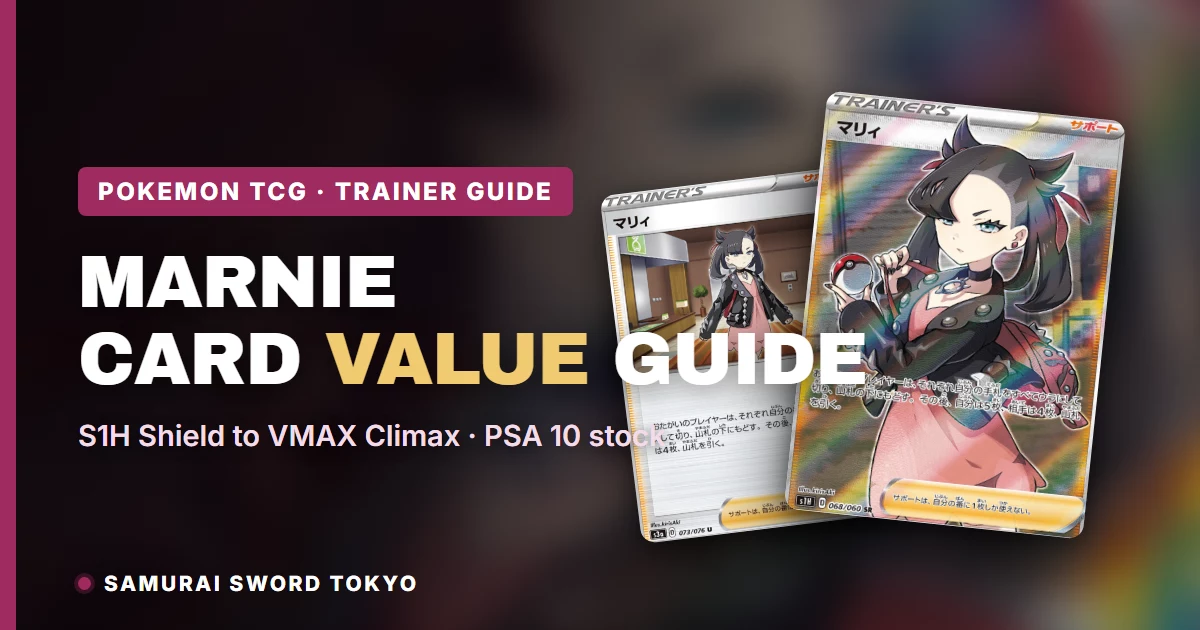
Search “Marnie” on a Japanese card marketplace and three different characters stare back at you — a Supporter card, a secret-slot deck exclusive, and a pair of 2025-era Pokemon cards that happen to share her name. They are not the same collectible, and mixing them up is one of the easiest mistakes to make when shopping for a Marnie trainer card.

This guide sorts all three families apart, walks the full printing history of the original Marnie Supporter card from its 2019 debut through 2021’s VMAX Climax reprint, and covers the newer Marnie’s Grimmsnarl ex and Marnie’s Morpeko cards from the 2025–26 “Trainer’s Pokemon” line. Store prices below are our own PSA 10 back-order terms as of September 24, 2026; marketplace figures are dated SNKRDUNK asks.

Key Takeaway

“Marnie” spans three separate card families — a Supporter, a secret Start Deck 100 print (“Marnie’s Pride”), and 2025’s Marnie’s Grimmsnarl ex / Marnie’s Morpeko Pokemon cards. The Shiny Star V SR (S4a 198/190) is offered as a PSA 10 back order at ¥26,291 (~$171), and the Marnie’s Grimmsnarl ex SAR (M2a 243/193) is offered the same way at ¥7,588 (~$49) — sourced to order, per the product page’s current terms.

Updated September 24, 2026
  • The Marnie’s Morpeko & Grimmsnarl ex starter set is sold out at the time of this update — restock requests go through Quick Order.
  • The Shiny Star V SR and the Grimmsnarl ex SAR, among other Marnie prints, are offered as a PSA 10 back order.
  • The lowest asking price on SNKRDUNK on September 24, 2026 was ¥11,999 (~$78) raw / ¥38,000 (~$247) PSA10 for the Shiny Star V SR (S4a 198/190), and ¥2,500 (~$16) raw / ¥10,300 (~$67) PSA10 for the Grimmsnarl ex SAR (M2a 243/193).
  • See the full Shiny Star V (S4a) card list for every card in the set.
11
Supporter Prints Cataloged

3
Card Families

Highest PSA 10 Back Order

2019–25
Years Covered

Store prices are PSA 10 back-order terms as of September 24, 2026; marketplace figures are dated SNKRDUNK asks. Back-order terms can change; the product page shows the current terms.

Three Different “Marnie” Cards — Don’t Mix Them Up

Before pricing anything, it’s worth separating what “Marnie” actually refers to, because three unrelated collectibles share the name:

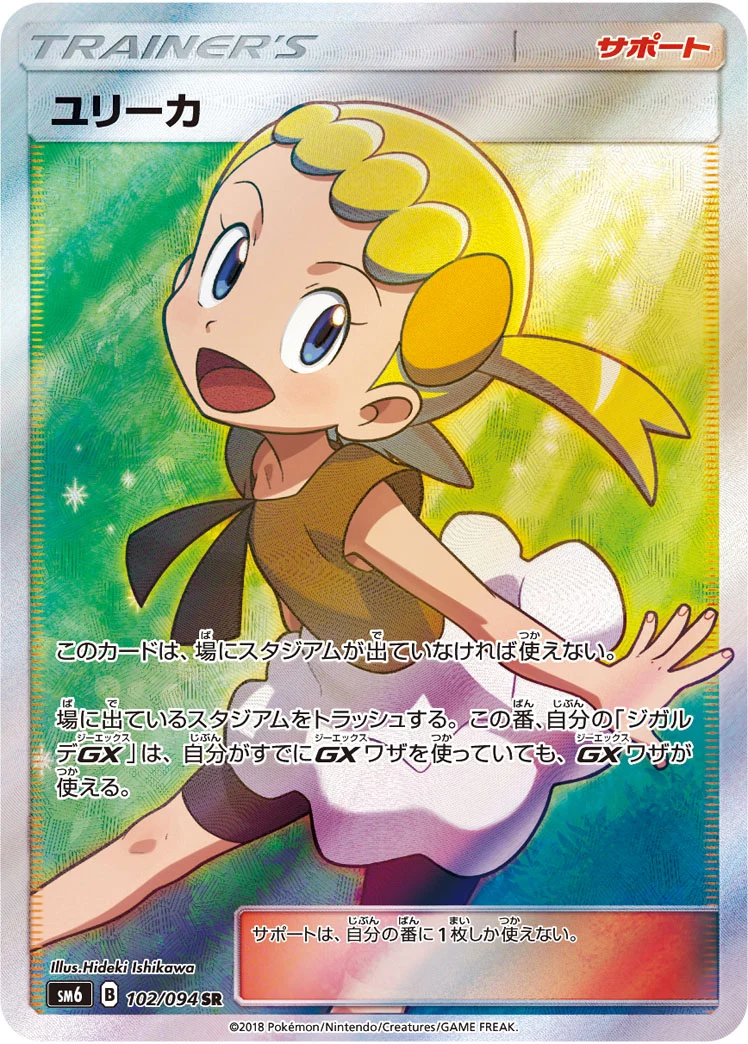
  • Marnie (マリィ) — a Supporter card from the Sword & Shield era (2019–2021). Effect: both players shuffle their hand into the deck, then you draw 5 cards while your opponent draws 4. This is the card most people mean when they say “Marnie.”
  • Marnie’s Pride (マリィのプライド) — a completely different Supporter card, found only as a secret-numbered pull in the Start Deck 100 product. It is not a reprint of the original Marnie.
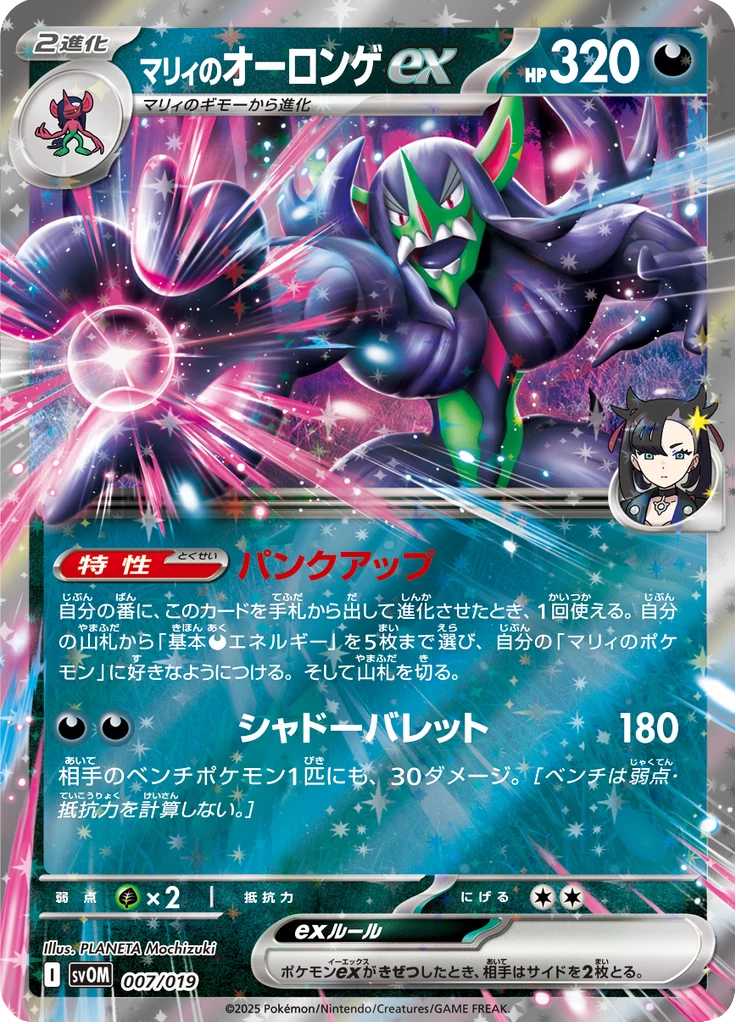
  • Marnie’s Pokemon (マリィのポケモン) — 2025–26 “Trainer’s Pokemon” cards: Marnie’s Grimmsnarl ex and Marnie’s Morpeko. These are Pokemon cards, not Supporters, and belong to an entirely separate modern sub-line.

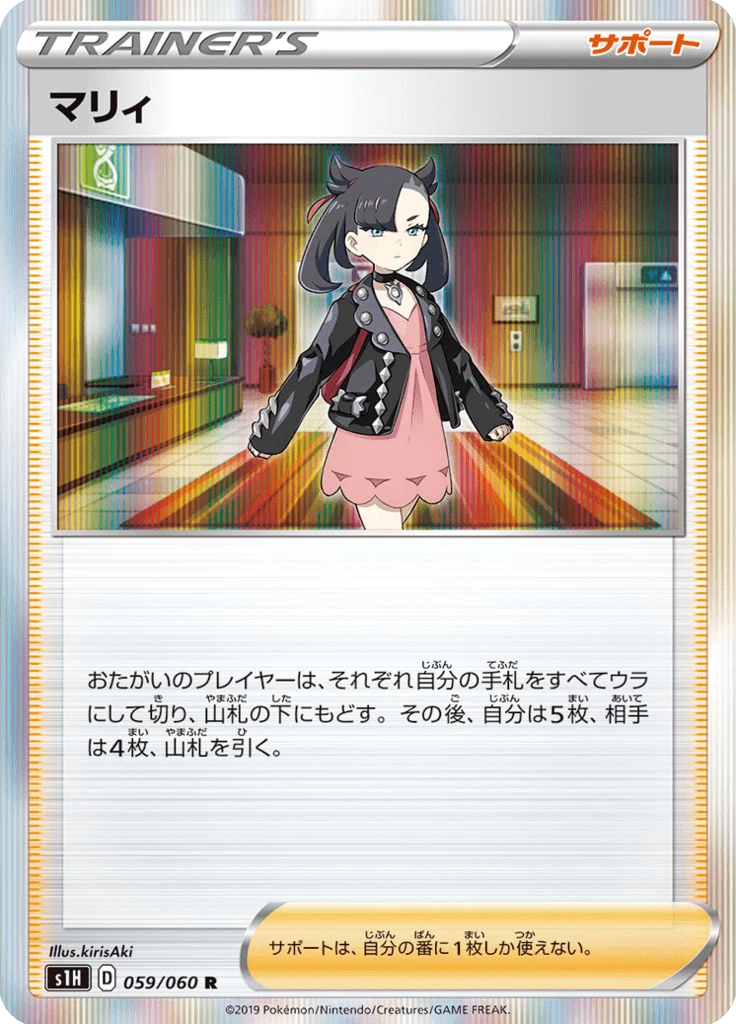
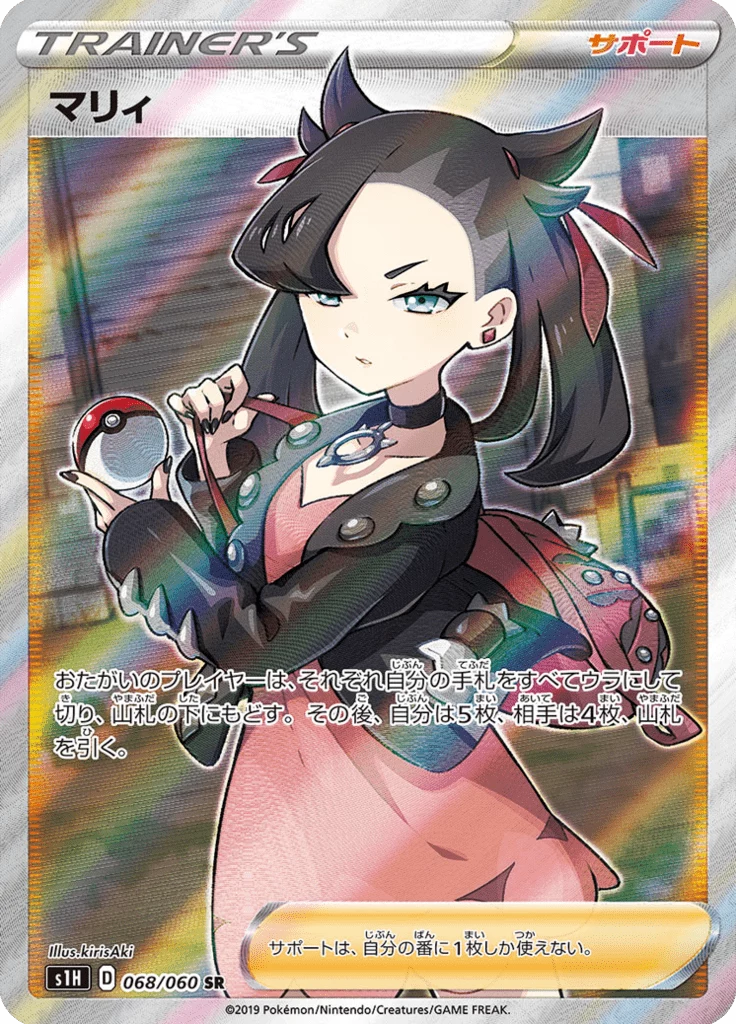
Within the original Supporter alone, three separate prints from the same 2019 set — 059/060 R, 068/060 SR, and 072/060 HR — look similar enough in a binder that they get confused constantly. None of the three is interchangeable with the others, and none of them is the same card as Marnie’s Pride or Marnie’s Pokemon. The sections below walk each family in order.

The Marnie Supporter Print Catalog

The original Marnie Supporter card was reprinted from 2019 through 2021 across five Japanese sets, plus standalone promos through 2022:

系列 Number Rarity Year
扩展包 “Shield” (S1H) 059/060 R 2019
Shield (S1H) 068/060 SR 2019
Shield (S1H) 072/060 HR 2019
V Starter Decks (various) 023/023, 024/024 Deck print —
Legendary Heartbeat (S3a) 073/076 U —
Shiny Star V (S4a) 177/190 Reprint 2020
Shiny Star V (S4a) 198/190 SR 2020
VMAX Climax (S8b) 160/184 Reprint 2021
Pokemon Card Gym promo 086/S-P Mirror holo 2020
Marnie’s Practice Trainer Card Collection 140/S-P Signed promo 2020
Extra Battle Day 340/S-P Non-holo 2022

Marnie appears in Shield (S1H) only — not its companion set Sword — and that single set produced three of the major documented prints, three different rarities of the same card. Both the 068/060 SR and the 072/060 HR are currently offered as a PSA 10 back order, at ¥78,558 (~$510) and ¥24,606 (~$160) respectively — sourced to order, per the product page’s current terms.
Marnie R, S1H 059/060, Shield

Marnie R (S1H 059/060)

Marnie SR, S1H 068/060, Shield

Marnie SR (S1H 068/060)

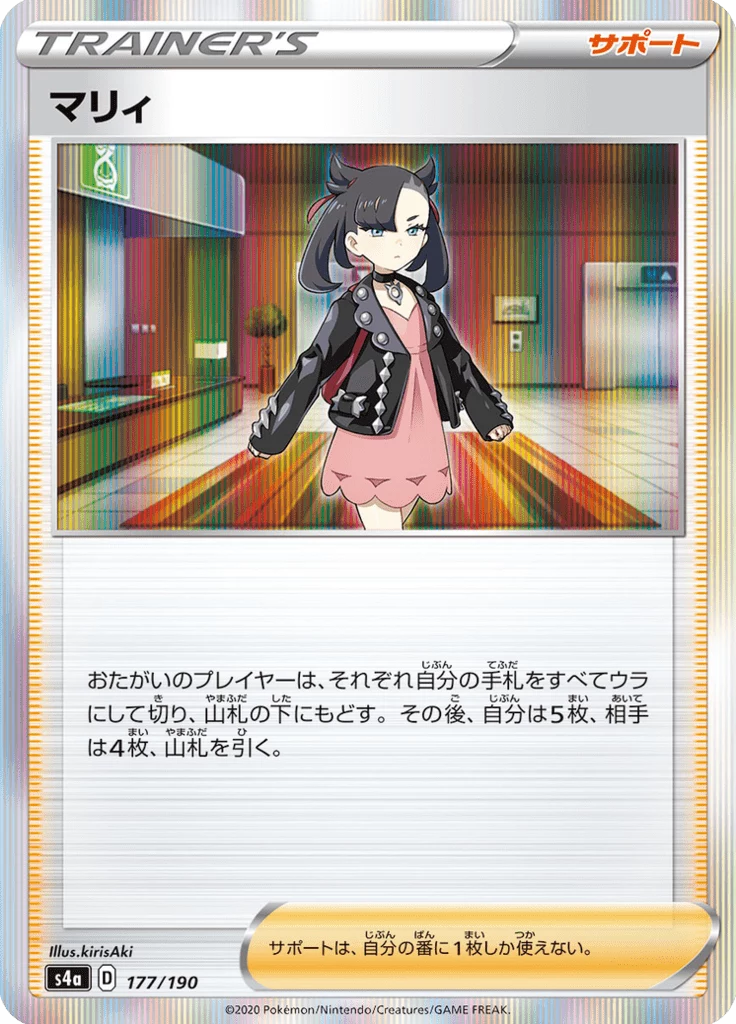
Marnie U, S3a 073/076, Legendary Heartbeat

Marnie (S3a 073/076)

Marnie, S4a 177/190, Shiny Star V

Marnie (S4a 177/190)

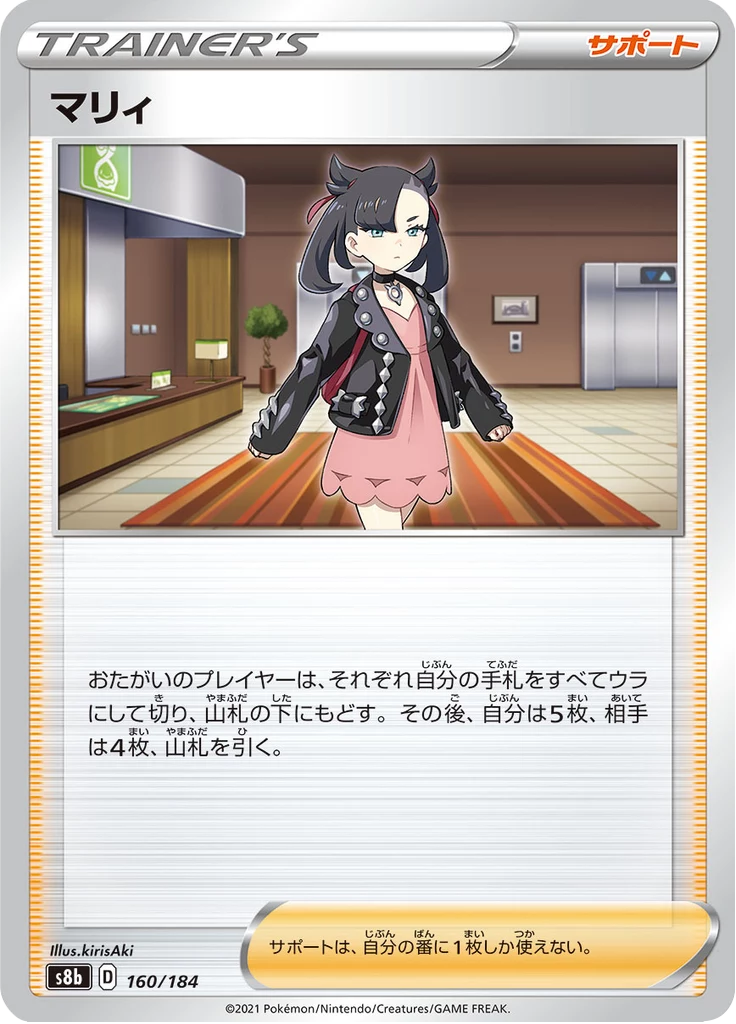
Marnie, S8b 160/184, VMAX Climax

Marnie (S8b 160/184)

Check This First

All three S1H prints share the same artwork in a standard card frame. Check the foil pattern and the number in the bottom-right corner — 059 (regular holo), 068 (secret rare foil), or 072 (hyper rare full-bleed) — since the SR and HR back-order terms are tens of thousands of yen apart.

The Chase Print: Shiny Star V SR (198/190)

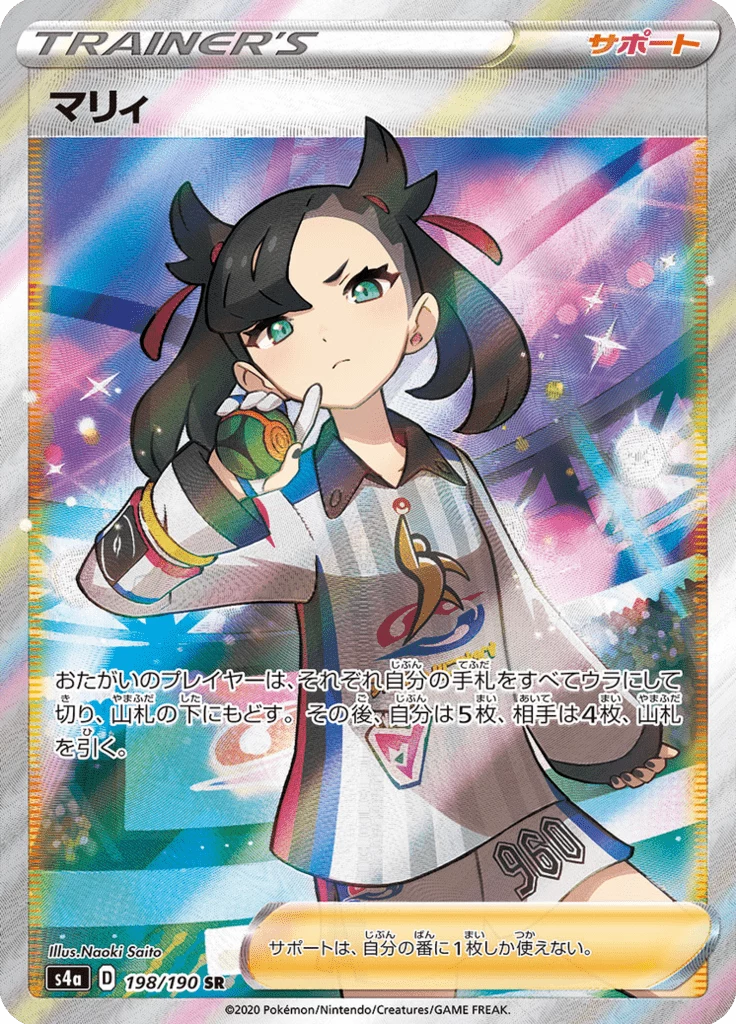
Marnie SR, S4a 198/190, Shiny Star V

Shiny Star V (S4a), released November 20, 2020, put Marnie in two slots: a straightforward 177/190 reprint of the standard artwork, and the 198/190 secret rare, an original illustration by Naoki Saito. The 198/190 is currently offered as a PSA 10 back order at ¥26,291 (~$171) — sourced to order, per the product page’s current terms. The lowest asking price on SNKRDUNK on September 24, 2026 for this print was ¥11,999 (~$78) raw / ¥38,000 (~$247) PSA10.
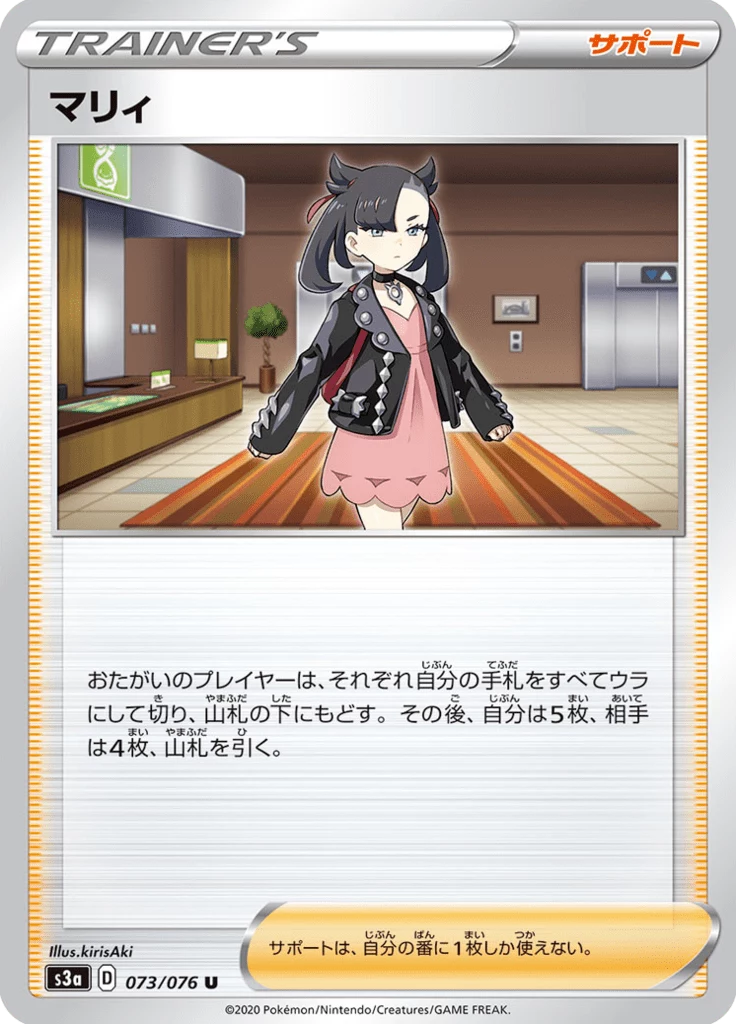
It’s a secret-rare slot rather than a reprint, so if your copy doesn’t match this artwork and number, it’s one of the other prints in the catalog above — not a lesser version of this one.

Featured Chase Card
PSA10 Marnie SR (S4a 198/190)
PSA 10 back order at ¥26,291 (~$171)
Ships from Tokyo

View Product →

The Promo Prints

Beyond the eight set printings, Marnie has appeared in at least three standalone S-P promos:

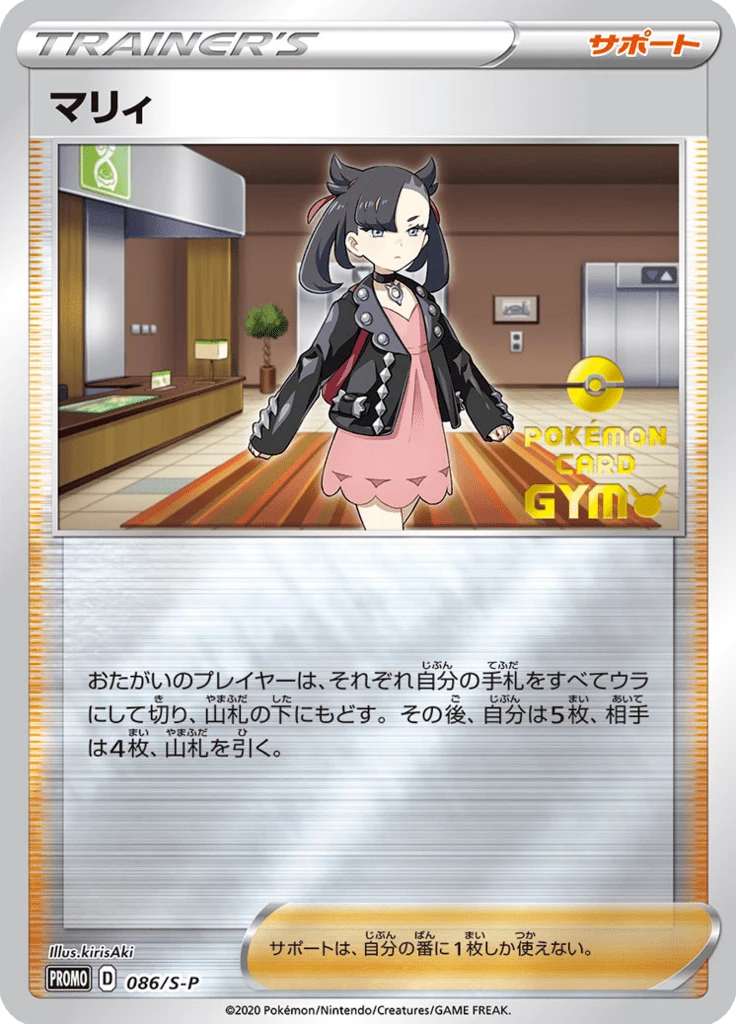
Marnie Promo, 086/S-P, Pokemon Card Gym Promo

Marnie Promo (086/S-P)

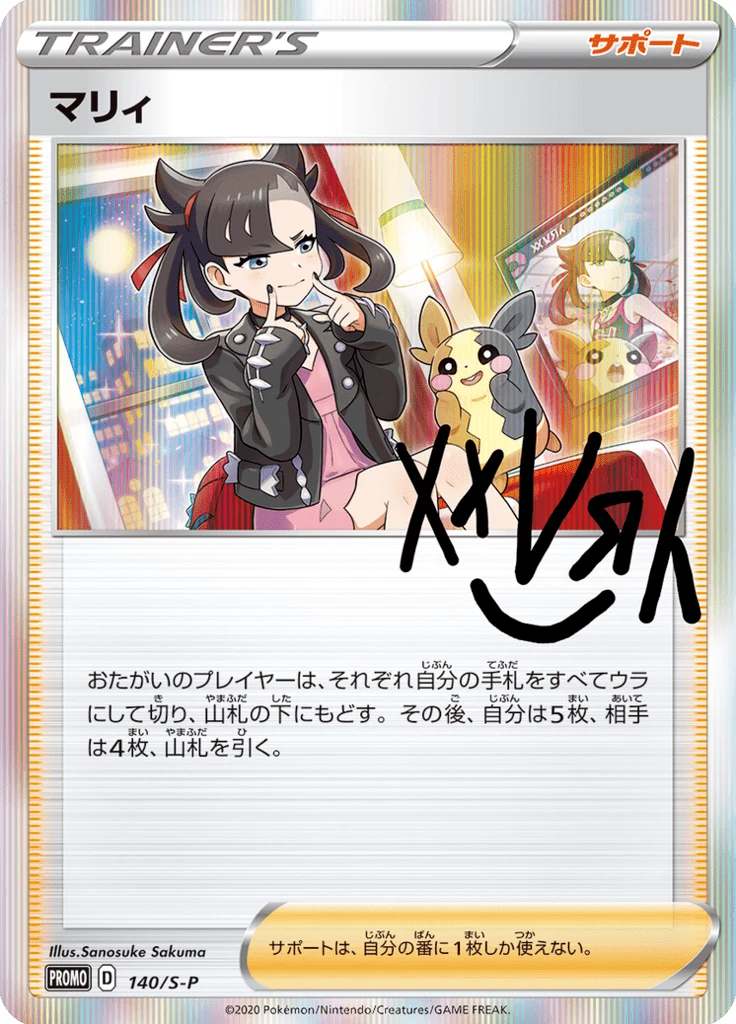
Marnie Promo, 140/S-P, Marnie's Practice Trainer Card Collection

Marnie Promo (140/S-P)

The 086/S-P is a mirror-holo promo handed out from April 3, 2020, with ¥1,500+ purchases during a Pokemon Card Gym store campaign. The 140/S-P is the centerpiece of a dedicated boxed product — “Marnie’s Practice Trainer Card Collection” (¥1,980 tax included, released November 20, 2020) — a signed promo illustrated by Sanosuke Sakuma, bundled with a card file and four booster packs. A third promo, 340/S-P, was distributed at Extra Battle Day events from December 16, 2022, as a non-holo card.

The 140/S-P and 086/S-P are offered as a PSA 10 back order — sourced to order, per the product page’s current terms: the 140/S-P at ¥34,715 (~$225) and the 086/S-P at ¥9,880 (~$64). We do not currently offer 340/S-P.

Marnie’s Pride: the Start Deck 100 Secret

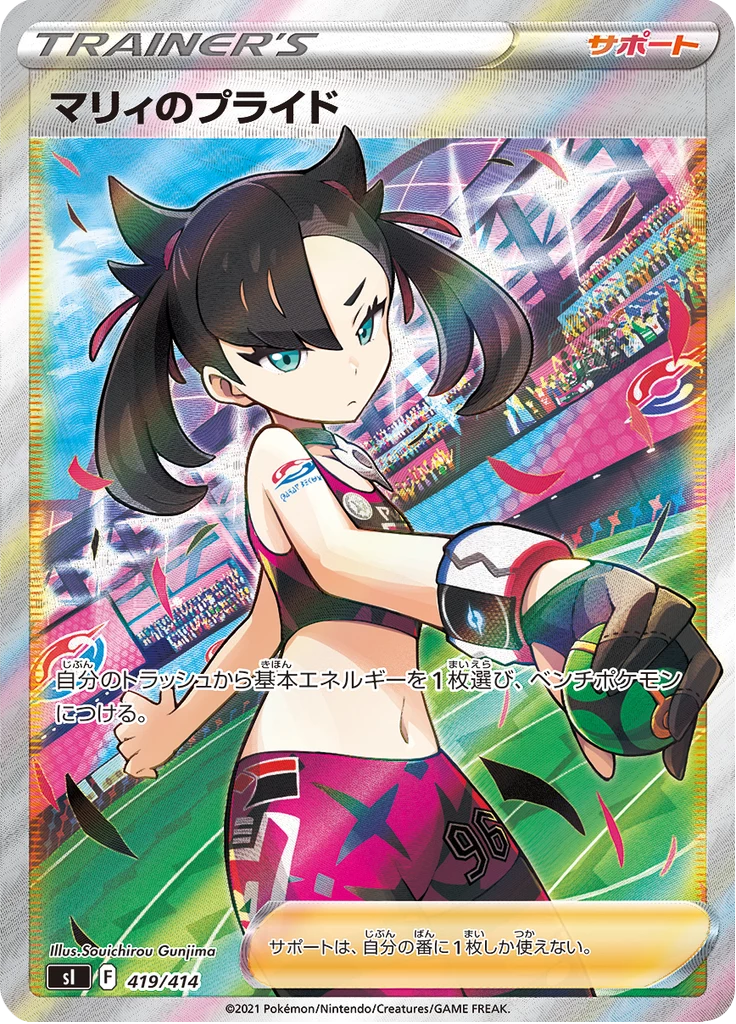
Marnie's Pride SR, SI 419/414, Start Deck 100
Marnie’s Pride SR, SI 419/414, Start Deck 100

Marnie’s Pride is a different card entirely, not a reprint of the original Marnie Supporter. It’s the SR secret slot — number 419, above the set’s 414-card main run — in Start Deck 100 (SI), released December 17, 2021. Start Deck 100 sells as a random 1-of-100 deck product, so pulling Marnie’s Pride specifically isn’t guaranteed by buying any single deck.

Marnie’s Pride PSA10 is currently offered as a PSA 10 back order at ¥27,435 (~$178) — sourced to order, per the product page’s current terms.
The 2025 Return: Marnie’s Grimmsnarl ex & Morpeko

Marnie’s name came back to the Pokemon card pool in 2025 — this time attached to actual Pokemon, not Supporter cards. The starter set “Marnie’s Morpeko & Grimmsnarl ex” released February 21, 2025 at ¥1,800 tax included: a 60-card constructed deck plus a coin, playmat, and other accessories, sold alongside a parallel Daigo’s Beldum & Metagross ex deck.

Marnie's Grimmsnarl ex, SVOM 007/019, Marnie's Morpeko & Grimmsnarl ex Starter Set

Marnie’s Grimmsnarl ex (SVOM 007/019)

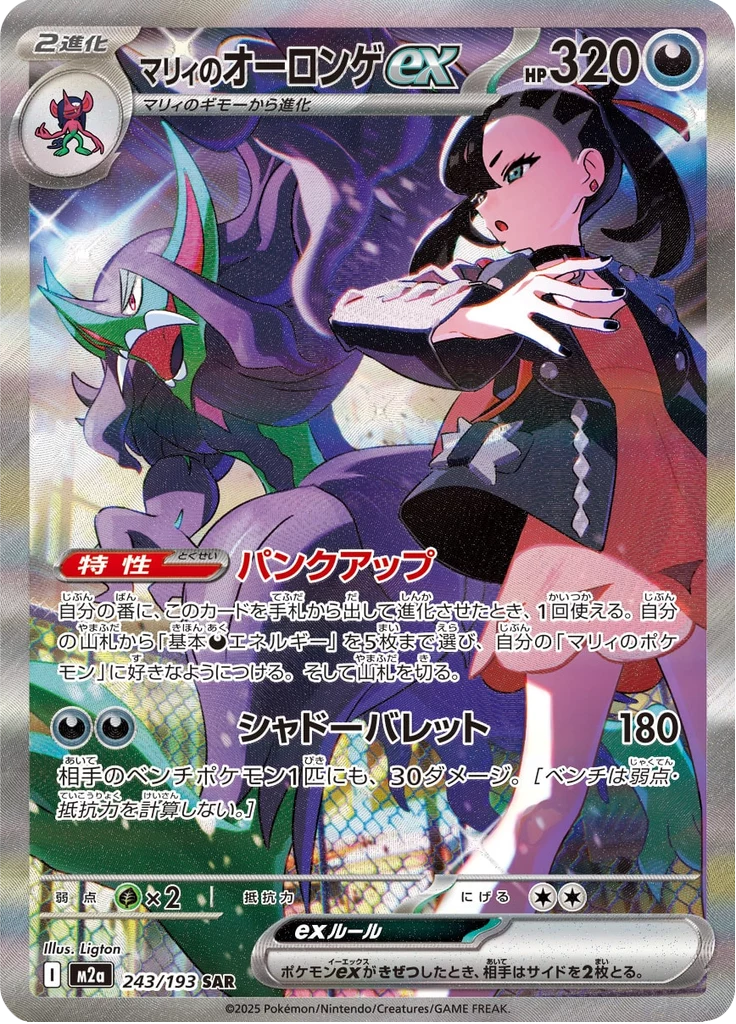
Marnie's Grimmsnarl ex SAR, M2a 243/193, Mega Dream ex

Marnie’s Grimmsnarl ex SAR (M2a 243/193)

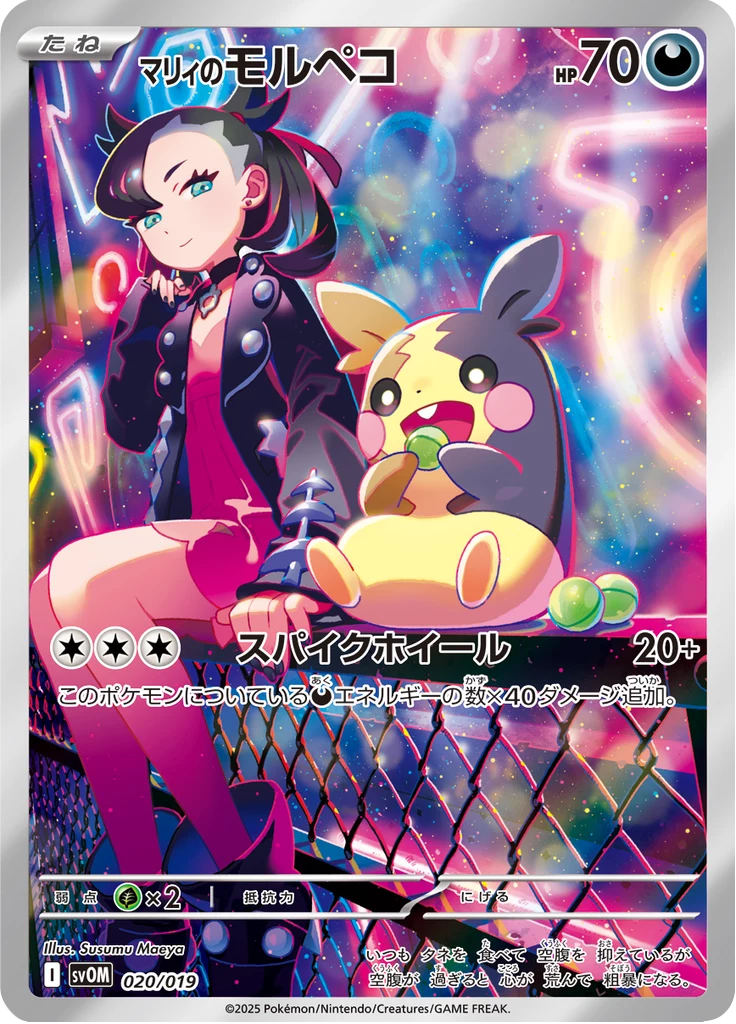
Marnie's Morpeko AR, SVOM 020/019, Marnie's Morpeko & Grimmsnarl ex Starter Set

Marnie’s Morpeko AR (SVOM 020/019)

Marnie’s Grimmsnarl ex has two Japanese prints: the deck-exclusive 007/019 from the starter set itself, and a second, higher-rarity version — the 243/193 Special Art Rare from Mega Dream ex (M2a), released November 28, 2025. The card is Darkness type with 320 HP, a Stage 2 evolving from Marnie’s Morgrem, with the ability Punk Up (search your deck for up to 5 Basic Darkness Energy and attach them to a Marnie’s Pokemon when it evolves from hand) and the attack Shadow Bullet (180 damage, plus 30 to a Benched Pokemon). The same artwork used for the M2a SAR is by illustrator Ligton.

Marnie’s Morpeko has two Japanese prints: the regular 008/019 deck print and the 020/019 AR — the secret card that sits above the deck’s main 19-card run.

The M2a SAR Grimmsnarl ex and the Morpeko AR are both currently offered as a PSA 10 back order — sourced to order, per the product page’s current terms: the Grimmsnarl ex SAR at ¥7,588 (~$49), and the Morpeko AR at ¥9,108 (~$59). The Marnie’s Morpeko & Grimmsnarl ex starter set (sealed) is sold out at the time of this update — sourcing requests go through Quick Order.

Which Marnie Card Fits Your Collection

Of the PSA 10 back orders we currently offer, here’s the lineup from lowest to highest price:

  • ¥7,588 (~$49) — Marnie’s Grimmsnarl ex SAR (M2a 243/193). The current top rarity for the 2025–26 Marnie’s Pokemon line, a 320 HP Stage 2 Darkness-type Grimmsnarl.
  • ¥9,108 (~$59) — Marnie’s Morpeko AR (SVOM 020/019). The secret card from the February 2025 starter deck.
  • ¥26,291 (~$171) — Marnie SR (S4a 198/190). The classic Supporter chase print, Naoki Saito’s Shiny Star V secret rare.
  • ¥78,558 (~$510) — Marnie SR (S1H 068/060). The original Shield secret rare, the priciest Marnie print we currently offer.
On Back-Order Terms

Each card above is sourced to order, not shipped from stock on hand. Check the live product page for the current terms before you check out — the prices above can move.

Who Is Marnie?

Marnie is one of the rival characters introduced in Pokemon Sword and Shield, alongside Hop and Bede. She’s from Spikemuth, a run-down corner of the Galar region, and her League Card describes her wanting to breathe life back into her hometown. She’s followed everywhere by her fan club, Team Yell — later revealed to be Spikemuth Gym’s own trainers in disguise.

Her Pokemon partner is Morpeko, given to her at age five by her older brother Piers, the original Spikemuth Gym Leader; it’s been by her side ever since, which may explain why Morpeko — not Grimmsnarl — got top billing in the 2025 starter set’s name. She also uses Grimmsnarl, which can Gigantamax in the games. After the player defeats Piers, Marnie takes over as Spikemuth’s Gym Leader, handing out the Dark Badge.

For PSA10 Japanese trainer cards beyond Marnie, see our PSA10 Japanese trainer cards guide.

Where to Buy Marnie Cards from Japan

Back-order cards ship from Tokyo; the product page shows the current terms. If you’re after the classic chase print, the Shiny Star V SR is the one to check first. USD figures convert at ¥154/USD, approximate.

For the full graded catalog beyond Marnie, browse our PSA10 card list, browse the Shiny Star V (S4a) card list for every card in that set, see our full art trainer cards guide for other Japanese SR/SAR Supporters, or use our Quick Order page to build a mixed order across singles and sealed product.

常见问题

Which Marnie card is our highest-value PSA 10 back order?

The Marnie SR from Shield (S1H 068/060), currently offered as a PSA 10 back order at ¥78,558 (~$510) — sourced to order, per the product page’s current terms.
What’s the difference between Marnie, Marnie’s Pride, and Marnie’s Pokemon?

Marnie is the original Supporter card (2019–2021). Marnie’s Pride is a separate Supporter card found only as a secret pull in Start Deck 100. Marnie’s Pokemon (Marnie’s Grimmsnarl ex and Marnie’s Morpeko) are actual Pokemon cards from a 2025 starter set — not Supporters, and not reprints of either earlier card.

How do I tell the three Shield (S1H) Marnie prints apart?

Check the number and foil pattern in the bottom-right corner: 059/060 is a regular holo Rare, 068/060 is a Secret Rare foil, and 072/060 is a Hyper Rare full-bleed print. All three share the same artwork but are priced very differently.

What is Marnie’s Grimmsnarl ex?

A Darkness-type, 320 HP Stage 2 Pokemon card from the 2025–26 Marnie’s Pokemon line. It has two Japanese prints: a deck-exclusive 007/019 from the starter set, and a Special Art Rare 243/193 from Mega Dream ex (M2a), currently offered as a PSA 10 back order at ¥7,588 (~$49).

Is the Marnie’s Morpeko & Grimmsnarl ex starter set still available?

The sealed starter set is sold out at the time of this update. Sourcing requests go through Quick Order; the individual Grimmsnarl ex SAR and Morpeko AR from the same era are currently offered as a PSA 10 back order.
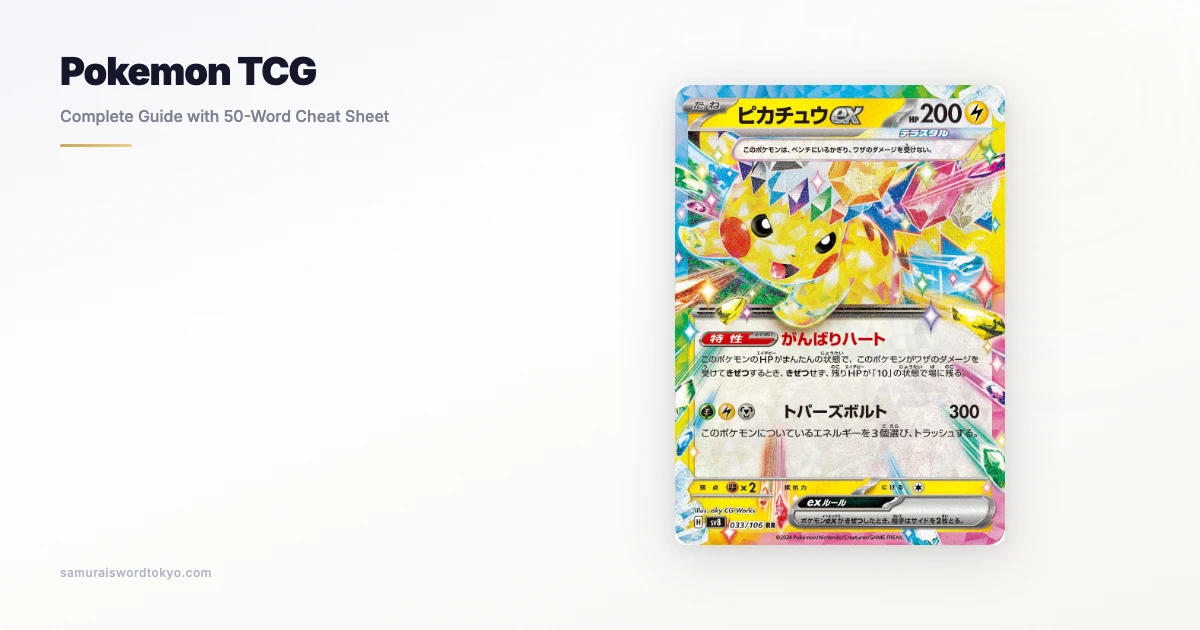
如何读懂日版宝可梦卡牌

Learning how to read Japanese Pokemon cards is easier than you think, and knowing how to identify Japanese Pokemon cards at a glance matters more than reading every word. You just opened a Japanese booster box — the art is stunning, the card quality feels premium — but you can’t read a single word on the cards, and Pokemon cards in Japanese can look intimidating the first time you sort a pull.

Good news: you don’t need to read Japanese to understand your cards. Over 70% of the information on a Japanese Pokemon card uses numbers, symbols, and icons that are identical to English versions. The layout is the same. The energy symbols are the same. The damage numbers are the same.

This guide gives you everything you need to decode any Japanese Pokemon card in seconds. We cover the full card layout, all rarity symbols (including the MEGA-era MUR and the new Futuristic Rare, FUR, from M6a 30th CELEBRATION), a 50-word Japanese-English cheat sheet you can reference while sorting your pulls, and the best translation tools for card text.

These are the methods we recommend to first-time Japanese card buyers.

Key Takeaway

You don’t need to read Japanese to understand your cards. Over 70% of the information uses universal numbers, symbols, and icons. This guide covers every card zone, all rarity symbols, and a 50-word cheat sheet.

Updated September 24, 2026
  • Standard format is still regulation marks H, I, and J (G rotated out on January 23, 2026).
  • M6a 30th CELEBRATION released worldwide on September 16, 2026, confirming the new FUR (Futuristic Rare) rarity at ¥360 per 6-card pack / ¥7,200 per box.
  • Our M6 Storm Emeralda booster box is currently listed at ¥12,100 for the Sealed option (~$79) or ¥10,560 for the No Shrink option (~$69).
70%+
Readable Without Japanese

50
Essential TCG Terms

11
Rarity Types (C to FUR)

3
Translation Tools

USD figures convert at ¥154/USD, approximate.

Japanese Pokemon Card Layout — What Each Part Means

A Japanese Pokemon card has the exact same layout as an English card. If you hold them side by side, every element is in the same position. The only difference is the language of the text.

Here’s what each zone on the card contains:

The Name Zone (Top Left)

The Pokemon’s name appears at the top left, written in katakana (angular Japanese characters). Next to the name, you’ll see:

  • Evolution stage: たね (Basic), 1進化 (Stage 1), 2進化 (Stage 2)
  • ex badge: If the card is a Pokemon ex, “ex” appears in the same style as English cards
  • Tera icon: Terastal Pokemon show a crystal icon, identical to English versions
  • Mega ex (メガシンカex): MEGA-era cards (from August 1, 2025) add a Mega Evolution ex. It counts as a Pokemon ex, carries higher HP and stronger attacks, and your opponent takes 3 Prize cards when it is Knocked Out

You don’t need to read the katakana name to identify the Pokemon — the artwork and Pokedex number in the set info tell you exactly which Pokemon it is.

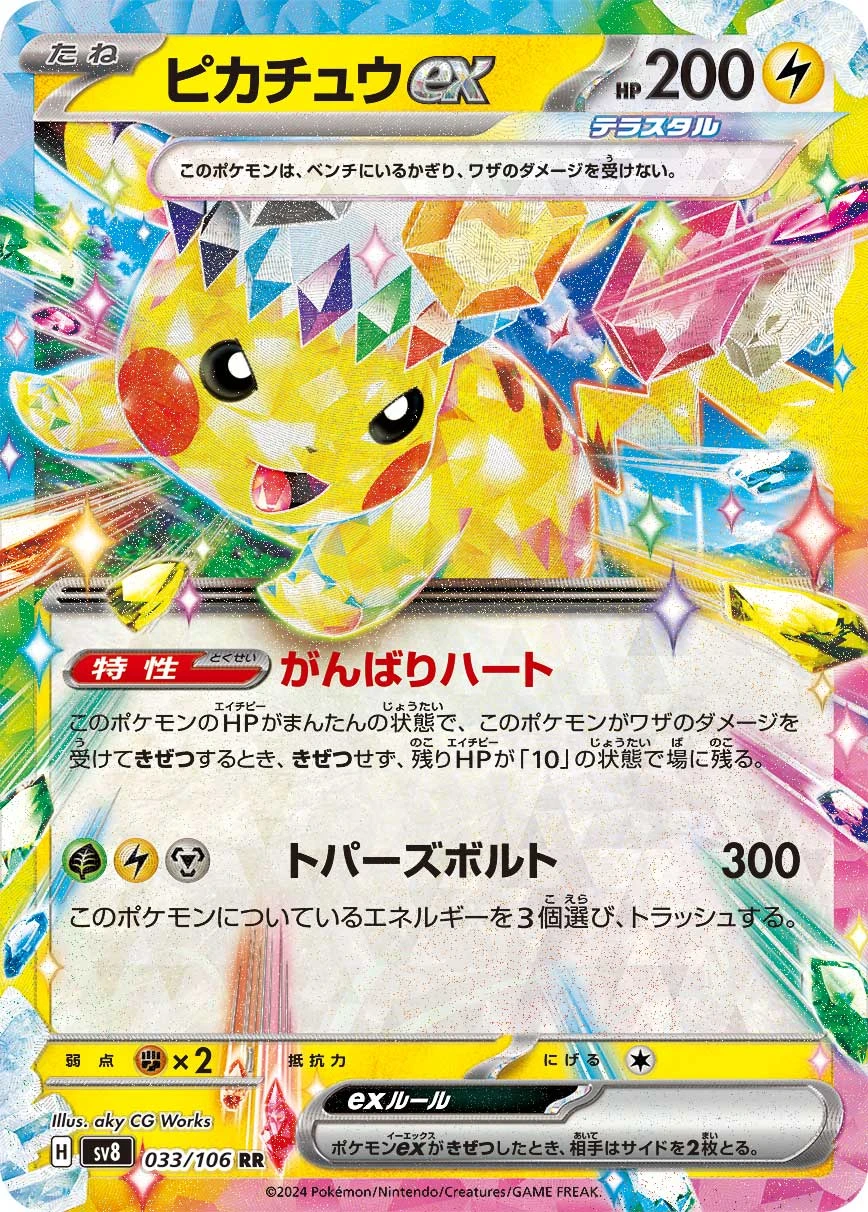
Japanese Pikachu ex Pokemon card from Super Electric Breaker set highlighting the name zone and ex badge
Japanese Pikachu ex card from Super Electric Breaker showing name zone and ex badge

HP, Type & Weakness Zone

These elements are 100% identical to English cards:

  • HP: Same number, same position (top right)
  • Type icon: Fire, Water, Grass — same color-coded energy symbol
  • Weakness: Bottom left, shows an energy type × 2
  • Resistance: Next to weakness, shows an energy type − 30
  • Retreat cost: Bottom center, shown as colorless energy icons

No Japanese reading required for any of these.

Pro Tip

Hold a Japanese card next to its English equivalent. You’ll see every element — HP, type icon, weakness, retreat cost — is in the exact same position. The layout is universal.

Attack Zone — Reading Damage & Energy Costs

Close-up of Japanese Pokemon card attack zone showing energy symbols and damage numbers
Close-up of Japanese Pokemon card attack zone with energy costs and damage numbers highlighted

The attack section sits in the middle of the card. Here’s how to read it without knowing Japanese:

  • Energy cost: The colored circles on the left side of each attack are universal energy symbols — Fire, Water, Lightning, Psychic, Fighting, Darkness, Metal, Dragon, Colorless. Count them exactly as you would on an English card
  • Damage number: On the right side of each attack. “120” means 120 damage in any language
  • Effect text: The Japanese text between the attack name and damage describes the effect. This is the only part that requires translation (covered in the Translation Tools section below)

The attack name itself appears in Japanese, but the mechanical information — energy cost, damage output — is fully readable without translation.

Understanding Japanese Text on Pokemon Cards

Japanese uses three writing systems, and all three appear on Pokemon cards. Knowing which system is used where helps you navigate the card faster.

Katakana = Pokemon Names

Katakana (カタカナ) characters are angular and sharp. On Pokemon cards, they’re used for:

  • Pokemon names: ピカチュウ (Pikachu), リザードン (Charizard), ミュウ (Mew)
  • Foreign loanwords in card effects: ダメージ (Damage), エネルギー (Energy), ベンチ (Bench)

If you see angular text at the top of the card, that’s the Pokemon’s name in katakana.

Three Writing Systems at a Glance

Katakana (angular) = Pokemon names & foreign words
Hiragana (rounded) = Rules & card effects
Kanji (complex) = Attack names & game terms

Hiragana & Kanji = Rules and Attacks

Hiragana (ひらがな) characters are rounded and flowing. They appear in:

  • Attack descriptions and card effects
  • Rule text (e.g., special conditions)
  • Small text above kanji (called furigana) that shows pronunciation

Kanji (漢字) are complex Chinese-origin characters used for:

  • Attack names: 炎のうず (Flame Vortex), 雷撃 (Thunder Strike)
  • Ability names and game terms
Collectors: Skip the Text

If you’re collecting (not playing), you don’t need to read hiragana or kanji at all. Card value is determined by rarity, artwork, and Pokemon identity — not by what the attack text says.

Numbers & Symbols Are Universal

Here’s the most important thing to remember: numbers and symbols on Japanese Pokemon cards are identical to English cards. This includes:

Universal (No Translation) Japanese Only (Translation Helpful)
HP values Pokemon name (top left)
Damage numbers Attack name text
Energy symbols Attack effect description
Retreat cost icons Ability name & text
Weakness / resistance Trainer card effects
Set numbers (bottom left) Rule box text

This means you can evaluate a card’s battle stats without reading a single Japanese character.

How to Identify Card Rarity at a Glance

Chart showing all Japanese Pokemon card rarity symbols from Common to MUR with visual examples
Japanese Pokemon card rarity symbols comparison — Common through MUR with visual examples

Identifying rarity is the most important skill for collectors. Japanese cards use a symbol system in the bottom-left corner that tells you exactly how rare a card is.

Rarity Symbols Explained (C → MUR)

Symbol Rarity Name Value Tier (relative) Visual Cue
◇ C Common 批量 Plain card, no holo
◇◇ U Uncommon 批量 Plain card, no holo
★ R Rare Low Slight holo or plain
★★ RR Double Rare Low to mid Full holo pattern (Pokemon ex)
— RRR Triple Rare Low to mid Full holo, used for selected ex cards
★★★ SR Super Rare Mid to high Textured holo, alternate art
— AR Art Rare Low to mid Full-art illustration, unique art style
— SAR Special Art Rare High Premium texture, full illustration
— UR Ultra Rare Mid to high Gold card or rainbow holo
— MUR MEGA Ultra Rare Highest (MEGA era) Premium texture, secret-numbered (e.g., M6 113/076)
— FUR Futuristic Rare New (from Sep 16, 2026) M6a 30th CELEBRATION only: Mew ex / Mewtwo ex by YOSHIROTTEN

Value tiers above are relative only; market prices change constantly, so check a dated price source before buying or selling. Cards from SR and above typically have a different card texture you can feel with your fingers — embossed patterns, raised ink, or premium holo foil.

Japanese Special Art Rare Pokemon card showing premium embossed texture detail
Japanese SAR card showing premium texture and embossed pattern

Set Numbers — The Universal Decoder

Every Japanese Pokemon card has a set number in the bottom-left corner formatted as:

XXX / YYY (e.g., 052/073)

  • XXX = this card’s number in the set
  • YYY = total number of regular cards in the set

Here’s the key trick: if XXX is higher than YYY, you have a Secret Rare. For example, a card numbered 081/073 means it’s one of the secret rares that go beyond the standard set — these are typically SR, SAR, UR, or MUR cards (in M6 Storm Emeralda, the Mega Rayquaza ex MUR is numbered 113/076).

Secret Rare Check

Card number > Set total = Secret Rare. Example: 081/073 = a card beyond the standard set — always check the bottom-left corner.

MEGA Era New Rarities (2025–2026)

The current MEGA era started on August 1, 2025 with Mega Brave (M1L) and Mega Symphonia (M1S), followed by Inferno X (M2, September 26, 2025) and the 高级包 Mega Dream ex (M2a, November 28, 2025). In 2026 the line continued with M3 Munkith Zero (January 23), M4 Ninja Spinner (March 13), M5 Abyss Eye (May 22), M6 Storm Emeralda (July 31), and M6a 30th CELEBRATION (September 16, released worldwide). The era brings two rarities you won’t find in SV-era sets:

  • MUR (MEGA Ultra Rare): The top rarity in MEGA-era sets. Premium textured full-art cards of Mega Evolution ex Pokemon, always secret-numbered above the set total (e.g., M6 113/076 Mega Rayquaza ex, M4 120/083, M5 118/081, M2a 250/193)
  • FUR (Futuristic Rare): Debuted in M6a 30th CELEBRATION, released worldwide September 16, 2026 (¥360 per 6-card pack, ¥7,200 per 20-pack box). The first FUR cards are Mew ex and Mewtwo ex illustrated by YOSHIROTTEN. Note that the 30th-anniversary reprints in this set are not Standard-legal

The rest of the ladder — C, U, R, RR, RRR, AR, SR, SAR, and UR — carries over from the SV era. If you’re opening MEGA-era boxes (Mega Brave, Mega Symphonia, Mega Dream ex, Storm Emeralda, etc.), look for the MUR marking on secret-numbered cards. For a deeper breakdown of each rarity tier, see our Japanese Pokemon card rarities explained guide.

Shop This Set
M6 Storm Emeralda Booster Box (Japanese)
Sealed currently listed at ¥12,100 (~$79) / No Shrink ¥10,560 (~$69)
Ships from Tokyo

View Product →

Essential Japanese TCG Vocabulary — 50-Word Cheat Sheet

These 50 terms cover over 90% of the Japanese text you’ll encounter on Pokemon cards.

卡牌类型 & Game Zones

日语 Romaji English Where You’ll See It
ポケモン Pokemon Pokemon Card type
トレーナーズ Toreinazu Trainers Card type label
グッズ Guzzu 商品 Trainer subtype
サポート Sapooto Supporter Trainer subtype
スタジアム Sutajiamu Stadium Trainer subtype
エネルギー Enerugii Energy Card type
たね Tane Basic Evolution stage
1進化 1-Shinka Stage 1 Evolution stage
2進化 2-Shinka Stage 2 Evolution stage
バトル場 Batoru-ba Active Spot Game zone
ベンチ Benchi Bench Game zone
手札 Tefuda Hand Game zone
山札 Yamafuda Deck Game zone
トラッシュ Torasshu Discard Pile Game zone
きぜつ Kizetsu Knocked Out Game state

Attacks, Abilities & Effects

日语 Romaji English Where You’ll See It
ワザ Waza Attack / Move Attack section
特性 Tokusei Ability Above attacks
ダメージ Dameeji Damage Attack description
にげる Nigeru Retreat Bottom of card
弱点 Jakuten Weakness Bottom left
抵抗力 Teikou-ryoku Resistance Bottom area
HP HP Hit Points Top right
エネ Ene Energy (short) Attack costs
きぜつする Kizetsu-suru Is Knocked Out Card effects
ダメカン Damekan Damage Counter Card effects
つける Tsukeru Attach Card effects
はがす Hagasu Remove/Detach Card effects
もどす Modosu Return (to deck/hand) Card effects
選ぶ Erabu Choose Card effects
引く Hiku Draw Card effects

Common Phrases on Trainer Cards

日语 Romaji English Where You’ll See It
〜を引く ~wo Hiku Draw ~ Supporter effects
〜を選ぶ ~wo Erabu Choose ~ Item effects
〜を出す ~wo Dasu Put ~ (into play) Effects
〜をトラッシュする ~wo Torasshu-suru Discard ~ Effects
〜までもどす ~made Modosu Return ~ to Effects
〜をつける ~wo Tsukeru Attach ~ Energy effects
自分の Jibun-no Your / Your own Card effects
相手の Aite-no Your opponent’s Card effects
このポケモン Kono Pokemon This Pokemon Card effects
次の番 Tsugi-no-ban Next turn Card effects
〜枚 ~mai ~ card(s) (counter) Card effects
〜回 ~kai ~ time(s) (counter) Card effects
コイン Koin Coin Coin flip effects
オモテ Omote Heads Coin flip results
ウラ Ura Tails Coin flip results
使う Tsukau Use / Play Card effects
のぞく Nozoku Look at (peek) Card effects
入れ替える Irekaeru Switch Card effects
回復 Kaifuku Heal / Recover Card effects
番 Ban Turn Game flow

Bookmark this table or print it out. Having it next to you while sorting pulls from a Japanese box makes identification significantly faster.

Quick Reference

The 15 terms in “卡牌类型 & Game Zones” are enough to identify any card’s basic function. Start with those, then learn the attack keywords as needed.

Japanese Pokemon Set Symbols, Regulation Marks & Set Codes

Regulation mark and set code location on a Japanese Pokemon card bottom-left corner
Close-up of regulation mark and set code on a Japanese Pokemon card bottom corner

Every Japanese Pokemon card from the Sword & Shield era onward has a small letter in the bottom-left corner — this is the regulation mark. It determines which cards are legal in the current Standard format.

Current Standard Format (2026)

Since January 23, 2026, the Standard format in Japan uses cards with regulation marks H, I, and J (official regulation page, updated January 22, 2026):

Regulation Mark Standard Status (September 24, 2026) How to Check
H Legal Printed on many Scarlet & Violet-era cards; read the letter on each card
I Legal Printed on later SV-era and some MEGA-era cards; the mark can differ between cards in the same set
J Legal The newest mark, used on MEGA-era prints (M-prefix set codes)

Cards with marks D, E, F, or G have rotated out of Standard (G was the latest to leave, on January 23, 2026) and are only legal in Expanded format. If you’re building a competitive Japanese deck, check the regulation mark before including a card.

Collectors vs Players

For collectors, the regulation mark doesn’t affect a card’s value — a PSA 10 Charizard is valuable regardless of its format legality. Only check regulation marks if you’re building a competitive deck.

How to Find the Set Code

The set code appears at the bottom of the card, near the regulation mark. Japanese set codes follow this format:

sv8a – 001 / 072

  • sv8a: Set identifier (sv = Scarlet & Violet era, 8a = specific set)
  • 001: Card number within the set
  • 072: Total regular cards in the set

For MEGA-era cards, the prefix changes to an uppercase M — M1L is Mega Brave, M1S is Mega Symphonia, M2a is the Mega Dream ex 高级包, and M6 is Storm Emeralda (an M6 MUR reads 113/076). Knowing the set code lets you instantly look up any card in online databases like Limitless TCG or Bulbapedia, or browse our own Japanese card list by set code once you know which one you’re holding.

Set Code Quick Decode

sv = Scarlet & Violet era | M = MEGA era | s12a = Sword & Shield HCP
Number after prefix = set number within that era. M1L and M1S are the paired Mega Brave / Mega Symphonia release; s12a is a Sword & Shield 高级包.

Trainer, Supporter & Item Cards — How to Tell Them Apart

Comparison of Japanese Item, Supporter, and Stadium trainer cards showing different layout indicators
Three Japanese trainer card types showing Item, Supporter, and Stadium visual differences

Trainer cards in the Japanese TCG fall into three subtypes, and each one has a distinct visual indicator:

Visual Indicators

Card Type Japanese Label Icon/Visual Cue Play Rules
グッズ (Item) グッズ Wrench/tool icon Play as many as you want per turn
サポート (Supporter) サポート Person silhouette icon Only one per turn
スタジアム (Stadium) スタジアム Building icon Stays in play, one at a time

The card type label appears at the top of the card, just below the card name. Even without reading the Japanese text, the icon next to the label tells you which type it is.

10 Most Common Trainer Cards You’ll See

Japanese Name English Name Type Quick Effect
ネストボール Nest Ball 商品 Search deck for Basic Pokemon
ハイパーボール Ultra Ball 商品 Discard 2, search for any Pokemon
ナンジャモ Iono Supporter Both players shuffle hand, draw based on prizes
博士の研究 Professor’s Research Supporter Discard hand, draw 7
ボスの指令 Boss’s Orders Supporter Switch opponent’s Active Pokemon
ふしぎなアメ Rare Candy 商品 Evolve Basic directly to Stage 2
すごいつりざお Super Rod 商品 Return 3 Pokemon/Energy from discard
ポケモンいれかえ Switch 商品 Switch your Active Pokemon
エネルギー回収 Energy Retrieval 商品 Return 2 Energy from discard
夜のタンカ Night Stretcher 商品 Return 1 Pokemon from discard to hand

If you see these cards in your pulls, you’ll recognize them by name after opening a few boxes.

Translation Tools That Actually Work

Limitless TCG card database search showing Japanese to English card translation
Limitless TCG card database interface showing Japanese card with English translation

When you need to know the exact effect of a Japanese card, try these three tools.

Limitless TCG Card Database

Limitless TCG is a database used by competitive players. Search by set number (e.g., “sv8a 001”) and get the full English translation of any Japanese card, including attacks, abilities, and trainer effects.

Google Translate Camera Mode

Open Google Translate on your phone, select Japanese → English, and point your camera at the card. The live translation overlay works surprisingly well for Pokemon cards because the text is printed clearly. Accuracy isn’t perfect for complex effects, but it handles 80% of card text correctly.

Bulbapedia & PokeGuardian

Bulbapedia has every Pokemon card ever printed with full English text. Search by the Pokemon’s English name plus the set name. PokeGuardian specializes in Japanese set translations and often publishes English translations before sets release internationally.

Translation Workflow

Note the set code from the bottom of your card → Search it on Limitless TCG → Read the full English text in seconds.

Common Mistakes When Reading Japanese Cards

These are three common mistakes when reading Japanese cards.

Confusing Similar-Looking Katakana

Several katakana characters look almost identical:

Pair Characters How to Tell Apart
shi / tsu シ / ツ シ (shi) strokes go bottom-left to top-right; ツ (tsu) strokes go top-left to bottom-right
so / n ソ / ン ソ (so) strokes go down; ン (n) strokes go up
u / wa ウ / ワ ウ (u) has a top horizontal stroke; ワ (wa) doesn’t

This matters when you’re trying to search for a card online by its Japanese name. Misreading one character can lead to a completely different search result.

Japanese Pokemon sealed booster box with shrink wrap showing authentic packaging
Japanese Pokemon booster box showing shrink wrap and box contents

Missing Secret Rares in Your Box

New collectors sometimes sort through their pulls quickly and miss Secret Rares because they don’t check set numbers. Always look at the bottom-left corner: if the card number exceeds the set total (e.g., 081/073), you’ve pulled something special. These cards often have premium textures, but some Secret Rares look similar to regular holos at first glance.

Assuming You Need to Read Everything

For collectors, you need to read exactly zero Japanese to enjoy and evaluate your cards. The card’s value is determined by:

  1. Rarity symbol (bottom-left corner)
  2. Set number (Secret Rare check)
  3. Artwork and Pokemon identity (visual)
  4. Card texture (feel it — premium cards have embossed patterns)

The Japanese text describes game effects. Unless you’re playing competitively with Japanese cards, you can skip it entirely.

Ready to Open Your First Japanese Box?

Now that you can read any Japanese Pokemon card, the next step is getting your hands on some.

Best Boxes for New Japanese Card Collectors

Here are the boxes we recommend for collectors who are new to Japanese cards (as of September 24, 2026):

  • M6 Storm Emeralda (M6) — A MEGA-era set released July 31, 2026 (¥200 per 5-card pack, ¥6,000 box MSRP). Home of the Mega Rayquaza ex MUR (113/076). Our M6 Storm Emeralda booster box is currently listed at ¥12,100 for the Sealed option (~$79) or ¥10,560 for the No Shrink option (~$69)
  • Terastal Festival ex (sv8a) — The Eeveelution SAR collection is a popular introduction to Japanese card art quality, and sv8a is the set code you’ll see quoted most often in guides
  • Battle Partners (sv9) — An SV-era set known for the Lillie’s Clefairy ex SAR. No longer the newest release, but still a well-known SV-era box for learning the sv-prefix layout
  • Mega Dream ex (M2a) — The MEGA-era 高级包 (November 28, 2025) with the MUR rarity (250/193). A dense way to study MEGA-era card layouts

M6a 30th CELEBRATION also released worldwide on September 16, 2026, adding the new FUR rarity and 30 Pikachu cards to the lineup.

Three recommended Japanese Pokemon booster boxes for beginners: Terastal Festival EX, Battle Partners, and Mega Dream EX
Japanese Pokemon booster boxes from Terastal Festival EX, Battle Partners, and Mega Dream EX

Why Buy from Samurai Sword CO.,LTD.

Boxes ship from Tokyo; the product page names the Sealed or No Shrink option you are buying, sourced in Japan.

常见问题

Can you play with Japanese Pokemon cards in English tournaments?

In most official Play! Pokemon tournaments, cards must be in the local language — so Japanese cards aren’t allowed in English-language events. However, many local leagues and casual play groups allow Japanese cards as long as you can provide an English reference (a printed translation or the Limitless TCG database on your phone). Always check with your tournament organizer before registering with a Japanese deck.

Are Japanese Pokemon cards worth more than English?

Prices differ by card and change often — compare dated asks for the exact printing before buying, especially for high-rarity cards like SARs and MURs. Japanese sets also release months before English versions.

How do you tell if a Japanese Pokemon card is rare?

Check three things: (1) The rarity symbol in the bottom-left corner — stars and special marks indicate higher rarity. (2) The set number — if it exceeds the set total (e.g., 081/073), it’s a Secret Rare. (3) The card texture — premium rares have embossed patterns, raised ink, or unique holo foil you can feel with your fingers.

What do the numbers on the bottom of Japanese Pokemon cards mean?

The numbers follow the format XXX/YYY where XXX is the card’s number in the set and YYY is the total regular cards. Cards numbered beyond the total are Secret Rares. You’ll also see the set code (like “sv8a” or “M2a”), the regulation mark letter, and the illustrator’s name.

Do Japanese Pokemon cards have different pull rates?

Japanese boxes follow a set-by-set rarity structure that differs from English boxes. MEGA-era boxes such as M5 Abyss Eye and M6 Storm Emeralda contain 30 packs of 5 cards (¥200 per pack, ¥6,000 per box MSRP), while M6a 30th CELEBRATION changes to 20 packs of 6 cards (¥360 per pack, ¥7,200 per box).

How do I find the English name of a Japanese Pokemon card?

Find the set code and card number at the bottom of the card (e.g., sv8a-052), then search it on Limitless TCG. The database shows the English name, full translated text, and high-resolution scans. Alternatively, identify the Pokemon by its artwork and search on Bulbapedia.

⚡ Shop Japanese Pokemon Booster Boxes

Japanese sealed products, shipped from Tokyo.

Browse All Japanese Pokemon Booster Boxes

Elesa宝可梦卡片指南:全部印刷版本解析

Elesa has a short print history compared to most Gym Leaders and Champions in the Japanese Pokemon TCG. Her modern Supporter card, Elesa’s Sparkle, was printed in Japan in Fusion Arts (S8) and VSTAR Universe (S12a); in English it appears in Fusion Strike and in Crown Zenith (the English set that reprinted it).

This guide covers the Japanese Elesa printings identified here: the 2013 BW-era Shiny Collection card, the Fusion Arts pair plus a Hyper Rare (HR), and the VSTAR Universe reprint pair — including the Super Rare (SR) available as a PSA 10 back order. Sealed product and singles ship out of Tokyo, and the prices below reflect what we currently have listed.
“Elesa” and “Elesa’s Sparkle” are two entirely separate cards released eight years apart. Sorting both out is the point of this guide, card by card, with the artist and set confirmed for each printing.

Key Takeaway

Elesa has six notable Japanese printings across three sets: BW Shiny Collection (2013), Fusion Arts / S8 (2021, three printings including a Hyper Rare), and VSTAR Universe / S12a (2022, a reprint of the standard Fusion Arts print plus a new Super Rare). Elesa’s Sparkle SR (S12a 246/172) is offered as a PSA 10 back order at ¥8,586 (~$56) — sourced to order; the product page shows the current terms. Chasing the set it comes from? Our VSTAR Universe Booster Box is currently listed at ¥27,540 (~$179).

Updated September 24, 2026
6
Printings Covered

¥8,586
PSA 10 Back Order Price (S12a SR)

3
Sets Featuring Elesa

2013–22
Years Covered

Elesa Cards and What Set Each Is From

Six notable Japanese printings, from the 2013 concept pack to the 2022 reprint:

卡牌 Number Rarity 系列 Year
Elesa SC 020/020 — Shiny Collection 2013
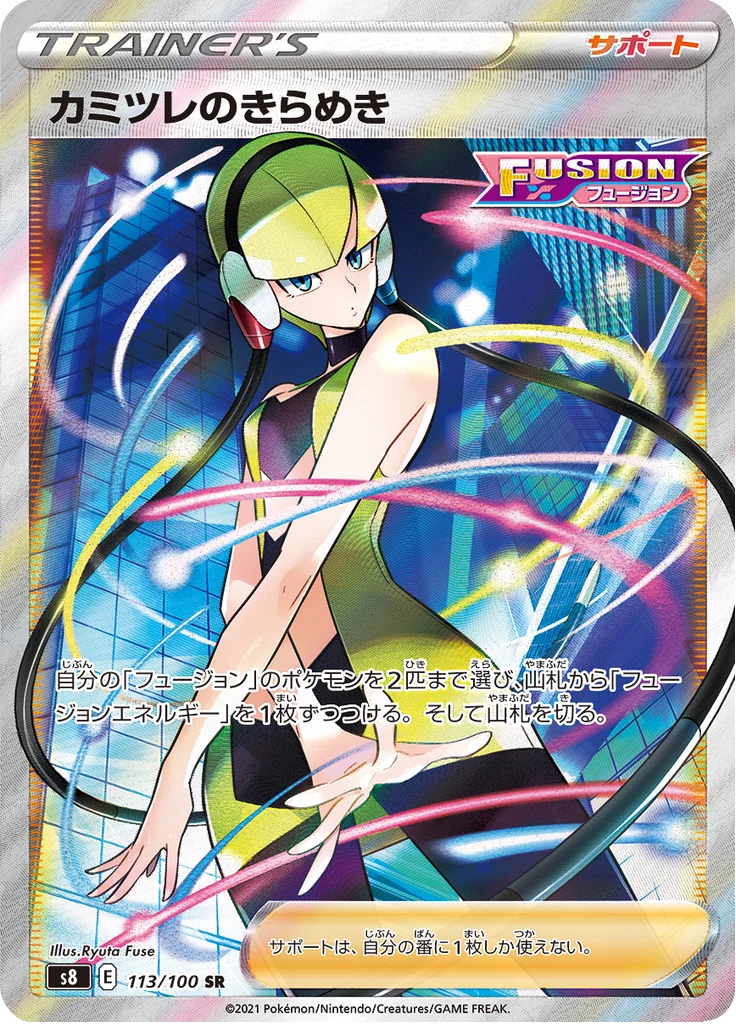
Elesa’s Sparkle S8 096/100 U Fusion Arts 2021
Elesa’s Sparkle S8 113/100 SR Fusion Arts 2021
Elesa’s Sparkle S8 122/100 HR Fusion Arts 2021
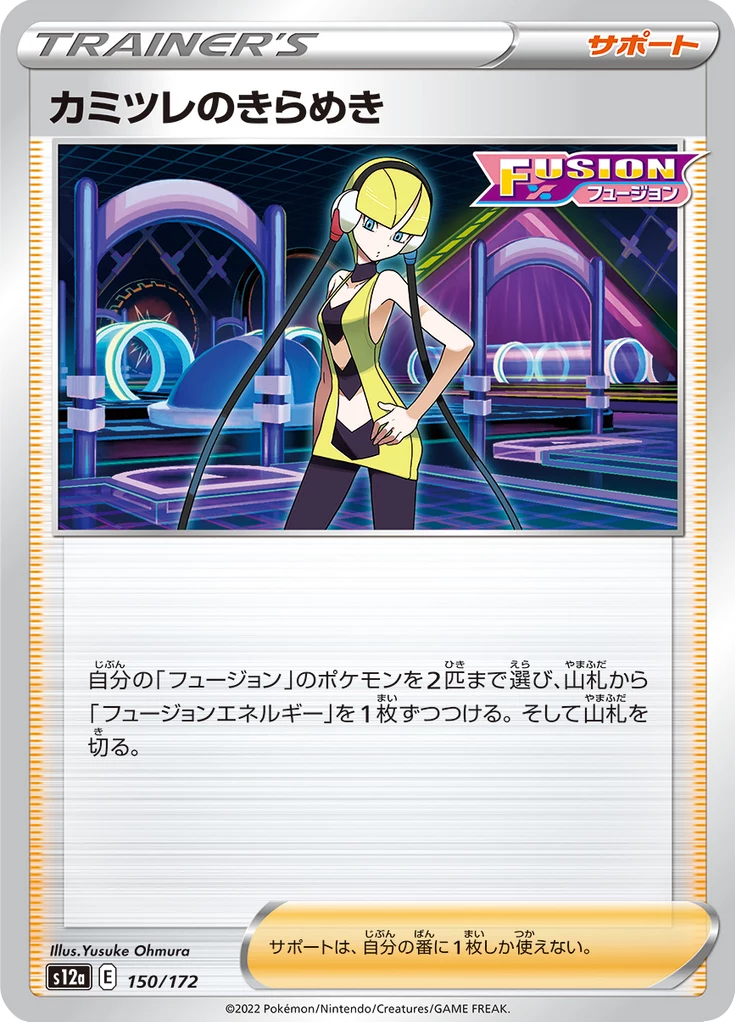
Elesa’s Sparkle S12a 150/172 reprint VSTAR Universe 2022
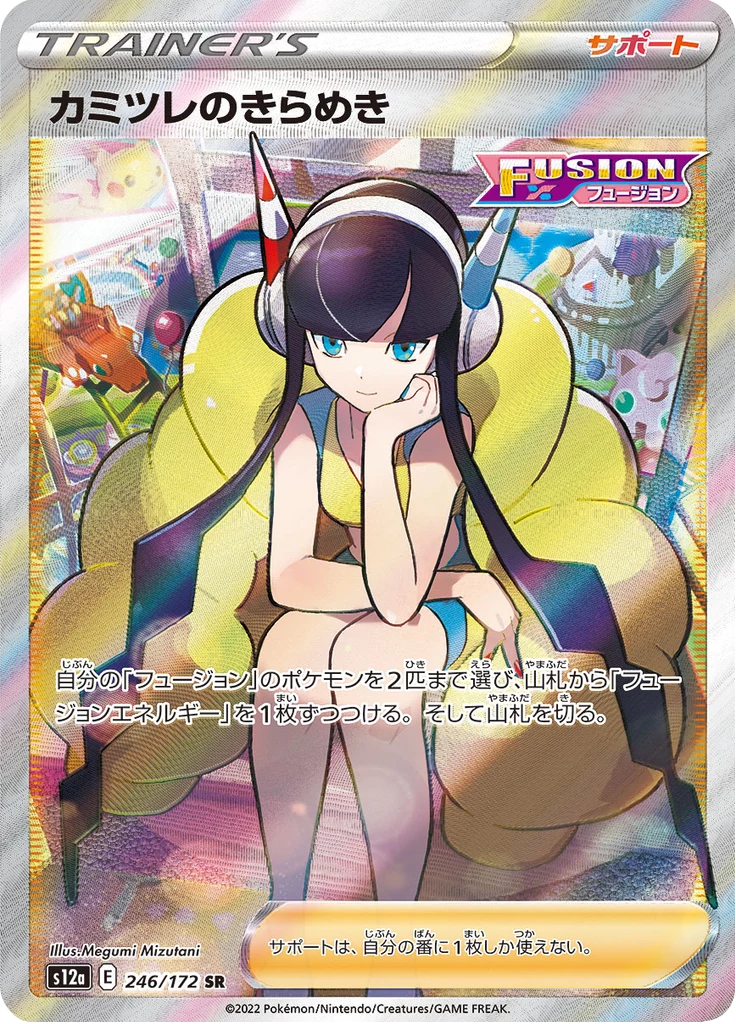
Elesa’s Sparkle S12a 246/172 SR VSTAR Universe 2022

Two Supporter cards carry the Elesa name, and they’re not interchangeable. The 2013 Shiny Collection card is a standalone BW-era release with its own effect and artwork, illustrated by Yusuke Ohmura. Elesa’s Sparkle is a separate, unrelated Supporter that debuted eight years later in Fusion Arts and was reprinted once, in VSTAR Universe. The sections below cover each in order.
If you already own a copy and just need to identify it, check the set name printed at the bottom of the card and the card number in the corner. “Shiny Collection” or “020/020” points to the 2013 original. Anything reading “S8” or a number out of 100 is a Fusion Arts printing of Elesa’s Sparkle. Anything reading “S12a” or a number out of 172 is the VSTAR Universe reprint.

The BW Original: Elesa, Shiny Collection 020/020

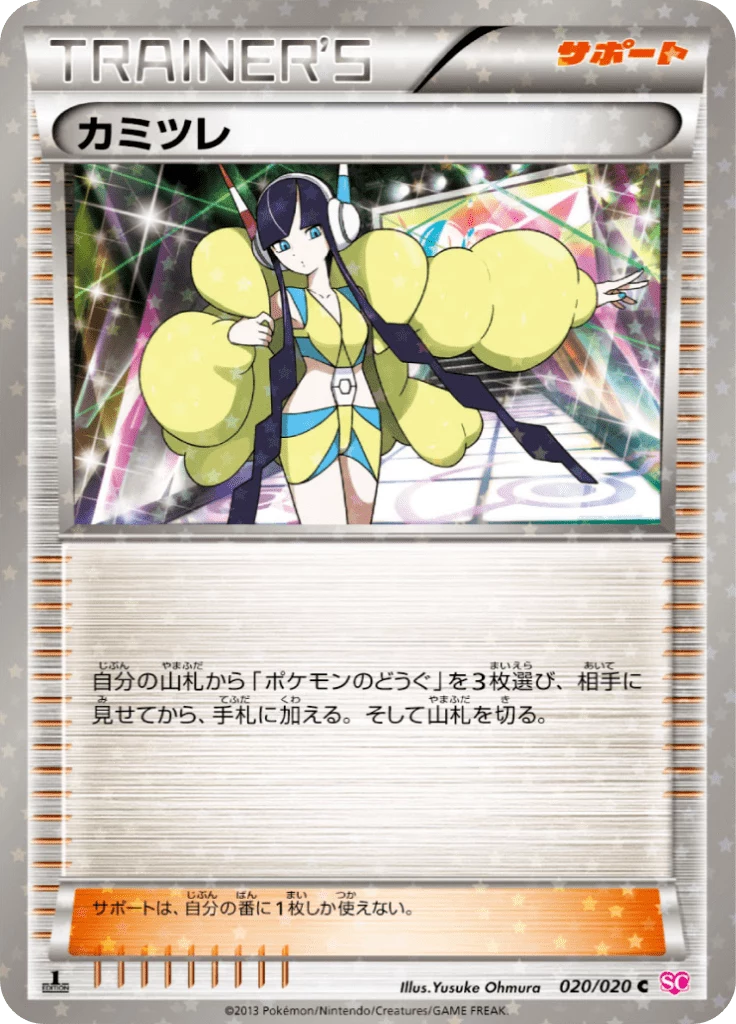
Elesa [SC 020/020] (Shiny Collection)
Elesa, SC 020/020, Shiny Collection

Elesa’s first Japanese TCG appearance came in Shiny Collection, a BW-era concept pack released in 2013. The card is a Supporter that lets you search your deck for up to three Pokemon Tool cards and add them to your hand — a build-around effect for Tool-heavy decks of the era. The English equivalent is Elesa, Legendary Treasures “Radiant Collection” RC20, a Common released the same year, sharing the same illustration.

This is the only confirmed BW-era Elesa printing — there’s no separate booster-pack release of the character under the plain name during that period. The card’s official detail page doesn’t list a distinct rarity code; treat it as a set-exclusive rather than trying to match it to a numbered rarity tier used in later sets. For more on what else came out of the BW era, see our BW-era Japanese Pokemon card guide.

Elesa’s Sparkle Debuts: Fusion Arts (S8)

Elesa’s Sparkle — a different Supporter, unrelated to the 2013 card — first appeared in Fusion Arts, released September 24, 2021, in three printings (U, SR and HR).

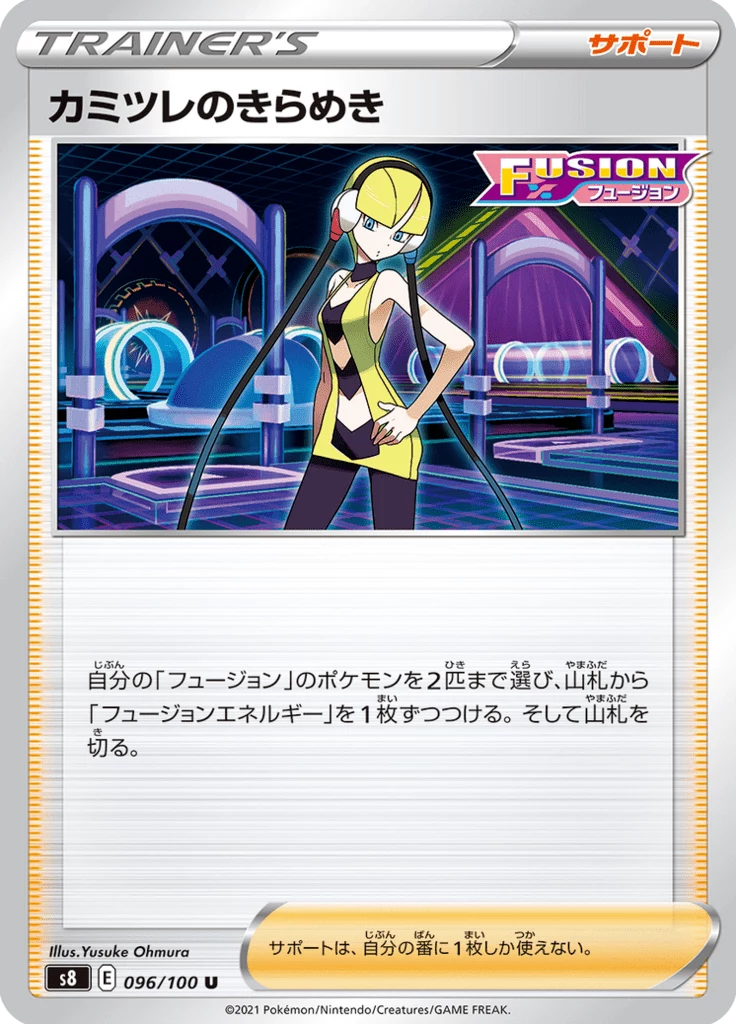
Elesa's Sparkle [S8 096/100] U (Fusion Arts)

Elesa’s Sparkle, S8 096/100, U

Elesa's Sparkle [S8 113/100] SR (Fusion Arts)

Elesa’s Sparkle, S8 113/100, SR

The effect is deck-specific: choose up to two Fusion Strike Pokemon in play, then attach a Fusion Energy from your deck to each. It’s a support piece for Fusion Strike strategies rather than a generic draw Supporter, which ties the card directly to Fusion Arts as a set.

The 096/100 Uncommon, illustrated by Yusuke Ohmura, is the standard-frame print most players pull first. The 113/100 Super Rare (SR), illustrated by Ryuta Fuse, uses a different piece of art entirely — a separate illustration from the Uncommon, not just a foil treatment of the same image. The set also has a 122/100 Hyper Rare (HR) print, offered as a PSA 10 back order at ¥11,336 (~$74) — sourced to order; the product page shows the current terms. Fusion Arts sits in the Sword & Shield era; our Sword & Shield-era Japanese Pokemon guide covers the wider set lineup around it, and the full Fusion Arts card list has the rest of the set.

The Reprint and the SR: VSTAR Universe (S12a)

Elesa's Sparkle [S12a 246/172] SR (VSTAR Universe)
Elesa’s Sparkle, S12a 246/172, SR, VSTAR Universe

Elesa’s Sparkle returned in VSTAR Universe, the high-class pack released December 2, 2022, with a standard reprint and a new Super Rare (SR).

Elesa's Sparkle [S12a 150/172] (VSTAR Universe)

Elesa’s Sparkle, S12a 150/172, reprint

Elesa's Sparkle [S12a 246/172] SR (VSTAR Universe)

Elesa’s Sparkle, S12a 246/172, SR

The 150/172 print carries the same illustration as the original 096/100 Uncommon, credited again to Yusuke Ohmura, effectively bringing the Fusion Arts artwork back into circulation for buyers who missed the original set. The 246/172 Super Rare (SR) is a new illustration by Megumi Mizutani — a different artist from the S8 SR, so the two SR versions of Elesa’s Sparkle look nothing alike despite sharing a card name and rarity tier. Elesa’s Sparkle SR (S12a 246/172) is offered as a PSA 10 back order at ¥8,586 (~$56) — sourced to order; the product page shows the current terms.

For the rest of what VSTAR Universe pulls, see our VSTAR Universe best cards guide.

Two Super Rares, Two Different Cards

Because Elesa’s Sparkle carries a Super Rare (SR) in both of its sets, it’s worth laying the two side by side rather than treating “the SR” as a single thing to look for.

Super Rare (SR) 系列 Year Illustrator
Elesa’s Sparkle SR, S8 113/100 Fusion Arts 2021 Ryuta Fuse
Elesa’s Sparkle SR, S12a 246/172 VSTAR Universe 2022 Megumi Mizutani

Neither is a reprint of the other — both are original Super Rare illustrations tied to their own set, released about a year apart. If you’re specifically after the PSA 10 back order, confirm the set line reads VSTAR Universe and the number reads 246/172; the Fusion Arts SR is a legitimate card in its own right, but it’s a different collectible with a different illustration.

Elesa’s Sparkle in English: Fusion Strike and Crown Zenith

Collectors cross-referencing the English side: Elesa’s Sparkle corresponds to cards in Fusion Strike (2021, #233, with higher-rarity versions at #260 and #275) and Crown Zenith (2023, #147). The 2013 Shiny Collection Elesa corresponds to Legendary Treasures “Radiant Collection” RC20. None of these English printings affect the Japanese card numbers or artwork covered above — they’re separate print runs in a separate language, useful mainly for matching a card you already own to its Japanese counterpart rather than for pricing the Japanese cards themselves.

Worth noting for the same reason a lot of collectors search for this card in the first place: the Fusion Strike English release and the Fusion Arts Japanese release cover the same competitive-era window, so a deck built around the English Elesa’s Sparkle uses the identical effect as the Japanese S8 and S12a printings — attaching Fusion Energy to two Fusion Strike Pokemon at once. The card text hasn’t changed between languages or printings, only the artwork and rarity have.

Chasing Elesa’s Sparkle Through VSTAR Universe Boxes

Both S12a printings of Elesa’s Sparkle — the 150/172 reprint and the 246/172 Super Rare (SR) — come from VSTAR Universe boxes.

Shop This Set
S12A VSTAR Universe Japanese Pokemon Booster Box
Currently listed at ¥27,540 (~$179)
Ships from Tokyo

View Product →

If you’d rather source the graded SR directly, the PSA 10 Elesa’s Sparkle SR is offered as a back order at ¥8,586 (~$56) — sourced to order; the product page shows the current terms — a straightforward way to skip the booster box and request the exact card graded.

Where to Buy Japanese Elesa Cards

Sealed product and singles ship from Tokyo. For Elesa’s Sparkle specifically, both S12a printings come from VSTAR Universe boxes, while the graded SR back order and the 2013 Shiny Collection original are sourced as singles.

Start with our VSTAR Universe Booster Box for sealed product, request the PSA 10 Elesa’s Sparkle SR back order for the graded single, or browse the full PSA 10 collection for other graded Supporters and Trainers — our PSA 10 trainer cards guide is a good starting point there. For a mixed order of boxes and singles in one checkout, sourcing requests go through our Quick Order page.

常见问题

Which Elesa’s Sparkle prints are the higher-rarity versions?

Fusion Arts has a Super Rare (SR, S8 113/100) and a Hyper Rare (HR, S8 122/100); VSTAR Universe has a Super Rare (SR, S12a 246/172), offered as a PSA 10 back order at ¥8,586 (~$56), sourced to order, with current terms on the product page.

What sets are Elesa Pokemon cards from?

Three sets across two different cards: the 2013 BW-era Shiny Collection (Elesa, 020/020), Fusion Arts from 2021 (Elesa’s Sparkle, three printings), and VSTAR Universe from 2022 (Elesa’s Sparkle reprint, two printings).

Where can I buy Japanese Elesa Pokemon cards?

Sealed product and singles ship from Tokyo. The VSTAR Universe Booster Box is currently listed at ¥27,540 and carries a chance at both S12a printings of Elesa’s Sparkle; the graded PSA 10 SR is offered as a back order at ¥8,586, and other Trainer singles are available via our PSA 10 collection and Quick Order page.

Jigglypuff宝可梦卡牌指南:全部日版印刷版本

Jigglypuff’s Japanese name is プリン (Purin), and Wigglytuff’s is プクリン (Pukurin), per the official Pokemon Card database. Jigglypuff evolves into Wigglytuff, and across the Japanese sets this guide covers, they keep showing up together — a TAG TEAM GX pairing Jigglypuff with Mega Lopunny, a Fairy-type Wigglytuff built around tool-card synergy, a matched pair of prints from the same 151 set, and a shiny variant from 2023. This guide covers notable prints across six Japanese sets and one earlier English release, spanning 1999 to 2025.

This guide walks through those prints: what set each came from, what the card actually does, and which Japanese sealed boxes still carry a shot at pulling one. We don’t hold these singles as physical stock, but several are offered as PSA 10 back orders — sourced to order; the product page shows the current terms. Sealed product ships from Tokyo, and you can request a quote via our Quick Order page for specific-card sourcing.

Both stages of the evolution line show up on this list, and it’s worth keeping them straight before diving in. Jigglypuff is the base-stage Normal/Fairy-type Pokemon most collectors recognize on sight, while Wigglytuff is its evolved form, and Japanese sets have a habit of printing both stages from the same era rather than picking one. That pattern holds across several of the Japanese sets covered here, which is part of why this guide treats the two names as one connected lineup instead of splitting them into separate articles.

Key Takeaway

Jigglypuff and Wigglytuff have appeared across notable card prints covered in this guide since 1999, spanning a 1999 English original, a 2019 TAG TEAM GX, a Fairy-type Uncommon, a same-set pair from Pokemon Card 151, a 2023 Shiny Rare, and a 2025 Art Rare. We don’t hold these singles as physical stock, but several are offered as PSA 10 back orders — sourced to order. The direct sealed-product route: the Sealed option of the Pokemon Card 151 Booster Box is currently listed at ¥45,900 (~$298) and the Alter Genesis Booster Box at ¥63,000 (~$409), and you can request a quote via our 快速下单 page for restock or specific-card sourcing requests.
Updated September 24, 2026
  • Pokemon Card 151 (Sealed), Alter Genesis, Shiny Treasure ex (Sealed) and Inferno X (No Shrink) booster boxes are currently listed; the Fairy Rise booster box is sold out at the time of this update — restock requests go through 快速下单.
  • SNKRDUNK lowest asks on September 24, 2026: the Wigglytuff ex Super Rare (SR, SV2a 189/165) PSA 10 ask was ¥5,000; the current-print Wigglytuff Art Rare (AR, M2 091/080) PSA 10 ask was ¥4,499; no current SNKRDUNK PSA 10 figure in this update for the plain Jigglypuff Common (SV2a 39/165).
  • Browse the full Pokemon Card 151 card list for the rest of the set behind both 151 prints.
1999–2025
Years Covered

3
TAG TEAM GX Prints

Selected Japanese Jigglypuff and Wigglytuff Prints

The official card database lists 21 cards named プリン and 16 named プクリン; this guide covers notable prints, plus two further プリン/プクリン printings and two further parallel prints of the Alter Genesis TAG TEAM identified below:

卡牌 Number Rarity 系列 Year
Jigglypuff JU #54 (EN) Common Jungle 1999
Mega Lopunny & Jigglypuff GX SM12 73/095 Double Rare (RR) Alter Genesis 2019
Mega Lopunny & Jigglypuff GX SM12 103/095 Super Rare (SR) Alter Genesis 2019
Mega Lopunny & Jigglypuff GX SM12 114/095 Hyper Rare (HR) Alter Genesis 2019
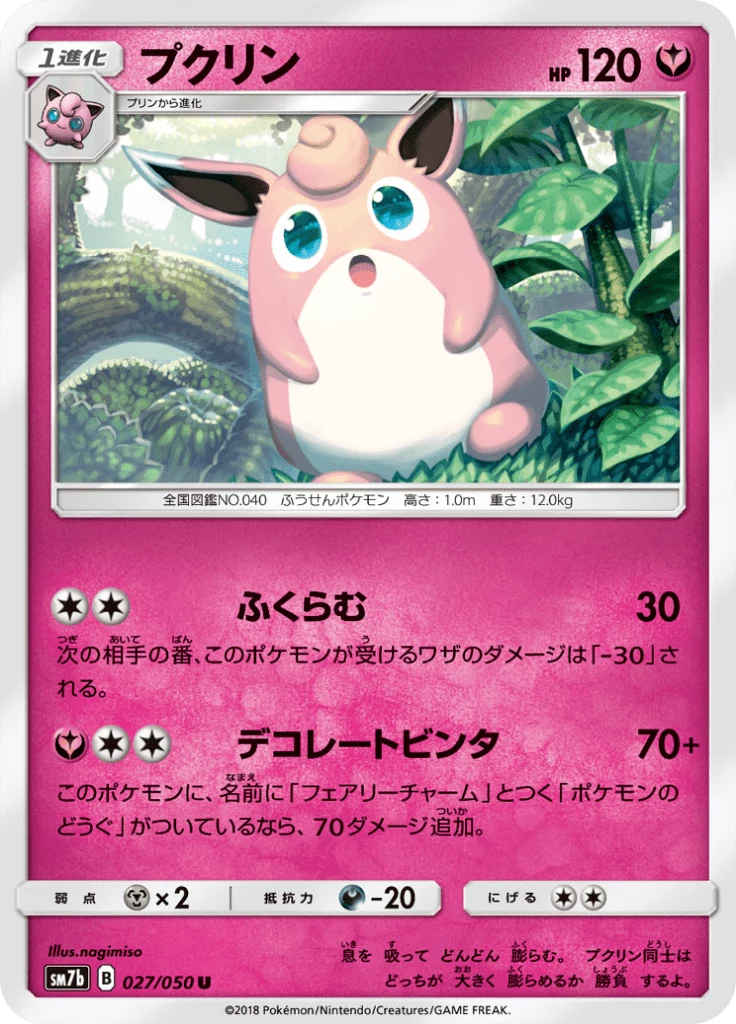
Wigglytuff SM7b #27 Uncommon Fairy Rise 2018
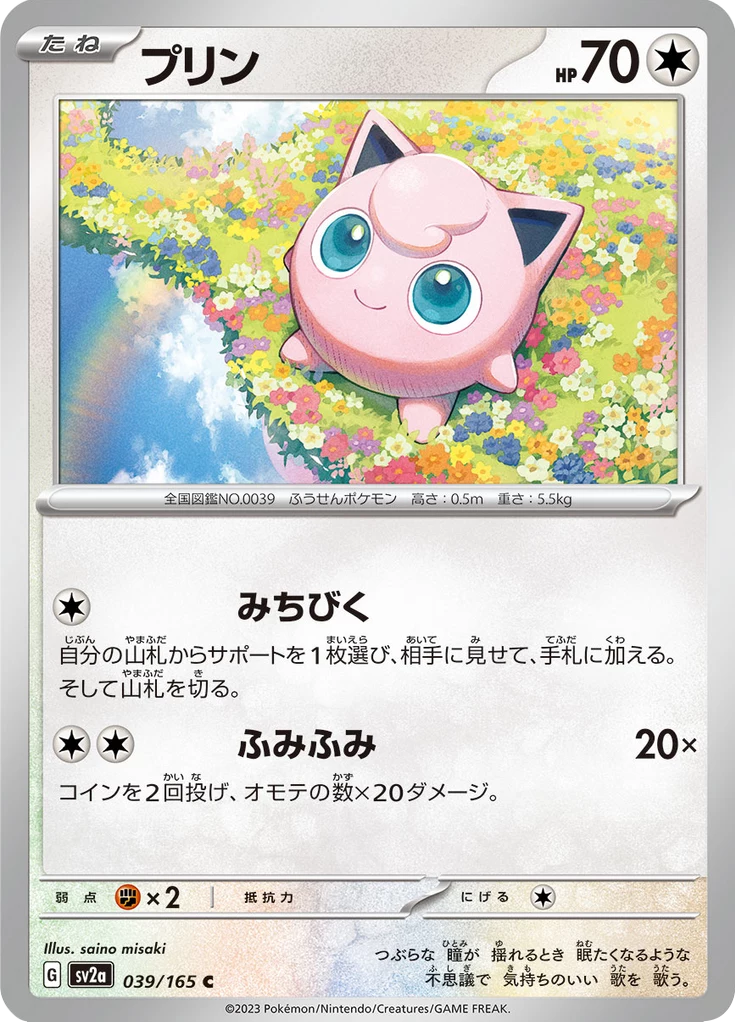
Jigglypuff SV2a 39/165 Common Pokemon Card 151 2023
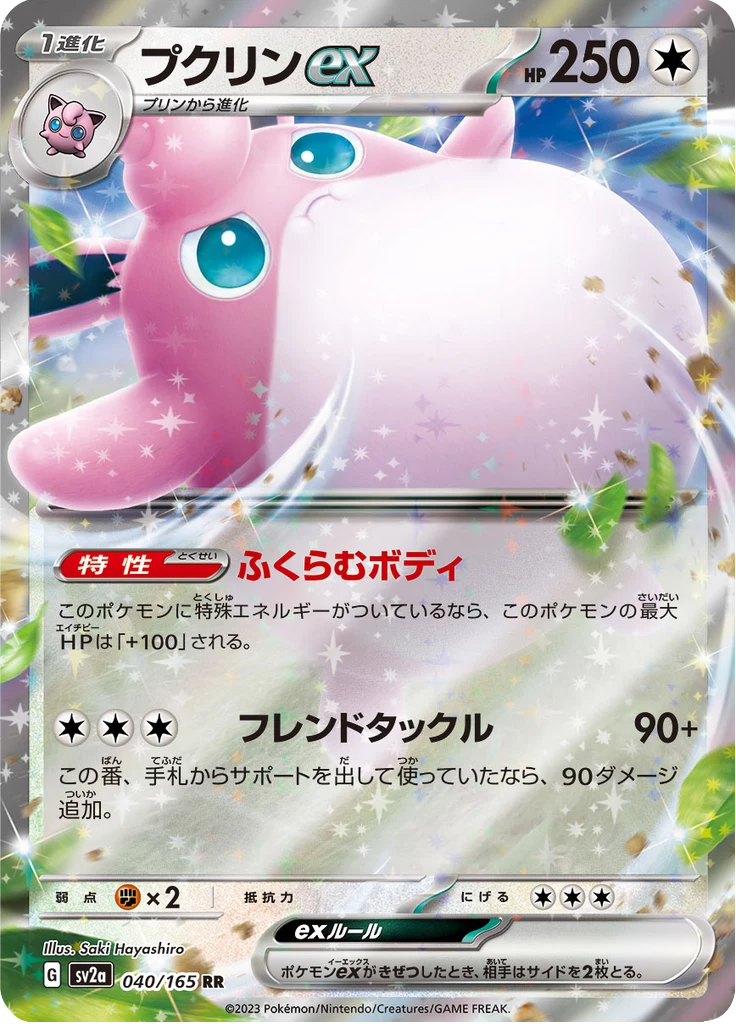
Wigglytuff ex SV2a 40/165 Double Rare Pokemon Card 151 2023
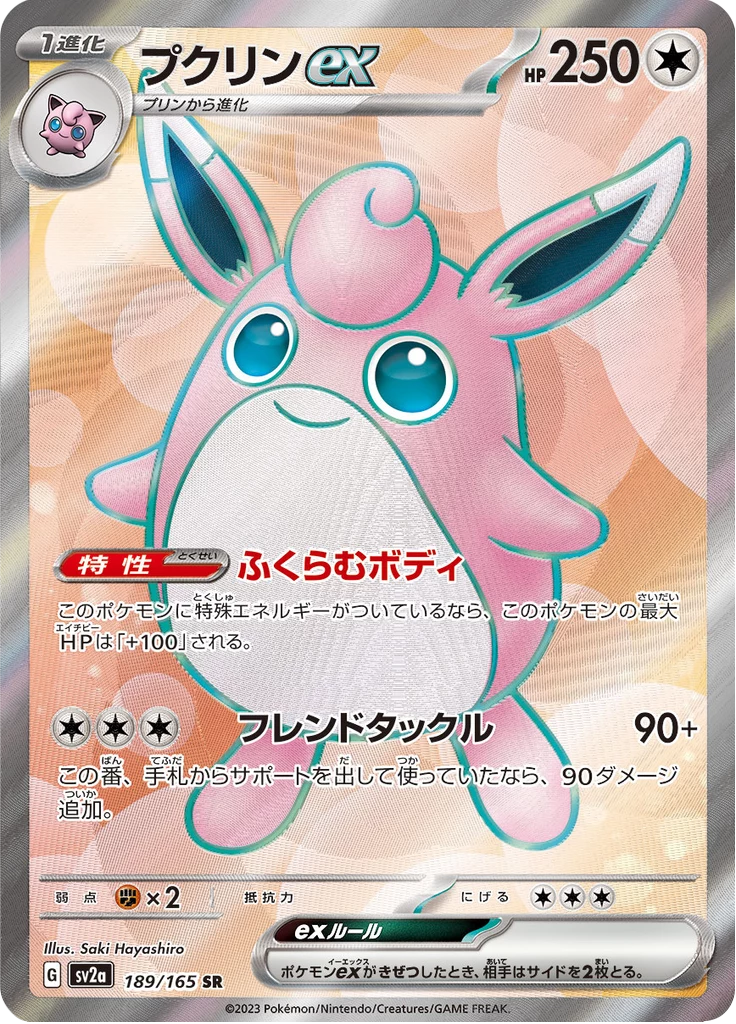
Wigglytuff ex SV2a 189/165 Super Rare (SR) Pokemon Card 151 2023
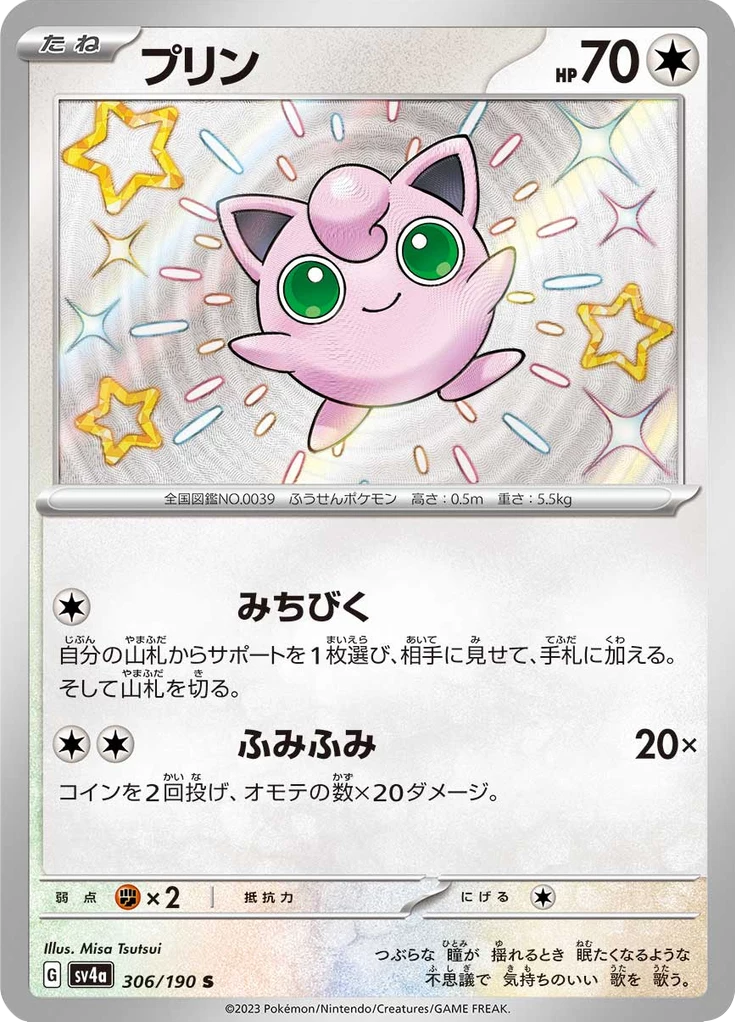
Jigglypuff (Shiny) SV4a 306/190 Shiny Rare Shiny Treasure ex 2023
Jigglypuff SV2D 026/071 Common Clay Burst 2023
Wigglytuff SV2D 027/071 Rare Clay Burst 2023
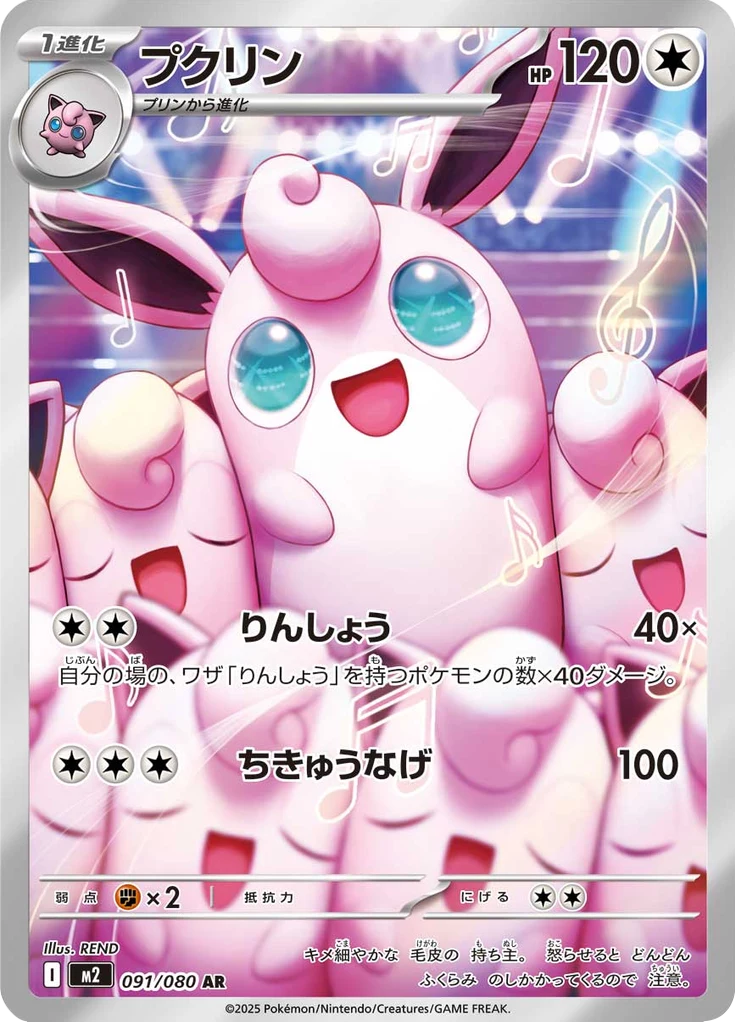
Wigglytuff M2 91/080 Art Rare (AR) Inferno X 2025

Two things stand out. First, Jigglypuff and Wigglytuff rarely get a print each on their own — most of the sets in this table carry both stages of the evolution line at once. Second, the lineup includes higher-rarity parallels: the Wigglytuff ex Super Rare (SR, 189/165) and the Alter Genesis TAG TEAM’s SR (103/095) and Hyper Rare (HR, 114/095).

Check This First

Jigglypuff and Wigglytuff are two different Pokemon, not two names for the same card — Wigglytuff is the evolved form. If you’re trying to identify a card, confirm which stage is printed before matching it to the set and number above.

The 1999 Original: Jungle

The earliest Jigglypuff print this guide could verify is card #54 from Jungle (JU), a Common printed in English in 1999 and illustrated by Kagemaru Himeno. The attack on this print is Lullaby, which puts the opponent’s Active Pokemon to sleep — a straightforward disruption tool. A Japanese original for this print is referenced in card history, but this guide could not verify its details independently, so no Japanese print information or image is included here.

That gap in verification matters for how you should treat this print if you’re comparing it to the rest of the lineup. Every other card in this guide is a confirmed Japanese-market release with a matched Limitless database entry; the Jungle Jigglypuff is included because it’s the historical starting point of the character on cardboard, not because it fits the same documentation standard as the Japanese prints that follow.

For more on how vintage Japanese-market cards are identified and priced against their English counterparts, see our Japanese old-back Pokemon cards guide.

The TAG TEAM: Mega Lopunny & Jigglypuff GX

Mega Lopunny & Jigglypuff GX Double Rare, SM12 73/095, Alter Genesis

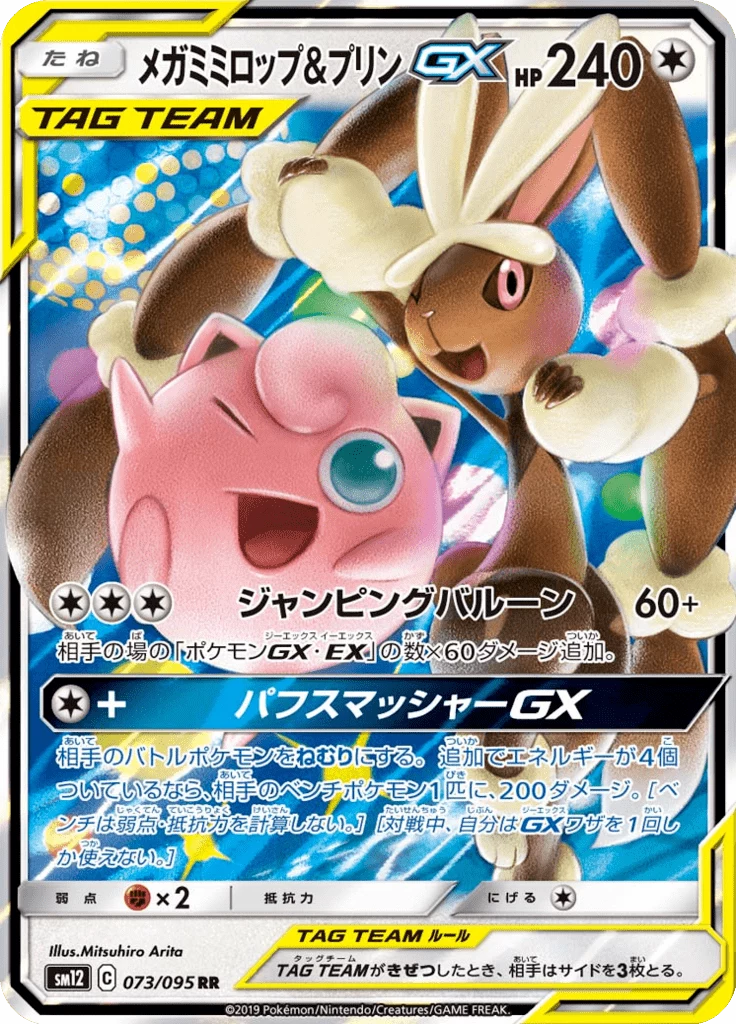
Jigglypuff’s only TAG TEAM GX appearance in this guide came in 2019, when Alter Genesis (SM12) paired it with Mega Lopunny for a TAG TEAM GX card — card #73 of 95, a Double Rare (RR) illustrated by Mitsuhiro Arita. The card’s GX attack, Puff Smasher GX, is the headline move on the print. The same card also has a Super Rare (SR) parallel at 103/095 and a Hyper Rare (HR) parallel at 114/095.

TAG TEAM cards pair two Pokemon on a single card rather than printing them separately, and the pairing choice usually signals which characters the set’s designers wanted to highlight together. Mega Lopunny & Jigglypuff GX puts Jigglypuff in the company of a Mega-Evolution Pokemon rather than another baby or Fairy-type Pokemon, which makes it something of an outlier next to the rest of the lineup in this guide — every other print here keeps Jigglypuff or Wigglytuff on the card by itself.

The RR parallel (73/095) is offered as a PSA 10 back order at ¥12,035 (~$78) — sourced to order; the product page shows the current terms.

Wigglytuff: Fairy Rise

Wigglytuff Uncommon, SM7b #27, Fairy Rise

A year earlier, Fairy Rise (SM7b) printed Wigglytuff as an Uncommon, card #27, illustrated by nagimiso. This is a Fairy-type era print, and its design leans on synergy with Fairy Charm tool cards from the same period rather than standing alone as a big attacker — a support-oriented role that fits Wigglytuff’s usual place in the Fairy-type toolbox of that era.

Fairy Rise sits at the tail end of the era when Pokemon TCG used a standalone Fairy type at all — a typing choice that was later folded back into Psychic in subsequent generations. That makes this Wigglytuff print a snapshot of a typing category that no longer exists on new cards, which is part of what separates it from the later Pokemon Card 151 and Inferno X prints in this same lineup. Browse the full Fairy Rise card list for the rest of the set.

Jigglypuff and Wigglytuff ex: Pokemon Card 151

Jigglypuff Common, SV2a 39/165, Pokemon Card 151

Jigglypuff Common, SV2a 39/165, Pokemon Card 151

Wigglytuff ex Double Rare, SV2a 40/165, Pokemon Card 151

Wigglytuff ex Double Rare, SV2a 40/165, Pokemon Card 151

Wigglytuff ex Super Rare, SV2a 189/165, Pokemon Card 151

Wigglytuff ex Super Rare (SR), SV2a 189/165, Pokemon Card 151

Pokemon Card 151 (SV2a), released June 16, 2023, is the only set in this lineup to print both Jigglypuff and Wigglytuff ex at once, filling the No. 39 and No. 40 slots of the set’s Kanto Pokedex numbering. Jigglypuff, card 39/165, is a Common illustrated by saino misaki with an attack called Guide that searches the deck for a Supporter card. Wigglytuff ex, card 40/165, is a Double Rare illustrated by Saki Hayashiro with the Ability Inflating Body, which raises its max HP by 100 while a Special Energy is attached. A second, Super Rare (SR) print of the same Wigglytuff ex sits at 189/165; its illustrator could not be verified independently, though the card itself is confirmed under the same name.

Pokemon Card 151’s whole structure runs on this pattern — every Pokemon from the original 151 gets a numbered slot in the base set, and several also get a second, higher-rarity alternate-art print later in the same set’s number range. Jigglypuff and Wigglytuff ex follow that structure closely: a base-numbered print in the 1–165 range for each, plus the Super Rare repeat for Wigglytuff ex above card 165. If you’re pulling a booster box from this set, both the No. 39/40 slots and the 189/165 slot come from the same product.

On the market: the lowest PSA 10 asking price on SNKRDUNK on September 24, 2026 for the Wigglytuff ex Super Rare (189/165) was ¥5,000, with an ungraded lowest ask of ¥1,000. The plain Jigglypuff Common (39/165) had an ungraded lowest ask of ¥1,000 and no current SNKRDUNK figure in this update for a PSA 10 copy.

The plain Jigglypuff Common (39/165) also has a Master Ball Mirror parallel, offered as a PSA 10 back order at ¥13,255 (~$86) — sourced to order; the product page shows the current terms.

Shop This Set
Pokemon Card 151 Booster Box (Japanese)
The Sealed option is currently listed at ¥45,900 (~$298)
Ships from Tokyo

View Product →

The Shiny Print: Shiny Treasure ex

Jigglypuff Shiny Rare, SV4a 306/190, Shiny Treasure ex

Shiny Treasure ex (SV4a), released December 1, 2023, gave Jigglypuff its shiny-color treatment: card 306/190, a Shiny Rare illustrated by Misa Tsutsui. A shiny Wigglytuff and a Wigglytuff ex Shiny Super Rare are also referenced as part of the same set’s shiny lineup, but their individual print details weren’t independently verified for this guide, so no image or number claim is made for them beyond the confirmed Jigglypuff print above.

Browse the full Shiny Treasure ex card list for the rest of the set. The Shiny Treasure ex Booster Box is currently listed: Sealed at ¥16,640 (~$108), No Shrink at ¥15,400 (~$100).

The Current Print: Wigglytuff AR in Inferno X

Wigglytuff Art Rare, M2 91/080, Inferno X
Wigglytuff Art Rare (AR), M2 91/080, Inferno X

The newest print in this lineup comes from Inferno X (M2), part of the 2025 MEGA era, released September 26, 2025. Wigglytuff appears at Art Rare (AR), card 91 of 80, illustrated by REND, and carries an attack whose Japanese name is Rinshō. A standard Common-rarity Jigglypuff is also part of the same set, at card #64. For more on how Art Rare and other alternate-art tiers fit into the wider Japanese rarity system, see our Character Rare cards guide.

The card number running past the set’s own denominator — 91 in a set marked /080 — isn’t a typo. Alternate-art rarities like this Art Rare are routinely numbered above a set’s base card count, the same pattern that puts the Pokemon Card 151 Super Rare at 189/165 earlier in this guide. It’s a reliable way to spot an above-base-set rarity at a glance, regardless of which set you’re looking at.

The lowest PSA 10 asking price on SNKRDUNK on September 24, 2026 for this Wigglytuff Art Rare was ¥4,499, with an ungraded lowest ask of ¥1,000. This print is offered as a PSA 10 back order at ¥4,543 (~$30) — sourced to order; the product page shows the current terms. See how PSA 10 back orders work. Browse the full Inferno X card list for the rest of the set.

Sourcing Jigglypuff and Wigglytuff Through Sealed Japanese Boxes

Sealed boxes from these sets are listed below. Each box is tied to a specific era covered earlier in this guide, so match the box to the print you’re after:

The 1999 Jungle print doesn’t have a matching booster box in current sealed inventory, and the Fairy Rise box above is sold out at the time of this update — restock requests for either go through our 快速下单 page.

Where to Buy Japanese Jigglypuff and Wigglytuff Cards

Sealed product ships from Tokyo. For this lineup specifically, the Pokemon Card 151 Booster Box is the box that covers three of the prints in this guide, while Alter Genesis, Shiny Treasure ex, and Inferno X each cover one more era apiece. See the full Pokemon Card 151 card list for the rest of the set behind both 151 prints, browse our PSA 10 collection for other graded singles; several Jigglypuff and Wigglytuff prints above are offered as PSA 10 back orders, sourced to order. For any other print in this guide, including the sold-out Fairy Rise box, request a quote via our 快速下单 page. For raw-versus-graded context on chase prints like the Pokemon Card 151 Super Rare, see our PSA 10 vs raw Japanese Pokemon cards guide.
常见问题

What is Jigglypuff’s Japanese name?

Jigglypuff’s Japanese name is プリン (Purin), per the official Pokemon Card database. Wigglytuff, the evolved form, is プクリン (Pukurin).

How many Japanese Jigglypuff and Wigglytuff Pokemon card prints are there?

The official card database lists 21 cards named プリン and 16 named プクリン; this guide covers notable prints, spanning the 1999 English Jungle original through the 2025 Inferno X Art Rare.

What is the oldest Jigglypuff card?

Card #54 from Jungle (JU), a Common printed in English in 1999 with the attack Lullaby. This guide could not independently verify a Japanese original for this print.

What is the Mega Lopunny & Jigglypuff GX card?

A TAG TEAM GX card from Alter Genesis (SM12), card 73/095 (Double Rare/RR), illustrated by Mitsuhiro Arita. It’s the only TAG TEAM appearance Jigglypuff has had in the sets this guide covers; the same card also has Super Rare (SR, 103/095) and Hyper Rare (HR, 114/095) parallels. Its GX attack is called Puff Smasher GX.

Is there a shiny Jigglypuff card?

Yes — a Shiny Rare Jigglypuff, card 306/190, from Shiny Treasure ex (SV4a), illustrated by Misa Tsutsui and released December 1, 2023.

Where can I buy Japanese Jigglypuff and Wigglytuff cards?

Sealed product ships from Tokyo. The Pokemon Card 151, Alter Genesis, Shiny Treasure ex, and Inferno X booster boxes are currently listed and each carry a different print; the Fairy Rise booster box is sold out at the time of this update. Several PSA 10 singles are offered as back orders — sourced to order; the product page shows the current terms. You can request a quote via our Quick Order page for the 1999 Jungle print, which has no matching box in current stock, or for the Fairy Rise box while it’s sold out.

Naoyo Kimura Pokemon卡牌指南:Neo Series 与 Pokemon Card 151

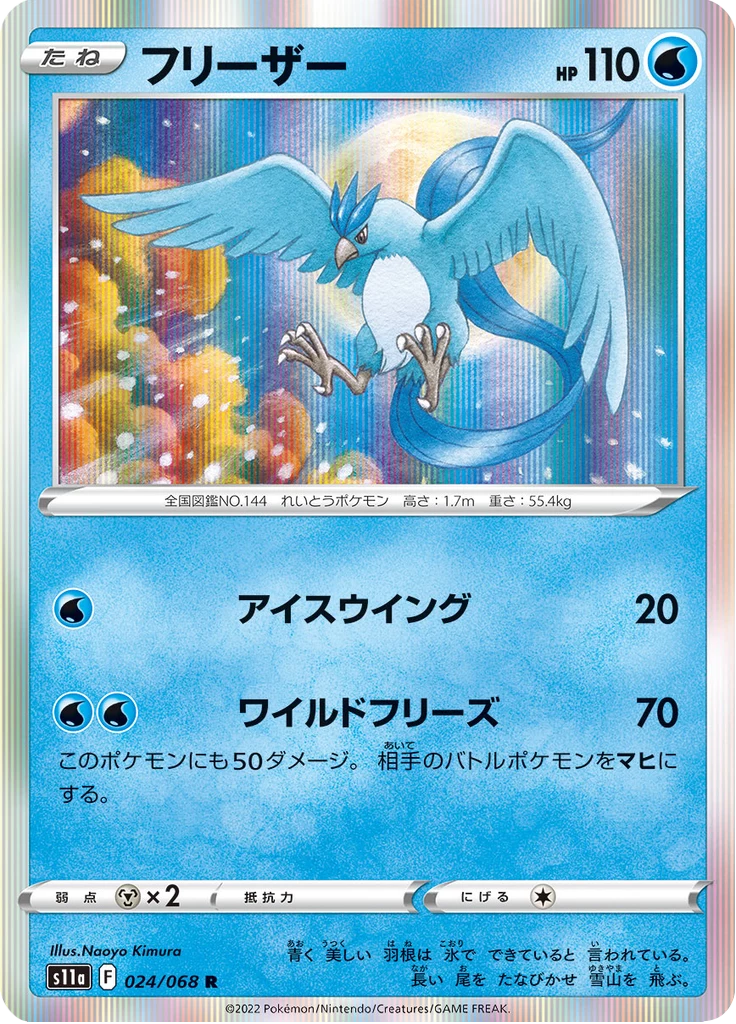
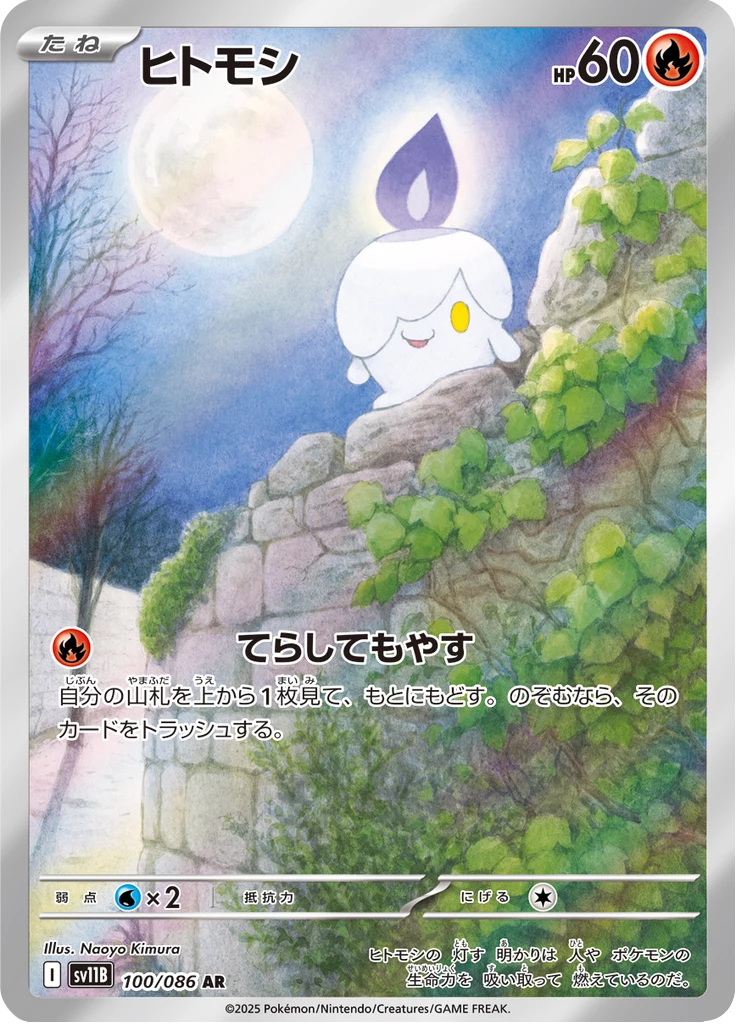
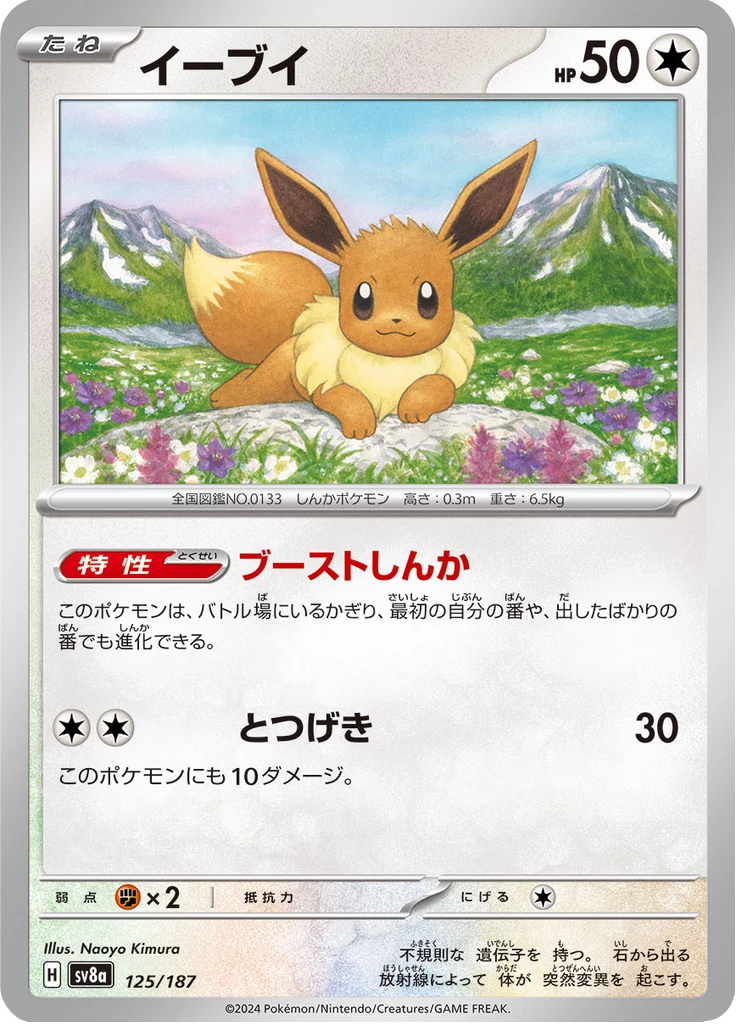
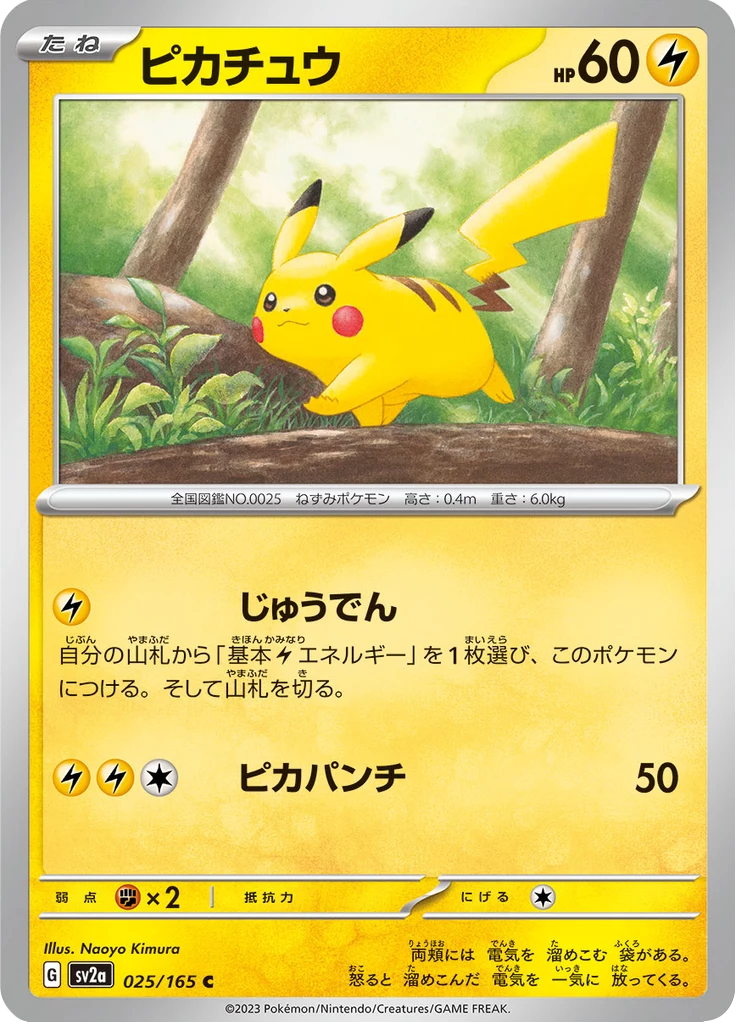
Naoyo Kimura, an illustrator for the Pokemon Trading Card Game, has a credited career that reaches back to the Japanese Expansion Sheet Series 2 and the Neo Series era, through the Pikachu on Pokemon Card 151, to the 2023 Pokemon x Van Gogh art collaboration.

Bulbapedia credits Naoyo Kimura with 276 TCG cards illustrated to date, and the Limitless TCG database independently tracks 260 English-language prints and 172 Japanese-language prints under the same credit. This guide walks through what’s actually documented about Kimura’s career — the Neo Series and Southern Islands promotional set work, the picture-book work, the Van Gogh collaboration — and ends at the Kimura-credited PSA 10 prints we currently list.

Collectors researching an illustrator credit usually run into one of two problems: either the artist has almost no documented history and the profile has to be built from the card catalog alone, or the sources are extensive but scattered across a wiki, a set database, and whatever a set’s promotional materials happened to say. Kimura’s case is closer to the second problem — the record is long enough that it’s worth separating out what’s actually sourced from what’s simply repeated across fan sites.

Key Takeaway

Naoyo Kimura has illustrated 276 Pokemon TCG cards per Bulbapedia’s tally (Limitless TCG separately counts 260 English-language and 172 Japanese-language prints under the same credit), with a career reaching back to the Neo Series and the Southern Islands promotional set. Two mirror prints of Pikachu 025/165 from Pokemon Card 151 (SV2a) carry Kimura’s credit and are currently listed: the Master Ball Mirror at ¥83,408 (~$542) and the Monster Ball Mirror at ¥24,024 (~$156).

Updated September 24, 2026
  • Pikachu 025/165: both PSA 10 prints are currently listed — the Master Ball Mirror print at ¥83,408 (~$542) and the Monster Ball Mirror print at ¥24,024 (~$156).
  • The lowest PSA 10 asking price on SNKRDUNK for the Master Ball Mirror print on September 24, 2026 was ¥100,000 (ungraded lowest ask ¥51,000). For the regular (non-mirror) Pikachu 025/165, SNKRDUNK’s lowest ungraded ask on September 24, 2026 was ¥1,000; no current SNKRDUNK PSA 10 figure in this update.
  • Browse the full Pokemon Card 151 card list for the rest of the set this Pikachu comes from.
276
TCG Cards Illustrated (Bulbapedia)

53
TCG Pocket Cards

1960
Birth Year (Van Gogh Museum, per Bulbapedia)

Who Is Naoyo Kimura?

Naoyo Kimura (Japanese: 木村直代, Kimura Naoyo) is an illustrator for the Pokemon Trading Card Game, per Bulbapedia, which cites the Van Gogh Museum’s own website for a birth year of 1960. Kimura’s first cards were Seel, Zapdos, and Graveler, released as part of the Japanese Expansion Sheet Series 2, giving Kimura a credited career reaching back to the game’s earliest Japanese releases. Kimura’s first cards released in English were the Wizards Black Star Promos Articuno, Zapdos, and Moltres, released alongside The Power of One.

Bulbapedia’s own count puts Kimura’s total TCG output at 276 cards illustrated to date, plus 53 cards in Pokemon Trading Card Game Pocket — a separate mobile-game database that Bulbapedia tracks apart from the main TCG tally. Limitless TCG’s independent database records 260 English-language cards and 172 Japanese-language cards under the “Naoyo Kimura” credit; these two counts overlap heavily (most illustrations appear in both languages) and should not be added together.

A note on pronouns: Bulbapedia’s own article is internally inconsistent, using “she/her” in its lead paragraph but “him” once in a later section. Because the source itself doesn’t agree, this guide refers to Kimura by name throughout rather than asserting either.

It’s also worth being precise about what the two card-count sources actually measure. Bulbapedia’s 276-card figure is the site’s own running tally, updated as new sets release. Limitless TCG’s 260 (English) and 172 (Japanese) counts come from a separate database that indexes each language’s card pool independently — a single illustration frequently appears in both an English and a Japanese printing, so those two numbers largely describe the same body of work counted twice, not 432 distinct illustrations. None of the three figures should be summed against another; each one is a complete count on its own terms.

For readers comparing artists across our illustrator series, Kimura’s catalog sits alongside KEIICHIRO ITO, Mitsuhiro Arita, and Teeziro — each with a dedicated guide covering their most notable printings.

Neo Series and the Southern Islands Set

Bulbapedia states plainly that Kimura “is notable for creating illustrations for the Neo Series and the Southern Islands promotional set” — two of the most collector-recognized eras in the game’s first decade.

Neither Bulbapedia nor Limitless names which specific Neo Series or Southern Islands cards belong to Kimura’s catalog beyond the general statement above, so this guide doesn’t attempt to list individual card numbers from that era — the point that matters for collectors is that Kimura’s credit reaches back into the game’s foundational Japanese sets.

Reading the Timeline

Kimura’s first TCG credits (Seel, Zapdos, Graveler on the Japanese Expansion Sheet Series 2) predate the Neo Series and Southern Islands work referenced above, giving Kimura a credited career reaching back to the game’s earliest Japanese releases.

The Modern Catalog: Pokemon Card 151 and Beyond

Kimura’s catalog didn’t stop at the early sets. Limitless TCG’s Japanese database lists 172 cards under Kimura’s credit spanning from those early Neo-era prints through recent releases, including a Common-rarity Pikachu that anchors one of the most recognizable modern Japanese sets: Pokemon Card 151 (SV2a).

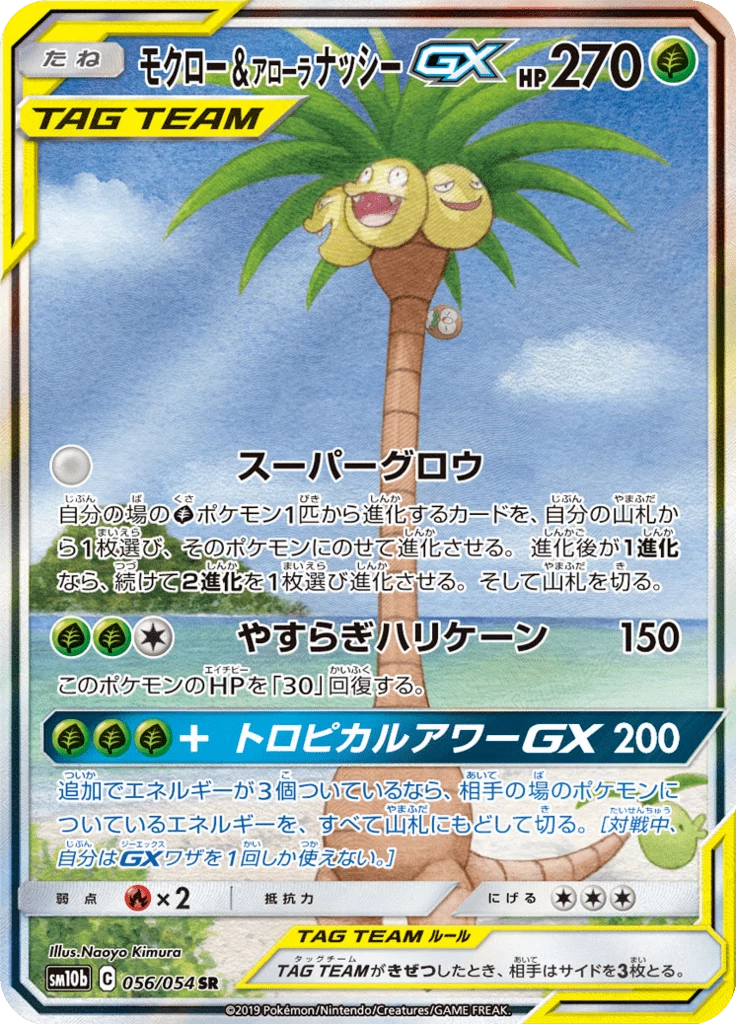
Rowlet and Alolan Exeggutor-GX SM10b 056 Super Rare (SR) Sky Legend
Rowlet & Alolan Exeggutor-GX, SM10b 056, Super Rare (SR) (Sky Legend)
Articuno S11a 024 Rare Incandescent Arcana
Articuno, S11a 024, Rare (Incandescent Arcana)
Litwick SV11B 100 Art Rare Black Bolt
Litwick, SV11B 100, Art Rare (Black Bolt)
Eevee SV8a 125 Terastal Fest ex
Eevee, SV8a 125 (Terastal Fest ex)

That range — a Super Rare (SR) Tag Team GX from Sky Legend, a Rare from Incandescent Arcana, an Art Rare from Black Bolt, and an Eevee from Terastal Fest ex — means this sample spans Common through Super Rare (SR), not concentrated in any one chase-card category. The individual Limitless card page for each of these confirms the “Illustrated by Naoyo Kimura” credit directly.

Also on the record: a Pikachu Promo card (SP 126) from the Sword & Shield Promotional Cards line, which puts Kimura’s credit on the promo side of the catalog as well as mainline set releases.

Each of the following carries the “Illustrated by Naoyo Kimura” credit on its Limitless TCG card page:

卡牌 Set (JP code) Number Rarity
Pikachu Pokemon Card 151 (SV2a) 025 Common
Rowlet & Alolan Exeggutor-GX Sky Legend (SM10b) 056 Super Rare (SR)
Eevee Terastal Fest ex (SV8a) 125 —
Articuno Incandescent Arcana (S11a) 024 Rare
Pikachu Sword & Shield Promotional Cards (SP) 126 Promo
Litwick Black Bolt (SV11B) 100 Art Rare

Two things stand out in that list. First, Kimura is still actively credited on recent sets — Black Bolt, the source for the Litwick entry, is among the more recent releases in this sample, which means this is not a legacy-only credit. Second, the rarity spread in this sample runs from plain Common to Super Rare (SR).

Beyond the Cards: Picture Books and the Van Gogh Collaboration

Outside the trading card game, Bulbapedia documents Kimura’s work on multiple entries in the Pokemon Tales picture-book series, including Come Out, Squirtle!, Seel to the Rescue!, Beroringa Licks Everything, Fly On, Butterfree, Dragonite’s Christmas, and Don’t Laugh, Charizard.

More recently, for the 2023 “Pokemon x Van Gogh” art collaboration, Kimura contributed illustrations of Pikachu and the evolutionary lines of Honchkrow and Corviknight, inspired respectively by Vincent van Gogh’s Self-Portrait with Grey Felt Hat and Wheatfield with Crows. It’s a notable pairing given Bulbapedia’s cited source for Kimura’s own birth year is the Van Gogh Museum’s website — connecting Kimura’s TCG work directly to an institutional art-world credit outside the Pokemon franchise.

Reading the picture-book titles and the Van Gogh commission side by side tells you something about the range Bulbapedia documents: children’s-book illustration built around a single Pokemon protagonist per title (Squirtle, Seel, Butterfree, Dragonite, Charizard among them) on one end, and a fine-art museum collaboration reinterpreting two of van Gogh’s most recognized paintings through Pikachu, Honchkrow, and Corviknight on the other. Both are sourced to the same Bulbapedia article.

Kimura has also illustrated 53 cards appearing in Pokemon Trading Card Game Pocket, the mobile spinoff, per Bulbapedia.

Naoyo Kimura Cards We Have Listed

Two Kimura-credited PSA 10 prints are currently listed: both are prints of the same underlying card — the Pikachu Common from Pokemon Card 151 (SV2a 025/165).

Pikachu SV2a 025 Common Pokemon Card 151, illustrated by Naoyo Kimura
Pikachu, SV2a 025/165, Common (Pokemon Card 151) — illustrated by Naoyo Kimura
商品 卡牌 价格
PSA10 Pikachu 025/165 Master Ball Mirror SV2a 025/165, Master Ball Mirror (Pokemon Card 151) ¥83,408 (~$542)
PSA10 Pikachu 025/165 Monster Ball Mirror SV2a 025/165, Monster Ball Mirror (Pokemon Card 151) ¥24,024 (~$156)

Both listings are graded PSA 10 prints of the same collector number, 025/165, and the same “Illustrated by Naoyo Kimura” credit applies to both — the Master Ball Mirror print and the Monster Ball Mirror print. None of the other cards discussed above — the Rowlet & Alolan Exeggutor-GX, Articuno, Litwick, or Eevee — currently have a graded PSA 10 listing.

For context on the market: the lowest PSA 10 asking price on SNKRDUNK on September 24, 2026 for the Master Ball Mirror print was ¥100,000 (ungraded lowest ask ¥51,000). For the regular (non-mirror) Pikachu 025/165, SNKRDUNK’s lowest ungraded ask on September 24, 2026 was ¥1,000; no current SNKRDUNK PSA 10 figure in this update.

Kimura’s Japanese-language catalog runs to 172 cards. If a specific Kimura-credited card from the table above is what brought you here rather than the Pikachu 025/165, sourcing requests go through the Quick Order page.

Shop This Card
PSA10 Pikachu 025/165 Master Ball Mirror (Pokemon Card 151)
Currently listed at ¥83,408 (~$542)
Ships from Tokyo

View Product →

Where to Buy Naoyo Kimura Cards from Japan

PSA 10 singles ship from Tokyo. Pikachu 025/165: both PSA 10 prints are currently listed — the Master Ball Mirror print at ¥83,408 (~$542) and the Monster Ball Mirror print at ¥24,024 (~$156).

The Monster Ball Mirror print is viewable directly on its own product page. For the wider PSA 10 catalog, browse our PSA 10 card list or our PSA 10 collection to filter by set, illustrator, and price. If you’re comparing how different artists have handled the current Scarlet & Violet-era Japanese sets, KEIICHIRO ITO and Mitsuhiro Arita both have dedicated guides covering their own most notable printings. For anything not currently listed, sourcing requests go through the Quick Order page.

常见问题

Who is Naoyo Kimura?

Naoyo Kimura (木村直代) is a Pokemon TCG illustrator whose credited career reaches back to the Japanese Expansion Sheet Series 2 and includes work on the Neo Series and the Southern Islands promotional set. Bulbapedia counts 276 TCG cards under Kimura’s credit, plus 53 cards in Pokemon Trading Card Game Pocket. Limitless TCG separately tracks 260 English-language and 172 Japanese-language prints.

What is Naoyo Kimura best known for in the Pokemon TCG?

Bulbapedia specifically notes Kimura for illustrations in the Neo Series and the Southern Islands promotional set — two of the most collector-recognized eras in the game’s early history. Kimura’s catalog also extends into modern releases, including a Pikachu on Pokemon Card 151 (SV2a).

Is the Pikachu 025/165 from Pokemon Card 151 illustrated by Naoyo Kimura?

Yes. The individual Limitless TCG card page for SV2a 025 shows “Illustrated by Naoyo Kimura.” Two PSA 10 prints of this card are currently listed — the Master Ball Mirror print and the Monster Ball Mirror print — both matching the same collector number and credit.

What other cards has Naoyo Kimura illustrated?

Kimura’s catalog includes Rowlet & Alolan Exeggutor-GX (Sky Legend, SM10b 056, Super Rare (SR)), Articuno (Incandescent Arcana, S11a 024, Rare), Litwick (Black Bolt, SV11B 100, Art Rare), Eevee (Terastal Fest ex, SV8a 125), and a Pikachu Promo card (SP 126), among many others.

Did Naoyo Kimura work on anything besides Pokemon cards?

Yes. Kimura illustrated multiple entries in the Pokemon Tales picture-book series, including Come Out, Squirtle! and Don’t Laugh, Charizard. For the 2023 Pokemon x Van Gogh art collaboration, Kimura illustrated Pikachu and the evolutionary lines of Honchkrow and Corviknight, inspired by two Van Gogh paintings.

Where can I buy Naoyo Kimura’s Pikachu PSA 10 cards?

Both PSA 10 prints of the Pikachu 025/165 (Pokemon Card 151) are currently listed, at ¥83,408 (~$542) and ¥24,024 (~$156). For the wider PSA 10 catalog, browse our PSA 10 card list or PSA 10 collection, or use our Quick Order page to request cards that aren’t currently listed.

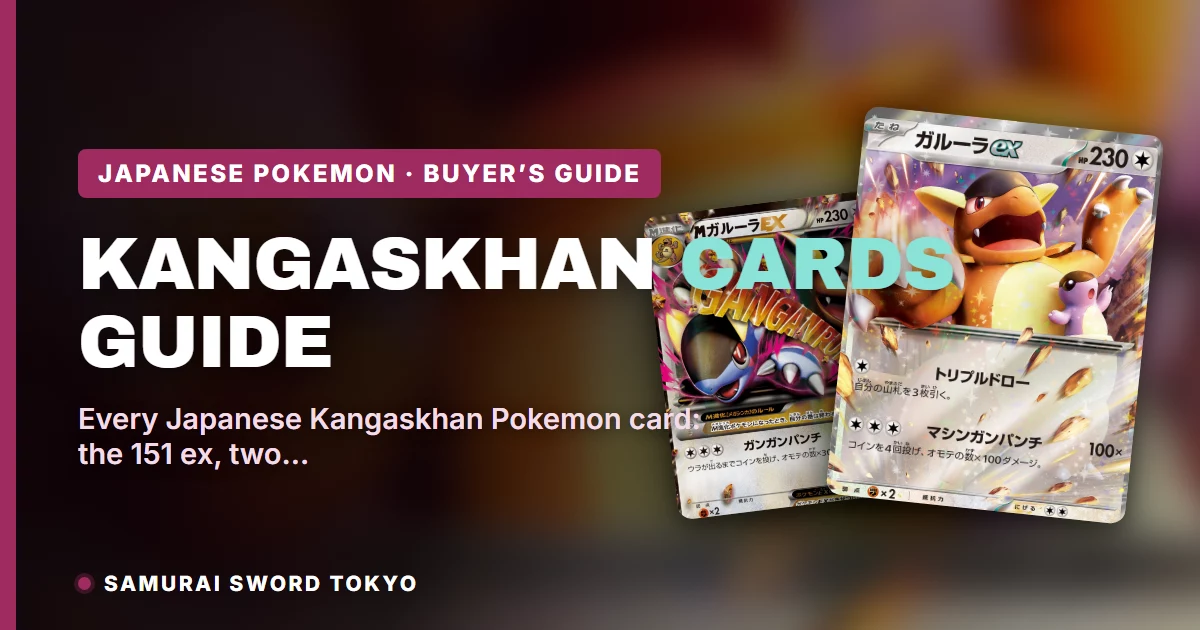
Kangaskhan宝可梦卡牌指南:从151到Mega Kangaskhan ex的所有日版印刷版本

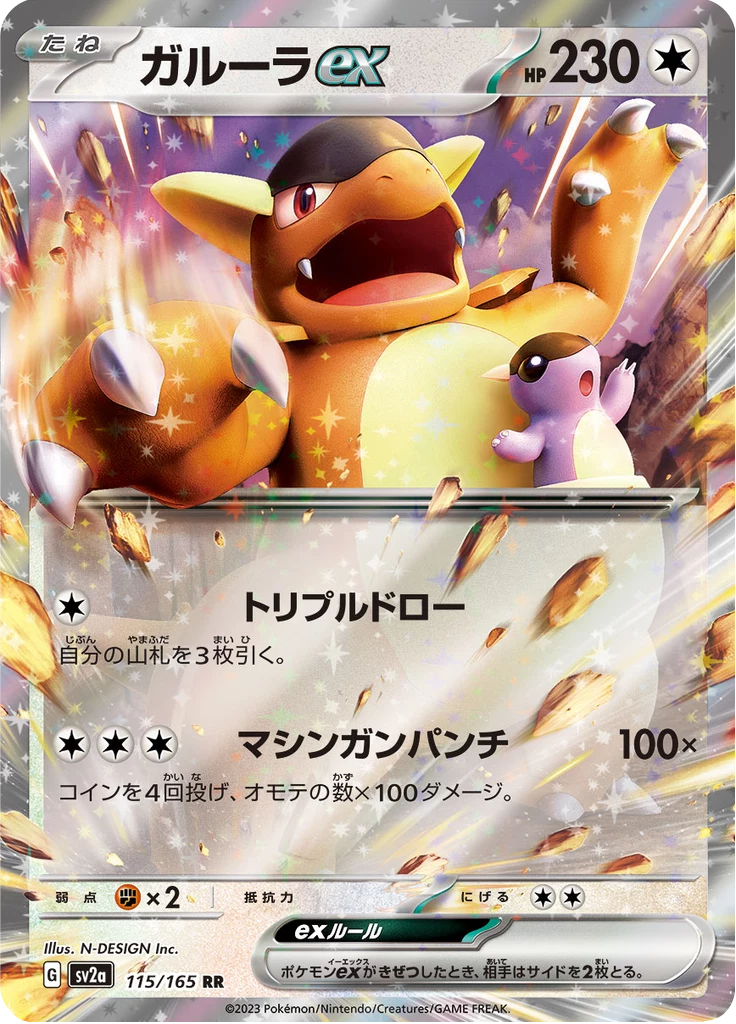
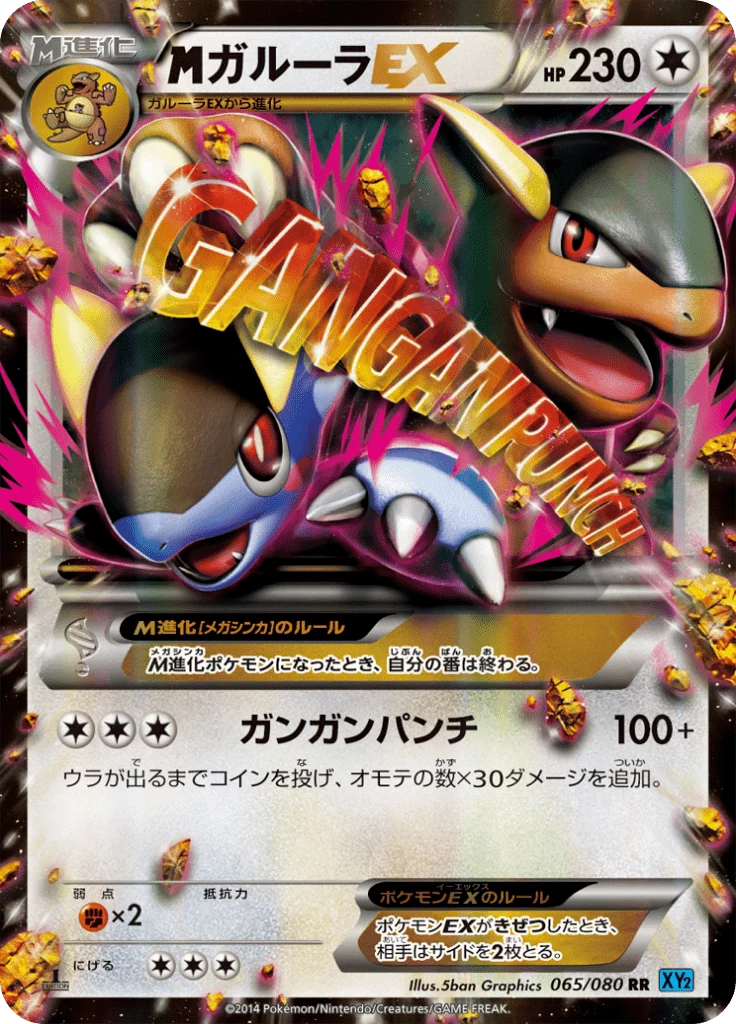
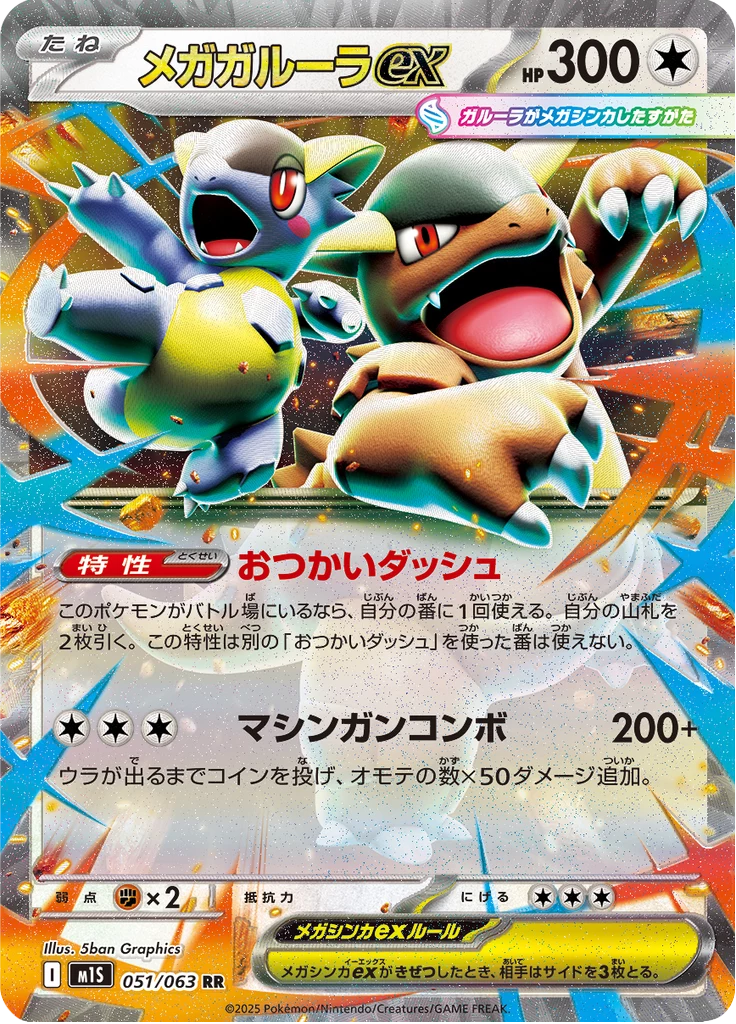
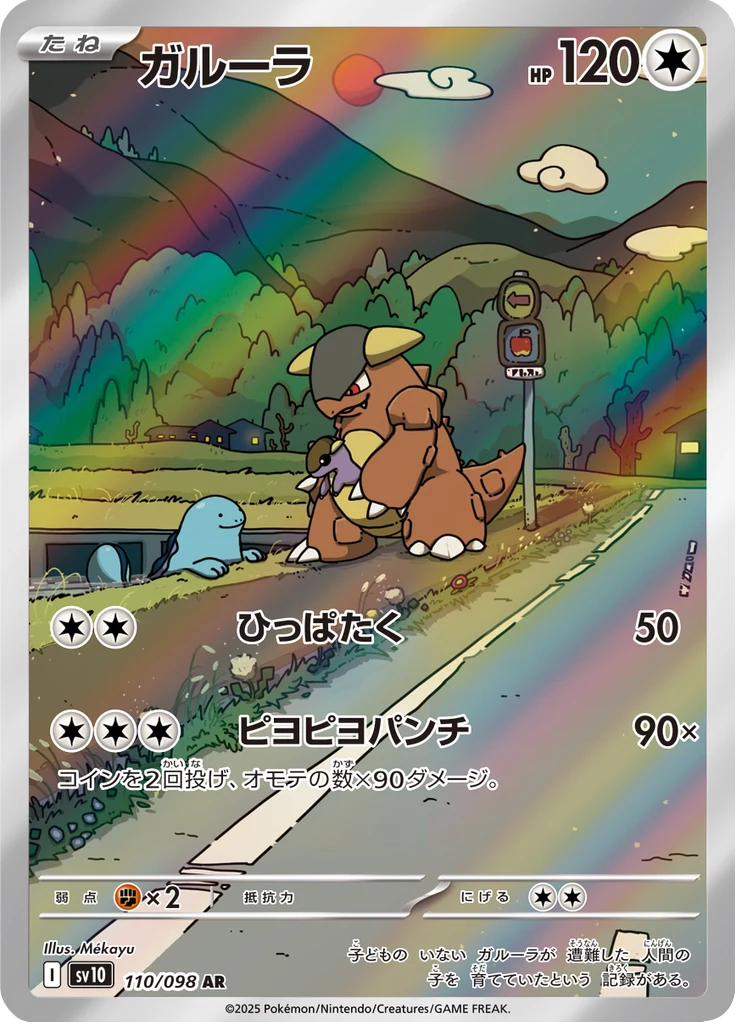
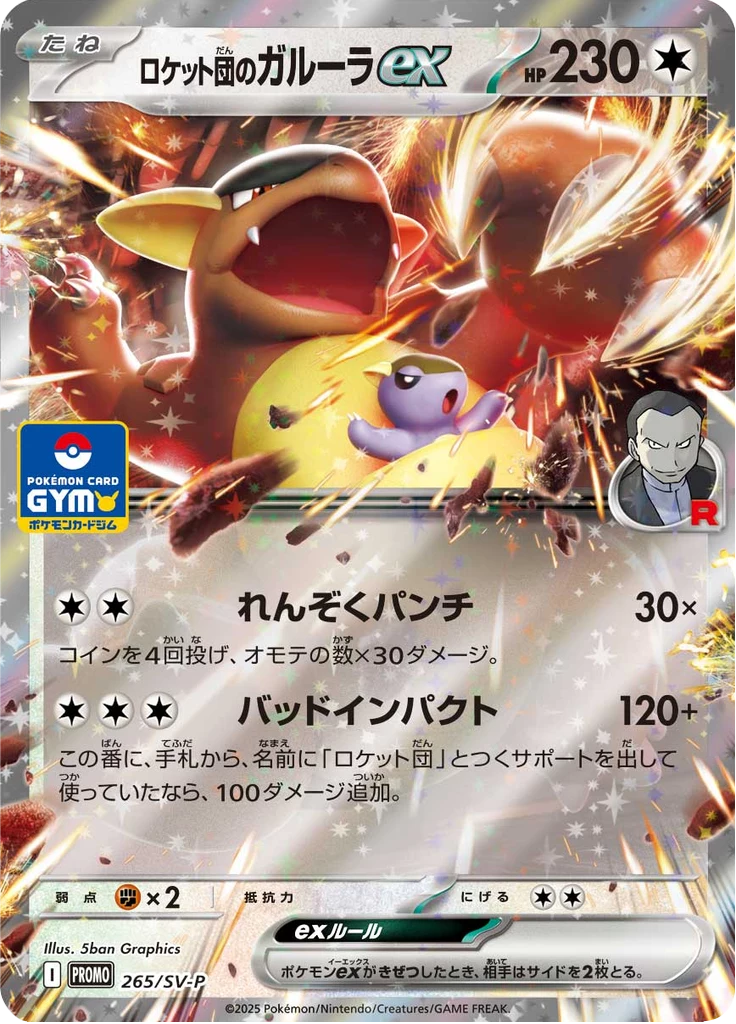
Kangaskhan has gone through Mega Evolution on a Japanese Pokemon card twice — once in 2014, once in 2025 — and the two versions barely resemble each other beyond the name. Between those two Mega prints sits a modern basic ex from the 151 set, a 2025 Kangaskhan AR (Art Rare), and a Team Rocket-branded promo, which makes Kangaskhan one of the more scattered single-Pokemon lineups in the Japanese TCG to track down correctly.

This guide covers the main Japanese Kangaskhan prints: the current-era Kangaskhan ex from Pokemon Card 151, the Mega Kangaskhan ex cards from opposite ends of the last decade, the 2025 Art Rare and Team Rocket’s Kangaskhan ex. Tag All Stars (2019) includes a standard-rarity Kangaskhan at 107/173, and a Kangaskhan-GX promo (SMP #303) also exists; we could not verify their card text, so they are not detailed here. Sealed product ships from Tokyo, and we’ve linked each set directly.

Key Takeaway

Kangaskhan has seven notable Japanese prints covered here across five sets and a promo, including Mega Kangaskhan ex cards released 11 years apart (XY2, 2014 and M1S, 2025). The original modern print, Kangaskhan ex (SV2a 115/165), comes from Pokemon Card 151 — our 151 Booster Box was listed at ¥45,900 (~$298) on September 24, 2026. For sealed product from the other sets covered here, or for sourcing a specific Kangaskhan print as a single, sourcing requests go through our Quick Order page.

Updated September 24, 2026
  • SNKRDUNK lowest asks on September 24, 2026: the Glory of Team Rocket Kangaskhan AR (SV10 110/098) PSA 10 ask was ¥4,700; the Kangaskhan ex SR full-art (SV2a 192/165) PSA 10 ask was ¥5,000; the Special Art Rare Mega Kangaskhan ex (Mega Symphonia) PSA 10 ask was ¥13,999.
  • Browse the full Pokemon Card 151 card list for the rest of the set behind the current Kangaskhan ex.
7
Japanese Prints Covered

2
Mega Kangaskhan ex Cards

2014–2025
Years Spanned

Japanese Kangaskhan Prints Covered Here

Seven Kangaskhan prints, from the current 151 ex to the 2014 Wild Blaze ultra rare:

卡牌 Number Rarity 系列 Year
Kangaskhan ex SV2a 115/165 RR 151 2023
Mega Kangaskhan ex M1S 051/063 RR Mega Symphonia 2025
Kangaskhan (AR) SV10 110/098 AR Glory of Team Rocket 2025
Team Rocket’s Kangaskhan ex SVP 265 Promo SVP promo card 2025
M Kangaskhan-EX XY2 65/080 RR Wild Blaze 2014
M Kangaskhan EX XY2 090/080 UR Wild Blaze 2014
Kangaskhan SM12a 107/173 — Tag All Stars 2019

The 151 print is the one most current buyers run into first. The two Mega Kangaskhan ex cards bookend the list — one from 2014’s Wild Blaze, one from 2025’s Mega Symphonia — and the sections below cover why they’re built so differently despite sharing a name and a Mega Evolution mechanic. Wild Blaze also carries a second, Ultra Rare :1ED print of the older Mega card at 090/080. Tag All Stars (2019) includes a standard-rarity Kangaskhan at 107/173, and a Kangaskhan-GX promo (SMP #303) also exists; we could not verify their card text, so they are not detailed further in this guide.

The Modern Original: Kangaskhan ex in 151

Kangaskhan ex [SV2a 115/165] RR (Pokemon Card 151)
Kangaskhan ex, SV2a 115/165, RR — the 151 print, illustrated by N-DESIGN Inc.

Kangaskhan’s entry in Pokemon Card 151 (SV2a 115/165) is a Colorless-type, 230 HP Basic Pokemon ex, illustrated by N-DESIGN Inc. Its attack “Triple Draw” draws three cards, and “Bullet Punch” flips four coins and deals 100 damage for each one that lands heads — a swingy, high-ceiling attack that can also whiff entirely on a bad flip. The same card also has a Super Rare (SR) full-art version at SV2a 192/165; the lowest PSA 10 asking price on SNKRDUNK on September 24, 2026 for that SR full-art print was ¥5,000, with an ungraded lowest ask of ¥2,000.

Because this is the print most people mean when they say “Kangaskhan card,” it’s also the entry point for the rest of the lineup below — the Mega Kangaskhan ex cards, the 2025 Art Rare, and Team Rocket’s version are all built around the same basic Pokemon. For a full breakdown of what else 151 packs contain, see our Pokemon 151 best cards guide.

Two Mega Kangaskhan ex Cards, 11 Years Apart

Kangaskhan has gone through Mega Evolution on a Japanese card twice, on opposite ends of a decade.

M Kangaskhan-EX [XY2 65/080] RR (Wild Blaze)

M Kangaskhan-EX, XY2 65/080, RR (2014)

Mega Kangaskhan ex [M1S 051/063] RR (Mega Symphonia)

Mega Kangaskhan ex, M1S 051/063, RR (2025)

The older card, M Kangaskhan-EX (XY2 65/080), comes from Wild Blaze in 2014 — the same XY-era M Evolution mechanic used across that generation, where the card evolves directly from a Kangaskhan-EX already in play. Illustrated by 5ban Graphics, it’s a Colorless, 230 HP card whose attack, “Wham Bam Punch,” deals 100 damage and then keeps flipping coins, adding 30 more damage for as long as the flips land heads. It was later reprinted in Japan in the EX x MEGA x BREAK Champion Pack (#94), and its English-language counterpart is Flashfire #79, with a secret rare printing at #109. The same Wild Blaze set also has an Ultra Rare :1ED print of this card at 090/080; our PSA 10 M Kangaskhan EX (XY2 090/080) was listed at ¥46,800 on September 24, 2026. How back orders work is explained in Back Order a PSA 10 Card from Japan.

The current card, Mega Kangaskhan ex (M1S 051/063), comes from Mega Symphonia in 2025 and uses the newer Mega mechanic instead of the old M Evolution rule. It’s a 300 HP Colorless Basic Pokemon with the ability “Errand Dash,” which draws two cards once per turn if this card is your Active Pokemon, plus the attack “Barrage Combo,” which does 200 damage and then keeps flipping coins for 50 more damage each as long as they land heads. The same card also has a Super Rare print at M1S 080/063 and a Special Art Rare at M1S 089/063, illustrated by GOTO minori. Internationally, it corresponds to Mega Evolution #104, with additional prints at #164 and #182, plus a Mega Promos version at #25. The lowest PSA 10 asking price on SNKRDUNK on September 24, 2026 for the Special Art Rare Mega Kangaskhan ex was ¥13,999, with an ungraded lowest ask of ¥2,800. Our PSA 10 Mega Kangaskhan ex Special Art Rare (089/063) was listed at ¥12,438 on September 24, 2026.

Beyond the shared name, the two attacks work the same way — a base amount of damage followed by a coin-flip chain — but the numbers, HP, and supporting ability changed considerably across the 11 years between them. For everything else from the 2014 set, see our Wild Blaze best cards guide, and for more on how XY-era EX and Mega EX cards are built, our XY-era EX and Mega EX cards guide covers the mechanic in more depth. Browse the full Mega Symphonia card list for the rest of the set.

The 2025 Additions: Art Rare and Team Rocket’s Kangaskhan ex

Kangaskhan [SV10 110/098] AR (Glory of Team Rocket)

Kangaskhan, SV10 110/098, AR

Team Rocket's Kangaskhan ex [SVP 265] Promo

Team Rocket’s Kangaskhan ex, SVP 265, Promo

Glory of Team Rocket, released in 2025, added an Art Rare Kangaskhan (SV10 110/098), illustrated by Mékayu. It’s a Colorless, 120 HP card with “Gentle Slap” for 50 damage and “Dizzy Punch,” which flips two coins for 90 damage each. The same card has a standard-rarity print at SV10 80/098, and its English-language equivalent is Destined Rivals #204. The lowest PSA 10 asking price on SNKRDUNK on September 24, 2026 for this Art Rare was ¥4,700, with an ungraded lowest ask of ¥1,000. Our PSA 10 Kangaskhan Art Rare (SV10 110/098) was listed at ¥5,023 on September 24, 2026. Browse the full Glory of Team Rocket card list for the rest of the set.

Team Rocket’s Kangaskhan ex is a standalone SVP promo card (#265) from 2025, illustrated by 5ban Graphics — it isn’t printed in any booster box. It’s a Colorless, 230 HP Pokemon ex with “Comet Punch,” which flips four coins for 30 damage each, and “Bad Impact,” which deals 120 damage plus 100 more if you played a Team Rocket Supporter card this turn. Its English-language equivalent is Ascended Heroes #162.

The Art Rare Kangaskhan and its standard-rarity print both come from Glory of Team Rocket, so a single sealed box gives you a shot at either one; the Team Rocket’s Kangaskhan ex promo isn’t printed in any booster box.

Other Kangaskhan Prints

Tag All Stars (2019) includes a standard-rarity Kangaskhan at 107/173, and a Kangaskhan-GX promo (SMP #303) also exists; we could not verify their card text, so they are not detailed here. If you’re specifically after either of these two prints, sourcing requests go through our Quick Order page — the more specific you can be about the print, the better.

Chasing Kangaskhan Through Sealed Boxes

These sealed boxes carry the prints above. The 151 box carries the modern Kangaskhan ex:

Shop This Set
Pokemon Card 151 Booster Box (Japanese)
Listed at ¥45,900 (~$298) on September 24, 2026
Ships from Tokyo

View Product →

For the other Kangaskhan prints covered above:

Wild Blaze (XY2), the source of the 2014 M Kangaskhan-EX, and the Team Rocket’s Kangaskhan ex promo are not covered by a booster box above. For either of those, or for any Kangaskhan single not listed above, sourcing requests go through our Quick Order page — specifics on the exact print help.

Where to Buy Japanese Kangaskhan Cards

Sealed product ships from Tokyo. For the current Kangaskhan ex, the 151 Booster Box is the direct route; for the Art Rare or 2019 reprint, the Glory of Team Rocket and Tag All Stars boxes linked above cover each print. For the 2014 M Kangaskhan-EX, the Team Rocket’s Kangaskhan ex promo, or any single-card request, sourcing requests go through our Quick Order page.

If you’re building out a wider XY-era collection beyond Kangaskhan, our Wild Blaze best cards guide and XY-era EX and Mega EX cards guide cover more of that generation, and our Japanese old-back Pokemon cards guide is a useful primer if you’re sourcing further back than XY-era product.

常见问题

Is there a Kangaskhan card in the Pokemon 151 set?

Yes. Kangaskhan ex (SV2a 115/165, RR) is the current-era Kangaskhan print, with a Super Rare (SR) full-art version at 192/165. It’s a Colorless, 230 HP Basic Pokemon ex with the attacks Triple Draw and Bullet Punch.

Is there a Mega Kangaskhan Pokemon card?

There are two. M Kangaskhan-EX (XY2 65/080, with an Ultra Rare :1ED print at 090/080) came from Wild Blaze in 2014 using the older M Evolution mechanic. Mega Kangaskhan ex (M1S 051/063, with Super Rare and Special Art Rare versions) came from Mega Symphonia in 2025 using the current Mega mechanic. They share a name but have different HP, abilities, and attack effects.

What is Team Rocket’s Kangaskhan ex?

It’s a standalone SVP promo card (#265) from 2025, illustrated by 5ban Graphics — not printed in any booster box. Its attack Bad Impact deals bonus damage if you played a Team Rocket Supporter card that turn.

Where can I buy Japanese Kangaskhan Pokemon cards?

Sealed product ships from Tokyo. The 151 Booster Box, Glory of Team Rocket Booster Box, and Tag All Stars Booster Box cover several of the Kangaskhan prints in this guide. For the rest, our Quick Order page handles sourcing requests.

Are there other Kangaskhan cards besides the ones covered here?

Tag All Stars (2019) includes a standard-rarity Kangaskhan at 107/173, and a Kangaskhan-GX promo (SMP #303) also exists; we could not verify their card text, so they are not detailed here. If you’re looking for either specifically, our Quick Order page is the way to submit a sourcing request.

Donquixote Doflamingo One Piece卡牌指南

Donquixote Doflamingo has three official Leader cards in three different color combinations — three distinct Doflamingo Leader card designs that, together with his Character-slot prints, make up the Doflamingo card lineup covered in this guide.

This guide covers six Doflamingo printings in detail — his three Leader cards and three Character cards — and lists further card numbers. Between OP01 Romance Dawn, OP04 Kingdoms of Intrigue, and OP14 The Azure Sea’s Seven, his Leader identity has shifted from Blue to Green/Purple to pure Purple. We source Japanese One Piece Card Game product directly out of Tokyo.

We don’t currently hold individual Doflamingo singles in our own stock, so this guide doesn’t quote any in-house prices for his own cards. What we can point you to directly is sealed Japanese product and a sourcing route for specific prints.

Key Takeaway

Donquixote Doflamingo has three official Leader cards — OP01-060 (Blue, OP01 Romance Dawn), OP04-019 (Green/Purple, OP04 Kingdoms of Intrigue), and OP14-060 (Purple, OP14 The Azure Sea’s Seven) — plus three Character cards covered in detail here. We don’t carry Doflamingo singles ourselves; the direct route to Japanese One Piece Card Game product from us is the OP-17 The World’s Strongest Warriors booster box, released August 22, 2026 and currently listed at ¥17,000 (~$110), or a request through 快速下单.

Updated September 24, 2026
  • OP-17 The World’s Strongest Warriors released in Japan on August 22, 2026.
  • SNKRDUNK’s September 24, 2026 dated asks for three of Doflamingo’s parallel prints are in the Leader and Character sections below.
  • See the full OP-17 card list for the set’s confirmed lineup.
6
Printings Covered

3
Leader Cards

3
Color Identities

Aug 22
OP-17 Release Date

Card data is drawn from the official OP card list and the LimitlessTCG card database. We don’t hold Doflamingo singles in our own stock; pricing below combines our own sealed product and SNKRDUNK’s dated secondary-market asks, both refreshed on September 24, 2026. USD figures convert at ¥154/USD, approximate.

Every Donquixote Doflamingo Card at a Glance

Six Donquixote Doflamingo printings are covered in detail in this guide, split evenly between Leader cards and Character cards:

Code 卡牌 Rarity 系列 Type
OP01-060 Donquixote Doflamingo Leader OP01 Romance Dawn Leader
OP01-073 Donquixote Doflamingo Rare OP01 Romance Dawn Character (Blocker)
ST03-009 Donquixote Doflamingo SR ST03 The Seven Warlords of the Sea Character
OP04-019 Donquixote Doflamingo Leader OP04 Kingdoms of Intrigue Leader
OP04-031 Donquixote Doflamingo SR OP04 Kingdoms of Intrigue Character
OP14-060 Donquixote Doflamingo Leader OP14 The Azure Sea’s Seven Leader

That’s three Leader cards in three different color combinations, across three separate mainline sets. Beyond these six, Doflamingo has also been confirmed under further card numbers not covered in detail in this guide: OP10-071 (SR, Royal Blood), OP14-069 (SR), PRB02-011 (R), and OP09-031 (R). The sections below cover each of the six main Leaders and Character cards in turn.

Three Leader Cards, Three Color Identities

What sets Doflamingo apart from most supporting characters in this game is that he hasn’t been locked to one Leader design. Each of his three Leader cards uses a different color combination and a different mechanical angle:

  • OP01-060 (Blue) — a reveal-and-deploy Leader tied to Seven Warlords of the Sea characters, from the game’s first mainline set.
  • OP04-019 (Green/Purple) — a DON!! recovery Leader, straightforward resource acceleration.
  • OP14-060 (Purple) — a defensive misdirection Leader that can redirect an opponent’s attack.

Each was released across three different eras of the game, from OP01 through OP14. The rest of this section walks through each one.

OP01-060: The Original Leader (Romance Dawn)

Donquixote Doflamingo Leader, OP01-060, OP01 Romance Dawn

OP01-060 Leader (OP01 Romance Dawn)

Donquixote Doflamingo Leader Alt Art, OP01-060, OP01 Romance Dawn

OP01-060 — Alt Art version

Doflamingo’s first Leader printing is OP01-060, from OP01 Romance Dawn: a Blue Leader with a 5000 base and a Life value of 5. Its ability triggers on attack — by paying 2 DON!!, you reveal the top card of your deck, and if it’s a Seven Warlords of the Sea character costing 4 or less, it enters play rested. It’s a tempo-focused Leader built around the Warlords archetype rather than Doflamingo’s own Donquixote Pirates crew. As of September 24, 2026, the lowest asking price on SNKRDUNK for the parallel foil (L-P) print of this Leader was ¥4,000 (~$26) raw, with PSA 10 graded examples asking from ¥21,200 (~$138) on the same date.

An Alt Art version of OP01-060 exists, and the same Leader was reprinted in the ST17 BLUE Donquixote Doflamingo starter deck, giving it a second point of entry outside the original booster box.

Since OP01-060 comes out of Romance Dawn, our OP-01 best cards guide covers the rest of that set’s chase list, and the full OP-01 card list covers every printing in the set.

OP04-019: The Green/Purple Leader (Kingdoms of Intrigue)

Donquixote Doflamingo Leader, OP04-019, OP04 Kingdoms of Intrigue

OP04-019 Leader (OP04 Kingdoms of Intrigue)

OP04-019, from OP04 Kingdoms of Intrigue, moves Doflamingo into a Green/Purple dual-color slot: 5000 base, Life 4. Its ability is straightforward resource recovery — at the end of the turn, set up to 2 rested DON!! cards active again. It’s a simpler effect than the OP01 version, built for consistent DON!! availability rather than a specific card-reveal payoff.

An Alt Art version of OP04-019 also exists.

OP14-060: The Purple Leader (The Azure Sea’s Seven)

Donquixote Doflamingo Leader, OP14-060, OP14 The Azure Sea's Seven

OP14-060 Leader (OP14 The Azure Sea’s Seven)

The most recent Doflamingo Leader is OP14-060, from OP14 The Azure Sea’s Seven, released in 2026. It’s a pure Purple Leader with a 5000 base and Life 5. Its ability is defensive rather than aggressive: for 1 DON!!, it can redirect an opponent’s attack toward itself or toward a Donquixote Pirates character on the field, giving the deck a way to control which of its cards actually takes damage on a given turn. As of September 24, 2026, the lowest asking price on SNKRDUNK for the parallel foil (L-P) print of this Leader was ¥2,500 (~$16) raw; no current SNKRDUNK figure in this update for a PSA 10 example of this print.

An Alt Art version of OP14-060 exists as well. Of the three Leaders, this is the only one built specifically around the Donquixote Pirates crew tag rather than the broader Seven Warlords of the Sea group or a generic DON!! effect. See the full OP-14 card list for every printing in the set.

The Character Cards: OP01-073, ST03-009, OP04-031

Donquixote Doflamingo Rare, OP01-073, OP01 Romance Dawn

OP01-073 Rare (OP01 Romance Dawn)

Donquixote Doflamingo Super Rare, ST03-009, ST03 The Seven Warlords of the Sea

ST03-009 SR (ST03 The Seven Warlords of the Sea)

Donquixote Doflamingo Super Rare, OP04-031, OP04 Kingdoms of Intrigue

OP04-031 SR (OP04 Kingdoms of Intrigue)

OP01-073 is a Blue, 3-cost, 4000-power Rare with Blocker, and an on-play ability that lets you rearrange the top 5 cards of your deck. It also has an Alt Art (aa) version and a Special (SP) printing that appeared in OP07 500 Years in the Future — a card that resurfaced two years after its original set. As of September 24, 2026, the lowest asking price on SNKRDUNK for the R-SPC parallel print of this card was ¥4,000 (~$26) raw, with PSA 10 graded examples asking from ¥18,000 (~$117) on the same date.

ST03-009, from ST03 The Seven Warlords of the Sea, is a Blue, 7-cost, 7000-power Super Rare with an on-play bounce effect: return an opposing character costing 7 or less to hand. It also has a Special version reprinted in OP03 Pillars of Strength, described on LimitlessTCG as a wanted-poster-style variant.

OP04-031, from OP04 Kingdoms of Intrigue, is a Green, 10-cost, 10000-power Super Rare with a stall effect: up to 3 of the opponent’s rested Leader or Character cards don’t stand back up at their next refresh. It has an Alt Art (aa) version and a reprint in The Best (PRB01).

For more on how alt-art and Special-version parallels work as a category across the game, our One Piece comic parallel cards guide covers the wider parallel landscape.

New for OP-16, and Is Doflamingo in OP-17?

OP16 The Time of Battle added two new Doflamingo Character cards, OP16-047 and OP16-069, both Common rarity — confirmation that he continues to get fresh slots in current-era mainline sets rather than being confined to reprints of older art. See the full OP-16 card list for every printing in that set.

As for OP-17 The World’s Strongest Warriors, which released in Japan on August 22, 2026: this guide does not cover OP-17 prints; the OP-17 card list shows the full set.

Shop This Set
OP-17 The World’s Strongest Warriors Booster Box (Japanese)
Currently listed at ¥17,000 (~$110)
Ships from Tokyo

View Product →

Where to Buy Donquixote Doflamingo Cards and OP-17 Boxes

Orders ship from Tokyo. We don’t currently hold Doflamingo singles — not the OP01-060 Leader, the OP04-019 or OP14-060 Leaders, or any of the three Character cards — as standing catalog items — specific printings can be requested through our Quick Order page. The OP-17 The World’s Strongest Warriors booster box is currently listed at ¥17,000 (~$110).

Browse the full lineup of Japanese One Piece booster boxes in our One Piece booster box collection. For a broader look at how Leader cards work across the game — not just for Doflamingo — our One Piece Leader cards guide is the sibling reference. And if you’re chasing graded prints of any of these printings, our PSA10 One Piece cards buying guide covers how grading affects value across the wider card pool.

常见问题

How many Donquixote Doflamingo cards are there?

Six printings covered in detail in this guide: three Leader cards (OP01-060, OP04-019, and OP14-060) and three Character cards (OP01-073, ST03-009, and OP04-031). OP16 also added two new Common-rarity Character cards, OP16-047 and OP16-069.

How many Leader cards does Doflamingo have?

Three: OP01-060 (Blue, OP01 Romance Dawn), OP04-019 (Green/Purple, OP04 Kingdoms of Intrigue), and OP14-060 (Purple, OP14 The Azure Sea’s Seven). Each uses a different color identity and a different ability.

What’s the difference between Doflamingo’s three Leader cards?

OP01-060 is a Blue, attack-triggered Leader that can deploy a Seven Warlords of the Sea character from the top of your deck. OP04-019 is a Green/Purple Leader focused on recovering rested DON!! cards. OP14-060 is a Purple, defensive Leader that can redirect an opponent’s attack toward itself or a Donquixote Pirates character.

Is Donquixote Doflamingo in the OP-17 set?

This guide does not cover OP-17 prints; the OP-17 card list shows the full set.

Brook One Piece卡牌指南:完整印刷版本一览

Brook has no confirmed Leader card. Brook One Piece card printings covered here (seven) are all Character cards, spanning the game’s entire run since its first starter deck — never the deck you build around, always a piece you build with.

That makes his card pool a straightforward one to map: no Leader variants to sort out, no rival “which one is the real Leader” confusion like some Straw Hats get. What Brook does have is a run of seven confirmed printings across starter decks, mainline boosters, an extra booster, and OP17-091, the card added in OP-17. This guide walks through every confirmed Brook printing, including OP17-091. We source Japanese One Piece Card Game product directly out of Tokyo, so every card discussed here ties back to an official set we can point to.

Key Takeaway

Brook has seven confirmed printings and no confirmed Leader card. Two are Super Rares with confirmed Alternate Art parallels (EB01-046 and OP15-032), and the newest — OP17-091, an Elbaph-era Common — comes from OP-17 The World’s Strongest Warriors, which released in Japan on August 22, 2026. The Japanese OP-17 booster box was listed at ¥17,000 (~$110) on September 24, 2026.

Updated September 24, 2026
  • OP-17 The World’s Strongest Warriors released in Japan on August 22, 2026.
  • SNKRDUNK’s September 24, 2026 dated asks for Brook’s two Super Rares are in the Two Super Rares section below.
  • See the full OP-17 card list for the set’s complete lineup, including OP17-091.
7
Confirmed Printings

0
Confirmed Leader Cards

2
Super Rares

Aug 22
OP-17 Release Date

Card data is drawn from the official OP card list and the LimitlessTCG card database. This is a sourcing guide. Store and SNKRDUNK prices below were refreshed on September 24, 2026; USD figures convert at ¥154/USD, approximate.

Every Brook Card at a Glance

Seven Brook printings are confirmed across the official card list and the LimitlessTCG card database, from his first starter-deck appearance through the OP-17 addition:

Code Rarity 系列 Notes
ST01-011 Common ST01 Straw Hat Crew [On Play] grants 2 rested DON!!. Reprinted across multiple later products, including Tournament Pack Vol.4, FILM RED Edition, and Championship 2023.
OP01-022 Uncommon OP01 Romance Dawn [DON!!x1][When Attacking] −2000 to up to two opposing Characters. Reprinted in a 25th Edition premium card collection.
OP02-040 Rare OP02 Paramount War [On Play] deploys a cost-3-or-under {FILM}/{Straw Hat Crew} Character. Reprinted in the ST11 Uta starter deck.
OP06-092 Rare OP06 Wings of the Captain [On Play] choice effect: trash a cost-4-or-under Character, or return three opposing trashed cards to the deck. Type includes Former Rumbar Pirates.
EB01-046 Super Rare EB01 Memorial Collection [On Play]/[When Attacking] −1 cost and K.O. a cost-0 Character. Confirmed Alternate Art parallel. Reprinted in PRB02.
OP15-032 Super Rare OP15 Adventure on Kami’s Island [On Play] rests itself and trashes itself to activate a cost-8-or-under Character. Confirmed Alternate Art parallel.
OP17-091 Common OP17 The World’s Strongest Warriors +3000 power and discards a card from the opponent’s hand if you control a cost-12-or-more Character. Type includes Elbaph and Straw Hat Crew — the newest confirmed printing.

No Leader card, no Secret Rare, and no confirmed comic-panel parallel appear for Brook in the official list. What he does have is a clean spread across cost brackets and colors — red, green, and black — plus two Super Rares that both carry a confirmed Alternate Art version.

Read chronologically, the seven printings also trace the shape of the card game itself: a Common from the very first starter deck, an Uncommon from the first mainline booster, a run of Rares tied to specific story eras, two Super Rares from later mainline and extra-booster sets, and a Common in OP-17. It’s a spread that favors a collector working set by set over one chasing a single grail card — there isn’t a standout chase print in Brook’s lineup the way there is for some other Straw Hats, just a steady run of confirmed releases.

The Two Super Rares: EB01-046 and OP15-032

Brook Super Rare, EB01-046, EB01 Memorial Collection

EB01-046 (EB01 Memorial Collection)

Brook Super Rare Alternate Art, EB01-046, EB01 Memorial Collection

EB01-046 — Alternate Art

Brook Super Rare, OP15-032, OP15 Adventure on Kami's Island

OP15-032 (OP15 Adventure on Kami’s Island)

Brook Super Rare Alternate Art, OP15-032, OP15 Adventure on Kami's Island

OP15-032 — Alternate Art

EB01-046 comes from EB01 Memorial Collection, an extra booster set, and is a black Character with a cost-reduction and removal effect — it gives −1 cost and K.O.s a cost-0 Character on play or when attacking. It carries a confirmed Alternate Art parallel and was later reprinted in PRB02. As of September 24, 2026, the lowest asking price on SNKRDUNK for the campaign promo-pack SR-P of EB01-046 (from the “始めようキャンペーン” promo pack) was ¥15,000 (~$97) raw, with PSA 10 graded examples asking from ¥47,600 (~$309) on the same date; the ordinary EB01 Memorial Collection SR asked ¥1,000 (~$6) raw on the same date, with its own SR-P parallel at ¥2,888 (~$19). See the full EB-01 card list for every printing in the set.

OP15-032 is a green Character from OP15 Adventure on Kami’s Island with an activation effect: it rests and trashes itself to reactivate a cost-8-or-under Character elsewhere on the board. Like EB01-046, it has a confirmed Alternate Art version. As of September 24, 2026, the lowest asking price on SNKRDUNK for this SR print was ¥1,000 (~$6) raw; no current SNKRDUNK figure in this update for a PSA 10 example of this print. See the full OP-15 card list for every printing in the set.

Both give deckbuilders a genuine tempo tool rather than a stat-line vanilla — useful context if you’re comparing Brook’s playable value against his collecting value. Neither card carries a Manga Parallel or Secret Rare treatment in the official list. Collectors chasing graded prints of either can check our PSA 10 One Piece cards buying guide for how grading is generally approached across the card pool.

The Original Printings: ST01-011 and OP01-022

Brook Common, ST01-011, ST01 Straw Hat Crew

ST01-011 (ST01 Straw Hat Crew)

Brook Uncommon, OP01-022, OP01 Romance Dawn

OP01-022 (OP01 Romance Dawn)

ST01-011 is Brook’s earliest confirmed printing, a red Common from ST01 Straw Hat Crew — the game’s very first starter deck. Its on-play effect grants two rested DON!! cards, a straightforward resource boost. It’s also the most reprinted of these seven Brook printings: the official list confirms it appearing again in Tournament Pack Vol.4, the FILM RED Edition premium collection, and Championship 2023 among other releases.

OP01-022 arrived one set later in OP01 Romance Dawn, the game’s first mainline booster set. It’s a red Uncommon with a DON!!-linked attack effect that weakens up to two opposing Characters, and it was reprinted in a 25th Edition premium card collection.

Together these two mark Brook’s first year in the game — both from the earliest wave of product, both reprinted at least once since, and both still the entry point for anyone building a Brook binder from the ground up.

FILM-Era Artwork: OP02-040

Brook Rare, OP02-040, OP02 Paramount War

OP02-040, a green Rare from OP02 Paramount War, carries a {FILM} type tag alongside {Straw Hat Crew} — tying its artwork to the movie continuity rather than the main manga timeline. Its on-play effect deploys a cost-3-or-under {FILM} or {Straw Hat Crew} Character from hand, which fits the card’s own type identity. It was later reprinted in the ST11 Uta starter deck, a set built around the FILM RED movie tie-in.

It’s a useful marker for anyone sorting a Brook collection by illustration era rather than just set number — the {FILM} type tag is the tell for movie-continuity artwork across the wider card pool, not just this one card.

Backstory in Cardboard: OP06-092 and the Rumbar Pirates

Brook Rare, OP06-092, OP06 Wings of the Captain

OP06-092, a black Rare from OP06 Wings of the Captain, is the one Brook card whose type field points to his life before the Straw Hats. Its type is listed as Former Rumbar Pirates — the crew Brook served on decades before joining Luffy’s crew, and the backstory that eventually connects to Laboon. Its on-play effect gives a choice: trash a cost-4-or-under opposing Character, or return three opposing trashed cards to the deck.

Type tags like this one are one of the more reliable ways the card game encodes a character’s backstory directly into the cardboard — useful if you’re collecting Brook cards specifically for the eras of his story they represent rather than just chasing rarity.

New for OP-17: OP17-091

OP-17 The World’s Strongest Warriors, which released in Japan on August 22, 2026, added a confirmed seventh Brook card: OP17-091, a black Common. Its effect gives +3000 power and forces a discard from the opponent’s hand, but only while you control a cost-12-or-more Character — a late-game payoff card. Its type field includes Elbaph alongside Straw Hat Crew, tying the artwork to the current Elbaph story arc. No current SNKRDUNK figure for OP17-091 is available in this update.

Shop This Set
OP-17 The World’s Strongest Warriors Booster Box (Japanese)
Listed at ¥17,000 (~$110) on September 24, 2026
Ships from Tokyo

View Product →

For a general walkthrough of how booster box buying and allocation work, see our One Piece booster box buying guide.

Why Brook Has No Leader Card

The official card list shows no Brook Leader card — not in a starter deck, not as a booster pull. That leaves him with a deep bench of Character-slot printings, but no Leader-slot card of his own so far.

For a full picture of which One Piece characters do have confirmed Leader cards — including ones with more than one Leader printing — see our One Piece Leader cards guide. If a Leader card is confirmed for Brook in a future set, we’ll update this guide.

Where to Source Brook Cards and the OP-17 Box

Orders ship from Tokyo. Brook’s newest confirmed card, OP17-091, comes from the OP-17 The World’s Strongest Warriors booster box, which released in Japan on August 22, 2026 and was listed at ¥17,000 (~$110) on September 24, 2026.

Browse the full lineup of Japanese One Piece booster boxes in our One Piece booster box collection. Requests for a specific product go through our Quick Order page.

New to sourcing Japanese One Piece cards generally? Our guide to buying One Piece cards from Japan in 2026 covers the sealed-product and single-sourcing process end to end.

常见问题

Does Brook have a Leader card?

No confirmed Leader card exists for Brook in the official One Piece Card Game list. All seven of his confirmed printings are Character-slot cards, from starter decks through mainline boosters.

Is Brook in the OP-17 set?

Yes. OP17-091 is a confirmed Common Brook card in OP-17 The World’s Strongest Warriors, which released in Japan on August 22, 2026. Its type field includes Elbaph, tying it to the current story arc.

Which Brook cards are Super Rare?

Two: EB01-046 from EB01 Memorial Collection and OP15-032 from OP15 Adventure on Kami’s Island. Both have confirmed Alternate Art parallels, and EB01-046 was later reprinted in PRB02. As of September 24, 2026, SNKRDUNK’s lowest raw asks were ¥1,000 for OP15-032 and ¥1,000 for the ordinary EB01 Memorial Collection SR of EB01-046; a separate campaign promo-pack SR-P of EB01-046 asked ¥15,000 raw on the same date.

What is Brook’s most reprinted card?

ST01-011, his original ST01 Straw Hat Crew starter-deck printing, has been reprinted the most across confirmed releases, including Tournament Pack Vol.4, the FILM RED Edition premium collection, and Championship 2023.

Bonnie SR 102/094:日版Forbidden Light卡片指南

Bonnie SR 102/094 is a Japanese Supporter card from 扩展包 “Forbidden Light” (SM6), printed under the Japanese name ユリーカ. Illustrated by Hideki Ishikawa, it is one of two ユリーカ prints the official database lists, both from the same set.

This guide covers the card’s printed text, sets the SR beside the set’s other Bonnie print, gives the dated SNKRDUNK ask alongside our own PSA 10 back order listing, and lines it up against other graded SM6 SR cards we list.

Key Takeaways

Bonnie SR 102/094 is a Supporter card from 扩展包 “Forbidden Light” (SM6), released March 2, 2018, illustrated by Hideki Ishikawa. A PSA 10 copy is offered as a back order from us at ¥21,070 (~$137) — sourced to order; the product page shows the current terms.

102/094
Card Number
SR
Rarity
Mar 2, 2018
SM6 Release
Our PSA 10 Back Order

Card facts below are read from the official Japanese card database. Marketplace and store figures are dated as stated; USD figures convert at ¥154/USD, approximate.

What Is Bonnie SR 102/094?

The official database lists Bonnie (ユリーカ) 102/094 as a Super Rare — SR — Supporter card from 扩展包 “Forbidden Light” (SM6). The official product page gives a Japanese release date of March 2, 2018. As a Trainer card, it carries no HP, type or stage — the database lists it simply as a Supporter.

Bonnie SR 102/094, 扩展包 Forbidden Light (SM6), illustrated by Hideki Ishikawa
Bonnie SR 102/094 — 扩展包 “Forbidden Light” (SM6) — Hideki Ishikawa

This SR print is illustrated by Hideki Ishikawa and carries the regulation mark B, read off the card image, with a copyright year of 2018. Illustrator credit does not separate this print from the set’s other Bonnie card, covered next — both are credited to Hideki Ishikawa.

The official product page lists a suggested retail price of 150 yen plus tax per pack for 扩展包 “Forbidden Light.”

Card Text

Attribute Detail
Card number 102/094
JP name ユリーカ
Card type Trainer — Supporter
Rarity SR Super Rare
Illustrator Hideki Ishikawa
Regulation mark B
系列 扩展包 “Forbidden Light” (SM6)

The official Japanese text reads: “このカードは、場にスタジアムが出ていなければ使えない。場に出ているスタジアムをトラッシュする。この番、自分の「ジガルデGX」は、自分がすでにGXワザを使っていても、GXワザが使える。” Our rendering: “You can play this card only if there is a Stadium in play. Discard the Stadium in play. During this turn, your Zygarde-GX can use a GX attack even if you have already used a GX attack.”

The effect names one Pokemon-GX, Zygarde-GX (ジガルデGX). The rendering above is our own, not an official English text.

Both ユリーカ Prints in the Official Database

The official database lists two ユリーカ prints, both from SM6 “Forbidden Light” and both illustrated by Hideki Ishikawa.

Print Number Rarity Illustrator 系列
Bonnie U 090/094 U Hideki Ishikawa SM6 “Forbidden Light”
Bonnie SR (this card) 102/094 SR Hideki Ishikawa SM6 “Forbidden Light”

The U and SR prints share one illustrator, Hideki Ishikawa, so the number (090/094 vs 102/094) and the rarity (U vs SR) tell them apart.

Our Full Art Trainer Cards from Japan guide covers SR/SAR Supporters from other sets in the same format, our Ultra Necrozma GX Card Guide covers other SM6 Forbidden Light prints, and our Forbidden Light 卡牌列表 covers the Japanese set behind it (SM6).

The Dated Ask and Our PSA 10 Back Order

The lowest asking price for Bonnie SR 102/094 on SNKRDUNK on September 24, 2026 was ¥5,000 for a raw copy and ¥22,500 for a PSA 10 copy (minimum of several PSA 10 listings); other PSA 10 asking prices on SNKRDUNK that day ran up to ¥120,000. A PSA 10 copy is offered as a back order from us at ¥21,070 (~$137) — sourced to order; the product page shows the current terms. Our PSA 10 back order guide explains how that process works. Because it is a back order rather than physical stock, the price and terms on the product page are the current source of truth, not the figures quoted here.

Shop This Card
PSA 10 Bonnie SR 102/094 (Back Order)
Back order · sourced to order · ships from Tokyo

View Product →

PSA 10 Bonnie SR 102/094, 扩展包 Forbidden Light (SM6), listed on samuraiswordtokyo.com

Our condition guide covers how card condition is assessed. PSA 10 designates Gem Mint condition per PSA’s published grading standards.

Other Graded SM6 SR Cards We List

Other graded SR cards from the same set (per our product names), offered as PSA 10 back orders:

PSA 10 Diantha SR 101/094, 扩展包 Forbidden Light (SM6), listed on samuraiswordtokyo.com

Diantha SR 101/094 (SM6)
PSA 10 Lady SR 100/094, 扩展包 Forbidden Light (SM6), listed on samuraiswordtokyo.com

Lady SR 100/094 (SM6)

Our PSA 10 Diantha SR 101/094 is offered as a back order at ¥20,280 (~$132), and our PSA 10 Lady SR 100/094 is offered as a back order at ¥41,600 (~$270), both sourced to order. Our Lady SR Supporter Card Guide covers that print in more detail.
Where to Buy

A PSA 10 copy of Bonnie SR 102/094 is offered as a back order from us at ¥21,070 (~$137), sourced to order. The SM6 comparables above are linked in that section, and our Forbidden Light Booster Box Buying Guide covers the set the card comes from in more depth, including its other chase cards.
See the full Forbidden Light (SM6) card list for the rest of the set, browse the PSA 10 collection for other graded Japanese singles, or send a request through 快速下单 for a specific print not currently listed.

常见问题

What set is Bonnie SR 102/094 from?

扩展包 “Forbidden Light” (SM6), released in Japan on March 2, 2018, illustrated by Hideki Ishikawa.

Is there more than one Bonnie card?

Yes — the official database lists two ユリーカ prints, a 090/094 U and this 102/094 SR, both from SM6 and both illustrated by Hideki Ishikawa.

What does Bonnie SR 102/094’s card text do?

It requires a Stadium in play, which it discards, and then lets your Zygarde-GX use a GX attack again during that turn even if you have already used one.

How do I tell the U and SR Bonnie prints apart?

By the number (090/094 vs 102/094) and the rarity (U vs SR); both prints are credited to Hideki Ishikawa.

What was the lowest SNKRDUNK asking price for this card?

¥5,000 for a raw copy and ¥22,500 for a PSA 10 copy, on September 24, 2026; other PSA 10 asking prices that day ran up to ¥120,000.

Where can I buy a PSA 10 copy of Bonnie SR 102/094?

A PSA 10 copy is offered as a back order from us, sourced to order, currently at ¥21,070 (~$137). The product page shows the current terms and price.

Brock's Grit SR 108/095:日版卡片与CP6版本指南

Brock’s Grit SR 108/095 is a Japanese Supporter card from 扩展包 “Tag Bolt” (SM9), printed under the Japanese name タケシのガッツ. It is illustrated by Naoki Saito and is one of two SR prints of the same Supporter in the official database — the other comes from Concept Pack “Pokemon Card Game 扩展包 20th Anniversary” (CP6), illustrated by Hitoshi Ariga.

This guide sets out the card’s printed text, compares the SM9 print against the CP6 print number by number, lists every タケシのガッツ printing verified in the official database, gives the dated SNKRDUNK ask, and links our own PSA 10 back orders for both SR prints.

Key Takeaways

Brock’s Grit (タケシのガッツ) has two SR printings verified in the official database: SM9 108/095 by Naoki Saito from 扩展包 “Tag Bolt”, and CP6 100/087 by Hitoshi Ariga from the 20th Anniversary Concept Pack. A PSA 10 copy of the SM9 print is offered as a back order from us at ¥10,399 (~$68), and a PSA 10 copy of the CP6 print is offered as a back order at ¥40,539 (~$263) — both sourced to order; the product pages show the current terms.

108/095
Card Number
SR
Rarity
Sep 16, 2016
CP6 Print Release
Our PSA 10 Back Order

Card facts below are read from the official Japanese card database. Marketplace and store figures are dated as stated; USD figures convert at ¥154/USD, approximate.

What Is Brock’s Grit SR 108/095?

The official database lists Brock’s Grit (タケシのガッツ) 108/095 as a Super Rare — SR — Supporter card from 扩展包 “Tag Bolt” (SM9). As a Supporter (Trainer) card it has no HP or evolution stage. It is illustrated by Naoki Saito.

Brock's Grit SR 108/095, 扩展包 Tag Bolt (SM9), illustrated by Naoki Saito
Brock’s Grit SR 108/095 — 扩展包 “Tag Bolt” (SM9) — Naoki Saito

The card’s regulation mark, read off the card image, is C, with a copyright year of 2018.

Card Text

Attribute Detail
Card number 108/095
JP name タケシのガッツ
Card type Trainer — Supporter
Rarity SR Super Rare
Illustrator Naoki Saito
Regulation mark C
系列 扩展包 “Tag Bolt” (SM9)

The official Japanese text reads: “自分のトラッシュにあるポケモンと基本エネルギーを合計6枚、相手に見せてから、山札にもどして切る。” “サポートは、自分の番に1枚しか使えない。” Our English rendering: “Reveal a total of 6 Pokémon and basic Energy cards from your discard pile to your opponent, then shuffle them into your deck. You may play only 1 Supporter card during your turn.”

That discard-pile shuffle effect, and the standard one-Supporter-per-turn restriction, is the entire printed text of the SM9 print. The CP6 print carries the same effect in slightly different wording, covered next.

The CP6 20th Anniversary SR Print

A second SR printing of the same Supporter exists: Brock’s Grit 100/087, from Concept Pack “Pokemon Card Game 扩展包 20th Anniversary” (CP6). The official product page for CP6 gives a Japanese release date of September 16, 2016, with a suggested retail price of 300 yen plus tax per pack.

Brock's Grit SR 100/087, Concept Pack Pokemon Card Game 扩展包 20th Anniversary (CP6), illustrated by Hitoshi Ariga
Brock’s Grit SR 100/087 — Concept Pack “20th Anniversary” (CP6) — Hitoshi Ariga

The CP6 print is illustrated by Hitoshi Ariga, a different credit from the SM9 print’s Naoki Saito. Its Japanese text reads: “自分のトラッシュからポケモンと基本エネルギーを合計6枚選び、相手に見せてから、山札にもどす。そして山札を切る。” Our English rendering: “Choose a total of 6 Pokémon and basic Energy cards from your discard pile, reveal them to your opponent, and put them into your deck. Then shuffle your deck.” The effect matches the SM9 print; only the wording differs.

The card image shows no regulation-mark box in the bottom strip, with a copyright year of 2016; a small “1”-style edition symbol is visible bottom-left; our own listing labels this print “:1ED”. The official database has no edition field.

Attribute SM9 108/095 CP6 100/087
Illustrator Naoki Saito Hitoshi Ariga
Release date not stated September 16, 2016
Regulation mark C no regulation-mark box; a small “1”-style edition symbol bottom-left
Our PSA 10 back order ¥10,399 (~$68) ¥40,539 (~$263)

Every タケシのガッツ Print in the Official Database

The official database lists five タケシのガッツ prints across three sets: two U-rarity prints, the two SR prints covered above, and a no-icon print from a trainer battle deck.

Print Number Rarity Illustrator Set / Product
Brock’s Grit 024/031 no icon Megumi Mizutani トレーナーバトルデッキ:ニビシティジムのタケシ
Brock’s Grit U 087/095 U Naoki Saito 扩展包 “Tag Bolt” (SM9)
Brock’s Grit SR (this card) 108/095 SR Naoki Saito 扩展包 “Tag Bolt” (SM9)
Brock’s Grit U 086/087 U Ken Sugimori Concept Pack “20th Anniversary” (CP6)
Brock’s Grit SR 100/087 SR Hitoshi Ariga Concept Pack “20th Anniversary” (CP6)

Both SM9 prints share illustrator Naoki Saito — the SR is the full-art version of the same U print. The two CP6 prints have different illustrators: Ken Sugimori on the U, Hitoshi Ariga on the SR covered in this guide. If you are matching a physical card against a listing, compare the illustrator credit and the card number to separate the five prints listed above. For the wider category, our N Supporter 153/103 reprint guide and Green Pokémon Trainer Cards guide cover other Japanese Trainer cards.

The Dated Ask and Our PSA 10 Back Orders

The lowest asking price for Brock’s Grit SR 108/095 on SNKRDUNK on September 24, 2026 was ¥9,999 for a PSA 10 copy and ¥4,000 for a raw copy. No comparable dated SNKRDUNK figure for the CP6 100/087 print is in this update.

A PSA 10 copy of the SM9 print is offered as a back order from us at ¥10,399 (~$68), and a PSA 10 copy of the CP6 print is offered as a back order at ¥40,539 (~$263) — both sourced to order; the product pages show the current terms. Our PSA 10 back order guide explains how that process works. Because these are back orders rather than physical stock, the price and terms on each product page are the current source of truth, not the figures quoted here.

Shop This Card
PSA 10 Brock’s Grit SR 108/095 (Back Order)
Back order · sourced to order · ships from Tokyo

View Product →

PSA 10 Brock's Grit SR 108/095 (SM9), samuraiswordtokyo.com back order listing
PSA 10 Brock's Grit SR 100/087 (CP6), samuraiswordtokyo.com back order listing

The CP6 print’s back order, shown above, is a separate listing at ¥40,539 (~$263). Our Japanese Pokémon Card Rarities guide covers how SR sits in the wider rarity scale.

Where to Buy

A PSA 10 copy of the SM9 print is offered as a back order from us at ¥10,399 (~$68), and a PSA 10 copy of the CP6 print at ¥40,539 (~$263), both sourced to order. See the full Tag Bolt (SM9) card list for the rest of the set, browse the PSA 10 collection for other graded Japanese singles, or send a request through 快速下单 for a specific print not currently listed.
常见问题

What set is Brock’s Grit SR 108/095 from?

扩展包 “Tag Bolt” (SM9), illustrated by Naoki Saito.

Is there more than one SR print of Brock’s Grit?

Yes — the official database lists two SR prints: 108/095 from Tag Bolt (SM9), illustrated by Naoki Saito, and 100/087 from the 20th Anniversary Concept Pack (CP6), illustrated by Hitoshi Ariga and released September 16, 2016.

What does Brock’s Grit’s card text do?

It is a Supporter that reveals a total of 6 Pokémon and basic Energy cards from your discard pile to your opponent, then shuffles them into your deck, with the standard one-Supporter-per-turn restriction. The CP6 print carries the same effect in slightly different wording.

How can I tell the SM9 print apart from the CP6 print?

By the illustrator and the card number: SM9 108/095 is illustrated by Naoki Saito, while CP6 100/087 is illustrated by Hitoshi Ariga and shows a small “1”-style edition symbol bottom-left instead of a regulation-mark box.

What was the lowest SNKRDUNK asking price for this card?

¥9,999 for a PSA 10 copy of the SM9 print and ¥4,000 for a raw copy, both on September 24, 2026. No comparable dated figure for the CP6 print is in that update.

Where can I buy a PSA 10 copy of Brock’s Grit?

A PSA 10 example of each SR print is offered as a back order from us, sourced to order: the SM9 print at ¥10,399 (~$68) and the CP6 print at ¥40,539 (~$263). Each product page shows the current terms and price.