One Piece Card Game 怎么玩:规则分步详解
This is our own explanation of how to play the One Piece Card Game, written from two official English documents we read on November 19, 2026: the Comprehensive Rules (version 1.2.1) and the Official Rule Manual (version 1.11).
- Deck: one Leader card, a main deck of exactly 50 Character, Event and Stage cards, and a DON!! deck of exactly 10 cards (the cards you pay costs with). Only cards in your Leader’s colours may go in, and normally no more than 4 cards may share one card number; some cards’ deck-building text can change how many cards of a certain kind a deck may hold.
- Turn: five phases, always in this order: Refresh, Draw, DON!!, Main and End.
- Losing: you lose when your Leader takes damage while you have 0 Life cards (face-down cards set out at setup), or when your deck has 0 cards. If your opponent loses and you do not, you win.
- Limits: this page covers the basic game; it does not cover individual card rulings, tournament procedure or strategy.
We rewrote this guide from the official rules pages and rule documents read on that date.
Which documents this guide follows. The official English rules page lists the Official Rule Manual with the date June 23, 2023 (Version 1.11 on the PDF cover) and the Comprehensive Rules with the date August 28, 2026 (Version 1.2.1 on the PDF cover). We also read the English Play Guide (no version or date shown) and the General Rules FAQ (February 28, 2025 on the FAQ index). We did not read the Japanese rule texts. Rule numbers such as (CR 5-1-2) refer to the Comprehensive Rules, which we follow where the two English documents differ.
The Five 卡牌类型 You’ll Use
The Comprehensive Rules name five card categories: Leader, Character, Event, Stage and DON!! (CR 2-2-2). Only three of them go into the 50-card deck. A few terms first: power is the number compared in a battle; a Counter value is extra power you can add while defending; an active card stands upright and a rested card is turned sideways; the cost area holds your DON!! cards; the trash is your face-up discard pile (CR 2-6-1, 2-10-1, 3-5-2, 3-9-1, 4-4-1).
| Category | Where it is used | Has a cost? | Has power? |
|---|---|---|---|
| Leader | Leader area, face-up from the start of the game | No | Yes; also the only category with Life |
| Character | Character area, up to 5 at a time | Yes | Yes; some carry a Counter value |
| 事件 | Used from hand: pay, trash, then resolve | Yes | No |
| Stage | Stage area, 1 at a time | Yes | No |
| DON!! | DON!! deck, then the cost area, or given to a Leader or Character | No | No; each given DON!! adds 1000 power during your turn |
Leader
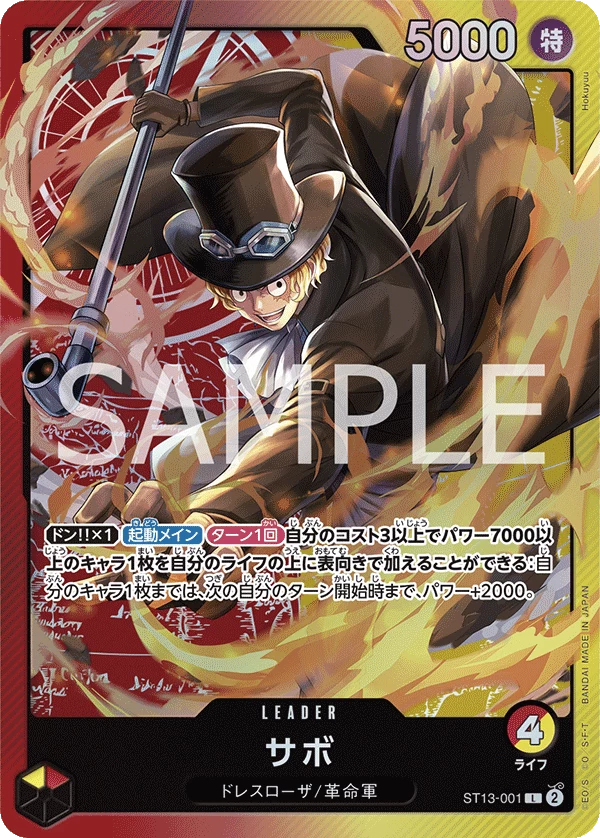
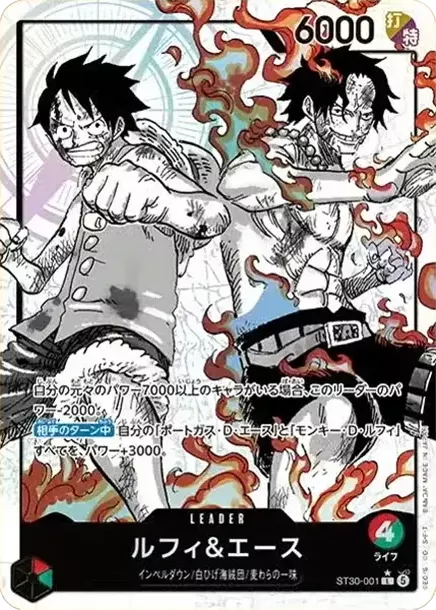
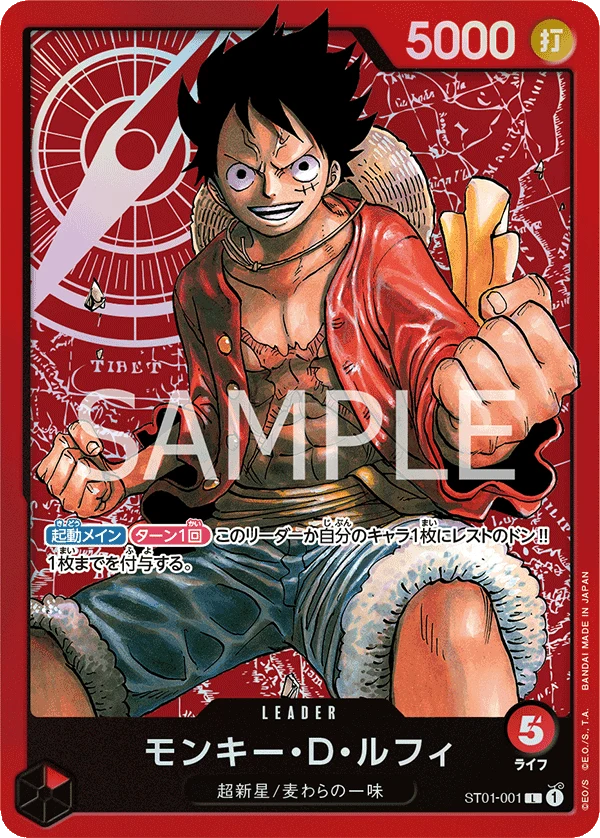
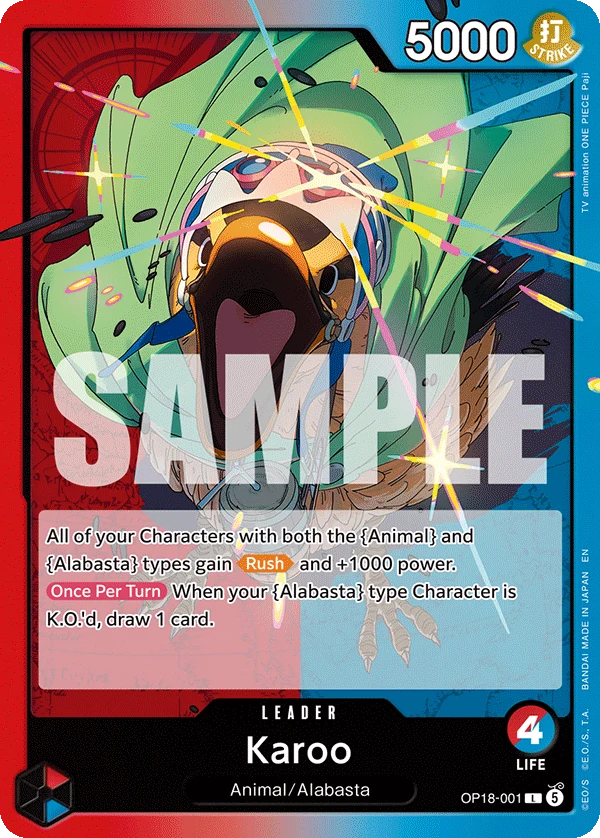
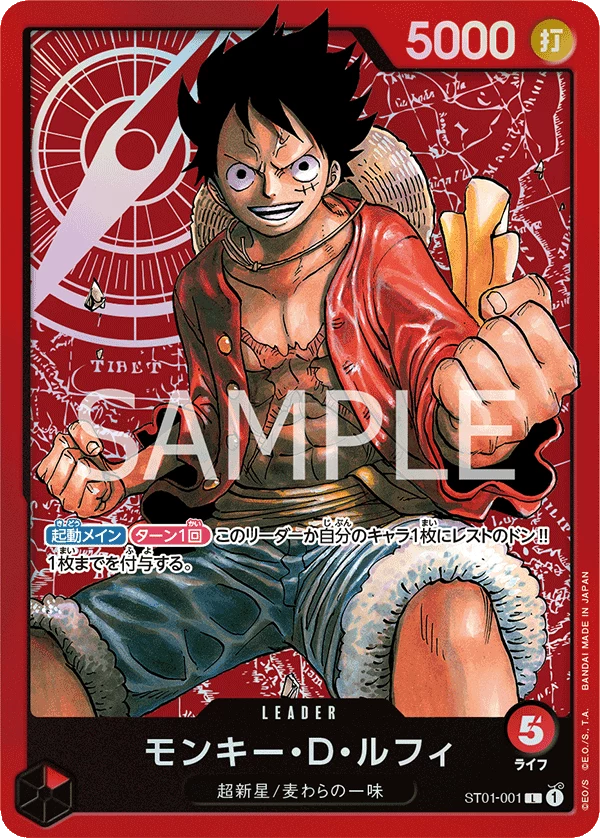
Your Leader is placed face-up in the Leader area before the game starts and stays there: rules and card effects cannot move it out (CR 3-6-1, 3-6-3). It has power and can attack. It is also the only card with a Life value, the number of Life cards you start with (CR 2-9-3). On the official English card list, the ST-01 Leader Monkey.D.Luffy (ST01-001) shows Life 5 and power 5000.
Character
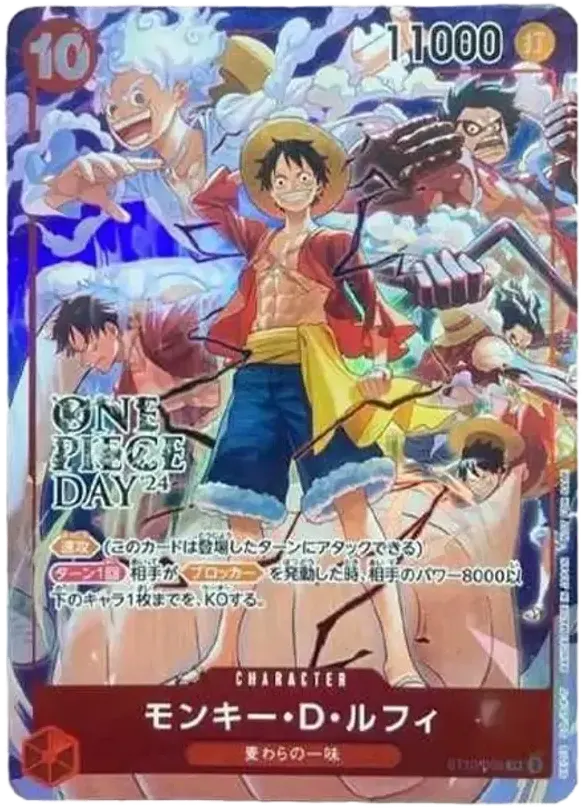
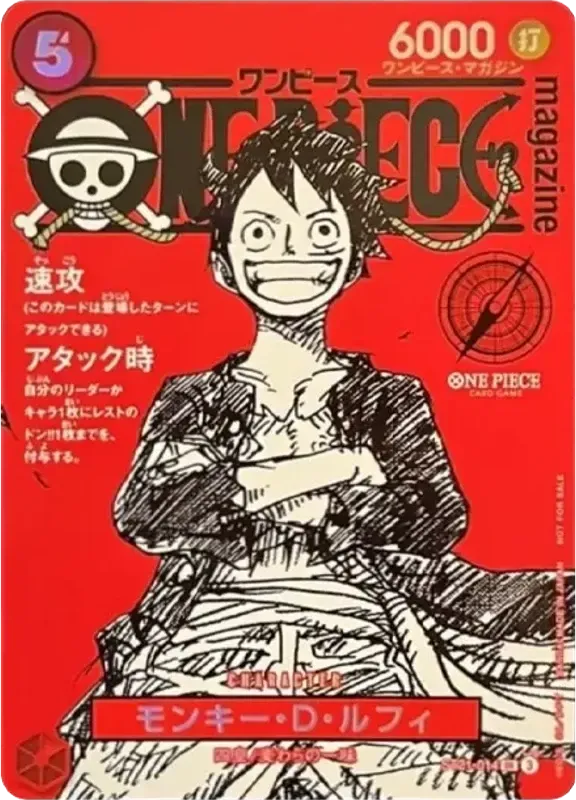
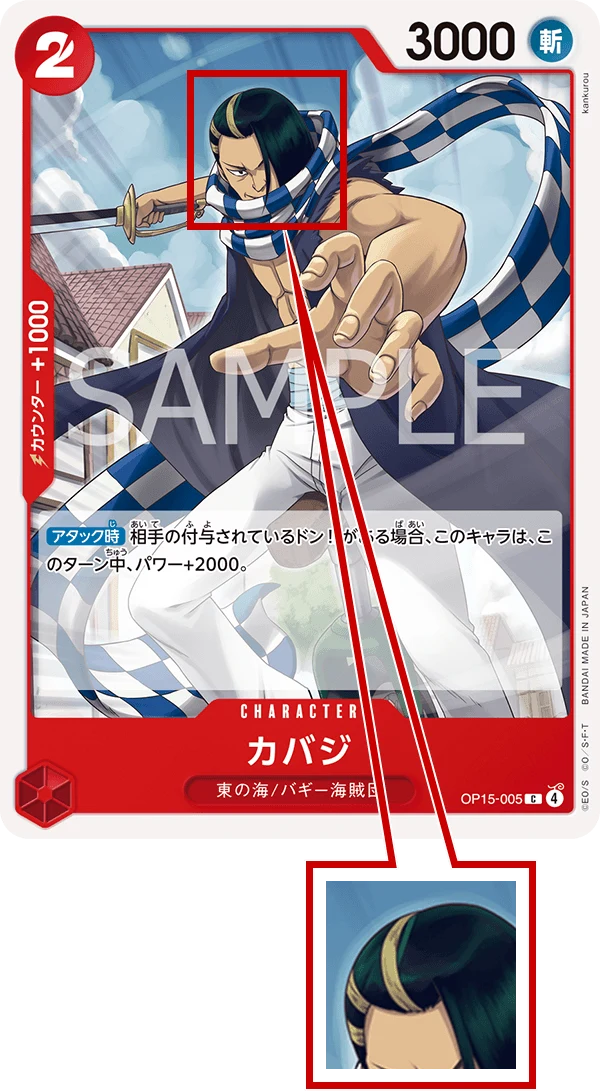
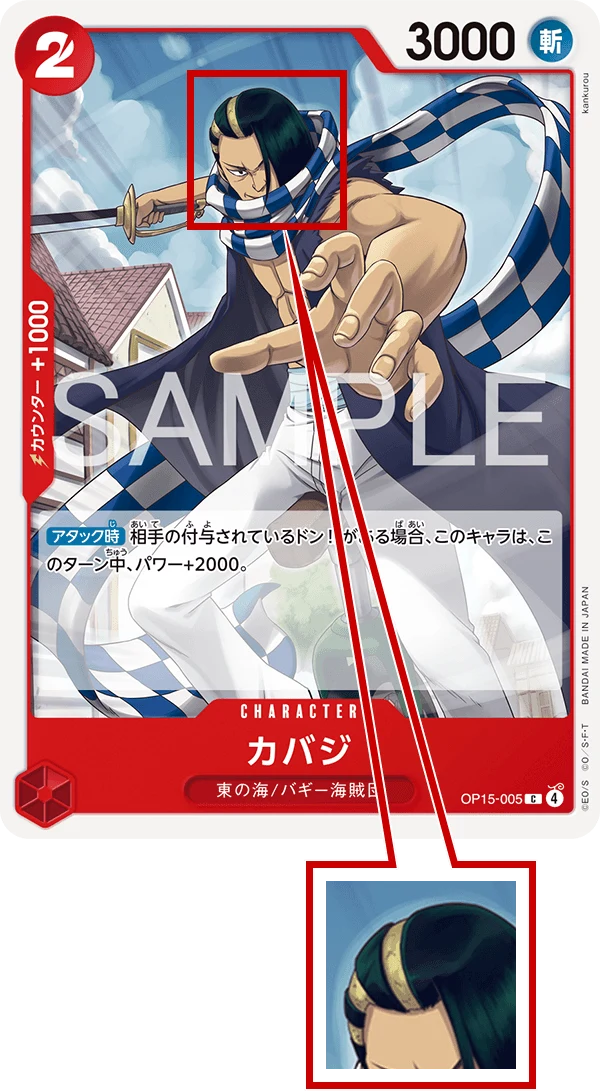
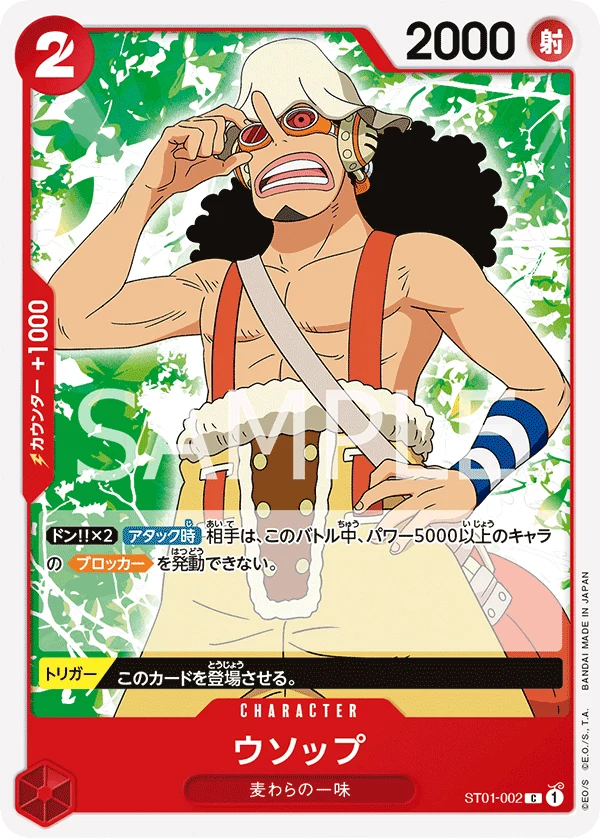
To play a Character or a Stage, reveal it from your hand, rest active DON!! cards equal to its cost (the number in the upper left corner), then place it in its area, normally active (CR 1-3-9-1, 2-7-2, 2-7-4, 3-7-5, 3-8-4). The Rule Manual (page 10) describes placing the card before paying; we follow the Comprehensive Rules order. You may have up to 5 Characters; to play a sixth, reveal it, trash one of the five, then play the new one. That trash is handled as a rule, not as an effect (CR 3-7-6-1, 3-7-6-1-1). A Character cannot attack on the turn it is played unless a card says otherwise, which is what [Rush] does (CR 3-7-4, 10-1-1). A Character card may also print a Counter value, used while you are being attacked. On the official card list, Usopp (ST01-002) is a Character with cost 2, power 2000 and Counter 1000.
事件
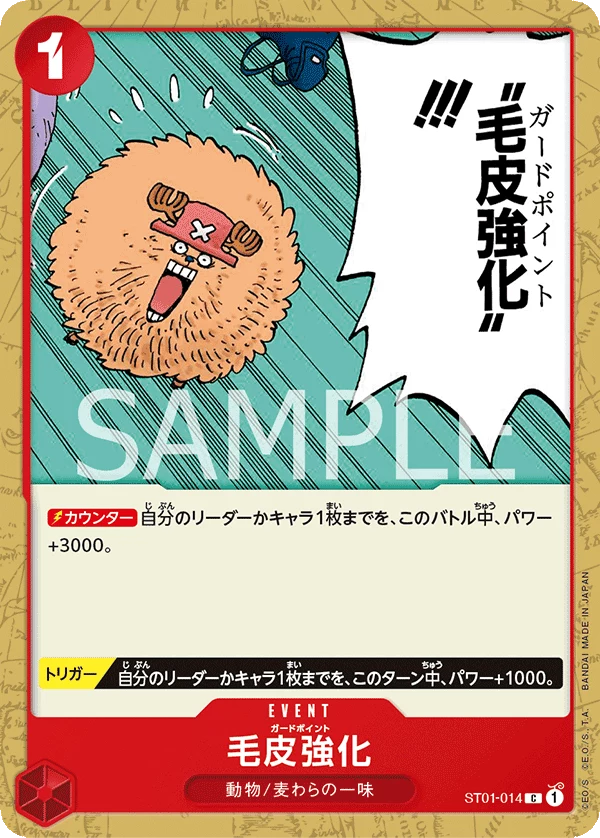
An Event is used, not placed: reveal it, rest DON!! cards equal to its cost, put it in your trash, then resolve its effect (CR 2-7-3). The Rule Manual (page 10) has a [Main] Event take effect before it goes to the trash; we follow the Comprehensive Rules. An Event effect marked [Main] is for your Main Phase outside a battle (CR 10-2-3). An Event effect marked [Counter] is for the Counter Step in your opponent’s turn, that is, while you are being attacked (CR 10-2-4). Another effect, such as a [Trigger], can let you use one at a different time; for a [Counter] effect, that effect must say to activate [Counter] (CR 10-2-3-1-1, 10-2-4-1-1, 10-2-4-1-2). Guard Point (ST01-014) is a cost-1 Event with a [Counter] effect that raises power during the battle.
Stage
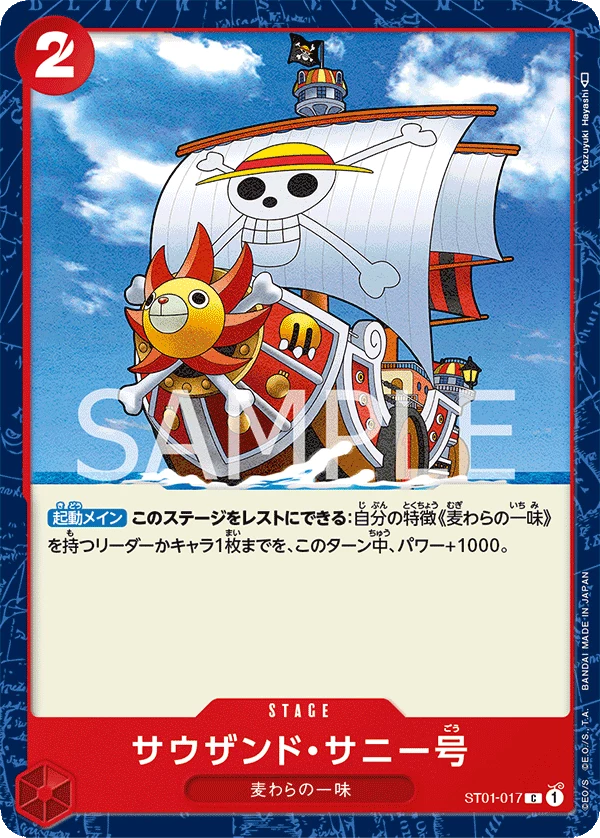
Each player can have only 1 Stage; to replace it, reveal the new Stage, pay its cost, trash the old one, then place the new one (CR 3-8-5, 3-8-5-1; General Rules FAQ). Thousand Sunny (ST01-017) is a cost-2 Stage with an [Activate: Main] effect, which can be used in your Main Phase outside a battle (CR 10-2-2).
DON!!
DON!! cards do two jobs. In the cost area, you rest them to pay costs. In the Main Phase you can also give an active DON!! card to your Leader or a Character by placing it underneath that card so it stays visible; each given DON!! adds 1000 power during your turn (CR 6-5-5-1, 6-5-5-2). Given DON!! cards go back to the cost area rested in your next Refresh Phase, or sooner, also rested, if the card holding them moves to another area (CR 6-2-3, 6-5-5-4). Our DON!! cards guide covers the card type.
Colours and other printed details
The game has six colours: red, green, blue, purple, black and yellow, shown by the hexagon in a card’s lower left corner. A multicolour card counts as each of its colours (CR 2-3-2, 2-3-3, 2-3-5). Rarity, the block symbol, the illustration and the illustrator’s name have no effect on play (CR 2-13, 2-15 to 2-17).
Building a Legal 50-Card Deck
Before the game, each player needs exactly three things (CR 5-1-2):
| Part | Count | What may go in it |
|---|---|---|
| Leader card | Exactly 1 | One Leader card |
| Deck | Exactly 50 cards | Character, Event and Stage cards only (CR 5-1-2-1) |
| DON!! deck | Exactly 10 cards | DON!! cards |
Two limits apply to the 50 cards:
- Colour: only cards of a colour that appears on your Leader may go in (CR 5-1-2-2). Because a multicolour card counts as each of its colours, a two-colour Leader opens both colours to the deck.
- Same card number: normally at most 4 cards may share one card number (CR 5-1-2-3, 2-14-2).
Some cards carry deck-building text about how many cards of a certain kind a deck may contain. The Comprehensive Rules treat that text as a permanent effect that replaces the standard limits for that deck (CR 5-1-2-4, 5-1-2-4-1).
Tournament list
For official and sanctioned tournaments, the English site posts a Banned/Restricted 卡牌列表. When we read it on November 19, 2026, the newest notice was dated November 17, 2026, announced changes effective November 27, 2026, and grouped entries as Banned Cards, Banned Pairs and Restricted Cards; the Restricted Cards group was empty on that reading. Before an event, check the current notice on the official rules page.
Our One Piece Leader cards guide explains Leader rules and colours.
How to Play the One Piece Card Game: Setup and the Five Turn Phases
Setting up a game
The Comprehensive Rules give this order (CR 5-2-1):
- Each player shows a legal deck.
- Each player shuffles their deck and places it face-down in the deck area; the DON!! deck goes face-down in its own area (CR 3-3-1, 3-3-2).
- Each player places their Leader face-up in the Leader area.
- Rock-Paper-Scissors, or another method, decides which player chooses; that player then declares whether they go first or second. Leader effects that apply at the start of the game are processed now; the player who made that choice processes theirs first (CR 5-2-1-5-1).
- Each player draws 5 cards. Each player may redraw once, the player going first deciding first: return the whole hand to the deck, reshuffle and draw 5 again.
- Each player takes cards from the top of the deck equal to their Leader’s Life value and places them face-down in the Life area without looking, so that the top card of the deck ends up at the bottom of the Life cards.
- The player going first starts their turn.
The opening hand and the single redraw come before the Life cards are placed. The number of Life cards is the Life value your Leader prints (CR 2-9-2), for example 5 on ST01-001 Monkey.D.Luffy, unless an effect raises it (CR 2-9-4).
The five phases of a turn
Every turn has the same five phases, in this order (CR 6-1-1):
| # | Phase | What the turn player does | Rule |
|---|---|---|---|
| 1 | Refresh Phase | Effects set to last until your next turn begins now expire, and start-of-turn effects activate. DON!! cards given to your Leader and Characters return to the cost area rested; then every rested card in your Leader, Character, Stage and cost areas, those DON!! included, is set active. (The Rule Manual, page 9, returns them active: same result.) | CR 6-2 |
| 2 | Draw Phase | Draw 1 card. The player going first skips this in their first turn. | CR 6-3 |
| 3 | DON!! Phase | Move 2 DON!! cards from the DON!! deck to the cost area, face-up and active (CR 3-9-3); the player going first moves only 1 in their first turn. If only 1 is left, move 1; if none are left, move none. | CR 6-4 |
| 4 | Main Phase | First, effects that work at the start of the Main Phase activate. Then, in any order and as often as you like: play cards, activate card effects marked [Main] or [Activate: Main], give DON!! cards, and battle. Declare the end of the Main Phase to move on. | CR 6-5 |
| 5 | End Phase | Your [End of Your Turn] effects resolve, then your opponent’s [End of Your Opponent’s Turn] effects. Effects that last until the end of the turn then expire, yours first, and the turn passes to the opponent. | CR 6-6 |
- Neither player may battle in their own first turn (CR 6-5-6-1; the Rule Manual, page 11, says the same about attacking). For the player going second, that is the second turn of the game: they cannot attack in it either.
- The draw and DON!! exceptions in the table name only the player going first (CR 6-3-1, 6-4-1), so the player going second draws 1 card and places 2 DON!! cards in their first turn as usual.
When a card says one thing and the Comprehensive Rules say another, the card text wins (CR 1-3-1).
Attacking, Blocking and Countering
A battle starts when the turn player rests an active Leader or Character to attack. The attack can target the opponent’s Leader or one of the opponent’s rested Characters, unless card text says otherwise (CR 7-1, 7-1-1-2). The battle then runs through five steps in this order (CR 7-1):
| Step | Who acts | What happens | Rule |
|---|---|---|---|
| 1. Attack Step | Attacker | Rest the attacking card, choose the target. Effects such as [When Attacking] activate. | CR 7-1-1 |
| 2. Block Step | Defender | May rest one other active card that has [Blocker], once in that battle; that card becomes the card being attacked. | CR 7-1-2, 10-1-4 |
| 3. Counter Step | Defender | May use Counter values from Character cards in hand and Event cards with [Counter], in any order, as often as they like. | CR 7-1-3 |
| 4. Damage Step | Both | Compare power. If the attacker’s power is equal to or higher, the attacker wins the battle. | CR 7-1-4 |
| 5. End of the Battle | Both | End-of-battle effects activate, effects that last only for the battle expire, and play returns to the Main Phase. | CR 7-1-5 |
If the attacking card or its target has moved to another area, the current step still finishes; at the end of the Attack, Block or Counter Step the battle then skips to End of the Battle (CR 7-1-1-4, 7-1-2-3, 7-1-3-1-3; General Rules FAQ).
What a Counter does
The defender has two kinds of Counter during the Counter Step (CR 7-1-3-1):
- A Character card’s Counter value: trash a Character card that prints a Counter value from your hand (if a card shows more than one, only the highest counts, CR 2-10-4). Your Leader or one of your Characters gains power equal to that value for that battle. Only Character cards have a Counter value (CR 2-10-2), and using it costs nothing (General Rules FAQ).
- An Event with [Counter]: pay the Event’s cost, then trash it to activate its [Counter] effect. The Rule Manual (page 12) leaves the cost out here; we follow the Comprehensive Rules, where it is paid (CR 7-1-3-1-2).
The Damage Step
If the attacker wins and the target is a Character, that Character is K.O.’d, which means it goes to its owner’s trash (CR 7-1-4-1-2, 10-2-1). If the attacker wins against a Leader, that Leader takes 1 damage (CR 7-1-4-1-1):
- If the defender has 0 Life cards at that moment, the attacking player wins the game.
- Otherwise the defender adds the top card of their Life cards to their hand without showing it. If that card has a [Trigger], the defender may instead reveal it and activate the [Trigger]; afterwards the card goes to the trash unless its text says otherwise (CR 7-1-4-1-1-2, 10-1-5-1, 10-1-5-3). The defender may also decline the [Trigger] and simply add the card to hand without revealing it (CR 10-1-5-2).
If the attacker’s power is lower, nothing happens in that battle and it moves to its end (CR 7-1-4-2). Three keywords change a battle: [Double Attack] deals 2 damage instead of 1, though against a Leader with 1 Life card it cannot win the game in that attack (General Rules FAQ); [Banish] trashes the Life card instead of adding it to the hand, with no [Trigger]; and [Unblockable] stops the defender from using [Blocker] (CR 10-1-2, 10-1-3, 10-1-7).
How You Win (and Lose)
The Comprehensive Rules give two defeat conditions. If only your opponent meets one, you win; if both players meet one at the same check, both lose (CR 1-2-1, 9-2-1):
| Defeat condition | Comprehensive Rules |
|---|---|
| Life | Your Leader is dealt damage while your Life area is empty (CR 1-2-1-1-1, 9-2-1-1). |
| Deck | Your deck is empty (CR 1-2-1-1-2, 9-2-1-2). |
The Rule Manual (page 7) and the Play Guide describe both conditions from the winner’s side; we follow the Comprehensive Rules wording. Reaching 0 Life cards does not end the game by itself: the game ends when the Leader takes damage after that. The deck condition needs no failed draw: a player whose deck reaches 0 cards loses as soon as rule processing checks it, which happens at once, even in the middle of another action (CR 1-2-2, 9-1-2, 9-2-1).
A player may also concede at any time and loses at once (CR 1-2-3), and some card effects can make a player win or lose directly (CR 1-2-5).
What to Buy to Start Playing
The Japanese product pages for ST-37 (砂漠の王女と海賊たち, The Desert Princess and the Pirates) and ST-38 (バロックワークス, Baroque Works), both with a Japanese release date of December 19, 2026, list a 51-card constructed deck, 10 DON!! cards, one bonus pack and a play sheet. By our arithmetic, 51 cards is 1 Leader plus a 50-card deck.
Our store export of November 19, 2026 contains no One Piece starter deck, so none is linked here; our One Piece starter decks guide lists the ST decks.
Three Japanese One Piece booster boxes from the same export; a booster box adds new cards to choose from:
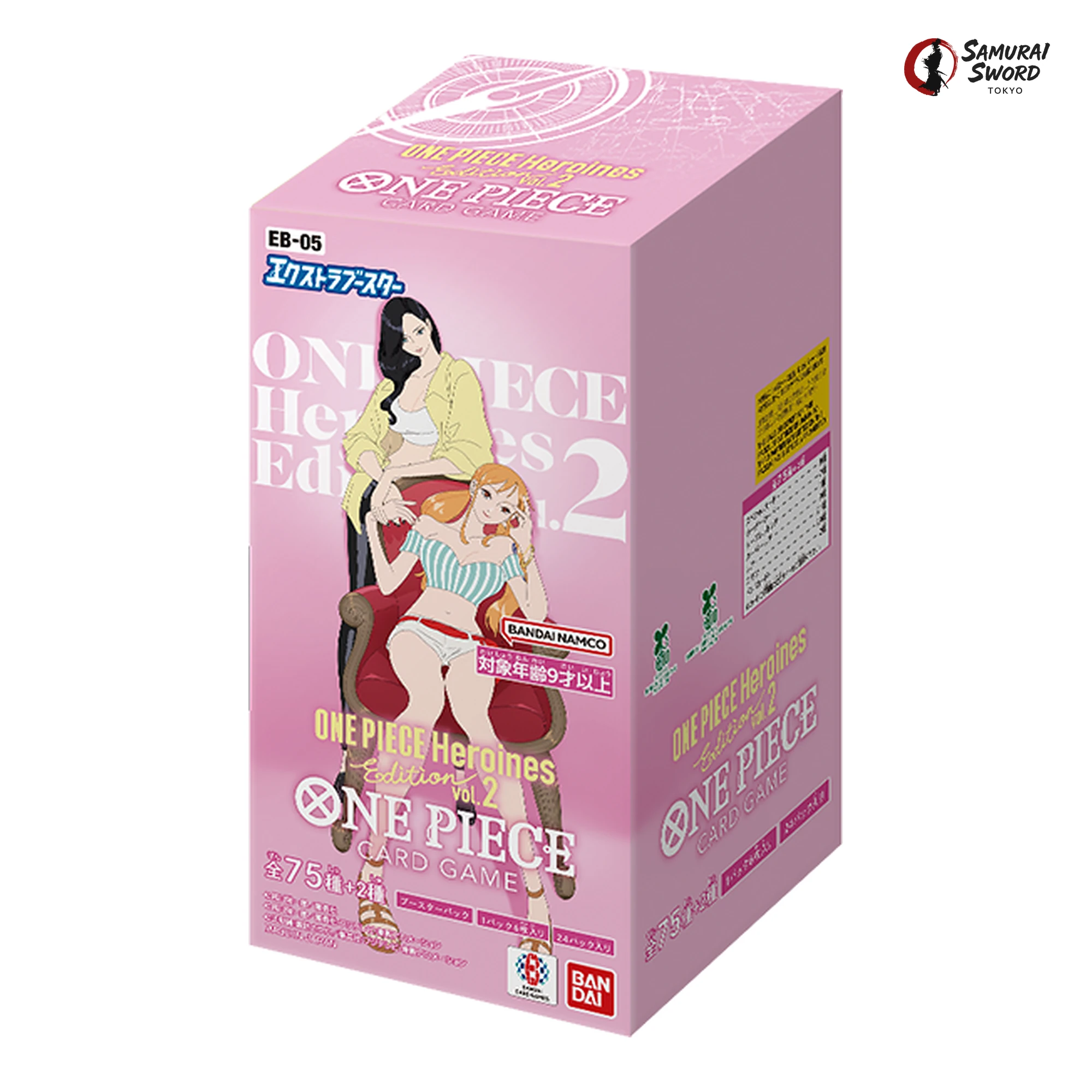
- EB-05 Heroines Edition vol.2 Japanese One Piece Booster Box, currently listed at ¥13,200
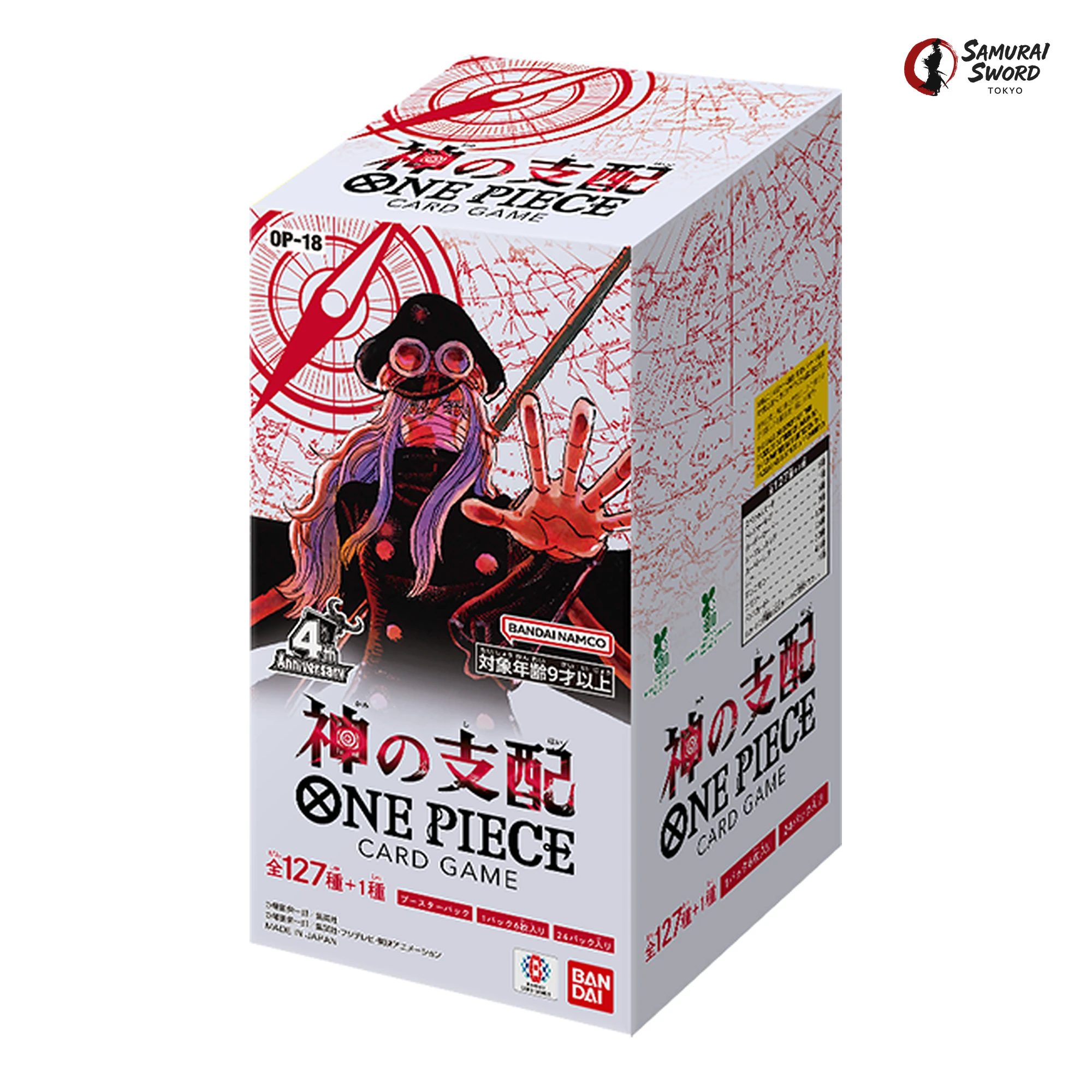
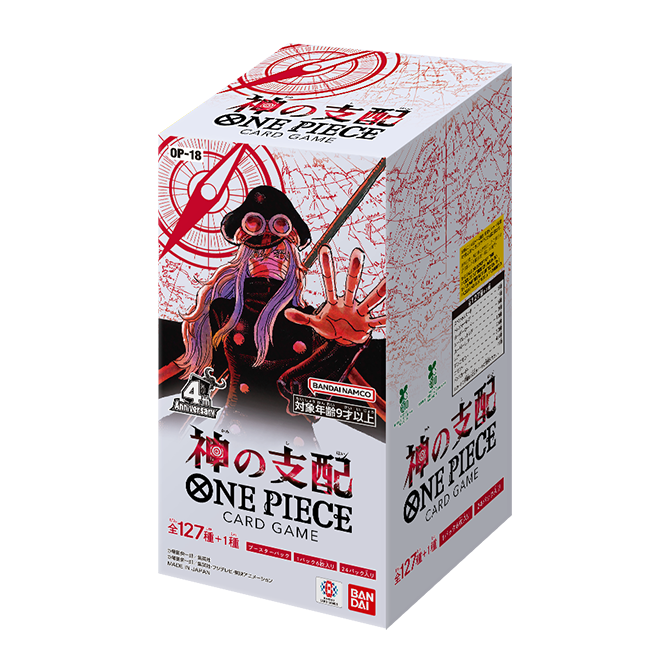
- OP-18 The Dominance of God Japanese One Piece Booster Box, currently listed at ¥12,999
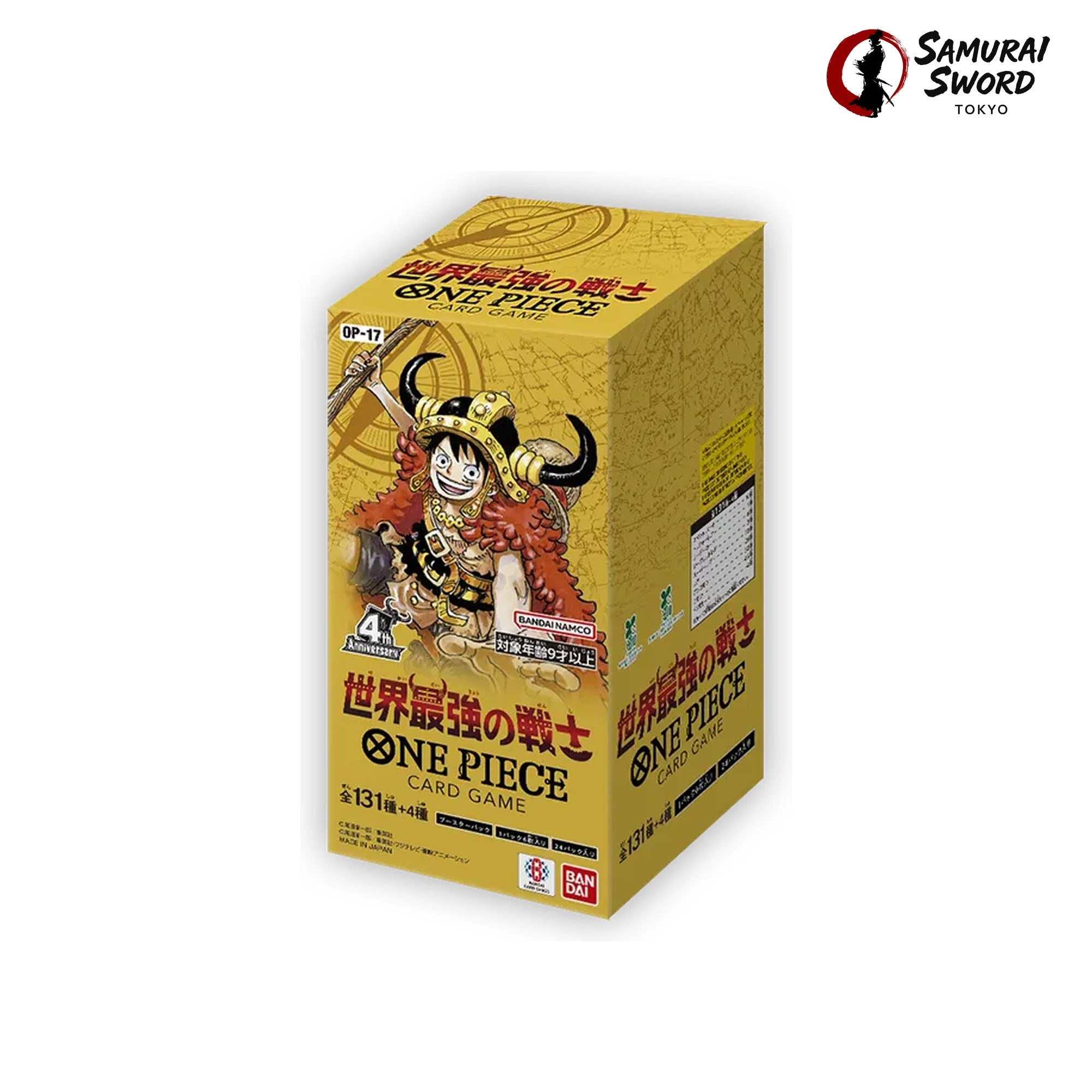
- OP-17 The World’s Strongest Warriors Japanese One Piece Booster Box
A booster box is not a ready-made deck. Japanese release dates for EB-05 and OP-18 are in our One Piece TCG release schedule.
Where to Buy One Piece Cards from Japan
Our One Piece booster box collection is the collection page for Japanese One Piece booster boxes on our site. The OP-17 card list page lists the cards of that set. Sourcing requests for a specific product or card go through 快速下单.
If you are ordering from Japan for the first time, our guide to buying One Piece cards from Japan explains the ordering steps.
常见问题
How many cards are in a One Piece Card Game deck?
Each player uses one Leader card, a main deck of exactly 50 cards and a DON!! deck of exactly 10. The 50 are Character, Event and Stage cards in your Leader’s colours, normally with at most 4 cards per card number unless a card’s deck-building text changes that (Comprehensive Rules 5-1-2).
What are the five card types in the One Piece Card Game?
Leader, Character, Event, Stage and DON!!. The Leader stays in the Leader area and sets your starting Life; Characters are played to the Character area (up to 5); Events are used from hand and trashed; each player can have one Stage in play; DON!! cards pay costs, and each DON!! given to your Leader or a Character adds 1000 power during your turn.
How does a turn work in the One Piece Card Game?
Five phases in order: Refresh (given DON!! cards return rested, then all your rested cards become active), Draw (draw 1), DON!! (add 2 DON!! cards to the cost area), Main (play cards, activate effects, give DON!!, battle) and End (end-of-turn effects, then the turn passes). In their first turn, the player going first does not draw and adds only 1 DON!! card.
What can the player going first not do on the first turn?
The player going first skips the draw and gets just 1 DON!! card in their first turn. Neither player can battle in their own first turn, so the player going second cannot attack in the game’s second turn either (Comprehensive Rules 6-3-1, 6-4-1, 6-5-6-1).
How do you win a game of the One Piece Card Game?
Your opponent loses when their Leader takes damage while they have 0 Life cards, or when their deck has 0 cards; you win if you have not lost at the same time. A player may also concede at any time.
When can you use a Counter?
In the Counter Step of a battle in which you are being attacked (another effect can change that only if it says to activate [Counter]). You can trash a Character card with a Counter value from hand to add that power to your Leader or one Character for the battle, or pay the cost of an Event with [Counter] and trash it to activate it.