Maak gratis een account en spaar punten en rang
Samurai Sword Tokyo
Bestellingen Winkelwagen

Munchlax Pokemon-kaartgids: elke Japanse print
Munchlax has a short list of Japanese cards, and that’s the whole story worth telling here. Search around and you’ll find plenty of English-language Munchlax prints going back to 2007, but on the Japanese side of the print run — the side we deal in every day — there are exactly two confirmed cards, both from the Sun & Moon era, both drawn by the same illustrator.

This guide covers those two Japanese prints in full detail: what they say, what they do, and which sealed products they come out of. It also lays out the English-only historical prints honestly, without pretending Japanese equivalents exist where we haven’t verified them. Munchlax is Snorlax’s pre-evolution, so we close with how the two cards relate — and point you to our dedicated Snorlax cards guide for the evolved line. We ship Japanese sealed product out of Tokyo every week, and the sourcing notes below reflect the sets we actually stock.

Key Takeaway

Only two Japanese Munchlax prints are confirmed: SM10a #40 (GG End) and its reprint, SM12a #114/173 (Tag All Stars), both illustrated by sowsow. Everything earlier — Diamond & Pearl, Majestic Dawn, Rising Rivals — is documented here as English-language print history only. If you’re sourcing the Japanese prints, they come out of the GG End Booster Box and Tag All-Stars Booster Box — sourcing requests run through Snel bestellen.

2
JP-Verified Prints

4
EN Historical Prints

2019
First JP Print Year

sowsow
Illustrator, Both JP Cards

Card data verified against individual card pages as of August 2026. This is a sourcing guide, not a price guide — we don’t publish market prices here, only which sealed products contain which Japanese prints.

Every Japanese Munchlax Print We’ve Verified

Six Munchlax cards worth knowing, spanning Japanese and English print runs from 2007 to 2019:

Kaart Set Taal Year Illustrator
Munchlax #40 GG End (SM10a) Japans 2019 sowsow
Munchlax #114/173 Tag All Stars (SM12a) Japans 2019 sowsow
Munchlax #33 Diamond & Pearl English 2007 Ken Sugimori
Munchlax #68 Majestic Dawn English 2008 Masakazu Fukuda
Munchlax #69 Rising Rivals English 2009 Tomokazu Komiya
Munchlax #70 Rising Rivals English 2009 Kagemaru Himeno

The pattern here is unusual compared to most Pokemon on the Japanese card checklist: Munchlax’s Japanese print run is thin. Rather than the dozen-plus variants you’d see on a mainline evolution like Snorlax, Munchlax got one original Japanese print in 2019 and a same-year reprint — and that’s it, based on what we’ve been able to confirm. The English side has a longer paper trail going back to 2007, but we haven’t verified that those English cards have direct Japanese-language counterparts under the same set names, so we’re presenting them as English print history rather than implying a Japanese equivalent exists.

The Two JP Prints: GG End and Tag All Stars

Both confirmed Japanese Munchlax cards come from the same short window in 2019, and both share the same artwork.
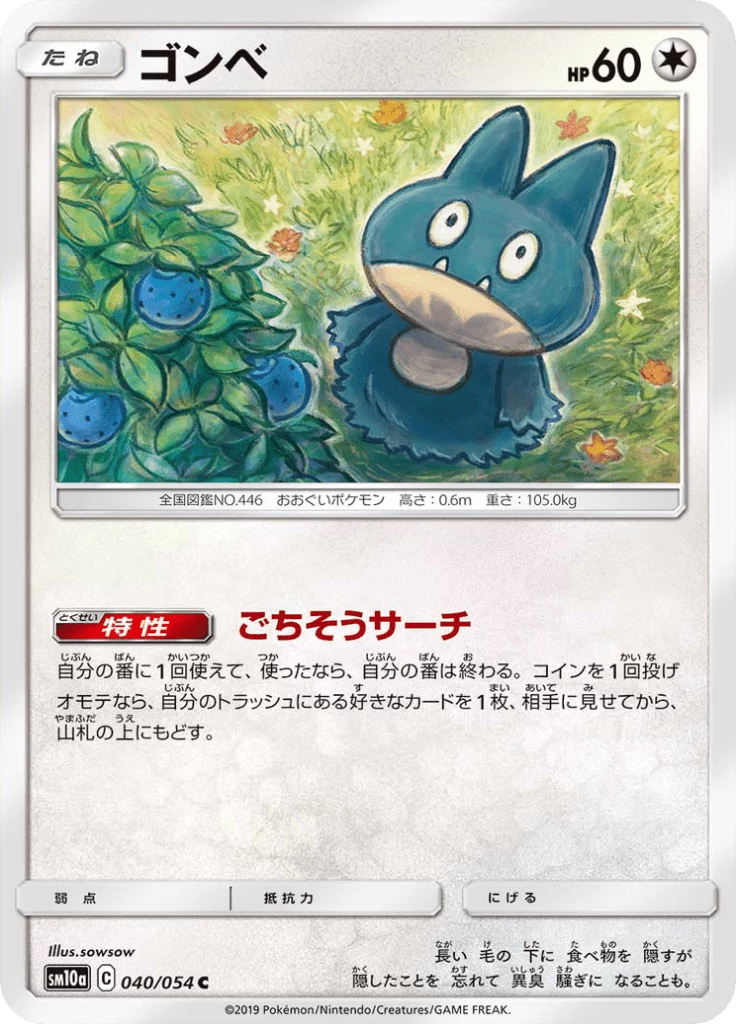
Munchlax [SM10a 40] C (GG End)

Munchlax, SM10a #40, Common (GG End)

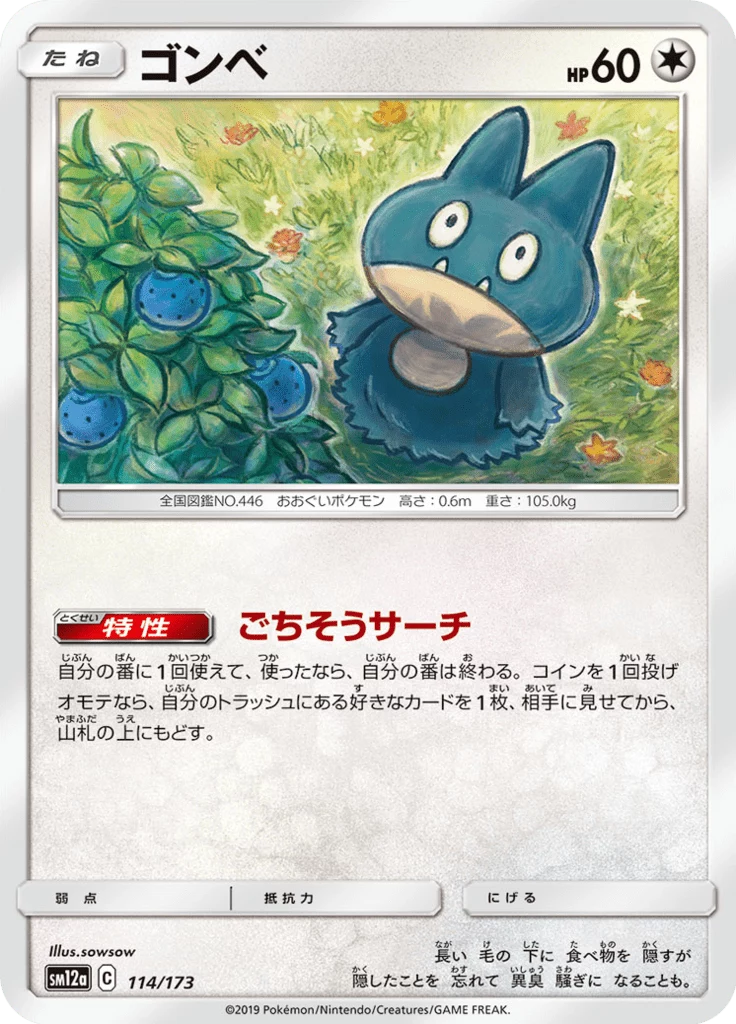
Munchlax [SM12a 114/173] (Tag All Stars)

Munchlax, SM12a #114/173 (Tag All Stars)

GG End (SM10a #40), released April 5, 2019, is the original. It’s a Common, Colorless-type, 60 HP card illustrated by sowsow, carrying the Feast Search ability covered in the next section. Its English-language counterpart is Unified Minds #173.

Tag All Stars (SM12a #114/173), released October 4, 2019, reprints the same card — same sowsow artwork, same Feast Search ability — inside that set’s reprint block. Limitless TCG doesn’t list a rarity symbol for this specific reprint slot, so we’re not assigning one here rather than guessing.

Check This First

Both cards look identical at a glance — same illustration, same card text. The set name and card number printed on the card are what tell them apart: GG End reads “SM10a,” Tag All Stars reads “SM12a.”

One naming note: the card database we cross-checked spells the name “Muchlax”; we use the standard English name Munchlax throughout this guide.

The English-Only History: 2007–2009

Before the 2019 Japanese prints, Munchlax had a run of English-language cards spanning the Diamond & Pearl through Rising Rivals era. We’re documenting these for completeness, but we haven’t verified Japanese-language set names or card numbers for this stretch, so no images accompany this section — only confirmed Japanese-language card art appears in our guides.

  • Munchlax — Diamond & Pearl #33, Rare, released May 23, 2007, illustrated by Ken Sugimori.
  • Munchlax — Majestic Dawn #68, Common, released May 21, 2008, illustrated by Masakazu Fukuda.
  • Munchlax — Rising Rivals #69, Common, released May 20, 2009, illustrated by Tomokazu Komiya.
  • Munchlax — Rising Rivals #70, Common, released May 20, 2009, illustrated by Kagemaru Himeno.

Two separate Munchlax cards in the same Rising Rivals set, each with its own illustrator, is a detail worth noting for anyone building a complete print run reference — it means Rising Rivals alone accounts for half of this historical block. If you’re specifically after Japanese-language cardboard for this Pokemon, though, the two 2019 prints covered above are the ones we can confirm and the ones we source.

Munchlax to Snorlax: A Pre-Evolution Story

Munchlax is Snorlax’s pre-evolution, introduced generations after Snorlax itself first appeared on cardboard, which is part of why its Japanese print run is so much thinner — Snorlax has been a Pokemon TCG staple since the earliest sets, while Munchlax only entered the picture with the Diamond & Pearl generation. If you’re collecting the full evolutionary line rather than just Munchlax on its own, our Snorlax cards guide covers the much larger and deeper Japanese print history on the evolved form — different scale of guide entirely, and worth reading alongside this one rather than instead of it.

What’s notable is that both confirmed Japanese Munchlax prints share one illustrator, sowsow, across both GG End and its Tag All Stars reprint — a level of print-run consistency you don’t often see even on more heavily printed Pokemon, simply because there have been so few Japanese Munchlax cards made in the first place.

Sourcing Munchlax Through Sealed Product

Because both confirmed Japanese Munchlax prints come out of specific 2019 sets, sealed product from those two releases is the direct route if you’re chasing either card alongside the rest of each set’s lineup.

Shop This Set
GG End Japanese Pokemon Booster Box (SM10a)
Contains Munchlax #40, the original 2019 print
Ships from Tokyo · Tracked delivery

View Product →

The reprint sits inside Tag All-Stars Japanese Pokemon Booster Box (SM12a) — same Munchlax artwork, same Feast Search text, packaged with that set’s own TAG TEAM lineup. Since Munchlax’s Japanese print history is this limited, these two boxes are the entire sourcing path we can point to for this card. For sourcing requests and mixed orders that pair Munchlax with other Sun & Moon-era cards, our Quick Order page is the fastest way to ask.

Where to Buy Japanese Munchlax Cards

We ship Japanese sealed product worldwide from Tokyo with tracked delivery. For Munchlax specifically, sourcing runs through the two 2019 booster boxes above — GG End for the original print, Tag All-Stars for the reprint — and general sourcing requests go through our Quick Order page.

For related reading on how Japanese rarity tiers and grading fit into a collection like this one, see our CHR character rare cards guide, our PSA 10 vs raw Japanese cards guide, and — if you’re building a collection on a budget — our best PSA 10 Japanese cards under ¥10,000 guide.

Veelgestelde vragen

How many Japanese Munchlax Pokemon cards are there?

Two confirmed: Munchlax #40 from GG End (SM10a, released April 5, 2019) and its reprint, Munchlax #114/173 from Tag All Stars (SM12a, released October 4, 2019). Both share the same sowsow artwork and the same Feast Search ability.

What does Munchlax’s Feast Search ability do?

Once per turn, you flip a coin. If it lands heads, you take any one card from your discard pile and place it on top of your deck. Your turn ends immediately after the flip, regardless of the result.

Is there a Japanese version of the Diamond & Pearl era Munchlax?

We haven’t verified one. The Diamond & Pearl, Majestic Dawn, and Rising Rivals Munchlax cards are documented here as English-language prints; we don’t have confirmed Japanese-language set names or card numbers for that era, so we present them as English print history rather than claiming a Japanese equivalent.

Where can I buy Munchlax Pokemon cards from Japan?

We ship Japanese sealed product worldwide from Tokyo. The GG End and Tag All-Stars booster boxes are the two sets containing the confirmed Japanese Munchlax prints, and sourcing requests for either run through our Quick Order page.
Togepi- en Togekiss-Pokemonkaarten: de gids voor alle Japanse prints

Togepi’s whole design is a promise — an egg that turns into a happiness Pokemon, and then a flying Fairy-type that heals more than it hits. That arc has been reprinted across ten Japanese card printings since 2015, from a plain Uncommon in Emerald Break to a TAG TEAM GX sharing the frame with Cleffa and Igglybuff.

This guide is the home base for the whole line: every confirmed Togepi and Togekiss print in the modern Japanese TCG, what each one actually does on the field, and which of our current booster boxes contain them. We don’t carry loose Togepi-line singles in stock right now, so instead of guessing at prices we’re pointing you straight at the sealed product that pulls these cards — and at our Quick Order page for sourcing requests if you’re after a specific single.

Key Takeaway

Ten confirmed Togepi and Togekiss printings span eight Japanese sets, 2015–2025. Five of our current booster boxes contain verified pulls, from the entry-level S10P Space Juggler Booster Box, currently listed at ¥15,225 (~$93) — the only set in this guide that pulls Togepi and Togekiss together — up to the SM12A Tag All-Stars Booster Box, currently listed at ¥212,100 (~$1,301), home to the Togepi & Cleffa & Igglybuff-GX TAG TEAM card.

10
Prints Covered

8
Sets Spanned

5
Boxes Matched

2015–25
Years Covered

Box prices reflect our own current listings as of August 2026, converted at ¥163/USD. We don’t currently stock individual Togepi-line singles, so no single-card prices are quoted here — use Quick Order for sourcing requests.

Every Togepi and Togekiss Print, Ranked by Release

Ten printings across eight Japanese sets, from the 2015 Emerald Break original to the 2025 Art Rare reprint:

Kaart Number Rarity Set Year
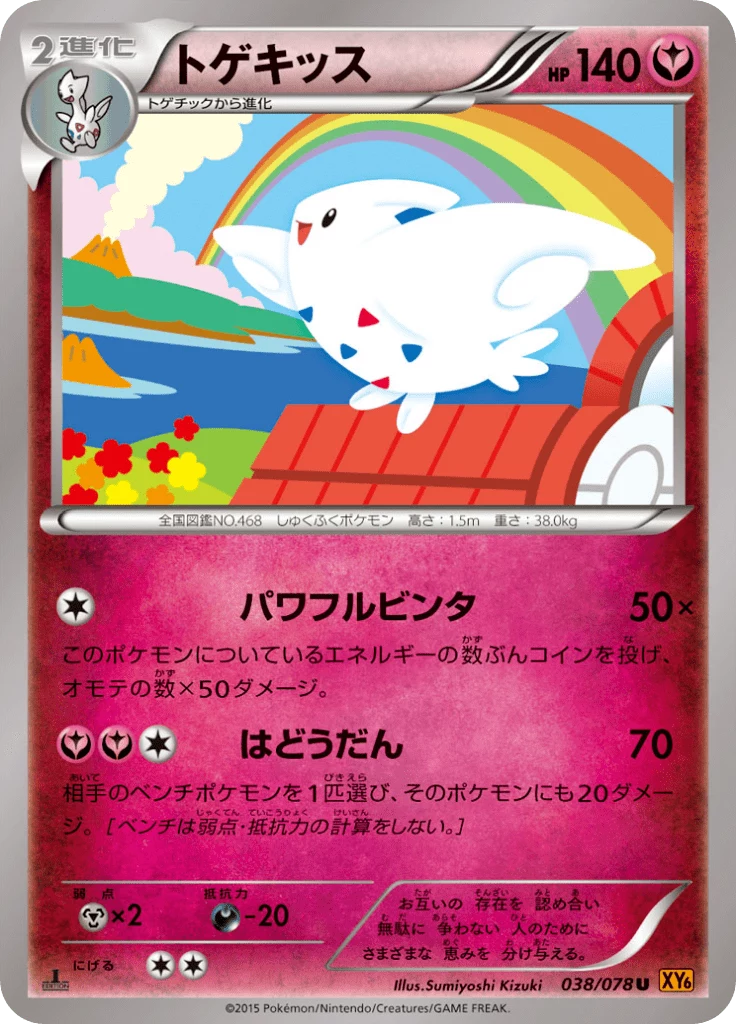
Togekiss XY6 #38/078 Uncommon Emerald Break 2015
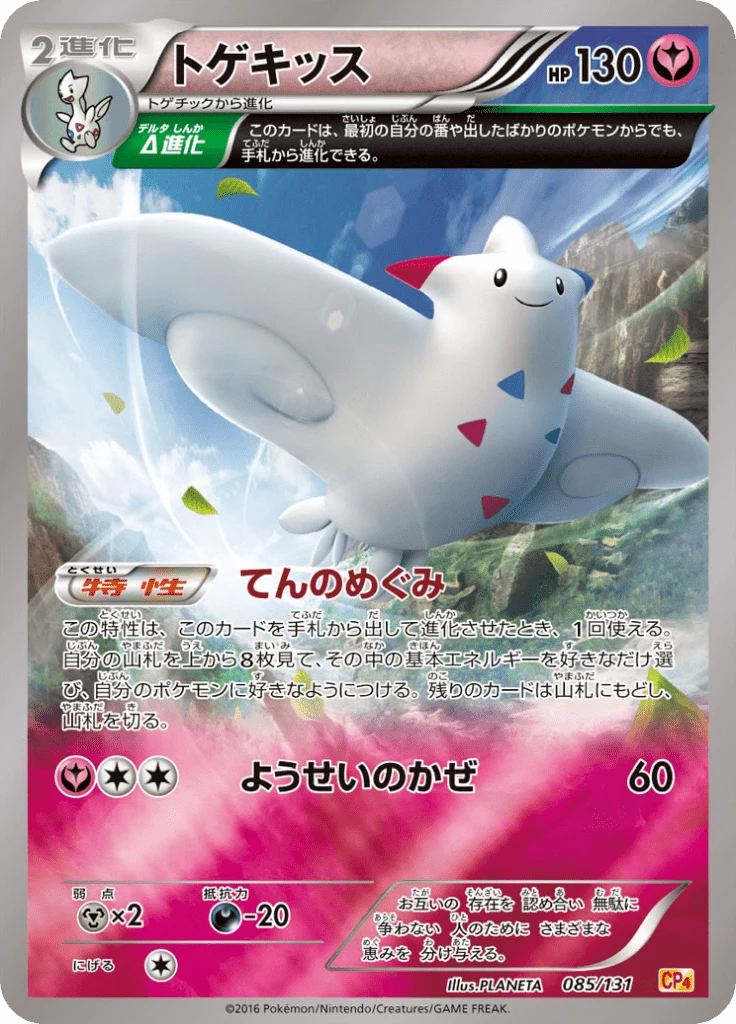
Togekiss CP4 #85 Unverified Premium Champion Pack 2016
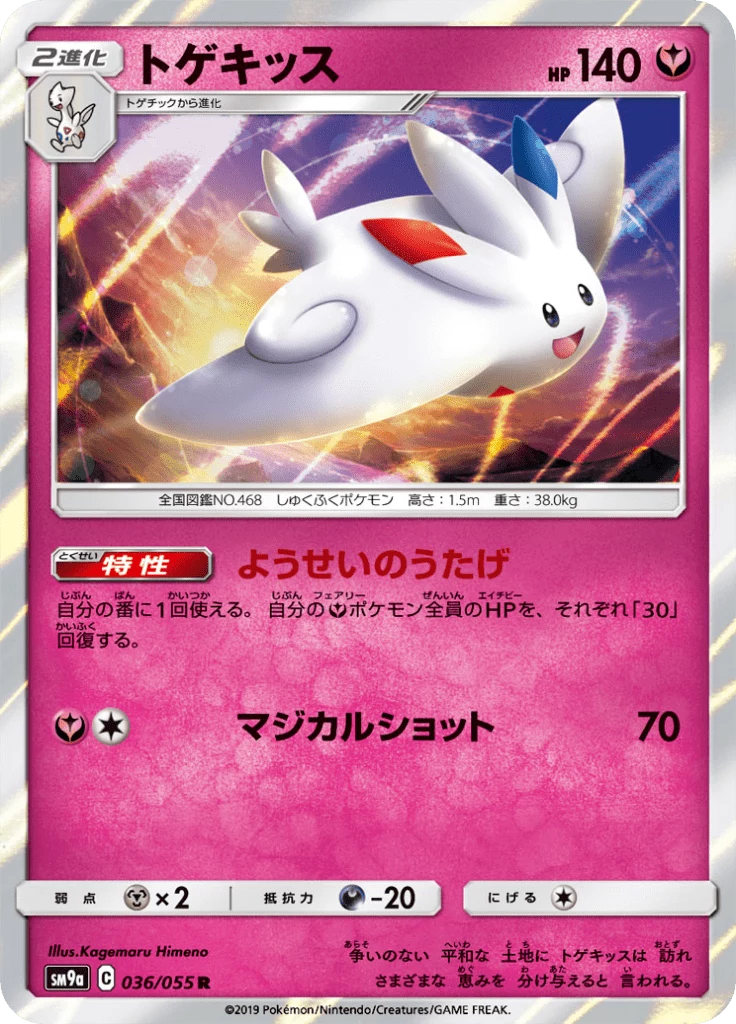
Togekiss SM9a #36 Rare Night Unison 2019
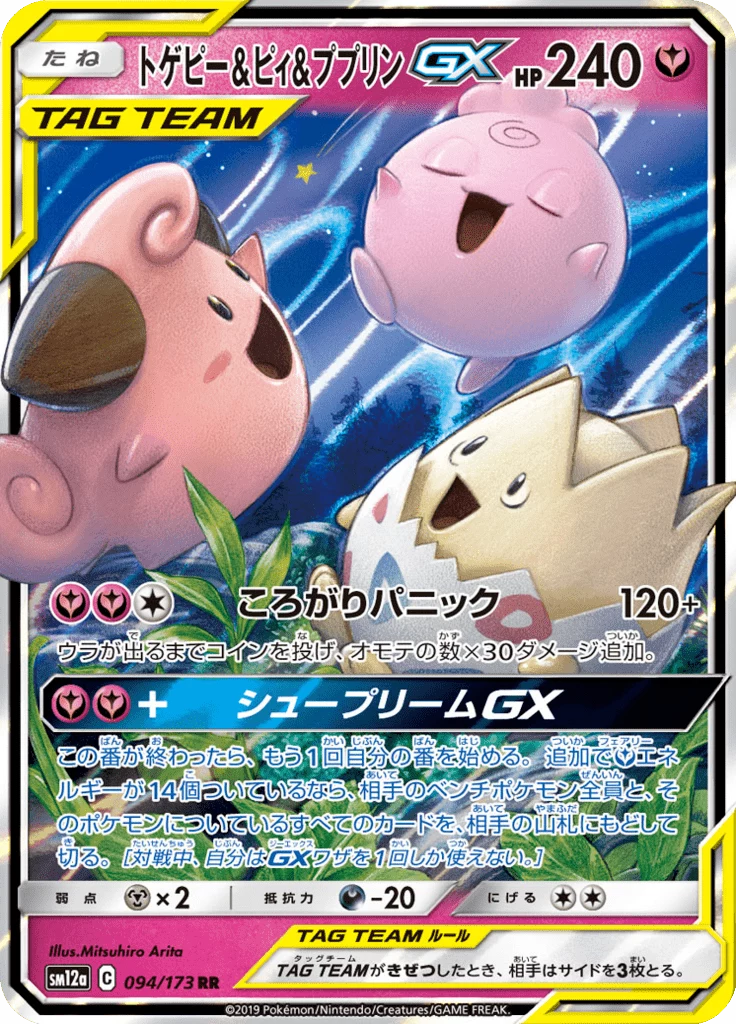
Togepi & Cleffa & Igglybuff-GX SM12a #94/173 Double Rare Tag All Stars 2019
Togekiss V S3a #58 Double Rare Legendary Heartbeat 2020
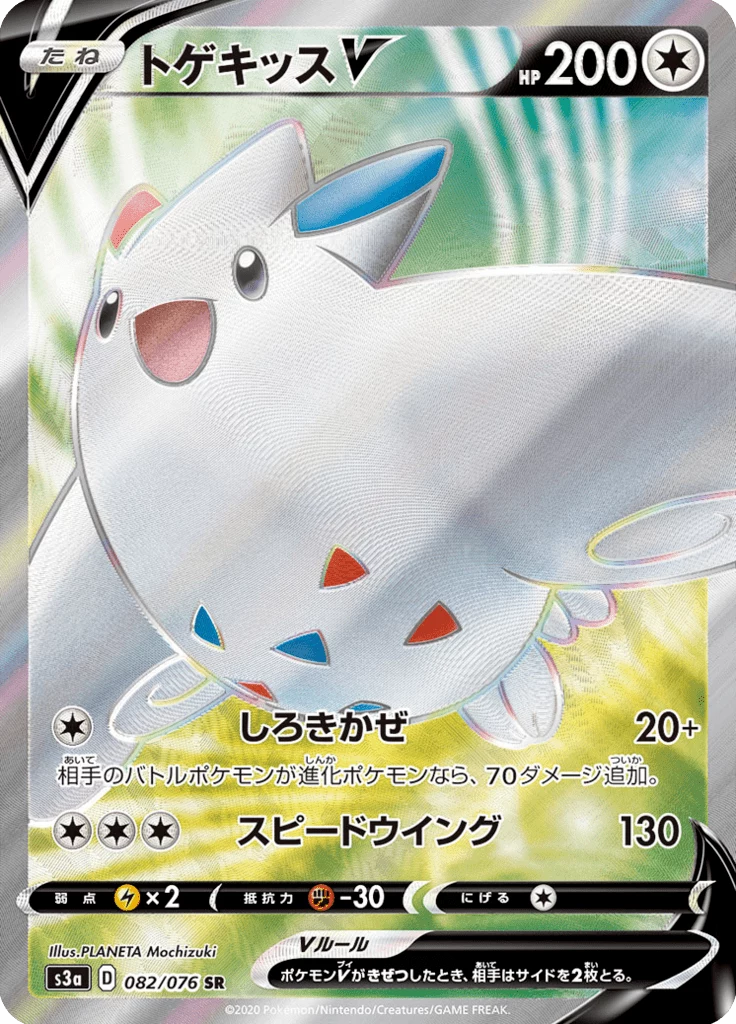
Togekiss V S3a #82 Secret Rare Legendary Heartbeat 2020
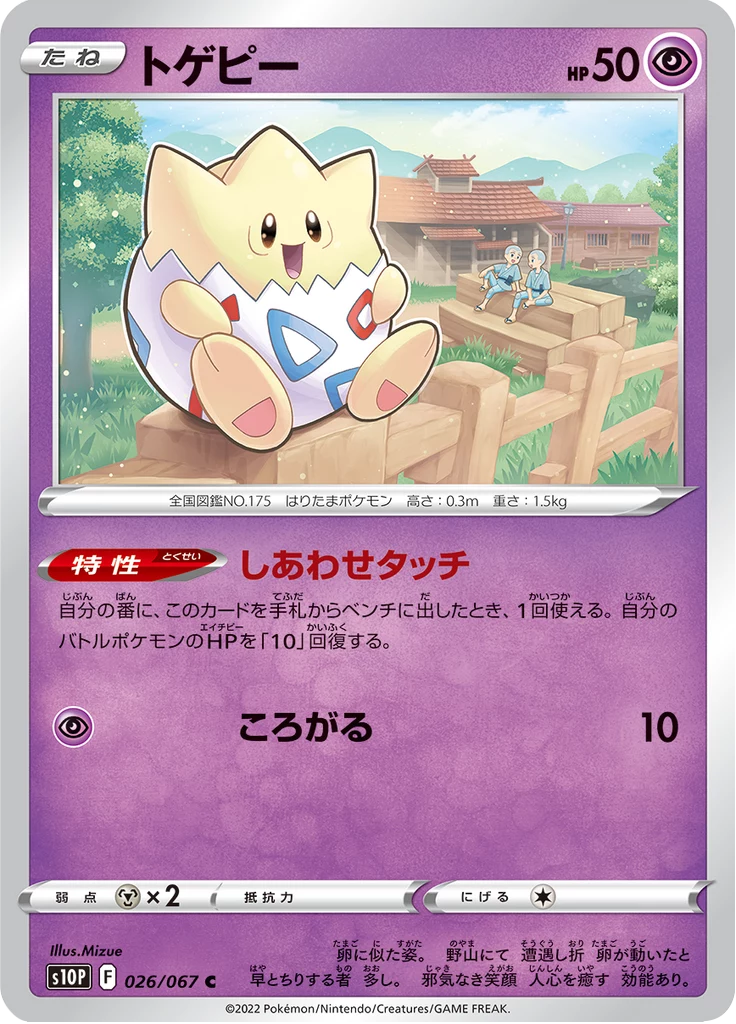
Togepi S10P #26 Common Space Juggler 2022
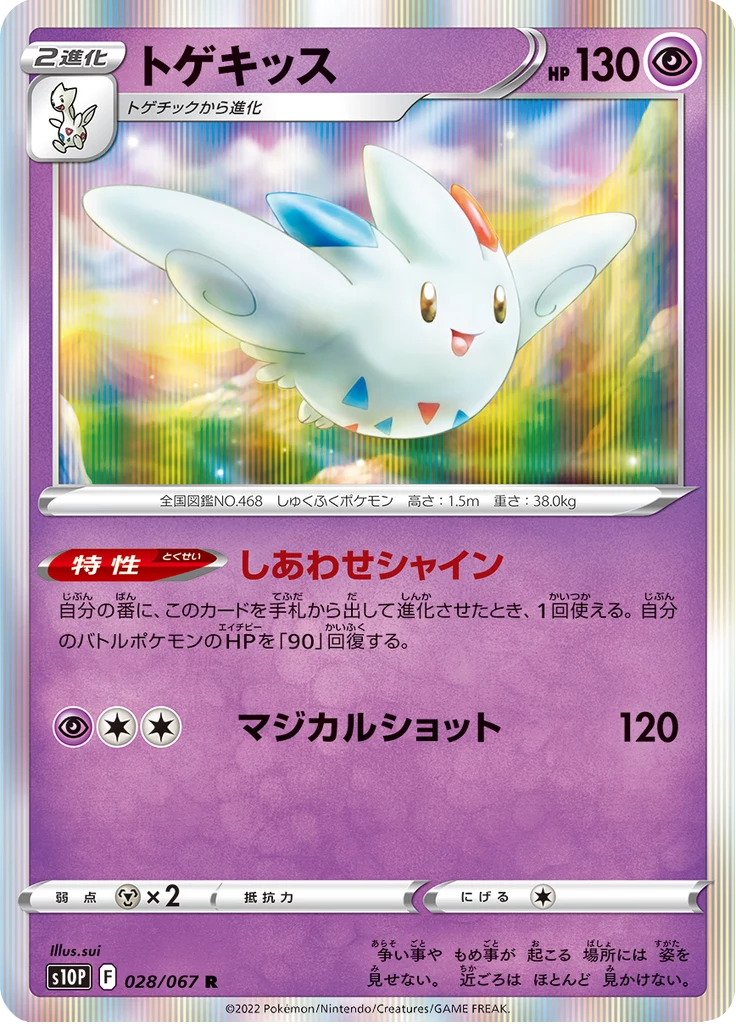
Togekiss S10P #28 Rare Space Juggler 2022
Togekiss SV8 #47 Rare Super Electric Breaker 2024
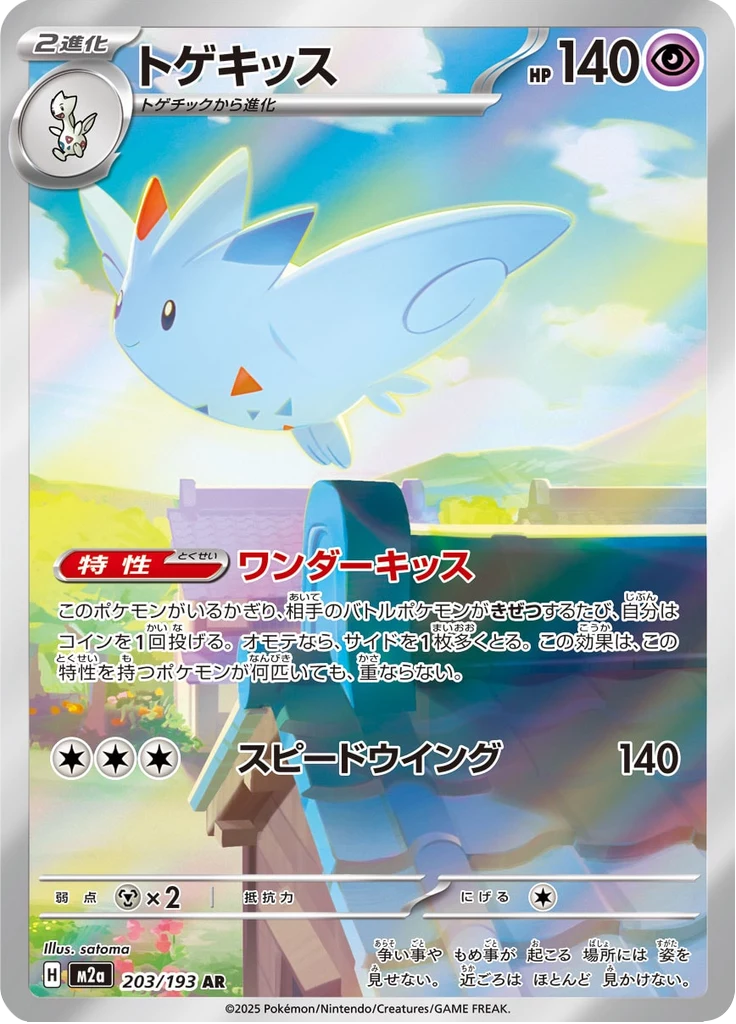
Togekiss M2a #203/193 Art Rare Mega Dream ex 2025

Two patterns stand out. First, Togekiss shows up far more often than Togepi — the pre-evolution only gets its own printing twice among the prints in this guide, both times sharing a set with a Togekiss (Space Juggler) or folded into a TAG TEAM alongside Cleffa and Igglybuff (Tag All Stars). Second, the line skews support over aggression: Fairy Banquet, Happy Shine, and Wonderkiss are all healing or utility abilities rather than big attackers, which tracks with how Togekiss has always played in the TCG.

The sections below walk through each era in release order.

The Original: Emerald Break and Its CP4 Reprint

Togekiss’s modern Japanese run starts with Emerald Break (XY6), released March 14, 2015.

Togekiss [XY6 38/078] Uncommon (Emerald Break)

Togekiss, XY6 38/078, Uncommon

Togekiss [CP4 85] (Premium Champion Pack)

Togekiss, CP4 85

The XY6 #38/078 print is a straightforward Fairy-type, 140 HP, two-stage evolution card illustrated by Sumiyoshi Kizuki — the entry point for anyone starting a Togekiss run. It corresponds to the English Roaring Skies #45 print.

The following year, the EX x MEGA x BREAK Premium Champion Pack (CP4, released April 16, 2016) reprinted a different Emerald Break Togekiss — illustrated by PLANETA and set at 130 HP, matching English Roaring Skies #46.

Check This First

Limitless TCG’s card database doesn’t list a rarity symbol for CP4 #85, so we’re not assigning it one here. Treat any rarity claim you see for this specific reprint as unconfirmed until you can check the physical card.

Night Unison: The Fairy Banquet Support Card

Togekiss [SM9a 36] Rare (Night Unison)
Togekiss, SM9a 36, Rare — the Fairy Banquet support print from Night Unison

Night Unison (SM9a), released January 11, 2019 as part of the Sun & Moon era, gave Togekiss its clearest support role. Illustrated by Kagemaru Himeno, this Fairy-type, 140 HP Rare carries the ability Fairy Banquet: once per turn, heal 30 damage from each of your Fairy-type Pokemon. It corresponds to English Unbroken Bonds #138. If you’re building out a broader Sun & Moon era collection, our Sun & Moon era Japanese Pokemon guide covers the wider set lineup this card belongs to.

Fairy Banquet is a team-wide heal rather than a self-heal, which is why this particular Togekiss print gets picked up by Fairy-type decks specifically rather than as a generic bench piece — it’s built to support other Fairy Pokemon, not just itself.

Togepi & Cleffa & Igglybuff-GX: The Tag All-Stars TAG TEAM

Togepi & Cleffa & Igglybuff-GX [SM12a 94/173] Double Rare (Tag All Stars)
Togepi & Cleffa & Igglybuff-GX, SM12a 94/173, Double Rare — illustrated by Mitsuhiro Arita, Tag All Stars

Released October 4, 2019, Tag All Stars (SM12a) is where Togepi got its biggest spotlight: a TAG TEAM card shared with Cleffa and Igglybuff, illustrated by Mitsuhiro Arita — the artist behind the original 1996 Charizard base set card, which makes any Arita TAG TEAM print notable on its own. This Fairy-type, 240 HP Double Rare hits with the attack Rolling Panic for 120+ damage, and corresponds to English Cosmic Eclipse #143 (and its #143a alternate).

Because it’s a shared TAG TEAM slot rather than a solo Togepi card, this is the only printing in the line where Togepi appears at Double Rare — every other Togepi appearance on this list is a plain Common.

Togekiss V: Legendary Heartbeat’s Double Rare and Secret Rare

Togekiss V [S3a 58] Double Rare (Legendary Heartbeat)

Togekiss V, S3a 58, Double Rare

Togekiss V [S3a 82] Secret Rare (Legendary Heartbeat)

Togekiss V, S3a 82, Secret Rare

Legendary Heartbeat (S3a), released July 10, 2020, brought Togekiss into the V era with two prints of the same card — a Double Rare and a Secret Rare, both illustrated by PLANETA Mochizuki. This is a Colorless-type, 200 HP V with the attack Shiroki Wind, which deals 20 damage plus an additional 70 if the Defending Pokemon is an Evolved Pokemon — a straightforward damage boost against anything past its first stage. Both correspond to English Vivid Voltage #140 and #178.

The Secret Rare (#82) uses the higher-gloss full-art treatment typical of the tier, while the Double Rare (#58) is the standard V frame. Same card text, same illustrator, different finish.

The Line Together: Togepi and Togekiss in Space Juggler

Togepi [S10P 26] Common (Space Juggler)

Togepi, S10P 26, Common

Togekiss [S10P 28] Rare (Space Juggler)

Togekiss, S10P 28, Rare

Space Juggler (S10P), released April 8, 2022, is the only set covered in this guide that prints Togepi and Togekiss side by side — a Common Togepi (#26, illustrated by Mizue) and a Rare Togekiss (#28, illustrated by sui). That makes it the closest thing to a single home for the whole line in one release.

This Togekiss is a Psychic-type, 130 HP card with the ability Happy Shine: when you play this card from your hand to evolve one of your Pokemon, heal 90 damage from your Active Pokemon. It corresponds to English Astral Radiance #57. Between the shared release and the direct evolution-triggered heal, Space Juggler is the print pair we’d point to first if you specifically want the Togepi-to-Togekiss story on cardboard rather than one stage in isolation.

The Current Print: Super Electric Breaker and Its Art Rare

Togekiss [SV8 47] Rare (Super Electric Breaker)

Togekiss, SV8 47, Rare

Togekiss [M2a 203/193] Art Rare (Mega Dream ex)

Togekiss, M2a 203/193, Art Rare

Super Electric Breaker (SV8), released October 18, 2024, is the most recent standalone Togekiss print, illustrated by Narano. This Rare carries the ability Wonderkiss: whenever an attack from this Pokemon knocks out your opponent’s Active Pokemon, flip a coin — if heads, take an extra Prize card. It corresponds to English Surging Sparks #72.

The same card got an alternate-art Art Rare treatment in Mega Dream ex (M2a #203/193), released November 28, 2025, illustrated by satoma — a separate illustration of the same Wonderkiss text, with the standard version reprinted at M2a #66 in the same set. Alternate-art tiers like this sit alongside other high-end illustration chases across the catalog; our CHR character rare cards guide covers that broader category if you collect for the art style as much as the character.

Which Booster Box to Buy for This Line

Five of our current booster boxes contain verified Togepi or Togekiss pulls. Here’s how they line up against the cards covered above:

Booster Box Contains Prijs
S10P Space Juggler Togepi #26, Togekiss #28 ¥15,225 (~$93)
S3A Legendary Heartbeat Togekiss V #58 & SA #82 ¥42,000 (~$258)
SM9A Night Unison Togekiss #36 (Fairy Banquet) ¥84,000 (~$515)
SM12A Tag All-Stars Togepi & Cleffa & Igglybuff-GX #94 ¥212,100 (~$1,301)
SV8 Super Electric Breaker Togekiss #47 (Wonderkiss) Check current listing

If you want the whole line’s story in one box, S10P Space Juggler is the only set that pulls Togepi and Togekiss together, and it’s also the cheapest entry point on this list. If you’re chasing the TAG TEAM specifically, SM12A Tag All-Stars is the only box that contains it — that’s a full high-class pack price point, not a standard booster box, so budget accordingly.

Shop This Set
S10P Space Juggler Booster Box (Japanese)
Currently listed at ¥15,225 (~$93)
Ships from Tokyo · Tracked delivery

View Product →

Where to Buy Japanese Togepi and Togekiss Cards

We ship Japanese sealed product worldwide from Tokyo with tracked delivery. We don’t hold individual Togepi-line singles listed at the moment, so if you’re after a specific print — the Night Unison Fairy Banquet copy, the Tag All-Stars TAG TEAM, or the M2a Art Rare — the fastest route is a restock request or sourcing request through our Quick Order page.

For sealed product, start with the boxes in the table above. If you’re deciding between a raw copy and a graded one once you do track a single down, our PSA 10 vs raw Japanese Pokemon cards guide walks through the trade-offs. And if your interest in this line runs further back than 2015, our Japanese old-back Pokemon cards guide covers the vintage printings outside this guide’s scope.

Veelgestelde vragen

What is the rarest Togekiss card covered in this guide?

By rarity tier, the Togepi & Cleffa & Igglybuff-GX Double Rare (SM12a #94/173, Tag All Stars) and the Togekiss V Secret Rare (S3a #82, Legendary Heartbeat) sit at the top of this line’s confirmed printings. The SM12a TAG TEAM is also the only box-matched print at that rarity tier, found in the SM12A Tag All-Stars Booster Box.

What’s the difference between the Emerald Break Togekiss and its CP4 reprint?

Both are Emerald Break-era Togekiss prints, but they’re separate cards with different illustrators and HP totals: XY6 #38/078 (Sumiyoshi Kizuki, 140 HP, Uncommon) versus CP4 #85 (PLANETA, 130 HP, rarity unconfirmed). They correspond to English Roaring Skies #45 and #46 respectively.

Which set pairs Togepi and Togekiss on the same release?

Space Juggler (S10P), released April 8, 2022, is the only set covered in this guide that prints both stages together — a Common Togepi (#26) and a Rare Togekiss (#28) with the ability Happy Shine.

Is the Togepi & Cleffa & Igglybuff-GX card the same as a solo Togekiss print?

No — it’s a TAG TEAM card featuring the pre-evolution stage (Togepi) alongside Cleffa and Igglybuff, not a Togekiss card. It’s the only printing in this line illustrated by Mitsuhiro Arita and the only one where Togepi appears above Common rarity.

Where can I buy Japanese Togepi and Togekiss cards?

We ship Japanese sealed product worldwide from Tokyo. Five of our current booster boxes contain verified pulls from this line, led by the S10P Space Juggler Booster Box at ¥15,225. We don’t currently stock loose Togepi-line singles, so sourcing requests for specific cards go through our Quick Order page.

Salamence Pokemon-kaartgids: elke Japanse uitgave

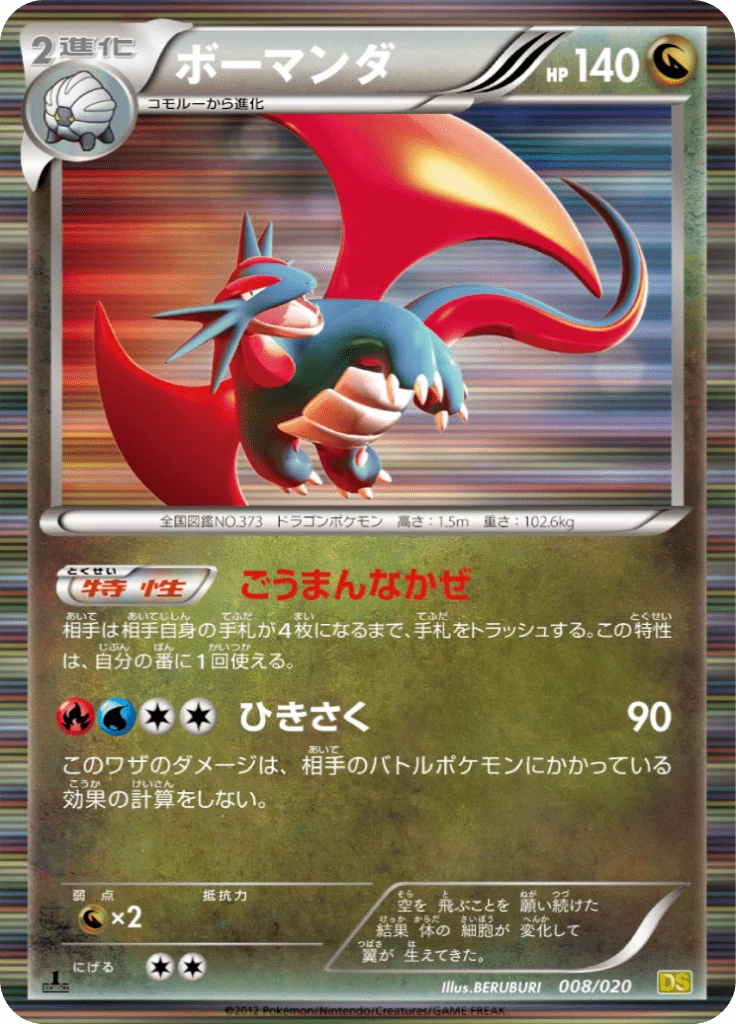
The earliest Salamence print verified in this guide is a 2012 concept pack that introduced the Dragon type to the Japanese TCG, and the line has kept reappearing ever since — through a Sun & Moon GX pair, a Sword & Shield V/VMAX trio, and a 2025 ex with a Special Art Rare chase print. Eleven prints in all, across six different Japanese sets.

This guide walks through every one of them: what set each came from, what the card actually does, and which Japanese sealed boxes still carry a shot at pulling one. We ship Japanese sealed product out of Tokyo every week, and Quick Order is where specific-card sourcing requests get handled.

Salamence’s card history mirrors its place in the Pokedex as the fully evolved Stage 2 form of the Bagon line, and that framing shows up directly on the cards: the Dragon Selection print and the newest Battle Partners ex are both explicitly Stage 2 Pokemon, and Battle Partners pairs the ex with a Bagon single from the same set for the first time in this lineup. Everything from a plain 2015 Rare to a 2025 Special Art Rare sits under that same evolution line.

Key Takeaway

Salamence has appeared on eleven main Japanese card prints since 2012, spanning a Dragon-type concept pack, three standalone Rares, a GX pair, a V/VMAX/SA trio, and the current Battle Partners ex line with its Special Art Rare. Sealed options include the Battle Partners Booster Box and Infinity Zone Booster Box, and specific-card sourcing runs through Snel bestellen.

11
Salamence Prints

2012–2025
Years Covered

4
Sourcing Boxes

320 HP
Highest (SV9 ex)

Every Japanese Salamence Card and Where It’s From

Eleven Salamence prints across six Japanese sets, plus the Bagon single that shares a set with the newest ex:

Kaart Number Rarity Set Year
Salamence DS #8 — Dragon Selection 2012
Salamence XY6 #47/078 Rare Emerald Break 2015
Salamence-GX SM6b #45 Double Rare Champion’s Road 2018
Salamence-GX SM6b #72 Secret Rare Champion’s Road 2018
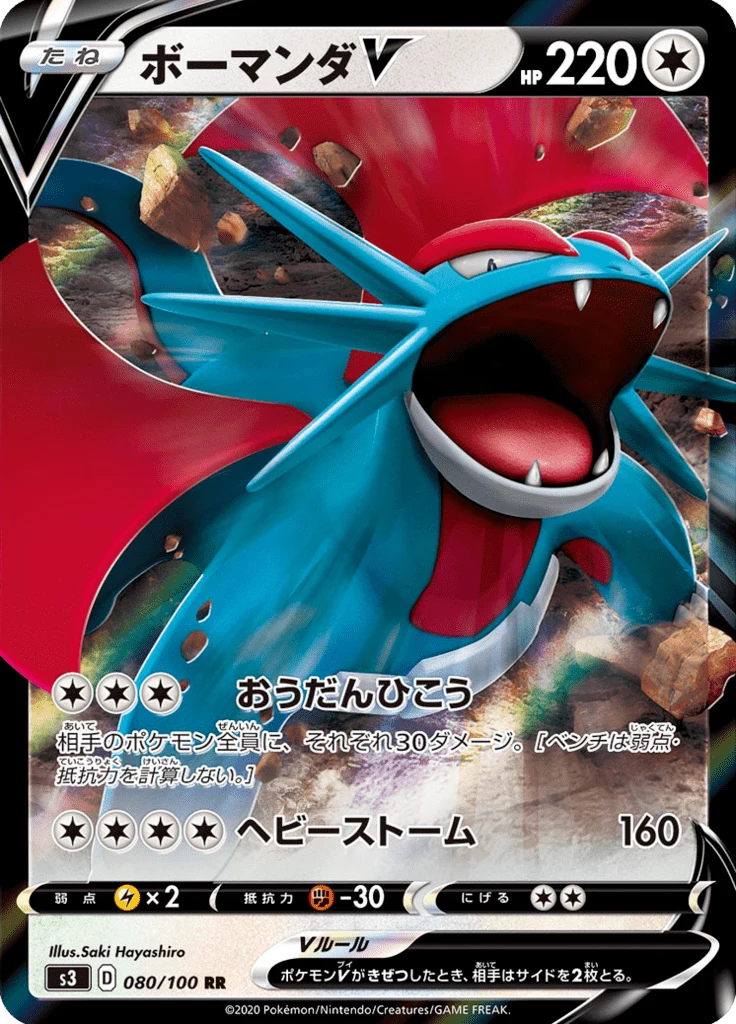
Salamence V S3 #80 Double Rare Infinity Zone 2020
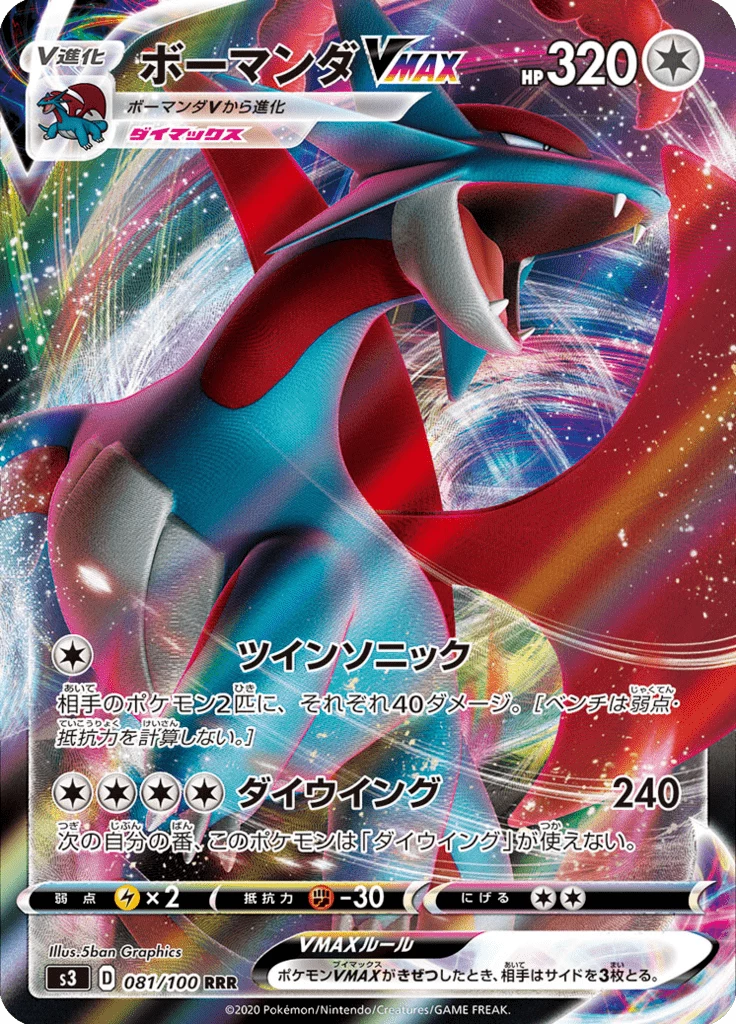
Salamence VMAX S3 #81 Double Rare Infinity Zone 2020
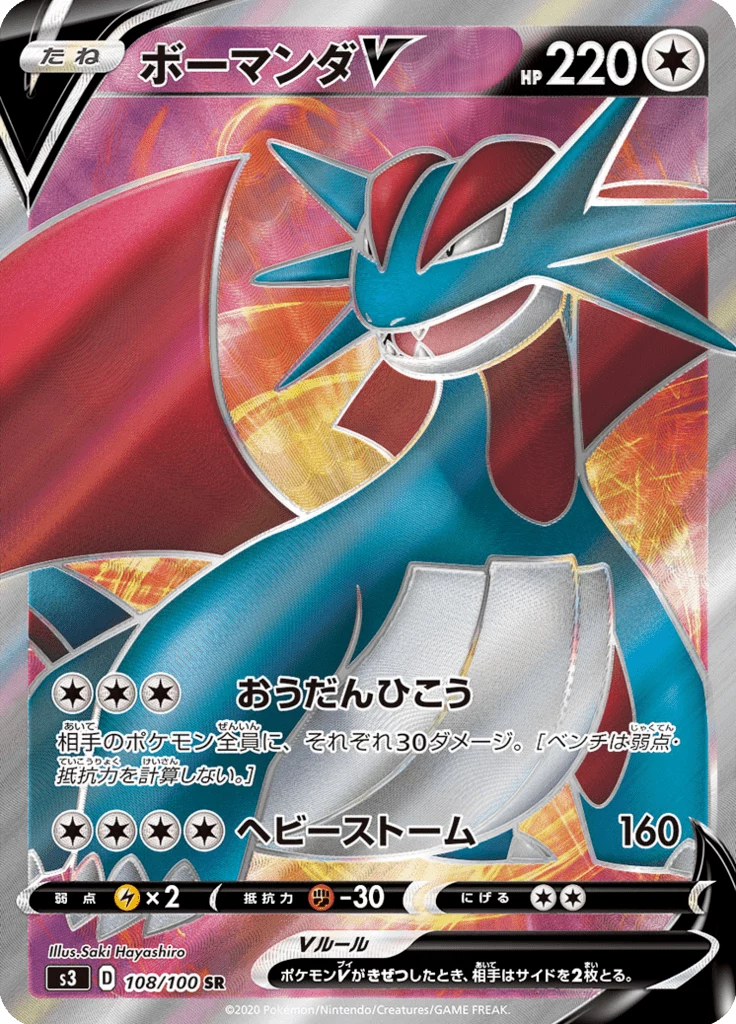
Salamence V (SA) S3 #108 Secret Rare Infinity Zone 2020
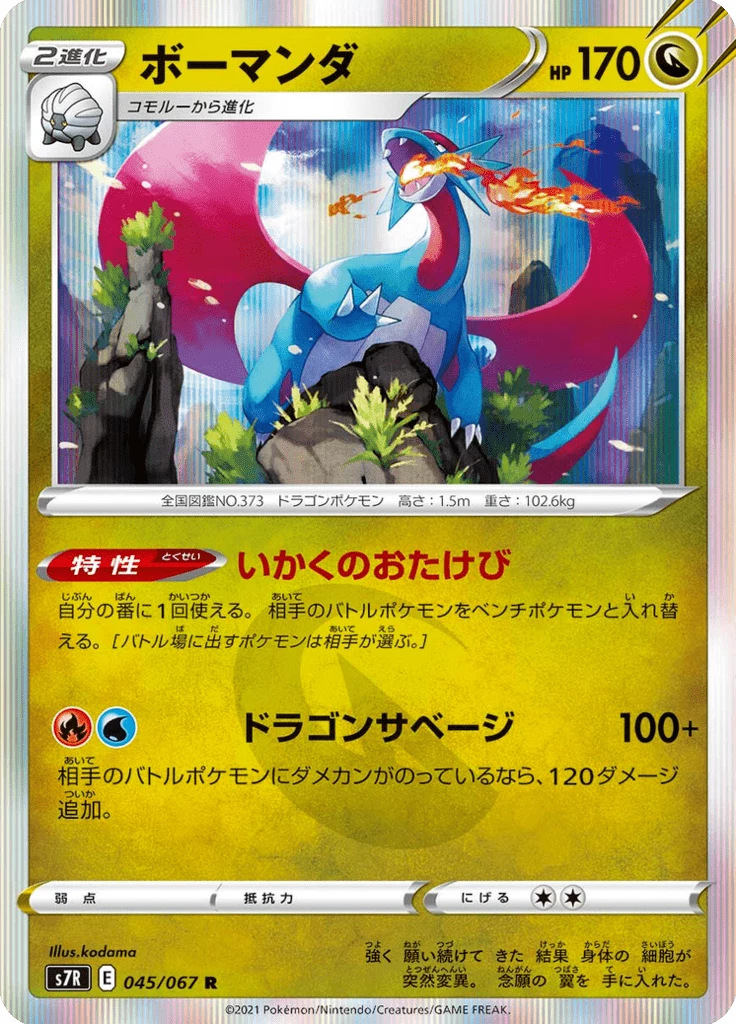
Salamence S7R #45 Rare Blue Sky Stream 2021
Salamence ex SV9 #72 Double Rare Battle Partners 2025
Salamence ex SV9 #119 Secret Rare Battle Partners 2025
Salamence ex SV9 #129 Special Art Rare Battle Partners 2025
Bagon SV9 #70 Common Battle Partners 2025

Two eras stand out. Champion’s Road, still under the Sun & Moon banner, produced the GX pair with the earliest mechanics in the lineup. Infinity Zone and Blue Sky Stream are both Sword & Shield-era Salamence prints — one built around the V/VMAX line, the other a standalone Rare. Battle Partners in early 2025 is the newest print and the first ex-era Salamence, issued at three separate rarity levels within a single set.

Check This First

The mechanic printed on the card — plain Pokemon, GX, V/VMAX, or ex — tells you the era faster than the artwork does. The rarity tier (Double Rare, Secret Rare, Special Art Rare) then tells you how far up the chase-card ladder that specific copy sits within its own set.

The 2012 Concept Pack: Dragon Selection

Salamence, DS #8, Dragon Selection

The earliest Salamence print verified in this guide comes from Dragon Selection (DS), a concept pack released January 27, 2012 that introduced the Dragon type to the Japanese TCG. Card #8 is a Stage 2 Pokemon with 140 HP, illustrated by BERUBURI. Its English-language counterpart, printed for the same concept, is Dragon Vault #8. Limitless doesn’t list a rarity tier for this print, so we’re not assigning one here — it’s a set-specific concept-pack card rather than a standard rarity-tier single.

Because Dragon Selection was built specifically to launch the Dragon type rather than to slot into the ordinary Rare-through-Secret-Rare ladder, it reads more like a foundational reference point for the rest of this lineup than a chase card in its own right. Most of the later Dragon-type Salamence prints in this guide — including the Emerald Break Rare, the Champion’s Road GX pair, and the Battle Partners ex — carry the same typing this 2012 release helped establish; the Infinity Zone V and VMAX prints are Colorless instead, a typing shift that came with the V/VMAX mechanic.

Emerald Break: The 2015 Rare

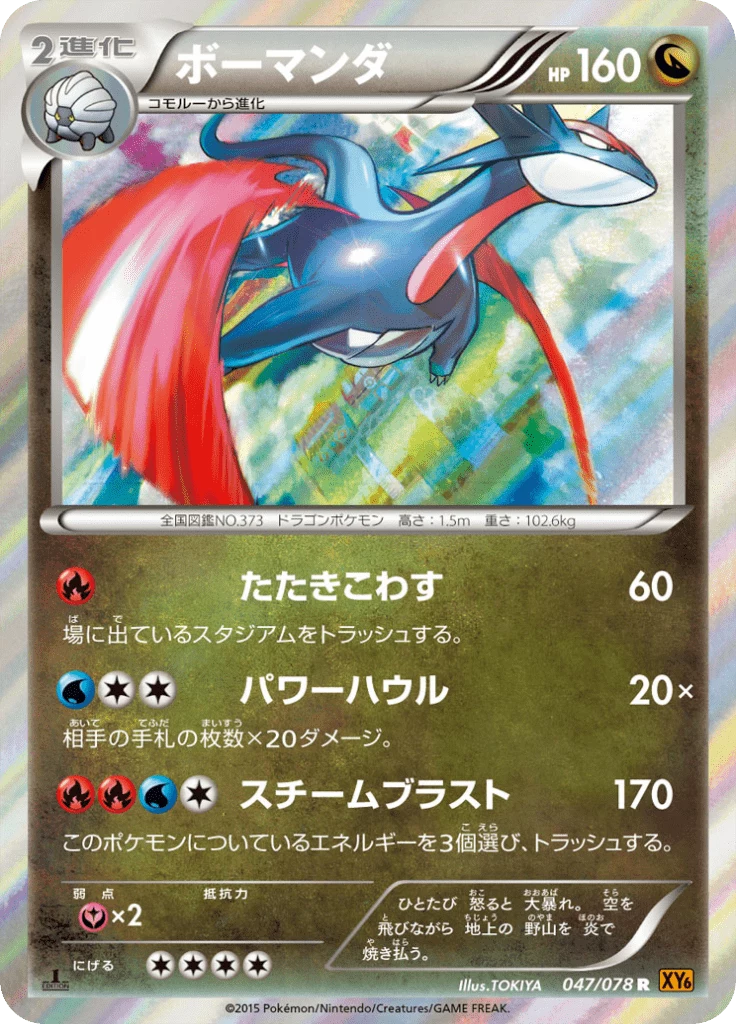
Salamence R, XY6 #47/078, Emerald Break

Three years later, Salamence returned as a straightforward Rare in Emerald Break (XY6), released March 14, 2015. Card #47 of 78 is a Dragon-type, 160 HP single illustrated by TOKIYA, with Roaring Skies #57 as its English equivalent. It’s the most conventional of the eleven prints — no V, no GX, no ex, just a Rare-tier Salamence from the mid-2010s XY era.

Salamence-GX and Champion’s Road

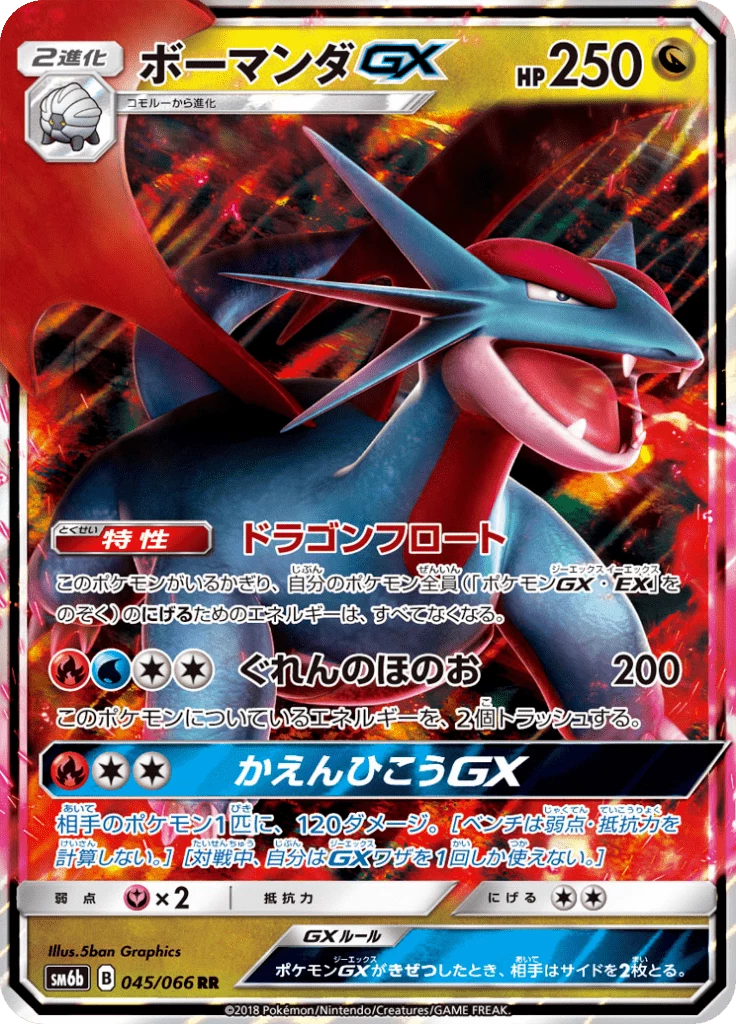
Salamence-GX Double Rare, SM6b #45, Champion's Road

Salamence-GX Double Rare, SM6b #45, Champion’s Road

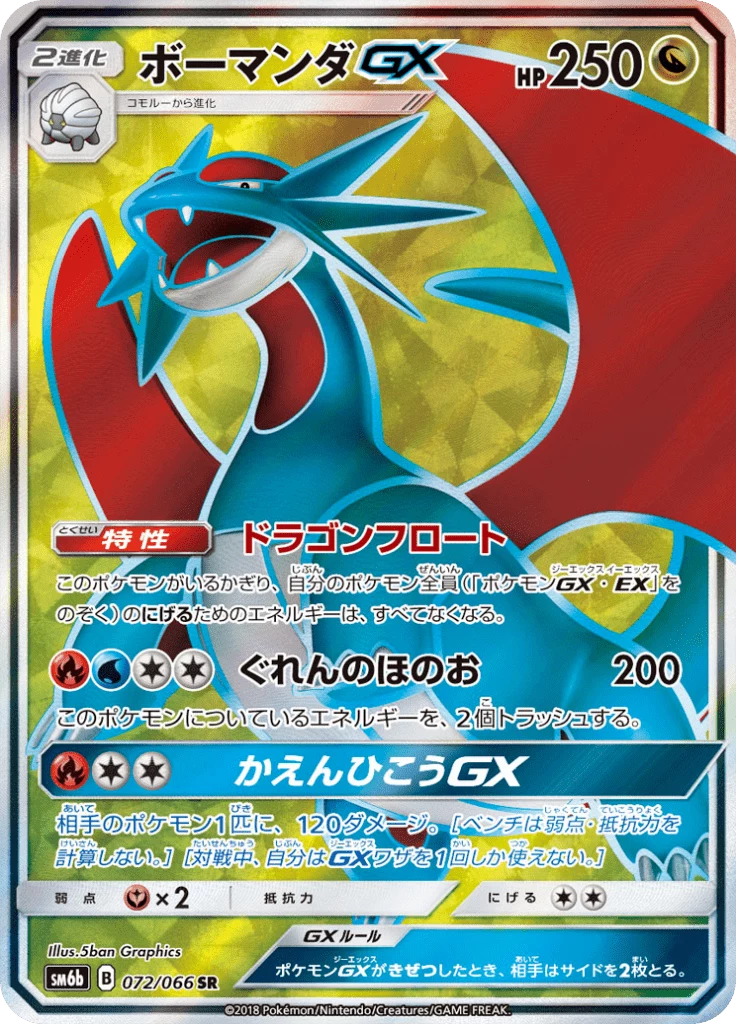
Salamence-GX Secret Rare, SM6b #72, Champion's Road

Salamence-GX Secret Rare, SM6b #72, Champion’s Road

Champion’s Road (SM6b), released May 3, 2018, gave Salamence its GX treatment. The Double Rare #45 and its Secret Rare counterpart #72 — both illustrated by 5ban Graphics — carry 250 HP and an ability called Dragon Lift that reduces the Retreat Cost of Pokemon in play, with some exceptions noted on the card itself. In English, the same card appears as Dragon Majesty #44 and related numbers. It’s the only GX-era Salamence in the lineup, and the Secret Rare is the rarer of the pair.

Salamence V and VMAX: Infinity Zone

Salamence V Double Rare, S3 #80, Infinity Zone

Salamence V Double Rare, S3 #80, Infinity Zone

Salamence VMAX Double Rare, S3 #81, Infinity Zone

Salamence VMAX Double Rare, S3 #81, Infinity Zone

Salamence V Secret Rare, S3 #108, Infinity Zone

Salamence V Secret Rare, S3 #108, Infinity Zone

Infinity Zone (S3), released June 5, 2020, is where Salamence picked up the V and VMAX mechanics. Card #80 (V, Colorless, 220 HP) and #81 (VMAX, Colorless, 320 HP) are both Double Rare, illustrated by Saki Hayashiro and 5ban Graphics respectively. A third print, #108, is a Secret Rare Special Art version of the V. All three share the same English equivalents: Darkness Ablaze #143, #144, #185, and #194. If you want the fuller picture of how V, VMAX, and the rest of the rarity system fit together, see our Sword & Shield-era Japanese Pokemon guide.

Blue Sky Stream: The Roar of Menace Rare

Salamence R, S7R #45, Blue Sky Stream

Blue Sky Stream (S7R), released July 9, 2021, added one more standalone Rare: card #45, a 170 HP Dragon-type illustrated by kodama. Its ability, Roar of Menace, lets you switch the opponent’s Active Pokemon with one from their Bench once per turn — a disruption tool rather than a straight attacker. The English equivalent is Evolving Skies #109.

The Current Print: Salamence ex in Battle Partners

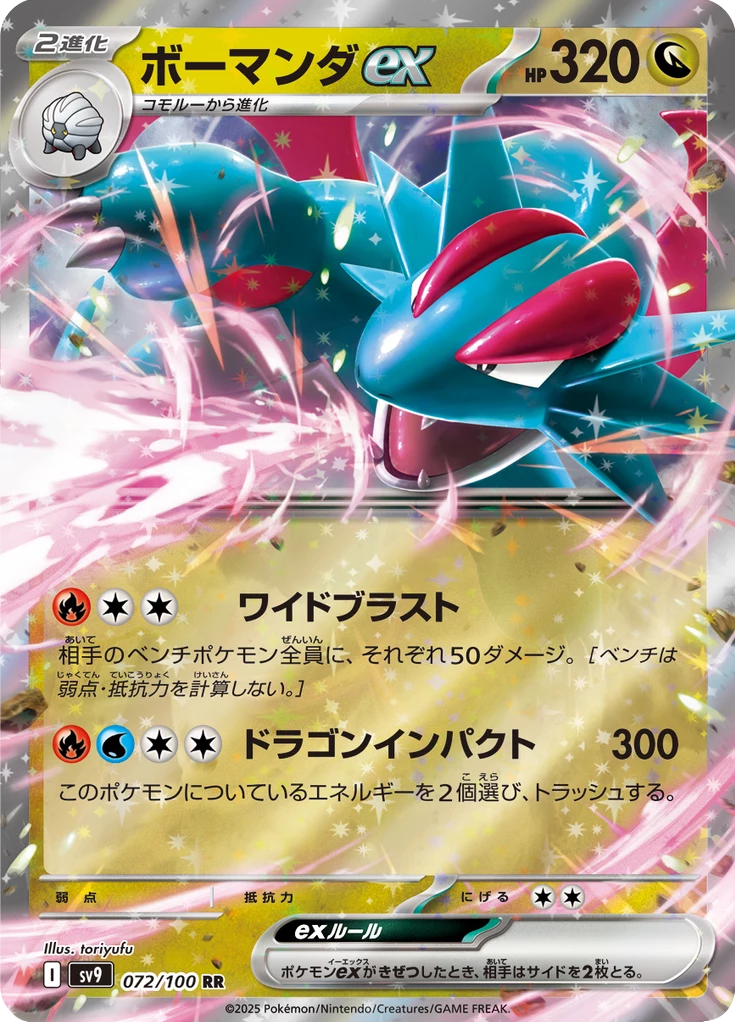
Salamence ex Double Rare, SV9 #72, Battle Partners

Salamence ex Double Rare, SV9 #72, Battle Partners

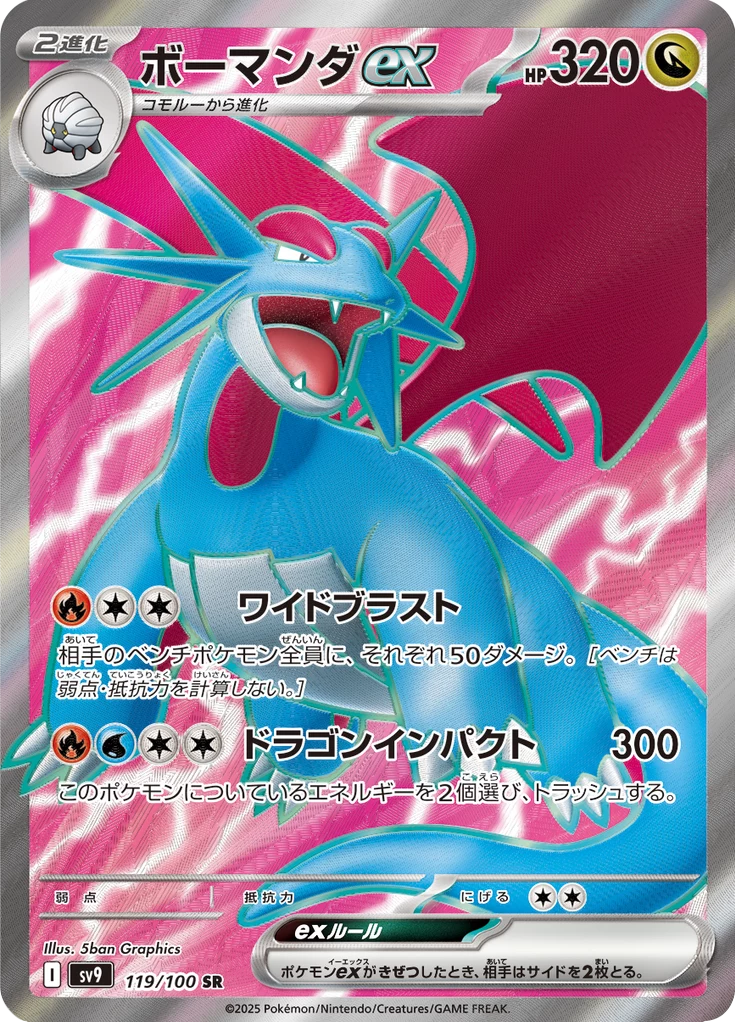
Salamence ex Secret Rare, SV9 #119, Battle Partners

Salamence ex Secret Rare, SV9 #119, Battle Partners

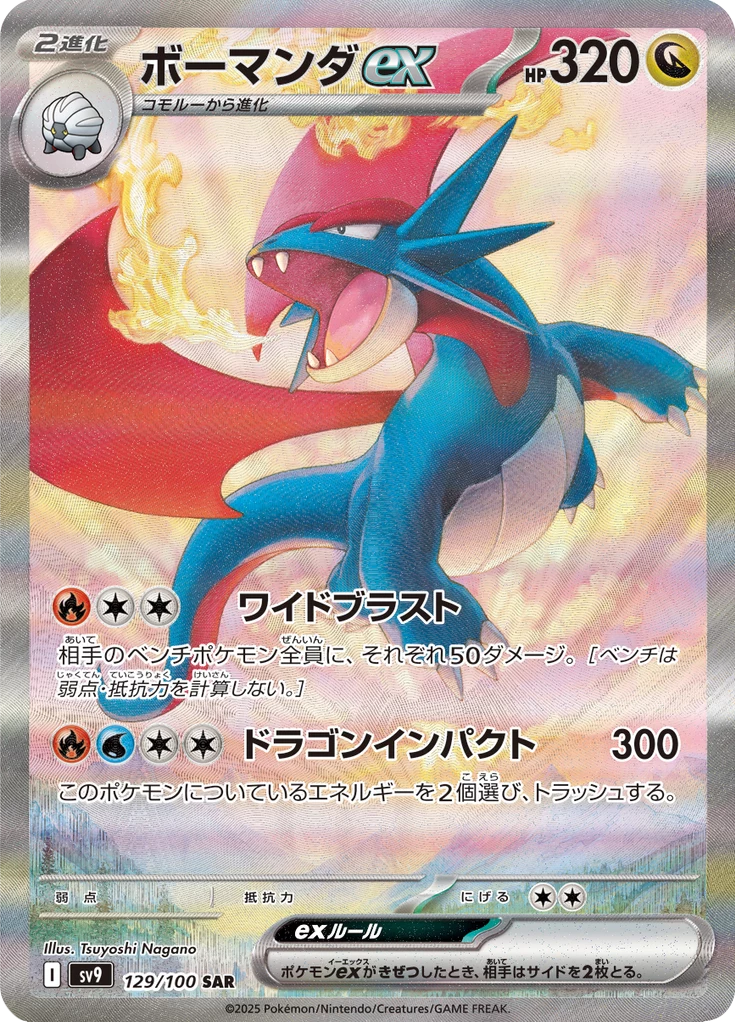
Salamence ex Special Art Rare, SV9 #129, Battle Partners

Salamence ex Special Art Rare, SV9 #129, Battle Partners

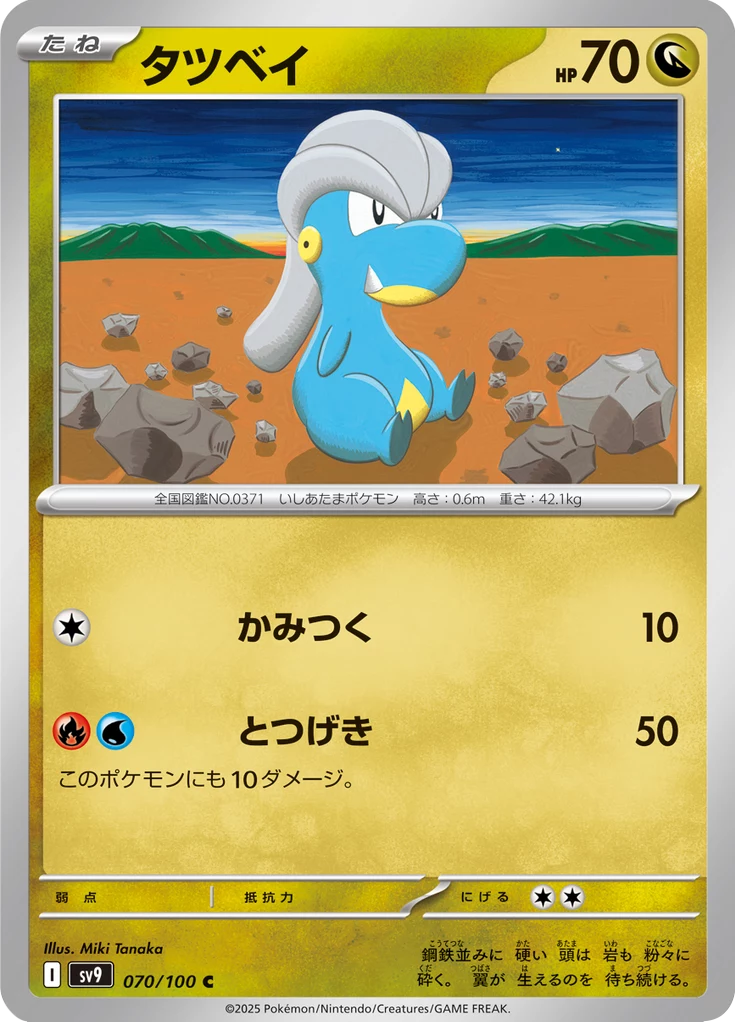
Bagon C, SV9 #70, Battle Partners

Bagon C, SV9 #70, Battle Partners

The newest and highest-HP Salamence print comes from Battle Partners (SV9), released January 24, 2025. Salamence ex is a 320 HP, two-stage Dragon-type Pokemon with an attack called Wide Blast that deals 50 damage to each of the opponent’s Benched Pokemon. It was printed at three rarity levels in the same set: Double Rare #72 (illustrated by toriyufu), Secret Rare #119 (5ban Graphics), and Special Art Rare #129 — illustrated by Tsuyoshi Nagano, and the highest rarity tier printed anywhere in this lineup. If you’re comparing alt-art chase prints across sets, our alt-art SAR cards guide covers how Special Art Rare fits into the wider Japanese rarity system. The English equivalents are Journey Together #114 and related numbers. The same set also carries the Common-rarity Bagon #70, illustrated by Miki Tanaka — the first stage of the evolution line, printed alongside its final form for the first time in this lineup.

Sourcing Salamence Through Sealed Japanese Boxes

We carry sealed product from four of the six sets Salamence appears in, and that’s the direct route to pulling one yourself. Each box below is tied to a specific era covered earlier in this guide, so match the box to the print you’re after rather than assuming any Japanese Pokemon box carries a shot at all eleven:

Shop This Set
Battle Partners Booster Box (Japanese)
Contains Salamence ex at Double Rare, Secret Rare, and Special Art Rare, plus Bagon
Ships from Tokyo · Tracked delivery

View Product →

For the Dragon Selection and Emerald Break prints, Snel bestellen is the direct channel for specific-card sourcing requests.

Where to Buy Japanese Salamence Cards

We ship Japanese sealed product worldwide out of Tokyo with tracked delivery. For Salamence specifically, Battle Partners is the newest and most direct box, carrying all three of the current ex rarities in one product, while Champion’s Road, Infinity Zone, and Blue Sky Stream cover the GX, V/VMAX, and standalone-Rare eras respectively. Browse the Battle Partners Booster Box directly, check the wider Japanese Pokemon booster box collection for other boxes, or use Snel bestellen to submit a specific-card sourcing request for any of the other prints in this guide. For raw-versus-graded context on older Salamence singles like the 2012 and 2015 prints, see our PSA 10 vs raw Japanese Pokemon cards guide.

Veelgestelde vragen

How many Japanese Salamence Pokemon card prints are there?

Eleven main prints across six Japanese sets, from the 2012 Dragon Selection concept pack through the 2025 Battle Partners ex line, plus a Common-rarity Bagon printed in the same set as the newest ex.

What is the oldest Salamence print in this guide?

January 27, 2012, in Dragon Selection (DS #8) — the oldest Salamence print verified in this guide, a concept pack that introduced the Dragon type to the Japanese TCG.

What does Salamence ex do in the Battle Partners print?

The SV9 Salamence ex is a 320 HP, two-stage Dragon-type Pokemon with the attack Wide Blast, which deals 50 damage to each of the opponent’s Benched Pokemon. It was printed as Double Rare (#72), Secret Rare (#119), and Special Art Rare (#129).

Where can I buy Japanese Salamence Pokemon cards?

We ship Japanese sealed product from Tokyo with tracked delivery. The Battle Partners, Infinity Zone, Champion’s Road, and Blue Sky Stream booster boxes each carry a different Salamence print, and Quick Order handles sourcing requests for the two prints without a matching box.

Dragapult Pokemon-kaartengids: alle Japanse drukken uitgelegd

Dragapult’s earliest verified Japanese print is a 2020 Rare. Four years later, Dragapult ex headlined SV6 Mask of Change — and picked up two more reprints within eighteen months of that.

Dragapult has one of the more compact but consistent print histories among modern Japanese chase Pokemon: twelve verified printings across eight sets, running from a 2020 standard (non-V) Rare all the way to a late-2025 high-class pack reprint. This guide lays out every one of them — what set each card comes from, how it’s classified by rarity, and which sealed Japanese boxes actually contain it.

Dreepy, Drakloak, and Dragapult follow the usual three-stage evolution structure in the games, but on the Japanese card side it’s really a two-act story: an early standard (non-V) Dragapult and a V/VMAX line from 2020, then four years without a special-rarity print before Dragapult ex arrived as a full headline card in 2024 and picked up two more reprints in the seasons after. Nothing in between carries a special-rarity slot — the mid-period Fusion Arts and Lost Abyss printings are plain Rares, which makes the jump to a Secret Rare and a Special Art Rare in the SV era a fairly sharp step up.

We ship Japanese sealed product out of Tokyo with tracked delivery. We don’t hold Dragapult singles in stock as a rule, so the purchase path here runs through sealed booster boxes and our Quick Order page.

Sourcing Note

We don’t carry loose Dragapult singles. What we do carry is sealed SV6 Transformation Mask booster box, currently listed at ¥15,965 — the set that introduced Dragapult ex. Restock requests and single-card sourcing run through Snel bestellen.

12
Verified JP Printings

2020–2025
Years Covered

320 HP
Dragapult ex (SV6)

6
In-Stock Booster Boxes

Every Dragapult Card Printing

Twelve Dragapult printings verified across eight Japanese sets, in release order:

Kaart Set Year Rarity
Dragapult VMAX Rising (S1a) #41 2020 Rare
Dragapult V Rebel Clash (S2) #49 2020 Double Rare
Dragapult VMAX Rebel Clash (S2) #50 2020 Not listed*
Dragapult VMAX SR Rebel Clash (S2) #101 2020 Secret Rare
Dragapult VMAX (Shiny) SR Shiny Star V (S4a) #318/190 2020 Shiny Ultra Rare
Dragapult Fusion Arts (S8) #51 2021 Rare
Dragapult Lost Abyss (S11) #54 2022 Rare
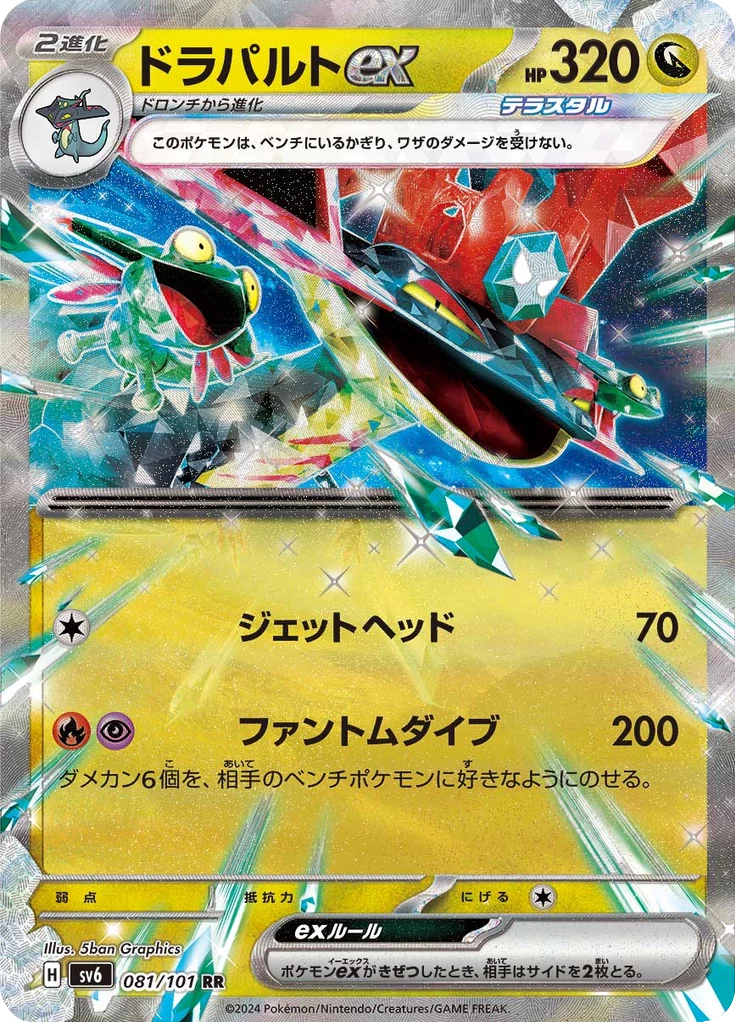
Dragapult ex Mask of Change (SV6) #81/101 2024 Double Rare
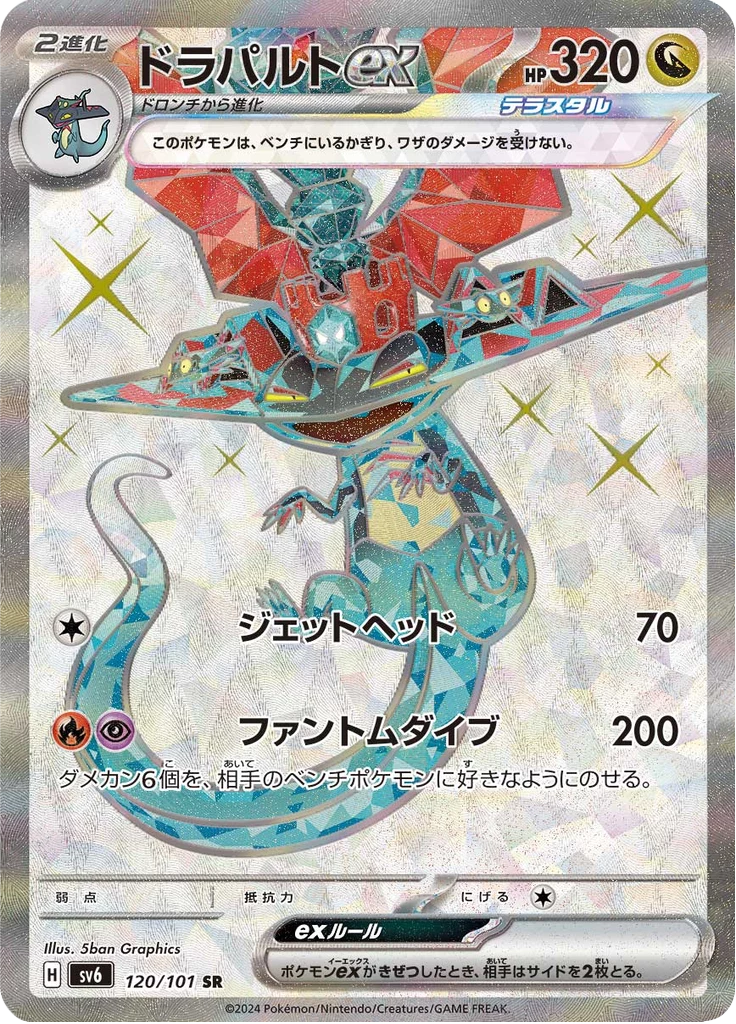
Dragapult ex SR Mask of Change (SV6) #120 2024 Secret Rare
Dragapult ex Terastal Festival ex (SV8a) #120/187 2024 Double Rare
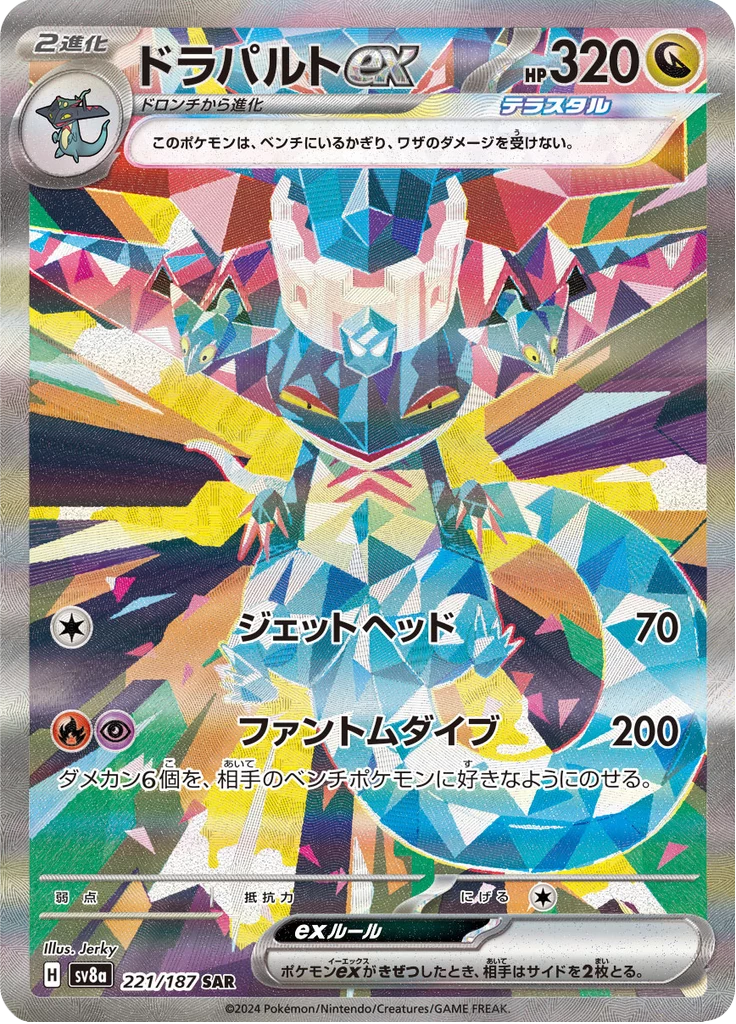
Dragapult ex SAR Terastal Festival ex (SV8a) #221 2024 Special Art Rare
Dragapult ex Mega Dream ex (M2a) #134/193 2025 Double Rare

*Card #50’s rarity slot isn’t classified in the source database we cross-checked against — we’ve left it unlabeled rather than guess.

The pattern is clear once you lay it out: Dragapult got a full V/VMAX treatment in 2020, sat out the middle of the Sword & Shield era as a standard (non-V) reprint, then came back as the headline ex of an entire Scarlet & Violet set in 2024 — followed by two more reprints inside eighteen months. That’s the version most collectors are chasing today, and it’s covered in detail below.

The First Dragapult: VMAX Rising and Rebel Clash (2020)

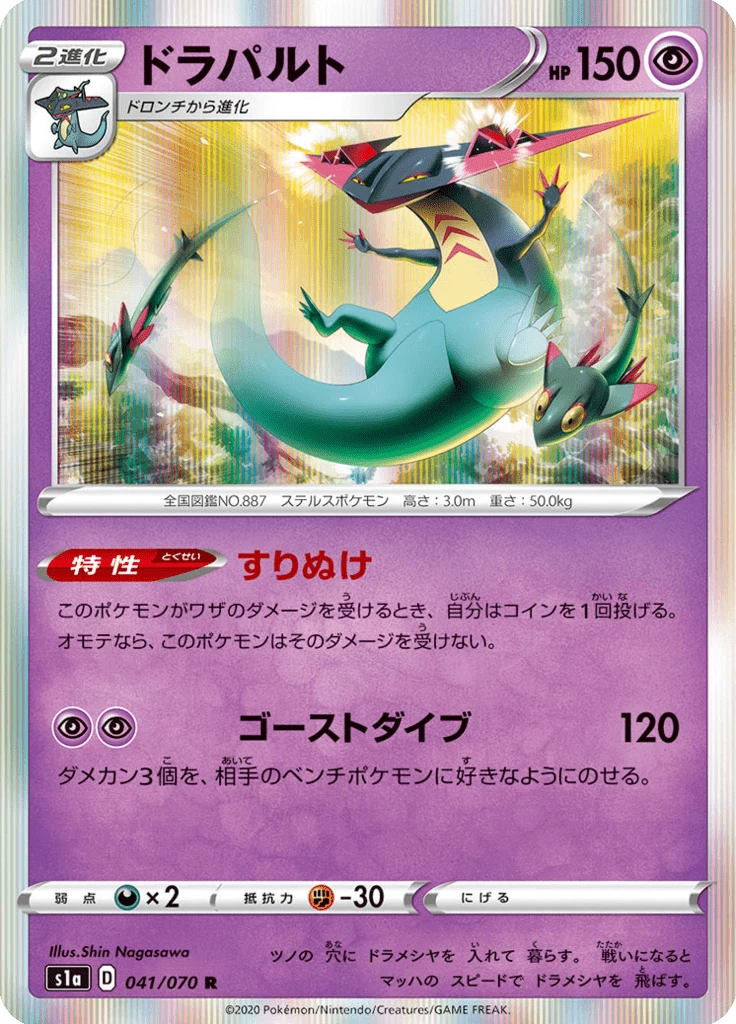
One of Dragapult’s earliest Japanese prints is a standard (non-V) Rare from VMAX Rising (S1a), card #41, released February 7, 2020 — illustrated by Shin Nagasawa. No V, no VMAX, just Dragapult as a Psychic-type attacker.

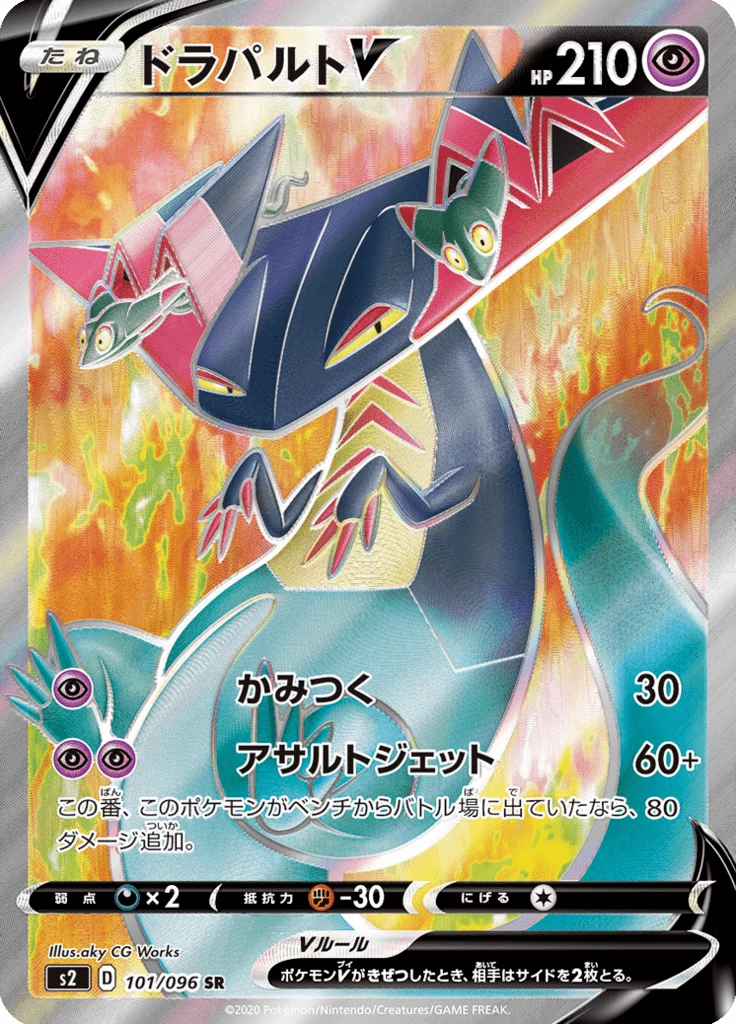
A month later, Rebel Clash (S2) gave Dragapult the full V/VMAX treatment: Dragapult V at #49 (Double Rare), Dragapult VMAX at #50, and a Secret Rare alternate-art VMAX at #101, all released March 6, 2020 and all illustrated by aky CG Works.

Dragapult, Rare, S1a #41, VMAX Rising

Dragapult — S1a #41 (VMAX Rising)

Dragapult VMAX, Secret Rare, S2 #101, Rebel Clash

Dragapult VMAX SR — S2 #101 (Rebel Clash)

Between the two, the set code and card number printed on the card are what tell them apart: the standard Rare is S1a #41, while the Secret Rare alternate-art VMAX is S2 #101.

This era of Japanese Sword & Shield sets is where most of the franchise’s early VMAX chase cards come from — our Sword & Shield era Japanese Pokemon guide covers the broader set lineup if you’re building out that period.

Shop This Set
S1A VMAX Rising Booster Box (Japanese)
Source of Dragapult #41
Ships from Tokyo · Tracked delivery

View Product →

Shop This Set
S2 Rebellion Crash Booster Box (Japanese)
Source of Dragapult V #49, VMAX #50, and Secret Rare #101
Ships from Tokyo · Tracked delivery

View Product →

The Shiny VMAX: Shiny Star V (2020)

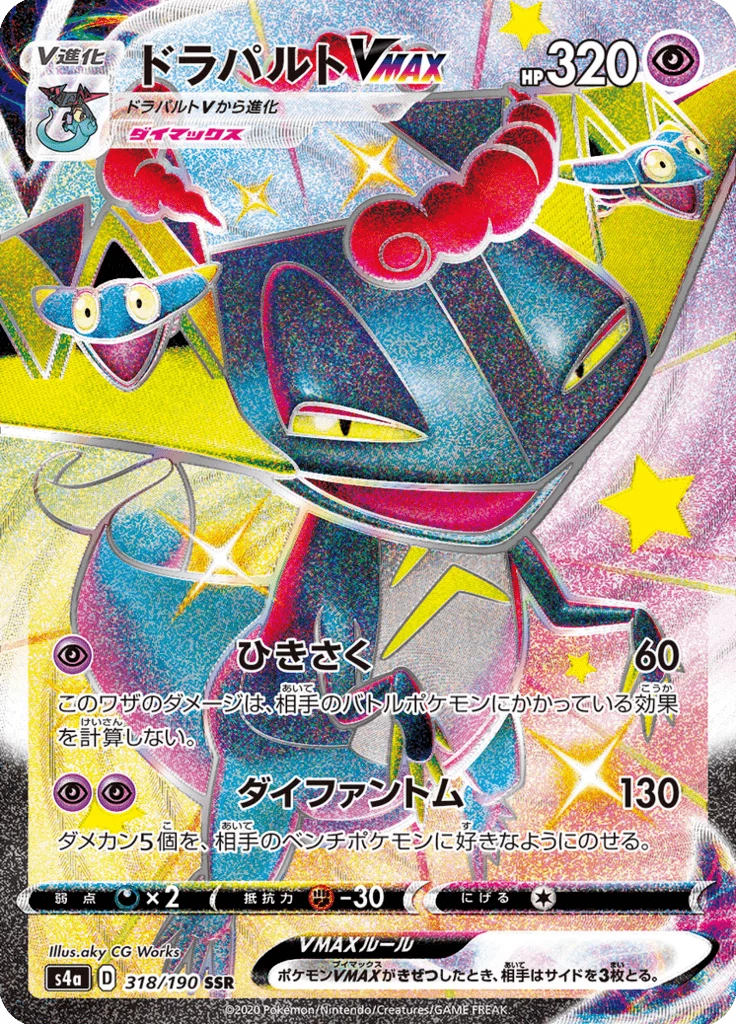
Dragapult VMAX Shiny, Shiny Ultra Rare, S4a 318/190, Shiny Star V
Dragapult VMAX (Shiny) — S4a 318/190, Shiny Star V

Later in 2020, Shiny Star V (S4a) reworked the Rebel Clash VMAX into a shiny-colored alternate at #318/190, illustrated by 5ban Graphics and classified as Shiny Ultra Rare — the set’s dedicated tier for color-swapped VMAX Pokemon.

Shiny Star V is a high-class pack from the same VMAX generation, and we don’t currently stock sealed boxes of it — it isn’t part of our active box lineup, so we’re not using it as a purchase link here. If you’re specifically after this printing, it’s worth checking with us directly through Quick Order rather than assuming it’s sitting in a booster box on our shelves.

Fusion Arts and Lost Abyss (2021–2022)

Between the 2020 VMAX cycle and the 2024 ex era, Dragapult kept a low profile as a single Rare reprint in two standard-era sets:

  • Fusion Arts (S8) #51 — released September 24, 2021, illustrated by Souichirou Gunjima.
  • Lost Abyss (S11) #54 — released July 15, 2022, illustrated by Teeziro.

Neither carries a secret-rare or alternate-art treatment — they’re the standard (non-V) version, the same role Dragapult played back in VMAX Rising. Both sets are currently in stock as sealed boxes: S8 Fusion Arts booster box and S11 Lost Abyss booster box.

Dragapult ex: SV6 Mask of Change (2024)

Dragapult’s biggest release to date is Mask of Change (SV6), out April 26, 2024 — the Japanese set we stock under the product name Transformation Mask. It’s a full two-stage ex line: Dreepy at #79 (Common), and Dragapult ex itself at #81/101 (Double Rare) and #120 (Secret Rare), all illustrated by 5ban Graphics.

Dragapult ex here is a Dragon-type attacker at 320 HP with the attack “Phantom Dive,” dealing 200 damage to the Active Pokemon and spreading six damage counters across the opponent’s Bench — the kind of board-wide swing that made this printing the set’s headline card.

Dragapult ex, Double Rare, SV6 81/101, Mask of Change

Dragapult ex — SV6 81/101 (Mask of Change)

Dragapult ex, Secret Rare, SV6 #120, Mask of Change

Dragapult ex SR — SV6 #120 (Mask of Change)

The Double Rare at #81/101 is the version most players run in a deck. The Secret Rare is numbered beyond the set’s 101-card count at #120, which is the usual Japanese convention for a set’s Secret Rare slot.

If you’re building the full evolution line, the same box carries Dreepy #79 alongside both Dragapult ex printings, so a single sealed box covers the entire chase.

Shop This Set
SV6 Transformation Mask Booster Box (Japanese)
Currently listed at ¥15,965 — source of Dragapult ex #81/#120 and Dreepy #79
Ships from Tokyo · Tracked delivery

View Product →

For a full breakdown of the set’s chase cards beyond Dragapult, see our Mask of Change best cards guide. Mask of Change also headlines the current Scarlet & Violet era lineup — our Scarlet & Violet era Japanese Pokemon guide covers where it sits among the other sets in that run.

Later Reprints: Terastal Festival ex and Mega Dream ex

Dragapult ex didn’t stay exclusive to Mask of Change for long. Terastal Festival ex (SV8a), released December 6, 2024, reprinted it twice: a standard Double Rare at #120/187, and a Special Art Rare at #221, illustrated by Jerky.

Dragapult ex, Special Art Rare, SV8a #221, Terastal Festival ex

Dragapult ex SAR — SV8a #221 (Terastal Festival ex)

A year later, Mega Dream ex (M2a), released November 28, 2025, brought Dragapult ex back a third time at #134/193 (Double Rare) — the most recent Japanese printing verified for this card. The SV8A Terastal Festival ex booster box, which carries the SV8a printings, is in stock; the M2a print is a Snel bestellen sourcing request.

Three ex printings inside two years is a fast reprint pace for a single card, and it puts Dragapult ex in the same category as other Scarlet & Violet-era Pokemon that got carried across a high-class pack cycle rather than staying tied to one set. For collectors, that means the printing you’re after determines which box to open: the original Mask of Change Double Rare and Secret Rare, the Terastal Festival ex Double Rare and Special Art Rare, or the Mega Dream ex Double Rare — each tied to its own release rather than shared across all three.

Where to Source Dragapult Cards from Japan

We don’t stock Dragapult singles — the fastest way to get one out of Japan is sealed product from the set it’s printed in, plus our Quick Order page for anything specific. For the headline ex, that’s the SV6 Transformation Mask booster box, currently listed at ¥15,965.

Restock requests and single-card sourcing — including the Mega Dream ex (M2a) reprint, which doesn’t have a matching box in our current lineup — run through Snel bestellen. Naming the exact set and card number — for example “Dragapult ex, SV6 #120, Secret Rare” — is the fastest way to get a usable answer, since this one Pokemon spans eight Japanese sets and five distinct rarity tiers.

If you’re also tracking down another set-mate from Mask of Change, our Ogerpon Pokemon card guide covers the other headline ex from the same box.

Veelgestelde vragen

What set is Dragapult ex from in Japanese?

Dragapult ex first appeared in Mask of Change (SV6), released April 26, 2024 — the set we stock under the product name Transformation Mask. It printed as #81/101 (Double Rare) and #120 (Secret Rare).

Has Dragapult ex been reprinted since Mask of Change?

Yes, twice. Terastal Festival ex (SV8a, December 2024) reprinted it as #120/187 Double Rare and #221 Special Art Rare. Mega Dream ex (M2a, November 2025) reprinted it again as #134/193 Double Rare.

What was the earliest Dragapult print in this guide?

A standard (non-V) Rare from VMAX Rising (S1a) #41, released February 7, 2020 — ahead of the full V/VMAX line that arrived a month later in Rebel Clash (S2).

Is there a Dreepy card in the same set as Dragapult ex?

Yes. Mask of Change (SV6) includes Dreepy at #79 (Common) in the same box as both Dragapult ex printings, so a single sealed box covers Dreepy and Dragapult ex together.

What’s the difference between the Mask of Change Double Rare and Secret Rare Dragapult ex?

The Double Rare is #81/101; the Secret Rare is #120, numbered beyond the set’s 101-card count, which is the usual Japanese convention for a set’s Secret Rare slot.

Luxray Pokemon-kaartengids: Shinx, Luxio & Elke Japanse Uitgave

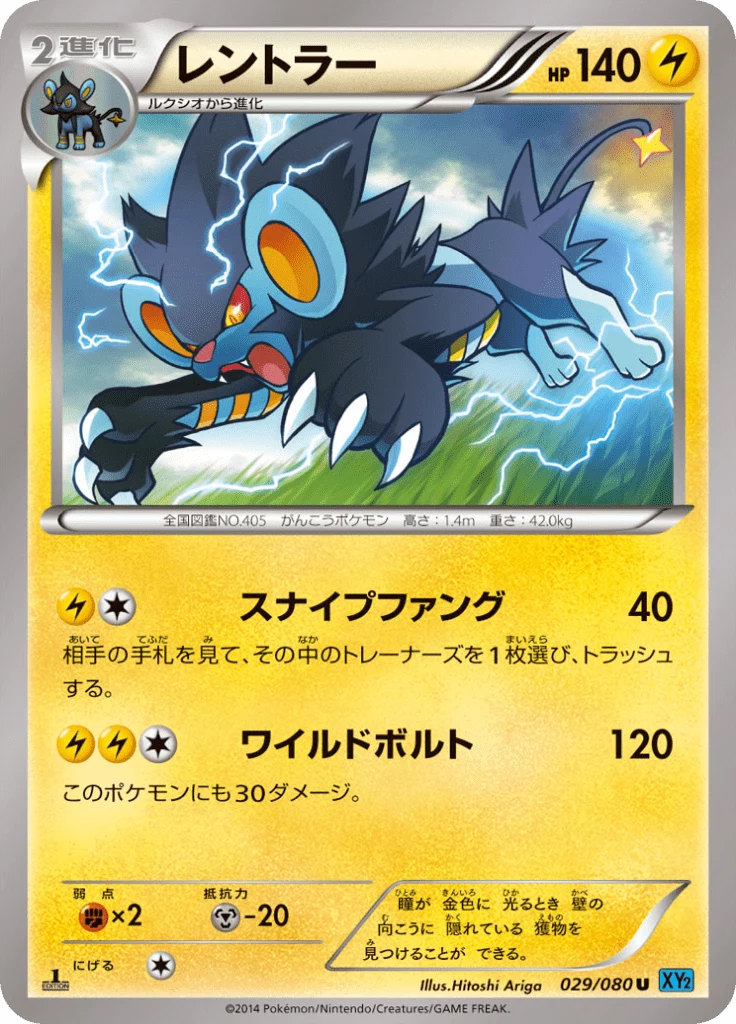
Shinx, Luxio, and Luxray form one of the more consistently reprinted three-stage lines in the modern Japanese Pokemon TCG — not because any single card is a headline chase pull, but because Luxray keeps turning up as a solid supporting piece, set after set, from a 2014 Wild Blaze Uncommon through a 2026 Rare in Munikis Zero.

This guide walks through every confirmed Japanese Luxray print — ten of them across eight sets, spanning 2014 to 2026 — and matches each modern-era card to the sealed booster box it comes out of, including the sets where Shinx rides along in the same pack. It’s a sourcing guide, not an inventory list: every purchase link here points to sealed product or to Quick Order for a sourcing request. We ship Japanese sealed product out of Tokyo every week.

Key Takeaway

Ten confirmed Japanese Luxray prints span eight sets from 2014 to 2026, and Shinx is confirmed alongside Luxray in four of the six booster boxes we carry. The fastest sourcing route is sealed product: the SV6 Transformation Mask Booster Box carries Luxray ex, and the M3 Munikis Zero Booster Box is the newest print. Sourcing for anything else on this list runs through Snel bestellen.

10
Luxray Prints Verified

4
Boxes With Shinx Confirmed

6
Boxes Matched

2014–26
Years Covered

Card details below are drawn from individual card pages on Limitless TCG’s Japanese database as of August 2026. This is a sourcing guide, not a price guide — we don’t publish market prices here, only which sealed products contain which Japanese prints.

Every Japanese Luxray Print We’ve Verified

Ten confirmed prints across eight Japanese sets, from the 2014 Wild Blaze original to the 2026 Munikis Zero release:

Kaart Number Rarity Set Year
Luxray XY2 #29 Uncommon Wild Blaze 2014
Luxray SM5M #20 Rare Ultra Moon 2017
Luxray S9 #39 Uncommon Star Birth 2022
Luxray V S10D #21/067 Double Rare Time Gazer 2022
Luxray V (SA) S10D #70 Secret Rare Time Gazer 2022
Luxray SV2D #21 Rare Clay Burst 2023
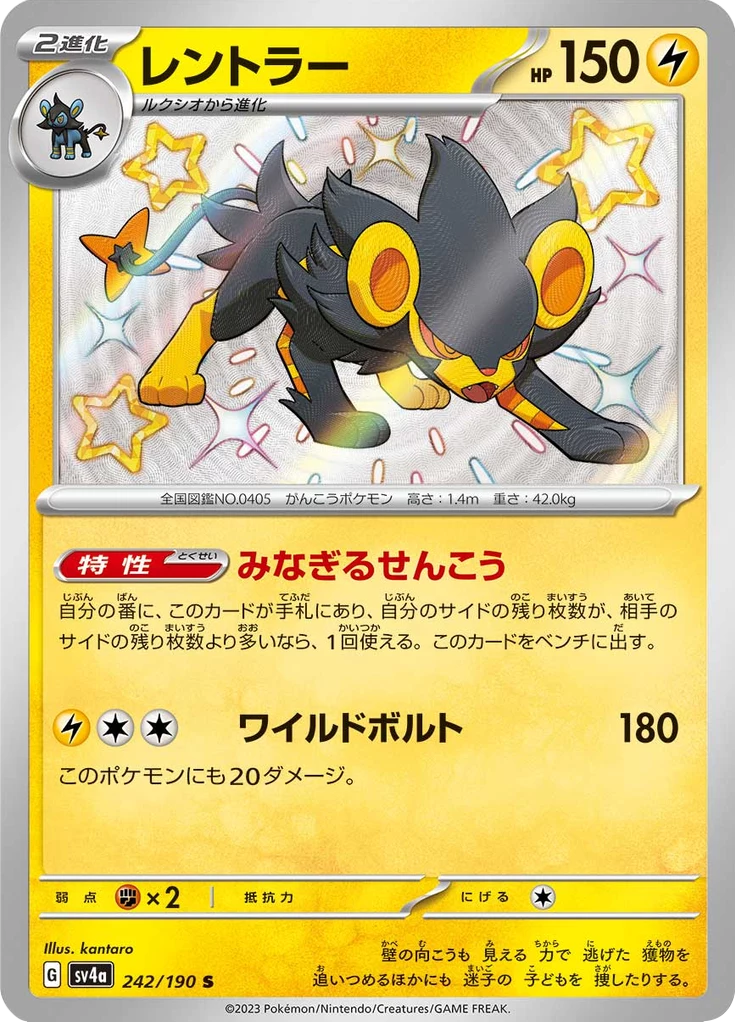
Luxray (Shiny) SV4a #242/190 Shiny Rare Shiny Treasure ex 2023
Luxray ex SV6 #41/101 Double Rare Transformation Mask 2024
Luxray ex (SR) SV6 #118 Secret Rare Transformation Mask 2024
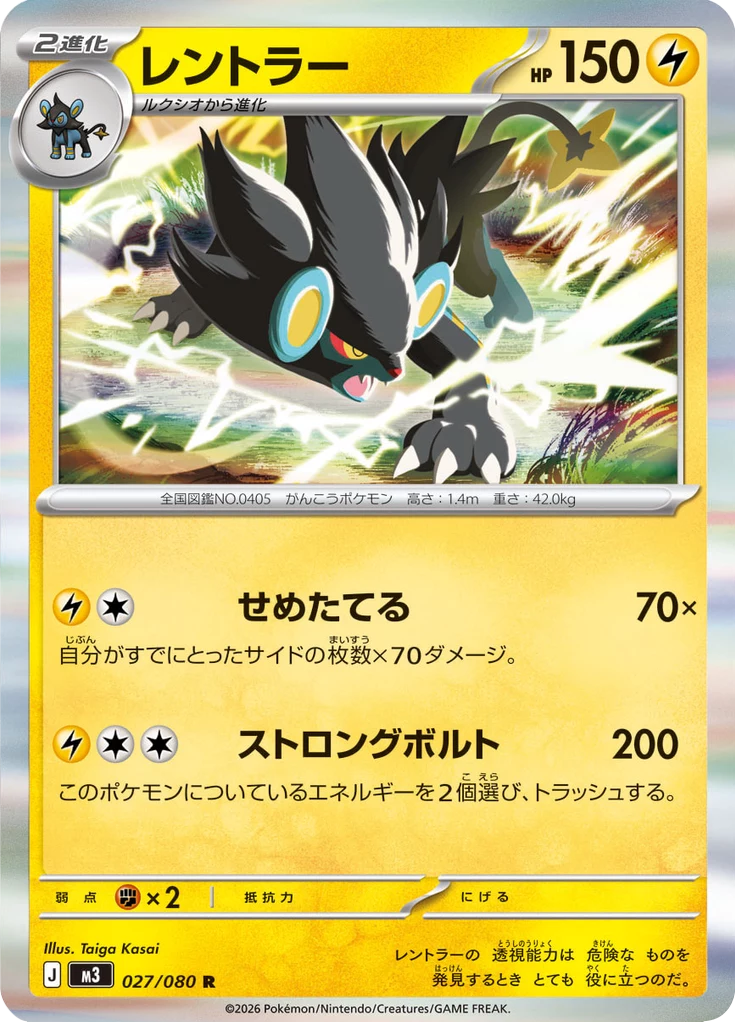
Luxray M3 #27 Rare Munikis Zero 2026

Two patterns run through the list. First, among the Secret Rare-tier prints above, the S10D #70 Secret Rare is a Special Art version with its own illustrator (MUGENUP), while the SV4a Shiny Rare print is a shiny recolor of the standard illustration. Second, the gap between prints has closed: Luxray went from one print roughly every three years in the 2010s to a new one almost every year once the Scarlet & Violet era started. The sections below cover each print in order.

The Early Prints: Wild Blaze and Ultra Moon

Luxray U, XY2 029, Wild Blaze

Luxray, XY2 #29, Uncommon (Wild Blaze)

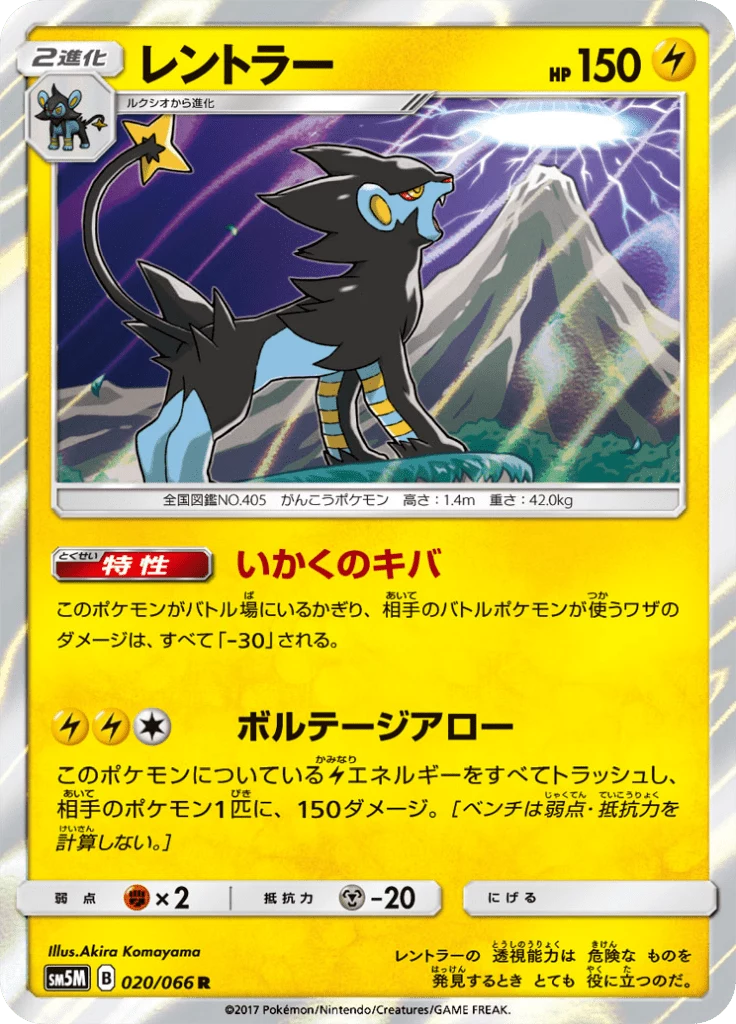
Luxray R, SM5M 020, Ultra Moon

Luxray, SM5M #20, Rare (Ultra Moon)

Luxray’s earliest print verified in this guide is Wild Blaze (XY2 #29), released March 15, 2014 and illustrated by Hitoshi Ariga. It’s a two-stage, Lightning-type card at 140 HP, and its English equivalent is Flashfire #34. Three and a half years later, Ultra Moon (SM5M #20) reprinted Luxray at Rare, illustrated by Akira Komayama, bumping HP to 150. Its English equivalent is Ultra Prism #48.

Neither of these two early prints is currently matched to a booster box in our catalog, so if you’re specifically after the Wild Blaze or Ultra Moon copy, that’s a sourcing request through Quick Order rather than a sealed-box route.

Luxray V and the Secret Rare from Time Gazer

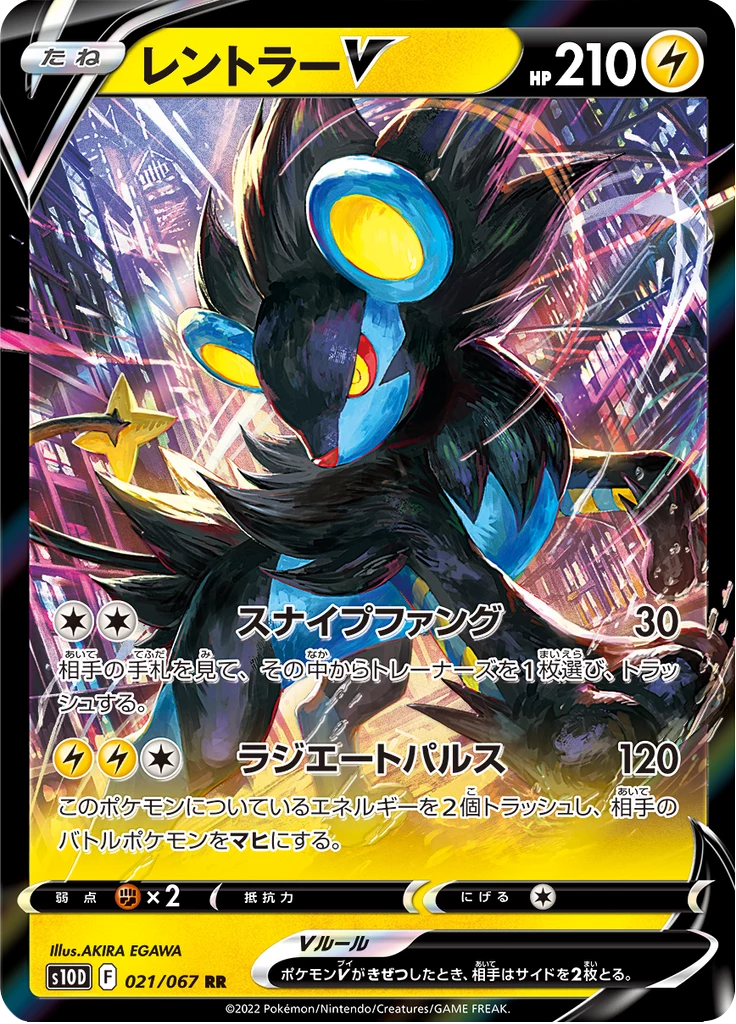
Luxray V RR, S10D 021, Time Gazer
Luxray V, S10D #21/067, Double Rare — Time Gazer

Time Gazer (S10D), released April 8, 2022, gave Luxray its first V treatment: a Lightning-type, 210 HP card carrying the attack Fang Snipe — look at the opponent’s hand and discard one Trainer card from it. The standard Double Rare print is #21/067, illustrated by AKIRA EGAWA; a Secret Rare version, #70, is illustrated by MUGENUP. English equivalents across the pair: Astral Radiance #50 and #168.

Time Gazer is also the set that carries Regigigas’s “Ancient Wisdom” trio card, so it’s a mixed-interest box for Sinnoh-era collectors — not every pull is a Luxray, but the set overlaps with more than one long-running line.

Clay Burst and the Shiny Treasure ex Reprint

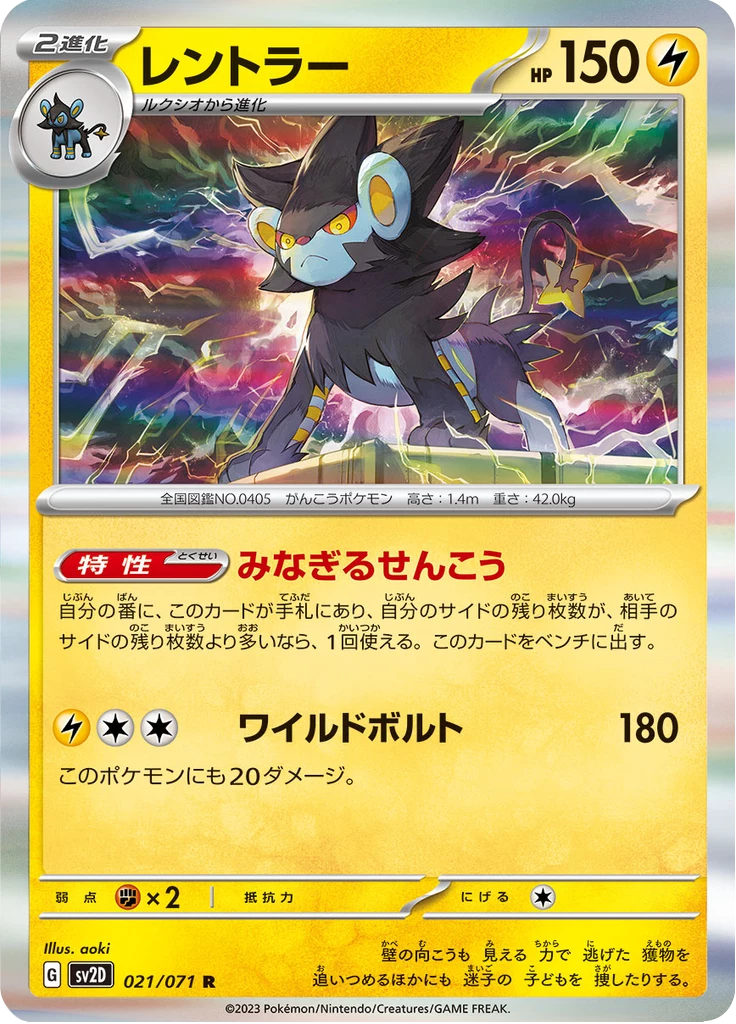
Luxray R, SV2D 021, Clay Burst

Luxray, SV2D #21, Rare (Clay Burst)

Luxray Shiny Rare, SV4a 242/190, Shiny Treasure ex

Luxray (Shiny), SV4a #242/190, Shiny Rare (Shiny Treasure ex)

Clay Burst (SV2D), released April 14, 2023, carries the standard-format Luxray at #21, Lightning-type, 150 HP, illustrated by aoki. Its ability, Overflowing Fighting Spirit, lets you put this card from your hand straight onto your Bench — without evolving through Shinx or Luxio first — whenever you have more Prize cards remaining than your opponent. English equivalent: Paldea Evolved #71.

Eight months later, Shiny Treasure ex (SV4a), released December 1, 2023, reprinted the same card at Shiny Rare under card number 242/190, illustrated by kantaro. The set also carries a non-shiny reprint at #61, illustrated by aoki. Both are the same attack and ability as the Clay Burst original — the difference is entirely in the shiny coloring and rarity tier. English equivalent: Paldean Fates #137.

Luxray ex: Double Rare and Secret Rare from Transformation Mask

Luxray ex RR, SV6 041, Transformation Mask

Luxray ex, SV6 #41/101, Double Rare (Transformation Mask)

Luxray ex SR, SV6 118, Transformation Mask

Luxray ex (SR), SV6 #118, Secret Rare (Transformation Mask)

Luxray’s only ex print so far comes from Mask of Change, the set we carry as Transformation Mask (SV6), released April 26, 2024. It’s a two-stage, Lightning-type card at 310 HP, illustrated by PLANETA Yamashita for both the Double Rare (#41/101) and Secret Rare (#118) versions. Its attack, Piercing Eyes, deals 120 damage and lets you choose and discard one card from the opponent’s hand. English equivalents: Twilight Masquerade #68 and #195.

This is also the set where Dreepy and Dragapult ex first appeared — if you’re chasing Dragapult from the same era, our Dragapult cards guide covers that side of the box.

On Rarity Tiers

Double Rare, Secret Rare, and Shiny Rare aren’t interchangeable labels — they mark distinct rarity tiers within the modern Japanese set structure. If the terminology across this guide is unfamiliar, our Japanese Pokemon card rarities explained guide breaks down how each tier fits into a set’s print run.

The Newest Print: Luxray in Munikis Zero

Luxray R, M3 027, Munikis Zero
Luxray, M3 #27, Rare — Munikis Zero (Nihil Zero)

Luxray’s most recent print is Nihil Zero, the set we carry as Munikis Zero (M3), released January 23, 2026. It’s a two-stage, Lightning-type card at 150 HP, illustrated by Taiga Kasai. Its attack, Assault, deals 70 damage multiplied by the number of Prize cards you’ve already taken — a scaling attack that gets stronger as a game goes on. English equivalent: Perfect Order #28.

As the newest release covered in this guide, Munikis Zero is also the set with the least secondary trading history so far. If you’re building toward the current Standard format rather than chasing the older Transformation Mask ex, this is the print to look for.

Sourcing Shinx and Luxio Alongside Luxray

Shinx, Luxio, and Luxray are a standard three-stage evolution line. We’ve confirmed Shinx in four of the six boxes matched below: Clay Burst (SV2D #19), Shiny Treasure ex (SV4a #59/#240), Transformation Mask (SV6 #39), and Munikis Zero (M3 #25). We haven’t been able to confirm a Shinx print in Time Gazer (S10D), so we’re not listing one there.

We don’t have individual card facts on file for Luxio specifically — unlike Shinx and Luxray, no Luxio print turned up in our set-by-set verification for this guide, so we’re not going to guess at a card number or illustrator. If you’re chasing the full three-stage line as singles, Quick Order is the right channel to ask what’s currently sourceable.

Like Garchomp — another Sinnoh-region Pokemon we’ve covered in a separate guide — Luxray was introduced in Diamond & Pearl and has been reprinted steadily ever since. If you’re comparing the two lines, see our Garchomp cards guide for the parallel Sinnoh-starter-adjacent lineup. Luxray also hasn’t received a Japanese LV.X or Prime treatment in any set we’ve verified — for how that older mechanic worked on the cards that do carry it, our Pokemon LV.X cards guide covers the format in full.

Sourcing Every Print Through Sealed Boxes

Six of the ten confirmed Luxray prints match to a booster box in our current catalog. Wild Blaze and Ultra Moon aren’t currently matched to a sealed box in our lineup, so those two prints run through Quick Order as sourcing requests rather than a box link.

Set Box Luxray Print(s) Inside Shinx Confirmed
Star Birth (S9) Booster Box Luxray #39 —
Time Gazer (S10D) Booster Box Luxray V #21/067, #70 —
Clay Burst (SV2D) Booster Box Luxray #21 Yes (#19)
Shiny Treasure ex (SV4a) Booster Box Luxray #61/#242 Yes (#59/#240)
Transformation Mask (SV6) Booster Box Luxray ex #41/101, #118 Yes (#39)
Munikis Zero (M3) Booster Box Luxray #27 Yes (#25)
Shop This Set
SV6 Transformation Mask Booster Box (Japanese)
Carries Luxray ex, the Secret Rare, and Shinx
Ships from Tokyo · Tracked delivery

View Product →

If you’re specifically after the newest print, the M3 Munikis Zero Booster Box is the direct route to Luxray, Shinx, and everything else in that release.

Where to Buy Japanese Luxray Cards

We ship Japanese sealed product worldwide from Tokyo with tracked delivery. Sourcing runs through the six booster boxes matched above — including SV6 Transformation Mask for the ex line and M3 Munikis Zero for the newest print — our wider Japanese Pokemon booster box collection, or a direct sourcing request through Snel bestellen for any print, including Wild Blaze and Ultra Moon.

For graded copies of other current-era Japanese pulls under a set budget, our best PSA 10 Japanese cards under ¥10,000 guide is a useful next stop, and our Japanese Pokemon card rarities explained guide covers how Common through Secret Rare tiers work across the sets referenced here.

Veelgestelde vragen

How many Japanese Luxray Pokemon cards are there?

Ten confirmed prints across eight Japanese sets, spanning Wild Blaze (2014) through Munikis Zero (2026). That includes the early standard-format prints, the Time Gazer Luxray V and its Secret Rare, the Clay Burst / Shiny Treasure ex pair, and the Transformation Mask Luxray ex.

Does Luxray have an ex print in the Japanese TCG?

Yes — one so far. Luxray ex was printed in Transformation Mask (SV6 #41/101, Double Rare, and #118, Secret Rare), released April 26, 2024. Its attack, Piercing Eyes, deals 120 damage and discards one card from the opponent’s hand.

Is Shinx in the same booster boxes as Luxray?

In four of the six current-catalog boxes, yes: Clay Burst, Shiny Treasure ex, Transformation Mask, and Munikis Zero all carry a confirmed Shinx print alongside Luxray. The official Pokémon Card Game card search lists no Shinx (コリンク) in Time Gazer (S10D), and the Time Gazer page shows no Luxio (ルクシオ) there either; the official card database does list Shinx and Luxio cards in other Japanese sets, such as Luxio in SV6 and M3.

Where can I buy Japanese Luxray Pokemon cards?

We ship Japanese sealed product worldwide from Tokyo. Sourcing runs through the six booster boxes matched in this guide — including SV6 Transformation Mask for the ex line and M3 Munikis Zero for the newest print — or through a direct request via our Quick Order page.

Minccino & Cinccino Pokemon-kaartengids (alle 7 versies)

Minccino’s whole personality is tidying up. Cinccino’s newest card turns that into a 240 HP attacker that hits harder the longer a game runs — and it’s one of the chase pulls of a brand-new Japanese set.

This guide covers seven Japanese Minccino and Cinccino prints, from the current Ninja Spinner set back to its 2019 Sword-era print. It walks through what each card actually does, how the special art rare differs from its regular counterpart in the same set, and where the pre-evolution Minccino fits into the picture. We ship Japanese sealed product and graded singles out of Tokyo every week, and the pricing referenced here reflects our own current catalog.

Minccino evolves into Cinccino, and every card on this list is either the tidy little Chinchilla Pokemon in its base form or the fully evolved version with the double tail. Most of the printings below are Cinccino, simply because the evolved form has appeared in more Japanese sets over the years — but Minccino gets its own dedicated Art Rare in the 2024 Wild Force set, covered further down alongside its Cinccino counterpart from the same release.

Key Takeaway

Cinccino ex has two prints in the current Ninja Spinner (M4) set — a special art rare and a regular double-rare version of the same card. Our graded copy, PSA 10 Cinccino ex SAR [M4 117/083] is currently listed at ¥18,540 (~$114), and the Ninja Spinner Booster Box is currently listed at ¥11,172 (~$69) if you’d rather chase a copy yourself.

7
Prints Covered

¥18,540
PSA 10 Cinccino ex SAR

2019–2026
Years Covered

M4
Latest Set (Ninja Spinner)

Prices reflect our own catalog as of August 2026, converted at ¥163/USD.

Every Minccino and Cinccino Print at a Glance

Seven prints across five Japanese sets, from the 2019 Sword-era debut to the current Ninja Spinner set:

Kaart Number Rarity Set Year
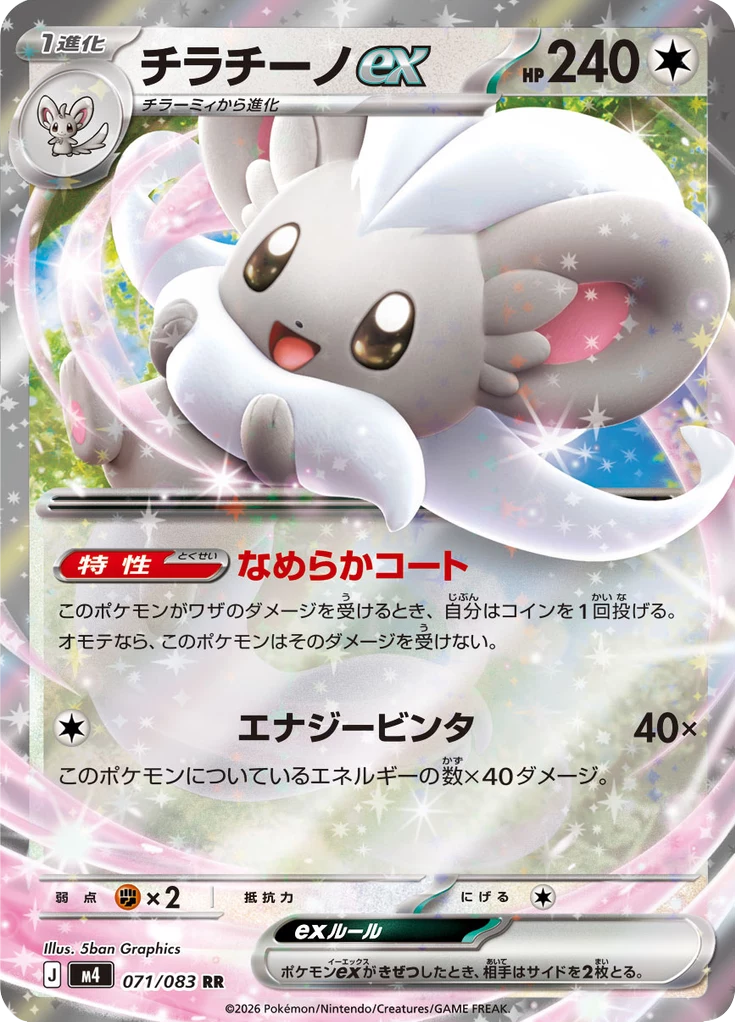
Cinccino ex M4 117/083 SAR Ninja Spinner 2026
Cinccino ex M4 071/083 RR Ninja Spinner 2026
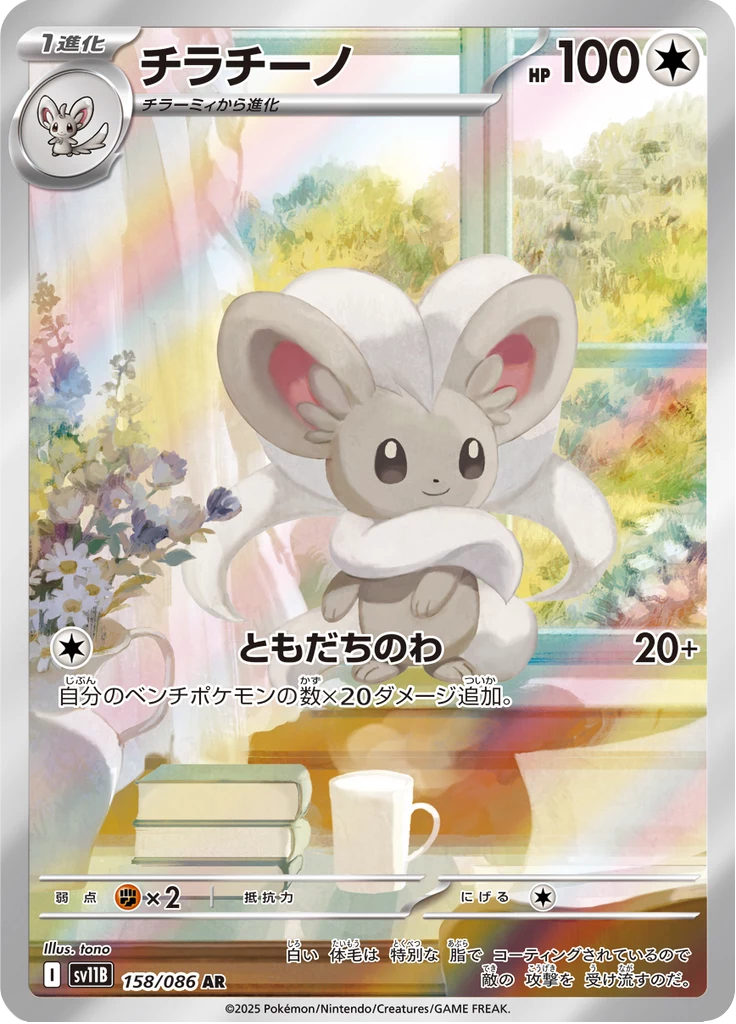
Cinccino AR SV11B 158/086 AR Black Bolt 2025
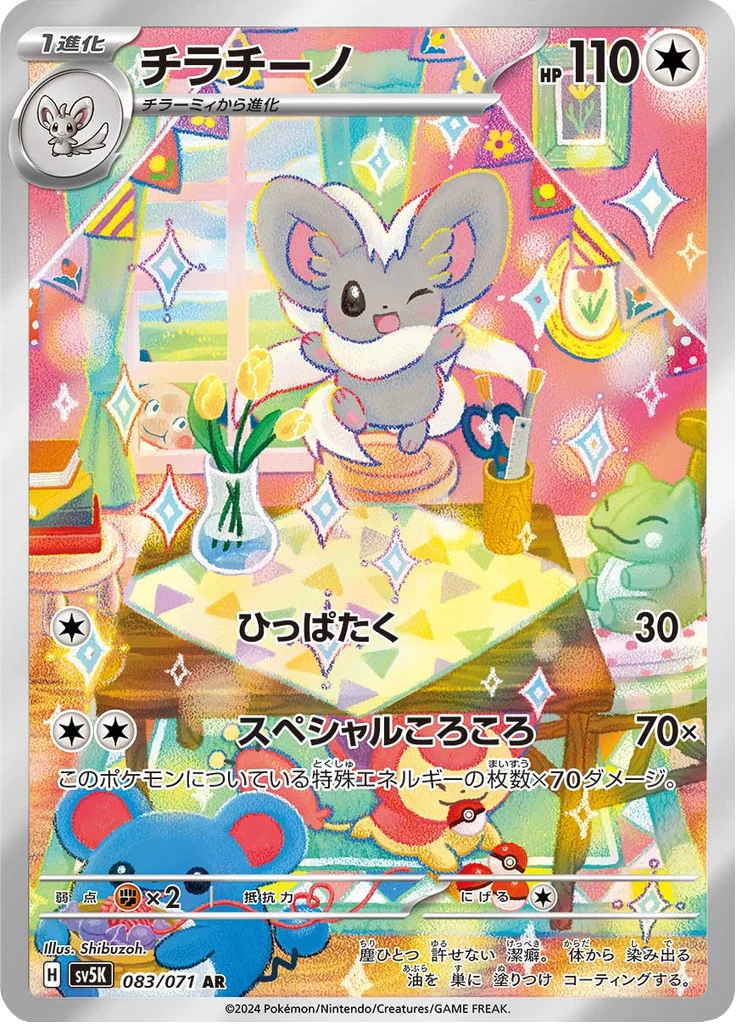
Cinccino AR SV5K 083/071 AR Wild Force 2024
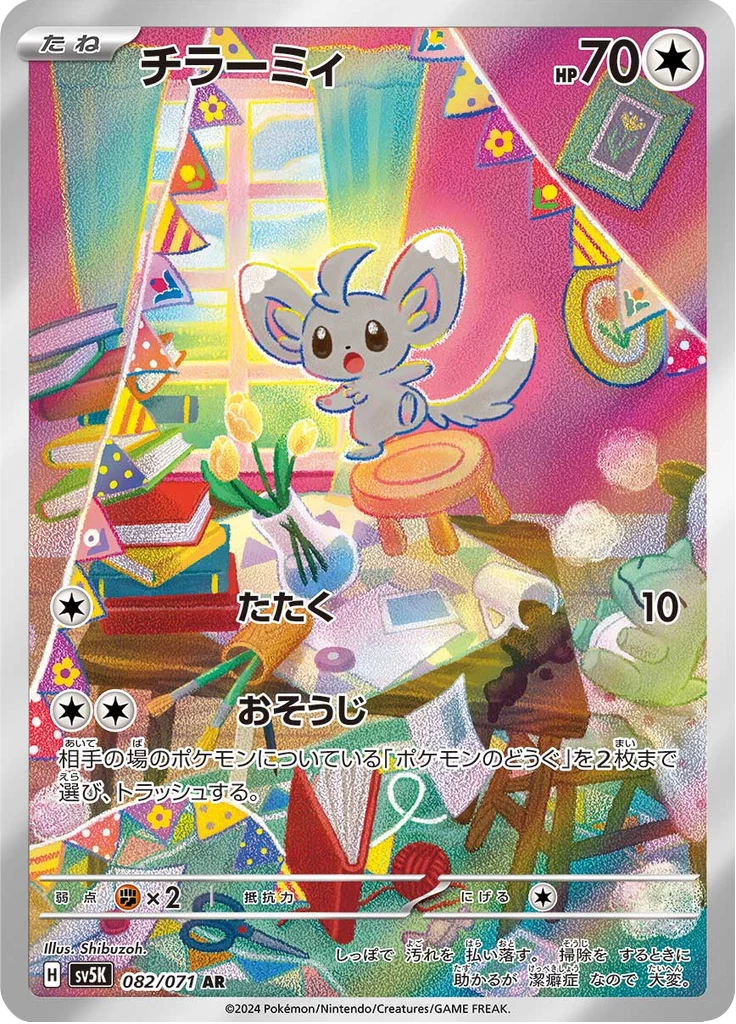
Minccino AR SV5K 082/071 AR Wild Force 2024
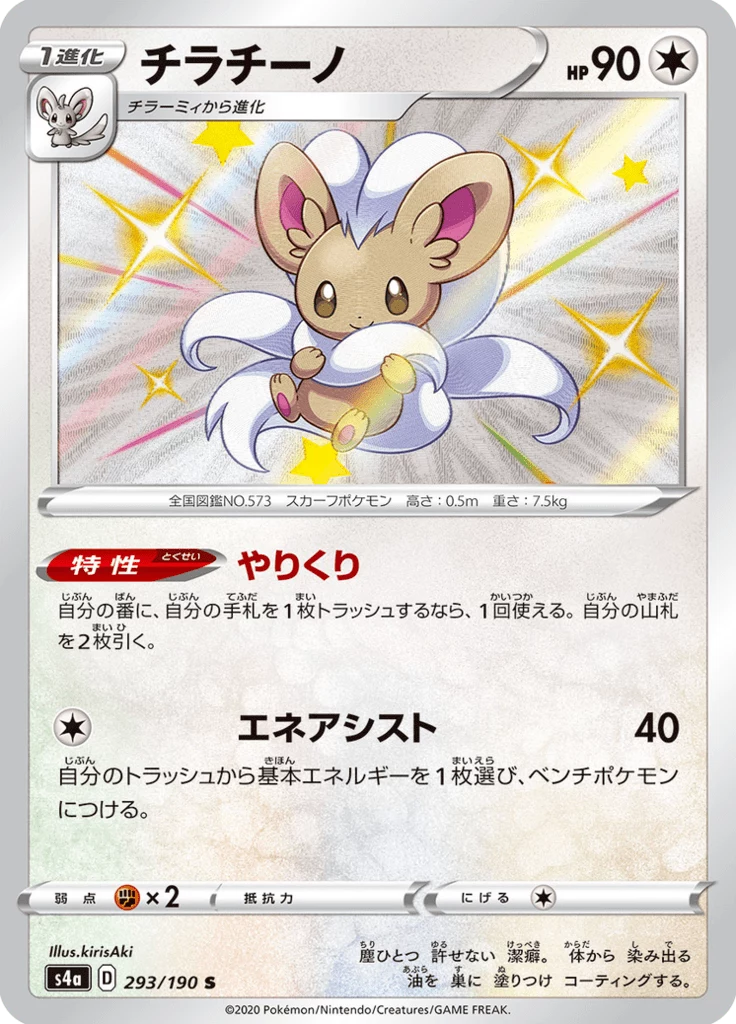
Cinccino (Shiny) S4a 293/190 S Shiny Star V 2020
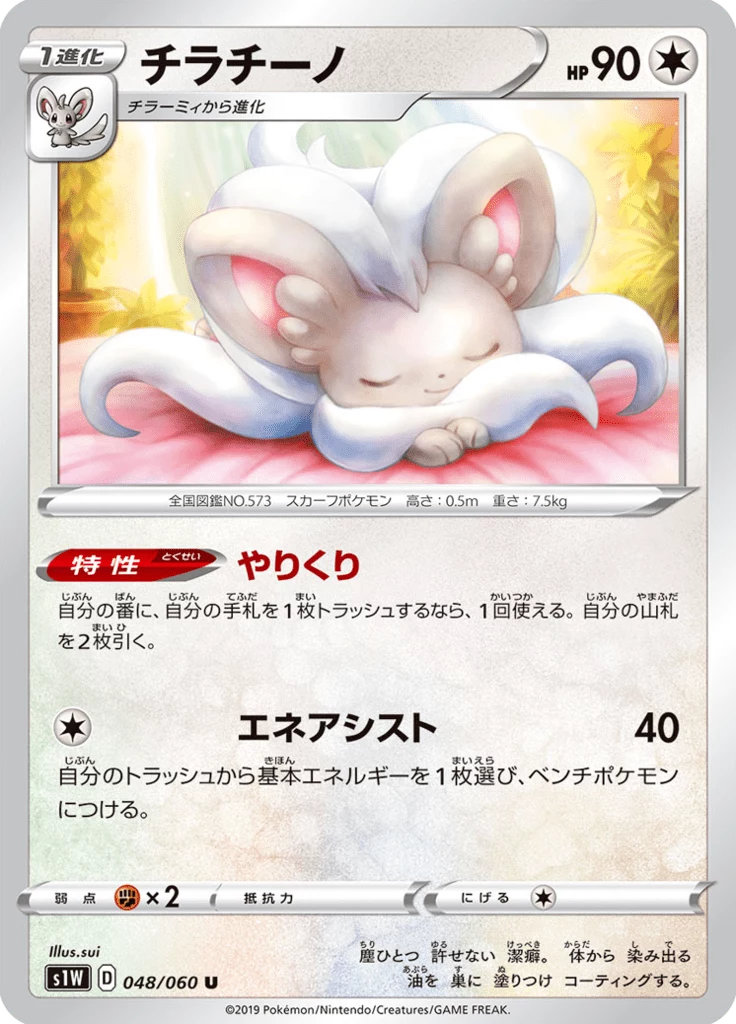
Cinccino S1W 048/060 U Sword 2019

The 2026 Ninja Spinner set carries the most weight here — it’s where Cinccino ex debuted at both special art rare and regular double-rare, and it’s the set our own PSA 10 stock comes out of. The line also shows up as a plain Minccino/Cinccino pairing in Starter Deck 100 (MC 603/604), as a normal-rarity Cinccino in Shiny Star V (S4a 142/143) alongside the shiny print above, and as the base-set Minccino in Ninja Spinner itself (M4/070) — three additional appearances that round out the line without changing the seven prints detailed below.

The rarity codes in that table follow the Japanese TCG’s standard tiers: U (uncommon) and R-family codes like RR (double rare) sit in a set’s normal pull structure, while AR (Art Rare) and SAR (Special Art Rare) are higher-rarity alternate-illustration slots, with SAR generally the rarer of the two within a given set. The S code marks a set’s dedicated shiny-colored parallel, which is a separate rarity track from AR and SAR rather than a step above or below them.

The Ninja Spinner Chase Card: Cinccino ex SAR

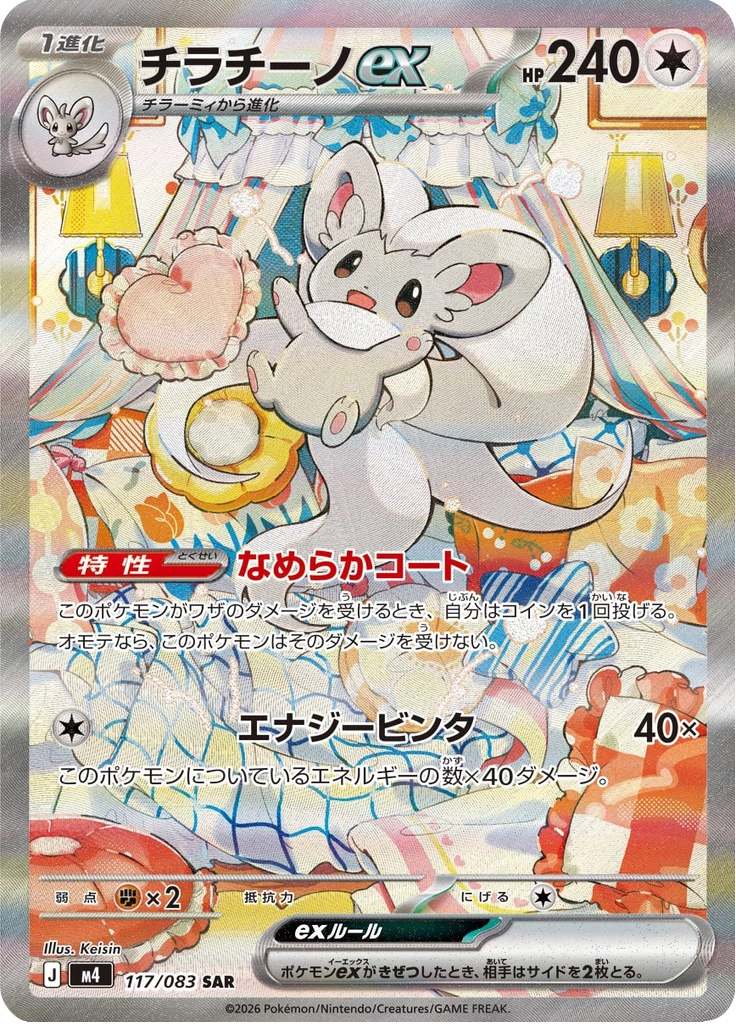
Cinccino ex SAR, M4 117/083, Ninja Spinner
Cinccino ex, SAR, M4 117/083, Ninja Spinner

Cinccino ex’s special art rare print, illustrated by Keisin, is one of the SAR chase cards collectors look for in Ninja Spinner — a Colorless-type, 240 HP evolution card that lists Minccino as its pre-evolution. Its Ability works like a coin-flip damage shield: whenever this Cinccino ex would take damage from an attack, flip a coin, and heads prevents that damage entirely. Its attack scales with setup — 40 damage for every Energy card attached to it.

The artwork itself is what pushes this print into SAR territory: rather than a standard character-and-background layout, Keisin’s full-bleed illustration puts Cinccino curled into a pile of cushions in a bedroom setting, a departure from the battle-ready poses more common on regular-rarity cards in the set. That kind of alternate-art treatment is exactly what collectors are paying the SAR premium for, on top of the card’s playable Ability and attack.

Our own graded copy is PSA 10 Cinccino ex SAR [M4 117/083], currently listed at ¥18,540 (~$114). A PSA 10 grade on a full-bleed print like this one confirms the card cleared the grading company’s centering, surface, corner, and edge review at the top score. If you’re comparing it against other graded Japanese cards in a similar range, it also shows up on our PSA 10 Japanese cards under ¥30,000 guide.

Check This First

Ninja Spinner prints Cinccino ex twice on two different card numbers — 117/083 (SAR) and 071/083 (RR). The rarity marker and the number in the corner are what separate the two, not the artwork alone.

For the rest of what Ninja Spinner packs, our M4 Ninja Spinner complete set guide and our Ninja Spinner best cards guide cover the full chase-card lineup Cinccino ex shares the set with.

The Regular Version: Cinccino ex RR

Cinccino ex RR, M4 071/083, Ninja Spinner
Cinccino ex, RR, M4 071/083, Ninja Spinner, illustrated by 5ban Graphics

Card number 071/083 carries the exact same Ability and attack as the SAR above — the coin-flip damage shield and the Energy-scaling attack are identical — but in a standard double-rare frame illustrated by 5ban Graphics rather than the SAR’s full-art treatment by Keisin. If you’re building with the card rather than collecting the art, this is functionally the same Pokemon at a lower rarity tier. Ninja Spinner also lists a third Cinccino ex slot at M4/103 in Limitless’s set index, though its rarity hasn’t been independently confirmed here.

Earlier Prints: Sword and Shiny Star V

Before Ninja Spinner, two of Cinccino’s most notable Japanese prints came from the Sword & Shield era.

Cinccino U, S1W 048/060, Sword

Cinccino, U, S1W 048/060, Sword (2019)

Cinccino S, S4a 293/190, Shiny Star V

Cinccino, S (Shiny), S4a 293/190, Shiny Star V (2020)

The Sword (S1W 048/060) print, illustrated by sui, is Cinccino’s debut in the Sword & Shield era and the card’s most functional printing — its Ability lets you discard a card from your hand once per turn to draw two, and its attack deals 40 damage while attaching a basic Energy from the discard pile to a Benched Pokemon. That draw-and-attach combination gave it real competitive use as a Sword & Shield-era support attacker rather than a purely collector-facing card.

The Shiny Star V (S4a 293/190) print, illustrated by kirisAki, carries the identical Ability and attack in a shiny-colored parallel — the same card, recolored for the set’s dedicated shiny-Pokemon rarity slot rather than a functional redesign. A shiny-colored Cinccino sitting alongside the set’s larger shiny Pokemon roster is part of what keeps this particular print in circulation years after release.

The Wild Force Art Rares arrived four years after Shiny Star V, with Black Bolt following the next year, before Ninja Spinner made the line a headline card.

The Modern Art Rares: Wild Force and Black Bolt

Cinccino’s two most recent prints before Ninja Spinner both use the Art Rare treatment, and one of them comes paired with a matching Minccino from the same set.

Cinccino AR, SV5K 083/071, Wild Force

Cinccino, AR, SV5K 083/071, Wild Force (2024)

Minccino AR, SV5K 082/071, Wild Force

Minccino, AR, SV5K 082/071, Wild Force (2024)

Cinccino AR, SV11B 158/086, Black Bolt

Cinccino, AR, SV11B 158/086, Black Bolt (2025)

Wild Force (SV5K) gave both stages of the line an Art Rare in the same set, illustrated by Shibuzoh. for both. Cinccino AR (083/071) carries two attacks — a 30-damage move and a second that deals 70 damage for each Special Energy attached. Minccino AR (082/071), its pre-evolution partner, has a 10-damage attack and a second move that discards up to two Pokemon Tool cards attached to the opponent’s Pokemon. The English-language version of the Minccino print has recorded competitive play in Lugia-based decks, according to Limitless’s deck database.

Black Bolt (SV11B 158/086), illustrated by tono, is the newest Art Rare before Ninja Spinner. Its attack deals 20 damage plus 20 more for each Benched Pokemon it has — a straightforward scaling move that rewards a full bench rather than heavy Energy investment, in contrast to the Energy-count scaling on the Ninja Spinner ex print above.

Taken together, the three Art Rares span two different scaling philosophies within a single year of releases: Wild Force’s pair rewards Special Energy density and item disruption, while Black Bolt’s print rewards board presence instead. None of the three carry the ex or GX suffix that Cinccino ex uses in Ninja Spinner, which is part of why the current set’s HP and damage numbers run noticeably higher than these three Art Rares.

Where to Buy Minccino and Cinccino Cards from Japan

We ship Japanese sealed product and graded singles worldwide from Tokyo with tracked delivery. For the current Ninja Spinner prints specifically, sealed booster boxes are the direct route to both the SAR and RR versions of Cinccino ex.

Shop This Set
M4 Ninja Spinner Booster Box (Japanese)
Currently listed at ¥11,172 (~$69)
Ships from Tokyo · Tracked delivery

View Product →

If you’d rather buy the graded chase card directly, our PSA 10 Cinccino ex SAR [M4 117/083] is currently listed at ¥18,540. For the older Sword and Shiny Star V prints, or to build a mixed order across sets, our Quick Order page is the fastest way to check current availability. For the broader Ninja Spinner context, see our Mega era sets in order guide.

Every order ships from Tokyo with tracked FedEx shipping, whether you’re picking up a single graded card or a full booster box. Since Ninja Spinner is a current-generation Japanese release, sealed boxes remain the only route to opening a fresh copy of either Cinccino ex print yourself — the SAR and RR are both possible pulls from the same box, alongside the rest of the set’s chase cards.

Veelgestelde vragen

What is the rarest Minccino or Cinccino Pokemon card?

Among the seven prints covered here, Cinccino ex SAR (M4 117/083) from the current Ninja Spinner set is the highest-rarity Cinccino print, and it’s the one our graded PSA 10 stock comes from. Its regular double-rare counterpart, M4 071/083, shares the same card effect at a lower rarity tier.

What does Cinccino ex do in the Ninja Spinner set?

Cinccino ex is a Colorless-type, 240 HP evolution Pokemon. Its Ability flips a coin whenever it would take attack damage — heads prevents that damage — and its attack deals 40 damage for every Energy card attached to it.

Is there a non-SAR version of Cinccino ex?

Yes. M4 071/083 is a regular double-rare (RR) print of the same Cinccino ex, with an identical Ability and attack to the SAR version at M4 117/083. Only the rarity tier and artist differ.

Does Minccino have its own card, or only Cinccino?

Minccino has its own prints, including a 2024 Art Rare from the Wild Force set (SV5K 082/071) that pairs with the Cinccino AR from the same set, as well as a base-rarity Minccino in the current Ninja Spinner set.

Where can I buy Japanese Minccino and Cinccino cards?

We ship Japanese sealed product and graded singles worldwide from Tokyo. The Ninja Spinner Booster Box is currently listed at ¥11,172 and carries a chance at both Cinccino ex prints; the graded PSA 10 Cinccino ex SAR is available directly, and older prints can be sourced through our Quick Order page.

Steelix Pokemon-kaartengids: alle Japanse uitgaven

Onix’s evolution has picked up two very different treatments in the Japanese Pokemon TCG. One pairs Steelix with a Trainer figure in a Character Rare slot. The other reworks it as a Mega Evolution secret rare from the XY era, priced well above the first. Both are real cards you can buy right now, not concepts.

This guide walks through the Steelix printings worth knowing if you’re buying Japanese cards: the Character Rare from Dream League, the Mega Steelix EX secret rare from Fever-Burst Fighter, the original 1999 Neo Genesis printing, and two current-generation prints from Pokémon GO and Mega Brave. We ship Japanese sealed product and singles out of Tokyo every week, and the pricing below reflects our own catalog.

Steelix has stayed on the Steel-type roster since the original Gold & Silver generation, and it evolves from Onix across every printing covered here — the Stage 1 slot is consistent even as the artwork, rarity tier, and card mechanics shift from set to set. That evolution line is part of why collectors track Steelix specifically rather than treating it as one entry in a longer list of Steel-type Pokemon: the same base creature keeps returning in Character Rare, Mega Evolution, and Art Rare form as the TCG’s rarity system has changed shape over 25 years.

Key Takeaway

Two Steelix cards are currently listed in our catalog: the Character Rare PSA10 Steelix CHR from Dream League, currently listed at ¥8,549 (~$52), and the PSA10 M Steelix EX SR, 1st Edition, from Fever-Burst Fighter, currently listed at ¥61,800 (~$379) — more than seven times the CHR’s price. Both are PSA10-graded singles — availability is as shown on the product page.

5
Printings Covered

¥61,800
Highest Listed (M Steelix EX SR)

¥8,549
Lowest Listed (Steelix CHR)

1999–2025
Years Covered

Prices are our own PSA10-graded stock as listed in August 2026, converted at ¥163/USD for reference. Where we don’t hold stock of a printing, no price is given.

Steelix Printings Worth Knowing

Five Steelix prints across five different eras of the Japanese TCG, from its 1999 debut to the current Mega era:

Kaart Number Rarity Set Year
Steelix SM11b 060/049 CHR Dream League 2019
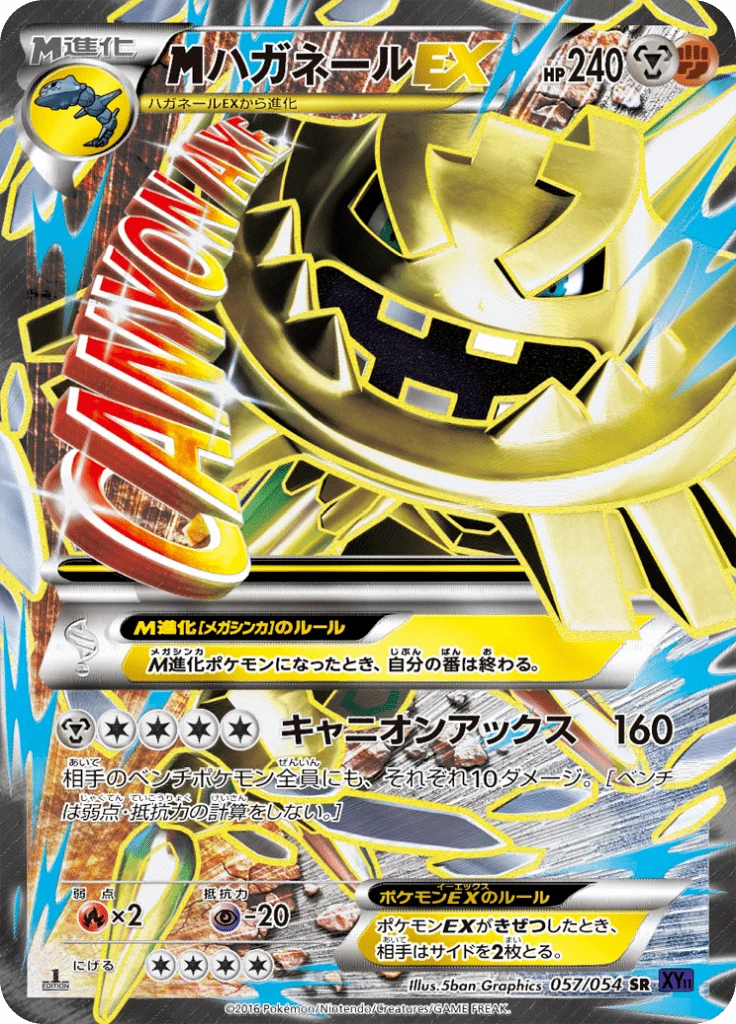
M Steelix EX XY11b 057/054 SR Fever-Burst Fighter 2016
Steelix Neo Genesis #15 (EN) Holo Rare Gold & Silver debut (JP) / Neo Genesis (EN) 1999
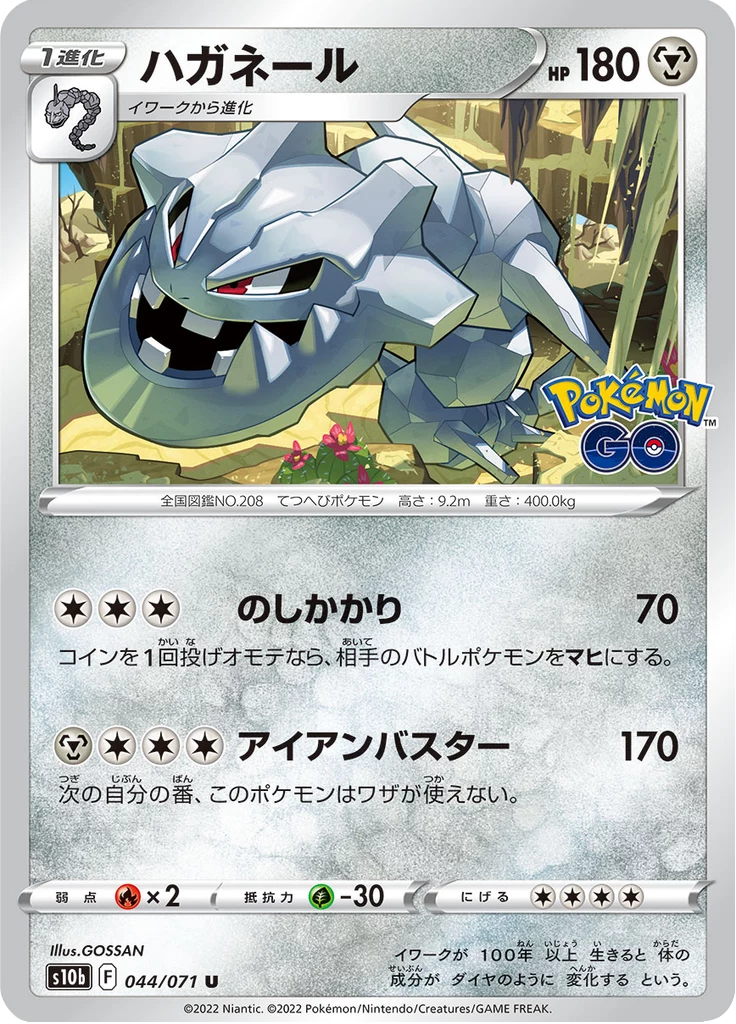
Steelix S10b 044/071 U Pokémon GO 2022
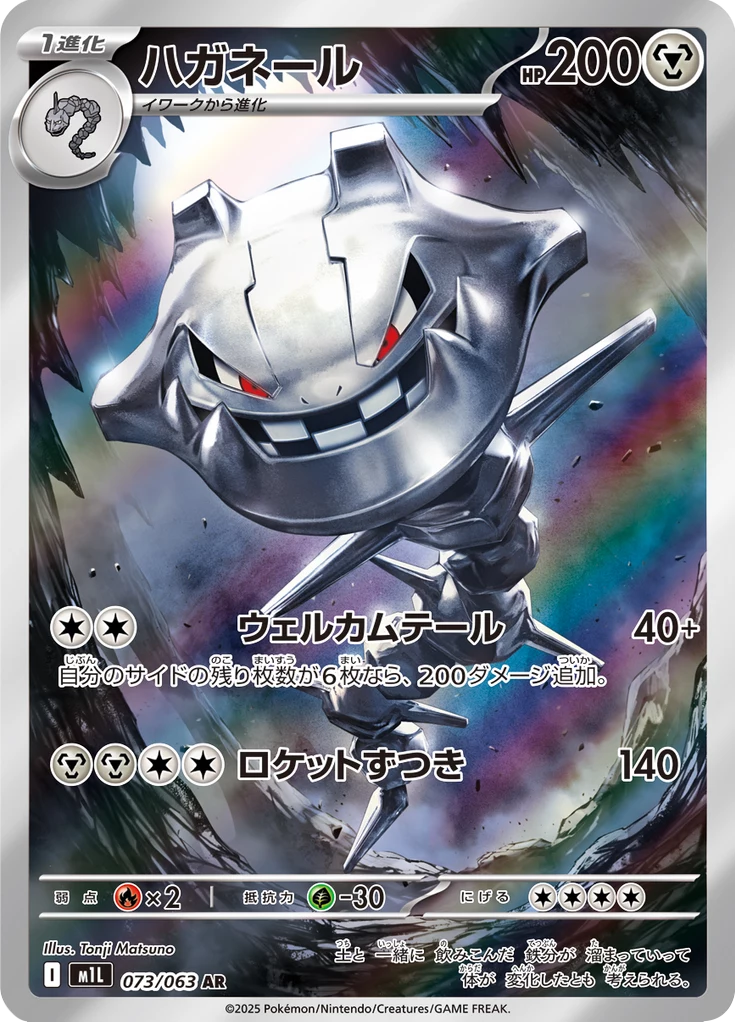
Steelix M1L 073/063 AR Mega Brave 2025

The two prints we hold PSA10 stock of — the Dream League CHR and the Fever-Burst Fighter Mega Steelix EX SR — are covered first. The remaining three fill in the wider print history: where Steelix’s TCG career started, and where it stands in two of its most recent sets.

This isn’t a full census of every Steelix card ever printed in Japan — the line has additional appearances in sets we haven’t detailed here, since our research focus for this guide is the two printings we currently carry in graded form plus the reference points that explain how Steelix’s rarity tier has evolved over time. If you’re after a specific Steelix printing not covered below, our Quick Order page is the fastest way to ask.

The Character Rare: Steelix CHR (Dream League)

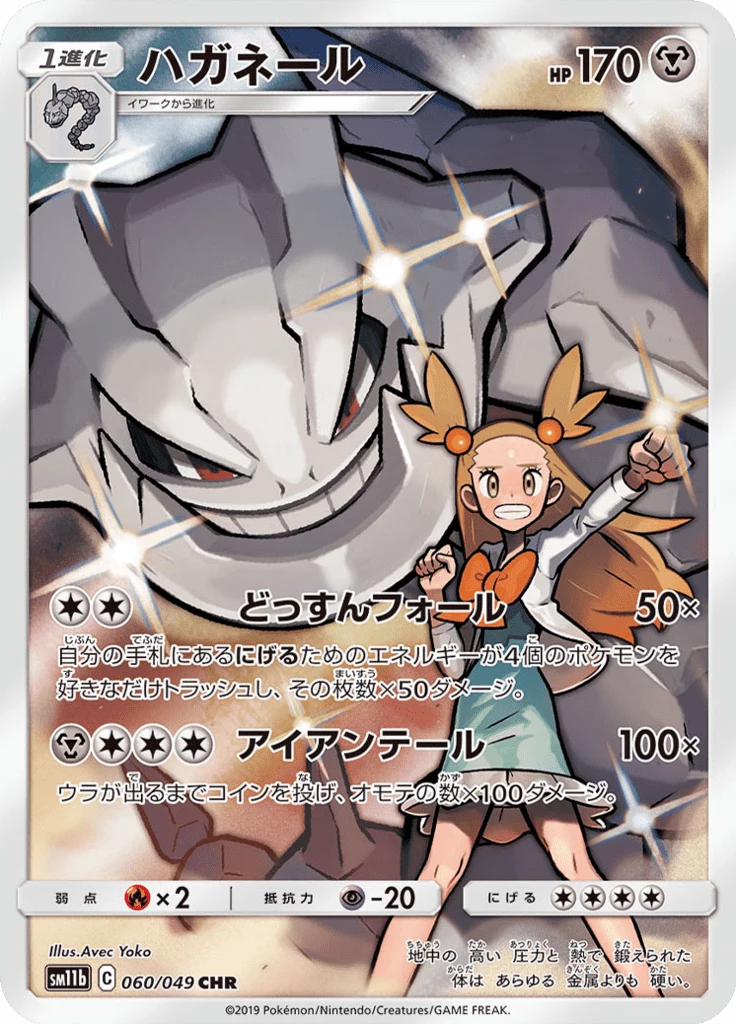
Steelix CHR, SM11b 060/049, Dream League

Steelix’s entry in Dream League (SM11b, released August 2, 2019) is a Steel-type, 170 HP Stage 1 that evolves from Onix, illustrated by Avec Yoko. The card is a Character Rare (CHR) — a rarity tier that pairs a Pokemon with an accompanying Trainer figure in the artwork, and this one shows Steelix alongside a Trainer character in the frame.

Its first attack, for two Colorless Energy, lets you discard any number of Pokémon with a Retreat Cost of 4 from your hand, dealing 50 damage for each one discarded. Its second attack, for one Metal Energy and three Colorless, flips coins until you get tails and deals 100 damage for every heads flipped along the way.

Card number 060 of a 049-card set total is a signal worth knowing on its own: numbers that run past the set’s printed total are how Japanese sets flag their secret-rare-range cards, and CHR slots sit inside that range alongside the set’s SR and other chase-level pulls. That’s part of why Dream League’s Character Rares carry more collector attention than their HP and attack text alone would suggest.

This copy is currently listed at ¥8,549 (~$52) in PSA10 grade. For the rest of the Dream League chase cards this Steelix shares a set with, see our Dream League best cards guide, and for more on how the CHR rarity tier works across sets, see our Character Rare (CHR) cards guide.

Mega Evolution: M Steelix EX SR (Fever-Burst Fighter)

M Steelix EX SR, XY11b 057/054, Fever-Burst Fighter

Fever-Burst Fighter (XY11b, 2016) is where Steelix got its Mega Evolution treatment: a Steel-type, 240 HP card that evolves from Steelix-EX via Mega Evolution, illustrated by 5ban Graphics. Its single attack, for one Metal Energy and four Colorless, deals a flat 160 damage.

Mega Evolution cards from the XY era work as a mid-game upgrade rather than a card you play from the start: you first put a matching EX Pokemon into play, then evolve it into its M-EX form once it’s already on the board, trading a turn for a jump in HP and attack output. That’s the mechanical reason M Steelix EX runs 240 HP against the base Steelix-EX’s lower total, and it’s a pattern used across Mega Evolution EX cards printed in the XY era, not something unique to this card.

Check This First

Our product title lists this card as “XY11-2” — that’s our own shorthand for the set most card databases label XY11b. Fever-Burst Fighter was released as a split set (XY11a / XY11b), and this Mega Steelix EX carries card number 057 of 054 total at Secret Rare (SR). Its English-set counterpart is Steam Siege.

Our copy carries a 1st Edition mark, a stamp used on XY-era Japanese prints. It’s PSA10-graded and currently listed at ¥61,800 (~$379).

Shop This Card
PSA10 M Steelix EX SR, 1st Edition (XY11b 057/054)
Currently listed at ¥61,800 (~$379)
Ships from Tokyo · Tracked delivery

View Product →

For the wider Fever-Burst Fighter lineup this Mega Steelix comes from, see our XY11 best cards guide. And for more on how Mega Evolution EX cards fit into the broader XY-era EX lineup, see our XY-era EX and Mega EX cards guide.

Where It Started: Neo Genesis

Steelix’s first Pokemon TCG card came in Japan’s 1999 Gold & Silver debut set. Its English-language printing is Neo Genesis, card #15, a Holo Rare illustrated by Ken Sugimori, a Steel-type, 110 HP Stage 1 with two attacks: a basic 20-damage Tackle, and a second attack dealing 30 damage that adds 20 more on a coin flip.

The exact Japanese card number for this printing hasn’t been confirmed here, so we’re not printing a specific number for it. We don’t carry this printing as JP stock, and Pokemon card images on this site are Japanese-language prints only, so there’s no card image for this entry — it’s included for print-history context ahead of the two current-generation Steelix cards below.

What stands out from this original print is how simple the attack design is: a flat 20-damage Tackle backed by a heavier attack that adds a bonus 20 damage on a coin flip. That two-attack layout is typical of the era, well before the multi-Pokemon hand discards and coin-flip damage scaling that the Dream League CHR above would carry two decades later.

Modern Steelix: Pokémon GO and Mega Brave

Two of the most recent Japanese Steelix prints come from very different sets three years apart.

Steelix U, S10b 044/071, Pokémon GO

Steelix U, S10b 044/071, Pokémon GO

Steelix AR, M1L 073/063, Mega Brave

Steelix AR, M1L 073/063, Mega Brave

The Pokémon GO set (S10b, 2022) printed Steelix at Uncommon, a Steel-type, 180 HP Stage 1 illustrated by GOSSAN. Its first attack, for three Colorless Energy, deals 70 damage with a coin-flip chance to paralyze the Defending Pokémon. Its second attack, for one Metal Energy and three Colorless, deals 170 damage but locks Steelix out of using that same attack on its next turn.

The Mega Brave set (M1L, 2025) gave Steelix an Art Rare (AR) treatment — a Steel-type, 200 HP Stage 1 illustrated by Tonji Matsuno. Its first attack, for two Colorless Energy, deals 40 damage that jumps to 240 if you still have all six of your Prize cards remaining. Its second attack, for two Metal Energy and two Colorless, deals a flat 140 damage.

Neither of these two prints is currently in our PSA10 stock, so no price is listed for them here — the pricing above applies only to the Dream League CHR and Fever-Burst Fighter Mega Steelix EX SR we carry.

Placed side by side, the five Steelix prints in this guide sketch a rough shape of how the card has been treated over time: a plain two-attack Stage 1 in 1999, a Trainer-paired Character Rare and a Mega Evolution secret rare in the mid-to-late 2010s, and two further Art Rare and Uncommon treatments in the 2020s as newer rarity tiers were introduced. None of that changes what the card does on the field — it’s still a Steel-type wall built around Onix’s evolution line — but it does explain why the same Pokemon shows up across such a wide price range depending on which print you’re holding.

Where to Buy Japanese Steelix Cards

We ship Japanese sealed product and singles worldwide from Tokyo with tracked delivery. For Steelix specifically, our two PSA10-graded singles are the direct route:

Both are single graded listings, so availability is as shown on the product page. For other current pulls and graded singles beyond Steelix, browse our PSA10 card list, or use our Quick Order page to build a mixed order of graded singles and sealed product in one checkout.

If you’re comparing Steelix against the other Character Rare and Mega Evolution cards from the same two sets, the Dream League best cards guide and XY11 best cards guide cover the rest of each set’s chase cards, and our Quick Order page is the fastest way to build a mixed order across either set alongside your Steelix pickup.

Veelgestelde vragen

What is the most expensive Steelix Pokemon card currently in stock?

Between our two listed PSA10 Steelix cards, the M Steelix EX SR, 1st Edition, from Fever-Burst Fighter (XY11b 057/054) is currently listed at ¥61,800 (~$379) — more than seven times the price of the Dream League Steelix CHR at ¥8,549 (~$52).

What is a Character Rare (CHR) Steelix card?

Character Rare (CHR) is a rarity tier that pairs a Pokemon with an accompanying Trainer figure in the artwork. Steelix’s CHR print comes from Dream League (SM11b 060/049), released August 2, 2019, illustrated by Avec Yoko.

Is the M Steelix EX SR from “XY11-2” the same card as Steam Siege’s M Steelix-EX?

Yes. “XY11-2” is our shorthand for XY11b, the Japanese half-set (our catalog renders the name as Fever-Burst Fighter; card databases translate it as Heat Burst Fighter), which was released as one half of a split set alongside XY11a. Its English-set counterpart is Steam Siege. Our PSA10 copy carries a 1st Edition mark and card number 057 of 054 at Secret Rare, so the numbers on the card itself match the listing regardless of which set name you’re used to seeing.

When did Steelix’s first Pokemon TCG card come out?

Steelix’s first Pokemon TCG card came in Japan’s 1999 Gold & Silver debut set. Its English-language printing is Neo Genesis (#15, Holo Rare). The exact Japanese card number hasn’t been confirmed here.

Where can I buy Japanese Steelix Pokemon cards?

We ship Japanese sealed product and singles worldwide from Tokyo. Our current PSA10 Steelix stock is the Dream League CHR (¥8,549) and the Fever-Burst Fighter Mega Steelix EX SR (¥61,800); check our PSA10 card list or Quick Order page for other current availability.

Vileplume Pokemon-kaartengids: Dream League tot Inferno X

Among the prints covered here, Vileplume doesn’t have a Mega, ex, or VMAX chase card. What it has instead is one of the longer print runs in the Japanese Pokemon TCG — a card that first appeared in 1997’s Pokemon Jungle expansion and has kept turning up in new sets ever since, most recently in 2025’s Inferno X.

This guide walks through five Japanese Vileplume prints worth knowing, from the Dream League secret rare in our own catalog through the 151 reprint, the Shiny Treasure ex shiny variant, and the original 1997 Jungle holo. It also flags a listing discrepancy on our own Dream League card that’s worth understanding before you buy. We ship Japanese sealed product and singles out of Tokyo every week, and the identification details here come from the cards we handle directly.

Key Takeaway

Five Vileplume prints span 1997’s Jungle through 2025’s Inferno X. Our own graded copy, currently listed under the title “Vileplume GX HR [SM11b 069/049],” is a Dream League secret rare — based on the physical card and Limitless TCG’s card database, the correct identification is Vileplume GX, SR, SM11b 062/049 (SM11b tops out at 068/049 and has no HR rarity tier). That copy is currently listed at ¥14,399 as PSA 10.

5
Prints Covered

1997–2025
Years Covered

¥14,399
Dream League PSA 10

3
Evolution Stages

Pricing reflects our own catalog as of August 2026. Card identifications are based on Limitless TCG’s Japanese card database and direct image review of the physical cards.

Key Vileplume Cards and What They Are

Five prints across nearly three decades, from the original 1997 holo to the current Scarlet & Violet era:

Kaart Number Rarity Set Year
Vileplume GX SM11b 062/049 SR Dream League 2019
Vileplume SV2a 045/165 R 151 2023
Vileplume (Shiny) SV4a 193/190 S Shiny Treasure ex 2023
Vileplume Jungle #15 Holo Rare Jungle (English-numbered) 1997/1999
Vileplume M2 003/095 U Inferno X 2025

The Dream League secret rare is the print we carry graded, and it’s also the one with a title discrepancy worth understanding before you buy — covered in detail below. The 151 rare and its Shiny Treasure ex shiny variant share the same card text and are two years apart, released as a base print and a reprint. The 1997 Jungle card is the line’s earliest TCG appearance, and Inferno X is the most recent Japanese print as of this guide.

The Dream League Secret Rare: What’s Actually on the Card

Vileplume GX SR, SM11b 062/049, Dream League

Our graded copy of this card is currently listed under the title “Vileplume GX HR [SM11b 069/049]”, and it’s worth being upfront about a discrepancy between that listing title and the physical card. Dream League (SM11b) is a 68-card set with no card numbered 069, and the set does not use an HR (Hyper Rare) rarity tier at that range — the secret-rare Vileplume GX in Dream League is printed at SR, card number 062/049. The card’s own face carries that number and rarity mark. The listing title has not been changed pending a physical label check, but the card being sold is the Dream League secret-rare Vileplume GX print — the title’s number and rarity code are simply off.

The card itself is a Grass-type, 240 HP, Stage 2 GX evolved from Gloom. Its ability (Japanese name かおるはなぞの, unofficial translation pending) heals 30 HP from each of your Pokemon once per turn. Its main attack (だいかいか) does 180 damage, reduced by 10 per damage counter, and its GX attack (アレルギーボムGX) does 50 damage and inflicts Poison, Burn, and Paralysis on the opponent’s Active Pokemon in one hit. The illustration, credited to Kagemaru Himeno, depicts a trainer asleep beneath a large blooming flower alongside Gloom, Vileplume’s pre-evolution.

Check This First

If you’re comparing this card against other Dream League secret rares, look at the printed number in the bottom corner rather than trusting a listing title alone — Dream League’s SR run tops out at 068/049, and 062 sits solidly inside that range.

A separate, non-secret version of Vileplume GX also exists in Dream League at 003/049, at standard Double Rare rarity — a different card from the one covered here.

The Modern Reprint: 151 and Its Shiny Treasure ex Variant

Vileplume [SV2a 045/165] R (Pokemon Card 151)

Vileplume, SV2a 045/165, R

Vileplume [SV4a 193/190] S (Shiny Treasure ex)

Vileplume, SV4a 193/190, S

The 151 set (SV2a) reprinted Vileplume at card number 045/165, corresponding to its National Pokedex number, illustrated by Sekio. It’s a Grass-type, 140 HP, Stage 2 card with an ability — “Full Bloom Energy” — that lets you attach any number of basic Energy cards from the top 8 cards of your deck to your Pokemon when Vileplume evolves from your hand. Its attack, “Solar Beam,” does 90 damage for three Energy.

Shiny Treasure ex (SV4a) reprinted the same card — same ability, same attack — under a shiny-colored illustration credited to artist 0313, at card number 193/190 and rarity S (Shiny). As with other Shiny Treasure ex reprints in this era, the card text carries over unchanged; only the coloring and card number change between the two prints. Neither the 151 rare nor the Shiny Treasure ex print is in our current graded stock, but our Quick Order page is the fastest way to check whether either has turned up.

Where It Started: 1997 Jungle

Vileplume’s Pokemon TCG debut came in the Jungle expansion — released in Japan in 1997 as part of the Pokemon Jungle set, with the English-language Jungle expansion following in 1999. This early card carries a Pokemon Power called “Heal,” which flips a coin and removes a damage counter from the card on heads, alongside an attack called “Petal Dance” that does 40 damage across three coin flips while confusing Vileplume itself. The illustration is credited to Keiji Kinebuchi. The card’s Japanese-language numbering from the 1997 print uses the era’s un-numbered format rather than a set-relative card number, so specific Japanese cataloging details for this print haven’t been independently confirmed here.

Because this is a nearly three-decade-old print, condition drives value far more than for the modern reprints above.

The Current-Era Print: Inferno X

Vileplume [M2 003/095] U (Inferno X)
Vileplume, M2 003/095, U — the most recent Japanese print, from Inferno X

The Inferno X expansion (M2), released in 2025, added the most recent Japanese Vileplume print at card number 003/095, illustrated by Shibuzoh. It’s a Grass-type, 150 HP, Stage 2 card carrying two same-cost attack options: 30 damage with a status effect (Sleep or Poison), or 60 damage that jumps to 180 if Vileplume’s side healed HP this turn.

This is the newest print and the one that’s Standard-legal, and it rounds out a Vileplume print history that now spans the original 1997 holo through this current Mega-era set.

The Full Evolution Line: Oddish to Vileplume

Every Vileplume card in this guide is a Stage 2, evolved from Gloom, which itself evolves from Oddish. The Dream League secret rare above evolves specifically from Gloom, and the 151 and Inferno X prints follow the same Stage 2 structure. We haven’t separately researched standout Oddish or Gloom prints for this guide — if you’re building a full evolution-line binder, treat those two stages as a separate research pass rather than assuming this guide covers them.

What stays consistent across every generation of Vileplume card, from the 1997 Jungle print through the 2025 Inferno X print, is the Grass typing and the general shape of its kit: a defensive or utility ability paired with a mid-cost attack. The GX era Dream League card is the outlier in that pattern — it’s the only one of the five built around an aggressive damage-scaling attack and a one-shot GX move, rather than the slower support role the card usually plays.

Comparing the Five Prints

If you’re deciding which Vileplume print to look for, the five covered in this guide split cleanly by era and by what they’re built for:

  • Collectible GX era piece — the Dream League secret rare (SM11b 062/049). Full-art GX treatment, currently the only one of the five we carry graded, and the one with the listing-title discrepancy explained above.
  • Current-set completionist pick — the 151 rare (SV2a 045/165). Standard illustration, National Pokedex numbering, and the base print behind the Shiny Treasure ex variant.
  • Shiny-collection pick — the Shiny Treasure ex variant (SV4a 193/190). Same card text as the 151 print, shiny-colored illustration, S rarity.
  • Vintage entry point — the 1997 Jungle holo. The line’s original TCG appearance, and the print most sensitive to condition given its age.
  • Current Standard-legal print — Inferno X (M2 003/095). The most recent Japanese Vileplume print, and the newest to be Standard-legal.

None of these are competing for the same slot in a collection — they represent five different reasons to own a Vileplume card, from a graded GX-era secret rare to a playable current-Standard card.

Where to Buy Japanese Vileplume Cards

We ship Japanese sealed product and singles worldwide from Tokyo with tracked delivery. Our graded Dream League secret rare is the most direct Vileplume pickup in the catalog right now.

Shop This Card
PSA 10 Vileplume GX (Dream League, SM11b secret rare)
Currently listed at ¥14,399
Ships from Tokyo · Tracked delivery

View Product →

For the wider Dream League lineup this card comes from, see our Dream League best cards guide, and for more on the Sun & Moon era this set belongs to, our Sun & Moon era Japanese Pokemon guide has the broader context. Shoppers working with a set budget may also want our PSA 10 Japanese cards under ¥30,000 guide, which this Vileplume card qualifies for. If you’re specifically after the 1997 Jungle-era print or other pre-modern Japanese cards, our Japanese old-back Pokemon cards guide covers that earlier era in depth. For anything not listed here, our Quick Order page is the fastest way to check current availability across our full Japanese singles catalog.

Veelgestelde vragen

Is the “Vileplume GX HR [SM11b 069/049]” listing a real Dream League card?

Yes, but the listing title’s number and rarity code don’t match the physical card. Dream League (SM11b) is a 68-card set with no card numbered 069 and no HR rarity tier at that range. Based on the physical card and the Limitless TCG database, the correct identification is Vileplume GX, SR, SM11b 062/049.

What is the difference between the 151 Vileplume and the Shiny Treasure ex Vileplume?

They share the same card text — the Full Bloom Energy ability and Solar Beam attack — but the Shiny Treasure ex print (SV4a 193/190) uses a shiny-colored illustration by artist 0313 at rarity S, while the 151 print (SV2a 045/165) uses a standard-color illustration by Sekio at rarity R.

When did Vileplume first appear in the Pokemon TCG?

Its earliest Pokemon TCG appearance was in the Jungle expansion, released in Japan in 1997 and in English in 1999, as a Holo Rare illustrated by Keiji Kinebuchi.

What is the most recent Japanese Vileplume card?

As of this guide, the most recent print is from Inferno X (M2), released in 2025 at card number 003/095, illustrated by Shibuzoh.

Where can I buy a Japanese Vileplume Pokemon card?

We ship Japanese sealed product and singles worldwide from Tokyo. Our graded PSA 10 Dream League secret rare Vileplume GX is currently listed at ¥14,399; check our Quick Order page for current availability on other prints.

Ampharos Pokemon-kaartengids: Mareep, Flaaffy & Mega Ampharos prints

Ampharos never got the spotlight the way Pikachu or Raichu did, but the electric sheep line has quietly picked up seven prints worth tracking across 27 years of the Japanese TCG — including a Mega Evolution card that’s easy to miss.

This guide walks through the Mareep, Flaaffy, and Ampharos cards worth knowing if you’re buying Japanese product: the current-era Flaaffy Character Rare from VMAX Climax, its Blue Sky Stream original, the 2015 Mega Ampharos-EX secret rare, the 2018 Ampharos GX secret rare, and the two newest prints from 2022 and 2026. It also confirms whether a Mega Ampharos card actually exists. We ship Japanese sealed product and singles out of Tokyo every week, and the pricing here reflects the market we trade in.

Key Takeaway

Seven Mareep-line prints span 1999 to 2026, from Neo Genesis to Ninja Spinner. Yes, Mega Ampharos-EX is a real card — it appeared in 2015’s Bandit Ring. Of the seven, the print we can price with confidence is the PSA 10 Flaaffy CHR (s8b 194/184) from VMAX Climax, currently listed at ¥8,893. If you’re chasing the line through sealed product, our VMAX Climax Booster Box is currently listed at ¥39,900.

7
Prints Covered

¥8,893
Anchor: PSA 10 Flaaffy CHR

2
saino misaki Prints (2021 & 2026)

1999–26
Years Covered

Pricing reflects our own catalog as of August 2026, converted at ¥163/USD where noted. Prints without a currently listed price are described by card text and print history only.

Every Mareep-Line Card and What Makes It Different

Seven prints across seven sets, from the line’s 1999 debut to its most recent 2026 appearance:

Kaart Number Rarity Set Year
Flaaffy s8b 194/184 CHR VMAX Climax 2021
Flaaffy S7R 027/067 U Blue Sky Stream 2021
Ampharos Neo Genesis #1 (EN) Holo Rare Gold & Silver debut (JP) / Neo Genesis (EN) 1999
M Ampharos EX XY7 086/081 SR Bandit Ring 2015
Ampharos GX SM8a 053/052 SR Dark Order 2018
Mareep S12a 209/172 AR VSTAR Universe 2022
Ampharos M4 088/083 AR Ninja Spinner 2026

The card most buyers actually run into is the Flaaffy Character Rare from VMAX Climax — it’s the print with a currently listed price in our catalog, and it’s the one this guide anchors around. The other six span the evolution line’s full print history: a 1999 original, a Mega Evolution secret rare, a GX-era secret rare, and two current-generation alternate-art prints. The sections below cover what separates each one.

The Anchor: Flaaffy CHR from VMAX Climax

Flaaffy [s8b 194/184] CHR (VMAX Climax)
Flaaffy, s8b 194/184, CHR — the VMAX Climax Character Rare currently listed in our catalog

Flaaffy’s entry in VMAX Climax (s8b 194/184) is a Lightning-type, 90 HP, one-stage evolution illustrated by saino misaki. Flaaffy’s Ability, Dynamotor (エレキダイナモ in Japanese), lets you attach a Lightning Energy card from your discard pile to 1 of your Benched Pokemon once during your turn, and its attack, Electro Ball, does 50 damage for a Lightning and Colorless Energy.

The artwork pairs Flaaffy with a trainer figure grooming it — a visual pairing consistent with Elesa (Kamitsure) in the Japanese games, though we haven’t confirmed that identification against an official source, so treat it as a visual read rather than a settled fact. VMAX Climax’s Character Rare tier is built around exactly this kind of trainer-and-Pokemon pairing, and it’s a big part of why the subset holds collector interest years after release — our CHR Character Rare cards guide covers the tier across the whole set.

A PSA 10 copy of this print is currently listed at ¥8,893 in our catalog. That puts it inside the range covered by our best PSA 10 Japanese cards under ¥10,000 guide, alongside other graded Character Rares from the same set.

Check This First

Eleki Dynamo isn’t unique to this printing — it’s carried over from the S7R original below. If a listing just says “Flaaffy” without a card number, confirm s8b 194/184 against the image before assuming it’s the CHR.

Where the Art Started: Flaaffy from Blue Sky Stream

Flaaffy [S7R 027/067] U (Blue Sky Stream)
Flaaffy, S7R 027/067, U — the Blue Sky Stream original that introduced Eleki Dynamo

Blue Sky Stream (S7R, 2021) is where the CHR’s card text first appeared — the same Eleki Dynamo ability and Electroball attack, on a standard uncommon print illustrated by OKACHEKE. It’s the version most likely to turn up loose in a bulk box rather than a binder, and it’s a genuinely playable Lightning-deck support card rather than a pure collector’s piece, which is part of why it kept getting reprinted at higher rarity tiers afterward.

If you’re comparing the two, the card text tells you nothing — it’s identical. The card number and the artwork are the only ways to tell a Blue Sky Stream copy from the VMAX Climax CHR above.

The First Ampharos: Neo Genesis, 1999

Ampharos’s first Pokemon TCG card came in Japan’s 1999 Gold & Silver debut set; in English it’s Neo Genesis card #1. It’s a Lightning-type, 80 HP, two-stage evolution illustrated by Ken Sugimori, with an attack called Giga Spark: 40 damage, with the Defending Pokemon Paralyzed on a heads coin flip, plus 10 damage to each Pokemon on the opponent’s Bench.

The Japanese-language printing from the same era used a numbering system that we haven’t been able to independently confirm here, so it isn’t pictured in this guide — we’re describing the card by its confirmed English-language details rather than guessing at a Japanese card number.

Does Mega Ampharos Exist? XY7 Bandit Ring, 2015

M Ampharos EX [XY7 086/081] SR (Bandit Ring)
M Ampharos EX, XY7 086/081, SR — the Mega Evolution secret rare from Bandit Ring

Short answer: yes. M Ampharos-EX is a real, confirmed card, printed in Bandit Ring (XY7, 2015) at secret-rare status. It’s a Lightning-type, 220 HP Mega Evolution card that evolves from Ampharos-EX, illustrated by 5ban Graphics. Its single attack hits for 120-plus damage for two Lightning and two Colorless energy.

Bandit Ring printed the full Mega Ampharos family in one set: the base Ampharos-EX (XY7/27), a standard-rarity M Ampharos-EX (XY7/28), and this secret-rare M Ampharos-EX at 086/081. Within the sets verified for this guide, the 2015 XY block is where you’ll find it. For the broader context of EX and Mega EX cards from that period, see our XY-era EX and Mega EX cards guide.

Ampharos GX SR: Dark Order, 2018

Ampharos GX [SM8a 053/052] SR (Dark Order)
Ampharos GX, SM8a 053/052, SR — the Dark Order secret rare, illustrated by 5ban Graphics

Three years after Bandit Ring, Ampharos got the GX treatment in Dark Order (SM8a, 2018) — a Lightning-type, 240 HP, two-stage evolution GX card, also illustrated by 5ban Graphics. Its attack, Impact Volt, does 150 damage and requires discarding all Lightning Energy attached; its GX attack, Elec Station GX, lets you search your deck for up to seven Pokemon and add them to your hand. A separate attack, Power Recharge, returns all “Electropower” cards from the discard pile to your hand.

A standard-rarity Ampharos GX also exists in the same set at SM8a/6, for anyone comparing print tiers within Dark Order specifically.

The Modern Prints: VSTAR Universe and Ninja Spinner

The two newest entries in the line come from opposite ends of the evolution chain, four years apart.

Mareep [S12a 209/172] AR (VSTAR Universe)

Mareep, S12a 209/172, AR

Ampharos [M4 088/083] AR (Ninja Spinner)

Ampharos, M4 088/083, AR

Mareep AR (S12a 209/172) is the Basic-stage starting point, from VSTAR Universe (2022), illustrated by Kouki Saitou. It’s a 60 HP Lightning card with two attacks: a 10-damage Back Kick and a 30-damage Electroball.

Ampharos AR (M4 088/083) is the fully evolved end of the same line, from 2026’s Ninja Spinner — the same set that produced our Cinccino ex anchor card — illustrated by saino misaki, the same artist behind the VMAX Climax Flaaffy CHR above. Its ability, Synchro Pulse, adds 80 damage to this Pokemon’s attacks whenever you and your opponent hold the same number of cards in hand, and its attack, Flashing Bolt, does 140 damage but can’t be used again the following turn. Its 160 HP, two-stage evolution build makes it the highest-HP non-EX/GX Ampharos print in this guide.

saino misaki illustrated both the 2021 Flaaffy CHR and the 2026 Ampharos AR — for the CHR subset the Flaaffy comes from, see our VMAX Climax best cards guide.

Chasing the Line Through VMAX Climax Boxes

The Flaaffy CHR is the one print in this guide with real graded stock behind it, and it comes out of VMAX Climax booster boxes alongside the rest of that set’s Character Rare subset.

Shop This Set
S8B VMAX Climax Booster Box (Japanese)
Currently listed at ¥39,900
Ships from Tokyo · Tracked delivery

View Product →

For the graded Flaaffy CHR itself, or for the other six prints in this guide — Blue Sky Stream, Neo Genesis, Bandit Ring, Dark Order, VSTAR Universe, and Ninja Spinner — our Quick Order page is the fastest way to check current availability and build a mixed order.

Where to Buy Japanese Mareep, Flaaffy, and Ampharos Cards

We ship Japanese sealed product and singles worldwide from Tokyo with tracked delivery. The PSA 10 Flaaffy CHR is currently listed at ¥8,893, and the VMAX Climax Booster Box is currently listed at ¥39,900 if you’d rather chase the CHR subset through sealed product.

For the other six prints in this guide, quote requests and sourcing run through our Quick Order page. For related Japanese pulls, see our CHR Character Rare cards guide and our XY-era EX and Mega EX cards guide.
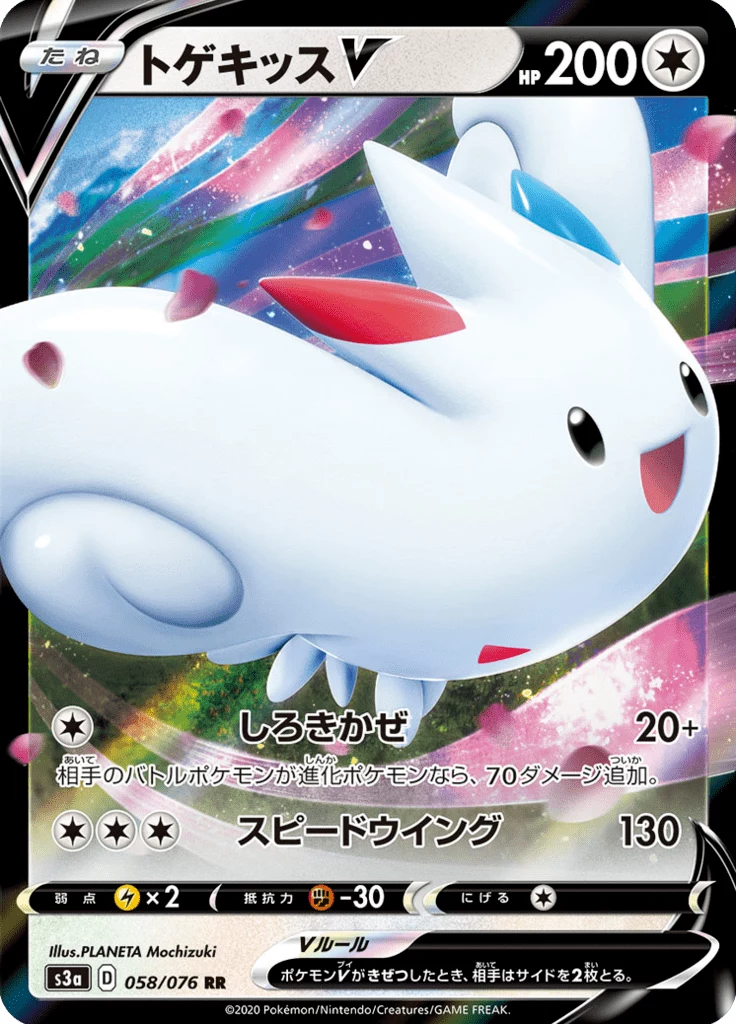
Veelgestelde vragen

Is there a Mega Ampharos Pokemon card?

Yes. M Ampharos-EX is a confirmed secret rare from Bandit Ring (XY7 086/081), released in 2015. Bandit Ring also included a standard-rarity M Ampharos-EX and the base Ampharos-EX it evolves from. Within the sets verified for this guide, the 2015 XY block is where you’ll find it.

What is the rarest Ampharos card from Japan?

Among the prints covered here, the two secret rares — M Ampharos EX SR from Bandit Ring (2015) and Ampharos GX SR from Dark Order (2018) — sit above the Character Rare, Art Rare, and standard prints in rarity tier. We don’t currently carry graded copies of either, so pricing on those two is best checked via Quick Order.

How much is the Flaaffy CHR from VMAX Climax worth?

A PSA 10 copy (s8b 194/184) is currently listed in our catalog at ¥8,893. It’s the only print in this guide with a currently listed price; the other six are available to source via Quick Order.

Where can I buy Japanese Mareep, Flaaffy, and Ampharos cards?

We ship Japanese sealed product and singles worldwide from Tokyo. The PSA 10 Flaaffy CHR is currently listed at ¥8,893, the VMAX Climax Booster Box is currently listed at ¥39,900, and the remaining prints in this guide can be sourced through our Quick Order page.
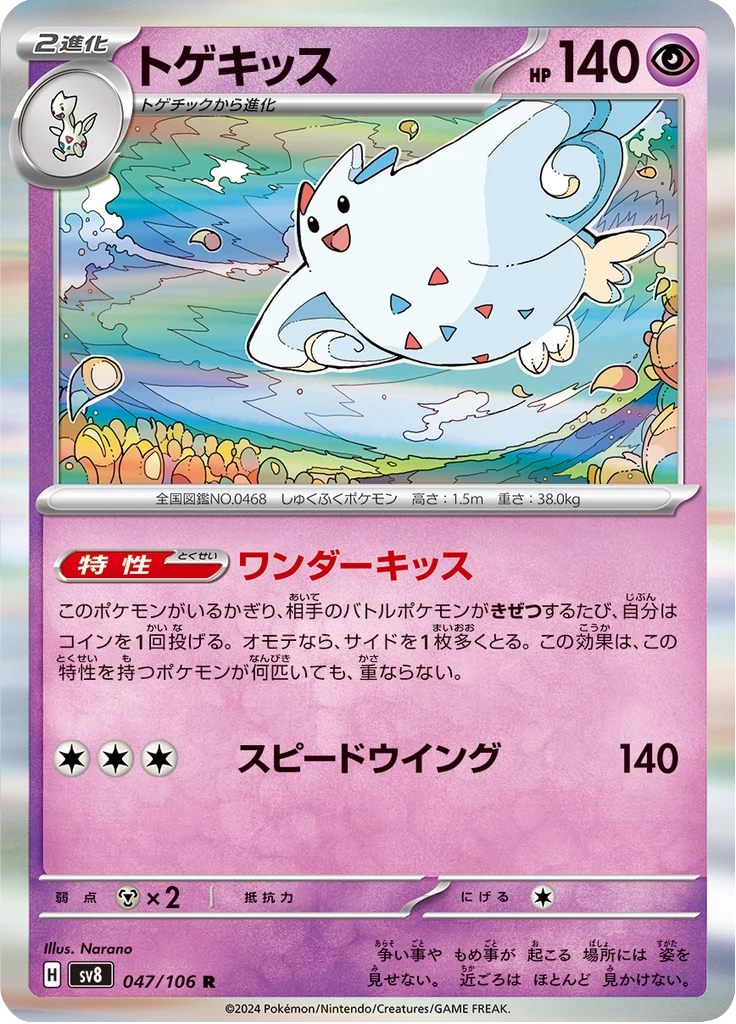
Pokemon LV.X-kaartengids: het LEVEL-UP-mechanisme van Diamond & Pearl

A LV.X card doesn’t evolve onto the Pokemon underneath it. It levels up — and that one-word distinction is why a Diamond & Pearl-era mechanic still gets asked about more than fifteen years after its last set.

Between 2006 and 2009, eleven English-language Pokemon TCG expansions carried a special gold-bordered card type called LV.X: a “level-up” form that sits on top of an existing Pokemon in play rather than replacing it through evolution. It’s a different rule from the ex cards that came before it and the GX cards that came after, and one specific LV.X — Garchomp C LV.X — ended up at the center of a World Championship-winning deck. This guide covers how the LV.X mechanic actually works, which sets carried it, and where Garchomp C LV.X’s 25th Anniversary reprint fits into the story. We ship Japanese sealed product and graded singles out of Tokyo every week, and the one LV.X print in our own catalog is the reprint covered below.

Key Takeaway

LV.X ran across eleven English-language sets from Diamond & Pearl (2006) through Arceus (2009): a Pokemon “levels up” rather than evolves, keeping every attack, Poke-Power, and Poke-Body it already had. The best-known LV.X, Garchomp C LV.X, anchored the “LuxChomp” deck that won the 2010 Pokemon World Championship. Its 25th Anniversary reprint is currently in our catalog — PSA 10 Garchomp C LV.X [S8a-P 018/025] is currently listed at ¥10,053 (~$62).

2006–09
Years Active

11
English-Language Sets

2010
LuxChomp World Title

¥10,053
Our Stock: PSA 10 Garchomp C LV.X

Pricing reflects our own catalog as of August 2026, converted at ¥163/USD.

What Is a Pokemon LV.X Card?

LV.X stands for “level-up,” and that’s a mechanically different action from evolving. A LV.X card is placed directly on top of a Pokemon of the same name that’s already in your Active spot — not played as an evolution the way a Stage 1 or Stage 2 card is. Because it isn’t an evolution, playing a LV.X card doesn’t trigger “just evolved” restrictions, and the Pokemon underneath keeps every attack, Poke-Power, and Poke-Body it already had. The LV.X card layers a gold-colored text box at the bottom of the card with its own additional attack, Poke-Power, or Poke-Body on top of what’s already there.
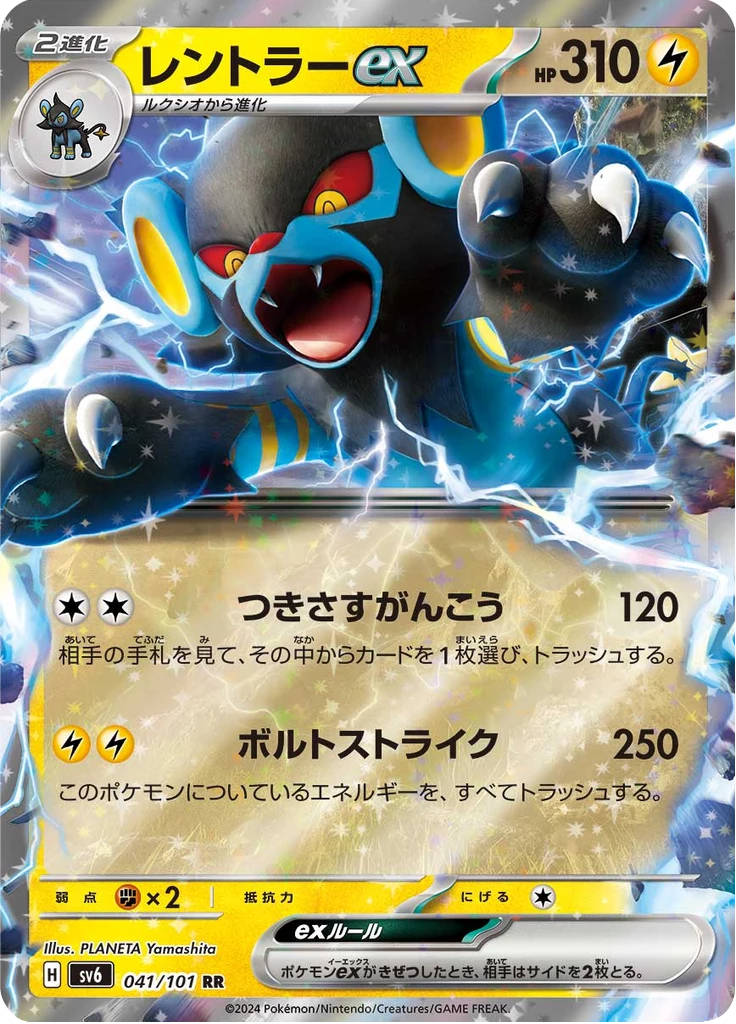
The mechanic’s Japanese debut was DP1, “Space-Time Creation” — released as the paired Diamond Collection and Pearl Collection sets on November 30, 2006. The first three LV.X cards were Empoleon, Infernape, and Torterra, the fully-evolved forms of the three Sinnoh starters. From there, LV.X continued through nearly every Diamond & Pearl-era expansion until its last English-language appearance in the Arceus set in 2009.
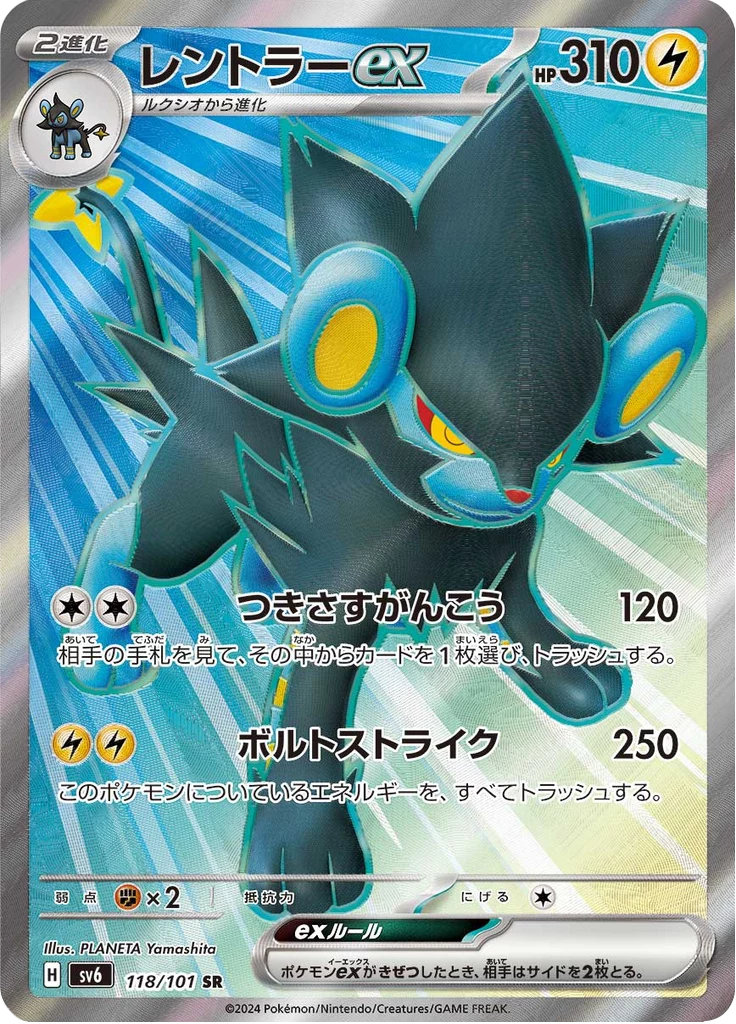
Check This First

If a card is stacked on an identically-named Pokemon and keeps a gold text box at the bottom, it’s a LV.X. If the card replaces a lower-stage Pokemon through the normal evolution line, it isn’t — even if the artwork looks similar at a glance.

The Full LV.X Run: 2006–2009, Set by Set

Most LV.X Pokemon appear once per set; the exceptions are Shaymin (two Platinum prints) and Arceus (three prints in its own set). Here’s the full run across eleven English-language expansions:

Set LV.X Pokemon
Diamond & Pearl Empoleon, Infernape, Torterra
Mysterious Treasures Electivire, Lucario, Magmortar
Secret Wonders Gardevoir, Honchkrow
Great Encounters Cresselia, Darkrai, Dialga, Palkia
Majestic Dawn Garchomp, Glaceon, Leafeon, Porygon-Z
Legends Awakened Azelf, Gliscor, Magnezone, Mesprit, Mewtwo, Rhyperior, Uxie
Stormfront Dusknoir, Heatran, Machamp, Raichu, Regigigas
Platinum Dialga G, Drapion, Giratina, Palkia G, Shaymin
Rising Rivals Alakazam E4, Floatzel GL, Flygon, Gallade E4, Hippowdon, Infernape E4, Luxray GL, Mismagius GL, Snorlax
Supreme Victors Absol G, Blaziken FB, Charizard G, Electivire FB, Garchomp C, Rayquaza C, Staraptor FB
Arceus Arceus (three separate prints), Gengar, Salamence, Tangrowth

The two names in bold — Luxray GL from Rising Rivals and Garchomp C from Supreme Victors — are the pair that would go on to define the mechanic’s most famous competitive run, covered below.

Reading the Suffix: What “C,” “G,” and “GL” Mean

Scan the set list above and a pattern shows up: some LV.X names carry a trailing capital letter — G, GL, E4, FB, or C — while others don’t. That’s not decorative. The Platinum series introduced these cards as part of a “Pokemon SP” subset, expanded through Rising Rivals and Supreme Victors, where the suffix ties the card to a specific in-game trainer rather than leaving it as a plain wild Pokemon. On Garchomp C specifically, the “C” marks it as Champion Cynthia’s Pokemon — the same trainer pairing covered in more depth in our Garchomp cards guide. The other suffixes in the Supreme Victors and Rising Rivals lists above mark separate trainer-tagged families within those same two sets.

Garchomp C LV.X and Its 25th Anniversary Reprint

Garchomp C LV.X’s original printing is English-language Supreme Victors 145/147, a Rare Holo LV.X from 2009. Its Japanese original printing traces to the same Diamond & Pearl-Platinum period, though we haven’t been able to confirm the exact expansion or starter deck it first shipped in — the full print history and card text are covered in our Garchomp cards guide.

What we do carry is the card’s most recent reprint: Garchomp C LV.X, S8a-P 018/025, from the Promo Card Pack 25th Anniversary edition — distributed alongside the mainline “25th ANNIVERSARY COLLECTION” set (S8a), which released October 22, 2021. The reprint carries the same DP-era card design under a 25th Anniversary treatment. For the full promo pack breakdown, see our 25th Anniversary promo pack guide.

The Limitless card database doesn’t carry an image for the S8a-P promo pack itself, and Diamond & Pearl-era sets predate its Japanese image archive entirely. What it does carry are verified images from the accompanying S8a mainline set that shipped alongside the promo pack — shown below for release-era context, not as the LV.X card itself:

Zacian V [S8a 018/028] RR

Zacian V, S8a 018/028, RR

Zamazenta V [S8a 019/028] RR

Zamazenta V, S8a 019/028, RR

Surfing Pikachu V [S8a 021/028] RR

Surfing Pikachu V, S8a 021/028, RR

Surfing Pikachu VMAX [S8a 022/028] RRR

Surfing Pikachu VMAX, S8a 022/028, RRR

Our own graded copy of the reprint — PSA 10 Garchomp C LV.X [S8a-P 018/025] is currently listed at ¥10,053 (~$62).

LuxChomp: The 2010 World Championship Deck

Garchomp C LV.X’s competitive reputation comes from a single, well-documented result: at the 2010 Pokemon Trading Card Game World Championship (Masters division), Yuta Komatsuda won the title playing “LuxChomp” — a deck built around Luxray GL LV.X and Garchomp C LV.X, running two copies of Garchomp C LV.X. The winning decklist was later released as a commemorative product under the name “LuxChomp of the Spirit.”

The pairing worked because both cards kept their base Pokemon’s existing toolkit while adding a leveled-up attack on top — Garchomp C LV.X’s Dragon Rush could snipe damage onto the Bench, a role that fit directly into the deck’s overall damage-spread plan. That’s the LV.X mechanic doing exactly what it was designed to do: strengthen an existing Pokemon without resetting its evolution line.

How LV.X Compares to ex and GX

LV.X sits between two other special Pokemon card types in TCG history, and the difference comes down to prize cards. The ex line that preceded it (basic or evolved Pokemon marked “ex”) gives up two Prize cards when knocked out, in exchange for extra power. The GX line that came later pairs a dedicated GX attack with the same two-Prize cost. LV.X takes a different approach: because a LV.X card levels up an existing Pokemon rather than replacing it with a new one, it stays a single-Prize card even while adding extra attacks and abilities on top of what the base Pokemon already has.

That’s the practical reason LV.X still gets discussed as a distinct design: it added late-game power without asking a deck to trade away the extra Prize card that ex and GX both require.

For where LV.X sits inside the wider landscape of Japanese TCG rarity systems — including how rarity tiers are marked and read on modern cards — see our Japanese Pokemon card rarities explained guide. And if you’re chasing the earliest Japanese prints rather than the Diamond & Pearl era specifically, our Japanese old-back Pokemon cards guide covers the pre-2000 print runs that came a full Pokemon TCG generation before LV.X existed.

Own a Piece of the LuxChomp Story

The only LV.X card in our catalog right now is the same one that anchored a World Championship deck.

Shop This Card
PSA 10 Garchomp C LV.X [S8a-P 018/025]
Currently listed at ¥10,053 (~$62)
Ships from Tokyo · Tracked FedEx shipping

View Product →

Where to Buy Japanese LV.X Cards

We ship Japanese sealed product and graded singles worldwide from Tokyo with tracked FedEx shipping. Our current LV.X stock is a single graded piece — PSA 10 Garchomp C LV.X [S8a-P 018/025], currently listed at ¥10,053.

For the full Garchomp print lineup, including the card’s Diamond & Pearl-era design details, see our Garchomp cards guide. For more on the promo pack this reprint came from, see our 25th Anniversary promo pack guide. Browse our full graded lineup on the PSA 10 collection or the PSA 10 card list, or use our Quick Order page to check current availability and build a mixed order in one checkout.

Veelgestelde vragen

What does LV.X mean on a Pokemon card?

LV.X stands for “level-up.” A LV.X card is placed on top of an identically-named Pokemon already in play rather than evolving it, so the Pokemon keeps every attack, Poke-Power, and Poke-Body it already had, plus a new one added by the LV.X card’s gold text box.

Is a LV.X card the same as evolving a Pokemon?

No. Evolution replaces a Pokemon through its normal evolution line (Stage 1, Stage 2, and so on). A LV.X card levels up a Pokemon that’s already fully in play, without going through that evolution sequence, and it doesn’t trigger “just evolved” turn restrictions.

What sets did Pokemon LV.X cards appear in?

LV.X ran across eleven English-language sets from Diamond & Pearl (2006) through Arceus (2009), including Mysterious Treasures, Secret Wonders, Great Encounters, Majestic Dawn, Legends Awakened, Stormfront, Platinum, Rising Rivals, and Supreme Victors. Its Japanese debut was DP1, “Space-Time Creation,” on November 30, 2006.

Why is Garchomp C LV.X well known?

It was one half of “LuxChomp,” the deck Yuta Komatsuda used to win the 2010 Pokemon Trading Card Game World Championship (Masters division), running two copies of Garchomp C LV.X alongside Luxray GL LV.X. The winning decklist was later released as a commemorative product.

Where can I buy a Garchomp C LV.X card?

We ship Japanese sealed product and graded singles worldwide from Tokyo. Our PSA 10 Garchomp C LV.X [S8a-P 018/025], a 25th Anniversary promo reprint, is currently listed at ¥10,053.