Maak gratis een account en spaar punten en rang
Samurai Sword Tokyo
Bestellingen Winkelwagen

Roaring Moon Kaartengids: Elke JP-uitgave & zeldzaamheid
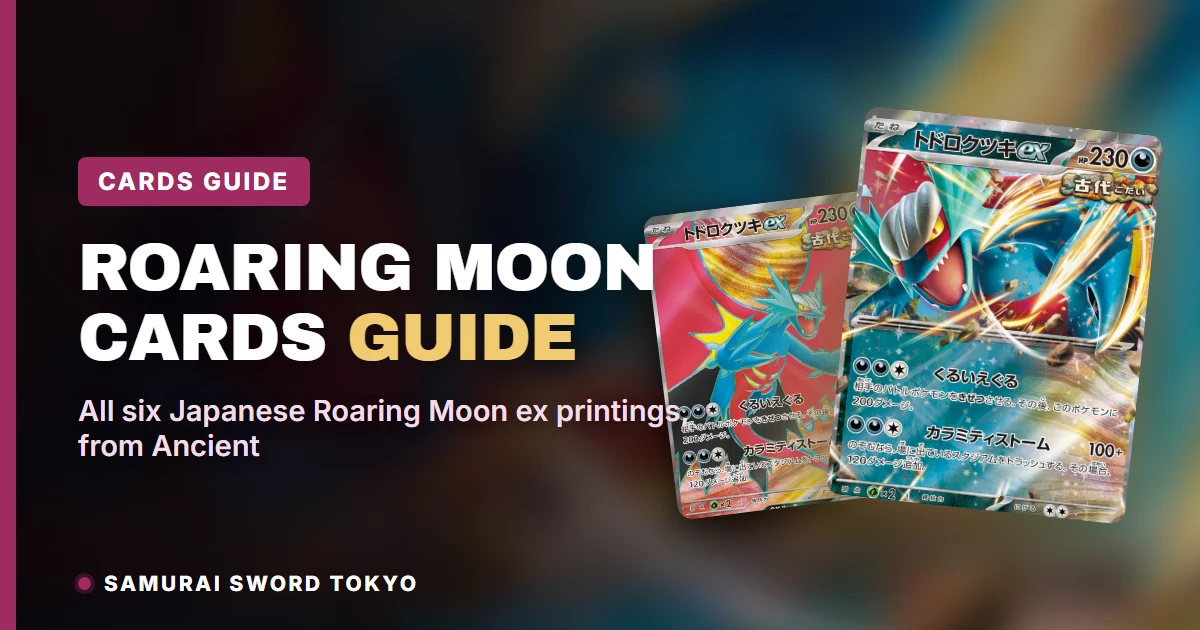
Roaring Moon has only been a Pokemon TCG card since October 2023, and it already has six distinct Japanese printings spread across three sets. If you’re trying to figure out which one you’re holding, or which one to chase, the card number in the corner tells you almost everything.

Roaring Moon is a Paradox Pokemon introduced in the Scarlet & Violet video game era, and every one of its Japanese TCG appearances so far has come out of that same modern block — there’s no older, pre-2023 Roaring Moon card floating around to worry about. That makes the collecting side of this Pokemon fairly contained: six cards, three sets, and a rarity ladder that runs from a standard secret rare up to a special-art chase card.

This guide is a collector’s reference, not a competitive one — we’re not covering tournament usage or deck strategy. What follows is every Japanese Roaring Moon printing, how to tell them apart by number and rarity, which set to buy sealed if you want to pull your own copy, and where to buy them. We ship Japanese sealed boxes and singles out of Tokyo.

Key Takeaway

Roaring Moon has six Japanese TCG printings across three sets: the debut ex RR in Ancient Roar (SV4K), its SR and UR alt-art siblings in the same set, a non-ex regular card in Wild Force (SV5K), and a reprinted RR plus a chase-tier SAR in Terastal Fest ex (SV8a). All are Scarlet & Violet-era cards — there is no older or vintage Roaring Moon print to look for.

6
Card Printings

3
Sets Featured

2023
TCG Debut Year

SAR
Top Chase Rarity

All Roaring Moon printings covered here are Japanese-language cards. Prices referenced for sealed boxes are our listed prices as of August 2026, converted at ¥159/USD.

Every Roaring Moon Printing at a Glance

Roaring Moon is a Paradox Pokemon that entered the Japanese TCG in late 2023. Here is every confirmed printing, in release order, along with the number and rarity you’d need to match against a card in hand:

Kaart Number Rarity Set Release
Roaring Moon ex 054/066 RR Ancient Roar (SV4K) Oct 2023
Roaring Moon ex (alt art) 084/066 SR Ancient Roar (SV4K) Oct 2023
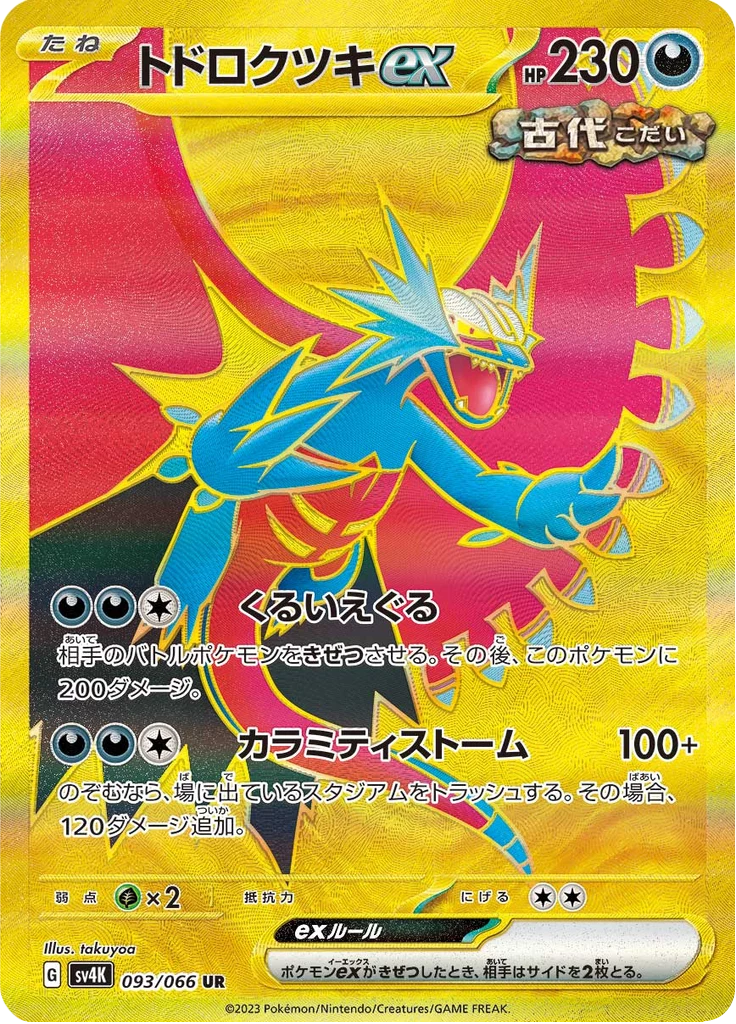
Roaring Moon ex (alt art) 093/066 UR Ancient Roar (SV4K) Oct 2023
Roaring Moon 051/071 R Wild Force (SV5K) Jan 2024
Roaring Moon ex (reprint) 101/187 RR Terastal Fest ex (SV8a) Dec 2024
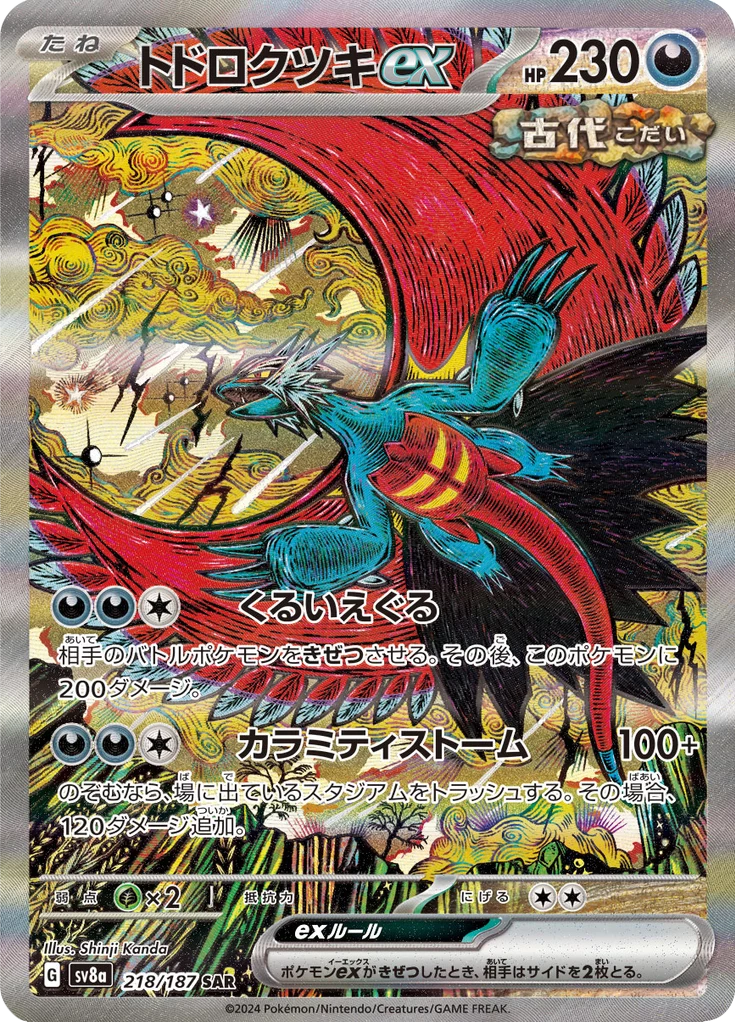
Roaring Moon ex (alt art) 218/187 SAR Terastal Fest ex (SV8a) Dec 2024

Two things stand out. First, five of the six printings are the ex version — the non-ex regular card in Wild Force is the only exception. Second, the Ancient Roar set alone produced three separate Roaring Moon ex prints in three different secret-rare tiers, which is why that set is the one to know if you’re trying to identify a card.

Each rarity abbreviation marks a distinct print treatment, not just a cosmetic variant — RR, SR, UR and SAR are separate collecting targets even though several of them show the same Roaring Moon ex on the same set of stats. Ancient Roar’s base numbering runs to 066, so two of its Roaring Moon cards — 084/066 and 093/066 — sit past that point, alongside the standard 054/066 RR within the base count. The same pattern repeats in Terastal Fest ex, where the base count is 187 and the SAR at 218/187 sits well past it.

The TCG Debut: Roaring Moon ex RR (Ancient Roar)
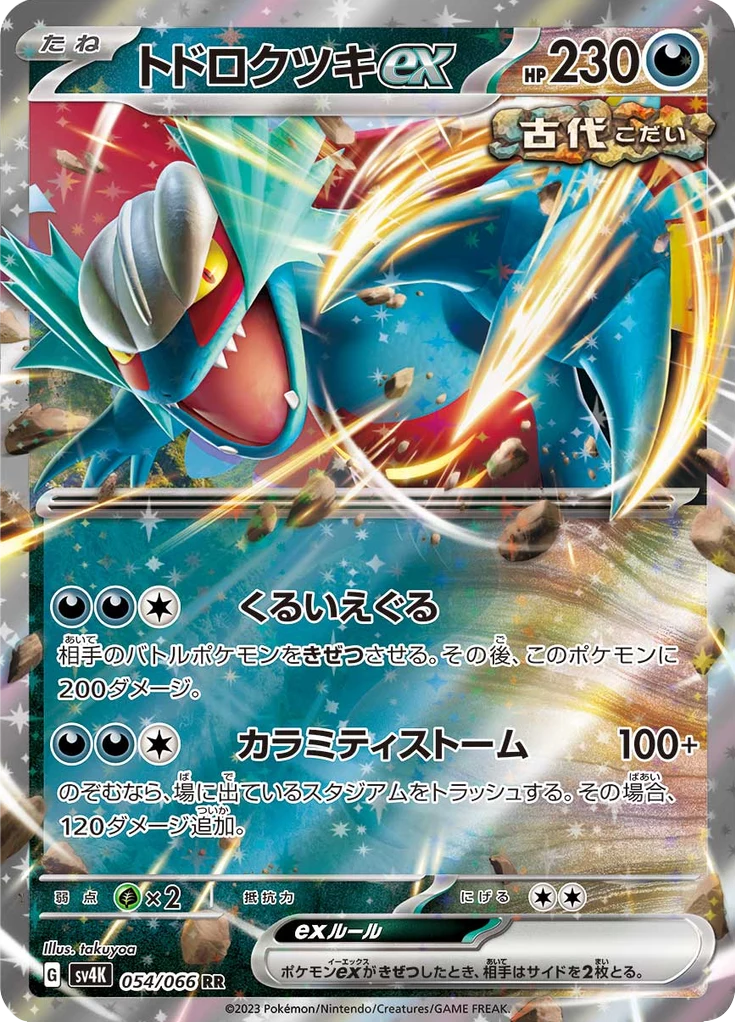
Roaring Moon ex 054/066 RR Ancient Roar
Roaring Moon ex 054/066 RR — Ancient Roar (SV4K)

Roaring Moon’s first Japanese TCG appearance was the ex RR at 054/066 in Ancient Roar (SV4K), released October 27, 2023. This is the card that gave Roaring Moon its ex treatment for the first time, and it’s the standard, most-printed version among the three Ancient Roar Roaring Moon cards.

If you’re just looking for one Roaring Moon card for a collection or a binder, this is the entry point — the base ex illustration in the set’s regular secret-rare slot, before the alt-art versions escalate in scarcity. It’s also the card every later Roaring Moon ex print traces back to: the 101/187 reprint in Terastal Fest ex uses the same ex card, reissued in a different set two sets later.

The Alt-Art Tier: SR and UR from Ancient Roar
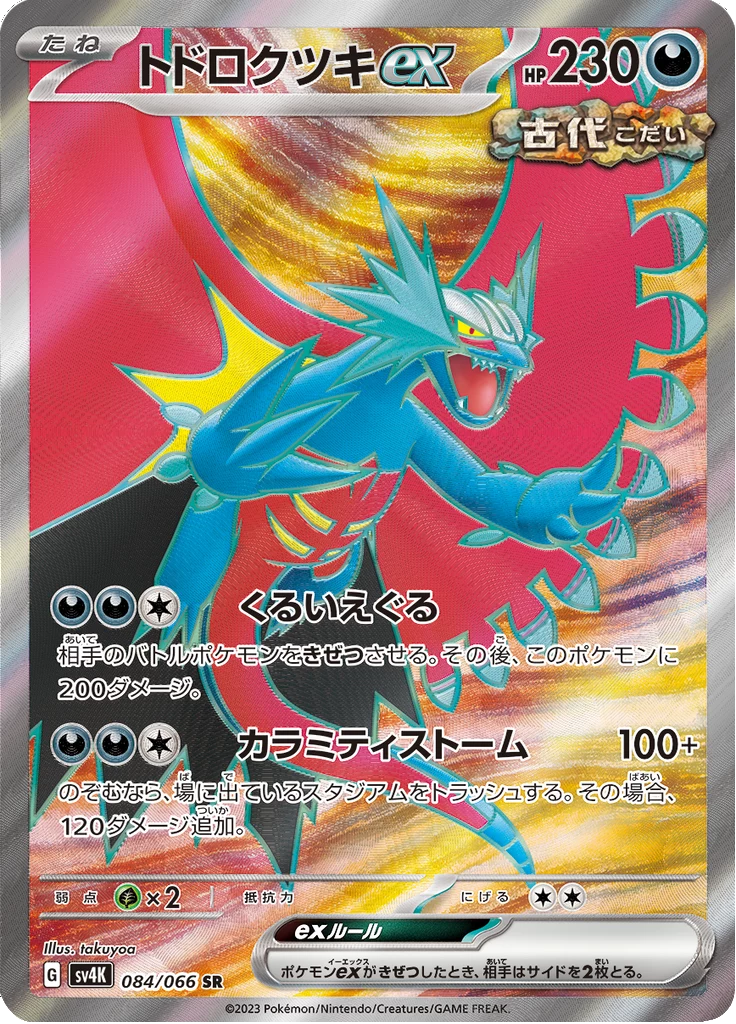
Roaring Moon ex 084/066 SR Ancient Roar

Roaring Moon ex 084/066 SR

Roaring Moon ex 093/066 UR Ancient Roar

Roaring Moon ex 093/066 UR

Ancient Roar didn’t stop at one Roaring Moon ex. The same card also has a full alt-art SR at 084/066 and a UR at 093/066, both sitting past the set’s main numbering (the base set runs to 066) in the secret-rare block. These are the printings most likely to draw collector attention from that set, since they use different artwork treatments than the standard RR.

We don’t have secondary-market pricing to compare these two against each other — what we can say for certain is that both sit in higher secret-rare tiers than the RR, and both are Ancient Roar exclusives; neither has been reprinted in the two later sets that carry Roaring Moon cards. For a collector, that exclusivity is the practical takeaway: the SR and UR artwork only exists in Ancient Roar packs, so a sealed Ancient Roar box is the only route to pulling either one yourself.

The fastest way to tell all three Ancient Roar Roaring Moon cards apart is the number in the corner — 054/066 for the RR, 084/066 for the SR, and 093/066 for the UR. Since the set’s regular numbering stops at 066, any of these three showing up in a pull is worth checking against those three numbers specifically.

The Non-Ex Card: Roaring Moon (Wild Force)
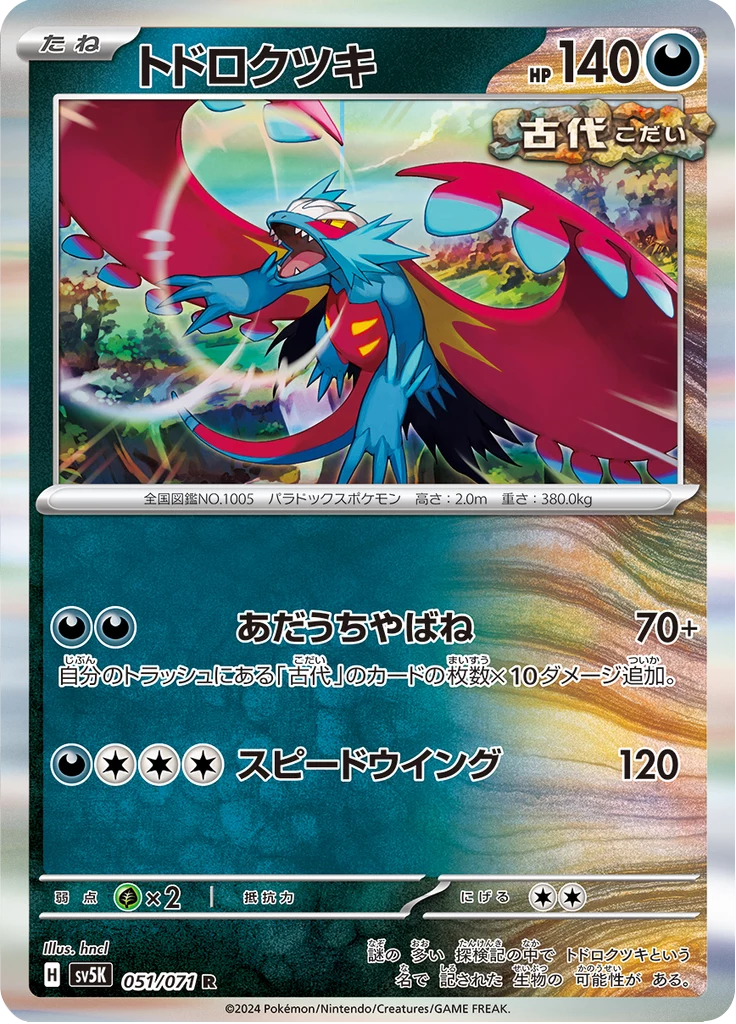
Roaring Moon 051/071 R Wild Force
Roaring Moon 051/071 R — Wild Force (SV5K)

Wild Force (SV5K), released January 26, 2024, is home to the only non-ex Roaring Moon card in the Japanese TCG: a regular-rarity print at 051/071. Every other printing covered in this guide is the ex version, so this is the one card in the lineup that shows the base-form artwork without the ex frame and stat boost.

It also arrived roughly three months after the Ancient Roar debut, sitting between that set and the December 2024 Terastal Fest ex release. For collectors building a set-by-set run of every card a Pokemon has appeared on, this is a required stop — it’s the only place the plain, non-ex version exists, and skipping Wild Force means skipping a full third of the Roaring Moon TCG lineup by set count.

The Reprint and the Chase Card: Terastal Fest ex
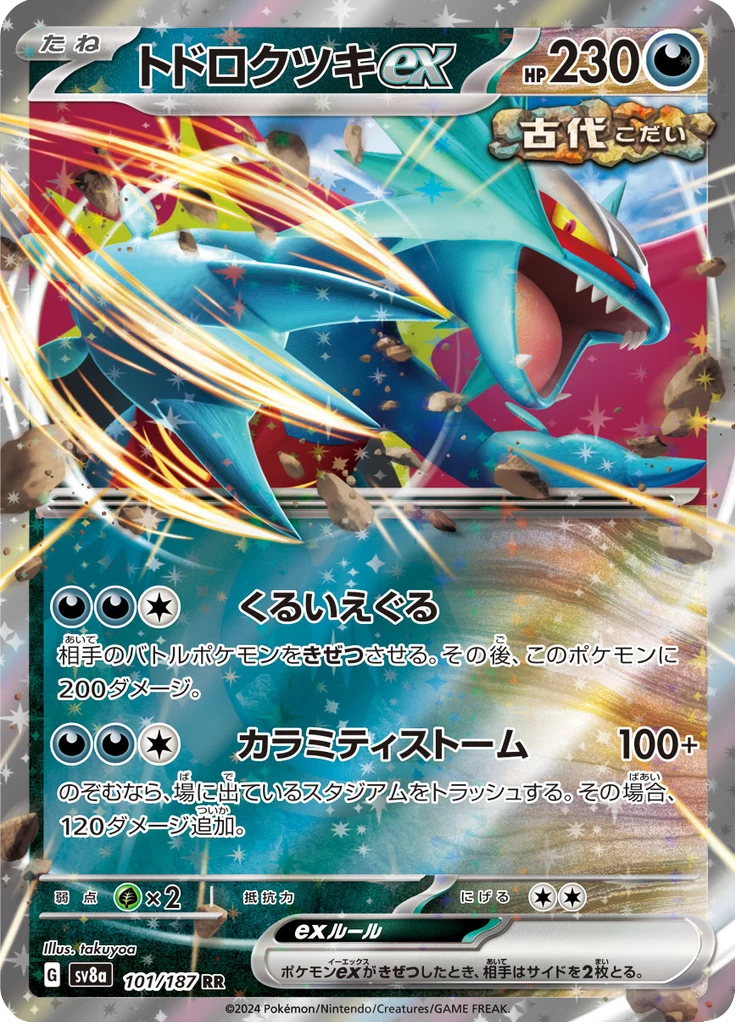
Roaring Moon ex 101/187 RR Terastal Fest ex

Roaring Moon ex 101/187 RR

Roaring Moon ex 218/187 SAR Terastal Fest ex

Roaring Moon ex 218/187 SAR

Terastal Fest ex (SV8a), released December 6, 2024, brought Roaring Moon back with a standard RR reprint at 101/187 — effectively a second circulation of the base ex illustration — alongside a new SAR at 218/187, a special-art secret rare sitting well past the base 187-card count.

The 218/187 SAR is the highest rarity tier Roaring Moon has reached in the Japanese TCG so far, and the newest of the six printings. If you’re specifically hunting the top of the Roaring Moon lineup, this is the card, and Terastal Fest ex is the set to look for it in.

Terastal Fest ex is also the only set to give Roaring Moon two separate slots in the same release — the reprinted RR for collectors who want the standard version in a newer set, and the SAR for the chase. Combined with the three Ancient Roar cards and the single Wild Force card, that brings the full lineup to six printings across just over a year of Japanese TCG releases.

How to Collect Roaring Moon Cards

Sealed boxes from each of the three sets are the direct route to these cards:

Set Contains Our listed price
Ancient Roar (SV4K) RR, SR & UR Roaring Moon ex ¥10,400–13,362 (~$65–84)
Wild Force (SV5K) Regular non-ex Roaring Moon ¥12,480–14,790 (~$78–93)
Terastal Fest ex (SV8a) RR reprint & chase SAR ¥19,570–20,196 (~$123–127)

Because the lineup only spans three sets released within about fourteen months of each other, all of them recent Scarlet & Violet-era releases, none of the three requires hunting down a decades-old vintage box to track down. Which box makes sense depends on which specific card you’re after:

  • Want a shot at all three Ancient Roar prints (RR, SR, UR)? Ancient Roar (SV4K) is the only box that can produce any of the three.
  • Want the only non-ex Roaring Moon? Wild Force (SV5K) is the sole source of the 051/071 regular print.
  • Want the current chase-tier SAR? Terastal Fest ex (SV8a) is the only box carrying the 218/187, alongside a second copy of the standard RR.

Ancient Roar is the one worth prioritizing if your goal is Roaring Moon specifically — it’s the only set with three different Roaring Moon printings in one box, so opening Ancient Roar packs is the only way to potentially pull the RR, the SR, and the UR from a single product line. Terastal Fest ex is the pick if the 218/187 SAR is the specific card you want, since it’s the only set that contains it, and Wild Force is the only route to the non-ex 051/071.

If you’d rather buy the card directly than open packs for it, that’s where our Quick Order page comes in — it lets you request a specific card and number rather than relying on a pull. Grading is a separate question from which printing you own: if you’re buying or submitting a graded copy, remember that PSA independently determines authenticity and grade, and that applies the same way across all six Roaring Moon printings.

For the full card list of Ancient Roar, including every other secret rare in the set, see our Ancient Roar (SV4K) complete card list.

Where to Buy Roaring Moon Cards and Sealed Product

We ship Japanese sealed product out of Tokyo with tracked delivery worldwide. If your priority is pulling your own Roaring Moon cards, Ancient Roar is the set with the most printings packed into one box.

Shop This Set
SV4K Ancient Roar Booster Box (Japanese)
Contains the RR, SR & UR Roaring Moon ex
Ships from Tokyo · Tracked delivery

View Product →

For the SV8a chase SAR or the SV5K non-ex card specifically, check the Terastal Fest ex box and Wild Force box pages, or browse the full set breakdowns on our SV4K card list hub and SV8a card list hub. For singles or PSA-graded cards, our Quick Order page is the fastest way to request a quote, and our PSA 10 card list covers graded Japanese cards across sets.

Roaring Moon is part of the same modern Scarlet & Violet ex wave as other Paradox and Legendary Pokemon — if you’re building out that side of a collection, our Zygarde cards guide and Bloodmoon Ursaluna cards guide cover two other ex lineups from the same era, both of which also run across multiple sets with their own reprint and secret-rare patterns.

Set-level pricing and pack configuration for Ancient Roar and Terastal Fest ex are broken down further on their respective card list hubs, linked above, and on our SV5K Wild Force card list hub if you’re tracking down the non-ex copy specifically.

Veelgestelde vragen

How many Roaring Moon cards are there in the Japanese TCG?

Six confirmed printings: three from Ancient Roar (SV4K) — RR 054/066, SR 084/066, UR 093/066 — one non-ex regular card from Wild Force (SV5K) at 051/071, and two from Terastal Fest ex (SV8a): a reprinted RR at 101/187 and an SAR at 218/187.

When did Roaring Moon ex first appear in the Pokemon TCG?

October 27, 2023, in the Japanese set Ancient Roar (SV4K), as Roaring Moon ex 054/066 RR.

What’s the rarest Roaring Moon card?

The Roaring Moon ex SAR at 218/187 from Terastal Fest ex (SV8a), released December 2024. It’s the highest rarity tier Roaring Moon has reached and the newest of the six printings.

Is there a non-ex Roaring Moon card?

Yes — the regular-rarity Roaring Moon at 051/071 from Wild Force (SV5K), released January 2024. It’s the only printing that isn’t the ex version.

Which set has the most Roaring Moon printings?

Ancient Roar (SV4K), with three: the standard RR, an alt-art SR, and an alt-art UR, all released in October 2023.

Is the Terastal Fest ex Roaring Moon ex a new card or a reprint?

The 101/187 RR is a reprint of the same Roaring Moon ex first released as 054/066 in Ancient Roar. The 218/187 SAR is a separate, newer print exclusive to Terastal Fest ex.
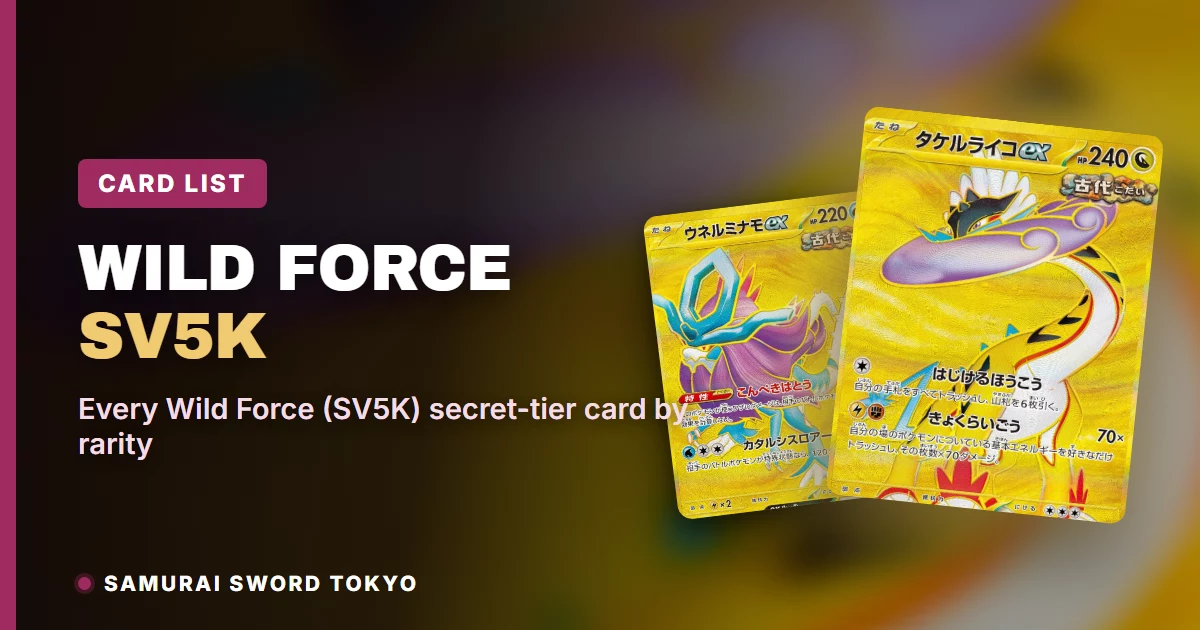
Wild Force (SV5K) complete kaartenlijst: alle 100 kaarten

Wild Force is the “K” half of the January 2024 Scarlet & Violet split — the set that introduced Raging Bolt ex, Walking Wake ex, and Gouging Fire ex to the Japanese card pool, each one repeated across three separate secret-tier treatments before the set is done with it. If you’re trying to work out exactly what card number you’re holding, or which of the three Iron/Paradox trio prints is the expensive one, this is the full breakdown.

This page catalogues every card Limitless TCG lists for SV5K Wild Force (ワイルドフォース), with the complete secret-tier table transcribed rarity by rarity, the chase cards pictured, and our current sealed and single-card listings for the set.

Numbering in this list follows Limitless TCG’s own index. Cards 001 through the low-070s make up the base set — the commons, uncommons, rares, and standard-rarity ex cards that fill out the front two-thirds of the checklist — while cards 072 through 100 form the secret tier this guide transcribes card by card below. A pack-pulled card numbered above the base count printed on the card itself (071) belongs in one of the four secret tiers covered here.

Key Takeaways

Wild Force (SV5K) is catalogued by Limitless TCG at 100 total rows — 71 base-set cards plus a 29-card secret tier split across Art Rare (12), Secret Rare (9), Special Art Rare (5), and Ultra Rare (3). The same three ex Pokemon — Gouging Fire, Walking Wake, and Raging Bolt — anchor all three of the top rarity tiers. The set released January 26, 2024, alongside its companion release, SV5M Cyber Judge.

100
Total Catalogued Cards

29
Secret-Tier Cards

71
Base-Set Rows

Jan 26, 2024
Release Date

Wild Force (SV5K) At a Glance

Wild Force released in Japan on January 26, 2024, as one half of a two-set split — the companion release, Cyber Judge (SV5M), came out the same day. Limitless TCG’s index catalogues 100 total rows for Wild Force, made up of 71 base-set cards (numbered up to 071, catalogued by Limitless as of August 2026 and not an official denominator) and a 29-card secret tier running from No. 072 through No. 100.

That secret tier splits into four rarities:

  • Art Rare — 12 cards (Nos. 072–083)
  • Secret Rare — 9 cards (Nos. 084–092)
  • Special Art Rare — 5 cards (Nos. 093–097)
  • Ultra Rare — 3 cards (Nos. 098–100)

The full table for every secret-tier card — Japanese name, English name, card number, and rarity — is below, organized by tier.

How the Four Secret Tiers Differ

Reading the tables below side by side, a clear pattern emerges in how Wild Force structures its 29-card secret tier:

  • Art Rare (12 cards) reprints ordinary base-set Pokemon — mostly mid-evolution and unevolved species like Grotle, Bronzor, and Cinccino — in full alternate art. None of these are ex cards.
  • Secret Rare (9 cards) is where the set’s ex Pokemon first show up at secret-slot rarity: Torterra ex, Gouging Fire ex, Walking Wake ex, Wugtrio ex, Gengar ex, and Raging Bolt ex, plus two Supporter cards (Eri, Morty’s Confidence) and one more Trainer (Explorer’s Guidance).
  • Special Art Rare (5 cards) takes a subset of that Secret Rare group — Gouging Fire ex, Walking Wake ex, Raging Bolt ex, Eri, and Morty’s Confidence — and reprints them again in full-bleed alternate art. Torterra ex, Wugtrio ex, and Gengar ex do not get this treatment.
  • Ultra Rare (3 cards) narrows the field one more time to just Gouging Fire ex, Walking Wake ex, and Raging Bolt ex, reprinted a third time at the top of the checklist.

In other words, every card in Wild Force’s Ultra Rare tier has also appeared as a Secret Rare and a Special Art Rare earlier in the same set. Collectors chasing a specific Pokemon across all three of its printings — rather than just the single highest-rarity copy — are working from the same three-card core each time: Gouging Fire, Walking Wake, and Raging Bolt.

Identifying Which Tier a Card Belongs To

Every Wild Force card carries a printed fraction in the bottom corner, such as 094/071. The denominator, 071, is the base-set count that Limitless’s numbering references for this set (catalogued as of August 2026, not necessarily the set’s official print denominator). If the numerator — the number before the slash — falls in the 072–100 range, the card is one of the 29 secret-tier cards transcribed on this page, and you can cross-reference the exact number against the four tables above to confirm both the card and its rarity.

Because Gouging Fire ex, Walking Wake ex, and Raging Bolt ex each appear at three different numbers (Secret Rare, Special Art Rare, and Ultra Rare), the printed card number — not the Pokemon name alone — is the only reliable way to confirm which of the three printings you’re holding.

Art Rare Tier (12 Cards)

The Art Rare tier reprints a run of base-set Pokemon in full alternate art, Nos. 072–083.

Nr. Japanese Name English Name Rarity
072 ハヤシガメ Grotle Art Rare
073 ユキハミ Snom Art Rare
074 ドーミラー Bronzor Art Rare
075 ランクルス Reuniclus Art Rare
076 ハバタクカミ Flutter Mane Art Rare
077 ジーランス Relicanth Art Rare
078 バンバドロ Mudsdale Art Rare
079 アーボック Arbok Art Rare
080 ゴース Gastly Art Rare
081 ペラップ Chatot Art Rare
082 チラーミィ Minccino Art Rare
083 チラチーノ Cinccino Art Rare

Flutter Mane at No. 076 is the notable name here — it’s the only Paradox Pokemon in the Art Rare run, sitting among a lineup that’s otherwise standard evolution-line Pokemon getting the alternate-art treatment. The other eleven cards in this tier span a wide mix of species and evolution stages, from second-stage Pokemon like Grotle and Cinccino to single-stage Pokemon like Gastly, Chatot, and Relicanth — there’s no single mechanical theme tying the Art Rare selections together beyond the alternate-art treatment itself.

Secret Rare Tier (9 Cards)

Nos. 084–092 make up the Secret Rare tier, and this is where the set’s three headline ex Pokemon first appear, alongside four Trainer/Supporter cards.

Nr. Japanese Name English Name Rarity
084 ドダイトスex Torterra ex Secret Rare
085 ウガツホムラex Gouging Fire ex Secret Rare
086 ウネルミナモex Walking Wake ex Secret Rare
087 ウミトリオex Wugtrio ex Secret Rare
088 ゲンガーex Gengar ex Secret Rare
089 タケルライコex Raging Bolt ex Secret Rare
090 探検家の先導 Explorer's Guidance Secret Rare
091 ビワ Eri Secret Rare
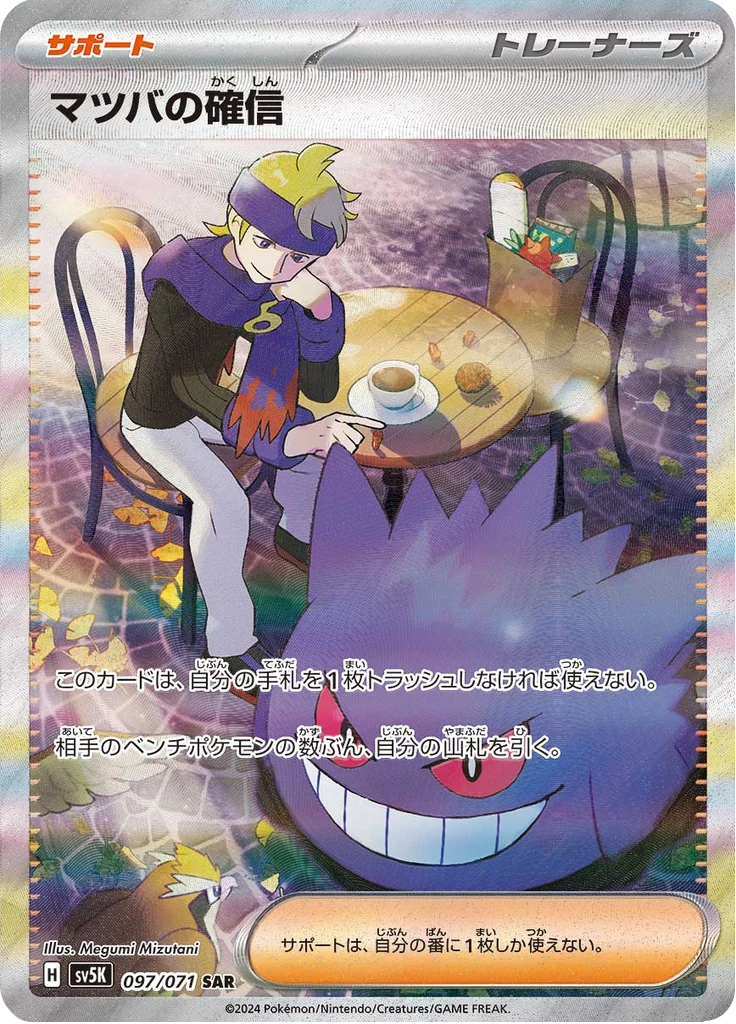
092 マツバの確信 Morty's Confidence Secret Rare

This is the first of three appearances each for Gouging Fire ex, Walking Wake ex, and Raging Bolt ex — they reappear in the Special Art Rare tier and again as Ultra Rares below. Eri and Morty’s Confidence, the set’s two Supporter secret rares, follow the same pattern one tier up. The remaining three ex Pokemon at this rarity — Torterra ex (084), Wugtrio ex (087), and Gengar ex (088) — are secret rares only in this set; none of them carry over into the Special Art Rare or Ultra Rare tiers covered next.

Special Art Rare Tier (5 Cards)

The Special Art Rare tier, Nos. 093–097, reprints five of the nine Secret Rares in full-bleed alternate art — the three Paradox ex Pokemon plus both Supporters.

Nr. Japanese Name English Name Rarity
093 ウガツホムラex Gouging Fire ex Special Art Rare
094 ウネルミナモex Walking Wake ex Special Art Rare
095 タケルライコex Raging Bolt ex Special Art Rare
096 ビワ Eri Special Art Rare
097 マツバの確信 Morty's Confidence Special Art Rare

Note that Torterra ex, Wugtrio ex, and Gengar ex — three of the nine Secret Rares — do not get a Special Art Rare reprint. Only the two Paradox trio ex cards that go on to the Ultra Rare tier, plus the two Supporters, make the cut here.

Ultra Rare Tier (3 Cards)

The top of the set, Nos. 098–100, reprints the same three Paradox ex Pokemon one more time in the set’s highest rarity slot.

Nr. Japanese Name English Name Rarity
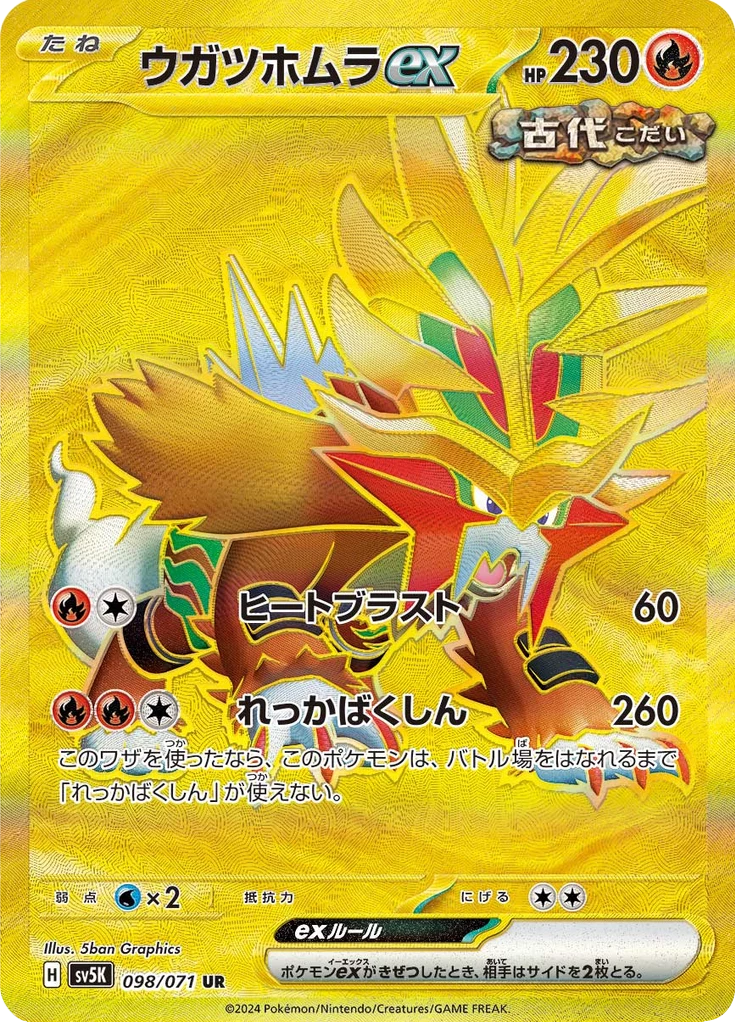
098 ウガツホムラex Gouging Fire ex Ultra Rare
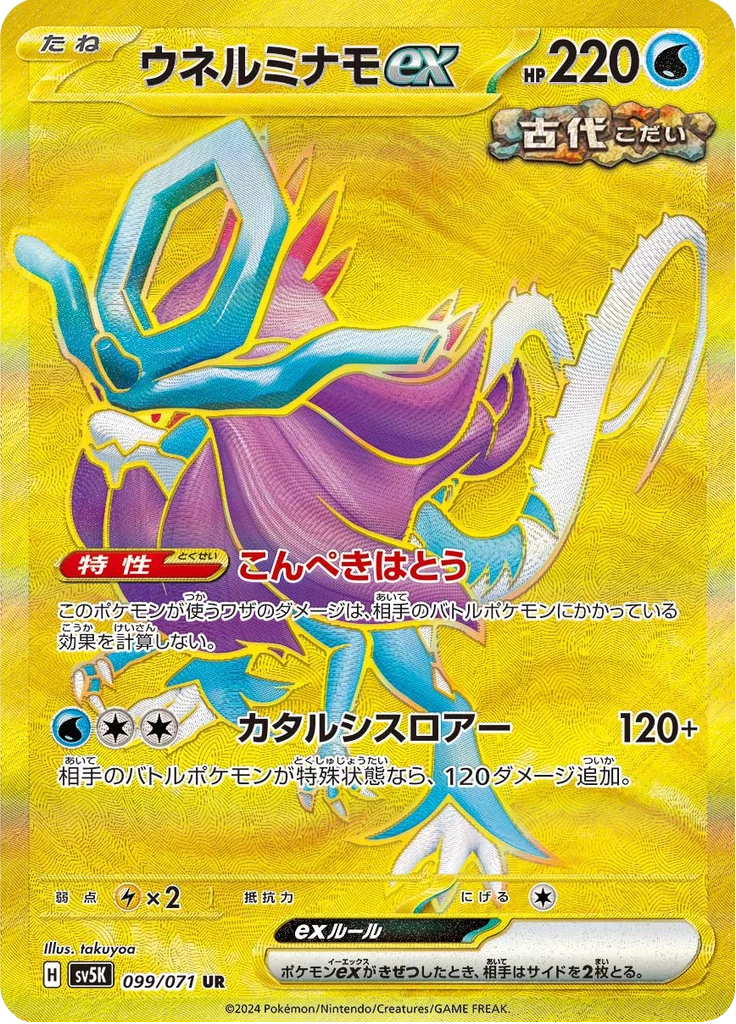
099 ウネルミナモex Walking Wake ex Ultra Rare
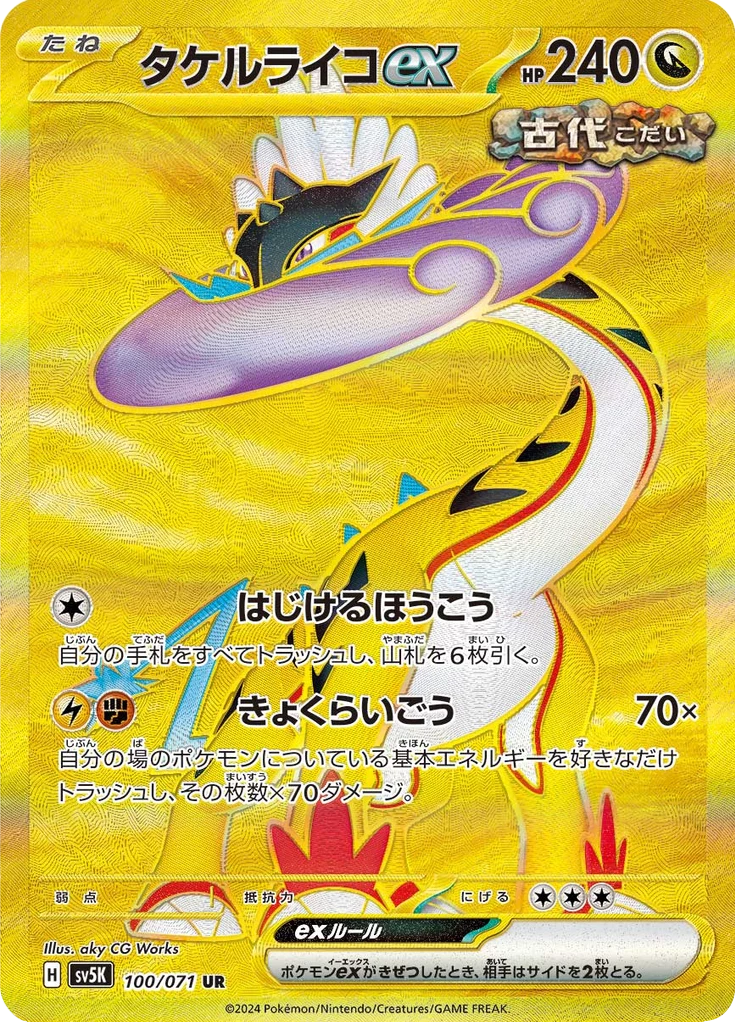
100 タケルライコex Raging Bolt ex Ultra Rare

Between the Secret Rare, Special Art Rare, and Ultra Rare tiers, Gouging Fire ex, Walking Wake ex, and Raging Bolt ex are each printed three separate times in Wild Force — a fourth if you count their base-set version at whatever number falls within the first 71 rows. No other Pokemon in the set repeats across all three secret tiers.

The Chase Cards

The three Ultra Rares are the top of the set, and the Special Art Rare printings of the same three Pokemon sit directly below them.

Raging Bolt ex 100/071 Ultra Rare Wild Force

Raging Bolt ex 100/071, Ultra Rare

Walking Wake ex 099/071 Ultra Rare Wild Force

Walking Wake ex 099/071, Ultra Rare

Gouging Fire ex 098/071 Ultra Rare Wild Force

Gouging Fire ex 098/071, Ultra Rare

Morty's Confidence 097/071 Special Art Rare Wild Force

Morty's Confidence 097/071, Special Art Rare

Raging Bolt ex (100/071, Ultra Rare) closes out the checklist at the highest card number in the set. It’s the third and final printing of Raging Bolt ex in Wild Force, following its Secret Rare (089) and Special Art Rare (095) appearances earlier in the tier breakdown above.

Walking Wake ex (099/071, Ultra Rare) and Gouging Fire ex (098/071, Ultra Rare) follow the same three-printing pattern — both cards also appear as a Secret Rare and a Special Art Rare at Nos. 086/094 and 085/093 respectively.

Morty’s Confidence (097/071, Special Art Rare) is one of only two Supporter cards to reach the Special Art Rare tier in this set, alongside Eri at 096/071. Both are reprints of Secret Rares from earlier in the checklist (092 and 091).

Our graded single from this tier is the Special Art Rare PSA 10 Walking Wake ex SAR, No. 094/071, which was listed at ¥13,750 (~$86) on August 25, 2026. PSA independently determines authenticity and grade, so a PSA 10 label reflects PSA’s own grading of that individual copy.

For a card-by-card look at what each of these secret-tier pulls has been trading for since release, see our Wild Force best cards guide.

Booster Box Pricing

We list sealed Wild Force booster boxes and singles directly from Tokyo. Our SV5K Wild Force Japanese Pokemon Booster Box was listed between ¥12,480 and ¥14,790 (~$78–$93) on August 25, 2026, depending on listing.

We also carry a lower-cost option for buyers who don’t need mint packaging: the Wild Force booster box (damaged box variant), which was listed at ¥13,905 (~$87) on August 25, 2026, with the same sealed packs inside a cosmetically imperfect outer box.

Between the two box listings and the graded single covered in the chase cards section above, buyers have three distinct ways into this set: a standard sealed box for the full pack-opening experience, the damaged-box variant at a comparable price if outer-box condition doesn’t matter to you, or the single graded PSA 10 Walking Wake ex SAR at ¥13,750 (~$86) if you want one specific secret-tier card without opening product.

For community-reported, unofficial box-opening data on any of the 29 secret-tier cards above, our Wild Force best cards guide covers that separately from this card list.

Companion Release: Cyber Judge (SV5M)

Wild Force didn’t release alone. Its companion set, Cyber Judge (SV5M), came out the same day — January 26, 2024 — as the other half of this Scarlet & Violet split. Cyber Judge follows an identical structure: 100 total catalogued rows, a 29-card secret tier, and the same Art Rare / Secret Rare / Special Art Rare / Ultra Rare breakdown, built around a different trio of Paradox and Tera ex Pokemon.

See the full breakdown in our Cyber Judge (SV5M) complete card list. Because both sets share the same release date and secret-tier structure, they’re a natural pair to shop together if you’re collecting the full January 2024 release rather than one half of it.

Where to Buy Wild Force

We ship Japanese sealed product and singles worldwide from Tokyo with tracked delivery.

Shop This Set
SV5K Wild Force Japanese Pokemon Booster Box
Sealed booster box, standard or damaged-box packaging
Ships from Tokyo · Tracked delivery

View Product →

Looking for the full set as a page you can browse card by card, or a specific single? Our Wild Force (SV5K) card list page catalogues the set for browsing, and you can request a quote for any individual card via our Quick Order page.

Veelgestelde vragen

How many cards are in the Wild Force (SV5K) set?

Limitless TCG catalogues 100 total rows for SV5K Wild Force, including 71 base-set rows and 29 secret-tier rows across Art Rare, Secret Rare, Special Art Rare, and Ultra Rare, as catalogued by Limitless as of August 2026.

What is the top rarity tier in Wild Force?

Ultra Rare, Nos. 098–100. The three Ultra Rares reprint Gouging Fire ex, Walking Wake ex, and Raging Bolt ex — the same three Pokemon that also appear as Secret Rares and Special Art Rares earlier in the set.

What card number is the Walking Wake ex Special Art Rare?

094/071. Our PSA 10 listing was priced at ¥13,750 (~$86) on August 25, 2026.

Does Wild Force have a Special Art Rare tier separate from Secret Rare?

Yes. Wild Force splits its highest chase cards into three secret tiers: 9 Secret Rares (084–092), 5 Special Art Rares (093–097) that reprint five of those characters in full-bleed alternate art, and 3 Ultra Rares (098–100) that reprint the top three of those again. Only Gouging Fire ex, Walking Wake ex, Raging Bolt ex, Eri, and Morty’s Confidence make the jump from Secret Rare to Special Art Rare; the remaining four Secret Rares in the set do not get a Special Art Rare reprint.

When was Wild Force released, and is there a companion set?

Wild Force was catalogued as releasing January 26, 2024, the same date as its companion set, Cyber Judge (SV5M). The two form a split-set pair from the Scarlet & Violet Japanese lineup, each catalogued at 100 total rows with an identical four-tier secret rarity structure.

Goodra & Hisuian Goodra Cards Guide: All 7 Printings

Goodra has two very different TCG identities in Japanese sets — the standard Dragon-type from the XY era, and the regional Hisuian form that anchored a five-card run in 2022. If you’re trying to work out which Goodra card you’re looking at, or which printing to chase, the two lines rarely get confused for each other once you know the numbers.

This guide walks through every verified Japanese Goodra printing we could confirm on Limitless TCG’s card database, from the 2014 original through the Hisuian Goodra VSTAR chase tier and its 2022 reprint. We ship Japanese sealed product out of Tokyo, so we’ve paired each section with the booster boxes that actually contain these cards.

Both species show up fairly rarely in Japanese sets compared to higher-profile Pokemon, which makes it easy to lose track of what belongs to which era. Standard Goodra’s TCG footprint is small — a single confirmed printing — while Hisuian Goodra got a concentrated run across one flagship set and one follow-up reprint set, both in 2022. If you’re building a collection around either form, or you picked up a loose card and want to identify it, the number-and-set combination in the table below is the fastest way to confirm exactly what you’re holding.

Key Takeaway

Seven Goodra printings are verified across three Japanese sets spanning 2014–2022: one standard-form Goodra from XY2 Wild Blaze, five Hisuian Goodra cards from S10a Dark Phantasma (base, V, V SR, VSTAR Triple Rare, VSTAR Hyper Rare), and one Hisuian Goodra AR reprint from S12a VSTAR Universe. Singles aren’t currently in our stock snapshot — both booster boxes that contain these cards are.

7
Verified Printings

2014–22
Years Covered

3
Sets Featured

2
In-Stock Booster Boxes

Card numbers, rarities, and set data verified against Limitless TCG’s Japanese card database as of August 2026. Prices below reflect our own listed booster box prices, converted at ¥159/USD, and are not market values for individual cards.

Every Goodra Printing at a Glance

Here is every Japanese Goodra and Hisuian Goodra card we could verify, in release order:

# Kaart Set Year Rarity
1 Goodra 060/080 Wild Blaze (XY2) 2014 R
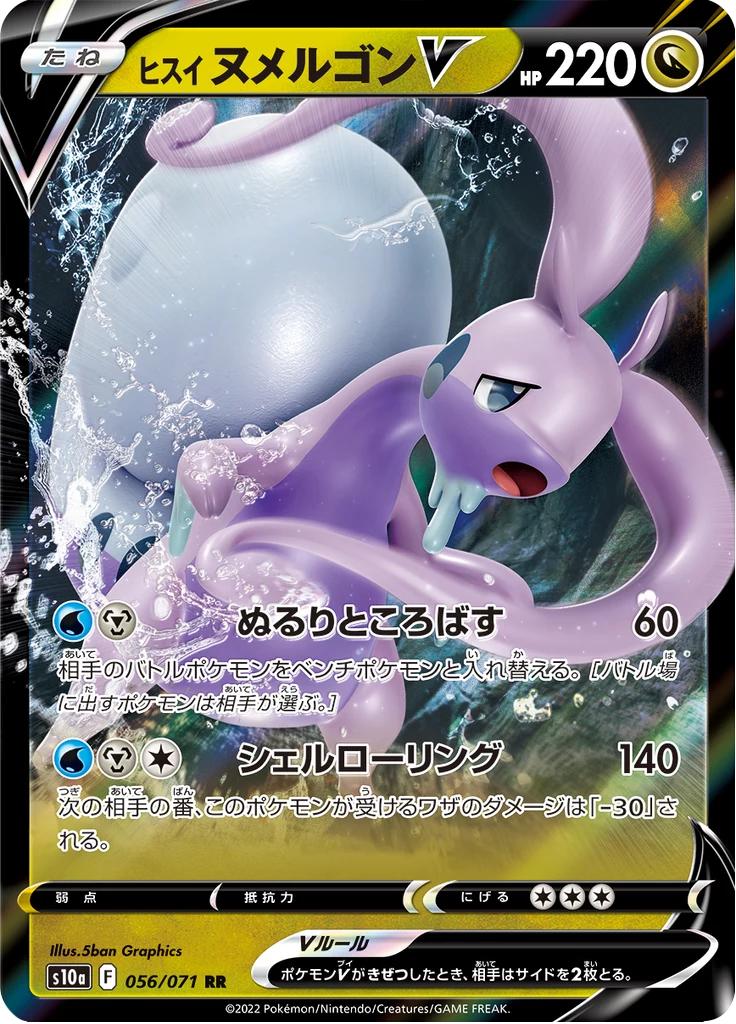
2 Hisuian Goodra 055/071 Dark Phantasma (S10a) 2022 R
3 Hisuian Goodra V 056/071 Dark Phantasma (S10a) 2022 RR
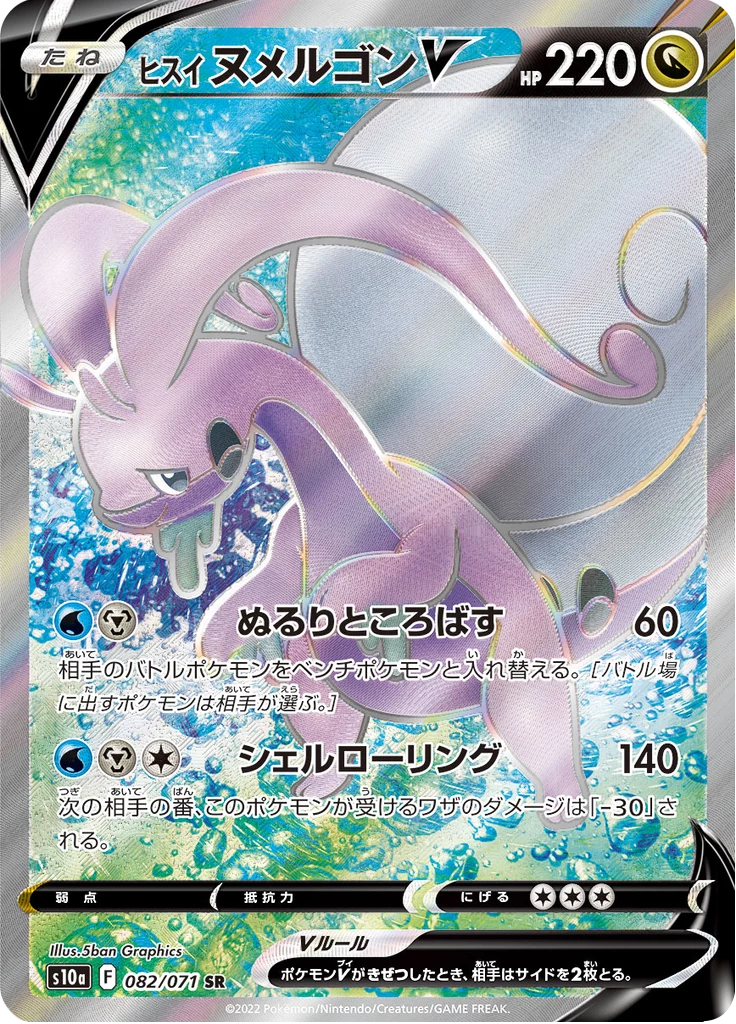
4 Hisuian Goodra V (SA) 082/071 Dark Phantasma (S10a) 2022 SR
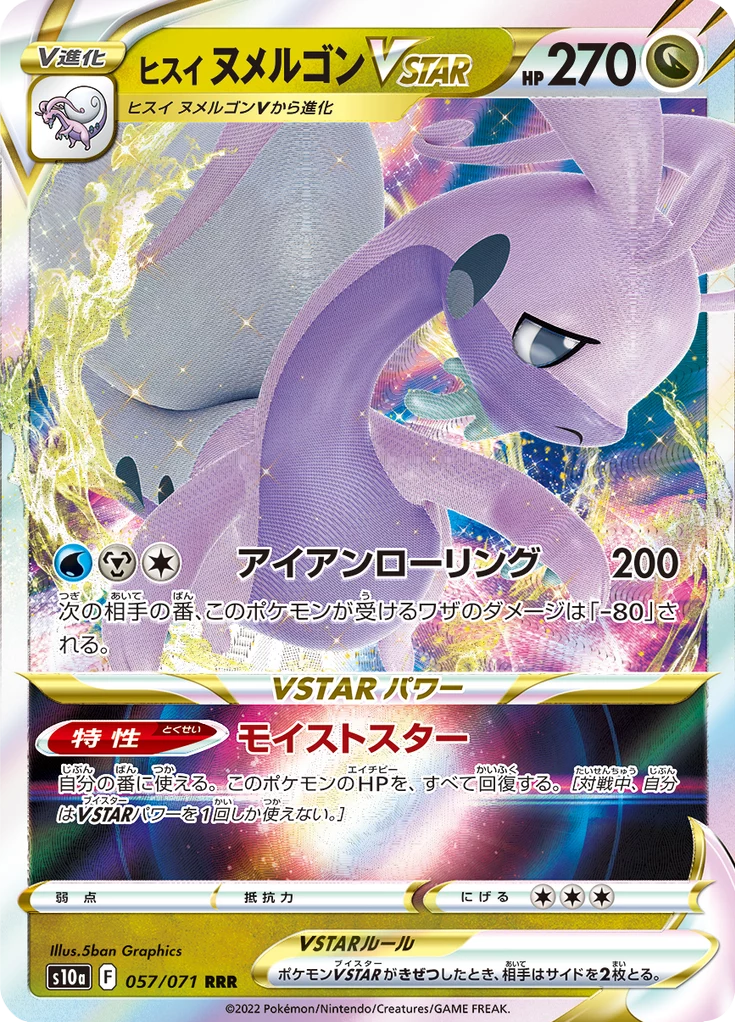
5 Hisuian Goodra VSTAR 057/071 Dark Phantasma (S10a) 2022 RRR (Triple Rare)
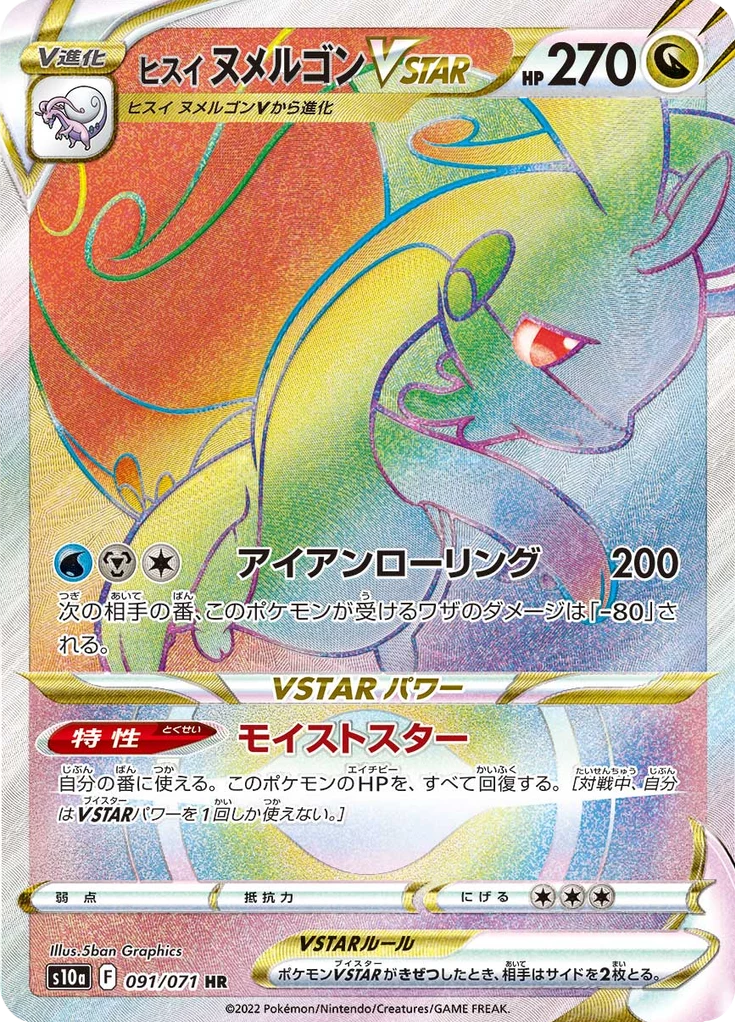
6 Hisuian Goodra VSTAR 091/071 Dark Phantasma (S10a) 2022 HR
7 Hisuian Goodra 196/172 VSTAR Universe (S12a) 2022 AR

Two things stand out. First, standard-form Goodra only has one confirmed Japanese printing in this line — everything after 2014 belongs to the Hisuian form. Second, all five of the Hisuian Goodra cards released within the same set, Dark Phantasma, before one of them (the AR) got a same-year reprint in VSTAR Universe. The sections below cover each in order.

The rarity column follows the standard modern Japanese TCG tiering: R (rare) and RR (double rare) are the base holofoil tiers most sets use for evolved Pokemon and V cards; SR (super rare) and HR (hyper rare) are the full-art and gold-bordered secret-rare tiers that sit above the set’s numbered print run; and AR (alternate rare) is the tier VSTAR Universe used across its entire reprint checklist. Where you see “Triple Rare” alongside RRR, that’s Limitless TCG’s own label for a specific alternate-art VSTAR tier that Dark Phantasma used for its highest standard-numbered cards.

The Original: XY2 Wild Blaze (2014)

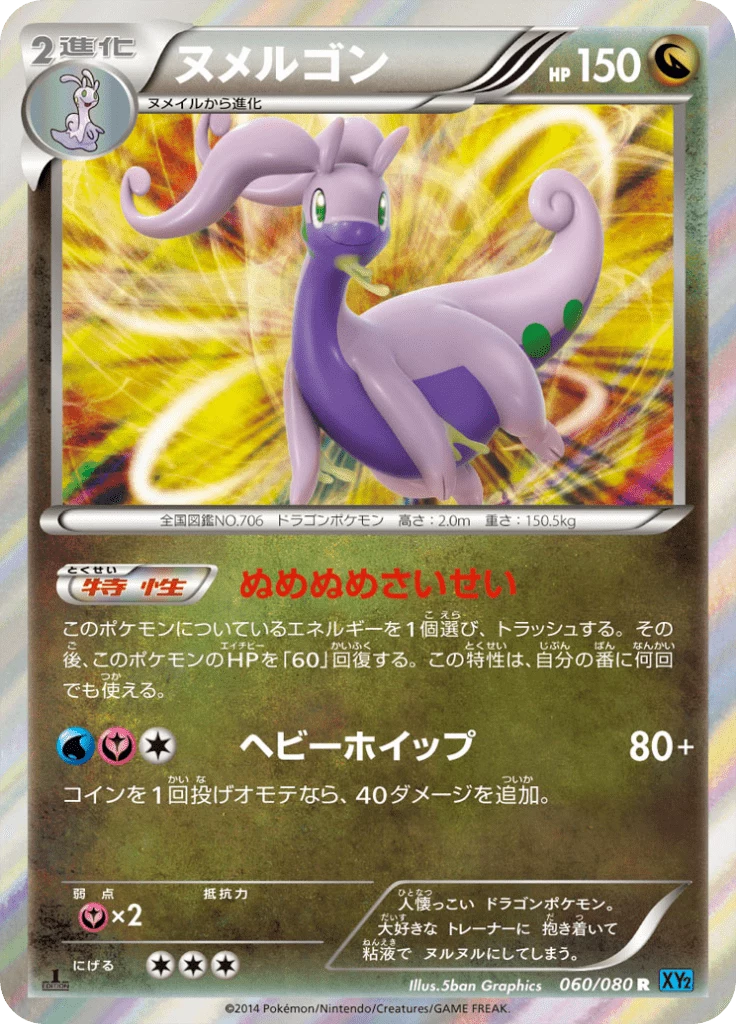
Goodra 060/080 R Wild Blaze XY2
Goodra 060/080 R — Wild Blaze (XY2)

The standard-form Goodra’s Japanese debut is 060/080 from Wild Blaze (XY2), released March 15, 2014 — an early XY-era print, from a time when the current Hisuian regional forms didn’t exist yet in the games or the card game. It’s a rare (R) holofoil in the standard XY-era frame, and it remains the only confirmed Japanese printing of the standard, non-Hisuian form of Goodra in this line.

If you’re specifically after “regular” Goodra as opposed to the Hisuian version, this is the card to look for. Everything else in this guide is Hisuian Goodra.

Wild Blaze sits in the earlier part of the XY block, well before the Hisuian regional forms existed as a game concept — those were introduced years later through a separate mainline title. That gap is part of why the two Goodra lines look so different in the card game: 060/080 uses the standard XY-era holofoil frame with no alternate-art treatment, while every Hisuian Goodra printing that follows arrives inside a completely different card generation with its own set of rarity tiers.

Hisuian Goodra Arrives: Dark Phantasma (S10a, 2022)

Eight years after the XY2 original, the Hisuian form of Goodra made its full Japanese TCG entrance in Dark Phantasma (S10a), released May 13, 2022. The set opened Hisuian Goodra’s run with a standard rare and a V card:

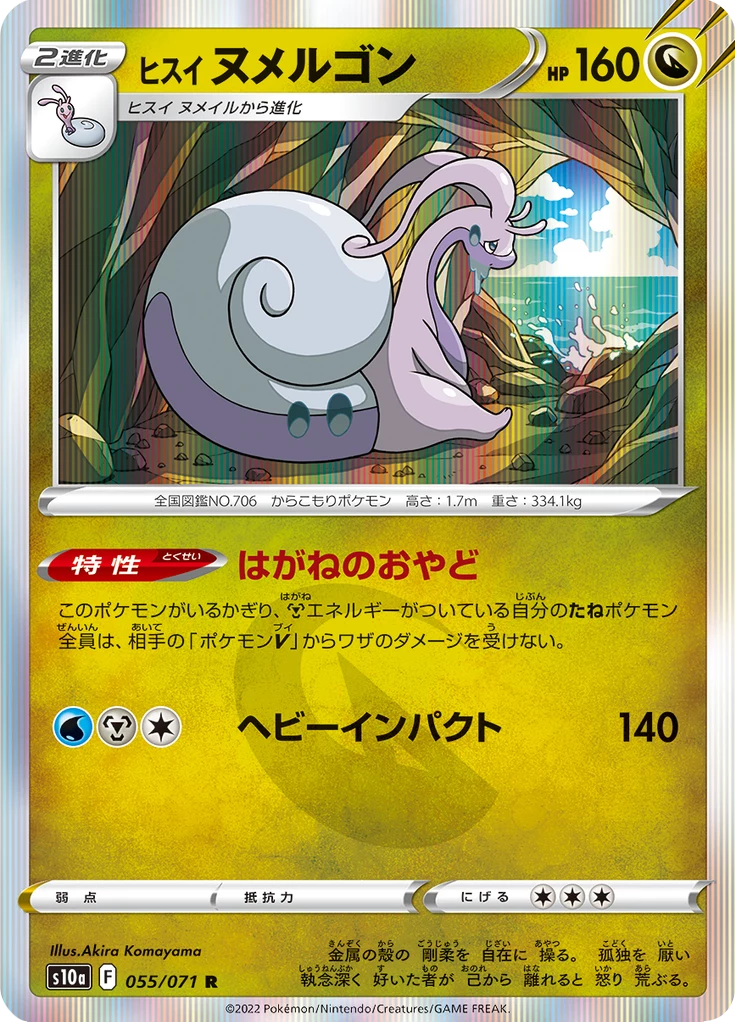
Hisuian Goodra 055/071 R Dark Phantasma S10a

Hisuian Goodra 055/071 R

Hisuian Goodra V 056/071 RR Dark Phantasma S10a

Hisuian Goodra V 056/071 RR

055/071 is the base Hisuian Goodra, a standard-rarity rare in the regular Sword & Shield-era card frame. 056/071 is the V evolution of that same line, sitting one rarity tier up as a double rare (RR). Together, these two form the “normal” entry point into the Hisuian Goodra lineup before the set moves into its alternate-art tiers, covered next.

V cards were the standard “big Pokemon” mechanic running through the Sword & Shield card generation, giving evolved or powerful Pokemon a boosted stat line in exchange for handing the opponent two prize cards when knocked out. Hisuian Goodra V follows that same format, and its regular RR printing is the version most collectors will encounter first when opening Dark Phantasma packs, well ahead of the rarer alternate-art versions covered in the next section.

The Chase Tier: V SR, VSTAR Triple Rare & Hyper Rare

Dark Phantasma gave Hisuian Goodra V and VSTAR three additional alternate-art printings, each at a higher rarity tier than the last:

Hisuian Goodra V SR 082/071 special art Dark Phantasma S10a

Hisuian Goodra V 082/071 SR

Hisuian Goodra VSTAR 057/071 Triple Rare Dark Phantasma S10a

Hisuian Goodra VSTAR 057/071 RRR

Hisuian Goodra VSTAR 091/071 Hyper Rare Dark Phantasma S10a

Hisuian Goodra VSTAR 091/071 HR

082/071 is a special-art (SA) version of the same Hisuian Goodra V, printed as a super rare (SR) — the same card as 056/071, but in an alternate full-art illustration. 057/071 is the VSTAR evolution, catalogued by Limitless TCG as a Triple Rare (RRR), one of the set’s higher standard-frame rarity slots. Topping the line is 091/071, the Hisuian Goodra VSTAR Hyper Rare (HR) — as of August 2026, this is the highest-rarity Goodra printing catalogued by Limitless TCG in this set.

All five Dark Phantasma Hisuian Goodra cards — 055, 056, 057, 082, and 091 — come from the same booster box, so if you want to try to build the full set from a single product, this is the one.

The jump from 056/071 to 082/071 illustrates a pattern that shows up across most modern Japanese sets: the same Pokemon and the same card mechanics get reprinted in an alternate illustration at a higher rarity slot, rather than gaining a new attack or ability. Visually, that means 082/071 is worth checking closely against 056/071 — the card text matches, but the artwork and card number don’t, and neither does the rarity tier.

The Reprint: VSTAR Universe (S12a, 2022)

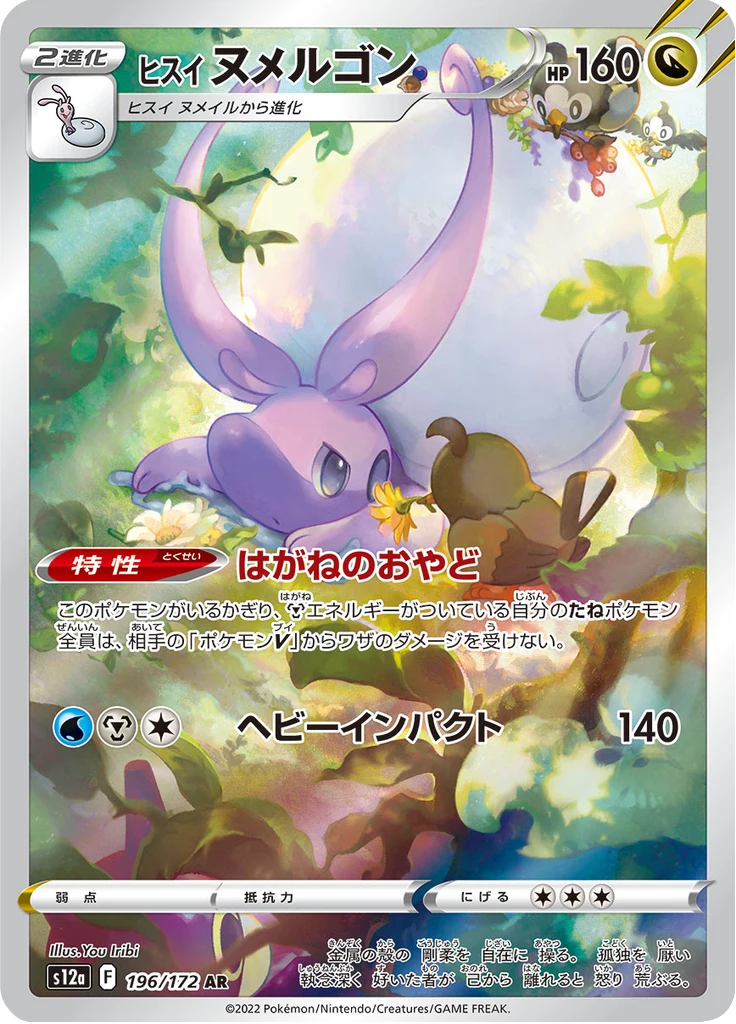
Hisuian Goodra AR 196/172 VSTAR Universe S12a
Hisuian Goodra 196/172 AR — VSTAR Universe (S12a)

Seven months after Dark Phantasma, Hisuian Goodra got a reprint in VSTAR Universe (S12a), released December 2, 2022. Card 196/172 brings the base Hisuian Goodra back as an alternate-rarity (AR) card in a new illustration, distinct from the Dark Phantasma originals.

VSTAR Universe was a large, mixed-set release that reprinted alternate-art cards from across several earlier sets in one box, which is why this Goodra reprint sits alongside cards that originally debuted elsewhere. If you’re assembling every Hisuian Goodra printing rather than just the Dark Phantasma run, this card is the one additional piece.

Because 196/172 is a reprint rather than a new illustration tied to one of the Dark Phantasma alternate-art cards, it functions as a separate entry point on its own — you don’t need any of the five Dark Phantasma printings to complete it, and it doesn’t complete a set that requires them either. Collectors who want “one of each Hisuian Goodra set” rather than “every printing” sometimes treat 196/172 as optional for that reason, though it’s still part of the verified sequence above.

Which Tier Should You Chase?

If your goal is simply to own a Goodra or Hisuian Goodra card, the base-rarity printings are the easiest target — Goodra 060/080, Hisuian Goodra 055/071, and Hisuian Goodra V 056/071 are all standard R/RR holofoils without the full-art treatment, sitting below the SR, RRR, and HR tiers covered next.

If you’re after the alternate-art versions specifically, the two to compare are Hisuian Goodra V 082/071 (SR) and Hisuian Goodra VSTAR 091/071 (HR). Both use full-bleed illustrations rather than the standard card frame, but they sit at different rarity tiers within Dark Phantasma, with 091/071 catalogued at the higher of the two. And if completism across every confirmed printing is the goal, the VSTAR Universe reprint (196/172) is the one extra card you’ll need beyond Dark Phantasma’s five and the 2014 XY2 original.

None of this is a claim about resale value — we don’t have verified market pricing for any of these seven cards as individual singles, only for the two booster boxes below. Treat rarity tier as a guide to how a card looks and how it was inserted into packs, not as a promise about what it’s worth.

How to Collect Goodra Cards

None of the seven printings above are showing as in-stock single cards in our current inventory snapshot. The most direct route to pulling one yourself is sealed product from the two sets that contain them:

Each sealed booster box contains multiple packs, so a single box gives you several chances at pulling the lower-rarity R and RR Hisuian Goodra cards, even though the SR, RRR, and HR tiers aren’t guaranteed in any individual box. That’s a structural point about how Japanese booster boxes are built, not a claim about how often any specific card appears — we don’t have verified insertion data for these particular cards.

If you’re specifically after a PSA-graded copy of any Hisuian Goodra card, the same Quick Order route applies — request a quote via our Quick Order page. PSA independently determines authenticity and grade; we don’t make grading claims on ungraded stock.

For a wider view of what other Dragon-type Japanese cards look like across sets, our Dragonite cards guide and Garchomp cards guide cover similarly structured printing histories, including their own base-to-alternate-art rarity progressions.

Where to Buy

We ship Japanese sealed product out of Tokyo with tracked delivery. Dark Phantasma is the set to target if your goal is the full five-card Hisuian Goodra run in one box; the VSTAR Universe box is the pickup for collectors who also want the 196/172 reprint alongside its wider mixed-set checklist.

Shop This Set
S10A Dark Phantasma Booster Box (Japanese)
Currently listed at ¥28,000 (~$176)
Ships from Tokyo · Tracked delivery

View Product →

For the deeper card-by-card breakdown of everything Dark Phantasma pulls, see our S10a Dark Phantasma complete card list and Dark Phantasma best cards breakdown, or our dedicated Dark Phantasma booster box buying guide. The full checklist by set is also on our S10a set hub page and S12a VSTAR Universe set hub page.

Chasing PSA-graded singles across other Japanese Pokemon lines? Browse our full PSA 10 card list, or request a quote via our Quick Order page for anything not currently listed.

Veelgestelde vragen

How many Goodra cards are there in Japanese sets?

Seven verified printings: one standard-form Goodra from Wild Blaze (XY2, 2014), five Hisuian Goodra cards from Dark Phantasma (S10a, 2022), and one Hisuian Goodra AR reprint from VSTAR Universe (S12a, 2022).

What’s the difference between Goodra and Hisuian Goodra cards?

Standard Goodra only has one confirmed Japanese printing, 060/080 from Wild Blaze (2014). Every other Goodra card in this guide is the Hisuian regional form, all from 2022 sets.

Which Goodra card is the rarest?

Among the printings catalogued by Limitless TCG as of August 2026, Hisuian Goodra VSTAR 091/071 (Hyper Rare) from Dark Phantasma sits at the top of the rarity tiers verified for this line.

Which booster box has all five Hisuian Goodra cards?

Dark Phantasma (S10a). The base Hisuian Goodra, Hisuian Goodra V (RR and SR), and Hisuian Goodra VSTAR (RRR and HR) all come from that single set.

Can I buy a Goodra single card directly?

Single Goodra cards aren’t currently showing in our stock snapshot. You can request a quote for any of the seven printings via our Quick Order page, or buy the Dark Phantasma or VSTAR Universe booster boxes that contain them.

Rob Lucci One Piece Kaarten: Alle Prints en Gids

Rob Lucci has two Leader cards, a Super Rare with three separate parallel treatments, and a starter-deck Common — and none of that is obvious from a single search on a card marketplace.

Rob Lucci is a longtime One Piece antagonist introduced as an assassin for the World Government’s Cipher Pol Number 9 (CP9), first appearing during the Water Seven and Enies Lobby storyline. In the One Piece Card Game, he has been printed across six different products spanning main sets, a starter deck, and an extra booster, with nine individually verified card entries between them.

What makes his print pool worth mapping out is how it’s structured. Unlike characters who get one or two cards per set, Rob Lucci shows up in three different rarity tiers within a single release (OP03 Pillars of Strength), gets a second Leader printing four sets later (OP07), and picks up variant treatments — Alternate Art, SP parallels, Full Art, and promo-exclusive versions — on nearly every card he appears on. That spread makes it easy to end up chasing the wrong printing if you’re only going off a card number without the set context.

This guide walks through every confirmed Rob Lucci printing — where it comes from, what rarity it sits at, what variant treatments exist, and which of our current Japanese booster boxes carry it — using only data confirmed against Limitless TCG’s card database.

Key Takeaways

Rob Lucci has 9 verified printings across 6 products: OP03 Pillars of Strength, OP05 Awakening of the New Era, OP07 500 Years in the Future, OP09 Emperors in the New World, the ST29 Egghead starter deck, and the EB04 Adventure on Kami’s Island extra booster. He has two Leader cards (OP03-076 and OP07-079) and two Super Rares (OP03-092 and OP05-093). Several of his printings are inside sealed Japanese boxes from OP-03, OP-05, and OP-09.

9
Verified Printings

2
Leader Cards

6
Products Featuring Lucci

CP9
Organization

Card data verified against Limitless TCG’s individual card pages as of August 2026. Prices shown are our own listed prices for sealed Japanese booster boxes, converted at ¥159/USD.

Every Rob Lucci Printing at a Glance

As catalogued by Limitless TCG, Rob Lucci has nine individually verified printings:

Card # Rarity Set Notes
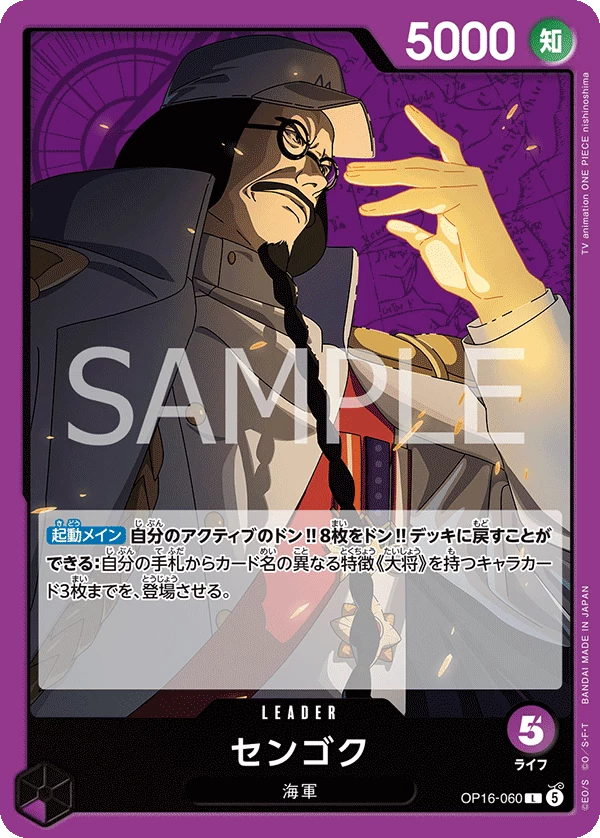
OP03-076 Leader OP03 — Pillars of Strength Base + Alternate Art parallel
OP03-071 Rare OP03 — Pillars of Strength Base printing
OP03-092 Super Rare OP03 — Pillars of Strength Base + Alternate Art + SP parallel
OP05-093 Super Rare OP05 — Awakening of the New Era Base + SR variant + Alternate Art + Illustration Box EX promo (4 treatments)
OP07-079 Leader OP07 — 500 Years in the Future Base + Anime 25th Collection promo parallel
OP07-093 Rare OP07 — 500 Years in the Future Base printing
OP09-038 Common OP09 — Emperors in the New World Base printing, CP9 affiliation text
ST29-013 Common ST29 — Egghead starter deck Base + Full Art parallel
EB04-048 Super Rare EB04 — Adventure on Kami’s Island Base + Alternate Art parallel

Three of those nine come from a single set — OP03 Pillars of Strength — which is also the only set where Lucci appears as a Leader, a Rare, and a Super Rare all at once. The rest are spread across two more main sets, a starter deck built for a specific archetype, and an extra booster.

Looking at the spread by product type: six of the nine printings come from main numbered sets (OP03, OP05, OP07 x2, OP09), one from a starter deck (ST29), and one from an extra booster (EB04). Main-set printings are generally the easiest to source through sealed product, since a full booster box gives you a shot at everything in that set’s checklist. Starter deck and extra booster printings work differently — those products are sold as fixed decks or smaller booster runs rather than randomized main-set boxes, so they don’t carry the same box-opening dynamic.

The Two Rob Lucci Leader Cards

Rob Lucci has been printed as a Leader twice, three sets apart.

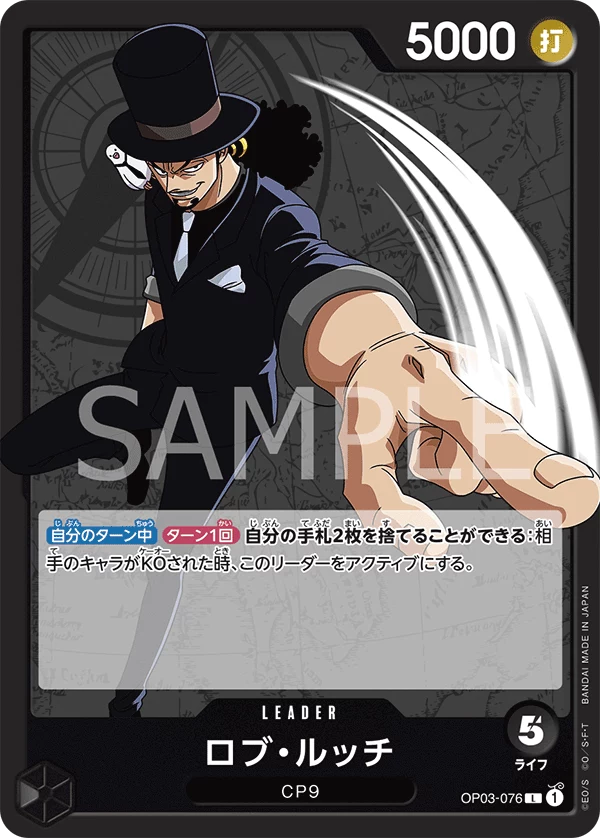
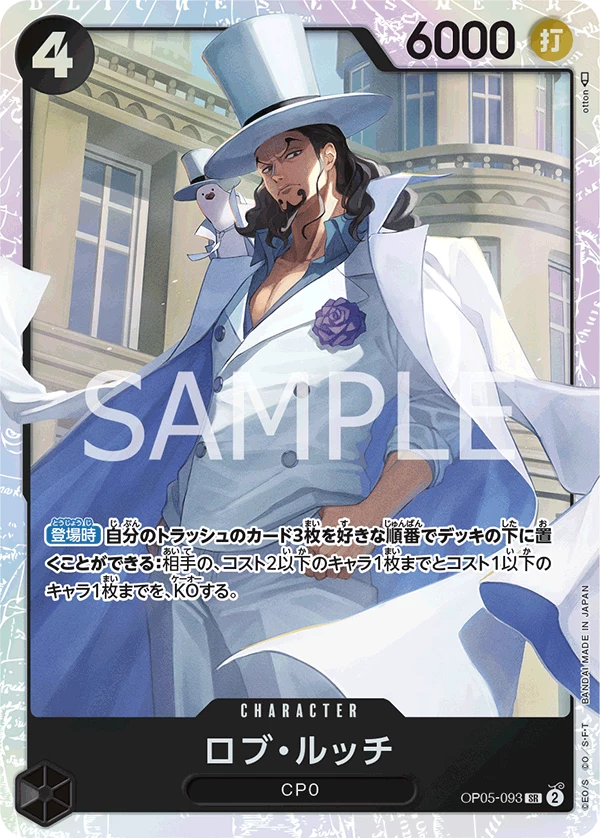
Rob Lucci OP03-076 Leader Pillars of Strength

Rob Lucci — OP03-076 Leader (Pillars of Strength)

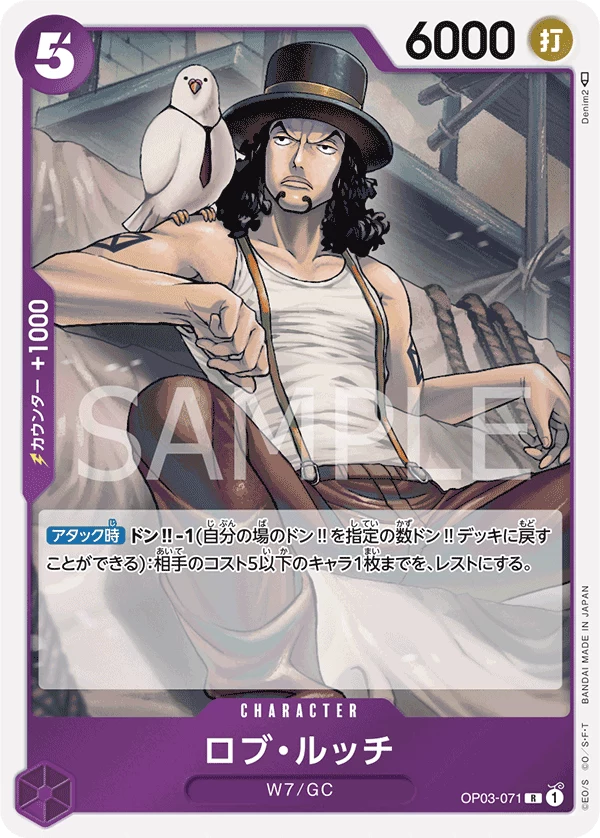
Rob Lucci OP03-071 Rare Pillars of Strength

Rob Lucci — OP03-071 Rare (Pillars of Strength)

OP03-076 was his first Leader printing, released with the CP9-themed Pillars of Strength set and carrying an Alternate Art parallel alongside the base card. It’s the Leader most collectors associate with him, since it launched alongside the Rare (OP03-071) and Super Rare (OP03-092) versions from the same set.

OP07-079 is his second Leader, printed in 500 Years in the Future. This one also has a promo parallel released as part of the Anime 25th Collection, its only additional treatment beyond the standard base card. A non-Leader Rare from the same set, OP07-093, was printed alongside it.

All three OP03 printings — the Leader, the Rare, and the Super Rare — come out of the same booster box, so it’s the single most efficient way to target multiple Lucci cards from one product.

Shop This Set
OP-03 Pillars of Strength Japanese Booster Box — Damaged Box
Contains the OP03-076 Leader, OP03-071 Rare, and OP03-092 Super Rare
Listed at ¥17,510 (~$110) on August 25, 2026

View Product →

The Super Rares: OP03-092 and OP05-093

Among Rob Lucci’s verified printings, Super Rare is the highest rarity tier he reaches, as catalogued by Limitless TCG. Two main-set cards and one extra-booster card share that tier.

Rob Lucci OP05-093 Super Rare Awakening of the New Era

Rob Lucci — OP05-093 Super Rare (Awakening of the New Era)

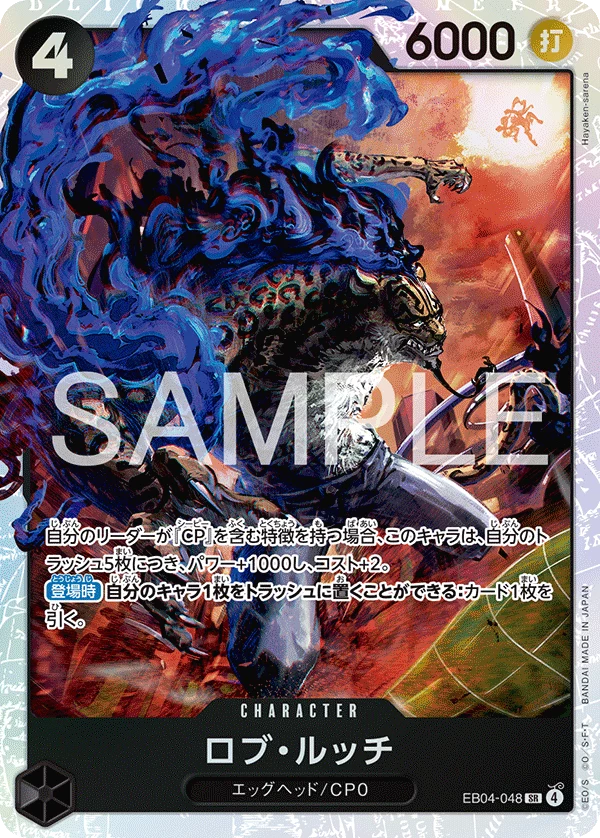
Rob Lucci EB04-048 Super Rare Adventure on Kami's Island

Rob Lucci — EB04-048 Super Rare (Adventure on Kami’s Island)

OP03-092 (Pillars of Strength) is the earliest of the three, printed with a base version, an Alternate Art parallel, and a further SP-marked parallel carrying an “Awakening of the New Era” print notation.

OP05-093 is the most heavily variant Rob Lucci card confirmed so far — a base Super Rare, a second SR-tier print, an Alternate Art parallel, and a fourth variant distributed through an Illustration Box EX promo. It’s part of the OP05 Awakening of the New Era set.

EB04-048 comes from the EB04 Adventure on Kami’s Island extra booster, printed as a base Super Rare with its own Alternate Art parallel. Extra boosters run smaller print pools than main numbered sets, which is worth knowing if you’re trying to track this one down specifically.

Telling the Parallels Apart

Several of these Super Rares have three or more printings of the same card number. Check the card’s border treatment and any promo stamp in the corner before assuming two listings are the identical print — the base, SR variant, Alternate Art, and promo versions of OP05-093 are four separate items.

Understanding Rob Lucci’s Variant Types

Almost every Rob Lucci card comes with at least one additional print treatment beyond the base version, and the terminology isn’t always consistent from card to card. Here’s what each label appearing in the printings table above actually refers to:

  • Alternate Art — a full replacement illustration on the same card number, distinct from the standard base artwork. Appears on OP03-076, OP03-092, OP05-093, and EB04-048.
  • SP parallel — a special-marked parallel print, seen on OP03-092, carrying an “Awakening of the New Era” print notation despite belonging to the OP03 set.
  • Full Art — edge-to-edge artwork with no standard card frame border, seen on ST29-013.
  • Promo parallels — versions distributed outside standard booster packs, through products like the Illustration Box EX (OP05-093) or the Anime 25th Collection (OP07-079).

None of these variants change the underlying card number — OP05-093 stays OP05-093 whether it’s the base print, the Alternate Art, or the Illustration Box EX promo. The print treatment is what separates otherwise identical listings, so it’s worth confirming which one you’re looking at before comparing two copies.

The clearest example of how much this matters is OP05-093, which has four confirmed treatments on a single card number: the base Super Rare, a second SR-tier print, an Alternate Art parallel, and an Illustration Box EX promo variant. A listing that just says “OP05-093” without specifying which of the four it is leaves out the single most important detail for anyone trying to match it against a specific print. The same logic applies to OP03-092, which carries a base print, an Alternate Art parallel, and the SP-marked parallel discussed above — three separate items sharing one card number.

Commons and Entry-Level Prints

Not every Rob Lucci card sits at Rare or above. Two Commons round out the list.

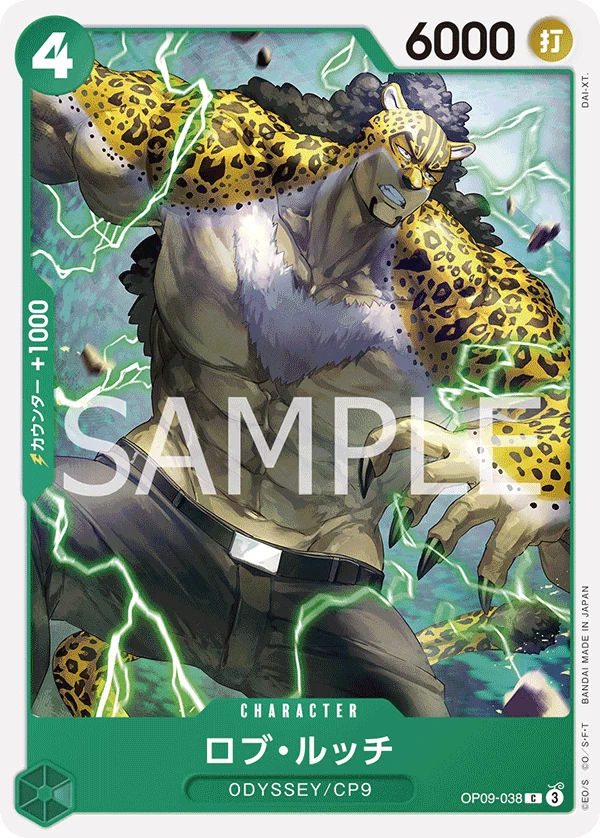
Rob Lucci OP09-038 Common Emperors in the New World

Rob Lucci — OP09-038 Common (Emperors in the New World)

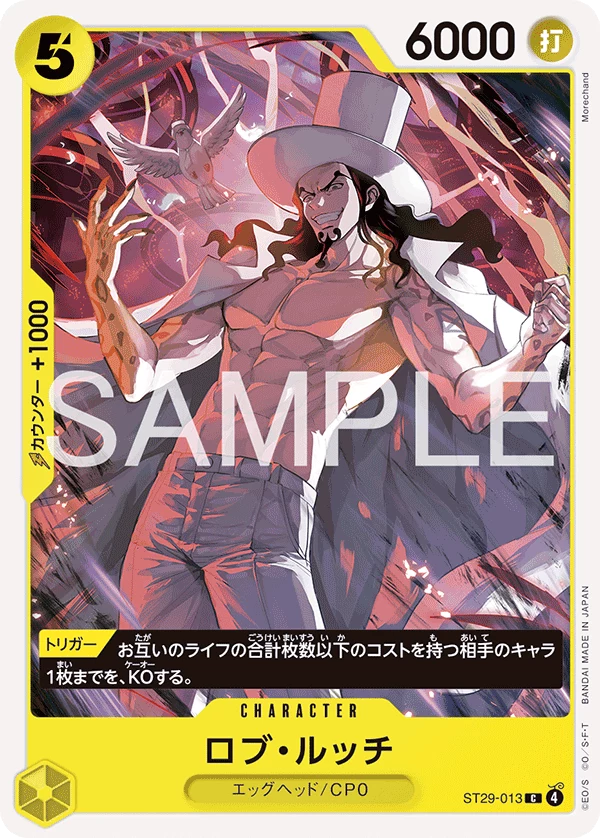
Rob Lucci ST29-013 Common Egghead Starter Deck

Rob Lucci — ST29-013 Common (Egghead Starter Deck)

OP09-038 is a green-aligned Common from Emperors in the New World, printed with CP9 affiliation text and a low deckbuilding cost. It’s part of the OP09 set, which also carries the box anchor below.

ST29-013 comes from the ST29 Egghead starter deck, printed as a base Common with an accompanying Full Art parallel. Starter deck Commons are typically the most accessible entry point into a character’s card pool, and this is Rob Lucci’s.

Shop This Set
OP-09 Emperors in the New World Japanese Booster Box — Damaged Box
Contains the OP09-038 Common
Listed at ¥22,145 (~$139) on August 25, 2026

View Product →

How to Collect Rob Lucci Cards from Japan

The most direct route to any of the nine printings above is sealed Japanese booster boxes from the sets that contain them — each box gives you a shot at every card printed in that set, Rob Lucci included.

Of the six products with a verified Lucci printing, three have a listed box on our site:

  • OP-03 Pillars of Strength — contains the Leader (OP03-076), Rare (OP03-071), and Super Rare (OP03-092). Listed at ¥17,510 (~$110) on August 25, 2026.
  • OP-05 Awakening of the New Era — contains the Super Rare (OP05-093). Listed at ¥64,890 (~$408) on August 25, 2026.
  • OP-09 Emperors in the New World — contains the Common (OP09-038). Listed at ¥22,145 (~$139) on August 25, 2026.

If you’re specifically after OP07-079, OP07-093, ST29-013, or EB04-048, request a quote via our Quick Order page.

Buying by the box rather than hunting for a single is also the more practical route when a character’s cards aren’t individually stocked anywhere. A booster box gives you every card in that set’s checklist rather than one specific number, so it works whether your goal is the Rob Lucci printing specifically or a broader set of pulls from the same release. It’s also the only way to get an unopened copy of any variant that was only ever distributed inside sealed packs, rather than through a standalone promo product.

If you collect other characters from the same broader cast, our Kaido card guide and Whitebeard card guide follow the same printing-by-printing format.

Where to Buy

We ship Japanese sealed product worldwide from Tokyo with tracked delivery. For Rob Lucci specifically, the OP-03 box is the highest-density option since it carries three of his nine verified printings in one product. The OP-05 and OP-09 boxes below cover his remaining two main-set appearances, at the Super Rare and Common tiers respectively.

Shop This Set
OP-05 Awakening of the New Era Japanese Booster Box — Damaged Box
Contains the OP05-093 Super Rare
Listed at ¥64,890 (~$408) on August 25, 2026

View Product →

For graded singles or other CP9 characters, our Quick Order page is the fastest way to request a quote. Our full graded card catalog is browsable on the PSA 10 card list page.

Veelgestelde vragen

How many Rob Lucci cards exist in the One Piece Trading Card Game?

Based on Limitless TCG’s card database as of August 2026, Rob Lucci appears in nine verified individual printings across six products: OP03 Pillars of Strength, OP05 Awakening of the New Era, OP07 500 Years in the Future, OP09 Emperors in the New World, the ST29 Egghead starter deck, and the EB04 Adventure on Kami’s Island extra booster.

Does Rob Lucci have a Leader card?

Yes, two. OP03-076 from Pillars of Strength was his first Leader printing, and OP07-079 from 500 Years in the Future is a second Leader edition that also has a promo parallel released as part of the Anime 25th Collection.

What is the rarest Rob Lucci card?

Among his verified printings, as catalogued by Limitless TCG as of August 2026, Super Rare is the highest rarity tier Rob Lucci reaches. OP03-092, OP05-093, and EB04-048 are all Super Rares, with OP05-093 carrying the most variants of the three.

Which set has the most Rob Lucci printings?

OP03 Pillars of Strength has the most, with three verified printings: the Leader card (OP03-076), a Rare (OP03-071), and a Super Rare (OP03-092), as catalogued by Limitless TCG.

Does OP05-093 have more than one printing?

Yes. OP05-093 has four confirmed treatments on the same card number: a base Super Rare, a second SR-tier print, an Alternate Art parallel, and an Illustration Box EX promo variant. They’re separate items despite sharing one card number.

Heatran-kaartengids: alle geverifieerde Japanse uitgaven

Heatran is a Legendary Pokemon best known for its molten-iron body and volcanic den, and its Japanese card history stretches across three different eras of the TCG — from a 2017 Sun & Moon Rare to a Radiant Rare, a GX, a VMAX, and a brand-new 2026 Mega-era printing. That’s six mechanics-spanning printings across nine years, without ever landing a full alternate-art secret rare, which makes the printing history itself worth laying out clearly.

This guide catalogues every verified Japanese Heatran printing we could confirm card-by-card against Limitless TCG, tells you which set each one comes from, and points you to the sealed boxes we currently carry out of Tokyo. We deal in Japanese sealed product and singles every day, so where a card isn’t in our stock right now, we say so plainly rather than implying availability that doesn’t exist.

Key Takeaways

Heatran has six verified Japanese printings spanning 2017’s Ultra Sun through 2026’s Abyss Eye, including a VMAX (Space Juggler, Triple Rare), a GX (GG End), and a Radiant Rare (Battle Region). None of the six single cards are in stock as of this snapshot — every printing traces back to a booster box, and four of those boxes are currently listed in our inventory.

6
Verified JP Printings

RRR
Rarest Slot — VMAX

¥7,820
Entry-Point Box (Abyss Eye)

2017–26
Ultra Sun to Abyss Eye

Card numbers and rarities are verified directly against individual Limitless TCG card pages as of August 2026. Prices shown are our own listed prices for sealed booster boxes, converted at ¥159/USD. We do not currently stock any Heatran single card, so no single-card pricing is quoted anywhere in this guide.

Every Verified Heatran Printing

Six Japanese Heatran cards have been individually confirmed for this guide, listed chronologically:

Kaart Set Number Rarity JP Release
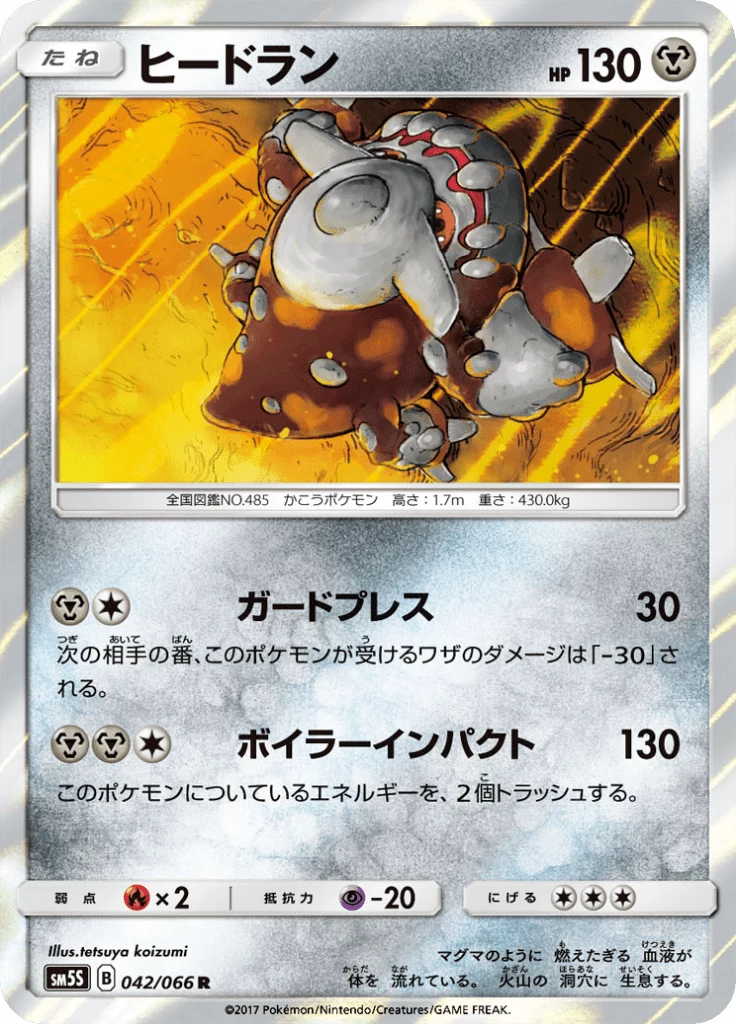
Heatran Ultra Sun (SM5S) 042/066 R Dec 8, 2017
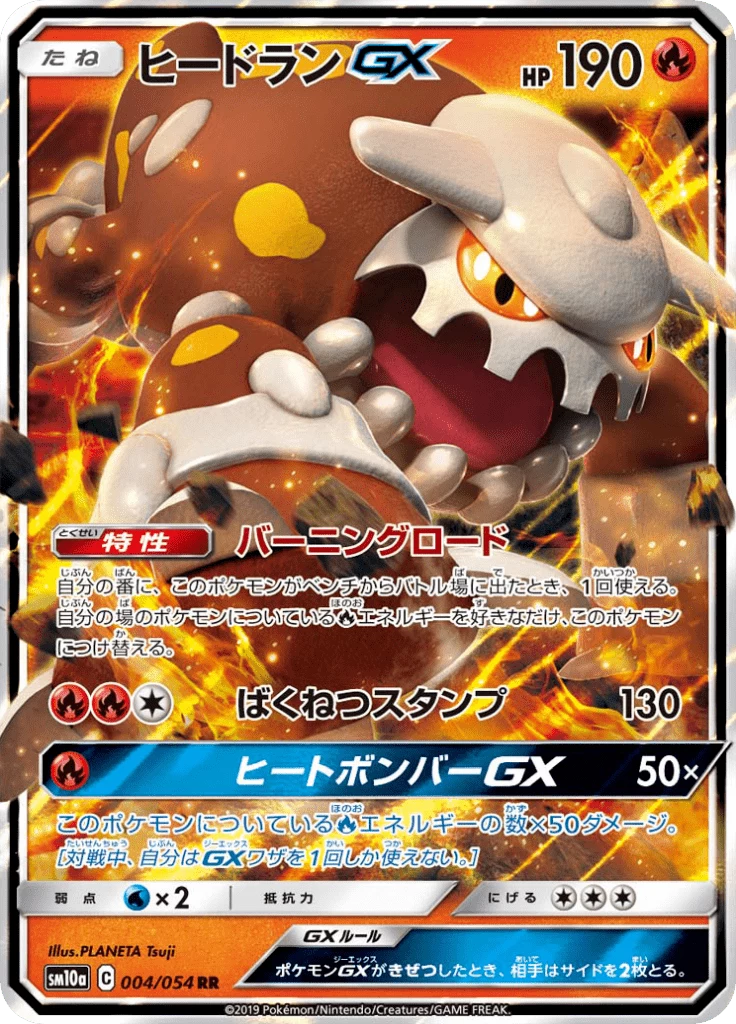
Heatran GX GG End (SM10a) 004/054 RR Apr 5, 2019
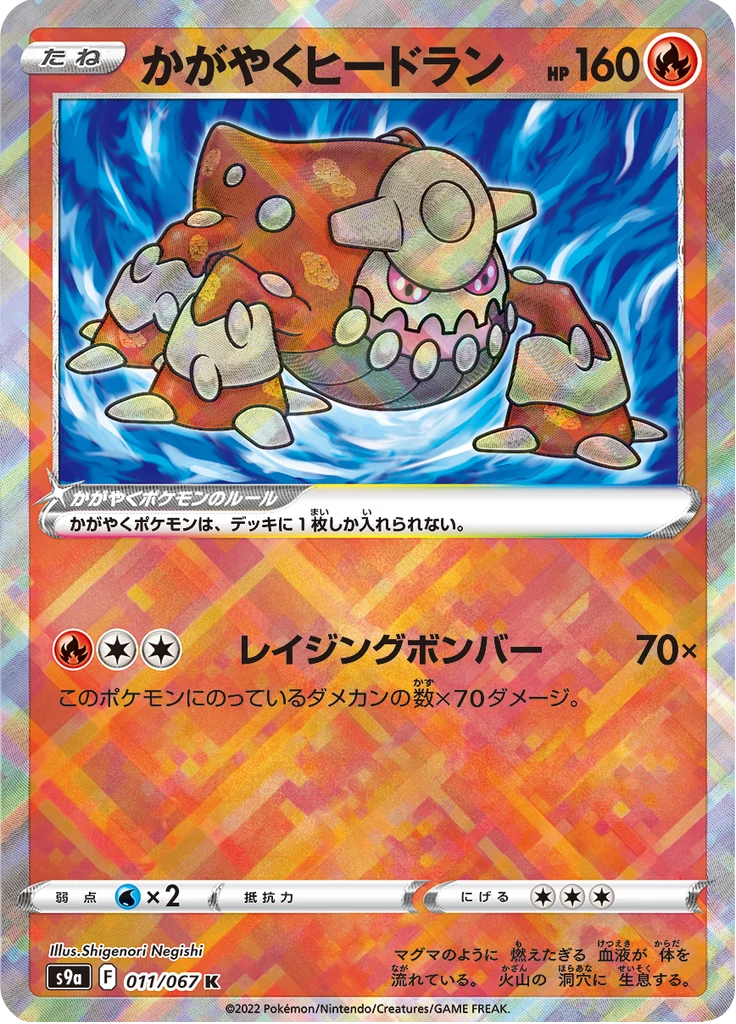
Radiant Heatran Battle Region (S9a) 011/067 K (Radiant Rare) Feb 25, 2022
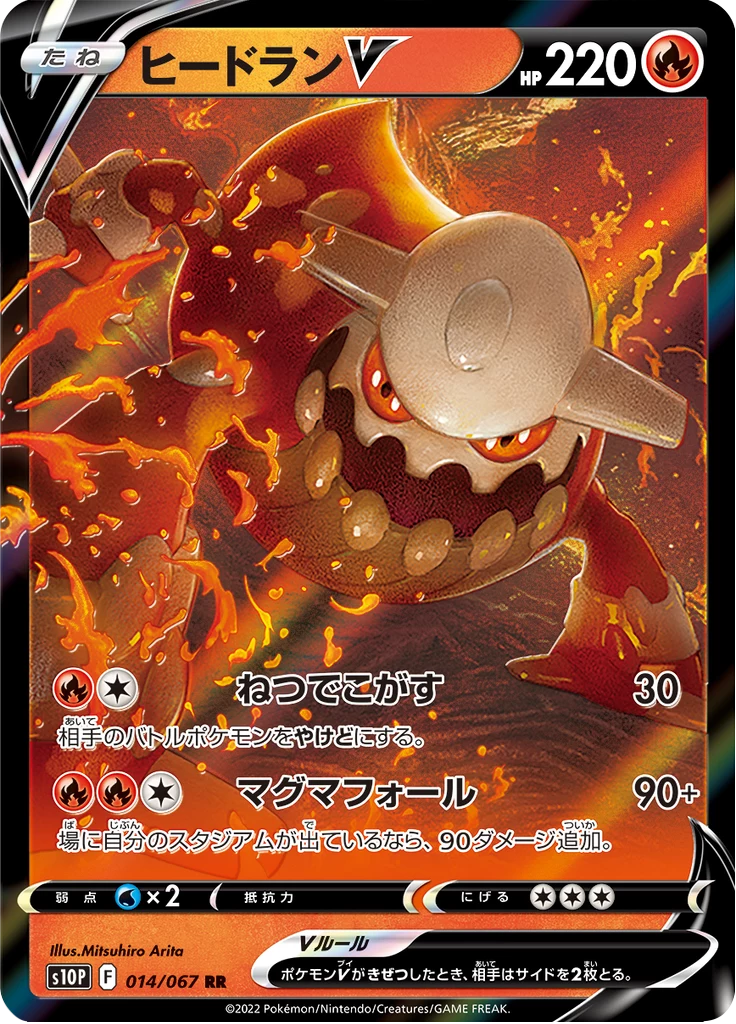
Heatran V Space Juggler (S10P) 014/067 RR Apr 8, 2022
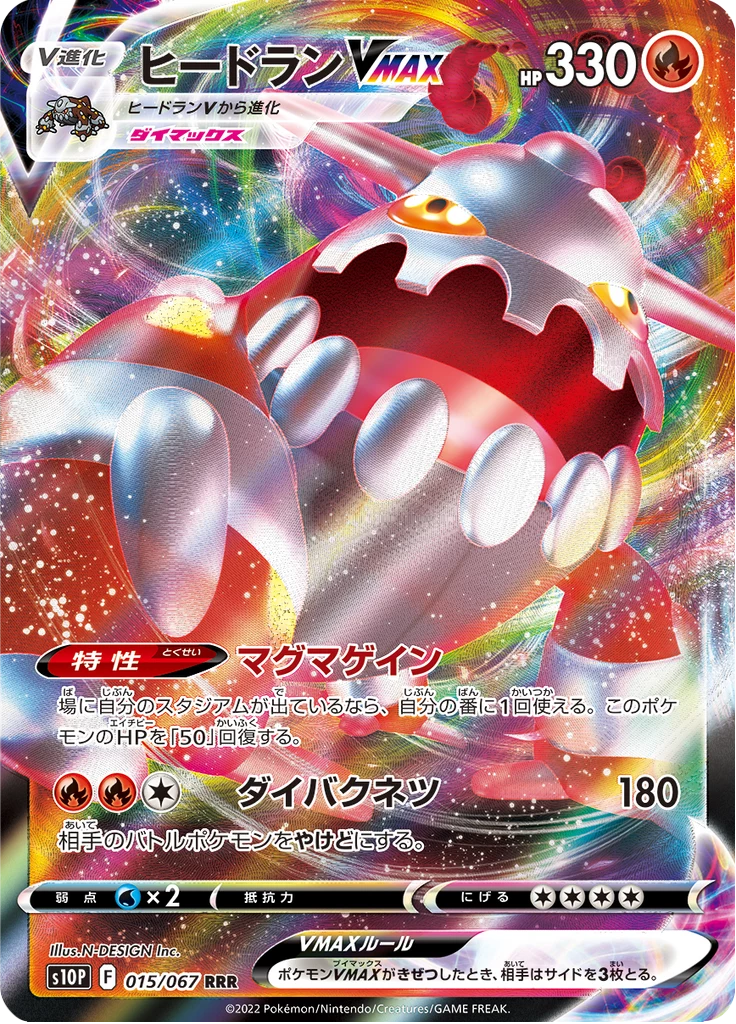
Heatran VMAX Space Juggler (S10P) 015/067 RRR (Triple Rare) Apr 8, 2022
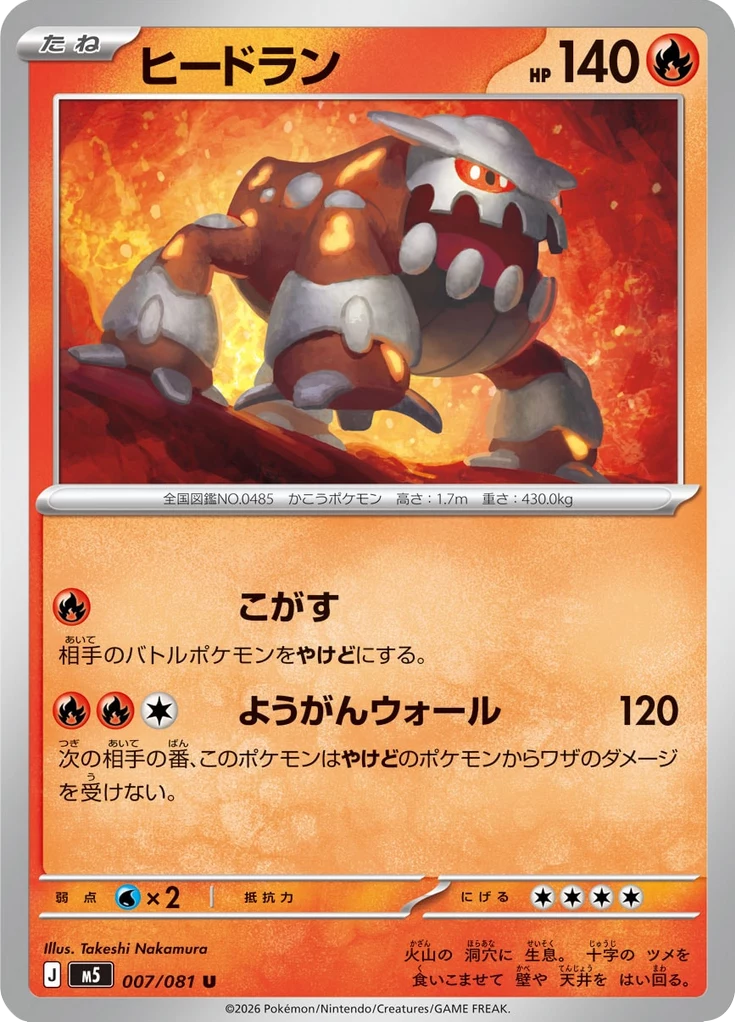
Heatran Abyss Eye (M5) 007/081 U May 22, 2026

Every one of these six was checked against its own individual Limitless TCG card page rather than pulled from a general checklist, so the numbers and rarities above are locked in. An older Team Plasma-era Heatran EX from a 2012 set does exist in secondary-market listings, but we could not independently verify its card number against Limitless, so it’s left out of this guide entirely.

What stands out looking at the six side by side is how many different rarity mechanics Heatran has touched without ever landing a full alternate-art secret rare or a Special Art Rare. It’s been a plain Rare, an Uncommon, a GX, a Radiant Rare, a V, and a Triple Rare VMAX — six different treatments across five sets, but never the kind of gold-bordered or oversized secret-rare slot that drives the highest-end chase cards in modern Japanese sets. That makes this a character whose collecting appeal is spread across variety rather than concentrated in one marquee printing.

Quick Identification

Card number and set code are the fastest way to tell these apart at a glance: 042/066 is the 2017 Ultra Sun Rare, 004/054 is the 2019 GX, 011/067 with a K marking is the 2022 Radiant Rare, 014/067 and 015/067 are the 2022 Space Juggler V and VMAX pair, and 007/081 is the 2026 Abyss Eye Uncommon.

Heatran V & VMAX: Space Juggler

The Space Juggler (S10P) set, released April 8, 2022, is the only set to give Heatran the full V-to-VMAX treatment, and it’s the highest rarity slot Heatran has occupied in the Japanese TCG.

Heatran V 014/067 RR Space Juggler

Heatran V 014/067 RR

Heatran VMAX 015/067 RRR Space Juggler

Heatran VMAX 015/067 RRR (Triple Rare)

The V at 014/067 sits at a standard RR slot, but the VMAX at 015/067 is a Triple Rare (RRR) — the rarest classification any Heatran card has carried in this guide’s verified list. Both come from the same 88-card set, so a Space Juggler box is the direct route to either.

V and VMAX pairs work as a linked mechanic in the Sword & Shield era: the V card is a stronger single-Prize Pokemon on its own, while the VMAX is its Gigantamax-style evolution, printed as a separate, higher-rarity card that requires the V to be in play first to use in a deck. Collectors tend to pursue the two as a set precisely because they’re mechanically paired rather than independent prints of the same character, which is part of why the VMAX carries the steeper rarity slot despite depicting the same Pokemon.

Neither the V nor the VMAX single is currently in our inventory. If you’re chasing either card specifically, you can request a quote via our Quick Order page, or open sealed Space Juggler product yourself and pull straight from the 88-card pool.

Heatran GX: GG End

Heatran GX 004/054 RR GG End
Heatran GX 004/054 RR, GG End (SM10a)

Before V/VMAX existed, GX was the top mechanic in the Sun & Moon era, and Heatran got its GX form in GG End (SM10a), released April 5, 2019. It sits at 004/054, RR rarity — an early, low card number that places it near the front of the set’s rare run.

This is the only GX-form Heatran verified in this guide. GX cards predate the V/VMAX system covered above — they were the top single-Pokemon mechanic in the Sun & Moon era before Sword & Shield replaced GX with V, and every GX card also carries a signature “GX attack” that can only be used once per game, which is part of what kept the mechanic popular with players as well as collectors.

Sealed GG End booster boxes are one of the pricier options in our current lineup for this character. If GX-era cards specifically are what you’re after, this is the set to focus on for Heatran — it’s the only one that carries that mechanic for this character.

Radiant Heatran: Battle Region

Radiant Heatran 011/067 K Battle Region
Radiant Heatran 011/067 K (Radiant Rare), Battle Region (S9a)

Radiant Pokemon were a short-lived mechanic limited to one Radiant card per deck, and Heatran got the treatment in Battle Region (S9a), released February 25, 2022. It’s numbered 011/067 with a K rarity marking (Radiant Rare) — a distinct slot from the regular holo and secret-rare tiers in the same set.

Radiant cards from this window of the TCG carry a full-art, gold-bordered treatment that’s visually distinct from a standard V or GX card, which makes this printing easy to identify at a glance if you’re sorting a collection. The one-per-deck deckbuilding restriction that came with Radiant Pokemon also meant fewer Radiant slots existed across the format overall compared to V or GX, since only a handful of Radiant Pokemon were printed each set.

Battle Region released the same year as Space Juggler, so 2022 was Heatran’s busiest single year across this guide — two different printings, two different mechanics, within a few months of each other.

Heatran Across the Eras: Ultra Sun to Abyss Eye

Outside of the V/VMAX, GX, and Radiant slots, Heatran has also appeared as a standard non-Pokemon-EX card twice, nine years apart.

Heatran 042/066 R Ultra Sun

Heatran 042/066 R (Ultra Sun)

Heatran 007/081 U Abyss Eye

Heatran 007/081 U (Abyss Eye)

The earliest printing verified for this guide is Ultra Sun (SM5S), released December 8, 2017, where Heatran sits at 042/066, Rare. It’s the oldest card in this lineup, from a 72-card set at the start of the Sun & Moon era, and it predates the V, VMAX, and Radiant mechanics covered above by several years.

Nine years later, Heatran returns in Abyss Eye (M5), released May 22, 2026 — the current Mega-era set and the most recent printing in this guide. It’s a straightforward Uncommon at 007/081 from an 81-card set, and it’s the printing whose booster box is currently listed at the lowest price of the four covered in this guide.

Placed side by side, these two cards bookend the entire guide: the 2017 Rare shows Heatran before any of the GX, Radiant, V, or VMAX treatments existed, while the 2026 Uncommon shows the character in the current Mega era, printed at a common collecting rarity rather than a chase slot. Neither is the flashiest card in this guide, but together they mark nine years of continuous appearances across format changes.

Which Printing to Chase, by Mechanic

Since none of the six single cards are currently in stock, the more useful question for most collectors isn’t “which is cheapest” but “which mechanic am I actually after.” Here’s how the six break down by what they represent in the TCG’s rules:

  • Classic Rare / Uncommon — Ultra Sun 042/066 R (2017) and Abyss Eye 007/081 U (2026). No special mechanic, just a standard holo or non-holo slot. Best for collectors who want the character across the widest possible timespan without hunting rarer treatments.
  • GX — GG End 004/054 RR (2019). The only GX-form Heatran verified here, and the era’s now-retired top single-Pokemon mechanic.
  • Radiant Rare — Battle Region 011/067 K (2022). A short-lived, one-per-deck mechanic with a distinct full-art gold treatment.
  • V / VMAX pair — Space Juggler 014/067 RR and 015/067 RRR (2022). The only linked V-to-VMAX progression Heatran has received, and the highest rarity slot (Triple Rare) in this guide.

Collectors building a complete Heatran run typically treat the V and VMAX as a matched pair rather than two separate targets, which effectively narrows the list to four distinct collecting goals covering all six verified cards.

How to Collect Heatran Cards

Because none of the six verified Heatran singles are in our current inventory, the practical way to pursue any of them is opening sealed product from the source set. Here’s what we currently have listed:

Box Contains Our price
Space Juggler Booster Box Heatran V & VMAX currently listed at ¥15,750 (~$99)
GG End Booster Box Heatran GX currently listed at ¥105,000 (~$660)
Battle Region Booster Box Radiant Heatran currently listed at ¥12,810 (~$81)
Abyss Eye Booster Box Heatran (007/081 U) currently listed from ¥7,820 to ¥9,200 (~$49–$58)

We don’t currently list a Ultra Sun (SM5S) booster box. For that printing, request a quote via our Quick Order page.

A few things worth knowing before you pick a box: each of the four we carry is a different era and price bracket, so the decision usually comes down to which specific card you want rather than which box is “best.” The Abyss Eye box is both the lowest-priced entry point and the most recently released set of the four. The GG End box sits well above the others in our listing. If you’re not chasing one specific printing and just want a Heatran card in hand, starting with the lower-priced current-era box and working up is the more budget-friendly path.

Shop This Set
Space Juggler Booster Box (Japanese)
Source set for Heatran V and VMAX
Ships from Tokyo · Tracked delivery

View Product →

If you’re specifically after Heatran singles — graded or raw — rather than sealed boxes, our Quick Order page is the fastest way to request a quote. On grading: PSA independently determines authenticity and grade.

Where to Buy Heatran Cards from Japan

We ship Japanese sealed product worldwide out of Tokyo with tracked delivery. For Heatran specifically, sealed boxes from Space Juggler, GG End, Battle Region, and Abyss Eye are your direct routes to each printing above.

For full set breakdowns, our set hub pages cover the complete card lists for Space Juggler, GG End, Battle Region, and Abyss Eye. If you’re building out a wider Legendary or GX collection alongside Heatran, our Ultra Beasts cards guide and Gholdengo cards guide cover other characters spanning similar rarity tiers. Graded copies across characters and sets are catalogued on our PSA10 card list hub.

Requests for specific Heatran singles, restocks, or mixed orders across sets all route through our Quick Order page. That’s also the right place to ask about the Ultra Sun box, or about graded copies of any of the six printings above, since none of those are sitting in listed inventory right now.

Veelgestelde vragen

Is there a Heatran VMAX?

Yes — Heatran VMAX, 015/067, Triple Rare (RRR), from Space Juggler (S10P), released April 8, 2022.

Is there a Radiant Heatran?

Yes — Radiant Heatran, 011/067, K rarity (Radiant Rare), from Battle Region (S9a), released February 25, 2022.

Does Heatran appear in the current Mega-era sets?

Yes — Heatran, 007/081, Uncommon, from Abyss Eye (M5), released May 22, 2026.

Is there a Heatran GX?

Yes — Heatran GX, 004/054, RR, from GG End (SM10a), released April 5, 2019.

What is the earliest Heatran printing covered in this guide?

Ultra Sun (SM5S), released December 8, 2017, where Heatran is numbered 042/066 at Rare rarity — the oldest of the six printings independently verified for this guide.

Scarlet ex (SV1S) Complete Card List: All 108 Cards

Scarlet ex (SV1S) was the Japanese Pokemon TCG’s opening move into the Scarlet & Violet era — and it shipped with a secret-tier run that set the template every mainline Japanese expansion since has followed. Twelve Art Rares, ten Secret Rares, five Special Art Rares, and three Ultra Rares, stacked on top of a 78-card base set.

This page is the full card list: every numbered card from the base set through the Ultra Rare energy at the very back of the print run, organized by rarity with both the Japanese and English card names. If you’re trying to figure out exactly what you pulled, or what to look for before you buy, the tables below cover the complete secret tier catalogued by Limitless TCG.

Scarlet ex released alongside its counterpart, Violet ex (SV1V) — the two sets split the Scarlet & Violet debut between them the way earlier Sword & Shield-era version pairs did, and they share several secret-rare Trainer cards with different artwork.

Because this is a card list rather than a pricing report, we’re not walking through market value here — the tables below exist so you can check exactly what number, name, and rarity a given card should have. If you want current secondary-market context for the chase cards, our sibling Scarlet ex best cards guide covers that side separately.

Key Takeaways

Scarlet ex (SV1S) catalogues 108 total cards as of August 2026, with a 30-card secret tier split across four rarities: 12 Art Rare, 10 Secret Rare, 5 Special Art Rare, and 3 Ultra Rare. The set released January 20, 2023. Our sealed booster box is currently listed at ¥11,648 (~$73).

108
Total Catalogued Cards

30
Secret-Tier Cards

78
Base-Set Cards

Jan 2023
JP Release

Prices below are converted at ¥159/USD (August 2026). Card counts are as catalogued by Limitless TCG as of August 2026, not an official Pokemon Company denominator.

Set Overview

Scarlet ex is the Scarlet-version half of the Japanese Pokemon TCG’s Scarlet & Violet debut, released January 20, 2023. It introduced the SV1S/SV1V card-numbering split that Japanese Scarlet & Violet-era sets used going forward, with Koraidon ex as the set’s flagship legendary and Gardevoir ex as its lead chase Pokemon.

Limitless TCG’s index catalogues 108 total rows for the set. Subtracting the 30-card secret tier leaves 78 base-set rows — commons, uncommons, rares, and the like — which lines up with the “/078” denominator printed on the cards themselves (for example, the Gardevoir ex Special Art Rare is numbered 101/078). The secret tier runs from card 079 through card 108, split into four rarities that stack in the order below.

If you’re new to Japanese secret-tier structure, the short version is that every card numbered above the base-set denominator (above 078/078 here) is a secret-tier card, and secret-tier cards are sorted into their own rarities that don’t exist in the base set: Art Rare, Secret Rare, Special Art Rare, and Ultra Rare, in roughly ascending order of scarcity within most Scarlet & Violet-era sets. Scarlet ex is a clean example of that four-tier stack, which makes it a useful reference point if you’re cross-checking a card from a different Japanese set against a similar numbering scheme.

One quirk worth flagging before the tables below: this set reuses the same character across multiple rarities more than most. Gardevoir ex shows up twice (Secret Rare and Special Art Rare), and Koraidon ex shows up three times (Secret Rare, Special Art Rare, and Ultra Rare). If you’re trying to identify a card you pulled, matching the card number to the table is more reliable than matching on character name alone — the small print at the bottom-left corner of a Japanese card, reading “xxx/078,” tells you exactly where it sits in the list below.

That numbering also makes cross-checking a card straightforward if you’re buying secondhand or from a marketplace listing: any card numbered 079/078 through 108/078 is a secret-tier card and should carry one of the four rarities in the tables below, while anything numbered 001/078 through 078/078 belongs to the base set this page doesn’t itemize.

Complete Secret-Tier Kaartenlijst

All 30 secret-tier cards, numbered 079/078 through 108/078, grouped by rarity.

Art Rare (12 cards)

Nr. JP Name EN Name Rarity
079/078 オリーニョ Dolliv Art Rare
080/078 グレンアルマ Armarouge Art Rare
081/078 ウミディグダ Wiglett Art Rare
082/078 ヘイラッシャ Dondozo Art Rare
083/078 ラルトス Ralts Art Rare
084/078 キルリア Kirlia Art Rare
085/078 パピモッチ Fidough Art Rare
086/078 リオル Riolu Art Rare
087/078 メグロコ Sandile Art Rare
088/078 ガケガニ Klawf Art Rare
089/078 ドドゲザン Kingambit Art Rare
090/078 ムックル Starly Art Rare

Secret Rare (10 cards)

Nr. JP Name EN Name Rarity
091/078 ギャラドスex Gyarados ex Secret Rare
092/078 サーナイトex Gardevoir ex Secret Rare
093/078 イダイナキバex Great Tusk ex Secret Rare
094/078 コライドンex Koraidon ex Secret Rare
095/078 ドクロッグex Toxicroak ex Secret Rare
096/078 パフュートンex Oinkologne ex Secret Rare
097/078 ジニア Jacq Secret Rare
098/078 スター団のしたっぱ Team Star Grunt Secret Rare
099/078 博士の研究 Professor’s Research Secret Rare
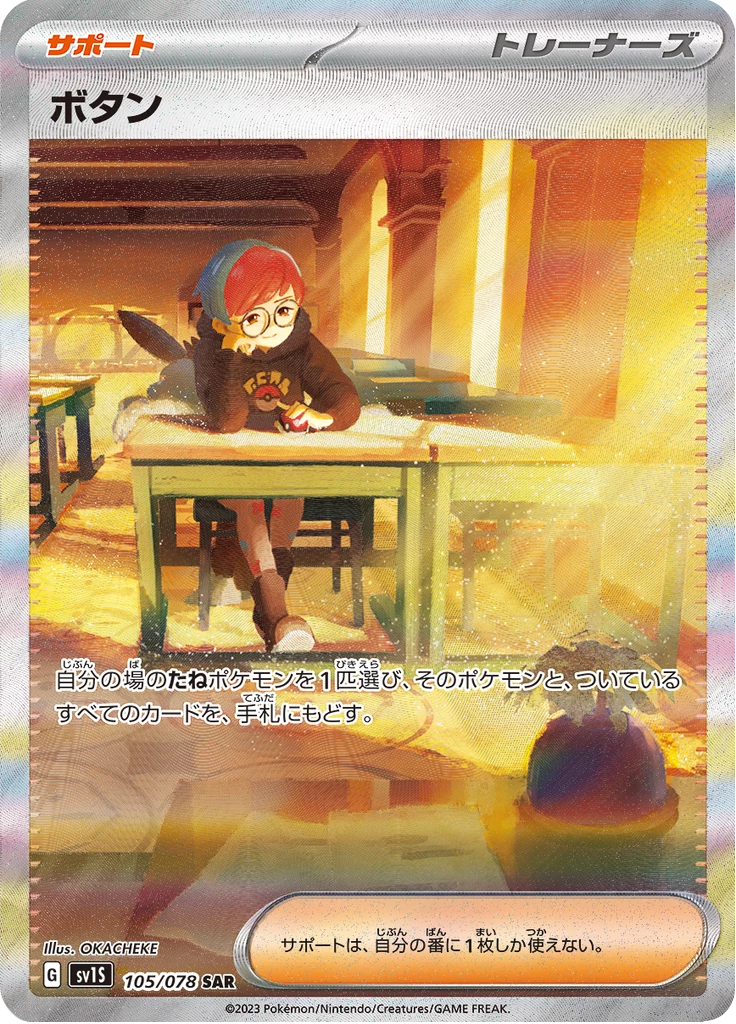
100/078 ボタン Penny Secret Rare

Special Art Rare (5 cards)

Nr. JP Name EN Name Rarity
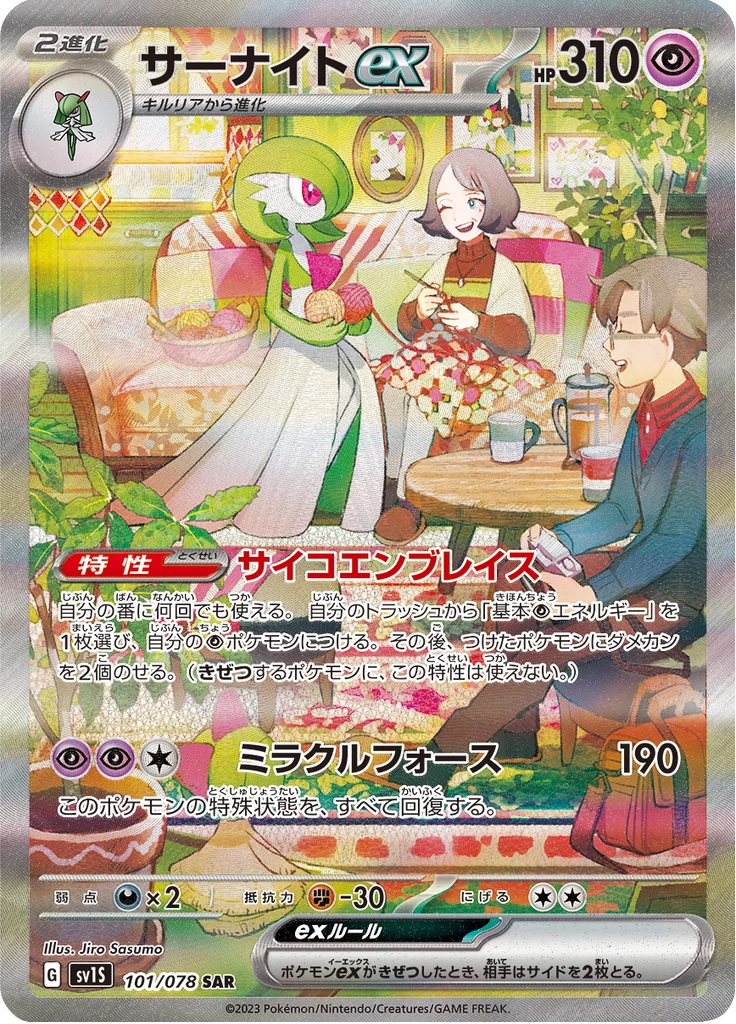
101/078 サーナイトex Gardevoir ex Special Art Rare
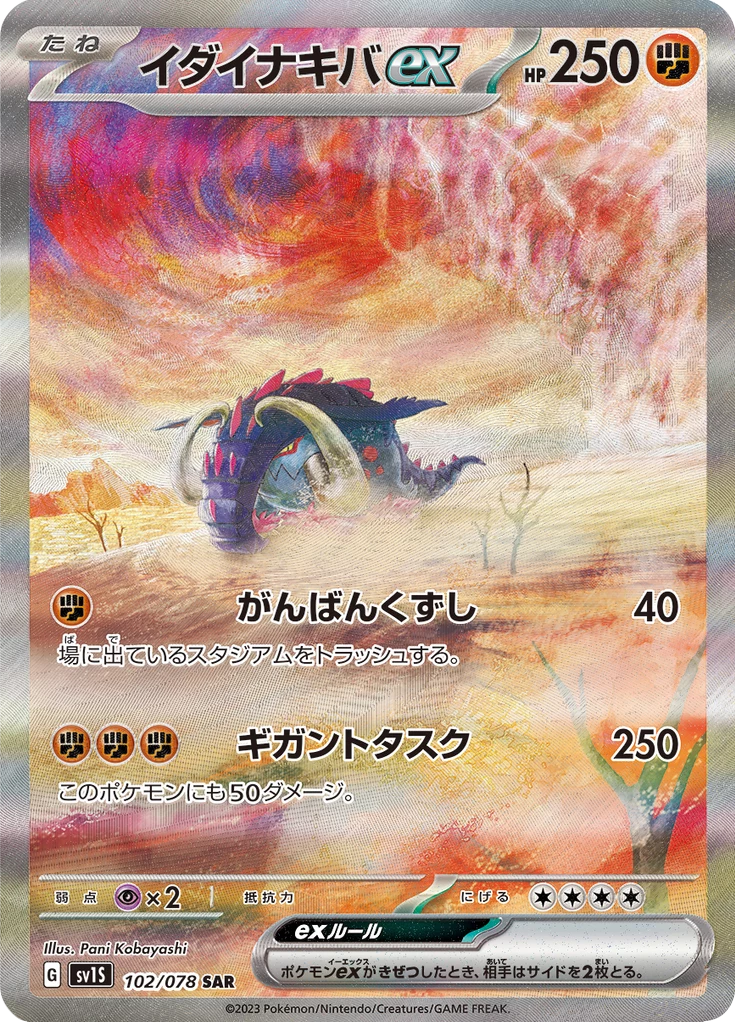
102/078 イダイナキバex Great Tusk ex Special Art Rare
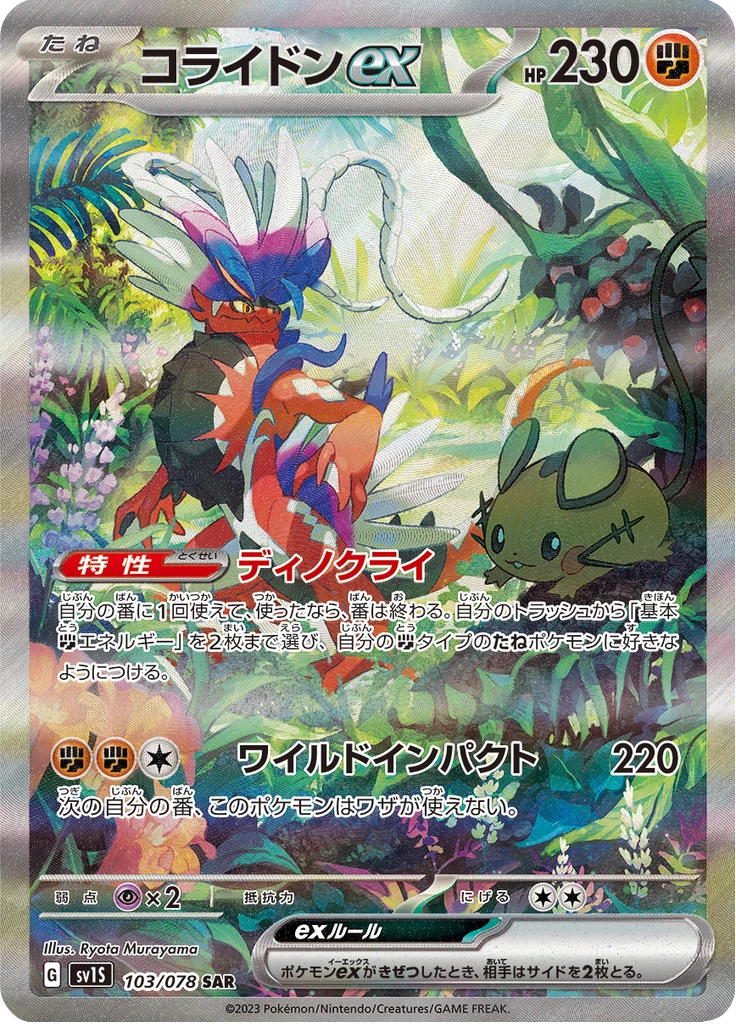
103/078 コライドンex Koraidon ex Special Art Rare
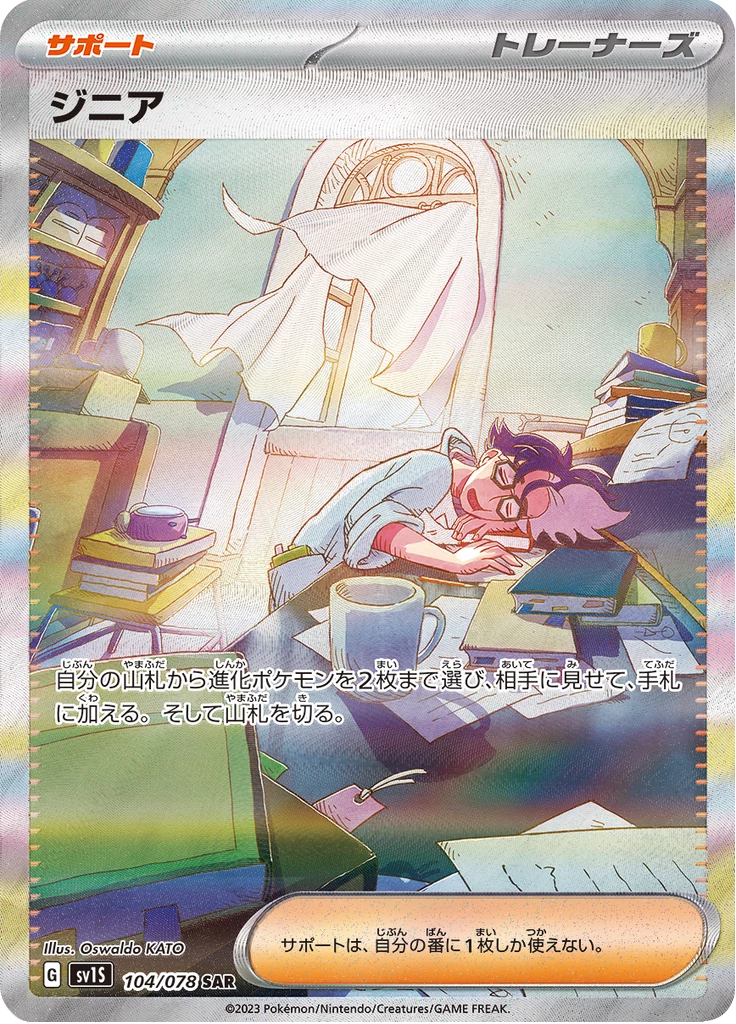
104/078 ジニア Jacq Special Art Rare
105/078 ボタン Penny Special Art Rare

Ultra Rare (3 cards)

Nr. JP Name EN Name Rarity
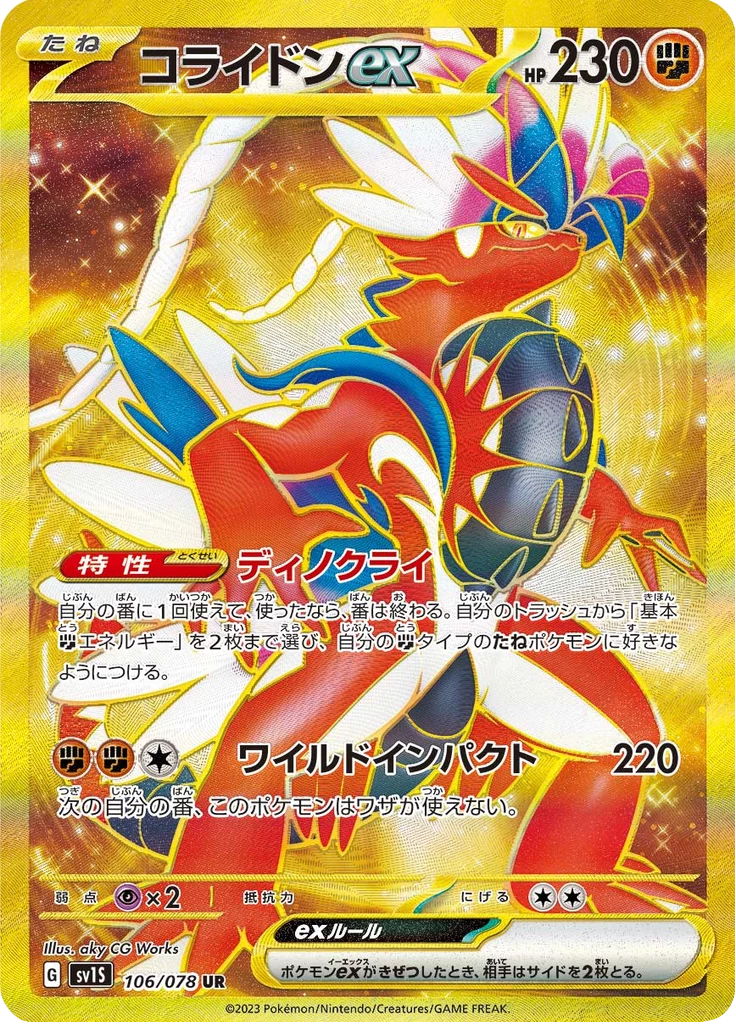
106/078 コライドンex Koraidon ex Ultra Rare
107/078 ネストボール Nest Ball Ultra Rare
108/078 基本闘エネルギー Basic Energy Ultra Rare

Two cards repeat across three rarities in this set: Gardevoir ex appears as a Secret Rare (092), a Special Art Rare (101), and never as an Ultra Rare, while Koraidon ex is the only card to appear in all three top rarities — Secret Rare (094), Special Art Rare (103), and Ultra Rare (106). That triple-rarity run is unusual even by Japanese secret-tier standards and is a big part of why Koraidon ex anchors this set’s chase list.

The Art Rare tier (079–090) is worth a separate look, even though it sits below the Secret Rare and Special Art Rare rows in most collectors’ pecking order. All twelve cards in that tier are non-ex Pokemon — Dolliv, Armarouge, Wiglett, Dondozo, Ralts, Kirlia, Fidough, Riolu, Sandile, Klawf, Kingambit, and Starly — rendered in the same full-bleed illustrated treatment as the higher rarities, just without the “ex” attack text or the gold/rainbow foil finishing. For collectors building a full art-rare run rather than chasing individual Special Art Rares, this tier is a self-contained target: twelve cards, and no character overlap with the Secret Rare or Special Art Rare tiers.

The Secret Rare tier (091–100) sits in between. It carries four “ex” Pokemon — Gyarados ex, Gardevoir ex, Great Tusk ex, Koraidon ex — plus two more ex cards, Toxicroak ex and Oinkologne ex, and four Trainer cards: Jacq, Team Star Grunt, Professor’s Research, and Penny. This is the tier where the set’s two Special-Art-Rare-eligible Trainers (Jacq and Penny) first appear, giving buyers a lower-cost alternative to the full-art versions two rows down.

Chase Cards: Special Art Rares & Ultra Rares

The five Special Art Rares and the Ultra Rare gold-bordered Koraidon ex sit at the top of the set. These are full-art, textured-foil treatments with the widest borders in the print run, and they’re the cards most collectors are hunting when they open a box.

Gardevoir ex 101/078 Special Art Rare Scarlet ex

Gardevoir ex 101/078 Special Art Rare

Great Tusk ex 102/078 Special Art Rare Scarlet ex

Great Tusk ex 102/078 Special Art Rare

Koraidon ex 103/078 Special Art Rare Scarlet ex

Koraidon ex 103/078 Special Art Rare

Jacq 104/078 Special Art Rare Scarlet ex

Jacq 104/078 Special Art Rare

Penny 105/078 Special Art Rare Scarlet ex

Penny 105/078 Special Art Rare

Koraidon ex 106/078 Ultra Rare Scarlet ex

Koraidon ex 106/078 Ultra Rare

Among singles, our current in-stock listing is the PSA 10-graded Gardevoir ex 101/078 Special Art Rare, currently listed at ¥51,014 (~$321). PSA independently determines authenticity and grade, so a PSA 10 slab reflects PSA’s own grading standard applied to that individual copy rather than a guarantee we make.

The two Trainer Special Art Rares, Jacq and Penny, are the more affordable end of the top tier — both are supporter cards rendered in the same full-art treatment as the Pokemon SARs, and both also appear as Secret Rares one number back, giving collectors a lower-rarity version of the same character art if the SAR isn’t in budget.

Great Tusk ex is the outlier of the five Special Art Rares in that it’s a Paradox Pokemon rather than a starter-line evolution or a returning legendary, sitting alongside Gardevoir ex, Koraidon ex, Jacq, and Penny as the five full-art chase cards collectors are most often hunting from this set.

The Ultra Rare tier closes the set out with Koraidon ex at 106/078, Nest Ball at 107/078, and a basic energy card at 108/078 — the last three numbers in the entire 108-card print run. Koraidon ex’s Ultra Rare printing is the third and final appearance of that character in the secret tier, after the Secret Rare at 094/078 and the Special Art Rare at 103/078.

Booster Box Pricing

Our sealed Scarlet ex booster box is currently listed at ¥11,648 (~$73), shipped from Tokyo. A damaged-box option is also listed for buyers who don’t need mint packaging: the Scarlet ex booster box (Damaged Box) is currently listed at ¥14,832 (~$93), with the cards inside unaffected by the outer box condition.

Every box contains a mix of the 78 base-set cards plus a chance at any of the 30 secret-tier cards above. We don’t publish estimated pull odds for this set — if you see insertion-odds figures elsewhere for a 2023 release like this one, treat them as community-reported and unofficial, not something we’re stating here.

Because Scarlet ex is now several years past its original release, it sits in a different buying category than a same-week release like a current Japanese expansion: the secret-tier singles market has had time to settle, and demand tends to concentrate on a handful of cards — here, Gardevoir ex and Koraidon ex across their multiple printings — rather than spreading evenly across all 30 secret-tier numbers. If your goal is a specific card rather than a full box, checking singles first and only opening sealed product if you want the box-opening experience is usually the more direct route.

Graded singles from this set are also listed as availability allows, like the PSA 10 Gardevoir ex listed above. A PSA grade documents the condition PSA assigned to that specific copy, which is most relevant for the textured, full-art Special Art Rare and Ultra Rare printings — those foils show handling wear more visibly than the flatter base-set cards.

Scarlet ex vs Violet ex

Scarlet ex shares its release window and several secret-rare Trainer slots with its sibling set, Violet ex (SV1V). Violet ex catalogues the same 108-row, 30-secret structure — 12 Art Rare, 10 Secret Rare, 5 Special Art Rare, 3 Ultra Rare — but with Miraidon ex as its flagship legendary in place of Koraidon ex, and a different supporting cast of Art Rares. If you’re building out both halves of this Scarlet & Violet debut, the two card lists are worth reading side by side.

Scarlet ex (SV1S) Violet ex (SV1V)
Flagship legendary Koraidon ex (094, 103, 106) Miraidon ex (094, 102, 106)
Total catalogued cards 108 108
Secret-tier cards 30 30
Special Art Rares 5 5

The Trainer lineup overlaps too — both sets carry a Secret Rare “Professor’s Research” and both close their Ultra Rare tier with a basic energy card, though the Special Art Rare supporters differ: Jacq and Penny in Scarlet ex versus Arven and Miriam in Violet ex. For a closer look at the Violet ex side, our sibling card list covers all 30 of its secret-tier cards the same way this page does.
For pull data and current secondary-market context on this set specifically, see our Scarlet ex best cards guide.

Where to Buy Scarlet ex Product

We ship Japanese sealed product and graded singles worldwide from Tokyo with tracked delivery.

Shop This Set
SV1S Scarlet ex Japanese Booster Box
Contains the full 78-card base set plus a chance at all 30 secret-tier cards
Ships from Tokyo · Tracked delivery

View Product →

For the full visual card checklist, see our SV1S card list page. For specific singles or mixed orders — including any of the secret-tier cards from the tables above that aren’t currently listed as standalone products — request a quote via our Quick Order page and we’ll check current availability.

If you’re weighing sealed product against singles: a booster box gets you a shot at all 30 secret-tier cards plus the full 78-card base set, while going straight to a single like the PSA 10 Gardevoir ex above gets you that exact card directly, without depending on what a box happens to contain. Which route makes sense depends on whether you’re collecting toward a specific card or building out the set as a whole.

Veelgestelde vragen

How many cards are in Scarlet ex (SV1S)?

Scarlet ex catalogues 108 total cards as of August 2026, including a 78-card base set and a 30-card secret tier split into 12 Art Rare, 10 Secret Rare, 5 Special Art Rare, and 3 Ultra Rare cards.

What are the rarest cards in Scarlet ex?

The five Special Art Rares (Gardevoir ex, Great Tusk ex, Koraidon ex, Jacq, and Penny) and the Ultra Rare Koraidon ex sit at the top of the secret tier. Koraidon ex is the only card in the set to appear as a Secret Rare, a Special Art Rare, and an Ultra Rare.

When was Scarlet ex released?

Scarlet ex released on January 20, 2023, as one of the two Japanese sets that opened the Scarlet & Violet era, alongside its counterpart Violet ex (SV1V).

What’s the difference between Scarlet ex and Violet ex?

Both sets share the same 108-card, 30-secret structure and several Trainer secret rares, but each has its own flagship legendary and Art Rare lineup — Koraidon ex leads Scarlet ex, while Miraidon ex leads Violet ex.
Where can I buy a Scarlet ex booster box?

Our sealed Scarlet ex booster box is currently listed at ¥11,648 (about $73), shipped from Tokyo with tracked delivery. A lower-cost damaged-box option and single PSA-graded cards are also listed.

How do I tell which rarity a Scarlet ex secret-tier card is?

Match the card’s printed number (the “xxx/078” in the bottom-left corner) to the tables on this page. Numbers 079–090 are Art Rare, 091–100 are Secret Rare, 101–105 are Special Art Rare, and 106–108 are Ultra Rare. Character name alone isn’t reliable since several characters, like Gardevoir ex and Koraidon ex, repeat across multiple rarities.

Imu One Piece-kaartgids: de Leader uit OP-13 uitgelegd

As of this writing, Imu has exactly one confirmed Japanese card number in the One Piece Card Game.

As of this writing, Limitless TCG’s database lists a single card number for Imu — the Leader card from Carrying on His Will (OP-13) — plus its alternate-art parallel. That’s it. No secret rare, no manga parallel, no starter-deck reprint. This guide covers both versions in detail: what the card does, how its deckbuilding restriction actually works, and where to find sealed Japanese product if you’re building around it.

For anyone new to Japanese One Piece Card Game singles, that kind of one-card footprint is worth flagging up front: it means there is no “which printing should I buy” spreadsheet to work through, no rarity ladder to climb, and no risk of accidentally picking up an outdated errata’d version. What you do need to get right is which of the two art treatments — base or AA — you’re actually looking at, and that’s exactly what the next two sections cover.

Key Takeaway

Imu currently has one confirmed card number — OP13-079 — from Carrying on His Will (OP-13), available as a base Leader print and an alternate-art (AA) parallel. Both are Black colour, 4 Life, 5000 Power, and lock the deck out of any Event card costing 2 or more.

1
Card Number

2
Versions (Base + AA)

OP-13
Debut Set

5000
Leader Power

Card data verified against Limitless TCG’s individual card pages as of August 2026. Prices, where shown, reflect our own listings converted at ¥159/USD.

Every Imu Printing in the One Piece TCG

Searching Limitless TCG for “Imu” returns two results, but they resolve to a single underlying card number with two visual treatments:

Kaart Set Type Life / Power
Imu — OP13-079 (base) Carrying on His Will (OP-13) Leader, Black 4 Life / 5000 Power
Imu — OP13-079 AA (alternate art) Carrying on His Will (OP-13) Leader, Black 4 Life / 5000 Power

Both versions carry the same stat line and the same ability — the AA is a purely cosmetic alternate-art parallel of the same Leader, not a separate print with new text. There is no non-Leader Character version of Imu, no Super Rare or Secret Rare chase print, and no starter-deck reprint on record as of this writing.

That two-row table is the entire checklist. If you’re comparing this guide against a listing, an auction, or a binder page, everything you need to identify what you’re looking at is right there: the card number (OP13-079), the set (Carrying on His Will / OP-13), and whether the copy in front of you shows the base artwork or the AA treatment.

OP13-079: The Base Leader Printing

Imu OP13-079 Leader Carrying on His Will
Imu OP13-079 Leader — Carrying on His Will (OP-13)

Imu debuted as a Leader card in Carrying on His Will (OP-13), illustrated by Takashi Kojima. As a Leader, the card carries no rarity letter — Limitless TCG doesn’t assign rarity symbols to Leader slots, so “Leader” is effectively its own tier. Looking for this printing or the OP-13 set generally? Our Quick Order page is the fastest way to flag a request.

The stat line is straightforward for a 4-Life Leader: 5000 Power, Black colour, no listed sub-type restrictions on the body of the card. What sets Imu apart is the ability text, which combines a deckbuilding restriction with a card-advantage engine tied to the Celestial Dragons type. We break that down in full in the next two sections.

Card text (paraphrased from the Japanese release, since no official English erratum has been catalogued for this printing): your deck cannot include Event cards that cost 2 or more; at the start of the game, you may put a Celestial Dragons-type Stage card from your deck into play; and once per turn, you may trash a Celestial Dragons-type Character card from your hand to draw a card.

OP13-079 AA: The Alternate Art Parallel

Imu OP13-079 Alternate Art Parallel Carrying on His Will
Imu OP13-079 AA (alternate art parallel) — Carrying on His Will (OP-13)

The AA parallel — catalogued on Limitless as the ?v=1 variant of OP13-079 — is the same Leader with different artwork and foiling. It plays identically to the base version in every game-relevant respect: same colour, same Life, same Power, same ability text. The only difference collectors need to track is the art treatment itself.

Because Imu has just one card number to begin with, the base-versus-AA distinction is effectively the entire collecting decision tree for this character right now. There’s no set of secret rares or manga parallels to chase — just the two treatments of the same printing.

For players rather than collectors, this also simplifies deckbuilding: whichever version you play — base or AA — the card functions identically at the table. There’s no version-dependent errata or timing difference to account for, which isn’t always true across a game with as many parallel print types as this one.

Reading the Card: Leader, Life, and Colour Explained

For collectors coming from other trading card games, three terms on Imu’s card are worth defining plainly, since they drive everything about how the card is played and collected.

Leader is a card slot every One Piece Card Game deck needs exactly one of. It sits face-up throughout the game, sets the deck’s colour identity, and usually carries an ongoing or activatable ability — in Imu’s case, both the deckbuilding restriction and the Celestial Dragons draw engine live on the Leader itself, not on a separate support card. That’s why there’s no “non-Leader” version of Imu to chase: the character was printed directly into this slot.

Life is the Leader’s starting life total, tracked as face-down cards rather than a number counter — Imu’s 4 Life is a mid-range total for the format. Colour (Black, in Imu’s case) determines which cards can legally go in the deck alongside the Leader; most cards are restricted to their Leader’s colour or colours, with limited exceptions.

The Celestial Dragons tag referenced throughout Imu’s ability text is a card type, printed on qualifying Character and Stage cards, that the Leader’s abilities key off of. A deck built around Imu needs enough Celestial Dragons-type cards on hand for the Leader’s engine to function — without them, the once-per-turn draw ability has nothing to trash.

How Imu’s Leader Ability Changes Deckbuilding

Most One Piece Leaders shape a deck through what they enable. Imu also shapes a deck through what it forbids.

The restriction — no Events costing 2 or more — immediately rules out a large chunk of the game’s higher-impact Event cards for any deck built around this Leader. In exchange, the card front-loads a bit of board presence: at the start of the game, you may put a Celestial Dragons-type Stage card from your deck straight into play without spending a turn or resources on it.

The ongoing engine is the [Activate: Main][Once Per Turn] ability: trash a Celestial Dragons-type Character card from hand to draw a card. That’s a repeatable way to convert an otherwise-dead card in hand into fresh options, provided the deck is built with enough Celestial Dragons-type Characters to feed it. In practice, that means an Imu deck’s build-around question isn’t “which Events do I run” — it’s “how many Celestial Dragons-type Characters can I fit, and which of them are worth trashing for a card.”

Taken together, the three pieces of text on this card form a single coherent design: give up flexible, high-cost Events in exchange for a free board piece at game start and a repeatable, hand-fixing draw loop for the rest of the game. Whether that trade is worth it depends entirely on how many playable Celestial Dragons-type cards a builder can find — a question this guide can’t answer on its own, since it falls outside what’s verified in our card database.

Reading the Restriction

The Event-cost lock applies to the whole deck, not just cards drawn into hand — it’s a deckbuilding-stage restriction, so it’s worth checking every Event’s printed cost before adding it to an Imu list.

Why Imu Has Only One Card Number (For Now)

As of this writing, Limitless TCG lists a single printing of Imu, plus its AA parallel — no additional Character-type prints, no reprints in later sets, and no promo-only versions on record.

Two things are true about that gap. First, Imu debuted relatively late in the game’s print history, in Carrying on His Will (OP-13). Second, later sets — including the current release, The World’s Strongest Warriors (OP-17) — have continued the broader World Government/Celestial Dragons storyline without adding a new Imu card number. That set does introduce new Secret Rares tied to its own cast — see our Loki guide for one example — but none of them are additional Imu printings. Whether a second Imu card number appears in a future set is outside what we can verify here; for now, the single OP-13 Leader print (plus its AA) is the complete picture.

For collectors, a one-card footprint cuts both ways. On one hand, completing an “Imu collection” is a realistic, finite goal — own the base print and the AA parallel, and there’s nothing left to chase. On the other hand, with only two treatments of one card number in circulation, availability of either version can be inconsistent set to set, since neither one gets refreshed through later reprints the way heavily-recurring characters do.

How to Collect Imu and Related World Government Cards

Because Imu’s only printing comes out of Carrying on His Will (OP-13) singles rather than a currently-listed box, the most direct way to add this Leader to a collection is a restock request through our Quick Order page — tell us the version (base or AA) and we’ll follow up when it’s available.

If you’d rather build out the surrounding Celestial Dragons and World Government theme with sealed product, the newest Japanese release still in print is The World’s Strongest Warriors (OP-17), currently listed at ¥18,000 (~$113) per booster box. It’s the same set that introduced the new Secret Rares covered in our Rocks D. Xebec and Loki guides, if you’re tracking the current chase cards alongside older Leaders like Imu.

When a hard-to-find single like OP13-079 does come up for sale, it’s worth confirming the same basics you’d check on any Japanese TCG single before paying: card number printed on the card matches OP13-079, the set stamp matches Carrying on His Will, and the listing clearly states base versus AA. None of that requires special tools — just matching what’s printed on the card against the Limitless TCG database entry.

Shop This Set
OP-17 The World’s Strongest Warriors Booster Box (Japanese)
Currently listed at ¥18,000 (~$113)
Ships from Tokyo · Tracked delivery

View Product →

Prefer graded copies once older OP-13 stock resurfaces? PSA independently determines authenticity and grade — our full PSA 10 card list is a useful reference for how graded One Piece cards are catalogued on our site.

Where to Buy Japanese One Piece Cards from Tokyo

We ship Japanese sealed product and singles worldwide out of Tokyo with tracked delivery. For a single, hard-to-find Leader like Imu, the fastest path is usually a direct request rather than browsing listed inventory — our Quick Order page lets you flag exactly which card, set, and version you’re after, and we’ll follow up on availability.

For related sealed product from the current World Government-adjacent storyline, see the OP-17 booster box above, or browse our full PSA 10 card list for graded singles across product lines. Whichever route you take, the same rule applies: check the card number and set stamp against this guide before you buy.

Veelgestelde vragen

How many Imu cards exist in the One Piece Card Game?

As of this writing, Limitless TCG lists a single card number for Imu — OP13-079 from Carrying on His Will (OP-13) — available as a base Leader print and an alternate-art (AA) parallel.

What set is Imu’s card from?

Imu’s only confirmed printing, OP13-079, is from Carrying on His Will (OP-13). No later set has added a new Imu card number as of this writing.

What does Imu’s Leader ability do?

Imu’s deck cannot include Event cards costing 2 or more. At the start of the game, you may put a Celestial Dragons-type Stage card from your deck into play, and once per turn you may trash a Celestial Dragons-type Character card from hand to draw a card.

Is the base OP13-079 or the AA parallel more collectible?

Both are the same underlying card with identical stats and ability text — the difference is purely the art treatment. Since Imu has only one card number, the base-versus-AA choice is the main collecting decision for this Leader right now.

Can I buy an Imu card from Samurai Sword Tokyo right now?

Imu singles aren’t currently listed in our inventory. Submit a restock request via our Quick Order page and we’ll follow up on availability, or explore related Japanese One Piece sealed product like the OP-17 booster box in the meantime.

Sengoku One Piece-kaarten Gids: Alle uitgaven

Twelve One Piece Card Game printings carry the name Sengoku — and one of them isn’t a character card at all. “Buddha” Sengoku, OP16-077, is a named Event card, a rare format for a character who otherwise shows up as a Leader, a Character card, or a Starter Deck common.

Sengoku, the former Navy Fleet Admiral known across the series as “Buddha” Sengoku, has been printed steadily since the game’s second set, Paramount War (OP02), through to his own Leader debut in OP-16: The Time of Battle. Along the way he’s shown up in a mainline Extra Booster, two different Starter Decks, and a standalone promo pack — a spread that touches nearly every product category the One Piece Card Game releases. This guide catalogs every verified Sengoku printing, walks through the standout cards from each era, and points you to the sealed product that contains them.

Key Takeaways

Sengoku has at least twelve verified printings spanning Starter Decks, main sets, an Extra Booster, and a promo — including one Leader card (OP16-060) and one rare named Event card (“Buddha” Sengoku, OP16-077) rather than a Character card. As of this writing we carry no graded or single Sengoku cards; the way to pull one is through the booster boxes that contain his prints.

12
Verified Printings

1
Leader Card

OP-16
Newest (Leader) Set

0
Singles Currently Listed

Card data verified against individual pages on Limitless TCG’s One Piece database as of August 2026. Prices below reflect our own listed prices for sealed booster boxes only — we do not currently list single Sengoku cards, so no single-card pricing appears in this guide. Yen figures convert at ¥159/USD, rounded to the nearest dollar.

Every Verified Sengoku Card

Twelve Sengoku printings are verified in detail on Limitless TCG’s individual card pages, spanning his earliest appearance through his newest OP-16 Leader and Event prints:

Card # Type / Rarity Set Notes
OP02-103 Character, Rare OP02 — Paramount War Black, Cost 2 / Power 3000, +2000 Counter
EB02-044 Character, Super Rare EB02 — Anime 25th Collection Black, Cost 7 / Power 7000. Blocker
OP06-049 Character, Common OP06 — Wings of the Captain Blue
OP07-046 Character, Rare OP07 — 500 Years in the Future Blue
ST06-005 Character, Common ST06 — Absolute Justice Starter Deck Black, Cost 5 / Power 6000, +1000 Counter
OP10-031 Character, Common OP10 — Royal Blood Green
OP12-047 Character, Rare OP12 — Legacy of the Master Blue
ST19-002 Character, Common ST19 — BLACK Smoker Starter Deck Black, Cost 1 / Power 1000
OP16-060 Leader OP16 — The Time of Battle Purple, Life 5 / Power 5000, Navy type
OP16-066 Character, Uncommon OP16 — The Time of Battle Purple
OP16-077 Event, Rare (“Buddha” Sengoku) OP16 — The Time of Battle Purple, Cost 1
P-032 Character, Promo Event Pack Vol.1 Black, Cost 5 / Power 6000

Ability text is confirmed for seven of the twelve — OP02-103, EB02-044, OP16-060, OP16-077, ST06-005, ST19-002, and P-032. For the remaining five (OP06-049, OP07-046, OP10-031, OP12-047, OP16-066) the verified data covers card number, set, color, and rarity on Limitless TCG, but the individual ability text was not part of what we could confirm, so we leave those effects undescribed rather than guess.

Three sets — OP16, and the pairing of OP02 with ST06 — carry the clearest through-line of his card history: OP02-103 and ST06-005 both frame him as a disruptive, cost-lowering Navy character in the game’s earliest era, while OP-16 gives him his first Leader card fifteen sets later.

The color spread is also worth noting if you’re building around him specifically. He’s been printed in Black most often — OP02-103, EB02-044, ST06-005, ST19-002, and P-032 — with Blue appearing on OP06-049, OP07-046, and OP12-047, Green on the single OP10-031, and Purple reserved for his three OP-16 prints (OP16-060, OP16-066, OP16-077). That means depending on which deck colors you’re running, there’s a Sengoku card that fits in nearly every major archetype, even outside his dedicated Leader printing.

The Early Prints: OP02-103 and EB02-044

Sengoku OP02-103 Rare Paramount War
Sengoku OP02-103 — Rare, OP02 Paramount War

OP02-103 is Sengoku’s earliest verified printing, a Black Character card at Cost 2 / Power 3000 with a +2000 Counter, illustrated by BISAI. Its ability triggers on attack: pay one DON!! to lower the cost of an opposing character by 2 for the turn. It’s a cheap, efficient disruption piece — the kind of card that fit straight into a Navy-themed deck from the very first sets of the game.

EB02-044, from the Anime 25th Collection Extra Booster, is a heavier Super Rare version: Black, Cost 7 / Power 7000, with Blocker and an On Play effect that puts a rested Black Navy-type character with Cost 4 or less into play straight from the trash. Where OP02-103 is a low-cost tempo piece, EB02-044 is a defensive, reanimation-style card built for the late game.

Between the two, they show the range Sengoku cards have covered since the game’s early sets — a cheap disruptive attacker on one end, and a heavy Blocker with trash recursion on the other. Neither is his only print from those early years, either: OP06-049 (Blue, Common, Wings of the Captain), OP07-046 (Blue, Rare, 500 Years in the Future), and OP10-031 (Green, Common, Royal Blood) all confirm additional appearances across that stretch of the set list, even though their individual ability text wasn’t part of what we could verify.

The Leader Card: OP16-060

Sengoku OP16-060 Leader The Time of Battle
Sengoku OP16-060 Leader — OP16 The Time of Battle

OP-16: The Time of Battle gave Sengoku his first Leader card: OP16-060, a Purple Leader with Life 5 and Power 5000, Navy type, illustrated by nishinoshima. His Main-phase activated ability returns 8 of your active DON!! cards to the DON!! deck, then lets you put up to three different-named {Admiral}-type Character cards from your hand into play — a build-around effect that trades a large chunk of your active DON!! for a sudden wide board of Admirals in a single turn.

It’s a Leader designed specifically around the Navy’s admiral-tier characters, which makes OP16-060 the natural centerpiece for anyone building a Navy-heavy deck rather than a splash inclusion. An alternate-art version of the Leader is also confirmed to exist.

The same OP-16 set also includes OP16-066, a Purple Uncommon Character card that shares the set with the Leader — we’ve confirmed its card number, color, and rarity, though its ability text wasn’t part of what we could verify on Limitless TCG.

The Named Event Card: “Buddha” Sengoku (OP16-077)

Buddha Sengoku OP16-077 Event Rare The Time of Battle
“Buddha” Sengoku OP16-077 — Event, Rare, OP16 The Time of Battle

OP16-077 is one of the more unusual Sengoku prints: a Purple, Cost 1 Rare card that carries his “Buddha” nickname directly in its name, but is built as an Gebeurtenis card rather than a Character. On play, it lets you look at the top 5 cards of your deck, add up to 2 Navy-type cards to your hand, place the rest on the bottom of the deck, then trash one card from your hand.

Named Event cards are a small category in the One Piece Card Game — most single-character searches turn up Leaders and Characters almost exclusively — so OP16-077 stands out from the rest of Sengoku’s card pool simply by format, on top of being a Navy-focused card-selection tool that’s efficient at a single DON!! of cost.

Starter Decks and Promo Prints

Three more Sengoku printings round out the verified list, each tied to a Starter Deck or a standalone promo release.

  • ST06-005 (Common, Black, Cost 5 / Power 6000, +1000 Counter) — from the Absolute Justice (ST06) Navy Starter Deck. On attack, it lowers an opposing character’s cost by 4 for the turn, a stronger version of the effect first seen on OP02-103.
  • ST19-002 (Common, Black, Cost 1 / Power 1000) — from the BLACK Smoker (ST19) Starter Deck. On play, trashing two Black Navy-type cards from hand draws three cards if your Leader is Navy-type, making it a cheap draw engine built specifically around a Navy Leader like OP16-060.
  • P-032 (Promo, Black, Cost 5 / Power 6000) — from Event Pack Vol.1, illustrated by tasaka. During your turn, paying one DON!! lowers the cost of every opposing character by 2, a board-wide version of the tempo effect that runs through several of his printings.

Taken together, the cost-reduction theme — on OP02-103, ST06-005, and P-032 — is the clearest mechanical signature across Sengoku’s card pool, alongside the Navy-type synergy that ST19-002 and the OP16-060 Leader both lean on directly.

Shop This Set
OP-16 The Time of Battle Japanese Booster Box
Currently listed at ¥12,540 (~$79) — contains OP16-060 (Leader), OP16-066, and OP16-077
Ships from Tokyo · Tracked delivery

View Product →

How to Collect Sengoku Cards

As of this writing, we do not have any graded or single Sengoku cards listed. If you’re building toward a specific print from this guide, the practical path is buying sealed booster boxes from the sets that contain it and pulling your own copy, or requesting availability through our Quick Order page for a restock alert.

This applies to all twelve printings covered above, not just the newer ones — even his earliest card, OP02-103 from Paramount War, and his Starter Deck prints from ST06 and ST19, are only reachable through the sealed product tied to those releases or a restock request rather than a direct single-card listing.

Because Sengoku’s prints are spread across nine different sets going back to OP02, no single box gives you every card in this guide. Collectors focused on his newest cards should start with the OP-16 box, since it’s the only listing here that contains three of his prints (the OP16-060 Leader, OP16-066, and the “Buddha” Sengoku Event card) at once. Collectors chasing an older print, like the ones from Royal Blood (OP10) or Legacy of the Master (OP12), are better served going straight to that set’s damaged-box listing.

Boxes tied to the cards covered above:

Set Contains Our Price Product
OP-16 The Time of Battle OP16-060 (Leader), OP16-066, OP16-077 Currently listed at ¥12,540 (~$79) View box
OP-16 The Time of Battle (Damaged Box) OP16-060 (Leader), OP16-066, OP16-077 Currently listed at ¥11,540 (~$73) View box
OP-10 Royal Blood (Damaged Box) OP10-031 Currently listed at ¥12,360 (~$78) View box
OP-12 Legacy of the Master (Damaged Box) OP12-047 Currently listed at ¥19,055 (~$120) View box

The “Damaged Box” listings are sealed booster boxes with cosmetic box damage only — the sealed packs inside are unaffected, and they’re typically listed below their non-damaged counterparts. The OP-12 damaged box above is a limited single listing, so it’s the most likely of the four to sell out first.

If Sengoku’s fellow Navy officers and rivals are also on your list, we cover several of them in dedicated guides: our Garp cards guide looks at the other Navy legend most closely tied to his storyline, and our Kaido cards guide covers one of the Emperors his Navy career was built to oppose.

Where to Buy

We ship Japanese sealed One Piece Card Game product worldwide from Tokyo with tracked delivery. For the fastest way to pull OP16-060, OP16-066, and the “Buddha” Sengoku Event card, the OP-16 booster box or its damaged-box counterpart above are the direct route. For older prints like OP10-031 and OP12-047, the damaged-box listings in the table above are typically the lowest-cost sealed entry point into those sets.

Looking for graded singles instead? Our PSA 10 card list hub tracks graded stock across our catalog, and our PSA 10 One Piece cards buying guide explains how PSA grading works for this game specifically — PSA independently determines authenticity and grade. For anything not currently listed, including single Sengoku cards, our Quick Order page is the fastest way to request a quote or flag interest for restock.

Veelgestelde vragen

Does Sengoku have a Leader card in the One Piece Card Game?

Yes, one is verified: OP16-060 from OP-16: The Time of Battle, a Purple Leader with Life 5 / Power 5000 and Navy type. It’s his only confirmed Leader printing.

What is “Buddha” Sengoku OP16-077?

It’s a Rare, Cost 1 card also from OP-16: The Time of Battle — but unlike most Sengoku prints, it’s built as an Event card rather than a Character card. Its effect looks at the top 5 cards of your deck and adds up to 2 Navy-type cards to your hand.

Which Sengoku card is the newest?

OP16-060 (Leader), OP16-066, and “Buddha” Sengoku (OP16-077), all from OP-16: The Time of Battle. Together they’re his most recent set appearance among verified printings.

Can I buy a single Sengoku card directly?

Not currently — we do not have graded or single Sengoku cards listed at this time. You can request availability or a restock via our Quick Order page, or buy the sealed booster boxes that contain his prints and pull your own copy.

What box should I buy to pull an OP-16 Sengoku card?

The OP-16 The Time of Battle Japanese Booster Box, currently listed at ¥12,540 (~$79), or its damaged-box counterpart at ¥11,540 (~$73). Both contain the OP16-060 Leader, OP16-066, and the “Buddha” Sengoku Event card.

S3 Infinity Zone Booster Box koopgids

Infinity Zone is one of the quieter Sword & Shield-era Japanese sets — no gimmick mechanic, no anniversary tie-in, just ten Secret Rare V cards and two Trainer Secret Rares packed into a set Limitless still catalogs at 110 rows five years after release. That quiet reputation is exactly why it’s worth a second look if you’re building out a Sword & Shield collection or hunting specific V-card artwork on a budget.

This guide covers what a box of S3 Infinity Zone gets you, which ten cards sit in the Secret Rare tier, and where the box fits if you’re comparing it against other Japanese Sword & Shield releases. We ship this set sealed out of Tokyo, so the pricing and stock figures below are our own listing, not a market estimate.

Infinity Zone doesn’t get the attention that flashier Sword & Shield releases pick up, largely because it doesn’t carry a signature mechanic or a crossover theme. What it does carry is a tight, well-defined Secret Rare tier — ten cards, no more, no less, according to Limitless’s own indexing — which makes it a more predictable set to plan a purchase around than releases with sprawling Ultra Rare and Special Art Rare subtiers layered on top of the Secret Rares.

That predictability is the main case for this box: you know going in exactly which ten cards make up the top tier, there’s no secondary Ultra Rare or Character Rare subtier splitting the odds further, and the set has had five years on the market since its Limitless-indexed release date for supply and demand to settle into whatever pattern it’s going to settle into. None of that is a promise about what you’ll pull from any individual box — it’s simply a description of how the set is structured.

Key Takeaways

S3 Infinity Zone is a Sword & Shield-era Japanese set that Limitless catalogs at 110 rows, with 10 Secret Rare chase cards — eight Pokemon V cards (Houndoom V, Drednaw V, Galarian Cursola V, Rhyperior V, Crobat V, Eternatus V, Scizor V, Salamence V) and two Trainer Secret Rares (Piers, Rose). Our sealed box is currently listed at ¥50,400 (~$317).

05 Jun 2020
Limitless Release Date

110
Catalogued Cards

10
Secret Rare Cards

¥50,400
Current Box Price

What’s Inside an S3 Infinity Zone Box

S3 Infinity Zone is a mainline Japanese Sword & Shield set, indexed by Limitless with a release date of 05 Jun 2020. The Limitless card database catalogs 110 rows for the set, and the top tier — the Secret Rare slot — runs 10 cards deep, numbered 101 through 110.

We don’t have a verified pack count or original MSRP for this release confirmed in our own data. For a full box configuration and odds breakdown, see our S3 Infinity Zone best cards guide. What we can confirm directly is our own sealed stock and current listed price, covered below.

The set skews toward Pokemon V cards in its base lineup, with the Secret Rare tier reserved for eight V-card alternate arts and two Trainer Secret Rares — Piers and Rose, both Galar-region Trainers who also headline other Sword & Shield sets. If you collect by character rather than by set, that overlap is worth knowing before you decide which Sword & Shield box to prioritize.

Because the Secret Rare tier tops out at 10 cards rather than sprawling across several subtiers, everything above the base set funnels into a single tier — which simplifies the math if you’re opening boxes with a specific card in mind.

The eight Pokemon V Secret Rares are drawn from across the existing Pokedex rather than concentrated on one evolutionary line, which is part of why the set appeals to collectors chasing a specific species rather than a specific archetype: Eternatus (a Legendary), Houndoom, Drednaw, Rhyperior, Crobat, Scizor, and Salamence are all fully-evolved Pokemon with established fan followings independent of this particular set, and Galarian Cursola adds a regional-variant angle exclusive to the Galar generation.

The remaining rows below the Secret Rare tier — roughly 100 of the 110 Limitless catalogs — make up the base set: the standard V cards in their non-Secret printings, supporting Pokemon, Trainer, and Energy cards, and the usual mix of common through rarer non-secret tiers you’d expect from a Sword & Shield main set. We haven’t broken that portion down card-by-card in this guide since it’s the ten Secret Rares that drive most purchase decisions on a box like this.

The 10 Secret Rare Chase Cards

Every Secret Rare row Limitless catalogs for S3 Infinity Zone, in card-number order:

Nr. Japanese Name English Name Rarity
101 ヘルガーV Houndoom V Secret Rare
102 カジリガメV Drednaw V Secret Rare
103 ガラル サニゴーンV Galarian Cursola V Secret Rare
104 ドサイドンV Rhyperior V Secret Rare
105 クロバットV Crobat V Secret Rare
106 ムゲンダイナV Eternatus V Secret Rare
107 ハッサムV Scizor V Secret Rare
108 ボーマンダV Salamence V Secret Rare
109 ネズ Piers Secret Rare
110 ローズ Rose Secret Rare

Eternatus V (106) is the set’s headline Legendary — the Pokemon most associated with the Galar region’s endgame storyline and the card most collectors specifically search for when they mention this set by name.

Crobat V (105), Scizor V (107), and Salamence V (108) round out the fully-evolved Pokemon side of the tier. All three are long-running fan favorites from earlier generations, which gives them a collector base independent of Sword & Shield specifically — useful to know if you’re chasing a Pokemon rather than a set.

Houndoom V (101), Drednaw V (102), and Rhyperior V (104) cover a mix of earlier and mid-generation Pokemon, while Galarian Cursola V (103) is a regional-variant card exclusive to the Galar generation — the Galarian form only exists because of Sword & Shield, so this is one of a limited number of sets where it appears as a V card.

Piers (109) and Rose (110) are the set’s two Trainer Secret Rares and its only non-Pokemon chases. Both are Galar-region human characters who also appear across other Sword & Shield sets, so collectors building out a full Trainer subset for either character will want this set specifically for its 109 and 110 printings.

Eternatus V No. 106 Secret Rare S3 Infinity Zone

Eternatus V No. 106 — Secret Rare

Crobat V No. 105 Secret Rare S3 Infinity Zone

Crobat V No. 105 — Secret Rare

Scizor V No. 107 Secret Rare S3 Infinity Zone

Scizor V No. 107 — Secret Rare

Salamence V No. 108 Secret Rare S3 Infinity Zone

Salamence V No. 108 — Secret Rare

Piers No. 109 Secret Rare S3 Infinity Zone

Piers No. 109 — Secret Rare

Rose No. 110 Secret Rare S3 Infinity Zone

Rose No. 110 — Secret Rare

For pull odds on any of these ten and community-reported, unofficial pricing on singles, our S3 Infinity Zone best cards guide has the full breakdown — we’re keeping this article focused on the sealed box itself.

Current Box Pricing

Our sealed S3 Infinity Zone Japanese Pokemon Booster Box is currently listed at ¥50,400 (~$317). That’s our listed price for the box as it stands today — we’re not comparing it against a market average here, since we don’t have a verified original MSRP or third-party market figure for this specific box logged in our data.

Shop This Set
S3 Infinity Zone Japanese Pokemon Booster Box
Currently listed at ¥50,400 (~$317)
Ships from Tokyo · Tracked delivery

View Product →

Infinity Zone released back in June 2020. If you’re planning to open multiple boxes to chase a specific Secret Rare like Eternatus V or Piers, buying your full quantity in one order is the more reliable path with an older set like this one.

We list our current price and availability directly on the product page, and both can change over time — the price quoted in this guide is accurate as of the date it was published, not a running promise. For the live price, check the product page directly before ordering.

Who Should Buy This Box

  • Eternatus V collectors. If you specifically want the box-art Legendary in Secret Rare form, this is the set it comes from — there’s no shortcut around opening or buying Infinity Zone product or singles.
  • Piers and Rose Trainer-card collectors. Both Secret Rare Trainer cards are exclusive to this set’s numbering (109 and 110), which makes Infinity Zone a target for anyone building a Galar Trainer subset.
  • Sword & Shield-era set collectors. If your goal is completing a run of Japanese Sword & Shield main-series boxes rather than chasing one specific card, Infinity Zone slots in as one of the earlier releases in that era.
  • Budget-conscious V-card openers. At ¥50,400 (~$317) per box, this is a straightforward entry point for opening Secret Rare V cards.
  • Galarian-form collectors. Galarian Cursola V is one of a limited number of Galarian-variant V cards, so anyone specifically collecting regional forms will want this set on the list.

Who this box is not the best fit for: collectors chasing a specific non-Pokemon-V card type — Infinity Zone’s Secret Rare tier is entirely V cards and two Trainers, with no Rainbow Rare or VMAX-style alternate arts in that top slot. If that’s what you’re after, a different Sword & Shield-era release will be a better match; our S3 card list page shows the full rarity breakdown so you can confirm before buying.

If your priority is a specific chase card rather than the set as a whole, check the insertion-odds estimates and community pricing in our S3 Infinity Zone best cards guide before deciding how many boxes to open, or request singles directly through our Quick Order page.

Where to Buy

We ship sealed Japanese product worldwide from Tokyo with tracked delivery. For S3 Infinity Zone specifically, the sealed box currently listed at ¥50,400 (~$317) is the direct route to all ten Secret Rare cards in the set.

For the full card list with every rarity tier, browse our S3 Infinity Zone card list page. If you’re after specific singles instead of sealed product, or want to combine Infinity Zone with other sets in one shipment, our Quick Order page is the fastest way to request a quote.

Whichever route you take, product listings on the site reflect our live stock and price at the time you view them, which can differ from the figures quoted in this guide if time has passed since publication.

Veelgestelde vragen

What’s inside an S3 Infinity Zone booster box?

We don’t have a verified pack count or original MSRP confirmed in our data for this release. Limitless catalogs the set at 110 cards total, with 10 Secret Rare chase cards. For a full configuration and odds breakdown, see our S3 Infinity Zone best cards guide.

What are the chase cards in S3 Infinity Zone?

Ten Secret Rare cards, numbered 101 to 110: Houndoom V, Drednaw V, Galarian Cursola V, Rhyperior V, Crobat V, Eternatus V, Scizor V, and Salamence V, plus two Trainer Secret Rares, Piers and Rose.

When was S3 Infinity Zone released?

Limitless indexes the release date as 05 Jun 2020. It’s a Japanese Sword & Shield-era main set.

How much does an S3 Infinity Zone booster box cost?

Our sealed box is currently listed at ¥50,400 (~$317).

Where can I buy an S3 Infinity Zone booster box from Japan?

We ship sealed S3 Infinity Zone boxes from Tokyo with tracked delivery. You can also request singles or combine sets through our Quick Order page.

Shiny Star V (S4a) Card List: All 326 Cards & Rarities

Shiny Star V (S4a) is the Japanese “High Class Pack” that built its entire identity around one idea: every Pokemon in the secret tier gets printed in a shiny, differently-colored variant. That single design choice produced one of the largest secret tiers in the Sword & Shield era — 139 cards deep, more than half of them shiny-colored commons and rares that never existed anywhere else.

This page transcribes every catalogued row in S4a Shiny Star V from Limitless TCG: the full Amazing Rare, Secret Rare, and Shiny Ultra Rare (SSR) tables number-by-number, plus a count-and-highlights summary of the 104-card Shiny Rare tier that gives the set its name. Card counts here are as catalogued by Limitless TCG as of August 2026, not an official Pokemon Company denominator, and no MSRP is stated below — only our own current listing for the set’s headline chase card.

For current secondary-market context on the cards below, see our sibling Shiny Star V best cards and insertion-odds guide.

Key Takeaways

Shiny Star V (S4a) catalogues 326 total rows as of August 2026, with a 139-card secret tier split across four rarities: 104 Shiny Rare, 23 Shiny Ultra Rare (SSR), 9 Secret Rare, and 3 Amazing Rare. The set’s best-known chase card — Charizard VMAX SSR, 308/190 — is one of only 23 SSR-tier cards ever printed for this release, and a PSA 10 copy is currently listed at ¥43,252 (~$272).

326
Catalogued Rows

139
Secret-Tier Cards

187
Base-Set Rows

Nov 2020
JP Release

Set data is transcribed from Limitless TCG’s Shiny Star V card index as catalogued as of August 2026. Prices below are our own listed prices, converted at ¥159/USD (August 2026).

Set Overview

Shiny Star V released in Japan on November 20, 2020, as a Sword & Shield-era “High Class Pack” — a premium product format built around a single mechanical theme rather than a normal expansion’s mix of new attackers. Limitless TCG’s index catalogues 326 total rows for the set, made up of 187 base-set rows (derived as total minus secret tier, catalogued as of August 2026 — not an official Pokemon Company denominator) and a sprawling 139-card secret tier numbered 191/190 through 326/190.

That secret tier is the reason Shiny Star V is still discussed five years after release. It splits into four rarity bands, and the split is heavily weighted toward one tier: 3 Amazing Rare, 9 Secret Rare, 104 Shiny Rare, and 23 Shiny Ultra Rare — the last of which carries the widely used shorthand “SSR” and includes the set’s most recognizable single card, Charizard VMAX.

The Shiny Rare tier alone — 104 cards — accounts for roughly three-quarters of the entire secret run. Every one of those 104 cards is the exact same Pokemon species and card layout as its normal-colored base-set counterpart, just recolored in the shiny palette, which is the mechanic the whole set is named for. The tables below cover the three smaller, fully-listed tiers in full, then summarize the 104-card Shiny Rare tier by count and named highlights.

Amazing Rare Tier: 021, 036, 117

Shiny Star V’s secret tier opens with its smallest and most unusual band — three Amazing Rare cards, numbered within the set’s normal range rather than above it:

Nr. Japanese Name English Name Rarity
021/190 レシラム Reshiram Amazing Rare
036/190 カイオーガ Kyogre Amazing Rare
117/190 イベルタル Yveltal Amazing Rare

Unlike Secret Rare or Shiny Ultra Rare cards, which are numbered past the set’s printed total to mark them as chase pulls, Amazing Rare cards sit inside the normal 001–190 numbering — Reshiram at 021, Kyogre at 036, Yveltal at 117 — and are identified by their distinct card frame and rarity marking rather than a number past the base set. Legendaries only: all three Amazing Rares catalogued in this set are Legendary Pokemon, and none of the three repeats elsewhere in the secret tier.

Secret Rare Tier: 191–199

Nine Secret Rares follow immediately after the base set’s printed total, numbers 191/190 through 199/190 — and every one is a Trainer or Supporter character rather than a Pokemon:

Nr. Japanese Name English Name Rarity
191/190 ウカッツ Cara Liss Secret Rare
192/190 ジムトレーナー Gym Trainer Secret Rare
193/190 とりつかい Bird Keeper Secret Rare
194/190 ネズ Piers Secret Rare
195/190 フウロ unconfirmed Secret Rare
196/190 ボールガイ Ball Guy Secret Rare
197/190 ポケモンごっこ Poke Kid Secret Rare
198/190 マリィ Marnie Secret Rare
199/190 ローズ Rose Secret Rare

Every card in this nine-card band is a Trainer/Supporter, drawn from Galar-region gym staff and story characters — Marnie (198), Piers (194), and Rose (199) among the more recognizable names, alongside Gym Trainer, Bird Keeper, Cara Liss, Poke Kid, and Ball Guy as generic character archetypes rather than named story figures. English name data for 195/190 isn’t confirmed in our source index, so it’s listed above by its Japanese name only rather than a guessed English equivalent.

Shiny Ultra Rare (SSR) Tier: 304–326

The top of Shiny Star V’s secret tier is 23 cards deep, numbered 304/190 through 326/190. This is the band collectors and our own product listings refer to by the shorthand “SSR,” and it’s exclusively V and VMAX cards — no Trainers, no Supporters:

Nr. Japanese Name English Name Rarity
304/190 ゴリランダーV Rillaboom-V Shiny Ultra Rare
305/190 ゴリランダーVMAX Rillaboom-VMAX Shiny Ultra Rare
306/190 ワタシラガV Eldegoss-V Shiny Ultra Rare
307/190 リザードンV Charizard V Shiny Ultra Rare
308/190 リザードンVMAX Charizard VMAX Shiny Ultra Rare
309/190 マルヤクデV Centiskorch V Shiny Ultra Rare
310/190 マルヤクデVMAX Centiskorch VMAX Shiny Ultra Rare
311/190 ラプラスV Lapras-V Shiny Ultra Rare
312/190 ラプラスVMAX Lapras-VMAX Shiny Ultra Rare
313/190 パルスワンV Boltund-V Shiny Ultra Rare
314/190 ストリンダーV Toxtricity-V Shiny Ultra Rare
315/190 ストリンダーVMAX Toxtricity-VMAX Shiny Ultra Rare
316/190 イエッサンV Indeedee-V Shiny Ultra Rare
317/190 ドラパルトV Dragapult-V Shiny Ultra Rare
318/190 ドラパルトVMAX Dragapult-VMAX Shiny Ultra Rare
319/190 タイレーツV Falinks-V Shiny Ultra Rare
320/190 クロバットVMAX Crobat VMAX Shiny Ultra Rare
321/190 オーロンゲV Grimmsnarl V Shiny Ultra Rare
322/190 オーロンゲVMAX Grimmsnarl VMAX Shiny Ultra Rare
323/190 メタモンV Ditto V Shiny Ultra Rare
324/190 メタモンVMAX Ditto VMAX Shiny Ultra Rare
325/190 バイウールーV Dubwool-V Shiny Ultra Rare
326/190 ウッウV Cramorant-V Shiny Ultra Rare

The pattern across this tier is a V-and-VMAX pair for most featured Pokemon: Rillaboom, Centiskorch, Lapras, Toxtricity, Dragapult, Grimmsnarl, and Ditto each get both a V and a VMAX printing back to back in the numbering. Five Pokemon — Eldegoss, Charizard, Boltund, Indeedee, and Falinks — only get a single V (Charizard is the exception with both 307 V and 308 VMAX), and Crobat VMAX, Dubwool-V, and Cramorant-V close the tier without a paired counterpart.

Charizard VMAX, 308/190, is the card this set is best known for. It’s the card this High Class Pack is best known for, and it’s the card behind our own current stock listing — a PSA 10-graded copy is currently listed at ¥43,252 (~$272).

Currently In Stock
PSA 10 Charizard VMAX SSR 308/190 (Shiny Star V)
Currently listed at ¥43,252 (~$272)
Ships from Tokyo · Tracked delivery

View Product →

The 104-Card Shiny Rare Tier

Numbers 200/190 through 303/190 make up the tier that gives Shiny Star V its name: 104 cards, every one a shiny-palette recolor of a Pokemon that also appears normally in the base set. That’s the largest single rarity band in the entire set — more than a quarter of every catalogued row in Shiny Star V, and roughly three-quarters of the secret tier alone. Transcribing all 104 rows individually is outside the scope of this summary; the full list is catalogued in the same Limitless index linked throughout this page. What follows is a representative sample rather than the complete 104-card table.

The clearest pattern inside the tier is that it runs almost entirely in complete evolution lines rather than scattered single Pokemon. Four fully-evolved starter trios sit inside the 104 — each stage of the line printed shiny, back to back in the numbering:

Nr. Japanese Name English Name Line
200/190 モクロー Rowlet Alola grass starter
201/190 フクスロー Dartrix Alola grass starter
202/190 ジュナイパー Decidueye Alola grass starter
203/190 サルノリ Grookey Galar grass starter
204/190 バチンキー Thwackey Galar grass starter
205/190 ゴリランダー Rillaboom Galar grass starter
214/190 ヒバニー Scorbunny Galar fire starter
215/190 ラビフット Raboot Galar fire starter
216/190 エースバーン Cinderace Galar fire starter
224/190 メッソン Sobble Galar water starter
225/190 ジメレオン Drizzile Galar water starter
226/190 インテレオン Inteleon Galar water starter

Beyond the starter trios, a handful of individually recognizable Pokemon also fall inside the 104-card Shiny Rare run: Suicune (221), Rotom (237), Dragapult (261, the un-evolved final-stage form alongside its own Shiny Ultra Rare V/VMAX pair higher in the tier list), and Corviknight (288), Galar’s regional taxi Pokemon.

Nr. Japanese Name English Name Rarity
221/190 スイクン Suicune Shiny Rare
237/190 ロトム Rotom Shiny Rare
261/190 ドラパルト Dragapult Shiny Rare
288/190 アーマーガア Corviknight Shiny Rare

Outside of these highlighted rows, the remaining Shiny Rare cards cover dozens of other Galar-region and cross-generation Pokemon in evolution-line order, from Blipbug through Dubwool. If you’re trying to confirm whether a specific card number between 200/190 and 303/190 belongs to this tier, every card in that range is a Shiny Rare by definition — there’s no further split within the band.

Chase Cards Worth Watching

The nine-card Secret Rare tier is entirely Trainer and Supporter characters, and eight of the nine are shown below — the ninth, Cara Liss (191/190), doesn’t have a verified image available for this page.

Gym Trainer 192/190 Secret Rare Shiny Star V S4a

Gym Trainer 192/190 (Secret Rare)

Bird Keeper 193/190 Secret Rare Shiny Star V S4a

Bird Keeper 193/190 (Secret Rare)

Piers 194/190 Secret Rare Shiny Star V S4a

Piers 194/190 (Secret Rare)

フウロ 195/190 Secret Rare Shiny Star V S4a

フウロ 195/190 (Secret Rare)

Gym Trainer (192) and Bird Keeper (193) open the tier as generic character archetypes rather than named story figures, followed immediately by Piers (194), the Spikemuth Dark-type gym leader, and 195/190, whose English localization isn’t confirmed in our source index.
Ball Guy 196/190 Secret Rare Shiny Star V S4a

Ball Guy 196/190 (Secret Rare)

Poke Kid 197/190 Secret Rare Shiny Star V S4a

Poke Kid 197/190 (Secret Rare)

Marnie 198/190 Secret Rare Shiny Star V S4a

Marnie 198/190 (Secret Rare)

Rose 199/190 Secret Rare Shiny Star V S4a

Rose 199/190 (Secret Rare)

The tier closes with Ball Guy (196) and Poke Kid (197), then two of the set’s most widely recognized character names: Marnie (198), the series’ rival trainer for this generation, and Rose (199), the closing story antagonist — the final card in the Secret Rare run and, by numbering, the final Secret Rare in the entire set.
Availability & Our Current Listing

Shiny Star V sealed booster boxes are not currently listed in our inventory. If you’re looking to open the set yourself, the fastest route is to request a quote via our Quick Order page and we’ll confirm what’s available for the next restock.

What we do have confirmed in stock is a single-card listing for the set’s headline chase card: a PSA 10-graded Charizard VMAX SSR, 308/190, currently listed at ¥43,252 (~$272). PSA independently determines authenticity and grade on graded singles like this one; we’re not making any authenticity claim beyond the PSA slab and grade shown on the listing itself.

Because MSRP figures for this generation of Japanese High Class Packs aren’t part of the verified data behind this article, we’re not stating an original retail price for Shiny Star V here — only what’s actually listed, when it’s listed. For more on how the set’s Secret Rare and SSR cards have traded since release, our sibling Shiny Star V best cards and insertion-odds guide covers that side in more depth, and our dedicated Shiny Star V booster box buying guide covers box-level buying decisions specifically.

Shiny Star V vs Later Shiny-Themed Sets

Shiny Star V’s all-shiny secret tier wasn’t a one-off idea — the Japanese TCG has returned to the “entire secret tier in shiny colors” format more than once since this set’s November 2020 release. If you’re deciding whether to chase this specific release or a more recent shiny-themed set instead, our Shiny Star V vs Shiny Treasure ex comparison guide lays out the two side by side in more detail than we can verify within this card-list page alone.

What we can confirm from the catalogued data above: Shiny Star V’s 139-card secret tier, split across four rarities and topped by a 23-card Shiny Ultra Rare band, is one of the larger and more granularly-tiered “all-shiny” secret runs in the set’s era. Whether a later release matches, exceeds, or restructures that split is a question for the dedicated comparison article rather than this checklist.

Where to Buy Shiny Star V Cards

We ship Japanese sealed product and singles worldwide from Tokyo with tracked delivery. Shiny Star V boxes are not currently in active stock, so the fastest path to this set’s cards is either our confirmed PSA 10 Charizard VMAX SSR listing below or a direct Quick Order request for anything else from the 326-row checklist above.

Currently In Stock
PSA 10 Charizard VMAX SSR 308/190 (Shiny Star V)
Currently listed at ¥43,252 (~$272)
Ships from Tokyo · Tracked delivery

View Product →

For the full visual card checklist alongside pricing and rarity filters, see our Shiny Star V (S4a) card list hub. For any other card from this checklist — a specific Shiny Rare, one of the nine Secret Rares, or an Amazing Rare — request a quote via our Quick Order page and we’ll check current availability. Listing the exact card number from the tables above speeds up the quote.

Veelgestelde vragen

How many cards are in Shiny Star V (S4a)?

Limitless TCG catalogues 326 total rows for Shiny Star V as of August 2026: 187 base-set rows plus a 139-card secret tier.

What rarities are in the Shiny Star V secret tier?

Four rarities across 139 cards: 104 Shiny Rare, 23 Shiny Ultra Rare (commonly abbreviated “SSR”), 9 Secret Rare, and 3 Amazing Rare.

What is Charizard VMAX SSR from Shiny Star V?

Card 308/190, a Shiny Ultra Rare printing of Charizard VMAX and the set’s best-known chase card. A PSA 10-graded copy is currently listed at ¥43,252 (about $272).

How many Secret Rares are in Shiny Star V, and what are they?

Nine, numbered 191/190 through 199/190. All nine are Trainer or Supporter characters rather than Pokemon, including Marnie (198) and Rose (199).

Where can I buy Shiny Star V cards?

Sealed booster boxes for this set are not currently in active stock. The confirmed listing is a PSA 10 Charizard VMAX SSR single at ¥43,252 (about $272); for any other card from the checklist, request a quote via our Quick Order page.