Maak gratis een account en spaar punten en rang
Samurai Sword Tokyo
Bestellingen Winkelwagen

Pikachu Mirror (S8a 001/028): de PSA 10-gids voor de 25th Anniversary Collection
Pikachu #1 cards show up in nearly every major Pokemon anniversary release, and it’s easy to mix them up once you’re looking at three or four different “anniversary Pikachu” products side by side. This one is specific: Pikachu (Mirror), card 001/028, from the 25th Anniversary Collection (S8a), illustrated by Mitsuhiro Arita.

This guide covers what the card actually is, why its printed number doesn’t match the set’s total card count, how it differs from the newer 30th Celebration Pikachu Illustrator cards, and where a PSA 10 graded copy sits in our own catalog today.

Key Takeaway

Pikachu (Mirror) 001/028 is from the 25th Anniversary Collection (S8a), released in Japan on 21 October 2021, illustrated by Mitsuhiro Arita. It is not part of the 2026 30th Celebration Pikachu Illustrator lineup — different anniversary, different set, different year. A PSA 10 graded copy is currently listed at ¥19,690 (~$124 at ¥159/USD).

37
Total S8a Cards

2021
JP Release Year

Currently Listed (~$124)

001/028
Product Numbering

Prices are converted at ¥159/USD (September 2026).

Pikachu Mirror 001/028: Card Facts
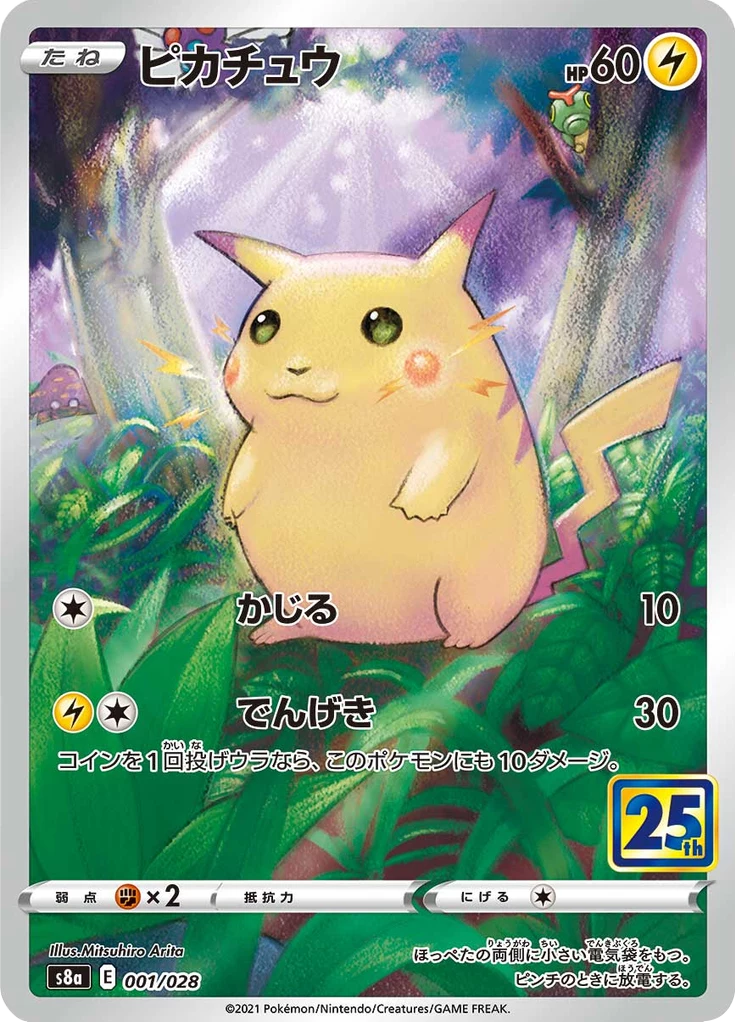
Pikachu Mirror holofoil card, card 1, 25th Anniversary Collection (S8a), Japanese print
Pikachu (Mirror), #1, 25th Anniversary Collection (S8a)

The card itself is straightforward to identify: it’s ピカチュウ (Pikachu), printed as card number 1, from the Japanese 25th Anniversary Collection (S8a) set. The illustration is credited to Mitsuhiro Arita. The product listing describes the print finish as “Mirror,” which is how the mirror-holo treatment on this card is labelled in our own catalog.

Field Detail
Kaart Pikachu (Mirror)
Card number 001/028
Set 25th Anniversary Collection (S8a)
JP release date 21 October 2021
Illustrator Mitsuhiro Arita
Grade sold PSA 10
Current price ¥19,690 (~$124)

We currently have one PSA 10 graded copy of this exact card listed at ¥19,690 (~$124 at ¥159/USD). If it sells before you get to it, sourcing another copy runs through our Quick Order page rather than a fixed restock date.

Inside the 25th Anniversary Collection (S8a)

25th Anniversary Collection (S8a) released in Japan on 21 October 2021 and totals 37 cards. Pikachu (Mirror) sits at the front of that checklist as card number 1, which is typical for a set built around Pokemon’s flagship mascot.

The set is closely tied to a companion promo product from the same campaign — a promo card pack distributed alongside S8a booster purchases — and to a separate “Golden Box” release from the same anniversary window. If you’re building out the full 25th Anniversary lineup rather than just this single card, our 25th Anniversary Collection booster box guide and 25th Anniversary Golden Box guide cover the sealed side of the set.

For the companion promo pack that circulated during the same release window, see our 25th Anniversary Promo Pack guide.

Why Is It Numbered 001/028?

If you’ve seen 25th Anniversary Collection listed elsewhere as a 37-card set, the “028” on this card’s numbering can look like a mismatch. It isn’t an error — it reflects how the set’s numbering band is structured.

The set’s numbering runs on a base of a core group of numbered cards plus a further run of alphabetic-suffixed bonus cards layered on top. The mirror-holo subset that this Pikachu belongs to is numbered against that core-plus-bonus band, which is where the “/028” denominator on the product listing comes from. Once every bonus-lettered card is counted alongside the core numbering, the set’s full checklist reaches 37 cards in total.

In short: 028 is the denominator used for this card’s specific numbering band, not the set’s overall card count. Both figures are correct — they’re just answering different questions.

Not the Same as the 2026 30th Celebration Illustrator Cards

This is worth stating plainly, because the two products get confused often: Pikachu (Mirror) 001/028 from the 25th Anniversary Collection is not part of the 30th Celebration “30 Pikachu Illustrator” lineup that Pokemon released in 2026.

They’re separate products from separate anniversaries, five years apart:

  • 25th Anniversary Collection (S8a) — released 21 October 2021, the set this Pikachu Mirror card comes from.
  • 30th Celebration / 30 Pikachu Illustrators — a separate 2026 anniversary set with its own card list and its own numbering.

If you landed here looking for the newer 30-card illustrator lineup specifically, our 30 Pikachu Illustrators 30th Celebration card list covers that set in full. This page stays focused on the earlier 2021 S8a Mirror print.

How This Pikachu Compares to Other Japanese Pikachu Prints

Pikachu has been reprinted as a chase-tier card across many Japanese sets and eras, and the visual style shifts a lot from one to the next. Two examples from outside the 25th Anniversary lineup show that range:
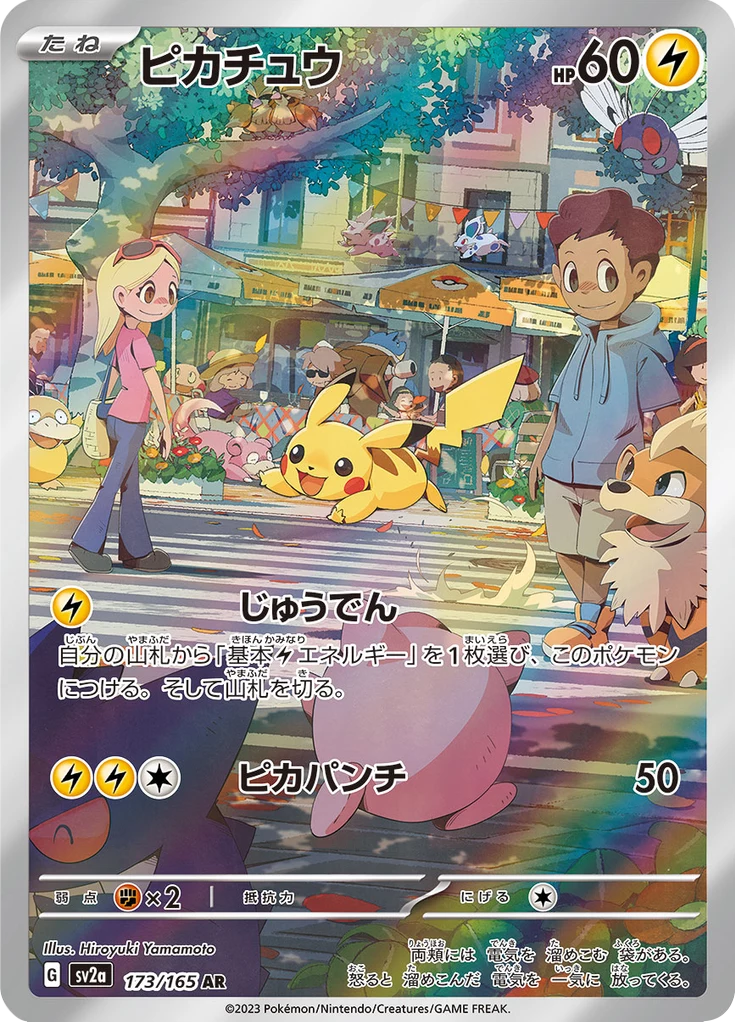
Pikachu AR alternate art card, card 173/165, Pokemon Card 151 (SV2a), Japanese print, shown for comparison
Pikachu, #173/165, AR, Pokemon Card 151 (SV2a) — shown for comparison, not this card
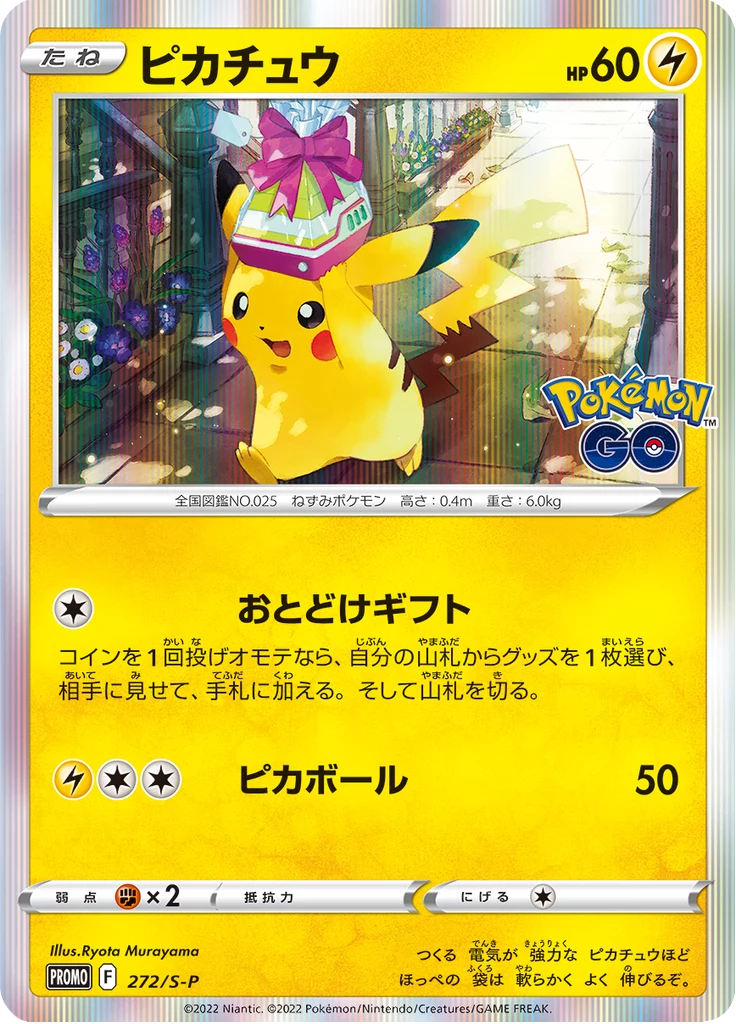
Pikachu promo card, card 272, Sword and Shield Promotional Cards, Japanese print, shown for comparison
Pikachu, #272/S-P, Sword & Shield Promotional Cards — shown for comparison, not this card

The Pikachu AR from Pokemon Card 151 (SV2a) is a modern alternate-art print built around a full-scene illustration style, while the Pikachu promo from the Sword & Shield Promotional Cards line reflects the more compact, single-character promo layout typical of that era. Neither is the card covered in this guide — they’re included purely to show how differently “a Pikachu chase card” can look depending on the set and the year. For a broader look at how Pikachu prints rank against each other, see our top 10 Pikachu Japanese cards roundup and our best Pikachu cards value guide.

Where It Sits Among Other PSA 10 Chase-Tier Singles
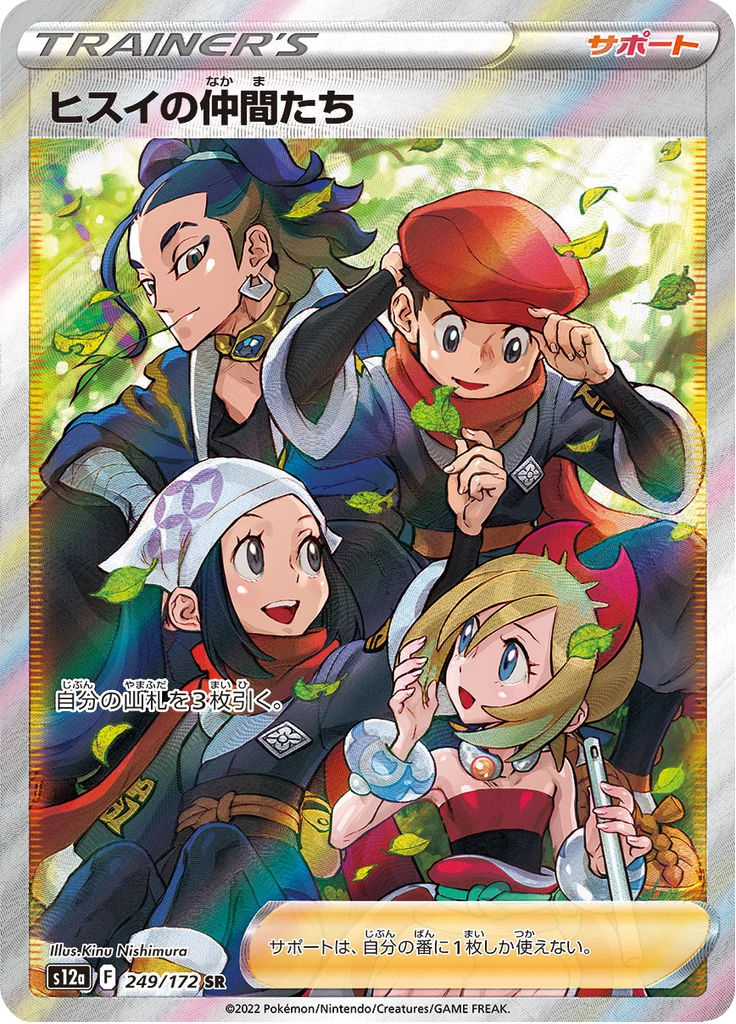
Friends in Hisui Secret Rare Supporter card, card 249/172, VSTAR Universe (S12a), Japanese print, shown for comparison
Friends in Hisui, #249/172, Secret Rare, VSTAR Universe (S12a) — different, unrelated set, shown for scale

It also helps to see this card next to a completely unrelated chase-tier single, just to calibrate expectations. The Friends in Hisui Secret Rare from VSTAR Universe (S12a) is a different card from a different set entirely — a Trainer Supporter card rather than a Pikachu print — but it sits in a broadly similar PSA 10 collector tier. Comparing across sets like this is a useful gut-check when you’re deciding whether a given price for a graded single is in line with what similar-tier cards trade for elsewhere in the Japanese market.

Where to Buy the Pikachu Mirror 001/028

We ship graded singles and sealed Japanese product worldwide from Tokyo with tracked delivery. Our current PSA 10 copy of Pikachu (Mirror) 001/028 is a single unit — once it’s gone, sourcing another goes through Quick Order rather than a scheduled restock.

Shop This Card
PSA10 Pikachu: Mirror (S8a) 001/028
Currently listed at ¥19,690 (~$124)
Ships from Tokyo · Tracked delivery

View Product →

Looking for the sealed booster box this card comes from, or other PSA 10 singles from the same anniversary campaign? See our 25th Anniversary Collection booster box guide, or build a mixed order — sealed product and other graded singles together — through our Quick Order page.

Veelgestelde vragen

What is the Pikachu Mirror 001/028 card?

It’s Pikachu, card number 1, from the Japanese 25th Anniversary Collection (S8a) set, released 21 October 2021 and illustrated by Mitsuhiro Arita. The product listing labels the print finish “Mirror” and numbers it 001/028.

What set is Pikachu Mirror 001/028 from?

The 25th Anniversary Collection (S8a), a 37-card Japanese set released 21 October 2021 to mark Pokemon’s 25th anniversary.

Why is it numbered 001/028 instead of 001/037?

The 028 denominator reflects the numbering band for this card’s mirror-holo subset, which runs on a core-plus-bonus-letter structure rather than the set’s full card count. The full 25th Anniversary Collection checklist totals 37 cards once every bonus letter is included.

Is this the same as the 30th Celebration Pikachu Illustrator cards?

No. Pikachu Mirror 001/028 is from the 2021 25th Anniversary Collection (S8a). The 30 Pikachu Illustrators cards are a separate 2026 30th Celebration product with its own set and numbering.

How much does a PSA 10 Pikachu Mirror 001/028 cost?

Our current PSA 10 graded copy is listed at ¥19,690 (about $124 at ¥159/USD). It’s a single-unit listing, so availability changes once it sells.
Skeledirge Japanse kaartengids: elke ex-print van Triplet Beat tot de Terastal Starter Set

One Pokemon, five Japanese cards, and two different typings on the same species. Skeledirge is the final Fire-starter evolution from Paldea, and in the three years since its debut it has picked up a Special Art Rare, a Double Rare, a Metal-type Tera variant, and two plain-Rare base prints — spread across four different products.
This guide lines up all five confirmed Japanese Skeledirge prints, explains what separates them beyond the artwork, and points out the one that comes as its own single-species starter box rather than a pack pull. We ship Japanese singles and sealed product out of Tokyo, and the PSA10 anchor below is the print currently sitting in our own stock.

Key Takeaway

Five Skeledirge prints exist in Japanese sets: the Triplet Beat Special Art Rare (SV1a 097/073, our own PSA10-graded stock card, currently listed at ¥10,176 / ~$64.00), a Double Rare from Shiny Treasure ex, a Metal-type Tera ex from its own single-species starter box, and two base-Rare prints. Card number and typing — not just artwork — separate these five from each other.

5
Confirmed Prints

¥10,176
Own-Stock PSA10 SAR

1
Single-Species Starter Box

2023–24
Print Window

Prices are converted at ¥159/USD (September 2026). The only priced anchor in this guide is our own listed stock; other prints are described by set, rarity, and stats only.

Every Skeledirge Print and What It Is

Five Japanese Skeledirge prints have been confirmed so far, spanning four different products released between January 2023 and October 2024:

Kaart Set Rarity Type / HP Released
Skeledirge ex 097/073 Triplet Beat (SV1a) SAR Fire / 340 10 Mar 2023
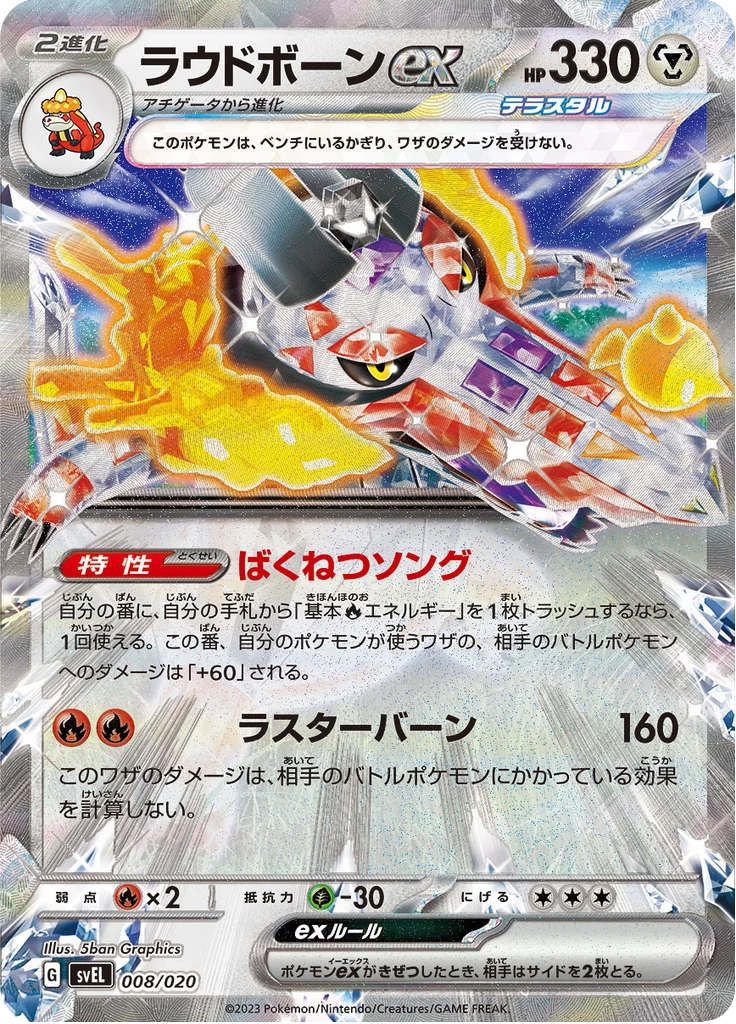
Skeledirge ex 008/020 Terastal Starter Set Skeledirge ex (SVEL) Tera ex Metal / 330 22 Sep 2023
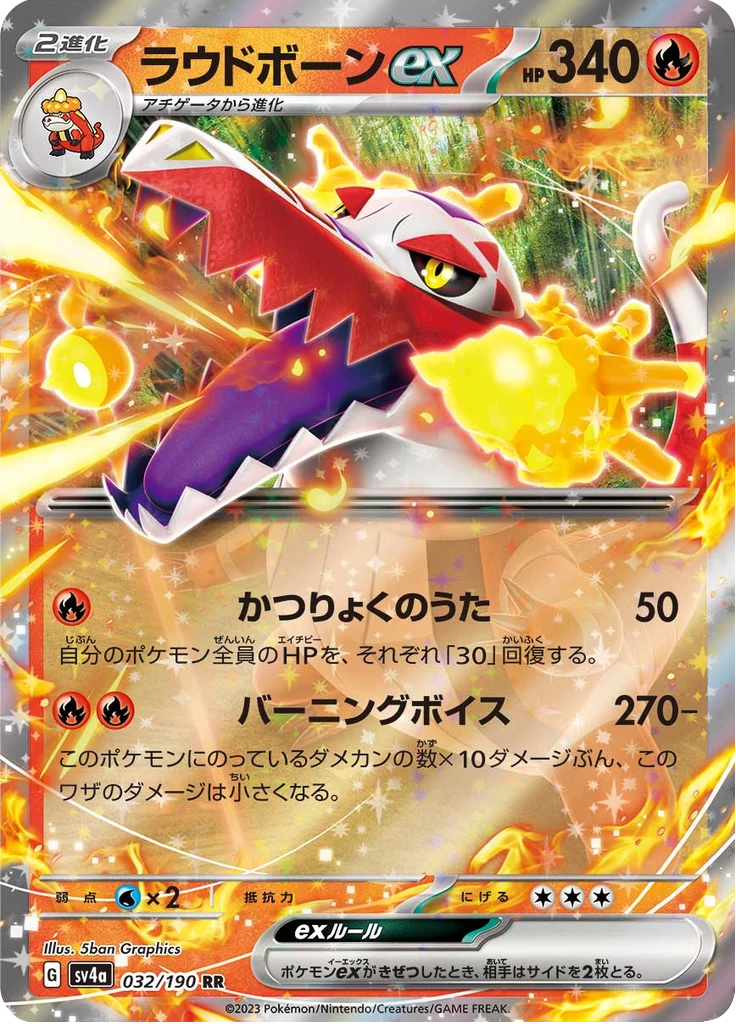
Skeledirge ex 032/190 Shiny Treasure ex (SV4a) Double Rare Fire / 340 1 Dec 2023
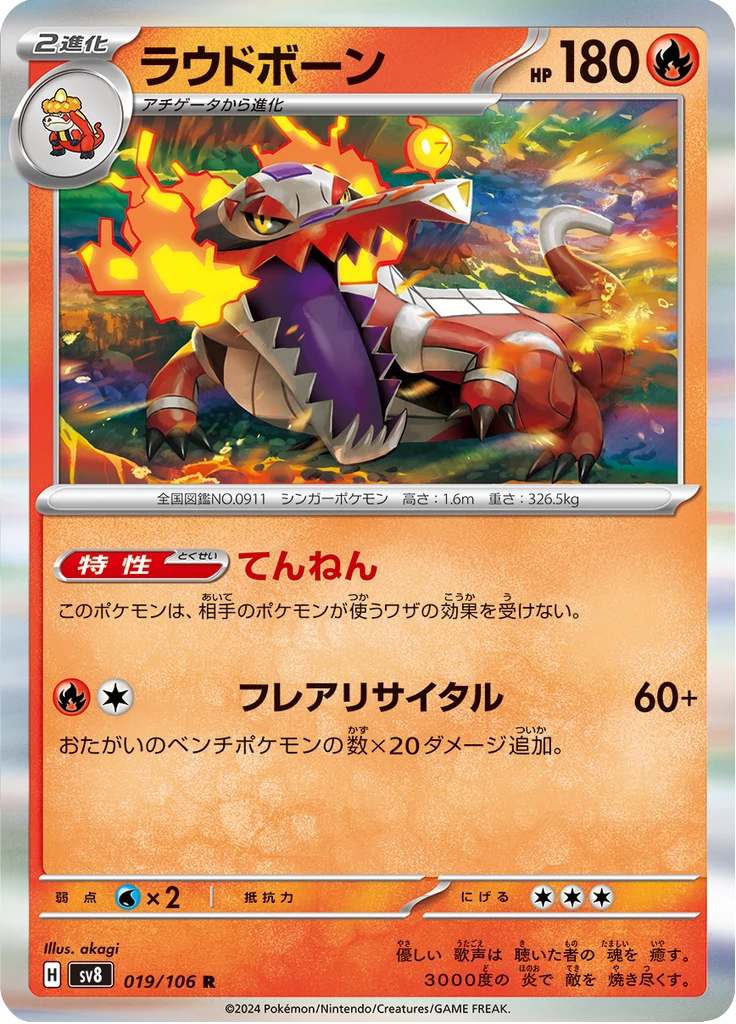
Skeledirge 019/106 Super Electric Breaker (SV8) Rare Fire / 180 18 Oct 2024
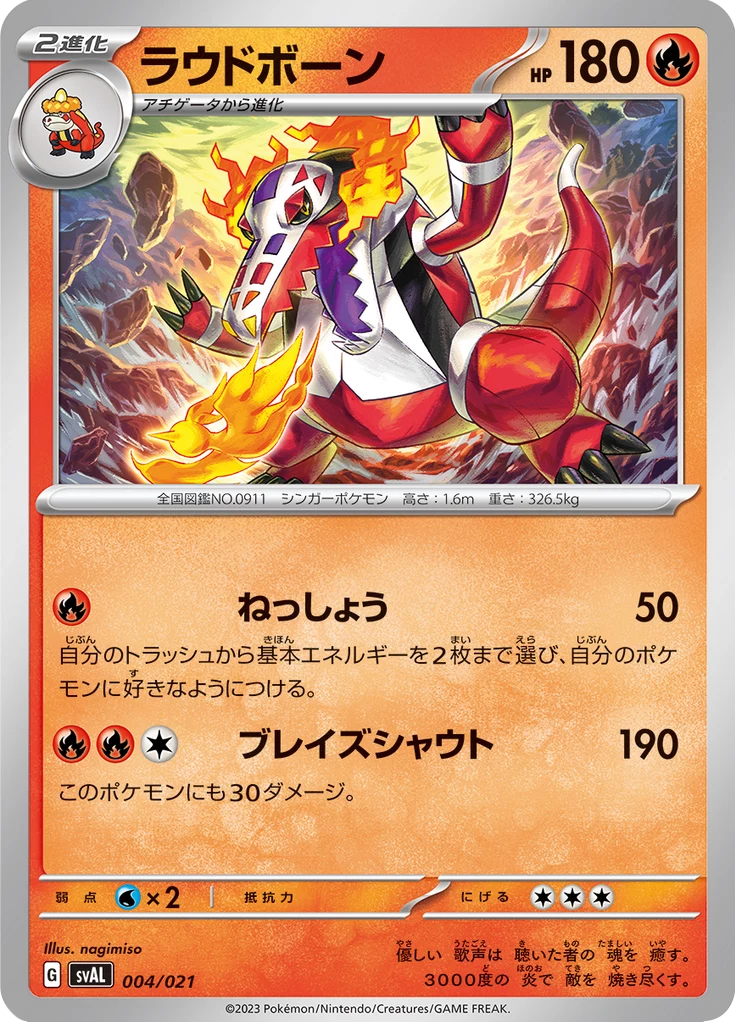
Skeledirge 004/021 ex Starter Set “Fuecoco & Ampharos ex” (SVAL) Rare Fire / 180 20 Jan 2023

Two things stand out immediately. First, three of the five prints are ex cards with HP in the 330–340 range, while the two base prints sit at HP 180 — a straightforward way to sort them at a glance. Second, one of the three ex prints is not Fire-type at all: the Terastal Starter Set version is a Metal-type Tera variant, the only Skeledirge card that breaks from its native typing.

The sections below go through each print in release order, then explain how to tell them apart when you’re looking at a physical card.

The Own-Stock Card: Skeledirge ex SAR From Triplet Beat

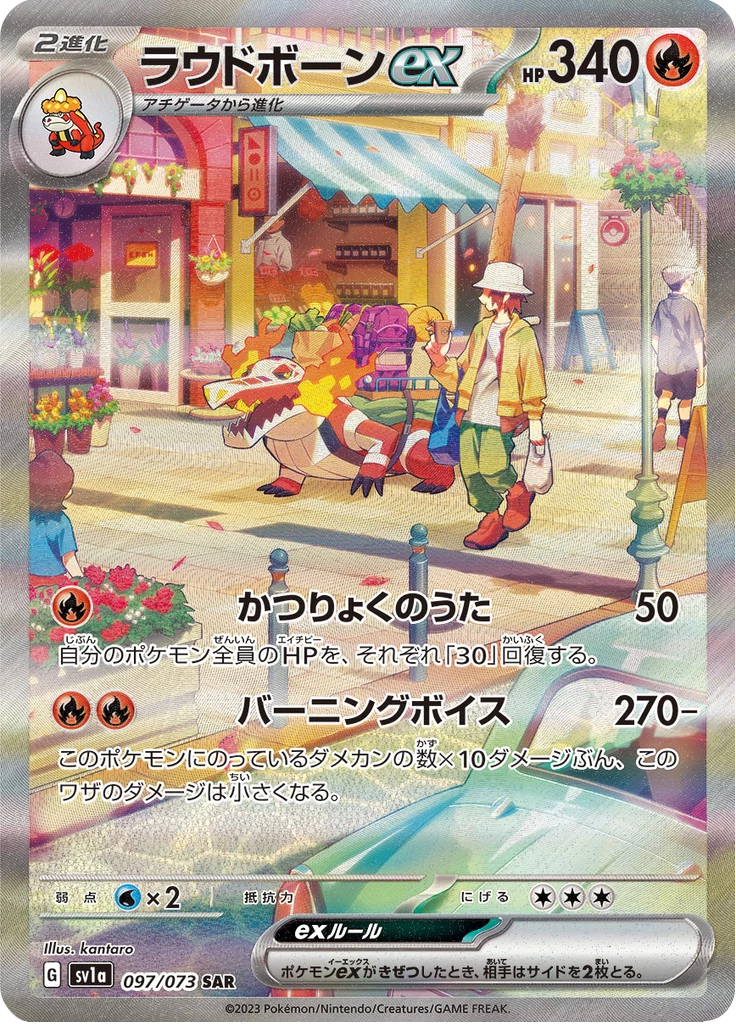
Skeledirge ex, SV1a 097/073, Special Art Rare, Triplet Beat

Triplet Beat (SV1a) was the set that gave each of the three Paldea starter evolutions its own Special Art Rare, and Skeledirge ex 097/073 is the Fire-type entry in that trio. It carries HP 340 and was illustrated by kantaro, released 10 March 2023.

This is the print we hold in stock, graded PSA10. It’s currently listed at ¥10,176 (~$64.00) as a single graded copy. If you want a closer look at this specific print — how it compares to its own Double Rare and Ultra Rare counterparts within Triplet Beat — we’ve covered that in a dedicated Skeledirge ex SAR card guide. This article takes the wider view across all five Japanese prints instead of focusing on one.

The Single-Species Box: Terastal Starter Set Skeledirge ex

Skeledirge ex, SVEL 008/020, Terastal Starter Set Skeledirge ex

Most Skeledirge prints came bundled inside larger main-series sets. This one didn’t — the Terastal Starter Set Skeledirge ex (SVEL), released 22 September 2023, is a starter box built around Skeledirge specifically, rather than a shared-character product.

The card inside, Skeledirge ex 008/020, is also the outlier of the lineup on stats: it’s a Metal-type card with HP 330, illustrated by 5ban Graphics — a Tera-style variant rather than the Fire typing Skeledirge carries everywhere else. If you’re trying to identify a Skeledirge card by type alone and it reads Metal instead of Fire, this is the print you’re holding.

The Double Rare Reprint: Shiny Treasure ex

Skeledirge ex, SV4a 032/190, Double Rare, Shiny Treasure ex

Shiny Treasure ex (SV4a), released 1 December 2023, brought Skeledirge back as a Double Rare: card 032/190, Fire-type, HP 340, illustrated by 5ban Graphics — the same illustrator behind the Terastal Starter Set print, though this is a separate illustration.

Stat-wise it’s a near match for the Triplet Beat SAR — same typing, same HP — which means the fastest way to tell the two apart is the card number and the artwork treatment rather than anything printed on the card’s battle stats. Double Rare framing is also visually distinct from a Special Art Rare’s full-bleed illustration, so a side-by-side comparison settles it quickly.

The Two Base Prints: Super Electric Breaker and the Fuecoco Starter Set

Skeledirge, SVAL 004/021, Rare, ex Starter Set Fuecoco & Ampharos ex

Skeledirge, SVAL 004/021 (ex Starter Set)

Skeledirge, SV8 019/106, Rare, Super Electric Breaker

Skeledirge, SV8 019/106 (Super Electric Breaker)

Two non-ex Skeledirge cards round out the lineup, both Rare rarity with HP 180, Fire-type, and neither carrying the ex-card treatment.

The earlier of the two, SVAL 004/021, comes from the ex Starter Set “Fuecoco & Ampharos ex”, released 20 January 2023 — the earliest confirmed Skeledirge print of the five, illustrated by nagimiso. The later one, SV8 019/106, comes from Super Electric Breaker, released 18 October 2024, illustrated by akagi. Despite sharing identical HP and typing, the two are separated by roughly 21 months and two different illustrators, so they read very differently side by side even though the stat line matches.

How to Tell the Five Prints Apart

With five prints and only two distinct HP values, identification comes down to a short checklist:

  • HP 180 means a base, non-ex print — check the set symbol to tell SVAL 004/021 from SV8 019/106.
  • HP 340, Fire-type narrows it to either the Triplet Beat SAR (097/073) or the Shiny Treasure ex Double Rare (032/190) — the card number and artwork framing (full-bleed SAR versus standard Double Rare layout) settle which.
  • HP 330, Metal-type is unique to the Terastal Starter Set ex (SVEL 008/020) — if the card reads Metal instead of Fire, this is the only print it can be.
Check This First

Typing is the fastest filter. If a Skeledirge card in your hands is anything other than Fire-type, it’s the Terastal Starter Set print — every other confirmed print keeps the native Fire typing.

Where Skeledirge Fits in the Paldea Starter Line

Skeledirge (Japanese: ラウドボーン) is a Fire-type Stage 2 Pokemon that evolves from Crocalor, itself evolved from Fuecoco — the final form of Paldea’s Fire starter, introduced alongside Scarlet & Violet in 2023.

It’s one of three Paldea starter final evolutions, alongside Meowscarada and Quaquaval, and each has picked up its own Triplet Beat Special Art Rare as part of the same 2023 set. This guide has stayed focused on Skeledirge specifically rather than repeating the full three-starter comparison — for that wider view, our Paldea starters cards guide covers all three side by side.

For more on the Scarlet & Violet era Skeledirge’s prints belong to, see our Scarlet & Violet era Japanese Pokemon guide. And if you want the rarity terminology used throughout this guide explained — Special Art Rare, Double Rare, and how they compare — our alt-art SAR cards guide and rarity guide for graded buyers both cover it in depth.

Where to Buy Skeledirge Cards from Japan

We ship Japanese singles and sealed product worldwide from Tokyo with tracked delivery. Our current in-stock Skeledirge card is the PSA10-graded Triplet Beat SAR:

Shop This Card
PSA10 Skeledirge ex [SV1a 097/073 SAR]
Currently listed at ¥10,176 (~$64.00)
Ships from Tokyo · Tracked delivery

View Product →

Looking for one of the other four prints, or want to build a mixed order across sets? Our Quick Order page is the fastest way to request specific singles, and restock requests for any Skeledirge print also go through Snel bestellen.

Veelgestelde vragen

Which Skeledirge print does Samurai Sword Tokyo carry, and what’s it worth?

Our own-stock card is Skeledirge ex from Triplet Beat (SV1a 097/073), a Special Art Rare graded PSA10, currently listed at ¥10,176 (~$64.00).

How many Skeledirge cards exist in Japanese sets?

Five confirmed prints across four products released between January 2023 and October 2024: two Fire-type ex cards (a Special Art Rare and a Double Rare), one Metal-type Tera ex from a single-species starter box, and two base Rare prints.

What is the Terastal Starter Set Skeledirge ex?

A single-species starter box built specifically around Skeledirge, released 22 September 2023. It contains a Metal-type Tera variant of Skeledirge ex (SVEL 008/020) with HP 330 — the only Skeledirge print that isn’t Fire-type.

What’s the difference between the SAR and the Double Rare Skeledirge ex?

Both are Fire-type with HP 340. The Special Art Rare (SV1a 097/073, Triplet Beat) is illustrated by kantaro and released March 2023; the Double Rare (SV4a 032/190, Shiny Treasure ex) is a separate illustration by 5ban Graphics released December 2023.

What does Skeledirge evolve from?

Skeledirge is a Fire-type Stage 2 Pokemon that evolves from Crocalor, the final evolution of Fuecoco, Paldea’s Fire starter introduced in Scarlet & Violet (2023).

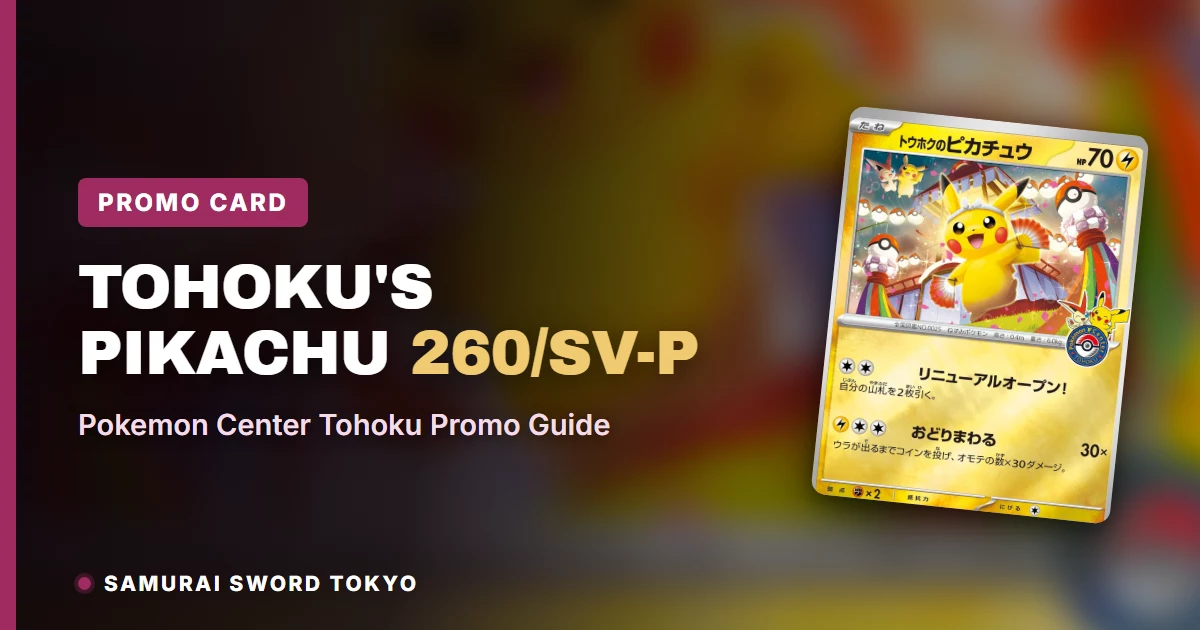
Tohoku's Pikachu 260/SV-P: Promogids Pokemon Center Tohoku

A Pokemon Center moving three floors down inside the same Sendai mall doesn’t usually make card-collecting news. In this case it produced a promo that never touched a retail shelf.

Tohoku’s Pikachu, numbered 260/SV-P, is a Mirror Holofoil promo card that existed for exactly one reason: Pokemon Center Tohoku’s 2025 relocation within PARCO Sendai. It was never sold as a standalone item and never appeared in a booster pack — the only route to owning one was a lottery-allocated Special Box sold through Pokemon Center Online.

This guide covers what’s actually printed on the card, how the 2025 reopening lottery ran, how the release compares to its sibling promo for Pokemon Center Fukuoka, and what a PSA 10 example is worth today.

Key Takeaway

Tohoku’s Pikachu (260/SV-P) is a Mirror Holofoil promo included only in the Pokemon Center Tohoku Special Box, released to mark the store’s move to the 3rd floor of PARCO Sendai. The box was lottery-only via Pokemon Center Online — applications ran June 13–17, 2025, one per person — and that window has since closed. A PSA 10 example is currently listed at ¥40,370 (~$254).

70
HP

2025
Release Year

¥40,370
PSA 10 Price (~$254)

1
Application Per Person

Prices are converted at ¥159/USD (September 2026).

What Is Tohoku’s Pikachu 260/SV-P?

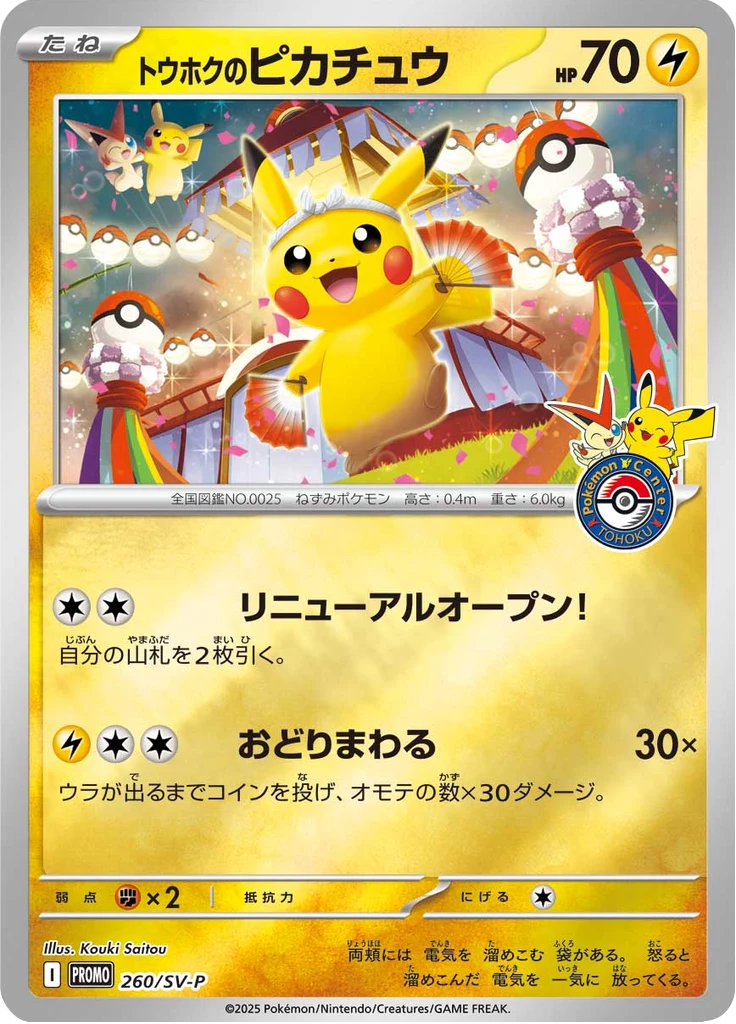
Tohoku’s Pikachu (トウホクのピカチュウ) is a Basic Lightning-type Pokemon card, 70 HP, Weakness Fighting, Retreat cost 1. It carries two attacks: “Renewal Open!” (draw 2 cards) and “Dance Around” (30 damage multiplied by however many times you flip a coin before it lands tails).

Tohoku's Pikachu 260/SV-P Mirror Holofoil, SV-P Promotional cards
Tohoku’s Pikachu 260/SV-P, Mirror Holofoil — SV-P Promotional cards

The card is illustrated by Kouki Saitou, and its Pokedex flavour text is sourced from Pokemon Scarlet. It’s a Mirror Holofoil finish, part of the long-running SV-P Promotional cards line rather than a mainline expansion — the “SV-P” in its card number marks it as a Scarlet & Violet-era Japanese promo, not a set-numbered pull.

Why Pokemon Center Tohoku Reopened

The card exists because a physical store moved. Pokemon Center Tohoku relocated within PARCO Sendai, going from the 8th floor down to the 3rd floor, and the Special Box was produced specifically to commemorate that reopening.

Two design details tie directly back to the event. “Renewal Open!” — the card’s first attack — is a direct reference to the store’s reopening. “Dance Around,” the second attack, references the Tohoku regional festivals depicted in the Special Box’s artwork. The card itself also carries the period-correct Pokemon Center Tohoku logo.

This is a pattern collectors will recognise from other Pokemon Center location promos — our broader Pokemon Center Pikachu Promo Cards: Regional Guide covers the wider series if you’re tracking more than one city’s release.

Inside the 2025 Reopening Lottery

The Special Box was never sold over the counter. It was Pokemon Center Online only, and access was allocated by lottery rather than first-come, first-served. The published timeline ran:

  • June 13–17, 2025 — application window open
  • June 20, 2025 — lottery results announced
  • June 20–24, 2025 — successful applicants could complete their purchase
  • Mid-August 2025 — shipping began

Entry was capped at one application per person, which is standard practice for Pokemon Center Online’s limited-box drops. Total units produced and the lottery’s win rate were never published, so treat any figure you see for either as unverified.

Window Is Closed

The application period ran June 13–17, 2025 and has not reopened. The Special Box is no longer available to order — the card now only circulates on the secondary and graded market.

Card Details: Attacks, Artist and Print Type

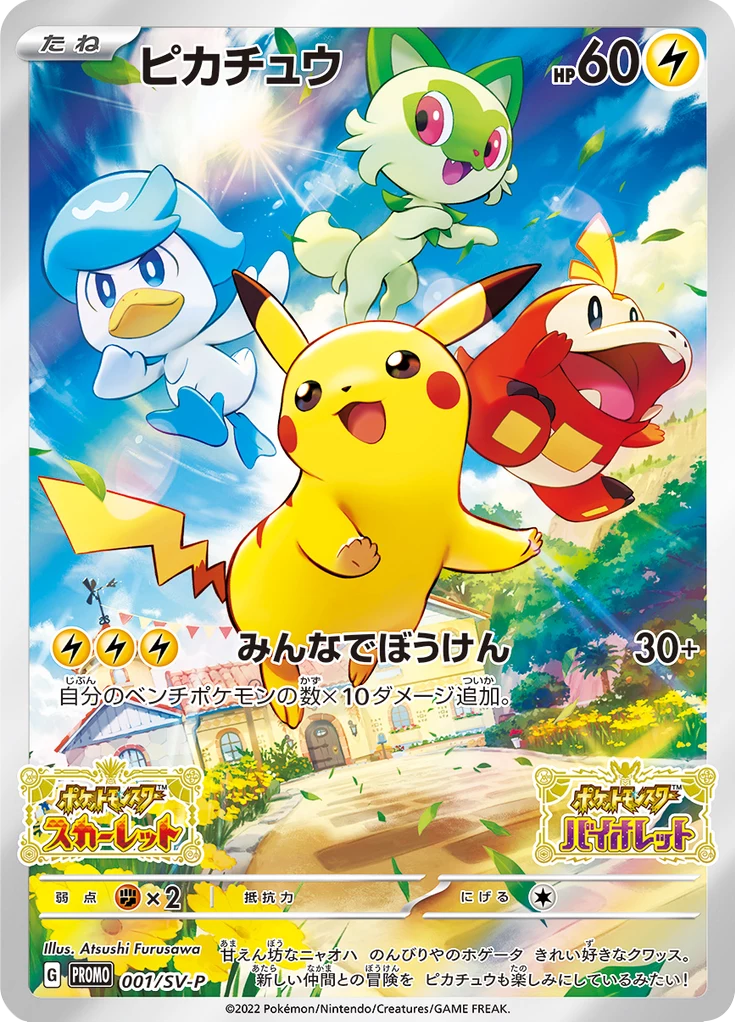
Pikachu 001/SV-P, SV-P Promotional cards

Pikachu 001/SV-P
SV-P Promotional cards

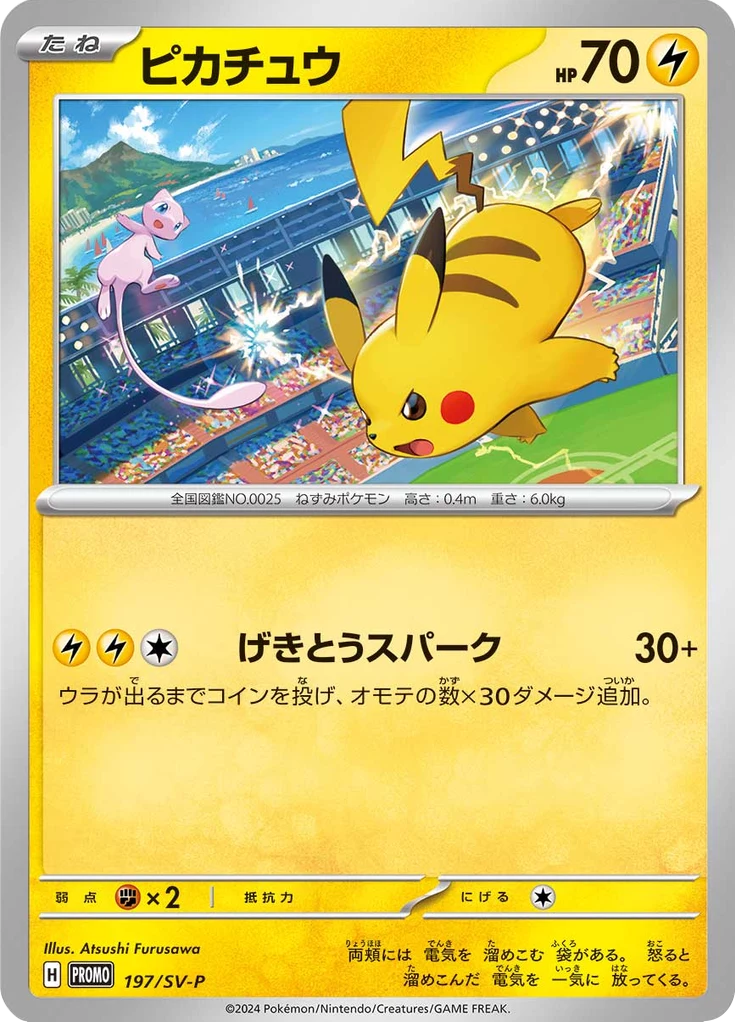
Pikachu 197/SV-P, SV-P Promotional cards

Pikachu 197/SV-P
SV-P Promotional cards

Card 260/SV-P sits inside a promo line that has been running since the start of the Scarlet & Violet era — the two cards above, 001/SV-P and 197/SV-P, are earlier Pikachu entries in the same numbering series, shown here for era context rather than as the same release. For a ranking of the strongest chases in this promo line, see our SV-P Promo Cards: Current Scarlet & Violet Chases guide.

What separates 260/SV-P from a standard SV-P entry is the finish and the story behind it: a Mirror Holofoil print tied to a single store’s physical move, illustrated by Kouki Saitou, and distributed through a box that was never available on general sale.

Tohoku vs Fukuoka: Comparing the 2025 Reopening Promos

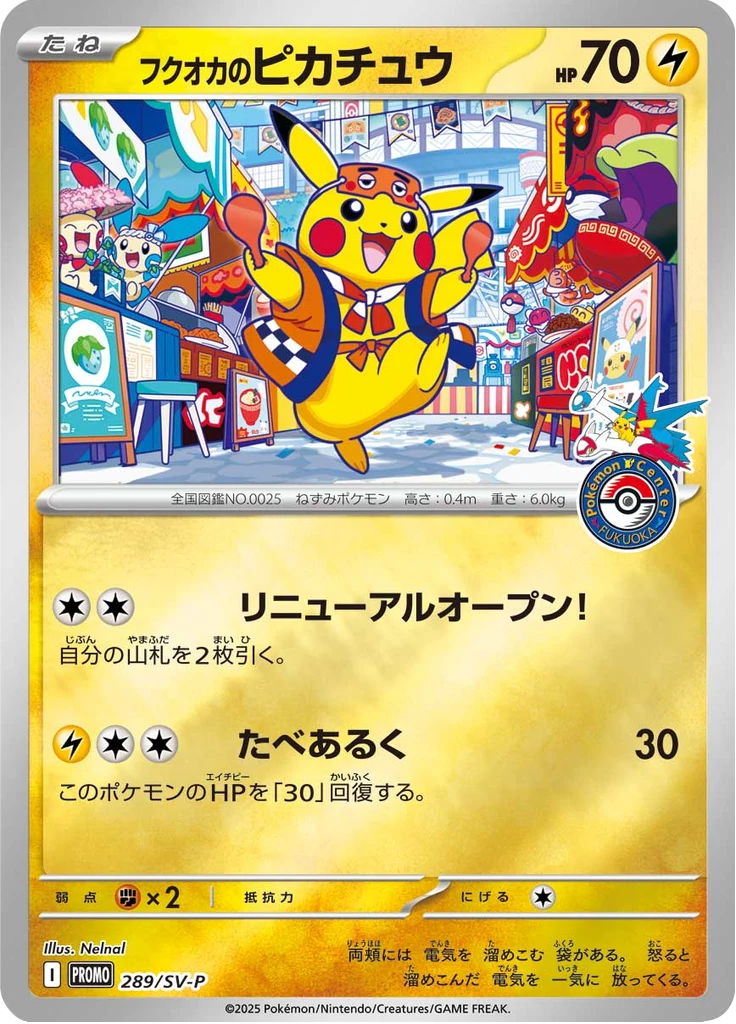
Tohoku’s Pikachu wasn’t the only reopening promo that June. Pokemon Center Fukuoka ran the same kind of Special Box lottery after its own move, from JR Hakata City mall to Hakata Murui mall, producing a sibling card: Fukuoka’s Pikachu, 289/SV-P.

Fukuoka's Pikachu 289/SV-P Mirror Holofoil, SV-P Promotional cards
Fukuoka’s Pikachu 289/SV-P, Mirror Holofoil — sibling Special Box promo, SV-P Promotional cards

Both cards share the “Renewal Open!” attack, but the second attack and the artwork theme are localised to each store’s region:

Detail Tohoku’s Pikachu (260/SV-P) Fukuoka’s Pikachu (289/SV-P)
Reopening location 3rd floor, PARCO Sendai Hakata Murui mall
Application window June 13–17, 2025 June 13–17, 2025
Results announced June 20, 2025 July 5, 2025
Purchase window June 20–24, 2025 July 4–8, 2025
Shipping began Mid-August 2025 Late September 2025
Second attack theme Dance Around (Tohoku festivals) Food Walk (Fukuoka food-stall culture)

Both application windows opened on the same date, but Fukuoka’s results and shipping ran roughly two weeks to a month behind Tohoku’s — likely reflecting separate box production runs rather than any difference in demand, since neither store has published applicant or unit numbers. For the full breakdown of the Fukuoka card, see our dedicated Fukuoka’s Pikachu 289/SV-P guide.

What a PSA 10 Copy Is Worth Today

With the lottery closed and no retail path left, pricing for 260/SV-P now runs entirely through the graded secondary market. A PSA 10 example from our own stock is currently listed at ¥40,370 (~$254), sourced and shipped from Tokyo.

As with any short-window lottery promo, condition matters more than usual once you’re past the initial owner — a Mirror Holofoil surface shows handling more visibly than a standard finish, so a PSA 10 grade is doing real work verifying centring and surface quality, not just confirming authenticity.

Shop This Card
PSA 10 Tohoku’s Pikachu 260/SV-P
Pokemon Center Tohoku Special Box promo, Mirror Holofoil
Ships from Tokyo · Tracked delivery

View Product →

If you’re comparing this card against other graded Pikachu chases before buying, our PSA 10 Pikachu Japanese Cards Guide and PSA 10 Japanese Pokemon Promo Cards Guide cover grading standards and pricing patterns across the wider promo market.

Where to Buy Tohoku’s Pikachu 260/SV-P

We ship graded Japanese cards worldwide, tracked, from Tokyo. Our PSA 10 Tohoku’s Pikachu (260/SV-P) is currently listed at ¥40,370 (~$254).

Since the Special Box lottery is closed, this listing reflects our own graded copy currently on the site rather than an ongoing release. If you’re after this specific card, or you want to build a mixed order with other Pokemon Center promos, our Quick Order page is the fastest way to send us a request.

Veelgestelde vragen

What is Tohoku’s Pikachu 260/SV-P?

It’s a Basic Lightning-type Mirror Holofoil promo card, part of the SV-P Promotional cards line, illustrated by Kouki Saitou. It was released exclusively inside the Pokemon Center Tohoku Special Box, produced to mark the store’s 2025 relocation within PARCO Sendai.

How did Pokemon Center Tohoku’s Special Box lottery work?

The box was sold only through Pokemon Center Online, allocated by lottery rather than direct sale. Applications ran June 13–17, 2025, results were announced June 20, 2025, successful applicants could purchase June 20–24, 2025, and shipping began mid-August 2025. Entry was capped at one application per person.

Is the Pokemon Center Tohoku Special Box still available?

No. The application window closed in June 2025 and has not reopened. The card is now only available through the secondary and graded market.

How is Tohoku’s Pikachu different from Fukuoka’s Pikachu?

Both share the “Renewal Open!” attack and came from the same June 2025 wave of Pokemon Center reopening promos, but their second attack and artwork theme are localised: Tohoku’s Pikachu features “Dance Around,” referencing regional festivals, while Fukuoka’s Pikachu features “Food Walk,” referencing Fukuoka’s food-stall culture. Their lottery timelines also differed by several weeks.

What does a PSA 10 Tohoku’s Pikachu cost?

Our own PSA 10 example is currently listed at ¥40,370 (about $254 at ¥159/USD). We don’t collect third-party market comparisons for this card.

Blissey Japanse Pokemon-Kaarten: De Complete Drukgids

Blissey has been reprinted in Japan across four decades of Pokemon card design — from a plain Uncommon in 2014 to a Double Rare chase card in 2026 — and the six prints in between don’t all look, or sit, at the same level.

This guide covers every Blissey print we could independently verify on Limitless’s Japanese card database: the set, the card number, the rarity tier, the release date, and the illustrator. Our sister article on Chansey and Blissey together covers the full pre-evolution line across every print; this one goes deeper on Blissey alone, with the most attention on the V/VMAX-era chase prints and the one we currently have graded and listed.

We ship Japanese singles and sealed product out of Tokyo, and the pricing you’ll see below reflects only what’s actually live on our own site — we don’t have third-party market data for the other five prints, so we’re not going to guess at it. Requests for those other prints go through our Quick Order page.

Key Takeaway

Six Blissey Japanese prints are verified here, spanning Phantom Gate (2014) through the still-undated Mask of Change ex. Only one carries a Secret Rare designation: Blissey V, S6K #079/070 from Jet-Black Spirit — and we currently have a PSA10 graded copy listed at ¥13,905 (~$87).

6
Confirmed Blissey Prints

2014–2022
Confirmed Release Span

1
Secret Rare Print (S6K)

$87
Our Listed PSA10 (¥13,905)

Card data verified against Limitless’s Japanese card database on 2026-09-01. Own-stock pricing verified live on samuraiswordtokyo.com the same day, converted at ¥159/USD.

Every Confirmed Blissey Print, Ranked by Era

Here are the six Blissey prints we verified, newest set-era first:

Kaart Set (JP) Code Nr. Rarity Release Artist
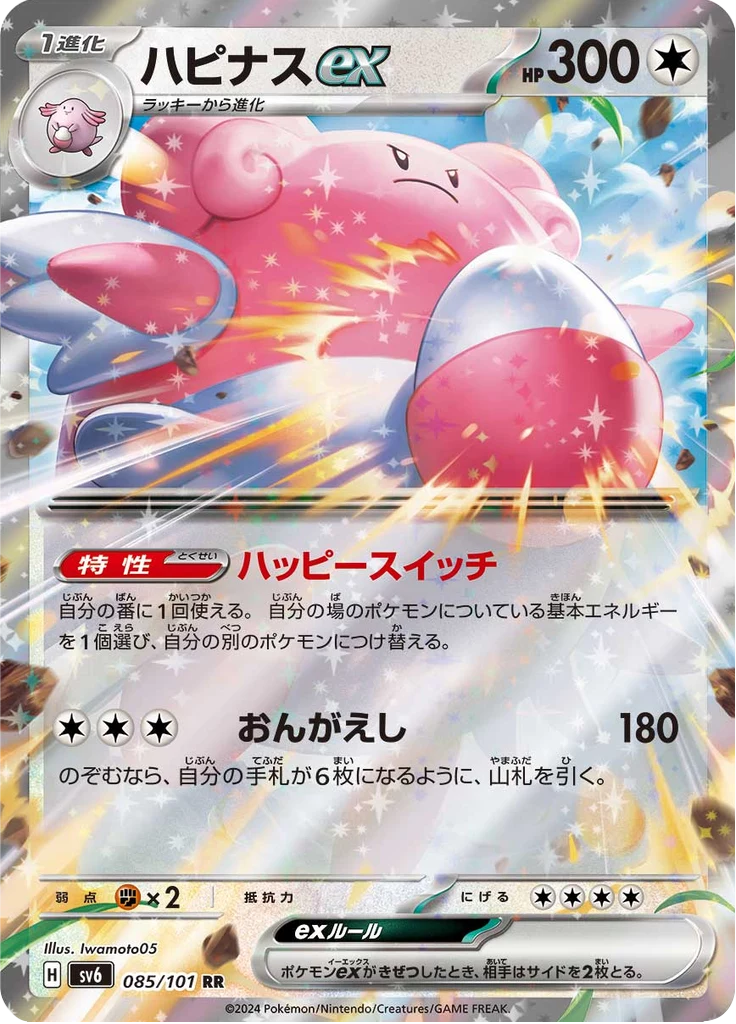
Blissey ex Mask of Change SV6 #85 Double Rare Unconfirmed Iwamoto05
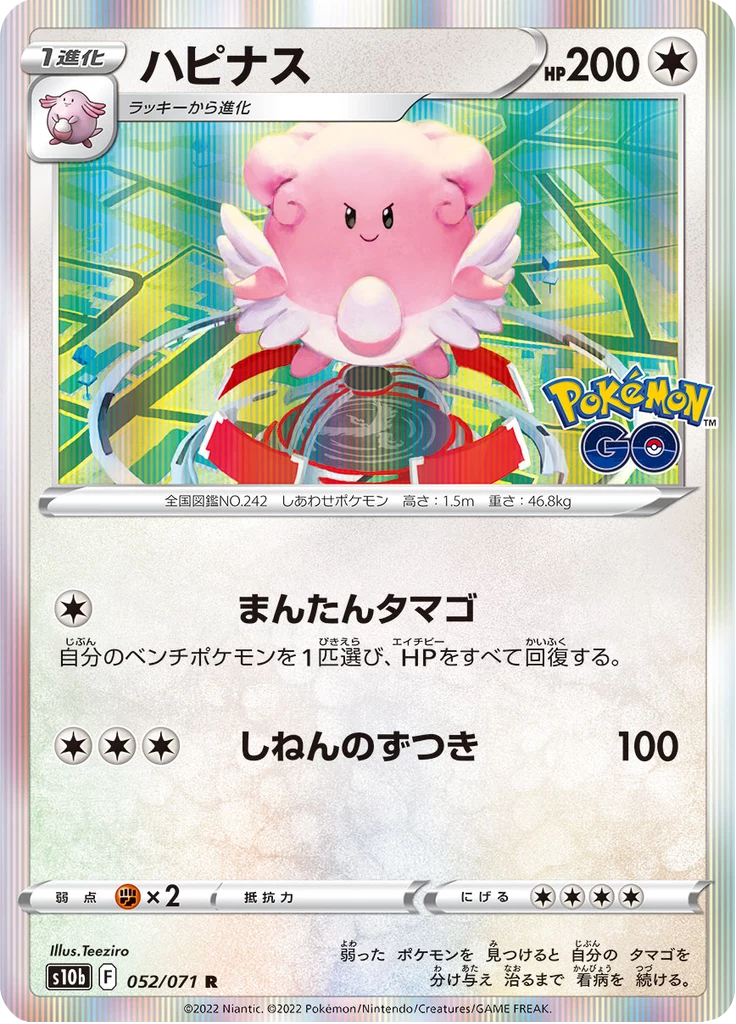
Blissey Pokémon GO S10b #52 Rare 17 Jun 2022 Teeziro
Blissey V VMAX Climax S8b #127 Double Rare 03 Dec 2021 Saki Hayashiro
Blissey V Jet-Black Spirit S6K #079/070 Secret Rare 23 Apr 2021 Saya Tsuruta
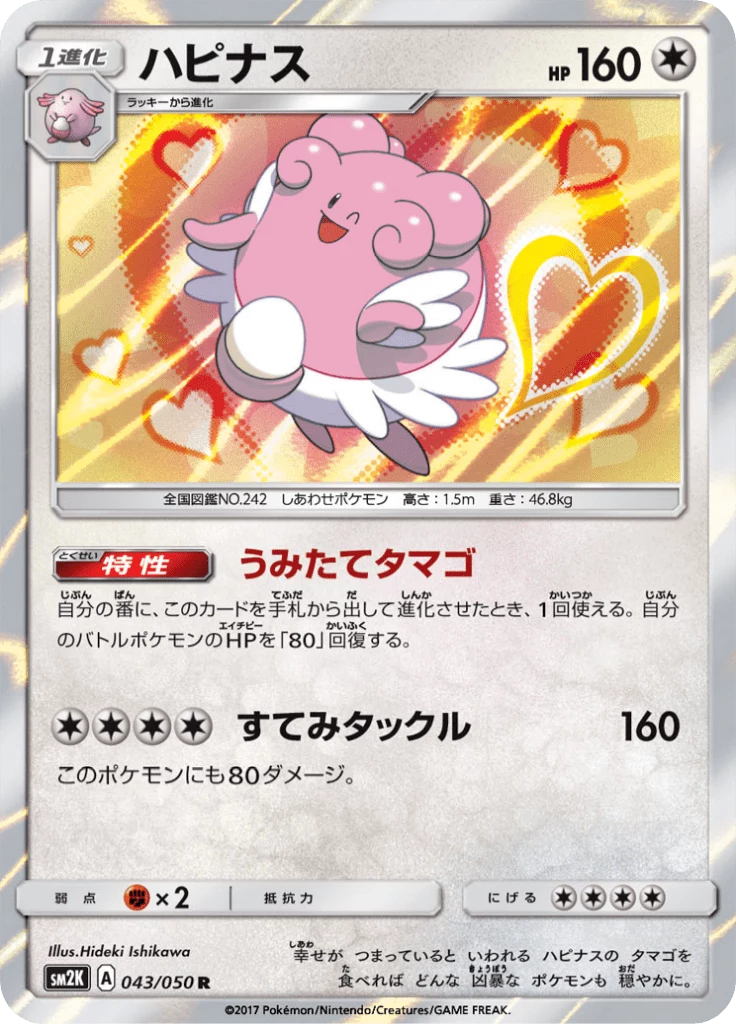
Blissey Islands Await You SM2K #43 Rare 17 Mar 2017 Hideki Ishikawa
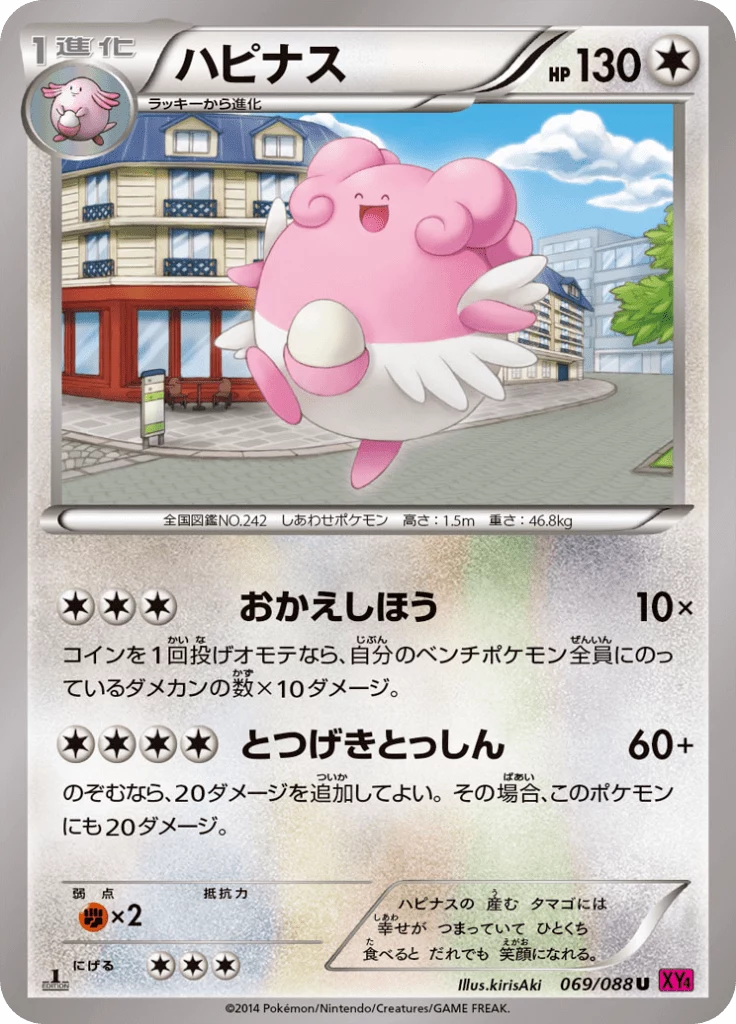
Blissey Phantom Gate XY4 #69 Uncommon 13 Sep 2014 kirisAki

We weren’t able to independently confirm a release date for the SV6 Blissey ex during this check, so we’re leaving it as unconfirmed rather than guessing. Everything else in the table is sourced directly from Limitless’s per-card pages.

Of the six, only the S6K print carries a Secret Rare tag — and it’s the one with a PSA10-graded copy currently listed on our site. The sections below walk through each print in more detail.

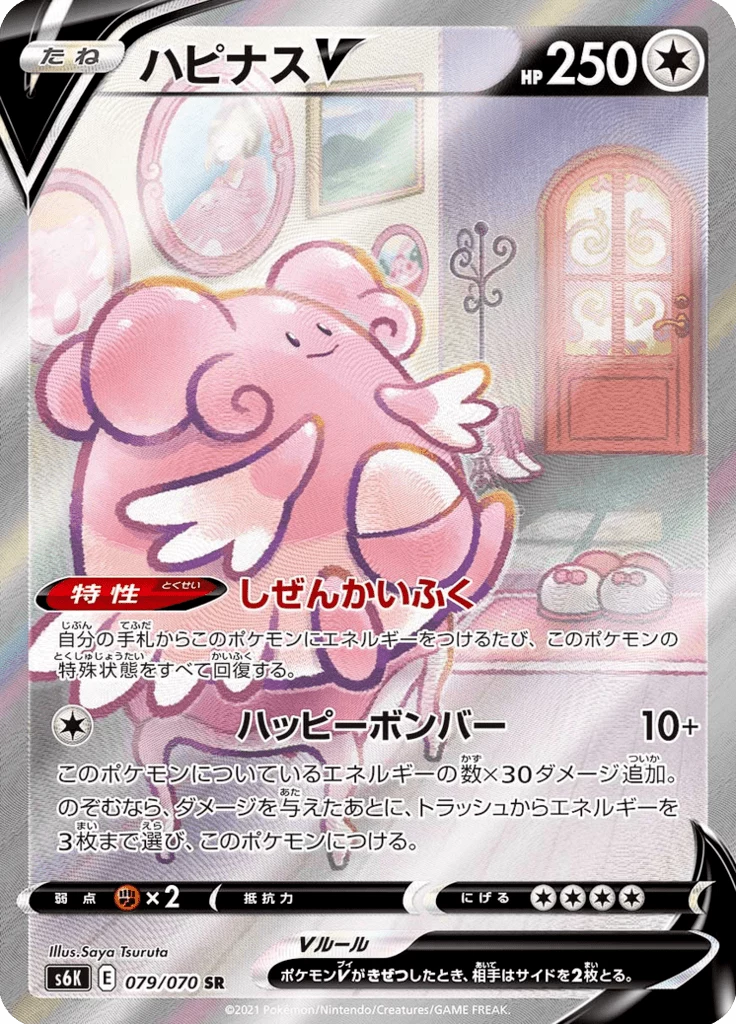
The Chase Card: Blissey V Secret Rare (Jet-Black Spirit)

Blissey V card number 079/070 Secret Rare from Jet-Black Spirit
Blissey V, S6K #079/070, Secret Rare — Jet-Black Spirit

Blissey V’s Secret Rare printing, S6K #079/070, comes from Jet-Black Spirit, released 23 April 2021 with artwork by Saya Tsuruta. It’s the only Secret Rare among the six confirmed prints in this guide — the rest sit at Double Rare, Rare, or Uncommon.

Jet-Black Spirit’s closest English-language parallel, per Limitless’s cross-reference data, is Chilling Reign — it isn’t a confirmed 1:1 reprint match, just the nearest international release in the same design era.

We currently have a PSA10-graded copy of this exact print listed at ¥13,905 (~$87). One thing worth flagging if you’re comparing our listing against Limitless’s database: our own product page labels this card’s rarity as “SR: SA,” while Limitless lists it as “Secret Rare.” Both labels describe the identical print — it’s a naming-convention difference, not a different card.

Check This First

If you’re trying to identify a Blissey V in hand, the card number is the fastest tell. S6K #079/070 is the Secret Rare from Jet-Black Spirit; a Blissey V numbered differently is a different print entirely.

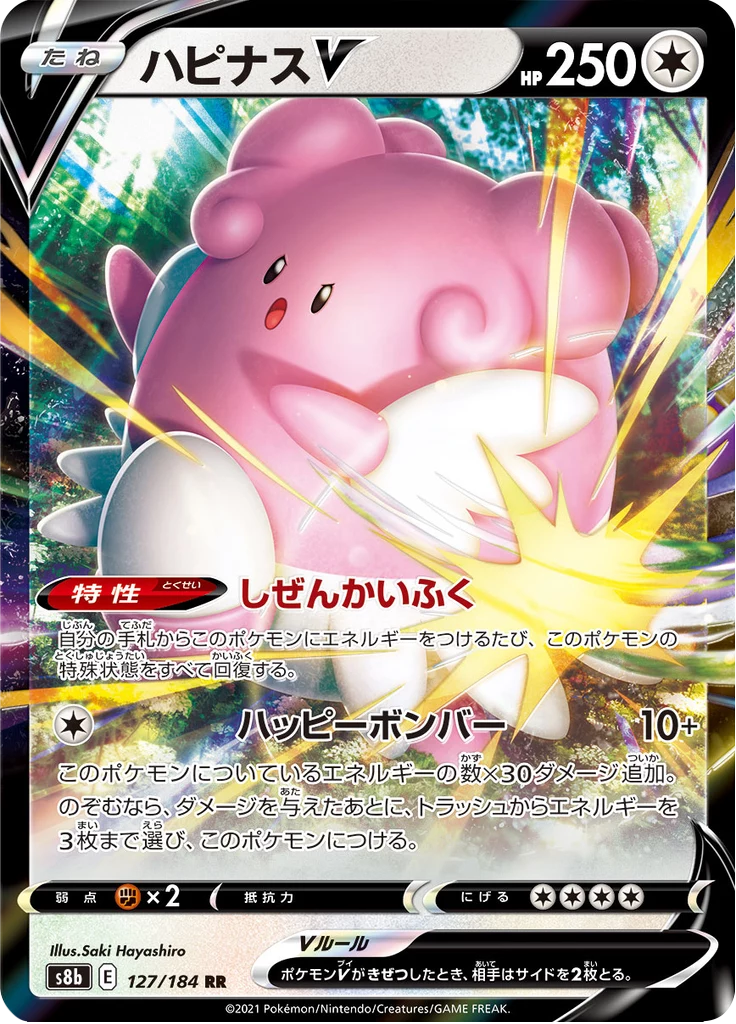
Blissey V Double Rare in VMAX Climax

Blissey V card number 127 Double Rare from VMAX Climax
Blissey V, S8b #127, Double Rare — VMAX Climax

A separate Blissey V print, S8b #127, appears in VMAX Climax, released 03 December 2021 with artwork by Saki Hayashiro. It carries a Double Rare rarity tag rather than the S6K print’s Secret Rare, and it’s a different card number entirely, even though both feature the same Pokemon at the V stage.

VMAX Climax’s closest English-language parallel, again per Limitless’s cross-reference, is Chilling Reign. If you’re building out a VMAX Climax collection more broadly, our VMAX Climax booster box buying guide and our S8b best-cards rundown cover the rest of the set’s chase prints.

We don’t have a live listing for the S8b print at the time of writing, so we’re not quoting a price for it here — the S6K Secret Rare above is the only print currently listed on our site.

The Newest Print: Blissey ex in Mask of Change

Blissey ex card number 85 Double Rare from Mask of Change
Blissey ex, SV6 #85, Double Rare — Mask of Change

The most recent addition to the lineup is Blissey ex, SV6 #85, a Double Rare from Mask of Change, illustrated by Iwamoto05. Its English-language counterpart is Twilight Masquerade.

We weren’t able to independently confirm an exact release date for this printing during our verification pass, so we’re leaving that blank rather than stating one — everything else about the card (set, number, rarity, artist) checks out directly against Limitless’s database.

This is the only “ex” version of Blissey in the six prints covered here; the rest are either base-stage Blissey or Blissey V.

The Earlier Prints: Phantom Gate, Islands Await You, Pokémon GO

Three more Blissey prints round out the confirmed list, spanning the XY era through 2022:

Blissey card number 69 Uncommon from Phantom Gate

Blissey #69, Phantom Gate (XY4)

Blissey card number 43 Rare from Islands Await You

Blissey #43, Islands Await You (SM2K)

Blissey card number 52 Rare from Pokémon GO

Blissey #52, Pokémon GO (S10b)

The oldest confirmed print, XY4 #69 from Phantom Gate (13 September 2014, illustrated by kirisAki), is an Uncommon — the lowest rarity tier of the six. Phantom Gate’s closest English-language parallel is Phantom Forces, again per Limitless’s cross-reference rather than a confirmed direct reprint.

SM2K #43 from Islands Await You (17 March 2017, illustrated by Hideki Ishikawa) sits at Rare. S10b #52 from Pokémon GO (17 June 2022, illustrated by Teeziro) is also a Rare — and Pokémon GO is one of the few sets here with a matching official English release under the same name, rather than a Limitless cross-reference.

How to Tell These Six Prints Apart

With six different Blissey cards spanning three Pokemon forms (base Blissey, Blissey V, Blissey ex), the fastest way to identify what you’re holding is the set code and card number printed on the card, not the artwork style:

  • Base Blissey appears three times: XY4 #69 (Uncommon, 2014), SM2K #43 (Rare, 2017), and S10b #52 (Rare, 2022). Check the small set code near the card number to tell them apart.
  • Blissey V appears twice: S8b #127 (Double Rare, VMAX Climax) and S6K #079/070 (Secret Rare, Jet-Black Spirit) — the same PSA10 copy we currently have listed. These are easy to confuse in a binder since both are the V stage — the card number is the giveaway.
  • Blissey ex appears once, as SV6 #85 from Mask of Change, and is the only ex-stage print in this list.

If you’re weighing this against other VMAX-era chase cards more broadly, our Japanese VMAX cards guide and our VMAX Climax vs VSTAR Universe comparison put the S8b and S6K prints in context against the rest of that generation.

Where to Buy Blissey Cards from Japan

We ship Japanese singles and sealed product worldwide from Tokyo with tracked delivery. Right now, our live Blissey listing is the PSA10-graded Secret Rare from Jet-Black Spirit.

Currently Listed
PSA10 Blissey V SR: SA [S6K 079/070], Jet-Black Spirit
¥13,905 (~$87)
Ships from Tokyo · Tracked delivery

View Product →

For the other five prints covered in this guide — or any other Japanese Blissey card — requests go through our Quick Order page, where we can source and quote a mixed order.

Veelgestelde vragen

Which confirmed Blissey print carries the Secret Rare designation?

Of the six Blissey prints we verified, only one carries a Secret Rare designation: Blissey V, S6K #079/070, from Jet-Black Spirit (released 23 April 2021). The other five sit at Double Rare, Rare, or Uncommon.

What’s the difference between the S8b and S6K Blissey V cards?

Both are Blissey V, but they’re different prints. S8b #127 is a Double Rare from VMAX Climax (3 December 2021), illustrated by Saki Hayashiro. S6K #079/070 is a Secret Rare from Jet-Black Spirit (23 April 2021), illustrated by Saya Tsuruta. Different set, different card number, different rarity tier.

Why does the store list card ID 8399 as “SR: SA” instead of “Secret Rare”?

“SR: SA” is the store’s own shorthand rarity label for the same S6K #079/070 print that Limitless’s database lists as Secret Rare. Both labels refer to the identical card — there’s no difference in the physical print.

When was the SV6 Blissey ex from Mask of Change released?

We were not able to independently confirm an exact release date for this printing during our September 2026 verification pass, so we’re not stating one here. The set, card number, rarity, and artist are all confirmed via Limitless’s card database.

Where can I buy a Japanese Blissey card?

We currently list the PSA10 Blissey V Secret Rare (S6K #079/070) from Jet-Black Spirit at ¥13,905 (~$87). For other prints, requests go through our Quick Order page.

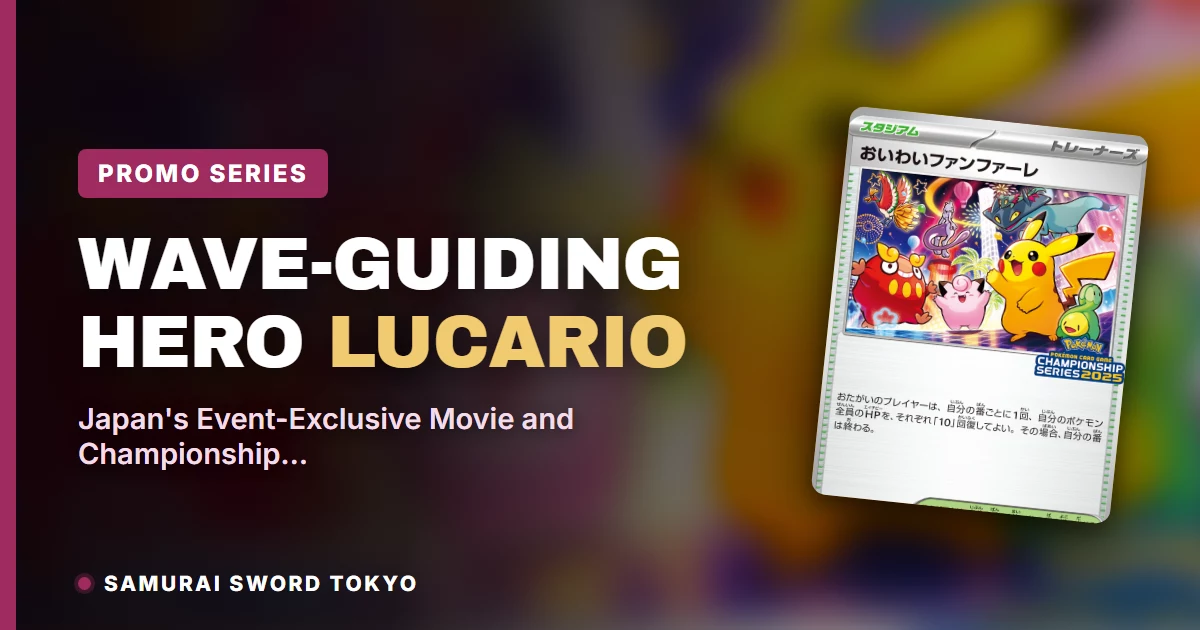
Wave-Guiding Hero Lucario & Celebratory Fanfare: Japanse evenementexclusieve film- en kampioenschapspromokaarten

Neither of these cards ever sat in a booster pack. One came home inside a Japan-only movie tie-in box. The other went out in the mail to players who cleared a points threshold across an entire competitive season. Different decades, different reasons to exist, but the same underlying logic: you had to show up, not open a pack.

Wave-Guiding Hero Lucario and Celebratory Fanfare have nothing in common on paper — one is a Basic Pokémon from a movie-commemoration promo box, the other is a Stadium Trainer handed out for tournament performance. What connects them here is distribution: both are Japan-exclusive “attend or qualify” prizes, and, as a small bonus, both trace back to the same illustrator, Kagemaru Himeno. This guide covers what each card actually is, where it came from, and what our own graded copies are currently listed at.

Key Takeaway

Wave-Guiding Hero Lucario is a Japan-only promo from the 10th Movie Commemoration Set, referencing Lucario and the Mystery of Mew (movie code M08). Our graded copy, PSA10 Hero of Waves Lucario [10th], is currently listed at ¥61,692 (~$388 at ¥159/USD). Celebratory Fanfare is a Stadium Trainer first issued in 2021 and reprinted in 2025 as a Championship Series reward for players earning 30–79 Championship Series Points; our copy, PSA10 Celebrate Fanfare P [M-P 033], is currently listed at ¥85,580 (~$538).

M08
Lucario’s Movie Code

30–79
CSP for 2025 Fanfare

$388
Lucario PSA10 Listed

$538
Fanfare PSA10 Listed

Prices are our own current listings as of September 2026, converted at ¥159/USD.

Two Prize Cards, Side by Side

Start with what each card actually does on the table, because the two have nothing in common mechanically.

Kaart Type / Format Origin Our listed price
Wave-Guiding Hero Lucario Basic Pokémon, Fighting, HP 80 10th Movie Commemoration Set ¥61,692 (~$388)
Celebratory Fanfare (033/M-P) Stadium Trainer 2025 Championship Series reward ¥85,580 (~$538)
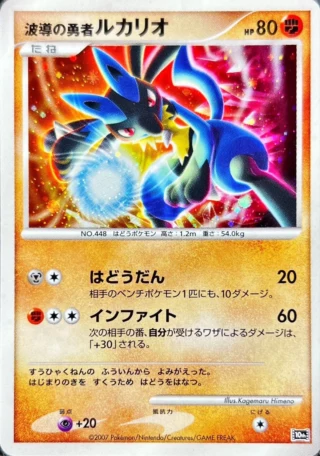
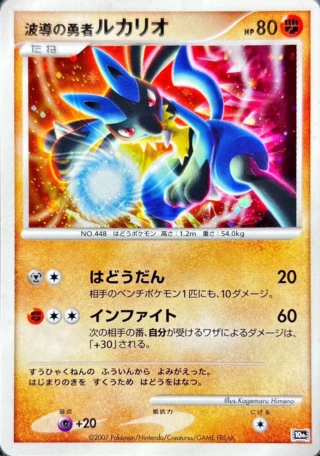
Our own PSA10 graded Wave-Guiding Hero Lucario, 10th Movie Commemoration Set promo card
Wave-Guiding Hero Lucario — our own PSA10 graded copy, 10th Movie Commemoration Set

Wave-Guiding Hero Lucario (JP: 波導の勤者ルカリオ) is a Basic Pokémon, Fighting type, 80 HP, weak to Psychic +20, with a retreat cost of 1. It carries two attacks: “Aura Sphere” (Metal + Colorless, 20 damage, plus 10 to a Benched Pokémon) and “Close Combat” (Fighting + Colorless + Colorless, 60 damage, though this Lucario takes +30 damage from attacks on the following turn). It’s illustrated by Kagemaru Himeno, and Bulbapedia categorises it as not officially released in English — it’s a Japan-exclusive print.

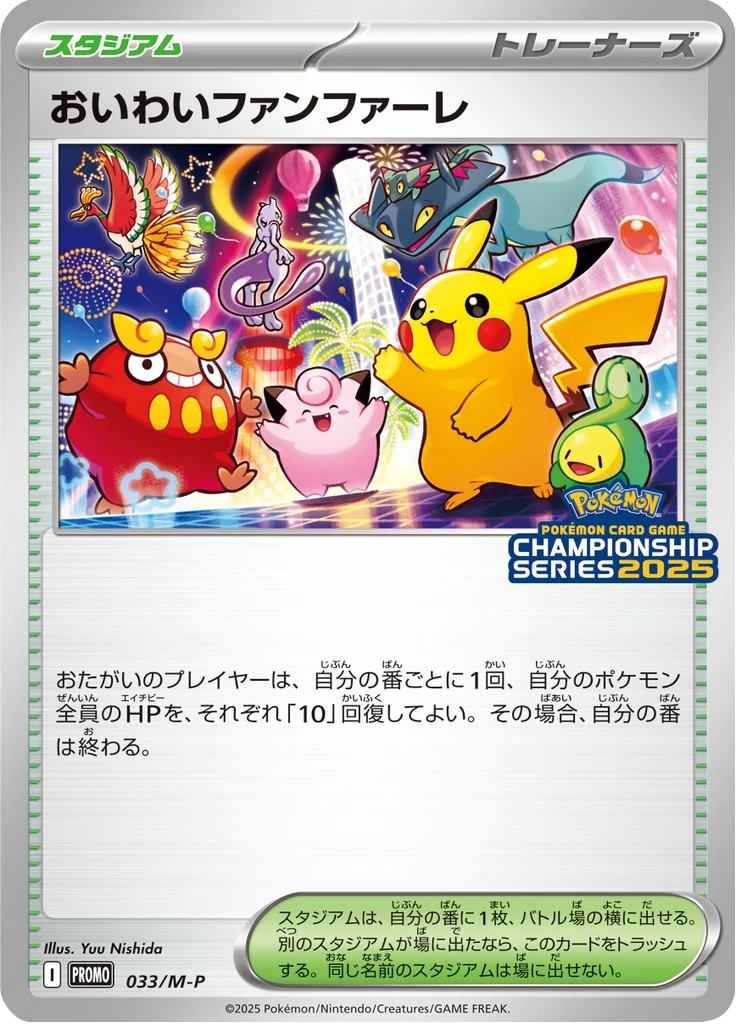
Celebratory Fanfare, M-P Promo 033, 2025 print
Celebratory Fanfare, M-P Promo 033 (2025 print)

Celebratory Fanfare (JP: おいわいファンファーレ) is a Stadium card: “Once during each player’s turn, that player may heal 10 damage from each of their Pokémon. If a player healed any damage in this way, their turn ends.” The version we carry is the 2025 print, collection number 033/M-P, with new artwork by Yuu Nishida and the Championship Series 2025 logo on the card face.

Inside the 10th Movie Commemoration Set

Wave-Guiding Hero Lucario didn’t ship alone. It was part of the 10th Movie Commemoration Set, a Japan-only promo box tied to Lucario and the Mystery of Mew (movie code M08) — and our own listing title describes it as a “Movie 10th Anniversary Premium Seats” item. Bulbapedia confirms the set name and the movie tie-in, but not the specific “premium seat” cinema-ticket mechanic; treat that phrase as a seller/collector description of how the box was distributed rather than an independently sourced fact.

The same box also included two other legendary Pokémon promos from earlier films: Striking Back Mewtwo, illustrated by Kouki Saitou, referencing the first Pokémon movie (M01), and Explosive Birth Lugia, illustrated by Masakazu Fukuda, referencing the second (M02). Neither is part of our own stock, and we don’t have an accessible photo source for either, so we aren’t including images of them here — but the pairing tells you what the box actually was: a retrospective of movie-legendary Pokémon (Mewtwo, Lugia, Lucario) timed to the 10th film, not a Lucario-specific product.

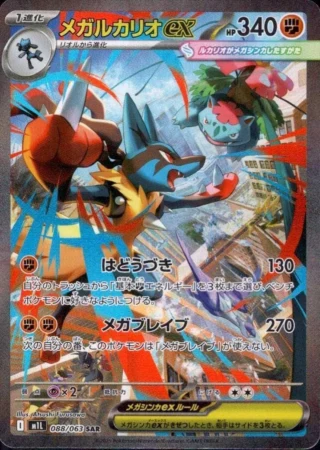
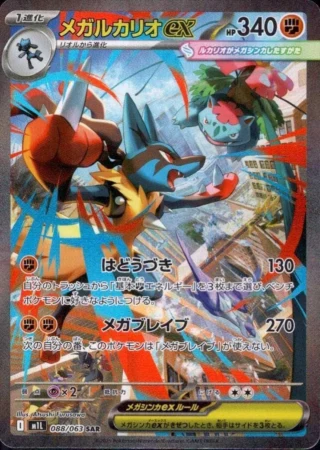
PSA10 Mega Lucario ex 088/063, a modern Lucario print shown for comparison, our own stock photo
Mega Lucario ex 088/063 (our own stock) — a different, modern Lucario print, shown for comparison only, not part of the 10th Movie Commemoration Set

If you collect Lucario prints more broadly, our Lucario card guide covers the wider print run, and for era context the Diamond & Pearl LV.X guide is a useful neighbour.

For a closer read on the Lucario card specifically — distribution details, condition notes, and what a graded copy looks like — see our dedicated Wave-Guiding Hero Lucario guide.

Celebratory Fanfare: From a 2021 Promo to a 2025 Reprint

Celebratory Fanfare is not a new card. It first appeared in 2021 as an S-P Promotional card, number 254/S-P, illustrated by Kagemaru Himeno — the same illustrator credited on Wave-Guiding Hero Lucario. Our Kagemaru Himeno illustrator guide tracks both prints and the rest of that artist’s work.

Our listed copy is the 2025 reprint: same Stadium effect, new collection number 033/M-P, entirely new artwork by Yuu Nishida, and the Championship Series 2025 logo printed on the card. It’s a fresh print run of an existing card rather than a new design — anyone comparing the two versions side by side is looking at the same rules text under two different pieces of art, four years apart. For distribution specifics and the full print timeline, see our dedicated Celebratory Fanfare guide.

Print History, Not a New Card

2021 S-P Promo 254/S-P (Himeno artwork) → 2025 M-P Promo 033/M-P (Nishida artwork, Championship Series 2025 branding). Same card text, different print.

How Players Earned the 2025 Celebratory Fanfare

The 2025 print of Celebratory Fanfare was a Japan-only reward tied to the 2024–2025 Championship Series season, which ran through 31 August 2025. Players who accumulated 30 to 79 Championship Series Points (CSP) across that season received the card. Players who cleared 80 or more CSP received a two-card set instead: Celebratory Fanfare plus Scizor ex (SV-P Promo 210). Distribution to eligible players began after the season closed.

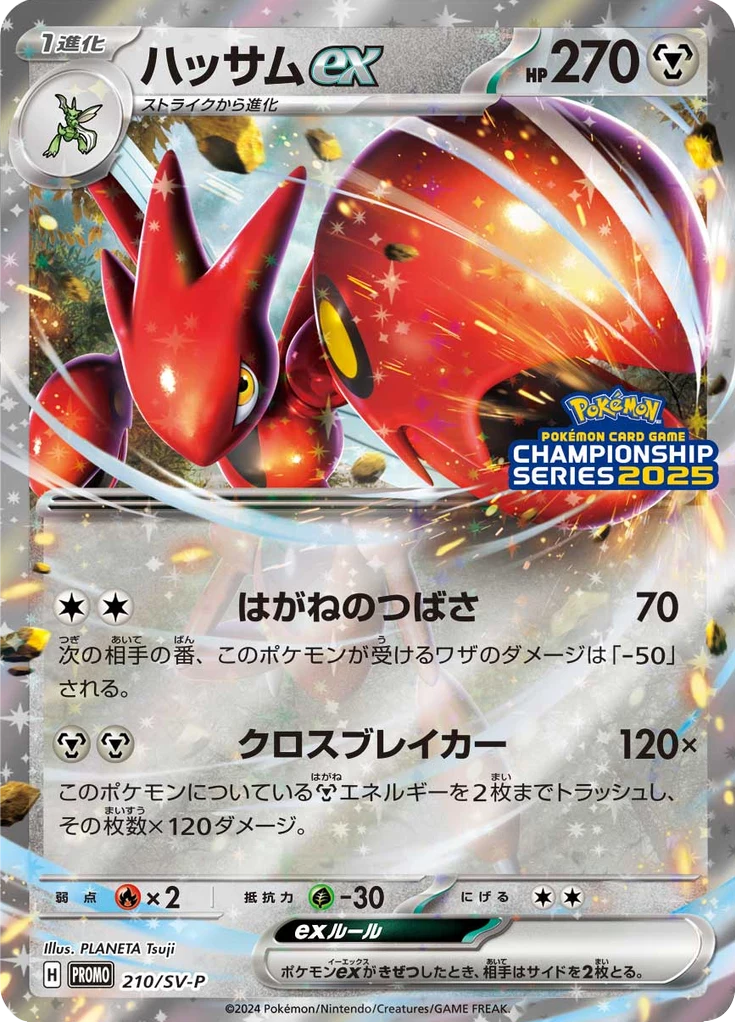
Scizor ex, SV-P Promo 210, companion card for the 80+ CSP tier
Scizor ex, SV-P Promo 210 — the 80+ CSP companion card, not part of our stock

Scizor ex isn’t part of our own stock — it’s shown here purely as context for how the reward tiers worked. The point-threshold structure is worth flagging because it’s a different reward mechanism from a lottery-entry campaign or a straight tournament-placement prize: it rewards sustained participation across a whole season rather than a single result.

Attend-to-Earn vs Pack-Pulled: Why There’s No Pull Rate Here

Neither of these cards came out of a booster pack, so neither has a pull rate — and we’re not going to invent one. Wave-Guiding Hero Lucario was distributed through a Japan-only movie-commemoration box; the 2025 print of Celebratory Fanfare was distributed to players who cleared a CSP threshold across a competitive season. If you’re used to thinking about card scarcity in terms of “how many per box,” these two need a different frame: scarcity here comes from how many people engaged with the movie promotion or how many players hit the points bar, not from print-run odds inside a product.

That’s also why this is one article rather than two separate “pull rate” pieces — the honest comparison is about qualification mechanics, not booster math. For the anniversary-numbering side of Pokémon TCG promo history more broadly, our anniversary sets history guide covers how these commemorative numbers get used across different eras.

Where to Buy These Event-Exclusive Promos

We ship graded Japanese cards worldwide out of Tokyo with tracked delivery. Both cards below are PSA10-graded singles from our own stock.

Shop This Card
PSA10 Hero of Waves Lucario [10th]
Currently listed at ¥61,692 (~$388)
Ships from Tokyo · Tracked delivery

View Product →

For the Celebratory Fanfare reward card, our PSA10 Celebrate Fanfare P [M-P 033] listing is currently priced at ¥85,580 (~$538). For anything else Japan-exclusive — movie promos, tournament rewards, or specific card numbers — our Quick Order page is the fastest way to request it directly.

Veelgestelde vragen

What is the 10th Movie Commemoration Set?

A Japan-only promo box named the 10th Movie Commemoration Set, referencing Lucario and the Mystery of Mew (movie code M08). Alongside Wave-Guiding Hero Lucario, it also included Striking Back Mewtwo (referencing the first movie, M01) and Explosive Birth Lugia (referencing the second, M02), suggesting the box was a movie-legendaries retrospective rather than a Lucario-only product.

Who illustrated Wave-Guiding Hero Lucario?

Kagemaru Himeno, who also illustrated the original 2021 print of Celebratory Fanfare (S-P Promo 254/S-P).

Is Celebratory Fanfare a new card in 2025?

No. It was first released in 2021 as an S-P Promotional card (254/S-P). The 2025 version is a reprint with new artwork by Yuu Nishida, a new collection number (033/M-P), and the Championship Series 2025 logo — the rules text is unchanged.

How did players qualify for the 2025 Celebratory Fanfare?

By earning 30 to 79 Championship Series Points during the 2024–2025 season, which ran through 31 August 2025. Players who earned 80 or more CSP instead received a two-card set of Celebratory Fanfare plus Scizor ex (SV-P Promo 210).

What does Celebratory Fanfare do as a Stadium card?

Once during each player’s turn, that player may heal 10 damage from each of their Pokémon. If a player heals any damage this way, their turn ends immediately.

Wave-Guiding Hero Lucario: Movie 10th Anniversary Premium Seat Promogids

No printed number. No rarity symbol. No set logo you can look up on a checklist. And still, this Lucario promo is one of the more quietly interesting cards to come out of the Pokemon TCG’s Japanese movie-era promos — because it was never meant to be pulled from a pack in the first place.

Collectors know it informally as the “Hero of Waves Lucario.” Bulbapedia’s catalogued English name is Wave-Guiding Hero Lucario — a direct translation of its Japanese name, 波導の勇者ルカリオ (Hadō no Yūsha Lucario). It was handed out as part of a Japan-only album product tied to the movie that made Lucario a household name in the franchise, and it carries the 10th Movie Commemoration Set’s “Premium Seat” branding rather than a standard set code.

This guide covers what the card actually is, where it came from, why it isn’t a tournament-legal Pokemon card, and where it sits if you’re already collecting Lucario prints.

Key Takeaway

The Wave-Guiding Hero Lucario is a Japan-exclusive promo from the 10th Movie Commemoration Set (2007), tied to the 8th Pokemon movie, Lucario and the Mystery of Mew. It has no printed card number or rarity symbol and is explicitly unreleased for competitive play — it’s a collectible, not a deck piece. Our own graded copy, PSA10 Hero of Waves Lucario [10th], is currently listed at ¥61,692 (~$388 at ¥159/USD).

2007
Release Year

¥61,692
Our PSA10 Listing

8
Cards in the Set

3
Release Phases

Prices shown are current Samurai Sword Tokyo listings as of September 2026, converted at ¥159/USD. No competitor or auction price data is included here.

Wave-Guiding Hero Lucario: Card Profile

Our own PSA10 graded Wave-Guiding Hero Lucario, 10th Movie Commemoration Set Premium Seat promo (Japanese)
Wave-Guiding Hero Lucario — our own PSA10 graded copy of the 10th Movie Commemoration Set Premium Seat promo, no printed number

The card is a Basic Fighting-type Lucario, 80 HP, with a Weakness to Psychic-type attacks (+20). Its two attacks are straightforward for the era:

  • Aura Sphere (はどうだん) — 20 damage to the Defending Pokemon, plus 10 damage to one of the opponent’s Benched Pokemon.
  • Close Combat (インファイト) — 60 damage, with a self-damage drawback typical of the attack’s other printings.

Illustration is credited to Kagemaru Himeno. Unlike most Japanese promos from surrounding sets, this card was never assigned a printed card number, level indicator, or rarity symbol — a detail that immediately marks it as coming from an album/commemoration product rather than a numbered booster set or standard promo line.

Our own graded copy, PSA10 Hero of Waves Lucario [10th], is a PSA 10 example of this exact promo, currently listed at ¥61,692 (~$388).

Naming Note

“Hero of Waves Lucario” is the informal English name most commonly used by collectors and listings. The official catalogued name is Wave-Guiding Hero Lucario, translated directly from the Japanese 波導の勇者ルカリオ.

The 8th Movie Connection: Lucario and the Mystery of Mew

The card’s design directly references Lucario’s role as the title Pokemon of the franchise’s 8th movie, Lucario and the Mystery of Mew (Japanese: ミュウと波導の勇者 ルカリオ, “Mew and the Wave-Guiding Hero Lucario”). That film introduced Lucario’s Aura-sensing ability to a mainstream audience and remains one of the more fondly remembered entries from that stretch of the anime movie run.

The card isn’t a movie tie-in reprint of an existing set card — it’s a purpose-made illustration built around that film’s version of Lucario, which is part of why it circulates outside the normal set-and-number system collectors use for everything else from this era.

Inside the 10th Movie Commemoration Set

This Lucario card belongs to the 10th Movie Commemoration Set, a Japan-exclusive, unlimited-edition product built around the franchise’s 10th anniversary (the anime debuted in 1997). It shipped as an 11-card album, with a 12th card — this Lucario, tied to the “Movie 10th Anniversary Premium Seat” promotion — given out separately to cinema patrons.

The set reused artwork themes from past movie-legendary Pokemon across three release phases:

Datum Phase
January 14, 2007 World Hobby Fair prerelease
July 14, 2007 Theatrical release distribution
August 3, 2007 Commercial release

The set’s companion cards each pair a legendary or mythical Pokemon with its own movie appearance: Explosive Birth Lugia (referencing the second movie), Striking Back Mewtwo (referencing the first), Tree of Beginning’s Mew, Crystal Tower’s Entei, Prince of the Sea Manaphy, Timeless Celebi, and Visitor Deoxys — eight cards in total across the set, each drawing its name and artwork from a specific movie appearance. None of these companion cards are currently listed on our site, so we aren’t including photos of them here.

Collectible Promo, Not a Tournament Card

Bulbapedia’s own reference marks this card as “TCG Unreleased” — meaning it was never made legal for Standard or Expanded tournament play. That’s worth stating plainly before anyone buys one expecting a deck piece: this is a display and collection card, not a competitive one, in line with several other movie-anniversary promos from the same period.

That framing doesn’t diminish what the card is. Album-exclusive movie promos with no printed number sit in their own collecting lane — closer to a commemorative item than a set chase — and demand for them tends to come from Lucario collectors and movie-era promo collectors specifically, rather than from players building a competitive binder.

Where This Card Fits in a Lucario Collection

Lucario has one of the deeper promo and chase-card histories in the Japanese TCG, spanning everything from early-2000s movie promos like this one through to the modern MEGA era. If you’re building out a Lucario collection, this 2007 promo sits at the older end of that timeline — a fundamentally different collecting category from the newer Mega Lucario ex chase cards.

PSA10 Mega Lucario ex 088/063, a modern Lucario print, product photo from our site

Mega Lucario ex 088/063 — currently listed on our site

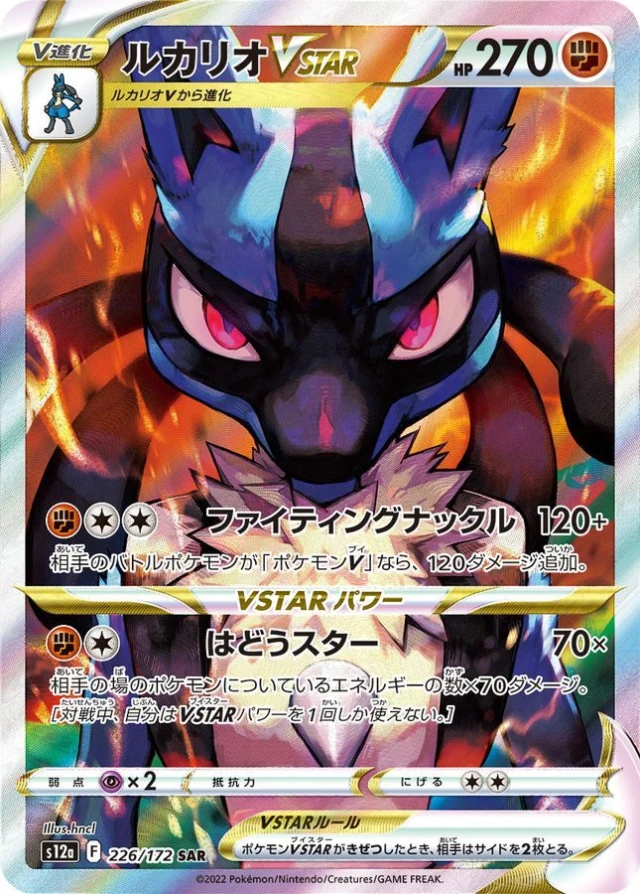
PSA10 Lucario VSTAR 226/172 SAR, a modern Lucario print, product photo from our site

Lucario VSTAR 226/172 SAR — currently listed on our site

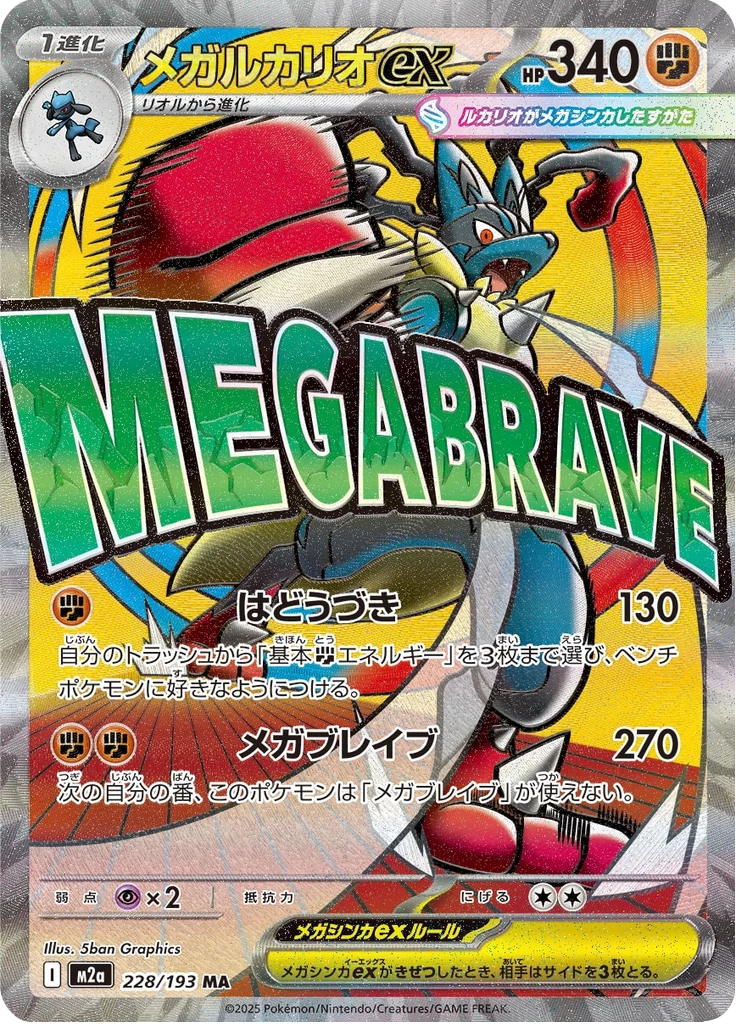
Mega Lucario ex, MA 228/193, a different modern Lucario print shown for comparison

Mega Lucario ex MA 228/193 — shown for comparison only, not one of our listings

These are different cards from the 2007 movie promo above — shown here only to illustrate how far the Lucario print line has moved since then, not as alternates for the album-exclusive promo itself.

For the modern side of that lineup, our Mega Lucario Cards Value Guide prices every current printing, and our broader Mega Lucario ex & Lucario Cards: Japan Price Guide covers the character across eras. If you’re specifically comparing Japanese movie- and campaign-era promos more generally, our M-P Promo Cards Guide and PSA 10 Japanese Pokemon Promo Cards Guide are useful starting points.

One naming note worth flagging: Lucario’s “Aura” ability is also referenced in the much newer “Hadou Seeker” (Aura Seeker) card line, which is a separate and considerably more recent release. Our Aura Seeker (Hadou Seeker) Complete Guide covers that card specifically — don’t confuse the two just because both reference Lucario’s Aura/Hadou naming.

Where to Buy the Wave-Guiding Hero Lucario Promo

We source and grade Japanese cards out of Tokyo, and a PSA 10 copy of this exact promo is currently listed on our site.

Shop This Card
PSA10 Hero of Waves Lucario [10th] (Movie 10th Anniversary Premium Seats)
Currently listed at ¥61,692 (~$388)
Ships from Tokyo · Tracked delivery

View Product →

If this specific listing shows as sold out when you check, it’s still worth a look — sourcing requests for graded Japanese movie promos like this one can be placed through our Quick Order page, and it’s also the fastest route if you want to combine it with other Lucario cards or Japanese promos in one order.

Veelgestelde vragen

What is the Wave-Guiding Hero Lucario card?

It’s a Japan-exclusive Basic Fighting-type Lucario promo card, informally known as “Hero of Waves Lucario,” released as part of the 10th Movie Commemoration Set in 2007. It has 80 HP, the attacks Aura Sphere and Close Combat, and carries no printed card number or rarity symbol.

Is the Wave-Guiding Hero Lucario tournament legal?

No. It’s catalogued as “TCG Unreleased,” meaning it was never made legal for Standard or Expanded competitive play. It’s a collectible/commemorative promo rather than a playable card.

What movie is this Lucario card from?

It references Lucario’s role as the title Pokemon of the franchise’s 8th movie, Lucario and the Mystery of Mew, released in Japan in 2007.

What other cards were released in the 10th Movie Commemoration Set?

Seven companion cards, each tied to a different movie-legendary or mythical Pokemon: Explosive Birth Lugia, Striking Back Mewtwo, Tree of Beginning’s Mew, Crystal Tower’s Entei, Prince of the Sea Manaphy, Timeless Celebi, and Visitor Deoxys — eight cards in total including this Lucario.

How much is a PSA 10 Wave-Guiding Hero Lucario worth?

Our own graded copy, PSA10 Hero of Waves Lucario [10th], is currently listed at ¥61,692 (about $388 at ¥159/USD, September 2026). No independent auction or competitor pricing data has been collected for this specific promo.

Lunala Japanse Pokemon-kaarten: een gids voor solo-prints

Lunala has six verified Japanese printings, and only one of them is the Tag Team GX most collectors picture when they hear the name. The other five are solo cards — a 2017 starter-deck GX, two post-GX non-GX reprints, and a 25th Anniversary release — and they rarely get discussed on their own because the Solgaleo & Lunala combo card dominates the conversation.

This guide separates the two. Our Solgaleo & Lunala best-printings guide covers the pair jointly; this article tracks Lunala’s own print history end to end — from the Sun & Moon starter deck through the Dream League Secret Rare currently listed in PSA10, to the post-GX solo reprints that came after.

Key Takeaway

Six Lunala prints are verified on Limitless TCG, spanning 2017–2019: one starter-deck solo GX, one shared Tag Team GX (Secret Rare and Double Rare), and three post-GX non-GX reprints. The Dream League Secret Rare is currently listed at ¥102,758 (~$646) as a single-unit listing.

6
Verified Prints

2017
First Print (Starter Set)

PSA 10
Listed Grade

¥102,758
Current Listing (~$646)

Card identifications sourced from Limitless TCG (limitlesstcg.com/cards/jp). Our own listed price is a live WooCommerce listing, converted at ¥159/USD (September 2026). We have no third-party market pricing for the five prints we don’t currently list — this guide identifies them without assigning a value.

Every Lunala Print, in One Table

Japanese name: ルナアーラ (Runaara). Six printings are documented on Limitless TCG, running from a 2017 starter deck through the post-GX reprint era:

Kaart Set (JP code) Nr. Rarity tag Release
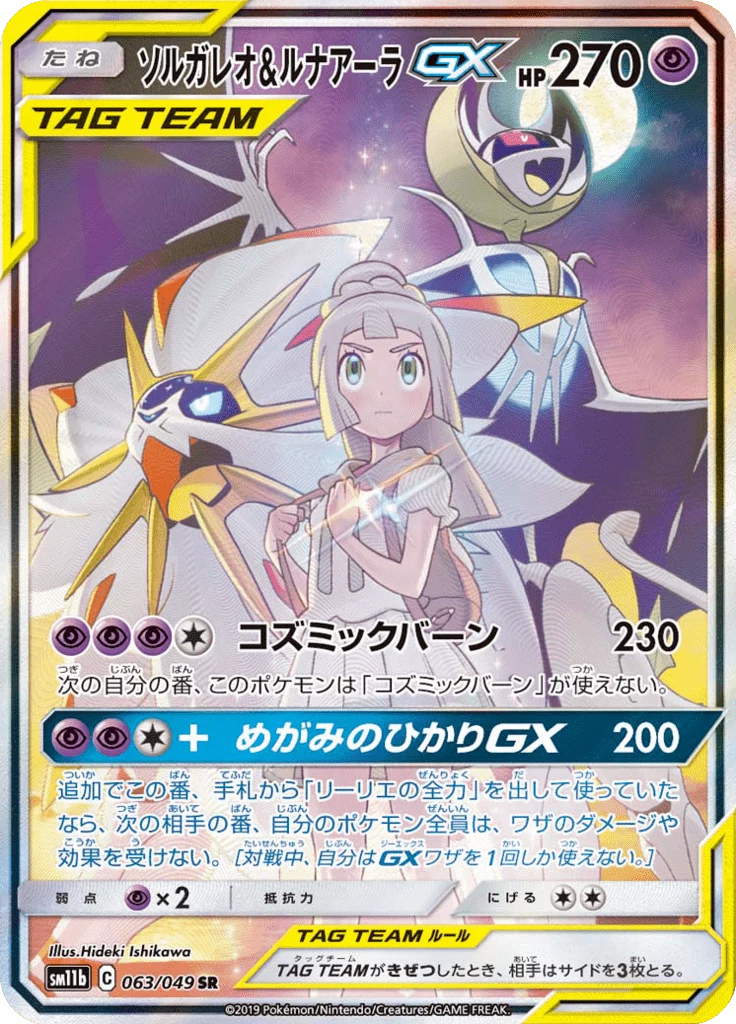
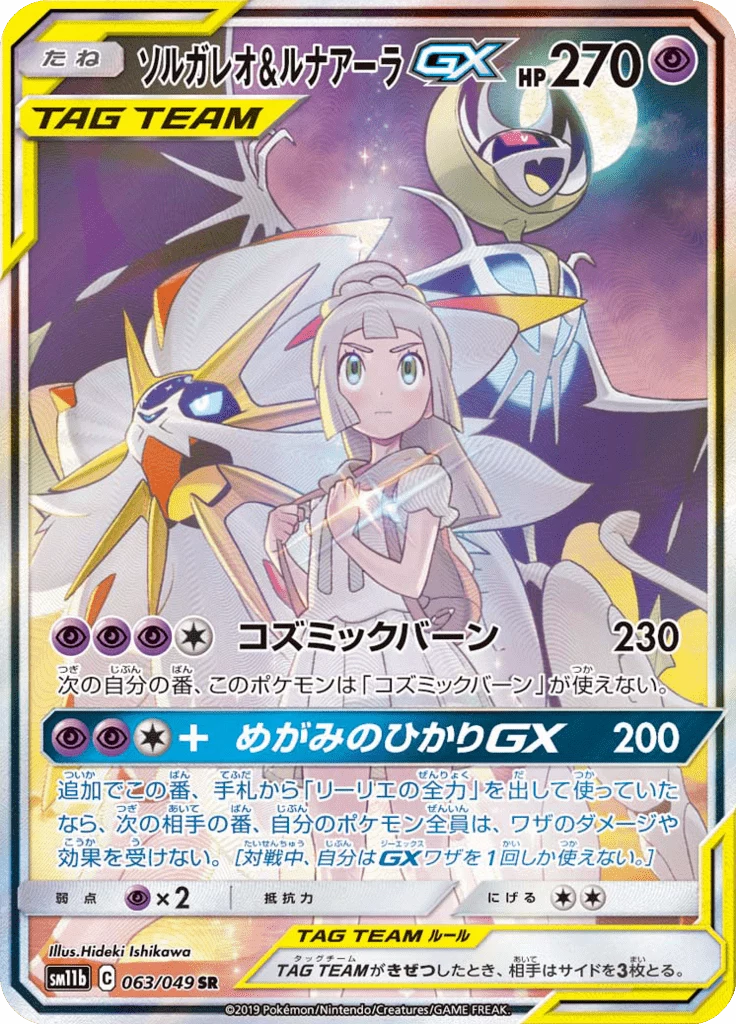
Solgaleo & Lunala GX Dream League (SM11b) #63 Secret Rare 2 Aug 2019
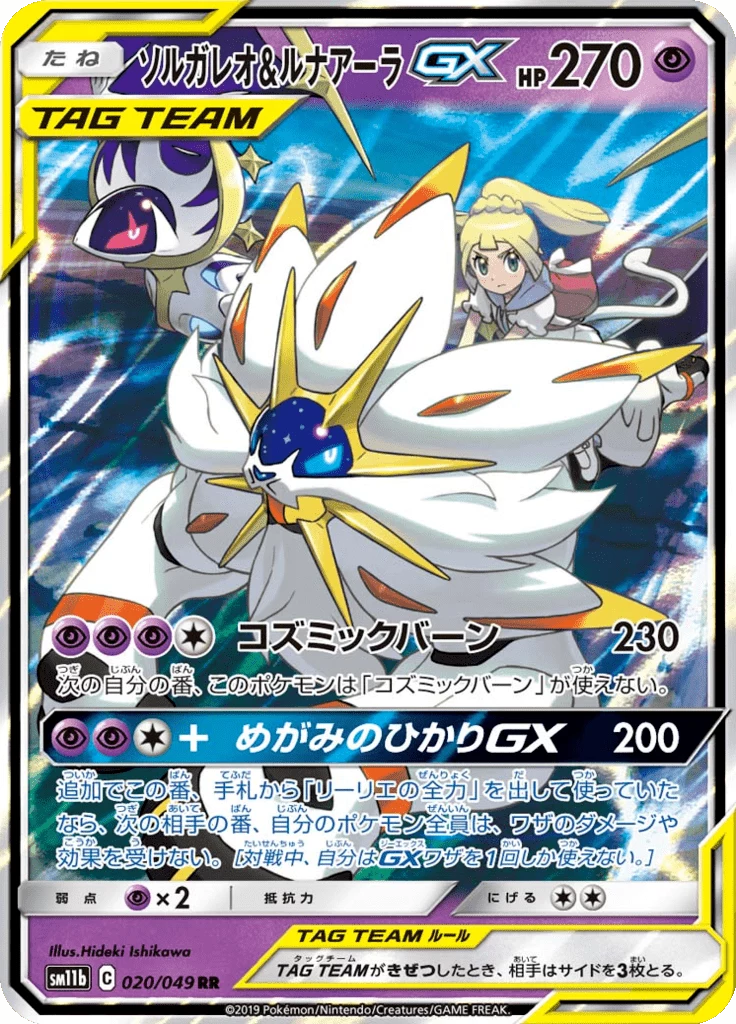
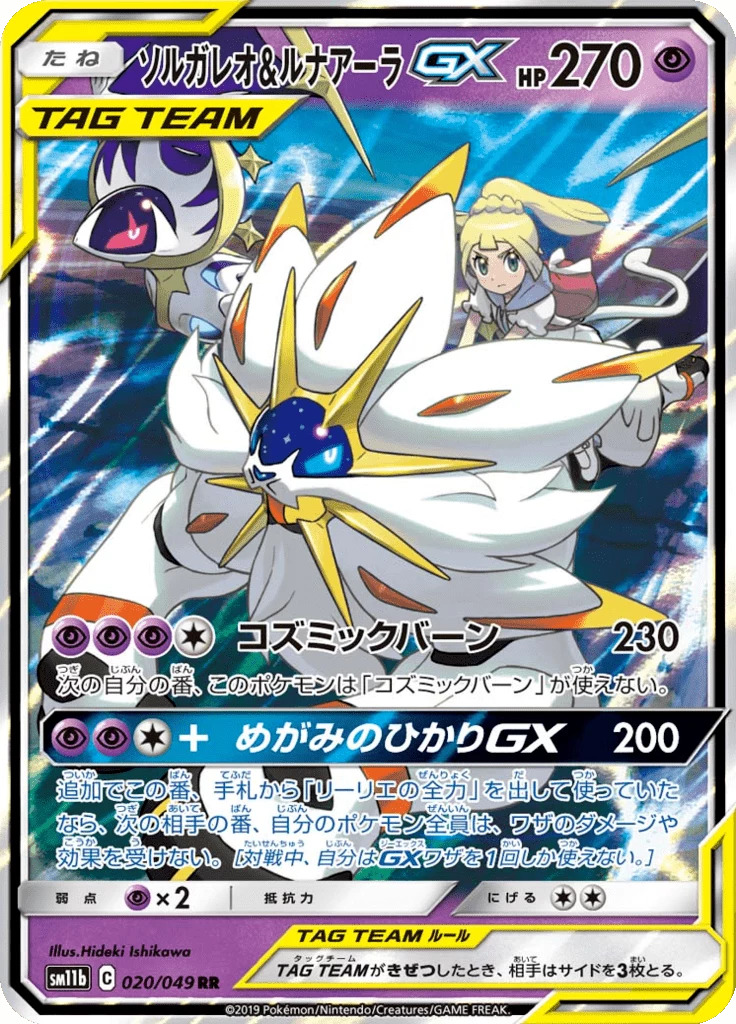
Solgaleo & Lunala GX Dream League (SM11b) #20 Double Rare 2 Aug 2019
Lunala GX (solo) Starter Set Solgaleo-GX & Lunala-GX (SME) #5 Starter-deck print, no special tag 10 Nov 2017
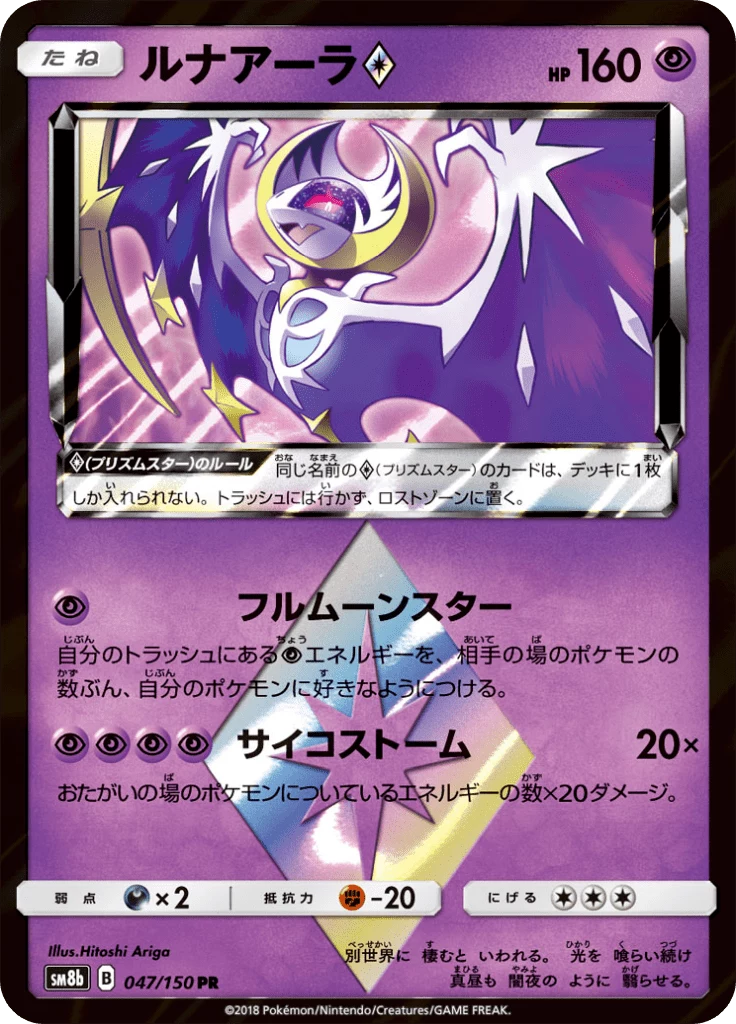
Lunala (solo, non-GX) GX Ultra Shiny (SM8b) #47 No special tag unverified
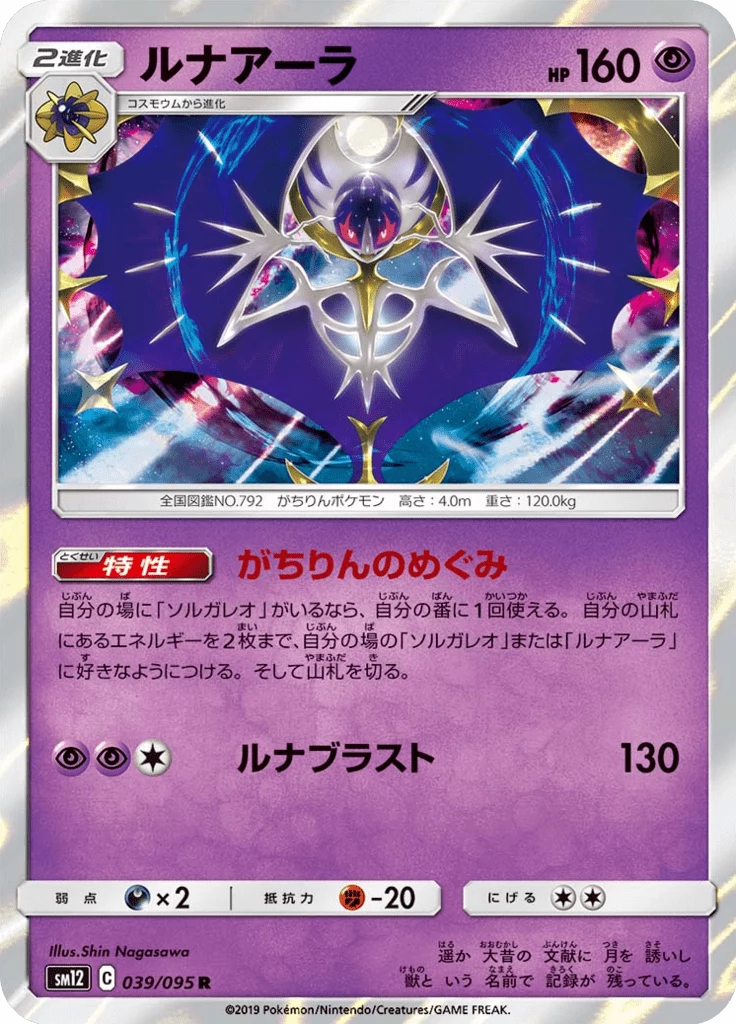
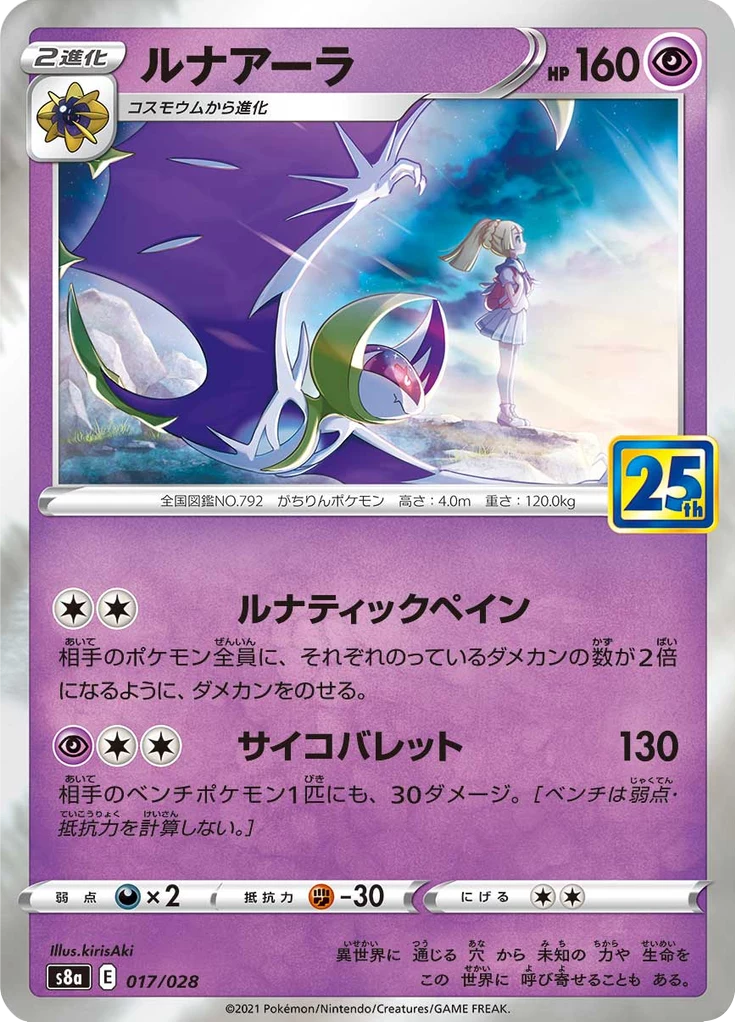
Lunala (solo, non-GX) Alter Genesis (SM12) #39 Rare 6 Sep 2019
Lunala (solo, non-GX) 25th Anniversary Collection (S8a) #17 No special tag unverified

Two things stand out. First, Lunala’s solo career started before the Tag Team card existed — the starter-deck GX predates Dream League by almost two years. Second, only one of the six carries a Secret Rare tag; everything else is either a Double Rare, a Rare, or a standard print with no elevated rarity marking on Limitless.

The sections below walk through each era in order.

The 2017 Origin: Starter Set Solgaleo-GX & Lunala-GX

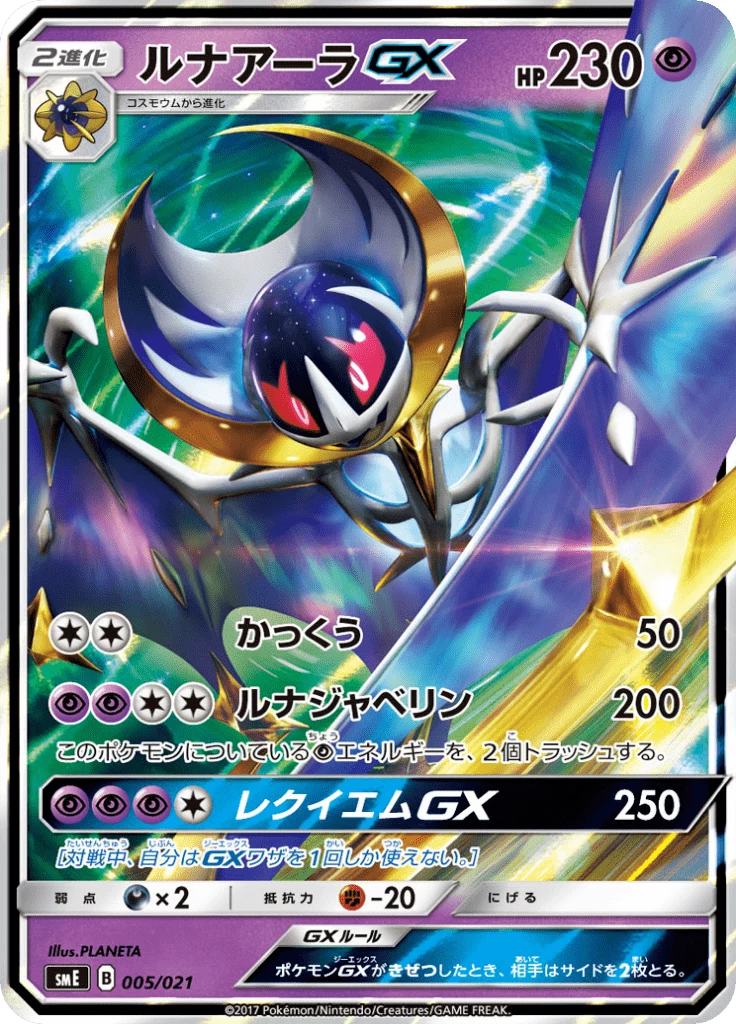
Lunala GX, SME #5, Starter Set Solgaleo-GX & Lunala-GX, 2017 starter deck print
Lunala GX — SME #5, Starter Set Solgaleo-GX & Lunala-GX (10 Nov 2017)

Lunala’s first Japanese card wasn’t a booster pull — it was a preconstructed starter deck. The Starter Set Solgaleo-GX & Lunala-GX, released 10 November 2017, paired a solo Solgaleo GX and a solo Lunala GX as the two headline cards of a beginner product, well before either Legendary was combined into the Tag Team card that would follow in 2019.

Limitless doesn’t list this SME #5 print with any elevated rarity tag — it’s catalogued as the standard starter-deck version. That doesn’t make it common in the collecting sense; starter decks have a narrower print run than mainline boosters, and the 2017 date puts it right at the start of the GX era. It’s the print to look for if you want the earliest Lunala GX rather than the highest rarity tag.

The Tag Team Card: Dream League Solgaleo & Lunala GX

Solgaleo & Lunala GX, SM11b #63, Secret Rare, Dream League
Solgaleo & Lunala GX — SM11b #63, Secret Rare, Dream League (2 Aug 2019)

Nearly two years after the starter deck, Solgaleo and Lunala were combined into a single Tag Team GX for Dream League, released 2 August 2019. The set carries two versions of the card: a Double Rare at #20 and a Secret Rare at #63, the latter with the alternate full-art treatment Secret Rare slots typically carry in this era.

This is the print currently listed in PSA10: the Dream League SM11b #63 Secret Rare, currently listed at ¥102,758 (~$646). It’s a single graded slab, not a batch — once it’s gone, we don’t have a second copy of this exact print behind it.

Solgaleo & Lunala GX, SM11b #20, Double Rare, Dream League
Solgaleo & Lunala GX — SM11b #20, Double Rare, Dream League (2 Aug 2019)

Because this is the same card that anchors our combined Solgaleo & Lunala guide, it’s worth being precise about what makes it a “Lunala card” here rather than a Solgaleo one: the card art and GX text feature both Legendaries equally, so where you file it — under Solgaleo or Lunala — comes down to which half of the pair you’re building a collection around. Our Solgaleo Japanese cards guide covers the same card from the other half’s angle, alongside Solgaleo’s own solo prints. For our wider look at Tag Team GX design, this card sits in the same design generation as the other late-2019 dual-Legendary releases.

After the GX Era: Three Solo Reprints

Once the GX mechanic wound down, Lunala kept getting reprinted as a solo, non-GX card. Three of these are verified on Limitless:

Lunala, SM8b #47, GX Ultra Shiny, no special rarity tag
Lunala — SM8b #47, GX Ultra Shiny (release date unverified)

The GX Ultra Shiny (SM8b) #47 print carries no elevated rarity tag on Limitless, and we could not verify its release date in this research pass — it sits in the same broad SM-era window as the other cards on this list.

Lunala, SM12 #39, Rare, Alter Genesis
Lunala — SM12 #39, Rare, Alter Genesis (6 Sep 2019)

The Alter Genesis (SM12) #39 print released 6 September 2019, just a month after Dream League, and is tagged Rare on Limitless — the only one of the three post-GX solo prints with a rarity tag above the base level.

Lunala, S8a #17, 25th Anniversary Collection, no special rarity tag
Lunala — S8a #17, 25th Anniversary Collection (release date unverified)

The 25th Anniversary Collection (S8a) #17 is the most recent verified print on this list. Limitless doesn’t attach a special rarity tag to it, and we couldn’t confirm an exact release date in this pass — but its inclusion in an anniversary set puts it in different collecting company than the earlier SM-era cards, which were both mainline expansion releases.

How to Tell Your Lunala Print Apart

With six prints spanning three visually distinct eras, identification comes down to three checks:

  1. GX or non-GX text box. Both the SME starter-deck card and the SM11b Dream League card carry the GX attack/ability text and the “GX” suffix in the name. The SM8b, SM12, and S8a prints do not — they’re standard non-GX Basic or Stage cards.
  2. Solo or paired artwork. Only the SM11b Dream League print shows Solgaleo and Lunala together. Every other print on this list is Lunala alone.
  3. Card number and set code. Because two of these prints (SM11b #63 and #20) share the same card name and release date, the number in the bottom corner is the only way to separate the Secret Rare from the Double Rare at a glance.
Check This First

If your card says “GX” and shows two Pokemon in the artwork, it’s the Dream League Tag Team print — check the number for #63 (Secret Rare) versus #20 (Double Rare). If it shows Lunala alone with GX text, it’s the 2017 starter-deck card. Anything solo without GX text is one of the three later reprints.

Which Print Fits Your Collection

There’s no cross-print pricing table here — we only have verified market pricing for the one print we currently list — but the six cards do split naturally by collecting goal:

  • Starter-deck completionists — the SME #5 Lunala GX is the print to chase if you want the character’s first-ever Japanese card, GX era included.
  • Tag Team GX collectors — the Dream League SM11b #63 Secret Rare is the flagship, and it’s the print currently listed at ¥102,758 (~$646). The #20 Double Rare is the same artwork era at a lower rarity tag, for collectors who want the design without the Secret Rare slot.
  • Post-GX / modern reprint collectors — the SM8b, SM12, and S8a solo prints track Lunala’s life after the GX mechanic ended, with Alter Genesis #39 standing out as the only one of the three carrying an explicit Rare tag.

For readers comparing Lunala against its Tag Team partner directly, our Necrozma cards guide and Lillie cards guide cover other Sun & Moon-era chase cards from the same design generation, and our Ultra Moon set guide covers the mainline expansion that introduced Lunala’s Ultra Beast-adjacent era on the Japanese side.

Where to Buy a Japanese Lunala Card

We ship graded and sealed Japanese product worldwide out of Tokyo with tracked delivery. The Dream League Secret Rare Tag Team GX described above is currently listed — a single PSA10 slab, not a restocking line item.

Shop This Card
PSA10 Solgaleo & Lunala GX SR (Dream League SM11b #63)
Currently listed at ¥102,758 (~$646)
Ships from Tokyo · Tracked delivery

View Product →

Single-Unit Listing

This is one graded slab, not a batch listing — we’re not able to say when or whether another copy of this exact print will be listed again.

Looking for one of the other five prints, a different Lunala grade, or a mixed order alongside other Sun & Moon-era cards? Our Quick Order page is the fastest way to submit a request against our full Japanese inventory.

Veelgestelde vragen

How many Japanese Lunala card prints are there?

Six are verified on Limitless TCG: the 2017 Starter Set Solgaleo-GX & Lunala-GX solo card (SME #5), the Dream League Tag Team GX in Secret Rare (SM11b #63) and Double Rare (SM11b #20), and three post-GX solo reprints — GX Ultra Shiny (SM8b #47), Alter Genesis (SM12 #39), and the 25th Anniversary Collection (S8a #17).

Which Lunala print is the Tag Team GX card?

The Solgaleo & Lunala GX from Dream League (SM11b), released 2 August 2019. It comes in two versions — a Secret Rare at #63 and a Double Rare at #20 — and pairs both Legendaries in the same artwork.

Is there a solo Lunala GX card, without Solgaleo?

Yes — the Starter Set Solgaleo-GX & Lunala-GX, released 10 November 2017, included a standalone Lunala GX at #5 alongside a separate solo Solgaleo GX. It predates the combined Dream League card by almost two years.

What Lunala card do you currently list?

A PSA10-graded Dream League Secret Rare (SM11b #63), currently listed at ¥102,758 (about $646 at ¥159/USD). It’s a single unit.

Are the post-GX Lunala reprints rare?

Of the three verified post-GX solo prints, only Alter Genesis (SM12 #39) carries an explicit Rare tag on Limitless. GX Ultra Shiny (SM8b #47) and the 25th Anniversary Collection (S8a #17) are catalogued without a special rarity tag.

OP-16 The Time of Battle: One Piece Reguliere Box vs Damaged Box-gids

Two listings, one set, a ¥460 gap between them. OP-16 “The Time of Battle” is one of the very few sets on our shelves right now where the Damaged Box actually costs less than the regular box — and by a real, live margin, not a rounding difference.

This guide puts the two OP-16 listings side by side, explains exactly what “Damaged Box” means on our site, and tells you which one to buy depending on what you actually want out of the purchase. We’re not covering pull rates or a full card list here — we’ve already published those separately, and we’ll link to them below.

Key Takeaway

OP-16 The Time of Battle regular box is currently ¥12,000 (~$75), and the Damaged Box version is ¥11,540 (~$73) — a genuine ¥460 (3.8%) discount as of publish date. The cards inside are identical, factory-sealed booster packs; only the outer box is affected. That real discount is unusual — most Damaged Box listings across the site currently show no price gap at all, which makes OP-16 one of the few pairs worth actually comparing before you buy.

¥12,000
Regular Box

¥11,540
Damaged Box

¥460
You Save

3.8%
Discount

Prices are our own live listings as of publish date, converted at ¥159/USD. Sealed-box prices move over time — treat the yen figures on the product pages as authoritative and the dollar figures as a same-day reference.

Two Listings, Two Prices: OP-16 Regular vs Damaged Box

OP-16 “The Time of Battle” is a Japanese-language One Piece Card Game booster box, and we currently carry it in two separate listings:

Both are sealed booster boxes of the same set. The only distinction the listings themselves make is condition: one is sold as a standard box, the other as a Damaged Box. Everything else — what’s printed inside, how many packs per box — is the same product.

Price Comparison at a Glance

Listing Conditie Prijs
OP-16 The Time of Battle Booster Box Regular ¥12,000 (~$75)
OP-16 The Time of Battle Booster Box Damaged Box ¥11,540 (~$73)

The gap is ¥460, or 3.8% off the regular box price. It’s not a dramatic discount, but it’s a real one — on the day this was checked, the Damaged Box was simply the cheaper way to get the same sealed product.

What “Damaged Box” Actually Means

“Damaged Box” is a condition category we use for sealed booster boxes where the outer box — not the contents — is affected. The booster packs inside stay factory-sealed; it’s the box itself that’s listed under this condition. Beyond that, we don’t have further verified detail to add about the specific type of box damage for this listing, so we’re not going to guess at it here — the product page is the source for anything more specific.

What it does not mean is any change to the sealed contents. You’re still getting the same OP-16 booster packs, in the same box count — the listing distinction is condition of the outer packaging, not the product inside it.

Why This Discount Is Real (When Most Aren’t)

If you’ve shopped Damaged Box listings on sealed Japanese product before, don’t assume “Damaged” automatically means “cheaper.” Across the site’s regular-vs-Damaged-Box pairs, most currently show no discount at all — some Damaged Box listings are priced the same as the regular box, and some are priced higher. Pricing on each listing moves independently over time, and the two variants aren’t guaranteed to track each other.

OP-16 is one of the exceptions. As of publish date, the Damaged Box is genuinely ¥460 cheaper than the regular box — a live, checkable number on both product pages, not a promotional framing. We can’t say why the gap exists on this particular pair (box condition, remaining stock count, and independent pricing on the regular box could all play a part, and we don’t have data isolating the cause). What we can say is that today, if price is your deciding factor and box condition isn’t, the Damaged Box is the better buy on this set.

Check Before You Buy

Because Damaged Box pricing moves independently of the regular box, always compare both current prices before ordering — don’t assume the gap you see today will still be there next time you check, and don’t assume it applies to other sets.

What’s Inside OP-16 The Time of Battle

Whichever condition you buy, the packs come from the same OP-16 set. Here’s a look at four cards from the set, in their Japanese printings:

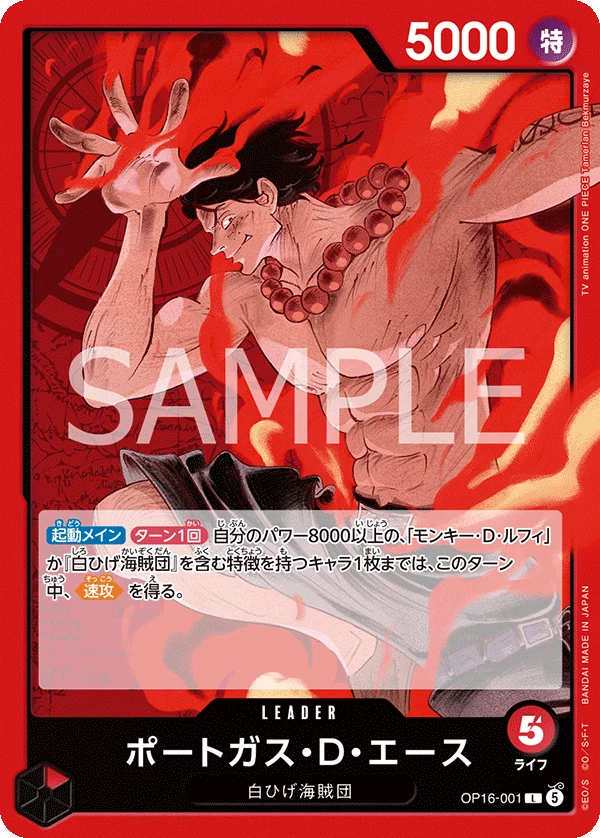
Portgas D. Ace, OP16-001, Leader, OP-16 The Time of Battle

Portgas D. Ace — OP16-001 (Leader)

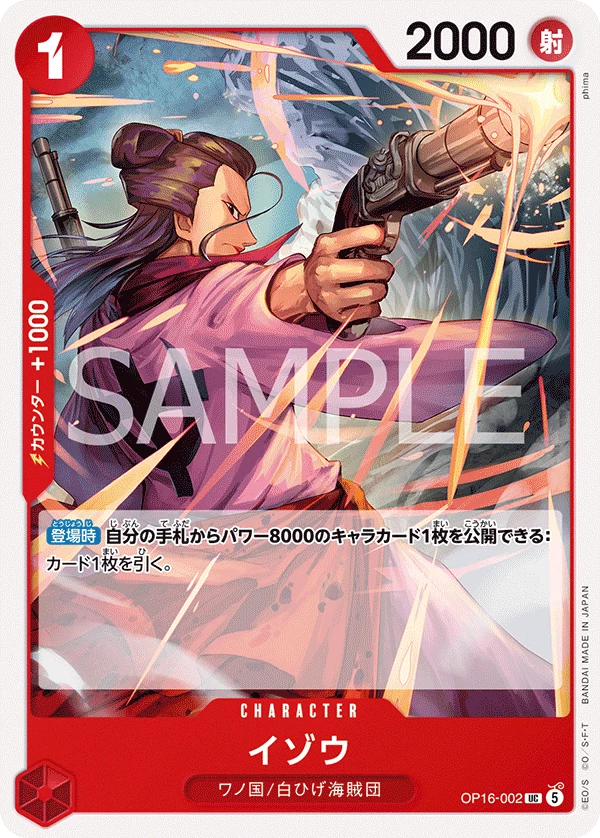
Izo, OP16-002, Uncommon, OP-16 The Time of Battle

Izo — OP16-002 (Uncommon)

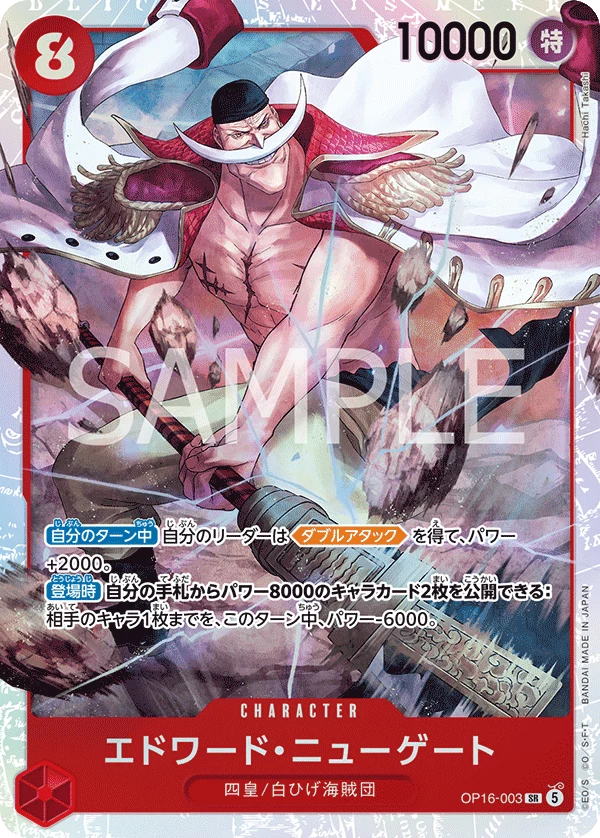
Edward Newgate, OP16-003, Super Rare, OP-16 The Time of Battle

Edward Newgate — OP16-003 (Super Rare)

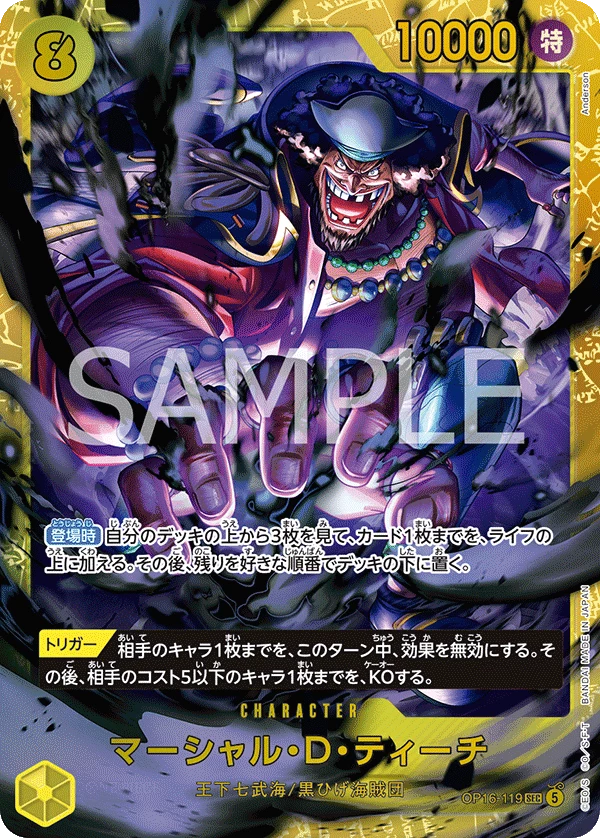
Marshall D. Teach, OP16-119, Secret Rare, OP-16 The Time of Battle

Marshall D. Teach — OP16-119 (Secret Rare)

These four span the range of the set — a Leader card, an early Uncommon, a Super Rare, and a Secret Rare — but they’re a sample, not the full checklist. For the complete card-by-card breakdown, see our OP-16 full card list and our OP-16 parallel and alt-art card list. If you’re weighing pull odds rather than box condition, our OP-16 pull rates and best cards guide covers that separately.

Which One Should You Buy

The decision comes down to what you’re optimising for:

  • Buying purely to open packs. The Damaged Box at ¥11,540 (~$73) gets you the same sealed packs for less. If the box itself isn’t going on display, the condition difference doesn’t affect what you pull from it.
  • Buying to keep the box sealed and presentable. The regular box at ¥12,000 (~$75) is the safer choice if box condition matters to you — for display, resale, or just personal preference.
  • Comparing against OP-17. If you’re deciding between sets rather than conditions, our OP-17 vs OP-16 box buying guide covers that separate question — regular box to regular box, across sets, not condition to condition within OP-16.

Either way, you’re buying the same OP-16 booster packs. For a wider view of which One Piece boxes are worth stocking up on right now, see our guide to the best One Piece boxes to buy.

Where to Buy OP-16 Boxes

We ship both OP-16 listings from Tokyo with tracked delivery. If price is the deciding factor today, the Damaged Box is the one carrying the discount.

Shop This Listing
OP-16 The Time of Battle Booster Box — Damaged Box
Currently ¥11,540 (~$73) — ¥460 less than the regular box
Ships from Tokyo · Tracked delivery

View Product →

Prefer the regular box instead? It’s listed here: OP-16 The Time of Battle Japanese One Piece Booster Box (regular), ¥12,000 (~$75). For OP-16 singles, other One Piece sets, or a mixed order, our Quick Order page is the fastest route. You can also browse related characters in our Nico Robin One Piece cards guide if you’re building out a specific pull list.

Veelgestelde vragen

Is the OP-16 Damaged Box actually cheaper than the regular box?

Yes, as of publish date. The Damaged Box is ¥11,540 (~$73) against ¥12,000 (~$75) for the regular box — a ¥460 (3.8%) difference. Both prices are live on their product pages and can move over time.

What does “Damaged Box” mean on this listing?

It refers to the condition of the outer box, not the contents. The booster packs inside stay factory-sealed. We don’t have further verified detail on the specific type of box damage beyond what’s noted on the product listing.

Is the sealed product any different between the two OP-16 listings?

No. Both listings are the same OP-16 factory-sealed booster packs. The only stated difference is the condition of the outer box.

Is a Damaged Box discount normal across all sets?

No — most Damaged Box listings across the site currently show the same price as the regular box, or a higher one. OP-16 is one of the exceptions where the Damaged Box is genuinely cheaper today.

Where can I see the full OP-16 card list?

See our OP-16 full card list and OP-16 parallel and alt-art card list for the card-by-card breakdown; this guide covers box condition and pricing only.

Pikachu 7-Eleven Promo (001/S-P): de Sword & Shield-pre-orderkaart uitgelegd

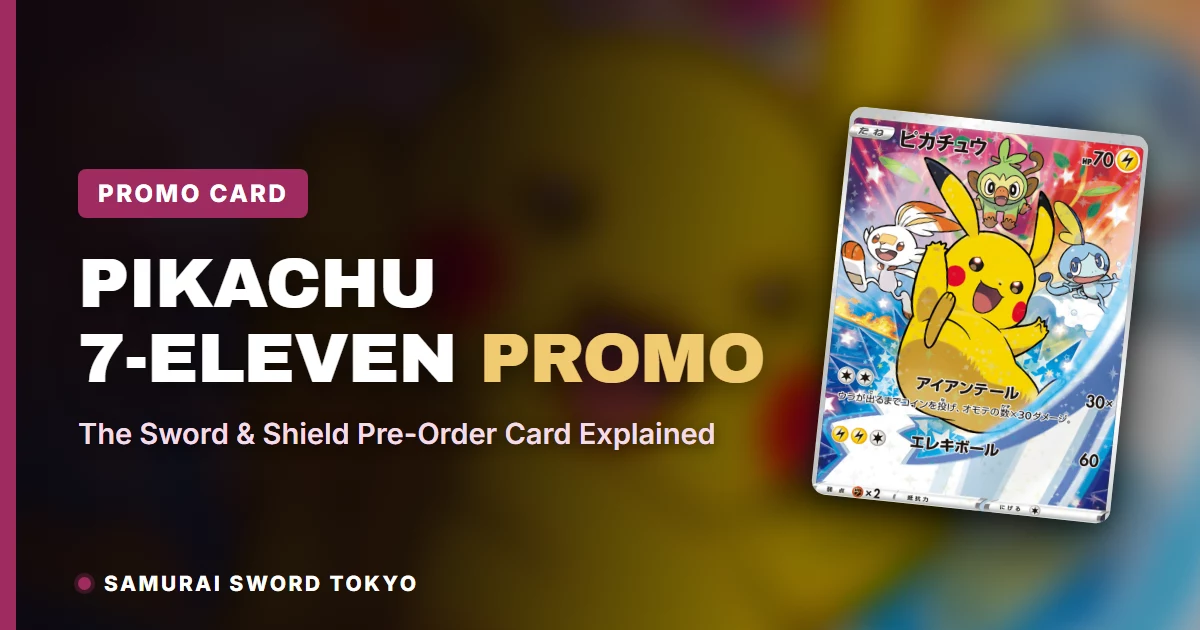
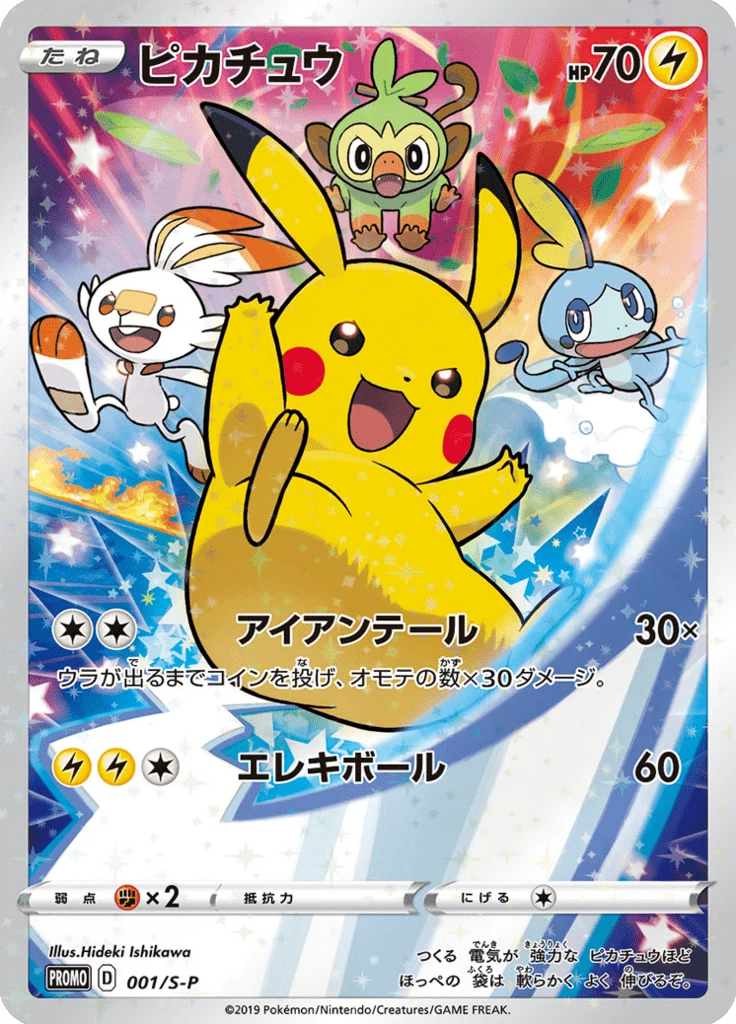
Buy a copy of Pokémon Sword or Pokémon Shield at the wrong convenience store in Japan in late 2019, and you got nothing extra. Buy it at a participating 7-Eleven between 15 November 2019 and 15 January 2020, and you walked out with a holographic full art Pikachu that no shop shelf ever carried.

That card is Pikachu 001/S-P, part of the Japanese S-P Promotional cards line. It was never sold on its own, never boxed with a booster product, and never distributed outside that two-month video-game pre-order window. This guide covers exactly what the card is, how it reached collectors, how it differs from its English counterpart, and what a PSA10 copy is worth today.

Key Takeaway

Pikachu 001/S-P is a Japan-only holographic full art card, illustrated by Hideki Ishikawa, given away at participating 7-Eleven stores to buyers of Pokémon Sword or Pokémon Shield between 15 November 2019 and 15 January 2020 — Double Pack buyers received two copies. It is a separate print from the English SWSH020 promo. Our own PSA10 copy is currently listed at ¥223,362 (~$1,405).

2019
Japan Distribution Year

001/S-P
Card Number

$1,405
Our PSA10 Listing (~USD)

2
Copies via Double Pack

Prices are converted at ¥159/USD (September 2026). All facts on distribution, print details, and set data below are sourced from Bulbapedia and Limitless TCG, cited throughout.

The Card: Pikachu 001/S-P Explained

Pikachu 001/S-P is a Basic Lightning-type card with HP 70, carrying two attacks: Iron Tail (アイアンテール) and Electro Ball (エレキボール). The artwork is credited to Hideki Ishikawa, and the card carries regulation mark D. It belongs to Japan’s S-P Promotional cards line, sits at card number 001/S-P, and the copyright line printed on the card reads ©2019 Pokémon/Nintendo/Creatures/GAME FREAK — confirmed by direct inspection of the card image.

Pikachu 001/S-P, Holographic Full Art, S-P Promotional cards
Attribute Detail
Card name ピカチュウ (Pikachu)
Type Lightning
HP 70
Attacks Iron Tail, Electro Ball
Illustrator Hideki Ishikawa
Regulation mark D
Card number / set 001/S-P, S-P Promotional cards
Copyright line ©2019 Pokémon/Nintendo/Creatures/GAME FREAK
Check This First

Confirm the regulation mark (D) and the card number printed as “001/S-P” in the bottom corner before assuming you’re holding this exact print — several other Japanese Pikachu promos share the same character and similar holo treatment. Our own graded copy is currently listed at ¥223,362 (~$1,405) if you want a reference point for what a PSA10 example looks like.

How You Got This Card: The 7-Eleven Sword & Shield Tie-In

In Japan, this card was distributed to customers at participating 7-Eleven convenience stores who purchased Pokémon Sword or Pokémon Shield between 15 November 2019 and 15 January 2020, as an early-purchase incentive tied to the games’ launch window. Customers who bought the “Double Pack” — both Sword and Shield together — received two copies of the card.

That is the only confirmed distribution channel for this specific card. It’s worth being precise here, because Japan ran several separate Pikachu-themed promo tie-ins around the same era through different retail partners, and mixing them up is an easy mistake. This exact 001/S-P print was a video-game pre-order bonus, full stop — it was never sold as a standalone product, never included in a booster box, and was not part of a Pokémon Center or Japan Post collaboration campaign.

The result is a card tied to a specific, closed distribution window: it only exists in the hands of people who pre-ordered a physical copy of Sword or Shield in Japan during a nine-week window in late 2019 and early 2020.

Full Art Holographic: What Sets 001/S-P Apart

Bulbapedia identifies this print as a “Holographic Full Art card” — the artwork by Hideki Ishikawa runs the full face of the card rather than sitting inside a standard framed illustration box, and the surface carries a holographic foil treatment. That combination is what separates it visually from a standard-issue Pikachu card and from most other promo-only Pikachu prints of the same generation.

For collectors comparing this card against other Japanese Pikachu promos from the surrounding years, the illustrator credit and the specific “001/S-P” number are the two details to check first — artwork style alone isn’t a reliable way to tell Japanese Pikachu promos apart, since several share a similar full-art holo treatment.

The English Equivalent: SWSH020

The English-language version of this same card is SWSH Black Star Promo SWSH020. It was distributed separately in North America through the “Sword & Shield Figure Collection,” starting 1 May 2020 — a retail collectible box, not a pre-order tie-in.

That’s a meaningfully different distribution model from the Japanese original: the Japanese 001/S-P went out free with a video game pre-order at a specific chain of convenience stores over a fixed nine-week window, while the English SWSH020 was sold as part of a standalone collector’s box more than three months later. They share the same artwork and card number logic within their respective regions, but they are two distinct cards with two distinct paper trails, and grading population data (where it exists) is generally tracked separately for each.

Grading and Current Value

We don’t have verified third-party auction data for this specific card and grade to cite here, so the only number we can put in front of you with confidence is our own: a PSA10 copy of Pikachu 001/S-P is currently listed at ¥223,362 (~$1,405).

What we can say with confidence is why this card holds value at all relative to more common Pikachu prints from the same period: it was never a retail product. No reprint run or secondary release has been documented for this promo, and the only way to acquire it today is through the secondary market. Combined with the holographic full art treatment, that gives it a collector profile closer to a limited promo than a mainstream set card.

Kaart Region / channel Distribution window
Pikachu 001/S-P Japan — 7-Eleven Sword/Shield pre-order 15 Nov 2019 – 15 Jan 2020
Pikachu SWSH020 North America — Sword & Shield Figure Collection From 1 May 2020

Where 001/S-P Sits in the S-P Promotional Cards Line

The S-P Promotional cards line is Japan’s long-running catch-all series for cards distributed outside standard booster products — convenience store tie-ins, retail collaborations, and mail-order promotions all feed into the same numbering sequence. Pikachu 001/S-P is simply the first entry in that line for this print era.

Cramorant 226/S-P, S-P Promotional cards
Cramorant 226/S-P, S-P Promotional cards — same promo line, distributed through a separate Japan Post Pokémon Stamp Box campaign rather than the 7-Eleven tie-in

Cramorant 226/S-P is a useful comparison precisely because it shows how varied this promo line’s distribution channels are: that card came from Pokémon Stamp Box sets sold through Japan Post, an entirely separate campaign from the 7-Eleven video-game tie-in that produced Pikachu 001/S-P. Two cards, same S-P Promotional cards line, two unrelated real-world distribution stories. Our S-P Promotional cards guide covers the wider line if you want the full picture beyond these two.

Pikachu-GX 393/SM-P, SM-P Promotional cards
Pikachu-GX 393/SM-P, SM-P Promotional cards — an earlier-generation Japanese Pikachu promo, distributed through the BEAMS collaboration line rather than a video-game pre-order

Stepping back a generation, Pikachu-GX 393/SM-P shows the same pattern one set-era earlier: a different Pikachu, a different promo sub-line (SM-P rather than S-P), and a different distribution partner entirely. Our SM-P Promotional cards guide covers that line in full. If it’s Pikachu prints specifically you’re tracking, our top 10 Pikachu Japanese cards roundup and best Pikachu cards in the Japanese TCG guide both place 001/S-P alongside modern chase prints like the one below.

Pikachu ex 764/742, SAR, Start Deck 100 Battle Collection
Pikachu ex 764/742, SAR, Start Deck 100 Battle Collection — a current-era Japanese Pikachu chase card, for comparison against the 2019 promo era

Pikachu ex 764/742 is a current-era Special Art Rare from a blind-purchase deck product — a completely different distribution model again. Between a video-game convenience-store giveaway, a Japan Post collaboration, a BEAMS retail tie-in, and a modern chase pull, these four cards trace how differently Japan has distributed promotional Pikachu cards across roughly a decade. For readers going deep on the newest of these, our Pikachu VMAX cards guide is a useful next stop.

Where to Buy a PSA10 Pikachu 001/S-P

We ship graded Japanese cards worldwide from Tokyo with tracked delivery. Our current PSA10 copy of this card is listed below.

Shop This Card
PSA10 Pikachu Seven-Eleven 001/S-P PROMO
Currently listed at ¥223,362 (~$1,405)
Ships from Tokyo · Tracked delivery

View Product →

Tracking down other Japanese promos or singles from the same S-P Promotional cards line? Our Quick Order page is the fastest way to build a mixed order across multiple cards and sets in one checkout.

Veelgestelde vragen

What is the Pikachu 001/S-P card?

It’s a Japanese holographic full art Pikachu card, HP 70, Lightning type, illustrated by Hideki Ishikawa, from the S-P Promotional cards line. It carries attacks Iron Tail and Electro Ball, regulation mark D, and the copyright line ©2019 Pokémon/Nintendo/Creatures/GAME FREAK.

How did people get the Pikachu 7-Eleven promo card in Japan?

It was given to customers at participating 7-Eleven stores in Japan who purchased Pokémon Sword or Pokémon Shield between 15 November 2019 and 15 January 2020, as an early-purchase incentive. Customers who bought the Double Pack of both games received two copies.

Is the Japanese 001/S-P the same as the English SWSH020 promo?

They share the same artwork, but they are separate cards with separate distribution histories. The Japanese 001/S-P was a 7-Eleven video-game pre-order giveaway in late 2019 and early 2020. The English SWSH020 was distributed through the Sword & Shield Figure Collection starting 1 May 2020, a different retail channel entirely.

What does “Holographic Full Art” mean for this card?

The Hideki Ishikawa artwork runs across the full face of the card rather than sitting inside a standard framed illustration box, and the card surface carries a holographic foil treatment — the combination that Bulbapedia’s card listing identifies for this specific print.

How much is a PSA10 Pikachu 001/S-P currently worth?

We don’t have verified third-party auction data to cite for this card and grade. Our own PSA10 copy is currently listed at ¥223,362 (about $1,405 at ¥159/USD).

Solgaleo Japanse Pokémon-kaarten: een gids voor solo-prints

Solgaleo appears on the Japanese checklist in three distinct forms: paired with Lunala on a tag-team GX card, as a solo GX print from an early starter deck, or dropped into a set as a plain non-GX single. That split matters if you’re trying to work out which card you actually want, because “a Solgaleo card” can mean six very different things depending on the set.

This guide lists every verified Japanese Solgaleo print by card number, set code, and rarity, and separates the combo GX prints from the solo GX and solo non-GX ones so you know exactly what you’re looking at before you buy. One of these is currently listed by us as a graded PSA 10, and it’s referenced below with its own listing.

Key Takeaways

Six verified Japanese Solgaleo prints exist across four sets. Only one — Dream League (SM11b) #63, a tag-team Secret Rare shared with Lunala — carries a Secret Rare tag on Limitless TCG; the rest are solo GX or solo non-GX singles or unlabelled starter-deck prints. A PSA 10 copy of that SM11b #63 Secret Rare is currently listed at ¥102,758 (~$646).

6
Verified JP Prints

2017
Earliest Confirmed Print

SM11b #63
Only Secret Rare

¥102,758
Our PSA 10 Listing

Card data verified against Limitless TCG (limitlesstcg.com). Stock price is our own live WooCommerce listing as of September 2026, converted at ¥159/USD.

Every Japanese Solgaleo Print at a Glance

Six Solgaleo cards are confirmed on Limitless TCG’s Japanese card database. Three feature Solgaleo alone; two are the same tag-team GX card in different rarities; one is the earliest print, from a 2017 starter deck.

# Kaart Set (JP code) Nr. Rarity Release
1 Solgaleo & Lunala GX Dream League (SM11b) 063/049 Secret Rare 2 Aug 2019
2 Solgaleo & Lunala GX Dream League (SM11b) 020/049 Double Rare 2 Aug 2019
3 Solgaleo GX (solo) Starter Set Solgaleo-GX & Lunala-GX (SME) #7 Starter-deck print, no special rarity tag 10 Nov 2017
4 Solgaleo (solo, non-GX) GX Ultra Shiny (SM8b) #82 No special rarity tag unverified
5 Solgaleo (solo, non-GX) Alter Genesis (SM12) #55 Rare 6 Sep 2019
6 Solgaleo (solo, non-GX) 25th Anniversary Collection (S8a) #16 No special rarity tag unverified

The pattern is worth noting: Solgaleo’s only Secret Rare appearance is shared with Lunala, not solo. If you specifically want a solo Solgaleo — just the Sun Legendary, no Lunala in frame — your options are the 2017 starter-deck GX or one of the three non-GX singles below. For the combo pair’s own best-printings ranking, see our Solgaleo & Lunala GX cards guide; this article goes the other direction and treats Solgaleo’s solo prints as the main subject.

The Secret Rare: Solgaleo & Lunala GX, SM11b #63

Solgaleo & Lunala GX 063/049 Secret Rare, Dream League SM11b
Solgaleo & Lunala GX 063/049, Secret Rare — Dream League (SM11b)

Dream League (SM11b), released 2 August 2019, is where Solgaleo got its only Secret Rare treatment on the Japanese checklist — card 063/049, a tag-team GX shared with Lunala. It’s the print most collectors mean when they say “the Solgaleo Secret Rare,” and it’s the only Solgaleo card carrying that specific rarity tag on Limitless TCG.

This is also the exact card currently listed by us: a PSA 10 graded copy, currently listed at ¥102,758 (~$646). We ship it and the rest of our Japanese PSA 10 listings from Tokyo with tracked delivery.

Because it’s a combo card rather than a Solgaleo-only design, some collectors treat it as a Lunala card that happens to feature Solgaleo, or vice versa — there’s no single “correct” way to file it. Our Lunala Japanese cards guide covers the same card from the other half’s angle, alongside Lunala’s own solo prints.

The Double Rare Alternate: SM11b #20

Solgaleo & Lunala GX 020/049 Double Rare, Dream League SM11b
Solgaleo & Lunala GX 020/049, Double Rare — Dream League (SM11b)

The same Dream League set also printed the identical Solgaleo & Lunala GX card as a Double Rare, numbered 020/049. Double Rare is the standard rarity slot for GX cards in this era — a regular full-art GX print, distinct from the textured, gold-bordered Secret Rare at #63.

If your goal is to own the card’s artwork rather than chase the Secret Rare specifically, #20 is the more commonly available route into the same set. A #20 copy isn’t currently listed by us; the Quick Order page is where restock requests for Japanese singles like this one go.

The Earliest Print: 2017 Starter Set (SME #7)

Solgaleo GX #7, Starter Set Solgaleo-GX & Lunala-GX (SME)
Solgaleo GX #7 — Starter Set Solgaleo-GX & Lunala-GX (SME), 2017

Before Dream League, Solgaleo’s first Japanese GX card came out of a dedicated starter deck: Starter Set Solgaleo-GX & Lunala-GX (SME), released 10 November 2017, card #7. This is a solo Solgaleo GX — no Lunala on the card itself, even though the deck’s name pairs them.

Limitless TCG doesn’t list a special rarity tag for this print; it’s the standard starter-deck card for its slot, not a chase pull. That makes it the most accessible way to own an actual solo Solgaleo GX, as opposed to the tag-team versions from 2019.

The Solo Non-GX Singles

Three further Japanese prints show Solgaleo alone, without any GX mechanic at all:

Solgaleo #82, GX Ultra Shiny (SM8b)

Solgaleo #82 — GX Ultra Shiny (SM8b)

Solgaleo #55, Rare, Alter Genesis (SM12)

Solgaleo #55, Rare — Alter Genesis (SM12)

Solgaleo #16, 25th Anniversary Collection (S8a)

Solgaleo #16 — 25th Anniversary Collection (S8a)

GX Ultra Shiny (SM8b), #82 — a solo non-GX Solgaleo despite the set’s GX-focused name. Limitless TCG doesn’t assign it a special rarity tag, and its exact release date isn’t confirmed, so treat it as an unverified-date print until a firmer source turns up.

Alter Genesis (SM12), #55, Rare — released 6 September 2019, roughly a month after Dream League. This is the one confirmed-Rare solo non-GX Solgaleo on the list, and the most straightforward “just Solgaleo” card to point to if someone asks for one.

25th Anniversary Collection (S8a), #16 — another solo non-GX print, again without a special rarity tag on Limitless and without a confirmed release date in our sources. Anniversary-collection sets tend to reprint earlier artwork, so treat the exact print date as unverified rather than assuming it matches the set’s general era.

Solgaleo’s evolutionary and Ultra Beast-adjacent storyline connects it to Necrozma in the Sun & Moon era games; our Necrozma cards guide covers that side of the Sun & Moon Legendary lineup if you’re building out the set.

Which Solgaleo Print Fits Your Collection

With six prints spanning combo GX and solo non-GX designs, the right pick depends on what you’re actually after:

  • Want the Secret Rare, and the exact card currently listed by us — the Dream League (SM11b) #63 combo GX, PSA 10, currently listed at ¥102,758 (~$646).
  • Want the same tag-team artwork in the standard GX rarity — the Dream League #20 Double Rare, request it through Quick Order.
  • Want the earliest Solgaleo GX, solo, no Lunala on the card — the 2017 SME #7 starter-deck print.
  • Want a plain non-GX Solgaleo with a confirmed release date — Alter Genesis (SM12) #55, Rare, from September 2019.
  • Building a complete Solgaleo run across every set — you’ll need all six, including the two unverified-date non-GX singles from SM8b and S8a.
Check the Card Number First

“Solgaleo & Lunala GX” and “Solgaleo GX” are not the same card. If you’re comparing listings, match the full card number (e.g. 063/049) against the table above before comparing price or condition.

Where to Buy Solgaleo Cards from Japan

We ship Japanese singles and sealed product worldwide out of Tokyo with tracked delivery. The Solgaleo listing currently available from us is the PSA 10 Secret Rare combo below.

PSA 10 Single
Solgaleo & Lunala GX SR 063/049 — Dream League (SM11b)
Currently listed at ¥102,758 (~$646)
Ships from Tokyo · Tracked delivery

View Product →

For the other five prints — the Double Rare alternate, the 2017 starter-deck GX, or any of the three solo non-GX singles — our Quick Order page is the fastest way to place a request, and it’s also where restock requests for out-of-stock singles go. If tag-team GX cards from this era are your focus, our best tag-team GX cards guide is a useful next stop, and Lillie’s own Japanese checklist ties into the same Sun & Moon storyline via our Lillie cards guide.

Veelgestelde vragen

What is the rarest Japanese Solgaleo card?

Among the six verified Japanese prints, only Dream League (SM11b) #63 carries a Secret Rare tag on Limitless TCG. It’s a tag-team GX card shared with Lunala, released 2 August 2019.

Is there a solo Secret Rare Solgaleo, without Lunala?

No. The only Secret Rare Solgaleo appearance on the Japanese checklist is the SM11b #63 combo with Lunala. Solo Solgaleo prints exist, but at lower or unlabelled rarities — the 2017 starter-deck GX (SME #7) and three non-GX singles from GX Ultra Shiny, Alter Genesis, and the 25th Anniversary Collection.

What was the first Japanese Solgaleo card?

Solgaleo GX, card #7 from Starter Set Solgaleo-GX & Lunala-GX (SME), released 10 November 2017. It’s a solo GX print with no special rarity tag on Limitless TCG.

What’s the difference between Dream League #63 and #20?

Both are the same Solgaleo & Lunala GX card from Dream League (SM11b), released the same day. #63 is the Secret Rare; #20 is the Double Rare, the standard GX-rarity print of the same artwork.

Do you have a Japanese Solgaleo card listed?

Yes — a PSA 10 graded copy of the Dream League (SM11b) #63 Secret Rare is currently listed at ¥102,758 (about $646), shipped from Tokyo with tracked delivery.