Maak gratis een account en spaar punten en rang
Samurai Sword Tokyo
Bestellingen Winkelwagen

Gids voor Japanse ruilkaartspellen: Pokemon, One Piece, Yu-Gi-Oh en Dragon Ball
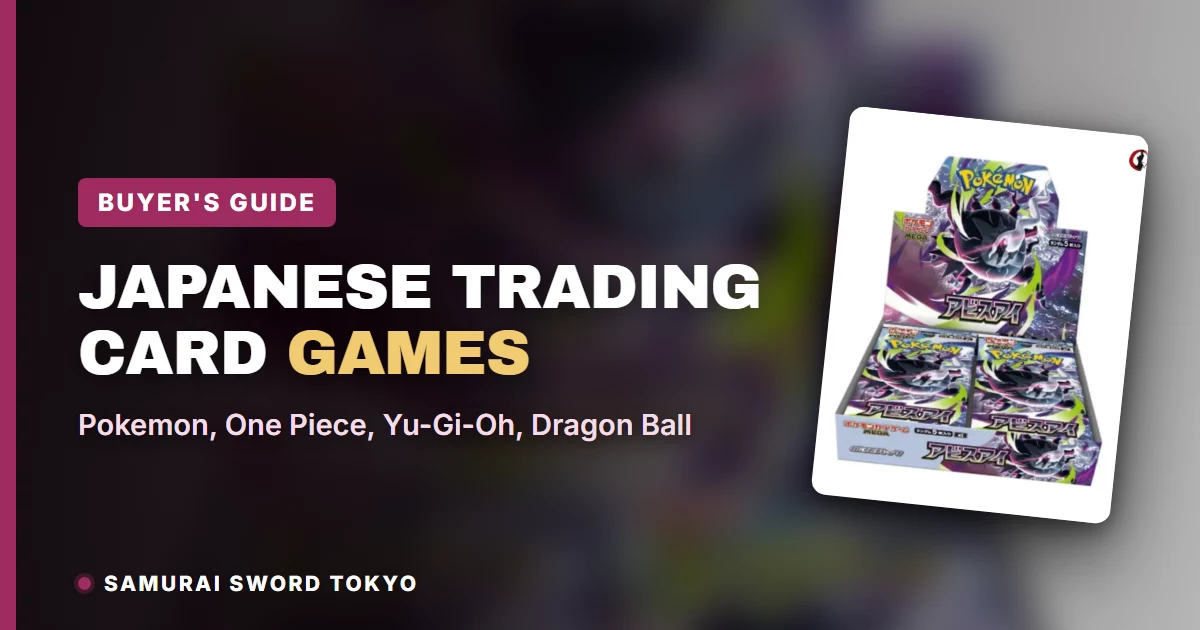
This guide compares four trading card games sold in Japan: Pokémon, One Piece, Yu-Gi-Oh!, and Dragon Ball. They come from different publishers and launched at different points in the timeline, but all four sell in the same basic format: booster packs sealed inside a booster box.

This guide lines the four games up side by side: who publishes each one, when it launched in Japan, and how many packs and cards you actually get per box. We ship a Japanese booster box from all four games out of Tokyo, so every product mentioned below is one we currently list.

Key Takeaways

The four Japanese trading card games compared here span nearly three decades: the Pokémon Trading Card Game launched October 20, 1996, the Yu-Gi-Oh! Official Card Game followed on February 4, 1999, the One Piece Card Game arrived July 8, 2022, and Dragon Ball Super Card Game: Fusion World is the newest of the four, launching February 16, 2024. A Japanese Pokémon M5-Abyss Eye booster box is currently listed at ¥7,475 (~$47), and a Japanese One Piece OP-16 booster box is currently listed at ¥12,360 (~$78).

4
Japanese TCGs Compared

1996
Oldest Launch (Pokémon)

2024
Newest Launch (Dragon Ball FW)

¥159
Per USD (Sept 2026)

Yen figures below convert at ¥159/USD (September 2026). Prices are a September 3, 2026 store snapshot — check the linked listing for the current number before ordering.

The Four Japanese Card Games at a Glance

Lined up by Japan launch date, the picture is nearly thirty years wide:

Game Publisher (Japan) Japan launch date
Pokémon Trading Card Game The Pokémon Company (originally Media Factory, 1996–2000) October 20, 1996
Yu-Gi-Oh! Official Card Game (OCG) Konami February 4, 1999
One Piece Card Game Bandai July 8, 2022
Dragon Ball Super Card Game: Fusion World Bandai February 16, 2024

Pokémon and Yu-Gi-Oh! are the two long-runners, both launched in Japan within three years of each other in the late 1990s and developed by Creatures Inc. (Pokémon) and Konami (Yu-Gi-Oh!) respectively. One Piece and Dragon Ball Fusion World are the newer pair, both published by Bandai and both released within the last four years.

One Publisher, Two Games

Bandai publishes both the One Piece Card Game and Dragon Ball Super Card Game: Fusion World in Japan — the two newest games on this list share a publisher, even though the card games themselves are unrelated products with separate rule systems.

Pokémon Trading Card Game
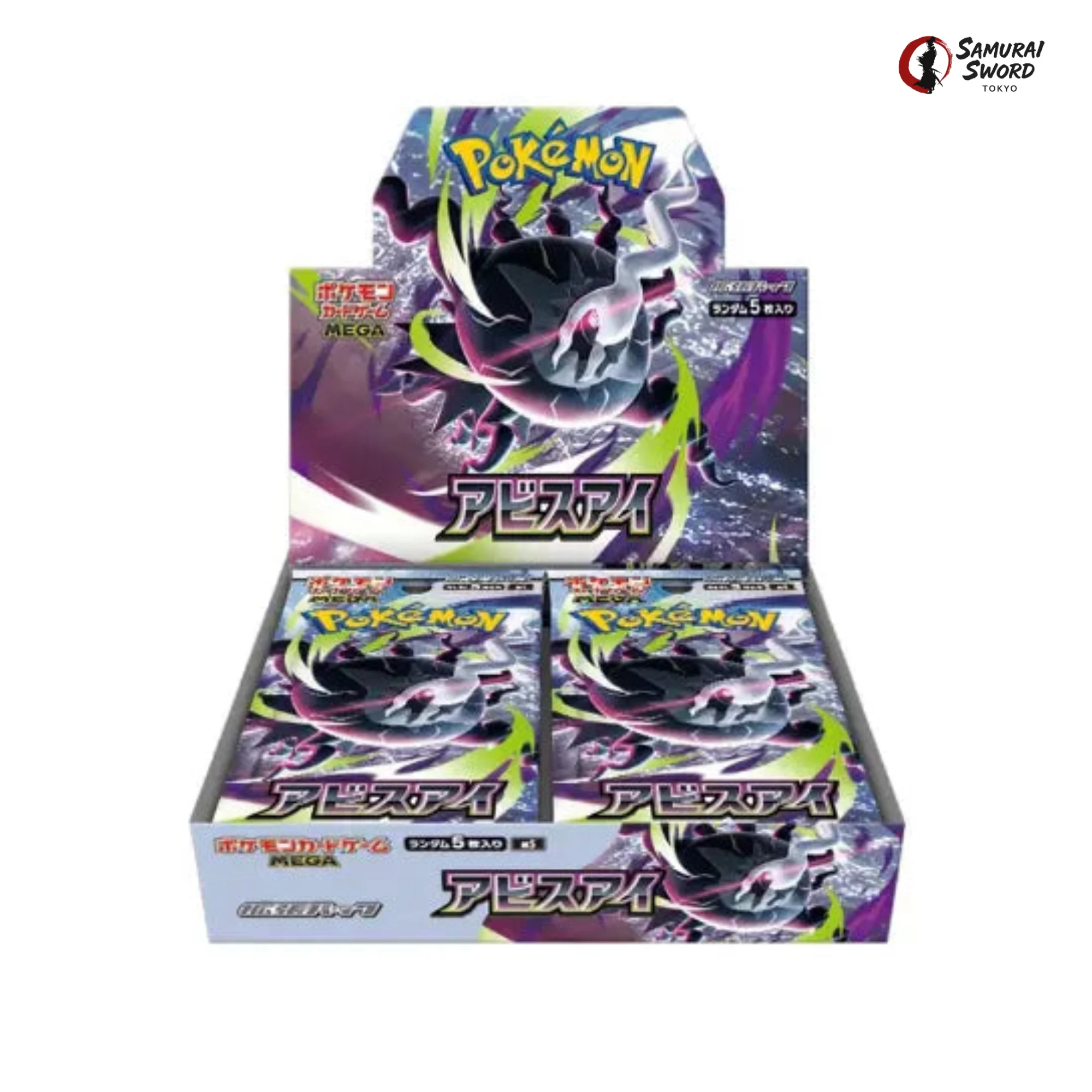
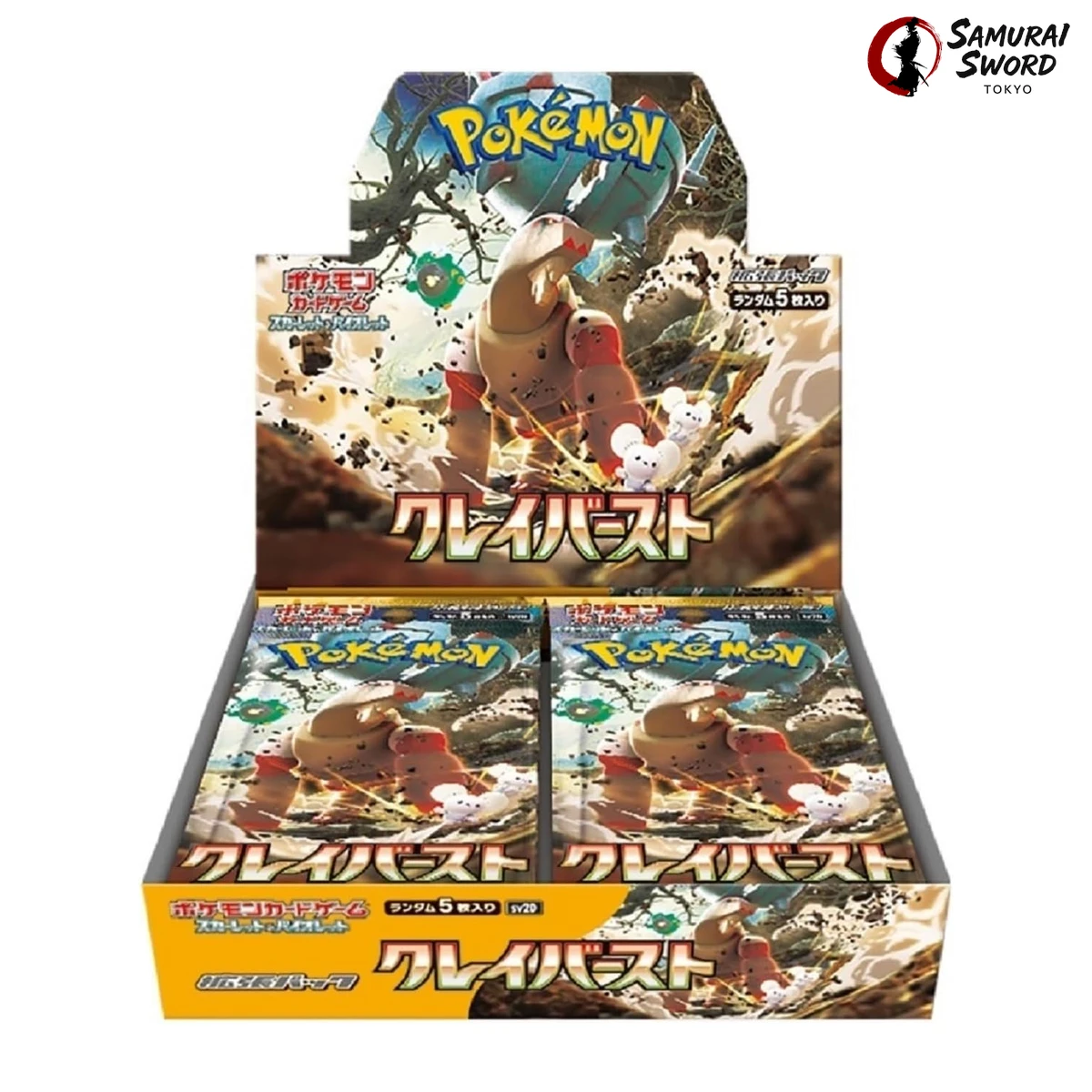
M5-Abyss Eye (Pitch Black) Japanese Pokemon Booster Box
M5-Abyss Eye (Pitch Black) Japanese Pokémon booster box

The Pokémon Trading Card Game launched in Japan on October 20, 1996, developed by Creatures Inc. Publishing duties in Japan sat with Media Factory from 1996 to 2000, before The Pokémon Company took over publishing from 2000 onward — the arrangement that still runs today, nearly thirty years after the first Japanese pack shipped.

Sealed Pokémon product still follows the same booster-pack-inside-a-booster-box format the game launched with, though the exact pack count changes from set to set. Our own M5-Abyss Eye (Pitch Black) Japanese booster box is currently listed at ¥7,475 (~$47). For a wider look at sourcing Pokémon product from Japan, see our guide to buying Japanese Pokémon cards online.

One Piece Card Game
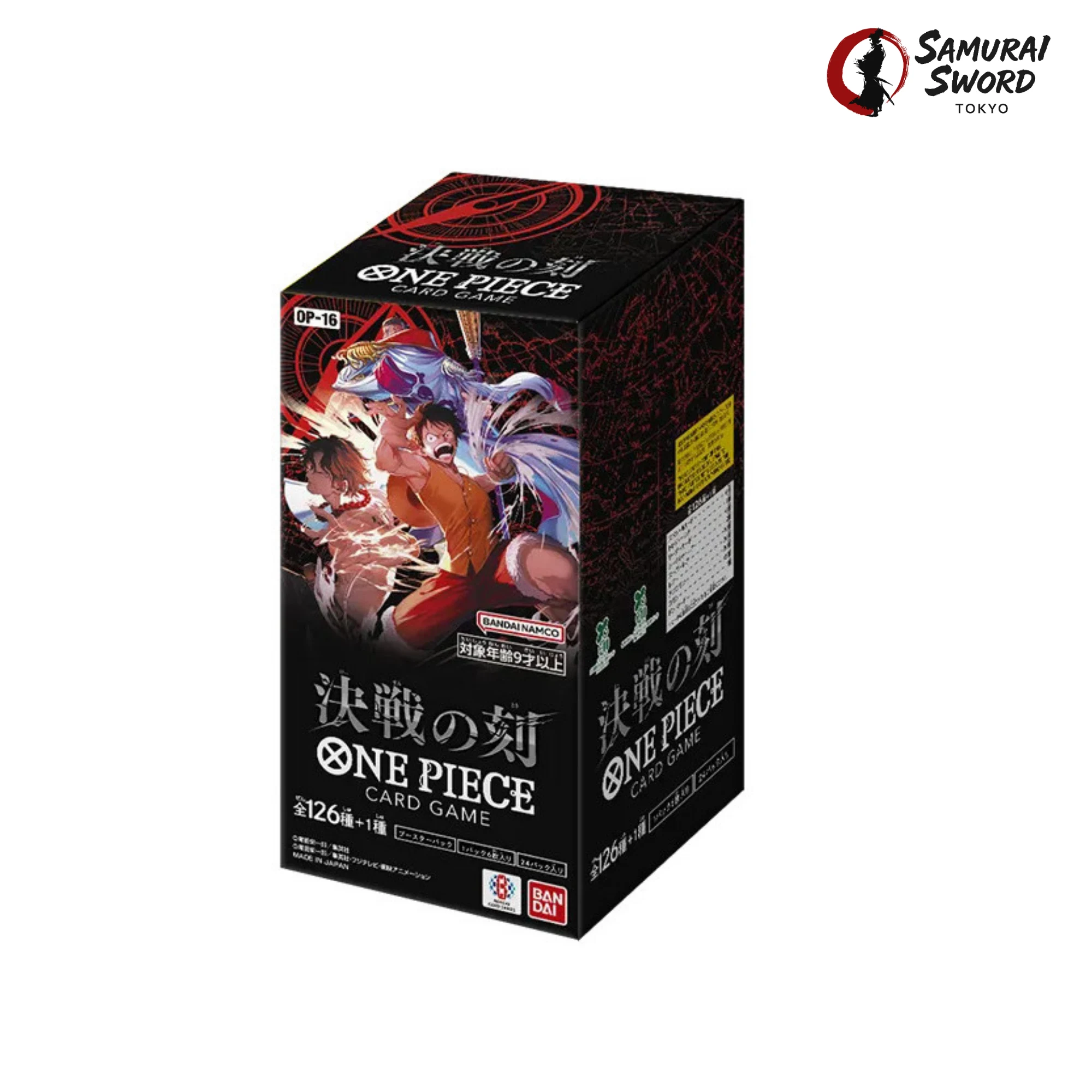
OP-16 The Time of Battle Japanese One Piece Booster Box
OP-16 The Time of Battle Japanese One Piece booster box

The One Piece Card Game is published by Bandai and launched in Japan on July 8, 2022, with the global release following on December 2, 2022 — roughly five months later. Bandai’s own official site frames the Japan launch as a release “to celebrate the 25th anniversary of the ONE PIECE manga,” tying the card game’s debut directly to the source manga’s anniversary year.

Our current One Piece anchor is the OP-16 The Time of Battle Japanese booster box, currently listed at ¥12,360 (~$78). For a full breakdown of the game itself, see our dedicated One Piece Card Game explainer; for sourcing strategy, see how to buy One Piece cards from Japan.

Yu-Gi-Oh! Official Card Game (OCG)
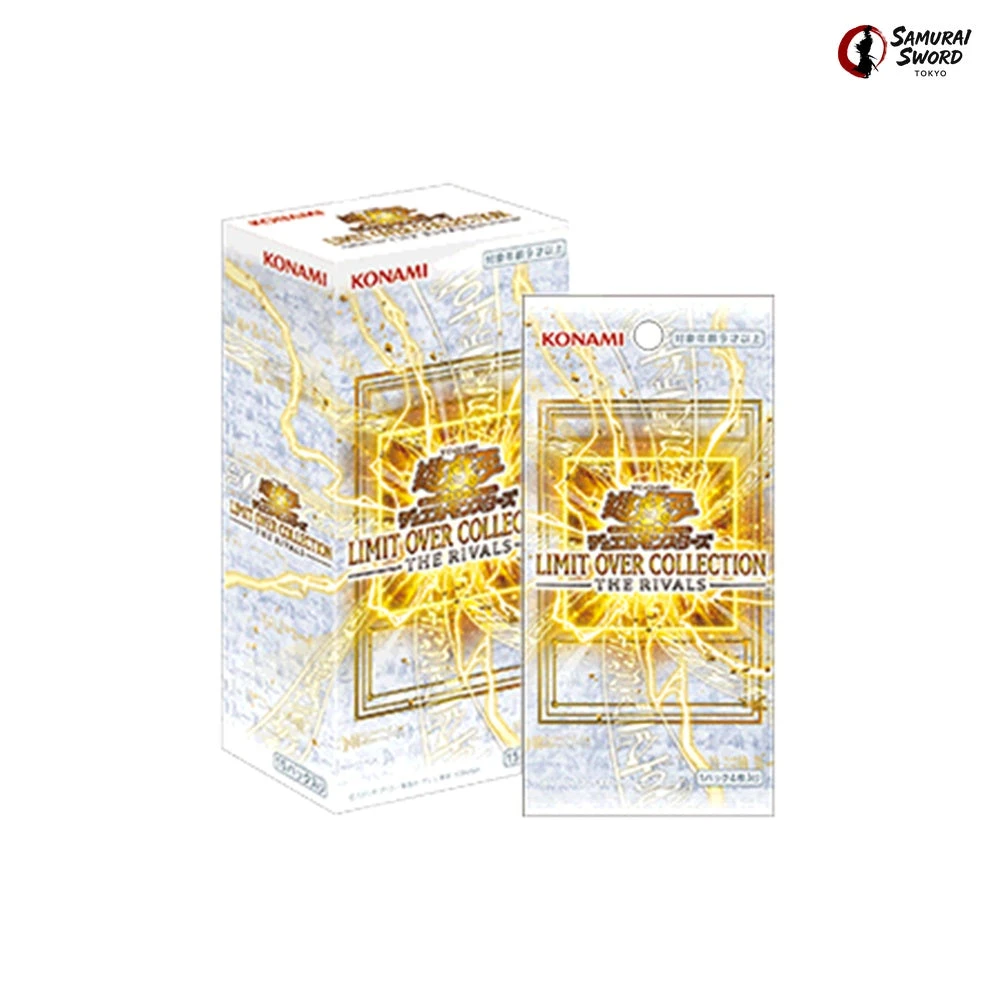
LOCR-Limit Over Collection The Rivals Japanese Yu-Gi-Oh Booster Box
LOCR-Limit Over Collection The Rivals Japanese Yu-Gi-Oh! booster box

Konami’s Yu-Gi-Oh! Official Card Game (OCG) is the second-oldest game on this list. Volume 1 released in Japan on February 4, 1999, with the game’s Official Rules following on March 6, 1999 — putting the OCG’s Japan launch a little over two years after Pokémon’s.
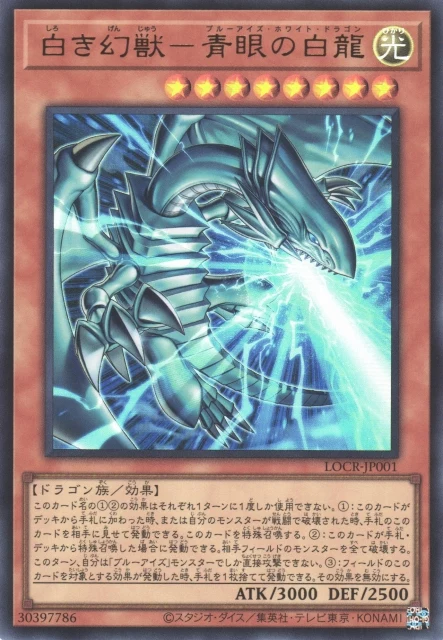
Blue-Eyes White Dragon "The White Phantom Beast", UR, LOCR
Blue-Eyes White Dragon “The White Phantom Beast”, UR, Limit Over Collection The Rivals (LOCR)

Our current Yu-Gi-Oh! anchor is the LOCR-Limit Over Collection The Rivals Japanese booster box, currently listed at ¥7,455 (~$47). For the full card list from this set, see our LOCR card list.

Dragon Ball Super Card Game: Fusion World
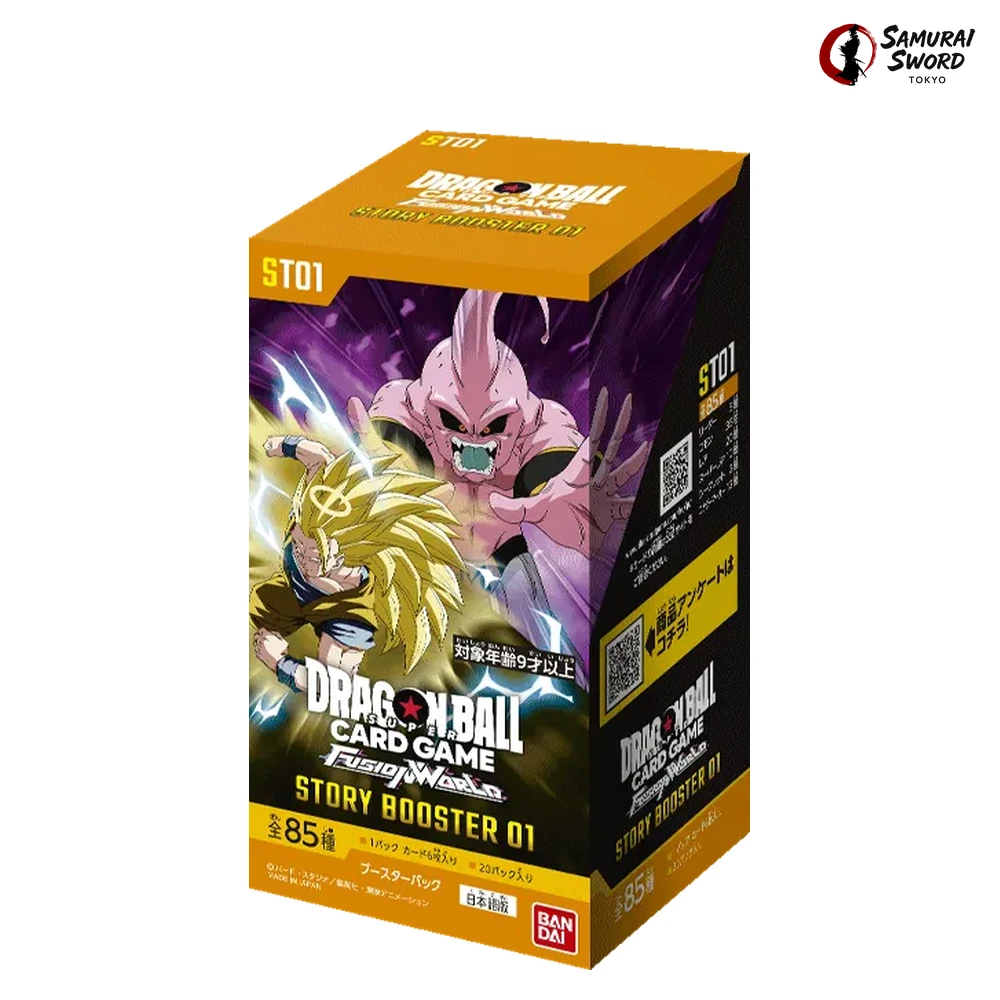
ST-01 Story Booster 01 Japanese Dragon Ball Booster Box
ST-01 Story Booster 01 Japanese Dragon Ball booster box

Dragon Ball Super Card Game: Fusion World is the newest of the four games covered here. Bandai’s Fusion World system launched in Japan on February 16, 2024. Fusion World runs as a separate system from the earlier Dragon Ball Super Card Game line, which Bandai has since branded as “Dragon Ball Super Card Game Masters” to distinguish the two.

Our current Dragon Ball anchor is the ST-01 Story Booster 01 Japanese booster box, currently listed at ¥23,000 (~$145). See the full ST-01 card list, or our Dragon Ball Fusion World sets in order guide for the sets that followed it.

Booster Box Structure Compared

All four games sell sealed product as booster packs inside a booster box, but the pack count and cards-per-pack differ by game — and, for Pokémon, by set:

Game Anchor box Packs per box Cards per pack
Yu-Gi-Oh! OCG LOCR 15 4
One Piece Card Game OP-16 24 6
Dragon Ball Fusion World ST-01 20 6
Pokémon Trading Card Game M5 varies by set varies by set

One Piece and Dragon Ball both settle on 6 kaarten per pack, though One Piece boxes carry more packs. Yu-Gi-Oh!’s LOCR runs the smallest pack count of the three fixed-structure boxes here, at 4 kaarten per pack. Pokémon is the outlier: pack and box counts move with each new set rather than holding to one fixed number, so a typical modern Pokémon set such as SV9 runs around 30 packs per box — a useful reference point, but not a number every Pokémon set repeats.

Where to Buy Japanese Trading Card Games from Tokyo

We ship sealed Japanese booster boxes for all four games out of Tokyo with tracked delivery. If you’re starting a collection or picking up a box for each game, here’s where each anchor lives on our site:

Browse the wider ranges through our Pokémon card box collection and One Piece card box collection, or send a mixed order — across any of the four games — through Snel bestellen.

Shop This Box
ST-01 Story Booster 01 Japanese Dragon Ball Booster Box
Currently listed at ¥23,000 (~$145)
Ships from Tokyo · Tracked delivery

View Product →

Veelgestelde vragen

Which four Japanese trading card games does this guide compare?

Pokémon Trading Card Game, Yu-Gi-Oh! Official Card Game (OCG), One Piece Card Game, and Dragon Ball Super Card Game: Fusion World. Pokémon launched in Japan in 1996, Yu-Gi-Oh! in 1999, One Piece in 2022, and Dragon Ball Fusion World in 2024.

Which Japanese trading card game is the oldest?

The Pokémon Trading Card Game, which launched in Japan on October 20, 1996 — about two and a half years before the Yu-Gi-Oh! Official Card Game.

Which Japanese trading card game is the newest?

Dragon Ball Super Card Game: Fusion World, which launched in Japan on February 16, 2024, making it the newest of the four covered in this guide.

Who publishes each of the four games in Japan?

The Pokémon Trading Card Game is published by The Pokémon Company (originally Media Factory from 1996 to 2000). The Yu-Gi-Oh! OCG is published by Konami. Both the One Piece Card Game and Dragon Ball Super Card Game: Fusion World are published by Bandai.

How many packs come in a Japanese booster box?

It depends on the game. Our LOCR (Yu-Gi-Oh!) box runs 15 packs of 4 cards; our OP-16 (One Piece) box runs 24 packs of 6 cards; our ST-01 (Dragon Ball) box runs 20 packs of 6 cards. Pokémon pack counts vary by set rather than holding to one fixed number.

Where can I buy Japanese booster boxes for these games?

We ship sealed Japanese booster boxes for all four games from Tokyo with tracked delivery, including the Pokémon, One Piece, Yu-Gi-Oh!, and Dragon Ball anchors listed in this guide. For a mixed order across games, use our Quick Order page.
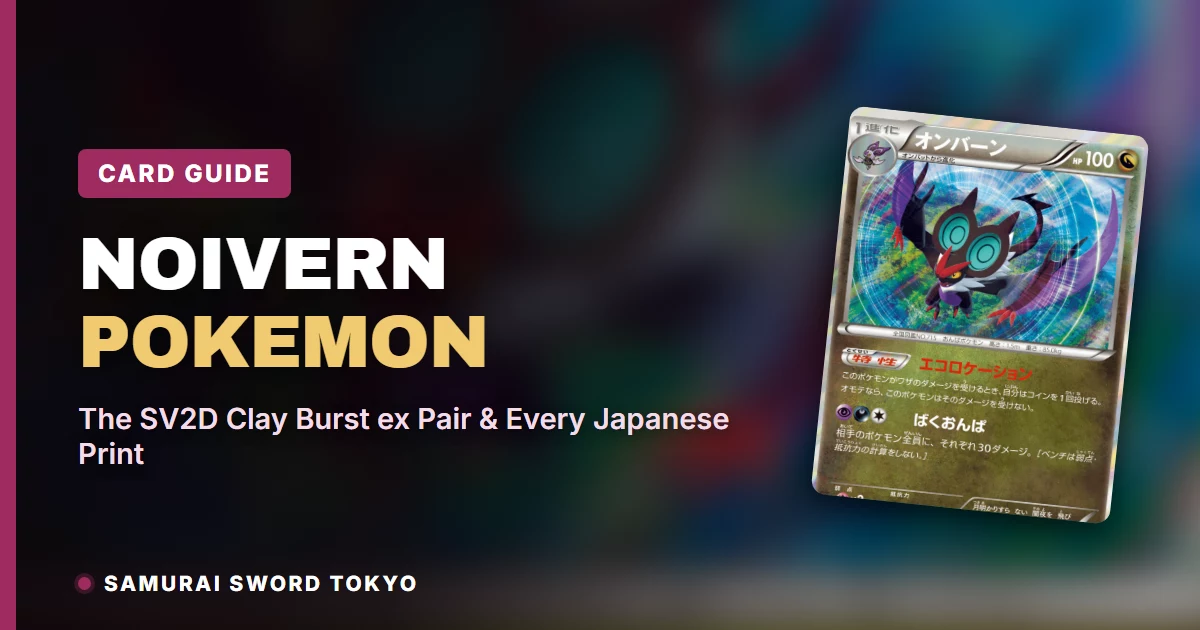
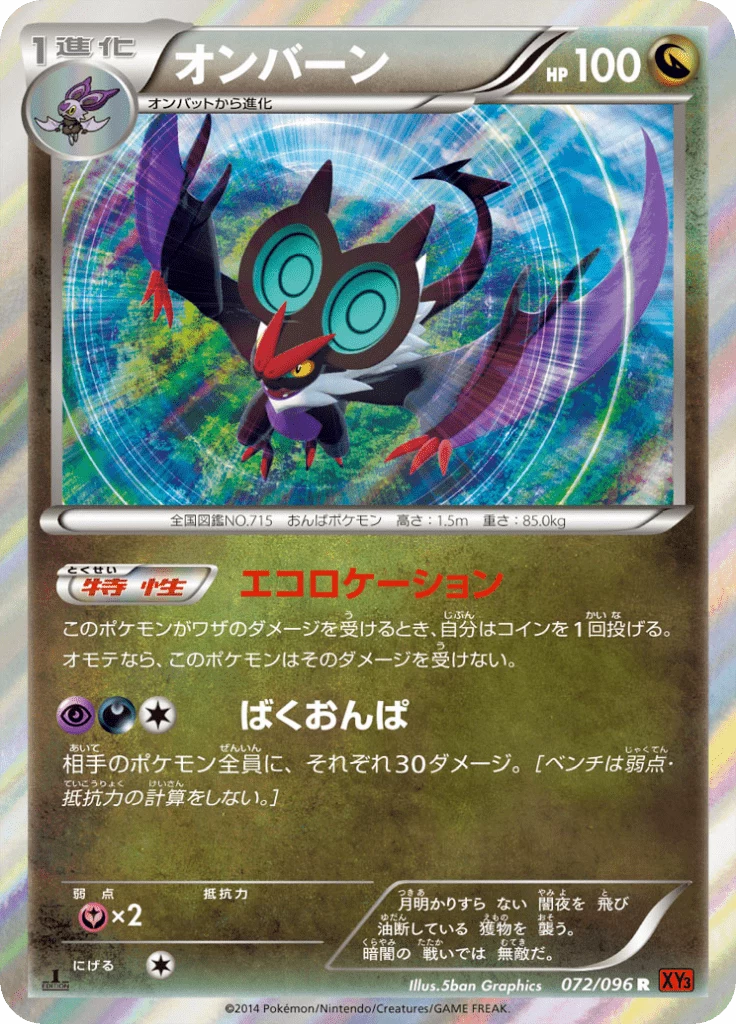
Noivern Pokémon-kaartengids: het SV2D Clay Burst ex-paar & elke Japanse druk

A search for every Japanese Noivern print turns up 23 cards, spread across sets that run from the original XY era through the 2025–26 M-series. The spread covers a wide rarity range — commons and uncommons in most sets Noibat and Noivern happened to round out, alongside higher-tier chase treatments (Noivern-GX, Noivern V, and other Noivern ex prints) elsewhere in the list. One of those higher-tier pairs is the SV2D Clay Burst Double Rare and Secret Rare Noivern ex, both from the same 2023 set: 58/71 sits within the base numbering, while 89/71 is secret-numbered above it.

This guide covers five Noivern prints in verified detail — the SV2D Clay Burst ex pair that anchors it, plus three earlier and later prints that show how the card has been treated across eras — and points to the Japanese sealed product that actually carries the Clay Burst pair.

Noivern (オンバーン) is a Dragon/Flying-type Stage 1 Pokemon, evolving from Noibat (オンバット). In the TCG, its “ex” prints are typed Dragon rather than Flying, which matters if you’re slotting one into a Dragon-type Energy base rather than a Flying one.

Key Takeaway

Noivern ex has two verified prints in SV2D Clay Burst — a Double Rare at 58/71 and a Secret Rare at 89/71, both HP 260, both inside our own listed Clay Burst Booster Box, currently listed at ¥9,880 (~$62). A Damaged Box listing of the same set is currently listed at ¥11,040 (~$69). We don’t currently list a single or graded Noivern card; sourcing requests for singles go through Quick Order.

5
Prints Covered

4
Rarities Featured

3
Eras Spanned

1
Listed Box (SV2D)

Japanese yen prices below convert at ¥159/USD (September 2026).

The Japanese Noivern Cards Verified in This Guide

A Limitless TCG search for pokemon:noivern returns 23 Japanese prints across CP4, M2a, MC, S12, S7D, SI, SM11, SM3H, SM6, SM8b, SNPo, SV2D, SV4a, SV9, SVM, XY3 and XYP. This guide covers five of them in verified detail, the ones we can confirm card number, rarity, illustrator and HP for from Limitless’s own card pages:

Number Set Rarity Illustrator HP
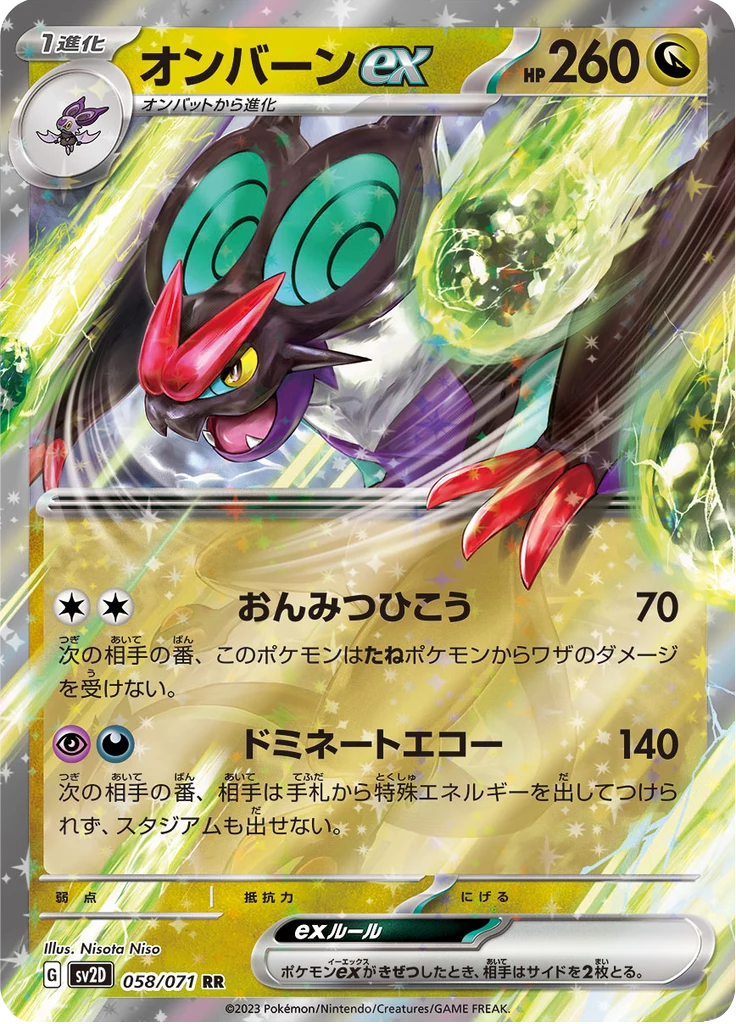
SV2D 58/71 Clay Burst Double Rare Nisota Niso 260
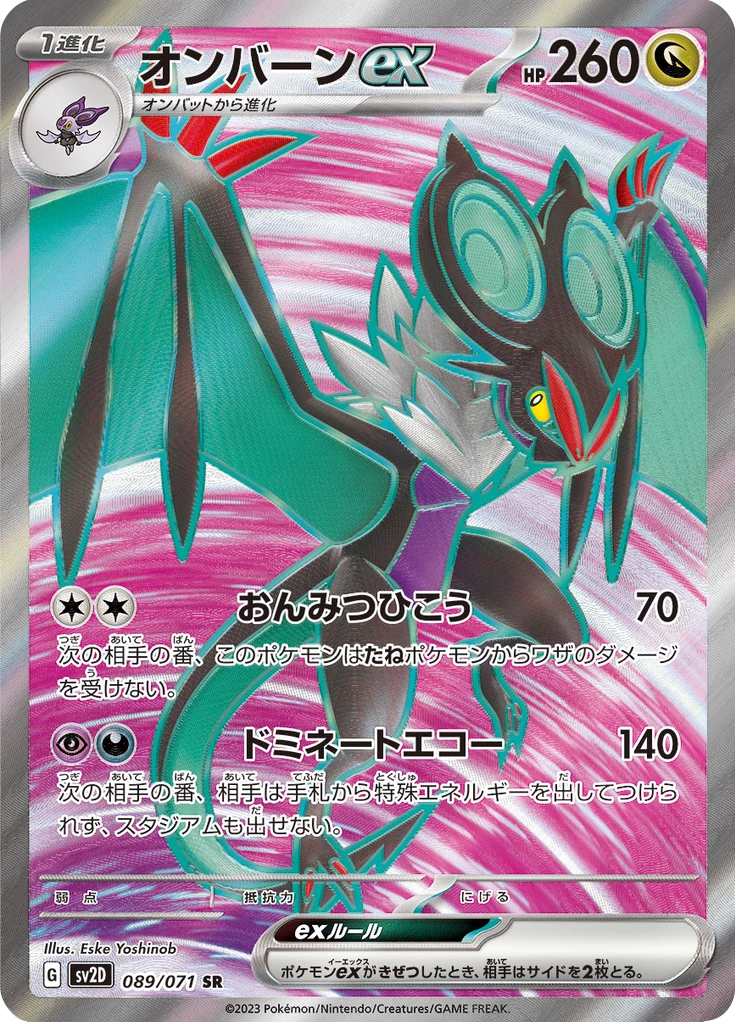
SV2D 89/71 Clay Burst Secret Rare Eske Yoshinob 260
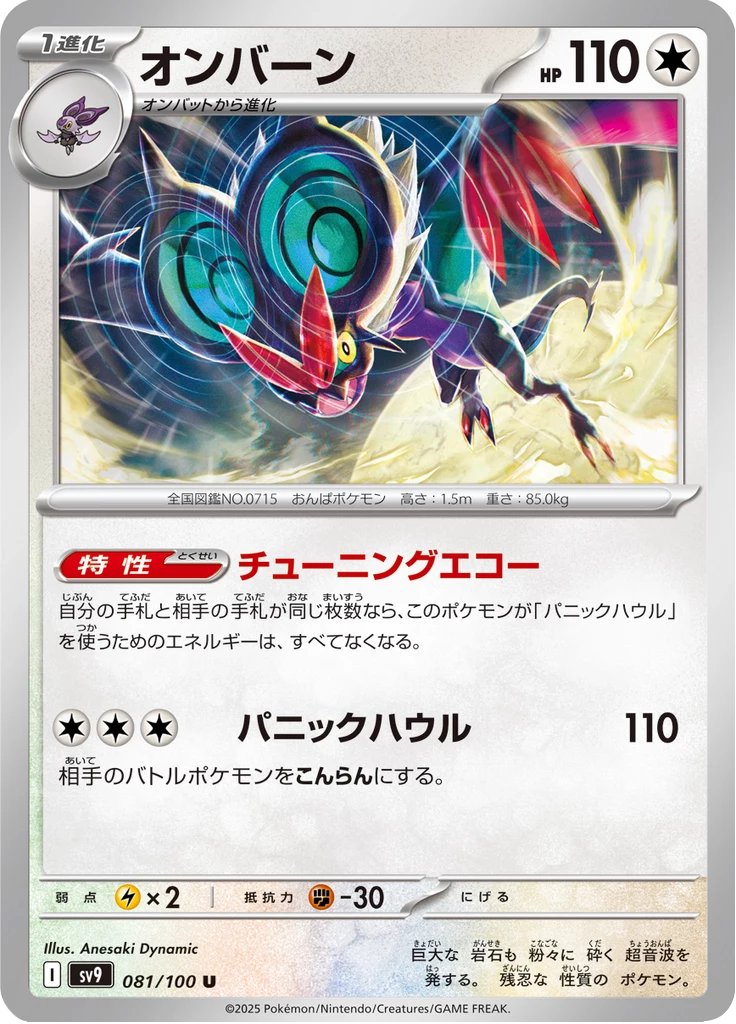
SV9 81 Battle Partners Uncommon Anesaki Dynamic 110
XY3 72 Rising Fist Rare 5ban Graphics 100
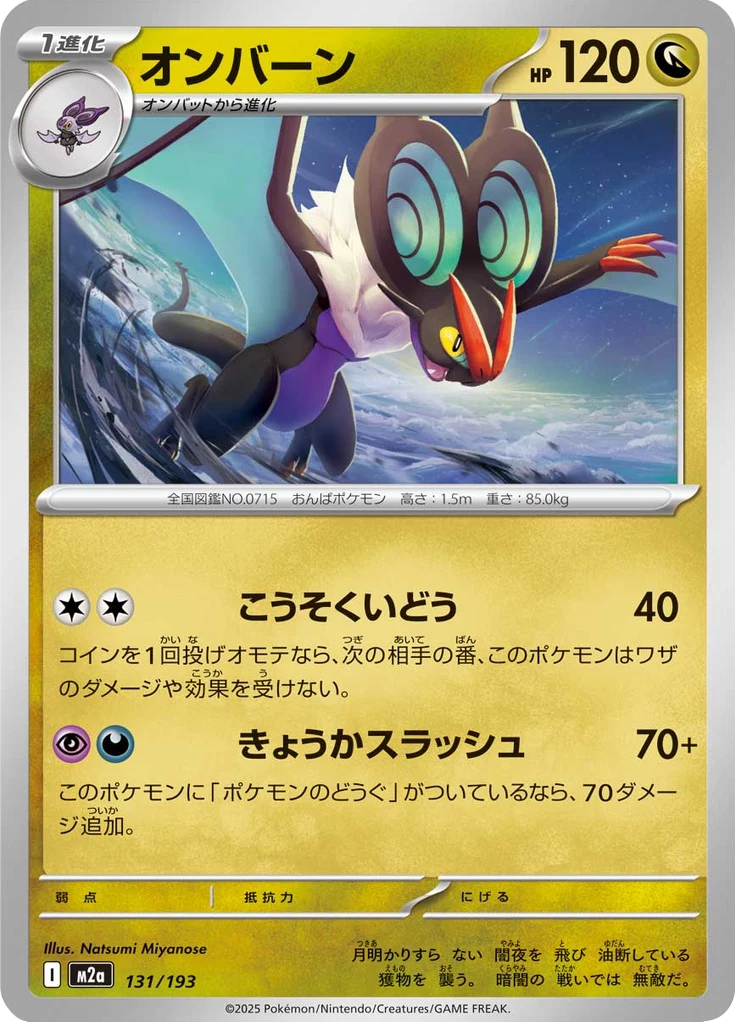
M2a 131 Mega Dream ex not stated in source Natsumi Miyanose 120

Two things stand out. First, the two SV2D cards are both “Noivern ex” — the only ex-typed prints among the five — and both share the same 260 HP line despite one being a Double Rare and the other a Secret Rare. Second, the other three prints span three different eras entirely: a 2014 XY-era Rare, a modern Scarlet & Violet Uncommon, and a 2025–26 M-series print, none of them typed as ex.

From XY to Modern SV: Two Non-ex Noivern Prints

Noivern, XY3 72, Rare, Rising Fist

Noivern, XY3 72, Rare, Rising Fist

Noivern, SV9 81, Uncommon, Battle Partners

Noivern, SV9 81, Uncommon, Battle Partners

The oldest of the five verified prints is Rising Fist (XY3), card 72, a Rare illustrated by 5ban Graphics with 100 HP. It’s a standard-frame XY-era card, from the set that also carried the era’s Mega Evolution lineup — Noivern’s role in it was a regular Rare slot rather than a chase card.

On the other end of the timeline sits Battle Partners (SV9), card 81, illustrated by Anesaki Dynamic at 110 HP and printed at Uncommon rarity. It is one of the non-ex Noivern prints covered here, while the SV2D pair shows how the same Pokemon also appears as an ex card.

The SV2D Clay Burst ex Pair: Double Rare 58/71 and Secret Rare 89/71

Noivern ex, SV2D 58/71, Double Rare, Clay Burst

Noivern ex, SV2D 58/71, Double Rare, Clay Burst

Noivern ex, SV2D 89/71, Secret Rare, Clay Burst

Noivern ex, SV2D 89/71, Secret Rare, Clay Burst

Clay Burst (SV2D) released in Japan on April 14, 2023, with a 99-card total — a 71-card base set plus a 28-card secret print run that includes 12 Art Rares. Noivern ex sits in the set twice, at opposite ends of that structure: the Double Rare at 58/71, illustrated by Nisota Niso, sits inside the main 71-card base run, while the Secret Rare at 89/71, illustrated by Eske Yoshinob, is numbered into the 28-card secret run above the base total. Both share the same attack line and the same 260 HP — the difference between them is entirely the print treatment and where each sits in the set’s numbering, not the card’s stats.

Check This First

Don’t mix the two up by name alone — both are “Noivern ex.” Check the number printed at the bottom of the card: 58/71 is the Double Rare, 89/71 is the Secret Rare, and the illustrator credit differs between them too (Nisota Niso versus Eske Yoshinob).

Clay Burst became a notable day-one sellout in Japan, driven in large part by demand for the set’s Iono Special Art Rare — a spike that pulled buyers toward the rest of the set’s rare slots as well, the Noivern ex pair included. For the full 99-card breakdown, see our Clay Burst SV2D card list.

The two Noivern ex prints map to different English cards, not the same one: the Double Rare (58/71) corresponds to Paldea Evolved (PAL), card #153, while the Secret Rare (89/71) corresponds to a separate full-art print, Paldea Evolved (PAL), card #246. If you’re cross-referencing the English side of this set, our Paldea Evolved Japanese card list and Paldea Evolved chase cards guide cover how the two versions line up.

The 2025–26 M-Series: Mega Dream ex 131

Noivern, M2a 131, Mega Dream ex

The newest print among the five verified here comes from Mega Dream ex (M2a), part of the 2025–26 M-series, at card 131. It’s illustrated by Natsumi Miyanose and carries 120 HP. We haven’t verified this print’s rarity from the source data, so we’re stating what we can confirm — the card number, illustrator and HP — rather than guessing at the rest.

Chase Prints and What Makes Them Collectible

Of the five prints in this guide, the SV2D pair is the one built to be chased, and the set’s own numbering explains why. Clay Burst’s 71-card base run holds the Double Rare at 58/71 — a tier above a standard Rare, but still inside the set’s regular numbered sequence. The Secret Rare at 89/71 sits eighteen numbers past that base total, placing it inside the 28-card secret print run alongside the set’s 12 Art Rares — the block of cards Japanese Scarlet & Violet-era sets number above the printed set size to mark them as the set’s top chase slots.

That’s the pattern worth knowing when you’re comparing any two SV-era Japanese prints of the same card: a number that runs past the set’s printed total (the “/71” in this case) is the tell that you’re holding a secret-rarity print rather than a standard one, regardless of what the card’s name or attack text looks like.

Which Japanese Boxes to Open for Noivern

Both SV2D Noivern ex prints come out of the same set, so there’s one direct box to point to, plus two related listings:

None of the other three prints in this guide — Rising Fist, Battle Partners or Mega Dream ex — are tied to a box we currently list. If you’re chasing one of those instead, or a graded single of any print covered here, sourcing requests go through Snel bestellen. For how Clay Burst stacks up against its release-partner set, see our SV2D vs SV2P box guide, and for the rest of Clay Burst’s chase cards, see our Clay Burst best cards guide.

Shop This Set
SV2D-Clay Burst Japanese Pokemon Booster Box
Currently listed at ¥9,880 (~$62)
Ships from Tokyo · Tracked delivery

View Product →

Where to Buy Noivern Cards from Tokyo

We ship Japanese sealed product worldwide out of Tokyo with tracked delivery. The Clay Burst Booster Box is the direct route to both Noivern ex prints covered in this guide, and the Damaged Box listing and Clay Burst & Snow Hazard Gym Set are the two related listings of the same product. Browse the wider Japanese Pokemon booster box collection, or request a quote via our Quick Order page for a specific-card sourcing request covering any of the five prints in this guide, including a graded or single copy.

SV2D Clay Burst Japanese Booster Box, listed on samuraiswordtokyo.com
SV2D-Clay Burst Japanese Pokemon Booster Box, currently listed on samuraiswordtokyo.com

Veelgestelde vragen

How many Japanese Noivern Pokemon card prints are there?

A Limitless TCG search returns 23 Japanese Noivern prints across sets from the XY era through the 2025–26 M-series. This guide covers five of them in verified detail: the SV2D Clay Burst ex pair, plus prints from Rising Fist (XY3), Battle Partners (SV9) and Mega Dream ex (M2a).

What is the SV2D Clay Burst Noivern ex pair?

Two prints of Noivern ex from Clay Burst (SV2D), released April 14, 2023: a Double Rare at 58/71 illustrated by Nisota Niso, and a Secret Rare at 89/71 illustrated by Eske Yoshinob. Both are HP 260, and both are inside our listed Clay Burst Booster Box.

Is Noivern ex a Dragon-type or Flying-type card in the TCG?

Noivern itself is a Dragon/Flying-type Pokemon in the games, but its TCG ex prints, including both SV2D versions, are typed Dragon.

Which Japanese booster box has the Clay Burst Noivern ex prints?

The SV2D-Clay Burst Japanese Pokemon Booster Box, currently listed at ¥9,880 (~$62), is the direct route to both the Double Rare and Secret Rare Noivern ex. The same set is also listed as a Damaged Box and as part of a combined Gym Set with Snow Hazard.

Where can I buy Japanese Noivern Pokemon cards?

We ship Japanese sealed product from Tokyo with tracked delivery. The Clay Burst Booster Box carries both SV2D Noivern ex prints, and requesting a quote via our Quick Order page covers sourcing for the other prints in this guide, including graded singles.

SV3 Ruler of the Black Flame Booster Box koopgids: setinfo, chase cards en waar te kopen

One Pokémon has three verified secret-tier prints here, each at a different rarity.

Ruler of the Black Flame, set code SV3, released in Japan on July 28, 2023 as the third core Scarlet & Violet set. It runs 141 cards and is built around a triple-print Charizard ex run — Secret Rare, Special Art Rare, and Ultra Rare versions of the same card in the same set — alongside a run of Secret Rare/Special Art Rare pairs for five other Pokémon and Trainer cards. That structure is unusual enough that it’s one of the reasons this box keeps coming up in buyer questions years after release.

This guide covers what’s actually in a Ruler of the Black Flame box, which pulls define the set, and what’s currently listed on our site — including the difference between our booster box listing and the separate Deck Build Box, which is a different product entirely. We ship Japanese sealed product out of Tokyo, so the prices below are what we carry right now.

Key Takeaway

Ruler of the Black Flame (SV3) is 141 cards — 108 base plus 33 secret-tier (12 Art Rare, 12 Secret Rare, 6 Special Art Rare, 3 Ultra Rare) — released July 28, 2023. The headline pull is Charizard ex, with three verified secret-tier prints at three rarities (125/108 SR, 134/108 SAR, 139/108 UR). Our SV3 Ruler of the Black Flame Booster Box is currently listed at ¥17,160 (~$108). The separate Ruler of the Black Flame Deck Build Box is currently listed at ¥5,400 — these are two different products, covered below.

141
Total Cards

108
Base Set Cards

33
Secret-Tier Cards

Jul 2023
JP Release

Prices below are our current listed prices as of September 2026, converted at ¥159/USD.

What’s in a Ruler of the Black Flame Box

Ruler of the Black Flame is a 141-card Scarlet & Violet core set, split into a 108-card base set and a 33-card secret tier:

Tier Rarity Count
Secret tier (33) AR Art Rare 12
SR Secret Rare 12
SAR Special Art Rare 6
UR Ultra Rare 3
Base set — 108

The card numbers for the secret tier run 109/108 through 141/108, sitting above the 108-card base set exactly as the rowspan above implies — 108 base cards, then 33 more numbered past the set’s nominal size.

Packs-per-box and cards-per-pack figures for this specific set aren’t confirmed from what we’ve verified this session — other same-era Scarlet & Violet core sets typically run 30 packs per box at 5 kaarten per pack, and Ruler of the Black Flame is very likely built the same way, but we’re flagging that structure as unverified specifically for SV3 rather than stating it as confirmed fact. We don’t cover pull rates or pull odds here — our source for this set is a card-list breakdown, not an official rate sheet, so we won’t invent numbers we can’t back up.

For the full 141-card breakdown, see our Ruler of the Black Flame SV3 card list.

Chase Cards in Ruler of the Black Flame

What makes this set stand out isn’t just one big secret rare — it’s a whole run of cards printed at two or three rarities each.

The Triple-Printed Chase: Charizard ex

Charizard ex is the set’s signature pull, and it’s printed three separate times:

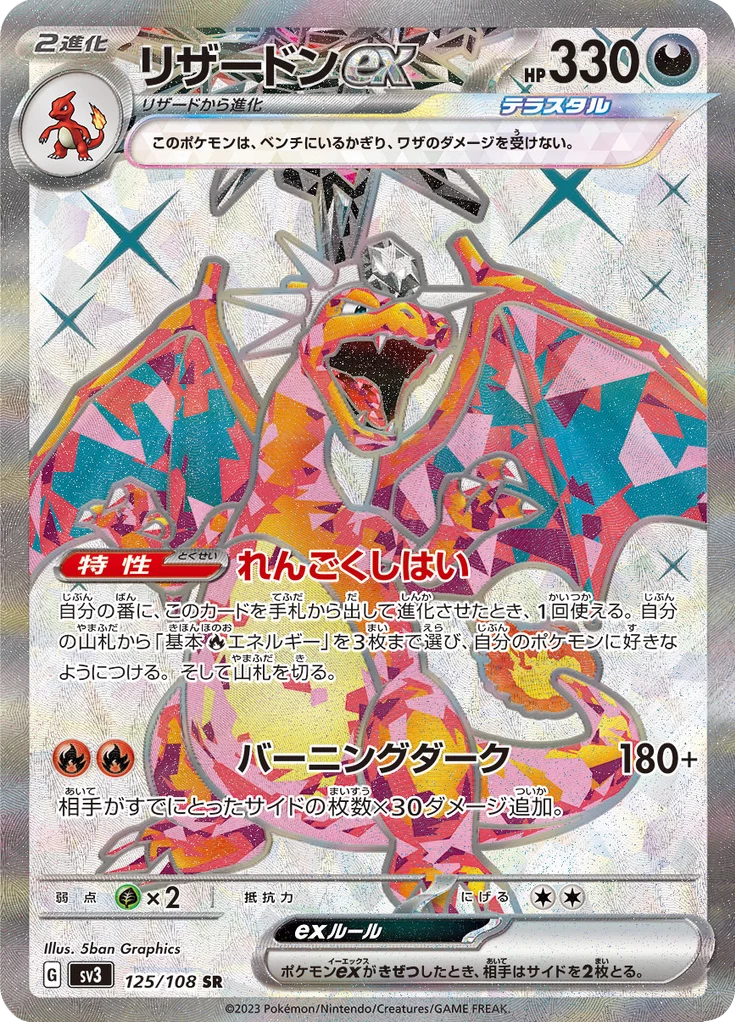
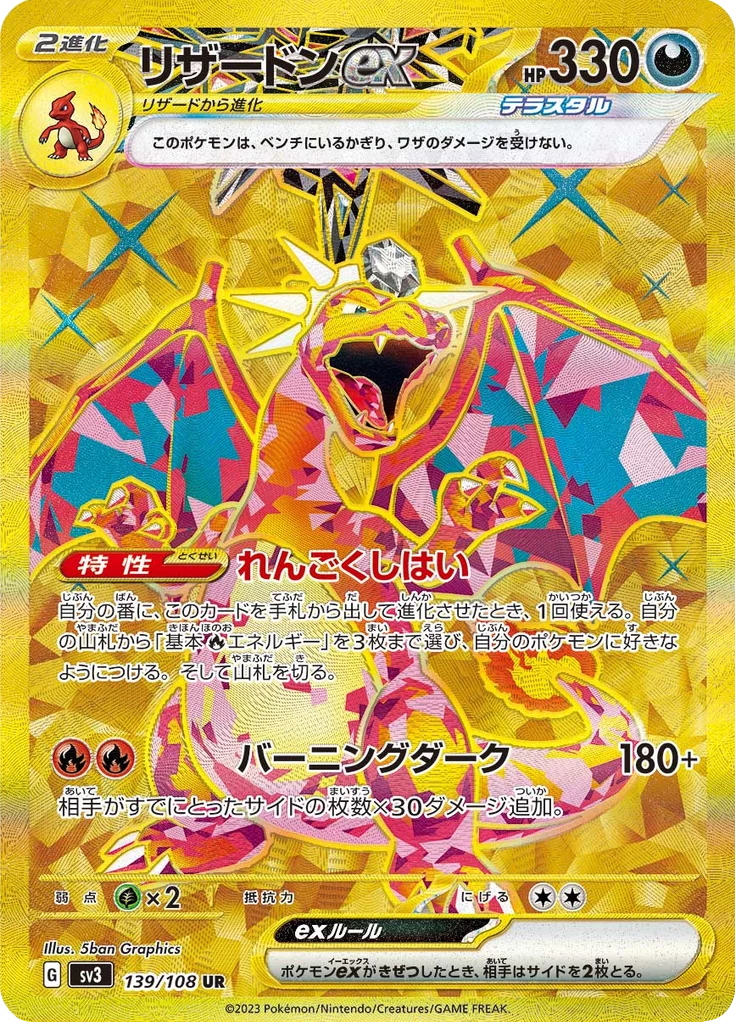
Charizard ex 125/108 Secret Rare, Ruler of the Black Flame

Charizard ex 125/108 SR

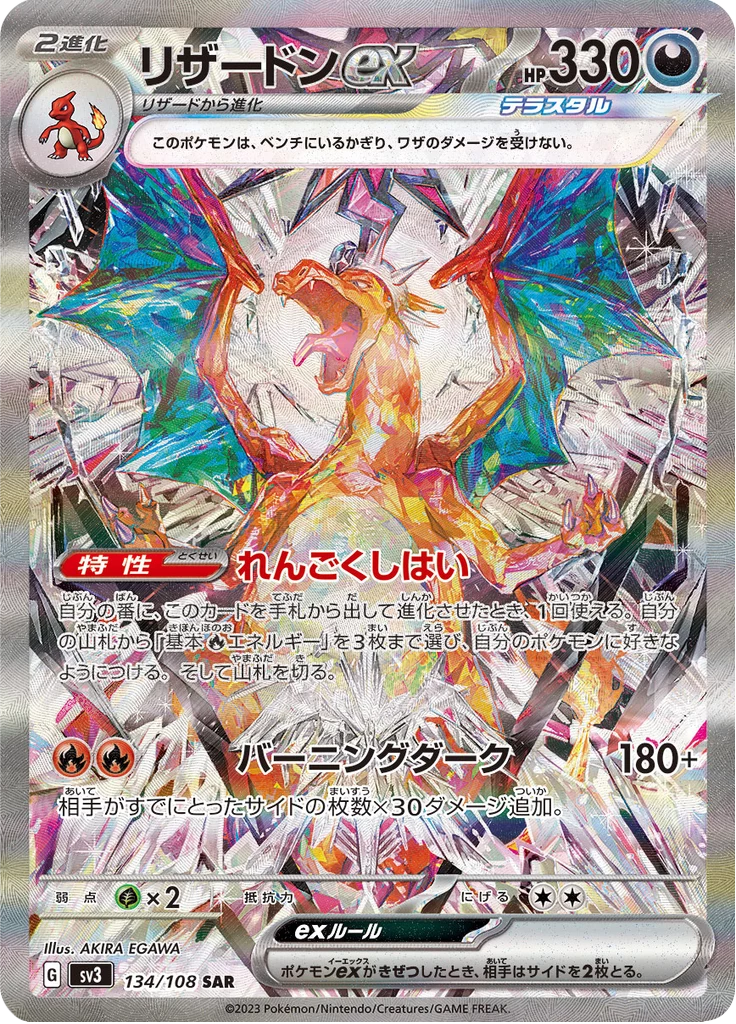
Charizard ex 134/108 Special Art Rare, Ruler of the Black Flame

Charizard ex 134/108 SAR

Charizard ex 139/108 Ultra Rare, Ruler of the Black Flame

Charizard ex 139/108 UR

Three rarity tiers of the same card, in the same set, is not the norm across Scarlet & Violet core sets — most signature Pokémon get a Secret Rare and, at most, a Special Art Rare upgrade. Ruler of the Black Flame gives Charizard ex all three: a Secret Rare at 125/108, a Special Art Rare at 134/108, and the set’s Ultra Rare slot at 139/108. This isn’t currently a live single listing on our site — if you’re after a graded or raw copy of any of the three, the Quick Order page is the fastest way to flag what you’re after.

The Secret Rare / Special Art Rare Pairs

Five other Pokémon and Trainer cards get the same two-tier treatment — a Secret Rare paired with a Special Art Rare upgrade of the same character:

Kaart Secret Rare Special Art Rare
Eiscue ex 121/108 SR 133/108 SAR
Revavroom ex 127/108 SR 135/108 SAR
Pidgeot ex 128/108 SR 136/108 SAR
Geeta 129/108 SR 137/108 SAR
Poppy 131/108 SR 138/108 SAR
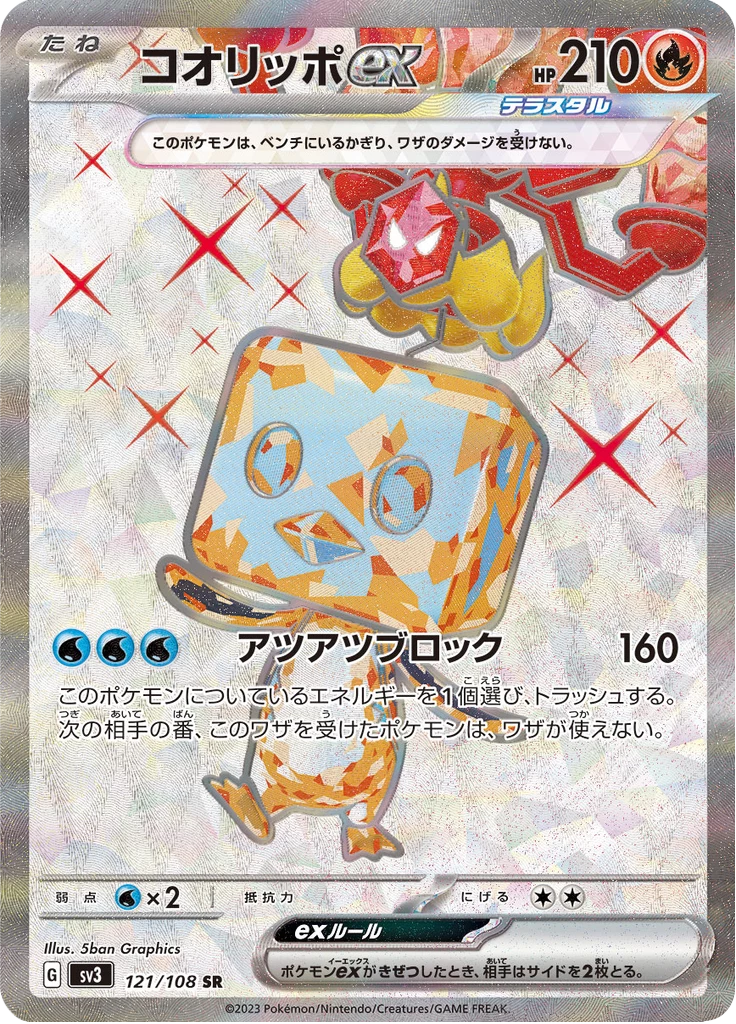
Eiscue ex 121/108 Secret Rare, Ruler of the Black Flame
Eiscue ex 121/108, Secret Rare — one of five SR/SAR character pairs in the set alongside the Charizard ex triple-print run

Between the Charizard ex trio and these five pairs, six of the set’s twelve Secret Rares belong to a Pokémon or Trainer card that gets reprinted at a higher tier elsewhere in the same set — Charizard ex plus the five SR/SAR pairs above. That pattern is a structural feature of Ruler of the Black Flame, not something we’re speculating about — it’s directly visible in the card numbers above.

Single Secret Rares and the Remaining Ultra Rares

The other six Secret Rares don’t get an SAR upgrade and round out the tier as single-tier prints: Tyranitar ex (122/108), Vespiquen ex (123/108), Glimmora ex (124/108), Absol ex (126/108), Ortega (130/108), and Ryme (132/108). The set’s remaining two Ultra Rares beyond Charizard ex are Trainer and Energy cards: Artazon (140/108) and a full-art Basic Fire Energy (141/108) closing out the set at card 141.

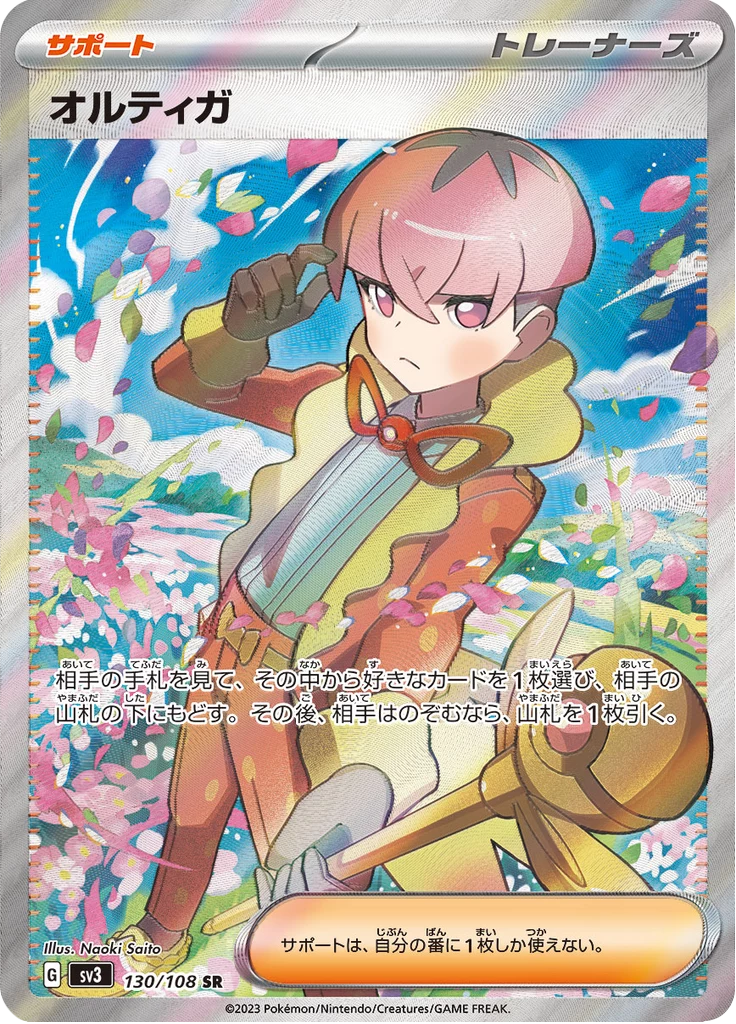
Ortega 130/108 Secret Rare, Ruler of the Black Flame
Ortega 130/108, Secret Rare — one of the six single-tier Secret Rares in Ruler of the Black Flame

A PSA10-graded Ortega single has appeared on our own card-list page before, but it is not part of our current listed anchors — this print is not listed on our site at the moment, and sourcing requests for it go through the Quick Order page. The same applies to any of the other secret-tier singles named above: none of them are currently listed as standalone products, only the sealed box below.

Booster Box vs Deck Build Box on Our Site

We list two Ruler of the Black Flame products, and they get confused with each other because the set name is identical — but they are not the same product, and the price gap between them reflects that.

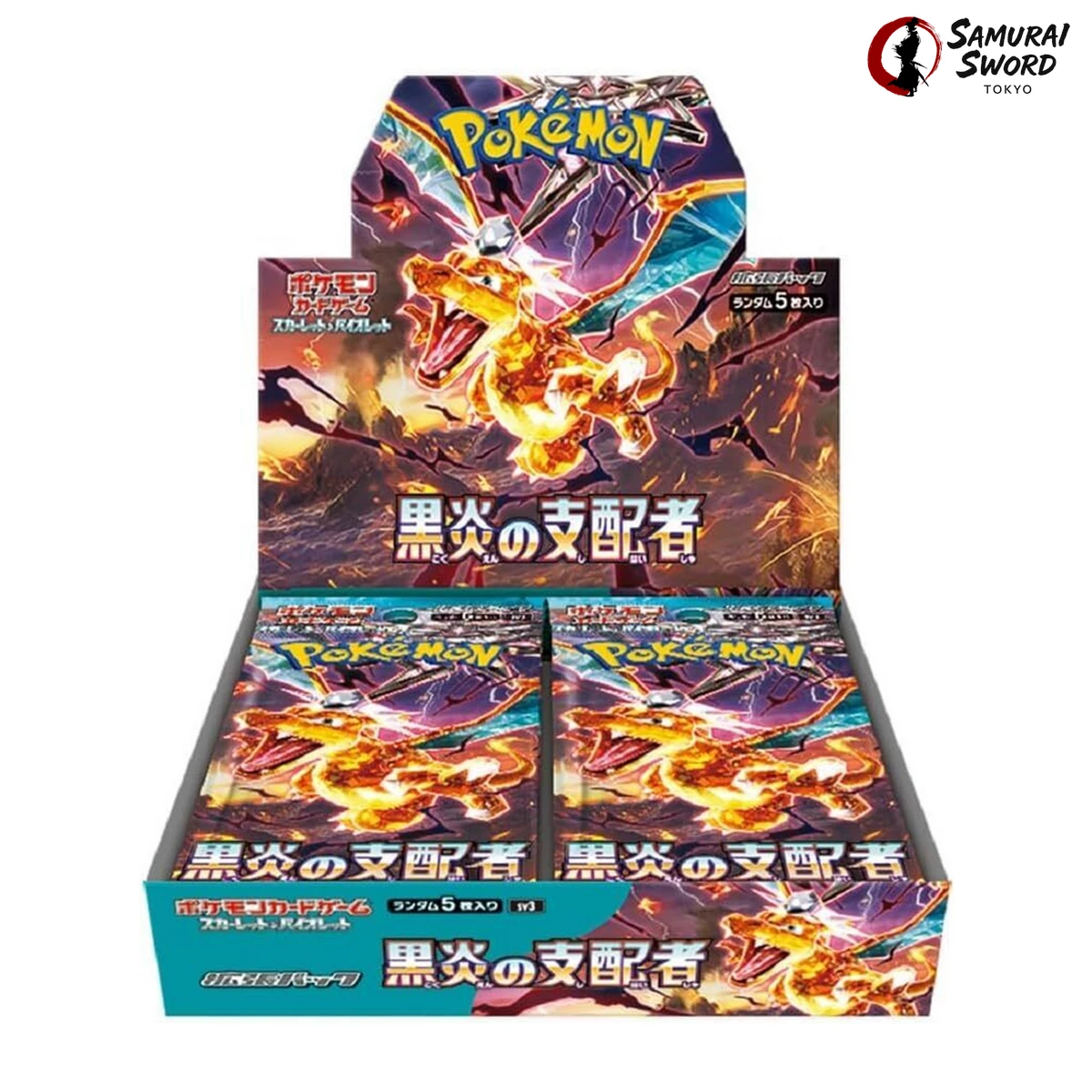
SV3 Ruler of the Black Flame Japanese Pokemon Booster Box product photo
SV3-Ruler Of The Black Flame Japanese Pokemon Booster Box
Listing Prijs
SV3-Ruler Of The Black Flame Japanese Pokemon Booster Box currently listed at ¥17,160 (~$108)
Ruler of the Black Flame Deck Build Box currently listed at ¥5,400

The Booster Box is the sealed pack product covered throughout this guide — it’s where the Charizard ex triple-print run and every other card discussed above actually comes from. The Deck Build Box is a different, separately structured Scarlet & Violet product line released alongside the main set: it centres on preconstructed deck contents, but per the official product listing it also includes 10 random Ruler of the Black Flame booster packs, so it can still yield secret-tier pulls — it just isn’t built primarily as a pack-opening product the way the Booster Box is. If your goal is maximising chances at the SR/SAR/UR cards covered in this guide, the Booster Box’s full box of packs gives you more chances than the Deck Build Box’s 10 included packs; the Deck Build Box mainly serves constructed-deck players who also want a shot at some pulls.

Check the Product Title

Both products carry “Ruler of the Black Flame” in the name. Confirm you’re looking at “Booster Box” versus “Deck Build Box” in the title before checkout — the ¥11,760 gap between the Booster Box (¥17,160) and the Deck Build Box (¥5,400) reflects genuinely different contents, not a discount on the same product.

Japanese vs English Version of This Set

Everything covered in this guide is the Japanese printing of Ruler of the Black Flame, which is what we carry. In the wider English-language hobby, this set is commonly identified as Obsidian Flames — a pairing that lines up with the known Scarlet & Violet release order, but one that has not been independently re-confirmed this session, so treat that name match as reported rather than verified on our end.

What we can confirm directly: the Japanese release date, July 28, 2023, and the full 141-card structure detailed above, both cross-checked against our own card-list article and an independent card database, with both sources agreeing exactly on the card count. We don’t have a confirmed English release date or an English-language card count to compare against, so we’re not going to state one here.

Practically, if you’re deciding between sourcing this set in Japanese or English, the Japanese printing is the one this guide — and our own listings — are built around.

Shop This Set
SV3-Ruler Of The Black Flame Japanese Pokemon Booster Box
Currently listed at ¥17,160 (~$108)
Ships from Tokyo · Tracked delivery

View Product →

Where to Buy a Ruler of the Black Flame Booster Box from Tokyo

We ship sealed Japanese product worldwide from Tokyo with tracked delivery. The SV3-Ruler Of The Black Flame Japanese Pokemon Booster Box above is the direct route to the Charizard ex triple-print run and the rest of the secret tier; the separate Ruler of the Black Flame Deck Build Box is worth a look if constructed play, rather than pulls, is the goal.

For the wider Japanese Pokémon booster box range, browse our Pokemon booster box collection. If you’re weighing this set against its numbered sibling, our SV3 vs SV3a box comparison lines the two up directly, and our Raging Surf (SV3a) card list and pull rates guide covers the follow-up set in the same numbered pair.

For any secret-tier single not currently listed as a standalone product — Charizard ex at any of its three rarities, Ortega, or any of the other named chases above — the Quick Order page is the fastest way to build a mixed order or flag what you’re after.

Veelgestelde vragen

What is SV3 Ruler of the Black Flame?

Ruler of the Black Flame is the third core Scarlet & Violet set released in Japan, on July 28, 2023. It contains 141 cards — a 108-card base set plus a 33-card secret tier — and is best known for printing Charizard ex at three separate rarities.

How many cards are in Ruler of the Black Flame?

141 total: 108 base-set cards plus 33 secret-tier cards, split into 12 Art Rare, 12 Secret Rare, 6 Special Art Rare, and 3 Ultra Rare.

Why are there three verified secret-tier Charizard ex prints?

Ruler of the Black Flame gives Charizard ex a Secret Rare (125/108), a Special Art Rare (134/108), and the set’s Ultra Rare slot (139/108) — a three-tier treatment that most other signature Pokémon in the set don’t get. Five other cards get a two-tier SR/SAR pairing, but Charizard ex is the only one printed at all three rarities.

What’s the difference between the SV3 Booster Box and the Deck Build Box on your site?

They’re different products. The Booster Box is the sealed pack product that contains the secret-tier cards covered in this guide, currently listed at ¥17,160 (~$108). The Deck Build Box is a separate, constructed-deck-oriented product from the same set, currently listed at ¥5,400 — it also includes 10 random Ruler of the Black Flame booster packs, so it can still yield secret-tier pulls, just fewer chances than the full Booster Box.

Is Ruler of the Black Flame the same as Obsidian Flames?

Ruler of the Black Flame is the Japanese printing we carry. It’s commonly identified in the wider hobby as the Japanese counterpart to the English set Obsidian Flames, though that pairing has not been independently re-confirmed this session — treat it as reported rather than fully verified.

Where can I buy a PSA10 Ortega or other Ruler of the Black Flame singles?

None of the secret-tier singles named in this guide, including Ortega, are currently listed as standalone products on our site — only the sealed Booster Box and Deck Build Box are. Sourcing requests for specific singles go through our Quick Order page.
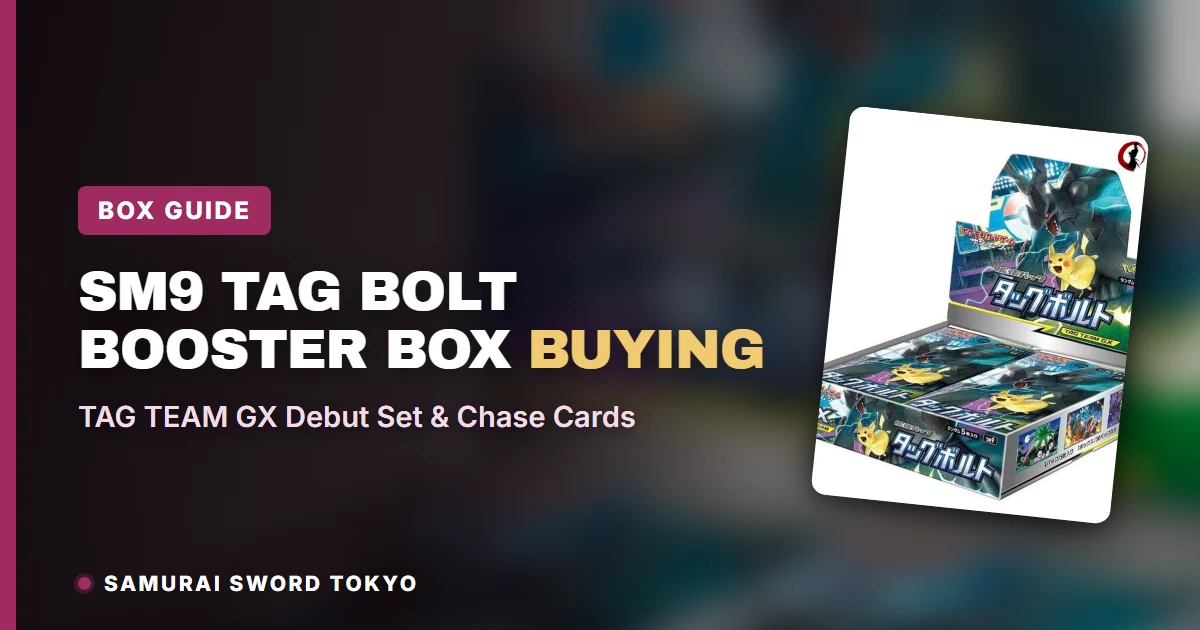
Koopgids voor de SM9 Tag Bolt Booster Box: de TAG TEAM GX-debuutset & chase-kaarten

Six TAG TEAM-GX pairings, one box, and a mechanic the Pokemon TCG had never used before. When 拡張パック「タッグボルト」— Expansion Pack “Tag Bolt” — released in Japan on December 7, 2018, it introduced the TAG TEAM-GX card type to the game, pairing two Pokemon on a single card with a shared attack.

This guide covers what’s actually in a Tag Bolt box, which TAG TEAM-GX pulls collectors chase, how our own Regular Box, Damaged Box and No Shrink listings work for this particular set, and how the Japanese release compares to its English counterpart. We ship Japanese sealed product and PSA-graded singles out of Tokyo, so every price below is our own current listing, not a third-party market quote.

Key Takeaways

Tag Bolt is set code SM9, released in Japan on December 7, 2018. It’s the set that introduced the TAG TEAM-GX mechanic, headlined in this guide by Pikachu & Zekrom GX SR (100/095) and Latias & Latios GX across three verified tiers. Our sealed SM9-Tag Bolt Japanese Pokemon Booster Box is currently listed at ¥441,000 (~$2,774).

6
TAG TEAM-GX Pairings

Dec 2018
Japan Release

6
TAG TEAM-GX Pairs

Feb 2019
English Release

Prices below are our own current listed prices as of September 2026, converted at ¥159/USD.

What’s in a Tag Bolt Booster Box

Tag Bolt is the Sun & Moon-era set that first brought the TAG TEAM-GX card type into the Pokemon TCG — two Pokemon sharing one card and one GX attack. Six pairings debuted here: Pikachu & Zekrom GX, Latias & Latios GX, Gengar & Mimikyu GX, Eevee & Snorlax GX, Celebi & Venusaur GX, and Magikarp & Wailord GX.

Item Value
Set name 拡張パック「タッグボルト」/ Expansion Pack “Tag Bolt”
Setcode SM9
Japan release date December 7, 2018
TAG TEAM-GX pairings introduced 6

On the card count, the totals in our cited references conflict. The visible numbering shows base-numbered cards followed by secret-numbered cards, so this guide does not state a definitive total. Use our Tag Bolt checklist article as a navigation aid, and verify individual cards by their printed numbers.

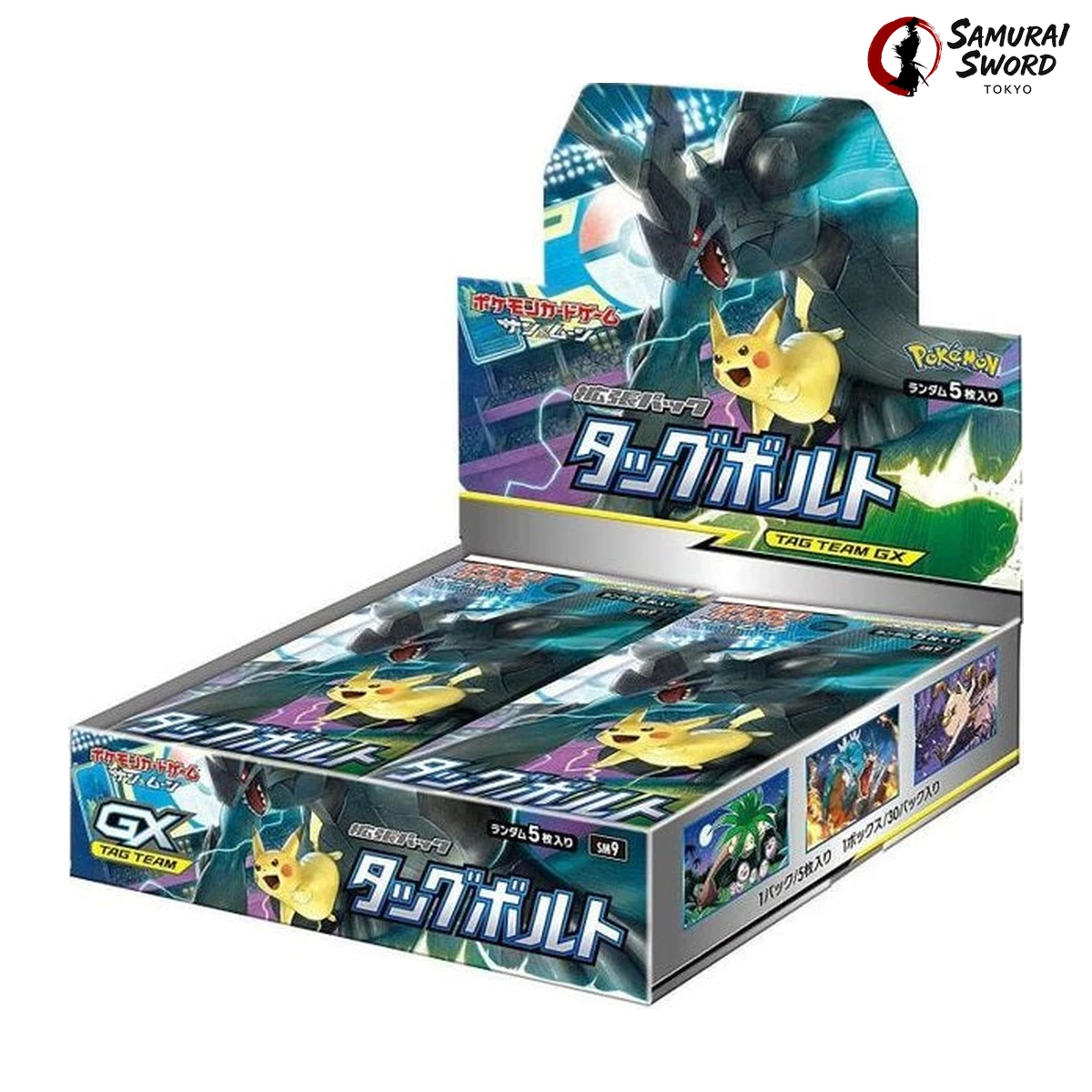
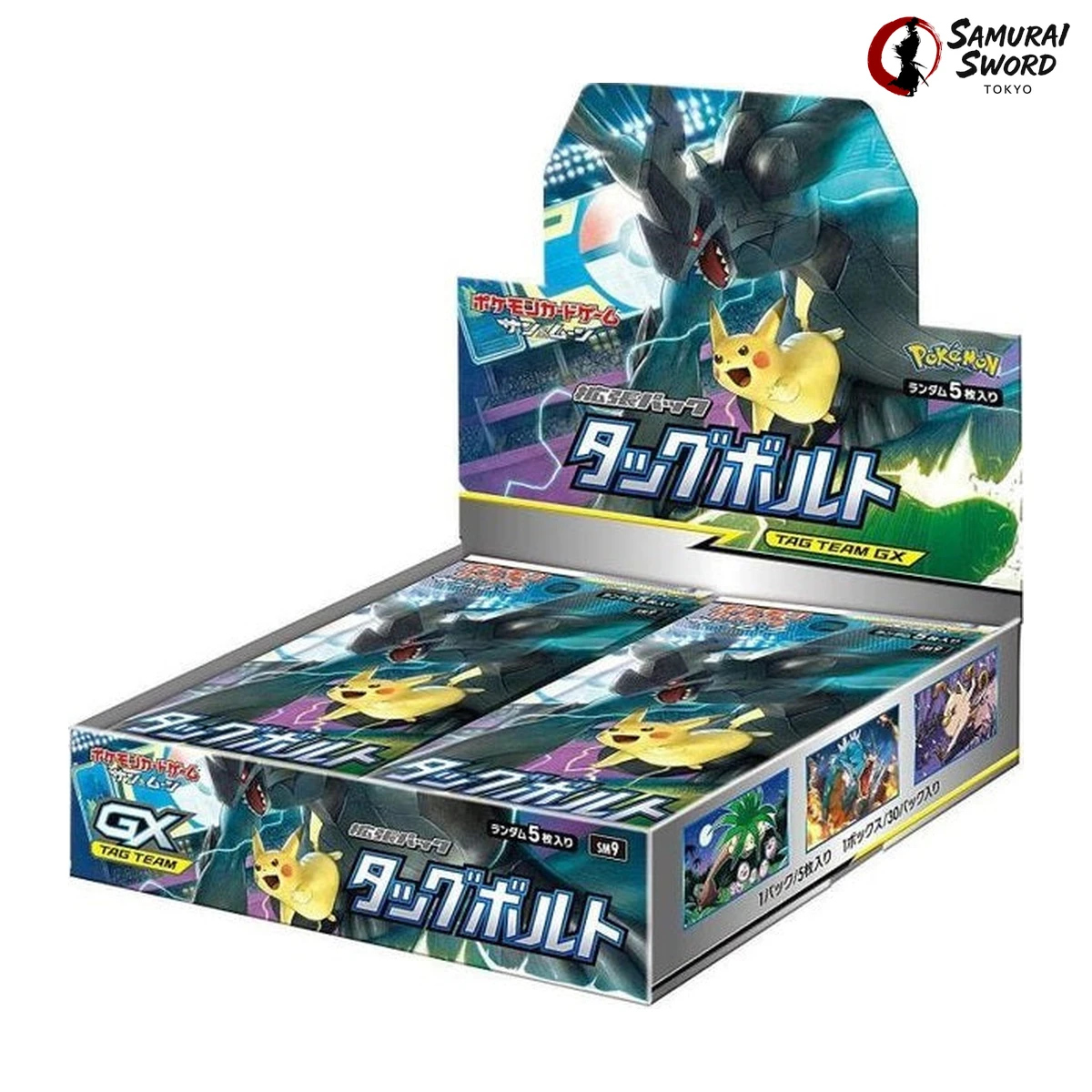
SM9-Tag Bolt Japanese Pokemon Booster Box product photo
SM9-Tag Bolt Japanese Pokemon Booster Box — our own sealed listing

Chase Cards in Tag Bolt

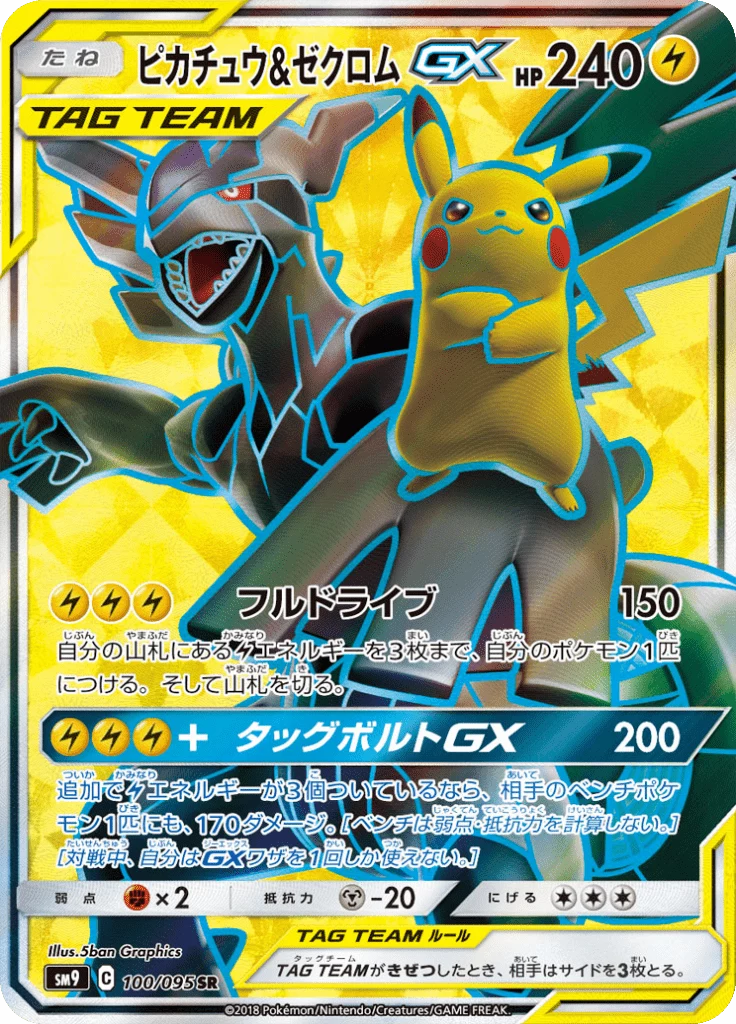
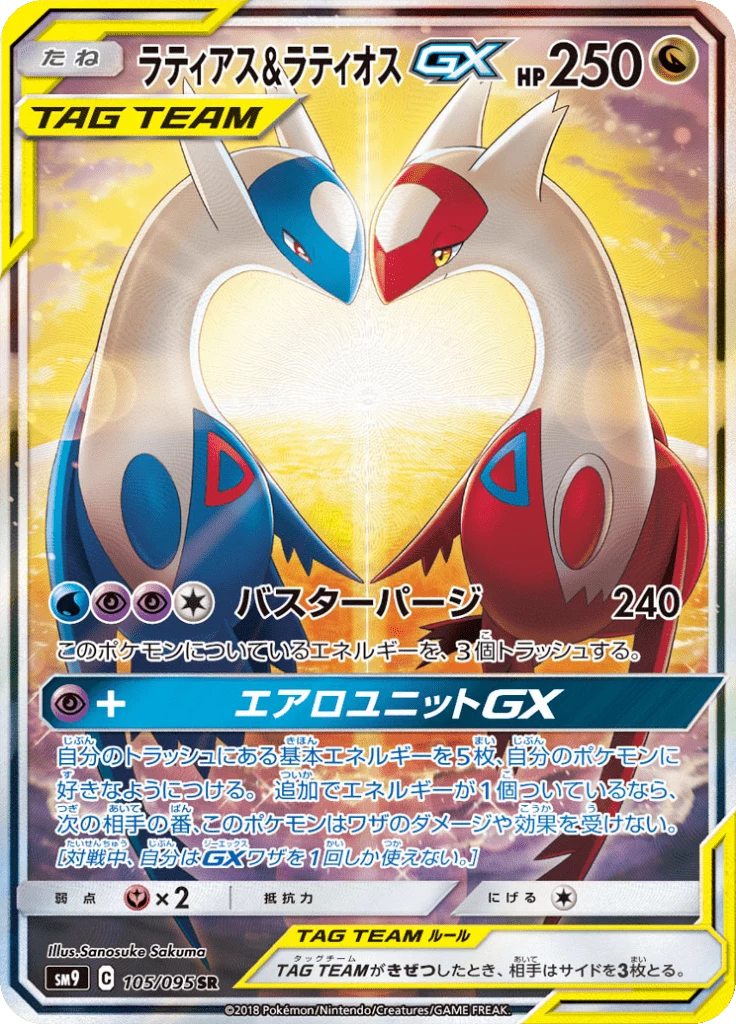
Six TAG TEAM-GX pairings debuted in Tag Bolt. For the two pairings documented card by card in our FACTS pack, the secret-numbered tiers include Pikachu & Zekrom GX at 100/095 SR and 101/095 SR Special Art, plus Latias & Latios GX at 104/095 SR and 105/095 SR Special Art. This guide does not generalise that tier pattern to the other four pairings.

Pikachu & Zekrom GX

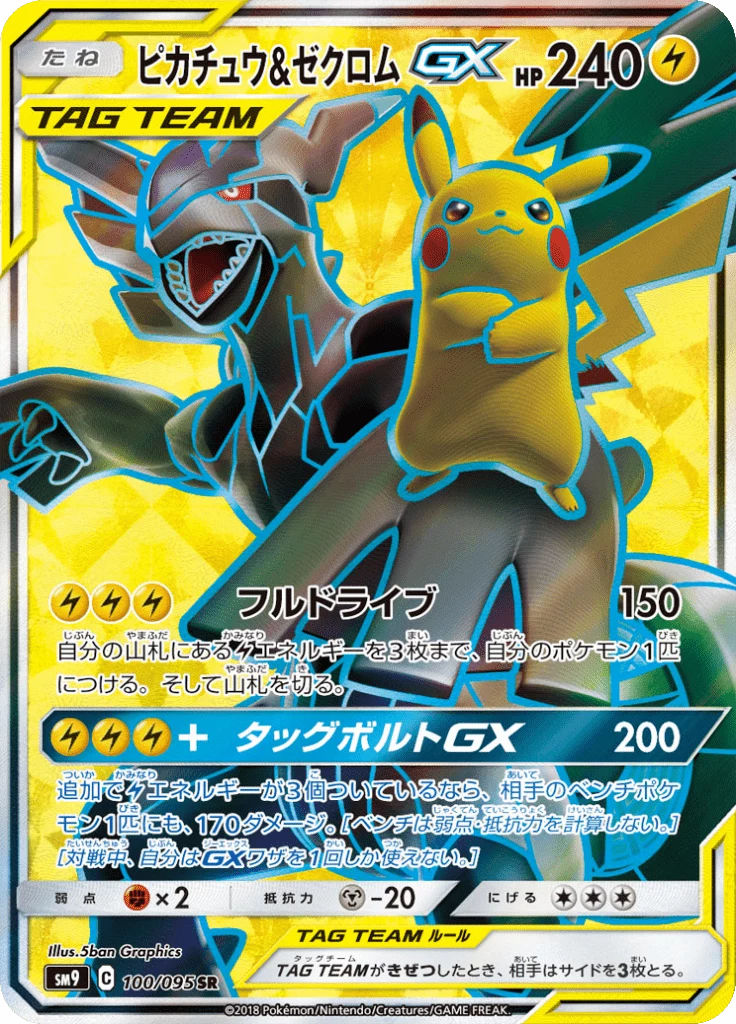
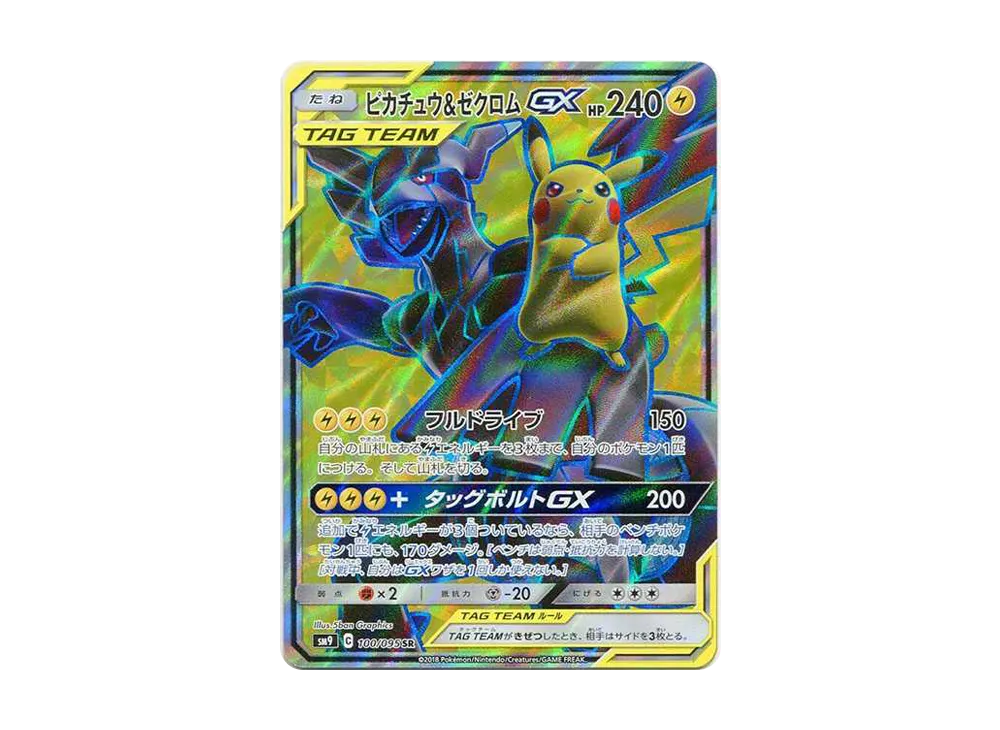
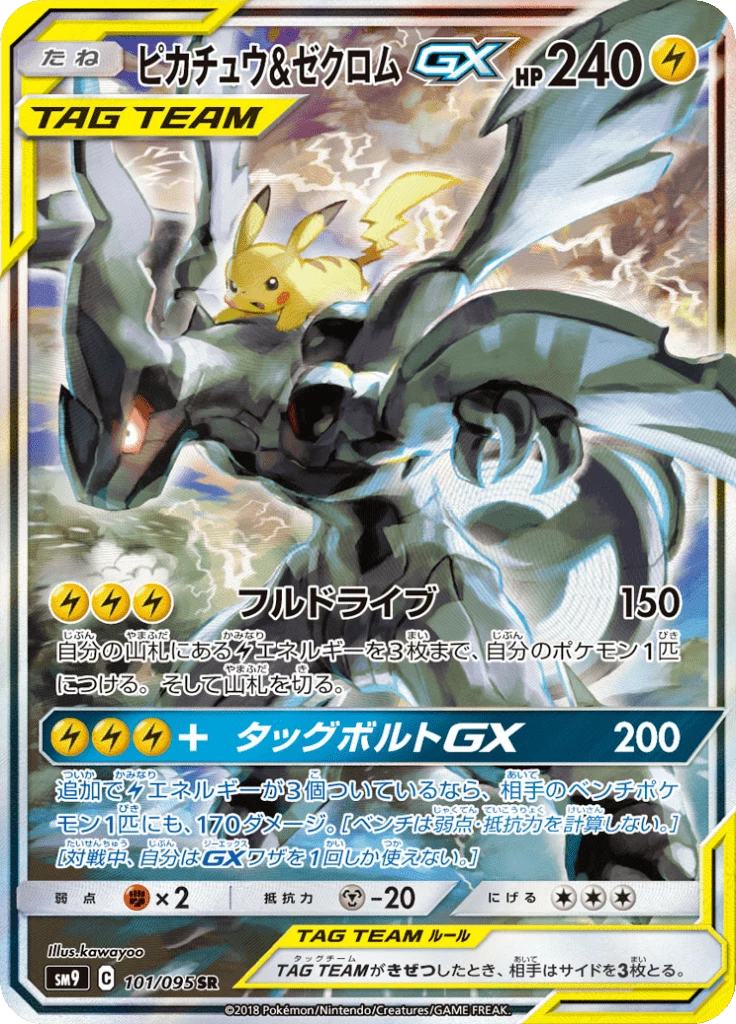
The set’s defining pairing. It appears across three separate printings: a regular Double Rare in the base numbering, then two secret-tier prints — SR (100/095) and SR Special Art (101/095).

Pikachu & Zekrom GX 100/095 SR Tag Bolt

Pikachu & Zekrom GX, 100/095, SR — Tag Bolt (SM9)

Pikachu & Zekrom GX 101/095 SR Special Art Tag Bolt

Pikachu & Zekrom GX, 101/095, SR Special Art — Tag Bolt (SM9)

The SR (100/095) is currently listed PSA10-graded, linked in the table below.

Latias & Latios GX

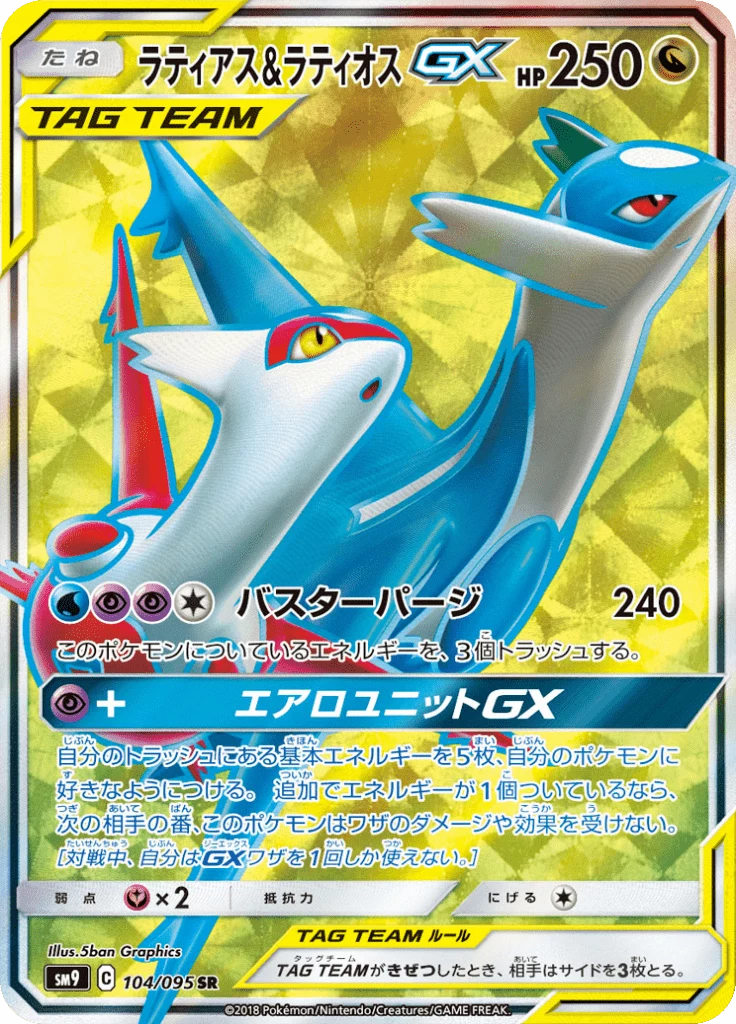
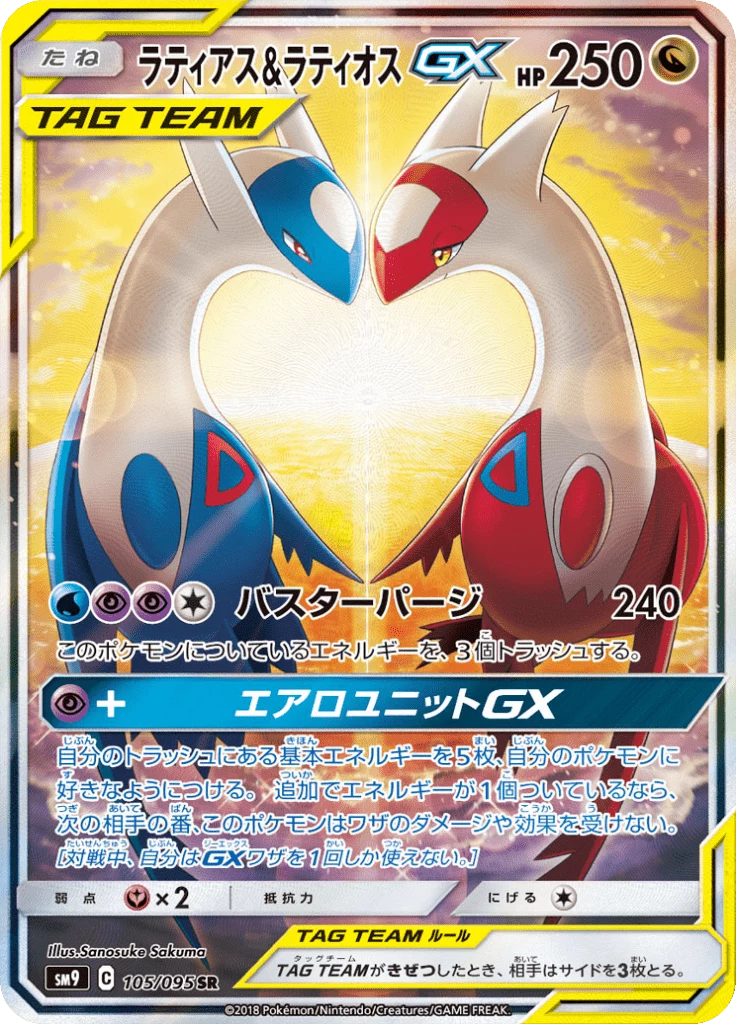
The same documented pattern includes a regular Double Rare in the base numbering, then SR (104/095) and SR Special Art (105/095).

Latias & Latios GX 104/095 SR Tag Bolt

Latias & Latios GX, 104/095, SR — Tag Bolt (SM9)

Latias & Latios GX 105/095 SR Special Art Tag Bolt

Latias & Latios GX, 105/095, SR Special Art — Tag Bolt (SM9)

The SR Special Art (105/095) is currently listed PSA10-graded, also linked below.

Kaart # Tier Currently listed
Pikachu & Zekrom GX 100/095 SR PSA10 currently listed at ¥87,208 (~$549)
Latias & Latios GX 105/095 SR Special Art PSA10 currently listed at ¥1,321,516 (~$8,311)

The other four debut pairings are Gengar & Mimikyu GX, Celebi & Venusaur GX, Magikarp & Wailord GX, and Eevee & Snorlax GX. Their detailed tier and number breakdown is outside the verified scope of this guide. Prints not listed on our site at the moment can be requested through Snel bestellen.

Gengar & Mimikyu GX 102/095 Tag Bolt
Gengar & Mimikyu GX, 102/095 — Tag Bolt (SM9)

Any Tag Bolt single not listed above can be requested through our Quick Order page.
For the set’s TAG TEAM-GX lineage in later Sun & Moon-era sets, see our SM10 Double Blaze pull rates guide and our SM12 Alter Genesis pull rates guide, which covers the later ADP GX Tag Team pairing.

Regular Box vs Damaged Box vs No Shrink on Our Site

On our site, “Damaged Box” is a condition category we use for sealed booster boxes where the outer box — not the contents — is affected. The booster packs inside stay factory-sealed; you’re still getting the same booster packs, in the same box count. Damaged Box pricing moves independently of the regular box listing and isn’t always cheaper. “No Shrink” is a separate listing name we use on some product pages for boxes sold without their original shrink wrap — beyond that naming, we don’t publish a broader definition of the term.

For Tag Bolt specifically, only the standard sealed box is currently listed on our site — there’s no separate Damaged Box or No Shrink listing for this set at the moment. If that changes, it will appear as its own line on the product page; in the meantime, requests for either condition variant can be flagged through Snel bestellen.

Japanese vs English Version of This Set

Tag Bolt released in Japan on December 7, 2018. Its English equivalent, Sun & Moon—Team Up, followed on February 1, 2019 — roughly two months later. The TAG TEAM-GX mechanic itself debuted in Japan first, with the English Team Up release carrying the same six pairings under the localized set name and English card text.

Because the Japanese release came first, Japanese collectors and importers had a head start of about two months on the TAG TEAM-GX format before it reached English-language shelves.

Shop This Set
SM9-Tag Bolt Japanese Pokemon Booster Box
Currently listed at ¥441,000 (~$2,774)
Ships from Tokyo · Tracked delivery

View Product →

Where to Buy a Tag Bolt Booster Box from Tokyo

We ship sealed Japanese product and PSA-graded singles worldwide from Tokyo with tracked delivery. The sealed SM9-Tag Bolt Japanese Pokemon Booster Box is our direct listing for this set. For graded chase-card singles, the PSA10 Pikachu & Zekrom GX SR (100/095) and PSA10 Latias & Latios GX SR Special Art (105/095) are both currently listed above.

Browse more graded Japanese Pokemon singles in our PSA10 graded card collection and more sealed boxes in our Pokemon booster box collection. Any Tag Bolt single, box condition, or other Sun & Moon-era set not covered here — including sets like SM10 Double Blaze or SM12 Alter Genesis — can be requested through our Quick Order page.
Veelgestelde vragen

What is Tag Bolt (SM9) and when did it release in Japan?

Tag Bolt is set code SM9, released in Japan on December 7, 2018. It’s the Sun & Moon-era set that introduced the TAG TEAM-GX card type to the Pokemon TCG, with six debut pairings across the set.

How many cards are in the Tag Bolt set?

The totals in our cited references conflict, so this guide does not state a definitive total. The visible numbering shows a base sequence followed by secret-numbered cards.

What are the chase cards in Tag Bolt?

The verified examples in this guide are Pikachu & Zekrom GX at 100/095 SR and 101/095 SR Special Art, plus Latias & Latios GX at 104/095 SR and 105/095 SR Special Art.

Is Tag Bolt the same set as Sun & Moon—Team Up?

They carry the same six TAG TEAM-GX pairings, but they’re separate regional releases. Tag Bolt is the Japanese SM9 set from December 7, 2018; Sun & Moon—Team Up is its English equivalent, released February 1, 2019.

Does your site sell a Damaged Box or No Shrink version of Tag Bolt?

Not currently. Only the standard sealed SM9-Tag Bolt booster box is listed on our site right now. Damaged Box and No Shrink are condition variants we use on some other listings, but neither exists for this set at the moment — requests can be flagged through Quick Order.

Where can I buy a Tag Bolt booster box or singles from Japan?

Our sealed SM9-Tag Bolt Japanese Pokemon Booster Box is listed directly on our site, along with PSA10-graded Pikachu & Zekrom GX and Latias & Latios GX singles. Anything else from the set can be requested through our Quick Order page.
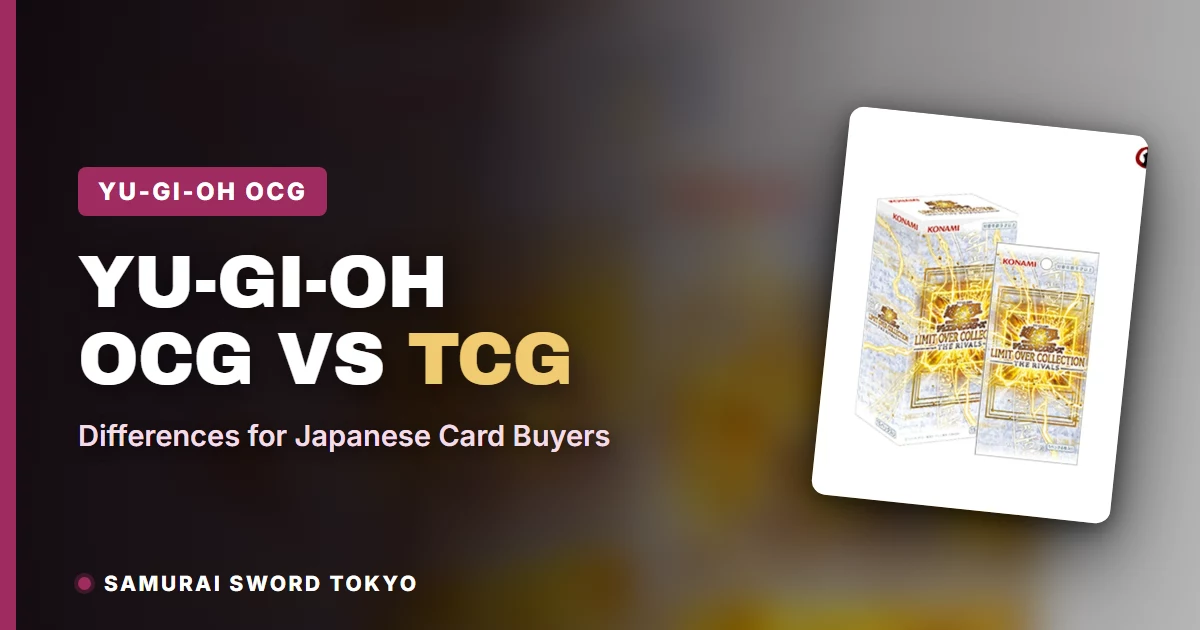
Yu-Gi-Oh OCG vs TCG: verschillen voor kopers van Japanse kaarten

OCG and TCG are two regional versions of the same card game. They look similar on the surface, but the card backs differ, the two formats keep separate tournament banlists, and cards legal in one are not automatically legal in the other.

If you’re buying Japanese Yu-Gi-Oh product — sealed boxes, singles, or anything shipped out of Japan — you are buying OCG cards. This guide walks through exactly what separates the two formats, using Yugipedia’s “Yu-Gi-Oh! Official Card Game” page as the source, and what the differences actually mean at the point of purchase.

Key Takeaways

The OCG launched on February 4, 1999, before it had an English-language TCG counterpart. Card backs differ by region, TCG cards are not tournament-legal in OCG events, and the two formats have run separate Forbidden/Limited banlists since September 2013 — the same card can be Forbidden in one format and Unlimited in the other. Our LOCR – Limit Over Collection The Rivals booster box is an OCG-only release with no TCG equivalent, currently listed at ¥7,455 (~$47).

1999
OCG Launch Year

2013
Banlists Went Separate

2
Card-Game Formats

¥159
Per USD (Sept 2026)

Yen figures below convert at ¥159/USD (September 2026).

OCG vs TCG: What the Two Formats Actually Are

The OCG and TCG are separately administered regional versions of the same game, with distinct card pools, print runs and release calendars.

The OCG came first. It launched in Japan on February 4, 1999 with Vol.1, and its Official Rules followed on March 6, 1999 — per the same Yugipedia source. Japanese Yu-Gi-Oh cards are OCG cards because they were printed for the Japanese market.

Aspect OCG TCG
Regio Japan and other OCG markets TCG markets
Card back Varies by sub-region — Japanese/Japanese-Asian, Asian-English and Korean backs are all different from each other One universal back logo worldwide
Tournament legality TCG cards are not legal in OCG events Runs its own separate legal card pool
Banlist Own Forbidden/Limited list, maintained separately since September 2013 Own Forbidden/Limited list, maintained separately since September 2013
Release schedule Own schedule; gets OCG-exclusive cards and sets Own schedule — by the same two-list logic, the TCG gets its own exclusives too

Card Backs: How to Tell OCG from TCG at a Glance

The fastest way to identify which format a card belongs to is the back of the card, not the front. TCG cards, regardless of which English-, French-, German- or Spanish-language box they came from, all share one universal back logo.

OCG cards don’t work that way. According to Yugipedia, Japanese and Japanese-Asian card backs carry a logo featuring the Japanese Yu-Gi-Oh! logo — rendered with English ruby text — and the phrase “Official Card Game Duel Monsters” printed in katakana. Asian-English cards use a different backing again, and Korean cards a different one still, distinct from both the Japanese cards and from each other.

Why This Matters at the Table

Because the backs are visibly different across regions, a player mixing OCG and TCG cards — or mixing Japanese, Asian-English and Korean cards within the OCG — needs opaque-backed sleeves. Without them, an opponent can potentially read information about a card from its back alone.

For a deeper look at spotting the specific print details that separate genuine Japanese product from everything else, see our guide to identifying Yu-Gi-Oh cards.

Tournament Legality: Why the Two Formats Don’t Mix

Per Yugipedia, TCG cards are not legal in OCG tournaments. The two formats run on separate legal card pools, and a card being printed for one region’s release schedule doesn’t automatically make it usable in the other region’s events.

This is the practical reason the card-back difference matters. If you’re playing in an OCG event in Japan, or a TCG event anywhere else, the cards on the table need to belong to that format — and if a deck legitimately mixes formats for casual play, opaque sleeves are the fix so the backs don’t give anything away.

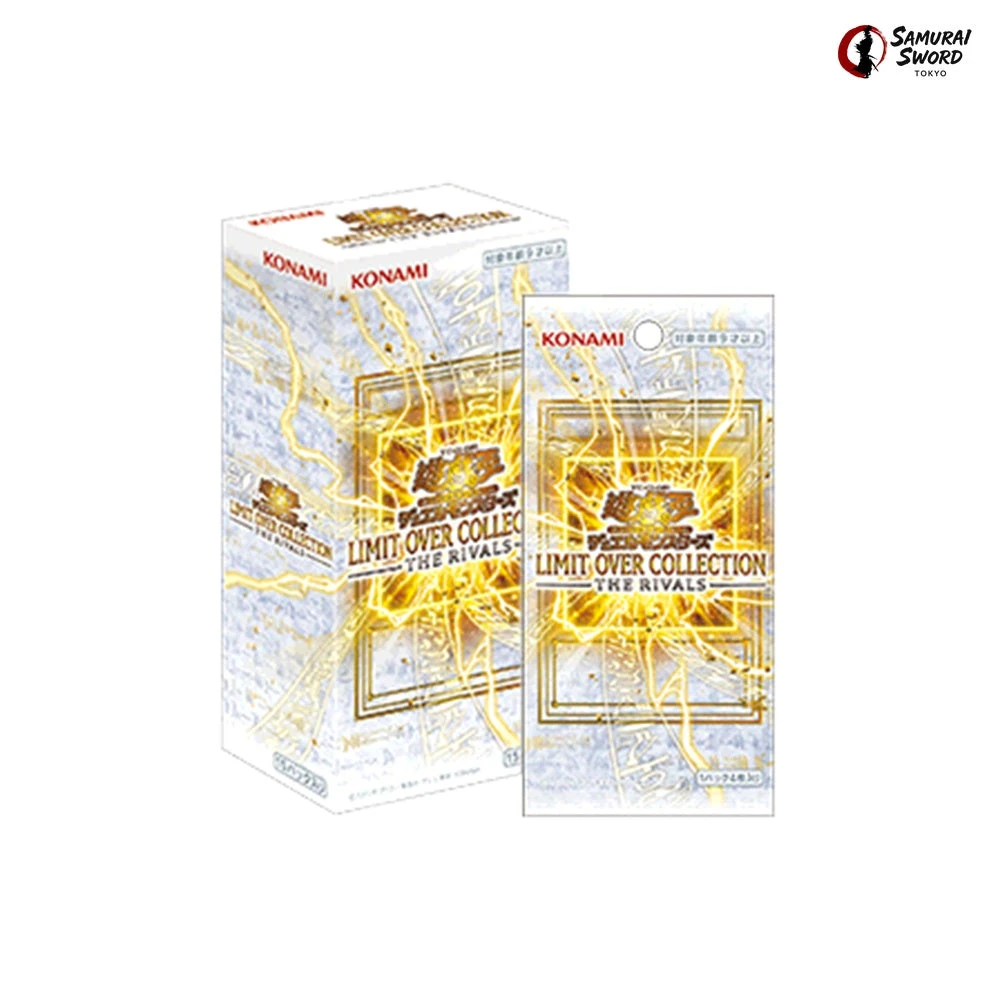
LOCR Limit Over Collection The Rivals Japanese Yu-Gi-Oh booster box
LOCR – Limit Over Collection The Rivals, an OCG booster box printed for the Japanese market

Banlists: The Same Card, Two Different Statuses

Since September 2013, the OCG and TCG have maintained entirely separate Forbidden/Limited banlists. That means the exact same printed card can carry a different legal status depending on which format you’re playing — Forbidden in the OCG and Unlimited in the TCG, or the other way around. Both directions happen; the pattern isn’t one-way.

Because banlists are revised multiple times a year in each format, this guide isn’t the place to state any individual card’s current status — check the live OCG or TCG list for the format you’re playing before assuming a card’s legality.

The one place the two lists get reconciled is the World Championship. During Worlds, every card is set to whichever status is most restrictive across all the regional banlists in play — so a card Forbidden under any one region’s list, even if Unlimited everywhere else, is Forbidden for the entire event.

Release Schedules and OCG-Exclusive Sets

The OCG runs its own release schedule for sets and products, separate from the TCG’s. That schedule produces cards and sets that exist only on the OCG side — and by the same logic that gives each format its own banlist, the TCG has releases that stay TCG-only in return.

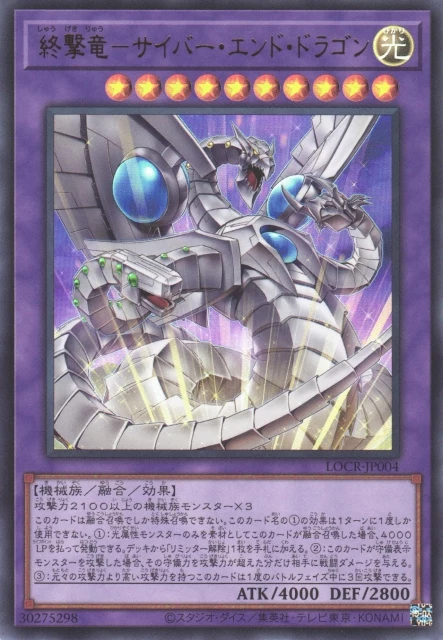
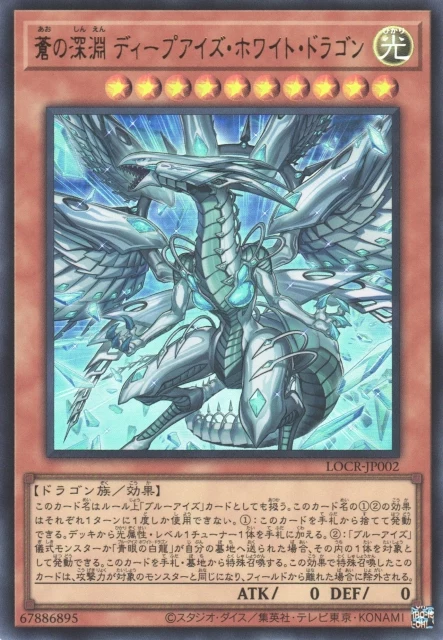
Our LOCR – Limit Over Collection The Rivals booster box is a clear example: as of our research, it’s an OCG-only product with no TCG equivalent set. It includes Ultra Rare prints such as Cyber End Dragon “The Final Strike Dragon” and Deep-Eyes White Dragon “The Blue Abyss.”

Cyber End Dragon The Final Strike Dragon, Ultra Rare, LOCR

Cyber End Dragon “The Final Strike Dragon” UR
LOCR – Limit Over Collection The Rivals

Deep-Eyes White Dragon The Blue Abyss, Ultra Rare, LOCR

Deep-Eyes White Dragon “The Blue Abyss” UR
LOCR – Limit Over Collection The Rivals

See the full card breakdown in our LOCR card list.

What This Means When You’re Buying Japanese Yu-Gi-Oh Cards

Every Japanese Yu-Gi-Oh product covered here is OCG product because it was printed for the Japanese release schedule. In practical terms, that means: the card backs carry the Japanese OCG logo and katakana text described above; the cards follow the OCG banlist rather than the TCG one; and some of what’s inside a Japanese box, like LOCR, simply doesn’t have a TCG-printed counterpart.

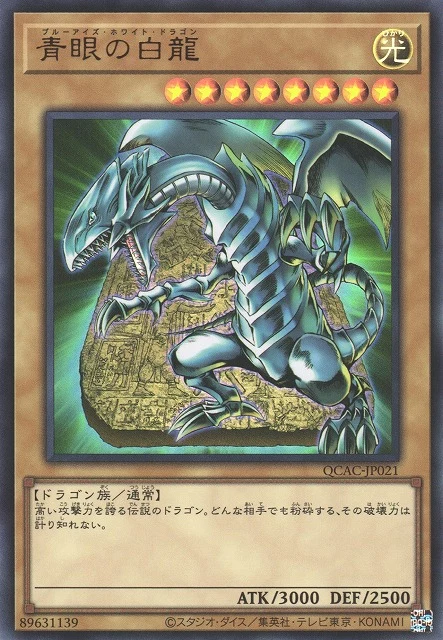
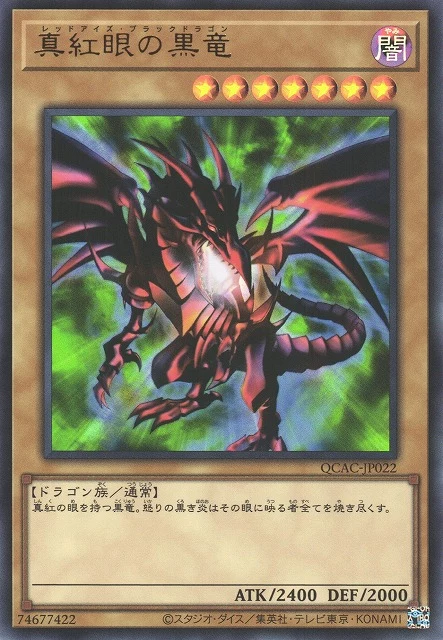
Our LOCR booster box is currently listed at ¥7,455 (~$47) and ships sealed from Tokyo. For high-end OCG anniversary product, our QCAC – Quarter Century Art Collection booster box carton is priced on request through Quick Order and includes prints like Blue-Eyes White Dragon and Red-Eyes Black Dragon in Ultra Rare.

Blue-Eyes White Dragon, Ultra Rare, QCAC

Blue-Eyes White Dragon UR
QCAC – Quarter Century Art Collection

Red-Eyes Black Dragon, Ultra Rare, QCAC

Red-Eyes Black Dragon UR
QCAC – Quarter Century Art Collection

Related reading: our QCAC card list and the wider 25th Anniversary / Quarter Century cards guide.

Shop This Set
LOCR – Limit Over Collection The Rivals Sealed Japanese Yu-Gi-Oh Booster Box
Currently listed at ¥7,455 (~$47)
Ships from Tokyo · Tracked delivery

View Product →

For anything not listed directly, our Quick Order page is the fastest way to request Japanese OCG singles or sealed product.

Veelgestelde vragen

What’s the difference between Yu-Gi-Oh OCG and TCG?

The OCG (Official Card Game) and TCG (Trading Card Game) are regional versions of Yu-Gi-Oh. They share the same core rules but run separate card backs, separate tournament banlists, and separate release schedules.

How can I tell if a Yu-Gi-Oh card is OCG or TCG?

Check the back of the card. TCG cards all use one universal back logo worldwide. OCG cards vary by sub-region: Japanese and Japanese-Asian cards carry a Japanese-logo back with katakana text reading “Official Card Game Duel Monsters,” while Asian-English and Korean cards each use their own distinct backing.

Can I use TCG cards in OCG tournaments?

No. TCG cards are not legal in OCG tournaments. Because the card backs are visibly different between formats, a deck mixing OCG and TCG cards for casual play needs opaque-backed sleeves.

Do OCG and TCG share the same banlist?

No, not since September 2013. The two formats have maintained separate Forbidden/Limited lists since then, so the same card can be Forbidden in one format and Unlimited in the other. Always check the current list for the format you’re playing, since these lists change multiple times a year.

When was the OCG first released?

The OCG launched in Japan on February 4, 1999 with Vol.1, and its Official Rules followed on March 6, 1999.

Are there Yu-Gi-Oh cards or sets only available in the OCG?

Yes. The OCG has its own release schedule and gets OCG-exclusive cards and sets that the TCG doesn’t print. LOCR – Limit Over Collection The Rivals is one example: as of our research it has no TCG equivalent set.

Celebi Old Back Promo (Neo Premium File 3) kaartgids

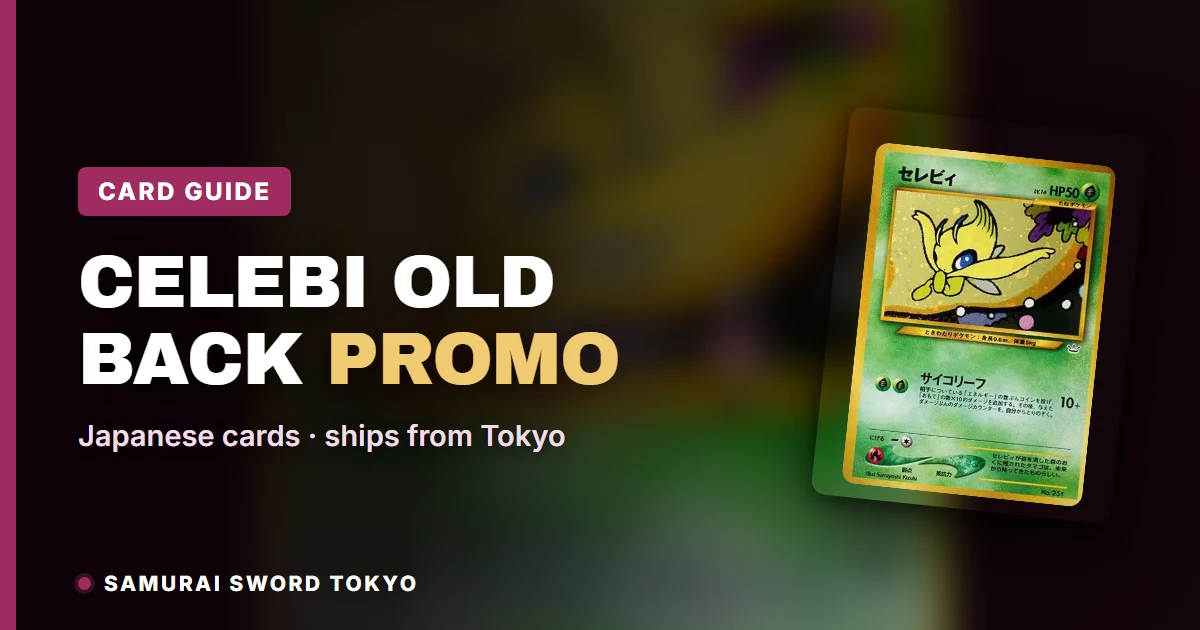
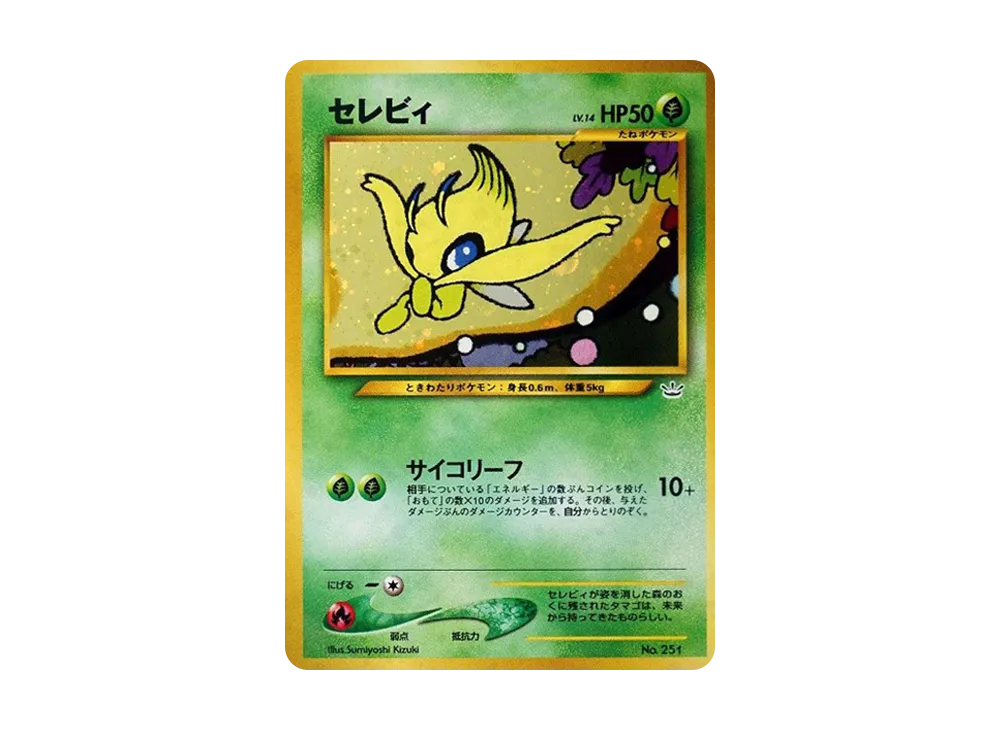
The card examined in this guide is an Old Back print — our catalogue label for the vintage Japanese card-back design used on this 2000 release, before the later modern back. It was distributed in Premium File 3 on 23 November 2000 as one of nine unnumbered promotional cards.

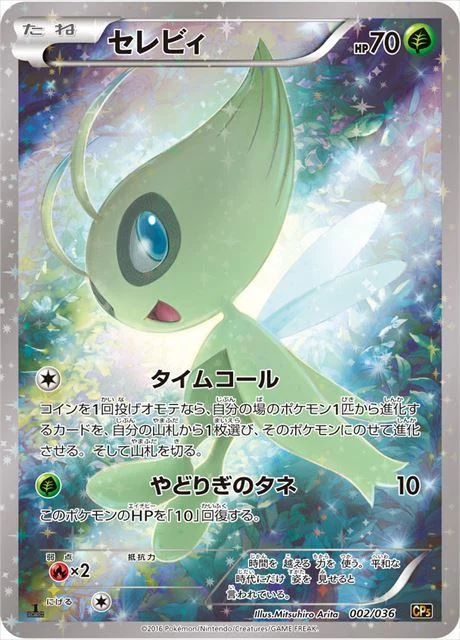
This Celebi promo card is セレビィ Lv.14 (No.251), distributed inside Pokemon Card ★neo “Premium File 3” on 23 November 2000. A PSA 10 example of this exact print is currently listed on our site, and this guide covers what the card is, how it differs from the newer CP5 Celebi also listed, what the English-language equivalent looks like, and where this print sits inside a vintage-era Japanese TCG collection.

Key Takeaways

The PSA 10 Celebi : Old Back [PRMF-3 No.251] is currently listed at ¥275,000 (~$1,730). It was distributed on 23 November 2000 inside Pokemon Card ★neo “Premium File 3”, one of nine unnumbered promotional cards in that release, and it predates the Japanese 1st Edition stamp window entirely. It is a different print, set, and era from the PSA 10 Celebi :1ED from CP5 also in our catalogue — the two should never be confused with each other.

50
HP

Promo
Rarity (Unnumbered)

9
Cards in Premium File 3

Nov 2000
Japan Release

Prices below are current samuraiswordtokyo.com listings, converted at ¥159/USD (September 2026).

The Card: Celebi No.251, Premium File 3 Promo

Celebi (セレビィ Lv.14, No.251) is a Basic Pokemon of the Grass type, carrying 50 HP and a single attack, サイコリーフ (Psycho Leaf). It carries a Fire-type weakness at ×2. The illustration is credited to Sumiyoshi Kizuki.

PSA10 Celebi : Old Back [PRMF-3 No.251], listed on samuraiswordtokyo.com
PSA10 Celebi : Old Back, PRMF-3 No.251

This card carries no set-internal card number of its own — it is one of nine unnumbered promotional cards distributed inside Premium File 3, and the “No.251” reference is the Pokedex number for Celebi itself, not a print position. Our own graded example of this print is currently listed at ¥275,000 (~$1,730), PSA 10.

The “Old Back” label in our catalogue title is our own designation, not an official print name. It marks this as a vintage Japanese card-back design from 2000, distinguishing it from modern-back Celebi reprints elsewhere in our catalogue — most directly, the CP5-era Celebi covered next.

The Set: Pokemon Card ★neo “Premium File 3”

Pokemon Card ★neo “Premium File 3” (プレミアムファイル3) was released in Japan on 23 November 2000, as part of the ★neo era of Japanese Pokemon TCG releases. It contained nine unnumbered promotional cards, of which this Celebi is one.

As a promotional file product rather than a numbered booster expansion, Premium File 3 doesn’t carry a standard set size in the way a booster set does — its nine cards were distributed together as a themed promotional release rather than pulled at random from packs.

Because the card was released in November 2000, it predates the Japanese 1st Edition stamp entirely. Per our own Japanese 1st Edition Pokemon cards guide, that stamp era began in 2001 — so there is no 1st Edition version of this particular Celebi to look for, and no 1ED mark should appear on this print.

Japanese vs English Print

This Celebi does have a confirmed English-language equivalent: Neo Revelation #16. The artwork is identical between the two — same illustrator, Sumiyoshi Kizuki, same pose and composition — representing the same original release distributed differently across the two regions. The Japanese version reached collectors as an unnumbered promotional insert inside Premium File 3, while the English version was issued as a numbered card within the Neo Revelation set itself.

Beyond this Premium File 3 promo, no other confirmed Japanese print carrying this exact artwork turned up in our research. If a Japanese booster-set counterpart to Neo Revelation exists for this specific Celebi print, it did not surface in the sources we checked for this guide, so we’re not asserting one either way here.

Where This Print Sits Among Our Vintage & Promotional PSA 10s

Because this is a promotional file card rather than a booster pull, it doesn’t sit on a per-box pull-rate ladder the way a modern SR or SAR does. Instead, its position is best understood alongside the other vintage and concept-pack promotional PSA 10 grades in our current catalogue — cards distributed through special files, legend-collection concept packs, and other non-standard channels rather than main booster runs.

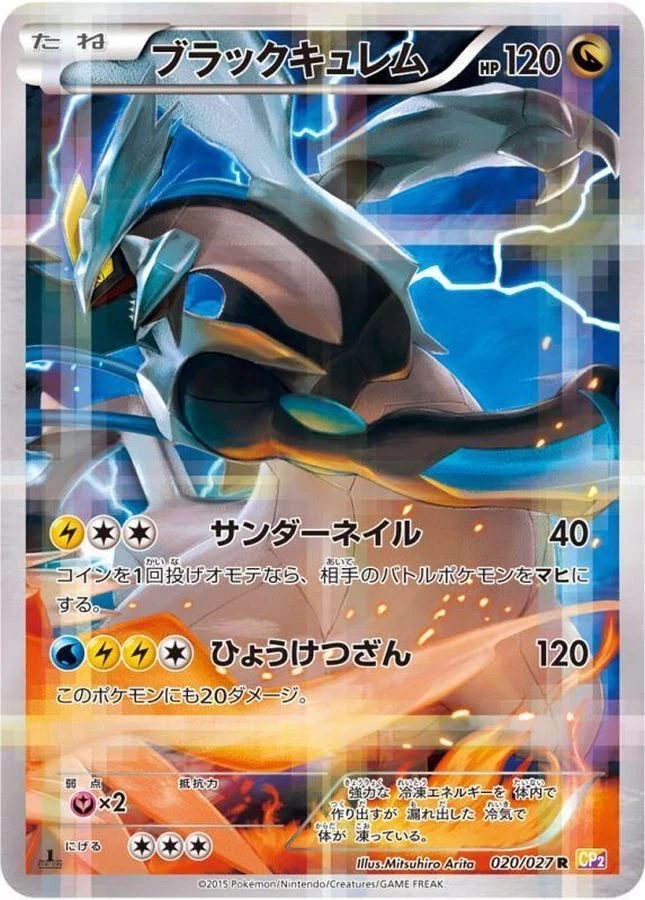
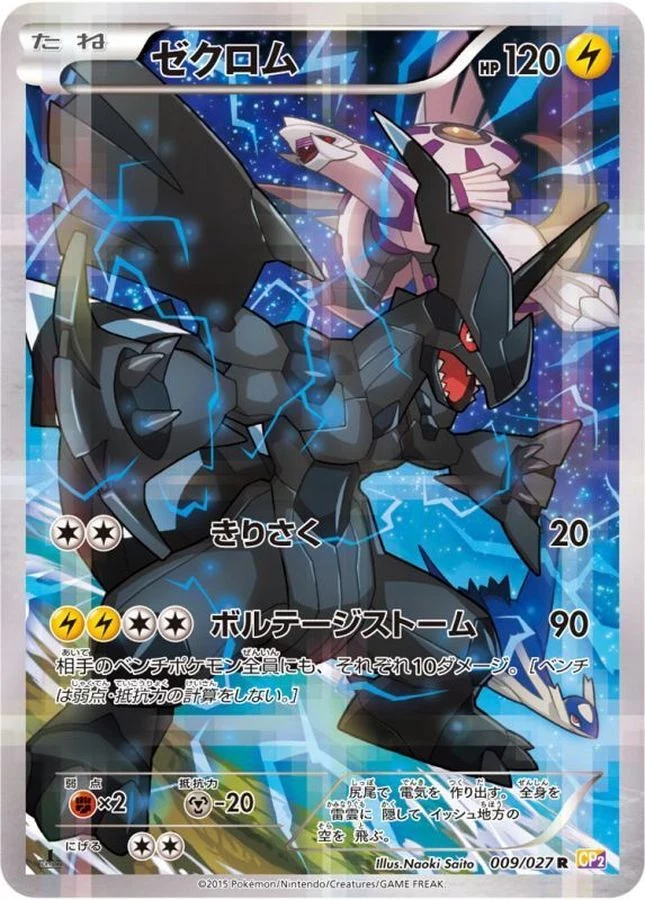
Two more concept-pack promotional cards from the same “Legend” naming pattern round out this tier: the Black Kyurem R :1ED [CP2 020/027] and the Zekrom 009/027 [CP2], both from the CP2 “Legend Kira Collection” concept pack — a different Pokemon and set from Celebi, but the same category of special-distribution product.

For a broader view of Celebi across the Japanese card pool, our Celebi Card Value Guide spans every print we cover, and our mythical Pokemon hub places this Old Back print alongside other mythical-tier Japanese grails. For vintage Japanese cards more generally, see our vintage Japanese Pokemon cards guide.

Shop This Print
PSA10 Celebi : Old Back [PRMF-3 No.251]
Currently listed at ¥275,000 (~$1,730)
Ships from Tokyo · Tracked delivery

View Product →

Where to Buy Celebi Old Back from Tokyo

Our graded example of the PSA 10 Celebi : Old Back [PRMF-3 No.251] is currently listed at ¥275,000 (~$1,730), shipped from Tokyo with tracked delivery. There is no booster box associated with this promotional-era card — Premium File 3 was a standalone promotional product, not a pack-based expansion.

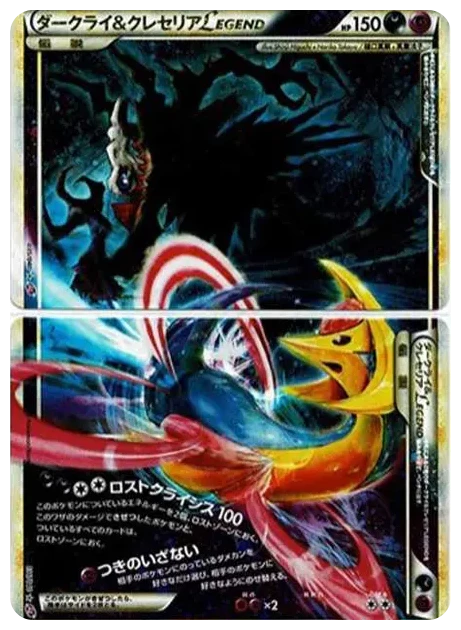
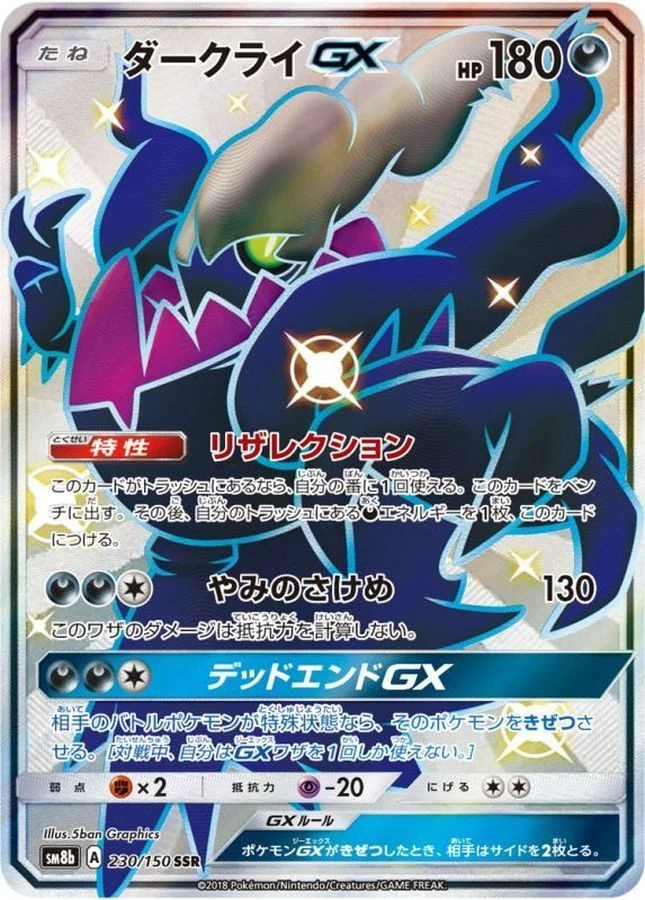
If you’re building out a wider vintage or mythical-tier collection, our other graded Celebi — the PSA 10 Celebi :1ED from CP5 at ¥91,300 — is a different print worth comparing side by side. For other high-value vintage and concept-pack PSA 10 grades, see the Darkrai & Cresselia LEGEND, Darkrai GX SSR, Black Kyurem R :1ED [CP2], and Zekrom [CP2] listings, or browse the full range in our PSA 10 graded card collection. If you’re building a mixed order across multiple prints, our Quick Order page is the fastest way to put together a cart. This exact print is not something we source on request outside our current listing — if you’re after a different Celebi print entirely, sourcing requests go through Quick Order.

Veelgestelde vragen

What is the Celebi Old Back promo card?

It’s セレビィ Lv.14 (No.251), a Celebi card distributed on 23 November 2000 inside the Japanese promotional release Pokemon Card ★neo “Premium File 3”, one of nine unnumbered cards in that file. “Old Back” is our own catalogue label for its vintage Japanese card back. We currently list a PSA 10 example at ¥275,000 (~$1,730).

Does this Celebi have a 1st Edition stamp?

No. The card was released in November 2000, before the Japanese 1st Edition stamp era began in 2001, so it predates that window entirely and carries no 1ED mark.

How is this different from your CP5 Celebi?

They’re two separate cards. This Old Back print is from Premium File 3 (November 2000). The other is a PSA 10 Celebi :1ED from CP5, dated to around 2016 in our records — a different set, different card back, and a different era.

Is there an English version of this Celebi?

Yes — Neo Revelation #16 carries the identical artwork by the same illustrator, Sumiyoshi Kizuki, representing the same original release distributed differently across regions. The Japanese version came as a promotional file insert; the English version is a numbered set card.

Is this the only Japanese print of this Celebi artwork?

It’s the only one we’ve confirmed in our research for this guide. We did not find another Japanese release carrying this exact 2000 Kizuki artwork, but that reflects what we verified rather than a claim covering every Japanese Pokemon TCG product ever produced.

Does a booster box exist for this card?

No. Premium File 3 was a standalone promotional product distributed as a themed file of nine cards, not a pack-based booster expansion, so there’s no associated booster box to open.

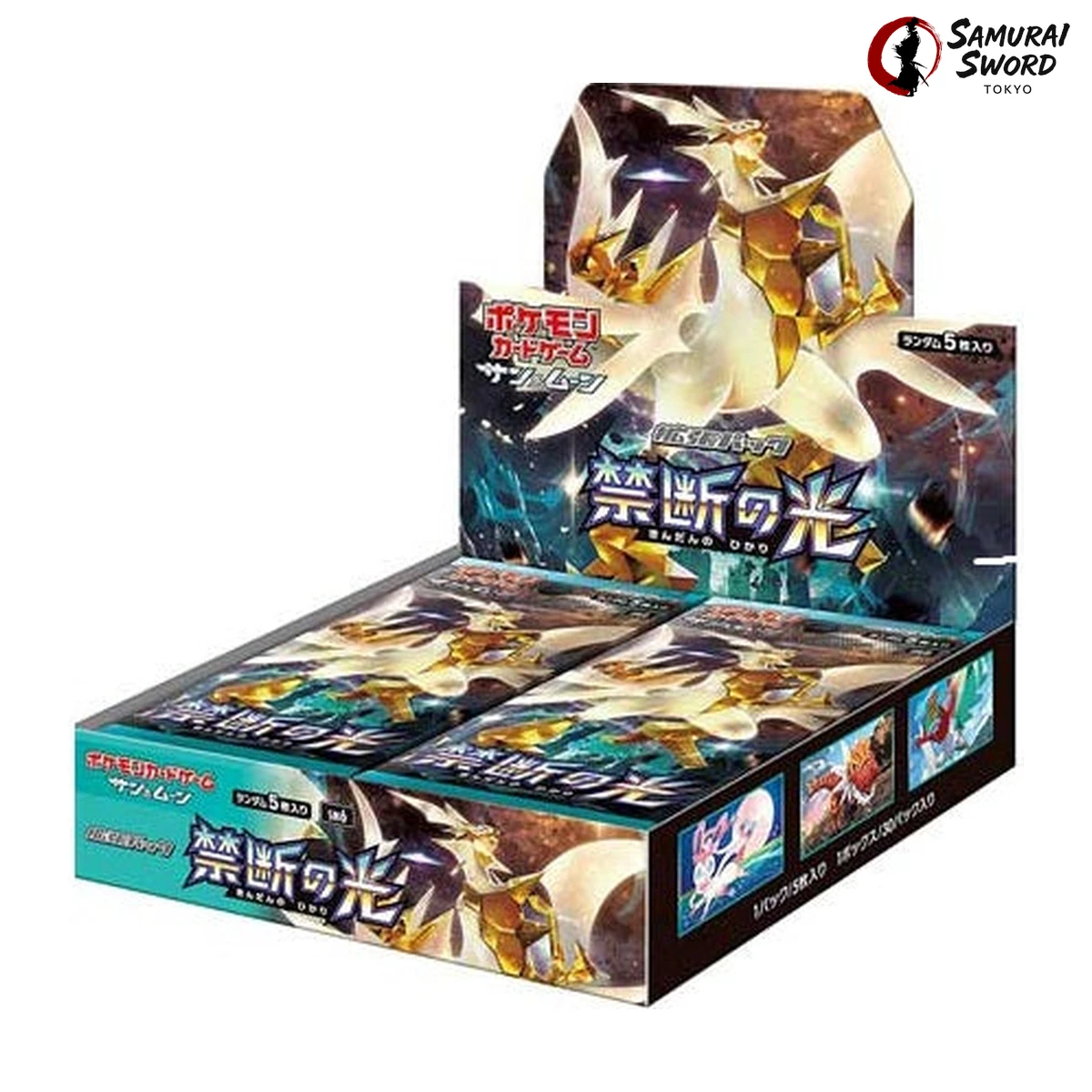
SM6-Forbidden Light Booster Box Koopgids: set, chase-kaarten & prijs

Forbidden Light is one of the last main-series Sun & Moon expansions before the era moved into its GX-heavy back half, and it’s still one of the SM-era boxes we get asked about by name. 拡張パック「禁断の光」— Expansion Pack “Forbidden Light,” set code SM6 — uses a main numbered run with secret-numbered cards above it.

This guide covers exactly what’s in a Forbidden Light box, which cards collectors actually chase, how our own Damaged Box and No Shrink listing categories apply (or don’t) to this set, and where the box sits between Japanese and English releases. We ship Japanese sealed product out of Tokyo, so the pricing below reflects the current listing — not a market estimate.

Key Takeaway

Forbidden Light (SM6) is a Sun & Moon expansion with 5 kaarten per pack and 30 packs per box, plus an official guarantee of 1 SR-or-better card per box. The headline chase is Ojou-sama SR 100/094, alongside Greninja-GX, Ultra Necrozma-GX, Karune and Xerneas-GX. Our SM6-Forbidden Light Japanese Pokemon Booster Box is currently listed at ¥68,250 (~$429), and the full Pokemon box range is browsable on our Pokemon card box collection.

094
Main-Run Denominator

30
Packs per Box

5
Cards per Pack

SM6
Set Code

The one listed price in this guide is our current listing as of September 2026, converted at ¥159/USD.

What’s in a Forbidden Light Booster Box

Item Value
Set name (JP) 拡張パック「禁断の光」(Expansion Pack “Forbidden Light”)
Setcode SM6
Era Sun & Moon
Cards per pack 5
Packs per box 30
Box guarantee 1 SR-or-better card per box (official)

The main numbered run goes up to 094, and secret-numbered cards sit above it — the pattern you’ll see below is card numbers like “100/094,” where the denominator marks the main run and the numerator extends beyond it. For the card-by-card breakdown, see our Forbidden Light (SM6) card list.

SM6 Forbidden Light Japanese Pokemon Booster Box, listed on samuraiswordtokyo.com
SM6-Forbidden Light Japanese Pokemon Booster Box — sealed, 30 packs

As a standard-format Sun & Moon expansion pack rather than a high-class pack, Forbidden Light doesn’t carry the wide Art Rare / Special Art Rare secret pool that later high-class sets are known for. The box’s draw is a smaller, more concentrated group of SR chase cards, covered next.

Chase Cards in Forbidden Light

Five cards are the reason collectors still open this box:

Ojou-sama SR 100/094

Ojou-sama SR 100/094 Forbidden Light
Ojou-sama, Secret Rare, 100/094, Forbidden Light (SM6)

Ojou-sama (おじょうさま) is the set’s current headline chase — a supporter-class SR that anchors most Forbidden Light discussion. This single is not currently listed on our site; sourcing requests go through Snel bestellen.

Greninja-GX SR 95/094

Greninja-GX SR 95/094 Forbidden Light
Greninja-GX, Secret Rare, 95/094, Forbidden Light (SM6)

Greninja-GX sits at the low end of the secret-numbered run, one of the set’s GX-tier SRs. This single is not currently listed on our site; sourcing requests go through Snel bestellen.

Ultra Necrozma-GX SR 99/094

Ultra Necrozma-GX SR 99/094 Forbidden Light
Ultra Necrozma-GX, Secret Rare, 99/094, Forbidden Light (SM6)

Ultra Necrozma-GX is the set’s original 2018 mascot attacker, and it’s usually the second name people bring up after Ojou-sama when talking about this box. This single is not currently listed on our site; sourcing requests go through Snel bestellen.

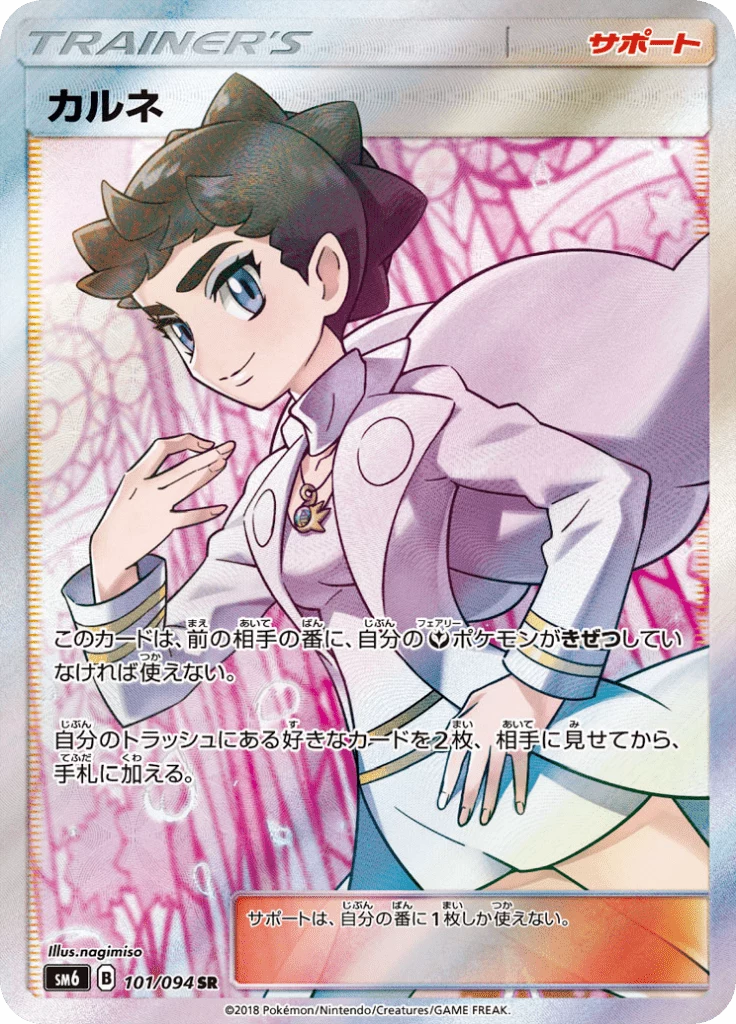
Karune SR 101/094

Karune SR 101/094 Forbidden Light
Karune, Secret Rare, 101/094, Forbidden Light (SM6)

Karune (カルネ) is a trainer-class SR near the top of the secret-numbered run. This single is not currently listed on our site; sourcing requests go through Snel bestellen.

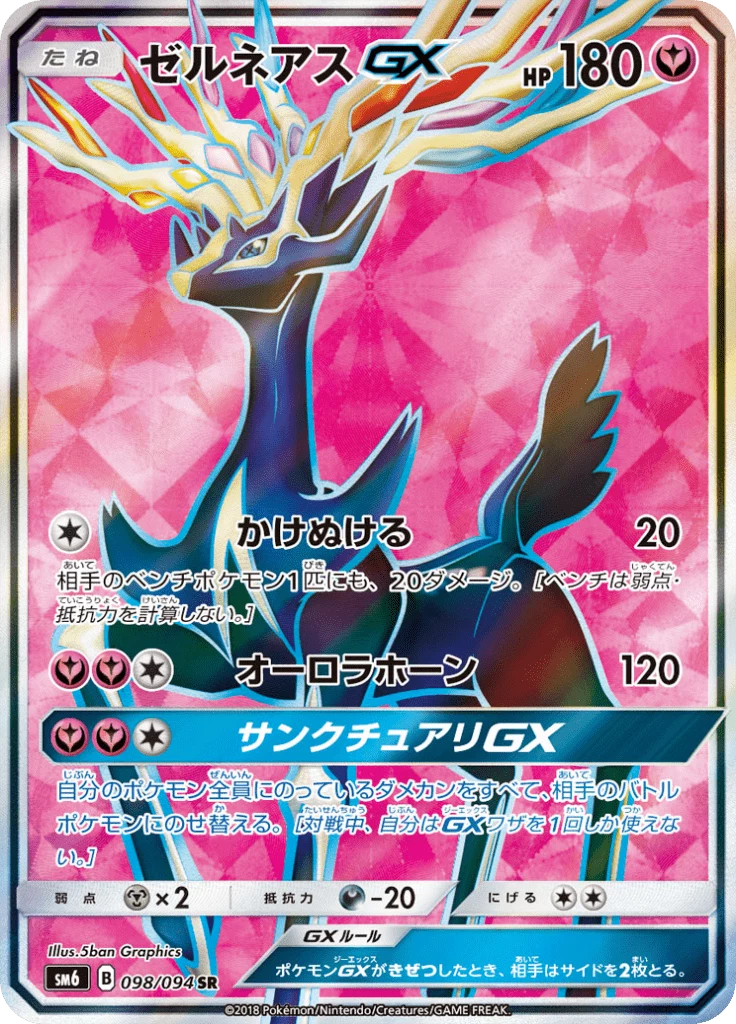
Xerneas-GX SR 98/094

Xerneas-GX SR 98/094 Forbidden Light
Xerneas-GX, Secret Rare, 98/094, Forbidden Light (SM6)

Xerneas-GX 98/094 is the Secret Rare print of this card in Forbidden Light, sitting in the secret-numbered run above the 094 main-run denominator. This single is not currently listed on our site; sourcing requests go through Snel bestellen.

None of the five cards above are currently listed as graded singles on our site. For the pull-rate math and a fuller ranking across the set’s secret tier, see our Forbidden Light pull rates and best cards guide — that article covers the EV side; this one covers box facts and where to buy.

Regular Box vs Damaged Box vs No Shrink on Our Site

Across our catalogue, we use two extra condition categories alongside a standard sealed listing, and it’s worth knowing what each one actually means before you buy:

  • Damaged Box — a condition category we use for sealed booster boxes where the outer box itself, not the contents, is affected. The booster packs inside stay factory-sealed; nothing about the sealed contents changes. You still get the same booster packs, in the same box count, just with a mark, dent or other cosmetic issue on the outer packaging. Damaged Box pricing moves independently of the regular box listing and isn’t always cheaper.
  • Zonder shrink — this is a listing name we use on a handful of product pages for boxes sold without their original shrink wrap. We don’t have a broader definition of the term beyond that; it’s a condition label attached to the specific listing, not a separate grading system.

For Forbidden Light specifically, only the standard sealed box is currently listed — there is no Damaged Box or No Shrink listing for this set on our site at the moment. If you’re after either variant for SM6, requests can be flagged through Snel bestellen (no timing on availability).

The regular sealed box is currently listed at ¥68,250 (~$429).

Japanese vs English Version of Forbidden Light

Forbidden Light has a direct English-language counterpart: Sun & Moon—Forbidden Light, released internationally in 2018 under the same set name. The box we carry is the original Japanese printing — the version this guide, our card-list article and our pull-rates article are all built around.

All the card images in this guide are Japanese prints. If you’re specifically comparing a Japanese copy against an English one for a given card, the card number and rarity marking are the fastest way to confirm you’re looking at the same print — the numbering conventions above (for example, “100/094”) are specific to the Japanese release.

Shop This Set
SM6-Forbidden Light Japanese Pokemon Booster Box
Currently listed at ¥68,250 (~$429)
Ships from Tokyo · Tracked delivery

View Product →

Where to Buy a Forbidden Light Booster Box from Tokyo

We ship Japanese sealed product out of Tokyo with tracked delivery. The SM6-Forbidden Light Japanese Pokemon Booster Box is currently listed at ¥68,250 (~$429) — that’s the only Forbidden Light listing we currently carry, with no Damaged Box or No Shrink variant for this set at present.

For the full Sun & Moon-era lineup, browse our Pokemon card box collection. If you’re comparing Forbidden Light against a later SM-era set, our SM12 Alter Genesis pull rates and best cards guide covers a sibling set from later in the same era. For the card-by-card checklist, see the Forbidden Light card list, and for a broader look at the Japanese sets around this release, see the Japanese sets behind Forbidden Light. Anything not listed above — a single card, a Damaged Box or a No Shrink copy of SM6 — can be flagged through Snel bestellen.

Veelgestelde vragen

How many cards are in Forbidden Light (SM6)?

The main numbered run goes to 094, with secret-numbered cards above it. This guide does not state a combined total.

What are the chase cards in Forbidden Light?

Ojou-sama SR (100/094) is the current headline chase, alongside Greninja-GX SR (95/094), Ultra Necrozma-GX SR (99/094), Karune SR (101/094) and Xerneas-GX SR (98/094).

How many packs are in a Forbidden Light booster box?

30 packs per box, 5 kaarten per pack, with an official guarantee of 1 SR-or-better card somewhere in the box.

What’s the difference between a Damaged Box and a No Shrink listing on your site?

Damaged Box means the outer box has a cosmetic issue while the sealed packs inside are unaffected. No Shrink is a listing name for boxes sold without their original shrink wrap; we don’t use a broader definition beyond that. Forbidden Light currently has neither variant listed — only the standard sealed box.

Is there an English version of Forbidden Light?

Yes — Sun & Moon—Forbidden Light, released internationally in 2018 under the same set name. We carry the Japanese printing.

Can I buy PSA 10 singles from Forbidden Light on your site?

Not at the moment — none of the five chase cards covered in this guide are currently listed as graded singles. Sourcing requests go through Quick Order.

Kaartgids voor Jirachi 015/032 Pokekyun Collection (1st Edition)

This guide focuses on Jirachi’s 1st Edition Concept Pack print. Card 015/032 comes from a 32-card release and carries the “1ED” stamp from the documented Japanese 1st Edition window.

This guide covers the exact print — Jirachi 015/032, Uncommon, 1st Edition, from the Japanese Concept Pack “Pokekyun Collection” (set code CP3) — where it sits in that set, how the Japanese 1ED mark applies to it, and how it compares to its English-language equivalent. We currently list a PSA 10 graded copy of this exact print, shipped from Tokyo.

Key Takeaways

Jirachi 015/032 U :1ED is a PSA 10, currently listed at ¥39,270 (~$247). It comes from Pokekyun Collection (CP3), a 32-card Japanese Concept Pack released 29 January 2016, inside the confirmed window when Japanese cards carried the 1st Edition mark. The same set is also where our PSA 10 Altaria U 029/032 :1ED comes from, if you’re building out the set alongside Jirachi.

70
HP (Psychic)

U
Rarity (015/032)

32
Set Size (CP3)

Jan 2016
Japan Release

Prices below are current samuraiswordtokyo.com listings, converted at ¥159/USD (September 2026).

The Card: Jirachi 015/032 U

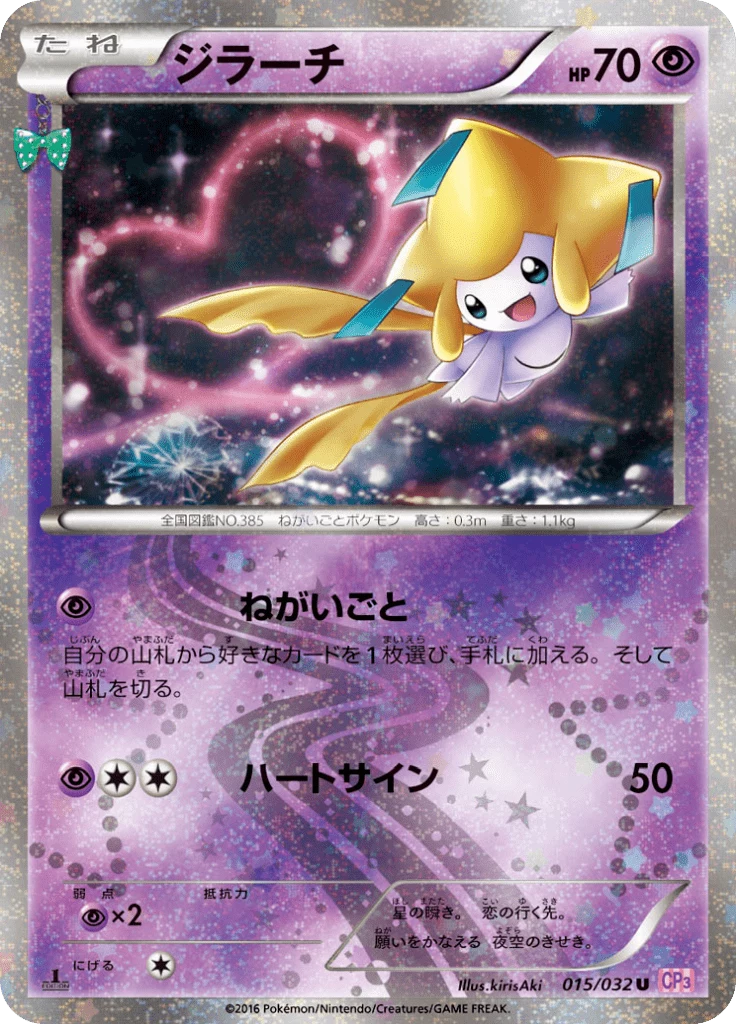
Jirachi — ジラーチ in Japanese — is a Basic Psychic-type Pokemon that does not evolve, with 70 HP. The 015/032 print was illustrated by kirisAki and sits at card 15 of the set’s 32-card main numbering, placing it comfortably inside the set’s regular run rather than in a secret or special slot.

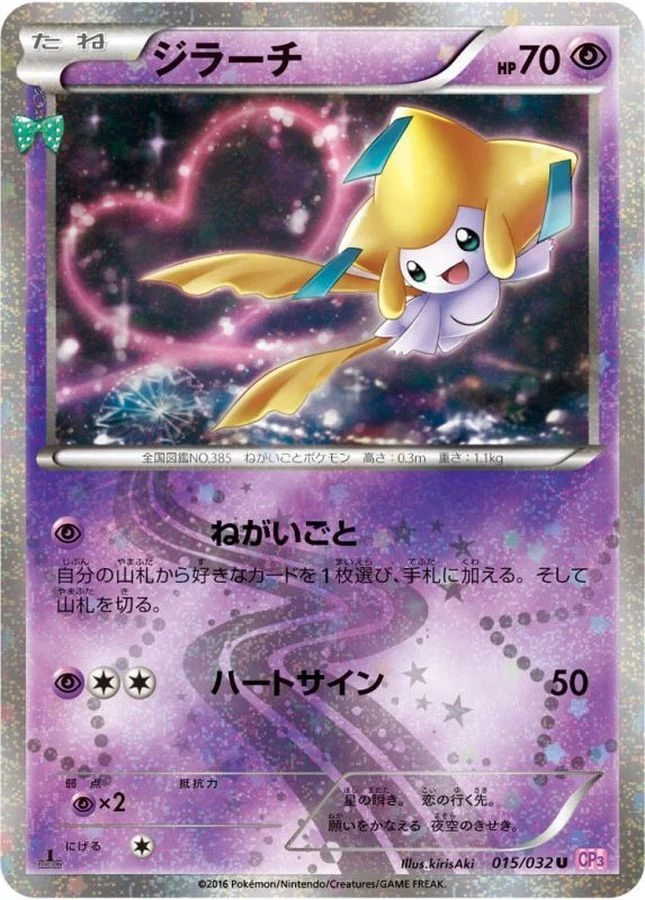
Jirachi U 015/032, Pokekyun Collection (CP3), Japanese
Jirachi U 015/032, Pokekyun Collection (CP3), illustrated by kirisAki

Our own graded copy of this exact print is a PSA 10, currently listed at ¥39,270 (~$247), and it carries the “:1ED” designation on our listing — the Japanese 1st Edition mark, covered in full below.

PSA 10 Jirachi U 015/032 slab, listed on samuraiswordtokyo.com

The Set: Pokekyun Collection (CP3)

Pokekyun Collection — ポケキュンコレクション in Japanese — is Concept Pack CP3, a 32-card Japanese release from 29 January 2016. Concept Packs are smaller, thematic Japanese releases distinct from the mainline Expansion Packs, and CP3 sits inside a specific window for one particular print detail: the Japanese “1st Edition” mark.

Per our own researched guide to that mark, the Japanese 1ED stamp ran from 2001 to 2016, covering both mainline Expansion Packs and the smaller Concept Pack releases. CP3, released in January 2016, sits inside that window. The mark itself is a large numeral “1” over the word “EDITION” between two lines, appearing in a lower corner of Pokemon and Trainer cards only (never Energy cards) — visually distinct from the Western WOTC leaf-and-circle 1st Edition mark. Our Japanese 1st Edition Pokemon cards guide covers the full history of the mark across every set that carried it.

For the full 32-card breakdown of Pokekyun Collection, see our Pokekyun Collection (CP3) set guide.

Japanese vs English Print

Jirachi 015/032 does have an English-language equivalent: Generations #RC13, an Uncommon in the Radiant Collection subset. Altaria’s equivalent print, RC24, also appears in that subset — the two Pokekyun Collection cards map into the same English subset, just at different numbers within it.

We haven’t independently verified further design differences between the CP3 and Generations RC printings beyond the card-number mapping, so if you’re matching a Japanese copy against an English one, confirm by artwork and set marking rather than assuming identical framing.

Where This Uncommon Sits Among Japanese Rarity Tiers

Among the CP3 prints we’ve verified, the set spans two rarity tiers: Common (C) and Uncommon (U). Jirachi’s Uncommon tier places it alongside Altaria, Floette and Slurpuff in this set, one step above the Common-tier evolution-line cards Charmander and Charmeleon. Pokekyun Collection is a small thematic Concept Pack rather than a full Expansion Pack, so this comparison covers the prints documented here rather than every rarity slot that may exist across the full 32-card release.

For mythical Pokemon prints more broadly, our Celebi and Jirachi mythicals guide covers Jirachi alongside other documented mythical prints, including a different Concept Pack entirely.

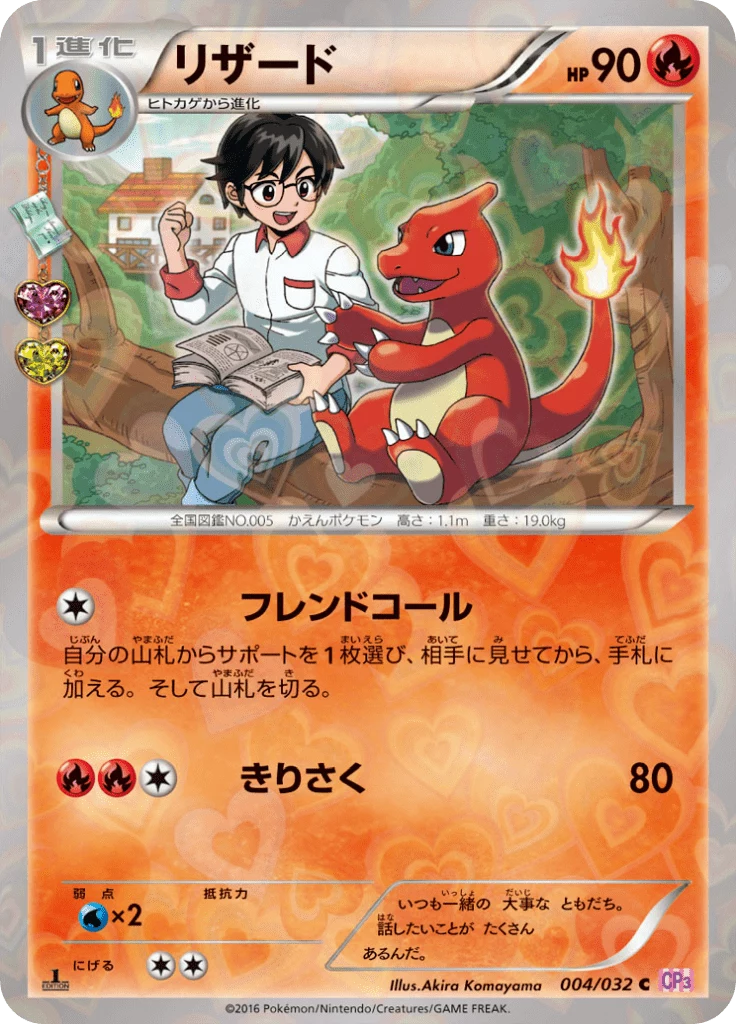
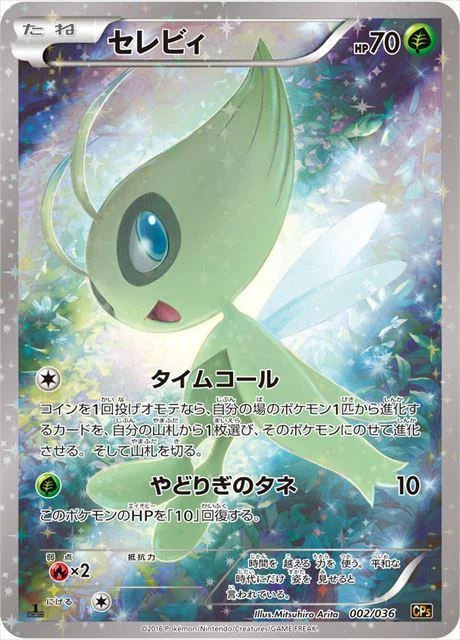
PSA 10 Celebi :1ED CP5 002/036 slab, listed on samuraiswordtokyo.com
PSA 10 Celebi :1ED CP5 002/036 slab, listed on samuraiswordtokyo.com — a different mythical, different Concept Pack, shown here for comparison

Shop This Card
PSA10 Jirachi U :1ED [CP3 015/032]
Currently listed at ¥39,270 (~$247)
Ships from Tokyo · Tracked delivery

View Product →

Where to Buy Jirachi from Tokyo

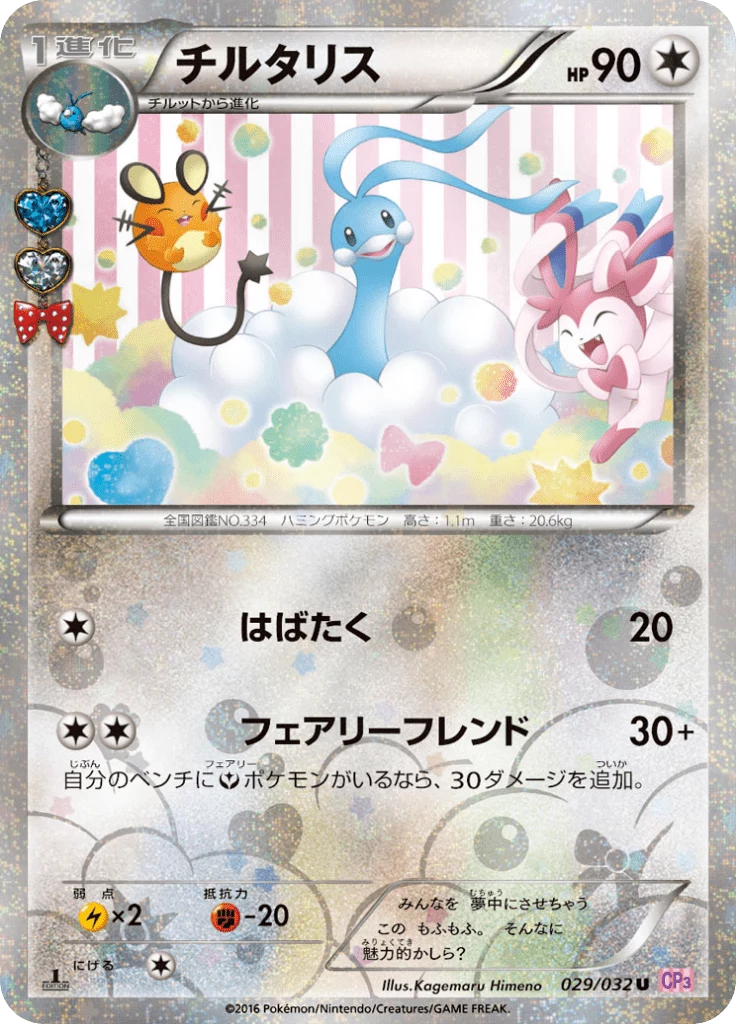
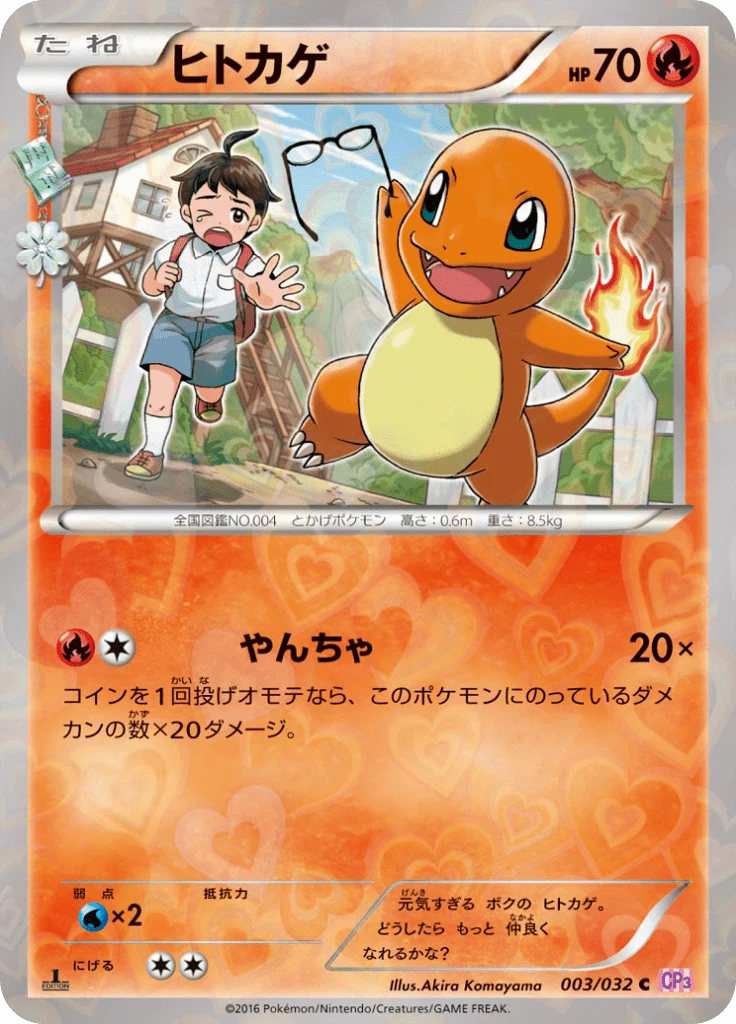
Our graded copy of PSA 10 Jirachi 015/032 U :1ED is currently listed at ¥39,270 (~$247), shipped from Tokyo with tracked delivery. From the same Pokekyun Collection set, PSA 10 Altaria U 029/032 :1ED is currently listed at ¥29,040 (~$183), and PSA 10 Charmander C 003/032 :1ED is currently listed at ¥29,141 (~$183).

If you’re building out a mythical Pokemon run rather than a single Concept Pack, our PSA 10 Celebi :1ED (CP5 002/036) at ¥91,300 (~$574) is a different mythical from a different Concept Pack. For the full picture on this exact card versus Jirachi’s other Japanese eras, our Jirachi Japanese card guide covers every print we’ve catalogued; this page is the single-card 1ED deep dive on CP3 015/032 specifically.

For our full range of graded singles, browse the PSA 10 graded card collection, or build a mixed order through our Quick Order page.
Veelgestelde vragen

What is the Jirachi 015/032 Pokekyun Collection card?

It’s Jirachi, card 015/032, Uncommon rarity, from the Japanese Concept Pack Pokekyun Collection (set code CP3), released 29 January 2016. A PSA 10 copy of this print with the 1st Edition mark is currently listed at ¥39,270 (~$247).

What does the “:1ED” mark on this card mean?

It’s the Japanese 1st Edition mark — a numeral “1” over “EDITION” printed in a lower corner of the card. The mark ran on Japanese Pokemon and Trainer cards from 2001 to 2016, and CP3’s January 2016 release sits near the end of that window, before the mark was retired after Concept Pack 6 in September 2016.

Is this the only Uncommon-rarity Jirachi print?

A secondary aggregation of Jirachi listings reports CP3 015/032 as Jirachi’s only Uncommon-rarity Japanese print, though we haven’t individually re-verified every Jirachi release to confirm that. Jirachi has other prints at other rarities and eras, but those are separate, unrelated cards.

Does Jirachi 015/032 have an English equivalent?

Yes — Generations #RC13, an Uncommon in the Radiant Collection subset of the English Generations set. That’s the same subset that carries Altaria’s CP3 equivalent, RC24.

What other cards come from the same Concept Pack as Jirachi?

Pokekyun Collection (CP3) is a 32-card set. We list PSA 10 graded Altaria U 029/032 and Charmander C 003/032 from the same set alongside Jirachi; Charmeleon C 004/032, Floette U 022/032, Swirlix C 023/032 and Slurpuff U 024/032 are also part of the set.

Where can I buy a PSA 10 Jirachi from Tokyo?

Our graded 015/032 copy is currently listed at ¥39,270 (~$247) with tracked shipping from Tokyo. Sibling PSA 10 cards from the same Concept Pack are also available, and our Quick Order page covers mixed orders.

Oddish Japanse Pokémon-kaartengids: elke druk en de SV3 Ruler of the Black Flame Box

Oddish — ナゾノクサ in Japanese — is one of the original 151, a Grass-type Basic Pokémon that evolves into Gloom, and it has kept turning up in Japanese Pokémon TCG sets for over a decade. A search of the Japanese card database returns 17 separate Oddish prints, spread across sets running from the BW era through to the 2025–26 M-series — a wide print history for a Pokémon that has never anchored a set on its own.

This guide focuses on the five Oddish prints verified individually in this guide, including the Common-rarity SV3 print that comes packed inside our currently listed Ruler of the Black Flame booster box, and lays out where the other prints sit within the wider search. If you want the specific Common you’d pull from a fresh box, or the named “Erika’s Oddish” variant, the details are below.

Key Takeaways

The Japanese card database lists 17 separate Oddish prints; five of them are verified individually in this guide, spanning the XY era through the 2025–26 M-series. The Common-rarity SV3 #1 print comes from the Ruler of the Black Flame Booster Box, currently listed at ¥17,160 (~$108), and the Ruler of the Black Flame Deck Build Box is currently listed at ¥5,400 (~$34). We don’t currently list a graded or single Oddish card — sourcing requests for specific prints go through Quick Order.

17
Japanese Prints Found

5
Prints Verified in Detail

6
Set Eras Spanned

2
Listed Ruler of the Black Flame Boxes

The Japanese Oddish Prints Verified in This Guide

A search of the Japanese TCG card database for Oddish returns 17 separate prints, spread across sets including BW6f, XY, XY7, SM10 (twice), SM11b, SM3H, S12, S9a, SV2a, SV3, SV4a (twice), SVM and MC — the BW, XY, SM, S, SV and M-series eras. That’s a wide spread for a first-stage Basic, though it lines up with Oddish’s long history as a common early-game card that set designers keep reusing across starter-adjacent releases.

We individually verified five of those prints. The table below covers what we confirmed for each — card number, rarity where the source states it, illustrator, and set:

Kaart Number Rarity Illustrator Set
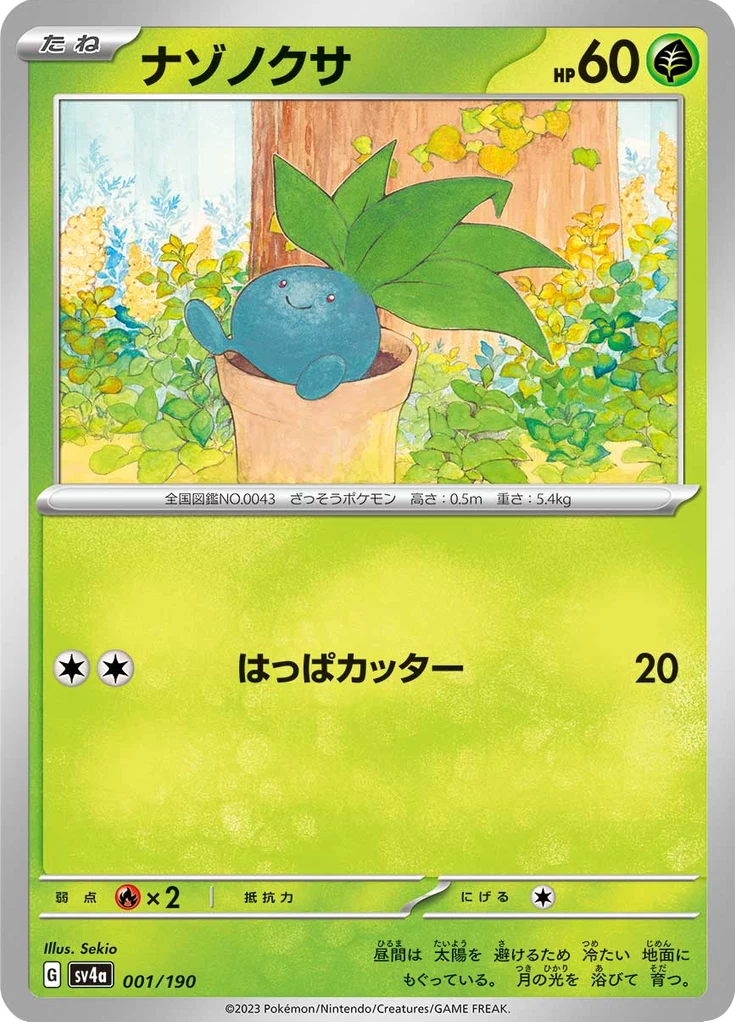
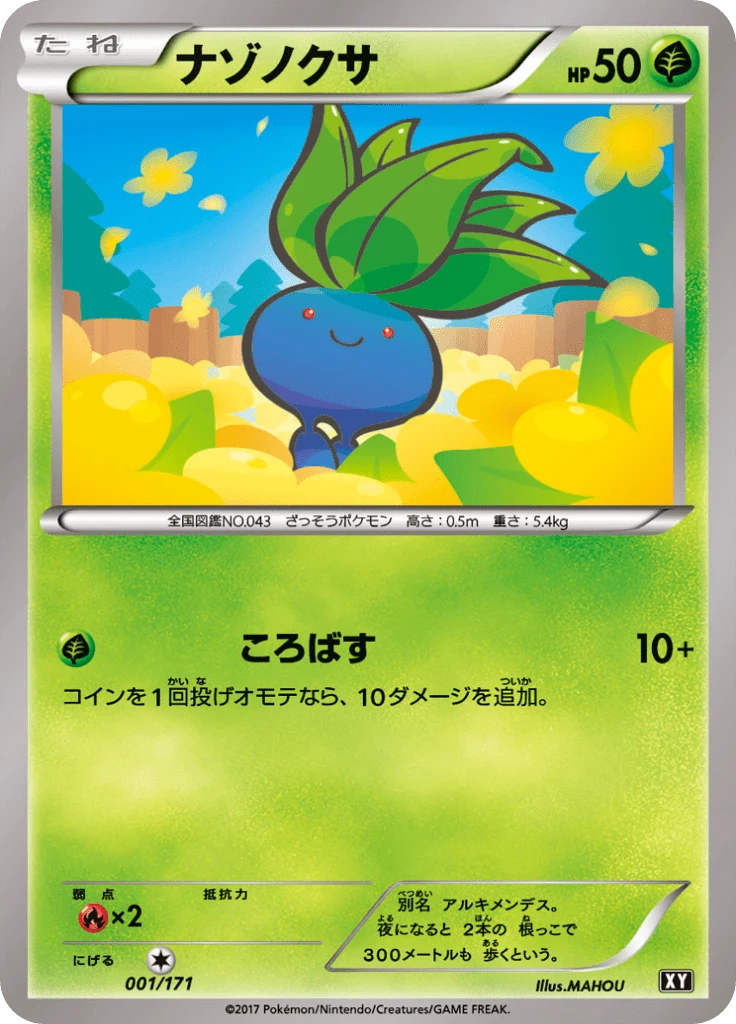
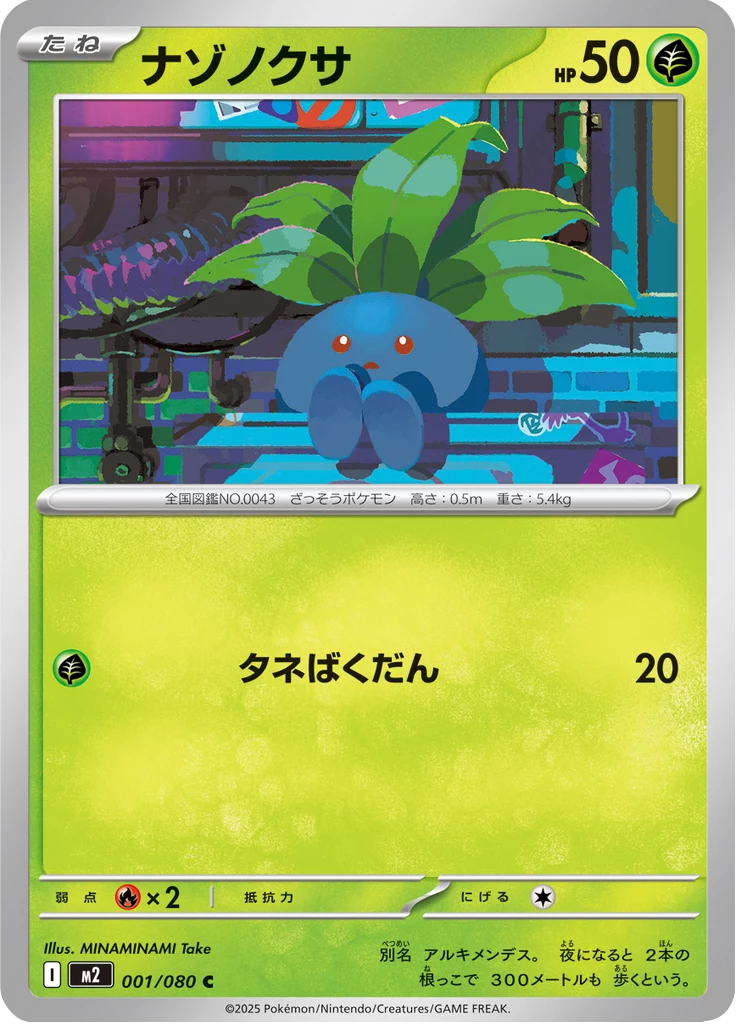
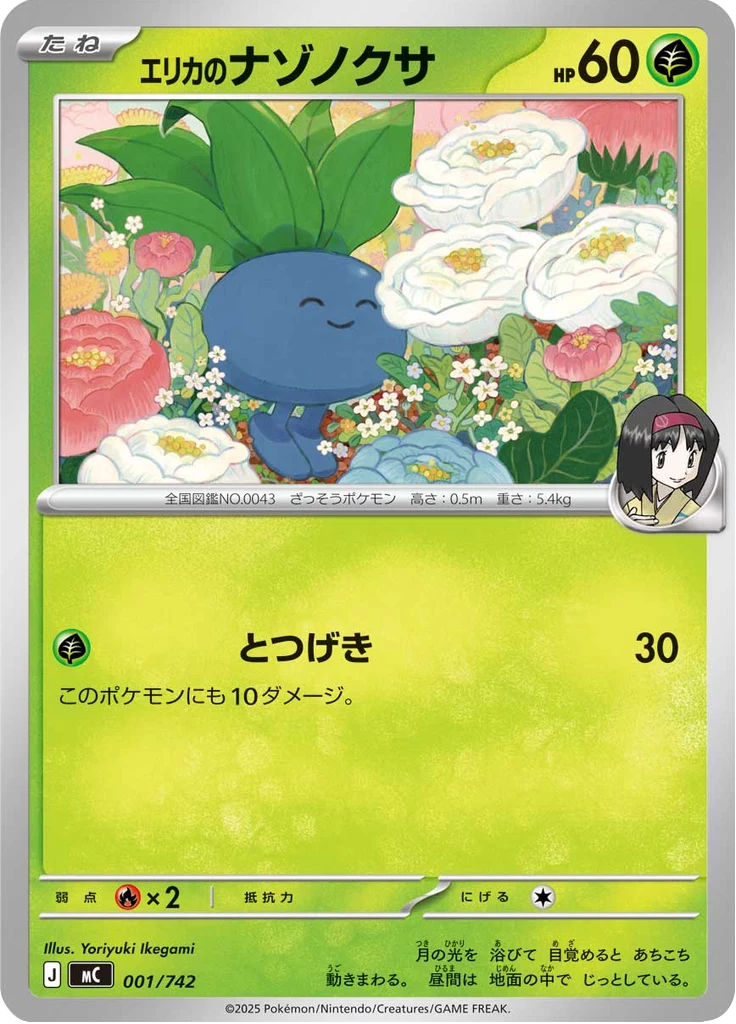
Oddish SV3 #1 Common Midori Harada Ruler of the Black Flame (SV3)
Oddish SV4a #1 Not stated in source Sekio Shiny Treasure ex (SV4a)
Oddish M2 #1 Common MINAMINAMI Take Inferno X (M2)
Oddish XY #1 Not stated in source MAHOU The Best of XY (XY)
Erika’s Oddish MC #1 Not stated in source Yoriyuki Ikegami Starter Decks 100 Battle Collection (MC)

The remaining 12 prints turned up in the database search but we haven’t pulled individual card numbers, rarities or illustrators for them yet, so this guide doesn’t detail them further. The five sections below cover the prints we did verify.

The SV3 Print: Where Our Anchor Box Comes From

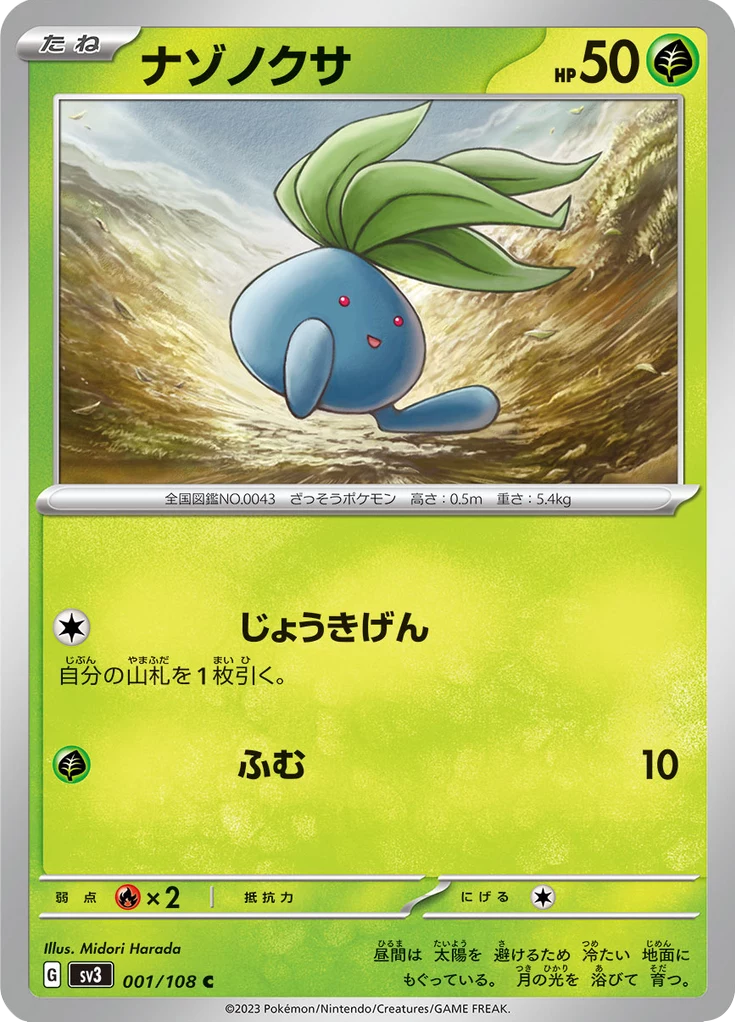
Oddish SV3 card number 1, Common rarity, Ruler of the Black Flame
Oddish, SV3 #1, Common, Ruler of the Black Flame

The print at the centre of this guide is Oddish, SV3 #1, a Common-rarity card illustrated by Midori Harada, HP 50. It’s the copy that comes packed inside Ruler of the Black Flame boosters, and it’s the print tied to a box we currently list.

Ruler of the Black Flame (SV3) released in Japan on July 28, 2023, and runs 141 cards total, with a 33-card secret tier spread across four rarities — 12 Art Rares plus the remaining higher tiers. Oddish’s Common slot sits well outside that secret tier: it’s a base-set card, not a chase pull, and nothing in the source data suggests otherwise. For the set’s full card list, see our Ruler of the Black Flame SV3 card list, and for what the set’s actual chase cards look like, see our Ruler of the Black Flame best cards guide.

On the English side, SV3 #1 corresponds to Obsidian Flames (OBF) #1 — the same Oddish artwork carried into the international print run. See our Obsidian Flames Japanese card list for the cross-reference, or our Obsidian Flames chase cards guide for what else that set is known for.

Other Verified Prints Across Eras

Two more Oddish prints outside the M-series stand out enough to detail individually.

Oddish SV4a card number 1, Shiny Treasure ex

Oddish SV4a #1, Shiny Treasure ex

Oddish XY card number 1, The Best of XY

Oddish XY #1, The Best of XY

SV4a #1, from Shiny Treasure ex, is illustrated by Sekio and printed at HP 60 — ten points higher than the SV3 print despite being the same Pokémon. Shiny Treasure ex followed Ruler of the Black Flame in the same SV block, and this is the Oddish print that landed there.

XY #1 comes from The Best of XY, a compilation-style release, illustrated by MAHOU at HP 50. It’s the oldest of the five prints we verified individually, and the artwork sits apart from the SV-era pair — a different illustrator and an older card frame generation entirely.

The 2025–26 M-Series Prints

The two newest verified Oddish prints both belong to the current M-series — the 2025–26 generation of Japanese-only sets — and one of them isn’t a standard Oddish print at all.

Oddish M2 card number 1, Common, Inferno X

Oddish M2 #1, Common, Inferno X

Erika's Oddish MC card number 1, Starter Decks 100 Battle Collection

Erika’s Oddish, MC #1

M2 #1, from Inferno X, is a Common Oddish illustrated by MINAMINAMI Take at HP 50 — a straightforward reprint pattern, consistent with the SV3 and XY Commons.

MC #1 is different. It’s named エリカのナゾノクサ — “Erika’s Oddish” — from the Starter Decks 100 Battle Collection, illustrated by Yoriyuki Ikegami at HP 60. Naming a card after a specific Trainer is its own card category in the Japanese TCG, a Trainer’s-Pokémon variant, separate from a plain species reprint, and it’s the most distinctive of the five prints we verified for this guide.

Chase Prints and What Makes Them Collectible

None of the five Oddish prints we verified sit in a secret-rare or ultra-rare tier. Two are confirmed Common in the source data — SV3 #1 and M2 #1 — and the other three (SV4a #1, XY #1 and MC #1) have no stated rarity, with nothing in the source indicating a higher tier. That puts Oddish itself outside the chase-card conversation that usually drives a set-level guide.

What separates the five prints from each other isn’t rarity, then — it’s treatment. A plain reprint like SV3 #1, M2 #1 or XY #1 carries the standard card frame for its era. “Erika’s Oddish” (MC #1) breaks that pattern by attaching a named Trainer to the card, a design choice reserved for select Pokémon in a set rather than applied to a random reprint. If you’re building a collection around named Trainer’s-Pokémon cards specifically, that’s the print worth tracking down; if you just want a plain Oddish for a deck or a binder, any of the standard-reprint prints fits that brief — though note HP and stats vary by print (SV3 #1 and XY #1 are both 50 HP, SV4a #1 and MC #1 are both 60 HP), so check the individual card before deck-building around one.

Which Japanese Boxes to Open for Oddish

Of the five prints in this guide, only SV3 #1 is tied to a box we currently list. The Ruler of the Black Flame Booster Box is currently listed at ¥17,160 (~$108), and the same set’s cards — Oddish included — are also built into the Ruler of the Black Flame Deck Build Box, currently listed at ¥5,400 (~$34), for a lower-cost route into the same set.

SV3 Ruler of the Black Flame Japanese Booster Box, listed on samuraiswordtokyo.com

The other four prints — SV4a #1, XY #1, M2 #1 and “Erika’s Oddish” (MC #1) — are not tied to a box on our site at the moment. Sourcing requests for those prints go through Snel bestellen.

Shop This Set
SV3-Ruler Of The Black Flame Japanese Pokemon Booster Box
Currently listed at ¥17,160 (~$108) · contains the Common Oddish SV3 #1
Ships from Tokyo · Tracked delivery

View Product →

Where to Buy Oddish Cards from Tokyo

We ship Japanese sealed product worldwide out of Tokyo with tracked delivery. If the Common SV3 print is the one you’re after, the Ruler of the Black Flame Booster Box is the direct route, with the lower-priced Ruler of the Black Flame Deck Build Box as an alternative entry point into the same set. Browse the wider Japanese Pokemon booster box collection for what else is currently listed, or request a quote via our Quick Order page for any of the other four prints covered in this guide, none of which are tied to a listing at the moment. For how SV3 compares with its companion release, see our SV3 vs SV3a box guide.

Veelgestelde vragen

How many Japanese Oddish Pokémon card prints are there?

The Japanese card database lists 17 Oddish prints. Five of them are verified individually in this guide, spanning the XY era through the 2025–26 M-series.

Which set is the SV3 Oddish print from?

Ruler of the Black Flame (SV3), released in Japan on July 28, 2023. It’s a Common-rarity card (SV3 #1), outside the set’s 33-card secret tier, and it comes from our currently listed Ruler of the Black Flame Booster Box.

What is “Erika’s Oddish”?

It’s the Japanese name (エリカのナゾノクサ) for MC #1, a Trainer’s-Pokémon variant from the Starter Decks 100 Battle Collection, illustrated by Yoriyuki Ikegami. Naming a card after a specific Trainer is a distinct design category from a standard species reprint.

Is there an English version of the SV3 Oddish print?

Yes. SV3 #1 corresponds to Obsidian Flames (OBF) #1 on the English side, per the international print-table cross-reference.

Do any Oddish prints carry a rare rarity tier?

Not among the five prints verified for this guide. Two are confirmed Common (SV3 #1 and M2 #1); the source didn’t state a rarity for the other three (SV4a #1, XY #1 and MC #1), but nothing indicates a secret-rare or ultra-rare tier for any of them.

Where can I buy Japanese Oddish cards?

We ship Japanese sealed product from Tokyo with tracked delivery. The Ruler of the Black Flame Booster Box and Deck Build Box both carry the Common SV3 print, and requesting a quote via Quick Order covers sourcing for the other four prints in this guide.

Sabrina's Suggestion SR 109/095 kaartgids

Sabrina’s Suggestion is a Trainer — Supporter card printed above its set’s main numbering. That tells you something important before you even read the effect text: this is a secret-rare slot rather than part of the main numbered run.

The card is ナツメの暗示 — Sabrina’s Suggestion, No. 109/095, printed as a Secret Rare (SR) in the Japanese expansion pack 拡張パック「タッグボルト」/ Expansion Pack “Tag Bolt” (set code SM9). This PSA 10 print is currently listed, graded and shipped from Tokyo, and this guide walks through what the card does, where it sits inside Tag Bolt, how the Japanese print compares to its English counterpart, and where it ranks against the other secret-rare cards we carry from the same set.

Key Takeaways

Sabrina’s Suggestion 109/095 SR is a PSA 10, currently listed at ¥22,198 (~$140). It comes from Tag Bolt (SM9), a Japanese Expansion Pack released 7 December 2018 whose main numbering runs to 095 before the secret-numbered cards. If you want the sealed source product, the SM9-Tag Bolt Japanese Booster Box is where this print — and the set’s other secret rares — originate.

Trainer
Card Type (Supporter)

SR
Rarity (109/095)

095
Main Numbering

Dec 2018
Japan Release

Prices below are current samuraiswordtokyo.com listings, converted at ¥159/USD (September 2026).

The Card: Sabrina’s Suggestion 109/095 SR

Sabrina’s Suggestion is a Trainer — Supporter card. Its effect reads: “View opponent’s hand; if desired, select one Supporter card and use that card’s effect as this card’s effect.” It is a hand-disruption and effect-copying Supporter, the kind of utility card that tends to get chased for its secret-rare treatment rather than for tournament play alone.

The 109/095 print is illustrated by Hitoshi Ariga — we cover his other Supporter illustrations, including Guzma and Welder, in our Hitoshi Ariga illustrator hub. Its position at #109 in a set whose main run stops at 095 marks it as a secret-rare slot rather than part of the numbered core set.

Sabrina's Suggestion SR 109/095, Tag Bolt (SM9)
Sabrina’s Suggestion 109/095 SR — Tag Bolt (SM9), illustrated by Hitoshi Ariga

This print is currently listed at ¥22,198 (~$140), PSA 10.

PSA 10 Sabrina's Suggestion SR 109/095 Tag Bolt slab, listed on samuraiswordtokyo.com
PSA 10 Sabrina’s Suggestion SR 109/095 slab, listed on samuraiswordtokyo.com

The Set: Tag Bolt (SM9)

Tag Bolt — 拡張パック「タッグボルト」in Japanese — is set code SM9, a Japanese Expansion Pack released on 7 December 2018. Its main numbered run stops at 095, with secret-numbered cards printed above that denominator. Sabrina’s Suggestion is one of those cards at 109/095.

Tag Bolt’s secret-rare block includes several other cards currently listed on our site as PSA 10 examples, including two GX Tag Team cards from the same era of the set.

Pikachu & Zekrom GX SR 100/095, Tag Bolt (SM9)

Pikachu & Zekrom GX 100/095 (SR)

Latias & Latios GX SR: SA 105/095, Tag Bolt (SM9)

Latias & Latios GX 105/095 (SR: SA)

For the full Tag Bolt secret-rare and chase-card line-up, see our Tag Bolt (SM9) card list hub, and for pull-rate discussion on the set specifically, our Tag Bolt pull-rates hub covers it in more detail.

SM9-Tag Bolt Japanese Pokemon Booster Box, listed on samuraiswordtokyo.com

Sealed Tag Bolt product — the source for 109/095 and the rest of the set’s secret rares — is currently listed as the SM9-Tag Bolt Japanese Pokemon Booster Box at ¥441,000 (~$2,774). This is a genuinely vintage, 2018-dated Japanese box, not an ordinary current-release product, and the price reflects that scarcity rather than a typical modern booster box.

Japanese vs English Print

Sabrina’s Suggestion does have an English-set equivalent, and the localisation carries an extra naming wrinkle worth flagging. The Japanese card name is ナツメの暗示 — literally “Natsume’s Hint” — because Natsume (ナツメ) is the original Japanese name for the character English localisations call Sabrina. The official English card name follows that established localisation: Sabrina’s Suggestion.

In English, the card appears in Team Up across two separate slots: a standard print at #154 and a full-art print at #181. Japanese Tag Bolt likewise includes a regular treatment at 88/095 and the SR at 109/095, so the two releases should be compared treatment by treatment rather than as two English cards replacing one Japanese card. For a broader look at how this Japanese-source set maps onto its English release, see our Team Up Japanese card list hub.

Where This SR Sits Among Japanese Rarity Tiers

In this generation of Japanese Sun & Moon-era sets, a card numbered above the set’s main count — here, above 095 — marks it as a Secret Rare (SR): the tier reserved for the set’s chase cards, printed outside the standard numbered run. Sabrina’s Suggestion at 109/095 sits in that SR block alongside other Tag Bolt secret rares currently listed on our site in PSA 10, including Pikachu & Zekrom GX 100/095, listed at ¥87,208 (~$549).

One sibling in the same secret-rare block goes a step further in its own product naming: Latias & Latios GX 105/095 is listed under the designation SR: SA, indicating a further special-art treatment within the secret-rare range. We list that print at ¥1,321,516 (~$8,312) — a figure that reflects genuine vintage scarcity for that specific print rather than a typical price for a Tag Bolt secret rare.
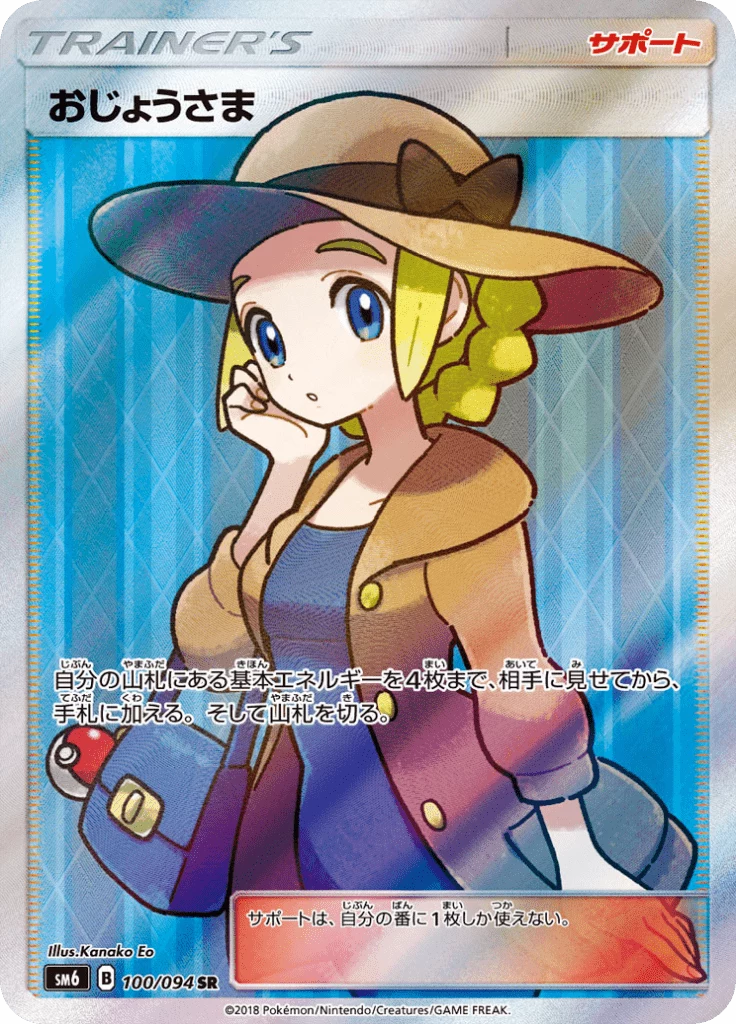
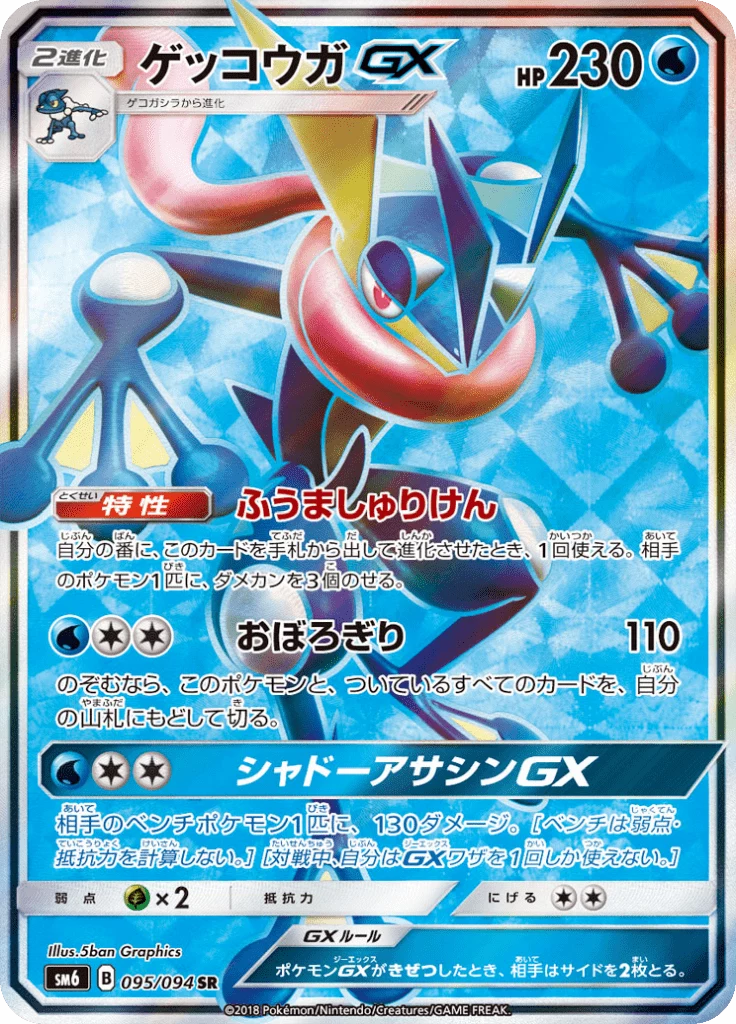
For the wider trainer-card angle across every verified print of Sabrina, see our Sabrina Pokemon cards guide.
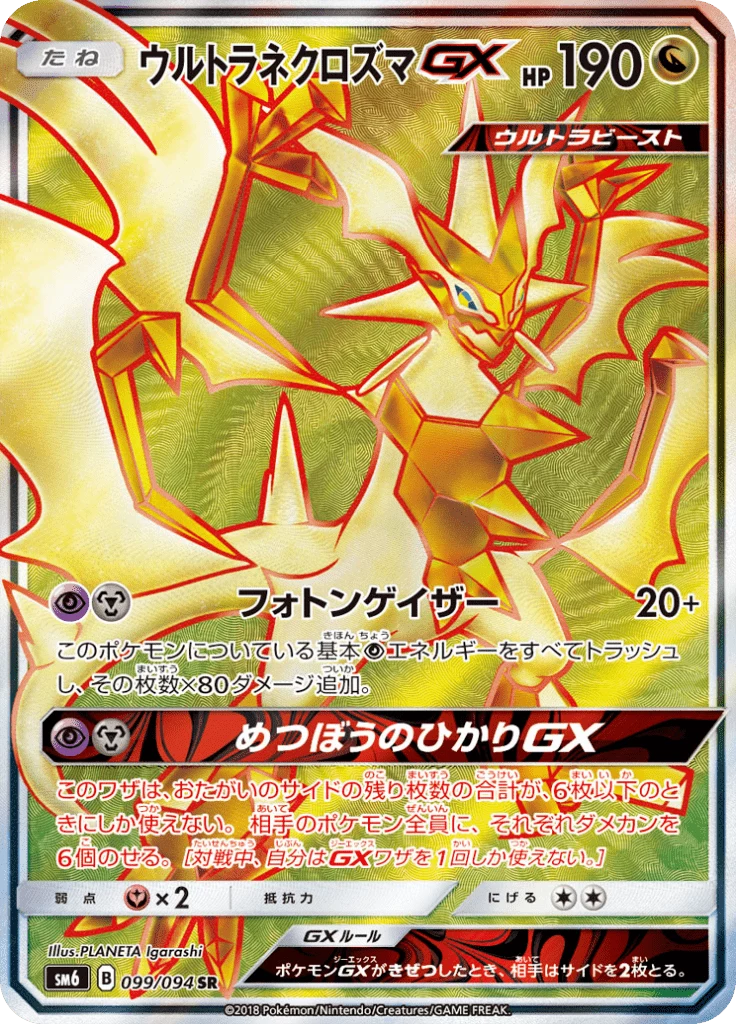
Shop This Set
PSA10 Sabrina’s Suggestion SR 109/095 (Tag Bolt)
¥22,198 (~$140)
Ships from Tokyo · Tracked delivery

View Product →

Where to Buy Sabrina’s Suggestion from Tokyo

PSA 10 Sabrina’s Suggestion 109/095 SR is currently listed at ¥22,198 (~$140), shipped from Tokyo with tracked delivery. If you would rather pull your own copy, the sealed SM9-Tag Bolt Japanese Booster Box is the source product for the set’s full secret-rare block, at ¥441,000 (~$2,774).

For other Tag Bolt secret rares in the same PSA 10 tier, see PSA 10 Pikachu & Zekrom GX 100/095 and PSA 10 Latias & Latios GX 105/095 SR: SA, or browse the full range in our PSA 10 graded card collection. For a mixed order across singles and sealed product, our Quick Order page is the fastest way to build a cart.

Veelgestelde vragen

What is Sabrina’s Suggestion 109/095 SR?

It is the Secret Rare print of Sabrina’s Suggestion (ナツメの暗示), card 109/095 from the Japanese Expansion Pack Tag Bolt (set code SM9), released 7 December 2018. This PSA 10 print is currently listed at ¥22,198 (~$140).

What does Sabrina’s Suggestion do?

It is a Trainer — Supporter card. Its printed effect lets you view your opponent’s hand and, if you choose, select one Supporter card from it and use that card’s effect as your own for the turn.

Why is Sabrina’s Suggestion called ナツメの暗示 in Japanese?

Natsume (ナツメ) is the original Japanese name for the character English localisations call Sabrina, so the Japanese card name translates literally to “Natsume’s Hint.” The official English card name follows the established localisation: Sabrina’s Suggestion.

Does Sabrina’s Suggestion have an English print?

Yes — Team Up carries a standard print at #154 and a full-art print at #181. Japanese Tag Bolt likewise has a regular treatment at 88/095 and the SR at 109/095.

What set is Sabrina’s Suggestion from?

Tag Bolt is Japanese set code SM9, an Expansion Pack released 7 December 2018. Its main numbered run stops at 095, with secret-numbered cards printed above that denominator.

Where can I buy a PSA 10 Sabrina’s Suggestion from Tokyo?

This 109/095 SR PSA 10 print is currently listed at ¥22,198 (~$140) with tracked shipping from Tokyo. The sealed SM9-Tag Bolt Japanese Booster Box is currently listed at ¥441,000 (~$2,774) if you would rather pull your own copy from the set’s secret-rare block.