Maak gratis een account en spaar punten en rang
Samurai Sword Tokyo
Bestellingen Winkelwagen

Magikarp Master Ball Mirror 129/165 kaartgids (Pokémon Card 151)
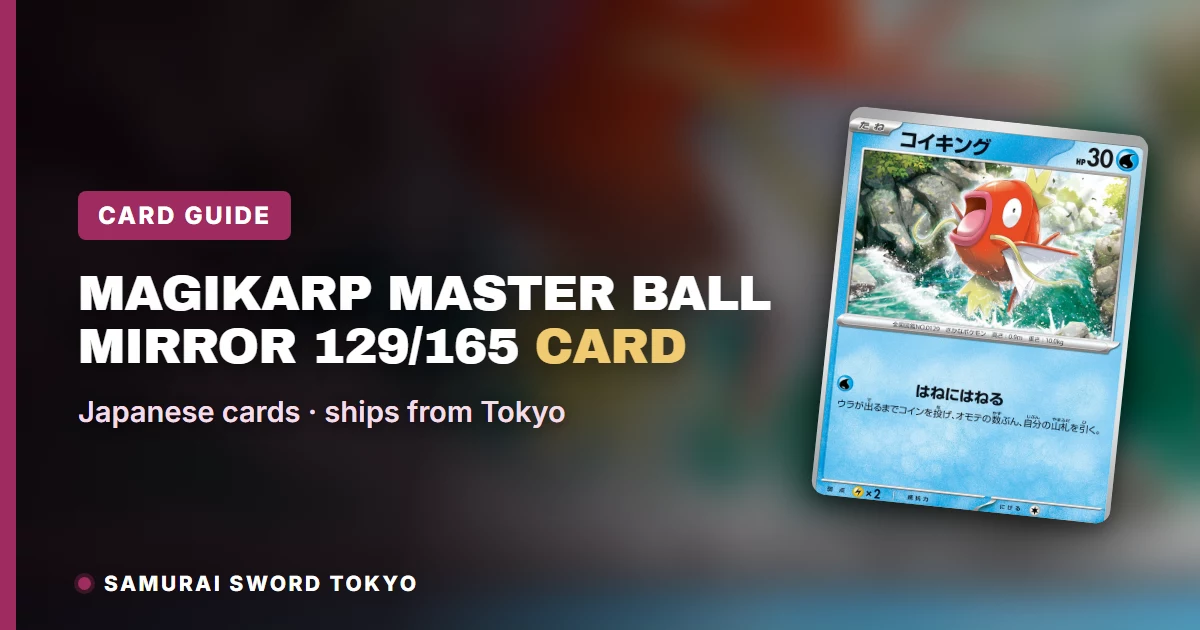
Magikarp’s SV2a Master Ball Mirror print isn’t a secret rare or an alt-art — it’s a plain Common card wearing a rarer foil. The Master Ball Mirror parallel of 129/165 from Pokémon Card 151 puts the everyday flopping fish under the same foil pattern reserved for a small slice of the set’s Commons, Uncommons and Rares, and that contrast between “just a Common” and “hard-to-find foil” is exactly why the card keeps turning up on want lists.

This guide covers what the card is, how the Master Ball Mirror mechanic actually works inside SV2a, where this print sits relative to the set’s more common mirror-holo treatment, and where to find a graded copy — along with the evolution-line and set-mate cards collectors chase alongside it.

Key Takeaways

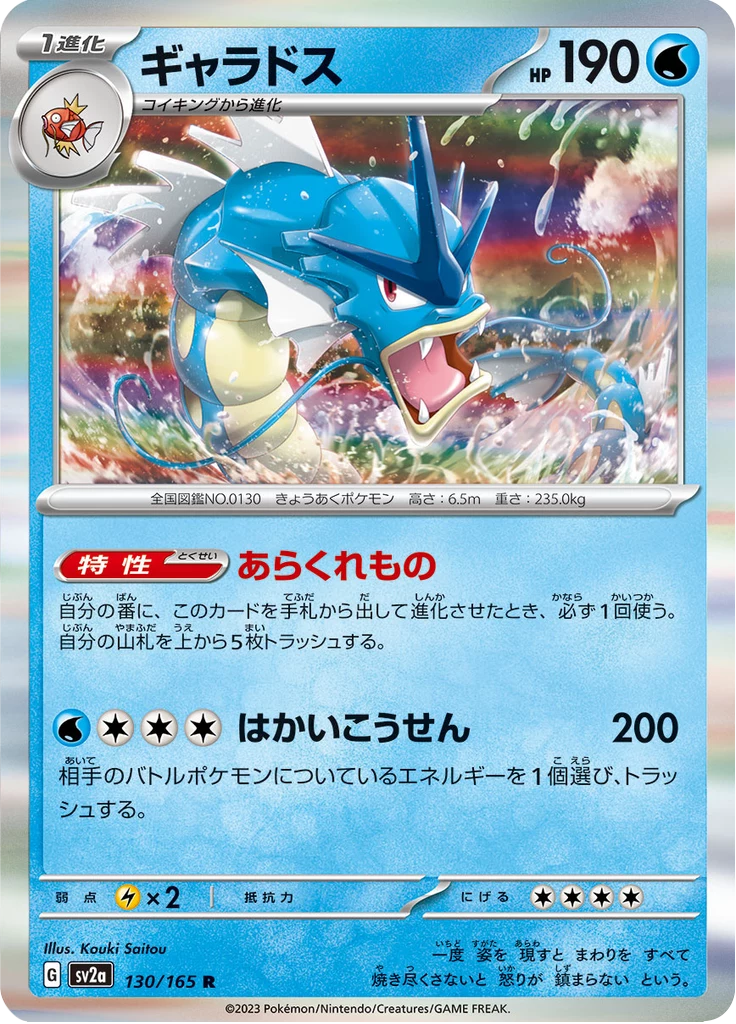
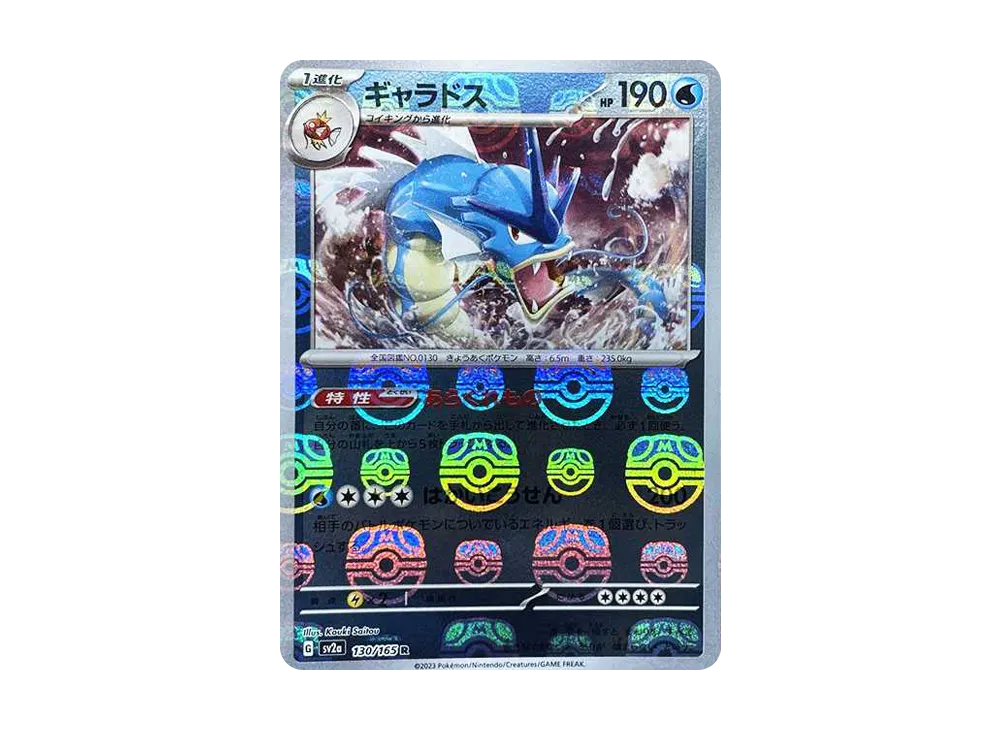
Our PSA 10 listing for Magikarp C: Master Ball Mirror [SV2a 129/165] is currently listed at ¥32,398 (~$204). It’s a Common-rarity card from Pokémon Card 151 (SV2a, 16 June 2023) that received the rarer Master Ball foil pattern instead of the standard Poké Ball mirror-holo most Commons and Uncommons carry. If you want the evolution line too, we also list a PSA 10 Gyarados R: Master Ball Mirror [SV2a 130/165] from the same set.

30
HP

C
Base Rarity (129/165)

210
Set Size (SV2a)

16 Jun 2023
Japan Release

Prices below are current samuraiswordtokyo.com listings, converted at ¥159/USD (September 2026).

The Card: Magikarp 129/165 Common

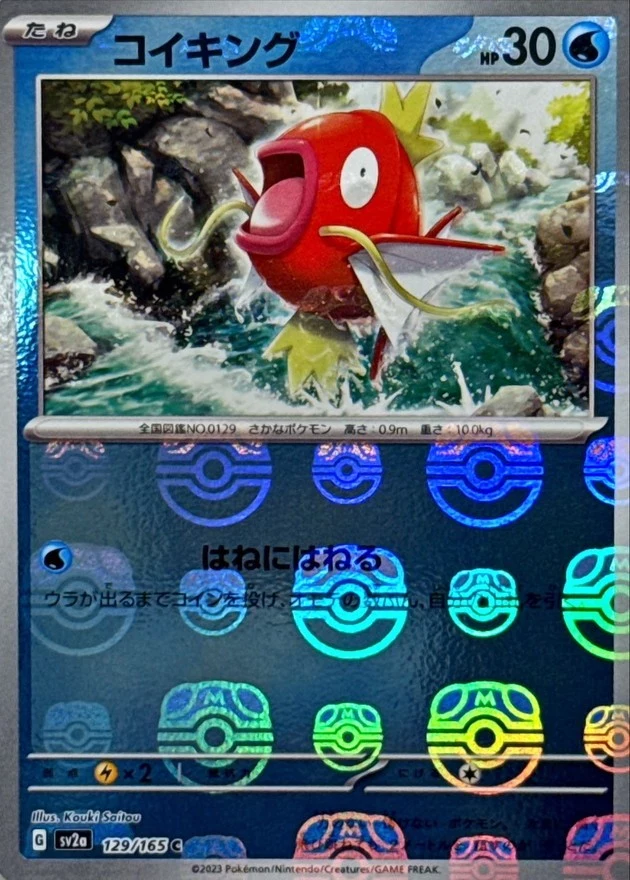
Magikarp is コイキング (Koikingu) in Japanese, a Basic, Water-type Pokémon with 30 HP and National Dex #129. Its single attack, はねにはねる (“Splash”), has you flip coins until you get tails and draw a card for each heads — a pure card-advantage effect rather than a damage output. The card carries a Lightning weakness, no Resistance, and a Retreat Cost of 1. The 129/165 print is illustrated by Kouki Saitou.
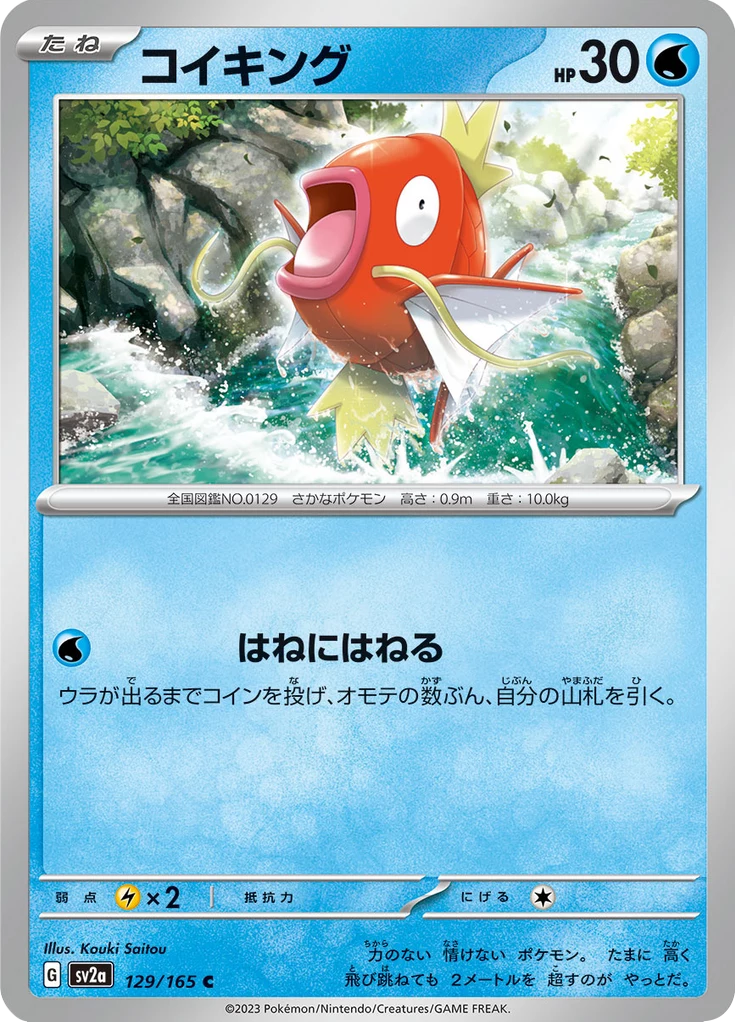
Magikarp 129/165, Master Ball Mirror, Pokemon Card 151 (SV2a)
Magikarp 129/165, Common — Pokémon Card 151 (SV2a), illustrated by Kouki Saitou

In the set’s own numbering, Magikarp’s base rarity is a straightforward Common (C). What makes the 129/165 print worth a dedicated guide is the foil it was printed with: a Master Ball Mirror parallel, which SV2a reserves for only a portion of its Commons, Uncommons and Rares rather than handing out to all of them. Our PSA 10 listing of this exact print is at ¥32,398 (~$204).
PSA 10 Magikarp Master Ball Mirror 129/165 slab, listed on samuraiswordtokyo.com

The Set: Pokémon Card 151 (SV2a)

Pokémon Card 151 — 強化拡張パック「ポケモンカード151」, the Enhanced Expansion Pack “Pokémon Card 151” — is Japanese set code SV2a, released 16 June 2023. The set runs to 210 cards, and each Japanese booster pack contains 7 cards with 2 guaranteed holofoil cards. For the complete card-by-card breakdown, see our Pokémon 151 (SV2a) card list, and for a look at what else the boosters can pull, our Pokémon Card 151 pull-rates hub covers the set’s best cards more broadly.
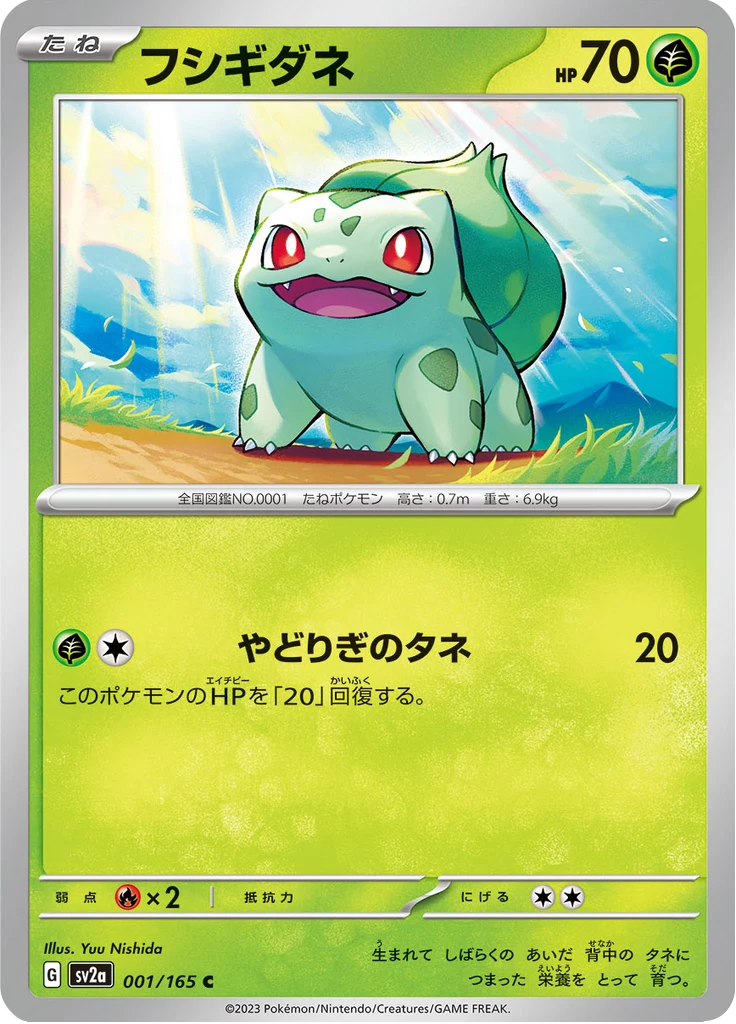
Bulbasaur 001/165, Pokemon Card 151 (SV2a)
Bulbasaur 001/165 — the set-opening card of Pokémon Card 151 (SV2a)

Sealed SV2a product — where the Master Ball Mirror foils are pulled from — is available as the SV2A Pokemon 151 Japanese Booster Box currently listed at ¥43,860 (~$276), with a Damaged Box variant at ¥53,760 (~$338) for buyers who don’t mind cosmetic packaging wear. For box-opening strategy specifically, see our Pokémon 151 booster box buying guide.
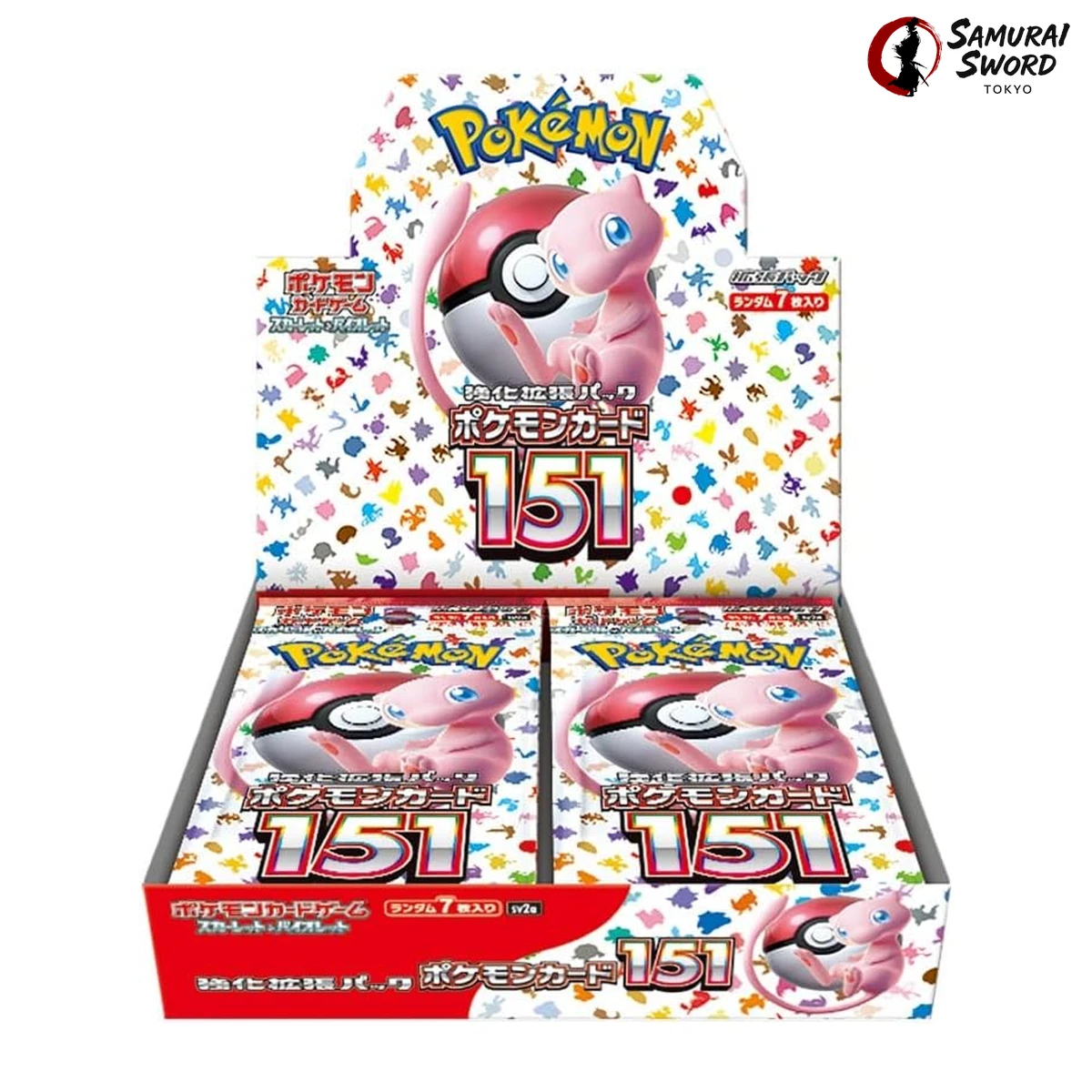
SV2A Pokemon Card 151 Japanese Booster Box, listed on samuraiswordtokyo.com

Japanese vs English Print

SV2a’s English-language equivalent is 151, released internationally as Scarlet & Violet—151 (also referred to as “MEW”) across September and October 2023. The English set carries the same design idea as SV2a’s mirror-holo system, using Poké Ball and Master Ball Reverse Holo parallels as its equivalent foil treatment.

We haven’t verified an exact English card number that matches Magikarp’s Japanese 129/165 Master Ball Mirror one-to-one, so treat the two as a set-level design equivalence rather than a confirmed same-numbered counterpart. If you’re trying to match a Japanese copy against an English one, go by the foil pattern and card artwork rather than assuming the numbering lines up.

Where This Print Sits Among Japanese Rarities

Structurally, Magikarp 129/165 stays a Common card — the Master Ball Mirror foil doesn’t move it into a higher printed rarity tier. What changes is which of the set’s two mirror-foil patterns it received: the standard Poké Ball Mirror that most Commons, Uncommons and Rares carry, or the harder-to-find Master Ball Mirror that only a portion of them get. Magikarp’s 129/165 sits in that second, smaller group.

The same Master Ball pattern also lands on higher base-rarity cards within SV2a, including our graded Gyarados R: Master Ball Mirror [SV2a 130/165] and Dragonite R: Master Ball Mirror [SV2a 149/165] — useful reference points if you’re comparing how the foil treatment reads on a Rare versus a Common.

For the wider Master Ball Mirror mechanic across other Japanese sets that use it, see our Master Ball Mirror Pokémon cards guide. For a different Japanese Magikarp print entirely — the 25th Anniversary shiny version — see our Shining Magikarp 25th Anniversary card guide, and for a broader look at Magikarp and Gyarados prints across eras, our Magikarp & Gyarados cards guide covers both lines.

Shop This Card
PSA 10 Magikarp C: Master Ball Mirror 129/165
Currently listed at ¥32,398 (~$204)
Ships from Tokyo · Tracked delivery

View Product →

Where to Buy Magikarp from Tokyo

Our PSA 10 listing of PSA 10 Magikarp C: Master Ball Mirror 129/165 is at ¥32,398 (~$204), shipped from Tokyo with tracked delivery.

If you’re building out the evolution line, our PSA 10 Gyarados R: Master Ball Mirror [SV2a 130/165] and PSA 10 Dragonite R: Master Ball Mirror [SV2a 149/165] are both graded to the same PSA 10 standard. For sealed product, the SV2A Pokemon 151 Japanese Booster Box and its Damaged Box option are where these Master Ball Mirror foils come from. For the wider range of graded Japanese singles, browse our PSA 10 graded card collection, or use our Quick Order page to build a mixed order across singles and sealed product.

Veelgestelde vragen

What is the Magikarp Master Ball Mirror 129/165 card?

It’s the Master Ball Mirror foil print of Magikarp, card 129/165 from the Japanese set Pokémon Card 151 (SV2a), released 16 June 2023. The card’s base rarity is Common; the Master Ball Mirror is the rarer of the set’s two mirror-holo foil patterns. We list a PSA 10 copy currently at ¥32,398 (~$204).

Is the Master Ball Mirror a different rarity from the regular Common Magikarp?

No. It’s still a Common card — the Master Ball Mirror is a foil-pattern parallel of the same Common print, not a separate printed rarity tier above it.

What’s the difference between the Poké Ball Mirror and the Master Ball Mirror?

Every Common, Uncommon and Rare in SV2a has a standard Poké Ball–pattern mirror holofoil version. A smaller subset instead carries the Master Ball–pattern foil, which is the rarer of the two treatments. Magikarp 129/165 is one of the cards that received the Master Ball pattern. SV2a doesn’t publish an exact ratio between the two, so we don’t state a pull rate.

Does Magikarp 129/165 have an English print?

SV2a’s English equivalent set is 151 (Scarlet & Violet—151, also called “MEW”), released September–October 2023, which uses the same Poké Ball/Master Ball Reverse Holo parallel structure. We haven’t verified an exact English card number matching the Japanese 129/165 one-to-one, so treat the two as a set-level equivalence.

Where can I buy a PSA 10 Magikarp Master Ball Mirror from Tokyo?

Our graded 129/165 print is currently listed at ¥32,398 (~$204), shipped from Tokyo with tracked delivery. Sealed SV2A booster boxes are also listed if you’d rather pull your own copy.
Pokemon GX-kaarten uitgelegd: GX & Tag Team GX in Japanse Sun & Moon-sets

A Pokemon GX card gives up two Prize cards when it’s Knocked Out instead of one, and its single GX attack can only be used once per game. A TAG TEAM GX card raises the stakes further — two or three Pokemon printed on one card, always treated as a Basic, and three Prize cards handed over on a KO. Both mechanics debuted in the Sun & Moon era (2017–18), and the Japanese sets that carry them run their own print ladder — RR, SR, an extra “SA” tier, and UR — that decides exactly which version of a card you’re holding.

This guide explains what the GX and TAG TEAM GX mechanics do on the battlefield, how the Japanese rarity tiers stack on top of each other, and which Sun & Moon sets to buy sealed if you want these cards. For a price-ranked list of the best TAG TEAM GX cards, see our best TAG TEAM GX cards guide — that article ranks cards by price, this one explains the mechanic and rarity system behind them.

Key Takeaways

A regular Pokemon-GX card gives up 2 Prize cards on a KO; a TAG TEAM GX card gives up 3. The earliest confirmed Japanese set carrying TAG TEAM GX cards is SM9, Tag Bolt. The SM12a Tag All-Stars booster box is currently listed at ¥207,900 (~$1,308), and the PSA10 Pikachu & Zekrom GX UR from that same set is currently listed at ¥155,288 (~$977).

2
Prize Cards, Regular GX

3
Prize Cards, TAG TEAM GX

173
Cards in Tag All-Stars (SM12a)

2017–18
Sun & Moon GX Era Begins

Yen figures below convert at ¥159/USD (September 2026). Prices are our own listed prices, checked against today’s catalogue.

What Is a Pokemon GX Card?

The GX mechanic debuted in the Sun & Moon expansion era (2017–18). A Pokemon-GX card carries one GX attack in addition to its normal attacks, and a player may use only one GX attack per game — unless a card effect specifically says otherwise. Once it’s used, the player flips a physical GX marker to track that the attack is spent for the rest of the match. GX attacks are themed on the video games’ Z-Moves and hit noticeably harder than the Pokemon’s regular attacks.

The trade-off is built into the Prize system. Knocking out a regular Pokemon-GX card hands the opponent 2 Prize cards instead of the usual 1 for a normal Pokemon — a meaningful swing in a format where the first player to take 6 Prizes wins.

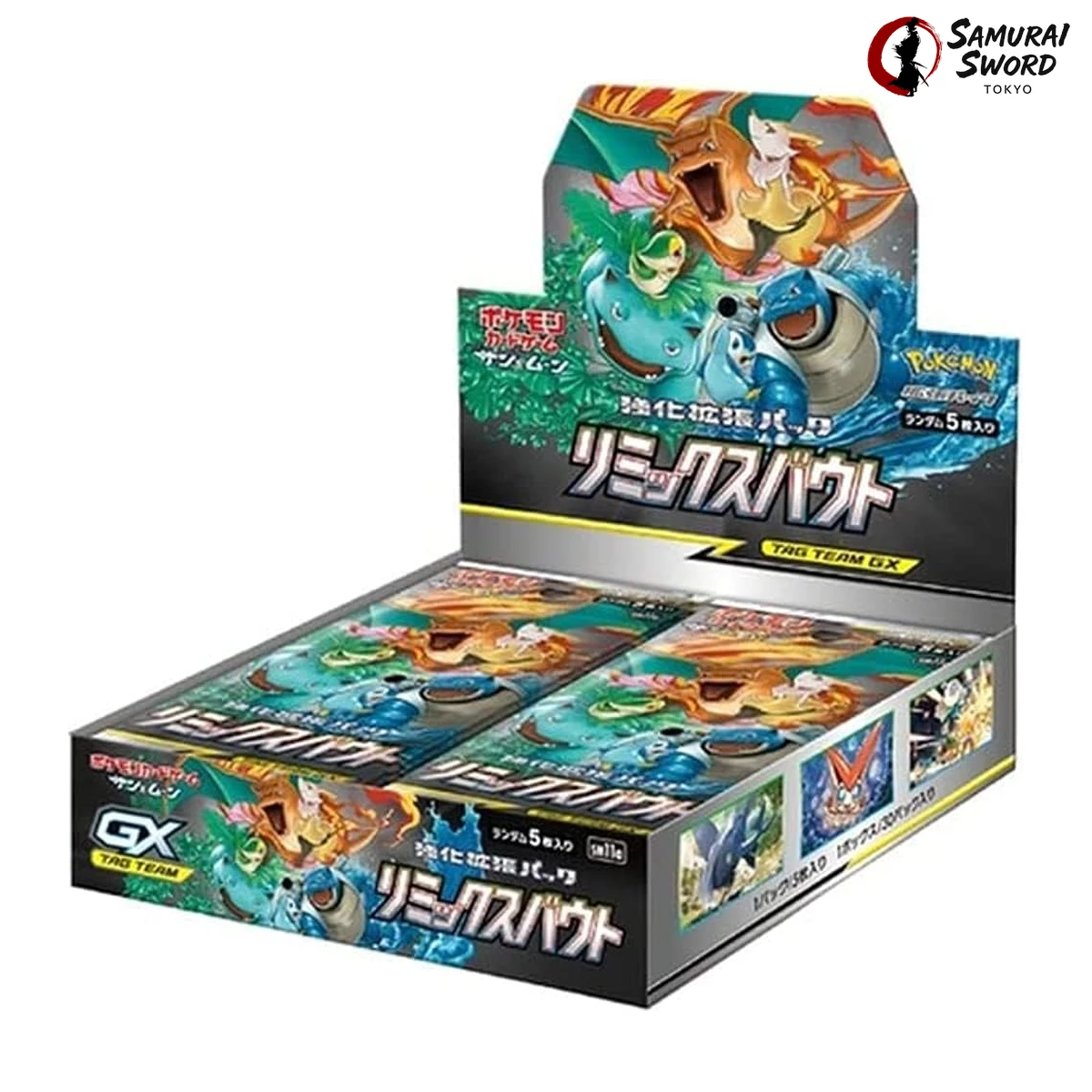
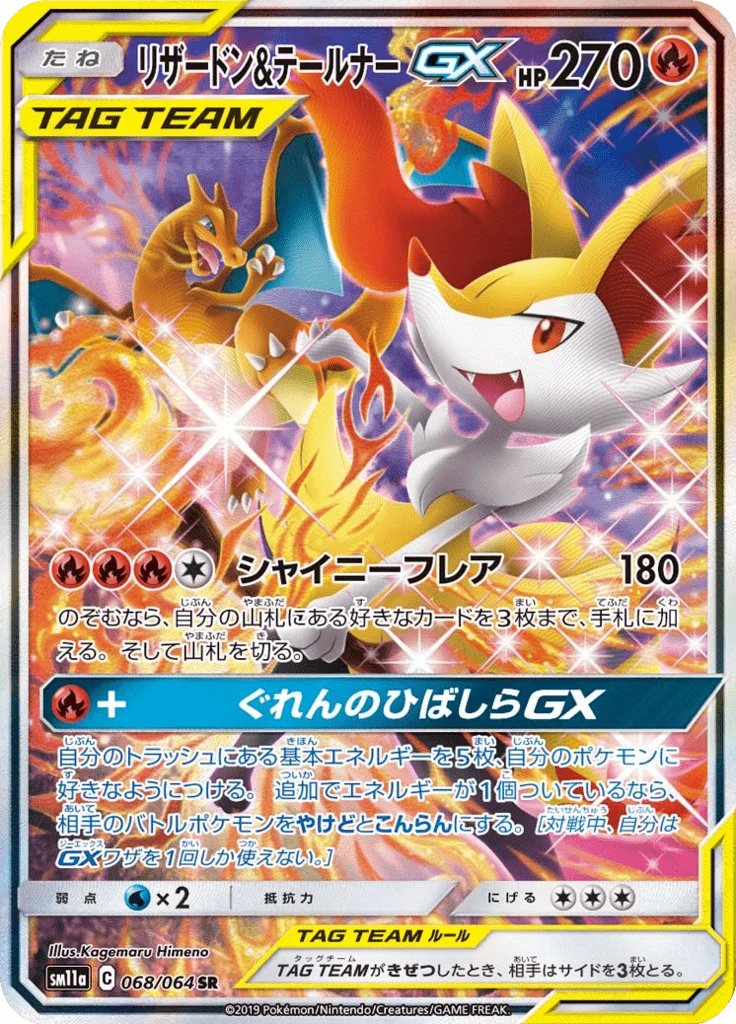
SM11a Remix Bout Japanese card, card #68
A card from Remix Bout (SM11a), one of the Japanese Sun & Moon era’s GX sets

Not every GX-era set is built around Tag Team pairings — several Sun & Moon sets carry single-Pokemon GX cards alongside the Tag Team versions, which is a distinction worth keeping straight before you start comparing prices. That split is covered in the sets section below.

What Makes a TAG TEAM GX Card Different

A TAG TEAM GX card combines two or three Pokemon that share at least one type on a single card. TAG TEAM GX Pokemon are always treated as Basic Pokemon regardless of what the individual Pokemon’s normal evolution line looks like, and they carry noticeably elevated HP compared with a single-Pokemon GX card. TAG TEAM GX attacks are marked with a “+” bonus-effect symbol, distinguishing them from a standard GX attack at a glance.

The stakes go up again at knockout: a TAG TEAM GX card hands the opponent 3 Prize cards when it’s Knocked Out — one more than a regular GX card, and three times a normal Pokemon.

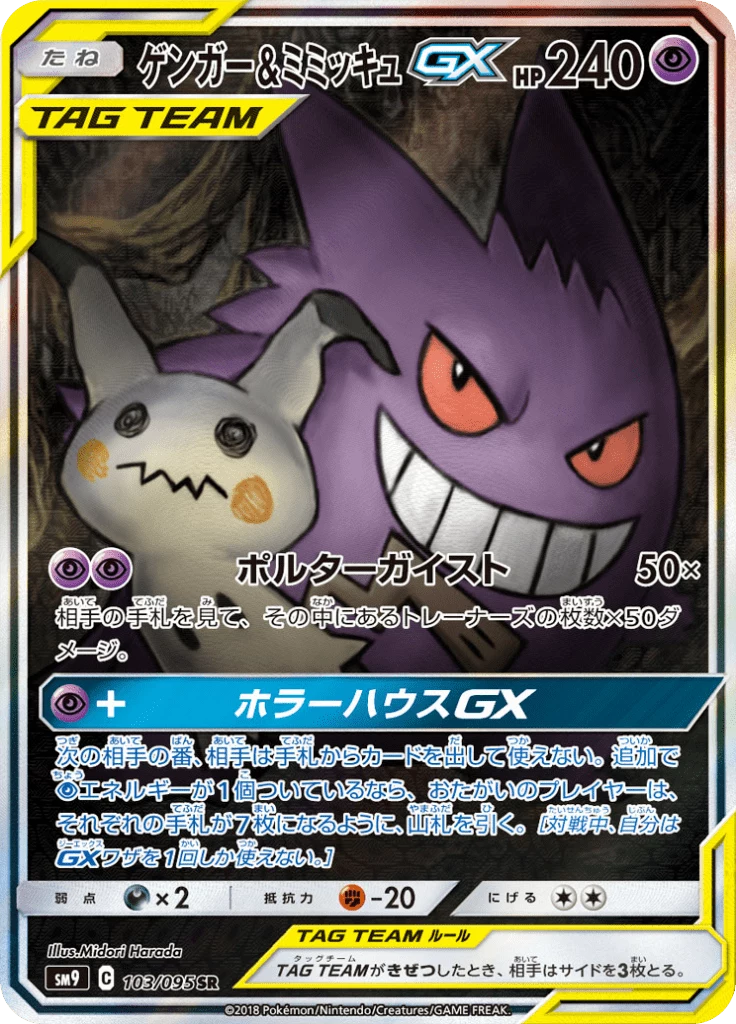
The Japanese set that carries the first TAG TEAM GX cards is SM9, Tag Bolt. Our Gengar & Mimikyu GX card guide covers the Tag Bolt Special Art print of one of that debut set’s TAG TEAM GX cards in full, including its exact number and print details.

SM9 Tag Bolt Japanese card, card #103
A card from Tag Bolt (SM9), the Japanese set that introduced TAG TEAM GX cards

GX Rarity Tiers: RR to UR on Sun & Moon Cards

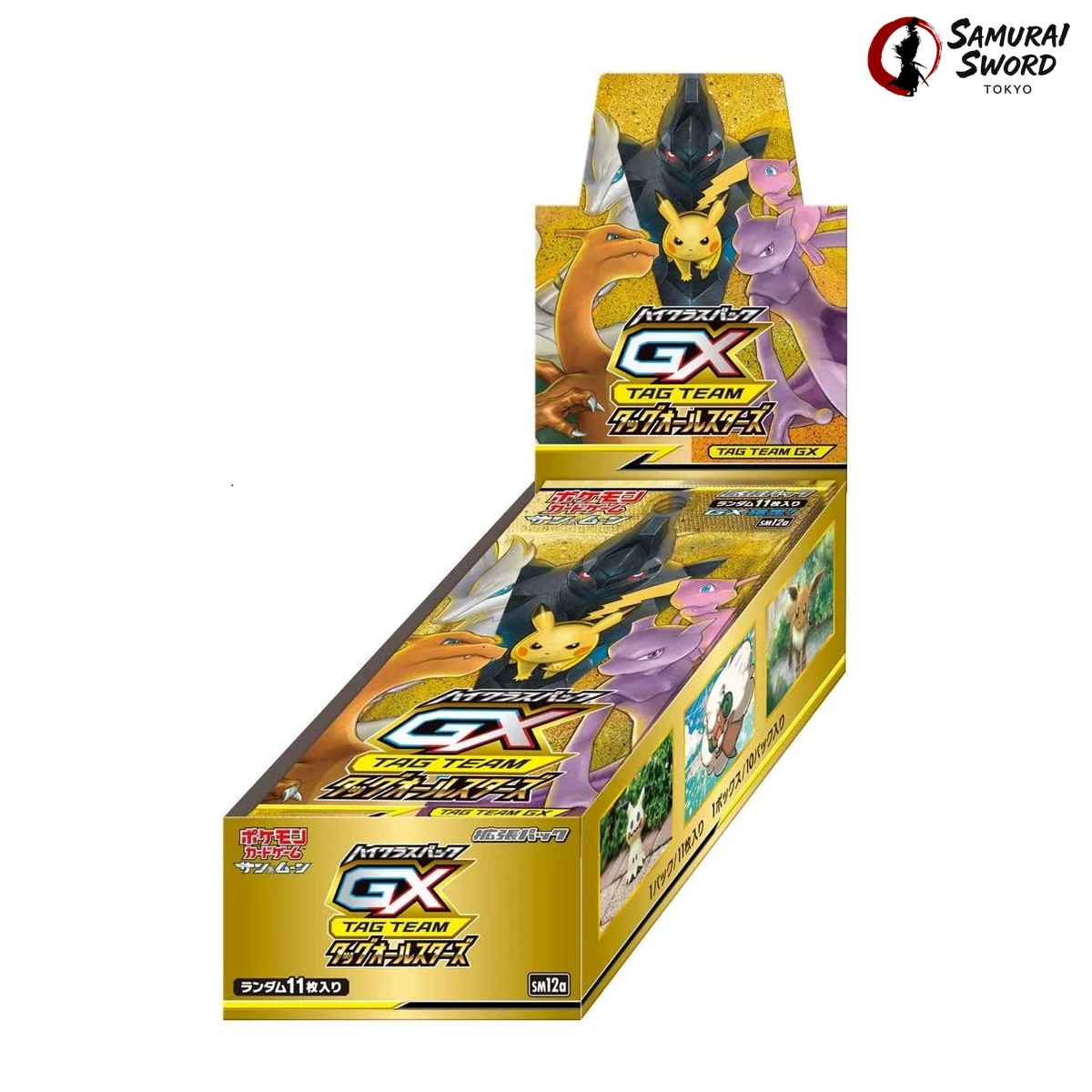
Across the Sun & Moon-era Tag Team GX cards in our catalogue, the print tiers run RR (regular), SR, an SA (Special Art) step above some SRs, and UR — with HR appearing on other GX-era cards too. A single set can carry a Tag Team GX Pokemon at more than one of these tiers, each printed as a separate card with its own number. SM12a “Tag All-Stars” is a clean example of the full ladder in one set:

Tier Kaart Number Currently listed at
RR Dedenne GX 048/173 ¥12,979 (~$82)
SR Dedenne GX 175/173 ¥62,330 (~$392)
UR Lucario & Melmetal GX 224/173 ¥30,800 (~$194)
UR Pikachu & Zekrom GX 221/173 ¥155,288 (~$977)

Dedenne GX is the plainest illustration of the ladder on its own: the same Pokemon appears as an RR at 048/173 and again as an SR at 175/173, at roughly 5x the price. The two URs at the bottom of the table make a second point — Lucario & Melmetal GX and Pikachu & Zekrom GX sit at the identical UR tier, yet their listed prices are more than five times apart. The letter marks the print tier, not a fixed price; the Pokemon and the specific card decide the number from there.

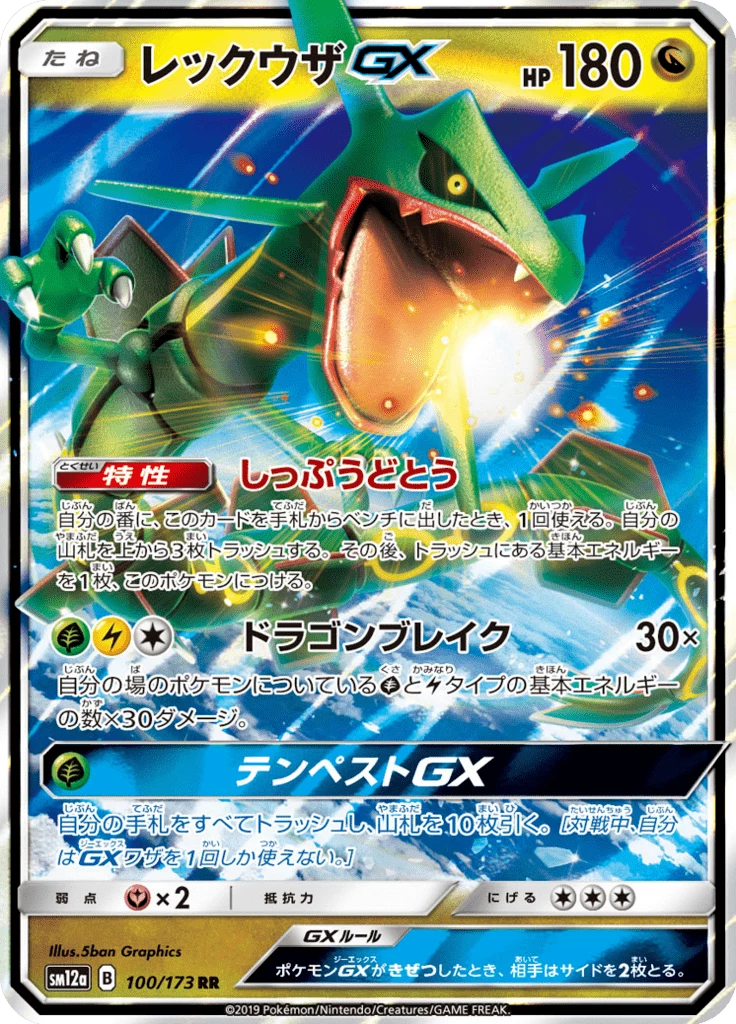
SM12a Tag All-Stars Japanese card, card #100
A card from Tag All-Stars (SM12a), the set used for the rarity ladder above

Same Card, Two Numbers: How the SA Print Tier Works

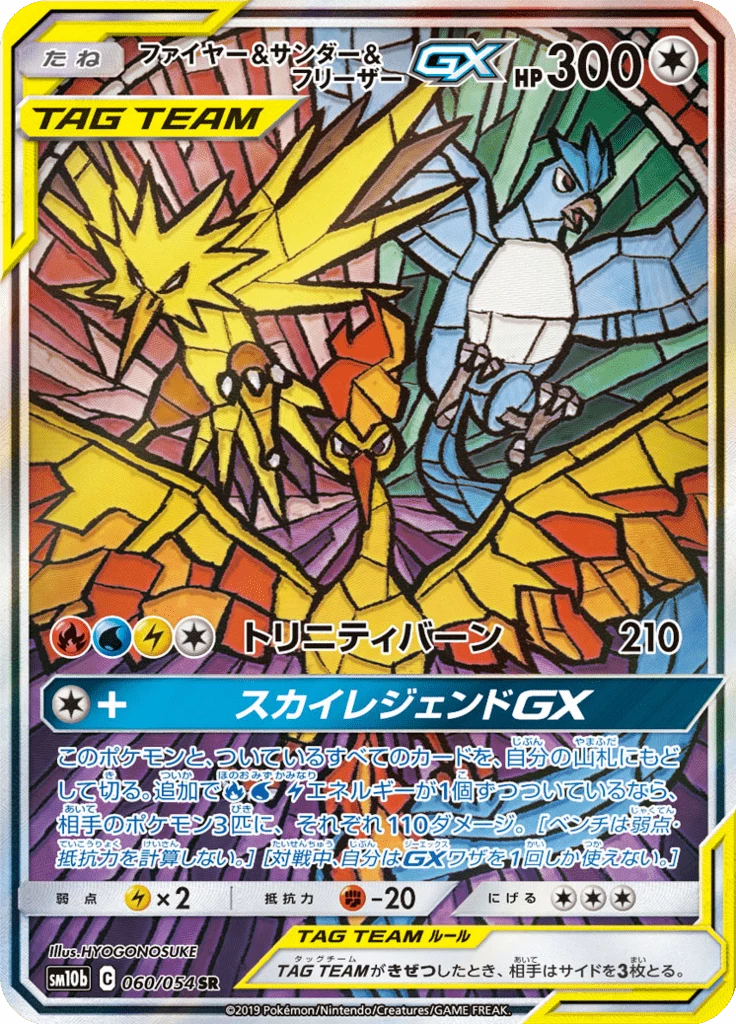
SA stands for Special Art, and it sits above a regular SR as an extra, higher print tier for the same card. The clearest verified example in our stock comes from Sky Legend (SM10b): Moltres & Zapdos & Articuno GX exists as a regular SR at #059/054 and again as an SA at #060/054 — the very next number in the set.

Print Number Currently listed at
SR (regular) 059/054 ¥62,540 (~$393)
SR:SA (Special Art) 060/054 ¥657,968 (~$4,138)

In this verified pair, the SA print is numbered one slot above its regular-SR sibling and is currently listed at more than ten times the price. We’ve checked this exact pair against our own catalogue, but we haven’t re-verified every SA/SR pair across the Sun & Moon era, so treat it as a confirmed example of the pattern rather than a rule that applies to every set automatically. If you’re trying to identify a Tag Team GX card, checking the number against the set’s total card count is the fastest way to tell an SA from its regular SR sibling.

Which Sun & Moon Sets Carry TAG TEAM GX Cards

Several Japanese Sun & Moon sets carry TAG TEAM GX cards after the SM9 Tag Bolt debut:

Set JP release Main-set size
SM11a — Remix Bout 5 July 2019 73 cards
SM11b — Dream League 2 August 2019 68 cards
SM12a — Tag All-Stars 4 October 2019 173 cards

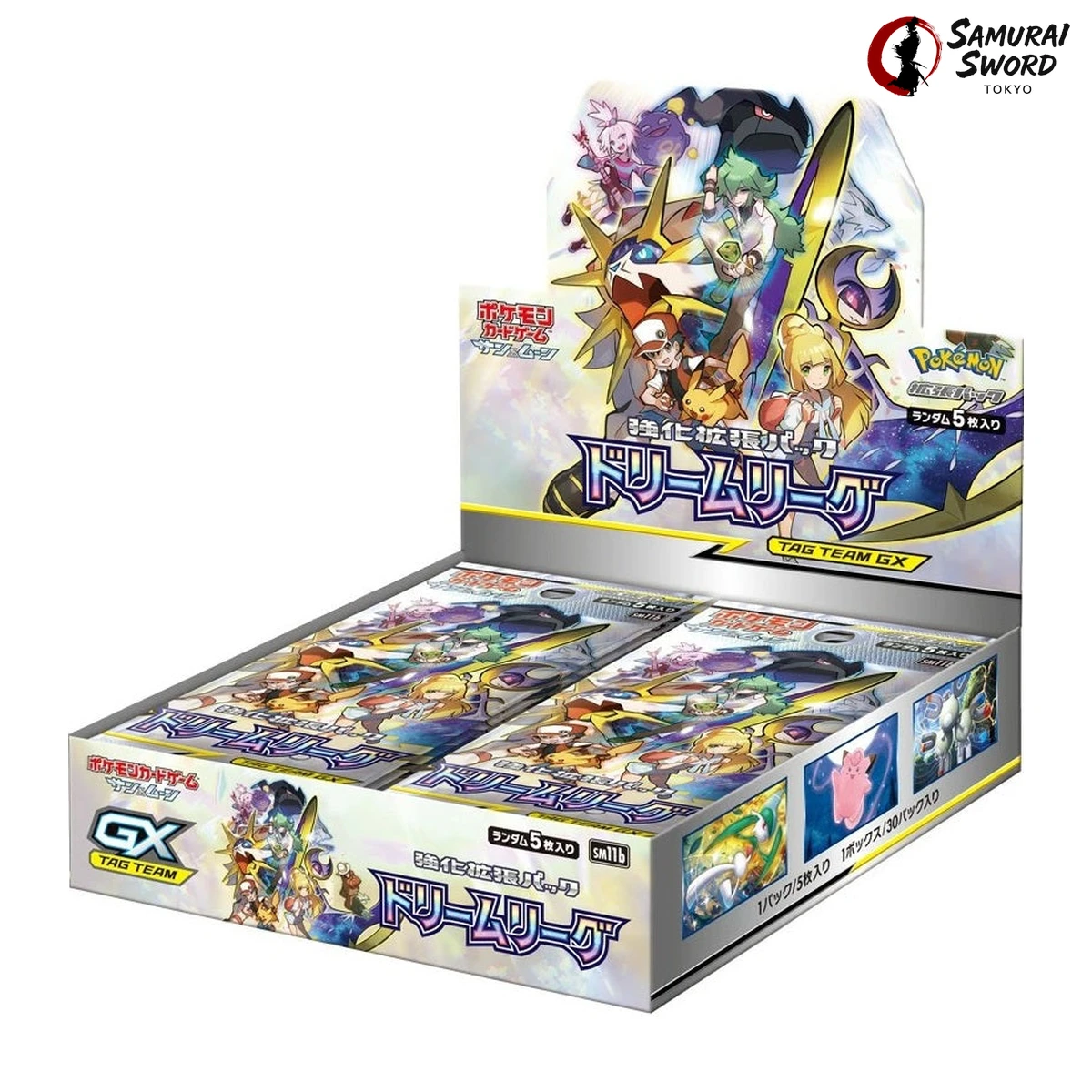
Remix Bout and Dream League are enhanced-expansion sets, and it’s worth knowing they aren’t exclusively Tag Team GX releases — both also carry single-Pokemon GX cards. Dream League, for example, includes Vileplume GX HR at #069/049 and Silvally GX RR at #041/049, and neither is a Tag Team card. For the complete Remix Bout print run, see our SM11a Remix Bout card list.

For the single-GX cards those two sets carry, our PSA10 Vileplume GX HR is currently listed at ¥18,128 (~$114), and our PSA10 Silvally GX RR is currently listed at ¥11,800 (~$74). For the era’s wider release context, our Sun & Moon era collector guide covers the full run of sets, and our Mewtwo GX card guide is a deep dive into one specific single-Pokemon GX print if you want to see how a non-Tag-Team GX card is documented print by print.

Where to Buy GX and TAG TEAM GX Cards from Tokyo

We ship Japanese sealed product and graded singles worldwide out of Tokyo with tracked delivery. If you want the cards from the rarity ladder above sealed, the three Sun & Moon boxes covered here are the direct route: SM11A Remix Bout at ¥141,750 (~$892), SM11B Dream League at ¥170,100 (~$1,070), and SM12A Tag All-Stars at ¥207,900 (~$1,308).

For graded singles, PSA10 Lucario & Melmetal GX UR is currently listed at ¥30,800 (~$194), PSA10 Pikachu & Zekrom GX UR at ¥155,288 (~$977), and PSA10 Moltres & Zapdos & Articuno GX SR:SA at ¥657,968 (~$4,138). Browse the full PSA10 graded card collection or the Japanese Pokemon booster box collection for more, or use Snel bestellen to build a mixed order of sealed boxes and singles in one pass.

Two more sibling guides worth reading before you buy: our Lucario & Melmetal GX card guide covers the SM12a UR print in full, and our Tag All-Stars booster box buying guide covers what’s inside an SM12a box beyond the cards listed above. Our Dream League booster box buying guide does the same for SM11b.

Shop This Era
SM12A Tag All-Stars Japanese Pokemon Booster Box
Currently listed at ¥207,900 (~$1,308)
Ships from Tokyo · Tracked delivery

View Product →

Veelgestelde vragen

What is a Pokemon GX card?

A Pokemon-GX card is a card type introduced in the Sun & Moon expansion era (2017–18) that carries one GX attack, usable only once per game, in addition to its normal attacks. Knocking one out gives the opponent 2 Prize cards instead of the usual 1.

What is a TAG TEAM GX card?

A TAG TEAM GX card combines two or three Pokemon that share at least one type on a single card. TAG TEAM GX Pokemon are always treated as Basic Pokemon, carry elevated HP, and give up 3 Prize cards when Knocked Out. Their GX attacks are marked with a “+” bonus-effect symbol.

How many Prize cards does a TAG TEAM GX card give up when it’s Knocked Out?

Three — one more than a regular Pokemon-GX card (2) and three times a normal Pokemon (1).

What is the difference between a regular SR and an SA (Special Art) Tag Team GX card?

SA sits above a regular SR as a separate, higher print tier of the same card. In our verified example from Sky Legend (SM10b), the SA print of Moltres & Zapdos & Articuno GX is numbered directly above its regular SR sibling and is currently listed at more than ten times the price.

Which Japanese set introduced TAG TEAM GX cards?

SM9, Tag Bolt, is the earliest confirmed Japanese set carrying TAG TEAM GX cards.

Are Dream League and Remix Bout TAG TEAM GX sets?

They carry TAG TEAM GX cards, but they aren’t exclusively Tag Team releases. Both are enhanced-expansion sets that also include single-Pokemon GX cards — Dream League, for example, carries Vileplume GX HR and Silvally GX RR, neither of which is a Tag Team card.

Shiny Dragonite Card Guide: de Master Ball Mirror-print van Pokemon Card 151 (SV2a)

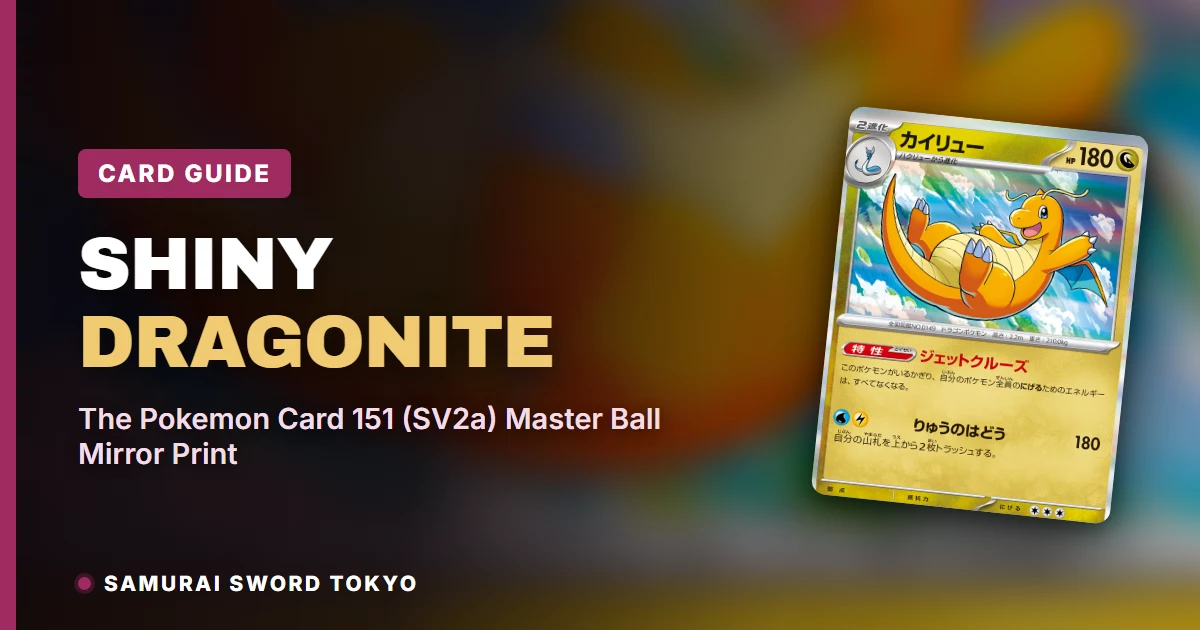
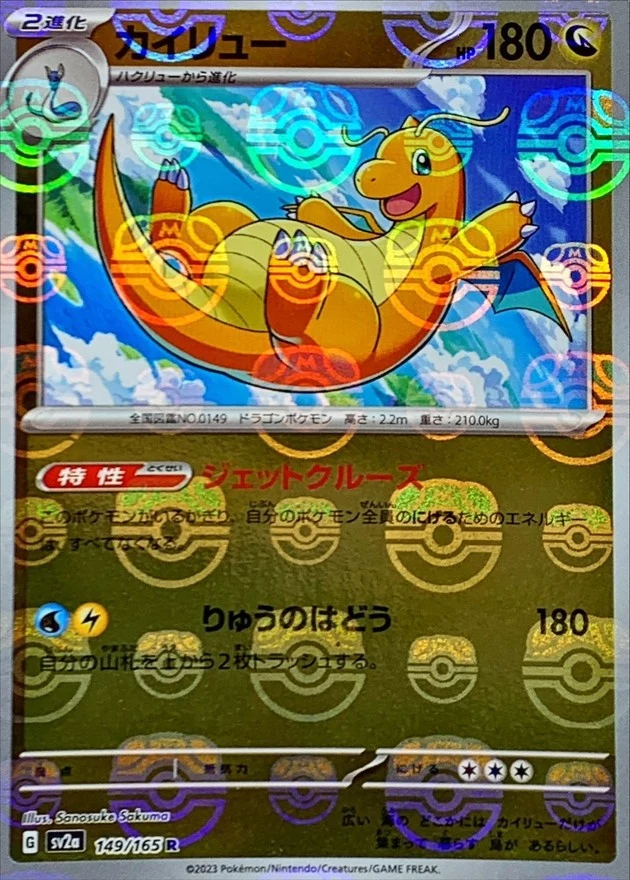
This guide covers a Dragonite Japanese single that isn’t from a Dragon-type showcase set — it’s a foil variant buried inside a nostalgia release built around the original 151 Pokemon. In SV2a, the Japanese expansion pack Pokemon Card 151, every Rare-tier card can be pulled in a standard foil or, far more rarely, in a distinct silver-and-purple parallel called Master Ball Mirror. Dragonite’s Master Ball Mirror print is the version this guide is built around.

This guide covers Dragonite No. 149/165, Rare, Master Ball Mirror, from Pokemon Card 151 (SV2a): what the card looks like, how the Master Ball Mirror mechanic works, where the set sits in the Scarlet & Violet era, and how it compares with the English 151 release. A PSA 10 graded example of this exact print is currently listed on our site, shipped from Tokyo.

Key Takeaways

Dragonite 149/165 Rare, Master Ball Mirror, from Pokemon Card 151 (SV2a) — a PSA 10 graded example is currently listed at ¥31,718 (~$199). The parallel shares its card number and base rarity with the standard Poké Ball Mirror foil of the same card; it is not a separate card number or rarity code. Pokemon Card 151 released in Japan on 16 June 2023 with 210 total cards, and the sealed SV2A-Pokemon 151 Japanese Pokemon Booster Box — currently listed at ¥43,860 (~$276) — is the box both foils are pulled from.

180
HP

Rare
Rarity (149/165)

210
Set Size (SV2a)

Jun 2023
Japan Release

Prices below are current samuraiswordtokyo.com listings, converted at ¥159/USD (September 2026).

The Card: Dragonite 149/165 Rare (Master Ball Mirror)

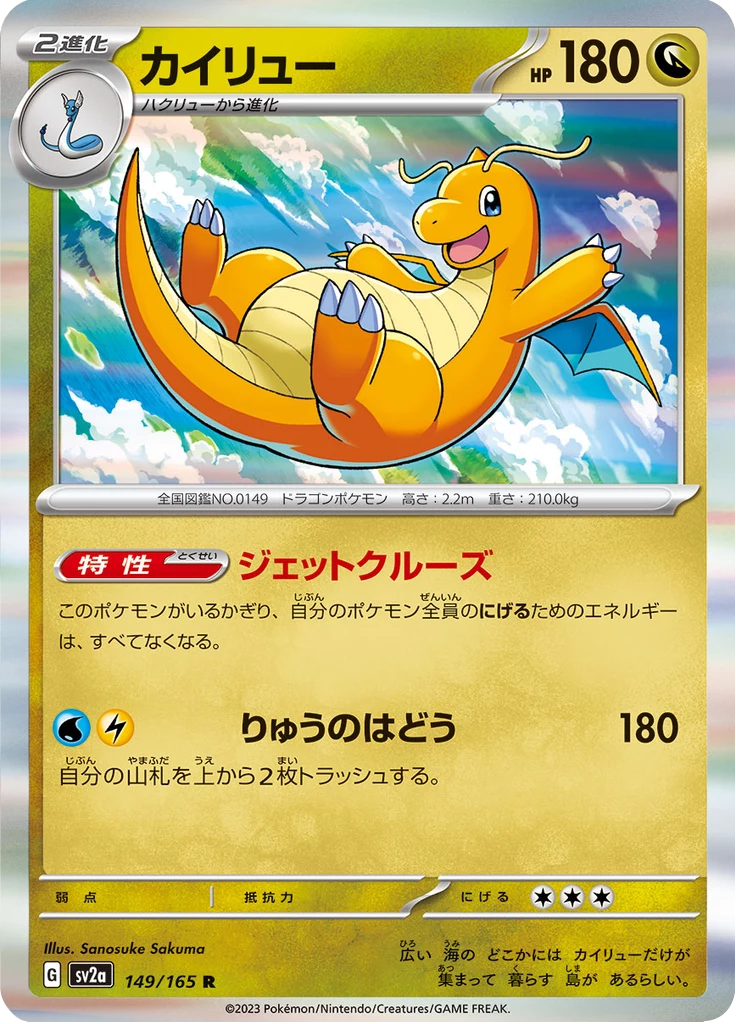
Dragonite — カイリュー (Kairyu) in Japanese — is a Dragon-type Pokemon card carrying 180 HP. In Pokemon Card 151 (SV2a), it is numbered 149/165 as a Rare, illustrated by Sanosuke Sakuma. The set’s main numbering runs to 165, though secret and parallel-rarity slots print above that count — a standard convention across modern Japanese Scarlet & Violet-era sets.

Dragonite 149/165, Rare, Pokemon Card 151 (SV2a), base print
Dragonite 149/165, Rare — Pokemon Card 151 (SV2a), base print before Master Ball Mirror foiling

SV2a introduced a rarity mechanic unique to that set: every Common, Uncommon, and Rare card can be pulled either as a standard Poké Ball Mirror foil or, far more rarely, as a Master Ball Mirror foil — a distinct silver-and-purple foil pattern. Both finishes share the same card number and the same base rarity; Master Ball Mirror is a parallel foil of the Rare, not a separate numbered card or rarity code. Dragonite’s Master Ball Mirror is the print this guide is centred on.

PSA 10 Dragonite Master Ball Mirror 149/165 slab, listed on samuraiswordtokyo.com

A PSA 10 graded example of this Master Ball Mirror print is currently listed at ¥31,718 (~$199).

The Set: Pokemon Card 151 (SV2a)

Pokemon Card 151 — 強化拡張パック「ポケモンカード151」 (Enhanced Expansion Pack “Pokemon Card 151”) in Japanese — is set code SV2a, released in Japan on 16 June 2023 with 210 total cards. It is a Scarlet & Violet-era enhanced expansion built entirely around the original 151 Pokemon, reintroducing classic species like Dragonite alongside the Poké Ball Mirror / Master Ball Mirror foil mechanic described above.

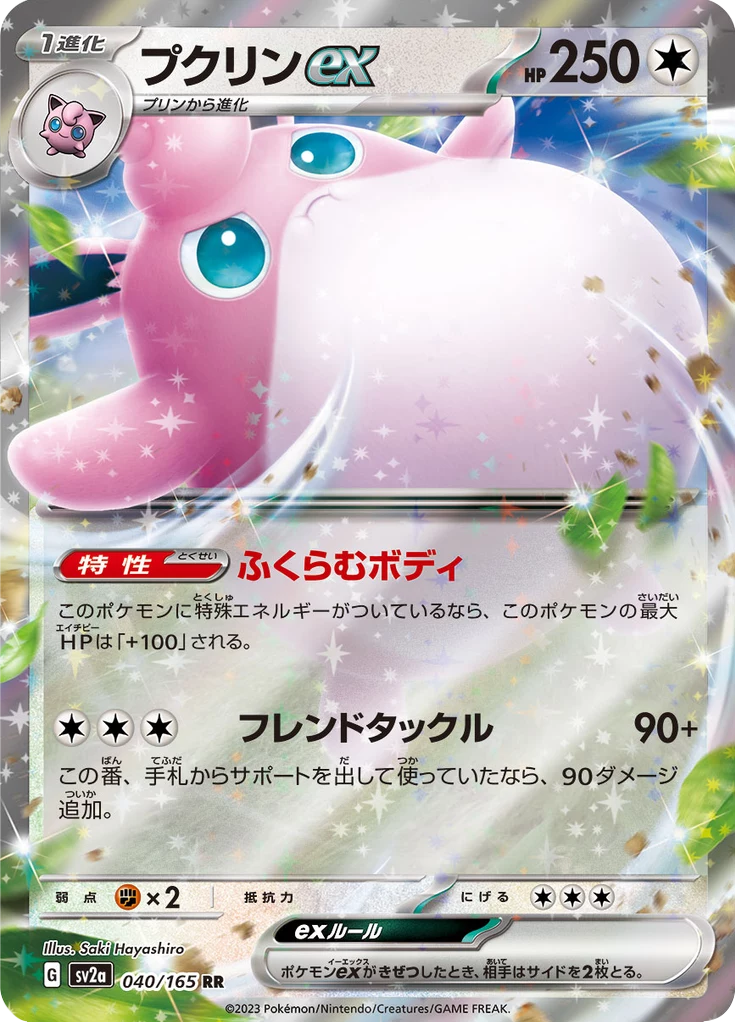
Wigglytuff ex, Pokemon Card 151 (SV2a)

Wigglytuff ex (SV2a, number not re-verified)

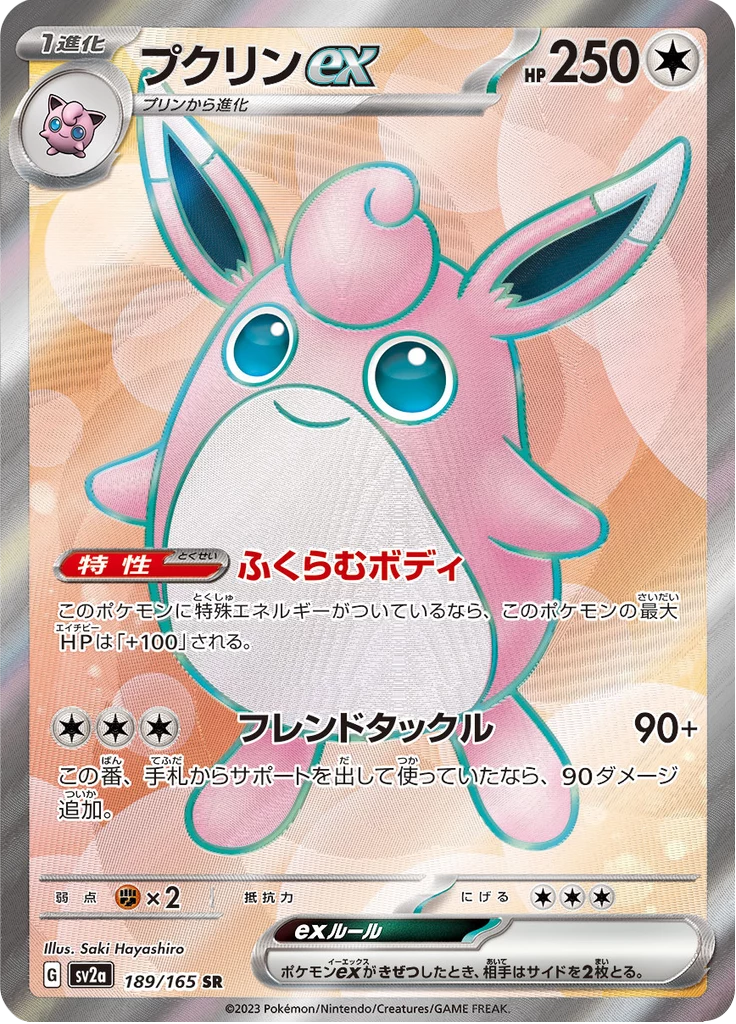
Wigglytuff ex, Pokemon Card 151 (SV2a)

Wigglytuff ex (SV2a, number not re-verified)

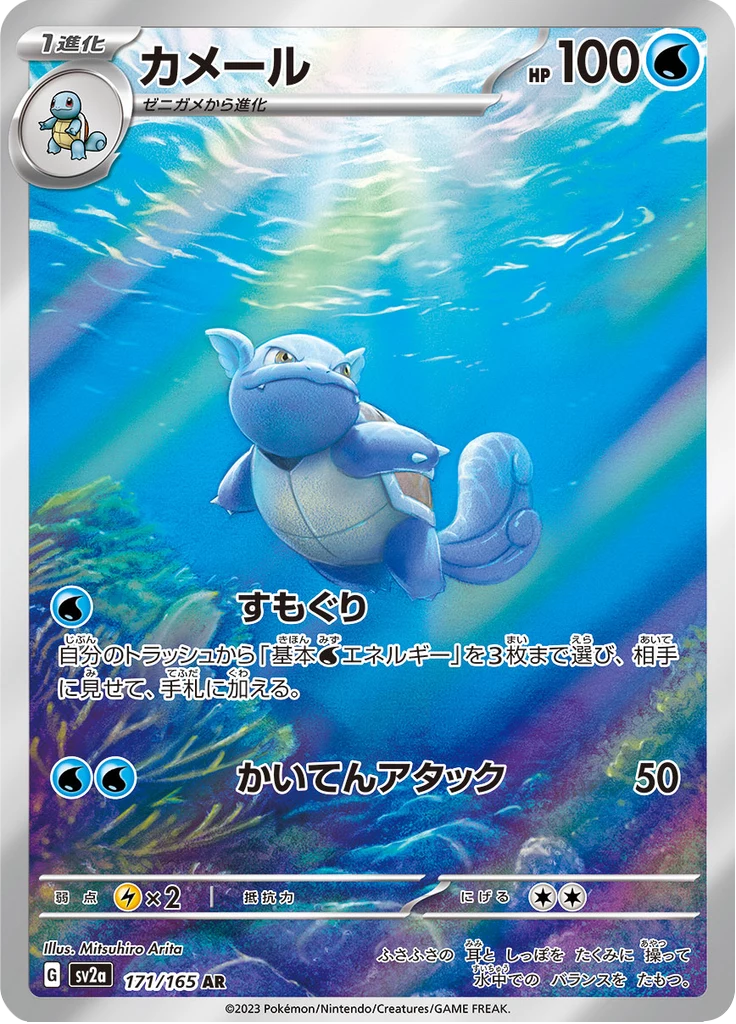
Wartortle, Pokemon Card 151 (SV2a)

Wartortle (SV2a, number not re-verified)

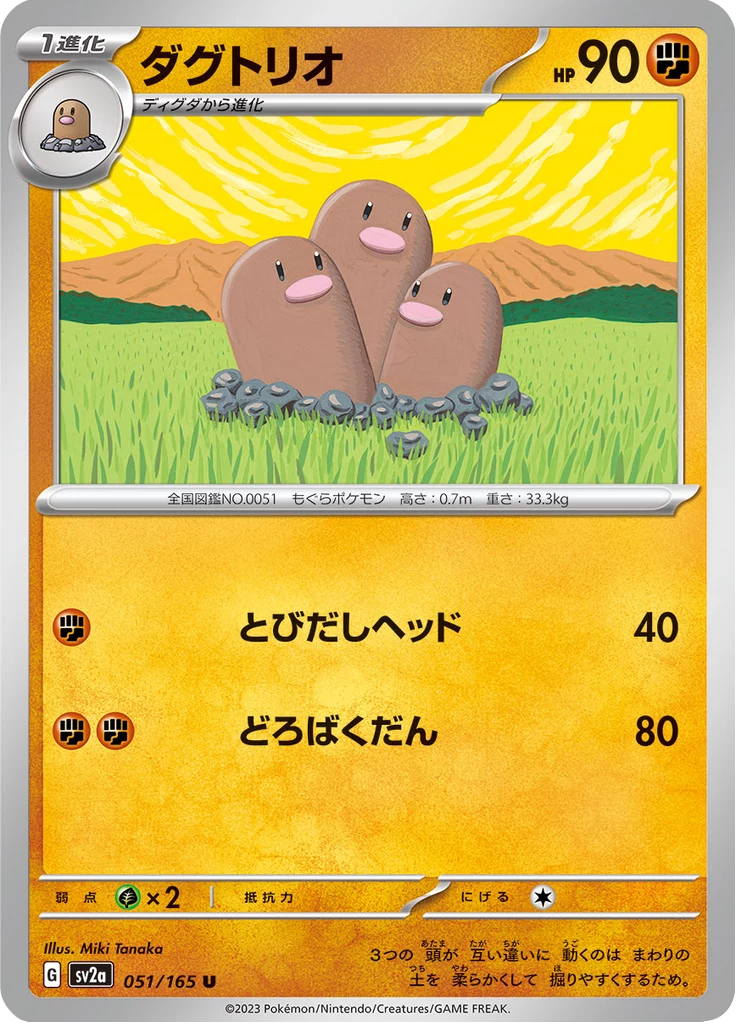
Dugtrio, Pokemon Card 151 (SV2a)

Dugtrio (SV2a, number not re-verified)

Those four prints are shown for set-wide context against Dragonite’s own Rare-tier Master Ball Mirror; their card numbers and rarity tiers haven’t been individually re-verified for this guide. Sealed SV2a product is the source for the Master Ball Mirror pull: the SV2A-Pokemon 151 Japanese Pokemon Booster Box is currently listed at ¥43,860 (~$276).

For how this set’s box stacks up against other 151-era Pokemon releases, see our Pokemon 151 vs Shiny Treasure ex box guide and our Pokemon 151 vs VSTAR Universe box guide.

Japanese vs English Print

Pokemon Card 151 has a direct English-language equivalent: 151, released 22 September 2023 with 207 cards. Dragonite is numbered #149 in the English set too, using the same core numbering scheme as the Japanese release.

The Master Ball Mirror foil, however, is exclusive to the Japanese, Korean, and Traditional Chinese prints of SV2a — the English 151 release does not carry a Master Ball Mirror parallel of this card. That means the print covered in this guide has no matching English-language finish: collectors sourcing the Master Ball Mirror foil are sourcing a Japanese-market-exclusive parallel, not an import alternative to an English card already available in that finish.

Where the Master Ball Mirror Sits in Japanese Rarity Tiers

On paper, Dragonite 149/165 is a base Rare — one of the more common rarity tiers in a modern Japanese set. What separates the Master Ball Mirror print from an ordinary Rare pull is the foil mechanic layered on top: it is a far rarer pull than the standard Poké Ball Mirror version of the same card, without moving the card up to a Secret Rare or Special Art Rare slot in the set’s own numbering.

For comparison, SV2a’s Secret Rare slots sit in a numbered position above the set’s base count of 165, a structurally different tier from a Master Ball Mirror parallel of a Rare. Numbered secret slots and mirror-foil parallels are separate rarity systems within the same set, and they can each apply to different cards.

For where Dragonite’s other Japanese chase prints sit by comparison, see our Mega Dragonite card guide and our wider Dragon-type Pokemon cards guide.

Shop This Set
SV2A-Pokemon 151 Japanese Pokemon Booster Box
Currently listed at ¥43,860 (~$276)
Ships from Tokyo · Tracked delivery

View Product →

Where to Buy Shiny Dragonite Cards from Tokyo

Our graded PSA 10 Dragonite Master Ball Mirror 149/165 is currently listed at ¥31,718 (~$199), shipped from Tokyo with tracked delivery. If you would rather chase your own Master Ball Mirror pull, sealed SV2A-Pokemon 151 Japanese Pokemon Booster Boxes are currently listed at ¥43,860 (~$276) and are the source product for both the Poké Ball Mirror and Master Ball Mirror foils.

For Dragonite’s wider Japanese print run, see our Dragonite card guide and Mega Dragonite card guide; for the SV2a set itself against other 151-era boxes, see our Pokemon 151 vs Shiny Treasure ex and Pokemon 151 vs VSTAR Universe comparisons. Browse the full range in our PSA 10 graded card collection or the Pokemon card box collection, and for a mixed order across singles and sealed product, our Quick Order page is the fastest way to build a cart.

Veelgestelde vragen

What is the shiny Dragonite Master Ball Mirror card?

It is the Master Ball Mirror parallel foil of Dragonite No. 149/165, Rare, from the Japanese expansion pack Pokemon Card 151 (SV2a). It shares its card number and base rarity with the standard Poké Ball Mirror print of the same card. A PSA 10 graded example is currently listed at ¥31,718 (~$199).

Is Master Ball Mirror a separate rarity or card number?

No. It is a parallel foil applied to Common, Uncommon, and Rare cards in SV2a. Dragonite’s Master Ball Mirror keeps the same 149/165 number and Rare base rarity as the standard Poké Ball Mirror print — it is not a distinct rarity code.

Does the English 151 set have a Master Ball Mirror Dragonite?

No. The Master Ball Mirror foil is exclusive to the Japanese, Korean, and Traditional Chinese prints of SV2a. Dragonite is numbered #149 in the English 151 set too, but that release does not carry a Master Ball Mirror parallel.

What set is this Dragonite print from?

Pokemon Card 151, Japanese set code SV2a, released 16 June 2023 with 210 total cards — a Scarlet & Violet-era expansion built around the original 151 Pokemon.

Where can I buy the shiny Dragonite card from Tokyo?

Our graded PSA 10 Master Ball Mirror example is currently listed at ¥31,718 (~$199). Sealed SV2A-Pokemon 151 Japanese Pokemon Booster Boxes, currently listed at ¥43,860 (~$276), are the source product for both foils, shipped from Tokyo with tracked delivery.

Yu-Gi-Oh 20th Secret Rare vs Ghost Rare: de Japanse OCG-zeldzaamheid uitgelegd

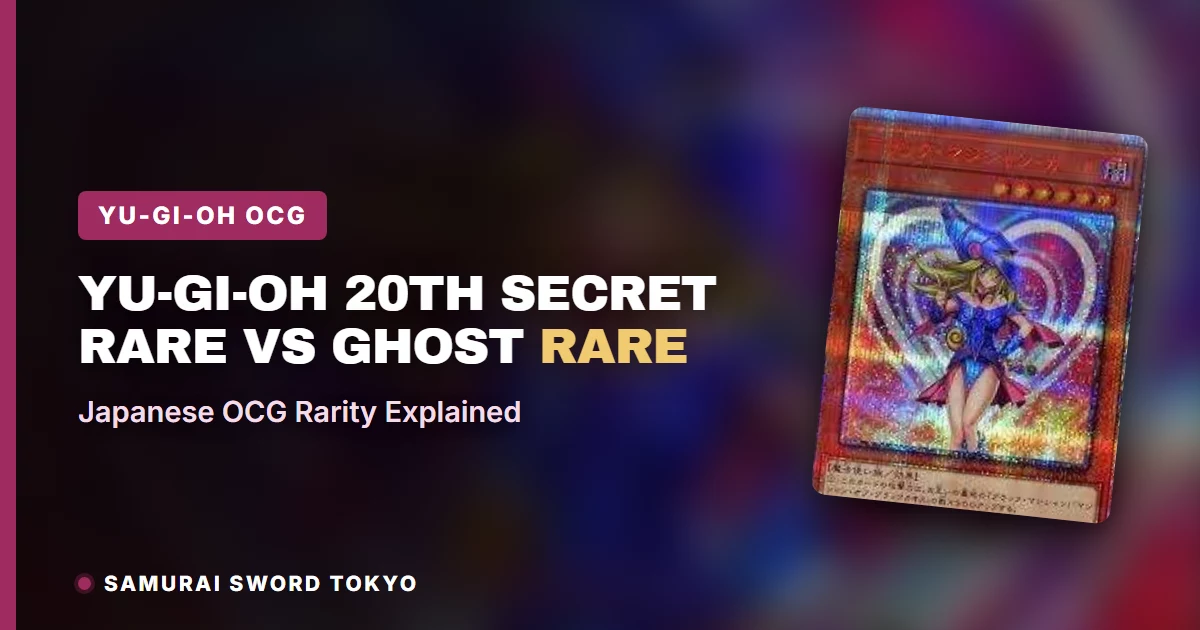
20th Secret Rare and Ghost Rare get mixed up constantly, and the confusion is understandable — both are foil treatments with “secret rare”-adjacent shine, and both sit near the top of their respective rarity ladders. But they come from different sides of the game entirely. 20th Secret Rare is a Japanese OCG-only anniversary foil that ran for a little over two years, from 2018 to 2020. Ghost Rare is a TCG-only rarity that has existed since 2007 and is still a recognised finish today, across two visually distinct generations of its own.

They are not rival tiers competing for the same slot in the same product line, and one did not replace the other. When the OCG retired 20th Secret Rare in 2020, it was replaced by Prismatic Secret Rare — not by Ghost Rare, which continued on as its own separate TCG rarity. This guide lays out what each foil actually is, where 20th Secret Rare showed up in Japanese product, and how the two compare on the points that actually matter for identifying a card.

Key Takeaways

20th Secret Rare (Japanese OCG, 2018–2020) and Ghost Rare (TCG, 2007–present) are separate rarities that never occupied the same slot — 20th SE was retired in April 2020 when Rise of the Duelist introduced Prismatic Secret Rare, not Ghost Rare. No Ghost Rare card is listed on our site at the moment; sourcing requests for one go through Snel bestellen. Two Japanese 20th Secret Rare PSA 10s are currently listed: PSA10 Dark Magician Girl 20th SE at ¥330,400 (~$2,078) and PSA10 Hiita the Fire Charmer, Ablaze 20th SE at ¥145,140 (~$913).

2018
20th Secret Rare’s OCG Debut

2007
Ghost Rare’s TCG Debut

212
20th Secret Rare Cards (Total)

¥159
Per USD (Sept 2026)

Historical rarity facts below are drawn from Yugipedia’s documentation on 20th Secret Rare and Ghost Rare. Yen figures convert at ¥159/USD (September 2026).

20th Secret Rare: A Two-Year Anniversary Foil (2018–2020)

PSA10 Dark Magician Girl 20th SE [20TH-JPC55], 20th Anniversary Legend Collection

20th Secret Rare was introduced in the OCG’s Cybernetic Horizon in 2018 to commemorate the Yu-Gi-Oh! OCG’s 20th anniversary. From there, Konami kept using the foil across a run of anniversary-themed products — including 20th Anniversary Legend Collection, 20th Anniversary Legend Selection and the 20th Secret Rare Special Pack — as well as in ordinary core boosters through 2018 to 2020.

The rarity was discontinued when Rise of the Duelist (April 2020) introduced the visually similar Prismatic Secret Rare as its replacement. The last 20th Secret Rare card ever printed was The Winged Dragon of Ra, in that same Rise of the Duelist booster. Yugipedia lists roughly 212 individual 20th Secret Rare cards across all of these products combined — a small, closed pool tied to a specific two-year window rather than an ongoing rarity.

Our own PSA10 Dark Magician Girl 20th SE currently listed at ¥330,400 (~$2,078), comes from 20th Anniversary Legend Collection — one of the dedicated anniversary products built specifically to carry this foil.

Where 20th Secret Rare Actually Appeared

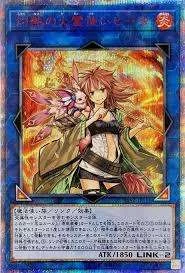
PSA10 Hiita the Fire Charmer, Ablaze 20th SE [SAST-JP056], Savage Strike

20th Secret Rare shows up in two different kinds of Japanese OCG product, and our two anchors happen to cover both:

Product Type Note
Cybernetic Horizon Core booster 20th Secret Rare’s OCG debut, 2018
20th Anniversary Legend Collection Anniversary box Our Dark Magician Girl 20th SE anchor comes from this set
20th Anniversary Legend Selection Anniversary box Dedicated 20th Secret Rare product
20th Secret Rare Special Pack Anniversary pack Dedicated 20th Secret Rare product
Savage Strike (SAST) Core booster Ordinary 2019 core booster; our Hiita the Fire Charmer, Ablaze 20th SE anchor comes from here
Rise of the Duelist Core booster Final 20th Secret Rare card, The Winged Dragon of Ra — rarity replaced by Prismatic Secret Rare from this set onward

Our PSA10 Hiita the Fire Charmer, Ablaze 20th SE currently listed at ¥145,140 (~$913), is the ordinary-booster half of that pattern — it comes from Savage Strike, a regular 2019 OCG core booster that used the 20th Secret Rare foil for just one chase card. Between the two anchors, you can see the rarity appeared both in sets purpose-built around it and as a single high-end insert in a standard release.

Ghost Rare: The TCG’s Long-Running Ghost-Effect Foil

Ghost Rare belongs to the other side of the game. It was introduced in the TCG version of Tactical Evolution in 2007, created as the TCG’s answer to the OCG’s “Holographic Rare” finish. Unlike 20th Secret Rare, it was never tied to an anniversary or a fixed window — it is a visual-effect rarity that Konami has kept using in various TCG sets from 2007 to the present.

The foil itself has changed over time, and Ghost Rare cards fall into two visual generations:

Era Card-name lettering Visual effect
Early Ghost Rare (from 2007) Shiny silver, similar to a Secret Rare Reduced, desaturated artwork colours — a pale, “ghost-like” look, especially when scanned
Newer Ghost Rare (from Crimson Crisis onward) Gold, similar to an Ultra Rare A 3D holographic image effect over the artwork

Konami switched to the newer gold-and-3D treatment starting with Red Dragon Archfiend/Assault Mode in Crimson Crisis. Both eras are still called “Ghost Rare,” but they look different enough on the shelf that the lettering colour alone tells you which generation a given card belongs to.

No Ghost Rare card is listed on our site at the moment. If you’re specifically hunting one, sourcing requests go through Snel bestellen.

20th Secret Rare vs Ghost Rare: The Key Differences

  20th Secret Rare Ghost Rare
Regio OCG only TCG only
Debut Cybernetic Horizon, 2018 Tactical Evolution, 2007
Active window 2018–2020 (about two years, then discontinued) 2007–present, across two visual generations
What it commemorates The OCG’s 20th anniversary Nothing anniversary-specific — an ongoing TCG visual-effect tier
What replaced it Prismatic Secret Rare (Rise of the Duelist, April 2020) Still an active TCG rarity — not retired or replaced
Not the Same Replacement

It’s easy to assume Ghost Rare stepped in when 20th Secret Rare ended, since both sound like top-tier foils from a similar period. That’s not what happened: Prismatic Secret Rare is the card that took over 20th Secret Rare’s slot in the OCG. Ghost Rare is a separate, still-distinct TCG rarity that was never part of that handover.

The two also aren’t really answering the same question for a collector. 20th Secret Rare is an anniversary-commemorative foil treatment tied to a specific, closed era. Ghost Rare is a long-running visual-effect rarity that has simply been reworked once along the way. They can sit side by side in a binder, but they were never competing for the same spot on a checklist.

Where These Two Rarities Sit in the Wider OCG Rarity Story

20th Secret Rare and Prismatic Secret Rare are only one chapter of the OCG’s rarity history. Our Yu-Gi-Oh OCG Rarity Guide: Quarter Century Secret Rare, Prismatic and More picks up the next one — it covers 2023–2025, when Quarter Century Secret Rare temporarily replaced Prismatic Secret Rare before Prismatic returned to the OCG’s standard slot. This article stays focused on the earlier pairing: 20th Secret Rare against Ghost Rare, 2007–2020.

If you want to see how the OCG’s rarity ladder looks in current product, our Limit Over Collection guide covers a modern OCG set built around Collector’s Rare and Ultimate Rare. And for how 20th Secret Rare and other high-end Yu-Gi-Oh cards have performed in documented sales, see our Most Expensive Yu-Gi-Oh Cards guide. We’ve also written dedicated guides to Starlight Rare vs 20th Secret Rare and to Collector’s Rare, if you’re mapping out the full Japanese OCG rarity tree.

Buying 20th Secret Rare and Japanese OCG Product from Tokyo

We ship Japanese Yu-Gi-Oh cards and sealed product out of Tokyo with tracked delivery. Since 20th Secret Rare is a closed, discontinued rarity, what’s available comes down to individual PSA-graded singles rather than sealed boxes — and our site currently lists two of them:

Shop This Card
PSA10 Dark Magician Girl 20th SE [20TH-JPC55] (20th Anniversary Legend Collection)
Currently listed at ¥330,400 (~$2,078)
Ships from Tokyo · Tracked delivery

View Product →

Beyond 20th Secret Rare specifically, Japanese OCG product continues well past 2020 — current sealed boxes carry Prismatic Secret Rare and other modern tiers instead.

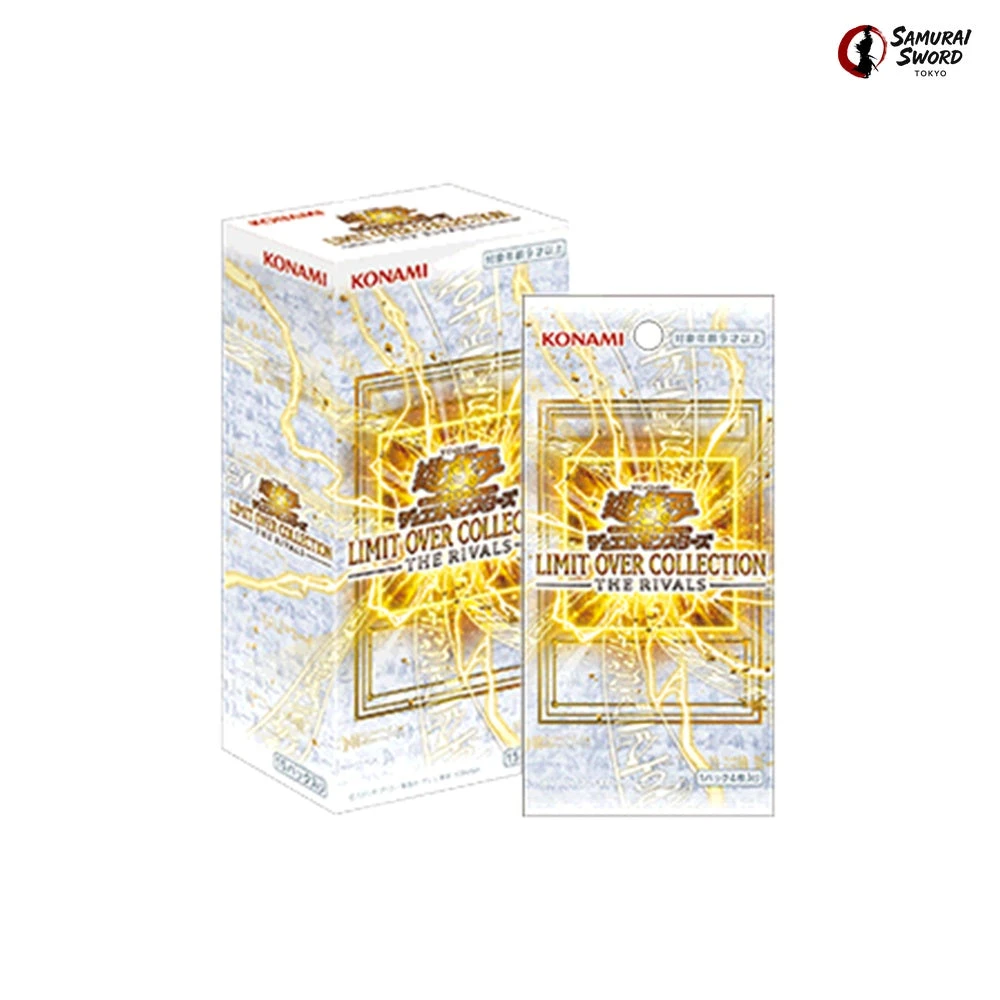
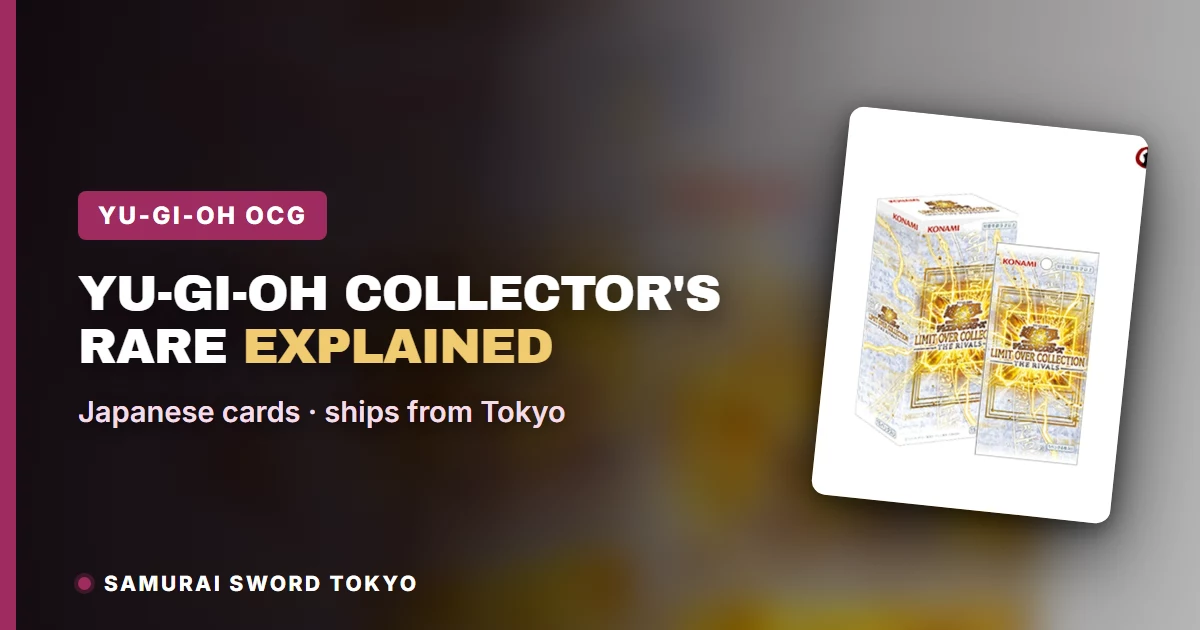
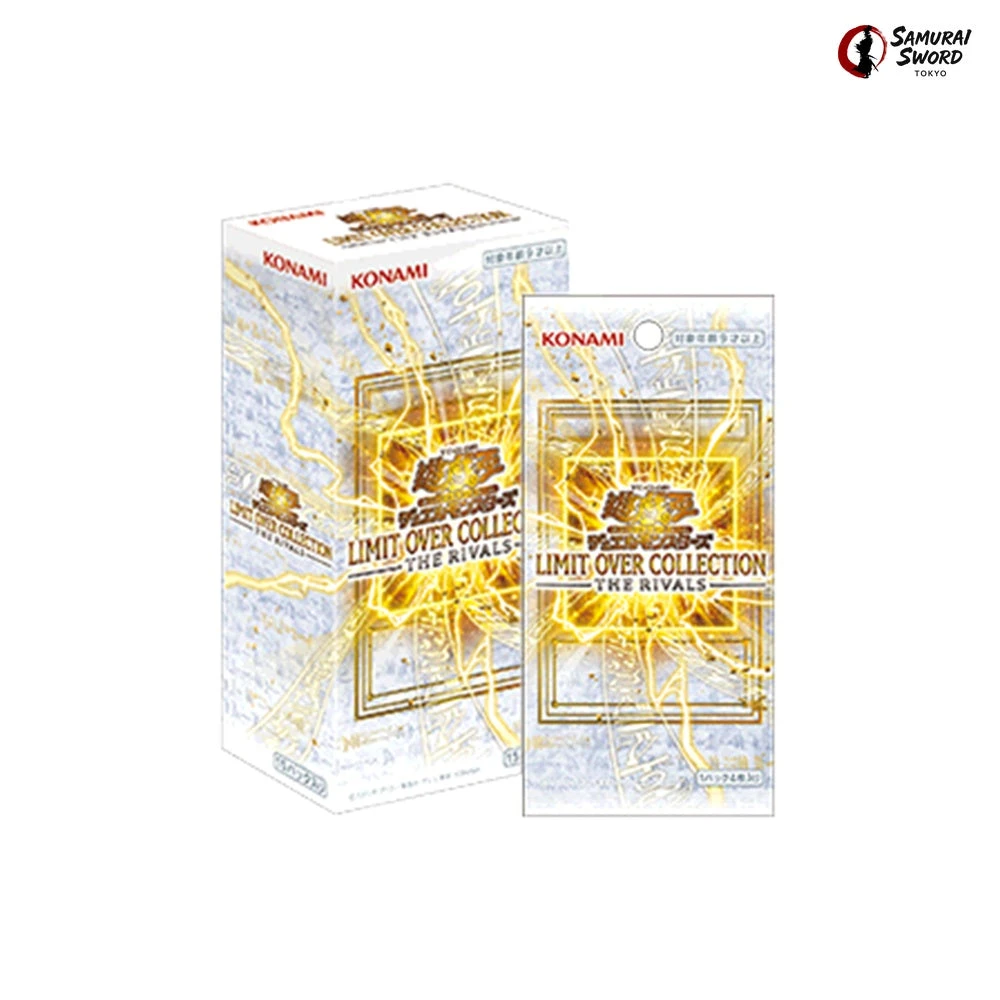
LOCR Limit Over Collection: The Rivals, a currently listed Japanese Yu-Gi-Oh OCG booster box
A currently listed Japanese Yu-Gi-Oh OCG booster box — not a 20th Secret Rare or Ghost Rare product, shown here as an example of current sealed Japanese OCG product.

For other PSA 10 graded Japanese cards, browse our PSA 10 graded card collection. For anything not listed — including a Ghost Rare single, or a specific 20th Secret Rare card outside the two above — sourcing requests go through Snel bestellen.

Veelgestelde vragen

What’s the difference between 20th Secret Rare and Ghost Rare?

20th Secret Rare is a Japanese OCG-only anniversary foil that ran from Cybernetic Horizon (2018) to Rise of the Duelist (2020). Ghost Rare is a TCG-only visual-effect rarity that has run since Tactical Evolution (2007) and is still in use today. They’re unrelated rarities from different sides of the game — not competing tiers in the same product line.

When was 20th Secret Rare introduced and discontinued?

It was introduced in the OCG’s Cybernetic Horizon in 2018 to mark the Yu-Gi-Oh! OCG’s 20th anniversary, and discontinued when Rise of the Duelist (April 2020) introduced Prismatic Secret Rare in its place. The last 20th Secret Rare card printed was The Winged Dragon of Ra, in that same Rise of the Duelist booster.

Is Ghost Rare still used in current Yu-Gi-Oh sets?

Ghost Rare has run in TCG sets from 2007 to the present, across two visual generations — an early silver-lettering, desaturated-art version, and a later gold-lettering, 3D-holographic version starting with Crimson Crisis. It has not been discontinued the way 20th Secret Rare was.

Did Prismatic Secret Rare replace Ghost Rare?

No. Prismatic Secret Rare replaced 20th Secret Rare in the OCG when Rise of the Duelist released in April 2020. Ghost Rare is a separate TCG rarity that was not affected by that change.

How many 20th Secret Rare cards exist?

Yugipedia lists roughly 212 individual 20th Secret Rare cards across all the products that used the rarity, including dedicated anniversary sets and ordinary core boosters between 2018 and 2020.

Do you have a Ghost Rare card listed on your site?

Not at the moment. We currently list two Japanese 20th Secret Rare PSA 10s — Dark Magician Girl 20th SE and Hiita the Fire Charmer, Ablaze 20th SE. Sourcing requests for a Ghost Rare card go through Quick Order.

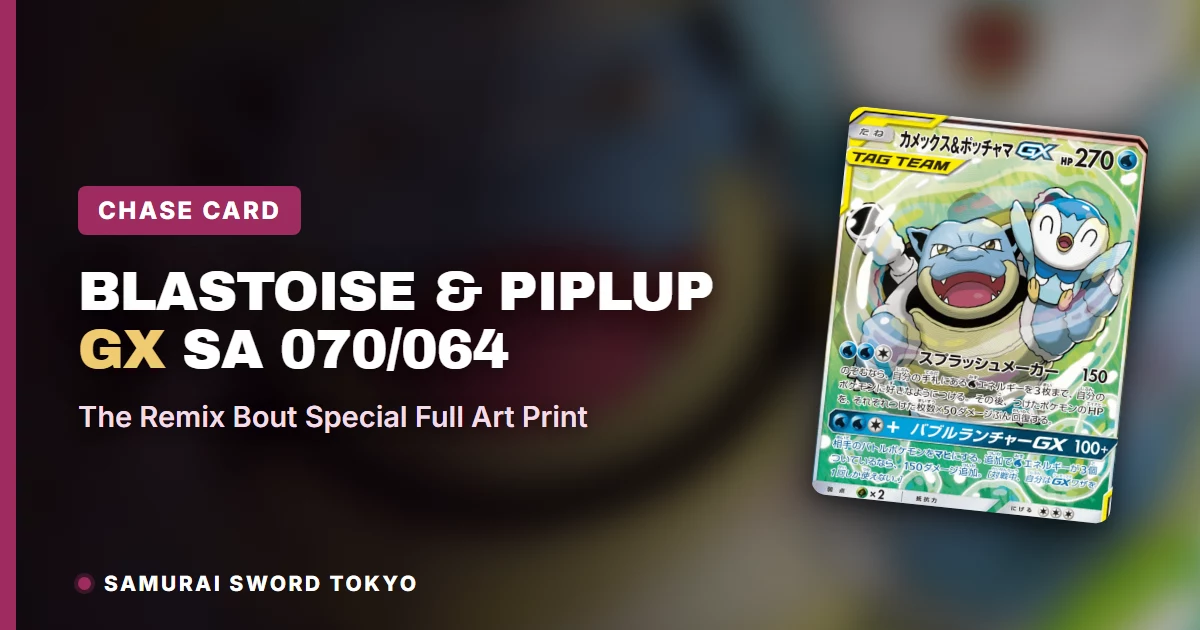
Blastoise & Piplup GX SA 070/064 kaartgids: De Special Full Art-print uit Remix Bout

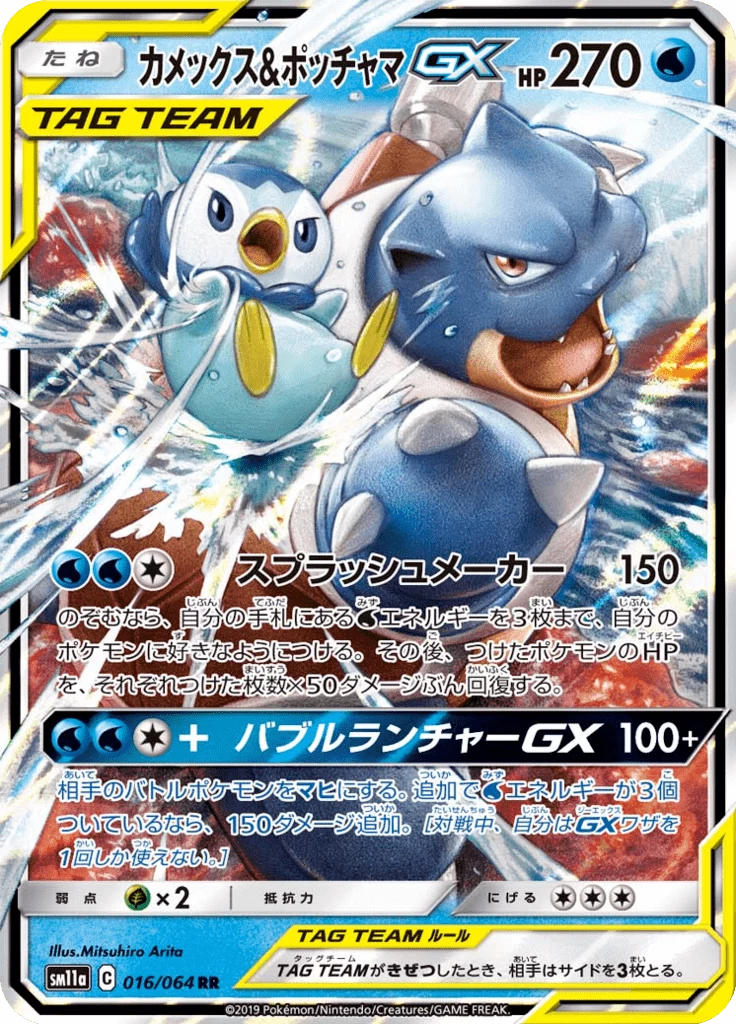
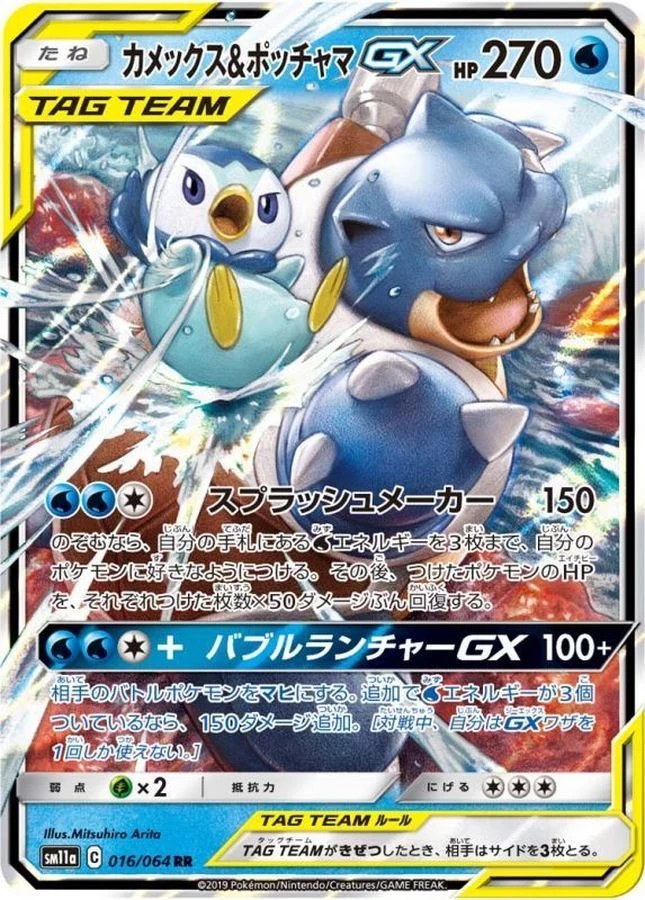
Blastoise & Piplup-GX comes from one Japanese set, but it exists across four separate treatments inside it — a regular rare, two Full Art tiers, and a Rainbow Rare secret. This guide focuses on the Special Full Art print this store lists in PSA 10, and walks through where it sits among its three siblings.

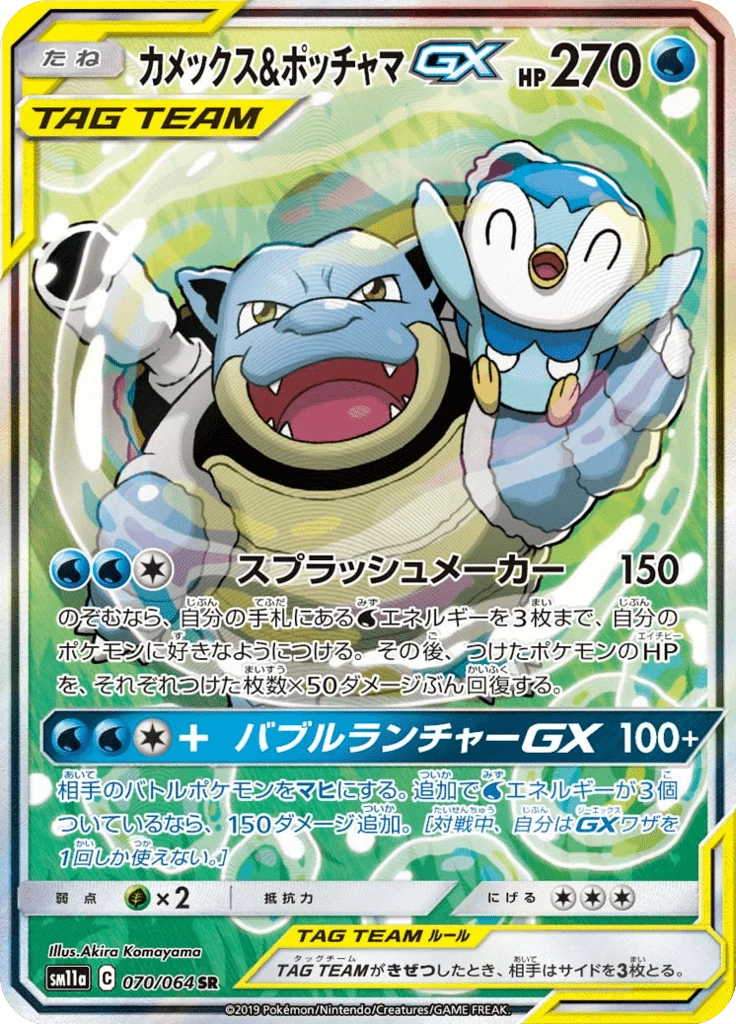
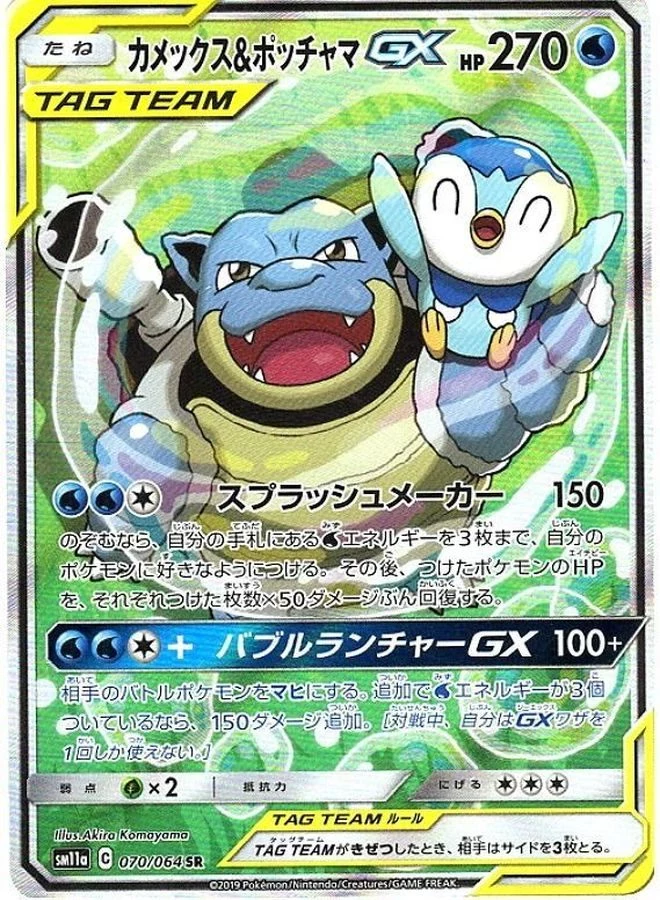
The card is Blastoise & Piplup-GX, No. 070/064, printed as a Special Full Art in the Japanese Enhanced Expansion Pack “Remix Bout” (set code SM11a). This store defines that print as the “SA” — the Special Full Art treatment — and currently lists a PSA 10 copy of it, graded and shipped from Tokyo. Below: the card itself, its full four-print history, the set it comes from, how it maps onto its English Cosmic Eclipse equivalent, and where this print sits among Remix Bout’s rarity tiers.

Key Takeaways

Blastoise & Piplup-GX SA 070/064 is a PSA 10, currently listed at ¥187,974 (~$1,182). It is one of four documented Japanese prints of this card from the Enhanced Expansion Pack “Remix Bout” (SM11a), and it is the print this store defines as the “SA.” The regular-tier sibling, PSA 10 RR 016/064, is currently listed at ¥21,046 (~$132).

270
HP

SA
Rarity (070/064)

73
Set Size (SM11a)

4
JP Prints of This Card

Prices below are current samuraiswordtokyo.com listings, converted at ¥159/USD (September 2026).

The Card: Blastoise & Piplup GX 070/064 SA

Blastoise & Piplup-GX is a Tag Team-GX card, Water type, with 270 HP. The 070/064 print is illustrated by Akira Komayama, and its position at #070 in a set whose cards are numbered against a 064 denominator places it outside the main numbered run — the standard convention in this generation of Japanese sets for marking a secret or special slot rather than part of the main checklist.

Blastoise & Piplup GX SA 070/064, Remix Bout (SM11a)
Blastoise & Piplup GX SA 070/064 — Remix Bout (SM11a), illustrated by Akira Komayama

Our own graded copy of this print is currently listed at ¥187,974 (~$1,182), PSA 10.

PSA 10 Blastoise & Piplup GX SA 070/064 slab, listed on samuraiswordtokyo.com

The Set: Remix Bout (SM11a)

Remix Bout — the Enhanced Expansion Pack — carries the set code SM11a. Its own card-list hub confirms a 73-card checklist, even though most of its cards, including all four Blastoise & Piplup-GX treatments, are numbered against a /064 denominator; the gap between that printed denominator and the full 73-card checklist is where the set’s secret and special slots sit. Cards numbered 065 and above, such as the 069/064, 070/064 and 076/064 prints of this card, fall into that secret-slot range.

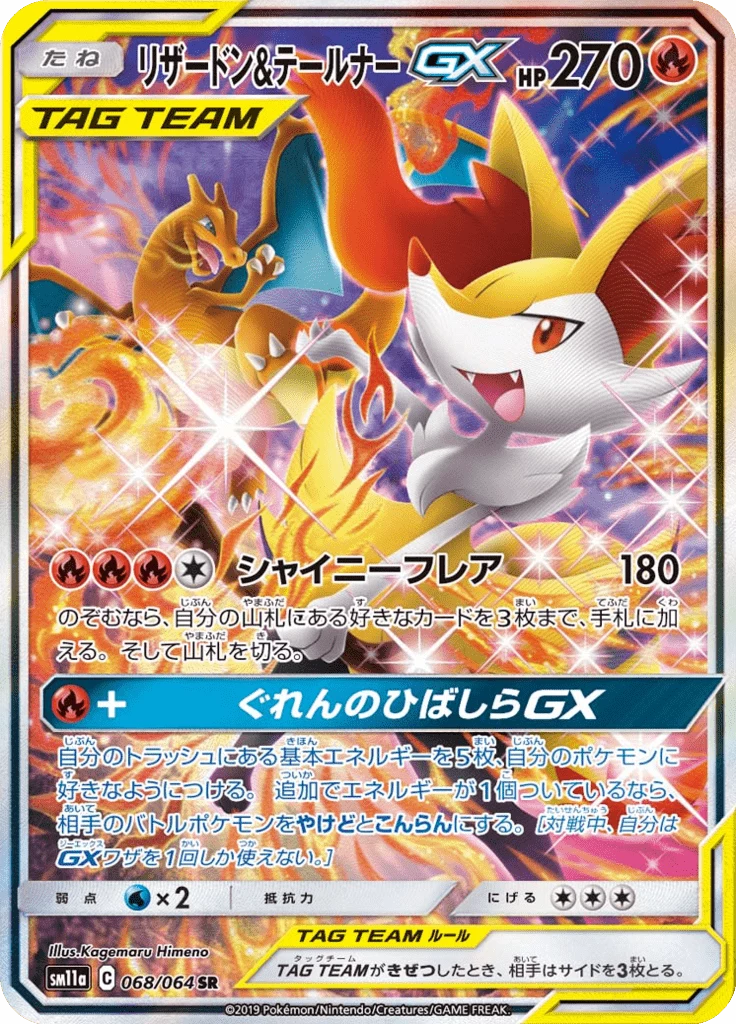
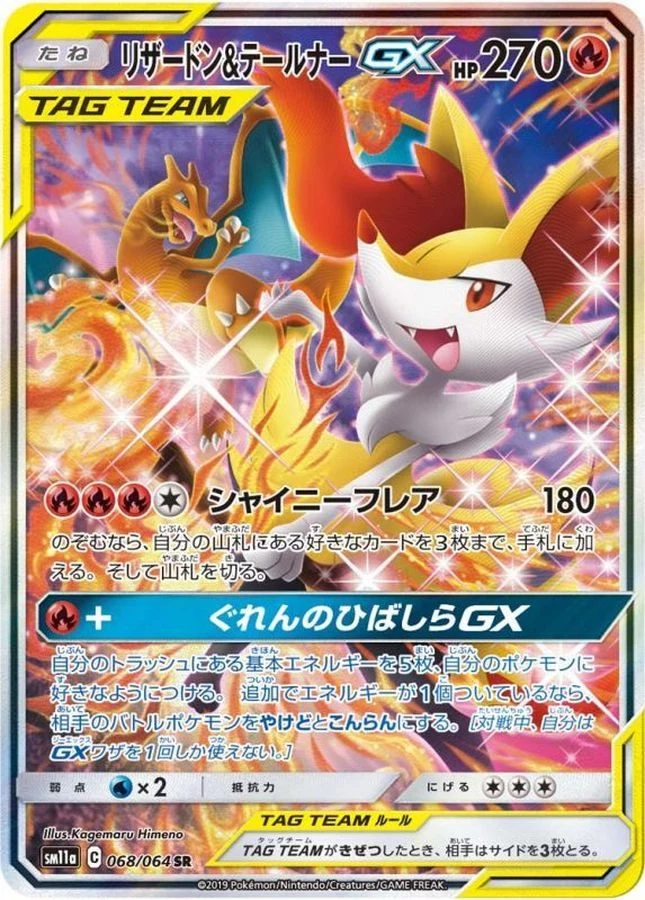
Charizard & Braixen GX SA 068/064, Remix Bout (SM11a)
Charizard & Braixen GX SA 068/064 — another Tag Team-GX Special Full Art from the same Remix Bout (SM11a) set

The set’s cast of Tag Team-GX cards also includes Charizard & Braixen-GX, which carries the same four-tier print structure and the same “SA” naming for its own Special Full Art treatment — covered separately in our Charizard & Braixen GX SA card guide.

Sealed Remix Bout product — the source of all four prints of this card, including the SA — is available as the SM11A Remix Bout Japanese Booster Box currently listed at ¥141,750 (~$891). For the full 73-card checklist, see our Remix Bout (SM11a) card list; for a broader look at the set’s chase cards, see our Remix Bout pull-rates hub.

Japanese vs English Print

Blastoise & Piplup-GX does have an English-set equivalent: Cosmic Eclipse (CEC), where the card appears across four separate numbers — a Regular print at #38, a Full Art at #214, a Special Full Art at #215, and a Rainbow Rare/Secret print at #253.

That is four English treatments against four Japanese ones, and the tier names line up directly: the English Regular pairs with the Japanese 016/064 RR, the English Full Art pairs with the 069/064 SR, the English Special Full Art pairs with the 070/064 SA covered in this guide, and the English Rainbow Rare/Secret pairs with the 076/064 HR. Matching a Japanese copy to an English one is a matter of lining up these tier names rather than the card numbers, which do not otherwise correspond between the two languages.

Where This SA Sits Among Japanese Rarity Tiers

Within Remix Bout, the four documented prints of this card span the set’s rarity ladder from the regular RR through two Full Art tiers to the Rainbow Rare secret. The Special Full Art print at 070/064 — the one this store lists and calls the “SA” — sits above the 016/064 RR and alongside the 069/064 Full Art print, distinguished by its own alternate art from illustrator Akira Komayama rather than 5ban Graphics’ treatment of the 069/064 print. The 076/064 Rainbow Rare occupies the top of the set’s secret-slot range for this card.

The same Special Full Art naming and treatment appears elsewhere in Remix Bout — the set’s other Tag Team-GX SA, PSA 10 Charizard & Braixen GX SA 068/064, is currently listed at ¥211,928 (~$1,333).

We do not currently list the 069/064 Full Art or 076/064 Rainbow Rare prints of this card; sourcing requests for either go through Snel bestellen.

Shop This Card
PSA 10 Blastoise & Piplup GX SA 070/064
Currently listed at ¥187,974 (~$1,182)
Ships from Tokyo · Tracked delivery

View Product →

Where to Buy Blastoise & Piplup GX from Tokyo

Our graded copy of PSA 10 Blastoise & Piplup GX SA 070/064 is currently listed at ¥187,974 (~$1,182), shipped from Tokyo with tracked delivery. The regular-tier PSA 10 RR 016/064 sibling is currently listed at ¥21,046 (~$132), and the set’s other Tag Team-GX SA, PSA 10 Charizard & Braixen GX SA 068/064, is currently listed at ¥211,928 (~$1,333). If you would rather pull your own copy, sealed SM11A Remix Bout Japanese Booster Boxes are currently listed at ¥141,750 (~$891).

For the broader Squirtle evolution line across many more eras and sets, see our Squirtle & Blastoise cards guide — that survey covers chase prints across the species, while this article is a single-card deep dive into just the 070/064 SA. Piplup fans can also cross-reference our Piplup species guide and our Sinnoh starters survey, which covers Piplup, Turtwig and Chimchar together across many more prints than this single card.

For other graded Tag Team-GX and Special Full Art cards, browse our PSA 10 graded card collection. For a mixed order across singles and sealed product, our Quick Order page is the fastest way to build a cart.

Veelgestelde vragen

What is Blastoise & Piplup GX SA 070/064?

It is the Special Full Art print of Blastoise & Piplup-GX, card 070/064 from the Japanese Enhanced Expansion Pack Remix Bout (set code SM11a). This store lists a PSA 10 copy of this print, currently listed at ¥187,974 (~$1,182).

How many Japanese prints of this card exist?

Four are documented: the 016/064 RR, the 069/064 Full Art SR, the 070/064 Special Full Art (the “SA” this store lists), and the 076/064 Rainbow Rare. All four come from the same Remix Bout release.

Is the 069/064 Full Art print available on your site?

No. Our catalogue for this card covers the 070/064 SA and the 016/064 RR. The 069/064 Full Art and 076/064 Rainbow Rare prints are not part of our current catalogue; sourcing requests go through Quick Order.

Does Blastoise & Piplup-GX have an English print?

Yes. Cosmic Eclipse (CEC) carries the card across four numbers: a Regular print at #38, a Full Art at #214, a Special Full Art at #215, and a Rainbow Rare/Secret print at #253, matching the four Japanese tiers.

What set is this card from?

Remix Bout, Japanese set code SM11a, an Enhanced Expansion Pack with a 73-card checklist. The set also carries a Special Full Art Charizard & Braixen-GX (068/064) alongside this card.

Where can I buy a PSA 10 Blastoise & Piplup GX from Tokyo?

Our graded 070/064 SA copy is currently listed at ¥187,974 (~$1,182) with tracked shipping from Tokyo. The 016/064 RR sibling and sealed Remix Bout booster boxes are also available if you would rather buy the lower tier or pull your own copy.
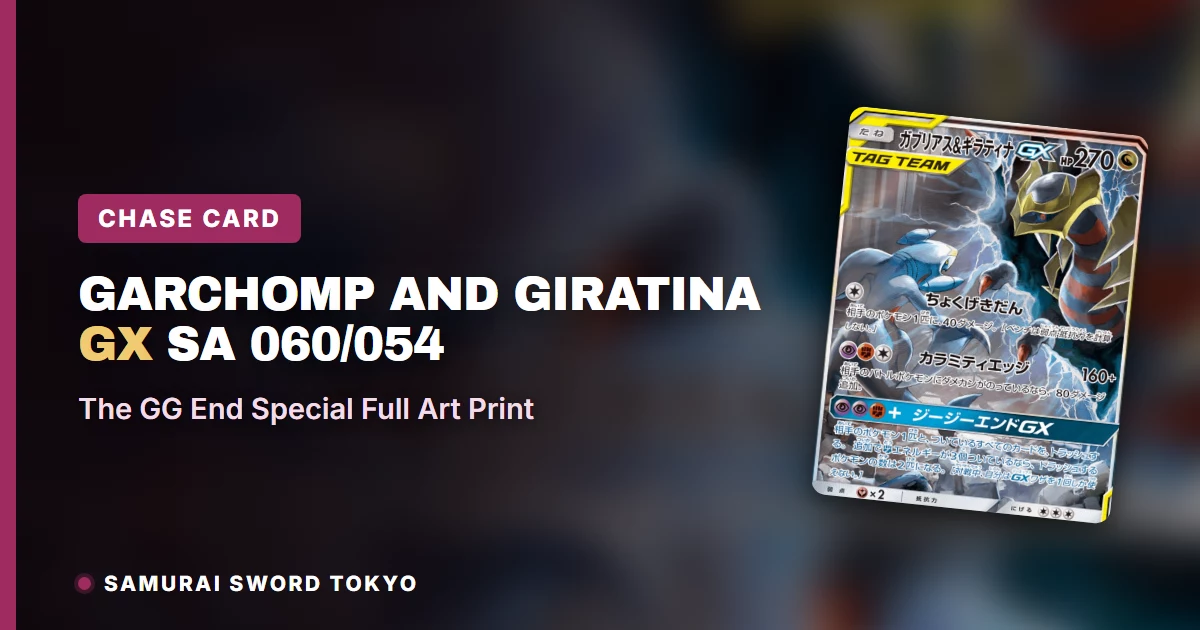
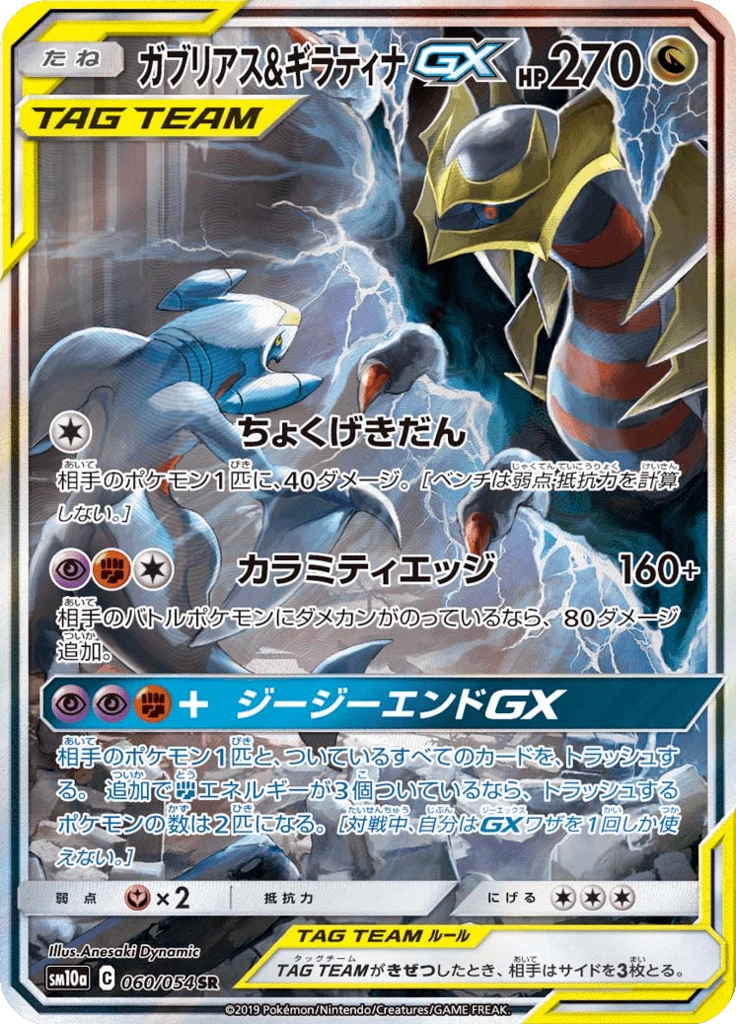
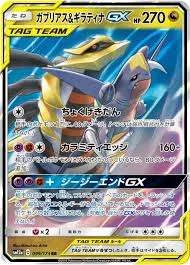
Garchomp and Giratina GX SA 060/054 kaartgids: de Special Full Art-print van GG End

Garchomp & Giratina-GX is the only card among our SA card guides that shows up as a graded chase across two separate Japanese sets, not one. Its Special Full Art print — the version our own store labels “SA” — comes from the enhanced expansion pack GG End (SM10a), while a second wave of the same Tag Team reappears two sets later in Tag All-Stars (SM12a) as a fresh Regular reprint and a Gold Full Art secret.

This guide is built around the GG End 060/054 SA as the headline anchor, with the Tag All-Stars reprints covered as what they are: the same Tag Team’s second Japanese appearance, not a continuation of the GG End print run. Graded PSA 10 examples from both sets are currently listed on our site, so this is also a practical map of what you’re looking at if you come across any of the six documented Japanese prints of this card.

Key Takeaways

Garchomp & Giratina-GX’s Special Full Art print, 060/054 from GG End (SM10a), is a PSA 10 currently listed at ¥201,945 (~$1,270). The same Tag Team also reappears in Tag All-Stars (SM12a), where we list the Gold Full Art UR at ¥56,404 (~$355). Six Japanese prints of this card exist across the two sets, and the GG End and Tag All-Stars versions are not interchangeable — they’re separate releases with separate rarity tiers.

270
HP

SR: SA
Rarity (060/054)

2
Japanese Sets

4 Oct 2019
Tag All-Stars Release

Prices below are current samuraiswordtokyo.com listings, converted at ¥159/USD (September 2026).

The Card: Garchomp & Giratina GX SA 060/054

Garchomp & Giratina-GX is a Tag Team-GX card with 270 HP and the Dragon type, built around Giratina in its Origin Forme paired with Garchomp. The 060/054 print is illustrated by Anesaki Dynamic, and its position — card 60 inside a set whose main run tops out at “054” — marks it as a secret/special slot printed above the standard numbering, which is the usual Japanese convention for a set’s higher-tier chase cards.

Garchomp & Giratina GX SA 060/054, GG End (SM10a)
Garchomp & Giratina GX SA 060/054 — GG End (SM10a), illustrated by Anesaki Dynamic

Our own graded copy of this print is currently listed at ¥201,945 (~$1,270), PSA 10.

PSA 10 Garchomp & Giratina GX SA 060/054 slab, listed on samuraiswordtokyo.com

The Sets: GG End (SM10a) and Tag All-Stars (SM12a)

GG End — 強化拡張パック「GG End」in Japanese — is set code SM10a, a Japanese enhanced expansion pack. Card numbers in its main run go up through 054, with secret and special slots printed above that count; our own GG End (SM10a) Complete Kaartenlijst confirms 62 total Japanese cards once those secret slots are included. For pull-rate discussion on the set generally, see our GG End pull-rates hub.

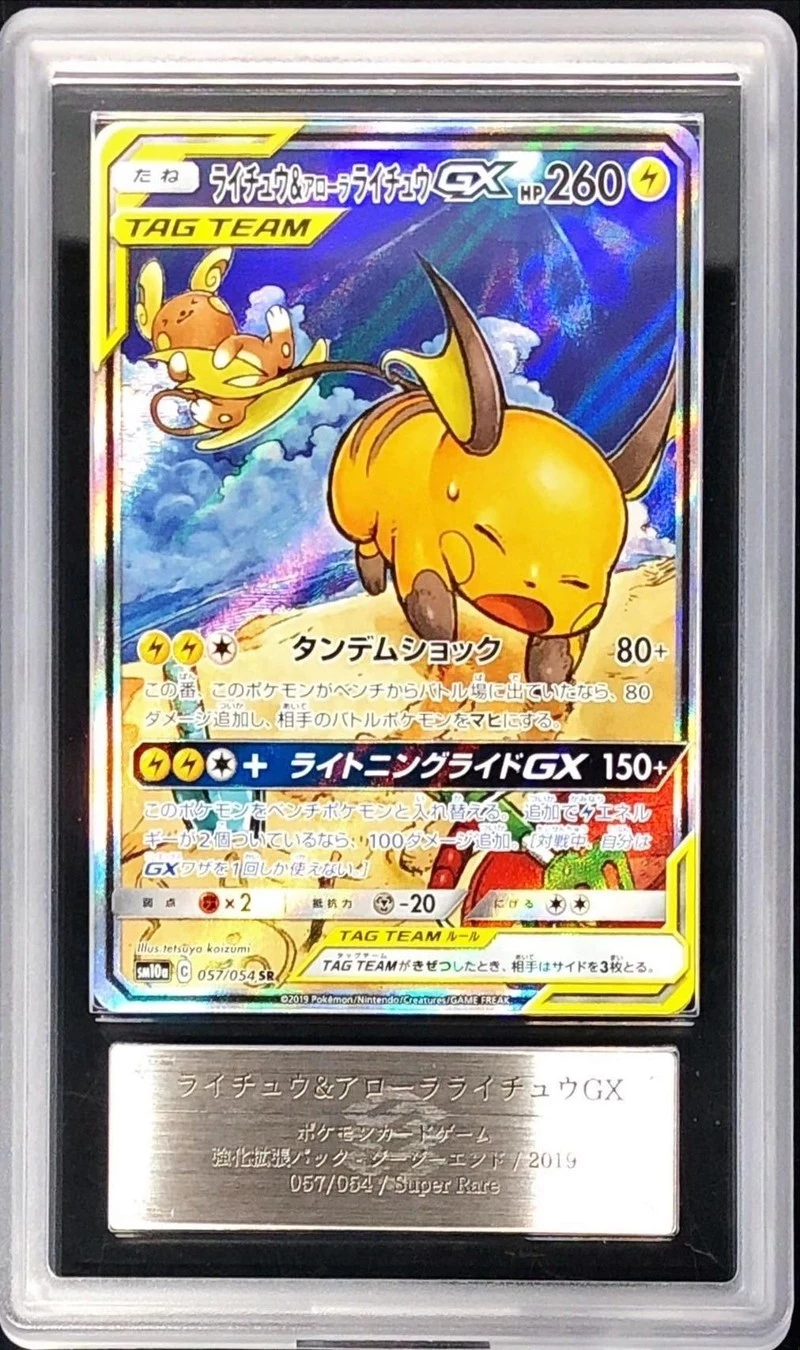
PSA 10 Raichu & Alolan Raichu GX SA 057/054 slab, listed on samuraiswordtokyo.com
PSA 10 Raichu & Alolan Raichu GX SA 057/054 — another GG End (SM10a) Special Full Art we list, listed on samuraiswordtokyo.com

Garchomp & Giratina-GX’s 060/054 SA is not the set’s only Special Full Art Tag Team — our Raichu & Alolan Raichu GX SA card guide covers a sibling print from the same GG End release, 057/054.

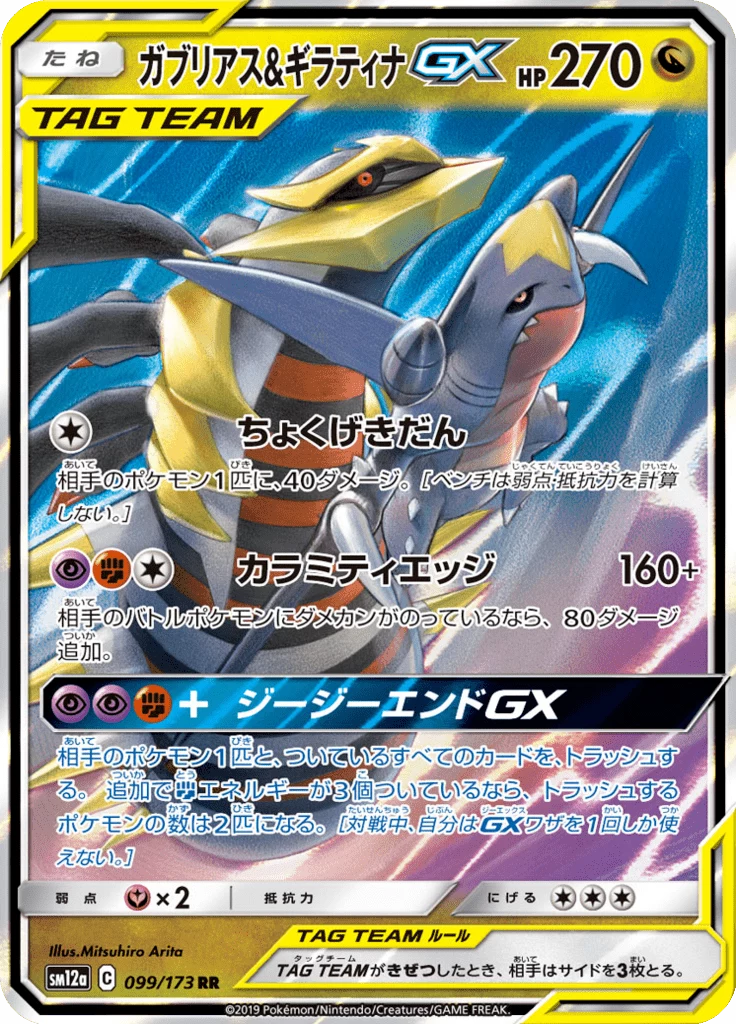
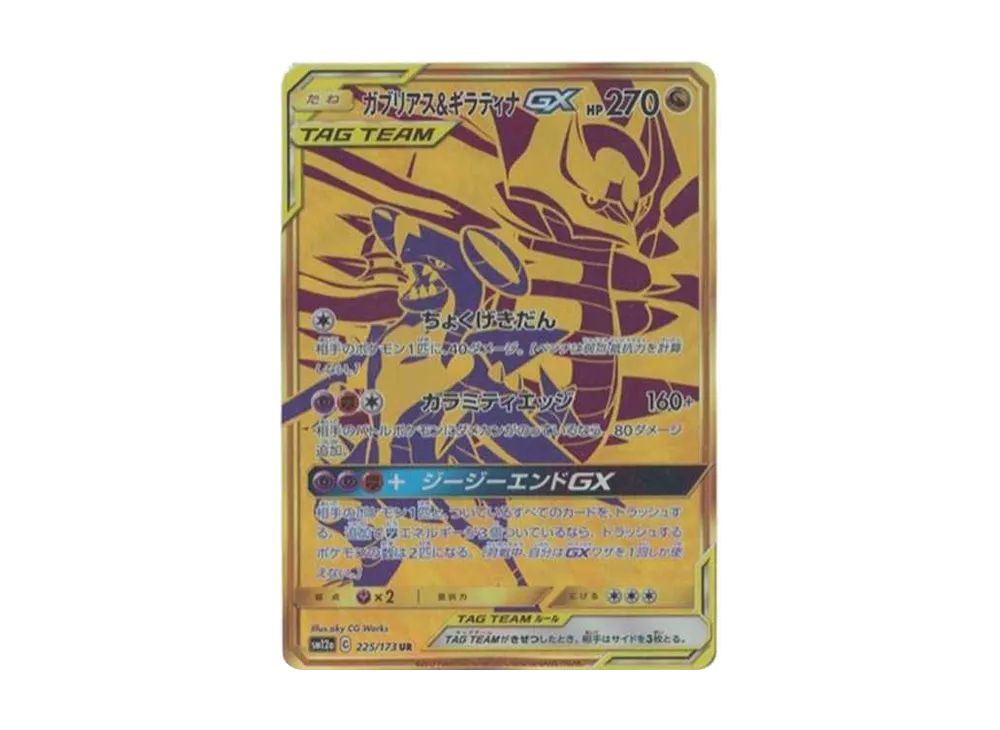
Tag All-Stars — ハイクラスパック「TAG TEAM GX Tag All Stars」in Japanese — is set code SM12a, a High Class Pack released 4 October 2019 with a 173-card main set. Card 099/173 sits inside that main run; 225/173 is a secret slot printed above it. For pull-rate discussion on this set, see our Tag All-Stars pull-rates hub.

A GG End (SM10a) booster box is not listed on our site at the moment; sourcing requests go through Quick Order. Sealed Tag All-Stars product — the set both SM12a prints of this card come from — is available as the SM12A-Tag All-Stars Japanese Pokemon Booster Box currently listed at ¥207,900.

Japanese vs English Print

Garchomp & Giratina-GX does have an English-set equivalent: Unified Minds (UNM), which carries the card at #146 (Regular), #228 (Full Art) and #247 (Rainbow Rare). A further Special Full Art version was issued separately as SM Black Star Promo #SM193, which is the closest English match to our GG End 060/054 SA in terms of art treatment.

The numbering does not map cleanly between languages. Japan spread the card across four GG End tiers plus a further two Tag All-Stars tiers — six prints in total — while the English side splits its own treatment across three Unified Minds numbers and a separate promo card. If you’re matching a Japanese copy against an English one, go by the art treatment and rarity tier rather than assuming the numbers correspond one-to-one.

Where the SA Sits Among Japanese Chase Rarities

Within GG End, the four Garchomp & Giratina-GX prints climb from the numbered Regular (032/054), through the Full Art (059/054), up to the Special Full Art SA (060/054) that we list, with the Rainbow Rare (066/054) sitting above that as the set’s top secret-slot treatment for this card. Our SA is the second-highest of the four GG End tiers — below the Rainbow Rare, above both the Full Art and the base Regular.

The Tag All-Stars pair runs on a separate ladder entirely: a Regular reprint (099/173) sitting inside the main numbering, and a Gold Full Art UR (225/173) as that set’s secret-slot treatment for the same Tag Team. Because GG End and Tag All-Stars are different sets, their rarity tiers don’t stack against each other directly — the GG End SA and the Tag All-Stars UR are each the standout secret print of their own release, not two rungs on one ladder.

For a broader look at how Tag Team-GX Special Full Art prints compare across our catalogue, see our Garchomp Pokemon Card Guide and Giratina V Alt Art & Best Giratina Cards hubs — both are species-wide surveys, where this article is a single card’s SA deep dive. Readers following the Garchomp side specifically may also want our Cynthia & Garchomp SAR card guide, a related chase-card article built around a different Garchomp print.

Shop This Card
PSA 10 Garchomp & Giratina GX SA 060/054
Currently listed at ¥201,945 (~$1,270)
Ships from Tokyo · Tracked delivery

View Product →

Where to Buy Garchomp & Giratina GX from Tokyo

Our graded copy of the GG End SA, PSA 10 Garchomp & Giratina GX SA 060/054, is currently listed at ¥201,945 (~$1,270), shipped from Tokyo with tracked delivery. If you’d rather track down one of the Tag All-Stars prints, we also list PSA 10 Garchomp & Giratina GX UR 225/173 at ¥56,404 (~$355) and PSA 10 Garchomp & Giratina GX RR 099/173 at ¥10,738 (~$68).
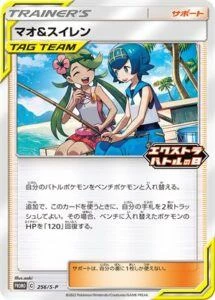
To pull your own copy of the Tag All-Stars prints, sealed SM12A-Tag All-Stars Japanese Pokemon Booster Boxes are listed at ¥207,900. A GG End booster box is not listed on our site at the moment, and sourcing requests for it go through Quick Order. For other graded Tag Team-GX cards, browse our full PSA 10 graded card collection, or use our Quick Order page to build a mixed order across singles and sealed product.

Veelgestelde vragen

What is Garchomp & Giratina GX SA 060/054?

It is the Special Full Art print of Garchomp & Giratina-GX, card 060/054 from the Japanese enhanced expansion pack GG End (set code SM10a), illustrated by Anesaki Dynamic. We list a PSA 10 copy of this print, currently listed at ¥201,945 (~$1,270).

Why does this card appear in two different Japanese sets?

Garchomp & Giratina-GX first released in GG End (SM10a) with four rarity tiers, then reappeared two sets later in Tag All-Stars (SM12a) with a Regular reprint and a Gold Full Art UR. That gives six documented Japanese prints across the two sets, not one continuous print run.

What’s the difference between the GG End SA and the Tag All-Stars UR and RR prints?

The GG End SA (060/054) is that set’s Special Full Art secret-slot treatment. The Tag All-Stars RR (099/173) is a Regular reprint inside the main numbering, and the Tag All-Stars UR (225/173) is that set’s own Gold Full Art secret. They come from separate sets and separate rarity ladders — the UR is not a higher tier of the GG End SA.

Does Garchomp & Giratina-GX have an English print?

Yes — Unified Minds (UNM) carries it at #146 (Regular), #228 (Full Art) and #247 (Rainbow Rare), with a further Special Full Art issued separately as SM Black Star Promo #SM193. The English numbering does not map one-to-one onto the six Japanese prints.

Where can I buy a PSA 10 Garchomp & Giratina GX from Tokyo?

Our GG End SA copy (060/054) is listed at ¥201,945 (~$1,270), with the Tag All-Stars UR (225/173) at ¥56,404 (~$355) and the Tag All-Stars RR (099/173) at ¥10,738 (~$68), all shipped from Tokyo with tracked delivery.

Mallow Pokémon-kaartgids: alle Japanse Trainer-drukken & de Mallow & Lana Supporters

Mallow’s name is printed on two different Japanese Supporter cards, and it is easy to mix them up if you only know the English localisation. One is a solo card from the Sun & Moon era; the other pairs her with fellow Alolan trial captain Lana in a Tag-style Supporter from a completely separate set. Different Japanese names, different effects, different sets — they are not the same card wearing two outfits.

This guide keeps the two families separate, lists every verified print for each, and points to the PSA 10 prints currently listed on our site.

Key Takeaways

Mallow (マオ) and Mallow & Lana (マオ&スイレン) are two different Japanese Supporter cards, not one card with two names. Solo Mallow’s headline print is the PSA 10 Mallow SR (SM2L 055/050) currently listed at ¥188,304 (~$1,184). The card she shares with Lana has its own Secret Rare print, the PSA 10 Mallow & Lana SR (SM12 107/095) currently listed at ¥37,642 (~$237). No Alolan Moonlight booster box is listed on our site at the moment, but the Alter Genesis booster box is currently listed at ¥63,000 (~$396); sourcing requests for the Alolan Moonlight box go through Quick Order.

5
Prints Covered

4
Rarities Covered

3
Sets (SM2L, SM12, SP)

Sep 2026
Prices Checked

Prices are our own listed prices as of September 2026, converted at ¥159/USD.

Mallow vs Mallow & Lana: Two Different Cards

Before anything else, it helps to separate what you are looking at. Both cards carry Mallow’s name and artwork style, but the Japanese card names, sets, and effects do not overlap.

Kaart Japanese name Debut set Effect summary
Mallow マオ Alolan Moonlight (SM2L) Deck manipulation — select and reorder 2 cards from your deck
Mallow & Lana マオ&スイレン Alter Genesis (SM12) Switches your Active Pokemon with a Benched one, with an optional discard-for-heal effect

Solo Mallow is a straightforward one-Trainer card. Mallow & Lana is a Tag-style Supporter that puts both trial captains on a single card, and it plays nothing like the solo print. Keep the two families separate when you are searching marketplaces or comparing prints below.

Mallow (マオ): The Alolan Moonlight Prints

Mallow’s solo Supporter debuted in Alolan Moonlight (SM2L), released in Japan on 17 March 2017 as part of a 55-card set.

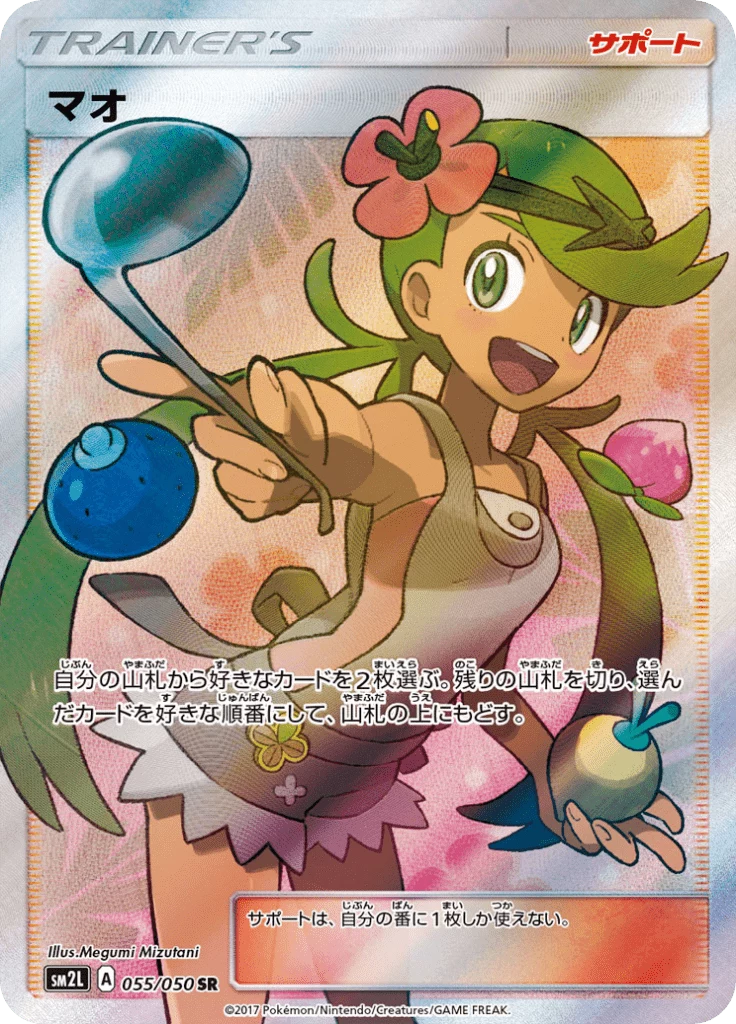
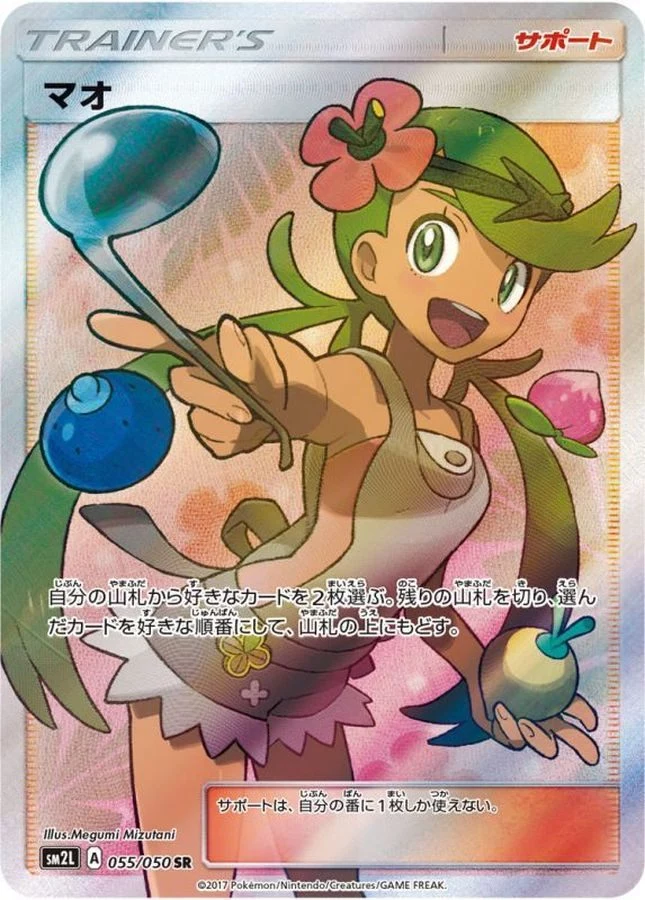
Mallow SR 055/050 Secret Rare Alolan Moonlight Japanese Pokemon Supporter card
Mallow 055/050, Secret Rare — Alolan Moonlight (SM2L)

Mallow SR (055/050) — Secret Rare

Illustrated by Megumi Mizutani, this is the print anchoring this guide. The effect: “Select 2 cards from your deck. Shuffle the remaining deck and return the selected cards to the top in any order.” It’s a deck-setup Supporter rather than a draw or search effect.

PSA 10 Mallow SR 055/050, listed on samuraiswordtokyo.com
Our PSA 10 slab of Mallow SR (055/050), currently listed at ¥188,304 (~$1,184)

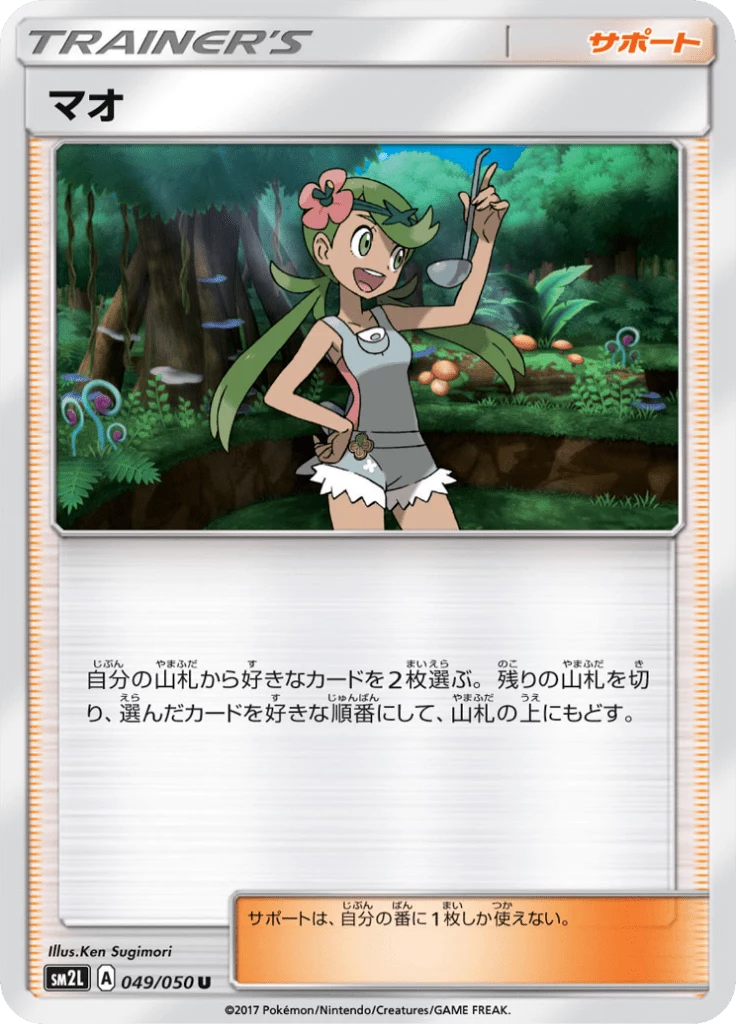
Mallow (049/050) — Uncommon

Mallow 049/050 Uncommon Alolan Moonlight Japanese Pokemon Supporter card
Mallow 049/050, Uncommon — Alolan Moonlight (SM2L)

Same effect text, illustrated instead by Ken Sugimori, printed at the set’s standard Uncommon tier rather than the Secret Rare slot.

The same card database entry also lists this artwork appearing in the Sun and Moon Promotional Cards series (as #246) and in a GX Battle Boost (SM4p) print (as #107). Those listings have not been independently re-fetched, so treat them as reported rather than confirmed prints.

Set Number Rarity Illustrator JP release
Alolan Moonlight (SM2L) 049/050 Uncommon Ken Sugimori 17 Mar 2017
Alolan Moonlight (SM2L) 055/050 Secret Rare Megumi Mizutani 17 Mar 2017

Mallow & Lana (マオ&スイレン): The Alter Genesis Prints

The combo card debuted in Alter Genesis (SM12), and a separate promo print later circulated through the Sword & Shield Promotional Cards series. Three prints are verified.

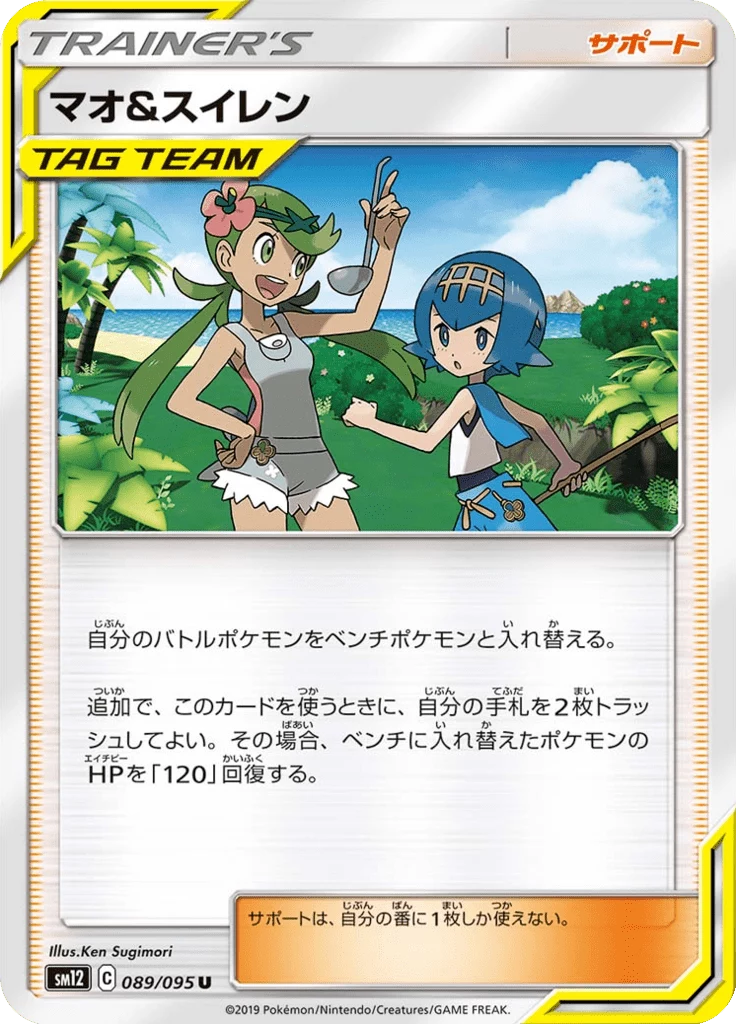
Mallow and Lana 089/095 Uncommon Alter Genesis Japanese Pokemon Supporter card
Mallow & Lana 089/095, Uncommon — Alter Genesis (SM12)

Mallow & Lana (089/095) — Uncommon

Illustrated by Ken Sugimori. The effect: switch your Active Pokemon with one of your Benched Pokemon, with an optional secondary effect to discard 2 cards and recover 120 HP on the Pokemon that was switched in. That’s a positioning-plus-healing Supporter, distinct in every respect from solo Mallow’s deck-manipulation effect above.

Mallow & Lana Extra Battle Day Promo (S-P 256)

PSA 10 Mallow and Lana Extra Battle Day promo, listed on samuraiswordtokyo.com
Our PSA 10 slab of the Mallow & Lana Extra Battle Day promo (S-P 256), currently listed at ¥12,862 (~$81)

This print, illustrated by aoki, carries the Sword & Shield Promotional Cards series number 256. It doesn’t use a standard rarity letter — S-P promos are numbered sequentially rather than assigned a tiered rarity. Multiple secondary marketplace sources describe it as an Extra Battle Day tournament participation prize distributed in Japan, with one such source dating the event to 5 February 2022; that date is reported by secondary sources rather than confirmed by an official record, so treat it as a reported detail. A directly-fetched card listing does confirm the same framing — an Extra Battle Day participation prize, not distributed through regular packs or retail shelves.

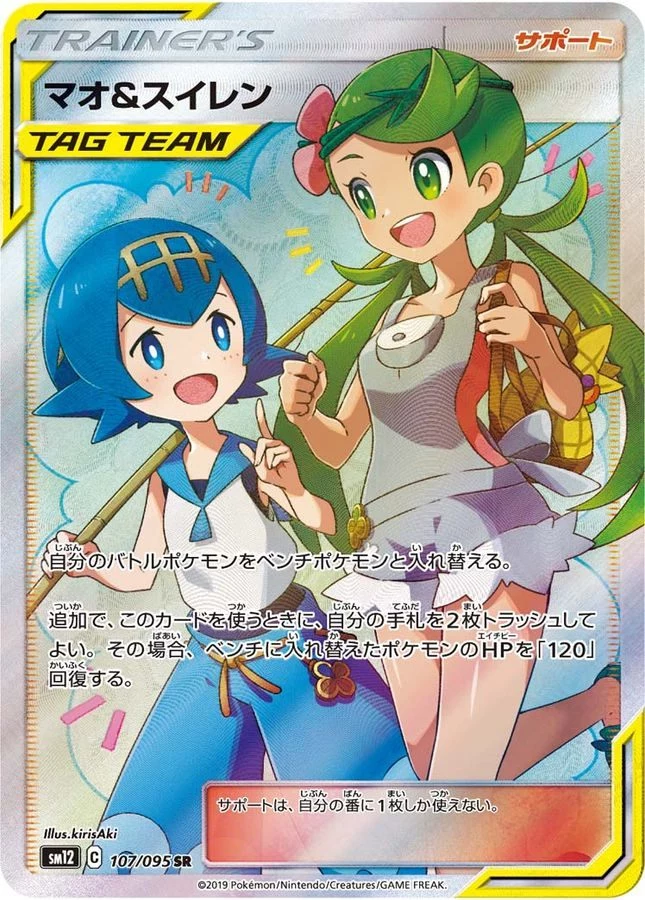
Mallow & Lana SR (107/095)

PSA 10 Mallow and Lana SR 107/095, listed on samuraiswordtokyo.com
Our PSA 10 slab of Mallow & Lana SR (SM12 107/095), currently listed at ¥37,642 (~$237)

This is the anchor print for this guide’s Mallow & Lana half. Our own listing identifies it as an SR out of Alter Genesis; a dedicated card-database rarity page for this exact number could not be independently confirmed at time of writing, so we’re presenting the rarity as our own listing states it rather than as independently re-verified.

Set Number Rarity Illustrator
Alter Genesis (SM12) 089/095 Uncommon Ken Sugimori
Sword & Shield Promotional Cards (SP) 256 Promo (no tiered rarity) aoki
Alter Genesis (SM12) 107/095 SR (per our listing) Not confirmed

Japanese vs English Print

Solo Mallow’s Alolan Moonlight SR has a documented English equivalent: Guardians Rising #127 at the standard rarity tier, with a Full Art version at #145. If you’re comparing artwork across languages, that’s the set to check.

For Mallow & Lana, no English-language equivalent has been verified for any of the three prints covered above. This guide covers the Japanese Alter Genesis and Sword & Shield Promotional Cards prints only — this is not an assertion that no English release exists, only that none was confirmed in the sources checked.

Where These Prints Sit in Japanese Rarity Tiers

Both families follow the same general shape common to Japanese Supporter cards from this era: a standard-rarity print at Uncommon, sitting below a full-art or textured Secret Rare/SR print in the same set’s numbering run above the set’s stated card count. Solo Mallow’s 055/050 Secret Rare and Mallow & Lana’s 107/095 SR both sit in that higher tier relative to their Uncommon counterparts (049/050 and 089/095).

The Extra Battle Day promo (S-P 256) runs on a separate numbering track entirely — Sword & Shield Promotional Cards promos are not assigned into a set’s rarity tier at all, since they are distributed outside normal boosters. We are not ranking these tiers by market price here, only by their printed rarity designation and card-number convention.

Shop This Card
PSA 10 Mallow SR (055/050, Alolan Moonlight)
Currently listed at ¥188,304 (~$1,184)
Ships from Tokyo · Tracked delivery

View Product →

Where to Buy Mallow Cards from Tokyo

We ship graded and raw Japanese singles out of Tokyo with tracked delivery. All three Mallow-related PSA 10 prints covered in this guide are individually listed in our shop right now.

Solo Mallow’s SR is the PSA 10 Mallow SR (055/050) currently listed at ¥188,304 (~$1,184). For the Mallow & Lana side, the PSA 10 Mallow & Lana SR (107/095) is currently listed at ¥37,642 (~$237), and the PSA 10 Mallow & Lana Extra Battle Day promo (S-P 256) is currently listed at ¥12,862 (~$81). No Alolan Moonlight booster box is listed on our site at the moment, but the Alter Genesis booster box is currently listed at ¥63,000 (~$396); sourcing requests for the Alolan Moonlight box go through Snel bestellen.

For more PSA 10 Trainer cards in the same rarity range, browse our PSA 10 graded card collection. If you’re building out a set of Japanese female trainer Supporters, our female Pokemon trainer card roundup and our wider PSA 10 trainer card guide cover more of this category. Our full-art SR/SAR trainer card guide explains how these rarity tiers compare across sets.

Two other Alola-region Supporter guides worth a look: our Kahili Supporter card guide covers a fellow Alola-region trial captain-adjacent print, and our Bianca trainer card guide and Gardenia trainer card guide follow the same every-print structure for other characters. For mixed orders combining Japanese singles or sealed product, our Quick Order page is the fastest route.

Veelgestelde vragen

Are Mallow and Mallow & Lana the same card?

No. Mallow (マオ) is a solo Supporter from Alolan Moonlight (SM2L) with a deck-manipulation effect. Mallow & Lana (マオ&スイレン) is a separate Tag-style Supporter from Alter Genesis (SM12) that switches your Active and Benched Pokemon. Different Japanese names, different sets, different effects.

What does the Mallow SR (055/050) card do?

Select 2 cards from your deck, shuffle the remaining deck, and return the selected cards to the top in any order. It’s from Alolan Moonlight (SM2L), released 17 March 2017, illustrated by Megumi Mizutani.

What does the Mallow & Lana Uncommon (089/095) card do?

Switch your Active Pokemon with one of your Benched Pokemon, with an optional secondary effect to discard 2 cards and recover 120 HP on the switched-in Pokemon. It’s from Alter Genesis (SM12), illustrated by Ken Sugimori.

Where does the Mallow & Lana Extra Battle Day promo (S-P 256) come from?

It’s a Sword & Shield Promotional Cards series print, illustrated by aoki. Secondary marketplace sources describe it as an Extra Battle Day tournament participation prize distributed in Japan, with one source dating the event to 5 February 2022 — that date is reported rather than officially confirmed. It was not distributed through regular packs or retail shelves.

Is there an English version of the Mallow cards?

Solo Mallow’s SR has a documented English equivalent: Guardians Rising #127 (standard) and #145 (Full Art). For Mallow & Lana, no English-language equivalent has been verified for any of its three Japanese prints.

Where can I buy Mallow cards from Japan?

All three Mallow-related PSA 10 prints covered in this guide — the solo Mallow SR, the Mallow & Lana SR, and the Mallow & Lana Extra Battle Day promo — are individually listed on our site, and we ship from Tokyo with tracked delivery. The Alolan Moonlight booster box is not currently listed, but the Alter Genesis booster box is, at ¥63,000 (~$396); sourcing requests for the Alolan Moonlight box go through Quick Order.

Pokemon Prime-kaarten: de Japanse LEGEND-tijdperk-drukken uitgelegd

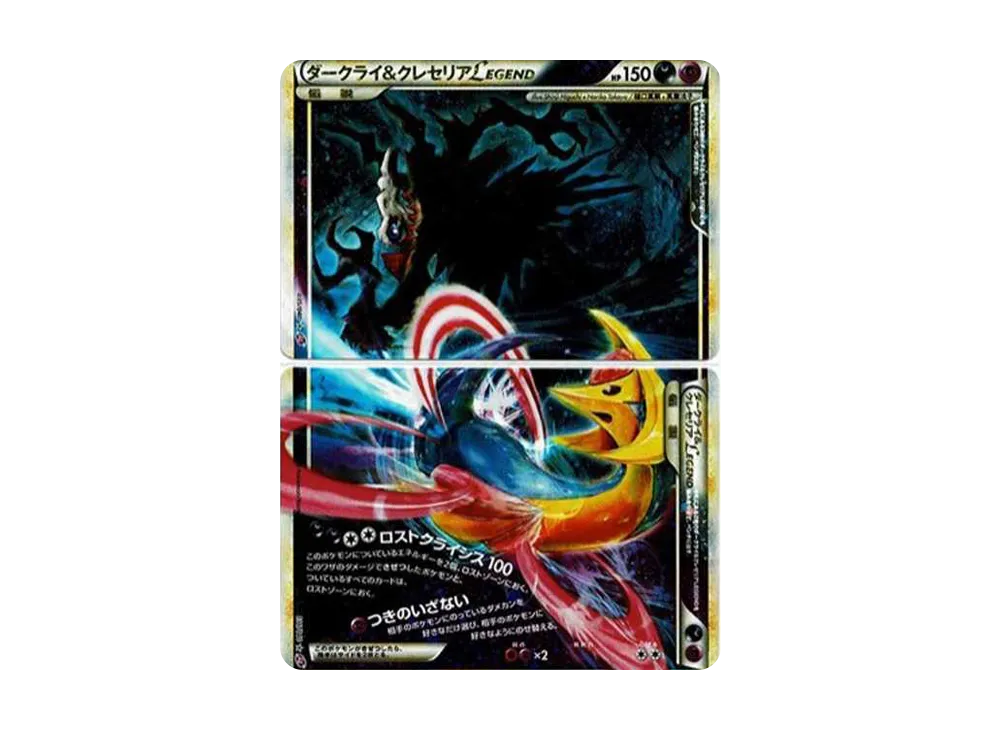
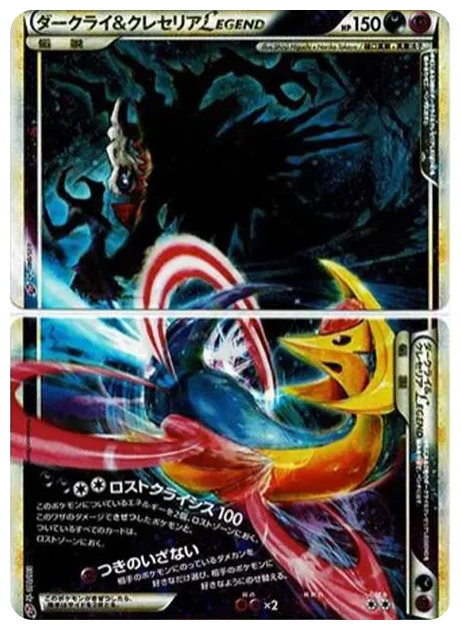
“Pokemon Prime” and “Pokemon LEGEND” are two different mechanics, printed in the same short window, and they get mixed up constantly. Prime is a single card with a gold-foil border and a stronger statline. LEGEND is a two-card combo where one Pokemon is physically split across a top half and a bottom half. Both come from the HeartGold & SoulSilver era, roughly 2009–2010, and neither one is the “Legendary” GX card you might be picturing.

This guide separates the two mechanics, walks through the Japanese sets that carried them, and uses our own Lost Link listing as the reference point for what a genuine LEGEND print looks like in hand.

Key Takeaways

Pokemon Prime (2010, Japanese: グレートポケモン, “Great Pokemon”) is a single gold-bordered card with no Pokedex info box. Pokemon LEGEND is a two-card mechanic that replaced Pokemon LV.X, split across a top half and bottom half that must be played together. Our anchor is the genuine PSA10 Darkrai & Cresselia LEGEND, currently listed at ¥770,000 (~$4,843). We do not currently have a genuine Pokemon Prime print listed — sourcing requests for Prime cards go through Quick Order.

2
Mechanics Covered

16 Apr 2010
Lost Link (LL) Release

40
Cards in Lost Link Set

7
Cards per Booster (No Energy)

Yen figures below convert at ¥159/USD (September 2026).

Pokemon Prime vs Pokemon LEGEND: Two Different Mechanics

Both mechanics surfaced in the same HeartGold & SoulSilver era, which is exactly why they get conflated in searches. They are not the same thing, and they don’t play the same way.

Mechanic First appeared Visual traits How it plays
Pokemon Prime HeartGold & SoulSilver expansion (2010 era). Japanese term: グレートポケモン (“Great Pokemon”) Gold-foil holo border, spikes around the artwork window, 3D-style illustration emphasis, no Pokedex info box Plays as a normal single-card Basic, Stage 1, or Stage 2 Pokemon with no special ruling — the statline is simply stronger than standard-era cards of the time
Pokemon LEGEND One of two HeartGold & SoulSilver-era replacements for Pokemon LV.X “Rare Holo LEGEND” stamp, printed across a top-half card and a bottom-half card Both halves must be placed on the Bench together; they act as one Pokemon in play even though they remain two physical cards

In short: Prime is a single-card stat boost. LEGEND is a physically split two-card combo. Neither uses the word “Legendary” as a rules term — that word is a separate species classification, not a rarity or mechanic, and it’s worth keeping the two apart as you read the rest of this guide.

How the Pokemon LEGEND Two-Card Mechanic Plays

LEGEND was introduced as one of two HeartGold & SoulSilver-era replacements for Pokemon LV.X — that guide covers the LEVEL-UP mechanic LEGEND effectively took over from; this article focuses on what came next. Each LEGEND Pokemon is printed across a “top half” card and a “bottom half” card. Both cards have to be played to the Bench together, and from that point they function as a single Pokemon in play, despite being two separate physical cards in a binder or deck box.

LEGEND cards were printed across the English sets Unleashed, Undaunted, and Triumphant, and in Japan across three sets: Reviving Legends, Clash at the Summit, and Lost Link. All of it released in roughly the same 2009–2010 window. For a value ranking across every LEGEND print, see our Pokemon LEGEND cards value hub — that hub ranks LEGEND prints by value; this article is the broader mechanic explainer, with our own Lost Link listings as the worked example.

Pokemon Prime: What Makes a “Great Pokemon” Card

The Japanese term for Prime cards is グレートポケモン, or “Great Pokemon,” and they first appeared in the HeartGold & SoulSilver expansion around 2010. Four visual traits identify one at a glance:

  • Gold-foil holo border running around the frame
  • Spikes around the artwork window rather than a plain rectangle
  • 3D-style illustration emphasis in the card art
  • No Pokedex info box — the space standard cards use for height, weight, and species is absent

Mechanically, a Prime card plays exactly like a normal Basic, Stage 1, or Stage 2 Pokemon — there’s no special Bench requirement or combo ruling the way there is with LEGEND. What sets it apart is the statline: Prime cards typically ran stronger than standard-era cards of the time, often carrying three attacks, or two attacks plus a Pokemon Power. They were distributed between 2009 and 2010 across HeartGold & SoulSilver, Unleashed, Undaunted, and Triumphant.

This print is not listed on our site at the moment; sourcing requests for a genuine Pokemon Prime card go through Snel bestellen. Because of that, the live examples in this guide anchor on the genuine LEGEND print from the same era instead.

Not Prime or LEGEND: The Later Sun & Moon “Legendary” GX Cards

Two Different Eras, One Search Term

“LEGEND” (the two-card combo mechanic explained above) and “Legendary Pokemon” (a general species classification used across the whole franchise) are not the same thing. The two cards below feature Legendary Pokemon and get searched alongside Prime/LEGEND cards, but they are Sun & Moon-era GX cards from 2017–2018 — seven to eight years after Prime and LEGEND — and they use a completely different mechanic.

If the two-Pokemon combo idea or the general “Legendary” theme is what drew you here, two of the Japanese PSA10 prints we list sit in that later GX era rather than the 2009–2010 Prime/LEGEND window:

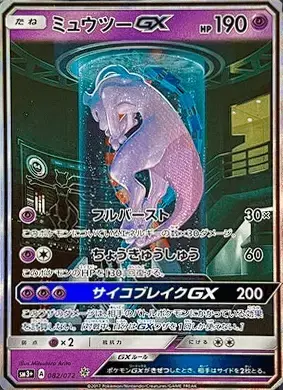
Mewtwo GX SA 082/072, Shining Legends (SM3+), Sun & Moon-era GX print

Mewtwo GX SA 082/072 (Shining Legends, SM3+)

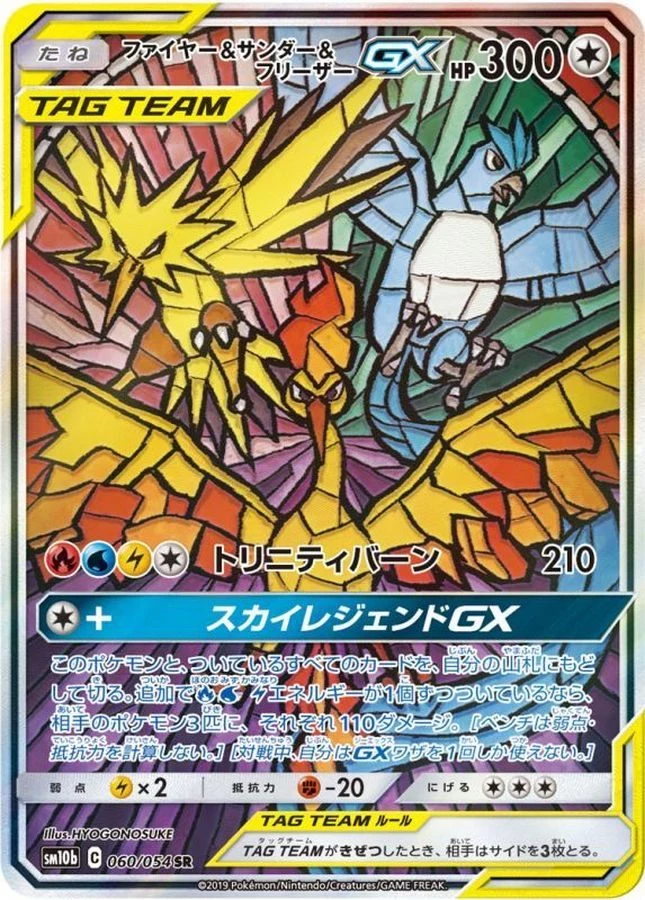
Moltres & Zapdos & Articuno GX SR:SA 060/054, Sky Legend (SM10b), Sun & Moon-era GX print

Moltres & Zapdos & Articuno GX SR:SA 060/054 (Sky Legend, SM10b)

Moltres & Zapdos & Articuno GX SR:SA 060/054, Sky Legend (SM10b) official card art
Moltres & Zapdos & Articuno GX SR:SA 060/054, Sky Legend (SM10b) — a GX-era card, not Prime or LEGEND

Shining Legends (SM3+), home to the Mewtwo GX SA above, released in Japan on 15 July 2017 and in English on 6 October 2017, with 82 cards in the Japanese set. It’s explicitly a GX-era set. For the full single-card breakdown, see our Mewtwo GX card guide. For the trio’s species background, see our Articuno, Zapdos & Moltres card guide, and for the rest of the set the trio comes from, see the Sky Legend (SM10b) complete card list and our Sky Legend pull rates & best cards guide.

Where to Buy LEGEND-Era and Legendary Cards from Tokyo

We ship Japanese sealed product and graded singles worldwide from Tokyo with tracked delivery. For a genuine Prime/LEGEND-era piece, the Lost Link Darkrai & Cresselia LEGEND print is the anchor of this guide, currently listed at ¥770,000 (~$4,843). If you’re drawn instead to the later Sun & Moon GX era, the Mewtwo GX SA is currently listed at ¥887,360 (~$5,581) and the Moltres & Zapdos & Articuno GX SR:SA is currently listed at ¥657,968 (~$4,138).

Featured Anchor
PSA10 Darkrai & Cresselia LEGEND [LL 035-036/040] Lost Link
Currently listed at ¥770,000 (~$4,843)
Ships from Tokyo · Tracked delivery

View Product →

For every other PSA10 Japanese card we list, browse the full PSA10 graded card collection, or use Snel bestellen to build a mixed order — including sourcing requests for prints, like a genuine Prime card, that aren’t currently listed.

Veelgestelde vragen

What is a Pokemon Prime card?

A single-card mechanic that first appeared in the HeartGold & SoulSilver expansion around 2010. Japanese name: グレートポケモン (“Great Pokemon”). It has a gold-foil holo border, spikes around the artwork window, 3D-style illustration emphasis, and no Pokedex info box. It plays as a normal Basic, Stage 1, or Stage 2 Pokemon with no special ruling, but the statline runs stronger than standard-era cards of the time.

What is a Pokemon LEGEND card?

A two-card mechanic that was one of two HeartGold & SoulSilver-era replacements for Pokemon LV.X. Each LEGEND Pokemon is split across a top-half card and a bottom-half card, and both must be placed on the Bench together to function as one Pokemon in play. It was printed across the English sets Unleashed, Undaunted, and Triumphant, and the Japanese sets Reviving Legends, Clash at the Summit, and Lost Link, roughly 2009–2010.

Is Darkrai & Cresselia LEGEND rare?

It’s the headline card of Strength Pack “Lost Link” (LL), split across #035/040 and #036/040 as “Rare Holo LEGEND.” This print is currently listed at ¥770,000 (~$4,843). See our dedicated single-card guide for the full print history.

Are the Mewtwo GX and Moltres/Zapdos/Articuno GX cards Prime or LEGEND cards?

No. Mewtwo GX SA (Shining Legends, SM3+, 2017) and Moltres & Zapdos & Articuno GX SR:SA (Sky Legend, SM10b, 2018) are Sun & Moon-era GX cards, roughly seven to eight years after the Prime/LEGEND era. They use the GX mechanic, not Prime or LEGEND, even though they feature Legendary Pokemon.

What set is Strength Pack “Lost Link”?

A Japanese set with the code LL, officially released 16 April 2010, with 40 total cards and 7 cards per booster (no Energy cards). It’s described as the only Japanese subset from the LEGEND era, and its headline card is Darkrai & Cresselia LEGEND.

Do you sell a genuine Pokemon Prime card?

Not at the moment — no genuine Pokemon Prime print is listed on our site currently. Sourcing requests for a Prime card go through Quick Order. Our live LEGEND-era example is the Darkrai & Cresselia LEGEND listing from Lost Link.

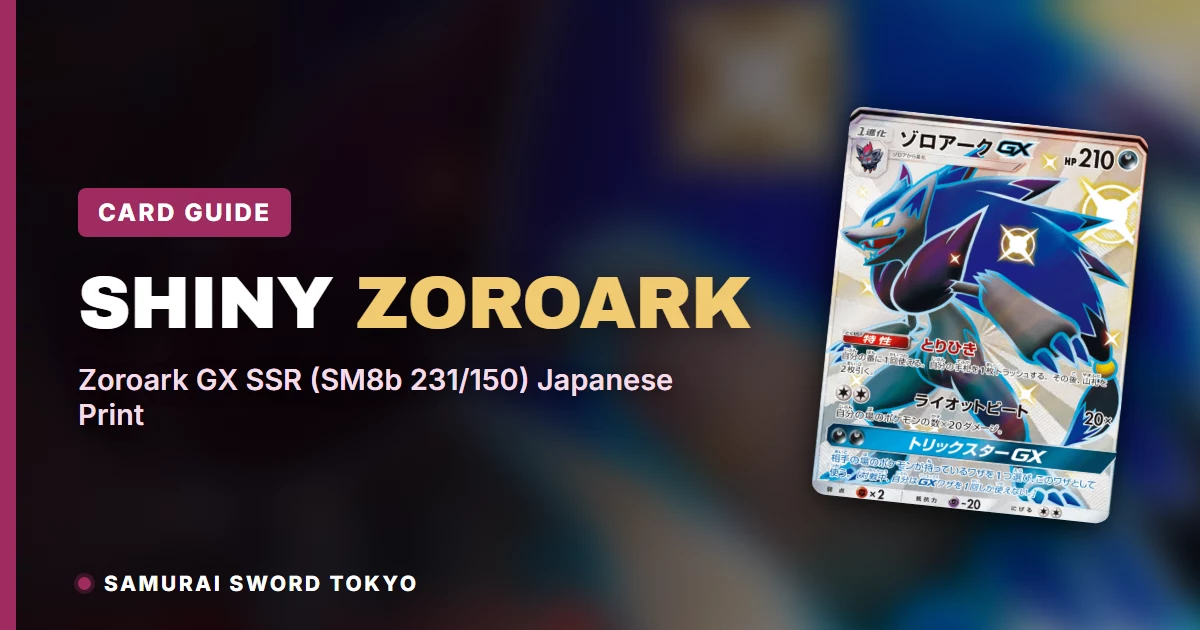
Shiny Zoroark-kaartgids: Zoroark GX SSR (SM8b 231/150) Japanse druk

Search “shiny zoroark card” and you will find two different things tangled together: a Shiny Pokemon — the alternate-colour version from the video games — and a Japanese Pokemon TCG rarity tier that also uses the word “shiny” in its own name. This guide is about the second one.

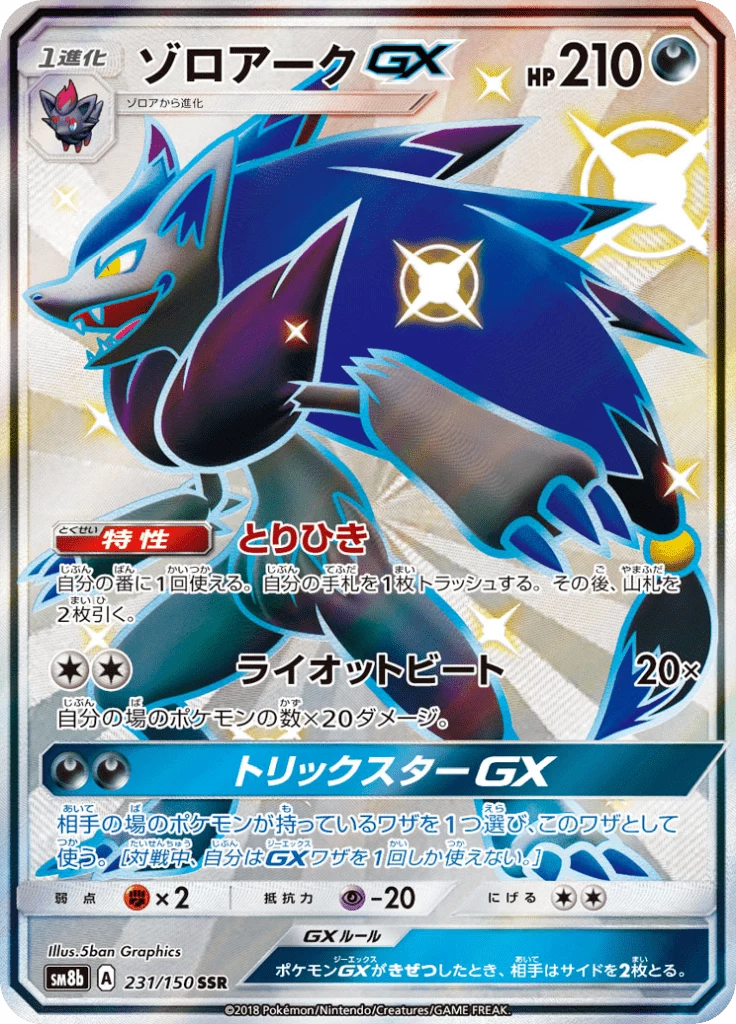
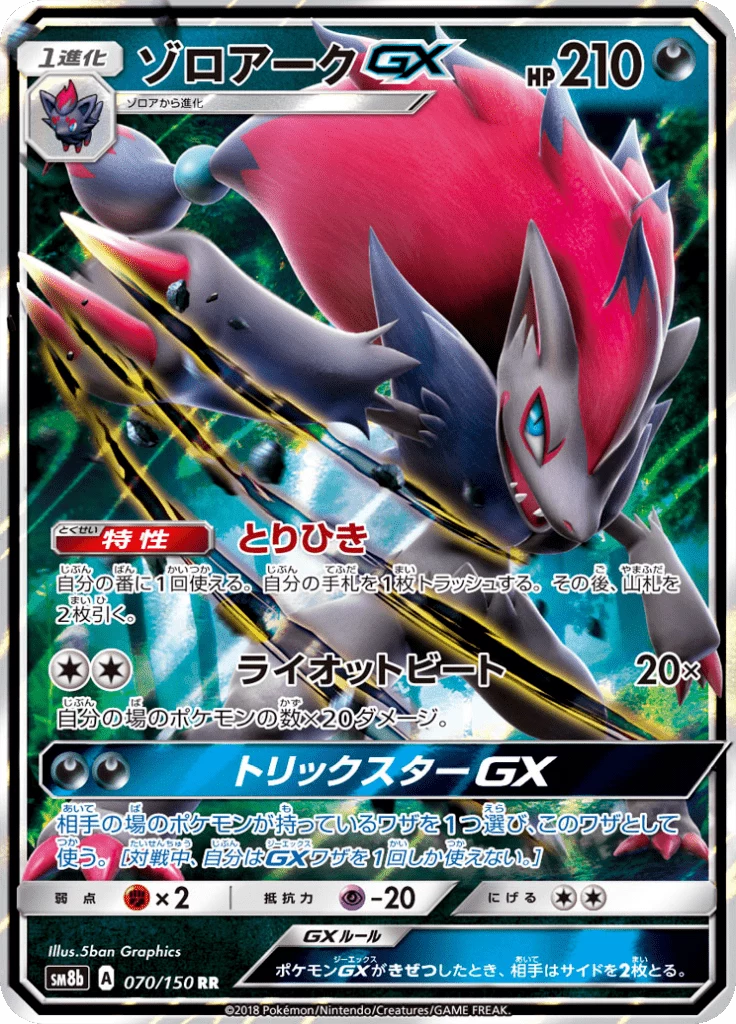
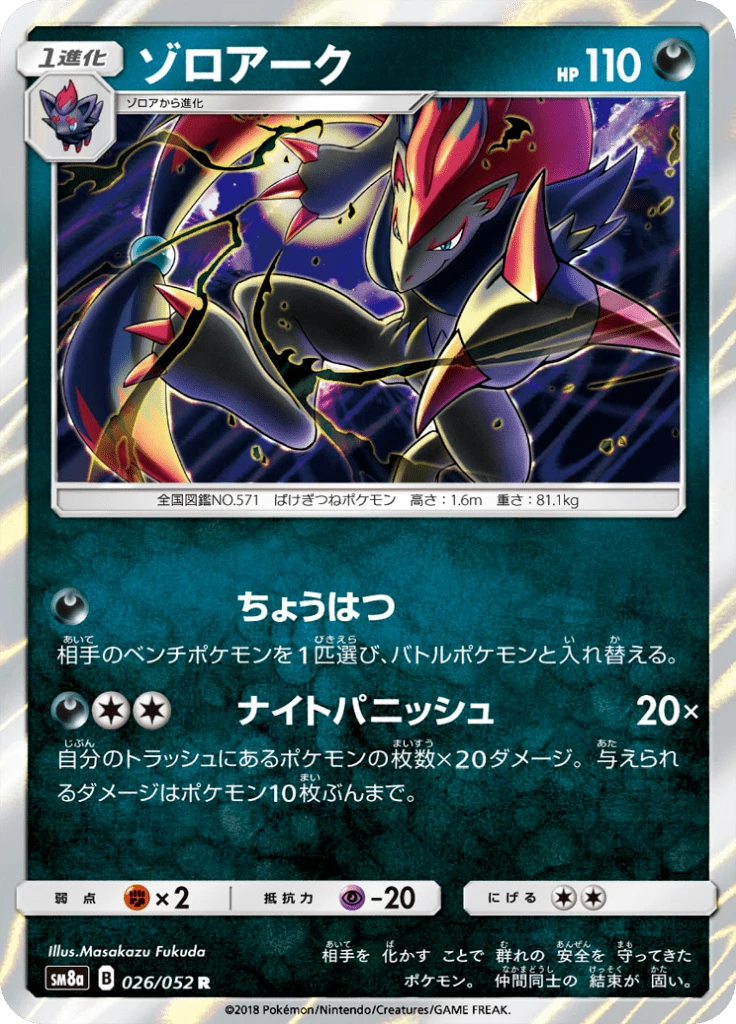
Our anchor is Zoroark GX, printed as an SSR — short for “Shiny Super Rare” — at 231/150 in the Japanese high-rarity set GX Ultra Shiny (set code SM8b). It is a full-art, alternate-colour-scheme treatment of the card, and it is the print our graded PSA 10 copy is listed for. Below: what the card is, how it compares to its sibling print from the same set, what we can and can’t confirm about the wider Zoroark print history, and where this exact SSR sits in Japan’s rarity tiers.

Key Takeaways

Zoroark GX SSR 231/150 from GX Ultra Shiny (SM8b) is a PSA 10, currently listed at ¥29,500 (~$186). “SSR” here stands for “Shiny Super Rare” — a TCG art/rarity treatment, not the in-game Shiny Pokemon variant. The same set also carries a regular Double Rare print of the card at 70/150, which is not currently listed on our site.

210
HP

SSR
Rarity (231/150)

SM8b
Set Code

2
Prints Individually Verified

Prices below are current samuraiswordtokyo.com listings, converted at ¥159/USD (September 2026).

The Card: Zoroark GX SSR 231/150

Zoroark GX (ゾロアークGX) is a Stage 1 Darkness-type Pokemon, evolving from Zorua. The 231/150 print carries 210 HP and is illustrated by 5ban Graphics. Its number — 231 in a set whose main run is numbered up to 150 — places it in the secret/special print slot above the set’s regular numbering, the standard Japanese convention for a set’s highest-tier chase print.

“Shiny” Here Means the Art Treatment, Not the Species

SSR stands for Shiny Super Rare, a Japanese TCG rarity tier used for full-art, alternate-colour-scheme parallel prints. It is not related to the “Shiny Pokemon” variant from the video games — a shiny-art SSR card and an in-game Shiny Pokemon are two unrelated uses of the same word.

Zoroark GX 231/150 SSR, GX Ultra Shiny (SM8b)
Zoroark GX 231/150, SSR — GX Ultra Shiny (SM8b), illustrated by 5ban Graphics

Our graded copy of this print is currently listed at ¥29,500 (~$186), PSA 10.

PSA 10 Zoroark GX SSR SM8b 231/150 slab, listed on samuraiswordtokyo.com
PSA 10 Zoroark GX SSR 231/150 slab, listed on samuraiswordtokyo.com

The Set: GX Ultra Shiny (SM8b)

GX Ultra Shiny, set code SM8b, is a Japanese Sun & Moon–era set — the same era the pack’s own English-set cross-reference (Team Up and related SM-era English sets) belongs to. Its main card numbering runs to 150, with secret/special print slots numbered above that; Zoroark GX’s SSR sits at 231, well outside the main count, in the same secret-slot pattern used across this era of Japanese sets.

The set’s exact Japanese release date has not been independently confirmed today, so we are not stating one here.

Both Zoroark GX prints covered above — the 70/150 Double Rare and the 231/150 SSR — come from this same GX Ultra Shiny release.

GX Ultra Shiny (SM8b) Japanese box

Japanese vs English Print

Zoroark GX does have an English-language presence: the regular version of the card appears in Team Up and other SM-era English sets. Whether an English alt-art/secret-rare equivalent of the specific 231/150 SSR print exists has not been confirmed today — treat that as unverified rather than assuming a direct match either way.

If you are trying to match a Japanese SSR against an English release, go by the actual card artwork and rarity treatment rather than assuming the card numbers or set names will line up — Japanese and English sets frequently split up a card’s parallel treatments differently.

Where This SSR Sits Among Japanese Rarity Tiers

The official card database lists the 231/150 print’s rarity as Secret Rare; our own listing follows the common site convention of labelling this specific shiny/alternate-colour full-art treatment “SSR” (Shiny Super Rare). Within GX Ultra Shiny, this SSR sits above the set’s regular numbered Double Rare print (70/150) — the secret-slot, full-art treatment outranking the standard in-set GX card.

If you collect other GX-era shiny/alt-art treatments, our Latias & Latios GX SA “Lovebirds” card guide covers a card in the same GX-era shiny/SA-art format. For a different Zoroark evolutionary form entirely, our Hisuian Zoroark VSTAR SAR guide covers the S12a 234/172 print — a genuinely different card, not another print of this one.

Shop This Card
PSA 10 Zoroark GX SSR 231/150 (GX Ultra Shiny, SM8b)
Currently listed at ¥29,500 (~$186)
Ships from Tokyo · Tracked delivery

View Product →

Where to Buy Zoroark GX SSR from Tokyo

Our graded PSA 10 Zoroark GX SSR 231/150 is currently listed at ¥29,500 (~$186), shipped from Tokyo with tracked delivery.

PSA 10 Zoroark GX SSR SM8b 231/150 slab, listed on samuraiswordtokyo.com
PSA 10 Zoroark GX SSR 231/150 slab, listed on samuraiswordtokyo.com

The regular 70/150 Double Rare print of this card is not currently listed on our site; sourcing requests for it, or for other Japanese Zoroark prints, go through Snel bestellen. Zoroark’s earlier evolution also appears in our Pokemon Starter Set ex comparison guide, which features Zorua & Zoroark ex alongside the set’s other starters.

Browse the wider graded range in our PSA 10 graded card collection, or use Snel bestellen to build a mixed order across singles and sealed product.

Veelgestelde vragen

What does “shiny” mean on this Zoroark card?

It refers to SSR — “Shiny Super Rare” — a Japanese TCG rarity tier for full-art, alternate-colour-scheme parallel prints. It is unrelated to the “Shiny Pokemon” variant from the video games; both simply use the word “shiny” for different things.

What is Zoroark GX SSR 231/150?

It is the Shiny Super Rare print of Zoroark GX, card 231/150 from the Japanese set GX Ultra Shiny (set code SM8b). We list a PSA 10 copy of this print at ¥29,500 (~$186).

What is the difference between the 70/150 and 231/150 prints?

Both come from GX Ultra Shiny (SM8b) and released the same day. The 70/150 is a Double Rare print inside the set’s main 150-card numbering; the 231/150 is the SSR, a secret-slot full-art alternate-colour treatment. We list the 231/150 SSR, not the 70/150.

Does Zoroark GX have an English print?

The regular version of Zoroark GX appears in Team Up and other SM-era English sets. Whether an English equivalent of the specific 231/150 SSR exists has not been confirmed, so we treat that as unverified rather than assumed.

How many Japanese Zoroark cards exist in total?

A database search for Japanese Zoroark cards returns 38 results across many sets, but only two of those have been individually verified — the 70/150 and 231/150 prints from GX Ultra Shiny. Treat the wider list as a starting point rather than a fully confirmed roster.

Where can I buy a PSA 10 Zoroark GX SSR from Tokyo?

Our graded 231/150 SSR copy is currently listed at ¥29,500 (~$186) with tracked shipping from Tokyo. The regular 70/150 print is not currently listed; requests for it go through Quick Order.

Yu-Gi-Oh Collector's Rare Uitgelegd (Japanse OCG)

Collector’s Rare is a Japanese OCG foil finish that took seven years to cross over into English Yu-Gi-Oh — it debuted in the OCG in 2013, and Western players did not see it until 2020. Visually, it is a Secret Rare’s rainbow foil pushed further: the same reflective pattern spreads across the Attribute icon, Level or Rank stars, the artwork, the text-box border and the outer card border, rather than sitting on just the name and holo window the way a standard Parallel Rare does.

That long gap between the OCG and TCG debuts is where most of the confusion online starts, and it is one of two things this guide sets straight. The other is where the finish actually shows up today: it is a confirmed, first-party guaranteed pull in a current Japanese booster box we list, and only a secondary-sourced, unconfirmed possibility in a second current release. This guide separates the two.

Key Takeaways

Collector’s Rare launched in the OCG in Collectors Pack: ZEXAL Version on 10 August 2013; the TCG did not get its own version until Toon Chaos on 19 June 2020 — a seven-year gap, not a shared debut date. Our own LOCR — Limit Over Collection: The Rivals booster box guarantees 2 Collector’s Rares per box by its own official product description, and is currently listed without a displayed price, with sourcing handled through Quick Order.

2013
OCG Debut Year

2020
TCG Debut Year

7
Years Between Debuts

2
Guaranteed per LOCR Box

Yen figures below convert at ¥159/USD (September 2026). All dates and set specs are the official Japanese OCG release information for the products named.

What Is a Yu-Gi-Oh Collector’s Rare?

Collector’s Rare is a foil treatment, not a distribution promise — it describes how a card is printed, not how many turn up in a given box. It carries the same rainbow-colored reflective pattern used on a Parallel Rare, but applied across more of the card than a standard Parallel Rare covers: the Attribute icon, the Level or Rank stars, the full artwork, the text-box border, and the outer card border all pick up the rainbow finish, rather than the treatment being confined to a smaller strip of the card.

LOCR Limit Over Collection The Rivals Japanese Yu-Gi-Oh booster box
LOCR – Limit Over Collection: The Rivals, Japanese OCG booster box — its own product description guarantees 2 Collector’s Rares per box.

It first appeared in the Japanese OCG in Collectors Pack: ZEXAL Version, released 10 August 2013. That makes it an OCG-original finish by a wide margin: it existed in Japan for the better part of a decade before English-language Yu-Gi-Oh players ever saw it on a card, which is exactly the timeline the next section walks through.

OCG vs TCG: Two Debuts, Seven Years Apart

Do Not Conflate These Dates

Collector’s Rare has two separate debut dates depending on the region, and they are frequently written up online as if they were one event. They are not.

Regio Debut set Release date
OCG (Japan) Collectors Pack: ZEXAL Version 10 August 2013
TCG (English) Toon Chaos 19 June 2020

Seven years separate the two. For buyers used to thinking of Yu-Gi-Oh rarities as a single global ladder, Collector’s Rare is a useful reminder that the OCG and TCG do not always introduce a given finish at the same time, or even in the same decade. Anyone dating a Collector’s Rare card should check which region’s product they are actually looking at before assuming a release year.

Where It Shows Up Today: LOCR’s Per-Box Guarantee

The clearest current example of Collector’s Rare in circulation is our own LOCR — Limit Over Collection: The Rivals booster box, released in Japan on 20 March 2026 under set code LOCR. It carries 80 card types in its base breakdown (38 Ultra Rare / 42 Super Rare), packed 15 packs per box at 4 kaarten per pack.

Per our own product listing for the box, each LOCR box guarantees a fixed set of premium pulls:

Treatment Guaranteed per box
Prismatic Secret Rare 1
Ultra Rare Over Frame 1
Ultimate Rare 2
Collector’s Rare 2
Secret Rare 9

That guarantee is first-party — it comes from our own site’s product listing for the box, not a secondary retail source. LOCR itself is currently listed on our site without a displayed price; sourcing for it goes through Snel bestellen. The same set’s carton-level listing is also live on our catalogue.

For the full 80-card breakdown behind this box, see our LOCR card list and our broader Limit Over Collection guide, which covers LOCR alongside its companion release, The Heroes — that guide looks at the whole set; this article is specifically about the Collector’s Rare finish within it.

Quarter Century Art Collection: What’s Actually Confirmed

PSA10 Dark Magician Girl the Dragon Knight SE QCAC-JP020 Quarter Century Art Collection
PSA10 Dark Magician Girl the Dragon Knight SE [QCAC-JP020], Quarter Century Art Collection — currently listed without a displayed price.

Quarter Century Art Collection (QCAC) is the other current OCG release most often mentioned alongside Collector’s Rare. It is reported to have released in Japan on 22 February 2025 as a 100-card, art-focused set built around Quarter Century Secret Rare and Secret Rare treatments.

Confirmed vs. Reported

Third-party retail listings (SNKRDUNK, YGOrganization) describe Collector’s Rare as one of QCAC’s premium chase treatments. That specific claim is not independently confirmed on an official Konami page today, so treat it as reported by resellers rather than a first-party guarantee — unlike LOCR’s own stated 2-per-box guarantee above, which comes directly from our product listing.

We do carry a graded single tied to this set on our site: a PSA10 Dark Magician Girl the Dragon Knight SE [QCAC-JP020] currently listed without a displayed price. The QCAC booster box (carton) is also live on our catalogue, also without a displayed price. For the set overall, see our dedicated Quarter Century Art Collection guide and full QCAC card list — those cover the set’s Quarter Century Secret Rare identity in depth; this article’s focus stays on Collector’s Rare specifically.

Where Collector’s Rare Sits on the Ladder

Within LOCR’s own guarantee list above, Collector’s Rare sits above the set’s Secret Rare slot and roughly alongside or below Ultimate Rare and Prismatic Secret Rare in that box’s guaranteed-pull structure. That ordering is specific to what LOCR’s own box guarantees — it is not a claim about a single, universal Yu-Gi-Oh rarity ranking that holds across every OCG era or every set.

For a sense of scale against Collector’s Rare’s rainbow-across-everything treatment, here are three Ultra Rare base prints from the same LOCR set, shown at their standard foil level:

Blue-Eyes White Dragon the White Phantom Beast Ultra Rare

Blue-Eyes White Dragon, the White Phantom Beast — Ultra Rare

Deep-Eyes White Dragon the Blue Abyss Ultra Rare

Deep-Eyes White Dragon, the Blue Abyss — Ultra Rare

The Guiding Flute of Summoning Dragons Ultra Rare

The Guiding Flute of Summoning Dragons — Ultra Rare

Standard Ultra Rare foil is gold holofoil letters on the card name plus a holofoil background — the rainbow, full-card treatment described earlier for Collector’s Rare goes well beyond that base finish. That contrast is the easiest way to spot a Collector’s Rare in hand: if the rainbow reflection only covers the card name and a narrow band around it, it is a different finish; Collector’s Rare’s rainbow pattern extends across the icon, stars, art and both borders.

Where to Buy Yu-Gi-Oh Collector’s Rare Product from Tokyo

We ship Japanese sealed product and graded singles worldwide from Tokyo with tracked delivery. The most direct route to a confirmed Collector’s Rare pull is a sealed LOCR box, since its 2-per-box guarantee is first-party and stated on our own listing.

Shop This Set
LOCR – Limit Over Collection: The Rivals Booster Box (Japanese)
Guarantees 2 Collector’s Rares, 2 Ultimate Rares, 1 Ultra Rare Over Frame, 1 Prismatic Secret Rare and 9 Secret Rares per box
Ships from Tokyo · Tracked delivery · Listed without a displayed price, sourcing via Quick Order

View Product →

Beyond the single box, we also list LOCR by the carton for larger orders, and the QCAC carton for the set discussed above — both are listed without a displayed price, with sourcing through Quick Order. If you want a single graded card rather than sealed product, our PSA10 Dark Magician Girl the Dragon Knight SE [QCAC-JP020] is currently listed the same way.

For the surrounding rarity picture — how Prismatic Secret Rare and Quarter Century Secret Rare relate to each other on current OCG product — our Yu-Gi-Oh OCG Rarity Guide: Quarter Century Secret Rare is the broader companion piece to this article; it covers the whole current ladder, where this guide focuses specifically on Collector’s Rare. Our Prismatic Secret Rare explained guide goes deeper on that specific neighbouring finish. Mixed orders across boxes, cartons and singles go through Snel bestellen.

Veelgestelde vragen

What is a Yu-Gi-Oh Collector’s Rare?

Collector’s Rare is a Japanese OCG foil finish that uses the same rainbow-colored reflective pattern as a Parallel Rare, but spreads it across more of the card — the Attribute icon, Level/Rank stars, artwork, text-box border and outer border all carry the treatment, rather than just the card name.

When did Collector’s Rare debut, and is the OCG date the same as the TCG date?

No — they are seven years apart. Collector’s Rare debuted in the OCG in Collectors Pack: ZEXAL Version on 10 August 2013. The TCG did not get its own Collector’s Rare cards until Toon Chaos on 19 June 2020.

Which current Japanese set guarantees Collector’s Rare cards?

LOCR – Limit Over Collection: The Rivals, released in Japan on 20 March 2026. Per our own product listing, each box guarantees 2 Collector’s Rares, alongside 1 Prismatic Secret Rare, 1 Ultra Rare Over Frame, 2 Ultimate Rares and 9 Secret Rares.

Does Quarter Century Art Collection (QCAC) have Collector’s Rare cards?

Third-party retail listings describe Collector’s Rare as one of QCAC’s premium treatments, but that specific claim is not independently confirmed on an official Konami page. Treat it as reported by resellers rather than a confirmed first-party guarantee, unlike LOCR’s own stated per-box count.

Where does Collector’s Rare sit compared to Secret Rare and Ultimate Rare?

In LOCR’s own guaranteed-pull list, Collector’s Rare sits above the set’s Secret Rare slot and roughly alongside or below Ultimate Rare and Prismatic Secret Rare. That ordering is specific to LOCR’s own guarantee list, not a universal cross-era Yu-Gi-Oh rarity ranking.

Where can I buy Yu-Gi-Oh Collector’s Rare product from Japan?

We ship Japanese sealed product and graded singles worldwide from Tokyo. Our LOCR booster box and carton, the QCAC carton, and a PSA10 Dark Magician Girl the Dragon Knight SE single are all currently listed on our site without a displayed price, with sourcing handled through Quick Order.