Crea un account gratuito: accumula punti e livello
Samurai Sword Tokyo
Ordini Carrello

Guida alle carte Pokemon Rockruff giapponesi: ogni stampa e il box SV3
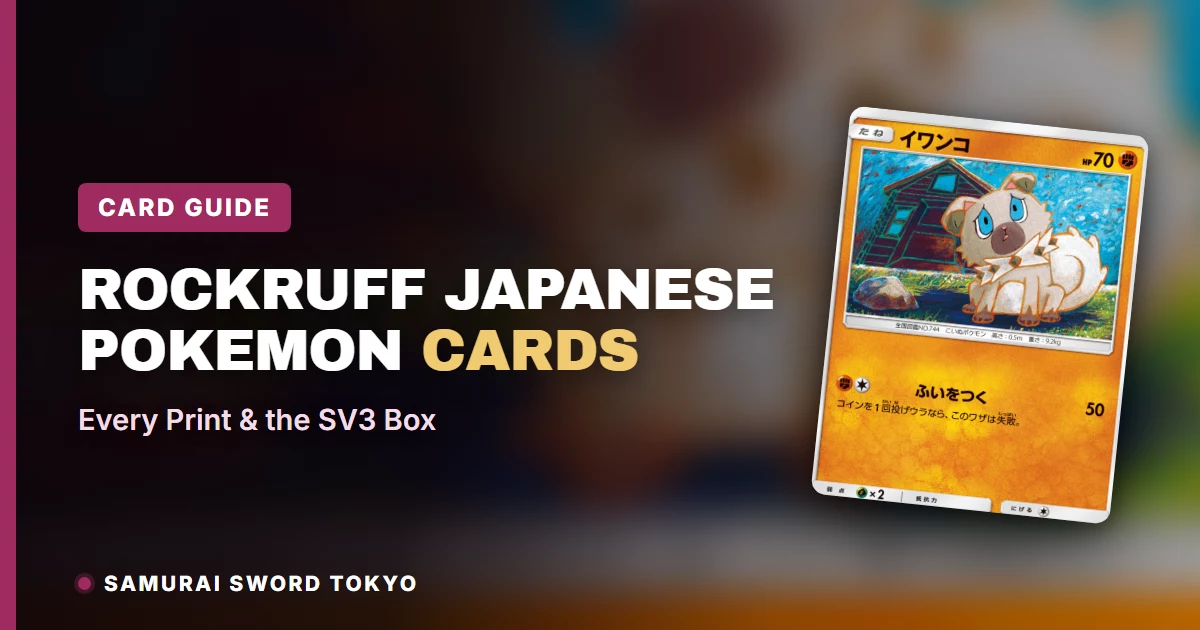
Rockruff (イワンコ) is a Rock-type Basic Pokemon that evolves into Lycanroc — a line with three possible evolved forms depending on the version of the game it’s caught in. That branching evolution has kept it a recurring roster pick in the Japanese TCG for close to a decade, and it has been printed across sets spanning the Sun & Moon era, through Sword & Shield, to the current Scarlet & Violet era.

A search of Japan’s Pokemon card database returns 24 Rockruff prints in total, spread across main expansions, starter decks, McDonald’s promos and Sun & Moon-era subsets. This guide doesn’t try to catalogue all 24 — it focuses on the four prints we’ve verified card-by-card, including the Common-rarity print currently sitting inside our listed Ruler of the Black Flame (SV3) booster box.

Key Takeaway

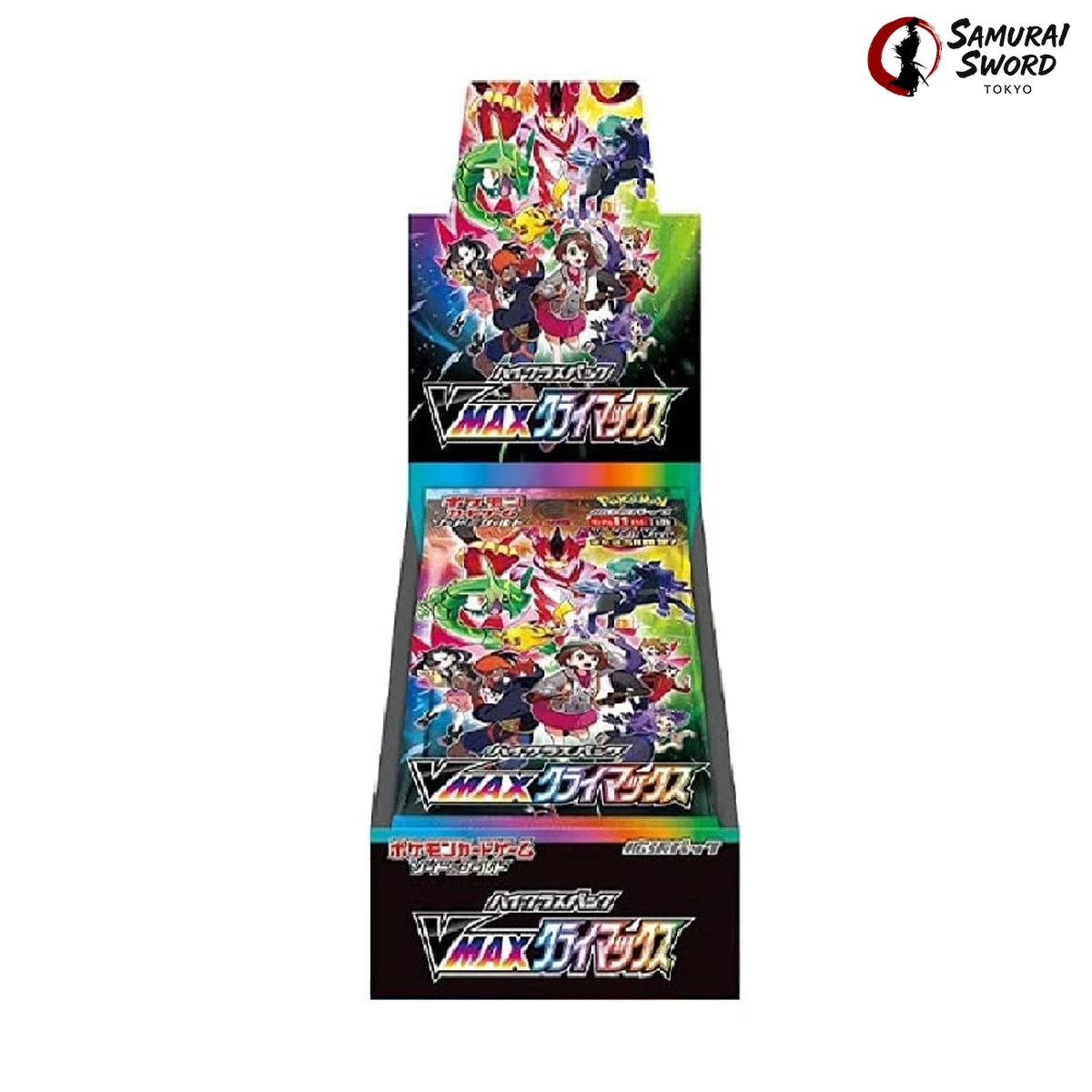
Rockruff has appeared across at least four verified Japanese prints spanning the Sun & Moon, Sword & Shield, and Scarlet & Violet eras, all confirmed or expected at Common rarity. The current pull-from box is the SV3 Ruler of the Black Flame Booster Box, which carries the SV3/61 print. The VMAX Climax Booster Box, currently listed at ¥39,900 (~$251), carries an earlier Rockruff print from 2021.

4
Prints Verified

Common
Confirmed Rarity Tier

3
Eras Covered (SM, S&S & SV)

3
Listed Boxes

The Japanese Rockruff Cards Verified in This Guide

Limitless TCG’s Japanese card search returns 24 Rockruff prints once every set code is counted, going back through McDonald’s promo sets, starter decks and Sun & Moon-era subsets. Most of that list sits outside what we can verify card-by-card, so this guide sticks to four prints with confirmed illustrator and HP data; rarity is confirmed for three, while the S8b print remains unverified:

Set / No. Set Name Rarity Illustrator HP
S3a 40 Legendary Heartbeat Common Eri Yamaki 70
SM6 52 Forbidden Light Common Tomokazu Komiya 70
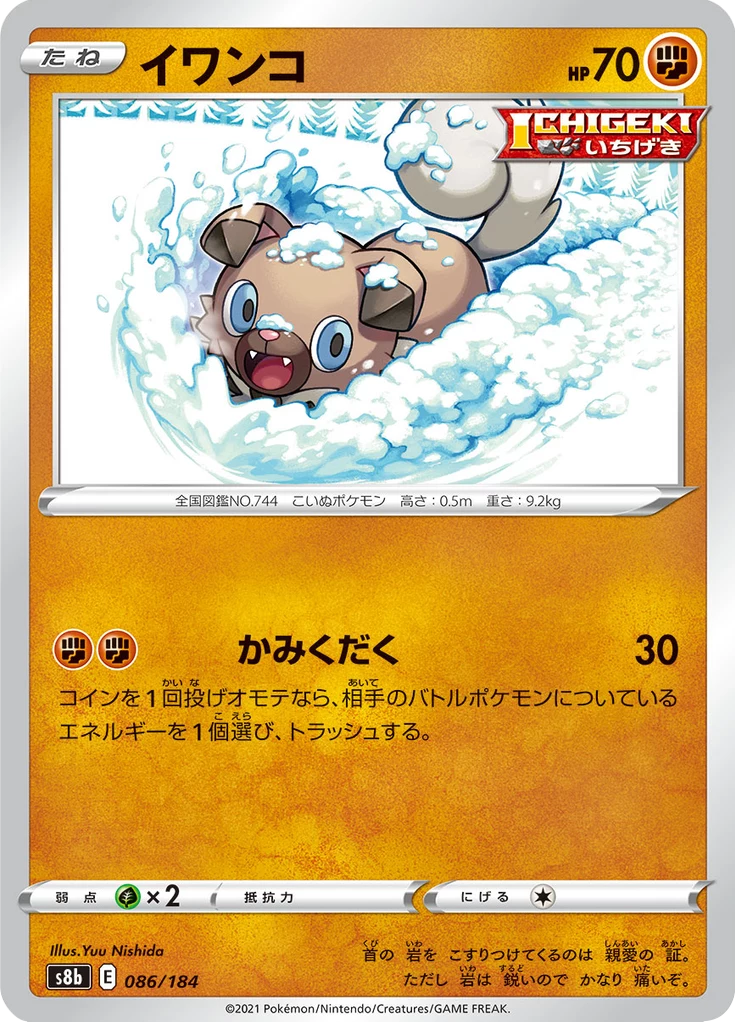
S8b 86/184 VMAX Climax Not shown in source data Yuu Nishida 70
SV3/61 Ruler of the Black Flame Common Jerky 60

Three of the four carry a confirmed Common rarity. The fourth, from VMAX Climax, doesn’t show a rarity marker on the source page we checked, so we’re treating that one as unverified rather than assuming it matches the others.

Sun & Moon Era: Forbidden Light
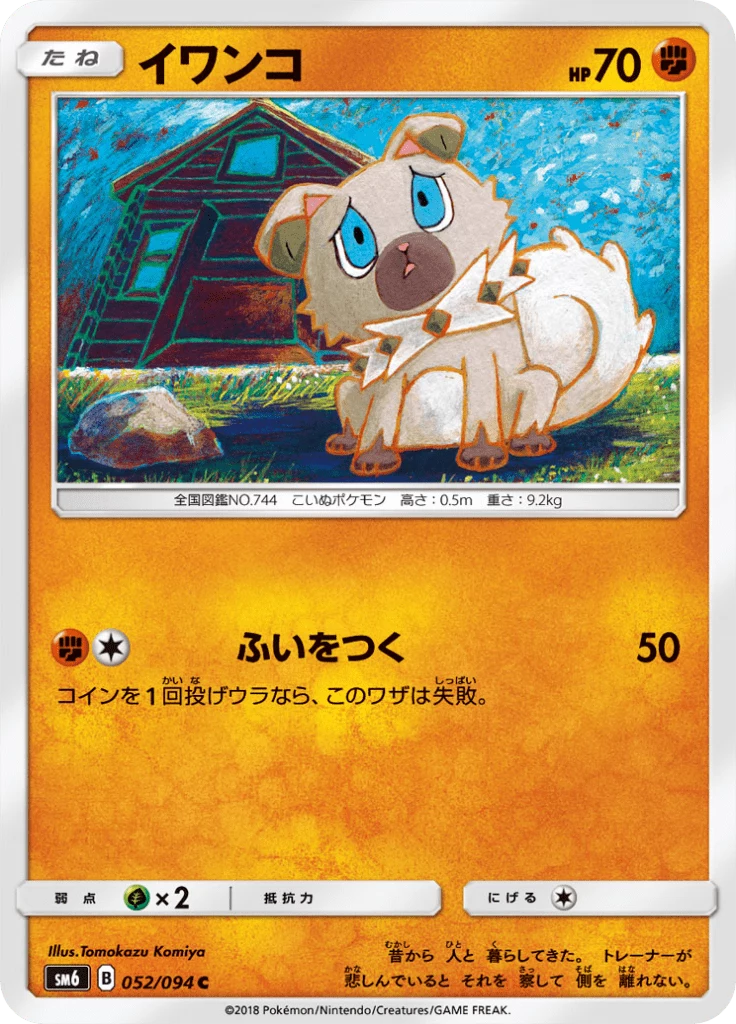
Rockruff, SM6 52, Common, Forbidden Light

Rockruff, SM6 52, Common, Forbidden Light

The earliest print we’ve verified comes from the Sun & Moon era. Forbidden Light (SM6) carries Rockruff at card 52, a Common-rarity 70 HP print illustrated by Tomokazu Komiya — a reliable Common slot rather than a chase pull, which is exactly the kind of print history a set-completion collector runs into when working through Sun & Moon-era binders.

Scarlet & Violet Era: Ruler of the Black Flame
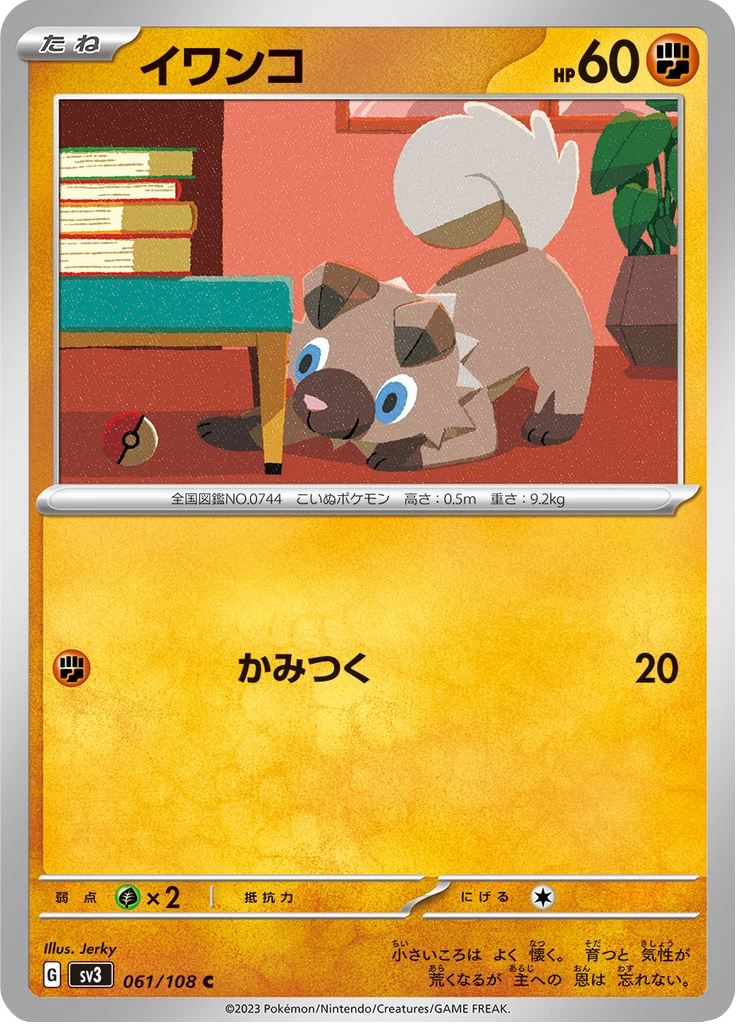
Rockruff, SV3/61, Common, Ruler of the Black Flame

The current-era print — and the one behind our anchor box — is SV3/61 from Ruler of the Black Flame, illustrated by Jerky. It’s a Common-rarity print with 60 HP, 10 HP lower than the three Sun & Moon- and Sword & Shield-era prints above, reflecting the slightly different HP baselines the Scarlet & Violet era uses for early-line Basic Pokemon.

Ruler of the Black Flame itself released on July 28, 2023, as a 141-card set. Its English-language equivalent is Obsidian Flames (OBF), where this same Rockruff print carries card number 116. If you’re cross-referencing an English collection against a Japanese one, that’s the pairing to use for this particular Rockruff — see our Obsidian Flames Japanese card list for the rest of the set’s English/Japanese matches.

Check This First

If your Rockruff card is 60 HP with the illustrator credit “Jerky” printed in small type near the bottom edge, you’re holding the SV3/61 Ruler of the Black Flame print. The three earlier prints above are all 70 HP instead.

For the full 141-card breakdown of what else is in this set, see our Ruler of the Black Flame card list and our Ruler of the Black Flame best cards guide.

Sword & Shield Era: Legendary Heartbeat and VMAX Climax
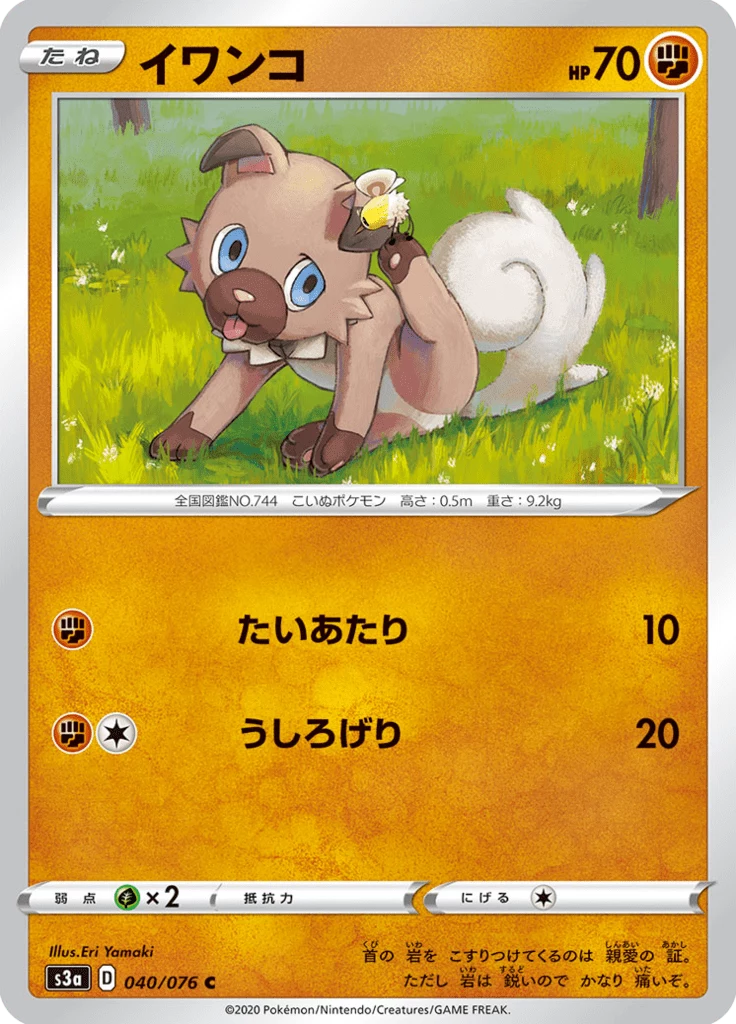
Rockruff, S3a 40, Common, Legendary Heartbeat

Rockruff, S3a 40, Common, Legendary Heartbeat

Rockruff, S8b 86/184, VMAX Climax

Rockruff, S8b 86/184, VMAX Climax

Two of our verified prints come from the Sword & Shield era — the “S”-coded Japanese sets that sit between Sun & Moon and Scarlet & Violet. Legendary Heartbeat (S3a) carries Rockruff at card 40, a Common-rarity 70 HP print illustrated by Eri Yamaki. VMAX Climax (S8b) carries a separate Rockruff at 86/184, also 70 HP, illustrated by Yuu Nishida. We haven’t been able to confirm the exact rarity tier from the source data for the S8b print, so we’re not stating one here.

What we can confirm is that VMAX Climax is one of the sets carrying a Rockruff print in currently listed sealed product on our site, alongside the newer SV3 box.

Chase Prints and What Makes Rockruff Collectible

Rarity tiers in the Japanese TCG run from Common and Uncommon up through Rare, then into the higher secret-rare and full-art tiers that define a set’s chase cards. Among the four prints covered here, the three with verified rarity are Common; the S8b print’s rarity remains unverified.

That doesn’t make the line uncollectible; it just means the appeal here is different. Rockruff’s collectibility comes from print-run variety rather than rarity-tier chasing: four different illustrators (Eri Yamaki, Tomokazu Komiya, Yuu Nishida, and Jerky) have each put their own take on the same Pokemon across four different sets and three different eras, and the 24-print total in the wider database suggests there’s a genuinely deep run to work through if set-completion is the goal. For collectors building out a Rockruff or a wider Lycanroc-line binder, the value is in tracking down each era’s distinct illustration rather than hunting a single expensive chase card.

It’s also worth noting the HP shift between eras: the Sun & Moon-era print (SM6) and the two Sword & Shield-era prints (S3a, S8b) all run 70 HP, while the current Scarlet & Violet print (SV3/61) drops to 60 HP. That’s a small but genuine design difference between how early-Basic Pokemon are costed across eras, and it’s a quick way to sort a mixed pile of Rockruff cards by era at a glance.

Which Japanese Boxes to Open for Rockruff

We don’t currently list a graded or single Rockruff card on our site — the direct route to pulling one is sealed product from the sets above. Two of our listed sets carry a verified Rockruff print, across three separate listings:
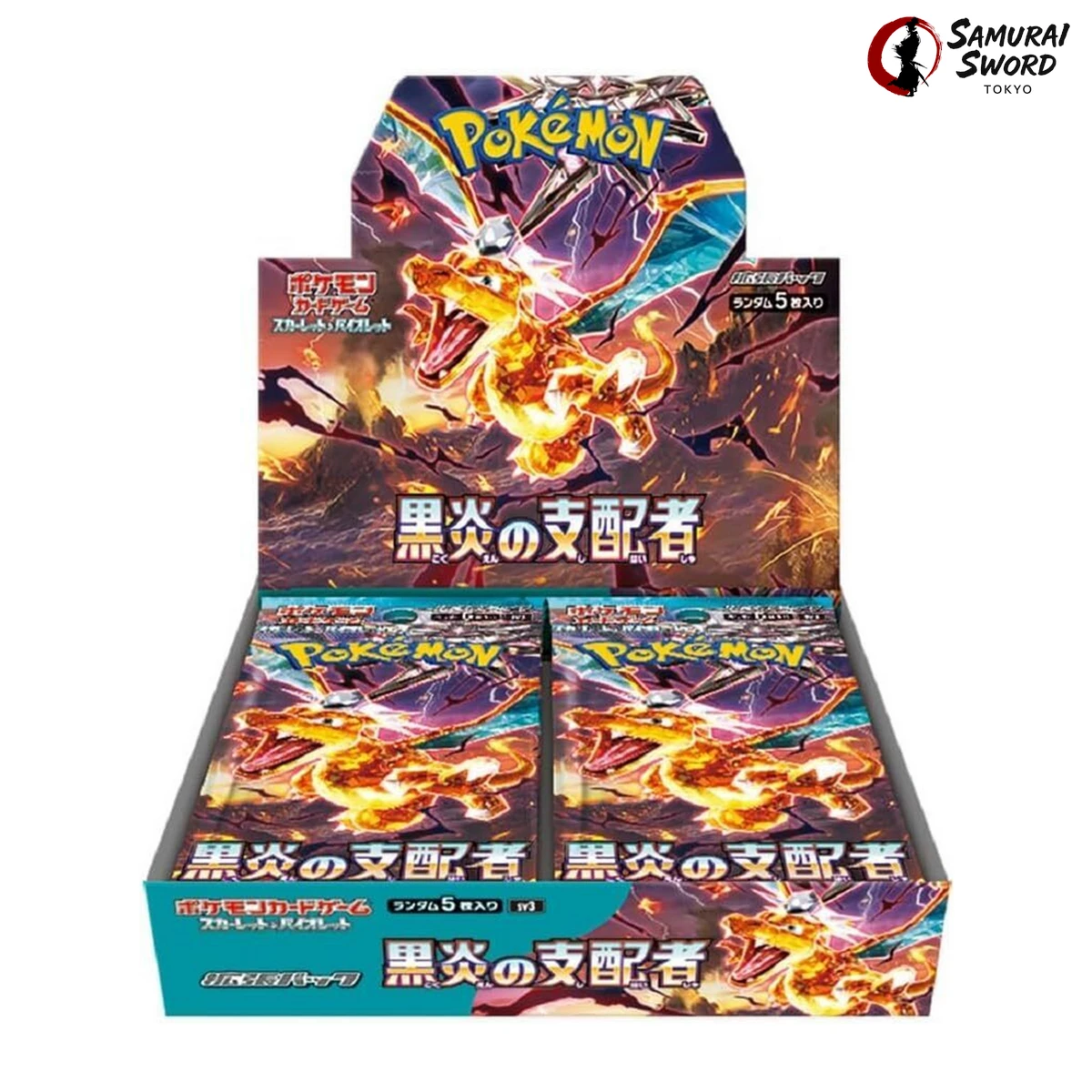
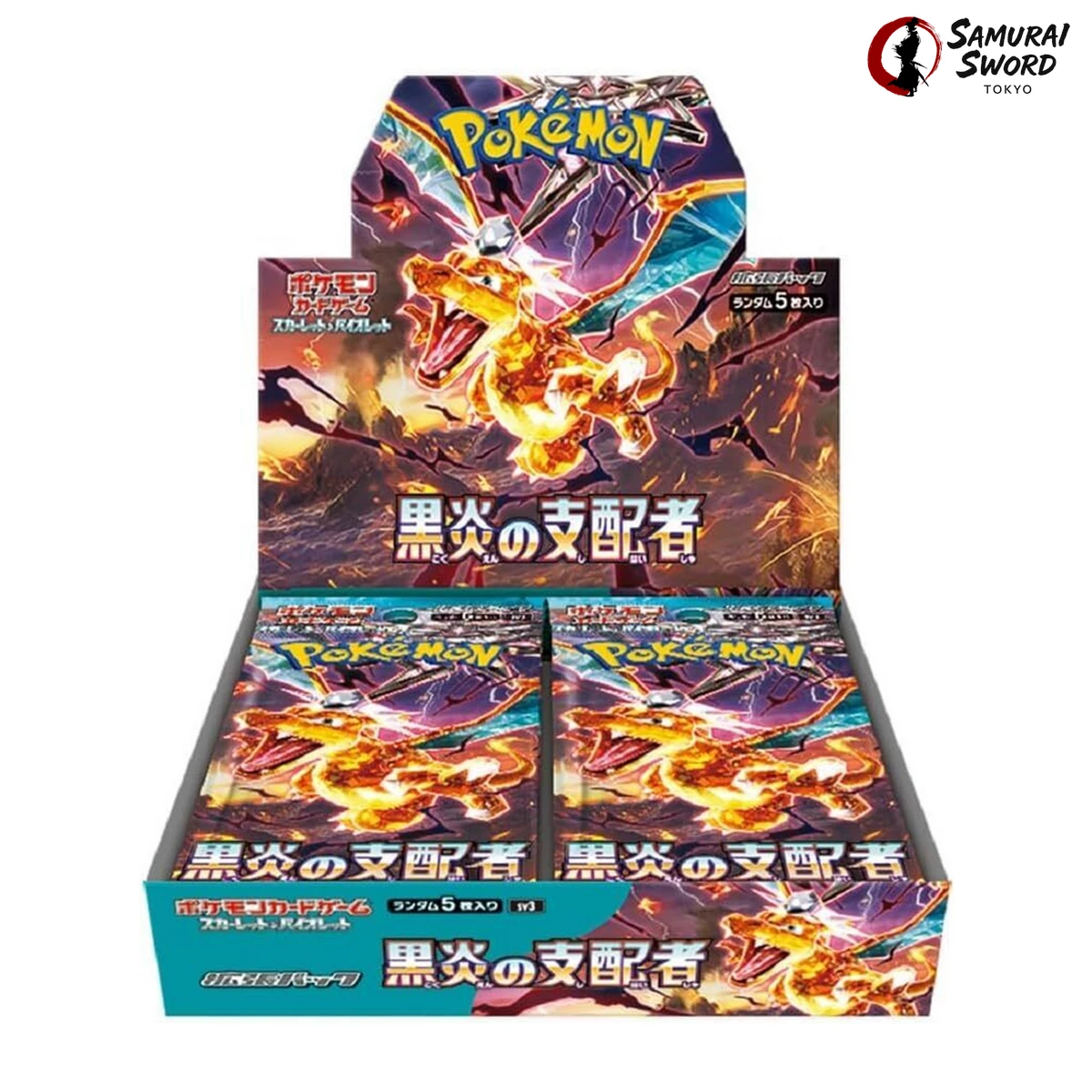
SV3 Ruler of the Black Flame Japanese Pokemon Booster Box, listed on samuraiswordtokyo.com
S8B VMAX Climax Japanese Booster Box, listed on samuraiswordtokyo.com

For a closer comparison of Ruler of the Black Flame against its sister set, see our SV3 vs SV3a box guide. For any of the other 20-plus Rockruff prints in the wider database that aren’t tied to a box above, sourcing requests go through our Quick Order page.

Shop This Box
SV3 Ruler of the Black Flame Japanese Pokemon Booster Box
See the product page for the currently displayed condition and price
Ships from Tokyo · Tracked delivery

View Product →

Where to Buy Rockruff Cards from Tokyo

We ship Japanese sealed product worldwide out of Tokyo with tracked delivery. If you’re after the current-era print, the SV3 Ruler of the Black Flame Booster Box is the direct route, with the Deck Build Box as a lower-cost alternative built around the same set. For the 2021 print, the S8B VMAX Climax Booster Box carries it alongside that set’s better-known chase cards.

Browse our wider Japanese Pokemon booster box collection for what else is currently listed, or request a quote through our Quick Order page for sourcing requests on the Sun & Moon-era prints or any of the 24 Rockruff prints not tied to a listed box above. If you’re building out the rest of the Lycanroc line or comparing this set against its Scarlet & Violet-era sibling, our Pidgeot cards guide covers another species pulled from the same era of Japanese sets.

Domande frequenti

How many Japanese Rockruff Pokemon card prints are there?

Japan’s Pokemon card database lists 24 Rockruff prints in total across main expansions, starter decks, McDonald’s promos and Sun & Moon-era subsets. This guide covers the four prints we’ve verified card-by-card: Legendary Heartbeat (S3a 40), Forbidden Light (SM6 52), VMAX Climax (S8b 86/184) and Ruler of the Black Flame (SV3/61).

What rarity is the Rockruff card in Ruler of the Black Flame?

Common. The SV3/61 print is 60 HP and illustrated by Jerky. Its English-language equivalent is Obsidian Flames (OBF) card 116.

Is there a rare or full-art Rockruff card?

Three of the four prints covered here are confirmed at Common rarity. The fourth (VMAX Climax, S8b 86/184) doesn’t show a rarity marker in the source data we checked, so its rarity remains unverified.

Which Japanese booster box has the newest Rockruff print?

Ruler of the Black Flame (SV3), which released July 28, 2023, and carries the SV3/61 Common print. It’s currently listed as a booster box and as a lower-cost Deck Build Box on our site.

Where can I buy Japanese Rockruff Pokemon cards?

We ship Japanese sealed product from Tokyo with tracked delivery. The Ruler of the Black Flame booster box and Deck Build Box carry the current-era print, and the VMAX Climax booster box carries the 2021 print. For any other print, sourcing requests go through our Quick Order page.
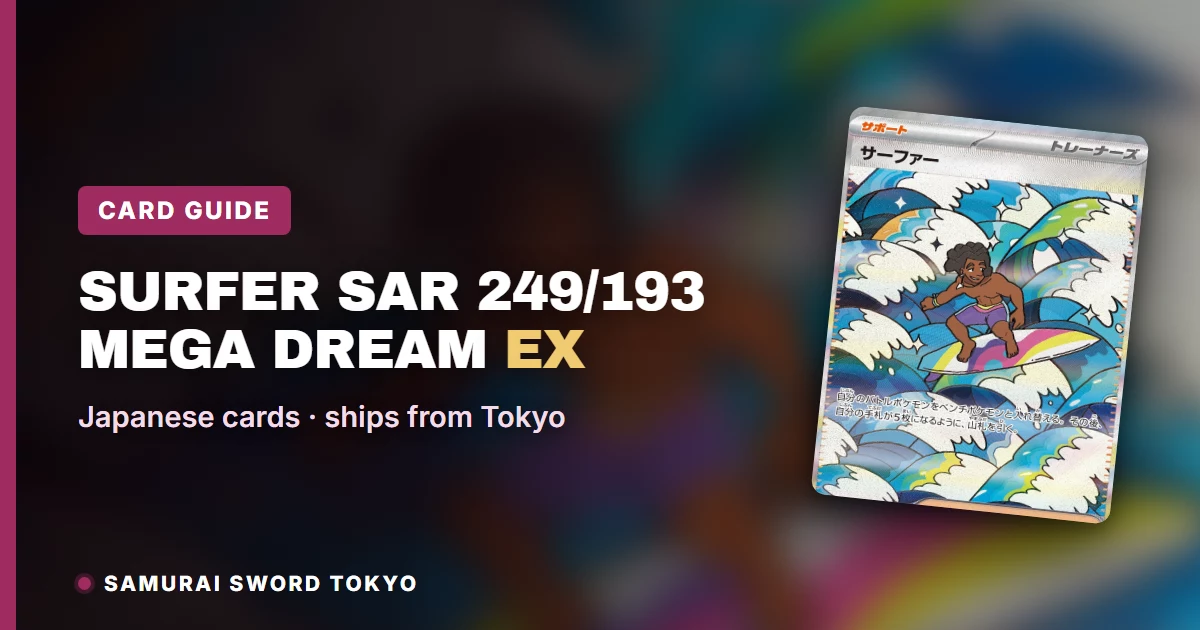
Guida alla carta Surfer SAR 249/193 MEGA Dream ex

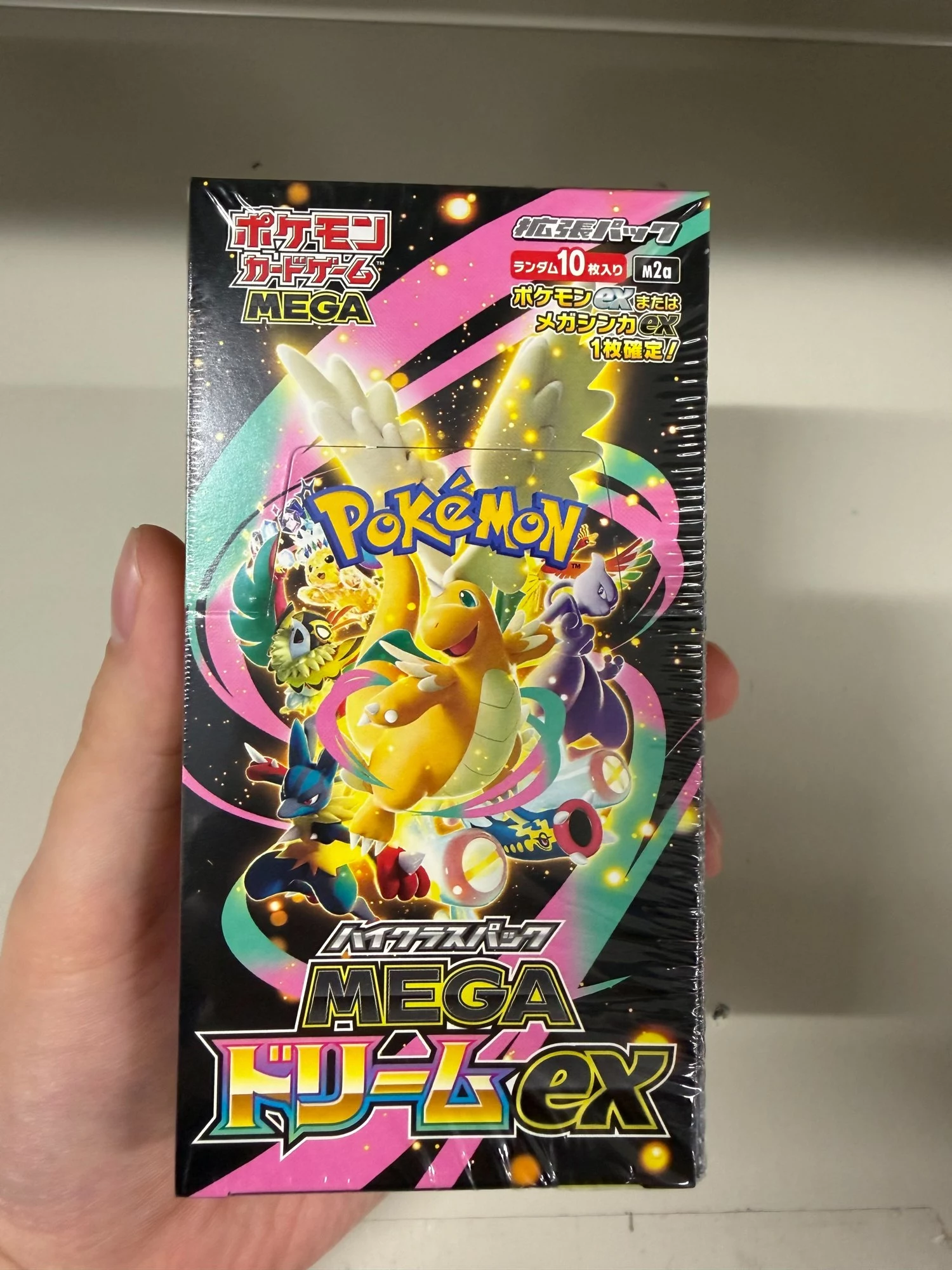
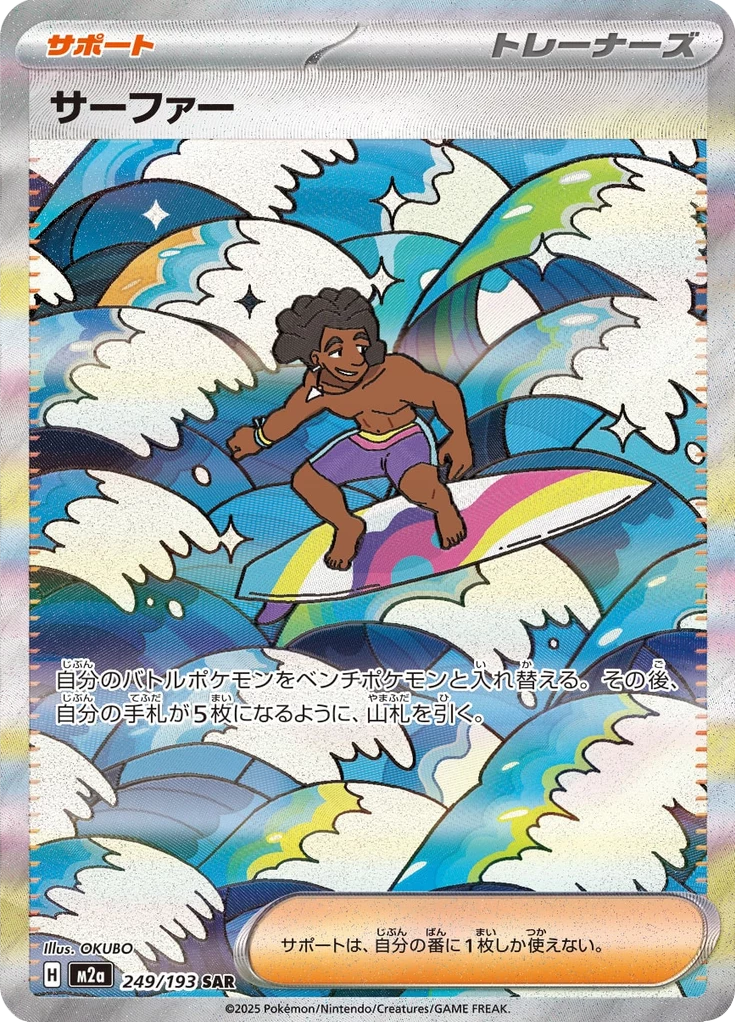
Surfer is a Trainer — Supporter card built around one simple effect: swap your Active Pokémon for a Benched one, then refill your hand to five cards. It’s the kind of utility Supporter that turns up across a wide range of decks rather than one built for a single archetype, and its most eye-catching Japanese print is the Special Art Rare (SAR) numbered 249/193, from the Japanese High Class Pack 「MEGAドリームex」 — MEGA Dream ex, set code M2a.

This guide covers what the card does, where 249/193 sits inside the M2a print run, how it compares with its English-set equivalents, and how it ranks against other Japanese chase-tier Supporters we carry in graded form. We currently list a PSA 10 example of this exact print, graded and shipped from Tokyo.

Key Takeaways

Surfer 249/193 SAR is a PSA 10, currently listed at ¥7,920 (~$50). It comes from MEGA Dream ex (M2a), a Japanese High Class Pack released 28 November 2025 with a main set running to 193 cards. The printed effect swaps your Active Pokémon for a Benched one and refills your hand to five cards. If you’d rather pull your own print from sealed product, the M2A-Mega Dream ex Japanese Pokemon Booster Box is the set this SAR comes from.

Supporter
Card Type
SAR
Rarity (249/193)
193
Set Size (M2a)
Nov 2025
Japan Release

Prices below are current samuraiswordtokyo.com listings, converted at ¥159/USD (September 2026).

The Card: Surfer 249/193 SAR

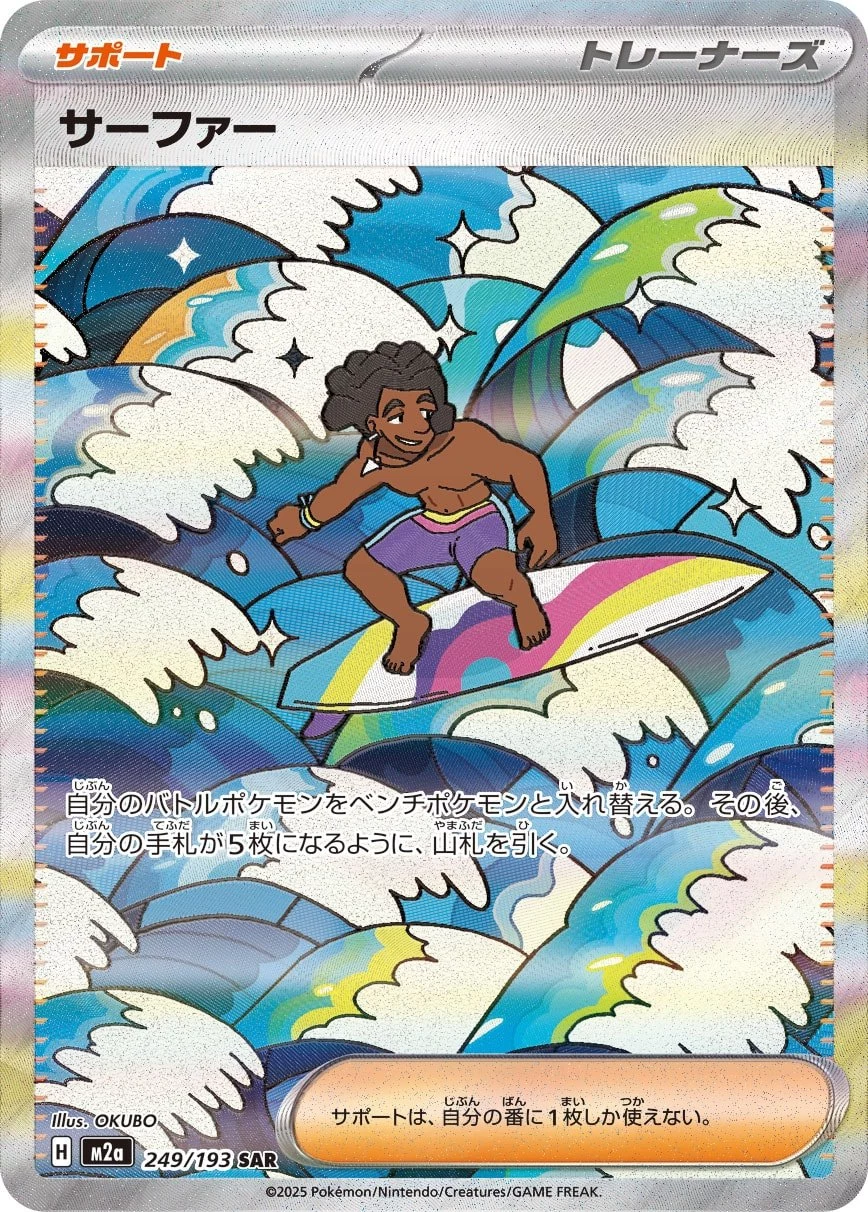
Surfer (サーファー) is a Trainer — Supporter card, illustrated by OKUBO. Its printed effect reads: “Switch your Active Pokémon with a Benched Pokémon. Then, draw cards until you have 5 cards in your hand.” It’s a utility Supporter rather than a card tied to one specific strategy, which is part of why it shows up across varied tournament decklists.

The 249/193 print is the Special Art Rare treatment — full alternate artwork, numbered outside the set’s own 193-card main run in a secret-slot position, following the same numbering convention used across this generation of Japanese Supporter SARs.

Surfer 249/193, Special Art Rare, MEGA Dream ex (M2a)
Surfer 249/193 SAR — MEGA Dream ex (M2a), illustrated by OKUBO

This exact print turns up in Limitless TCG’s tournament decklist archive, in Slowking-variant lists used at the 2026 World Championships and the 2026 North America International Championships. That’s noted here purely as a record of competitive usage — not as a claim about rarity, scarcity, or resale value.

Our graded example of this print is currently listed at ¥7,920 (~$50), PSA 10.

PSA 10 Surfer SAR 249/193 MEGA Dream ex slab, listed on samuraiswordtokyo.com
PSA 10 Surfer SAR 249/193 slab, listed on samuraiswordtokyo.com

The Set: MEGA Dream ex (M2a)

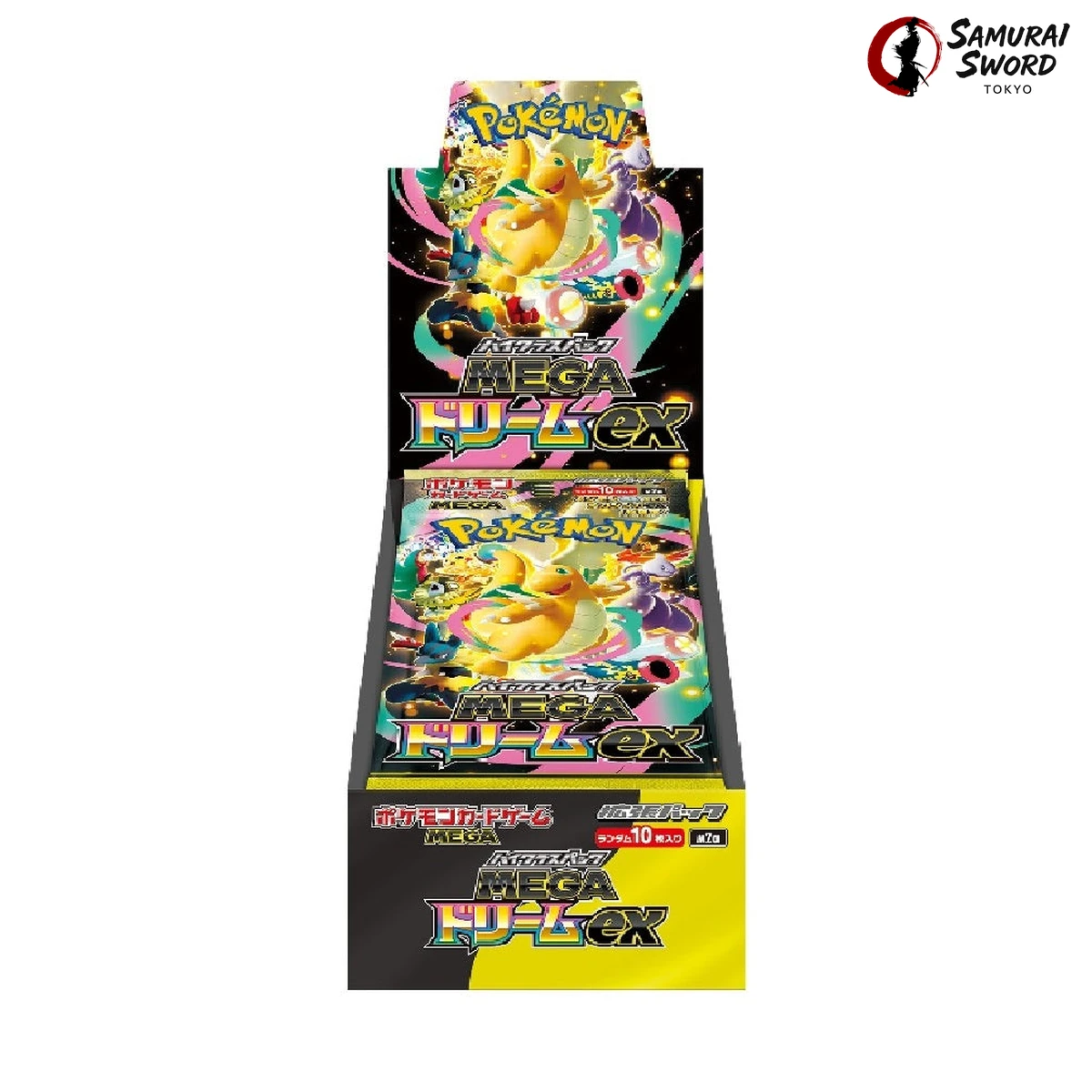
MEGA Dream ex — ハイクラスパック「MEGAドリームex」 in Japanese — is set code M2a, a Japanese High Class Pack released on 28 November 2025. The main numbered run goes to 193 cards, with secret and special slots numbered above that, bringing the release to 250 total cards.

Sealed M2a product is available as the M2A-Mega Dream ex Japanese Pokemon Booster Box, currently listed at ¥12,240 (~$77), with a Damaged Box option at ¥12,280 (~$77) for buyers who don’t mind cosmetic damage to the outer packaging.

For pull-rate discussion and other standout cards across the release, see our MEGA Dream ex pull-rates hub.

Japanese vs English Print

Surfer does carry English-set equivalents, but they don’t map onto the single Japanese SAR as a one-to-one match. The English releases split the card across two sets and four separate print tiers: Surging Sparks carries it at #187 and #235, while Ascended Heroes carries it at #200 and #293.

That’s four English print tiers set against the one Japanese SAR we’ve verified. As with other Japanese Special Art Rares, the English side tends to spread a single Japanese treatment across multiple alternate-art and secret-rare slots rather than reproducing it as one matching card — so lining up a Japanese 249/193 against an English number by card number alone won’t work. Go by artwork and rarity treatment instead. For the Japanese-source card lists behind those two English sets, see our Surging Sparks Japanese card list and Ascended Heroes Japanese card list.

Where This SAR Sits Among Japanese Chase Rarities

Within MEGA Dream ex, the Special Art Rare tier sits above the set’s regular numbered rarities — it’s the full alternate-art, secret-slot treatment placed outside the main 193-card run, the standard pattern for SAR-tier cards across this era of Japanese Pokémon sets.

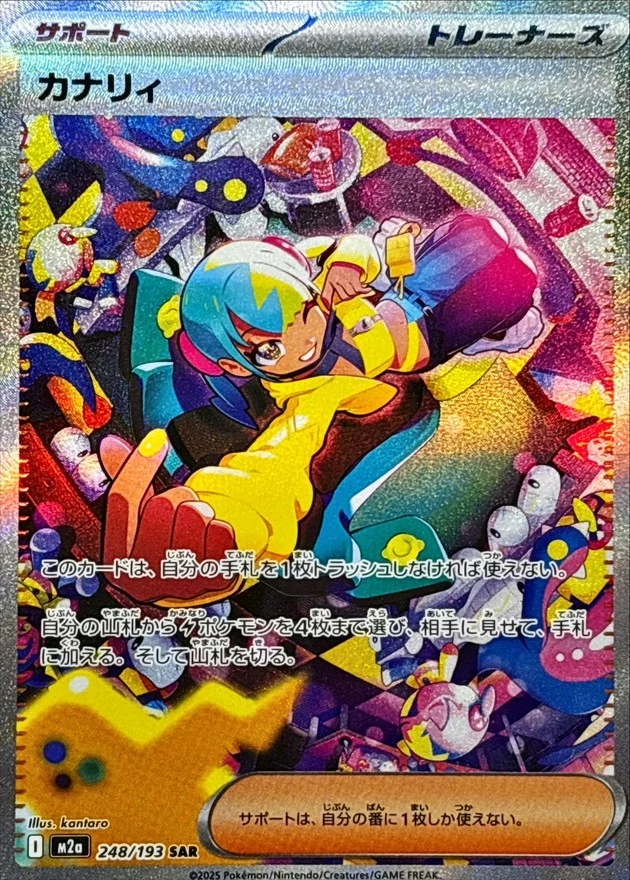
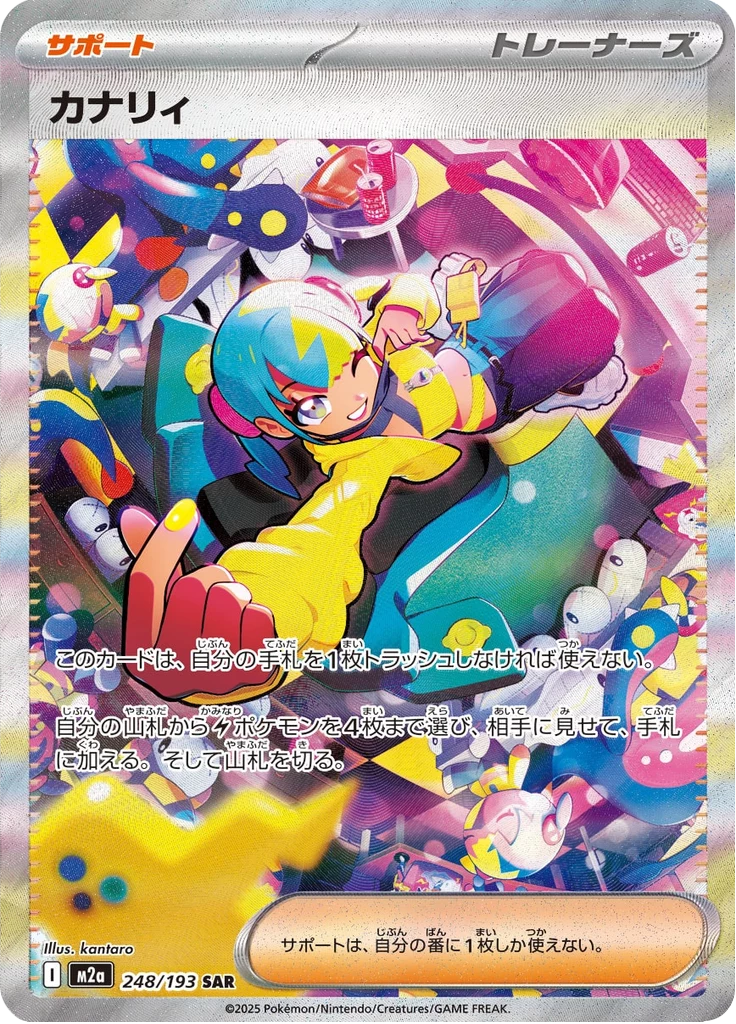
Surfer’s SAR sits alongside other MEGA Dream ex SARs graded to the same PSA 10 standard, including Canari SAR 248/193 from the same set — a neighbouring secret-slot print released the same day.

PSA 10 Canari SAR 248/193 MEGA Dream ex slab, listed on samuraiswordtokyo.com
PSA 10 Canari SAR 248/193 slab, listed on samuraiswordtokyo.com

We only list Surfer in this SAR print; the card’s other confirmed Japanese prints — the SV7a Uncommon and Secret Rare, and the M2a 171/193 base print — aren’t currently in our own catalogue as graded singles. For a wider view of how M2a’s chase-tier cards compare, see our M2a MEGA Dream ex complete guide.

Shop This Card
PSA 10 Surfer SAR 249/193 (MEGA Dream ex)
Currently listed at ¥7,920 (~$50)
Ships from Tokyo · Tracked delivery

View Product →

Where to Buy Surfer from Tokyo

Our graded PSA 10 Surfer SAR 249/193 is currently listed at ¥7,920 (~$50), shipped from Tokyo with tracked delivery. If you’d rather pull your own print, sealed M2A-Mega Dream ex Japanese Pokemon Booster Boxes are the source product, from ¥12,240 (~$77), with a Damaged Box option at ¥12,280 (~$77).

For another graded MEGA Dream ex Supporter in the same PSA 10 tier, see PSA 10 Canari SAR 248/193, or browse the full range in our PSA 10 graded card collection. For a mixed order across singles and sealed product, our Quick Order page is the fastest way to build a cart.

Domande frequenti

What is Surfer 249/193 SAR?

It is the Special Art Rare print of Surfer (サーファー), a Trainer Supporter card numbered 249/193 from the Japanese High Class Pack MEGA Dream ex (set code M2a), released 28 November 2025. We carry a PSA 10 example of this print, currently listed at ¥7,920 (~$50).

What does the Surfer Supporter card do?

Its printed effect is: “Switch your Active Pokémon with a Benched Pokémon. Then, draw cards until you have 5 cards in your hand.” It’s illustrated by OKUBO.

Does Surfer’s tournament play mean the card is rare or valuable?

No — its appearance in Slowking-variant decklists at the 2026 World Championships and 2026 North America International Championships is a competitive-usage record only, not a rarity or value claim.

Does Surfer have an English print?

Yes — Surging Sparks carries it at #187 and #235, and Ascended Heroes carries it at #200 and #293. Those four English print tiers do not map one-to-one onto the single Japanese SAR.

What set is Surfer from and when did it release in Japan?

MEGA Dream ex, Japanese set code M2a, a High Class Pack released 28 November 2025 with a 193-card main set and 250 total cards including secret slots.

Where can I buy a PSA 10 Surfer from Tokyo?

Our graded 249/193 SAR print is currently listed at ¥7,920 (~$50) with tracked shipping from Tokyo. Sealed M2a booster boxes are also available if you would rather pull your own print.

Guida alle carte Yu-Gi-Oh 25° anniversario (Quarter Century)

“Yu-Gi-Oh 25th anniversary” cards means one specific thing in the Japanese OCG: the Quarter Century Secret Rare (QCSR) — a champagne-gold rarity Konami created in February 2023 to mark 25 years since the OCG’s Japan launch, followed two years later by a dedicated 100-card booster, Quarter Century Art Collection (QCAC). Nothing else carries the QCSR rarity’s champagne-gold foil and anniversary watermark, though Konami has since used the “Quarter Century” name on other, separate products — more on that below.

This guide separates the two things people mean when they say “25th anniversary Yu-Gi-Oh cards”: the QCSR rarity itself, and QCAC, the set built around it. It also covers what Konami did next, so you can tell a genuine Quarter Century-era card from a newer rarity that looks similar but isn’t part of the anniversary line.

Key Takeaways

Quarter Century Secret Rare launched in February 2023 and officially replaced Prismatic Secret Rare as the OCG’s standard top secret-rare foil as of Duelist Nexus (April 2023) — its last Japanese appearance was a special Blue-Eyes White Dragon set in April 2025. The dedicated booster, Quarter Century Art Collection, released February 22, 2025 with 100 cards. It’s listed on our site without a displayed price — enquire via Quick Order. A newer OCG booster, Limit Over Collection: The Rivals, is currently listed at ¥7,455 (~$47) and shows how the OCG’s rarity system kept evolving after the anniversary.

100
Cards in QCAC

2023
QCSR Introduced

1999
OCG Launched in Japan

15
Packs per QCAC Box

Yen figures below convert at ¥159/USD (September 2026). Only prices for products currently on our own site are given — no third-party market prices are quoted anywhere in this guide.

What Is the Yu-Gi-Oh Quarter Century Era?

The Yu-Gi-Oh! Official Card Game (OCG) launched in Japan on February 4, 1999 under Konami. Add 25 years and you land in the 2023–2024 window — the “Quarter Century” the name refers to.

Konami marked the anniversary in two stages, and this is the part that causes confusion: the rarity came first, the dedicated set came later.

  • February 2023 — Konami introduced the Quarter Century Secret Rare rarity in the Japanese OCG booster Rarity Collection Quarter Century Edition.
  • February 22, 2025 — Konami released Quarter Century Art Collection, a 100-card booster built specifically around reprinting classic cards in QCSR (and Secret Rare) form.

So “a 25th anniversary Yu-Gi-Oh card” most precisely means a card printed in the QCSR rarity, whether that card came out in 2023, 2025, or one of the sets in between that also used the rarity. The two sections below cover each half in turn.

Quarter Century Secret Rare: The Anniversary Rarity

Quarter Century Secret Rare (QCSR) is a Secret-Rare-foil-treatment card variant. It’s identified by a speckled holographic champagne-gold card name and a printed “Yu-Gi-Oh! Card Game 25th Quarter Century” watermark in the text box — the watermark is the giveaway if the foil colour is hard to judge from a photo.

Its timeline, as documented, runs like this:

Data Evento
February 2023 Introduced in Rarity Collection Quarter Century Edition, to commemorate the OCG’s 25th anniversary.
April 2023 Officially replaced the Prismatic Secret Rare rarity, starting with Duelist Nexus (Japan).
February 2025 Became the signature rarity of the dedicated Quarter Century Art Collection booster.
April 2025 Last documented Japanese appearance — a special Blue-Eyes White Dragon ukiyo-e framed set.

Because QCSR replaced Prismatic Secret Rare as the OCG’s rarity of that tier, several sets released between April 2023 and April 2025 carry QCSR cards without being “anniversary sets” in name — QCAC is the set built entirely around the concept, but it isn’t the only place the rarity shows up.

Inside Quarter Century Art Collection (QCAC)

Quarter Century Art Collection is the OCG booster built specifically to showcase QCSR. Released in Japan on February 22, 2025, it’s structured as:

Spec Detail
Total cards 100
Cards per pack 4
Packs per box 15
Rarity spread Secret Rare and Quarter Century Secret Rare availability is specified card by card rather than applying uniformly to all 100 entries.

The set isn’t just a rarity reprint exercise — several cards received brand-new alternate artwork exclusive to QCAC. Dark Magician Girl got a third distinct artwork, and both Blue-Eyes White Dragon and Dark Magician received new artworks that are QCSR-exclusive within this set.

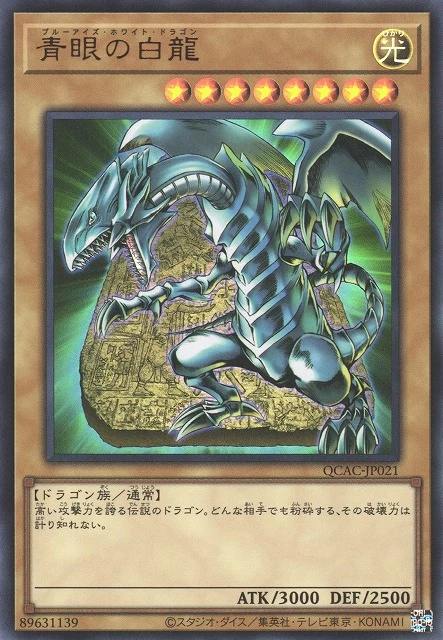
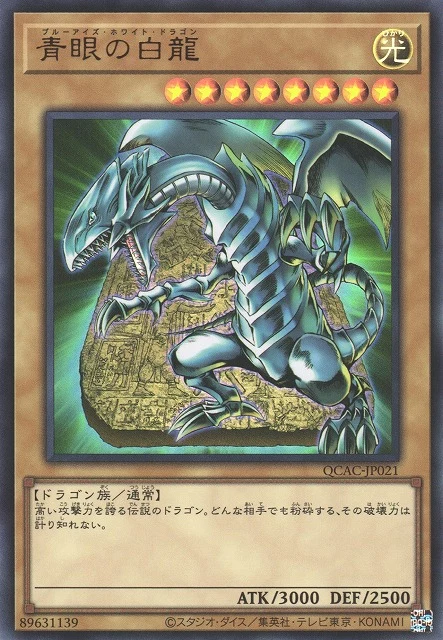
Blue-Eyes White Dragon, Ultra Rare, Quarter Century Art Collection (QCAC), Japanese

Blue-Eyes White Dragon, UR — QCAC

Dark Magician, Ultra Rare, Quarter Century Art Collection (QCAC), Japanese

Dark Magician, UR — QCAC

Blue-Eyes Chaos MAX Dragon, Ultra Rare, Quarter Century Art Collection (QCAC), Japanese

Blue-Eyes Chaos MAX Dragon, UR — QCAC

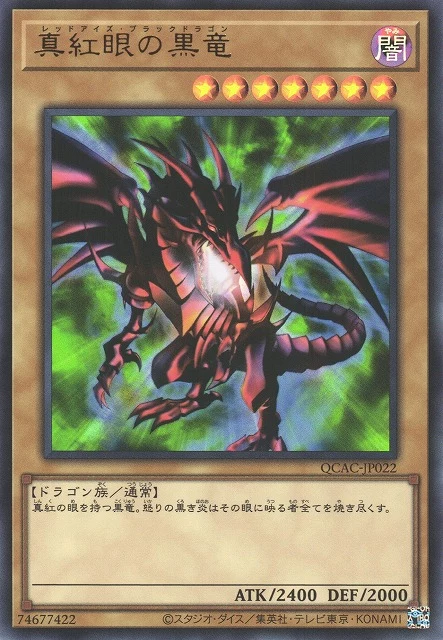
Red-Eyes Black Dragon, Ultra Rare, Quarter Century Art Collection (QCAC), Japanese

Red-Eyes Black Dragon, UR — QCAC

These four are the Ultra Rare printings from the box — the same characters are also chaseable in QCSR form within the same set. For the complete 100-card breakdown, see our QCAC card list and our earlier QCAC concept guide, which covers the set’s structure in more depth than this article does.

On our own site, the QCAC booster box (carton) is listed without a displayed price — enquire via Ordine rapido.

What Came After QCSR: Rarity Innovation Didn’t Stop

QCSR’s last documented Japanese appearance was April 2025, but that didn’t mean the OCG stopped inventing new top-tier rarities. The Grand Master Rare tier debuted in Limit Over Collection: The Heroes, released in Japan on February 28, 2026, and carried into its companion release three weeks later, Limit Over Collection: The Rivals (LOCR), released in Japan on March 20, 2026 — a useful, more recent example of the OCG’s rarity system still evolving.

Spec Detail
Total cards 80 (38 Ultra Rare / 42 Super Rare)
Cards per pack 4
Packs per box 15
Top rarity Grand Master Rare — official spec: “100 cards limited with unique serial numbers,” applied to only 18 of the 38 Ultra Rares
Other new design “Extended Art” frame-breaking card design, available as both Ultra Rare and Prismatic Secret Rare
Full rarity spread All 80 cards are also available as Prismatic Secret Rare and Secret Rare

Grand Master Rare is not a Quarter Century-era rarity. It’s a separate, later rarity tied to the Limit Over Collection line’s numbered-card concept — introduced in The Heroes and continued in The Rivals — not to the OCG’s 25th anniversary. The two are worth keeping apart: QCSR marks a specific 2023–2025 anniversary window and a specific champagne-gold look with the 25th-anniversary watermark; Grand Master Rare is a 2026 numbered-serial concept with no anniversary tie-in.

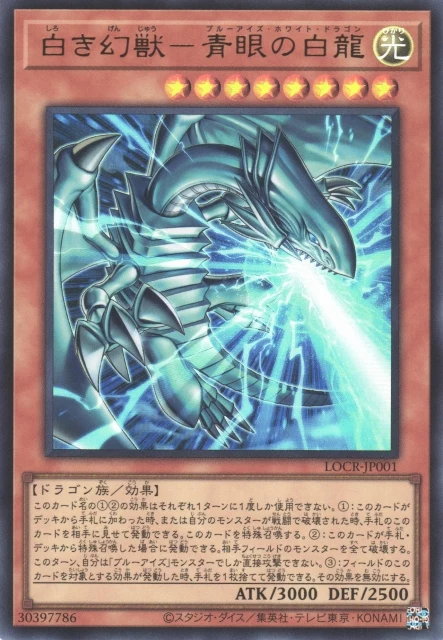
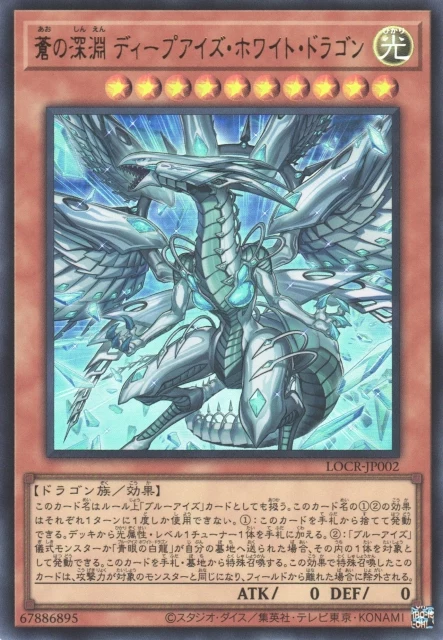
Blue-Eyes White Dragon The White Phantom Beast, Ultra Rare, Limit Over Collection The Rivals (LOCR), Japanese
Blue-Eyes White Dragon “The White Phantom Beast,” UR — Limit Over Collection: The Rivals

What the two sets share is the underlying pattern: Konami keeps building new top-of-set rarity concepts (QCSR in 2023, Grand Master Rare in 2026) rather than reusing an old one indefinitely. If you’re trying to date a card by its rarity name alone, check which set it came from before assuming it belongs to the anniversary line. For the complete LOCR card list, see our LOCR card list and Limit Over Collection concept guide.

Where to Buy Yu-Gi-Oh Quarter Century Cards from Tokyo

We ship sealed Japanese OCG product from Tokyo. Two boxes from this guide are currently on our site:

Shop This Set
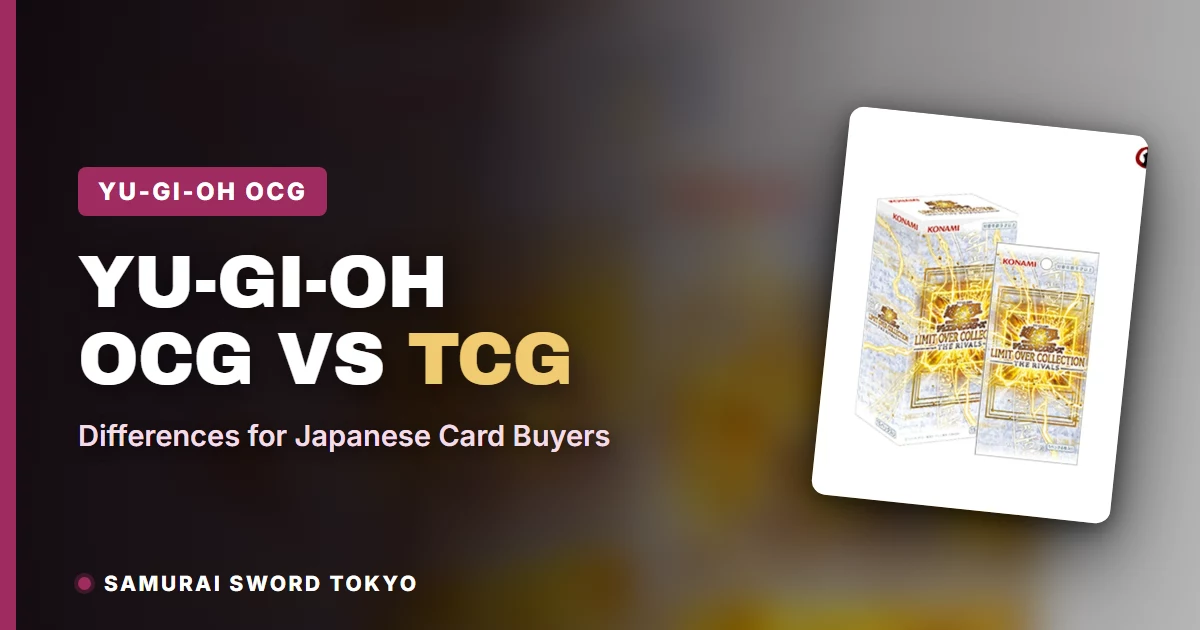
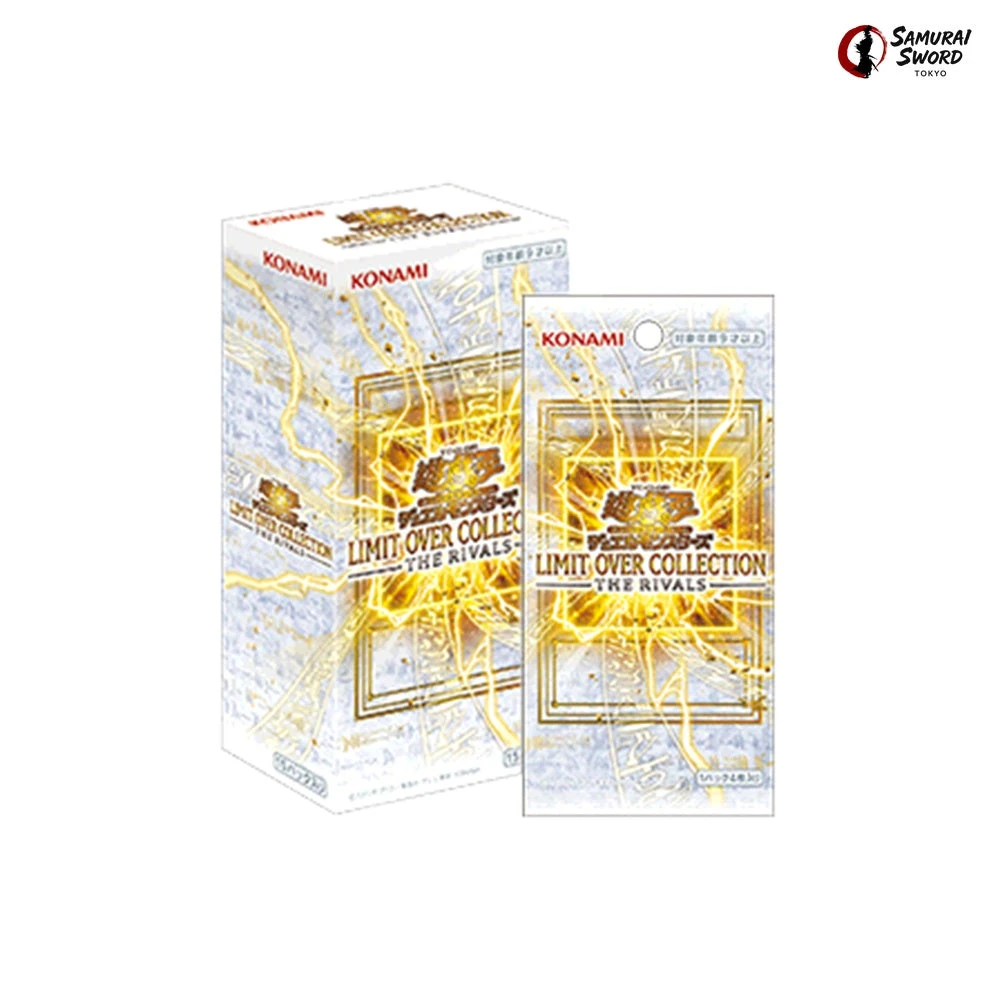
LOCR — Limit Over Collection: The Rivals (Japanese Booster Box)
Ships from Tokyo · Tracked delivery

View Product →

For a related Quarter Century-era product not covered in depth above, see our Quarter Century Chronicle: Side Pride card list. For anything not listed on our site, Ordine rapido is the fastest way to send a sourcing request.

Domande frequenti

What does “Yu-Gi-Oh 25th anniversary” refer to?

It refers to the Quarter Century Secret Rare (QCSR) rarity, which Konami introduced in the Japanese OCG in February 2023 to mark 25 years since the OCG’s February 4, 1999 Japan launch, and to the dedicated booster built around it, Quarter Century Art Collection (February 2025).

What is a Quarter Century Secret Rare (QCSR)?

A Secret-Rare-foil-treatment card variant identified by a speckled holographic champagne-gold card name and a printed “Yu-Gi-Oh! Card Game 25th Quarter Century” watermark in the text box. It officially replaced the Prismatic Secret Rare rarity as of Duelist Nexus, April 2023.

How many cards are in Quarter Century Art Collection?

100 cards total, sold as 4 carte per pack and 15 packs per box. Secret Rare and Quarter Century Secret Rare availability varies by card.

Is Grand Master Rare a Quarter Century-era rarity?

No. Grand Master Rare is a separate, newer rarity introduced in Limit Over Collection: The Heroes (February 2026) and carried into its companion set, Limit Over Collection: The Rivals (March 2026) — a numbered-serial concept applied to a subset of each set’s Ultra Rares, with no tie to the OCG’s 25th anniversary.

When did Quarter Century Secret Rare last appear in Japan?

The last documented Japanese appearance is a special Blue-Eyes White Dragon ukiyo-e framed set released in April 2025.

Can I buy Quarter Century Art Collection from Samurai Sword Tokyo?

The QCAC booster box (carton) is on our site but listed without a displayed price — sourcing requests go through Quick Order. A related current OCG box, Limit Over Collection: The Rivals, is listed at ¥7,455 (~$47).

Guida all’acquisto del booster box S7R Blue Sky Stream: set di tipo Drago e chase card verificate

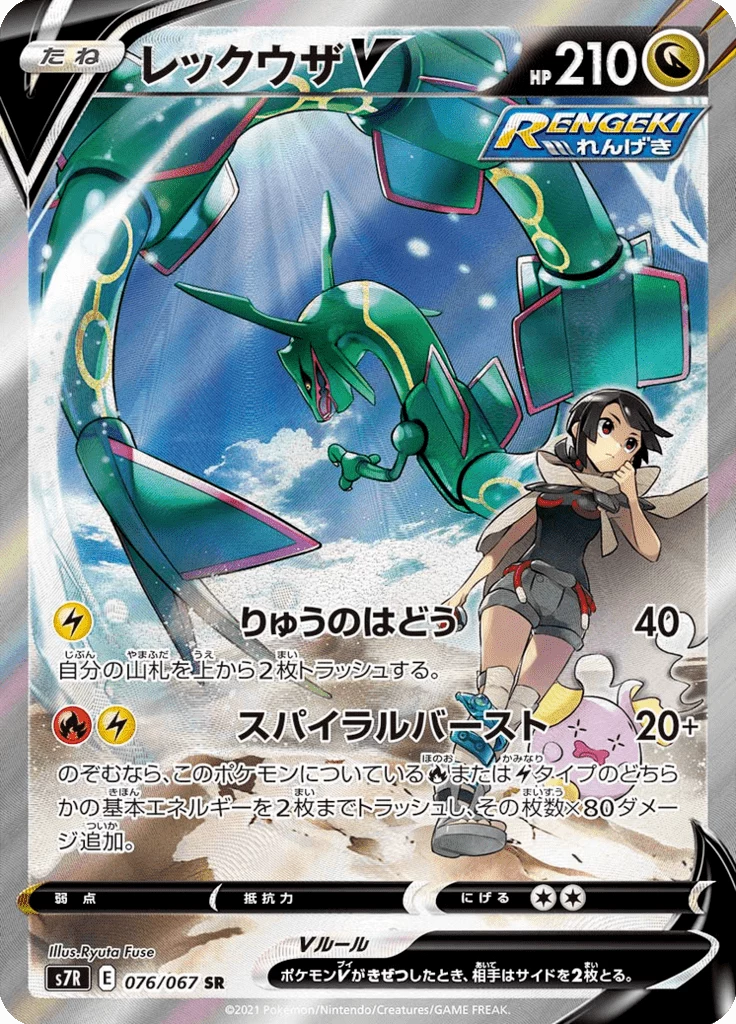
S7R Blue Sky Stream includes two Rayquaza V treatments above the 067-card base checklist: 075/067 and 076/067.

蒼空ストリーム / Blue Sky Stream, set code S7R, is a Sword & Shield-era Japanese expansion released as one half of a dual-set launch alongside S7D Towering Perfection. Where S7D drew from a different Pokémon pool, S7R is the dragon-type-focused half of the pair and includes Rayquaza V.

This guide covers what is inside a Blue Sky Stream box, examines selected cards numbered above the base checklist, explains the store’s own box-condition listings, and points you to the sealed box currently listed from Tokyo.

Key Takeaway

The main Blue Sky Stream numbering runs to 067; secret-numbered cards sit above it. This guide covers selected SR cards from 068/067 through 079/067, including Rayquaza V at #075/067 and #076/067. The S7R-Blue Sky Stream Japanese Pokemon Booster Box is currently listed at ¥306,600 (~$1,928); no Damaged Box or No Shrink listing exists for this set at the moment.

67
Main Checklist

30
Packs per Box

5
Cards per Pack

2
Rayquaza V SR Prints

Prices below are our current listed prices as of September 2026, converted at ¥159/USD.

What’s in a Blue Sky Stream Box

The box structure is straightforward: a Blue Sky Stream box contains 30 packs, and each pack holds 5 cards.

Articolo Value
Set name (JP) 蒼空ストリーム (Blue Sky Stream)
Codice set S7R
Companion set S7D Towering Perfection (different Pokémon pool)
Main checklist Numbered through 067
Selected SR cards covered here 068/067–079/067
Packs per box 30
Cards per pack 5

We are not publishing pull-rate figures or presenting the selected SR range below as the set’s complete above-number checklist.

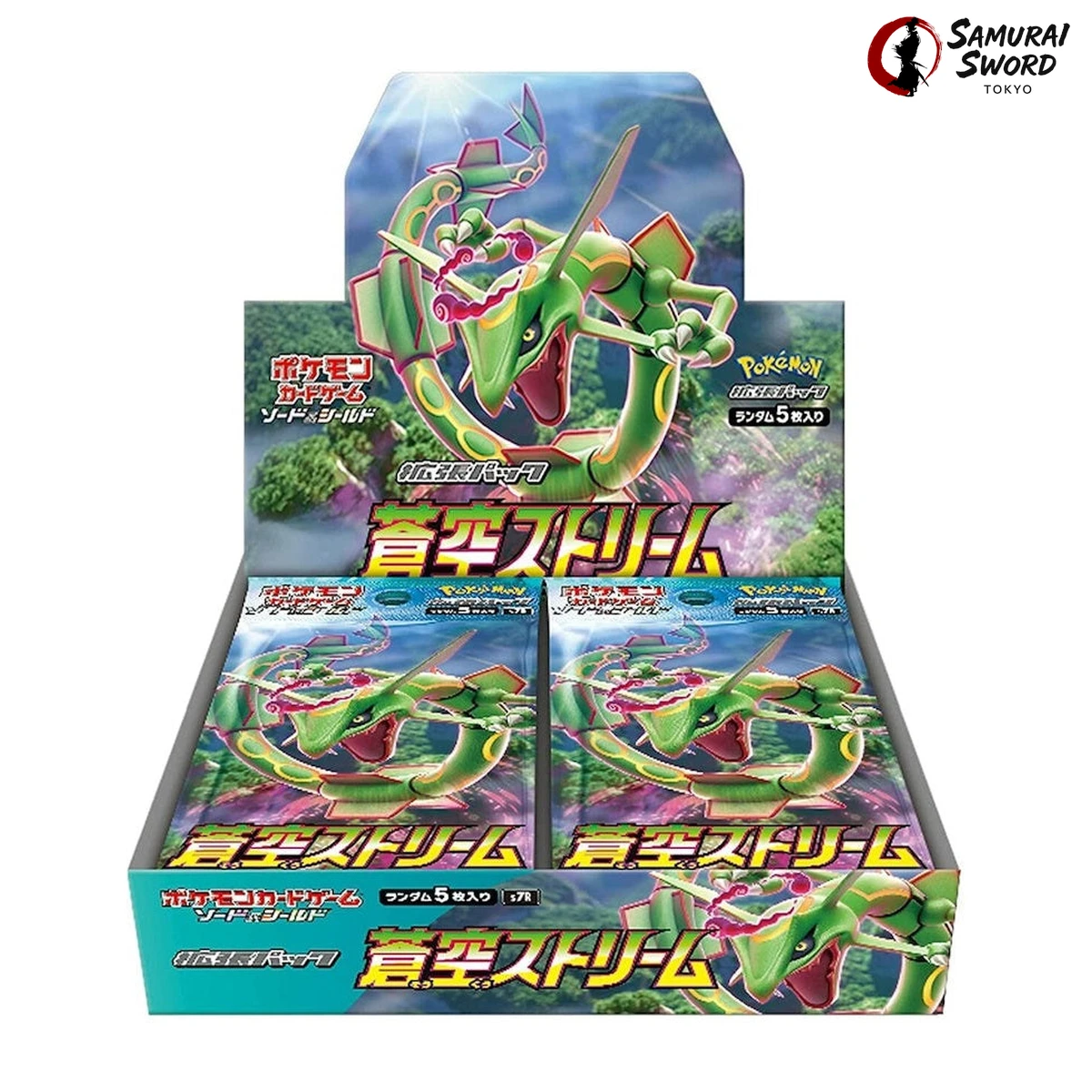
S7R Blue Sky Stream Japanese booster box, sealed
S7R-Blue Sky Stream Japanese Pokemon Booster Box, sealed

For a broader card-by-card breakdown, see our Blue Sky Stream (S7R) card list.

Chase Cards in Blue Sky Stream

Correcting a Common Claim

The main S7R numbering runs to 067, with secret-numbered cards above it. The Rayquaza V cards covered here are 075/067 and 076/067.

The selected SR cards covered in this guide are:

# Carta Rarity
068/067 Trevenant V SR
069/067 Volcarona V SR
070/067 Gyarados V SR
071/067 Medicham V SR
072/067 Medicham V SR
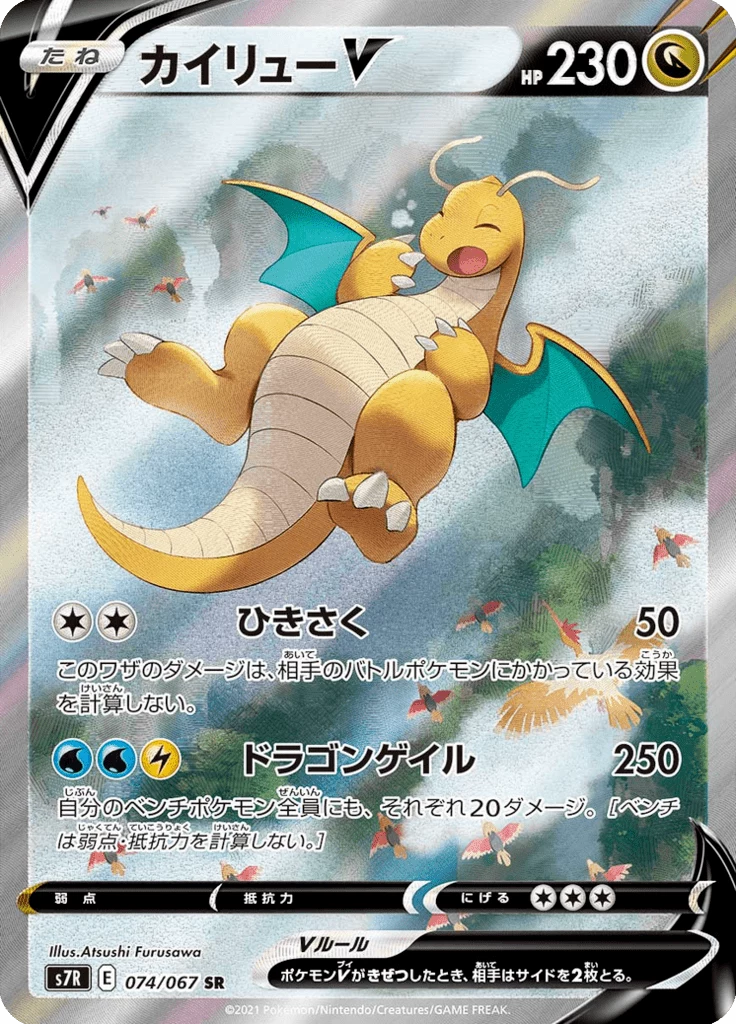
073/067 Dragonite V SR
074/067 Dragonite V SR
075/067 Rayquaza V SR
076/067 Rayquaza V SR
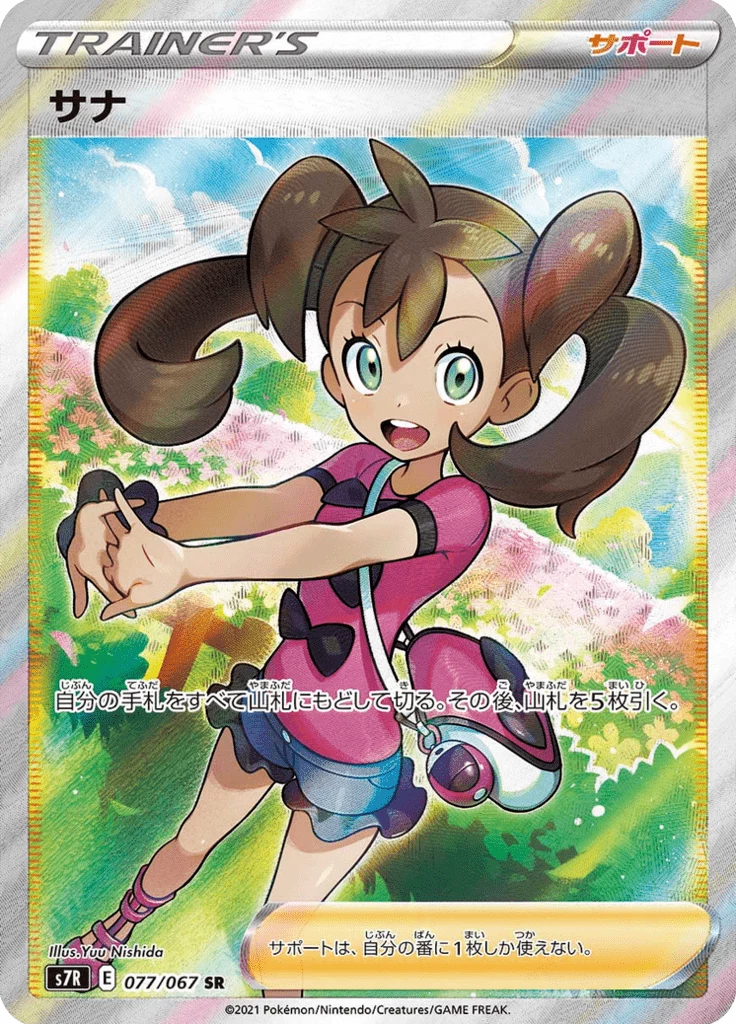
077/067 Sana SR
078/067 School Boy SR
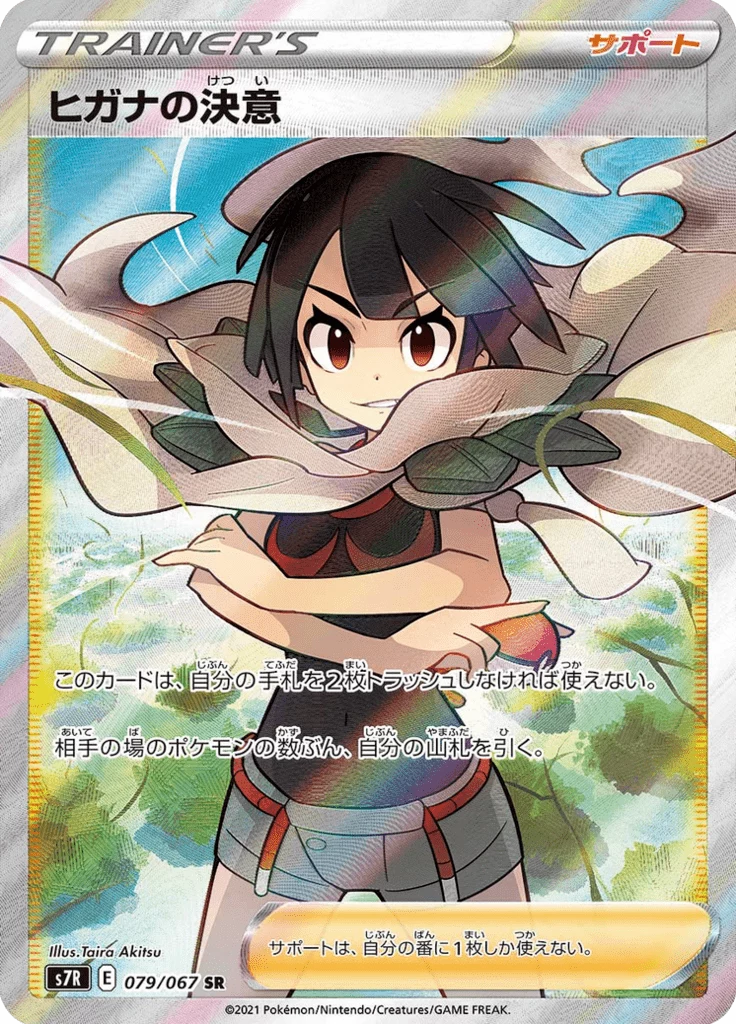
079/067 Zinnia’s Resolve SR

Within this selected SR group, Rayquaza, Dragonite and Medicham each have two printings.

Rayquaza V — 075/067 and 076/067

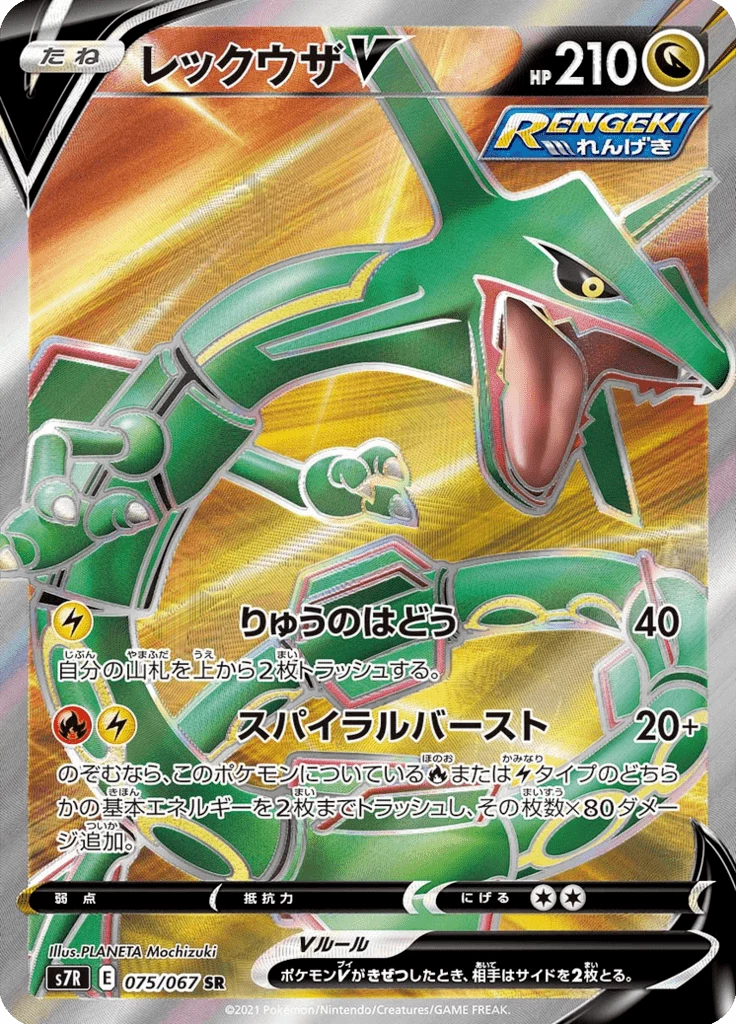
Rayquaza V, card number 075/067, SR, Blue Sky Stream (S7R)

Rayquaza V 075/067 SR

Rayquaza V, card number 076/067, SR, Blue Sky Stream (S7R)

Rayquaza V 076/067 SR

Rayquaza V has two SR printings in this set. These singles are not listed on our site at the moment; sourcing requests go through Ordine rapido.

Dragonite V — 073/067 and 074/067

Dragonite V, card number 074/067, SR, Blue Sky Stream (S7R)
Dragonite V, SR 074/067, Blue Sky Stream (S7R)

Dragonite V shares the same two-printing pattern as Rayquaza V within the SR group covered here, sitting one slot earlier in the numbering at 073/067 and 074/067. These prints are not currently listed as singles on our site.

Medicham V — 071/067 and 072/067

Medicham V occupies 071/067 and 072/067, immediately ahead of the Dragonite V pair in the selected SR group. No verified image for these two printings is available for this guide, and neither is currently listed as a single on our site.

Sana — 077/067

Sana, card number 077/067, SR, Blue Sky Stream (S7R)
Sana, SR 077/067, Blue Sky Stream (S7R)

Sana appears in the selected SR group alongside School Boy and Zinnia’s Resolve. This print is not currently listed as a single on our site.

Zinnia’s Resolve — 079/067

Zinnia's Resolve, card number 079/067, SR, Blue Sky Stream (S7R)
Zinnia’s Resolve, SR 079/067, Blue Sky Stream (S7R)

Zinnia’s Resolve appears at 079/067. School Boy at 078/067 sits between Sana and Zinnia’s Resolve in the selected SR group.

For more set context, see our S7R Blue Sky Stream pull-rates and best-cards guide. The numbering here describes only the selected SR cards covered in this article, not the set’s complete above-number checklist.

Regular Box vs Damaged Box vs No Shrink on Our Site

Across our catalogue, we list sealed booster boxes in a few different conditions, and it’s worth knowing what each term means before you buy:

  • Regular box — sealed, factory-shrink-wrapped, box exterior in standard retail condition.
  • Damaged Box — the sealed contents inside are unaffected, but the outer cardboard box itself has cosmetic damage (a crushed corner, a dent, print marks), sold at a reduced price to reflect the exterior condition.
  • Senza cellophane — the box has had its factory shrink wrap removed, with the individual packs inside still sealed, sold as a separate listing from the shrink-wrapped version.

For Blue Sky Stream specifically, the standard sealed box is currently listed on our site. Damaged Box and No Shrink products are not listed for this set at the moment; sourcing requests go through Ordine rapido.

Japanese vs English Version of This Set

Blue Sky Stream was issued in Japan under the S7R name and code. The related English-language expansion is Evolving Skies, which absorbed cards from Blue Sky Stream’s era into its own English print run.

That relationship is not a straightforward one-to-one translation, though. Evolving Skies also blends in content sourced from S7D Towering Perfection and other Japanese sets released around the same period, so it functions as a broader English-language compilation rather than a direct English printing of Blue Sky Stream card-for-card. If you are trying to match a specific Blue Sky Stream secret rare to an English equivalent, treat that mapping as unconfirmed rather than assumed — the sealed Japanese box remains the direct way to get the set as it was actually printed.

The sealed Japanese box contains S7R packs, including the Rayquaza V printings covered here.

Shop This Set
S7R-Blue Sky Stream Japanese Pokemon Booster Box
30 packs, 5 cards each · dragon-type flagship box
Ships from Tokyo · Tracked delivery

View Product →

Where to Buy a Blue Sky Stream Booster Box from Tokyo

We ship Japanese sealed product worldwide from Tokyo with tracked delivery. The S7R-Blue Sky Stream Japanese Pokemon Booster Box is currently listed at ¥306,600 (~$1,928). Damaged Box, No Shrink and single-card products from this set are not listed on our site at the moment.

If you’re after a specific card — either Rayquaza V printing, either Dragonite V printing, either Medicham V printing, Sana, School Boy, or Zinnia’s Resolve — those sourcing requests go through the Quick Order page. Our broader Pokemon booster box collection is worth a look too if you’re comparing sealed product across sets, and the full Blue Sky Stream card list is the place to check any card number before you order.

For comparison against other high-value S-series boxes, see our guides to the S8 Fusion Arts and S9 Star Birth booster boxes.

Domande frequenti

Which Rayquaza V cards are covered in this S7R Blue Sky Stream guide?

Rayquaza V appears at #075/067 and #076/067 in the selected SR group covered here.

How is the Blue Sky Stream checklist numbered?

The main numbering runs through 067, and secret-numbered cards sit above it. This guide covers selected SR cards from 068/067 through 079/067 without treating that range as the complete above-number checklist.

What comes in a Blue Sky Stream booster box?

30 packs per box, with 5 cards in each pack.

Is there a Damaged Box or No Shrink version of Blue Sky Stream available?

Not currently. The standard sealed box is listed on our site, while Damaged Box and No Shrink products are not listed at the moment; sourcing requests go through Quick Order.

Is there an English version of Blue Sky Stream?

Not under the same name or set code. The closest English-language counterpart is Evolving Skies, but that set also absorbs content from S7D Towering Perfection and other Japanese sources, so it is not a direct one-to-one printing of Blue Sky Stream.

Where can I buy a Blue Sky Stream booster box?

The S7R-Blue Sky Stream Japanese Pokemon Booster Box is currently listed at ¥306,600 (~$1,928) and ships tracked from Tokyo. Individual secret rares from the set, including either Rayquaza V printing, are not currently listed as singles; sourcing requests go through Quick Order.

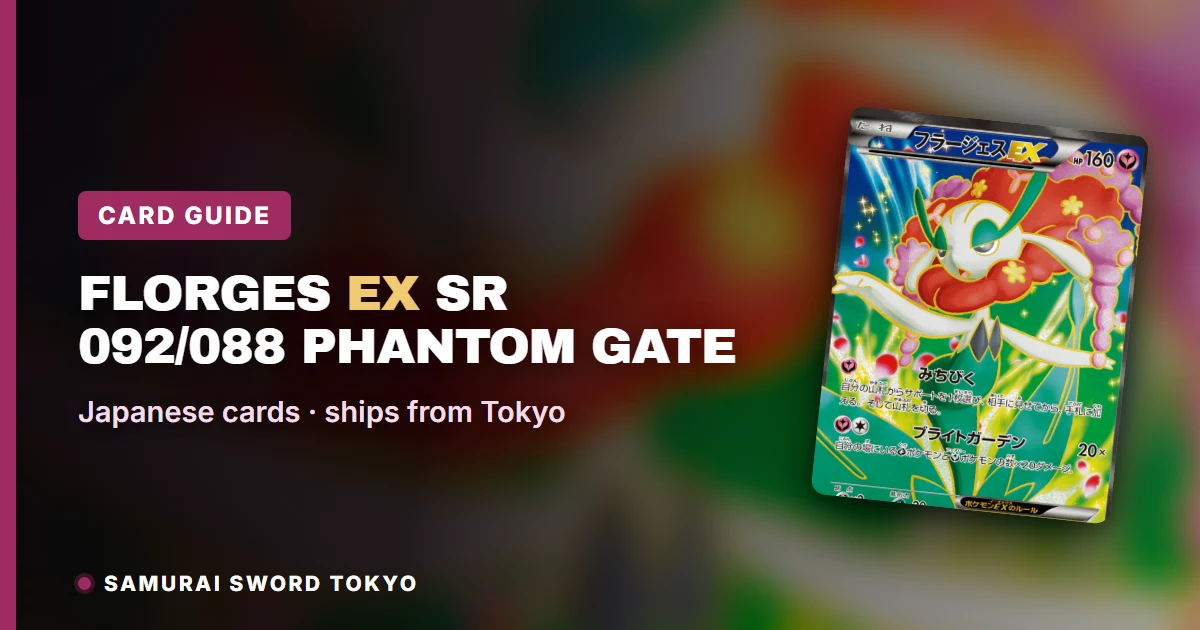
Guida alla carta Florges EX SR 092/088 Phantom Gate (1ª Edizione)

Florges EX comes from one Japanese set, Phantom Gate, but the set carries the card across two prints we’ve verified in the card record: a main-numbered RR at 060/088 and a secret-numbered SR at 092/088. This guide focuses on the SR print currently listed in PSA 10.

The card is フラージェスEX — Florges EX, No. 092/088, printed as a Secret Rare (SR) in the Japanese expansion pack 拡張パック「ファントムゲート」/ Expansion Pack “Phantom Gate” (set code XY4). We currently list a PSA 10 copy of this exact print — tagged :1ED for its 1st Edition mark — graded and shipped from Tokyo. This guide walks through what the card is, where it sits inside Phantom Gate, how the Japanese print compares to its English counterparts, and where the SR rarity sits relative to other notable cards from the same set.

Key Takeaways

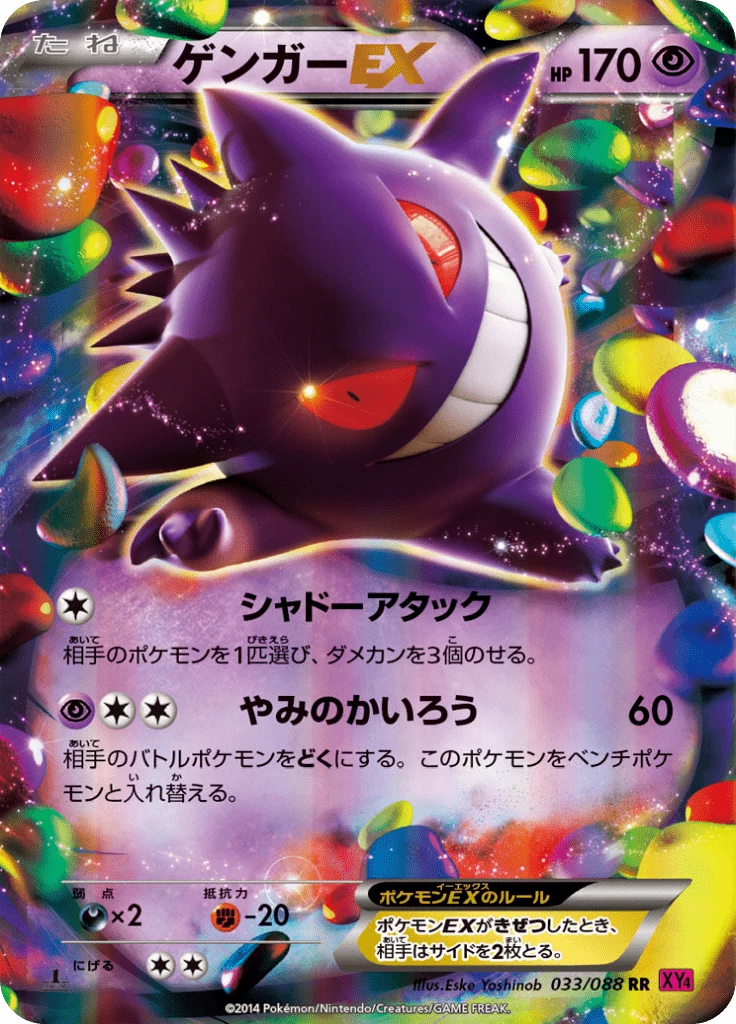
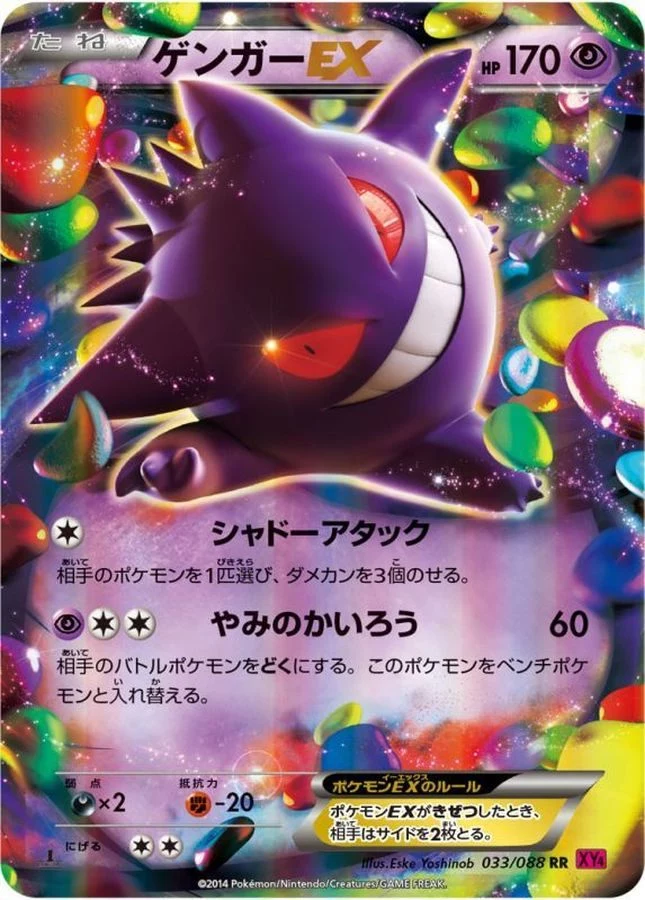
Florges EX SR 092/088 :1ED is a PSA 10, currently listed at ¥28,600 (~$180). It comes from Phantom Gate (XY4), a Japanese Expansion Pack reported as released September 13, 2014 — month and year confirmed, exact day per a secondary source — with a set size of 88 cards. The print we’ve verified carries our 1st Edition (:1ED) mark. Phantom Gate’s own headline chase card, Gengar EX RR 033/088, is also on our site in PSA 10 at ¥366,666 (~$2,306).

160
HP

SR
Rarity (092/088)

88
Set Size (XY4)

Sep 2014
Japan Release

Prices below are current samuraiswordtokyo.com listings, converted at ¥159/USD (September 2026).

The Card: Florges EX 092/088 SR

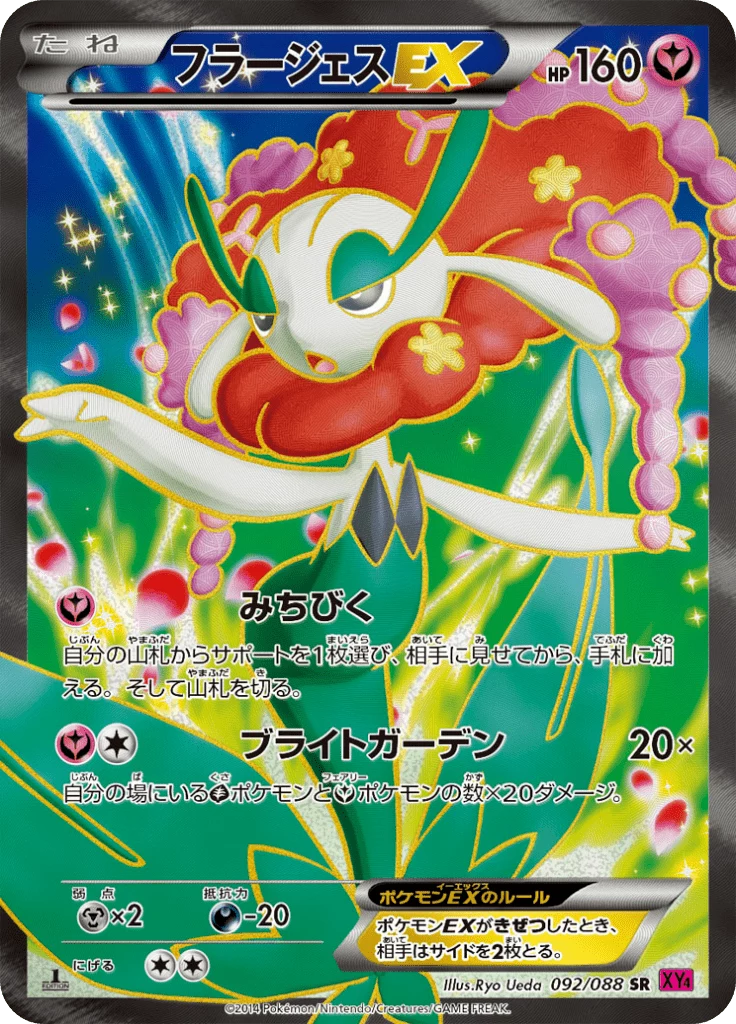
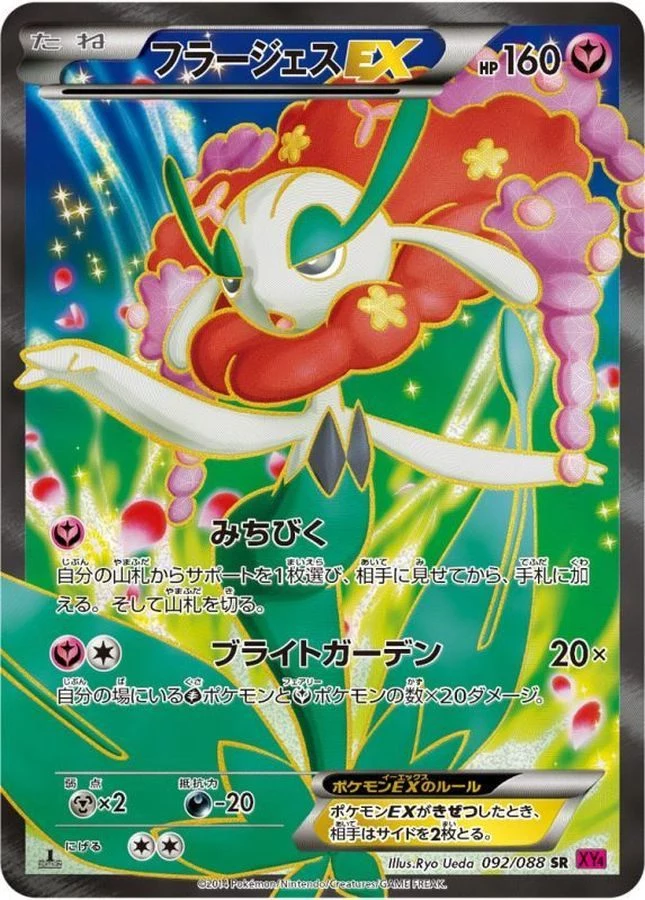
Florges EX is a Fairy-type Pokemon-EX carrying 160 HP. The 092/088 print is illustrated by Ryo Ueda, and its position at #92 in an “088” set — a number past the set’s own card count — is the standard Japanese convention for marking a card as a secret/special slot rather than part of the main numbered run.

Florges EX SR 092/088, Phantom Gate (XY4)
Florges EX SR 092/088 — Phantom Gate (XY4), illustrated by Ryo Ueda

Our own graded copy of this print is currently listed at ¥28,600 (~$180), PSA 10.

PSA 10 Florges EX SR XY4 092/088 slab, listed on samuraiswordtokyo.com

The Set: Phantom Gate (XY4)

Phantom Gate — 拡張パック「ファントムゲート」in Japanese — is set code XY4, a regular Japanese Expansion Pack (not a Concept Pack), reported as released September 13, 2014. We’ve confirmed the month and year against official product listings; the specific day comes from a secondary source. The set runs to 88 cards in its main numbering, with secret/special slots numbered above that — the same convention behind the 092/088 Florges EX print covered above.

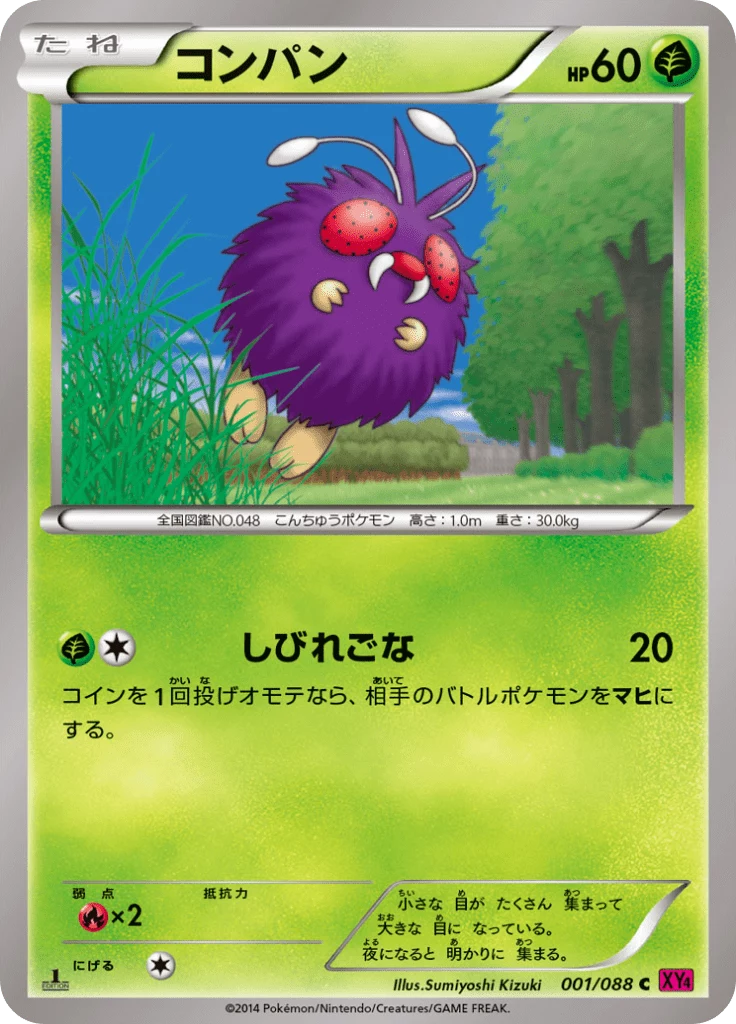
Venonat, Common 001/088, Phantom Gate (XY4)

Venonat, Common 001/088

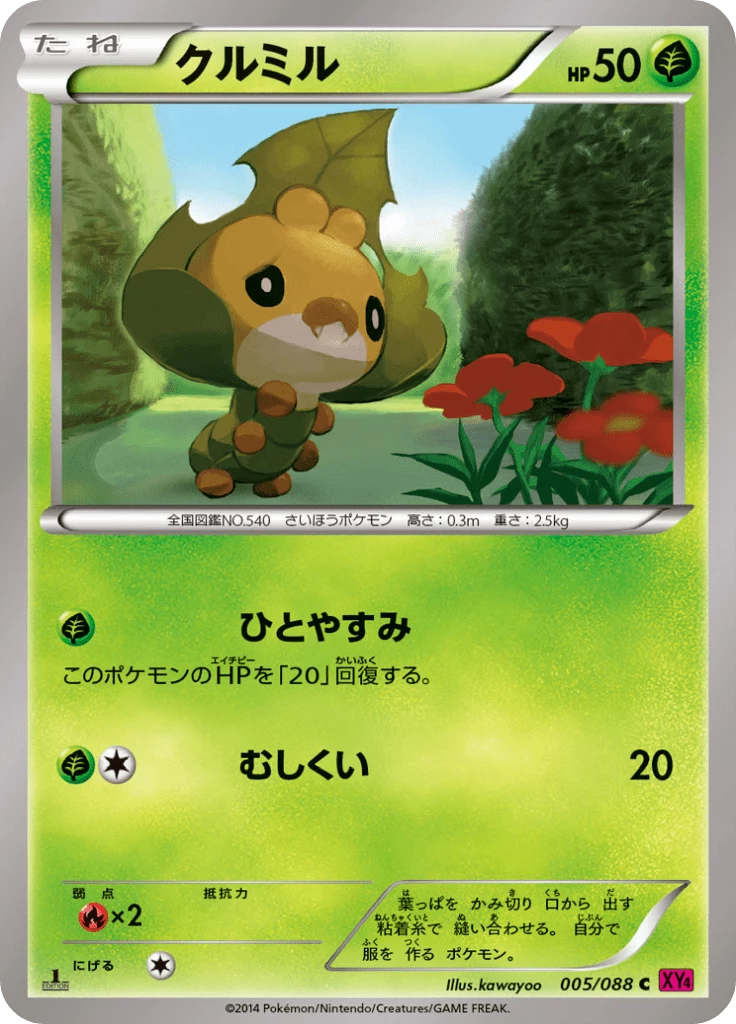
Sewaddle, Common, Phantom Gate (XY4)

Sewaddle, Common (XY4)

Our listing tags the Florges EX print :1ED for its 1st Edition mark. Japanese 1st Edition printing ran from 2001 through 2016, and per our own Japanese 1st Edition Pokemon cards guide, that window covered mainline Expansion Pack releases as well as the smaller Concept Pack releases. Phantom Gate, released in September 2014, is a mainline Expansion Pack that falls inside that confirmed window.

Phantom Gate sits inside the wider XY era of Japanese Pokemon sets. For a broader view of that era, see our XY-era Japanese Pokemon guide, and for the EX and Mega EX cards that defined the period, our XY-era EX and Mega EX cards guide. For a set-wide look at Phantom Gate’s other notable cards, including Gengar EX, see our XY4 Phantom Gate best cards hub — that guide covers the set as a whole, while this one is a single-card deep dive on Florges EX.

Japanese vs English Print

Florges EX does have English-set equivalents, though the print count doesn’t map one-to-one onto the Japanese release. The English set is Phantom Forces, and it carries the card across two slots: a standard print at #67, and a full art print at #116.

That’s two English treatments against the two Japanese prints we’ve verified (060/088 RR and 092/088 SR). Japanese secret rares like the 092/088 print often correspond loosely to an English full art slot rather than a single matching number — if you’re comparing a Japanese copy against an English one, go by artwork and rarity treatment rather than assuming the numbers will line up.

Where This SR Sits Among Japanese Rarity Tiers

Within Phantom Gate, Florges EX’s 092/088 print sits at the Secret Rare (SR) tier — a secret-numbered slot placed outside the set’s main 88-card count, the same convention covered in The Card above. Gengar EX, by contrast, occupies the RR (Rare Rare) tier at 033/088, inside the main numbered run. The SR designation is reserved for cards numbered beyond a set’s stated size, while RR is the standard treatment for an EX-tier card within the regular checklist.

Phantom Gate’s EX cards sit within the wider Rare / Rare Rare / Secret Rare structure that ran across the XY era’s expansion packs — see our XY-era EX and Mega EX cards guide for how that ladder holds across other sets from the period.

We do not currently list the RR Gengar EX outside of this PSA 10 grade, so the two cards above — Florges EX SR and Gengar EX RR — represent the two Phantom Gate rarity tiers we carry.

Shop This Card
PSA10 Florges EX SR :1ED (XY4 092/088)
Currently listed at ¥28,600 (~$180)
Ships from Tokyo · Tracked delivery

View Product →

Where to Buy Florges EX from Tokyo

Our graded copy of PSA 10 Florges EX SR 092/088 :1ED is currently listed at ¥28,600 (~$180), shipped from Tokyo with tracked delivery. If you collect other secret-rare and rare-tier cards from the same set, our PSA 10 Gengar EX RR 033/088 is also on our site, currently listed at ¥366,666 (~$2,306).

Browse the wider range in our PSA 10 graded card collection, or for a mixed order across singles and sealed product, our Quick Order page is the fastest way to build a cart.

Domande frequenti

What is Florges EX SR 092/088?

It is the Secret Rare print of Florges EX (フラージェスEX), card 092/088 from the Japanese Expansion Pack Phantom Gate (set code XY4), reported as released September 13, 2014. We carry a PSA 10 copy of this print, tagged :1ED, currently listed at ¥28,600 (~$180).

What does the :1ED mark mean on this listing?

It denotes a Japanese 1st Edition print. Japanese 1st Edition printing ran from 2001 through 2016 and covered mainline Expansion Pack releases as well as smaller Concept Pack releases. Phantom Gate, released in September 2014, is a mainline Expansion Pack that falls inside that window.

Does Florges EX have an English print?

Yes — Phantom Forces carries the card across two slots: a standard print at #67 and a full art print at #116. These do not map one-to-one onto the two Japanese Phantom Gate prints (060/088 RR and 092/088 SR).

What set is Florges EX from?

Phantom Gate, Japanese set code XY4, a regular Expansion Pack reported as released September 13, 2014 with an 88-card main set. The set’s own headline chase card is Gengar EX.

What’s the difference between Florges EX SR and Gengar EX RR in the same set?

Both come from Phantom Gate (XY4). Florges EX is the Secret Rare (SR) at 092/088, a secret-numbered slot placed outside the set’s main 88-card count. Gengar EX is the Rare Rare (RR) at 033/088, inside the main numbered run — the set’s own headline chase card.

Where can I buy a PSA 10 Florges EX from Tokyo?

Our graded 092/088 SR copy is currently listed at ¥28,600 (~$180) with tracked shipping from Tokyo. Our PSA 10 Gengar EX RR 033/088 from the same set is also available if you’re building out a Phantom Gate collection.

Guida ai giochi di carte collezionabili giapponesi: Pokemon, One Piece, Yu-Gi-Oh, Dragon Ball

This guide compares four trading card games sold in Japan: Pokémon, One Piece, Yu-Gi-Oh!, and Dragon Ball. They come from different publishers and launched at different points in the timeline, but all four sell in the same basic format: booster packs sealed inside a booster box.

This guide lines the four games up side by side: who publishes each one, when it launched in Japan, and how many packs and cards you actually get per box. We ship a Japanese booster box from all four games out of Tokyo, so every product mentioned below is one we currently list.

Key Takeaways

The four Japanese trading card games compared here span nearly three decades: the Pokémon Trading Card Game launched October 20, 1996, the Yu-Gi-Oh! Official Card Game followed on February 4, 1999, the One Piece Card Game arrived July 8, 2022, and Dragon Ball Super Card Game: Fusion World is the newest of the four, launching February 16, 2024. A Japanese Pokémon M5-Abyss Eye booster box is currently listed at ¥7,475 (~$47), and a Japanese One Piece OP-16 booster box is currently listed at ¥12,360 (~$78).

4
Japanese TCGs Compared

1996
Oldest Launch (Pokémon)

2024
Newest Launch (Dragon Ball FW)

¥159
Per USD (Sept 2026)

Yen figures below convert at ¥159/USD (September 2026). Prices are a September 3, 2026 store snapshot — check the linked listing for the current number before ordering.

The Four Japanese Card Games at a Glance

Lined up by Japan launch date, the picture is nearly thirty years wide:

Game Publisher (Japan) Japan launch date
Pokémon Trading Card Game The Pokémon Company (originally Media Factory, 1996–2000) October 20, 1996
Yu-Gi-Oh! Official Card Game (OCG) Konami February 4, 1999
One Piece Card Game Bandai July 8, 2022
Dragon Ball Super Card Game: Fusion World Bandai February 16, 2024

Pokémon and Yu-Gi-Oh! are the two long-runners, both launched in Japan within three years of each other in the late 1990s and developed by Creatures Inc. (Pokémon) and Konami (Yu-Gi-Oh!) respectively. One Piece and Dragon Ball Fusion World are the newer pair, both published by Bandai and both released within the last four years.

One Publisher, Two Games

Bandai publishes both the One Piece Card Game and Dragon Ball Super Card Game: Fusion World in Japan — the two newest games on this list share a publisher, even though the card games themselves are unrelated products with separate rule systems.

Pokémon Trading Card Game

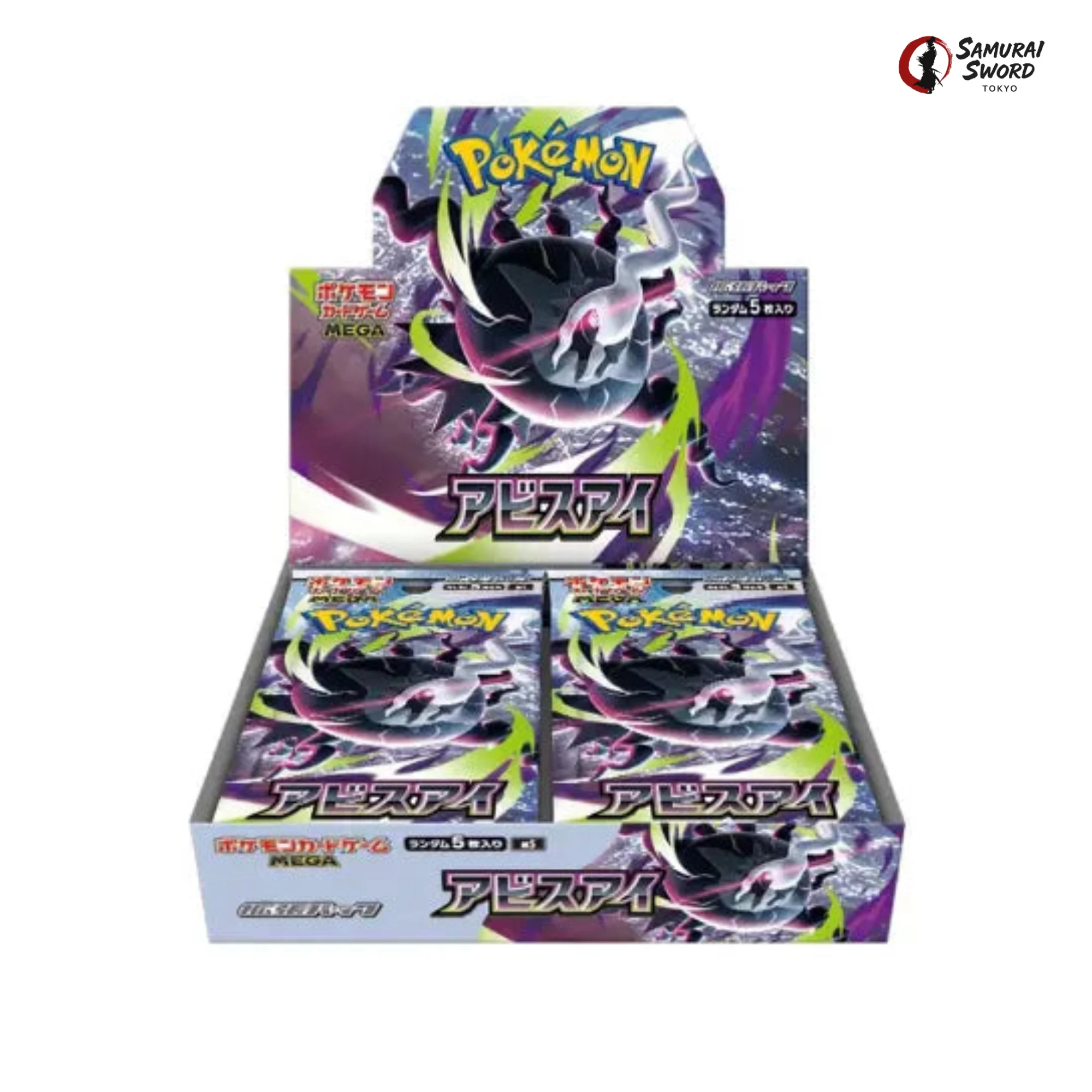
M5-Abyss Eye (Pitch Black) Japanese Pokemon Booster Box
M5-Abyss Eye (Pitch Black) Japanese Pokémon booster box

The Pokémon Trading Card Game launched in Japan on October 20, 1996, developed by Creatures Inc. Publishing duties in Japan sat with Media Factory from 1996 to 2000, before The Pokémon Company took over publishing from 2000 onward — the arrangement that still runs today, nearly thirty years after the first Japanese pack shipped.

Sealed Pokémon product still follows the same booster-pack-inside-a-booster-box format the game launched with, though the exact pack count changes from set to set. Our own M5-Abyss Eye (Pitch Black) Japanese booster box is currently listed at ¥7,475 (~$47). For a wider look at sourcing Pokémon product from Japan, see our guide to buying Japanese Pokémon cards online.

One Piece Card Game

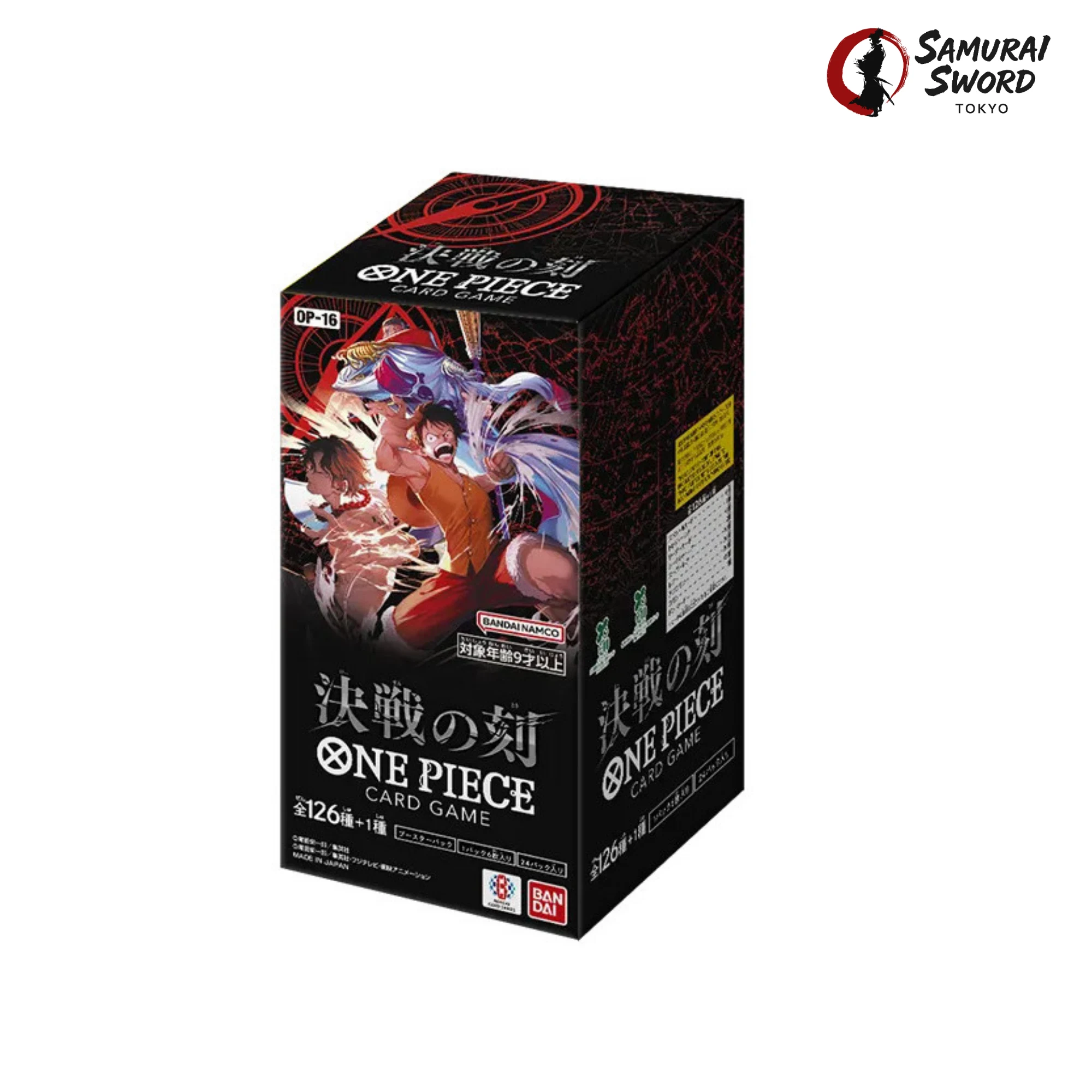
OP-16 The Time of Battle Japanese One Piece Booster Box
OP-16 The Time of Battle Japanese One Piece booster box

The One Piece Card Game is published by Bandai and launched in Japan on July 8, 2022, with the global release following on December 2, 2022 — roughly five months later. Bandai’s own official site frames the Japan launch as a release “to celebrate the 25th anniversary of the ONE PIECE manga,” tying the card game’s debut directly to the source manga’s anniversary year.

Our current One Piece anchor is the OP-16 The Time of Battle Japanese booster box, currently listed at ¥12,360 (~$78). For a full breakdown of the game itself, see our dedicated One Piece Card Game explainer; for sourcing strategy, see how to buy One Piece cards from Japan.

Yu-Gi-Oh! Official Card Game (OCG)

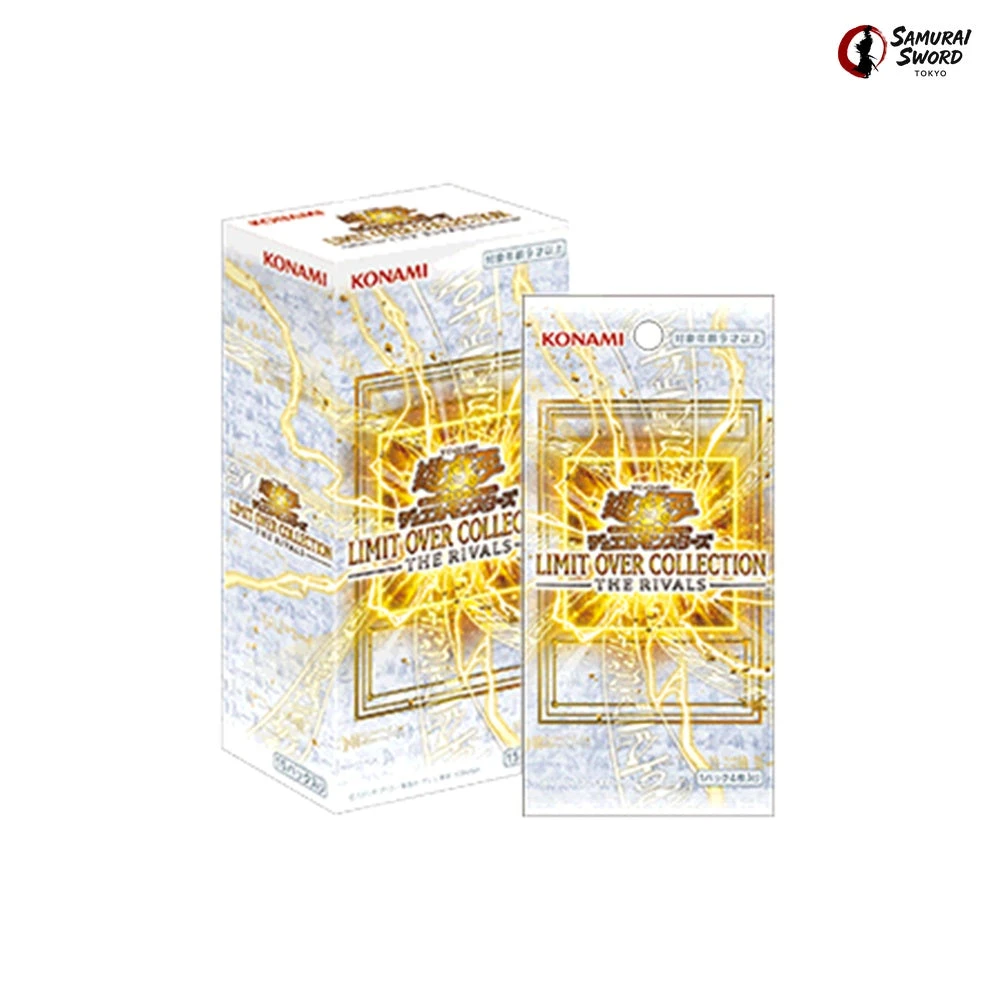
LOCR-Limit Over Collection The Rivals Japanese Yu-Gi-Oh Booster Box
LOCR-Limit Over Collection The Rivals Japanese Yu-Gi-Oh! booster box

Konami’s Yu-Gi-Oh! Official Card Game (OCG) is the second-oldest game on this list. Volume 1 released in Japan on February 4, 1999, with the game’s Official Rules following on March 6, 1999 — putting the OCG’s Japan launch a little over two years after Pokémon’s.

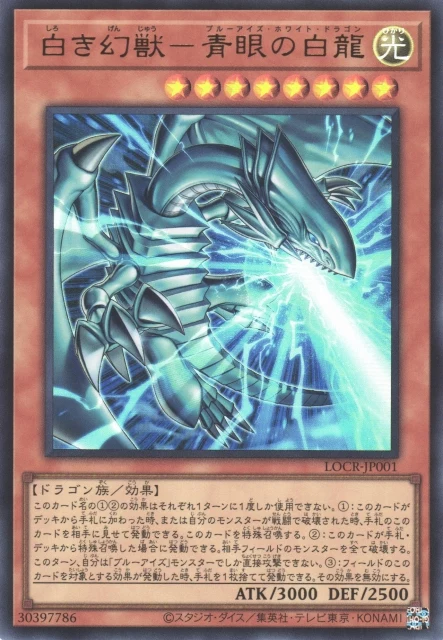
Blue-Eyes White Dragon "The White Phantom Beast", UR, LOCR
Blue-Eyes White Dragon “The White Phantom Beast”, UR, Limit Over Collection The Rivals (LOCR)

Our current Yu-Gi-Oh! anchor is the LOCR-Limit Over Collection The Rivals Japanese booster box, currently listed at ¥7,455 (~$47). For the full card list from this set, see our LOCR card list.

Dragon Ball Super Card Game: Fusion World

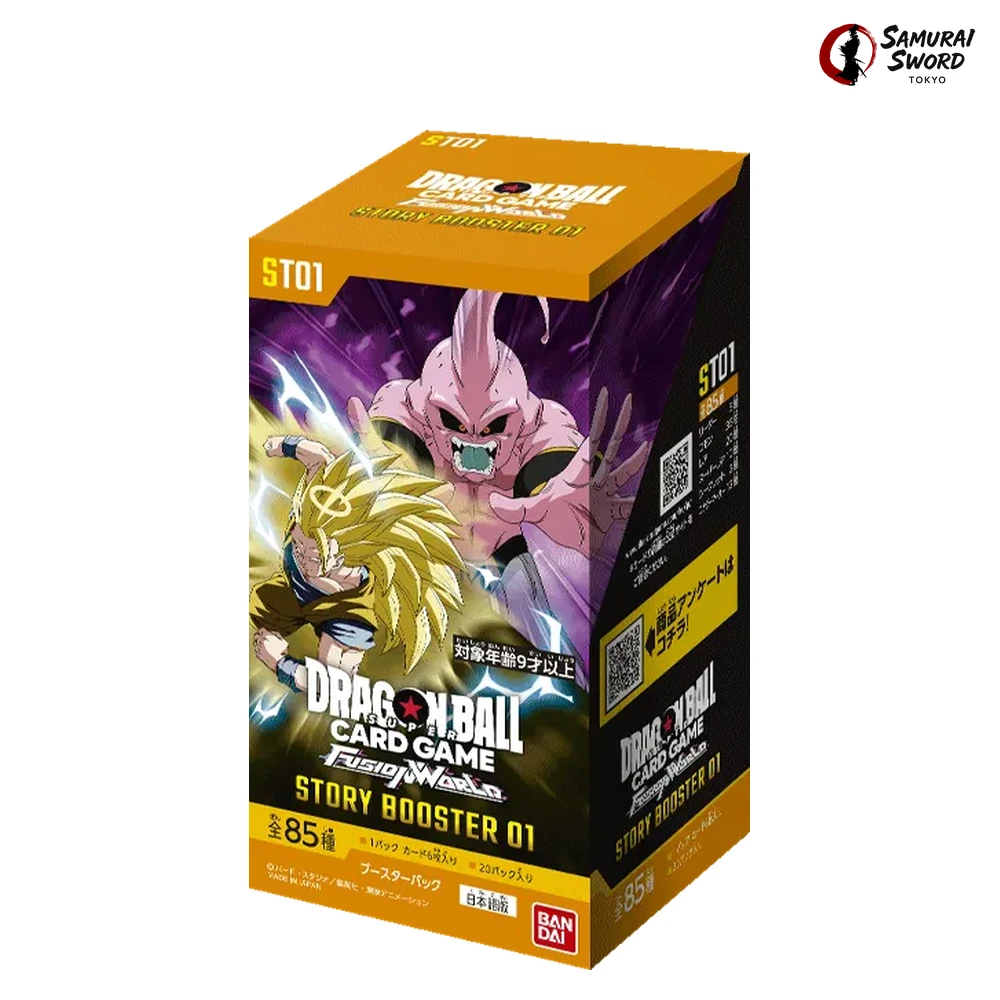
ST-01 Story Booster 01 Japanese Dragon Ball Booster Box
ST-01 Story Booster 01 Japanese Dragon Ball booster box

Dragon Ball Super Card Game: Fusion World is the newest of the four games covered here. Bandai’s Fusion World system launched in Japan on February 16, 2024. Fusion World runs as a separate system from the earlier Dragon Ball Super Card Game line, which Bandai has since branded as “Dragon Ball Super Card Game Masters” to distinguish the two.

Our current Dragon Ball anchor is the ST-01 Story Booster 01 Japanese booster box, currently listed at ¥23,000 (~$145). See the full ST-01 card list, or our Dragon Ball Fusion World sets in order guide for the sets that followed it.

Booster Box Structure Compared

All four games sell sealed product as booster packs inside a booster box, but the pack count and cards-per-pack differ by game — and, for Pokémon, by set:

Game Anchor box Packs per box Cards per pack
Yu-Gi-Oh! OCG LOCR 15 4
One Piece Card Game OP-16 24 6
Dragon Ball Fusion World ST-01 20 6
Pokémon Trading Card Game M5 varies by set varies by set

One Piece and Dragon Ball both settle on 6 carte per pack, though One Piece boxes carry more packs. Yu-Gi-Oh!’s LOCR runs the smallest pack count of the three fixed-structure boxes here, at 4 carte per pack. Pokémon is the outlier: pack and box counts move with each new set rather than holding to one fixed number, so a typical modern Pokémon set such as SV9 runs around 30 packs per box — a useful reference point, but not a number every Pokémon set repeats.

Where to Buy Japanese Trading Card Games from Tokyo

We ship sealed Japanese booster boxes for all four games out of Tokyo with tracked delivery. If you’re starting a collection or picking up a box for each game, here’s where each anchor lives on our site:

Browse the wider ranges through our Pokémon card box collection and One Piece card box collection, or send a mixed order — across any of the four games — through Ordine rapido.

Shop This Box
ST-01 Story Booster 01 Japanese Dragon Ball Booster Box
Currently listed at ¥23,000 (~$145)
Ships from Tokyo · Tracked delivery

View Product →

Domande frequenti

Which four Japanese trading card games does this guide compare?

Pokémon Trading Card Game, Yu-Gi-Oh! Official Card Game (OCG), One Piece Card Game, and Dragon Ball Super Card Game: Fusion World. Pokémon launched in Japan in 1996, Yu-Gi-Oh! in 1999, One Piece in 2022, and Dragon Ball Fusion World in 2024.

Which Japanese trading card game is the oldest?

The Pokémon Trading Card Game, which launched in Japan on October 20, 1996 — about two and a half years before the Yu-Gi-Oh! Official Card Game.

Which Japanese trading card game is the newest?

Dragon Ball Super Card Game: Fusion World, which launched in Japan on February 16, 2024, making it the newest of the four covered in this guide.

Who publishes each of the four games in Japan?

The Pokémon Trading Card Game is published by The Pokémon Company (originally Media Factory from 1996 to 2000). The Yu-Gi-Oh! OCG is published by Konami. Both the One Piece Card Game and Dragon Ball Super Card Game: Fusion World are published by Bandai.

How many packs come in a Japanese booster box?

It depends on the game. Our LOCR (Yu-Gi-Oh!) box runs 15 packs of 4 cards; our OP-16 (One Piece) box runs 24 packs of 6 cards; our ST-01 (Dragon Ball) box runs 20 packs of 6 cards. Pokémon pack counts vary by set rather than holding to one fixed number.

Where can I buy Japanese booster boxes for these games?

We ship sealed Japanese booster boxes for all four games from Tokyo with tracked delivery, including the Pokémon, One Piece, Yu-Gi-Oh!, and Dragon Ball anchors listed in this guide. For a mixed order across games, use our Quick Order page.

Guida alle carte Pokémon Noivern: la coppia SV2D Clay Burst ex e ogni stampa giapponese

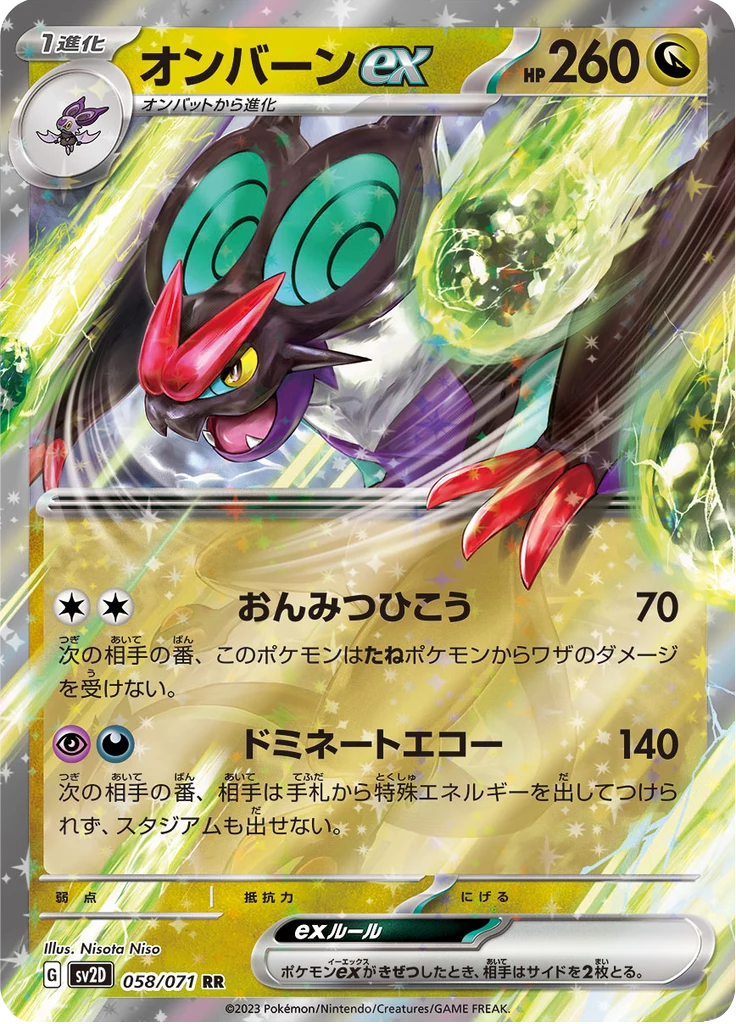
A search for every Japanese Noivern print turns up 23 cards, spread across sets that run from the original XY era through the 2025–26 M-series. The spread covers a wide rarity range — commons and uncommons in most sets Noibat and Noivern happened to round out, alongside higher-tier chase treatments (Noivern-GX, Noivern V, and other Noivern ex prints) elsewhere in the list. One of those higher-tier pairs is the SV2D Clay Burst Double Rare and Secret Rare Noivern ex, both from the same 2023 set: 58/71 sits within the base numbering, while 89/71 is secret-numbered above it.

This guide covers five Noivern prints in verified detail — the SV2D Clay Burst ex pair that anchors it, plus three earlier and later prints that show how the card has been treated across eras — and points to the Japanese sealed product that actually carries the Clay Burst pair.

Noivern (オンバーン) is a Dragon/Flying-type Stage 1 Pokemon, evolving from Noibat (オンバット). In the TCG, its “ex” prints are typed Dragon rather than Flying, which matters if you’re slotting one into a Dragon-type Energy base rather than a Flying one.

Key Takeaway

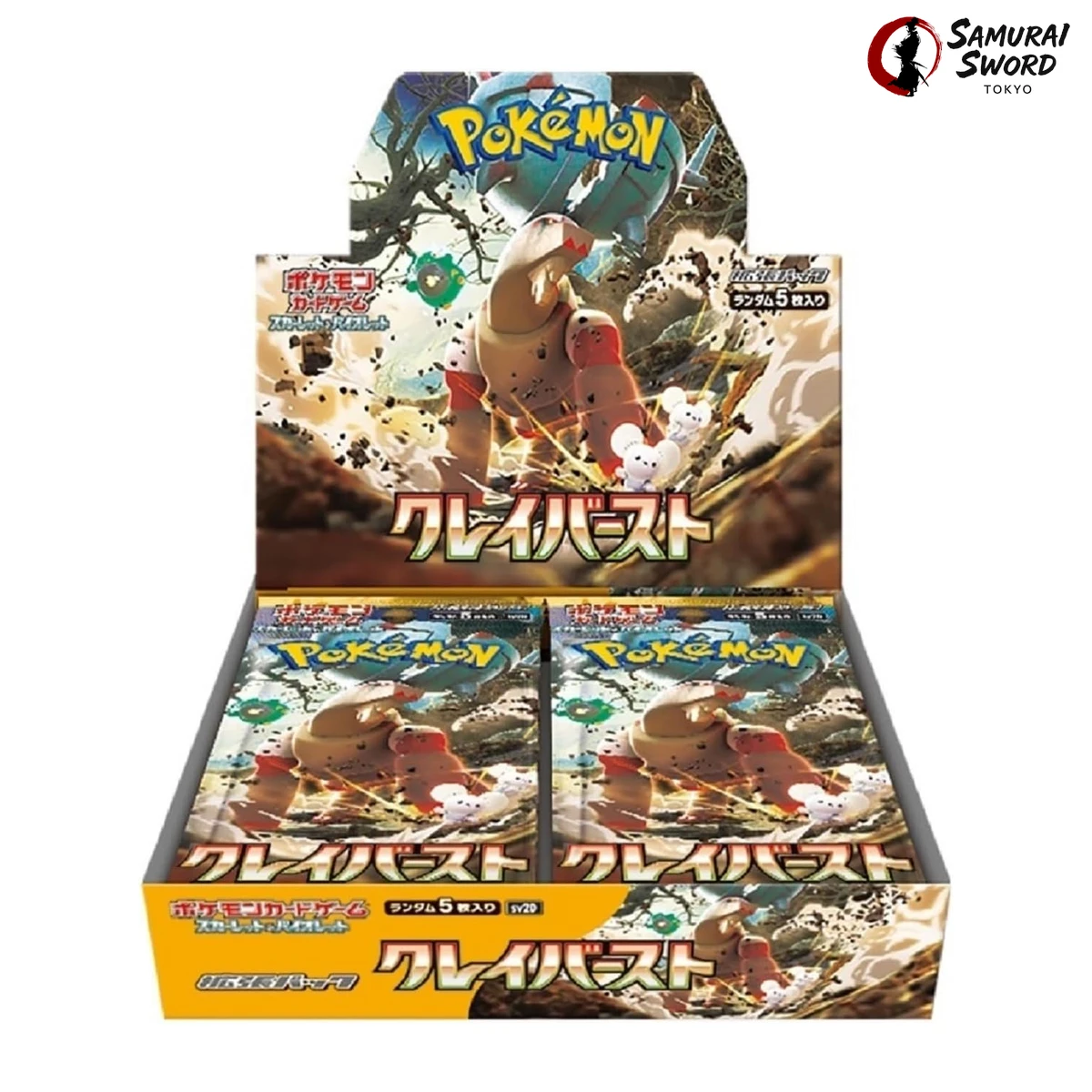
Noivern ex has two verified prints in SV2D Clay Burst — a Double Rare at 58/71 and a Secret Rare at 89/71, both HP 260, both inside our own listed Clay Burst Booster Box, currently listed at ¥9,880 (~$62). A Damaged Box listing of the same set is currently listed at ¥11,040 (~$69). We don’t currently list a single or graded Noivern card; sourcing requests for singles go through Quick Order.

5
Prints Covered

4
Rarities Featured

3
Eras Spanned

1
Listed Box (SV2D)

Japanese yen prices below convert at ¥159/USD (September 2026).

The Japanese Noivern Cards Verified in This Guide

A Limitless TCG search for pokemon:noivern returns 23 Japanese prints across CP4, M2a, MC, S12, S7D, SI, SM11, SM3H, SM6, SM8b, SNPo, SV2D, SV4a, SV9, SVM, XY3 and XYP. This guide covers five of them in verified detail, the ones we can confirm card number, rarity, illustrator and HP for from Limitless’s own card pages:

Number Set Rarity Illustrator HP
SV2D 58/71 Clay Burst Double Rare Nisota Niso 260
SV2D 89/71 Clay Burst Secret Rare Eske Yoshinob 260
SV9 81 Battle Partners Uncommon Anesaki Dynamic 110
XY3 72 Rising Fist Rare 5ban Graphics 100
M2a 131 Mega Dream ex not stated in source Natsumi Miyanose 120

Two things stand out. First, the two SV2D cards are both “Noivern ex” — the only ex-typed prints among the five — and both share the same 260 HP line despite one being a Double Rare and the other a Secret Rare. Second, the other three prints span three different eras entirely: a 2014 XY-era Rare, a modern Scarlet & Violet Uncommon, and a 2025–26 M-series print, none of them typed as ex.

From XY to Modern SV: Two Non-ex Noivern Prints

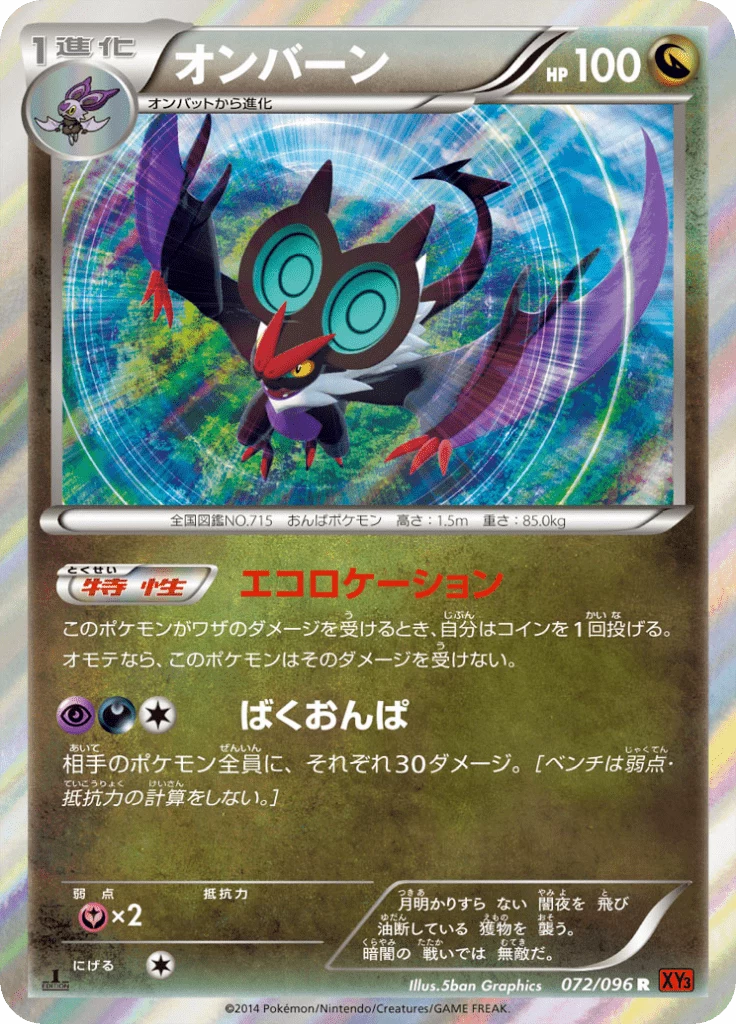
Noivern, XY3 72, Rare, Rising Fist

Noivern, XY3 72, Rare, Rising Fist

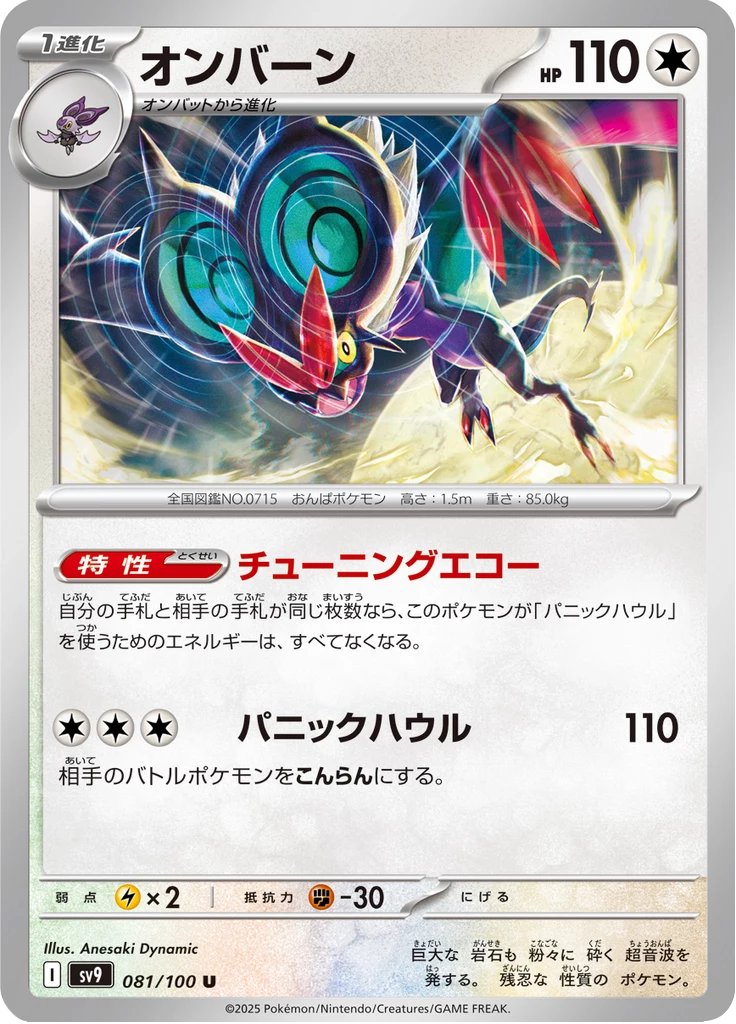
Noivern, SV9 81, Uncommon, Battle Partners

Noivern, SV9 81, Uncommon, Battle Partners

The oldest of the five verified prints is Rising Fist (XY3), card 72, a Rare illustrated by 5ban Graphics with 100 HP. It’s a standard-frame XY-era card, from the set that also carried the era’s Mega Evolution lineup — Noivern’s role in it was a regular Rare slot rather than a chase card.

On the other end of the timeline sits Battle Partners (SV9), card 81, illustrated by Anesaki Dynamic at 110 HP and printed at Uncommon rarity. It is one of the non-ex Noivern prints covered here, while the SV2D pair shows how the same Pokemon also appears as an ex card.

The SV2D Clay Burst ex Pair: Double Rare 58/71 and Secret Rare 89/71

Noivern ex, SV2D 58/71, Double Rare, Clay Burst

Noivern ex, SV2D 58/71, Double Rare, Clay Burst

Noivern ex, SV2D 89/71, Secret Rare, Clay Burst

Noivern ex, SV2D 89/71, Secret Rare, Clay Burst

Clay Burst (SV2D) released in Japan on April 14, 2023, with a 99-card total — a 71-card base set plus a 28-card secret print run that includes 12 Art Rares. Noivern ex sits in the set twice, at opposite ends of that structure: the Double Rare at 58/71, illustrated by Nisota Niso, sits inside the main 71-card base run, while the Secret Rare at 89/71, illustrated by Eske Yoshinob, is numbered into the 28-card secret run above the base total. Both share the same attack line and the same 260 HP — the difference between them is entirely the print treatment and where each sits in the set’s numbering, not the card’s stats.

Check This First

Don’t mix the two up by name alone — both are “Noivern ex.” Check the number printed at the bottom of the card: 58/71 is the Double Rare, 89/71 is the Secret Rare, and the illustrator credit differs between them too (Nisota Niso versus Eske Yoshinob).

Clay Burst became a notable day-one sellout in Japan, driven in large part by demand for the set’s Iono Special Art Rare — a spike that pulled buyers toward the rest of the set’s rare slots as well, the Noivern ex pair included. For the full 99-card breakdown, see our Clay Burst SV2D card list.

The two Noivern ex prints map to different English cards, not the same one: the Double Rare (58/71) corresponds to Paldea Evolved (PAL), card #153, while the Secret Rare (89/71) corresponds to a separate full-art print, Paldea Evolved (PAL), card #246. If you’re cross-referencing the English side of this set, our Paldea Evolved Japanese card list and Paldea Evolved chase cards guide cover how the two versions line up.

The 2025–26 M-Series: Mega Dream ex 131

Noivern, M2a 131, Mega Dream ex

The newest print among the five verified here comes from Mega Dream ex (M2a), part of the 2025–26 M-series, at card 131. It’s illustrated by Natsumi Miyanose and carries 120 HP. We haven’t verified this print’s rarity from the source data, so we’re stating what we can confirm — the card number, illustrator and HP — rather than guessing at the rest.

Chase Prints and What Makes Them Collectible

Of the five prints in this guide, the SV2D pair is the one built to be chased, and the set’s own numbering explains why. Clay Burst’s 71-card base run holds the Double Rare at 58/71 — a tier above a standard Rare, but still inside the set’s regular numbered sequence. The Secret Rare at 89/71 sits eighteen numbers past that base total, placing it inside the 28-card secret print run alongside the set’s 12 Art Rares — the block of cards Japanese Scarlet & Violet-era sets number above the printed set size to mark them as the set’s top chase slots.

That’s the pattern worth knowing when you’re comparing any two SV-era Japanese prints of the same card: a number that runs past the set’s printed total (the “/71” in this case) is the tell that you’re holding a secret-rarity print rather than a standard one, regardless of what the card’s name or attack text looks like.

Which Japanese Boxes to Open for Noivern

Both SV2D Noivern ex prints come out of the same set, so there’s one direct box to point to, plus two related listings:

None of the other three prints in this guide — Rising Fist, Battle Partners or Mega Dream ex — are tied to a box we currently list. If you’re chasing one of those instead, or a graded single of any print covered here, sourcing requests go through Ordine rapido. For how Clay Burst stacks up against its release-partner set, see our SV2D vs SV2P box guide, and for the rest of Clay Burst’s chase cards, see our Clay Burst best cards guide.

Shop This Set
SV2D-Clay Burst Japanese Pokemon Booster Box
Currently listed at ¥9,880 (~$62)
Ships from Tokyo · Tracked delivery

View Product →

Where to Buy Noivern Cards from Tokyo

We ship Japanese sealed product worldwide out of Tokyo with tracked delivery. The Clay Burst Booster Box is the direct route to both Noivern ex prints covered in this guide, and the Damaged Box listing and Clay Burst & Snow Hazard Gym Set are the two related listings of the same product. Browse the wider Japanese Pokemon booster box collection, or request a quote via our Quick Order page for a specific-card sourcing request covering any of the five prints in this guide, including a graded or single copy.

SV2D Clay Burst Japanese Booster Box, listed on samuraiswordtokyo.com
SV2D-Clay Burst Japanese Pokemon Booster Box, currently listed on samuraiswordtokyo.com

Domande frequenti

How many Japanese Noivern Pokemon card prints are there?

A Limitless TCG search returns 23 Japanese Noivern prints across sets from the XY era through the 2025–26 M-series. This guide covers five of them in verified detail: the SV2D Clay Burst ex pair, plus prints from Rising Fist (XY3), Battle Partners (SV9) and Mega Dream ex (M2a).

What is the SV2D Clay Burst Noivern ex pair?

Two prints of Noivern ex from Clay Burst (SV2D), released April 14, 2023: a Double Rare at 58/71 illustrated by Nisota Niso, and a Secret Rare at 89/71 illustrated by Eske Yoshinob. Both are HP 260, and both are inside our listed Clay Burst Booster Box.

Is Noivern ex a Dragon-type or Flying-type card in the TCG?

Noivern itself is a Dragon/Flying-type Pokemon in the games, but its TCG ex prints, including both SV2D versions, are typed Dragon.

Which Japanese booster box has the Clay Burst Noivern ex prints?

The SV2D-Clay Burst Japanese Pokemon Booster Box, currently listed at ¥9,880 (~$62), is the direct route to both the Double Rare and Secret Rare Noivern ex. The same set is also listed as a Damaged Box and as part of a combined Gym Set with Snow Hazard.

Where can I buy Japanese Noivern Pokemon cards?

We ship Japanese sealed product from Tokyo with tracked delivery. The Clay Burst Booster Box carries both SV2D Noivern ex prints, and requesting a quote via our Quick Order page covers sourcing for the other prints in this guide, including graded singles.

Guida all'acquisto della Booster Box SV3 Ruler of the Black Flame: info sul set, chase card e dove comprarla

One Pokémon has three verified secret-tier prints here, each at a different rarity.

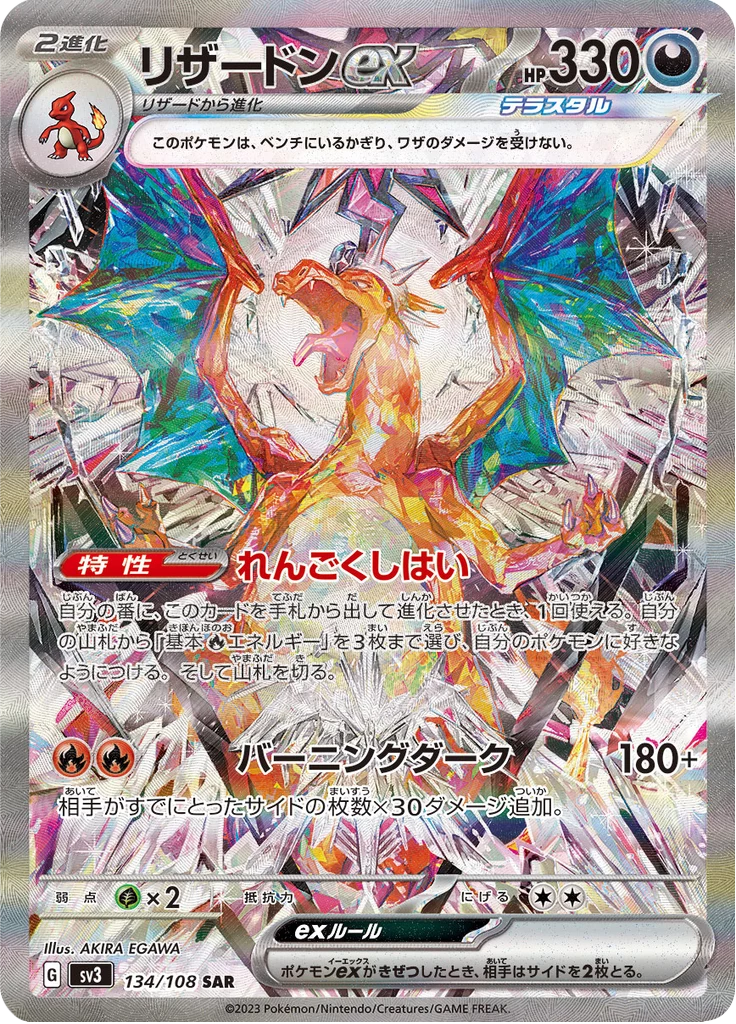
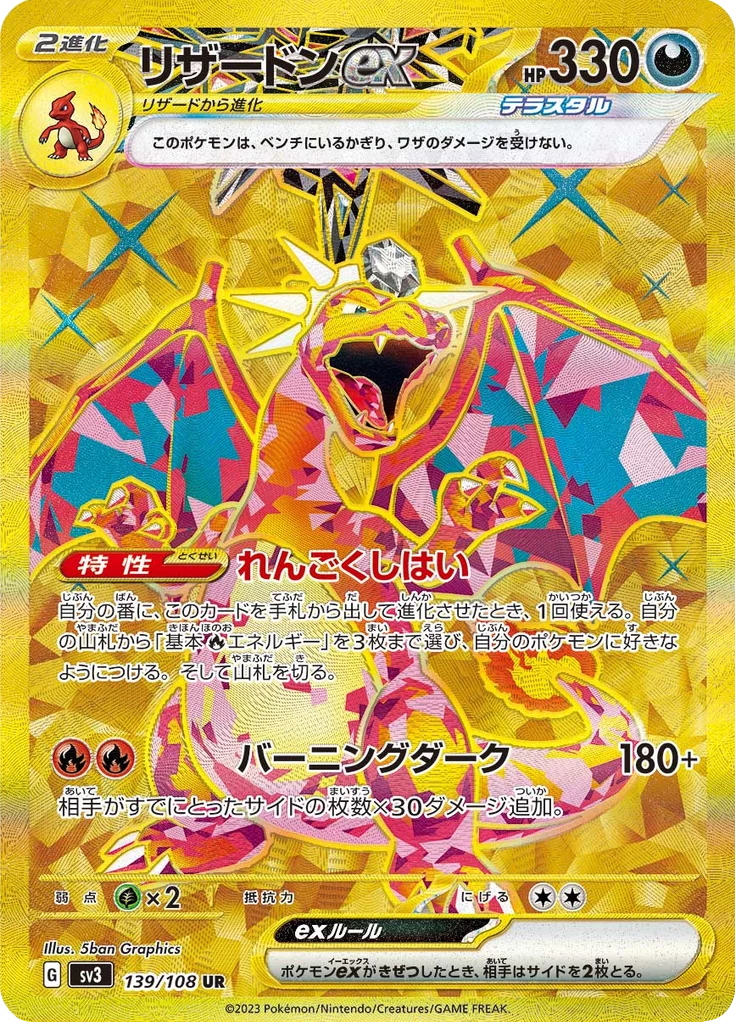
Ruler of the Black Flame, set code SV3, released in Japan on July 28, 2023 as the third core Scarlet & Violet set. It runs 141 cards and is built around a triple-print Charizard ex run — Secret Rare, Special Art Rare, and Ultra Rare versions of the same card in the same set — alongside a run of Secret Rare/Special Art Rare pairs for five other Pokémon and Trainer cards. That structure is unusual enough that it’s one of the reasons this box keeps coming up in buyer questions years after release.

This guide covers what’s actually in a Ruler of the Black Flame box, which pulls define the set, and what’s currently listed on our site — including the difference between our booster box listing and the separate Deck Build Box, which is a different product entirely. We ship Japanese sealed product out of Tokyo, so the prices below are what we carry right now.

Key Takeaway

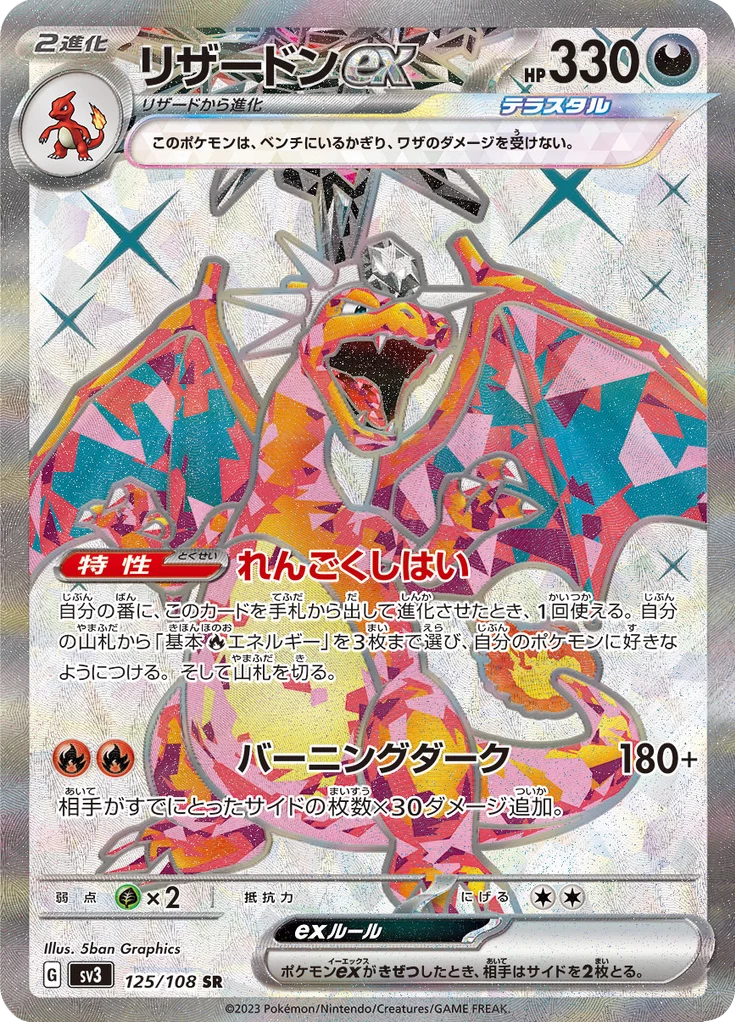
Ruler of the Black Flame (SV3) is 141 cards — 108 base plus 33 secret-tier (12 Art Rare, 12 Secret Rare, 6 Special Art Rare, 3 Ultra Rare) — released July 28, 2023. The headline pull is Charizard ex, with three verified secret-tier prints at three rarities (125/108 SR, 134/108 SAR, 139/108 UR). Our SV3 Ruler of the Black Flame Booster Box is currently listed at ¥17,160 (~$108). The separate Ruler of the Black Flame Deck Build Box is currently listed at ¥5,400 — these are two different products, covered below.

141
Total Cards

108
Base Set Cards

33
Secret-Tier Cards

Jul 2023
JP Release

Prices below are our current listed prices as of September 2026, converted at ¥159/USD.

What’s in a Ruler of the Black Flame Box

Ruler of the Black Flame is a 141-card Scarlet & Violet core set, split into a 108-card base set and a 33-card secret tier:

Tier Rarity Count
Secret tier (33) AR Art Rare 12
SR Secret Rare 12
SAR Special Art Rare 6
UR Ultra Rare 3
Base set — 108

The card numbers for the secret tier run 109/108 through 141/108, sitting above the 108-card base set exactly as the rowspan above implies — 108 base cards, then 33 more numbered past the set’s nominal size.

Packs-per-box and cards-per-pack figures for this specific set aren’t confirmed from what we’ve verified this session — other same-era Scarlet & Violet core sets typically run 30 packs per box at 5 carte per pack, and Ruler of the Black Flame is very likely built the same way, but we’re flagging that structure as unverified specifically for SV3 rather than stating it as confirmed fact. We don’t cover pull rates or pull odds here — our source for this set is a card-list breakdown, not an official rate sheet, so we won’t invent numbers we can’t back up.

For the full 141-card breakdown, see our Ruler of the Black Flame SV3 card list.

Chase Cards in Ruler of the Black Flame

What makes this set stand out isn’t just one big secret rare — it’s a whole run of cards printed at two or three rarities each.

The Triple-Printed Chase: Charizard ex

Charizard ex is the set’s signature pull, and it’s printed three separate times:

Charizard ex 125/108 Secret Rare, Ruler of the Black Flame

Charizard ex 125/108 SR

Charizard ex 134/108 Special Art Rare, Ruler of the Black Flame

Charizard ex 134/108 SAR

Charizard ex 139/108 Ultra Rare, Ruler of the Black Flame

Charizard ex 139/108 UR

Three rarity tiers of the same card, in the same set, is not the norm across Scarlet & Violet core sets — most signature Pokémon get a Secret Rare and, at most, a Special Art Rare upgrade. Ruler of the Black Flame gives Charizard ex all three: a Secret Rare at 125/108, a Special Art Rare at 134/108, and the set’s Ultra Rare slot at 139/108. This isn’t currently a live single listing on our site — if you’re after a graded or raw copy of any of the three, the Quick Order page is the fastest way to flag what you’re after.

The Secret Rare / Special Art Rare Pairs

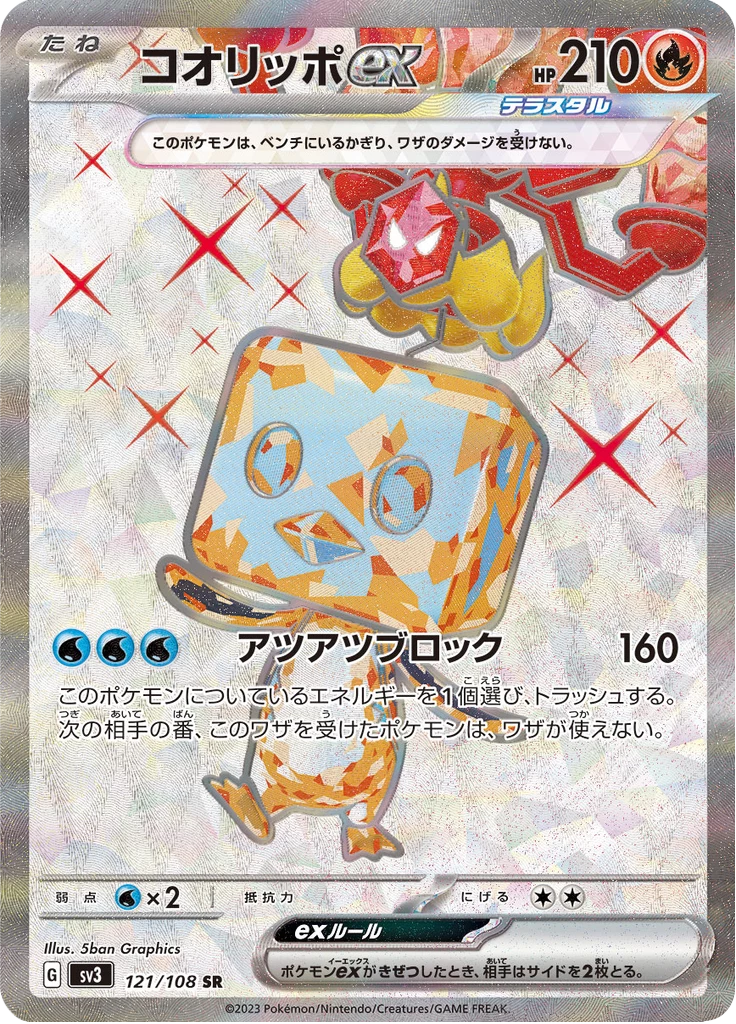
Five other Pokémon and Trainer cards get the same two-tier treatment — a Secret Rare paired with a Special Art Rare upgrade of the same character:

Carta Secret Rare Special Art Rare
Eiscue ex 121/108 SR 133/108 SAR
Revavroom ex 127/108 SR 135/108 SAR
Pidgeot ex 128/108 SR 136/108 SAR
Geeta 129/108 SR 137/108 SAR
Poppy 131/108 SR 138/108 SAR
Eiscue ex 121/108 Secret Rare, Ruler of the Black Flame
Eiscue ex 121/108, Secret Rare — one of five SR/SAR character pairs in the set alongside the Charizard ex triple-print run

Between the Charizard ex trio and these five pairs, six of the set’s twelve Secret Rares belong to a Pokémon or Trainer card that gets reprinted at a higher tier elsewhere in the same set — Charizard ex plus the five SR/SAR pairs above. That pattern is a structural feature of Ruler of the Black Flame, not something we’re speculating about — it’s directly visible in the card numbers above.

Single Secret Rares and the Remaining Ultra Rares

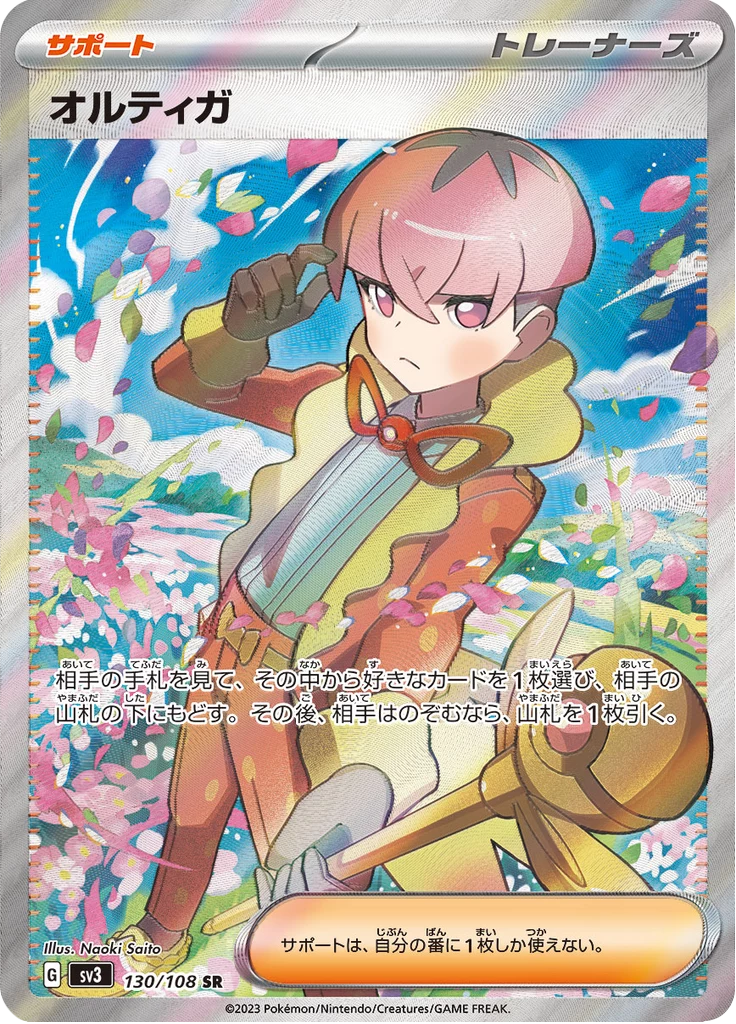
The other six Secret Rares don’t get an SAR upgrade and round out the tier as single-tier prints: Tyranitar ex (122/108), Vespiquen ex (123/108), Glimmora ex (124/108), Absol ex (126/108), Ortega (130/108), and Ryme (132/108). The set’s remaining two Ultra Rares beyond Charizard ex are Trainer and Energy cards: Artazon (140/108) and a full-art Basic Fire Energy (141/108) closing out the set at card 141.

Ortega 130/108 Secret Rare, Ruler of the Black Flame
Ortega 130/108, Secret Rare — one of the six single-tier Secret Rares in Ruler of the Black Flame

A PSA10-graded Ortega single has appeared on our own card-list page before, but it is not part of our current listed anchors — this print is not listed on our site at the moment, and sourcing requests for it go through the Quick Order page. The same applies to any of the other secret-tier singles named above: none of them are currently listed as standalone products, only the sealed box below.

Booster Box vs Deck Build Box on Our Site

We list two Ruler of the Black Flame products, and they get confused with each other because the set name is identical — but they are not the same product, and the price gap between them reflects that.

SV3 Ruler of the Black Flame Japanese Pokemon Booster Box product photo
SV3-Ruler Of The Black Flame Japanese Pokemon Booster Box
Listing Prezzo
SV3-Ruler Of The Black Flame Japanese Pokemon Booster Box currently listed at ¥17,160 (~$108)
Ruler of the Black Flame Deck Build Box currently listed at ¥5,400

The Booster Box is the sealed pack product covered throughout this guide — it’s where the Charizard ex triple-print run and every other card discussed above actually comes from. The Deck Build Box is a different, separately structured Scarlet & Violet product line released alongside the main set: it centres on preconstructed deck contents, but per the official product listing it also includes 10 random Ruler of the Black Flame booster packs, so it can still yield secret-tier pulls — it just isn’t built primarily as a pack-opening product the way the Booster Box is. If your goal is maximising chances at the SR/SAR/UR cards covered in this guide, the Booster Box’s full box of packs gives you more chances than the Deck Build Box’s 10 included packs; the Deck Build Box mainly serves constructed-deck players who also want a shot at some pulls.

Check the Product Title

Both products carry “Ruler of the Black Flame” in the name. Confirm you’re looking at “Booster Box” versus “Deck Build Box” in the title before checkout — the ¥11,760 gap between the Booster Box (¥17,160) and the Deck Build Box (¥5,400) reflects genuinely different contents, not a discount on the same product.

Japanese vs English Version of This Set

Everything covered in this guide is the Japanese printing of Ruler of the Black Flame, which is what we carry. In the wider English-language hobby, this set is commonly identified as Obsidian Flames — a pairing that lines up with the known Scarlet & Violet release order, but one that has not been independently re-confirmed this session, so treat that name match as reported rather than verified on our end.

What we can confirm directly: the Japanese release date, July 28, 2023, and the full 141-card structure detailed above, both cross-checked against our own card-list article and an independent card database, with both sources agreeing exactly on the card count. We don’t have a confirmed English release date or an English-language card count to compare against, so we’re not going to state one here.

Practically, if you’re deciding between sourcing this set in Japanese or English, the Japanese printing is the one this guide — and our own listings — are built around.

Shop This Set
SV3-Ruler Of The Black Flame Japanese Pokemon Booster Box
Currently listed at ¥17,160 (~$108)
Ships from Tokyo · Tracked delivery

View Product →

Where to Buy a Ruler of the Black Flame Booster Box from Tokyo

We ship sealed Japanese product worldwide from Tokyo with tracked delivery. The SV3-Ruler Of The Black Flame Japanese Pokemon Booster Box above is the direct route to the Charizard ex triple-print run and the rest of the secret tier; the separate Ruler of the Black Flame Deck Build Box is worth a look if constructed play, rather than pulls, is the goal.

For the wider Japanese Pokémon booster box range, browse our Pokemon booster box collection. If you’re weighing this set against its numbered sibling, our SV3 vs SV3a box comparison lines the two up directly, and our Raging Surf (SV3a) card list and pull rates guide covers the follow-up set in the same numbered pair.

For any secret-tier single not currently listed as a standalone product — Charizard ex at any of its three rarities, Ortega, or any of the other named chases above — the Quick Order page is the fastest way to build a mixed order or flag what you’re after.

Domande frequenti

What is SV3 Ruler of the Black Flame?

Ruler of the Black Flame is the third core Scarlet & Violet set released in Japan, on July 28, 2023. It contains 141 cards — a 108-card base set plus a 33-card secret tier — and is best known for printing Charizard ex at three separate rarities.

How many cards are in Ruler of the Black Flame?

141 total: 108 base-set cards plus 33 secret-tier cards, split into 12 Art Rare, 12 Secret Rare, 6 Special Art Rare, and 3 Ultra Rare.

Why are there three verified secret-tier Charizard ex prints?

Ruler of the Black Flame gives Charizard ex a Secret Rare (125/108), a Special Art Rare (134/108), and the set’s Ultra Rare slot (139/108) — a three-tier treatment that most other signature Pokémon in the set don’t get. Five other cards get a two-tier SR/SAR pairing, but Charizard ex is the only one printed at all three rarities.

What’s the difference between the SV3 Booster Box and the Deck Build Box on your site?

They’re different products. The Booster Box is the sealed pack product that contains the secret-tier cards covered in this guide, currently listed at ¥17,160 (~$108). The Deck Build Box is a separate, constructed-deck-oriented product from the same set, currently listed at ¥5,400 — it also includes 10 random Ruler of the Black Flame booster packs, so it can still yield secret-tier pulls, just fewer chances than the full Booster Box.

Is Ruler of the Black Flame the same as Obsidian Flames?

Ruler of the Black Flame is the Japanese printing we carry. It’s commonly identified in the wider hobby as the Japanese counterpart to the English set Obsidian Flames, though that pairing has not been independently re-confirmed this session — treat it as reported rather than fully verified.

Where can I buy a PSA10 Ortega or other Ruler of the Black Flame singles?

None of the secret-tier singles named in this guide, including Ortega, are currently listed as standalone products on our site — only the sealed Booster Box and Deck Build Box are. Sourcing requests for specific singles go through our Quick Order page.
Guida all'acquisto del Booster Box SM9 Tag Bolt: il set di debutto TAG TEAM GX e le carte chase

Six TAG TEAM-GX pairings, one box, and a mechanic the Pokemon TCG had never used before. When 拡張パック「タッグボルト」— Expansion Pack “Tag Bolt” — released in Japan on December 7, 2018, it introduced the TAG TEAM-GX card type to the game, pairing two Pokemon on a single card with a shared attack.

This guide covers what’s actually in a Tag Bolt box, which TAG TEAM-GX pulls collectors chase, how our own Regular Box, Damaged Box and No Shrink listings work for this particular set, and how the Japanese release compares to its English counterpart. We ship Japanese sealed product and PSA-graded singles out of Tokyo, so every price below is our own current listing, not a third-party market quote.

Key Takeaways

Tag Bolt is set code SM9, released in Japan on December 7, 2018. It’s the set that introduced the TAG TEAM-GX mechanic, headlined in this guide by Pikachu & Zekrom GX SR (100/095) and Latias & Latios GX across three verified tiers. Our sealed SM9-Tag Bolt Japanese Pokemon Booster Box is currently listed at ¥441,000 (~$2,774).

6
TAG TEAM-GX Pairings

Dec 2018
Japan Release

6
TAG TEAM-GX Pairs

Feb 2019
English Release

Prices below are our own current listed prices as of September 2026, converted at ¥159/USD.

What’s in a Tag Bolt Booster Box

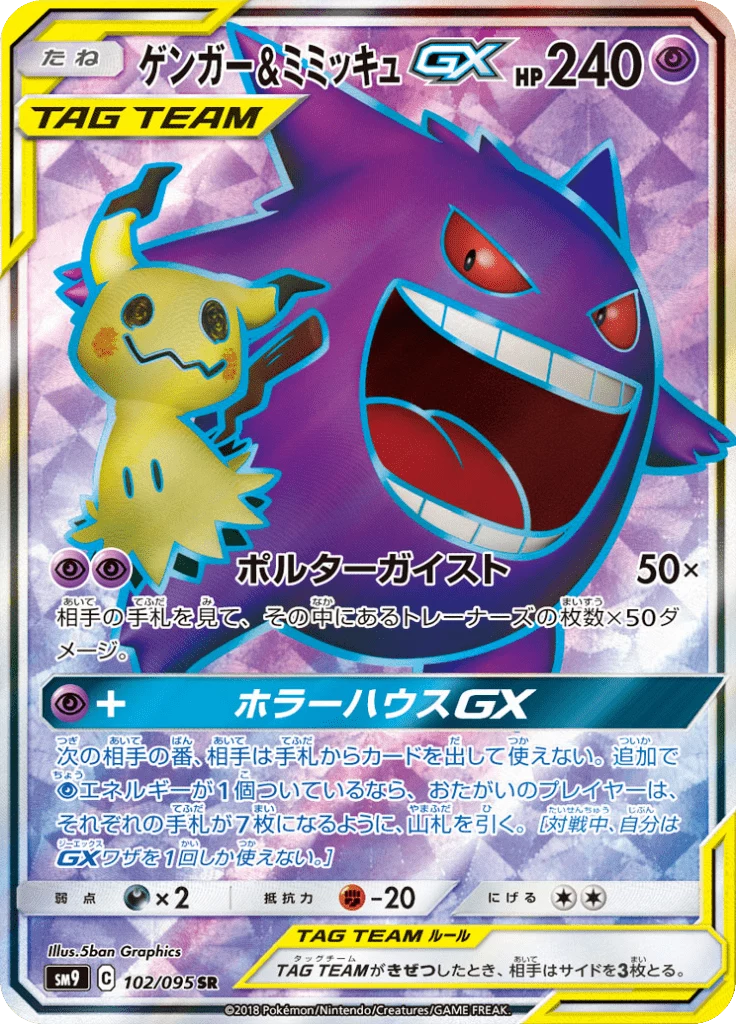
Tag Bolt is the Sun & Moon-era set that first brought the TAG TEAM-GX card type into the Pokemon TCG — two Pokemon sharing one card and one GX attack. Six pairings debuted here: Pikachu & Zekrom GX, Latias & Latios GX, Gengar & Mimikyu GX, Eevee & Snorlax GX, Celebi & Venusaur GX, and Magikarp & Wailord GX.

Articolo Value
Set name 拡張パック「タッグボルト」/ Expansion Pack “Tag Bolt”
Codice set SM9
Japan release date December 7, 2018
TAG TEAM-GX pairings introduced 6

On the card count, the totals in our cited references conflict. The visible numbering shows base-numbered cards followed by secret-numbered cards, so this guide does not state a definitive total. Use our Tag Bolt checklist article as a navigation aid, and verify individual cards by their printed numbers.

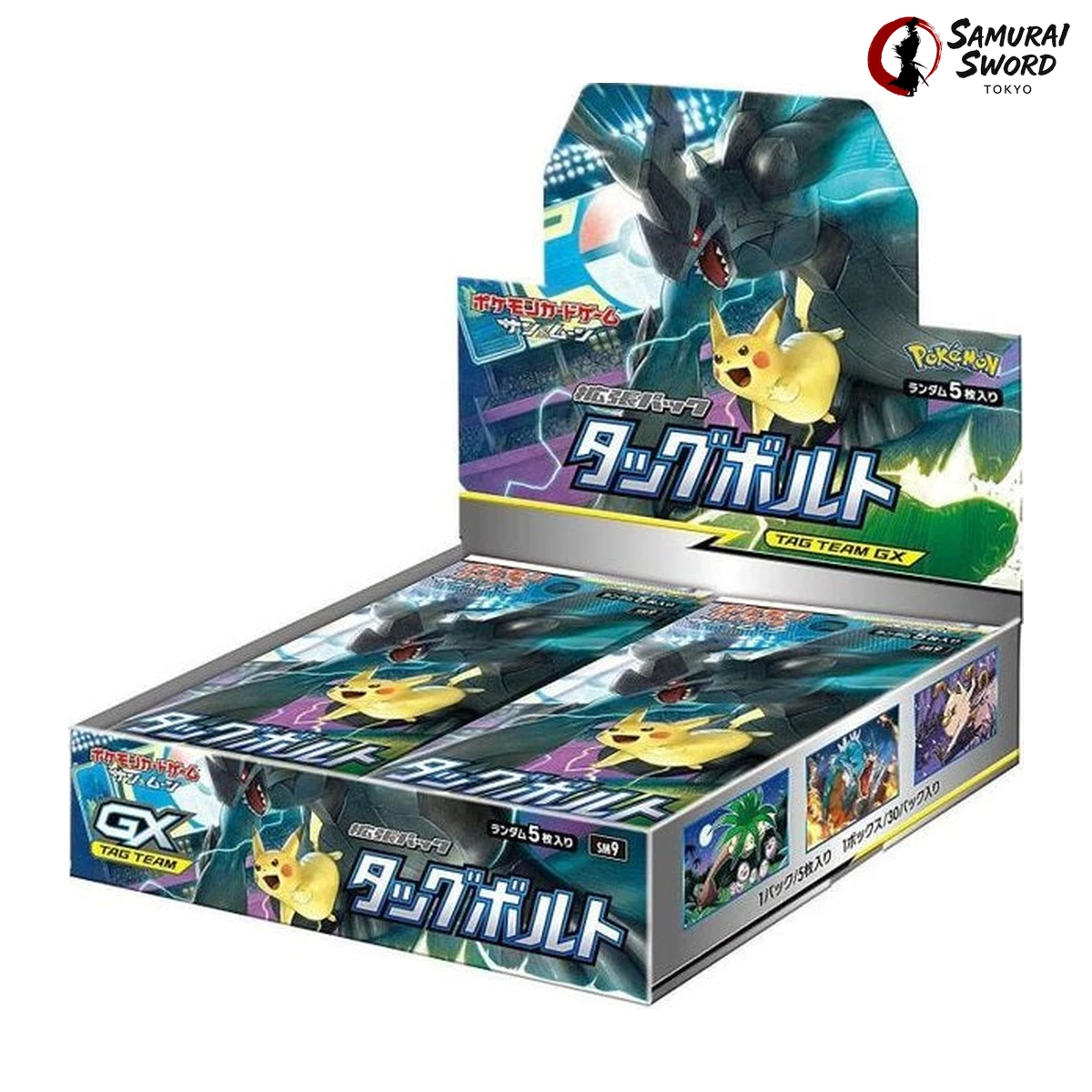
SM9-Tag Bolt Japanese Pokemon Booster Box product photo
SM9-Tag Bolt Japanese Pokemon Booster Box — our own sealed listing

Chase Cards in Tag Bolt

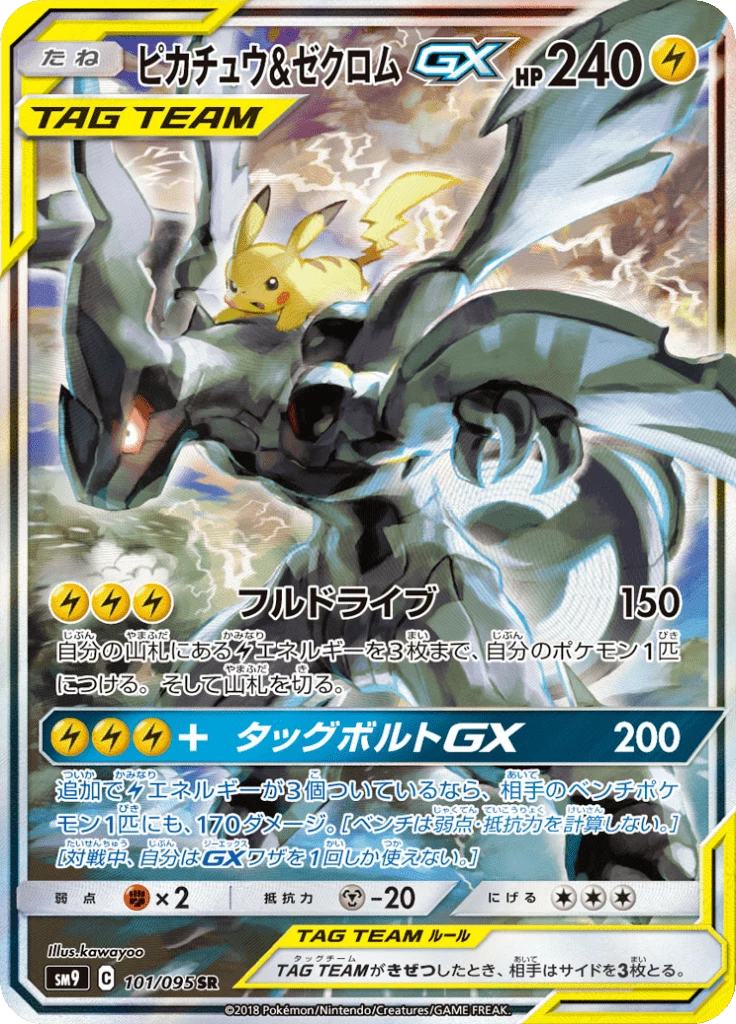
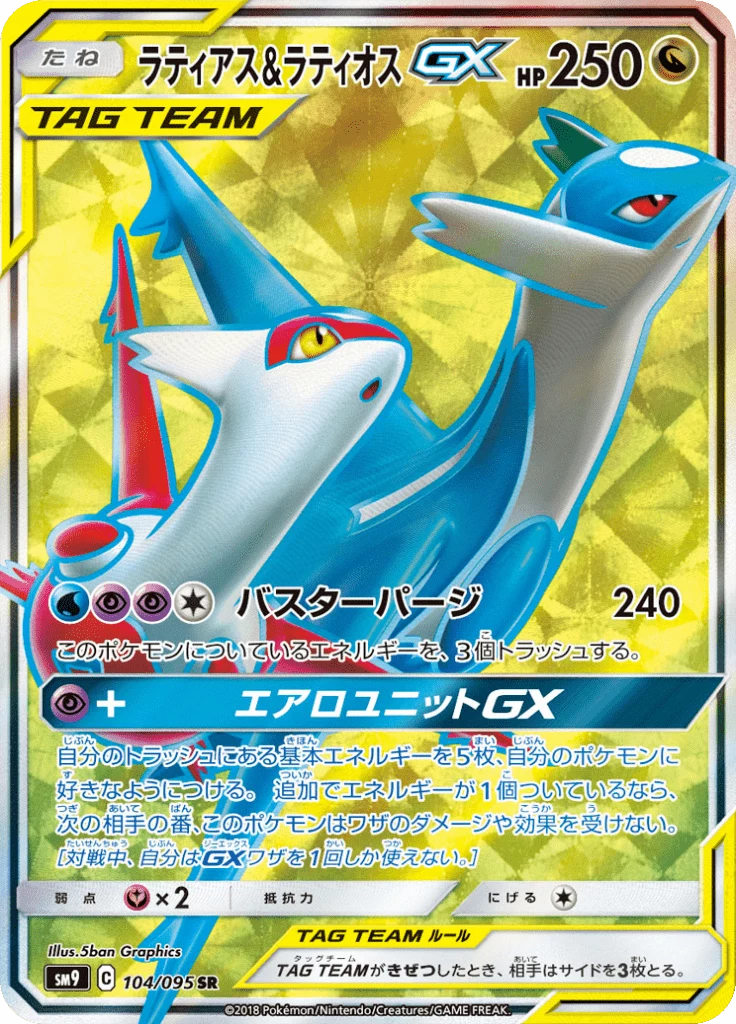
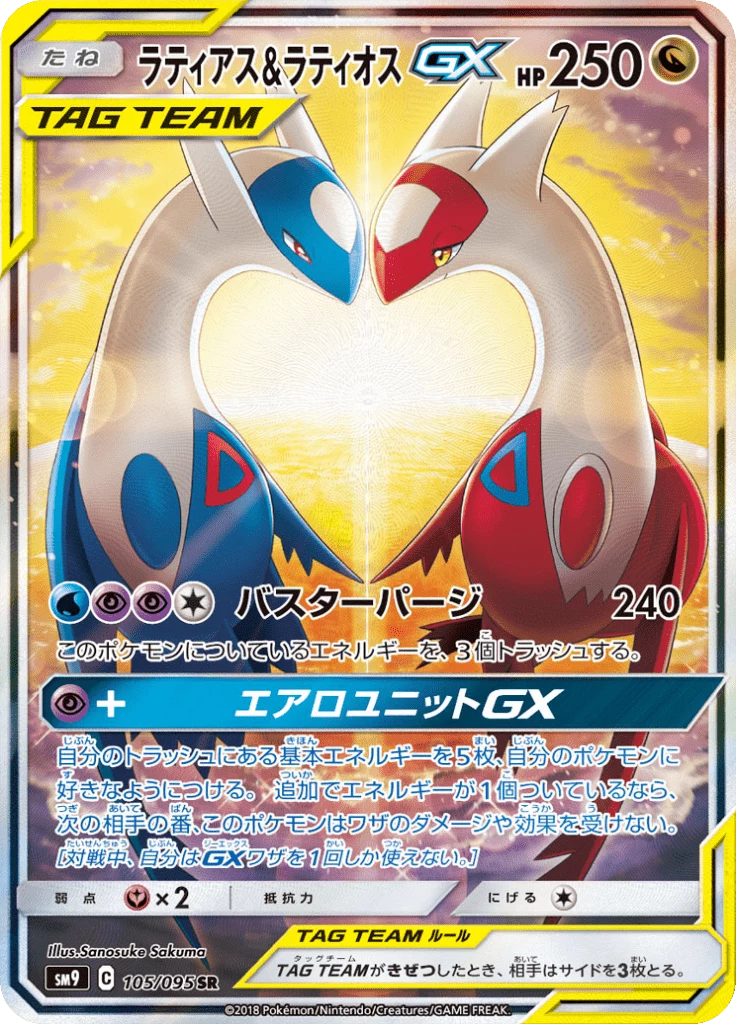
Six TAG TEAM-GX pairings debuted in Tag Bolt. For the two pairings documented card by card in our FACTS pack, the secret-numbered tiers include Pikachu & Zekrom GX at 100/095 SR and 101/095 SR Special Art, plus Latias & Latios GX at 104/095 SR and 105/095 SR Special Art. This guide does not generalise that tier pattern to the other four pairings.

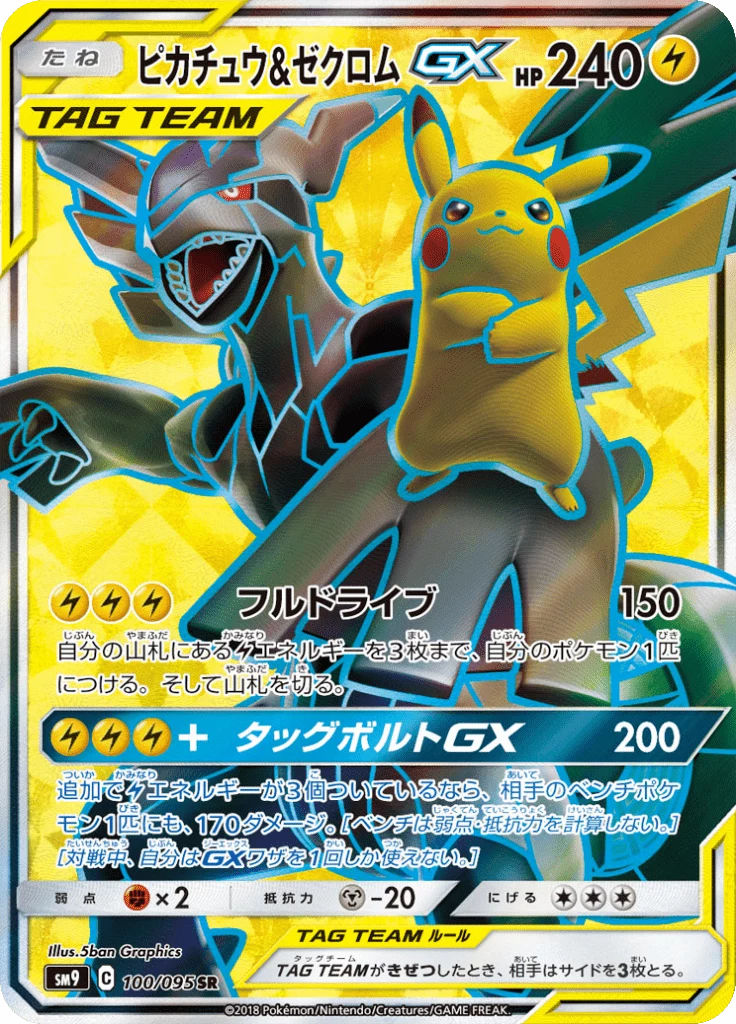
Pikachu & Zekrom GX

The set’s defining pairing. It appears across three separate printings: a regular Double Rare in the base numbering, then two secret-tier prints — SR (100/095) and SR Special Art (101/095).

Pikachu & Zekrom GX 100/095 SR Tag Bolt

Pikachu & Zekrom GX, 100/095, SR — Tag Bolt (SM9)

Pikachu & Zekrom GX 101/095 SR Special Art Tag Bolt

Pikachu & Zekrom GX, 101/095, SR Special Art — Tag Bolt (SM9)

The SR (100/095) is currently listed PSA10-graded, linked in the table below.

Latias & Latios GX

The same documented pattern includes a regular Double Rare in the base numbering, then SR (104/095) and SR Special Art (105/095).

Latias & Latios GX 104/095 SR Tag Bolt

Latias & Latios GX, 104/095, SR — Tag Bolt (SM9)

Latias & Latios GX 105/095 SR Special Art Tag Bolt

Latias & Latios GX, 105/095, SR Special Art — Tag Bolt (SM9)

The SR Special Art (105/095) is currently listed PSA10-graded, also linked below.

Carta # Tier Currently listed
Pikachu & Zekrom GX 100/095 SR PSA10 currently listed at ¥87,208 (~$549)
Latias & Latios GX 105/095 SR Special Art PSA10 currently listed at ¥1,321,516 (~$8,311)

The other four debut pairings are Gengar & Mimikyu GX, Celebi & Venusaur GX, Magikarp & Wailord GX, and Eevee & Snorlax GX. Their detailed tier and number breakdown is outside the verified scope of this guide. Prints not listed on our site at the moment can be requested through Ordine rapido.

Gengar & Mimikyu GX 102/095 Tag Bolt
Gengar & Mimikyu GX, 102/095 — Tag Bolt (SM9)

Any Tag Bolt single not listed above can be requested through our Quick Order page.
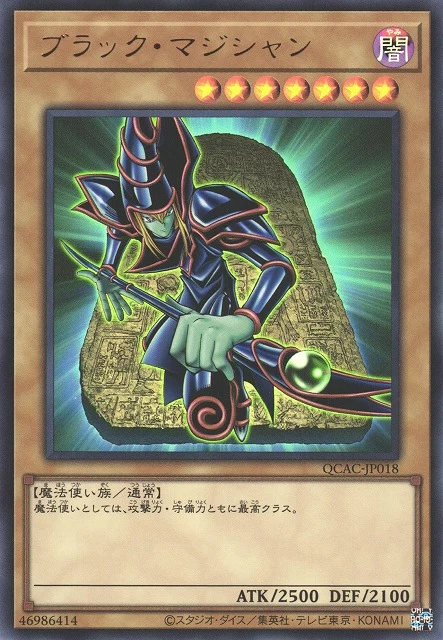
For the set’s TAG TEAM-GX lineage in later Sun & Moon-era sets, see our SM10 Double Blaze pull rates guide and our SM12 Alter Genesis pull rates guide, which covers the later ADP GX Tag Team pairing.

Regular Box vs Damaged Box vs No Shrink on Our Site

On our site, “Damaged Box” is a condition category we use for sealed booster boxes where the outer box — not the contents — is affected. The booster packs inside stay factory-sealed; you’re still getting the same booster packs, in the same box count. Damaged Box pricing moves independently of the regular box listing and isn’t always cheaper. “No Shrink” is a separate listing name we use on some product pages for boxes sold without their original shrink wrap — beyond that naming, we don’t publish a broader definition of the term.

For Tag Bolt specifically, only the standard sealed box is currently listed on our site — there’s no separate Damaged Box or No Shrink listing for this set at the moment. If that changes, it will appear as its own line on the product page; in the meantime, requests for either condition variant can be flagged through Ordine rapido.

Japanese vs English Version of This Set

Tag Bolt released in Japan on December 7, 2018. Its English equivalent, Sun & Moon—Team Up, followed on February 1, 2019 — roughly two months later. The TAG TEAM-GX mechanic itself debuted in Japan first, with the English Team Up release carrying the same six pairings under the localized set name and English card text.

Because the Japanese release came first, Japanese collectors and importers had a head start of about two months on the TAG TEAM-GX format before it reached English-language shelves.

Shop This Set
SM9-Tag Bolt Japanese Pokemon Booster Box
Currently listed at ¥441,000 (~$2,774)
Ships from Tokyo · Tracked delivery

View Product →

Where to Buy a Tag Bolt Booster Box from Tokyo

We ship sealed Japanese product and PSA-graded singles worldwide from Tokyo with tracked delivery. The sealed SM9-Tag Bolt Japanese Pokemon Booster Box is our direct listing for this set. For graded chase-card singles, the PSA10 Pikachu & Zekrom GX SR (100/095) and PSA10 Latias & Latios GX SR Special Art (105/095) are both currently listed above.

Browse more graded Japanese Pokemon singles in our PSA10 graded card collection and more sealed boxes in our Pokemon booster box collection. Any Tag Bolt single, box condition, or other Sun & Moon-era set not covered here — including sets like SM10 Double Blaze or SM12 Alter Genesis — can be requested through our Quick Order page.
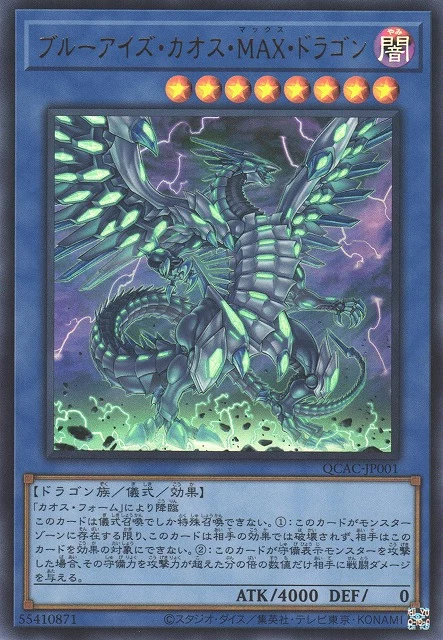
Domande frequenti

What is Tag Bolt (SM9) and when did it release in Japan?

Tag Bolt is set code SM9, released in Japan on December 7, 2018. It’s the Sun & Moon-era set that introduced the TAG TEAM-GX card type to the Pokemon TCG, with six debut pairings across the set.

How many cards are in the Tag Bolt set?

The totals in our cited references conflict, so this guide does not state a definitive total. The visible numbering shows a base sequence followed by secret-numbered cards.

What are the chase cards in Tag Bolt?

The verified examples in this guide are Pikachu & Zekrom GX at 100/095 SR and 101/095 SR Special Art, plus Latias & Latios GX at 104/095 SR and 105/095 SR Special Art.

Is Tag Bolt the same set as Sun & Moon—Team Up?

They carry the same six TAG TEAM-GX pairings, but they’re separate regional releases. Tag Bolt is the Japanese SM9 set from December 7, 2018; Sun & Moon—Team Up is its English equivalent, released February 1, 2019.

Does your site sell a Damaged Box or No Shrink version of Tag Bolt?

Not currently. Only the standard sealed SM9-Tag Bolt booster box is listed on our site right now. Damaged Box and No Shrink are condition variants we use on some other listings, but neither exists for this set at the moment — requests can be flagged through Quick Order.

Where can I buy a Tag Bolt booster box or singles from Japan?

Our sealed SM9-Tag Bolt Japanese Pokemon Booster Box is listed directly on our site, along with PSA10-graded Pikachu & Zekrom GX and Latias & Latios GX singles. Anything else from the set can be requested through our Quick Order page.
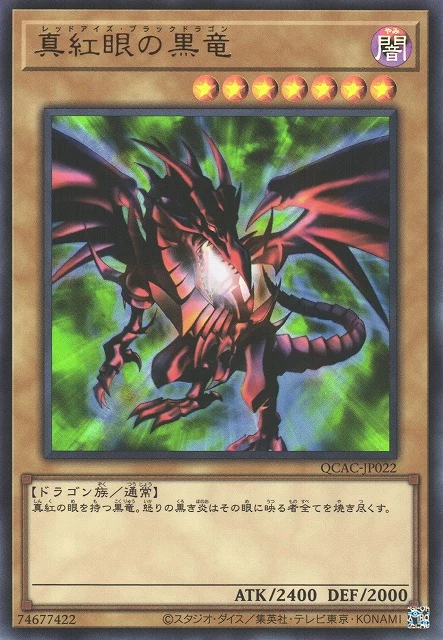
Yu-Gi-Oh OCG vs TCG: differenze per chi compra carte giapponesi

OCG and TCG are two regional versions of the same card game. They look similar on the surface, but the card backs differ, the two formats keep separate tournament banlists, and cards legal in one are not automatically legal in the other.
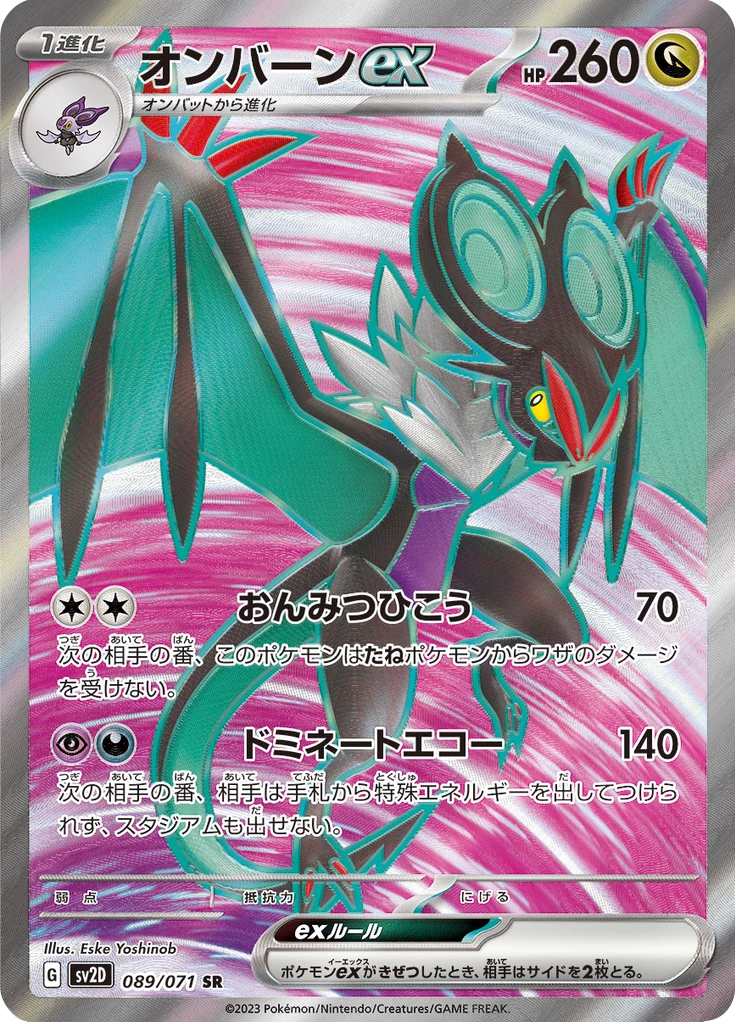
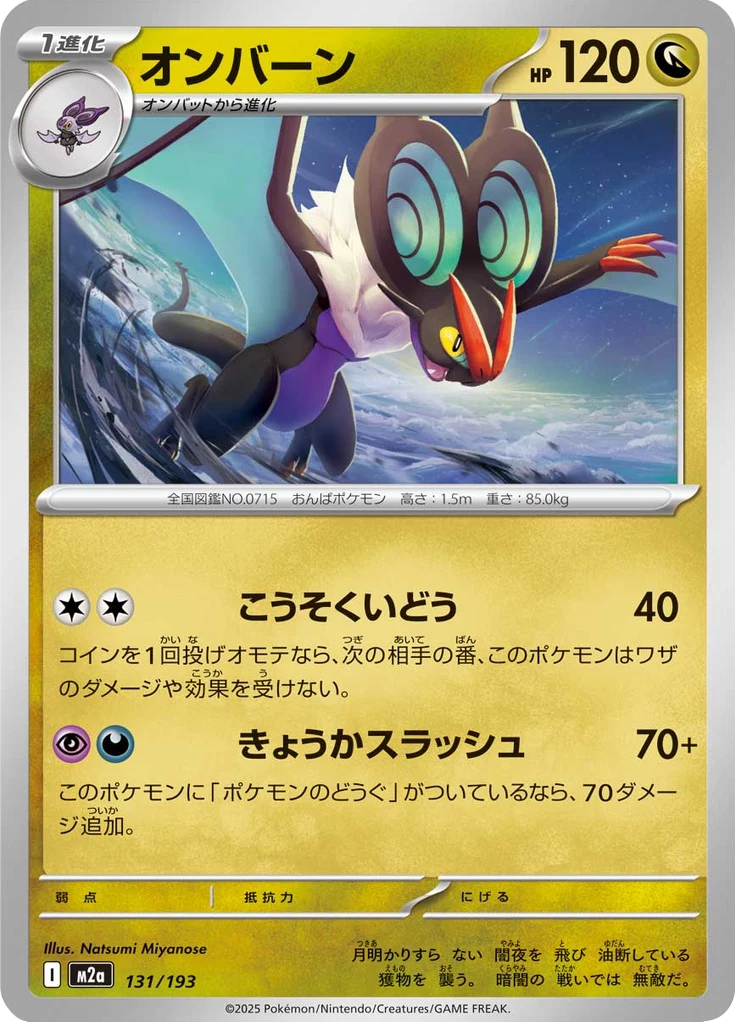
If you’re buying Japanese Yu-Gi-Oh product — sealed boxes, singles, or anything shipped out of Japan — you are buying OCG cards. This guide walks through exactly what separates the two formats, using Yugipedia’s “Yu-Gi-Oh! Official Card Game” page as the source, and what the differences actually mean at the point of purchase.

Key Takeaways

The OCG launched on February 4, 1999, before it had an English-language TCG counterpart. Card backs differ by region, TCG cards are not tournament-legal in OCG events, and the two formats have run separate Forbidden/Limited banlists since September 2013 — the same card can be Forbidden in one format and Unlimited in the other. Our LOCR – Limit Over Collection The Rivals booster box is an OCG-only release with no TCG equivalent, currently listed at ¥7,455 (~$47).

1999
OCG Launch Year

2013
Banlists Went Separate

2
Card-Game Formats

¥159
Per USD (Sept 2026)

Yen figures below convert at ¥159/USD (September 2026).

OCG vs TCG: What the Two Formats Actually Are

The OCG and TCG are separately administered regional versions of the same game, with distinct card pools, print runs and release calendars.

The OCG came first. It launched in Japan on February 4, 1999 with Vol.1, and its Official Rules followed on March 6, 1999 — per the same Yugipedia source. Japanese Yu-Gi-Oh cards are OCG cards because they were printed for the Japanese market.

Aspect OCG TCG
Regione Japan and other OCG markets TCG markets
Card back Varies by sub-region — Japanese/Japanese-Asian, Asian-English and Korean backs are all different from each other One universal back logo worldwide
Tournament legality TCG cards are not legal in OCG events Runs its own separate legal card pool
Banlist Own Forbidden/Limited list, maintained separately since September 2013 Own Forbidden/Limited list, maintained separately since September 2013
Release schedule Own schedule; gets OCG-exclusive cards and sets Own schedule — by the same two-list logic, the TCG gets its own exclusives too

Card Backs: How to Tell OCG from TCG at a Glance

The fastest way to identify which format a card belongs to is the back of the card, not the front. TCG cards, regardless of which English-, French-, German- or Spanish-language box they came from, all share one universal back logo.

OCG cards don’t work that way. According to Yugipedia, Japanese and Japanese-Asian card backs carry a logo featuring the Japanese Yu-Gi-Oh! logo — rendered with English ruby text — and the phrase “Official Card Game Duel Monsters” printed in katakana. Asian-English cards use a different backing again, and Korean cards a different one still, distinct from both the Japanese cards and from each other.

Why This Matters at the Table

Because the backs are visibly different across regions, a player mixing OCG and TCG cards — or mixing Japanese, Asian-English and Korean cards within the OCG — needs opaque-backed sleeves. Without them, an opponent can potentially read information about a card from its back alone.

For a deeper look at spotting the specific print details that separate genuine Japanese product from everything else, see our guide to identifying Yu-Gi-Oh cards.

Tournament Legality: Why the Two Formats Don’t Mix

Per Yugipedia, TCG cards are not legal in OCG tournaments. The two formats run on separate legal card pools, and a card being printed for one region’s release schedule doesn’t automatically make it usable in the other region’s events.

This is the practical reason the card-back difference matters. If you’re playing in an OCG event in Japan, or a TCG event anywhere else, the cards on the table need to belong to that format — and if a deck legitimately mixes formats for casual play, opaque sleeves are the fix so the backs don’t give anything away.

LOCR Limit Over Collection The Rivals Japanese Yu-Gi-Oh booster box
LOCR – Limit Over Collection The Rivals, an OCG booster box printed for the Japanese market

Banlists: The Same Card, Two Different Statuses

Since September 2013, the OCG and TCG have maintained entirely separate Forbidden/Limited banlists. That means the exact same printed card can carry a different legal status depending on which format you’re playing — Forbidden in the OCG and Unlimited in the TCG, or the other way around. Both directions happen; the pattern isn’t one-way.

Because banlists are revised multiple times a year in each format, this guide isn’t the place to state any individual card’s current status — check the live OCG or TCG list for the format you’re playing before assuming a card’s legality.

The one place the two lists get reconciled is the World Championship. During Worlds, every card is set to whichever status is most restrictive across all the regional banlists in play — so a card Forbidden under any one region’s list, even if Unlimited everywhere else, is Forbidden for the entire event.

Release Schedules and OCG-Exclusive Sets

The OCG runs its own release schedule for sets and products, separate from the TCG’s. That schedule produces cards and sets that exist only on the OCG side — and by the same logic that gives each format its own banlist, the TCG has releases that stay TCG-only in return.

Our LOCR – Limit Over Collection The Rivals booster box is a clear example: as of our research, it’s an OCG-only product with no TCG equivalent set. It includes Ultra Rare prints such as Cyber End Dragon “The Final Strike Dragon” and Deep-Eyes White Dragon “The Blue Abyss.”

Cyber End Dragon The Final Strike Dragon, Ultra Rare, LOCR

Cyber End Dragon “The Final Strike Dragon” UR
LOCR – Limit Over Collection The Rivals

Deep-Eyes White Dragon The Blue Abyss, Ultra Rare, LOCR

Deep-Eyes White Dragon “The Blue Abyss” UR
LOCR – Limit Over Collection The Rivals

See the full card breakdown in our LOCR card list.

What This Means When You’re Buying Japanese Yu-Gi-Oh Cards

Every Japanese Yu-Gi-Oh product covered here is OCG product because it was printed for the Japanese release schedule. In practical terms, that means: the card backs carry the Japanese OCG logo and katakana text described above; the cards follow the OCG banlist rather than the TCG one; and some of what’s inside a Japanese box, like LOCR, simply doesn’t have a TCG-printed counterpart.

Our LOCR booster box is currently listed at ¥7,455 (~$47) and ships sealed from Tokyo. For high-end OCG anniversary product, our QCAC – Quarter Century Art Collection booster box carton is priced on request through Quick Order and includes prints like Blue-Eyes White Dragon and Red-Eyes Black Dragon in Ultra Rare.

Blue-Eyes White Dragon, Ultra Rare, QCAC

Blue-Eyes White Dragon UR
QCAC – Quarter Century Art Collection

Red-Eyes Black Dragon, Ultra Rare, QCAC

Red-Eyes Black Dragon UR
QCAC – Quarter Century Art Collection

Related reading: our QCAC card list and the wider 25th Anniversary / Quarter Century cards guide.

Shop This Set
LOCR – Limit Over Collection The Rivals Sealed Japanese Yu-Gi-Oh Booster Box
Currently listed at ¥7,455 (~$47)
Ships from Tokyo · Tracked delivery

View Product →

For anything not listed directly, our Quick Order page is the fastest way to request Japanese OCG singles or sealed product.

Domande frequenti

What’s the difference between Yu-Gi-Oh OCG and TCG?

The OCG (Official Card Game) and TCG (Trading Card Game) are regional versions of Yu-Gi-Oh. They share the same core rules but run separate card backs, separate tournament banlists, and separate release schedules.

How can I tell if a Yu-Gi-Oh card is OCG or TCG?

Check the back of the card. TCG cards all use one universal back logo worldwide. OCG cards vary by sub-region: Japanese and Japanese-Asian cards carry a Japanese-logo back with katakana text reading “Official Card Game Duel Monsters,” while Asian-English and Korean cards each use their own distinct backing.

Can I use TCG cards in OCG tournaments?

No. TCG cards are not legal in OCG tournaments. Because the card backs are visibly different between formats, a deck mixing OCG and TCG cards for casual play needs opaque-backed sleeves.

Do OCG and TCG share the same banlist?

No, not since September 2013. The two formats have maintained separate Forbidden/Limited lists since then, so the same card can be Forbidden in one format and Unlimited in the other. Always check the current list for the format you’re playing, since these lists change multiple times a year.

When was the OCG first released?

The OCG launched in Japan on February 4, 1999 with Vol.1, and its Official Rules followed on March 6, 1999.

Are there Yu-Gi-Oh cards or sets only available in the OCG?

Yes. The OCG has its own release schedule and gets OCG-exclusive cards and sets that the TCG doesn’t print. LOCR – Limit Over Collection The Rivals is one example: as of our research it has no TCG equivalent set.