Créez un compte gratuit pour cumuler points et rang
Samurai Sword Tokyo
Commandes Panier

Full Art Trainer Cards from Japan: SR/SAR Supporters Guide
A full art Trainer card is a Supporter reprinted with its illustration stretched across the entire face of the card, edge to edge, instead of sitting inside a standard frame. In Japan, traditional full art Supporter reprints carry the SR code. That is distinct from the later AR/SAR framework; SAR can also appear on Supporters, as the Grant card in this guide shows.

That single-letter distinction trips a lot of collectors up, because SR and SAR look interchangeable at a glance and are not. This guide sets out what a Supporter card is, how it became a full art chase card in the first place, why Japan numbers Trainers on a different code from Pokemon, and where the eight full art SR/SAR Supporters currently in our own catalogue sit inside that system.

Key Takeaways

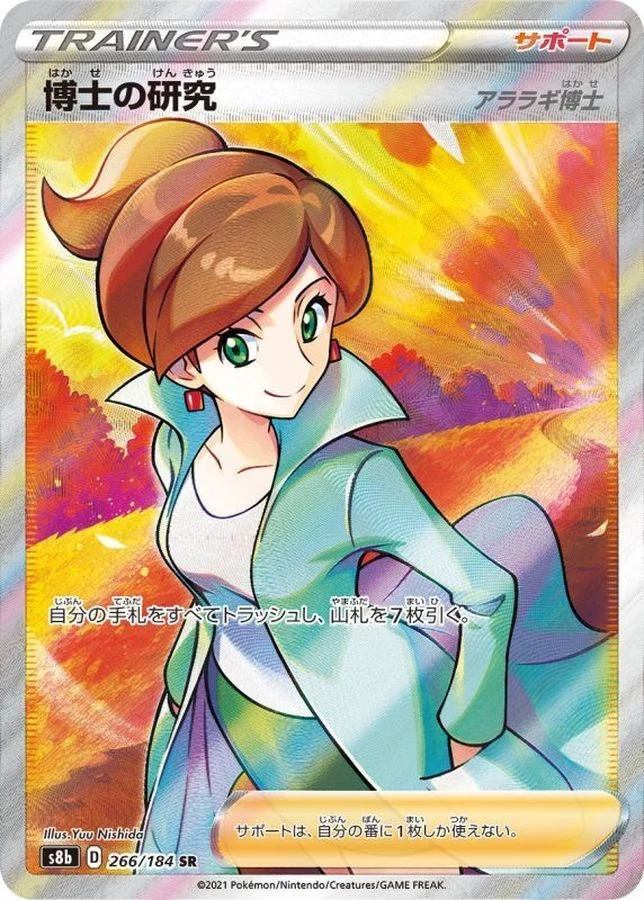
Supporter cards are a Trainer-card subtype limited to one play per turn, and popular Supporters began receiving full art reprints during the Black & White Series — the origin of the category this guide covers. Traditional Japanese full art Supporters use the SR designation, while the later SAR tier can also include Supporters. A PSA10 Sabrina’s Suggestion 109/095 SR is currently listed at ¥22,198 (~$140), and a PSA10 Professor’s Research SR from VMAX Climax is currently listed at ¥8,800 (~$55).

8
Full Art Supporters Below

1
Supporter Played Per Turn

SR
Japan’s Full Art Trainer Code

¥159
Per USD (Sep 2026)

Yen figures below convert at ¥159/USD (September 2026). Prices are the current listing shown on each linked product page — check the listing itself before ordering.

What Is a Full Art Trainer Card?

Per Bulbapedia’s Supporter card entry, a Supporter is a Trainer-card subtype that « depict[s] and feature[s] people; generally, these are characters from the Pokemon games and Pokemon animation. » The subtype debuted internationally in the Expedition Base Set during the e-Card Series; in Japan, Supporters first appeared within the « P Promotional cards » during the web era. Supporters started out as a plain Trainer subclass and were « elevated to equal level as Trainer cards with the start of the Diamond & Pearl Series. » One rule has stayed constant since: only one Supporter card may be played per turn, which is part of why a strong Supporter becomes a strategically important card long before it becomes a collectible one.

A « full art » card, separately, is one where the « artwork [is] printed on the full space of the card » rather than being framed inside a border with text boxes around it. Full Art was introduced with the Black & White expansion, originating from the Japanese « Black Collection » and « White Collection » releases. When a Supporter gets the full art treatment, the character artwork — not just the Pokemon beside them — runs edge to edge across the card.

Put the two together and a « full art Trainer card » is exactly what it sounds like: a Supporter card (or, less commonly, another Trainer subtype) reprinted in that edge-to-edge full art format. That is the category this guide covers.

From Supporter Card to Full Art Chase Card

Full art Supporters are not an original print format — they are reprints. Per Bulbapedia, « popular Supporter cards began to receive reprints as Full Art cards during the Black & White Series. » That single sentence is the origin of the entire full art Trainer/Supporter chase-card category that later expansions built on: a Supporter first appears as a standard-frame card doing its job in a deck, then a later or parallel print of the same card is issued in full art, and it is that full art reprint — not the original — that collectors chase.

Because the practice started with Supporters specifically, most full art Trainer cards you will see are Supporters rather than Items, Tools, or Stadiums. All eight anchors covered later in this guide are full art Supporter reprints for exactly that reason.
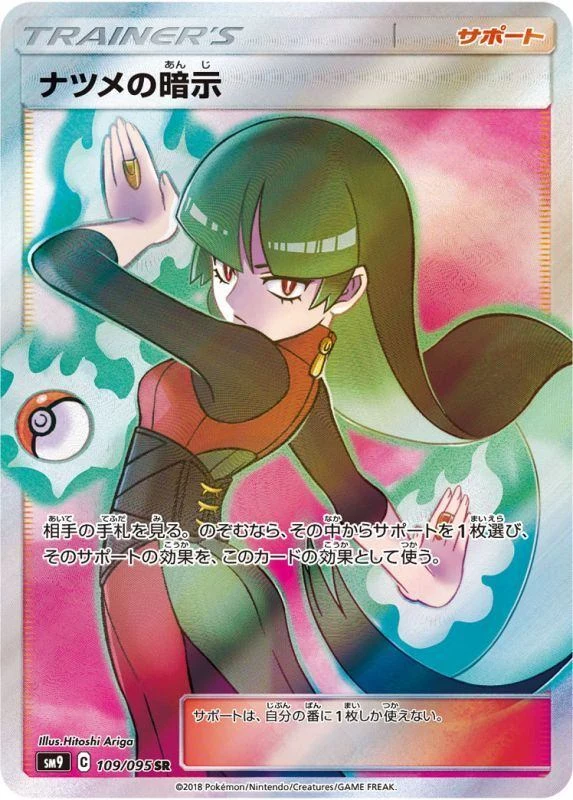
Sabrina's Suggestion 109/095 SR full art Supporter card, Japanese print, PSA 10 slab
Sabrina’s Suggestion 109/095, SR — a full art Supporter reprint of the Sabrina character card

Why Full Art Trainers Use SR, Not AR or SAR

This is the point that catches out most buyers new to Japanese product: SR and SAR are not the same rarity, and they do not mark the same category of card.

Per Bulbapedia’s Full Art card entry, in Japan, full art Trainer cards specifically carry the SR designation — a code that sits apart from the AR/SAR system used for full art Pokemon cards. In other words, Japan runs two parallel labelling tracks for full art prints: one for Pokemon, one for Trainers. A full art Supporter and a full art Pokemon ex from the same expansion can look similarly elaborate on the shelf, but they are marked with different letters because they belong to different tracks.

Full art cards generally were introduced with the Black & White expansion, again tracing back to the Japanese « Black Collection »/ »White Collection » releases — so the full art format itself is shared between Pokemon and Trainers, even though the rarity code that marks it is not. One of the eight anchors below, a Grant SAR from VSTAR Universe, is included specifically as a contrast case: it is a modern AR/SAR-tier full art card rather than an SR-tier Trainer card, so seeing it next to the SR Supporters makes the letter difference easier to spot on real product rather than in the abstract.

For the wider rarity-letter system this SR/AR/SAR distinction sits inside, see our Japanese Pokemon card rarities explained guide.

How Japan Numbers Full Art Trainer Cards

Full art cards also get numbered differently depending on the region. In Japan’s numbering system, full art cards are classified as secret cards, numbered beyond the printed set size — so a set printed as, say, 76 cards will carry its full art chase cards at numbers like 77, 78 and upward, past the set’s own stated total. English-language releases instead place full art cards at the end of the set list without necessarily numbering past the printed total in the same way.

That numbering convention is why you will sometimes see a Japanese full art Supporter’s card number look « too high » for the set it comes from — the number itself is telling you the card is a secret, beyond-set-size print before you have even checked the rarity code.

Eight Full Art SR/SAR Supporters in Our Catalogue

These eight full art Trainer cards are currently in our catalogue as PSA 10 graded singles, spanning several Japanese expansions. Seven are SR-designation full art Supporters; the eighth (Grant) is the SAR contrast case described above.

Set codes marked « — » are not confirmed in our source data for that specific listing; the card and rarity are still verified. Ranked by listed price, Sabrina’s Suggestion sits above the rest of the group. The other seven listings range from ¥7,920 to ¥12,078, a spread of ¥4,158.
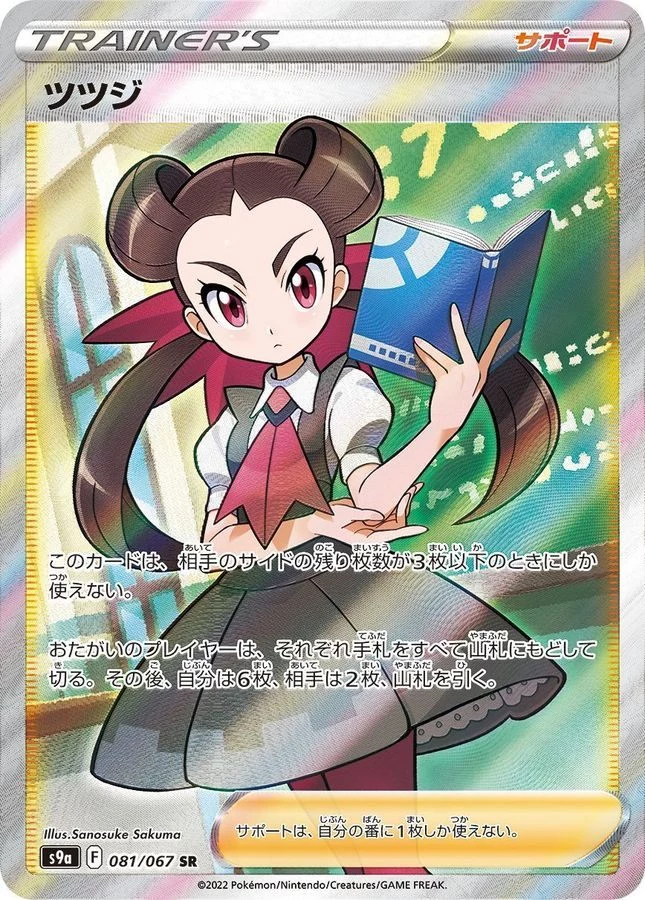
Roxanne 081/067 SR, Battle Region S9a, Japanese full art Supporter, PSA 10 slab

Roxanne 081/067, SR (S9a Battle Region)

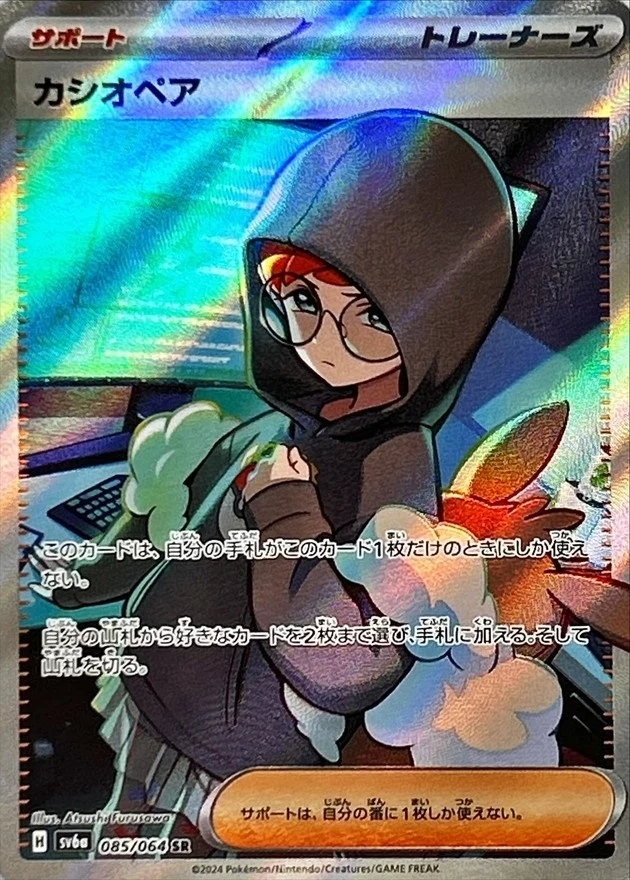
Cassiopeia 085/064 SR, Night Wanderer SV6a, Japanese full art Supporter, PSA 10 slab

Cassiopeia 085/064, SR (SV6a Night Wanderer)

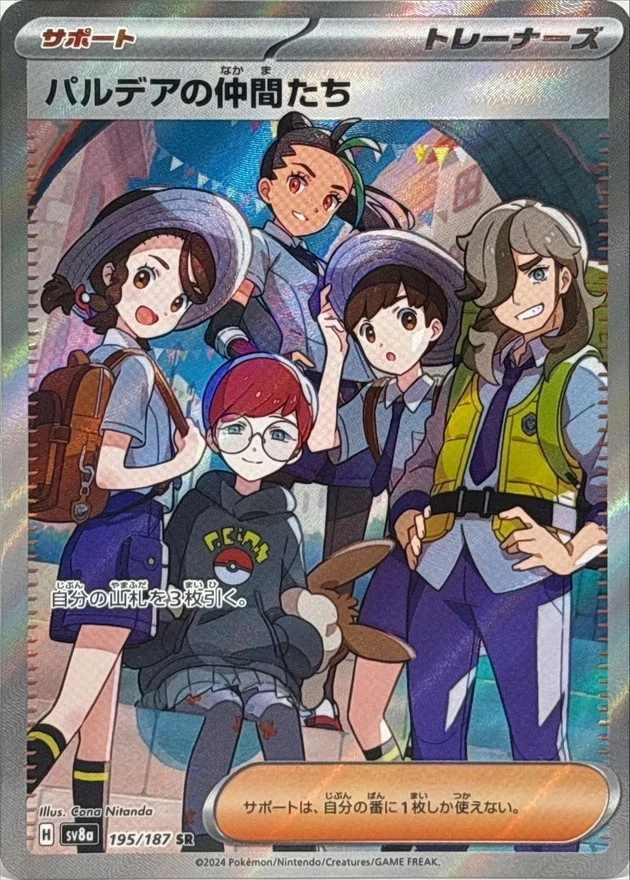
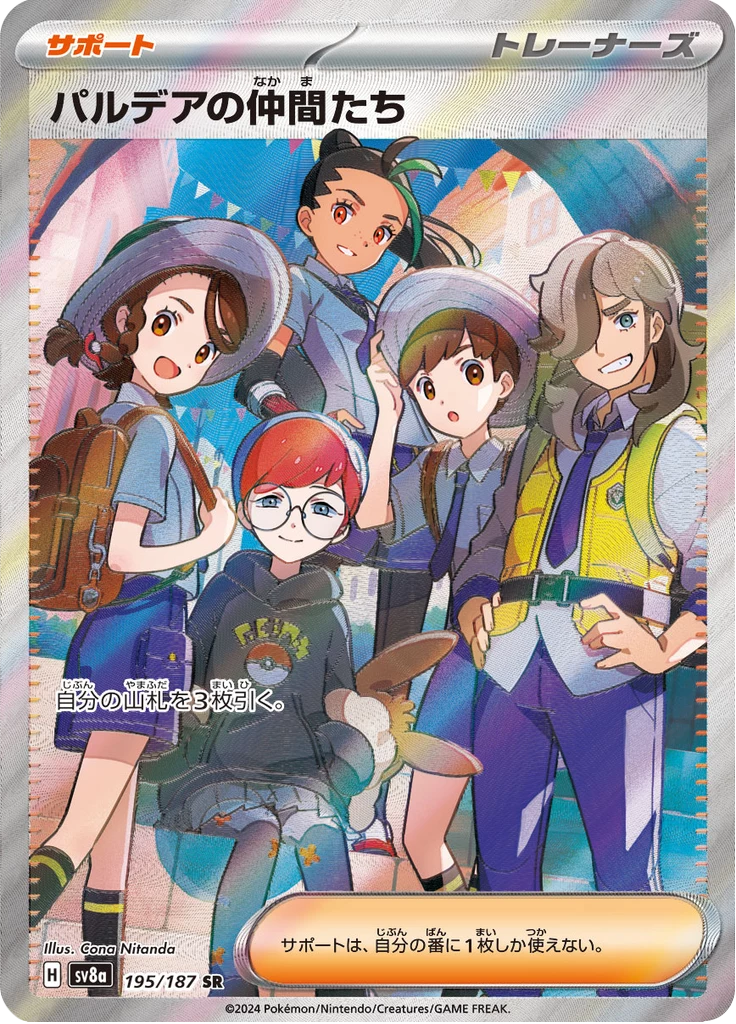
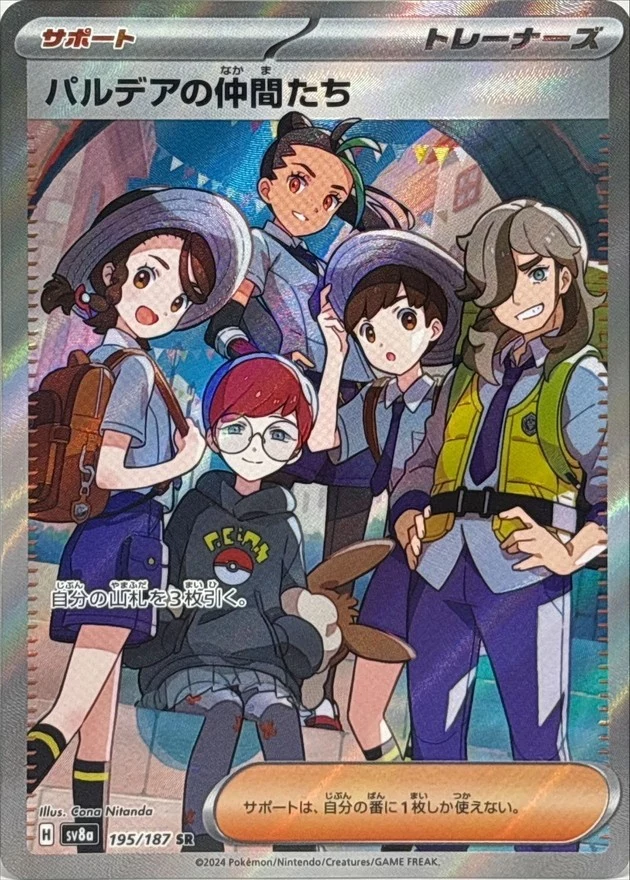
Friends of Paldea 195/187 SR, Terastal Festival ex SV8a, Japanese full art Supporter, PSA 10 slab

Friends of Paldea 195/187, SR (SV8a Terastal Festival ex)

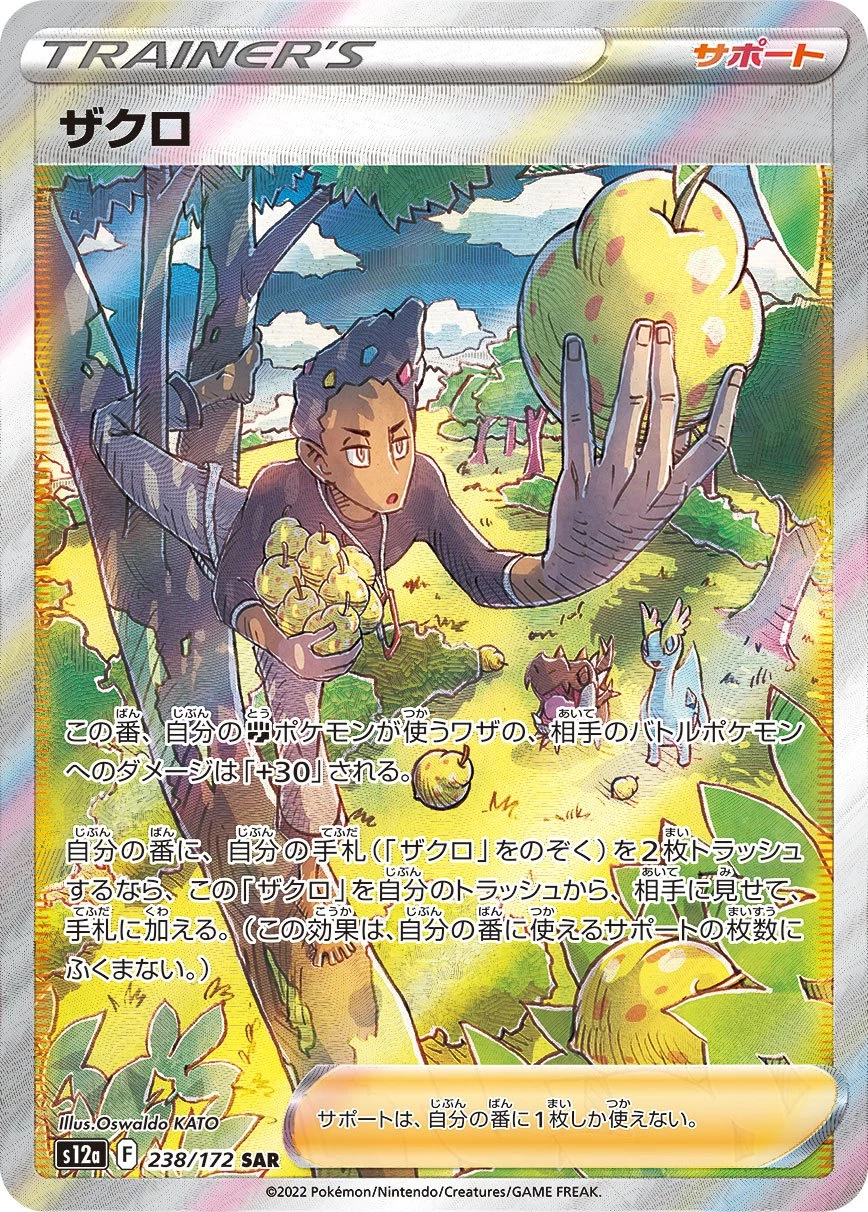
Grant 238/172 SAR, VSTAR Universe s12a, Japanese full art Supporter, PSA 10 slab

Grant 238/172, SAR — contrast card (s12a VSTAR Universe)

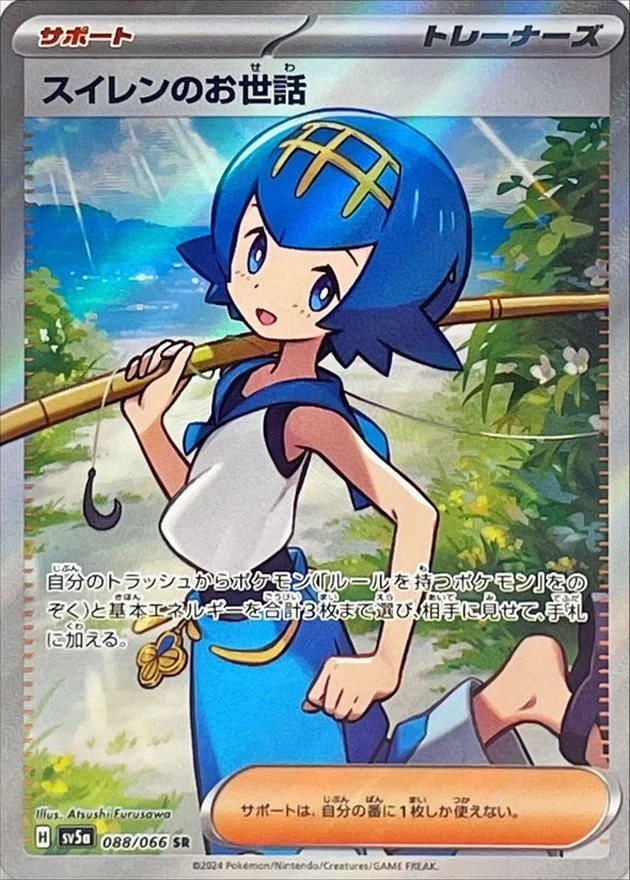
Lana's Aid 088/066 SR, Crimson Haze SV5a, Japanese full art Supporter, PSA 10 slab
Lana’s Aid 088/066, SR — Crimson Haze (SV5a)
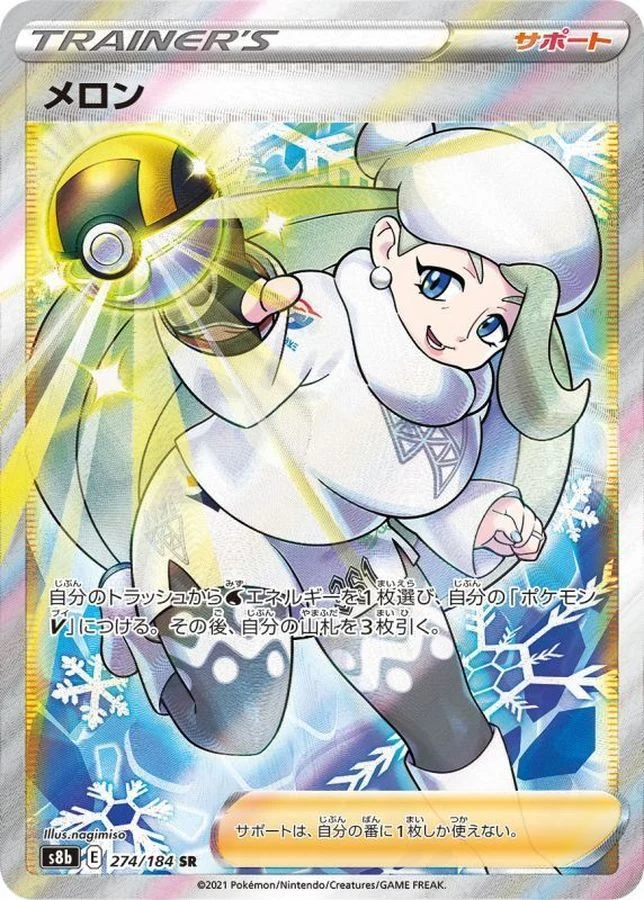
Melony 274/184 SR, Japanese full art Supporter, PSA 10 slab
Melony 274/184, SR

Where to Buy Full Art Trainer Cards from Tokyo

All eight full art SR/SAR Supporters covered above are graded PSA 10 singles in our PSA 10 collection, shipped from Tokyo. If you already know which card you want — Sabrina’s Suggestion 109/095 SR at ¥22,198 (~$140), Lana’s Aid SR at ¥12,078 (~$76), Grant SAR at ¥9,350 (~$59), Roxanne SR at ¥8,796 (~$55), Professor’s Research SR at ¥8,800 (~$55), Cassiopeia SR at ¥8,008 (~$50), Friends of Paldea SR at ¥7,986 (~$50), or Melony SR at ¥7,920 (~$50) — the product link goes straight to that listing. For a full art Trainer card not covered here, or a mixed order alongside sealed product, use Commande rapide to build the order in one pass.

If you are still narrowing down which character or era you want, our broader PSA10 Trainer cards guide rounds up other named Trainers across our catalogue — that guide covers the wider roster of Lillie, Acerola, Ion and other characters, while this one focuses specifically on the full art SR/SAR mechanic and definition. We also have character-specific write-ups for female Trainer cards, N, Green, and Gardenia.

Shop This Card
PSA10 Sabrina’s Suggestion 109/095 SR
Full art Supporter, SR designation
Ships from Tokyo · Tracked delivery

View Product →

Foire aux questions

What is a full art Trainer card?

It’s a Supporter card (or other Trainer subtype) reprinted with its artwork stretched across the entire face of the card rather than framed inside a border. The format was introduced with the Black & White expansion, tracing back to Japan’s « Black Collection » and « White Collection » releases. Popular Supporters began receiving these full art reprints during the Black & White Series, which is the origin of the whole category.

Is SR the same rarity as SAR?

No. Traditional Japanese full art Supporters carry the SR designation, while SAR is a separate later rarity that can also appear on Supporters. They are not interchangeable rarity codes — the Grant SAR in this guide shows that contrast next to the seven SR Supporters.

How many Supporter cards can you play in one turn?

Only one. That’s a core Pokemon TCG rule for the Supporter subtype, and it applies whether the card is a standard-frame print or a full art chase reprint.

Why is a Japanese full art Trainer card’s number higher than the set’s total card count?

In Japan’s numbering system, full art cards are classified as secret cards numbered beyond the printed set size, so their card number sits past the set’s stated total. English-language releases instead place full art cards at the end of the set list.

Were Supporter cards always considered Trainer cards?

Not originally. Supporters started as a Trainer subclass and were elevated to equal status alongside Trainer cards starting with the Diamond & Pearl Series.

Where can I buy full art SR Supporter cards from Japan?

The eight full art SR/SAR Supporters covered in this guide are graded PSA 10 singles in our PSA 10 collection, shipped from Tokyo. For a card not listed here, Quick Order lets you request it alongside the rest of your order.
Guide des cartes Karasu One Piece : chaque carte, parallèle et extension (2026)

Karasu is a Revolutionary Army officer who has quietly picked up four separate card numbers across the One Piece Card Game — one per mainline booster, plus a starter deck printing — without ever settling on a single colour. Red in his first appearance, Yellow in his second, Black in the two after that: if you are trying to work out which Karasu print you are holding, the colour on the card is not the reliable clue.

This guide lines up every verified Karasu printing — OP05-005, OP09-100, OP12-085 and ST35-003 — with its rarity, colour, cost and power, plus the Premium Card Collection parallel reprint of the original card. It also covers which of the three sealed boxes that contain a Karasu card are currently listed on our site, all as Damaged Box product.

Key Takeaway

Karasu has four verified card numbers — OP05-005 (R, Red), OP09-100 (UC, Yellow), OP12-085 (C, Black) and ST35-003 (C, Black) — plus a parallel reprint of OP05-005 in Premium Card Collection -BEST SELECTION VOL.2-. The sets that carry OP09-100 and OP12-085 are both currently listed as Damaged Box: OP-09 The New Emperor and OP-12 Legacy of the Master.

4
Card Numbers

4
Sets Featured

3
Rarities (R/UC/C)

3
Boxes Listed

Card numbers, rarities, colours, costs and power values below are taken from the official One Piece Card Game card list search (freewords=Karasu). Prices are our own listing prices, converted at ¥159/USD (September 2026).

Every Karasu Printing at a Glance

Karasu is a Revolutionary Army officer and commander of its North Army. Sabo serves as the Revolutionary Army’s chief of staff — see our Sabo One Piece cards guide for his cards. Four card numbers carry Karasu’s name in the verified card list:

Code Rarity Colour Cost Power Série
OP05-005 R Red 4 5000 -Awakening of the New Era- [OP-05]
OP09-100 UC Yellow 3 4000 -Emperors in the New World- [OP-09]
OP12-085 C Black 5 6000 -Legacy of the Master- [OP-12]
ST35-003 C Black 3 4000 STARTER DECK -Red/Black Sabo- [ST-35]

Note the colour column: it moves from Red to Yellow to Black across these four printings. That is a normal pattern for a Revolutionary Army character reprinted across several mainline sets — each set assigns its own colour to the card, so don’t assume a Karasu print you find somewhere is misprinted just because the colour doesn’t match one you’ve already seen.

-Awakening of the New Era- [OP-05]: OP05-005

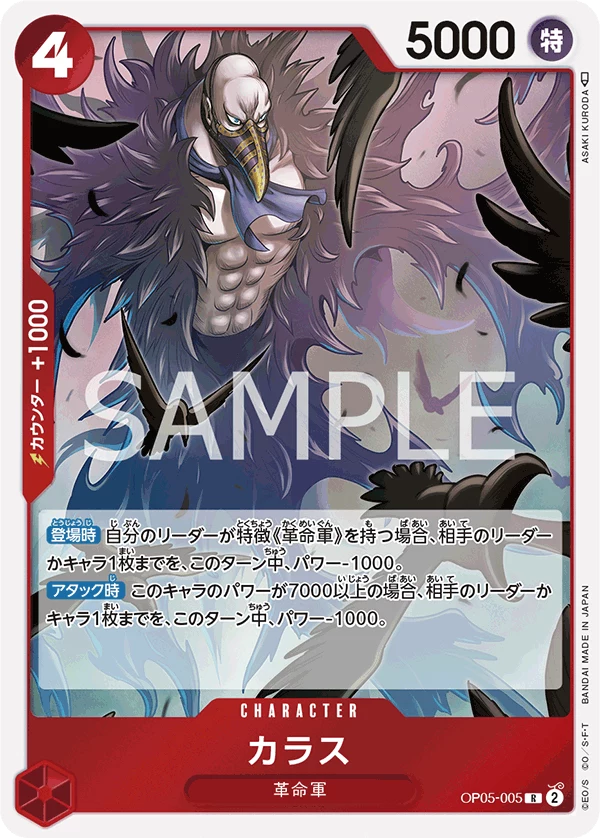
Karasu OP05-005, R, Red, Revolutionary Army, -Awakening of the New Era- [OP-05]
Karasu OP05-005, R, Red — -Awakening of the New Era- [OP-05]

OP05-005 — R, Red, Cost 4, Power 5000

Karasu’s first card number is OP05-005, a Red R Character card with a cost of 4 and 5000 power, printed in -Awakening of the New Era- [OP-05]. It is also the number that later reappears as a parallel print through Premium Card Collection -BEST SELECTION VOL.2-, covered below.

OP-05 is one of the earlier mainline sets, and its Damaged Box listing sits above the other two boxes in this guide, which is consistent with OP-05 generally trading at a different level to newer sets rather than anything unusual about this particular box. It is currently listed for ¥61,750 (~$388). For a broader look at what else pulls from this set, see our OP-05 best cards guide.

-Emperors in the New World- [OP-09]: OP09-100

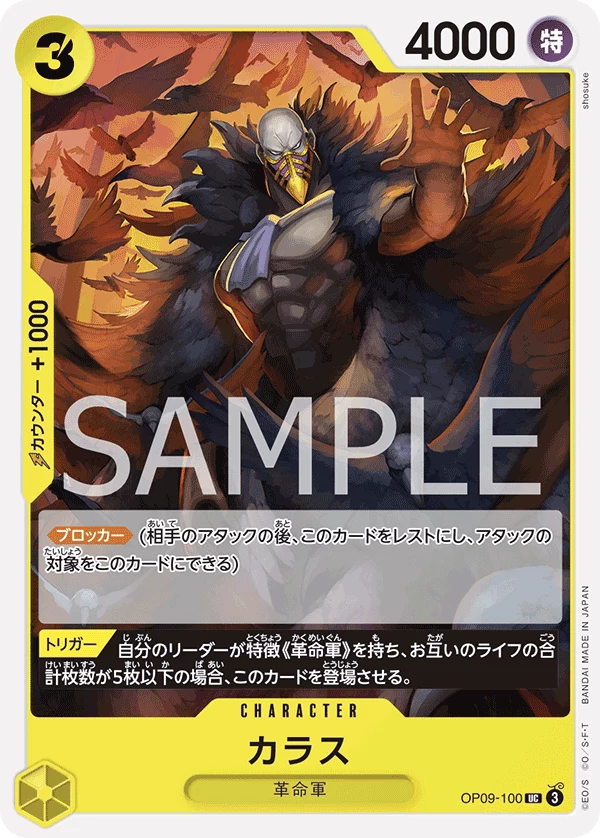
Karasu OP09-100, UC, Yellow, Revolutionary Army, -Emperors in the New World- [OP-09]
Karasu OP09-100, UC, Yellow — -Emperors in the New World- [OP-09]

OP09-100 — UC, Yellow, Cost 3, Power 4000

In -Emperors in the New World- [OP-09], Karasu reappears as OP09-100, an Uncommon Character card, this time in Yellow with a cost of 3 and 4000 power. It’s the lowest-cost of the four confirmed Karasu numbers.

The official set name is -Emperors in the New World- [OP-09]; the corresponding Damaged Box appears under our product-listing title OP-09 The New Emperor and is currently listed at ¥20,900 (~$131). Our OP-09 pull rates and best cards guide covers the rest of the set’s lineup.

-Legacy of the Master- [OP-12]: OP12-085

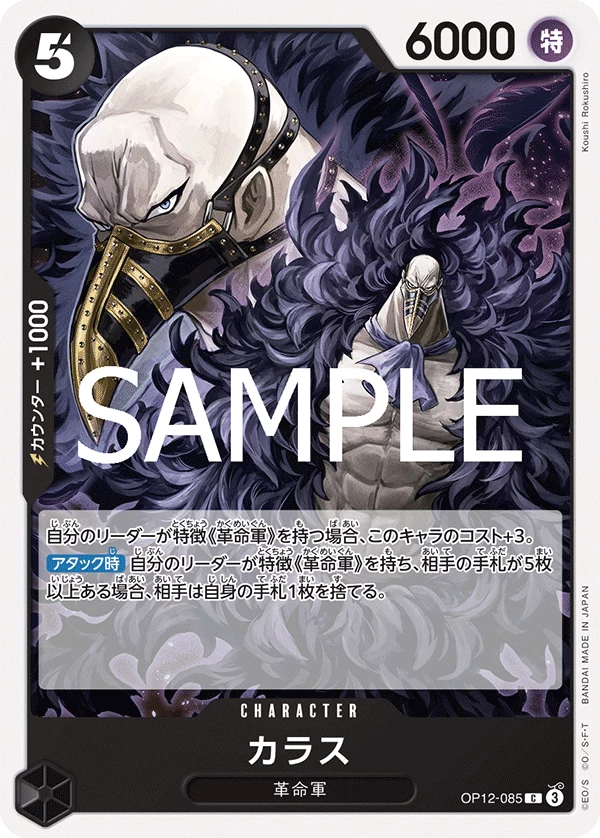
Karasu OP12-085, C, Black, Revolutionary Army, -Legacy of the Master- [OP-12]
Karasu OP12-085, C, Black — -Legacy of the Master- [OP-12]

OP12-085 — C, Black, Cost 5, Power 6000

-Legacy of the Master- [OP-12] gives Karasu his third printing, OP12-085, a Common Character card in Black — the highest cost (5) and highest power (6000) of the four numbers covered in this guide.

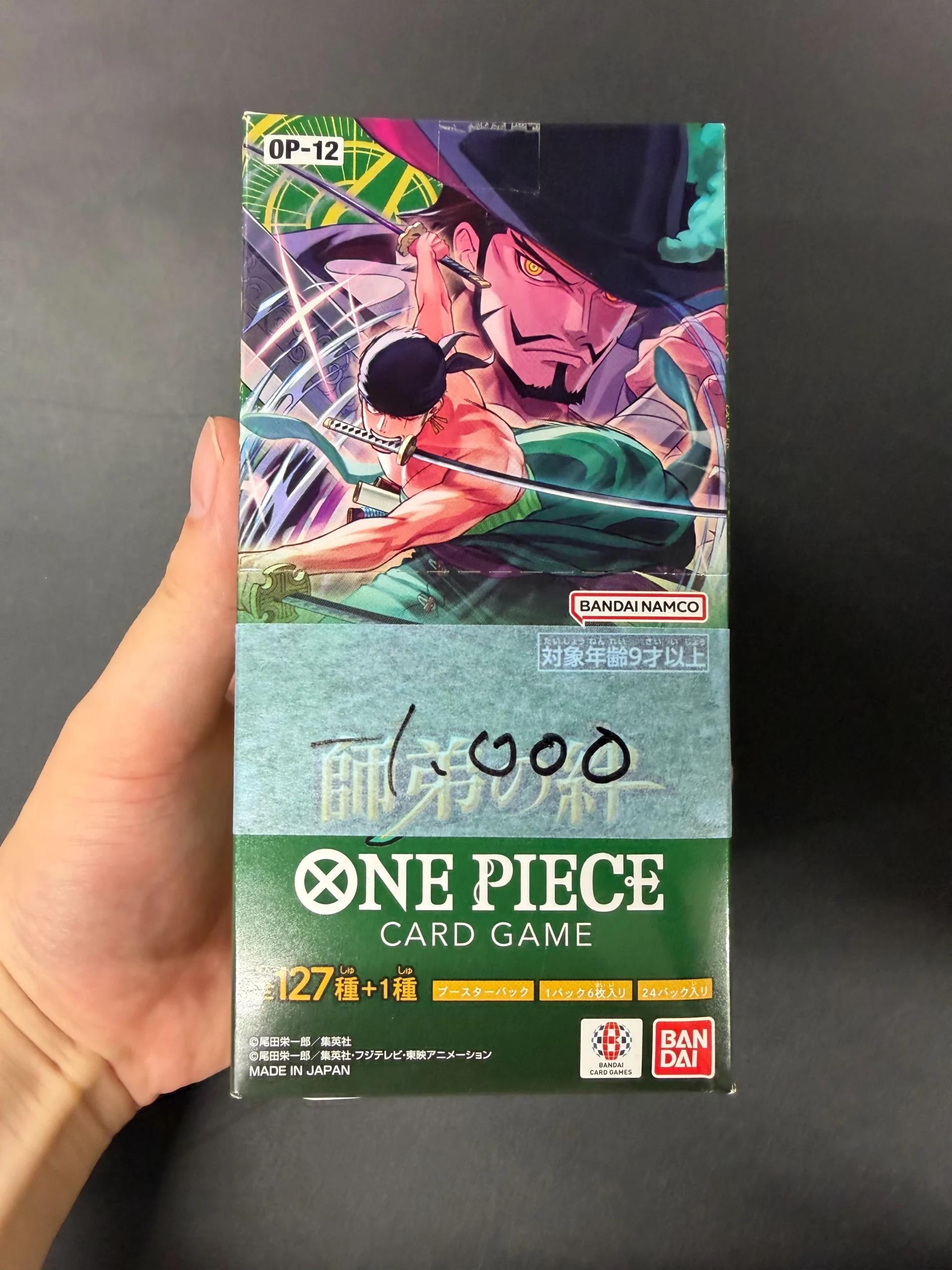
OP-12 Legacy of the Master Japanese One Piece booster box, Damaged Box listing
OP-12 Legacy of the Master Japanese booster box — Damaged Box, contains OP12-085

The OP-12 Damaged Box is currently listed at ¥18,050 (~$114), the most affordable of the three boxes in this guide. See our OP-12 pull rates and best cards guide for the full set breakdown.

Starter Deck -Red/Black Sabo- [ST-35]: ST35-003

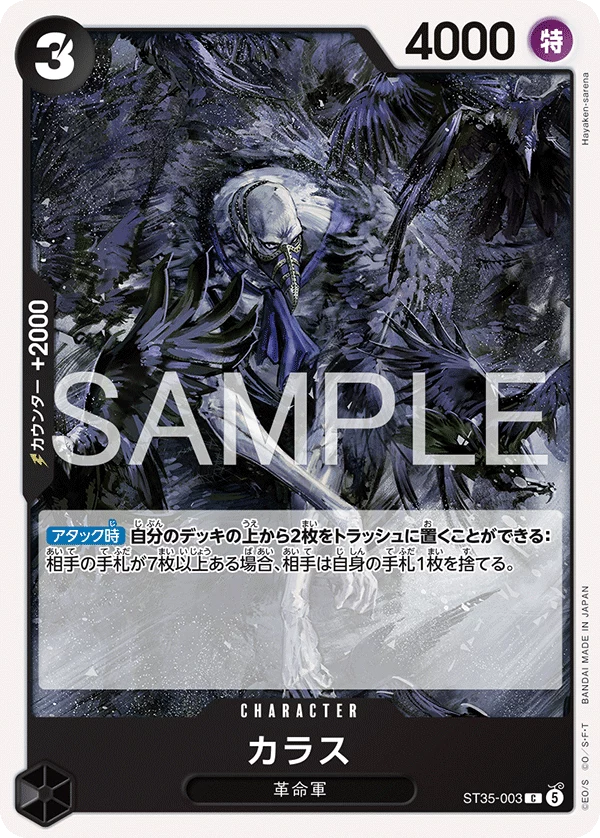
Karasu ST35-003, C, Black, Revolutionary Army, STARTER DECK -Red/Black Sabo- [ST-35]
Karasu ST35-003, C, Black — STARTER DECK -Red/Black Sabo- [ST-35]

ST35-003 — C, Black, Cost 3, Power 4000

Karasu’s fourth printing, ST35-003, is a Common Character card in Black with a cost of 3 and 4000 power, fielded in STARTER DECK -Red/Black Sabo- [ST-35] — fittingly, a starter deck built around his own commanding officer. See our Sabo One Piece cards guide for the rest of that deck’s Revolutionary Army cast.

This print is not listed on our site at the moment; sourcing requests go through Commande rapide.

The Parallel Print: Premium Card Collection -BEST SELECTION VOL.2-

Beyond the four mainline card numbers above, OP05-005 has been reprinted as a parallel through PREMIUM CARD COLLECTION -BEST SELECTION VOL.2-. It carries the same card number, rarity, colour, cost and power as the original OP-05 printing — the parallel treatment applies to the artwork and foiling rather than changing the underlying card data.

No parallel or alternate-art treatment is verified for OP09-100, OP12-085 or ST35-003 at the time of writing; if one exists, it isn’t in the official card list search results we checked for this guide.

Which Boxes to Open for Karasu

Three sealed boxes contain a Karasu card. Each one appears on our site as Damaged Box product — see our One Piece Damaged Box lineup guide for what that grading means across our catalogue. ST-35’s starter deck is not part of this list, since that print is not listed.

Boîte Contains Prix
OP-05 Awakening of the New Era — Damaged Box OP05-005 ¥61,750 (~$388)
OP-09 The New Emperor — Damaged Box OP09-100 ¥20,900 (~$131)
OP-12 Legacy of the Master — Damaged Box OP12-085 ¥18,050 (~$114)
Shop This Box
OP-09 The New Emperor Japanese One Piece Booster Box — Damaged Box
Contains OP09-100, one of Karasu’s four confirmed printings
Ships from Tokyo · Tracked delivery

View Product →

Where to Buy Karasu One Piece Cards from Tokyo

We ship Japanese sealed product from Tokyo with tracked delivery. If you want a Karasu card, the most direct route is one of the three Damaged Box listings above — OP-05 Awakening of the New Era, OP-09 The New Emperor, or OP-12 Legacy of the Master — each of which pulls the corresponding Karasu number directly from the pack. Browse the wider range in our One Piece Card Game box collection.

For the ST35-003 starter print or the Premium Card Collection parallel, neither of which is currently listed, sourcing requests go through Commande rapide.

Karasu serves under Sabo in the Revolutionary Army — see our Sabo One Piece cards guide for the crew’s leader, plus our guides to fellow Revolutionary Army members Monkey D. Dragon, Koala, Emporio Ivankov, Belo Betty, and Lim.

Foire aux questions

How many Karasu cards are there in the One Piece Card Game?

Four verified card numbers: OP05-005 (R, Red, -Awakening of the New Era-), OP09-100 (UC, Yellow, -Emperors in the New World-), OP12-085 (C, Black, -Legacy of the Master-) and ST35-003 (C, Black, STARTER DECK -Red/Black Sabo-). OP05-005 has also been reprinted as a parallel through Premium Card Collection -BEST SELECTION VOL.2-.

Why is Karasu’s card a different colour in each set?

Karasu’s colour changes with each new printing — Red in OP05-005, Yellow in OP09-100, and Black in both OP12-085 and ST35-003. This is a normal pattern for characters reprinted across several mainline One Piece Card Game sets; the colour is not fixed to the character.

Which sealed boxes contain a Karasu card?

Three: -Awakening of the New Era- [OP-05] (OP05-005), -Emperors in the New World- [OP-09] (OP09-100), and -Legacy of the Master- [OP-12] (OP12-085). Each of these appears on our site as Damaged Box product. The STARTER DECK -Red/Black Sabo- [ST-35] print, ST35-003, is not listed at the moment.

Is there a parallel version of Karasu’s card?

Yes — OP05-005 has been reprinted as a parallel through Premium Card Collection -BEST SELECTION VOL.2-, carrying the same rarity, colour, cost and power as the original -Awakening of the New Era- printing. No parallel is currently verified for OP09-100, OP12-085 or ST35-003.

What faction does Karasu belong to?

Karasu is a member of the Revolutionary Army across all four of his confirmed printings, serving under Sabo. See our Sabo One Piece cards guide for the Revolutionary Army’s leader.

Where can I buy Karasu One Piece cards from Japan?

The OP-05, OP-09 and OP-12 Damaged Box listings on our site each contain a Karasu card and ship from Tokyo with tracked delivery. For the ST35-003 starter print or the Best Selection Vol.2 parallel, sourcing requests go through Quick Order.

Valeur des cartes One Piece : ce qui détermine le prix des cartes japonaises

Two cards from the same set, same character, can sit in completely different price brackets. Character popularity, competitive playability, and physical condition all play into that, but this guide focuses on four structural factors that sit underneath those market forces and are verifiable from the card and set itself: which official rarity tier a card was printed at, which channel it was distributed through, whether it carries a parallel treatment on top of its base rarity, and how large the card pool it was pulled from actually is.

This guide walks through each of those four structural mechanisms using the One Piece Card Game’s own rarity system and our own catalogue as worked examples. It does not quote market prices or predict where any card is headed — that’s not something a rarity code can tell you, and rarity is only one input among several that ultimately set a card’s price. What it can tell you is why two SR cards from the same set are not interchangeable, and why a tournament-distributed card behaves differently from a retail pull before you even look at a price tag.

Key Takeaways

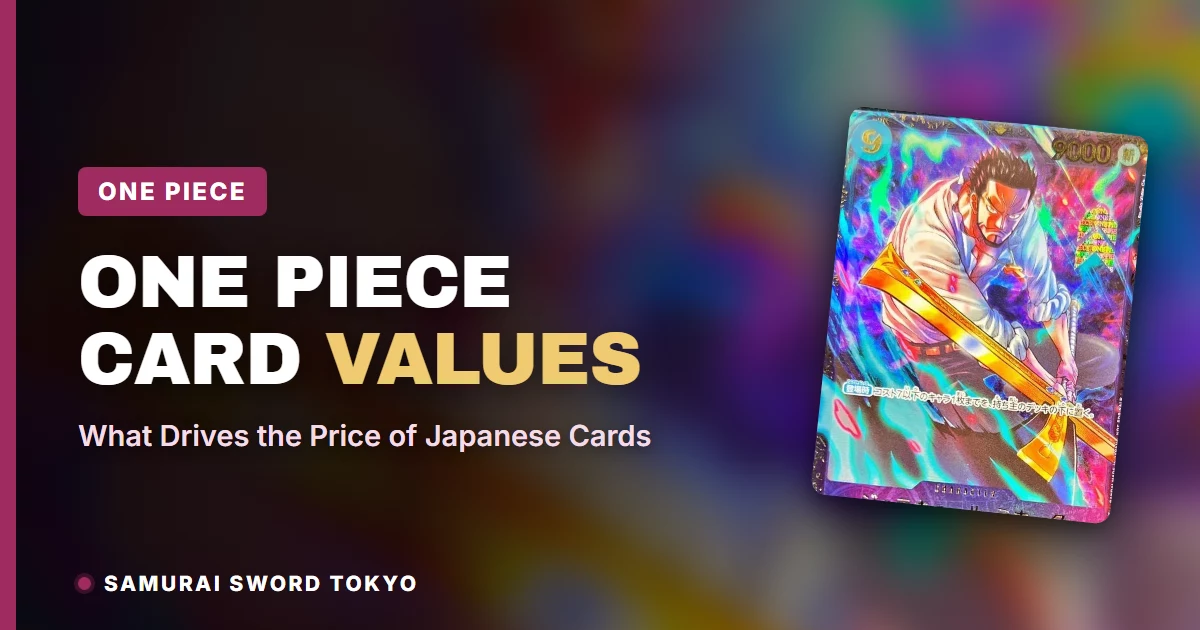
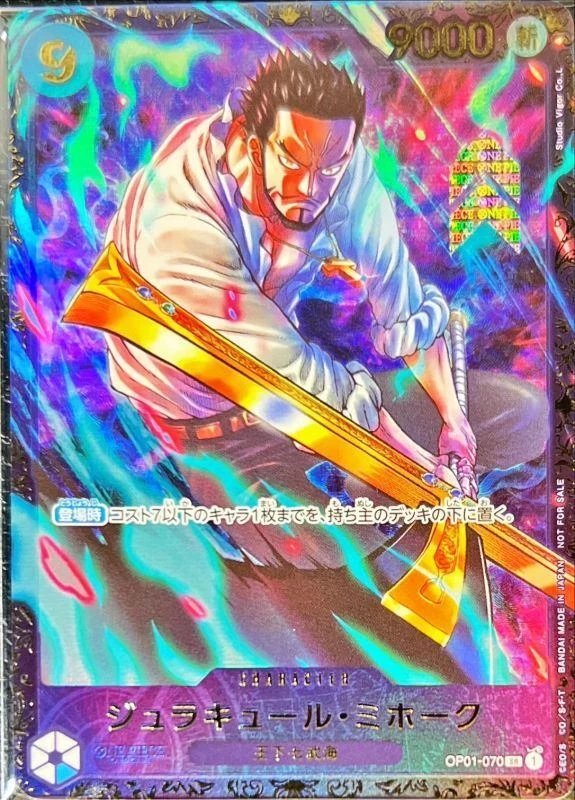
The One Piece Card Game’s official rarity ladder runs L, C, UC, R, SR, SEC, with parallel and « Comic Parallel » art treatments layered on top of those base tiers. Distribution channel matters as much as rarity letter — a Flagship Battle souvenir card such as the PSA10 Dracule Mihawk SR [OP01-070] is capped by tournament attendance, not booster print runs. Set size also shapes the maths: our OP-16 « The Time of Battle » booster box draws from 127 official card types across 6 cartes par pack.

6
Official Rarity Tiers

127
Types de cartes in OP-16

6
Cards Per Booster Pack

4
Extra Boosters Released (EB-01–EB-04)

This article covers structural drivers only — rarity tier, distribution channel, parallel treatment and set size. It does not cite market prices for any of these mechanisms; the only prices below are our own current listing prices, shown as purchase links, converted at ¥159/USD (September 2026).

The Official One Piece Card Rarity Ladder

The One Piece Card Game uses the rarity codes below. Leader (L) identifies a card’s deck role, so it should not be placed into a most-to-least-common sequence with the pull-rarity codes.

Code Tier What it marks
L Leader The Leader card that anchors a deck — a distinct card role, not a pull-rarity step.
C Common The base tier that fills out a deck’s core.
UC Uncommon One step above Common.
R Rare A step above Uncommon.
SR Super Rare A chase-tier card, often the character-focused pulls a set is built around.
SEC Secret Rare The top of the base ladder.

On top of these base letters, the game layers parallel and alt-art treatments — alternate foil or artwork versions of a card that already carries one of the codes above — plus a distinct « Comic Parallel » manga-panel treatment covered in its own section below. Our dedicated One Piece card rarity explainer walks through the full L/C/UC/R/SR/SEC ladder and the parallel tiers built on top of it in more depth than we cover here.

The practical point for anyone trying to understand value: the letter code tells you where a card sits on this ladder, and that’s a fixed, verifiable fact about the print. It’s the starting point for everything else in this article, not the end of the story.

Retail Pulls vs Tournament-Only Distribution

Rarity code describes where a card sits on the print ladder. It says nothing about how that card reached the market — and distribution channel is a separate structural factor entirely.

Most SR and SEC cards come from booster packs, meaning their supply scales with however many packs and boxes a set prints. Some cards, however, are never sold in a booster pack at all. The One Piece Card Game runs official Flagship Battle tournaments, and certain SR cards are distributed exclusively as souvenirs tied to tournament results — not as retail pulls.

Dracule Mihawk SR OP01-070, Flagship Battle Victory Souvenir card, PSA10

Dracule Mihawk SR [OP01-070] — Flagship Battle Victory Souvenir

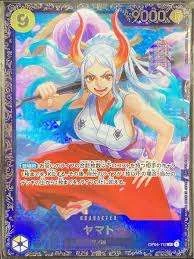
Yamato SR OP04-112, Flagship Battle Top 8 Souvenir card, PSA10

Yamato SR [OP04-112] — Flagship Battle Top 8 Souvenir

Our own graded catalogue carries two clear examples of this. The PSA10 Dracule Mihawk SR [OP01-070] is a « Flagship Battle Victory Souvenir » — a card given specifically to tournament winners. The PSA10 Yamato SR [OP04-112] is a « Flagship Battle Top 8 Souvenirs » print, awarded to players who finished in the top eight of an event.

The structural point here is supply mechanics, not price: a booster-pulled SR’s supply is bounded by how many boxes get opened. A Flagship Battle souvenir’s supply is bounded by tournament-side factors instead — how many events have been run, each event’s own distribution rules, and how many players attended and placed at each one — a completely different, and generally much smaller, ceiling than a booster print run. That distinction exists independently of whatever tier the card carries on the rarity ladder.

Comic Parallel (SP): A Second Layer on Base Rarity

A third structural factor sits on top of both rarity tier and distribution channel: whether a card also received a Comic Parallel treatment — a manga-panel-style alternate art version layered onto a specific card that already has a base rarity.

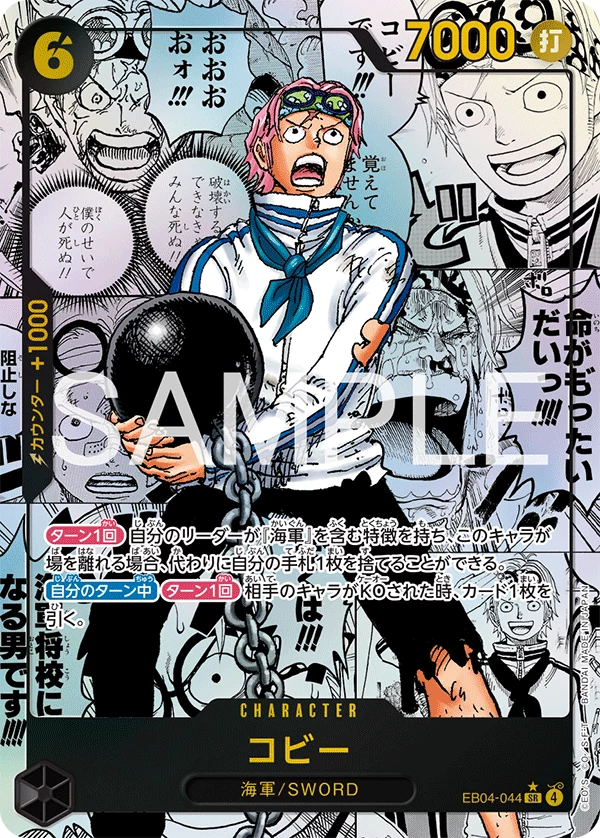
Koby SR-SP EB04-044 Comic Parallel card, Extra Booster EGGHEAD CRISIS, PSA10

Koby SR-SP [EB04-044] — Comic Parallel, Extra Booster « EGGHEAD CRISIS »

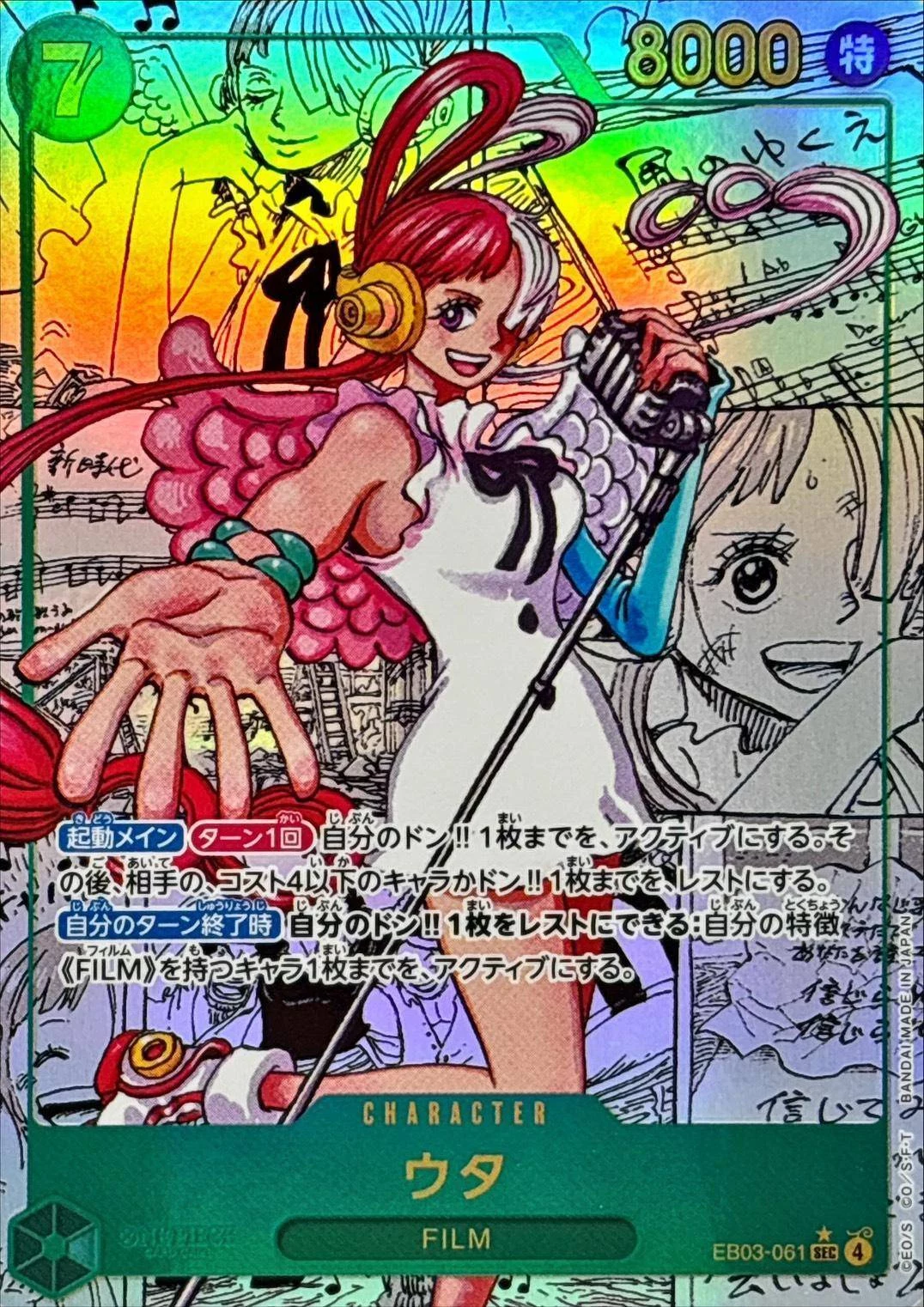
Uta SEC-SP EB03-061 Comic Parallel card, Extra Booster ONE PIECE Heroines edition, PSA10

Uta SEC-SP [EB03-061] — Comic Parallel, Extra Booster « ONE PIECE Heroines edition »

Our catalogue includes the PSA10 Koby SR-SP [EB04-044], a Comic Parallel print from the Extra Booster « EGGHEAD CRISIS, » and the PSA10 Uta SEC-SP [EB03-061], a Comic Parallel print from the Extra Booster « ONE PIECE Heroines edition. » The SR-SP and SEC-SP forms here are our catalogue labels for these products; they should not be read as suffixes printed in the official card-list rarity field.

The structural takeaway: two cards can share an identical base rarity code and still not be the same print. An SR and an SR-SP of the same character are different products — one carries an additional, distinct art treatment the other does not.

Set Size and the Maths of Pulling a Specific Card

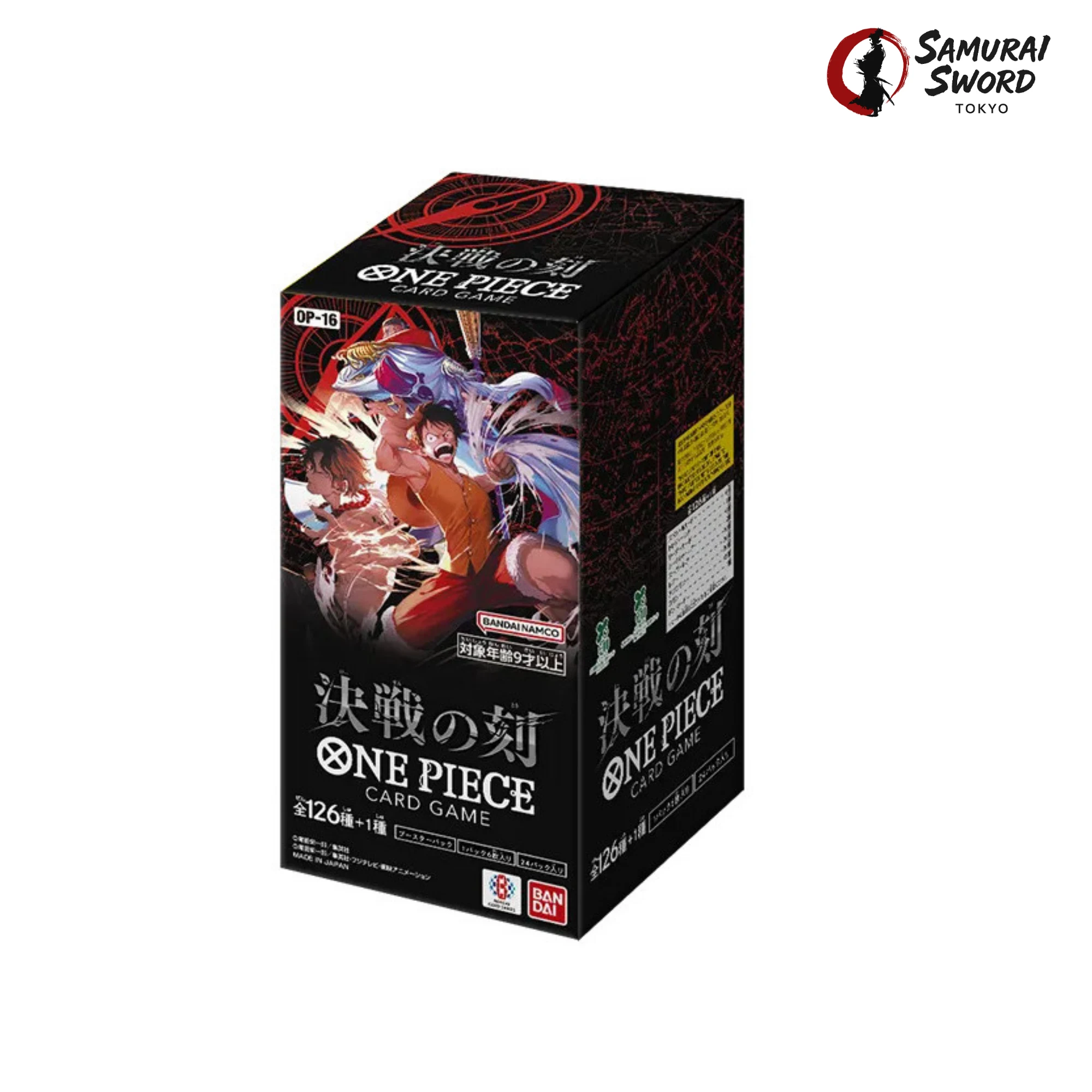
OP-16 The Time of Battle Japanese One Piece booster box
OP-16 « The Time of Battle » Japanese booster box — 127 official card types, 6 cartes par pack

A fourth structural factor to record is set size: how many total card types exist in a given set. That count gives useful context, but it does not by itself establish the odds of pulling a specific card.

Our anchor set, OP-16 « The Time of Battle, » officially contains 126+1 card types (127 in total), according to the game’s own official product page, with 6 cartes par pack. The official specification also separates rarity categories, so total card types and pack size alone are not enough to calculate the chance of pulling a particular card.

This is a structural description only. Without verified collation and rarity-slot allocation, it does not establish absolute supply or the probability of pulling a specific card.

Extra Booster vs Mainline Booster Pack

Not every One Piece booster product draws from the same size of card pool. Extra Boosters (EB-01 through EB-04 to date) are a distinct product line from mainline numbered Packs booster (OP-01, OP-02, and so on) — designed to reinforce archetypes from previously released sets and spotlight characters who aren’t central to a mainline set’s main cast, rather than introduce a fresh mainline story arc.

Structurally, that positioning tends to come with a smaller card-type pool than a mainline Booster Pack. One comparison reported in aggregated summaries of the game’s own product positioning puts EB-01 at roughly 62 card types, against OP-06’s 126 — a pool less than half the size. We haven’t independently re-verified that exact count against an official source, so treat it as a directional illustration of the Extra Booster format rather than a fixed number.

The verified distinction here is product focus and card-pool size. Neither point supplies a specific-card probability without verified rarity and collation data.

What This Means When You’re Buying

Put the four mechanisms together and you get a simple checklist for evaluating any One Piece card before you buy: what’s the rarity code, was it a retail pull or a tournament-distribution card, does it carry a Comic Parallel or other parallel treatment, and how large is the set or booster line it came from.

Applied to our own current listings:

  • Our OP-16 « The Time of Battle » Japanese booster box is currently listed at ¥12,360 (~$78) — a mainline Booster Pack drawing from the full 127-type pool covered above.
  • The PSA10 Dracule Mihawk SR [OP01-070] Flagship Battle Victory Souvenir is currently listed at ¥129,118 (~$812) — a tournament-distribution card, not a booster pull.
  • The PSA10 Yamato SR [OP04-112] Flagship Battle Top 8 Souvenir is currently listed at ¥28,336 (~$178) — the same tournament-distribution channel at a different placement tier.
  • The PSA10 Koby SR-SP [EB04-044] Comic Parallel is currently listed at ¥180,620 (~$1,136) — an Extra Booster card with the additional parallel treatment layered on.
  • The PSA10 Uta SEC-SP [EB03-061] Comic Parallel is currently listed at ¥184,800 (~$1,162) — the top base tier plus the same parallel treatment.

None of these five listings are presented here as evidence for why one is worth more than another — they’re simply worked examples of the four mechanisms above, with a purchase link if you want to look closer at any of them. For a deeper look at how the market has actually priced specific cards, see our most valuable One Piece cards ranking and our One Piece card prices guide — both cover measured pricing directly, which this article deliberately does not. If you’re specifically after scarcity-driven cards, our rarest One Piece cards guide is the companion piece to this one.

Shop This Set
OP-16 « The Time of Battle » Japanese Booster Box
Currently listed at ¥12,360 (~$78)
Ships from Tokyo · Tracked delivery

View Product →

For a mixed order across sealed boxes and graded singles, our One Piece booster box collection and PSA 10 graded card collection cover both sides of what’s discussed above, and Commande rapide lets you build a combined order in one pass.

Foire aux questions

What are the official One Piece Card Game rarity tiers?

The official codes include L (Leader), C (Common), UC (Uncommon), R (Rare), SR (Super Rare), and SEC (Secret Rare). L identifies a card role rather than a pull-rarity step. Parallel and alt-art treatments, including the distinct « Comic Parallel » manga-style version, are layered on top of a card’s base code.

What is a Comic Parallel (SP) card in One Piece?

A Comic Parallel is a manga-panel-style alternate art treatment applied to a specific card that already carries a base rarity code. Our catalogue labels the Koby and Uta examples SR-SP and SEC-SP; those are catalogue labels, not suffixes in the official card-list rarity field.

Why are Flagship Battle souvenir cards different from booster pulls?

A booster-pulled card’s supply is bounded by how many packs and boxes of that set get opened. A Flagship Battle souvenir card, such as a Victory Souvenir or Top 8 Souvenir print, is distributed through tournament results instead — bounded by how many events are run, each event’s distribution rules, and how many players attended and placed — a different, generally smaller supply mechanism that has nothing to do with booster print runs.

Does a bigger set change my odds of pulling a specific card?

Set size alone does not establish the odds of pulling a specific card. OP-16 « The Time of Battle » officially carries 127 card types across 6 cartes par pack, but a probability calculation would also require verified rarity and collation data.

What’s the difference between an Extra Booster and a mainline Booster Pack?

Mainline Packs booster (OP-01, OP-02, and so on) carry the game’s main storyline sets. Extra Boosters (EB-01 through EB-04) are a separate product line built to reinforce previously released archetypes and spotlight characters outside a mainline set’s main cast, and they typically draw from a smaller card-type pool than a mainline Booster Pack.

Where can I buy Japanese One Piece cards and boxes?

We ship Japanese sealed One Piece booster boxes and graded singles worldwide out of Tokyo with tracked delivery. Browse our One Piece booster box collection and PSA 10 graded card collection, or use Commande rapide to combine sealed product and singles in one order.
Guide d’achat du Booster Box Scarlet ex SV1S : cartes chase Gardevoir ex et Koraidon ex

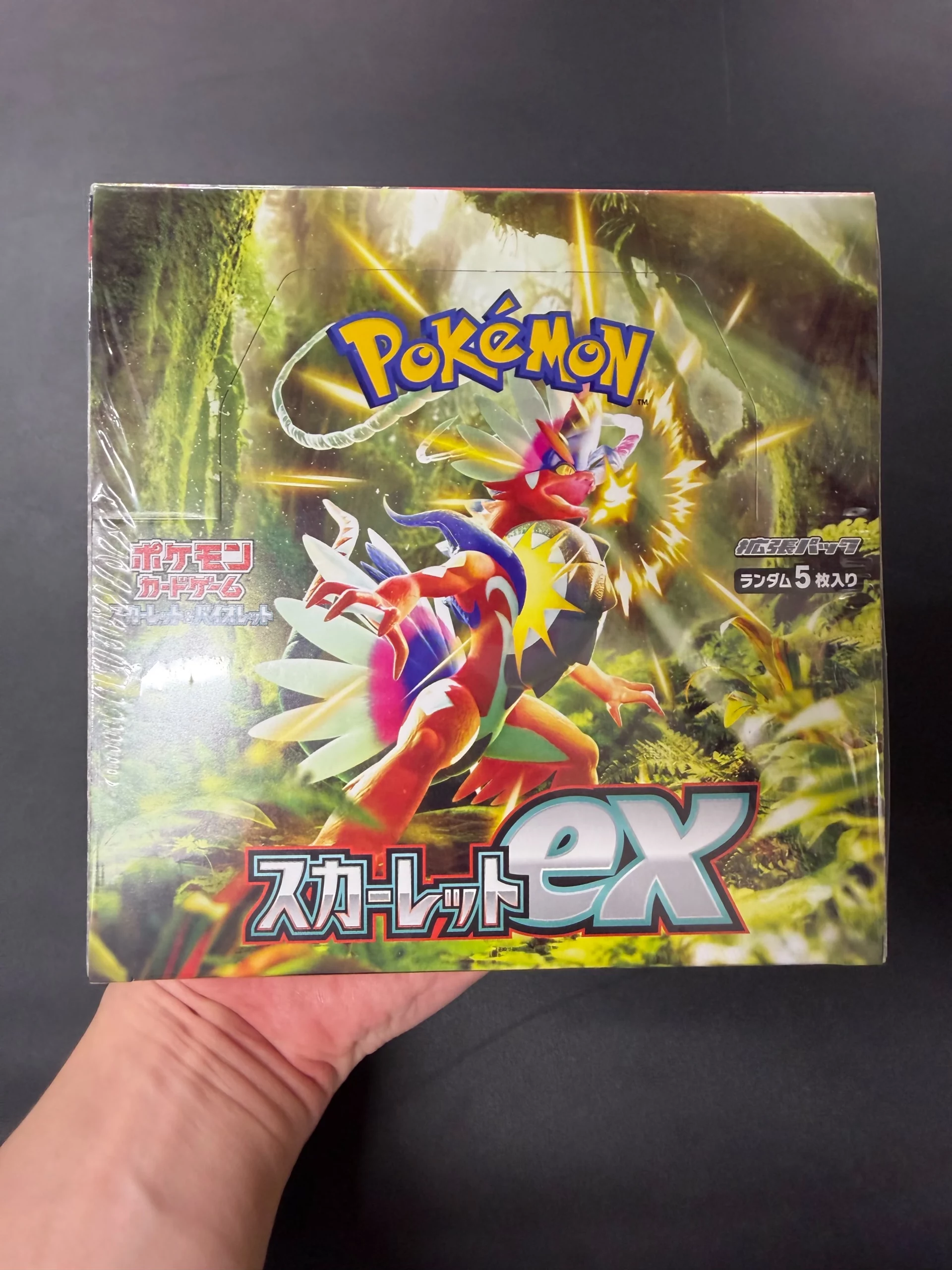
Scarlet ex was one half of a launch. On January 20, 2023, Japan got two boxes on the same day — スカーレットex (Scarlet ex, set code SV1S) and its sister set Violet ex (SV1V) — opening the Scarlet & Violet era in Japanese Pokemon TCG. Scarlet ex carries the Scarlet-side mascot, Koraidon ex, and a Special Art Rare pool built around it.

This guide covers what’s actually inside a Scarlet ex box, which cards collectors chase, how the Sealed, No Shrink and Damaged Box options differ, and how this set connects to its English-language counterpart. We ship Japanese sealed product out of Tokyo, so the pricing below reflects our current listings — not third-party market data.

Key Takeaway

Scarlet ex (SV1S) is a 108-card set packed 5 cartes par pack, 30 packs per box, with five Special Art Rare chases in its main premium pool — led by Gardevoir ex and the Scarlet mascot Koraidon ex. The No Shrink option is currently listed at ¥11,648 (~$73), and our Damaged Box is currently listed at ¥14,590 (~$92) — the options move independently, so check the linked product pages for the current figures.

108
Cards in Set

30
Packs per Box

5
Cards per Pack

Jan 2023
Japan Release

Prices below are our own current listed prices on samuraiswordtokyo.com as of September 2026, converted at ¥159/USD. We do not cite third-party market prices as our own.

What’s in a Scarlet ex Box

Scarlet ex is the Scarlet-side launch box of the Scarlet & Violet era, released alongside its sister set Violet ex (SV1V) on the same day. The set totals 108 cards, confirmed by direct enumeration of the full Limitless TCG card list for SV1S — the same figure used in our own complete checklist article for the set.

Article Value
Set name (JP) スカーレットex (Scarlet ex)
Code de série SV1S
Japan release date January 20, 2023
Sister set Violet ex (SV1V), same release date
Total cards 108
Cards per pack 5
Packs per box 30

Card numbering on the secret-rare tier runs against a main-set denominator of /78 rather than the full 108 — that’s why the chase cards below are printed as, for example, 101/78 rather than 101/108. This is a standard Scarlet & Violet-era numbering convention, not a printing error.

Within the secret-rare pool, Scarlet ex carries five Special Art Rare cards in its main premium lineup: Gardevoir ex, Great Tusk ex, Koraidon ex, Jacq, and Penny. For the full card-by-card rundown of all 108 entries, see our Scarlet ex (SV1S) complete card list.

Chase Cards in Scarlet ex

Six cards stand out from Scarlet ex’s secret-rare tier, drawn from our own Scarlet ex pull rates and best cards guide, with every number and rarity cross-checked directly against Limitless TCG’s own listing for the set. None of these singles are currently listed on our site — sourcing requests for any of them go through Commande rapide.

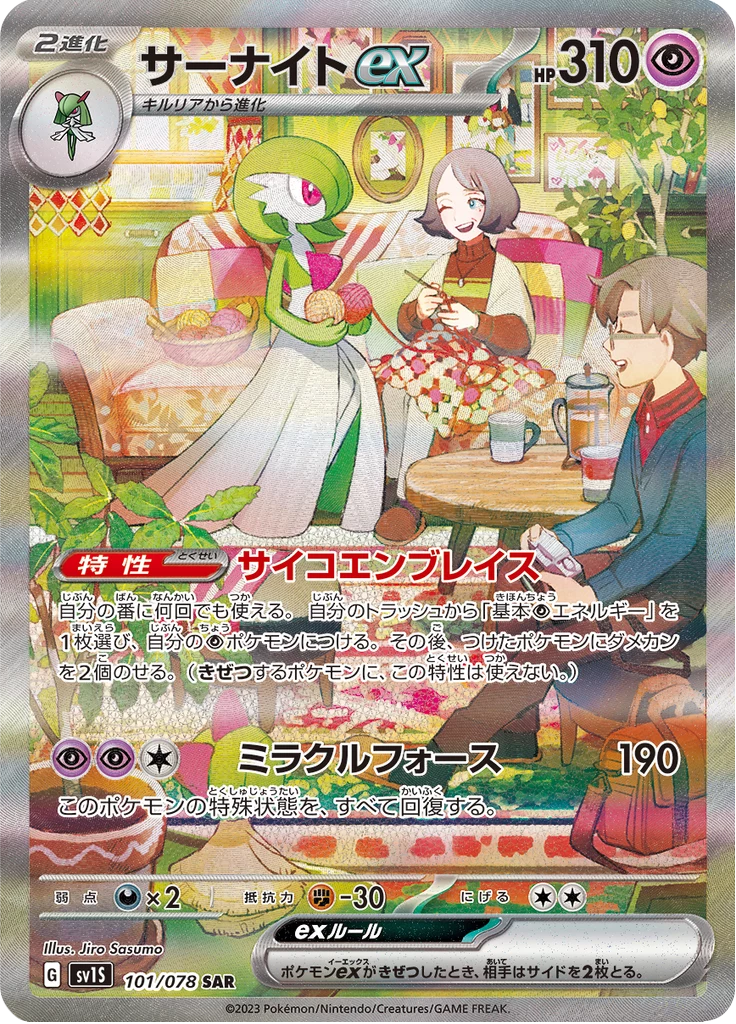
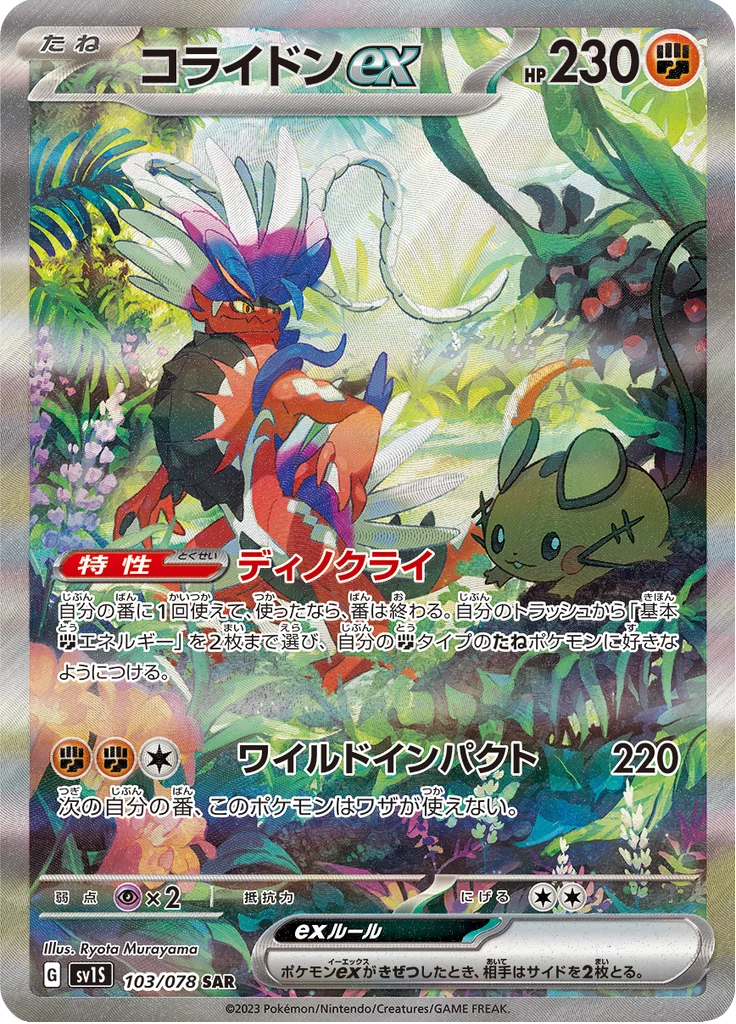
Gardevoir ex — 101/78, Special Art Rare

Gardevoir ex, 101/78, SAR, Scarlet ex (SV1S)
Gardevoir ex, 101/78, Special Art Rare, Scarlet ex (SV1S)

Gardevoir ex is one of the headline chases for anyone opening Scarlet ex boxes. It sits in the Special Art Rare tier alongside four other cards in the set’s premium pool.

Koraidon ex — 103/78, Special Art Rare

Koraidon ex, 103/78, SAR, Scarlet ex (SV1S)
Koraidon ex, 103/78, Special Art Rare, Scarlet ex (SV1S)

Koraidon ex is the Scarlet-side mascot of the whole Scarlet & Violet era, and its Special Art Rare printing here is the box’s second headline chase. It’s the direct counterpart to Violet ex’s own mascot SAR on the other side of this same-day launch.

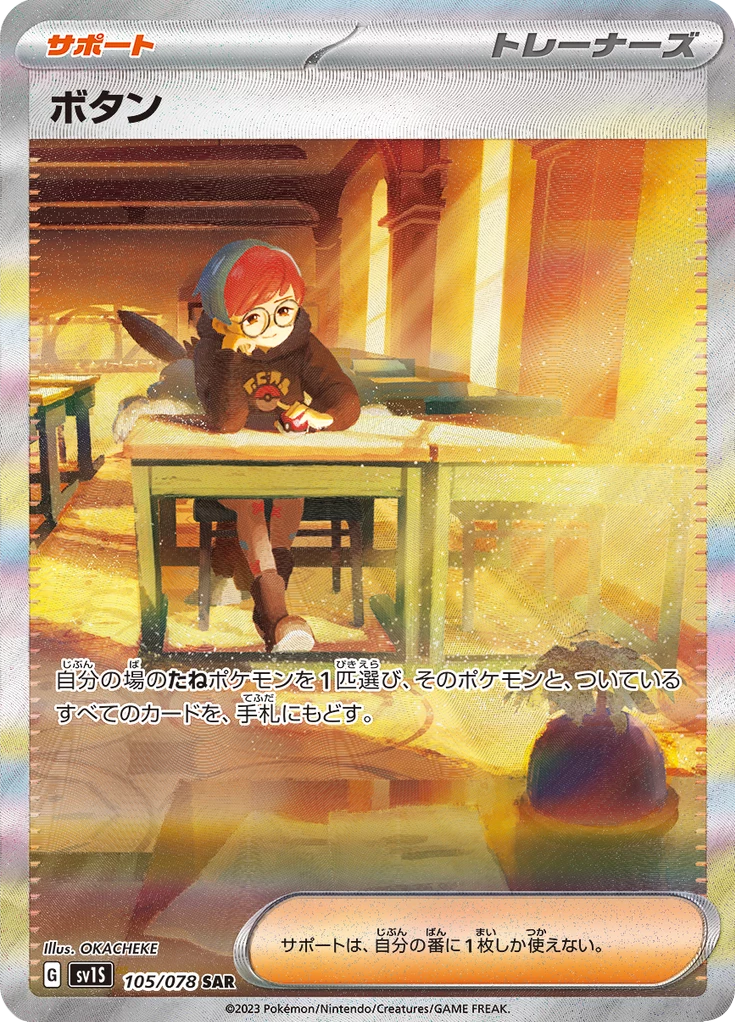
Penny — 105/78, Special Art Rare

Penny, 105/78, SAR, Scarlet ex (SV1S)
Penny, 105/78, Special Art Rare, Scarlet ex (SV1S)

Penny is one of the trainer-card Special Art Rares in the set’s premium pool, alongside Jacq.

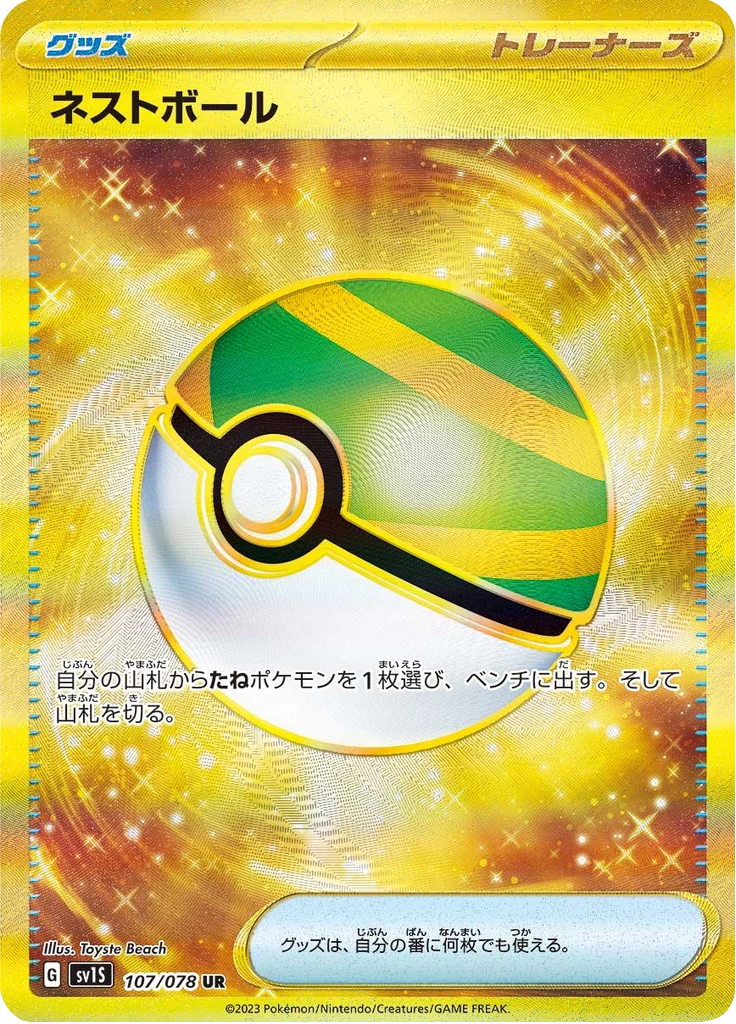
Nest Ball — 107/78, Ultra Rare

Nest Ball, 107/78, UR, Scarlet ex (SV1S)
Nest Ball, 107/78, Ultra Rare, Scarlet ex (SV1S)

Nest Ball is a Trainer item card that reaches the Ultra Rare tier in this set — a step above the Special Art Rare pool and one of the higher rarity slots in the whole card list.

Two further cards round out the top of the set’s chase list:

Carte # Rarity
Great Tusk ex 102/78 SAR
Professor’s Research (Sada) 99/78 SR

Great Tusk ex is one of the five Special Art Rare cards in the main premium pool, and Professor’s Research (Sada) is a Secret Rare-tier Supporter card. As with the four cards above, neither is currently listed on our site — sourcing requests go through Commande rapide.

Scarlet ex Box État Options on Our Site

The main product page offers Sealed and No Shrink selections, while Damaged Box has a separate listing. These are the two linked prices documented for this guide:

Listing Prix
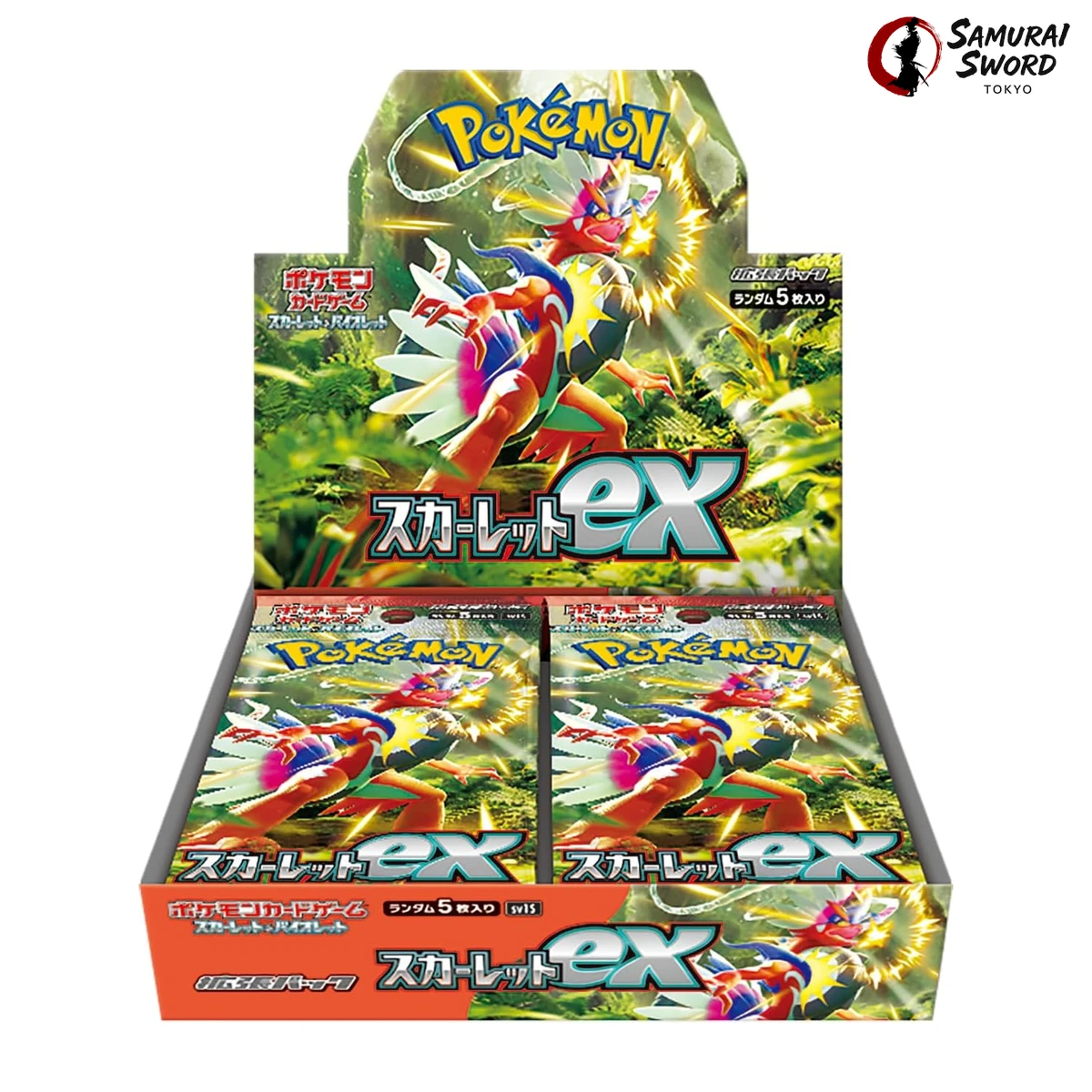
SV1S-Scarlet ex Japanese Pokemon Booster Box — No Shrink option currently listed at ¥11,648 (~$73)
SV1S-Scarlet ex Japanese Pokemon Booster Box – Damaged Box currently listed at ¥14,590 (~$92)
SV1S Scarlet ex Japanese Pokemon Booster Box No Shrink option product photo
SV1S-Scarlet ex Japanese Pokemon Booster Box — No Shrink option

Our own definition of the « Damaged Box » category, used consistently across our catalogue: it’s a condition category for sealed booster boxes where the outer box — not the contents — is affected. The booster packs inside stay factory-sealed. It does not mean any change to the sealed contents; you’re still getting the same booster packs, in the same box count.

SV1S Scarlet ex Japanese Pokemon Booster Box Damaged Box listing product photo
SV1S-Scarlet ex Japanese Pokemon Booster Box — Damaged Box listing

The ¥11,648 figure belongs to the Sans film option, not the Sealed option. The Sealed option is selected from the same product page, so check that page for its current figure. Damaged Box pricing moves independently of the No Shrink option, and the documented Damaged Box figure here is higher; do not assume a fixed discount relationship between the condition options.

Japanese vs English Version of This Set

Scarlet ex doesn’t have a one-to-one English reprint under its own name. Instead, it connects to the international market as the Japanese launch box of the era that English-language collectors know as the Scarlet & Violet base set — Scarlet ex is the Scarlet-side half of that same launch window, released in Japan first.

Its sister set, Violet ex (SV1V), released the same day in Japan and carries the Violet-side mascot SAR as its own headline chase. If you’re comparing the two launch boxes directly, our Violet ex pull rates and best cards guide covers the Violet-side chase pool in the same format as the Scarlet ex breakdown above.

For collectors building out the wider early Scarlet & Violet-era Japanese lineup, our Triplet Beat (SV1a) card list covers the next Japanese set in that same era.

Shop This Set
SV1S-Scarlet ex Japanese Pokemon Booster Box
Contains the SAR and UR chases covered above
Ships from Tokyo · Tracked delivery

View Product →

Where to Buy a Scarlet ex Booster Box from Tokyo

We ship Japanese sealed product out of Tokyo with tracked delivery. For Scarlet ex, the main product page carries Sealed and No Shrink selections, while Damaged Box has a separate listing:

Browse the wider category in our Pokemon booster box collection, or for any single not currently listed — Gardevoir ex, Koraidon ex, Nest Ball, Penny, Great Tusk ex, or Professor’s Research (Sada) — the Quick Order page is the fastest way to flag what you’re after.

For the sister launch box, see our Violet ex pull rates and best cards guide, and for the full Scarlet ex checklist, our Scarlet ex (SV1S) complete card list covers all 108 entries.

Foire aux questions

What’s in a Scarlet ex booster box?

A Scarlet ex (SV1S) box has 30 packs of 5 cards each, drawn from a 108-card set. The secret-rare tier is numbered against a /78 main-set denominator and includes five Special Art Rare cards in the main premium pool: Gardevoir ex, Great Tusk ex, Koraidon ex, Jacq, and Penny.

Which cards should I chase in Scarlet ex?

The headline chases are Gardevoir ex (101/78, SAR) and Koraidon ex (103/78, SAR), the Scarlet-side mascot. Also worth knowing: Great Tusk ex (102/78, SAR), Penny (105/78, SAR), Nest Ball (107/78, UR), and Professor’s Research (Sada) (99/78, SR).

What’s the difference between the No Shrink and Damaged Box options on your site?

The ¥11,648 (~$73) figure is for the No Shrink option on the main product page, not its Sealed option. Damaged Box is a separate condition listing where the outer box — not the contents — is affected; its documented figure here is ¥14,590 (~$92). Check both linked pages for current pricing.

Is there an English version of Scarlet ex?

Scarlet ex doesn’t have a direct one-to-one English reprint under its own name. It’s the Japanese Scarlet-side launch box of the era that international collectors know as the Scarlet & Violet base set, released the same day in Japan as its sister set, Violet ex (SV1V).

How many cards are in the Scarlet ex set?

108 cards total, confirmed by direct enumeration of the set’s full Limitless TCG card list. The secret-rare tier uses a /78 numbering scheme, which is why chase cards are printed as, for example, 101/78 rather than against the 108 total.

Where can I buy singles like Gardevoir ex or Koraidon ex from this set?

These singles are not currently listed on our site. Sourcing requests for any Scarlet ex single go through our Quick Order page, which is the fastest way to flag what you’re after or build a mixed order.
Guide d'achat de la Booster Box S10D-Time Gazer : le triple chase d'Origin Forme Dialga

Time Gazer places Origin Forme Dialga across several rarity treatments in one booster box. This guide focuses on the three chase prints verified in our source pack.

Released in Japan on April 8, 2022, S10D “タイムゲイザー” (Time Gazer) launched alongside its sister set S10P Space Juggler on the same day — together the two form a Hisui-region tribute pair drawing on Pokemon Legends: Arceus, with Origin Forme Dialga headlining this box and Origin Forme Palkia doing the same job across in Space Juggler. Time Gazer runs to 88 cards total, and its 21-card chase tier closes out with Origin Forme Dialga VSTAR sitting in the set’s top Ultra Rare band.

This guide covers what’s printed in a Time Gazer box, three verified Origin Forme Dialga chase cards, how Damaged Box and No Shrink listings work, and what the set’s English counterpart looks like. The prices below are current listings on our own site.

Key Takeaway

Time Gazer (S10D) is an 88-card Sword & Shield-era Japanese set. This guide covers verified Origin Forme Dialga chase prints at 074/067, 082/067, and 086/067 without treating that selection as a complete print count. The S10D-Time Gazer Japanese Pokemon Booster Box is currently listed at ¥14,700 (~$92); a PSA10 Machamp V SR: SA (073/067) from the same set is currently listed at ¥19,690 (~$124). No Origin Forme Dialga single from Time Gazer itself is currently listed — sourcing requests go through Commande rapide.

88
Total Cards

21
Chase-Tier Cards

3
Dialga Chase Prints Covered

Apr 8, 2022
Japan Release

Prices below are our own currently listed prices as of September 2026, converted at ¥159/USD.

What’s In a Time Gazer Booster Box

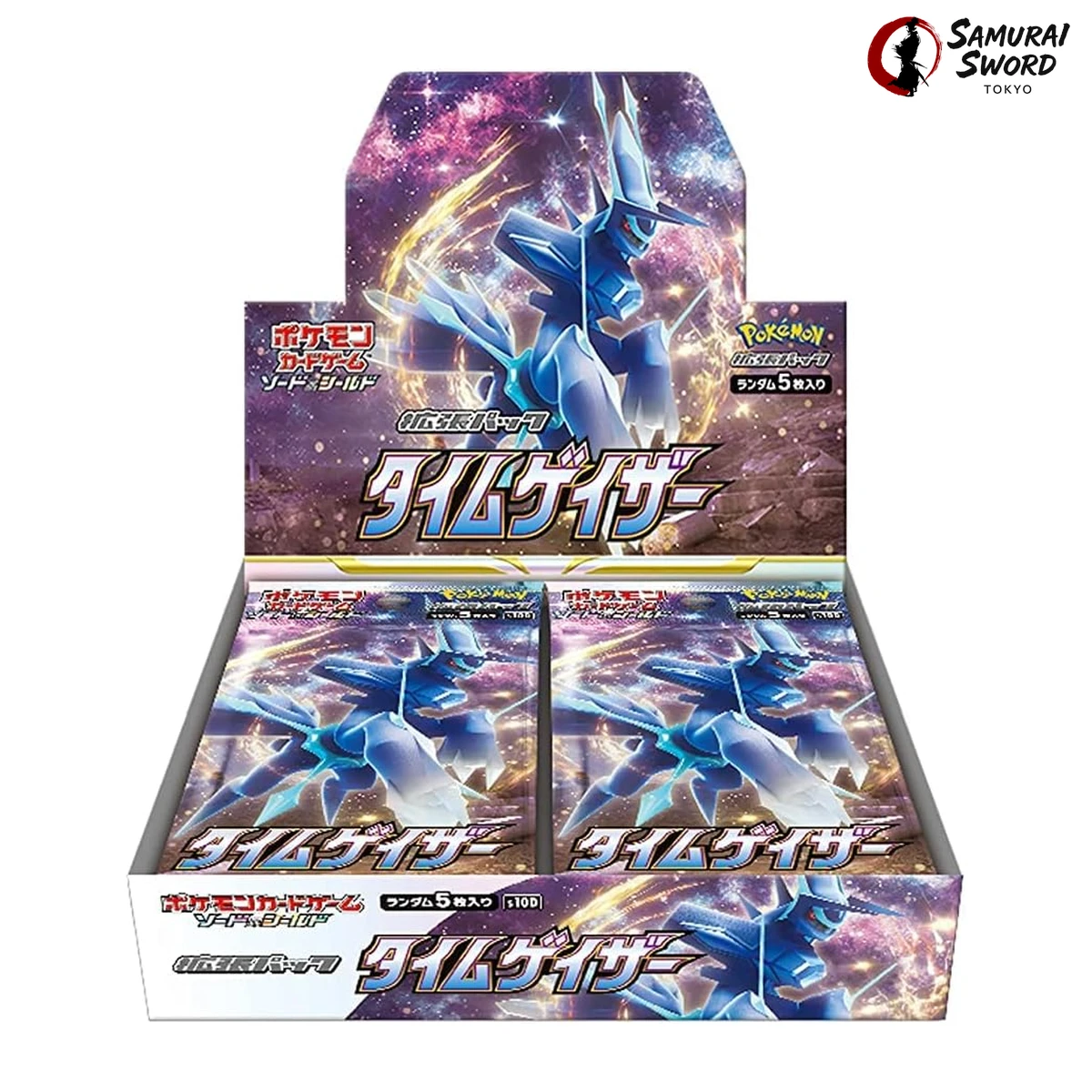
S10D-Time Gazer Japanese Pokemon booster box, sealed
S10D-Time Gazer Japanese Pokemon Booster Box, sealed

Time Gazer is a standard Sword & Shield-era Japanese expansion, set code S10D, released April 8, 2022 — the same day as its sister set S10P Space Juggler. The two sets share a Hisui-region theme lifted from Pokemon Legends: Arceus, and each one is built around one Origin Forme Legendary as its chase focal point: Dialga here, Palkia in Space Juggler.

The set runs to 88 cards in total. The base numbered run covers 001/067 through 067/067 — 67 cards — and the chase tier picks up from there at 068/067 through 088/067, adding 21 more cards on top of the base count. Within that chase tier, the set itself is structured into three ascending rarity bands: 12 Super Rares, 6 Hyper Rares, and 3 Ultra Rares, with the Ultra Rare band closing at 088/067. The Pokemon Company has never published official per-box figures for a band structure like this one, so this guide sticks to what the set itself confirms — how many cards sit in each band, not how often any of them turn up in a given box.

For the full 88-card breakdown, our Time Gazer (S10D) complete card list covers every card and rarity in the set, and our Time Gazer pull rates and best cards guide goes deeper on the chase tier specifically.

Chase Cards in Time Gazer: Verified Origin Forme Dialga Prints

The Origin Forme Dialga chase prints verified for this guide include the following three cards:

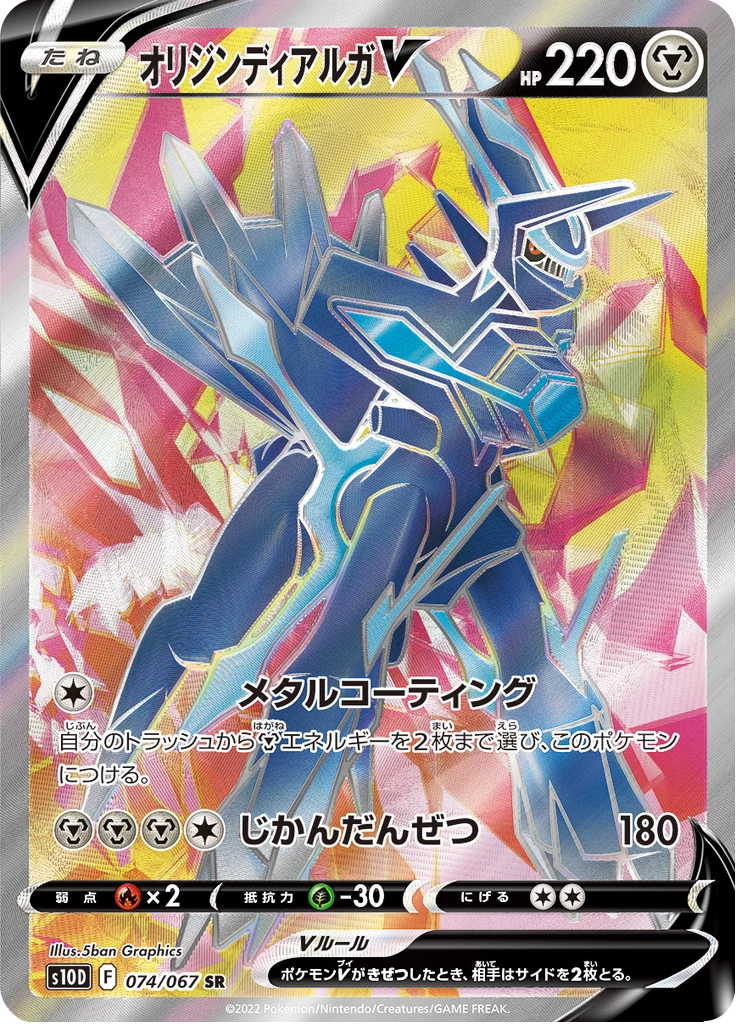
Origin Forme Dialga V, SR, 074/067, Time Gazer (S10D)

Origin Forme Dialga V SR 074/067

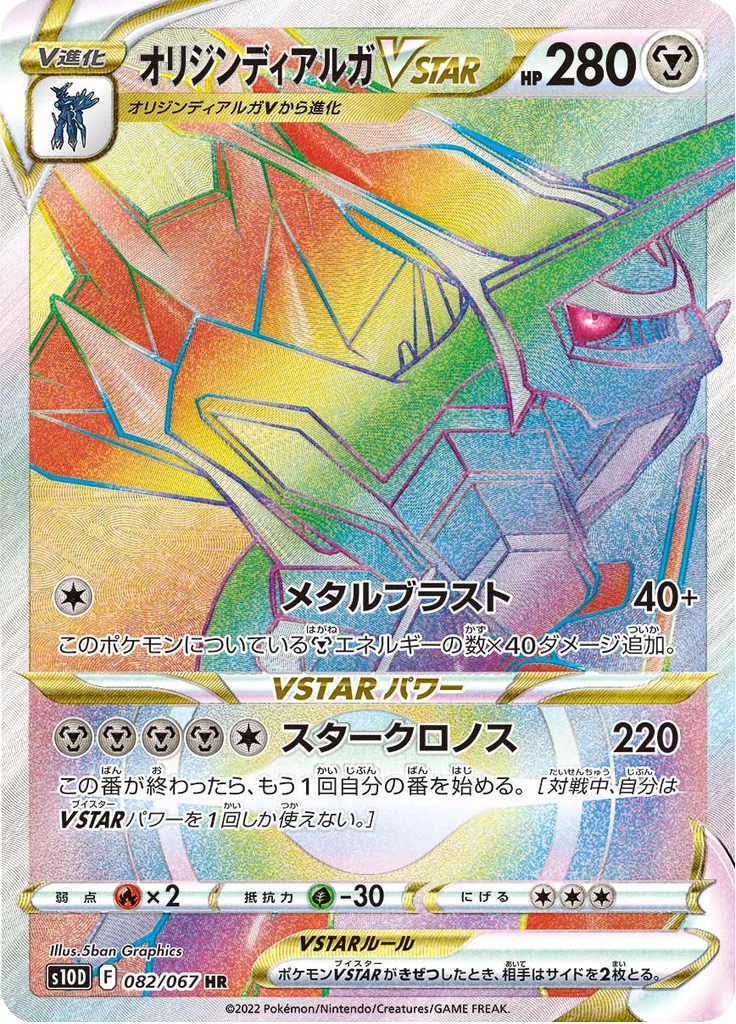
Origin Forme Dialga VSTAR, HR, 082/067, Time Gazer (S10D)

Origin Forme Dialga VSTAR HR 082/067

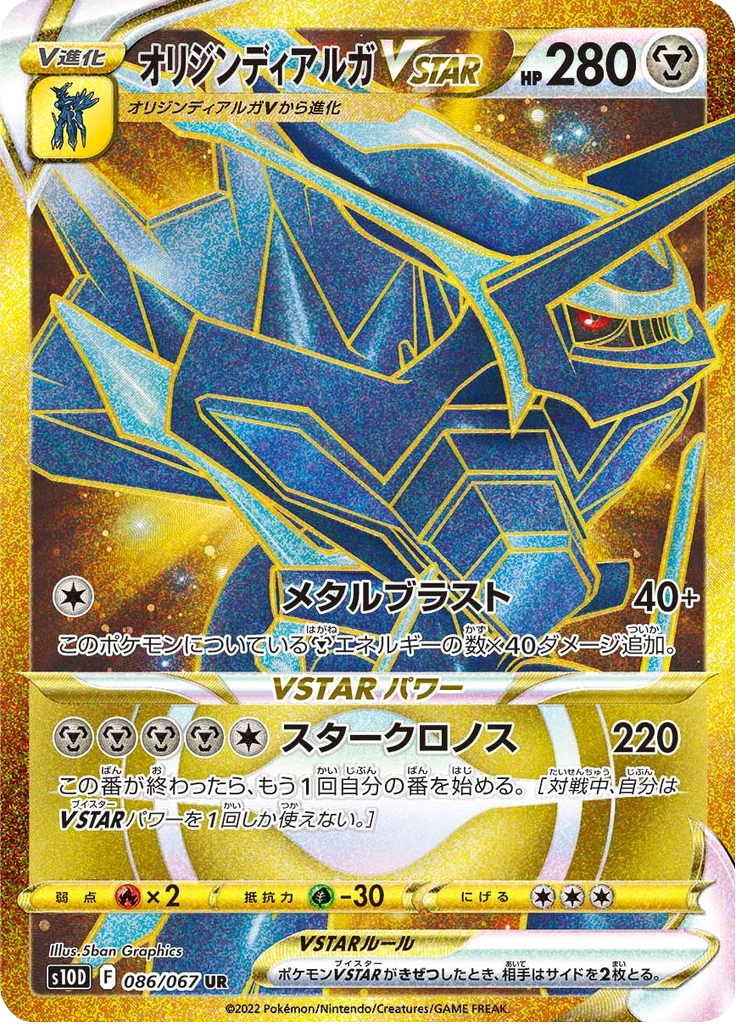
Origin Forme Dialga VSTAR, UR, 086/067, Time Gazer (S10D)

Origin Forme Dialga VSTAR UR 086/067

The 074/067 Super Rare is the entry point — Origin Forme Dialga V in its first appearance in the set. The 082/067 Hyper Rare steps up to the VSTAR evolution in a higher-tier treatment, and the 086/067 Ultra Rare is the same VSTAR card again in the set’s Ultra Rare band.

Adaman, the Hisui-region character tied to Dialga’s storyline in Pokemon Legends: Arceus, gets the same treatment across two of his own prints:

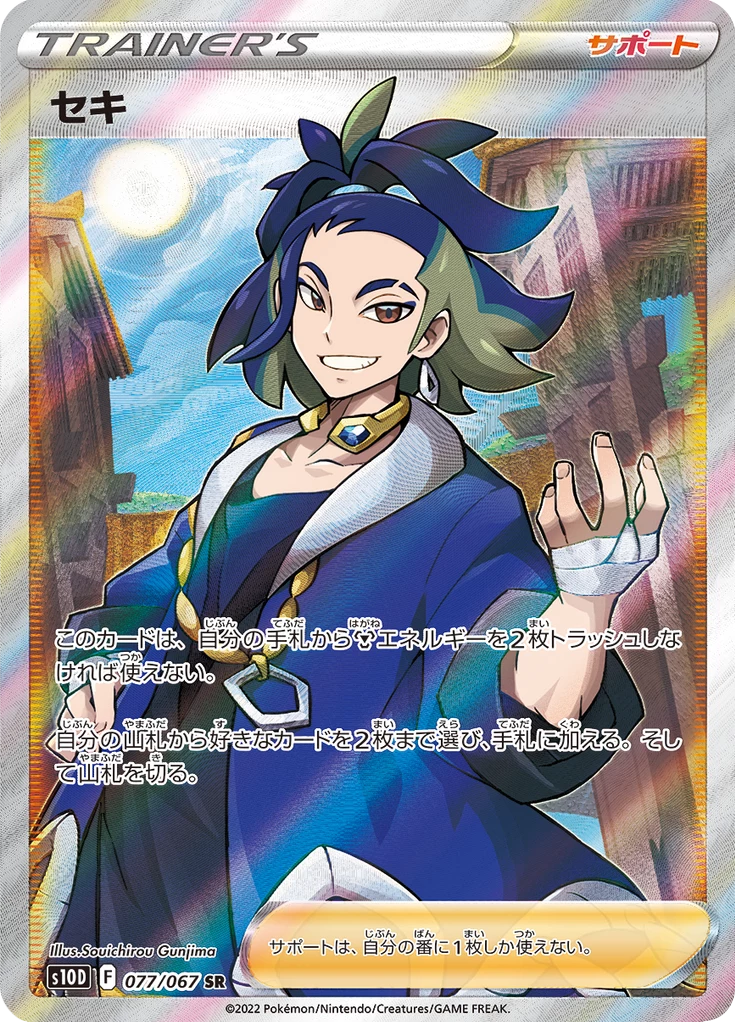
Adaman, SR, 077/067, Time Gazer (S10D)

Adaman SR 077/067

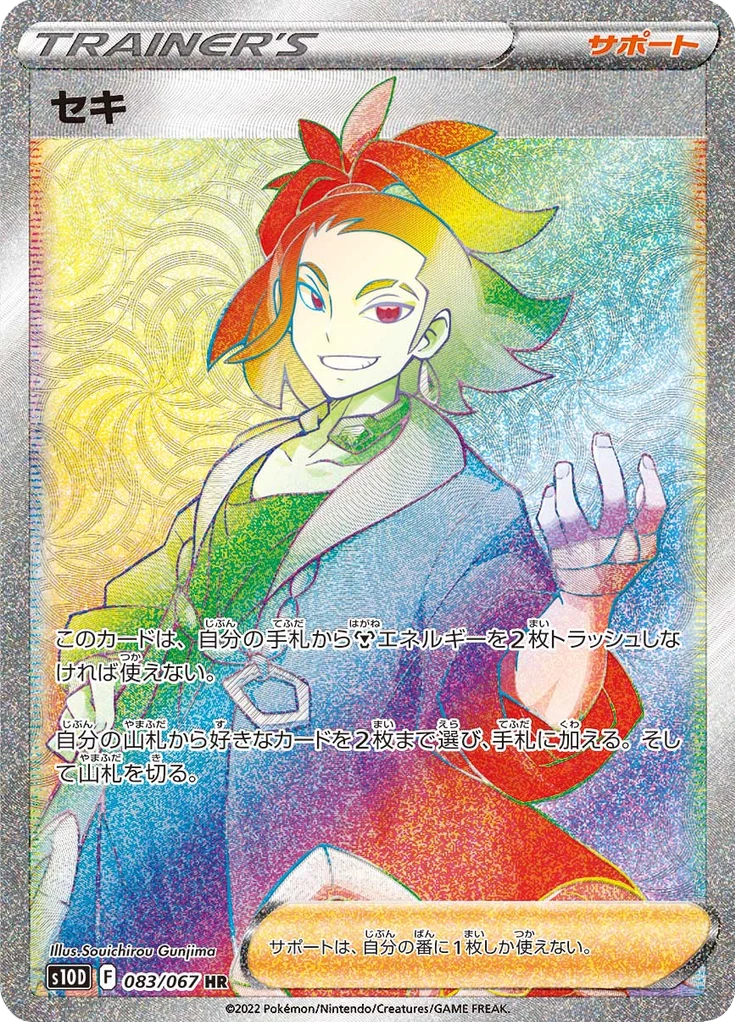
Adaman, HR, 083/067, Time Gazer (S10D)

Adaman HR 083/067

077/067 is the Super Rare printing of Adaman; 083/067 reprints the same Trainer at Hyper Rare. Pairing a Trainer card across two rarity bands, the way the set does with both Dialga and Adaman, is part of what makes the chase tier read as a coherent set rather than a scattered list of hits.

Carte # Rarity
Origin Forme Dialga V 074/067 SR
Adaman 077/067 SR
Origin Forme Dialga VSTAR 082/067 HR
Adaman 083/067 HR
Origin Forme Dialga VSTAR 086/067 UR

No Origin Forme Dialga single from Time Gazer itself is currently listed on our site at the moment; sourcing requests for 074/067, 082/067, or 086/067 go through Commande rapide. What is currently listed from the same set is a PSA10 Machamp V SR: SA (073/067), currently listed at ¥19,690 (~$124) — the card sitting one number below Origin Forme Dialga V in the chase tier. If a Dialga single graded PSA10 in hand today matters more than the specific Time Gazer print, a PSA10 Dialga (017/027, CP2) is currently listed at ¥58,300 (~$367) — note this is a different, earlier-era Dialga print, not from Time Gazer.

Regular Box vs Damaged Box vs No Shrink on Our Site

We list sealed Japanese product under a few different condition categories, and the terms describe how we grade the box itself rather than what’s inside it.

Damaged Box is a condition category used for sealed booster boxes where the outer box — not the contents — is affected. The booster packs inside stay factory-sealed; what changes is cosmetic damage to the outer packaging. It does not mean any change to the sealed contents — the same booster packs, in the same box count, are still inside. Damaged Box pricing moves independently of the regular box price and isn’t always cheaper.

Sans film is a separate listing name that appears as a bracketed prefix on some of our product titles — it identifies a specific listing/condition variant on that product’s own page, and its meaning is set out on that page rather than as a store-wide policy.

For Time Gazer specifically, the regular sealed S10D-Time Gazer Japanese Pokemon Booster Box is currently listed at ¥14,700 (~$92). Neither a Damaged Box nor a No Shrink listing of this set is currently listed on our site — interest in either can be flagged through Commande rapide.

Japanese vs English: Time Gazer and Astral Radiance

Time Gazer never received a matching stand-alone English set. Instead, its main-set cards were folded into Astral Radiance, released in English on May 27, 2022 — about seven weeks after Time Gazer’s Japanese release. Astral Radiance runs to 246 cards and merges content from three separate Japanese sets: Time Gazer (S10D), its sister set Space Juggler (S10P), and material from Battle Region (S9a).

What that means in practice: comparing a Time Gazer card to its English counterpart means looking inside Astral Radiance rather than a set that shares Time Gazer’s name or number. The Japanese and English versions carry different card numbering entirely, and the two Origin Forme Legendaries that headline the Japanese sister-set pair — Dialga here, Palkia in Space Juggler — both end up inside that same combined English release.

Shop This Set
S10D-Time Gazer Japanese Pokemon Booster Box
Currently listed at ¥14,700 (~$92)
Ships from Tokyo · Tracked delivery

View Product →

Where to Buy a Time Gazer Booster Box from Tokyo

We ship Japanese sealed product and PSA-graded singles worldwide from Tokyo with tracked delivery. The S10D-Time Gazer Japanese Pokemon Booster Box above is the source product for the verified Origin Forme Dialga chase prints covered here and the rest of the set.

For singles, our currently listed PSA10 Machamp V SR: SA (073/067) comes from the same set, and a PSA10 Dialga (017/027, CP2) is a currently listed earlier-era alternative if a Dialga single is the priority over the specific Time Gazer print. Browse the wider category on our Pokemon booster box collection, and for anything not currently listed — the Origin Forme Dialga singles, a Damaged Box, or a No Shrink listing of this set — the Quick Order page is the fastest way to flag what you’re after.

For more on the set itself, see our Time Gazer pull rates and best cards guide, the full 88-card checklist, and our companion guide to sister set Space Juggler.

Foire aux questions

What is Time Gazer (S10D)?

Time Gazer is a Sword & Shield-era Japanese Pokemon expansion, set code S10D, released April 8, 2022 alongside its sister set S10P Space Juggler. Together the two form a Hisui-region tribute pair based on Pokemon Legends: Arceus, with Origin Forme Dialga as Time Gazer’s chase focal point.

How many cards are in the Time Gazer set?

88 cards total — a 67-card base run (001/067–067/067) plus a 21-card chase tier (068/067–088/067) split into 12 Super Rares, 6 Hyper Rares, and 3 Ultra Rares.

Which Origin Forme Dialga chase prints does this guide cover?

This guide covers Origin Forme Dialga V as a Super Rare at 074/067, Origin Forme Dialga VSTAR as a Hyper Rare at 082/067, and Origin Forme Dialga VSTAR as an Ultra Rare at 086/067. These are a selected chase group, not a complete count of every Dialga card in Time Gazer.

Does Time Gazer have an English release?

Not as a stand-alone set. Its main-set cards were combined into Astral Radiance, released in English on May 27, 2022, which merges Time Gazer with its sister set Space Juggler and content from Battle Region into one 246-card release.

What’s the difference between a Damaged Box and a No Shrink listing?

Damaged Box refers to cosmetic damage to the outer box only — the booster packs inside stay factory-sealed, and the box count doesn’t change. No Shrink is a separate listing name used on specific product pages; its meaning is set out on that product’s own page rather than as a store-wide definition.

Where can I buy an Origin Forme Dialga single from Time Gazer?

No Origin Forme Dialga single from Time Gazer itself is currently listed on our site — sourcing requests go through Quick Order. A PSA10 Machamp V SR: SA (073/067) from the same set, and a PSA10 Dialga (017/027, CP2) from an earlier era, are both currently listed as alternatives.
Guide de la carte Pokémon Charmander CP3 003/032 : Pokekyun Collection (1st Edition)

Charmander’s Pokekyun Collection print is a small, easy-to-overlook card — a Common-rarity Basic Pokémon in a compact 32-card Concept Pack. It is also, as it happens, the exact card our own site uses to show readers what a Japanese 1st Edition stamp looks like at the very end of the era that stamp existed.

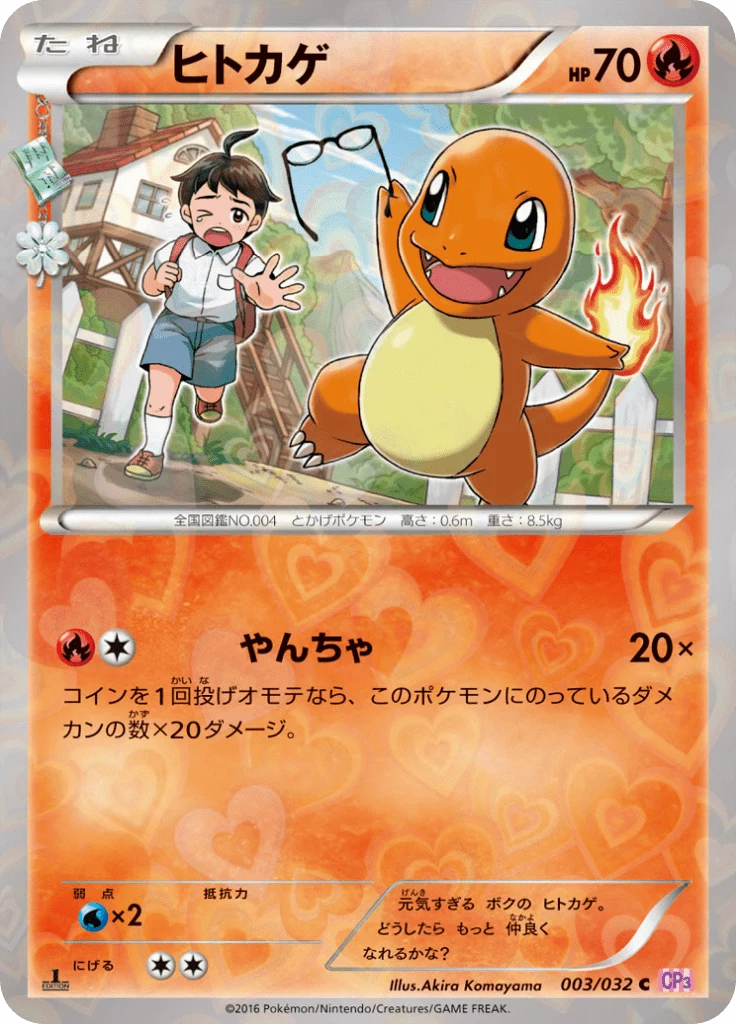
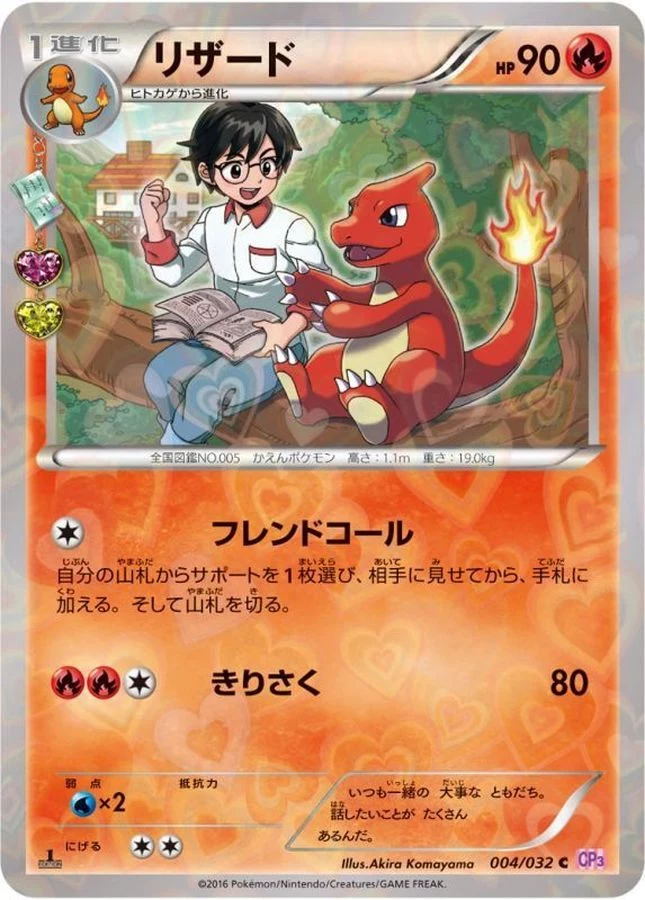
The card is ヒトカゲ (Hitokage) — Charmander, No. 003/032, printed as a Common (C) in the Japanese Concept Pack “Pokekyun Collection” (set code CP3), released 29 January 2016 with a 1st Edition mark. We currently list a PSA 10 copy of this print, graded and shipped from Tokyo, and this guide covers what the card is, where it sits inside CP3, how it compares to its English-set equivalent, and where a Common print like this one sits against the rest of the set’s rarity ladder.
Key Takeaways

Charmander CP3 003/032 Common (1st Edition) is a PSA 10, currently listed at ¥29,141 (~$183). It comes from Pokekyun Collection (CP3), a Japanese Concept Pack released 29 January 2016 with a 32-card set size. The pack’s next card, Charmander’s evolution Charmeleon CP3 004/032, is also PSA 10 graded and currently listed at ¥35,420 (~$223).

70
HP

Common
Rarity (003/032)

32
Set Size (CP3)

Jan 2016
Japan Release

Prices below are current samuraiswordtokyo.com listings, converted at ¥159/USD (September 2026).

The Card: Charmander CP3 003/032 Common

Charmander is a Basic, Fire-type Pokémon carrying 70 HP. The CP3 003/032 print is illustrated by Akira Komayama and sits early in the Pokekyun Collection numbering, at Common rarity — the entry-level print tier for this set rather than a chase slot. It carries the small 1st Edition mark that Concept Packs in this window of Japanese releases used to print on their cards.

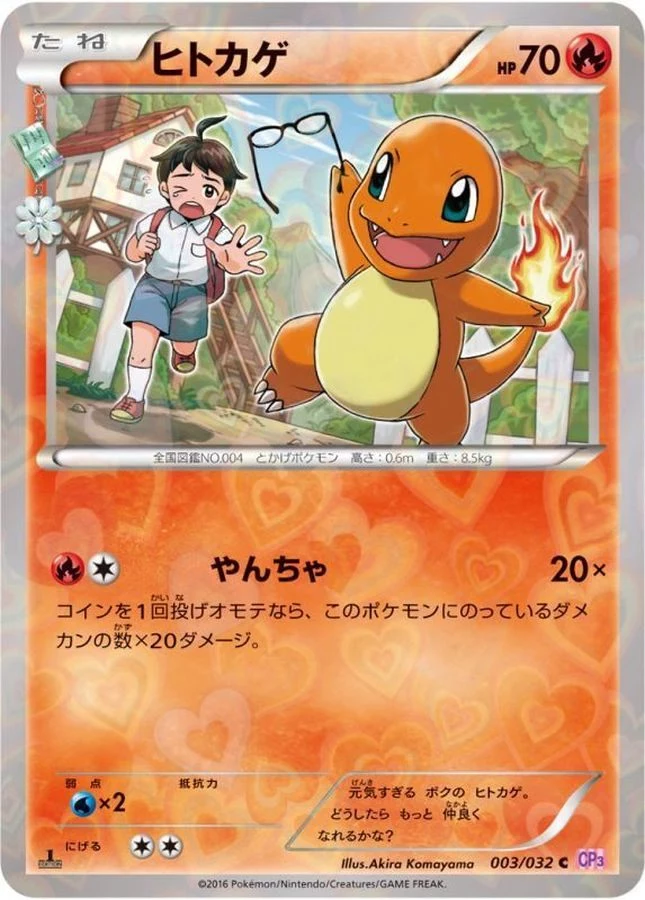
Charmander CP3 003/032, Common, Pokekyun Collection
Charmander CP3 003/032, Common — Pokekyun Collection (CP3), illustrated by Akira Komayama

Our own graded example of this print, PSA 10 with the 1st Edition mark, is currently listed at ¥29,141 (~$183).

PSA 10 Charmander CP3 003/032 slab, listed on samuraiswordtokyo.com

The Set: Pokekyun Collection (CP3)

Pokekyun Collection is Japanese Concept Pack CP3, released 29 January 2016 with a compact 32-card set size — small next to a standard expansion, which is typical of the Concept Pack format. For background on how Concept Packs differ from full expansions, see our Japanese Concept Packs (CP) guide, and for a full breakdown of everything in this specific set, see our Pokekyun Collection (CP3) guide.

CP3 lands right at the tail end of the period when Japan still printed the 1st Edition stamp on new releases. Our own Japanese 1st Edition Pokemon Cards guide uses this exact Charmander print — alongside its evolution, Charmeleon CP3 004/032, also 1st Edition — as its worked visual example of what the stamp and surrounding card layout looked like just months before the mark was retired. If you want to see the stamp itself up close, that guide is the reference.

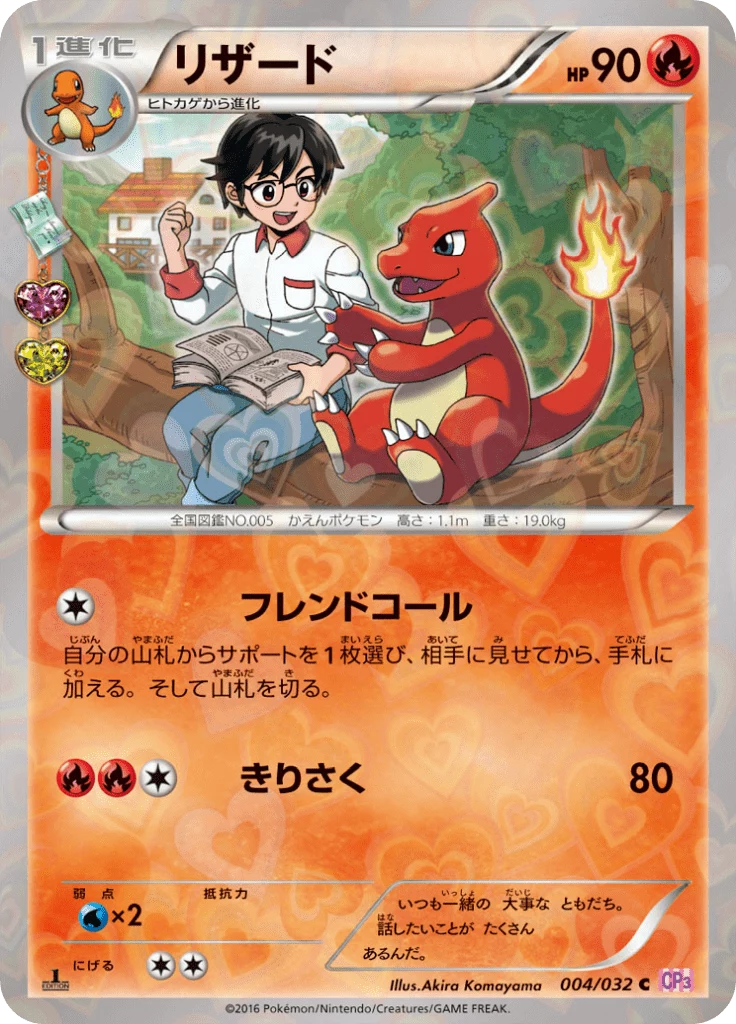
Charmeleon CP3 004/032, Common, Pokekyun Collection
Charmeleon CP3 004/032, Common — the next card in the same Pokekyun Collection set, following on from Charmander

Charmeleon CP3 004/032 is the direct evolution slot immediately after Charmander in the set’s numbering, and it is also 1st Edition. Our graded copy of that print is currently listed at ¥35,420 (~$223).

PSA 10 Charmeleon CP3 004/032 slab, listed on samuraiswordtokyo.com

Japanese vs English Print

This Charmander print does have an English-set equivalent: Generations Radiant Collection, card #RC3. The two are the same character appearing in different regional set contexts — a Japanese Concept Pack release on one side, an English Radiant Collection slot on the other — rather than a direct reprint of one from the other with matching numbering.

If you are trying to match a raw card against this guide, go by the set context and card number (CP3 003/032) rather than assuming the English RC3 slot shares the same rarity treatment or print run. The two exist in separate collector markets, and this guide covers the Japanese CP3 1st Edition print specifically.

Where This Common Print Sits Among Japanese Rarity Tiers

Common (C) is the base rarity rung in Japanese set numbering — the standard, widely-distributed print tier that sits below Uncommon (U), Rare, and the various secret/special-art tiers used in modern sets. Charmander’s 003/032 print sits at that entry level within Pokekyun Collection.

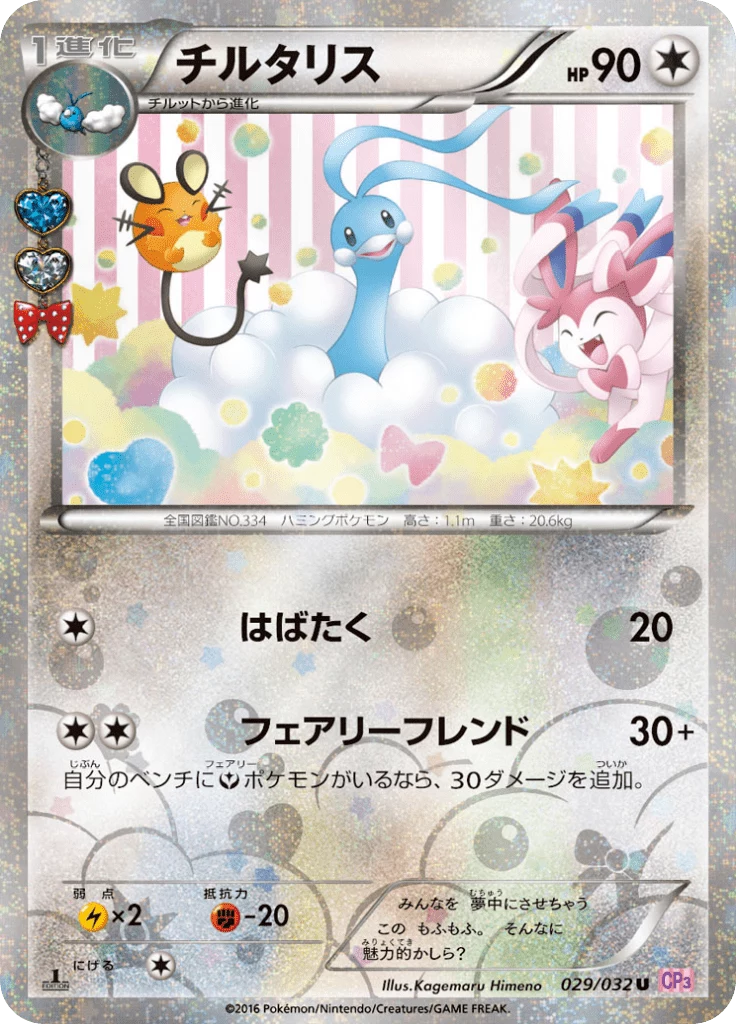
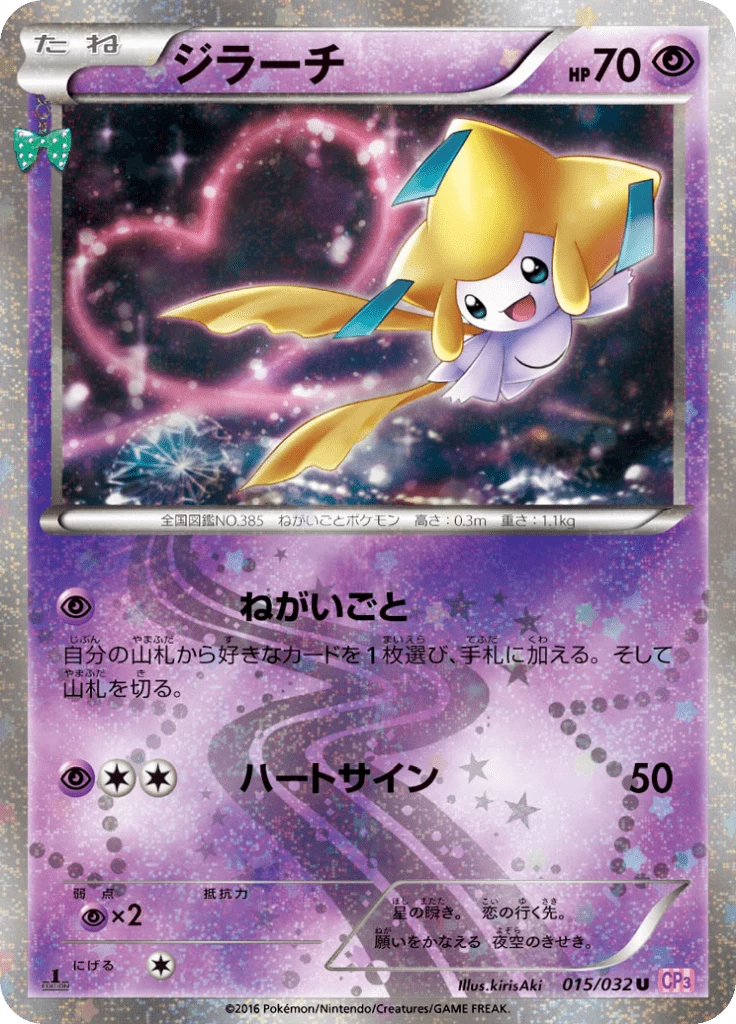
The same 32-card set also carries Uncommon-tier prints, two of which are also currently listed in PSA 10 alongside Charmander: Altaria U 029/032 and Jirachi U 015/032. Seeing a Common and two Uncommons from the same 32-card pack side by side is a useful reference point for how compact a Concept Pack’s rarity spread actually is compared with a full-size expansion.

None of this is pull-rate or scarcity data — it is simply where each card sits on the printed rarity ladder for this set. For the wider PSA 10 range across our Japanese catalogue, see our PSA 10 graded card collection.

Shop This Card
PSA 10 Charmander CP3 003/032 Common (1st Edition)
Currently listed at ¥29,141 (~$183)
Ships from Tokyo · Tracked delivery

View Product →

Where to Buy Charmander from Tokyo

Our graded copy of PSA 10 Charmander CP3 003/032 Common (1st Edition) is currently listed at ¥29,141 (~$183), shipped from Tokyo with tracked delivery. If you are building out the same Pokekyun Collection pack, its evolution Charmeleon CP3 004/032 is currently listed at ¥35,420 (~$223), alongside the set’s Uncommon-tier Altaria 029/032 (¥29,040, ~$183) and Jirachi 015/032 (¥39,270, ~$247).

For the broader graded catalogue, browse our full PSA 10 graded card collection. For a mixed order across singles and sealed product, our Quick Order page is the fastest way to build a cart.

Foire aux questions

What is Charmander CP3 003/032?

It is the Common-rarity print of Charmander from the Japanese Concept Pack Pokekyun Collection (set code CP3), released 29 January 2016 with a 1st Edition mark. We currently list a PSA 10 copy of this print at ¥29,141 (~$183).

Is this a 1st Edition card?

Yes. Pokekyun Collection released with the 1st Edition stamp, just months before Japan retired that mark. Our own Japanese 1st Edition Pokemon Cards guide uses this exact Charmander print, and its evolution Charmeleon CP3 004/032, as its worked example of the stamp at the end of that era.

Does Charmander have an English print of this card?

Yes — the English-set equivalent is Generations Radiant Collection, card #RC3. It is the same character in a different regional set context rather than a direct reprint with matching numbering.

What rarity is this Charmander print?

Common (C), the base print tier in Pokekyun Collection’s 32-card set. The same set also includes Uncommon-tier prints such as Altaria 029/032 and Jirachi 015/032, both of which we also carry in PSA 10.

Is this Charmander’s only Japanese print?

No. This guide covers the verified Pokekyun Collection print specifically. A broader search of Charmander’s print history reports around 20 total Charmander cards across separate, unrelated Japanese TCG sets and eras, a count that has not been individually re-verified here. Our Charmander cards guide covers that wider spread.

Where can I buy a PSA 10 Charmander CP3 003/032 from Tokyo?

Our graded copy is currently listed at ¥29,141 (~$183) with tracked shipping from Tokyo. Related Pokekyun Collection PSA 10 prints, including Charmeleon, Altaria and Jirachi, are also currently listed.

Guide d’achat de la Booster Box S8 Fusion Arts : cartes phares Mew V et informations sur l’extension

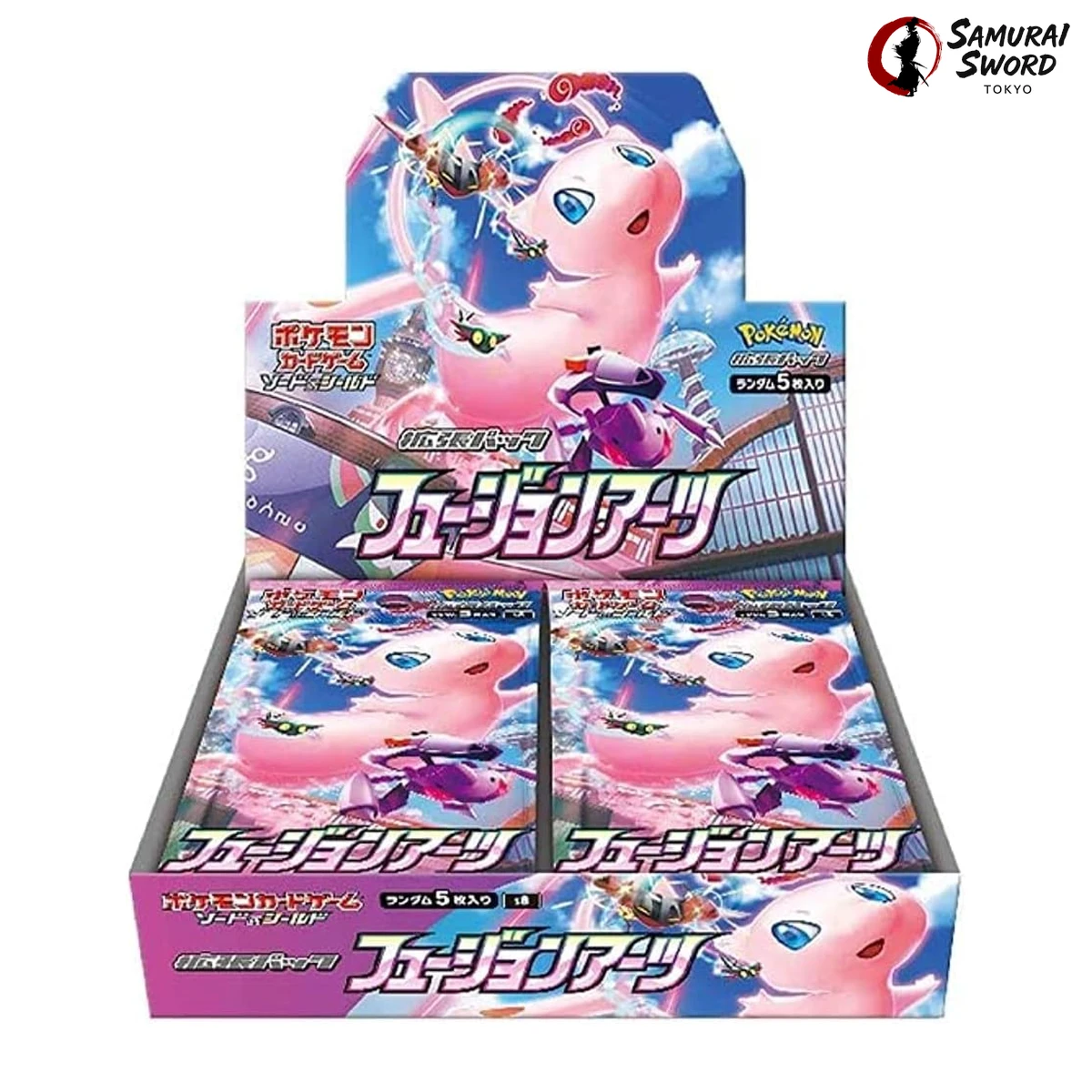
フュージョンアーツ — Fusion Arts — is a standard Sword & Shield-era Japanese expansion, released September 24, 2021 under the set code S8. It doesn’t carry the « high-class pack » label of a set like VSTAR Universe, and its verified Mew chase prints are Mew V #105/100 and #106/100.

This guide covers the official pack and box structure, walks through the confirmed chase cards, explains the difference between Regular, Damaged, and No Shrink box listings on our own site, and compares the Japanese set against its English counterpart. We ship Japanese sealed product out of Tokyo, so every price here reflects our current listings.

Key Takeaway

Fusion Arts has a 100-card main set followed by secret-numbered cards, across a standard 30-pack box (5 cartes par pack), and was released September 24, 2021. Its verified Mew chase prints are Mew V #105/100 and #106/100. Our S8-Fusion Arts Japanese Pokemon Booster Box is currently listed at ¥61,425 (~$386). No Mew single, Damaged Box, or No Shrink listing for this set is currently on our site — sourcing requests go through the Quick Order page.

100
Main-Set Cards

30
Packs per Box

5
Cards per Pack

Sep 24, 2021
Japan Release

Prices below are our own listed prices as of September 2026, converted at ¥159/USD.

What’s in a Fusion Arts Box

S8 Fusion Arts sealed Japanese booster box product photo
S8 Fusion Arts Japanese booster box, sealed
Article Value
Release date (JP) September 24, 2021
Code de série S8
Main-set cards 100, followed by secret-numbered cards
Packs per box 30
Cards per pack 5
Box price (tax incl., official MSRP) ¥4,950

Fusion Arts is a standard expansion box rather than a « high-class pack » — it runs the regular 30-pack, 5-card structure rather than the shorter, higher-density pack count of a high-class release. That’s a straightforward structural fact from the pack contents; we’re not stating any pull-rate figures for how often any individual card appears.

The numbered checklist starts with a 100-card main set and continues with secret-numbered cards above 100. That secret range includes the two Mew V prints at 105 and 106. For a card-by-card overview, see our Fusion Arts (S8) card list.

Chase Cards in Fusion Arts

The verified Mew chase cards in Fusion Arts are the two Mew V treatments at 105/100 and 106/100. Our S8 Fusion Arts pull rates and best cards article covers wider set-opening context.

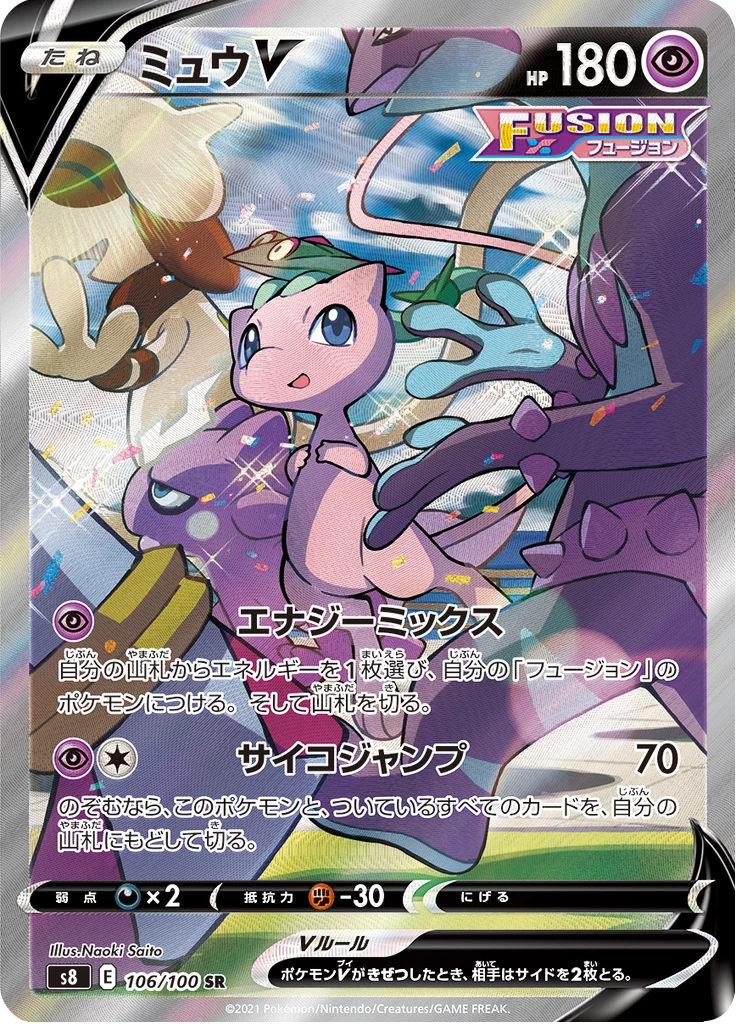
Mew V — Special Art (SA), #106/100

Mew V Special Art card, S8 Fusion Arts 106/100, Secret Rare
Mew V, Special Art (SA), S8 Fusion Arts #106/100, Secret Rare

The Special Art printing at 106/100 carries the illustrated full-scene treatment that separates it from the set’s regular Secret Rare cards. This single is not currently listed on our site — sourcing requests go through Commande rapide.

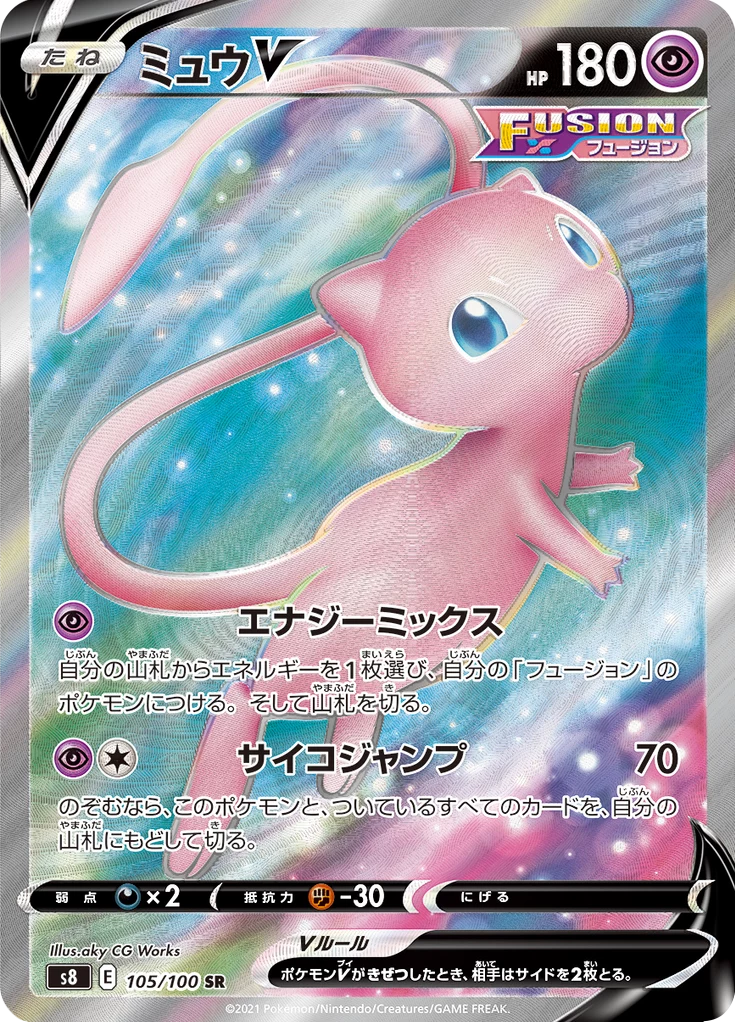
Mew V — Regular, #105/100

Mew V regular full-art card, S8 Fusion Arts 105/100, Secret Rare
Mew V, regular full-art printing, S8 Fusion Arts #105/100, Secret Rare

Card 105 is the non-SA Secret Rare printing of the same Mew V — a full-art card in its own right, one slot ahead of the SA version in the set’s numbering. This single is also not currently listed on our site.

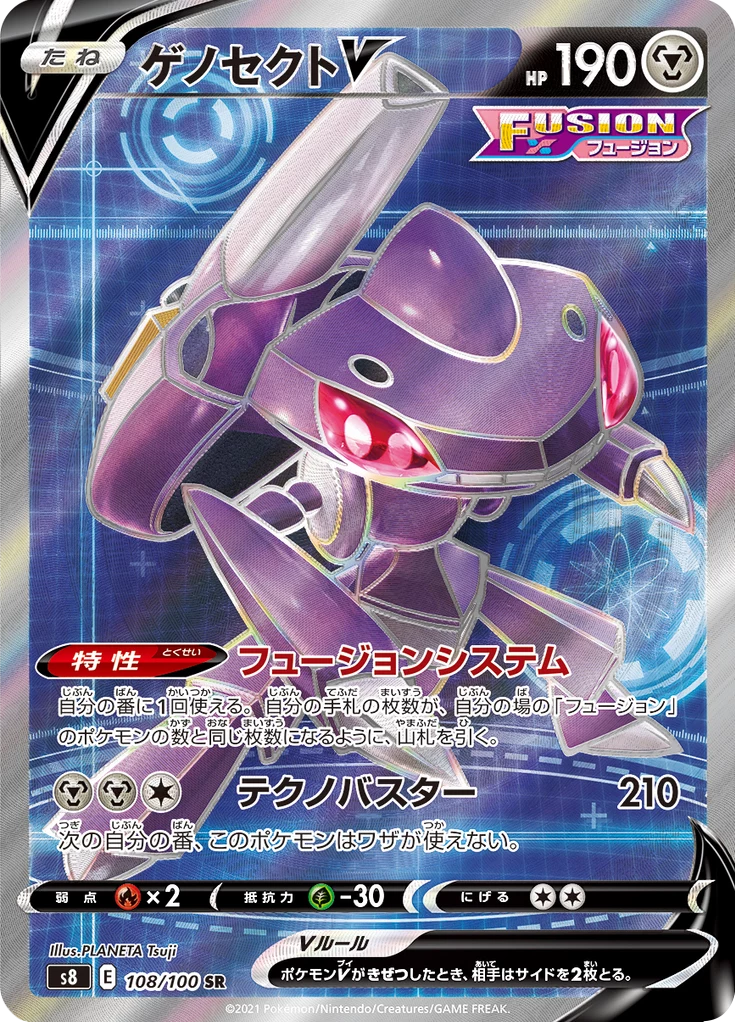
Genesect V — #108/100 & #109/100

Genesect V card, S8 Fusion Arts 108/100, Secret Rare
Genesect V (ゲノセクトV), S8 Fusion Arts #108/100, Secret Rare

Genesect V occupies two Secret Rare slots, 108 and 109 — both confirmed directly against Limitless TCG’s card database under the same Japanese name (ゲノセクトV). These two treatments sit in the same secret-numbered range as the Mew V pair.

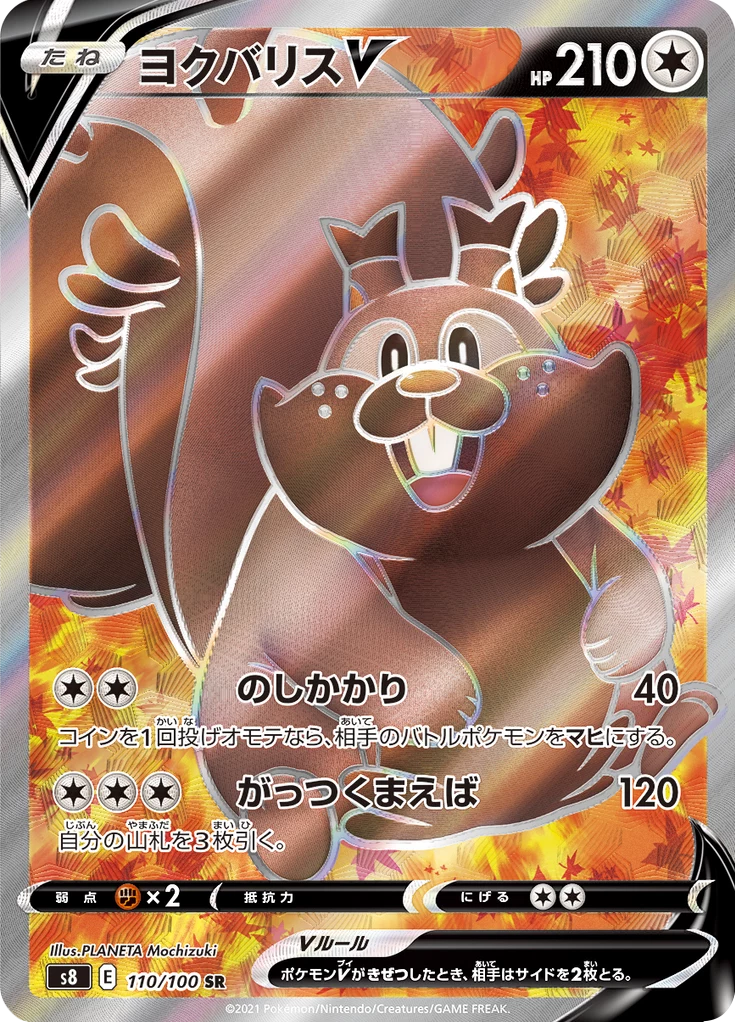
Greedent V — #110/100 & #111/100

Greedent V card, S8 Fusion Arts 110/100, Secret Rare
Greedent V (ヨクバリスV), S8 Fusion Arts #110/100, Secret Rare

Like Genesect V, Greedent V also fills two Secret Rare numbers, 110 and 111. It’s another two-slot entry in the secret-numbered range, confirmed against Limitless under its Japanese name (ヨクバリスV).

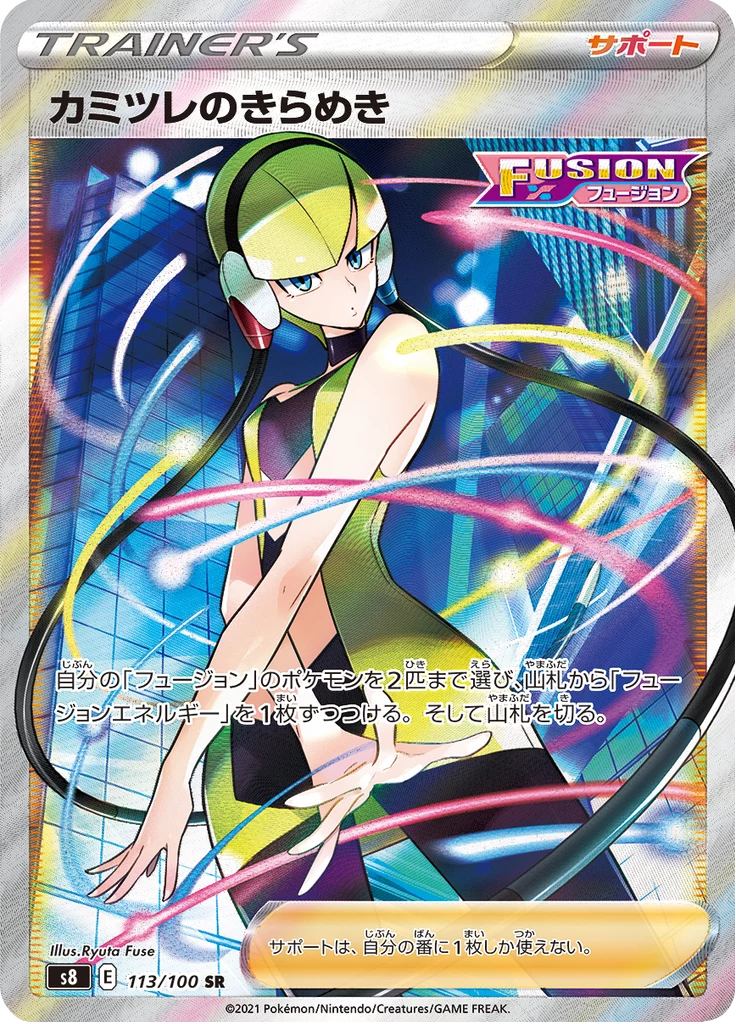
Elesa’s Sparkle — SR, #113/100

Elesa's Sparkle Secret Rare Supporter card, S8 Fusion Arts 113/100
Elesa’s Sparkle (カミツレのきらめき), Secret Rare, S8 Fusion Arts #113/100

Elesa’s Sparkle is one of the Supporter cards in the secret-numbered range. It sits alongside the two Mew V, Genesect V, and Greedent V treatments shown here.

Regular Box vs Damaged Box vs No Shrink on Our Site

We list booster boxes in a few condition categories, and it’s worth knowing what each one means before you order. Per our own definition: « Damaged Box » is a condition category we use for sealed booster boxes where the outer box — not the contents — is affected. The booster packs inside stay factory-sealed; what it does not mean is any change to the sealed contents. You’re still getting the same booster packs, in the same box count. Damaged Box pricing moves independently of the regular box listing and isn’t always cheaper.
« No Shrink » is a separate listing name we use on some product pages for boxes sold without the original shrink wrap — beyond that, it’s simply the name of that listing variant rather than a broader condition standard.
For Fusion Arts specifically, only the standard sealed box is currently listed on our site; there is no Damaged Box or No Shrink listing for S8 at the moment. If you’re specifically after one of those condition variants for this set, the Quick Order page is the way to flag it.

Japanese vs English Version of This Set

Fusion Arts’ English equivalent is Fusion Strike (set code swsh8), released November 12, 2021 — about seven weeks after the Japanese release. Fusion Strike is a much larger set at 284 cards, built by combining content sourced from multiple Japanese sets rather than being a direct one-to-one translation of Fusion Arts alone.

The Japanese Mew V Special Art at 106/100 corresponds to the English Mew V 251/264 in Fusion Strike, which carries the same illustration as an English Ultra Rare. The numbering and rarity labels differ between the Japanese and English releases.

Shop This Set
S8-Fusion Arts Japanese Pokemon Booster Box
Currently listed at ¥61,425 (~$386)
Ships from Tokyo · Tracked delivery

View Product →

Where to Buy a Fusion Arts Booster Box from Tokyo

We ship sealed Japanese product worldwide from Tokyo with tracked delivery. The S8-Fusion Arts Japanese Pokemon Booster Box is currently listed at ¥61,425 (~$386) and is the direct route to both Mew V slots, the Genesect V and Greedent V pairs, and Elesa’s Sparkle.

Neither the Mew V singles nor a Damaged Box or No Shrink variant of this set is currently listed — for any of those, or for a mixed order alongside other Japanese sets, the Quick Order page is the fastest route. Our full Pokemon card box collection covers other Japanese booster boxes we currently carry.

If you’re comparing Fusion Arts against other S-series sets, our S9 Star Birth pull rates and best cards guide covers the set that followed it, and the Blue Sky Stream (S7R) card list covers a sister S-series release from the same era.

Foire aux questions

What is the chase card in Fusion Arts (S8)?

This guide highlights Mew V Special Art #106/100. The other verified Mew chase print in Fusion Arts is Mew V #105/100.

Which Mew prints are verified in Fusion Arts?

The verified Mew chase prints are Mew V #105/100 and Mew V Special Art #106/100.

How many cards are in the Fusion Arts set?

The main set contains 100 cards, followed by secret-numbered cards above that main numbering. This guide does not state a combined total.

What’s the difference between a Regular box and a Damaged Box on your site?

A Damaged Box has cosmetic damage to the outer packaging only — the booster packs inside stay factory-sealed, and you receive the same packs in the same box count as the regular listing. Damaged Box pricing moves independently and isn’t always cheaper than the regular box.

Is there an English version of Fusion Arts?

Yes — Fusion Strike (swsh8), released November 12, 2021, about seven weeks after the Japanese Fusion Arts release. Fusion Strike is a larger 284-card set built from multiple Japanese sources. Japanese Mew V 106/100 corresponds to English Mew V 251/264, with different numbering and rarity labels.

How many packs and cards come in a Fusion Arts booster box?

A Fusion Arts box contains 30 packs of 5 cards each, at an official tax-included MSRP of ¥4,950. It’s a standard expansion box rather than a high-class pack.

Guide de la carte des inséparables Latias & Latios GX SA de Tag Bolt

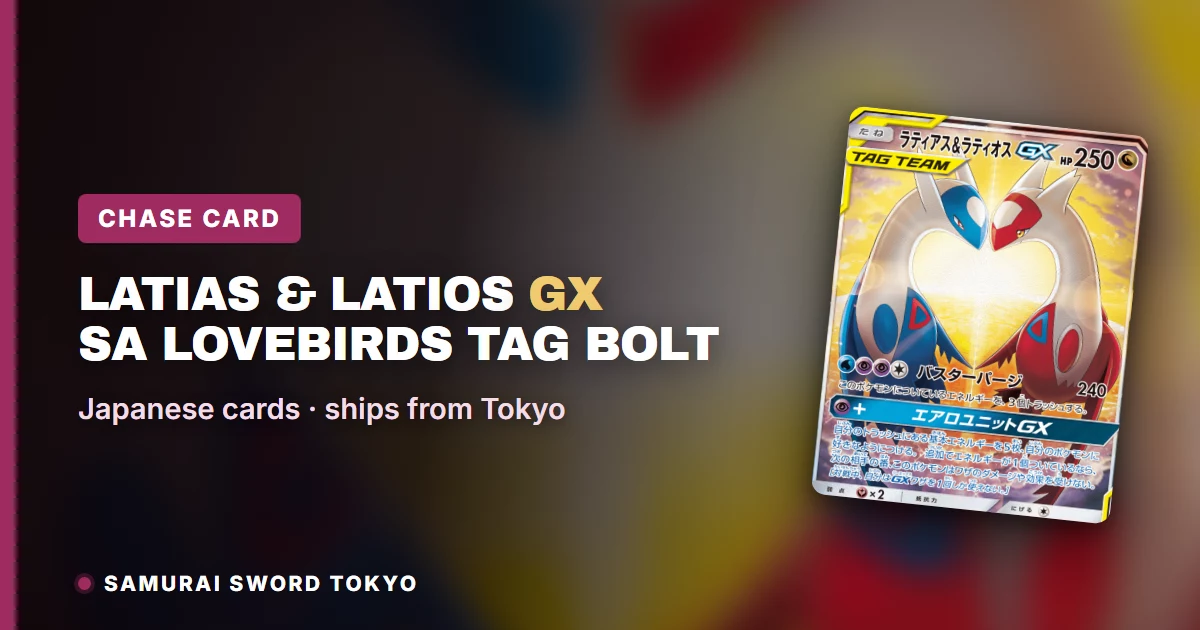
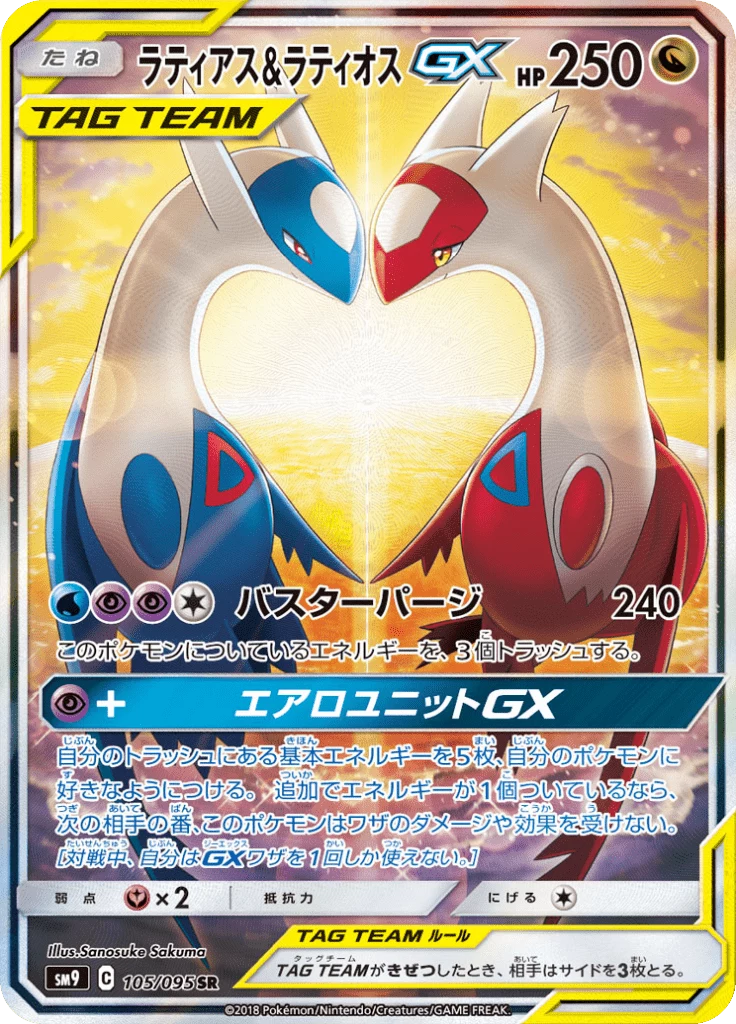
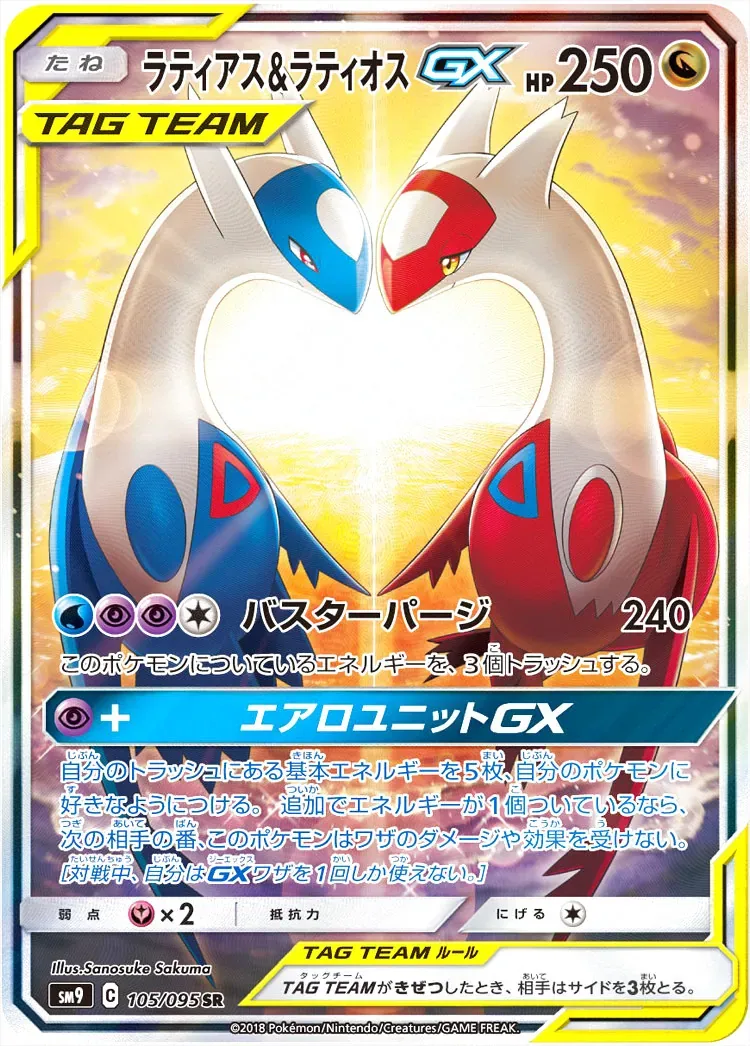
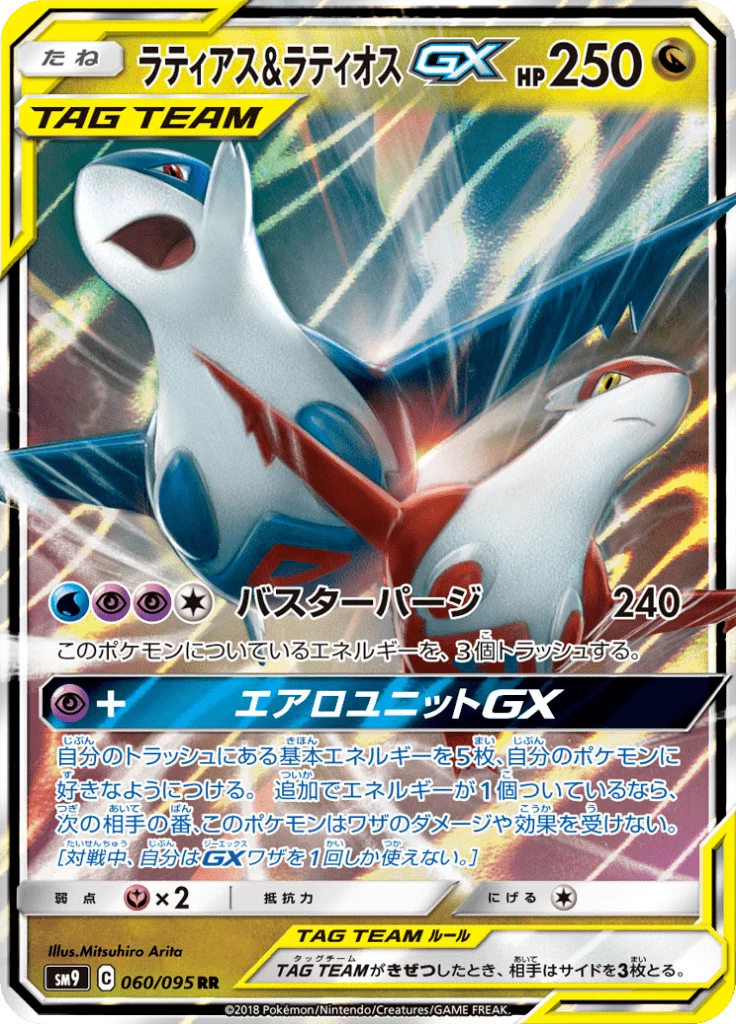
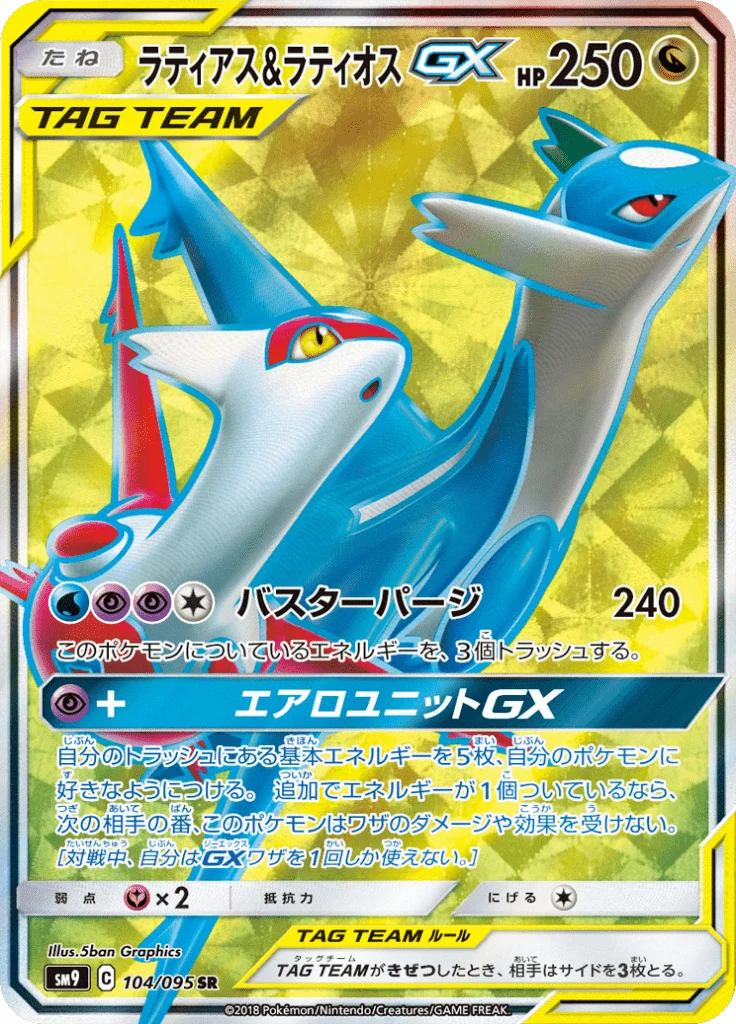
The Japanese Latias & Latios GX prints verified here are the 060/095 RR, 104/095 SR and 105/095 SR special art from Tag Bolt. The PSA 10 listing covered here is the 105/095 special-art print, currently listed above ¥1.3 million.

The card is ラティアス&ラティオスGX — Latias & Latios GX, No. 105/095, printed as a Secret Rare in the Japanese expansion pack 拡張パック「タッグボルト」/ Pack d'extension “Tag Bolt” (set code SM9), where our own catalogue lists it under the rarity tag SR: SA. We currently list a graded PSA 10 of this exact print, and this guide covers the card itself, how it compares to the two other verified Tag Bolt printings of the same Pokémon pair, where Tag Bolt sits in the wider Sun & Moon era, and how the Japanese release maps onto its English counterpart.

Key Takeaways

Latias & Latios GX 105/095 SR: SA is a PSA 10, currently listed at ¥1,321,516 (~$8,312). It comes from Tag Bolt (SM9), a Japanese Pack d'extension released 7 December 2018 with a 95-card main set and collector numbers extending through 118. Three Japanese prints of this card are verified here in Tag Bolt: 060/095, 104/095 and 105/095. If you want the sealed source product, the SM9-Tag Bolt Japanese Booster Box is where these prints originate.

250
HP

SR: SA
Rarity (105/095)

95
Main Numbering (SM9)

Dec 2018
Japan Release

Prices below are current samuraiswordtokyo.com listings, converted at ¥159/USD (September 2026).

The Card: Latias & Latios GX 105/095 SR: SA

Latias & Latios GX is a Basic, Dragon-type Tag Team card carrying 250 HP, weak to Fairy-type attacks, with a retreat cost of 1. It has one regular attack, バスターパージ / Buster Purge, which does 240 damage but discards three Energy from itself, and one GX attack, エアロユニットGX / Aero Unit GX, which attaches up to five Basic Energy from the discard pile and gives a damage-immunity bonus if an extra Energy card was attached during the same turn. As a Dragon-type Tag Team, it sits alongside the other Dragon-type Pokémon cards we’ve covered separately.

The 105/095 print is illustrated by Sanosuke Sakuma. Its position at #105 in an « 095 » set — a number past the set’s main numbered run — is the standard Japanese convention marking a card as a secret-slot print rather than part of the main count. Our own listing tags this specific print SR: SA to separate it from the set’s other Secret Rare treatment of the same card.

Latias & Latios GX 105/095 SR: SA, Tag Bolt (SM9)
Latias & Latios GX 105/095 SR: SA — Tag Bolt (SM9), illustrated by Sanosuke Sakuma

The graded PSA 10 listing for this print is currently ¥1,321,516 (~$8,312).

PSA 10 Latias & Latios GX SR:SA 105/095 slab, listed on samuraiswordtokyo.com
PSA 10 Latias & Latios GX SR: SA 105/095 slab, listed on samuraiswordtokyo.com

If you’re after the wider Latias & Latios story across multiple Japanese eras rather than this single Tag Bolt print, our Latias & Latios cards guide covers the pair across sets going back to their 2015 « Shine » singles. This article stays narrowly focused on the 105/095 SR: SA print and the two other verified Tag Bolt numbers it sits alongside.

The Set: Tag Bolt (SM9)

Tag Bolt — 拡張パック「タッグボルト」in Japanese — is set code SM9, a Japanese Pack d'extension released on 7 December 2018. Its main set contains 95 cards, while the secret and Hyper Rare collector numbers extend through 118. It belongs to the Sun & Moon era’s run of Tag Team GX sets, where two Pokémon share a single card, a mechanic also used for the listed Pikachu & Zekrom GX and the Gengar & Mimikyu GX we’ve covered separately. For the full Tag Bolt card list, see our Tag Bolt (SM9) card list.

SM9-Tag Bolt Japanese Pokemon Booster Box, listed on samuraiswordtokyo.com
SM9 Tag Bolt Japanese Booster Box — the sealed source for the three verified Latias & Latios GX prints

Sealed SM9 product — where all three verified Latias & Latios GX prints originate — is listed as the SM9-Tag Bolt Japanese Pokemon Booster Box, currently at ¥441,000 (~$2,774). For a broader look at the set’s cards, our Tag Bolt guide covers the set more generally.

Japanese vs English Print

Latias & Latios GX does have an English-set equivalent, but the Japanese and English releases don’t split into the same number of treatments. The English set is Team Up (TEU), and it carries the card across four separate slots: a standard print at #113, a Full Art at #169, an Alternate Full Art at #170, and a Secret print at #190.

The English release has four treatments, while the Japanese prints verified here are 60/095 RR, 104/095 SR and 105/095 SR special art. The numbering and rarity labels do not map one-to-one, so compare cards by artwork and rarity treatment rather than assuming the numbering lines up.

Where This SR: SA Sits Among Japanese Chase Rarities

Within Tag Bolt, the three Latias & Latios GX prints verified here sit on different parts of the set’s rarity structure: the regular numbered Double Rare at 60/095 and two Secret Rare treatments at 104/095 and 105/095. The 105/095 print is tagged SR: SA in our listing.

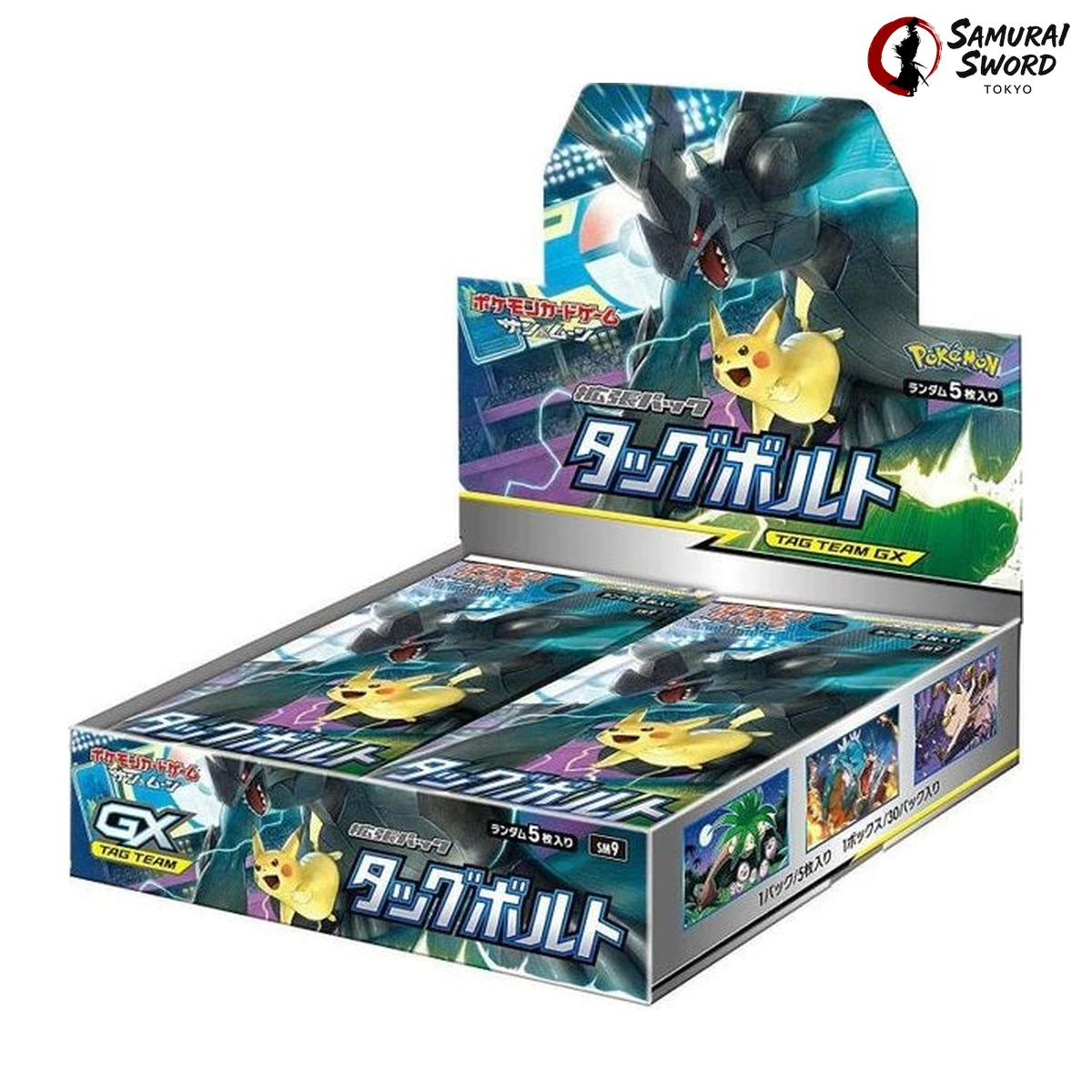
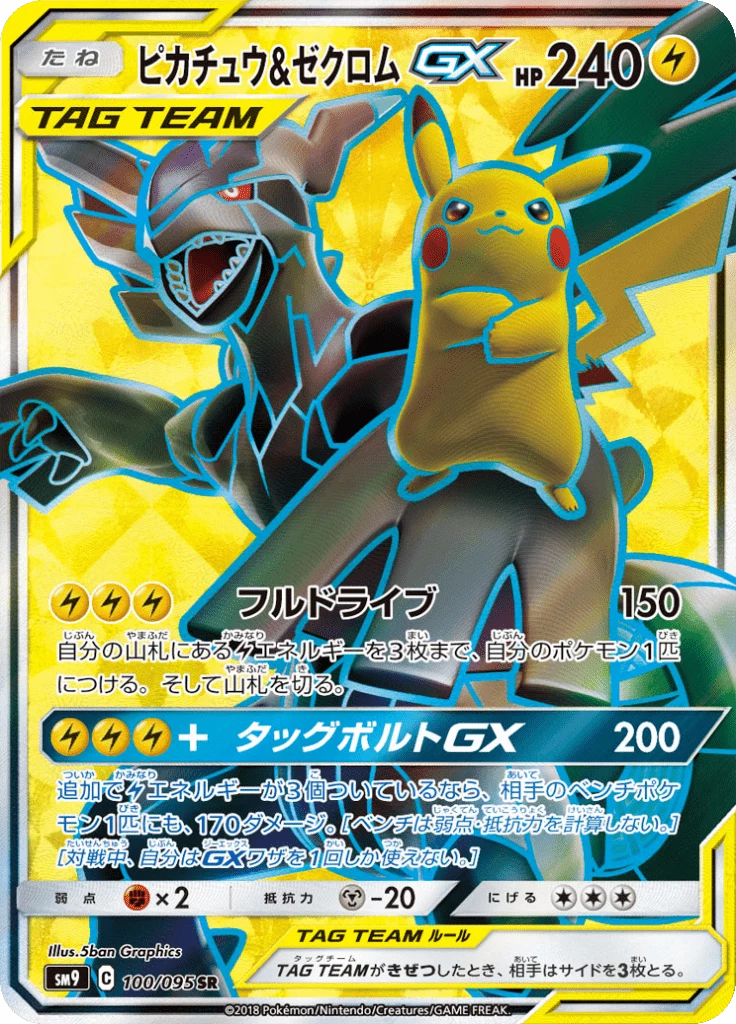
The same Tag Bolt set produced other Tag Team GX Secret Rares listed in PSA 10, including Pikachu & Zekrom GX SR 100/095, and a sibling single-card guide worth reading alongside this one is our Gengar & Mimikyu GX SA card guide — another SM9 Tag Team print at the same SA tier.

For the broader Tag Team GX category across sets, our Tag Team GX value roadmap places this SM9 trio in context against Tag Team GX prints from other Sun & Moon sets. For Latias’s and Latios’s individual print histories outside this Tag Team card, see our Latias card hub and Latios card hub.

Shop This Card
PSA10 Latias & Latios GX SR: SA 105/095 (Tag Bolt)
¥1,321,516 (~$8,312)
Ships from Tokyo · Tracked delivery

View Product →

Where to Buy Latias & Latios GX from Tokyo

The PSA 10 Latias & Latios GX 105/095 SR: SA is currently listed at ¥1,321,516 (~$8,312), shipped from Tokyo with tracked delivery. If you’d rather chase a print from sealed product, the SM9-Tag Bolt Japanese Booster Box is the source for the three Latias & Latios GX numbers verified here, currently listed at ¥441,000 (~$2,774).

For other Tag Team GX singles in the same PSA 10 tier, see PSA 10 Pikachu & Zekrom GX SR 100/095, or browse the full range in our PSA 10 graded card collection. Sealed Japanese boxes across other sets are collected in our Pokemon booster box collection. For a mixed order across singles and sealed product, our Quick Order page is the fastest way to build a cart.

Foire aux questions

What is Latias & Latios GX 105/095 SR: SA?

It’s the Secret Rare print of Latias & Latios GX (ラティアス&ラティオスGX) our listing tags SR: SA, card 105/095 from the Japanese Pack d'extension Tag Bolt (set code SM9), released 7 December 2018. The PSA 10 listing is currently ¥1,321,516 (~$8,312).

How many Japanese prints of Latias & Latios GX are there?

Three Tag Bolt prints are verified here: 60/095 (Double Rare), 104/095 (Secret Rare) and 105/095 (Secret Rare, SR: SA in our listing). All three released in Tag Bolt (SM9).

Does Latias & Latios GX have an English print?

Yes — Team Up (TEU) carries the card across four slots: a standard print at #113, a Full Art at #169, an Alternate Full Art at #170, and a Secret print at #190. These don’t map one-to-one onto the three Japanese prints verified here.

How is this different from the site’s other Latias & Latios guide?

Our Latias & Latios cards guide covers the pair broadly across multiple eras, including their 2015 « Shine » singles. This guide is a narrow deep dive on the Tag Bolt (SM9) Tag Team GX print alone, comparing the three numbers verified here.

What set is Latias & Latios GX from?

Tag Bolt, Japanese set code SM9, is an Pack d'extension released 7 December 2018 with a 95-card main set and collector numbers extending through 118, part of the Sun & Moon era’s Tag Team GX run.

Where can I buy a PSA 10 Latias & Latios GX from Tokyo?

The graded 105/095 SR: SA is currently listed at ¥1,321,516 (~$8,312) with tracked shipping from Tokyo. The sealed SM9 Tag Bolt booster box is also listed as the source product.

Guide de la carte Dresseur Ortega : la Secret Rare de SV8a Terastal Festival ex

Ortega (オルティガ) has one Japanese print verified for this guide: the Secret Rare numbered 189/187 in Terastal Festival ex (SV8a). The set search used for this guide returns the name once.

This guide covers that verified Japanese print: its effect, the set it comes from, how its number relates to the English-language card database, and other Terastal Festival ex cards. We currently list the sealed SV8a box; we don’t currently list a graded or single Ortega card.

Key Takeaways

The Japanese print verified for this guide is SV8a #189 from Terastal Festival ex, illustrated by Teeziro. The Terastal Festival ex box is currently listed at ¥17,510 (~$110). We don’t currently list a graded Ortega single — sourcing requests go through Commande rapide.

1
Confirmed JP Prints

Secret Rare
Ortega’s Rarity

237
Cards in SV8a

Dec 2024
Japan Release

Prices are our own listed prices as of September 2026, converted at ¥159/USD.

The Verified Ortega Secret Rare: SV8a #189

Ortega’s Japanese name is オルティガ, and the verified card is classified as a Trainer – Supporter. Its translated effect is: look at the opponent’s hand, choose 1 card from it, and return that card to the bottom of the opponent’s deck. The opponent may then draw a card. The print carries regulation mark G.

SV8a #189 — Terastal Festival ex

Ortega 189 Secret Rare Terastal Festival ex Japanese Pokemon Supporter card
Ortega, card 189, Secret Rare — Terastal Festival ex (SV8a), illustrated by Teeziro

Printed as a Secret Rare, card 189, in the high-class pack Terastal Festival ex (set code SV8a), with artwork credited to Teeziro. This is the print inside our currently listed Terastal Festival ex box.

Terastal Festival ex

SV8A Terastal Festival ex Japanese Pokemon Booster Box
SV8A-Terastal Festival ex Japanese Pokemon Booster Box — the set containing Ortega 189/187

The verified print comes from Terastal Festival ex (テラスタルフェスex), a Japanese high-class pack with the set code SV8a, officially released in Japan on December 6, 2024. The set totals 237 cards, with 50 Secret Cards spread across the SR, SAR, and UR tiers, and no AR cards. Ortega is printed as card 189/187 in the Secret Rare tier. Our full SV8a card list covers all 237 cards, and our Terastal Festival ex pull-rates and best-cards hub covers other cards from the set.

Japanese vs English Print

Limitless TCG maps the Japanese SV8a #189 print to Obsidian Flames (OBF) #190. Obsidian Flames released in English in August 2023, well before the SV8a print’s December 2024 Japanese release. Treat the OBF number as Limitless’s equivalence mapping, not as evidence that the prints launched together.

Chase Prints and What Makes Terastal Festival Collectible

Ortega’s Secret Rare sits inside a set that put 50 cards into its Secret Rare, Special Art Rare, and Ultra Rare tiers — a wide top end for a single high-class pack. A couple of the set’s other Secret Rare pulls give a sense of the range collectors are chasing alongside Ortega:

Umbreon Master Ball Mirror 092/187 Secret Rare Terastal Festival ex card

Umbreon Master Ball Mirror SV8a 092/187

Friends of Paldea 195/187 Secret Rare Terastal Festival ex card

Friends of Paldea SR SV8a 195/187

These two sit at different points in the set’s rarity structure: Friends of Paldea (195/187) is numbered above the base 187-card run, the same Secret Rare tier as Ortega’s #189. Umbreon Master Ball Mirror (092/187) is numbered inside the base run rather than above it — it’s a special reverse-holo foil treatment applied to a base-numbered card, not a numbered-above-the-set Secret Rare like Ortega or Friends of Paldea. Both are illustrated separately (Friends of Paldea SR is credited to Cona Nitanda), and both have PSA 10 examples currently listed on our site — useful reference points for where Ortega’s own Secret Rare sits within the set’s rarity structure, even though we don’t currently list a graded Ortega single itself.

Which Box to Open for an Ortega Secret Rare

The verified Ortega Secret Rare comes from SV8a. We list two versions of the Terastal Festival ex box:

Listing Our price
SV8A-Terastal Festival ex Japanese Pokemon Booster Box ¥17,510 (~$110)
SV8A-Terastal Festival ex Japanese Pokemon Booster Box – Damaged Box ¥19,200 (~$121)

The standard SV8a box is currently listed at ¥17,510 (~$110). Our Damaged Box listing — sealed product with cosmetic box damage only, noted on the listing itself, with no effect on the cards inside — is currently listed at ¥19,200 (~$121); check the individual listing for the specific damage described before ordering. For the full pack and box structure, see our Terastal Festival ex booster box buying guide. For comparisons, see our SV9a vs SV8a box guide and Pokemon 151 vs Terastal Festival box guide.

Shop This Set
SV8A-Terastal Festival ex Japanese Pokemon Booster Box
Currently listed at ¥17,510 (~$110)
Ships from Tokyo · Tracked delivery

View Product →

Where to Buy Ortega Cards from Tokyo

We ship Japanese sealed product and graded singles out of Tokyo with tracked delivery. We don’t currently list a graded or single Ortega card — sourcing requests go through our Quick Order page. The SV8a box and two graded cards from the same set have current listings below.

PSA 10 Umbreon Master Ball Mirror SV8a 092/187, listed on samuraiswordtokyo.com
PSA 10 Umbreon Master Ball Mirror, SV8a 092/187 — currently listed at ¥32,560 (~$205)
PSA 10 Friends of Paldea SR SV8a 195/187, listed on samuraiswordtokyo.com
PSA 10 Friends of Paldea SR, SV8a 195/187 — currently listed at ¥7,986 (~$50)

For sealed product, see the currently listed SV8a booster box and Damaged Box. Our wider Pokemon booster box collection and PSA 10 graded card collection cover other listings. For more Terastal Festival ex cards, see our Prismatic Evolutions chase cards guide. Other sourcing requests go through Commande rapide.

Foire aux questions

How many Ortega cards exist in the Japanese Pokemon TCG?

This guide verifies one Japanese Ortega print: Secret Rare 189/187 from Terastal Festival ex (SV8a), illustrated by Teeziro.

What does the Ortega Secret Rare card do?

Look at the opponent’s hand, choose 1 card from it, and return that card to the bottom of the opponent’s deck. The opponent may then draw a card. It’s a Trainer – Supporter card with regulation mark G.

Is there an English print of Ortega?

Limitless TCG maps Japanese SV8a #189 to Obsidian Flames (OBF) #190. The English set released in August 2023, before the SV8a print’s December 2024 release, so this is an equivalence mapping rather than a matched release window.

When did the Ortega set release, and how big is it?

Terastal Festival ex (SV8a) released on December 6, 2024, and totals 237 cards, including 50 Secret Cards across the SR, SAR, and UR tiers, and no AR cards.

Where can I get a graded or single Ortega card?

We don’t currently list a graded or single Ortega card. Sourcing requests go through our Quick Order page. The SV8a Terastal Festival ex booster box containing the verified print is currently listed on our site.

Guide des cartes Pokémon japonaises Scorbunny : toutes les éditions et le SV7 Stellar Miracle Box

Scorbunny’s Japanese card history is short compared to most starters, but it is not thin — a search on Limitless TCG for pokemon:scorbunny returns 15 Japanese prints spread across ten different sets, from the Shield expansion and V Starter Decks through to the 2025–26 M-series. This guide covers the five most fully documented of those prints, including the one currently sitting inside a Japanese booster box currently listed on our site.

Scorbunny is a Fire-type Basic Pokémon — ヒバニー in Japanese — that evolves into Raboot and then Cinderace. Its Japanese prints span the Shield expansion, the V Starter Decks line, the Shiny Star V high-rarity set, a 2025–26 M-series battle collection, and the current Scarlet & Violet-era Stellar Miracle (SV7) set, released in Japan on 19 July 2024. For a wider look at all three Galar starters together, see our Galar starters cards guide, which also covers Inteleon VMAX; this article goes deeper on Scorbunny alone, covering the prints verified in detail.

Key Takeaway

Fifteen Japanese Scorbunny prints exist across ten sets, but only five have documented illustrator, HP and rarity-context data in this guide: Shield (S1H), V Starter Decks (SD), Shiny Star V (S4a), the M-series Battle Collection (MC), and the current Stellar Miracle (SV7) anchor print. No graded or single Scorbunny card is currently listed on our site — the direct route is the SV7 Stellar Miracle Japanese Booster Box, currently listed at ¥9,984 (~$63), or its Damaged Box variant at ¥11,520 (~$72).

15
JP Prints Found (Limitless)

10
Sets Featured In

3
Eras Spanned

1
Box Listed (SV7)

The Japanese Scorbunny Cards Verified in This Guide

Limitless TCG’s search lists 15 total Japanese Scorbunny prints across M1L, MC (two prints), S1H, S4a (two prints), S6H, SAr, SD, SI, SP (four prints) and SV7. Of those, five have been individually checked for illustrator, HP and rarity context for this guide:

Set / No. Rarity / context Illustrator HP Set name
SV7/16 Common Cona Nitanda 70 Stellar Miracle (SV7), 2024
S1H 7/060 Common kirisAki 60 Shield (S1H)
SD 16 Starter deck exclusive kirisAki 60 V Starter Decks (SD)
S4a 22 Shiny Star V context (rarity not documented on source page) kirisAki 60 Shiny Star V (S4a)
MC 137 Battle Collection print (rarity not documented on source page) Cona Nitanda 70 Starter Decks 100 Battle Collection (MC)

Two clusters show up in that table. The three Sword & Shield-era prints — Shield, V Starter Decks and Shiny Star V — all carry 60 HP and are illustrated by kirisAki. The two newer prints — the M-series Battle Collection card and the SV7 Stellar Miracle anchor — both carry 70 HP and are illustrated by Cona Nitanda. That split lines up with a broader artwork refresh between the Sword & Shield era and the sets that followed it.

The remaining ten prints — in M1L, S6H, SAr, SI, the four SP prints, plus the second S4a print and the second MC print — appear in the Limitless search results but have not been individually checked for this guide, so we’re not stating specifics for them here.

Check This First

Look at the printed HP. 60 HP puts your card in the Sword & Shield-era, kirisAki-illustrated group (S1H, SD, S4a). 70 HP puts it in the newer, Cona Nitanda-illustrated group (MC, SV7).

The Sword & Shield Era: Scorbunny’s Early Japanese Prints

Scorbunny’s earliest documented Japanese prints in this guide come from the Sword & Shield generation, including the Shield expansion and the V Starter Decks line.

Scorbunny S1H 7/060 Common, Shield

Scorbunny S1H 7/060, Common, Shield

Scorbunny SD 16 starter deck exclusive, V Starter Decks

Scorbunny SD 16, starter deck exclusive, V Starter Decks

Scorbunny S4a 22, Shiny Star V

Scorbunny S4a 22, Shiny Star V

Shield (S1H) 7/060 is a Common, kirisAki-illustrated print from the Shield expansion. It is distinct from the preconstructed V Starter Decks product covered next.

V Starter Decks (SD) 16 is a starter-deck-exclusive print, also illustrated by kirisAki at 60 HP. Starter-deck exclusivity is a distribution note rather than a named rarity tier — the card wasn’t sold in booster packs, only inside the preconstructed deck product.

Shiny Star V (S4a) 22 sits inside Shiny Star V’s shiny-rare-heavy checklist. The Limitless source page for this card doesn’t display an explicit rarity code, so we’re not stating one as fact — what’s confirmed is the illustrator (kirisAki) and HP (60).

The M-Series Return: Starter Decks 100 Battle Collection

Scorbunny MC 137, Starter Decks 100 Battle Collection, 2025-26 M-series
Scorbunny MC 137, Starter Decks 100 Battle Collection (MC), 2025–26 M-series

After the Sword & Shield era, Scorbunny’s next documented Japanese print is card 137 of the Starter Decks 100 Battle Collection (MC), part of the 2025–26 M-series. Illustrated by Cona Nitanda at 70 HP, this print sits inside a battle-collection product rather than a mainline booster set. As with S4a 22, the Limitless source page for this card doesn’t display an explicit rarity code, so we’re treating that detail as unverified rather than stating a specific tier.

Scarlet & Violet Era: The SV7 Stellar Miracle Anchor Print

Scorbunny SV7 16, Common, Stellar Miracle
Scorbunny SV7/16, Common, Stellar Miracle — illustrated by Cona Nitanda

SV7/16 is the Scorbunny print inside the current mainline Scarlet & Violet-era set covered in this guide, a Common card in Stellar Miracle (SV7), officially released in Japan on 19 July 2024. Note that the Starter Decks 100 Battle Collection (MC) print covered above belongs to the newer 2025–26 M-series, so SV7/16 is not Scorbunny’s most recent print overall — it’s illustrated by Cona Nitanda and carries 70 HP, matching the M-series Battle Collection print rather than the earlier Sword & Shield-era group.

Stellar Miracle itself runs 135 total cards: 102 base-set numbers plus 33 secret-slot cards (12 AR, 12 SR, 6 SAR and 3 UR). Scorbunny’s own print sits in the base-set Common range, not among those higher secret-slot tiers — see the full breakdown in our Stellar Miracle (SV7) card list. The English-language equivalent set is Stellar Crown (SCR), where Scorbunny is card #26 — covered in our Stellar Crown Japanese card list cross-reference.

Chase Prints and What Makes Them Collectible

None of the five Scorbunny prints documented in this guide sit at the top of their set’s rarity ladder. The SV7/16 and S1H 7/060 prints are both plain Commons; the S4a and MC prints have unverified rarity codes but nothing suggesting a secret-slot placement; and the SD print’s distinguishing feature is starter-deck exclusivity, a distribution trait rather than a printed rarity tier.

That’s a useful data point on its own: Scorbunny hasn’t (at least among the prints verified here) been given an Art Rare, Super Rare, Special Art Rare or Ultra Rare treatment the way some other Pokémon get in the same sets. Stellar Miracle’s own 33-card secret-slot range (AR/SR/SAR/UR) belongs to other Pokémon in that set, not to Scorbunny’s own Common print. If you’re after Stellar Miracle’s higher-tier chase cards generally, our Stellar Miracle pull rates and best cards guide covers that side of the set.

For collectors specifically chasing Scorbunny, the more meaningful distinctions in this print run are illustrator (kirisAki vs Cona Nitanda), distribution channel (starter deck vs booster pack), and set era — not a rarity-tier hierarchy.

Which Japanese Box to Open for Scorbunny

Of the ten sets carrying a Scorbunny print, only Stellar Miracle (SV7) has sealed product on our site right now, containing the SV7/16 Common print covered above.

SV7 Stellar Miracle Japanese Booster Box, listed on samuraiswordtokyo.com
SV7 Stellar Miracle Japanese Booster Box, the source box for the Scorbunny SV7/16 print

The SV7 Stellar Miracle Japanese Pokemon Booster Box is currently listed at ¥9,984 (~$63). A Damaged Box variant of the same set is also currently listed, at ¥11,520 (~$72), for buyers who don’t need mint outer packaging. If you’re weighing this set against its companion release, our SV7 vs SV7a box guide compares the two directly.

Shop This Set
SV7-Stellar Miracle Japanese Pokemon Booster Box
Currently listed at ¥9,984 (~$63) — contains the Scorbunny SV7/16 Common print
Ships from Tokyo · Tracked delivery

View Product →

For the other nine sets carrying a Scorbunny print — including Shield, V Starter Decks, Shiny Star V and the M-series Battle Collection — we don’t currently list sealed product or singles. Sourcing requests for those go through our Quick Order page.

Where to Buy Scorbunny Cards from Tokyo

We ship Japanese sealed product worldwide out of Tokyo with tracked delivery. For Scorbunny specifically, the SV7 Stellar Miracle Booster Box is the direct route to the current SV7/16 print, and the wider Japanese Pokemon booster box collection is worth browsing for what else is currently listed. Single and graded Scorbunny cards are not currently listed on our site; sourcing requests go through our Quick Order page.

Foire aux questions

How many Japanese Scorbunny Pokemon cards are there?

Limitless TCG’s search lists 15 Japanese Scorbunny prints across ten sets. This guide documents five of them in detail: Shield (S1H), V Starter Decks (SD), Shiny Star V (S4a), the M-series Battle Collection (MC), and Stellar Miracle (SV7).

What is the SV7 Stellar Miracle Scorbunny card?

SV7/16 is a Common Scorbunny print illustrated by Cona Nitanda at 70 HP, from Stellar Miracle (SV7), released in Japan on 19 July 2024. It’s the print inside the SV7 Stellar Miracle Japanese Booster Box we currently list.

Is there a rare or secret Scorbunny card in Japanese sets?

Not among the prints verified in this guide. SV7/16 and S1H 7/060 are both Commons, the SD print is a starter-deck exclusive rather than a named rarity, and the S4a and MC prints have rarity codes that aren’t documented on their source pages. None sit in a set’s secret-slot (AR/SR/SAR/UR) range.

What’s the difference between the Sword & Shield era and SV7 Scorbunny prints?

The Sword & Shield-era prints (Shield, V Starter Decks, Shiny Star V) are all 60 HP and illustrated by kirisAki. The newer prints (the M-series Battle Collection card and the SV7 Stellar Miracle anchor) are both 70 HP and illustrated by Cona Nitanda.

Where can I buy a Scorbunny card from Japan?

We ship Japanese sealed product from Tokyo with tracked delivery. The SV7 Stellar Miracle Booster Box, currently listed at ¥9,984 (~$63), is the direct route to the current Scorbunny print. For any of the other nine sets in this guide, or a graded single, request a quote via our Quick Order page.