Créez un compte gratuit pour cumuler points et rang
Samurai Sword Tokyo
Commandes Panier

Guide d'achat de la Booster Box Paradise Dragona (SV7a) : infos sur le set, chase cards et où l'acheter
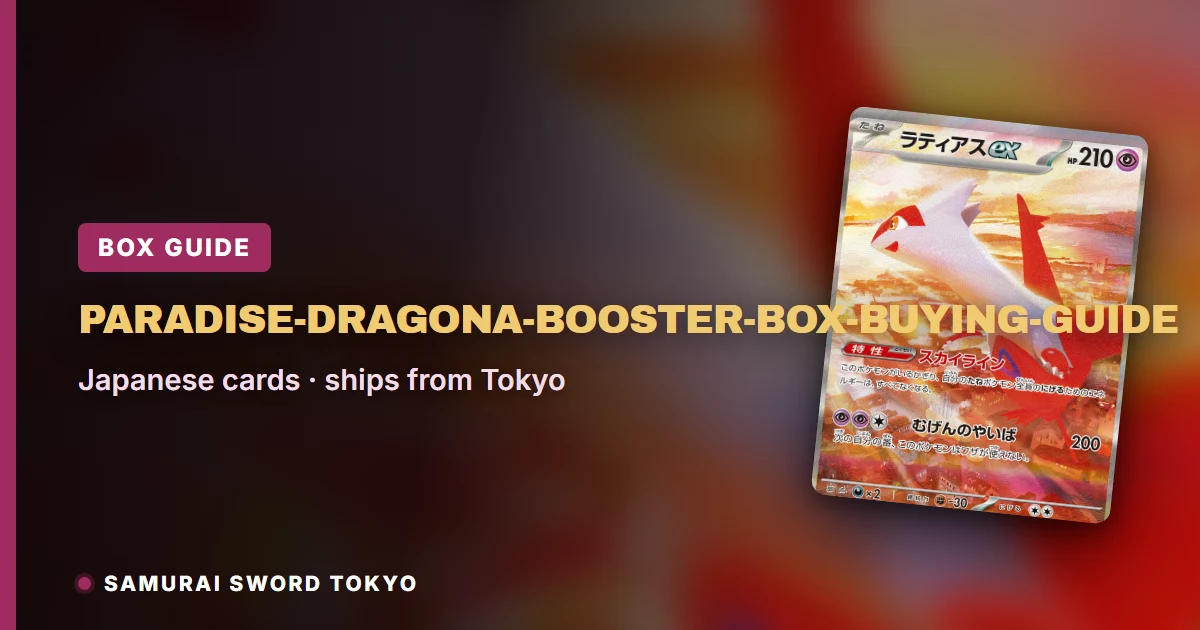
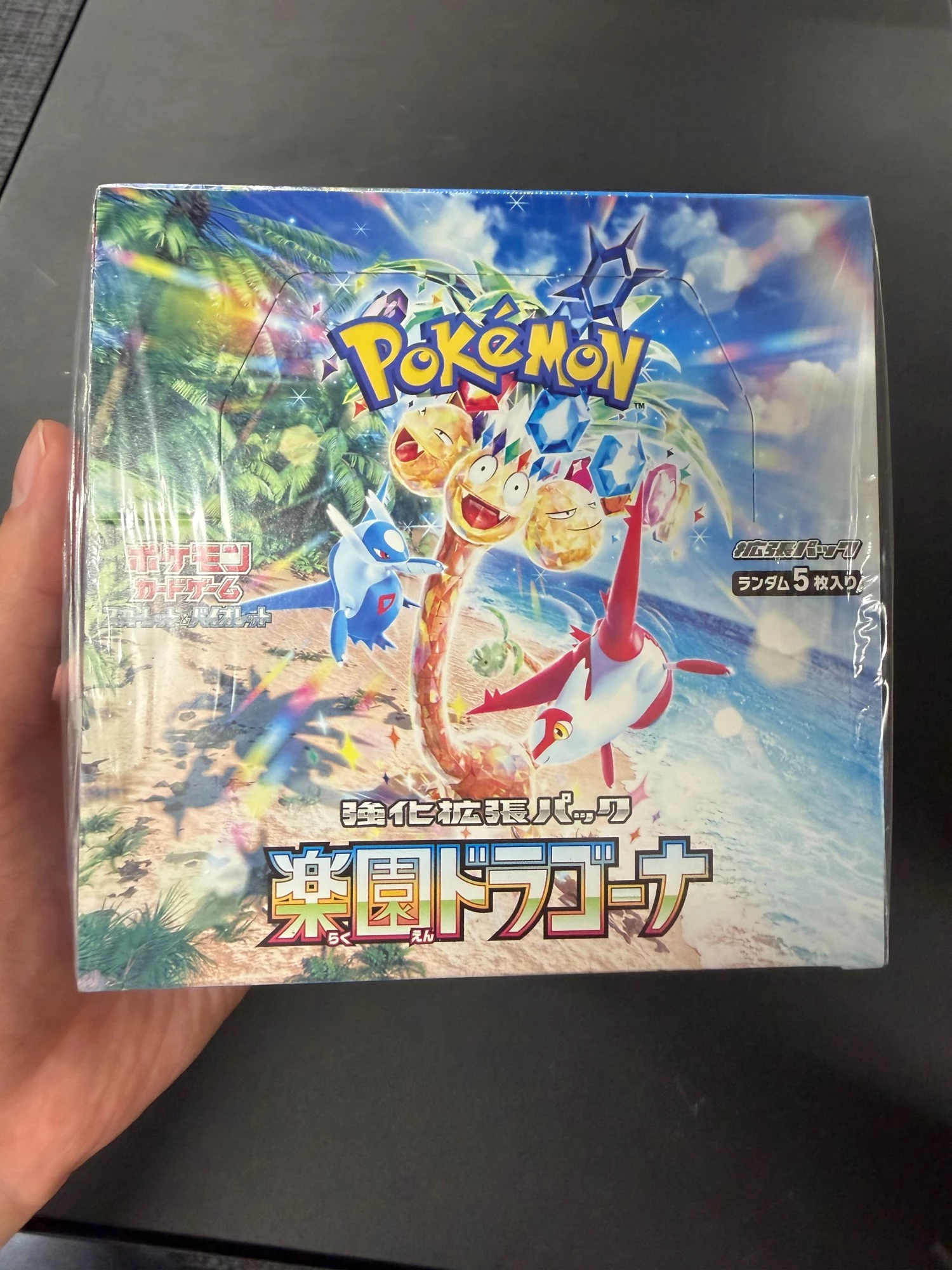
Paradise Dragona is one of the few Scarlet & Violet-era Japanese sets built around a Dragon-type headliner, and more than a year after release it’s still one of the boxes our international buyers ask about by name. If you’re deciding whether it’s worth opening, this guide covers exactly what’s in the box, which pulls define the set, and current listing prices on our site.

SV7a “Paradise Dragona” is an Pack d'extension amélioré in the Scarlet & Violet series, released in Japan on September 13, 2024. It runs 94 cards total — a 64-card main set plus a 30-card secret tier — and its headline pulls centre on Latias ex and the trainer card Lisia’s Appeal, both appearing in more than one rarity within the set.

We ship Japanese sealed product out of Tokyo with tracked delivery, and the pricing below reflects our current listings for this set.

Key Takeaway

Paradise Dragona (SV7a) is 94 cards — 64 main-set plus 30 secrets — released in Japan on September 13, 2024. Each box holds 30 packs of 5 cards. The regular SV7A-Paradise Dragona Japanese Pokemon Booster Box is currently listed at ¥14,040 (~$88), and the Damaged Box is currently listed at ¥15,840 (~$100) — higher than the regular listing, not lower.

94
Cards in Set

30
Packs per Box

5
Cards per Pack

Sep 2024
JP Release

Prices are our current listed prices as of September 2026, converted at ¥159/USD.

What’s in a Paradise Dragona Box

Paradise Dragona is an Pack d'extension amélioré in the Scarlet & Violet series, released in Japan on September 13, 2024. The set totals 94 cards: a 64-card main set plus a 30-card secret tier, which is where the set’s Special Art Rare (SAR) headliners sit.

Article Value
Code de série SV7a
Pack type Pack d'extension amélioré
JP release date September 13, 2024
Total cards in set 94 (64 main-set + 30 secret)
Cards per pack 5
Packs per box 30

At 5 cartes par pack and 30 packs per box, a full box works out to 150 cards. We’re not publishing pull-rate figures here — the box/pack structure above is confirmed, but how often any individual secret shows up per box isn’t something we state as fact. If you want that side of the picture, our own Paradise Dragona pull rates and best cards guide covers it separately, and the full 94-card list is on its own page.

Within the 30-card secret tier, there are 5 Special Art Rare (SAR) slots — the tier that carries the set’s headline chase cards.

Chase Cards in Paradise Dragona

Five numbered prints across three named chase cards anchor the set’s SAR/SR tier, plus two more cards named as headline pulls without a confirmed card number this session:
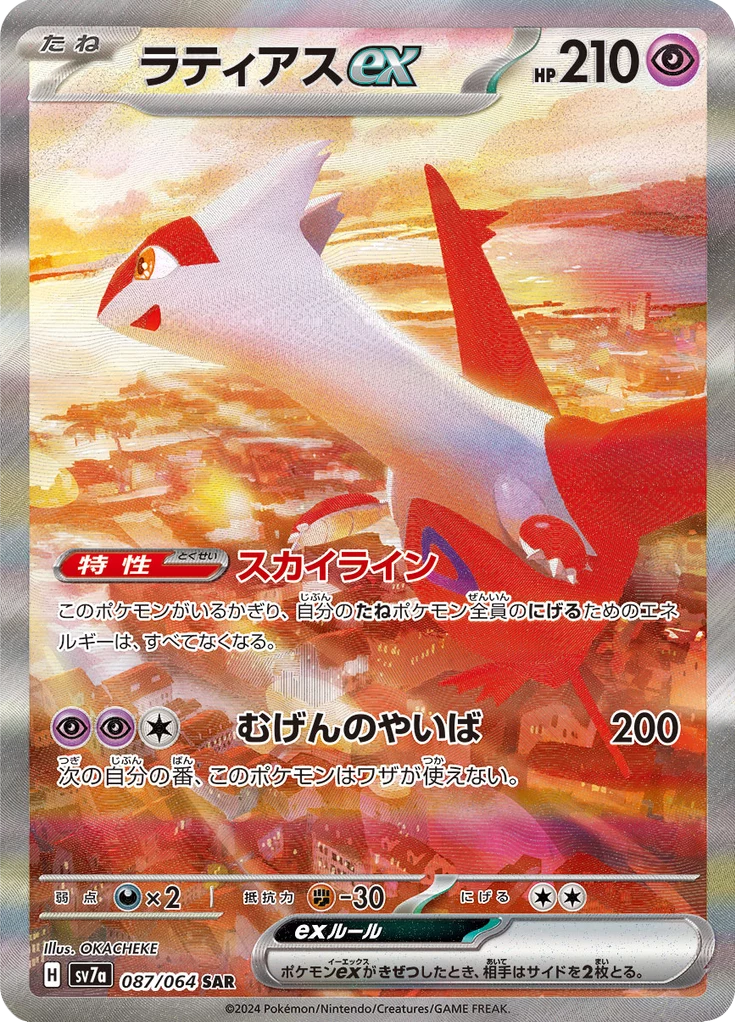
Latias ex 087/064 SAR Paradise Dragona SV7a Japanese card
Latias ex 087/064, Special Art Rare — Paradise Dragona (SV7a)

Latias ex 087/064 (SAR) is the set’s Dragon-type headliner and the card most closely tied to Paradise Dragona’s name. A second, lower-rarity print of the same Pokemon — Latias ex 078/064 — also appears in the set; we haven’t independently confirmed its exact rarity code this session, so we’re not labelling it here.
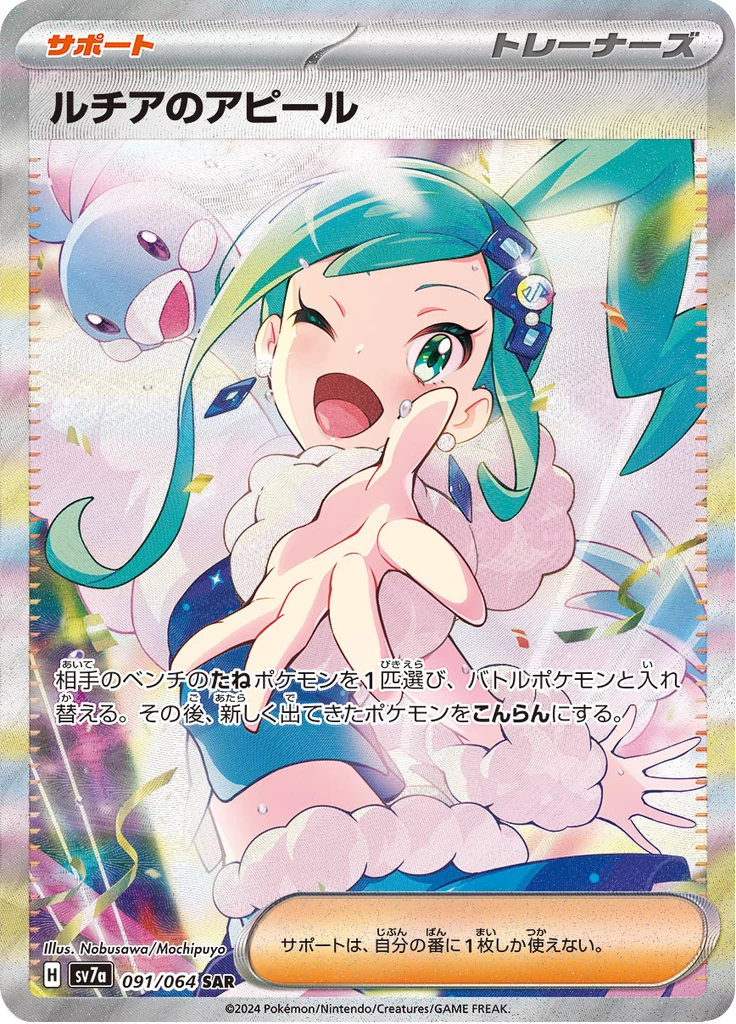
Lisia's Appeal 091/064 SAR Paradise Dragona SV7a Japanese card
Lisia’s Appeal 091/064, Special Art Rare — Paradise Dragona (SV7a)

Lisia’s Appeal 091/064 (SAR) is one of the set’s trainer-card secrets. The same trainer card also has a lower-rarity print in the set:
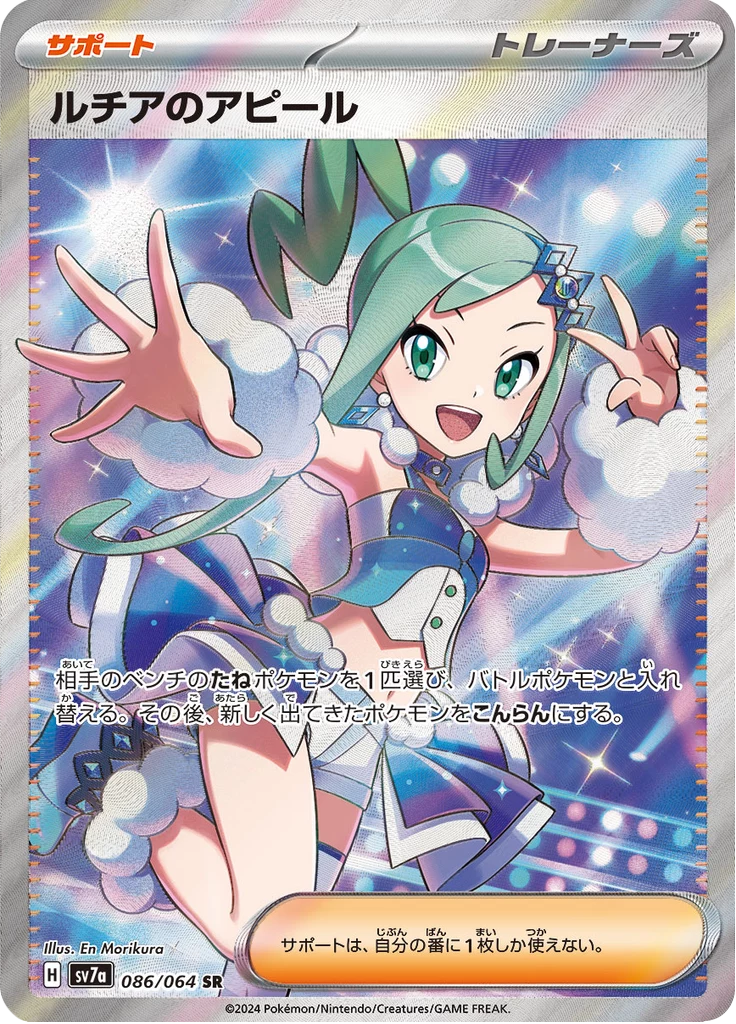
Lisia's Appeal 086/064 SR Paradise Dragona SV7a Japanese card
Lisia’s Appeal 086/064, Secret Rare — Paradise Dragona (SV7a)

Lisia’s Appeal 086/064 (SR) shares the same artwork subject as the 091/064 SAR at a lower rarity tier — the two prints are commonly discussed together for exactly that reason.
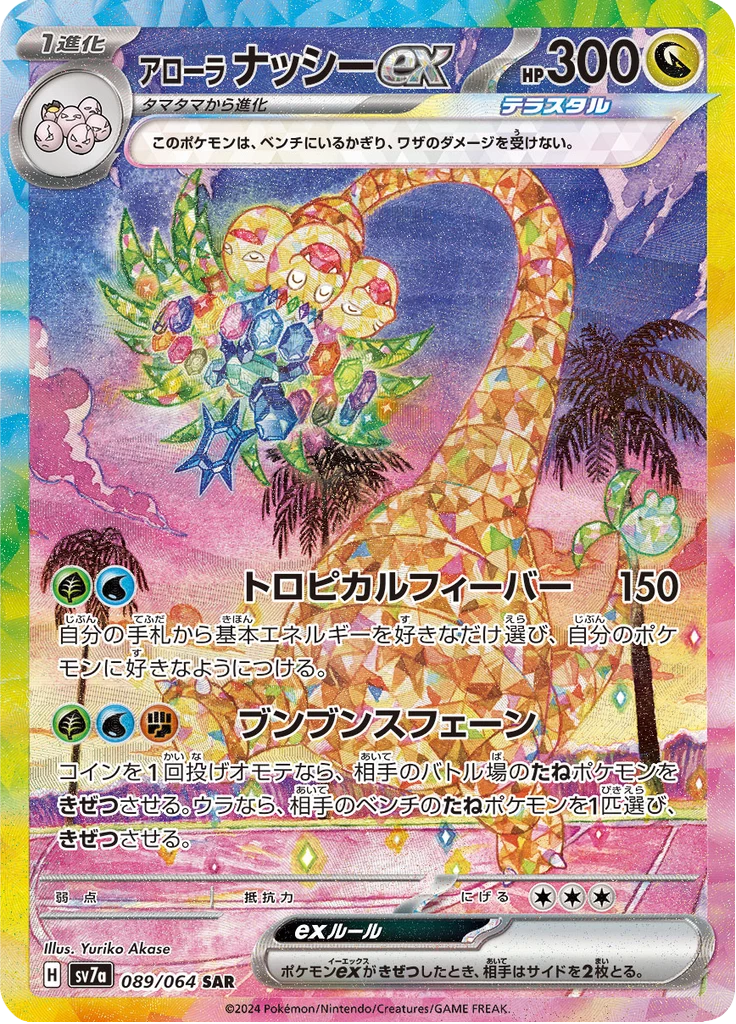
Alolan Exeggutor ex 089/064 SAR Paradise Dragona SV7a Japanese card
Alolan Exeggutor ex 089/064, Special Art Rare — Paradise Dragona (SV7a)

Alolan Exeggutor ex 089/064 (SAR) rounds out the set’s main SAR trio alongside the two Latias ex and Lisia’s Appeal prints above.

Two more names come up repeatedly as headline pulls for this set — Archaludon ex and Drayton, both cited at SAR tier — though we haven’t independently confirmed their exact card numbers this session. None of these singles are currently listed on our site; sourcing requests for any of them go through Commande rapide.

Regular Box vs Damaged Box on Our Site

We currently list Paradise Dragona sealed product in two forms:
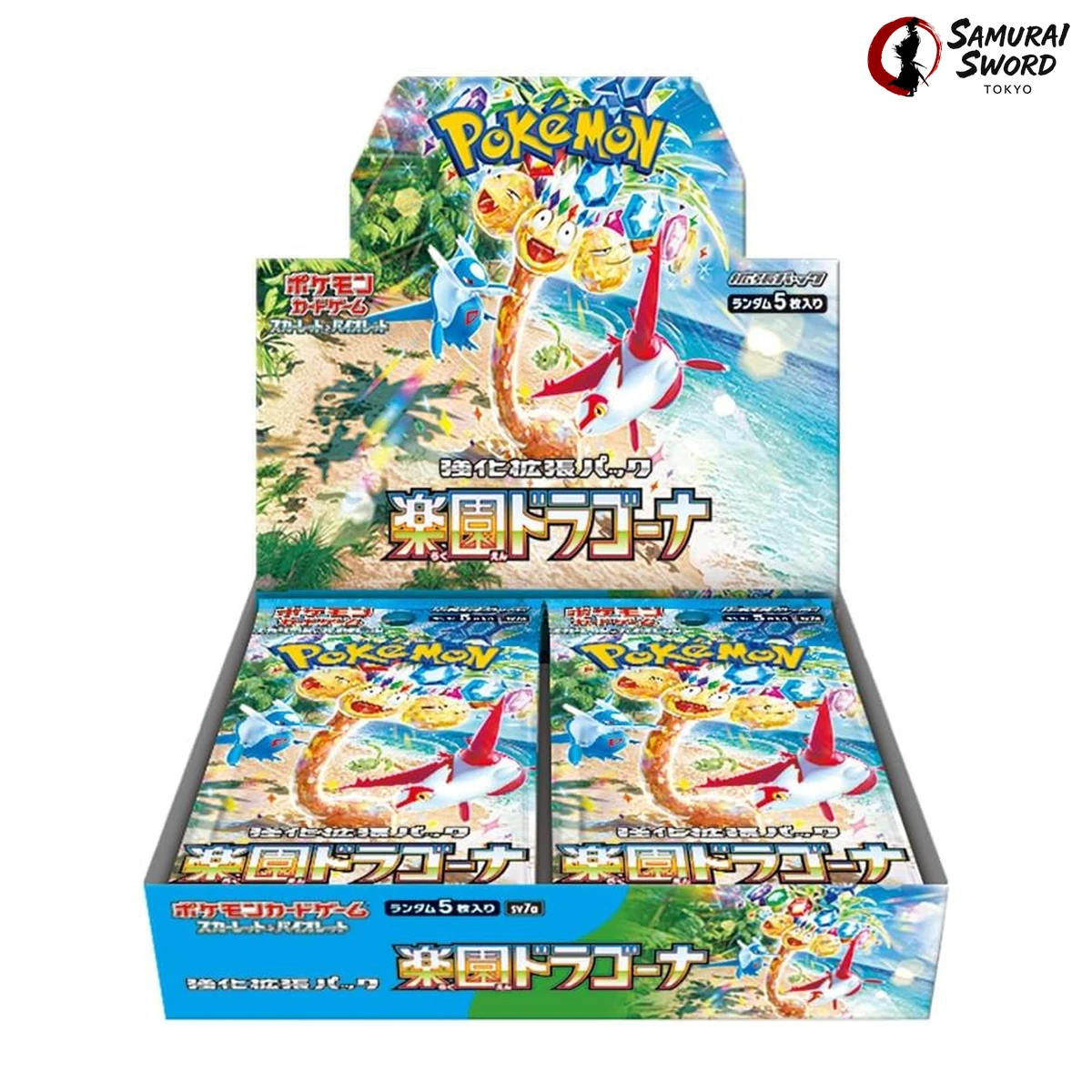
SV7A-Paradise Dragona Japanese Pokemon Booster Box regular product photo
SV7A-Paradise Dragona Japanese Pokemon Booster Box (regular)
Listing Prix
SV7A-Paradise Dragona Japanese Pokemon Booster Box currently listed at ¥14,040 (~$88)
SV7A-Paradise Dragona Japanese Pokemon Booster Box – Damaged Box currently listed at ¥15,840 (~$100)
SV7A-Paradise Dragona Japanese Pokemon Booster Box Damaged Box product photo
SV7A-Paradise Dragona Japanese Pokemon Booster Box — Damaged Box listing

Worth flagging directly: on this set, the Damaged Box is priced above the regular box, not below it. That’s not a universal rule across every set we carry, so it’s worth checking the current price on each listing rather than assuming Damaged Box automatically means cheaper. On our site, « Damaged Box » refers to the outer box packaging condition, not the cards inside — the sealed packs themselves are unaffected. We don’t currently have a No Shrink listing for this particular set.

Japanese vs English Version of This Set

Paradise Dragona has no standalone English-language set under its own name. Per our own set research, many of its cards connect through to Surging Sparks, the English-language set that also draws from SV8 Super Electric Breaker — the two Japanese sets feed into that one English release. We haven’t independently re-verified that card-by-card mapping this session, so treat it as a starting point rather than a confirmed one-to-one list.

If you’re comparing sibling sets, our Super Electric Breaker pull rates and best cards guide covers the other Japanese set that shares that English counterpart. And if you’re weighing Paradise Dragona against the earlier release in the same SV7 line, our SV7 vs SV7a box guide compares Stellar Miracle (SV7) against Paradise Dragona (SV7a) directly — that’s a head-to-head between the two boxes, separate from the single-set breakdown here.

Shop This Set
SV7A-Paradise Dragona Japanese Pokemon Booster Box
Currently listed at ¥14,040 (~$88)
Ships from Tokyo · Tracked delivery

View Product →

Where to Buy a Paradise Dragona Booster Box from Tokyo

We ship sealed Paradise Dragona boxes worldwide from Tokyo with tracked delivery. The regular SV7A-Paradise Dragona Japanese Pokemon Booster Box is the direct route to the SAR trio covered above — Latias ex, Lisia’s Appeal, and Alolan Exeggutor ex. If you’d rather source the box with a cosmetically marked outer package, the Damaged Box listing is the alternative — on this set it’s actually priced above the regular box, as noted earlier.

Browsing more broadly, our Pokemon booster box collection carries other Japanese sets side by side, including the sibling Super Electric Breaker release linked above. For singles not currently listed — including the SAR chases from this set — or to build a mixed order across multiple boxes, the Quick Order page is the fastest route.

Foire aux questions

What’s in a Paradise Dragona (SV7a) booster box?

Each box holds 30 packs of 5 cards, drawn from a 94-card set: 64 main-set cards plus a 30-card secret tier that includes 5 Special Art Rare slots.

What are the main chase cards in Paradise Dragona?

The set’s headline SAR-tier pulls are Latias ex (087/064), Lisia’s Appeal (091/064, with a lower-rarity Secret Rare print at 086/064), and Alolan Exeggutor ex (089/064). Archaludon ex and Drayton are also named as headline pulls, though their exact card numbers aren’t confirmed here.

Is the Damaged Box cheaper than the regular Paradise Dragona box?

Not on this set — the Damaged Box is currently listed at ¥15,840 (~$100), above the regular box’s ¥14,040 (~$88). « Damaged Box » refers to the outer packaging condition, not the sealed packs inside.

Is there an English version of Paradise Dragona?

There’s no standalone English set under this name. Per our own research, many of its cards connect through to the English Surging Sparks set, which also draws from the Japanese SV8 Super Electric Breaker release — we haven’t independently re-verified a full card-by-card mapping this session.

How many cards are in the Paradise Dragona set?

94 total — a 64-card main set plus a 30-card secret tier, released in Japan on September 13, 2024.

Where can I buy a Paradise Dragona booster box from Japan?

Our regular and Damaged Box listings are linked above and ship from Tokyo with tracked delivery. For singles or a mixed order across sets, use the Quick Order page.
SIR (Special Illustration Rare) expliquée : SAR vs SIR, japonais vs anglais

SIR stands for Special Illustration Rare, an English/international Pokémon TCG rarity that debuted with the Scarlet & Violet base set in March 2023 — a full-art alternate-artwork reprint of a Pokémon ex with an added glitter-foil layer, marked by a double gold star. Its Japanese cognate is SAR (Special Art Rare), but the two terms are not a clean one-to-one match: Bulbapedia is explicit that « these rarities don’t completely overlap. »

That last point trips up a lot of buyers, so this guide works through it directly — what SIR means, what SAR means, where they diverge, how AR and IR fit one tier below, and where the whole naming system actually started.

We ship Japanese sealed product and PSA 10 singles out of Tokyo, so the anchors below are all currently listed prints you can check against the definitions as you read.

Key Takeaways

SIR (English) and SAR (Japanese) are parallel terms, but per Bulbapedia they « don’t completely overlap, » so the specific card and set must be checked rather than assuming a guaranteed 1:1 match. AR/SAR debuted together in the Japanese high-class pack VSTAR Universe (s12a), home to the PSA10 Grant SAR, currently listed at ¥9,350 (~$59). For the sealed side of that same set, the VSTAR Universe booster box is currently listed at ¥30,870 (~$194).

2023
SIR Debut (English)

2022
AR/SAR Debut (Japan, reported)

4
Rarity Terms Compared

¥159
Per USD (Sept 2026)

Yen figures below convert at ¥159/USD (September 2026). Prices shown are our own listed prices on samuraiswordtokyo.com, not third-party market prices — check the linked listing for the current number before ordering.

What Does SIR Mean? Special Illustration Rare Explained

SIR (Special Illustration Rare) is an English/international-only Pokémon TCG rarity, introduced by The Pokémon Company International with the Scarlet & Violet base set in March 2023.

Per Bulbapedia’s Special Illustration Rare page, SIR cards are full-art alternate-artwork reprints of Pokémon ex — and, per the same source, « some supporter cards » can also carry the tier — with an added glitter-foil layer over the card face, typically showing the Pokémon in a natural setting rather than in battle. The symbol printed on English cards at this tier is a double gold star.

That symbol is the important part. SIR is a print-tier label describing a specific visual treatment (full art, glitter foil, natural-setting illustration) applied to a specific category of card (Pokémon ex, occasionally Supporters) — it is not a description of how many were printed, and this guide won’t make that claim.

SAR: The Japanese Cognate — Not a Perfect Match

SAR (Special Art Rare / スペシャルアートレア) is the Japanese cognate, but Bulbapedia is explicit that « these rarities don’t completely overlap » between the two markets. Check the specific card and set rather than treating SAR and SIR as guaranteed interchangeable labels.

In practice, that means you can’t assume every Japanese full-art Pokémon ex card with a glitter-foil, natural-setting illustration is stamped SAR. The label depends on which set era it came from, and on the Pokémon’s game mechanic, not purely on how the card looks. Our Miriam card guide and N’s Zoroark ex card guide both work through this exact SIR-vs-SAR distinction on individual cards, if you want to see it applied to a specific print.

SIR and SAR Are Not Interchangeable

Treat « SIR » and « SAR » as parallel terms in two different markets — not as a guaranteed 1:1 translation. Check the specific card and set before applying either label.

AR vs IR: The One-Star Tier Beneath SIR/SAR

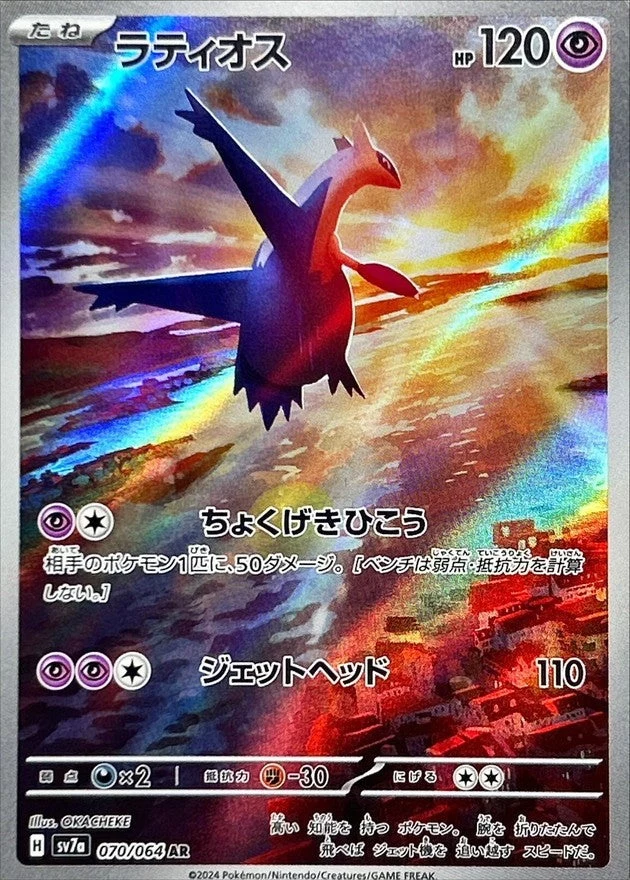
Latios 070/064 AR
Latios 070/064, AR (Art Rare) — currently listed at ¥10,571 (~$66)

One tier below SIR/SAR sits AR (Art Rare / アートレア), the Japanese cognate of the English IR (Illustration Rare). AR/IR cards are full-art holographic reprints of Common, Uncommon or Rare Pokémon — not ex Pokémon — often illustrating a full evolutionary line in one continuous piece of art by a single illustrator. The English-market symbol for this tier is a single gold star, one star short of SIR’s double.

The distinction is made at the individual card level: AR/IR applies to the Common, Uncommon or Rare Pokémon treatments described above, while SIR/SAR applies to Pokémon ex or, on some cards, Supporters. It is not determined by whether the final stage of an illustrated evolution line is a Pokémon ex.

English term Japanese cognate English symbol What it depicts
IR (Illustration Rare) AR (Art Rare / アートレア) Single gold star Full-art holo reprint of a Common/Uncommon/Rare Pokémon, often a full evolution line, one artist
SIR (Special Illustration Rare) SAR (Special Art Rare / スペシャルアートレア) — not a full 1:1 match, see above Double gold star Full-art alt-art reprint of a Pokémon ex (or some Supporter cards), added glitter-foil layer, natural setting

Where AR and SAR Began: VSTAR Universe (s12a)

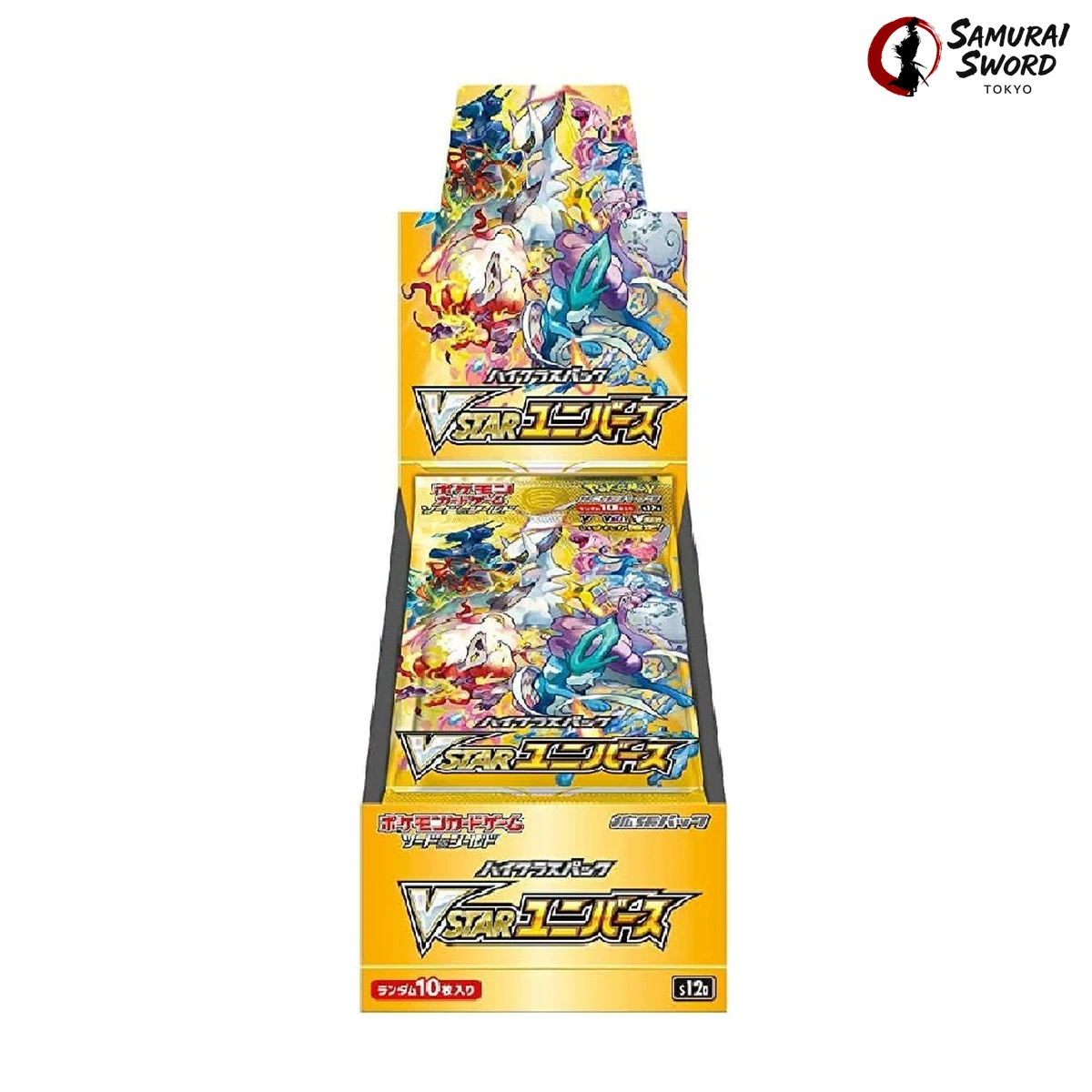
S12A VSTAR Universe Japanese Pokemon Booster Box
S12A VSTAR Universe booster box (Japanese) — currently listed at ¥30,870 (~$194)

AR and SAR were both introduced together in the Japanese high-class pack VSTAR Universe (set code s12a). Per secondary trade press (PokeGuardian, citing PokéBeach), the reported release date is 2 December 2022 — flagged here as reported/secondary rather than independently confirmed against an official pokemon-card.com page, since that direct confirmation wasn’t available in this pass.

This guide does not state a rarity-by-rarity total for VSTAR Universe. Our VSTAR Universe (s12a) card list covers the full set breakdown if you’re trying to identify a specific print. As a live example from that set, the PSA10 Grant SAR shown at the top of this article is 238/172, currently listed at ¥9,350 (~$59).

Do Full-Art Supporter Cards Get SAR? It Depends on the Card

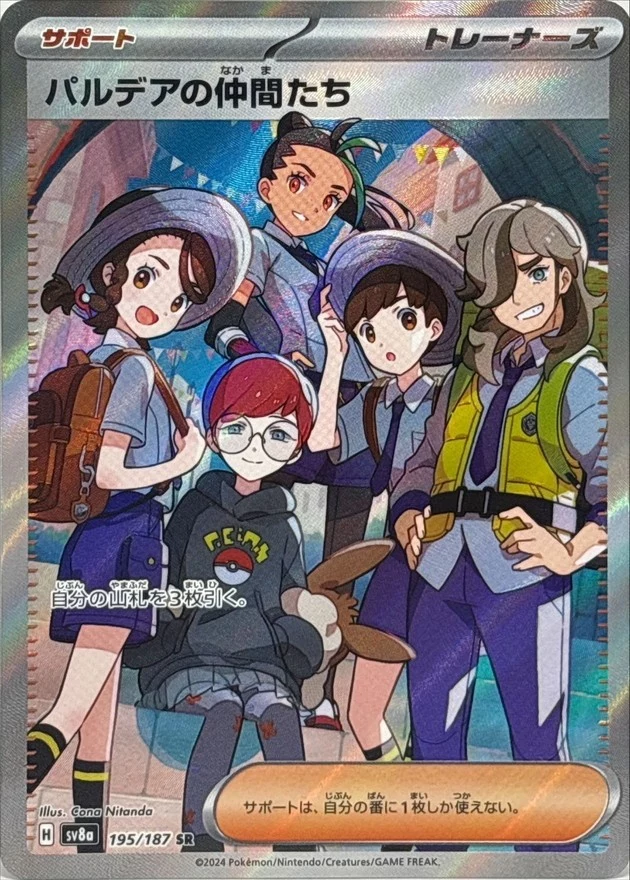
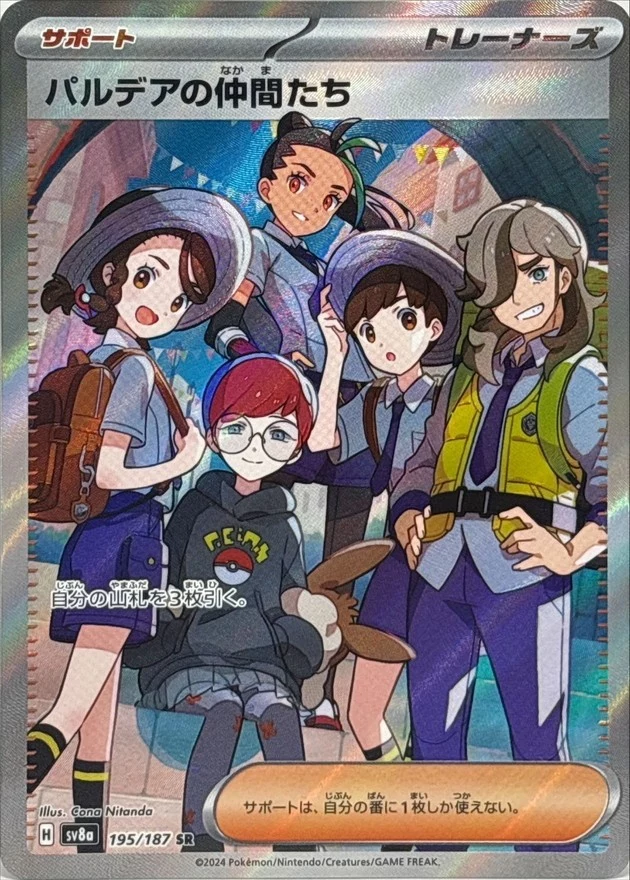
Friends of Paldea 195/187 SR, SV8a Terastal Festival ex
Friends of Paldea 195/187, SR (Secret Rare), Terastal Festival ex (SV8a) — currently listed at ¥7,986 (~$50)

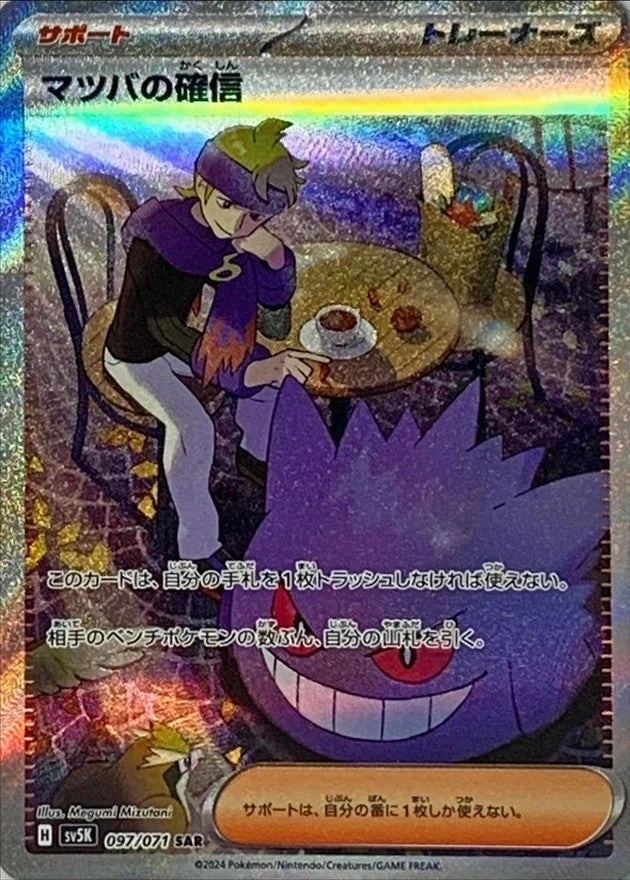
There’s one more nuance worth knowing before you try to slot a full-art Trainer/Supporter card into AR/IR or SAR/SIR by eye: the tier isn’t fixed by card type alone. Grant, Penny, and Morty’s Conviction — full-art Supporter cards currently listed in PSA 10 — are each designated Special Art Rare (SAR). Per Bulbapedia, Pokémon ex cards « also can appear as special illustration rares as well as some supporter cards, » and a Supporter reaching the SIR/SAR tier is a documented pattern.

Friends of Paldea, the Supporter card pictured above, shows the other side of that same pattern: it’s a full-art Supporter card from the same broader Scarlet & Violet era, and its printed designation is SR (Secret Rare), not SAR. So a given full-art Supporter card’s tier depends on the individual card and set — there isn’t a single blanket rule you can apply from « it’s a Trainer card » alone.

Japanese vs English: Telling SAR from SIR at a Glance

Putting the pieces above together, here’s the practical checklist for working out which tier a full-art, glitter-foil card actually sits in, in either language:

  • Check the individual card, not an evolution-line rule. AR/IR applies to Common, Uncommon or Rare Pokémon treatments, while SIR/SAR applies to Pokémon ex or some Supporters. Similar artwork across an evolution line does not determine the rarity label.
  • Don’t assume a Trainer/Supporter card’s tier from its type alone. Full-art Supporters can land at SAR (Grant, Penny, Morty’s Conviction) or SR (Friends of Paldea) — check the specific card and set rather than applying a single rule to every Trainer/Supporter card.
  • Check the era and set. The SIR/SAR naming described in this guide is not a guaranteed 1:1 translation across every release, so verify the label on the specific card rather than carrying it backward by visual similarity.
  • Remember the language gap runs both directions. AR and SAR are reported to have entered the Japanese market in December 2022, roughly three months before SIR entered English-language use with the Scarlet & Violet base set in March 2023 — so if you’re comparing release timing between the two markets on this specific rarity pair, Japan’s terminology came first.

For the wider rarity ladder this pair sits inside — from Common through every step up to SAR — see our Japanese Pokémon card rarities hub.

Where to Buy SIR, SAR and AR Cards from Tokyo

We ship Japanese sealed product and PSA 10 graded singles worldwide out of Tokyo with tracked delivery. If you want to see the terms from this guide on real cards rather than just in a table, these are currently listed:

Prints not listed in the links above aren’t currently on our site — sourcing requests for a specific SIR, SAR or AR card go through Commande rapide. You can also browse the full PSA 10 graded card collection or the Japanese Pokémon booster box collection to see what’s currently available across other sets.

Shop This Set
S12A VSTAR Universe Booster Box (Japanese)
The set that introduced both AR and SAR
Ships from Tokyo · Tracked delivery

View Product →

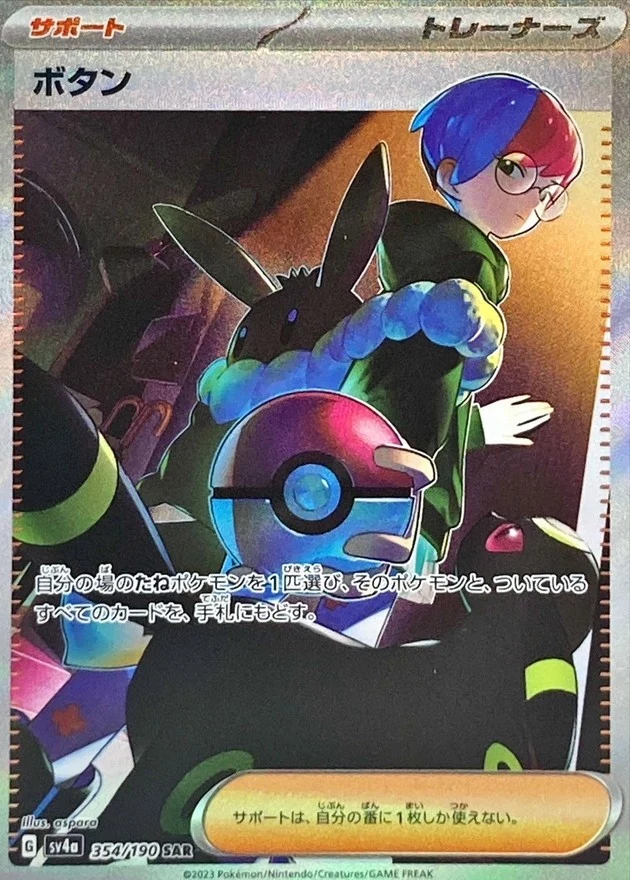
Penny 354/190 SAR, SV4a Shiny Treasure ex
Penny 354/190, SAR (Special Art Rare), Shiny Treasure ex (SV4a) — currently listed at ¥15,070 (~$95)
Morty's Conviction 097/071 SAR
Morty’s Conviction 097/071, SAR (Special Art Rare) — currently listed at ¥28,578 (~$180)

Foire aux questions

What is the difference between SIR and SAR?

SIR (Special Illustration Rare) is the English/international term, introduced with the Scarlet & Violet base set in March 2023. SAR (Special Art Rare) is the Japanese cognate, but per Bulbapedia the two rarities « don’t completely overlap. » Check the specific card and set rather than assuming a guaranteed 1:1 match.

What does SIR stand for on a Pokémon card?

Special Illustration Rare. It marks a full-art alternate-artwork reprint of a Pokémon ex (or, on some cards, a Supporter) with an added glitter-foil layer, usually showing the Pokémon in a natural setting. The symbol is a double gold star.

What is the difference between AR and IR cards?

AR (Art Rare) is the Japanese cognate of English IR (Illustration Rare). Both apply to full-art holo reprints of a Common, Uncommon or Rare Pokémon and use a single gold star in English. The classification is made card by card, not by the final stage of an illustrated evolution line.

Which set introduced AR and SAR in Japan?

VSTAR Universe (set code s12a). Per secondary trade press, its reported release date is 2 December 2022. This guide does not state a rarity-by-rarity total for the set.

Do full-art Trainer cards count as AR or SAR in Japan?

It depends on the card. Some full-art Supporter cards — Grant, Penny, and Morty’s Conviction among them — are designated Special Art Rare (SAR). Others, like Friends of Paldea, carry the SR (Secret Rare) designation instead. There isn’t a single rule that applies to every full-art Trainer/Supporter card by type alone.

Is a Japanese SAR card the same as an English SIR card?

Usually the same underlying concept — a full-art glitter-foil ex reprint — but not a guaranteed 1:1 match across every era. Check the specific set and Pokémon rather than assuming the two labels always line up.

Les types de cartes Pokemon expliqués (Pokemon, Trainer, Énergie, ex/V/GX)

There are only three card types in the Pokemon Trading Card Game: Pokemon cards, Trainer cards and Energy cards. Everything else — ex, V, GX, VMAX, Full Art, SR, SAR — is a rarity label or a special-rule subcategory layered on top of one of those three, not a fourth type.

That distinction matters more than it sounds. A new collector looking at a binder of Japanese cards will see « Pokemon V », « Supporter », « Special Energy » and « SAR » printed in different corners and assume they’re all naming the same kind of thing. They aren’t. This guide sorts the three real card types, their official subtypes, and the special-rule Pokemon cards that get mistaken for types of their own — using only the definitions Bulbapedia documents for the Pokemon TCG.

Key Takeaways

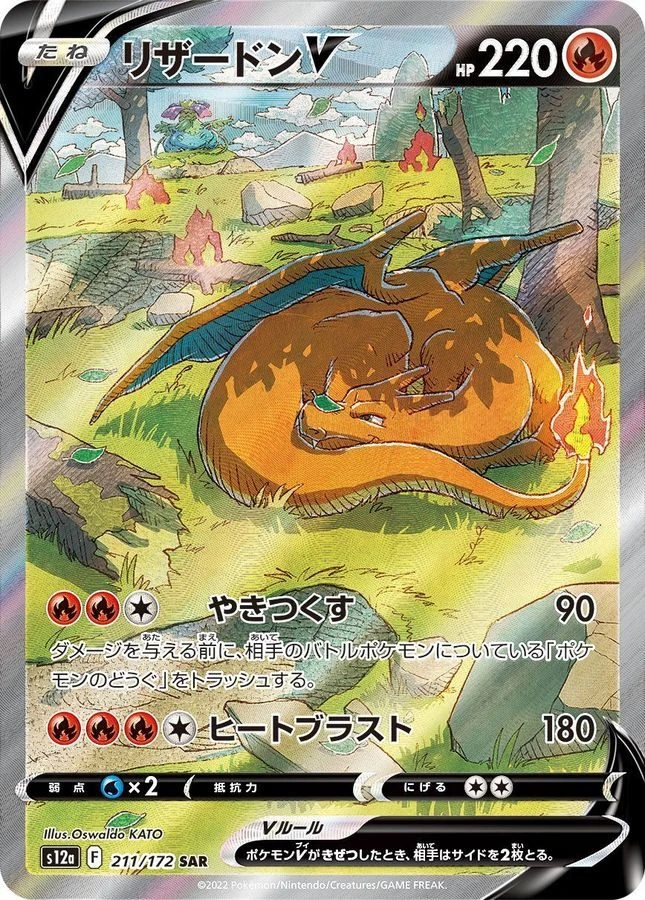
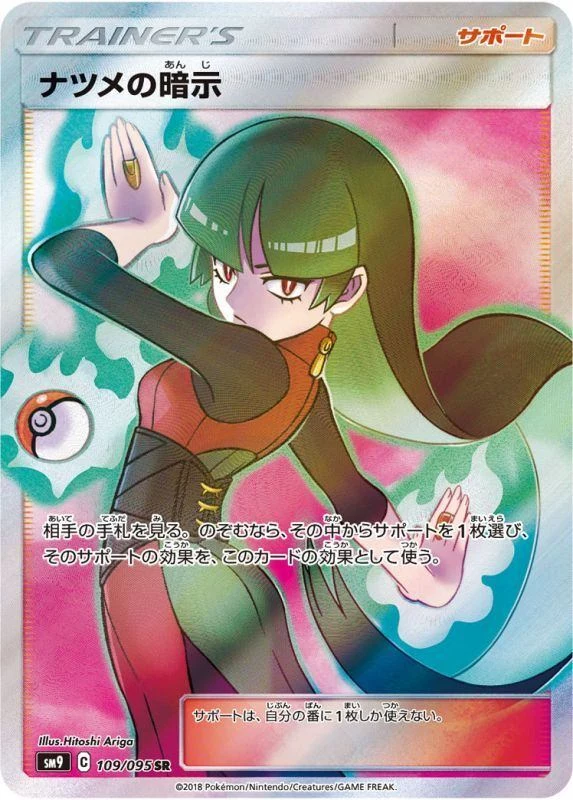
The Pokemon TCG has exactly three card types — Pokemon, Trainer and Energy. Trainer cards split into four official subtypes (Item, Pokemon Tool, Supporter, Stadium); Energy cards split into two (Basic and Special). Pokemon-ex, V, GX and VMAX are not separate types — they’re special-rule Pokemon cards. A PSA10 Charizard V 211/172 SAR is currently listed at ¥18,260 (~$115) as a Pokemon-card example, and a PSA10 Sabrina’s Suggestion 109/095 SR is currently listed at ¥22,198 (~$140) as a Trainer-card example.

3
Fundamental Types de cartes

4
Trainer Card Subtypes

9
Historical Basic Energy Types

4
Max Per Card (Non-Basic Energy)

Yen figures below convert at ¥159/USD (September 2026). Card-type definitions are sourced from Bulbapedia’s Trainer card, Supporter card, Energy card and Full Art card pages — see the inline citations for each claim.

The Three Fundamental Types de cartes

Per Bulbapedia, the Pokemon TCG is built on exactly three card types: Pokemon cards, which perform attacks; Trainer cards, which « provide a more supportive role, allowing a player to search through their deck, draw cards, or other special effects »; and Energy cards, which power those attacks.

Type Function What happens after use
Pokemon card Performs attacks, is placed on the Bench or Active spot Stays in play until Knocked Out
Trainer card Supports the player — deck search, draw, or a special effect Varies by subtype — some are discarded after use, others stay in play
Energy card Attached to a Pokemon to power its attacks Stays attached until discarded by an effect
Charizard V 211/172, SAR — Pokemon card type example
Charizard V, 211/172, SAR — a Pokemon card, not a separate « V-type » card

« Trainer card » is often described loosely as one-per-turn, but that’s only true of one subtype (Supporter). The four official Trainer subtypes each carry their own rule on how many can be played and what happens to the card afterward — Item cards break the one-per-turn pattern entirely, and Pokemon Tool and Stadium cards aren’t discarded after use at all. That’s covered next.

Trainer Cards: Item, Pokemon Tool, Supporter and Stadium

Trainer cards split into four official subtypes, and each one plays by different rules:

Subtype Rule Notes
Article Multiple playable per turn The original Trainer subtype
Pokemon Tool One per Pokemon at a time Functions like a held item, attached to a Pokemon
Supporter Limited to one per turn « Usually much more powerful than regular Item cards »; briefly elevated to its own card type during the Diamond & Pearl Series, before reverting to a Trainer subtype once Generation IV Trainer cards were reclassified as Item cards
Stadium Limited to one per turn Affects the whole field and remains in play indefinitely until replaced by a different Stadium card

Item cards are the oldest Trainer subtype, and multiple Item cards can be played in a single turn. Pokemon Tool cards function like held items, with one Tool attached to each Pokemon at a time. Supporter cards moved the other direction: internationally they arrived with the Expedition Base Set, and in Japan during the « P Promotional cards » web era, and they are limited to one per turn. Stadium cards work differently again — you can still only play one per turn, but instead of being discarded after use, a Stadium stays on the field affecting both players until a different Stadium card replaces it.

Sabrina's Suggestion, 109/095, SR

Sabrina’s Suggestion, 109/095, SR

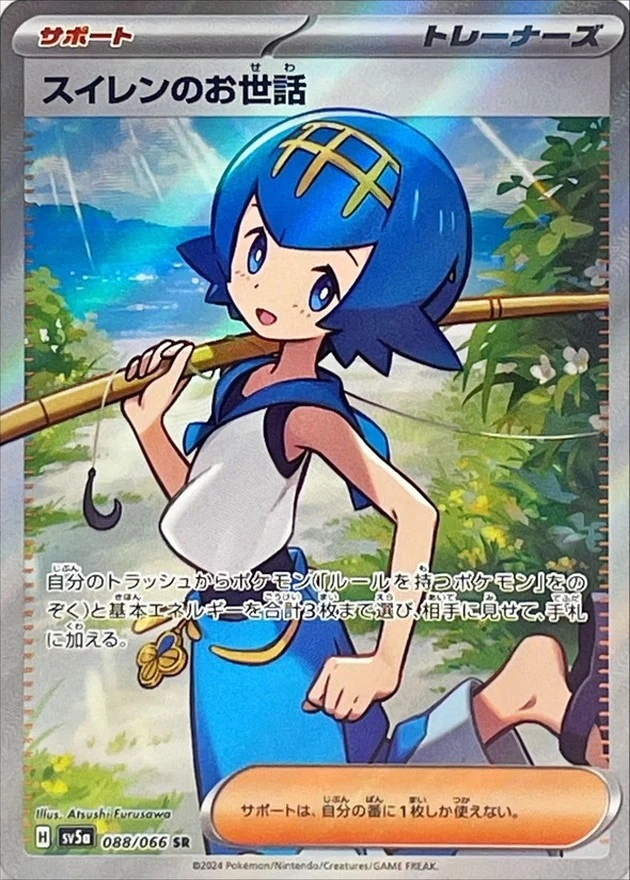
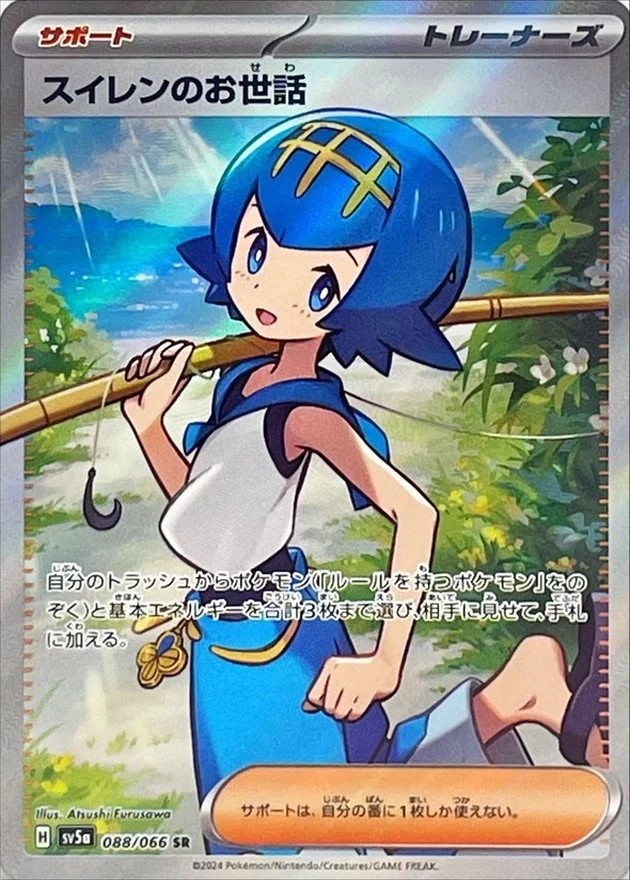
Lana's Aid, SV5a 088/066, SR, Crimson Haze

Lana’s Aid, SV5a 088/066, SR, Crimson Haze

Both of the Supporter cards pictured above — and Ethan’s Adventure 089/063 SAR, currently listed at ¥25,078 (~$158) — are Trainer cards, subtype Supporter, not a distinct rarity of « Trainer type. » Their SR and SAR markings describe the print, not the card type. Our PSA10 Trainer cards guide and female Pokemon Trainer cards guide cover Supporter cards like these in more depth.

Energy Cards: Basic vs Special

Energy cards split into two subtypes with very different deck-building rules.

Basic Energy cards provide one unit of a specific energy type with no extra effect. Across the game’s history there have been nine Basic Energy types: Grass, Fire, Water, Lightning, Psychic, Fighting, Darkness, Metal and Fairy. Fairy is a historical case rather than a current one — it was introduced in the XY Series and carried through the Sun & Moon Series before being discontinued starting with the Sword & Shield Series. Basic Energy is also the single exception to the game’s deck-building limit: it’s the only card type a deck is allowed to include more than four of under a single name.

Special Energy cards trade that flexibility for extra effects — they can carry multiple energy units, multiple types, or additional abilities on the card. In exchange, a Special Energy card is capped like any other non-Basic-Energy card: a deck can include at most four of the same-named Special Energy card under the format’s regulation marks.

Our 30th Celebration Basic Energy cards guide covers one specific 30th-anniversary Energy foil set in detail — that article is about a single release, while this section is the general definition of what an Energy card is and how the Basic/Special split works across the whole game.

Where ex, V, GX and VMAX Actually Fit In

This is the most common mix-up in the hobby: Pokemon-ex, Pokemon V, Pokemon GX, Pokemon VMAX and similar mechanics are not separate card types. They are special-rule Pokemon cards — the same fundamental type covered above — that carry an extra rule layered on top, such as giving the opponent additional Prize cards when the Pokemon is Knocked Out.

Friends of Paldea, SV8a 195/187, SR, Terastal Festival ex
Friends of Paldea, SV8a 195/187, SR, Terastal Festival ex — a Trainer card from a Pokemon-ex era set, not itself a Pokemon-ex card

Full Art printings of these special-rule Pokemon are their own separate classification again: Bulbapedia lists Full Art cards as introduced with the Black & White Series, and they can apply across Pokemon and Trainer cards alike. So a single Japanese card can carry up to three independent labels at once — its fundamental type (Pokemon or Trainer), its special-rule subcategory (ex, V, GX, VMAX, or none), and its print style (Full Art or standard). Confusing any one of those three for the others is where most « is this a rare type of card? » questions come from.

Full Art Cards and the Japanese SR Designation

Full Art is a physical print style — artwork that runs across the entire face of the card — not a card type or a rarity tier by itself. It was introduced with the Black & White Series and has since been applied to both Pokemon cards and Trainer cards.

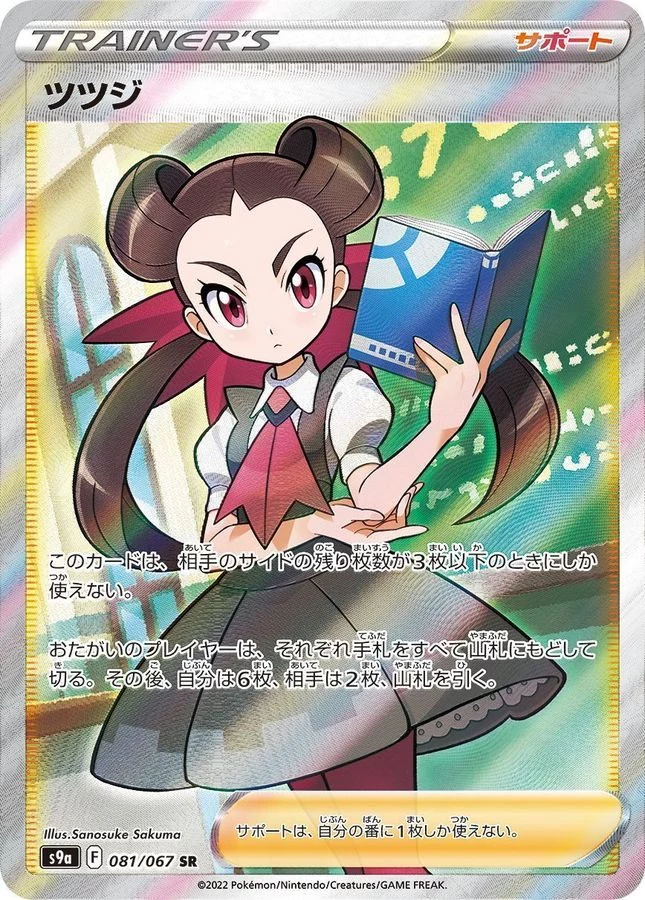
Roxanne, SR — Full Art Trainer card example
Roxanne, SR — a Full Art Trainer card carrying the Japanese SR designation

In Japan specifically, Full Art Trainer cards of the Supporter subtype commonly carry the SR (Secret Rare) designation. That said, « SR » is not an exclusive Trainer signal — the same two-letter designation has also been used on alternate-art Pokemon cards in Japanese sets, so seeing « SR » on a card tells you it’s a Secret Rare print, not automatically that it’s a Full Art Trainer Supporter. You still need to check whether the card itself is a Pokemon or a Trainer card. Our Full Art Pokemon cards guide and Japanese Pokemon card rarities guide go further into how these print-style and rarity labels stack together set by set.

Which Type of Card Are You Actually Buying From Japan?

Once the three types and their subtypes are sorted, it’s easier to see what you’re actually adding to a collection. Here’s a spread of currently listed PSA10 examples across the categories covered above:

Carte Type / subtype Listed price
Charizard V 211/172, SAR Pokemon card (V special rule) ¥18,260 (~$115)
Sabrina’s Suggestion 109/095, SR Trainer card, Supporter ¥22,198 (~$140)
Ethan’s Adventure 089/063, SAR Trainer card, Supporter ¥25,078 (~$158)
Lana’s Aid SV5a 088/066, SR Trainer card, Supporter ¥12,078 (~$76)
Friends of Paldea SV8a 195/187, SR Trainer card, Supporter (from a Pokemon-ex era set) ¥7,986 (~$50)

All five are PSA10-graded Japanese cards, and four of the five are Trainer cards — a reminder that « Supporter » and « Trainer » cover a lot of ground beyond the Pokemon cards that usually get the attention. Browse the full PSA10 graded card collection to see more of each type side by side, or use Commande rapide to build a mixed order of Pokemon and Trainer cards in one pass.

Shop This Card
PSA10 Friends of Paldea SR [SV8a 195/187] Terastal Festival ex
A Trainer card, Supporter subtype, from a Pokemon-ex era set
Ships from Tokyo · Tracked delivery

View Product →

Foire aux questions

What are the three types of Pokemon cards?

Pokemon cards, Trainer cards and Energy cards. Pokemon cards perform attacks, Trainer cards provide supportive effects such as deck search or drawing, and Energy cards power attacks by being attached to a Pokemon.

What’s the difference between an Item card and a Supporter card?

Both are Trainer card subtypes. Item cards are the original Trainer subtype and multiple can be played in a single turn. Supporter cards are limited to one per turn and are described by Bulbapedia as usually much more powerful than a regular Item card — they were briefly elevated to their own card type during the Diamond & Pearl Series, before reverting to a Trainer subtype once Generation IV Trainer cards were reclassified as Item cards.

Is Pokemon V or Pokemon ex a separate card type?

No. Pokemon-ex, Pokemon V, Pokemon GX and Pokemon VMAX are special-rule Pokemon cards — the same fundamental « Pokemon card » type — that carry an extra rule such as giving the opponent additional Prize cards when Knocked Out. They are not a fourth card type.

What is a Stadium card?

A Stadium is a Trainer card subtype that affects the whole field rather than being discarded after one use. Only one Stadium card can be played per turn, and once played, it remains in play indefinitely until a different Stadium card replaces it.

How many Basic Energy types have there been?

Nine historically: Grass, Fire, Water, Lightning, Psychic, Fighting, Darkness, Metal and Fairy. Fairy was introduced in the XY Series, carried through the Sun & Moon Series, and was discontinued starting with the Sword & Shield Series.

Can you run more than four of the same card in a Pokemon deck?

Only with Basic Energy cards. Every other card type, including Special Energy, is capped at four of the same-named card under the format’s regulation marks.

Guide d'achat du Booster Box SV5A-Crimson Haze

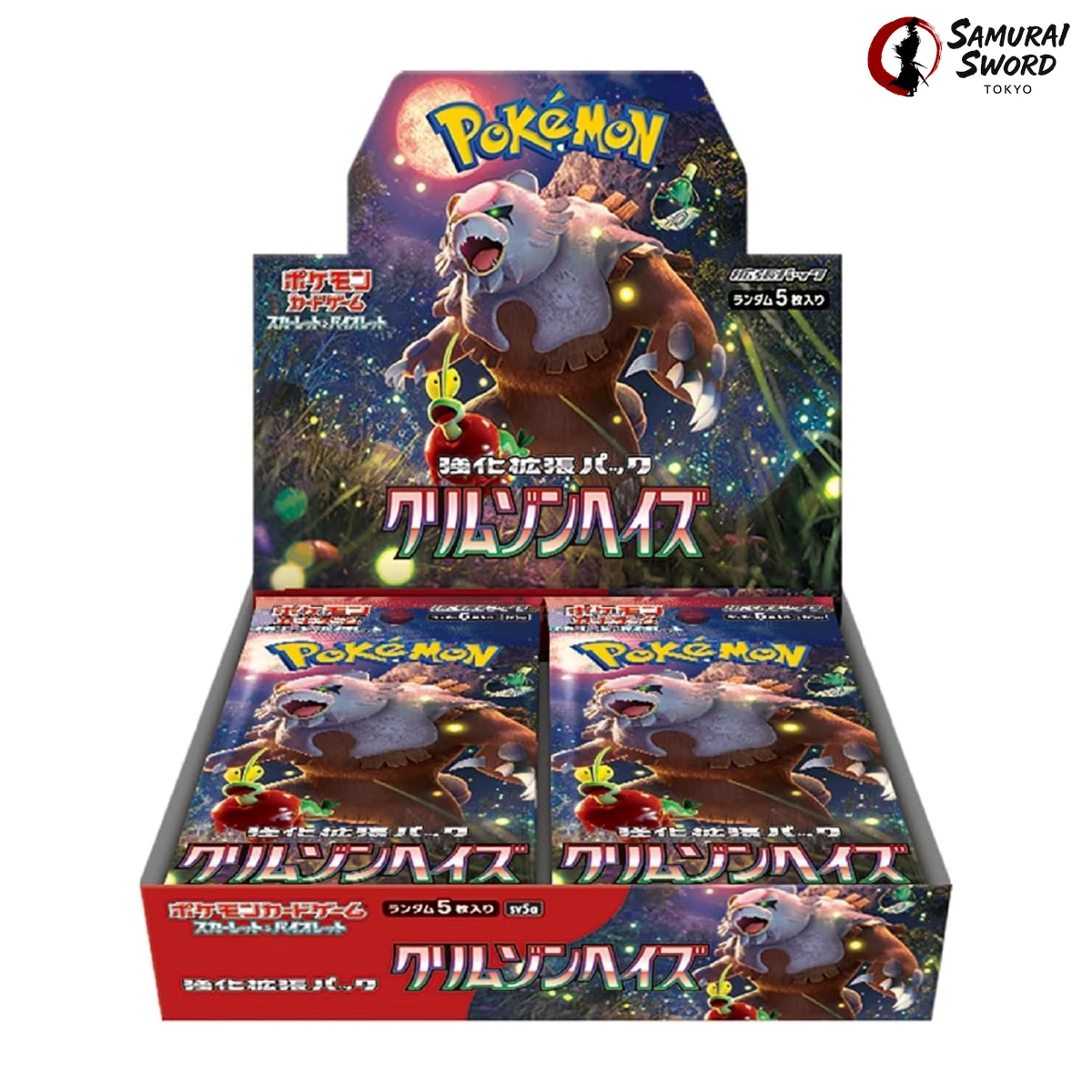
SV5a “Crimson Haze” released in Japan on March 22, 2024, and it’s still one of the boxes we get asked about by name — largely because of Bloodmoon Ursaluna ex, the set’s Kitakami-flavoured mascot Pokemon, and the five Special Art Rares built around it.

This guide covers what’s actually in a Crimson Haze box, the five SAR-tier chases worth knowing before you open one, how our regular box, Damaged Box and PSA10-graded single listings differ, and how this set relates to its English-market counterpart. We ship Japanese sealed product and PSA10 singles out of Tokyo, so every price below reflects what’s currently listed on our site.

Unlike a set built around a single flagship secret, Crimson Haze spreads its rarity ceiling evenly — all five Special Art Rares sit on the same tier, so there’s no single « the » chase card the way some other Japanese expansions are built. That structure shapes most of what follows in this guide, from how we describe the chases below to how the box compares with its neighbouring SV5-era sets.

Key Takeaway

Crimson Haze is a 96-card set (66 main-set + 30 secret cards) with 5 Special Art Rares. The regular booster box is currently listed at ¥12,480 (~$78), and the Damaged Box is currently listed at ¥13,630 (~$86) — here the Damaged Box costs more than the regular box, not less.

96
Cards in Set

30
Packs per Box

5
Cards per Pack

Mar 2024
Japan Release

Prices below are converted at ¥159/USD (September 2026). Pokemon does not publish official pull rates for its Japanese sets, so this guide describes rarity tiers rather than pull odds.

What’s in a Crimson Haze Booster Box

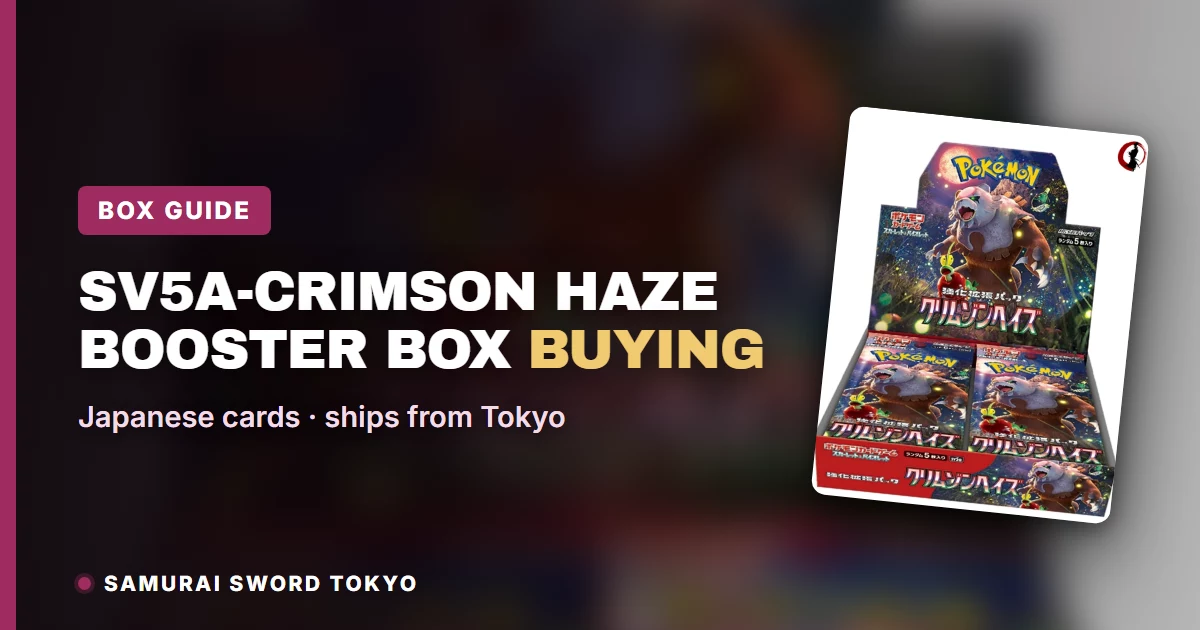
SV5A-Crimson Haze Japanese Pokemon booster box
SV5A-Crimson Haze Japanese Pokemon Booster Box

We couldn’t independently verify a standalone official product page for this set on pokemon-card.com at the time of writing, so the structure below is sourced from our own Crimson Haze card list breakdown, cross-checked against the packaging.

Article Value
Code de série SV5a
Release date (JP) March 22, 2024
Packs per box 30
Cards per pack 5
Total cards in set 96 (66 main-set + 30 secret cards)
Special Art Rare (SAR) count 5

The set carries the Kitakami storyline through — the same region introduced in the Scarlet & Violet DLC — with Bloodmoon Ursaluna ex serving as the set’s headline Pokemon. Rather than a single flagship secret, Crimson Haze spreads its top tier across five equally-ranked Special Art Rares, which is what the next section covers.

At 30 packs of 5 cards each, a single box works out to 150 cards drawn from that 96-card checklist — the 66-card main set plus the 30-card secret tier described above. We’re deliberately not translating that into a per-pack or per-box pull estimate here, since Pokemon doesn’t publish official odds for its Japanese sets and we’d rather point you to verified rarity tiers than a guessed number.

Chase Cards in Crimson Haze

All five of the set’s Special Art Rares are the cards collectors open this box for. Here they are, in the order our own top-cards rundown ranks them:

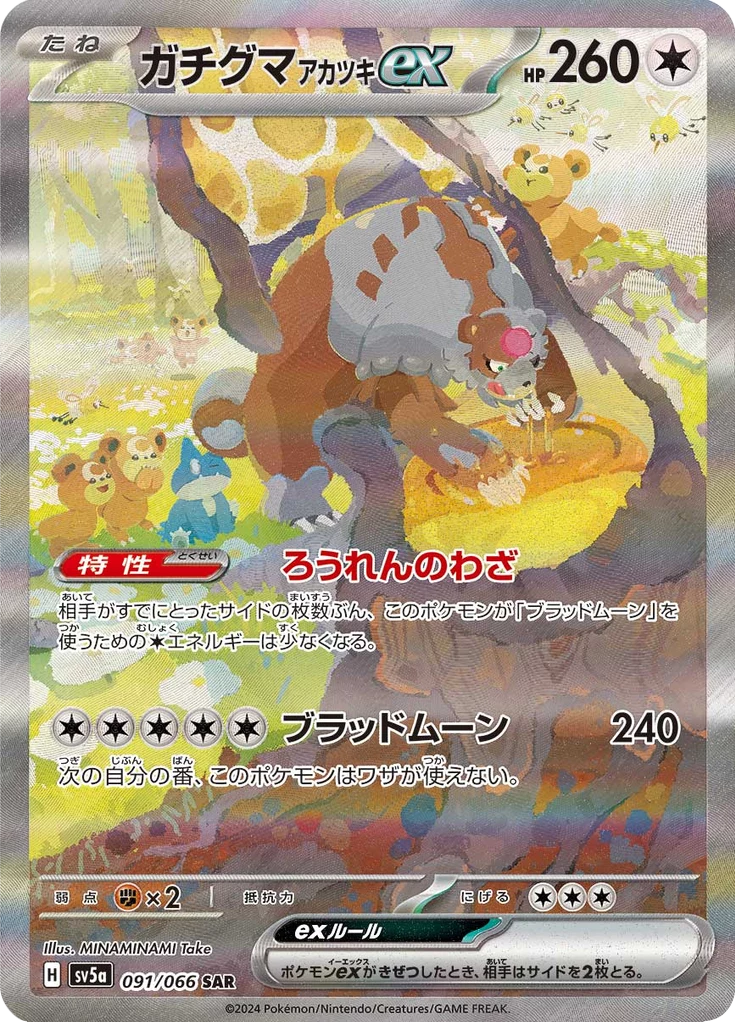
Bloodmoon Ursaluna ex 091/066 SAR

Bloodmoon Ursaluna ex 091/066 SAR Crimson Haze
Bloodmoon Ursaluna ex 091/066 SAR – Crimson Haze

The set’s mascot and identity card. Bloodmoon Ursaluna is the Pokemon on the box art, and this Special Art Rare is the print most collectors go in wanting.

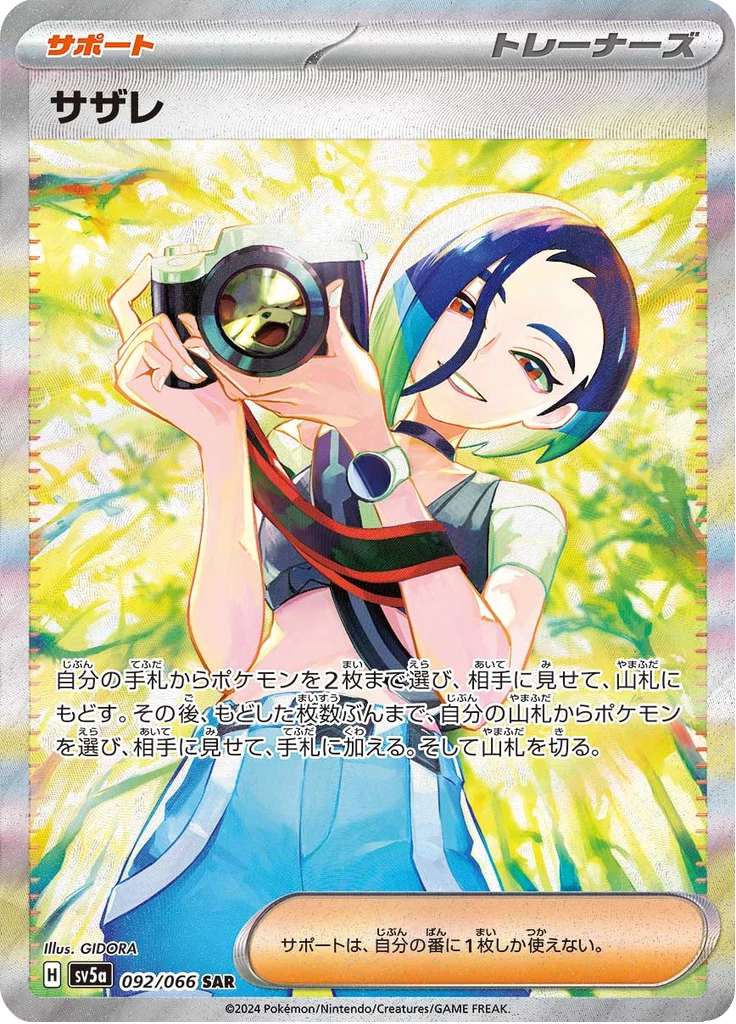
Perrin 092/066 SAR

Perrin 092/066 SAR Crimson Haze
Perrin 092/066 SAR – Crimson Haze

Our own ranking calls this the strongest trainer-card chase in the set — a full Special Art Rare treatment of the supporter Perrin.

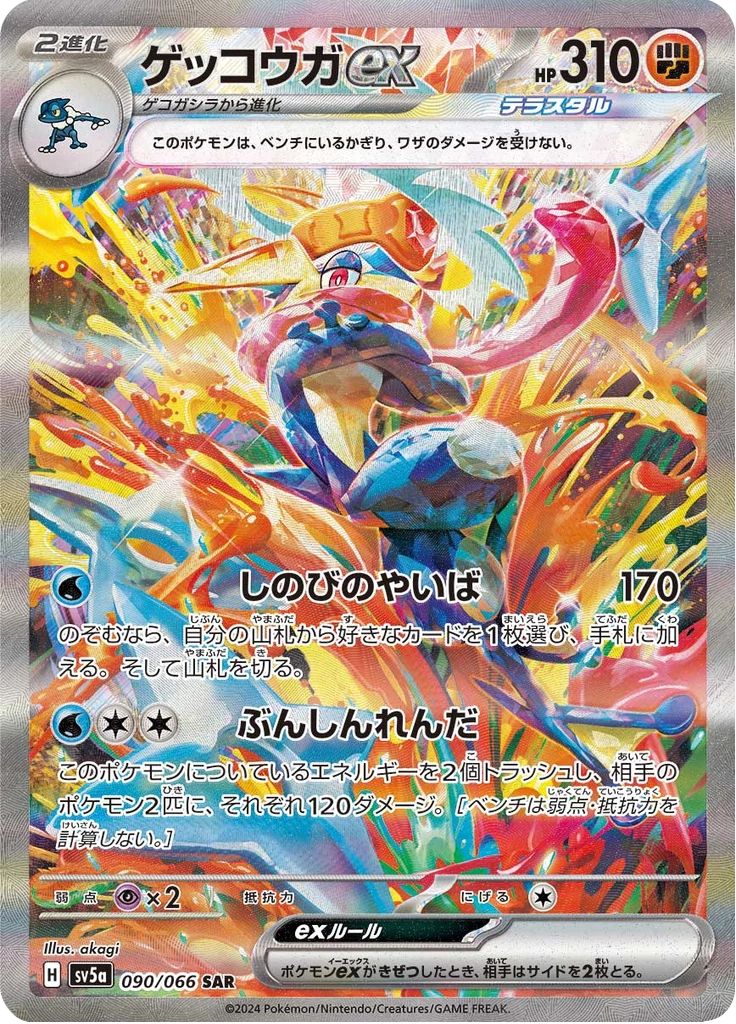
Greninja ex 090/066 SAR

Greninja ex 090/066 SAR Crimson Haze
Greninja ex 090/066 SAR – Crimson Haze

A perennially popular Pokemon getting the Special Art Rare treatment, and one of the two SARs alongside Bloodmoon Ursaluna that anchor the set’s headline pulls.

Lana’s Aid 093/066 SAR

Lana's Aid 093/066 SAR Crimson Haze
Lana’s Aid 093/066 SAR – Crimson Haze

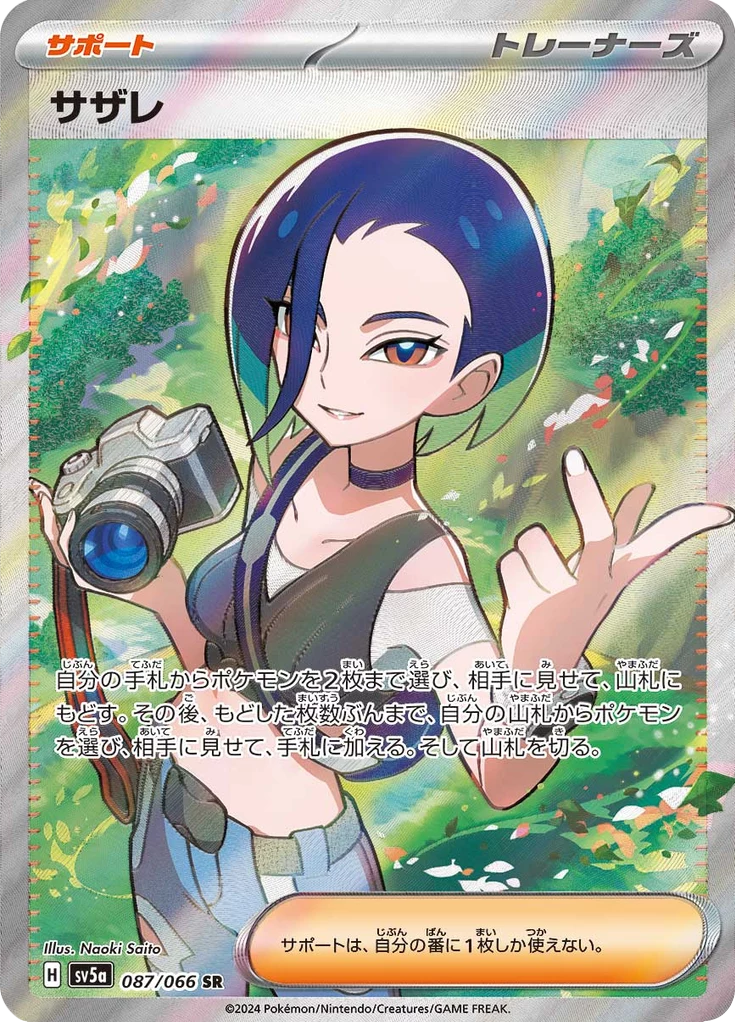
A supporter-card SAR rounding out the top tier. This is the same Supporter card as the 088/066 SR discussed below, but it is a separate printing with a different card number, artwork, and rarity treatment.

Sinistcha ex 089/066 SAR

The fifth and final Special Art Rare in the set. We don’t have a verified image for this print at the time of writing, but it completes the five-card SAR line-up alongside Bloodmoon Ursaluna ex, Perrin, Greninja ex and Lana’s Aid.

Other Notable Pulls

Perrin 087/066 SR Crimson Haze
Perrin 087/066 SR – Crimson Haze

Below the SAR tier, our own rundown also calls out Perrin 087/066 SR as a lower-cost route to the same trainer if the SAR print is out of reach, plus Bloodmoon Ursaluna ex 094/066 UR as a gold-treatment variant of the set mascot, Eevee 078/066 AR, Applin 077/066 AR, and Rescue Board 095/066 UR. None of these five are listed on our site at the moment; sourcing requests for any of them go through the Quick Order page.
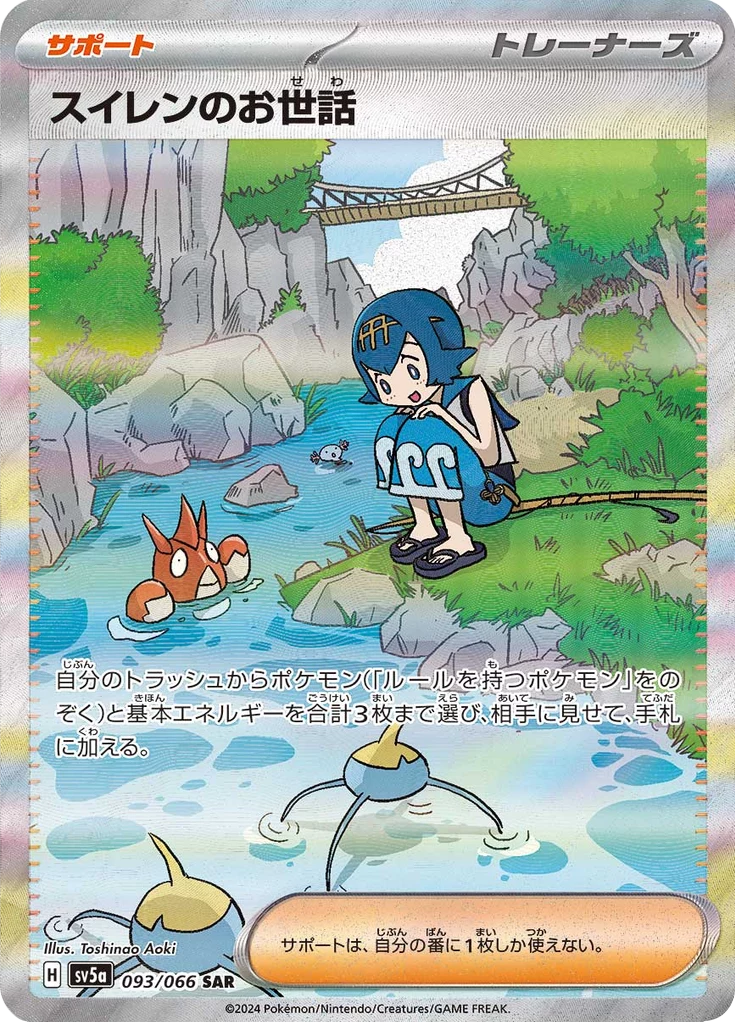
Two Lana’s Aid Printings
PSA10 Lana's Aid SR 088/066 Crimson Haze graded slab
PSA10 Lana’s Aid SR 088/066 – Crimson Haze

Don’t mix the printings up: Lana’s Aid SR 088/066, a PSA10-graded single currently listed at ¥12,078 (~$76), depicts the same Supporter card as Lana’s Aid SAR 093/066 covered above. They have different card numbers, artwork, and rarity treatments.

Regular Box vs Damaged Box vs No Shrink on Our Site

The current Crimson Haze product pages include these formats:

Listing Prix
SV5A-Crimson Haze Japanese Pokemon Booster Box currently listed at ¥12,480 (~$78)
SV5A-Crimson Haze Japanese Pokemon Booster Box – Damaged Box currently listed at ¥13,630 (~$86)

On several of our other Japanese boxes, the Damaged Box option lists below the regular box. That pattern doesn’t hold here — the Crimson Haze Damaged Box is priced ¥1,150 above the regular box, not below it. If you’re comparing our listings across different sets, check each set’s own pricing rather than assuming a Damaged Box is automatically the cheaper option.

We don’t currently have a No Shrink listing for this set. If that’s the format you’re after, requests go through the Quick Order page.
Japanese vs English Version of This Set

Crimson Haze’s English-market relationship is Twilight Masquerade — but this is a market relationship, not a strict card-for-card reprint. Our own hub article treats the Japanese and English releases as separate products with independent numbering, rather than the same set in two languages.

If you’re trying to map a specific Crimson Haze card to its English-market equivalent, don’t assume the numbers or rarities line up. For the fuller picture on how the two markets connect, see our Twilight Masquerade Japanese sets hub and our Twilight Masquerade chase-cards guide.

The regular Crimson Haze box is the direct route to all five SARs, the SR-tier Perrin, and everything else in the 96-card set. If your priority is a specific card rather than the full set, the PSA10 single and the Quick Order page covered in the next section are the more targeted options.

Shop This Set
SV5A-Crimson Haze Japanese Pokemon Booster Box
Currently listed at ¥12,480 (~$78)
Ships from Tokyo · Tracked delivery

View Product →

Where to Buy a Crimson Haze Booster Box from Tokyo

We ship sealed Crimson Haze boxes and PSA10-graded singles worldwide from Tokyo with tracked delivery. The regular box and the Damaged Box are both live listings above; for the graded single, see PSA10 Lana’s Aid SR.

Browse the wider category in our Japanese Pokemon booster box collection or our PSA10 graded card collection. If you’re deciding between Crimson Haze and a neighbouring SV5-era set, our SV5a vs SV5K vs SV5M box guide lines the three up side by side. Anything not currently listed — including the five secondary chases named above — can be flagged through the Quick Order page.
Foire aux questions

What’s inside a Crimson Haze booster box?

Each box has 30 packs of 5 cards, drawn from a 96-card set (66 main-set cards plus 30 secret cards), including 5 Special Art Rares. Pokemon does not publish official pull rates for this set.

What are the chase cards in Crimson Haze?

The five Special Art Rares: Bloodmoon Ursaluna ex 091/066, Perrin 092/066, Greninja ex 090/066, Lana’s Aid 093/066, and Sinistcha ex 089/066. Perrin 087/066 SR is a lower-rarity printing of the same Trainer card.

Is the Crimson Haze Damaged Box cheaper than the regular box?

No. On this set the Damaged Box is currently listed at ¥13,630 (~$86), which is ¥1,150 above the regular box’s ¥12,480 (~$78) — the opposite of the pattern on some of our other listings.

Is PSA10 Lana’s Aid SR the same card as Lana’s Aid SAR?

They are two printings of the same Supporter card. Lana’s Aid SR is 088/066, while Lana’s Aid SAR is 093/066; the card numbers, artwork, and rarity treatments differ.

Does Crimson Haze have an English release?

Its English-market relationship is Twilight Masquerade, but the two are treated as separate products with independent card numbering rather than a direct reprint of the same set.

Is there a No Shrink version of Crimson Haze available?

Not currently. We list a regular box and a Damaged Box for this set; No Shrink requests can be flagged through the Quick Order page.
Guide de la carte Glimmora ex : les impressions japonaises de rareté spéciale SV3 et SV4a

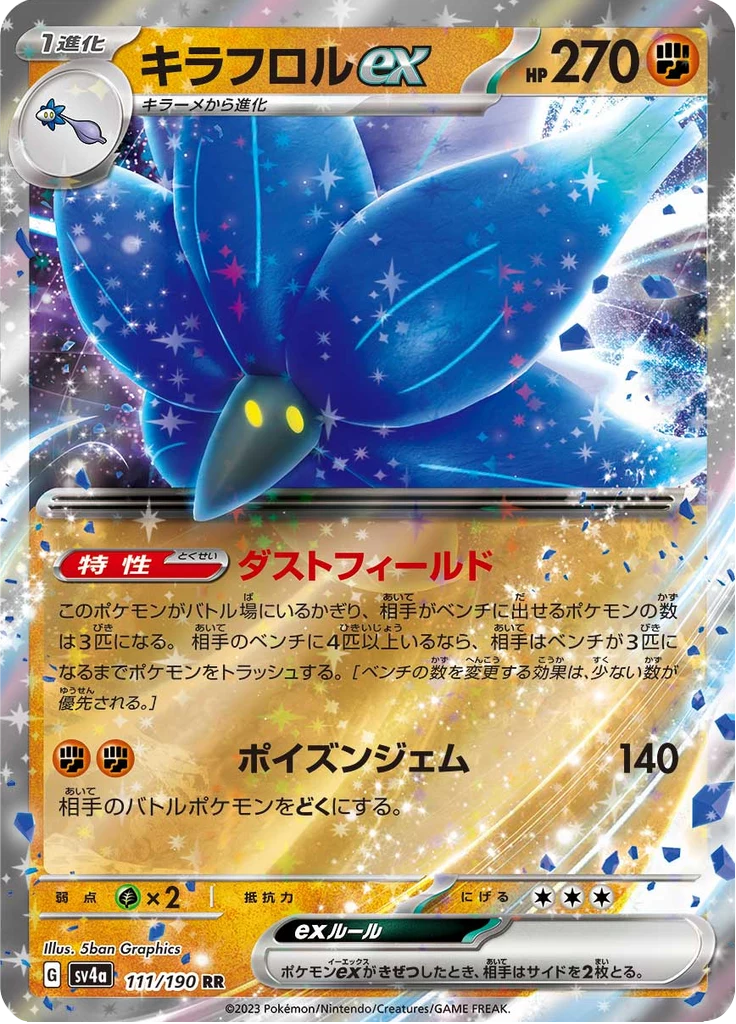
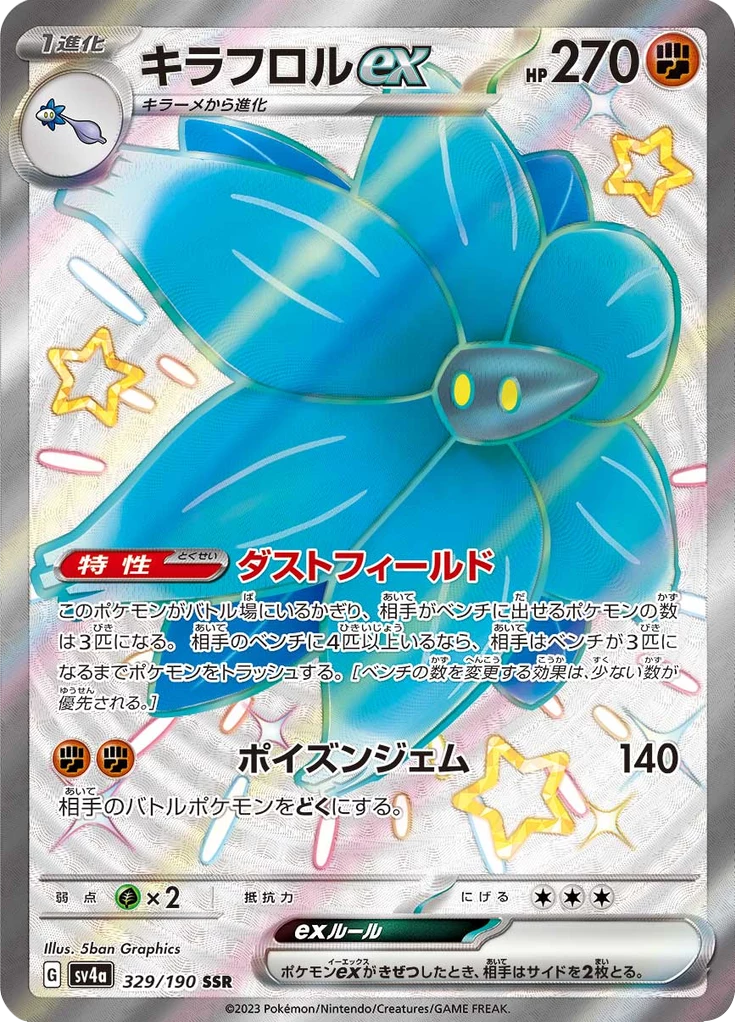
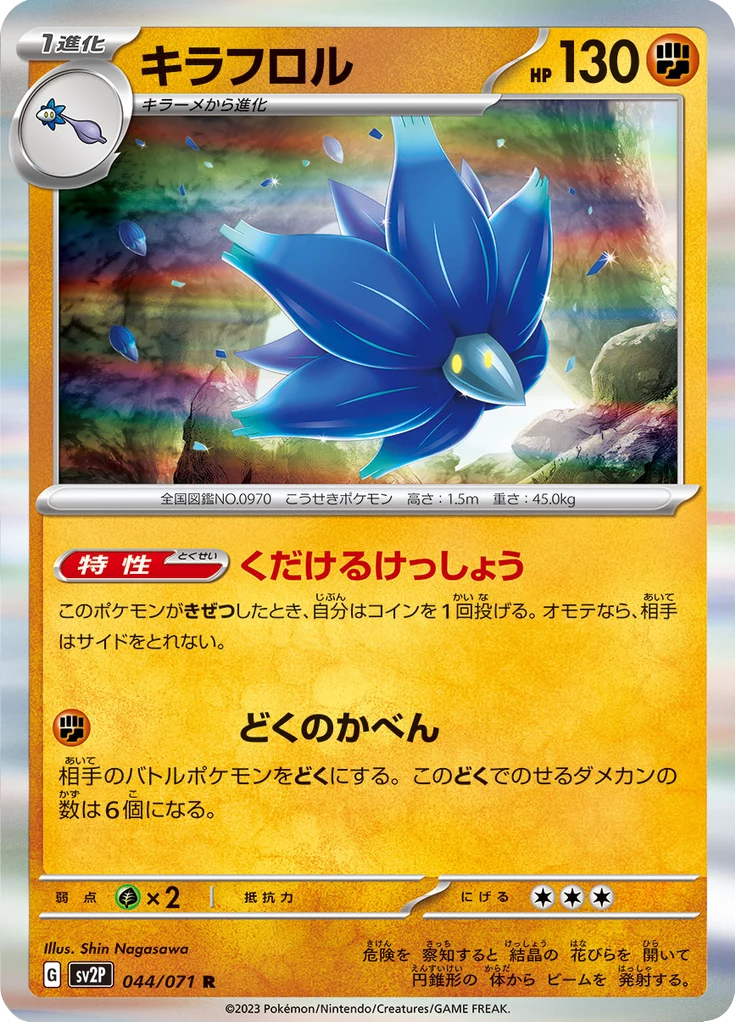
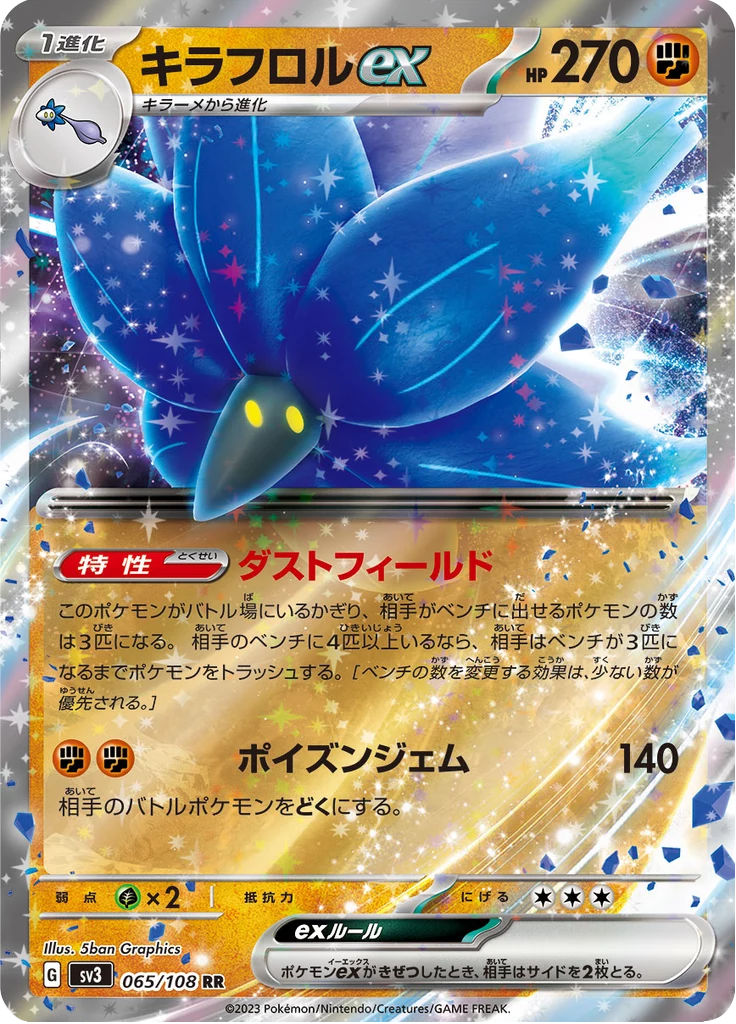
Glimmora ex doesn’t come from the set most people expect it from. Four documented Japanese « ex » prints of this card exist, and every one of them sits in one of two Scarlet & Violet–era sets — SV3 Ruler of the Black Flame and SV4a Shiny Treasure ex. A plain, non-« ex » Glimmora exists separately, spread across three different sets, and the similarity in name makes the two easy to mix up.

This guide covers all four « ex » prints in detail, including the Secret Rare that sits inside SV3’s secret tier and the #329 print in SV4a’s much larger catalogue, and points to the plain (non-« ex ») prints for context. No PSA 10 single of any Glimmora ex print is currently listed on our site, so purchase intent here runs through the sealed booster boxes that produce these cards.

Key Takeaways

Glimmora ex (キラフロルex) has four documented Japanese prints across two sets: SV3 Ruler of the Black Flame (#65 Double Rare and #124 Secret Rare) and SV4a Shiny Treasure ex (#111 Double Rare and the #329 print). Both come out of sealed product — the SV3 Ruler of the Black Flame Japanese Pokemon Booster Box is currently listed at ¥17,160 (~$108), and the SV4a Shiny Treasure ex Japanese Pokemon Booster Box at ¥16,640 (~$105). No PSA 10 single of Glimmora ex is currently listed on our site.

4
« Ex » Prints Documented

2
Sets Carrying « Ex » Prints

2
Verified Rarity Labels

Jul–Dec 2023
Japan Release Span

Prices below are current samuraiswordtokyo.com listings, converted at ¥159/USD (September 2026).

The Card: Glimmora ex — SV3 #124 Secret Rare

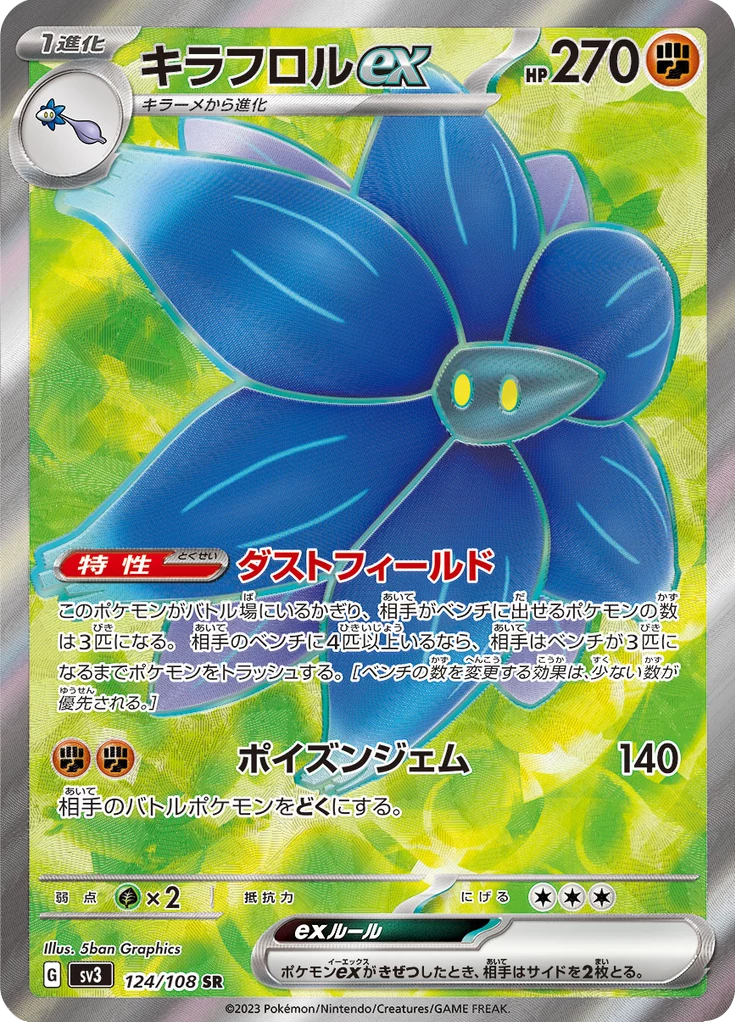
Glimmora ex (キラフロルex) is illustrated by 5ban Graphics across every « ex » print it has received. The SV3 print at #124 carries the Secret Rare rarity and sits outside the set’s 108-card base numbering, inside the 33-card secret tier that runs above it — Ruler of the Black Flame catalogues 141 cards in total (108 base plus 33 secret-tier).

Glimmora ex 124, Secret Rare, Ruler of the Black Flame (SV3)
Glimmora ex 124, Secret Rare — Ruler of the Black Flame (SV3), illustrated by 5ban Graphics

It is a secondary chase print inside SV3, not the set’s own headline card — that role belongs to Charizard ex, which we cover separately in our SV3 card list and SV3 pull-rates guide.

No PSA 10 graded single of this print — or of any other Glimmora ex print — is currently listed on our site. If you want this exact card, it comes packed inside sealed SV3 Ruler of the Black Flame Japanese Pokemon Booster Box product, covered in full further down, or a sourcing request for a specific single goes through Commande rapide.

The Sets: SV3 Ruler of the Black Flame & SV4a Shiny Treasure ex

SV3 — Ruler of the Black Flame

Code de série SV3, released in Japan on 28 July 2023. It runs a 108-card base set plus a 33-card secret tier, for 141 total cataloged cards. Its own headline chase card is Charizard ex — full breakdown in our SV3 card list and SV3 pull-rates guide.

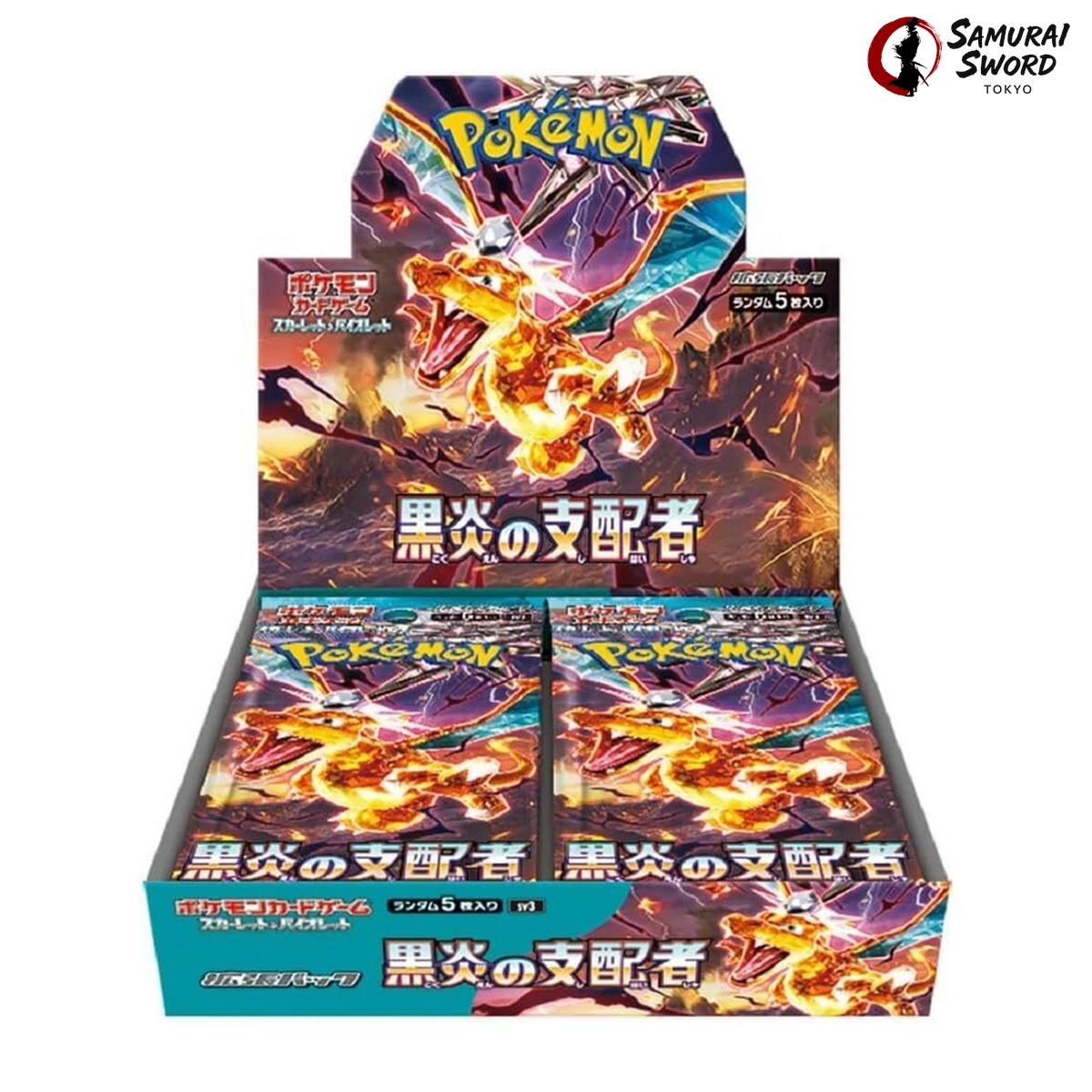
SV3 Ruler of the Black Flame Japanese Pokemon Booster Box, listed on samuraiswordtokyo.com

SV4a — Shiny Treasure ex

Code de série SV4a, released in Japan on 1 December 2023 as a Pack Haut de Gamme, with 360 total cataloged cards — one of the larger Japanese card pools of this era. Glimmora ex’s two prints, #111 and #329, sit within that catalogue. Full set detail in our SV4a card list and SV4a pull-rates guide.

SV4a Shiny Treasure ex Japanese Pokemon Booster Box, listed on samuraiswordtokyo.com

For other early Scarlet & Violet–era Japanese sets, see our Paradox Rift Japanese card list.

Japanese vs English Print

All four Japanese « ex » prints of Glimmora share the same English-set equivalents: Obsidian Flames (OBF) #123 and #213, plus Paldean Fates (PAF) #218. That’s three English card numbers standing in for four Japanese prints — a Japanese secret-tier print does not always get its own dedicated one-to-one English slot.

The plain (non-« ex ») SV2P #44 print is a separate lineage entirely, with its own English equivalent in Paldea Evolved (PAL) #126. It does not share a slot with any of the « ex » versions above.

Where These Prints Sit Among Japanese Rarity Tiers

Within SV3, the #65 Double Rare sits inside the set’s ordinary 108-card numbered run, while the #124 Secret Rare occupies a slot in the smaller 33-card secret tier positioned above it. Within SV4a’s larger 360-card catalogue, #111 Double Rare again sits earlier in the numbering, and the verified #329 print sits farther into the extended range.

None of these four prints is Ruler of the Black Flame’s own headline chase card — that role belongs to Charizard ex, as noted above — so Glimmora ex runs as a secondary chase line inside SV3, and as one of the secret-tier prints inside SV4a’s larger catalogue.

Shop This Set
SV3 Ruler of the Black Flame Japanese Pokemon Booster Box
Currently listed at ¥17,160 (~$108) — contains the Glimmora ex Double Rare (#65) and Secret Rare (#124)
Ships from Tokyo · Tracked delivery

View Product →

Where to Buy Glimmora Ex Sealed Product from Tokyo

Since no PSA 10 single of any Glimmora ex print is currently listed on our site, the two sealed boxes above are the way to pull one yourself. The SV3 Ruler of the Black Flame Japanese Pokemon Booster Box is currently listed at ¥17,160 (~$108) and produces both the #65 Double Rare and the #124 Secret Rare. The SV4a Shiny Treasure ex Japanese Pokemon Booster Box is currently listed at ¥16,640 (~$105) and produces both the #111 Double Rare and the verified #329 print.

If you’re after the plain (non-« ex ») print instead, the SV2P Snow Hazard Japanese Pokemon Booster Box — currently listed at ¥10,920 (~$69) — carries the #44 Rare version, though its own chase axis runs through Chien-Pao ex and Grusha rather than Glimmora.

For the wider range of Japanese Pokemon booster boxes, see our Pokemon booster box collection, or use Commande rapide to build a mixed order, including sourcing requests for specific singles.

Foire aux questions

How many Glimmora ex prints exist in Japanese?

Four documented prints across two sets: SV3 Ruler of the Black Flame (#65 Double Rare and #124 Secret Rare) and SV4a Shiny Treasure ex (#111 Double Rare and the verified #329 print).

Does the SV2P Snow Hazard box contain Glimmora ex?

No. The Snow Hazard (SV2P) print of Glimmora, #44, is a plain Rare with no « ex » suffix. The real Glimmora ex prints, including the Secret Rare, come from two other sets: SV3 Ruler of the Black Flame and SV4a Shiny Treasure ex.

Which Glimmora ex print is the Secret Rare?

#124 from SV3 Ruler of the Black Flame, illustrated by 5ban Graphics. It sits outside the set’s 108-card base run, inside the 33-card secret tier.

Does Glimmora ex have an English print?

Yes. All four Japanese « ex » prints share the same three English-set equivalents: Obsidian Flames (OBF) #123 and #213, plus Paldean Fates (PAF) #218. The plain, non-« ex » SV2P print has a separate English equivalent in Paldea Evolved (PAL) #126.

Is a PSA 10 Glimmora ex currently listed?

No. No PSA 10 graded single of any Glimmora ex print is currently listed on our site. Sourcing requests for a specific single go through Quick Order.

Where can I buy Glimmora ex sealed product from Tokyo?

The SV3 Ruler of the Black Flame Japanese Pokemon Booster Box is currently listed at ¥17,160 (~$108), and the SV4a Shiny Treasure ex Japanese Pokemon Booster Box at ¥16,640 (~$105) — both ship from Tokyo with tracked delivery, and both boxes produce their respective Glimmora ex prints.

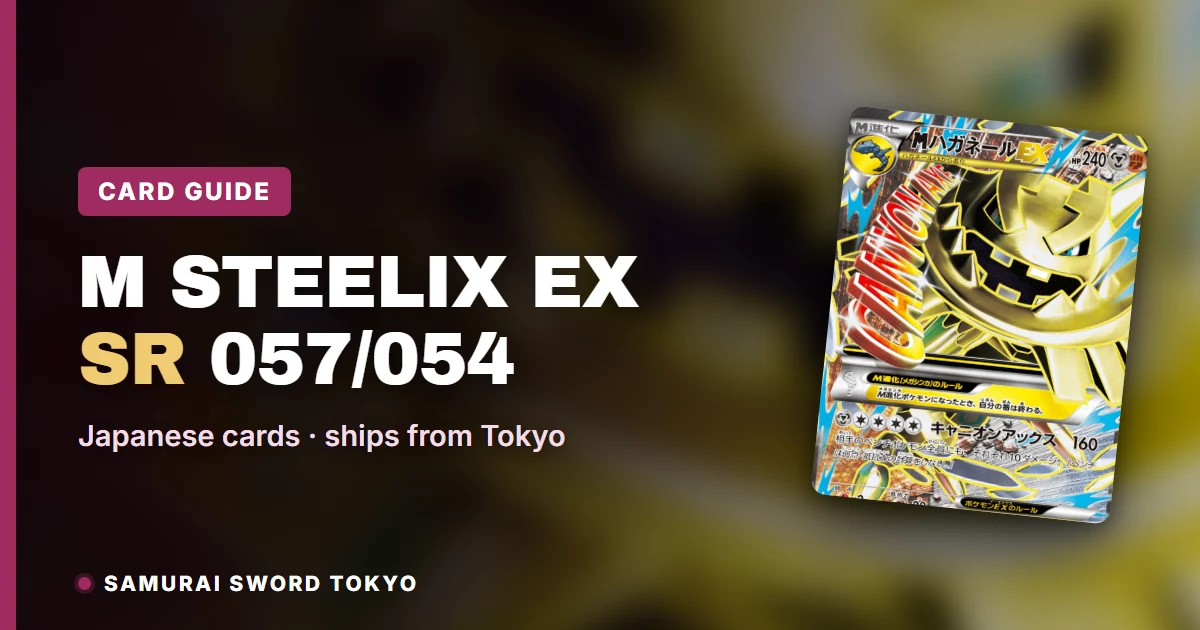
Guide de la carte M Steelix EX SR 057/054 (Fever-Burst Fighter, 1st Edition)

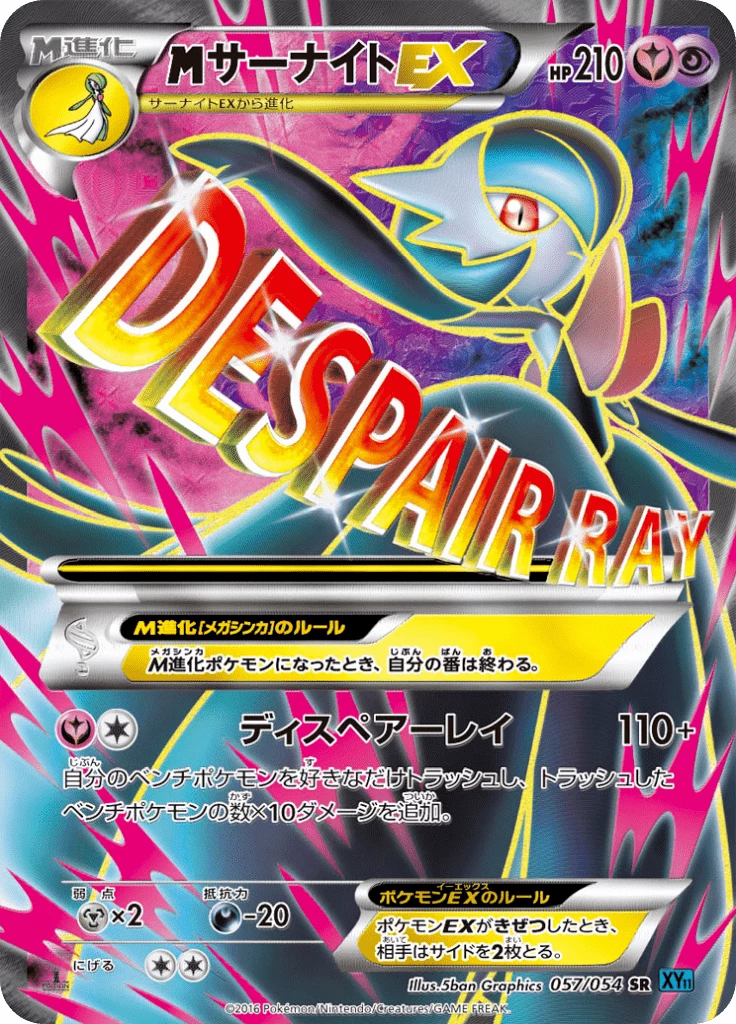
Two Japanese sets released on the same day in June 2016, both denominated out of 54 cards, and both put their headline Secret Rare at card number 057. One of those cards is M Gardevoir EX. The other is M Steelix EX — and it is the card this guide is built around.

The card is M Steelix EX, No. 057/054, printed as a Secret Rare (SR) in the Japanese expansion pack our site labels Fever-Burst Fighter (爆熱の闘士, internal set code XY11b). A graded, 1st Edition copy of this exact print is currently listed at ¥66,000 (~$415), and this guide covers the card’s full stat line, how its numbering lines up against its release-day siblings, what the set itself is, and how the Japanese print compares to its English counterpart.

This exact print already appears as the headline chase card in our two-set overview of XY11, Cruel Traitor & Fever-Burst Fighter: Best Cards. That article frames M Steelix EX as one half of a two-set story alongside M Gardevoir EX. This guide goes deeper on M Steelix EX alone — full print detail, its Mega Evolution mechanics, and where it sits against its own set’s sibling rarities.

Key Takeaways

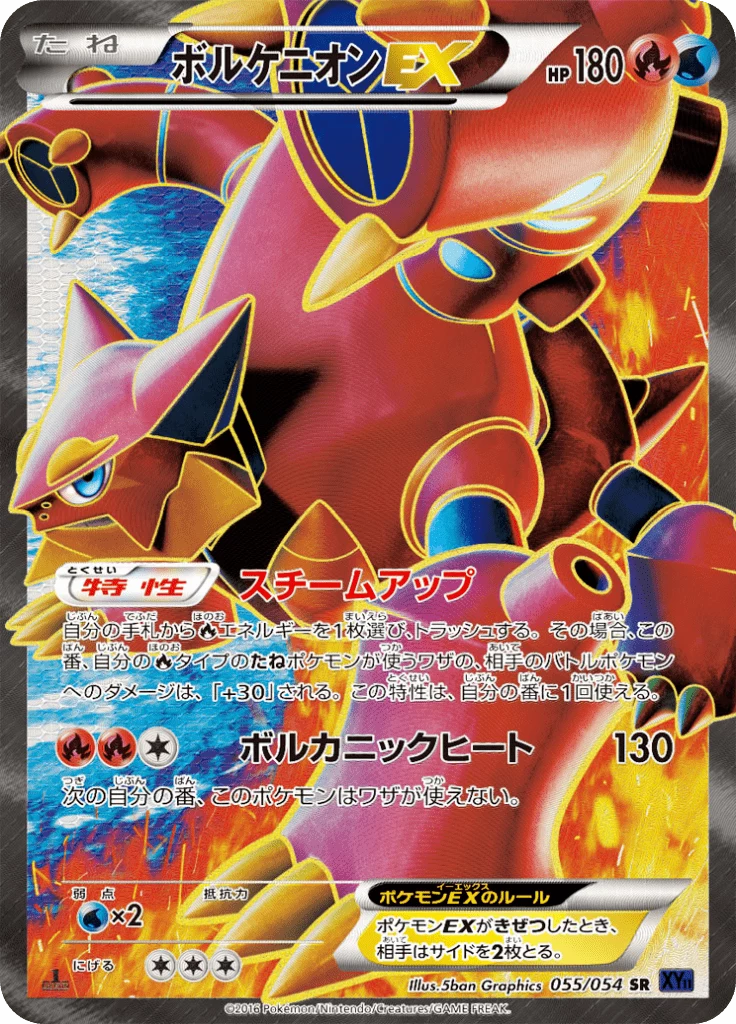
M Steelix EX SR 057/054 is a PSA 10, 1st Edition copy, currently listed at ¥66,000 (~$415). It comes from Fever-Burst Fighter (XY11b), a Japanese expansion pack released 17 June 2016 alongside its twin set Cruel Traitor. The same Fever-Burst Fighter set also produced Volcanion EX SR 055/054, whose PSA 10, 1st Edition copy is currently listed at ¥37,399 (~$235).

240
HP

SR
Rarity (057/054)

58
Set Size (cards)

Jun 2016
Japan Release

Prices below are current samuraiswordtokyo.com listings, converted at ¥159/USD (September 2026).

The Card: M Steelix EX 057/054 SR

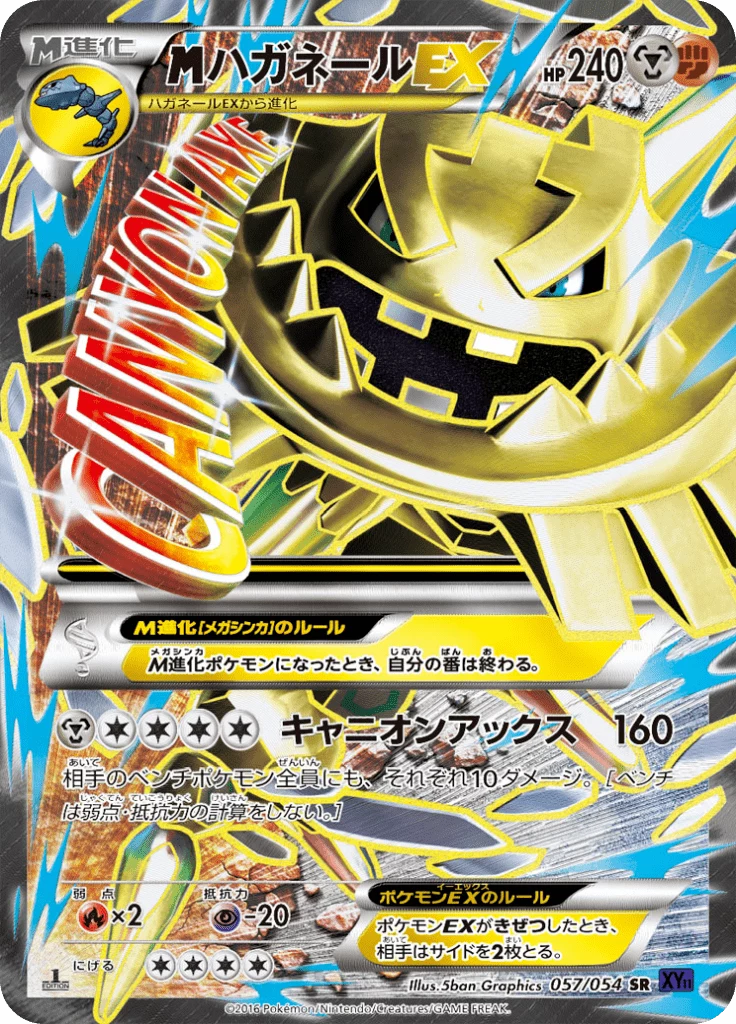
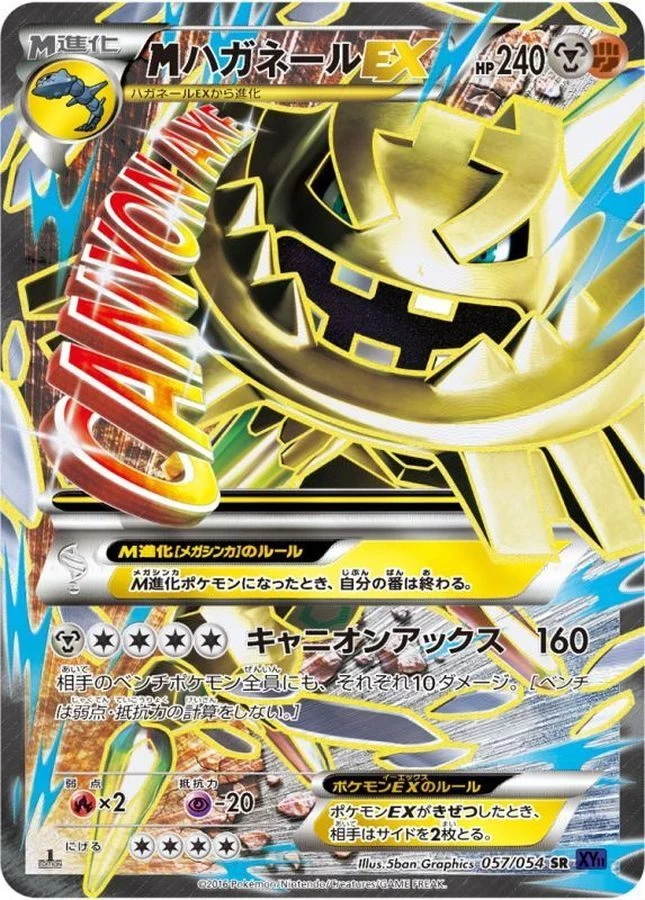
M Steelix EX is a Mega Evolution Pokemon evolving from Steelix-EX (the non-Mega form), with a Steel/Fighting dual type — labelled “Metal/Fighting” under Limitless’s type naming — and 240 HP. Its attack is キャニオンアックス (Canyon Axe), costing MCCCC for 160 damage, with the added effect that each of the opponent’s Benched Pokemon takes 10 damage; that bench damage is not affected by Weakness or Resistance. The card carries a Fire Weakness, a Psychic Resistance, and a Retreat Cost of 4. It is illustrated by 5ban Graphics.

M Steelix EX 057/054 SR, Fever-Burst Fighter (XY11b)
M Steelix EX 057/054 SR — Fever-Burst Fighter (XY11b), illustrated by 5ban Graphics

The number 057 sits above Fever-Burst Fighter’s own /054 denominator, which is where this set places its Secret Rare. Our own graded copy of this print is a 1st Edition, currently listed at ¥66,000 (~$415), PSA 10.

PSA 10 M Steelix EX SR 057/054 Fever-Burst Fighter slab, listed on samuraiswordtokyo.com
Already Covered Elsewhere on Our Site

Our Cruel Traitor & Fever-Burst Fighter best-cards overview also features this print as one of two headline chase cards across XY11’s twin sets. If you want the wider two-set picture, start there; if you want the full detail on M Steelix EX specifically, keep reading here.

The Set: Fever-Burst Fighter (XY11b)

Fever-Burst Fighter — 爆熱の闘士 in Japanese — is the translation our site uses, following Bulbapedia’s rendering of the title. Limitless’s internal card database labels the same set “Heat Burst Fighter,” and “Explosive Fighter” appears elsewhere on our own site. None of these three is an official Pokemon Company name, because this Japanese set never received a standalone English-language release of its own. Its internal set code is XY11b, which matches the community shorthand “XY11-2” used in our own product titles.

Fever-Burst Fighter released on 17 June 2016, the same day as its twin set Cruel Traitor (冷酷の反逆者, internal code XY11r / community shorthand “XY11-1”), whose own headline card is M Gardevoir EX. Both sets carry the print denominator /054 in their main numbered run, and both extend to a documented total of 58 cards once their secret-rare slots are counted.

We do not currently list a Fever-Burst Fighter or Cruel Traitor booster box; it is a vintage 2016 Japanese release. The graded singles above — M Steelix EX, Volcanion EX, and M Gardevoir EX — are our current route into this set. For a broader look at Japanese Steelix prints beyond this one card, see our Steelix cards guide.

Our anchor copy of M Steelix EX carries a 1st Edition mark on its own product listing. That sits comfortably inside the documented window during which Japanese Pokemon cards carried a 1st Edition stamp, which our own 1st Edition Japanese Pokemon cards guide covers in full — June 2016 falls well within that era.

Japanese vs English Print

The English set is Steam Siege (STS), which combines card pools from Fever-Burst Fighter and Cruel Traitor. Its M Steelix EX treatments are the regular print at #68 and the Full Art print at #109; the Japanese SR verified here is 057/054.

If you are trying to line up a Japanese copy against an English one, match by artwork and treatment — regular versus Full Art — rather than assuming the numbers will correspond directly.

One distinction worth being explicit about: this XY-era M Steelix EX (2016) is not the same card family as the more recent M-series “Mega X ex” cards released in 2025–26. The two use overlapping “Mega” branding language, but they belong to different Pokemon TCG eras, different mechanics generations, and different card pools. Nothing about the 2016 Fever-Burst Fighter print is a reprint of, or related to, any 2025–26 M-series release.

Where This SR Sits Among Japanese Chase Rarities

Within Fever-Burst Fighter, M Steelix EX’s 057/054 is a Secret Rare — the print sits past the set’s own /054 denominator, in the same elevated numbering band as Volcanion EX (055/054) from the same set and M Gardevoir EX (057/054) from the twin Cruel Traitor set. All three occupy that same beyond-denominator SR band, which is the standard treatment this pair of 2016 sets used for their headline chase cards.

The three graded XY11 Secret Rare listings shown here provide a direct comparison. For a side-by-side treatment of how M Steelix EX and M Gardevoir EX compare as a pair, see our Cruel Traitor & Fever-Burst Fighter best-cards overview.

Shop This Card
PSA10 M Steelix EX SR 057/054 :1ED (Fever-Burst Fighter)
Currently listed at ¥66,000 (~$415)
Ships from Tokyo · Tracked delivery

View Product →

Where to Buy M Steelix EX from Tokyo

Our graded copy of PSA 10 M Steelix EX SR 057/054, 1st Edition is currently listed at ¥66,000 (~$415), shipped from Tokyo with tracked delivery. From the same Fever-Burst Fighter set, PSA 10 Volcanion EX SR 055/054 is currently listed at ¥37,399 (~$235), and from the twin Cruel Traitor set, PSA 10 M Gardevoir EX SR 057/054 is currently listed at ¥102,300 (~$643).

We do not currently list a Fever-Burst Fighter or Cruel Traitor booster box; sourcing requests for sealed XY11 product go through our Quick Order page. For our wider range of graded Japanese cards, browse the PSA 10 graded card collection, or build a mixed order across singles and sealed product through Commande rapide.
Foire aux questions

What is M Steelix EX SR 057/054?

It is the Secret Rare print of M Steelix EX, card 057/054 from the Japanese expansion pack our site labels Fever-Burst Fighter (internal set code XY11b), released 17 June 2016. A PSA 10, 1st Edition copy of this print is currently listed at ¥66,000 (~$415).

Is M Steelix EX related to the newer « Mega X ex » cards?

No. M Steelix EX is a 2016 XY-era card from Fever-Burst Fighter. The M-series « Mega X ex » cards released in 2025–26 are a separate, later generation of Mega Evolution cards. They share « Mega » branding language but are not reprints of, or related to, each other.

Why do M Steelix EX and M Gardevoir EX share the number 057?

Fever-Burst Fighter and Cruel Traitor are twin Japanese sets released on the same day, 17 June 2016, both denominated out of 54 cards. Each set placed its own headline Secret Rare past that denominator: M Steelix EX at 057/054 in Fever-Burst Fighter, M Gardevoir EX at 057/054 in Cruel Traitor. The shared number is a coincidence of the two sets’ numbering, not a reprint relationship.

Does M Steelix EX have an English print?

Yes — Steam Siege (STS) carries the card across two treatments: a regular print at #68 and a Full Art print at #109. Steam Siege is the single English set combining the card pools of both Fever-Burst Fighter and Cruel Traitor.

What does the « 1st Edition » mark mean on this card?

It confirms the specific print run stamp used on Japanese Pokemon cards during the documented 1st Edition era. Our anchor copy’s listing confirms a 1st Edition mark, and the card’s June 2016 release date sits inside that documented window.

Where can I buy a PSA 10 M Steelix EX from Tokyo?

Our graded 057/054 SR copy is currently listed at ¥66,000 (~$415) with tracked shipping from Tokyo.

Cartes Pocket Monsters : pourquoi les cartes Pokemon japonaises disent Pocket Monsters

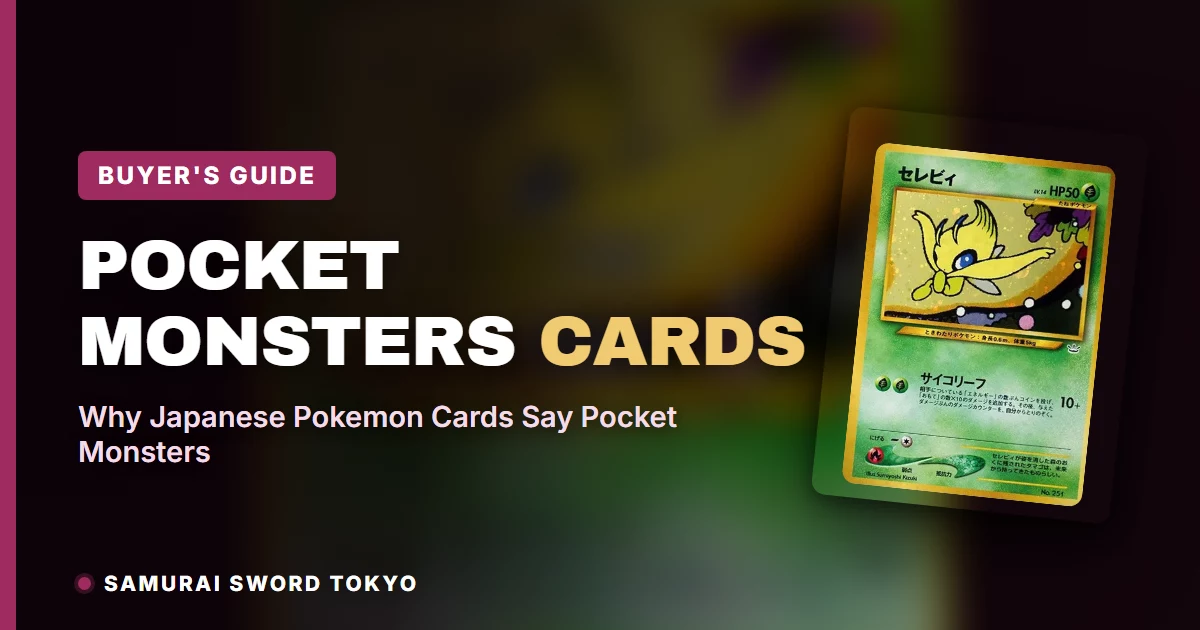
The earliest Japanese TCG packaging and original-era card back used Pocket Monsters Card Game branding because Pocket Monsters (ポケットモンスター) was the franchise’s original Japanese name. « Pokemon » is a contraction of that same name that went on to become the franchise’s standard branding internationally — and, within a few years, in Japan’s own card game too. It isn’t a mistranslation of the Japanese name; it’s the same name, shortened.

That history explains why the original 1996 Japanese TCG packaging and the earliest card design carried « Pocket Monsters Card Game » branding rather than « Pokemon. » This guide traces where the name came from, when Japan’s own card-game branding shifted over to « Pokemon, » and how the original naming era connects to the « Old Back » card design that graders and collectors still reference today.

Key Takeaways

« Pocket Monsters » is the franchise’s original, official Japanese name — older than « Pokemon, » not a corruption of it. The name was almost « Capsule Monsters » before a trademark issue forced a change, prior to the franchise’s 1996 debut. The Japanese TCG launched on October 20, 1996 under « Pocket Monsters Card Game » branding, originally published by Media Factory and developed by Creatures Inc.; Japan’s own card-game branding later moved to « Pokemon Card Game » (ポケモンカードゲーム), which is what’s printed on current Japanese packaging. A sealed Pokemon Card Game Classic set is currently listed at ¥84,000 (~$528), and a PSA10 Celebi carrying a literal Old Back « Pocket Monsters »-era print is currently listed at ¥275,000 (~$1,730).

1996
JP TCG Launch Year

2000
TPC Takes Over JP Publishing

20 Oct
1996 JP TCG Launch Date

¥159
Per USD (Sept 2026)

Yen figures below convert at ¥159/USD (September 2026). Prices are the store’s current listed prices — check the linked listing for the live number before ordering.

From « Capsule Monsters » to « Pocket Monsters »: The Trademark Story

Before Pokemon existed under that name, it nearly launched under a different one. According to Bulbapedia’s history of the franchise, the concept was originally pitched to Nintendo under the working title « Capsule Monsters. » That name ran into trademark issues before release, so the project was renamed « Pocket Monsters » — the name it has carried in Japan ever since.

This matters for card collectors because it means « Pocket Monsters » is not a nickname, a fan term, or a rough translation. It’s the franchise’s actual, original, official Japanese name — predating « Pokemon » by the entire pre-launch development period. Everything that followed, including the trading card game, was built and branded under that original name in Japan.

Why the Original Japanese TCG Said « Pocket Monsters Card Game »

The Japanese Pokemon Trading Card Game launched on October 20, 1996. It was originally published by Media Factory and developed by Creatures Inc.. Because the underlying franchise name in Japan at the time was « Pocket Monsters, » the original packaging and card branding used that name directly — « Pocket Monsters Card Game » — rather than « Pokemon. » Japan’s own TCG branding later moved on: today’s Japanese packaging is printed as « Pokemon Card Game » (ポケモンカードゲーム), the same « Pokemon » name used internationally.

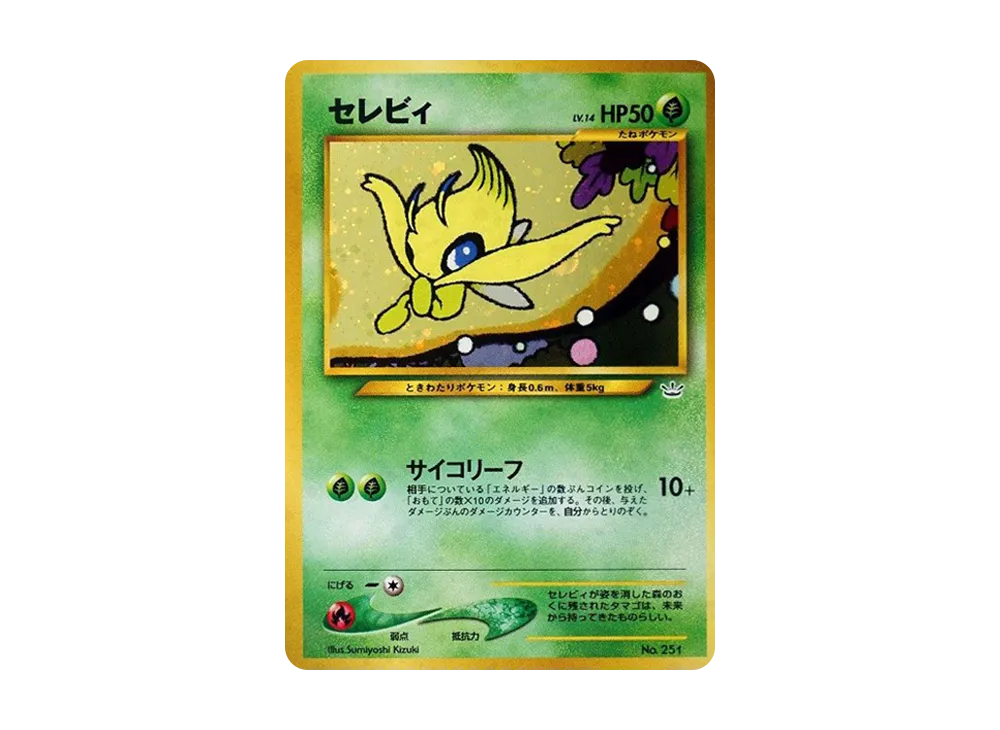
PSA10 graded Celebi, PRMF-3 No. 251, Old Back print
Celebi, PRMF-3 No. 251, Old Back print — a literal example of a card from the « Pocket Monsters »-branded era

A card like this one is a direct physical example of that early branding period: printed while the Japanese TCG’s own packaging still used the « Pocket Monsters » name, before « Pokemon » became the card game’s own branding as well as the international one. Our sibling piece on Japanese card backs explained covers how the physical card-back design from this same period is identified and graded.

In Japan — and formerly in Korea and China as well — the wider entertainment franchise (the video games and anime) is still officially referred to as the « Pocket Monsters » series. That’s the root reason the earliest Japanese TCG packaging, promotional material, and card branding read differently from what English-speaking collectors are used to seeing — even though the card game itself later adopted the « Pokemon » name in Japan too.

Where the Name « Pokemon » Came From

« Pokemon » is a contraction of « Pocket Monsters. » It became the franchise’s standard branding internationally and, within a few years, the card game’s own branding in Japan as well, alongside « Pocket Monsters » remaining the wider franchise’s official Japanese name for the video games and anime.

Market Official franchise name Where it shows up
Japan (and formerly Korea/China) Pocket Monsters (ポケットモンスター) series — video games and anime Original-era JP TCG packaging and card branding
International markets, and Japan’s own card game today Pokemon — contraction of Pocket Monsters International releases and Japan’s own « Pokemon Card Game » (ポケモンカードゲーム) branding

The two names describe the same franchise, released from the same source — they are branding choices tied to different eras and products, not separate franchises or separate histories.

Not a Mistranslation

« Pocket Monsters » is sometimes assumed to be an awkward or literal translation of « Pokemon. » It’s the reverse: « Pocket Monsters » is the original name, and « Pokemon » is the derived, shortened English form.

The Name Behind the « Old Back » Card Design

Western grading and hobby terminology splits early Japanese Pokemon cards into « Old Back » and « New Back » categories based on a card-back redesign. « Old Back » describes what the reverse of a card physically looks like, while « Pocket Monsters Card Game » describes branding found on original-era Japanese TCG packaging and cards. The two labels should not be treated as an exact shared date range.

PSA10 PSA10 M Steelix EX SR :1ED [XY11-2 057/054](Pack d'extension "Fever-Burst Fighter") 057/054 SR, listed on samuraiswordtokyo.com
PSA10 PSA10 M Steelix EX SR :1ED [XY11-2 057/054](Pack d'extension "Fever-Burst Fighter") 057/054 SR — a much later-era print, still part of the same franchise, produced well after both the Old Back naming period and the original "Pocket Monsters" TCG branding

Cards like this later XY-era print use a different card-back design from the original-era example, but the underlying franchise identity in Japan — « Pocket Monsters » — hasn’t changed. For the full breakdown of how the physical card-back redesign is identified, see our dedicated Japanese card-back guide, and for how the two languages’ printings differ more broadly, see our Japanese vs English Pokemon cards hub.

Two Names, One Franchise: How It Works Today

Modern Japanese Pokemon cards use « Pokemon Card Game » (ポケモンカードゲーム) branding rather than the original-era « Pocket Monsters Card Game » wording. The broader entertainment franchise — the video games and anime — still carries the « Pocket Monsters » (ポケットモンスター) name in Japan.

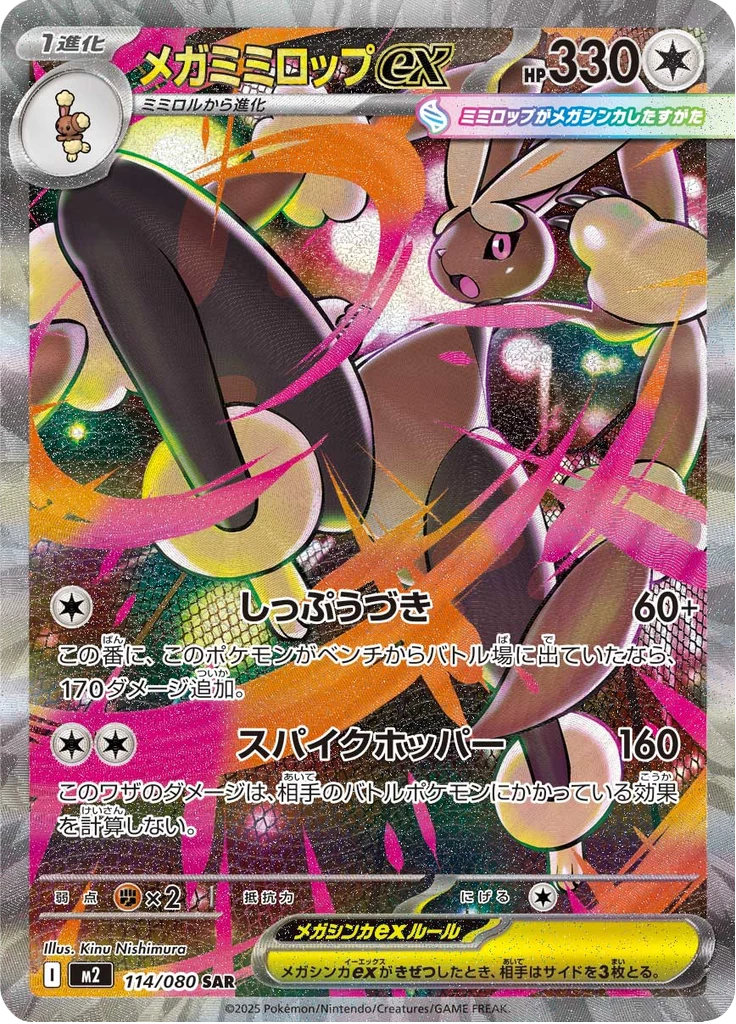
Mega Lopunny ex, No. 114, SAR, Set M2

Mega Lopunny ex, No. 114, SAR — Set M2

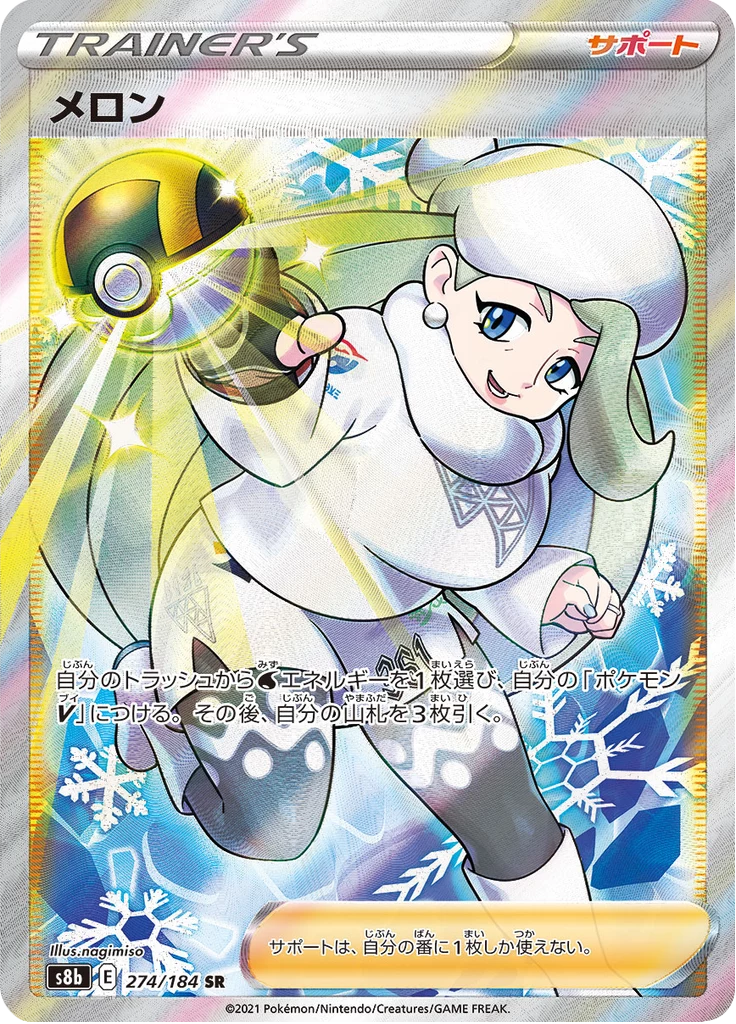
Melony, No. 274, SR, Set S8b

Melony, No. 274, SR — Set S8b

These two current-era Japanese prints carry the modern « Pokemon Card Game » branding, decades removed from the 1996 « Pocket Monsters Card Game » original — though the wider entertainment franchise those cards are based on is still officially the « Pocket Monsters » series in Japan. For readers tracking how the game’s rarity labelling evolved across those same decades, our Japanese trading card games guide covers the wider landscape those sets sit inside.

Buying Japanese Pokemon Cards from Tokyo

Two products referenced in this guide are a sealed Pokemon Card Game Classic set and a graded single that physically dates to the Old Back period.

The Pokemon Card Game Classic set is currently listed at ¥84,000 (~$528).

Pokemon Card Game Classic sealed Japanese set
Pokemon Card Game Classic — sealed Japanese set

For a graded single that literally carries an Old Back « Pocket Monsters »-era print, the PSA10 Celebi, Old Back [PRMF-3 No.251], is currently listed at ¥275,000 (~$1,730). For contrast, a much later-era print that’s still part of the same modern Japanese franchise — the PSA10 M Steelix EX SR, 1st Edition [XY11-2 057/054], is currently listed at ¥66,000 (~$415) — useful if you’d rather see how the identity carries into a later-era print without paying an Old Back premium. For the wider first-edition landscape between those two eras, see our Japanese 1st Edition cards guide and our vintage Japanese booster box guide for sealed product from the same period.

Shop This Set
Pokemon Card Game Classic (Japanese)
Sealed Japanese set
Ships from Tokyo · Tracked delivery

View Product →

For graded singles from other eras, our PSA10 graded card collection and Pokemon card box collection cover current listings, and our Quick Order page is the fastest way to request a specific print or set.

Foire aux questions

Why did the original Japanese Pokemon cards say « Pocket Monsters » instead of « Pokemon »?

Because « Pocket Monsters » was the franchise’s original, official Japanese name when the TCG launched in 1996. « Pokemon » is a contraction of that name, and Japan’s TCG packaging later switched to « Pokemon Card Game » branding.

Was « Pokemon » originally going to be called something else?

Yes. The franchise was first pitched to Nintendo under the working title « Capsule Monsters. » A trademark issue forced a change before release, and the name became « Pocket Monsters » — the name Japan still uses for the series today.

When did the Japanese Pokemon Trading Card Game launch?

October 20, 1996. It was originally published by Media Factory and developed by Creatures Inc.

Who originally published and developed the Japanese TCG?

Media Factory originally published the Japanese TCG, with Creatures Inc. as developer.

Is « Pocket Monsters » a mistranslation of « Pokemon »?

No. It’s the reverse of that assumption — « Pocket Monsters » is the original, official Japanese name, and « Pokemon » is the derived, shortened form.

Does « Pocket Monsters » branding only appear on old cards?

The verified original-era examples use « Pocket Monsters Card Game » branding, while today’s Japanese TCG packaging says « Pokemon Card Game. » This guide does not assign an exact shared date range to that branding and the Old Back designation.

Guide de la carte Skwovet Full Art : l'Art Rare japonaise de SV1V Violet ex

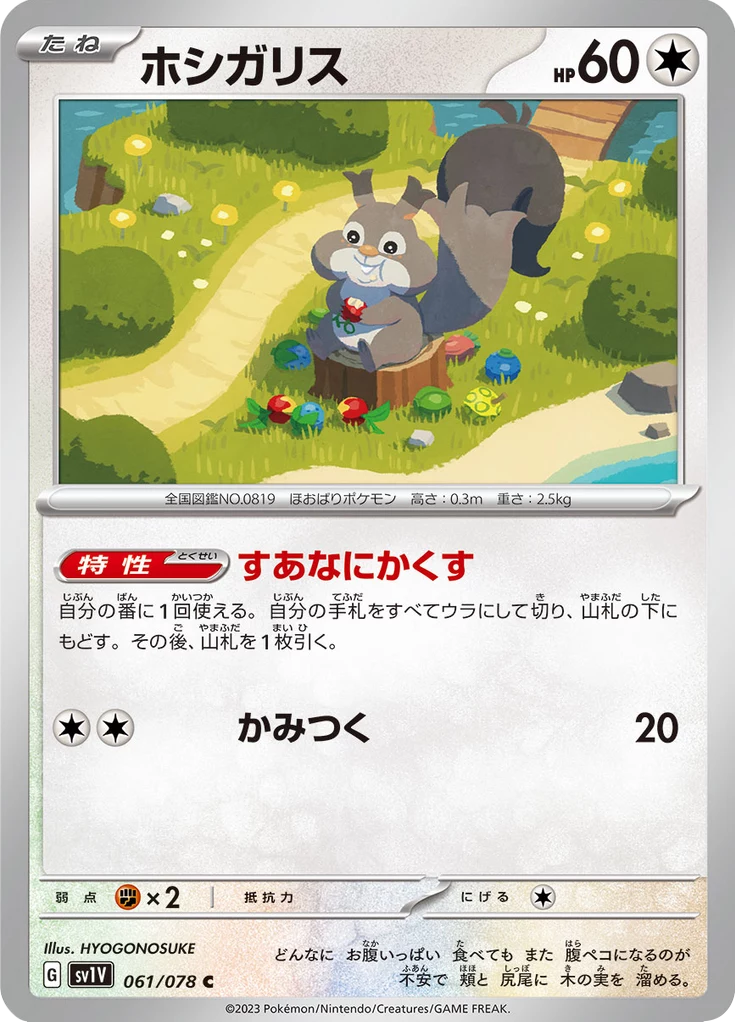
Skwovet has a long Japanese print history — a Limitless TCG database search returns 13 Japanese prints in total — but only one of them is the “full art” collectors mean when they search for it. That print and its plain-Common set-mate both come from the same Violet ex release, but they have different artwork by different illustrators as well as different card numbers and rarity labels.

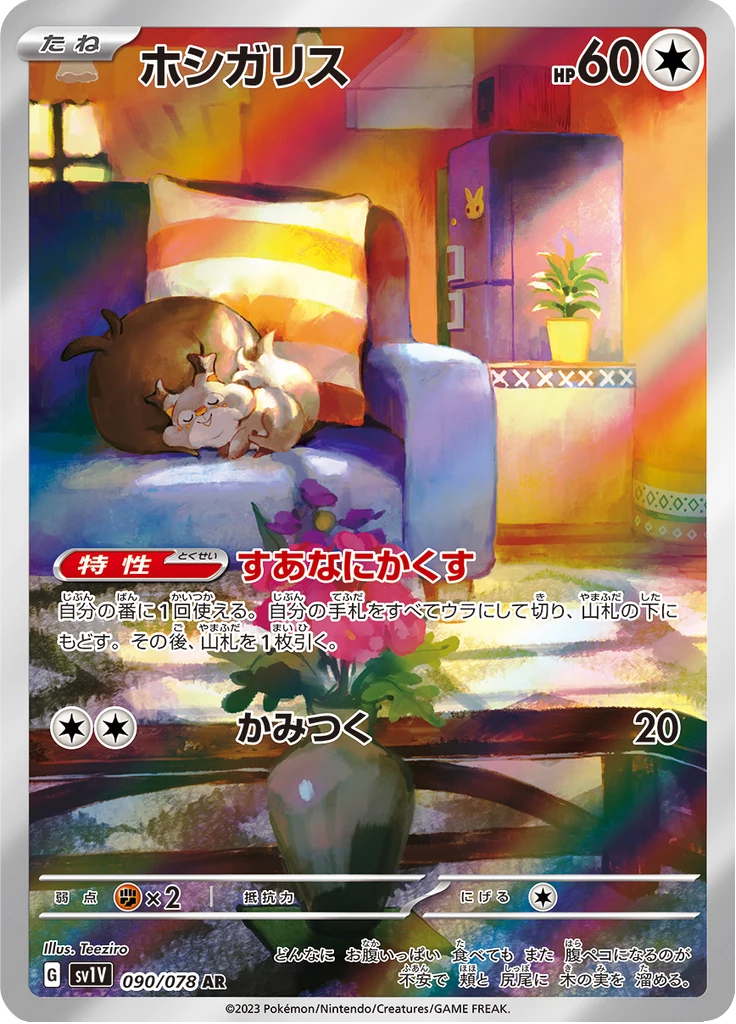
The card is ホシガリス — Skwovet, and the print collectors mean when they say “Skwovet full art” is 90/78, printed as an Art Rare (AR) in the Japanese expansion pack 拡張パック「バイオレットex」/ “Violet ex”, set code SV1V. Note on terminology first: Art Rare is the printed rarity on the card — “full art” is the community shorthand people search for because the illustration runs edge to edge with no border, not a rarity name printed anywhere on the card itself. This guide covers Skwovet’s two Violet ex prints in full detail — that’s the set behind the sealed box we currently list — and flags the card’s wider Japanese print footprint so you know 90/78 isn’t Skwovet’s only Japanese appearance, how it compares to its English-set equivalents, and where the sealed product that produces it is listed on our site.

Key Takeaways

Skwovet’s Art Rare print, 90/78, comes from Violet ex (SV1V), a Japanese expansion pack released 20 January 2023. No single copy of this print is currently listed on our site — the print is pulled from sealed SV1V-Violet ex Japanese Pokemon Booster Boxes, currently listed at ¥9,880 (~$62). The set’s other confirmed Skwovet print, 61/78, is a plain Common and not the card people are searching for when they say “full art.”

AR
Rarity (90/78)

78
Base Set Size (SV1V)

Jan 2023
Japan Release

13
Total JP Prints (Limitless)

Prices below are current samuraiswordtokyo.com listings, converted at ¥159/USD (September 2026).

The Card: Skwovet 90/78 Art Rare

The print behind the “Skwovet full art” search term is card 90/78 from Violet ex (SV1V), illustrated by Teeziro. Its printed rarity is Art Rare (AR) — that is the tier name that actually appears in the set’s own card list. “Full art” describes the look of the card (the illustration runs the full frame with no colour border), and it’s the phrase most buyers type into a search bar, so we’re using it in this guide’s title while being precise about the printed rarity in the body text.

The card’s position — numbered 90 inside a set labelled “78” — follows the standard Japanese convention for a secret-tier slot: the number sits above the set’s main run of 78 cards, marking it as one of the additional chase-tier prints rather than part of the base numbering.

Skwovet 90/78, Art Rare, Violet ex (SV1V)
Skwovet 90/78, Art Rare — Violet ex (SV1V), illustrated by Teeziro

This print is not currently listed as a single on our site; sourcing requests for a graded or raw copy go through Commande rapide. The card is pulled from sealed Violet ex product — see the Where to Buy section below for the box that carries it.

The Set: Violet ex (SV1V)

Violet ex — 拡張パック「バイオレットex」in Japanese — is set code SV1V, released in Japan on 20 January 2023 on the same day as its companion set, Scarlet ex (SV1S). Between the two, the set list runs to 108 total cataloged cards: a base run of 78 cards plus 30 secret-tier prints, made up of 12 Art Rare, 10 Secret Rare, 5 Special Art Rare, and 3 Ultra Rare cards.

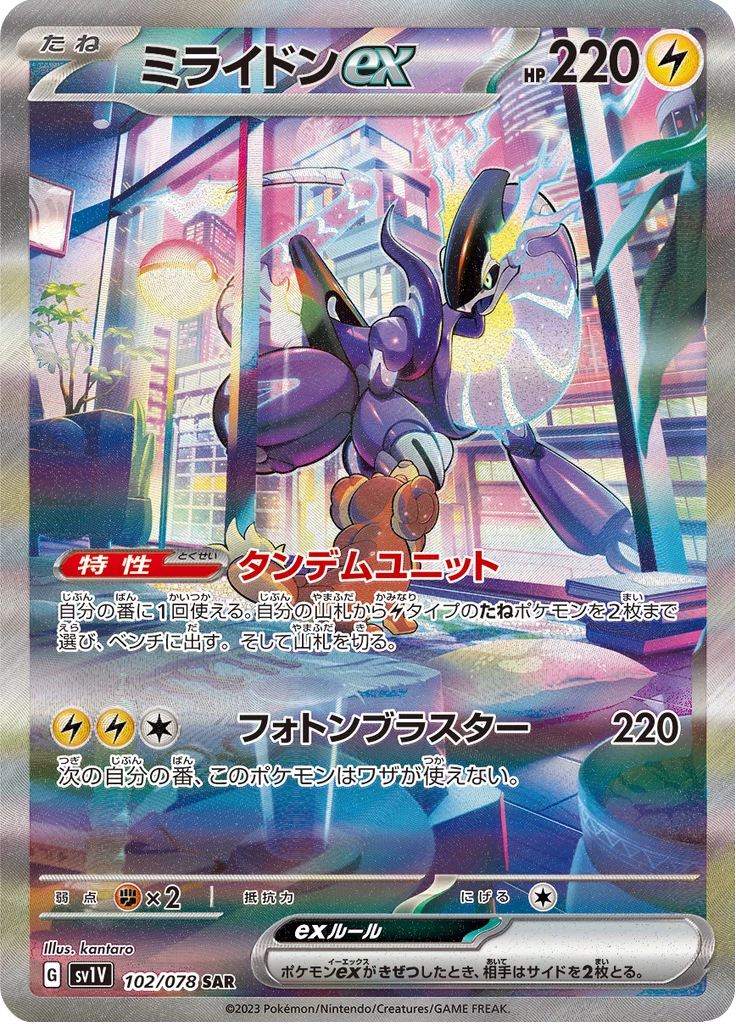
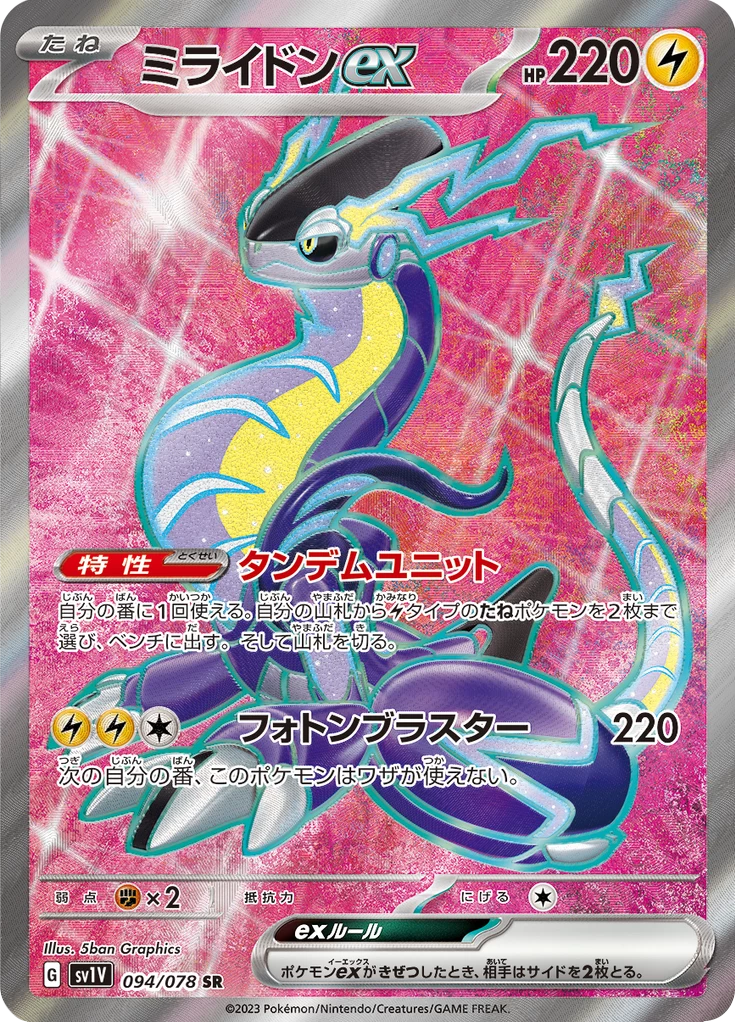
Violet ex is Miraidon-themed, and its own headline chase card is Miraidon ex, which appears in the set at both Secret Rare and Special Art Rare tiers. For the set’s own full card-by-card breakdown, see our Violet ex (SV1V) card list, and for a look at pull rates and the set’s strongest pulls, see Violet ex pull rates and best cards.

Miraidon ex 102/78, Special Art Rare, Violet ex (SV1V)
Miraidon ex 102/78, Special Art Rare — Violet ex (SV1V)’s own headline chase card, from the same box as Skwovet
Miraidon ex 94/78, Secret Rare, Violet ex (SV1V)
Miraidon ex 94/78, Secret Rare — a second Miraidon ex tier from the same set
Don’t Mix Up SV1V and SV1S

Violet ex (SV1V, Miraidon-themed) and Scarlet ex (SV1S, Koraidon-themed) are companion sets released on the same day with the same 108-card structure, but different headline Pokemon and different secret-tier print runs. Skwovet’s Art Rare is an SV1V print — check the set code before assuming a card from one companion set applies to the other. Our SV1S vs SV1V box guide covers the differences between the two.

Japanese vs English Print

Skwovet does have English-set equivalents, though the split doesn’t map one-to-one onto the two Japanese prints. The English releases sit in the base Scarlet & Violet (SVI) set at #151 and #222, plus a further print in Paldean Fates (PAF) at #205.

That three-slot English side is a smaller count than Skwovet’s Japanese side once you look past Violet ex alone — the card has 13 documented Japanese prints in total across many more sets, not just the two covered in detail here. If you’re matching a Japanese Art Rare against an English copy, go by illustration and rarity treatment rather than assuming the card numbers line up, since SVI and PAF use entirely separate numbering from SV1V.

Our Scarlet & Violet base set chase cards guide covers the SVI side of the base era in more detail if you’re cross-referencing other cards from the same generation.

Where This Art Rare Sits Among Japanese Chase Rarities

Violet ex’s 30 secret-tier prints split across four rarities: 12 Art Rare, 10 Secret Rare, 5 Special Art Rare, and 3 Ultra Rare. Skwovet’s 90/78 sits at the Art Rare tier — the entry point of the set’s secret-tier chase cards, and the tier with the largest number of distinct prints (12) of the four. Secret Rare, Special Art Rare, and Ultra Rare prints in the same set have progressively fewer distinct cards printed at each tier, which is the standard shape of a Scarlet & Violet-era Japanese set’s rarity ladder.

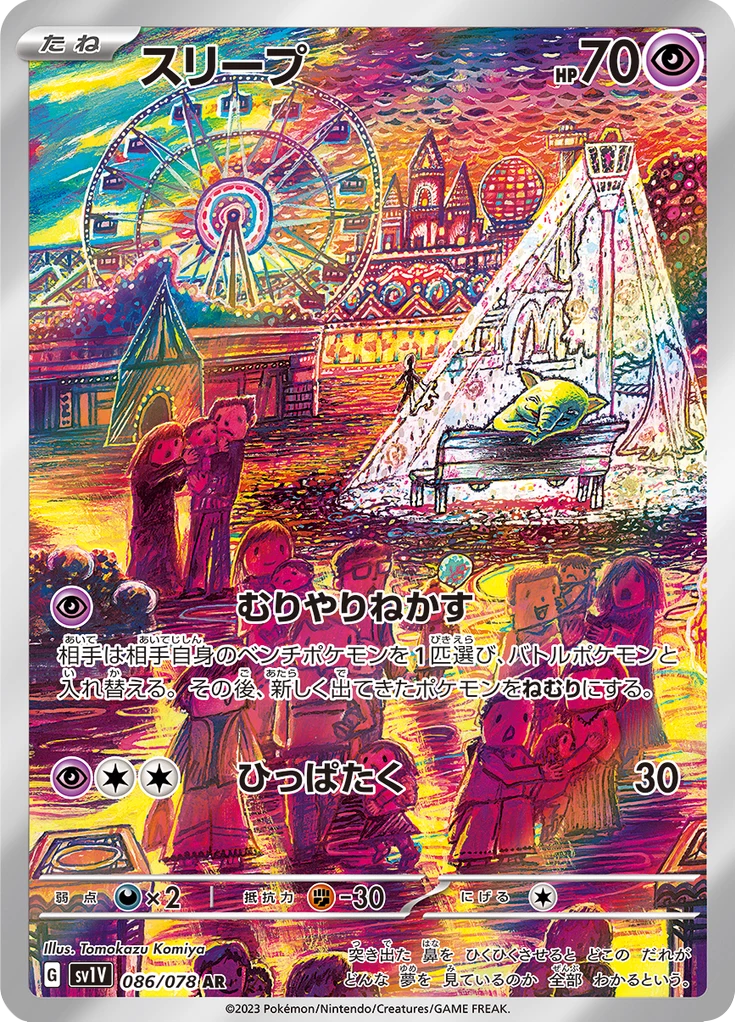
Skwovet’s Art Rare sits alongside other Violet ex Art Rares we’ve profiled, including Drowzee 86/78 — another full-bleed illustration from the same set and the same secret-tier rarity, covered in our Drowzee Art Rare (Violet ex) card guide.

Drowzee 86/78, Art Rare, Violet ex (SV1V)
Drowzee 86/78, Art Rare — another Violet ex (SV1V) full art, same secret-tier rarity as Skwovet’s 90/78

For another Violet ex single-card profile from this same secret tier, see our Miriam Pokemon card guide, and for a broader look at what makes an Art Rare-style print collectible across Japanese sets generally, see our best full art Pokemon cards guide.

Shop This Set
SV1V-Violet ex Japanese Pokemon Booster Box
Currently listed at ¥9,880 (~$62) — source of both confirmed Skwovet prints
Ships from Tokyo · Tracked delivery

View Product →

Where to Buy Skwovet Cards from Tokyo

No single copy of the Common (61/78) print or the Art Rare (90/78) print appears on our site at the moment. The way to pull either print is sealed SV1V-Violet ex Japanese Pokemon Booster Boxes, currently listed at ¥9,880 (~$62), shipped from Tokyo with tracked delivery — the same box also produces the set’s Miraidon ex Secret Rare and Special Art Rare pulls covered above.

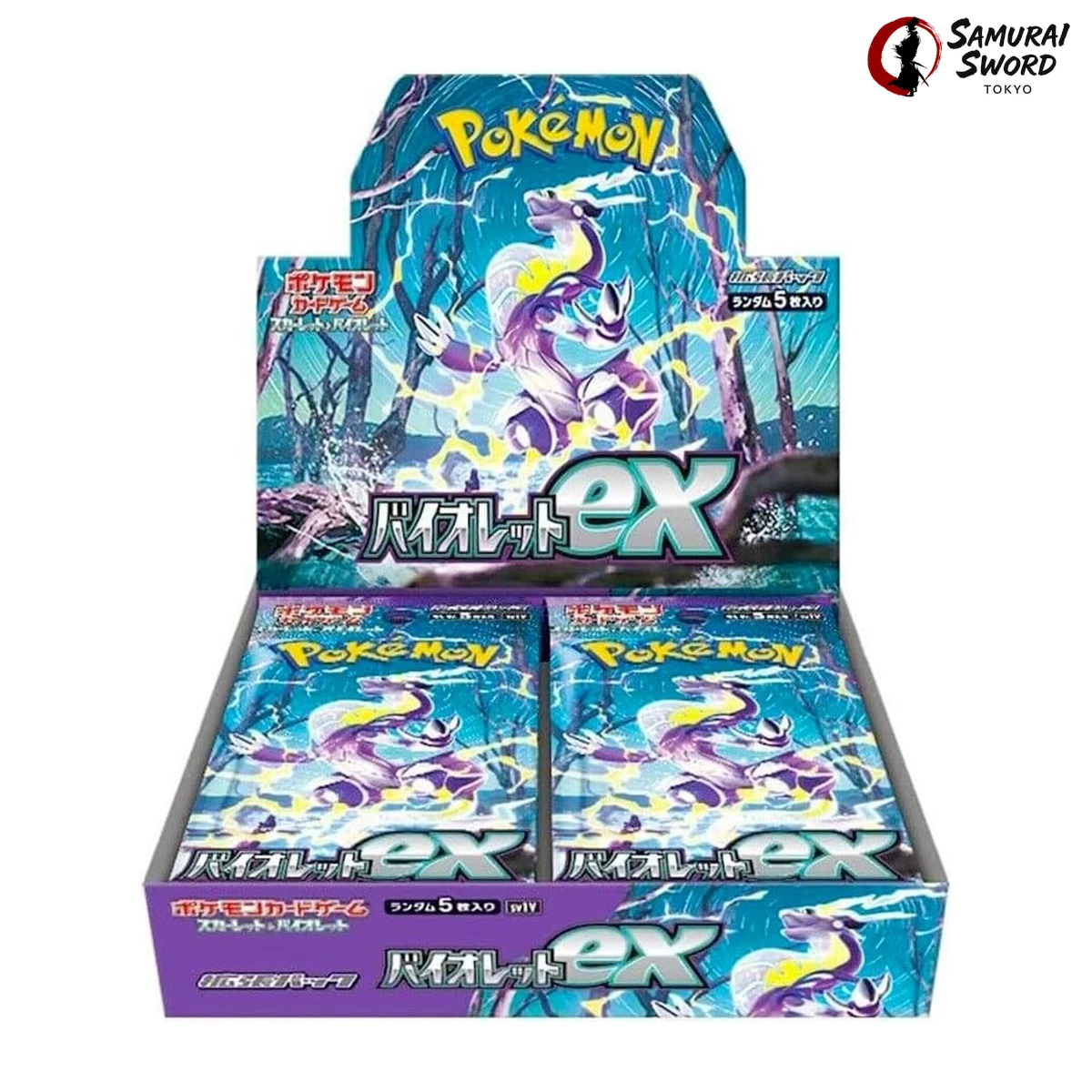
SV1V Violet ex Japanese Pokemon Booster Box, listed on samuraiswordtokyo.com

If you’re after a graded single of either print, sourcing requests go through our Quick Order page, which is also the fastest route for building a mixed order across sets. For the full range of sealed Japanese Pokemon product, browse our Pokemon card box collection.

Foire aux questions

What is the Skwovet full art card?

“Full art” is the community search term for Skwovet 90/78, whose printed rarity is Art Rare (AR), from the Japanese expansion pack Violet ex (SV1V), released 20 January 2023. The card isn’t labelled “full art” anywhere on its print — that’s a description of its edge-to-edge illustration style.

How many Japanese prints of Skwovet are there?

At least 13, per a Limitless TCG database search across many Japanese sets. This guide details the two from Violet ex (SV1V), released the same day: 61/78 (Common, illustrated by HYOGONOSUKE) and 90/78 (Art Rare, illustrated by Teeziro).

What is the difference between Skwovet 61/78 and 90/78?

Both are from Violet ex (SV1V). The 61/78 is a Common print inside the set’s main 78-card numbering; the 90/78 is the Art Rare — a secret-tier, full-bleed alternate-art treatment. The “full art” search term refers to the 90/78 print.

Does Skwovet have an English print?

Yes — the base Scarlet & Violet (SVI) set carries it at #151 and #222, and Paldean Fates (PAF) carries a further print at #205. These English numbers don’t map directly onto the two Japanese SV1V prints.

What set is Skwovet’s Art Rare from?

Violet ex, Japanese set code SV1V, released 20 January 2023 alongside its companion set Scarlet ex (SV1S). Violet ex’s own headline chase card is Miraidon ex.

Where can I get a Skwovet full art card from Japan?

No single copy of either Japanese print is currently listed on our site. Both prints come from sealed Violet ex booster boxes, currently listed at ¥9,880 (~$62), and single-card sourcing requests go through our Quick Order page.
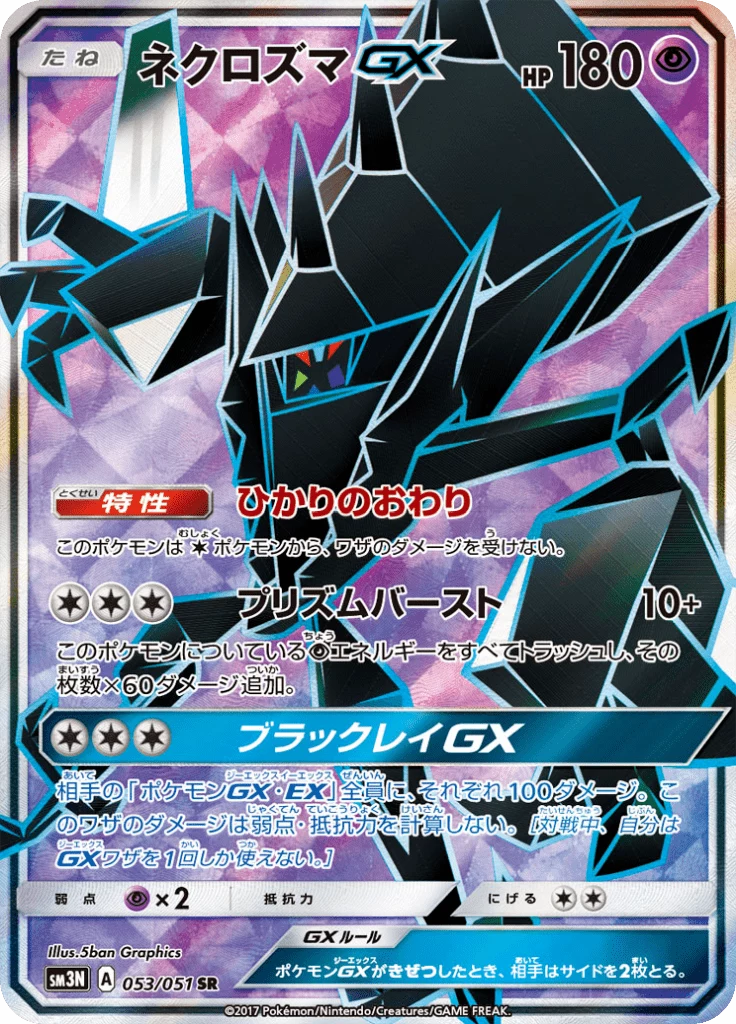
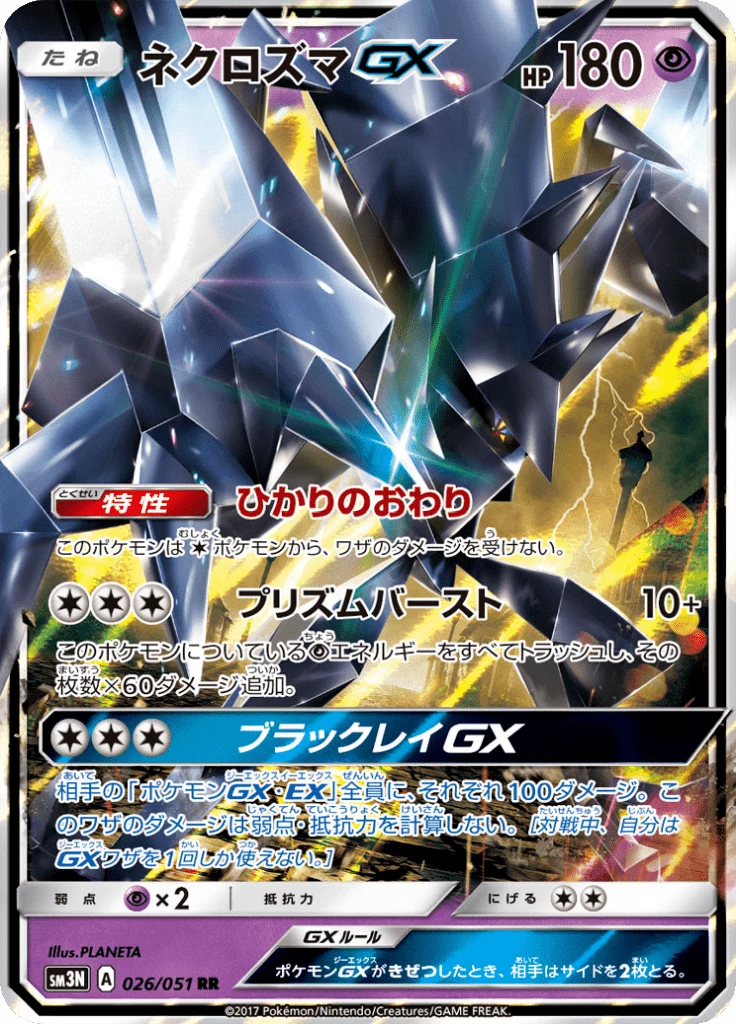
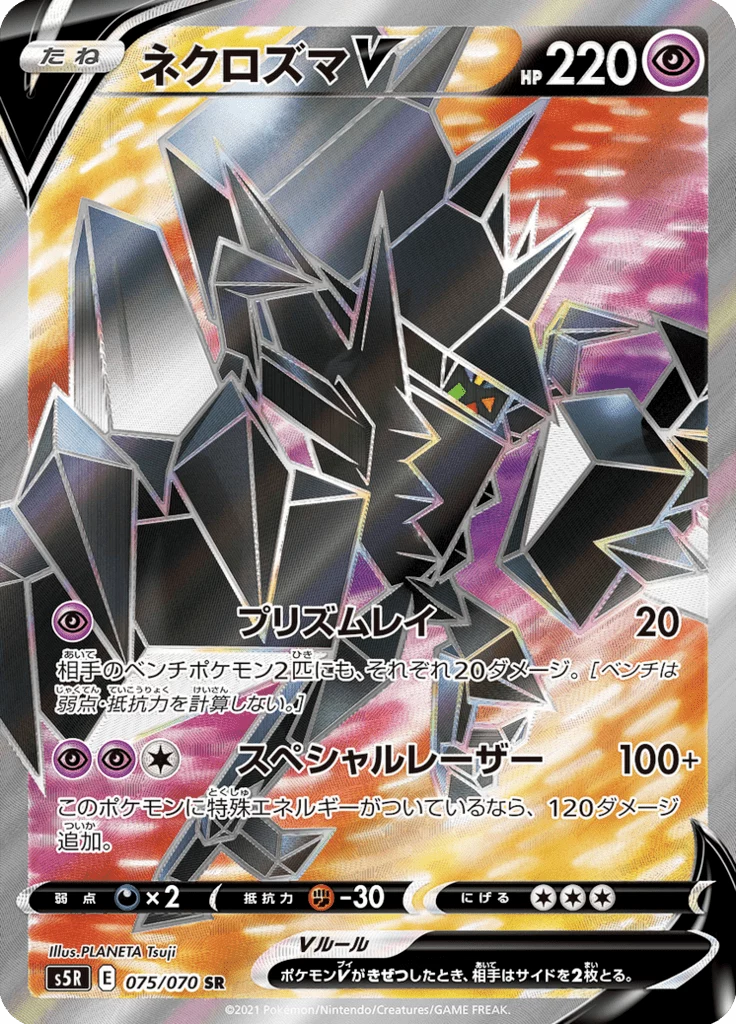
Guide des cartes Ultra Necrozma GX : tirages SM6 Forbidden Light

This guide focuses on the two Ultra Necrozma GX prints verified in Forbidden Light (SM6), both from the same March 2018 release. It does not treat that SM6 pair as a complete count of Japanese appearances.

The card is ウルトラネクロズマGX — Ultra Necrozma GX, a 190 HP Dragon-type card released in the Japanese expansion pack フォビドゥンライト / « Forbidden Light » (set code SM6). We do not currently list a graded single of either SM6 print, but the sealed SM6 booster box — where both are pulled from — is on our site. This guide covers what the card is, how those two SM6 prints compare, where Forbidden Light sits in the wider SM-era catalogue, and how the Japanese release lines up against its English-set counterparts.

Key Takeaways

The prints verified in Forbidden Light (SM6) are a Double Rare at 069/094 and a Secret Rare at 099/094. Neither Forbidden Light single is currently listed on our site — sourcing requests for a graded copy of this card go through Commande rapide. If you want the sealed source product both SM6 prints are pulled from, the SM6 Forbidden Light Japanese Booster Box is currently listed at ¥68,250 (~$429).

190
HP

SR
Rarity (099/094)

102
Cataloged Cards (SM6)

Mar 2018
Japan Release

Prices below are current samuraiswordtokyo.com listings, converted at ¥159/USD (September 2026).

The Card: Ultra Necrozma GX 099/094 Secret Rare

Ultra Necrozma GX is a Dragon-type card with 190 HP. The 099/094 print — the headline print of the two — is illustrated by PLANETA, while the 069/094 Double Rare print carries art by PLANETA Otani. Forbidden Light’s main numbering runs to 94 cards, so 069/094 sits inside that mainline run; 099/094 sits past it, in the set’s secret-slot numbering, which is what marks it as the Secret Rare tier. Forbidden Light’s full catalog, including the secret-slot prints, runs to 102 cataloged cards.

Ultra Necrozma GX 099/094, Secret Rare, Forbidden Light (SM6)
Ultra Necrozma GX 099/094, Secret Rare — Forbidden Light (SM6), illustrated by PLANETA

This is the print set collectors reach for first when they say « Ultra Necrozma GX » without a number attached — the Secret Rare treatment, sitting above the Double Rare in the set’s own rarity structure. We do not currently list a graded single of this print; a sealed SM6 Forbidden Light Japanese Booster Box is the direct route to pulling one.

The Set: Forbidden Light (SM6)

Forbidden Light — 拡張パック「フォビドゥンライト」in Japanese — is set code SM6, a Japanese expansion pack released on 2 March 2018. Its catalog, main numbering plus secret and special slots combined, runs to 102 cataloged cards. The set belongs to the Sun & Moon (SM) era, when GX cards were the top mechanic across Japanese Pokemon releases.

For the set’s full card-by-card breakdown, see our Forbidden Light SM6 card list, and for a pull-rate and best-cards discussion of the set more broadly, our SM6 Forbidden Light pull rates & best cards hub covers that ground.

SM6 Forbidden Light Japanese Pokemon Booster Box, listed on samuraiswordtokyo.com
Sealed SM6 Forbidden Light Japanese booster box — the source product for both Ultra Necrozma GX prints

The SM6 Forbidden Light Japanese Booster Box — where both the 069/094 and 099/094 prints originate — is currently listed at ¥68,250 (~$429).

Japanese vs English Print

Ultra Necrozma GX has English-set equivalents. The English set is also called Forbidden Light (FLI), and it carries the card across three numbered slots — #95, #127, and #140 — plus a fourth appearance as a promo card, SM Promos #126, and a fifth as a Secret Rare in Dragon Majesty #78.

Those five English treatments do not map one-to-one onto the two verified SM6 prints covered here. If you are matching a Japanese print against an English one, go by artwork and rarity treatment rather than assuming the card numbers correspond.

Where This Secret Rare Sits Among Japanese Chase Rarities

Within Forbidden Light, the two confirmed Ultra Necrozma GX prints sit on two different rungs of the set’s rarity structure: the Double Rare at 069/094, and the Secret Rare at 099/094. The Secret Rare sits above the Double Rare — the harder-to-pull, higher secret-slot treatment, which is the standard pattern for SR-tier cards across this era of Japanese sets.

Ultra Necrozma GX’s chase-card status echoes other Necrozma-family cards from different Japanese sets and different card mechanics. Light Consuming Darkness (SM3N) — an earlier SM-era set — carries a plain Necrozma GX (not the Ultra form) at both a Secret Rare (#53) and a Double Rare (#26) tier, the same two-rung pattern seen here. A later set, Rapid Strike Master (S5R), carries a Necrozma V at Secret Rare (#75) — a different card mechanic from GX entirely, released under the newer V system rather than the Sun & Moon-era GX system.

Necrozma GX 53, Secret Rare, Light Consuming Darkness (SM3N)

Necrozma GX 53 (Secret Rare, SM3N) — sibling print, not Ultra Necrozma

Necrozma GX 26, Double Rare, Light Consuming Darkness (SM3N)

Necrozma GX 26 (Double Rare, SM3N) — sibling print, not Ultra Necrozma

Necrozma V 75, Secret Rare, Rapid Strike Master (S5R)

Necrozma V 75 (Secret Rare, S5R) — different mechanic, sibling family only

None of the three cards above are Ultra Necrozma GX — they are separate Necrozma-family prints from separate sets, shown here only to illustrate how the same Double Rare / Secret Rare rarity ladder appears elsewhere in this Pokemon’s Japanese card history. For the wider family, see our Necrozma Pokemon Card Guide — that page is the broader Necrozma-forms hub, while this page is a deep dive on the verified Ultra Necrozma GX pair from SM6. For a wider view of GX-era value cards, see our best Tag Team GX cards guide, and for Legendary-line Japanese chase cards generally, our Legendary Pokemon Japanese card guide covers that ground.

Shop This Set
SM6 Forbidden Light Japanese Booster Box
Source of both confirmed Ultra Necrozma GX prints
Ships from Tokyo · Tracked delivery

View Product →

Where to Buy Ultra Necrozma GX from Tokyo

We do not currently list a PSA 10 single of Ultra Necrozma GX, either the 069/094 Double Rare or the 099/094 Secret Rare. Sourcing requests for a graded single of this card go through our Quick Order page — no timing guaranteed, but it is the fastest way to flag what you’re after.

The direct route to both prints is sealed product: the SM6 Forbidden Light Japanese Booster Box, currently listed at ¥68,250 (~$429), ships from Tokyo with tracked delivery. For the set’s own card-by-card reference, our Forbidden Light Japanese card list covers every print in the set, not just this one. Browse our wider Japanese Pokemon booster box collection for other SM-era sealed product, or build a mixed order through Quick Order if you’re after singles across several sets.

Foire aux questions

What is Ultra Necrozma GX 099/094?

It is the Secret Rare print of Ultra Necrozma GX (ウルトラネクロズマGX), card 099/094 from the Japanese expansion pack Forbidden Light (set code SM6), released 2 March 2018. We do not currently list a graded single of this print; it is pulled from sealed SM6 booster boxes.

How many Japanese prints of Ultra Necrozma GX are there?

The prints verified for this guide are the Forbidden Light (SM6) Double Rare at 069/094 and Secret Rare at 099/094, released the same day. This is a limited SM6 list rather than a complete count of later Japanese appearances.

What is the difference between the 069/094 and 099/094 prints?

Both are from Forbidden Light (SM6), released the same day. The 069/094 is a Double Rare print; the 099/094 is the Secret Rare, sitting above it on the set’s rarity ladder. Neither is currently listed as a single on our site.

Does Ultra Necrozma GX have an English print?

Yes — the English set, also called Forbidden Light (FLI), carries the card across three numbered slots (#95, #127, #140) plus a promo appearance as SM Promos #126 and a Secret Rare in Dragon Majesty #78. These five English treatments do not map one-to-one onto the two verified SM6 prints covered here.

Is Necrozma V the same as Ultra Necrozma GX?

No. Necrozma V is a separate card released under the newer V mechanic in a later set (Rapid Strike Master, S5R), not the GX mechanic Ultra Necrozma GX uses. They share the Necrozma name but are different cards from different eras.

Where can I buy Ultra Necrozma GX from Tokyo?

We don’t currently list a graded single of either print, so sourcing requests go through Quick Order. The sealed SM6 Forbidden Light Japanese booster box, currently listed at ¥68,250 (~$429), is where both prints are pulled from, with tracked shipping from Tokyo.

Guide d'achat du display SV5M Cyber Judge : infos sur l'extension, cartes phares et où l'acheter

Japan got two Scarlet & Violet expansions on the same January day in 2024. One of them — Cyber Judge — is the half of that pair that carries this generation’s ex Special Art Rares, and it remains a frequently requested SV5-era box on our site.

SV5M Cyber Judge — in Japanese, 拡張パック「サイバージャッジ」— is a 100-card set that released in Japan on January 26, 2024, alongside its sibling expansion SV5K Wild Force. Each Cyber Judge booster box holds 30 packs of 5 cards, built around a 29-card secret tier that includes a pool of five Special Art Rares.

This guide covers exactly what’s in a Cyber Judge box, which cards define the set’s chase tier, how our Regular Box, Damaged Box and No Shrink listings compare for this particular set, and how the Japanese Cyber Judge release relates to its English-language counterpart. We ship this set out of Tokyo, so the pricing below reflects what’s currently listed.

Key Takeaways

Cyber Judge (SV5M) is a 100-card Scarlet & Violet expansion — 71 main-set cards plus a 29-card secret tier — released in Japan on January 26, 2024. The secret tier’s SAR pool runs to five Special Art Rares, headlined by Bianca’s Devotion, Iron Crown ex, Iron Leaves ex and Iron Boulder ex. Our SV5M-Cyber Judge Japanese Pokemon Booster Box is currently listed at ¥9,690 (~$61); for the full pull breakdown see our Cyber Judge pull rates and best cards guide.

100
Total Cards

30
Packs Per Box

5
Cards Per Pack

Jan 26, 2024
JP Release

Prices below are our current listed prices as of September 2026, converted at ¥159/USD.

What’s in a Cyber Judge Box

Article Value
Série Cyber Judge (SV5M), Scarlet & Violet series
JP release date January 26, 2024
Total cards 100 (71 main-set + 29 secret)
Packs per box 30
Cards per pack 5
Our box listing currently listed at ¥9,690 (~$61)
SV5M-Cyber Judge Japanese Pokemon Booster Box, listed on samuraiswordtokyo.com
SV5M-Cyber Judge Japanese Pokemon Booster Box, currently listed at ¥9,690 (~$61)

Of the 100 cards in the set, 71 make up the main numbered set and the remaining 29 sit in the secret tier above it. That secret tier is where the set’s Special Art Rares, Art Rares and Secret Rare live — we cover each of the named chase cards in the next section.

For the complete 100-card breakdown, see our Cyber Judge (SV5M) card list. Cyber Judge shares its January 26, 2024 release date with SV5K Wild Force, and if you’re deciding between the two our SV5a vs SV5K vs SV5M box comparison puts all three side by side.

Chase Cards in Cyber Judge

Eight named cards make up the chase tier collectors look for when opening this box: five Special Art Rares, an Art Rare pair, and one Secret Rare.

Carte Number Rarity
Bianca’s Devotion 97/71 SAR
Iron Crown ex 94/71 SAR
Iron Leaves ex 93/71 SAR
Iron Boulder ex 95/71 SAR
Salvatore 96/71 SAR
Deerling 73/71 AR
Sawsbuck 74/71 AR
Ciphermaniac’s Codebreaking 90/71 SR

Bianca’s Devotion 97/71 — Special Art Rare

Bianca's Devotion 97/71 Special Art Rare SV5M Cyber Judge
Bianca’s Devotion, 97/71, Special Art Rare, SV5M Cyber Judge

Bianca’s Devotion is a trainer-card Special Art Rare. Together with Salvatore 96/71 and the three Paradox-Pokemon ex cards below, it completes Cyber Judge’s five-card SAR pool.

Iron Crown ex 94/71 — Special Art Rare

Iron Crown ex 94/71 Special Art Rare SV5M Cyber Judge
Iron Crown ex, 94/71, Special Art Rare, SV5M Cyber Judge

Iron Crown ex gets the full-art Special Art Rare treatment at 94/71, sitting alongside Iron Leaves ex and Iron Boulder ex as one of the set’s three Paradox-Pokémon ex SARs.

Iron Leaves ex 93/71 — Special Art Rare

Iron Leaves ex 93/71 Special Art Rare SV5M Cyber Judge
Iron Leaves ex, 93/71, Special Art Rare, SV5M Cyber Judge

Iron Leaves ex sits one number below Iron Crown ex in the SAR run at 93/71, part of the same Paradox-Pokémon trio.

Iron Boulder ex 95/71 — Special Art Rare

Iron Boulder ex 95/71 Special Art Rare SV5M Cyber Judge
Iron Boulder ex, 95/71, Special Art Rare, SV5M Cyber Judge

Iron Boulder ex rounds out the run of ex Special Art Rares at 95/71, completing the trio with Iron Crown ex and Iron Leaves ex.

Deerling 73/71 — Art Rare

Deerling 73/71 Art Rare SV5M Cyber Judge
Deerling, 73/71, Art Rare, SV5M Cyber Judge

Deerling opens the set’s Art Rare tier at 73/71, the first half of a printed evolution pair that continues one number later with Sawsbuck.

Sawsbuck 74/71 — Art Rare

Sawsbuck follows Deerling at 74/71 in the Art Rare tier, giving the set a matched full-art evolution pair. Neither Deerling nor Sawsbuck is currently listed as an individual single on our site; sourcing requests for either go through Commande rapide.

Ciphermaniac’s Codebreaking 90/71 — Secret Rare

Ciphermaniac’s Codebreaking is the set’s Secret Rare trainer card at 90/71, the tier directly below the Special Art Rares in Cyber Judge’s secret run. It isn’t currently listed as an individual single on our site either; the same Quick Order route applies if you’re after it.

For a full accounting of how these pulls stack up across the whole secret tier, see our Cyber Judge pull rates and best cards guide or the complete Cyber Judge card list.

Regular Box vs Damaged Box vs No Shrink on Our Site

On some of the Japanese box listings we carry, we also list a Damaged Box or No Shrink version alongside the standard sealed box. For SV5M Cyber Judge specifically, the only listing we currently carry is the standard sealed box:

Listing Status
SV5M-Cyber Judge Japanese Pokemon Booster Box currently listed at ¥9,690 (~$61)
Damaged Box not currently listed for this set
Sans film not currently listed for this set

If a Damaged Box or No Shrink variant of Cyber Judge becomes available, or you’d like to ask about sourcing one now, requests go through Commande rapide.

Japanese vs English Version of This Set

Cyber Judge is a Japanese-market release: set code SV5M, part of the Scarlet & Violet series, dated January 26, 2024. Our own reporting on the set describes its card pool as connecting to Temporal Forces, the English-language Scarlet & Violet expansion — we’re presenting that as a reported connection rather than one we’ve independently reconfirmed this time around.

What’s confirmed directly is the Japanese side of things: the box covered on this page is the original Cyber Judge product — Japanese-language cards and box art, sold under the SV5M code, currently listed at ¥9,690 (~$61).

Shop This Set
SV5M-Cyber Judge Japanese Pokemon Booster Box
Currently listed at ¥9,690 (~$61)
Ships from Tokyo · Tracked delivery

View Product →

Where to Buy a Cyber Judge Booster Box from Tokyo

We ship sealed Japanese product out of Tokyo with tracked delivery worldwide. The SV5M-Cyber Judge Japanese Pokemon Booster Box above, currently listed at ¥9,690 (~$61), is the most direct way into this set.

For the wider range of Japanese Pokemon booster boxes we carry, browse our Pokemon card box collection. Cyber Judge’s sibling release, SV5K Wild Force, is covered in our Wild Force pull rates and best cards guide and Wild Force card list, and our SV5a vs SV5K vs SV5M box comparison puts all three releases side by side.

For Cyber Judge singles or anything not currently listed, the Quick Order page is the fastest way to build a mixed order.

Foire aux questions

What is SV5M Cyber Judge?

Cyber Judge is a 100-card Scarlet & Violet expansion released in Japan on January 26, 2024, known in Japanese as 拡張パック「サイバージャッジ」. It released alongside its sibling set, SV5K Wild Force, on the same day.

How many cards are in the Cyber Judge set?

100 cards total: 71 in the main numbered set plus a 29-card secret tier that carries the set’s Special Art Rares, Art Rares and Secret Rare.

What’s inside a Cyber Judge booster box?

Each box holds 30 packs of 5 cards. The secret tier includes five Special Art Rare cards: Bianca’s Devotion, Salvatore, Iron Crown ex, Iron Leaves ex and Iron Boulder ex.

What are the chase cards in Cyber Judge?

The headline pulls are the Special Art Rares — Bianca’s Devotion (97/71), Iron Crown ex (94/71), Iron Leaves ex (93/71) and Iron Boulder ex (95/71) — plus the Art Rare pair Deerling (73/71) and Sawsbuck (74/71), and the Secret Rare Ciphermaniac’s Codebreaking (90/71).

Is there an English-language version of Cyber Judge?

Cyber Judge itself is a Japanese-market release under the SV5M code. Our own reporting links its card pool to Temporal Forces, the English-language Scarlet & Violet expansion, though we haven’t independently reconfirmed that connection this time around.

Where can I buy a Cyber Judge booster box?

Our SV5M-Cyber Judge Japanese Pokemon Booster Box is currently listed at ¥9,690 (~$61), shipped from Tokyo with tracked delivery. For singles or anything not currently listed, use the Quick Order page.