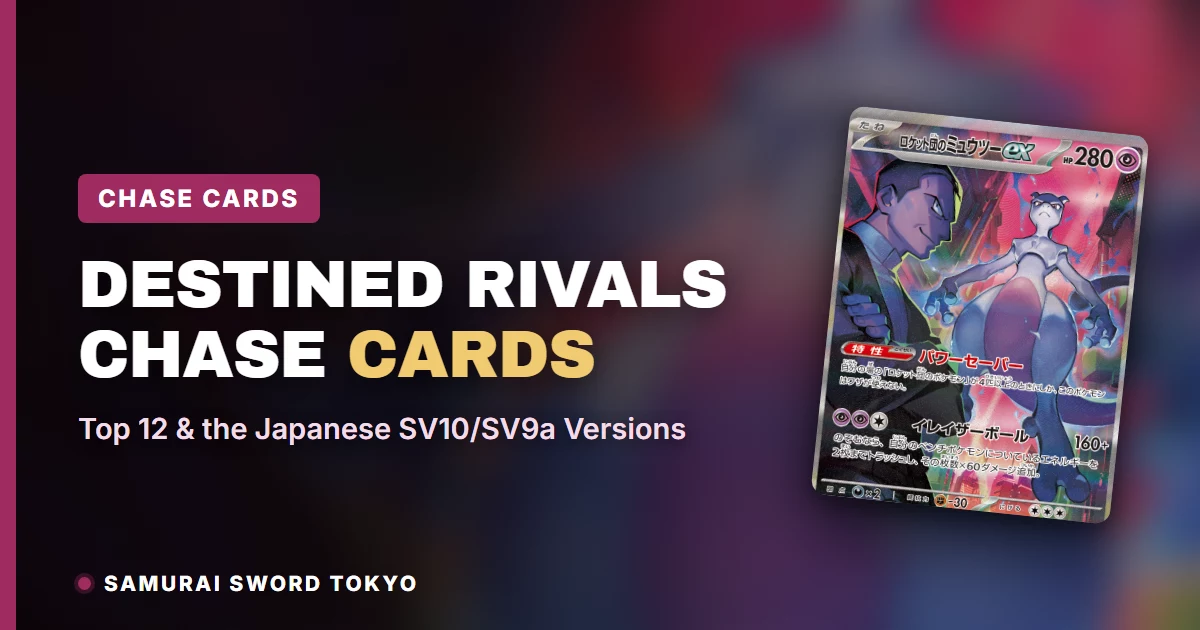
Destined Rivals Chase-Karten: Top 12 und die japanischen Versionen SV10/SV9a
Destined Rivals (DRI) is the English Scarlet & Violet set headlined by Team Rocket, alongside cards tied to trainers like Ethan, Cynthia, Marnie and Steven, and its 244 cards trace back to two Japanese releases: SV10 Glory of Team Rocket and SV9a Heat Wave Arena, plus a handful of cards pulled from the Marnie and Steven decks that sit outside either main set. If you already have our Destined Rivals Japanese card list open, this article is the next step — a ranked list of the twelve chase cards worth knowing, matched to their exact Japanese set, number and rarity.
We grade and ship these cards out of Tokyo, so the ranking below is built from what we can actually verify: our own PSA 10 listings first, then rarity tier for everything else. No TCGplayer or eBay numbers appear anywhere in this article.
Key Takeaways
Destined Rivals draws from SV10 Glory of Team Rocket (JP, April 18, 2025) and SV9a Heat Wave Arena (JP, March 14, 2025), released roughly six to ten weeks before the EN set on May 30, 2025. Our top PSA 10 listing is Team Rocket’s Mewtwo ex SAR (SV10 125/098) at ¥123,244 (~$775), and the fastest way to open fresh copies is the SV10 Glory of Team Rocket Japanese booster box, currently listed at ¥22,660 (~$143).
DRI
EN Set (Destined Rivals)
SV10 / SV9a
JP Sets (Apr 18 & Mar 14, 2025)
12
Chase Cards Covered
¥22,660
SV10 Box, Currently Listed
How We Ranked These
Exchange rate used throughout: ¥159/USD (September 2026).
This list is not a market-price ranking — we don’t quote TCGplayer, eBay, or PriceCharting numbers, and we won’t invent pull rates that Limitless doesn’t publish for these sets. Instead we ranked in two passes:
Own PSA 10 listings first, ordered by our listed price. Eight of the twelve cards below are graded PSA 10 copies we currently list, from ¥123,244 down to ¥5,749.
Everything else, ordered by rarity tier. For the cards without a current PSA 10 listing on our site, we ranked by the Limitless rarity ladder: Ultra Rare/Hyper Rare (gold) first, then Special Art Rare/Special Illustration Rare.
One naming note before the list: Limitless’s Japanese card-list labels („Art Rare,“ „Secret Rare,“ „Special Art Rare,“ „Ultra Rare“) don’t line up one-to-one with the English labels for the same rarity tier. JP Art Rare (AR) corresponds to EN Illustration Rare (IR); JP Secret Rare (SR) corresponds to EN Ultra Rare (the full-art style); JP Special Art Rare (SAR) corresponds to EN Special Illustration Rare (SIR); and JP Ultra Rare (UR) corresponds to EN Hyper Rare (the gold-etched style). We use the JP rarity name for each Japanese card below, and note the EN equivalent in the table only when it differs.
The Top 12 Chase Cards
Twelve Destined Rivals chase cards, matched to their exact Japanese printing.
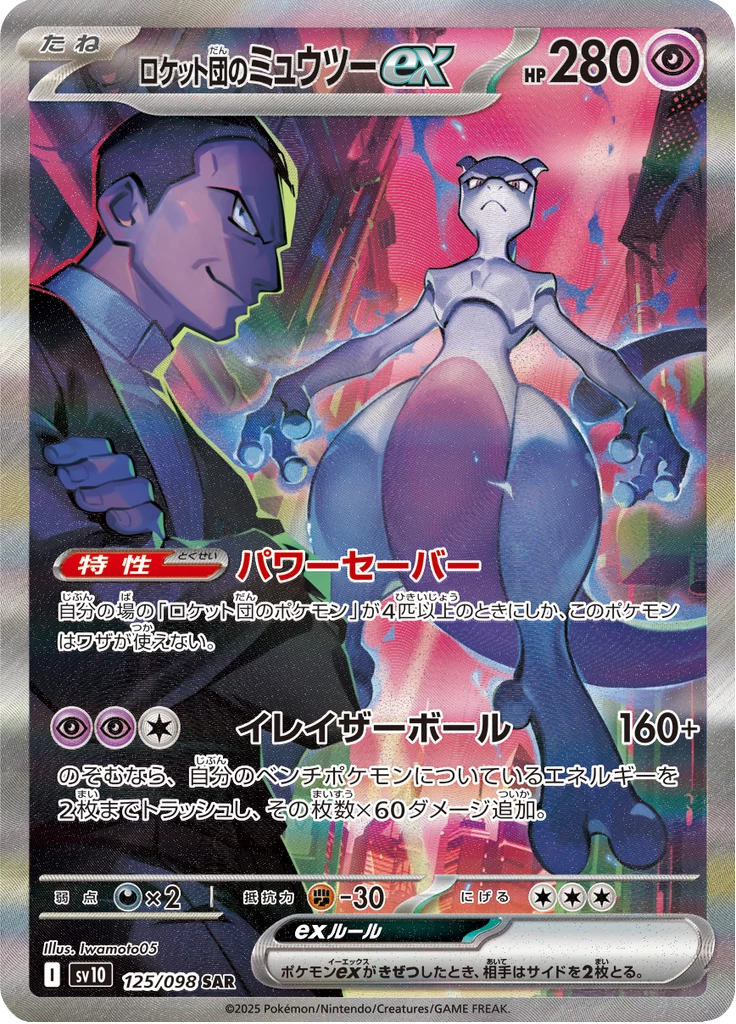
1. Team Rocket’s Mewtwo ex — DRI 231/182 SIR ↔ SV10 125/098 SAR
Team Rocket’s Mewtwo ex 125/098 SAR — SV10 Glory of Team Rocket, art by Iwamoto05
Basic Psychic, 280 HP. Its Ability, Power Saver, means it can’t attack unless you have four or more Team Rocket’s Pokemon in play; the payoff is Erasure Ball, an attack that hits for 160 or more. This is a Basic Pokemon ex, so a Prize trade costs your opponent two cards, not three. We’ve confirmed visually that the artwork on this SAR is identical to the English SIR at DRI 231/182 — same illustration, different language of text box. It’s our highest-priced PSA 10 in this set: PSA 10 SV10 125/098, currently listed at ¥123,244 (~$775). Team Rocket’s Mewtwo ex has been reprinted in several other Japanese products beyond SV10 — our Team Rocket’s Mewtwo ex card guide walks through every printing.
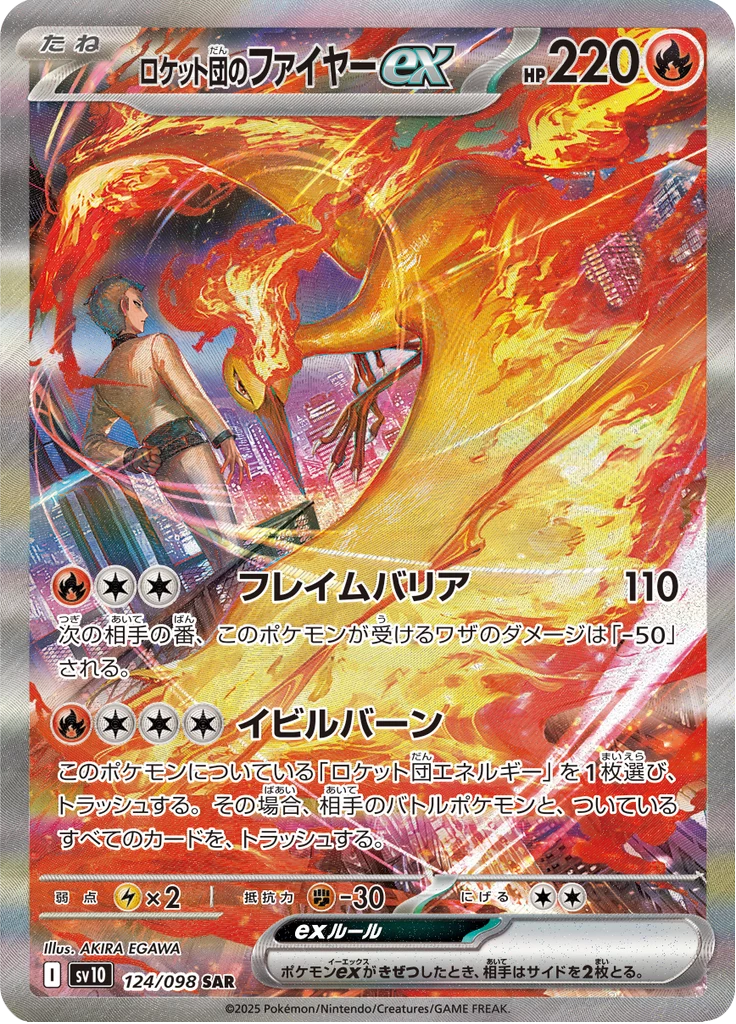
2. Team Rocket’s Moltres ex — DRI 229 SIR ↔ SV10 124/098 SAR
Team Rocket’s Moltres ex 124/098 SAR — SV10 Glory of Team Rocket, art by AKIRA EGAWA
Fire type, 220 HP. Second on our list by listed price: PSA 10 SV10 124/098, currently listed at ¥41,426 (~$261).
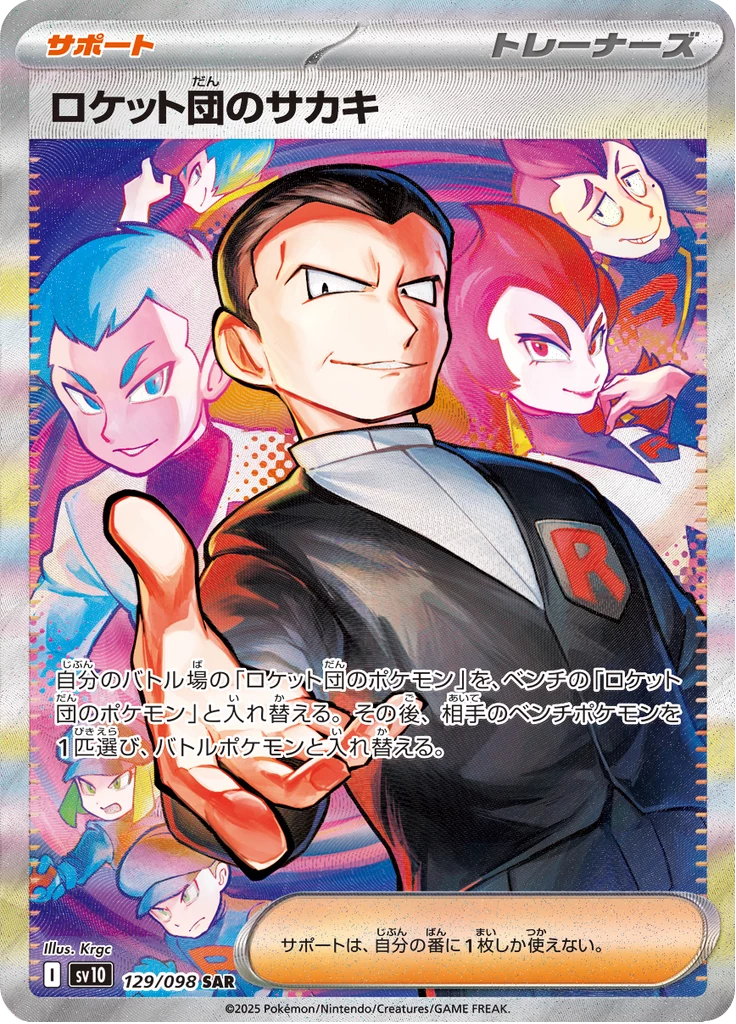
3. Team Rocket’s Giovanni — DRI 238 SIR ↔ SV10 129/098 SAR
Team Rocket’s Giovanni 129/098 SAR — SV10 Glory of Team Rocket, art by Krgc
A Supporter card, not a Pokemon — the boss-fight-style Special Art Rare treatment applied to a trainer. Listed at PSA 10 SV10 129/098, ¥22,957 (~$144).
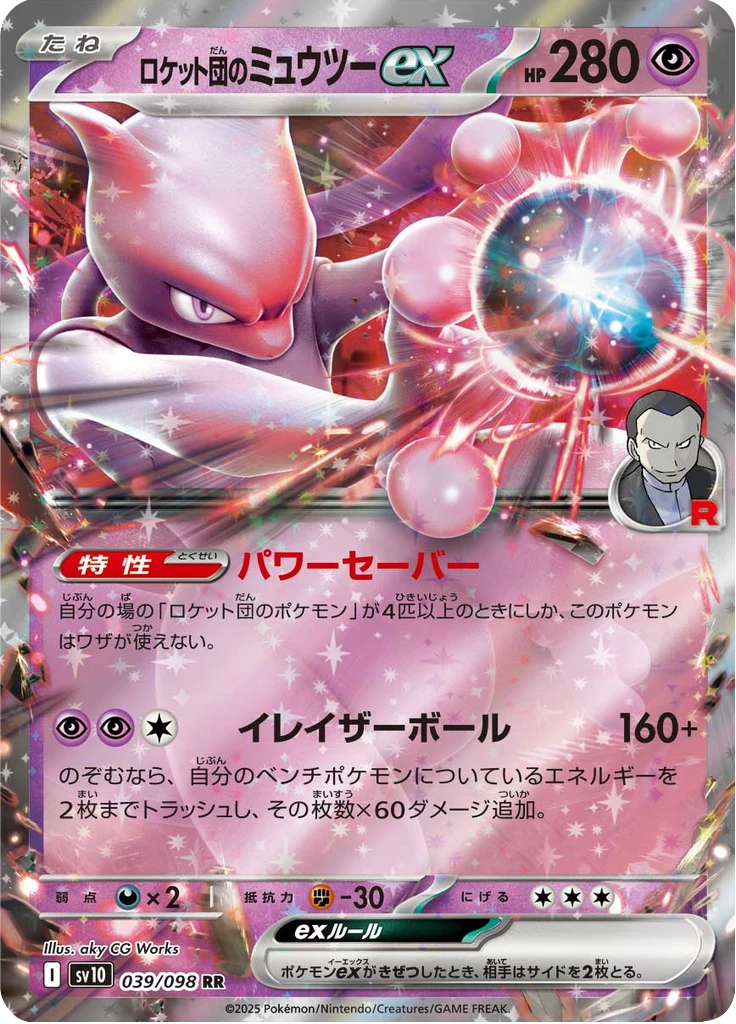
4. Team Rocket’s Mewtwo ex (regular) — DRI 81 Double Rare ↔ SV10 39/098 RR
Team Rocket’s Mewtwo ex 39/098 RR — the regular Double Rare print, not a secret rare
Worth being precise about this one: SV10 39/098 is the ordinary Double Rare (RR) print of the same Team Rocket’s Mewtwo ex card, not a secret rare. It’s the copy most people actually pull and play with, and a PSA 10 of the standard print still holds a real price on its own merits — PSA 10 SV10 39/098, ¥11,550 (~$73).
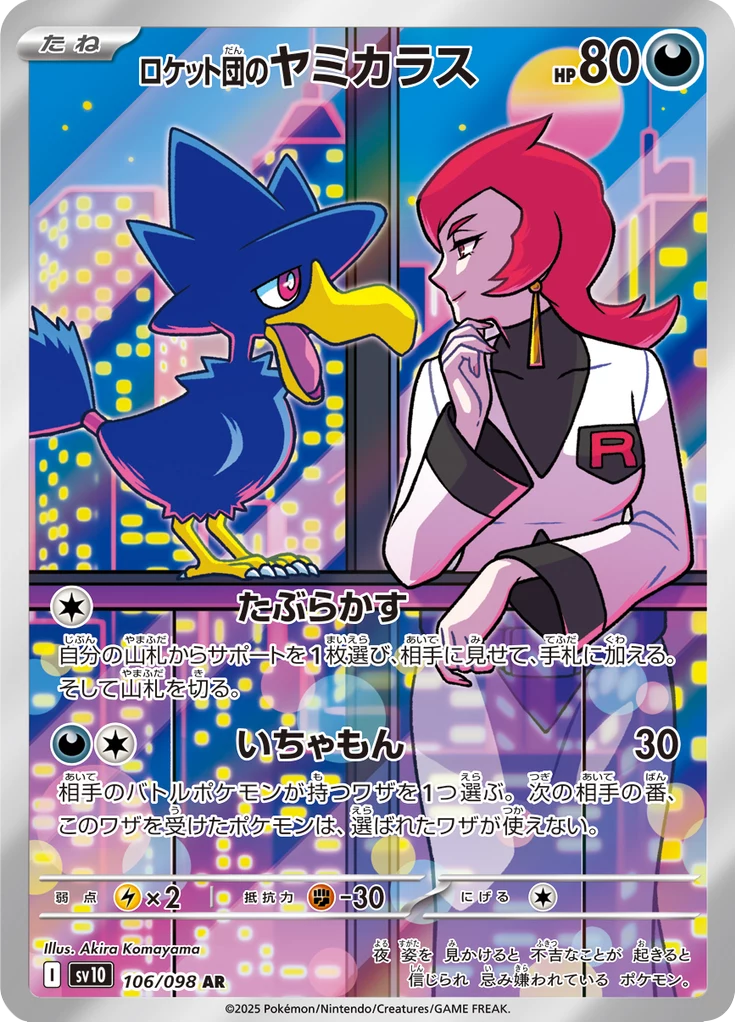
5. Team Rocket’s Murkrow — DRI 200 IR ↔ SV10 106/098 AR
Team Rocket’s Murkrow 106/098 AR — SV10 Glory of Team Rocket
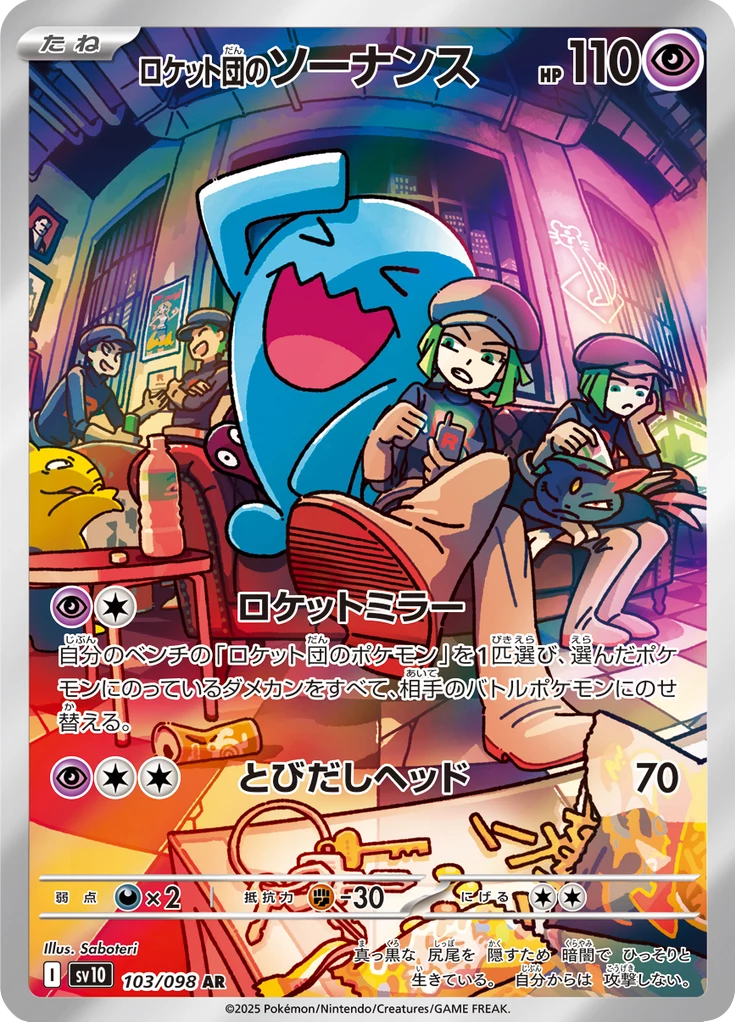
7. Team Rocket’s Wobbuffet — no DRI Illustration Rare ↔ SV10 103/098 AR
Team Rocket’s Wobbuffet 103/098 AR — SV10 Glory of Team Rocket, no Destined Rivals Illustration Rare
The Japanese-only entry on this list. Per the Limitless Destined Rivals card list, the Illustration Rare run (183–205) doesn’t include a Team Rocket’s Wobbuffet — this Art Rare has no direct EN counterpart at the equivalent rarity. It’s still a real, gradeable card, currently listed as PSA 10 SV10 103/098, ¥5,755 (~$36).
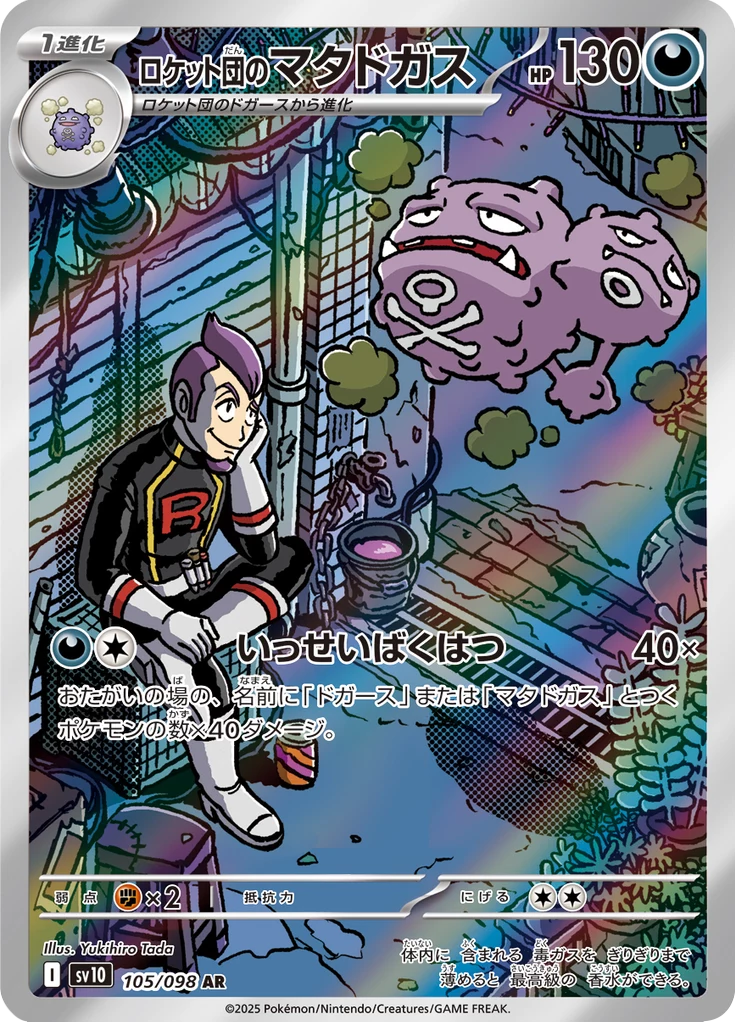
8. Team Rocket’s Weezing — DRI 199 IR ↔ SV10 105/098 AR
Team Rocket’s Weezing 105/098 AR — SV10 Glory of Team Rocket
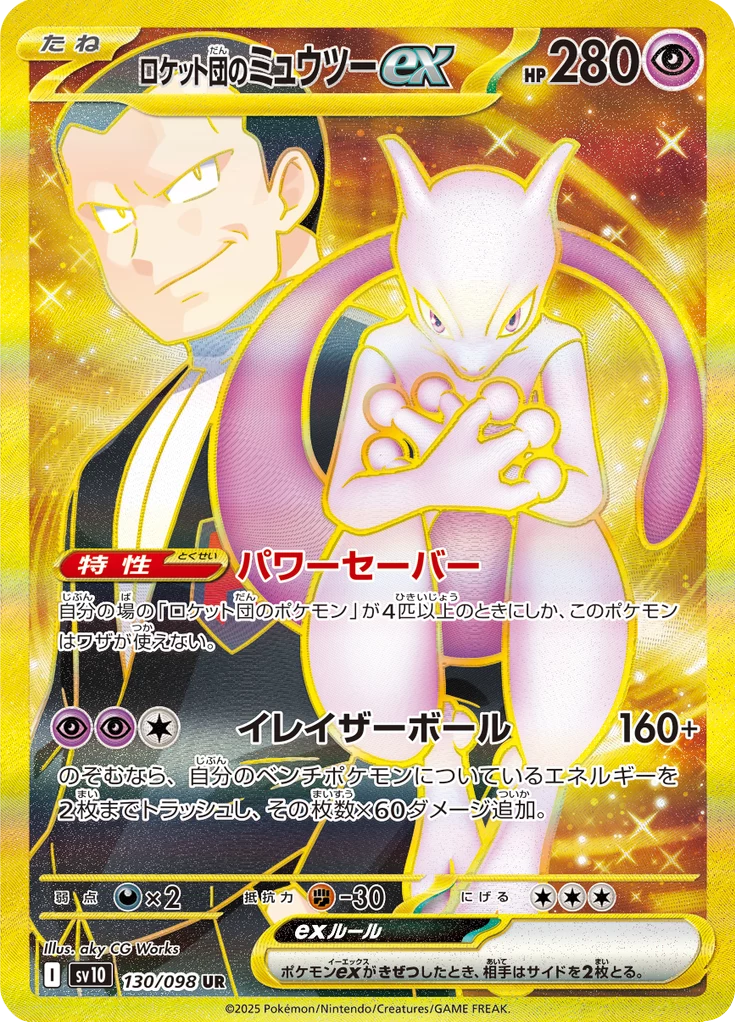
9. Team Rocket’s Mewtwo ex (Hyper) — DRI 240 Hyper Rare ↔ SV10 130/098 UR
Team Rocket’s Mewtwo ex 130/098 UR — SV10 Glory of Team Rocket gold treatment, art by aky CG Works
The gold-treatment Ultra Rare of the same Mewtwo ex, and the top rarity tier in the set. We haven’t compared the JP and EN gold foil treatments side by side for this card, so we won’t claim they’re identical — treat that as unverified. No PSA 10 of this one is currently listed; if you’re after this specific card, sourcing is via Schnellbestellung.
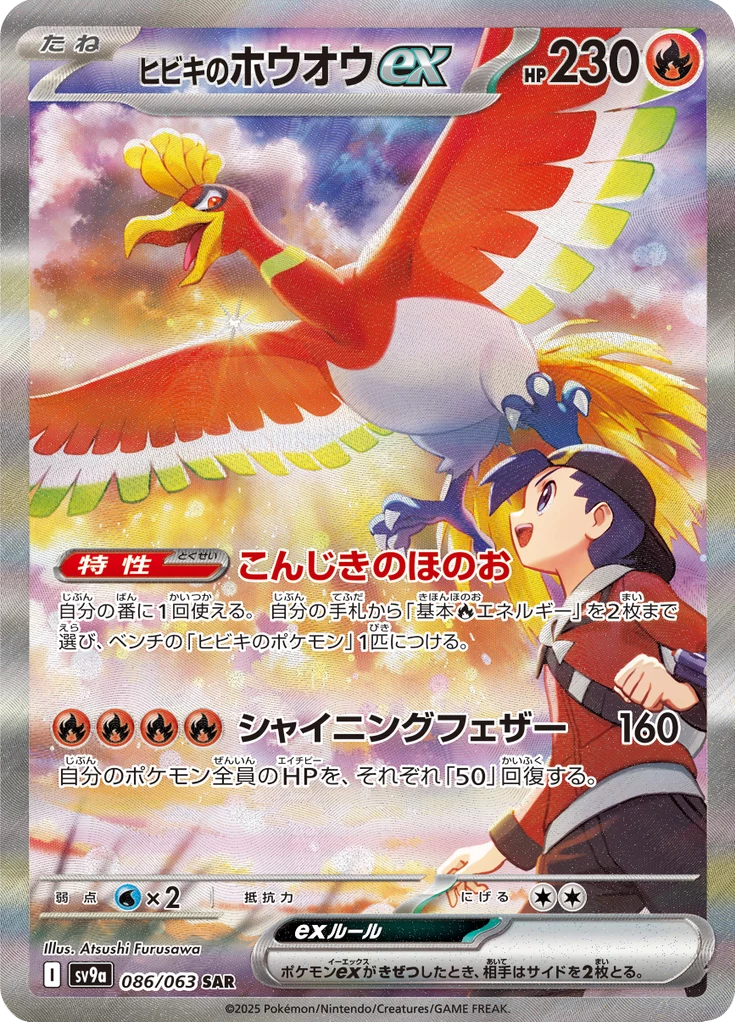
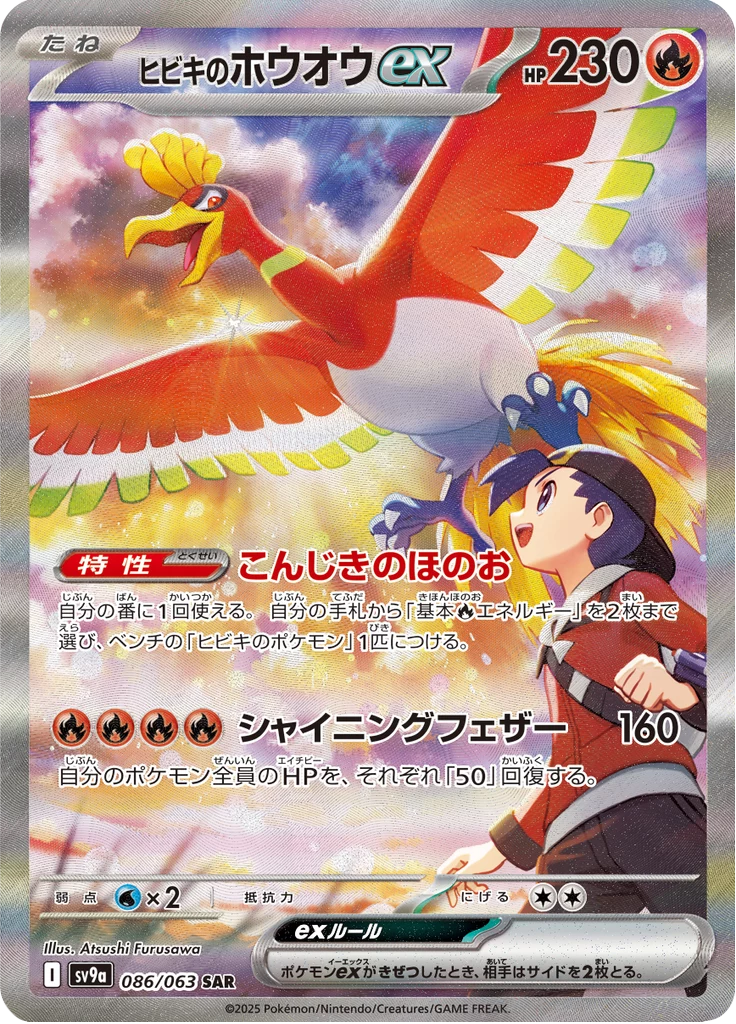
10. Ethan’s Ho-Oh ex — DRI 230 SIR ↔ SV9a 86/063 SAR
Ethan’s Ho-Oh ex 86/063 SAR — SV9a Heat Wave Arena, art by Atsushi Furusawa
Fire type, 230 HP, from the SV9a Heat Wave Arena side of Destined Rivals. No PSA 10 of this SAR is currently in our listings, so this one is Schnellbestellung sourcing rather than an in-hand link.
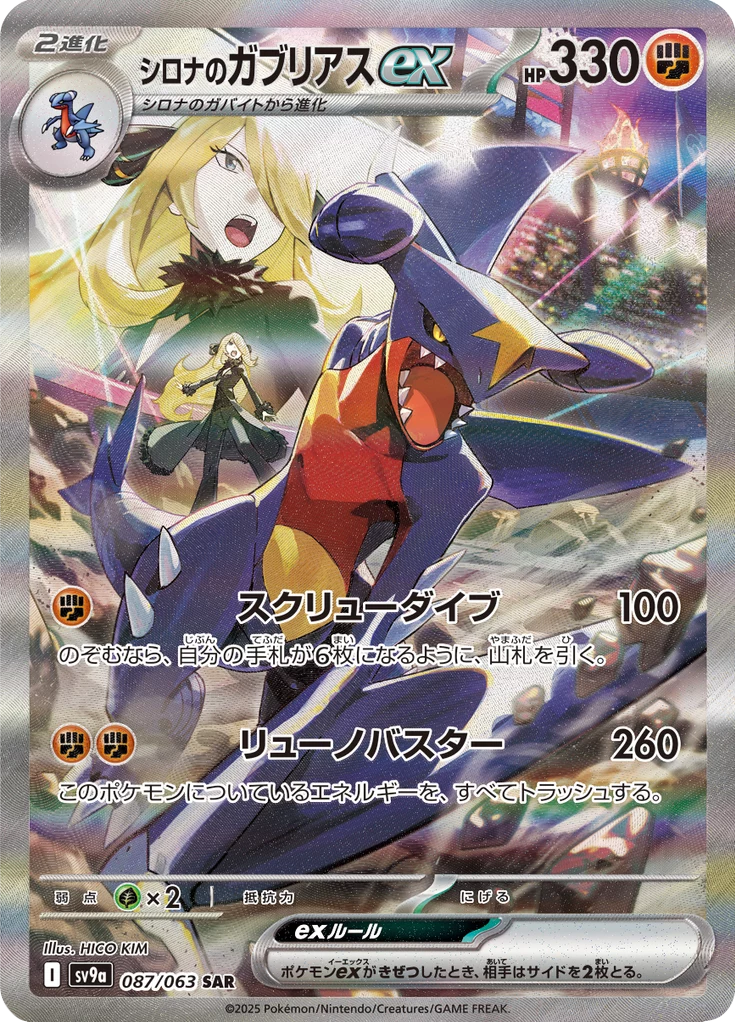
11. Cynthia’s Garchomp ex — DRI 232 SIR ↔ SV9a 87/063 SAR
Cynthia’s Garchomp ex 87/063 SAR — SV9a Heat Wave Arena, art by HICO KIM
Fighting type, Stage 2, 330 HP — the tankiest card on this list. Also Quick Order sourcing for now: request it here.
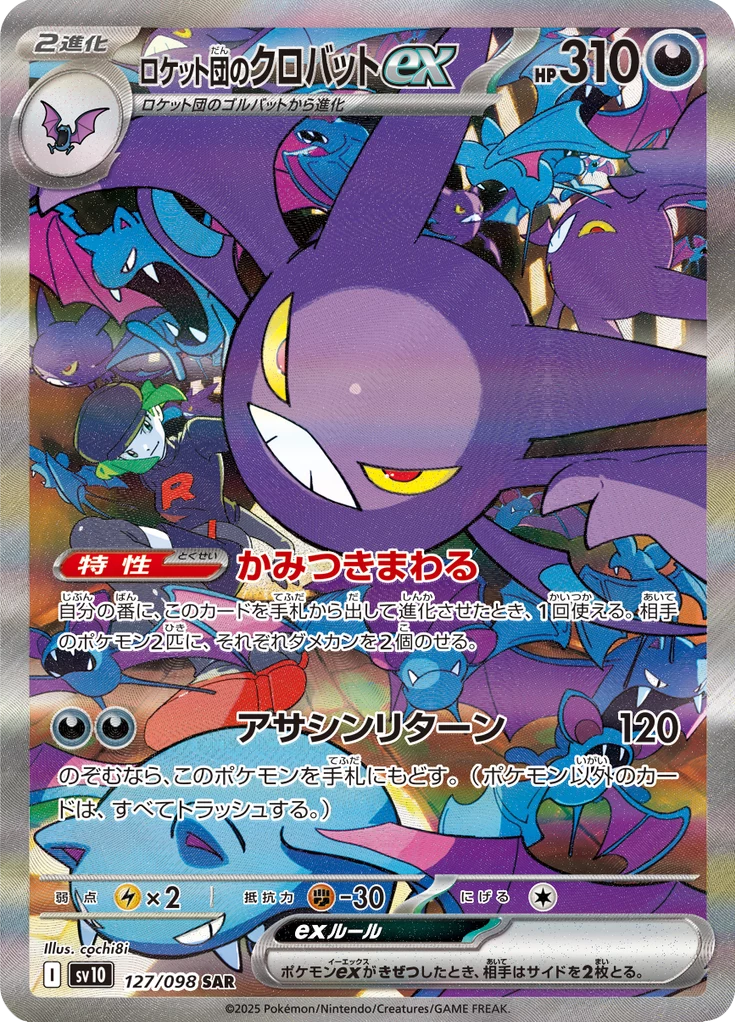
12. Team Rocket’s Crobat ex — DRI 234 SIR ↔ SV10 127/098 SAR
Team Rocket’s Crobat ex 127/098 SAR — SV10 Glory of Team Rocket, art by cochi8i
Darkness type, 310 HP, back on the SV10 side to close the list. No PSA 10 currently listed — Schnellbestellung is the route for this one.
Numbering resets between languages. Destined Rivals runs 1–244 (182 printed + 62 secret numbers) as one continuous EN set. The Japanese side is split across two printed runs — SV10 Glory of Team Rocket goes to /098 (132 cataloged cards: 98 printed + 34 secrets) and SV9a Heat Wave Arena goes to /063 (92 cataloged cards: 63 printed + 29 secrets). A card’s EN number tells you nothing about its JP number or which of the two JP sets it came from — you have to look it up.
Card counts don’t line up 1:1. SV10 and SV9a together account for 224 Japanese entries feeding into the 244-card English set; the gap is made up of additional cards pulled from the Marnie and Steven decks, which sit outside both SV10 and SV9a and aren’t part of either set’s own numbering.
Japan releases first, by months. SV9a Heat Wave Arena came out March 14, 2025, SV10 Glory of Team Rocket followed April 18, 2025, and Destined Rivals didn’t reach English shelves until May 30, 2025 — six to ten weeks later depending on which JP set you’re comparing to.
Rarity names don’t translate literally. As covered above, JP „Art Rare“ = EN „Illustration Rare,“ JP „Secret Rare“ = EN „Ultra Rare“ (full art), JP „Special Art Rare“ = EN „Special Illustration Rare,“ and JP „Ultra Rare“ = EN „Hyper Rare“ (gold). Reading a JP rarity code cold and assuming it matches the EN term of the same letters will get you the wrong tier.
Not every Japanese card gets an English match. Team Rocket’s Wobbuffet (SV10 103/098 AR) has no Illustration Rare counterpart in the Destined Rivals Illustration Rare run, at least per the current Limitless list — it’s a JP-only pull at that rarity.
Shop This Set
SV10 Glory of Team Rocket Booster Box (Japanese)
Contains the SAR, RR, AR, and UR Team Rocket’s Mewtwo ex prints
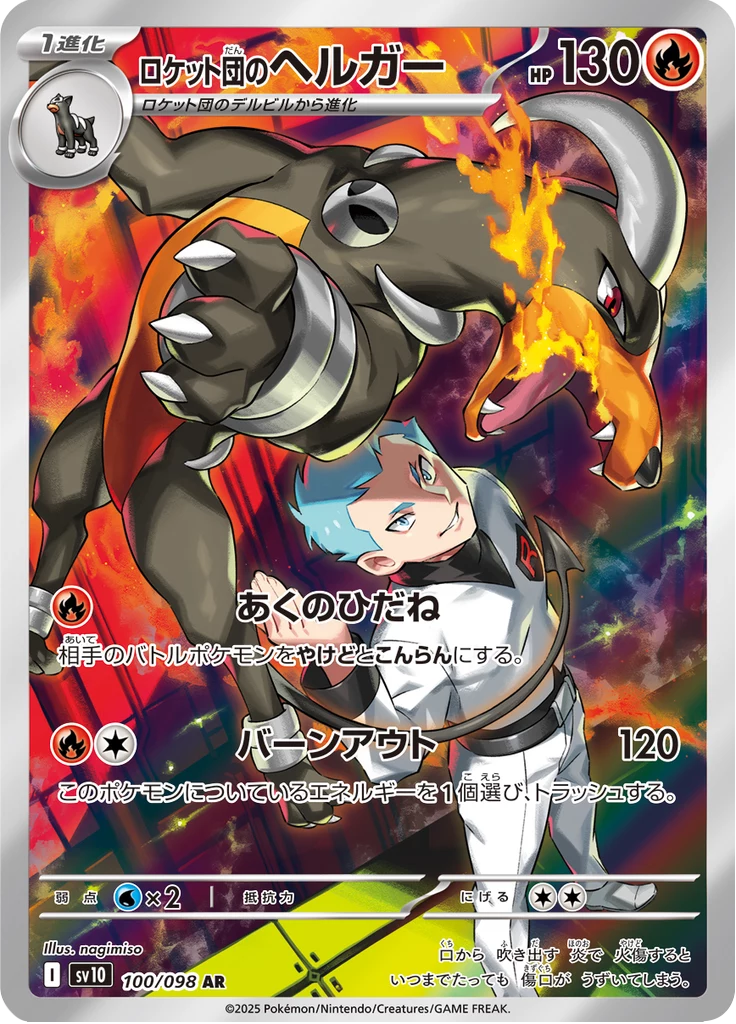
We ship Japanese Pokemon sealed product and graded singles worldwide from Tokyo, tracked. For the SV10 side of this chase list — the Mewtwo ex family, Giovanni, Murkrow, Houndoom, Wobbuffet, Weezing, and Crobat ex — the SV10 Glory of Team Rocket booster box is currently listed at ¥22,660 (~$143). A damaged-box option for the same set is also listed separately at the same price for buyers who don’t need mint packaging.
For the SV9a side — Ethan’s Ho-Oh ex and Cynthia’s Garchomp ex — the SV9a Heat Wave Arena booster box is currently listed at ¥16,995 (~$107).
What is the Japanese equivalent of Destined Rivals?
Destined Rivals draws its cards from two Japanese Scarlet & Violet sets — SV10 Glory of Team Rocket (released April 18, 2025) and SV9a Heat Wave Arena (released March 14, 2025) — plus additional cards from the Marnie and Steven decks that sit outside either set’s own numbering.
Which Destined Rivals chase card is the most expensive in your current PSA 10 listings?
Team Rocket’s Mewtwo ex, Special Art Rare, SV10 125/098 — currently listed at ¥123,244 (~$775). It’s the same artwork as the English Special Illustration Rare at DRI 231/182.
Is Team Rocket’s Wobbuffet a secret rare in the English Destined Rivals set?
Not at the equivalent rarity. The Japanese SV10 103/098 Art Rare has no Illustration Rare counterpart in the current Destined Rivals card list, making it a Japanese-only pull at that tier.
Is SV10 39/098 Team Rocket’s Mewtwo ex a secret rare?
No — it’s the regular Double Rare print of the card, distinct from the Special Art Rare (SV10 125/098) and Ultra Rare gold (SV10 130/098) versions of the same Pokemon.
Do the gold Hyper Rare and Ultra Rare Mewtwo ex cards look identical between Japanese and English printings?
We haven’t verified that side by side for this card, so we’re not claiming they match. Gold treatments have differed between Japanese and English printings on other recent sets, so treat this as unconfirmed until checked directly.
How do I buy the Japanese SV10 or SV9a boxes and singles from Tokyo?
The SV10 Glory of Team Rocket and SV9a Heat Wave Arena booster boxes are both listed on our site with tracked shipping from Tokyo, and our PSA 10 singles are listed individually. For anything not currently listed, Quick Order is the fastest way to request it.
Water-Type Pokemon-Karten: Die besten japanischen Prints
Water-type is the quiet giant of the Pokemon TCG’s type chart. It isn’t just Squirtle, Vaporeon and the odd Magikarp — the TCG’s Water energy also covers most Ice-type Pokemon from the video games, and every Ice-type card in this guide — Articuno, Chien-Pao and Glaceon — carries the same printed Water symbol as Suicune and Blastoise.
This guide rounds up 12 Japanese Water-type cards we consider the standout prints across recent sets and promos, from a ¥9,306 Art Rare to a ¥1,100,000 promo. Every card here has Water printed as its energy type, checked directly on its Limitless TCG card page or, for two promo cards that Limitless doesn’t hold in its Japanese database, on Bulbapedia’s printed-type listing. A couple of famous cards that look Water-type at a glance — Greninja and Rapid Strike Urshifu — are printed Fighting-type instead, so they’re excluded here, not lumped in.
We source and grade Japanese singles out of Tokyo, so every price below is our own current listing, not a third-party market estimate.
Key Takeaway
Twelve Japanese Water-type cards, spanning 10 different sets and promo packs from 2021 to 2025. The PSA 10 Vaporeon VMAX Summer PokeCard promo tops the list at ¥1,100,000 (~$6,918 at ¥159/USD), while the PSA 10 Glaceon V leads the regular set cards at ¥57,156. Ice-type Pokemon such as Articuno and Chien-Pao print as Water — the card decides the type, not the species.
12
Cards Covered
10
JP Sets Spanned
¥1,100,000
Highest Listed
¥9,306
Lowest Listed
Prices are our own current PSA 10 listings as of September 2026, converted at ¥159/USD. We do not quote third-party market prices.
What Counts as a Water-Type Pokemon Card
A Pokemon TCG card’s type is printed on the card as its energy symbol, and Water is one of the broadest categories on the chart: it contains most Water-type and most Ice-type Pokemon from the main video-game series. That’s why Glaceon, Articuno and Chien-Pao — all Ice-type in the games — show up in this Water-type roundup rather than a category of their own. Every card below was checked directly on its Limitless TCG card page, with Bulbapedia used only for two 25th Anniversary promo cards that Limitless’s Japanese database doesn’t carry. These are our editorial picks, chosen for scarcity and demand across the sets we trade in daily — not an exhaustive database of every Water-type card ever printed.
Cards That Look Water-Type But Aren’t
Two frequently-asked-about cards get mistaken for Water-type. Greninja ex Special Art Rare (SV5a Crimson Haze, 090/066) is printed Fighting type — a Tera mechanic quirk, not a Water card; see our Greninja cards guide for the full lineup. Rapid Strike Urshifu VMAX Hyper Rare (S5R 084/070) is also printed Fighting. Neither appears in the list below.
Lapras is another Water-type Pokemon worth knowing about, but it’s deep enough on its own that we cover every Lapras printing separately in our Lapras cards guide — our Quick Order page is the fastest way to source a specific Lapras print from our Japanese inventory.
Our Picks: 12 Japanese Water-Type Cards
Ranked loosely by how often collectors ask us about them, starting with the promo that anchors the whole category.
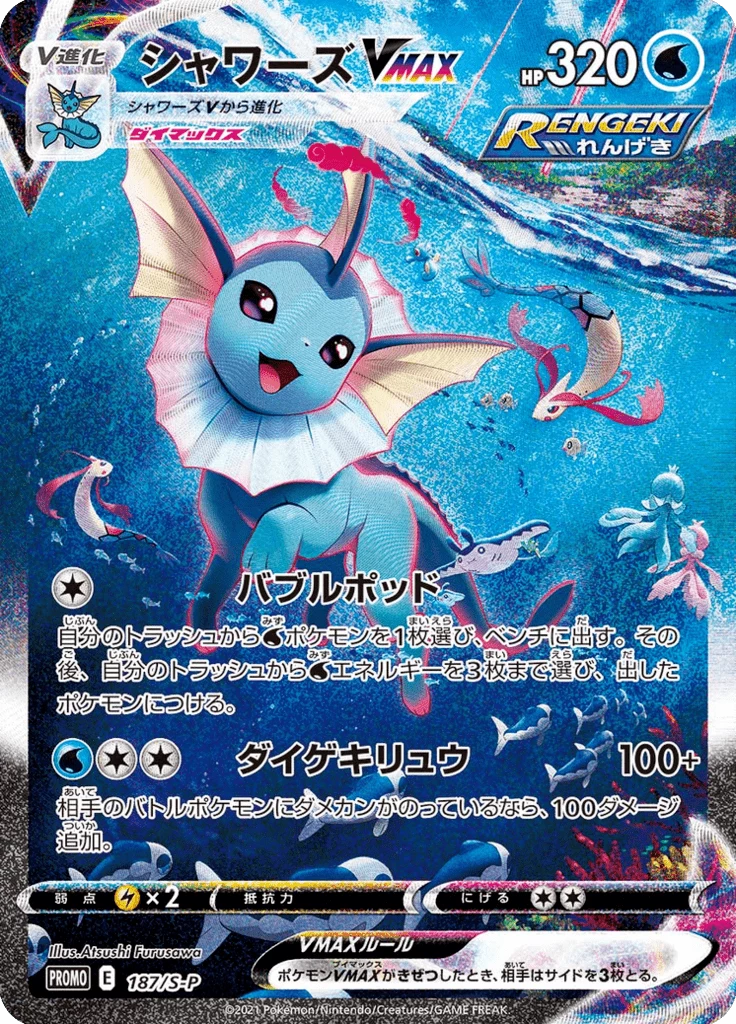
A Sword & Shield-era promo (S-P 187), art by Atsushi Furusawa, distributed through Japan’s Summer PokeCard campaign. We haven’t independently verified the exact campaign date, so we’re not stating one here — see our Summer PokeCard promo series guide for what is confirmed. This is the highest-value card in our entire Water-type roundup: a PSA 10 copy is currently listed at ¥1,100,000 (~$6,918). Our Vaporeon VMAX Summer promo guide has more detail on this specific print.
Blastoise (カメックス, 25th Anniversary Promo)
From the Promo Card Pack 25th Anniversary Edition (S8a-P, released 22 October 2021), card 003/025, promo, printed Water — confirmed on Bulbapedia’s listing for this pack, which Limitless’s Japanese database doesn’t hold. We list a PSA 10 copy at ¥29,964 (~$188). For the full Squirtle-to-Blastoise evolution line across every set, see our Squirtle & Blastoise cards guide and our dedicated Blastoise 25th Anniversary 003/025 card guide.
Dark Gyarados (わるいギャラドス, 25th Anniversary Promo)
Same pack as the Blastoise above (S8a-P, 22 October 2021), card 005/025, promo, printed Water per Bulbapedia’s listing for this promo pack. We list a PSA 10 copy at ¥22,660 (~$143). For the Magikarp-to-Gyarados line, see our Magikarp & Gyarados cards guide and our dedicated Dark Gyarados promo card guide.
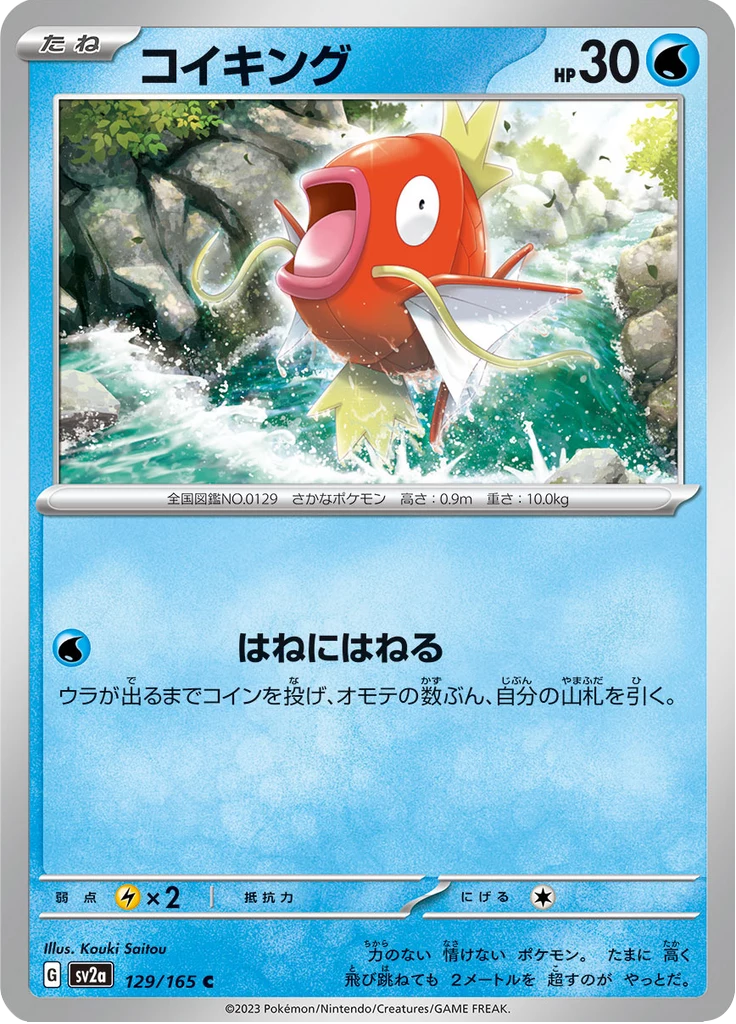
Magikarp (コイキング, Master Ball Mirror)
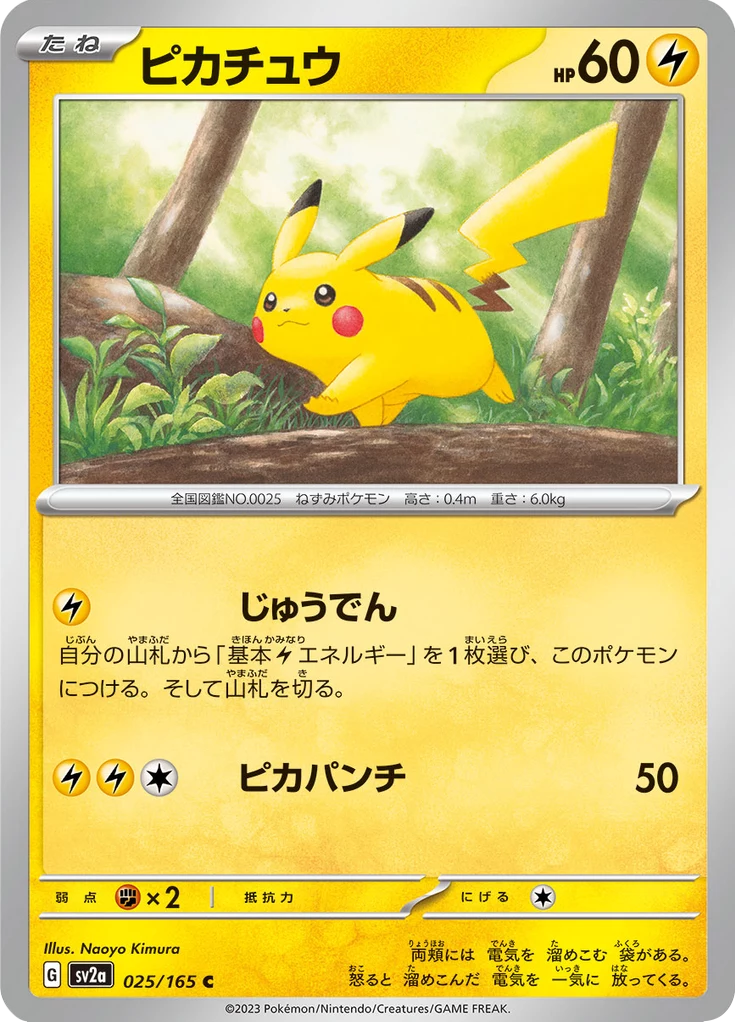
Magikarp 129/165, Common (Master Ball mirror-foil), Pokemon Card 151 (SV2a)
Pokemon Card 151 (SV2a, released 16 June 2023), card 129/165, art by Kouki Saitou. The printed rarity is Common — the Master Ball mirror-foil finish is a print variant, not a rarity symbol, so it’s not a „rare“ card by the numbers, but it’s one of the most requested Water-type cards from this set. We list a PSA 10 copy at ¥32,678 (~$206). See our Magikarp & Gyarados cards guide for the full evolution line.
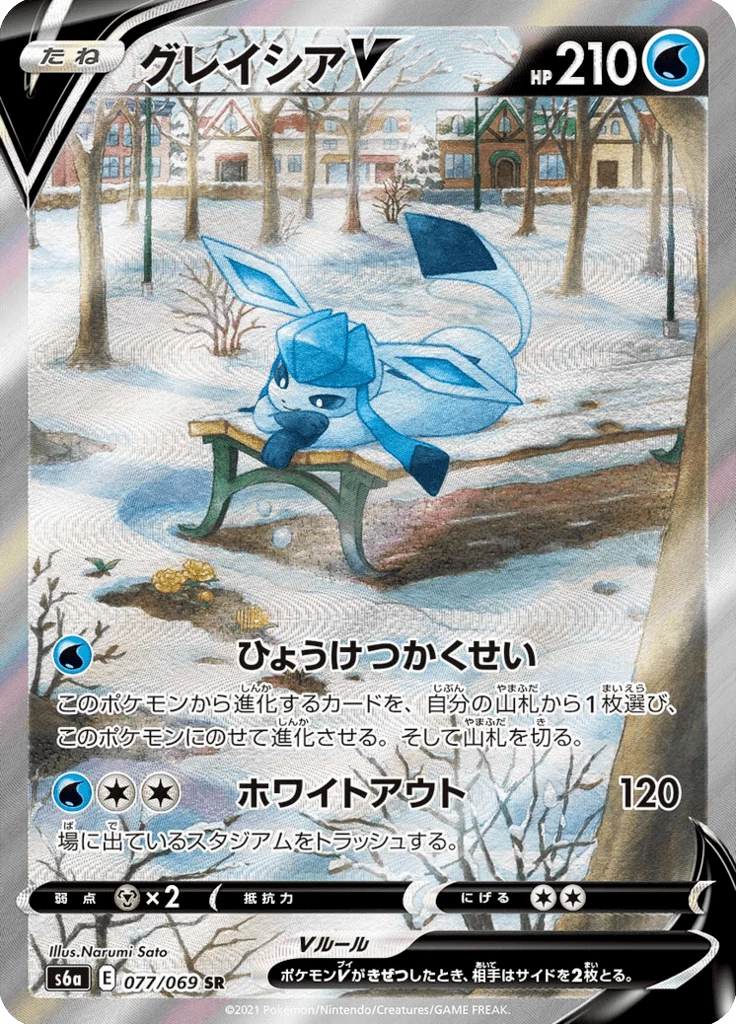
Glaceon V (グレイシアV)
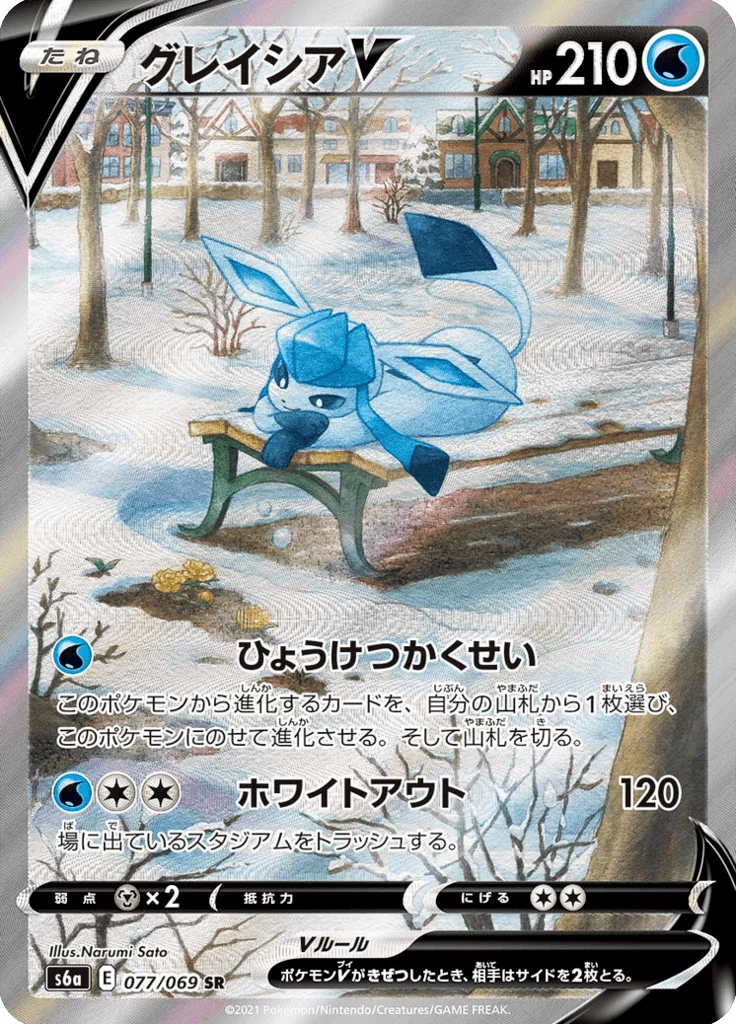
Glaceon V 077/069, Secret Rare, Eevee Heroes (S6a)
Eevee Heroes (S6a, released 28 May 2021), card 077/069, illustrated by Narumi Sato. Collectors often call this an „SA“ alt-art print, but Secret Rare (SR) is the rarity actually printed on the card. Glaceon is Ice-type in the games and, like the other Ice-type Pokemon covered in this guide, prints here as Water. We list a PSA 10 copy at ¥57,156 (~$359), the highest price among the regular set cards in this guide. Our Glaceon cards guide, Leafeon & Glaceon cards guide and Eevee Heroes card list cover the rest of this set.
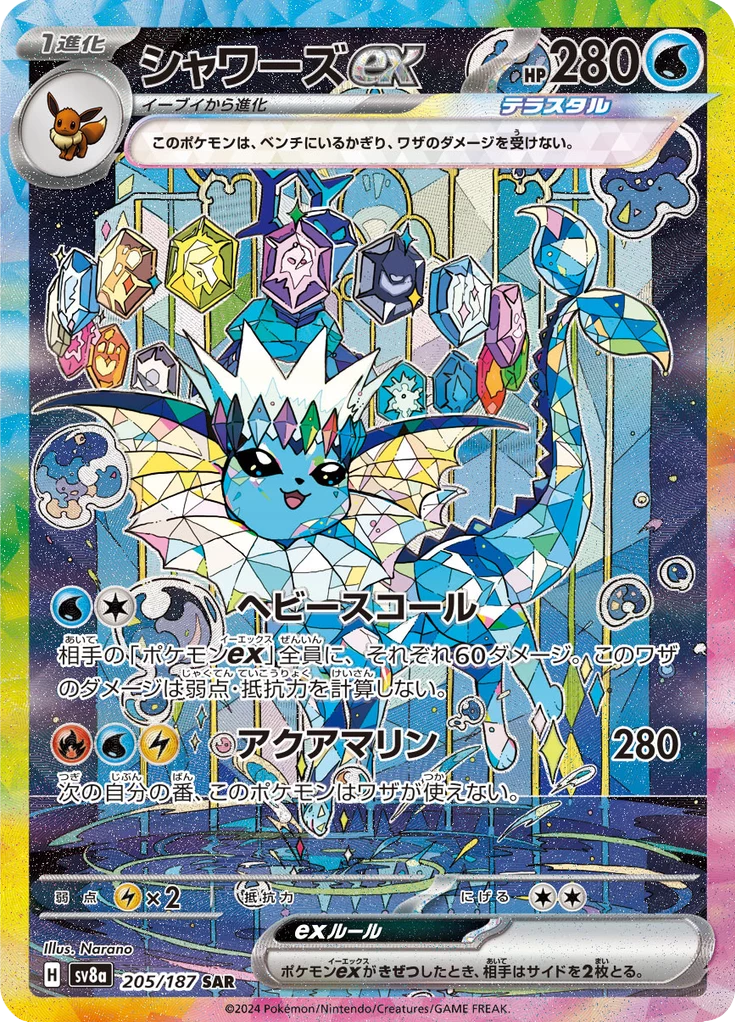
Vaporeon ex (シャワーズex)
Vaporeon ex 205/187, Special Art Rare, Terastal Festival ex (SV8a)
Terastal Festival ex (SV8a, released 6 December 2024), card 205/187, Special Art Rare, art by Narano — the most recent Vaporeon printing on this list. We list a PSA 10 copy at ¥17,752 (~$112). See our Vaporeon, Jolteon & Flareon cards guide for the wider Eeveelution lineup.
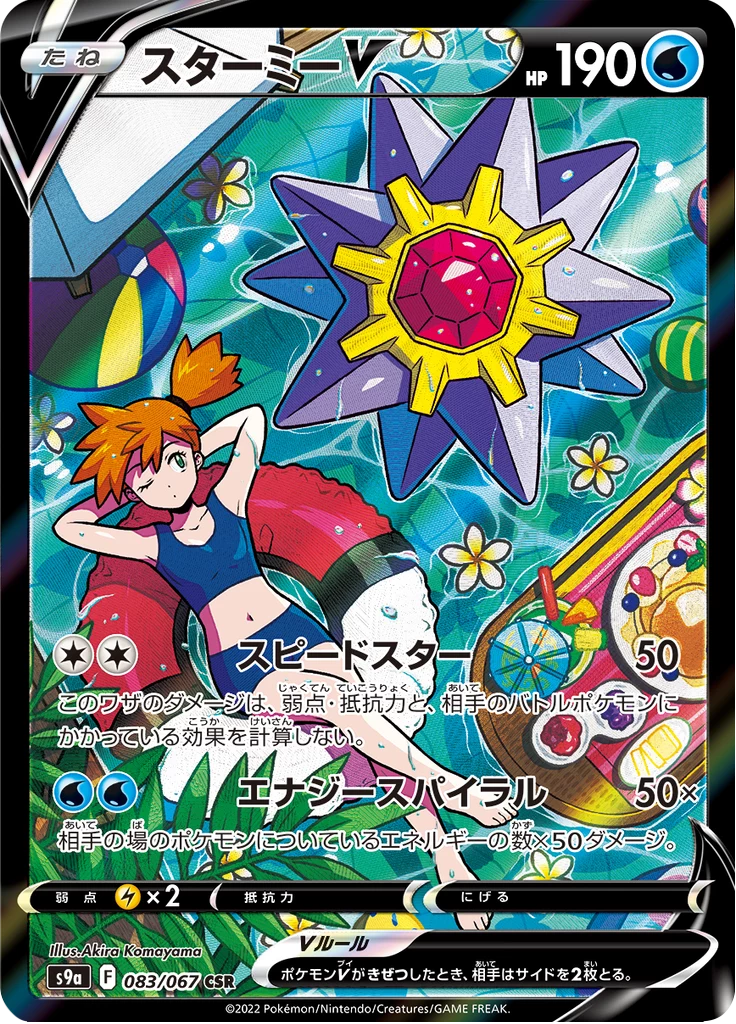
Starmie V (スターミーV)
Starmie V 083/067, Character Super Rare, Battle Region (S9a)
Battle Region (S9a, released 25 February 2022), card 083/067, Character Super Rare, art by Akira Komayama. We list a PSA 10 copy at ¥49,720 (~$313), the second-highest price among the regular set cards behind Glaceon V.
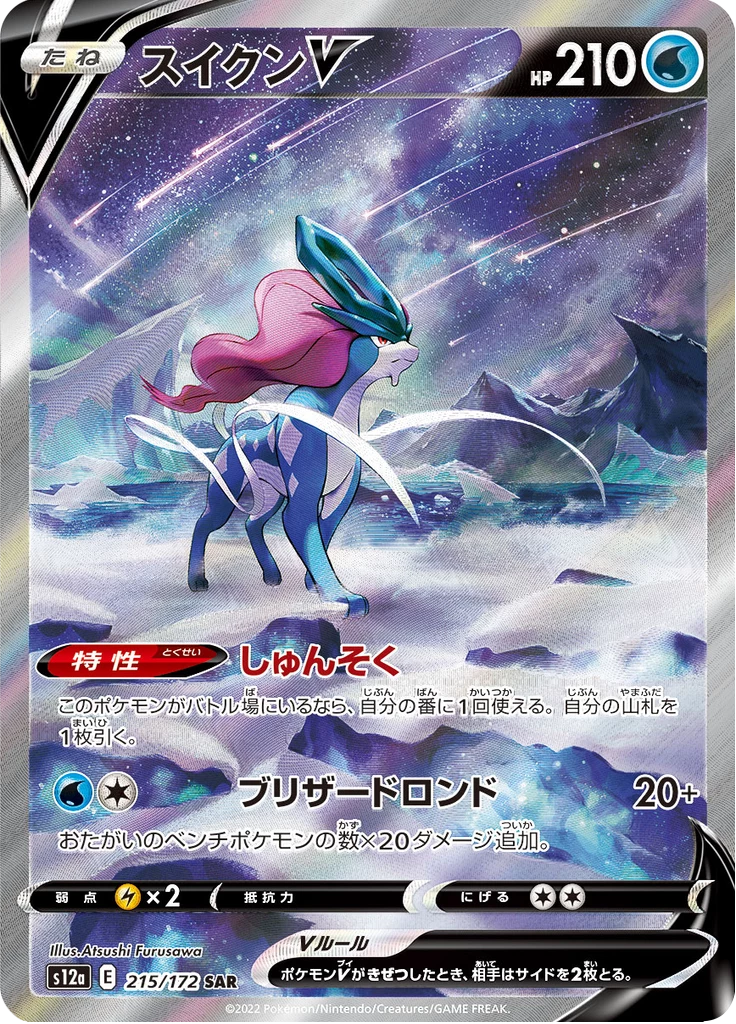
Suicune V (スイクンV)
Suicune V 215/172, Special Art Rare, VSTAR Universe (S12a)
VSTAR Universe (S12a, released 2 December 2022), card 215/172, Special Art Rare, art by Atsushi Furusawa — the same illustrator behind the Vaporeon VMAX promo above. We list a PSA 10 copy at ¥15,400 (~$97). Our Suicune Japanese cards guide and Atsushi Furusawa artist guide go deeper on both.
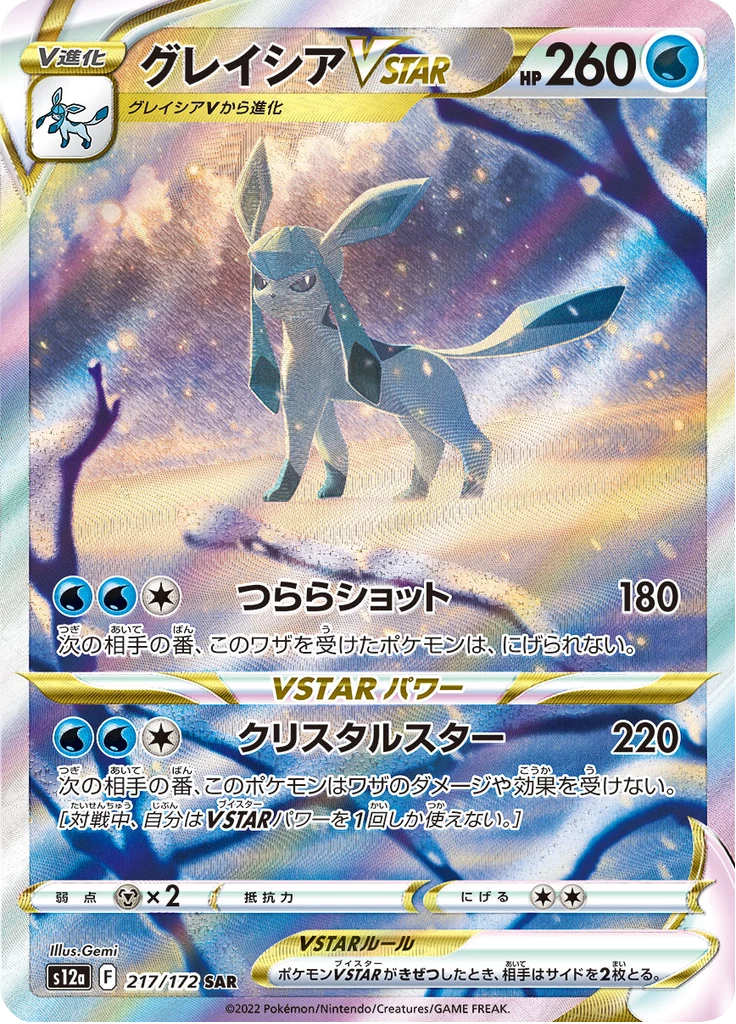
Glaceon VSTAR (グレイシアVSTAR)
Glaceon VSTAR 217/172, Special Art Rare, VSTAR Universe (S12a)
Same set as the Suicune V above (S12a, 2 December 2022), card 217/172, Special Art Rare, art by Gemi. A second Ice-type-as-Water print from the same release. We list a PSA 10 copy at ¥14,256 (~$90).
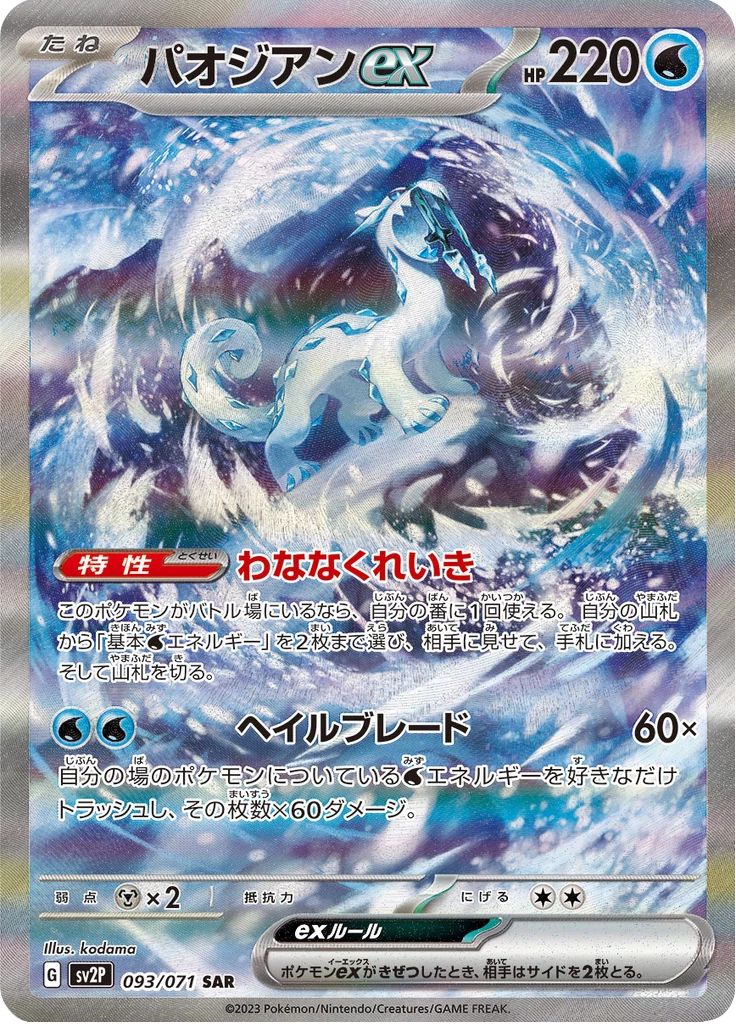
Chien-Pao ex (パオジアンex)
Chien-Pao ex 093/071, Special Art Rare, Snow Hazard (SV2P)
Snow Hazard (SV2P, released 14 April 2023), card 093/071, Special Art Rare, art by kodama. Chien-Pao is Dark/Ice in the video games, and this printing carries Water as its TCG energy type, matching the pattern for the Ice-type Pokemon featured in this guide. We list a PSA 10 copy at ¥9,570 (~$60).
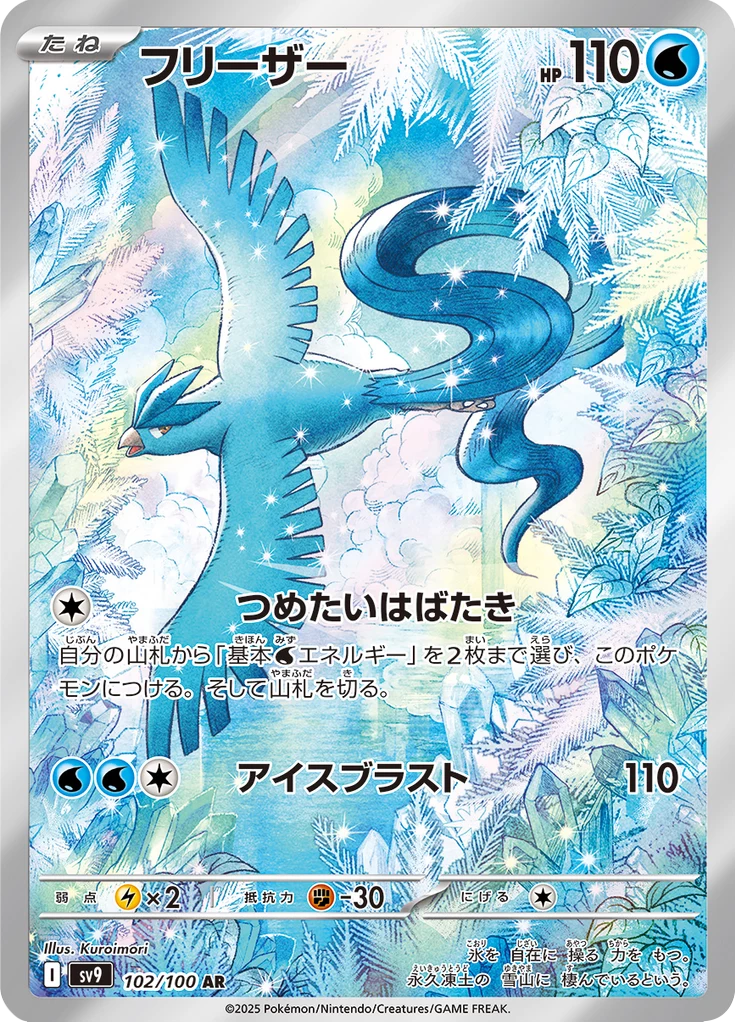
Articuno (フリーザー)
Articuno 102/100, Art Rare, Battle Partners (SV9)
Battle Partners (SV9, released 24 January 2025), card 102/100, Art Rare, art by Kuroimori — the most recently released card on this list, and another Ice-type Pokemon printed as Water. We list a PSA 10 copy at ¥9,306 (~$59), the lowest listing among all 12 cards here. See our Articuno Japanese cards guide for the wider lineup.
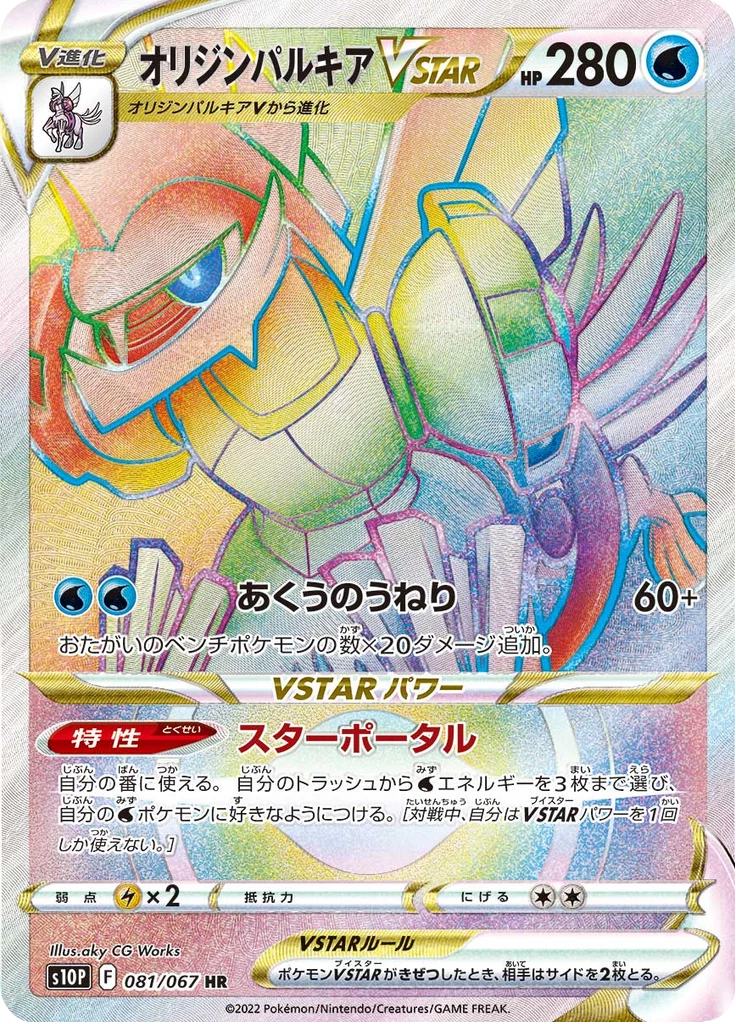
Origin Forme Palkia VSTAR (オリジンパルキアVSTAR)
Origin Forme Palkia VSTAR 081/067, Hyper Rare, Space Juggler (S10P)
Space Juggler (S10P, released 8 April 2022), card 081/067, Hyper Rare (Limitless labels the slot „Holo Rare“; we list it as HR), art by aky CG Works. Palkia is Water/Dragon in the games, and this Origin Forme print carries Water as its TCG energy type. We list a PSA 10 copy at ¥10,450 (~$66). A related dual-type oddity worth knowing: Ice Rider Calyrex VMAX (S6H 085/070, Hyper Rare, released 23 April 2021) is also printed Water rather than Psychic or Dragon — we don’t have a verified image for that print, but a PSA 10 copy is listed at ¥97,196 (~$611). See our Origin Forme Palkia VSTAR guide and Calyrex cards guide for both lineups.
Water-Type Card Comparison
All 12 cards side by side, our own PSA 10 listings only:
The spread runs from a ¥9,306 Art Rare to a ¥1.1M promo. Distribution channel is one visible pattern here — the Summer PokeCard promo and the two 25th Anniversary promos came from limited campaign channels, while the VSTAR Universe and Eevee Heroes cards came from a wider box-and-pack release — though we aren’t claiming that’s the only factor behind the spread.
Every card linked here is a live PSA 10 listing shipped from Tokyo with tracked delivery. If the exact card, set, or grade you want isn’t listed above, our Quick Order page is the fastest way to request it — tell us the card, set code and number, and we’ll build a quote from our current Japanese inventory.
Two sets on this list produced multiple cards — VSTAR Universe (Suicune V and Glaceon VSTAR) and the 25th Anniversary Promo Card Pack (Blastoise and Dark Gyarados) — so buying a pair from the same release together is often the most efficient way to build out a Water-type binder in one order.
Start with the PSA 10 Glaceon V if you want the highest-value regular set card, or the PSA 10 Suicune V for a legendary at a lower entry price. For anything else, Schnellbestellung is open for custom requests.
Häufig gestellte Fragen
What makes a Pokemon card „Water type“?
The energy type printed on the card itself, not the Pokemon’s type in the video games. Water is a broad TCG category that contains most Water-type Pokemon and most Ice-type Pokemon from the main series games, verified on each card’s Limitless TCG page.
Are Ice-type Pokemon cards Water-type in the TCG?
Yes, for the Ice-type Pokemon covered in this guide. Glaceon, Chien-Pao, Articuno and Ice Rider Calyrex are all Ice-type (or Ice-dual-type) Pokemon in the games, and each prints with Water as its energy type on the card.
What is the most valuable Japanese Water-type card in this list?
The Vaporeon VMAX Summer PokeCard promo (S-P 187), with a PSA 10 currently listed at ¥1,100,000. Among non-promo set cards, the Glaceon V Secret Rare (S6a 077/069) leads at ¥57,156.
Is Greninja a Water-type card?
Not the modern chase print. Greninja ex Special Art Rare (SV5a Crimson Haze, 090/066) is printed Fighting-type in the TCG despite Greninja being Water-type in the video games. Check our Greninja cards guide for the full lineup.
Where can I buy these Japanese Water-type cards from outside Japan?
Every card on this list is a live listing shipped from Tokyo with tracked international delivery. Use the product links above for graded PSA 10 copies, or our Quick Order page for other cards, sets, or grades from our Japanese inventory.
Pokémon-Karten vom Typ Drache: Die besten japanischen Prints (Rayquaza, Latias & Latios, Dragonite und mehr)
Dragon is one of the youngest energy types in the Pokemon TCG — it was introduced in 2012, timed to the Year of the Dragon — and it still plays by a different rulebook than every other type. There is no Dragon Basic Energy card, and no Pokemon can actually use a Dragon-type energy in an attack; instead, Dragon attackers typically require two non-Colorless energy types to fire their moves. The type went absent from Sword & Shield until Evolving Skies brought it back, then was briefly retired again at the start of Scarlet & Violet before Paldea Evolved reinstated it.
That structural quirk trips up a lot of assumptions. Several Pokemon that look unmistakably „dragon“ on the video-game side print as something else entirely in the TCG — Mega Charizard X ex is Fire, the original M Rayquaza EX is Colorless. We checked every card in this guide against its printed type directly on its Limitless TCG card page, so what follows is 12 Japanese cards that are genuinely, verifiably Dragon-type, from a ¥17,776 GX to a ¥1,321,516 alt-art secret rare.
We source and grade Japanese singles out of Tokyo, so every price below is our own current listing, not a third-party market estimate.
Key Takeaway
Twelve Japanese Dragon-type cards spanning eight sets from 2014 to 2025. The PSA 10 Latias & Latios GX alt art tops the list at ¥1,321,516 (~$8,311 at ¥159/USD), while the PSA 10 MEGA Dragonite ex anchors the newest wave of Dragon-type chase cards at ¥93,225. Card number and set — not the Pokemon’s species — decide whether a card is actually Dragon-type.
12
Cards Covered
8
JP Sets Spanned
¥1,321,516
Highest Listed
¥17,776
Lowest Listed
Prices are our own current PSA 10 listings as of September 2026, converted at ¥159/USD. We do not quote third-party market prices.
What Counts as a Dragon-Type Pokemon Card
A card’s type in the Pokemon TCG is printed on the card as its energy symbol, and it does not always match the Pokemon’s type in the main video-game series. Every card in this roundup has Dragon printed as its energy type, checked directly on its Limitless TCG card page (or Bulbapedia’s card-print table where Limitless does not carry a secret-rare image). These are our editorial picks, chosen for scarcity and demand across the sets we trade in daily — not an exhaustive database of every Dragon-type card ever printed.
Cards That Look Dragon-Type But Aren’t
Several famous „dragon“ Pokemon are not printed Dragon-type at all. The original M Rayquaza EX from Emerald Break (XY6 062/078) and the 25th Anniversary promo M Rayquaza-EX (024/025) are both Colorless. MEGA Charizard X ex (M2 116/080 and M2a 223/193) is Fire — only the 2014 XY2 M Charizard EX is Dragon. Cynthia’s Garchomp ex (SV9a 087/063) is Fighting, and the SV3a Garchomp ex is Water. Dragapult’s ex prints in the current Scarlet & Violet era run Psychic, not Dragon — see our Dragapult (not a Dragon-type print) guide if that’s the card you’re after. None of these appear in the list below.
Our Picks: 12 Japanese Dragon-Type Cards
Ranked loosely by how often collectors ask us about them, starting with the alt arts that anchor the category.
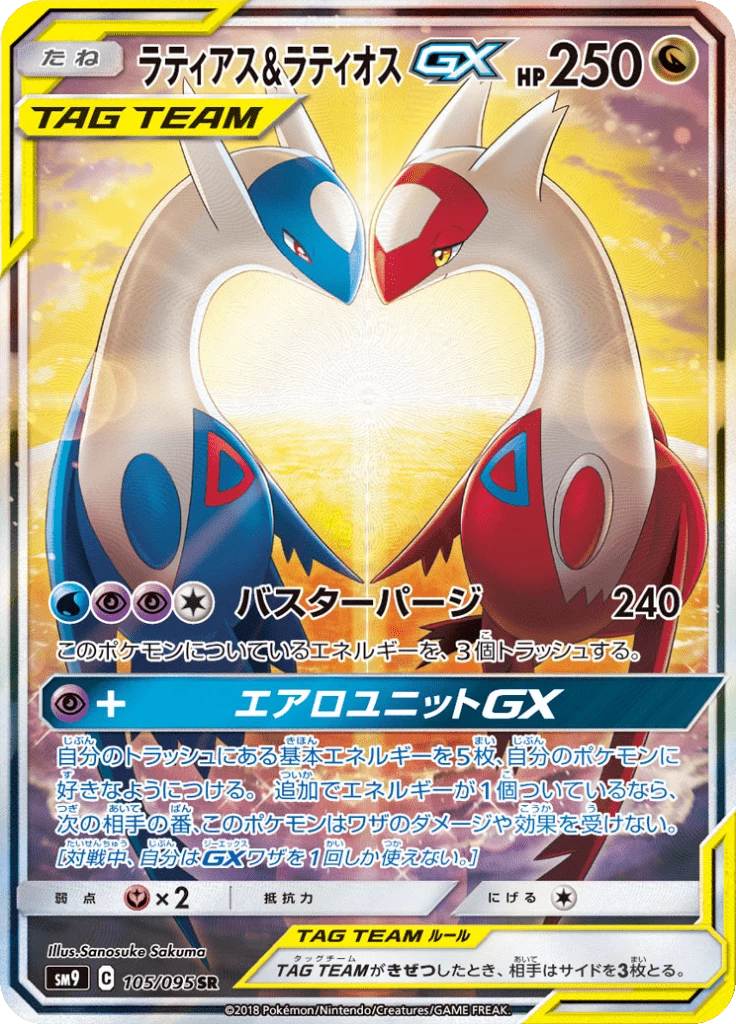
Latias & Latios GX (ラティアス&ラティオスGX)
Latias & Latios GX 105/095, Secret Rare, Tag Bolt (SM9)
From Tag Bolt (SM9, released 7 December 2018), card 105/095, Secret Rare, illustrated by Sanosuke Sakuma. This tag-team alt art is the single highest-value Dragon-type card in our listings. We currently list a PSA 10 copy at ¥1,321,516 (~$8,311). See our Latias & Latios cards guide for the wider lineup.
Rayquaza VMAX (レックウザVMAX)
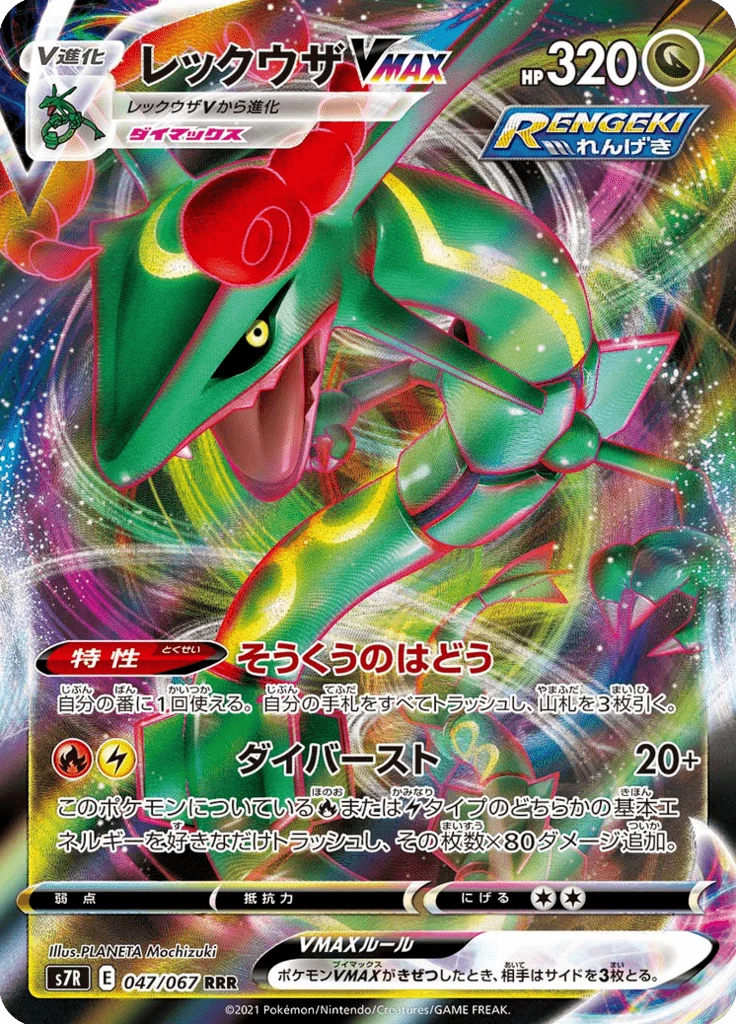
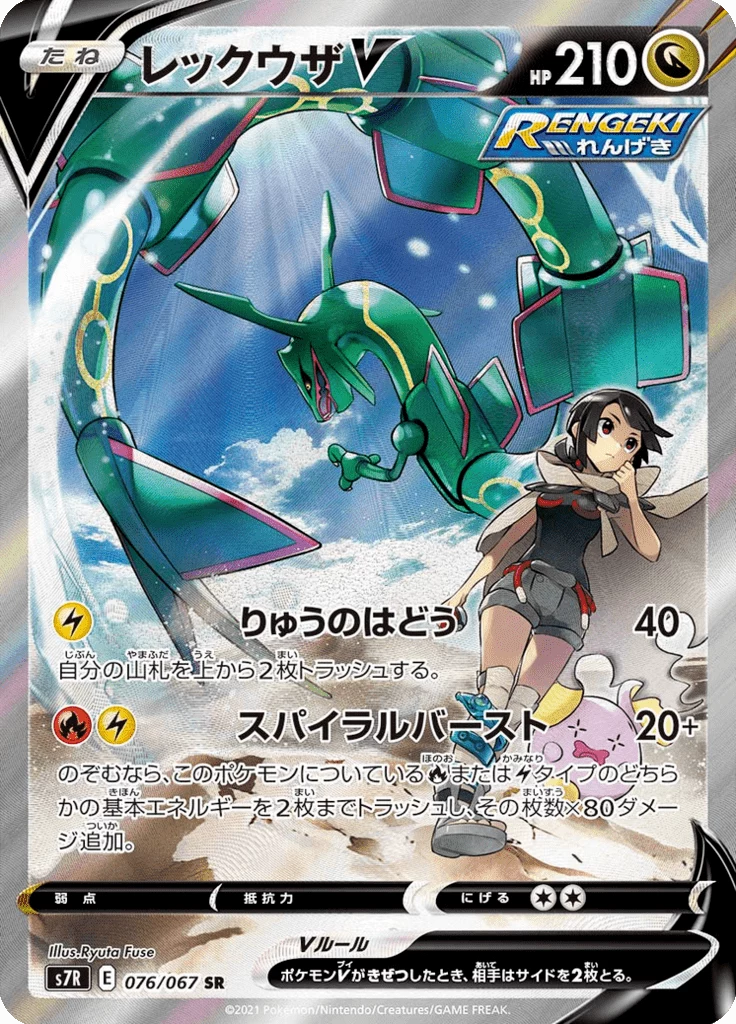
Rayquaza VMAX, Blue Sky Stream (S7R) — regular RRR print 047/067 shown; the 083/067 alt art is the print listed below
Blue Sky Stream (S7R, released 9 July 2021), card 083/067, alt art rated HR on its print record, illustrated by PLANETA Mochizuki. This HR alt-art Rayquaza VMAX printing is a different card entirely from Mega Rayquaza ex — the newer 2026 Storm Emeralda (M6) chase cards, which we cover in full in our Mega Rayquaza value guide rather than here. We list a PSA 10 copy at ¥1,216,624 (~$7,651). Our Rayquaza VMAX cards guide has the full printing history.
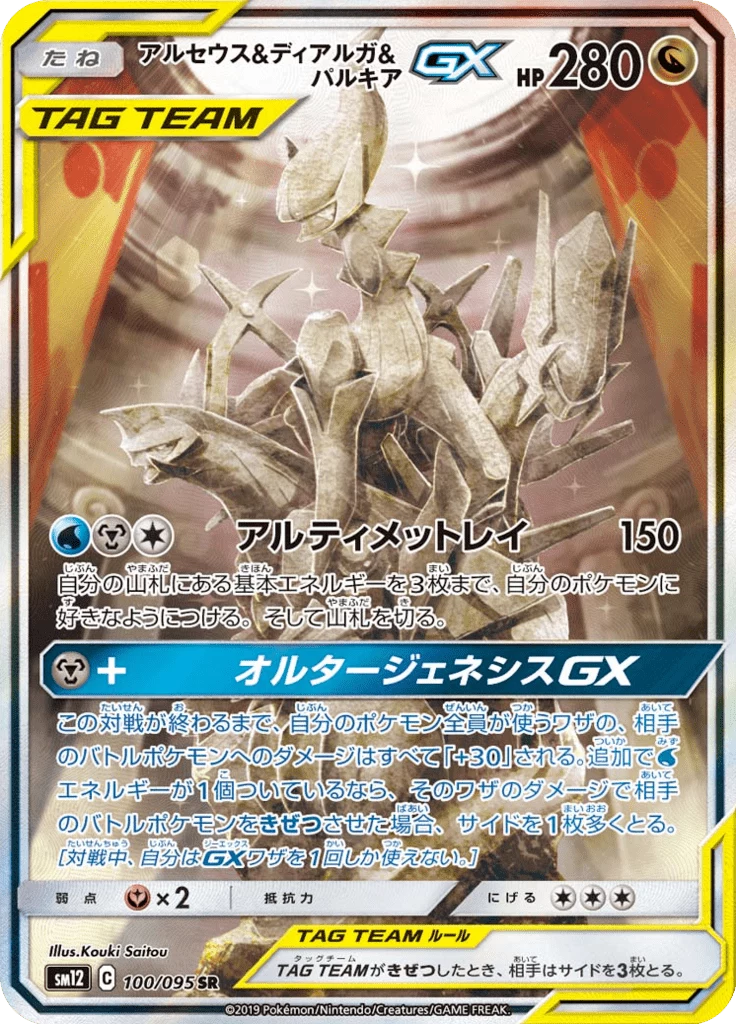
Alter Genesis (SM12, released 6 September 2019), card 100/095, Secret Rare, illustrated by Kouki Saitou. This creation-trio tag-team is Dragon-typed at 280HP, one of the highest-HP cards in this roundup. We list a PSA 10 copy at ¥258,830 (~$1,628). See our Dialga cards guide for the individual member breakdown.
M Charizard EX (MリザードンEX)
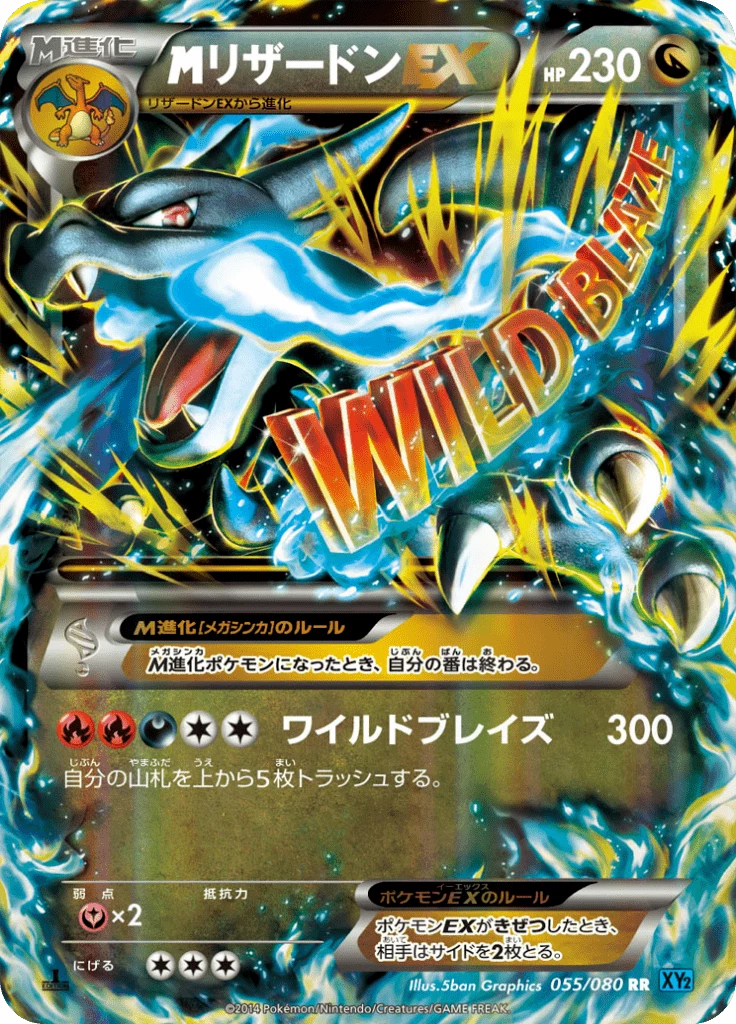
M Charizard EX 055/080, RR, black Mega X, Wild Blaze (XY2)
Wild Blaze (XY2, released 15 March 2014), card 055/080, RR, art by 5ban Graphics. This is the one Charizard Mega EX that genuinely prints Dragon — the black „Mega X“ frame — and it’s easy to mix up with the later Fire-type MEGA Charizard X ex from Inferno X. We list a PSA 10 copy at ¥147,884 (~$930). Our Mega Charizard value guide covers the full Fire-vs-Dragon printing history in detail.
Latias (ラティアス)
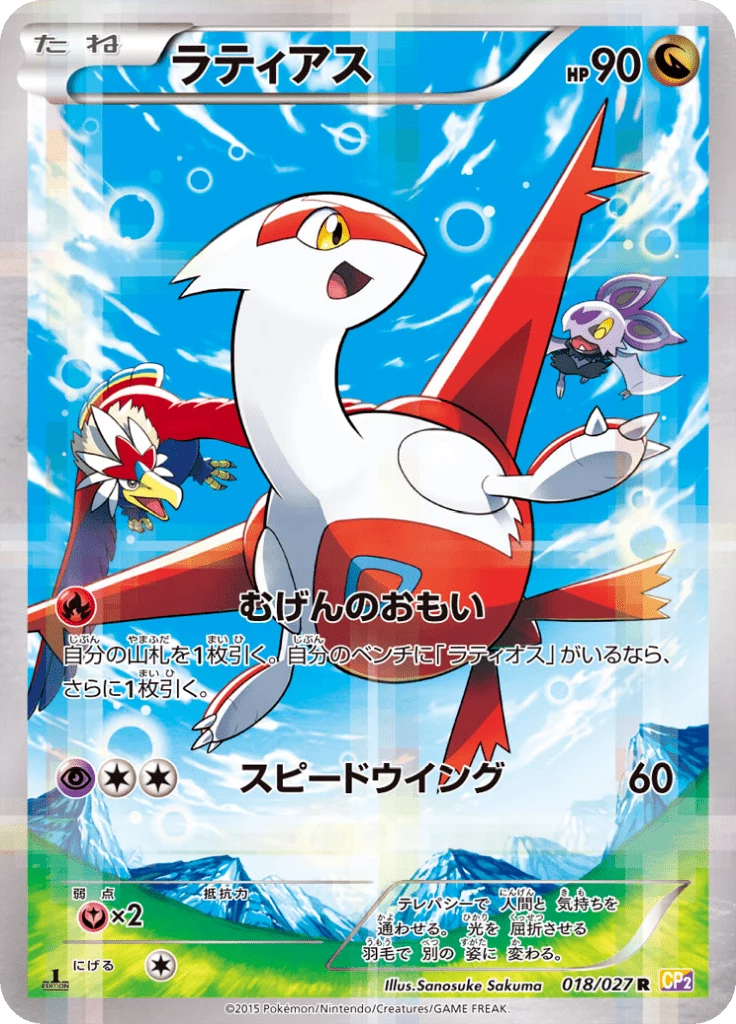
Latias 018/027, R (holo), 1st edition, Legend Kira Collection (CP2)
Legend Kira Collection (CP2, released 18 July 2015), card 018/027, R holo, 1st edition, illustrated by Sanosuke Sakuma. A straightforward holo Latias at 90HP, and one of the two cards that anchor this 2015 legendary-focused set alongside Latios. We list a PSA 10 copy at ¥134,420 (~$845). Our Latias Japanese cards guide has more on the full lineup.
Latios (ラティオス)
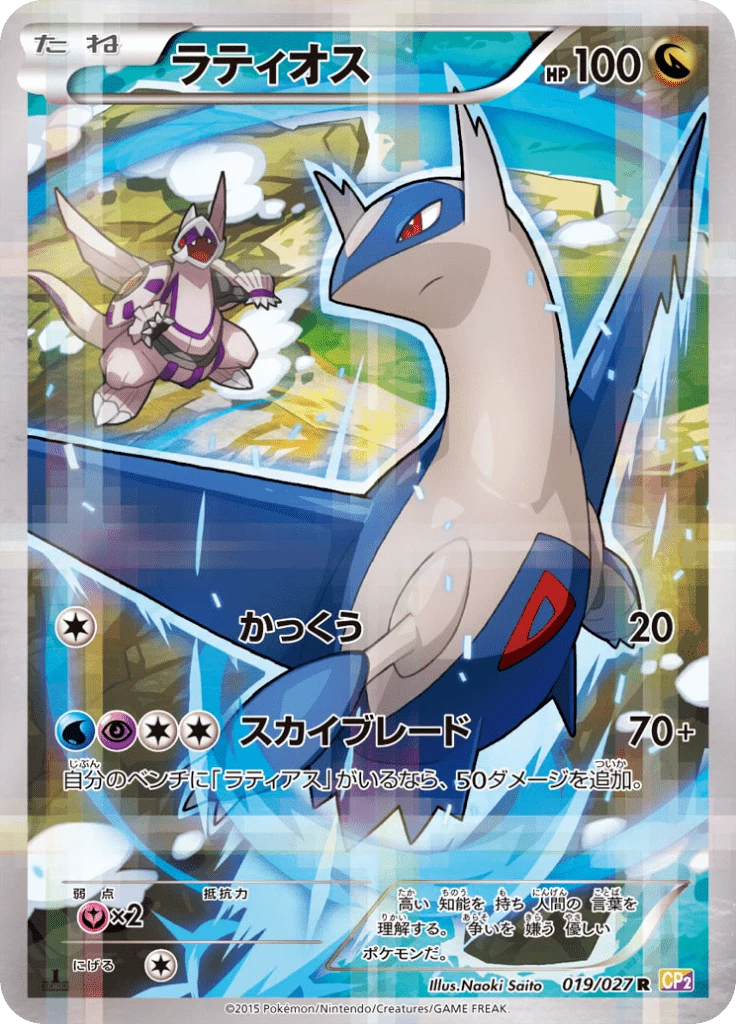
Latios 019/027, R (holo), Legend Kira Collection (CP2)
Also from Legend Kira Collection (CP2, 18 July 2015), card 019/027, R holo, 100HP, art by Naoki Saito. Latios trades slightly below its sibling despite the matched release, which is fairly typical for this pair across most CP2 print runs. We list a PSA 10 copy at ¥129,554 (~$815). See our Latios Japanese cards guide for the rest.
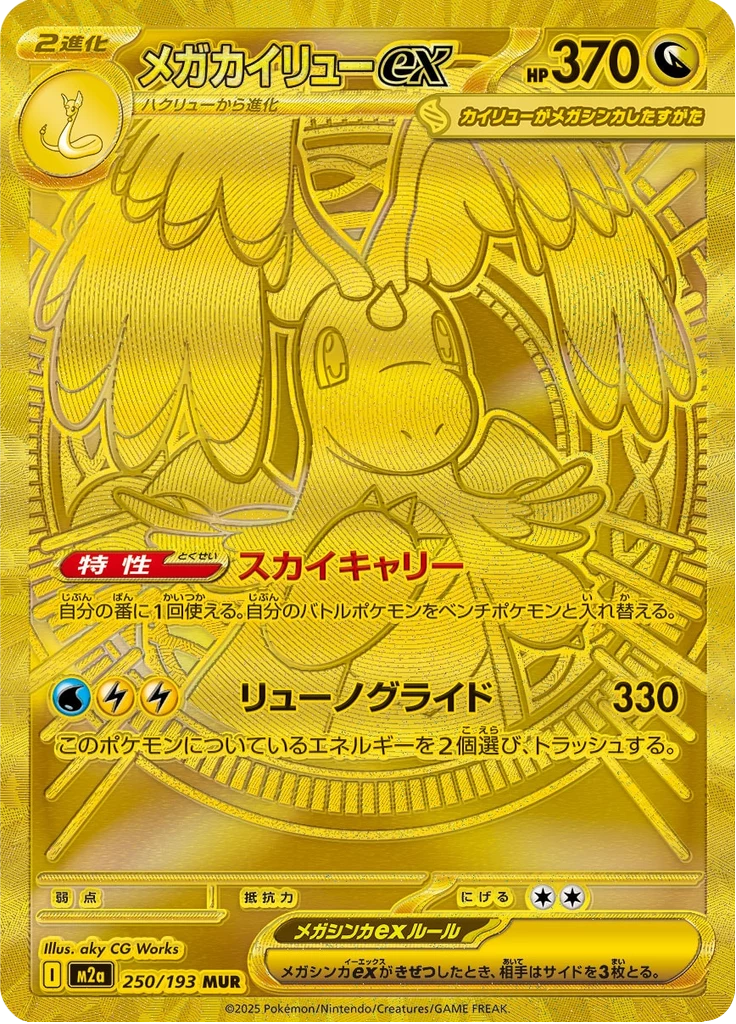
MEGA Dragonite ex, Ultra Rare (メガカイリューex)
MEGA Dragonite ex 250/193, Ultra Rare (our listing label „MUR“), Mega Dream ex (M2a)
Mega Dream ex (M2a, released 28 November 2025), card 250/193, listed as Ultra Rare on Limitless (we use the shorthand „MUR“ for our own catalogue), art by aky CG Works. At 370HP this is the highest-HP card on this list and the anchor of the newest Dragon-type wave. We list a PSA 10 copy at ¥93,225 (~$586). Our MEGA Dragonite cards guide and Dragonite cards guide cover the wider line.
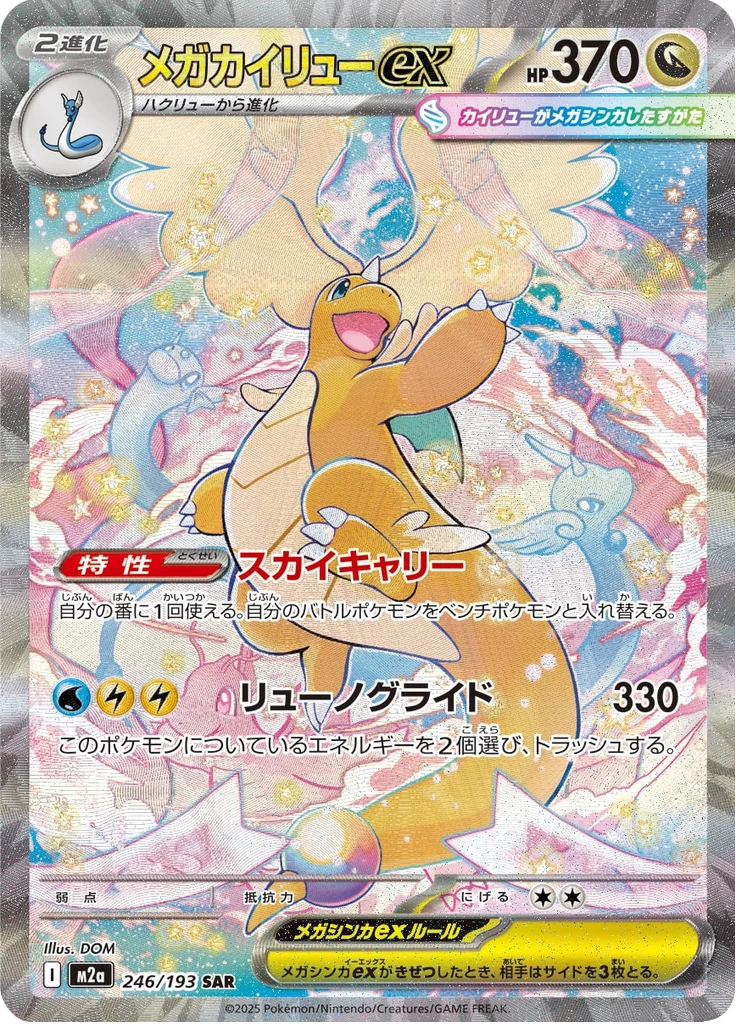
MEGA Dragonite ex, Special Art Rare
MEGA Dragonite ex 246/193, Special Art Rare, Mega Dream ex (M2a)
Also from Mega Dream ex (M2a, 28 November 2025), card 246/193, Special Art Rare, art by DOM. The alt-art companion to the Ultra Rare above, from the same 370HP print but in a scenic full-art frame. We list a PSA 10 copy at ¥41,888 (~$263).
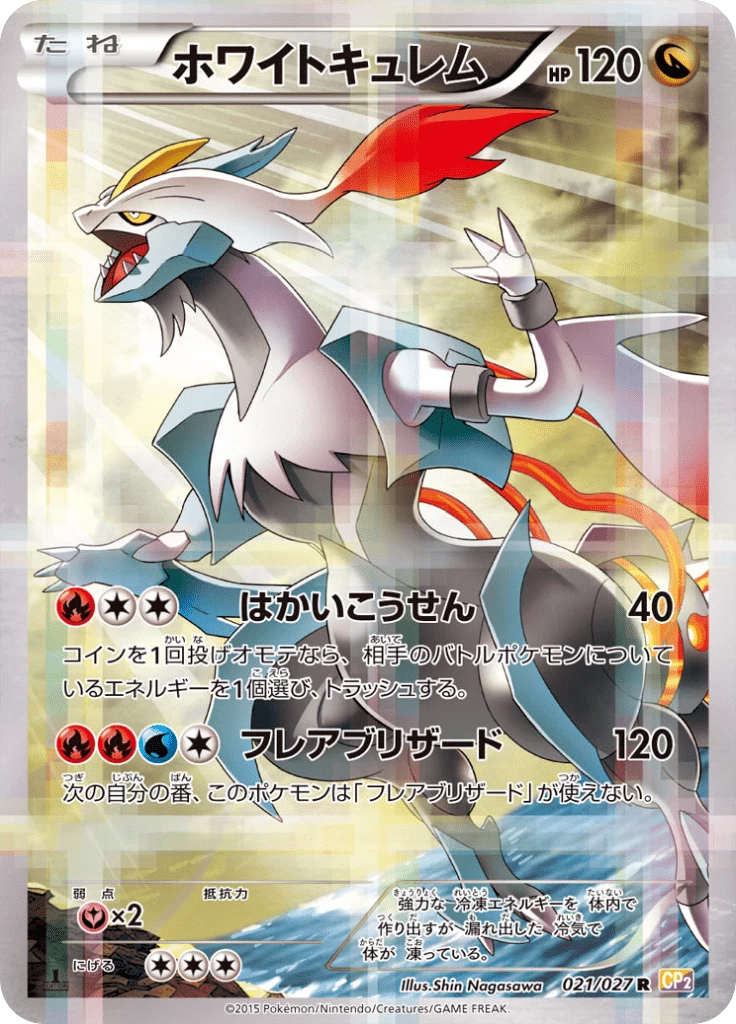
White Kyurem (ホワイトキュレム)
White Kyurem 021/027, R (holo), Legend Kira Collection (CP2)
The third and fourth cards from Legend Kira Collection (CP2, 18 July 2015): White Kyurem, card 021/027, R holo, 120HP, art by Shin Nagasawa. Kyurem’s fusion forms round out CP2’s Dragon-type quartet alongside Latias and Latios. We list a PSA 10 copy at ¥44,000 (~$277).
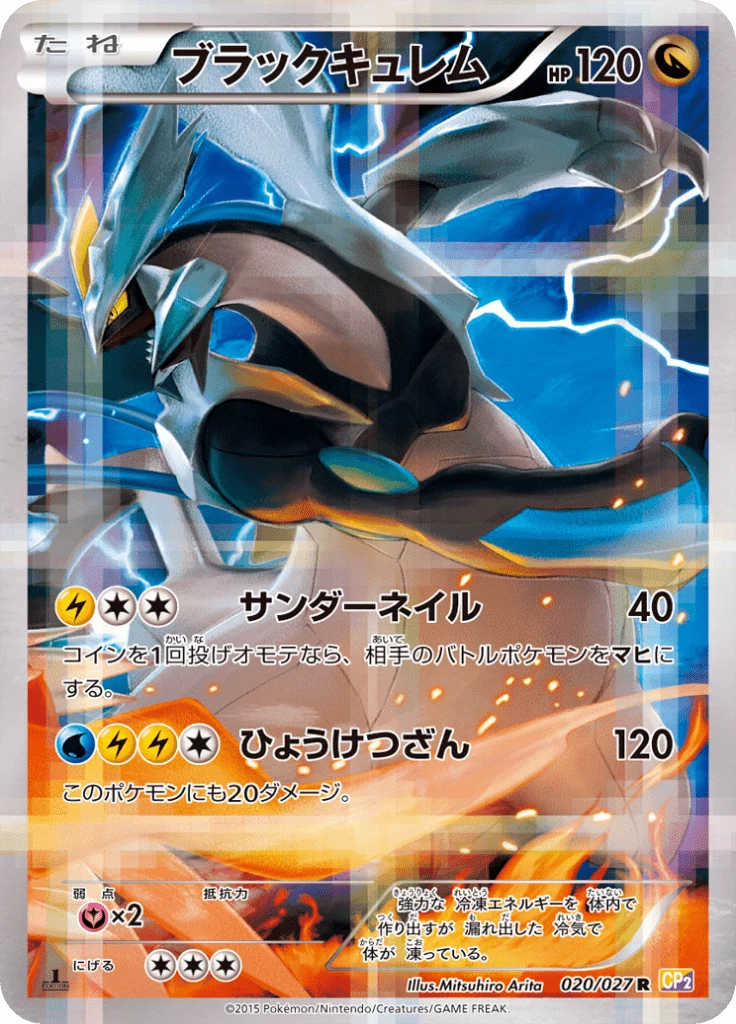
Black Kyurem (ブラックキュレム)
Black Kyurem 020/027, R (holo), 1st edition, Legend Kira Collection (CP2)
Black Kyurem, card 020/027, R holo, 1st edition, 120HP, art by Mitsuhiro Arita — the counterpart to White Kyurem from the same set and release date. We list a PSA 10 copy at ¥43,999 (~$277), within a single yen of its counterpart.
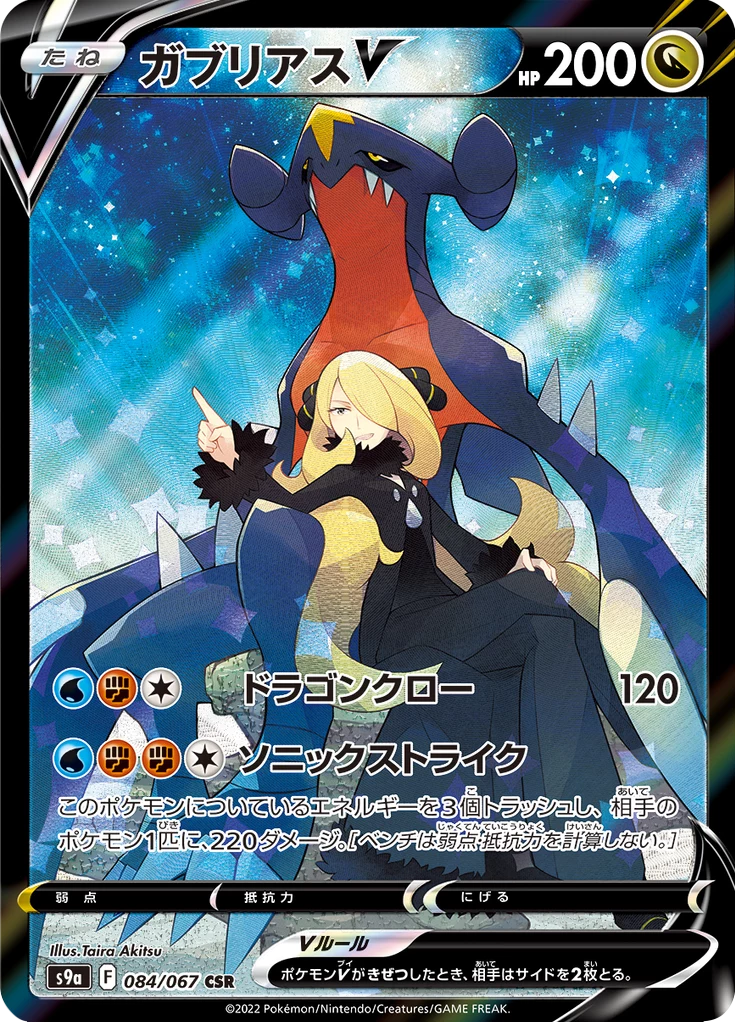
Garchomp V (ガブリアスV)
Garchomp V 084/067, Character Super Rare, Battle Region (S9a)
Battle Region (S9a, released 25 February 2022), card 084/067, Character Super Rare, illustrated by Taira Akitsu, 200HP. Garchomp’s other well-known ex prints (Cynthia’s Garchomp ex, and the SV3a Garchomp ex) are Fighting- and Water-typed respectively, so this CSR is the one to reach for if you specifically want a Dragon-type Garchomp card. We list a PSA 10 copy at ¥27,676 (~$174). Our Garchomp cards guide covers the full lineup and typing breakdown.
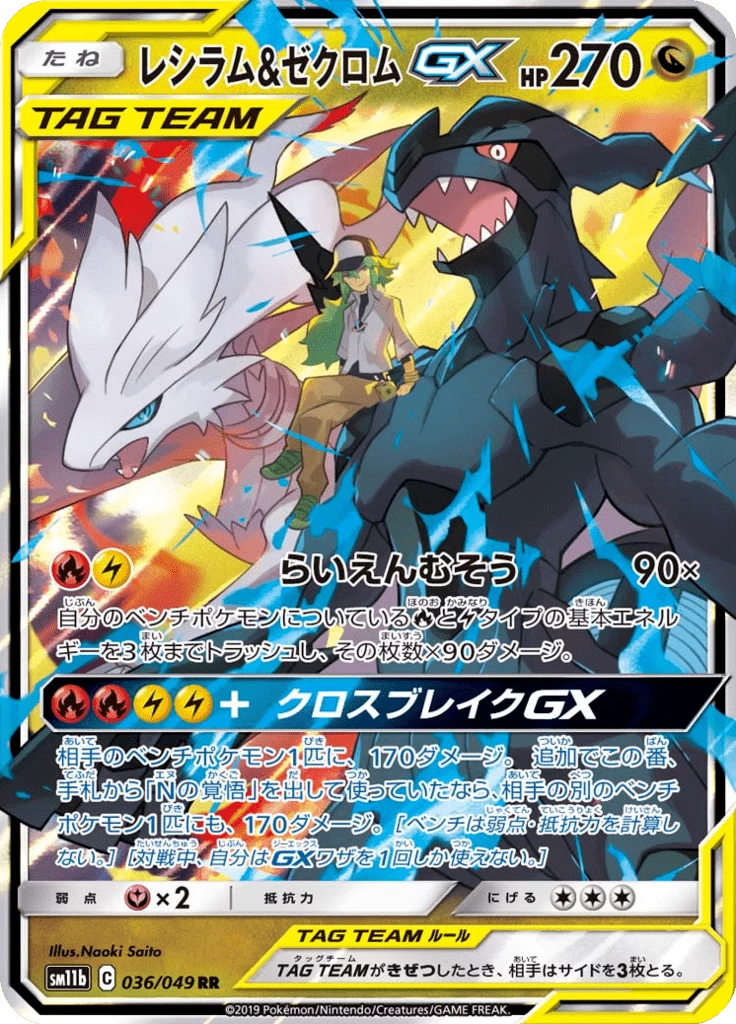
Reshiram & Zekrom GX (レシラム&ゼクロムGX)
Reshiram & Zekrom GX 036/049, RR, Dream League (SM11b)
Dream League (SM11b, released 2 August 2019), card 036/049, RR, art by Naoki Saito, 270HP. Both Reshiram and Zekrom carry other, non-Dragon printings elsewhere in the catalogue — this tag-team GX is the pairing where both legendaries print Dragon together. We list a PSA 10 copy at ¥17,776 (~$112), the most accessible entry point in this roundup.
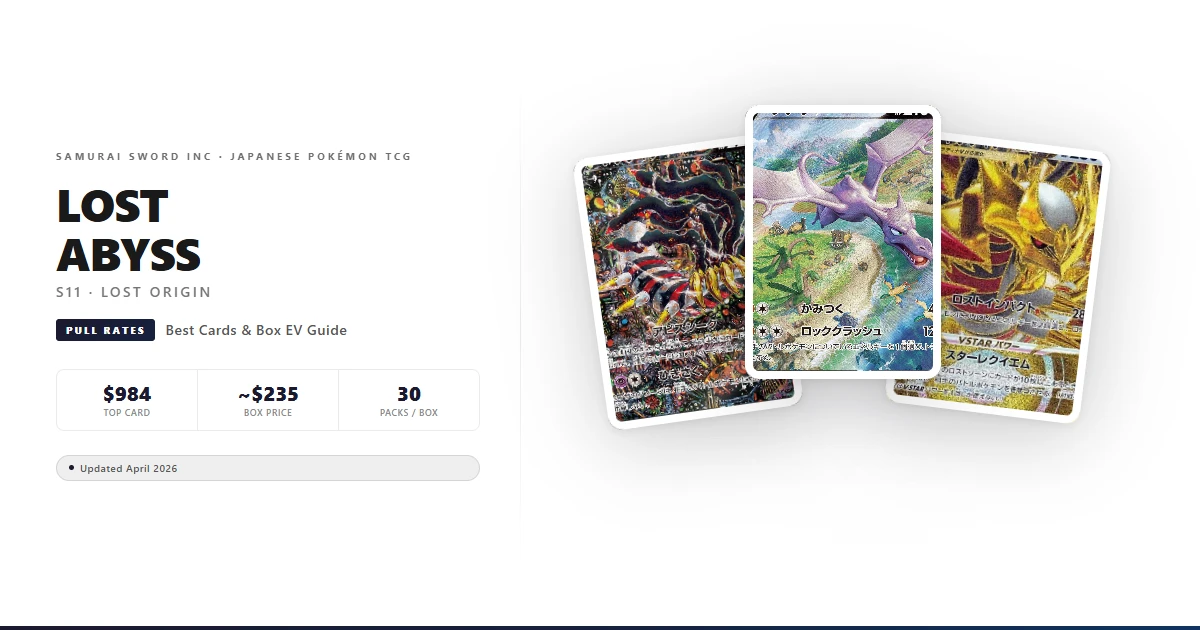
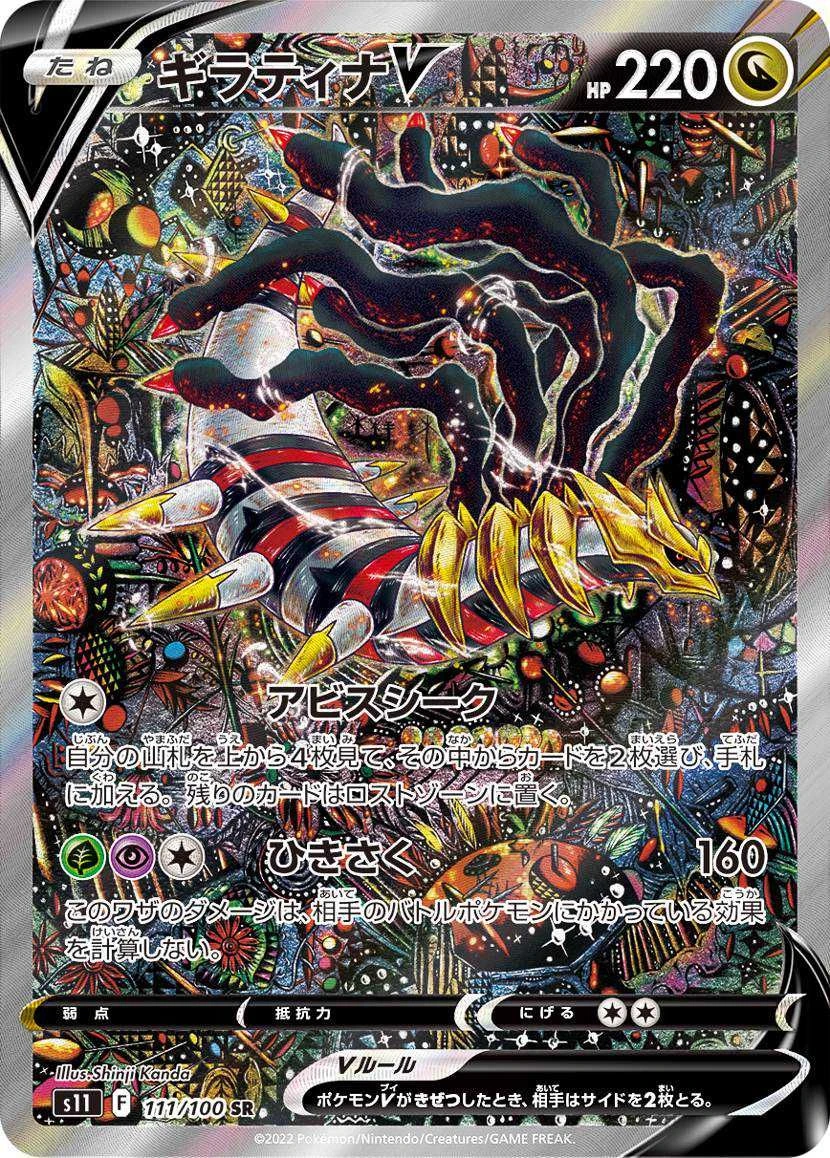
A few more Japanese Dragon-type cards worth knowing that aren’t currently listed on our site: Giratina V’s alt-art secret rare (S11 Lost Abyss, 111/100) is Dragon-typed at 220HP, and Rayquaza VMAX’s Character Super Rare print from VMAX Climax (S8b, 252/184) is Dragon-typed as well. Both are Quick Order sourcing requests rather than live links right now. See our Giratina cards guide for the first card’s full background, or our Rayquaza VMAX cards guide for the second.
Dragon-Type Card Comparison
All 12 cards side by side, our own PSA 10 listings only:
The spread runs from a ¥17,776 tag-team GX to a ¥1.32M alt-art secret rare, and set era is the biggest driver — the 2015 Legend Kira Collection quartet (Latias, Latios, Black Kyurem, White Kyurem) clusters tightly in the ¥40k–135k band, while the 2018–19 tag-team GX secret rares from Tag Bolt and Alter Genesis sit well above it.
Every card in this guide is graded PSA 10 and shipped from our Tokyo stock with tracked delivery. If the exact card, set, or grade you want isn’t listed above — including cards like Giratina V or the newer Storm Emeralda Mega Rayquaza ex prints — our Quick Order page is the fastest way to request it. Tell us the card, set code and number, and we’ll build a quote from our current Japanese inventory.
The 2015 Legend Kira Collection cards (Latias, Latios, Black Kyurem, White Kyurem) are frequently bought together since they were originally sold as a themed set, so ordering the run in one pass is often the most efficient way to build out that part of a Dragon-type binder.
The energy type printed on the card itself, not the Pokemon’s type in the video games. Dragon was introduced to the TCG in 2012, has no Basic Energy card of its own, and Dragon attackers typically need two non-Colorless energy types to attack. All 12 cards in this guide have Dragon as their verified printed type.
Is Rayquaza always a Dragon-type card?
No. The Rayquaza VMAX alt art from Blue Sky Stream (S7R 083/067) is Dragon-type, but the original M Rayquaza EX from Emerald Break (XY6 062/078) and its 25th Anniversary promo reprint (024/025) are both Colorless. Check the individual card, not just the Pokemon.
What is the most valuable Japanese Dragon-type card in this list?
The Latias & Latios GX secret rare alt art from Tag Bolt (SM9 105/095), with a PSA 10 currently listed at ¥1,321,516. The Rayquaza VMAX alt art from Blue Sky Stream (S7R 083/067) is close behind at ¥1,216,624.
Is Dragapult a Dragon-type card?
No — Dragapult’s ex prints in the current Scarlet & Violet era are Psychic-type in the TCG, despite Dragapult’s Dragon/Ghost typing in the games. See our Dragapult cards guide for that card specifically; it isn’t included in this Dragon-type roundup.
Where can I buy these Japanese Dragon-type cards from outside Japan?
We ship every card on this list from Tokyo with tracked international delivery. Use the product links above for graded PSA 10 copies, or our Quick Order page for other cards, sets, or grades from our Japanese inventory.
Evolving Skies Chase Cards: Top 10 und die japanischen Versionen aus S7R / S7D / S6a Eevee Heroes
Evolving Skies released in English on 27th August 2021 with 203 cards plus 34 secret rares — and every one of its headline chase cards started life in Japan months earlier, spread across three separate sets. If you have ever wondered why the Japanese alt-art Umbreon V looks identical to the English Ultra Rare but carries a different number, or why one popular alt art never made it into Evolving Skies at all, the answer is in how Pokemon assembled this set.
This guide ranks ten Evolving Skies chase cards our own way — by our graded PSA 10 listings first, then by Japanese print rarity tier — and shows the exact Japanese print each one comes from: S6a Eevee Heroes, S7R Blue Sky Stream and S7D Skyscraping Perfection. Product links go to our own current listings where one exists. For the full Japanese breakdown across all three sets, see our Evolving Skies Japanese card list.
Key Takeaways
Evolving Skies draws its chase cards from three Japanese sets — S6a Eevee Heroes, S7R Blue Sky Stream and S7D Skyscraping Perfection. Our highest-priced PSA 10 in this lineup is the Rayquaza VMAX HR alt art (S7R 083/067) at ¥1,216,624, and the S6a Eevee Heroes Booster Box is currently listed at ¥159,600 (~$1,004) if you want to chase these pulls yourself.
EVS
EN Set (27 Aug 2021)
S6a / S7R / S7D
JP Source Sets
10
Chase Cards Covered
¥159,600
S6a Box Listed Price
All prices below are our own Tokyo listings, converted at ¥159/USD (September 2026). We do not quote third-party market prices.
How We Ranked These Chase Cards
We ranked this list two ways, in order. First, any card with a graded PSA 10 currently listed on our site, sorted from our highest listed price down to our lowest. Second, once those listings run out, by Japanese print rarity tier — HR alt art above SR alt art, SR alt art above standard SR, and so on. We do not use TCGplayer, eBay or PriceCharting values anywhere in this article, and we do not quote pull rates as fact.
Six of the ten cards below currently have a PSA 10 listed on our site; the remaining four are ranked by rarity tier and are best sourced through Schnellbestellung or as pulls from sealed Japanese product.
The Top 10 Evolving Skies Chase Cards
1. Rayquaza VMAX — EVS 218/203
The English „Secret Rare“ alt-art Rayquaza VMAX, illustrated by Anesaki Dynamic, sits at the top of the Evolving Skies secret run at 218/203. Its Japanese counterpart is S7R Blue Sky Stream 083/067, an HR alt-art print — a number that sits above Limitless’s catalogued S7R range, so we can’t independently verify the artwork match through that source. Per our own Rayquaza VMAX card guide, both printings share the same illustration.
We currently list a PSA 10 of this card at ¥1,216,624 — the highest-priced graded copy in this lineup.
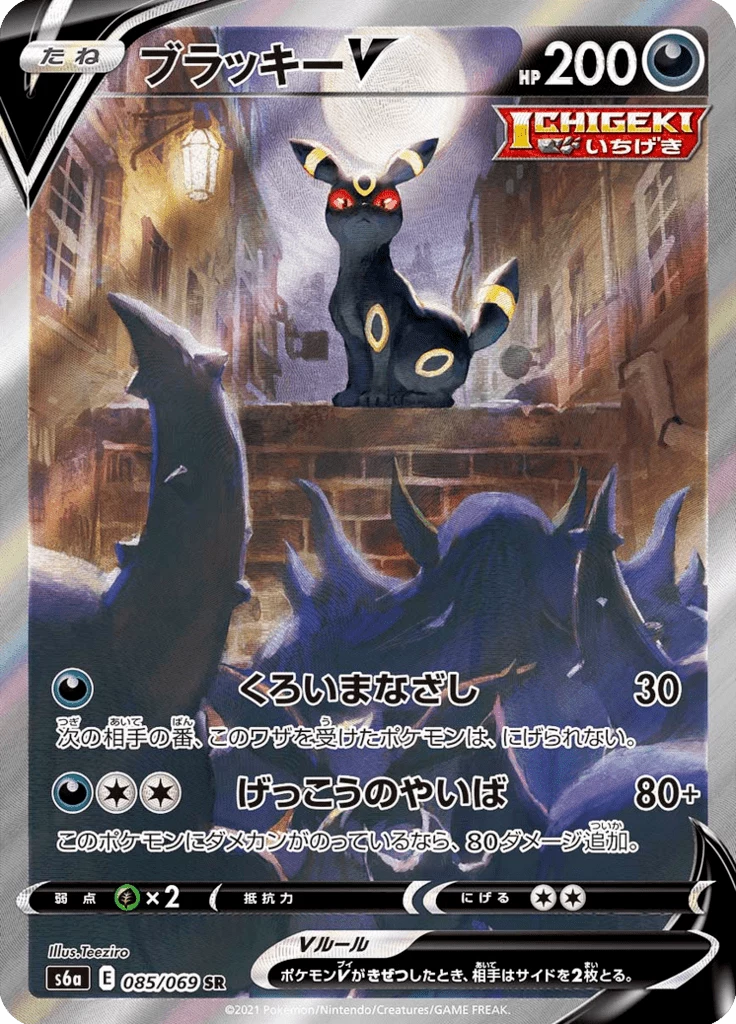
2. Umbreon V — EVS 189/203
Umbreon V, S6a 085/069, SR (alt art), Eevee Heroes — illustrated by Teeziro
The English Ultra Rare alt-art Umbreon V matches S6a Eevee Heroes 085/069, an SR alt-art print by the same illustrator, Teeziro. Evolving Skies itself lists the S6a 085 print among its cross-references, so this is one of the more directly confirmed pairs on this list.
3. Jolteon V (Japanese alt art) — not printed in Evolving Skies
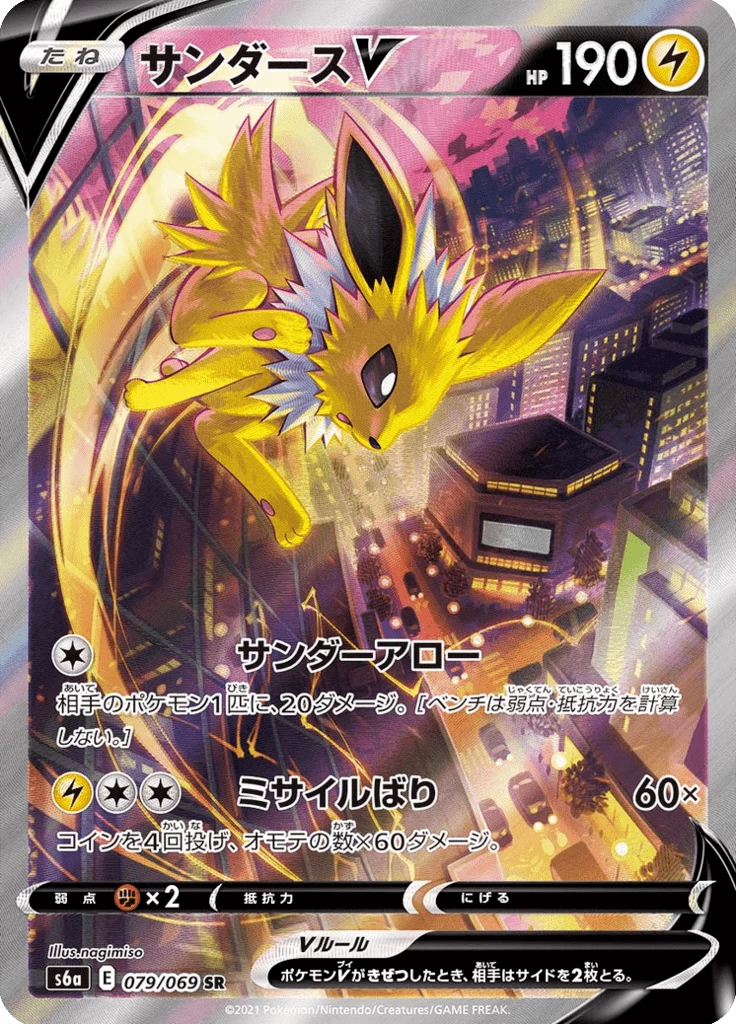
Jolteon V, S6a 079/069, SR (alt art), Eevee Heroes — illustrated by nagimiso
This is where the „cards cut from Evolving Skies“ story gets concrete. Evolving Skies only carries one Jolteon V, the standard Ultra Rare at 177/203, illustrated by 5ban Graphics — and that print matches S6a 078, not this card. The alt-art Jolteon V shown here, S6a Eevee Heroes 079/069, illustrated by nagimiso, has no counterpart in Evolving Skies at all, which is exactly why collectors search for it separately from the English set.
The English „Secret Rare“ alt-art Duraludon VMAX, illustrated by Saki Hayashiro, is 220/203 in Evolving Skies. Its Japanese equivalent is S7D Skyscraping Perfection 083/067, an HR alt-art print — again a number outside Limitless’s catalogued S7D range, so we’re stating the Japanese print here without asserting the artwork is a confirmed match.
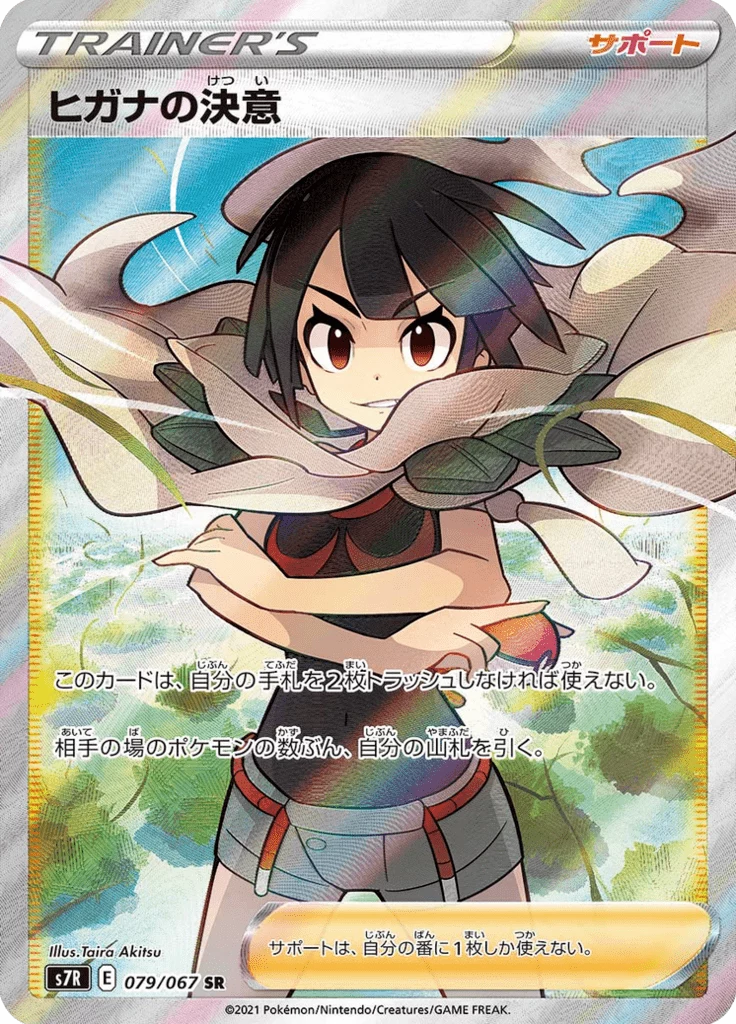
Zinnia’s Determination, S7R 079/067, SR, Blue Sky Stream — illustrated by Taira Akitsu
The English Ultra Rare supporter Zinnia’s Resolve (203/203, with a rainbow version at 225/203) is illustrated by Taira Akitsu, and the same illustrator’s Japanese print, S7R Blue Sky Stream 079/067 — titled Zinnia’s Determination on our own listings — is a cross-listed print of the same card.
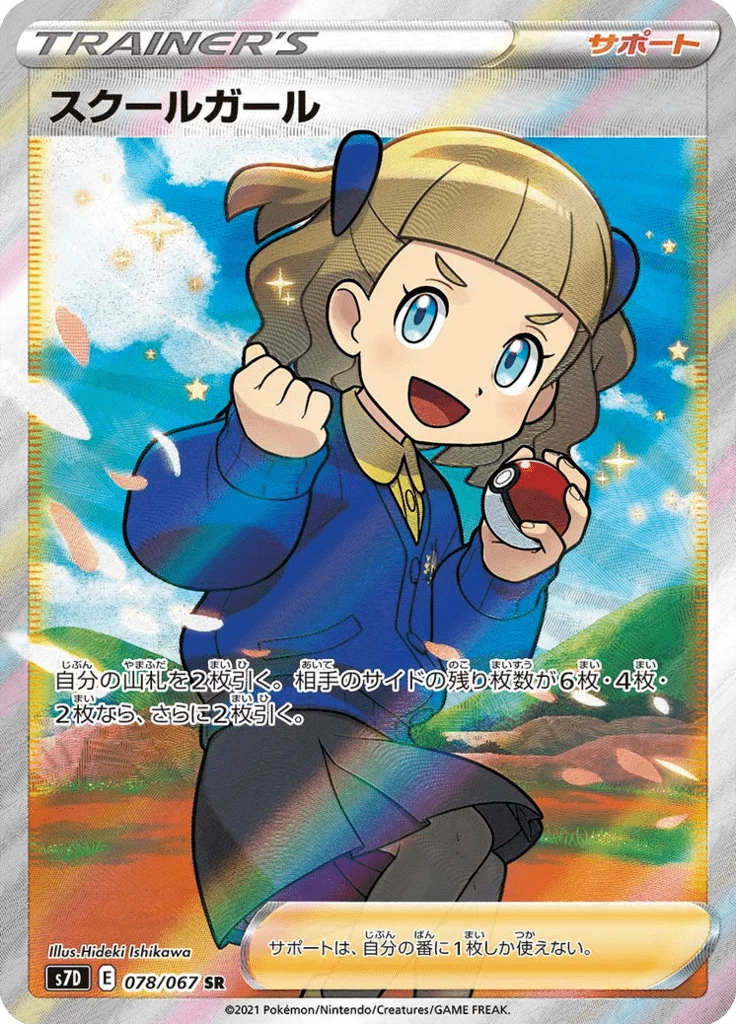
Evolving Skies‘ Ultra Rare supporter slots are limited to Aroma Lady, Copycat, Gordie, Raihan and Zinnia’s Resolve — Schoolgirl isn’t among them. S7D Skyscraping Perfection 078/067, illustrated by Hideki Ishikawa, is a Japan-only supporter SR in this set mapping, which makes it one of the harder cards on this list to track down in English collections.
The English „Secret Rare“ alt-art Umbreon VMAX, illustrated by Keiichiro Ito, sits at 215/203 — better known by its nickname, „Moonbreon.“ Per our Moonbreon card guide, the Japanese equivalent is S6a Eevee Heroes 095/069, an HR alt-art print by the same illustrator — a number above Limitless’s catalogued S6a range, which is why no card image is available from that source here.
This card isn’t currently listed on our site; it’s best sourced via Schnellbestellung.
8. Sylveon V — EVS 184/203
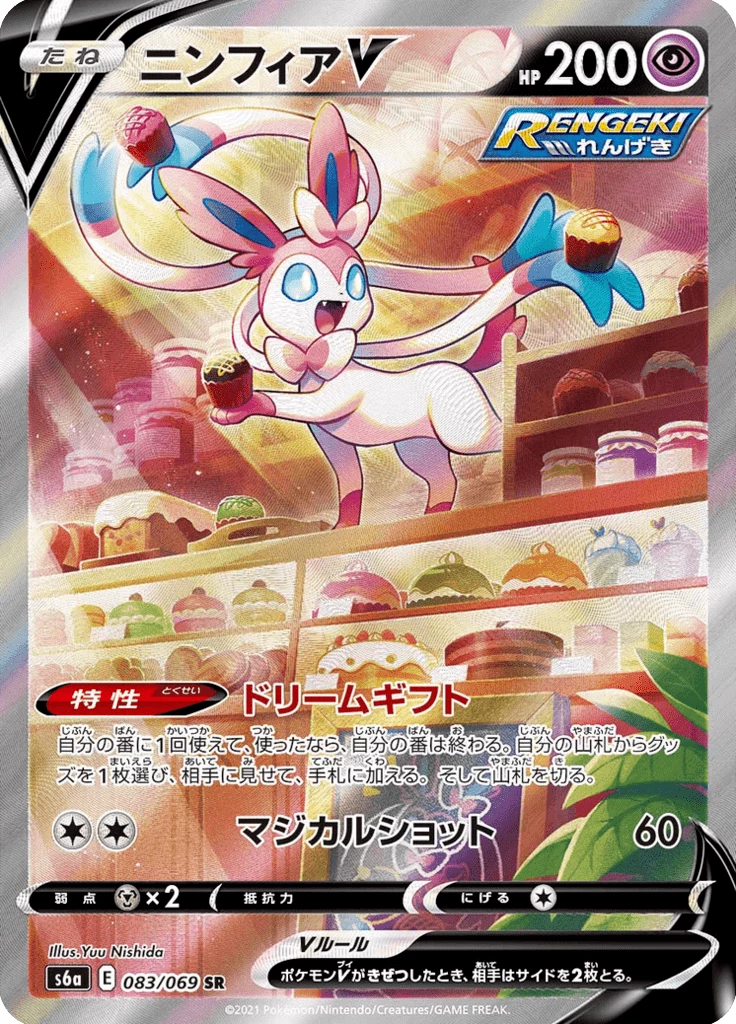
Sylveon V, S6a 083/069, SR (alt art), Eevee Heroes — illustrated by Yuu Nishida
The English Ultra Rare alt-art Sylveon V matches S6a Eevee Heroes 083/069, the SR alt-art print by the same illustrator, Yuu Nishida. This card isn’t currently listed on our site; sourcing is via Schnellbestellung or from a sealed Eevee Heroes Eeveelutions Set.
9. Espeon V — EVS 180/203
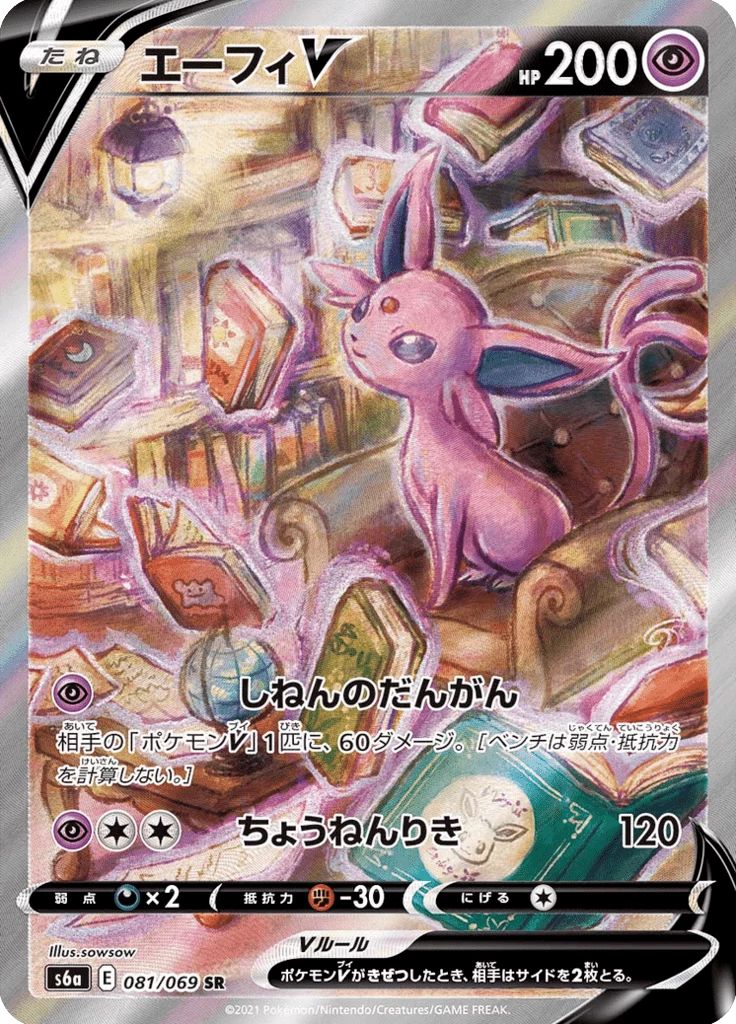
Espeon V, S6a 081/069, SR (alt art), Eevee Heroes — illustrated by sowsow
The English Ultra Rare alt-art Espeon V matches S6a Eevee Heroes 081/069, illustrated by sowsow on both prints. This card isn’t currently listed on our site; sourcing is via Schnellbestellung.
10. Glaceon V — EVS 175/203
Glaceon V, S6a 077/069, SR (alt art), Eevee Heroes — illustrated by Narumi Sato
Rounding out the list, the English Ultra Rare alt-art Glaceon V matches S6a Eevee Heroes 077/069, illustrated by Narumi Sato on both prints. This card isn’t currently listed on our site; sourcing is via Schnellbestellung.
Japanese vs English: What Changes
Evolving Skies is a compilation set, and the numbers tell the story. The English release runs 237 cards as one continuous numbered sequence: 203 main-set cards plus 34 secrets (204–237). The three Japanese sets it draws from carry Limitless-catalogued totals higher than the fraction printed on the cards themselves: S6a Eevee Heroes lists 87 cards in total even though its cards are numbered against a /069 denominator, and S7R Blue Sky Stream and S7D Skyscraping Perfection each list 79 cards against a /067 denominator. The gap is the run of alt-art and secret-rare prints — cards like 079/069 or 083/067 — that sit above each set’s main numbered sequence but still count toward the Limitless total. Between the three sets, that’s 245 catalogued entries.
That gap matters: per PokeBeach’s tracking, around 90 Japanese cards were cut from the English set entirely. Every Japanese card also keeps its own set code and printed number — a card is „S6a 085/069“ or „S7R 079/067“ for its whole life — while Evolving Skies renumbers everything into one English-only sequence starting at 1. That’s why the same illustration can carry two completely different numbers depending on which release you’re holding.
Release timing follows a different pattern per set. S6a Eevee Heroes came out 28th May 2021, roughly three months ahead of Evolving Skies‘ 27th August 2021 English release. S7R Blue Sky Stream and S7D Skyscraping Perfection followed later, on 9th July 2021, giving Japanese collectors only about seven weeks‘ lead on those two sets before the English release caught up. For the full card-by-card mapping, see our Evolving Skies Japanese card list, our S7R Blue Sky Stream card list, our S7D Skyscraping Perfection card list, and our S6a Eevee Heroes card list.
Shop This Set
S6a Eevee Heroes Booster Box (Japanese)
Source of the Umbreon V, Jolteon V, Sylveon V, Espeon V and Glaceon V alt arts
We ship Japanese sealed product and graded singles worldwide from Tokyo with tracked delivery. If you want a chance at pulling these alt arts yourself, sealed product is the direct route: the S6a Eevee Heroes Booster Box (¥159,600) covers the Eeveelution V alt arts, the S7R Blue Sky Stream Booster Box (¥306,600) covers Rayquaza VMAX and Zinnia’s Determination, and the S7D Skyscraping Perfection Booster Box (¥17,850) covers Duraludon VMAX and Schoolgirl. For a complete Eeveelution set in one purchase, see the Eevee Heroes Eeveelutions Set (¥400,000).
If you’d rather buy a specific graded card outright, the PSA 10 links throughout this article go straight to our current listings, and our PSA 10 Eeveelutions buying guide covers the graded side of this lineup in more depth. For singles not currently listed here, or for building a mixed order across sets, our Quick Order page is the fastest route. For more on how Japanese and English Pokemon releases generally differ, see our Japanese vs English Pokemon cards guide.
Häufig gestellte Fragen
What is the most expensive Evolving Skies chase card in Japanese?
Among the graded copies we currently list, the Rayquaza VMAX HR alt art from S7R Blue Sky Stream (083/067) is our highest-priced PSA 10 in this lineup, at ¥1,216,624.
Why isn’t the alt-art Jolteon V from Eevee Heroes in Evolving Skies?
Evolving Skies only includes one Jolteon V, the standard Ultra Rare (177/203), which matches S6a Eevee Heroes 078. The alt-art Jolteon V at S6a 079/069 has no counterpart anywhere in Evolving Skies.
How many Japanese sets does Evolving Skies come from?
Three: S6a Eevee Heroes (28th May 2021, 87 cards), S7R Blue Sky Stream (9th July 2021, 79 cards) and S7D Skyscraping Perfection (9th July 2021, 79 cards).
Why were some Japanese cards left out of Evolving Skies?
The three source sets carry 245 Limitless-catalogued entries between them (87 + 79 + 79) against Evolving Skies‘ 237. Per PokeBeach’s tracking, around 90 Japanese cards were cut from the English set overall, including some alt arts like the Eevee Heroes Jolteon V and the Skyscraping Perfection Schoolgirl.
Can I buy PSA 10 graded copies of these chase cards?
Yes — six of the ten cards in this article currently have a graded PSA 10 listed on our site, linked directly from each card’s section above. See our PSA 10 Eeveelutions buying guide for more on the graded side of this set.
Where can I buy sealed Eevee Heroes, Blue Sky Stream or Skyscraping Perfection product?
We ship all three Japanese booster boxes from Tokyo with tracked delivery: S6a Eevee Heroes, S7R Blue Sky Stream and S7D Skyscraping Perfection. Links to each are in the Where to Buy section above.
Fairy Type Pokemon-Karten: Die besten japanischen Prints und die Geschichte des Fairy Type im TCG
The Fairy type only ever existed in the Pokemon TCG for six years. It was introduced with the Kalos Starter Set on 8 November 2013 and quietly stopped receiving new cards when the Sword & Shield era began in Japan in December 2019. Nearly every Fairy-typed card — Xerneas, Sylveon, Gardevoir, Togepi, all of it — was printed inside that window, which makes the type a closed, collectible set rather than an ongoing category; the one exception is a 2021 25th-anniversary promo that reprinted the original Fairy-type Xerneas EX design years after the type had stopped receiving new cards (covered below).
This guide explains what actually counted as Fairy type, walks through twelve Japanese Fairy-type prints from the XY era through Sun & Moon, and shows what the same Pokemon look like now that the type no longer exists — because Fairy Pokemon are printed as Psychic type today. We ship Japanese sealed product and singles out of Tokyo every week, so the listings below reflect our own current listings.
Key Takeaway
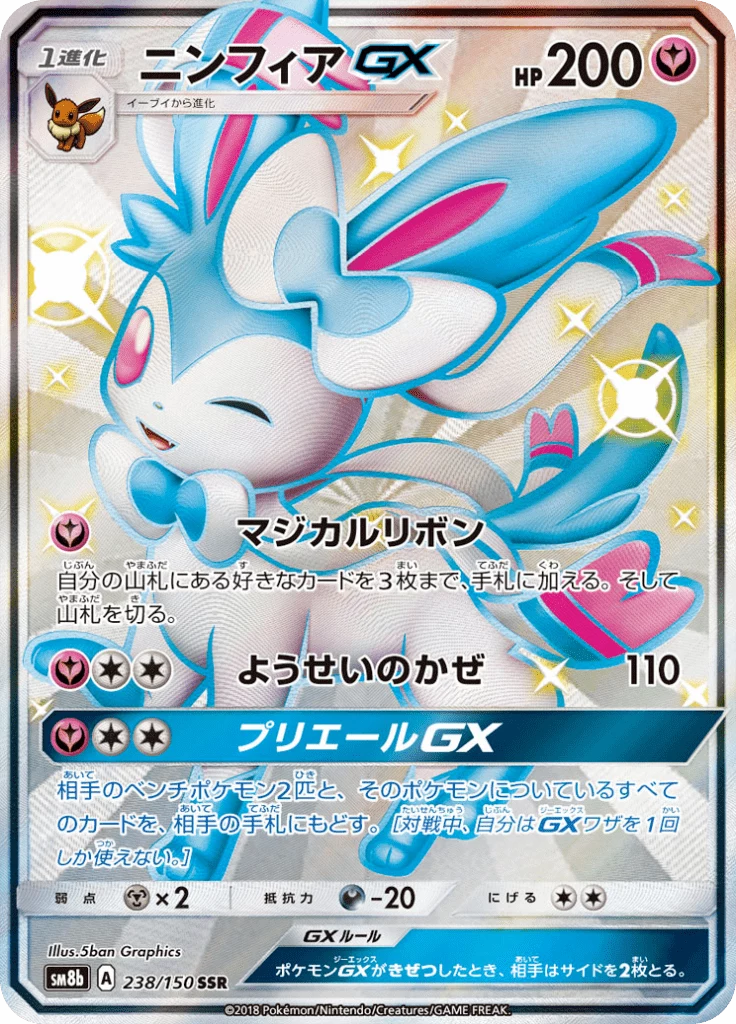
Fairy type ran from the Kalos Starter Set (8 Nov 2013) through the Sun & Moon era and stopped with Sword & Shield (Japan, Dec 2019). Fairy Pokemon are now printed as Psychic type. Our highest-listed Japanese Fairy-type PSA 10 is the Togepi & Cleffa & Igglybuff GX alt art (SM12a 186/173) at ¥116,160 (~$731), and the Sylveon GX SSR (SM8b 238/150) is currently listed at ¥77,220 (~$486).
12
Cards Covered
2013–2019
Fairy Type Lifespan
¥116,160
Highest Listed (PSA 10)
¥6,138
Lowest Listed (PSA 10)
Prices below are our own current Japanese-market listings, converted at ¥159/USD (September 2026). No third-party market prices are used.
What Counts as a Fairy-Type Pokemon Card
Per Bulbapedia’s Fairy (TCG) entry, „the Fairy type formerly contained most Fairy-type Pokemon found in the main series video games,“ with Xerneas, Sylveon and Aromatisse given as examples. The type also picked up some Pokemon that weren’t Fairy-typed in the games: „some Pokemon that were classed as Colorless types prior to the Kalos Starter Set, such as Snubbull, were Fairy types from the Kalos Starter Set to Cosmic Eclipse.“
That lifespan is short and specific. The Kalos Starter Set released 8 November 2013 in both English and Japan, introducing Fairy Energy and the first Fairy-typed cards. In Japan, the first XY booster — Collection X — followed on 13 December 2013, and its Xerneas EX (044/060 RR) is documented as the first Fairy-type Pokemon-EX; we cover that specific card in our Xerneas EX 25th anniversary card guide.
The type carried through the entire Sun & Moon era. The last Japanese sets to include Fairy-type cards were Dream League (SM11b, 2 August 2019) and Tag All Stars (SM12a, 4 October 2019). Then, per Bulbapedia, „the Fairy type ceased being supported by the TCG from the Sword & Shield expansion onwards“ — Japan’s first Sword & Shield set, S1W „Sword,“ released 6 December 2019. In the 2021–22 Standard format, Fairy Energy was rotated out, becoming the first Basic Energy card to be dropped from the format. As Bulbapedia puts it, „Pokemon that are Fairy-type in the core series games are now grouped with the Psychic type instead.“
One naming note worth flagging: SM7b, released 3 August 2018, is called „Fairy Rise“ in Japanese — but that is the set’s name, not a rarity tier. Three of the picks below come from that set.
Our Picks: 12 Japanese Fairy-Type Cards
Ordered by release date, from the type’s first year through its final Japanese printings and one 25th-anniversary reprint of the original.
Florges EX SR — Phantom Gate (XY4), September 2014
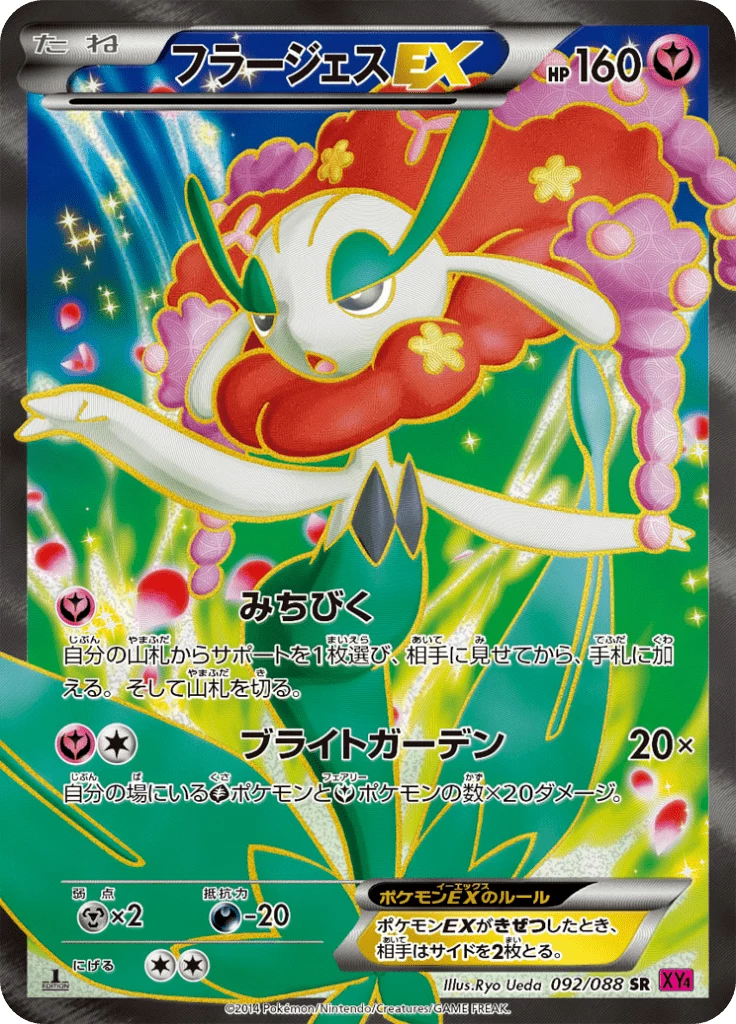
Florges EX 092/088, SR — Phantom Gate (XY4)
Florges EX (092/088, SR), illustrated by Ryo Ueda, was printed 13 September 2014 in Phantom Gate — the English-set equivalent is Phantom Forces. Our PSA 10 copy is currently listed at ¥28,600 (~$180).
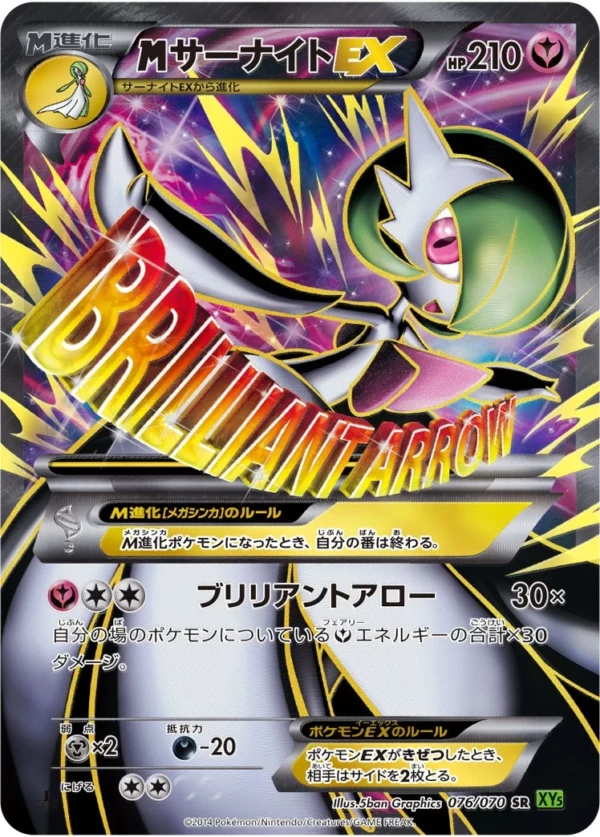
M Gardevoir EX SR — Tidal Storm (XY5), December 2014
M Gardevoir EX 076/070, SR — Tidal Storm (XY5)
Released 13 December 2014, this SR printing (076/070) carries the same 5ban Graphics artwork used on the English Primal Clash card. Our PSA 10 is currently listed at ¥108,900 (~$685) — the modern Mega Gardevoir line, by contrast, is Psychic type; see our Mega Gardevoir value guide for that comparison.
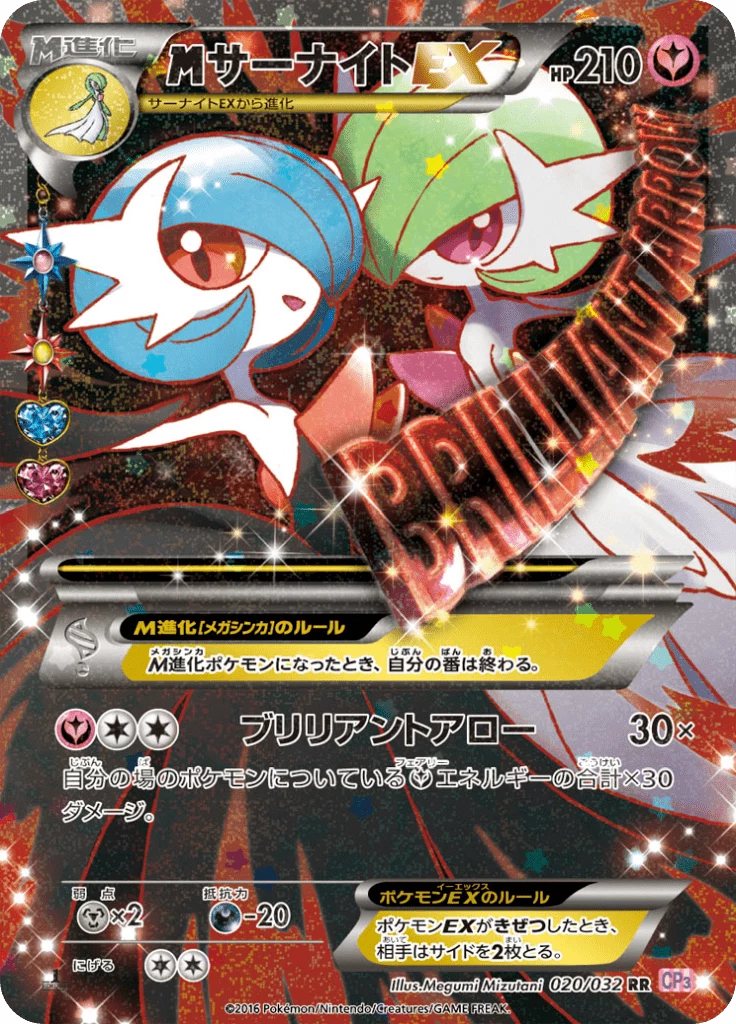
M Gardevoir EX RR — Pokekyun Collection (CP3), January 2016
M Gardevoir EX 020/032, RR — Pokekyun Collection (CP3)
A second Fairy-type M Gardevoir EX (020/032, RR), illustrated by Megumi Mizutani, appeared in the Pokekyun Collection sub-set on 29 January 2016 — the same release that produced our next pick. This one is not currently in our PSA 10 lineup — sourcing via Schnellbestellung.
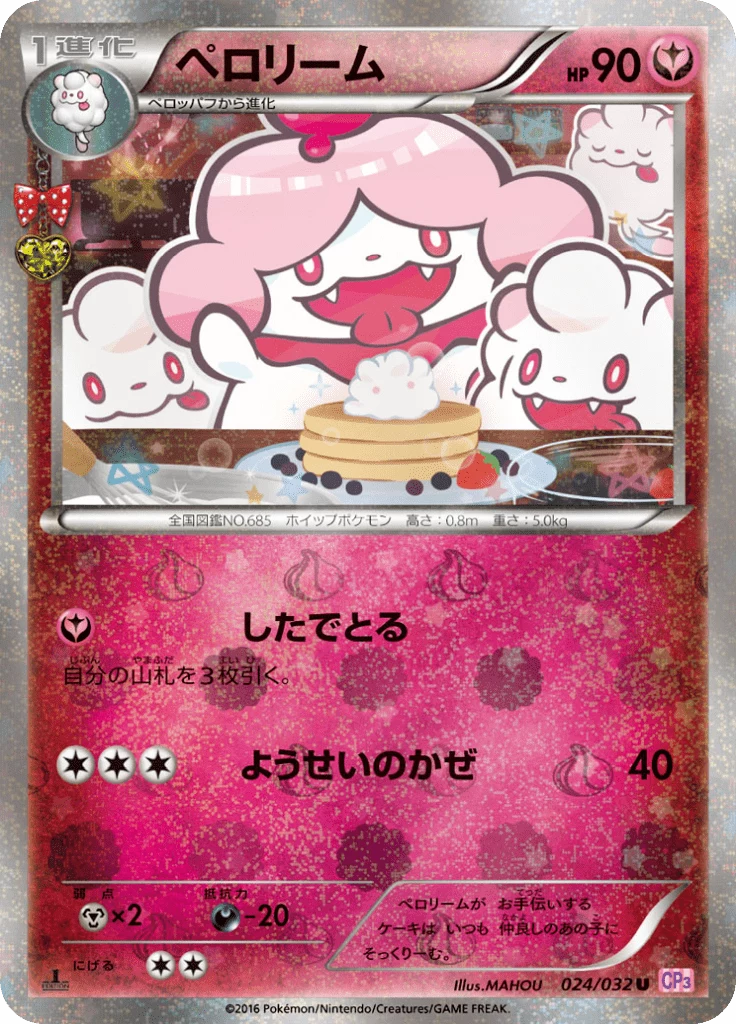
Slurpuff U — Pokekyun Collection (CP3), January 2016
Slurpuff 024/032, U — Pokekyun Collection (CP3)
Slurpuff (024/032, U), illustrated by MAHOU, is the most affordable Fairy-type pick on this list. Our PSA 10 is currently listed at ¥17,600 (~$111), the equivalent of the English-set Generations release.
M Gardevoir EX SR — Cruel Traitor (XY11-1), June 2016
M Gardevoir EX 057/054, SR — Cruel Traitor (XY11-1)
Released 17 June 2016 (the Steam Siege equivalent set), this SR (057/054) is a dual-type card — printed as Fairy/Psychic, with its Despair Ray attack costing Fairy plus Colorless energy. It’s the only card on this list that already carried a Psychic half before the type disappeared. Our PSA 10 is currently listed at ¥104,499 (~$657). See our Gardevoir cards guide for the full XY-to-Mega ladder.
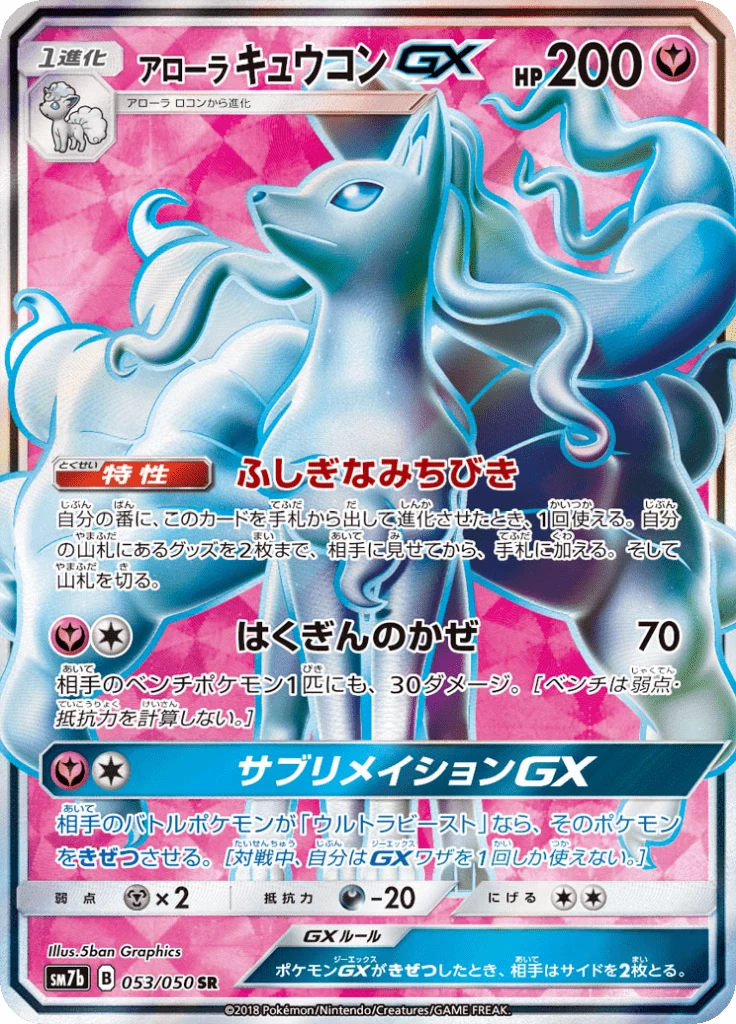
Alolan Ninetales GX SR — Fairy Rise (SM7b), August 2018
Alolan Ninetales GX 053/050, SR — Fairy Rise (SM7b)
SM7b „Fairy Rise“ released 3 August 2018 as a 50-card base set plus secret rares, and its GX alt-art trio anchors this list’s late Sun & Moon section. Alolan Ninetales GX (053/050, SR), illustrated by 5ban Graphics, is not currently in our PSA 10 lineup — sourcing via Schnellbestellung.
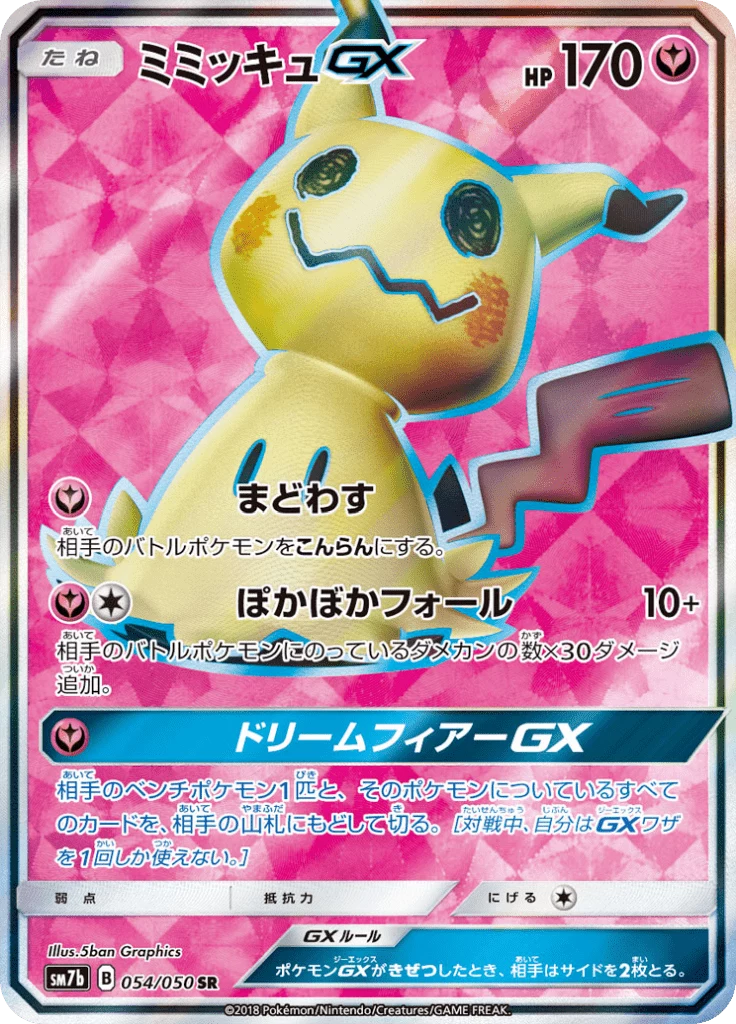
Mimikyu GX SR — Fairy Rise (SM7b), August 2018
Mimikyu GX 054/050, SR — Fairy Rise (SM7b)
Mimikyu GX (054/050, SR), also illustrated by 5ban Graphics, is the set’s other alt-art GX. Not currently in our PSA 10 lineup — sourcing via Schnellbestellung. For the wider Mimikyu print run across sets, see our Mimikyu cards guide.
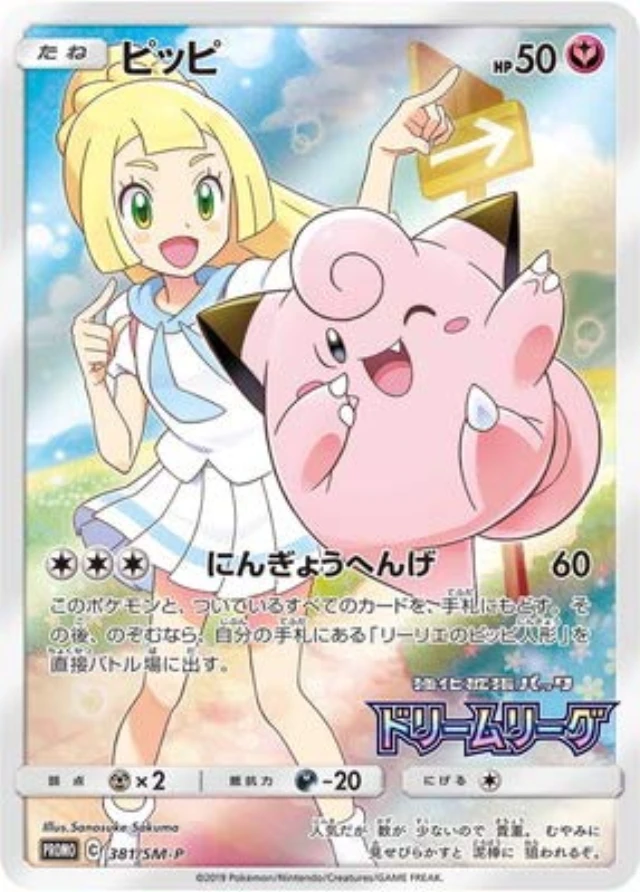
This Clefairy promo (381/SM-P), illustrated by Sanosuke Sakuma, was given out with Dream League booster boxes at participating stores from 2 August 2019 — the same month as the type’s second-to-last main set. Our PSA 10 is currently listed at ¥105,050 (~$661). For the wider Clefairy/Clefable print history, see our Clefairy & Clefable cards guide.
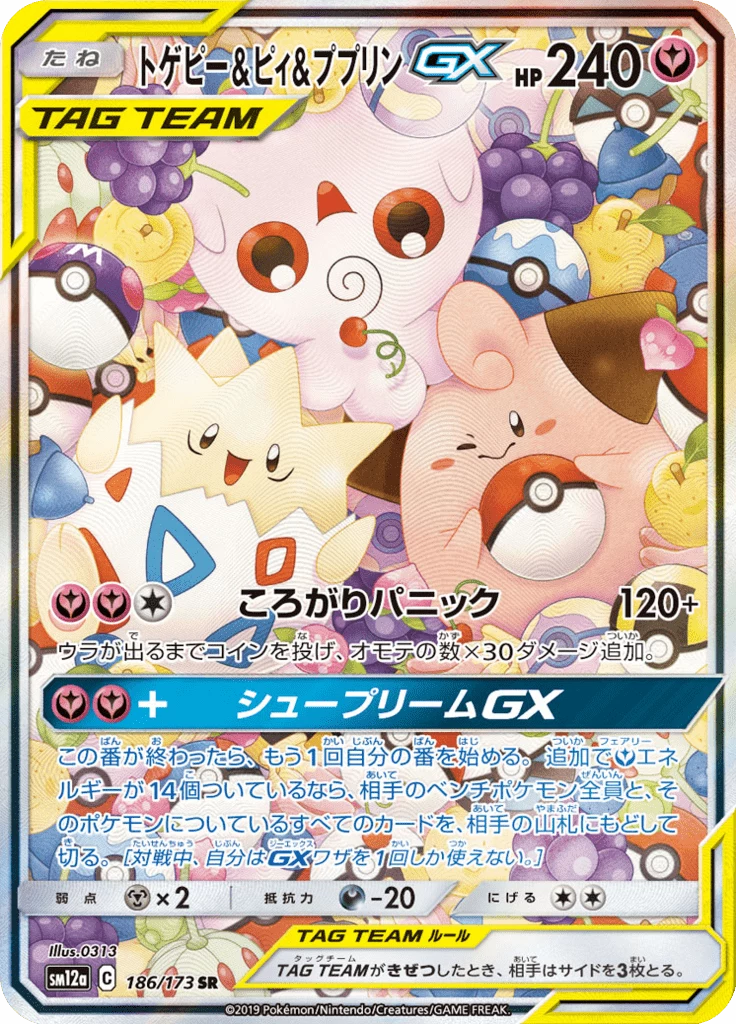
Togepi & Cleffa & Igglybuff GX (alt art) SR — Tag All Stars (SM12a), October 2019
Togepi & Cleffa & Igglybuff GX 186/173, SR (alt art) — Tag All Stars (SM12a)
Released 4 October 2019 — one of the last two Japanese sets to carry Fairy-type cards — this alt-art SR (186/173) is our highest-listed Fairy-type card. Our PSA 10 is currently listed at ¥116,160 (~$731).
Xerneas EX PROMO (25th Anniversary reprint) — October 2021
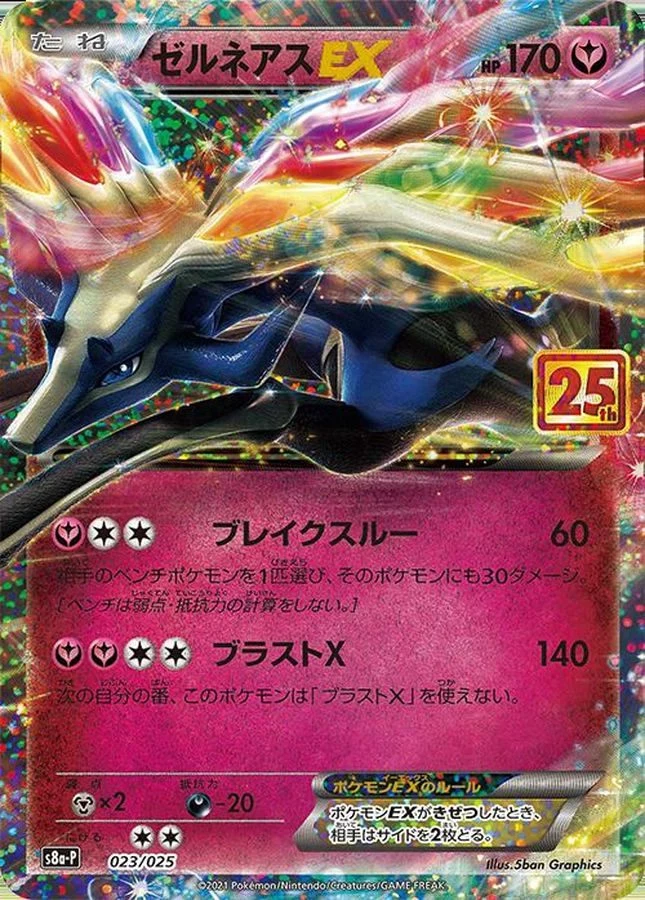
This 22 October 2021 promo (023/025), illustrated by 5ban Graphics, is a reprint of the very first Fairy-type Pokemon-EX — Collection X’s 044/060 RR from December 2013. Our PSA 10 is currently listed at ¥6,138 (~$39), our lowest-listed Fairy-type card and a full-circle bookend to the type’s history. Full print details in our Xerneas EX 25th anniversary card guide.
The Same Pokemon Today: Printed as Psychic Type
Since Fairy type stopped being supported, Pokemon that were Fairy-typed in the games — including Sylveon, Clefairy, Gardevoir, Diancie and Mimikyu — are now printed as Psychic type. Two current Japanese cards make the contrast clear:
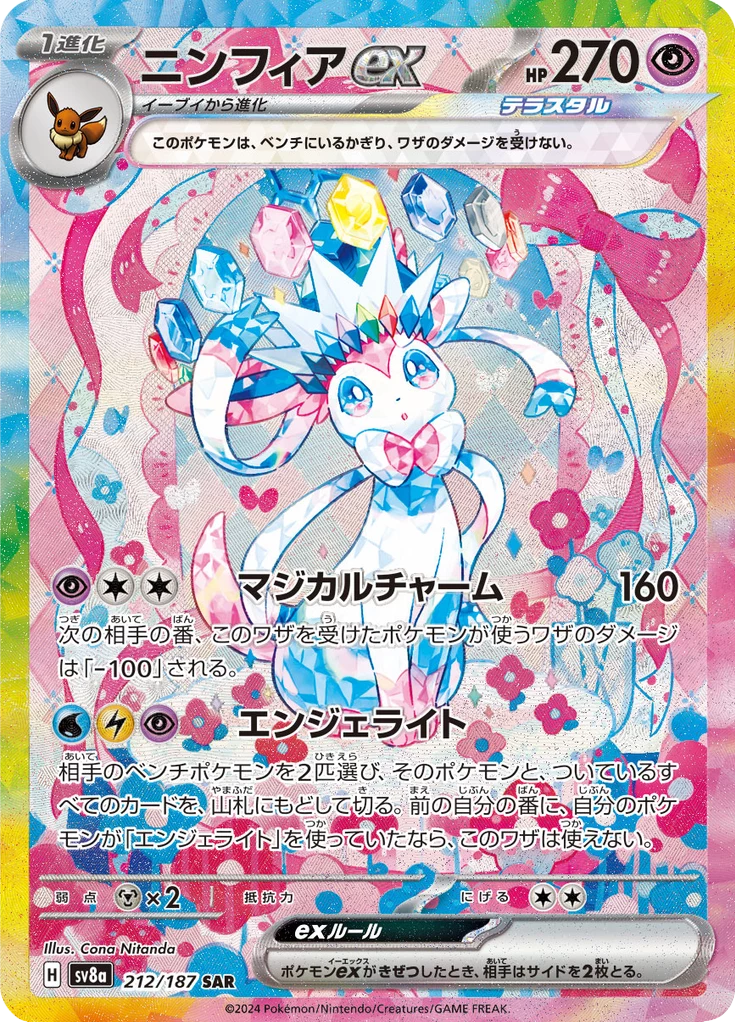
Sylveon ex 212/187 SAR (Terastal Fest ex, SV8a) — Psychic type
¥30,778 (~$194)
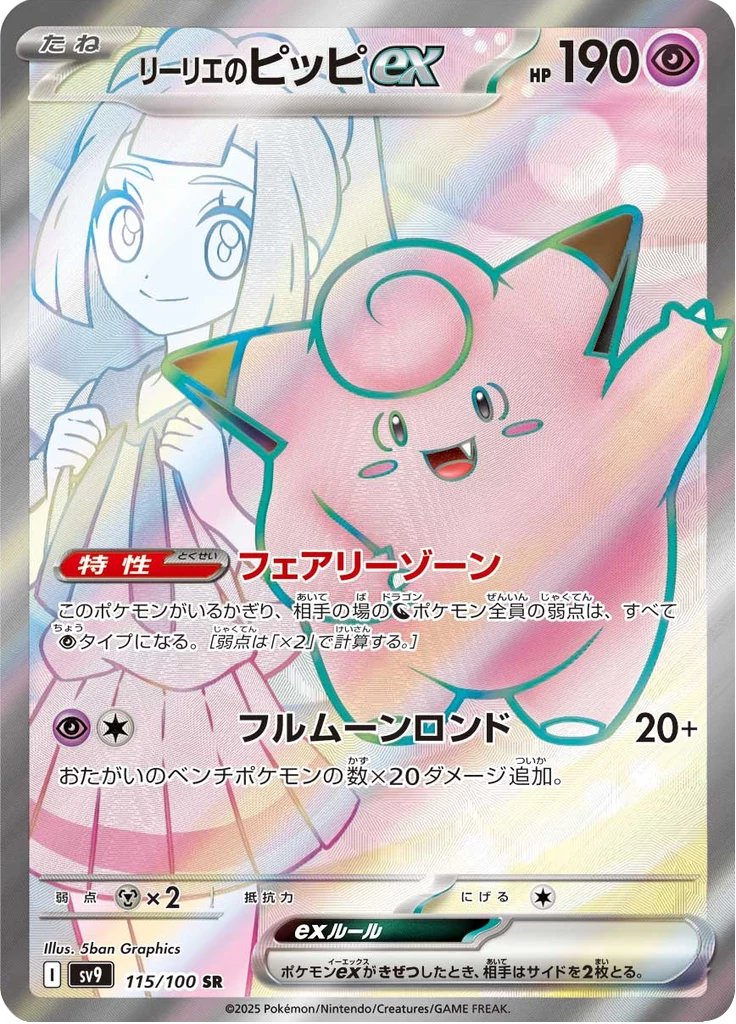
Lillie’s Clefairy ex 115/100 SR (Battle Partners, SV9) — Psychic type
¥12,859 (~$81)
Sylveon ex (212/187, SAR, illustrated by Cona Nitanda), released 6 December 2024, and Lillie’s Clefairy ex (115/100, SR, illustrated by 5ban Graphics), released 24 January 2025, are both printed Psychic type — not Fairy. Neither belongs in a Fairy-type list; they’re shown here specifically to illustrate the type change. Our PSA 10 copies are listed at ¥30,778 (~$194) and ¥12,859 (~$81) respectively.
Rarity abbreviations here (SR, SSR, RR, PR) are Limitless’s English rendering of the printed Japanese rarity marks; our Japanese rarity symbols guide covers the full letter system used across eras.
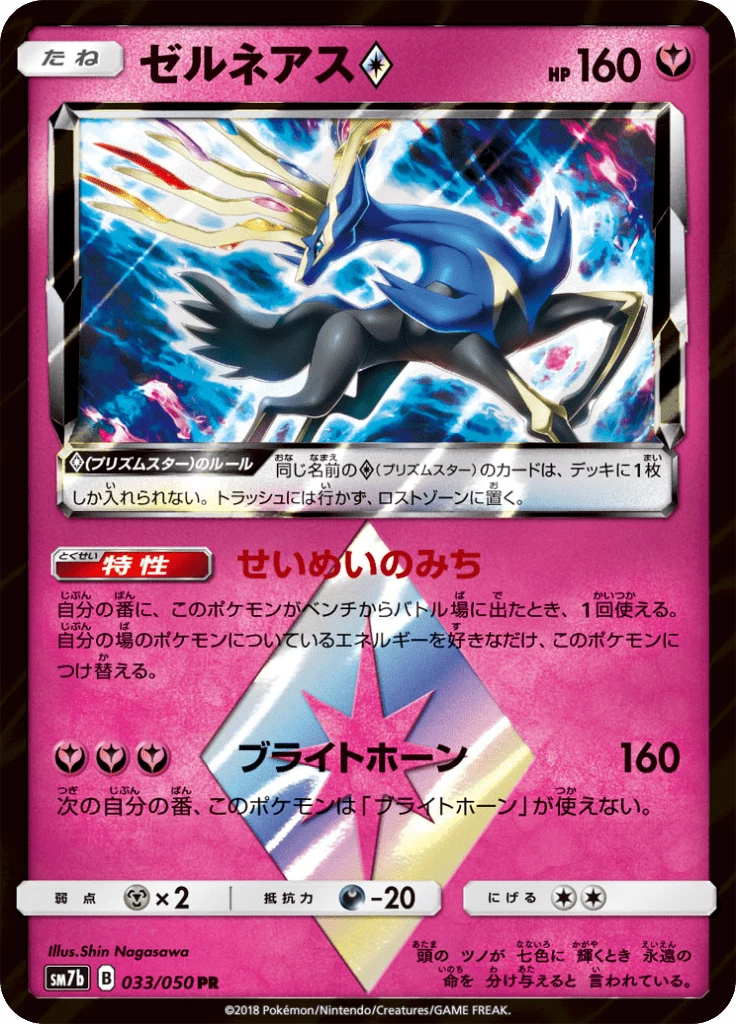
Three of the picks above — Alolan Ninetales GX, Mimikyu GX and Xerneas ◊ — all come out of the same Japanese booster box.
We ship Japanese sealed product and PSA 10 singles worldwide from Tokyo with tracked delivery. For the sets covered here, sealed Japanese boxes are the most direct route to pulling your own copies: the SM7b Fairy Rise box is currently listed at ¥52,500 (~$330), the SM12a Tag All Stars box at ¥207,900 (~$1,308), and the SM11b Dream League box at ¥170,100 (~$1,070).
For PSA 10 singles, use the direct product links in the picks and comparison table above. Anything not currently in our PSA 10 lineup — including the four „Ask via Quick Order“ rows — can be sourced raw or graded through our Quick Order page, which is also the fastest way to build a mixed order across sets.
Häufig gestellte Fragen
What does Fairy type mean in the Pokemon TCG?
Fairy was a Pokemon TCG energy type introduced with the Kalos Starter Set on 8 November 2013, covering most Fairy-type Pokemon from the video games (such as Xerneas, Sylveon and Aromatisse) plus a few Pokemon reclassified from Colorless, such as Snubbull.
When did the Fairy type exist in the Pokemon TCG?
From the Kalos Starter Set (8 November 2013) through the Sun & Moon era. The Fairy type ceased being supported from the Sword & Shield expansion onwards — Japan’s first Sword & Shield set released 6 December 2019. Fairy Energy was later rotated out of the 2021–22 Standard format, the first Basic Energy card to be dropped from the format.
Why are Sylveon and Gardevoir cards no longer Fairy type?
Because the Fairy type no longer exists in the TCG. Pokemon that are Fairy-type in the core series video games, including Sylveon, Gardevoir, Clefairy and Mimikyu, are now printed as Psychic type instead.
What was the first Fairy-type Pokemon-EX card?
Xerneas EX (044/060 RR) from Japan’s Collection X, released 13 December 2013. A 25th-anniversary reprint of the same card, Xerneas EX 023/025, was issued as a promo on 22 October 2021.
Is „Fairy Rise“ a rarity level?
No. Fairy Rise is the Japanese name for the SM7b set, released 3 August 2018 as a 50-card base set plus secret rares. It is not a rarity marking — the cards within it carry their own rarity labels, such as SR and PR.
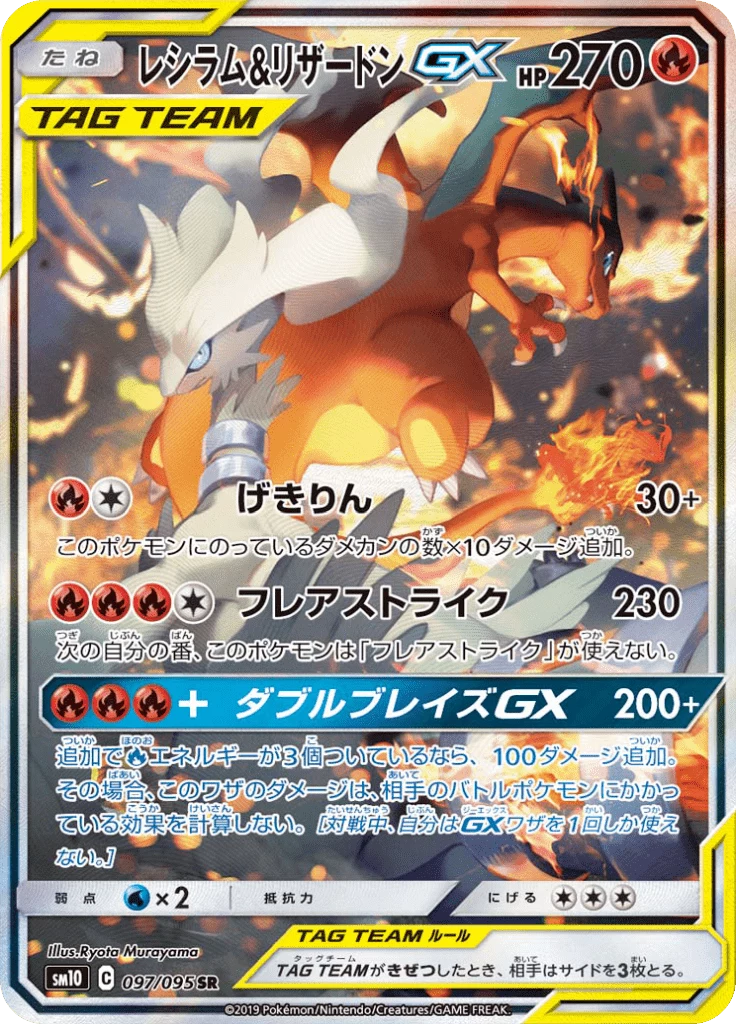
Fire-type is the deepest well in the Pokemon TCG for one simple reason: Charizard alone has generated more chase-card printings than most entire sets. But the category is bigger than one dragon-shaped lizard — Flareon, Reshiram, Ho-Oh, Entei, Moltres and Blaziken all carry the same printed Fire energy type, and several of Japan’s biggest recent secret rares belong to them.
This guide rounds up 12 Japanese Fire-type cards we consider the standout prints across the last six years of sets, from a ¥10,692 Character Super Rare to a ¥1,263,460 promo. Every card here has Fire (炎) printed as its energy type — verified directly on each card’s Limitless TCG page — so a couple of famous Charizard and Reshiram prints that are actually Darkness- or Dragon-type in the TCG are called out and excluded, not lumped in.
We source and grade Japanese singles out of Tokyo, so every price below is our own current listing, not a third-party market estimate.
Key Takeaway
Twelve Japanese Fire-type cards, spanning 11 different sets from 2020 to 2025, ranging from ¥10,692 to ¥1,263,460. The PSA 10 Flareon VMAX Summer PokéCard promo tops the list at ¥1,263,460 (~$7,946 at ¥159/USD); among non-promo set cards, the PSA 10 Mega Charizard X ex Ultra Rare leads at ¥493,460. Card number and set — not the Pokemon’s species — decide whether a card is actually Fire-type.
12
Cards Covered
11
JP Sets Spanned
¥1,263,460
Highest Listed
¥10,692
Lowest Listed
Prices are our own current PSA 10 listings as of September 2026, converted at ¥159/USD. We do not quote third-party market prices.
What Counts as a Fire-Type Pokemon Card
A Pokemon TCG card’s type is printed on the card itself as its energy symbol, and it doesn’t always match the Pokemon’s type in the main video-game series. Every card in this roundup has Fire (炎) printed as its energy type, checked directly on its Limitless TCG card page (or Bulbapedia for the one promo without a Limitless image). These are our editorial picks, chosen for scarcity and demand across the sets we trade in daily — not an exhaustive database of every Fire-type card ever printed.
Cards That Look Fire-Type But Aren’t
Two well-known chase cards get mistaken for Fire-type constantly. Charizard ex from Obsidian Flames (SV3 134/108 SAR) and its Shiny Treasure ex reprint (SV4a 349/190 SAR) are both printed Darkness type — a Tera mechanic quirk, not a Fire card. N’s Reshiram AR (SV9 109/100) is printed Dragon type. None of the three appear in the list below.
Our Picks: 12 Japanese Fire-Type Cards
Ranked loosely by how often collectors ask us about them, starting with the Charizard prints that anchor the category.
Charizard VSTAR (リザードンVSTAR)
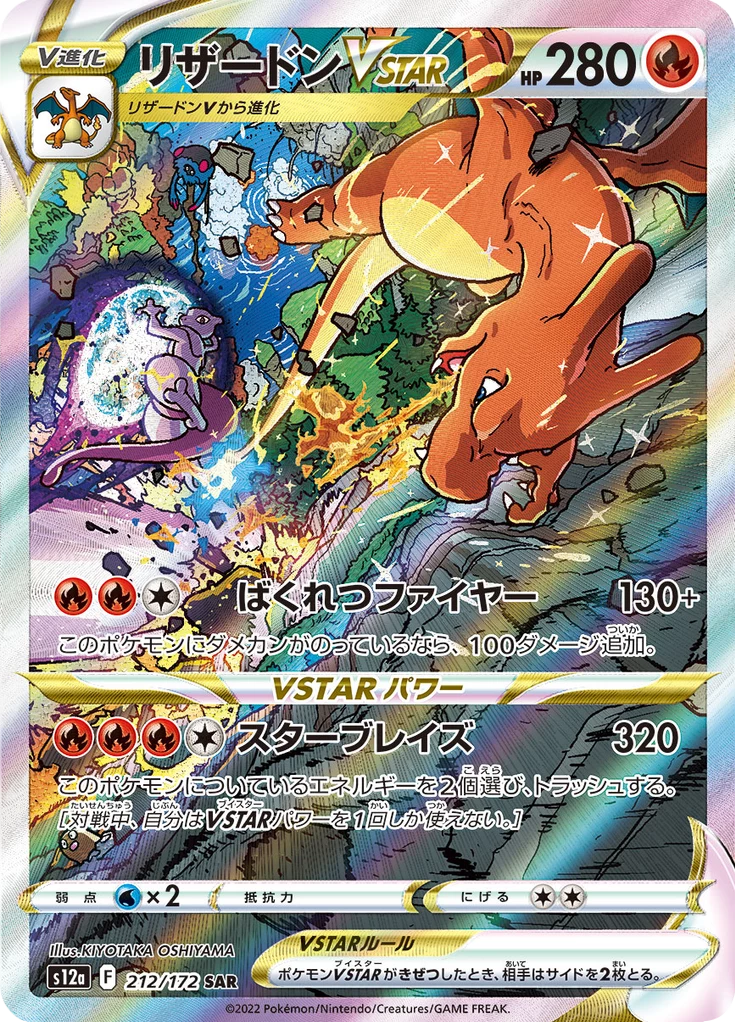
Charizard VSTAR 212/172, Special Art Rare, VSTAR Universe (S12a)
From VSTAR Universe (S12a, released 2 December 2022), card 212/172, Special Art Rare, illustrated by KIYOTAKA OSHIYAMA. This is the print most collectors mean when they say „Charizard VSTAR,“ and it’s the single most requested card in our Fire-type inquiries. We currently list a PSA 10 copy at ¥30,248. For the full Charizard lineup across every set, see our Top 10 Charizard Japanese cards ranking and PSA 10 Charizard buying guide — we’re keeping Charizard to a handful of entries here since this article covers the whole Fire-type category.
Charizard VMAX (Shiny)
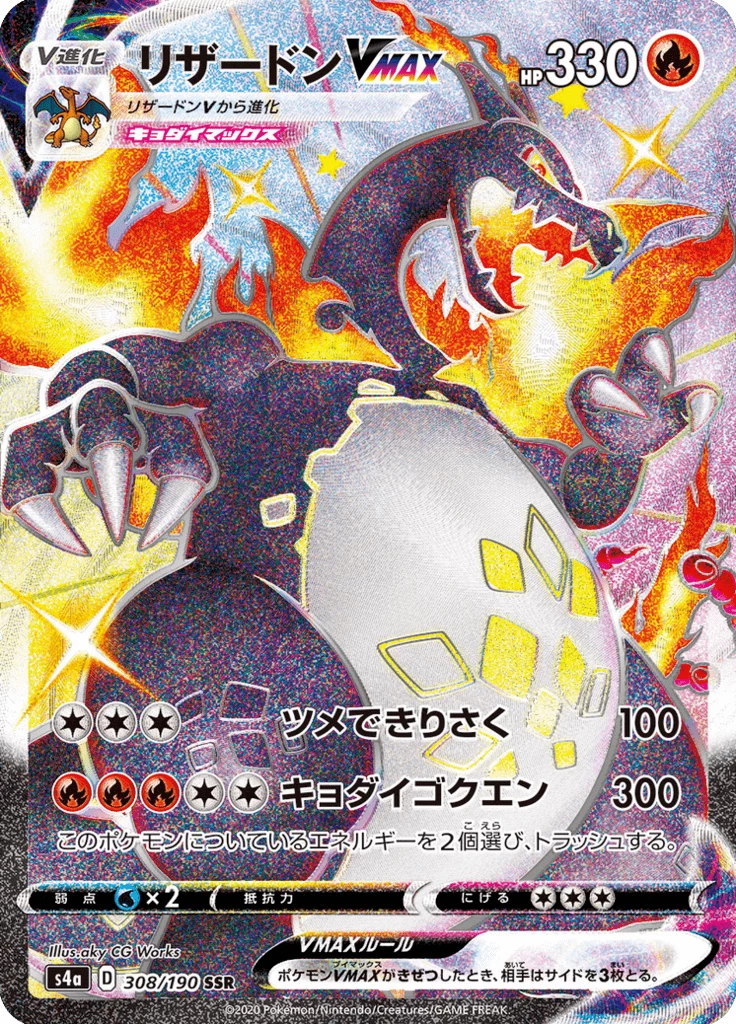
Charizard VMAX 308/190, Shiny Ultra Rare, Shiny Star V (S4a)
Shiny Star V (S4a, released 20 November 2020), card 308/190, Shiny Ultra Rare, art by aky CG Works. The gold-bordered shiny frame from this set defined an entire era of secret rares. We list a PSA 10 copy at ¥39,800.
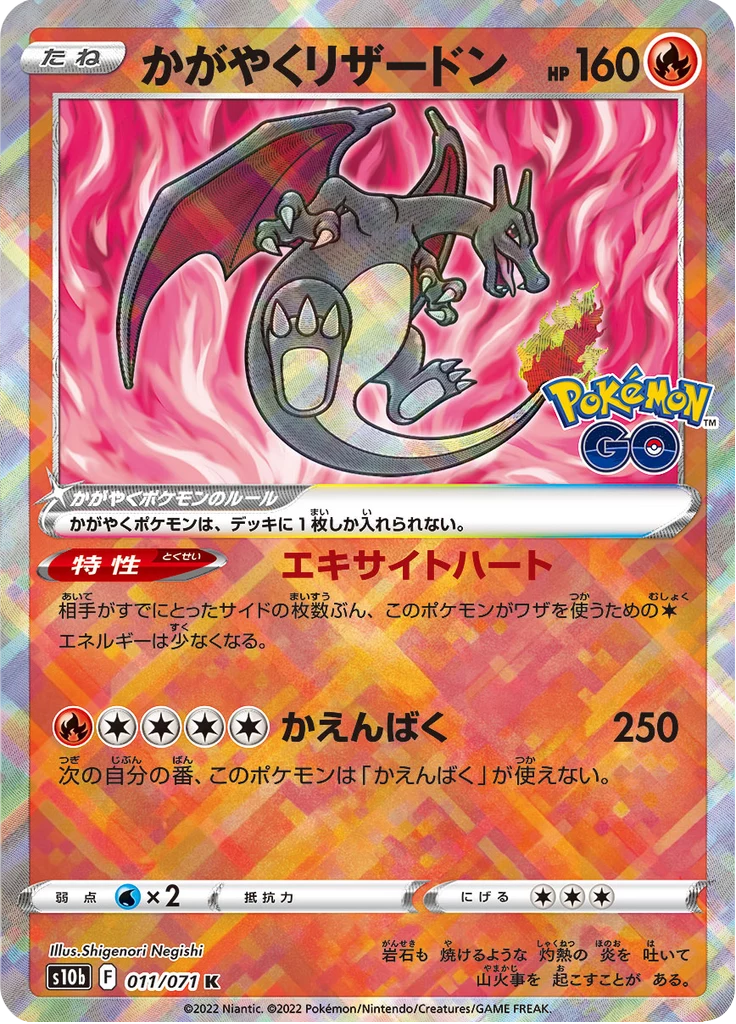
Radiant Charizard (かがやくリザードン)
Radiant Charizard 011/071, Radiant Rare, Pokemon GO (S10b)
Pokemon GO (S10b, released 17 June 2022), card 011/071, Radiant Rare, illustrated by Shigenori Negishi. The Radiant mechanic limits a deck to one copy, which keeps demand steady for this print. We list a PSA 10 copy at ¥12,802. Our Radiant Charizard card guide covers the full Pokemon GO set context.
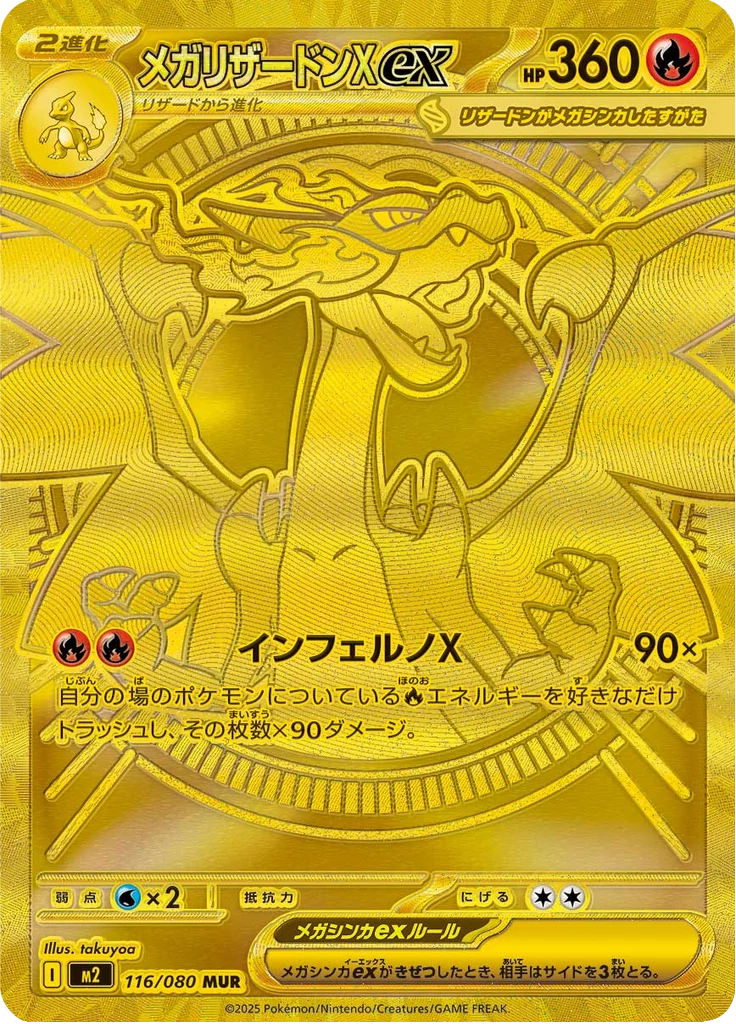
Mega Charizard X ex (メガリザードンXex)
Mega Charizard X ex 116/080, Ultra Rare, Inferno X (M2)
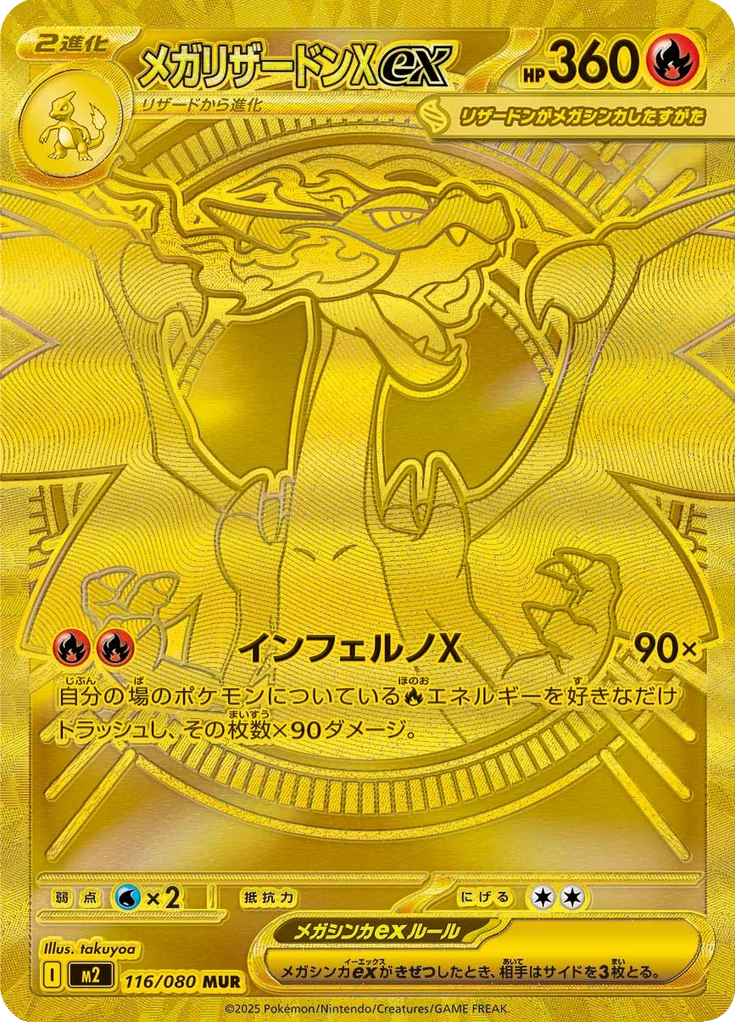
Inferno X (M2, released 26 September 2025), card 116/080, Ultra Rare, art by takuyoa. This is the highest-value non-promo card in our Fire-type roundup and the one that surprises collectors most: despite Mega Charizard X’s Fire/Dragon typing in the video games, this TCG print is officially Fire type, not Dragon — confirmed on its Limitless card page. We list a PSA 10 copy at ¥493,460 (~$3,104). See our Mega Charizard X ex card guide and Mega Charizard value guide for the wider Mega Charizard lineup.
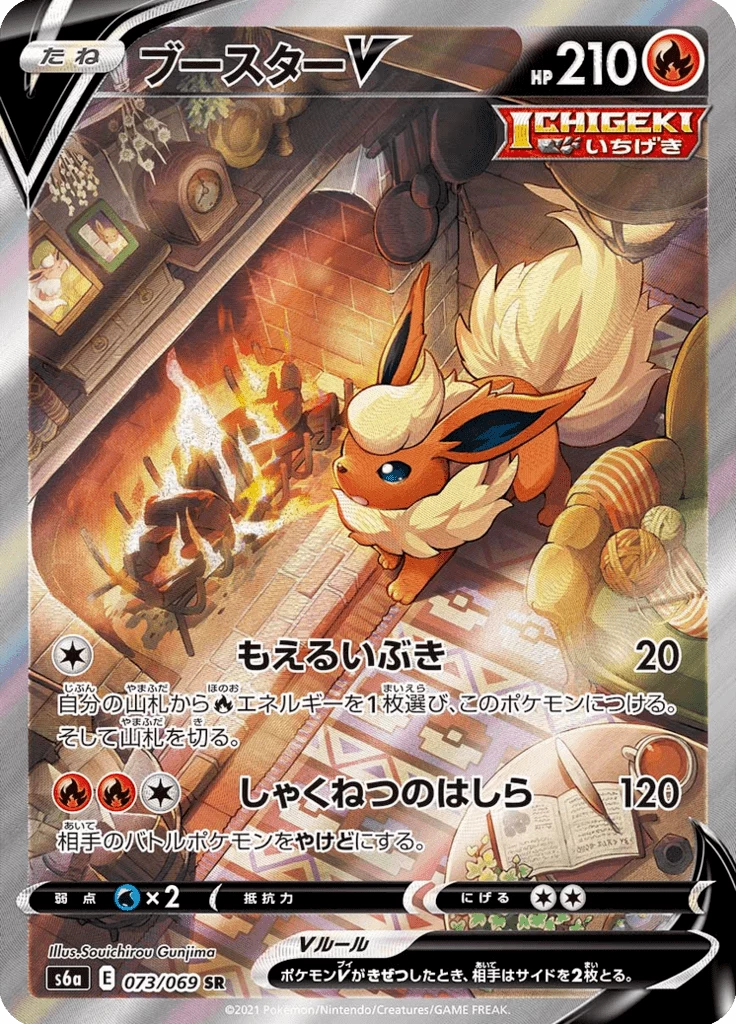
Flareon V (ブースターV)
Flareon V 073/069, Secret Rare, Eevee Heroes (S6a)
Eevee Heroes (S6a, released 28 May 2021), card 073/069, Secret Rare, illustrated by Souichirou Gunjima. This is the anchor Fire-type card of the Eeveelution lineup from this set. We list a PSA 10 copy at ¥46,398. Our Flareon Japanese cards guide covers every Flareon printing in more depth.
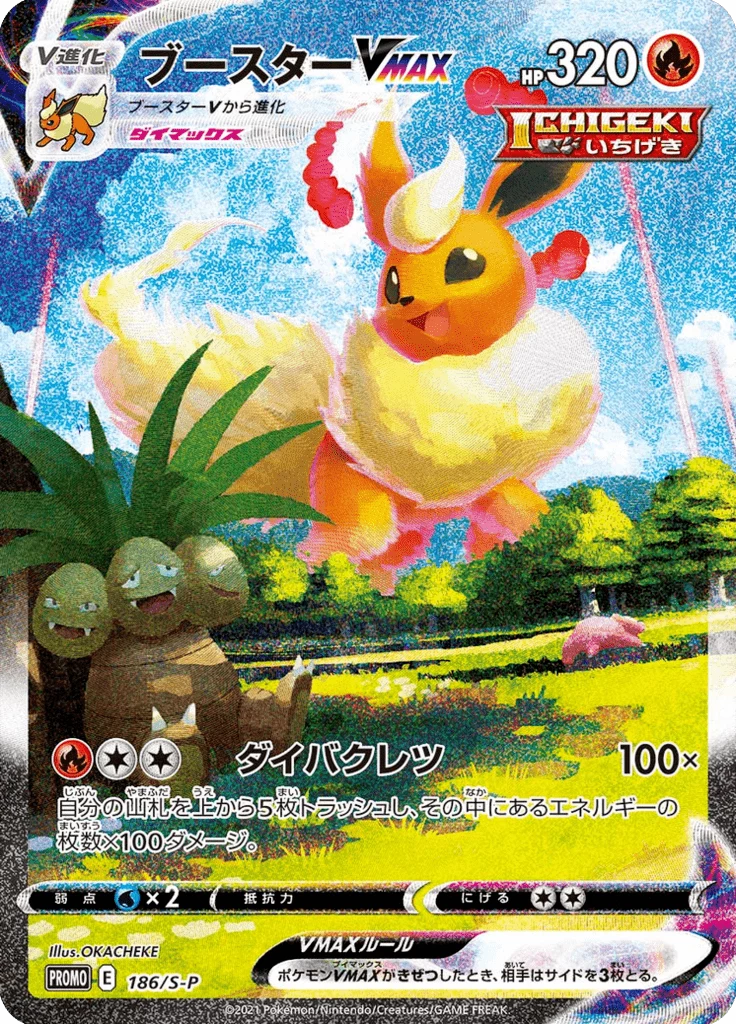
A Sword & Shield-era promo card (S-P 186), art by OKACHEKE, distributed through Japan’s Summer PokéCard campaign. Promo distribution windows are limited by nature, and this print is the highest-priced card in our Fire-type lineup — a PSA 10 is currently listed at ¥1,263,460 (~$7,946). Full campaign background is in our Flareon VMAX Summer PokéCard guide.
Reshiram ex (レシラムex)
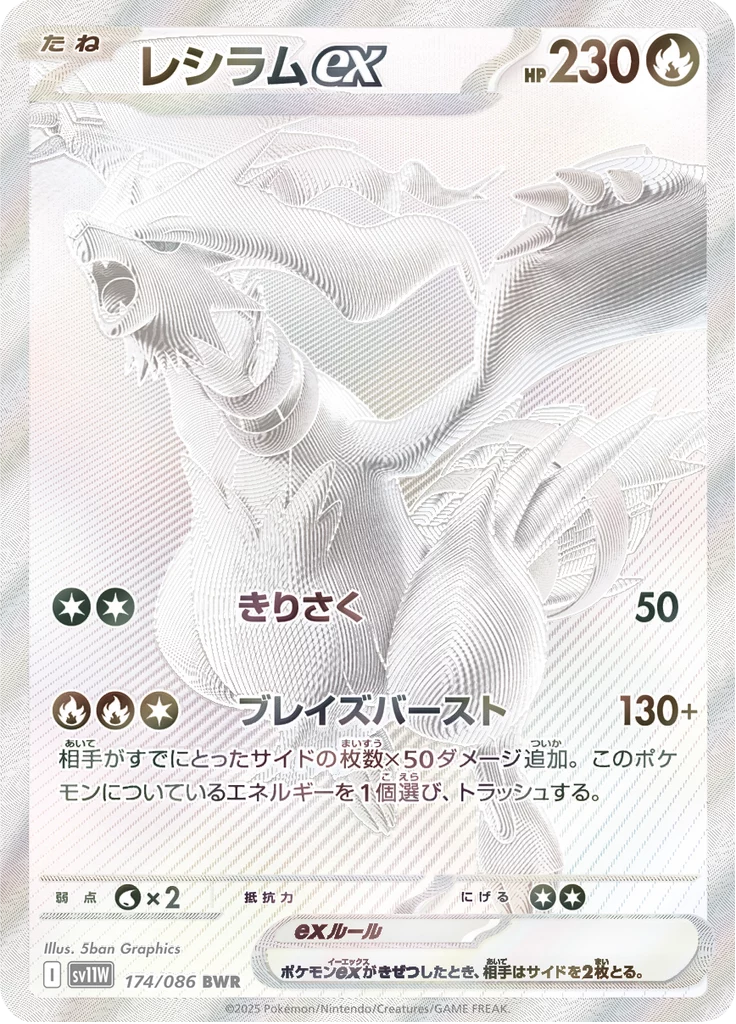
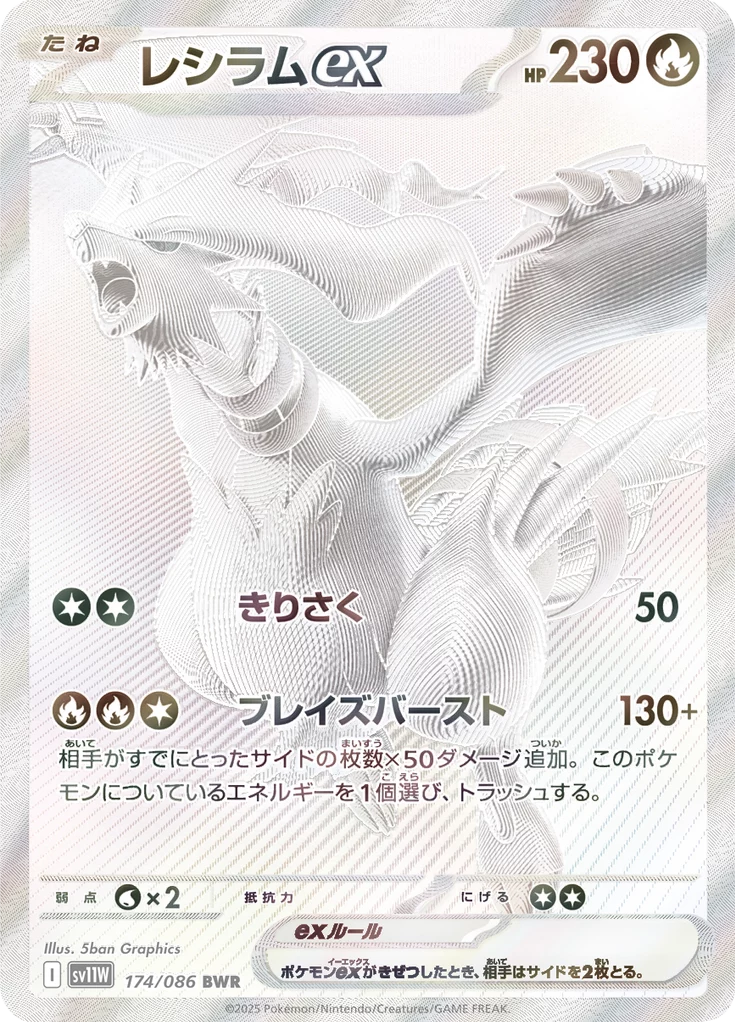
Reshiram ex 174/086, Ultra Rare, White Flare (SV11W)
White Flare (SV11W, released 6 June 2025), card 174/086, Ultra Rare on Limitless, art by 5ban Graphics. Reshiram is Dragon-type in the main games, but this printing carries Fire as its TCG energy type — one of the clearer examples of a card’s printed type diverging from the Pokemon’s species type. We list a PSA 10 copy at ¥134,310 (~$845). More on the set in our Reshiram cards guide and White Flare full card list.
Ethan’s Ho-Oh ex (ヒビキのホウオウex)
Ethan’s Ho-Oh ex 086/063, Special Art Rare, Heat Wave Arena (SV9a)
Heat Wave Arena (SV9a, released 14 March 2025), card 086/063, Special Art Rare, art by Atsushi Furusawa. Part of the „Ethan’s“ trainer-character subset that’s become one of the more collected niches in recent Scarlet & Violet-era Japanese sets. We list a PSA 10 copy at ¥42,108. See our Ho-Oh cards guide and Ethan’s Pokemon card family guide for the rest of the subset.
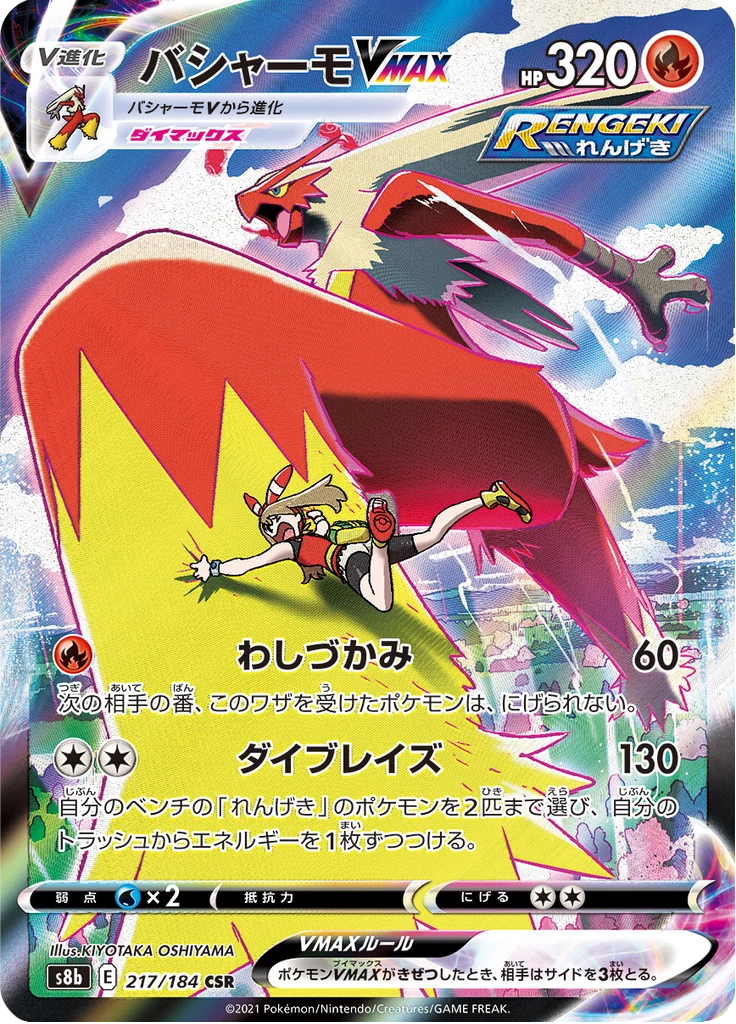
Blaziken VMAX (Character Super Rare)
Blaziken VMAX 217/184, Character Super Rare, VMAX Climax (S8b)
VMAX Climax (S8b, released 3 December 2021), card 217/184, Character Super Rare, art by KIYOTAKA OSHIYAMA. This CSR is the Fire-type standout from the set. We list a PSA 10 copy at ¥10,692. Our Blaziken cards guide covers the earlier Matchless Fighters alt-art too.
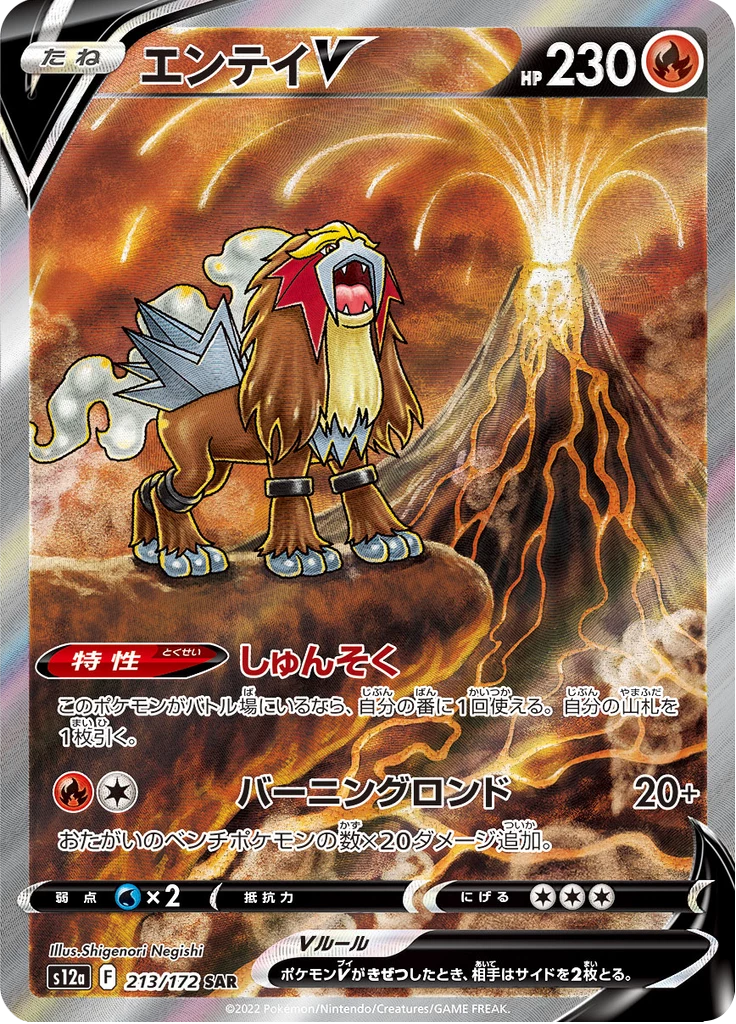
Entei V (エンテイV)
Entei V 213/172, Special Art Rare, VSTAR Universe (S12a)
VSTAR Universe (S12a, released 2 December 2022), card 213/172, Special Art Rare, art by Shigenori Negishi — from the same set as the Charizard VSTAR above. We list a PSA 10 copy at ¥15,664. Our VSTAR Universe full card list and Entei cards guide have more on this set and Pokemon.
Team Rocket’s Moltres ex (ロケット団のファイヤーex)
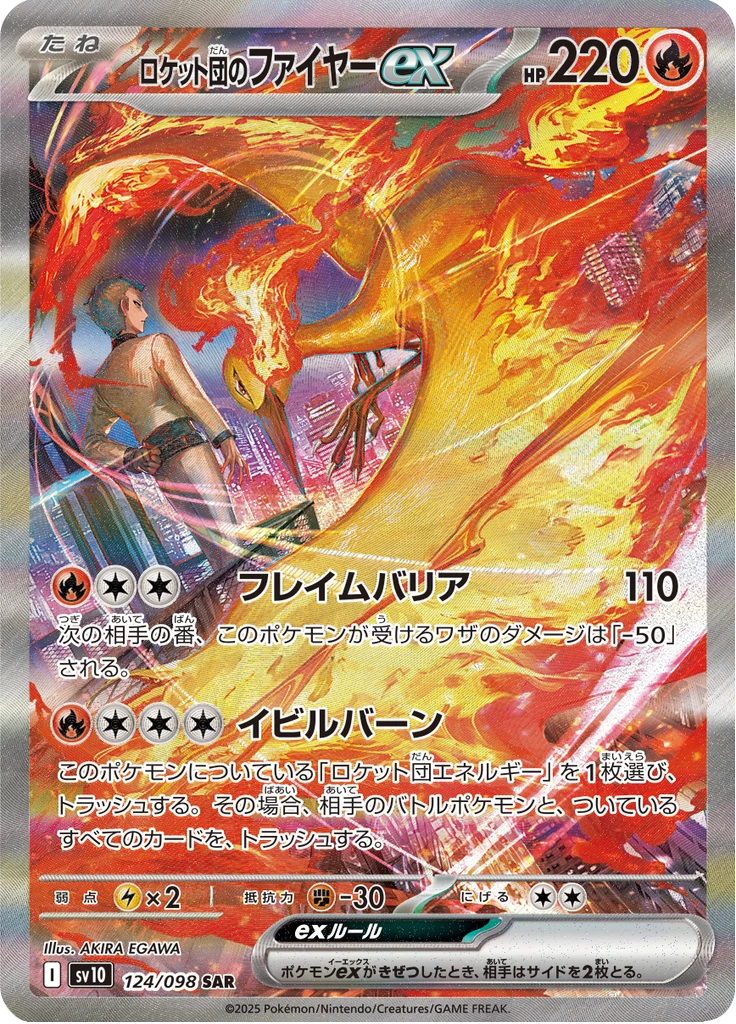
Team Rocket’s Moltres ex 124/098, Special Art Rare, Glory of Team Rocket (SV10)
Glory of Team Rocket (SV10, released 18 April 2025), card 124/098, Special Art Rare, art by AKIRA EGAWA. The Team Rocket subset has been consistently strong for us across every legendary bird it’s touched. We list a PSA 10 copy at ¥41,426. See our Moltres Japanese cards guide for the wider Moltres lineup.
Ceruledge ex (ソウブレイズex)
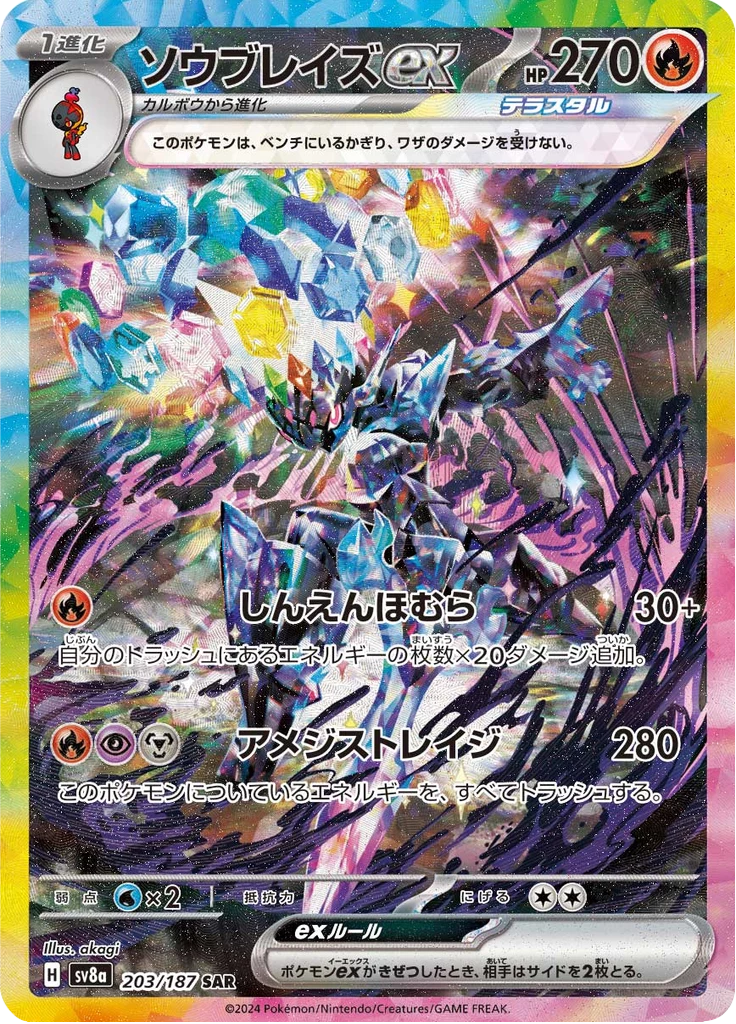
Ceruledge ex 203/187, Special Art Rare, Terastal Fest ex (SV8a)
Terastal Fest ex (SV8a, released 6 December 2024), card 203/187, Special Art Rare, art by akagi. The most recently printed card on this list and one of the strongest alt-arts from the Terastal Fest set. We list a PSA 10 copy at ¥11,583.
Fire-Type Card Comparison
All 12 cards side by side, our own PSA 10 listings only:
The spread here is the point — Fire-type isn’t one price tier, it’s a category that runs from a ¥10,692 CSR to a ¥1.26M promo, and the deciding factor is almost always distribution: how many packs, boxes, or promo events a given print came from.
Every card in this guide is graded PSA 10 and shipped from our Tokyo stock with tracked delivery. If the exact card, set, or grade you want isn’t listed above, our Quick Order page is the fastest way to request it — tell us the card, set code and number, and we’ll build a quote from our current Japanese inventory.
VSTAR Universe is the only set that lands two cards on this list — Charizard VSTAR and Entei V — so buying both together is an efficient way to cover that set in one order.
Start with the PSA 10 Charizard VSTAR if you’re new to collecting Fire-types, or the PSA 10 Reshiram ex if you want a card whose printed type genuinely surprises people. For anything else, Schnellbestellung is open for custom requests.
Häufig gestellte Fragen
What makes a Pokemon card „Fire type“?
The energy type printed on the card itself, not the Pokemon’s type in the video games. All 12 cards in this guide have Fire (炎) as their printed energy type, verified on each card’s Limitless TCG page.
Is Mega Charizard X ex Fire-type or Dragon-type?
In the TCG, the Inferno X printing (M2 116/080) is officially Fire-type, confirmed on its Limitless card page — even though Mega Charizard X is Fire/Dragon in the main video-game series.
What is the most valuable Japanese Fire-type card in this list?
The Flareon VMAX Summer PokéCard promo (S-P 186), with a PSA 10 currently listed at ¥1,263,460. Among non-promo set cards, the Mega Charizard X ex Ultra Rare (M2 116/080) leads at ¥493,460.
Are Reshiram cards Fire-type?
Not always — check the individual card. Reshiram ex (SV11W 174/086) and Reshiram V (S11a 076/068) are printed Fire-type despite Reshiram being Dragon-type in the games, but N’s Reshiram AR (SV9 109/100) is printed Dragon-type. The card, not the Pokemon, decides.
Where can I buy these Japanese Fire-type cards from outside Japan?
We ship every card on this list from Tokyo with tracked international delivery. Use the product links above for graded PSA 10 copies, or our Quick Order page for other cards, sets, or grades from our Japanese inventory.
Warum sind japanische Pokemon-Karten günstiger? Die tatsächlichen wirtschaftlichen Hintergründe [2026]
Why are Japanese Pokemon cards cheaper? A lower sticker price can partly reflect smaller packs and a different box format. Currency conversion, the seller’s offer and shipping then determine what you actually pay. For singles, compare the specific printing and condition: Japanese cards are not always cheaper than their English counterparts.
This guide separates original manufacturer prices from current store offers, explains how currency and sourcing affect an order, and shows how to compare singles without confusing them with sealed products. Official Pokemon product pages supply the historical specifications; the current box prices below come from our store listings checked on October 20, 2026.
Start with your goal: opening packs, collecting an unopened box, or buying a particular card. Then identify the exact product and condition. That gives you a useful basis for comparing offers.
Smaller packs can mean a lower upfront price; currency and delivery costs determine the final saving. Compare the contents and condition of each box, then calculate the complete order total. For a specific card, compare matching prints and grades. Japanese packs in the official examples below contain five, seven or ten cards.
A Japanese booster pack, an English booster pack, a complete display box and a graded single are different purchases. Start with the contents and condition, then compare prices observed on the same date.
These historical MSRP examples show different Pokemon pack formats. Japanese prices include tax; the U.S. figure is the announced dollar MSRP. Current purchase offers appear separately below.
The English contents are described in Pokemon Support’s booster-pack explanation. That description separates game cards from the Energy and digital code. Count those consistently when comparing products: calling both products simply a “pack” hides a material difference in what the buyer receives.
Box sizes need the same care. The official Japanese Heat Wave Arena product page specifies 30 packs per box and five Karten pro Pack, or 150 cards. At its original ¥180 tax-inclusive pack MSRP, 30 packs total ¥5,400; this arithmetic is a historical reference, not a current purchase offer. The official English Destined Rivals product showcase describes a 36-pack display with ten game cards and a Basic Energy in each pack. That is 360 game cards plus 36 Energy cards. These are different set examples demonstrating different box formats; they do not measure a Japan-versus-English saving on an equivalent box.
For a specific collection, begin with the card list and work outward to the right product. The VSTAR Universe card list and Pokemon 151 card list help you identify the artwork you want.
Japanese products can have a lower pack sticker price because the product being priced is different. The five-card Scarlet ex pack and ten-card Shiny Treasure ex pack above are both Japanese, yet they have different published prices and formats. There is no single “Japanese pack price” that can be applied to the whole Pokemon catalogue.
MSRP is the manufacturer’s reference price for the specified product. For a purchase today, use the seller’s current offer and check availability. Keep the original MSRP beside its release context when comparing it with that offer.
Comparison layer
Useful question
Common mistake
Original MSRP
What did the manufacturer publish for this exact pack or product?
Treating an old MSRP as today’s available price
Current product listing
What SKU, quantity and condition does this seller offer?
Comparing a no-shrink option with a sealed option
Box contents
How many packs and cards does this specific box contain?
Assuming one box in each language contains equal quantities
Collection goal
Does this product contain the specific artwork or printing I want?
Treating the same Pokemon name as the same card
Final order cost
What does the complete order cost to my destination?
Comparing one seller’s item price with another’s delivered total
Dividing the published Japanese pack prices by their card counts gives ¥36 per card for Scarlet ex / Violet ex (¥180 ÷ 5), approximately ¥41.43 for Pokemon 151 (¥290 ÷ 7), and ¥55 for Shiny Treasure ex (¥550 ÷ 10). These are historical pack-cost averages, not single-card values. The sets have different contents and rarity structures, so this arithmetic does not establish which pack offers better pulls.
Price per card helps check the scale of a purchase. Use it alongside the card list: it counts ordinary and rare cards equally and leaves the chance of finding a particular illustration unresolved.
Choose singles when the goal is one specific illustration; choose a box when the pack-opening experience or unopened display is part of what you want. Use the price comparison appropriate to that goal.
Our product prices in this guide are in Japanese yen. Your cost in another currency depends on the conversion rate and fees applied to the actual payment. If a yen-denominated price stays unchanged, a rate that buys more yen per unit of your currency reduces its converted cost; a rate that buys fewer yen increases it. The effect depends on the yen price staying unchanged.
A hypothetical currency example
A ¥15,000 item converts to US$100 at ¥150 per dollar, or US$120 at ¥125 per dollar. The yen price is identical; the converted item cost changes by US$20. These rates are examples, not current exchange quotes, and the calculation excludes conversion fees, shipping and destination charges.
Use the rate and charges available for your actual payment. Product prices below stay in yen so you can apply your own payment method’s conversion terms.
Record the currency on each quote. A yen listing and a dollar listing cannot be compared by their numbers alone.
Use the applicable payment rate and charges. A general currency converter may differ from the amount charged by your payment provider.
Keep the destination and order quantity consistent. A converted item price still leaves the rest of the order costs to consider.
Check again before paying. Both the product price and the conversion terms may change after you first browse.
For a multi-item order, calculate the total in the currency you will pay and allocate shared costs sensibly. A low unit price can be outweighed by an expensive shipment; a larger shipment may spread some charges over more items, but it can also change weight and destination charges. There is no universal quantity at which ordering from Japan becomes cheaper.
Keep the original MSRP comparison and the current shopping comparison separate. The former explains product formats; the latter tells you what your chosen order costs today.
Reason 3: Compare Sourcing Routes by Delivered Cost
Buying from a Japanese seller can give you a different product selection and price from a local shop. Compare the actual offers: acquisition costs, seller margins, product condition, shipping and service terms can all differ.
The practical way to compare routes is to build an equivalent basket. Specify the exact set, sealed or no-shrink condition, number of boxes, destination and payment method. Then collect current totals. If one quote leaves shipping or destination charges unresolved, keep that part of the comparison open instead of treating it as zero.
Route you are considering
What to record
What the route alone cannot prove
Local shop or local online seller
Exact product condition, final local price, collection or delivery terms, returns terms
That the shop paid more for the product or that an import will cost less
That the item is available at original Japanese MSRP
Marketplace seller
Seller identity, actual-item photos, condition wording, protections and complete fees
That the lowest asking price represents a completed sale or equivalent condition
For a sealed-box collection, the condition of the outer packaging may be part of what you are buying. For opening, you may consider a differently described condition, but read that description before deciding. A lower headline quote is not a like-for-like saving when it refers to a different condition, a damaged box, a carton rather than one box, or an unavailable option.
For a shop order, compare the complete quote for the same quantity and condition. Record how long the quote is valid and which charges are included so that the cheaper item price does not hide a higher order total.
Reason 4: Reprints Can Change Supply, Not Guarantee Prices
Additional production can change the amount of product offered to buyers, but reprinting is not unique to Japan. Pokemon’s English-language product availability statement, updated May 26, 2026, says it is working to increase production and reprint affected products. Check set-specific notices for the product you want.
In Japan, the official Pokemon Card 151 notice described made-to-order production and warned of temporary asking-price spikes around release. This is a useful example of a supply response to a particular product. Look for the corresponding announcement for the set you are considering.
Check the exact set. Look for its own production announcement or seller availability update.
Check the price separately. Compare dated offers before deciding how supply news affects your purchase.
Compare available choices. Balance today’s offer with your budget and how soon you want the product.
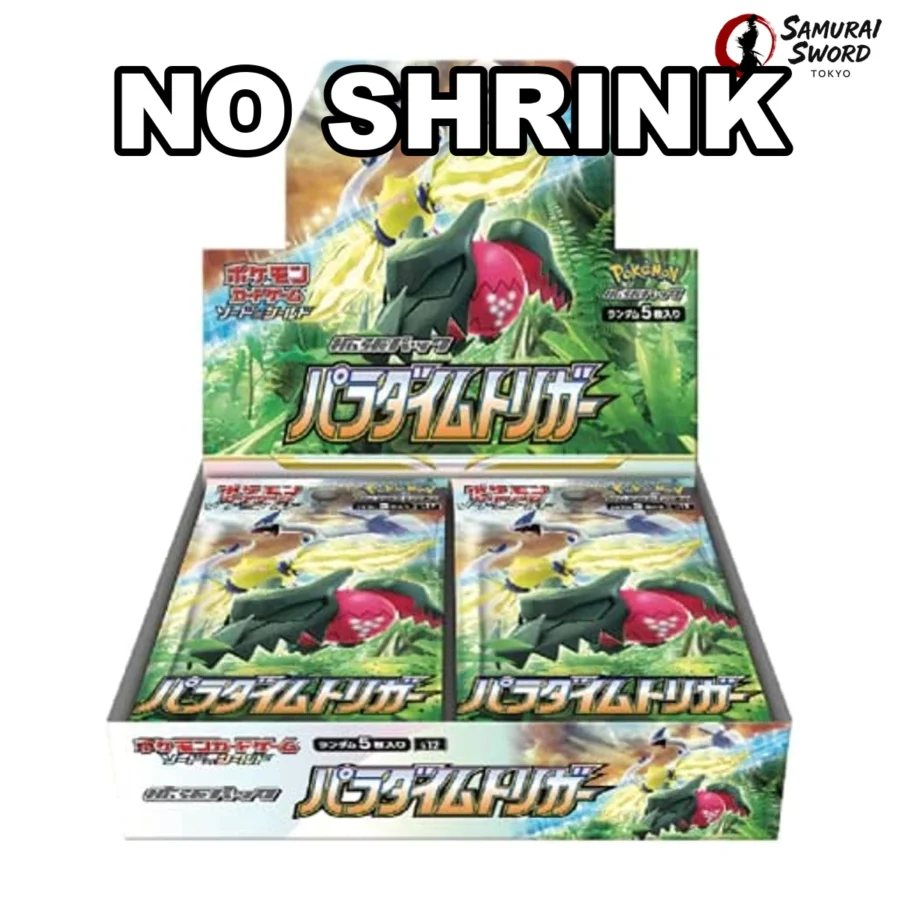
No shrink describes the outer packaging condition, rather than a production wave. Read the seller’s description of the box and packs, inspect its condition evidence, and compare it with other No Shrink offers.
The official Japanese notice also describes counterfeit and searched products on resale platforms. Check the seller’s disclosures for the actual item. No Shrink alone is neither proof of tampering nor proof of an untouched original box.
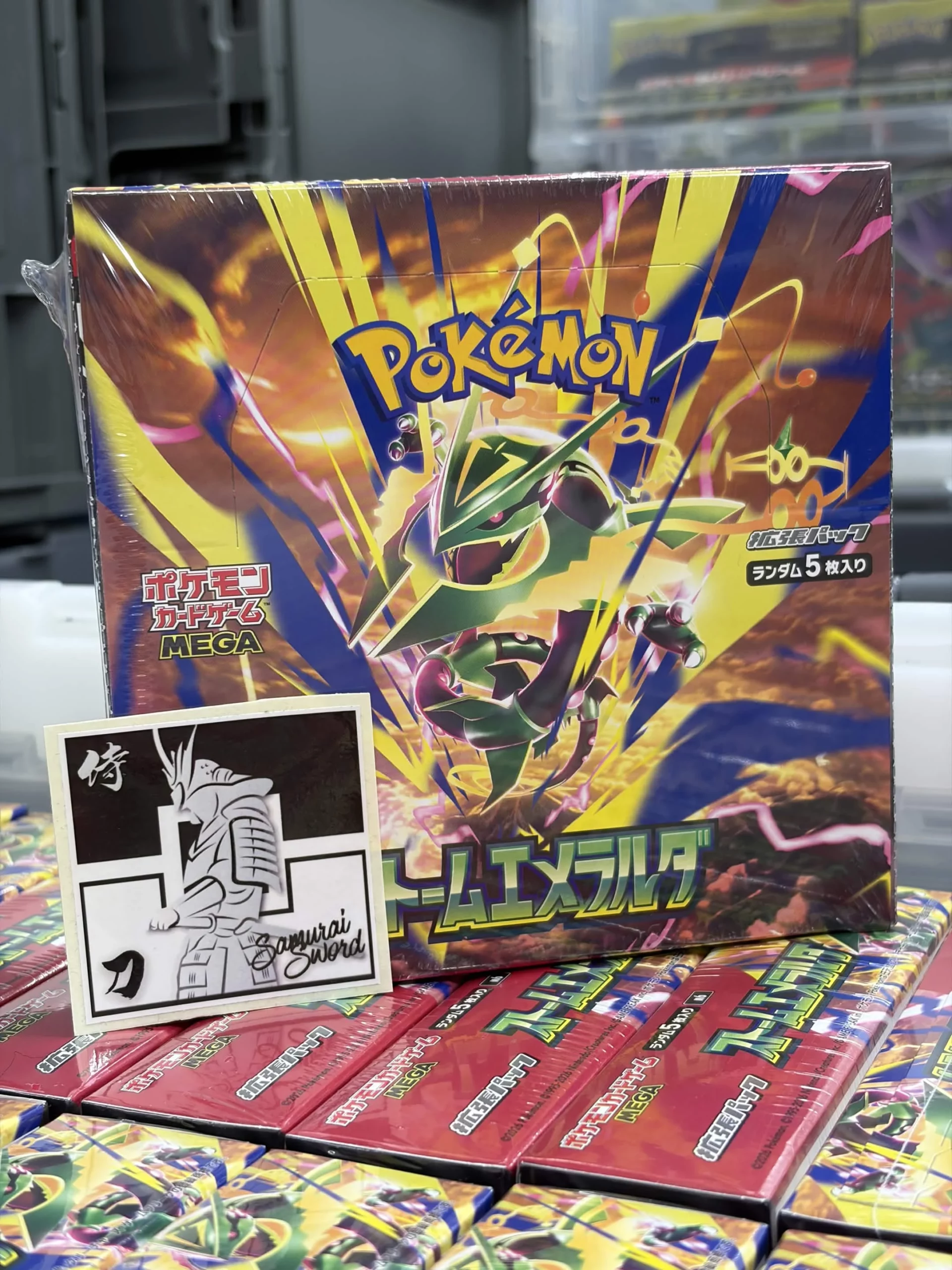
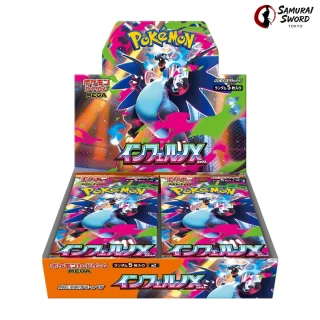
The current offers below include Storm Emeralda and Inferno X in Sealed condition, plus Mega Dream ex in No Shrink condition. Select the condition named beside the price and review its description before ordering.
M6 Storm Emeralda. The current offer below is for the Sealed option.
"Cheaper" Does Not Mean "Worth Less"
A cheaper pack is a cheaper pack purchase. It is not a valuation of each card that might come out of it. Japanese and English printings need their own comparisons, even when they show the same Pokemon or share an illustration. Neither language is automatically the lower-value version.
Same card, different market of origin
Start with the set and full card number in each language, then check the artwork, rarity and finish. A standard holo, reverse pattern, promotional release and special illustration are not interchangeable just because the character name matches. A sealed-product comparison and a single-card comparison answer different questions.
For a single-card comparison
Match or record
Why it matters
Identity
Language, set, full number and artwork
A name alone can group several separate prints
Version
Finish, rarity, promotional stamp and edition where relevant
Different versions may have different buyers and prices
Zustand
Comparable raw condition, or the same grader and numerical grade
A raw card and a PSA 10 listing are different offers
Evidence
Recent completed sales and their dates, with asking prices separately labeled
An unsold listing does not establish an achievable sale
Transaction
Currency, quantity and applicable transaction costs
The headline price may not equal the buyer’s total or seller’s proceeds
Where matching sales are scarce, keep the comparison open rather than substituting a similar-looking card. Record the exact print in a sourcing request to avoid receiving a quote for a different version.
The grading angle
Inspect the specific card before treating it as a grading candidate. PSA’s published grading standards consider physical features such as corners, centering, gloss, staining and printing imperfections. A language label does not establish those features or guarantee a grade.
Our PSA10 singles collection lets you compare already graded cards. For a raw-card purchase, inspect its condition separately; the eventual grade depends on that individual card.
Japanese-side exclusives
When a Japanese printing has no exact English counterpart, there is no direct language-price discount to calculate. Identify the specific release and compare it with sales of that same printing. If a similar illustration appears in another product or language, check the number and finish before deciding that the two are equivalent.
Decide whether your goal is a specific card, a set of illustrations, an unopened display, or the experience of opening packs. That choice changes what a useful price comparison looks like. For one artwork, compare matching single-card offers. For an unopened collection, compare the box and packaging condition. For opening, compare the contents and your budget without treating a particular pull as assured.
If you intend to play, check the language and format requirements that apply to the event you plan to enter before buying. A collection purchase and an event-eligible deck purchase need not be the same decision. For general condition and authenticity checks, use our guide to spotting fake Japanese Pokemon cards alongside actual listing photos and seller information.
For visual browsing, open the VSTAR Universe card list before choosing the VSTAR Universe booster box. Seeing the set’s cards first helps you choose for the artwork rather than a vague promise of “Japanese value.” If you prefer a different current box, compare the Inferno X Sealed listing and its product description.
If you are a reseller or shop owner
For a shop order, record the exact SKU, packaging condition, supplier quote date, quantity and complete purchase cost. Keep sealed boxes, raw singles and graded singles on separate lines so each can be compared with an equivalent offer.
Check availability for the selected condition before building an order. Where a listing offers several conditions, save the option name beside the price; a cheaper option may be unavailable even when another version of the product can be ordered.
Pack format and the possible contents of a set do not establish the probability of pulling your desired card. Pokemon Support explicitly says it cannot guarantee a particular Pokemon or type of card in an individual booster pack. An image on the wrapper is not a statement that the pictured card will be inside.
Read how Japanese Pokemon pull rates work for the distinctions between product descriptions, observed opening results and estimates. A lower box price can reduce the amount you spend on that box, but it does not guarantee a cheaper route to one specific card. Comparing the single-card offer is a practical check before buying multiple boxes for a chase.
What Japanese Boxes Actually Cost Right Now
These are SST store asking prices checked on October 20, 2026, with the selected condition shown beside each quote. Follow the linked price to review the current product offer and checkout total.
For other conditions, check the live product page. Requests for a specific product go through Schnellbestellung. A regular box, No Shrink box, damaged box and carton are separate offers; compare the one you intend to buy.
For an unopened display collection, start with the Sealed options. If you are considering No Shrink, read the packaging description and compare other offers with the same condition. Browse the card list first when your priority is the artwork inside.
Why are Japanese Pokemon cards cheaper than English ones?
Smaller packs and different box formats can partly explain lower sticker prices. Currency conversion and delivery costs affect the final total. Compare the exact product and condition; Japanese cards are not always cheaper.
Are Japanese Pokemon cards worth more than English cards?
It depends on the printing. Compare the exact card number, artwork, finish and condition, or the same grader and grade, using recent completed sales. Value singles separately from the pack they came in.
Are Japanese Pokemon cards lower quality?
Judge the individual card by its centering, corners, surface condition and printing imperfections. Published grading standards assess those features rather than treating language as a quality grade.
Is it cheaper to buy Pokemon cards directly from Japan?
It can be. Compare current offers for the same product, condition and quantity, including shipping, payment or conversion charges and applicable destination charges. Use the complete total to choose.
Will the price gap between Japanese and English cards last?
The gap can change with availability, seller prices, demand and currency conversion. Both Japanese and English products can receive additional production. Recheck the exact offers when you plan to buy.
How do I buy Japanese cards from overseas safely?
Check the exact product and condition, seller details, actual-item evidence where relevant, and the shipping, payment and returns terms before ordering. Keep sealed and no-shrink offers separate. Review the current checkout total rather than assuming a historical price or a packaging label proves the offer.
Official MSRP examples show the original product specifications. Store prices were checked October 20, 2026; use each product page and checkout for the latest offer and complete total.
Lost Abyss Booster-Box Guide (S11): Pull-Raten, beste Karten & Kartenliste (2026)
The Giratina V SA from the S11 Lost Abyss booster box is the single most valuable card you can pull from a standard modern Japanese Pokemon TCG expansion — at roughly $984 raw and $1,700+ in a PSA 10 slab, it commands prices that rival vintage chase cards. Lost Abyss introduced the Lost Zone mechanic to the Sword & Shield era when it launched in July 2022, and the sealed box is now currently listed from ¥44,000 (SST), with SNKRDUNK asks as high as ¥59,300 — well above its original retail price.
That box premium exists for one reason: every sealed box carries roughly a 3.8–6.2% chance of containing the Giratina V SA. Open sixteen boxes and you might pull one. Or you might find it in your first. That lottery is what keeps S11 among the most sought-after sealed products in the modern Japanese card market.
This guide breaks down the complete Lost Abyss picture: all 10 most valuable cards ranked by current JPN market prices, pull rate data translated from Japanese opening compilations, a box EV calculation, and 3.5 years of price history showing how this set survived a reprint crash and came back stronger. We ship hundreds of Japanese Pokemon TCG boxes monthly — here’s the data behind one of the most iconic sets we’ve handled.
Key Takeaway
S11 Lost Abyss is home to the ~$984 Giratina V SA — the most valuable card from any standard modern JPN expansion. The booster box is currently listed from ¥44,000 at SST, with SNKRDUNK asks up to ¥59,300, so the chase card alone is still worth roughly 3× the box price. Production ended after the 2024 reprint, and the V-shaped price recovery from ¥5,000 confirms enduring demand.
Updated September 1, 2026
Box and Giratina V SA pricing below reflect current SST listings and live SNKRDUNK asking prices.
$984
Top Card (Giratina V SA)
¥44,000+
BOX Price (SST, from)
30 Packs
Per Box
127 Cards
Total Set
S11 Lost Abyss Set Overview
Lost Abyss is the set that brought the Lost Zone mechanic to Sword & Shield — and produced the most valuable card in the modern Japanese Pokemon TCG. Released on July 15, 2022, S11 packs 127 cards into a standard 30-pack box that has become one of the most premium sealed products in the hobby.
Set Specs
Spec
Detail
Set Code
S11
Set Name
Lost Abyss (ロストアビス)
Series
Sword & Shield
Category
Expansion Pack
JP Release
July 15, 2022
Packs per Box
30
Cards per Pack
5
Main Set
100 cards
Secret Rares
27 cards (12 SR incl. 4 SA, 8 HR, 3 UR, 4 Trainer SR)
Total Cards
127
MSRP
¥4,950 → currently listed from ¥44,000 at SST; SNKRDUNK lowest ask ¥59,300, as of September 1, 2026
EN Equivalent
Lost Origin (partial — also includes S10A, S10D cards)
The Lost Zone Mechanic
Lost Abyss’s signature mechanic — the Lost Zone — sends cards to a separate zone from which they cannot be retrieved. Unlike the discard pile, cards in the Lost Zone are permanently removed from play. This created new deck strategies centered around accumulating cards in the Lost Zone to unlock powerful abilities, most notably Giratina VSTAR’s Star Requiem attack, which knocks out any opposing Pokemon if 10+ cards sit in your Lost Zone.
The mechanic proved so popular that Lost Zone-based strategies dominated the competitive Sword & Shield format through 2023. That competitive relevance, combined with the Giratina V SA’s artwork, created a dual demand pillar — both players and collectors want these cards.
What Makes This Set Special
Giratina V SA (111/100). The most valuable card from any standard modern JPN expansion. Illustrated by Shinji Kanda, the alternate art depicts Giratina emerging from a portal between dimensions. At ~$984 raw and $1,700+ PSA 10, this card alone justifies the set’s sealed product premium.
Four alternate art cards. S11 contains four Special Art variants: Giratina V SA, Aerodactyl V SA, Rotom V SA, and Galarian Perrserker V SA. The SA pull rate (~15% per box for any SA) keeps these cards genuinely scarce.
Lost Zone competitive legacy. Giratina VSTAR, Comfey, and Mirage Gate formed the backbone of one of the most dominant deck archetypes in the Sword & Shield competitive era.
JPN vs English — The Lost Origin Connection
The English set Lost Origin combines cards from three Japanese sets: Lost Abyss (S11), Dark Phantasma (S10A), and Time Gazer (S10D). This dilutes S11’s concentrated card pool across a 196-card English set, significantly reducing your odds of pulling any specific S11 card.
JPN Premium
The Japanese Giratina V SA (~$984 as of April 2026) commands a 70%+ premium over the English Lost Origin version (~$400–573). JPN cards from S11 consistently trade higher than their ENG equivalents, driven by superior print quality and a more focused 127-card pool.
Top 10 Most Valuable Lost Abyss Cards
The Giratina V SA towers over this set’s value chart at roughly 11× the price of the second-most valuable card. Here are the top 10 ranked by current JPN market data.
Giratina V SA (111/100) — ¥180,000–218,000 (~$984)
Rang
Karte
Number
Rarity
JPN Price (¥)
USD Price
1
Giratina V (Alt Art)
111/100
SR (SA)
¥180,000–218,000
~$984
2
Aerodactyl V (Alt Art)
106/100
SR (SA)
¥14,000–17,800
~$87
3
Giratina VSTAR
125/100
UR
¥5,500–6,980
~$23
4
Rotom V (Alt Art)
104/100
SR (SA)
¥2,200–2,780
~$21
5
Giratina V
110/100
SR
¥2,200–2,780
~$18
6
Giratina VSTAR
120/100
HR
¥2,700–3,580
~$10
7
Aerodactyl V
105/100
SR
¥1,300–1,780
~$8
8
Fantina
116/100
SR
¥900–1,580
~$6
9
Aerodactyl VSTAR
118/100
HR
¥1,600–2,180
~$5
10
Pidgeot V
112/100
SR
¥700–980
~$4
Price Note
JPN prices from SNKRDUNK and altema.jp (April 2026). USD prices from PriceCharting. JPN cards typically trade at a 15–40% premium over English equivalents for high-demand cards.
#1 Giratina V SA (111/100) — ~$984
The Giratina V SA is the defining card of modern Japanese Pokemon — and the highest-value pull from any standard expansion box in the current era. At ¥180,000–218,000 on the Japanese secondary market (~$984 USD raw), it occupies a price tier usually reserved for vintage stars.
Illustrated by Shinji Kanda, the alternate art captures Giratina tearing through dimensional space with its six-legged, centipede-like Altered Forme on full display. The composition uses dramatic perspective — Giratina lunging toward the viewer through a shattered portal — creating a sense of motion that few Pokemon cards achieve.
PSA 10 copies trade at $1,700+, reflecting the grading market’s strong conviction. The Japanese version commands a 70%+ premium over its English Lost Origin counterpart (~$400–573).
#2 Aerodactyl V SA (106/100) — ~$87
Aerodactyl V SA (106/100) — ¥14,000–17,800 (~$87)
The Aerodactyl V SA at ¥14,000–17,800 (~$87) shows the prehistoric Pokemon soaring above a fossil excavation site — a scene that connects Aerodactyl to its lore origins. This card has strong international demand, particularly among collectors who appreciate the paleontology-themed artwork. PSA 10 copies trade around $171.
#3 Giratina VSTAR UR (125/100) — ~$23
Giratina VSTAR UR (125/100) — ¥5,500–6,980 (~$23)
The gold-textured Ultra Rare treatment of Giratina VSTAR at ¥5,500–6,980 (~$23) is a popular display piece. The Star Requiem VSTAR Power text gleams in gold relief. PSA 10 copies jump to ~$83, making it a viable grading candidate.
Cards #4–10
Rotom V SA (104/100) (¥2,200–2,780 / ~$21) — Competitive staple from Charizard ex decks. 3-draw ability maintained play demand well into Scarlet & Violet format.
Giratina V SR (110/100) (¥2,200–2,780 / ~$18) — Standard full-art version carrying the set mascot’s baseline collector appeal.
At a current listed price from ¥44,000 (SST) up to a ¥59,300 SNKRDUNK ask, S11 is a premium purchase — but the Giratina V SA alone is still worth roughly 3× the box price. Here’s how it breaks down by buyer type.
Buyer’s Tip
If you’re chasing the Giratina V SA specifically, buying the single at ~$984 saves thousands compared to opening boxes. But the ~15% SA pull rate per box means roughly 1 in 7 boxes contains a display-worthy alternate art — and that lottery is what keeps collectors opening.
For Collectors
Lost Abyss is one of those sets where one card defines the entire experience. The Giratina V SA at ~$984 creates a level of pack-opening tension that few modern sets can match. Every SR-slot pack is a potential $984 moment — and even without hitting the SA, the four trainer SRs and other alternate arts deliver display-worthy pulls.
S11 also carries historical weight as the set that introduced the Lost Zone mechanic. For collectors building a Sword & Shield era collection, this is a cornerstone set.
For Box Openers
Thirty packs at the current ¥44,000–50,960 SST listing (~$299–347) means roughly $10–12 per pack. Each box guarantees at least one SR-tier pull (from the 16-card SR pool, which includes the four SAs). You’ll also pull approximately 4–5 RR cards, 2 RRR cards, and common/uncommon bulk.
The ~3.8–6.2% chance of pulling the Giratina V SA from a single box is the headline — but even a non-SA box delivers $20–40 in SR value plus the guaranteed RR/RRR cards. The 10% “double-hit” box probability adds extra excitement.
For Long-Term Holders
The sealed box trajectory tells a powerful story. S11 launched at ¥4,950, climbed steadily, crashed to approximately ¥5,000 after the June 2024 reprint, then kept recovering — SST currently lists the box from ¥44,000, with SNKRDUNK asks up to ¥59,300 as of September 1, 2026. That recovery — from reprint floor back to roughly 9–12× the original retail — demonstrates the market’s conviction in this set’s long-term value.
Production is finished. The 2024 reprint was the last run. Every box opened or shipped reduces sealed supply permanently.
Singles vs. Box — The Math
Approach
Cost
What You Get
Buy Giratina V SA single
~$984
The exact card you want, guaranteed
Buy 16 boxes (avg for specific SA)
$3,500–4,000
~1 Giratina V SA + 3–4 total SA pulls + 480 other cards
Buy 1 box for the experience
from ¥44,000 (~$299+)
30 packs + guaranteed SR-tier pull + ~3.8–6.2% SA lottery
S11 follows the standard Sword & Shield expansion pull rate structure — one guaranteed SR-tier card per box, with SA, HR, and UR cards requiring multiple boxes. The 30-pack format gives you more shots at the high-rarity pool than smaller Enhanced Expansion sets.
Pull Rate Breakdown (Per Box — 30 Packs)
Rarity
Cards in Set
Expected per Box
Notes
RR
~12
4–5
V and VSTAR cards
RRR
~6
~2
VSTAR and VMAX cards
SR
16 (incl. 4 SA)
1 guaranteed
Full art V, trainers, and alternate arts
SA
4
~1 per 6–7 boxes (~15%)
Giratina V, Aerodactyl V, Rotom V, Galarian Perrserker V
HR
8
~1 per 10 boxes (~10%)
Rainbow rare treatment
UR
3
~1 per 10 boxes (~10%)
Giratina VSTAR, Lost Sweeper, Collapsed Stadium
Disclaimer
Pull rates are estimated from Japanese community opening compilations (oripagacha.com, SNKRDUNK). Not officially confirmed by The Pokemon Company. Actual results vary.
Giratina V SA — The Odds
Approximately 3.8–6.2% per box for the Giratina V SA specifically — roughly 1 in 16–26 boxes. Conservative estimates (oripagacha) place the rate at ~3.8% per box; SNKRDUNK data suggests ~6.2%. At carton level (12 boxes), Japanese opening data suggests approximately 2 total SA pulls, giving roughly a 50% chance of seeing the Giratina V SA in one carton.
“Double-Hit” Boxes
Approximately 10% of S11 boxes contain two secret rares instead of the standard one. These are randomly distributed and can contain any combination of SR, HR, or UR cards.
Box EV Breakdown
Every box of Pokemon cards has negative expected value on average — that’s standard across all TCG products. What matters for S11 is the Giratina V SA’s extreme value pulling the SA-weighted average substantially higher than most sets.
Component
Est. Value per Box
1 SR/SA hit (SA-weighted avg.)
~¥7,500 (~$50)
4–5 RR cards
~¥600
2 RRR cards
~¥400
Remaining R/U/C
~¥200
SA-Weighted Box EV
~¥8,700 (~$58)
EV Summary
Box cost: ~¥33,000–37,500 ($220–250) | Average EV: ~¥8,700 ($58). The 15% SA probability — with the Giratina V SA at $984 — creates the widest SA-weighted upside of any Sword & Shield expansion. Standard SR-only EV is ~¥2,800 ($19).
The Giratina V SA’s extreme value ($984) means that a single SA pull transforms the entire box economics. For comparison, S12 Paradigm Trigger has a similar dynamic with the Lugia V SA ($510), and S11A Incandescent Arcana features the Serena SR ($75) at a smaller scale.
Price Trends — 3.5 Years After Launch
The Lost Abyss box and the Giratina V SA have both traced dramatic arcs since July 2022 — surviving a reprint crash to reach their highest sustained prices in the set’s history.
S11 Lost Abyss BOX price history (JPN secondary market, SNKRDUNK data)
BOX Price Journey
Period
BOX Price (JPN)
BOX Price (USD)
Context
Jul 2022 (Launch)
¥4,950 retail → ~¥8,000–10,000
~$55–70
Launch premium
Late 2022–2023
~¥12,000–18,000
~$80–120
Steady appreciation
June 2024
~¥5,000
~$35
Reprint crash (bottom)
Late 2024
~¥15,000–20,000
~$100–135
Recovery begins
Early 2026
¥33,000–37,500
~$220–250
Post-recovery level
September 2026
from ¥44,000 (SST) / ¥59,300 SNKRDUNK ask
~$299–403
Current level
The 2024 reprint created a sharp correction, pushing boxes back toward original retail. But the reprint supply was absorbed within months, and the recovery that followed has been one of the most dramatic in recent Pokemon TCG history. The current ¥44,000–59,300 range represents roughly a 9–12× multiple over the original ¥4,950 retail — driven almost entirely by the Giratina V SA’s appreciating value.
Giratina V SA Price History
July 2022 (Launch): ~¥20,000–30,000 (~$140–210)
Late 2022–2023: Gradual climb to ¥40,000–60,000
2024 (Post-Reprint): Temporary dip, then rapid recovery past ¥100,000
2025: Crossed ¥150,000 milestone
April 2026: ¥180,000–218,000 (~$984 raw)
PSA 10 copies trade at $1,700+, reflecting the grading market’s strong conviction. The raw-to-graded premium (roughly 1.7×) signals that collectors view this card as a long-term hold worth the cost of professional grading.
Why Prices Recovered
Production end — The 2024 reprint was the final run. Sealed supply only decreases from here.
Giratina’s cultural staying power — As one of the most popular Legendary Pokemon globally, demand isn’t tied to competitive rotation or temporary trends.
Grading market validation — PSA 10 copies at $1,700+ attract investment-grade collector interest, which flows back into sealed box demand.
Sword & Shield nostalgia cycle — Collectors who entered the hobby during this era are returning with disposable income.
Authentic S11 boxes are available through Japanese TCG specialty retailers with tracked international shipping. Given the set’s premium price point (currently listed from ¥44,000 at SST), verification is especially important.
What to Look For
Factory seal — Genuine S11 boxes have a white Creatures Inc. factory seal, not re-shrunk clear wrap. At this price point, resealed boxes are a real risk from unverified sellers.
30 packs per box — Each pack contains 5 cards. A box should feel appropriately heavy and consistent in weight.
Japanese text on all packaging — The box should display the ロストアビス (Lost Abyss) branding with The Pokemon Company logo.
Seller verification — Purchase from established sellers with a track record in Japanese Pokemon TCG and verifiable sourcing from authorized Japanese distributors.
At Samurai Sword Tokyo, we stock sealed Japanese Lost Abyss boxes sourced directly from our inventory in Japan with tracked international shipping. Availability fluctuates — check our product page for current stock, or browse the full Japanese Pokemon sealed booster box collection if you are comparing alternatives.
The Giratina V SA ($984) is the engine — the most valuable card from any standard modern JPN expansion. It drives sealed box demand, determines box pricing, and creates the asymmetric upside that makes every opening tense.
Supply is finite and shrinking — production ended after the 2024 reprint. The price recovery from ¥5,000 to a current ¥44,000–59,300 range reflects a market that recognizes permanent scarcity.
Four alternate arts keep every box alive — the ~15% SA pull rate per box means roughly 1 in 7 boxes contains a display-worthy alternate art card.
At a current price from ¥44,000 (SST) to a ¥59,300 SNKRDUNK ask, Lost Abyss sits in premium territory — but for a set containing a $984 chase card with proven appreciation since its 2022 launch, the risk-reward balance is compelling. Whether you’re opening for the thrill or holding sealed for the long term, S11 has earned its place among the most important Sword & Shield era sets.
Each 30-pack box guarantees at least one SR-tier card from a pool of 16 SRs (including 4 alternate arts). SA cards appear in approximately 15% of boxes (~1 in 6–7 boxes). HR cards appear ~10% of the time, and UR cards also ~10%. About 10% of boxes are “double-hit” boxes containing two secret rares. Pull rates are estimated from Japanese community opening data and not officially confirmed.
What is the most expensive card in Lost Abyss?
Giratina V SA (111/100) at approximately ¥180,000–218,000 (~$984 raw) as of April 2026. PSA 10 graded copies trade at $1,700+. It is the most valuable card from any standard modern Japanese Pokemon TCG expansion.
Is Lost Abyss worth buying in 2026?
At a current price from ¥44,000 (SST) to a ¥59,300 SNKRDUNK ask, S11 is a premium set with the highest chase-card ceiling in the Sword & Shield era. Box EV (including SA probability) averages approximately $58, which is below box cost — standard for Pokemon TCG products. The value proposition lies in the ~3.8–6.2% chance of pulling a $984 Giratina V SA, the collector-grade artwork, and the sealed box’s appreciation trajectory.
How rare is the Giratina V SA in Lost Abyss?
Approximately 3.8–6.2% per box (roughly 1 in 16–26 boxes). At carton level (12 boxes), you can expect about 2 total SA pulls with roughly a 50% chance of seeing the Giratina V SA specifically.
What is the English equivalent of Lost Abyss?
Lost Origin (SWSH11) is the English equivalent, but it combines cards from three Japanese sets: S11 Lost Abyss, S10A Dark Phantasma, and S10D Time Gazer. The English version has 196 cards versus S11’s 127, diluting pull rates. The Japanese Giratina V SA commands a 70%+ price premium over the English version.
Is the Lost Abyss booster box price sustainable in September 2026?
The current price reflects post-reprint stabilization and continued demand. After crashing to ~$35 following the June 2024 reprint, boxes recovered and SST currently lists the box from ¥44,000, with SNKRDUNK asks up to ¥59,300 as of September 1, 2026, as supply was absorbed and the Giratina V SA continued appreciating. With production finished and no further reprints expected, the price is anchored by finite supply and the $984 chase card.
Paradigm Trigger Kartenliste, Pull-Raten & beste Karten: S12 Booster-Box-Guide (2026)
Paradigm Trigger (S12) needed a full May 21, 2026 refresh because the old article read like a short Paradigm Trigger card list instead of a serious buying guide. The current standard is different: lead with the buying answer, show the product, show the chase cards, explain the pull-rate math, and separate Japan market signals from overseas customer-facing prices.
The practical answer is simple. Buy sealed if you want a Sword & Shield-era Lugia chase box with long-term sealed appeal. Buy Lugia V SA directly if that is the only card you want. A sealed box can be a strong purchase when you want the product story and the opening experience. It is a weak purchase when you are only using it as an expensive shortcut to one exact SAR.
This version follows the same format as the stronger SST Pokemon guides: current market proof, a real product image, a top-card grid, a Japan vs overseas chart, buyer segmentation, box EV, and a deeper FAQ section. The goal is not to pad word count; it is to answer the questions a collector or shop buyer actually has before ordering.
The biggest change is the order of the thinking. A thin article usually starts with a card ranking and only later mentions whether a box is worth buying. This refresh starts with the purchase decision because that is what search traffic is really asking. A reader wants to know whether sealed makes sense today, whether singles are smarter, whether the set has a reason to age well, and whether the visible price is current. The card ranking is still important, but it sits inside a fuller buying framework.
Thumbnail composite for Paradigm Trigger using SST product imagery and key chase-card imagery.
Key Takeaway Paradigm Trigger is still a Lugia V special-art box, with Candice, Unown, Regidrago, and Lugia VSTAR adding depth below the chase. As of September 1, 2026, SNKRDUNK’s lowest ask sits at ¥22,700, while SST listed the box at ¥21,070. Judge the box by buyer type: sealed collectors, singles buyers, openers, and import buyers all need different advice.
Updated September 1, 2026
Box pricing refreshed on September 1, 2026: Paradigm Trigger (S12) was listed at ¥21,070 on our store, with a lowest asking price of ¥22,700 on SNKRDUNK as of September 1, 2026.
Paradigm Trigger is the Japanese S12 product released on October 21, 2022. It connects to Silver Tempest, but Japanese sealed buyers should treat it as its own product with its own card numbering, box price, and collector identity.
The old short article format usually stopped at release date, card count, and a top-10 table. That is not enough. A modern buyer needs to know whether the set has a durable reason to exist, whether the sealed price is moving, whether the top cards justify opening, and how the Japanese box compares with English or adjacent Japanese sets.
Spec
Detail
Set-Code
S12
Japanese release
October 21, 2022
Card count
98 main-set cards plus 27 secret cards, 125 total
Box format
30 packs per box, 5 Karten pro Pack
SAR count
27 Special Art Rare cards
Current Japan signal
Listed at ¥21,070 (SST) · SNKRDUNK ask ¥22,700, as of September 1, 2026.
Best buyer
Collector or shop buyer who understands the set story and is not relying on one exact pull.
Paradigm Trigger sealed Japanese booster box. The product image is shown early so the article card and article body match the product being sold.
What Changed in the May 2026 Refresh
The old article was useful as a first pass, but it was too thin for the current blog standard. It had fewer visual breaks, a weaker market section, and a shorter decision path. This refresh adds the missing context: why the set matters, where the box sits today, how the top cards rank, and when singles make more sense than sealed.
Japanese Box vs English Relationship
English products are easier for many local buyers, but the Japanese product is cleaner for collectors who want one exact set code and Japanese print quality. The Japanese box also has a more direct sealed-market signal because the product is not blended with multiple Japanese sources the way many English releases are.
Factor
Japanese Paradigm Trigger
Silver Tempest
Product identity
One Japanese set code, one box, one collector story
English market relationship with different distribution and buyer behavior
Ideal für
Japanese sealed collectors, import buyers, visual collectors
Local players and buyers who prefer English cards
Pricing
Read Japan and overseas separately
Often easier to find locally, but not the same sealed thesis
Buying mistake
Using old article prices after the market has moved
Assuming English and Japanese pull economics are identical
What the Product Page Should Help You Decide
A strong set guide should reduce hesitation before the product page click. For Paradigm Trigger, the reader should leave this section knowing the set code, the card count, the box format, the major chase lanes, and the current market spread. That is enough to compare the box against other Japanese sealed products without opening a dozen tabs.
This is especially important for overseas buyers. A small difference in listed price can disappear once shipping, payment fees, import tax, and condition risk are included. The article therefore treats price as a range and a decision signal, not as a single permanent number. That is the difference between a useful ecommerce guide and a static checklist.
Paradigm Trigger card list (S12): what’s in the set
The full Paradigm Trigger card list covers all 125 cards (98 main-set plus 27 secret cards), including the 27-card premium pool anchored by Lugia V. Use it to check card numbers and rarity before deciding between a sealed box and targeted singles, or browse the broader Japanese Pokemon sealed booster box collection to compare Paradigm Trigger against other sets.
Top 10 Best Cards and Current Market Read
Paradigm Trigger is still a Lugia V special-art box, with Candice, Unown, Regidrago, and Lugia VSTAR adding depth below the chase. The top-card table below uses the local PriceCharting cache and Fuji card-list image set where available, then frames each card by why a buyer would care. Prices are not permanent; the ranking is useful because it shows the shape of demand.
Rang
Karte
Rarity
Raw price signal
Why it matters
1
Lugia V 110/98
SA/SR
¥90,000 (SNKRDUNK ask, Sept 1, 2026)
The defining special-art chase and the reason the box has a high ceiling.
2
Candice 113/98
SR
$12.49
Candice gives the set a strong trainer lane below Lugia.
3
Unown V 103/98
SA/SR
$25.31
Alternate art with strong Johto nostalgia and a distinct visual identity.
4
Regidrago V 108/98
SA/SR
$23.50
Regidrago special art keeps the alternate-art pool from being only Lugia.
5
Lugia VSTAR 123/98
UR
$25.59
Gold Lugia for completionists and mascot collectors.
6
Lugia VSTAR 118/98
HR
$24.61
Rainbow Lugia gives the mascot another premium slot.
7
Lugia V 109/98
SR
$12.99
Standard full-art Lugia is the practical lower-cost version.
8
Candice 121/98
HR
$6.20
Candice HR supports trainer completion demand.
9
Unown VSTAR 116/98
HR
$7.70
Unown premium hit for Johto collectors.
10
Regidrago VSTAR 117/98
HR
$6.71
Regidrago premium hit below the SA card.
SA/SR
Lugia V
The defining special-art chase and the reason the box has a high ceiling.
SR
Candice
Candice gives the set a strong trainer lane below Lugia.
SA/SR
Unown V
Alternate art with strong Johto nostalgia and a distinct visual identity.
Top-Card Thesis
The best version of a set guide explains why the top card leads. For Paradigm Trigger, the top layer works because the cards are tied to the set story rather than feeling randomly expensive. The market can move, but the identity is easier to defend when the chase cards are aligned with the product name, mascot, character focus, or mechanic.
Secondary Hit Layer
A box feels better when there are enough cards below the top chase to keep opening from becoming binary. That does not mean every SAR or UR pays for the box. It means the buyer has several outcomes that still feel like meaningful collection pieces.
SA/SR
Regidrago V
Regidrago special art keeps the alternate-art pool from being only Lugia.
UR
Lugia VSTAR
Gold Lugia for completionists and mascot collectors.
HR
Lugia VSTAR
Rainbow Lugia gives the mascot another premium slot.
SR
Lugia V
Standard full-art Lugia is the practical lower-cost version.
Budget Singles Worth Watching
Budget singles matter because not every reader is ready to buy a sealed box or a top SAR. Lower-cost SRs, ARs, and URs often make the article more useful for collectors who want the set identity without paying for the top card. For Paradigm Trigger, the lower layer also helps explain why opening can still be enjoyable even when the expected value is below sealed price.
The lower layer also matters for resale and customer education. A shop buyer can sell the top chase easily, but the box becomes easier to merchandise when there are several cards that look good in a display case, binder page, or break menu. That is why the article covers secondary SARs, ARs, and URs instead of treating everything outside the top three as filler.
What Makes Paradigm Trigger Special
Lugia Makes Paradigm Trigger a Ceiling Box
Paradigm Trigger closes the main Sword & Shield era with Lugia as the unmistakable chase. The Japanese version has a tighter identity than its English relationship because the S12 card pool is more focused.
Why the Set Can Be Explained Quickly
A strong ecommerce article should make the set understandable from a thumbnail, a product card, or a quick scan. Paradigm Trigger has that advantage: its best cards and product identity point in the same direction. That makes it easier for collectors, store buyers, and breakers to communicate the product without a long explanation.
Why That Matters for Sealed Boxes
Sealed boxes do not trade only on average pull value. They also trade on identity, scarcity, display appeal, and whether future buyers can understand the box quickly. A set with a clear story can stay easier to sell than a technically similar set whose top cards feel disconnected from the product.
Collector Memory and Thumbnail Recognition
Collector memory is practical, not abstract. If a buyer can remember the set from one image and one chase lane, the article and product card have a much better chance of converting later. Paradigm Trigger should therefore be presented with its box image, its most recognizable cards, and the set-specific hook near the top of the page. A text-only article forces the reader to do too much work.
Should You Buy a Paradigm Trigger Box in 2026?
Buy sealed if you want a Sword & Shield-era Lugia chase box with long-term sealed appeal. Buy Lugia V SA directly if that is the only card you want. The honest answer changes by buyer type. That is the main reason the new article format needs more depth than the old one.
Buyer type
Best action
Reason
Exact top-card buyer
Buy the single
Specific-card odds are low, even when the set itself is good.
Sealed collector
Buy after checking current spread
The product story matters, but stale pricing can produce bad entries.
Casual opener
Buy one box if lower hits are acceptable
The box can be fun without guaranteeing the chase card.
Shop or breaker
Buy if the set story is easy for your customers
Clear chase identity matters for merchandising and breaks.
Player
Buy singles
Playable needs are cheaper and cleaner through targeted purchases.
Import buyer
Compare landed cost
Shipping, duties, and currency spread can erase a low sticker price.
Box vs Singles
Singles are the rational route for one exact chase. Sealed boxes are for the product experience, shelf identity, and optionality. The article should not confuse those two jobs. A box can be good and still be the wrong route to one card.
Compared With Lost Abyss
Use Lost Abyss as the comparison point rather than treating every SV-era box as identical. The better buy is the one whose chase structure matches the buyer’s goal. Sometimes that means paying more for a stronger chase; sometimes it means buying the cheaper box because the set identity is enough.
Sealed Holding Logic
The sealed holding case depends on whether the box will still be easy to explain later. Paradigm Trigger has a clearer story than many generic mid-era boxes, but that does not remove restock, reprint, or demand risk. Buy sealed because you want the box and understand the thesis, not because an article says every sealed Pokemon product must rise.
How to Compare Entry Prices
Do not compare one seller’s Japan sticker price with another seller’s international checkout price as if they are the same thing. A clean comparison includes product condition, whether the box is factory sealed, shipping speed, tracking, payment fees, and the risk of dealing with an unknown marketplace seller. The cheapest visible number is not always the cheapest final purchase.
For repeat buyers and stores, consistency can be worth more than a small discount. A predictable sourcing route makes it easier to reorder, answer customer questions, and avoid condition disputes. For one-time collectors, the right move is often to decide the maximum landed cost first, then choose the cleanest box inside that budget.
Pull Rates, Chase Odds and Box EV
Pokemon does not publish official pull rates for Japanese booster boxes. The estimates below are decision support based on typical Japanese SV-era structure and community opening behavior, not guaranteed odds.
Pull Rate Reality The key distinction is any premium hit versus one exact card. A buyer can reasonably expect a satisfying box and still be very unlikely to pull the exact SAR they want.
Estimated Pull Rate Breakdown
Rarity or slot
Estimated box behavior
Buyer meaning
RR / ex
Several per box
Baseline hits, not the sealed-price thesis.
AR
Multiple visual hits in many boxes
Binder value and casual opening satisfaction.
SR
Most boxes are anchored by an SR-or-better style slot
The most common premium outcome.
SAR
Chance upgrade, not guaranteed
The main collector chase, but exact-card odds are much lower.
UR
Lower-frequency gold-card upgrade
Useful for collectors and playable/gold-card buyers.
Specific Chase Odds
If a buyer wants one exact SAR, the correct mental model is multi-box odds. Even if a set has a relatively small SAR pool, the box still has to hit the SAR layer and then hit the correct card inside that layer. That is why the recommendation for exact-card buyers is nearly always singles first.
Goal
Estimated route
Recommendation
Enjoy one sealed box
Reasonable
Buy sealed if the set story appeals to you.
Pull any premium card
Reasonable but variable
Open if lower outcomes are acceptable.
Pull the top SAR
Low exact-card odds
Buy the single if this is the only target.
Build a master set
Boxes plus singles
Use sealed for base volume, singles for expensive gaps.
Hold sealed
No pull risk
Focus on box condition, authenticity, and entry price.
Box EV Context
Expected value is usually below sealed price for Pokemon boxes. That is normal. The sealed price includes scarcity, product identity, optionality, and the entertainment value of opening. The mistake is using EV as the only reason to buy or ignoring EV completely. A strong guide shows both.
EV component
Role in Paradigm Trigger
How to use it
Top SARs
Main upside
Great when hit, too rare to rely on.
Secondary SARs
Reduce binary feel
Make opening more satisfying below the top card.
SR/AR layer
Baseline visual value
Important for casual collectors and binder builders.
UR layer
Gold-card optionality
Can matter when the card is playable or iconic.
Sealed premium
Box value beyond pulls
Driven by condition, supply, and set identity.
Opening Plan by Budget
One box is best treated as an experience purchase. Two or three boxes can give a better feel for the set, but they still do not turn an exact SAR into a reliable outcome. If a buyer plans to spend more than the price of the target single, the singles route should be reconsidered before opening another box.
The balanced route for many collectors is one sealed box plus targeted singles. The box provides the product memory, base cards, AR texture, and a chance at upside. Singles then finish the exact chase cards without forcing the buyer to gamble through a larger sealed budget. That hybrid strategy is often better than pure sealed opening or pure singles buying.
Japan vs Overseas Price Snapshot
The market section is where the old articles were weakest. As of September 1, 2026, SNKRDUNK’s lowest ask sits at ¥22,700, while SST’s overseas retail signal was listed at ¥21,070. That does not mean there is one perfect price. It means buyers should compare Japan source signals, overseas retail, shipping, condition, and the reason they are buying.
Japan vs overseas market snapshot for Paradigm Trigger, updated May 21, 2026. Yen and dollar signals are intentionally separated.
Market signal
May 2026 baseline
September 1, 2026 read
Buyer meaning
Japan low/mid signal
¥23,304
¥21,070 (SST listing)
Shows whether the box is still in its old range or has reset upward.
Japan upper live signal
¥34,000
¥22,700 (SNKRDUNK lowest ask)
Use this to avoid anchoring to stale pricing.
Overseas/SST signal
$144.5
Listed at ¥21,070 (~$143)
Customer-facing price must include shipping, handling, and sourcing realities.
Best buyer action
Casual price check
Compare landed cost and buyer goal
Do not use one converted number as the entire market.
How to Read a Wide Spread
A wide spread is not automatically a contradiction. Japan domestic signals, overseas retail, buy-price references, and sold data all measure different parts of the market. The right article explains the spread instead of hiding it.
What Would Change the Recommendation?
The recommendation weakens if sealed supply returns in size, if the top-card demand cools, or if overseas pricing runs far above Japan without a condition or sourcing reason. It strengthens if the box holds its current range while the top cards remain liquid.
Current Market Thesis
Paradigm Trigger is best treated as a set with a specific buyer thesis, not a generic Pokemon box. If the buyer wants that thesis, sealed can make sense. If the buyer only wants a single card, the market thesis is a warning to buy the single instead.
May 2026 Action Guide
If the current Japan signal is close to the overseas checkout price after shipping, buying from a trusted store is usually simpler than chasing a marginal discount. If Japan is materially lower, the buyer should ask whether the difference is real after fees and condition risk. If overseas is materially lower, the buyer should check whether the listing is old stock, opened stock, regional product, or missing condition details.
The correct conclusion is not always „buy now.“ Sometimes the correct move is to watch the spread for another week, buy the single, or choose a different Japanese box with a better entry. The value of the chart is that it gives the reader a framework for that choice instead of leaving them with a stale price line from an older article.
Where to Buy Paradigm Trigger
For SST customers, check the live product page first, then compare against the broader Japanese sealed collection if another set better matches the buyer’s goal.
Paradigm Trigger (S12) Booster Box
Japanese sealed booster box. Check the current price and shipping options before using old article assumptions.
Paradigm Trigger is worth covering at full length because the buying decision is not just a top-10 list. The buyer needs product identity, current market context, chase-card odds, and a clear box-vs-singles answer. That is the gap this refresh closes.
The best buyer is someone who likes the set even when the top card does not appear. The worst buyer is someone who wants one exact SAR and thinks a box is the cheapest route. If you separate those two people, the recommendation becomes much clearer.
Best use case Buy sealed for the Paradigm Trigger product story and optionality. Buy singles for precision. Use the current Japan vs overseas spread before deciding where to enter.
Häufig gestellte Fragen
What are the pull rates for Paradigm Trigger?
Pokemon does not publish official pull rates. Treat S12 as a Japanese box with regular hits, AR/CHR texture depending on the era, and one SR-or-better style slot, with SAR/CSR/UR/alternate-art outcomes as chance upgrades.
What is the best card in Paradigm Trigger?
Lugia V is the leading chase in this refresh. The set still needs to be judged by the full premium pool, not only by the single top card.
Is Paradigm Trigger worth buying in 2026?
Yes if you like the set identity and current sealed price. Buy singles instead if you only want Lugia V or one exact premium card.
How many cards are in Paradigm Trigger?
Paradigm Trigger has 98 main-set cards plus 27 secret or premium cards, 125 total cards in this guide’s count.
Is Paradigm Trigger the same as Silver Tempest?
No. Silver Tempest is the English-market relationship. Paradigm Trigger is the Japanese S12 product with its own card numbering, box format, and sealed-market behavior.
Should I buy a Paradigm Trigger box or Lugia V?
Buy Lugia V directly if that is the only target. Buy the box if you value the opening experience, sealed collecting, and multiple chase lanes.
What is the biggest risk with Paradigm Trigger?
The biggest risk is treating one sealed box as a rational way to hit one exact card. Exact-card odds remain low even when any-premium-hit odds feel attractive.
Where can I see the full Paradigm Trigger card list?
Use the S12 card list linked in the article to inspect card numbers, artwork, and rarity before buying sealed or singles.
Is Paradigm Trigger better than Lost Abyss?
Paradigm Trigger is better if you prefer Lugia V special art and final Sword & Shield main-set status. Lost Abyss is the cleaner comparison if you want a different chase structure or sealed price band.
Is Paradigm Trigger better opened or kept sealed?
Open it if the chase suite and pack experience matter. Keep it sealed if you want a clean Japanese box with current Japan-vs-overseas market support.
Fifty-seven PSA10-graded Japanese Pokémon cards sit inside one specific price band on this site right now: ¥100,000 to ¥500,000, or roughly $630 to $3,139 at ¥159/USD (September 2026). That’s above entry-level graded singles and below true grail territory — it’s the range where SAR, SR, and secret-rare chase cards from across two decades of Japanese sets settle once both rarity and character demand are established.
This is not a ranked „best of“ list. It’s every PSA10 card currently listed inside this exact band, sorted from highest to lowest price with a direct link to each listing. After the full table, we split the band into three tiers so you can see what separates a ¥100,000 card from one worth four times as much, and what tends to repeat at each level.
All 57 cards below are PSA10-graded, currently listed on this site, and priced between ¥100,100 and ¥499,031. Each entry links straight to its own listing.
Fifty-seven cards, one price band, values from ¥499,031 down to ¥100,100. Below, we split the band into three natural price tiers and look at what tends to separate one tier from the next.
The ¥350,000+ Tier: Six Cards at the Top
Six cards clear ¥350,000 within this band, running from ¥401,016 up to ¥499,031. They span a genuine mix of formats: an SR (Lusamine 120/114), a Mega Evolution secret rare (MEGA Charizard X ex MUR, bracketed as M2 116/080), a promo (Mega Tokyo Pikachu, XY-P 098/XY-P), an SA-treatment VMAX (Gengar VMAX 020/019 SA), and two GX SR: SA tag-team cards — Reshiram & Charizard from Double Blaze (SM10 097/095) and Umbreon & Darkrai (182/173).
Where a card carries a bracketed code like [M2 116/080] or [SM10 097/095], that’s the set’s expansion code and card number, sourced from our own catalogue. Cards without a bracket in this guide are listed by name and card number only, since no set code was confirmed for them in this pass.
Thirty-two cards — more than half the band — sit between ¥100,100 and ¥148,214. This is where PROMO prints appear most often: Pikachu-themed promos (393/SM-P, 323/S-P, 381/SM-P as Clefairy, and others), alongside SAR singles like Iono 096/071 and Charizard ex 134/108, and SR cards like Misty & Lorelei 191/173 and Lillie’s Full Force 068/049.
What Separates a ¥100,000 Card From a ¥499,000 Card
Looking across all 57 listings, a few patterns hold. First, rarity tier matters more than character alone: Lusamine appears twice in this band — once at ¥499,031 (120/114 SR, the top of the entire list) and once at ¥317,240 (055/050 SR) — two different set appearances of the same character, priced almost ¥182,000 apart. Second, promo prints (PROMO) are not confined to any one tier; they show up near the very top (Mega Tokyo Pikachu at ¥466,180), in the middle (Pikachu Seven-Eleven at ¥223,362), and repeatedly in the entry tier under ¥150,000. Third, SA (Special Art) and SAR (Special Art Rare) treatments consistently price above plain SR or standard numbered prints of comparable age, which is visible throughout the middle and top tiers of the table above.
None of this is a claim about which card will hold value best — these are simply the prices at which 57 individually graded PSA10 cards are listed today. For background on what a PSA10 grade means on a Japanese Pokémon card in the first place, see our PSA10 Meaning guide, and for the raw-versus-graded trade-off generally, see PSA10 vs Raw Japanese Pokémon Cards.
How many PSA10 Japanese Pokémon cards are listed between ¥100,000 and ¥500,000?
57 cards, ranging from ¥100,100 to ¥499,031 (~$630–$3,139 at ¥159/USD, September 2026).
What’s the most expensive card in this ¥100,000–¥500,000 band?
Lusamine 120/114 SR, currently listed at ¥499,031 (~$3,139).
What’s the cheapest card in this band?
Mew ex 205/165 SAR, currently listed at ¥100,100 (~$630).
Which rarity tiers show up most often in this price band?
SR, SAR, and GX SR: SA tag-team cards make up most of the band, with promo (PROMO) prints appearing at every price level within it, not just at the top.
Why do two PSA10 copies of the same card (Reshiram ex BWR, SV11W 174/086) list at different prices?
They are two separately graded PSA10 copies of the same print, listed as individual stock items — one at ¥136,840 and the other at ¥132,550.
Gast-Checkout verfügbar Mitgliedsgutscheine erfordern eine Registrierung oder Anmeldung vor dem Checkout. Eine Kontoerstellung während des Checkouts schaltet für diese Bestellung keine Gutscheine frei.