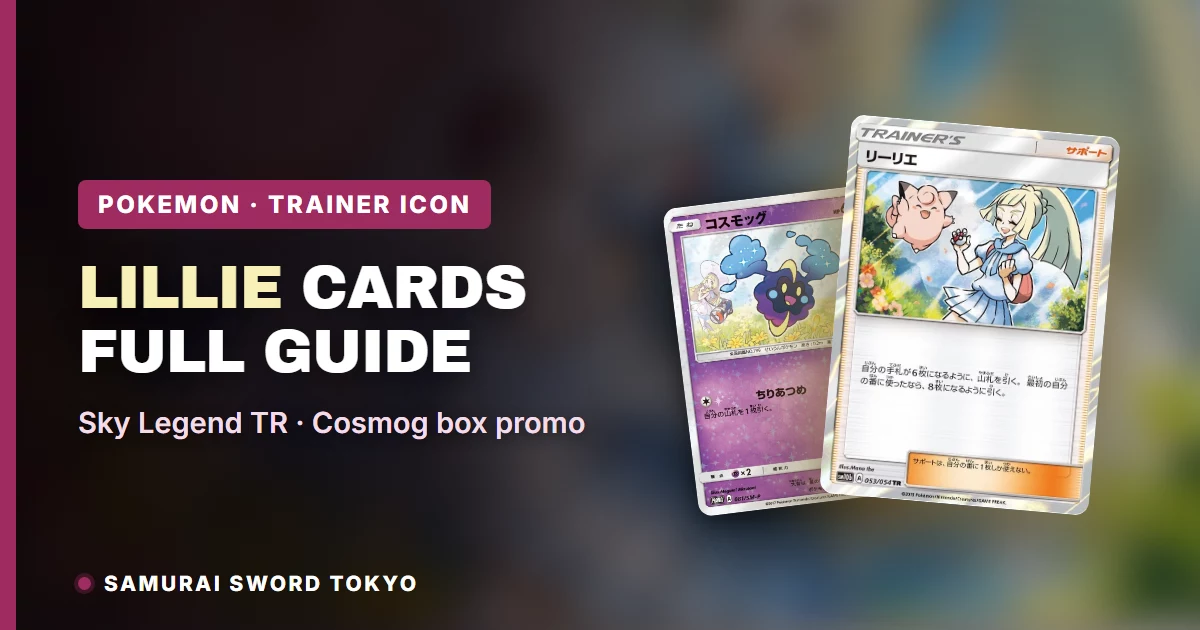
Lillie is the reason “trainer card” stopped meaning “utility cardboard” and started meaning “collectible.” The Sun & Moon era turned its most beloved character into a run of chase Supporters whose full-art prints now anchor the entire trainer-card market — and unlike most Pokemon chases, her cards sell on narrative: each major print maps to a moment in her story.
This guide covers the two Lillie-line prints we hold graded — a Japan-exclusive Trainer Rare and the Cosmog promo from her own boxed set — plus an honest map of the grails we source on request. Prices are live listing figures on PSA10 copies shipping from Tokyo.
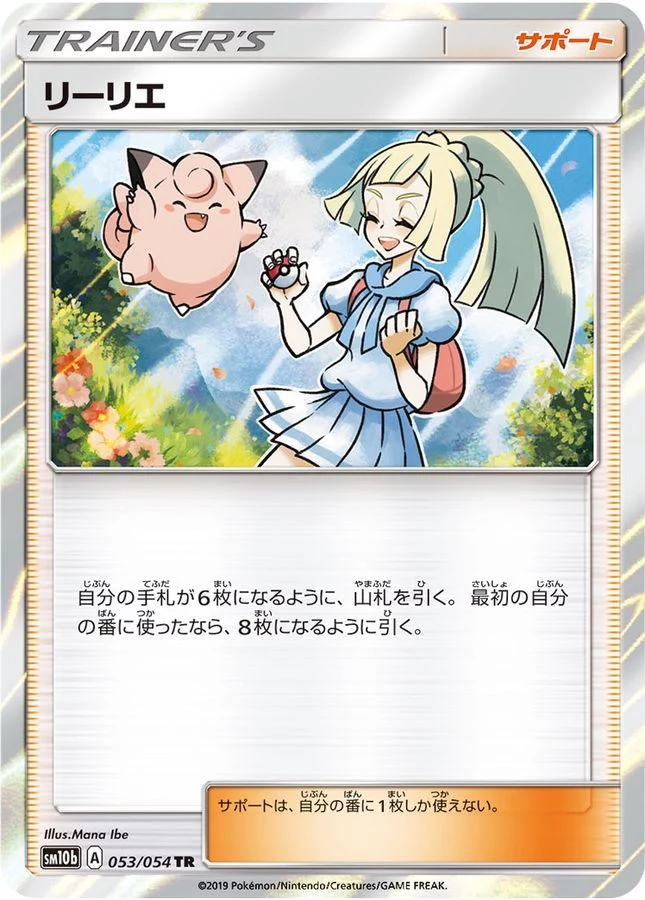
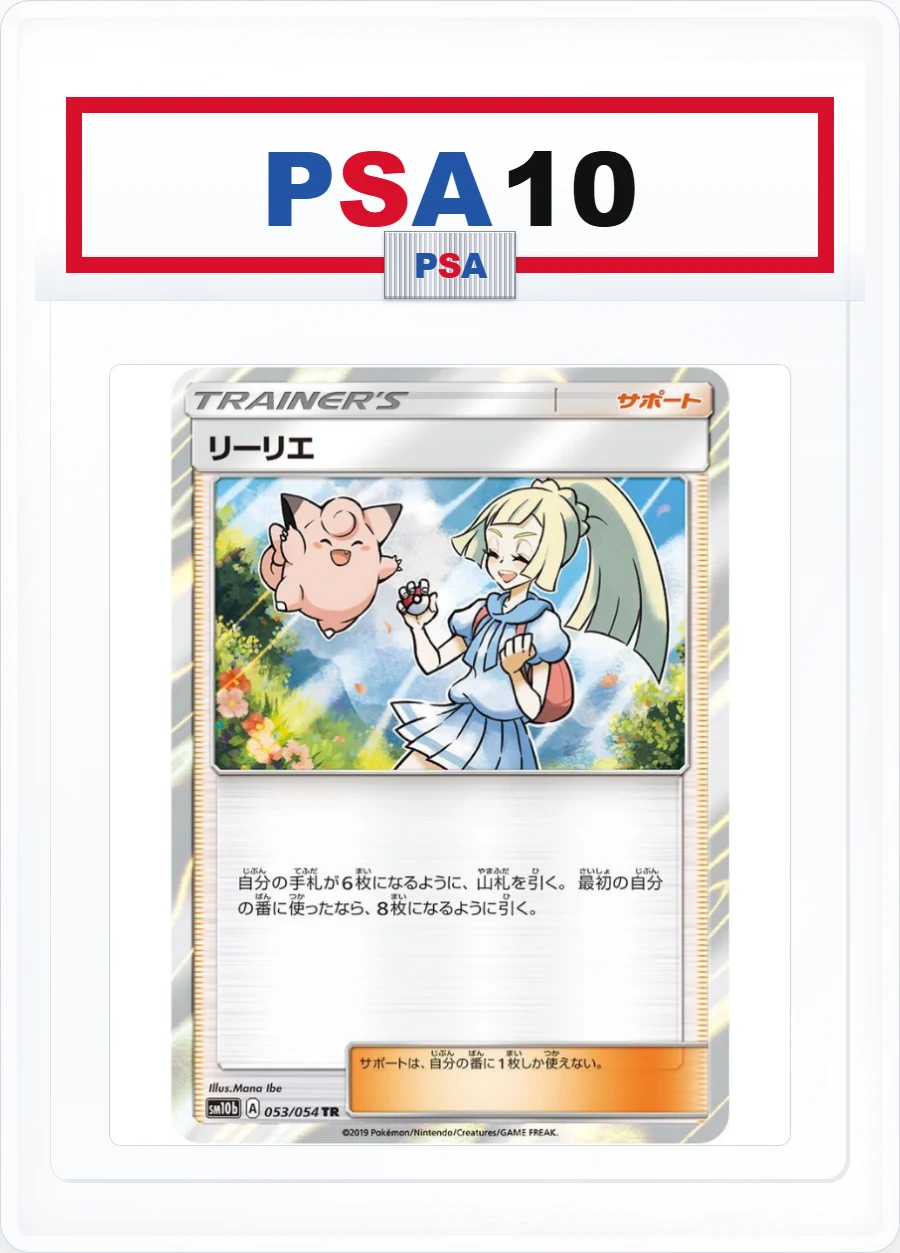
PSA10 Lillie TR, 053/054 — Sky Legend (SM10b, Japan 2019)
Japan’s Sky Legend enhanced expansion (SM10b, released April 26, 2019) closed its 54-card checklist with a five-card TR (Trainer Rare) block — a Japan-specific rarity tier that gave holo-frame reprints to key trainers and items: Recycle Energy (050), Net Ball (051), Gladion (052), Lillie (053), and Lusamine (054). Putting the Aether family — Gladion, Lillie, Lusamine — in consecutive slots was a deliberate flourish, and it makes 052–054 a natural three-card subset for Alola collectors.
The TR tier never traveled: Sky Legend’s core fed into international products in reshuffled form, so the Japanese TR prints stayed the only version of this treatment. Our PSA10 Lillie TR is currently listed at ¥10,197 — a five-figure entry into graded Lillie, in a market where her full-art grails clear seven figures.
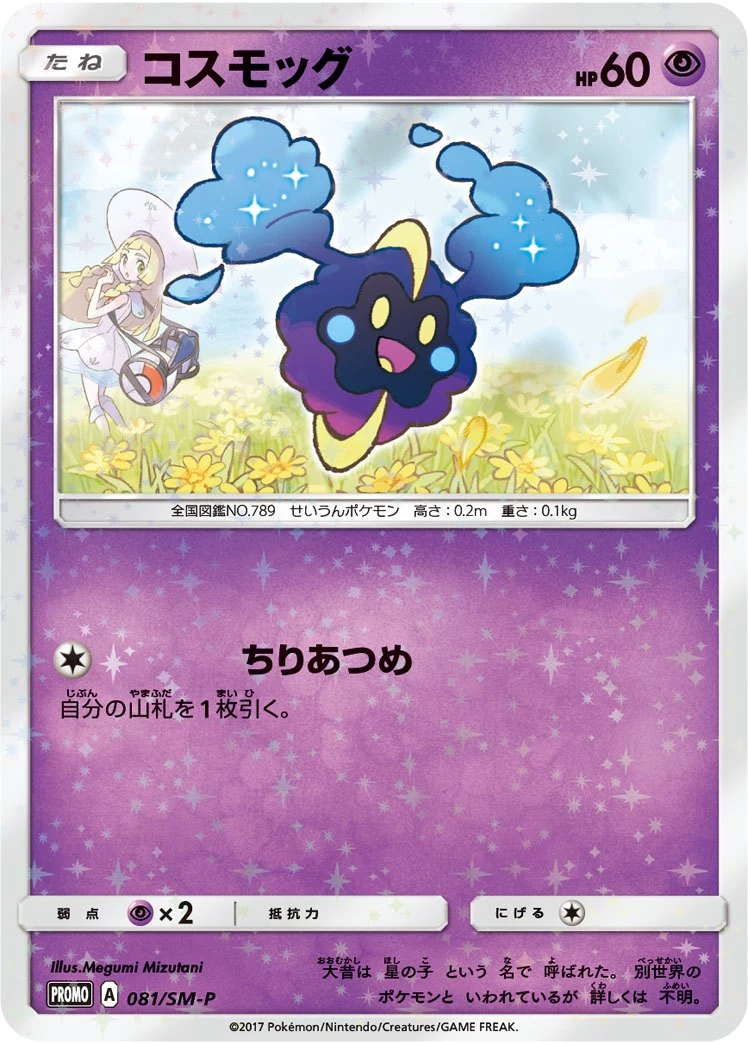
Lillie’s story in Sun & Moon is inseparable from the little nebula she carries in her bag, and the TCG bottled that in a boxed set: the Japanese “Special Box Lillie & Cosmog,” whose promo Cosmog at 081/SM-P is the collectible the product is remembered for. It’s the character-collector’s companion piece — the “Nebby” card — and because it only existed inside that box, graded copies are how it survives today.
Our PSA10 copy is currently listed at ¥23,014. Paired with the TR above, it’s the two-card version of Lillie’s whole arc for about ¥33,000 — the trainer and the Pokemon she was protecting.
The Grails We Source on Request
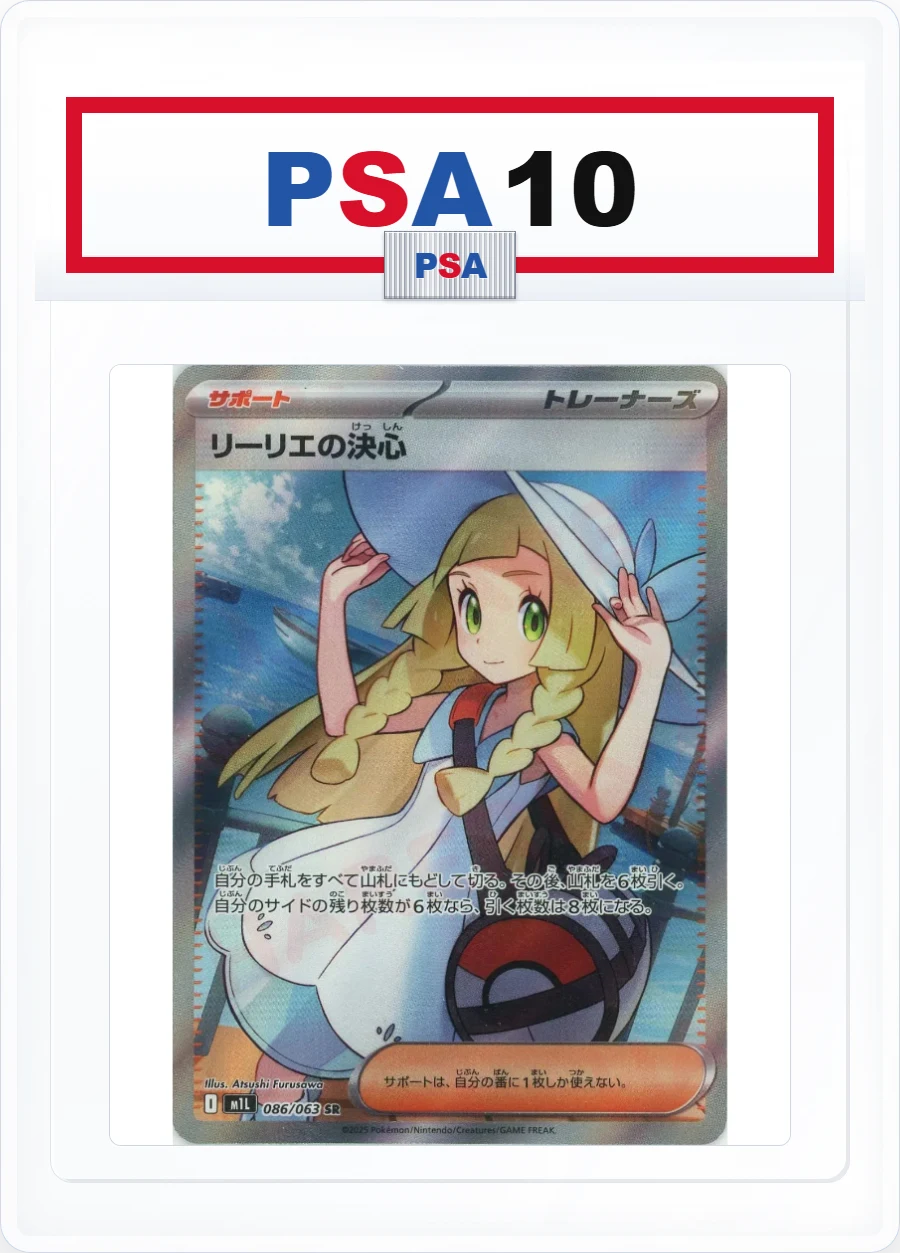
Above these two prints sits the famous stuff: the original Lillie full art from the SM base era, and the print everyone knows by its Japanese nickname — “Ganbare Lillie” (the determined-Lillie full art from the SM8b high-class era), one of the most expensive modern trainer cards in existence. We deliberately don’t hold permanent stock at that tier; the market moves too fast for shelf pricing to be honest. Instead, we source specific grails on order: name the print, number, and target grade through Quick Order and we’ll quote it against the live Japanese market that day.
Buying Tip
Lillie prints are the most nickname-driven corner of the trainer market — “Ganbare Lillie,” “TR Lillie,” “base full art” — and nicknames cause expensive mix-ups. Always confirm the set code and card number before wiring money for any Lillie card, here or anywhere else.
Where Lillie Sits in the Trainer-Card Market
Trainer-card collecting has three eras of royalty: the SM era belongs to Lillie, the SV era to Iono, and the space between to the Galar cast. Lillie’s distinction is depth — she has chase prints at every price tier, from the TR above to seven-figure grails, which is why she’s usually the first name in any graded trainer-card portfolio. For the current-era counterpart, see our Iono cards guide — and for the owner’s-Pokemon evolution of the same idea, the Cynthia & Garchomp guide.
Browse more graded trainers and chase cards in the PSA10 collection, or read the Japanese PSA10 price guide for how top-grade premiums behave on trainer cards specifically.
Frequently Asked Questions
What is the cheapest graded Lillie card?
Among her recognized chase prints, the Sky Legend TR (053/054, April 2019) is the accessible one — our PSA10 is currently listed at ¥10,197. Lillie’s full-art grails trade orders of magnitude higher.
What is Lillie TR 053/054?
A Japan-exclusive Trainer Rare from the Sky Legend enhanced expansion (SM10b), whose TR block runs 050–054 and places the Aether family — Gladion (052), Lillie (053), Lusamine (054) — in consecutive slots. The TR treatment was never released outside Japan.
What is the Cosmog 081/SM-P promo?
The promo card from the Japanese “Special Box Lillie & Cosmog” — the boxed set built around Lillie and Nebby. It only existed inside that product; our PSA10 copy is listed at ¥23,014.
Do you sell “Ganbare Lillie”?
Not as permanent shelf stock — grail-tier Lillie prints move too fast for fixed pricing. We source them on request through Quick Order, quoted against the live Japanese market at your target grade.
Why are Lillie cards so expensive?
She’s the most beloved character of the Sun & Moon era, her major prints map to story moments fans want to own, and the chase versions concentrate in Japan-exclusive rarities and high-class packs with limited top-grade supply. Depth of demand at every price tier is what separates her from almost every other trainer.
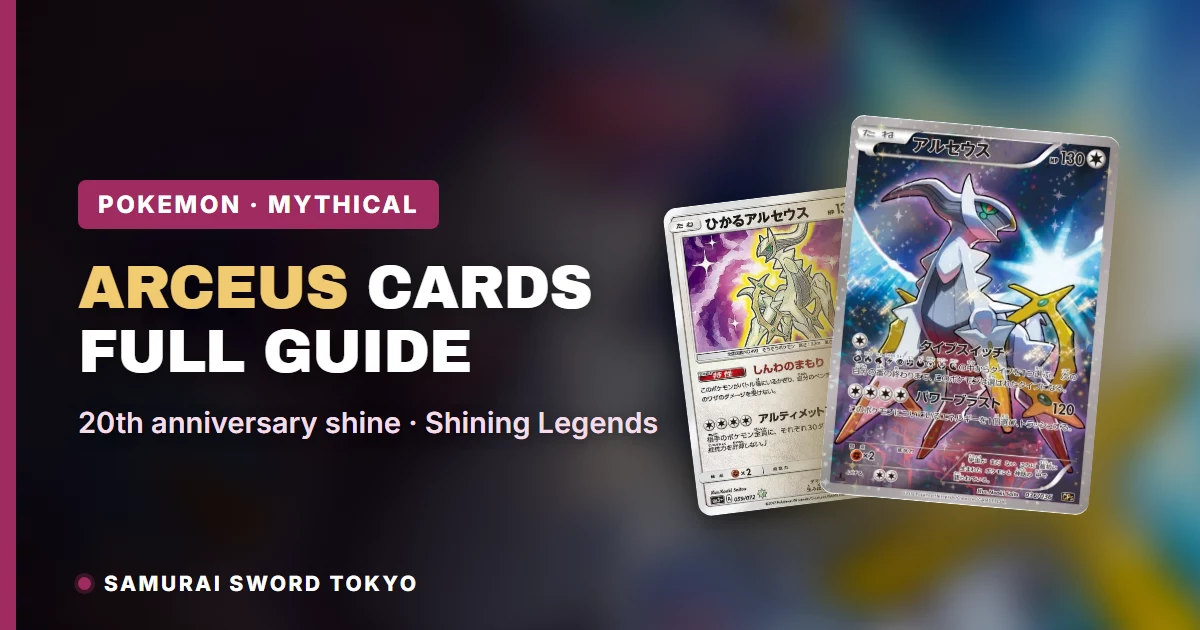
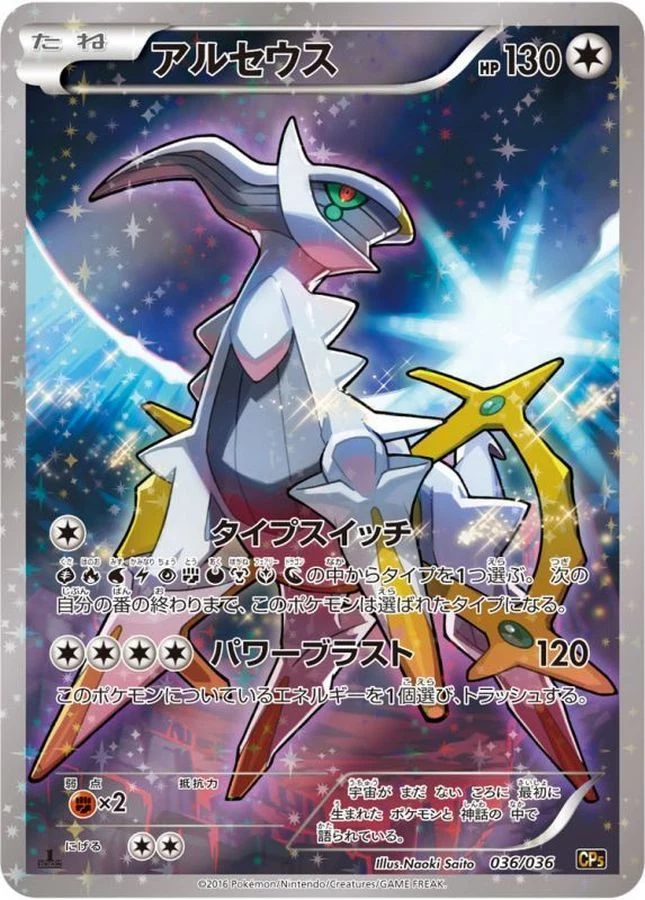
Arceus is the Pokemon that literally closes the book: in the 2016 collection Japan built to celebrate the franchise’s 20th anniversary, the creator god was placed at the final number of the checklist — 036 of 036. That kind of deliberate placement follows Arceus through the whole TCG: it rarely gets ordinary printings, and its best Japanese cards come from commemorative, Japan-exclusive products rather than standard boosters.
This guide covers the two graded Arceus prints we currently hold — the 20th-anniversary shine print and the Shining Legends “Shining Arceus” — plus how to hunt the prints we don’t shelve permanently. Prices are live listing figures on PSA10 copies shipping from Tokyo.
The Mythical & Legendary Dream Shine Collection (CP5) released in Japan on July 16, 2016 — the heart of the Pokemon 20th anniversary campaign, timed with the nineteenth movie. It’s a 36-card checklist (plus two EX secrets: Yveltal-EX at 037 and Xerneas-EX at 038) in which every card carries a gloss coating with a special holofoil inset and no printed rarity marks, packs held four cards instead of five, and the whole product stayed Japan-exclusive — there is no English equivalent set.
Arceus closes the checklist at 036/036 (with a second Arceus print one slot earlier at 035). Landing the creator god on the set’s final number in the anniversary product is exactly the sort of flourish that turns a card into a collecting target on its own. Our PSA10 copy carries the first-edition mark and is currently listed at ¥58,504 — a one-of-one listing.
The same set supplies one of our favorite adjacent cards: a PSA10 Celebi first edition at 002/036, currently listed at ¥88,741 — same shine treatment, same anniversary provenance, if you’re building a CP5 run rather than a single card.
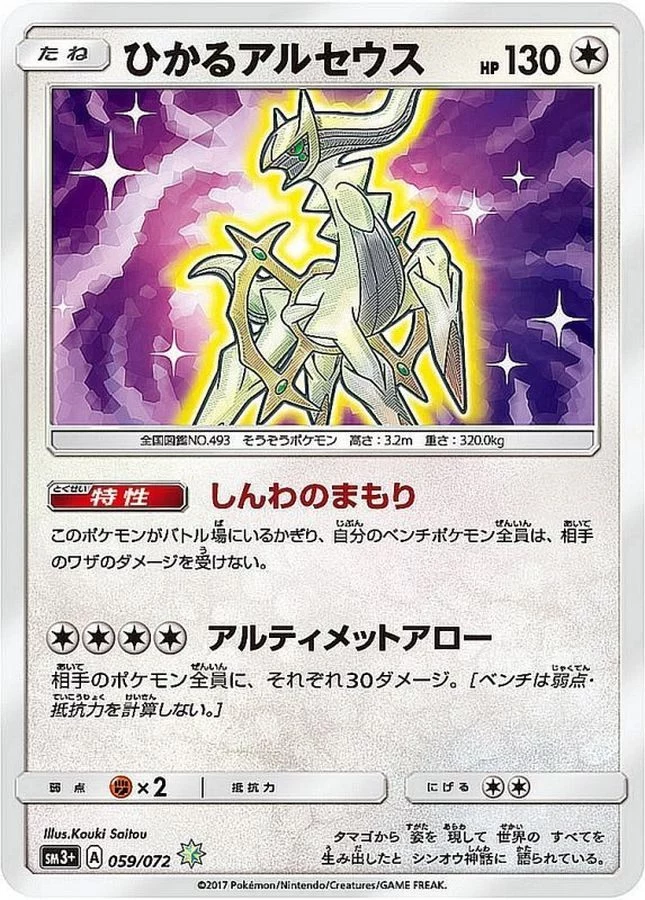
The Shiny Print: Shining Arceus, 059/072
PSA10 Shining Arceus, 059/072 — Shining Legends (SM3+, Japan 2017)
A year after the anniversary, Arceus got the other treatment collectors care about: a Shining print. Japan’s Shining Legends (SM3+, 2017) revived the “Shining Pokemon” concept from the early-2000s Neo era for a 72-card special expansion, and Shining Arceus at 059/072 is one of its headline cards — the shiny-colored creator god with the starburst Shining frame.
Our PSA10 copy is currently listed at ¥41,199, making it the more accessible of our two graded Arceus prints — and the one to pick if your collection leans shiny variants rather than anniversary products.
The Prints We Source on Request
Arceus has a deep print history beyond these two — the DPt-era LV.X cards that introduced it, the “Arceus VSTAR” line from the Brilliant Stars / Star Birth era, and assorted promos. We don’t keep permanent graded stock across all of them; demand comes in waves, so we source specific numbers on order instead. If you’re hunting an Arceus VSTAR (regular or secret), an LV.X, or any print not listed above, send the set, number, and target grade through Quick Order and we’ll quote it against the live Japanese market.
Sourcing Note
Quick Order requests are priced per-request at current market — not fixed shelf prices. For popular targets like Arceus VSTAR secrets, allocation moves fast; naming your acceptable grade range up front gets you a faster, firmer quote.
Browse the wider PSA10 collection for more graded legendaries and mythicals, or see the Japanese PSA10 price guide for how top-grade premiums behave across cards like these.
Frequently Asked Questions
What is the Arceus 036/036 card?
It’s the final card of Japan’s Mythical & Legendary Dream Shine Collection (CP5), released July 16, 2016 for the Pokemon 20th anniversary. Every card in the set has a gloss coating with special holofoil and no printed rarity; the set was never released in English. A second Arceus print sits at 035/036.
How much is the PSA10 first-edition CP5 Arceus?
Our PSA10 copy with the first-edition mark is currently listed at ¥58,504, shipping from Tokyo with tracking. It’s a one-of-one listing.
What set is Shining Arceus from?
Shining Legends (SM3+), Japan’s 2017 special expansion that revived the Shining Pokemon concept. Shining Arceus is 059/072; our PSA10 is listed at ¥41,199.
Do you have Arceus VSTAR?
Not as permanent graded stock — we source Arceus VSTAR prints (and LV.X-era cards and promos) on request through our Quick Order page, quoted at the live Japanese market for your target grade.
Is the CP5 set worth collecting as a whole?
It’s one of the cleanest anniversary products Japan has made: 36 cards + 2 EX secrets, uniform shine treatment, four-card packs, Japan-exclusive. We currently also hold a PSA10 first-edition Celebi (002/036) at ¥88,741 for set-builders.
Best Eevee Cards: Yu Nagaba Promos, SAR & Sealed Grails
Eevee has more separate card identities than almost any other Pokemon in the Japanese card game — not because it evolves into eight different Pokemon (it does, and each of those has its own collecting scene), but because Eevee itself, the un-evolved species, keeps showing up as the centerpiece of its own promos, its own sealed products, and its own illustrator collaborations.
This guide is about that second track: the Eevee (species) card line specifically, not the eeveelutions. We cover the Yu Nagaba collaboration promo, the Pokemon Card Game Classroom promo, the GX Start Battle gym promo, the Terastal Festival ex, and the sealed collector boxes tied to Eevee Heroes — with the actual card numbers, release context, and where each one sits in the current market. We ship Japanese sealed product and singles out of Tokyo, so the pricing context below comes from the market we trade in.
Key Takeaway
Eevee (species) has at least four distinct collectible cards on record — SM-P 245, 033/SV-P, 062/SV-P (Yu Nagaba), and the SV8a 224/187 SAR — plus two separate sealed collector-box eras (2021 Eevee Heroes, 2023 Yu Nagaba). They are easy to mix up by number alone.
Before getting into the background on each one, here’s the full rundown of the Eevee (species) cards this guide covers — not the eeveelutions, just Eevee itself.
Monster-ball “Mirror” variant confirmed; no AR variant found for this set
A quick word of caution before we go further: SV-P is a huge, ongoing promo series, and Eevee shows up in it more than once for reasons that have nothing to do with each other. Besides 033/SV-P (Card Game Classroom) and 062/SV-P (Nagaba), there are also unrelated Eevee promos at 031/SV-P and 032/SV-P tied to a separate “Pokemon Center Casual Battle” campaign. If you’re buying a specific numbered promo, confirm the number against the listing photo — the campaigns don’t share artwork or rarity, only the species.
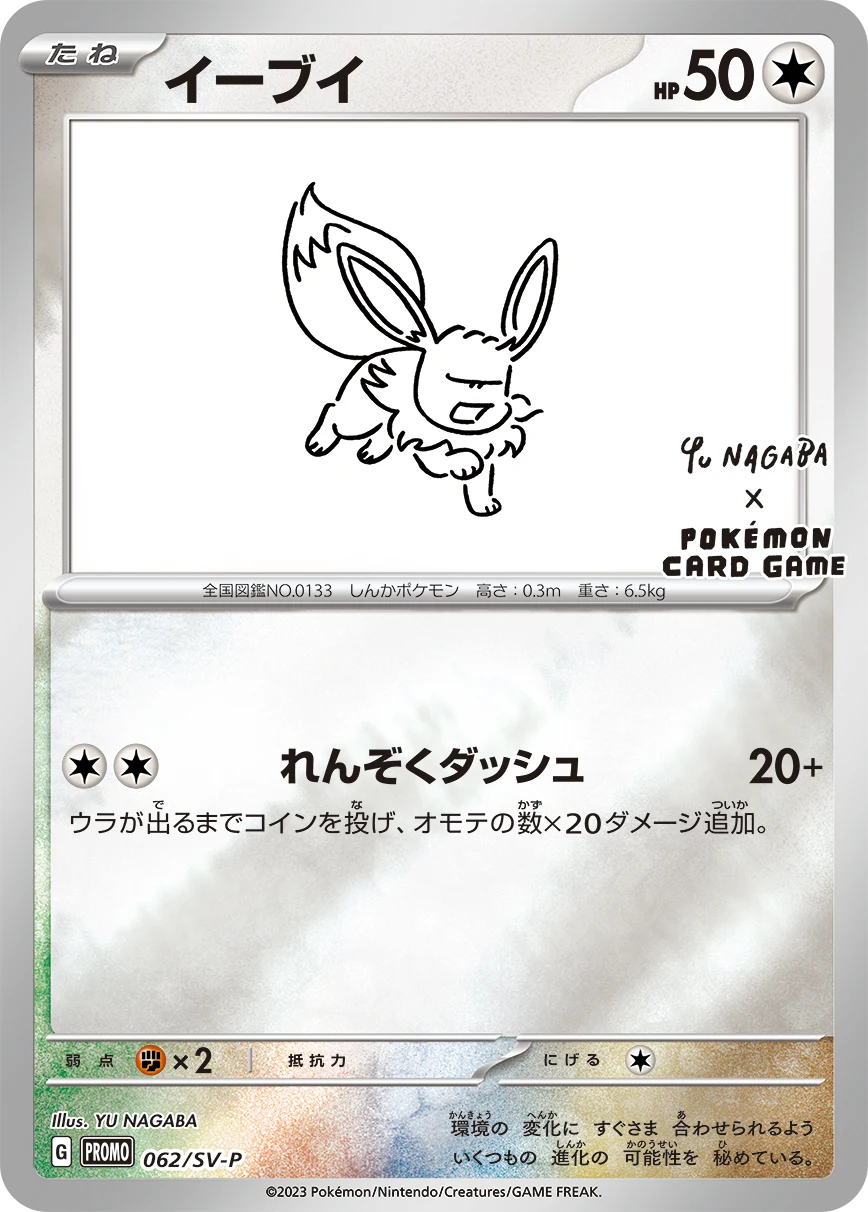
The Yu Nagaba Eevee: 062/SV-P
The most talked-about Eevee promo in recent years belongs to illustrator Yu Nagaba (長場雄), a Tokyo Zokei University graduate known for a minimal, deformed line-drawing style built from years of graphic design work at apparel brand graniph before he went independent. His client list runs through UNIQLO, SoftBank, Panasonic, and Beams × Star Wars — and in 2021 he did his first Pokemon Card Game collaboration, a Pikachu promo (208/S-P) tied to a T-shirt and Special Box release.
The second Nagaba collaboration, in 2023, is the one that matters for this guide. Officially announced on the Pokemon Card Game site, it was themed entirely around Eevee and its eight evolutions — nicknamed “Eevee-tachi” (イーブイたち). Three retail products released together on May 24, 2023, and separately, a set of nine promo cards, numbered 062/SV-P through 070/SV-P, all illustrated by Nagaba, went out one at random per every ¥1,000 spent on card-related products at Pokemon Center, Pokemon Store, and Pokemon Center Online starting May 20, 2023. In-store distribution capped at 10 cards per person; the online allocation reportedly sold out within a day due to demand.
Number
Pokemon
062/SV-P
Eevee (イーブイ)
063/SV-P
Vaporeon
064/SV-P
Jolteon
065/SV-P
Flareon
066/SV-P
Espeon
067/SV-P
Umbreon
068/SV-P
Leafeon
069/SV-P
Glaceon
070/SV-P
Sylveon
062/SV-P is Eevee’s slot in that run — the base-form card at the front of a nine-card set that collectors tend to chase as a group. If you’re building out the evolution side of the same collab instead, our Yu Nagaba Pokemon card guide covers the full lineup across both the 2021 Pikachu drop and this 2023 Eevee-tachi run, and our top Umbreon cards guide and Moonbreon card guide go deep on 067/SV-P specifically.
Two Different Nagaba Sealed Products — Don’t Mix Them Up
Yu Nagaba’s Eevee’s Promo Pack — sealed, tied to the 062–070/SV-P distribution
The May 2023 Nagaba collab released two accessory-style sealed products under the “Eevee’s” branding, and it’s easy to conflate them because they share a name and an era:
Eevee’s Special BOX (イーブイズ スペシャルBOX, ¥4,800 at release) — 64-count deck shields, a deck case with dividers, a rubber play mat, and a card box, all in Nagaba’s line-art style. It does not include booster packs or a guaranteed promo card; it’s an accessory bundle sold alongside the promo distribution window. Current asking prices for sealed copies on the Japanese secondary market run roughly ¥27,980–¥42,800 depending on version, per SNKRDUNK asking prices, August 6, 2026.
Eevee’s Collection File (¥1,980) and Eevee’s Display Frame (¥1,490) — a 180-card binder and a single-card display stand, both released the same day, both accessories rather than card product.
What we currently carry sealed is the promo pack tied to the same release — priced at ¥13,650. SNKRDUNK asking prices on comparable listings run around ¥12,500 as of August 6, 2026, so pricing is in the same range rather than a discount claim on our end.
Don’t Confuse This With the 2021 Box
A separate, unrelated sealed product — the 2021 Eevee Heroes “イーブイズセット” bundle — also uses “Eevee’s” in its name and pre-dates the Nagaba collab by two years. It’s a completely different product with different contents, covered further down in this guide.
Separate from anything Nagaba touched, Eevee 033/SV-P belongs to the “Pokemon Card Game Classroom” (ポケモンカードゲーム教室) promo campaign — a distribution track built around in-store or event-based teaching sessions rather than a designer collaboration or a booster set. It shares the SV-P promo numbering block with the Nagaba cards and with the unrelated 031/032 Casual Battle promos, which is exactly why checking the card number against the actual listing matters more than trusting a product title alone.
Graded copies are the most visible way this card trades. PSA10 Eevee 033/SV-P, ¥45,835 — the highest price point among the graded Eevee-only promos in this guide.
Eevee P [SM-P 245]: The GX Start Battle Promo
Going back further, Eevee P [SM-P 245] comes from the “GXスタートバトル ~イーブイをゲットしよう~” (GX Start Battle — Get Eevee) promo, released July 13, 2018. It was a Pokemon Card Gym prize: bring or buy a GX Start Deck, play three or more free battles at a gym event, and take one home. Illustrated by Saya Tsuruta, it’s a Basic Pokemon at 60 HP with an “Energy Evolution” ability and a “Quick Draw” attack — a straightforward early-SM-era design, and one of the older entries on this list.
The most recent Eevee (species) card on this list is Eevee ex at Special Art Rare, card 224/187 in the High Class Pack “テラスタルフェスex” (Terastal Festival ex). At 200 HP and Colorless typing, it’s built around a Terastallization-flavored ability — “Rainbow DNA” (にじいろDNA) — paired with the attack “Quartz Shine” for 200 damage. It’s the only ex-rarity Eevee (species, not evolution) card confirmed in current listings, which puts it in a different collecting tier from the promo cards above: full-art SAR treatment rather than a promo-only print.
The 2021 Eevee Heroes Era and the Eeveelutions Set
Two years before the Nagaba collab, Eevee got an entire expansion built around it: S6a “イーブイヒーローズ” (Eevee Heroes), released May 28, 2021, five cards per pack. The set leans heavily on the eeveelutions as V/VMAX cards — Umbreon VMAX, Sylveon VMAX, Leafeon VMAX, and Glaceon VMAX are the confirmed headliners — but Eevee itself appears at Common rarity as 058/069, the base-form pull most collectors run into first when opening packs. If you’re comparing this set’s headline cards rather than Eevee specifically, our S6a Eevee Heroes best cards guide and Eevee Heroes card list guide break the full set down.
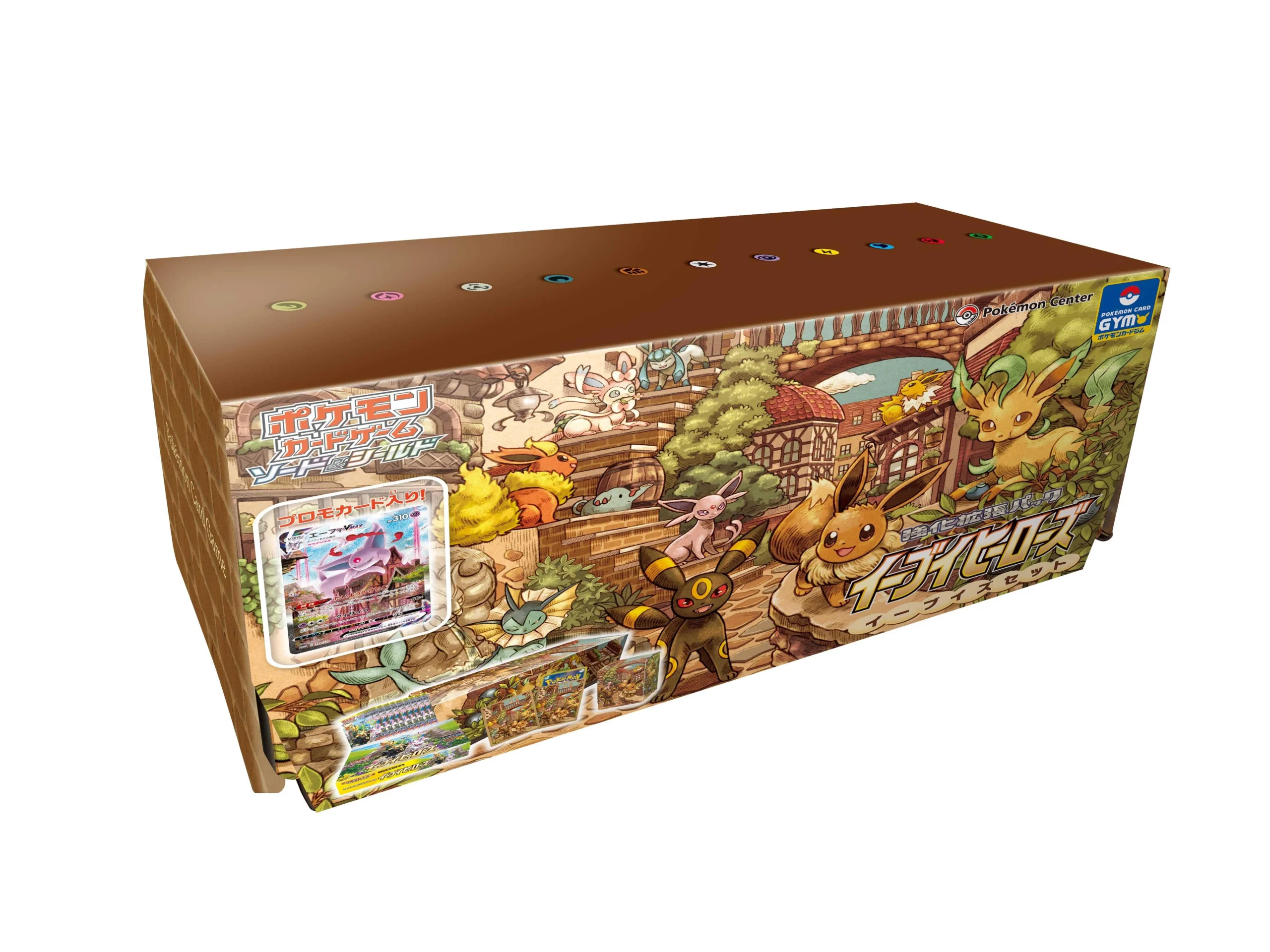
Alongside the booster release, Pokemon put out a dedicated bundle: 強化拡張パック イーブイヒーローズ イーブイズセット (Eevee Heroes — “Eevee’s Set”), also released May 28, 2021, at a list price of ¥11,330. It packaged deck shields, a deck case, a large-capacity card box, two full boxes (60 packs total) of the S6a booster, and an original, exclusive “Espeon VMAX” card not available any other way — all wrapped in a soft, picture-book-style Eevee illustration treatment, a distinctly different art direction from Nagaba’s later line-art collab.
The 2021 Eevee Heroes bundle — sealed, with an exclusive Espeon VMAX not printed anywhere else
Five years on from its ¥11,330 release, this is the sealed collector piece in this guide that’s moved the furthest. We list it as the Eeveelutions Set, and it’s a one-of-one situation in practical terms — sealed 2021 copies with the exclusive Espeon VMAX intact aren’t something that gets restocked. SNKRDUNK asking prices on comparable listings ran around ¥364,000 on August 6, 2026, in the same range as our own pricing.
If you’d rather build toward the evolutions inside this same set individually — graded or raw — our PSA10 eeveelutions buying guide is the companion piece to this article.
Where to Buy Eevee Cards from Japan
We ship Japanese sealed product and singles worldwide from Tokyo with tracked delivery. For the base-form Eevee cards covered here, the most direct routes are the Yu Nagaba promo pack and the graded promos above; for the wider Eevee Heroes set that 058/069 and the VMAX evolutions come out of, sealed booster boxes are the way in.
For graded PSA10 Eevee and eeveelution cards across sets, browse our PSA10 collection. For singles, sealed product, or a mixed order across multiple sets, our Quick Order page is the fastest way to build one order.
Frequently Asked Questions
What is the rarest Eevee card?
There’s no single confirmed “rarest” Eevee card — several distribution campaigns were limited enough that no clean ranking exists. Collectors most often point to the sealed 2021 Eevee Heroes Eeveelutions Set, since its exclusive Espeon VMAX was never reprinted, or to the Yu Nagaba 062/SV-P promo, whose online distribution reportedly sold out within a day of release in May 2023.
What is the Yu Nagaba Eevee card?
Eevee 062/SV-P, part of illustrator Yu Nagaba’s second Pokemon Card Game collaboration in May 2023, themed around Eevee and its eight evolutions. It’s one of nine promo cards (062–070/SV-P) distributed one at random per every ¥1,000 spent on card-related products at Pokemon Center, Pokemon Store, and Pokemon Center Online.
What’s included in the Eevee Heroes Eeveelutions Set?
The 2021 “イーブイズセット” bundle includes deck shields, a deck case, a large-capacity card box, two full boxes (60 packs) of the S6a Eevee Heroes booster, and an original exclusive Espeon VMAX card not available anywhere else. It released May 28, 2021 at ¥11,330; sealed copies now trade well above that original price.
What sets have an Eevee ex card?
Eevee ex appears at Special Art Rare in SV8a’s High Class Pack “Terastal Festival ex” (224/187), with a Rainbow DNA ability. It’s the confirmed ex-rarity entry for Eevee the species; the eeveelutions have their own separate ex and SAR printings across other sets.
Can I buy these Eevee cards from Japan directly?
Yes — we ship Japanese sealed product and single cards worldwide from Tokyo with tracked delivery. Browse our PSA10 collection, use Quick Order for a mixed cart, or shop individual sealed products and singles directly on the product pages linked throughout this guide.
Inferno X (M2) Complete Guide: Card List & Where to Buy
Inferno X is the third set in Pokemon’s Japanese MEGA era, and it put Mega Charizard X front and center — across four different rarities in the same 116-card set. If you’re trying to figure out what’s actually in this set, which card is the real chase, or whether the sealed box you’re looking at is priced fairly, this guide covers all three.
We stock Inferno X (M2) sealed boxes and singles out of Tokyo, so the numbers below come from a set we handle directly — not a secondhand summary.
Key Takeaway
Inferno X (M2) is a 116-card set headlined by Mega Charizard X ex, with a single MUR, six SAR chase cards, and 17 SR cards. Our sealed box is ¥15,980 — roughly 30% under the ¥22,693 shrink-intact asking price we measured on SNKRDUNK on August 6, 2026.
Inferno X (Japanese: インフェルノX, product code M2) is a Japanese Pokemon TCG expansion pack that released on September 26, 2025. It’s the third set in the MEGA era, following the launch pair M1L (Mega Brave) and M1S (Mega Symphonia), which both released August 1, 2025.
Per the official product page, Inferno X is built around Fire-Energy-based explosive-damage offense, centered on Mega Evolution Pokemon-ex and Pokemon-ex generally, with status-condition (confusion) support mechanics layered in. The set’s flagship is Mega Charizard X ex, which appears across four separate rarities — a base printing within the 001-080 numbered run, an SR at 094/080, an SAR at 110/080, and the set’s top MUR at 116/080. A secondary fan characterization frames the set as a Fire/Dark pairing via Mega Charizard X and Mega Sharpedo, though that framing comes from retailer commentary rather than the official product page copy.
Inferno X totals 116 species across five rarity tiers, verified against the set’s numbered card list:
Rarity
Card numbers
Count
Notes
Normal / R
001–080
80
Base numbered set
AR
081–092
12
Alternate Art Rare
SR
093–109
17
SR full-art / special illustration
SAR
110–115
6
SAR Special Art Rare — the chase tier
MUR
116
1
MUR Mega Ultra Rare — the top card
The 17 SR cards (093–109/080) mix Pokemon-ex reprints of the SAR headliners with Trainer, Supporter, Stadium, and Special Energy cards:
No.
Card (Japanese name)
Type
093/080
Mega Heracross ex
Pokemon
094/080
Mega Charizard X ex
Pokemon
095/080
Oricorio ex
Pokemon
096/080
Rotom ex
Pokemon
097/080
Mismagius ex
Pokemon
098/080
Mega Sharpedo ex
Pokemon
099/080
Empoleon ex
Pokemon
100/080
Mega Lopunny ex
Pokemon
101/080
ヒートバーナー (item, unverified EN name)
Item
102/080
Switch
Trainer
103/080
せいなるおまもり (unverified EN name)
Trainer
104/080
パンクメット (unverified EN name)
Trainer
105/080
ギーマの一手 (unverified EN name)
Supporter
106/080
Dawn (SR printing — separate from the SAR below)
Supporter
107/080
ひふきやろう (unverified EN name)
Trainer
108/080
Battle Colosseum
Stadium
109/080
Ignition Energy
Special Energy
A note on the English names above: Inferno X has not had an official English-language release, so the English glosses in this table are informal translations of the Japanese card names, not confirmed localizations. Only the Japanese names are directly source-confirmed. Treat the English wording as a reading aid, not a final localized name.
The SAR Chase Card Lineup
Six SAR cards sit at 110–115/080, and this is the tier most buyers are actually chasing when they open a box — the MUR is the headline, but the SAR run is where most of the set’s collector value concentrates because there are six shots at pulling one instead of one.
No.
Card
Rarity
110/080
Mega Charizard X ex
SAR
111/080
Oricorio ex
SAR
112/080
Rotom ex
SAR
113/080
Mega Sharpedo ex
SAR
114/080
Mega Lopunny ex
SAR
115/080
Dawn
SAR
Community “当たりカード” (chase card) ranking articles from Japanese fan and retailer sites repeatedly cite a similar order for collector interest, though this is community opinion rather than an official or price-verified ranking, and we’re not reproducing any dollar figures attached to it here:
Mega Charizard X ex (MUR) 116/080 — cited as the top chase card across multiple ranking articles.
Mega Charizard X ex (SAR) 110/080 — consistently cited as the second-tier chase card, and the SAR most buyers are realistically hoping to land.
Mega Charizard X ex (SR) 094/080 — a notable but lower-tier chase, since it’s a step down in both rarity and price from the SAR and MUR printings of the same Pokemon.
Oricorio ex (SAR) 111/080 — cited among the top non-Charizard SAR chases.
Dawn (SAR) 115/080 — called out repeatedly for character-popularity-driven demand rather than in-game utility. Dawn is the Sinnoh-region protagonist from the Diamond/Pearl games, and this Supporter card draws collector interest specifically because of who’s illustrated on it.
One disambiguation worth flagging: Dawn also has a separate, lower-rarity SR printing at 106/080. The SAR at 115/080 is the chase version — don’t confuse the two when you’re checking listings.
MUR Spotlight: Mega Charizard X ex 116/080
The set’s single MUR is Mega Charizard X ex, 116/080, a Fire-type Stage 2 Pokemon confirmed as the flagship across multiple independent retailer listings and the official product page. It’s the same Pokemon that anchors the SR (094/080) and SAR (110/080) print runs, which is why Mega Charizard X ends up dominating both the set’s marketing and its chase-card conversation.
Per retailer product listings for this card (not the official rules text, so we’re flagging it as secondary-sourced), the card’s named attack is “Inferno X” — discard any number of Energy attached to this Pokemon, dealing 90 damage per Energy card discarded. That’s a scalable, all-in attack line consistent with the set’s stated Fire-Energy-to-damage theme.
The official product page’s catalog copy for the set translates roughly to “turn a mass of Fire Energy into explosive attack power and burn everything down,” and Mega Charizard X ex is the card that copy is describing.
Box Economics: Pack Price, Box Count, and Our Price Gap
The official product page confirms a pack price of ¥180 (tax included) with 5 cards per pack. What the official page does not state is packs-per-box — that figure isn’t published on pokemon-card.com. Multiple independent retail and fan sources converge on 30 packs per box at ¥5,400 (tax included), which lines up arithmetically with the confirmed per-pack price, but we’re flagging it as retailer-corroborated rather than officially confirmed, since the primary source doesn’t list it.
On pricing, this is where Inferno X gets interesting for overseas buyers. We measured Inferno X box asking prices on SNKRDUNK on August 6, 2026: a shrink-intact box was asking ¥22,693, while a box with shrink removed was asking closer to ¥17,500. Our own sealed Inferno X booster box is ¥15,980 — about 30% under that shrink-intact market ask, and still under the no-shrink figure.
Why the Gap Exists
Inferno X released nearly a year ago as of this writing, and MEGA-era product has kept moving through secondary channels at a premium as newer sets (M3 through M6) have shifted collector attention forward. That’s part of why a slightly older MEGA-era box can sit meaningfully under fresher secondary-market asks — the chase (Mega Charizard X ex across three rarities) hasn’t gone anywhere, but the immediate release-week price pressure has.
If you’re chasing Dawn specifically rather than opening for her, we also carry a graded single: PSA 10 Dawn (SAR) 115/080 at ¥14,103, in stock. That’s a store price, not a market comparison — we’re not claiming it beats a specific external ask, just noting it’s the graded route if you’d rather skip the box entirely.
Pull Rates: What’s Rumor vs What’s Confirmed
We want to be direct about this section because pull-rate numbers circulate widely and get treated as fact when they’re not. Pokemon does not publish official pull rates on the Inferno X product page — there are no odds figures anywhere on pokemon-card.com for this set.
One fan aggregator site states community-reported figures of roughly “1 MUR per 50 boxes, about 1 per 3 cartons” and a “guaranteed” SAR rate of roughly “1 per 3.3 boxes.” We’re including these because they’re the numbers circulating in the community, but they come from a single fan source, are not corroborated against any official statement, and should be treated as rumor — not as odds you can plan a purchase around.
The practical takeaway: six SAR slots plus a base/SR/SAR/MUR-spread Mega Charizard X ex means the set rewards opening more boxes rather than one, but we can’t verify a specific rate at which that pays off, and neither can most of the sites citing numbers on this set.
Where to Buy Inferno X (M2) from Japan
We ship Japanese sealed product and graded singles worldwide out of Tokyo with tracked delivery. If you want a shot at all four Mega Charizard X ex printings plus the rest of the SAR and SR lineup, sealed box is the direct route.
Shop This Set
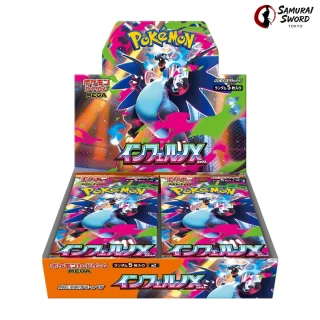
Inferno X (M2) Booster Box (Japanese)
¥15,980 — ~30% under the shrink-intact SNKRDUNK ask
If you’d rather go straight for a graded chase card instead of opening packs, our PSA 10 collection covers Inferno X singles alongside the rest of our graded inventory. And if you’re building a mixed order across sets — Inferno X plus M1L, M1S, or anything from the current MEGA lineup — the Quick Order page is the fastest way to put that together in one checkout.
Inferno X is a Japanese Pokemon TCG expansion pack (product code M2) released on September 26, 2025, as the third set in the MEGA era. It’s a 116-card set headlined by Mega Charizard X ex, which appears across the base run, SR, SAR, and MUR rarities.
How many cards are in the Inferno X card list?
116 species total: 80 Normal/R cards (001–080), 12 AR cards (081–092), 17 SR cards (093–109), 6 SAR cards (110–115), and 1 MUR card (116).
What is the rarest card in Inferno X?
The Mega Ultra Rare (MUR) Mega Charizard X ex at 116/080 is the set’s single top-rarity card. The six SAR cards at 110–115/080 sit one tier below it, with the SAR Mega Charizard X ex (110/080) most cited as the second-tier chase.
Why is your Inferno X booster box cheaper than other listings?
Our sealed box is priced at ¥15,980. We measured a shrink-intact Inferno X box asking ¥22,693 on SNKRDUNK on August 6, 2026 — our price sits roughly 30% under that. We source and ship directly from Tokyo, which removes a layer of secondary-market markup.
Is the Dawn SAR card worth chasing?
Dawn (115/080, SAR) is cited repeatedly in community chase-card rankings, but the demand appears driven by character popularity — she’s the Diamond/Pearl protagonist — rather than competitive utility. A separate, lower-rarity SR printing of Dawn exists at 106/080; make sure you’re looking at 115/080 if you want the SAR.
Can I buy Inferno X (M2) product from Japan if I live overseas?
Yes. We ship Japanese sealed Inferno X boxes and singles internationally from Tokyo with tracked delivery, through our booster box listing, PSA 10 singles collection, or the Quick Order page for mixed orders.
Terastal Festival ex vs Shiny Treasure ex: Which High Class Pack to Buy [2026]
Both sets have a ¥55,000 chase card at the top. Both guarantee premium hits in every box. Both are Scarlet & Violet High Class Packs with god packs, English-market premiums, and multi-year appreciation stories. So when a collector asks us which one to buy — and they ask constantly — the honest answer is that Terastal Festival ex and Shiny Treasure ex are built for two different kinds of buyer, and the differences are structural, not cosmetic.
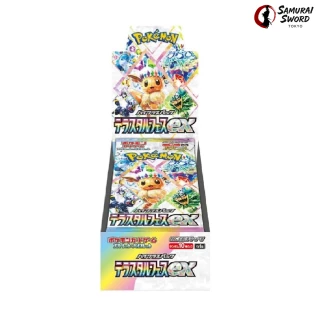
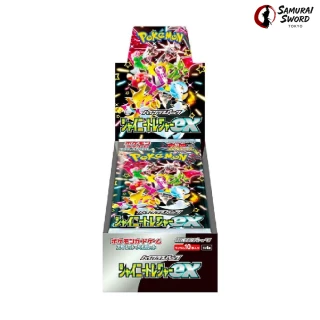
Shiny Treasure ex (SV4a) is the shiny showcase: 360 cards, 129 baby shinies, a guaranteed SSR in every box, and a Mew ex SAR that has climbed 244% since launch. Terastal Festival ex (SV8a) is the Eeveelution set: 232 cards, all nine Eeveelution SARs in one pool, Master Ball mirror variants, and the only High Class Pack structure that guarantees a Special Art Rare in every single box.
We ship both sets out of our Tokyo warehouse daily, so this comparison uses the data we track in our own Shiny Treasure ex guide and Terastal Festival ex guide — pull structures, chase card values, god pack styles — and turns it into one decision.
Both Boxes In Stock — Tokyo, Ships Worldwide
SV8a Terastal Festival ex box:¥19,240 in stock · SV4a Shiny Treasure ex box:¥17,340 in stock. Short version: buy Terastal Festival ex if you want a guaranteed SAR floor and the Eeveelution chase; buy Shiny Treasure ex if you want shiny volume, better god pack odds, and the Mew/Charizard dual chase.
¥19,240
SV8a Box (In Stock)
¥17,340
SV4a Box (In Stock)
¥55,000
Top Chase (Each Set)
10×10
Packs × Cards per Box
What a High Class Pack Actually Is
High Class Packs are Japan’s premium reprint-plus-secrets format, and both of these sets follow the same skeleton: 10 packs of 10 cards per box at a ¥5,500 MSRP (¥550 per pack), with rarity structures far richer than a standard expansion. Neither trades anywhere near MSRP anymore — limited production windows mean High Class Packs historically appreciate after production ends, which is exactly what both of these sets have done.
Three features define the format, and both sets carry all three:
Guaranteed hit structures. Every SV4a box guarantees at least one SSR plus multiple baby shinies; every SV8a box guarantees a Special Art Rare. A standard expansion box guarantees neither.
God packs. Rare packs where the normal card mix is replaced by premium cards — a defining feature of Japanese High Class Packs that the English equivalents don’t offer in booster boxes. Full mechanics in our Pokemon god pack guide.
A JPN premium with reasons behind it. Japanese printings carry higher-quality texturing and holofoil, and JPN versions of chase cards have historically traded 15–40% above their English equivalents.
Shiny Treasure ex was the Scarlet & Violet era’s first High Class Pack (December 1, 2023, English version: Paldean Fates). Terastal Festival ex followed a year later (December 6, 2024, English version: Prismatic Evolutions — which has remained supply-constrained well into 2026, pushing overseas demand toward the Japanese original). Same format, one year apart, two very different designs inside the box.
Head-to-Head: The Full Comparison Table
Everything that materially differs between the two boxes, side by side:
Factor
Terastal Festival ex (SV8a)
Shiny Treasure ex (SV4a)
Release (JPN)
December 6, 2024
December 1, 2023
Total cards
232 (188 main + 44 secret)
360 (190 main + 170 special)
Box structure
10 packs × 10 cards
10 packs × 10 cards
SAR pool
33 SARs (incl. all 9 Eeveelutions)
8 SARs
Shiny structure
—
129 baby shinies + 18 SSRs
Guaranteed per box
1 SAR + 1 ACE SPEC + ~9 RR
1 SSR + 2–3 baby shinies + ~1 AR
SAR odds
1 per box, guaranteed
~1 in 6 boxes (est.)
Mirror chase
Master Ball mirrors, 101-card pool, ~1 per 2 boxes
Pull rates are community estimates from Japanese opening data — The Pokemon Company does not publish official rates. Chase card values are Japanese secondary-market prices as of March 2026, from the source guides linked above.
Read the table top to bottom and the pattern emerges. SV4a is wide: a huge card pool, shiny volume in every pack, and god packs common enough to be a real (if lucky) event. SV8a is deep: fewer cards, but a guaranteed SAR every box and a chase hierarchy that funnels toward nine Eeveelutions everyone recognizes.
The Case for Terastal Festival ex: Eeveelutions and the Guaranteed Floor
SV8a Terastal Festival ex — the only SV-era High Class Pack with a guaranteed SAR per box
Terastal Festival ex is the definitive Eeveelution set. All nine Eeveelutions — Vaporeon, Jolteon, Flareon, Espeon, Umbreon, Leafeon, Glaceon, Sylveon, and Eevee — appear as ex cards with Special Art Rare treatments, the first time all nine have shared a single set with premium art. No other Scarlet & Violet set concentrates this much Eeveelution content, and Eeveelution demand is evergreen.
Three structural arguments favor SV8a:
The guaranteed SAR changes what a “bad box” means. Every SV8a box contains at least one of 33 SARs. The nine Eeveelution SARs average ¥14,167 each; even the pool average sits around ¥5,033. Compare that to SV4a, where an SAR shows up roughly once in six boxes. If you’re only buying one or two boxes and want the certainty that something genuinely premium comes out, SV8a is the only High Class Pack that promises it.
Umbreon ex SAR is still climbing. At ¥55,000 ($310), it matches Mew ex SAR at the top of the SV era — and it’s up 17% from its ¥47,000 launch, with the floor moving from ¥46,000 to above ¥50,000. Umbreon has topped every Eeveelution set it appears in; the 2021 Eevee Heroes Umbreon VMAX SA followed the same trajectory, peaking above ¥100,000. PSA 10 copies have already sold for over $500.
Master Ball mirrors add a second chase layer. A 101-card pool of Master Ball watermark reverse holos, at roughly one per two boxes. The Umbreon Master Ball mirror trades at ¥22,000 — up 22% since launch — because pulling that specific card works out to roughly 1 in 202 boxes, making it functionally rarer than most SARs. Full checklist on our SV8a card list.
The honest trade-off: SV8a’s god packs are spectacular — one variant contains three random Eeveelution SARs, the other all nine in a single pack, a combined value exceeding ¥130,000 — but community estimates put them at roughly 1 in 300–500 boxes. You buy SV8a for the guaranteed floor and the Eeveelution ceiling, not the god pack.
The Case for Shiny Treasure ex: Shiny Volume and the Proven Track Record
SV4a Shiny Treasure ex — 360 cards, 129 baby shinies, guaranteed SSR every box
Shiny Treasure ex introduced the largest collection of shiny Pokemon cards ever put in a single set: 129 baby shiny (S) cards plus 18 shiny super rares. Every pack guarantees a Pokemon ex, and every box guarantees at least one SSR alongside 2–3 baby shinies — which means shiny cards keep appearing throughout the box rather than one premium moment at the end. If the appeal of a High Class Pack is the opening experience, SV4a distributes it more evenly than any SV-era set.
Three structural arguments favor SV4a:
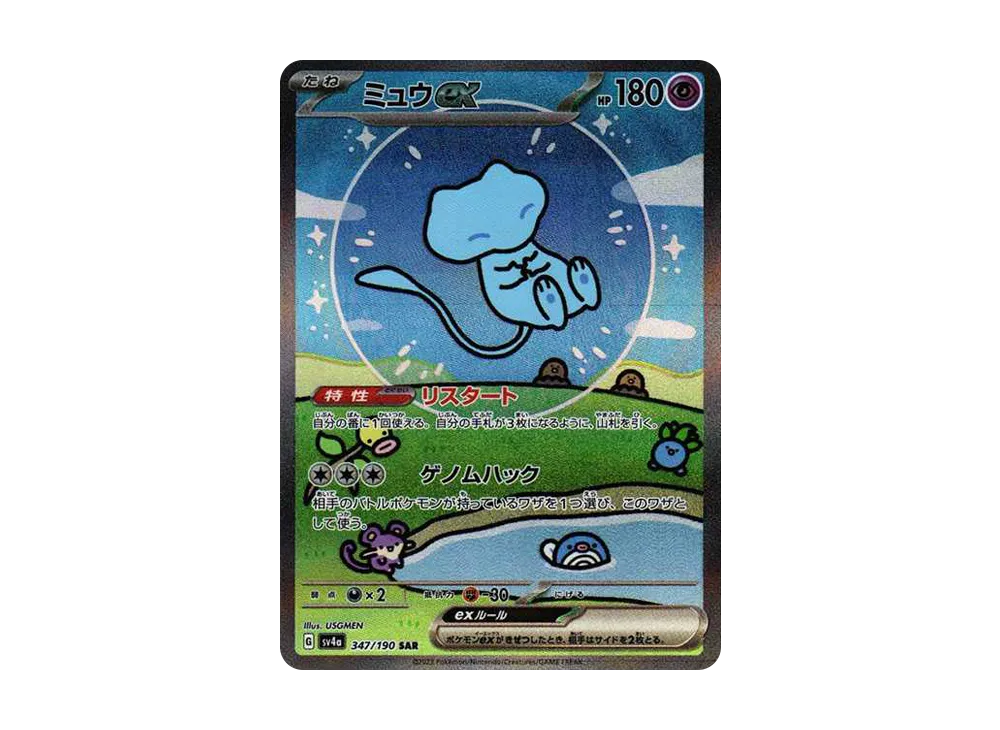
The dual chase is Mew and Charizard. Mew ex SAR at ¥55,000 (~$374) is the most valuable card in the entire SV High Class Pack lineup, up 244% from its ~¥16,000 launch over 27 months, with PSA 10 copies around ¥86,000. Behind it sits Charizard ex SAR at ¥40,000 and Gardevoir ex SAR at ¥18,000 — three cards worth over ¥100,000 combined, and all three have appreciated from launch. Full checklist on our SV4a card list.
God packs you might actually see. SV4a’s god pack — 9 shiny cards in one pack — lands at an estimated ~4% per box, roughly 1 in 25 boxes. That is an order of magnitude more common than SV8a’s estimated 1 in 300–500. Nobody should buy boxes for god packs, but at 1-in-25, a multi-box SV4a order carries a realistic shot at one; at SV8a’s odds it’s a lottery ticket.
The longest proven track record in the SV era. As the era’s first High Class Pack, SV4a has 27 months of visible market history: boxes launched around ¥8,000–9,000, corrected to ¥6,000–7,000, then recovered and appreciated as supply tightened — while the Mew, Charizard, and Gardevoir SARs all rose. Sustained demand over that window is not something SV8a can demonstrate yet; it’s a year younger and, per the pattern our SV8a guide describes, has only recently entered the early-appreciation phase of the High Class Pack lifecycle.
Mew ex SAR — SV4a’s top chase, up 244% from launch to ¥55,000
The honest trade-off: without a guaranteed SAR, an SV4a box can come up “cold” on the top rarities — the guaranteed SSR and baby shinies keep every box from being empty, but the SSR slot averages far less than an SV8a SAR slot. SV4a asks you to accept more variance in exchange for shiny volume, the stronger god pack, and the deeper chase pedigree.
Which Box for Which Buyer
Match yourself to a row — this is the framework we use when customers ask us directly:
You are…
Buy
Why
An Eeveelution collector
Terastal Festival ex
All 9 Eeveelution SARs plus Master Ball mirror variants — no substitute exists
A shiny/nostalgia collector
Shiny Treasure ex
129 baby shinies + 18 SSRs; shiny hits guaranteed in every box
Buying only 1–2 boxes
Terastal Festival ex
Guaranteed SAR per box removes the cold-box scenario entirely
Opening many boxes with friends
Shiny Treasure ex
~1-in-25 god pack odds make the jackpot moment realistically reachable
Chasing one specific card
Neither — buy the single
SV8a’s SAR pool is 33 deep; SV4a’s SAR is ~1 in 6 boxes. Targeting via packs doesn’t pay
A sealed investor wanting history
Shiny Treasure ex
27 months of demonstrated appreciation in both boxes and chase cards
A sealed investor wanting the earlier entry
Terastal Festival ex
Younger set entering the appreciation window that SV4a already moved through
A player wanting deck material
Terastal Festival ex
~9 RR Pokemon ex plus a guaranteed ACE SPEC per box; Umbreon/Espeon/Jolteon ex see competitive play
Undecided with budget for both
Both
The sets barely overlap — one box each covers shiny volume and the Eeveelution chase
One point worth restating for singles-minded buyers: both of our source guides reach the same conclusion, which is that packs are for breadth and experience, singles are for precision. If your entire goal is the Umbreon ex SAR or the Mew ex SAR specifically, the single — or a graded copy from our PSA 10 collection — is the direct route. Boxes are the right buy when the opening itself, the set breadth, or the sealed hold is the point.
Buying Either Box From Japan
Both boxes are in stock in our Tokyo warehouse right now, at current store prices of ¥19,240 for the SV8a Terastal Festival ex box and ¥17,340 for the SV4a Shiny Treasure ex box. A few practical notes for overseas buyers:
Authenticity handling. Boxes ship shrink-wrapped with serial-tracked inventory — if a search or reseal issue is ever detected, we trace it to the source supplier and ban them permanently.
Why the Japanese versions. Higher print quality with textured holofoil, god packs that the English booster boxes don’t include, and JPN chase cards that have historically held a 15–40% premium over English equivalents. Prismatic Evolutions in particular has stayed supply-constrained in Western markets, which keeps overseas demand flowing to SV8a.
Combine your order. Both boxes in one shipment costs far less than two shipments — and if you’re adding singles or other sealed product, our full booster box collection and Quick Order page cover everything else in one checkout.
Take the shiny-volume route — the SV4a Shiny Treasure ex box at ¥17,340, for baby shinies every box, ~1-in-25 god packs, and the Mew/Charizard chase.
Skip the variance entirely — browse graded PSA 10 singles and take the chase cards from these sets home with a grade already on them.
Frequently Asked Questions
Which is better: Terastal Festival ex or Shiny Treasure ex?
It depends on the buyer. Terastal Festival ex (SV8a) guarantees one SAR per box and holds all nine Eeveelution SARs, making it the safer single-box buy and the definitive Eeveelution set. Shiny Treasure ex (SV4a) offers 129 baby shinies, a guaranteed SSR per box, far better god pack odds (~1 in 25 boxes vs ~1 in 300–500), and a 27-month track record of appreciation. Neither is strictly better — they are built for different collectors.
What is a High Class Pack?
A premium Japanese Pokemon TCG format: 10 packs of 10 cards per box at ¥5,500 MSRP, with guaranteed hit structures and god packs that standard expansions lack. High Class Packs have limited production windows and have historically appreciated after production ends. Both Shiny Treasure ex and Terastal Festival ex are Scarlet & Violet-era High Class Packs.
Which box has better god pack odds?
Shiny Treasure ex, by a wide margin. Its god pack (9 shiny cards in one pack) is estimated at ~4% per box, roughly 1 in 25 boxes. Terastal Festival ex god packs (3 Eeveelution SARs, or all 9 in one pack worth over ¥130,000) are estimated at 1 in 300–500 boxes. All god pack rates are community estimates — no official rates are published.
What is guaranteed in each box?
Terastal Festival ex: 1 SAR (from a 33-card pool), 1 ACE SPEC, and ~9 RR Pokemon ex per box, with a Master Ball mirror about every 2 boxes. Shiny Treasure ex: 1 SSR, 2–3 baby shinies, and ~1 Art Rare per box, with an SAR roughly every 6 boxes. SV8a is the only one that guarantees a Special Art Rare.
Which is the better investment?
Shiny Treasure ex has the proven history: 27 months of box appreciation and chase cards (Mew ex SAR +244%, Charizard ex SAR +60%) that rose from launch. Terastal Festival ex is the earlier-cycle entry — Umbreon ex SAR is up 17% and the Umbreon Master Ball mirror up 22% since launch, with the set entering the appreciation phase that previous High Class Packs followed. Past performance does not guarantee future results.
What are the top chase cards in each set?
Both sets top out at ¥55,000: Umbreon ex SAR (217/187) in Terastal Festival ex and Mew ex SAR (347/190) in Shiny Treasure ex. Behind them sit Sylveon ex SAR (¥19,000) and the Umbreon Master Ball mirror (¥22,000) in SV8a, and Charizard ex SAR (¥40,000) and Gardevoir ex SAR (¥18,000) in SV4a. Prices are March 2026 Japanese secondary-market values.
Are both boxes still in stock in 2026?
Yes — we currently have both in our Tokyo warehouse: the SV8a Terastal Festival ex box at ¥19,240 and the SV4a Shiny Treasure ex box at ¥17,340, shrink-wrap verified, serial-tracked, and shipped worldwide with tracking.
What are the English versions of these sets?
Shiny Treasure ex became Paldean Fates (January 26, 2024), which mixes SV4a cards with leftovers from other Japanese sets. Terastal Festival ex became Prismatic Evolutions, which has been supply-constrained since launch. The Japanese versions offer god packs, higher print quality, and chase cards that historically trade 15–40% above English equivalents.
Pull rates and god pack rates are community estimates from Japanese opening data and are not officially confirmed by The Pokemon Company. Chase card values are Japanese secondary-market snapshots as of March 2026, drawn from our Shiny Treasure ex and Terastal Festival ex guides; store box prices (¥19,240 / ¥17,340) are current samuraiswordtokyo.com prices and may change with the market.
QCAC Quarter Century Art Collection Guide: Yu-Gi-Oh’s Art Set Explained
Most Yu-Gi-Oh booster boxes are sold on what the cards do. QUARTER CENTURY ART COLLECTION is sold on how they look.
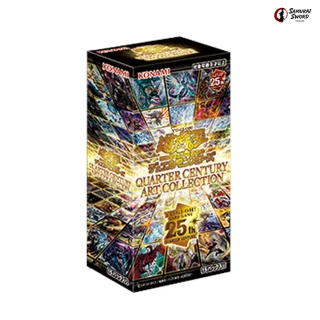
Released in Japan on February 22, 2025, QCAC is a 100-card special pack built around a single curatorial idea: every card in it exists with two or more illustrations. Konami took that pool of multi-artwork cards, reprinted them in premium rarities, added newly commissioned artwork, and folded in illustrations appearing in Japan for the first time. The result is less a booster set than a gallery you open four cards at a time — and it has become one of the most requested Japanese Yu-Gi-Oh products we track at our online store.
This guide explains exactly what QCAC is, how the 100-card list breaks down, what the Quarter Century Secret Rare treatment means, why the glowing-name Dark Magician Girl became the face of the set, and how international collectors actually go about ordering the Japanese version from Tokyo.
Availability Note — Restock Requests Open
Sealed Japanese QCAC booster boxes most recently sold in our store at ¥5,775 (~$35) and are currently out of stock. Because this is a Japan-origin collection product, allocations resurface in waves rather than on a schedule — the collectors who get boxes are the ones who ask first. You can register a restock request on the QCAC booster box product page or via Quick Order, and we’ll contact you when Tokyo supply lands.
100
Card Types
40 / 60
Ultra Rare / Super Rare
4 × 15
Cards per Pack × Packs per Box
2025
Feb 22 — Japan Release
Set facts below are per Konami’s official Japanese product page for QCAC. The only prices referenced in this article are our own store prices for sealed boxes.
What Is the Quarter Century Art Collection?
QUARTER CENTURY ART COLLECTION — QCAC on the pack code — is a Japanese OCG special pack released on Saturday, February 22, 2025. Its full official name is 遊戯王オフィシャルカードゲーム デュエルモンスターズ QUARTER CENTURY ART COLLECTION, and it sits in the “Quarter Century” family of products Konami built around Yu-Gi-Oh’s 25th anniversary era.
Spec
Detail
Set code
QCAC
Release date (Japan)
February 22, 2025
Card count
100 types total
Rarity split
40 Ultra Rare / 60 Super Rare
Pack configuration
4 cards per pack
Box configuration
15 packs per box
Concept
Cards with 2+ illustration variants, reprinted in premium rarities
Two things about that table are unusual by normal booster standards. First, there is no common or rare slot anywhere in the set — the floor is Super Rare. All 100 cards are foil reprints in premium treatments, which is why collectors talk about QCAC boxes the way Pokemon collectors talk about high-class packs: every single card that comes out of a pack is a “hit” by mainline-set standards.
Second, the selection logic is artistic rather than competitive. The 100 cards were not chosen because they define the current meta. They were chosen because they carry multiple illustrations — and that one criterion changes who the product is for. QCAC is aimed squarely at art collectors, binder builders, and anyone whose attachment to Yu-Gi-Oh runs through its characters and artwork rather than its tournament scene.
If you want to see the full 100-card list before chasing a box, we maintain a dedicated QCAC card list page you can browse card by card.
The Art-Variant Concept: Why Every Card Has at Least Two Faces
QCAC Quarter Century Art Collection — sealed Japanese booster box
The entry requirement for QCAC’s card list is simple: a card qualifies if two or more illustrations of it exist. In a game that has been running for a quarter century, that pool is rich — Yu-Gi-Oh has a long tradition of alternate-artwork printings, and the cards that receive multiple illustrations tend to be exactly the ones players and fans care about most. Signature monsters, iconic spells, characters with real story weight: multiple artworks are, in effect, a popularity signal, and QCAC harvested that signal into one product.
But QCAC is not just a reprint anthology of artwork that already existed. Konami layered in two more things on top of the base concept:
Newly commissioned artwork. Some cards in the set carry brand-new illustrations drawn for this product — artwork that did not exist anywhere before QCAC. For an art-themed set, this is the difference between a museum retrospective and a new exhibition: part of the appeal is seeing familiar cards through an illustrator’s fresh interpretation.
Japan-first illustrations. The set also includes illustrations making their first domestic appearance in Japan. Yu-Gi-Oh artwork does not always travel between regions at the same time or in the same form, and QCAC used that history as material — bringing art into the Japanese card pool that Japanese collectors had never been able to own locally.
Put those three layers together — multi-illustration icons, newly drawn art, and Japan-first debuts — and the collecting logic of the set becomes clear. You are not opening packs hoping to find one specific chase and treating the rest as filler. Each of the 100 cards is a deliberate artwork selection, which is why complete-set collecting and binder curation are far more common with QCAC than with a standard booster.
Quarter Century Secret Rares and the Glowing-Name Dark Magician Girl
The listed rarity floor of QCAC is Super Rare and Ultra Rare — but the treatment collectors chase hardest sits above the base list: the Quarter Century Secret Rare, the anniversary-era premium foil that has become the signature high rarity of the whole Quarter Century product family. QCAC carries a Quarter Century Secret Rare lineup as part of its premium rarity structure, which means the set’s most iconic artworks can appear in the most prestigious finish of the anniversary era.
And one card was given a treatment beyond even that.
The Face of the Set
QCAC includes a special Quarter Century Secret Rare Dark Magician Girl (Black Magician Girl in the OCG) featuring a glowing card name and the 25th anniversary logo. It is the set’s flagship anniversary variant — the card Konami built the product’s identity around.
The choice of Dark Magician Girl is no accident. She is arguably the single most illustrated character in Yu-Gi-Oh history — precisely the kind of multi-artwork icon the set’s concept was designed to celebrate — and giving her a one-off variant with a luminous name treatment and the anniversary mark turned her into the shorthand for the entire product. When collectors outside Japan ask us about “the QCAC Dark Magician Girl,” this is the card they mean.
For collectors, the practical takeaway is that QCAC operates on two levels at once. At the base level, every pack delivers premium-foil artwork from a curated 100-card list. Above that, the Quarter Century Secret Rare lineup — crowned by the glowing-name Dark Magician Girl — gives sealed boxes a genuine top-end ceiling. That combination of a high floor and an anniversary-grade ceiling is exactly what has kept demand for sealed Japanese boxes alive well past the release window.
Inside the Box: 15 Packs, 4 Cards, 100 Types
A sealed QCAC box contains 15 packs of 4 cards each — 60 cards per box, drawn from the 100-type list of 40 Ultra Rares and 60 Super Rares. That configuration shapes how people collect the set in three concrete ways:
No filler slots. With no common or rare tier, all 60 cards in a box are Super Rare or better. Opening a QCAC box feels categorically different from opening a mainline booster: there is no stack of bulk to set aside, only a curated spread of foil artwork.
One box cannot complete the set. Sixty cards against a 100-type list means a single box mathematically cannot hold every card — before even accounting for duplicates. Set completists typically work across multiple boxes or pair sealed boxes with targeted singles pickups from the QCAC card list.
Compact, display-friendly boxes. Fifteen four-card packs make for a small-format box, which matters more than it sounds: QCAC sealed boxes are collected as display objects in their own right, and the compact anniversary packaging is part of the appeal for sealed-product collectors.
It’s worth stating clearly what this article deliberately does not do: we are not quoting pull rates or per-card odds here. Konami does not publish insertion ratios, and secondhand ratio claims for a Japan-origin collection product age badly. What the official configuration guarantees is the part above — 60 premium-rarity cards per sealed box from a 100-card art-first list — and that is the honest basis on which to decide whether the product fits your collection.
Why Art Collectors Import the Japanese Version
QCAC is a Japan-origin product, and for the collectors this set is aimed at, the Japanese printing is the version that matters. A few reasons come up again and again in the orders we ship:
It is the original release. QCAC debuted in Japan on February 22, 2025 as a Japanese OCG product. For an art collection, provenance carries weight — the Japanese box is the form the product was designed in, with the original packaging, pack art, and card layout.
Japan-first illustrations live here. Part of the set’s stated concept is artwork making its first appearance in Japan. Collectors who follow Yu-Gi-Oh illustration history specifically want those cards in their Japanese printing, because that printing is the debut.
Japanese text as an aesthetic choice. This is an art set, and a large share of our buyers simply prefer how the artwork presents with Japanese card text — the same preference that drives imports of Japanese Pokemon and One Piece product. For binder display, the language of the text box is part of the composition.
Buying at the source. Japan-origin collection products are allocated to the Japanese market first, so Tokyo is where sealed supply surfaces. Importing directly from a Japan-based shop shortens the chain between you and that supply — relevant for a product that moves in waves rather than sitting on shelves.
If you are newer to importing, our Japanese Yu-Gi-Oh buying guide walks through the whole landscape — how the OCG relates to the TCG, what’s currently sealed and available, and how ordering from Japan actually works.
While QCAC itself is out of stock awaiting restock, collectors who want a sealed Japanese Yu-Gi-Oh box on the shelf now usually pick up the current mainline set instead:
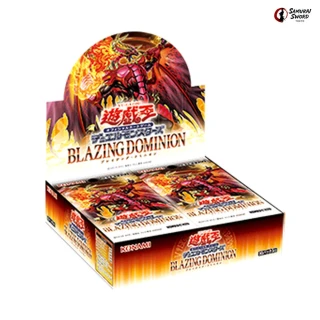
BLZD Blazing Dominion — the current-set Japanese booster box, in stock in Tokyo
QCAC and the Limit Over Collections: Konami’s Collection-Box Family
QCAC did not stay a one-off. In 2026, Konami released two more Japanese collection sets in the same 4-cards-per-pack, 15-packs-per-box format: LIMIT OVER COLLECTION – THE HEROES – (LOCH, February 28, 2026) and LIMIT OVER COLLECTION – THE RIVALS – (LOCR, March 20, 2026). Each is an 80-card set split 38 Ultra Rare / 42 Super Rare, and together they confirm that the premium small-box collection format QCAC helped define is now a recurring part of the OCG calendar.
The organizing idea shifted, though. Where QCAC curates by artwork — cards with multiple illustrations — the Limit Over Collections curate by character, with THE HEROES built around protagonist cards and THE RIVALS around their rivals. If QCAC’s gallery-first approach appeals to you, the Limit Over pair is the natural next shelf: we break both boxes down in our Limit Over Collection guide.
For a wider view of every recent Japanese Yu-Gi-Oh set and where each one fits, our Yu-Gi-Oh card list hub indexes the full lineup in one place.
How to Order QCAC from Tokyo
We ship sealed Japanese Yu-Gi-Oh product worldwide from Tokyo with tracked delivery. For QCAC specifically, the honest picture as of this writing: our most recent store price for a sealed box was ¥5,775 (~$35), and the box is currently out of stock — restock requests are the mechanism, and they genuinely drive what we hunt for first when Japan-side supply appears. Three ways forward from here:
Register a restock request. The QCAC booster box product page is the place to raise your hand. Requests are queued, and when boxes land in Tokyo we work through that queue before anything goes to general listing.
Study the set first. If you’re deciding between chasing sealed boxes and picking up specific cards, the QCAC card list lets you review all 100 types — and figure out whether your targets are Ultra Rare or Super Rare slots — before committing either way.
Ask us directly via Quick Order. For restock notifications, mixed orders, or anything not on a product page, Quick Order is the fastest line to us. Tell us you want QCAC and we’ll contact you when supply lands — no obligation attached to asking.
One closing note on timing: Japan-origin anniversary products don’t follow mainline reprint logic, and windows where sealed QCAC is buyable at a Tokyo storefront have been intermittent since release. If the set fits your collection, being on the request list costs nothing and decides who hears first.
Frequently Asked Questions
What is the Yu-Gi-Oh Quarter Century Art Collection (QCAC)?
QCAC is a Japanese OCG special pack released February 22, 2025. It collects 100 cards that each exist with two or more illustrations, reprinted in premium rarities — 40 Ultra Rares and 60 Super Rares — including newly commissioned artwork and illustrations debuting in Japan for the first time.
How many cards are in the QCAC set?
100 card types in total, split into 40 Ultra Rares and 60 Super Rares. There is no common or rare tier — every card in the set is a premium-rarity foil.
How many packs come in a QCAC booster box?
Each sealed Japanese QCAC box contains 15 packs with 4 cards per pack — 60 cards per box drawn from the 100-type list.
What is the special Dark Magician Girl in QCAC?
QCAC features a special Quarter Century Secret Rare Dark Magician Girl variant with a glowing card name and the 25th anniversary logo. It is the flagship anniversary card of the set and part of QCAC’s Quarter Century Secret Rare lineup.
Why do collectors buy the Japanese version of QCAC?
QCAC is a Japan-origin product: the Japanese box is the original release, it contains illustrations that debuted in Japan first, and many art collectors prefer the artwork presented with Japanese card text. Buying from a Tokyo shop also puts you closest to where sealed supply surfaces.
Is the QCAC booster box still available?
Our most recent store price for a sealed QCAC box was ¥5,775, and it is currently out of stock. You can register a restock request on the product page or via our Quick Order page, and we’ll contact you when new Tokyo supply lands.
Team Rocket Japanese Pokemon Cards: From 1997 Old-Backs to SV10 [2026]
Team Rocket has been stealing Pokemon — and selling Pokemon cards — for 29 years.
The villains debuted on Japanese cardboard in 1997, in an old-back expansion pack that predates the modern card back entirely. In 2026 they are back on top of the hobby again, headlining SV10 Glory of Team Rocket, a Japanese set built around six villain Special Art Rares and some of the most talked-about pull rates of the Scarlet & Violet era. In between sit anniversary promos, deck-set oddities, and graded singles that range from pocket money to five figures in yen — times ten.
This guide walks the whole 29-year arc from the Japanese side of the market, where we operate. We’re a Tokyo exporter of Japanese sealed product and PSA-graded singles, so every price in this article is either a live price from our own store shelf or a recent listing from our own inventory — not a scraped estimate. One quick note for English-side searchers: the “Team Rocket tin” you may have seen is an English-language product; this article covers the Japanese cards, which is what we stock and ship.
Key Takeaway
Japanese Team Rocket cards span three tiers: the modern SV10 Glory of Team Rocket booster box (¥22,048, in stock), PSA10 graded singles from ¥5,379 to ¥117,418 currently on our shelf, and the 1997 old-back “Team Rocket” expansion at the vintage summit — our PSA10 old-back Dragonite recently listed at ¥657,140 and sold. All ship worldwide from Tokyo.
29
Years of Team Rocket Cards
¥22,048
SV10 Box — In Stock
6
Villain SARs in SV10
6
PSA10 Singles In Stock
All prices are live prices from our online store as of August 2026, converted at ¥163/USD. Graded singles are one-of-one inventory — each slab listed exists as a single copy and can sell at any time.
The Modern Era: SV10 Glory of Team Rocket
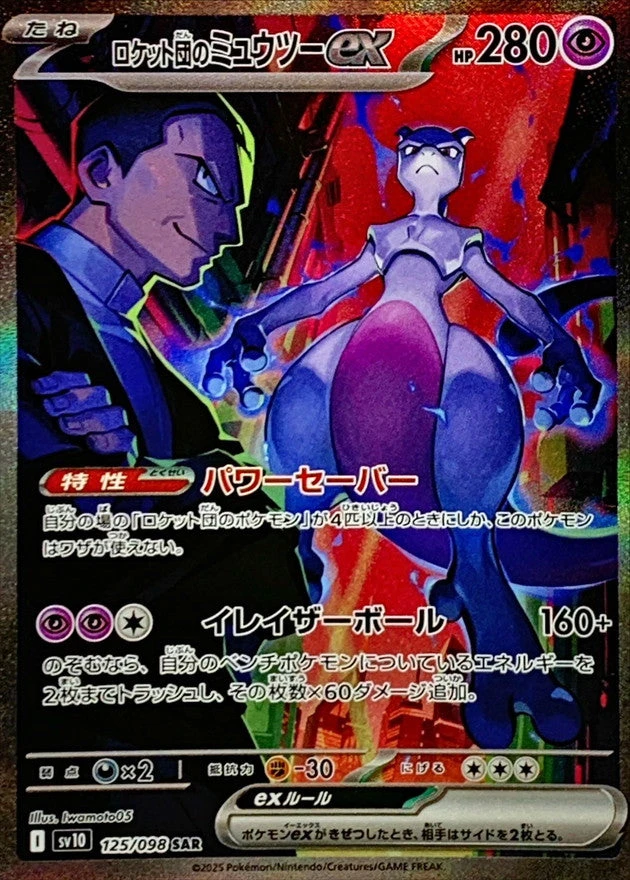
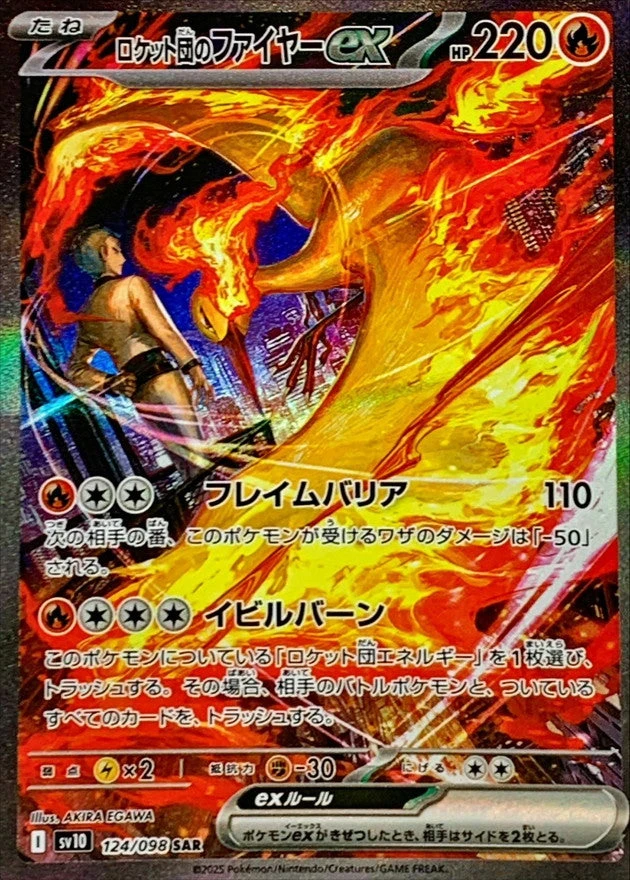
If you came to Team Rocket cards through the 2025–26 hype cycle, this is the set that did it. SV10 Glory of Team Rocket is the Japanese expansion that brought the villains back as the headline act rather than a side theme, and in our Glory of Team Rocket pull rates guide — compiled from data across 1,000+ pack openings — we called it one of the strongest SAR lineups in the Scarlet & Violet era. That wasn’t hype for its own sake: the set’s Special Art Rare slot is stacked with six villain-themed SARs, covering Mewtwo, Moltres, Nidoking, Crobat, Giovanni, and Ariana.
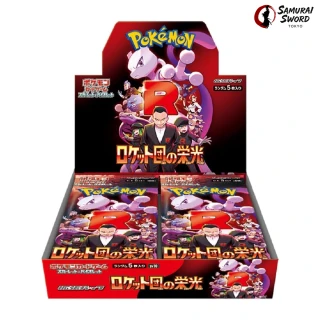
SV10 Glory of Team Rocket Japanese booster box — ¥22,048 in stock, ships from Tokyo
What makes the lineup unusual is coherence. Most modern sets scatter their chase cards across unrelated Pokemon; SV10 built an entire rogues’ gallery. Giovanni and Ariana bring the human villains onto Special Art Rare canvases, while the Pokemon SARs — Mewtwo, Moltres, Nidoking, Crobat — are drawn as the team’s enforcers rather than as neutral creatures. Collectors responded to that storytelling, and the market showed it immediately.
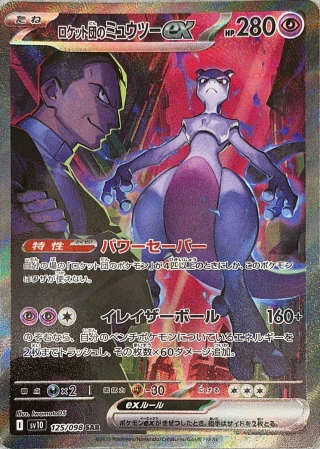
Team Rocket’s Mewtwo ex
SAR — one of six villain SARs
Team Rocket’s Moltres ex
SAR — one of six villain SARs
The box price tells the story of the whole release in three acts. At its peak, the Japanese booster box traded around ¥38,000 (~$233) — a number driven by allocation shortages and the sheer pull of that SAR lineup. It then cooled sharply as reprint supply arrived; at one point our own guide measured boxes around ¥17,000. Today it has settled between those extremes: our current store price is ¥22,048 (~$135), in stock at our SV10 Glory of Team Rocket booster box page. For a set this recent, that journey — spike, correction, stabilization — is about as healthy as a chase set gets, and it means buyers today are no longer paying the panic premium of the launch window.
If the rarity codes here are unfamiliar — SAR, AR, UR and how they rank — our Japanese Pokemon card rarities explained guide covers the full ladder. The short version for this set: AR cards are alternate-art rares that appear regularly, SAR cards are the full-canvas special art rares that carry the set’s value, and the UR is the gold-treatment secret rare at the very end of the print sheet. All of the villain chase cards discussed in this article live in the SAR and UR slots.
One more reason this set matters to buyers outside Japan: it is a Japanese-first release. The Japanese printing is the one the character artists’ work debuts in, the one Japanese grading submissions come from, and the one that established the market prices everyone else references. For collectors who intend to grade, that matters — Japanese print runs are widely regarded by collectors as the cleaner product out of the pack, which is a real consideration when a PSA 10 is the goal.
Sealed vs Singles
A box at ¥22,048 is the lottery ticket; the graded singles below are the guaranteed outcomes. Which route makes sense depends on whether you want the opening experience or the specific card — the next section prices the second option.
PSA10 Team Rocket Singles In Stock Right Now
Everything in this table is a PSA10 slab physically on our shelf in Tokyo as of this writing. These are one-of-one listings — when a slab sells, it’s gone until we source another — so treat this as a snapshot of a working inventory rather than a permanent catalogue.
#
Card
Number
Grade
Store price
1
Team Rocket’s Koffing SAR
SV10 125/098
PSA 10
¥117,418 (~$720)
2
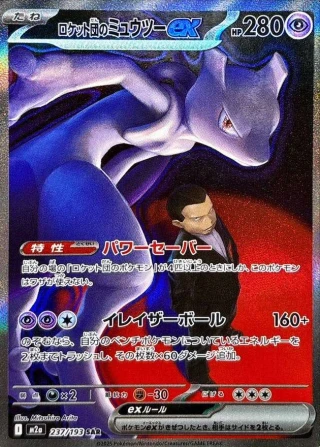
Team Rocket’s Ariana SAR
237/193
PSA 10
¥36,915 (~$226)
3
Team Rocket’s Mewtwo ex (promo)
P 043/M-P
PSA 10
¥32,823 (~$201)
4
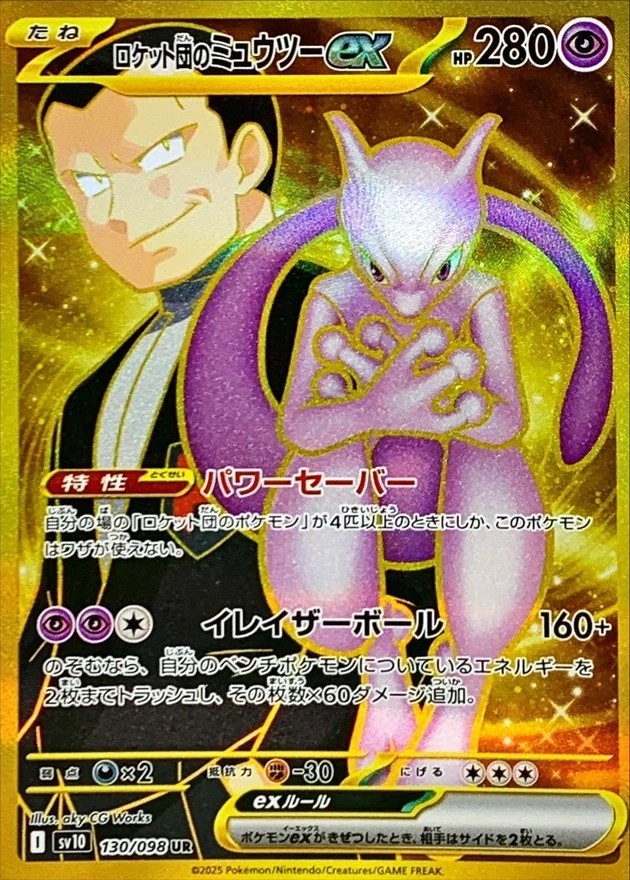
Team Rocket’s Mewtwo UR
SV10 130/098
PSA 10
¥27,007 (~$166)
5
Rocket’s Thunder (25th Anniversary promo)
008/025
PSA 10
¥13,335 (~$82)
6
Team Rocket’s Orbeetle AR
SV10 104/098
PSA 10
¥5,379 (~$33)
The spread here is instructive. At the bottom, the Orbeetle AR at ¥5,379 (~$33) is a genuine entry-level slab: a PSA10 art rare from the hottest villain set of the era for roughly the price of three booster packs’ worth of impulse spending. In the middle, the two Mewtwo — the SV10 UR at ¥27,007 and the M-P promo at ¥32,823 — give you the franchise’s most famous villain-adjacent Pokemon in two different frames, and the Ariana SAR at ¥36,915 puts one of the set’s human villains on the shelf in top grade.
Team Rocket’s Mewtwo UR — PSA 10
¥27,007 (~$166)
Team Rocket’s Ariana SAR — PSA 10
¥36,915 (~$226)
And at the top sits the surprise: Team Rocket’s Koffing SAR at ¥117,418 (~$720) — the most expensive graded Team Rocket card on our shelf, ahead of every Mewtwo we stock. A Koffing. We’ll unpack why in the next section, because the answer says a lot about how modern Japanese chase cards actually work.
Why PSA 10 specifically? Top-grade slabs consistently command a multiple over raw copies of the same card, and the gap widens as the card gets scarcer — a dynamic we break down with real examples in our PSA10 Mega Pokemon cards guide. For a villain set where the art is the entire point, condition certainty is worth paying for.
One-of-One Inventory
Each graded single above is a single physical slab. Prices are live at time of writing but availability changes without notice — if a card matters to you, check the current listing on our PSA10 collection before planning around it.
Why a Koffing Outprices Mewtwo
Team Rocket’s Koffing SAR, PSA 10 — the top graded Team Rocket card on our shelf at ¥117,418
On paper it looks backwards. Mewtwo is one of the most famous Pokemon ever printed; Koffing is a first-route poison ball. Yet on our shelf, the PSA10 Koffing SAR at ¥117,418 sits more than four times higher than the PSA10 Mewtwo UR at ¥27,007. This isn’t a quirk of our pricing — it reflects how the Japanese market has treated the card — and the logic behind it is worth understanding before you buy anything from a character-driven set.
The first factor is which demand a card taps. Mewtwo cards are plentiful across three decades of printings, so demand for “a great Mewtwo card” spreads across dozens of options in every era and price band. Koffing, by contrast, almost never gets a premium art slot. When a set finally gives a supporting character its one showcase card, that card becomes the single destination for everyone who wants it — there is no substitute printing to absorb the demand.
The second factor is what the art is actually of. Koffing isn’t just a Pokemon in Team Rocket’s world — it’s the team’s mascot-tier sidekick, inseparable from the anime’s villain duo since 1997. A Team Rocket-themed Koffing SAR is less a “Koffing card” than a Team Rocket character piece, and character-story SARs are precisely what the SV10 collector base formed around. Nostalgia demand attaches to the scene, not to the Pokedex entry.
The third factor is rarity structure. Both cards come from the same boxes, but within the secret-rare slots, the market has room to rank them — and when collectors converge on one SAR as the set’s identity card, its price separates from the rest of the sheet. That convergence is qualitative and can shift, which is exactly why we’d rather show you our live shelf prices than quote a theory.
The practical lesson: in villain and character sets, don’t price cards by the Pokemon’s fame. Price them by how rarely that character gets premium treatment. It’s the same dynamic that makes trainer-character cards outperform legendary Pokemon in set after set — and it’s why the humble Koffing is, for now, the king of our Team Rocket shelf.
The Vintage Summit: 1997’s Old-Back “Team Rocket” Expansion
Everything above is the modern chapter. The original chapter was printed in 1997, when Japan released the expansion pack known simply as “Team Rocket” (Rocket Gang, PMCG4) — the set that put the villains on cards for the first time and introduced the “Dark” Pokemon concept that would define villain-themed cards for years.
These are old-back cards, or kyu-ura in Japanese collecting slang: printed before Japan adopted the standardized card back in use since the early 2000s, they carry the original Japanese back design that instantly identifies a card as pre-modern. Old-back sets sit at the top of the Japanese vintage hierarchy for the same reasons early English sets do — age, attrition, and the fact that almost nothing from 1997 survived three decades of playgrounds in grade-worthy condition.
We won’t quote a market table for this set, because vintage old-back singles trade thinly and third-party price estimates are notoriously unreliable. What we can tell you is what has passed through our own inventory: our PSA10 old-back Dragonite from the 1997 Team Rocket expansion (No. 149) recently listed at ¥657,140 (~$4,030) — and it is currently sold. That single data point tells you most of what you need to know about the ceiling: a top-graded card from this set trades at roughly thirty modern booster boxes’ worth of yen, and buyers are there when one surfaces.
For collectors, the practical realities of old-back hunting are these:
Population is the story. High-grade old-backs are scarce in absolute terms, so availability — not list price — is usually the binding constraint. Copies appear when they appear.
Authentication matters more than anywhere else. A graded slab from PSA removes the two big vintage risks — condition disputes and authenticity — which is why nearly all serious old-back trade happens in slabs.
Japan is the source market. These cards were never printed anywhere else, and the deepest supply still surfaces domestically — which is precisely the pipeline a Tokyo exporter exists to serve.
Want-List the Vintage
Because old-back inventory is irregular, the efficient move is to tell us what you’re hunting rather than waiting for a listing to appear. Our Quick Order page exists for exactly this — more in the buying section below.
Promo Corner: 25th Anniversary Rockets and the Satoshi VS Team Rocket Deck
Between 1997 and SV10, the most collectible Team Rocket cards came not from expansions but from promos and special products — a corner of the market that rewards knowing exactly what exists.
The 25th Anniversary promos (2021) are the accessible end. Japan’s 25th Anniversary celebration produced a promo series that included Team Rocket nostalgia cards, and two of them matter here. Rocket’s Thunder (008/025) is the one currently on our shelf — a PSA10 copy at ¥13,335 (~$82), which makes it one of the cheapest ways to own a graded piece of the anniversary series. Its sibling, Here Comes Team Rocket! (S8a-P 006/025), revives one of the franchise’s most beloved villain artworks; a PSA10 copy recently listed on our store at ¥11,376 (~$70) and sold to an overseas buyer, which is typical of how quickly these anniversary Rockets move when they surface.
At the other end of the spectrum sits a genuine oddity: the “Satoshi VS Team Rocket” 30-card deck set, a Japanese deck product that pitted the anime’s hero against the villain duo. Deck-exclusive cards like these were never available in boosters, print runs were modest, and high-grade survivors are rare — a combination that puts top slabs from this product firmly in grail territory. From our own inventory: a PSA10 Mimikyu GX from the set recently listed at ¥182,310 (~$1,120) and is currently sold.
The pattern across the promo corner is consistent with everything else in this guide: Japanese Team Rocket material that was distributed narrowly — promo packs, deck sets, anniversary products — separates in price from booster-set cards and stays separated. If a Team Rocket card was hard to get on day one, it is much harder to get now.
It’s also the corner of the market where doing your homework pays off most. Booster-set chase cards have visible, liquid markets; promo and deck-set cards trade in ones and twos, which means a patient buyer with a clear target list has a real edge over someone browsing whatever happens to be listed. Knowing that Rocket’s Thunder and Here Comes Team Rocket! are siblings from the same anniversary series, or that the Satoshi VS Team Rocket deck exists at all, is exactly the kind of knowledge that separates a deliberate collection from an expensive accumulation.
Sold Listings Are Not Offers
The Here Comes Team Rocket!, Mimikyu GX, and old-back Dragonite figures above are recent one-of-one listings from our store that have already sold. They’re shared as reference points from our own sales history, not as available inventory or as market-wide price guides.
How to Buy Team Rocket Cards from Japan
We ship Japanese sealed product and graded singles worldwide from Tokyo with tracked delivery. For Team Rocket collectors, there are three practical routes, and they map onto the three tiers this guide has covered.
Route one: the sealed box. If you want the SV10 experience — the pack-opening, the shot at the six villain SARs — the booster box is the direct path, and at ¥22,048 it’s well off its ¥38,000 peak.
Route two: graded singles. If you want a specific card in certainty-grade condition — the Koffing SAR, a Mewtwo, the anniversary promos — browse our PSA10 collection. Everything there is a slab we physically hold in Tokyo, priced in yen off the Japanese market we buy from daily. Remember the one-of-one rule: what you see is the copy we have.
Route three: the want list. For anything not currently listed — vintage old-backs, deck-set exclusives, a particular SV10 SAR in PSA10 — use our Quick Order page. Tell us the cards you’re hunting and we source from the Japanese domestic market, which is where old-back and promo material surfaces first. This is by far the most effective route for the vintage tier, where waiting for a public listing can mean waiting a very long time.
Two practical notes for international buyers. First, all our pricing is in yen; at the current ¥163/USD rate, the yen prices in this article convert favorably for dollar-based collectors compared to recent years. Second, every order ships tracked from Tokyo — sealed boxes and slabs alike — so the same logistics apply whether you’re importing one Orbeetle or an old-back grail.
If you’re deciding between the three routes, a simple framework: buy sealed when the opening experience is part of the value for you, buy graded singles when a specific card is the goal and condition certainty matters, and use the want list when the card you’re after simply isn’t in public circulation. Plenty of our Team Rocket customers end up doing all three — a box for the fun of it, a slab or two for the collection, and a standing want list for the vintage piece they’re patient about.
Frequently Asked Questions
What is Glory of Team Rocket (SV10)?
SV10 Glory of Team Rocket is the Japanese expansion that brought Team Rocket back as a headline theme, with six villain Special Art Rares — Mewtwo, Moltres, Nidoking, Crobat, Giovanni, and Ariana. Our store currently has the Japanese booster box in stock at ¥22,048 (~$135), down from its ¥38,000 peak.
What is the most valuable Team Rocket card?
From our own inventory: the top graded Team Rocket card currently in stock is a PSA10 Team Rocket’s Koffing SAR at ¥117,418 (~$720), and the highest-priced Team Rocket card we’ve recently listed was a PSA10 old-back Dragonite from the 1997 Japanese Team Rocket expansion at ¥657,140 (~$4,030), which has sold. Vintage old-back prices vary widely by card and grade, so we only quote our own listings.
What does “old-back” mean for Japanese Pokemon cards?
Old-back (kyu-ura) refers to Japanese cards printed before Japan adopted the standardized modern card back in the early 2000s. The 1997 Team Rocket expansion is an old-back set, which places it in the oldest and scarcest tier of Japanese vintage.
Why is the Koffing SAR worth more than the Mewtwo cards?
Character-art scarcity. Mewtwo demand spreads across decades of printings, while Koffing — Team Rocket’s signature sidekick — almost never receives a premium art card. The SV10 SAR is the single destination for that demand, so collectors have converged on it as one of the set’s identity cards.
Is there an English version of the Team Rocket products?
Yes — English-language Team Rocket products exist, including the “Team Rocket tin” many collectors search for. This guide covers the Japanese cards, which release first, are printed separately, and are what we stock and export from Tokyo.
What is the Satoshi VS Team Rocket deck set?
A Japanese 30-card deck product themed around the anime’s hero-versus-villain matchup, with deck-exclusive cards never available in boosters. High-grade cards from it are rare; a PSA10 Mimikyu GX from the set recently listed on our store at ¥182,310 (~$1,120) and has sold.
Do you ship Team Rocket cards internationally?
Yes. We ship sealed boxes and PSA-graded singles worldwide from Tokyo with tracked delivery. For cards not currently listed — especially vintage old-backs and promos — submit a want list through our Quick Order page and we source from the Japanese domestic market.
Mega Pokemon PSA 10 Cards: XY-Era Grails vs the New MEGA Era
The cheapest PSA 10 in this guide costs ¥6,393. The most expensive costs ¥752,971. Both are Mega Evolution Pokemon cards, both are Japanese, and both are sitting in our Tokyo stock room right now.
That gap exists because “Mega Pokemon card” now means two completely different things. The first Mega era ran through Japan’s XY sets from 2014 to 2016 — M Charizard EX, M Gengar EX, M Gardevoir EX — and a decade later, Japanese SRs from those sets have become genuinely hard to find in PSA 10. The second era started in 2026, when Pokemon revived the mechanic for the Japanese M-series sets (M1 through M6), putting brand-new MEGA ex cards with Special Art Rares into circulation at prices an ordinary collector can actually pay.
Most price guides cover one era or the other. This one puts both side by side, using a data source we can fully vouch for: our own store. Every card below is a PSA 10 graded single physically in stock at SAMURAI SWORD in Tokyo, listed at our live August 2026 price. No estimates, no “last known sale” — these are the numbers on the shelf.
Key Takeaway
Mega Evolution cards span two eras with two price languages. Vintage XY-era Japanese SRs in PSA 10 run from ¥23,690 to ¥752,971 in our current stock, led by M Charizard EX SR 091/087. The 2026 MEGA era starts at ¥6,393 and tops out under ¥50,000 — modern SAR artwork in the same PSA 10 grade at a fraction of the vintage cost.
23
PSA 10s in Stock
¥752,971
Top Card (M Charizard SR)
¥6,393
Lowest Entry
2
Eras Covered
All prices are our live store prices as of August 2026, in JPY with approximate USD at ¥163/USD. Every card is a PSA 10 graded single — one physical copy per listing. When a copy sells, that listing is gone and the next copy we source may be priced differently. Availability reflects the moment you read this, not the moment we wrote it.
Every Mega PSA 10 in Stock, Ranked by Price
Twenty-three cards, two eras, one table. Vintage XY-era cards are marked XY; 2026 M-series cards are marked MEGA.
#
Card
Era
Our PSA 10 price
1
M Charizard EX SR 091/087
XY
¥752,971 (~$4,620)
2
M Gengar EX RR 1st Edition (XY4 034/088, Phantom Gate)
XY
¥515,000 (~$3,160)
3
M Gardevoir EX RR 020/032
XY
¥199,161 (~$1,220)
4
M Gardevoir EX SR 1st Edition (XY11-1 057/054, Cruel Traitor)
XY
¥102,999 (~$632)
5
M Gardevoir EX SR (XY5 076/070, Tidal Storm)
XY
¥95,675 (~$587)
6
M Venusaur EX SR 1st Edition (CP6 089/087, 20th Anniversary)
XY
¥91,660 (~$562)
7
M Gengar EX (CP4 049/131, Premium Champion Pack)
XY
¥80,134 (~$492)
8
M Scizor EX SR (XY9 087/080, Anger of Heaven)
XY
¥61,800 (~$379)
9
M Steelix EX SR 1st Edition (XY11-2 057/054, Fever-Burst Fighter)
XY
¥52,530 (~$322)
10
MEGA Dragonite ex 246/193 SAR
MEGA
¥49,953 (~$306)
11
M Venusaur EX 002/072
XY
¥36,874 (~$226)
12
MEGA Meganium ex SAR Style (MC 761/742, Battle Collection)
MEGA
¥35,556 (~$218)
13
M Sharpedo EX (XY 071/171, The Best of XY)
XY
¥27,604 (~$169)
14
M Gardevoir EX 092/171
XY
¥23,690 (~$145)
15
MEGA Charizard X ex MA 223/193
MEGA
¥17,508 (~$107)
16
MEGA Dragalge ex SAR (M4 116/083, Ninja Spinner)
MEGA
¥12,133 (~$74)
17
MEGA Dragonite ex MA 232/193
MEGA
¥11,297 (~$69)
18
MEGA Clefable ex 112/080 SAR
MEGA
¥9,268 (~$57)
19
MEGA Scrafty ex 241/193 SAR
MEGA
¥9,177 (~$56)
20
MEGA Lucario ex SR 078/063
MEGA
¥8,516 (~$52)
21
Mega Hawlucha ex 239/193 SAR
MEGA
¥8,071 (~$50)
22
MEGA Lopunny ex 114/080 SAR
MEGA
¥6,647 (~$41)
23
MEGA Eelektross ex 235/193 SAR
MEGA
¥6,393 (~$39)
The pattern is unmistakable. The top nine slots all belong to the vintage XY era, and the first modern card doesn’t appear until MEGA Dragonite ex SAR at #10. From #15 down, the list is almost entirely 2026 product — Special Art Rares in PSA 10 for less than the price of a single sealed booster box.
That split is not an accident of our inventory. It reflects how the two eras were made, aged, and graded, which the rest of this guide unpacks card by card.
One Copy Per Listing
Graded singles are one-of-one stock. Each row above is a specific PSA 10 slab, not a product with a quantity behind it. If the card you want is in stock at the price shown, it is available exactly once — and the price you see today applies to that copy only.
The XY-Era Grails (2014–2016)
Mega Evolution debuted on cards in Japan’s XY sets, and the era produced the first wave of Mega chase cards: full-art SRs of M Charizard, M Gengar, M Gardevoir and their peers. These were pulled, played, sleeved badly, traded at school, and generally treated like the ordinary cards they were at the time. A decade later, Japanese XY-era SRs are scarce in PSA 10 — the surviving copies that grade gem mint are a thin slice of what was printed, and the market prices them accordingly.
Here are the four headline slabs in our stock right now.
M Charizard EX SR 091/087
¥752,971 (~$4,620)
M Gengar EX RR 1st Edition (Phantom Gate)
¥515,000 (~$3,160)
M Gardevoir EX SR (Tidal Storm)
¥95,675 (~$587)
M Venusaur EX SR 1st Edition (20th Anniversary)
¥91,660 (~$562)
M Charizard EX SR 091/087 — ¥752,971
The top of the entire lineup, and it isn’t close. Charizard sits at the intersection of everything that drives Japanese vintage prices: the single most collected Pokemon in the hobby, a secret-rare full art from the first Mega era, and a PSA 10 grade on a card that most surviving owners can’t match. At ¥752,971 (~$4,620), this is a destination card — the kind of slab a Mega collection gets built around rather than added to. We have exactly one, and cards at this level historically do not sit in our stock long.
M Gengar EX RR 1st Edition (Phantom Gate) — ¥515,000
The second grail is a lesson in what actually makes vintage Japanese cards expensive. This is not a secret rare — it’s the RR printing from Phantom Gate (XY4, 034/088). What puts it at ¥515,000 (~$3,160) is the combination of the 1st Edition stamp, Gengar’s enduring pull as a fan favourite, and the gem mint grade. Japanese XY-era sets ran a first print with a 1st Edition mark, and collectors treat those stamped copies as the definitive version of the card. A 1st Edition RR in PSA 10 from 2014 is a fundamentally different object from the same card unstamped in a binder.
The M Gardevoir EX Trio — ¥23,690 to ¥199,161
Gardevoir is the quiet strength of the XY Mega lineup, and our stock happens to hold four distinct printings — a ready-made study in how printing details set price:
Printing
Details
Our PSA 10 price
M Gardevoir EX RR 020/032
RR printing
¥199,161 (~$1,220)
M Gardevoir EX SR 1st Edition
XY11-1 057/054, Cruel Traitor
¥102,999 (~$632)
M Gardevoir EX SR
XY5 076/070, Tidal Storm
¥95,675 (~$587)
M Gardevoir EX 092/171
Reprint compilation number
¥23,690 (~$145)
Same Pokemon, same mechanic, an 8x spread. The RR 020/032 leads the trio at ¥199,161; the two SR full arts — the 1st Edition Cruel Traitor printing and the Tidal Storm printing — sit close together around the ¥100,000 line; and the 092/171 compilation printing is the accessible way to put a gem mint Mega Gardevoir in the cabinet at ¥23,690. If you’ve read our Japanese PSA 10 price guide, this is the recurring theme: with vintage Japanese cards, the card number and stamp matter as much as the character.
M Venusaur EX SR 1st Edition (20th Anniversary) — ¥91,660
The CP6 20th Anniversary set is one of the most beloved Japanese sets ever printed, recreating the feel of the original Base Set era, and its secret-rare slots have aged into serious collector territory. Our 1st Edition M Venusaur EX SR 089/087 in PSA 10 lists at ¥91,660 (~$562) — a 2016 anniversary secret rare of a first-generation starter, stamped, in the top grade. For Venusaur loyalists there is no more definitive Mega-era card. We also hold the M Venusaur EX 002/072 printing at ¥36,874 (~$226) for collectors who want the character without the anniversary premium.
The Accessible XY Tier: ¥23,690–¥80,134
Below the grails, the XY era still offers real vintage in PSA 10 at prices that overlap with the modern market:
M Gengar EX (CP4, Premium Champion Pack)
¥80,134 (~$492)
M Scizor EX SR (Anger of Heaven)
¥61,800 (~$379)
M Steelix EX SR 1st Edition (Fever-Burst Fighter)
¥52,530 (~$322)
M Gardevoir EX 092/171
¥23,690 (~$145)
The CP4 M Gengar EX (¥80,134) comes from the Premium Champion Pack and gives you the same character as the ¥515,000 grail at under a sixth of the price. The M Scizor EX SR (¥61,800) and 1st Edition M Steelix EX SR (¥52,530) are the sleeper picks of the whole vintage list — genuine XY-era secret-rare full arts in PSA 10, from the same 2016 sets as the Gardevoir grails, priced where a serious collection can actually reach them. And the M Sharpedo EX from The Best of XY (¥27,604) covers the compilation-set angle for completionists.
Collector’s Note
With XY-era Japanese cards, always check for the 1st Edition stamp and the exact card number before comparing prices anywhere. The same artwork can exist as an unlimited printing, a 1st Edition printing, and a later compilation reprint — three different cards to the market, even in identical grades.
The New MEGA Era (2026)
In 2026 Pokemon brought Mega Evolution back as the headline mechanic of the Japanese M-series sets — M1 through the newly released M6, plus the MEGA Battle Collection. The new cards use the modern SAR (Special Art Rare) treatment: full-bleed, illustrator-driven artwork that many collectors rate above anything the XY era printed. And because these sets are in or near current print, PSA 10 copies exist at prices the vintage market left behind years ago.
This is the era’s defining trade-off, and for a lot of collectors it’s the right one: you give up vintage scarcity, and you get modern artwork in the same gem mint grade for one-tenth to one-hundredth of the money.
MEGA Dragonite ex 246/193 SAR
¥49,953 (~$306)
MEGA Meganium ex SAR Style (Battle Collection)
¥35,556 (~$218)
MEGA Dragalge ex SAR (M4, Ninja Spinner)
¥12,133 (~$74)
MEGA Clefable ex 112/080 SAR
¥9,268 (~$57)
MEGA Lucario ex SR 078/063
¥8,516 (~$52)
The Modern Headliner: MEGA Dragonite ex SAR — ¥49,953
MEGA Dragonite ex 246/193 SAR is the most expensive modern Mega card in our stock at ¥49,953 (~$306) — the only 2026 card that prices into vintage territory, landing between the XY-era Steelix SR and Venusaur 002/072. Dragonite has been a collector favourite since 1996, and this SAR is the card the new era gets judged by. We also hold the MEGA Dragonite ex MA 232/193 printing at ¥11,297 (~$69) — same Pokemon, same set family, under a quarter of the price, which tells you exactly how much the SAR artwork slot carries.
The Mid Tier: Meganium and Charizard X — ¥17,508–¥35,556
The MEGA Meganium ex SAR Style (¥35,556) comes from the MEGA Battle Collection with the towering card number 761/742 — a secret-slot printing from a special set, and the second most valuable modern Mega we hold. The MEGA Charizard X ex MA (¥17,508) is the fascinating one: a brand-new Charizard Mega card in PSA 10 for about 2% of what our XY-era Charizard SR costs. If you have ever wanted a gem mint Mega Charizard and been priced out of the vintage one, this is the era answering you directly.
The Entry Tier: SAR Artwork Under ¥10,000
Below ¥10,000 the 2026 era gets genuinely democratic. MEGA Clefable ex SAR (¥9,268), MEGA Scrafty ex SAR (¥9,177), MEGA Lucario ex SR (¥8,516), Mega Hawlucha ex SAR (¥8,071), MEGA Lopunny ex SAR (¥6,647), and MEGA Eelektross ex SAR (¥6,393) — six PSA 10 slabs, all with premium artwork treatments, all under ¥10,000 each. The whole tier together costs less than one XY-era Steelix. For a new collector, that’s a display shelf of graded modern Megas for the price of a single mid-tier vintage card. The MEGA Dragalge ex SAR from M4 Ninja Spinner (¥12,133) sits just above the line and rounds out the group.
The gap between ¥752,971 and ¥6,393 for cards sharing the same mechanic comes down to supply-side history, not character popularity — Charizard, Gengar, and Dragonite appear on both sides of the ledger.
The XY print runs ended a decade ago. The 2014–2016 Japanese sets were printed for their own era’s player base, and when the sets rotated out, the supply was fixed forever. No reprint of those exact cards, with those numbers and stamps, has existed since.
Ten years of attrition did the rest. Cards from that era were opened to be played. Copies were shuffled unsleeved, carried to tournaments, traded hand to hand. The fraction that survived untouched — and then survived PSA’s grading standards at the gem mint level — is what the vintage market is actually pricing. A PSA 10 XY-era SR is scarce twice over: scarce as a surviving card, and scarcer still as a perfect one.
The MEGA era is still being printed. The 2026 M-series sets are current product. Pristine copies go straight from pack to sleeve to grading submission, so PSA 10s enter the market steadily and prices stay anchored near the cost of pulling and grading the card. That’s not a weakness — it’s what makes the era collectable at scale — but it means today’s MEGA SAR and a 2015 SR are in completely different supply situations.
The honest way to frame it: the XY era sells you scarcity that already happened, and the MEGA era sells you artwork whose scarcity story hasn’t been written yet. Whether the 2026 cards eventually follow the vintage path is a question nobody can answer from here — what you can know today is that both eras are available in the same grade, and one of them costs two orders of magnitude less.
How to Choose by Budget
Working from our live stock list, here’s how the two eras map to a budget:
Under ¥10,000 (~$61) — Exclusively MEGA-era territory, and it’s rich: Clefable, Scrafty, Lucario, Hawlucha, Lopunny, and Eelektross, all PSA 10, from ¥6,393 to ¥9,268. This is the best on-ramp to graded collecting in the current hobby — real slabs, premium art, pocket-money prices.
¥10,000–¥50,000 (~$61–$306) — The crossover zone, and the most interesting bracket in the guide. Modern picks: Dragalge SAR (¥12,133), Charizard X MA (¥17,508), Meganium SAR Style (¥35,556), Dragonite SAR (¥49,953). Vintage picks: M Gardevoir EX 092/171 (¥23,690), M Sharpedo EX (¥27,604), M Venusaur EX 002/072 (¥36,874). Here you genuinely choose between a decade-old card and a brand-new one at the same price.
¥50,000–¥110,000 (~$306–$675) — Vintage SR territory begins: Steelix SR 1st Edition (¥52,530), Scizor SR (¥61,800), Gengar CP4 (¥80,134), Venusaur SR 1st Edition (¥91,660), Gardevoir SR Tidal Storm (¥95,675), Gardevoir SR 1st Edition (¥102,999). Every card in this tier is a full XY-era secret or promo printing in PSA 10 — the sweet spot where vintage credibility meets a reachable price.
The grails: ¥199,161 and up — Gardevoir RR 020/032 (¥199,161), Gengar RR 1st Edition (¥515,000), and the Charizard SR (¥752,971). One-of-one slabs at the top of the Mega hierarchy. Buyers at this level usually know exactly which card they came for.
A Two-Era Strategy
Plenty of our regular buyers mix eras deliberately: one vintage anchor card, surrounded by modern SARs of the same or related Pokemon. A ¥100,000 budget could take the Tidal Storm Gardevoir SR alone — or the Steelix SR plus five modern SAR slabs. Neither answer is wrong; they’re just different collections.
Where to Buy PSA 10 Mega Cards from Japan
Every card in this guide was sourced and graded through our Japan-side operation. We buy in the Tokyo market — where XY-era Japanese cards actually circulate — hold the slabs in stock, and ship worldwide from Tokyo with tracked delivery. Because graded singles are one-of-one, what you see on the collection page at any moment is precisely what exists; there is no backorder on a PSA 10.
Browse the Stock
All PSA 10 Graded Singles
Every card in this guide, live prices, one copy each
Building a mixed order — a few slabs plus sealed boxes, or singles across several sets — is fastest through our Quick Order page. And if you’re buying graded cards in quantity, our guide on how to buy PSA 10 Pokemon cards in bulk from Japan covers how wholesale-scale orders work with us.
Frequently Asked Questions
What is the most valuable Mega Pokemon card in PSA 10?
In our current stock, it’s the Japanese M Charizard EX SR 091/087 from the vintage XY era at ¥752,971 (~$4,620). The next tier down is the M Gengar EX RR 1st Edition from Phantom Gate at ¥515,000. Both are one-of-one graded singles, so availability changes the moment a copy sells.
Why are XY-era Mega cards so much more expensive than the 2026 MEGA-era cards?
Supply history. The Japanese XY sets were printed in 2014–2016 and never reprinted in those exact forms, and a decade of play and handling means few surviving copies grade PSA 10 today. The 2026 M-series sets are current product, so pristine copies flow steadily into grading and PSA 10 prices stay close to the cost of pulling the card.
Are the 2026 MEGA-era cards a good entry point for graded collecting?
They’re the most accessible one in years. In our stock, six MEGA-era PSA 10 slabs with SAR or SR artwork sit under ¥10,000 (~$61) each — a full display shelf of graded modern cards for the price of one mid-tier vintage SR. Whether they ever follow the vintage price path is unknowable; what you get today is top-grade modern artwork at modern prices.
What does “1st Edition” mean on Japanese XY-era cards?
Japanese XY-era sets ran a first print carrying a 1st Edition stamp, with later prints unstamped. Collectors treat the stamped copies as the earliest and most desirable version of the card, which is why our M Gengar EX RR 1st Edition, M Venusaur EX SR 1st Edition, M Gardevoir EX SR 1st Edition, and M Steelix EX SR 1st Edition are listed as distinct printings rather than generic copies.
Are the prices in this guide fixed?
They are our live store prices as of August 2026. Every card is a one-of-one graded single: when a copy sells, the listing ends, and any replacement copy we source is priced at the market we buy into at that time. Treat the figures here as a dated snapshot and check the live collection page for the current state.
Do you ship PSA 10 graded cards internationally?
Yes. All graded singles ship from our Tokyo operation worldwide with tracked delivery, packed for slab protection. You can combine graded singles with sealed product in one order through the Quick Order page.
PSA 10 Japanese Trainer Cards Guide: Lillie, Acerola, Iono, Erika And More
PSA 10 Japanese Trainer Cards Guide: Lillie, Acerola, Iono, Erika And More
Last updated: June 4, 2026. Market data, canonical CTA links, and gallery product links were refreshed before upload packaging.
This guide focuses on the buying workflow for PSA 10 Japanese Pokemon cards, including how to browse current SST inventory and when to use the wholesale inquiry path for larger orders.
Trainer PSA 10s In Stock — August 2026
Graded trainer singles on the shelf right now (one-of-one stock; prices are live store prices): Lillie SR 066/060 ¥1,442,000 · Marnie SR 068/060 ¥99,601 · Cynthia SR 153/150 ¥66,744 · Cynthia & Caitlin SR ¥43,518 · Marnie 140/S-P promo ¥35,144 · Cynthia’s Ambition SAR ¥20,167 · Iono SR 091/071 ¥18,519 · Lillie TR ¥11,227 and more. Browse the full graded inventory at our PSA 10 collection.
Key Takeaway: PSA 10 Japanese Trainer buying should be treated as a buying workflow, not a simple card list. The strongest SST angle is direct access to Japanese PSA 10 inventory, wholesale inquiry paths, and product pages that help Trainer collectors, premium slab buyers, and stores move from research to action.
Japanese Trainer PSA 10 cards need stricter comparison than most Pokemon cards because character demand, artwork, and scarcity can move independently.
The buying decision is different from a sealed-box set guide. A PSA 10 buyer is not only asking "which card is best?" They are asking whether the seller can confirm current graded inventory, whether the order can scale, how to compare product pages quickly, and which link to click when they are ready to request pricing or buy.
Quick Answer
For PSA 10 Japanese Trainer buying, start with the PSA 10 collection, then use the wholesale page if the order is multi-card, recurring, or B2B. Individual product pages are the place to confirm exact card identity, PSA 10 wording, and current availability before ordering.
Use the product page or quote to confirm the exact card, PSA 10 wording, and live availability.
Use the broad collection when you are still comparing options. Use individual product pages when the exact card matters. Use the wholesale path when you need current quantity, pricing, or recurring supply.
Why Japanese PSA 10 Cards Work For Overseas Buyers
Japanese Pokemon cards have several advantages for graded-card buyers: Japanese print quality is often strong, Japanese-only promos create collector stories, and overseas buyers frequently want inventory that is difficult to source locally. A PSA 10 slab also removes a large part of the condition-risk conversation because the buyer can compare grade wording, product title, card identity, and price before ordering.
That does not make every PSA 10 card a good buy. The practical question is what changes buyer action. A reseller cares about liquidity and margin. A collector cares about exact artwork and long-term desire. A store cares about showcase appeal, category breadth, and how quickly each slab can be explained to a customer. A breaker or content seller may care about recognizable names that perform well on camera.
For this topic, the practical hook is character demand, full-art support, and liquidity risk. Start with the buying workflow, then check risk controls and order planning before committing budget.
Market Signal: PSA Demand Is Still Elevated In 2026
The useful recent data is not "every PSA 10 card is automatically going up." The stronger claim is narrower and more actionable: PSA grading volume is still running at very high levels in 2026, PSA 10 cards carry a large premium over raw cards in broad Pokemon price data, and individual slab prices need a dated comp check before a buyer commits budget.
As of GemRate’s June 3, 2026 dashboard, PSA recorded 482,480 grades over the trailing seven days, up 10% from the prior seven days, and 2,125,904 grades over the trailing 30 days, up 4% from the prior 30 days. GemRate also reported that April 2026 was a record month for card grading, with 3.10 million total cards graded and PSA at 2.21 million cards, up 42% year over year. May cooled from April, but still reached 2.95 million total cards and PSA graded 2.07 million cards, up 25% year over year.
Across tracked Pokemon cards, raw averaged $42.25 while PSA 10 averaged $273.45, a 547.3% premium.
PSA 10 certainty can be worth a real premium, but the premium must be checked card by card.
The chart below is the practical reading for a bulk buyer. It separates demand direction from pricing discipline, which matters because a high PSA 10 premium can create margin but can also hide an overpay if the wrong card, wrong version, or old comp is used.
Market signal
What it supports
What it does not prove
PSA grading volume remains elevated
The graded-card market is active enough to justify a dedicated PSA 10 buying page and current inventory CTA.
It does not prove every individual PSA 10 card is rising.
PSA 10 average premium is much higher than raw in broad Pokemon data
Buyers often pay for certainty, grade, and resale-ready presentation.
It does not replace checking the exact card, language, set, and recent sold comps.
Icon cards show wide raw-to-PSA10 spreads
Charizard, Eevee, Pikachu, Mew, Mewtwo, Trainers, and promos can be useful anchors for a slab order.
It does not mean a random assortment of slabs is good wholesale inventory.
SST has linked product pages
The article can move readers from research to actual browse/request actions.
Availability and exact order details still need the product page or current quote.
A few live card examples show why this matters for buying workflow. On June 4, 2026, PriceCharting’s Japanese Star Birth index listed Charizard V #103 at $150.81 ungraded and $418.96 in PSA 10. PriceCharting listed Japanese Charizard VMAX #002 at $32.61 ungraded and $127.40 in PSA 10, with PSA 10 volume shown as one sale per day. For a lower-ticket example, Japanese VMAX Climax Eevee #210 was listed at $12.74 ungraded and $69.00 in PSA 10, also with PSA 10 volume shown as one sale per day.
Those examples are useful because they show the difference between buying raw upside and buying graded certainty. They are not promises about SST inventory, future appreciation, or guaranteed resale margin. A reseller should still check the latest sold listings, the exact Japanese card number, whether the listing is PSA 10 rather than another grader, and whether shipping costs erase the expected spread. A collector should use the same data differently: the PSA 10 premium may be rational when the buyer wants a clean display copy and does not want to gamble on condition.
Before a larger order, the comp check should run in a fixed order. First, confirm the exact SST product or collection page so the buyer is looking at real available inventory. Second, compare the same Japanese card number in PSA 10, not only the English version or a raw copy. Third, check whether the most recent sales are clustered around one level or scattered across outlier prices. Fourth, convert the result into an order role: anchor card, mid-tier display card, value-depth card, or "skip for now." This keeps the article useful for buyers who want action, not just market commentary.
That workflow also improves the wholesale inquiry. Instead of asking only for "cheap PSA 10 cards," a stronger buyer request says which theme, price band, character group, and resale use case the order needs. SST can then respond with a current list that matches the buyer’s actual plan, while the buyer avoids treating a public article as a permanent price sheet.
For SST buyers, the decision rule is simple: use the PSA 10 collection and product pages to confirm actual available slabs, then ask for a current wholesale quote if the order is larger than a one-card purchase. If the market is moving, the safest article CTA is not a fixed public price list; it is a current inventory check with a dated quote.
Use exact card identity and current comps before treating a PSA 10 spread as margin.
What To Check Before Buying Multiple PSA 10 Cards
Check
Why it matters
Buyer action
Exact card identity
Similar names, promos, and reprints can have very different demand.
Match card name, number, rarity, language, and artwork before comparing price.
PSA grade wording
The article is about PSA 10, so grade wording must be clear in the product title or quote.
Confirm PSA 10 in the product title, product page, or current wholesale list before ordering.
Grade/title consistency
Buyers want the product title, card number, and PSA 10 wording to line up.
Confirm grade wording and card identity through the product page or current quote.
Liquidity
Some slabs are beautiful but slow to resell.
Separate collector gems from fast-moving inventory.
Quantity fit
Bulk buying fails when the assortment is wrong.
Ask whether the order needs many recognizable names or a narrower premium theme.
Price date
PSA 10 markets move.
Add the access date for live SST price, sold comps, or quote table.
Shipping/import
Slabs need protected packing and clear international expectations.
Link wholesale/import guidance near the CTA.
Inventory Themes To Build Around
The linked product pages in this article represent the type of PSA 10 Japanese Pokemon inventory buyers often compare before a larger order. Card examples include: PSA10 Acerola 056/049 SR, PSA10 Cynthia 070/066 SR, PSA10 Cynthia’s Roserade AR ") 065/063 AR, PSA10 Erika’s Invitation U 161/165, PSA10 Iono’s Kilowattrel 104/100 AR, PSA10 Iono’s Wattrel P 232/SV-P, PSA10 Lillie 053/054 TR, PSA10 Lillie’s Determination 086/063 SR. Availability can change quickly, so use the current SST product pages or a wholesale inquiry for the live list.
A larger PSA 10 order is easier to compare when the inventory is grouped into buyer-readable themes:
Character Trainers: cards where the Trainer name, artwork, and Japanese demand drive collector interest.
Promos: cards where the distribution story matters as much as the card number.
Modern SAR/AR cards: visually strong cards that can work in stores and online listings.
Vintage or nostalgia routes: slower but deeper collector appeal when the card has history.
Theme-led PSA 10 orders work best when every slab has a clear role in the buyer plan.
Which PSA 10 Buyer Are You?
A PSA 10 buying plan works better when it does not treat every reader as the same buyer. The same slab can be a personal grail for one customer, a store showcase card for another, and a slow-moving capital trap for a third. The tradeoff changes with the buyer segment.
Whether the card can be listed quickly and explained simply.
Wholesale inquiry.
Local card shop
Showcase appeal, category breadth, repeat supply.
Whether the order builds a balanced display case, not just one expensive card.
Wholesale inquiry.
High-end buyer
Premium scarcity, display value, confidence.
Exact version, grade wording, card number, and documentation.
Specific product pages.
New graded-card buyer
Avoiding mistakes, understanding grade premium.
Whether PSA 10 certainty is worth the premium over raw cards.
Collection first, then FAQ.
Choose the path that matches the order. A reseller should focus on margin and assortment. A collector should focus on card identity and authenticity. A store should focus on category breadth and reorder potential.
Assortment Strategy For A PSA 10 Order
The biggest mistake in graded-card buying is assuming that a high grade alone creates demand. PSA 10 is the entry filter, not the full reason to buy. A stronger order usually mixes a few high-recognition anchors with mid-tier cards that fit the same story.
Assortment type
Example use
Strength
Risk
Icon-led order
Pikachu, Charizard, Mew, Mewtwo, Eeveelutions.
Easy to explain and merchandise.
Competitive pricing and higher capital requirement.
A grouped order is easier to review than a random list of slabs. Decide the role each card plays in the order, then use the PSA collection or wholesale route to confirm current availability.
Risk Controls Before Payment
A serious PSA buying guide should reduce buyer anxiety without pretending that every risk disappears. Even with PSA 10 slabs, buyers should confirm exact identity, availability, price date, and shipping expectations before payment.
Risk
Why it happens
What the buyer should do
Wrong version
Similar artwork, Japanese/English variants, promos, and reprints can blur together.
Match the exact product title, card number, rarity, and linked product page before comparing price.
Stale availability
PSA inventory can move faster than evergreen blog pages.
Open the current product or collection page before assuming stock is available.
Old price reference
Graded markets change and quote lists expire.
Ask for the quote date and avoid relying on old screenshots or stale price lists.
Product-page mismatch
Article examples, old carts, and saved links can drift from current stock.
Confirm the exact card, PSA 10 wording, live availability, and any extra confirmation needs through the product page or wholesale quote.
Overstated PSA relationship
Sellers can describe PSA-graded cards but should not imply endorsement.
Treat PSA as the grading company, not a seller endorsement.
Shipping expectations
Slabs need protection and international buyers need clarity.
Confirm packing, shipping method, destination limits, and timing before a large order.
If any of these checks are unclear, use the wholesale inquiry path before relying on a saved price list or an old product screenshot.
PSA 10 vs Raw Cards
Raw Japanese cards can be cheaper and may have grading upside, but that upside is not free. The buyer absorbs condition risk, grading cost, grading time, and the chance of receiving a 9 instead of a 10. PSA 10 slabs move that risk into the purchase price. That can be rational for overseas buyers who need certainty, faster listing, or a clean showcase product.
Route
Best for
Main risk
Article CTA
PSA 10 slab
Buyers who need certainty and resale-ready inventory.
Paying too much for the wrong card.
PSA 10 collection and product links.
Raw card
Buyers with grading skill or local grading access.
Condition and grade uncertainty.
Mention only when SST has raw/single links.
Mixed order
Stores that need both premium slabs and accessible singles.
Assortment complexity.
Wholesale inquiry page.
How A Wholesale Buyer Should Use This Page
A strong B2B reader path should look like this:
Understand the PSA 10 buying angle in plain language.
See live SST collection and product links.
Use the article tables to narrow the desired theme or quantity.
Open the wholesale page when the order needs pricing support, recurring supply, or a custom list.
Confirm the final quote, availability, shipping route, and payment terms before relying on any price in the article.
A wholesale article should not promise a fixed discount or guaranteed price list unless SST confirms it for that order. Safer buyer language is "request current pricing" or "ask for an available PSA 10 list."
Ready To Browse Or Request A PSA 10 List?
Use the route that matches your order size. If you want to browse immediately, start with the PSA 10 collection. If you are buying multiple slabs, sourcing for a store, or need a recurring supply path, use the wholesale inquiry route and ask for current availability.
Buyer intent
Best route
Link
Browse current graded cards or inspect one-card examples
For larger orders, include the card theme, target quantity, budget range, destination country, and whether substitutions are acceptable. That gives SST enough context to answer with a useful list instead of a generic reply.
How To Keep Availability And Pricing Accurate
PSA 10 inventory and graded-card prices move quickly, so the safest buying process is to treat the article as a decision framework and verify live availability at the point of order:
Open the current PSA 10 collection before assuming a card is available.
Match the exact card name, card number, rarity, language, and PSA grade before comparing prices.
For a large order, ask for a current list instead of relying on an old screenshot or saved cart.
Use product pages as the browsing starting point, then verify the grade wording, card number, and availability through the product page or quote.
Treat marketplace chatter and social posts as research signals, not as final authority for SST availability.
Date any external price comparison you use internally, because graded-card comps can change fast.
The rule is simple: if a claim can change, verify it at the point of order. That keeps the buying decision grounded without pretending that a static blog page can freeze the PSA market.
Final Pre-Order Checklist
Before placing a larger PSA 10 order, confirm the following points with the product page or wholesale contact:
The slab is PSA 10 and the card identity matches the intended version.
The product or quoted list is currently available.
The quote date, currency, quantity, and substitutions are clear.
Shipping method, packing expectations, and destination country are confirmed.
Any external price comparison is recent enough to matter.
The order mix fits your goal: collector purchase, resale inventory, shop showcase, or recurring B2B supply.
FAQ
Is buying PSA 10 Pokemon cards in bulk from Japan only for stores?
No. Stores and resellers are the clearest B2B audience, but serious collectors may also buy multiple slabs when they are building a theme such as Pikachu promos, Charizard cards, Trainers, or Eeveelutions. The key is whether the buyer needs a repeatable sourcing path rather than a single retail checkout.
Should I buy PSA 10 slabs or raw Japanese cards?
Buy PSA 10 slabs when certainty, speed, and resale-ready presentation matter. Buy raw cards when you have grading skill, accept condition risk, and want upside. For overseas buyers, slabs can reduce friction because the grade is already settled.
Can I treat every PSA 10 card as equally liquid?
No. Liquidity depends on Pokemon or Trainer popularity, artwork, release type, card number, rarity, price point, and current market attention. Separate fast-moving names from niche collector cards before buying quantity.
What should I ask before placing a wholesale PSA order?
Ask for current availability, price date, quantity, card list, extra confirmation needs, shipping method, packing expectations, and whether substitutions are allowed. Never build a public price claim from an old quote.
Does using PSA in the article imply PSA official partnership?
No. Use PSA only to describe graded products. Do not use PSA official logos or imply SST is endorsed by PSA unless that relationship is formally confirmed.
Bottom Line
PSA 10 Japanese Trainer Cards Guide: Lillie, Acerola, Iono, Erika And More is a buying-workflow guide first and a PSA education page second. The practical route is clear: decide the order theme, verify exact slab identity, check live SST inventory, and use the wholesale CTA when the order needs quantity, current pricing, or recurring supply.
One Piece OP-15 Booster Box Pull Rates & Hit Rates — Best Cards [2026]
The Enel Comic Parallel launched at ¥100,000 on February 28. Three days later, it’s trading at ¥150,000–160,000 (~$970–$1,030). That’s a 50–60% climb in under a week — and it hasn’t slowed down.
OP-15 “Adventure on KAMI’s Island” is the Skypiea set that OPTCG collectors have been requesting since the game launched. Enel, the Skypiea showdown, Devil Fruit–patterned Special Cards — it’s all here. And based on the first weekend of Japanese tournament results, Purple Enel is already the most-winning Leader in the format.
We’ve been tracking OP-15 from the first SNKRDUNK transactions on launch day. Our team ships OPTCG boxes from Tokyo weekly, and the demand spike for this set hit harder than anything since OP-13. Below is what the numbers actually say — pull rates, card prices, box value, and what Purple Enel’s tournament dominance means for card values.
Key Takeaway
Enel Comic Parallel rose from ¥100,000 to ¥160,000 in 3 days — the opposite of most chase cards, which peak on launch day. Purple Enel is dominating JPN tournaments. OP-15’s 3 guaranteed SRs cover ¥4,500–6,900 of the box cost, with SEC and SP as pure upside.
Category
Card
Price (¥)
~USD
Why
#1 Chase
Enel Comic Parallel SEC
¥150,000–160,000
~$970–1,030
Rose 50%+ in 3 days
Best SP
Boa Hancock Devil Fruit Pattern SP
¥50,000–53,000
~$335
Hancock SPs hold across sets
Sleeper
Gum Gum Golden Rifle R
¥23,000–32,800
~$150–210
Rare parallel at SR prices
Player Pick
Roronoa Zoro SR
¥2,180–10,800
~$14–70
Buyback ≈ market price
Prices as of March 3, 2026. JPN secondary market (SNKRDUNK, Card Rush, major retailers). USD at ~¥155.
¥7,600
Box Floor
125+
Card Types
~1/72
Comic Para Rate
24
Packs/Box
OP-15 Set Overview — Adventure on KAMI’s Island
OP-15 covers the Skypiea arc with six new Leaders, a “Low DON” mechanic built around Sky Island cards, and a Devil Fruit Pattern SP series — six characters, each featuring their actual Devil Fruit’s swirl texture. Beyond Skypiea, the set pulls in Dressrosa (Lucy, Rebecca) and East Blue (Don Krieg) support.
Skypiea isn’t just nostalgia. It’s one of the arcs that defined early One Piece — the first time the Straw Hats faced something genuinely godlike. Enel’s lightning powers, the Maxim, the golden bell — these moments have been requested as card art since the game’s launch. OP-15 finally delivers them.
The set’s mechanical identity centers on “Low DON.” Sky Island cards trigger bonus effects when your DON!! count sits at 6 or fewer — the inverse of every other strategy in the game. Instead of racing to 10 DON, you’re optimizing around restraint. Enel’s Purple Leader enforces this by capping his DON deck at 6 cards total (standard is 10) and adding only 1 per turn. Then he channels up to 4 rested DON onto a single Character for massive single-target bursts.
The SP series uses a “Devil Fruit Pattern” design — each of the six characters (Hancock, Luffy, Law, Enel, Sabo, Newgate) features their specific Devil Fruit’s swirl texture across the card face. Collecting all six creates a unified display set that previous OPTCG releases haven’t offered.
New Leaders (6 Total)
Leader
Color
Life
Archetype
Lucy
Red/Blue
4
Dressrosa aggro-midrange
Don Krieg
—
4
East Blue rush
Rebecca
—
5
Dressrosa control (cannot attack)
Brook
Green/Black
4
Straw Hat trash synergy
Monkey D. Luffy
Yellow
5
Sky Island protection
Enel
Purple
—
Low DON burst control
Enel is the headline. His DON deck holds 6 cards instead of 10. Each turn, he adds up to 1 DON from his deck, then attaches up to 4 rested DON to a single Character. Sky Island support cards trigger at 6 or fewer total DON, creating a self-reinforcing loop: stay lean, hit hard, repeat. Japanese tournament results from the first weekend already show Enel taking the most first-place finishes in the OP-15 format.
Brook is the first Straw Hat Crew member to serve as a Leader in OPTCG. His Green/Black build mills aggressively, then unlocks power thresholds at 15, 20, and 30+ cards in trash. A player named Yodamen piloted Brook to 1st place in a 3v3 team event on March 1 with a 6-1 record — proof that this archetype works beyond theory.
Monkey D. Luffy Leader Parallel (Yellow) — Sky Island protection
Luffy (Yellow) protects Sky Island characters with 6000+ base power from removal. When an opponent’s effect would remove one, you pull from the top of your Life instead. A defensive shell for the Sky Island board.
Top 10 Most Valuable Cards in OP-15
Rank
Card
Rarity
Price (¥)
~USD
1
Enel (Comic Parallel)
SEC
¥150,000–160,000
~$970–1,030
2
Boa Hancock (Devil Fruit Pattern)
SP
¥50,000–53,000
~$335
3
Monkey D. Luffy (Devil Fruit Pattern)
SP
¥36,000–38,000
~$245
4
Gum Gum Golden Rifle (Alt Art)
R
¥23,000–32,800
~$150–210
5
Jamboule (Alt Art)
R
¥24,000–26,800
~$155–173
6
Trafalgar Law (Devil Fruit Pattern)
SP
¥20,000–25,000
~$130–160
7
Enel (Devil Fruit Pattern)
SP
¥13,000–21,800
~$84–140
8
Sabo (Devil Fruit Pattern)
SP
~¥11,000
~$71
9
Edward Newgate (Devil Fruit Pattern)
SP
~¥10,000
~$65
10
Roronoa Zoro (Alt Art)
SR
¥2,180–10,800
~$14–70
Prices as of March 3, 2026. SNKRDUNK, Card Rush, Fuji Card Shop. USD at ~¥155.
#1 — SEC COMIC PARALLEL
Enel (OP15-118)
~$970–1,030 · JPN: ¥150,000–160,000
Launch day: ¥100,000. Day three: ¥150,000–160,000. The Enel Comic Parallel is appreciating post-launch — the opposite of what most chase cards do. Panels from Volume 30 show Enel at peak menace during the Skypiea climax. The relief texturing on the lightning effects adds a physical quality that flat images don’t capture. Pull rate: approximately 1 per 6 cartons (72 boxes), or ~0.84% per box.
Rarity Check
The Enel Comic Parallel appears in approximately 1 out of every 72 boxes (6 cartons) — making it one of the rarest pulls in the entire OPTCG.
Why it’s rising, not falling: Most Comic Parallels peak on day one and correct downward as supply enters the market. Enel is moving the other direction because initial supply was absorbed faster than expected. Skypiea has deep emotional resonance across both Japanese and international fanbases, and Enel’s villain status gives him a collector profile that doesn’t depend on competitive play relevance.
Risk Factor
Restocks will increase supply. The typical 4–6 week correction pattern hasn’t kicked in yet. Buyers at ¥160,000 should plan to hold through any near-term pullback.
#2 — SP DEVIL FRUIT PATTERN
Boa Hancock
~$335 · JPN: ¥50,000–53,000
The Mero Mero no Mi swirl wrapping around Hancock’s illustration. Hancock is the most consistent high-value SP character in OPTCG — her cards from OP-03, OP-07, and OP-12 have all held premium pricing regardless of competitive viability. The SP slot hits at roughly 7.78% per box, but pulling specifically Hancock requires closer to 1 in 77 boxes. Card Rush buyback: ¥45,000 (~85% of market).
#3 — SP DEVIL FRUIT PATTERN
Monkey D. Luffy
~$245 · JPN: ¥36,000–38,000
Luffy’s Gomu Gomu no Mi texture across a dynamic action pose. Every Luffy parallel sells — his character demand is the broadest of any One Piece figure, spanning collectors, players, and casual fans. Card Rush buyback at ¥33,000 (87% of market) confirms the confidence.
#4–5 Standout Rare Parallels
#4 Gum Gum Golden Rifle — Alt Art [R/P] {OP15-116}: ~$150–210 · JPN: ¥23,000–32,800. SR-tier pricing for an R card. Luffy’s golden fist slamming through the thunderclouds during the Skypiea climax — full-bleed illustration with premium foil on the golden arm. Buyback at ¥20,000 shows a notable gap, suggesting emotion-driven premium that may compress.
#5 Jamboule — Alt Art [R/P] {OP15-077}: ~$155–173 · JPN: ¥24,000–26,800. Enel’s thunder dragon attack in dramatic full-art. The widest market-to-buyback gap on this list (¥24,000+ vs ¥12,000–20,000) — shops aren’t as confident long-term. A card to watch but not to chase at peak pricing.
#6–10 at a Glance
#6 Trafalgar Law — Devil Fruit Pattern [SP] (~$130–160): Ope Ope no Mi texture. Law consistently places in the top half of SP value across sets. Buyback ¥20,000 — solid floor.
#7 Enel — Devil Fruit Pattern [SP] (~$84–140): Goro Goro no Mi design. Three Enel cards in the top 10 — that’s how deep Skypiea collector demand runs. Price range is wide, suggesting the market hasn’t found equilibrium yet.
#8 Sabo — Devil Fruit Pattern [SP] (~$71): Mera Mera no Mi. Sabo’s collector base is real but smaller than Luffy, Hancock, or Law. Market and buyback both at ¥11,000 — perfectly flat, no speculation.
#9 Edward Newgate — Devil Fruit Pattern [SP] (~$65): Gura Gura no Mi on Whitebeard. At ¥10,000, this is the SP floor. Buyback matches market. Stable but not exciting.
Roronoa Zoro Alt Art SR Parallel — tournament staple
#10 Roronoa Zoro — Alt Art [SR/P] {OP15-113} (~$14–70): The widest price spread on the list reflects the gap between different marketplace averages. Zoro’s buyback runs extremely close to retail at shops catering to tournament players. This is a deck staple, not a display piece.
The Panoramic SEC Pair
Enel SEC Parallel — part of the panoramic Skypiea showdown pair
OP-15’s two Secret Rare Parallels — Enel (OP15-118) and Luffy (OP15-119) — connect into a single panoramic scene when placed side by side. The Skypiea showdown rendered as two-card art. Grading services see increasing demand for matched-condition pairs, and the display value of a PSA 10 pair exceeds the sum of individual slab prices.
The Devil Fruit Pattern SP series is what makes OP-15 special for collectors. Six characters, each featuring their actual Devil Fruit texture — Mero Mero no Mi (Hancock), Gomu Gomu no Mi (Luffy), Ope Ope no Mi (Law), Goro Goro no Mi (Enel), Mera Mera no Mi (Sabo), Gura Gura no Mi (Newgate). Displayed together, they form a cohesive set that no previous OPTCG release has offered.
The Enel Comic Parallel is the crown chase — appreciating post-launch, first-ever Enel Comic Parallel, deep character demand. The panoramic SEC pair adds another display target for collectors who frame or slab their top pulls.
Collector Timing
Open a JPN box for the experience — 3 guaranteed SRs give you a baseline. For Devil Fruit Pattern SPs, watch for the 4–6 week correction window. Hancock and Luffy will hold best; Sabo and Newgate may soften to more accessible prices.
For Players — Purple Enel Is Dominating
This isn’t speculation — Purple Enel (OP15-058) posted the most first-place finishes during the first weekend of the OP-15 format in Japan. The Low DON archetype works. Early results show Enel decks stripping opponent resources while resolving 6-cost Enel characters for board control.
Brook (Green/Black) is also performing. Yodamen took Brook to 1st place in a 3v3 event on March 1 with a 6-1 record. The trash synergy shell is real, not theoretical. Lucy (Red/Blue) and Yellow Luffy also posted top finishes — OP-15 has injected genuine diversity into the competitive meta.
For EN players: the English release on April 3 means these archetypes will enter your local meta within weeks. Building knowledge now gives you a head start.
Your move: Pre-order EN boxes. Target Zoro SR/P and Nami SR as singles — competitive demand for these will climb as deck lists circulate post-EN release. If you can’t wait, JPN singles work for testing builds before EN stock arrives.
For Investors — The OP-09 / OP-13 Pattern
Context matters here. Look at what happened with the last two major JPN sets:
OP-09 (Aug 2024): JPN BOX launched at ¥8,000–9,000, settled near retail within 3 weeks due to reprints. But the EN version? Launched at $58, peaked at $725 — a +1,150% run over 13 months.
OP-13 (Aug 2025): JPN BOX launched at ¥15,625 (3x retail). EN version went from $120 retail to $700+ peak — +296%.
OP-15’s JPN BOX is currently at ¥7,600–9,300 — well below OP-13’s launch premium. The EN version is priced at $119.99 with per-customer limits of 2 boxes at some retailers. If OP-15 follows the OP-09/OP-13 trajectory on the EN side, early boxes could appreciate significantly.
Your move: The JPN side has restock risk. The EN side is where the OP-09/OP-13 pattern played out. Watch EN pre-order availability — limited allocation + tariff uncertainty could tighten supply faster than expected.
JPN Now or Wait for English?
JPN Version (Available Now)
Box Price: ¥7,600–9,300 (~$49–60)
JPN premium print quality
First access to Devil Fruit SPs
OP-15 only (125+1 types)
JPN-only parallels possible
EN Version (April 3, 2026)
Box Price: $119.99 retail
English text for tournament play
OP-15 + EB-04 content (159+ types)
2 per customer limits at some stores
EN-only parallels possible
Collectors → JPN now. JPN print quality, first access to Devil Fruit SPs, the Enel Comic Parallel is a JPN-first chase. JPN boxes are currently cheaper than EN retail.
Players → EN in April. English text matters for competitive play, and the EN set includes EB-04 content for extra deck-building options.
Both? JPN box for the opening experience + EN singles for your deck once April stock hits.
Pull Rates — What’s in Your Box
The guaranteed 3 SRs per box give every opening a solid value floor. Beyond that, the upside comes from variance: pulling a SEC or SP flips the math entirely.
Estimated Pull Rates
Rarity
Rate per BOX
Boxes to Pull
Notes
Comic Parallel SEC
~0.84%
~119 / ~1 per 6 cartons
Enel only
SP (Devil Fruit) SP
~7.78% total
~13 for any SP
6 designs; specific ~1/77
DON!! Super Parallel
~8.40%
~12 boxes
~1 per carton
SEC (Secret Rare)
~17–25%
~4–6 boxes
2 designs
SR (Super Rare) SR
3 per box
Every box
Guaranteed floor
Estimated from JPN community opening data. Not officially confirmed by Bandai.
The guaranteed 3 SRs per box anchor every opening. No matter what else you pull, three Super Rares establish a value floor. Everything above SR tier is upside variance.
Box Contents by Rarity
Rarity
Pulls/BOX (est.)
Card Value Range
SR (confirmed)
3.0
¥1,500–2,300 (~$10–15) each
R Parallel (est.)
~0.5
¥800–3,000 (~$5–19) each
SEC (est.)
~0.2
¥7,500–9,000 (~$48–58) each
SP (est.)
~0.08
¥15,000–52,000 (~$97–335) each
The 3 guaranteed SRs alone cover ¥4,500–6,900 (~$29–45) against a JPN box cost of ¥7,600–9,300. Any SEC hit pushes you well into positive territory, and an SP pull makes the box highly profitable. For comparison, OP-13 boxes launched at ¥15,625 — OP-15’s entry point is significantly lower.
Singles vs Sealed — The Real Math
Strategy
Cost for Enel CP
Risk
Upside
Buy 72 boxes (1 CP avg)
~¥550,000–670,000
Might not pull it
71 boxes of pulls + experience
Buy single
¥150,000–160,000
Card only
Guaranteed the card
1 box + single later
¥7,600 + correction price
Price may shift
Experience + targeted buy
Most collectors land on option 3. One box for the experience, then singles for the specific cards they want once the 4–6 week correction brings prices closer to fair value.
Price Trends & Market Outlook
JPN Launch Data (SNKRDUNK / Kakaku)
Item
Launch Day (Feb 28)
Day 3 (Mar 2–3)
Trend
BOX
¥9,000–10,000
¥7,600–9,300
Softening — restocks arriving
Enel Comic Parallel
¥100,000
¥150,000–160,000
Rising sharply
Hancock SP
¥52,800
¥50,000–53,000
Holding
Luffy SP
¥37,800
¥36,000–38,000
Holding
Two stories here. BOX prices are softening as restocks hit retail — the SNKRDUNK floor dropped from the ¥10,000 range to ¥7,600. Meanwhile, the Enel Comic Parallel is climbing because initial pulls got absorbed faster than supply could replace them.
How Previous Sets Moved
OP-09 “Emperors in the New World” (Aug 2024):
JPN BOX: ¥8,000–9,000 launch → settled to ~¥5,750 (near retail) within 3 weeks
EN BOX: $58 launch → $725 peak (Jan 2026) → currently $80–110
Top chase (Gol D. Roger Gold SP): ¥500,000–648,000
OP-13 “Carrying on His Will” (Aug 2025):
JPN BOX: ¥15,625 launch (3x retail) → ¥16,800–22,800 by early 2026
EN BOX: $120 retail → $702 peak (Jan 2026)
Top chase (Luffy Red SP): ¥359,000 → ¥498,000 by Nov 2025 (+33%)
Pattern: JPN boxes face restock pressure within 2–4 weeks. EN boxes, when supply is constrained, can run 3–6x from retail over 6–12 months. The EN appreciation pattern has been more reliable than JPN for sealed box value.
What This Means for OP-15
OP-15’s JPN BOX is already softening toward the ¥7,600 floor — only 1.4x retail. Mild compared to OP-13’s 3x. If reprints continue, JPN boxes could approach retail within a month, similar to OP-09.
The EN release on April 3 is the bigger variable. At $119.99 with some retailers limiting purchases to 2 boxes per customer, plus tariff uncertainty flagged by US retailers — the supply dynamics could mirror OP-13’s EN trajectory.
The Enel Comic Parallel’s rising trend is unusual and likely unsustainable at this slope. Expect a correction once more cartons are opened and supply increases. But the floor should be well-supported: Enel is a permanent A-tier character in One Piece fandom, the Comic Parallel is a one-print chase, and the art quality justifies premium pricing.
Timing Options
JPN box now — ¥7,600 is reasonable for the opening experience. Wait 2–4 weeks for SP singles correction. Pre-order EN (April 3, $119.99) if allocation is tight. Wait for EN restocks if you’re patient.
OP-15 isn’t just a collector set. The first weekend of Japanese tournaments already showed significant meta shifts.
Purple Enel — The Format’s New Boss
Enel Leader Parallel (Purple) — most first-place finishes in the OP-15 format
Tournament Result
Purple Enel (OP15-058) posted more first-place finishes than any other Leader during the opening weekend of OP-15 format in Japan.
The archetype works by stripping opponent resources early, then dropping 6-cost Enel characters mid-to-late game for board control. The Low DON mechanic is genuinely new to OPTCG — with a 6-card DON deck and only 1 DON added per turn, Enel players attach up to 4 rested DON to a single Character for concentrated burst power.
For context: Yellow Enel (the pre-existing version from earlier sets) had 231 tournament placings and 13 wins during the OP-06 through OP-09 era. In OP-15 format, Yellow Enel hasn’t featured prominently — Purple Enel has replaced it as the definitive Enel archetype.
Brook — Straw Hat Trash Synergy
Brook Leader Parallel — the first Straw Hat Crew Leader in OPTCG
Brook (OP15-022, Green/Black) is the first Straw Hat Crew Leader. The deck mills aggressively, then triggers power thresholds: 15+ cards in trash for initial boosts, 20+ for stronger effects, 30+ for late-game dominance.
Tournament result: Yodamen piloted Brook to 1st place at a 3v3 team event on March 1, finishing 6-1. The deck ran a full suite of OP-15 Straw Hat characters plus cross-set support (EB02-017, PRB02-006, OP13-118). This isn’t a fringe brew — it’s a structured archetype with proven results.
Other Performing Leaders
Red/Blue Lucy (OP15-002): Multiple top finishes. Dressrosa aggro-midrange gained new tools.
Yellow Luffy (OP15-098): Won a 188-player Standard Battle. Sky Island protection + high-power characters.
Boa (Yellow/Blue) from OP-14: Still performing. OP-15 didn’t kill the existing meta — it expanded it.
Key Competitive Singles
Roronoa Zoro SR/P {OP15-113}: The most in-demand competitive card. Buyback nearly matches market price at tournament-focused shops. Yellow deck staple.
Nami SR {OP15-086}: Sky Island support that boosts consistency in the Luffy Leader shell. Part of Yodamen’s Brook deck list — cross-archetype utility.
Rebecca SR {OP15-053}: Dressrosa Control gains a mid-game option layer for the Lucy Leader game plan.
Where to Buy OP-15 Japanese Boxes
OP-15 Adventure on KAMI’s Island — Sealed JPN Booster Box
What to Look For
Sealed boxes with intact shrink wrap from authorized distributors. JPN OPTCG boxes don’t have the counterfeit problem that some other TCGs face, but packaging condition matters for resale value. Our boxes ship directly from Japanese distributors in Tokyo with tracked international shipping.
EN Pre-Orders
The English release on April 3 is priced at ~$119.99 per box. Some retailers are already accepting pre-orders. Note: per-customer limits of 2 boxes have been reported, and several US retailers have flagged potential price adjustments due to tariff changes. If you want EN at retail, pre-ordering now is the safest path.
Shipping & Import Tips
US: Most orders under $800 clear customs without additional duties
Canada: Budget 5–10% extra for potential GST/HST on declared value
UK: VAT at 20% on declared value plus shipping cost
Australia: GST at 10% for goods over AUD $1,000
Express shipping from Japan: 5–10 business days. For a set this fresh, express gets your boxes before EN pre-release events shift market dynamics.
What are the pull rates for OP-15 Adventure on KAMI’s Island?
Based on Japanese community opening data: the Comic Parallel (Enel SEC/SP) hits at approximately 0.84% per box — roughly 1 per 6 cartons (72 boxes). Devil Fruit Pattern SPs appear at ~7.78% per box total (~1 in 13 boxes for any SP; ~1 in 77 for a specific SP). Each box contains 3 confirmed Super Rares. SECs are estimated at 1 per 4–6 boxes. Gold DON!! Super Parallel at ~1 per 12 boxes. These rates are community-estimated and not officially confirmed by Bandai.
What is the most expensive card in OP-15?
The Enel Comic Parallel (SEC/SP) {OP15-118} — trading at ¥150,000–160,000 (~$970–$1,030 USD) as of March 3, 2026. This card has appreciated roughly 50% from its ¥100,000 launch price on February 28. It features iconic manga panels from One Piece Volume 30 and is the rarest pull in the set at ~1 per 72 boxes.
Is OP-15 worth buying?
For collectors: strong yes. The Devil Fruit Pattern SP series (6 cards), the Enel Comic Parallel, and the panoramic SEC pair make OP-15 one of the most collector-friendly sets in OPTCG. For players: Purple Enel is already dominating Japanese tournaments in the first weekend. The 3 guaranteed SRs cover ¥4,500–6,900 of the ¥7,600–9,300 box cost, with SEC and SP pulls as pure upside.
When does OP-15 release in English?
April 3, 2026. The English version combines OP-15 with EB-04 Extra Booster content, totaling 159+ card types. Pre-release events start March 27, 2026. Retail price is ~$119.99 per box (24 packs + 1 bonus pack). Some retailers are limiting purchases to 2 boxes per customer.
How many secret rares are in OP-15?
Two: Monkey D. Luffy (OP15-119) and Enel (OP15-118). Both have Secret Rare Parallel versions that connect as a panoramic artwork when placed side by side — depicting the climactic Skypiea battle.
What is the Enel Comic Parallel worth?
The Enel Comic Parallel launched at ¥100,000 on February 28 and rose to ¥150,000–160,000 (~$970–1,030 USD) within three days. It’s the first-ever Comic Parallel for the Enel character, with an estimated pull rate of ~0.84% per box (~1 per 72 boxes). Card Rush buyback sits at ¥120,000–135,000.
What leaders are in OP-15?
Six Leaders: Lucy (Red/Blue, Dressrosa), Don Krieg (East Blue), Rebecca (Dressrosa), Brook (Green/Black, Straw Hat Crew — the first Straw Hat Leader in OPTCG), Monkey D. Luffy (Yellow, Sky Island), and Enel (Purple, Sky Island). Enel’s Low DON mechanic and Brook’s trash synergy are the competitively significant additions — both have already posted first-place tournament finishes in Japan.
Ready to Open Packs?
Get the OP-15 Island of God booster box — shipped directly from Tokyo, Japan with tracking & insurance.