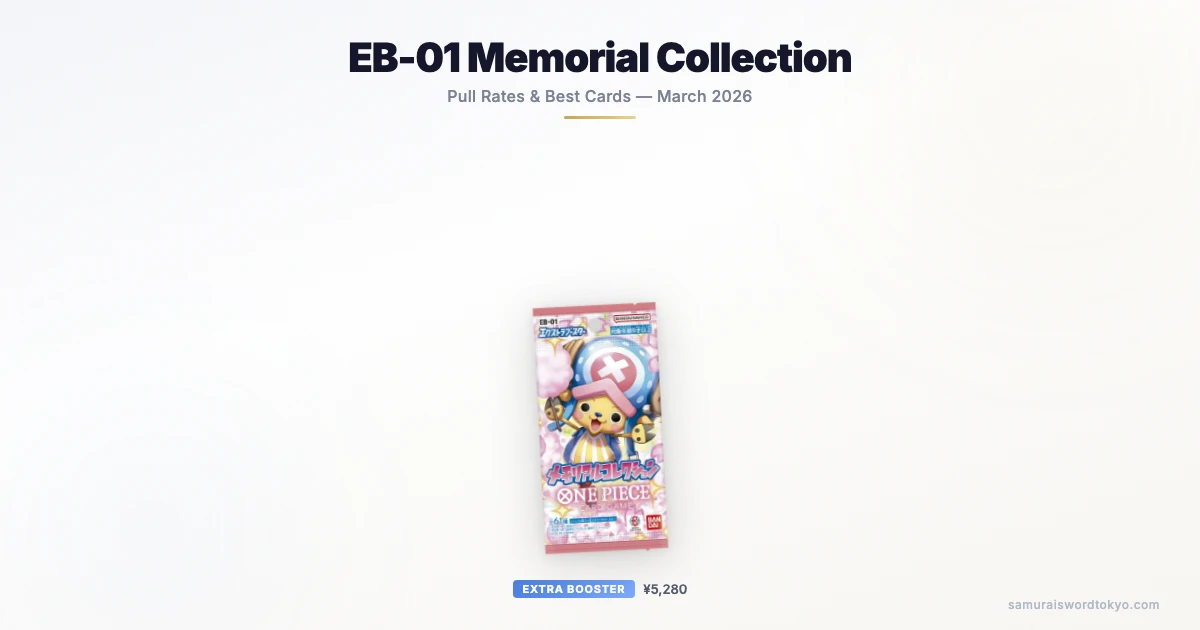
What are the best cards in EB-01, and is ONE PIECE CARD GAME’s first-ever Extra Booster still worth buying two years after release? The Tony Tony Chopper Manga Rare commands roughly $666 on the secondary market, making it one of the most valuable single pulls in the entire game. But EB-01 Memorial Collection offers far more than one chase card — this set introduced competitive staples that still see tournament play today, fan-favorite alternate arts spanning Dressrosa to Impel Down, and a collector-driven appeal that has pushed JPN box prices well above their original retail.
With only 62 card types and a single Secret Rare, EB-01 packs a surprisingly concentrated value profile. Every box delivers guaranteed SR content across 24 packs, and the smaller card pool means your odds of pulling specific chase cards are meaningfully better than in a standard 121-type booster set.
In this guide, we rank every high-value card in EB-01, break down estimated pull rates from the Japanese opening community, analyze current market trends, and help you decide whether Memorial Collection belongs in your collection. All pricing reflects March 2026 data from PriceCharting and Japanese card shop buyback rates.
¥5,280
Box MSRP
144
Cards/Box
62
卡牌種類
$666
Top Card
What Is EB-01? Set Overview & Specs
EB-01 Memorial Collection is the first Extra Booster in ONE PIECE CARD GAME history — a smaller, collector-focused product that supplements existing deck themes rather than launching new ones, with fan-favorite characters from Dressrosa, Baroque Works, Impel Down, and Wano.
EB-01 is the very first Extra Booster in OPTCG history — a landmark product that established the format for all subsequent EB sets. Its compact 62-card pool versus 121+ in standard sets gives meaningfully better pull odds.
What Makes EB-01 Special
EB-01 stands apart from standard OP booster sets in several ways:
Compact card pool — Only 62 types versus 121+ in standard sets, giving better pull odds for specific cards
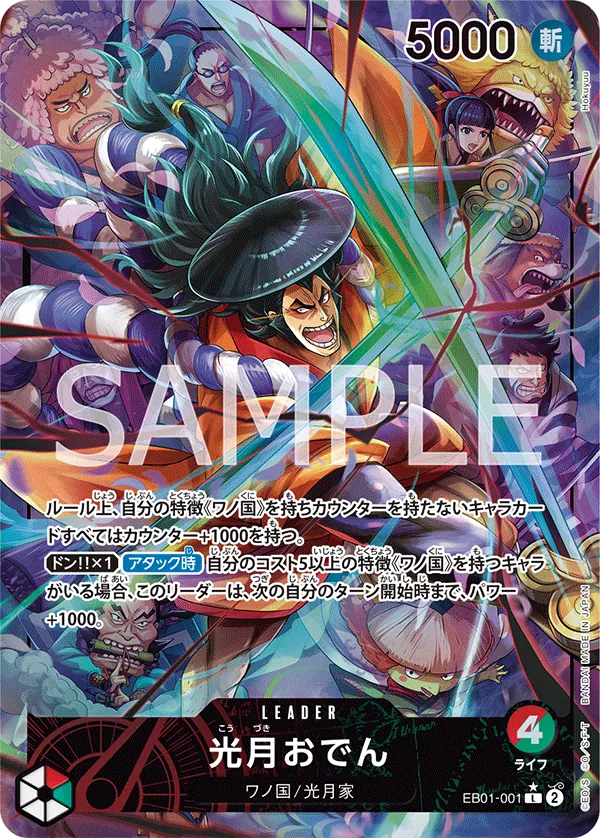
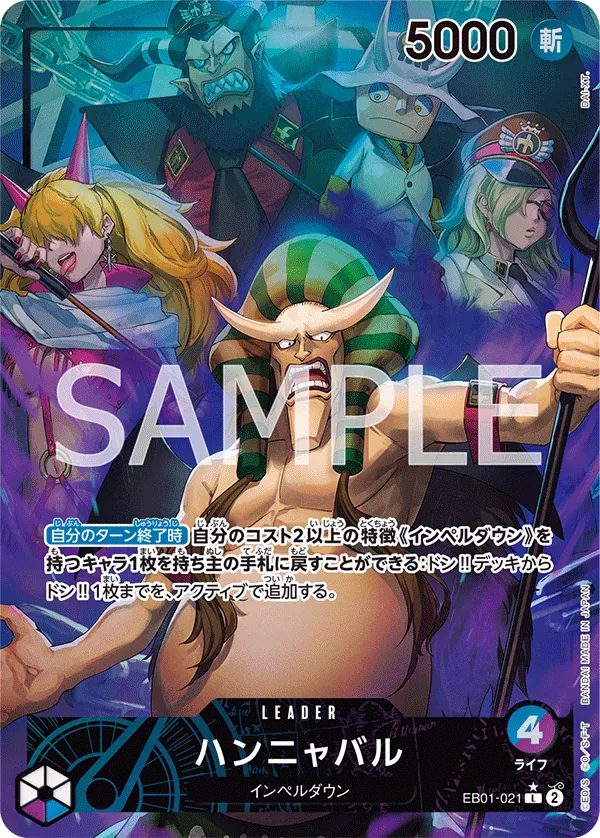
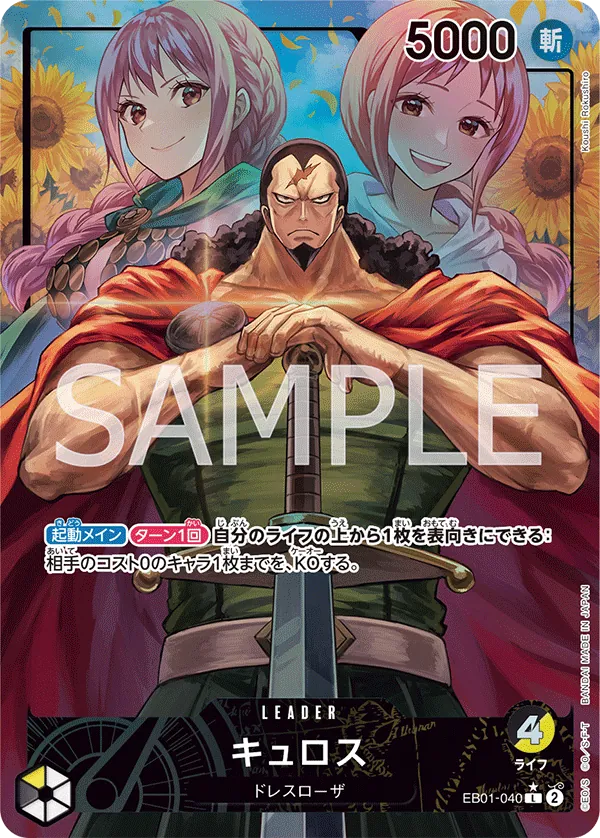
Three new Leaders — Kouzuki Oden, Kyros, and Hannyabal each bring unique deck-building options
Manga Rare debut — Tony Tony Chopper received the set’s only Manga Rare treatment, creating the ultimate chase card
Competitive staples — Mr. 2 Bon Kurei (SEC), Charlotte Flampe, and Shirahoshi became meta-defining cards
Cross-arc nostalgia — Cards spanning Dressrosa, Baroque Works, Impel Down, Fish-Man Island, and Wano arcs
The Chopper Manga Rare dominates EB-01’s value chart at ~$666, followed by Mr. 2 Bon Kurei’s SEC alternate art and Charlotte Flampe’s SP — a spread that reflects both collector demand and lasting competitive relevance. Prices below reflect March 2026 JPN secondary market data.
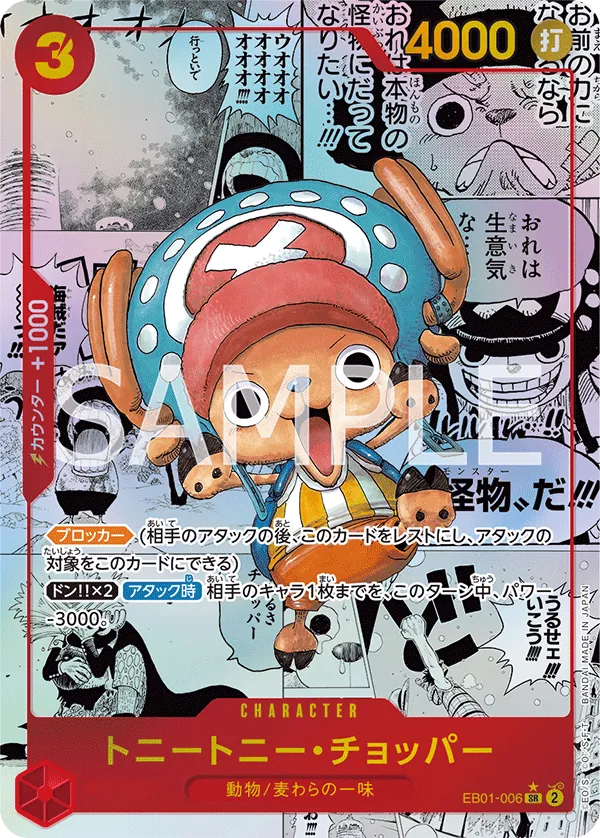
#1 — Manga MANGA RARE
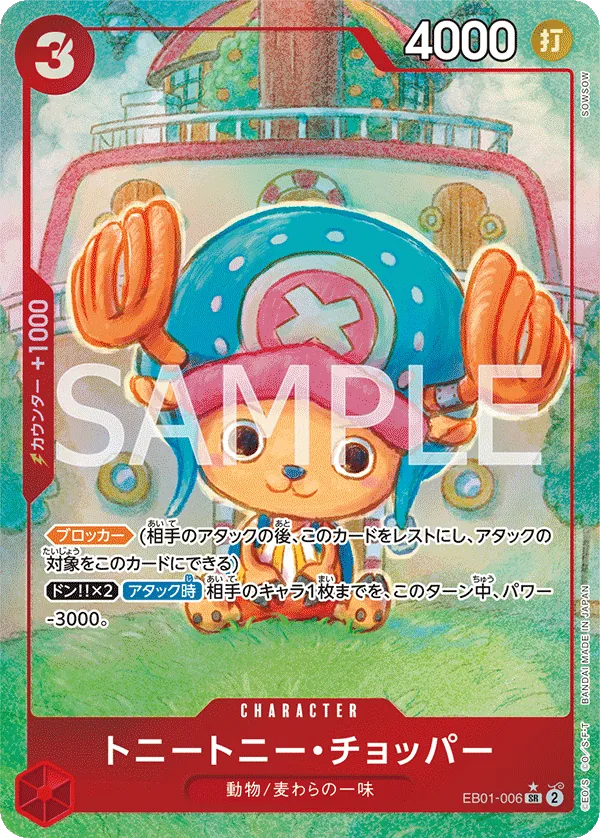
Tony Tony Chopper (EB01-006)
~$666 · JPN: ~¥50,000+
The undisputed king of EB-01 and one of the most valuable Manga Rares in all of OPTCG. This Chopper features the iconic manga panel art treatment that collectors prize above almost every other rarity tier. With an estimated pull rate of roughly 1 per 4-6 cartons, the Chopper Manga Rare turns any box opening into a legitimate treasure hunt. Two years after release, this card has held its value remarkably well.
Rarity Check
At roughly 1 per 4-6 cartons (48-144 boxes), the Chopper Manga Rare is among the rarest pulls in any OPTCG product. For context, that’s roughly 1 in every 1,150-3,450 packs opened.
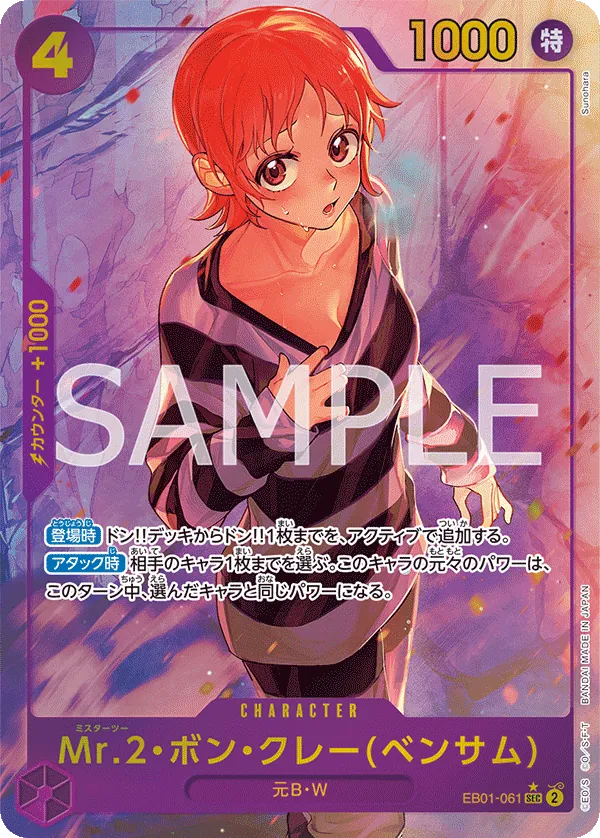
#2 — 秒 SECRET RARE ALT ART
Mr. 2 Bon Kurei / Bentham (EB01-061)
~$39 · JPN: ~¥4,000
EB-01’s sole Secret Rare pulls double duty as both a collector piece and a competitive powerhouse. Mr. 2 sees play in Red Purple Trafalgar Law — one of the strongest decks across multiple formats — and his ability to impersonate Nami gives him unique mechanical appeal. As the only SEC in a 62-card set, the alternate art version commands premium pricing.
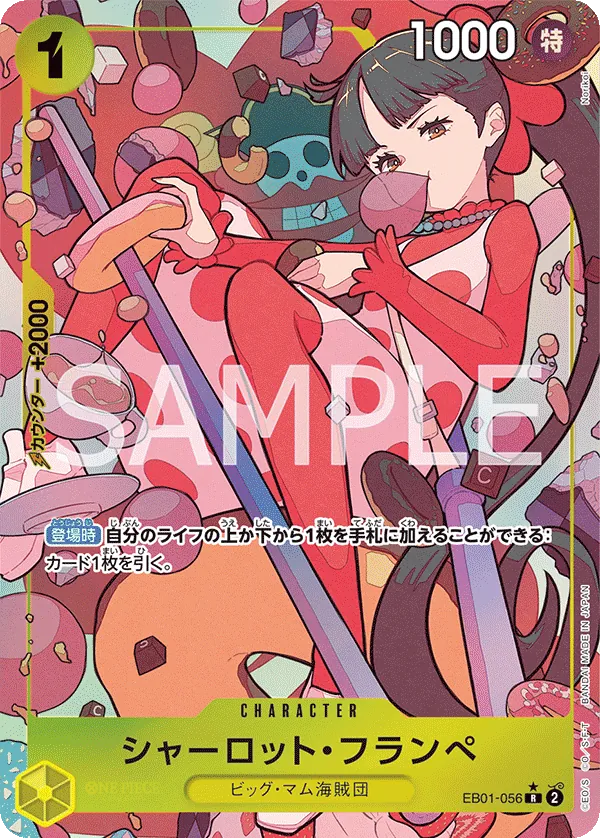
#3 — SP SPECIAL ART PARALLEL
Charlotte Flampe (EB01-056)
~$35 · JPN: ~¥3,500
Flampe’s SP version benefits from sustained competitive demand. Yellow decks have been a dominant force in OPTCG’s metagame for multiple formats, and Flampe serves as a key support piece with draw engine mechanics. The SP art treatment elevates an already valuable competitive card into genuine collector territory.
Cards #4-10
#
卡牌
Rarity
Price (USD)
JPN Buyback
4
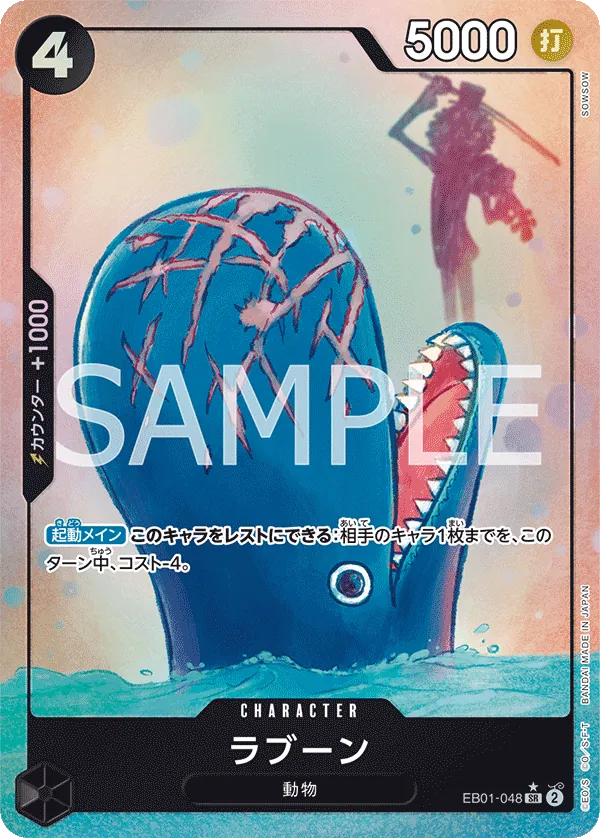
Laboon (EB01-048)
SR
~$16
¥1,500
5
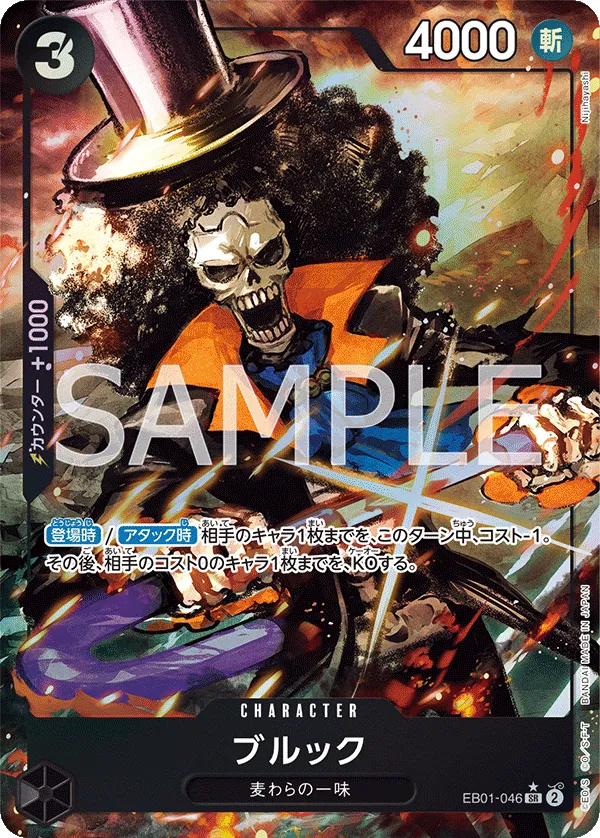
Brook (EB01-046)
SR
~$12
¥1,200
6
Kouzuki Oden (EB01-001)
L
~$12
¥1,200
7
Tony Tony Chopper (EB01-006)
SR
~$11
¥1,000
8
Scratchmen Apoo (EB01-015)
R
~$11
¥1,000
9
Hannyabal (EB01-021)
L
~$10
¥1,000
4
Laboon SR
~$16 · ¥1,500
Fan-favorite Thriller Bark character with stunning alternate art
5
Brook SR
~$12 · ¥1,200
Beloved Straw Hat crew member with premium art treatment
6
Oden L
~$12 · ¥1,200
Leader card with Wano/Akazaya Nine synergy for unique builds
7
Chopper SR
~$11 · ¥1,000
Crayon-style alt art — distinct from the manga rare version
8
Hannyabal L
~$10 · ¥1,000
Impel Down Leader enabling Blue Purple ramp strategies
9
Kyros SR
~$10 · ¥900
Dressrosa arc warrior with future support potential
Player’s Pick
Scratchmen Apoo at #8 is notable as a Rare-rarity card commanding $11 — strong competitive demand for Supernova support pieces drives pricing well above typical R-tier values.
Pull Rates & What’s in Your Box
Every EB-01 box delivers 24 packs of 6 cards each — a total of 144 cards — with a compact 62-type card pool that gives meaningfully better odds for specific pulls compared to standard 121+ type booster sets.
Rarity-by-Rarity Pull Rates
Rarity
Types
Per BOX (est.)
Notes
C
28
~84 cards
Bulk of box contents
R
21
~36 cards
Higher ratio than standard sets
SR
8
~4-6 cards
Strong pull rate for small set
SR Parallel / Alt Art
~8
~2-3 cards
Where the value concentrates
秒
1
~0.5-1 card
Mr. 2 — ~1 per 1-2 boxes
SEC Alt Art
1
~0.25 card
~1 per 3-5 boxes
SP
1
~0.25 card
Flampe SP — ~1 per 3-5 boxes
Manga Rare
1
—
~1 per 4-6 cartons
Leader Alt Art
3
~0.5-1 card
Oden, Kyros, Hannyabal
Bandai does not publish official pull rates for EB-01; the official product page lists only 6 張/包 and the number of card types per rarity.
Compact Pool Advantage
With only 8 SR types versus 10+ in standard sets, your odds of pulling any specific SR are roughly 50% better than in a typical OP booster box.
Box Value Breakdown
Component
Guaranteed?
Typical Value Range
4-6 SR cards
Yes
$15-30 total
2-3 SR Alt Art / Parallel
High probability
$15-40+
1 SEC (Mr. 2)
~1 in 1-2 boxes
$5-39
1 SP (Flampe)
~1 in 3-5 boxes
$35 if pulled
Manga Rare (Chopper)
~1 per 4-6 cartons
$666 if pulled
Best Competitive Cards from EB-01
Four EB-01 cards still define competitive formats two years after release — an unusual longevity that makes this set relevant for players, not just collectors.
卡牌
ID
Meta Role
Key Decks
Mr. 2 Bon Kurei
EB01-061
Multi-format staple
Red Purple Trafalgar Law
Charlotte Flampe
EB01-056
Draw engine
Yellow decks (multiple leaders)
Shirahoshi
EB01-057
Generic yellow blocker
All yellow builds
Cavendish
EB01-012
DON!! manipulation
Supernova builds
Mr. 2 Bon Kurei’s mechanical flexibility — counting as “Nami” for certain interactions — gives him unique utility that no other card replicates. Charlotte Flampe’s draw engine makes her an automatic inclusion in most yellow builds, while Shirahoshi’s generic blocker role means she fits virtually any yellow deck. Cavendish supports Supernova leader strategies with active DON!! manipulation.
Deck Builder’s Note
Hannyabal (EB01-021) is also competitively relevant as one of EB-01’s three Leaders, enabling Blue Purple Impel Down ramp strategies. While not tier-1 in every format, Impel Down builds have shown up at regional events.
Should You Buy EB-01?
EB-01 Memorial Collection remains one of the strongest Extra Booster products in OPTCG, with a concentrated card pool, lasting competitive relevance, and a true grail-tier chase card in the Chopper Manga Rare.
For Collectors
Verdict: Strong buy at current JPN pricing.
At ~$100 per JPN box, you’re getting a premium collector experience with genuine chase card excitement. The Chopper Manga Rare at $666 provides a grail-tier pull possibility, and the alternate art treatments across Dressrosa, Impel Down, and Wano characters create a visually stunning collection.
Collector Value
EB-01’s nostalgic appeal — the set was explicitly designed to celebrate beloved characters across multiple arcs — gives it lasting collector significance as OPTCG’s first Extra Booster product.
For Players
Verdict: Buy singles for specific competitive needs.
If you need Mr. 2 Bon Kurei, Charlotte Flampe, or Shirahoshi for your competitive decks, buying singles is more cost-effective than chasing through sealed product. However, if you play multiple archetypes (yellow, purple, Supernova), a box can provide solid deck-building material across several strategies simultaneously.
Buy Sealed
Chase Chopper Manga Rare
Compact pool = better odds
Multi-archetype value
Buy Singles
Target specific meta cards
No variance risk
Better for single-deck players
For Investors
Verdict: JPN sealed boxes have appreciated and may continue.
EB-01 JPN boxes have nearly doubled from their ¥5,280 retail price to ~$100 in two years. As the first Extra Booster in OPTCG history, this set carries “first of its kind” collector premium. Sealed product from early OPTCG sets has historically appreciated as the player base grows.
JPN EB-01 boxes have established a stable premium over retail, trading at roughly $100 — nearly double the ¥5,280 list price — reflecting steady collector demand for the game’s first Extra Booster product.
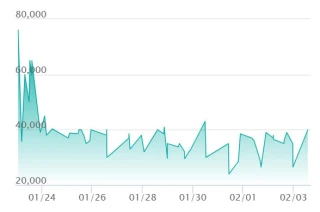
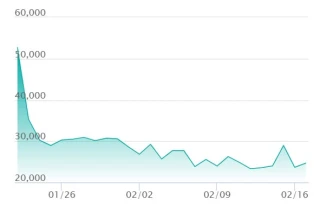
BOX Price Movement
The EB-01 JPN box has followed a classic OPTCG appreciation pattern. After an initial launch-period availability window, supply gradually tightened as production ended. The current ~$100 price point represents a mature market with consistent demand but limited new supply.
EN boxes trade at a modest premium around $120+, though the JPN-EN gap is smaller for EB-01 than for most standard booster sets. This narrower gap reflects the set’s collector-driven appeal — buyers seeking alternate arts and the Chopper Manga Rare care less about card language than visual quality.
Timing Tip
Bandai has not announced EB-01 reprints to date. Premium booster products historically become harder to find at reasonable prices as time passes, and EB-01’s “first Extra Booster” status adds scarcity premium.
When to Buy
Timing
JPN BOX
Strategy
Now (March 2026)
~$100
Stable pricing, no imminent catalysts for drops
If reprinted
Potential dip
Watch for Bandai reprint announcements
12+ months
Likely higher
First Extra Booster scarcity + growing player base
Where to Buy EB-01 from Japan
For international collectors, buying JPN EB-01 directly from Japan ensures authentic sealed product at competitive pricing.
What to expect when ordering from Japan:
Shipping typically takes 7-14 business days to US/CA/UK/AU
Customs duties may apply depending on your country (usually 0-5% for trading cards)
All boxes are factory sealed with original shrink wrap
EB-01 Memorial Collection delivers three things that make it special even two years after release:
A $666 chase card — the Chopper Manga Rare gives every box opening genuine excitement and represents one of OPTCG’s most valuable singles
Competitive longevity — Mr. 2 Bon Kurei, Charlotte Flampe, and Shirahoshi remain tournament staples across multiple formats
First Extra Booster premium — as OPTCG’s inaugural Extra Booster, EB-01 carries collector significance that grows with the game’s expanding player base
At ~$100 for a JPN box, the entry point reflects earned appreciation rather than speculative hype. The compact 62-card pool gives better pull odds than standard sets, and the nostalgic character selection ensures broad collector appeal.
The Tony Tony Chopper Manga Rare (EB01-006) is the most valuable card at approximately $666 as of March 2026. This manga panel art treatment is estimated at roughly 1 per 4-6 cartons, making it an exceptionally rare pull.
What are the pull rates for EB-01?
每盒包含 24 packs of 6 cards. You can expect roughly 4-6 SRs per box, with a chance at SR alternate arts (2-3 per box), the Mr. 2 Bon Kurei SEC (~1 per 1-2 boxes), Flampe SP (~1 per 3-5 boxes), and the Chopper Manga Rare (~1 per 4-6 cartons). The official product page does not publish pull rates; it gives only the pack size (6 cards) and the card count per rarity.
Is EB-01 worth buying in 2026?
For collectors, EB-01 remains a strong buy at the JPN price point (~$100 per box). The concentrated card pool, competitive staples, and Chopper Manga Rare chase card create a premium opening experience. For players seeking specific cards, buying singles is more cost-effective.
How many cards are in EB-01?
EB-01 contains 62 card types (61 cards + 1 DON!! card), including 3 Leaders, 28 Commons, 21 Rares, 8 Super Rares, and 1 Secret Rare. The smaller pool compared to standard 121+ type sets means better pull odds.
What is the difference between EB-01 and regular booster sets?
EB-01 is an Extra Booster — a smaller, collector-focused product with 62 card types versus 121+ in standard sets. It supplements existing deck themes (Dressrosa, Impel Down, Wano) rather than introducing entirely new mechanics. The compact pool gives better odds for specific cards.
Which EB-01 cards are good for competitive play?
The most competitively relevant EB-01 cards are Mr. 2 Bon Kurei (EB01-061) for Red Purple Law decks, Charlotte Flampe (EB01-056) for yellow decks, Shirahoshi (EB01-057) as a generic yellow blocker, and Cavendish (EB01-012) for Supernova builds.
Ready to Open Packs?
Get the EB-01 Memorial Collection booster box — shipped directly from Tokyo, Japan with tracking & insurance.
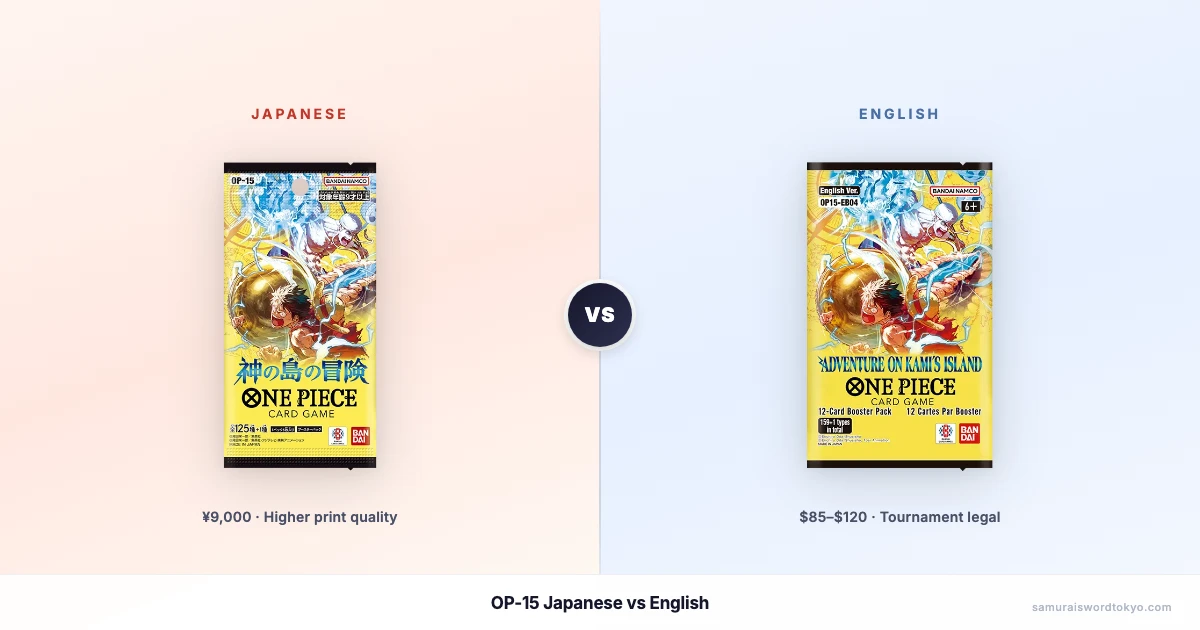
The Japanese OP-15 box is trading at ¥9,000 (~$58). The English box pre-orders are running $85–$120. Same cards, same pull rates — but the JPN version costs roughly 40–50% less, shipped from Japan.
So why would anyone wait for English?
Because tournament legality, card language, and resale markets all differ between versions. And with OP-15 “Adventure on KAMI’s Island” possibly being one of the last sets with staggered release dates — Bandai plans to unify global launches sometime in 2026 — the JPN-vs-EN question matters more right now than it ever has.
We ship OP-15 boxes from Tokyo every week. Here’s the data-backed breakdown: box prices, card-level price comparisons, print quality differences, tournament rules, and a clear recommendation based on what you’re actually trying to do with these cards.
Quick Answer
Your Goal
Buy
Why
Collecting / display
日語
40% cheaper boxes, superior print quality, earlier access
Competitive play (US/EU)
English
Tournament-legal in Western regions
Both collecting and playing
JPN now + EN singles later
JPN for collection, EN singles for your deck
Grading investment
日語
Thicker cardstock, higher PSA 10 rates
~$58
JPN Box
$85–$120
EN Box
32–52%
JPN Savings
Apr 3
EN Release
OP-15 at a Glance — JPN vs EN Specs
Two versions of the same set, but the packaging and timing differ significantly.
Release Timeline & Pack Structure
Spec
日語
English
Release Date
February 28, 2026
April 3, 2026
Pre-Release
—
March 27, 2026
MSRP (BOX)
¥5,280 (~$34)
~$119.99
Market Price (BOX)
¥9,000 (~$58)
$85–$120 (pre-order)
Packs per BOX
24
24
Cards per Pack
6
12 (includes EB-04)
Total 卡牌種類
125 + 1 DON!!
159+ (OP-15 + EB-04)
Card Language
日語
English
Prices as of March 2026. JPN market price from SNKRDUNK. EN pre-order prices from major US retailers. USD at ~¥155.
A key structural difference: the English release merges OP-15 with EB-04 (Extra Booster) content, resulting in more card types per box. The Japanese version keeps them separate.
What’s in the Set — Skypiea’s Biggest Moments
OP-15 covers the Skypiea arc — Enel, the golden bell, and the first time the Straw Hats faced something godlike. Six new Leaders including Purple Enel (already dominating Japanese tournaments) and the first-ever Brook Leader card.
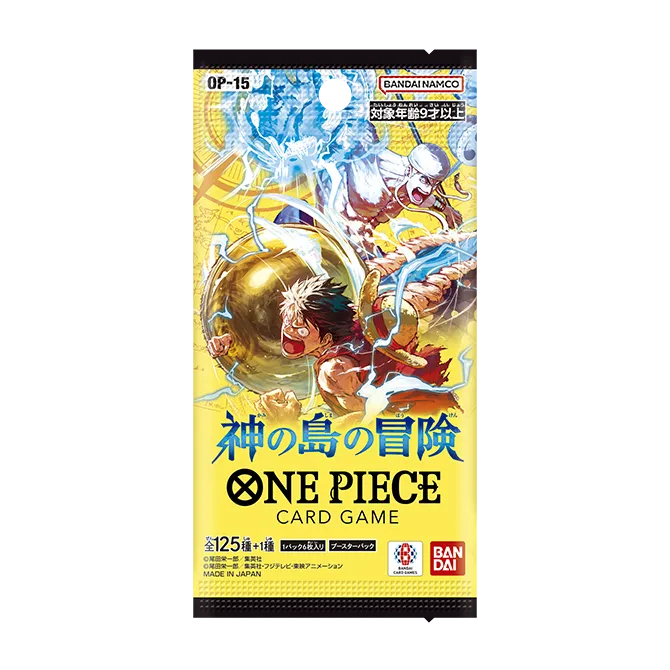
OP-15 Japanese Booster Box — Adventure on KAMI’s Island
The chase cards are headlined by the Enel Comic Parallel at ¥138,000–160,000 (~$890–$1,030) and a Devil Fruit Pattern SP series featuring six characters with their actual Devil Fruit texture across the card face.
Price Comparison — How Much Does Each Version Actually Cost?
JPN boxes cost 32–52% less than EN pre-orders. The gap is even wider on singles.
Box Prices: JPN vs EN
Metric
日語
English
Difference
MSRP
¥5,280 (~$34)
~$119.99
—
Current Market Price
¥9,000 (~$58)
$85–$120
JPN is 32–52% cheaper
Price per Pack
~$2.42
~$3.54–$5.00
JPN is 32–52% cheaper
Sealed Case (12 boxes)
~$696
~$1,020–$1,440
JPN saves $324–$744
The JPN box at $58 is one of the better deals in the current OPTCG sealed market. For context, OP-14 JPN boxes traded at ¥7,500–8,500 (~$48–$55) during the same post-launch window.
Single Card Prices — Same Card, Different Price Tag
Based on the JPN market data we track daily and historical JPN-to-EN price ratios from recent sets (OP-13, OP-14), here’s what to expect:
卡牌
Rarity
JPN Price (¥)
JPN (~USD)
EN Est. ($)
JPN Savings
Enel (Comic Parallel)
秒/SP
¥138,000–160,000
$890–$1,030
$1,500–$3,000+
50–70%
Boa Hancock (Devil Fruit Pattern)
SP
¥52,800
$341
$500–$800
32–57%
Monkey D. Luffy (Devil Fruit Pattern)
SP
¥37,800
$244
$400–$700
38–65%
Gum Gum Golden Rifle (Alt Art)
R/P
¥32,800
$212
$300–$500
29–58%
Roronoa Zoro (Alt Art)
SR/P
¥11,800
$76
$100–$200
24–62%
JPN prices: SNKRDUNK / Fuji Card Shop, February–March 2026. EN estimates based on OP-13/OP-14 JPN-to-EN ratios where EN cards typically command 1.5–3x the JPN price for high-rarity cards.
Why the gap? Two factors. First, Japan prints more volume — the domestic supply chain is shorter and more abundant. Second, English-speaking markets concentrate demand on a single language version, pushing EN prices higher. The OP-13 Manga Rare Ace went from ~$1,200 JPN to $4,000+ EN. That 2–3x multiplier is consistent across recent sets.
Key Takeaway
If you want OP-15 chase cards for your collection and don’t need English text, buying JPN singles now saves 30–70% compared to waiting for EN release.
The manufacturing process differs between regions — and the results are measurable.
Cardstock, Texture & Foil
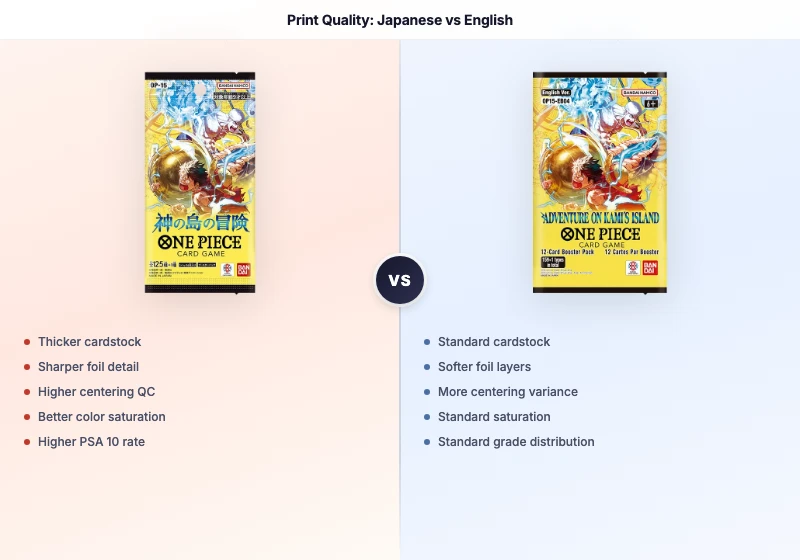
Japanese OPTCG cards use a thicker, more rigid cardstock that resists warping better than the English print run. The difference is noticeable when you handle both versions side by side:
Cardstock thickness: JPN cards feel sturdier. English cards tend to curve more easily in humid conditions
Foil application: JPN foil layers are more precise — the metallic effects on parallels and SPs have sharper definition
Color saturation: JPN prints show higher contrast, especially on dark illustrations like the Enel Comic Parallel
Centering consistency: JPN quality control produces more evenly centered cards out of the pack
JPN (left) vs EN (right) — note the foil definition and color saturation difference
Grading Potential (PSA 10 Rates)
For collectors who submit to PSA or CGC, the cardstock difference translates directly to grades. Japanese cards arrive in better condition from the factory — fewer edge nicks, less surface wear, tighter centering. While neither Bandai nor PSA publishes official grade distributions by region, the community consensus (and our own submission experience) points to JPN cards achieving PSA 10 at a meaningfully higher rate.
Grading Tip
If you’re planning to grade an Enel Comic Parallel or a Hancock SP, the JPN version gives you better odds of hitting Gem Mint 10 — and PSA 10 premiums run 3–5x over PSA 9.
Tournament Legality — Can You Play JPN Cards in the West?
Short answer: not in official Bandai tournaments. The official tournament rules specify language requirements by region.
Regional Rules at a Glance
地區
Tournament-Legal Version
Notes
Japan, Hong Kong, Taiwan, Singapore, Indonesia, Thailand
日語
JPN is the native version
US, Canada, Latin America
English
JPN cards cannot be used
Europe, UK
English
JPN cards cannot be used
Australia, New Zealand
English
JPN cards cannot be used
No exceptions at official Bandai events. If competitive play is your primary reason for buying cards, you need the English version for Western tournaments.
The “Practice Deck” Strategy
Here’s what competitive players actually do: buy JPN cards for testing, then pick up EN versions for tournament play.
OP-15 launched in Japan on February 28. The English release isn’t until April 3. That’s a five-week window where JPN cards are the only way to physically test the new meta. Purple Enel is already the most-winning Leader in Japanese tournaments — players who build and practice with JPN cards now will have a serious edge when EN drops.
Practice Deck Budget
A playable Purple Enel build using JPN singles runs roughly $30–$60 for the core cards. That’s a small investment for five weeks of meta knowledge. Check Limitless for OP-15 decklists.
Who Should Buy Japanese? Who Should Buy English?
The answer depends entirely on what you’re doing with these cards.
Buy Japanese If…
You’re a collector focused on art and quality. JPN cards look better, feel better, and cost less. The Devil Fruit Pattern SPs in particular are showcase cards — the texture work on Hancock’s Mero Mero no Mi and Luffy’s Gomu Gomu no Mi is more vivid on the JPN print. You’re paying less for a higher-quality product.
You want the best value per dollar. At $58 per box versus $85–$120, JPN boxes give you more product for less money. If you’re opening multiple boxes, the savings compound fast — a sealed case (12 boxes) saves $324–$744 compared to EN.
You’re a grading investor. The cardstock advantage directly affects PSA 10 rates. JPN versions of chase cards also carry a “first printing” premium for some collectors, and the earlier release date means you lock in prices before EN hype pushes demand higher.
Buy English If…
You play in Western tournaments. Non-negotiable. You need EN cards for official Bandai events in the US, Canada, Europe, and Oceania. No amount of savings justifies owning cards you can’t play.
You prefer reading the card text. OPTCG card effects can be complex — if you’re learning the game or don’t want to reference translations mid-match, English text removes that friction.
Your local community plays EN. Casual play groups and local game stores in the West typically use English cards. Matching your community makes trading and borrowing easier.
Buy Both If…
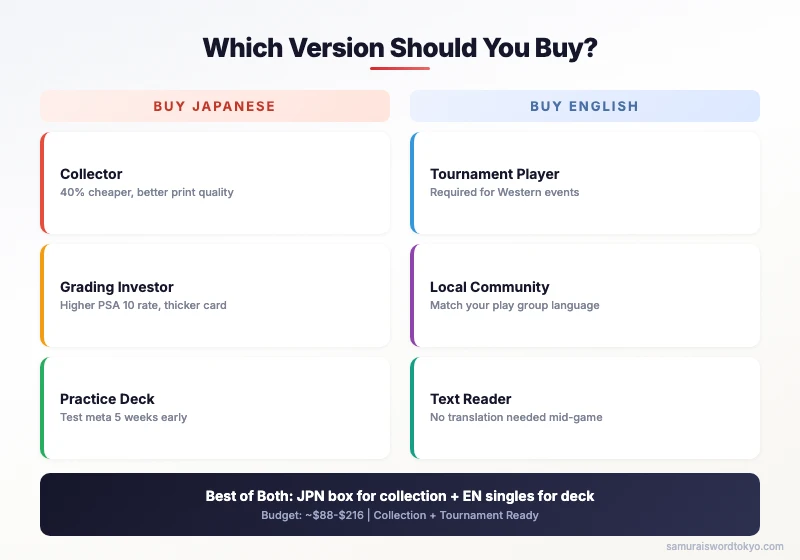
You want the best of both worlds. The optimal strategy for a collector-player hybrid: buy a JPN box or JPN singles for your display collection and grading submissions, then pick up EN singles for the specific cards you need in your competitive deck.
The 2026 Factor — Will Simultaneous Releases Change Everything?
Bandai announced that all ONE PIECE CARD GAME products will release simultaneously worldwide starting at some point in 2026. OP-15 was not a simultaneous release: the Japanese edition went on sale on February 28, 2026, and the English edition (OP15-EB04) went on sale on April 3, 2026.
What “Simultaneous Release” Actually Means
No more five-week gaps between JPN and EN launches. When the switch happens, both versions will hit shelves on the same day globally. The EN card pool will catch up to JPN in real time.
OP-15 may be one of the last sets — possibly the last — with a staggered release. OP-16 (Paramount War, June 12) is also expected to have a gap, but the simultaneous launch could begin as early as OP-17 in late 2026.
Why JPN Cards Keep Their Edge
Even after simultaneous releases begin, the core advantages of JPN cards remain:
Print quality: Manufacturing happens at different facilities. JPN cardstock and foil quality won’t change because the release date aligns
Price advantage: JPN’s larger domestic supply and shorter distribution chain keep prices lower. This is structural, not timing-related
JPN-exclusive products: Anniversary sets, promo cards, and certain parallel variants remain Japan-only regardless of release synchronization
Grading edge: Cardstock quality is a manufacturing difference, not a timing one
Bottom Line
The simultaneous release eliminates the “early access” advantage. Everything else stays the same. If you’ve been buying JPN cards for quality and price, nothing changes.
One more factor: April 2026 introduces Standard Rotation, removing Block 1 cards (OP-01 through OP-04) from competitive play. OP-15 sits in Block 4, meaning it has a long competitive lifespan ahead.
Our Verdict
Three facts drive the decision:
JPN boxes cost 32–52% less and contain the same cards at higher print quality
EN cards are required for competitive play in the US, Europe, Canada, and Oceania
OP-15 may be one of the last staggered releases — the early-access window is closing
If collecting is your priority, buy Japanese. The quality is better, the price is lower, and the chase cards (especially the Enel Comic Parallel and Devil Fruit Pattern SPs) look their best on JPN cardstock.
If competing is your priority, buy English — but consider grabbing JPN singles now to practice the OP-15 meta before the April 3 EN launch.
If you want both, the hybrid approach works: JPN box for your collection, EN singles for your tournament deck. Total cost: roughly $88–$216 depending on how deep you go.
OP-15 brings the Skypiea arc to OPTCG for the first time. Purple Enel is already rewriting the competitive format in Japan. The Devil Fruit Pattern SPs are some of the most visually distinctive cards the game has produced. Whichever version you choose, this is a set worth owning.
Shop This Set
OP-15 Adventure on KAMI’s Island Booster Box (Japanese)
Are Japanese One Piece cards worth more than English?
Generally, no — Japanese cards are cheaper for the same card due to higher domestic supply. English versions often trade at 1.5–3x the JPN price because Western demand concentrates on a single language version. However, for graded cards (PSA 10), Japanese versions can command premiums due to superior cardstock quality.
Can I use Japanese OP-15 cards in English tournaments?
No. Official Bandai tournaments in North America, Europe, and Oceania require English-language cards. Japanese cards are legal only in Japan, Hong Kong, Taiwan, Singapore, Indonesia, and Thailand. Casual play groups may allow mixed languages — check with your local community.
Is the card quality different between Japanese and English OP-15?
Yes. Japanese cards use thicker cardstock with tighter quality control on centering and foil application. The difference is especially visible on parallel and SP cards where foil layers are more precisely applied on JPN prints. This quality gap has been consistent across all OPTCG sets.
Should I buy OP-15 Japanese now or wait for the English release?
It depends on your goal. Collectors save 30–70% buying JPN now. Competitive players need EN cards but can buy JPN for practice during the five-week gap. Grading investors benefit from JPN’s higher PSA 10 potential. There’s no wrong answer — just different strategies for different goals.
Will OP-15 be the last set with separate JPN and EN release dates?
Possibly. The official OP-15 product pages list different dates for each edition (Japanese: February 28, 2026; English: April 3, 2026), so OP-15 did not launch worldwide on the same day. OP-16 (June 2026) is expected to still have a gap. The switch may happen with OP-17 or later.
How much cheaper is a Japanese OP-15 box compared to English?
As of March 2026, JPN boxes trade at ¥9,000 (~$58) while EN pre-orders run $85–$120. That’s a 32–52% savings on the JPN side. For a sealed case of 12 boxes, you’d save approximately $324–$744 by going Japanese.
Does OP-15 have different pull rates in Japanese vs English?
Bandai doesn’t publish official pull rates for either version. Community opening data suggests comparable rates for both, though the English version merges OP-15 and EB-04 card pools, which affects the distribution of specific cards within each pack. For detailed JPN pull rate estimates, see our OP-15 Pull Rates guide.
Ready to Open Packs?
Get the OP-15 Island of God booster box — shipped directly from Tokyo, Japan with tracking & insurance.
Looking to buy One Piece cards from Japan but not sure where to start? Japanese cards hit shelves two to four months before their English counterparts, and that early access drives thousands of collectors and competitive players to import every set cycle. Add in the thicker cardstock, sharper foil finishes, and Japan-exclusive parallels — 秒, SP, Manga Rares — and the appeal is obvious.
The problem? Most Japanese card shops don’t ship internationally. Language barriers, unclear shipping costs, and the fear of receiving counterfeits keep many overseas buyers on the sideline. And since August 2025, new U.S. tariff rules have changed the math on importing from Japan entirely.
This guide covers every viable method to buy Japanese One Piece cards from outside Japan in 2026 — a comparison of the best international retailers, a walkthrough of proxy shopping services, a full cost breakdown including the latest customs duties, and authentication tips so you never get burned by fakes. We ship hundreds of Japanese OPTCG boxes to collectors worldwide every month, and here’s what we’ve learned.
Key Takeaway
Three methods to buy JPN cards: international retailers (easiest), proxy services (cheapest), and global marketplaces (most convenient). Multi-box orders save the most on shipping and duties.
¥5,280
JPN Box MSRP
$20-30
Shipping (1 BOX)
12.5%
US Import Duty
2-5 days
DHL Delivery
Why Buy Japanese One Piece Cards?
Japanese One Piece cards consistently command premium attention from international collectors, and the reasons go beyond just aesthetics.
Early Access to New Sets
Every main booster set releases in Japan first. OP-09 (Emperors in the New World) launched in Japan in August 2024 — the English version followed months later. For competitive players tracking the meta, this head start is critical. You can test new strategies and secure key cards before your local scene even knows what’s coming.
Superior Print Quality
Japanese cards use thicker, more rigid cardstock that resists warping and edge wear. The foil treatments on parallel cards — particularly SEC and SP variants — have a depth and texture that English prints don’t match. For collectors who grade cards through PSA or CGC, the tighter quality control on Japanese prints translates directly to higher grade potential.
Better Box Value
Here’s something most English-language guides won’t tell you: Japanese booster boxes are often cheaper than their English equivalents. A Japanese booster box carries an MSRP of ¥5,280 (approximately $35 at ¥150/USD). Market prices on SNKRDUNK — Japan’s primary secondary market platform — range from near MSRP for well-stocked sets to significant premiums for popular releases.
The same set in English often sells at higher markups due to tighter supply in Western markets. Factor in the exclusive JPN-only parallels and earlier access, and the value proposition is strong.
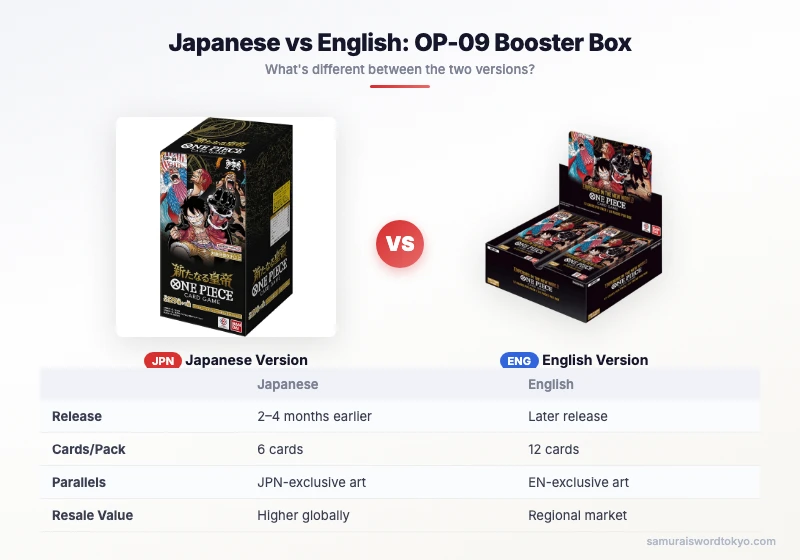
Japanese Version
Releases 2-4 months earlier
6 張/包
Thicker card stock, sharper foil
JPN-only parallels & promos
Box MSRP: ¥5,280 (~$35)
English Version
Later release
12 張/包
Standard print quality
EN-only parallels
Box price: ~$100+
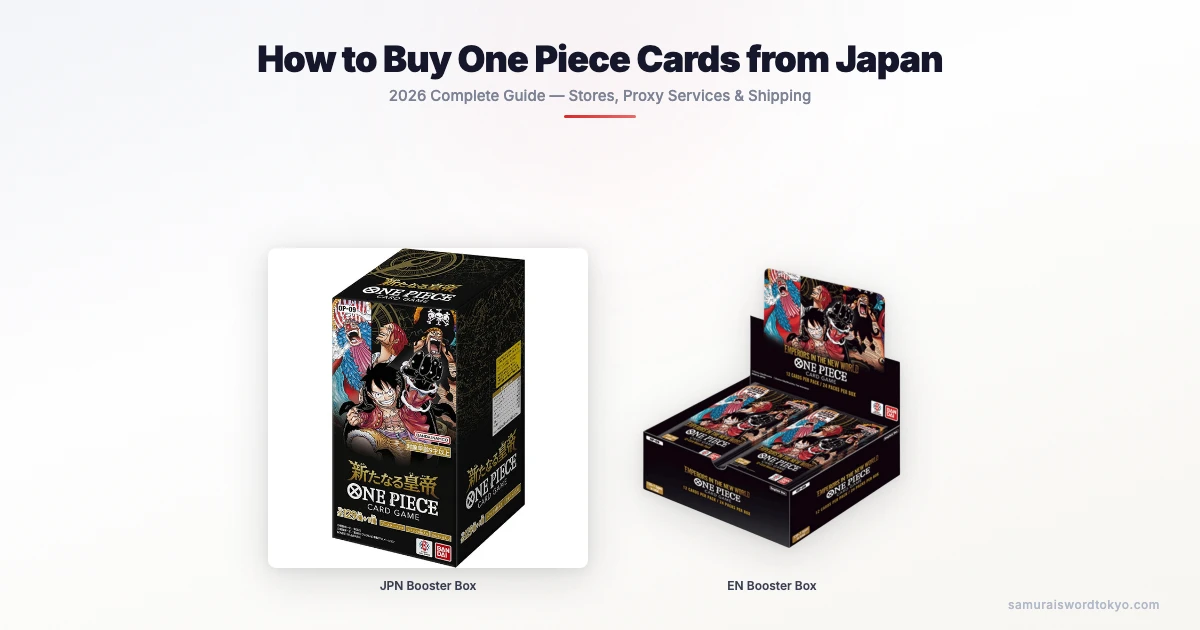
Japanese (left) vs English (right) One Piece Card Game booster boxes
3 Ways to Buy Japanese One Piece Cards Online
There are three main approaches to buying Japanese One Piece cards from overseas. Each has tradeoffs in convenience, price, and product selection.
Method
Best For
Pros
Cons
International JPN retailers
Beginners, sealed products
English site, direct shipping, easy returns
Slightly higher prices
Proxy shopping services
Rare singles, JPN-only stores
Access to every JPN store, best prices
Extra fees, slower process
Global marketplaces (eBay, Amazon)
Convenience seekers
Familiar platform, buyer protection
Highest markup, fake risk
Method 1: Buy from International Japanese Card Retailers
This is the easiest path. These Japan-based stores have built their business around international shipping. Their sites are in English, they accept PayPal and major credit cards, and they handle all export logistics.
Best Stores for Sealed Products
If you’re after booster boxes, starter decks, or special collections, these retailers consistently deliver:
Store
Specialty
Ships From
Shipping (1 BOX)
Notes
Japan Trading Card Store
Boxes, decks
日本
~$24
Bulk discounts on 2+ boxes
Plaza Japan
Sealed products
日本
Varies by weight
Guaranteed authentic, unopened
Cardotaku
Boxes + singles
Osaka, Japan
Varies
TCG specialist since 2017
Solaris Japan
Sealed + collectibles
日本
Varies
Large anime/TCG selection
ToysOneJapan
Boxes, promos
日本
Flat rate
Consistent shipping cost
Sakuras Card Shop
Boxes, special sets
日本
Varies
Extensive OPTCG inventory
Best Stores for Singles
If you’re hunting a specific SEC parallel, a meta-defining leader, or a Manga Rare, these stores offer individual card sales:
Store
Selection
Strength
TCG Republic
4,800+ OPTCG singles
Largest online JPN singles inventory
Cardotaku
Singles + sealed
Ships direct from Osaka, guarantees physical stock
Nipponrama
Singles + sealed
Easy import process, Japan-direct
First-Time Buyer?
Starting with an international retailer is the safest move. You get an English-language checkout, buyer protection, and direct shipping without needing to navigate Japanese websites.
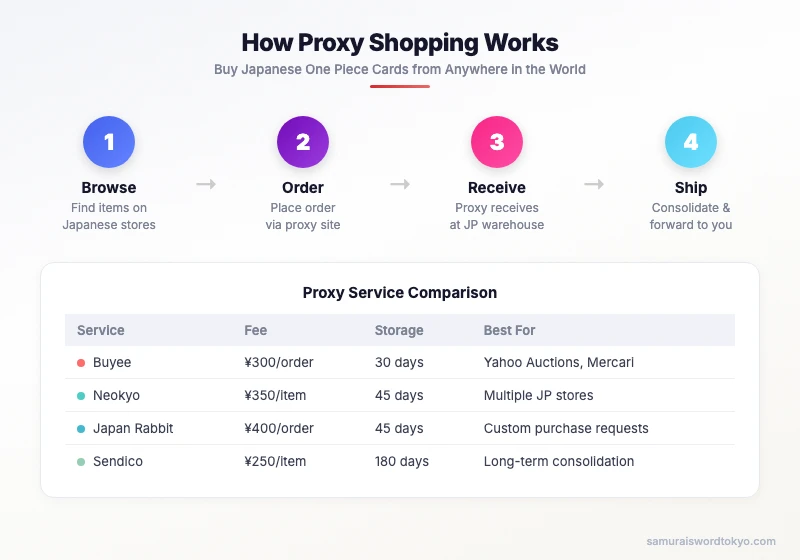
Proxy services unlock the full Japanese market. Stores like Cardrush, Yuyu-tei, and listings on Mercari Japan often have the best prices and rarest inventory — but they only ship within Japan. A proxy service acts as your middleman: they buy the item on your behalf, receive it at their Japanese warehouse, and forward it to your international address.
What Is a Proxy Service?
Think of it as a personal shopper in Japan. You browse a Japanese store, send the item link to the proxy, they purchase it, and then ship it to you. Some services let you add items from multiple stores into one shipment to save on shipping.
Step-by-Step: Buying via Proxy
Create an account on a proxy service (Buyee, Neokyo, etc.)
Find your item on a Japanese store (Cardrush, Mercari, Yahoo Auctions)
Submit the purchase request — paste the item URL into the proxy’s order form
The proxy buys the item and receives it at their warehouse in Japan
Choose your shipping method (DHL, FedEx, etc.) and pay shipping + service fees
Receive your package at your international address
The whole process typically takes 7–14 days from order to delivery, depending on the proxy’s processing speed and your chosen shipping method.
Best Proxy Services Compared
Service
Service Fee
Free Storage
Key Strength
Supported Stores
Buyee
¥300/order
30 days
Largest platform, Yahoo Auctions integration
Yahoo Auctions, Mercari, Rakuten, Amazon JP
Neokyo
¥350/item
45 days
Transparent pricing, lower total cost
Most JPN stores
Japan Rabbit
Varies
45 days
Flexible — can buy from almost any JPN store
Any JPN store
Sendico
Varies
180 days
Longest free storage, good for combining orders
Yahoo Auctions, Mercari, Rakuten
Remambo
Varies
Varies
Specializes in TCG store purchases (Cardrush)
Cardrush, other JPN stores
Pro Tip: Package Consolidation
If you’re buying from multiple stores, choose a proxy with free consolidation. Neokyo and Sendico both offer this, which can cut your shipping costs significantly when combining several orders into one box.
Japanese Terms You’ll Encounter
日語
Meaning
Why It Matters
新品 (shinpin)
Brand new
Sealed, unopened product
美品 (bihin)
Excellent condition
Near-mint single card
売り切れ (urikire)
售罄
Don’t waste time on this listing
初版 (shohan)
First print
Often more valuable than reprints
再販 (saihan)
Reprint
Usually cheaper, same card quality
BOX
Booster box
24 packs per box standard
How proxy shopping works: browse → order → ship to warehouse → forward internationally
Method 3: Buy from Global Marketplaces
If convenience is your priority, eBay and Amazon are the path of least resistance. Japanese One Piece products are widely listed on both platforms by individual sellers and small businesses.
eBay & Amazon: Easiest but Priciest
The markup on global marketplaces is real. A Japanese booster box that sells for ¥5,000–8,000 on SNKRDUNK might list for $50–70+ on eBay after the seller adds their margin and shipping costs. You’re paying for convenience and the platform’s buyer protection.
When it makes sense: Single box purchases where the time and hassle of using a proxy isn’t worth the savings. eBay’s “sold listings” filter is also useful for checking what boxes actually sell for.
Watch Out for Fakes
Always check seller ratings (99%+ positive with 100+ sales minimum), look for photos of the actual product (not stock images), and prefer sellers who show the shrink wrap seal.
Mercari Japan via Proxy: Best Deals on Singles
Mercari is Japan’s largest C2C marketplace, and it’s where individual sellers list cards at competitive prices. You can’t buy directly from overseas, but using a proxy service like Buyee (which has direct Mercari integration) gives you access to thousands of listings.
Singles on Mercari often sell for 20–40% less than dedicated card shops, especially for mid-range cards (SR, R rarity). The tradeoff is less consistency in card condition descriptions and no returns on most listings.
The True Cost: Shipping, Customs & Duties in 2026
This is the section every other guide skips — and it’s the one you actually need. The total cost of importing Japanese One Piece cards goes beyond the product price. Here’s the full breakdown.
Shipping Options & Costs
Since August 2025, Japan Post has suspended EMS and parcel services for taxable goods to the United States. U.S. buyers now rely on private couriers. A new service called UGX (operated in cooperation with Japan Post) launched in early 2026 as a more affordable alternative.
Shipping Method
Delivery Time
Cost (1 BOX)
Tracking
Notes
DHL Express
2-4 days
$20-30
Full
Fastest option, most reliable
FedEx
3-5 days
$20-30
Full
Good US coverage
UGX (Japan Post partner)
5-10 days
$15-25
Full
New in 2026, more affordable
EMS
5-10 days
$15-20
Full
NOT available to US (suspended Aug 2025)
For US buyers: DHL and FedEx are your primary options. Budget $20–30 for a single box shipment.
For UK/EU/AU buyers: EMS remains available and is typically the most cost-effective option at $15–20 per box.
Import Duties & Taxes by Country (As of August 2026)
The biggest change: the U.S. ended its $800 de minimis exemption in August 2025. Previously, packages under $800 entered duty-free. Now, all imports from Japan face duties regardless of value. The current rate for trading cards is 12.5%, effective July 24, 2026 under a Section 301 action.
Country
Duty Rate
VAT/GST
De Minimis
Notes
美國
12.5%
None
$0 (eliminated Aug 2025)
Duty prepaid at checkout when you buy from us (DDP)
英國
0-4.2%
20% VAT
£135
VAT on goods + shipping + duty
歐盟
0-4.2%
19-27%
€150
Duty threshold varies by country
澳洲
0-5%
10% GST
AUD 1,000
Most cards enter duty-free
加拿大
0-8%
5% GST (+ provincial)
CAD 20
Low threshold — most orders taxed
Rates as of August 2026. Check your country’s customs authority for current rates.
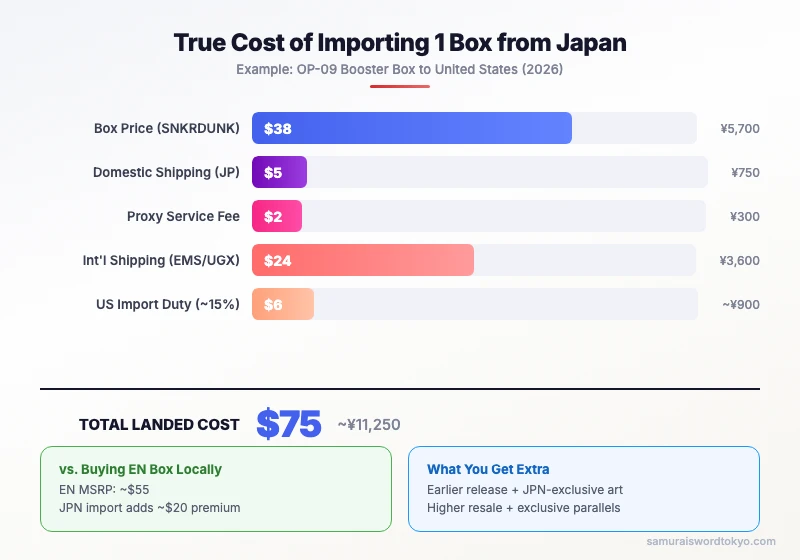
Worked Example: Total Cost of 1 Japanese Booster Box to the US
Cost Component
金額
Product price (JPN market)
¥6,000 (~$40)
Shipping (DHL Express)
$25
US Import Duty (12.5%) + CBP fee
~$6
Customs brokerage fee
$0 when we ship DDP (duty collected at checkout)
Total landed cost
~$71
The math improves dramatically with multi-box orders — shipping per box drops to $7-12 when you buy 4+ boxes, and when we ship DDP there is no brokerage fee at all.
Order Size
Shipping/Box
Total Shipping
Duty (12.5%)
Brokerage
Extra Cost/Box
1 box
$25
$25
~$5
$0
~$30
4 boxes
$7
$28
~$5
$0
~$12
8 boxes
$5
$38
~$5
$0
~$10
12 boxes
$4
$48
~$5
$0
~$9
Bottom Line
Importing directly makes the most financial sense at 4+ boxes per order. For single boxes, international retailers or domestic resellers may be comparable after factoring in duties and shipping.
Total landed cost comparison: 1 box vs. multi-box orders
How to Spot Fake One Piece Cards
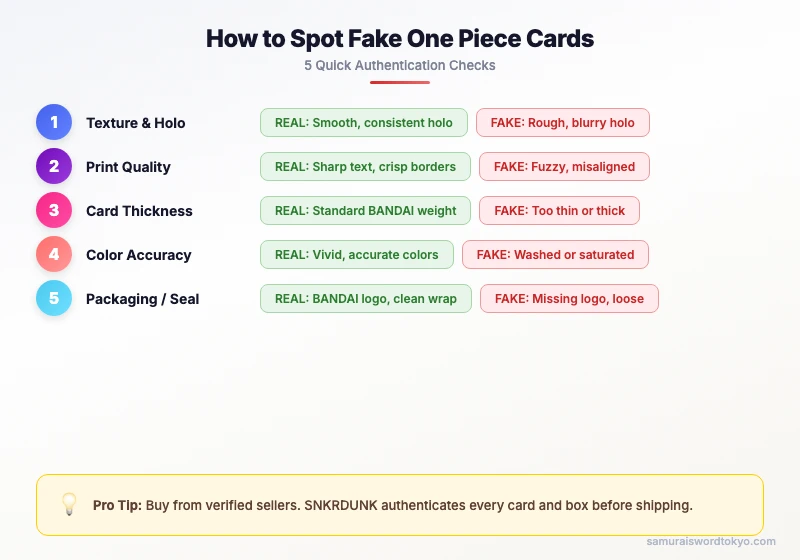
As One Piece card values have climbed, so has the volume of counterfeits. Buying from reputable stores and established sellers is your first line of defense — but knowing how to verify authenticity yourself adds an important safety net.
5 Authentication Checks
1. Card Back Color The most reliable tell. Authentic cards have a specific, balanced color palette on the back. Counterfeits consistently show a purple tint or muddy, overly dark coloring. Compare any suspicious card against a confirmed authentic one under the same lighting.
2. Text Sharpness Genuine cards have razor-sharp text at every size. If the smallest text (set number, copyright line) appears fuzzy or slightly blurred, that’s a strong indicator of a counterfeit.
3. Card Texture and Feel Bandai uses specific cardstock that’s firm with a particular weight. Fakes tend to be either too thick or too thin. High-rarity cards (SR, 秒, SP) should have a subtle textured finish — if a rare card feels completely smooth, be suspicious.
4. Holofoil Quality Authentic foil has a gentle, uniform gloss. Counterfeit foil is often too bright, too shiny, or unevenly applied. The difference is noticeable when comparing side-by-side.
5. Authenticity Stamp Look for a small, nearly transparent stamp in the bottom-left corner that reads “One Piece Card Game.” On fakes, this stamp is harshly printed and clearly visible rather than subtly embedded.
Five key authentication checks to verify your One Piece cards are genuine
Red Flags When Shopping Online
Prices significantly below market rate (if it seems too good to be true, it is)
Stock photos instead of actual product images
Sellers with limited history or low feedback scores
Listings that don’t specify whether the product is Japanese or English
No clear return policy
Insider Tips from the Japanese Market
These advantages come from working in the Japanese card market daily.
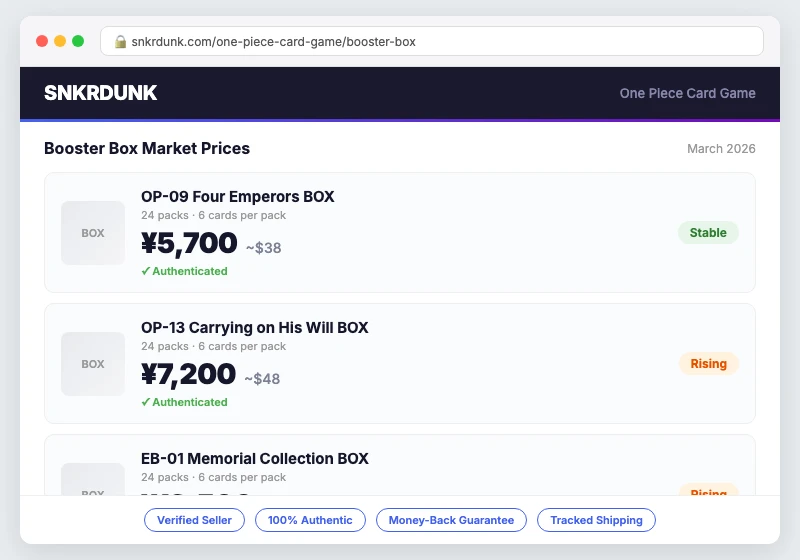
Track Japanese Prices on SNKRDUNK
SNKRDUNK is Japan’s leading secondary market platform for trading cards and collectibles — think StockX for Japanese TCGs. Most English-language buyers have never heard of it, but it’s the benchmark for Japanese booster box pricing.
Before you buy from any international retailer, check the SNKRDUNK price for the same product. This tells you the actual Japanese market value, so you can judge whether the international markup is reasonable. The site has an English version, making it accessible without Japanese language skills.
First Print vs. Reprint Boxes
Japanese booster boxes come in first print (初版) and reprint (再販) runs. First print boxes are generally more sought after by collectors and may have slightly different pull rate distributions.
First print boxes typically have a small mark or code on the packaging that distinguishes them from reprints
Reprint boxes are identical in card content and quality but may trade at a slight discount
For most buyers, reprints offer the same experience at a better price — the cards inside are identical
When to Buy: Reprint Windows
Bandai regularly reprints popular sets, and each reprint temporarily drops box prices on the secondary market. If you’re not in a rush, monitoring for reprint announcements can save you 10–20% on box prices.
The pattern: prices spike at launch → gradually settle over 1-2 months → drop further when a reprint is announced → recover once reprint stock is absorbed. Track announcements on the official ONE PIECE CARD GAME website and SNKRDUNK for the best timing.
SNKRDUNK: Japan’s benchmark for booster box market prices
Are Japanese One Piece cards worth more than English?
It depends on the specific card. Japanese cards generally command higher prices for high-rarity parallels (SEC, SP, Manga Rare) due to superior print quality and Japan-exclusive art. English cards can be worth more for tournament-staple cards in regions where English is the standard format. For collectors focused on display and grading, Japanese cards typically hold stronger long-term value.
Can I use Japanese One Piece cards in English tournaments?
This varies by region and tournament organizer. In most official Bandai-sanctioned tournaments outside Japan, you must use the language version that matches your region. Casual locals and some unofficial events may allow Japanese cards. Always check with your local tournament organizer before entering with Japanese cards.
How long does shipping from Japan take?
DHL Express and FedEx deliver in 2–5 business days to most international destinations. EMS (where available) takes 5–10 business days. Economy shipping options can take 2–4 weeks. EMS is currently suspended for taxable goods to the United States as of August 2025.
Do I have to pay customs on cards from Japan?
Yes, in most countries. The United States eliminated its $800 de minimis exemption in August 2025, so all imports face duty regardless of value — 12.5% as of August 2026, which we collect at checkout (DDP) when you buy from us. The UK charges 20% VAT on imports over £135. Australia’s threshold of AUD 1,000 means most single-box orders enter GST-free. Check your country’s customs authority for current rates.
What’s the cheapest way to buy One Piece cards from Japan?
For sealed products, buying multiple boxes directly from a Japanese retailer or through a proxy service (with package consolidation) offers the best per-unit cost. For singles, browsing Mercari Japan through a proxy service like Buyee typically yields prices 20–40% below dedicated card shops. Timing your purchase around set reprints can also save 10–20%.
How can I tell if One Piece cards are fake?
Check five things: card back color (fakes have a purple tint), text sharpness (fakes are blurry), card thickness and feel (fakes are too thick or thin), holofoil quality (fakes are too shiny), and the authenticity stamp in the bottom-left corner (fakes have a harshly printed stamp). Buying from established retailers with strong feedback scores is the simplest way to avoid counterfeits.
What is a proxy shopping service?
A proxy shopping service is a middleman that buys products from Japanese stores on your behalf and ships them to your international address. You find the item on a Japanese website, submit the link to the proxy, they purchase and receive it at their Japanese warehouse, then forward it to you. Popular services include Buyee, Neokyo, Japan Rabbit, and Sendico.
Start Buying Japanese One Piece Cards Today
Buying Japanese One Piece cards from overseas is more accessible than ever, even with the 2025 tariff changes. Three things to remember:
Start with international retailers if you’re new — stores like Japan Trading Card Store, Cardotaku, and TCG Republic offer English-language sites with direct shipping and buyer protection.
Use proxy services for the best prices and selection — Buyee and Neokyo unlock the full Japanese market, including Mercari deals and specialty card shops.
Buy in bulk to beat shipping and duty costs — the per-box cost of importing drops dramatically at 4+ boxes, making direct import the clear value play for serious collectors.
The Japanese One Piece card market offers early access, superior quality, and exclusive cards you can’t get anywhere else. Whether you’re chasing a Manga Rare Luffy or building a competitive deck ahead of the English meta, the path starts with your first order from Japan.
Specialty Japanese card shops offer the best balance of price, authenticity, and convenience for international buyers. Proxy services and eBay are alternatives, but authentication risk and fees vary significantly.
5 Methods
Buying Options
12.5%
US Tariff (2026)
7-14 Days
Avg. Delivery
Serial-Tracked
Box Verification
Introduction
Figuring out how to buy Japanese Pokemon cards from Japan is the first hurdle every international collector faces. Language barriers, shipping logistics, a 12.5% US tariff, and counterfeit risks create real hesitation — even though Japanese cards have become some of the most sought-after collectibles worldwide.
This guide breaks down five proven methods to buy Japanese Pokemon cards from Japan, compares the total landed cost of each, and walks you through shipping, import duties (including the 2026 US tariff changes after the Supreme Court ruling), and how to avoid fakes. By the end, you will know exactly which buying method fits your budget and comfort level.
Our team at Samurai Sword INC ships over 15,000 sealed booster boxes from Tokyo every month. Every box is inspected and serial-tracked — so the information in this guide comes from daily experience in the Japan-to-international Pokemon card supply chain.
Why Buy Japanese Pokemon Cards?
Japanese Pokemon cards trade at a 15–40% premium over their English counterparts — and for good reason. Three factors drive collectors toward the Japanese market.
Print Quality & Exclusive Art
Japanese cards are manufactured at a dedicated facility with stricter quality control than international printings. The texture on full-art cards feels noticeably different: smoother holographic patterns, sharper color gradients, and more consistent centering. Exclusive rarities like Special Art Rare (SAR) and Master Ultra Rare (MUR) feature artwork that many collectors consider the pinnacle of Pokemon TCG design.
Japanese Pokemon card SAR texture close-up showing print quality
Earlier Release Dates
Japanese sets release 3–6 months before their international counterparts. Buying Japanese means you get access to new mechanics and chase cards months ahead of the English market.
Collector Value & PSA Grades
Japanese cards consistently achieve higher PSA 10 rates — community estimates suggest 15–20% for Japanese prints versus 8–12% for English. A PSA 10 slab can multiply a card’s value by 3–10x, making Japanese cards particularly attractive for grading.
Your best option depends on budget, effort, and how much you value authenticity guarantees. Here is a side-by-side comparison.
Method
Cost Level
Speed
Ease
Safety
Best For
1. Specialized Export Shops
$$
Fast (3–7 days)
Easiest
Highest
Most buyers
2. Proxy Services (Buyee, ZenMarket)
$–$$
Moderate (7–14 days)
Moderate
Moderate
Bargain hunters
3. eBay / Global Marketplaces
$$–$$$
Varies
Easy
Low–Moderate
Convenience seekers
4. Japanese Shops + Forwarding
$–$$
Slow (10–21 days)
Hard
Moderate
Experienced buyers
5. Buying in Person (Japan)
$
Instant
Fun
High
Travelers
5 buying methods comparison visual with ratings
Method 1 — Specialized Export Shops (Recommended)
Specialized export shops are the simplest way to buy Japanese Pokemon cards from Japan. These businesses handle sourcing, inspection, packaging, and international shipping — you browse an English-language site, pay, and wait for delivery.
How it works:
Browse the shop’s catalog (all in English)
Add items to cart and checkout (credit card, PayPal)
Your order ships from Japan with full tracking
Why this is the top recommendation: Export shops inspect every box before shipping. At Samurai Sword INC, every booster box carries a serial number — if a resealed or tampered box is ever reported, we trace it to the source and permanently ban that supplier. This level of quality control does not exist on marketplaces or through proxy services.
Typical cost (1 BOX to US): Product price + $15–25 shipping. No proxy fees, no forwarding charges.
Best for: First-time buyers, collectors who value authenticity guarantees, and anyone who wants a simple English-language checkout.
Sealed Japanese Pokemon booster box with serial tracking tag
Proxy services connect you to Japanese marketplaces — Yahoo! Auctions Japan, Mercari, Rakuten — through an English interface. You browse, bid, and buy without navigating Japanese sites yourself.
How it works with Buyee:
Create a Buyee account (free, English interface)
Search for Japanese Pokemon cards on Yahoo! Auctions or Mercari through Buyee
Place your bid or buy — Buyee handles the Japanese-language transaction
Items arrive at Buyee’s warehouse. Consolidate multiple purchases into one shipment
Choose shipping method and Buyee forwards to your address
Fees as of March 2026. Additional costs apply for international shipping, consolidation, and optional inspection services.
Typical cost (1 BOX to US): Product + proxy fee + ¥3,000–5,000 international shipping + import duty. Often comparable to or higher than Method 1, but proxy services give you access to out-of-print sets and auction deals.
Best for: Buyers hunting specific items, out-of-print sets, or auction-price deals on Yahoo! Auctions Japan.
Trade-off: Proxy services do not inspect products. You are buying from individual Japanese sellers, and the proxy forwards whatever arrives.
Method 3 — Global Marketplaces (eBay, Amazon)
eBay and Amazon are the most familiar platforms, but they come with a price premium.
How it works: Search for “Japanese Pokemon booster box” on eBay or Amazon, buy from a seller with solid reviews, and receive direct shipping.
Typical cost (1 BOX to US): Product price (often 20–40% above Japanese market price) + $10–30 shipping. Many sellers build import fees into the listing price.
Cons: Highest prices due to seller markup. Counterfeit and resealed box risk is the greatest among all methods.
Best for: Buyers who prioritize convenience and buyer protection over price.
Red flags to watch: Prices significantly below market, new seller accounts with no history, stock photos instead of actual product images, shipping from countries other than Japan.
Method 4 — Japanese Online Shops + Forwarding
Shopping directly on Amazon.co.jp, Rakuten, or Pokemon Center Japan Online requires a package forwarding service — most Japanese retailers do not ship internationally.
How it works:
Sign up for a forwarding service (tenso.com, Blackship, Japan Rabbit)
Receive a Japanese warehouse address
Shop on Japanese sites using that address
The forwarding service ships your package internationally
Typical cost (1 BOX to US): Product + ¥500–1,000 forwarding fee + ¥3,000–6,000 international shipping.
Best for: Experienced online shoppers comfortable navigating Japanese-language sites (Google Translate helps, but checkout flows can be tricky).
Note: Pokemon Center Japan Online uses a lottery system for popular products. Winning gives you retail pricing, but odds are low and the site is entirely in Japanese.
Method 5 — Buying in Person (If Visiting Japan)
A trip to Japan opens up the most hands-on shopping experience. Card shops are concentrated in major cities, and most stock current and out-of-print sets.
Where to go:
Pokemon Center stores (Shibuya, Ikebukuro, Osaka) — official retail, lottery-based for popular BOX
Nakano Broadway (Tokyo) — Mandarake and specialty card shops with singles and sealed product
Akihabara (Tokyo) — Card Rush, Yellow Submarine, and dozens of small shops
Convenience stores — 7-Eleven, Lawson, and FamilyMart sell booster packs (typically 2-pack limit per person)
Japanese Pokemon card shop interior in Akihabara or Nakano Broadway
Typical cost: Retail or shop pricing (no shipping or import duty). Savings depend on exchange rate and shop.
Best for: Travelers visiting Japan who want the full in-person experience. Bring an extra suitcase.
Total Cost Breakdown — What You’ll Actually Pay
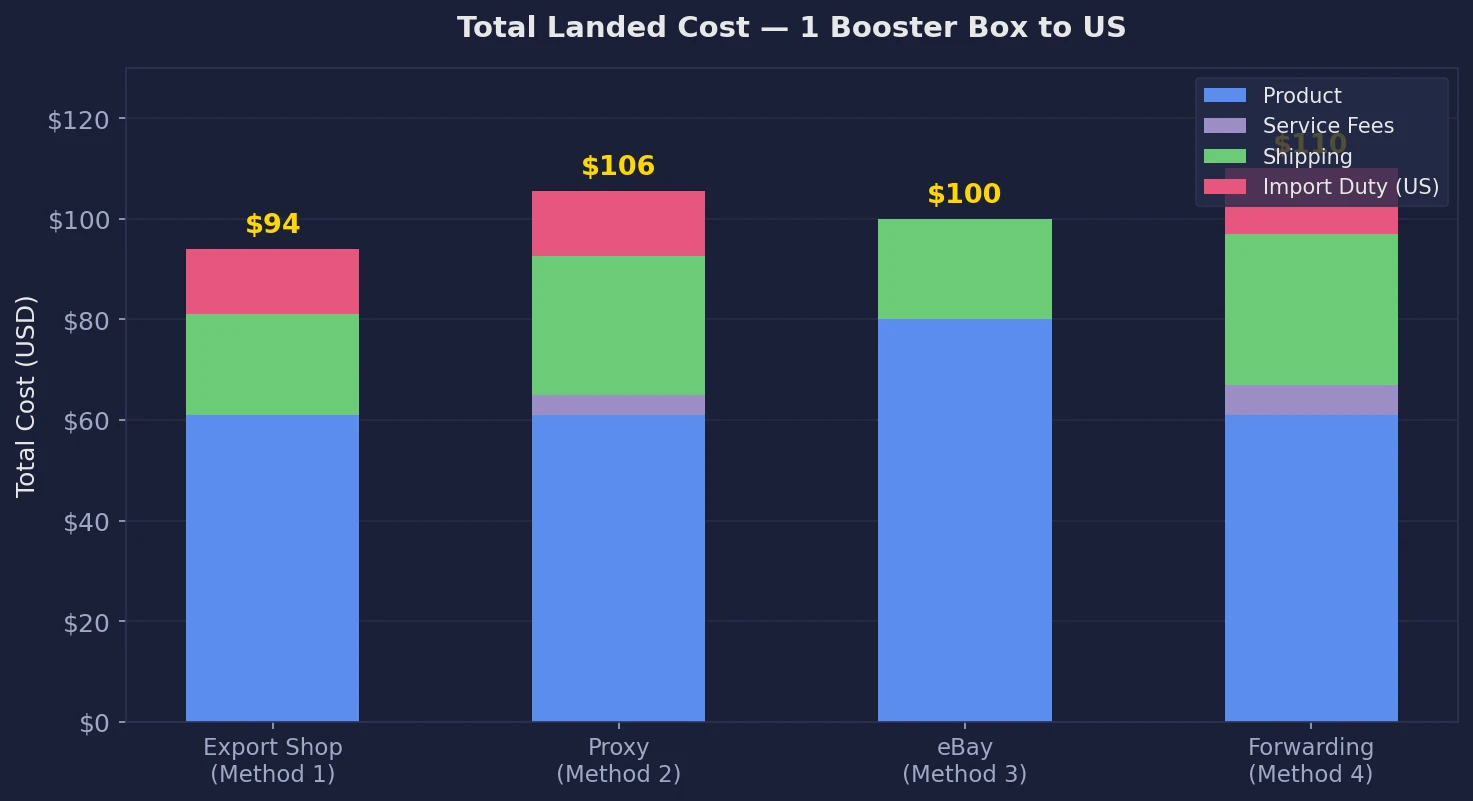
The sticker price on a Japanese booster box is just the starting point. Shipping, proxy fees, and import duties can add 30–70% to your final bill depending on your method and location.
Example: 1 Standard Booster Box (Market Price ~¥8,500 / ~$58)
Cost Component
Method 1 (Export Shop)
Method 2 (Proxy)
Method 3 (eBay)
Method 4 (Forwarding)
Method 5 (In Person)
商品
~$58
~$58
~$75–90
~$58
~$58
Service Fee
Included
~$2–5
—
~$5–7
—
運送
$15–25
$20–35
$10–30
$20–40
—
Import Duty (US, 12.5%)
~$7–10
~$7–10
Often included
~$7–10
Duty-free*
Carrier Fee
$0 (DDP — prepaid)
~$18 (DDU)
Often included
~$18 (DDU)
—
Total (US)
~$80–93
~$105–126
~$85–120
~$108–133
~$58
Total landed cost comparison chart for 1 booster box across 5 methods
Prices as of March 2026. Secondary market prices. Exchange rate: approximately ¥147/USD.
*In-person purchases are duty-free for personal-use quantities under the US $800 personal exemption when returning from travel.
Specialized export shops (Method 1) typically deliver the lowest total landed cost for remote buyers because they ship in volume and avoid the layered fees that proxy and forwarding services add.
Price alert: Starting May 2026, Japanese booster pack MSRP increases from ¥180 to ¥200 per pack (¥5,400 to ¥6,000 per 30-pack box) due to rising material costs. Current-production boxes at the old price point represent the last window before the increase takes effect. (Source: PokeBeach)
Most Japanese Pokemon card shipments reach international destinations within 3–14 business days, depending on carrier and service level.
Shipping Methods Compared
Carrier
Delivery Time
Tracking
Insurance
Cost (1 BOX, ~500g)
DHL Express
2–5 days
Full
Included
¥3,500–5,000 (~$24–34)
FedEx
2–5 days
Full
Included
¥3,500–5,500 (~$24–37)
EMS (Japan Post)
4–10 days
Full
Included
¥3,150–4,400 (~$21–30)
ePacket
7–21 days
Basic
Limited
¥1,500–2,500 (~$10–17)
Surface Mail
1–3 months
None
None
¥1,000–1,500 (~$7–10)
Shipping rates as of March 2026 (Japan Post rate schedule). Actual rates vary by destination zone and package dimensions.
Shipping method comparison visual — speed vs cost
Recommendation: For sealed booster boxes, DHL or FedEx provide the best balance of speed and protection. EMS is a solid mid-tier option. Avoid surface mail for valuable items.
2026 update: When you buy from us, we ship to the US DDP (Delivered Duty Paid): the 12.5% import duty and the small CBP processing fee are collected at checkout, and no carrier fee is billed at your door. Sellers who ship DDU instead leave the duty to be collected on delivery, plus the carrier’s disbursement fee (currently about $18).
Import Duties & Tariffs — 2026 Update
Import duties have changed significantly since 2025. Here is the current picture for major markets.
United States — 12.5% Tariff, Prepaid at Checkout
The US tariff landscape for Japanese imports went through four major changes:
August 29, 2025: The de minimis exemption ($800 duty-free threshold) was eliminated. All packages from Japan became subject to tariff regardless of value.
September 4, 2025: The US-Japan Framework Agreement locked in a 15% tariff on most Japanese imports, including trading cards (HS code 9504.40).
February 20, 2026: The Supreme Court ruled that IEEPA-based tariffs exceeded presidential authority, ending the 15% rate. A temporary 10% surcharge under Section 122 applied from February 24 to July 23, 2026.
July 24, 2026: A Section 301 action set the current rate: 12.5% for Japan-origin goods whose base US duty rate is free — including trading cards (HS 9504.40).
What you pay today (updated August 2026):
Tariff: 12.5% on the product value (international shipping is not taxed)
Carrier fee: none when you buy from us — we ship DDP and collect the duty at checkout; DDU shipments from other sellers incur the carrier’s disbursement fee (about $18) on delivery
Typical duty on 1 BOX (~$58 value): approximately $7, prepaid at checkout with us — nothing to pay at your door
英國
VAT: 20% on declared value + shipping cost
Customs duty: Generally 0% for trading cards (HS code 9504)
Carrier handling fee: £8–12
Typical import cost on 1 BOX: approximately £12–18
澳洲
GST: 10% on goods valued over AUD $1,000
Single-box orders (under AUD $1,000): No GST or customs duty — Australia remains the most import-friendly market for Pokemon card buyers
加拿大
Customs duty: 0% for trading cards
GST/HST: 5–15% depending on province
De minimis threshold: CAD $20 for duty, CAD $40 for tax
Typical import cost on 1 BOX: approximately CAD $5–12
Country
Tariff Rate
Tax
De Minimis
Typical Cost (1 BOX)
US
12.5%
—
Eliminated
~$7–10 (prepaid at checkout with us)
UK
0% (cards)
VAT 20%
£135
£12–18
澳洲
0%
GST 10%
AUD $1,000
A$0–6
加拿大
0%
GST 5–15%
CAD $20–40
C$5–12
Import duty comparison by country — US, UK, Australia, Canada
Duty and tax information as of August 2026. Rates change — check your country’s customs authority for the latest figures.
How to Buy Safely — Avoiding Fakes & Scams
Buying from a trusted source with quality control eliminates nearly all risk. If you purchase from a reputable export shop with inspection procedures, the chance of receiving a counterfeit or resealed product is close to zero. Here is what to watch for if you buy through other channels.
Red Flags to Watch For
Fake cards: Look for blurred printing, incorrect card thickness, flat uniform blue on the back (authentic cards have subtle gradients), and inconsistent Japanese text spacing. The tactile feel of genuine holographic cards is distinctive and difficult to replicate.
Resealed boxes: Check that the shrink wrap has the Pokemon Company logo printed on it. Watch for visible tape residue, re-application marks on edges, irregular barcode placement, and prices suspiciously below market value.
Authentic vs fake Japanese Pokemon card comparison showing key differences
Why Serial Tracking Matters
Shops that assign serial numbers to every box create a chain of accountability. If a tampered box is reported, the serial traces it back to the supplier — who gets permanently banned. This systemic approach to quality control is something marketplace sellers and proxy services cannot replicate.
What to Buy First — Best Japanese Sets for New Collectors
Three booster box categories stand out for new collectors in 2026.
For chase card collectors: The latest expansion packs — Battle Partners and Super Electric Breaker — feature stunning SAR and MUR artwork. Lillie’s Clefairy ex SAR from Battle Partners trades around ¥28,000 (~$190), and Pikachu ex SAR from Super Electric Breaker sits at approximately ¥66,500 (~$452).
For budget-friendly first purchases: Standard expansion booster boxes (30 packs) range from ¥7,000–12,000 (~$48–82) on the secondary market.
For long-term value: High Class Packs (released annually in December) have historically appreciated after going out of print. They feature curated card pools with elevated rarity rates.
Recommended Japanese Pokemon booster boxes for beginners — 3 BOX lineup
Timing note: Booster pack MSRP increases from ¥180 to ¥200 in May 2026. Boxes produced before this change are the last at the current price point.
How can I buy Japanese Pokemon cards if I live in the US?
The easiest option is a specialized export shop like Samurai Sword INC that ships directly from Japan with tracking. You can also use proxy services like Buyee or ZenMarket to buy from Japanese marketplaces. Since August 2025 all US imports from Japan are subject to tariff regardless of value; the rate is 12.5% as of August 2026. When you buy from us the tariff is collected at checkout (DDP) with no carrier fee at your door — roughly $7 per booster box.
Is it cheaper to buy Pokemon cards from Japan?
Japanese booster boxes have an MSRP of ¥5,400 (~$37), but retail availability is extremely limited. Secondary market prices range from ¥7,000–15,000 (~$48–102) depending on the set. After adding shipping ($15–35) and import duties, the total cost is often comparable to buying from a US-based Japanese card retailer — but you gain access to wider selection and earlier releases. Starting May 2026, MSRP increases to ¥6,000 per box.
How much does it cost to ship Pokemon cards from Japan?
For a single booster box (~500g), expect approximately $10–17 for economy (ePacket), $21–30 for EMS, or $24–37 for express carriers (DHL/FedEx). Rates as of March 2026 based on Japan Post and carrier rate schedules.
Do I have to pay customs on Pokemon cards from Japan?
In most countries, yes. US buyers pay a 12.5% tariff (rate as of August 2026) on all imports since the de minimis exemption ended in August 2025; when you buy from us it is prepaid at checkout with no carrier fee. UK buyers pay 20% VAT plus £8–12 handling. Australian buyers generally pay nothing on single-box orders under AUD $1,000. Canadian buyers pay 5–15% GST/HST.
How do I spot fake Japanese Pokemon cards?
Check print sharpness (fakes look blurred), card texture (authentic holos feel distinctly smooth), card thickness (fakes feel wrong), back color gradients (fakes use flat uniform blue), and Japanese text spacing (fakes show inconsistencies). The safest approach is buying from sellers with serial-tracked inspection procedures. See our complete fake detection guide.
Can I use Japanese Pokemon cards in English tournaments?
Official Pokemon TCG rules require cards in the language of the event. Some tournaments allow Japanese cards if your entire deck uses the same language and you carry official English reference cards. Confirm with your local tournament organizer.
What is a proxy service and how does it work?
A proxy service like Buyee acts as a middleman — you browse Japanese marketplaces (Yahoo! Auctions, Mercari) through an English interface, and the proxy handles the purchase, receives items at a Japanese warehouse, and forwards them to your international address. You pay the product price plus a service fee (¥250–300 per item) plus international shipping.
Are Japanese Pokemon booster boxes ever resealed?
Resealing exists but is uncommon from legitimate sellers. Protect yourself by buying from shops that inspect and serial-track every box, verifying the shrink wrap shows the Pokemon Company logo, and avoiding suspiciously cheap listings. Export shops with quality control procedures offer the strongest protection.
Bottom Line
Buying Japanese Pokemon cards from Japan comes down to three decisions:
Choose your method. Specialized export shops deliver the best combination of price, speed, and safety for most buyers. Proxy services like Buyee open up broader inventory — including out-of-print sets — but add complexity. Visiting Japan in person gives you the lowest cost and most hands-on experience.
Budget for the full cost. Product price is just the start. Add shipping ($15–35), import duty (0–12.5% depending on your country), and any carrier fees to calculate your real total. For US buyers, a typical booster box lands at $80–95 all-in through an export shop.
Prioritize authenticity. The cheapest option is rarely the safest. Serial-tracked boxes from established shops eliminate counterfeit and resealing risk entirely.
Your next step: browse the latest Japanese booster boxes and find a set that matches your collecting goals.
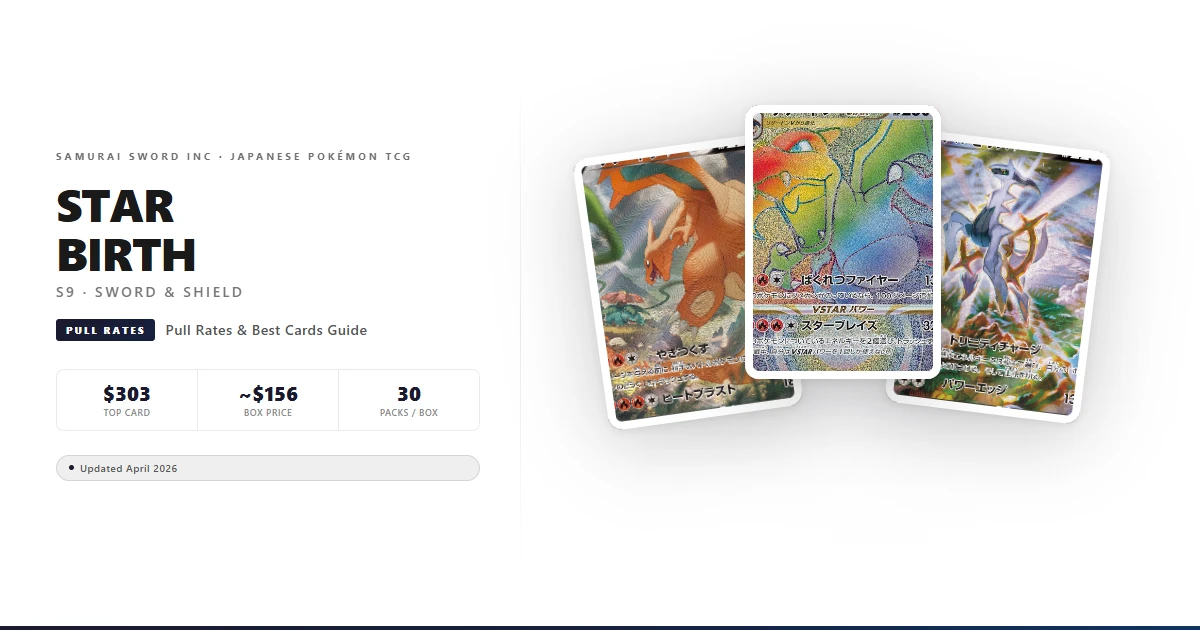
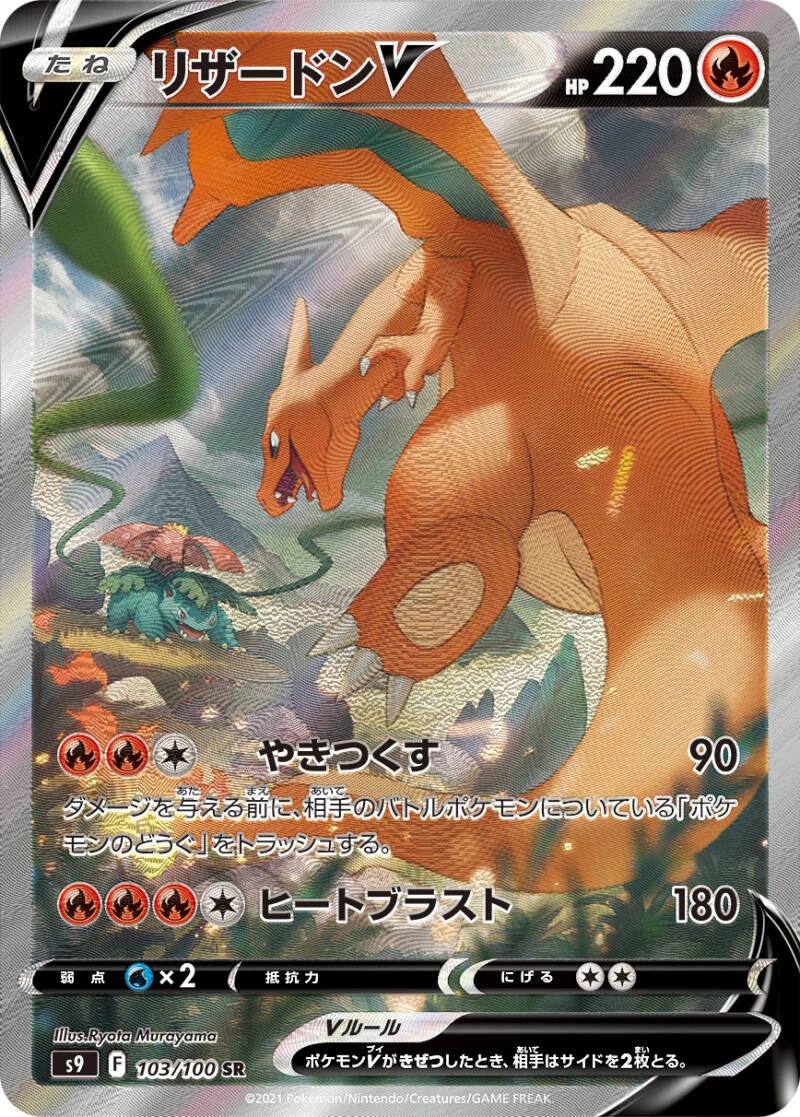
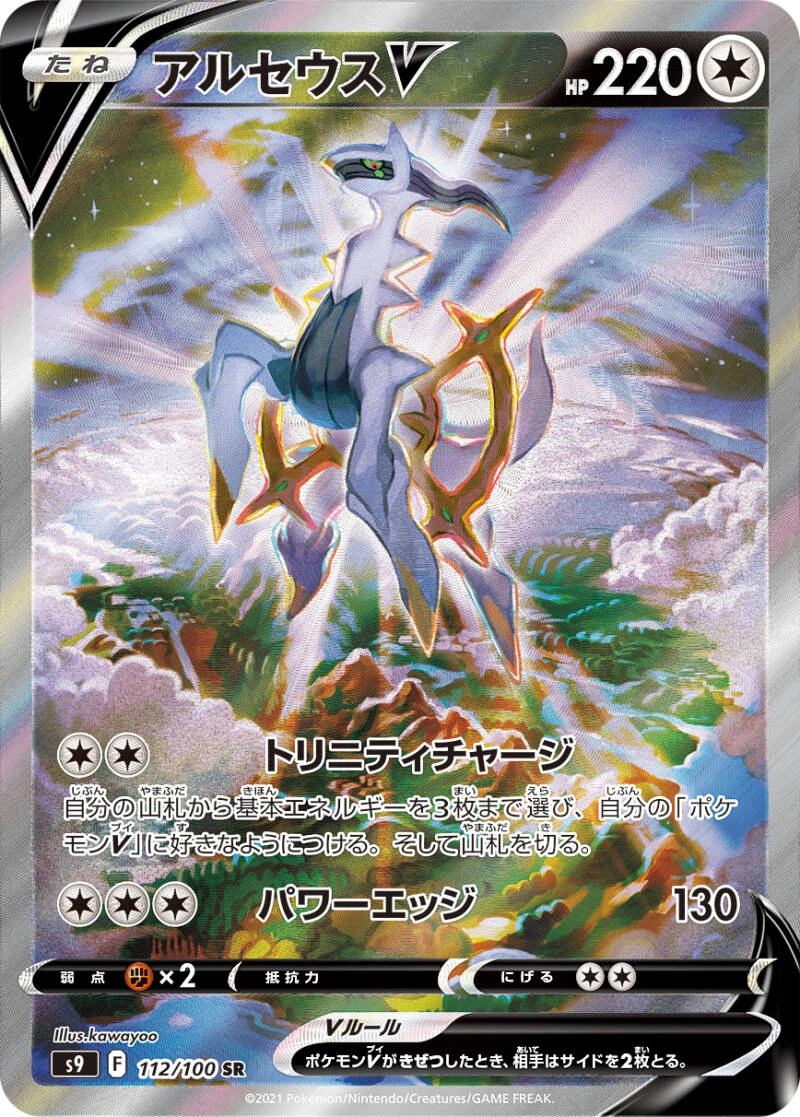
The Japanese S9 Star Birth set has one card that has been continuously appreciated since its January 2022 release: Charizard V SA (103/100), currently at ¥42,800 (~$303) on the JPN secondary market. That single card accounts for roughly half the opening value in a lucky box — and it sits alongside Arceus V SA (112/100) at ¥8,980 (~$64) and a Hyper Ball UR that trades at more than almost any trainer item card in the Sword & Shield era. S9 is the set that defined what a “Charizard box” looks like in modern JPN TCG collecting.
S9 Star Birth holds historical significance beyond its card values: it introduced the VSTAR mechanic to the Pokémon TCG, with Arceus VSTAR, Charizard VSTAR, and Shaymin VSTAR debuting here. The set is the Japanese counterpart to the international Brilliant Stars (February 2022), but with different SR and SA artwork treatment — the Charizard V SA (103/100) in S9 does not appear in the English Brilliant Stars. Four years out of print, the box has climbed from ~¥5,500 at launch to ~¥22,000 (~$156) today.
This guide breaks down the full S9 picture: top 10 cards ranked by April 2026 JPN prices, pull rate estimates for the 30-pack regular expansion structure, EV math, the “Charizard box or Arceus box?” framing question, and a 4-year price trajectory. We handle Japanese Pokémon TCG boxes internationally every week — here is everything we tell buyers asking about Star Birth.
Key Takeaway
S9 Star Birth is the first VSTAR set and home to the Charizard V SA (103/100) at ~$303 — one of the highest-value individual cards in the entire Sword & Shield era. At ~$156/box with a 25% chance per box of any SA pull, S9 is the premium OOP regular expansion for collectors who want Charizard, Arceus, or the first appearance of the VSTAR mechanic.
~$303
Top Card (Charizard V SA)
~$156
BOX Market Price
30 Packs
Per Box (5 cards each)
127 Cards
Total Set
What Is S9 Star Birth? Set Overview
S9 Star Birth (スターバース) is the Japanese regular expansion pack released on January 14, 2022, and the most significant Sword & Shield set by one measure: it introduced the VSTAR mechanic to the Pokémon Trading Card Game. Every VSTAR card — Arceus VSTAR, Charizard VSTAR, Shaymin VSTAR, and 24 others — traces its debut to this set.
Set Specs
Detail
Value
Set Code
S9
Japanese Name
スターバース
Series
Sword & Shield
Category
Regular 擴充包 (拡張パック)
Release Date
January 14, 2022
Packs per Box
30
Cards per Pack
5
Main Set
100 cards
Secret Rares
27 cards (11 SR Pokémon, 4 SR Trainers, 4 SA, 8 HR, 3 UR)
Total Cards
127
MSRP
¥4,950 → Market price: ~¥22,000 (~$156 at ¥141/USD) as of April 2026
VSTAR Mechanic Introduction
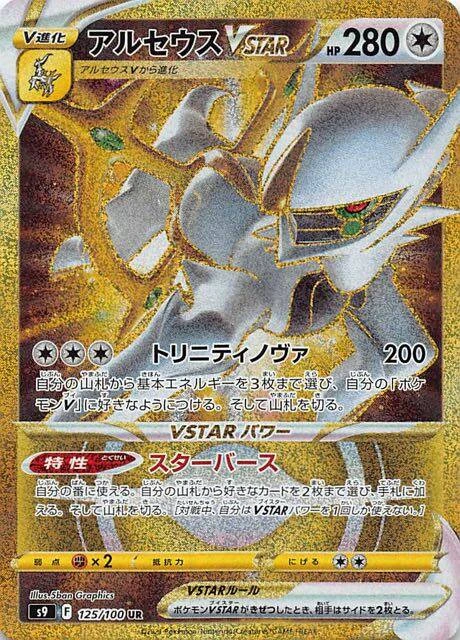
VSTAR cards were the Sword & Shield era’s final evolution of the V mechanic. Each VSTAR Pokémon comes with a once-per-game VSTAR Power — either a powerful attack or an ability. Arceus VSTAR’s Starbirth ability (search your deck for any two cards) became immediately relevant in competitive play, and Charizard VSTAR’s Blaze VSTAR attack set the template for high-damage VSTAR builds. The debut of this mechanic in S9 makes it a historically significant set regardless of secondary market prices.
JPN vs English Brilliant Stars
The international Brilliant Stars (February 2022) combined S9’s main set cards with the Brilliant Stars-specific rarity treatment: Alternate Art (AA) and Rainbow Rare designs replaced the JPN SR and SA cards entirely. The Charizard V SA (103/100) from S9 does not appear in Brilliant Stars — the English version has a Charizard V Alternate Art with different artwork. Collectors who specifically want the JPN Charizard V SA (103/100) or Arceus V SA (112/100) must buy the Japanese S9 set.
Top 10 Most Valuable S9 Star Birth Cards
Charizard V SA leads S9’s value structure by a significant margin — at ~¥42,800, it is nearly 3× the second-place Charizard VSTAR HR. This Charizard-heavy structure means the SA pull in a box is more likely to be Arceus, Lumineon, or Honchkrow (the other three SA cards) than the set’s crown jewel. Prices below from altema.jp, April 2026.
#
卡牌
Number
Rarity
JPN Sell
JPN Buy
1
Charizard V
103/100
SA
¥42,800
¥35,000
2
Charizard VSTAR
118/100
HR
¥14,800
¥11,000
3
Hyper Ball
126/100
UR
¥8,980
¥7,500
4
Arceus V
112/100
SA
¥8,980
¥7,500
5
Charizard V
102/100
SR
¥5,980
¥4,500
6
Cynthia’s Ambition
—
SR
¥3,280
¥2,300
7
Arceus VSTAR
—
HR
¥2,480
¥1,800
8
Arceus VSTAR
125/100
UR
¥2,380
¥1,800
9
Lumineon V
105/100
SA
¥1,380
¥1,000
10
Shaymin VSTAR
—
HR
¥1,180
¥800
Prices in JPY from altema.jp secondary market, April 2026. 1 USD ≈ ¥141.
#1 — Charizard V SA (103/100) — ~$303
The defining card of S9 and one of the most valuable individual cards in the entire Sword & Shield era. Charizard V SA (103/100) depicts Charizard mid-flight in a dynamic full-bleed illustration that fills the entire card face. Charizard’s universal collector appeal — maintained across every generation of the TCG since Base Set — means this card has held a premium that other set-specific SAs rarely match. At ¥42,800 sell / ¥35,000 buy (April 2026), it is the anchor card that defines S9’s overall box price floor.
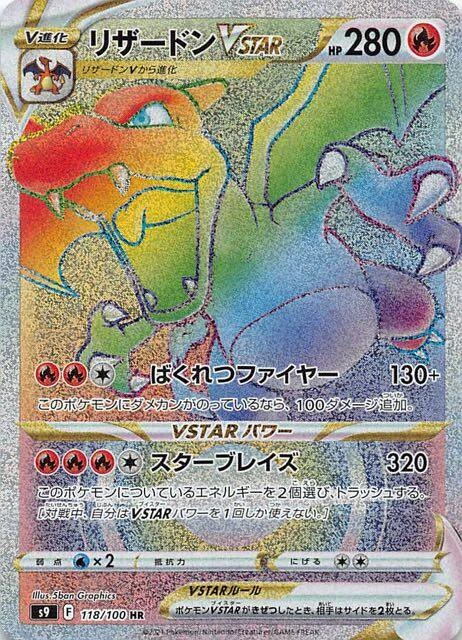
#2 — Charizard VSTAR HR (118/100) — ~$105
The rainbow hyper rare version of Charizard VSTAR trades at ¥14,800 (~$105), making it the second most valuable pull in the set. As an HR card, Charizard VSTAR is significantly rarer than the guaranteed SR slot — estimated at roughly 1 per 5 boxes — and the Charizard premium on the HR treatment pushes it well above the set’s other HR cards. For buyers targeting two Charizard pulls in one box, both the SA (103) and HR (118) are in play.
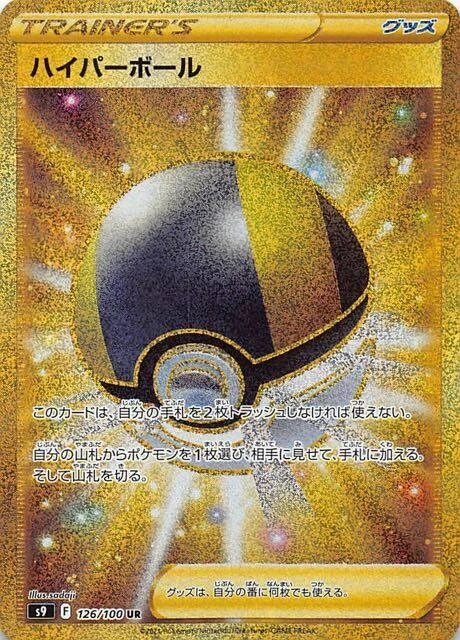
#3 — Hyper Ball UR (126/100) — ~$64
The Hyper Ball UR (126/100) at ¥8,980 (~$64) is one of the highest-value item UR cards in the Sword & Shield era. Its value comes from two sources: Hyper Ball is a mechanically useful trainer card that saw competitive play, and the gold UR treatment on a universally recognizable item card (the standard PokéBall throw animation) has strong cross-audience appeal. It trades higher than the Arceus VSTAR UR at ¥2,380 — unusual for a trainer item to outperform a Pokémon VSTAR in gold treatment.
#4 — Arceus V SA (112/100) — ~$64
Arceus V SA (112/100) is the thematic centerpiece of the set — Arceus is literally in the set name — but it trades at ¥8,980 (~$64), significantly less than the Charizard V SA. This gap reflects the Charizard premium that runs across the entire TCG: Charizard cards consistently outperform equivalent non-Charizard cards in secondary market value. For Arceus collectors, the SA provides excellent value at its current price; for pure value chasing, the Charizard SA is the target.
#5 — Arceus VSTAR UR (125/100) — ~$17
Arceus VSTAR in gold UR treatment (125/100) at ¥2,380 (~$17) is the set’s fourth-highest value card beyond the top tier. It also appears as an HR version at a similar price (¥2,480). For Arceus master collectors, both the SA (112) and the UR (125) are must-haves alongside the set’s SR full art at 111/100.
Cards #6–10: Supporting Value
Cynthia’s Ambition SR is the set’s top Trainer SR at ¥3,280. Cynthia (シロナ) is the Sinnoh region Champion from Pokémon Diamond and Pearl — her SR card in any set consistently draws premium demand from Sinnoh fans, and S9 is her SA debut in the VSTAR era. Charizard V SR (102/100) at ¥5,980 is the “consolation prize” version of the top SA card, with the same subject but regular full art treatment rather than the dynamic SA illustration. Shaymin VSTAR HR completes the set’s notable rainbow holo pulls alongside Charizard VSTAR.
Should You Buy an S9 Star Birth Box?
For Charizard Collectors
S9 is one of three Sword & Shield era sets with a Charizard SA or equivalent, alongside S7D (Charizard V SA) and S8B VMAX Climax. The S9 Charizard V SA (103/100) is widely regarded as the best Charizard illustration in the era. At ~$156/box with a ~25% chance per box of any SA, opening for it requires patience — statistical expectation is one SA per four boxes, but it’s one of four SA variants. Buying the single directly at ~$303 is more cost-efficient if Charizard V SA is the only goal.
For VSTAR Completionists
S9 is the only set that can complete a VSTAR debut collection. All three premiere VSTAR cards (Arceus, Charizard, Shaymin) have HR rainbow holo versions here. If building a first-edition VSTAR collection is the goal, S9 is a required set with no substitute.
For Arceus Collectors
Arceus V SA (112/100) at ¥8,980 (~$64) is accessible as a single and a reasonable opening target given the 25% SA chance per box. The Arceus VSTAR UR (125/100) at ¥2,380 and HR version add further depth. S9 is the best single set for building an Arceus V/VSTAR collection.
For Box Openers and Casual Collectors
S9 is a 30-pack, 150-card box. At ~$156, it sits in the upper-mid range of Sword & Shield OOP boxes — more expensive than S10P (~$92) but less than S8A 25th Anniversary (~$200+). The opening experience has clear chase targets (Charizard SA and Arceus SA for different collector profiles) and the HR/UR slots carry strong supporting value. The negative EV is offset by the experience.
For Investors
S9’s Charizard V SA is the most reliable long-term appreciator in the set — Charizard cards have historically maintained value better than other Pokémon across market cycles. The overall box has appreciated from ~¥5,500 to ~¥22,000 (+300%) in four years. Whether this trajectory continues depends on new VSTAR-era nostalgia and Charizard demand, both of which have strong fundamentals.
S9 Star Birth Pull Rates & Box EV Breakdown
S9 is a regular expansion pack (30 packs × 5 cards = 150 cards/box). It guarantees at least 3 V cards, 2 VSTAR cards, and 1 SR per box. Pull rates below are estimated from Japanese community opening data.
Rarity
Estimated Rate
Per 30-Pack Box
SR (Super Rare, Full Art)
~100%
1 guaranteed
SA (Special Art)
~25% per box
1 per ~4 boxes
HR (Hyper Rare)
~20% per box
1 per ~5 boxes
UR (Ultra Rare, Gold)
~10% per box
1 per ~10 boxes
RRR (VSTAR, Full Art)
~200%
~2 per box
RR (V, Double Rare)
~300–400%
~3–4 per box
Estimates from Japanese community opening data. Not officially confirmed by The Pokémon Company.
Box EV Breakdown
Box cost: ~¥22,000 (~$156). Expected value uses April 2026 altema.jp prices.
Hit Type
Rate
Avg Value (JPY)
Expected Value
Guaranteed SR (from 15 SR pool)
100%
~¥1,500
¥1,500
SA pull (1 of 4 SA cards)
~25%
~¥13,000
~¥3,250
HR pull
~20%
~¥3,000
~¥600
UR pull
~10%
~¥4,600
~¥460
VSTAR cards (~2 per box)
200%
~¥300
~¥600
V cards (~3–4 per box)
350%
~¥150
~¥525
Total Expected Value
~¥6,935
EV Reality Check
Expected value ~¥6,935 vs box cost ~¥22,000 = approximately -¥15,065 per box on average. This is the standard structure for premium OOP collector boxes — the negative EV reflects the scarcity premium, not irrationality. The SA average (¥13,000) is pulled down by three low-value SA cards (Lumineon V at ¥1,380, Honchkrow V at ¥680) alongside the Arceus V SA (¥8,980) and Charizard V SA (¥42,800). The Charizard V SA itself, when pulled, returns more than 1.9 boxes worth of cost — the variance is enormous.
SA Distribution: The Charizard Problem
S9 has four SA cards: Charizard V (¥42,800), Arceus V (¥8,980), Lumineon V (¥1,380), and Honchkrow V (¥680). If you pull an SA in a box (~25% chance), the expected value of that pull is the average of all four: approximately (¥42,800 + ¥8,980 + ¥1,380 + ¥680) / 4 = ~¥13,460. But the distribution is extremely skewed — three of four SA pulls return under ¥9,000, while only one returns ¥42,800. This variance is what makes S9 one of the most “lottery-like” regular expansion boxes in the Sword & Shield era.
S9 Star Birth BOX Price History (2022–2026)
S9 has appreciated from ~¥5,500 at launch to ~¥22,000 over four years — a 300% increase. The appreciation has accelerated since late 2023 as the Charizard V SA’s value climbed and OOP supply tightened.
日期
BOX Price (JPY)
USD (est.)
Notes
Jan 2022
~¥5,500
~$39
Launch, heavy supply
Jul 2022
~¥6,000
~$43
Post-launch holding
Jan 2023
~¥8,000
~$57
VSTAR nostalgia cycle begins
Jul 2023
~¥10,000
~$68
OOP approaching
Jan 2024
~¥12,000
~$81
OOP confirmed
Jul 2024
~¥16,000
~$109
Charizard V SA premium rises
Jan 2025
~¥19,000
~$129
Steady appreciation
Apr 2026
~¥22,000
~$156
Current; supply increasingly scarce
JPN secondary market prices (altema.jp / SNKRDUNK estimates). Prices as of April 2026.
Why S9 Has Outperformed Other Regular Expansions
Three factors separate S9’s trajectory from comparable regular expansion boxes. First, the Charizard V SA floor: as long as Charizard V SA holds ¥35,000+ (its buy price), the box has a strong value anchor that other sets lack. Second, the VSTAR debut: S9 is the only set where Arceus VSTAR, Charizard VSTAR, and Shaymin VSTAR all appear for the first time — this creates completionist demand that doesn’t fade with time. Third, the 27-card secret rare pool provides more variety in pulls than smaller sets, which sustains opening interest and keeps boxes moving through the secondary market.
Where to Buy S9 Star Birth
S9 is out of print and only available through secondary market channels. We ship from Japan directly.
S9 Star Birth Booster Box — Authentic Japanese
Sealed, shrink-wrapped, shipped direct from Japan. In stock while supplies last.
Bottom Line: Is S9 Star Birth Worth Buying in 2026?
S9 Star Birth offers something no other Sword & Shield set provides: the combination of the Charizard V SA (103/100) at ¥42,800, the first-ever Arceus VSTAR debut, and 27 total secret rares providing the widest pull variety in any regular expansion of the era. The box is now priced at ~$156, which is steep — but the Charizard V SA alone at ~$303 means a single lucky pull returns double the box cost.
The negative EV is substantial on average (-¥15,065 per box), but the SA variance makes S9 one of the most exciting regular expansion boxes to open. For collectors who want Charizard, Arceus, or the first VSTAR cards in Japanese, there is no substitute set.
Buy it if: You collect Charizard cards, want the Arceus VSTAR debut in Japanese, or are building a Sword & Shield era VSTAR collection.
The most valuable card is Charizard V SA (103/100), currently at approximately ¥42,800 (~$303) on the JPN secondary market as of April 2026. Charizard VSTAR HR (118/100) is second at ~¥14,800 (~$105), and Hyper Ball UR (126/100) is third at ~¥8,980 (~$64), unusually high for a trainer item card.
How many cards are in S9 Star Birth?
S9 Star Birth has 127 total cards: 100 main set cards plus 27 secret rares (11 SR Pokémon full arts, 4 SR Trainers, 4 SA special arts, 8 HR rainbow holos, and 3 UR gold cards). Each booster box contains 30 packs of 5 cards = 150 cards per box.
Is S9 Star Birth the same as English Brilliant Stars?
Partially. The English Brilliant Stars (February 2022) uses S9’s main set as its base but has completely different SR and rarity treatments. The Japanese S9 Charizard V SA (103/100) and Arceus V SA (112/100) do not appear in Brilliant Stars — the English set uses Alternate Art cards with different artwork. Collectors who specifically want the JPN SR/SA cards must buy S9.
What are the S9 Star Birth pull rates?
Estimated from community opening data: 1 SR guaranteed per 30-pack box, ~25% chance of any SA card per box, ~20% chance of an HR rainbow holo, ~10% chance of a UR gold card. As a regular expansion (30 packs × 5 cards), SA probability is lower per box than in enhanced expansions like S10A or S10B. The Pokémon Company does not officially publish pull rate data.
Why is Charizard V SA worth so much more than Arceus V SA?
Charizard commands a consistent premium across the entire Pokémon TCG — Charizard cards in any era sell for more than equivalent non-Charizard cards with identical rarity and artwork quality. Charizard V SA (¥42,800) vs Arceus V SA (¥8,980) reflects this dynamic: the S9 set is named after Arceus and built around the Arceus VSTAR debut, but the Charizard card commands 4.75× the value of the set’s mascot card.
Is S9 Star Birth still in print?
No. S9 Star Birth is out of print with no announced reprint. The box price has appreciated from ~¥5,500 at launch to ~¥22,000 as of April 2026, driven by OOP scarcity and the sustained value of the Charizard V SA.
Nihil Zero (Munikis Zero) Booster Box Pull Rates & Hit Rates [2026]
One MUR card in every 50 boxes — those are the Nihil Zero pull rates that every collector needs to know before buying. That’s roughly a 2% chance per box of pulling the gold Mega Zygarde ex, the single most valuable card in Japan’s first MEGA-era expansion of 2026.
Nihil Zero (known internationally as “Nihil Zero” or “Nullifying Zero”) dropped in Japan on January 23, 2026, and it brought a brand-new rarity tier, four Mega Evolutions, and some of the most stunning SAR artwork in the MEGA era. Six weeks in, launch premiums have settled and several mid-tier cards are actually trending upward as competitive demand solidifies.
This guide covers the actual pull rates sourced from Japanese opening data, a full top-10 card ranking with real JPN market prices converted to USD, an expected value calculation for sealed boxes, and a clear answer on whether you should buy, hold, or go singles. We pulled the latest data from SNKRDUNK, Mercari, and eBay sold listings so you can make a decision based on numbers — not hype.
Our team tracks JPN card prices daily and ships 100+ boxes from Tokyo every week. This is the data we use internally, now available to you.
Key Takeaway
Mega Zygarde ex MUR trades at ¥35,000 (~$225) with a 1-in-50-box pull rate. Rosa’s Encouragement SAR is the fan-favorite at ¥21,000. At ~¥7,000 per box, Nihil Zero is the most affordable MEGA-era entry point — and the first J-Regulation set, giving it long-term “era starter” appeal.
~¥7,000
Box Price
118
Cards
~1/6
SAR Rate
30
Packs/Box
Nihil Zero (Nihil Zero) — Set Overview
Nihil Zero is the third expansion pack in the Pokemon TCG MEGA series and the first set under J-Regulation — Japan’s newest card legality format. The set revolves around Mega Evolutions tied to Pokemon Legends: Z-A, with Mega Zygarde ex as the flagship card.
Release Info, Price & Pack Contents
Detail
Info
Set Name (JPN)
ムニキスゼロ (Nihil Zero)
Set Code
M3
Release Date (JPN)
January 23, 2026
MSRP
¥5,400/box (¥180/pack)
Market Price
~¥7,000 (~$45 at ¥155/USD)
Packs per Box
30 packs × 5 cards
Set Size
80 main set + 38 secret rares (118 total)
Regulation
J-Regulation (first set)
Prices as of March 2026. Market prices based on SNKRDUNK data.
What Makes This Set Special — Mega Evolution & J-Regulation
Nihil Zero introduces two firsts. It’s the debut of J-Regulation, meaning every card in this set will remain tournament-legal for the longest possible window. For players, that alone makes it worth attention.
For collectors, the real draw is the MUR (Mega Ultra Rare) rarity — a gold-finished, full-art treatment exclusive to the MEGA series. Only one MUR exists per set, and Nihil Zero’s MUR is Mega Zygarde ex, card 117/080. The gold etching across the entire card surface gives it a visual weight that photographs don’t fully capture.
The set also features four Mega Evolution ex cards: Mega Zygarde, Mega Starmie, Mega Clefable, and Mega Skarmory. Plus a competitively relevant Meowth ex with a Supporter-search ability that’s already seeing play in Japan.
JPN vs International Timeline
The English-language equivalent, Mega Evolution—Perfect Order, went on sale on March 27, 2026, roughly two months after the Japanese release on January 23, 2026.
Japanese Version
Released January 23, 2026
Set name: Nihil Zero (M3)
2-month head start
Higher texture/foil quality
English Version
Releasing March 27, 2026
Set name: Perfect Order
Cards from multiple JPN sets
Lower secondary market price
Historically, JPN versions of the same cards trade at a 15–40% premium over their English counterparts. That premium tends to be strongest for SARs and MURs, where JPN texture and foil quality stand out most. For a comprehensive breakdown, see our Japanese vs English Pokemon Cards comparison.
Top 10 Most Valuable Cards in Nihil Zero
Here’s the full ranking based on Japanese secondary market data as of March 2026. USD estimates use the current rate of ¥155/USD.
等級
卡牌
Rarity
JPN Price (¥)
USD Est.
1
Mega Zygarde ex
MUR
¥35,000
~$226
2
Rosa’s Encouragement
SAR
¥21,000
~$135
3
Meowth ex
SAR
¥12,000
~$77
4
Mega Starmie ex
SAR
¥5,000
~$32
5
Mega Zygarde ex
SAR
¥3,500
~$23
6
Mega Clefable ex
SAR
¥2,800
~$18
7
Rosa’s Encouragement
SR
¥2,500
~$16
8
Meowth ex
SR
¥2,000
~$13
9
Yukari
SAR
¥1,800
~$12
10
Poke Pad
SR
¥1,100
~$7
Prices based on SNKRDUNK and Mercari transaction data, March 2026.
#1 Mega Zygarde ex MUR — The Gold Grail
The gold Mega Zygarde ex launched at ¥60,000 (~$387) on day one and has settled around ¥35,000 (~$226) six weeks later. That correction aligns with the typical MUR trajectory, and the card remains the most expensive single in any 2026 Japanese set so far.
The price holds because of three factors. First, the MUR pull rate is brutal — roughly one in every 50 boxes. Second, Zygarde is the face of Pokemon Legends: Z-A, giving it narrative weight beyond typical chase cards. Third, the MUR treatment itself is stunning: full gold etching across the card surface with a tactile texture that sets it apart from standard SARs.
For context, the previous MUR — Mega Rayquaza ex from the M1 set — followed a similar trajectory: day-one spike, 30-40% correction over four weeks, then gradual stabilization. Zygarde is following that exact pattern, and the current price range around ¥35,000 appears to be approaching its stabilization floor.
#2 Rosa’s Encouragement SAR — Fan-Favorite Trainer Art
Rosa (Mei in Japanese) is the female protagonist from Pokemon Black 2 and White 2, and she commands serious collector demand. This SAR features her eating a Pikachu-shaped double-scoop ice cream cone — a charming, lighthearted illustration that’s driven strong emotional response from collectors in Japan.
Day-one price: ¥40,000 (~$258). Current: ¥21,000 (~$135). The 48% correction from day one reflects SAR pull rates (~1 in 6 boxes) being far more generous than MUR rates. Supply has caught up with initial demand, and the card appears to be finding its floor.
The card also carries competitive value: Rosa’s Encouragement is a Supporter that lets you draw cards while attaching Energy, making it a staple in several JPN meta decks. That dual appeal — playability plus fan-favorite character art — gives it a price floor that pure collector cards lack.
#3 Meowth ex SAR — Competitive Staple Meets Beautiful Art
Meowth ex might be the most important card in this set for tournament players. Its ability “Okunote Catch” lets you search your deck for any Supporter card once per turn — an effect that slots into virtually every deck archetype.
The SAR version at ¥12,000 (~$77) has actually climbed from its initial post-launch dip, driven by sustained tournament demand. The illustration shows Meowth in a traditional maneki-neko (beckoning cat) pose, which resonated strongly with Japanese collectors. This is one of the few cards in the set where competitive utility and collector appeal are reinforcing each other’s price floor.
#4–10 Quick Hits
#4 Mega Starmie ex SAR (¥5,000 / ~$32) — Gorgeous cosmic illustration that has appreciated from its ¥4,000 launch price. Mega Starmie sees some competitive play as a versatile attacker, and the art quality continues to attract collectors.
#5 Mega Zygarde ex SAR (¥3,500 / ~$23) — The “budget” version of the flagship card. Same Pokemon, different art treatment. Has actually climbed from its ¥2,300 post-launch dip, likely buoyed by players wanting Zygarde representation without the MUR price tag.
#6 Mega Clefable ex SAR (¥2,800 / ~$18) — Clefable’s Fairy-type nostalgia drives collector interest. The Mega form is exclusive to the Z-A era, adding novelty value. Steady upward movement since launch.
#7 Rosa’s Encouragement SR (¥2,500 / ~$16) — The standard Secret Rare version of the #2 card. Same competitive utility, less premium art. Strong entry point for players who need the card for decks.
#8 Meowth ex SR (¥2,000 / ~$13) — Competitive necessity at a reasonable price. If you’re building decks in J-Regulation, you likely need this card. Price has firmed up since launch as tournament demand grows.
#9 Yukari SAR (¥1,800 / ~$12) — A new Supporter character without existing fan base, which explains the lower price. Art quality is high, but character recognition drives SAR pricing more than illustration alone.
#10 Poke Pad SR (¥1,100 / ~$7) — A useful Item card with utility across multiple deck types. Price has climbed as J-Regulation deck building picks up, making this a consistent staple.
The answer depends on what you’re after — and right now, with launch premiums behind us, the entry point is more accessible than it was a month ago.
For Collectors — Chase the Art, Not the MUR
Nihil Zero has genuinely strong art across its SAR lineup. Rosa’s Encouragement, Meowth ex, and Mega Starmie ex are all top-tier illustrations. At ~$45 per box, you’re getting 30 packs with guaranteed ARs and a reasonable shot at SARs.
Collector Recommendation
Buy 1–3 boxes for the opening experience. Set a budget you’re comfortable treating as entertainment spending, not investment. If you specifically want the MUR or Rosa SAR, buy them as singles after prices stabilize further.
For Players — Key Competitive Cards
Two cards from Nihil Zero are already shaping the J-Regulation meta:
Meowth ex — Supporter search ability. Near-universal inclusion across deck types.
Rosa’s Encouragement — Draw + Energy attachment. Strong in acceleration-based strategies.
Both are available as affordable SR/RR versions. You don’t need the SAR to play competitively.
For Investors — JPN Premium & Sealed Value
Sealed JPN boxes have historically appreciated once print runs end. Nihil Zero is the first J-Regulation set, which gives it “first of era” appeal similar to early Scarlet & Violet sets.
The English release (Perfect Order, March 27) is imminent, which typically creates short-term price pressure on JPN versions — this can work in your favor as a buying opportunity. The current ~¥7,000 box price is near the lowest since release, and the stabilization window around 2-3 months post-release has historically marked a strong entry point for sealed box holdings.
Buyer Type
Recommendation
Key Reason
Collector
Buy 1-3 boxes
Strong SAR art, fun opening experience at ~$45/box
Player
Buy singles
Meowth ex RR & Rosa RR available under $5 each
Investor
Buy now — near floor pricing
First J-Reg set, “era starter” sealed value at ¥7,000
Most English-language guides describe Nihil Zero pull rates as “low” or “extremely rare” without giving you numbers. Here are the actual figures, sourced from Japanese opening data aggregated across multiple large-scale box breaks.
Rarity
Cards in Set
Per Box (30 packs)
Per Pack
Approx. Odds
MUR
1
~0.02
~0.07%
1 in 50 boxes
SAR
6
~0.17
~0.56%
1 in 6 boxes
SR (Pokemon/Supp.)
8
~1
~3.3%
~1 per box
SR (Trainer Items)
4
~1
~3.3%
~1 per box
AR
12
3
10%
3 per box
RR
8
4
13.3%
4 per box
Pull rate data estimated from Japanese opening reports. The Pokémon Card Game’s official product page does not publish pull rates; it says only that cards are inserted randomly.
Pull rate breakdown per box (30 packs). Data from Japanese opening reports.
MUR Pull Rate — The Brutal Math
MUR Reality Check
At one MUR per 50 boxes, you’d need to spend approximately ¥350,000 (~$2,258) at market price to statistically expect one Mega Zygarde ex MUR. The card itself trades at ¥35,000 (~$226). Buying the single is roughly 10x more cost-efficient than chasing it through sealed product.
To put it in perspective: a standard case contains 12 boxes. You’d need to open over four full cases — 1,500+ packs — for a statistical coin flip at pulling the MUR.
SAR, SR, AR & RR Breakdown
SARs are far more accessible at roughly 1 in every 6 boxes. With six different SARs in the set, you can expect to see one every ~36 boxes on average for any specific SAR you’re targeting.
The guaranteed minimums per box keep each opening interesting:
3 Art Rares (AR) — from a pool of 12 designs
4 Double Rares (RR) — from a pool of 8
1–2 Secret Rares (SR) — the most consistent source of value per box
These guaranteed pulls form the backbone of your box value, which brings us to the EV calculation.
Box EV Breakdown — What the Numbers Say
Every Pokemon TCG box has a negative expected value on paper — if cards were worth more than the box, no one would sell sealed product. That’s the baseline reality across the hobby. Here’s the Nihil Zero breakdown using March 2026 market data.
EV Calculation at Market Price (~¥7,000 / ~$45)
Rarity
Avg Cards/Box
Avg Card Value (¥)
EV Contribution (¥)
MUR
0.02
¥35,000
¥700
SAR
0.17
¥7,683
¥1,306
SR (Pokemon/Supp.)
1.0
¥2,250
¥2,250
SR (Items)
1.0
¥1,100
¥1,100
AR
3.0
¥350
¥1,050
RR
4.0
¥250
¥1,000
R/U/C
21.8
~¥10
¥218
Total EV
¥7,624 (~$49)
EV contribution by rarity tier vs box price (¥7,000). March 2026 market data.
EV Summary
At current market price of ~¥7,000: EV is positive by ~¥624 (~$4) per box. This is unusual for Pokemon TCG sealed product — competitive staples like Meowth ex and Rosa’s Encouragement have firmed up in price, while the box price has dropped since launch. The guaranteed SR, AR, and RR pulls form a solid value floor in every box.
What This Actually Means When You Open
~85% of boxes return ¥4,500-7,500 in card value (SRs, ARs, RRs only)
~13% of boxes return ¥10,000-18,000 (hit a SAR)
~2% of boxes return ¥40,000+ (hit the MUR)
The opening experience itself — 30 packs, guaranteed ARs and RRs, a shot at SARs — is where the value lives for most buyers. The MUR is a lottery ticket, not a business plan.
Singles vs Sealed — The Break-Even Analysis
Goal
Sealed (1 Box)
Singles
Verdict
Mega Zygarde MUR
¥7,000 x 50 boxes = ¥350,000
¥35,000
Singles: 10x cheaper
Rosa SAR
¥7,000 x 6 boxes = ¥42,000
¥21,000
Singles: ~2x cheaper
Meowth ex (playable RR)
¥7,000 x 1 box
¥500
Singles: 14x cheaper
Opening experience + random hits
¥7,000
N/A
Sealed: priceless
If you want specific cards, buy singles. If you want the experience of opening packs and building a collection organically, sealed boxes are the way — just go in with realistic expectations.
Price Trends — How Prices Have Settled Since Launch
Nihil Zero is showing an interesting split: top-end chase cards (MUR and Rosa SAR) corrected from launch premiums as expected, while mid-tier competitive staples have actually firmed up as J-Regulation tournament demand builds. Here’s the full picture.
卡牌
Day 1 (Jan 23)
Current (Mar)
Change
Mega Zygarde MUR
¥60,000 ($387)
¥35,000 ($226)
-42%
Rosa SAR
¥40,000 ($258)
¥21,000 ($135)
-48%
Meowth ex SAR
¥12,500 ($81)
¥12,000 ($77)
-4%
Mega Starmie SAR
¥4,000 ($26)
¥5,000 ($32)
+25%
BOX (sealed)
¥9,000 ($58)
¥7,000 ($45)
-22%
Prices: SNKRDUNK and Mercari transaction data. USD at ¥155/USD.
Mega Zygarde ex MUR — transaction history (Source: SNKRDUNK)Rosa’s Encouragement SAR — transaction history (Source: SNKRDUNK)Meowth ex SAR — transaction history (Source: SNKRDUNK)
The Two-Speed Market — Chase Cards Down, Staples Up
Three dynamics are shaping the current price landscape:
Chase card supply catching up. MUR and top SARs followed the typical correction curve as more boxes entered the market. The MUR has dropped 42% from day one, in line with previous sets.
Competitive demand building. Meowth ex and Rosa’s Encouragement are tournament staples in J-Regulation. Their SR/RR versions are climbing as more players build decks, and this demand is also supporting SAR prices.
English release imminent. With Perfect Order launching March 27, some short-term price pressure on JPN versions is expected — but historically, the JPN premium persists long-term.
Based on similar sets (Mega Dream ex, Terastal Fest ex), the pattern typically looks like this:
Weeks 1-2: Sharp drop from launch spike (-20-40%)
Weeks 3-6: Gradual decline as supply increases (-10-15% more)
Months 2-4: Stabilization around a floor price
Month 6+: Gradual recovery as print run ends
Nihil Zero is entering the stabilization phase. Box prices at ~¥7,000 are near their lowest point since release, while card values are actually trending upward on aggregate. The English release in late March may create a brief buying window for sealed product.
JPN vs English Cards — The Premium Factor
Card Type
Typical JPN Premium Over ENG
Why
MUR / Highest Rarity
30–40%
Texture quality, collector prestige
SAR / SIR
20–35%
Art and foil differences, earlier release
SR / Standard
10–20%
Lower demand differential
If you’re buying JPN cards primarily for the premium over ENG versions, the optimal window is before the English release — while JPN versions are still the only option available.
Where to Buy Nihil Zero from Japan
Buying Boxes — What to Expect
Samurai Sword INC ships sealed Nihil Zero boxes directly from Tokyo with tracked shipping. Every box is inspected and serial-tracked for authenticity — if a searched or resealed box is ever reported, we trace it back to the source and ban that supplier permanently.
Other options and current market price ranges:
eBay (US sellers): $50-$75, typically with free shipping
Specialty JPN card shops: $45-$60 + shipping
Direct from Japan: ¥7,000 (~$45) + international shipping (~$10-20)
When buying sealed boxes, verify the shrink wrap is intact. Japanese boxes come factory-sealed with a clear film — any box without shrink wrap has been opened and cannot guarantee pack integrity.
Shipping, Customs & What to Know
US: No import duty on trading cards under $800. Most single-box orders clear customs without fees.
UK: VAT (20%) applies on imports over £135. Budget an additional ~£10–15 per box.
加拿大: GST/HST may apply. Declared value under CAD$20 is duty-free (rarely applies to box orders).
澳洲: GST (10%) on goods over AUD$1,000. Single boxes typically fall under this threshold.
Shipping from Japan to the US typically takes 5–10 business days via tracked services. Express options (DHL, FedEx) cut that to 2–4 days at a premium.
If you want the MUR, buy the single. At 1-in-50-box odds, chasing it through sealed product costs roughly 10x more than the card itself.
Boxes are at their best price yet. At ~¥7,000 (~$45), you’re getting 30 packs with guaranteed ARs and RRs, plus a real shot at SARs. Box EV is currently positive — a rarity for Pokemon TCG sealed product.
First J-Regulation set carries long-term appeal. Whether you’re opening or holding sealed, Nihil Zero’s “era starter” status gives it a collector profile that similar sets have historically rewarded.
Nihil Zero is a solid set with strong art, a game-defining Meowth ex, and the collector prestige of the first J-Regulation MUR. Whether you go sealed or singles, the data above gives you everything you need to decide.
What are the pull rates for Nihil Zero (Nihil Zero)?
Based on Japanese opening data, the MUR (Mega Ultra Rare) appears in approximately 1 out of every 50 boxes. SARs (Special Art Rares) appear in roughly 1 out of every 6 boxes. Each box guarantees at least 3 Art Rares, 4 Double Rares, and 1–2 Secret Rares. The Pokémon Card Game’s official product page does not publish pull rates, so any figures here are estimates from community data.
What is the most expensive card in Nihil Zero?
As of March 2026, the Mega Zygarde ex MUR (card 117/080) is the most valuable at approximately ¥35,000 (~$226 USD). It launched at ¥60,000 on day one and has settled about 42% below its launch price. The second most valuable card is Rosa’s Encouragement SAR at ¥21,000 (~$135).
Is a Nihil Zero booster box worth buying?
It depends on your goal. For collectors who enjoy opening packs, boxes at ~$45-70 USD offer guaranteed ARs and RRs with a reasonable chance at SARs. For players seeking specific competitive cards like Meowth ex, buying singles is significantly cheaper. For investors, the current ¥7,000 price is near the lowest since release, with “era starter” appeal as the first J-Regulation set.
What is the expected value (EV) of a Nihil Zero box?
At the current market price of ~¥7,000 ($45), the expected value of cards inside a box is approximately ¥7,624 (~$49) — a positive EV of about ¥624 (~$4). This is unusual for Pokemon TCG sealed product and reflects the combination of falling box prices and rising competitive staple values.
When does the English version of Nihil Zero come out?
The English-language equivalent, Mega Evolution—Perfect Order, went on sale on March 27, 2026, approximately two months after the Japanese release on January 23, 2026. The English set incorporates cards from Nihil Zero along with cards from other Japanese sets.
What is a MUR (Mega Ultra Rare) card?
MUR stands for Mega Ultra Rare, a rarity tier introduced in the Pokemon TCG MEGA series. MUR cards feature a full gold-etched finish covering the entire card surface. Only one MUR card exists per set, making it the rarest and most valuable card in each MEGA expansion. The Nihil Zero MUR is Mega Zygarde ex (117/080).
How does Nihil Zero compare to Mega Dream ex?
Mega Dream ex (released November 2025) is a 高級卡包 focused on collection value with a higher price point (¥550/pack). Nihil Zero is a standard expansion (¥180/pack) geared toward competitive play and the new J-Regulation format. Mega Dream ex has more chase cards across its larger set, while Nihil Zero concentrates value in fewer cards — most notably the MUR.
⚡ Ready to Open Packs?
Get the M3-Munikis Zero (Nihil Zero) booster box — shipped directly from Tokyo, Japan with tracking & insurance.
October 22, 2021 marked a milestone for the Pokémon Trading Card Game: the release of the 25th Anniversary Collection (S8A), a Japanese-exclusive set celebrating a quarter-century of Pokémon history. No other set packs classic legend cards — Ho-Oh, Lugia, Reshiram, Zekrom — alongside new Pikachu variants in the same box. And no other set delivers the prism foil mirror treatment that makes every card shimmer with a confetti-like holographic pattern unique to this anniversary release.
In this guide, we cover everything international collectors need to know: which cards are worth chasing, how the S8A-P promo pack system works, pull rates, box EV breakdown, and how prices have moved over four years. If you’re considering adding a sealed S8A box to your collection, read this first.
S8A 25th Anniversary Collection: Set Overview
The 25th Anniversary Collection is not a standard expansion — it’s a commemorative product celebrating every major Pokémon era from Generation I through Sword & Shield. The set is structured around two parallel products: the main S8A booster box and the S8A-P Anniversary Edition promo pack.
Set Code
S8A
Full Name
25th Anniversary Collection
Series
Sword & Shield
Release Date
October 22, 2021
Pack Configuration
30 packs / box, 5 cards / pack
MSRP
¥4,950 per box
Market Price (2026)
~¥50,000 (~$354)
Main Set Size
~90 cards including prism foil parallels
Distribution
Pokémon Center lottery (Japan only)
Because S8A was sold exclusively via the Japanese Pokémon Center online lottery, it never hit mass retail shelves. Secondary market prices jumped immediately above MSRP and have remained elevated as sealed stock continues to be absorbed by collectors worldwide.
What Makes S8A Unique
Three elements separate this set from any other Sword & Shield release:
Prism foil treatment: The classic collection reprints use a confetti holographic pattern not found in any other modern set. Each card catches light differently, creating a vintage-meets-modern aesthetic that collectors prize.
Cross-generational roster: The 28-card classic collection spans every generation — Pikachu and Mew from Gen I, Ho-Oh and Lugia from Gen II, up through Zacian and Zamazenta from Gen VIII.
Pikachu V-UNION mechanic: One pack per box contains all four pieces of the Pikachu V-UNION card, the first V-UNION Pokémon ever released. Opening that pack is guaranteed — no hunting required.
Top Cards from the Main Set
The S8A main pack delivers two ultra-premium hits alongside a suite of fan-favorite Pikachu variants. Here’s what you’re pulling for.
Mew UR — The Crown Jewel
UR
Mew
~¥42,800 (~$303)
Pull rate: ~1 per 20 boxes
The Mew UR is the definitive chase card of this set. With an estimated pull rate of roughly one per every 20 boxes, this card is genuinely scarce — and the artwork reinforces its status. Mew floats against a golden, celestial background with a confetti holographic foil that glows differently under every angle. It’s not just the most valuable card in the set; it’s one of the most visually striking UR cards in the Sword & Shield era.
At ¥42,800 ($303), the Mew UR alone is worth nearly the cost of one full box. The moment you understand that math, you understand why collectors pay ¥50,000 for sealed S8A stock.
Flying Pikachu VMAX (RRR)
RRR
Flying Pikachu VMAX
~¥3,230 (~$23)
Pull rate: ~1 per 3 boxes
Flying Pikachu VMAX is the fan-favorite VMAX of this set. The art shows a VMAX-scale Pikachu soaring above the clouds with red balloons — a loving nod to the original Base Set Flying Pikachu promo from 1999. At ¥3,230 ($23), it’s a strong RRR value and a consistent seller for international buyers who grew up with the original card.
Surfing Pikachu VMAX (RRR)
RRR
Surfing Pikachu VMAX
~¥3,147 (~$22)
Pull rate: ~1 per 3 boxes
The perfect companion to Flying VMAX, Surfing Pikachu VMAX depicts a giant Pikachu riding a massive wave in full VMAX scale. Both VMAX cards reference the beloved original Pokémon Yellow promos, making them especially appealing to collectors who have nostalgia for the earliest era of the game.
Pikachu V-UNION (RRR)
RRR
Pikachu V-UNION
~¥5,480 (~$39)
Guaranteed 1 complete set per box
The Pikachu V-UNION is mechanically unique: it’s a four-piece card that combines into a single massive Pokémon with 300 HP. The special twist in S8A is that all four pieces are guaranteed in one single pack per box — unlike later V-UNION sets where pieces are distributed randomly across packs. This makes the Pikachu V-UNION the most reliable hit in the set: you know exactly which pack holds all four pieces.
At ¥5,480 ($39), the complete V-UNION is worth more than the Surfing and Flying VMAs individually and represents the best guaranteed value per box opening.
Professor’s Research SR
The Professor’s Research SR features Professor Oak in a classic pose — a reference to the original Professor Oak trainer card from the Base Set. At ¥480 ($3), it holds minimal monetary value but completes the anniversary narrative: the same trainer card that defined the original game is here reimagined for the 25th year.
Prism Foil Mirror Cards
Alongside the V/VMAX cards, the classic collection reprints come in prism foil parallel versions — often called “mirror cards” by the community. These are variants of the 25+ legendary and mythical Pokémon cards in the set. Pull rate is estimated at 4 mirror cards per box. Values range from ¥1,000 to ¥8,280+ for the most popular variants:
Pikachu Mirror: ~¥8,280 ($59)
Mew Mirror: ~¥5,480 ($39)
Lugia Mirror: ~¥3,500 ($25)
Ho-Oh Mirror: ~¥3,200 ($23)
Other legendary mirrors: ¥1,000–2,500 each
S8A-P Promo Pack: 25 Hidden Gems
Here’s what most guides miss about the 25th Anniversary Collection: the most valuable cards don’t come from the main S8A packs at all. They come from the S8A-P Anniversary Edition Promo Pack — a separate bonus pack distributed alongside S8A purchases.
How the Promo System Works
When purchasing S8A packs in Japan (primarily through the Pokémon Center), customers received one S8A-P promo pack for every four main S8A packs bought. A full box of 30 packs yields approximately 7–8 promo packs. Each promo pack contains one random card from a pool of 25 classic-era reprints — all stamped with special 25th anniversary artwork and a commemorative foil treatment.
The promo pool spans the entire Pokémon history: from Base Set (Charizard, Blastoise, Venusaur) through Neo (Shining Magikarp), to e-Card era (Mew-ex), and beyond. The result is a distribution lottery that sits on top of the main pack lottery — and the top prizes are extraordinary.
Top S8A-P Promo Card Values
卡牌
Era Reference
Buy Price
Sell Price
~USD
Charizard 25th
Base Set
¥70,000
¥79,800
~$566
Birthday Pikachu 25th
CoroCoro Promo
¥60,000
¥69,800
~$495
Umbreon 25th
Neo Discovery
¥28,000
¥36,800
~$261
Mega Rayquaza-EX 25th
Legendary Shine
¥24,000
¥29,800
~$211
Shining Magikarp 25th
Neo Revelation
¥19,000
¥23,800
~$169
Mew-ex 25th
e-Card Series
¥15,000
¥19,800
~$140
Blastoise 25th
Base Set
¥11,000
¥14,800
~$105
Mewtwo-EX 25th
Legendary Collection
¥10,000
¥12,800
~$91
Venusaur 25th
Base Set
¥8,500
¥11,800
~$84
Prices as of April 2026. Buy = dealer purchase price. Sell = retail market price. At ¥141/USD.
The Charizard 25th promo alone is worth $566 — nearly twice the current sealed BOX price. Birthday Pikachu at $495 is not far behind. With 7–8 promo packs coming with a full box, the promo lottery is the true high-stakes element of the S8A experience.
Should You Buy S8A?
For Collectors
S8A is a landmark release that documents 25 years of Pokémon history in a single product. The prism foil treatment is genuinely unique — no other modern set replicates it. If you’re building a comprehensive Japanese collection or specifically collecting anniversary milestones, this box belongs in your sealed collection. Prices have held stable around ¥50,000 for two consecutive years, suggesting the market has found equilibrium.
For Pikachu Fans
This is one of the best Pikachu-focused sets ever released. Flying Pikachu VMAX, Surfing Pikachu VMAX, Pikachu V-UNION, Pikachu V, and the Pikachu Mirror card are all in the same box. No other set concentrates this many Pikachu variants in one product.
For Investors
S8A was a lottery-distributed limited product. As sealed stock continues to decrease globally, upward price pressure is the historical pattern for similar releases. The prism foil treatment, cross-generational roster, and Pikachu focus create durable collector demand. Monitor secondary market prices — if a sealed box dips closer to ¥45,000, that represents a historically attractive entry.
For Pack Openers
The box EV is negative (see below), as is standard for premium collector products. You’re paying for the experience of opening a 25th anniversary set — the Pikachu V-UNION guaranteed hit, the prism foil parallels, and the chance at Mew UR or a high-value promo card. If that experience justifies ¥50,000 for you, the opening is memorable.
S8A Pull Rates & Box EV Breakdown
S8A pull rates are estimated from community opening data. The Pokémon Company has not released official figures.
Rarity
Cards
Est. Rate
Per Full Box
UR Ultra Rare
1 (Mew)
~1/20 boxes
0.05
SR Super Rare
1 (Prof. Research)
~1/box
1
RRR Triple Rare
~4 (VMAX + V-UNION)
~2/box
~2
RR Double Rare
5 (V cards)
~3/box
~3
Mirror (Prism Foil)
25+ variants
~4/box
~4
S8A-P Promo
25 cards
1 per 4 main packs
~7–8
Box EV Calculation
Box EV estimates the average card value across many openings. This is a statistical average — individual results vary widely. One box might yield a Mew UR (worth almost the full box price) while another yields only low-value hits.
Card / Category
Avg Per Box
Value Each
EV Contribution
Mew UR
0.05
¥42,800
¥2,140
Prof. Research SR
1
¥480
¥480
VMAX cards (RRR)
0.67
~¥3,200
¥2,140
Pikachu V-UNION
1
¥5,480
¥5,480
V cards (RR)
3
~¥500
¥1,500
Mirror Cards (avg)
4
~¥2,500
¥10,000
S8A-P Promos (avg)
7.5
~¥3,000
¥22,500
Other cards
—
—
~¥1,000
Estimated Total EV
~¥45,240
Market BOX price
~¥50,000
EV / Cost ratio
~90%
The S8A EV ratio is notably higher than most Sword & Shield sets, driven by the S8A-P promo pack lottery. With an average of 7–8 promos per box and a pool that includes $500+ cards, the promo system contributes the largest share of expected value. A box with average luck comes close to breaking even — a box with above-average promo luck can return a significant profit.
That said, this is a statistical average. The promo pool has 25 cards ranging from ¥1,000 to ¥79,800, and the Charizard 25th and Birthday Pikachu 25th are rare outliers. Most promo pulls will be in the ¥1,000–5,000 range.
S8A Price Trends: 4-Year History
S8A price history reflects its nature as a limited lottery product with persistent collector demand:
Oct 2021 (Launch): Secondary market launched at ¥15,000–20,000, well above MSRP. Lottery-only distribution limited initial supply.
Dec 2021 – Q1 2022: Holiday demand pushed prices to ¥25,000–35,000. International buyers discovered the set through unboxing videos showcasing the prism foil treatment.
2022: Prices climbed to ¥35,000–45,000 as sealed supply contracted. The Pikachu V-UNION mechanic drove additional attention from competitive players.
2023: Market found equilibrium around ¥40,000–48,000. Nostalgia cycle from international collectors (who now recognized the promo card value) kept demand steady.
2024–2026: Stabilized at ¥48,000–52,000. Promo cards continue to drive individual card prices upward even as BOX prices hold flat.
Unlike many Sword & Shield sets that declined 30–50% from launch peaks, S8A has shown resilient value retention due to three factors: limited supply, collector-focused design, and the ongoing appreciation of vintage-reference promos.
Where to Buy S8A 25th Anniversary Collection
S8A is no longer in production. Sealed boxes and individual cards are available exclusively on the secondary market. Our store carries curated Japanese TCG products shipped directly from Japan with authentication guarantee.
Browse S8A 25th Anniversary Collection →
Check current availability at Samurai Sword Tokyo — we stock authenticated sealed S8A boxes sourced directly from Japanese distributors.
Shrink wrap integrity: Authentic sealed boxes have tight, clear plastic wrap with no gaps around the box edge
Box weight: A sealed 30-pack S8A box weighs approximately 380–420g. Significant deviation suggests tampering
Seller reputation: For sets with high-value promo cards, purchase from established sellers with return policies
Certificate verification: For individual graded cards (Mew UR, promo cards), verify PSA/BGS certification numbers directly on the grading service website
常見問題
How many cards are in the S8A 25th Anniversary Collection?
The S8A main set contains approximately 90+ cards including the base classic collection reprints, their prism foil parallel versions, V/VMAX/V-UNION cards, SR (Professor’s Research), UR (Mew), and basic energy cards. The companion S8A-P promo set adds 25 additional reprint cards.
What is the Pikachu V-UNION and how does it work?
Pikachu V-UNION is a four-piece card that forms one massive Pokémon with 300 HP when combined. In S8A, all four pieces come in a single pack guaranteed per box — making it the most reliable hit in every box opening. You don’t need to hunt for individual pieces across multiple packs.
How rare is the Mew UR in S8A?
The Mew UR pull rate is estimated at approximately 1 per 20 boxes based on community opening data. The Pokémon Company has not published official pull rates. At current market value of ~¥42,800 ($303), the Mew UR is the single highest-value card available from the S8A main packs.
What is the S8A-P promo pack and do I get it with every box?
The S8A-P Anniversary Edition Promo Pack was distributed at Japanese Pokémon Centers at the rate of one promo pack per four main S8A packs purchased. A full box of 30 packs would yield approximately 7–8 promo packs. Each promo pack contains one random card from 25 classic-era reprints with special 25th anniversary stamping.
Why is the Charizard 25th promo worth so much?
The Charizard 25th promo (¥79,800 / $566) combines three premium factors: the iconic Charizard demand, the 25th anniversary commemorative stamp, and extremely limited production as a bonus promo card. Unlike standard set cards, promos were only distributed to players who physically visited Pokémon Centers in Japan during the launch period, severely limiting global supply.
Is the S8A 25th Anniversary Collection worth buying in 2026?
At ~¥50,000 ($354), S8A represents a premium collector purchase. The EV ratio is approximately 90% — close to neutral by Pokémon standards — driven by the promo pack lottery. For collectors valuing the anniversary milestone, Pikachu focus, or prism foil parallels, the set has maintained its price floor consistently. For strict ROI analysis, the outcome depends heavily on which promo cards you pull.
Our team handles hundreds of Japanese booster boxes weekly. Browse our authenticated S8A and other Sword & Shield inventory — all sealed, all shipped from Japan.
On July 9, 2021, a single Japanese booster set changed collector expectations for the Sword & Shield era. S7R Blue Sky Stream (蒼空ストリーム) introduced the Rayquaza VMAX Alt Art — a card that now trades at ¥748,000 ($5,305) and single-handedly drives the sealed box price from its original ¥4,950 MSRP to the current ¥210,000 market rate. A 42× appreciation for a 5-year-old set is rare even in the premium Japanese TCG market, and S7R has done it without any lottery exclusivity or artificial scarcity.
This guide covers everything you need to know before buying sealed S7R: the chase cards, pull rates, full box EV math, and the 5-year price trajectory that made Blue Sky Stream one of the most appreciated S-series sets of all time. If you’re comparing S7R against Evolving Skies (its English cousin) or trying to decide whether a ¥210,000 box is worth opening, read this first.
S7R Blue Sky Stream: Set Overview
Blue Sky Stream released as one half of a dual expansion alongside S7D Towering Perfection. The two sets shared a release date but featured different Pokémon pools: S7R focused on dragon-type Pokémon headlined by Rayquaza, while S7D focused on other themes. S7R’s dragon lineup made it the immediately more popular of the two sets — and Rayquaza VMAX’s Alt Art has kept it that way ever since.
Set Code
S7R
Japanese Name
蒼空ストリーム (Soukū Stream)
English Source
Partial source for Evolving Skies (swsh7)
Release Date
July 9, 2021
Pack Configuration
30 packs / box, 5 cards / pack
MSRP
¥4,950 per box
Market Price (2026)
~¥210,000 (~$1,489)
Total Cards
79 (67 base + 12 secret rares)
Companion Set
S7D Towering Perfection (sister release)
S7R vs. English Evolving Skies
Collectors familiar with Evolving Skies (swsh7) should understand that Blue Sky Stream is only a partial source for the English set. Evolving Skies combined cards from multiple Japanese sources — primarily S7R Blue Sky Stream and S7D Towering Perfection, plus some exclusive English additions. The famous Rayquaza VMAX Alt Art and Rayquaza V Alt Art originate from S7R specifically, while cards like Umbreon VMAX Alt Art (“Moonbreon”) are from a different Japanese set entirely (S6A Eevee Heroes).
Top Cards in S7R Blue Sky Stream
Rayquaza VMAX Alt Art — The Crown Jewel of the S-Series Era
SA
Rayquaza VMAX
~¥748,000 (~$5,305)
Pull rate: ~1/20 boxes (est.)
The Rayquaza VMAX Alt Art by Anesaki Dynamic is, by many collector measures, the most desirable VMAX card ever produced. The illustration depicts Rayquaza coiled in a dramatic vertical pose against a swirling celestial backdrop — an art style that broke from the standard VMAX template and set the visual benchmark for what “alt art” could mean in competitive TCG illustration.
At ¥748,000 ($5,305) in near-mint condition, this card alone is worth 3.5× the current sealed box price. The English equivalent (swsh7-218 from Evolving Skies) trades at $733 in the US market, but Japanese versions command a significant premium due to collector preferences for original-language cards and the generally higher standards of the Japanese print quality.
Pull rate is estimated at roughly 1 per 20 boxes — meaning you’d need to open approximately 600 packs to average one copy. A single pull recovers the cost of ~3.5 boxes at current prices.
Rayquaza V Alt Art
SA
Rayquaza V
~¥118,000 (~$837)
Pull rate: ~1/16 boxes (est.)
Ryuta Fuse’s Rayquaza V Alt Art (card 76/79) is the second-most valuable card in S7R. The illustration shows Rayquaza in a side profile against a sky-gradient background, emphasizing the Pokémon’s serpentine grace. At ¥118,000 ($837), this card alone is worth more than most entire Sword & Shield boxes — and it’s the second card you’re hoping to pull from any S7R box.
The English equivalent (swsh7-194, same Ryuta Fuse artwork) sells for approximately $280 in the US market, confirming the ~3× Japanese premium that applies to the premium S7R cards.
Dragonite V Alt Art
SA
Dragonite V
~¥79,800 (~$566)
Pull rate: ~1/16 boxes (est.)
Atsushi Furusawa’s Dragonite V Alt Art (card 74/79) rounds out the trio of iconic S7R alt art V cards. The artwork depicts Dragonite soaring through clouds in a classic flying pose that captures the nostalgic appeal of one of Generation I’s most beloved dragons. At ¥79,800 ($566), Dragonite V Alt Art is a strong third-tier value and particularly appealing to collectors building Kanto dragon collections.
Rayquaza VMAX HR (Rainbow)
The Rayquaza VMAX HR (swsh7-217 equivalent, artist: PLANETA Mochizuki) is the traditional rainbow/gold foil version of Rayquaza VMAX. At ¥34,800 ($247), it’s significantly more accessible than the Alt Art while still representing a premium collectible. Pull rate is approximately 1 per 5 boxes — making this the most likely “significant value” hit from any S7R box opening.
Sana SR — Japanese Exclusive Trainer
Sana SR (card 77/79) is a Japanese-exclusive character trainer card that appears only in S7R. Sana is a character from the Pokémon XY anime series, and her S7R SR card features a full-art illustration at ¥10,800 ($77). Because she’s a Japanese-exclusive character, this SR has strong appeal for anime-focused collectors who value original Japanese lore representations.
Zinnia’s Resolve SR
SR
Zinnia’s Resolve
~¥6,780 (~$48)
Pull rate: ~1/box (est.)
Zinnia’s Resolve SR (card 79/79) is a full-art supporter card featuring Zinnia from Pokémon Omega Ruby/Alpha Sapphire. The card was a competitive staple during the S7R era for its energy-deck-search effect, and the SR version retains strong collector demand at ¥6,780 ($48). Taira Akitsu’s illustration captures Zinnia mid-determination, making it one of the more memorable trainer SR cards of the era.
Should You Buy S7R Blue Sky Stream?
For Rayquaza Collectors
S7R is mandatory for serious Rayquaza collectors. The Alt Art VMAX, Alt Art V, and HR Rainbow together represent the most iconic Rayquaza TCG lineup ever printed. At combined singles prices of ¥900,000+ for all three premium variants, building the collection through box opening is mathematically inferior to buying singles — but the box opening experience carries intangible value for dedicated Rayquaza fans.
For Sealed Investors
S7R has demonstrated one of the most reliable appreciation curves in the S-series: a 42× growth from ¥4,950 MSRP to ¥210,000 over 5 years, with consistent upward momentum and no major price crashes. The fundamental driver (Rayquaza VMAX Alt Art collector demand) has not weakened, and sealed supply continues to decline as boxes are opened and graded cards enter PSA slabs. If you’re building a sealed S-series portfolio, S7R is a core holding.
For Pack Openers
The EV math is unfavorable (see below). At a ~35% box EV ratio, you’re paying ¥210,000 for an expected ~¥74,000 in card value. The variance is extreme: one Rayquaza VMAX Alt Art pull recovers ~3.5x box cost, but most boxes will return far less. Open if you appreciate the lottery dynamic; buy singles if you’re targeting specific cards.
For Competitive Players
Blue Sky Stream’s competitive cards (Rayquaza VMAX, Inteleon VMAX, Zinnia’s Resolve) have rotated out of standard format. There’s no competitive reason to buy sealed S7R — buy singles if you need playable copies for expanded or format-specific events.
S7R Pull Rates & Box EV Breakdown
Pull rate estimates are based on community opening data. Official rates are not published.
The 35% EV ratio is one of the lowest among S-series sets — and that’s because the vast majority of box value is concentrated in a single card (Rayquaza VMAX Alt Art) with an extremely low pull rate. Most box openings will return ~¥20,000-40,000 in cards. A Rayquaza VMAX Alt Art pull changes the math dramatically: a single hit returns ¥748,000 against the ¥210,000 box cost — a 3.5x multiple that makes the entire S7R investment thesis work.
This dynamic is similar to buying a lottery ticket: statistically unfavorable, but with a large enough prize that the rare hits make the practice economically rational in aggregate (for holders of many boxes). For individual collectors buying one or two boxes, the expected outcome is substantially negative.
S7R Price History: 5-Year Trajectory
S7R’s price history is among the most remarkable in S-series collecting:
Jul 2021 (launch): ¥5,500 — near MSRP, widely available at retail
Jan 2022: ¥8,000 — early collector interest as Alt Art artwork spreads online
Jul 2022: ¥15,000 — first major price step as sealed supply starts declining
Jan 2023: ¥30,000 — international collector demand accelerates
Jul 2023: ¥55,000 — Rayquaza VMAX Alt Art becomes iconic in TCG media
Jan 2024: ¥90,000 — significant sealed supply depletion
Jul 2024: ¥135,000 — crossing the ¥100,000 threshold
Jan 2025: ¥170,000 — approaching current levels
Apr 2026: ¥210,000 — 42× appreciation from launch
The consistent upward trajectory without meaningful corrections reflects durable fundamentals: Rayquaza VMAX Alt Art has become a TCG canon card, S7R sealed supply keeps declining, and international demand has not weakened. Whether this trajectory continues depends on Rayquaza card values holding their current levels and sealed supply continuing to contract.
Where to Buy S7R Blue Sky Stream
S7R is long out of print. Sealed boxes and individual cards are exclusively secondary market. Given the ¥210,000+ box price and the potential for grading fraud on premium cards, buying from established, authentication-guaranteed sellers is essential.
Browse S7R Blue Sky Stream →
We source authenticated Japanese sealed boxes and premium singles directly from Japan. Check availability for your next Rayquaza addition.
Sealed boxes: Original shrink wrap should be tight with no gaps; factory holographic sticker intact; box weight should be 380-420g
Graded singles: Always verify PSA/BGS certification numbers directly on the grading service website
Raw singles: At ¥100,000+ price points, insist on high-resolution photos, centering measurements, and accept raw cards only from vetted sellers
Holographic authenticity: Japanese Rayquaza VMAX Alt Art has a specific foil pattern that differs from the English version — familiarize yourself with reference photos before purchasing
常見問題
Is S7R Blue Sky Stream the same as English Evolving Skies?
No. Blue Sky Stream (S7R) is one of multiple Japanese sources for English Evolving Skies (swsh7). Evolving Skies combines cards from S7R Blue Sky Stream, S7D Towering Perfection, and some English-exclusive additions. Key cards like Rayquaza VMAX Alt Art originate specifically from S7R, but Umbreon VMAX Alt Art (“Moonbreon”) is from a different Japanese set (S6A Eevee Heroes), not S7R.
Why is Rayquaza VMAX Alt Art so expensive?
The Rayquaza VMAX Alt Art by Anesaki Dynamic (¥748,000 / ~$5,305) combines several premium factors: (1) the illustration broke from standard VMAX templates and set a new benchmark for TCG alt art, (2) Rayquaza is one of the most iconic Legendary Pokémon in collector demand, (3) the pull rate of approximately 1 per 20 boxes makes individual supply scarce, and (4) international collector demand has intensified steadily since release. The card has become a canonical “must-have” for serious Pokémon TCG collections.
How many secret rares are in S7R?
S7R Blue Sky Stream has 12 secret rare cards numbered 68-79. This includes 4+ Special Art (SA) V cards: Rayquaza V, Dragonite V, Medicham V, and the VMAX Alt Art, plus SR versions of those V cards and trainer SRs (Sana, Schoolboy, Zinnia’s Resolve). The total set is 79 cards: 67 base cards plus 12 secret rares.
Is S7R worth buying in 2026 at ¥210,000?
The EV ratio is approximately 35%, meaning each box averages ¥72,000 in expected card value against the ¥210,000 cost. Most box openings will return far less than the cost. However, buyers with long-term sealed investment horizons continue to acquire S7R because the price has shown consistent upward appreciation (42× from launch) with no major corrections. For pure ROI, buying Rayquaza VMAX Alt Art singles is more efficient. For the opening experience, sealed S7R delivers genuine high-stakes lottery variance.
What is the difference between Rayquaza VMAX Alt Art and HR Rainbow?
Both cards show Rayquaza VMAX with special rarity treatment, but the artwork is completely different. The Alt Art (Anesaki Dynamic, ¥748,000) features a dramatic vertical composition with a unique cosmic illustration — it’s the iconic “Moonbreon-tier” card of S7R. The HR Rainbow (PLANETA Mochizuki, ¥34,800) uses the standard VMAX template with rainbow/gold foiling — the traditional high-rarity treatment. The Alt Art commands a 21x price premium because its illustration broke the template.
How has S7R price appreciated since release?
S7R launched at approximately ¥5,500 above the ¥4,950 MSRP in July 2021. Over 5 years, the sealed box has appreciated to ¥210,000 — a 38-42× increase with consistent upward momentum. The appreciation accelerated particularly in 2023-2024 as Rayquaza VMAX Alt Art gained international collector recognition. No major corrections have occurred, making S7R one of the most reliable sealed appreciation stories in S-series history.
We stock authenticated Blue Sky Stream boxes and key Rayquaza singles sourced directly from Japanese distributors. For high-value items, authentication and condition guarantees are included.
Released on July 9, 2021 as the sister set to S7R Blue Sky Stream, S7D Towering Perfection (摩天パーフェクト) is the S-series set that lives permanently in Rayquaza’s shadow. While S7R boxes trade at ¥210,000 driven by Rayquaza VMAX Alt Art, S7D boxes hover around ¥18,000 — roughly the same as MSRP-era pricing from sets released two years later. For international collectors, this price differential makes S7D one of the most accessible entry points into premium Japanese S-series boxes.
This guide covers what you can actually expect from a ¥18,000 Towering Perfection box: the Duraludon-centered chase cards, the realistic EV math, how the price history compares to its famous sibling, and whether this underrated set is worth opening in 2026.
S7D Towering Perfection: Set Overview
S7D and S7R released on the same day as a dual expansion: two separate sets sold simultaneously with different Pokémon pools. S7R got Rayquaza, Dragonite, and a dragon-focused theme. S7D got Duraludon, Noivern, and a steel/architectural theme anchored by Galar’s pseudo-legendary. The split wasn’t exactly even in collector reception — Rayquaza carried S7R to cult status while Duraludon left S7D as the quieter half of the release.
Set Code
S7D
Japanese Name
摩天パーフェクト (Maten Perfect)
English Source
Partial source for Evolving Skies (swsh7)
Release Date
July 9, 2021
Pack Configuration
30 packs / box, 5 cards / pack
MSRP
¥4,950 per box
Market Price (2026)
~¥18,000 (~$128)
Total Cards
79 (67 base + 12 secret rares)
Companion Set
S7R Blue Sky Stream
S7D vs. S7R — The Accessible Alternative
S7D and S7R shared the July 9, 2021 release date, the same ¥4,950 MSRP, and the same 30-pack box configuration. Five years later, their market trajectories have diverged dramatically:
S7R Blue Sky Stream: ¥210,000 (42× appreciation) — Rayquaza VMAX Alt Art chase
S7D Towering Perfection: ¥18,000 (3.6× appreciation) — Duraludon VMAX Alt Art top card
The price differential reflects raw collector demand: Rayquaza is an iconic Hoenn legendary with 25 years of fan attachment; Duraludon is a Galar pseudo-legendary whose appeal is largely confined to Sword & Shield players. For collectors building a complete S-era collection, S7D represents the affordable counterpart that completes the July 2021 dual release.
Top Cards in S7D Towering Perfection
Duraludon VMAX Alt Art — The Set’s Headline Card
SA
Duraludon VMAX
~¥23,800 (~$169)
Pull rate: ~1/20 boxes (est.)
Duraludon VMAX Alt Art by Saki Hayashiro is the premier chase card of S7D. The illustration reimagines Duraludon as Galar’s architectural crown jewel, styled after the famous Hammerlocke Stadium tower (which Duraludon’s design is explicitly based on). At ¥23,800 ($169), it’s roughly 1/31 the price of Rayquaza VMAX Alt Art — but it’s also roughly 1/12 the box cost, meaning a single pull still justifies almost two box openings.
Duraludon holds a unique niche in Sword & Shield lore as the Pokémon whose Gigantamax form literally is a skyscraper. Saki Hayashiro’s illustration leans into this architectural identity, making the card a favorite among collectors who appreciate the Galar region’s industrial aesthetic.
Noivern V Alt Art
SA
Noivern V
~¥7,480 (~$53)
Pull rate: ~1/16 boxes (est.)
Mitsuhiro Arita’s Noivern V Alt Art is the second-most valuable S7D card. Arita is one of the most legendary Pokémon card artists — responsible for the original Base Set Charizard illustration in 1999 — and his work on any modern Pokémon card carries both artistic weight and collector demand. The Noivern V Alt Art depicts the dragon-flying Pokémon in a fierce, downward-facing pose that captures the Pokémon’s echolocation hunting style.
At ¥7,480 ($53), this is an accessible entry point into Arita’s modern catalog. For collectors who prioritize the artist’s work over specific Pokémon, this is arguably a better value than the higher-priced Duraludon VMAX Alt Art.
Duraludon V Alt Art
SA
Duraludon V
~¥6,280 (~$45)
Pull rate: ~1/16 boxes (est.)
Duraludon V Alt Art by Naoki Saito rounds out the Duraludon trio. Saito’s illustration style (recognizable from his work on Mew V SA in S8 Fusion Arts and other S-series SA cards) brings a dynamic, almost anime-cel quality to Duraludon. For collectors building a complete “Duraludon in S7D” set, both the VMAX Alt Art and V Alt Art are essential — combined sing prices of ¥30,080 ($214) represents the core S7D collecting target.
Duraludon VMAX HR (Rainbow)
The HR Rainbow version of Duraludon VMAX (card 219 equivalent, artist: PLANETA Mochizuki) trades at just ¥1,200 ($9) — one of the lowest prices for any VMAX HR in the S-series. This is notable because HR Rainbow cards typically carry a premium for their visual treatment. For S7D, the modest HR price reflects the overall set’s lower collector temperature. For budget collectors wanting an HR Duraludon, this is the cheapest premium pull available.
Raihan SR
SR
Raihan
~¥900 (~$6)
Pull rate: ~1/box (est.)
Raihan (the Dragon-type Gym Leader from Sword & Shield, Hammerlocke Gym) appears as an SR trainer in S7D. Thematically appropriate given that S7D’s top Pokémon (Duraludon) is Galar’s dragon-type pseudo-legendary and Raihan is Galar’s dragon Gym Leader. The card by kirisAki captures Raihan’s fashionable character design and iconic forearm-raised pose. At ¥900 ($6), it’s a budget pickup but holds meaning for Raihan fans building character card collections.
Gold Steel Energy UR
The Basic Steel Energy UR (¥2,700 / $19) is the most valuable non-SA card in S7D. As with most S-series sets, gold energy UR cards maintain steady demand from collectors building display decks. Steel-type Pokémon are relatively rare in modern TCG design, which makes gold Steel Energy particularly sought-after as a decorative addition.
Should You Buy S7D Towering Perfection?
For Budget Japanese Collectors
At ¥18,000 ($128), S7D is one of the most affordable sealed Japanese S-series boxes from the 2021 era. If you want the experience of opening a 4-year-old S-series box without the ¥200,000+ commitment of luxury sets, Towering Perfection is a legitimate entry point. The secret rare pulls exist, the Duraludon VMAX Alt Art is a meaningful chase, and the opening dynamics are identical to more expensive sets.
For Complete S-Era Collectors
S7D is mandatory for completionists. The July 9, 2021 dual release (S7R + S7D) is a single documented moment in Sword & Shield history, and any collection claiming S-era coverage needs both. Because S7D is so much cheaper than S7R, it’s actually the harder half to find sealed in good condition — collectors who owned S7D sealed often cracked them open rather than storing them as investment products.
For Duraludon/Raihan Fans
S7D is the primary source for premium Duraludon TCG cards. The VMAX Alt Art, V Alt Art, and HR Rainbow together form the definitive Duraludon collection from Japan. Similarly, Raihan SR is the key character card from this era.
For Pack Openers
EV math is below average (see below), but at a ¥18,000 box price, the dollar losses are much smaller than with premium sets. A bad opening on S7R loses ¥150,000; a bad opening on S7D loses ¥12,000. The variance is the same mathematically, but the absolute dollar risk is lower, making S7D a more forgiving set for the casual opener.
V cards + Trainer SRs (Raihan, Copycat, Schoolgirl)
~1-2 per box
RRR Triple Rare
VMAX regular
~2 per box
Box EV Calculation
Category
Rate/Box
Avg Value
EV
Duraludon VMAX Alt Art SA
~0.05
¥23,800
¥1,190
Noivern V Alt Art SA
~0.0625
¥7,480
¥468
Duraludon V Alt Art SA
~0.0625
¥6,280
¥393
Other SA (Golurk, etc.)
~0.075
¥2,000
¥150
Steel Energy UR + other UR
~0.10
¥2,000
¥200
HR Rainbow cards
~0.20
¥1,500
¥300
SR cards (V full art + trainers)
~2
¥900
¥1,800
RRR VMAX regular
~2
¥500
¥1,000
Other cards
—
—
¥1,000
Estimated Total EV
~¥6,501
Market BOX price
~¥18,000
EV / Cost ratio
~36%
The 36% EV ratio is similar to most S-series sets. In absolute dollar terms, however, S7D’s losses are much more manageable: the expected ~¥11,500 net loss per box is about 1/13 the size of an equivalent S7R opening. This makes S7D a viable “casual” opening set for collectors who want to experience the S-series pack-opening ritual without committing premium-level capital.
S7D Price History: 5-Year Trajectory
S7D’s appreciation has been slow and steady — nothing like the Rayquaza-driven explosion of its sister set:
Jul 2021 (launch): ¥5,000 — near MSRP, widely available
Jan 2022: ¥5,500 — minimal movement in first 6 months
Jul 2022: ¥6,500 — slow climb as Duraludon VMAX Alt Art gains niche recognition
Jan 2023: ¥7,500
Jul 2023: ¥9,000 — breaking the ¥10k ceiling approach
Jan 2024: ¥11,000
Jul 2024: ¥13,500
Jan 2025: ¥16,000
Apr 2026: ¥18,000 — current
The 3.6× appreciation from launch is modest by Sword & Shield standards but respectable as a baseline. S7D’s growth reflects general S-era sealed supply decline rather than any single-card demand driver. For investors, this means S7D is unlikely to deliver outsized returns — but it’s also unlikely to crash, because the Duraludon/Raihan collector base is stable and the set’s downside is already priced close to what a new collector would pay.
Where to Buy S7D Towering Perfection
S7D is no longer in production. Sealed boxes and singles are exclusively secondary market. The good news: because S7D is less hyped, counterfeit risk is significantly lower than for premium sets, and authentication concerns are minimal for most purchases.
Browse S7D Towering Perfection →
Authenticated Japanese sealed boxes and Duraludon singles sourced directly from Japan. Browse availability at Samurai Sword Tokyo.
Is S7D Towering Perfection the same as English Evolving Skies?
No. S7D Towering Perfection is one of two Japanese sources for English Evolving Skies. Along with S7R Blue Sky Stream and some English-exclusive additions, both sets’ cards were combined into Evolving Skies (swsh7) for the English market. S7D contains the Duraludon, Noivern, Golurk, and Lycanroc V cards, while S7R contains the Rayquaza, Dragonite, and Gyarados cards.
Why is S7D so much cheaper than S7R?
S7D (¥18,000) is roughly 1/12 the price of S7R (¥210,000) because S7D lacks an iconic chase card equivalent to Rayquaza VMAX Alt Art. The top S7D card is Duraludon VMAX Alt Art at ¥23,800, while the top S7R card is Rayquaza VMAX Alt Art at ¥748,000 — a 31× difference in chase card value. Box prices reflect this: collectors will pay a premium for Rayquaza odds but not comparable premiums for Duraludon.
What is the top card in S7D Towering Perfection?
Duraludon VMAX Alt Art (artist: Saki Hayashiro) is the top card at ¥23,800 ($169). This is followed by Noivern V Alt Art (¥7,480, by Mitsuhiro Arita) and Duraludon V Alt Art (¥6,280, by Naoki Saito). Gold Steel Energy UR at ¥2,700 is the most valuable non-SA card.
Is S7D worth buying at ¥18,000 in 2026?
The EV ratio is approximately 36%, meaning each box averages ¥6,500 in expected card value against the ¥18,000 cost. In absolute terms, this is a ~¥11,500 expected loss per box — significantly smaller than premium sets. S7D is best viewed as an affordable S-series opening experience or as a completionist purchase for collectors who want both halves of the July 2021 dual release. It’s not a strong investment set.
Who is Raihan and why is his SR card in S7D?
Raihan is the Dragon-type Gym Leader of Galar’s Hammerlocke Gym in Pokémon Sword & Shield. His inclusion in S7D is thematically appropriate because Duraludon (the set’s headline VMAX) is designed to evolve into Gigantamax Duraludon, which takes the form of Hammerlocke Stadium — Raihan’s home gym. The card is an SR trainer pulled at approximately 1 per box.
How has S7D appreciated since release?
S7D launched at approximately ¥5,000 in July 2021. Over 5 years, the sealed box has appreciated to ¥18,000 — a 3.6× increase. This is modest compared to its sister set S7R Blue Sky Stream (42× appreciation) but reflects steady collector demand without dramatic chase-card-driven price spikes. The appreciation has been linear and stable since 2022.
Looking for accessible Japanese S-series boxes? We stock S7D Towering Perfection and other budget-friendly sealed products alongside our premium selections.
On April 23, 2021, Japan received S6K Jet-Black Geist (漆黒のガイスト) — one half of a dual expansion that introduced the Crown Tundra Legendary Pokémon to the TCG. This is the “shadow” half of the release: Shadow Rider Calyrex VMAX as the headline chase card, joined by Zeraora V Alt Art, the famous “Chubby” Blissey V Alt Art, and Caitlin SR. Five years later, sealed boxes trade at ¥30,000 ($213) — a ~6× appreciation from MSRP that positions S6K firmly in the mid-tier of S-series collectability.
This guide covers everything you need before buying sealed S6K: the chase cards, pull rates, EV breakdown, 5-year price history, and how it compares to its sister set S6H Silver Lance.
S6K Jet-Black Geist: Set Overview
S6K and S6H released on the same day as a dual expansion featuring the two Calyrex forms from Pokémon Sword & Shield’s Crown Tundra DLC. S6K got Shadow Rider Calyrex (psychic-type ghostly steed), while S6H got Ice Rider Calyrex (the frozen horseman). Together they represent one of the most thematically ambitious Japanese releases of the S-series, with both Calyrex Pokémon commanding strong collector demand.
Set Code
S6K
Japanese Name
漆黒のガイスト (Shikkoku no Geist)
English Source
Partial source for Chilling Reign (swsh6)
Release Date
April 23, 2021
Pack Configuration
30 packs / box, 5 cards / pack
MSRP
¥4,950 per box
Market Price (2026)
~¥30,000 (~$213)
Total Cards
83 (70 base + 13 secret rares)
Companion Set
S6H Silver Lance (Ice Rider side)
S6K vs. English Chilling Reign
S6K Jet-Black Geist is one of two Japanese sources for English Chilling Reign (swsh6). The English set combined S6K (Shadow Rider cards) and S6H (Ice Rider cards) plus some English-exclusive additions. If you’re hunting specifically for Shadow Rider Calyrex, Zeraora V Alt Art, or Blissey V Alt Art (the Chubby one), those originate from S6K Jet-Black Geist specifically — not S6H.
Top Cards in S6K Jet-Black Geist
Shadow Rider Calyrex VMAX Alt Art — The Headline Chase
SA
Shadow Rider Calyrex VMAX
~¥24,800 (~$176)
Pull rate: ~1/20 boxes (est.)
Mitsuhiro Arita — the legendary artist behind the original 1999 Base Set Charizard — delivers one of his most striking modern illustrations with the Shadow Rider Calyrex VMAX Alt Art. The artwork captures the spectral horse mid-charge against a haunting violet-black background, emphasizing the Pokémon’s ghostly nature in a way the standard VMAX template cannot. At ¥24,800 ($176), it’s S6K’s definitive chase card and arguably one of the strongest Arita illustrations of the Sword & Shield era.
Arita’s involvement alone drives significant collector premium. His modern catalog is small compared to his Base Set era work, and cards bearing his signature carry inherent artist value that supplements their rarity pricing.
Zeraora V Alt Art
SA
Zeraora V
~¥22,000 (~$156)
Pull rate: ~1/16 boxes (est.)
Atsushi Furusawa’s Zeraora V Alt Art is one of the most dynamic V-form illustrations in the S-series. Zeraora is depicted mid-leap with electricity arcing from its paws — a cinematic action pose that captures the mythical lightning Pokémon at its most iconic. At ¥22,000 ($156), it’s the second-most valuable card in S6K and a must-have for Zeraora collectors.
Furusawa is also known for Dragonite V Alt Art from S7R Blue Sky Stream. His style — dynamic action poses with strong lighting — has become recognizable across the S-series era, and Zeraora V Alt Art is widely considered one of his strongest works.
Blissey V Alt Art (“Chubby Blissey”)
SA
Blissey V
~¥15,000 (~$106)
Pull rate: ~1/16 boxes (est.)
Saya Tsuruta’s Blissey V Alt Art is widely known in collector circles as the “Chubby Blissey” — a charming, plush-like illustration of Blissey that broke from the standard combat-focused V card template. The card depicts Blissey in a gentle, relaxed pose surrounded by soft pastel colors, emphasizing the Pokémon’s caretaker identity over its battle attributes.
At ¥15,000 ($106), Chubby Blissey is a top-tier Alt Art despite Blissey’s relative lack of competitive impact. The card succeeds purely on artistic merit and nickname recognition — the “Chubby Blissey” moniker has become a shorthand in collector discussions, boosting demand organically over time.
Shadow Rider Calyrex V Alt Art
SA
Shadow Rider Calyrex V
~¥8,500 (~$60)
Pull rate: ~1/16 boxes (est.)
Artist kodama’s Shadow Rider Calyrex V Alt Art is the lower-rarity counterpart to Arita’s VMAX. The illustration shows the spectral steed in a more ethereal pose, with flowing dark mane details that contrast the crisp rider form. At ¥8,500 ($60), it’s an accessible entry into the Shadow Rider alt art lineup and pairs naturally with the VMAX version for collectors building complete Calyrex sets.
Caitlin SR
Caitlin SR (the Unova Elite Four member, card 80/83 in JPN) is one of the most aesthetically celebrated trainer SR cards in the S-series. En Morikura’s illustration gives Caitlin an elegant, dreamy quality that has made it a long-term favorite among character card collectors. At ¥8,500 ($60), it’s priced in line with the lower SA tier — unusual for a trainer SR but justified by En Morikura’s distinct illustration style and Caitlin’s fan appeal.
Should You Buy S6K Jet-Black Geist?
For Character Card Collectors
S6K is strong for character card collectors: Caitlin SR (En Morikura), Agatha SR, and Peonia SR all appear with distinctive artist styles. Combined with the high-quality alt art V/VMAX cards, the set delivers consistent artistic value across multiple pull levels.
For Calyrex Collectors
S6K is mandatory for Shadow Rider Calyrex collectors. The V Alt Art and VMAX Alt Art together form the canonical Shadow Rider collection — both featuring unique illustrations unavailable in any other set. S6H Silver Lance covers the Ice Rider Calyrex variants separately.
For Mitsuhiro Arita Collectors
Shadow Rider Calyrex VMAX Alt Art is one of Arita’s highest-profile modern illustrations. Alongside his Noivern V Alt Art (S7D) and other S-series work, S6K represents a premium entry in the Arita modern catalog. For dedicated Arita collectors, buying this card as a single is more efficient than chasing it through sealed boxes.
For Pack Openers
S6K’s EV ratio (~43%) is slightly better than most S-series sets because the SA pool is tightly clustered — no single card dominates the expected value like Rayquaza VMAX does in S7R. This makes S6K a more “balanced” opening experience: you’re less likely to hit a massive jackpot, but also less likely to feel cheated by an average box.
S6K’s 47% EV ratio is above average for Sword & Shield sets. The reason: instead of one mega-chase card with low probability, S6K distributes value across multiple mid-tier SA cards (Shadow Rider Calyrex VMAX at ¥24,800, Zeraora V at ¥22,000, Blissey V at ¥15,000). This flatter distribution means boxes are more likely to return something meaningful even without a headline hit — but the upside ceiling is lower than lottery-dominated sets like S7R.
S6K Price History: 5-Year Trajectory
S6K has shown steady appreciation driven by distributed collector demand across multiple valuable cards:
Apr 2021 (launch): ¥5,200 — near MSRP
Oct 2021: ¥5,500 — minimal initial movement
Apr 2022: ¥7,000 — first meaningful price increase
Oct 2022: ¥9,500 — Chubby Blissey recognition spreads
Apr 2023: ¥13,000 — international collector demand
Oct 2023: ¥17,000
Apr 2024: ¥21,000
Oct 2024: ¥25,000
Apr 2026: ¥30,000 — current
The ~5.8× appreciation from launch reflects S6K’s balanced value proposition. The set has neither exploded (like S7R) nor stagnated (like S7D), tracking consistently with S-series supply contraction and collector demand growth.
Where to Buy S6K Jet-Black Geist
Browse S6K Jet-Black Geist →
Authenticated Japanese sealed boxes and premium singles sourced directly from Japan. Check availability at Samurai Sword Tokyo.
Is S6K Jet-Black Geist the same as English Chilling Reign?
No. S6K Jet-Black Geist is one of two Japanese sources for English Chilling Reign (swsh6). The English set combined S6K (Shadow Rider Calyrex side) and S6H Silver Lance (Ice Rider Calyrex side) plus some English-exclusive additions. Shadow Rider Calyrex VMAX Alt Art, Zeraora V Alt Art, and Blissey V Alt Art originate from S6K specifically.
Why is Blissey V Alt Art called “Chubby Blissey”?
The nickname comes from Saya Tsuruta’s illustration style, which depicts Blissey in a soft, rounded, plush-like pose that emphasizes the Pokémon’s gentle caretaker identity rather than its battle stats. Collectors coined the “Chubby Blissey” name in English-language forums, and it became the card’s universal identifier. The artistic departure from combat-focused V card templates made it a fan favorite.
What is the top card in S6K Jet-Black Geist?
Shadow Rider Calyrex VMAX Alt Art by Mitsuhiro Arita is the top card at approximately ¥24,800 ($176). Zeraora V Alt Art (~¥22,000) and Blissey V Alt Art “Chubby” (~¥15,000) round out the premium SA tier. Shadow Rider Calyrex V Alt Art and Caitlin SR are both around ¥8,500.
Is S6K worth buying at ¥30,000 in 2026?
S6K has a ~47% box EV ratio — above average for S-series sets. Expected card value per box is approximately ¥14,000 against the ¥30,000 cost. The value is distributed across 3-4 mid-tier SA cards rather than concentrated in one chase, making box openings more consistent. For balanced pack opening or building a Shadow Rider Calyrex collection, S6K is a reasonable purchase. For pure ROI, singles are always cheaper than sealed.
Who illustrated Shadow Rider Calyrex VMAX Alt Art?
Mitsuhiro Arita, the legendary artist who illustrated the original 1999 Base Set Charizard. His modern Pokémon card catalog is small, making any Arita-signed modern card carry inherent collector premium. Shadow Rider Calyrex VMAX Alt Art is considered one of his most dramatic modern illustrations, depicting the spectral horse against a haunting violet-black background.
How does S6K compare to S6H Silver Lance?
S6K (Shadow Rider side) and S6H (Ice Rider side) released on the same day April 23, 2021 with the same ¥4,950 MSRP. S6K has been slightly more popular due to Mitsuhiro Arita’s involvement on Shadow Rider Calyrex VMAX and the viral “Chubby Blissey” nickname for Blissey V Alt Art. Both sets share the same pull rate system and similar box EV math.