免費註冊帳戶,開始累積點數與等級
Samurai Sword Tokyo
訂單 購物車

SM6-Forbidden Light 補充包盒購買指南:系列、熱門卡與價格
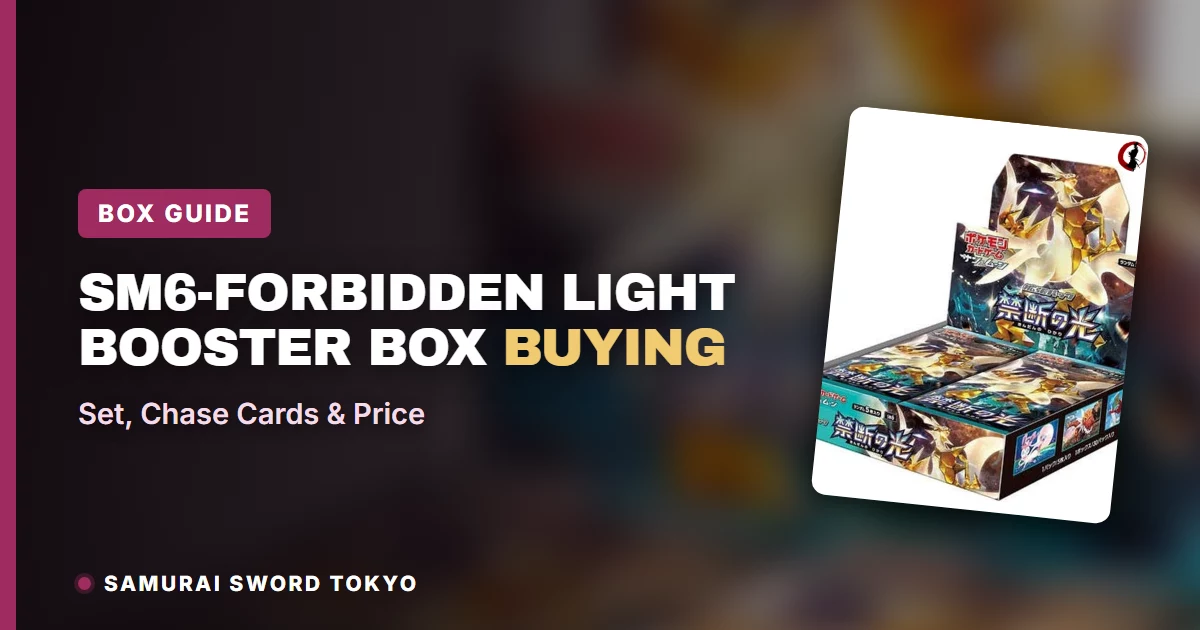
Forbidden Light is one of the last main-series Sun & Moon expansions before the era moved into its GX-heavy back half, and it’s still one of the SM-era boxes we get asked about by name. 拡張パック「禁断の光」— 擴充包 “Forbidden Light,” set code SM6 — uses a main numbered run with secret-numbered cards above it.

This guide covers exactly what’s in a Forbidden Light box, which cards collectors actually chase, how our own Damaged Box and No Shrink listing categories apply (or don’t) to this set, and where the box sits between Japanese and English releases. We ship Japanese sealed product out of Tokyo, so the pricing below reflects the current listing — not a market estimate.

Key Takeaway

Forbidden Light (SM6) is a Sun & Moon expansion with 5 張/包 and 30 packs per box, plus an official guarantee of 1 SR-or-better card per box. The headline chase is Ojou-sama SR 100/094, alongside Greninja-GX, Ultra Necrozma-GX, Karune and Xerneas-GX. Our SM6-Forbidden Light Japanese Pokemon Booster Box is currently listed at ¥68,250 (~$429), and the full Pokemon box range is browsable on our Pokemon card box collection.

094
Main-Run Denominator

30
Packs per Box

5
Cards per Pack

SM6
Set Code

The one listed price in this guide is our current listing as of September 2026, converted at ¥159/USD.

What’s in a Forbidden Light Booster Box

商品 Value
Set name (JP) 拡張パック「禁断の光」(擴充包 “Forbidden Light”)
系列代碼 SM6
Era Sun & Moon
Cards per pack 5
Packs per box 30
Box guarantee 1 SR-or-better card per box (official)

The main numbered run goes up to 094, and secret-numbered cards sit above it — the pattern you’ll see below is card numbers like “100/094,” where the denominator marks the main run and the numerator extends beyond it. For the card-by-card breakdown, see our Forbidden Light (SM6) card list.
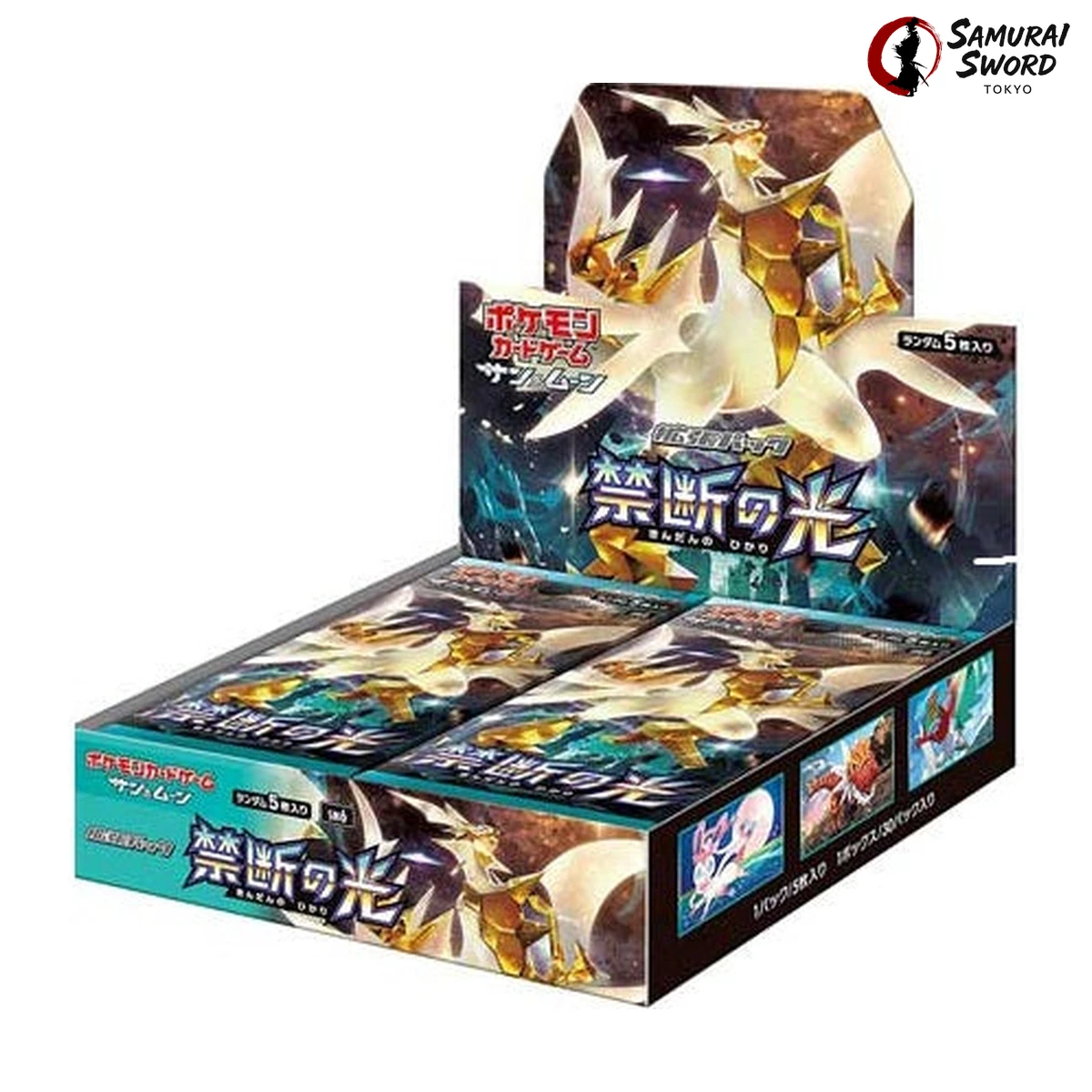
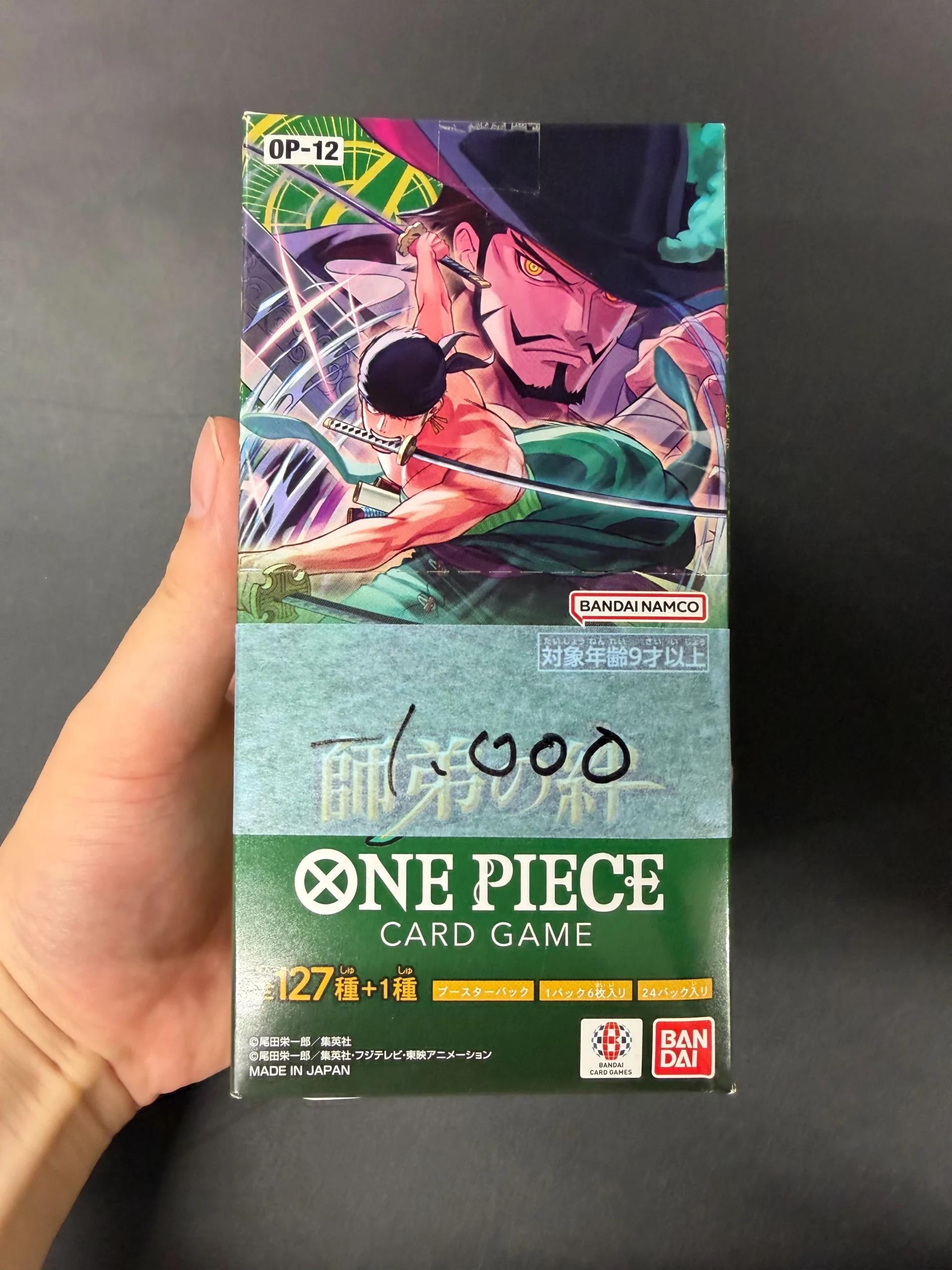
SM6 Forbidden Light Japanese Pokemon Booster Box, listed on samuraiswordtokyo.com
SM6-Forbidden Light Japanese Pokemon Booster Box — sealed, 30 packs

As a standard-format Sun & Moon expansion pack rather than a high-class pack, Forbidden Light doesn’t carry the wide Art Rare / Special Art Rare secret pool that later high-class sets are known for. The box’s draw is a smaller, more concentrated group of SR chase cards, covered next.

Chase Cards in Forbidden Light

Five cards are the reason collectors still open this box:

Ojou-sama SR 100/094
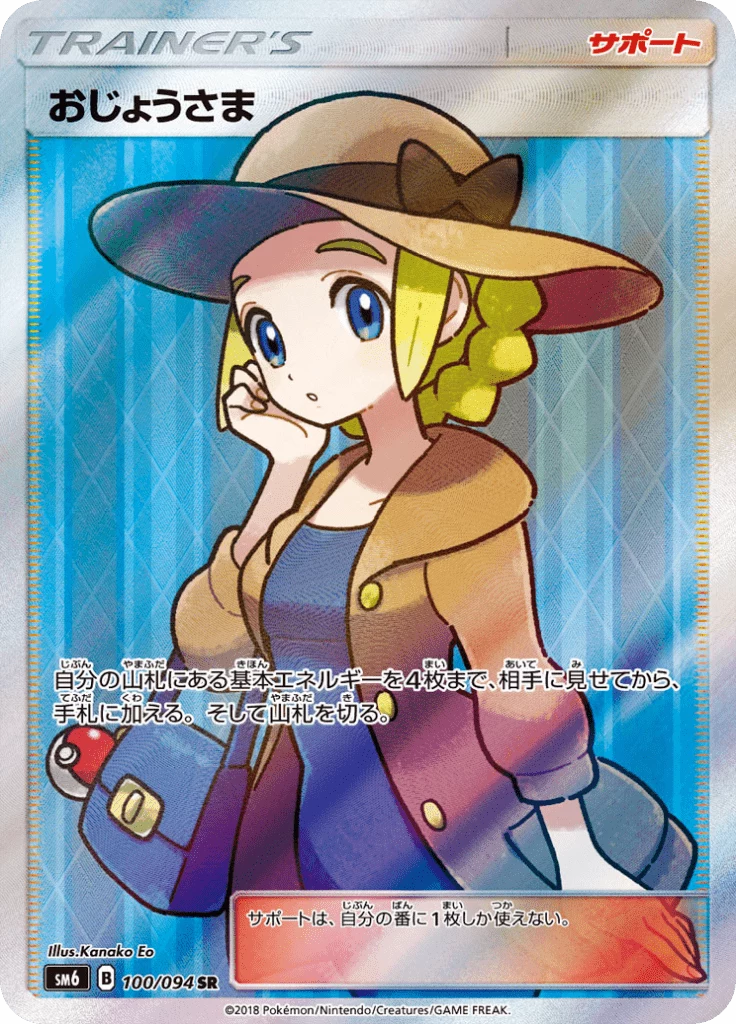
Ojou-sama SR 100/094 Forbidden Light
Ojou-sama, Secret Rare, 100/094, Forbidden Light (SM6)

Ojou-sama (おじょうさま) is the set’s current headline chase — a supporter-class SR that anchors most Forbidden Light discussion. This single is not currently listed on our site; sourcing requests go through 快速訂購.

Greninja-GX SR 95/094
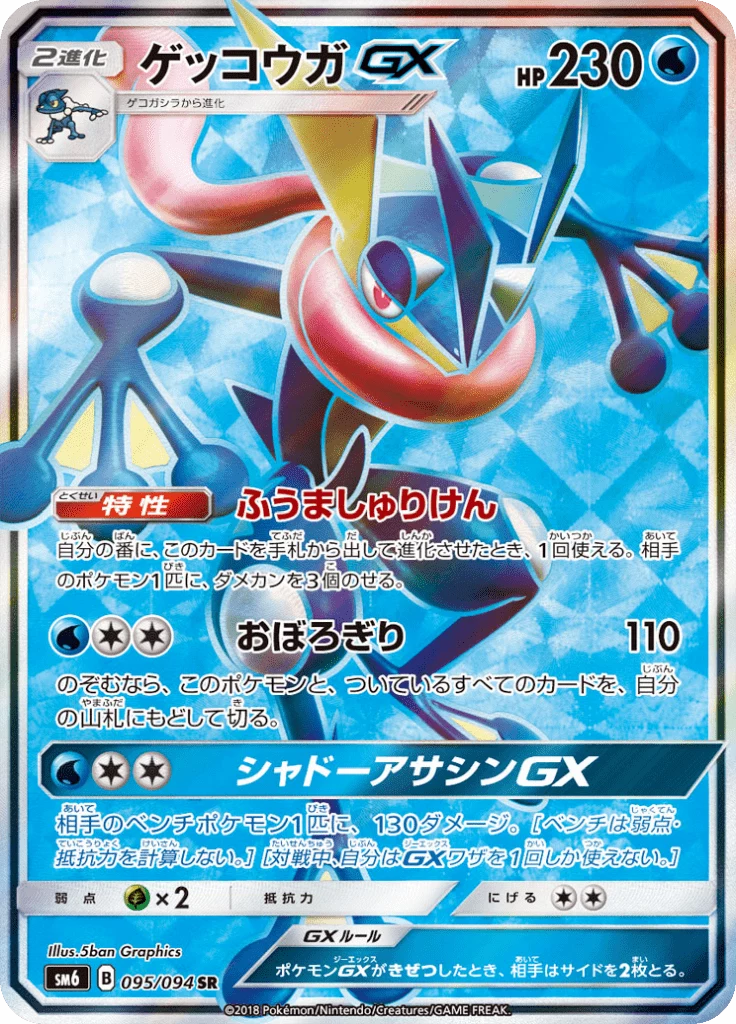
Greninja-GX SR 95/094 Forbidden Light
Greninja-GX, Secret Rare, 95/094, Forbidden Light (SM6)

Greninja-GX sits at the low end of the secret-numbered run, one of the set’s GX-tier SRs. This single is not currently listed on our site; sourcing requests go through 快速訂購.

Ultra Necrozma-GX SR 99/094
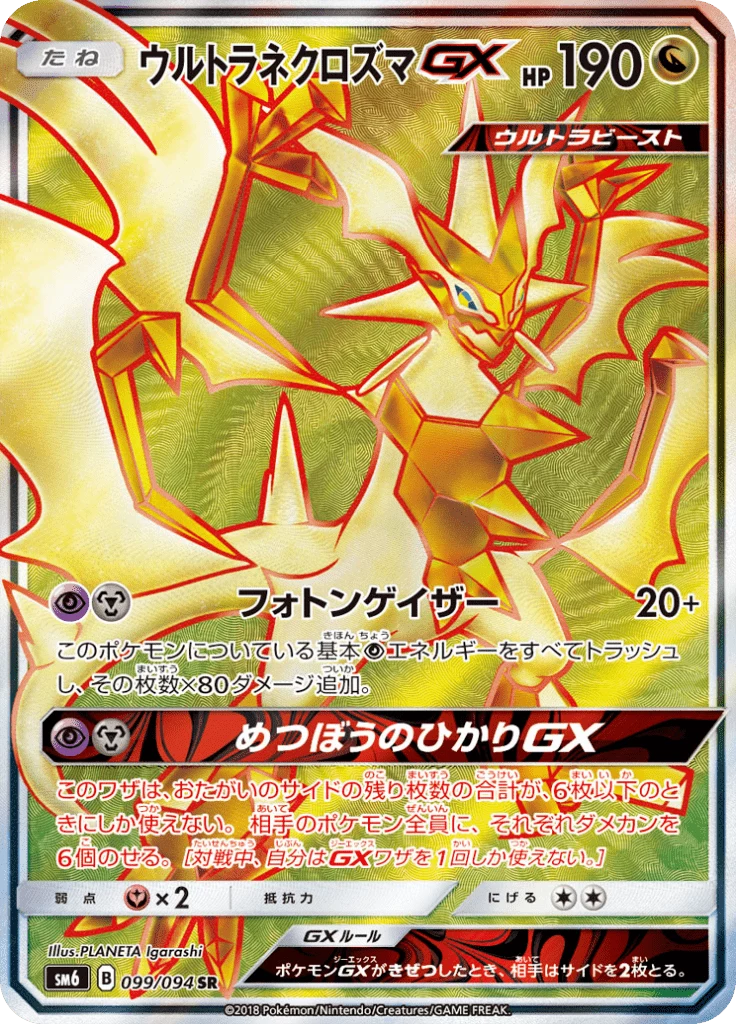
Ultra Necrozma-GX SR 99/094 Forbidden Light
Ultra Necrozma-GX, Secret Rare, 99/094, Forbidden Light (SM6)

Ultra Necrozma-GX is the set’s original 2018 mascot attacker, and it’s usually the second name people bring up after Ojou-sama when talking about this box. This single is not currently listed on our site; sourcing requests go through 快速訂購.

Karune SR 101/094
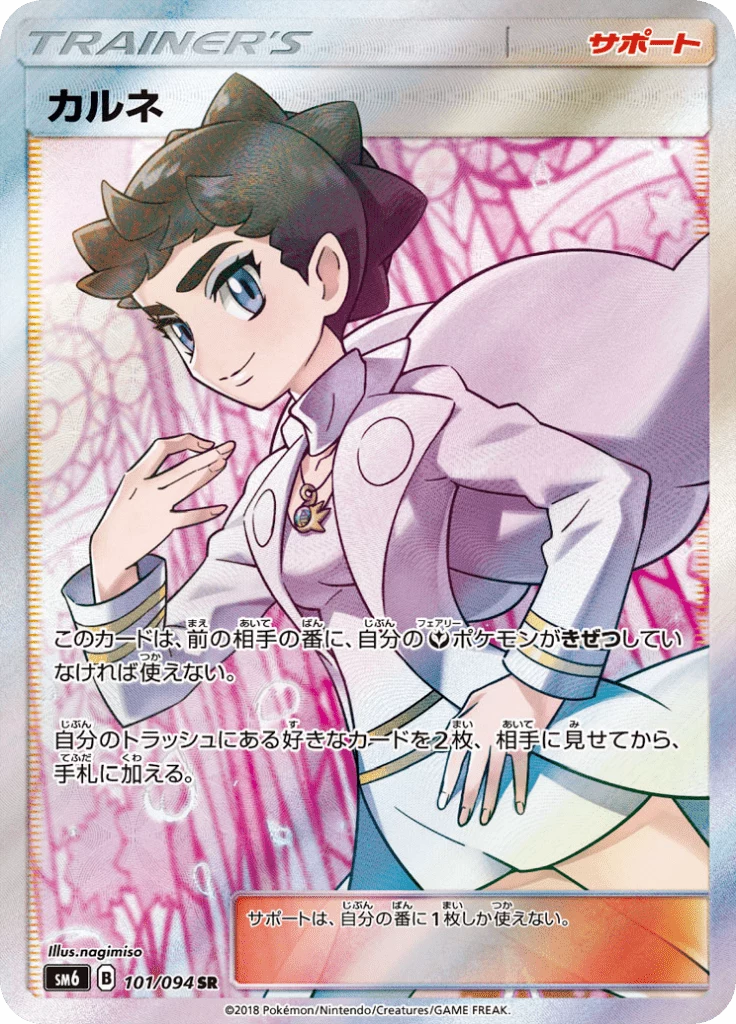
Karune SR 101/094 Forbidden Light
Karune, Secret Rare, 101/094, Forbidden Light (SM6)

Karune (カルネ) is a trainer-class SR near the top of the secret-numbered run. This single is not currently listed on our site; sourcing requests go through 快速訂購.

Xerneas-GX SR 98/094
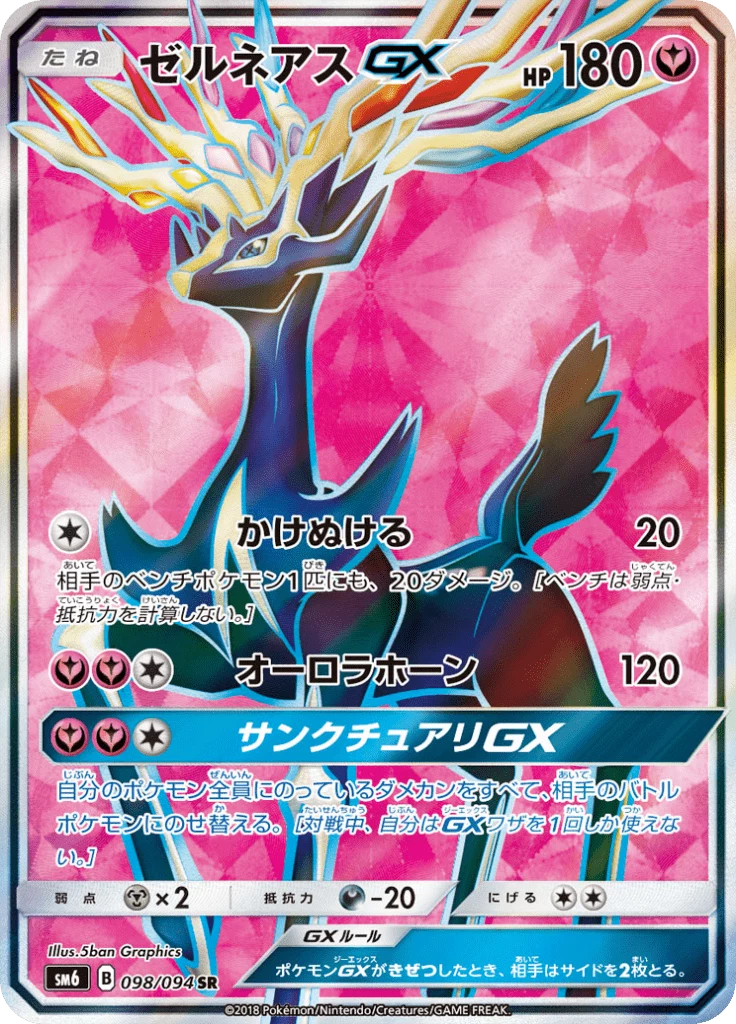
Xerneas-GX SR 98/094 Forbidden Light
Xerneas-GX, Secret Rare, 98/094, Forbidden Light (SM6)

Xerneas-GX 98/094 is the Secret Rare print of this card in Forbidden Light, sitting in the secret-numbered run above the 094 main-run denominator. This single is not currently listed on our site; sourcing requests go through 快速訂購.

None of the five cards above are currently listed as graded singles on our site. For the pull-rate math and a fuller ranking across the set’s secret tier, see our Forbidden Light pull rates and best cards guide — that article covers the EV side; this one covers box facts and where to buy.

Regular Box vs Damaged Box vs No Shrink on Our Site

Across our catalogue, we use two extra condition categories alongside a standard sealed listing, and it’s worth knowing what each one actually means before you buy:

  • Damaged Box — a condition category we use for sealed booster boxes where the outer box itself, not the contents, is affected. The booster packs inside stay factory-sealed; nothing about the sealed contents changes. You still get the same booster packs, in the same box count, just with a mark, dent or other cosmetic issue on the outer packaging. Damaged Box pricing moves independently of the regular box listing and isn’t always cheaper.
  • 無收縮膜 — this is a listing name we use on a handful of product pages for boxes sold without their original shrink wrap. We don’t have a broader definition of the term beyond that; it’s a condition label attached to the specific listing, not a separate grading system.

For Forbidden Light specifically, only the standard sealed box is currently listed — there is no Damaged Box or No Shrink listing for this set on our site at the moment. If you’re after either variant for SM6, requests can be flagged through 快速訂購 (no timing on availability).

The regular sealed box is currently listed at ¥68,250 (~$429).

Japanese vs English Version of Forbidden Light

Forbidden Light has a direct English-language counterpart: Sun & Moon—Forbidden Light, released internationally in 2018 under the same set name. The box we carry is the original Japanese printing — the version this guide, our card-list article and our pull-rates article are all built around.

All the card images in this guide are Japanese prints. If you’re specifically comparing a Japanese copy against an English one for a given card, the card number and rarity marking are the fastest way to confirm you’re looking at the same print — the numbering conventions above (for example, “100/094”) are specific to the Japanese release.

Shop This Set
SM6-Forbidden Light Japanese Pokemon Booster Box
Currently listed at ¥68,250 (~$429)
Ships from Tokyo · Tracked delivery

View Product →

Where to Buy a Forbidden Light Booster Box from Tokyo

We ship Japanese sealed product out of Tokyo with tracked delivery. The SM6-Forbidden Light Japanese Pokemon Booster Box is currently listed at ¥68,250 (~$429) — that’s the only Forbidden Light listing we currently carry, with no Damaged Box or No Shrink variant for this set at present.

For the full Sun & Moon-era lineup, browse our Pokemon card box collection. If you’re comparing Forbidden Light against a later SM-era set, our SM12 Alter Genesis pull rates and best cards guide covers a sibling set from later in the same era. For the card-by-card checklist, see the Forbidden Light card list, and for a broader look at the Japanese sets around this release, see the Japanese sets behind Forbidden Light. Anything not listed above — a single card, a Damaged Box or a No Shrink copy of SM6 — can be flagged through 快速訂購.

常見問題

How many cards are in Forbidden Light (SM6)?

The main numbered run goes to 094, with secret-numbered cards above it. This guide does not state a combined total.

What are the chase cards in Forbidden Light?

Ojou-sama SR (100/094) is the current headline chase, alongside Greninja-GX SR (95/094), Ultra Necrozma-GX SR (99/094), Karune SR (101/094) and Xerneas-GX SR (98/094).

How many packs are in a Forbidden Light booster box?

30 packs per box, 5 張/包, with an official guarantee of 1 SR-or-better card somewhere in the box.

What’s the difference between a Damaged Box and a No Shrink listing on your site?

Damaged Box means the outer box has a cosmetic issue while the sealed packs inside are unaffected. No Shrink is a listing name for boxes sold without their original shrink wrap; we don’t use a broader definition beyond that. Forbidden Light currently has neither variant listed — only the standard sealed box.

Is there an English version of Forbidden Light?

Yes — Sun & Moon—Forbidden Light, released internationally in 2018 under the same set name. We carry the Japanese printing.

Can I buy PSA 10 singles from Forbidden Light on your site?

Not at the moment — none of the five chase cards covered in this guide are currently listed as graded singles. Sourcing requests go through Quick Order.
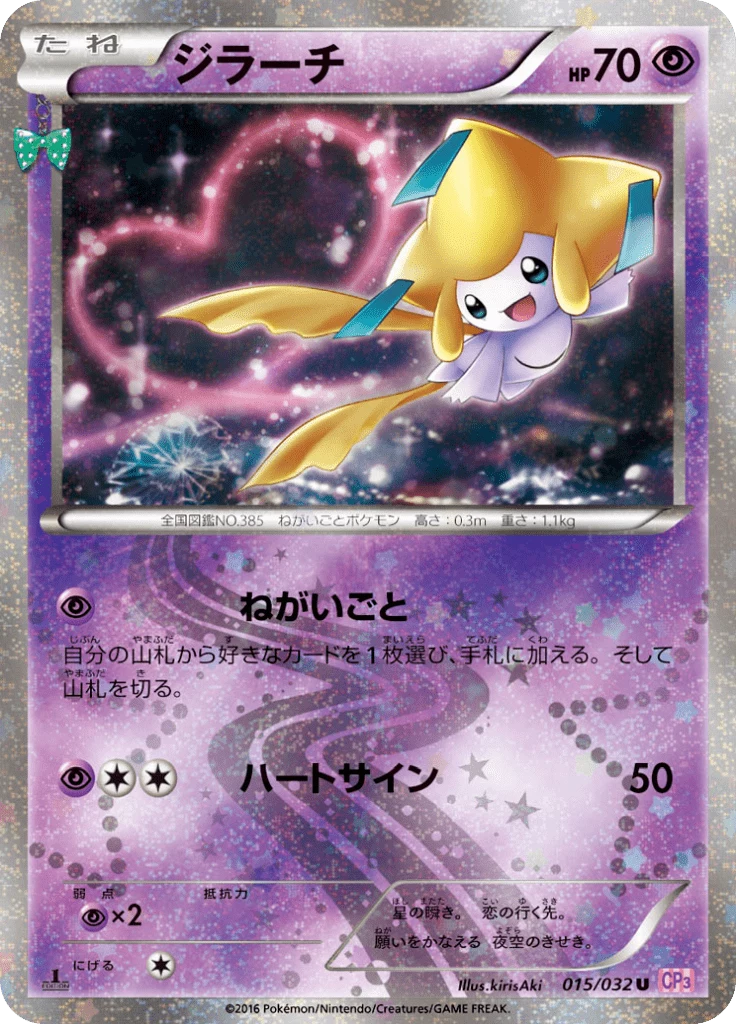
Jirachi 015/032 Pokekyun Collection(1st Edition)卡牌指南

This guide focuses on Jirachi’s 1st Edition Concept Pack print. Card 015/032 comes from a 32-card release and carries the “1ED” stamp from the documented Japanese 1st Edition window.

This guide covers the exact print — Jirachi 015/032, Uncommon, 1st Edition, from the Japanese Concept Pack “Pokekyun Collection” (set code CP3) — where it sits in that set, how the Japanese 1ED mark applies to it, and how it compares to its English-language equivalent. We currently list a PSA 10 graded copy of this exact print, shipped from Tokyo.

Key Takeaways

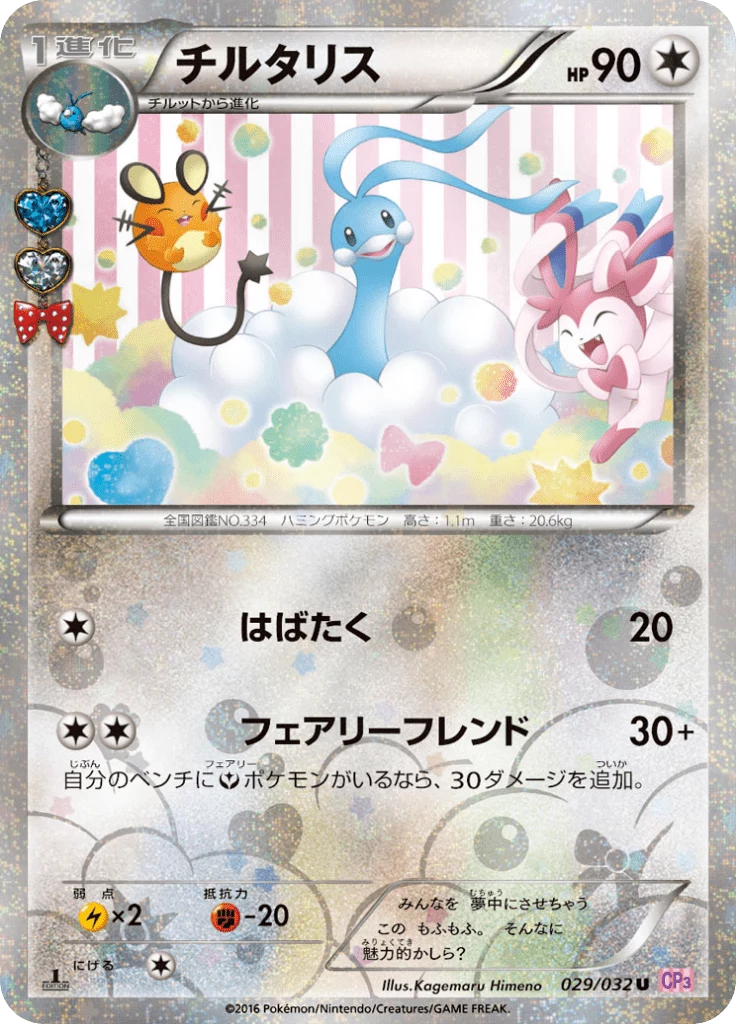
Jirachi 015/032 U :1ED is a PSA 10, currently listed at ¥39,270 (~$247). It comes from Pokekyun Collection (CP3), a 32-card Japanese Concept Pack released 29 January 2016, inside the confirmed window when Japanese cards carried the 1st Edition mark. The same set is also where our PSA 10 Altaria U 029/032 :1ED comes from, if you’re building out the set alongside Jirachi.

70
HP (Psychic)

U
Rarity (015/032)

32
Set Size (CP3)

Jan 2016
Japan Release

Prices below are current samuraiswordtokyo.com listings, converted at ¥159/USD (September 2026).

The Card: Jirachi 015/032 U

Jirachi — ジラーチ in Japanese — is a Basic Psychic-type Pokemon that does not evolve, with 70 HP. The 015/032 print was illustrated by kirisAki and sits at card 15 of the set’s 32-card main numbering, placing it comfortably inside the set’s regular run rather than in a secret or special slot.

Jirachi U 015/032, Pokekyun Collection (CP3), Japanese
Jirachi U 015/032, Pokekyun Collection (CP3), illustrated by kirisAki

Our own graded copy of this exact print is a PSA 10, currently listed at ¥39,270 (~$247), and it carries the “:1ED” designation on our listing — the Japanese 1st Edition mark, covered in full below.

PSA 10 Jirachi U 015/032 slab, listed on samuraiswordtokyo.com

The Set: Pokekyun Collection (CP3)

Pokekyun Collection — ポケキュンコレクション in Japanese — is Concept Pack CP3, a 32-card Japanese release from 29 January 2016. Concept Packs are smaller, thematic Japanese releases distinct from the mainline Expansion Packs, and CP3 sits inside a specific window for one particular print detail: the Japanese “1st Edition” mark.

Per our own researched guide to that mark, the Japanese 1ED stamp ran from 2001 to 2016, covering both mainline Expansion Packs and the smaller Concept Pack releases. CP3, released in January 2016, sits inside that window. The mark itself is a large numeral “1” over the word “EDITION” between two lines, appearing in a lower corner of Pokemon and Trainer cards only (never Energy cards) — visually distinct from the Western WOTC leaf-and-circle 1st Edition mark. Our Japanese 1st Edition Pokemon cards guide covers the full history of the mark across every set that carried it.

For the full 32-card breakdown of Pokekyun Collection, see our Pokekyun Collection (CP3) set guide.

Japanese vs English Print

Jirachi 015/032 does have an English-language equivalent: Generations #RC13, an Uncommon in the Radiant Collection subset. Altaria’s equivalent print, RC24, also appears in that subset — the two Pokekyun Collection cards map into the same English subset, just at different numbers within it.

We haven’t independently verified further design differences between the CP3 and Generations RC printings beyond the card-number mapping, so if you’re matching a Japanese copy against an English one, confirm by artwork and set marking rather than assuming identical framing.

Where This Uncommon Sits Among Japanese Rarity Tiers

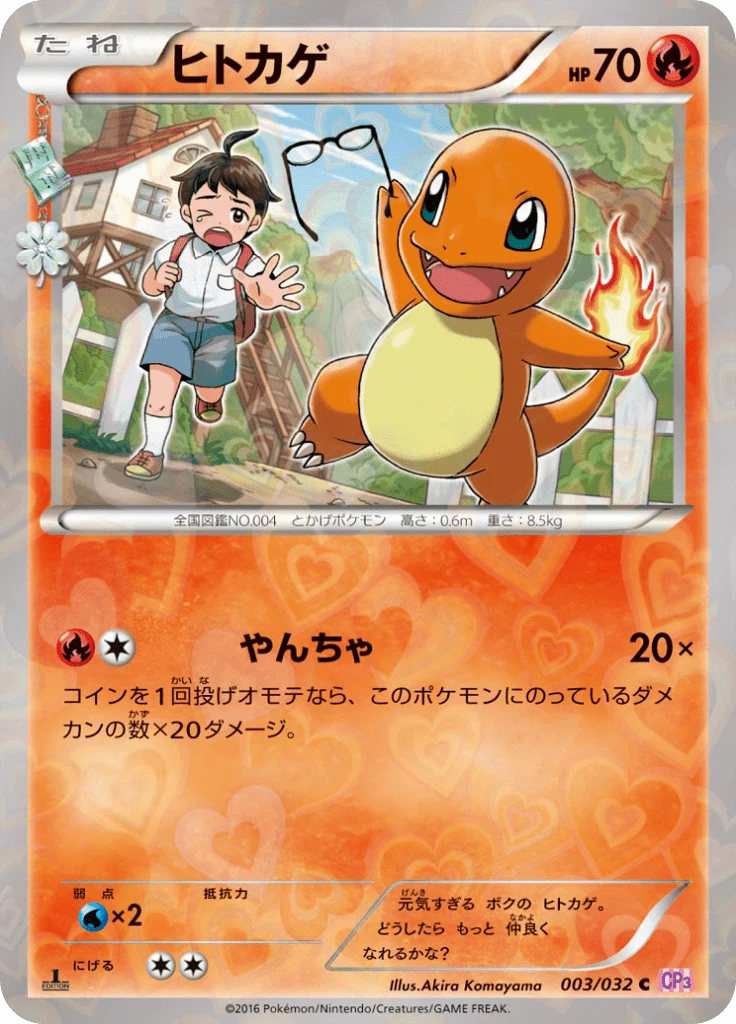
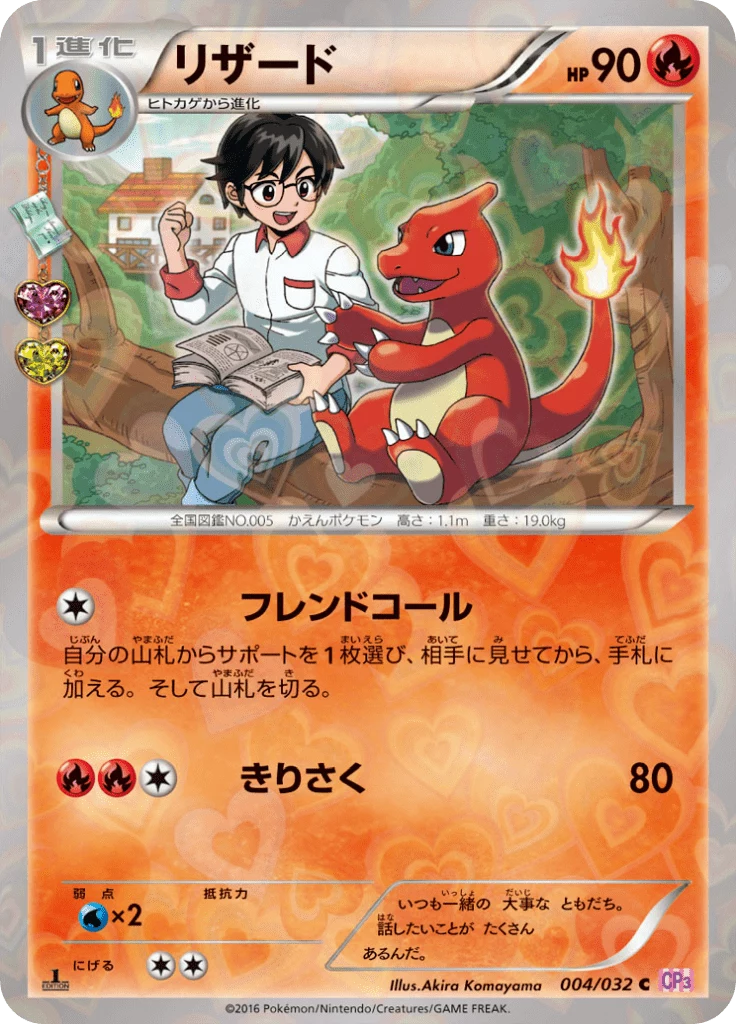
Among the CP3 prints we’ve verified, the set spans two rarity tiers: Common (C) and Uncommon (U). Jirachi’s Uncommon tier places it alongside Altaria, Floette and Slurpuff in this set, one step above the Common-tier evolution-line cards Charmander and Charmeleon. Pokekyun Collection is a small thematic Concept Pack rather than a full 擴充包, so this comparison covers the prints documented here rather than every rarity slot that may exist across the full 32-card release.

For mythical Pokemon prints more broadly, our Celebi and Jirachi mythicals guide covers Jirachi alongside other documented mythical prints, including a different Concept Pack entirely.

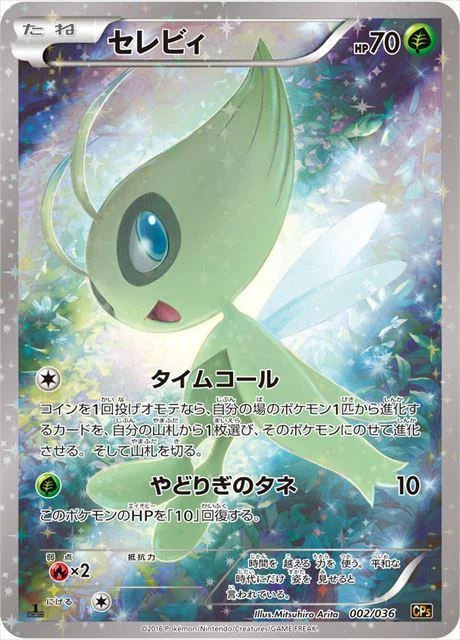
PSA 10 Celebi :1ED CP5 002/036 slab, listed on samuraiswordtokyo.com
PSA 10 Celebi :1ED CP5 002/036 slab, listed on samuraiswordtokyo.com — a different mythical, different Concept Pack, shown here for comparison

Shop This Card
PSA10 Jirachi U :1ED [CP3 015/032]
Currently listed at ¥39,270 (~$247)
Ships from Tokyo · Tracked delivery

View Product →

Where to Buy Jirachi from Tokyo

Our graded copy of PSA 10 Jirachi 015/032 U :1ED is currently listed at ¥39,270 (~$247), shipped from Tokyo with tracked delivery. From the same Pokekyun Collection set, PSA 10 Altaria U 029/032 :1ED is currently listed at ¥29,040 (~$183), and PSA 10 Charmander C 003/032 :1ED is currently listed at ¥29,141 (~$183).

If you’re building out a mythical Pokemon run rather than a single Concept Pack, our PSA 10 Celebi :1ED (CP5 002/036) at ¥91,300 (~$574) is a different mythical from a different Concept Pack. For the full picture on this exact card versus Jirachi’s other Japanese eras, our Jirachi Japanese card guide covers every print we’ve catalogued; this page is the single-card 1ED deep dive on CP3 015/032 specifically.

For our full range of graded singles, browse the PSA 10 graded card collection, or build a mixed order through our Quick Order page.

常見問題

What is the Jirachi 015/032 Pokekyun Collection card?

It’s Jirachi, card 015/032, Uncommon rarity, from the Japanese Concept Pack Pokekyun Collection (set code CP3), released 29 January 2016. A PSA 10 copy of this print with the 1st Edition mark is currently listed at ¥39,270 (~$247).

What does the “:1ED” mark on this card mean?

It’s the Japanese 1st Edition mark — a numeral “1” over “EDITION” printed in a lower corner of the card. The mark ran on Japanese Pokemon and Trainer cards from 2001 to 2016, and CP3’s January 2016 release sits near the end of that window, before the mark was retired after Concept Pack 6 in September 2016.

Is this the only Uncommon-rarity Jirachi print?

A secondary aggregation of Jirachi listings reports CP3 015/032 as Jirachi’s only Uncommon-rarity Japanese print, though we haven’t individually re-verified every Jirachi release to confirm that. Jirachi has other prints at other rarities and eras, but those are separate, unrelated cards.

Does Jirachi 015/032 have an English equivalent?

Yes — Generations #RC13, an Uncommon in the Radiant Collection subset of the English Generations set. That’s the same subset that carries Altaria’s CP3 equivalent, RC24.

What other cards come from the same Concept Pack as Jirachi?

Pokekyun Collection (CP3) is a 32-card set. We list PSA 10 graded Altaria U 029/032 and Charmander C 003/032 from the same set alongside Jirachi; Charmeleon C 004/032, Floette U 022/032, Swirlix C 023/032 and Slurpuff U 024/032 are also part of the set.

Where can I buy a PSA 10 Jirachi from Tokyo?

Our graded 015/032 copy is currently listed at ¥39,270 (~$247) with tracked shipping from Tokyo. Sibling PSA 10 cards from the same Concept Pack are also available, and our Quick Order page covers mixed orders.

Oddish 日版 Pokemon 卡牌指南:所有版本與 SV3 Ruler of the Black Flame 補充包盒

Oddish — ナゾノクサ in Japanese — is one of the original 151, a Grass-type Basic Pokémon that evolves into Gloom, and it has kept turning up in Japanese Pokémon TCG sets for over a decade. A search of the Japanese card database returns 17 separate Oddish prints, spread across sets running from the BW era through to the 2025–26 M-series — a wide print history for a Pokémon that has never anchored a set on its own.

This guide focuses on the five Oddish prints verified individually in this guide, including the Common-rarity SV3 print that comes packed inside our currently listed Ruler of the Black Flame booster box, and lays out where the other prints sit within the wider search. If you want the specific Common you’d pull from a fresh box, or the named “Erika’s Oddish” variant, the details are below.

Key Takeaways

The Japanese card database lists 17 separate Oddish prints; five of them are verified individually in this guide, spanning the XY era through the 2025–26 M-series. The Common-rarity SV3 #1 print comes from the Ruler of the Black Flame Booster Box, currently listed at ¥17,160 (~$108), and the Ruler of the Black Flame Deck Build Box is currently listed at ¥5,400 (~$34). We don’t currently list a graded or single Oddish card — sourcing requests for specific prints go through Quick Order.

17
Japanese Prints Found

5
Prints Verified in Detail

6
Set Eras Spanned

2
Listed Ruler of the Black Flame Boxes

The Japanese Oddish Prints Verified in This Guide

A search of the Japanese TCG card database for Oddish returns 17 separate prints, spread across sets including BW6f, XY, XY7, SM10 (twice), SM11b, SM3H, S12, S9a, SV2a, SV3, SV4a (twice), SVM and MC — the BW, XY, SM, S, SV and M-series eras. That’s a wide spread for a first-stage Basic, though it lines up with Oddish’s long history as a common early-game card that set designers keep reusing across starter-adjacent releases.

We individually verified five of those prints. The table below covers what we confirmed for each — card number, rarity where the source states it, illustrator, and set:

卡牌 Number Rarity Illustrator 系列
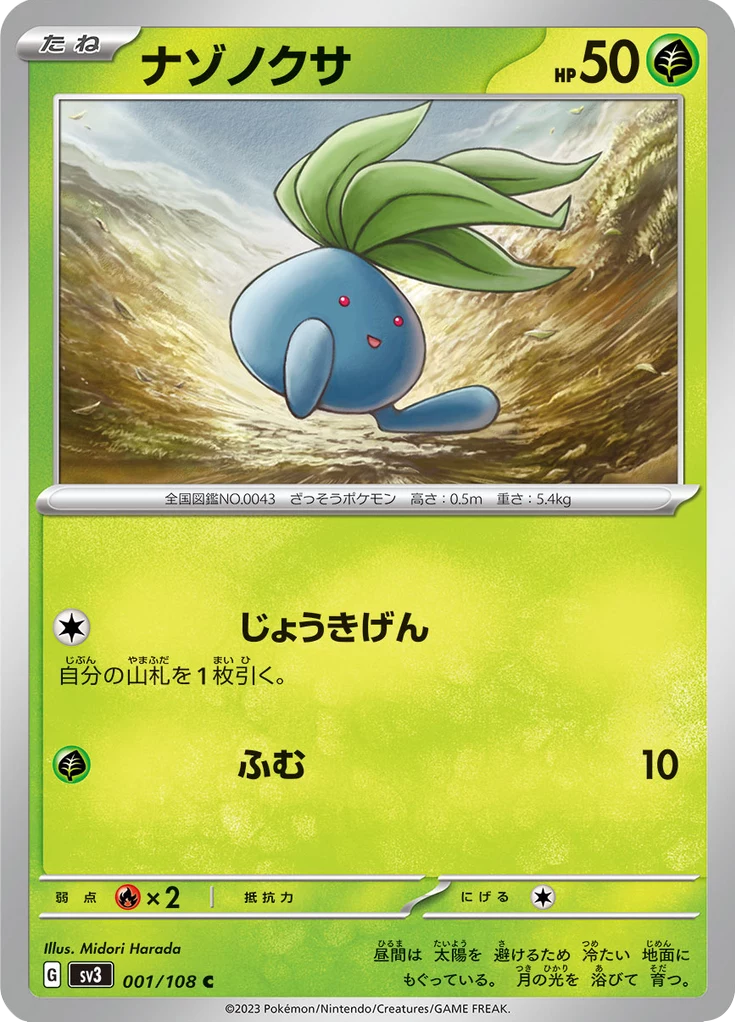
Oddish SV3 #1 Common Midori Harada Ruler of the Black Flame (SV3)
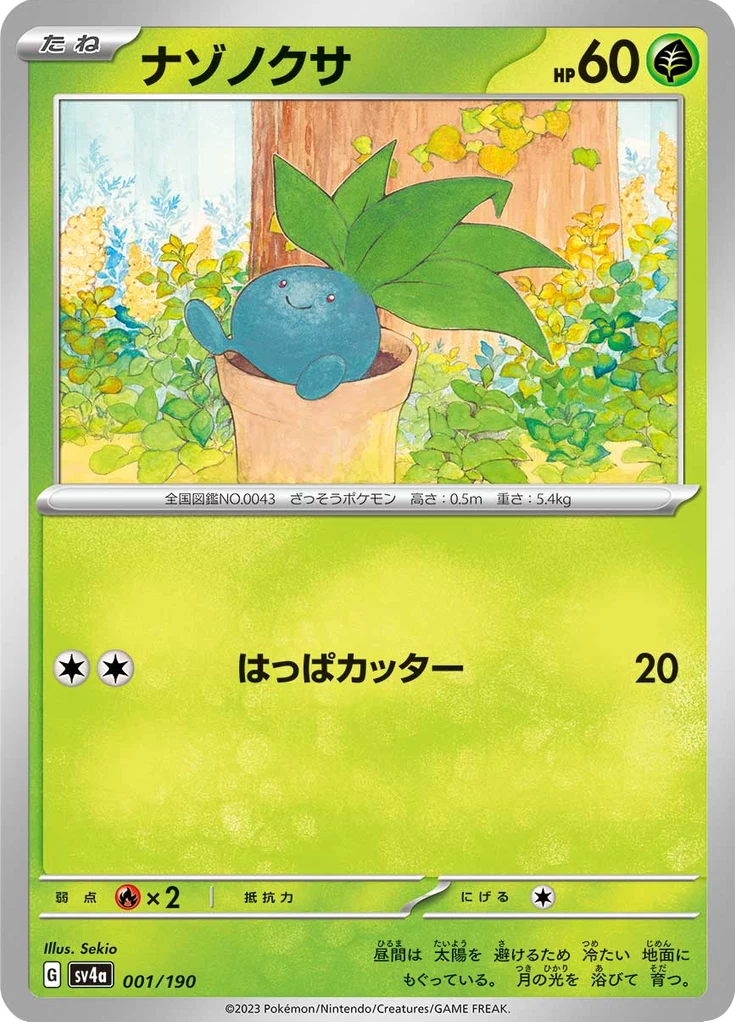
Oddish SV4a #1 Not stated in source Sekio Shiny Treasure ex (SV4a)
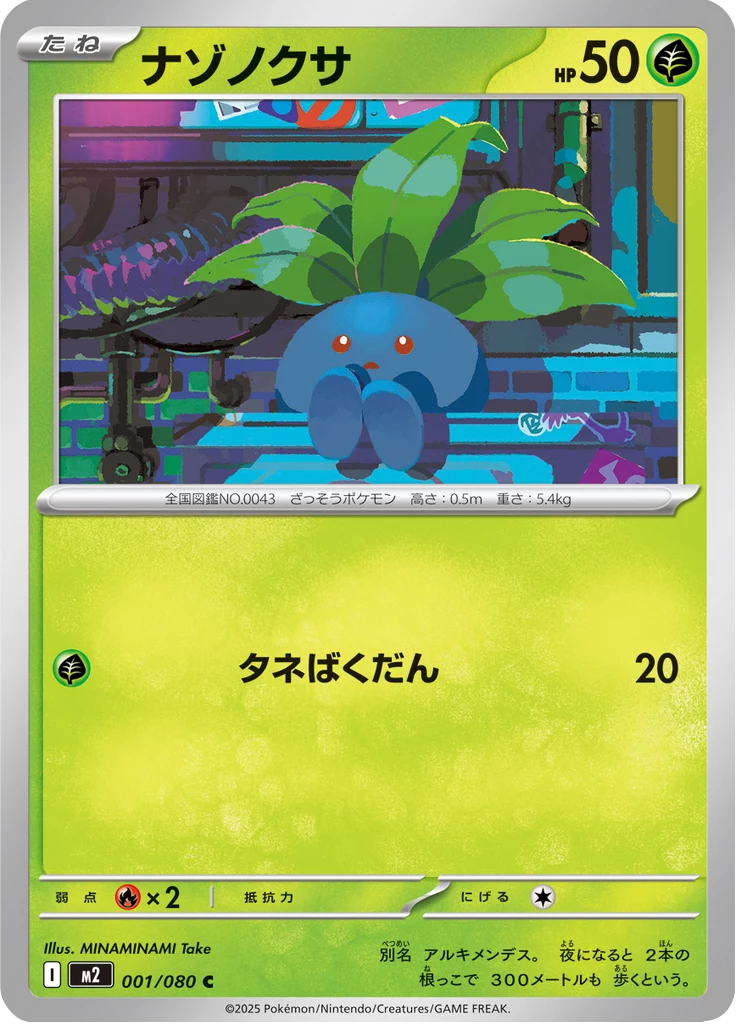
Oddish M2 #1 Common MINAMINAMI Take Inferno X (M2)
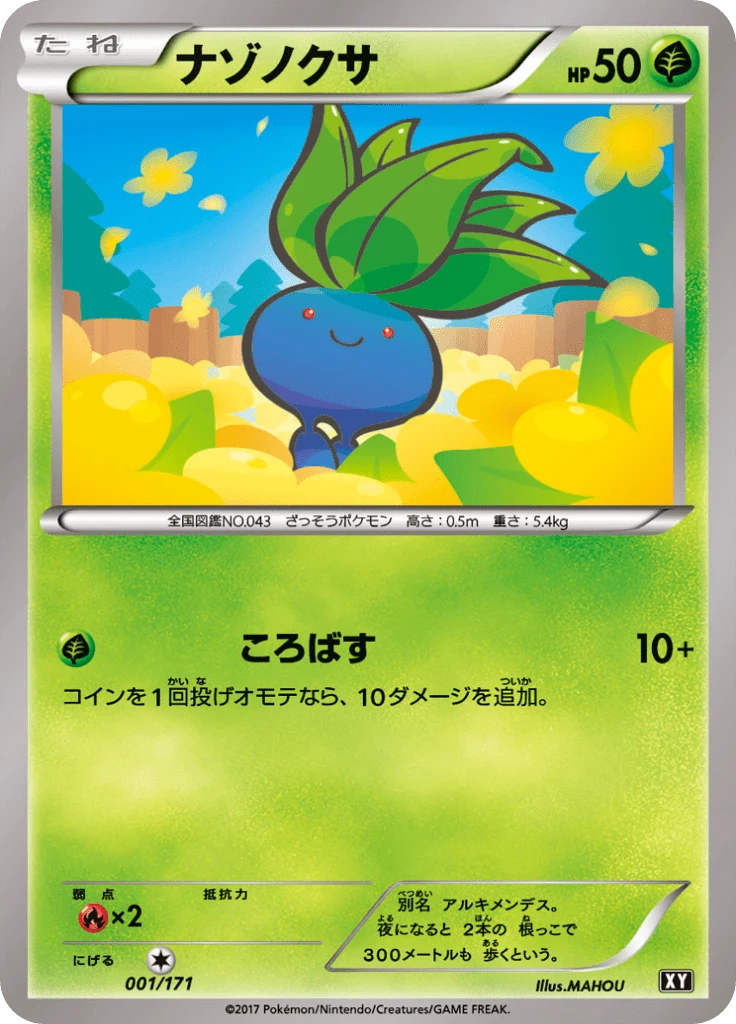
Oddish XY #1 Not stated in source MAHOU The Best of XY (XY)
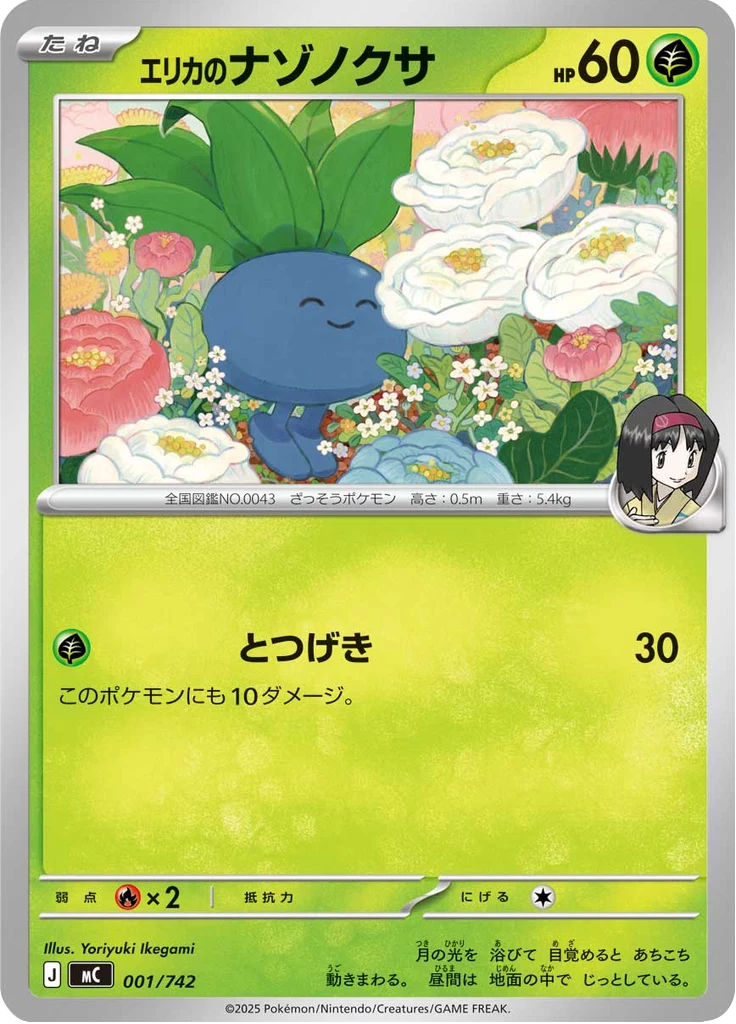
Erika’s Oddish MC #1 Not stated in source Yoriyuki Ikegami Starter Decks 100 Battle Collection (MC)

The remaining 12 prints turned up in the database search but we haven’t pulled individual card numbers, rarities or illustrators for them yet, so this guide doesn’t detail them further. The five sections below cover the prints we did verify.

The SV3 Print: Where Our Anchor Box Comes From

Oddish SV3 card number 1, Common rarity, Ruler of the Black Flame
Oddish, SV3 #1, Common, Ruler of the Black Flame

The print at the centre of this guide is Oddish, SV3 #1, a Common-rarity card illustrated by Midori Harada, HP 50. It’s the copy that comes packed inside Ruler of the Black Flame boosters, and it’s the print tied to a box we currently list.

Ruler of the Black Flame (SV3) released in Japan on July 28, 2023, and runs 141 cards total, with a 33-card secret tier spread across four rarities — 12 Art Rares plus the remaining higher tiers. Oddish’s Common slot sits well outside that secret tier: it’s a base-set card, not a chase pull, and nothing in the source data suggests otherwise. For the set’s full card list, see our Ruler of the Black Flame SV3 card list, and for what the set’s actual chase cards look like, see our Ruler of the Black Flame best cards guide.

On the English side, SV3 #1 corresponds to Obsidian Flames (OBF) #1 — the same Oddish artwork carried into the international print run. See our Obsidian Flames Japanese card list for the cross-reference, or our Obsidian Flames chase cards guide for what else that set is known for.

Other Verified Prints Across Eras

Two more Oddish prints outside the M-series stand out enough to detail individually.

Oddish SV4a card number 1, Shiny Treasure ex

Oddish SV4a #1, Shiny Treasure ex

Oddish XY card number 1, The Best of XY

Oddish XY #1, The Best of XY

SV4a #1, from Shiny Treasure ex, is illustrated by Sekio and printed at HP 60 — ten points higher than the SV3 print despite being the same Pokémon. Shiny Treasure ex followed Ruler of the Black Flame in the same SV block, and this is the Oddish print that landed there.

XY #1 comes from The Best of XY, a compilation-style release, illustrated by MAHOU at HP 50. It’s the oldest of the five prints we verified individually, and the artwork sits apart from the SV-era pair — a different illustrator and an older card frame generation entirely.

The 2025–26 M-Series Prints

The two newest verified Oddish prints both belong to the current M-series — the 2025–26 generation of Japanese-only sets — and one of them isn’t a standard Oddish print at all.

Oddish M2 card number 1, Common, Inferno X

Oddish M2 #1, Common, Inferno X

Erika's Oddish MC card number 1, Starter Decks 100 Battle Collection

Erika’s Oddish, MC #1

M2 #1, from Inferno X, is a Common Oddish illustrated by MINAMINAMI Take at HP 50 — a straightforward reprint pattern, consistent with the SV3 and XY Commons.

MC #1 is different. It’s named エリカのナゾノクサ — “Erika’s Oddish” — from the Starter Decks 100 Battle Collection, illustrated by Yoriyuki Ikegami at HP 60. Naming a card after a specific Trainer is its own card category in the Japanese TCG, a Trainer’s-Pokémon variant, separate from a plain species reprint, and it’s the most distinctive of the five prints we verified for this guide.

Chase Prints and What Makes Them Collectible

None of the five Oddish prints we verified sit in a secret-rare or ultra-rare tier. Two are confirmed Common in the source data — SV3 #1 and M2 #1 — and the other three (SV4a #1, XY #1 and MC #1) have no stated rarity, with nothing in the source indicating a higher tier. That puts Oddish itself outside the chase-card conversation that usually drives a set-level guide.

What separates the five prints from each other isn’t rarity, then — it’s treatment. A plain reprint like SV3 #1, M2 #1 or XY #1 carries the standard card frame for its era. “Erika’s Oddish” (MC #1) breaks that pattern by attaching a named Trainer to the card, a design choice reserved for select Pokémon in a set rather than applied to a random reprint. If you’re building a collection around named Trainer’s-Pokémon cards specifically, that’s the print worth tracking down; if you just want a plain Oddish for a deck or a binder, any of the standard-reprint prints fits that brief — though note HP and stats vary by print (SV3 #1 and XY #1 are both 50 HP, SV4a #1 and MC #1 are both 60 HP), so check the individual card before deck-building around one.

Which Japanese Boxes to Open for Oddish

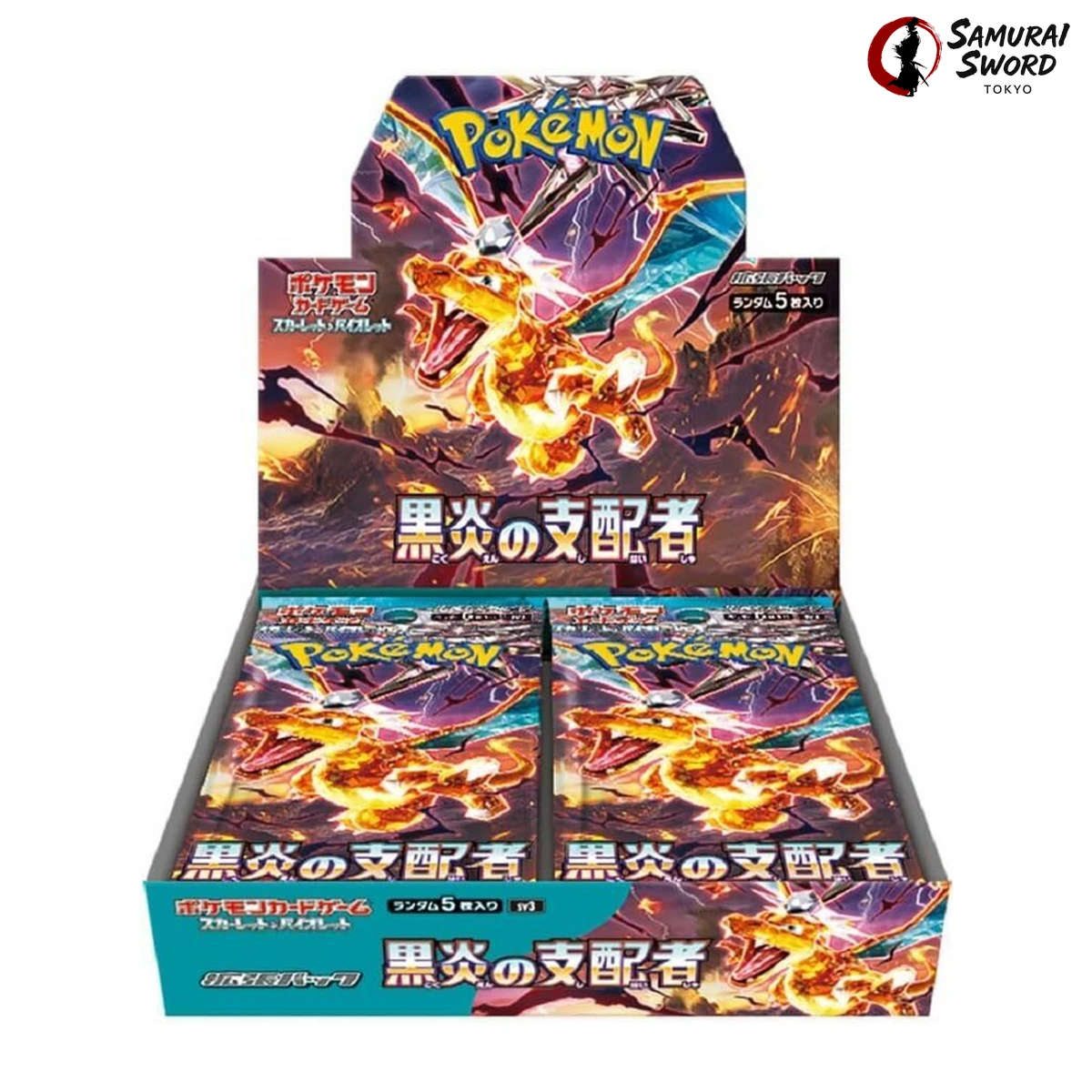
Of the five prints in this guide, only SV3 #1 is tied to a box we currently list. The Ruler of the Black Flame Booster Box is currently listed at ¥17,160 (~$108), and the same set’s cards — Oddish included — are also built into the Ruler of the Black Flame Deck Build Box, currently listed at ¥5,400 (~$34), for a lower-cost route into the same set.

SV3 Ruler of the Black Flame Japanese Booster Box, listed on samuraiswordtokyo.com

The other four prints — SV4a #1, XY #1, M2 #1 and “Erika’s Oddish” (MC #1) — are not tied to a box on our site at the moment. Sourcing requests for those prints go through 快速訂購.

Shop This Set
SV3-Ruler Of The Black Flame Japanese Pokemon Booster Box
Currently listed at ¥17,160 (~$108) · contains the Common Oddish SV3 #1
Ships from Tokyo · Tracked delivery

View Product →

Where to Buy Oddish Cards from Tokyo

We ship Japanese sealed product worldwide out of Tokyo with tracked delivery. If the Common SV3 print is the one you’re after, the Ruler of the Black Flame Booster Box is the direct route, with the lower-priced Ruler of the Black Flame Deck Build Box as an alternative entry point into the same set. Browse the wider Japanese Pokemon booster box collection for what else is currently listed, or request a quote via our Quick Order page for any of the other four prints covered in this guide, none of which are tied to a listing at the moment. For how SV3 compares with its companion release, see our SV3 vs SV3a box guide.

常見問題

How many Japanese Oddish Pokémon card prints are there?

The Japanese card database lists 17 Oddish prints. Five of them are verified individually in this guide, spanning the XY era through the 2025–26 M-series.

Which set is the SV3 Oddish print from?

Ruler of the Black Flame (SV3), released in Japan on July 28, 2023. It’s a Common-rarity card (SV3 #1), outside the set’s 33-card secret tier, and it comes from our currently listed Ruler of the Black Flame Booster Box.

What is “Erika’s Oddish”?

It’s the Japanese name (エリカのナゾノクサ) for MC #1, a Trainer’s-Pokémon variant from the Starter Decks 100 Battle Collection, illustrated by Yoriyuki Ikegami. Naming a card after a specific Trainer is a distinct design category from a standard species reprint.

Is there an English version of the SV3 Oddish print?

Yes. SV3 #1 corresponds to Obsidian Flames (OBF) #1 on the English side, per the international print-table cross-reference.

Do any Oddish prints carry a rare rarity tier?

Not among the five prints verified for this guide. Two are confirmed Common (SV3 #1 and M2 #1); the source didn’t state a rarity for the other three (SV4a #1, XY #1 and MC #1), but nothing indicates a secret-rare or ultra-rare tier for any of them.

Where can I buy Japanese Oddish cards?

We ship Japanese sealed product from Tokyo with tracked delivery. The Ruler of the Black Flame Booster Box and Deck Build Box both carry the Common SV3 print, and requesting a quote via Quick Order covers sourcing for the other four prints in this guide.

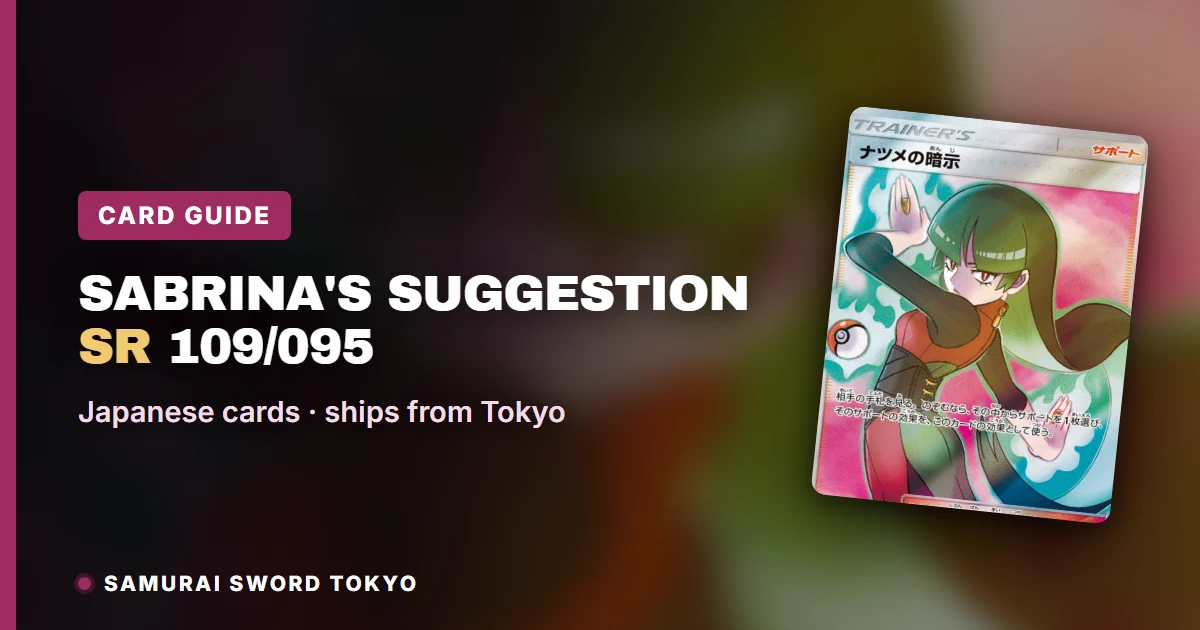
Sabrina's Suggestion SR 109/095 卡片指南

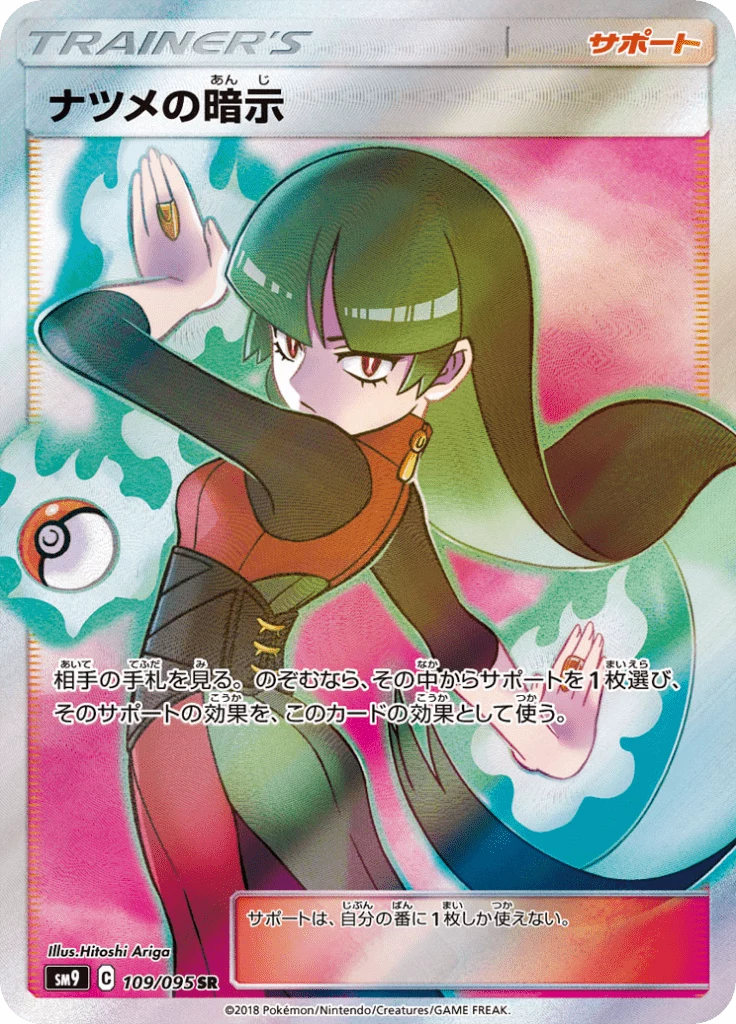
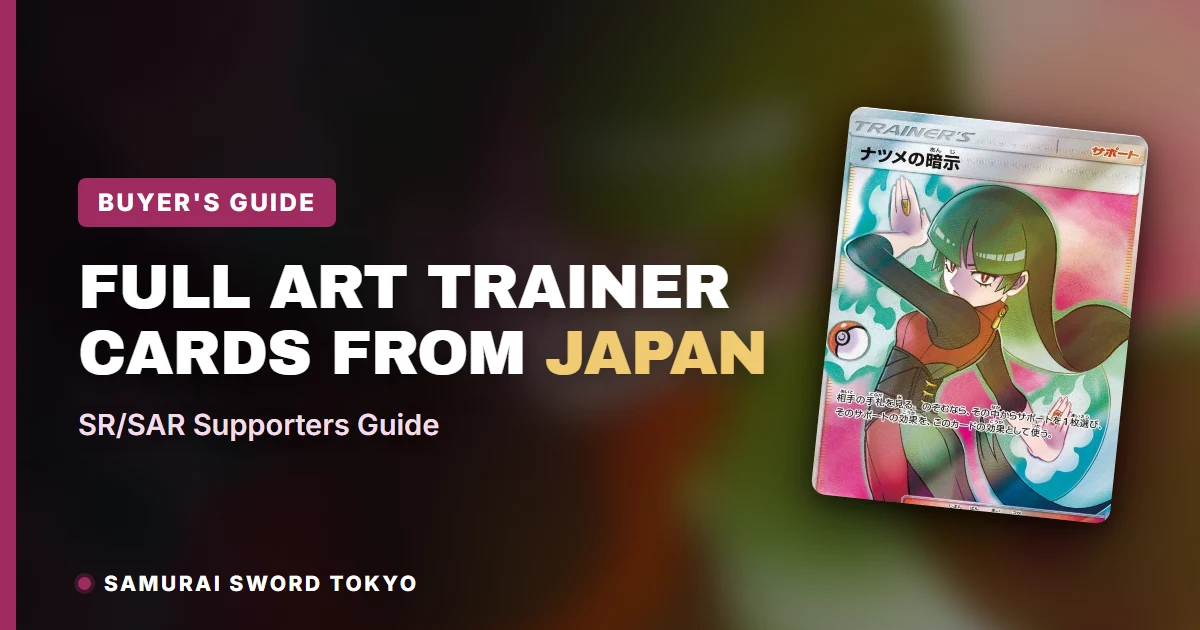
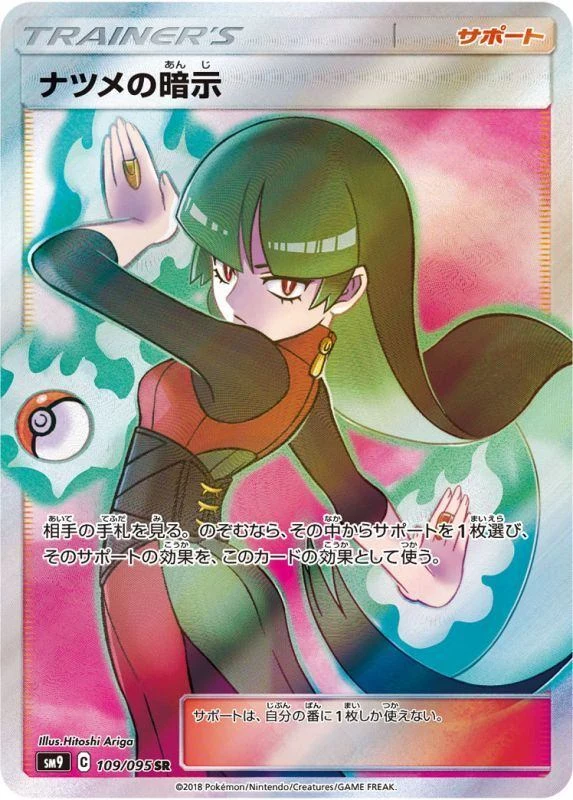
Sabrina’s Suggestion is a Trainer — Supporter card printed above its set’s main numbering. That tells you something important before you even read the effect text: this is a secret-rare slot rather than part of the main numbered run.

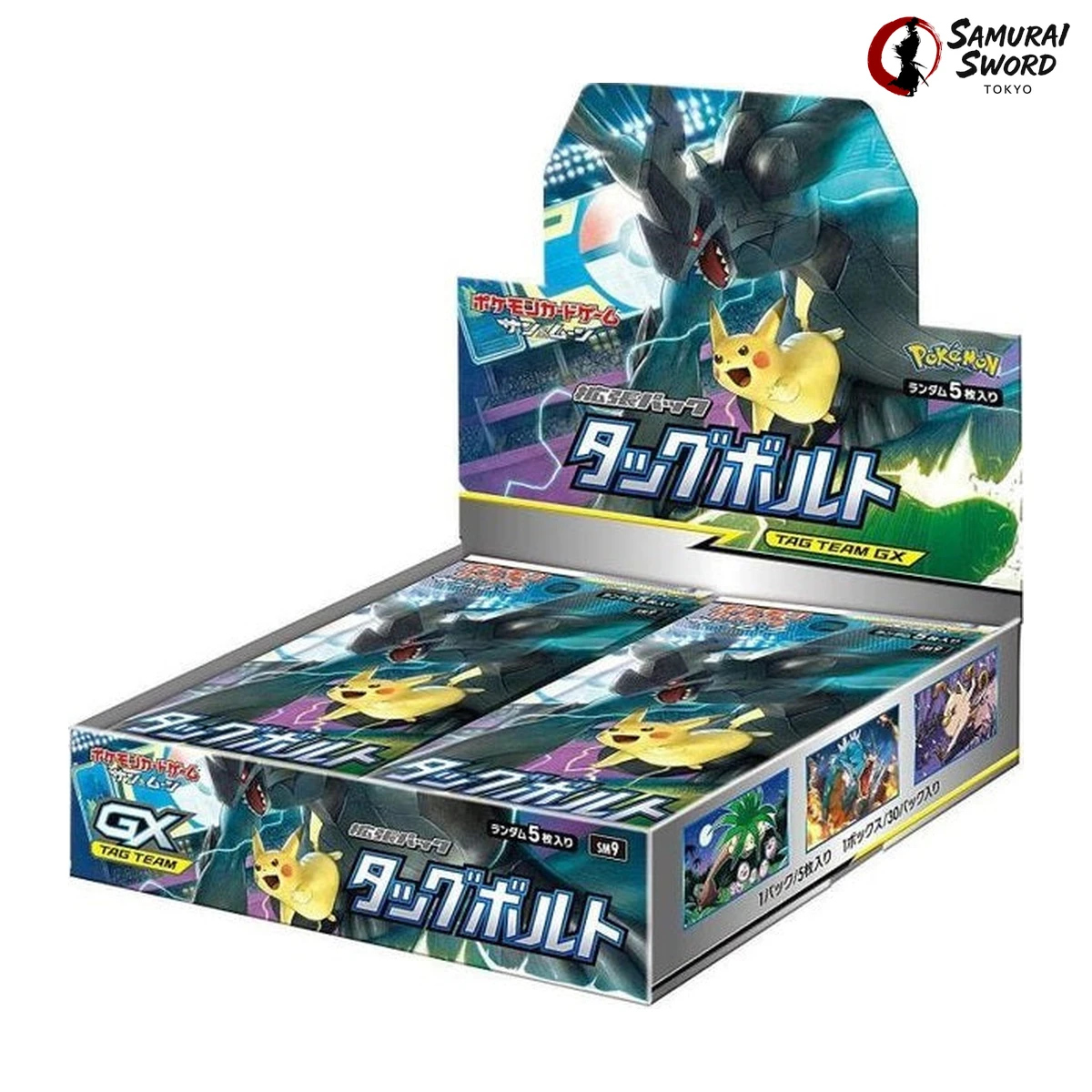
The card is ナツメの暗示 — Sabrina’s Suggestion, No. 109/095, printed as a Secret Rare (SR) in the Japanese expansion pack 拡張パック「タッグボルト」/ 擴充包 “Tag Bolt” (set code SM9). This PSA 10 print is currently listed, graded and shipped from Tokyo, and this guide walks through what the card does, where it sits inside Tag Bolt, how the Japanese print compares to its English counterpart, and where it ranks against the other secret-rare cards we carry from the same set.

Key Takeaways

Sabrina’s Suggestion 109/095 SR is a PSA 10, currently listed at ¥22,198 (~$140). It comes from Tag Bolt (SM9), a Japanese 擴充包 released 7 December 2018 whose main numbering runs to 095 before the secret-numbered cards. If you want the sealed source product, the SM9-Tag Bolt Japanese Booster Box is where this print — and the set’s other secret rares — originate.

Trainer
Card Type (Supporter)

SR
Rarity (109/095)

095
Main Numbering

Dec 2018
Japan Release

Prices below are current samuraiswordtokyo.com listings, converted at ¥159/USD (September 2026).

The Card: Sabrina’s Suggestion 109/095 SR

Sabrina’s Suggestion is a Trainer — Supporter card. Its effect reads: “View opponent’s hand; if desired, select one Supporter card and use that card’s effect as this card’s effect.” It is a hand-disruption and effect-copying Supporter, the kind of utility card that tends to get chased for its secret-rare treatment rather than for tournament play alone.

The 109/095 print is illustrated by Hitoshi Ariga — we cover his other Supporter illustrations, including Guzma and Welder, in our Hitoshi Ariga illustrator hub. Its position at #109 in a set whose main run stops at 095 marks it as a secret-rare slot rather than part of the numbered core set.

Sabrina's Suggestion SR 109/095, Tag Bolt (SM9)
Sabrina’s Suggestion 109/095 SR — Tag Bolt (SM9), illustrated by Hitoshi Ariga

This print is currently listed at ¥22,198 (~$140), PSA 10.

PSA 10 Sabrina's Suggestion SR 109/095 Tag Bolt slab, listed on samuraiswordtokyo.com
PSA 10 Sabrina’s Suggestion SR 109/095 slab, listed on samuraiswordtokyo.com

The Set: Tag Bolt (SM9)

Tag Bolt — 拡張パック「タッグボルト」in Japanese — is set code SM9, a Japanese 擴充包 released on 7 December 2018. Its main numbered run stops at 095, with secret-numbered cards printed above that denominator. Sabrina’s Suggestion is one of those cards at 109/095.

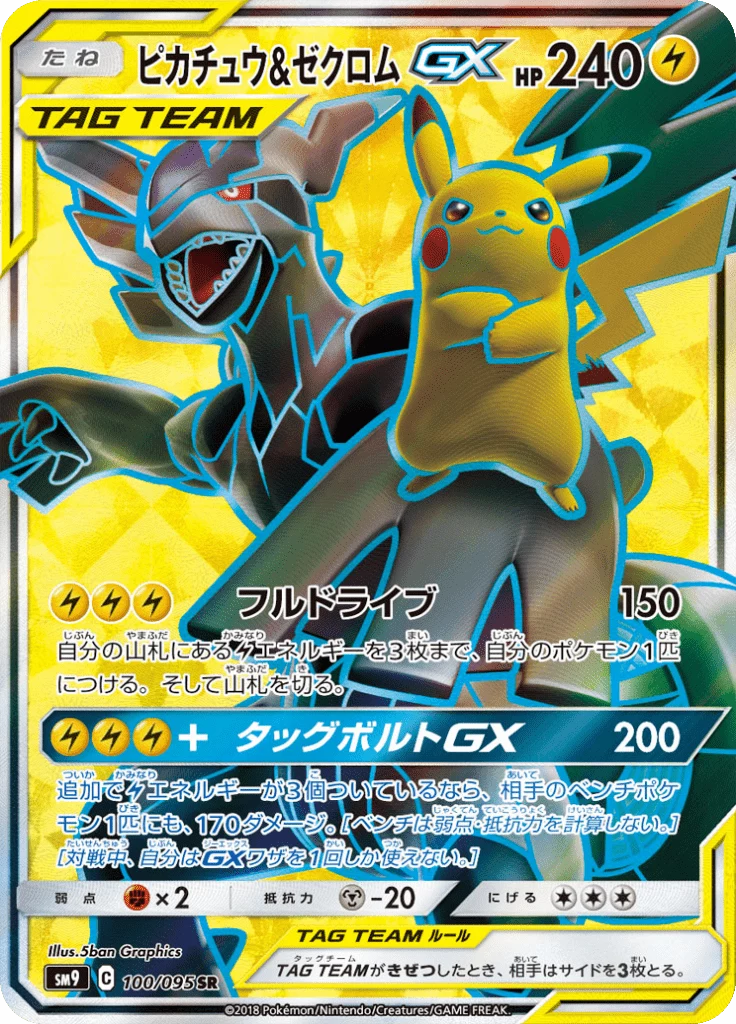
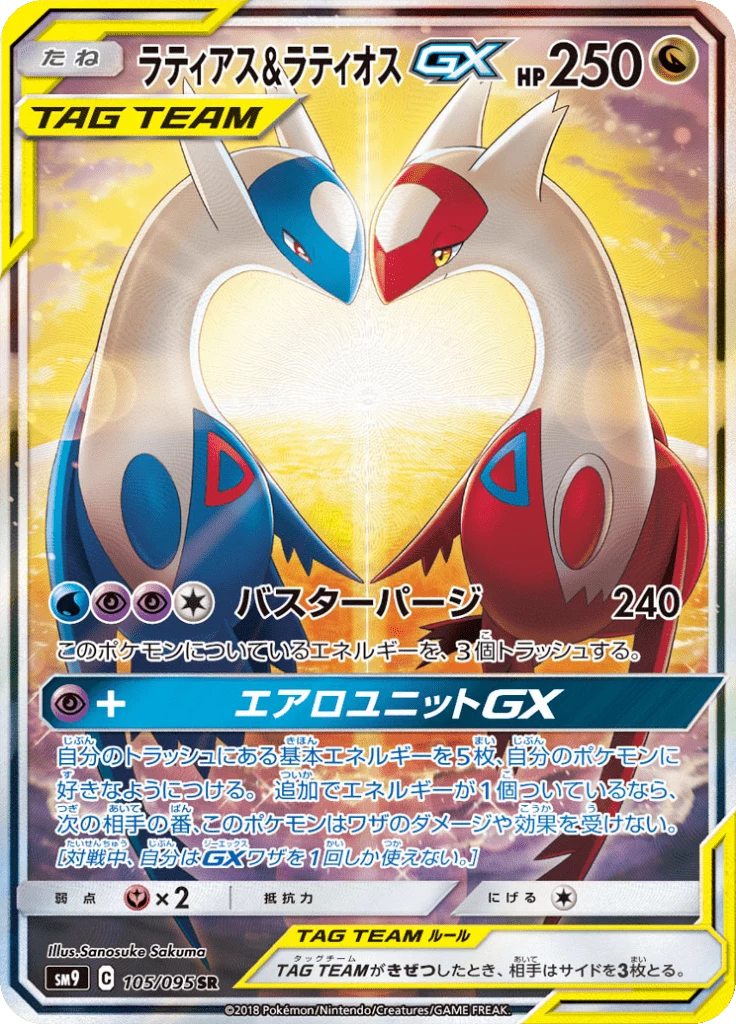
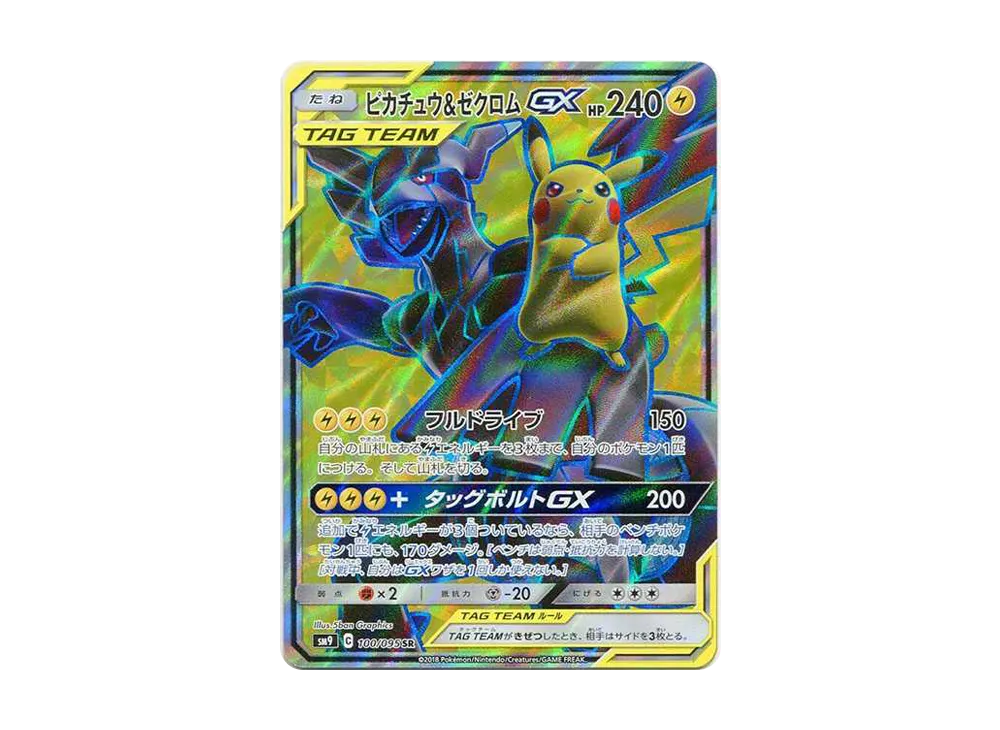
Tag Bolt’s secret-rare block includes several other cards currently listed on our site as PSA 10 examples, including two GX Tag Team cards from the same era of the set.

Pikachu & Zekrom GX SR 100/095, Tag Bolt (SM9)

Pikachu & Zekrom GX 100/095 (SR)

Latias & Latios GX SR: SA 105/095, Tag Bolt (SM9)

Latias & Latios GX 105/095 (SR: SA)

For the full Tag Bolt secret-rare and chase-card line-up, see our Tag Bolt (SM9) card list hub, and for pull-rate discussion on the set specifically, our Tag Bolt pull-rates hub covers it in more detail.

SM9-Tag Bolt Japanese Pokemon Booster Box, listed on samuraiswordtokyo.com

Sealed Tag Bolt product — the source for 109/095 and the rest of the set’s secret rares — is currently listed as the SM9-Tag Bolt Japanese Pokemon Booster Box at ¥441,000 (~$2,774). This is a genuinely vintage, 2018-dated Japanese box, not an ordinary current-release product, and the price reflects that scarcity rather than a typical modern booster box.

Japanese vs English Print

Sabrina’s Suggestion does have an English-set equivalent, and the localisation carries an extra naming wrinkle worth flagging. The Japanese card name is ナツメの暗示 — literally “Natsume’s Hint” — because Natsume (ナツメ) is the original Japanese name for the character English localisations call Sabrina. The official English card name follows that established localisation: Sabrina’s Suggestion.

In English, the card appears in Team Up across two separate slots: a standard print at #154 and a full-art print at #181. Japanese Tag Bolt likewise includes a regular treatment at 88/095 and the SR at 109/095, so the two releases should be compared treatment by treatment rather than as two English cards replacing one Japanese card. For a broader look at how this Japanese-source set maps onto its English release, see our Team Up Japanese card list hub.

Where This SR Sits Among Japanese Rarity Tiers

In this generation of Japanese Sun & Moon-era sets, a card numbered above the set’s main count — here, above 095 — marks it as a Secret Rare (SR): the tier reserved for the set’s chase cards, printed outside the standard numbered run. Sabrina’s Suggestion at 109/095 sits in that SR block alongside other Tag Bolt secret rares currently listed on our site in PSA 10, including Pikachu & Zekrom GX 100/095, listed at ¥87,208 (~$549).

One sibling in the same secret-rare block goes a step further in its own product naming: Latias & Latios GX 105/095 is listed under the designation SR: SA, indicating a further special-art treatment within the secret-rare range. We list that print at ¥1,321,516 (~$8,312) — a figure that reflects genuine vintage scarcity for that specific print rather than a typical price for a Tag Bolt secret rare.

For the wider trainer-card angle across every verified print of Sabrina, see our Sabrina Pokemon cards guide.

Shop This Set
PSA10 Sabrina’s Suggestion SR 109/095 (Tag Bolt)
¥22,198 (~$140)
Ships from Tokyo · Tracked delivery

View Product →

Where to Buy Sabrina’s Suggestion from Tokyo

PSA 10 Sabrina’s Suggestion 109/095 SR is currently listed at ¥22,198 (~$140), shipped from Tokyo with tracked delivery. If you would rather pull your own copy, the sealed SM9-Tag Bolt Japanese Booster Box is the source product for the set’s full secret-rare block, at ¥441,000 (~$2,774).

For other Tag Bolt secret rares in the same PSA 10 tier, see PSA 10 Pikachu & Zekrom GX 100/095 and PSA 10 Latias & Latios GX 105/095 SR: SA, or browse the full range in our PSA 10 graded card collection. For a mixed order across singles and sealed product, our Quick Order page is the fastest way to build a cart.

常見問題

What is Sabrina’s Suggestion 109/095 SR?

It is the Secret Rare print of Sabrina’s Suggestion (ナツメの暗示), card 109/095 from the Japanese 擴充包 Tag Bolt (set code SM9), released 7 December 2018. This PSA 10 print is currently listed at ¥22,198 (~$140).

What does Sabrina’s Suggestion do?

It is a Trainer — Supporter card. Its printed effect lets you view your opponent’s hand and, if you choose, select one Supporter card from it and use that card’s effect as your own for the turn.

Why is Sabrina’s Suggestion called ナツメの暗示 in Japanese?

Natsume (ナツメ) is the original Japanese name for the character English localisations call Sabrina, so the Japanese card name translates literally to “Natsume’s Hint.” The official English card name follows the established localisation: Sabrina’s Suggestion.

Does Sabrina’s Suggestion have an English print?

Yes — Team Up carries a standard print at #154 and a full-art print at #181. Japanese Tag Bolt likewise has a regular treatment at 88/095 and the SR at 109/095.

What set is Sabrina’s Suggestion from?

Tag Bolt is Japanese set code SM9, an 擴充包 released 7 December 2018. Its main numbered run stops at 095, with secret-numbered cards printed above that denominator.

Where can I buy a PSA 10 Sabrina’s Suggestion from Tokyo?

This 109/095 SR PSA 10 print is currently listed at ¥22,198 (~$140) with tracked shipping from Tokyo. The sealed SM9-Tag Bolt Japanese Booster Box is currently listed at ¥441,000 (~$2,774) if you would rather pull your own copy from the set’s secret-rare block.

Thundurus寶可夢卡片指南:從XY到Storm Emeralda的每張日版印刷卡

A card database search for Thundurus across the Japanese Pokemon TCG returns 19 results. This guide selects 11 documented prints from that broader result set, ranging from XY-era cards to a 2026 Uncommon print.

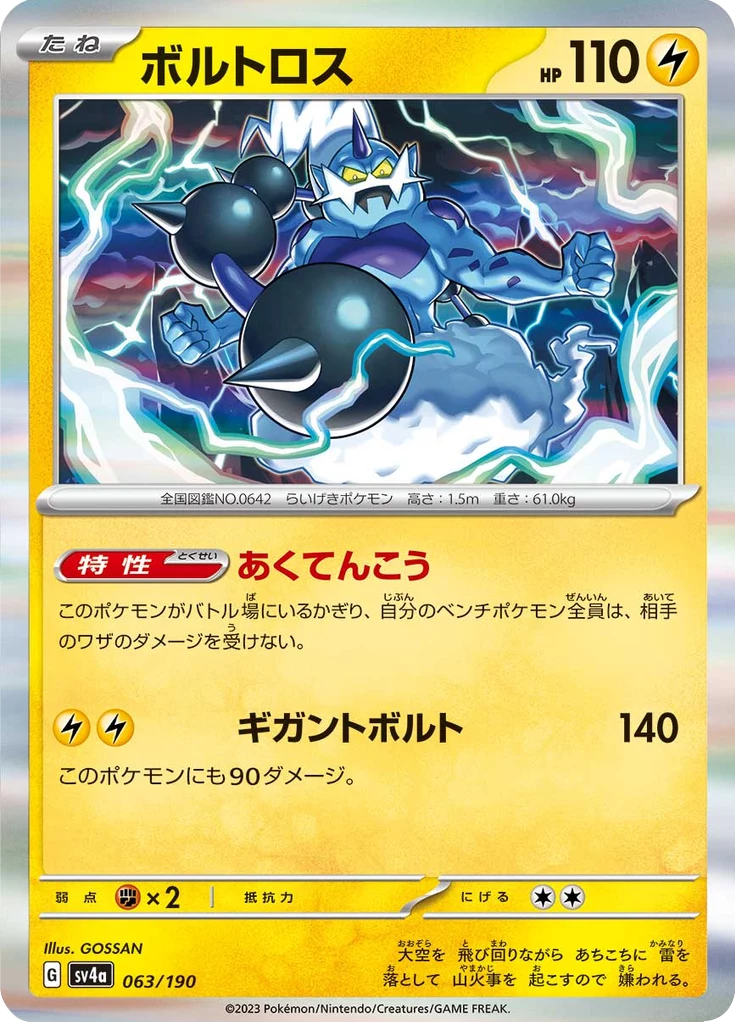
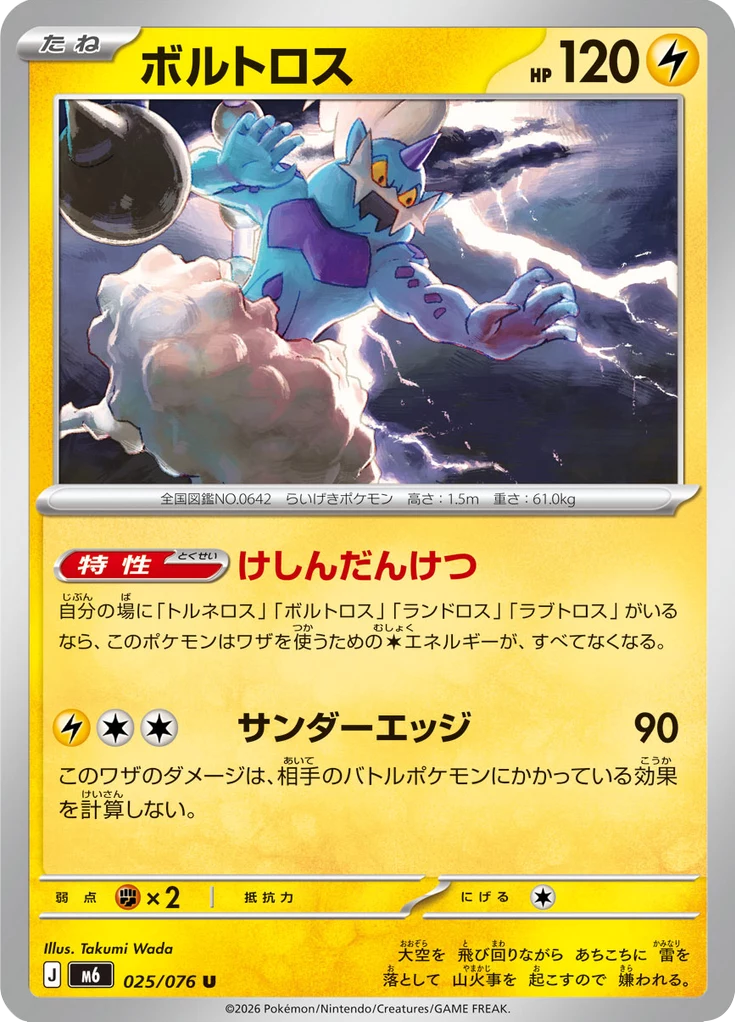
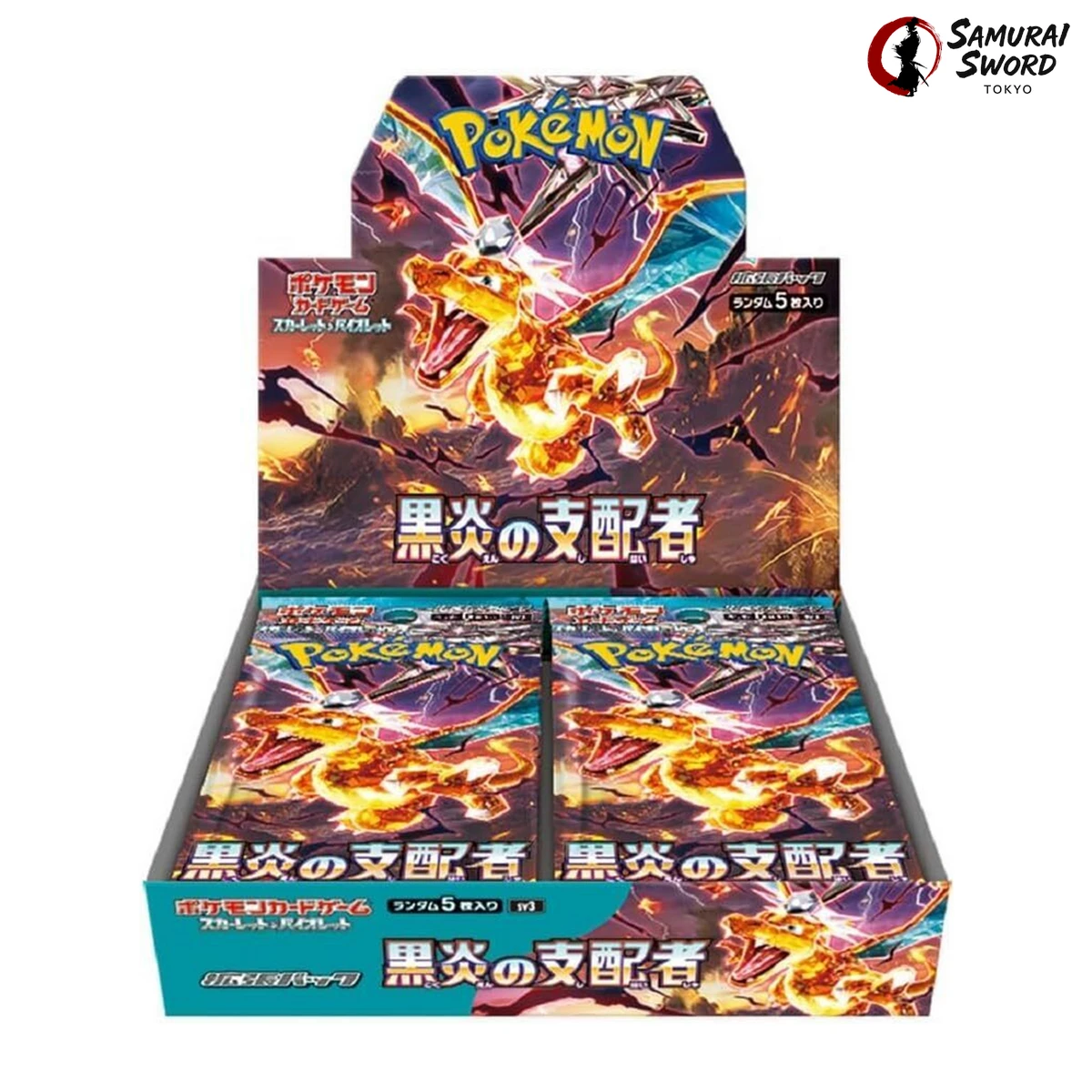
Japanese name ボルトロス (Vorutorosu), English name Thundurus. This guide walks the 11 selected prints era by era, explains why the vintage “Thundurus EX” cards from 2015 are a genuinely different card type from the modern Thundurus prints covered here, and lands on the one Japanese booster box currently on our site that carries a Thundurus pull: SV3 “黒炎の支配者” (Ruler of the Black Flame), where Thundurus sits at card #36, Rare.

We ship Japanese sealed product out of Tokyo every week. No single Thundurus card is currently listed on our site, so this guide treats the SV3 box as the direct route to a Thundurus pull, and points sourcing requests for the other prints covered here toward our Quick Order page.

Key Takeaway

This guide compares 11 selected Japanese Thundurus prints, from XY-era examples to the 2026 Storm Emeralda Uncommon. The modern SV3 Rare print (#36) comes from SV3 Ruler of the Black Flame Booster Box, currently listed at ¥17,160 (~$108). No Thundurus single is currently listed — sourcing requests for any print in this guide go through our Quick Order page.

11
Selected Prints

6
Rarity Tiers

4
Eras Covered

1
Listed Box (SV3)

The 11 Selected Japanese Thundurus Prints

The database search that anchors this guide returned 19 Thundurus results in the Japanese TCG; the table below is a selected comparison of 11 documented entries rather than a complete print list.

系列 # Rarity Illustrator EN equivalent
SV3 (anchor) 36 Rare GOSSAN OBF #70 / PAF #139
SV4a 63 Base print GOSSAN OBF #70 / PAF #139
SV4a 244 Shiny Rare Shin Nagasawa OBF #70 / PAF #139
M6 25 Uncommon Takumi Wada Not verified yet
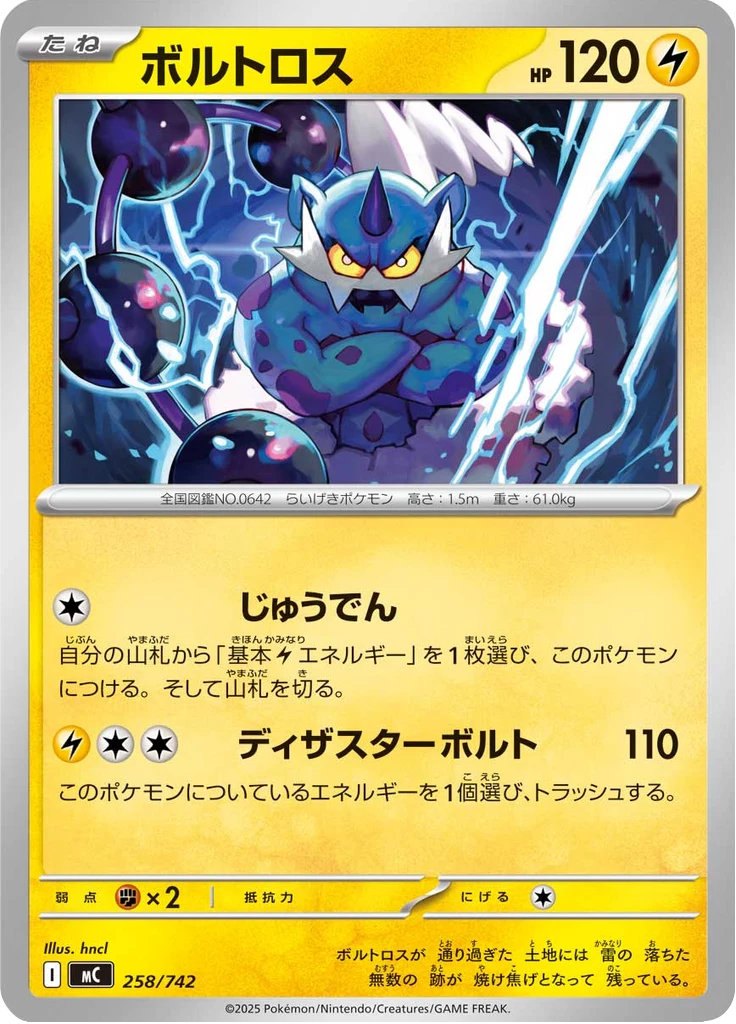
MC 258 Start Deck 100 print hncl SVP #209 / BLK #33
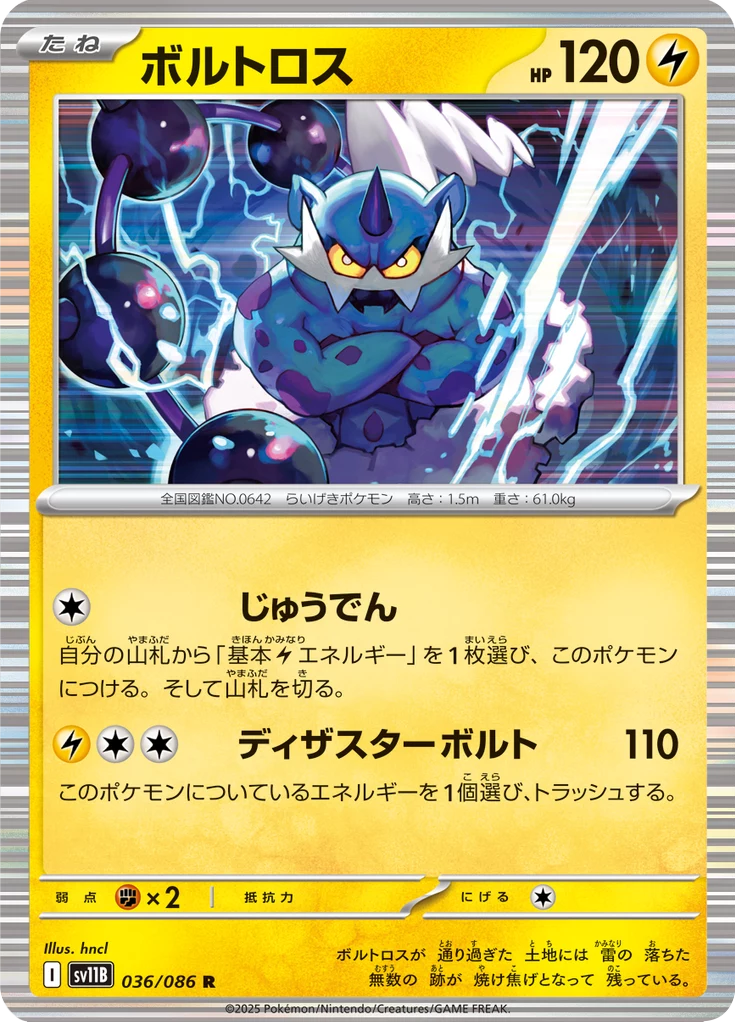
SV11B 36 Rare hncl SVP #209 / BLK #33
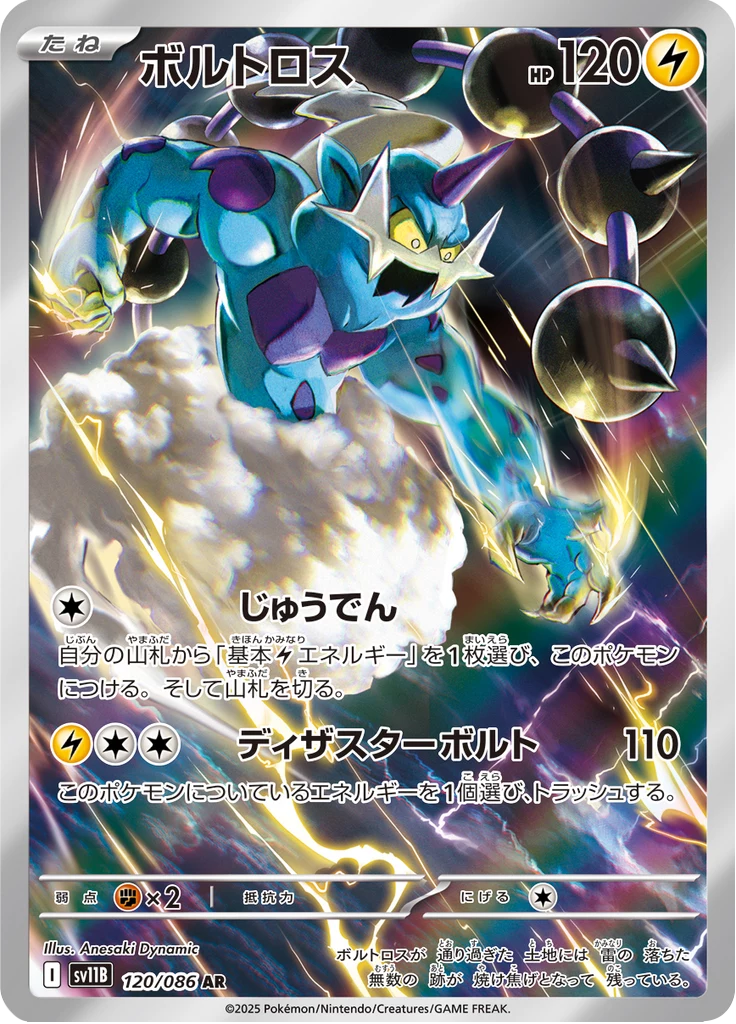
SV11B 120 Art Rare Anesaki Dynamic SVP #209 / BLK #33
S5a 22 Rare Souichirou Gunjima CRE #52
XY6 22 (Thundurus EX) Double Rare Eske Yoshinob ROS #98 / #26
XY6 79 (Thundurus EX) Secret Rare Ryo Ueda ROS #98 / #26
XY3 31 Uncommon Hajime Kusajima FFI #33

Two things stand out. First, the two XY6 rows are the only “Thundurus EX” cards in this selected lineup — a Basic-EX card type that stopped being printed after the XY era. Every other row in this table is a standard, non-EX Thundurus print. All but one of them — every print from S5a onward — was released between eight and eleven years after the EX pair; the ninth, XY3, actually predates it. Second, the named rarity spread runs from Uncommon (M6, XY3) up through Secret Rare (XY6 #79), with Shiny Rare, Art Rare, Double Rare and Rare in between — six distinct named rarity tiers across four TCG eras.

Check This First

If your card matches one of the two Thundurus EX entries covered here, it is an XY6 print from 2015. The nine non-EX prints in this guide, spanning XY3 through the 2026 Storm Emeralda release, are a different card type rather than reprints of that XY6 pair.

The Vintage Era: XY3 and XY6

An earlier print covered in this guide, Thundurus #31 from XY3, is a standard Uncommon — not an EX card — illustrated by Hajime Kusajima, with an English-set equivalent at Furious Fists #33.

XY6 (the Japanese counterpart to Roaring Skies) is where the EX version appears, and it did so twice in the same set:

  • Thundurus EX #22, Double Rare, illustrated by Eske Yoshinob.
  • Thundurus EX #79, Secret Rare, illustrated by Ryo Ueda — the higher-numbered secret print of the same card.

Both XY6 prints map to the same English release, Roaring Skies #98 / #26. The “EX” suffix on these two cards is the key identifier: no other Thundurus print in this guide carries it, and the EX card type itself was discontinued industry-wide well before the SV-era prints below were designed. Treat the XY6 EX pair and every non-EX print in this guide as two separate collecting lanes rather than a single continuous run.

Sword & Shield Era: Thundurus in S5a

One Sword & Shield-era release included in this guide is Thundurus #22 in S5a, Rare, illustrated by Souichirou Gunjima. Its English-set equivalent is Chilling Reign #52.

Scarlet & Violet: SV3 Ruler of the Black Flame and SV4a

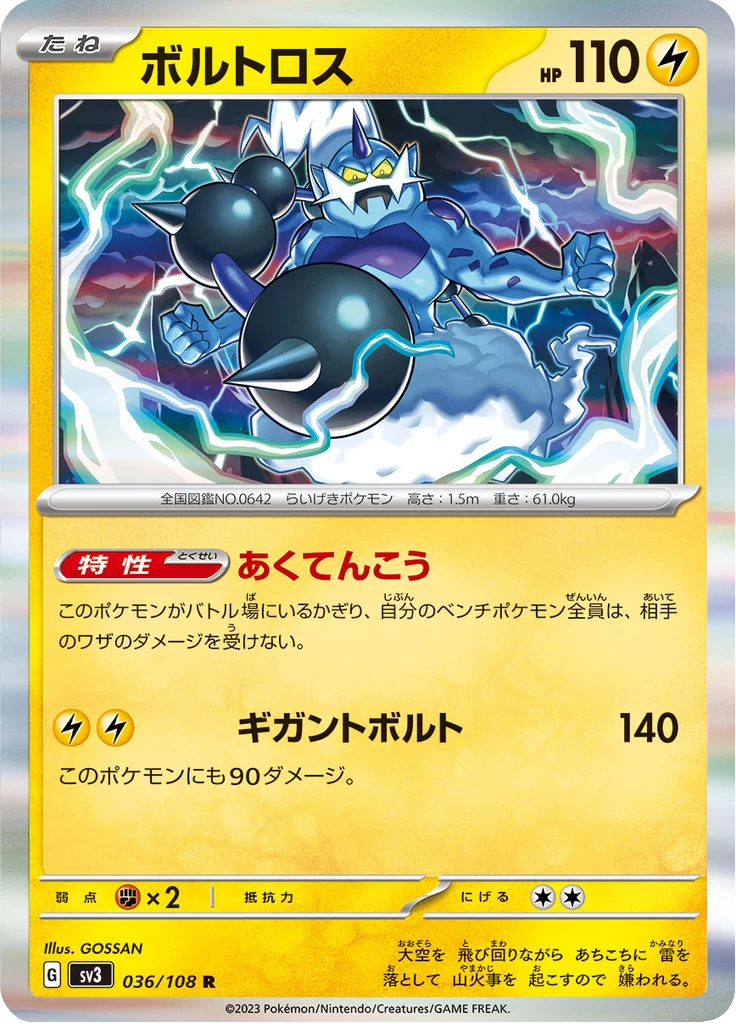
Thundurus Rare #36, SV3 Ruler of the Black Flame
Thundurus Rare #36, SV3 Ruler of the Black Flame — the anchor print of this guide

SV3 “黒炎の支配者” (Ruler of the Black Flame), JP set code SV3, released 28 July 2023 with 141 cards, is where the modern Thundurus lineage starts. Thundurus sits at #36, Rare, illustrated by GOSSAN, with an English-set equivalent split across Obsidian Flames #70 and Paldean Fates #139. This is the print that comes out of the box we currently list — see the full SV3 Ruler of the Black Flame card list for where it sits among the rest of the set, or our SV3 pull-rates and best-cards guide for the set’s other chase cards. For how the SV3 anchor box compares with its companion release, see our SV3 vs SV3a box guide.

Thundurus base print #63, SV4a

Thundurus #63 (base print), SV4a

SV4a carries the same card twice: a base print at #63 (also illustrated by GOSSAN) and a Shiny Rare at #244, illustrated by Shin Nagasawa. Both SV4a prints share the same English-set equivalent as the SV3 anchor — Obsidian Flames #70 / Paldean Fates #139 — which places all three cards (SV3 #36, SV4a #63, SV4a #244) as Japanese-side counterparts of the same English artwork pair. For the wider chase-card lineup on the English side of that pairing, see our Obsidian Flames chase cards guide.

The Black Bolt Prints: MC and SV11B

Thundurus print #258, MC Start Deck 100 Battle Collection

Thundurus #258, MC Start Deck 100 Battle Collection

Thundurus Rare #36, SV11B Black Bolt

Thundurus Rare #36, SV11B

Thundurus Art Rare #120, SV11B Black Bolt

Thundurus Art Rare #120, SV11B

Three prints share the same English-set equivalent here — SVP #209 and Black Bolt #33. MC #258, illustrated by hncl, is included in Start Deck 100 Battle Collection. SV11B “ブラックボルト” (Black Bolt), JP set code SV11B, released 6 June 2025 with 174 cards, carries Thundurus twice: a Rare at #36 (also illustrated by hncl) and an Art Rare at #120, illustrated by Anesaki Dynamic. The Art Rare is the higher rarity tier of the pair, sitting above the standard Rare the way SV4a’s Shiny Rare sits above its own base print.

The 2026 Return: Thundurus in Storm Emeralda (M6)

Thundurus Uncommon #25, M6 Storm Emeralda
Thundurus Uncommon #25, M6 Storm Emeralda — the newest print in this guide

The newest print in this guide comes from M6 “ストームエメラルダ” (Storm Emeralda), JP set code M6, released 31 July 2026 with 76 cards. Thundurus sits at #25, Uncommon, illustrated by Takumi Wada. Unlike every other print in this guide, this one doesn’t have a confirmed English-set equivalent yet. For the rest of the set’s card list, see our Storm Emeralda M6 card list.

Chase Prints and What Makes Them Collectible

The named rarity tiers among the prints listed above form the following hierarchy. The SV4a #63 base print and MC #258 Start Deck 100 print are left outside this tier ranking because the table does not assign either one a named rarity tier:

  • Secret Rare — XY6 #79, sitting above the set’s regular numbering.
  • Art Rare — SV11B #120. A full-illustration treatment above the standard Rare slot in the same set.
  • Shiny Rare — SV4a #244. An alternate-colour treatment of the SV3/SV4a base print.
  • Double Rare — XY6 #22. The standard EX-tier rarity for the vintage print.
  • Rare — SV3 #36, SV11B #36, S5a #22.
  • Uncommon — XY3 #31, M6 #25.

What makes a print “collectible” in this lineup isn’t a single factor: the XY6 Secret Rare is scarce because of its rarity slot, the SV4a Shiny Rare and SV11B Art Rare are scarce because of their alternate treatment, and the SV3 anchor print is notable simply because it’s the print tied to a box we currently list.

Which Japanese Box to Open for Thundurus

The currently listed box connected to the prints covered here is:

SV3 Ruler of the Black Flame Japanese Pokemon Booster Box, listed on samuraiswordtokyo.com
SV3 Ruler of the Black Flame Booster Box, Japanese — currently listed at ¥17,160 (~$108)

The SV3 Ruler of the Black Flame Booster Box (Japanese), currently listed at ¥17,160 (~$108), is the box that carries the Rare Thundurus print at #36 covered above.

SV4a, M6, MC, SV11B, S5a, XY6 and XY3 — the other seven sets and products represented in this selected table — are not listed on our site at the moment; sourcing requests for boxes or singles from any of those go through our Quick Order page.

Shop This Set
SV3-Ruler Of The Black Flame Japanese Pokemon Booster Box
Contains the Rare Thundurus print at #36
Ships from Tokyo · Tracked delivery

View Product →

Where to Buy Thundurus Cards from Tokyo

We ship Japanese sealed product worldwide out of Tokyo with tracked delivery. For a shot at the modern SV3 Rare print, the SV3 Ruler of the Black Flame Booster Box, currently listed at ¥17,160 (~$108), is the direct route. For the wider range of Japanese Pokemon booster boxes we currently carry, browse the Pokemon card box collection. No Thundurus single is currently listed — whether you’re after the vintage XY6 EX pair, the SV11B Art Rare, or any other print in this guide, request a quote via our Quick Order page for a specific-card sourcing request.

常見問題

How many Japanese Thundurus Pokemon card prints are there?

A card database search returns 19 results for Thundurus in the Japanese TCG. This guide compares 11 selected documented entries and does not present them as a complete print list.

What is the anchor Thundurus print in this guide?

Thundurus #36, Rare, from SV3 Ruler of the Black Flame (released 28 July 2023), illustrated by GOSSAN. It’s the print that comes out of the SV3 Ruler of the Black Flame Booster Box, currently listed on our site.

What’s the difference between Thundurus EX and the modern Thundurus prints?

The two Thundurus EX cards covered in this guide are the 2015 XY6 #22 Double Rare and #79 Secret Rare. The other entries covered here, from XY3 through the 2026 Storm Emeralda release, are standard non-EX Thundurus cards — a different card type, not reprints of that XY6 pair.

Which Japanese box should I open to pull the SV3 Thundurus?

The SV3 Ruler of the Black Flame Booster Box (Japanese), currently listed at ¥17,160 (~$108), is the box that carries the Rare Thundurus print at #36.

Does the SV3 Thundurus have an English-set equivalent?

Yes — Obsidian Flames #70 and Paldean Fates #139 are the confirmed English-set equivalents shared by the SV3 #36 print and both SV4a Thundurus prints.

Where can I buy Thundurus cards from Japan?

We ship Japanese sealed product from Tokyo with tracked delivery. The SV3 Ruler of the Black Flame Booster Box is currently listed for the modern Rare print; no Thundurus single is currently listed, so sourcing requests for any print in this guide go through our Quick Order page.

Byrnndi World One Piece 卡牌指南

Search the official One Piece Card Game database for “Byrnndi World” and one result comes back: a single card, one rarity, one set. That makes this one of the shorter identification jobs in the game — but it’s also a card that gets misfiled constantly, because a broader search for “World” pulls in a long list of unrelated cards and leaves buyers unsure which listing is actually his.

This guide runs through everything the official card list confirms about Byrnndi World’s One Piece Card Game appearance — the card number, rarity, stats and crew — explains the set it comes from, and tells you where that set’s era currently fits into what we ship out of Tokyo.

Key Takeaways

Byrnndi World has a single confirmed One Piece Card Game print: OP02-082, a Purple UC Character card with a cost of 8 and 8000 power, credited to the World Pirates crew in -Paramount War- [OP-02]. No parallel or alternate-art version of this number has turned up in the official card list. OP-02 itself doesn’t have a listed booster box on our site at the moment, but readers stocking up on the same collecting era can currently look at the OP-16 The Time of Battle Japanese Booster Box (listed at ¥12,360, ~$78) or the OP-03 Pillars of Strength Damaged Box (listed at ¥17,860, ~$112).

1
Confirmed Card

UC
Rarity

1
Set Appearance

0
OP-02 Boxes Listed

Card data below is taken from the official One Piece Card Game card list (freewords search for “Byrnndi World”, filtered to the exact name match). Prices convert at ¥159/USD, September 2026.

Byrnndi World in the One Piece Card Game: OP02-082

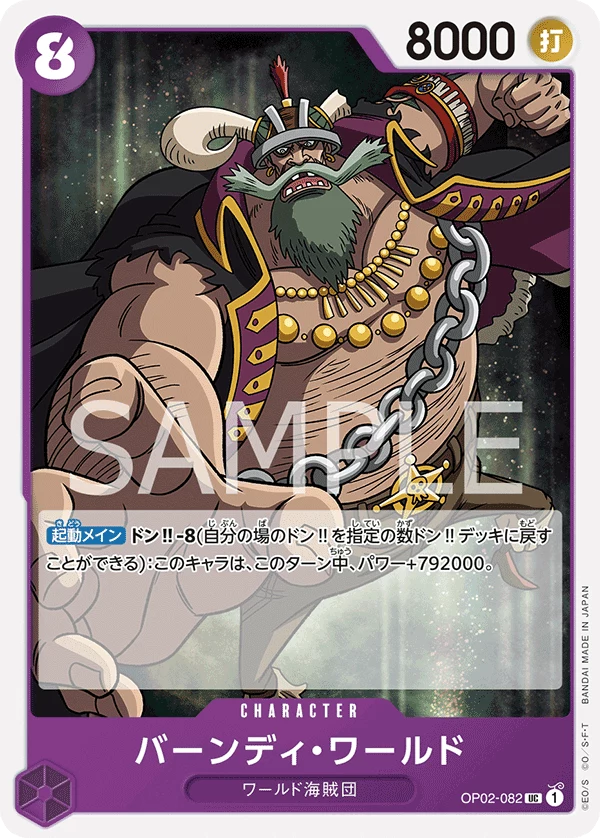
Byrnndi World’s only confirmed appearance in the One Piece Card Game is OP02-082, a Character-type card at UC (uncommon) rarity from -Paramount War- [OP-02]. The official card list attaches him to the World Pirates crew rather than any of the game’s larger factions.

Card # Rarity Type Color Cost Power Crew 系列
OP02-082 UC Character Purple 8 8000 World Pirates -Paramount War- [OP-02]
Byrnndi World OP02-082, UC Character card, -Paramount War- [OP-02]
Byrnndi World — OP02-082, UC, Purple Character, -Paramount War- [OP-02]

The Purple colour slot and the printed 8-cost, 8000-power statline identify this Character’s role in the card list. The World Pirates crew line is the relevant trait for deckbuilders checking synergy with that specific crew rather than filtering by colour alone.

The Set Behind the Card: -Paramount War- [OP-02]

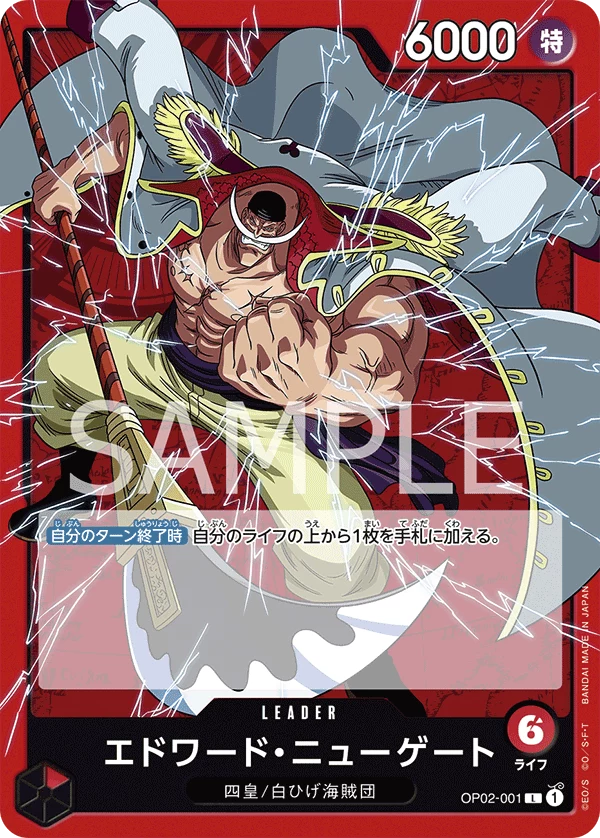
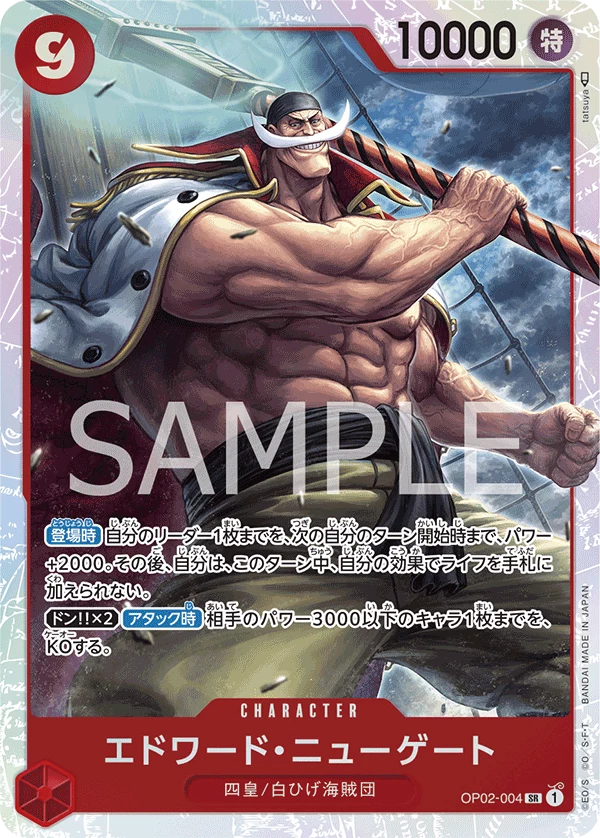
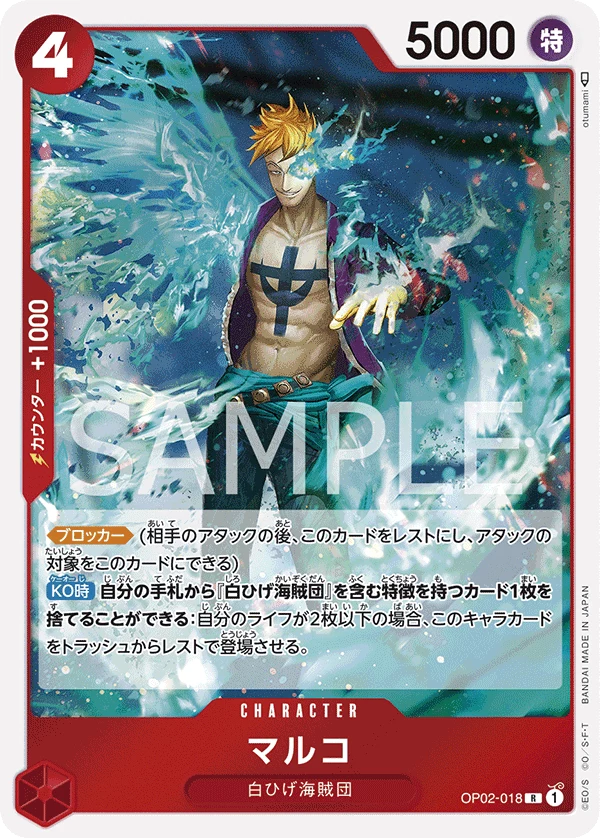
-Paramount War- [OP-02] is the set built around the Marineford war arc — the story stretch that also gave the game its Whitebeard Pirates cards. Byrnndi World’s World Pirates card sits inside that same booster alongside the set’s headline Whitebeard Pirates prints, including the Leader and SR versions of Edward.Newgate and the crew’s R-rarity Marco.

Edward.Newgate (Whitebeard), L, Leader, -Paramount War- [OP-02]

Edward.Newgate — OP02-001, L

Edward.Newgate (Whitebeard), SR, Character, -Paramount War- [OP-02]

Edward.Newgate — OP02-004, SR

Marco, R, Character, -Paramount War- [OP-02]

Marco — OP02-018, R

None of that changes Byrnndi World’s own card — he isn’t a Whitebeard Pirates crewmate on the card text — but it places OP-02 in context for anyone assembling a Marineford-era set rather than hunting one card in isolation. For the rest of the checklist, our OP-02 full card list and OP-02 pull-rates hub cover the set card by card, and our Whitebeard cards guide covers the Whitebeard Pirates side of the same set in detail.

Parallel and Alt-Art Versions

The official card list search returns no parallel, alternate-art, or special-rarity treatment of OP02-082 at this time — the UC print above is the print verified for this guide.

If You’re Trying to Identify a Copy

Anything sold as “Byrnndi World” should carry the card number OP02-082. If a listing shows a different number or a rarity other than UC, cross-check it directly against the official card list before treating it as a second print — our search turned up none.

Our OP-02 parallel and alt-art card list tracks which numbers in this set do carry alternate treatments, if you’re cross-referencing the rest of the booster.

Which One Piece Boxes to Open for This Era

-Paramount War- [OP-02] itself is not a listed booster box on our site right now — sourcing requests for that specific set go through 快速訂購. The following listed boxes are alternative purchase routes, but neither contains OP02-082:

原盒 Set era Listed price
OP-16 The Time of Battle (regular) Current mainline booster ¥12,360 (~$78)
OP-03 Pillars of Strength — Damaged Box Early-numbered set, adjacent to OP-02 ¥17,860 (~$112)

OP-03 is an early-numbered set currently listed on our site, while OP-16 is a current mainline product. Neither box contains Byrnndi World’s OP02-082; they are alternative purchase routes only. Our box-buying comparison guide covers current mainline sets in more depth.

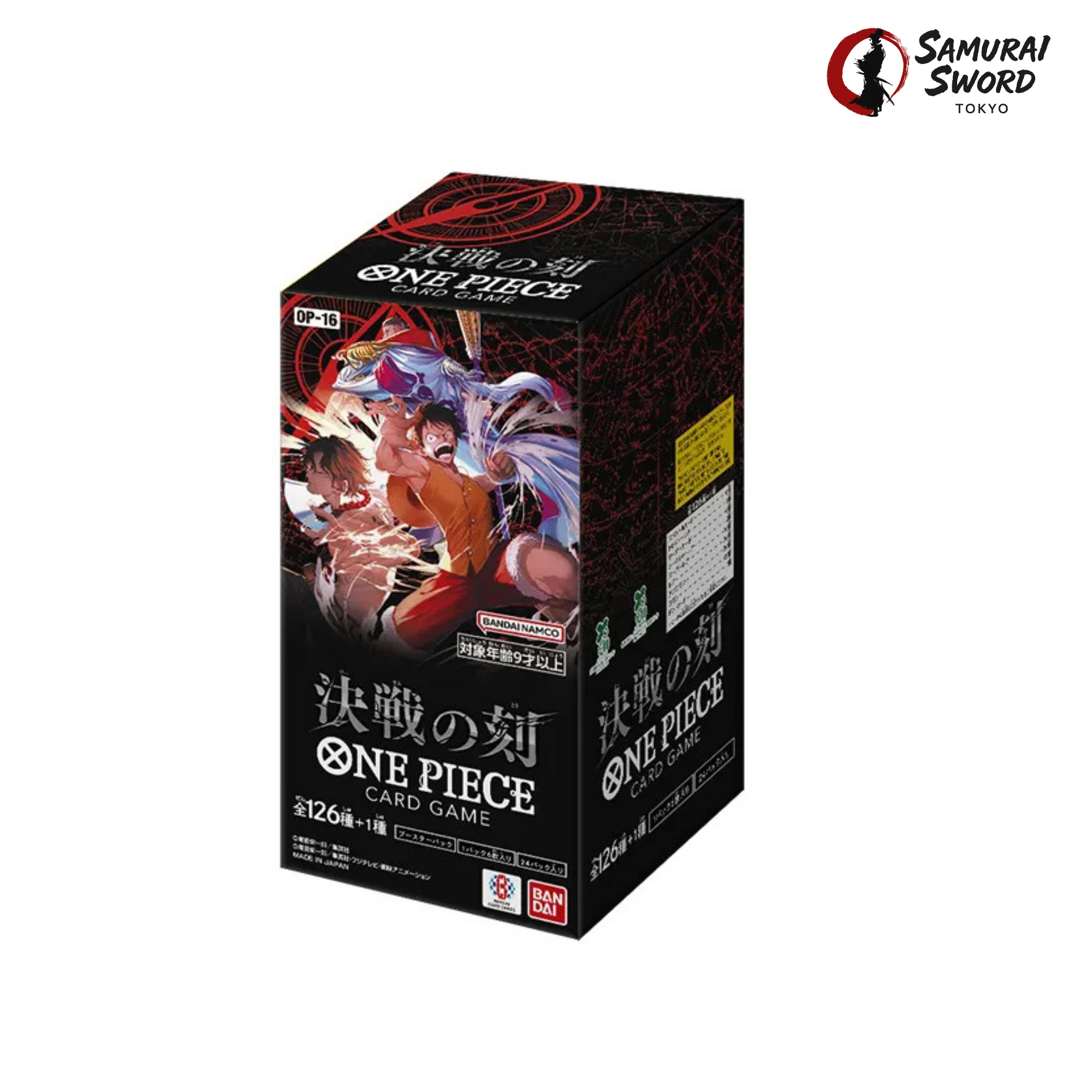
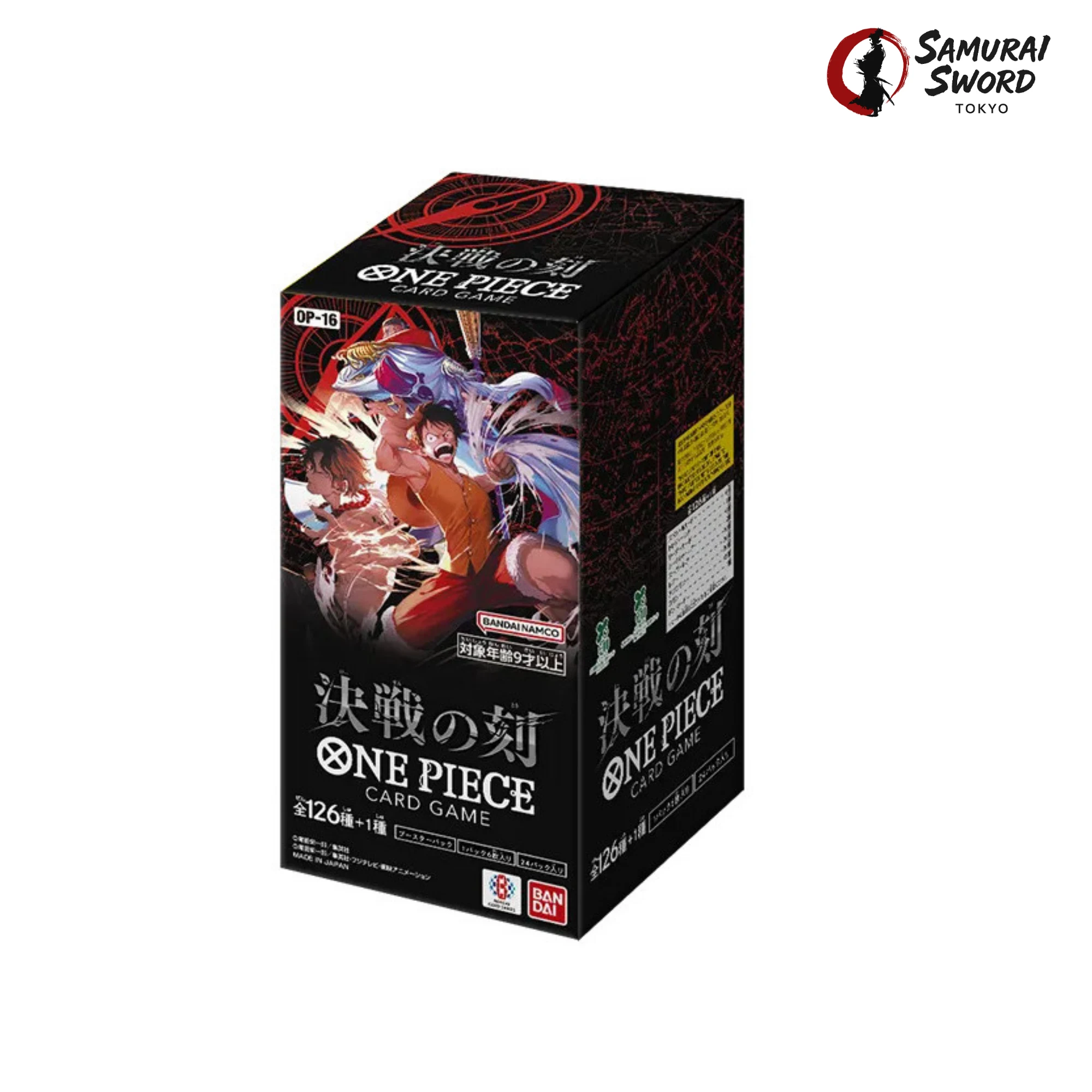
OP-16 The Time of Battle Japanese One Piece Booster Box product photo

OP-16 The Time of Battle Box
¥12,360 (~$78)

OP-03 Pillars of Strength Japanese One Piece Booster Box - Damaged Box product photo

OP-03 Pillars of Strength — Damaged Box
¥17,860 (~$112)

Shop This Box
OP-16 The Time of Battle Japanese One Piece Booster Box
Listed at ¥12,360 (~$78)
Ships from Tokyo · Tracked delivery

View Product →

Where to Buy Byrnndi World One Piece Cards from Tokyo

Byrnndi World’s card, OP02-082, is not listed on our site at the moment; sourcing requests go through 快速訂購. Send us the card number and the grade or condition you’re after and we’ll work the request from there — a specific card number gets a faster answer than a general request.

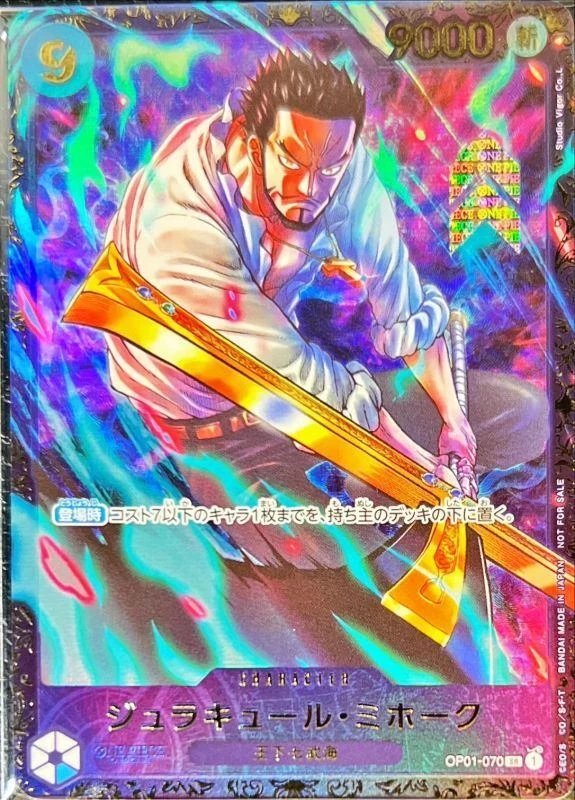
If you’d rather build out the same Marineford-era collecting window with something that is currently listed, our early-set graded single, PSA10 Dracule Mihawk SR [OP01-070], is listed at ¥129,118 (~$812) and comes from the set immediately before OP-02. For sealed product, our One Piece booster box collection covers everything we currently list, shipped from Tokyo with tracked delivery. Requests for anything outside that list, OP-02 included, go through 快速訂購 as above.

常見問題

What is Byrnndi World’s card number in the One Piece Card Game?

OP02-082. It’s a Purple, UC-rarity Character card from -Paramount War- [OP-02], credited to the World Pirates crew, with a cost of 8 and 8000 power.

What rarity is the Byrnndi World card?

UC (uncommon). The official card list shows only this one rarity for OP02-082, with no confirmed parallel or alternate-art treatment.

Does Byrnndi World have a parallel or alt-art print?

Not that the official card list search shows. OP02-082 is the print verified for this guide, and no parallel or alternate-art treatment appeared in the official search results.

Can I buy Byrnndi World’s card or the OP-02 box from samuraiswordtokyo.com?

Neither is a listed item on our site at the moment. Sourcing requests for OP02-082 or for -Paramount War- [OP-02] sealed product go through our Quick Order page.

What other cards come from the same -Paramount War- [OP-02] set as Byrnndi World?

OP-02 is built around the Marineford war arc and includes the set’s Whitebeard Pirates cards, such as the Leader and SR versions of Edward.Newgate and the R-rarity Marco. Our OP-02 full card list covers the rest of the checklist.

What boxes should I buy if I want cards from this collecting era?

A -Paramount War- [OP-02] box is not listed on our site at the moment. OP-03 Pillars of Strength Damaged Box and OP-16 The Time of Battle are listed alternatives, but neither contains Byrnndi World’s OP02-082.

Charizard EX CoroCoro Promo 030/XY-P 卡牌指南

Not every Japanese Charizard promo came out of a booster pack. The card in this guide was distributed as a bonus insert with a comic magazine.

The card is リザードンEX — Charizard EX, card number 030/XY-P, distributed as a bonus insert in the March 2014 issue of CoroCoro Comic, Japan’s flagship monthly manga magazine for young readers. It carries 180 HP, is Fire-type, and was illustrated by 5ban Graphics. We currently list a PSA 10 copy of this exact print, and this guide covers how the card was distributed, where it sits inside the wider XY-P promo series, how the Japanese print compares to its English counterpart, and how it differs from the various “M Charizard EX” cards we also carry — which are separate cards from different sets entirely, not reprints of this one.

Key Takeaways

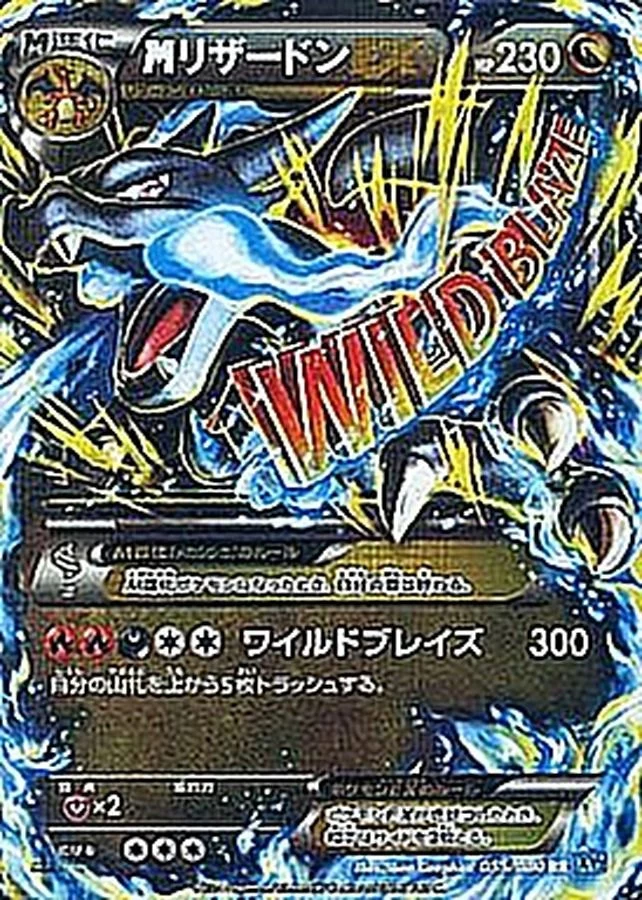
Charizard EX 030/XY-P is a PSA 10, currently listed at ¥176,000 (~$1,107). It was a CoroCoro Comic magazine insert from February 2014, not a booster-pack pull, and it is a different card from the “M Charizard EX” (Mega Charizard-EX) cards from the same XY era — including our separately listed PSA 10 M Charizard EX RR :1ED [Wild Blaze XY2 055/080].

180
HP

Fire
Type

CoroCoro Promo
Distribution

Feb 2014
Japan Release

Prices below are current samuraiswordtokyo.com listings, converted at ¥159/USD (September 2026).

The Card: Charizard EX 030/XY-P

Charizard EX is a Basic Fire-type Pokemon card carrying 180 HP, illustrated by 5ban Graphics. It has two attacks: Mega Evolution, a deck-searching attack, and Brave Fire, which does 120 damage to the opponent with 30 damage of recoil to this Pokemon.

The card carries the promo set code XYP (written without a dash on card databases) at position 030, and it is described in Japanese sourcing as an “original kira” card — a holo-foil finish specific to this promo run rather than a standard set-pack holo pattern.

Charizard EX 030/XY-P, CoroCoro Comic promo, kira holo
Charizard EX 030/XY-P — CoroCoro Comic promo, illustrated by 5ban Graphics

The “Mega Evolution” attack name does not make this Charizard EX a Mega Evolution card itself, and it is not a reprint of any “M Charizard EX” or modern “Mega Charizard ex” card. Our own graded copy of this exact print is currently listed at ¥176,000 (~$1,107), PSA 10.

PSA 10 slab, Charizard EX 030/XY-P, CoroCoro promo
PSA 10 slab, Charizard EX 030/XY-P, CoroCoro promo — listed on samuraiswordtokyo.com

How This Promo Was Distributed

Charizard EX 030/XY-P did not come from a booster box. It was a bonus insert card packaged with the March 2014 issue of CoroCoro Comic, which went on sale in Japan on 15 February 2014. CoroCoro Comic is a monthly manga anthology magazine aimed at young readers, and it has run Pokemon TCG promo inserts alongside its issues for years — a distribution channel entirely separate from Expansion Packs, Concept Packs, or booster boxes.

A secondary source (pokeboon.com) reports a combined print run across the January–March 2014 issues of roughly 73,000 units for that stretch of CoroCoro promos; this figure is reported by that source and has not been officially confirmed by The Pokemon Company, so treat it as a community-reported estimate rather than a verified print number.

系列代碼 Number Distribution JP release
XYP 030/XY-P CoroCoro Comic magazine insert 15 Feb 2014 (Mar 2014 issue)

The Japanese print on record for this card is 030/XY-P. No second Japanese printing of this exact card has turned up in our sourcing, so treat any additional print claims as unverified.

The Set: XY-P Promo Series

XY-P is not a boxed 擴充包 or Concept Pack — it is Japan’s ongoing XY-era promo card series, a running numbered line of promo cards distributed through channels like CoroCoro Comic issues, campaigns, and events rather than sold as a standalone product. Because it is an open-ended promo line rather than a fixed set, there is no official “set size” figure the way there is for a numbered 擴充包, and the 1st Edition marking used on Concept Packs and some mainline Expansion Packs does not apply here — this card was never issued with or without a 1st Edition stamp, since that concept is specific to a different distribution format.

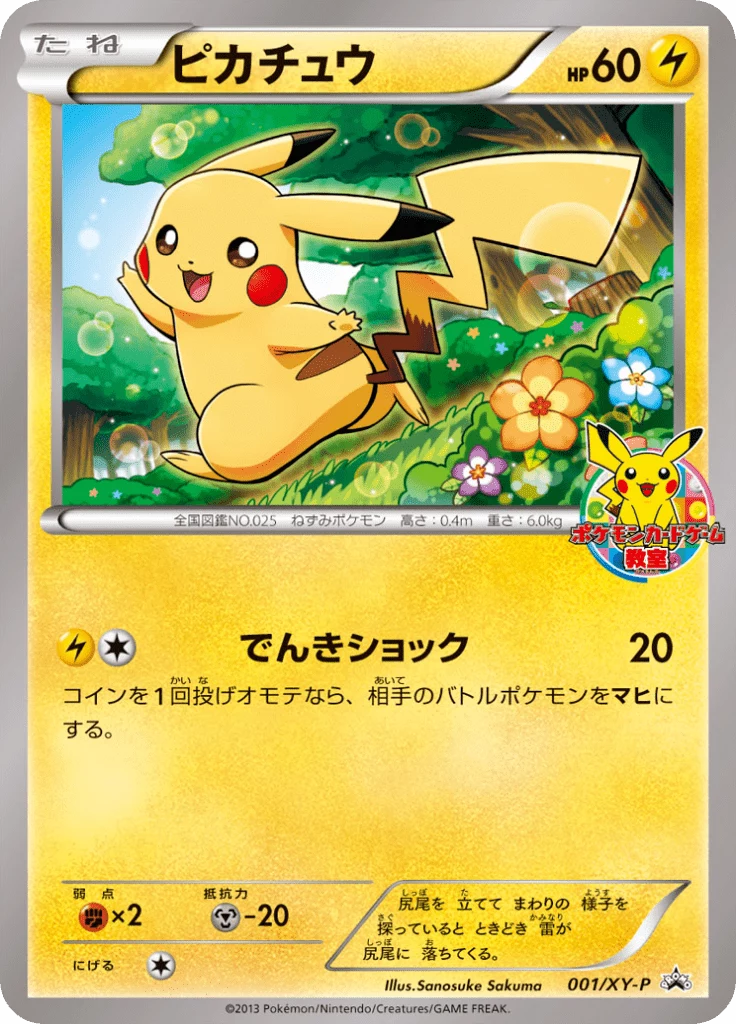
Other cards share the XY-P promo line alongside Charizard EX, including Pikachu 001/XY-P, illustrated by Sanosuke Sakuma — an example of how the same promo series ran across multiple Pokemon and multiple magazine issues rather than a single themed release.

Pikachu 001/XY-P, XY-P promo series
Pikachu 001/XY-P — same XY-P promo series, illustrated by Sanosuke Sakuma

For a wider look at how CoroCoro Comic promos work as a category across different Pokemon and years, see our CoroCoro Comic Pokemon promo cards guide, and for the XY-P line specifically, our XY-P promo series guide covers other notable numbers in the run.

Japanese vs English Print

Charizard EX 030/XY-P does have an English-language equivalent: XY Promos #17. Both carry the same artwork, attacks, and HP total, released as part of their respective language’s XY-era promo distribution.

What differs is the distribution channel and the collecting context around each. The Japanese 030/XY-P print came through a magazine insert with a comparatively limited, geographically restricted distribution inside Japan. The English XY Promos line was distributed through different regional channels entirely (retail promotions, organized play, and similar programs specific to English-language markets). Treat the two as parallel prints of the same card in two languages and two separate promo lines — not the same physical print run split across regions.

Where This Promo Sits Among Japanese Print Types

Charizard EX 030/XY-P sits outside the numbered rarity ladder you see on mainline 擴充包 cards — there is no Rare, SR, or SAR tier attached to a magazine promo, because it was never part of a pack-pull structure. Its distinguishing feature is the “original kira” holo finish applied specifically to this CoroCoro promo run, which sets it apart from a standard set-pack holofoil pattern.

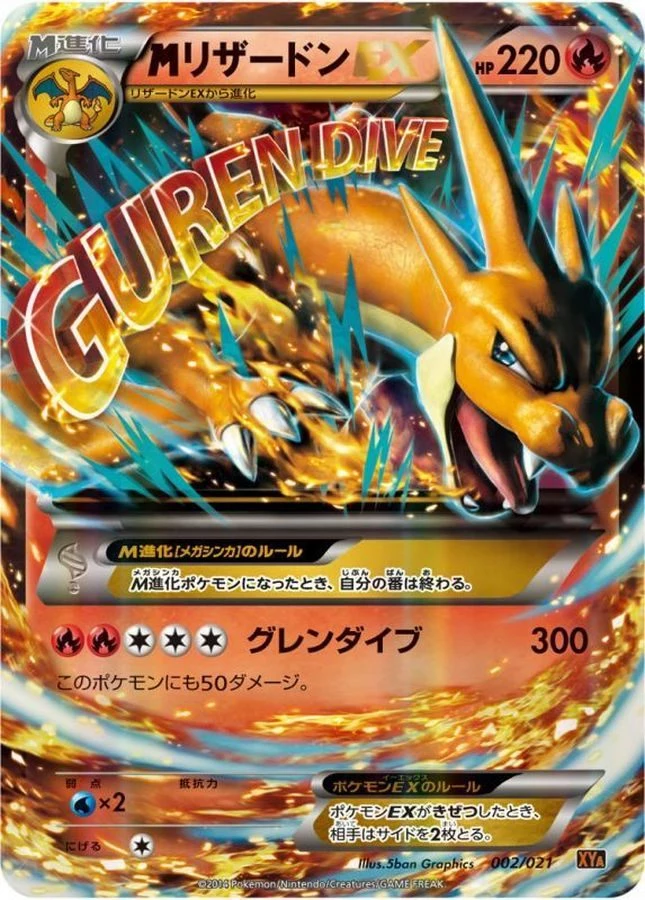
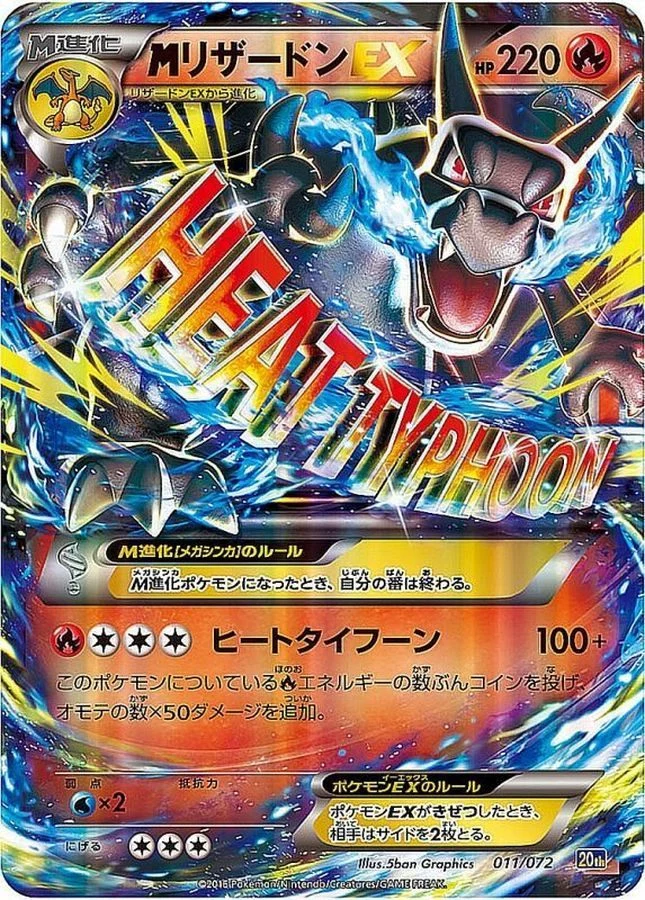
It’s also worth being precise about what this card is not. Charizard EX 030/XY-P is the base (non-Mega) EX card — its attack name does not make it an “M Charizard EX,” and this promo is not a reprint of any modern “Mega Charizard ex” card from the 2025–26 MEGA-series of Japanese sets. We separately carry three different PSA 10 graded “M Charizard EX” cards from other XY-era sets and products — the Mega Battle Deck 60 exclusive, the Wild Blaze (XY2) 1st Edition Reverse Rare, and the XY-20th Starter Pack version — and each of those is a genuinely different card, from a different set and print run, to the CoroCoro promo covered in this guide.

For a broader look at graded Charizard prints from Japan across sets and eras, see our PSA 10 Japanese Charizard cards buying guide.

Shop This Card
PSA 10 Charizard EX PROMO 030/XY-P
Currently listed at ¥176,000 (~$1,107)
Ships from Tokyo · Tracked delivery

View Product →

Where to Buy Charizard EX Promo from Tokyo

Our graded copy of PSA 10 Charizard EX PROMO 030/XY-P is currently listed at ¥176,000 (~$1,107), shipped from Tokyo with tracked delivery. Because this is a magazine promo rather than a booster-pack pull, there is no sealed source product to point to — sourcing requests for this exact print go through 快速訂購.

If you are building out a wider Charizard-family collection, we also carry three separately listed “M Charizard EX” cards from other XY-era products — Mega Battle Deck 60 (¥67,056), Wild Blaze XY2 :1ED (¥147,070), and XY-20th Starter Pack (¥148,412). Each is a distinct card from a distinct set, not a variant of the CoroCoro promo above. Browse the full range in our PSA 10 graded card collection, or use 快速訂購 to build a mixed cart across singles and sealed product.

常見問題

What is Charizard EX 030/XY-P?

It is a Japanese Pokemon promo card, リザードンEX in Japanese, distributed as a bonus insert with the March 2014 issue of CoroCoro Comic (on sale 15 February 2014). It carries 180 HP, is Fire-type, and was illustrated by 5ban Graphics. We currently list a PSA 10 copy at ¥176,000 (~$1,107).

How was this card distributed if it wasn’t sold in a booster pack?

It was a magazine insert, packaged with a specific issue of CoroCoro Comic rather than distributed through 擴充包 booster boxes. A secondary source reports a combined print run of roughly 73,000 units across the January–March 2014 CoroCoro issues, though that figure is not officially confirmed.

Is this the same card as “Mega Charizard ex” from the modern MEGA-series sets?

No. Charizard EX 030/XY-P is a 2014 XY-era promo, and it is not a reprint of, and is unrelated to, any “Mega Charizard ex” card from the 2025–26 MEGA-series of Japanese sets. It is also a different card from the “M Charizard EX” cards we separately list from other XY-era products.

Does Charizard EX 030/XY-P have an English print?

Yes — the English equivalent is XY Promos #17, sharing the same artwork, attacks, and HP. It was distributed through separate English-market promo channels rather than the Japanese CoroCoro magazine insert.

Is Charizard EX 030/XY-P a 1st Edition card?

No 1st Edition marking applies to this card. The 1st Edition concept is specific to Concept Packs and some mainline Expansion Packs; this is a magazine promo distribution, a different format the 1st Edition framework does not cover.

Where can I buy Charizard EX 030/XY-P from Tokyo?

Our PSA 10 graded copy is currently listed at ¥176,000 (~$1,107) with tracked shipping from Tokyo. Since this is a promo card rather than a sealed-product pull, other sourcing requests go through our Quick Order page.

Full Art Trainer Cards from Japan: SR/SAR Supporters Guide

A full art Trainer card is a Supporter reprinted with its illustration stretched across the entire face of the card, edge to edge, instead of sitting inside a standard frame. In Japan, traditional full art Supporter reprints carry the SR code. That is distinct from the later AR/SAR framework; SAR can also appear on Supporters, as the Grant card in this guide shows.

That single-letter distinction trips a lot of collectors up, because SR and SAR look interchangeable at a glance and are not. This guide sets out what a Supporter card is, how it became a full art chase card in the first place, why Japan numbers Trainers on a different code from Pokemon, and where the eight full art SR/SAR Supporters currently in our own catalogue sit inside that system.

Key Takeaways

Supporter cards are a Trainer-card subtype limited to one play per turn, and popular Supporters began receiving full art reprints during the Black & White Series — the origin of the category this guide covers. Traditional Japanese full art Supporters use the SR designation, while the later SAR tier can also include Supporters. A PSA10 Sabrina’s Suggestion 109/095 SR is currently listed at ¥22,198 (~$140), and a PSA10 Professor’s Research SR from VMAX Climax is currently listed at ¥8,800 (~$55).

8
Full Art Supporters Below

1
Supporter Played Per Turn

SR
Japan’s Full Art Trainer Code

¥159
Per USD (Sep 2026)

Yen figures below convert at ¥159/USD (September 2026). Prices are the current listing shown on each linked product page — check the listing itself before ordering.

What Is a Full Art Trainer Card?

Per Bulbapedia’s Supporter card entry, a Supporter is a Trainer-card subtype that “depict[s] and feature[s] people; generally, these are characters from the Pokemon games and Pokemon animation.” The subtype debuted internationally in the Expedition Base Set during the e-Card Series; in Japan, Supporters first appeared within the “P Promotional cards” during the web era. Supporters started out as a plain Trainer subclass and were “elevated to equal level as Trainer cards with the start of the Diamond & Pearl Series.” One rule has stayed constant since: only one Supporter card may be played per turn, which is part of why a strong Supporter becomes a strategically important card long before it becomes a collectible one.

A “full art” card, separately, is one where the “artwork [is] printed on the full space of the card” rather than being framed inside a border with text boxes around it. Full Art was introduced with the Black & White expansion, originating from the Japanese “Black Collection” and “White Collection” releases. When a Supporter gets the full art treatment, the character artwork — not just the Pokemon beside them — runs edge to edge across the card.

Put the two together and a “full art Trainer card” is exactly what it sounds like: a Supporter card (or, less commonly, another Trainer subtype) reprinted in that edge-to-edge full art format. That is the category this guide covers.

From Supporter Card to Full Art Chase Card

Full art Supporters are not an original print format — they are reprints. Per Bulbapedia, “popular Supporter cards began to receive reprints as Full Art cards during the Black & White Series.” That single sentence is the origin of the entire full art Trainer/Supporter chase-card category that later expansions built on: a Supporter first appears as a standard-frame card doing its job in a deck, then a later or parallel print of the same card is issued in full art, and it is that full art reprint — not the original — that collectors chase.

Because the practice started with Supporters specifically, most full art Trainer cards you will see are Supporters rather than Items, Tools, or Stadiums. All eight anchors covered later in this guide are full art Supporter reprints for exactly that reason.

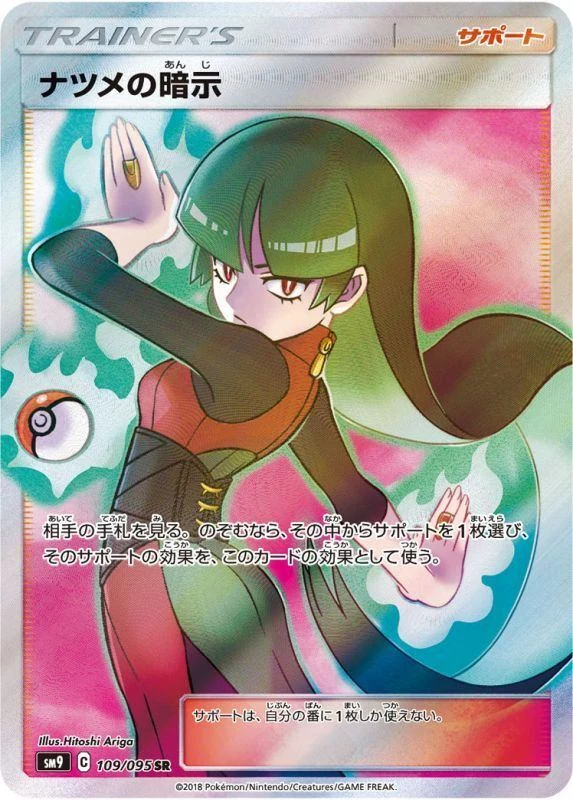
Sabrina's Suggestion 109/095 SR full art Supporter card, Japanese print, PSA 10 slab
Sabrina’s Suggestion 109/095, SR — a full art Supporter reprint of the Sabrina character card

Why Full Art Trainers Use SR, Not AR or SAR

This is the point that catches out most buyers new to Japanese product: SR and SAR are not the same rarity, and they do not mark the same category of card.

Per Bulbapedia’s Full Art card entry, in Japan, full art Trainer cards specifically carry the SR designation — a code that sits apart from the AR/SAR system used for full art Pokemon cards. In other words, Japan runs two parallel labelling tracks for full art prints: one for Pokemon, one for Trainers. A full art Supporter and a full art Pokemon ex from the same expansion can look similarly elaborate on the shelf, but they are marked with different letters because they belong to different tracks.

Full art cards generally were introduced with the Black & White expansion, again tracing back to the Japanese “Black Collection”/”White Collection” releases — so the full art format itself is shared between Pokemon and Trainers, even though the rarity code that marks it is not. One of the eight anchors below, a Grant SAR from VSTAR Universe, is included specifically as a contrast case: it is a modern AR/SAR-tier full art card rather than an SR-tier Trainer card, so seeing it next to the SR Supporters makes the letter difference easier to spot on real product rather than in the abstract.

For the wider rarity-letter system this SR/AR/SAR distinction sits inside, see our Japanese Pokemon card rarities explained guide.

How Japan Numbers Full Art Trainer Cards

Full art cards also get numbered differently depending on the region. In Japan’s numbering system, full art cards are classified as secret cards, numbered beyond the printed set size — so a set printed as, say, 76 cards will carry its full art chase cards at numbers like 77, 78 and upward, past the set’s own stated total. English-language releases instead place full art cards at the end of the set list without necessarily numbering past the printed total in the same way.

That numbering convention is why you will sometimes see a Japanese full art Supporter’s card number look “too high” for the set it comes from — the number itself is telling you the card is a secret, beyond-set-size print before you have even checked the rarity code.

Eight Full Art SR/SAR Supporters in Our Catalogue

These eight full art Trainer cards are currently in our catalogue as PSA 10 graded singles, spanning several Japanese expansions. Seven are SR-designation full art Supporters; the eighth (Grant) is the SAR contrast case described above.

Set codes marked “—” are not confirmed in our source data for that specific listing; the card and rarity are still verified. Ranked by listed price, Sabrina’s Suggestion sits above the rest of the group. The other seven listings range from ¥7,920 to ¥12,078, a spread of ¥4,158.

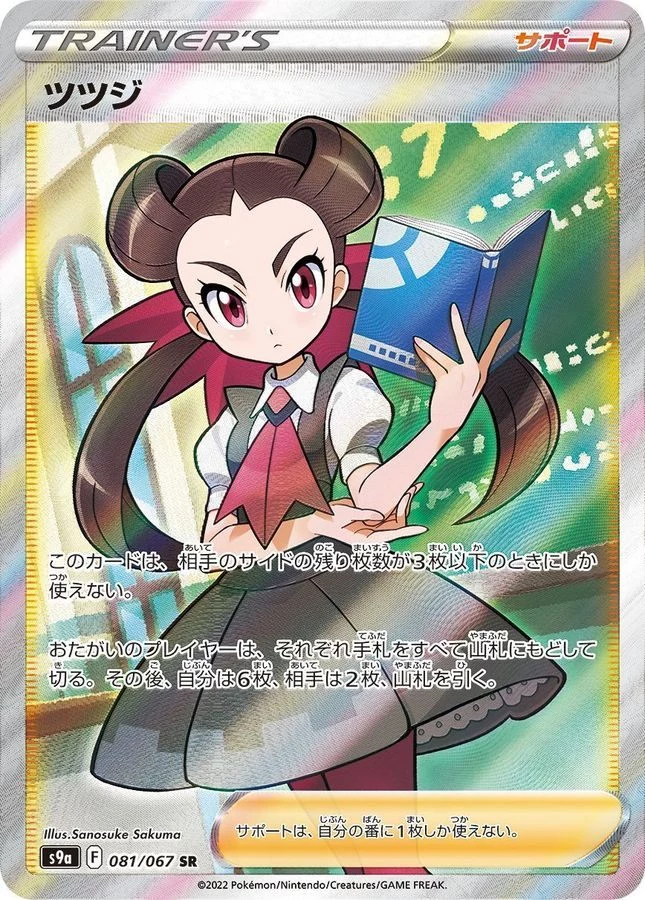
Roxanne 081/067 SR, Battle Region S9a, Japanese full art Supporter, PSA 10 slab

Roxanne 081/067, SR (S9a Battle Region)

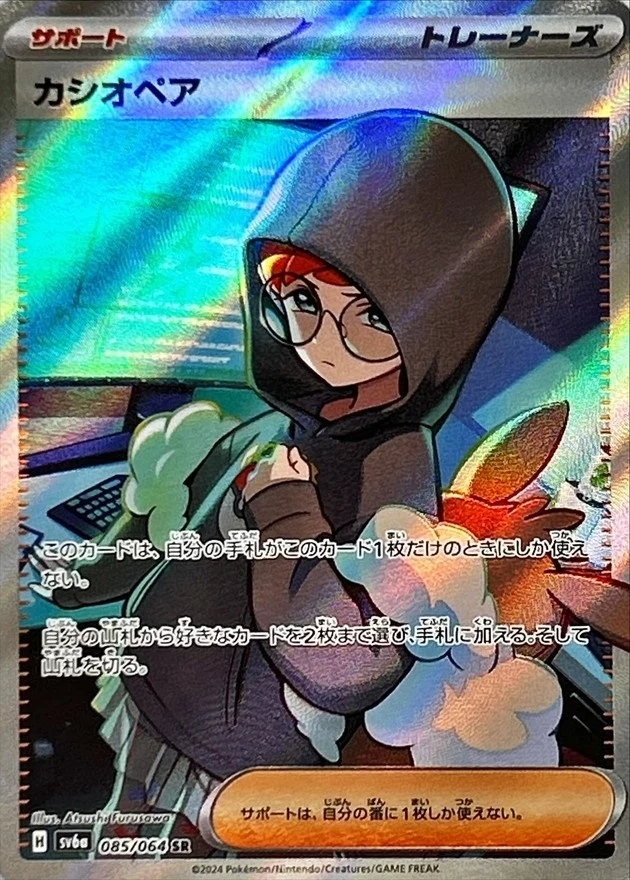
Cassiopeia 085/064 SR, Night Wanderer SV6a, Japanese full art Supporter, PSA 10 slab

Cassiopeia 085/064, SR (SV6a Night Wanderer)

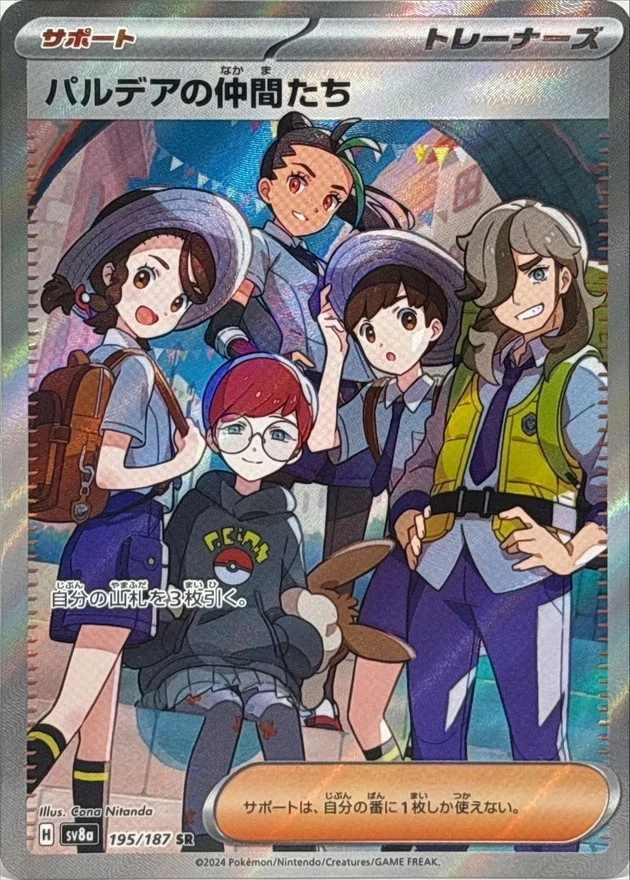
Friends of Paldea 195/187 SR, Terastal Festival ex SV8a, Japanese full art Supporter, PSA 10 slab

Friends of Paldea 195/187, SR (SV8a Terastal Festival ex)

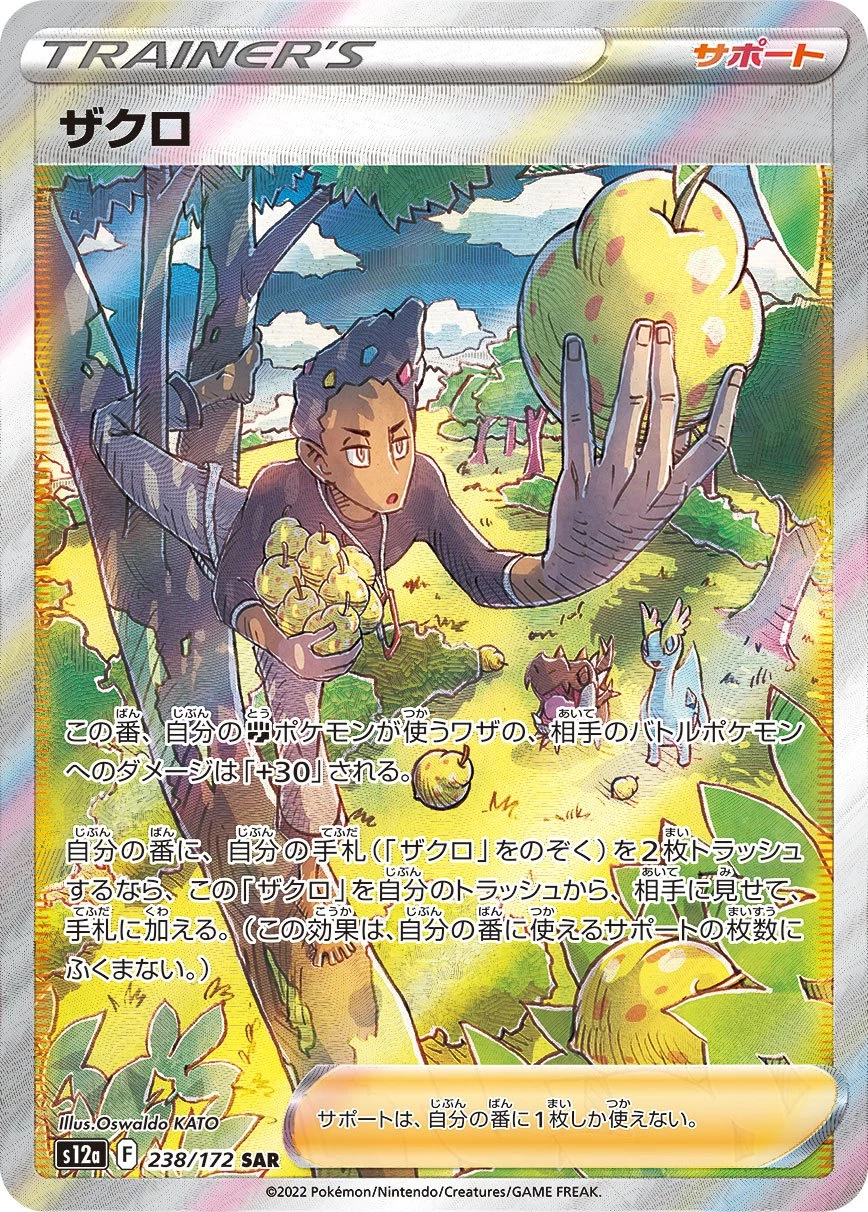
Grant 238/172 SAR, VSTAR Universe s12a, Japanese full art Supporter, PSA 10 slab

Grant 238/172, SAR — contrast card (s12a VSTAR Universe)

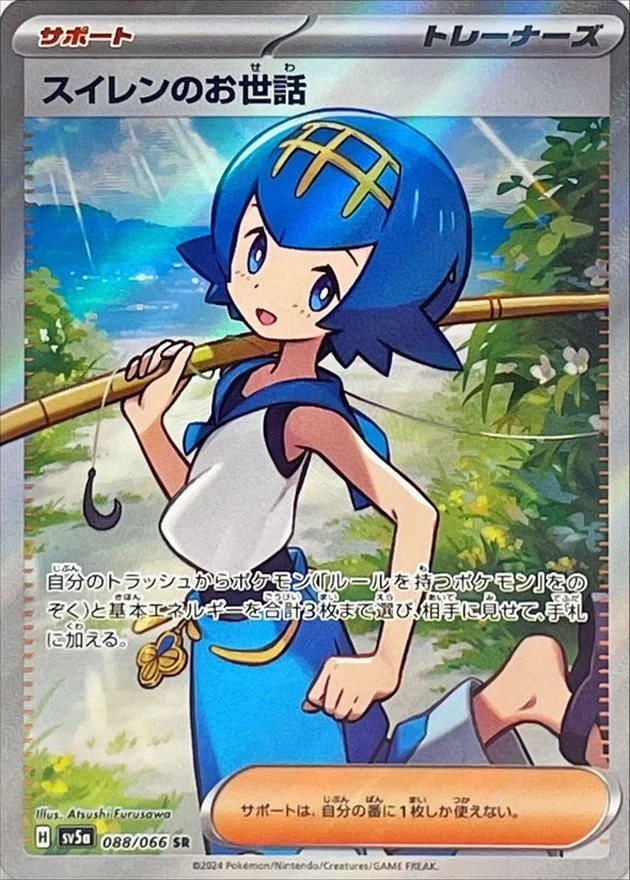
Lana's Aid 088/066 SR, Crimson Haze SV5a, Japanese full art Supporter, PSA 10 slab
Lana’s Aid 088/066, SR — Crimson Haze (SV5a)
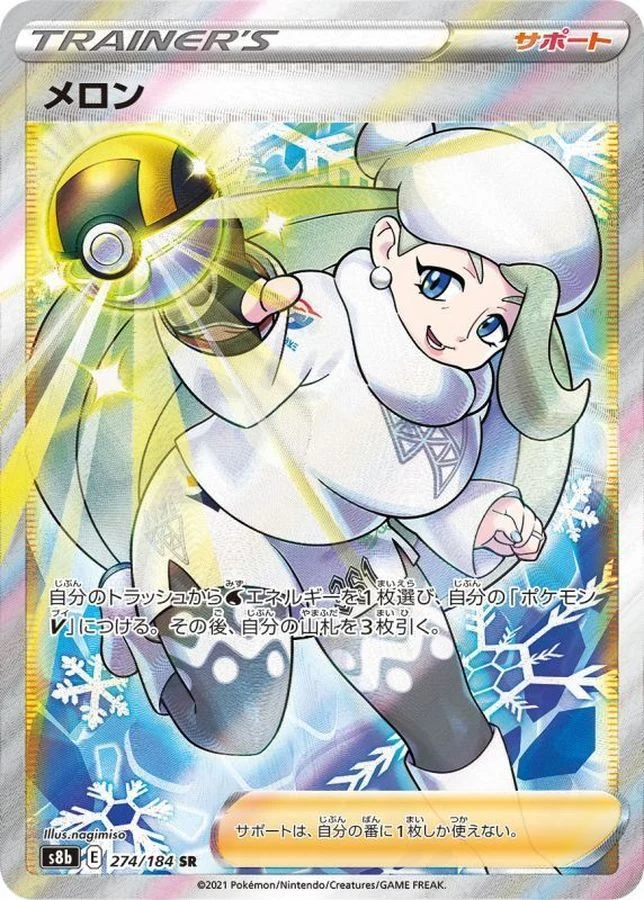
Melony 274/184 SR, Japanese full art Supporter, PSA 10 slab
Melony 274/184, SR

Where to Buy Full Art Trainer Cards from Tokyo

All eight full art SR/SAR Supporters covered above are graded PSA 10 singles in our PSA 10 collection, shipped from Tokyo. If you already know which card you want — Sabrina’s Suggestion 109/095 SR at ¥22,198 (~$140), Lana’s Aid SR at ¥12,078 (~$76), Grant SAR at ¥9,350 (~$59), Roxanne SR at ¥8,796 (~$55), Professor’s Research SR at ¥8,800 (~$55), Cassiopeia SR at ¥8,008 (~$50), Friends of Paldea SR at ¥7,986 (~$50), or Melony SR at ¥7,920 (~$50) — the product link goes straight to that listing. For a full art Trainer card not covered here, or a mixed order alongside sealed product, use 快速訂購 to build the order in one pass.

If you are still narrowing down which character or era you want, our broader PSA10 Trainer cards guide rounds up other named Trainers across our catalogue — that guide covers the wider roster of Lillie, Acerola, Ion and other characters, while this one focuses specifically on the full art SR/SAR mechanic and definition. We also have character-specific write-ups for female Trainer cards, N, Green, and Gardenia.

Shop This Card
PSA10 Sabrina’s Suggestion 109/095 SR
Full art Supporter, SR designation
Ships from Tokyo · Tracked delivery

View Product →

常見問題

What is a full art Trainer card?

It’s a Supporter card (or other Trainer subtype) reprinted with its artwork stretched across the entire face of the card rather than framed inside a border. The format was introduced with the Black & White expansion, tracing back to Japan’s “Black Collection” and “White Collection” releases. Popular Supporters began receiving these full art reprints during the Black & White Series, which is the origin of the whole category.

Is SR the same rarity as SAR?

No. Traditional Japanese full art Supporters carry the SR designation, while SAR is a separate later rarity that can also appear on Supporters. They are not interchangeable rarity codes — the Grant SAR in this guide shows that contrast next to the seven SR Supporters.

How many Supporter cards can you play in one turn?

Only one. That’s a core Pokemon TCG rule for the Supporter subtype, and it applies whether the card is a standard-frame print or a full art chase reprint.

Why is a Japanese full art Trainer card’s number higher than the set’s total card count?

In Japan’s numbering system, full art cards are classified as secret cards numbered beyond the printed set size, so their card number sits past the set’s stated total. English-language releases instead place full art cards at the end of the set list.

Were Supporter cards always considered Trainer cards?

Not originally. Supporters started as a Trainer subclass and were elevated to equal status alongside Trainer cards starting with the Diamond & Pearl Series.

Where can I buy full art SR Supporter cards from Japan?

The eight full art SR/SAR Supporters covered in this guide are graded PSA 10 singles in our PSA 10 collection, shipped from Tokyo. For a card not listed here, Quick Order lets you request it alongside the rest of your order.

Karasu One Piece 卡片指南:所有卡片、平行版與系列(2026)

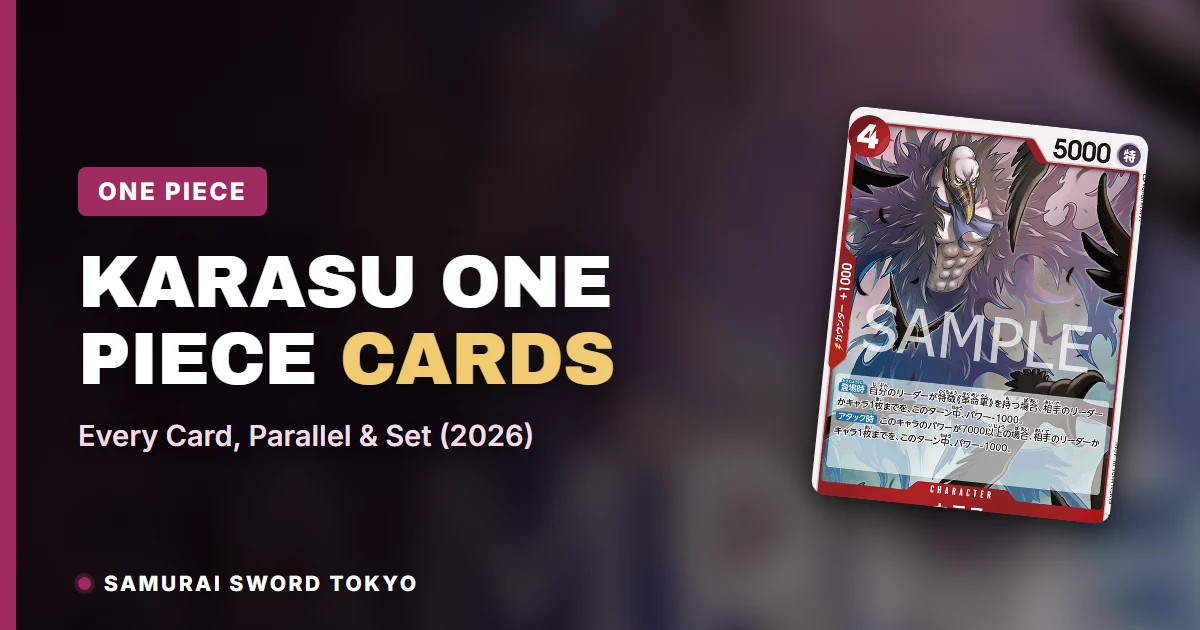
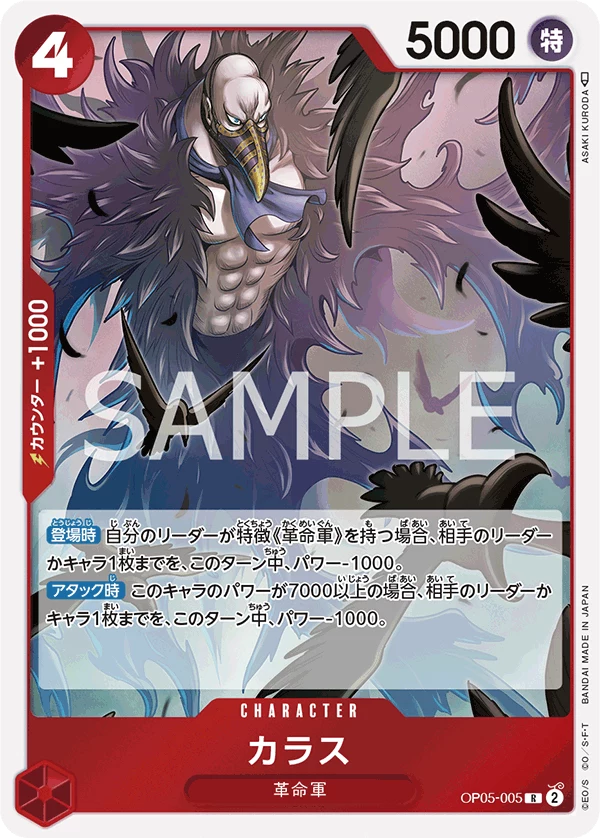
Karasu is a Revolutionary Army officer who has quietly picked up four separate card numbers across the One Piece Card Game — one per mainline booster, plus a starter deck printing — without ever settling on a single colour. Red in his first appearance, Yellow in his second, Black in the two after that: if you are trying to work out which Karasu print you are holding, the colour on the card is not the reliable clue.

This guide lines up every verified Karasu printing — OP05-005, OP09-100, OP12-085 and ST35-003 — with its rarity, colour, cost and power, plus the Premium Card Collection parallel reprint of the original card. It also covers which of the three sealed boxes that contain a Karasu card are currently listed on our site, all as Damaged Box product.

Key Takeaway

Karasu has four verified card numbers — OP05-005 (R, Red), OP09-100 (UC, Yellow), OP12-085 (C, Black) and ST35-003 (C, Black) — plus a parallel reprint of OP05-005 in Premium Card Collection -BEST SELECTION VOL.2-. The sets that carry OP09-100 and OP12-085 are both currently listed as Damaged Box: OP-09 The New Emperor and OP-12 Legacy of the Master.

4
Card Numbers

4
Sets Featured

3
Rarities (R/UC/C)

3
Boxes Listed

Card numbers, rarities, colours, costs and power values below are taken from the official One Piece Card Game card list search (freewords=Karasu). Prices are our own listing prices, converted at ¥159/USD (September 2026).

Every Karasu Printing at a Glance

Karasu is a Revolutionary Army officer and commander of its North Army. Sabo serves as the Revolutionary Army’s chief of staff — see our Sabo One Piece cards guide for his cards. Four card numbers carry Karasu’s name in the verified card list:

Code Rarity Colour Cost Power 系列
OP05-005 R Red 4 5000 -Awakening of the New Era- [OP-05]
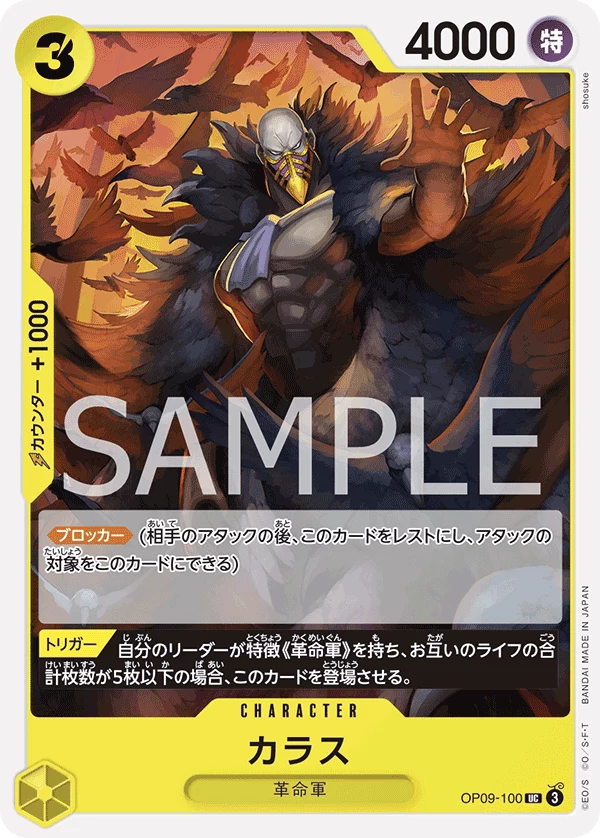
OP09-100 UC Yellow 3 4000 -Emperors in the New World- [OP-09]
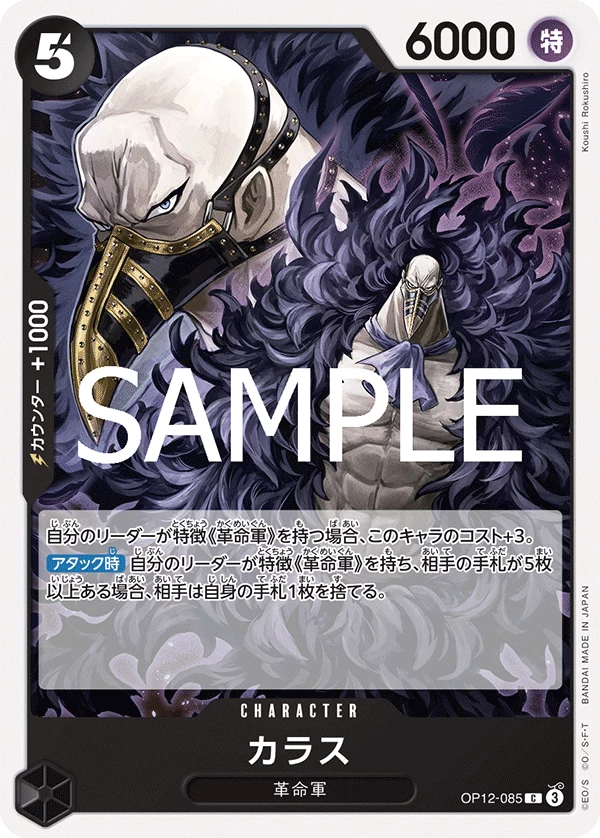
OP12-085 C Black 5 6000 -Legacy of the Master- [OP-12]
ST35-003 C Black 3 4000 STARTER DECK -Red/Black Sabo- [ST-35]

Note the colour column: it moves from Red to Yellow to Black across these four printings. That is a normal pattern for a Revolutionary Army character reprinted across several mainline sets — each set assigns its own colour to the card, so don’t assume a Karasu print you find somewhere is misprinted just because the colour doesn’t match one you’ve already seen.

-Awakening of the New Era- [OP-05]: OP05-005

Karasu OP05-005, R, Red, Revolutionary Army, -Awakening of the New Era- [OP-05]
Karasu OP05-005, R, Red — -Awakening of the New Era- [OP-05]

OP05-005 — R, Red, Cost 4, Power 5000

Karasu’s first card number is OP05-005, a Red R Character card with a cost of 4 and 5000 power, printed in -Awakening of the New Era- [OP-05]. It is also the number that later reappears as a parallel print through Premium Card Collection -BEST SELECTION VOL.2-, covered below.

OP-05 is one of the earlier mainline sets, and its Damaged Box listing sits above the other two boxes in this guide, which is consistent with OP-05 generally trading at a different level to newer sets rather than anything unusual about this particular box. It is currently listed for ¥61,750 (~$388). For a broader look at what else pulls from this set, see our OP-05 best cards guide.

-Emperors in the New World- [OP-09]: OP09-100

Karasu OP09-100, UC, Yellow, Revolutionary Army, -Emperors in the New World- [OP-09]
Karasu OP09-100, UC, Yellow — -Emperors in the New World- [OP-09]

OP09-100 — UC, Yellow, Cost 3, Power 4000

In -Emperors in the New World- [OP-09], Karasu reappears as OP09-100, an Uncommon Character card, this time in Yellow with a cost of 3 and 4000 power. It’s the lowest-cost of the four confirmed Karasu numbers.

The official set name is -Emperors in the New World- [OP-09]; the corresponding Damaged Box appears under our product-listing title OP-09 The New Emperor and is currently listed at ¥20,900 (~$131). Our OP-09 pull rates and best cards guide covers the rest of the set’s lineup.

-Legacy of the Master- [OP-12]: OP12-085

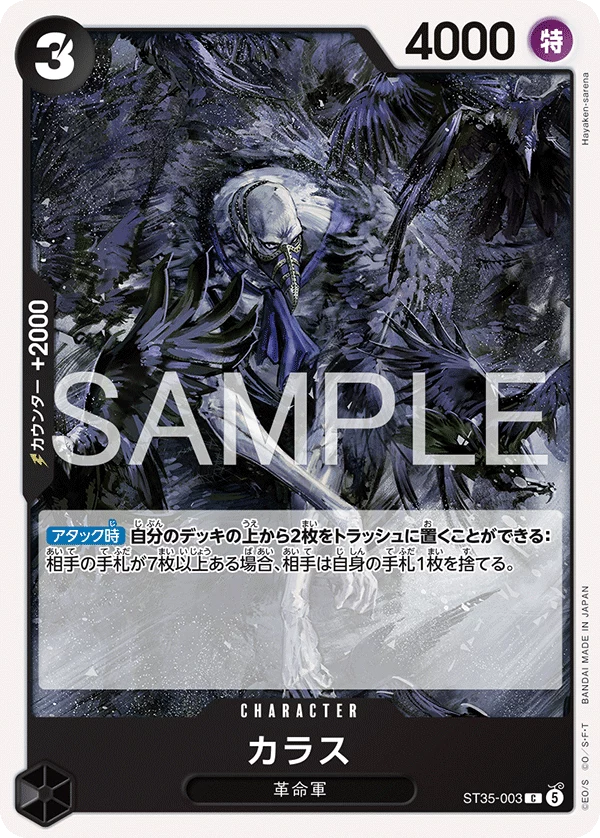
Karasu OP12-085, C, Black, Revolutionary Army, -Legacy of the Master- [OP-12]
Karasu OP12-085, C, Black — -Legacy of the Master- [OP-12]

OP12-085 — C, Black, Cost 5, Power 6000

-Legacy of the Master- [OP-12] gives Karasu his third printing, OP12-085, a Common Character card in Black — the highest cost (5) and highest power (6000) of the four numbers covered in this guide.

OP-12 Legacy of the Master Japanese One Piece booster box, Damaged Box listing
OP-12 Legacy of the Master Japanese booster box — Damaged Box, contains OP12-085

The OP-12 Damaged Box is currently listed at ¥18,050 (~$114), the most affordable of the three boxes in this guide. See our OP-12 pull rates and best cards guide for the full set breakdown.

Starter Deck -Red/Black Sabo- [ST-35]: ST35-003

Karasu ST35-003, C, Black, Revolutionary Army, STARTER DECK -Red/Black Sabo- [ST-35]
Karasu ST35-003, C, Black — STARTER DECK -Red/Black Sabo- [ST-35]

ST35-003 — C, Black, Cost 3, Power 4000

Karasu’s fourth printing, ST35-003, is a Common Character card in Black with a cost of 3 and 4000 power, fielded in STARTER DECK -Red/Black Sabo- [ST-35] — fittingly, a starter deck built around his own commanding officer. See our Sabo One Piece cards guide for the rest of that deck’s Revolutionary Army cast.

This print is not listed on our site at the moment; sourcing requests go through 快速訂購.

The Parallel Print: Premium Card Collection -BEST SELECTION VOL.2-

Beyond the four mainline card numbers above, OP05-005 has been reprinted as a parallel through PREMIUM CARD COLLECTION -BEST SELECTION VOL.2-. It carries the same card number, rarity, colour, cost and power as the original OP-05 printing — the parallel treatment applies to the artwork and foiling rather than changing the underlying card data.

No parallel or alternate-art treatment is verified for OP09-100, OP12-085 or ST35-003 at the time of writing; if one exists, it isn’t in the official card list search results we checked for this guide.

Which Boxes to Open for Karasu

Three sealed boxes contain a Karasu card. Each one appears on our site as Damaged Box product — see our One Piece Damaged Box lineup guide for what that grading means across our catalogue. ST-35’s starter deck is not part of this list, since that print is not listed.

原盒 Contains 價格
OP-05 Awakening of the New Era — Damaged Box OP05-005 ¥61,750 (~$388)
OP-09 The New Emperor — Damaged Box OP09-100 ¥20,900 (~$131)
OP-12 Legacy of the Master — Damaged Box OP12-085 ¥18,050 (~$114)
Shop This Box
OP-09 The New Emperor Japanese One Piece Booster Box — Damaged Box
Contains OP09-100, one of Karasu’s four confirmed printings
Ships from Tokyo · Tracked delivery

View Product →

Where to Buy Karasu One Piece Cards from Tokyo

We ship Japanese sealed product from Tokyo with tracked delivery. If you want a Karasu card, the most direct route is one of the three Damaged Box listings above — OP-05 Awakening of the New Era, OP-09 The New Emperor, or OP-12 Legacy of the Master — each of which pulls the corresponding Karasu number directly from the pack. Browse the wider range in our One Piece Card Game box collection.

For the ST35-003 starter print or the Premium Card Collection parallel, neither of which is currently listed, sourcing requests go through 快速訂購.

Karasu serves under Sabo in the Revolutionary Army — see our Sabo One Piece cards guide for the crew’s leader, plus our guides to fellow Revolutionary Army members Monkey D. Dragon, Koala, Emporio Ivankov, Belo Betty, and Lim.

常見問題

How many Karasu cards are there in the One Piece Card Game?

Four verified card numbers: OP05-005 (R, Red, -Awakening of the New Era-), OP09-100 (UC, Yellow, -Emperors in the New World-), OP12-085 (C, Black, -Legacy of the Master-) and ST35-003 (C, Black, STARTER DECK -Red/Black Sabo-). OP05-005 has also been reprinted as a parallel through Premium Card Collection -BEST SELECTION VOL.2-.

Why is Karasu’s card a different colour in each set?

Karasu’s colour changes with each new printing — Red in OP05-005, Yellow in OP09-100, and Black in both OP12-085 and ST35-003. This is a normal pattern for characters reprinted across several mainline One Piece Card Game sets; the colour is not fixed to the character.

Which sealed boxes contain a Karasu card?

Three: -Awakening of the New Era- [OP-05] (OP05-005), -Emperors in the New World- [OP-09] (OP09-100), and -Legacy of the Master- [OP-12] (OP12-085). Each of these appears on our site as Damaged Box product. The STARTER DECK -Red/Black Sabo- [ST-35] print, ST35-003, is not listed at the moment.

Is there a parallel version of Karasu’s card?

Yes — OP05-005 has been reprinted as a parallel through Premium Card Collection -BEST SELECTION VOL.2-, carrying the same rarity, colour, cost and power as the original -Awakening of the New Era- printing. No parallel is currently verified for OP09-100, OP12-085 or ST35-003.

What faction does Karasu belong to?

Karasu is a member of the Revolutionary Army across all four of his confirmed printings, serving under Sabo. See our Sabo One Piece cards guide for the Revolutionary Army’s leader.

Where can I buy Karasu One Piece cards from Japan?

The OP-05, OP-09 and OP-12 Damaged Box listings on our site each contain a Karasu card and ship from Tokyo with tracked delivery. For the ST35-003 starter print or the Best Selection Vol.2 parallel, sourcing requests go through Quick Order.
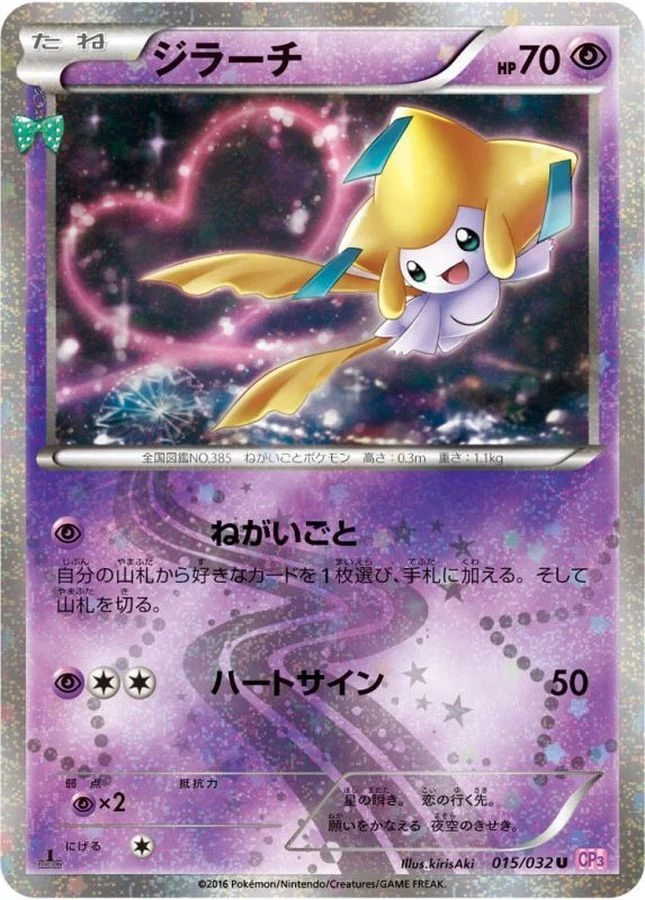
One Piece 卡片價值:影響日版卡片價格的因素

Two cards from the same set, same character, can sit in completely different price brackets. Character popularity, competitive playability, and physical condition all play into that, but this guide focuses on four structural factors that sit underneath those market forces and are verifiable from the card and set itself: which official rarity tier a card was printed at, which channel it was distributed through, whether it carries a parallel treatment on top of its base rarity, and how large the card pool it was pulled from actually is.

This guide walks through each of those four structural mechanisms using the One Piece Card Game’s own rarity system and our own catalogue as worked examples. It does not quote market prices or predict where any card is headed — that’s not something a rarity code can tell you, and rarity is only one input among several that ultimately set a card’s price. What it can tell you is why two SR cards from the same set are not interchangeable, and why a tournament-distributed card behaves differently from a retail pull before you even look at a price tag.

Key Takeaways

The One Piece Card Game’s official rarity ladder runs L, C, UC, R, SR, SEC, with parallel and “Comic Parallel” art treatments layered on top of those base tiers. Distribution channel matters as much as rarity letter — a Flagship Battle souvenir card such as the PSA10 Dracule Mihawk SR [OP01-070] is capped by tournament attendance, not booster print runs. Set size also shapes the maths: our OP-16 “The Time of Battle” booster box draws from 127 official card types across 6 張/包.

6
Official Rarity Tiers

127
卡牌種類 in OP-16

6
Cards Per Booster Pack

4
Extra Boosters Released (EB-01–EB-04)

This article covers structural drivers only — rarity tier, distribution channel, parallel treatment and set size. It does not cite market prices for any of these mechanisms; the only prices below are our own current listing prices, shown as purchase links, converted at ¥159/USD (September 2026).

The Official One Piece Card Rarity Ladder

The One Piece Card Game uses the rarity codes below. Leader (L) identifies a card’s deck role, so it should not be placed into a most-to-least-common sequence with the pull-rarity codes.

Code Tier What it marks
L Leader The Leader card that anchors a deck — a distinct card role, not a pull-rarity step.
C Common The base tier that fills out a deck’s core.
UC Uncommon One step above Common.
R Rare A step above Uncommon.
SR Super Rare A chase-tier card, often the character-focused pulls a set is built around.
秒 Secret Rare The top of the base ladder.
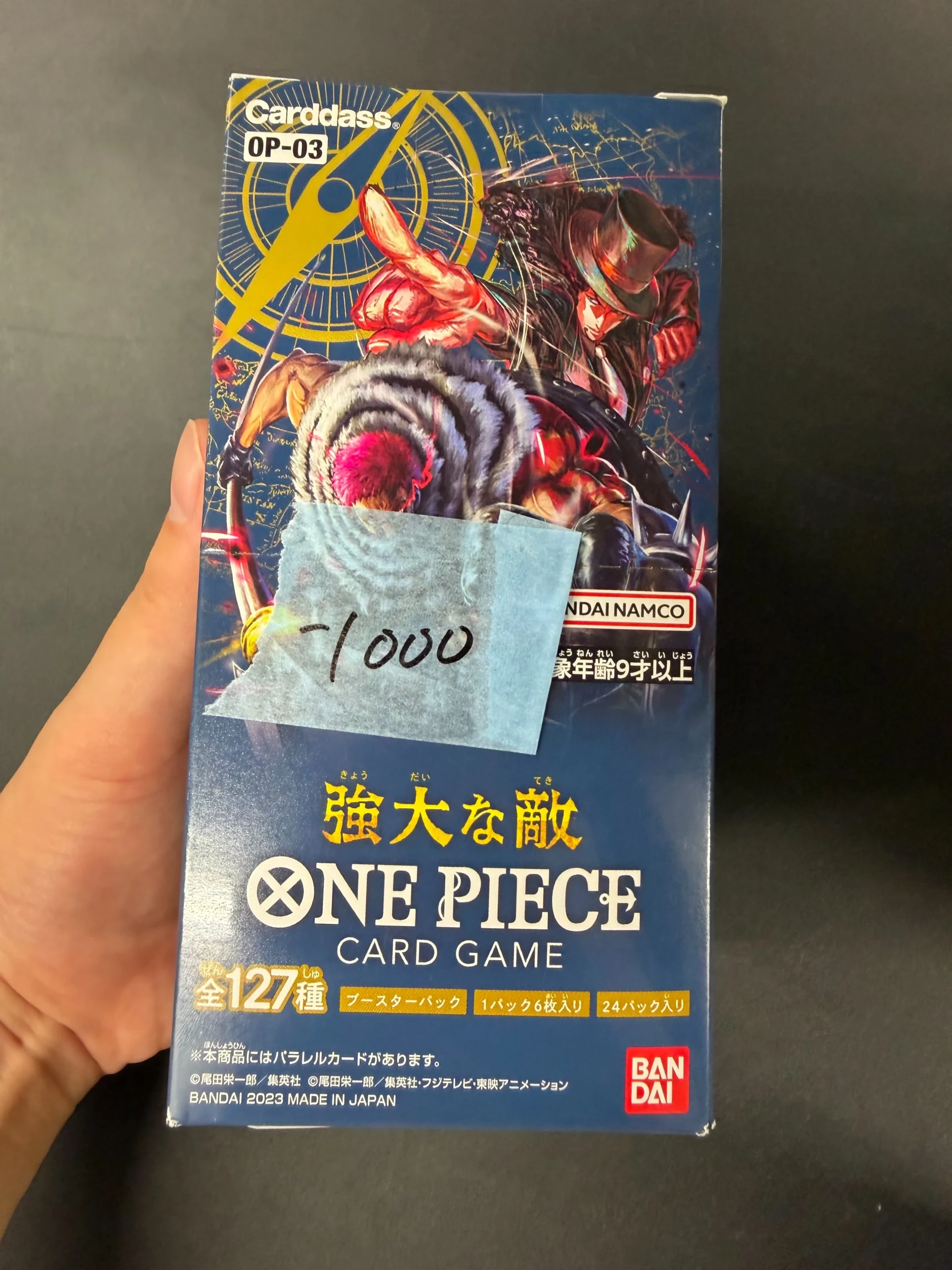
On top of these base letters, the game layers parallel and alt-art treatments — alternate foil or artwork versions of a card that already carries one of the codes above — plus a distinct “Comic Parallel” manga-panel treatment covered in its own section below. Our dedicated One Piece card rarity explainer walks through the full L/C/UC/R/SR/SEC ladder and the parallel tiers built on top of it in more depth than we cover here.

The practical point for anyone trying to understand value: the letter code tells you where a card sits on this ladder, and that’s a fixed, verifiable fact about the print. It’s the starting point for everything else in this article, not the end of the story.

Retail Pulls vs Tournament-Only Distribution

Rarity code describes where a card sits on the print ladder. It says nothing about how that card reached the market — and distribution channel is a separate structural factor entirely.
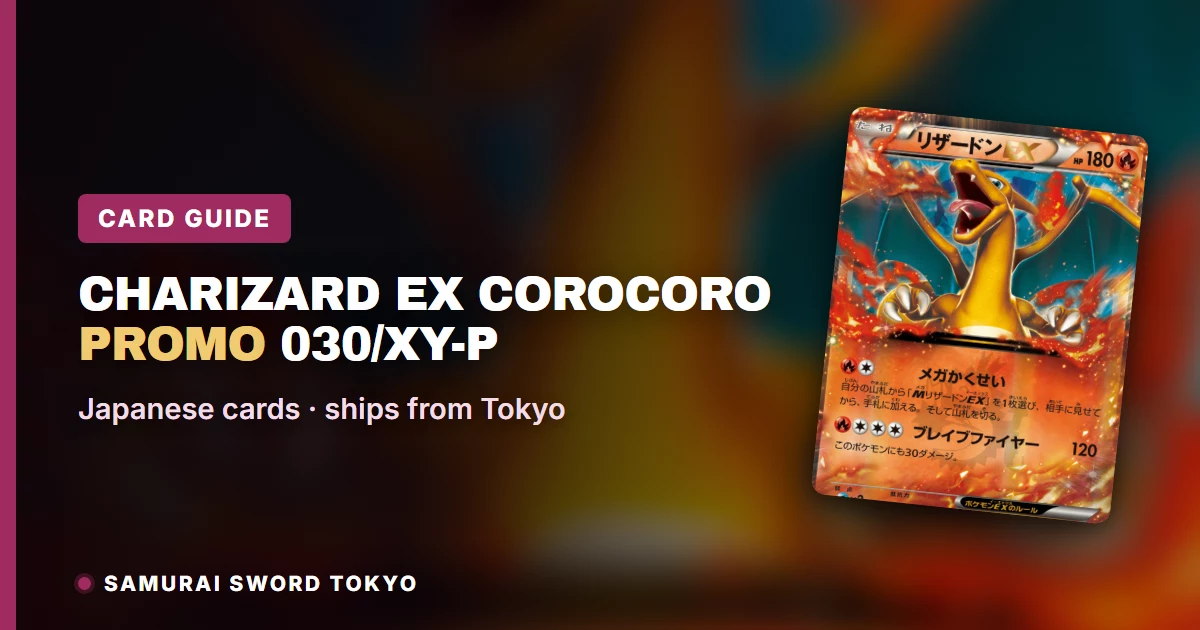
Most SR and SEC cards come from booster packs, meaning their supply scales with however many packs and boxes a set prints. Some cards, however, are never sold in a booster pack at all. The One Piece Card Game runs official Flagship Battle tournaments, and certain SR cards are distributed exclusively as souvenirs tied to tournament results — not as retail pulls.

Dracule Mihawk SR OP01-070, Flagship Battle Victory Souvenir card, PSA10

Dracule Mihawk SR [OP01-070] — Flagship Battle Victory Souvenir

Yamato SR OP04-112, Flagship Battle Top 8 Souvenir card, PSA10

Yamato SR [OP04-112] — Flagship Battle Top 8 Souvenir

Our own graded catalogue carries two clear examples of this. The PSA10 Dracule Mihawk SR [OP01-070] is a “Flagship Battle Victory Souvenir” — a card given specifically to tournament winners. The PSA10 Yamato SR [OP04-112] is a “Flagship Battle Top 8 Souvenirs” print, awarded to players who finished in the top eight of an event.

The structural point here is supply mechanics, not price: a booster-pulled SR’s supply is bounded by how many boxes get opened. A Flagship Battle souvenir’s supply is bounded by tournament-side factors instead — how many events have been run, each event’s own distribution rules, and how many players attended and placed at each one — a completely different, and generally much smaller, ceiling than a booster print run. That distinction exists independently of whatever tier the card carries on the rarity ladder.
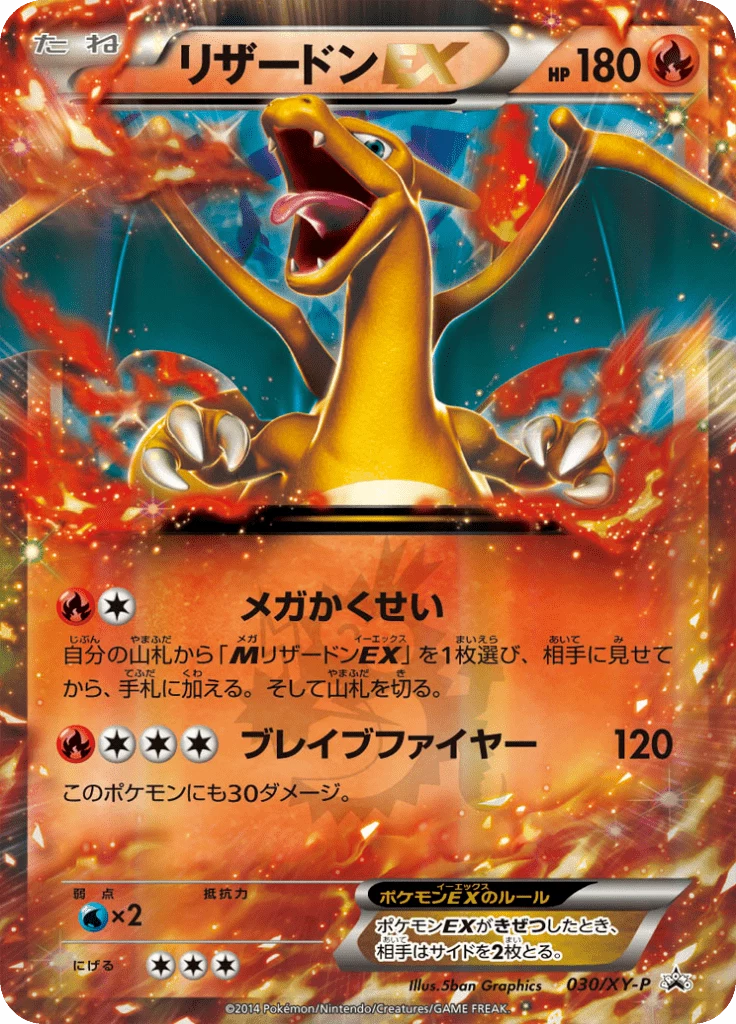
Comic Parallel (SP): A Second Layer on Base Rarity

A third structural factor sits on top of both rarity tier and distribution channel: whether a card also received a Comic Parallel treatment — a manga-panel-style alternate art version layered onto a specific card that already has a base rarity.
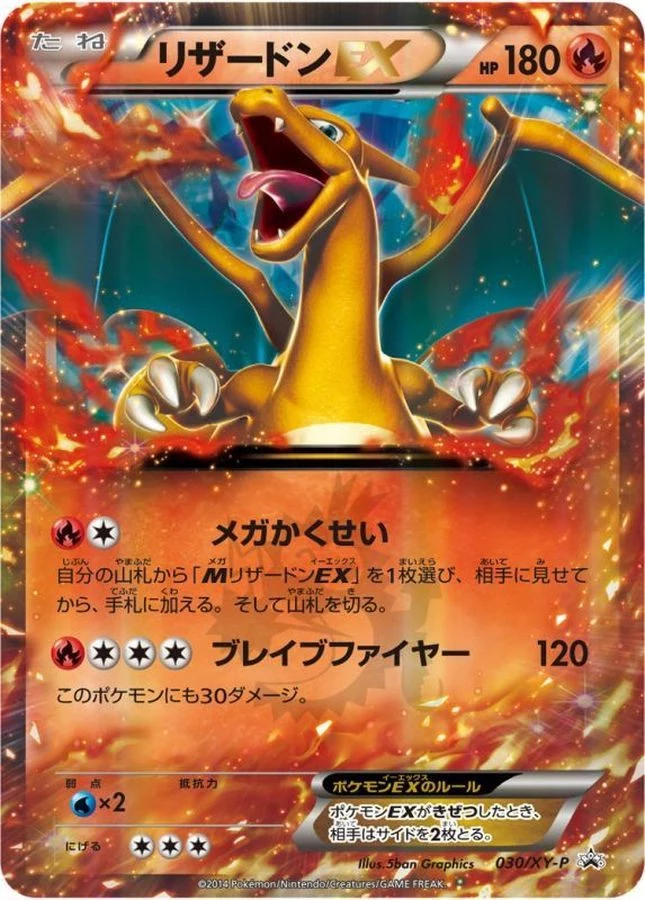
Koby SR-SP EB04-044 Comic Parallel card, Extra Booster EGGHEAD CRISIS, PSA10

Koby SR-SP [EB04-044] — Comic Parallel, Extra Booster “EGGHEAD CRISIS”

Uta SEC-SP EB03-061 Comic Parallel card, Extra Booster ONE PIECE Heroines edition, PSA10

Uta SEC-SP [EB03-061] — Comic Parallel, Extra Booster “ONE PIECE Heroines edition”

Our catalogue includes the PSA10 Koby SR-SP [EB04-044], a Comic Parallel print from the Extra Booster “EGGHEAD CRISIS,” and the PSA10 Uta SEC-SP [EB03-061], a Comic Parallel print from the Extra Booster “ONE PIECE Heroines edition.” The SR-SP and SEC-SP forms here are our catalogue labels for these products; they should not be read as suffixes printed in the official card-list rarity field.

The structural takeaway: two cards can share an identical base rarity code and still not be the same print. An SR and an SR-SP of the same character are different products — one carries an additional, distinct art treatment the other does not.

Set Size and the Maths of Pulling a Specific Card

OP-16 The Time of Battle Japanese One Piece booster box
OP-16 “The Time of Battle” Japanese booster box — 127 official card types, 6 張/包

A fourth structural factor to record is set size: how many total card types exist in a given set. That count gives useful context, but it does not by itself establish the odds of pulling a specific card.

Our anchor set, OP-16 “The Time of Battle,” officially contains 126+1 card types (127 in total), according to the game’s own official product page, with 6 張/包. The official specification also separates rarity categories, so total card types and pack size alone are not enough to calculate the chance of pulling a particular card.

This is a structural description only. Without verified collation and rarity-slot allocation, it does not establish absolute supply or the probability of pulling a specific card.

Extra Booster vs Mainline Booster Pack

Not every One Piece booster product draws from the same size of card pool. Extra Boosters (EB-01 through EB-04 to date) are a distinct product line from mainline numbered 補充包 (OP-01, OP-02, and so on) — designed to reinforce archetypes from previously released sets and spotlight characters who aren’t central to a mainline set’s main cast, rather than introduce a fresh mainline story arc.

Structurally, that positioning tends to come with a smaller card-type pool than a mainline Booster Pack. One comparison reported in aggregated summaries of the game’s own product positioning puts EB-01 at roughly 62 card types, against OP-06’s 126 — a pool less than half the size. We haven’t independently re-verified that exact count against an official source, so treat it as a directional illustration of the Extra Booster format rather than a fixed number.

The verified distinction here is product focus and card-pool size. Neither point supplies a specific-card probability without verified rarity and collation data.

What This Means When You’re Buying

Put the four mechanisms together and you get a simple checklist for evaluating any One Piece card before you buy: what’s the rarity code, was it a retail pull or a tournament-distribution card, does it carry a Comic Parallel or other parallel treatment, and how large is the set or booster line it came from.

Applied to our own current listings:

  • Our OP-16 “The Time of Battle” Japanese booster box is currently listed at ¥12,360 (~$78) — a mainline Booster Pack drawing from the full 127-type pool covered above.
  • The PSA10 Dracule Mihawk SR [OP01-070] Flagship Battle Victory Souvenir is currently listed at ¥129,118 (~$812) — a tournament-distribution card, not a booster pull.
  • The PSA10 Yamato SR [OP04-112] Flagship Battle Top 8 Souvenir is currently listed at ¥28,336 (~$178) — the same tournament-distribution channel at a different placement tier.
  • The PSA10 Koby SR-SP [EB04-044] Comic Parallel is currently listed at ¥180,620 (~$1,136) — an Extra Booster card with the additional parallel treatment layered on.
  • The PSA10 Uta SEC-SP [EB03-061] Comic Parallel is currently listed at ¥184,800 (~$1,162) — the top base tier plus the same parallel treatment.

None of these five listings are presented here as evidence for why one is worth more than another — they’re simply worked examples of the four mechanisms above, with a purchase link if you want to look closer at any of them. For a deeper look at how the market has actually priced specific cards, see our most valuable One Piece cards ranking and our One Piece card prices guide — both cover measured pricing directly, which this article deliberately does not. If you’re specifically after scarcity-driven cards, our rarest One Piece cards guide is the companion piece to this one.

Shop This Set
OP-16 “The Time of Battle” Japanese Booster Box
Currently listed at ¥12,360 (~$78)
Ships from Tokyo · Tracked delivery

View Product →

For a mixed order across sealed boxes and graded singles, our One Piece booster box collection and PSA 10 graded card collection cover both sides of what’s discussed above, and 快速訂購 lets you build a combined order in one pass.

常見問題

What are the official One Piece Card Game rarity tiers?

The official codes include L (Leader), C (Common), UC (Uncommon), R (Rare), SR (Super Rare), and SEC (Secret Rare). L identifies a card role rather than a pull-rarity step. Parallel and alt-art treatments, including the distinct “Comic Parallel” manga-style version, are layered on top of a card’s base code.

What is a Comic Parallel (SP) card in One Piece?

A Comic Parallel is a manga-panel-style alternate art treatment applied to a specific card that already carries a base rarity code. Our catalogue labels the Koby and Uta examples SR-SP and SEC-SP; those are catalogue labels, not suffixes in the official card-list rarity field.

Why are Flagship Battle souvenir cards different from booster pulls?

A booster-pulled card’s supply is bounded by how many packs and boxes of that set get opened. A Flagship Battle souvenir card, such as a Victory Souvenir or Top 8 Souvenir print, is distributed through tournament results instead — bounded by how many events are run, each event’s distribution rules, and how many players attended and placed — a different, generally smaller supply mechanism that has nothing to do with booster print runs.

Does a bigger set change my odds of pulling a specific card?

Set size alone does not establish the odds of pulling a specific card. OP-16 “The Time of Battle” officially carries 127 card types across 6 張/包, but a probability calculation would also require verified rarity and collation data.

What’s the difference between an Extra Booster and a mainline Booster Pack?

Mainline 補充包 (OP-01, OP-02, and so on) carry the game’s main storyline sets. Extra Boosters (EB-01 through EB-04) are a separate product line built to reinforce previously released archetypes and spotlight characters outside a mainline set’s main cast, and they typically draw from a smaller card-type pool than a mainline Booster Pack.

Where can I buy Japanese One Piece cards and boxes?

We ship Japanese sealed One Piece booster boxes and graded singles worldwide out of Tokyo with tracked delivery. Browse our One Piece booster box collection and PSA 10 graded card collection, or use 快速訂購 to combine sealed product and singles in one order.