무료 회원가입으로 포인트 적립과 등급을 시작하세요
Samurai Sword Tokyo
주문 장바구니

Tag All-Stars vs VSTAR Universe: Box Guide
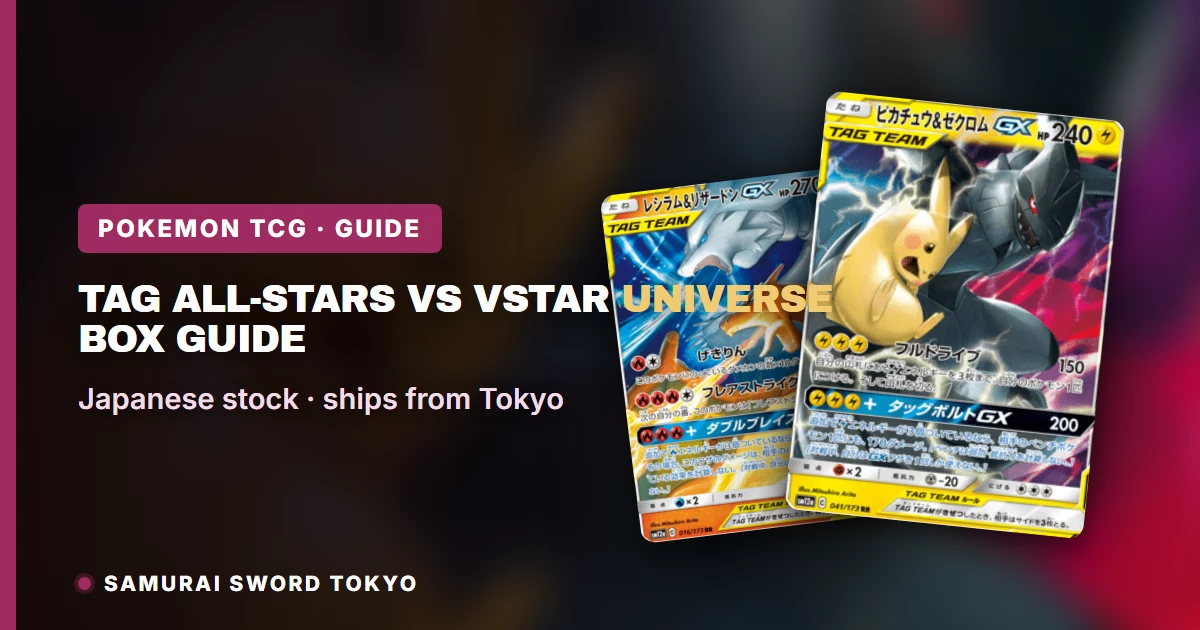
Two flagship Japanese high class packs, three years apart, and a gap between their current box prices that has nothing to do with which set pulled better cards. Tag All-Stars (SM12a) closed out the Sun & Moon era in October 2019 as a “best of” reprint pack. VSTAR Universe (s12a) closed out Sword & Shield three years later with an entirely new card pool and a god pack chase. Today, one of those two boxes costs roughly seven times what the other one does.

This guide puts Tag All-Stars and VSTAR Universe side by side — release timing, rarity structure, chase cards, and current box pricing out of our own Tokyo stock — so you can see exactly where that price gap comes from before you decide which one to chase.

Key Takeaway

Tag All-Stars booster box is currently listed at ¥207,900; VSTAR Universe booster box is currently listed at ¥30,264 — roughly a 6.9x gap. SM12a is a reprint pack built around past Tag Team GX cards in new Special Art form; s12a is entirely new content with a community-reported god pack mechanic. SM12a launched October 4, 2019; s12a launched December 2, 2022, about 3 years and 2 months later.

¥207,900
SM12a Box (Current)

¥30,264
s12a Box (Current)

~6.9x
Current Price Gap

3 yr 2 mo
Release Gap

Box prices are our current listed prices as of Aug 13, 2026, pulled directly from stock. Market-price snapshots and pull-rate estimates cited below come from our own previously published set guides and are dated individually — all pull rates are community-reported, unofficial estimates, not figures confirmed by The Pokemon Company. Dollar conversions are reproduced as printed in each dated source snapshot; implied exchange rates vary between snapshots and are not normalized.

Tag All-Stars vs VSTAR Universe: At a Glance

Both sets are Japanese high class packs, but they sit on opposite sides of a generational line — SM12a is the Sun & Moon era’s late flagship, s12a is the Sword & Shield era’s closing flagship.

Category Tag All-Stars (SM12a) VSTAR Universe (s12a)
Release date October 4, 2019 December 2, 2022
Pack / box config 10 packs/box, 10 cards/pack 10 packs/box, 10 cards/pack (see note below)
MSRP ¥5,400/box ¥5,500/box
Total cards 173+ (SR, HR, UR included) 262 (172 main + 90 secret)
Top rarity tier SA / SR / HR / UR (Gold) / CHR SAR / AR / UR
Content type Reprint — past Tag Team GX cards in new form New content, not a reprint set
God pack Not documented in our SM12a source article Yes — Pikachu AR #205 is god-pack exclusive
Currently listed (our box) ¥207,900 ¥30,264

The pack configuration deserves a caveat. Our own s12a source article states 10 packs per box, matching SM12a exactly — but a separate same-day comparison piece in our catalogue, covering a different high class pack pairing, notes that neither official Sword & Shield-era set page it checked actually lists a packs-per-box figure, and treats the number as an unofficial, industry-standard assumption rather than a confirmed Pokemon Company figure. We’re citing the widely used 10-pack figure here while flagging that it isn’t independently confirmed for s12a.

Reprint Pack vs New Content: Two Different Flagships

Tag All-Stars (SM12a) is a reprint set — it takes past Tag Team GX cards and reissues them in new Special Art (SA), Character Rare (CHR), and Gold Secret Rare (UR) treatments as a “best of” high class pack. It overlaps partially with the English Cosmic Eclipse set, though our source article is clear it isn’t a direct translation. Our SM12a guide also frames the CHR tier as a precursor to the concept that S8b VMAX Climax later built its entire secret-rare structure around.

VSTAR Universe (s12a) takes the opposite approach: entirely new content, not a reprint. Its 90-card secret-rare tier breaks down as 25 Pokemon SAR, 10 Supporter SAR, 37 AR, 14 SR, and 4 UR — the four URs being Origin Forme Dialga, Origin Forme Palkia, Giratina, and Arceus, printed as a connected panoramic gold-foil set. The English translation, Crown Zenith (January 2023), actually combines s12a with two other Japanese sets (Paradigm Trigger and Incandescent Arcana) rather than translating any one of them directly — the JPN-exclusive SARs and god pack mechanic don’t carry over to Crown Zenith at all.

If you want the full picture of every Tag Team GX era pull across multiple sets, not just SM12a, our best Tag Team GX cards guide covers the format from the beginning.

Tag All-Stars (SM12a): Set Breakdown

SM12a released October 4, 2019 with 173-plus cards including SR, HR, and UR tiers, at ¥5,400 MSRP. Its chase tier, by our own source article’s price listing:

등급 카드 Rarity 가격 Est. pull rate
1 Arceus & Dialga & Palkia GX SA ~¥18,000 (~$128) ~1/18 boxes
2 Reshiram & Zekrom GX SA ~¥12,000 (~$85) ~1/18 boxes
3 Pikachu Secret Rare (Gold) UR ~¥8,000 (~$57) ~1/20 boxes

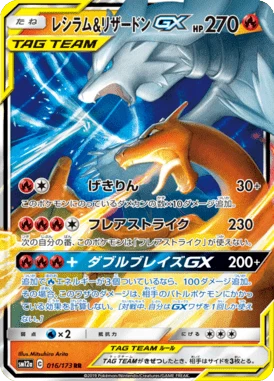
Just below that top three, two more Tag Team GX SAs round out the set’s next tier — Pikachu & Zekrom GX SA at ~¥15,000 and Reshiram & Charizard GX SA at ~¥14,000:
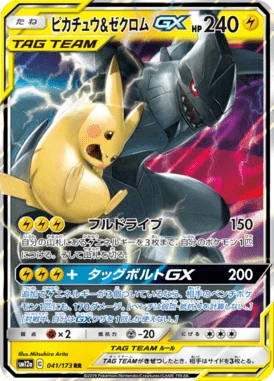
Pikachu & Zekrom GX, regular RR print, SM12a 041/173, Tag All-Stars

Pikachu & Zekrom GX (regular RR print, SM12a 041/173) — the SA reissue runs ~¥15,000 in our source data
SA reissue: ~¥15,000 (~$106)

Reshiram & Charizard GX, regular RR print, SM12a 016/173, Tag All-Stars

Reshiram & Charizard GX (regular RR print, SM12a 016/173) — the SA reissue runs ~¥14,000 in our source data
SA reissue: ~¥14,000 (~$99)

Our source article does not document a god-pack mechanic anywhere in its text for SM12a. We can’t confirm one doesn’t exist — only that it isn’t recorded in our reference. For the full pull-rate table and complete chase-card rankings, see our Tag All-Stars pull rates and best cards guide.

VSTAR Universe (s12a): Set Breakdown

s12a released December 2, 2022 as a 262-card set (172 main + 90 secret) at ¥5,500 MSRP, roughly three years and two months after SM12a. Top chase tier from our source article’s Top 10 table, dated as of March 2026:

등급 카드 Rarity Price (Mar 2026)
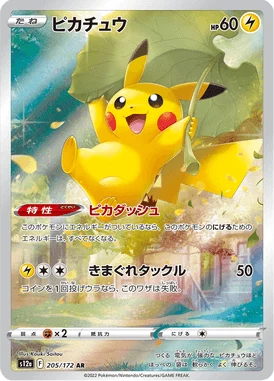
1 Pikachu #205 (god pack only) AR ~¥21,000
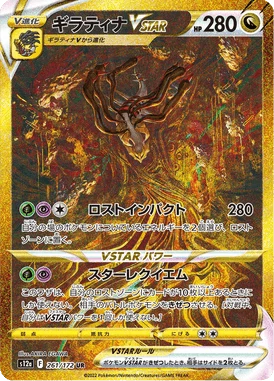
2 Giratina VSTAR #261 UR ~¥16,000 (~$156)
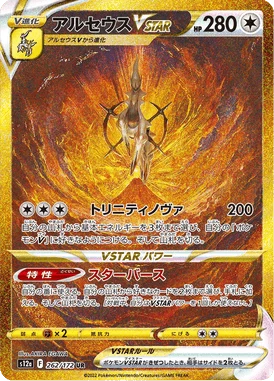
3 Arceus VSTAR #262 UR ~¥10,000 (~$90)
Pikachu AR, s12a 205/172, VSTAR Universe, god pack exclusive

Pikachu AR [s12a 205/172]

Giratina VSTAR UR, s12a 261/172, VSTAR Universe

Giratina VSTAR UR [s12a 261/172]

Arceus VSTAR UR, s12a 262/172, VSTAR Universe

Arceus VSTAR UR [s12a 262/172]

Pikachu #205 AR is pulled only through the god pack — our source article documents this as a real mechanic but doesn’t give confirmed odds for it, so we’re not stating a probability here.

Watch the Date Stamps

Our s12a source article carries more than one figure for the same cards at different dates, and both figures appear in our own coverage. The Top 10 table above (dated March 2026) puts Pikachu AR at ~¥21,000 and Giratina VSTAR UR at ~¥16,000; a separate FAQ answer in the same article, dated August 12, 2026, puts them at approximately ¥27,000 (~$166) and approximately ¥30,000 (~$184) respectively. Box pricing shows the same pattern — ~¥22,800 in the March 2026 set-overview table versus ~¥30,990 in an August 2026 update note. We’re citing all figures with their dates rather than picking one; our own current listed box price below reflects today’s stock, not any of these historical snapshots.

For the full pull-rate tables and probability breakdowns, see our VSTAR Universe pull rates and best cards guide.

Chase Card Showdown

Side by side, using each set’s own source-article price listing — note these come from different dated snapshots, not one shared measurement date:

세트 카드 Rarity Price (dated)
Tag All-Stars Arceus & Dialga & Palkia GX SA ~¥18,000
Tag All-Stars Reshiram & Zekrom GX SA ~¥12,000
Tag All-Stars Pikachu Secret Rare (Gold) UR ~¥8,000
VSTAR Universe Pikachu #205 AR ~¥21,000 (Mar) / ~¥27,000 (Aug)
VSTAR Universe Giratina VSTAR #261 UR ~¥16,000 (Mar) / ~¥30,000 (Aug)
VSTAR Universe Arceus VSTAR #262 UR ~¥10,000 (Mar)

SM12a’s single-card ceiling tops out at Arceus & Dialga & Palkia GX SA around ¥18,000. VSTAR Universe’s god-pack-only Pikachu AR runs higher even at the more conservative March 2026 figure, and the August 2026 FAQ figure puts it higher still. The structural difference is that s12a’s top chase requires a documented rare pull mechanic on top of a normal pack pull; SM12a’s chase tier has no equivalent gating that our source article records.

The 6.9x Box Price Gap: What It Means

The single-card chase prices above don’t explain why the sealed boxes sit roughly ¥177,600 apart today. SM12a is currently listed at ¥207,900; s12a is currently listed at ¥30,264. Both launched at nearly identical MSRPs — ¥5,400 and ¥5,500 — so the gap has opened up entirely after release.

The clearest structural difference between the two is age. SM12a released in October 2019, nearly seven years before this writing, versus s12a’s December 2022 release. Sealed product from a set that old, and no longer in production, draws its box price from box scarcity itself — not just from what’s inside it. A box’s chase-card odds tell you what you might pull; how long a set has been out of print is a separate factor entirely, and it’s the one doing most of the work here.

Shop This Set
Tag All-Stars Booster Box (SM12a, Japanese)
Currently listed at ¥207,900
Ships from Tokyo · Tracked delivery

View Product →

If you’re weighing VSTAR Universe against a different Sword & Shield-era sibling instead of a Sun & Moon-era reprint pack, our VMAX Climax vs VSTAR Universe guide covers that pairing, where both boxes sit much closer together on price.

Which One Should You Buy?

Five honest decision points, based only on what’s documented above:

  • Want the lower entry price on the box itself? VSTAR Universe, currently listed at roughly a seventh of Tag All-Stars’ price.
  • Want a documented rare-pull mechanic on top of the normal chase tier? VSTAR Universe’s god pack is a real, source-documented feature. Tag All-Stars’ source article has no equivalent recorded.
  • Want reprints of classic Tag Team GX cards you may already recognize, in new Special Art form? Tag All-Stars is built entirely around that concept; VSTAR Universe is new content, not reprints.
  • Want a lower-cost graded single as an entry point instead of a box? VSTAR Universe singles start at ¥8,755 and Tag All-Stars singles at ¥10,299 — see the table below.
  • Want to own the older, out-of-print flagship at whatever the current market asks? Tag All-Stars, seven years removed from release, is the one currently commanding the premium — and that premium is a function of scarcity, not documented pull rates.

Neither box is objectively the better buy. One is a scarce, seven-year-old reprint pack; the other is a newer set with a documented chase mechanic and a much lower current entry price. The right pick depends on whether you’re chasing nostalgia and scarcity or a lower-cost shot at a god-pack pull.

PSA 10 Singles From Both Sets

If you’d rather buy a specific graded card than open a box, we currently carry PSA 10 singles from both sets:

카드 Set / # Rarity 가격
Umbreon & Darkrai GX SM12a 181/173 SR ¥67,045
Lucario & Melmetal GX SM12a 224/173 UR ¥33,990
Dedenne GX SM12a 048/173 RR ¥15,243
Marshadow & Machamp GX SM12a 067/173 RR ¥10,299
Mewtwo VSTAR s12a 221/172 SAR ¥34,460
Entei V s12a 213/172 SAR ¥17,320
Radiant Charizard s12a 015/172 K ¥11,070
Zeraora VMAX s12a 219/172 SAR ¥9,451
Galarian Moltres s12a 190/172 AR ¥9,332
Grant s12a 238/172 SAR ¥8,755

Four of the singles above come from Tag All-Stars, six from VSTAR Universe — that split reflects what’s currently in our case, not a statement about which set produced more graded copies. Check our Quick Order page for the latest availability across both sets.

Where to Buy Tag All-Stars and VSTAR Universe

We ship Japanese sealed product and PSA 10 singles worldwide from Tokyo with tracked delivery. Both boxes below come from current listings.

Shop This Set
Tag All-Stars Booster Box (SM12a, Japanese)
Currently listed at ¥207,900
Ships from Tokyo · Tracked delivery

View Product →

Shop This Set
VSTAR Universe Booster Box (s12a, Japanese)
Currently listed at ¥30,264
Ships from Tokyo · Tracked delivery

View Product →

Browsing more broadly? Our booster box collection carries sealed product across both eras, and our PSA 10 singles collection covers graded cards beyond just these two sets. For a mixed order combining sealed product and singles, use our Quick Order page.

Published alongside this guide, our sibling comparison covers GX Ultra Shiny vs Shiny Star V, another flagship-versus-flagship pairing from the same GX and Sword & Shield high-class-pack lineage.

자주 묻는 질문

What’s the main difference between Tag All-Stars and VSTAR Universe?

Content type. Tag All-Stars (SM12a) is a reprint pack — it reissues past Tag Team GX cards in new Special Art, Character Rare, and Gold Secret Rare form. VSTAR Universe (s12a) is entirely new content with a documented god pack mechanic for its god-pack-exclusive top chase, Pikachu AR #205. SM12a’s source article has no equivalent god-pack feature on record.

Which box is cheaper right now?

VSTAR Universe, currently listed at ¥30,264 versus Tag All-Stars at ¥207,900 — roughly a 6.9x gap at today’s prices, despite both sets launching at nearly identical MSRPs (¥5,400 and ¥5,500).

Why is Tag All-Stars so much more expensive than VSTAR Universe?

Age and scarcity. Tag All-Stars released in October 2019, roughly seven years before this writing and well out of print; VSTAR Universe released in December 2022. Neither set’s chase-card prices explain the box-level gap on their own — long out-of-print sealed product carries a scarcity premium on the box itself, separate from what’s inside it.

Does Tag All-Stars have a god pack?

Our SM12a source article does not document a god-pack mechanic. We can’t confirm one doesn’t exist — only that it isn’t recorded in our reference. VSTAR Universe’s god pack, by contrast, is explicitly documented as the only way to pull Pikachu AR #205.

What are the top chase cards in each set?

In Tag All-Stars, Arceus & Dialga & Palkia GX SA topped our source article’s listing at ~¥18,000. In VSTAR Universe, Pikachu AR #205 — god pack only — was priced at ~¥21,000 in a March 2026 snapshot and ~¥27,000 in an August 2026 update, both figures appearing in the same source article.
XY8 Blue Impact: Best Cards & Set Guide

Search for a Japanese set called simply “XY8” and you won’t find one. Japan never printed it that way. What English-speaking collectors think of as a single expansion, BREAKthrough, actually shipped in Japan as two smaller sets released the same day — and the split isn’t a footnote, it’s the whole design idea behind the release.

This guide explains how that two-set structure works, walks through the chase card on our side of it — Mewtwo EX UR 065/059 from Blue Impact — and sorts out the numbering confusion that trips up buyers searching for this card online.

Key Takeaway

Japan’s XY8 was split into two sets released together: Blue Impact (Mega Mewtwo X) and Red Flash (Mega Mewtwo Y). Our PSA 10 Mewtwo EX UR (065/059) is a Blue Impact card — a currently listed graded PSA 10 copy, priced at ¥342,990.

2
Sets Under “XY8”

¥342,990
Our Listed PSA 10 UR

Sept 2015
Japan Release

1
English Set (BREAKthrough)

Card numbers, rarities, and release dates below are sourced from card databases and set references as cited throughout. Where LimitlessTCG’s internal indexing and printed card numbers disagree, we’ve flagged it rather than guessing.

The Set That Isn’t One Set: Blue Impact vs Red Flash

Later in 2015, Japan’s card game followed up with a release built around a single idea: two paths to power, told as two separate products. Rather than one expansion, Japan got “青い衝撃” (Blue Impact, also referenced as Blue Shock) featuring Mega Mewtwo X, and “赤い閃光” (Red Flash) featuring Mega Mewtwo Y — a mirrored pair of sets sold as their own booster products, not as one set with two card backs.

Card databases track them as two distinct set codes for exactly this reason: LimitlessTCG lists Blue Impact internally as XY8b and Red Flash as XY8r. Bulbapedia’s card index groups both under the English-language umbrella of their combined international release, but treats them as separate Japanese sets with separate release checklists.

The theme lines up with the game’s own lore split. Pokemon Omega Ruby & Alpha Sapphire gave Mewtwo two Mega Evolution forms depending on which Mega Stone it holds — Mega Mewtwo X or Mega Mewtwo Y. Japan’s TCG release mirrored that fork directly: buy Blue Impact and you’re chasing the X path; buy Red Flash and you’re chasing the Y path. It’s a rare case of a set’s marketing structure matching its in-game mechanic exactly.

The card featured in this guide — and the one currently in our listings — comes from the Blue Impact side. We haven’t verified Red Flash inventory or images for this pack, so everything below refers specifically to Blue Impact unless stated otherwise.

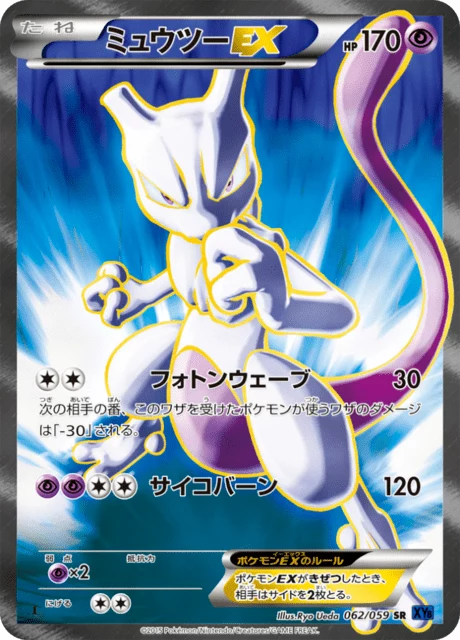
The Chase Card: Mewtwo EX UR 065/059

Mewtwo EX UR 065/059, Blue Impact (XY8b), Ultra Rare Japanese Pokemon card
Mewtwo EX 065/059 — Ultra Rare, Blue Impact (XY8b)

Blue Impact’s headline pull is Mewtwo EX, printed number 065/059, rated Ultra Rare. The card itself is a Mewtwo EX at HP 170, Psychic-type, with two attacks: Photon Wave, doing 30 damage now and setting up a further −30 damage against the opponent’s next attack, and Psyburn (サイコバーン), a heavier 120-damage hit.

The printed number — 065 over a stated total of 059 — already tells you this card lives past the regular card count, in the set’s secret/ultra-rare number band. That structure is common in Japanese sets from this era: the fraction shown on the card (065/059) marks it as a bonus pull beyond the standard 001–059 print run, not a typo.

Numbering Note

LimitlessTCG’s own database indexes this same card internally as its 62nd entry in the Blue Impact set (shown on the site as “XY8b #62”), which is different from the 065/059 printed on the physical card. The attack text, HP, and artwork match across both references — it’s the same card, just catalogued two different ways by two different systems.

PSA 10 Anchor
Mewtwo EX UR 065/059 — Blue Impact (XY8b)
Currently listed at ¥342,990
Ships from Tokyo · Tracked delivery

View Product →

This is a currently listed graded PSA 10 copy at this price. If you’re comparing it against other Mewtwo chase cards from Japan’s XY era, our PSA 10 Mew & Mewtwo Japanese cards buying guide lines up several printings side by side.

Release Details and the English Equivalent

Blue Impact released in Japan on September 26, 2015, the same day as its Red Flash counterpart. Internationally, the two Japanese sets were consolidated into a single English-language expansion, XY—BREAKthrough, which followed on November 4, 2015 with 164 cards — noticeably more than either individual Japanese set on its own, since it merged content from both.

BREAKthrough also introduced the BREAK Evolution mechanic to the wider game: a card type that evolves an existing Pokemon by laying sideways over it, adding HP and extra attacks or Abilities while keeping everything the previous stage had. That mechanic is the design throughline connecting Blue Impact, Red Flash, and their English merger — not just the Mega Mewtwo split, but a new evolution type debuting across all three releases at once.

For collectors tracking the broader XY block chronologically, Blue Impact follows two earlier Japanese sets we’ve covered in detail: Emerald Break (XY6), which came out earlier the same year, and Phantom Gate (XY4), from the year before. Our XY4 Phantom Gate best cards guide and broader XY-era Japanese Pokemon guide map out how these releases connect.

The Secret Rare Numbering, Explained

Blue Impact’s regular print run covers numbers 001 through 059. Everything from 060 upward sits in the set’s secret-card band, and that’s where our chase card, 065/059, lives — alongside a small handful of other confirmed secrets in the same range.

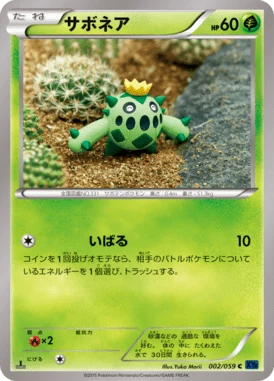
Blue Impact XY8b regular-print card, number 1

Regular-print Blue Impact card, #1

Blue Impact XY8b regular-print card, number 2

Regular-print Blue Impact card, #2

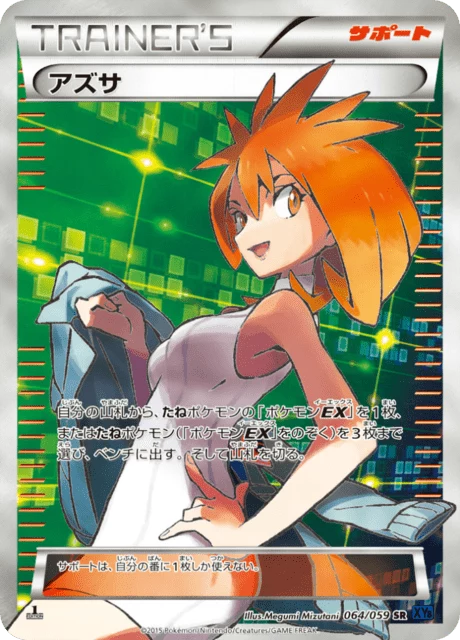
The other secrets we could confirm sitting in that same band, by LimitlessTCG’s internal index: a Mega Glalie-EX entry catalogued as #61, an M Mewtwo-EX (the Mega evolution, carrying the Vanishing Strike attack) catalogued as #63, and a Trainer support card, Azusa (Brigette), catalogued as #64 — the last entry on the set’s index page.

Azusa (Brigette), secret rare Trainer card, Blue Impact (XY8b)
Azusa (Brigette) — secret-band Trainer card, Blue Impact (XY8b)

We’re not able to confirm the exact printed card total for Blue Impact from a single authoritative source — combined Blue Impact and Red Flash totals get reported at 130 cards in some references, while LimitlessTCG’s own Blue Impact index page runs to 64 thumbnails. Those two numbers don’t describe the same thing (one is a combined two-set total, the other is a single-set database count), so rather than pick one, we’re noting both and letting the printed 065/059 fraction on the card itself stand as the reliable reference point for this specific card.

Why the Split Matters When You’re Buying

If you’re searching secondhand listings or card databases for “XY8,” you’ll get mixed results unless you know which half you’re after. A listing titled just “XY8” without specifying Blue Impact or Red Flash could be either set — and confusingly, both sets have their own Mewtwo EX card printed at 065/059 UR, so the number and rarity alone won’t tell you which set you’re actually looking at.

The two cards aren’t the same underneath that shared number. Blue Impact’s 065/059 Mewtwo EX runs HP 170 with Photon Wave and Psyburn (サイコバーン); Red Flash’s 065/059 Mewtwo EX is a different card entirely, carrying Shatter Shot and Damage Change. Since the printed number is identical across both sets, the only reliable way to confirm which one you’re looking at is to check the set name together with the attack names on the card — number and rarity alone aren’t enough.

It’s also worth knowing that Japan’s standard 1st Edition print run for the JP card game ran from 2001 through the 2016 20th Anniversary release, which covers this set’s September 2015 window. We haven’t confirmed whether our specific listed copy carries a 1st Edition stamp, so we’re not claiming that here — it’s background on the era, not a description of the card we have in stock.

Where to Buy XY8 Blue Impact Cards from Japan

We ship graded Japanese singles out of Tokyo with tracked delivery worldwide. For the card covered in this guide:

Shop the Collection
PSA 10 Graded Singles
Ships from Tokyo · Tracked delivery

View Collection →

Looking for a Red Flash single, a different XY-era printing, or want to build a mixed order across sets? Our Quick Order page is the fastest way to request it.

자주 묻는 질문

Is XY8 one set or two?

Two. Japan released XY8 as two separate sets on the same day in September 2015: Blue Impact (Mega Mewtwo X) and Red Flash (Mega Mewtwo Y). There is no single Japanese set called just “XY8.” Both were later merged into one English-language expansion, BREAKthrough.

What is the best card in XY8 Blue Impact?

Mewtwo EX, printed 065/059, rated Ultra Rare — the set’s chase card, sitting in the secret-number band above the regular 001–059 print run. We currently list a PSA 10 copy at ¥342,990.

Why does the Mewtwo EX card show two different numbers?

The printed card shows 065/059, which is the official set number. LimitlessTCG’s database separately catalogues the same card as its 62nd internal entry (“XY8b #62”). Both refer to the identical card — the attack text, HP, and artwork match — but the two numbering systems don’t line up with each other.

What is the English equivalent of Blue Impact?

XY—BREAKthrough, released November 4, 2015 with 164 cards. It combines content from both Japanese sets, Blue Impact and Red Flash, into one English-language release, and introduced the BREAK Evolution mechanic to the wider game.

Where can I buy XY8 Blue Impact cards from Japan?

We currently stock a graded PSA 10 Mewtwo EX UR (065/059) at ¥342,990, ships from Tokyo with tracked delivery. Browse our full PSA 10 collection or use our Quick Order page to request other XY8 or XY-era singles.

Eevee Heroes vs Pokemon 151: Which Box to Buy?

Two years apart, both instantly recognizable, and priced about as differently as two ¥5,500-MSRP boxes can get.

Eevee Heroes (S6a, 2021) and Pokemon 151 (SV2a, 2023) are two of the sets we get asked to compare most often — one built entirely around the eight Eeveelutions, the other a nostalgia trip back to the original 151. Both launched at the same ¥5,500 MSRP. Both are two of the most frequently compared Japanese high-class packs of the past five years. And yet, in our current catalog, one box costs roughly 3.4x what the other does.

This guide puts the two sets side by side: what’s actually in each box, how their chase cards compare in value, why the price gap between them is so wide today, and which one makes more sense depending on what you’re buying for.

Key Takeaway

Eevee Heroes is the eeveelution showcase — 101 cards total, headlined by Umbreon VMAX SA “Moonbreon” at an estimated ~¥350,000. Pokemon 151 is the Kanto starter showcase — a SAR-led secret tier topped by Charizard ex SAR at ~¥60,000. Eevee Heroes is currently listed at ¥154,350; Pokemon 151 is currently listed from ¥45,900.

2yr 19d
Release Gap (2021–23)

¥5,500
Shared MSRP/Box

~¥350,000
Eevee Heroes Top Chase (Moonbreon)

~3.4x
Current Box Price Gap

Prices below are drawn from our own set-facts articles (dated snapshots noted throughout) and our current live catalog. USD figures are carried over from each source snapshot and may reflect a different exchange rate than our stated ¥163/USD (July 2026) conversion basis. Pull-rate estimates are community-reported, not official Pokemon Company data.

Eevee Heroes vs Pokemon 151: At a Glance

Feature Eevee Heroes (S6a) Pokemon 151 (SV2a)
Release (Japan) May 28, 2021 June 16, 2023
MSRP ¥5,500/box ¥5,500/box
Pack structure 5 cards + 1 puzzle card/pack, 30 packs/box (packs-per-box figure flagged as unofficial in our comparison source) 7 cards/pack, 20 packs/box
Total cards 101 (69 main + 32 secret) 165+–210*
Secret/special tier 32 (18 SR + 10 HR + 4 UR) SAR-led, headlined by the Kanto starter ex trio (#200–202)
Top chase card Umbreon VMAX SA “Moonbreon” ~¥350,000 Charizard ex SAR ~¥60,000
English release Evolving Skies (partial translation) Pokemon 151 / sv3pt5 (near-direct translation)
Currently listed (our box) ¥154,350 from ¥45,900

*Our sources disagree on Pokemon 151’s exact card count. Our SV2a set-facts article describes the set as “165+ (Kanto-themed),” which reads as a main-set-plus-rough-secret-tier estimate. Our card database, scanned up through card #230, shows the highest confirmed card number in the set is #210 (a basic energy reprint) — so the full numbered range, including secret and energy reprints, runs to 210. We cite both rather than pick one. Eevee Heroes’ total of 101 (69 main + 32 secret) is consistent across our set-facts article and our comparison article, which cross-checked it against Bulbapedia.

Eevee Heroes: The Eeveelution Showcase

Eevee Heroes (S6A) released in Japan on May 28, 2021, and its whole identity is built around one idea: give all eight Eeveelutions a real moment. Our set-facts article describes the resulting construction — every evolution line getting a V card and a special-art (SA) treatment — as unique to this set, even though the English release, Evolving Skies, partially reuses the same card pool.

The secret tier stacks in three bands. SR (#070–087, 18 cards) covers V-card and SA prints across all eight evolutions plus two trainer cards. HR (#088–097, 10 cards) is where the set’s real heat lives: SA prints of four VMAX cards — Umbreon, Sylveon, Glaceon, and Leafeon. UR (#098–101, 4 cards) closes out the set.

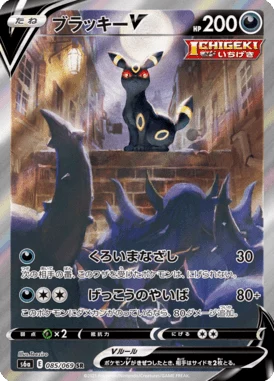
Umbreon V SA 085/069 SR Eevee Heroes S6a Japanese card

Umbreon V (SA) #085/069, SR — Eevee Heroes
~¥46,500

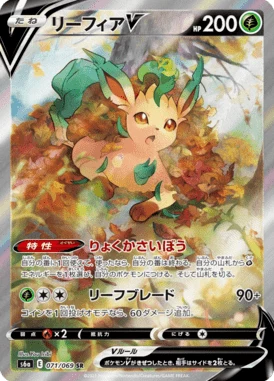
Leafeon V SA 071/069 SR Eevee Heroes S6a Japanese card

Leafeon V (SA) #071/069, SR — Eevee Heroes

The set’s headline card — Umbreon VMAX SA, widely nicknamed “Moonbreon” — doesn’t have a confirmed catalog image in our card database, but its number is well known and its price is not in question: an estimated ~¥350,000 (~$2,180) as of July 2026, at a community-reported pull rate of roughly 1 in 36 boxes. Behind it, Sylveon VMAX SA sits around ~¥128,000 (~$800) and Glaceon VMAX SA around ~¥80,000 (~$500), both at the same estimated ~1/36-box rate. Further down, Leafeon VMAX SA runs about ¥59,800, the SR-tier Umbreon V SA pictured above about ¥46,500, and Espeon V SA about ¥17,000.

If the HR-tier VMAX quartet is what you’re after rather than one specific pull, we currently list a complete Eevee Heroes Eeveelutions Set at ¥400,000 — listed as a single bundled set — availability can change. For a lower-cost graded single from the set instead, we currently list PSA 10 Pikachu C #026/069, currently listed at ¥10,300.

For the full rarity breakdown and every S6a chase card, see our standalone Eevee Heroes pull rates and best cards guide, or browse the full numbered checklist in our Eevee Heroes card list and pull rates.

Pokemon 151: The Kanto Nostalgia Hit

Pokemon 151 (SV2a) released in Japan on June 16, 2023 as a full tribute to the original 151 Pokemon from Red/Blue (1996). Like Eevee Heroes, this is an all-new-print set — but where S6a is built around the Eeveelutions, 151 builds new artwork around the original Kanto roster. Its English release (Pokemon 151, sv3pt5) is a near-direct translation rather than a partial remix.

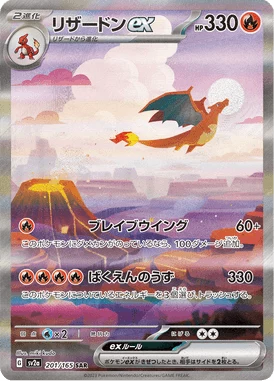
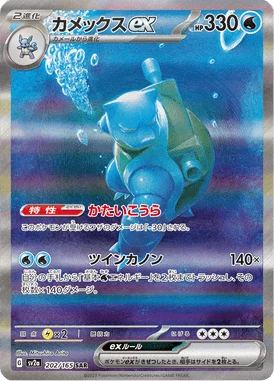
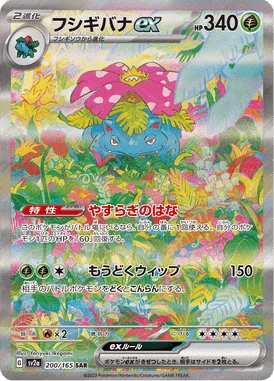
The set’s SAR pool is the draw, and its centerpiece is the Kanto starter trio getting the full Special Art Rare treatment: Venusaur ex SAR #200/165, Charizard ex SAR #201/165, and Blastoise ex SAR #202/165.

Charizard ex SAR 201/165 Pokemon 151 SV2a Japanese card

Charizard ex SAR #201/165 — Pokemon 151
~¥60,000 (~$375)

Blastoise ex SAR 202/165 Pokemon 151 SV2a Japanese card

Blastoise ex SAR #202/165 — Pokemon 151
~¥19,000 (~$119)

Venusaur ex SAR 200/165 Pokemon 151 SV2a Japanese card

Venusaur ex SAR #200/165 — Pokemon 151
~¥16,900 (~$106)

Charizard ex SAR tops the set at roughly ~¥60,000 (~$375) as of July 2026, at an estimated pull rate around 1 in 20 boxes; PSA 10 graded copies run around ¥117,000. Blastoise ex SAR at ~¥19,000 (~$119) carries a notable illustrator story — our source flags that Mitsuhiro Arita, who painted the original 1999 Base Set Charizard, returned 24 years later to paint the Blastoise ex SAR. Venusaur ex SAR rounds out the top three at ~¥16,900 (~$106). Further down the list, Zapdos ex SAR sits around ¥14,000, and Erika’s Invitation SAR shows unusually wide condition-based spread, from about ¥7,600 played up to over ¥50,000 near mint.

We currently list a graded Blastoise ex SAR from the set: PSA 10 Blastoise ex SAR #202/165, currently listed at ¥36,936, well above the raw ~¥19,000 figure above — a graded premium worth knowing before you compare raw market prices to graded listing prices.

For the complete rarity breakdown and full chase list, see our standalone Pokemon 151 pull rates and best cards guide.

Chase Card Face-Off

Put the two sets’ top pulls side by side and the gap is dramatic — Eevee Heroes’ HR tier prices well above anything in Pokemon 151’s SAR pool.

세트 카드 Tier Price (as of July 2026)
Eevee Heroes Umbreon VMAX SA “Moonbreon” HR ~¥350,000 (~$2,180)
Eevee Heroes Sylveon VMAX SA HR ~¥128,000 (~$800)
Eevee Heroes Glaceon VMAX SA HR ~¥80,000 (~$500)
Pokemon 151 Charizard ex SAR SAR ~¥60,000 (~$375)
Eevee Heroes Leafeon VMAX SA HR ~¥59,800
Eevee Heroes Umbreon V SA SR ~¥46,500
Pokemon 151 Blastoise ex SAR SAR ~¥19,000 (~$119)
Eevee Heroes Espeon V SA SR ~¥17,000
Pokemon 151 Venusaur ex SAR SAR ~¥16,900 (~$106)
Pokemon 151 Zapdos ex SAR SAR ~¥14,000

The gap isn’t close: Eevee Heroes’ top card alone is worth roughly six Pokemon 151 Charizard ex SARs. But it’s worth noting the two sets’ pull-rate estimates aren’t directly comparable either — Eevee Heroes’ HR tier sits at a community-reported ~1/36 boxes per top card, while Pokemon 151’s SAR tier is estimated around ~1/20 boxes for its top cards. Both figures are community-tracked, not confirmed by Pokemon Co.

Box Economics: Why the Price Gap Is So Wide

Both sets launched at an identical ¥5,500 MSRP. Neither is anywhere close to that number today, but they’ve moved very differently since release.

Metric Eevee Heroes (S6a) Pokemon 151 (SV2a)
MSRP ¥5,500 ¥5,500
Currently listed (our catalog) ¥154,350 from ¥45,900
Approx. multiple of MSRP ~28x ~8.3x

One pricing wrinkle worth flagging on the Eevee Heroes side: our detailed S6a set-facts article (dated July 31, 2026, SNKRDUNK secondary-market basis) puts the box around ~¥147,800 (~$920), while our own live catalog — checked August 12–13, 2026 — currently lists it at ¥154,350. Those are two different things: a secondary-market resale snapshot versus our current listing price, taken about two weeks apart. We treat our live listing price as the number to shop against; for a current, buyable figure, that’s ¥154,350.

Even accounting for that ~¥6,500 spread, Eevee Heroes still runs at roughly 3.4x Pokemon 151’s current from-price in our catalog. The Moonbreon effect — one exceptionally scarce, high-value card — is doing most of the lifting on the Eevee Heroes side; Pokemon 151’s more evenly distributed SAR pool doesn’t carry a single card anywhere near that ceiling.

Which Box Should You Buy?

Working from everything above, here’s how we’d frame the decision:

  • Chasing the most valuable pull in either of these two sets? Eevee Heroes’ Moonbreon is the reason this set carries the price it does — but that also means the box itself costs a lot before you open a single pack.
  • Want Gen 1 nostalgia and returning classic illustrators? Pokemon 151’s Kanto starter ex SAR trio — and the Mitsuhiro Arita connection on Blastoise ex SAR — is built for exactly that.
  • Buying by budget right now? Pokemon 151 is currently listed from ¥45,900, well below Eevee Heroes’ current listing of ¥154,350.
  • Want a specific single instead of a box? Both sets’ chase cards are available graded — browse our PSA10 collection for current stock across both sets. Individual graded cards move one holder at a time, so once a listing sells it’s gone.
Shop This Set
Pokemon 151 Booster Box (SV2a, Japanese)
Currently listed from ¥45,900
Ships from Tokyo · Tracked delivery

View Product →

Where to Buy Eevee Heroes and Pokemon 151

We ship both sets sealed out of Tokyo with tracked delivery. Eevee Heroes is currently listed at ¥154,350, and Pokemon 151 is currently listed from ¥45,900. For graded singles from either set — including the Moonbreon-adjacent Umbreon V SA, the Kanto starter ex SAR trio, or lower-cost entry points like our PSA 10 Pikachu C — our PSA10 collection is where current stock lives.

For a full sealed-product overview across Japanese sets, browse our Pokemon box collection, or use our Quick Order page to build a mixed order across both sets and any singles you want in the same shipment.

Related reading: if you’re weighing Eevee Heroes against a different Sword & Shield-era high-class pack, see our Eevee Heroes vs VSTAR Universe box guide. And if Pokemon 151 has you curious how it stacks up against a Scarlet & Violet-era shiny set instead, we’ve also covered Pokemon 151 vs Shiny Treasure ex.

자주 묻는 질문

Which is more valuable, Eevee Heroes or Pokemon 151?

By chase card and by box price, Eevee Heroes runs higher. Its top pull, Umbreon VMAX SA “Moonbreon,” is estimated around ¥350,000, well above Pokemon 151’s top pull, Charizard ex SAR at roughly ¥60,000. In our current catalog, Eevee Heroes is listed at ¥154,350 versus Pokemon 151 from ¥45,900 — roughly a 3.4x gap.

How many cards are in Eevee Heroes and Pokemon 151?

Eevee Heroes has 101 total cards (69 main + 32 secret), consistent across our sources. Pokemon 151’s count is less settled: our set-facts article describes it as “165+,” while our card database shows numbered cards running up to #210 including energy and secret reprints. We present both rather than pick one.

What is Moonbreon and why is it so expensive?

Moonbreon is the community nickname for Umbreon VMAX SA from Eevee Heroes, the set’s top chase card. It’s estimated around ¥350,000 (about $2,180) as of July 2026, at a community-reported pull rate near 1 in 36 boxes — the combination of a small pull rate and strong ongoing collector demand for Umbreon specifically keeps it at the top of the set.

Why does Pokemon 151 cost less than Eevee Heroes right now?

Both sets launched at the same ¥5,500 MSRP, but Eevee Heroes’ price is driven up heavily by one card — Moonbreon — worth more than most people’s entire collection. Pokemon 151’s SAR pool is more evenly distributed across the Kanto starter trio and other cards, without a single card near that ceiling, which keeps its overall box price lower.

Who illustrated the Pokemon 151 Blastoise ex SAR?

Blastoise ex SAR was illustrated by Mitsuhiro Arita, the same artist who painted the original 1999 Base Set Charizard — a return to Gen 1 starters roughly 24 years later, according to our source.

XY6 Emerald Break: Best Cards & Set Guide

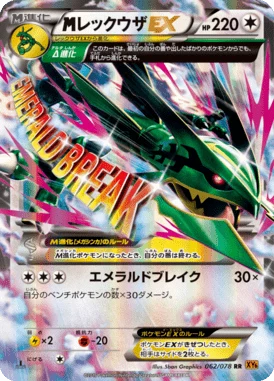
Mega Rayquaza’s very first Japanese trading card appearance came from a single 2015 set: Emerald Break. Before Storm Emeralda, before any English reprint, this is where the Ancient Trait mechanic (Δ Evolution) met the sky-dragon legendary for the first time — and the chase card it produced is still one of the more expensive secret rares from the XY era.

Emerald Break (XY6) released in Japan on March 14, 2015, built around the then-new Omega Ruby & Alpha Sapphire storyline. Its English counterpart, XY—Roaring Skies, followed almost two months later on May 6, 2015. The set’s headline card, Mega Rayquaza EX, debuted here in secret-rare form — and the set also carries one of the more collectible 1st Edition Supporter cards from the period, Winona.

This guide covers what’s actually in XY6, clears up a couple of common mix-ups around card numbers and rarities, and points to the graded 1st Edition singles we currently carry from the set. We source and list Japanese XY-era singles out of Tokyo, including graded 1st Edition copies.

Key Takeaway

XY6 Emerald Break (March 14, 2015) is the Japanese debut set for Mega Rayquaza EX, printed as a SR secret rare at card number 086/078. We currently have a graded PSA 10 Winona SR 1st Edition [XY6 088/078], currently listed at ¥80,110 — a one-of-one graded copy from this set.

Mar 14, 2015
Japan Release

001–078
Main Numbering

89–91
Total Cards (sources vary)

086/078
Mega Rayquaza EX SR

What Is XY6 Emerald Break?

Emerald Break (エメラルドブレイク), set code XY6, released in Japan on March 14, 2015. Its English-language equivalent is XY—Roaring Skies, released May 6, 2015 with 110 cards.

The set’s theme centers on Mega Rayquaza-EX making its debut, alongside Mega Latios-EX and a broader wave of Dragon-type Pokemon — a lineup drawn from that generation’s Omega Ruby & Alpha Sapphire storyline. Mega Rayquaza EX carries the Ancient Trait Δ Evolution, letting it evolve the turn the Pokemon comes into play — even on your first turn of the game — instead of waiting a turn as normal. Its named attack, Emerald Break, deals 30 damage for each Pokemon on your own Bench — and gives the set its name.

The Set’s Star: Mega Rayquaza EX SR 086/078

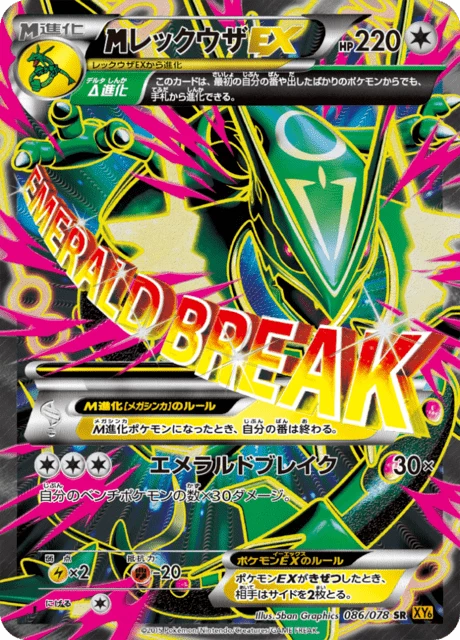
Mega Rayquaza EX SR 086/078 Emerald Break XY6 secret rare Japanese card
Mega Rayquaza EX, XY6 086/078 — Secret Rare, Emerald Break’s headline card

Mega Rayquaza EX is printed at card number 086/078, a SR secret rare that falls outside the set’s regular 001–078 numbering. It carries 220 HP, is Colorless-typed, and was illustrated by 5ban Graphics. First Edition copies of this printing exist — XY6’s March 2015 release falls within Japan’s 1st Edition print run, which continued in various sets through the 20th Anniversary expansion.

Worth flagging directly: this is a different card from the “M Rayquaza EX UR 095/081” listings you may see — including our own graded copy — referenced elsewhere on Japanese card marketplaces. That number and rarity combination does not match any confirmed XY6 printing — the set’s actual secret Mega Rayquaza is 086/078, rarity SR, as documented above. For a full breakdown of every Mega Rayquaza printing across sets and languages, including which ones we carry, see our Mega Rayquaza card value guide. If you’re specifically after shiny variants, our shiny Mega Rayquaza guide covers those separately.

Winona SR 1st Edition 088/078: Our In-Stock Anchor

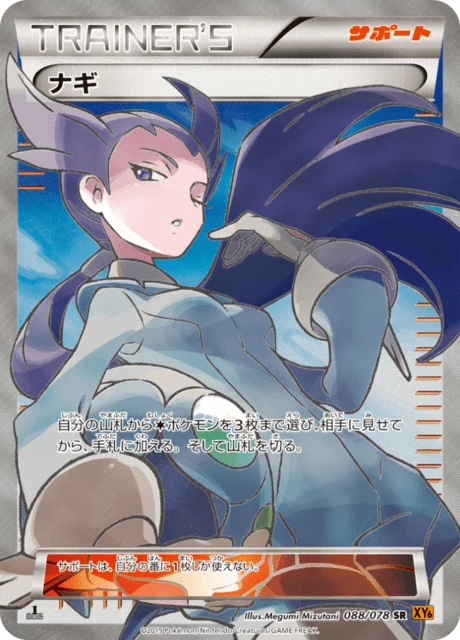
Winona SR 088/078 Emerald Break XY6 1st Edition Supporter card
Winona (ナギ), XY6 088/078 — Secret Rare Supporter, 1st Edition

Two card numbers past Mega Rayquaza EX sits Winona (ナギ), a Supporter card at 088/078, also a SR secret rare. Its effect lets you search your deck for up to three Colorless-type Pokemon, reveal them to your opponent, add them to your hand, and shuffle the deck — a consistency tool that made it a playable secret rare rather than just a collector’s card. It was illustrated by Megumi Mizutani.

Graded Single
PSA 10 Winona SR 1st Edition [XY6 088/078]
Currently listed at ¥80,110
Ships from Tokyo · Tracked delivery

View Product →

This is a graded PSA 10 copy, meaning it’s a single physical card — one-of-one stock. It’s a single graded slab — when it sells, it’s gone.

How Many Cards Are in XY6? A Numbers Discrepancy

Sources don’t fully agree on XY6’s total card count, and we’re not going to pretend one is definitively right. The regular numbering runs 001–078 either way — that part is settled and matches the printed numbers on cards like Mega Rayquaza EX (086/078) and Winona (088/078).

Where accounts diverge is the secret-rare tail past 078:

  • One widely cited reference lists 91 total cards (78 main-set cards plus 13 secret/high-rarity cards), which would put the secret range at roughly 079–091.
  • A card-database count based on catalogued thumbnails lists 89 total cards, which would put the secret range at roughly 079–089.

Both confirmed secrets we cover here — 086/078 and 088/078 — fall inside either range, so the discrepancy doesn’t affect which cards are real. It’s simply a case of two respectable sources counting the set’s outer edge differently, and we’re presenting both rather than picking a side.

XY6 and Japan’s 1st Edition Era

Japan’s 1st Edition print runs spanned a long stretch of TCG history — starting in 2001 and continuing through various expansions until the 20th Anniversary set. XY6’s March 2015 release date sits well inside that window, which is why both the Winona secret rare we carry and Mega Rayquaza EX exist in confirmed 1st Edition print form. If you’re new to what “1st Edition” actually means for Japanese cards — how to identify the stamp, why it matters for value, and which eras it covers — our Japanese 1st Edition Pokemon cards guide walks through the full picture across sets.

Where XY6 Sits in the Wider XY Era

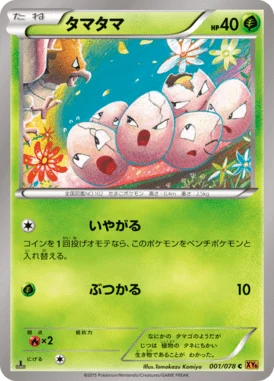
XY6 Emerald Break card number 1 Japanese Pokemon card

XY6 Emerald Break, card #1

XY6 Emerald Break card number 62 Japanese Pokemon card

XY6 Emerald Break, card #62

XY6 is one entry in a long run of Japanese XY-block sets, each built around its own Mega Evolution or thematic hook. If you’re building out a fuller picture of the era, our Japanese XY era guide maps the block’s sets in sequence. For the sets immediately around Emerald Break, see our XY4 Phantom Gate best cards guide and our XY8 Blue Impact best cards guide, both from the same block.

Where to Buy XY6 Cards from Japan

We ship Japanese singles worldwide from Tokyo with tracked delivery. Right now our confirmed in-stock XY6 single is the graded 1st Edition Winona above; for the Mega Rayquaza EX side of the set and its other printings, our dedicated value guide is the place to check current listings.

Graded Single
PSA 10 Winona SR 1st Edition [XY6 088/078]
Currently listed at ¥80,110
Ships from Tokyo · Tracked delivery

View Product →

  • Browse our full graded singles lineup, including other XY-era secret rares, on the PSA 10 collection.
  • For sealed Japanese booster boxes across eras, browse our Japanese sealed booster box collection.
  • Looking for a specific XY6 single we don’t currently list, or want to combine it with other cards in one shipment? Use our Quick Order page to build a mixed order.

자주 묻는 질문

What is XY6 Emerald Break?

XY6 Emerald Break is a Japanese Pokemon TCG expansion released March 14, 2015, notable as the debut set for Mega Rayquaza EX. Its English-language equivalent is XY—Roaring Skies, released May 6, 2015 with 110 cards.

What is the correct card number and rarity for Mega Rayquaza EX in XY6?

Mega Rayquaza EX is 086/078, rarity SR (Secret Rare). It falls outside the set’s regular 001–078 numbering. A different number/rarity combination sometimes seen in listings elsewhere does not match a confirmed XY6 printing.

How many cards are in XY6 Emerald Break?

Sources disagree: one reference lists 91 total cards (78 main-set plus 13 secret/high-rarity), another lists 89 based on catalogued card counts. The main numbering (001–078) is consistent across both; the discrepancy is only in how the secret-rare tail is counted.

Who is Winona in the XY6 set, and what does the card do?

Winona (ナギ) is a Supporter card at 088/078, rarity SR. Its effect searches your deck for up to three Colorless-type Pokemon, reveals them to your opponent, adds them to your hand, and shuffles your deck. It was illustrated by Megumi Mizutani and exists in confirmed 1st Edition print form.

Are XY6 cards available in 1st Edition?

Yes. XY6’s March 2015 release falls within Japan’s 1st Edition print run window, which ran from 2001 through the 20th Anniversary expansion. Both Mega Rayquaza EX and Winona from this set exist in confirmed 1st Edition print form.

CP2 Legendary Shine Collection: Complete Guide

Most Japanese Pokemon concept packs bury one or two chase cards inside a stack of commons. CP2 Legendary Shine Collection did the opposite — every single card in the set, all 27 of them, got the same gloss-coated, special-foil treatment. There’s no “hit” to hunt for in the traditional sense, because the whole set is the hit.

Released in Japan on July 18, 2015 to coincide with that summer’s Pokemon movie, CP2 packed 27 all-holo cards — headlined by legendary and mythical Pokemon — into an unusually structured product — four 팩당 카드 instead of the standard five, with every card carrying the collection’s signature shine finish. It’s a small set by Japanese TCG standards, but it’s dense with the kind of legendary lineup — Zekrom, Dialga, Palkia, Reshiram, Arceus, the Kyurem forms — that keeps singles collectors coming back to it a decade later.

Key Takeaway

CP2 Legendary Shine Collection shipped 27 all-holo cards on July 18, 2015. We currently list five graded PSA 10 singles from the set: Dialga 017/027 at ¥65,920, Zekrom 009/027 at ¥92,700, Latios 019/027 at ¥104,792, Black Kyurem 020/027 (1st Edition) at ¥47,380, and White Kyurem 021/027 at ¥49,440. Each is a single listed copy — when it sells, it’s gone until we source another.

27
Total Cards in CP2

2015
Japan Release Year

4
Cards Per Pack

5
PSA 10 Anchors In Stock

Card numbers, rarities, and release details below come from Bulbapedia’s Legendary Shine Collection entry and the limitlesstcg CP2 card database, cited throughout. JPY figures are our current samuraiswordtokyo.com listing prices; USD figures are approximate conversions at ¥163/USD (July 2026 basis).

What Is CP2 Legendary Shine Collection

CP2 is the Japanese-language abbreviation used for Concept Pack: Legendary Shine Collection (コンセプトパック 传説キラコレクション), released in Japan on July 18, 2015. It’s part of a run of standalone “concept pack” products that Japanese Pokemon TCG issued alongside the main expansion schedule — smaller sets built around a single idea rather than a full 100-plus card block.

CP2’s idea was legendary and mythical Pokemon, timed to the theatrical release of Pokemon the Movie XY: The Archdjinni of the Rings — Hoopa, that summer’s 18th Pokemon film. The set draws its roster from Pokemon tied to that movie and the wider legendary cast of the era — Hoopa-EX takes one of the two RR slots, alongside Pikachu-EX, with a supporting lineup of Reshiram, Zekrom, Palkia, Dialga, Latias, Latios, both Kyurem forms, Arceus, and Regigigas rounding out the rare slots.

Structurally, CP2 tops out at 027/027 — there’s no secret-rare overflow past the printed count, which is a contrast to sets like CP5, where two secret cards run past its base number.

All 27 Cards in CP2, Numbered 001 to 027

Here’s the full checklist, in printed order:

No. 카드 Type Rarity
001/027 Chespin Grass C
002/027 Reshiram Fire R
003/027 Fennekin Fire C
004/027 Braixen Fire U
005/027 Palkia Water R
006/027 Froakie Water C
007/027 Frogadier Water U
008/027 Pikachu-EX Lightning RR
009/027 Zekrom Lightning R
010/027 Dedenne Lightning C
011/027 Wobbuffet Psychic C
012/027 Hoopa-EX Psychic RR
013/027 Hippopotas Fighting C
014/027 Pancham Fighting C
015/027 Hawlucha Fighting C
016/027 Inkay Darkness C
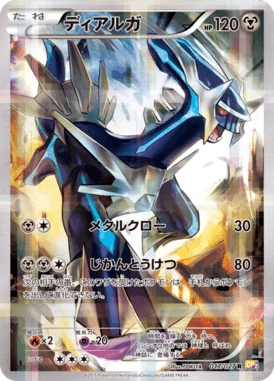
017/027 Dialga Metal R
018/027 Latias Dragon R
019/027 Latios Dragon R
020/027 Black Kyurem Dragon R
021/027 White Kyurem Dragon R
022/027 Meowth Colorless C
023/027 Regigigas Colorless R
024/027 Arceus Colorless R
025/027 Rufflet Colorless C
026/027 Braviary Colorless U
027/027 Noibat Colorless C

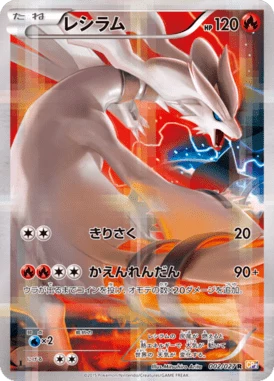
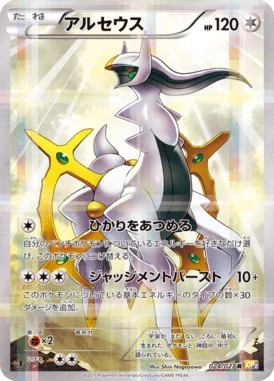
The two RR-rarity Hoopa-EX and Pikachu-EX slots sit at the top of the rarity ladder, but the legendary lineup at R rarity — Reshiram, Palkia, Zekrom, Dialga, Latias, Latios, both Kyurem forms, Regigigas, and Arceus — is where most collectors focus, since the shine treatment makes even a common-rarity CP2 card look closer to a modern holo than a base-set filler.

The All-Holo Shine Treatment and the Four-Card Pack

Reshiram 002/027 R, Legendary Shine Collection (CP2)

Reshiram 002/027 R

Arceus 024/027 R, Legendary Shine Collection (CP2)

Arceus 024/027 R

CP2’s defining feature isn’t any single card — it’s that every card in the set carries a gloss coating and special holo foil treatment, regardless of printed rarity. A 001/027 common gets the same shine finish as the 008/027 Pikachu-EX. That’s unusual for a Japanese set of this era, where holo treatment is normally reserved for R-and-above slots.

The other structural quirk is pack size. CP2 packs contain four cards, not the five found in standard Japanese boosters — a trade-off that comes with the all-holo format, since every card in every pack is a foil card rather than a mix of foil and non-foil.

Dialga 017/027: In Stock Now

Dialga 017/027 R, Legendary Shine Collection (CP2)
Dialga 017/027 R — Legendary Shine Collection (CP2)

Dialga sits at 017/027, a Metal-type Rare in CP2’s original, non-transformed form — distinct from the later Origin Forme Dialga cards built around the Pokemon Legends: Arceus game mechanic. If you’re tracking that more recent VSTAR-era printing specifically, our Origin Forme Dialga VSTAR guide covers it separately.

PSA 10 Anchor
Dialga 017/027 — Legendary Shine Collection (CP2)
Currently listed at ¥65,920 (~$404)
Ships from Tokyo · Tracked delivery

View Product →

This is a graded single — a single listed copy. Once it sells, it’s out of our listings until we source another PSA 10 of this printing.

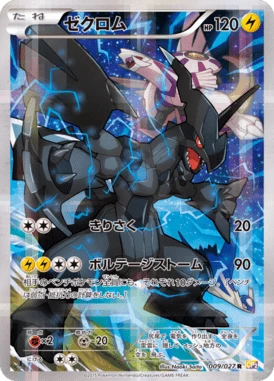
Zekrom 009/027: In Stock Now

Zekrom 009/027 R, Legendary Shine Collection (CP2)
Zekrom 009/027 R — Legendary Shine Collection (CP2)

Zekrom is 009/027, a Lightning-type Rare and, alongside Dialga, one of the marquee legendaries in the R lineup that anchors CP2’s rare slots.

PSA 10 Anchor
Zekrom 009/027 — Legendary Shine Collection (CP2)
Currently listed at ¥92,700 (~$569)
Ships from Tokyo · Tracked delivery

View Product →

Same rule applies: a single listed copy. When this one sells, it’s gone until we source a replacement PSA 10.

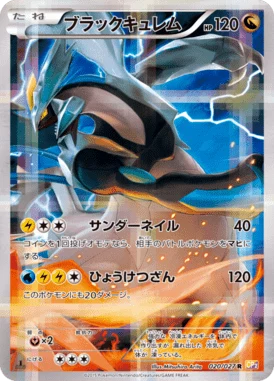
Black Kyurem 020/027 and the 1st Edition Question

Black Kyurem 020/027 R, Legendary Shine Collection (CP2)
Black Kyurem 020/027 R — Legendary Shine Collection (CP2)

Black Kyurem is 020/027, a Dragon-type Rare, sitting alongside its counterpart White Kyurem at 021/027. Our currently listed copy carries a 1st Edition stamp.

The 1st Edition question on CP2 is worth being precise about. 1st Edition–marked CP2 boxes and singles — Black Kyurem included — do turn up in secondary-market listings from specialty dealers and marketplaces. What we haven’t found is a Pokemon Company announcement or a Bulbapedia reference formally defining a 1st Edition print run for CP2 the way that term is used for early English-language sets. So the short version: 1st Edition CP2 cards are something you can confirm exist in the secondary market, but the official print-run distinction behind that stamp isn’t something we can point to a primary source for. Our Japanese 1st Edition cards guide goes deeper into how 1st Edition marks work across different Japanese sets, including cases like this one where the marking is well attested in the market but not in official documentation.

PSA 10 Anchor · 1st Edition
Black Kyurem 020/027 (1st Edition) — Legendary Shine Collection (CP2)
Currently listed at ¥47,380 (~$291)
Ships from Tokyo · Tracked delivery

View Product →

This is a one-of-one listing on our site — a single graded, 1st Edition–marked copy. Once it sells, it’s gone until another one comes through our sourcing.

Where CP2 Fits in the Concept Pack Series

CP2 is one entry in a short run of Japanese concept packs released between January 2015 and September 2016:

세트 Japanese Name English Name Japan Release
CP1 ダブルクリシス Double Crisis January 30, 2015
CP2 传説キラコレクション Legendary Shine Collection July 18, 2015
CP3 ポケキュンコレクション PokéKyun Collection January 29, 2016
CP4 プレミアムチャンピオンパック Premium Champion Pack April 16, 2016
CP5 幻・传説ドリームキラコレクション Mythical & Legendary Dream Shine Collection July 16, 2016
CP6 拓張パック 20th Anniversary 확장팩 20th Anniversary September 16, 2016

CP5 is the closest sibling to CP2 — released almost exactly a year later, also built around legendary and mythical Pokemon, and also fully holo across the set, though CP5 runs to 38 cards including two secret slots and doesn’t print rarity letters on the cards the way CP2 does. If you’re building out a full concept-pack run, our CP5 Mythical & Legendary Dream Shine Collection guide and our broader Japanese concept packs (CP series) guide cover the rest of the lineup.

Where to Buy CP2 Cards from Japan

We ship graded Japanese singles out of Tokyo with tracked delivery worldwide. For CP2 specifically, here’s what’s currently in our listings:

Shop the Collection
PSA 10 Graded Singles
Ships from Tokyo · Tracked delivery

View Collection →

Looking for a different CP2 number, a raw copy, or want to build a mixed order across sets? Our Quick Order page is the fastest way to request it.

자주 묻는 질문

What is CP2 Legendary Shine Collection?

CP2 is a Japanese Pokemon TCG concept pack released July 18, 2015, containing 27 cards, all with gloss-coated, special-foil “shine” treatment. It was timed to the release of Pokemon the Movie XY: The Archdjinni of the Rings — Hoopa and features a legendary and mythical Pokemon lineup including Hoopa-EX, Zekrom, Dialga, Reshiram, Palkia, both Kyurem forms, and Arceus.

How many cards are in CP2?

27 cards, numbered 001/027 through 027/027, with no secret cards printed past that number.

Why do CP2 packs only have four cards instead of five?

Because every card in the set carries the all-holo shine treatment. Standard Japanese boosters mix foil and non-foil cards across five slots; CP2’s four-card pack is entirely foil cards, which is the structural trade-off for making the whole set holo.

Are there 1st Edition CP2 cards?

1st Edition–marked CP2 cards and boxes do turn up in secondary-market listings, including our currently listed Black Kyurem 020/027. We haven’t found an official Pokemon Company source formally defining a 1st Edition print run for CP2, so treat the “1st Edition” stamp as market-confirmed rather than officially documented.

Where can I buy CP2 Legendary Shine Collection cards from Japan?

We currently stock five graded PSA 10 CP2 singles — Dialga 017/027 at ¥65,920, Zekrom 009/027 at ¥92,700, Latios 019/027 at ¥104,792, Black Kyurem 020/027 (1st Edition) at ¥47,380, and White Kyurem 021/027 at ¥49,440 — each a single listed copy. All ship from Tokyo with tracked delivery; use our Quick Order page for anything not listed directly.

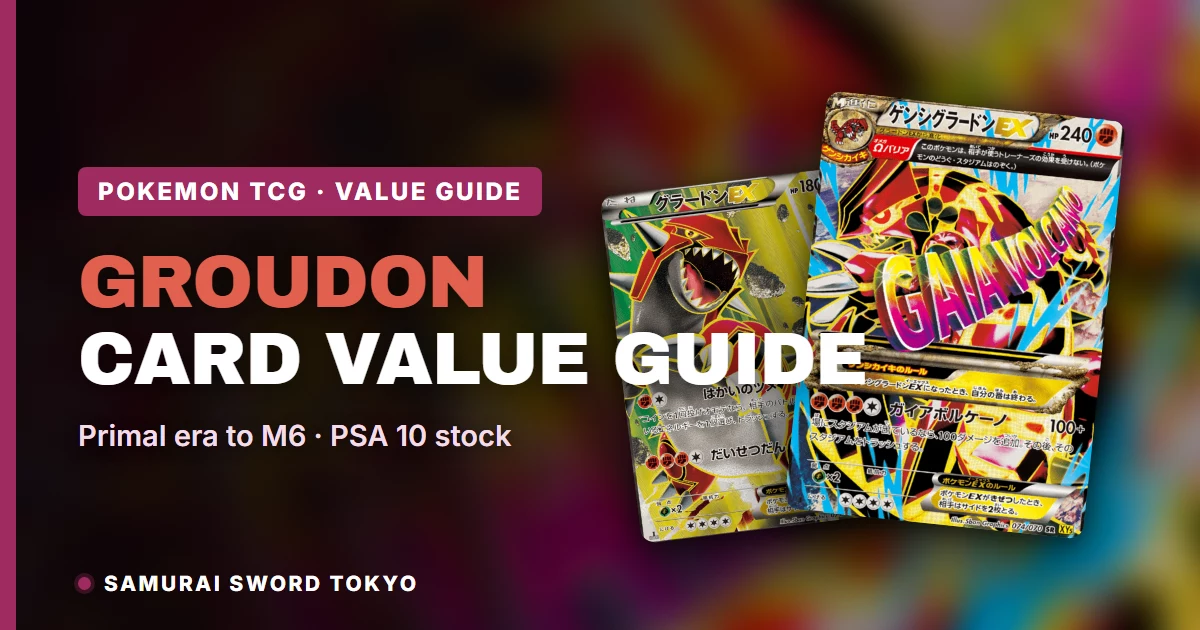
Groudon Card Value Guide: Best Japanese Printings

Groudon has been a Japanese Pokemon TCG chase card since 2003, but its most important printing didn’t arrive until 2015 — and it isn’t the version most collectors picture. When Groudon’s game-world Primal Reversion made the jump from Omega Ruby & Alpha Sapphire to card form, it created a two-card pair, a Fighting-type stat jump from HP 180 to HP 240, and a card that’s still a quieter corner of the XY era.

This guide walks through Groudon’s major Japanese printings in release order — the 2003 promo debut, the 2015 Genshi Groudon EX era, a 2015 movie promo, the Sun & Moon-era Remix Bout single, and the newest 2026 Storm Emeralda cards — and flags where the record is thin instead of guessing. Two of these are currently in our listings as graded PSA 10s.

Key Takeaway

We currently list two PSA 10 Groudon singles: Genshi Groudon EX SR (074/070, Gaia Volcano) at ¥278,100 and Groudon (144/XY-P, Hoopa’s Gift movie promo) at ¥49,440. Both are graded singles — a single listed copy each, so when a copy sells, it’s gone until we source another.

2003–2026
Years of Groudon Prints

¥278,100
Our Top Listed PSA 10

2026
Newest Printing (M6)

6+
Major JP Printings Covered

Card numbers, sets, and dates below are sourced from official listings and card databases as cited throughout. Where a detail couldn’t be confirmed against a primary source, we’ve said so rather than guessing.

Every Major Groudon Printing, In Order

The printings covered in this guide, oldest to newest:

카드 Set / Number Year Status
Groudon ex (promo) 002/ADV-P & 012/ADV-P 2003 Not currently stocked
Groudon ex ★ (kira) Undone Seal (ADV4) 056/083 2004 Not currently stocked
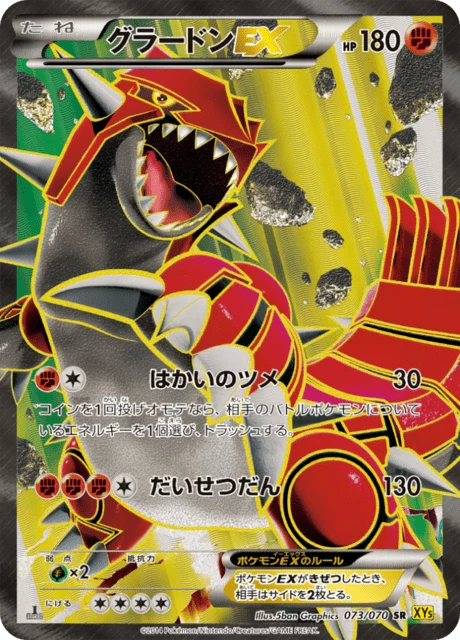
Groudon EX (pre-Primal) Gaia Volcano (XY5) 073/070 2015 Not currently stocked
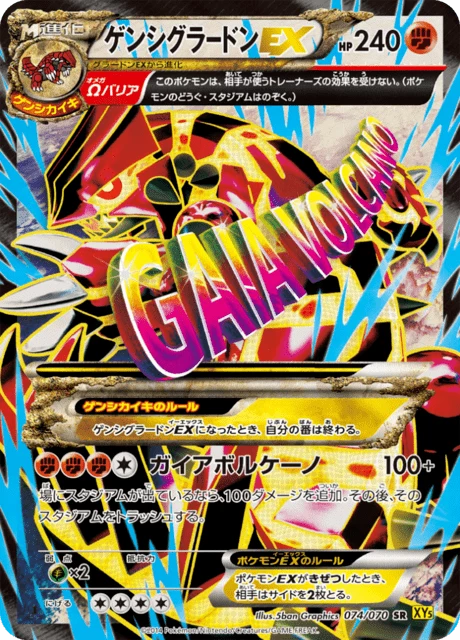
Genshi Groudon EX SR Gaia Volcano (XY5) 074/070 2015 Currently listed at ¥278,100 (PSA 10)
Genshi Groudon EX (double rare) Gaia Volcano (XY5) 040/070 2015 Not currently stocked
Groudon (movie promo) 144/XY-P 2015 Currently listed at ¥49,440 (PSA 10)
Groudon Remix Bout (SM11a) 032/064 2018–2019 Sealed Remix Bout boxes currently listed at ¥141,750
Groudon (English) Paradox Rift #93/182 2023 Japanese set details unverified; not stocked
Groudon (English) Prismatic Evolutions #49/131 2025 Japanese set details unverified; not stocked
Groudon R Storm Emeralda (M6) 039/076 2026 Sealed M6 boxes currently listed from ¥16,800
Groudon AR Storm Emeralda (M6) 084/076 2026 Not currently stocked as a single

The sections below cover each era, what makes the card worth knowing about, and where we currently stand on stock.

2003: The ADV-P Promo Debut

Groudon’s first Japanese card appearance came as a Nintendo-distributed promo, Groudon ex, illustrated by Kazuo Yazawa. It carries two card numbers — 002/ADV-P, the version bundled directly into the February 2003 issue of CoroCoro Comic, and 012/ADV-P, a ticket-exchange version tied to the same issue’s reader promotion. Its English structural counterpart is Nintendo Black Star Promo #2, Groudon ex.

A second early appearance followed in 2004: Groudon ex ★ (kira), numbered 056/083 in the fourth expansion pack, Undone Seal, released January 16, 2004. The English equivalent is EX Hidden Legends #93/101, a Rare Holo ex.

Both of these early promos predate the card database coverage we could verify image sources against, so we’re not displaying artwork for them here — but the set numbers and release details above are confirmed against dealer listings and Bulbapedia’s Groudon card index.

2015: Genshi Groudon EX and the Primal Reversion Pair

Groudon’s most significant card era starts with a game mechanic. Pokemon Omega Ruby & Alpha Sapphire (2014) introduced Primal Reversion, letting Groudon transform into Genshi Groudon (Primal Groudon) by holding the Red Orb — Kyogre gets the equivalent treatment with the Blue Orb. The TCG translated that into a two-card structure: a regular EX before the transformation, and a separate, more powerful EX after it.

Japan’s version of that pair arrived in XY5 “Gaia Volcano,” released in 2015.

Groudon EX 073/070, Gaia Volcano (XY5)

Groudon EX 073/070, Gaia Volcano (XY5)

Genshi Groudon EX 074/070 SR, Gaia Volcano (XY5)

Genshi Groudon EX 074/070 SR, Gaia Volcano (XY5)

The pre-transformation card, Groudon EX (073/070), is a Fighting-type EX at HP 180. Its Primal counterpart, Genshi Groudon EX (074/070), jumps to HP 240 as the set’s Secret Rare — the highest print slot in Gaia Volcano. A second copy of the Primal card was also printed in a double-rare slot at 040/070. In English, this same pairing shipped as Groudon-EX #85/160 and Primal Groudon-EX #86/160 in Primal Clash, with a full-art Ultra Rare at #151/160 in the same set (Primal Clash).

PSA 10 Anchor
Genshi Groudon EX SR 074/070 — Gaia Volcano (XY5)
Currently listed at ¥278,100
Ships from Tokyo · Tracked delivery

View Product →

This is a graded single — a single listed copy. When it sells, it’s gone until we source another PSA 10 copy of the same secret rare.

2015: The Hoopa’s Gift Movie Promo

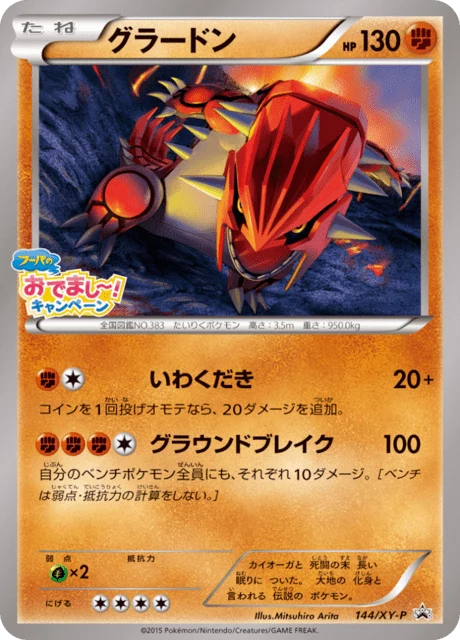
Groudon 144/XY-P, Hoopa's Gift movie promo
Groudon 144/XY-P — Hoopa’s Gift movie promo, illustrated by Mitsuhiro Arita

The same year gave Groudon a second, very different card: 144/XY-P, HP 130, illustrated by Mitsuhiro Arita. It was one of the pack-in promo cards for the “Hoopa’s Gift” campaign tied to the 2015 Pokemon movie built around Hoopa — distributed starting June 20, 2015, with the pack given out on qualifying purchases at chains including Ito-Yokado, Aeon, Toys R Us, and Pokemon Center / Pokemon Store locations across Japan. Its English structural counterpart is Groudon, XY Black Star Promos #XY52.

Unlike the XY5 pair above, this is a standalone promo — no Primal Reversion mechanic, just a movie-tie-in single that’s become a collecting target in its own right.

PSA 10 Anchor
Groudon 144/XY-P — Hoopa’s Gift movie promo
Currently listed at ¥49,440
Ships from Tokyo · Tracked delivery

View Product →

Same rule applies here: a single listed copy. Once this copy sells, it’s out of our listings until another PSA 10 comes in.

2018–2019: Groudon in Remix Bout (SM11a)

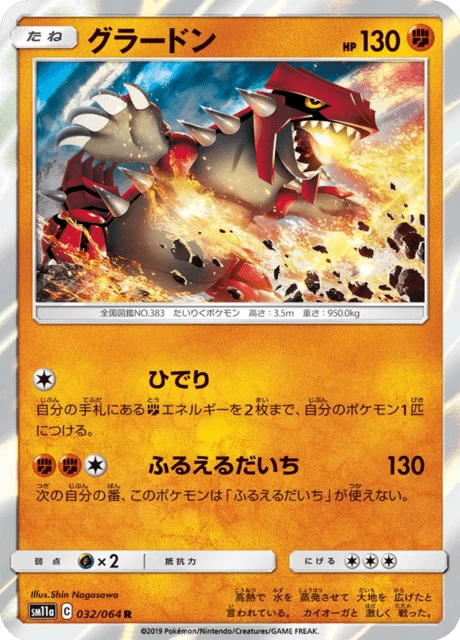
Groudon 032/064 R, Remix Bout (SM11a)
Groudon 032/064 R — Remix Bout (SM11a)

Groudon’s most notable Sun & Moon-era Japanese single is in SM11a “Remix Bout,” as card 032/064, a Fighting-type Rare. Its English structural counterpart is Groudon, Cosmic Eclipse #113/236, a holographic rare from the same Sun & Moon era. This is an accessible Groudon single of the Sun & Moon period — a straightforward Rare rather than a secret-rare chase card.

We don’t currently carry that specific single graded, but we do stock sealed Remix Bout product — the set this Groudon comes packed in.

Shop This Set
Remix Bout Booster Box (SM11a, Japanese)
Currently listed at ¥141,750
Ships from Tokyo · Tracked delivery

View Product →

The Sword & Shield Gap

Between the Sun & Moon-era Remix Bout single and the current Scarlet & Violet era, Groudon didn’t get a new standalone Sword & Shield-mechanics card in the sets we could confirm. The Celebrations set (2021, English) reprinted an earlier-era Groudon rather than introducing a new one, with the Japanese equivalent arriving as part of the 25th Anniversary Collection.

We also checked specifically for Groudon V or Groudon VSTAR cards, since V/VSTAR was the signature mechanic of that era. Across the card databases we searched, we couldn’t find any Groudon V or Groudon VSTAR entries — not proof they don’t exist anywhere, but nothing turned up in the sources we checked.

2023–2026: Paradox Rift Through Storm Emeralda

The current Scarlet & Violet era has given Groudon two English printings so far — a holographic rare at #93/182 in Paradox Rift (2023), plus a Gold-treatment variant at #199/182, and a further printing at #49/131 in Prismatic Evolutions (2025). We don’t currently carry either as a graded single, and we’re not listing Japanese set numbers for these two since we couldn’t confirm the Japanese original set details against a primary source.

The newest Groudon prints are Japanese, from Storm Emeralda (M6), released July 31, 2026:

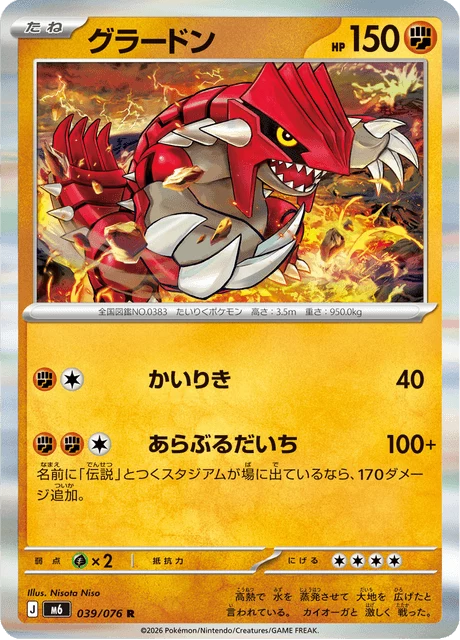
Groudon 039/076 R, Storm Emeralda (M6)

Groudon 039/076 R, Storm Emeralda (M6)

Groudon R (039/076) is a Fighting-type Basic Pokemon at HP 150, weak to Grass, with a retreat cost of 4 — the standard-rarity version pulled from Storm Emeralda boosters. The same set also includes Groudon AR (084/076), an Art Rare alternate-art treatment of the same Pokemon; we couldn’t source a verified image or confirmed attack text for that card, so we’re flagging it as a printing that exists rather than describing it in detail.

For the complete Storm Emeralda checklist, see our M6 card list (all 113 cards), and for how often the set’s chase cards actually hit, see our M6 pull rates guide.

Shop This Set
Storm Emeralda Booster Box (M6, Japanese)
Currently listed from ¥16,800
Ships from Tokyo · Tracked delivery

View Product →

Groudon sits alongside other weather-trio and legendary staples worth tracking — if you’re building out a broader legendary collection, our Giratina cards guide and Arceus cards guide cover two more of the franchise’s most-collected legendaries in the same detail.

Where to Buy Groudon Cards from Japan

We ship graded Japanese singles and sealed product out of Tokyo with tracked delivery worldwide. For the cards and sets covered in this guide:

Shop the Collection
PSA 10 Graded Singles
Ships from Tokyo · Tracked delivery

View Collection →

Looking for a specific Groudon printing not listed here, or want to build a mixed order across sets? Our Quick Order page is the fastest way to request it.

자주 묻는 질문

What is the most valuable Groudon card we currently stock?

Genshi Groudon EX SR (074/070, Gaia Volcano/XY5), currently listed at ¥278,100 in PSA 10. It’s the Secret Rare slot in Gaia Volcano.

What is Genshi Groudon EX?

Genshi Groudon EX (074/070, Gaia Volcano) is the Japanese card representing Groudon’s Primal Reversion — a game mechanic introduced in Omega Ruby & Alpha Sapphire (2014) where Groudon transforms via the Red Orb. It’s HP 240, a jump from the pre-transformation Groudon EX (073/070) at HP 180. The English structural counterpart is Primal Groudon-EX from Primal Clash and Ancient Origins.

Is there a Groudon V or Groudon VSTAR card?

We searched the card databases available to us and found no Groudon V or Groudon VSTAR entries. That means nothing turned up in the sources we checked, not a confirmed statement that no such card exists anywhere.

Where does the 144/XY-P Groudon promo come from?

It was distributed through the 2015 “Hoopa’s Gift” campaign tied to that year’s Hoopa-themed Pokemon movie, given out on qualifying purchases at retailers including Ito-Yokado, Aeon, Toys R Us, and Pokemon Center locations in Japan starting June 20, 2015. It’s illustrated by Mitsuhiro Arita.

What’s new for Groudon in Storm Emeralda (M6)?

Storm Emeralda, released July 31, 2026, includes Groudon R (039/076), a standard-rarity Fighting-type Basic Pokemon, plus Groudon AR (084/076), an Art Rare alternate-art version of the same card. Both come out of Storm Emeralda booster boxes, currently listed from ¥16,800.

Where can I buy Groudon cards from Japan?

We currently stock two graded PSA 10 Groudon singles — Genshi Groudon EX SR at ¥278,100 and the Hoopa’s Gift movie promo at ¥49,440 — plus sealed Remix Bout and Storm Emeralda boxes that contain other Groudon printings. All ship from Tokyo with tracked delivery; use our Quick Order page for anything not listed directly.

Shiny Star V vs Shiny Treasure ex: Box Guide

Three years apart, both built around the same idea — open a pack, hope for a shiny — and yet the two sets barely resemble each other once you look past the cover art.

Shiny Star V (S4a, 2020) and Shiny Treasure ex (SV4a, 2023) are two of the sets collectors most often compare when the whole point is chasing color-swapped cards. Both are High Class Packs, both share the same ¥5,500 MSRP, and both built their reputation on shiny-rarity chase cards. But the two sets solve the “shiny” problem differently — one leans on sheer volume of shiny species, the other on a rarer, higher-ceiling pull mechanic — and that shows up directly in what each box is worth today.

This guide puts the two sets side by side: what’s in each box, how their shiny mechanics differ, which chase cards define each set, and which one fits what you’re buying for.

Key Takeaway

Shiny Star V leans on volume — over 100 shiny “S” species plus shiny VMAX/V secret rares. Shiny Treasure ex leans on concentration — 129 baby shinies, 18 SSRs, 8 SARs, and a god pack mechanic that turns one full pack into nine shiny cards (community-reported at roughly 4% of boxes). Shiny Star V is currently listed at ¥22,365; Shiny Treasure ex is currently listed from ¥17,340.

3 yrs
Release Gap (2020–23)

¥5,500
Shared MSRP/Box

360
SV4a Total Cards (consistent across our sources)

~4%
SV4a God Pack Odds/Box

Prices below are Japanese secondary-market figures unless noted as our own listing prices. USD figures are carried over from each source snapshot and may reflect different exchange rates. Pull rates and probability figures are community-reported estimates, not official Pokemon Company data.

Shiny Star V vs Shiny Treasure ex: At a Glance

Feature Shiny Star V (S4a) Shiny Treasure ex (SV4a)
Japanese name シャイニースターV シャイニートレジャーex
Release (Japan) November 20, 2020 December 1, 2023
Series Sword & Shield’s first 하이클래스팩 Scarlet & Violet’s first 하이클래스팩
MSRP ¥5,500/box ¥5,500/box
Pack structure 10 packs/box, 10 cards/pack 10 packs/box, 10 cards/pack
Total cards 320+–326* 360
Secret/special tier size 130+–136* 170
English release Shining Fates (partial) Paldean Fates (mixed, 56 days later)
Guaranteed shiny pull “S” shiny slots (per our set data) SSR guaranteed per box; 2–3 baby shinies per box
God pack mechanic Not mentioned in our set data Yes — ~4% of boxes, community-reported

*Our sources disagree on Shiny Star V’s exact card count: set-summary text rounds it to “320+”, while our numbered card-list database lands on 326 (190 main + 136 secret, #191–326). We cite both rather than pick one. Shiny Treasure ex’s total of 360 (190 main + 170 secret, #191–360) is consistent across every source we checked.

Shiny Star V: The Original Shiny Showcase

Shiny Star V (S4A) launched on November 20, 2020 as Sword & Shield’s first 하이클래스팩 — the first 하이클래스팩 built around a full shiny lineup, a structure later shiny-themed sets would echo: a full lineup of color-swapped “baby” Pokemon — over 100 shiny species by our set data’s count — sitting alongside a smaller run of Shiny Secret Rares (SSR), which are shiny versions of VMAX and V cards.

Per our S4a set data, packs are built around “S” (shiny) slots, so the set’s core identity comes through on every box you open, not just on the rare hits. The chase, then, isn’t really about pulling a shiny — it’s about pulling the right one.

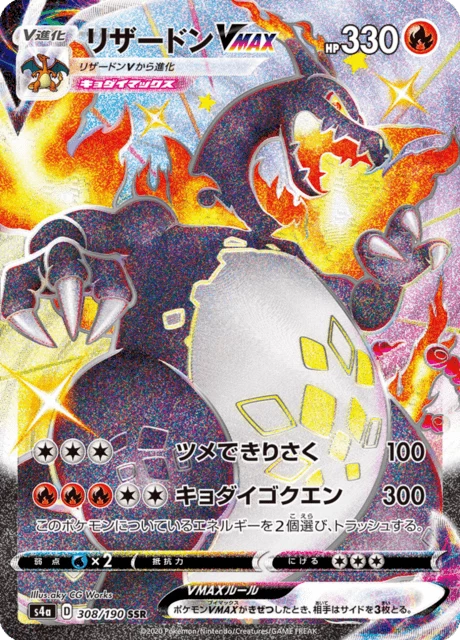
Charizard VMAX Shiny #308 SSR Shiny Star V S4a Japanese card

Charizard VMAX (Shiny) #308, SSR — Shiny Star V
~¥19,000 raw (~$119)

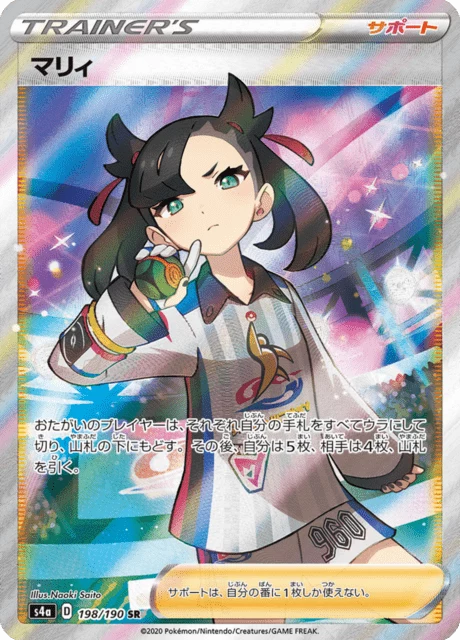
Marnie SR #198 full art Shiny Star V S4a Japanese card

Marnie #198, SR (full art) — Shiny Star V
~¥14,000 (~$88)

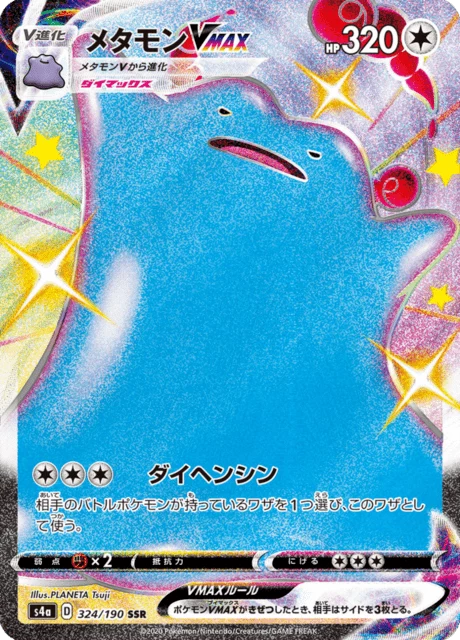
Ditto VMAX Shiny #324 SSR Shiny Star V S4a Japanese card

Ditto VMAX (Shiny) #324, SSR — Shiny Star V
~¥2,000 (~$13)

The set’s marquee card, shiny Charizard VMAX (#308), tops the chase list at roughly ¥19,000 (~$119) raw as of July 2026, with PSA 10 graded copies ranging from roughly ¥60,000 up to ¥200,000 depending on the specific sale. As of this writing, we currently list a graded S4a single from the set — PSA 10 Reshiram #021/190, currently listed at ¥6,695 — if you want a graded Shiny Star V card without chasing the top of the chase list.
By market price, Shiny Star V trades around ¥23,800 (~$149) per box as of July 2026 (SNKRDUNK secondary-market basis) — roughly 4.3x its ¥5,500 MSRP.

Shiny Treasure ex: The Modern Shiny Powerhouse

Shiny Treasure ex (SV4a) released in Japan on December 1, 2023 as Scarlet & Violet’s first 하이클래스팩 — the SV-era successor to Shiny Star V’s role in the Sword & Shield lineup. Its English release, Paldean Fates, came 56 days later on January 26, 2024, and mixes in additional cards rather than reprinting the set 1:1.

The set’s own highlight line sums it up: “360 cards · 129 baby shinies · 18 SSRs · 8 SARs · God pack odds ~4% per box · SSR guaranteed in every box.” Every box guarantees at least one SSR, plus roughly 2–3 baby shiny “S” cards and one near-guaranteed AR.

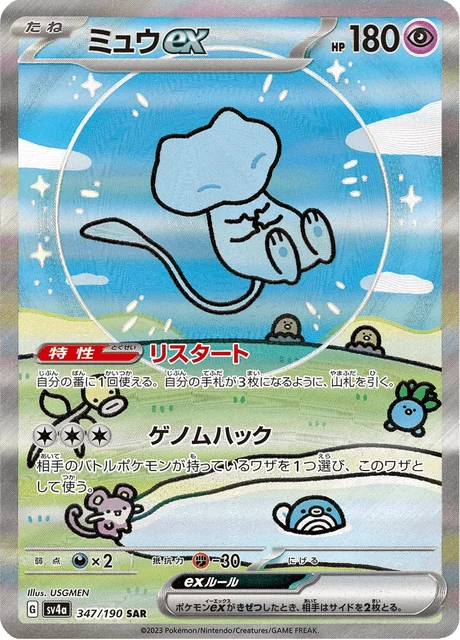
Mew ex #347/190 SAR Shiny Treasure ex SV4a Japanese card

Mew ex #347/190, SAR — Shiny Treasure ex
~¥55,000 (~$374)

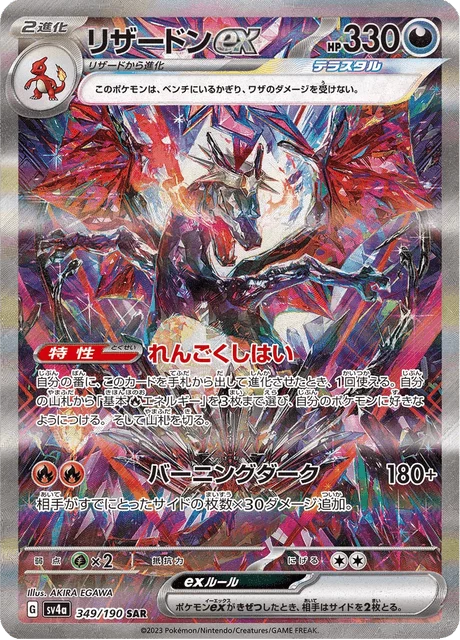
Charizard ex #349/190 SAR Shiny Treasure ex SV4a Japanese card

Charizard ex #349/190, SAR — Shiny Treasure ex
~¥40,000 (~$272)

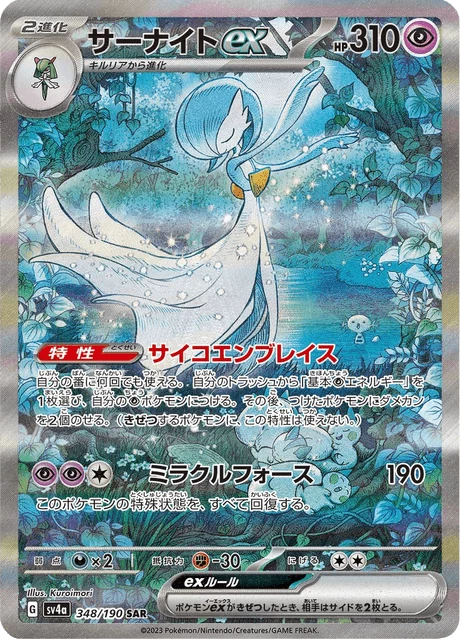
Gardevoir ex #348/190 SAR Shiny Treasure ex SV4a Japanese card

Gardevoir ex #348/190, SAR — Shiny Treasure ex
~¥18,000 (~$122)

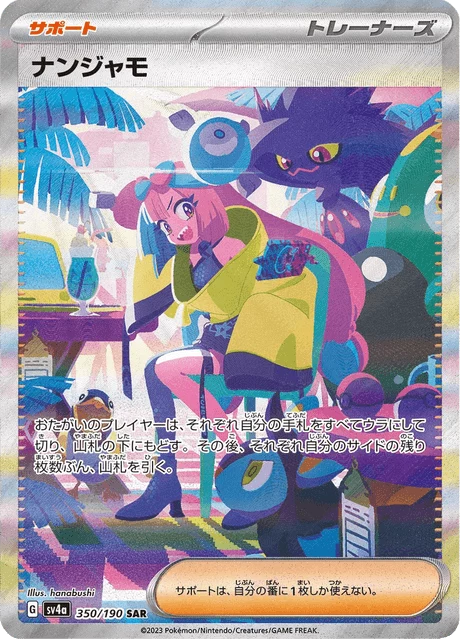
Iono #350/190 SAR Shiny Treasure ex SV4a Japanese card, also known as Nanjamo

Iono (also listed as Nanjamo) #350/190, SAR — Shiny Treasure ex
~¥13,000 (~$88)

One pricing quirk worth flagging: our detailed set-facts writeup (March 2026) prices the box around ¥13,800 (~$94) on a SNKRDUNK/Mercari secondary-market basis. Two more recent comparison pieces (August 2026) instead cite our own live selling price of ¥20,176 sealed / ¥17,340 no-shrink. Those are two different things — secondary-market resale price versus our current listing price — not a contradiction. For a current, buyable price, our Shiny Treasure ex box is currently listed from ¥17,340.

How Each Set Handles “Shiny”: The Core Difference

Both sets are built around shiny Pokemon, but the mechanics that deliver them are genuinely different, and that’s the single biggest thing to understand before choosing between them.

Shiny Star V spreads shiny pulls across the whole box. With a guaranteed “S” card in every pack and over 100 shiny species to fill that slot, the set’s shiny content is baked into the base opening experience. The chase sits on top, in a smaller pool of Shiny Secret Rare VMAX/V cards.
Shiny Treasure ex concentrates its biggest hits into a standalone mechanic. The god pack — one pack in a box can come out as a god pack (~4% of boxes, community-reported), with nine shiny cards at once — is a distinct, rarer event. Our Shiny Star V set data has no equivalent mechanic mentioned anywhere in it. We won’t claim Shiny Star V definitely lacks a god-pack-style mechanic — we simply don’t have a source confirming one exists.

In Practical Terms

If you want a shiny in every pack you open, Shiny Star V is built around that experience in our set data — shiny slots appear throughout a box. If you’re chasing the possibility of a single spectacular pack, the SV4a god pack is the mechanic built for that — at roughly 4% odds, community-reported, not guaranteed.

Chase Card Face-Off

Put the two sets’ top pulls side by side and the price gap is stark — Shiny Treasure ex’s SAR chase cards simply price higher in our current data.

세트 카드 # Rarity 가격
Shiny Treasure ex Mew ex 347/190 SAR ~¥55,000 (~$374)
Shiny Treasure ex Charizard ex 349/190 SAR ~¥40,000 (~$272)
Shiny Star V Charizard VMAX (Shiny) 308 SSR ~¥19,000 (~$119) raw
Shiny Treasure ex Gardevoir ex 348/190 SAR ~¥18,000 (~$122)
Shiny Treasure ex Iono / Nanjamo 350/190 SAR ~¥13,000 (~$88)
Shiny Star V Marnie 198 SR ~¥14,000 (~$88)
Shiny Treasure ex Penny / Button 354/190 SAR ~¥3,000 (~$20) raw

On that Mew ex figure: our data shows it launched around ¥16,000 and has climbed to roughly ¥55,000 over 27 months — a +244% move — while Charizard ex started higher (~¥25,000) and rose a more moderate +60%. Iono (also recorded as Nanjamo in some source material, same card, same number) is also the top vote-getter in an SNKRDUNK community popularity poll among Shiny Treasure ex cards.

Penny (recorded as Button in some source material) is a lower-priced SAR at roughly ¥3,000 raw — but graded copies move differently. We currently list PSA 10 Penny SAR #354/190, currently listed at ¥13,987, a graded single from Shiny Treasure ex.

Box Economics: What You’re Actually Paying For

Both sets’ expected-value figures below are community-reported estimates built from pull-rate data, not official Pokemon Company numbers, and each was calculated at a different point in time — so treat the comparison as directional, not a precise head-to-head.

Metric Shiny Star V (2026/7 snapshot) Shiny Treasure ex (2026/3 snapshot)
Estimated box EV ~¥12,000 ~¥4,881 (ours) / ~¥6,329 (pokeka-atari.jp)
Market box price used ~¥23,800 ~¥13,800 (secondary market)
EV as % of market price ~50% ~35–46%

On this data, Shiny Star V’s EV covers roughly half its market box price, while Shiny Treasure ex’s EV covers somewhat less of its (lower) market box price — though the two EV figures for Shiny Treasure ex, ours and pokeka-atari.jp’s, differ by about ¥1,400 depending on which pull-rate assumptions are used. Neither number should be read as a guarantee; both sets’ pull rates are community-reported estimates, not confirmed by The Pokemon Company.

Which Set Should You Buy?

Working from everything above, here’s how we’d frame the decision:

  • Want a shiny in every pack you open? Shiny Star V is built around that experience in our set data — shiny slots appear throughout a box, spread across 100+ species.
  • Chasing a specific high-value SAR? Shiny Treasure ex’s chase cards — Mew ex, Charizard ex, Gardevoir ex — sit well above Shiny Star V’s top pulls in current price, if that ceiling matters to you.
  • Want the god pack shot? That’s a Shiny Treasure ex-only mechanic in our data, at roughly 4% of boxes, community-reported.
  • Buying by budget right now? Shiny Treasure ex is currently listed from ¥17,340, below Shiny Star V’s current listing of ¥22,365.
  • Want a specific single instead of a box? Both sets’ top singles are available graded — see our PSA10 collection for current stock across both sets.
Shop This Set
Shiny Treasure ex Booster Box (SV4a, Japanese)
Currently listed from ¥17,340
Ships from Tokyo · Tracked delivery

View Product →

Where to Buy Shiny Star V and Shiny Treasure ex

We ship both sets sealed out of Tokyo with tracked delivery. Shiny Star V is currently listed at ¥22,365, and Shiny Treasure ex is currently listed from ¥17,340. For graded singles from either set, our PSA10 collection is where current stock lives — individual graded cards are one-of-one, so once a listing sells it’s gone.

For a full sealed-product overview across Japanese sets, browse our Pokemon box collection, or use our Quick Order page to build a mixed order across both sets and any singles you want in the same shipment.

Related reading: our standalone Shiny Star V pull rates and best cards guide goes deeper on S4a’s full rarity breakdown, and we’ve also compared Shiny Treasure ex against two other Scarlet & Violet-era High Class Packs: Pokemon 151 vs Shiny Treasure ex and Shiny Treasure ex vs Terastal Festival ex. If you’re weighing a Sword & Shield-era shiny-adjacent set instead, see our VMAX Climax vs VSTAR Universe box guide, and for the full graded card catalog across every set we carry, browse our PSA10 card list.

자주 묻는 질문

Which set has more shiny cards, Shiny Star V or Shiny Treasure ex?

Shiny Star V is built around volume — over 100 shiny “S” species plus a smaller Shiny Secret Rare tier. Shiny Treasure ex’s shiny content is more structured: 129 baby shinies, 18 SSRs, and 8 SARs out of 360 total cards. Which one has “more” shiny cards depends on how you count — Shiny Star V has more shiny species, Shiny Treasure ex has a larger overall secret/special tier (170 cards vs Shiny Star V’s contested 130+–136).

What is a “god pack” and does Shiny Star V have one?

A god pack is a special pack where every card — instead of the normal mix — comes out as a rare or shiny card. Shiny Treasure ex has a confirmed god pack mechanic (one full pack of 9 shiny cards, community-reported at roughly 4% of boxes). Our Shiny Star V set data has no mention of an equivalent mechanic, but we can’t confirm it definitely doesn’t exist — we simply don’t have a source for one.

Which chase card is more valuable, Mew ex or Charizard VMAX (Shiny)?

Shiny Treasure ex’s Mew ex (#347/190, SAR) is priced around ¥55,000 (~$374), well above Shiny Star V’s top pull, Charizard VMAX Shiny (#308, SSR) at roughly ¥19,000 (~$119) raw. Both are each set’s most valuable card by our current data.

What’s the difference between the English versions, Shining Fates and Paldean Fates?

Shiny Star V’s English release, Shining Fates, is a partial reprint of the Japanese set. Shiny Treasure ex’s English release, Paldean Fates, came 56 days after the Japanese launch and mixes in additional cards rather than reprinting the set directly. Neither English release is a full 1:1 match to its Japanese source.

Which box has better expected value, Shiny Star V or Shiny Treasure ex?

On our community-reported estimates, Shiny Star V’s box EV covers roughly 50% of its market price (2026/7 snapshot), while Shiny Treasure ex’s EV covers roughly 35–46% of its market price (2026/3 snapshot). The two figures were calculated at different times using different pull-rate assumptions, so treat this as a general comparison rather than a precise one.

Vintage Japanese Pokemon Booster Boxes: Sealed Guide

A sealed Japanese booster box from 2018 and a sealed Japanese booster box from 2026 are, physically, the same kind of object — cardboard, foil wrap, ten packs inside. What separates them is everything that happened to the print run in between: long out of print, fewer boxes left unopened, and a chase-card lineup that either did or didn’t hold collector attention.

This guide lines up nine vintage Japanese sealed boxes — from the Sun & Moon GX era through the first Sword & Shield sets — by release date and current listed price, and sets them next to a current-release box so you can see what years on the shelf actually did to each one. We ship sealed Japanese product out of Tokyo, so the prices below are what we have these boxes listed at right now, not a market forecast.

Key Takeaway

Nine vintage boxes in this guide range from SM7b Fairy Rise at ¥57,750 to SM12a Tag All-Stars at ¥207,900. By contrast, the current-release M6 Storm Emeralda box starts from ¥16,800. Price here tracks each box’s own print run and chase cards, not simply how old it is — boxes released months apart sit at very different price points.

9
Boxes in This Guide

2018–2020
Release Window

¥57,750–¥207,900
Listed Price Range

¥16,800
Current M6 Box, from

Prices below are what these sealed boxes are currently listed at in our shop as of August 2026. They are not market averages, auction results, or a prediction of future value — just what’s on our shelf today.

Nine Vintage Sealed Boxes, One Price Ladder

Here is the full lineup, ordered by Japanese release date, from the last wave of single-Pokemon GX boxes through the first V/VMAX sets.

세트 JP Release Notable Cards Currently Listed At
SM6 Forbidden Light March 2, 2018 Ultra Necrozma GX, Zygarde GX, Yveltal GX ¥71,400
SM7b Fairy Rise August 3, 2018 Alolan Ninetales GX, Mimikyu GX ¥57,750
SM9a Night Unison January 11, 2019 Greninja & Zoroark GX, Gardevoir & Sylveon GX ¥84,000
SM11 Miracle Twin May 31, 2019 Mewtwo & Mew GX ¥197,400
SM11a Remix Bout July 5, 2019 Charizard & Braixen GX 008/064, Venusaur & Snivy GX 001/064 ¥141,750
SM11b Dream League August 2, 2019 Solgaleo & Lunala GX, Reshiram & Zekrom GX ¥165,900
SM12a Tag All-Stars October 4, 2019 Pikachu & Zekrom GX 041/173, Mewtwo & Mew GX 052/173 ¥207,900
S1H Shield December 6, 2019 Zamazenta V, Lapras VMAX ¥65,100
S1a VMAX Rising February 7, 2020 Inteleon VMAX, Cinderace VMAX ¥105,000

Two things stand out immediately. First, release order and price order don’t match — SM7b (August 2018) is the cheapest box on the list, while SM12a (October 2019), released more than a year later, is the most expensive. Second, three sets released within a ten-week span of each other in mid-2019 — SM11, SM11a, SM11b — span roughly a ¥56,000 range between them. The sections below walk through why, era by era.

The Single-GX Era: SM6 and SM7b

The two oldest boxes in this guide predate the tag-team format entirely — every headline Pokemon here is a single-Pokemon GX, not a pair.

SM6 Forbidden Light (March 2, 2018) is built around Ultra Necrozma GX, which appears across multiple rarity tiers — an Ultra Rare printing (#95), a Super Rare printing (#127), and a rainbow-style variant (#140) — alongside Zygarde GX and Yveltal GX, both Ultra Rare. The set also carries Prism Star cards (Volcanion, Diancie, Arceus among them), a mechanic tied to the Ultra Sun & Ultra Moon block. It’s currently listed at ¥71,400. For a full pull-rate breakdown of this set, see our SM6 Forbidden Light pull rates and best cards guide.

SM7b Fairy Rise (August 3, 2018) is fairy-type focused, headlined by Alolan Ninetales GX (025/050) and Mimikyu GX (038/050), both RR (Double Rare), plus a Prism Star Xerneas (033/050). At ¥57,750, it’s the lowest-priced box in this entire lineup — a five-month-younger set than SM6, priced below it.

The Tag-Team GX Era: SM9a Through SM12a

From early 2019 onward, the chase cards in this lineup stop being single Pokemon and start being pairs — two Pokemon sharing one card, one name, and one set of attacks.

SM9a Night Unison (January 11, 2019) leads with Greninja & Zoroark GX (#25) and Gardevoir & Sylveon GX (#31), both RR (Double Rare) tag-team pairs. It’s currently listed at ¥84,000.

Shop This Set
SM11 Miracle Twin Sealed Booster Box (Japanese)
Currently listed at ¥197,400
Ships from Tokyo · Tracked delivery

View Product →

SM11 Miracle Twin (May 31, 2019) is the priciest box of the three released that summer, built around Mewtwo & Mew GX in its alternate-art secret rare printing — the card headlining our own graded stock from this set. It’s currently listed at ¥197,400. Our full pull-rate breakdown for this set is here: SM11 Miracle Twin pull rates and best cards.

/sw/wp-content/uploads/2026/08/img_vintage_sm11_98_r_jp_9c584c845113-1.webp

Mewtwo & Mew GX — SM11 098/094 — SR:SA — Miracle Twin

/sw/wp-content/uploads/2026/08/img_vintage_sm12a_181_r_jp_166c60c65189-1.webp

Umbreon & Darkrai GX — SM12a 181/173 — SR — Tag All-Stars

Six weeks later, SM11a Remix Bout (July 5, 2019) paired starter Pokemon across generations — Venusaur & Snivy GX (001/064) and Charizard & Braixen GX (008/064) in their base printings, each also released in multiple secret rare variants. It’s currently listed at ¥141,750. See our SM11a Remix Bout pull rates and best cards for the full card list.

One month after that, SM11b Dream League (August 2, 2019) brought Solgaleo & Lunala GX (020/049 base, 063/049 secret rare) and Reshiram & Zekrom GX (036/049 base, 064/049 secret rare), each also printed in a hyper rare variant. It’s currently listed at ¥165,900. Full detail in our SM11b Dream League pull rates and best cards.

/sw/wp-content/uploads/2026/08/img_vintage_sm11a_68_r_jp_6e952d149786-1.webp

Charizard & Braixen GX — SM11a 068/064 — SR:SA — Remix Bout

/sw/wp-content/uploads/2026/08/img_vintage_sm11b_64_r_jp_705544e87509-1.webp

Reshiram & Zekrom GX — SM11b 064/049 — SR:SA — Dream League

/sw/wp-content/uploads/2026/08/img_vintage_sm11b_60_r_jp_63b36b3a7494-1.webp

Steelix — SM11b 060/049 — CHR — Dream League

Two months later, SM12a Tag All-Stars (October 4, 2019) closed out the tag-team run as a high-class pack built around alternate-art reprints of earlier tag-team GX cards, including Pikachu & Zekrom GX (041/173) and Mewtwo & Mew GX (052/173). It tops this entire guide at ¥207,900 — the most expensive box on this list despite being neither the oldest nor the newest. See our SM12a Tag All-Stars pull rates and best cards for the complete lineup.

The V/VMAX Turn: S1H Shield and S1a VMAX Rising

Two months after SM12a, the GX era gave way to a new mechanic.

S1H Shield (December 6, 2019, released the same day as its Sword-side counterpart) is the set where Pokemon V and VMAX first appeared in the TCG. Its headline cards are Zamazenta V (139/202, Ultra Rare) and Lapras VMAX (50/202, VMAX Rare). It’s currently listed at ¥65,100.

S1a VMAX Rising (February 7, 2020) followed two months later, centered on the Galar starter trio — Rillaboom, Cinderace, and Inteleon — in V and VMAX form. Its headline secret rares, Inteleon VMAX (#81) and Cinderace VMAX (#80), anchor the set. It’s currently listed at ¥105,000.

These two boxes mark the mechanical hinge point of this entire guide: everything before them in this lineup is GX-era; everything at or after them is V/VMAX-era, the format that current-release Japanese sets like M6 Storm Emeralda still build on.

What Years on the Shelf Actually Did to Price

Put the vintage ladder next to a current release and the gap is immediate: the newest box in our shop, M6 Storm Emeralda, starts from ¥16,800, while every box in this guide — released between two and eight years earlier — is currently listed between ¥57,750 and ¥207,900.

That gap isn’t a promise about where any individual box goes next — it’s a snapshot of what happens once a print run stops and a set stops circulating on shelves: fewer sealed boxes exist today than existed on release day, and none are being made. A current box, by contrast, is still moving through normal retail and secondary channels. Read this table as a record of where these nine sets sit today, not a forecast.

It’s also worth noting that price here doesn’t track age in a straight line. SM7b (2018) is cheaper than SM12a (2019), and SM11 (May 2019) is priced well above SM11b (August 2019) despite being only three months older. Each box’s price reflects its own print run and its own chase-card lineup — not simply how many years it’s been sitting sealed.

Buying Sealed Vintage: What to Check First

A box that’s been sealed for five-plus years has typically changed hands more times than one that shipped last month, which is exactly why the basics of authentication matter more here than on a current release.

Check This First

Genuine factory shrink wrap on Japanese boxes has small air holes — that’s the most reliable visual indicator that the wrap hasn’t been removed and replaced. We cover this and other authentication basics in full in our guide to spotting fake Japanese Pokemon cards.

Beyond the shrink wrap itself, buy vintage sealed product from a seller who can tell you where a box came from and who has handled the physical item — not just a listing photo. That’s a bigger factor in getting a genuine box than the release date printed on the set.

Which Vintage Box Fits Your Budget

Where to Buy Vintage Japanese Sealed Boxes

We ship sealed Japanese product out of Tokyo with tracked delivery worldwide, and we carry both ends of this guide — the vintage GX and V/VMAX-era boxes above, and current releases like M6 Storm Emeralda. Our full card list hub is the fastest way to browse everything we currently have sealed and graded: 카드 리스트 보기.

Looking for a specific vintage set or building a mixed order across several boxes? Our Quick Order page is the fastest way to get exact pricing before checkout. And if 1st Edition Japanese cards are part of what you’re chasing rather than 2018–2020 GX and VMAX product, our Japanese 1st Edition guide covers that separate, earlier stamp era in full.

자주 묻는 질문

What counts as “vintage” in this guide?

This guide covers nine Japanese sealed booster boxes released between March 2018 and February 2020 — from the single-GX era (SM6, SM7b) through the tag-team GX era (SM9a through SM12a) to the first Sword & Shield V/VMAX sets (S1H, S1a).

Why do boxes released just months apart have such different prices?

Price here tracks each set’s own print run and chase-card lineup rather than release date alone. SM7b (August 2018) is currently our cheapest box at ¥57,750, while SM12a (October 2019), released over a year later, is our most expensive at ¥207,900.

What’s the difference between the GX boxes and the V/VMAX boxes in this list?

SM6 through SM12a are built around GX Pokemon, including the tag-team GX pairs that headline SM9a through SM12a. S1H Shield and S1a VMAX Rising are the first Japanese sets built around the V and VMAX card types instead, a format current releases still use.

How does a current-release box compare in price to these vintage boxes?

Our current-release M6 Storm Emeralda box starts from ¥16,800, while the nine vintage boxes in this guide are currently listed between ¥57,750 and ¥207,900 — a reflection of stopped print runs and fewer sealed boxes remaining, not a price prediction.

What should I check before buying a sealed vintage Japanese box?

Genuine factory shrink wrap has small air holes, which is the most reliable visual check that the wrap is original. Buy from a seller who can speak to the box’s condition and history directly. Our full authentication guide covers this in detail.

S10D Time Gazer: Pull Rates & Best Cards Guide

One Pokemon carries almost this entire set on its back. S10D Time Gazer prints Origin Forme Dialga three separate times in its chase tier — as a V, a VSTAR, and again as the top-slot Ultra Rare — and that repetition is the whole point of the set’s design.

Time Gazer released in Japan in April 2022 as one half of a dual-set launch, paired with S10P Space Juggler on the same day. Together they form the tenth main Sword & Shield-era expansion, and both draw their card pool from the Hisui region introduced in Pokemon Legends: Arceus — a region that had just given Japanese collectors an entirely new set of Origin Forme legendaries to chase.

This guide walks through what’s actually in Time Gazer: the 88-card structure, the SR/HR/UR chase tier built around Origin Forme Dialga, how it connects to its Space Juggler sister set, and what a sealed box means for collectors picking it up today. We ship Japanese sealed product and PSA-graded singles from Tokyo, and the prices below are our own current listings.

Key Takeaway

Time Gazer’s chase card is Origin Forme Dialga VSTAR, printed as an Ultra Rare at 086/067 — the top card of the set’s 21-card SR/HR/UR tier. A sealed S10D Time Gazer booster box is currently listed at ¥14,910. For collectors chasing the wider Origin Forme Dialga line, our PSA 10 Dialga 017/027 [CP2] is currently listed at ¥65,920.

Apr 2022
JP Release

88
Total Cards

21
SR–UR Chase Tier

¥14,910
Sealed Box (2026)

Prices below are our own current listings in Japanese yen, sourced from our Tokyo inventory.

Inside S10D Time Gazer

S10D Time Gazer carries 88 cards in total: a competitive base set running from 001/067 through 067/067, topped by a 21-card chase tier numbered 068/067 through 088/067 that holds every Super Rare, Hyper Rare and Ultra Rare in the set.

The set’s identity is built around the Hisui region and its Origin Forme legendaries. Time Gazer’s focal point is Origin Forme Dialga, which the set prints repeatedly across its chase tier in escalating rarity — a design choice that mirrors how Legends: Arceus itself centered its story on the same Pokemon. Alongside Dialga, the set includes V-stage cards for Hisuian Lilligant, Luxray, Jirachi, Machamp and Wyrdeer, plus support Trainer cards for Hisui-era characters like Adaman.

If you’re comparing Time Gazer to other vintage Japanese Sword & Shield sets, our vintage Japanese booster box guide covers where it sits in that broader lineup.

The Chase Tier: Origin Forme Dialga’s SR and HR

The 21-card chase tier splits into three rarity bands: 12 Super Rares (068–079), 6 Hyper Rares (080–085), and 3 Ultra Rares (086–088). Origin Forme Dialga appears in the first two bands before topping out the third.

/sw/wp-content/uploads/2026/08/img_s10d_s10d_74_r_jp_lg_c8b10a6449bb-1.webp

Origin Forme Dialga V, 074/067 SR
S10D Time Gazer — Super Rare

/sw/wp-content/uploads/2026/08/img_s10d_s10d_82_r_jp_lg_7b226df88d35-1.webp

Origin Forme Dialga VSTAR, 082/067 HR
S10D Time Gazer — Hyper Rare

The 074/067 SR is Origin Forme Dialga in its V stage, one of two Super Rare printings of the card at that stage (074 and 075 share the same name and rarity slot). The 082/067 HR steps up to the VSTAR stage in a full illustration treatment — the same evolution jump that carries through to the Ultra Rare tier below.

The Super Rare band also carries the set’s key Trainer support: Adaman, the Hisui-region character tied to Dialga’s storyline in Legends: Arceus, appears at 077/067 as an SR and again at 083/067 as an HR, alongside fellow support cards Gardenia’s Vigor and Zisu.

A Note on Duplicate SR Numbers

Some set-list sources record 069/067, 073/067 and 075/067 as separate cards sharing a name and rarity with 068, 072 and 074 — possibly a special-art variant tier. We couldn’t independently confirm the exact distinction between these paired numbers, so if a listing prices them very differently from their pair, verify the card in hand before paying a premium.

The UR Tier: Dialga VSTAR and the Trainer Chase

/sw/wp-content/uploads/2026/08/img_s10d_s10d_86_r_jp_lg_56f9a7550353-1.webp

Origin Forme Dialga VSTAR, 086/067 UR
S10D Time Gazer — Ultra Rare, top of set

/sw/wp-content/uploads/2026/08/img_s10d_s10d_88_r_jp_lg_ca1910ec5ff5-1.webp

Path to the Peak, 088/067 UR
S10D Time Gazer — Ultra Rare Stadium

Three Ultra Rares close out Time Gazer’s numbering, and Origin Forme Dialga takes the first slot: 086/067 is the VSTAR in its top-rarity UR printing, and it’s the headline card of the set. It’s the same Pokemon as the 074 SR and 082 HR, three tiers up, which is why collectors building a Dialga run across this set usually treat all three as one connected chase rather than picking just one.

The other two UR slots are Trainer cards rather than Pokemon: Trekking Shoes (087/067) and Path to the Peak (088/067), a Stadium card. Both round out the top tier alongside the Dialga VSTAR, giving the UR band a mix of one chase Pokemon and two Trainer cards.

For readers focused specifically on the VSTAR printing and how it compares across other sets, our dedicated Origin Forme Dialga VSTAR guide goes deeper on that single card.

Sister Set: Space Juggler and the Road to Astral Radiance

Time Gazer didn’t release on its own. S10P Space Juggler launched the same day in April 2022, and the two sets are designed as a matched pair — the same dual-set format the Japanese TCG has repeated across other eras. Space Juggler carries its own Origin Forme legendary chase card: our PSA 10 Origin Forme Palkia VSTAR HR [S10P 081/067] is currently listed at ¥18,025, the direct counterpart to Time Gazer’s Dialga VSTAR.

Internationally, the two Japanese sets were combined into a single English release, Astral Radiance, which launched May 27, 2022 with 246 cards. If you’re used to shopping the English set, that’s why a single Astral Radiance pack can contain cards that were originally split across two separate Japanese products.

Collectors drawn to the Dialga-and-Palkia pairing beyond this VSTAR era also have a further option: our PSA 10 Arceus & Dialga & Palkia GX SR [100/095 SA] is currently listed at ¥213,997, a fused TAG TEAM-style printing of the same three Sinnoh-and-Hisui-linked legendaries from an earlier era of the game. It’s a different card generation from Time Gazer, but it sits in the same collecting lane for anyone building around this legendary trio specifically.

For the Palkia side of the story in more depth, see our Origin Forme Palkia VSTAR guide.

What’s Confirmed on Pull Rates — and What Isn’t

The Pokemon Company and Creatures have not published official pull rates or box-odds figures for S10D Time Gazer, and we haven’t found a reliable, verifiable community source for them either. Rather than repeat an unsourced number, here’s what we can actually confirm about how the chase tier is structured.

The 21-card SR-and-up tier breaks into three bands by rarity: 12 Super Rares, 6 Hyper Rares, and 3 Ultra Rares. As a general pattern across Sword & Shield-era Japanese sets, rarity tiers get proportionally harder to pull as the band narrows — which is consistent with why the 6-card HR band and especially the 3-card UR band, including the Dialga VSTAR, command a real premium over the 12-card SR band. Beyond that structural relationship, we’re not going to manufacture a specific pull-rate percentage. If a listing quotes you a precise number for this set, treat it as an unofficial estimate.

Where a Sealed S10D Box Fits in 2026

Time Gazer is now more than four years removed from its Japanese release, putting it in the same collecting bracket as other early Sword & Shield-era sets rather than current-format product. A sealed box is currently listed at ¥14,910, which makes it one of the more affordable Sword & Shield era boxes in our own lineup — it’s a set built around a single well-known chase Pokemon rather than a wide field of high-value hits, and the box price reflects that.

For buyers focused on the graded singles side rather than opening product, our PSA 10 Dialga 017/027 [CP2] at ¥65,920 is a separate graded Dialga printing from an earlier era of the game worth knowing about if the Pokemon itself — rather than this specific VSTAR-era set — is what you’re building a collection around.

Where to Buy S10D Time Gazer from Japan

We ship Japanese sealed product and PSA-graded singles worldwide from Tokyo with tracked delivery. For Time Gazer, a sealed box is the direct route to pulling your own copy of Origin Forme Dialga across all three of its printings.

Shop This Set
S10D Time Gazer Booster Box (Japanese)
Currently listed at ¥14,910
Ships from Tokyo · Tracked delivery

View Product →

For the graded chase card without opening product, our PSA 10 Dialga 017/027 [CP2] and the sister-set PSA 10 Origin Forme Palkia VSTAR HR [S10P] are both single graded copies — when either sells, it’s gone. Our full graded catalogue lives on the card list page, browsable by set and rarity, and our PSA 10 collection covers graded singles more broadly. For sealed vintage boxes across other Sword & Shield-era sets, see our booster box collection, and for mixed orders across multiple sets, the Quick Order page is the fastest checkout route.

자주 묻는 질문

What is the chase card in S10D Time Gazer?

Origin Forme Dialga VSTAR, printed as an Ultra Rare at 086/067 — the top card of the set’s 21-card SR/HR/UR chase tier. The same Pokemon also appears as an SR (074/067) and an HR (082/067) earlier in that tier.

How many cards are in S10D Time Gazer?

88 total: a competitive base set from 001/067 through 067/067, plus a 21-card chase tier from 068/067 through 088/067 covering every SR, HR and UR in the set.

When did S10D Time Gazer release, and what’s its English equivalent?

Time Gazer released in Japan in April 2022, alongside its sister set S10P Space Juggler on the same day. Internationally, the two were combined into a single English set, Astral Radiance, released May 27, 2022 with 246 cards.

What is Space Juggler’s relationship to Time Gazer?

They’re a matched dual-set pair released on the same day in Japan, both drawing from the Hisui region introduced in Pokemon Legends: Arceus. Where Time Gazer centers on Origin Forme Dialga, Space Juggler carries its own Origin Forme Palkia VSTAR HR as its parallel chase card.

Are the official pull rates for S10D Time Gazer published?

No. The Pokemon Company and Creatures have not published official pull rates for this set, and no reliable community-sourced figures were found either. What is confirmed is the tier structure: 12 Super Rares, 6 Hyper Rares, and 3 Ultra Rares within the 21-card chase tier.

The Best of XY High Class Pack: 완벽 가이드

Two Supporter cards, no Pokemon in the artwork at all, and one of them was listed above ¥800,000 in PSA 10 in August 2026. That’s the pull most collectors remember from The Best of XY — not a Mega Evolution, not a GX, a purple-clad trainer who quietly became one of the most-discussed cards of her era.

XY-BEST, “The Best of XY” (ハイクラスパック THE BEST OF XY), released in Japan on April 21, 2017, as the last high-class-pack subset of the XY BREAK era. It reprinted a run of popular XY and XY BREAK cards and then topped the checklist off with a set of new full-art Secret Rare Supporters — two of which, Hex Maniac and Karen, are still discussed in competitive circles today, years after the format they were designed for has moved on.

This guide covers what The Best of XY actually is, what its two headline secrets do and why they mattered competitively, how the set’s 171-plus-secret structure works, and where it sits relative to the high-class packs Japan has released since. We source and ship graded Japanese singles out of Tokyo, so the numbers below reflect our own listings.

Key Takeaway

The Best of XY’s two headline secrets are Hex Maniac (181/171), a Full Art Supporter that shuts off Abilities set-wide, and Karen (183/171), a Supporter that shuffles the discard pile back into the deck. A graded PSA 10 Hex Maniac was listed at ¥845,177 (~$5,186) in August 2026, and a PSA 10 Karen was listed at ¥220,420 (~$1,352) in August 2026.

Apr 21, 2017
Japan Release

171+
Base Checklist

188/171
Highest Confirmed Number

2
Headline Secret Supporters

Prices below reflect our own Tokyo stock listings as of August 2026, converted at approximately ¥163/USD. Card names, numbers, and effect text are cited from Serebii, Bulbapedia, and TCGplayer listing pages. Competitive usage notes are drawn from community forum discussion (PokeBeach) and are marked as community-reported, not official tournament statistics.

What The Best of XY Actually Is

The Best of XY’s full Japanese name is ハイクラスパック THE BEST OF XY — “하이클래스팩 THE BEST OF XY” — and store and database listings in English shorten it to the code XY-BEST. It released on April 21, 2017, closing out the XY BREAK era as its final high-class subset before the Sun & Moon block took over.

As the name suggests, the set’s job was to gather marquee cards of the XY era — Yveltal EX, Shaymin EX, N, Shauna — into one release, most of them in the secret-rare tier, then add a tier of brand-new full-art Secret Rare Supporters on top that hadn’t existed anywhere before. That reprint-plus-new-secrets format is a defining trait of Japanese high-class packs, and Best of XY is a set that carries the category name Japan later reused for VMAX Climax and VSTAR Universe.

The base numbered checklist runs to 171 cards. Above that sits a Secret Rare tier numbered 172 and up, and the highest individually confirmed card in the set is Shaymin EX at 188/171 — putting the full checklist, base plus secrets, at 188 cards.

Hex Maniac (181/171): The Ability-Lock Card

Hex Maniac 181/171 Full Art Supporter, The Best of XY secret rare

Hex Maniac — XY-BEST 181/171, Full Art Secret Rare

Hex Maniac first appeared as a regular-rarity Supporter in Ancient Origins, but The Best of XY is where she got the treatment that made her a target for collectors: a full-art Secret Rare printing at 181/171. The card’s effect is blunt and set-defining — until your opponent’s next turn ends, every Pokemon in play, in either player’s hand, and in either player’s discard pile loses its Ability.

That single line of text is why Hex Maniac became a competitive fixture. Community discussion on PokeBeach’s forums has repeatedly pointed to Hex Maniac as one of the most reliable “Ability lock” tools available in the format — a card that could reach into an opponent’s hand or discard pile, not just the board, and shut a deck’s engine off cold. It’s referenced as a piece that showed up in multiple Regional Championship-winning lists during its playable window. Those are community-reported observations rather than official Pokemon Company tournament statistics, but the consistency of the discussion across forum threads is itself part of why the card carries the reputation it has.

Why This Printing Matters

The Best of XY is the home of her Full Art printing. It’s the same effect as her earlier Ancient Origins printing, but the artwork, rarity tier, and the scarcity that comes with a 181/171 secret-rare slot are exclusive to this set.

Karen (183/171): The Discard-Pile Reset

Karen 183/171 Full Art Supporter, The Best of XY secret rare

Karen — XY-BEST 183/171, Full Art Secret Rare

Karen sits two slots after Hex Maniac at 183/171. Her effect: both players return every Pokemon in their discard pile to their deck and shuffle.

That effect made Karen a direct answer to discard-pile-dependent archetypes. PokeBeach forum discussion from her playable era — in a thread titled “Is Karen the Death of Night March and Vespiquen?” — treated her as a clean counter to those two decks specifically, since Night March and Vespiquen both depend on stacking Pokemon in the discard pile as a resource. The same discussion noted that Battle Compressor-style recursion couldn’t get around it because she moves Pokemon, not cards in general.

The flip side, also raised in that same community discussion: outside of a discard-reliant matchup, Karen can be close to dead weight, since giving your opponent their discarded Pokemon back is not something most decks want to do. That’s the trade-off that made her a genuine tech choice rather than an auto-include — again, a community-reported read on the card’s competitive role rather than an official statistic.

Inside the 171-Plus-Secret Structure

Below the two headline Supporters, The Best of XY’s checklist is built the way most Japanese high-class packs are: a wide base set of reprints, followed by a tier of new-to-the-set Secret Rare cards layered on top of the base number.

Number 카드 Rarity
180/171 N SR, Supporter
181/171 Hex Maniac SR, Full Art, Supporter
182/171 Blacksmith SR
183/171 Karen SR, Full Art, Supporter
184/171 Delinquent SR
185/171 Shauna SR
186/171 Team Flare Grunt SR
187/171 Yveltal EX SR
188/171 Shaymin EX SR

Below the Secret Rare tier, the base 171-card checklist carries the reprints that make the set a genuine “best of” — recognizable XY and XY BREAK-era cards brought back in their original or refreshed form, including Mew at 044/171, a mirror-holo reprint from lower in the base numbering. Up in the secret-rare tier, Yveltal EX at 187/171, one of the era’s signature Legendary EX cards, sits alongside the new Supporters rather than in the base checklist.

Yveltal EX 187/171, The Best of XY secret rare reprint

Yveltal EX — XY-BEST 187/171

N 180/171, The Best of XY Supporter secret rare

N — XY-BEST 180/171, Supporter SR

Shauna 185/171, The Best of XY Supporter secret rare

Shauna — XY-BEST 185/171, Supporter SR

Mew mirror holo 044/171, The Best of XY reprint

Mew (Mirror) — XY-BEST 044/171

Several other numbers in the 172–188 secret tier — M Camerupt EX, Jolteon EX, M Manectric EX, Regirock EX, M Lucario EX, Zygarde EX, M Sharpedo EX, Aegislash EX among them — are documented on Serebii’s set-level card list, but not individually confirmed against a standalone listing page, so we’re not putting exact numbers on every one here. The two headline Supporters are confirmed against multiple sources; the remaining secret-tier numbers are documented on Serebii’s set list.

Best of XY and the High-Class-Pack Lineage

“하이클래스팩” isn’t a fan nickname — it’s the product category The Best of XY’s own Japanese name uses, and it’s the same category name Japan has attached to two more recent flagship releases: VMAX Climax (December 3, 2021) and VSTAR Universe (2022). All three sets share the same basic construction — a large base checklist of reprinted, popular cards, topped with a tier of new-to-the-set secret rares that didn’t exist in any earlier release.

It’s worth being precise about what that means. The shared product category name and the shared reprint-plus-new-secrets structure are confirmed facts. What isn’t confirmed, and what we’re not claiming, is that Best of XY was the direct starting point VMAX Climax and VSTAR Universe were built from — no official Pokemon Company statement makes that connection. What can fairly be said is that these three sets share a naming category and a format, five years apart, and collectors who like one tend to recognize the pattern in the others.

If you’re comparing the modern end of that lineage, our VMAX Climax vs VSTAR Universe box guide breaks down how those two current-era high-class packs compare on pull rates and box value, and our Japanese high-class pack roundup covers the category more broadly across eras.

Which Card Fits Your Collection

Best of XY singles split into a few clear tiers for a collector deciding where to start:

  • The competitive-history piece — a graded PSA 10 Karen was listed at ¥220,420 (~$1,352) in August 2026. A Full Art Supporter with a documented niche as a discard-pile counter, at a meaningfully lower entry point than Hex Maniac.
  • The set’s top chase — a graded PSA 10 Hex Maniac was listed at ¥845,177 (~$5,186) in August 2026. The set’s signature Secret Rare, an ability-lock Supporter with a community-reported track record across Regional-level play, in the format’s top full-art grade.
  • The record collector’s stray reprint — for anyone building out an XY-era binder more broadly rather than chasing a specific secret, sets like this one are also where cards such as Yveltal EX and Shaymin EX picked up standout printings. Our Japanese 1st Edition cards guide covers a different, earlier era of collectible Japanese Supporters and EX cards if you’re weighing print eras against each other.

Both cards in our shop are graded singles, not sealed product.

Where to Buy The Best of XY Cards from Japan

We ship graded Japanese singles worldwide out of Tokyo with tracked delivery.

Shop This Card
PSA 10 Hex Maniac 181/171 (The Best of XY)
Listed at ¥845,177 (~$5,186) in August 2026
Ships from Tokyo

View Product →

Shop This Card
PSA 10 Karen 183/171 (The Best of XY)
Listed at ¥220,420 (~$1,352) in August 2026
Ships from Tokyo

View Product →

For the full range of graded Japanese Supporters, EX, and GX singles beyond this one set, browse our PSA 10 collection or the visual PSA 10 card list. If you’re building a mixed order across multiple sets and eras — a Best of XY Supporter alongside a modern VMAX Climax or VSTAR Universe pull, for instance — our Quick Order page is the fastest way to put it together in one shipment.

자주 묻는 질문

What is The Best of XY?

The Best of XY (ハイクラスパック THE BEST OF XY, code XY-BEST) is a Japanese high-class pack released April 21, 2017, closing out the XY BREAK era. It reprints popular XY-era cards and adds a tier of new full-art Secret Rare Supporters, most notably Hex Maniac and Karen.

What does Hex Maniac do?

Hex Maniac (181/171) is a Full Art Secret Rare Supporter. Until your opponent’s next turn ends, every Pokemon in play, in either player’s hand, and in either player’s discard pile loses its Ability. Community forum discussion has cited it as a reliable Ability-lock tool used in multiple Regional Championship-winning lists during its playable window.

What does Karen 183/171 do?

Karen (183/171) is a Full Art Secret Rare Supporter. Her effect has both players return every Pokemon in their discard pile to their deck and shuffle — community discussion has treated her as a direct counter to discard-pile-reliant decks like Night March and Vespiquen.

How many cards are in The Best of XY?

The base checklist runs to 171 cards, with a Secret Rare tier numbered 172 and up. The highest individually confirmed card is Shaymin EX at 188/171, putting the full set at 188 cards.

Is The Best of XY the same product category as VMAX Climax or VSTAR Universe?

They share the same official “하이클래스팩” category name and the same reprint-plus-new-secret-rares structure. Whether Best of XY was a direct design influence on the later sets is not confirmed by any official source — only the shared naming category and format are established facts.