무료 회원가입으로 포인트 적립과 등급을 시작하세요
Samurai Sword Tokyo
주문 장바구니

Volcanion Pokemon 카드 가이드: 일본판 수록 버전 전체 설명
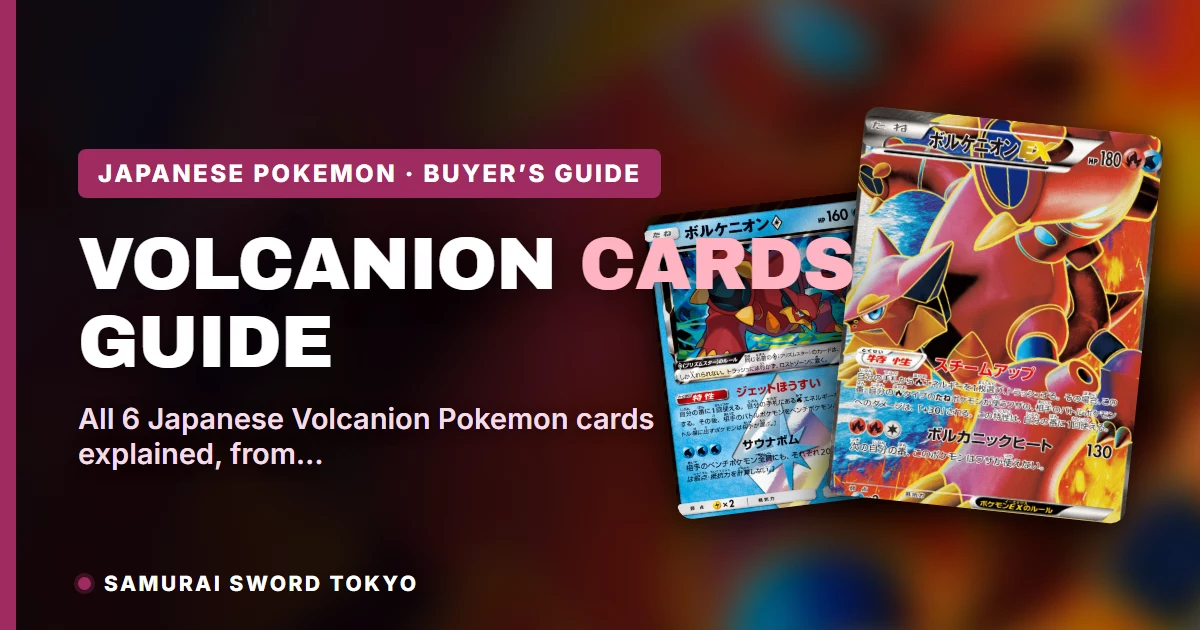
Volcanion is a dual-type Mythical Pokemon — Fire and Water in the same body — and this guide covers the six Japanese printings we’ve verified in detail, from its 2016 origin set through its most recent reprint in 2025.

That dual typing isn’t universal across the lineup, either. Only the original EX carries the Fire/Water combination — later prints settle into a single type each, which is one more detail worth checking before you assume every Volcanion card in a binder is the “same” card.

This guide walks through every Japanese Volcanion print we’ve verified: the 2016 original trio from Fever-Burst Fighter, the 2018 Prism Star from Forbidden Light, a 2016 concept-pack holo, and the 2025 SAR from Battle Partners. We ship Japanese sealed product and singles out of Tokyo every week, and our own graded stock — a PSA 10 copy of the original secret-rare print — anchors the pricing here. Other Japanese Volcanion appearances exist across later SM, S, and SV-block sets; this guide focuses on the six prints we’ve verified in detail.

Key Takeaway

This guide covers six Japanese Volcanion prints we’ve verified across four sets, from XY11b Fever-Burst Fighter (2016) to SV9 Battle Partners (2025). Our own stock is the PSA10 Volcanion EX SR 1ED [XY11-2 055/054], currently listed at ¥37,079 (~$227) — the secret-rare print from Volcanion’s original set.

6
Prints Covered

¥37,079
PSA10 SR 1ED Listed

2016–25
Years Covered

Fire·Water
Dual Typing (XY11b)

Prices reflect our own catalog as of August 2026, converted at ¥163/USD.

Every Japanese Volcanion Card and What We Know

Six prints we’ve verified, spanning four sets from 2016 to 2025:

카드 Number Rarity 세트 Year
Volcanion EX XY11b 055/054 SR Fever-Burst Fighter 2016
Volcanion EX XY11b 012/054 RR Fever-Burst Fighter 2016
Volcanion XY11b 011/054 R Fever-Burst Fighter 2016
Volcanion ◇ SM6 027/094 Prism Star Forbidden Light 2018
Volcanion CP5 #9 Concept pack Illusion, Legend, Dream 2016
Volcanion ex SV9 124/100 SAR Battle Partners 2025

Three of the six prints come out of the same 2016 set. That’s the starting point for identifying what you have — the SR, RR, and non-EX R from Fever-Burst Fighter are easy to mix up in a listing photo, and they sit at very different points in a collection. The other three — a Prism Star, a concept-pack holo, and a modern SAR — are each the only print of their kind we’ve verified in their respective set.

Lined up by HP, the six prints also trace an upward curve over time: 130 HP on the two 2016 non-EX cards, 160 HP on the 2018 Prism Star, and 180 HP on the original EX, before the 2025 SAR jumps to 220 HP. If you’re trying to place an unfamiliar Volcanion card by its stat line alone, HP is a reasonable rough guide to which era it came from.

The sections below break down each one.

The 2016 Original: XY11b Fever-Burst Fighter
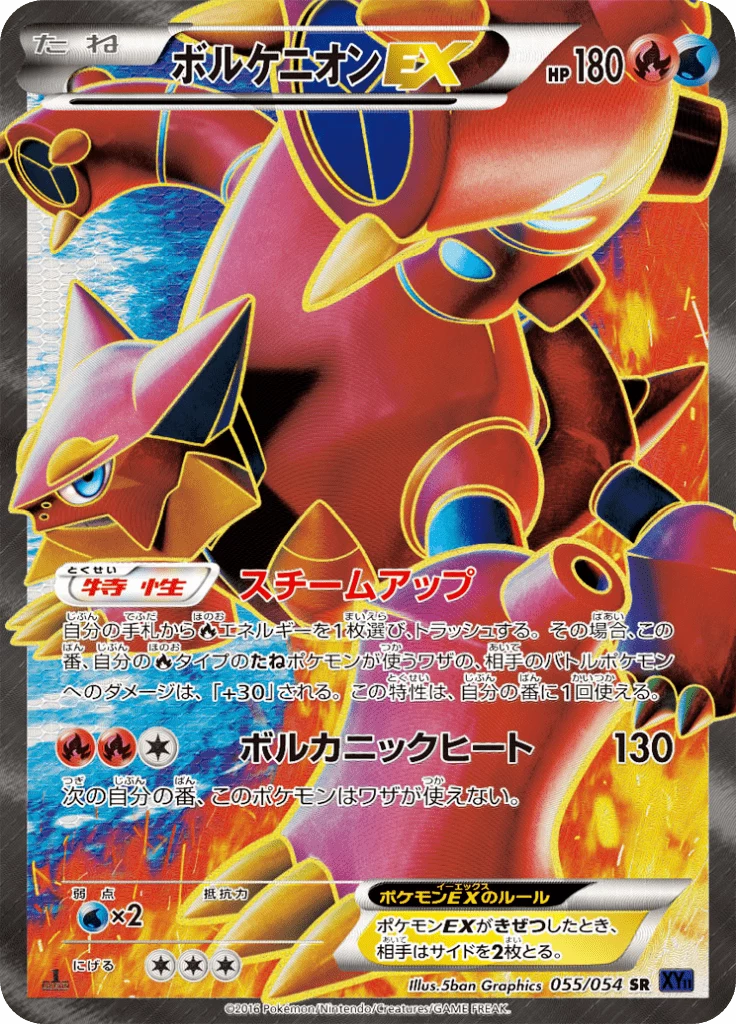
Volcanion EX SR, XY11b 055/054, Fever-Burst Fighter
Volcanion EX, XY11b 055/054, SR — the secret-rare print from Volcanion’s debut set, released June 17, 2016

Volcanion made its Japanese TCG debut in Fever-Burst Fighter (XY11b), an expansion pack released June 17, 2016. The Basic, dual Fire/Water-type card carries 180 HP, a water weakness, a retreat cost of 3, and a 130-damage attack that costs three energy (RRC). Illustration is credited to 5ban Graphics.

That same card exists at two rarity slots. The SR at 055/054 sits in the set’s secret-rare range — our own PSA10 1ED copy is this print. The RR at 012/054 is the standard-rarity version of the identical card: same HP, same 130-damage attack, same artwork treatment, just a different print run and number.

Check This First

Card number is the fastest way to tell the SR and RR apart — 055/054 vs. 012/054. Both are the same Volcanion EX with identical stats; the number in the corner is the only reliable identifier if the listing photo is small.

A third, separate card fills out the set: a non-EX Volcanion at 011/054, rarity R. It’s a lower-HP card (130), single Fire-type rather than the EX’s Fire/Water dual typing, with two attacks — a 1-energy move for 20 damage and a 3-energy move for 100 — and it’s illustrated by the same artist, 5ban Graphics, but it’s a distinct card rather than a rarity variant of the EX.

Fever-Burst Fighter sits at the tail end of the XY block, one of the last Japanese sets before the Sun & Moon era began. Volcanion isn’t the only secret rare EX we carry graded stock from that release — the same set produced a PSA10 M Steelix EX SR 1ED (057/054), currently listed at ¥61,800 (~$379), if you’re building out the set’s chase cards rather than Volcanion specifically. For the rest of the set’s chase cards, see our XY11 best cards guide, and for more on that period generally, our XY-era Japanese Pokemon guide covers the block as a whole.

Our own stock is the SR, and it carries a 1ED stamp — a first-print marking that collectors track separately from later reprints of the same card. Our Japanese 1st edition guide covers how to identify that stamp across different sets and eras.

Shop This Card
PSA10 Volcanion EX SR 1ED [XY11-2 055/054]
Currently listed at ¥37,079 (~$227)
Ships from Tokyo · Tracked delivery

View Product →

The 2018 Prism Star: Forbidden Light (SM6)
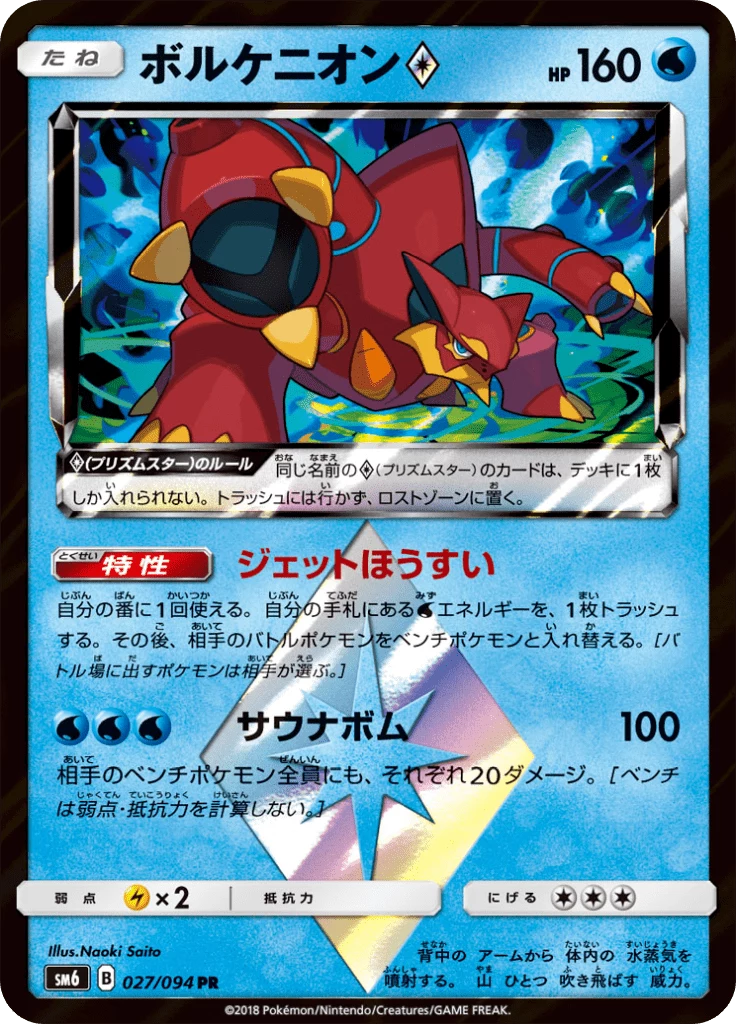
Volcanion, SM6 027/094, Prism Star, Forbidden Light
Volcanion ◇, SM6 027/094, Prism Star — released March 2, 2018, in a Water typing distinct from the 2016 originals

Forbidden Light (SM6), released March 2, 2018, gave Volcanion its Prism Star treatment. Card 027/094 is listed as “Volcanion ◇” in the card database, with the diamond symbol marking it as part of the Prism Star mechanic — and it’s a type change from the 2016 originals, switching to pure Water instead of the Fire/Water dual typing.

The card runs 160 HP with an ability, known in Japanese as ジェットしんすい, that lets you discard a Water energy from hand to swap the opponent’s Active Pokemon with one from their bench. Its attack, Sauna Bomb, costs three Water energy for 100 damage to the opponent’s Active plus 20 to each benched Pokemon. Illustration is by Naoki Saito.

The Prism Star mark — the diamond after the card name — is the fastest tell if you’re scanning a listing quickly, since it’s a distinct symbol printed on the card itself rather than something you’d need to infer from the set or number alone. Combined with the pure-Water typing, it’s the easiest of the six prints to separate from the rest of the lineup at a glance.

The 2016 Concept Pack: Illusion, Legend, Dream (CP5)
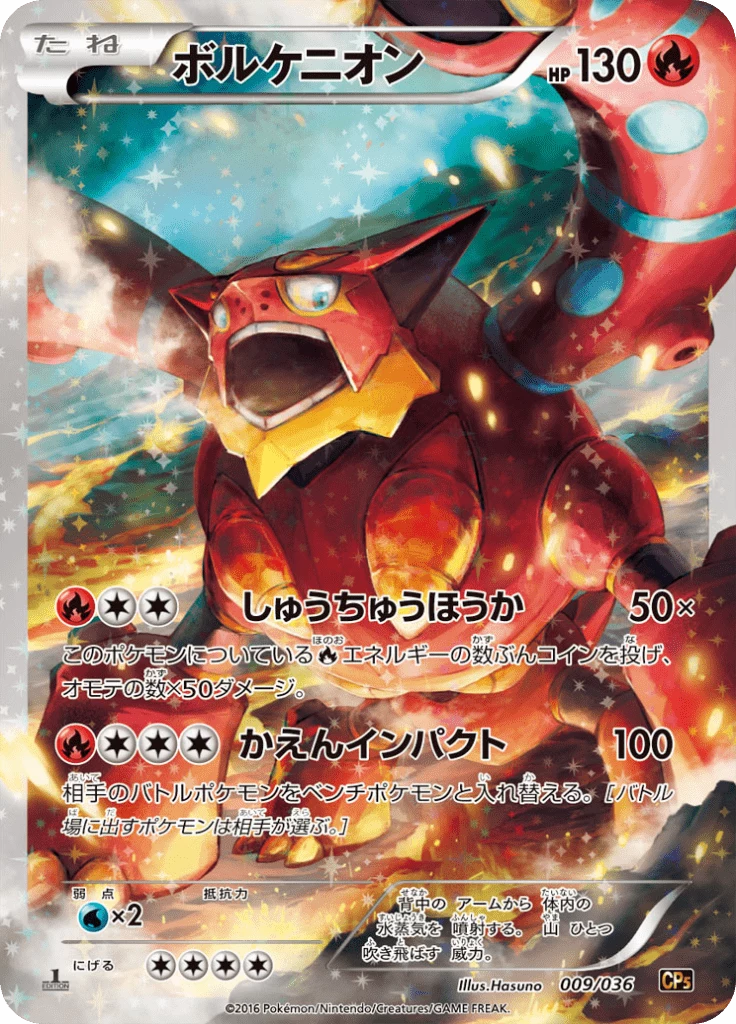
Volcanion, CP5 #9, Illusion Legend Dream Holo Collection
Volcanion, CP5 #9 — a holo-finish concept-pack print from July 16, 2016

A month after Fever-Burst Fighter, Volcanion appeared again in Illusion, Legend, Dream Holo Collection (CP5), a concept pack released July 16, 2016, built around Mythical and Legendary Pokemon in a kira (holo) finish. Volcanion is card #9 — a Fire-type card with 130 HP, a retreat cost of 4, and two attacks: one costing two colorless plus a Fire energy for a variable 50× damage, and a second costing three colorless plus a Fire energy for a flat 100. Illustration is credited to Hasuno.

Volcanion is one of the Mythical Pokemon in this pack’s lineup, alongside other Legendary and Mythical prints from the same release. Coming a month after the Fever-Burst Fighter debut, this is effectively the second Volcanion print in Japan — same Fire-heavy stat profile as the non-EX Fever-Burst Fighter card, but issued in the kira finish that concept packs of that era used to set their Legendary and Mythical lineup apart from a normal expansion’s card sheet. For more on how Mythical Pokemon cards are collected as a category, see our Celebi and Jirachi mythical Pokemon cards guide.

The 2025 Return: Volcanion ex SAR from Battle Partners (SV9)
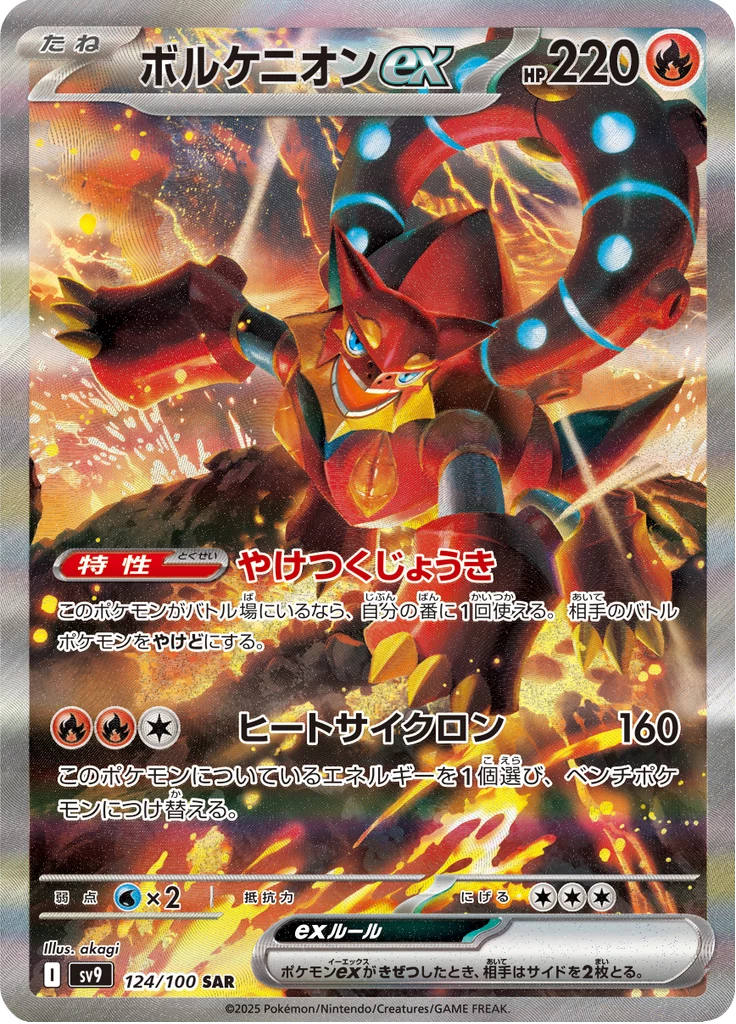
Volcanion ex, SV9 124/100, SAR, Battle Partners
Volcanion ex, SV9 124/100, SAR — the current-era print from Battle Partners, released January 24, 2025

Seven years after the Prism Star, the next print in this guide’s lineup, Volcanion returned in Battle Partners (SV9), released January 24, 2025. Card 124/100 is a Special Art Rare — a Basic Fire-type card at 220 HP, considerably bulkier than any of the 2016 or 2018 prints. Its ability burns the opponent’s Active Pokemon while Volcanion ex is in the Active spot, and its attack, Heat Cyclone, costs one Fire and two colorless energy for 160 damage plus an energy move between Pokemon. Illustration is by akagi.

It’s the newest and highest-HP Volcanion card confirmed to date, and the only current-generation print in this lineup. At 220 HP, it’s 40 more than the 2016 EX and 60 more than the 2018 Prism Star, continuing the upward HP trend visible across all six prints when they’re lined up by release year.

Where to Buy a Japanese Volcanion Card

We ship Japanese sealed product and singles worldwide from Tokyo with tracked delivery. Our current Volcanion stock is graded: a PSA10 copy of the original XY11b secret-rare print.

Shop This Card
PSA10 Volcanion EX SR 1ED [XY11-2 055/054]
Currently listed at ¥37,079 (~$227)
Ships from Tokyo · Tracked delivery

View Product →

For the wider graded lineup, our PSA 10 card list covers everything we currently carry in graded form — including the M Steelix EX SR from the same Fever-Burst Fighter set noted above, if you’re shopping that release rather than Volcanion specifically. Our Quick Order page is the fastest way to build a mixed order or ask about sourcing a specific Volcanion print we don’t currently list.

자주 묻는 질문

How many Japanese Volcanion Pokemon cards are there?

This guide covers six verified prints across four sets: the SR and RR versions of Volcanion EX plus a non-EX Volcanion from Fever-Burst Fighter (XY11b, 2016), a Prism Star from Forbidden Light (SM6, 2018), a concept-pack holo from Illusion, Legend, Dream (CP5, 2016), and a Special Art Rare Volcanion ex from Battle Partners (SV9, 2025). Other Japanese Volcanion appearances exist across later SM, S, and SV-block sets; three of the six prints covered here come from the same 2016 set, so card number is usually the fastest way to tell them apart.

What’s the difference between the Volcanion EX SR and RR prints from XY11b?

They’re the same card — 180 HP, Fire/Water typing, a 130-damage attack for three energy — printed at two different rarity slots. The SR sits at 055/054 in the set’s secret-rare range; the RR sits at 012/054. Card number is the fastest way to tell them apart in a photo.

Is the Forbidden Light Volcanion a Prism Star card?

Yes — it’s listed as “Volcanion ◇” in the card database, with the diamond symbol marking it as part of the Prism Star mechanic. It’s also a type change from the 2016 originals, switching to pure Water instead of Fire/Water.

Is Volcanion a Mythical Pokemon?

Yes. Its 2016 concept-pack print (CP5 #9) appeared in Illusion, Legend, Dream Holo Collection, a set built around Mythical and Legendary Pokemon in a holo finish.

Where can I buy a PSA 10 Volcanion Pokemon card?

We ship Japanese sealed product and singles worldwide from Tokyo with tracked delivery. Our current Volcanion stock is the PSA10 Volcanion EX SR 1ED [XY11-2 055/054], currently listed at ¥37,079 (~$227). Check our PSA 10 card list or use the Quick Order page for other prints, including sourcing requests for prints we don’t currently list.
Mizue Pokemon 카드 가이드

Mizue’s Pokemon TCG credit goes back to Call of Legends in 2011, and the name is still showing up on current Scarlet & Violet-era prints — Serebii’s Cardex carries the credit forward into the Delta Reign and 30th Celebration period, the most recent era reflected in that entry. That’s fifteen years of catalog on the record, spanning multiple TCG generations.

Serebii’s Cardex tallies 187 cards under Mizue’s credit, counting reprints, and Limitless TCG’s Japanese-language artist search independently returns 217 hits under the same name. This guide walks through what’s actually documented about that run — the 2011 origin point, the current sets, and the rarity range in between — using only what Limitless and Serebii show on the record. We ship Japanese sealed product out of Tokyo every week, so where a card’s set is available to us as sealed booster boxes, we’ve linked it below.

No verifiable biographical details are publicly documented for Mizue beyond this TCG credit history, so this guide covers documented card and career work only — no invented backstory, no assumed pronouns.

Key Takeaway

Mizue has been credited on Japanese Pokemon TCG prints since Call of Legends (2011) — 187 cards per Serebii’s Cardex (counting reprints), with 217 separate hits on Limitless TCG’s Japanese-language artist search. The most recent confirmed print in this guide is Musharna AR (SV11B 122/086) from Black Bolt, released 2025-06-06. We don’t carry single Mizue-credited cards in stock, but the sealed Black Bolt Booster Box is currently listed at ¥24,128〜, and singles requests run through 빠른 주문.

217
Limitless JP Artist-Search Hits

187
TCG Cards Illustrated (Serebii, incl. reprints)

2011
Debut Year (Call of Legends)

6
Notable Prints Verified in This Guide

Card and set details below are drawn from Limitless TCG’s individual card pages and Serebii’s artist Cardex, cited throughout. Sealed booster box prices reflect our own catalog as of August 2026, converted at ¥163/USD.

Who Is Mizue?

Mizue is a credited illustrator for the Pokemon Trading Card Game, per Serebii’s Cardex, with a documented run that begins with Call of Legends in 2011 and continues into current Scarlet & Violet-era sets. Limitless TCG’s artist search independently returns 217 hits under the “Mizue” credit on Japanese-language cards, and Serebii’s own tally — which counts reprints across a card’s full print history — puts the number at 187.

Those two figures measure overlapping but not identical things: Serebii’s 187 counts every printing a given illustration has appeared in, including reprints, while Limitless’s 217 reflects distinct Japanese-language card pages returned by an artist-name search. They describe the same body of work from two different angles rather than two different totals to be added together.

No publicly documented biographical information exists for Mizue beyond this credit history — no verifiable birth year, studio affiliation, or outside commission work turned up in either source. This guide sticks to what’s on the record: the cards themselves, and where they sit in the TCG’s print history.

That’s a deliberately narrower approach than some illustrator profiles can take. Where a source documents a birth year, a bibliography, or an outside art-world collaboration, that belongs in the record. Where it doesn’t, the honest version of the profile is the card catalog on its own — which, at 187 credited prints across fifteen years, is substantial enough to stand alone.

For readers comparing artists across our illustrator series, Mizue’s catalog sits alongside Kagemaru Himeno and Atsuko Nishida — both with dedicated guides covering their own most notable printings.

A Catalog That Starts With Call of Legends (2011)

Serebii’s Cardex lists Mizue’s earliest credited appearance in Call of Legends, the English-language set released in 2011 that featured Snubbull and Granbull among its early illustrated prints. From there, Serebii’s own record carries the credit forward continuously into the Delta Reign and 30th Celebration period, which is the most recent set era reflected in that same Cardex entry.

Reading the Two Counts Together

Serebii’s Cardex is the source for both the 2011 debut and the 2026 present-day range — a single continuous entry rather than two separate claims. Limitless TCG’s independent 217-hit artist search on Japanese-language cards corroborates that Mizue’s credit is active and substantial, without itself dating the earliest appearance.

Neither Serebii nor Limitless names every individual card from the 2011-era Call of Legends period beyond the set-level statement above, so this guide doesn’t attempt to list specific 2011 card numbers — the point that matters for collectors is the length of the run itself, not any single card from it.

What a 2011-to-current credit does tell you, in practical terms, is that Mizue’s work isn’t tied to one specific card generation or set family. A collector who only knows the Black Bolt-era prints below and one who only knows the original Call of Legends printing would both be looking at the same illustrator credit, fifteen years apart. That continuity is worth stating plainly rather than assuming, especially given how many Japanese TCG artist credits are tied to a single generation.

The Modern Catalog: Black Bolt and Beyond

Limitless TCG’s Japanese-language database confirms Mizue’s credit on a run of current-era prints, each verified on its own individual card page rather than a substring match on the artist search results.

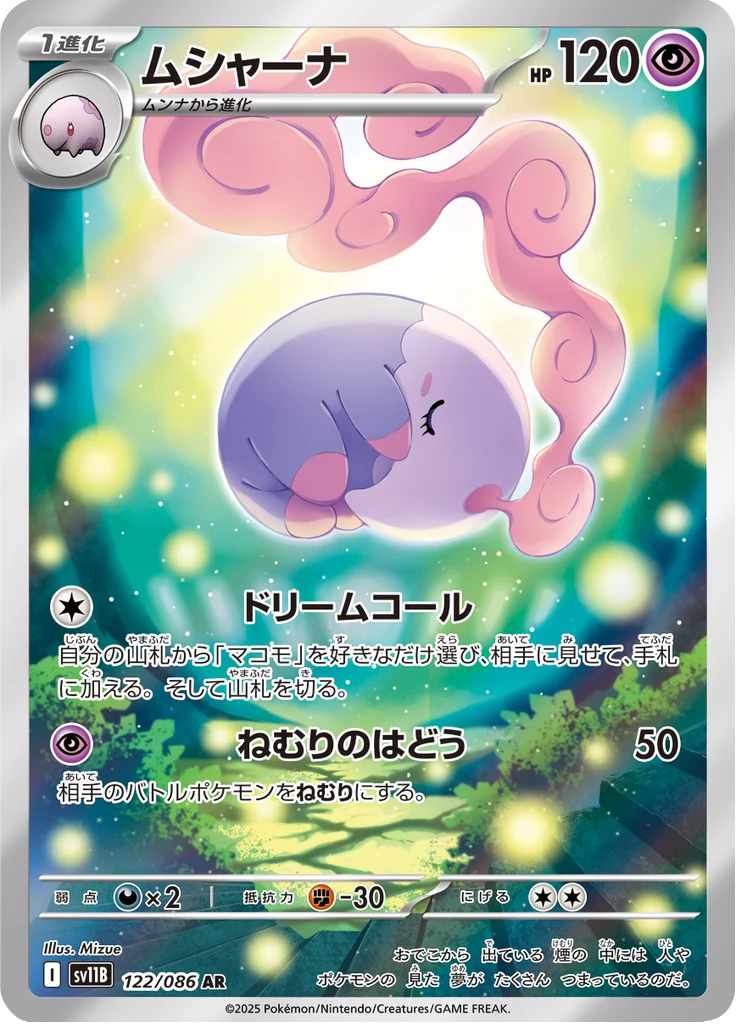
Musharna AR, SV11B 122/086, Black Bolt

Musharna AR, SV11B 122/086, Black Bolt

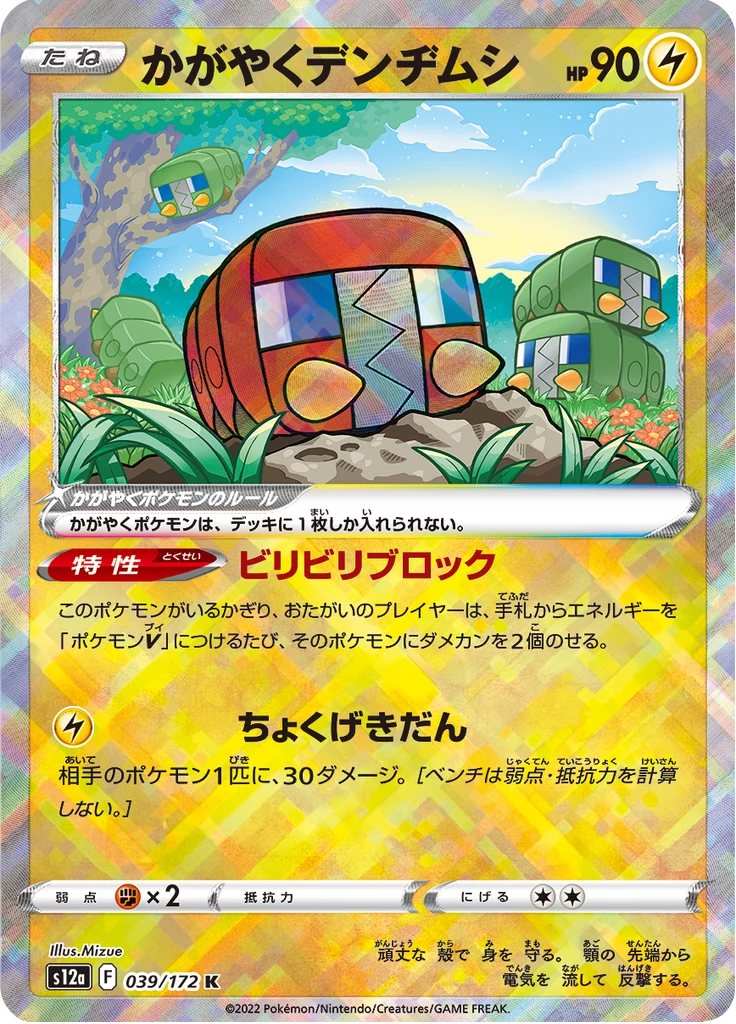
Radiant Charjabug Radiant Rare, S12a 39/172, VSTAR Universe

Radiant Charjabug Radiant Rare, S12a 39/172, VSTAR Universe

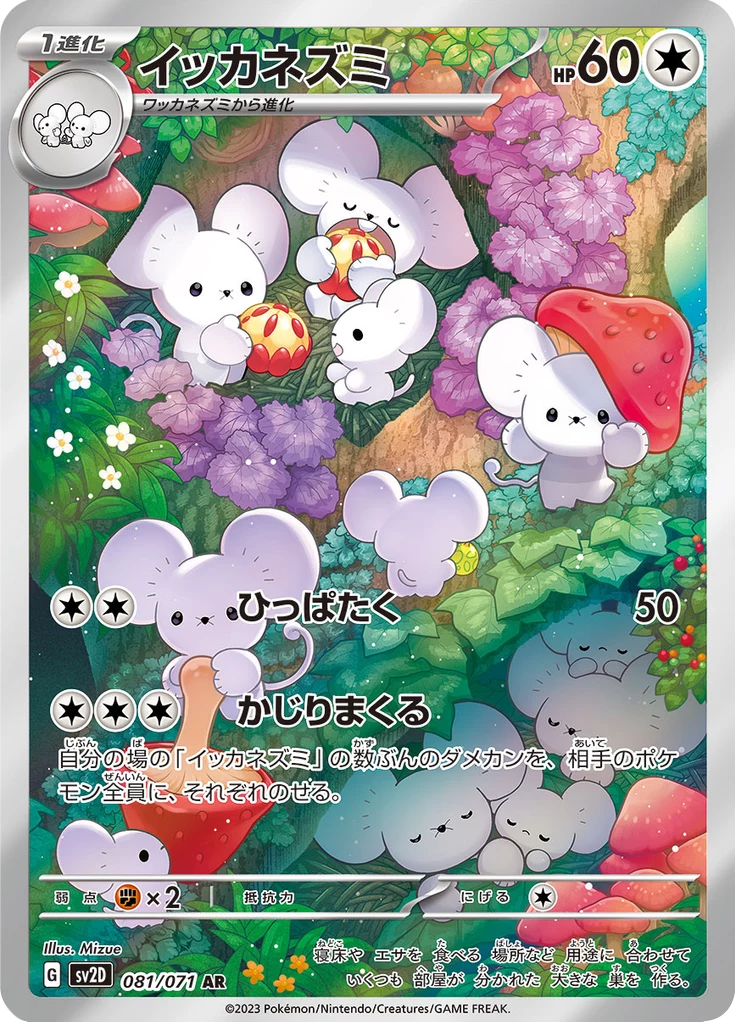
Maushold AR, SV2D #81, Clay Burst

Maushold AR, SV2D #81, Clay Burst

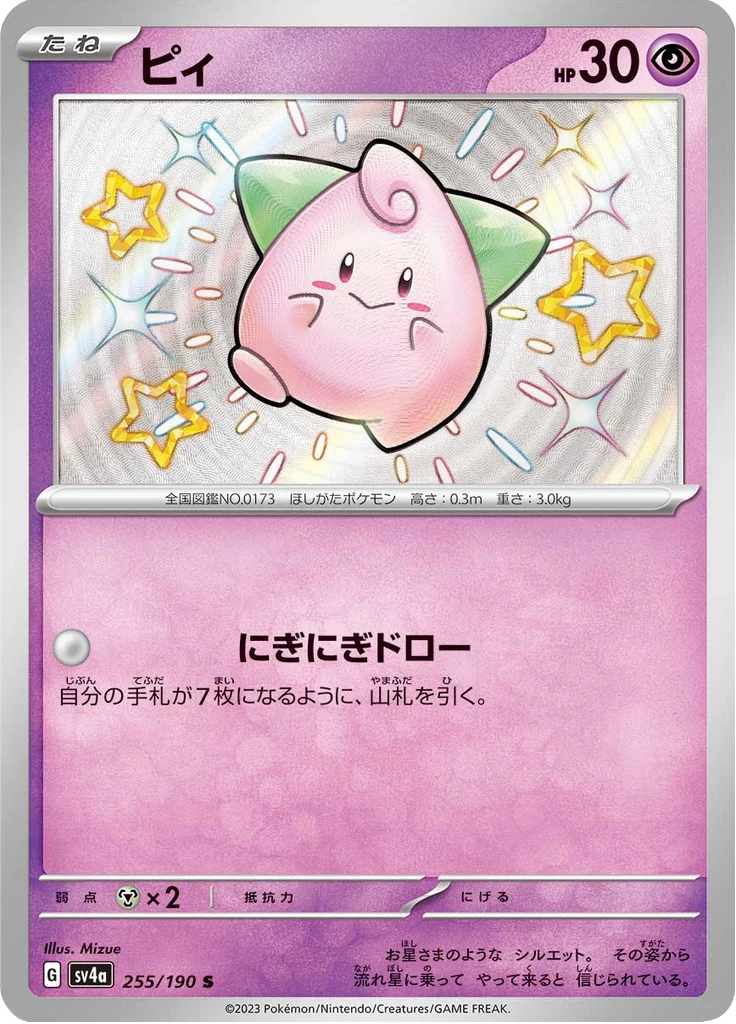
Cleffa Shiny Rare, SV4a 255/190, Shiny Treasure ex

Cleffa Shiny Rare, SV4a 255/190, Shiny Treasure ex

The Musharna AR from Black Bolt (SV11B 122/086, released 2025-06-06) is the most recent confirmed print in this catalog and anchors the current-era end of Mizue’s run. For the set that produced it, our Black Bolt set guide covers the rest of the lineup.

The Radiant Charjabug from VSTAR Universe (S12a 39/172, released 2022-12-02) carries the かがやく — Radiant Rare — treatment, a rarity tier the Japanese TCG used for its かがやく (Radiant) Pokemon prints. Readers tracking that specific rarity tier across multiple artists and sets can see our Radiant Pokemon cards guide.

Maushold (SV2D #81, Clay Burst, released 2023-04-14) is an AR print whose printed total we haven’t confirmed on a primary source, so this guide references it by card number only rather than a full “/total” figure. Cleffa (SV4a 255/190, Shiny Treasure ex, 2023-12-01) is a Shiny Rare print — the color-swapped treatment the Japanese TCG uses across multiple sets, confirmed on its own Limitless page.

카드 Set (JP code) Number Rarity Year
Musharna Black Bolt (SV11B) 122/086 AR 2025
Radiant Charjabug VSTAR Universe (S12a) 39/172 Radiant Rare 2022
Maushold Clay Burst (SV2D) #81 AR 2023
Cleffa Shiny Treasure ex (SV4a) 255/190 Shiny Rare 2023
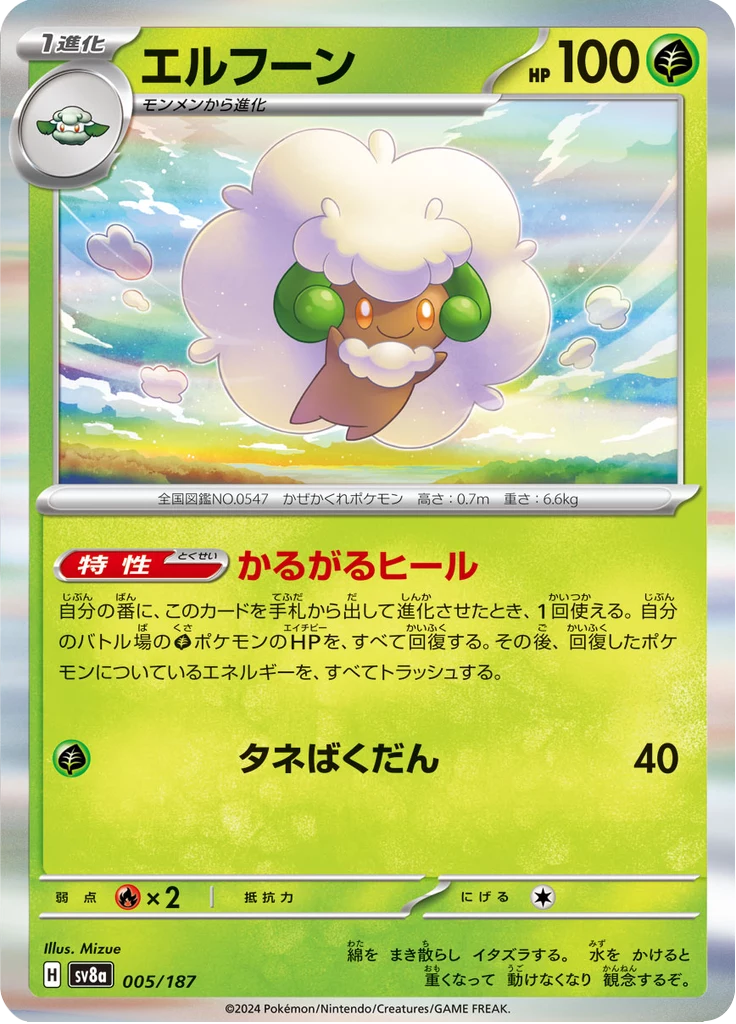
Whimsicott Terastal Festival ex (SV8a) 5/187 — 2024
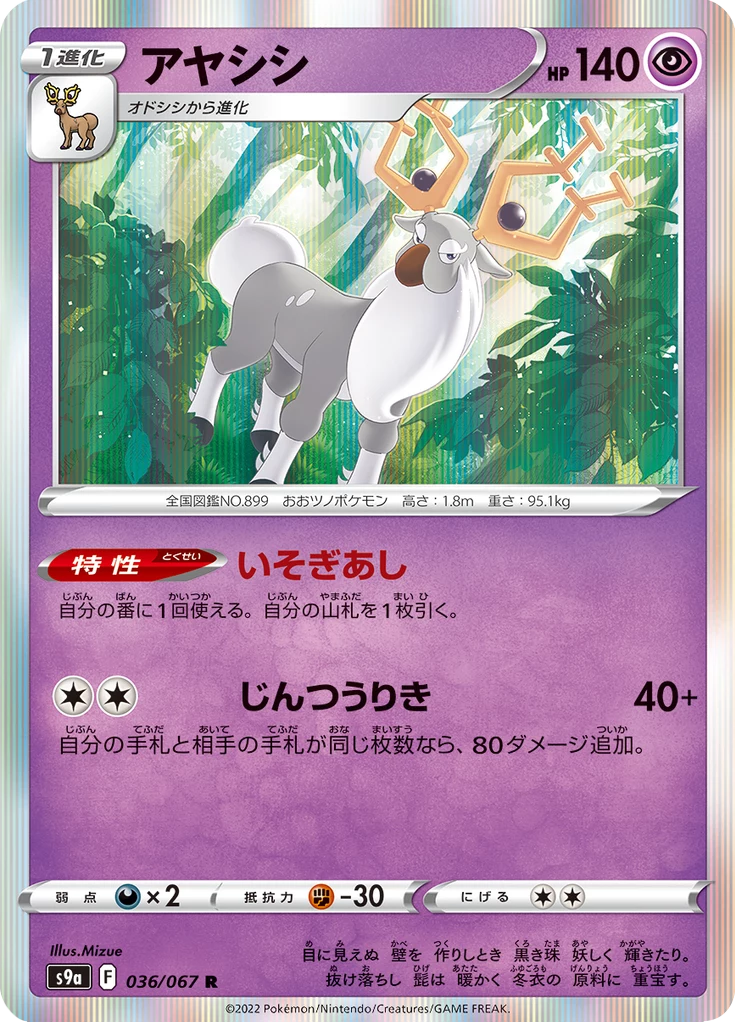
Wyrdeer Battle Region (S9a) #36 R 2022

If you’re following the current Scarlet & Violet-era side of this catalog specifically, our Clay Burst set guide and Shiny Treasure ex set guide cover the sets that produced the Maushold and Cleffa prints above.

From Radiant Rare to AR: The Rarity Range in Mizue’s Catalog

Whimsicott, SV8a 5/187, Terastal Festival ex

Whimsicott, SV8a 5/187, Terastal Festival ex

Wyrdeer R, S9a #36, Battle Region

Wyrdeer R, S9a #36, Battle Region

Whimsicott (SV8a 5/187, Terastal Festival ex, released 2024-12-06) carries no printed rarity code on its Limitless page — it sits in the high-class pack’s standard slot rather than a named rarity tier. For the set it comes from, our Terastal Festival ex set guide covers the rest of the pull lineup. Wyrdeer (S9a #36, Battle Region, released 2022-02-25) is a plain R print whose printed total we haven’t confirmed on a primary source, so it’s referenced here by card number only.

Reading the six confirmed cards together, Mizue’s documented catalog spans from a plain R print through Radiant Rare, Shiny Rare, and AR treatments — not concentrated in any single rarity tier. That spread is worth flagging for a specific reason: an illustrator credit on its own doesn’t predict rarity tier. The 2022 Battle Region R and the 2025 Black Bolt AR sit three years and two rarity tiers apart under the same name. If you’re building a collection around a specific illustrator rather than a specific set, the card number and set code on the physical card are still what determine which print — and which price range — you’re actually looking at.

Sourcing Mizue-Credited Cards Through Sealed Product

We checked Mizue’s Japanese-language card credits against our current catalog directly, and the result is a sourcing case rather than a stock case: we don’t hold graded or raw Mizue-credited singles in inventory as of this guide. What we do carry is sealed booster boxes for the sets that produced the cards above, which is the most direct route to opening one yourself.

Shop This Set
Black Bolt Booster Box (Japanese)
Currently listed at ¥24,128〜 — contains the Musharna AR print above
Ships from Tokyo · Tracked delivery

View Product →

For the other sets in this guide, sealed boxes are listed here:

If a specific Mizue-credited card from the table above is what brought you here rather than a full sealed box, the Quick Order page is the fastest way to flag a singles request. For a broader look at how graded versus raw copies compare once a specific card does turn up, our PSA 10 vs raw Japanese Pokemon cards guide walks through that decision.

Where to Buy Mizue Pokemon Cards from Japan

We ship Japanese sealed product worldwide out of Tokyo with tracked delivery. For Mizue’s catalog specifically, the Black Bolt box is the most current route, since it contains the newest confirmed print in this guide.

Shop This Set
Black Bolt Booster Box (Japanese)
Currently listed at ¥24,128〜
Ships from Tokyo · Tracked delivery

View Product →

Browse the full card list for other current-era Japanese stock, or use our Quick Order page to request a specific Mizue-credited single and build a mixed order of boxes and singles in one checkout.

자주 묻는 질문

Who is Mizue?

Mizue is a credited illustrator for the Pokemon Trading Card Game whose documented run begins with Call of Legends in 2011 and continues into the Delta Reign and 30th Celebration period, per Serebii’s Cardex. Serebii counts 187 cards under Mizue’s credit including reprints; Limitless TCG separately returns 217 hits on a Japanese-language artist search.

How long has Mizue been illustrating Pokemon cards?

At least since 2011, when Mizue’s earliest credited work appears in Call of Legends, per Serebii’s Cardex. That same source carries the credit forward continuously to the Delta Reign and 30th Celebration era — the most recent sets reflected in the entry.

What cards has Mizue illustrated recently?

Confirmed recent prints include Musharna AR (Black Bolt, SV11B 122/086, 2025), Maushold AR (Clay Burst, SV2D #81, 2023), and Cleffa Shiny Rare (Shiny Treasure ex, SV4a 255/190, 2023), each verified on its own Limitless TCG card page.

Is there a Radiant Rare or Shiny Rare Mizue card?

Yes. Radiant Charjabug (S12a 39/172, VSTAR Universe) is confirmed as a Radiant Rare print, and Cleffa (SV4a 255/190, Shiny Treasure ex) is a confirmed Shiny Rare print, both under Mizue’s credit.

Where can I buy Mizue Pokemon cards from Japan?

We don’t currently hold Mizue-credited singles in stock, but we ship sealed booster boxes for the sets that produced them — including the Black Bolt box, currently listed at ¥24,128〜. Use our Quick Order page to request a specific single, or browse the full card list for other current-era Japanese stock.

Fezandipiti Pokemon 카드 가이드: 일본판 프린트 전체

Fezandipiti has four Japanese printings covered in this guide — three of the ex, plus a separate non-ex card — since its 2024 debut, and the reprint that just landed in MEGA Dream ex is the one we currently carry graded. Same attack, same ability, three different pieces of art on the ex version alone — plus a completely separate, smaller non-ex card that gets confused with it more often than you’d expect.

This guide walks through the four printings we’ve verified in detail — the two Night Wanderer originals, the non-ex support print from Mask of Change, and the new MEGA Dream ex SAR — and tells you what card number and rarity you’re actually looking at, plus where Fezandipiti fits alongside the other two Loyal Three Pokemon that share its release history. We ship Japanese sealed product and singles out of Tokyo every week, and a graded copy of the MEGA Dream ex SAR is currently listed in our own catalog.

Key Takeaway

Fezandipiti ex has four Japanese printings covered in this guide across three sets: two from its Night Wanderer debut (RR and SAR), a non-ex AR support print from Mask of Change, and a new SAR from MEGA Dream ex. A PSA 10 MEGA Dream ex Fezandipiti ex SAR (M2a 244/193) is currently listed at ¥9,006, and other graded M2a SARs are also in stock, including Canari SAR at ¥15,808 and Surfer SAR at ¥7,601. Sealed M2a booster box availability can be checked through 빠른 주문.

4
Printings Covered

¥9,006
PSA 10 M2a Currently Listed

2024
TCG Debut (SV6a)

2025
Latest Reprint (M2a)

Stock and pricing reflect our own catalog as of August 2026, converted at ¥163/USD where noted.

Every Fezandipiti Printing at a Glance

Four verified printings across three sets are covered here: three of them share the same underlying ex card — a Darkness-type ex with one ability and one attack — reprinted under different art and rarity, plus one separate non-ex support print:

카드 Number Rarity 세트 Year
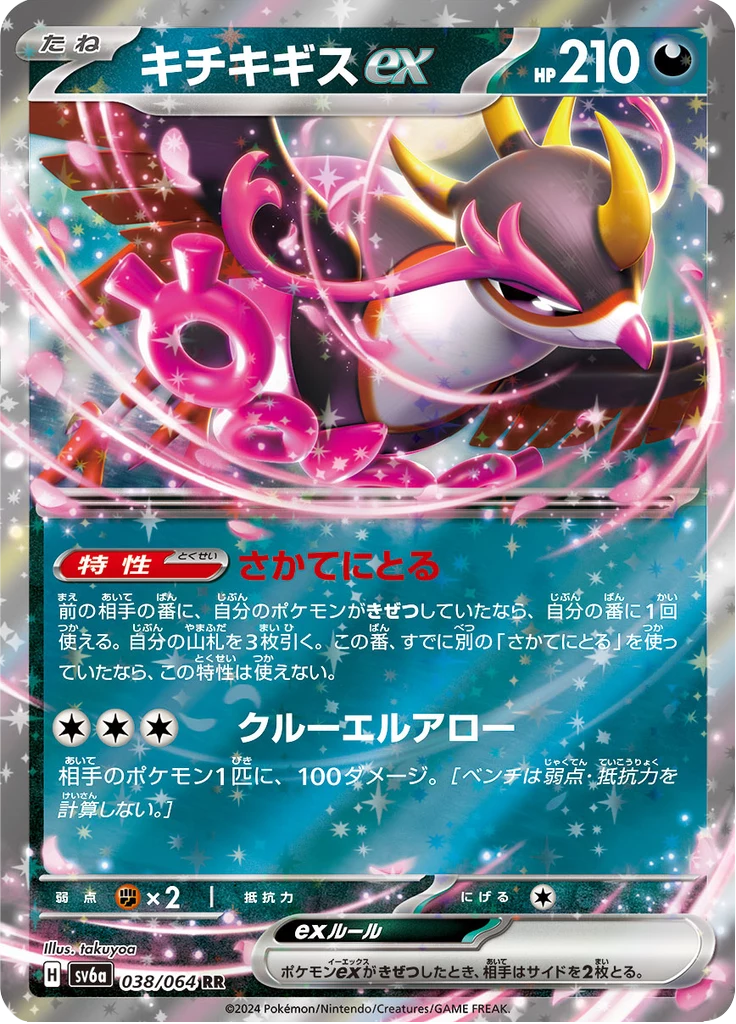
Fezandipiti ex SV6a 038/064 RR Night Wanderer 2024
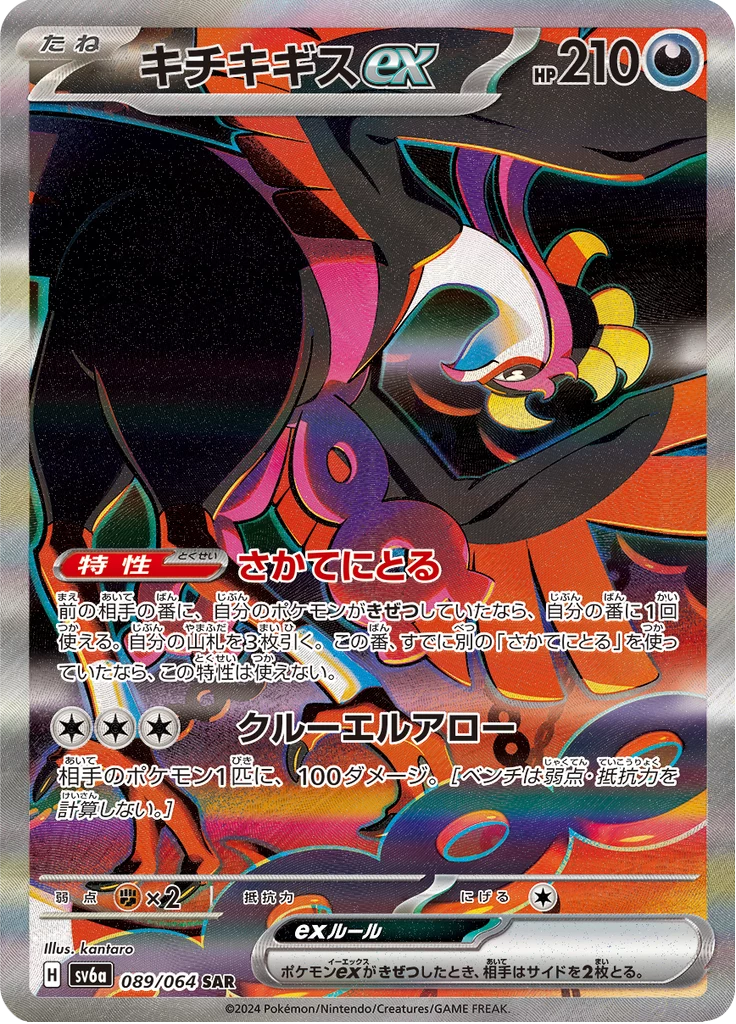
Fezandipiti ex SV6a 089/064 SAR Night Wanderer 2024
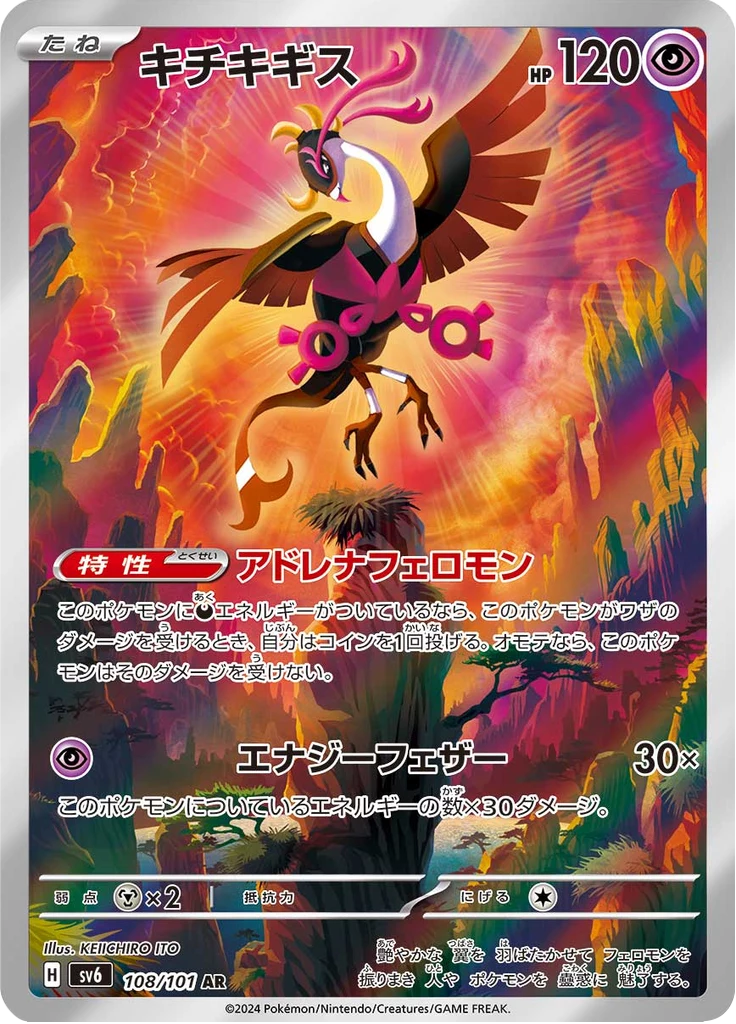
Fezandipiti SV6 108/101 AR Mask of Change 2024
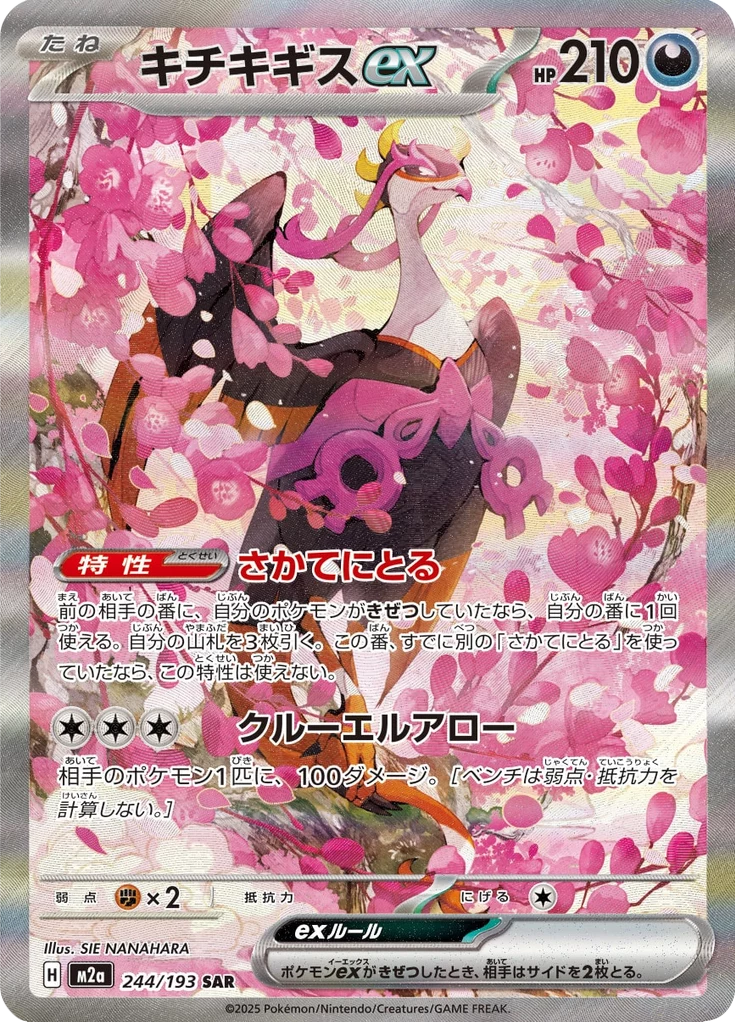
Fezandipiti ex M2a 244/193 SAR MEGA Dream ex 2025

The two Night Wanderer prints (RR and SAR) are the original release, both carrying the same ability and attack under different artwork. Mask of Change added a separate, lower-HP non-ex Fezandipiti a couple of months earlier. The MEGA Dream ex SAR is the most recent printing and the one we currently carry graded — a full breakdown of that set is in our M2a MEGA Dream ex complete guide.

Because the RR and both SARs share identical card text, the practical question for most buyers isn’t which one plays better — it’s which piece of art and which set you want on your shelf. The RR is the lowest-rarity of the three ex printings and the most straightforward way to own the card’s stats. Both SARs carry the alternate, full-art-style treatment typical of the rarity, just with different illustrators and different set numbering.

The Debut: Night Wanderer (SV6a)

Fezandipiti ex RR, SV6a 038/064, Night Wanderer

Fezandipiti ex, SV6a 038/064, RR

Fezandipiti ex SAR, SV6a 089/064, Night Wanderer

Fezandipiti ex, SV6a 089/064, SAR

Fezandipiti ex first appeared in Night Wanderer (SV6a), the strengthened expansion pack that released June 7, 2024 — the Japanese counterpart to the English-language Shrouded Fable set. Both the RR (038/064, art by takuyoa) and the SAR (089/064, art by kantaro) carry the same card text.

Fezandipiti ex is a Basic Darkness-type ex with 210 HP. Its ability, translated by Limitless as roughly “reverse advantage,” lets you draw three cards once per turn if one of your own Pokemon was Knocked Out during your opponent’s last turn. Its attack, Cruel Arrow, costs three Darkness Energy and does 100 damage to one of the opponent’s Pokemon — ignoring Weakness and Resistance if that target is on the Bench. Retreat cost is one Energy.

Check This First

The RR and the SAR use different illustrations but identical card text, so the fastest way to tell them apart is the card number in the corner — 038/064 for the RR, 089/064 for the SAR. Night Wanderer also printed an SR version of the same card at #081 (unverified).

The Reprint: MEGA Dream ex (M2a)

Fezandipiti ex SAR, M2a 244/193, MEGA Dream ex

MEGA Dream ex (M2a), the high-class pack that released November 28, 2025, brought Fezandipiti ex back as a new SAR at 244/193, illustrated by SIE NANAHARA. The card text carries over unchanged from the Night Wanderer originals — same ability, same Cruel Arrow attack, same 210 HP — so this is a straight reprint of the Shrouded Fable-era card under new art rather than a new version.

A graded copy of this exact print — PSA 10 Fezandipiti ex SAR (M2a 244/193), currently listed at ¥9,006 — sits comfortably inside our own roundup of PSA 10 Japanese cards under ¥10,000, and for a rundown of every chase card MEGA Dream ex produced, see our MEGA Dream ex best cards guide.

MEGA Dream ex is a high-class pack; Night Wanderer was an enhanced expansion pack.

The Support Print: Mask of Change (SV6)

Fezandipiti AR, SV6 108/101, Mask of Change

Mask of Change (SV6) — the Japanese counterpart to Twilight Masquerade, released April 26, 2024, about six weeks before Night Wanderer — carries a separate, non-ex Fezandipiti at Art Rare, illustrated by Keiichiro Ito. This is a smaller, support-oriented Basic Psychic-type card at 120 HP rather than the ex attacker covered above.

Its ability, which Limitless translates as roughly “Adrena-Pheromone,” has a coin-flip component: with a Darkness Energy attached, flipping heads prevents damage from an incoming attack. Its attack costs a single Energy and scales its damage with the number of Energy attached. A standard, non-AR version of the same card exists at #56 in the same set, though we haven’t independently verified its details.

Because this print shares the “Fezandipiti” name with the ex versions above but is a different Pokemon-type, HP total, and set, it’s worth checking the card number before assuming two listings are the same card. If a listing says SV6 108/101, you’re looking at this non-ex support print, not the Darkness-type ex from Night Wanderer or MEGA Dream ex.

Fezandipiti and the Loyal Three

In the games, Fezandipiti is one of three Loyal Three Pokemon introduced in the Kitakami storyline, alongside Okidogi and Munkidori. Night Wanderer printed all three as a matched ex-plus-SAR set — Okidogi ex at #036 (SAR #087) and Munkidori ex at #037 (SAR #088) sit right next to Fezandipiti ex (#038, SAR #089) in the set’s numbering — and the trio kept appearing together across the sets that followed.

세트 Okidogi Munkidori Fezandipiti
Mask of Change (SV6) non-ex non-ex non-ex, #108/101 AR
Night Wanderer (SV6a) ex #036 / SAR #087 ex #037 / SAR #088 ex #038 / SAR #089
Terastal Festival ex (SV8a) #090 / #102 #075 / #103 ex #076 / #104
MEGA Dream ex (M2a) numbering unconfirmed numbering unconfirmed ex, SAR #244/193

We haven’t independently verified the ability and attack text for Okidogi or Munkidori, so we won’t detail their card text here. The “Loyal Three” name itself comes from the games rather than being printed on the cards, but the trio has appeared together in every one of these sets.

Chasing Fezandipiti and Graded MEGA Dream ex Singles

The MEGA Dream ex SAR is the print currently listed in our own graded catalog, and it’s the direct single-card route to Fezandipiti right now.

Shop This Card
PSA 10 Fezandipiti ex SAR (M2a 244/193)
Currently listed at ¥9,006 (~$55)
Ships from Tokyo · Tracked delivery

View Product →

We also carry other graded SARs from the same set, including PSA 10 Team Rocket’s Mewtwo ex SAR (M2a 237/193), currently listed at ¥33,449 and PSA 10 Iris’s Fighting Spirit SAR (M2a 247/193), currently listed at ¥9,888. Sealed M2a MEGA Dream ex booster boxes are currently out of stock in our catalog — check current availability through 빠른 주문.

Where to Buy Japanese Fezandipiti Cards

We ship Japanese sealed product and singles worldwide from Tokyo with tracked delivery. For Fezandipiti specifically, our graded MEGA Dream ex SAR is the most direct single-card buy. Sealed M2a booster boxes are currently out of stock — use 빠른 주문 to check availability or request sourcing.

Check current graded stock via our Fezandipiti ex SAR listing, or use our Quick Order page to build a mixed order of boxes and singles in one checkout. For other current-era Japanese pulls, see our Ogerpon cards guide, our M2a MEGA Dream ex complete guide, or our PSA 10 cards under ¥10,000 roundup.

자주 묻는 질문

What is Fezandipiti ex in the Japanese Pokemon TCG?

Fezandipiti ex is a Basic Darkness-type ex Pokemon card with 210 HP, an ability that draws three cards once per turn if one of your own Pokemon was Knocked Out during your opponent’s last turn, and an attack, Cruel Arrow, that does 100 damage to one of the opponent’s Pokemon for three Darkness Energy. It first appeared in Night Wanderer (SV6a) in 2024 and was reprinted in MEGA Dream ex (M2a) in 2025.

What’s the difference between the Night Wanderer and MEGA Dream ex Fezandipiti SARs?

Both are printed at SAR rarity with identical card text — the difference is the artwork and card number. The Night Wanderer SAR is SV6a 089/064 (illustrated by kantaro); the MEGA Dream ex SAR is M2a 244/193 (illustrated by SIE NANAHARA).

Is the non-ex Fezandipiti from Mask of Change the same card as Fezandipiti ex?

No. The Mask of Change print (SV6 108/101, AR) is a separate, smaller Basic Psychic-type card at 120 HP with its own ability and attack, distinct from the Darkness-type ex covered in the Night Wanderer and MEGA Dream ex printings.

Who are the other Loyal Three Pokemon printed alongside Fezandipiti?

Okidogi and Munkidori. All three were released as a matched ex trio starting with Night Wanderer (SV6a), and non-ex versions of all three also appear in Mask of Change (SV6). The trio has continued to appear together across Terastal Festival ex (SV8a) and MEGA Dream ex (M2a).

Where can I buy a Japanese Fezandipiti card?

We ship Japanese sealed product and singles worldwide from Tokyo. A PSA 10 MEGA Dream ex Fezandipiti ex SAR is currently listed at ¥9,006. Sealed M2a booster boxes are currently out of stock — use our Quick Order page to check availability or request sourcing.

Kyoko Umemoto Pokemon 카드 가이드

Kyoko Umemoto’s Pokemon TCG credit stretches back to the Japanese VS series in 2001, and it hasn’t stopped — Serebii’s Cardex still lists Umemoto’s work through the White Flare, Black Bolt, and Destined Rivals period. That’s a credited run that predates most of the set codes collectors use today.

Serebii’s Cardex tallies 179 cards under Umemoto’s credit, counting reprints, and the Limitless TCG database independently returns 177 hits on a Japanese-language artist search for the same name. This guide walks through what’s actually documented about that run — the 2001 origin point, the current Scarlet & Violet-era prints, and the rarity range in between — using only what Limitless and Serebii show on the record. We ship Japanese sealed product out of Tokyo every week, so where a card’s set is available to us as sealed booster boxes, we’ve linked it below.

No verifiable biographical details are publicly documented for Kyoko Umemoto beyond this TCG credit history, so this guide covers documented card and career work only — no invented backstory, no assumed pronouns.

Key Takeaway

Kyoko Umemoto has been credited on Japanese Pokemon TCG prints since the 2001 VS series — 179 cards per Serebii’s Cardex (counting reprints), with 177 separate hits on Limitless TCG’s Japanese-language artist search. The most recent confirmed print in this guide is Zweilous AR (SV11W 143/086) from White Flare, released 2025-06-06. We don’t carry single Umemoto-credited cards in stock, but the sealed White Flare Booster Box is currently listed at ¥20,800〜, and singles requests run through 빠른 주문.

179
TCG Cards Illustrated (Serebii, incl. reprints)

177
Limitless JP Artist-Search Hits

2001
Debut Year (VS Series)

6
Notable Prints Verified in This Guide

Card and set details below are drawn from Limitless TCG’s individual card pages and Serebii’s artist Cardex, cited throughout. Sealed booster box prices reflect our own catalog as of August 2026, converted at ¥163/USD.

Who Is Kyoko Umemoto?

Kyoko Umemoto is a credited illustrator for the Japanese Pokemon Trading Card Game, per Serebii’s Cardex, with a documented run that begins in the VS series (2001) and continues into current Scarlet & Violet-era sets. Limitless TCG’s artist search independently returns 177 hits under the “Kyoko Umemoto” credit on Japanese-language cards, and Serebii’s own tally — which counts reprints across the card’s full print history — puts the number at 179.

Those two figures measure overlapping but not identical things: Serebii’s 179 counts every printing a given illustration has appeared in, including reprints, while Limitless’s 177 reflects distinct Japanese-language card pages returned by an artist-name search. They describe the same body of work from two different angles rather than two different totals to be added together.

No publicly documented biographical information exists for Kyoko Umemoto beyond this credit history — no verifiable birth year, studio affiliation, or outside commission work turned up in either source. This guide sticks to what’s on the record: the cards themselves, and where they sit in the TCG’s print history.

That’s a deliberately narrower approach than some illustrator profiles can take. Where a source documents a birth year, a picture-book bibliography, or an outside art-world collaboration, that belongs in the record. Where it doesn’t, the honest version of the profile is the card catalog on its own — which, at 179 credited prints across 24 years, is substantial enough to stand alone.

For readers comparing artists across our illustrator series, Umemoto’s catalog sits alongside Naoyo Kimura and Mitsuhiro Arita — both with dedicated guides covering their own most notable printings.

A Credited Run That Starts in 2001

Serebii’s Cardex lists Umemoto’s earliest credited appearance in the Japanese VS series, which released in 2001 — placing the start of this credit near the beginning of the Japanese TCG’s modern print history. From there, Serebii’s own record carries the credit forward continuously into the White Flare, Black Bolt, and Destined Rivals period, which is the most recent set era reflected in that same Cardex entry.

A Source’s Own Framing

Serebii’s Cardex describes Umemoto as “one of the longest-serving artists” working in the Japanese Pokemon TCG — that characterization comes directly from Serebii’s own entry, not an editorial claim made independently here. Given the 2001-to-current span the same source documents, it’s a description the record supports.

Neither Serebii nor Limitless names which specific VS-series cards belong to Umemoto’s earliest credits beyond the set-level statement above, so this guide doesn’t attempt to list individual 2001-era card numbers — the point that matters for collectors is the length of the run itself, not any single card from it.

What a 2001-to-current credit does tell you, in practical terms, is that Umemoto’s work isn’t tied to one specific card generation or set family. A collector who only knows the White Flare-era prints below and one who only knows a much older VS-series card would both be looking at the same illustrator credit, decades apart. That continuity is unusual enough among Japanese TCG artist credits that it’s worth stating plainly rather than assuming.

The Modern Catalog: White Flare and Beyond

Limitless TCG’s Japanese-language database confirms Umemoto’s credit on a run of current-era prints, each verified on its own individual card page rather than a substring match on the artist search results.

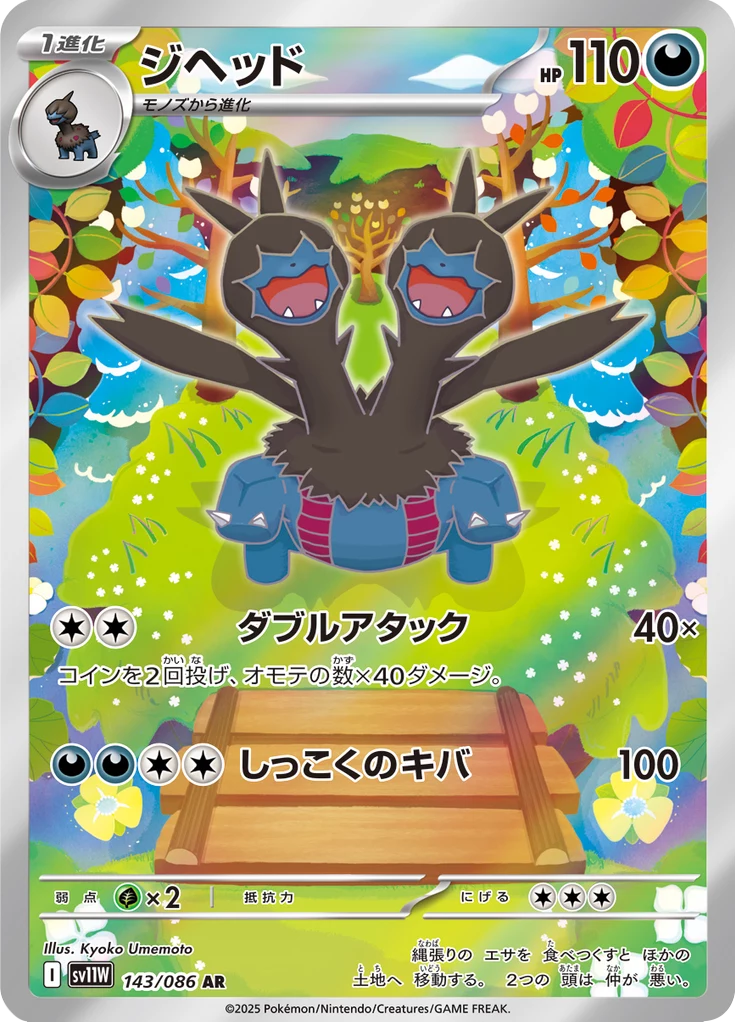
Zweilous AR, SV11W 143/086, White Flare

Zweilous AR, SV11W 143/086, White Flare

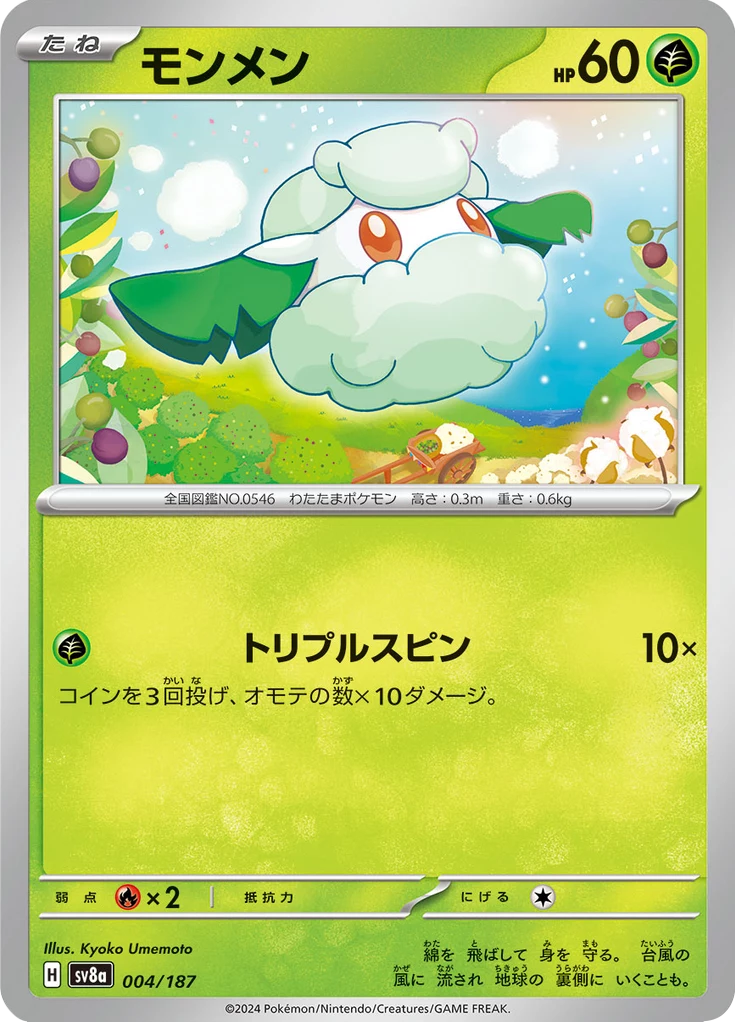
Cottonee, SV8a 4/187, Terastal Festival ex

Cottonee, SV8a 4/187, Terastal Festival ex

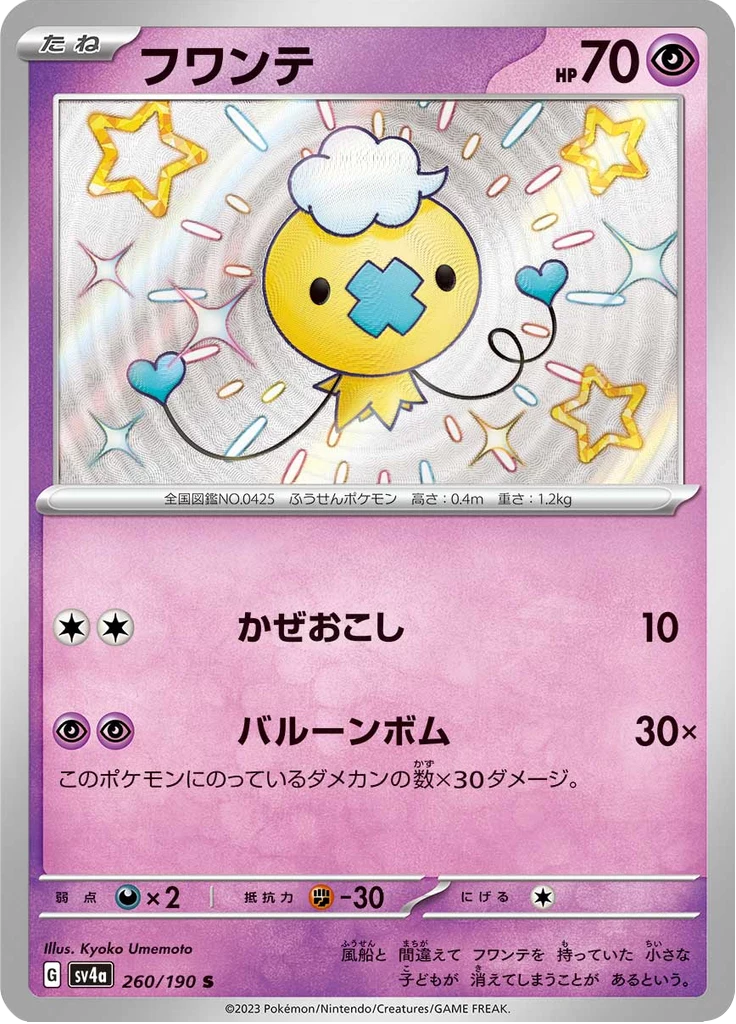
Drifloon Shiny Rare, SV4a 260/190, Shiny Treasure ex

Drifloon Shiny Rare, SV4a 260/190, Shiny Treasure ex

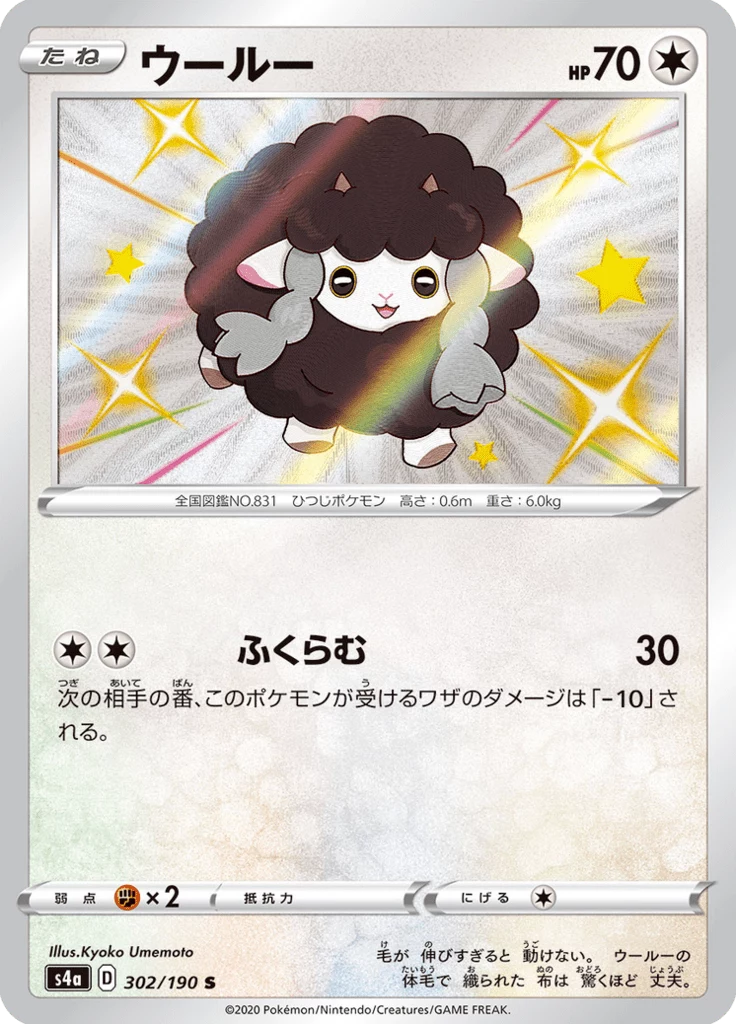
Wooloo Shiny Rare, S4a 302/190, Shiny Star V

Wooloo Shiny Rare, S4a 302/190, Shiny Star V

The Zweilous AR from White Flare (SV11W 143/086, released 2025-06-06) is the most recent confirmed print in this catalog and anchors the current-era end of Umemoto’s run. Cottonee from Terastal Festival ex (SV8a 4/187, released 2024-12-06) carries no printed rarity code — it sits in the set’s standard high-class-pack slot rather than a named rarity tier. Both Drifloon (SV4a 260/190, Shiny Treasure ex, 2023-12-01) and Wooloo (S4a 302/190, Shiny Star V, 2020-11-20) are Shiny Rare prints — the color-swapped treatment the Japanese TCG uses across multiple sets, confirmed on each card’s individual Limitless page.

Every card in this section and the table below was checked on its own Limitless TCG card page in addition to appearing in the artist search results, so the credit isn’t resting on a search-index match alone.

카드 Set (JP code) Number Rarity Year
Zweilous White Flare (SV11W) 143/086 AR 2025
Cottonee Terastal Festival ex (SV8a) 4/187 — 2024
Drifloon Shiny Treasure ex (SV4a) 260/190 Shiny Rare 2023
Wooloo Shiny Star V (S4a) 302/190 Shiny Rare 2020
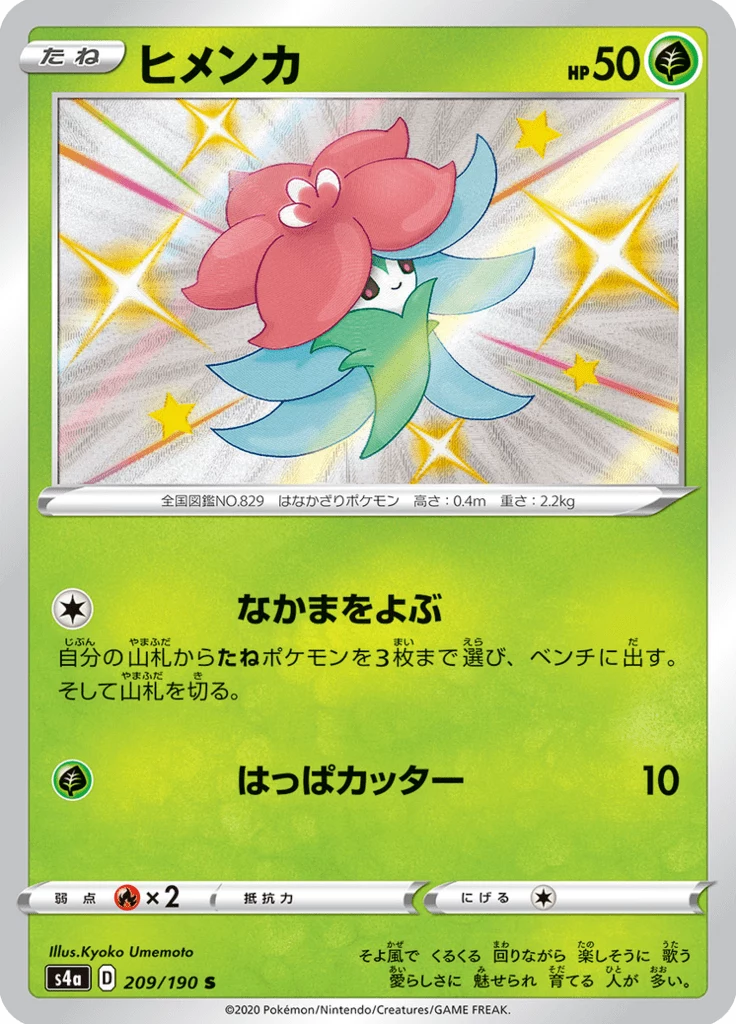
Gossifleur Shiny Star V (S4a) 209/190 Shiny Rare 2020
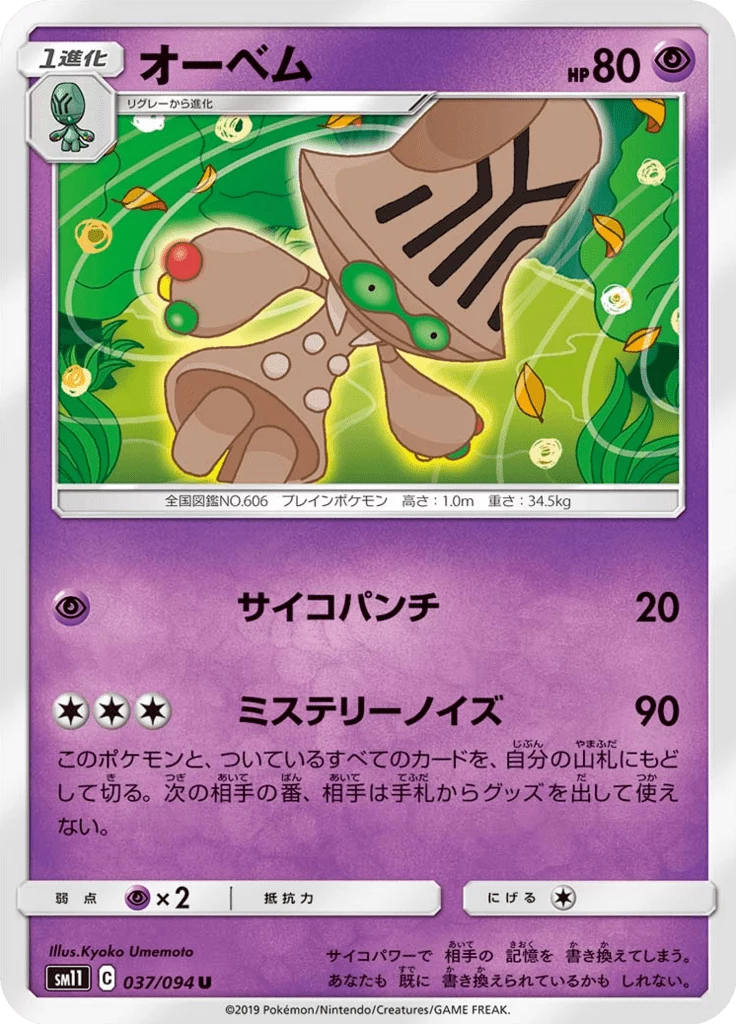
Beheeyem Miracle Twin (SM11) 37/094 U 2019

If you’re following the current Scarlet & Violet-era side of this catalog specifically, our White Flare set guide and Terastal Festival ex set guide cover the sets that produced the Zweilous and Cottonee prints above.

From Common to AR: The Rarity Range in Umemoto’s Catalog

Gossifleur Shiny Rare, S4a 209/190, Shiny Star V

Gossifleur Shiny Rare, S4a 209/190, Shiny Star V

Beheeyem U, SM11 37/094, Miracle Twin

Beheeyem U, SM11 37/094, Miracle Twin

Gossifleur (S4a 209/190, Shiny Star V, 2020-11-20) is the second Shiny Rare confirmed in this catalog from the same 2020 set as Wooloo above — both color-swapped prints released in the same Shiny Star V print run. Beheeyem (SM11 37/094, Miracle Twin, released 2019-05-31) sits at the opposite end of the rarity scale: a plain Uncommon print from the Sun & Moon era, and the oldest specifically-dated card confirmed in this guide.

Reading the six confirmed cards together, Umemoto’s documented catalog spans from an Uncommon common-slot print through Shiny Rare and AR treatments — not concentrated in any single rarity tier. For readers interested in the Shiny Rare finish specifically, our shiny and super-rare cards guide covers that finish across multiple sets and artists.

That spread is worth flagging for a specific reason: an illustrator credit on its own doesn’t predict rarity tier. Two Shiny Star V prints from the same 2020 set, on the same artist credit, land at the same rarity band — but the 2019 Miracle Twin Uncommon and the 2025 White Flare AR sit five years and two rarity tiers apart under that same name. If you’re building a collection around a specific illustrator rather than a specific set, the card number and set code on the physical card are still what determine which print — and which price range — you’re actually looking at.

Sourcing Umemoto-Credited Cards Through Sealed Product

We checked Umemoto’s Japanese-language card credits against our current catalog directly, and the result is a sourcing case rather than a stock case: we don’t hold graded or raw Umemoto-credited singles in inventory as of this guide. What we do carry is sealed booster boxes for the sets that produced the cards above, which is the most direct route to opening one yourself.

Shop This Set
White Flare Booster Box (Japanese)
Currently listed at ¥20,800〜 — contains the Zweilous AR print above
Ships from Tokyo · Tracked delivery

View Product →

For the other sets in this guide, sealed boxes are listed here:

If a specific Umemoto-credited card from the table above is what brought you here rather than a full sealed box, the Quick Order page is the fastest way to flag a singles request. For a broader look at how graded versus raw copies compare once a specific card does turn up, our PSA 10 vs raw Japanese Pokemon cards guide walks through that decision.

Where to Buy Kyoko Umemoto Cards from Japan

We ship Japanese sealed product worldwide out of Tokyo with tracked delivery. For Umemoto’s catalog specifically, the White Flare box is the most current route, since it contains the newest confirmed print in this guide.

Shop This Set
White Flare Booster Box (Japanese)
Currently listed at ¥20,800〜
Ships from Tokyo · Tracked delivery

View Product →

Browse the full card list for other current-era Japanese stock, or use our Quick Order page to request a specific Umemoto-credited single and build a mixed order of boxes and singles in one checkout.

자주 묻는 질문

Who is Kyoko Umemoto?

Kyoko Umemoto is a credited illustrator for the Japanese Pokemon Trading Card Game whose documented run begins with the 2001 VS series and continues into the White Flare, Black Bolt, and Destined Rivals period, per Serebii’s Cardex. Serebii counts 179 cards under Umemoto’s credit including reprints; Limitless TCG separately returns 177 hits on a Japanese-language artist search.

How long has Kyoko Umemoto been illustrating Pokemon cards?

At least since 2001, when Umemoto’s earliest credited work appears in the Japanese VS series, per Serebii’s Cardex. That same source carries the credit forward continuously to the White Flare, Black Bolt, and Destined Rivals era — the most recent sets reflected in the entry — and describes Umemoto as “one of the longest-serving artists” in the Japanese TCG.

What cards has Kyoko Umemoto illustrated recently?

Confirmed recent prints include Zweilous AR (White Flare, SV11W 143/086, 2025), Cottonee (Terastal Festival ex, SV8a 4/187, 2024), and Drifloon Shiny Rare (Shiny Treasure ex, SV4a 260/190, 2023), each verified on its own Limitless TCG card page.

Is there a Shiny Rare Kyoko Umemoto card?

Yes. Drifloon (SV4a 260/190, Shiny Treasure ex), Wooloo (S4a 302/190, Shiny Star V), and Gossifleur (S4a 209/190, Shiny Star V) are all confirmed Shiny Rare prints under Umemoto’s credit.

Where can I buy Kyoko Umemoto Pokemon cards from Japan?

We don’t currently hold Umemoto-credited singles in stock, but we ship sealed booster boxes for the sets that produced them — including the White Flare box, currently listed at ¥20,800〜. Use our Quick Order page to request a specific single, or browse the full card list for other current-era Japanese stock.

Duraludon Pokemon 카드 가이드: 일본 프린트 전체

Two special-art versions of the same V/VMAX pairing, released in the same 67-card set, priced almost double one another. That is the shape of collecting Duraludon in Japanese, and it makes the “Skyscraping Perfection” lineup worth understanding card by card before you buy.

This guide walks through every Japanese Duraludon print worth knowing — the standard V and VMAX from S7D, their special-art chase versions, the later VMAX Climax character super rare, the 2020 Shiny Star V steel-type print, and the current-Standard reprint from Terastal Fest ex. It also covers what our own PSA 10 stock of the two S7D chase cards is currently listed at, since those are real numbers rather than estimates. We ship Japanese sealed product and graded singles out of Tokyo every week, and the pricing referenced throughout this guide reflects our own live catalog rather than a generic market estimate.

If you already know you’re after a specific print, the table in the next section is the fastest way to find it. If you’re new to Duraludon’s card history, the sections that follow walk through each set in release order, starting with the one that matters most.

Key Takeaway

Duraludon has eight notable Japanese prints across four sets, headlined by S7D “Skyscraping Perfection” (2021). Our own PSA 10 stock covers both S7D chase versions: the Duraludon V SR SA (076/067), currently listed at ¥12,153, and the Duraludon VMAX HR SA (083/067), currently listed at ¥22,660. For sealed product, our S7D Skyscraping Perfection Booster Box is currently listed at ¥17,850.

8
Printings Covered

¥22,660
Top In-Stock PSA 10

¥12,153
Entry PSA 10

2020–24
Years Covered

Prices shown are our own catalog listings as of August 2026, converted at ¥163/USD where noted.

Every Duraludon Card and Where It’s From

Eight prints across four Japanese sets, from a plain double rare to a pair of special-art chase cards released in the same expansion:

카드 Number Rarity 세트 Year Currently Listed
Duraludon V S7D 048/067 RR Skyscraping Perfection 2021 —
Duraludon VMAX S7D 049/067 RRR Skyscraping Perfection 2021 —
Duraludon V SR S7D 075/067 SR Skyscraping Perfection 2021 —
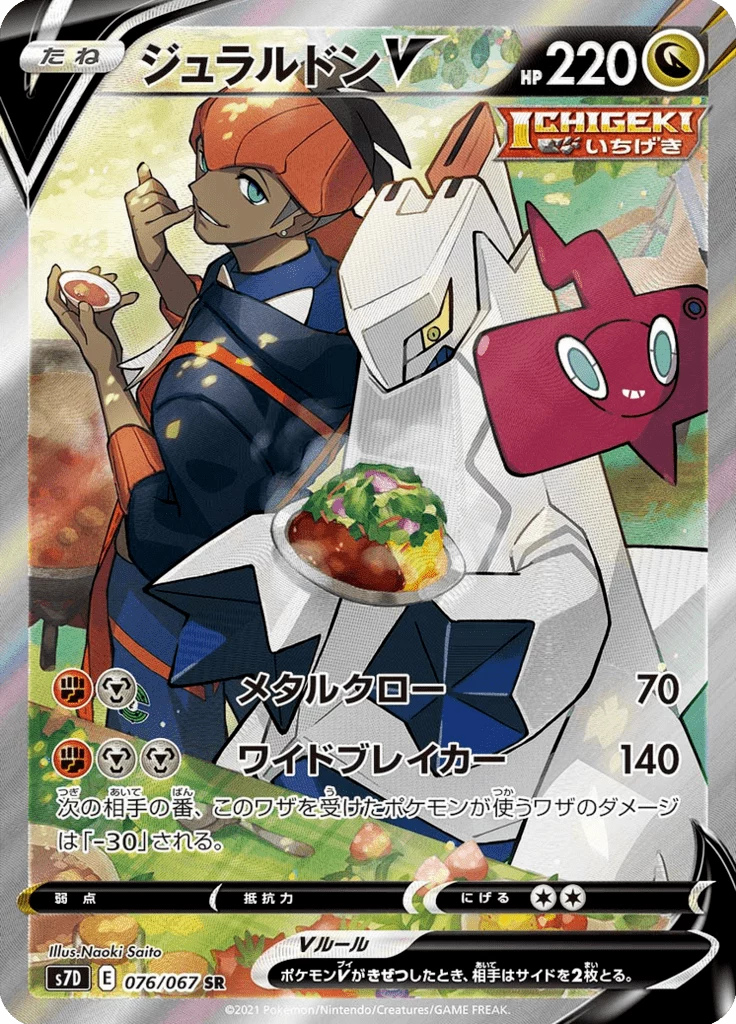
Duraludon V SR SA S7D 076/067 SR Skyscraping Perfection 2021 PSA 10, ¥12,153
Duraludon VMAX HR SA S7D 083/067 HR Skyscraping Perfection 2021 PSA 10, ¥22,660
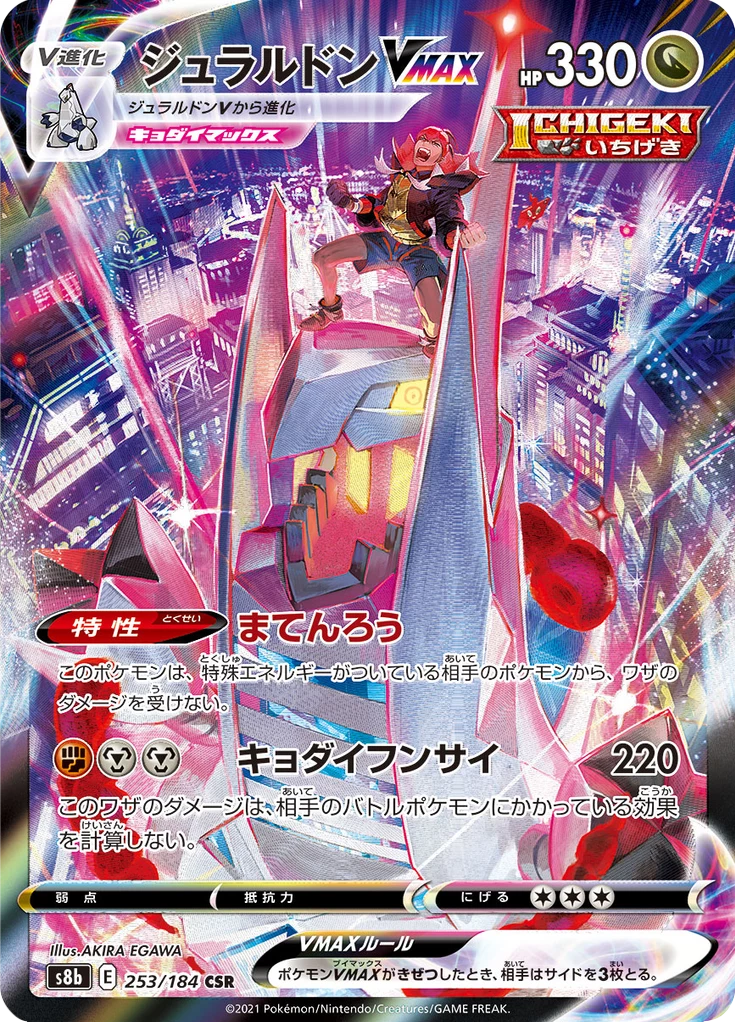
Duraludon VMAX CSR S8b 253/184 CSR VMAX Climax 2021 —
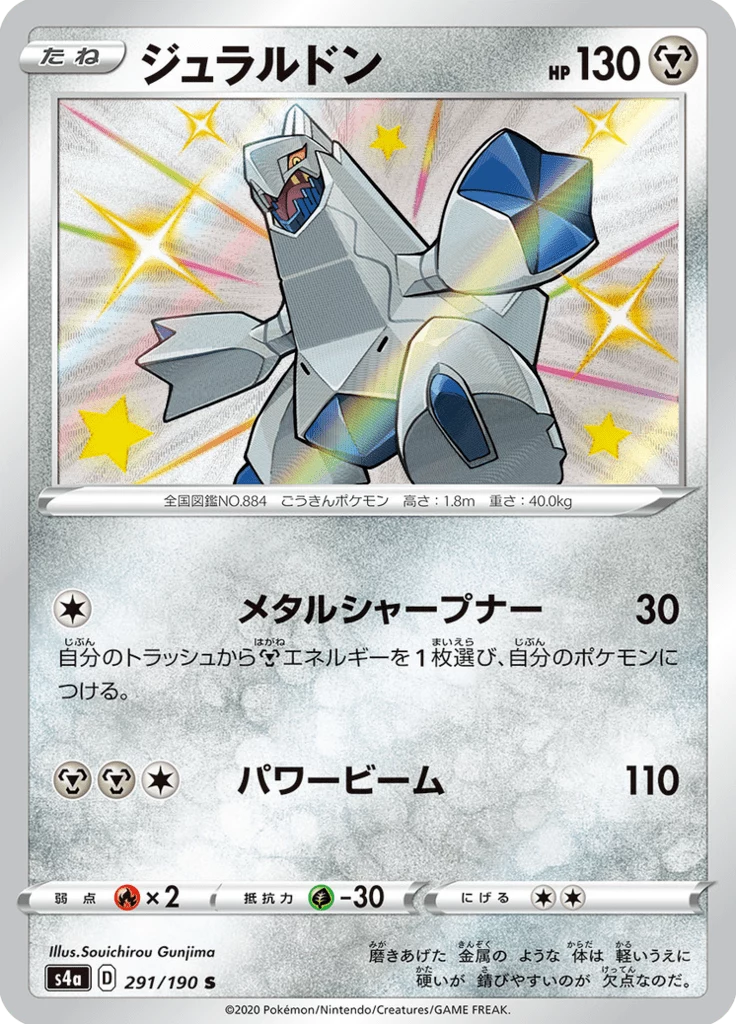
Duraludon (Shiny) S4a 291/190 S Shiny Star V 2020 —
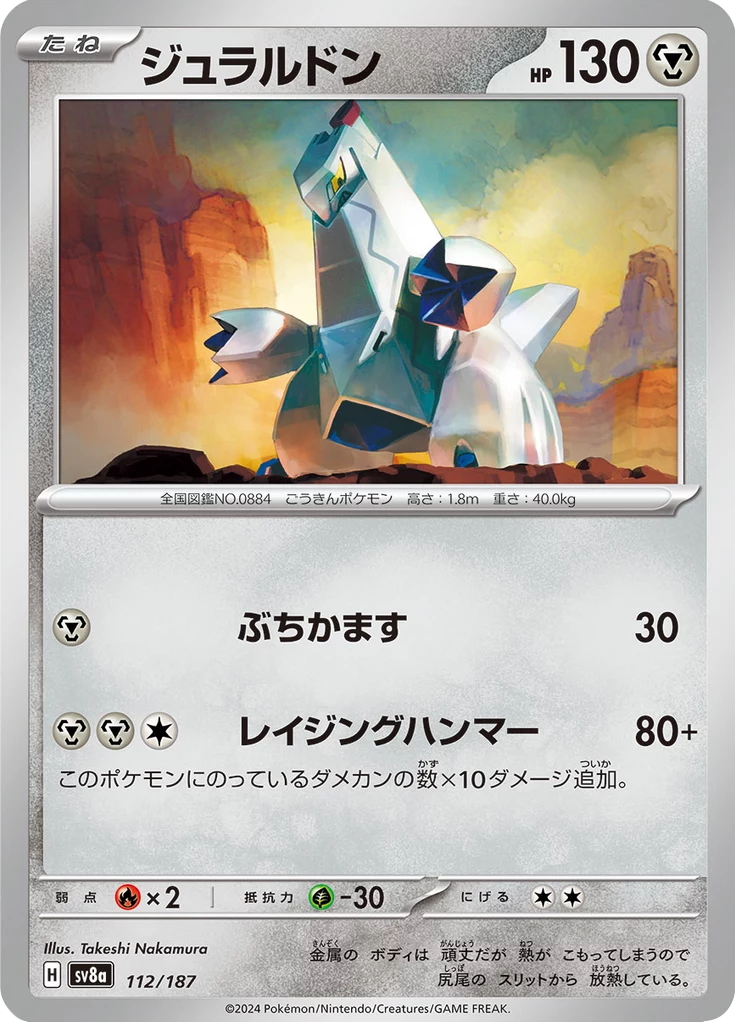
Duraludon SV8a 112/187 R Terastal Fest ex 2024 —

Two things stand out. First, five of the eight prints come from the same set — S7D “Skyscraping Perfection” is Duraludon’s headliner release, and it’s the only set to give the Pokemon a special-art version of both its V and VMAX forms. Second, the two prints we carry graded are both S7D chase versions, priced almost 90% apart from each other despite coming from the same 67-card expansion. The sections below break down what separates them.

The Headliner: Skyscraping Perfection (S7D)

S7D “Skyscraping Perfection” (摩天パーフェクト) released on July 9, 2021, with 79 cards counted in its Limitless listing against a stated set size of 67 — the gap made up of secret-rare slots, which is where both of Duraludon’s special-art prints live.

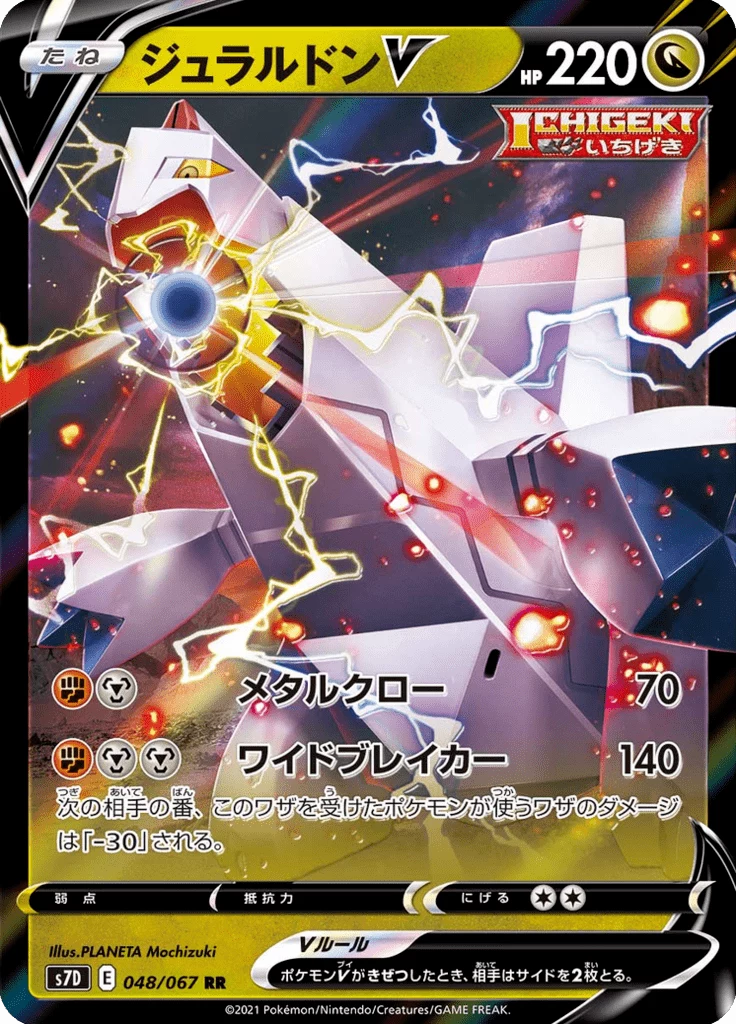
Duraludon V [S7D 048/067] RR (Skyscraping Perfection)

Duraludon V, S7D 048/067, RR

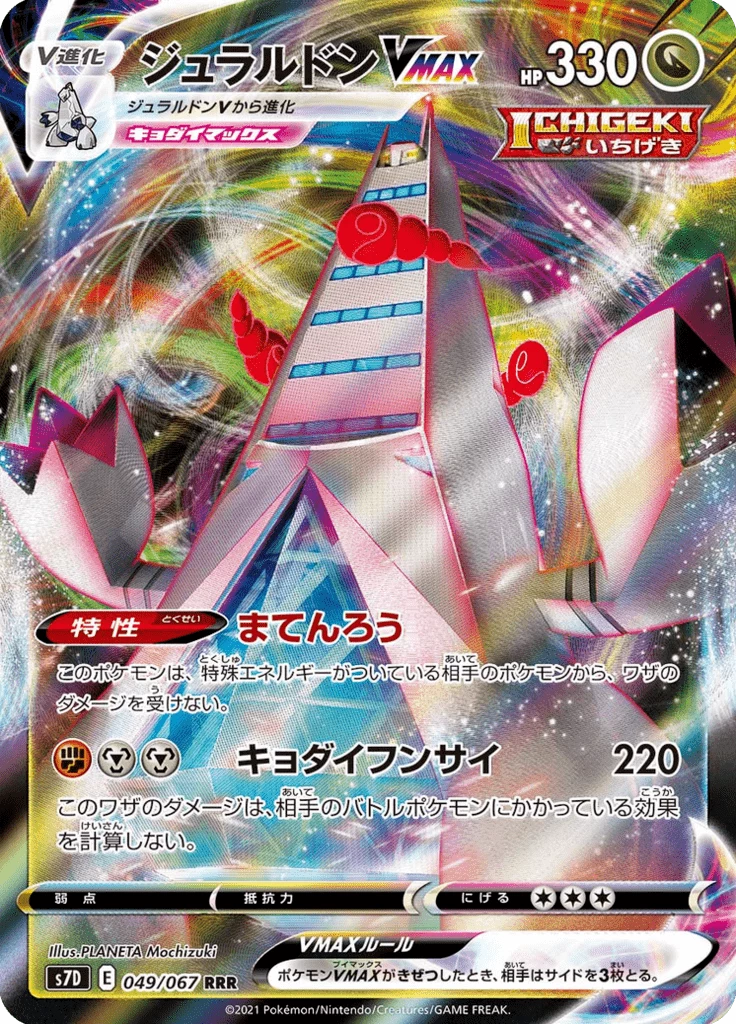
Duraludon VMAX [S7D 049/067] RRR (Skyscraping Perfection)

Duraludon VMAX, S7D 049/067, RRR

Duraludon V (048/067, RR) is a Dragon-type card with 220 HP and standard framing, illustrated by PLANETA Mochizuki. Its first attack, Metal Claw, hits for 70. Its second, Wide Breaker, hits for 140 and reduces the damage of the opponent’s next attack by 30.

Duraludon VMAX (049/067, RRR) steps up to 330 HP and carries no listed Weakness. It has an Ability that stops it from taking attack damage from any opposing Pokemon with a Special Energy attached, plus a heavy-hitting attack that does 220 damage while ignoring any effects placed on the Defending Pokemon.

Duraludon V SR (075/067) is a full-art version of the same V card — same stats, same PLANETA Mochizuki illustration style, just reframed at the SR rarity slot. Both this card and its base RR counterpart have listed English equivalents in Evolving Skies and Crown Zenith.

The base V, VMAX, and non-SA SR all share the same PLANETA Mochizuki illustration style. The V’s Special Art version in the next section is by a different artist (Naoki Saito); the HR SA’s illustrator isn’t listed in the databases we verified, which is part of what sets these two prints apart as this set’s chase versions rather than its playable ones.

Those four cards set the baseline. The two prints most collectors actually chase from this set — the special-art SR and HR versions — get their own section next, since we carry both of them graded.

The Two Chase Versions: SR SA vs HR SA

S7D didn’t stop at one special-art Duraludon. It gave both the V and the VMAX a second, alternate-illustration printing — and they sit at very different prices in our own graded stock.

Duraludon V SR SA [S7D 076/067] (Skyscraping Perfection)
Duraludon V, S7D 076/067, SR (Special Art) — illustrated by Naoki Saito, currently in our PSA 10 stock

Duraludon V SR SA (076/067) carries the same stat line as the base V — Metal Claw for 70, Wide Breaker for 140 — under a separate illustration credited to Naoki Saito. A graded PSA 10 copy is currently listed at ¥12,153 in our catalog.

Duraludon VMAX HR SA (083/067) carries the same 330 HP and attack line as the base VMAX, in the HR (Special Art) alternate-illustration slot. This particular print isn’t currently catalogued in Limitless TCG’s Japanese card database, but it turns up consistently across multiple secondary marketplaces under the same S7D 083/067 identifier, and its English equivalent — the Evolving Skies Duraludon VMAX Alternate Art Secret — is a confirmed listing on its own. A graded PSA 10 copy is currently listed at ¥22,660 in our catalog, nearly double the SR SA.

Both cards sit in the same secret-numbered tail of the set — 076 and 083 against a stated set size of 067 — which is where Japanese sets typically place their alternate-art chase prints, separate from the standard numbered run. Knowing that range is a quick way to spot a special-art card in a listing before checking the illustration itself.

Check This First

Both cards share the “SA” designation for their alternate illustration, but sit at different set-level rarity tiers — SR for the V, HR for the VMAX. For a broader rundown of how SR, SA, and HR labeling differs across Japanese sets, see our SA (Special Art) Japanese cards guide.

Beyond S7D: CSR, Shiny, and the Modern Reprint

S7D is where Duraludon peaked in card count, but it isn’t the only set worth knowing. Three other prints round out the character’s Japanese card history, spanning 2020 through 2024.

Duraludon VMAX CSR [S8b 253/184] (VMAX Climax)

Duraludon VMAX, S8b 253/184, CSR

Duraludon [S4a 291/190] S (Shiny Star V)

Duraludon, S4a 291/190, S

Duraludon [SV8a 112/187] (Terastal Fest ex)

Duraludon, SV8a 112/187

Duraludon VMAX CSR (S8b 253/184) comes from VMAX Climax, the high-class pack released December 3, 2021, illustrated by AKIRA EGAWA. Character Super Rare is the set’s dedicated character-focused chase tier, distinct from the RR/SR/HR ladder used in a mainline set like S7D, and it’s the only Duraludon print built specifically for that pack. It carries the same VMAX stat line as the S7D original under a new illustration.

Duraludon, Shiny (S4a 291/190) is the earliest print on this list, from Shiny Star V, released November 20, 2020, illustrated by Souichirou Gunjima. It’s one of the two Steel-type Duraludon cards in this lineup (with the SV8a reprint below) — 130 HP, an Ability that moves a discarded Metal Energy onto one of your Pokemon, and a Power Beam attack for 110. It’s also the only entry here without a V or VMAX suffix, and the only one that predates S7D by roughly eight months. For more on this generation’s chase cards, see our Sword & Shield era Japanese Pokemon guide.

Duraludon (SV8a 112/187) is the newest and only current-Standard-legal print, from Terastal Fest ex, released December 6, 2024, illustrated by Takeshi Nakamura. Steel-type, 130 HP, with a 30-damage attack and a second attack that does 80 damage, plus 10 for every damage counter already on it. Unlike the S7D and S8b prints above, this one sits at a standard non-secret rarity rather than a chase-tier slot, which makes it the most straightforward entry point if you just want a current-format copy rather than a graded collectible. Its English equivalents are Stellar Crown #106 and Prismatic Evolutions #69.

Chasing Duraludon Through Sealed S7D Boxes

Because both S7D chase versions — the V SR SA and the VMAX HR SA — come out of the same product, sealed Skyscraping Perfection booster boxes are the direct route if you want a shot at either alongside the rest of the set’s pulls.

Shop This Set
S7D Skyscraping Perfection Booster Box (Japanese)
Currently listed at ¥17,850
Ships from Tokyo · Tracked delivery

View Product →

If you’d rather see how the rest of the set’s chase cards stack up before buying sealed product, our Skyscraping Perfection best cards guide covers the wider set beyond Duraludon.

Where to Buy Japanese Duraludon Cards

We ship Japanese sealed product and graded singles worldwide from Tokyo with tracked delivery. For Duraludon specifically, we currently carry both S7D chase versions as graded PSA 10 singles, plus sealed S7D boxes for anyone chasing a copy directly from packs.

At ¥12,153, the V SR SA also fits inside the range covered by our PSA10 Japanese cards under ¥30,000 guide, if you’re comparing it against other graded singles in that price band. For anything else Duraludon-related, or to build a mixed order of boxes and singles in one checkout, our Quick Order page is the fastest route.

자주 묻는 질문

What is the most valuable Japanese Duraludon Pokemon card?

Among the prints we carry graded, the Duraludon VMAX HR SA (S7D 083/067) is the higher of the two, with a PSA 10 copy currently listed at ¥22,660 — nearly double the V SR SA (S7D 076/067) at ¥12,153.

What set has the most Duraludon Pokemon cards?

S7D “Skyscraping Perfection,” released July 9, 2021, is Duraludon’s headliner set. It includes five separate Duraludon prints: the base V and VMAX, a full-art SR of the V, plus special-art SR and HR versions.

What’s the difference between the SR SA and HR SA Duraludon prints?

Both are alternate-illustration “SA” versions from the same S7D set, but the V print sits at SR rarity (076/067) while the VMAX print sits at HR rarity (083/067). They carry the same in-game stats as their non-SA counterparts — the difference is illustration and set rarity slot, not the card’s attacks or HP.

Where can I buy Japanese Duraludon Pokemon cards?

We ship Japanese sealed product and graded singles worldwide from Tokyo. We currently carry PSA 10 copies of both S7D chase versions (¥12,153 and ¥22,660) as well as sealed S7D Skyscraping Perfection booster boxes at ¥17,850; other Duraludon prints can be sourced via our Quick Order page.

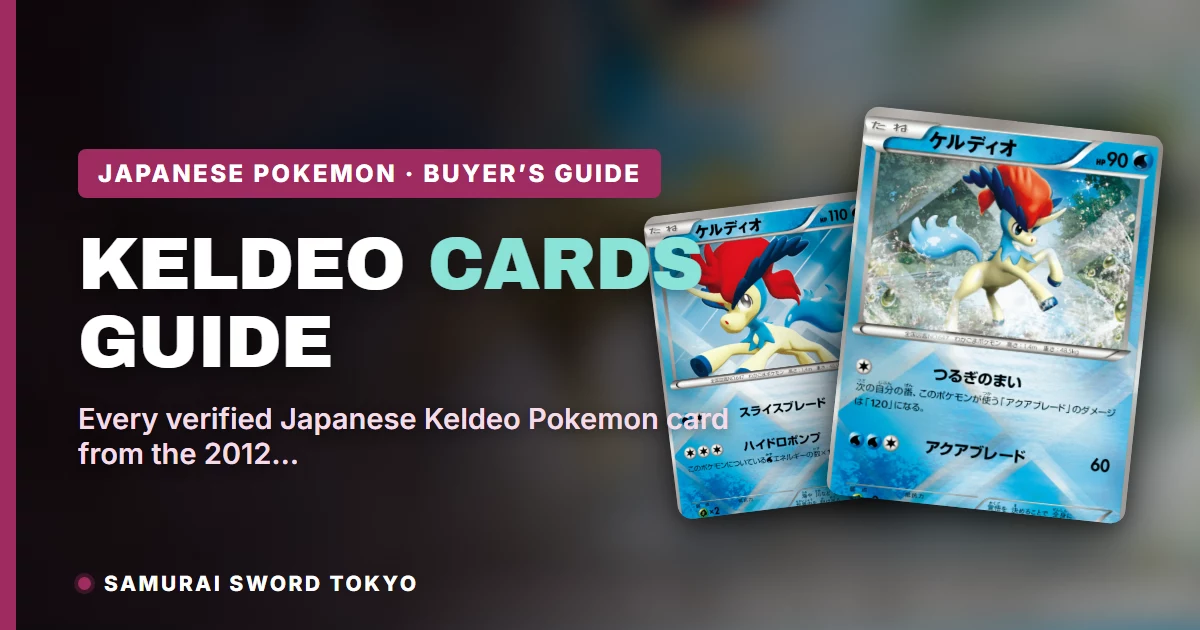
Keldeo Pokemon 카드 가이드: 모든 일본판 (2012-2025)

Keldeo is one of the few Pokemon whose Japanese card history reads like a straight line rather than a scattered mess of reprints — a Black & White era Half Deck star that resurfaced, largely unchanged in concept, across six more sets over the following thirteen years. The most recent version, a 210 HP ex card from 2025, is still standard-legal today.

This guide walks through every verified Japanese Keldeo print, from the 2012 Half Deck original through the 2025 White Flare ex, with card numbers, sets, and what each one actually does on the field. We don’t carry Keldeo singles in stock as a standing SKU, but we source specific Japanese prints on request — if one of the cards below is on your list, our Quick Order page is the fastest way to start that request.

Key Takeaway

Eight verified Japanese Keldeo prints span 2012–2025, from a BW-era promo and Half Deck star through a Sky Legend GX and the current-era White Flare ex. There is no “Keldeo V” — that card does not exist in the Japanese print record. If you’re after a specific print, request it directly via 빠른 주문 — sourcing runs print-by-print rather than off a fixed shelf.

8
Verified Prints

2012
First JP Release

2025
Most Recent (White Flare)

7
Sets in This Guide

Card details below are sourced from individual Limitless TCG database pages for each Japanese print, verified as of August 2026. We do not hold standing Keldeo stock — this guide is a reference for sourcing specific prints via Quick Order, not a price or inventory list.
Every Verified Keldeo Print

Eight Japanese Keldeo prints across seven sets, from the 2012 BW era through the current Scarlet & Violet era:

카드 Number 세트 Year
Keldeo (Promo) BW-P 162 BW Promos 2012
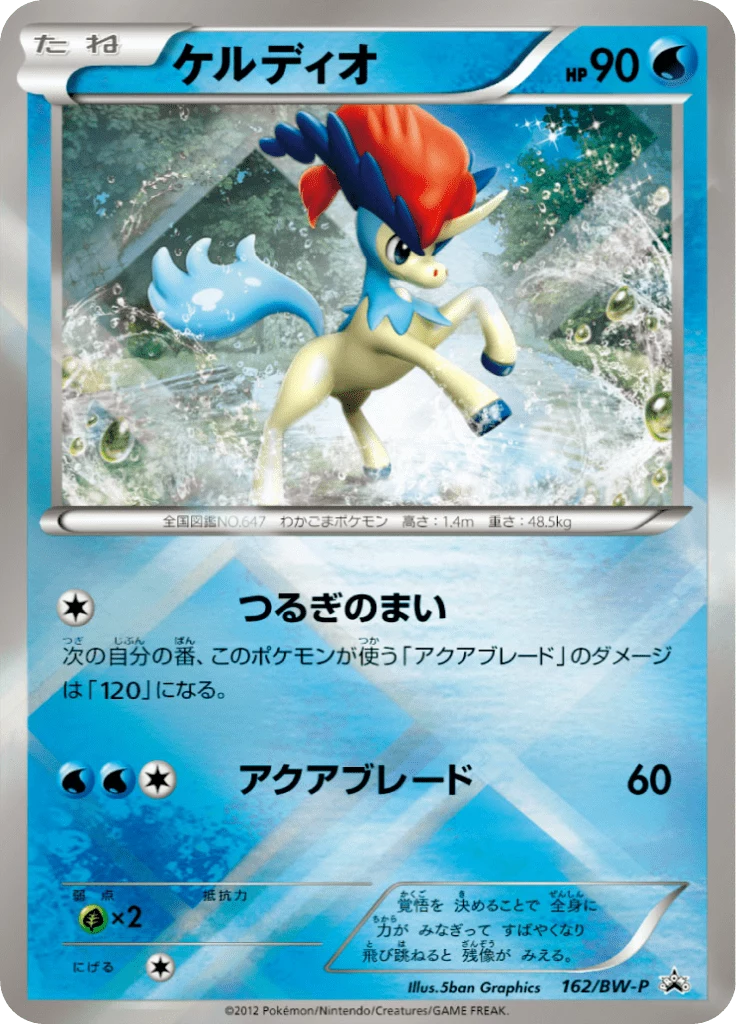
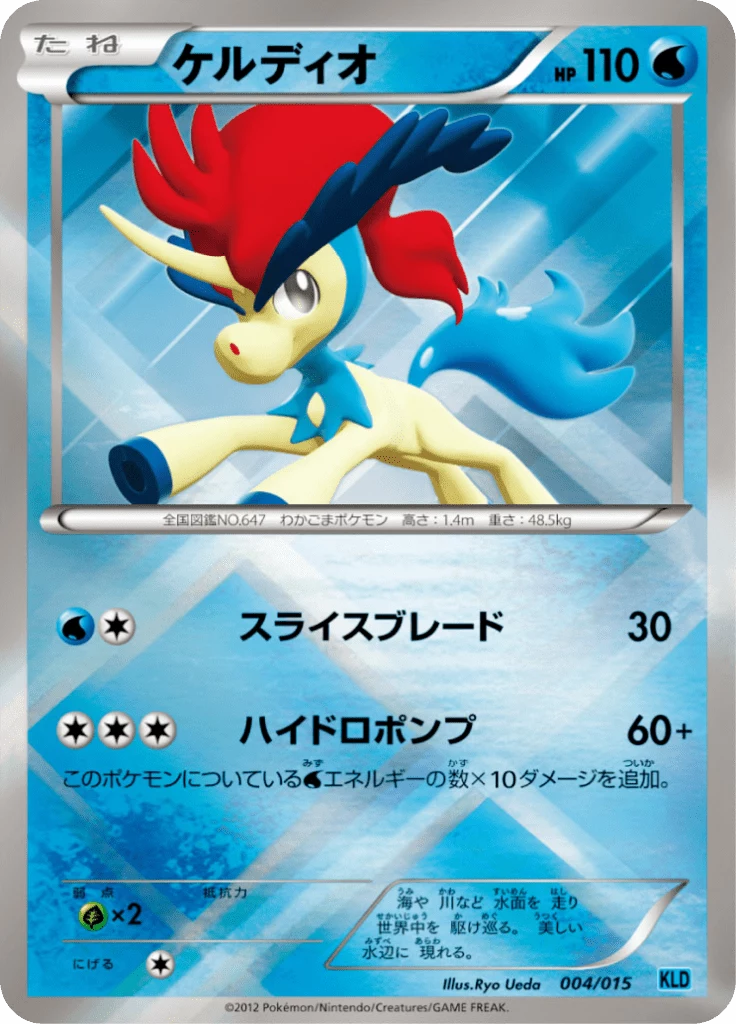
Keldeo KLD 004/013 Keldeo Half Deck 2012
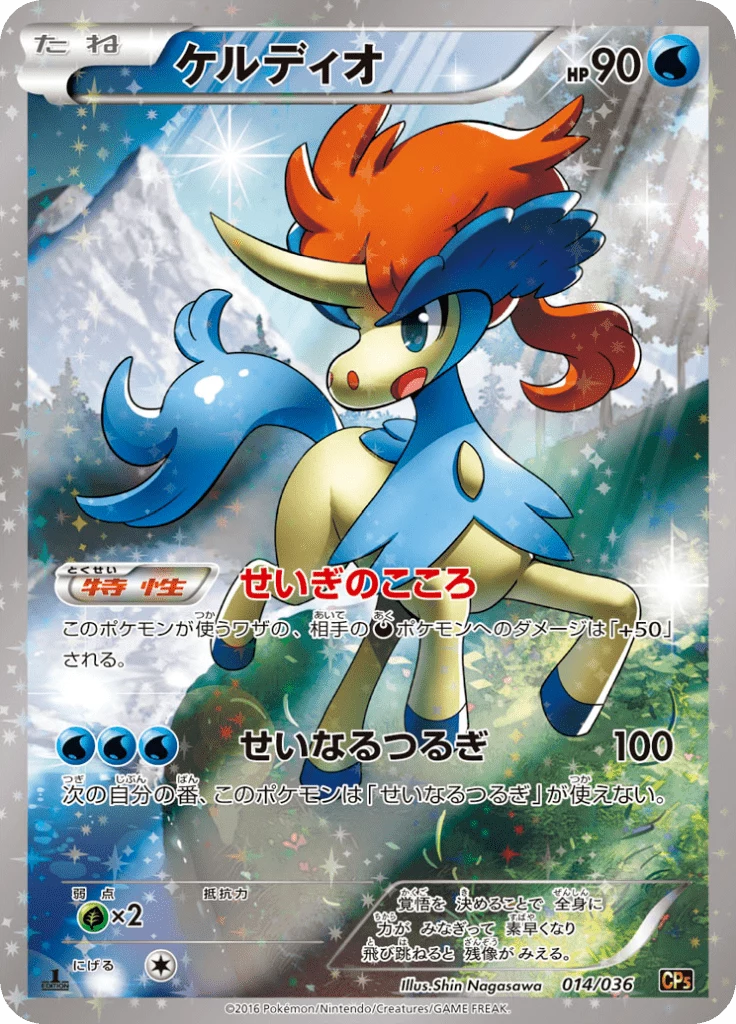
Keldeo CP5 014/036 Dream Holo Collection 2016
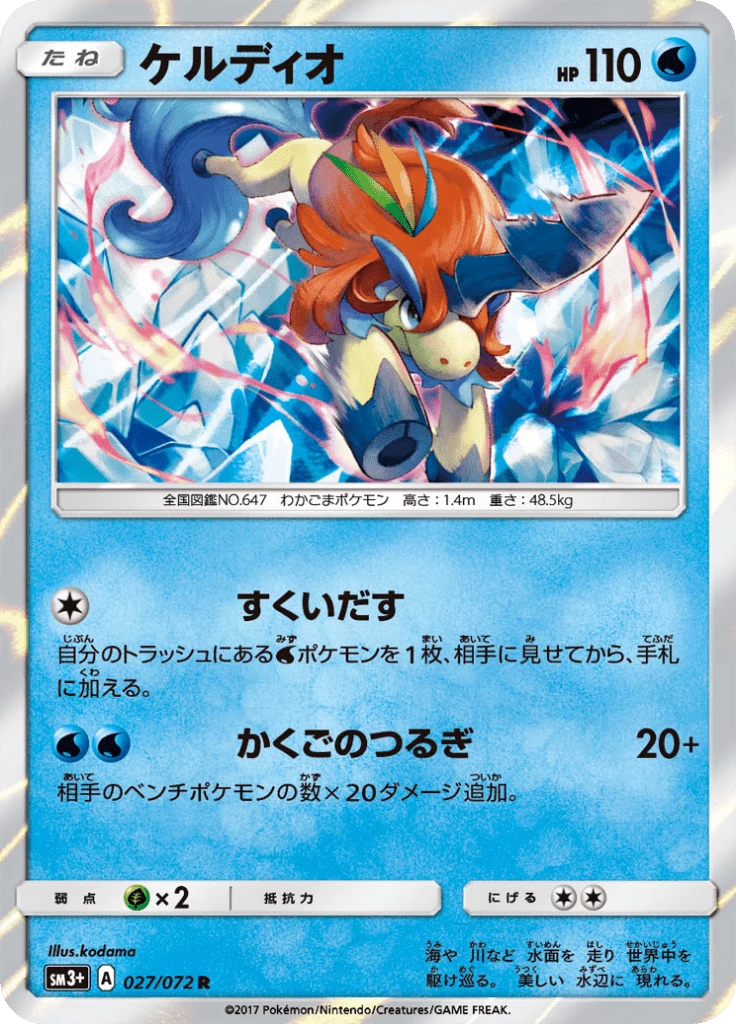
Keldeo SM3p 027/072 R Shining Legends 2017
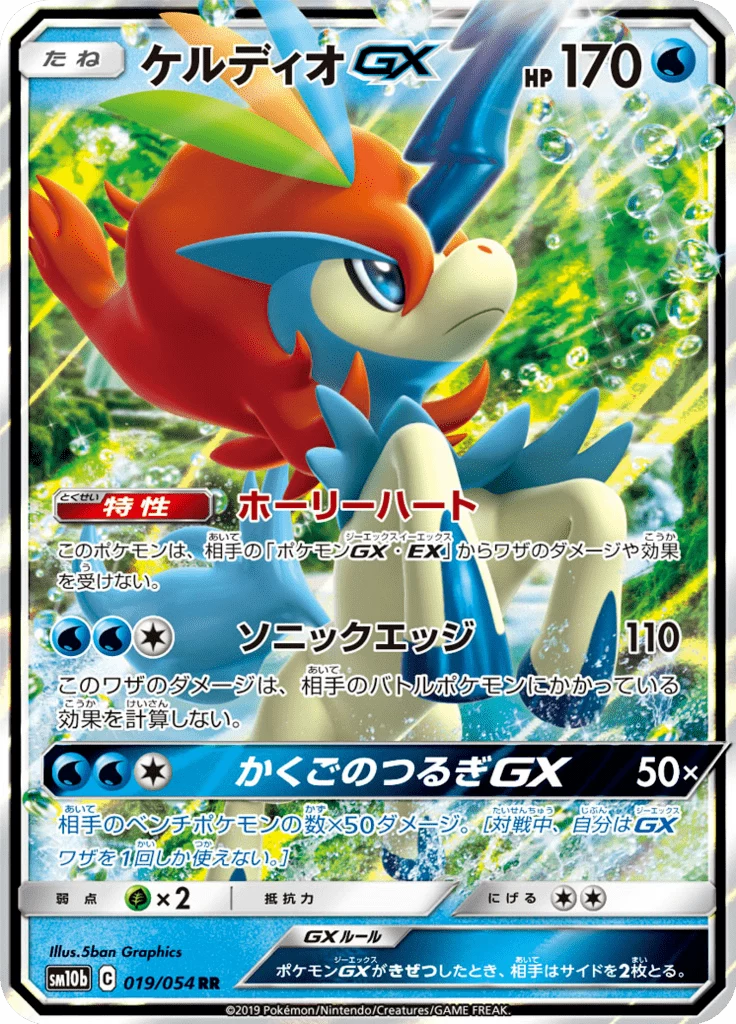
Keldeo GX SM10b 019/054 RR Sky Legend 2019
Keldeo GX (Secret) SM10b 057/054 SR Sky Legend 2019
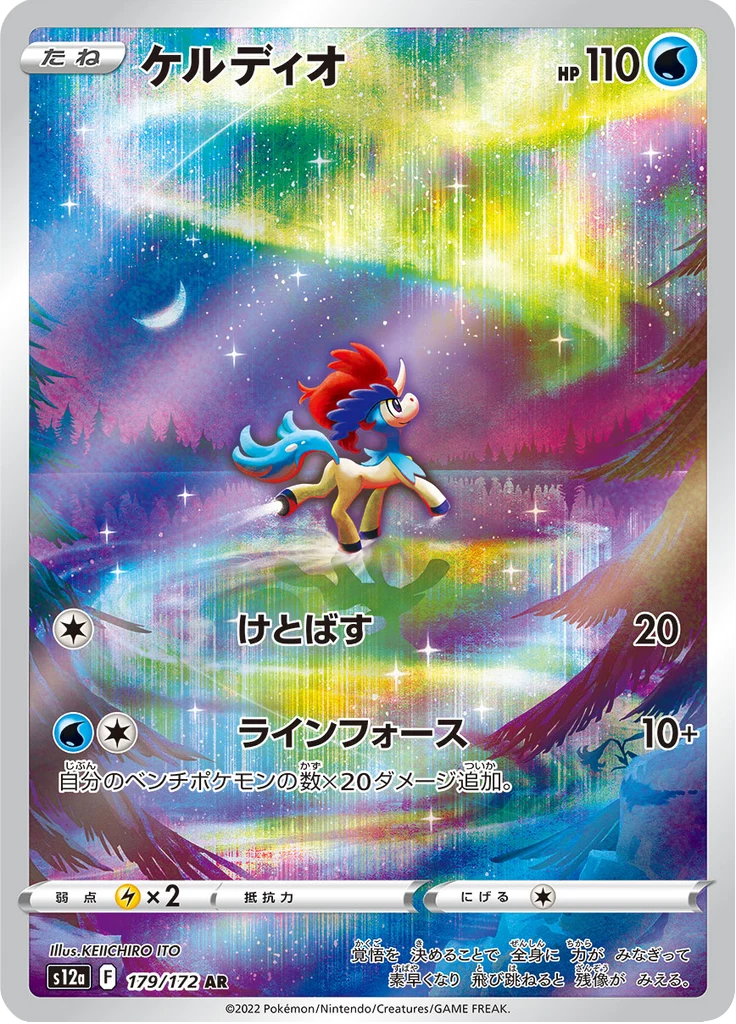
Keldeo S12a 179/172 AR VSTAR Universe 2022
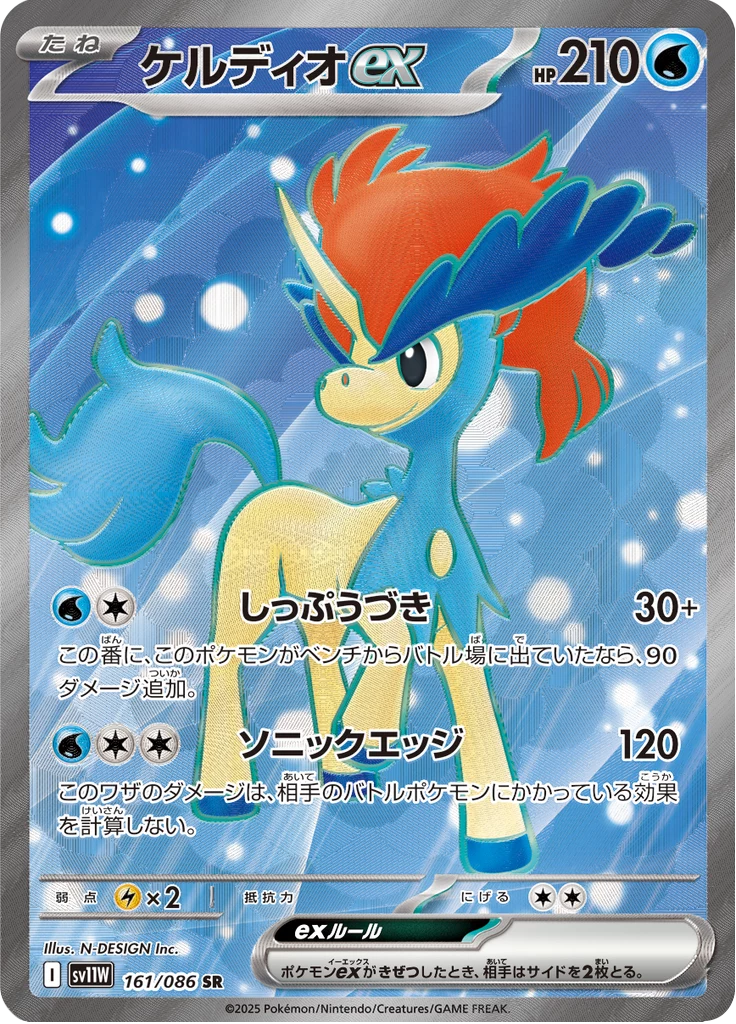
Keldeo ex (Secret) SV11W 161/086 SR White Flare 2025

Two things stand out across the prints verified here. First, Keldeo’s kit barely changes — a Water-type attacker built around a bladed finishing move, whether that’s called Sword Dance, Resolute Sword, or Sonic Edge from print to print. Second, the gaps between these eight verified prints are wide: after the 2012 originals, the next verified print is 2016’s Dream Holo Collection, then Shining Legends, Sky Legend, VSTAR Universe, and finally White Flare in 2025 — roughly every two to three years. Among the prints verified here, it isn’t a card that gets reprinted constantly — when it shows up, it tends to be a full new illustration rather than a straight reprint. (A handful of additional Keldeo numbers turn up in other sets but aren’t individually verified for this guide.)

That pattern also means Keldeo doesn’t behave like a set-defining chase card. Across the prints verified here, it’s a themed-deck star or secondary chase rather than a set headliner — a secondary GX, or an alternate-art bonus alongside a set’s real chase cards. For collectors, that makes it a character-driven pickup rather than a set-driven one: you’re chasing the Pokemon across its verified print run, not one specific box.

The BW Era: Promo and Half Deck Star

Keldeo, BW-P 162, Promo, BW Promos

Keldeo, BW-P 162, BW Promos

Keldeo, KLD 004/013, Keldeo Half Deck

Keldeo, KLD 004/013, Keldeo Half Deck

Keldeo’s first two Japanese appearances both landed in 2012, illustrated by 5ban Graphics and Ryo Ueda respectively. The BW-P 162 promo is a Water-type, 90 HP card with Sword Dance (raising the damage of its follow-up attack to 120) and a 60-damage Aqua Blade. It’s part of the wider BW Promos run released during the movie era of that year, though the specific tie-in isn’t independently confirmed here — treat the “movie promo” framing as general BW-era context rather than a documented link to one title.

The KLD 004/013 print is the headline card of the Keldeo Half Deck, a themed 2012 deck built around the character. At 110 HP, it runs a 30-damage Slice attack and a Hydro Pump that scales up with extra Water Energy attached. Half Deck stars like this one were sold as complete, ready-to-play products rather than pulled from boosters, which is part of why they circulate differently from set-based rares.

Identifying the BW Prints

Both 2012 cards share the same Water typing and blade-attack theme, but the artwork, HP, and attack names are distinct — check the card number in the corner (BW-P 162 vs. KLD 004/013) before assuming which one you’re holding.

The 20th Anniversary Return: Dream Holo Collection

Keldeo, CP5 014/036, Holo, Dream Holo Collection
Keldeo, CP5 014/036, Holo — Dream Holo Collection, illustrated by Shin Nagasawa

Keldeo sat out of new Japanese prints for four years before resurfacing in 2016’s Dream Holo Collection (CP5), part of the run of anniversary-era sets built around legendary and mythical Pokemon. This 90 HP version carries an ability that adds 50 damage to attacks against Dark-type opponents, alongside a 100-damage Holy Sword attack that can’t be used again the following turn. It’s a different illustration and a different kit from the 2012 originals, credited to Shin Nagasawa.

CP5 actually lists two Keldeo card numbers in that range (013 and 014), but only 014 has been individually verified here — if you’re sourcing a specific CP5 Keldeo, confirm the exact number against a reference image before committing.

The Sun & Moon Era: Shining Legends and Sky Legend GX

Keldeo, SM3p 027/072, R, Shining Legends

Keldeo, SM3p 027/072, R (Shining Legends)

Keldeo GX, SM10b 019/054, RR, Sky Legend

Keldeo GX, SM10b 019/054, RR (Sky Legend)

The SM3p 027/072 print, illustrated by kodama, brought Keldeo into Shining Legends at 110 HP with a Rescue attack that recovers a Water Pokemon from the discard pile, backed by a Resolute Sword that scales with damage across the opponent’s bench.

Two years later, Sky Legend gave Keldeo its first GX treatment. Keldeo GX (SM10b 019/054) jumps to 170 HP with its own ability, distinct from the CP5 print’s, that blocks damage and effects from opposing GX and EX Pokemon entirely — a 110-damage Sonic Edge that ignores effects, and the GX attack Resolute Sword GX, which scales with the number of Pokemon on the opponent’s bench. A secret-rare version of the same card, SM10b 057/054, carries the identical kit under a different illustration credited to ConceptLab.

The Modern Era: VSTAR Universe and White Flare ex

Keldeo, S12a 179/172, AR, VSTAR Universe
Keldeo, S12a 179/172, AR — VSTAR Universe, illustrated by Keiichiro Ito

VSTAR Universe (2022) added Keldeo at Art Rare — the alternate-art tier that sits above a set’s standard holo rares — with a straightforward 110 HP kit: a 20-damage Kick and a Line Force attack that scales with the size of Keldeo’s own bench. It’s the card most collectors run into first if they’re building out a modern Water-type binder alongside other VSTAR Universe alternate arts.

Keldeo ex, SV11W 161/086, SR, White Flare
Keldeo ex, SV11W 161/086, SR — White Flare, illustrated by N-DESIGN Inc.

The most recent print is Keldeo ex (SV11W 161/086), a secret-rare release from White Flare on June 6, 2025 and the largest jump in the card’s history at 210 HP. Windswept Slash deals 30 damage that rises to 120 if Keldeo moved to the Active Spot from the bench this turn, and Sonic Edge returns as a 120-damage attack that ignores effects on the defending Pokemon. A standard-rarity version of the same ex card exists at SV11W 027, with an alternate-art version at SV11W 169 — neither has been individually verified here, so if you need the exact number, confirm it before sourcing.

Put next to the 2019 Sky Legend GX, the jump is easy to see: HP climbs from 170 to 210, Sonic Edge stays in the kit almost unchanged at 110 to 120 damage, and the GX-exclusive finishing move is gone entirely, replaced by the conditional Windswept Slash. It’s the clearest example in the whole print run of how a Pokemon’s card design shifts with the mechanic of its era — GX cards built around a once-per-game bonus attack, ex cards built around straightforward stat and condition scaling.

How Sourcing Works for a Card Like Keldeo

Keldeo doesn’t have the release-week volume of a current flagship chase card, so we don’t hold it as standing shelf stock the way we do for active-set singles. What we do instead is source specific prints on request — you tell us the exact card (set code and number, ideally matched against one of the eight above), and we work that request through our Japanese supply chain.

확보 진행 중
Japanese Keldeo Cards, BW–SV Era
Request a specific print via Quick Order
Ships from Tokyo · Tracked delivery

Start a Sourcing Request →

If you’re new to buying Japanese-era Pokemon cards from outside the current set cycle, our BW-era Japanese Pokemon guide covers how that older stretch of the print history holds up for collectors today, and our PSA 10 vs. raw Japanese Pokemon cards guide is useful background if you’re deciding whether to request a graded or raw copy for a card like this.

The most useful detail to include on a request like this is the exact identifier — set code and card number, matched against the table earlier in this guide, plus whether you’re after raw or graded. BW-era and Sun & Moon-era Japanese singles don’t move in the same volume as a current-set release, so a specific number is a more precise starting point than a general “Keldeo card” request.
Where to Source Japanese Keldeo Cards

We ship Japanese sealed product and singles worldwide from Tokyo with tracked delivery. For a card without standing stock like Keldeo, the Quick Order page is the direct route — list the set code and number from the table above, and the request routes through the same sourcing process we use for other request-only Japanese singles.

Keldeo belongs to the same broader Mythical and legendary-adjacent tier that collectors often chase alongside other movie-era and event-tied Pokemon; our Mythical Pokemon cards guide (Celebi & Jirachi) and our Meloetta cards guide cover two other characters with a similar sourcing profile — strong character recognition, no fixed shelf stock, request-driven fulfillment. If you’re building a request across several of these characters at once, 빠른 주문 handles a mixed list in a single submission.
자주 묻는 질문

Is there a Keldeo V card?

No. A search of the Japanese Pokemon card database found no “Keldeo V” release. Keldeo’s Japanese prints run from the 2012 BW Promo and Half Deck star through Dream Holo Collection, Shining Legends, Sky Legend GX, VSTAR Universe, and the 2025 White Flare ex — a GX and an ex, but no V.

What is the newest Japanese Keldeo card?

Keldeo ex (SV11W 161/086), a secret-rare print from White Flare released June 6, 2025. At 210 HP, it’s the highest-HP Keldeo print to date, with the attacks Windswept Slash and Sonic Edge.

Does samuraiswordtokyo.com keep Keldeo cards in stock?

Not as standing shelf stock. We source specific Japanese Keldeo prints on request via our Quick Order page, matched against verified card numbers like the ones listed in this guide.

What set was Keldeo originally released in?

Keldeo’s first Japanese cards both released in 2012: a BW Promo (BW-P 162) and the headline card of the themed Keldeo Half Deck (KLD 004/013).

Is Keldeo GX or Keldeo ex better for a modern deck?

Only Keldeo ex (SV11W 161/086, White Flare, 2025) is standard-legal in the current era. Keldeo GX (Sky Legend, SM10b 019/054) is a Sun & Moon-era card and is not part of the current Standard format.

Hoopa Pokemon 카드 가이드: 일본판 전체 발행 (2015-2023)

Search for a “Hoopa Pokemon card” from Japan and the trail eventually leads to a card that isn’t Hoopa at all. The chase piece tied to Hoopa’s 2015 movie release is a Groudon promo — distributed at retail during the campaign, not printed with Hoopa’s own artwork. Hoopa itself has a real, three-era Japanese card history of its own, running from a 2015 EX debut through a 2021 V and a current-era 2023 ex, and it’s worth keeping those two things straight before you buy anything.

This guide covers every verified Japanese Hoopa printing, explains exactly what the 2015 movie promo is (and isn’t), and points to what we actually carry in Tokyo right now. If you’re searching for “Hoopa Pokemon card” hoping to find the campaign piece, it helps to know upfront which cards actually carry Hoopa’s own artwork and which ones simply share its release date.

Key Takeaway

No Hoopa VMAX appears in the Japanese card database. The card most associated with its 2015 movie release is actually a Groudon promo, issued as part of the 2015 movie-release retail campaign — our graded copy is the PSA10 Groudon P [XY-P 144], currently listed at ¥49,234. Hoopa’s own chase cards are the 2015 Bandit Ring EX, the 2021 Fusion Arts V, and the 2023 Raging Surf ex.

7
Verified JP Printings

3
Card Eras (EX / V / ex)

2015
First Release (Bandit Ring)

¥49,234
2015 Movie Promo (Groudon)

Every Hoopa Pokemon Card, by Era

Hoopa has appeared in Japanese sets three times, always as a Pokemon-EX / V / ex, each with a standard and a secret or full-art printing. A search of the Japanese print record turns up no Hoopa VMAX.

카드 세트 Number Rarity Year
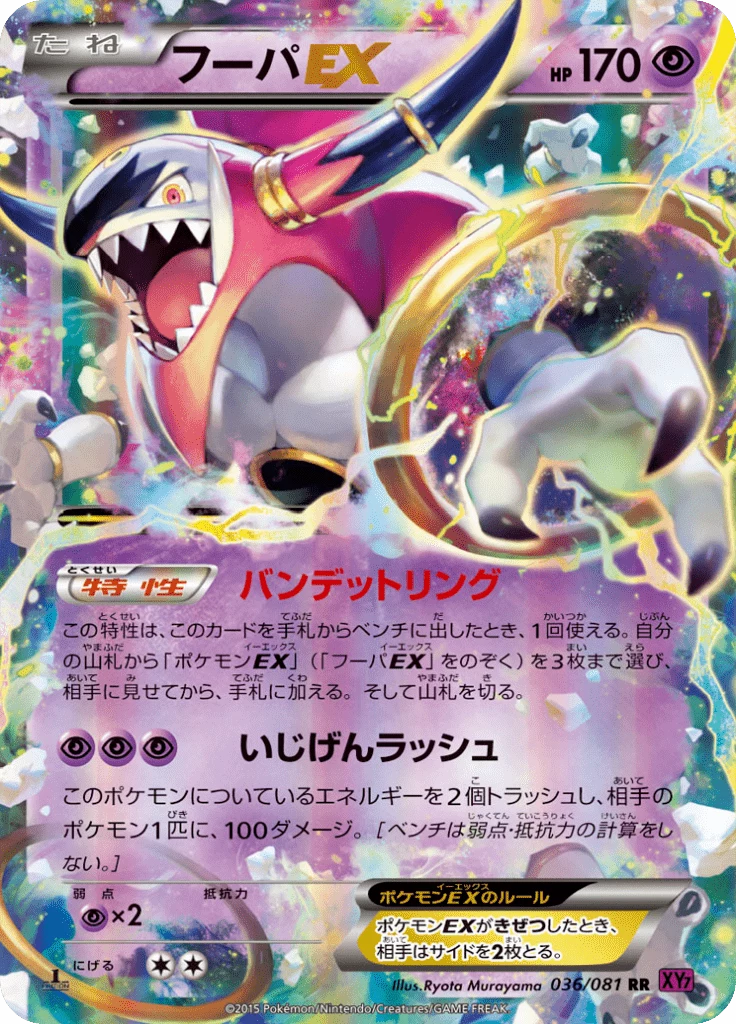
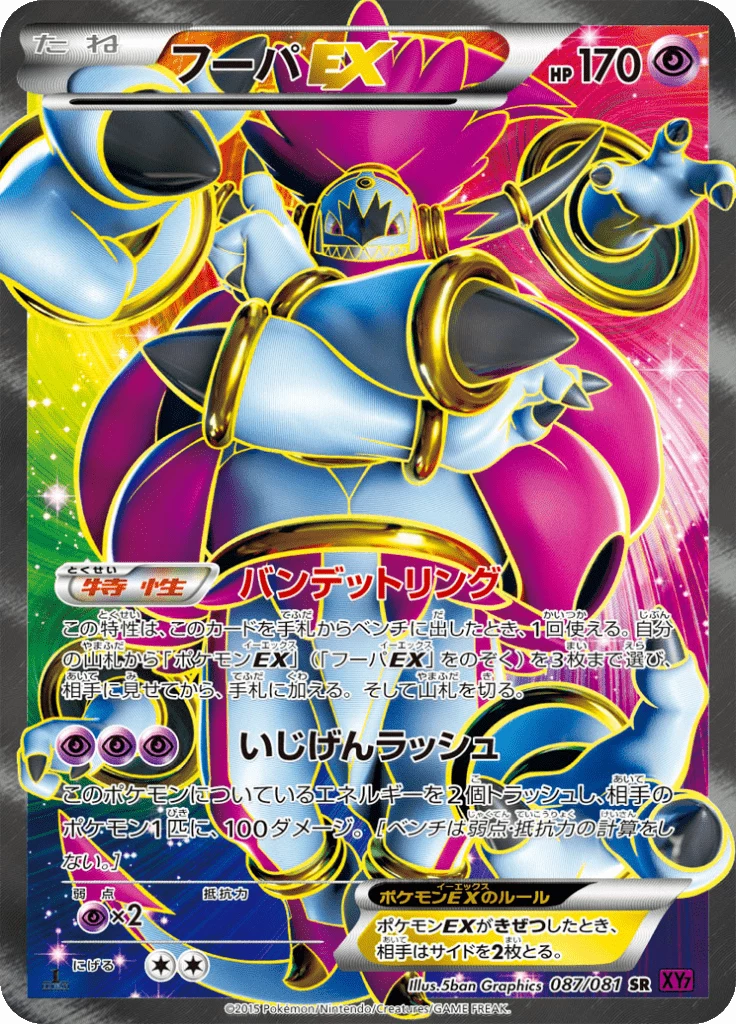
Hoopa EX Bandit Ring (XY7) 036/081 RR 2015
Hoopa EX Bandit Ring (XY7) 087/081 SR (Secret) 2015
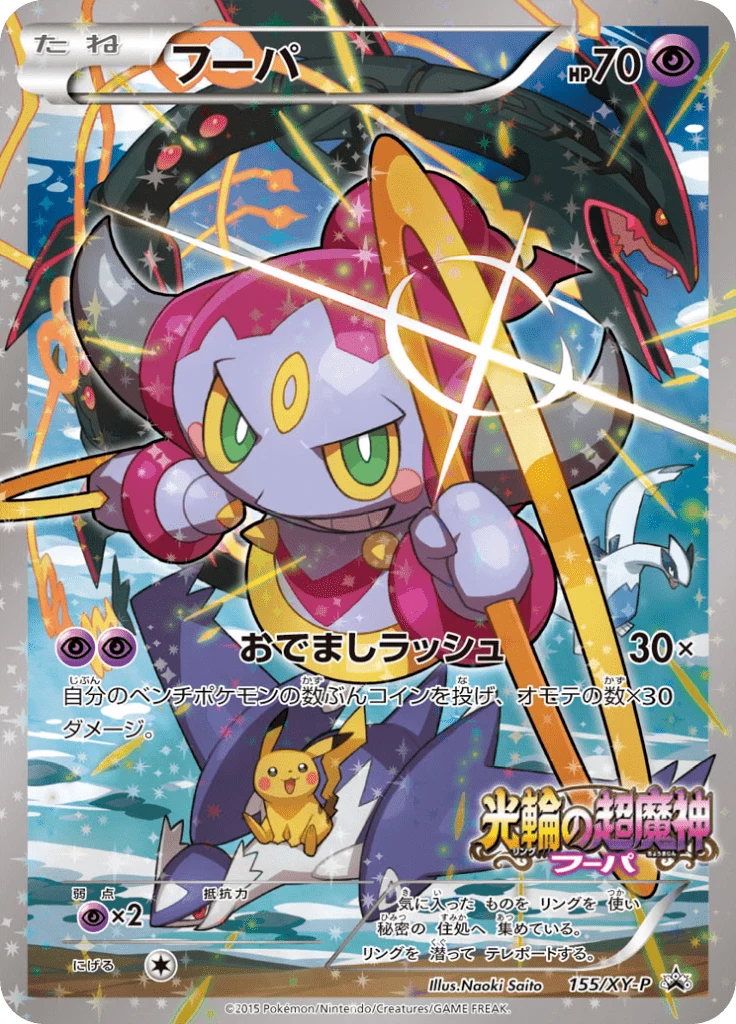
Hoopa (Promo) XY Promos 155 PROMO 2015
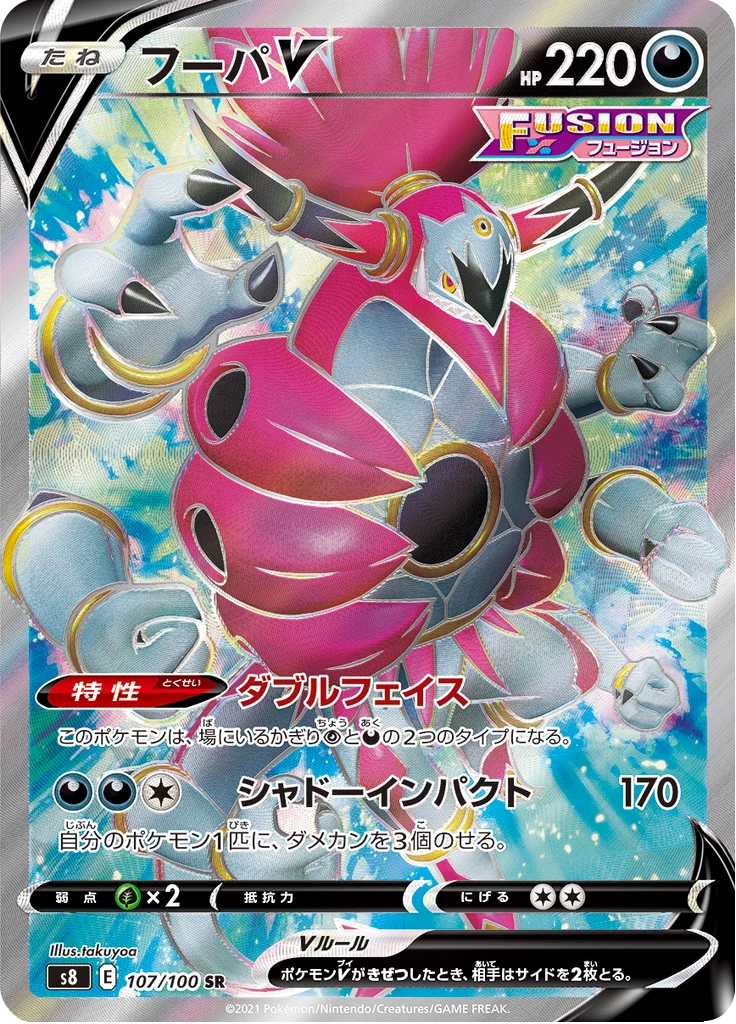
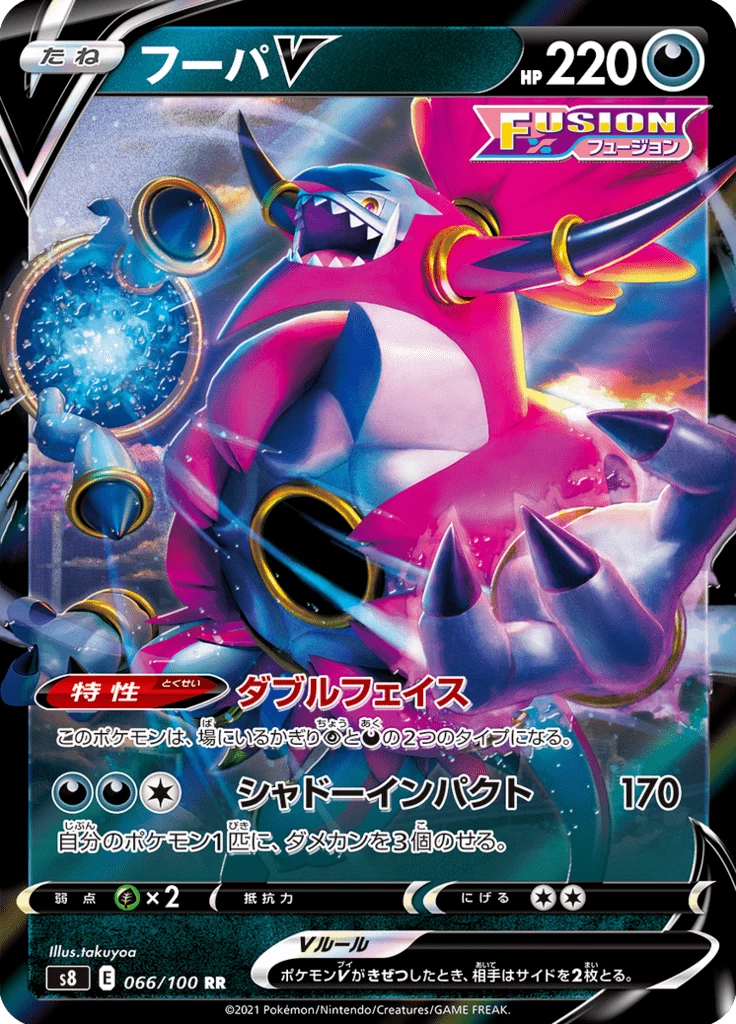
Hoopa V Fusion Arts (S8) 066/100 RR 2021
Hoopa V Fusion Arts (S8) 107/100 SR (Full Art) 2021
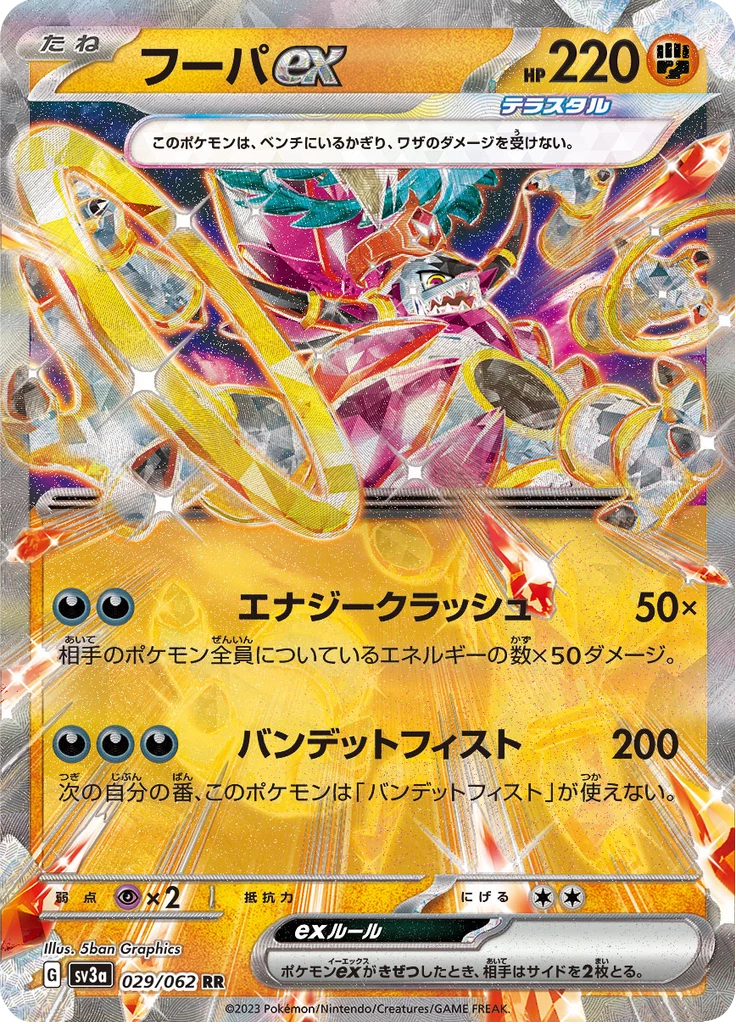
Hoopa ex Raging Surf (SV3a) 029/062 RR 2023
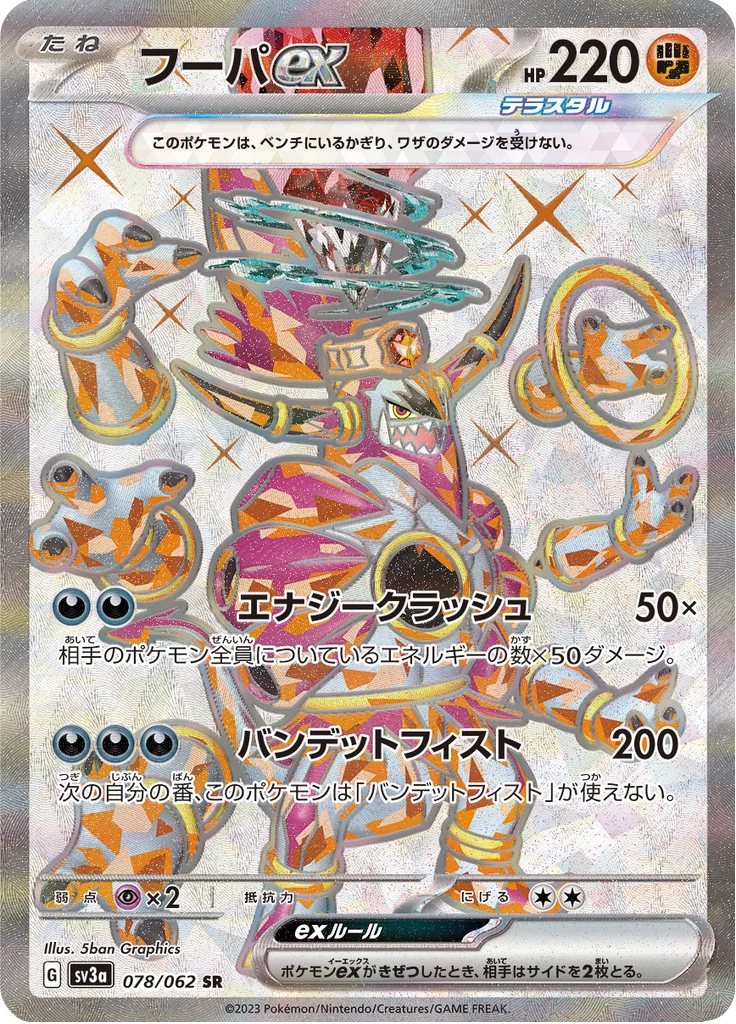
Hoopa ex Raging Surf (SV3a) 078/062 SR (Secret) 2023

The pattern repeats across all three eras: a numbered rare version inside the set’s print run, and a secret or full-art version pushed past the set’s official count. What changes between eras is Hoopa’s typing and HP — Psychic at 170 HP in 2015, Darkness at 220 HP in 2021, and Fighting at 220 HP in 2023 — a reminder that a Pokemon’s card typing tracks the rules era it was printed in, not a fixed trait. The sections below walk through each one.

The 2015 Debut: Hoopa EX and the Bandit Ring Set

Hoopa’s first Japanese card arrived on June 20, 2015, in the expansion pack Bandit Ring (XY7) — released the same day as the Hoopa movie in Japanese theaters. Hoopa EX (036/081, RR) is a Psychic-type with 170 HP, illustrated by Ryota Murayama. Its ability, also named “Bandit Ring,” lets you search up to three Pokemon-EX cards from your deck to your hand once per turn when it’s moved from your hand to the Bench, and its attack, “Dimension Rush,” hits for 100.

Hoopa EX RR, XY7 036/081, Bandit Ring

Hoopa EX (036/081, RR)

Hoopa EX SR, XY7 087/081, Bandit Ring

Hoopa EX (087/081, SR)

The set’s secret rare, Hoopa EX (087/081, SR), is the same card in a different illustration by 5ban Graphics — same ability, same attack, printed past Bandit Ring’s official 081-card count. Having the character’s ability named after the set itself is a small but telling detail: Bandit Ring was built around Hoopa as its headline Pokemon, not as a guest appearance in someone else’s set. That makes it the entry point for anyone collecting Hoopa the character rather than the movie campaign that happened to launch alongside it.

For more on how XY-era promos and secret rares from this window are collected, see our XY-era Japanese Pokemon guide.

The 2015 Movie Chase Card Is a Groudon, Not a Hoopa

This is the part worth getting precise about. Alongside the Bandit Ring set, Pokemon ran a retail campaign timed to the movie’s release — distributed through stores including Ito-Yokado, AEON, Toys “R” Us, and Pokemon Center — that handed out four promo cards: Groudon, Kyogre, Latias, and Latios. None of them feature Hoopa. The card is named for the movie, not for the Pokemon in the title.

Our own graded stock from this campaign is the Groudon piece: Groudon P (XY-P 144), a Fighting-type with 130 HP, illustrated by Mitsuhiro Arita, with attacks “Rock Smash” (20+) and “Ground Breaker” (100, plus 10 to each of the opponent’s Benched Pokemon). It’s the card many buyers mean when they remember “the Hoopa promo” from 2015 — but it’s a Groudon card that happens to share the movie’s release window, not a Hoopa print. Our graded copy is currently listed at ¥49,234.

The four-card structure of this campaign — Groudon, Kyogre, Latias, and Latios distributed through an in-store lottery at participating retailers rather than sold inside a booster pack — is why these promos read differently from a standard set pull. None of them were ever in circulation as pack contents.

If you specifically want Hoopa’s own face on a promo card from this era, that exists too: Hoopa (XY-P 155), a Psychic-type with 70 HP and the attack “Appearance Rush” (30 damage per heads on a coin flip per Pokemon on your Bench), distributed with the movie-release album set and never released outside Japan.

Hoopa PROMO, XY-P 155, XY Promos

Hoopa (XY-P 155, Promo)

Don’t Mix These Up

“Hoopa movie promo” and “the 2015 Groudon promo” refer to the same campaign but two different cards. Our in-stock graded piece is the Groudon (XY-P 144); the Hoopa-branded promo from the same campaign is XY-P 155.

Currently Listed
PSA10 Groudon P [XY-P 144] — 2015 Movie Release Campaign Promo
Currently listed at ¥49,234
Ships from Tokyo · Tracked delivery

View Product →

For the wider Groudon printing history beyond this one promo, our Groudon cards guide covers it in full, and our XY-P promo cards guide places this campaign in the context of the wider XY promo run.

2021: Hoopa V Returns in Fusion Arts

Hoopa’s next Japanese card came six years later, in the September 24, 2021 expansion pack Fusion Arts (S8). Hoopa V (066/100, RR), illustrated by takuyoa, is a Darkness-type with 220 HP. Its ability, “Double Face,” gives it both the Psychic and Darkness types simultaneously while in play, and its attack “Shadow Impact” deals 170 damage while placing 3 damage counters on one of your own Pokemon.

Hoopa V RR, S8 066/100, Fusion Arts

Hoopa V (066/100, RR)

Hoopa V SR, S8 107/100, Fusion Arts

Hoopa V (107/100, SR)

The full-art Hoopa V (107/100, SR) is the same card and stat line in Fusion Arts’ signature full-bleed treatment, printed past the set’s 100-card count. This was also the point where Hoopa’s typing changed for the first time — from the purely Psychic EX of 2015 to a V that carries both Psychic and Darkness at once through its “Double Face” ability, an effect that put both types into play on a single card while it stayed on the field. Fusion Arts singles move through our sourcing pipeline, and the sealed box is also in our catalog: send a request via our Quick Order page for singles, or see the box below.

2023: Hoopa ex in Raging Surf

The most recent and current standard-legal Hoopa card is Hoopa ex (029/062, RR) from the September 22, 2023 enhanced expansion pack Raging Surf (SV3a), illustrated by 5ban Graphics. It switched typing again, this time to Fighting, with 220 HP. Its first attack, “Energy Crush,” deals 50 damage for every Energy card attached across all of the opponent’s Pokemon; its second, “Bandit Fist,” hits for 200 but can’t be used again the following turn.

Hoopa ex RR, SV3a 029/062, Raging Surf

Hoopa ex (029/062, RR)

Hoopa ex SR, SV3a 078/062, Raging Surf

Hoopa ex (078/062, SR)

The secret rare Hoopa ex (078/062, SR) carries the same ex card text in an alternate illustration. The “can’t use next turn” clause on Bandit Fist is a tradeoff mechanic common to high-damage ex attacks in this era — a 200-damage swing paid for with a turn of downtime rather than a resource cost. Raging Surf is a set we do stock sealed — if you’re chasing this printing directly out of the box, our Raging Surf Japanese Pokemon Booster Box is sealed product shipped from Tokyo with tracked delivery. For a specific graded or ungraded Hoopa ex single, our Quick Order page handles sourcing requests.

Where to Buy Hoopa Cards from Japan

We ship Japanese sealed product and graded singles worldwide out of Tokyo with tracked delivery. Right now, our confirmed Hoopa-adjacent stock is the graded Groudon movie-campaign promo; Hoopa’s own EX, V, and ex singles move through sourcing requests rather than sitting on a shelf, since demand for any one specific printing — standard versus secret, PSA graded versus raw — varies from buyer to buyer.

Currently Listed
PSA10 Groudon P [XY-P 144] — 2015 Movie Release Campaign Promo
Currently listed at ¥49,234
Ships from Tokyo · Tracked delivery

View Product →

For sealed product carrying the current-era Hoopa ex, see the Raging Surf Japanese Pokemon Booster Box, and for the earlier Hoopa V era, the Fusion Arts Japanese Pokemon Booster Box. For any specific Hoopa single — EX, V, or ex, standard or secret — our Quick Order page is the fastest way to submit a sourcing request or build a mixed order in one checkout.

자주 묻는 질문

Is the famous 2015 Hoopa promo card actually a Hoopa card?

Usually not the one people mean. The card most associated with the 2015 movie campaign is a Groudon promo (XY-P 144), distributed at retail alongside Kyogre, Latias, and Latios promos to mark the film’s release. A separate Hoopa-branded promo (XY-P 155) exists from the same campaign, distributed with a movie-release album set.

What is the first real Hoopa Pokemon card?

Hoopa EX (036/081, RR), released June 20, 2015 in the expansion pack Bandit Ring (XY7) — the same day as the Hoopa movie’s Japanese theatrical release.

Does a Hoopa VMAX card exist?

A search of the Japanese card database turns up no Hoopa VMAX. Hoopa has appeared as a Pokemon-EX (2015), a V (2021), and an ex (2023).

What is the most recent Hoopa Pokemon card?

Hoopa ex (029/062, RR and its 078/062 secret rare), from the September 2023 enhanced expansion pack Raging Surf (SV3a) — the current standard-legal Hoopa printing.

Where can I buy Hoopa cards and the 2015 Groudon promo from Japan?

We stock the graded Groudon movie-campaign promo directly, plus sealed Raging Surf and Fusion Arts booster boxes that contain the current and 2021-era Hoopa cards. Individual Hoopa EX, V, or ex singles can be sourced through our Quick Order page.

Riolu Pokemon 카드 가이드: 일본판 모든 프린트 정리

Search “Riolu CHR” and you’ll find plenty of price trackers and forum threads pointing confidently at a Character Holo Rare print. Search Japan’s actual card database for Riolu and that card isn’t in it. What does exist is a smaller, genuinely interesting run of alt-art and shiny prints spread across six Japanese sets, one of which is the direct on-ramp to a much bigger Lucario evolution chase.

This guide runs through every current Japanese Riolu print, sorts out the alt-art-versus-shiny confusion between the Scarlet ex and Shiny Treasure ex versions, and shows which sealed product each one actually comes out of. We ship Japanese sealed product out of Tokyo every week, and the box pricing below reflects our own current catalog.

Key Takeaway

Six current Japanese Riolu prints span six sets released between 2019 and 2025 — and despite what search results claim, none of them is a Character Holo Rare (CHR). The two prints most people are actually hunting are AR and Shiny tier: the Scarlet ex Art Rare (SV1S 86/078) and the Shiny Treasure ex Shiny Rare (SV4a 280/190). The set that opened the Scarlet & Violet-era alt-art run, Scarlet ex Booster Box, is currently listed at ¥11,648 (~$71), and the shiny print’s home set, Shiny Treasure ex Booster Box, is currently listed at ¥17,680 (~$108). Sourcing requests for any print in this guide run through our Quick Order page.

6
Prints Covered

0
CHR Prints (Despite the Searches)

3
AR-Tier Prints

2019–25
Years Covered

Box prices reflect our own catalog listings as of August 2026, converted at ¥163/USD (2026-07 basis). We don’t price individual cards here — where we mention a price, it’s a sealed-box listing, not a card-by-card market value.

Every Riolu Print, Set by Set

Six prints across six Japanese sets, from the newest Mega-era release back to a 2019 common:

카드 Number Rarity 세트 Year
Riolu M1L 68/092 AR Mega Brave 2025
Riolu M2a 91/250 — Mega Dream ex 2025
Riolu (Shiny) SV4a 280/190 S Shiny Treasure ex 2023
Riolu SV1S 86/078 AR Scarlet ex 2023
Riolu S12a 201/172 AR VSTAR Universe 2022
Riolu SM9b 27/054 C Full Metal Wall 2019

Two patterns stand out. First, half of Riolu’s prints are Art Rare tier, spread across three different sets and three different illustrators rather than clustered in one release — unusual for a Basic Pokemon that isn’t itself a set’s headline card. Second, there’s no CHR, no VMAX, and no ex line here; Riolu’s own printings stay firmly in the AR / Shiny / common range, while the bigger money in this evolution family sits with what it becomes.

The CHR Myth: What Riolu’s Top Prints Actually Are

A search for “Riolu CHR” turning up Character Holo Rare price pages is a common result, but it doesn’t match what’s actually been printed. Character Holo Rare is a real Sword & Shield-era rarity tier — it shows up on plenty of Pokemon across that era — but a full search of Japan’s card database returns no CHR print of Riolu anywhere in its history. If you’re cross-referencing a listing that calls itself a “Riolu CHR,” that label doesn’t match anything currently catalogued on the Japanese side.

What Riolu actually got instead is three separate Art Rare prints (VSTAR Universe, Scarlet ex, Mega Brave) and one Shiny Rare recolor (Shiny Treasure ex) — covered set by set below. Riolu’s evolved form, Lucario, has its own alt-art history that does include higher-tier chase prints; that side of the evolution line is covered separately in our Lucario cards guide. This page sticks to Riolu itself, the pre-evolution Basic that most buyers are chasing to pair with a Lucario pickup rather than as a standalone grail.

If you’re sourcing AR-tier singles in volume rather than chasing one specific print, our Japanese AR bulk cards for resellers guide covers buying alt-art commons and uncommons at scale.

The Scarlet & Violet Era’s First Alt Art: Scarlet ex (SV1S)

Riolu [SV1S 86/078] AR, Scarlet ex
Riolu, SV1S 86/078, AR — the Scarlet ex alt art, illustrated by Nelnal

Scarlet ex (SV1S), released January 20, 2023, gave Riolu its first Art Rare print in the current era. It’s a Fighting-type, 70 HP Basic illustrated by Nelnal, with two attacks: Punch, which does 10 damage, and Reckless Charge, which does 50 damage but also does 20 damage to Riolu itself. The set’s regular, non-alt-art Riolu sits at SV1S 40/078. The English-language release of the same design appears as an Illustration Rare (IR) in Scarlet & Violet, card #215.

This is the print that started the alt-art run for Riolu in the Scarlet & Violet era.

The Shiny Treasure ex Print (SV4a)

Riolu [SV4a 280/190] S, Shiny Treasure ex
Riolu, SV4a 280/190, S (Shiny Rare) — new artwork by sowsow, Shiny Treasure ex

Shiny Treasure ex, released December 1, 2023 — about eleven months after Scarlet ex — is a Shiny Rare with the same card text but new sowsow artwork. Same Fighting-type, 70 HP stat line, same Punch (10 damage) and Reckless Charge (50 damage, 20 to itself) attacks, but a different illustrator, sowsow, and Shiny Treasure ex’s Shiny Rare (S) finish rather than a standard Art Rare frame. The set’s regular, non-shiny Riolu sits at SV4a 104/190.

Check This First

SV1S 86 and SV4a 280 share identical attack text, so listings sometimes blur them together. The fastest way to tell them apart is the illustrator credit and the color treatment — Nelnal’s Scarlet ex version runs standard colors, while sowsow’s Shiny Treasure ex version is the shiny recolor.

Shiny Treasure ex and Scarlet ex both sit in the same window of Japan’s Scarlet & Violet-era output; our Scarlet & Violet-era Japanese Pokemon guide covers what else came out of that stretch of sets.

The VSTAR Universe Art Rare and Its Promo Origins

Riolu [S12a 201/172] AR, VSTAR Universe
Riolu, S12a 201/172, AR — the VSTAR Universe alt art, illustrated by Kouki Saitou

VSTAR Universe (S12a), released December 2, 2022, carries the oldest of Riolu’s three Art Rare prints, at card number 201/172. It’s a Fighting-type, 60 HP Basic illustrated by Kouki Saitou, with a single attack, Low Kick, for 50 damage. The set’s regular version sits at S12a 76/172.

This particular artwork has a longer history than the AR print alone: it first appeared as an SP promo card (#260), then as part of Star Birth (S9) at card 54, before this VSTAR Universe reprint gave it the full Art Rare treatment. Kouki Saitou’s design also crossed into English-language product as part of Crown Zenith’s Galarian Gallery subset, card #GG26.

The Current-Era Print: Mega Brave (M1L)

Riolu [M1L 68/092] AR, Mega Brave
Riolu, M1L 68/092, AR — the Mega Brave alt art, illustrated by GOSSAN

Mega Brave (M1L), released August 1, 2025, is the newest and most current of Riolu’s prints. It’s a Fighting-type, 80 HP Basic illustrated by GOSSAN, with the attack Accelerating Stab for 30 damage — with the condition that you can’t use the same attack again on your next turn. The set’s regular version sits at M1L 28/092, and the same design also appears as MP promo card #22.

At 80 HP, this has the highest HP among the confirmed prints in this guide, and it’s the newest of Riolu’s Basic printings.

The Common Print and the Newest Unconfirmed Listing

Riolu [SM9b 27/054] C, Full Metal Wall
Riolu, SM9b 27/054, C — the Full Metal Wall common, illustrated by Mizue

Full Metal Wall (SM9b), released February 1, 2019, is the oldest print in this guide and the only one at common rarity. It’s a Fighting-type, 70 HP Basic illustrated by Mizue, with the attack Feint for 10 damage that ignores Resistance. The English-language equivalent appears in Unbroken Bonds, card #102.

The newest listing is Mega Dream ex (M2a 91/250), released November 28, 2025. Its inclusion is confirmed by set search listings, but we haven’t pulled the individual card page yet, so we can’t confirm its HP, attacks, or illustrator here — treat it as a print that exists rather than one we can describe in detail. It also doesn’t currently have matching sealed box stock in our catalog, so request it through Quick Order.

Sourcing Riolu Through Sealed Product

Because the two most-searched Riolu prints — the Scarlet ex alt art and its Shiny Treasure ex recolor — each come from a single set, sealed booster boxes are the direct route into either one.

Shop This Set
Scarlet ex Booster Box (SV1S, Japanese)
Currently listed at ¥11,648 (~$71)
Ships from Tokyo · Tracked delivery

View Product →

For the shiny version, Shiny Treasure ex boxes are currently listed at ¥17,680 (~$108). For the other three prints, VSTAR Universe is currently listed at ¥33,280 (~$204), Mega Brave is currently listed at ¥10,486 (~$64), and Full Metal Wall is currently listed at ¥52,500 (~$322), reflecting that set’s age and overall collector demand well beyond this one common Riolu.

Restock requests, mixed sourcing across any set in this guide, or single-card sourcing requests for the unconfirmed Mega Dream ex print run through our Quick Order page.

Where to Buy Japanese Riolu Cards

We ship Japanese sealed product worldwide from Tokyo with tracked delivery. For the two alt-art prints most buyers are after, Scarlet ex covers the original AR and Shiny Treasure ex covers the Shiny Rare. For the rest of the lineup, VSTAR Universe, Mega Brave, and Full Metal Wall cover the remaining AR, current-era, and common prints. Use our Quick Order page to combine any of these into one order or to submit a single-card sourcing request for the Mega Dream ex print.

If you’re building a budget-conscious order around this evolution line, our best PSA 10 Japanese cards under ¥10,000 guide is a useful companion list while you decide where to spend on the Riolu side versus the Lucario side.

자주 묻는 질문

Does Riolu have a CHR (Character Holo Rare) Pokemon card?

No. Despite search results that suggest otherwise, a full search of Japan’s card database turns up no Character Holo Rare print of Riolu. Its highest-rarity prints are three Art Rare cards (VSTAR Universe, Scarlet ex, Mega Brave) and one Shiny Rare recolor (Shiny Treasure ex).

What is the rarest Riolu Pokemon card from Japan?

Among the six prints in this guide, the three AR-tier cards — S12a 201/172, SV1S 86/078, and M1L 68/092 — along with the shiny SV4a 280/190, represent the highest rarity Riolu has received. We don’t price individual cards here; sealed product from each one’s home set is available via Quick Order or the box links above.

What’s the difference between the Scarlet ex alt art and the Shiny Treasure ex shiny Riolu?

They share identical attack text — Punch (10 damage) and Reckless Charge (50 damage, 20 to itself) — and the same 70 HP Fighting-type stat line. The difference is the illustrator and finish: Nelnal’s Scarlet ex print (SV1S 86/078) runs standard colors, while sowsow’s Shiny Treasure ex print (SV4a 280/190), released about eleven months later, is the shiny recolor.

Where can I buy Japanese Riolu Pokemon cards?

We ship Japanese sealed product worldwide from Tokyo. Scarlet ex booster boxes are currently listed at ¥11,648 and cover the original alt art; Shiny Treasure ex, VSTAR Universe, Mega Brave, and Full Metal Wall boxes cover the remaining prints, and our Quick Order page handles mixed orders and single-card sourcing requests.

Zorua 포켓몬 카드 가이드: Hisuian Zorua부터 N's Zorua까지, 모든 일본 수록본

Zorua’s whole identity on the show is disguise — but on the card itself, one printing pulls off a switch that has nothing to do with illusion. Every standard Zorua in this lineup is a Dark type. Hisuian Zorua isn’t. It’s Psychic, tied to the regional form the card is actually printed as, and it’s the one detail that trips up buyers scanning listings for “any Zorua.”

This guide covers six confirmed Japanese Zorua prints across six sets, from the current-era Trainer-named “N’s Zorua” to the 2018 Dark Order original, plus what’s known so far about the new 2026 Zorua & Zoroark ex starter set. It’s a sourcing guide, not a price guide — instead of invented ask prices, every set below links to the sealed booster box it actually comes out of. We ship Japanese sealed product out of Tokyo every week, and the box catalog referenced here is our own.

Key Takeaway

Six confirmed Zorua prints span six Japanese sets between 2018 and 2025, plus a brand-new 2026 starter set still being catalogued. The headline detail: Hisuian Zorua (S10a 29/071) is a Psychic type, while every other Zorua on this list is Dark. If you’re chasing Hisuian Zorua specifically, our S10A Dark Phantasma Booster Box was listed at ¥28,500 (~$175) as of August 2026, and requests for other prints run through 빠른 주문.

6
Prints Covered

2
Types (Dark & Psychic)

2018–2025
Years Covered

7
Box Sourcing Options

Box prices below reflect our own catalog as of August 2026, converted at ¥163/USD (2026-07 basis). This guide does not include Japanese secondary-market ask prices for individual Zorua cards.

Every Confirmed Zorua Print

Six Zorua prints across six sets, from the newest Art Rares back to the 2018 original:

카드 Number Rarity 세트 Year
Zorua (AR) SV11W 140/086 AR White Flare 2025
N’s Zorua (AR) SV9 108/100 AR Battle Partners 2025
Zorua (AR) SV6a 72/064 AR Night Wanderer 2024
Hisuian Zorua S10a 29/071 C Dark Phantasma 2022
Zorua S12a 90/172 — VSTAR Universe 2022
Zorua SM8a 25/052 C Dark Order 2018

Five of the six are Dark type. The outlier is Hisuian Zorua, and it isn’t a cosmetic variant — it’s a different Pokemon form with a different type printed on the card. That’s the detail worth understanding before you buy, so it’s where this guide starts.

The Type Switch: Hisuian Zorua

Hisuian Zorua C, S10a 29/071, Dark Phantasma

Hisuian Zorua, printed in Dark Phantasma (S10a 29/071), is a 60 HP Psychic type — not Dark, which is what every other card in this guide is. It’s illustrated by Akira Komayama and carries two low-cost moves: “Collect,” which draws a card, and “Mumble,” a 10-damage attack. The type change follows the Hisuian regional form itself rather than being a printing quirk, and it makes Hisuian Zorua the entry point into a small family of Hisuian-form cards from the same set, including Hisuian Zoroark VSTAR.

The English-language equivalent of this card sits in Lost Origin as card #75, part of the same wave of Hisuian-form prints that set introduced internationally. If you’re comparing listings across languages, matching the card number against the set rather than the name alone is the safer way to confirm you’re looking at the same print, since “Zorua” on its own covers both the Dark-type and Psychic-type versions.

If you’re new to the Hisuian branch of the Pokemon card lineup more broadly, our Hisuian Pokemon cards guide covers the wider set of regional-form prints it belongs to. For the rest of what Dark Phantasma has to offer beyond Zorua, see our Dark Phantasma best cards guide.

Check This First

If a listing just says “Zorua” without specifying Hisuian, assume Dark type. Hisuian Zorua is the only Psychic-type printing among the six confirmed cards here, and it only comes from Dark Phantasma (S10a).

The Trainer-Named Print: N’s Zorua

N's Zorua AR, SV9 108/100, Battle Partners
N’s Zorua AR, SV9 108/100, Battle Partners

Battle Partners introduced “N’s Zorua” (SV9 108/100, Art Rare), a Dark-type, 70 HP card illustrated by Megumi Mizutani with a single attack, “Scratch,” for 20 damage. The name ties it to Trainer N, and this specific Zorua evolves into N’s Zoroark ex within the same card family. A standard-rarity version of the same card sits at SV9 60/100, and the print itself first appeared as SVP promo 200 before Battle Partners gave it a full set slot.

Internationally, this card corresponds to Journey Together #97. Because the SVP promo predates the Battle Partners release, you may see both a promo-numbered copy and a set-numbered copy of the same illustration listed separately — they’re the same artwork and card text under two different print codes.

This guide covers the Zorua side of that line only. For the evolved N’s Zoroark ex itself, see our N’s Zoroark ex cards guide.

The Modern Art Rares: Night Wanderer and White Flare

Zorua AR, SV6a 72/064, Night Wanderer

Zorua AR, SV6a 72/064, Night Wanderer

Zorua AR, SV11W 140/086, White Flare

Zorua AR, SV11W 140/086, White Flare

Night Wanderer (SV6a 72/064) gave Zorua its first Art Rare treatment, illustrated by REND: Dark type, 70 HP, with “Stampede” for 10 damage and “Double Scratch,” a two-coin-flip attack worth 20 damage per heads. A standard-rarity copy of the same card sits at SV6a 31/064, and the print was reprinted again in Terastal Fest ex (SV8a 96). Internationally, this illustration corresponds to Shrouded Fable #75, listed there as an Illustration Rare.

White Flare (SV11W 140/086) added a second modern Art Rare, illustrated by Naoki Saito: Dark type, 70 HP, with a single attack, “Take Down,” for 30 damage that costs Zorua 10 damage in recoil. White Flare itself is built around Black & White-era remake material — if that period of the Japanese card game is what you’re after more broadly, our BW-era Japanese Pokemon guide covers it in full. The standard-rarity version of this Zorua sits at SV11W 58/086, and the international counterpart is White Flare #142, also an Illustration Rare.

Between them, these two Art Rares are the prints most collectors run into first if they’re browsing recent Japanese Zorua cards rather than hunting older sets — both are current-print, both saw a reprint or cross-set appearance, and both have a direct English-language match for anyone cross-referencing a collection across languages.

Where It Started: VSTAR Universe and Dark Order

Zorua, S12a 90/172, VSTAR Universe

Zorua, S12a 90/172, VSTAR Universe

Zorua C, SM8a 25/052, Dark Order

Zorua C, SM8a 25/052, Dark Order

The Zorua printed in VSTAR Universe (S12a 90/172), illustrated by ryoma uratsuka, is Dark type, 70 HP, with “Rear Kick” for 30 damage. It isn’t a new illustration — it’s a reprint of the card that first appeared in Eevee Heroes (S6a 49) back in 2021, carried forward into the 2022 chase-card compilation set. Internationally, this illustration corresponds to Evolving Skies #102.

The oldest confirmed print in this guide is the Dark Order original (SM8a 25/052, Common) from 2018, illustrated by Naoyo Kimura: Dark type, 60 HP, with the attack “Hide in Shadows,” which switches Zorua with a Benched Pokemon. It was reprinted again the following year in Tag All Stars (SM12a 78). Between the Eevee Heroes original, its VSTAR Universe reprint, and the Dark Order-to-Tag All Stars pair, Zorua has now appeared in at least two separate reprint cycles before the 2026 starter set added a third.

The 2026 Starter Set

Zorua and Zoroark got a dedicated release on July 31, 2026: the “ex Starter Set Zorua & Zoroark ex,” which includes two separate Zorua prints (MEZ 6 and MEZ 20) inside a single starter product. We haven’t catalogued the individual card details for these two prints yet, so we’re not listing rarities or attack text for them here — treat this as confirmation that the set exists and covers Zorua twice, not a full breakdown. If you’re after the new starter set itself, requests go through our Quick Order page.

Chasing Zorua Through Sealed Boxes

The direct route to any of these prints is the booster box each one actually comes from. Since Hisuian Zorua is the headline card in this guide, that’s the box worth starting with:

Shop This Set
S10A Dark Phantasma Booster Box (Japanese)
Listed at ¥28,500 (~$175) as of August 2026
Ships from Tokyo · Tracked delivery

View Product →

For the rest of the lineup, here’s the box each print comes out of:

None of these boxes are printed with a guaranteed Zorua pull. For single-card sourcing, or anything not listed above, use 빠른 주문.

Where to Buy Japanese Zorua Cards

We ship Japanese sealed product worldwide from Tokyo with tracked delivery. For a Zorua card specifically, the sealed booster box for its home set is the direct route; for anything outside our box catalog, Quick Order is where sourcing requests go.

Start with the S10A Dark Phantasma Booster Box for Hisuian Zorua, or place a sourcing request through 빠른 주문.

자주 묻는 질문

What type is Hisuian Zorua?

Psychic. It’s the only Psychic-type Zorua printing confirmed here — every other Zorua card, including N’s Zorua and the standard Night Wanderer and White Flare prints, is Dark type. Hisuian Zorua comes from Dark Phantasma (S10a 29/071).

What is N’s Zorua?

A Dark-type Art Rare from Battle Partners (SV9 108/100), named for and connected to Trainer N. It evolves into N’s Zoroark ex, and a standard-rarity version of the same card sits at SV9 60/100.

Which Japanese sets have Zorua cards?

Six confirmed prints span Dark Order (2018), Dark Phantasma (2022, Hisuian Zorua), VSTAR Universe (2022, reprinting a 2021 Eevee Heroes original), Night Wanderer (2024, reprinted in Terastal Fest ex), Battle Partners (2025), and White Flare (2025). A 2026 dedicated starter set adds two more Zorua prints not yet fully catalogued.

Where can I buy Japanese Zorua cards?

We ship the sealed booster boxes each print comes from — including S10A Dark Phantasma for Hisuian Zorua and SV9 Battle Partners for N’s Zorua — worldwide from Tokyo. For anything outside our box catalog, use our Quick Order page for sourcing requests.

Munchlax Pokemon 카드 가이드: 일본판 프린트 전체

Munchlax has a short list of Japanese cards, and that’s the whole story worth telling here. Search around and you’ll find plenty of English-language Munchlax prints going back to 2007, but on the Japanese side of the print run — the side we deal in every day — there are exactly two confirmed cards, both from the Sun & Moon era, both drawn by the same illustrator.

This guide covers those two Japanese prints in full detail: what they say, what they do, and which sealed products they come out of. It also lays out the English-only historical prints honestly, without pretending Japanese equivalents exist where we haven’t verified them. Munchlax is Snorlax’s pre-evolution, so we close with how the two cards relate — and point you to our dedicated Snorlax cards guide for the evolved line. We ship Japanese sealed product out of Tokyo every week, and the sourcing notes below reflect the sets we actually stock.

Key Takeaway

Only two Japanese Munchlax prints are confirmed: SM10a #40 (GG End) and its reprint, SM12a #114/173 (Tag All Stars), both illustrated by sowsow. Everything earlier — Diamond & Pearl, Majestic Dawn, Rising Rivals — is documented here as English-language print history only. If you’re sourcing the Japanese prints, they come out of the GG End Booster Box and Tag All-Stars Booster Box — sourcing requests run through 빠른 주문.

2
JP-Verified Prints

4
EN Historical Prints

2019
First JP Print Year

sowsow
Illustrator, Both JP Cards

Card data verified against individual card pages as of August 2026. This is a sourcing guide, not a price guide — we don’t publish market prices here, only which sealed products contain which Japanese prints.

Every Japanese Munchlax Print We’ve Verified

Six Munchlax cards worth knowing, spanning Japanese and English print runs from 2007 to 2019:

카드 세트 언어 Year Illustrator
Munchlax #40 GG End (SM10a) 일본어 2019 sowsow
Munchlax #114/173 Tag All Stars (SM12a) 일본어 2019 sowsow
Munchlax #33 Diamond & Pearl English 2007 Ken Sugimori
Munchlax #68 Majestic Dawn English 2008 Masakazu Fukuda
Munchlax #69 Rising Rivals English 2009 Tomokazu Komiya
Munchlax #70 Rising Rivals English 2009 Kagemaru Himeno

The pattern here is unusual compared to most Pokemon on the Japanese card checklist: Munchlax’s Japanese print run is thin. Rather than the dozen-plus variants you’d see on a mainline evolution like Snorlax, Munchlax got one original Japanese print in 2019 and a same-year reprint — and that’s it, based on what we’ve been able to confirm. The English side has a longer paper trail going back to 2007, but we haven’t verified that those English cards have direct Japanese-language counterparts under the same set names, so we’re presenting them as English print history rather than implying a Japanese equivalent exists.

The Two JP Prints: GG End and Tag All Stars

Both confirmed Japanese Munchlax cards come from the same short window in 2019, and both share the same artwork.

Munchlax [SM10a 40] C (GG End)

Munchlax, SM10a #40, Common (GG End)

Munchlax [SM12a 114/173] (Tag All Stars)

Munchlax, SM12a #114/173 (Tag All Stars)

GG End (SM10a #40), released April 5, 2019, is the original. It’s a Common, Colorless-type, 60 HP card illustrated by sowsow, carrying the Feast Search ability covered in the next section. Its English-language counterpart is Unified Minds #173.

Tag All Stars (SM12a #114/173), released October 4, 2019, reprints the same card — same sowsow artwork, same Feast Search ability — inside that set’s reprint block. Limitless TCG doesn’t list a rarity symbol for this specific reprint slot, so we’re not assigning one here rather than guessing.

Check This First

Both cards look identical at a glance — same illustration, same card text. The set name and card number printed on the card are what tell them apart: GG End reads “SM10a,” Tag All Stars reads “SM12a.”

One naming note: the card database we cross-checked spells the name “Muchlax”; we use the standard English name Munchlax throughout this guide.

The English-Only History: 2007–2009

Before the 2019 Japanese prints, Munchlax had a run of English-language cards spanning the Diamond & Pearl through Rising Rivals era. We’re documenting these for completeness, but we haven’t verified Japanese-language set names or card numbers for this stretch, so no images accompany this section — only confirmed Japanese-language card art appears in our guides.

  • Munchlax — Diamond & Pearl #33, Rare, released May 23, 2007, illustrated by Ken Sugimori.
  • Munchlax — Majestic Dawn #68, Common, released May 21, 2008, illustrated by Masakazu Fukuda.
  • Munchlax — Rising Rivals #69, Common, released May 20, 2009, illustrated by Tomokazu Komiya.
  • Munchlax — Rising Rivals #70, Common, released May 20, 2009, illustrated by Kagemaru Himeno.

Two separate Munchlax cards in the same Rising Rivals set, each with its own illustrator, is a detail worth noting for anyone building a complete print run reference — it means Rising Rivals alone accounts for half of this historical block. If you’re specifically after Japanese-language cardboard for this Pokemon, though, the two 2019 prints covered above are the ones we can confirm and the ones we source.

Munchlax to Snorlax: A Pre-Evolution Story

Munchlax is Snorlax’s pre-evolution, introduced generations after Snorlax itself first appeared on cardboard, which is part of why its Japanese print run is so much thinner — Snorlax has been a Pokemon TCG staple since the earliest sets, while Munchlax only entered the picture with the Diamond & Pearl generation. If you’re collecting the full evolutionary line rather than just Munchlax on its own, our Snorlax cards guide covers the much larger and deeper Japanese print history on the evolved form — different scale of guide entirely, and worth reading alongside this one rather than instead of it.

What’s notable is that both confirmed Japanese Munchlax prints share one illustrator, sowsow, across both GG End and its Tag All Stars reprint — a level of print-run consistency you don’t often see even on more heavily printed Pokemon, simply because there have been so few Japanese Munchlax cards made in the first place.

Sourcing Munchlax Through Sealed Product

Because both confirmed Japanese Munchlax prints come out of specific 2019 sets, sealed product from those two releases is the direct route if you’re chasing either card alongside the rest of each set’s lineup.

Shop This Set
GG End Japanese Pokemon Booster Box (SM10a)
Contains Munchlax #40, the original 2019 print
Ships from Tokyo · Tracked delivery

View Product →

The reprint sits inside Tag All-Stars Japanese Pokemon Booster Box (SM12a) — same Munchlax artwork, same Feast Search text, packaged with that set’s own TAG TEAM lineup. Since Munchlax’s Japanese print history is this limited, these two boxes are the entire sourcing path we can point to for this card. For sourcing requests and mixed orders that pair Munchlax with other Sun & Moon-era cards, our Quick Order page is the fastest way to ask.

Where to Buy Japanese Munchlax Cards

We ship Japanese sealed product worldwide from Tokyo with tracked delivery. For Munchlax specifically, sourcing runs through the two 2019 booster boxes above — GG End for the original print, Tag All-Stars for the reprint — and general sourcing requests go through our Quick Order page.

For related reading on how Japanese rarity tiers and grading fit into a collection like this one, see our CHR character rare cards guide, our PSA 10 vs raw Japanese cards guide, and — if you’re building a collection on a budget — our best PSA 10 Japanese cards under ¥10,000 guide.

자주 묻는 질문

How many Japanese Munchlax Pokemon cards are there?

Two confirmed: Munchlax #40 from GG End (SM10a, released April 5, 2019) and its reprint, Munchlax #114/173 from Tag All Stars (SM12a, released October 4, 2019). Both share the same sowsow artwork and the same Feast Search ability.

What does Munchlax’s Feast Search ability do?

Once per turn, you flip a coin. If it lands heads, you take any one card from your discard pile and place it on top of your deck. Your turn ends immediately after the flip, regardless of the result.

Is there a Japanese version of the Diamond & Pearl era Munchlax?

We haven’t verified one. The Diamond & Pearl, Majestic Dawn, and Rising Rivals Munchlax cards are documented here as English-language prints; we don’t have confirmed Japanese-language set names or card numbers for that era, so we present them as English print history rather than claiming a Japanese equivalent.

Where can I buy Munchlax Pokemon cards from Japan?

We ship Japanese sealed product worldwide from Tokyo. The GG End and Tag All-Stars booster boxes are the two sets containing the confirmed Japanese Munchlax prints, and sourcing requests for either run through our Quick Order page.