Pikachu VMAX Vivid Voltage: guida completa alla carta S4
The Pikachu VMAX card from Vivid Voltage is number 031/100, rarity RRR, in the Japanese edition of set S4, Amazing Volt Tackle. It has 310 HP, evolves from Pikachu V and attacks with Gigantamax Volt Tackle. This guide covers the card, its Pikachu V line and the five other Japanese Pikachu VMAX prints.
5 carte per pack, randomly inserted, 165 yen tax included
HP
310
Evolution
Evolves from Pikachu V
Illustrator
aky CG Works
All attack names in English in this article are our translations of the Japanese card text. The Pikachu VMAX data comes from the official Pokémon Card Game database. Japanese sealed Pokémon products are collected on our Pokemon Card Box collection page, while this guide stays with the card and its prints.
Which Japanese card is Pikachu VMAX from Vivid Voltage?
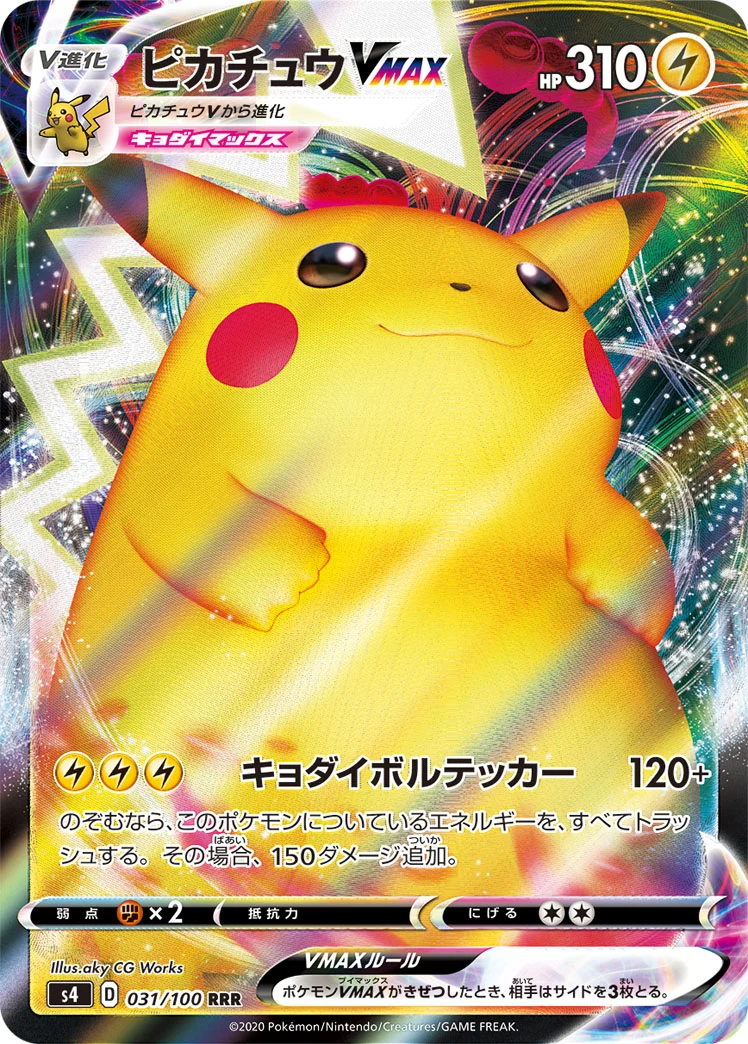
It is Pikachu VMAX, card 031/100, rarity RRR, in set S4, the Japanese expansion pack Amazing Volt Tackle. The official card page confirms the set, the number and the HP of 310.
The number, the set code and the artwork are what identify the print, and this guide describes the Japanese edition. The number matters because Pikachu VMAX has been printed several times in Japan, and the S4 card is the print that comes from the Amazing Volt Tackle expansion itself. The rarity RRR is the mark shown for this print in the official database. The card’s illustrator is aky CG Works, and its weakness is listed as ×2.
The number 031/100 has two parts. The first part, 031, is the card number, and the second part, 100, is the set total printed on the card. Some cards carry a number above that total. The official database lists Pikachu V 104/100 in the same set, which is numbered above the set total of 100.
Pikachu VMAX, S4 031/100, RRR. Official Japanese card image from pokemon-card.com.
Field
Pikachu VMAX S4 031/100
Set
S4, Amazing Volt Tackle
Card number
031/100
Rarity
RRR
HP
310
Stage
VMAX, evolves from Pikachu V
Weakness
×2
Illustrator
aky CG Works
A card is the S4 print when its number reads 031/100, its set code is S4, its HP is 310, its illustrator credit is aky CG Works and its attack is Gigantamax Volt Tackle with no second attack.
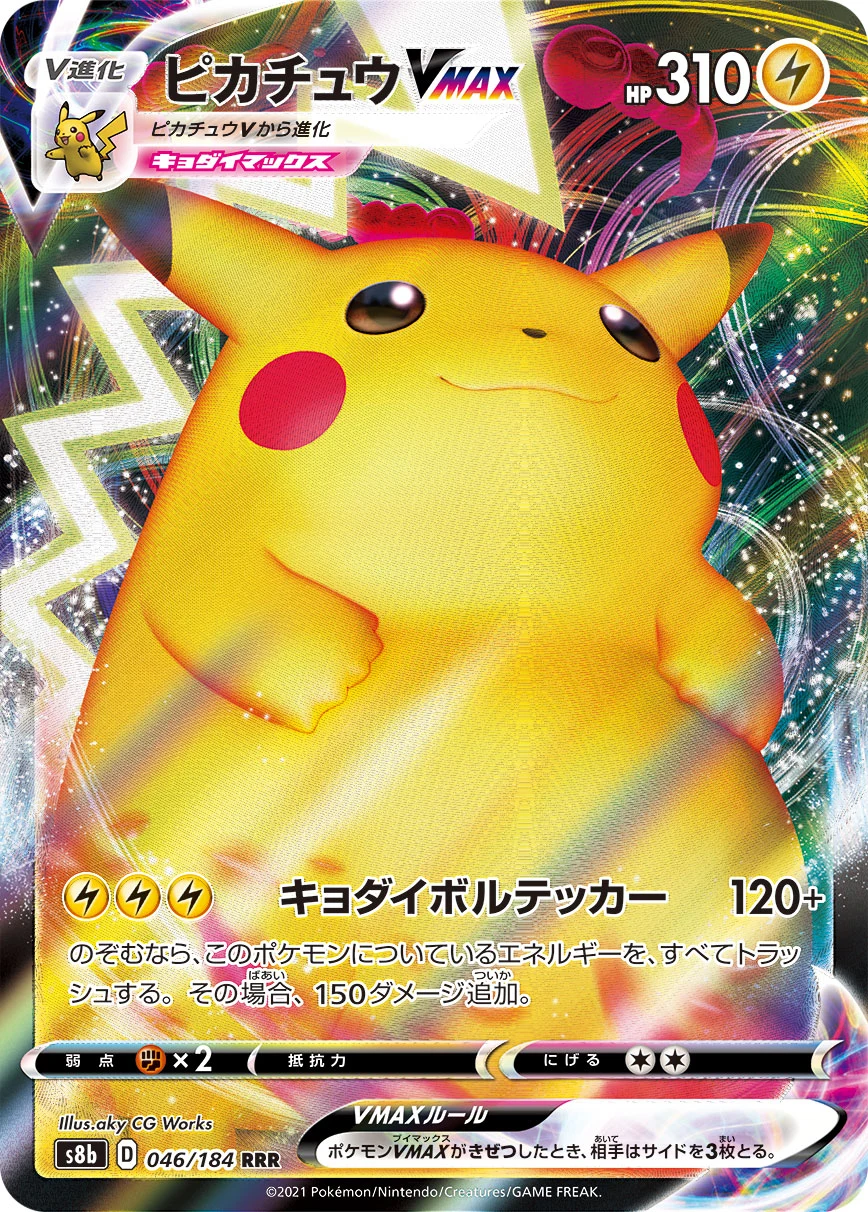
Artwork alone is not enough. The S8b 046/184 print and the Golden Box print are also credited to aky CG Works, so the number and the set name printed on the card are the reliable check. The fourth section lists all six prints side by side.
What does Pikachu VMAX’s Gigantamax Volt Tackle attack do?
Gigantamax Volt Tackle deals 120 damage, and if you choose to discard all Energy attached to Pikachu VMAX, it deals 150 more damage. The Japanese text reads that, if you wish, you trash every Energy attached to this Pokémon, and if you do, the attack does 150 more.
The official set page sums this up as 270 damage when the Energy is discarded, or 120 damage when it is not. The choice is optional, so the card can attack for 120 and keep its Energy in play.
The numbers are easy to compare with the card’s HP. The full 270 damage is 40 below the 310 HP that Pikachu VMAX itself has, and the 120 base damage is well under half of that figure. The 270 total is also 20 above the 250 damage of Gigantamax Thunder on the S-P 265 promo, although that promo needs no discard.
The card also carries the standard VMAX special rule. When a Pokémon VMAX is Knocked Out, the opponent takes 3 Prize cards. The card prints this as its special rule for Pokémon VMAX.
Element
What the card says
Attack name
Gigantamax Volt Tackle (our translation of the Japanese name)
Base damage
120
Optional bonus
Discard all attached Energy to deal 150 more
Total with bonus
270
Special rule
Opponent takes 3 Prize cards when it is Knocked Out
HP
310
Weakness
×2
The official card page lists a single attack for the S4 print. That makes the card simple to read, with one attack, one optional discard and one Prize rule. The next section covers the Pikachu V it evolves from.
Which Pikachu V does Pikachu VMAX evolve from?
Pikachu VMAX evolves from Pikachu V, which the official card page expresses as V-evolution. The official site lists Pikachu V cards in more than one product, and the S4 set prints two of them.
Inside the same set, S4 prints Pikachu V number 030/100 at rarity RR and number 104/100 at rarity SR. The 104 card is numbered above the set total of 100. The official database lists both under the same set.
The official set page describes the Pikachu V attacks. Its Charge attack lets you attach up to 2 Lightning Energy from your deck. On the following turn, its 10,000,000 Volt attack needs 3 Energy and deals 200 damage.
The same page notes that Pikachu VMAX can also evolve from Pikachu V in the V Starter Deck Lightning, which was released on July 10, 2020. The official database lists the Pikachu V in that deck as number 028/127, with no rarity mark.
Pikachu V card
Prodotto
Number
Rarity
Pikachu V
S4, Amazing Volt Tackle
030/100
RR
Pikachu V
S4, Amazing Volt Tackle
104/100
SR
Pikachu V
V Starter Deck Lightning
028/127
No rarity mark
The Pikachu V cards that sit with the other VMAX prints are also listed in the official database. They show how the pairs line up across products.
Prodotto
Pikachu V
Pikachu VMAX
VMAX Climax (S8b)
045/184 RR and 222/184 CSR
046/184 RRR and 223/184 CSR
25th Anniversary Golden Box (S8a-G)
001/015 and 005/015, no rarity mark
006/015, no rarity mark
Pika Pika! Pikachu! Promo Card Campaign
S-P 122/S-P, no rarity mark
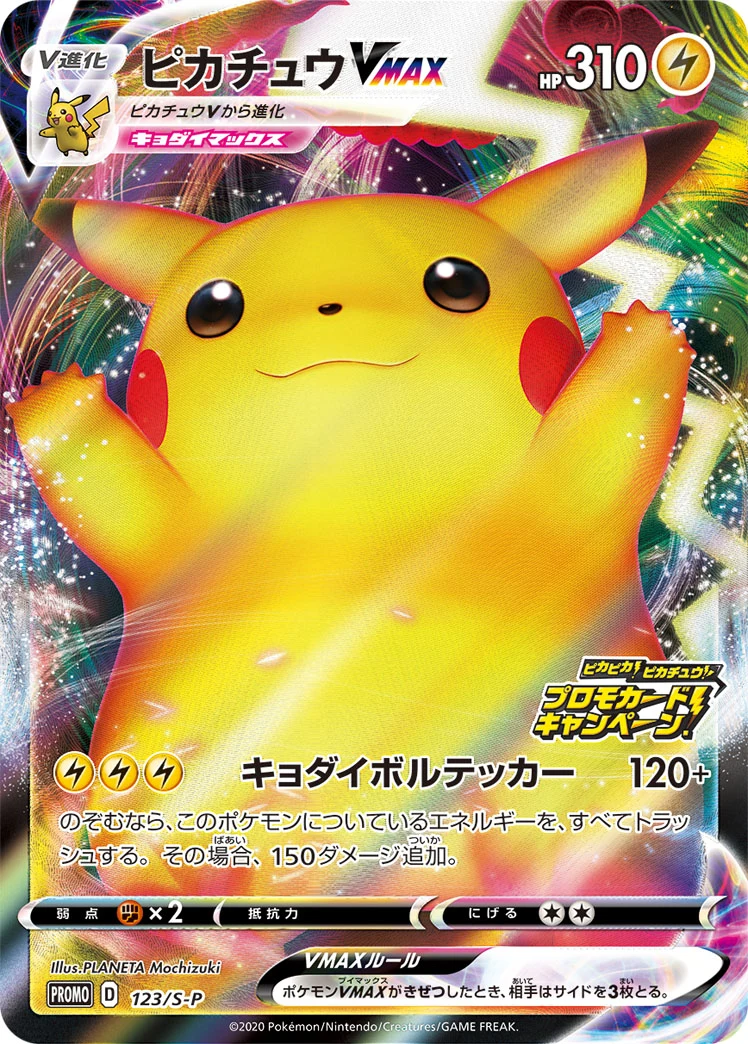
S-P 123/S-P, no rarity mark
The promo Pikachu V S-P 121 comes from a different source, the Giant Pack Set Amazing Volt Tackle (our translation of the Japanese product title).
How many Japanese Pikachu VMAX prints are there?
The official Pikachu search lists six Japanese Pikachu VMAX prints: one in S4, two in S8b, one in the 25th Anniversary Golden Box and two promos numbered S-P 123 and S-P 265. That count is taken from the 257 Pikachu prints the database shows.
Five of the six share the same attack text as the S4 card. They are the S4 print, both S8b prints, the Golden Box print and the S-P 123 promo. The S-P 265 promo is the print with different attacks, and the next section covers it. The prints differ in number, product, illustrator and rarity mark, so the number line and the set name are the easiest way to tell them apart.
Print
Prodotto
Rarity
Illustrator
S4 031/100
Amazing Volt Tackle
RRR
aky CG Works
S8b 046/184
VMAX Climax
RRR
aky CG Works
S8b 223/184
VMAX Climax
CSR
Souichirou Gunjima
S8a-G 006/015
25th Anniversary Golden Box
No rarity mark
aky CG Works
S-P 123/S-P
Pika Pika! Pikachu! Promo Card Campaign
No rarity mark
PLANETA Mochizuki
S-P 265/S-P
Product not shown
No rarity mark
AKIRA EGAWA
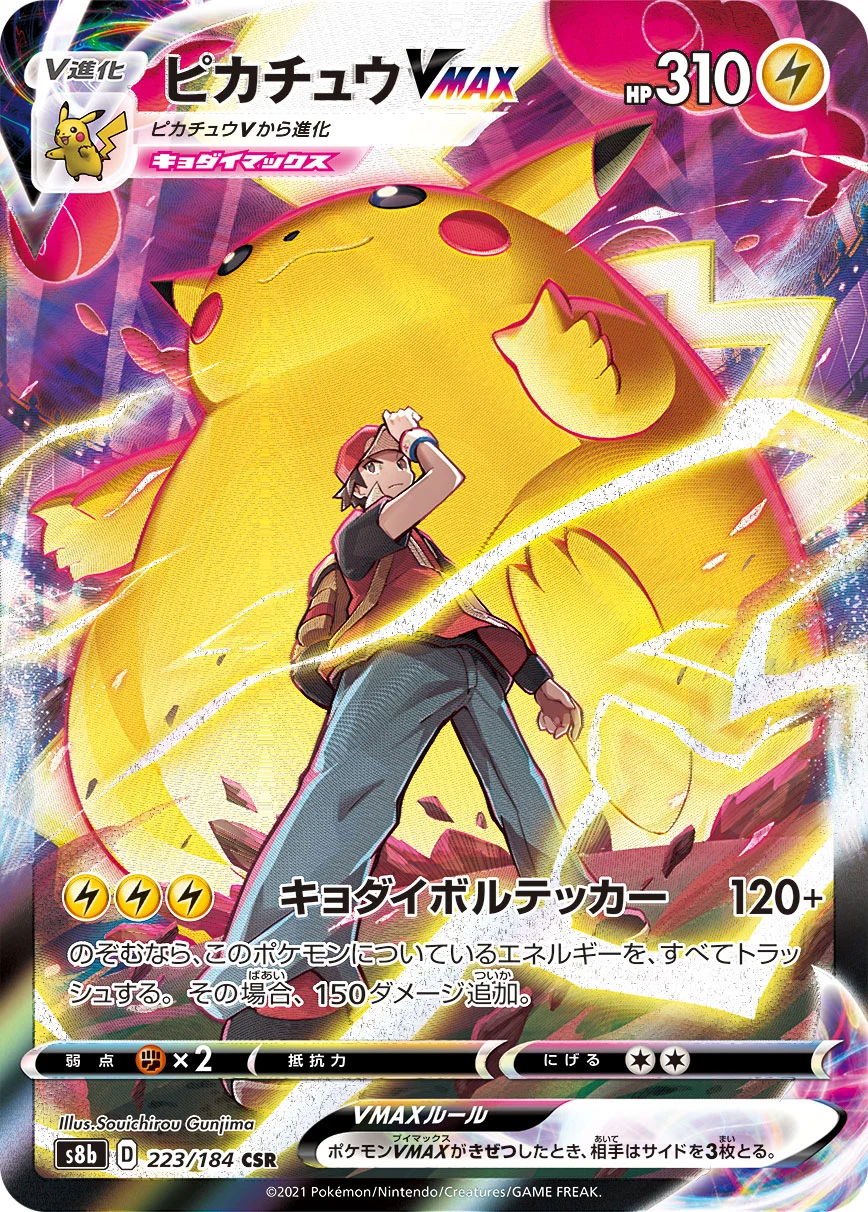
The S8b 223/184 card is numbered above the set total, and its rarity mark is CSR. The S8b 046/184 print uses aky CG Works art like the S4 card and carries the same RRR mark, so the two can look related. Check the number and the set name printed on the card to separate them. VMAX Climax is a high-class pack, and the Golden Box is a boxed product, so both come from different releases than the S4 expansion pack.
Pikachu VMAX, S8b 046/184, RRR. Official image.Pikachu VMAX, S8b 223/184, CSR. Official image.
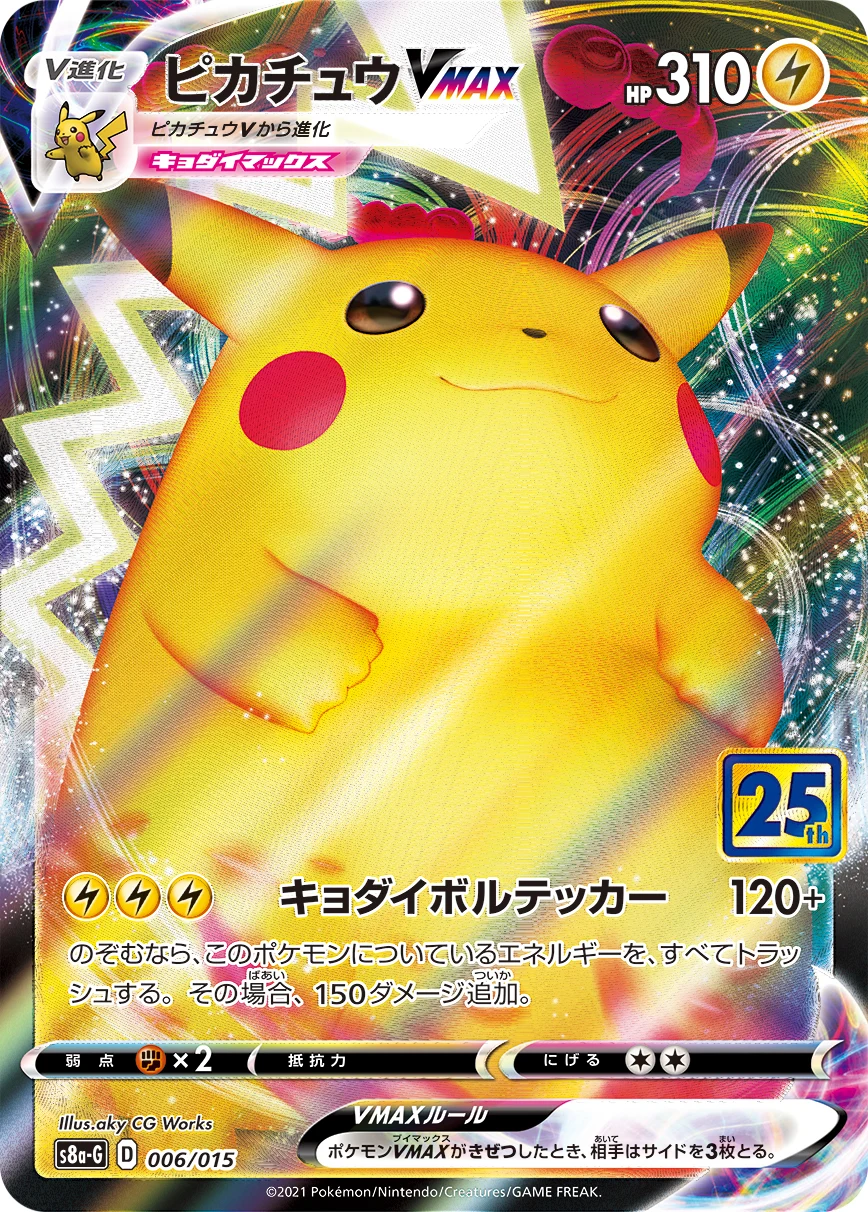
Pikachu VMAX, S8a-G 006/015. Official image.Pikachu VMAX promo, S-P 123/S-P. Official image.
How does the S-P 265 Pikachu VMAX differ from the S4 card?
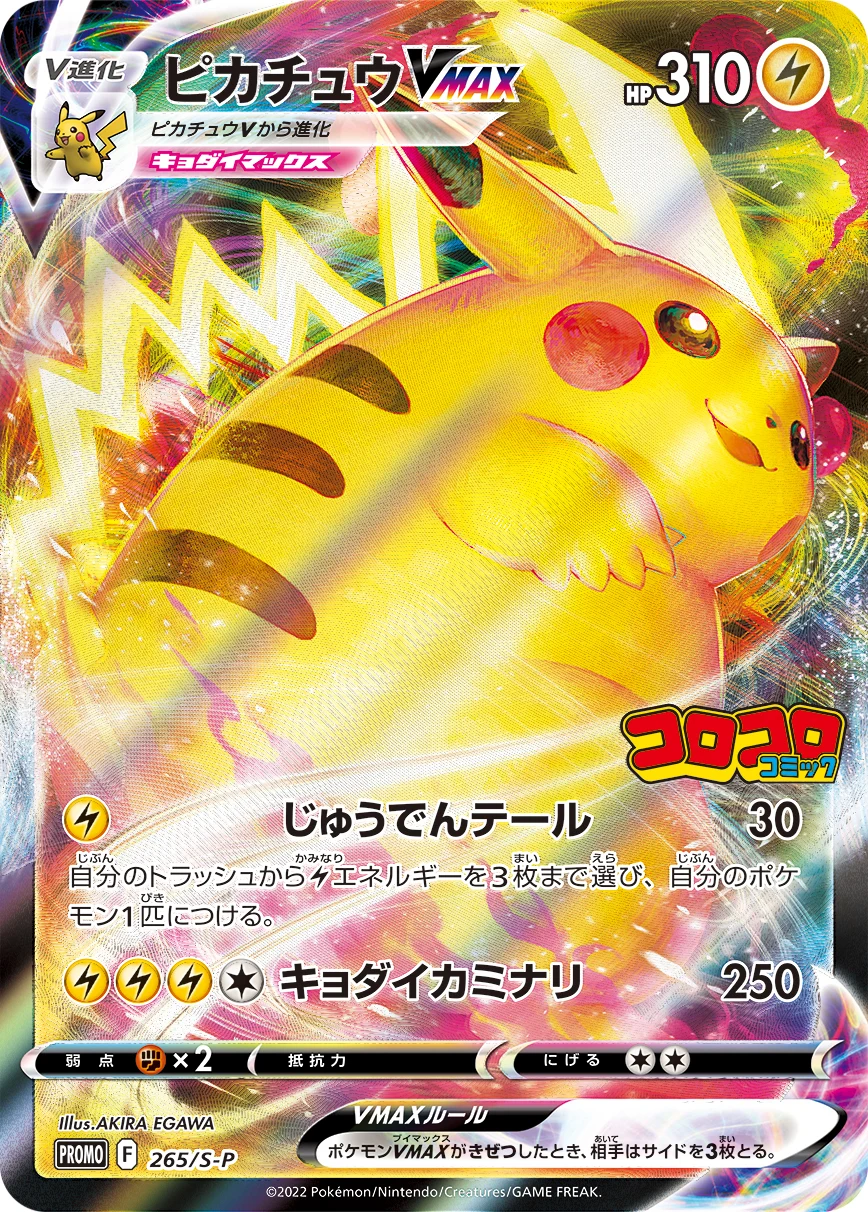
The S-P 265 Pikachu VMAX has the same 310 HP but two different attacks, so Pikachu VMAX prints do not share one attack. The S4 card uses Gigantamax Volt Tackle, while S-P 265 uses Charge Tail and Gigantamax Thunder.
Charge Tail deals 30 damage. It lets you choose up to 3 Energy from your discard pile and attach them to your Pokémon. Gigantamax Thunder deals 250 damage. The official detail page lists AKIRA EGAWA as the illustrator, and the database does not show a product for it. The English names Charge Tail and Gigantamax Thunder are our translations of the Japanese text.
Pikachu VMAX, S-P 265/S-P. Official image.
Feature
S4 031/100
S-P 265/S-P
HP
310
310
First attack
Gigantamax Volt Tackle, 120 plus 150 if all Energy is discarded
Charge Tail, 30, attaches up to 3 Energy from the discard pile
Second attack
No second attack
Gigantamax Thunder, 250
Illustrator
aky CG Works
AKIRA EGAWA
Rarity mark
RRR
None shown
The two cards play differently. The S4 card puts all its damage into one attack and lets the player decide whether to discard Energy. The S-P 265 card splits the work between a 30 damage attack that recovers Energy from the discard pile and a 250 damage attack that has no discard condition in the database text. If you care about how the card plays, read the attack text before the artwork.
The S-P 123 promo matches the S4 attack text with 120 plus the discard bonus, and so do the S8b and Golden Box prints. The official database also shows no rarity mark for either promo, so the RRR mark of the S4 card does not carry over to them.
What else is in the Amazing Volt Tackle set with Pikachu VMAX?
Amazing Volt Tackle was released on September 18, 2020, a Friday, at 165 yen per pack with 5 cards in each pack. The official set page says the cards are randomly inserted.
The page names ten cards: Pikachu V, Pikachu VMAX, Electrode, Orbeetle VMAX, Charizard, Leon, Nessa, Bea, Hitmontop and Shedinja. It states that the SR cards for Leon and Bea are included in the set.
The set’s two Pikachu V cards and the Pikachu VMAX are the cards that belong to this topic. In the official database they are numbered 030/100, 031/100 and 104/100, with rarities RR, RRR and SR.
We ship Japanese sealed Pokémon products from Tokyo by FedEx, and the full terms are on our shipping policy page. Standard shipping is FedEx International Connect Plus with a tracking number, usually 3-7 business days after dispatch as an estimate, and the cost is calculated at checkout. Payments are made in Japanese yen through Wise, PayPal or cards via PayPal, as listed on the payment methods page, and customs processing after FedEx takes over is controlled by the carrier and your country’s authorities.
More Pikachu card guides
These guides cover other Japanese Pikachu cards and the VMAX cards that sit next to this one.
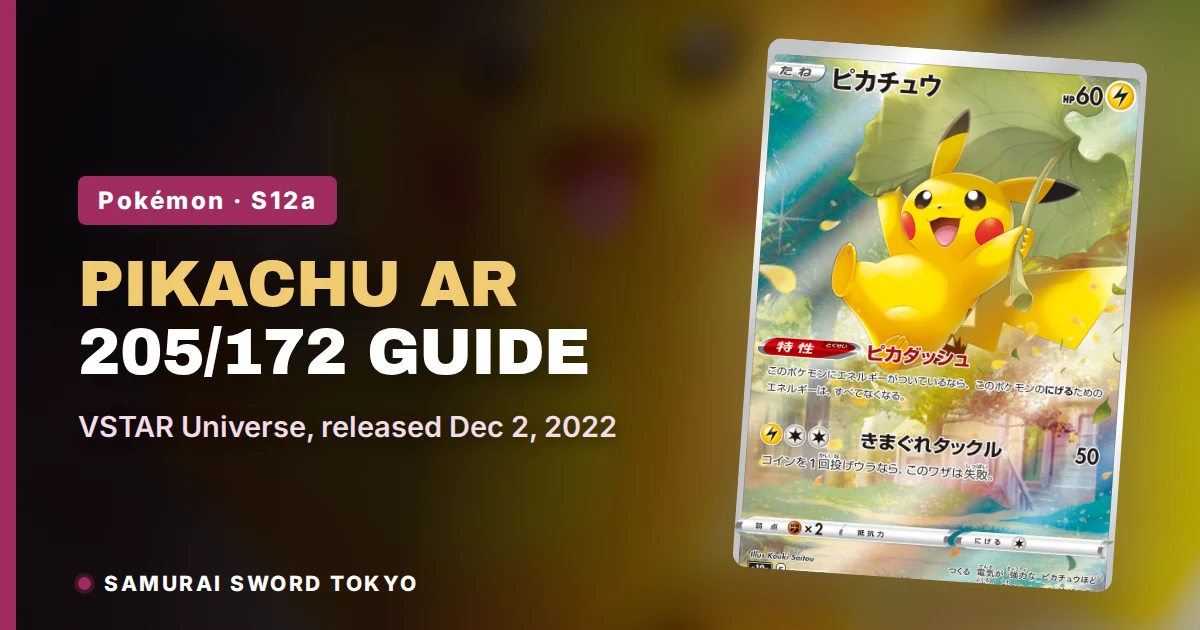
Cover of our Pikachu VSTAR Universe guide, a related Japanese Pikachu card.
What is the Pikachu VMAX card number in Vivid Voltage?
The Japanese card is number 031/100 in set S4, Amazing Volt Tackle, with rarity RRR.
How much HP does Pikachu VMAX have?
Pikachu VMAX has 310 HP on the S4 card and on the other five Japanese Pikachu VMAX prints in the official search.
Which Pokémon does Pikachu VMAX evolve from?
It evolves from Pikachu V. The set includes Pikachu V cards numbered 030/100 and 104/100.
When was the set with Pikachu VMAX released in Japan?
The S4 set, Amazing Volt Tackle, was released on September 18, 2020.
Do all Pikachu VMAX cards have the same attack?
No. The S4 card has Gigantamax Volt Tackle, while the S-P 265 promo has Charge Tail and Gigantamax Thunder.
Who illustrated the S4 Pikachu VMAX?
The official card page credits aky CG Works for the S4 031/100 card.
How much damage can Gigantamax Volt Tackle deal?
It deals 120 damage, or 270 damage in total if you discard all Energy attached to Pikachu VMAX. The official set page gives both figures.
How many Prize cards does the opponent take when Pikachu VMAX is Knocked Out?
The opponent takes 3 Prize cards. This is the special rule printed on the card for Pokémon VMAX.
Pikachu ex Surging Sparks: guida completa a SV8
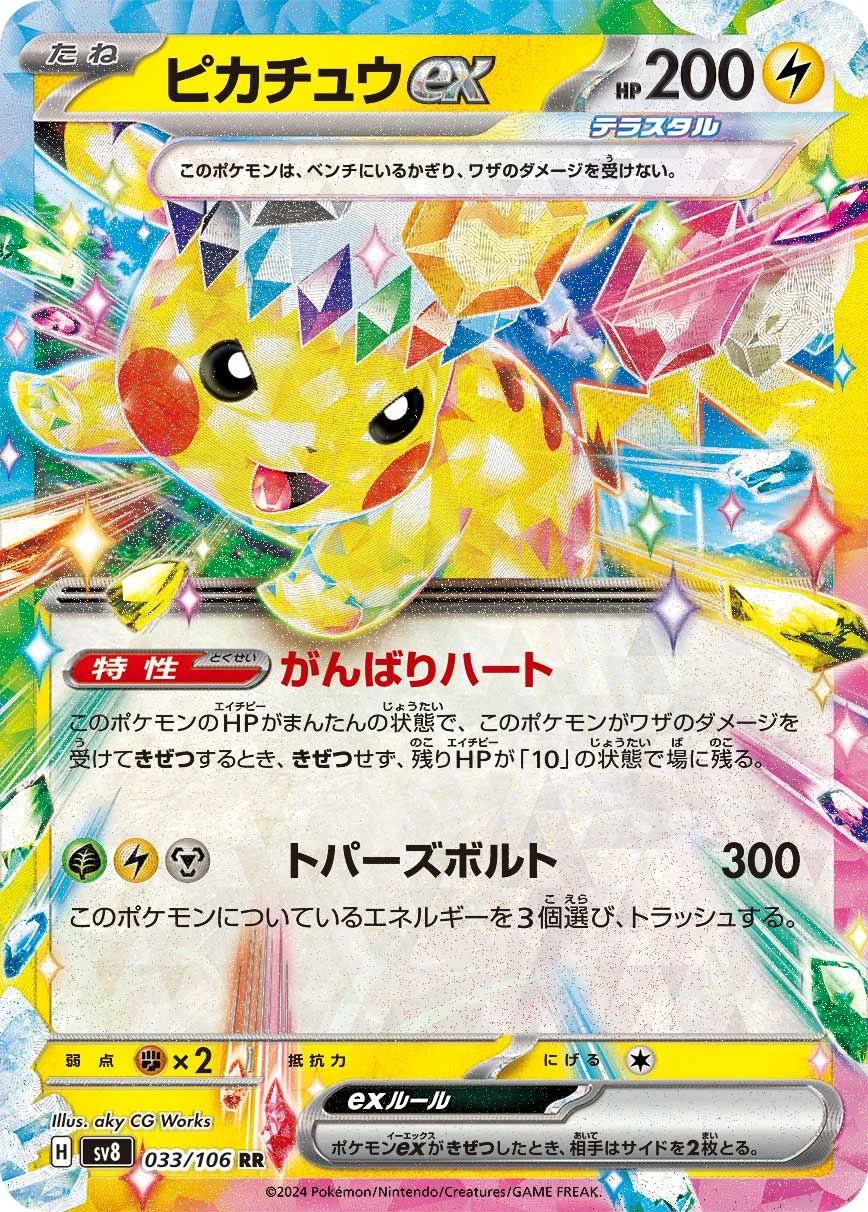
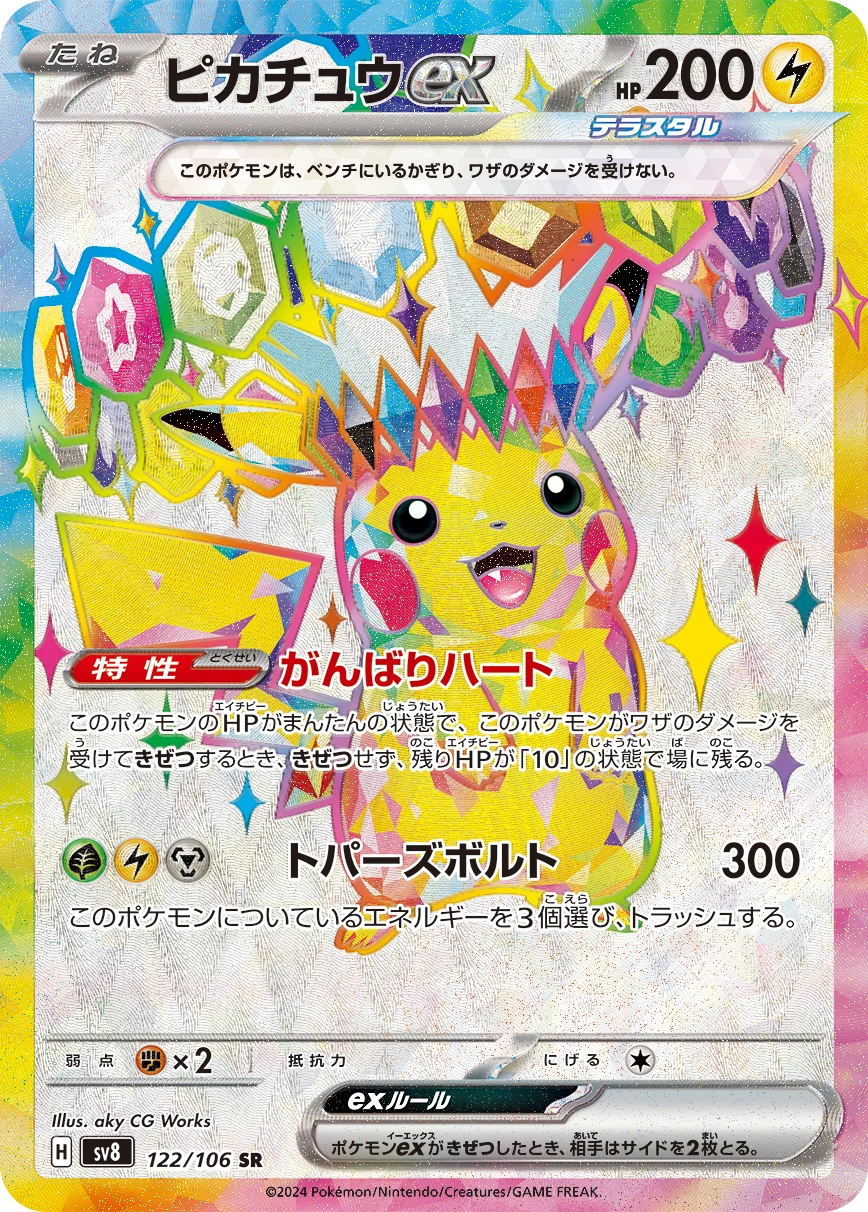
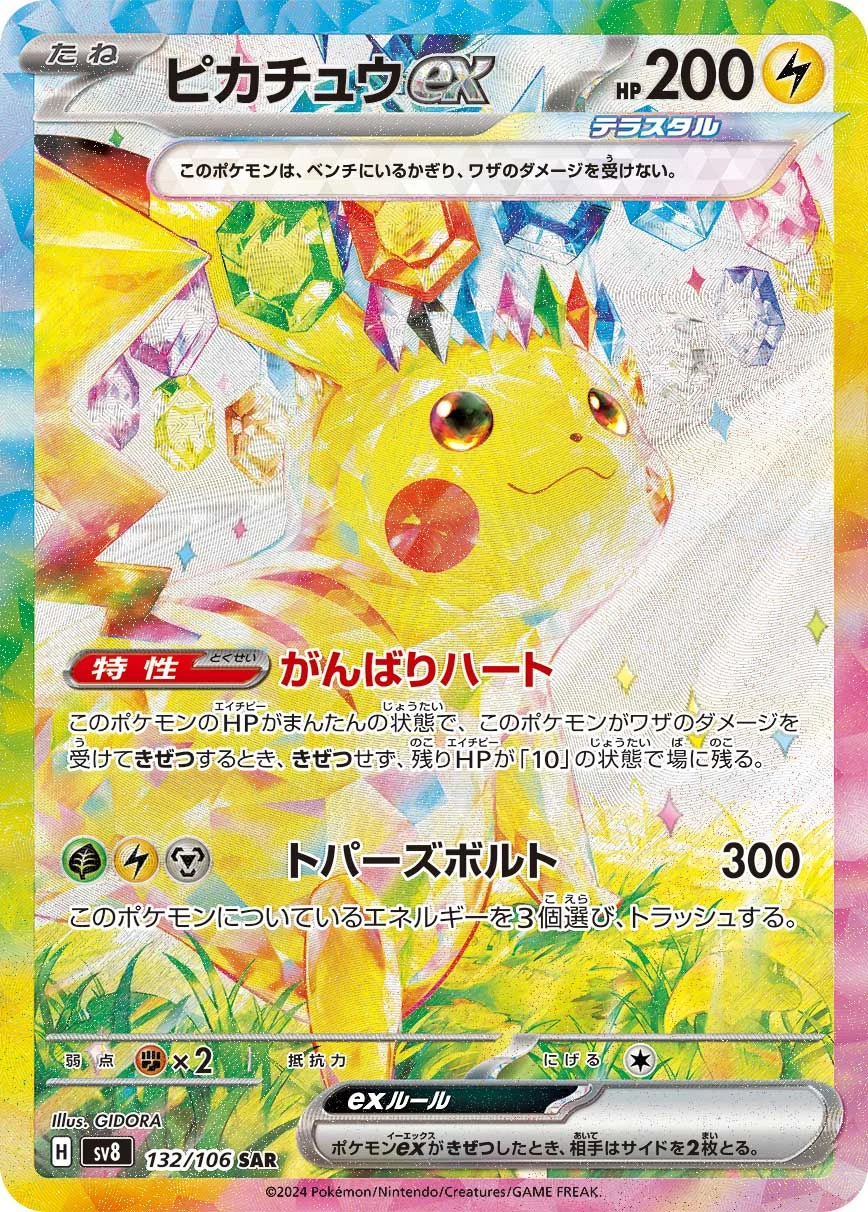
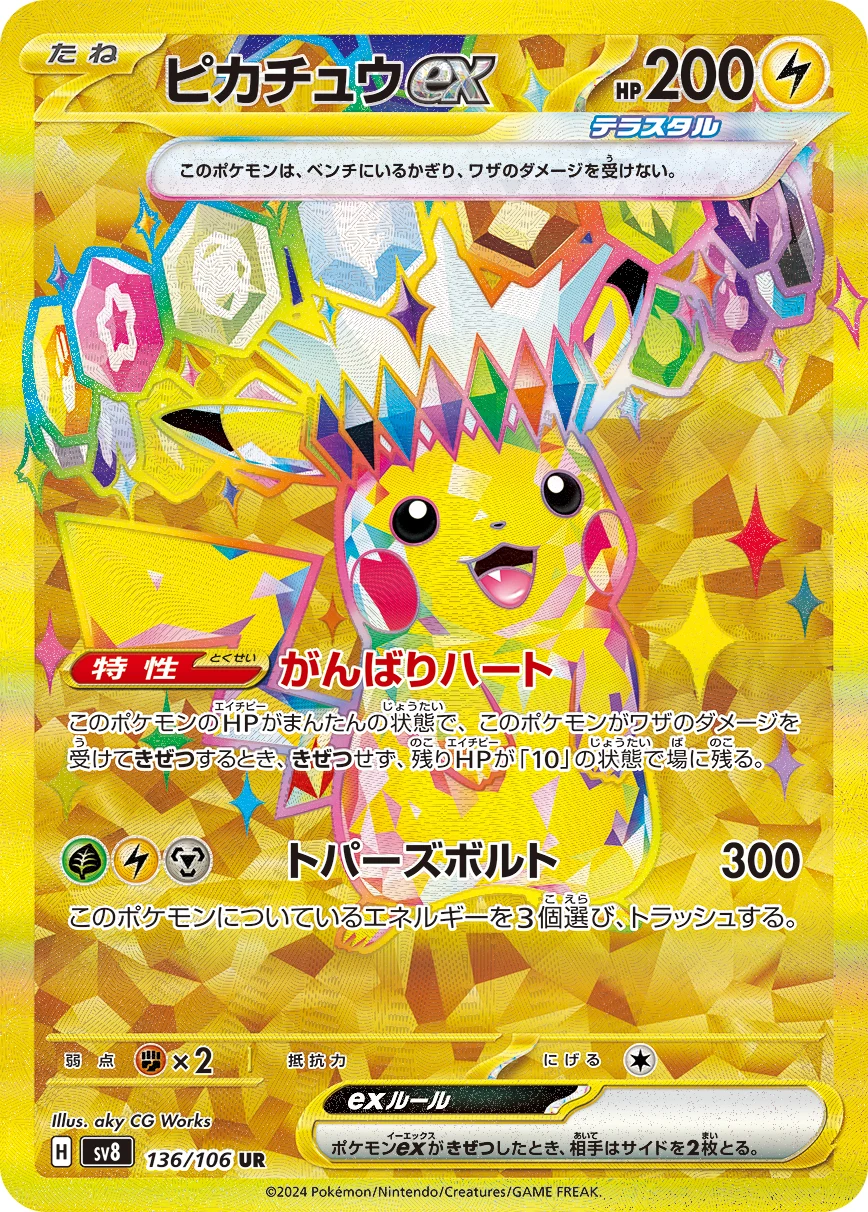
Pikachu ex Surging Sparks refers to Pikachu ex in the Japanese SV8 (Super Electric Breaker) set, a Basic card with HP 200 and the attack Topaz Bolt. SV8 holds four Pikachu ex prints, numbered 033, 122, 132 and 136 of 106. This guide gives the official card text, the illustrators and a comparison with other Pikachu ex cards.
It is the Pikachu ex card from SV8 (Super Electric Breaker), the Japanese expansion pack released on October 18, 2024. The official Japanese database lists it under the set name Super Electric Breaker. Everything below uses the Japanese card pages on pokemon-card.com. For sealed Pokémon boxes, our Pokemon Card Box category is the related shop page.
The base print is number 033 of 106, rarity RR. The official card page describes it as a Basic Pokémon with HP 200. As a Pokémon ex, it follows the rule printed on the card: when it is Knocked Out, the opponent takes 2 Prize cards. That rule is printed on every Pikachu ex card in this guide.
One note on names. English attack names in this article, including Topaz Bolt, are our translations of the Japanese card text; the official page prints the attack as トパーズボルト. Rarity marks are the ones printed on the official card pages. The card is named ピカチュウex in Japanese, and Pikachu ex everywhere in this article.
Pikachu ex, SV8 033/106 (RR), official Japanese card image.
How many Pikachu ex prints does SV8 have?
SV8 has four Pikachu ex prints, numbered 033, 122, 132 and 136 of 106. The official database lists each as a separate card with its own rarity mark.
Number
Rarity mark
Position in the set
033/106
RR
Within the 106-card numbering
122/106
SR
Numbered above the set total
132/106
SAR
Numbered above the set total
136/106
UR
Numbered above the set total
Three of the four numbers run past 106, and the official database lists them that way. The official SV8 page mentions RR, SR and SAR in its Pikachu section. The UR mark for 136 comes from the official card search.
The four prints share the same card text. What differs between them is the rarity mark and, on one print, the illustrator. The next table summarises what stays the same and what changes.
Feature
Same on all four prints?
Card text (Ability, Topaz Bolt, rule box)
Yes
HP 200 and Basic stage
Yes
Rarity mark
No: RR, SR, SAR and UR
Illustrator
No: GIDORA on 132, aky CG Works on the other three
Topaz Bolt deals 300 damage and makes you discard 3 Energy attached to Pikachu ex, while the Ability keeps it on 10 HP if an attack would Knock it Out from full HP. The official page prints both on the same card.
Part of the card
What the official text says
Type and HP
Basic, HP 200
Bench line
While this Pokémon is on the Bench, it takes no damage from attacks.
Ability
If this Pokémon has full HP and would be Knocked Out by attack damage, it is not Knocked Out and stays in play with 10 HP remaining. (The Japanese name is がんばりハート; an official English name has not been announced.)
Attack: Topaz Bolt
300 damage. Choose 3 Energy attached to this Pokémon and discard them.
Rule box
When a Pokémon ex is Knocked Out, the opponent takes 2 Prize cards.
The Ability only works from full HP and only against attack damage, so it covers the first hit and not the second. After it triggers, the card sits on 10 HP and any further damage Knocks it Out, which gives the opponent 2 Prize cards.
The attack has a clear cost. Discarding 3 Energy means Pikachu ex has to be re-powered before it can swing for 300 again. The card text sets the damage and the discard, and nothing more.
The Bench line is a separate rule. It appears in the official card text before the Ability line, and it means a Pikachu ex waiting on the Bench takes no damage from attacks. Read together, the three rules describe a card that takes no damage while waiting, survives one full-HP hit once it is active, and then hits for 300 at the cost of its Energy.
Who illustrated each SV8 Pikachu ex print?
Three SV8 prints are credited to aky CG Works, and the SAR print, 132/106, is credited to GIDORA. The artist is shown on each official card page.
Number
Rarity mark
Illustrator
033/106
RR
aky CG Works
122/106
SR
aky CG Works
132/106
SAR
GIDORA
136/106
UR
aky CG Works
So the four prints do not share one artist. The 132/106 print is the one credited to GIDORA, and the other three carry the aky CG Works credit. The SR and UR prints have the same credit as the base RR print.
What else did the Super Electric Breaker pack feature?
The pack contains 5 cards and cost ¥180 including tax, with the cards randomly inserted, according to the official SV8 page. Pikachu ex is one of six Pokémon ex the page features.
The English names above come from the official pokemon.com name table. The page also mentions AR and SAR cards in a separate AR and SAR section, in addition to the Pikachu section that names RR, SR and SAR.
The official page presents Pikachu ex first among the Pokémon ex it features. It does not give pull rates, and none are quoted here.
The other five Pokémon ex on the page, Hydreigon ex, Tatsugiri ex, Slaking ex, Scovillain ex and Milotic ex, are separate cards with their own text. This guide stays with Pikachu ex, so their attacks and prints are not covered here.
Two other Japanese high-class packs carry the same Topaz Bolt Pikachu ex text: SV8a (Terastal Festival) and M2a (Mega Dream). The official database shows the same HP 200, the same Ability and the same 300-damage Topaz Bolt on each. The database lines used here give no release dates for SV8a or M2a, so this guide compares them by card text only.
Set
Number
Rarity mark
Illustrator
SV8a (Terastal Festival)
236/187
UR
aky CG Works
M2a (Mega Dream)
044/193
RR
aky CG Works
M2a (Mega Dream)
234/193
SAR
James Turner
Both sets are high-class packs (ハイクラスパック in Japanese). The SV8a card and the M2a 044 card carry the aky CG Works credit, and M2a 234 is credited to James Turner. Among these three prints, M2a 234/193 is the one with an illustrator different from the SV8 artists.
Our Pikachu ex Mega Dream guide covers the M2a prints in detail. Together with the four SV8 prints, these three bring the Topaz Bolt text to seven prints in the official database.
Cover of our M2a guide, the set with two more Topaz Bolt Pikachu ex prints.
How does it differ from earlier Pikachu ex cards?
Seven other Pikachu ex cards in the official database show no Ability and deal between 120 and 220 damage, while the SV8 card has an Ability and a 300-damage attack. The table below lists them.
Carta
HP
Attacks
Illustrator
SVC 1/021 (Starter Set ex)
190
Pika Punch 30; Dynamic Bolt 220 (flip a coin; on tails, discard all Energy from this Pokémon)
These seven entries show no Ability line in the official text. The SV8 card adds the survive-on-10-HP Ability and the Bench protection line, and its attack deals 300 where these cards deal at most 220. The cost of that damage is the discard of 3 Energy. The other cards pay with a coin flip or with damage to themselves, and the 120-damage Thunderbolt cards have no extra cost in their text.
The cards with HP 190 (SVC, WCS23, SVM) have 10 HP less than SV8’s 200. The cards at HP 200 in this table (SVI, MC, M-P 6) share SV8’s HP but not its Ability.
The simplest way to tell the families apart is by the attack list. A card with Pika Punch and Dynamic Bolt is the starter-set and Worlds 2023 design. A card with Thunderbolt for 120 is the SVI and Start Deck 100 design. A card with Topaz Bolt for 300 is the SV8 design, shared with the SV8a and M2a prints above.
The official database also shows SVI 18/066 twice, as two separate card pages with the same text.
Which Pikachu ex cards came in 30th Celebration?
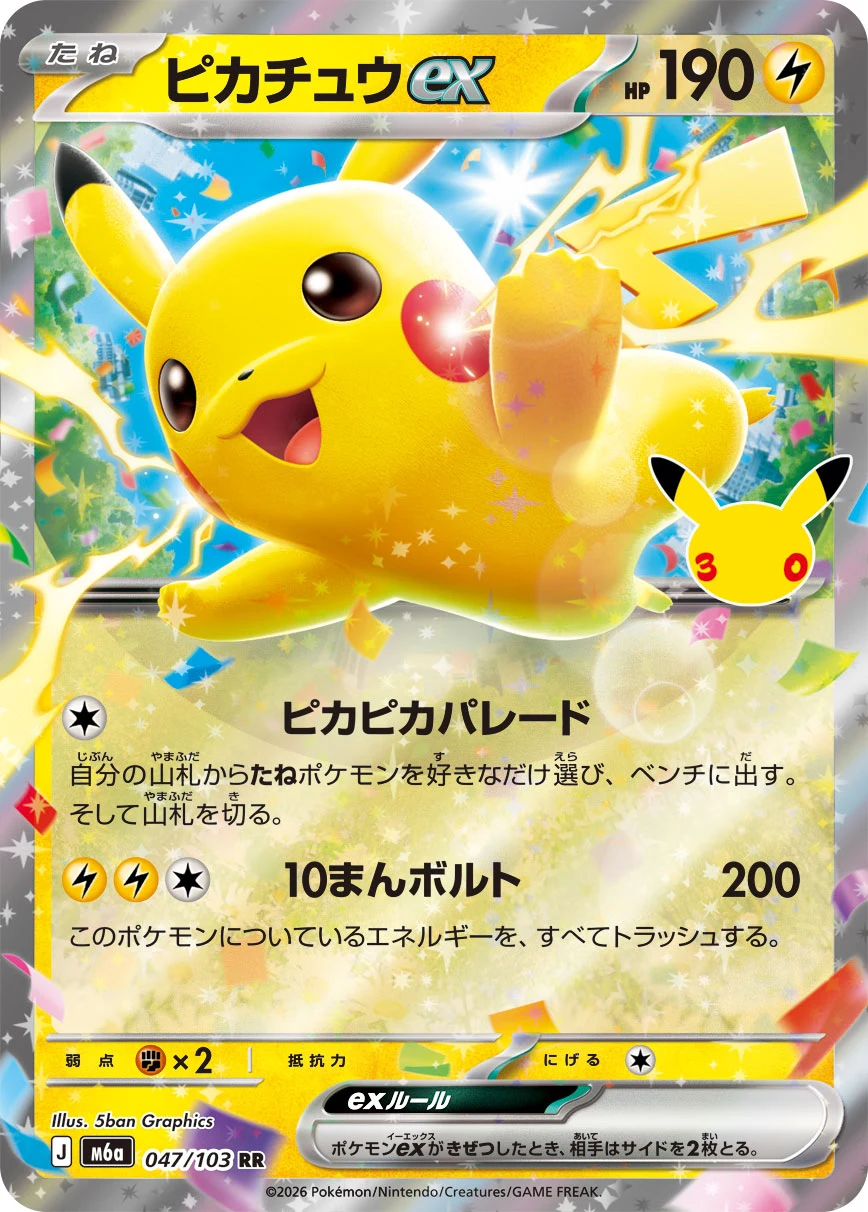
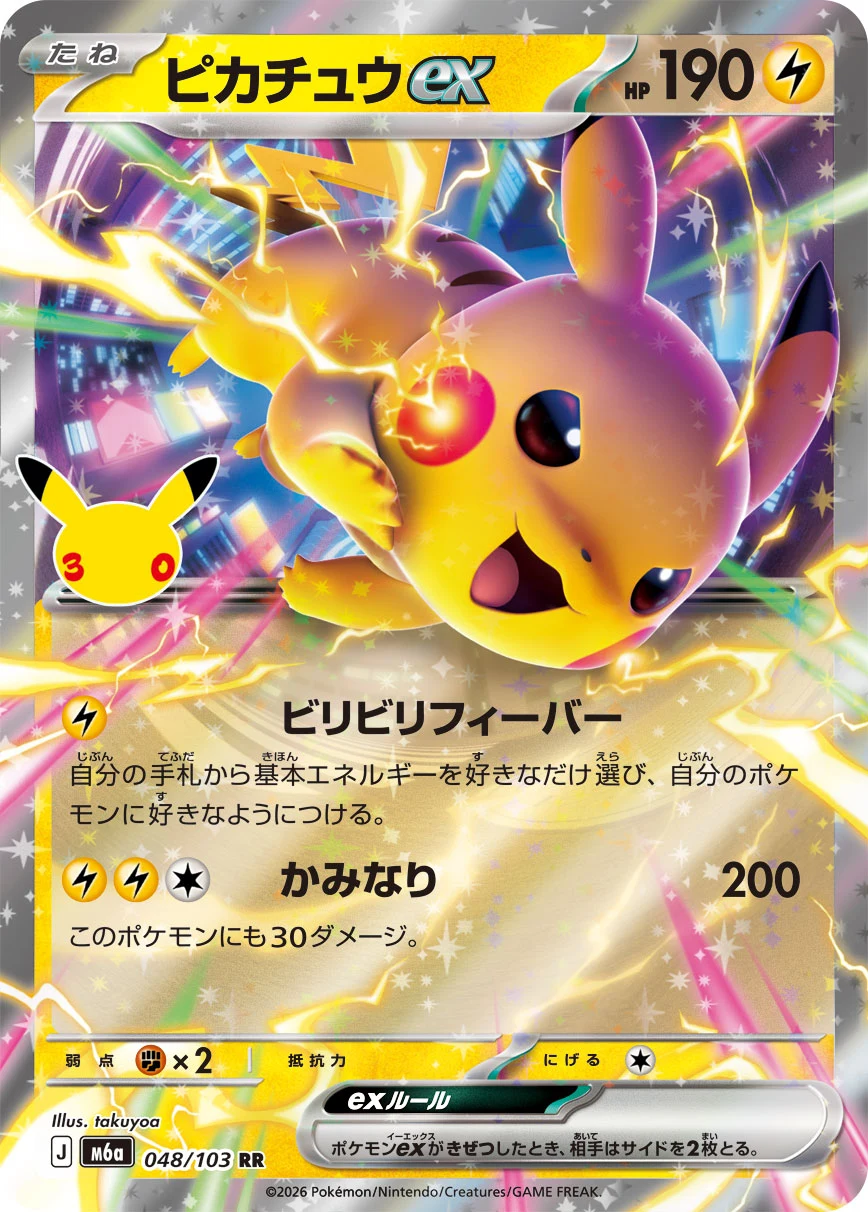
Four Pikachu ex cards use different effects from SV8: M6a (30th Celebration) 47/103 and 48/103, plus M-P 131 and 132 from the 30th Celebration Futuristic Box. All four are HP 190 with two attacks and no Ability line.
Carta
Rarity mark
First attack
Second attack
Illustrator
M6a 47/103
RR
Sparkly Parade: search your deck for any number of Basic Pokémon, put them on the Bench, then shuffle
Thunderbolt 200: discard all Energy from this Pokémon
5ban Graphics
M6a 48/103
RR
Zappy Fever: attach any number of Basic Energy from your hand to your Pokémon as you like
Thunder 200: 30 damage to itself
takuyoa
M-P 131/M-P
No rarity mark
Same text as M6a 47
Same text as M6a 47
YOSHIROTTEN
M-P 132/M-P
No rarity mark
Same text as M6a 48
Same text as M6a 48
YOSHIROTTEN
These cards play differently from the SV8 card. Instead of a 300-damage attack, they pair a setup attack (benching Pokémon or attaching Energy) with a 200-damage attack. The SV8 card has no such setup attack.
Yes. The official card page for SV8 033/106 lists it as Basic with HP 200.
When was the Japanese SV8 set released?
The official SV8 page gives the release date as October 18, 2024.
How much was an SV8 pack?
One pack cost ¥180 including tax and contained 5 cards, randomly inserted, per the official SV8 page.
Which SV8 Pikachu ex print is the SAR?
The SAR is number 132/106, illustrated by GIDORA.
Which Pokémon ex does the SV8 page feature besides Pikachu ex?
It names Hydreigon ex, Tatsugiri ex, Slaking ex, Scovillain ex and Milotic ex.
Does the SV8 Pikachu ex have an Ability?
Yes. If it has full HP and would be Knocked Out by attack damage, it stays in play with 10 HP remaining. The same Ability text also appears on the SV8a and M2a prints.
More Pikachu ex guides
These guides from our blog cover related Pikachu cards and sets.
Munkidori Full Art 088/064: guida alla carta SAR giapponese
The Munkidori full art cards in the Japanese Pokémon TCG are three prints: the SAR Munkidori ex 088/064 and the SR Munkidori ex 080/064, both in SV6a (SV6A) Night Wanderer, and the AR Munkidori 107/101 in SV6 Mask of Change. This guide goes card by card through HP, ability, attack and illustrator.
Night Wanderer, Japanese edition (強化拡張パック「ナイトワンダラー」)
Release date
June 7, 2024 (Friday)
Contenuto della bustina
5 carte per pack, randomly inserted; 180 yen with tax
HP and stage
210, Basic Pokémon
Illustrator
kantaro
Which Munkidori cards count as full art?
Three do: SAR 088/064, SR 080/064 and AR 107/101, and each has a number above the printed set total. In this guide, “full art” means a print with an AR, SR or SAR mark whose number is higher than the set total. That is our working definition for sorting the ten official prints, not a term printed on the cards.
The official database lists 10 Munkidori prints, and seven of them have numbers inside the set total. The database writes the SR rarity as “SR_C”, and we keep that mark as written.
Print
Card name
Rarity mark
Set
Illustrator
088/064
Munkidori ex
SAR
SV6a (Night Wanderer)
kantaro
080/064
Munkidori ex
SR_C
SV6a (Night Wanderer)
5ban Graphics
107/101
Munkidori
AR
SV6 (Mask of Change)
Teeziro
Two of the three are ex cards with 210 HP, and one is a plain Munkidori with 110 HP. For the wider background on how the SR, SAR and AR marks relate.
The gap between each number and its set total is simple arithmetic from the printed numbers. The SAR 088/064 is 24 above the total of 64, the SR 080/064 is 16 above it, and the AR 107/101 is 6 above the total of 101.
The ten prints also fall into clear groups by set. SV6a Night Wanderer holds three Munkidori ex prints (037/064, 080/064 and 088/064), SV6 Mask of Change holds two prints (055/101 and 107/101), and SV8a Terastal Festival holds two (075/187 and 103/187). The remaining three come from M2a Mega Dream, the MC starter deck product and the M-P promo pack, one each.
The illustrator credits split the same way. kodama is credited on five of the ten prints, takuyoa on two, and kantaro, 5ban Graphics and Teeziro on one each. That means each of the three full art prints has a different illustrator, and none of them is credited to kodama or takuyoa.
Cover of our Jynx full art guide, written in the same rarity, number and illustrator format.
What is Munkidori ex SAR 088/064 in Night Wanderer?
It is the SAR print of Munkidori ex in SV6a Night Wanderer, a Basic Pokémon with 210 HP illustrated by kantaro. The set is the Reinforcement Expansion Pack “Night Wanderer” in the Scarlet & Violet series, released on June 7, 2024, and the official product page lists 5-card packs at 180 yen with tax.
The number 088/064 sits 24 above the set total of 64. The pack centers on Pecharunt ex and includes cards from Pokémon Scarlet & Violet: The Teal Mask, and Munkidori ex appears in the ex Pokémon section of that page.
The card text of this SAR is the same as on the other three Munkidori ex prints in the database: 037/064 and 080/064 in Night Wanderer, and 103/187 in SV8a. What differs is the rarity mark, the number and the illustrator credit, which is kantaro for the SAR.
The official card page for 088/064 also gives the special rule: when a Pokémon ex is Knocked Out, the opponent takes 2 Prize cards.
One detail trips up searchers. The official database search page writes this card as 88/064, while the card pages for the other Night Wanderer prints write numbers with a leading zero, such as 037/064. Both forms point to the same print, and this guide uses the three-digit form, 088/064, for clarity.
The useful comparison is with the plain Munkidori prints, which have 110 HP. The ex version has 210 HP, a 190-damage attack against the plain card’s 60, and the special rule that gives the opponent 2 Prize cards when a Pokémon ex is Knocked Out.
What do the ability and attack on Munkidori ex say?
Munkidori ex has one ability that reduces the Prize cards taken when Pecharunt ex is in play, and one attack that deals 190 damage and cannot be used on your next turn. English names in this guide are our translations of the Japanese text, not official English names.
Part of the card
Our English name
What it says
Ability (ひょうしぬけ)
Letdown
If this Pokémon is Knocked Out by damage from an opponent’s attack and you have Pecharunt ex in play, the opponent takes 1 fewer Prize card.
Attack (ダーティヘッド)
Dirty Head
190 damage. During your next turn, this Pokémon cannot use Dirty Head.
Special rule
Pokémon ex rule
When a Pokémon ex is Knocked Out, your opponent takes 2 Prize cards.
The ability names Pecharunt ex, the card the SV6a pack centers on. The official SV6a page describes the same effect in its ex Pokémon section: the ability reduces the Prize cards taken by one when Pecharunt ex is in play.
The attack is Dirty Head at 190, and its listed restriction is the one on your next turn. All four Munkidori ex prints (037/064, 080/064 and 088/064 in Night Wanderer, plus 103/187 in SV8a) carry this text, with 210 HP on each.
Put the ability and the special rule together and the arithmetic is straightforward. A Pokémon ex normally gives the opponent 2 Prize cards when it is Knocked Out. If Munkidori ex is Knocked Out by an opponent’s attack while Pecharunt ex is in play on your side, the opponent takes 1 fewer, which leaves 1 Prize card. Without Pecharunt ex in play, the ability does not apply and the opponent takes the normal 2.
Dirty Head deals 190 damage, close to the card’s own 210 HP, and the card cannot use it during your next turn. The sources give no other cost or effect for the attack beyond the damage figure and this restriction.
The ex card and the plain Munkidori carry different text. The ex version has an ability tied to Pecharunt ex and one 190-damage attack. The plain version, covered below, has an ability that moves damage counters and a 60-damage attack that confuses the opponent’s Active Pokémon.
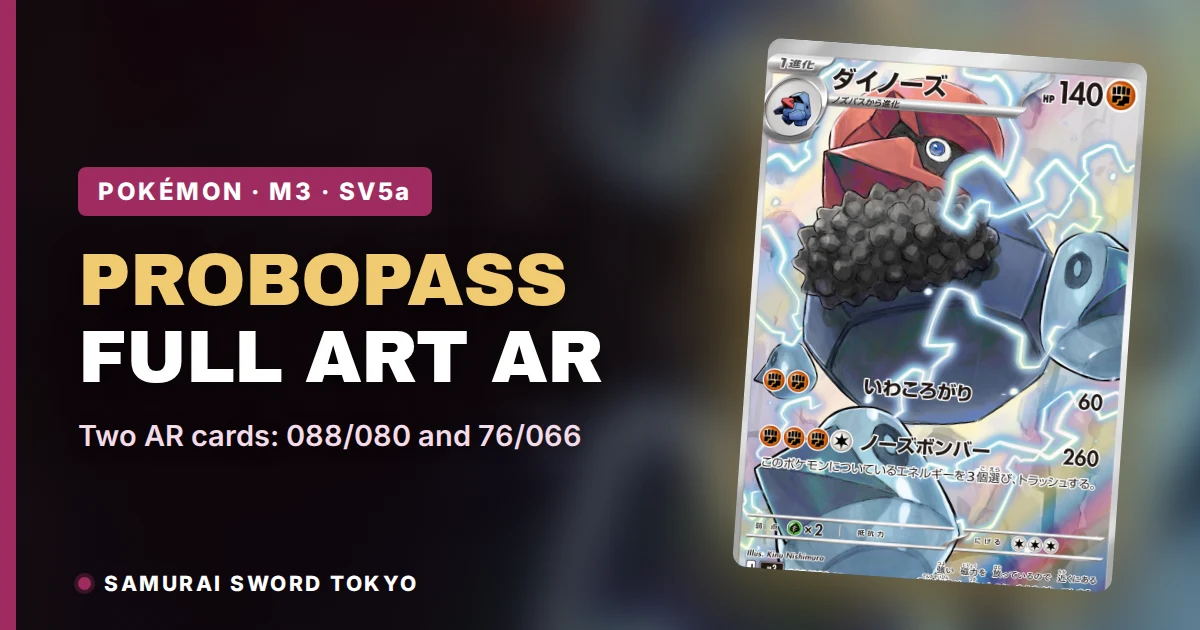
Cover of our Probopass full art guide.
How does the SR 080/064 differ from the SAR 088/064?
They have the same name, set, HP and card text, and differ in rarity mark, card number and illustrator. The SR 080/064 is credited to 5ban Graphics, and the SAR 088/064 to kantaro.
Because the text is identical, the difference between the two comes down to the artwork and the credit line. The official pages give the rarity marks and the illustrators, and the ability, attack and special rule match word for word.
The database also keeps a third Night Wanderer print of the same card, 037/064, with the RR mark and the credit takuyoa. Seen together, the three Night Wanderer prints are three different illustrators on one card text: takuyoa on 037/064, 5ban Graphics on 080/064 and kantaro on 088/064.
What is the Mask of Change AR Munkidori 107/101?
It is a different card from the ex: a plain Munkidori with 110 HP in SV6 Mask of Change, illustrated by Teeziro. Its rarity mark is AR and its number, 107/101, is above the set total of 101.
Part of the card
Our English name
What it says
Ability (アドレナブレイン)
Adrena-Brain
Once during your turn, if this Pokémon has Energy attached, move up to 3 damage counters from one of your Pokémon to one of your opponent’s Pokémon.
Attack (サイコトリップ)
Psycho Trip
60 damage. The opponent’s Active Pokémon is now Confused.
This card is a Basic Pokémon with the ability and attack shown above. The Pokémon ex rule is not printed on it, because it is not an ex card. The official card page is the source for this text.
The AR shares its card text with five other prints: the regular 055/101 in Mask of Change, the regular 075/187 in Terastal Festival, 081/193 in Mega Dream, 358/742 in the Starter Deck 100 product and 3/M-P in the MEGA promo pack. All six prints have 110 HP, the same ability and the same 60-damage attack. Only the AR carries a full art mark. Its artwork is credited to Teeziro, while the other five are all credited to kodama.
Adrena-Brain lets you move up to 3 damage counters from one of your Pokémon onto one of your opponent’s Pokémon, once during your turn, as long as Munkidori itself has Energy attached. The attack, Psycho Trip, adds Confusion to the opponent’s Active Pokémon after 60 damage.
The Twilight Masquerade English expansion page says Okidogi, Munkidori and Fezandipiti, the Heroes of Kitakami, have “Adrena” Abilities that use Darkness-type Energy. That page covers the English-language expansion, so treat it as background on the Adrena abilities, not as a statement about this Japanese card’s set.
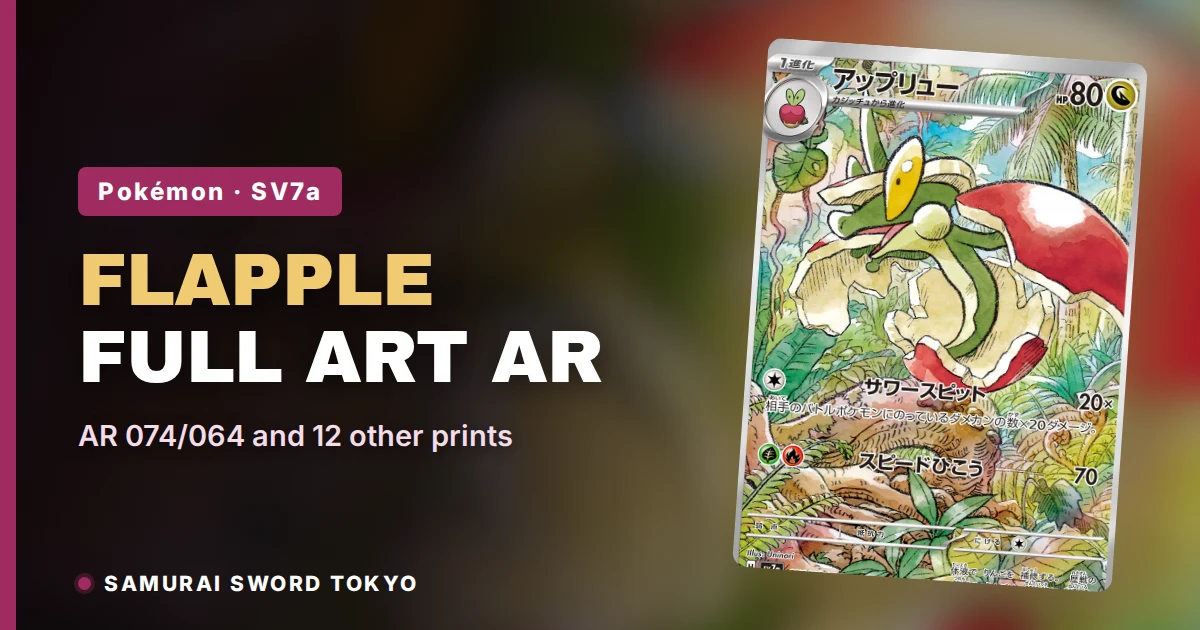
Cover of our Flapple full art guide.
Which Munkidori prints are not full art?
Seven of the ten official prints are not full art under our working definition: two RR ex cards, one R_C card and four prints with no rarity mark. All seven carry numbers inside their set totals and have no AR, SR or SAR mark.
Number
Card name
Rarity mark
Set
Illustrator
037/064
Munkidori ex
RR
SV6a (Night Wanderer)
takuyoa
103/187
Munkidori ex
RR
SV8a (Terastal Festival)
takuyoa
055/101
Munkidori
R_C
SV6 (Mask of Change)
kodama
075/187
Munkidori
none
SV8a (Terastal Festival)
kodama
081/193
Munkidori
none
M2a (Mega Dream)
kodama
358/742
Munkidori
none
MC, Starter Deck 100 Battle Collection
kodama
3/M-P
Munkidori
none
M-P, MEGA Promo Card Pack Vol. 1
kodama
The Munkidori ex 037/064 in Night Wanderer has the same name and text as 080/064 and 088/064. The difference is the number: 037 is inside the set total of 64, and its illustrator is takuyoa.
The plain Munkidori prints share the Adrena-Brain and Psycho Trip text with the AR. The official page for 075/187 in SV8a lists a Basic Pokémon with 110 HP, Weakness ×2 and Resistance −30, illustrated by kodama. The same page gives Pokédex No. 1015, the Retainer Pokémon (けらいポケモン), 1.0 m tall and 12.2 kg. The SV8a set is the High Class Pack “Terastal Festival ex”.
Sorting the seven by HP gives a simple rule. The two RR cards are ex cards with 210 HP and the Dirty Head attack. The other five (055/101, 075/187, 081/193, 358/742 and 3/M-P) are plain Munkidori cards with 110 HP and the Psycho Trip attack. Across all ten prints, then, four have 210 HP and six have 110 HP.
The SV8a pair shows how a single set can hold both versions. Terastal Festival has the plain Munkidori 075/187 with no rarity mark and the ex 103/187 with the RR mark, and neither number is above the set total of 187. So SV8a has no Munkidori full art print under our definition.
None of them shows a rarity mark in the official database.
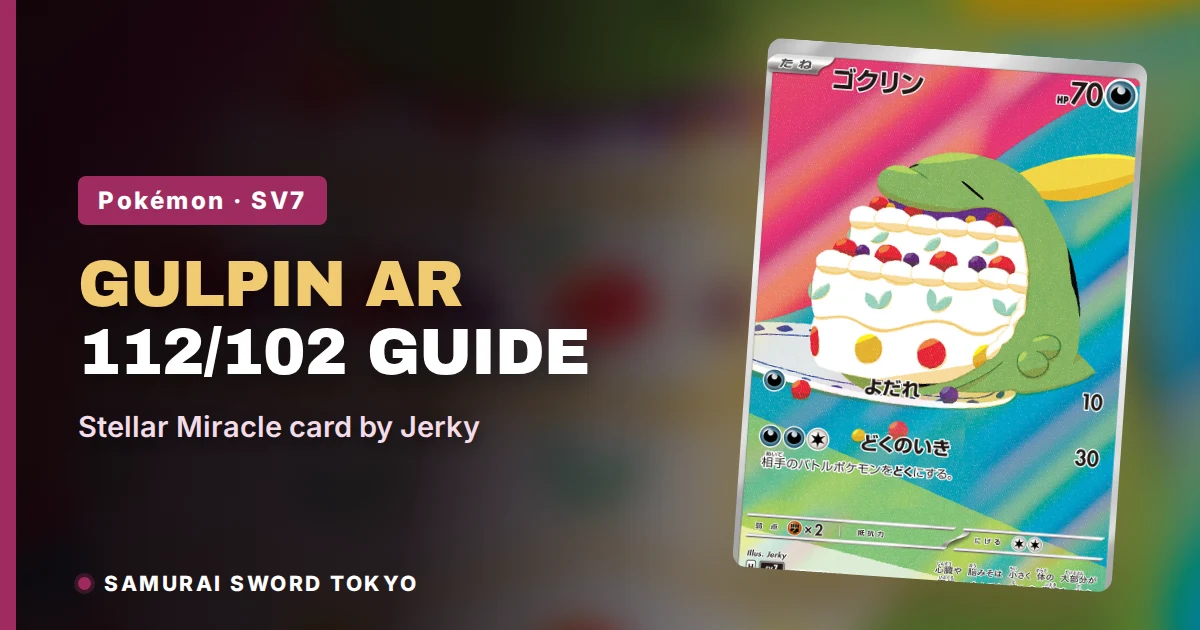
Cover of our Gulpin full art guide.
Which other SAR cards share Night Wanderer with Munkidori?
Four other SAR cards sit beside the Munkidori ex SAR in Night Wanderer, which makes five SAR cards in the set. The official card search for SV6a lists them as Okidogi ex, Fezandipiti ex, Pecharunt ex and カシオペア (official English name not announced). We do not give their card numbers here.
Carta
Rarity
Link to Munkidori
Pecharunt ex
SAR
The card the SV6a pack centers on; Munkidori ex’s ability refers to it.
Okidogi ex
SAR
Named with Munkidori among the Heroes of Kitakami on the English Twilight Masquerade page.
Fezandipiti ex
SAR
Named with Munkidori among the Heroes of Kitakami on the English Twilight Masquerade page.
The fourth SAR card
SAR
Listed in the official SV6a AR, SR and SAR section.
The official SV6a page also lists Horsea, Houndoom, Bewear and Pecharunt ex in its AR, SR and SAR section. Munkidori ex is named on the page in the ex Pokémon section instead, beside other ex Pokémon.
Pecharunt ex is the card tied most directly to Munkidori ex: the Munkidori ex ability is written around it, and the pack centers on it. For sealed Pokémon products, our Pokemon Card Box category page is the related shop category.
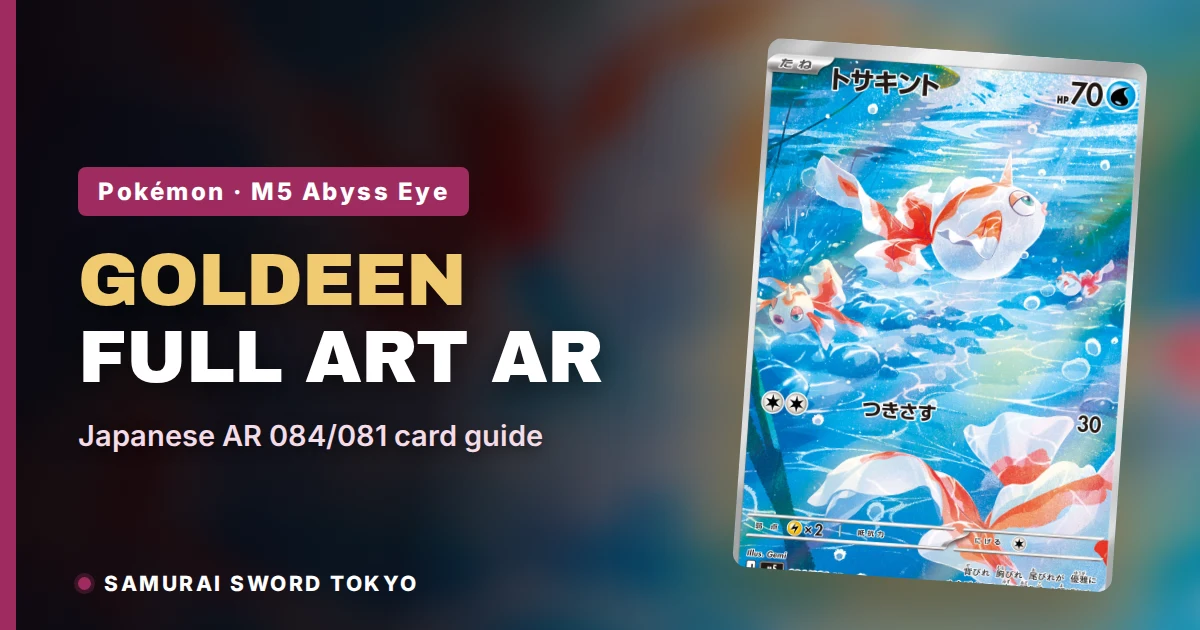
Cover of our Goldeen full art guide.
Domande frequenti
How many Munkidori full art cards are there in Japanese?
There are three under our definition: SAR 088/064 and SR 080/064 (Munkidori ex, SV6a Night Wanderer) and AR 107/101 (Munkidori, SV6 Mask of Change).
When was SV6a Night Wanderer released?
SV6a Night Wanderer was released in Japan on June 7, 2024, according to the official product page.
Who illustrated the Munkidori ex SAR?
The SAR 088/064 is illustrated by kantaro. The SR 080/064 is by 5ban Graphics and the AR 107/101 is by Teeziro.
Is the Munkidori ex SR the same card as the SAR?
No. They share name, set, 210 HP and card text, but have different numbers (080/064 and 088/064), rarity marks and illustrators.
How many cards come in a Night Wanderer pack?
Each pack holds 5 cards, randomly inserted, and the official price is 180 yen with tax.
What number is the regular Munkidori in Terastal Festival?
The regular Munkidori in SV8a Terastal Festival ex is 075/187, a Basic Pokémon with 110 HP illustrated by kodama.
Is there a Munkidori full art print in SV8a Terastal Festival?
No. The two SV8a prints are the plain 075/187 with no rarity mark and the ex 103/187 with the RR mark, and both numbers are inside the set total of 187.
Does the Munkidori ex ability work without Pecharunt ex?
No. The ability only reduces the opponent’s Prize cards by one if Pecharunt ex is in play on your side when Munkidori ex is Knocked Out by an opponent’s attack.
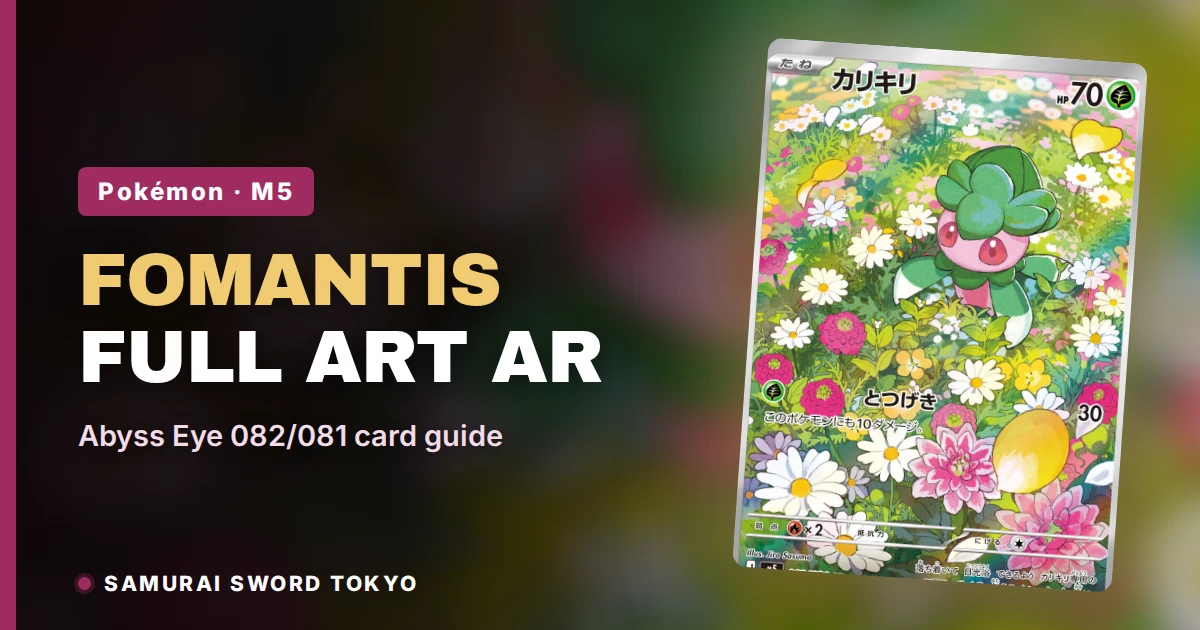
Cover of our Fomantis full art guide.Image from our Applin full art guide.Image from our Pidgeot ex full art guide.
Quali carte Yu-Gi-Oh! valgono soldi? Come controllare una carta OCG giapponese
Start with the exact print. We counted 87 Japanese print entries under Blue-Eyes White Dragon in Konami’s database. Match the card number, rarity and artwork before comparing asking prices.
This guide is a step-by-step check for Japanese OCG cards (the Official Card Game sold in Japan). It shows where the card number is printed, how to tell a Japanese card from an English TCG card, how to name the rarity in Konami’s own Japanese terms, how to find out which print you hold, and how to check condition. The facts come from Konami’s Japanese site and its official card database, read on November 18, 2026. The price examples are list prices in our online store on the same date.
This is not a ranking of expensive cards. If you want that, our guide to expensive Yu-Gi-Oh! cards covers it. Here the question is simpler: is the card in your hand worth checking, and how do you check it?
Key Facts
Official: on Konami’s sample monster card, the card number ROTD-JP014 is on the right below the artwork and above the text box. JP, AE and EN identify the language in the examples shown in this guide.
Official: Konami’s card database lists 87 print entries for Blue-Eyes White Dragon in Japanese, from 1999 to 2026. One card name is not one price.
Among the eight Blue-Eyes White Dragon PSA 10 back-order listings compared below, our asking prices range from ¥35,446 to ¥499,999.
87
Japanese print entries for Blue-Eyes in the official database
4
Rarities on one number (QCCP-JP001)
JP / AE / EN
Language codes in the examples shown
001–100
Serial range on LOCR Grandmaster Rares
Prices are our shop’s asking prices on November 18, 2026, not completed sales. Most of the graded examples are PSA 10 back-order listings (sourced to order); the product page shows the current terms.
The Short Answer: Identify the Print First
Three checks come before any price:
Identify the print. Record the card number, language, product, rarity and illustration.
Check condition. Inspect the corners, edges, surface and centring.
Compare like with like. Compare asking prices for the same print and condition.
The six steps below turn this into checks you can do with the card in your hand.
Step 1: Find the Card Number
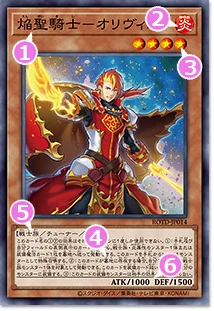
Everything starts with the card number. Konami’s own card-anatomy diagram shows where it sits: on its sample monster card, ROTD-JP014 is on the right below the artwork and above the text box.
焔聖騎士-オリヴィエ, ROTD-JP014, Konami’s official card-anatomy diagram
The diagram labels six parts of a monster card: card name, attribute, level, card text, type, and ATK/DEF. It does not label the number, but you can see it printed under the art: ROTD-JP014. Read it in three pieces:
Part
Example
What it tells you
Codice set
ROTD
The product the card came from: ライズ・オブ・ザ・デュエリスト (RISE OF THE DUELIST)
Language code
JP
A Japanese OCG print
Position
014
The card’s number in that set
Now type that number into Konami’s official card database (遊戯王ニューロン, Yu-Gi-Oh! Neuron) at db.yugioh-card.com. Its search panel has a card-number search next to the card-name search. For this card, the database lists one print: ROTD-JP014, released April 18, 2020, in Normal rarity. That one entry tells you the set, the date and the rarity at once.
Some numbers look different. Some promotional and special cards use a letter in the position, as in 2018-JPP01, and early Japanese cards have no language code: LB-01 (May 18, 2000) is the earliest Blue-Eyes White Dragon entry in the database that carries a card number. The four entries dated before it (March 6 to December 16, 1999, starting with the STARTER BOX prints) show no card number at all. The database handles all of these.
Step 2: Japanese OCG or English TCG?
The official database groups its languages into two blocks: the OCG (Japanese, Korean, English (Asia) and Simplified Chinese) and the TCG (English, German, French, Italian, Spanish and Portuguese). Our guide to OCG vs TCG differences explains how the two games differ for players. JP, AE and EN identify the language in the examples shown below. For older numbers such as SDK-001, check the database language, product and date together.
Code in the number
Example (official database)
What it is
JP
QCCP-JP001, LOCR-JP001
Japanese OCG print
AE
SDRB-AE001 (November 11, 2023)
Asian English print, part of the OCG
EN
LC01-EN004 (entries dated October 5, 2010 and April 21, 2023)
English TCG print
No language code
LB-01 (Japanese, May 18, 2000)
An early print; the database entry tells you which product and game it belongs to
Two practical points follow.
English words do not make a card English TCG. Konami’s rules for non-Japanese cards at events held in Japan list Japanese OCG prints that carry English or other non-Japanese text. Read the number, not the name.
Japanese-version cards are the official cards at events in Japan. Konami’s September 26, 2026 rule names Japanese-version OCG cards as the official cards for events in Japan. It permits the listed cards with non-Japanese text to be played as their corresponding existing cards, including KA-05 and YAS3-JP005 as Blue-Eyes White Dragon.
When you search for a price later, always include the language. A Japanese QCCP-JP001 and an English print of the same monster are different prints.
Step 3: Name the Rarity in Konami’s Terms
Konami’s Japanese product pages print the rarity names in katakana. Here they are once in Japanese, with the English reading used in this guide:
Japanese name
English reading used here
Database code
Where Konami lists it
ノーマル
Normal
N
Core boosters, decks
レア
Rare
R
Core boosters (18 of 80 in IMMORTAL PHOENIX)
スーパーレア
Super Rare
SR
Boosters and special packs
ウルトラレア
Ultra Rare
UR
Boosters and special packs
アルティメットレア
Ultimate Rare
UL
IMMORTAL PHOENIX (4 cards); LOCR and YAC1 versions
シークレットレア
Secret Rare
SE
IMMORTAL PHOENIX, LOCR, QCAC, YAC1
プリズマティックシークレットレア
Prismatic Secret Rare
PSE
IMMORTAL PHOENIX (24 cards); every LOCR card
クォーターセンチュリーシークレットレア
Quarter Century Secret Rare
QCSE
25th-anniversary products such as QCAC
コレクターズレア
Collector’s Rare
CR
LOCR (21 cards), YAC1 (14 cards)
グランドマスターレア
Grandmaster Rare
GMR
LOCR (18 cards), YAC1 (10 cards); serial-numbered
The database also lists other rarity names on some prints, such as ホログラフィックレア (Holographic Rare, HR), 20thシークレットレア (20th Secret Rare), パラレル (Parallel) and ミレニアム (Millennium). Our Japanese OCG rarity guide shows how each one looks on the card.
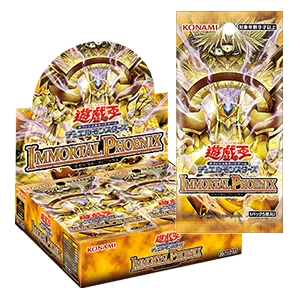
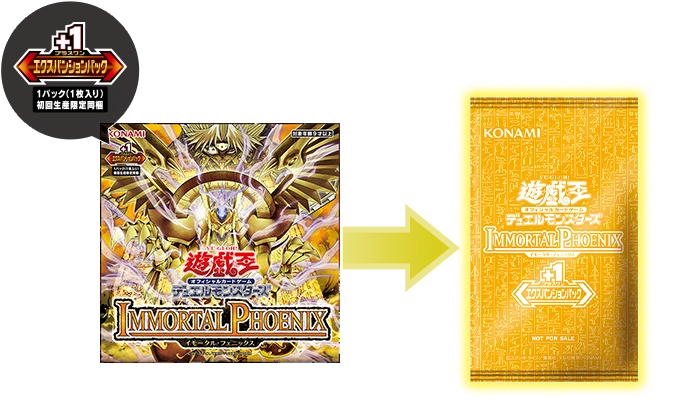
A core booster shows how the tiers stack. Konami’s page for IMMORTAL PHOENIX (October 31, 2026, ¥198 per pack including tax, 30 packs per box) lists 80 cards: 4 Ultimate Rare, 8 Ultra Rare, 10 Super Rare, 18 Rare and 40 Normal (4 + 8 + 10 + 18 + 40 = 80). On top of that, 24 cards also exist as Prismatic Secret Rare and 30 as Secret Rare. Half of the 80 card types are Normal.
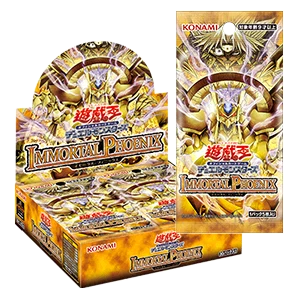
IMMORTAL PHOENIX (IMPH), Japanese box and pack, official image
Overframe is a design, not a rarity
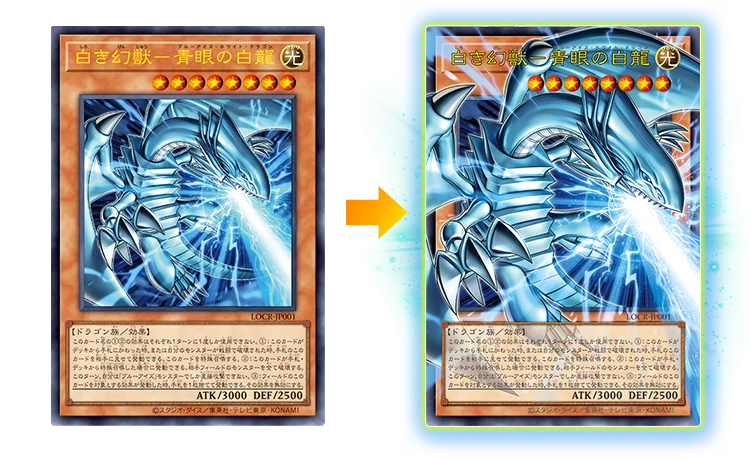
Recent Japanese products add an Overframe (オーバーフレーム) design, in which the illustration breaks out of the art frame. Konami lists it as a version of a rarity: in LOCR, 18 of the Prismatic Secret Rares and 18 of the Ultra Rares are Overframe cards. Record both the rarity and the design when you describe the card.
白き幻獣-青眼の白龍 (Blue-Eyes White Dragon, the White Phantom Beast), LOCR-JP001: standard frame (left) and Overframe (right), official image
Grandmaster Rare carries a serial number
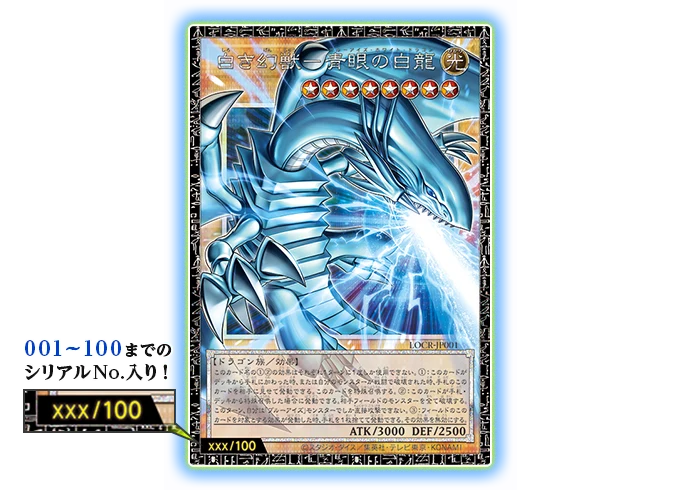
Konami’s LOCR page calls Grandmaster Rare a new rarity with a serial number, and the YAC1 page says each Grandmaster Rare carries its own serial number and no two cards share one. The LOCR graphic gives the serial range as 001–100. The sample card shows “xxx/100” at bottom left.
白き幻獣-青眼の白龍, LOCR-JP001, Grandmaster Rare sample with “xxx/100” serial, official image
If your card has a serial in that corner, write the serial down with the card number. The LOCR card list shows the set.
Step 4: Work Out Which Print You Hold
Blue-Eyes White Dragon (青眼の白龍) has 87 Japanese print entries in the database, from a STARTER BOX print dated March 6, 1999 to the YAS3 prints of October 31, 2026. By rarity code, those entries break down as 27 Ultra Rare, 13 Secret Rare, 11 Normal, 10 Quarter Century Secret Rare, 5 Ultimate Rare and 21 spread across other codes (27 + 13 + 11 + 10 + 5 + 21 = 87).
Three things in the database entry help you place your card:
One number can carry several rarities. QCCP-JP001 (QUARTER CENTURY CHRONICLE side:PRIDE, March 23, 2024) appears four times: Ultra Rare, Secret Rare, Ultimate Rare and Quarter Century Secret Rare. The number alone does not finish the job; check the foil.
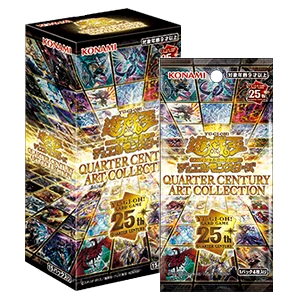
One number can carry several illustrations. The database groups prints by illustration. QCAC-JP021 (QUARTER CENTURY ART COLLECTION, February 22, 2025) appears under five different illustrations. Konami’s QCAC page says some cards have alternate illustrations, and each card has Secret Rare, Quarter Century Secret Rare or both set individually.
The dates show first print and reprints. Each entry carries its release date, so the earliest date listed is the first Japanese printing in the database. Konami’s product pages also flag reprints in the text as 再収録カード (re-included cards).
QUARTER CENTURY ART COLLECTION (QCAC), Japanese box and pack, official image
Event and campaign cards need extra care. Blue-Eyes White Dragon prints in the database include a World Championship 2018 visitor card (2018-JPP01), a Prismatic Secret Rare campaign card (PSEC-JP001) and a Japan Post collaboration card (NYC1-JP001). These were distributed differently from booster cards. Copy the entire number, including any letters after JP. The QCAC card list and our hub of card lists help with set prints.
What Our Shop’s Listings Show
Our catalogue has PSA 10 listings for several Blue-Eyes White Dragon prints. The eight below are as listed on November 18, 2026; listings and prices change daily. Same card name and PSA 10 grade, different prints:
The highest listing in this table is more than fourteen times the lowest. All eight are Blue-Eyes White Dragon, and all eight are PSA 10. They differ in print: rarity, distribution and date. That is why Step 4 matters more than the card name.
The same pattern shows up on a single card number. Dragon Master Knight GB7-003, which our listings name as a Yu-Gi-Oh! Duel Monsters 7 card, is listed in PSA 10 at ¥58,850 as a Secret Rare and at ¥998,000 as an Ultra Rare, both as back orders. Same number, different rarity, very different asking price. Check the foil before you read a price.
A PSA 10 grade does not make every card expensive either. Favorite HERO Flame Wingman, an Ultra Rare from LIMIT OVER COLLECTION -THE HEROES- (LOCH-JP005), is listed in PSA 10 at ¥10,735 as a back order, and a PSA 10 Ash Blossom & Joyous Spring alternate-illustration Prismatic Secret Rare (PAC1-JP016) is currently listed at ¥23,400. At the other end, a PSA 10 Dark Magician Girl alternate-illustration Quarter Century Secret Rare from QCAC (QCAC-JP019) is currently listed at ¥589,999.
Shop listing names abbreviate Quarter Century Secret Rare as “25th SE”. Konami’s database calls it QCSE.
Japanese Yu-Gi-Oh! Box
LOCR-Limit Over Collection The Rivals Japanese Yu-Gi-Oh Booster Box
LOCR is the set behind the Overframe and Grandmaster Rare images above. Konami’s page lists 80 cards (38 Ultra Rare, 42 Super Rare) at ¥385 per pack including tax. At four carte per pack and 15 packs per box, a box contains 60 cards against an 80-card set.
Step 5: Condizione and Grading
Once you know the exact print, check condition under a bright light, tilting the card:
Corners: sharp, or soft and rounded?
Edges: any whitening or chipping along the border, front and back?
Surface: scratches, dents, print lines, or clouding on the foil?
Centring: are the borders even left to right and top to bottom?
Bends and warping: lay the card flat and look along it.
On foil rarities such as Secret, Prismatic Secret and Quarter Century Secret Rare, look at the surface at several angles; marks on the foil are part of the condition.
A grade is a third-party assessment of condition. Compare a graded copy with the same print and grade.
Check Authenticity First
A price only matters if the card is real. Our guide on how to spot fake Yu-Gi-Oh! cards covers what to look at before you compare prices.
Step 6: Look Up a Market Price
With the number, language, rarity, print and condition written down, you can search for prices. A few rules keep the comparison honest:
Search the full description. Card number, rarity, language, and grade or condition together. “QCCP-JP001 Quarter Century Secret Rare Japanese PSA 10” finds a different set of results from “Blue-Eyes White Dragon”.
Prefer completed sales to asking prices. An asking price is what a seller hopes to get. Where a site shows completed sales, use them, and look at several.
Compare like with like. Raw with raw, graded with the same grade, Japanese with Japanese, the same illustration with the same illustration.
The Full Checklist
Run through this with the card in front of you:
Check
Where to look
What to note
Card number
On the illustrated ROTD card, right below the artwork
A promo-style number (JPP, JPS, a year such as 2018-) or an early number without JP
Lingua
JP / AE / EN in the number
Match the market you plan to compare against
Rarity
Foil on the name, art and frame; the database entry
The rarity shown for this print in the database
Design
Art breaking the frame; alternate illustration
Overframe; an illustration listed separately in the database
Serial
Bottom-left corner
A Grandmaster Rare serial such as xxx/100
Print date
Official database entry
Early prints, event or campaign prints
Condizione
Corners, edges, surface, centring under light
Clean on all four
Authenticity
Print quality, foil, card stock
Anything off: stop and check before pricing
Use the completed checklist to find comparable cards.
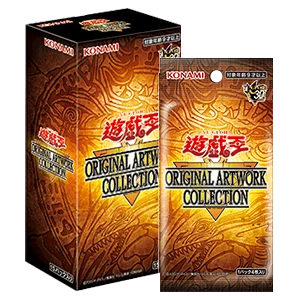
ORIGINAL ARTWORK COLLECTION (YAC1), Japanese box and pack, official image
YAC1 (September 26, 2026, ¥396 per pack including tax) shows how many versions one set can hold. Konami’s page lists 100 cards (25 Ultra Rare, 45 Super Rare and 30 Ultra Rare MANGA-STYLE; 25 + 45 + 30 = 100), plus Prismatic Secret Rare, Overframe, Grandmaster Rare, Secret Rare, Ultimate Rare and Collector’s Rare versions of some cards, and monochrome and colour Secret Rare versions of the MANGA-STYLE cards.
Where to Buy Japanese Yu-Gi-Oh! Cards
We sell Japanese Yu-Gi-Oh! sealed product and PSA 10 graded singles from Tokyo. Starting points from this guide:
Sourcing requests for a specific Japanese card or print go through our Quick Order page; include the card number and rarity. The product page shows the current terms. Our Japanese Yu-Gi-Oh! buying guide covers what to check before you pay.
Domande frequenti
What Yu-Gi-Oh! cards are worth money?
Identify the print by its number, rarity and artwork, then check condition. We counted 87 Japanese entries for Blue-Eyes White Dragon in Konami’s database. The eight PSA 10 back-order examples above show how our asking prices differ between prints.
Where is the set number on a Japanese Yu-Gi-Oh! card?
On Konami’s sample monster card, ROTD-JP014 is on the right below the artwork and above the text box. The letters before the dash are the set code, JP marks a Japanese print, and the digits are the card’s position in the set.
How can I tell if my Yu-Gi-Oh! card is Japanese or English?
Read the card number. JP, AE and EN identify the language in the examples shown. For older numbers such as SDK-001, check the database language, product and date together. Some Japanese OCG prints carry English card names, so check the number as well as the text.
What are the special rarities on Japanese Yu-Gi-Oh! cards called?
Konami’s Japanese pages print the names in katakana. This guide renders them as Ultimate Rare, Collector’s Rare and Grandmaster Rare. The English database also uses Quarter Century Secret Rare. Each product page lists which rarities the set contains. Grandmaster Rare cards carry an individual serial number.
How do I tell a first print from a reprint on a Japanese Yu-Gi-Oh! card?
To date a Japanese card, use the official card database: it lists the printings of a card with their release dates, so the earliest date listed is the first Japanese printing in the database. Konami’s product pages flag reprints in the text as re-included cards.
Should I get my Yu-Gi-Oh! card graded?
Check the corners, edges, surface and centring first. A grade is a third-party assessment of condition. Compare a graded copy with the same print and grade.
Carte Pokémon Mega ex giapponesi: lista completa per set, mazzo e promo, con l'anteprima di M7
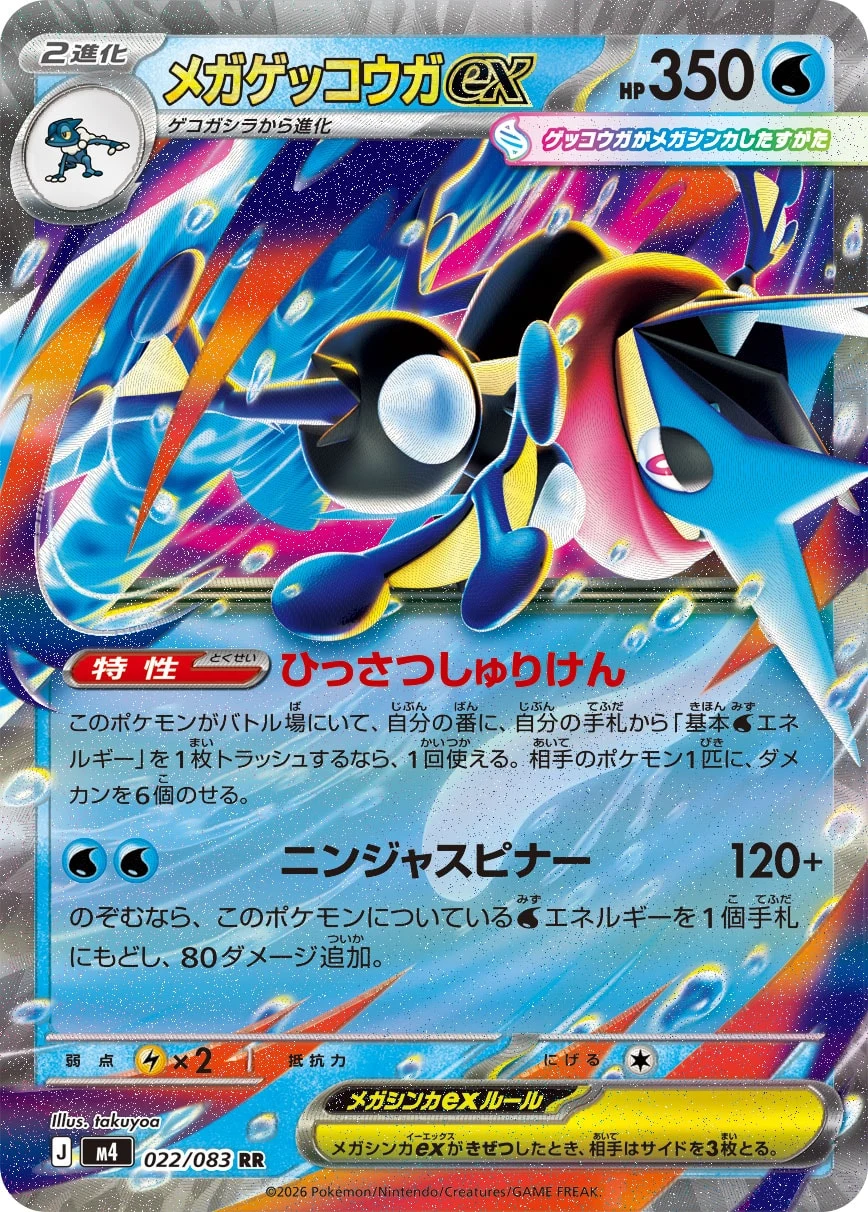
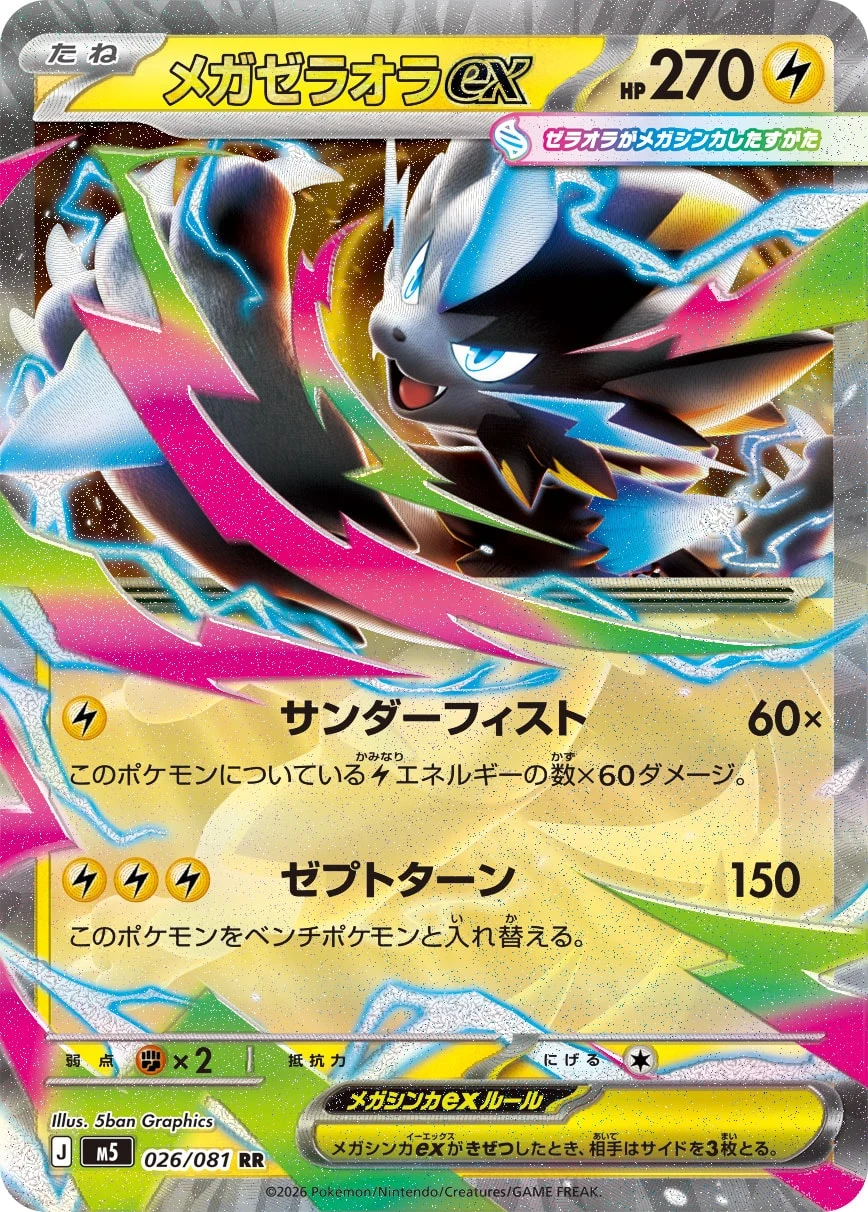
Eight released Japanese expansions contain Mega Pokémon ex. Three more printings appear in official previews for M7, due November 27, 2026. The checklist also covers four deck products and nine promo printings. Which ones exist, in which set, at which rarity?
This page answers it in one place. Every card named メガ…ex in the official Japanese card database (pokemon-card.com), plus the official M7 page, was checked on November 18, 2026; only cards that print the Mega Evolution ex rule are listed. Each set has its own table, followed by summary tables. For other cards in the nine covered expansions, follow the set-specific links. Deck products and promos are indexed below.
Key Takeaways
As of November 18, 2026 there are 140 Japanese Mega ex printings of 50 different Mega Pokémon ex: 116 in expansion sets (M1L to M7), 15 in deck products and 9 promos.
M7 Hadou Seeker is partial: three Mega Z ex are revealed on the official page; the set releases on November 27, 2026.
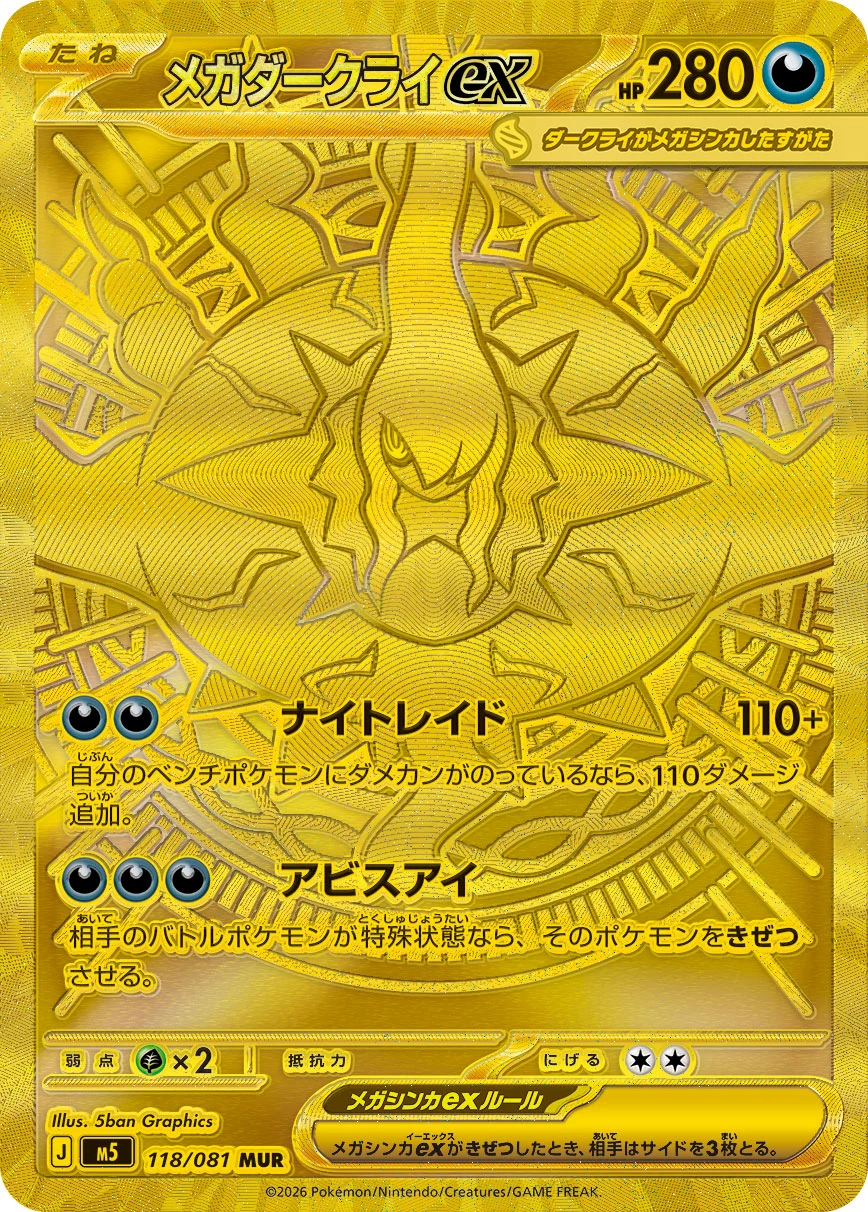
The official card database lists 10 Mega Attack Rare cards as of November 18, 2026, all in MEGA Dream ex (M2a, 223–232/193). Each of the eight sets from M1L to M6 has one MUR, and all eight MURs are Mega ex.
Ten Mega ex have no expansion card: five are in deck products (one also as a promo) and five are promos only.
Mega Attack Rares in the official card database (Nov 18, 2026), all in MEGA Dream ex
8
MUR Cards
Card data: official Japanese card database and official M7 page (pokemon-card.com), checked November 18, 2026. English card names are the standard English Pokémon names; rarity is the mark shown on the official page. Deck and promo cards show no rarity mark there.
What Counts as a Mega Pokémon ex Card
Every Mega ex card prints the same special rule. On the official card pages it reads:
Mega Evolution ex rule (official Japanese text)
「メガシンカexがきぜつしたとき、相手はサイドを3枚とる。」
Our translation: “When a Mega Evolution ex is Knocked Out, your opponent takes 3 Prize cards.”
On the printed card it sits in a box headed メガシンカexルール. A card is on this list only if its name is メガ…ex and it prints this rule. So:
Yanmega ex is not a Mega. Yanmega’s ordinary Japanese name is メガヤンマ, so its card is メガヤンマex. None of its five database rows (in M2a, MC and SV9a) prints the rule.
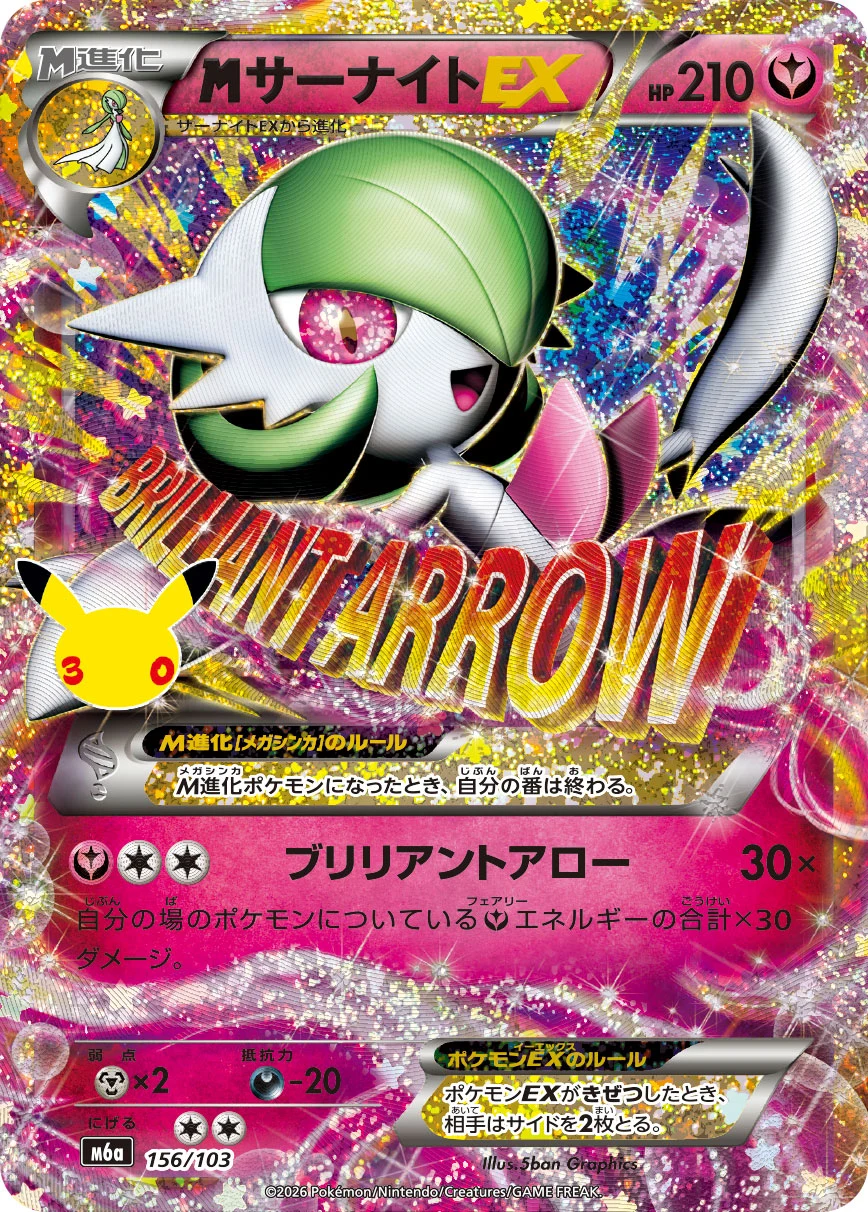
30th CELEBRATION (M6a) adds none. Its 156/103 サーナイトEX is an XY-style M Gardevoir-EX with an [M] mark, not a Mega Evolution ex.
Mega ex are not all the same stage. Counting the 50 names, 17 are Basic, 18 are Stage 1 and 15 are Stage 2.
Every Set at a Glance
Code
Set or product
Release (Japan)
Mega ex
Printings
Rarities
M1L
Mega Brave
Aug 1, 2025
5
14
RR 5, SR 5, SAR 3, MUR 1
M1S
Mega Symphonia
Aug 1, 2025
5
14
RR 5, SR 5, SAR 3, MUR 1
M2
Inferno X
Sep 26, 2025
4
12
RR 4, SR 4, SAR 3, MUR 1
M2a
MEGA Dream ex
Nov 28, 2025
10
25
RR 7, MA 10 (official card database as of November 18, 2026), SAR 7, MUR 1
M3
Munikis Zero
Jan 23, 2026
4
12
RR 4, SR 4, SAR 3, MUR 1
M4
Ninja Spinner
Mar 13, 2026
4
12
RR 4, SR 4, SAR 3, MUR 1
M5
Abyss Eye
May 22, 2026
4
12
RR 4, SR 4, SAR 3, MUR 1
M6
Storm Emeralda
Jul 31, 2026
4
12
RR 4, SR 4, SAR 3, MUR 1
M6a
30th CELEBRATION
Sep 16, 2026
0
0
—
M7
Hadou Seeker (partial)
Nov 27, 2026
3
3
RR 3 revealed
MBG, MBD
Starter Set MEGA (Gengar / Diancie)
Sep 5, 2025
2
2
no mark shown
MC
MEGA Start Deck 100 Battle Collection
Dec 19, 2025
5
10
no mark shown
MG
Special Deck Set MEGA
Nov 13, 2026
3
3
no mark shown
M-P
Promo cards
various
8
9
no mark shown
Totale
140
RR 40, SR 30, SAR 28, MA 10 (official card database as of November 18, 2026, all in MEGA Dream ex), MUR 8, no mark 24
Expansion sets give 14 + 14 + 12 + 25 + 12 + 12 + 12 + 12 + 3 = 116 printings; with 15 deck and 9 promo printings that makes 140. Counted once each, there are 50 different Mega ex.
The regular sets M1L to M6 share one pattern: every Mega ex has an RR and an SR, three get a SAR, and the MUR goes to one of those three. In M2a, a high class pack, the Mega ex have Mega Attack Rares instead of SRs. Our Japanese Pokémon card sets in order guide places these sets in the wider release history.
M1L Mega Brave (August 1, 2025)
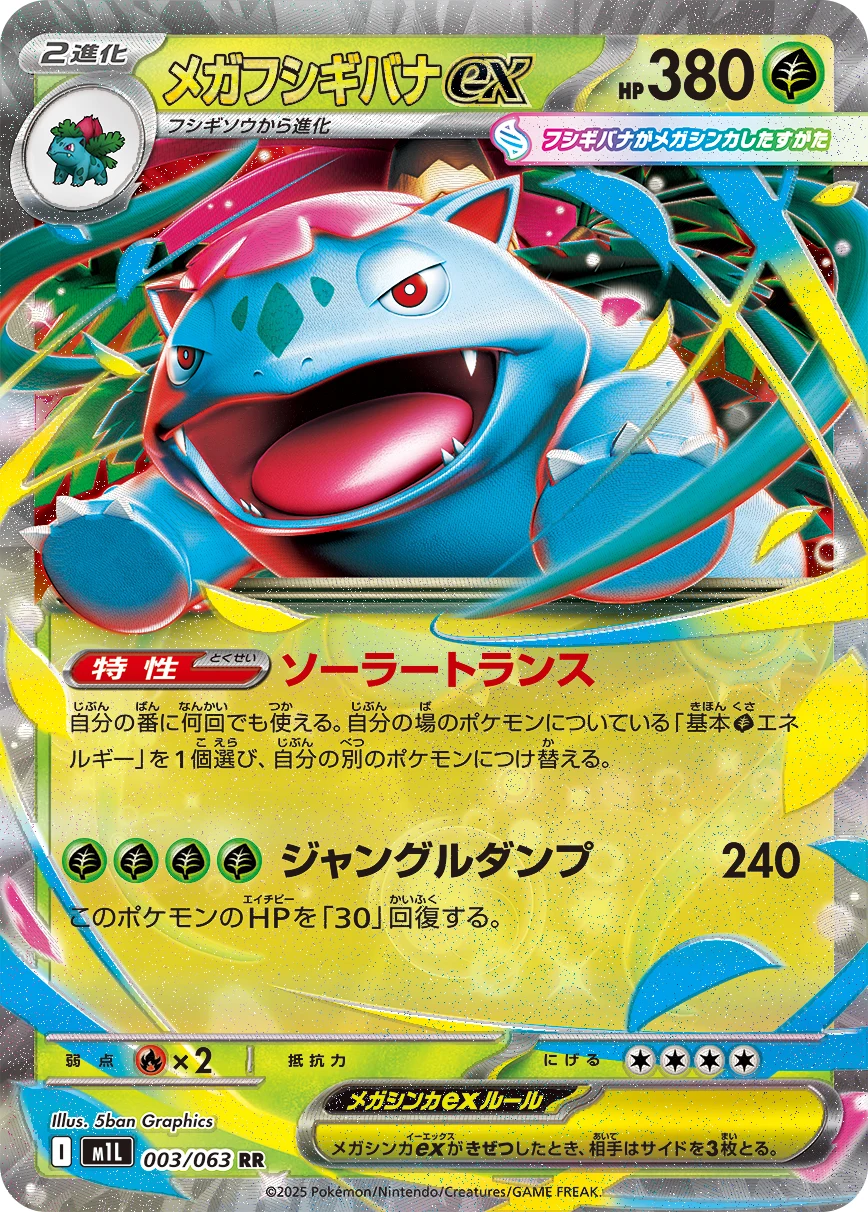
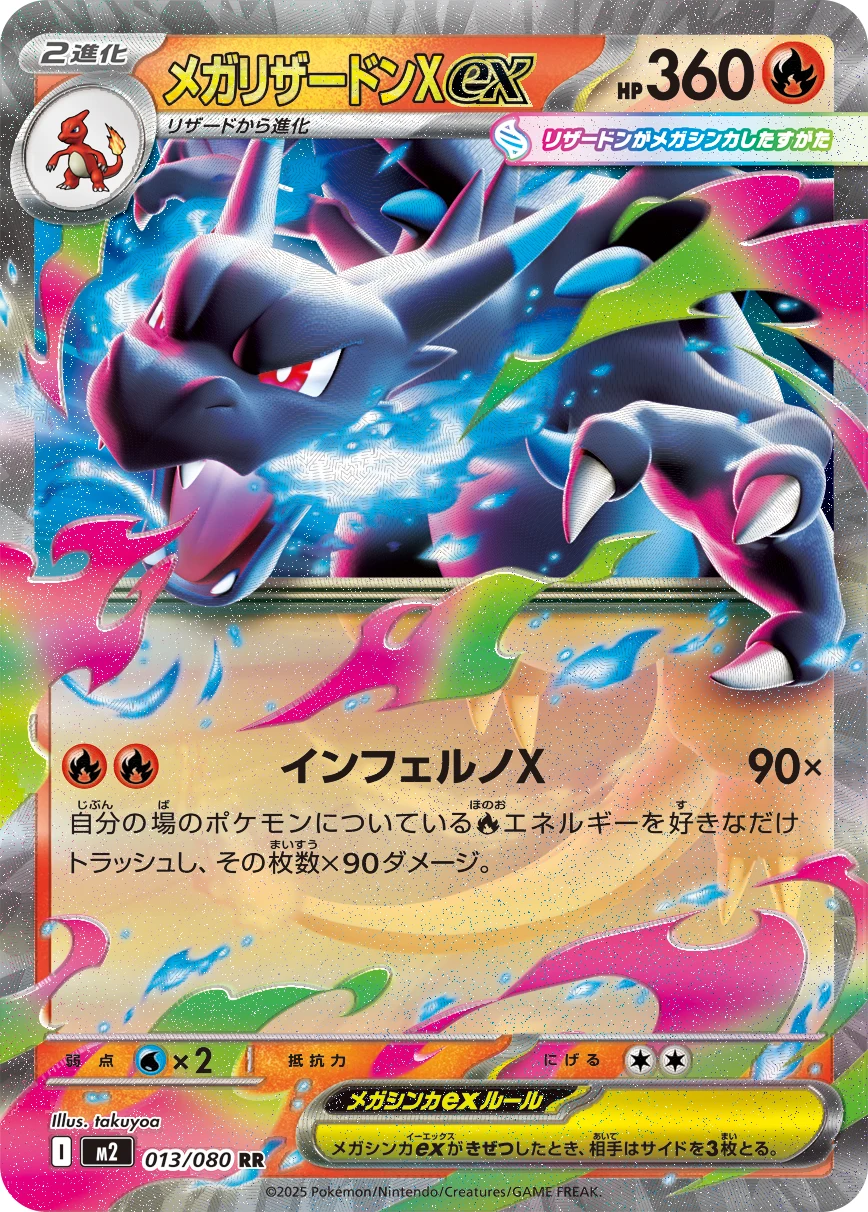
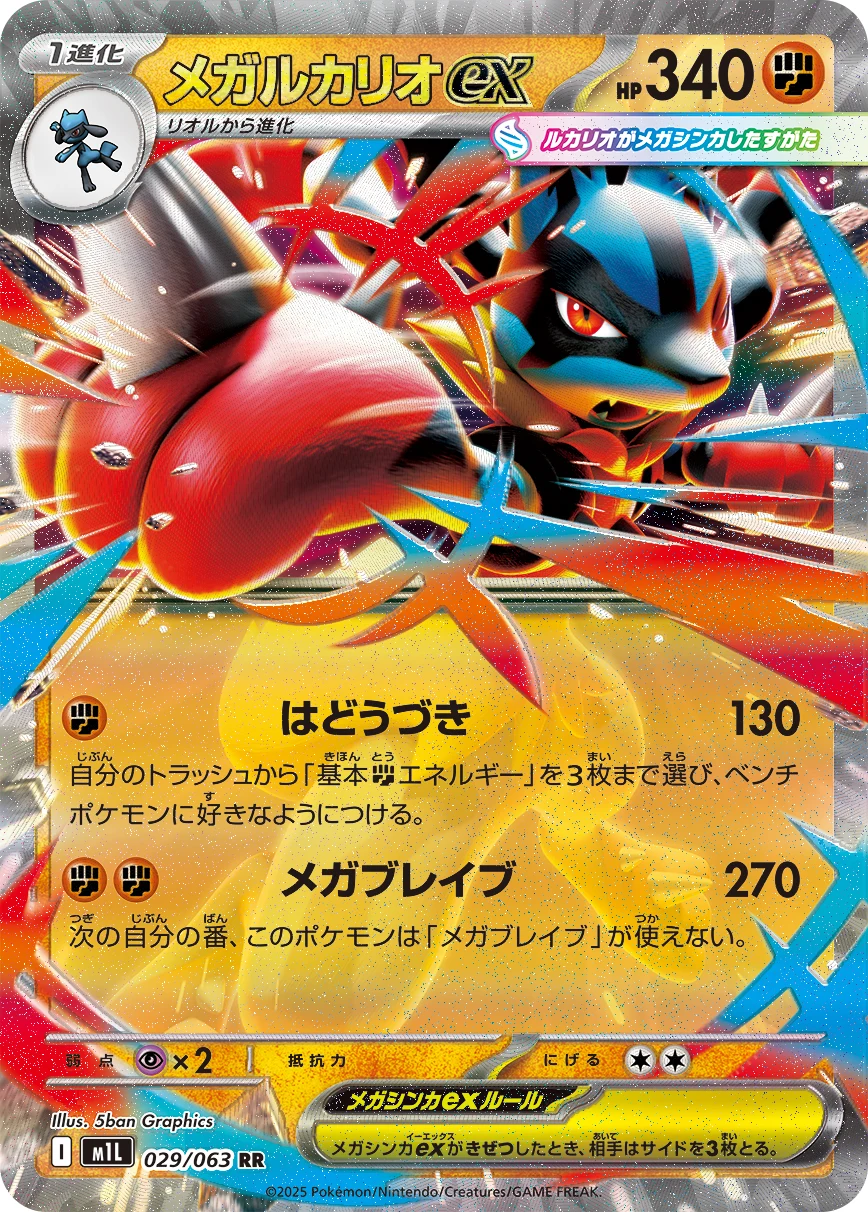
Mega Brave (拡張パック「メガブレイブ」) has five Mega ex in a /063 main set. Mega Lucario ex is the one with all four rarities.
Carta
Japanese name
No. and rarity
Type
HP
Mega Venusaur ex
メガフシギバナex
003/063 RR 076/063 SR 087/063 SAR
Grass
380
Mega Camerupt ex
メガバクーダex
013/063 RR 077/063 SR
Fire
340
Mega Lucario ex
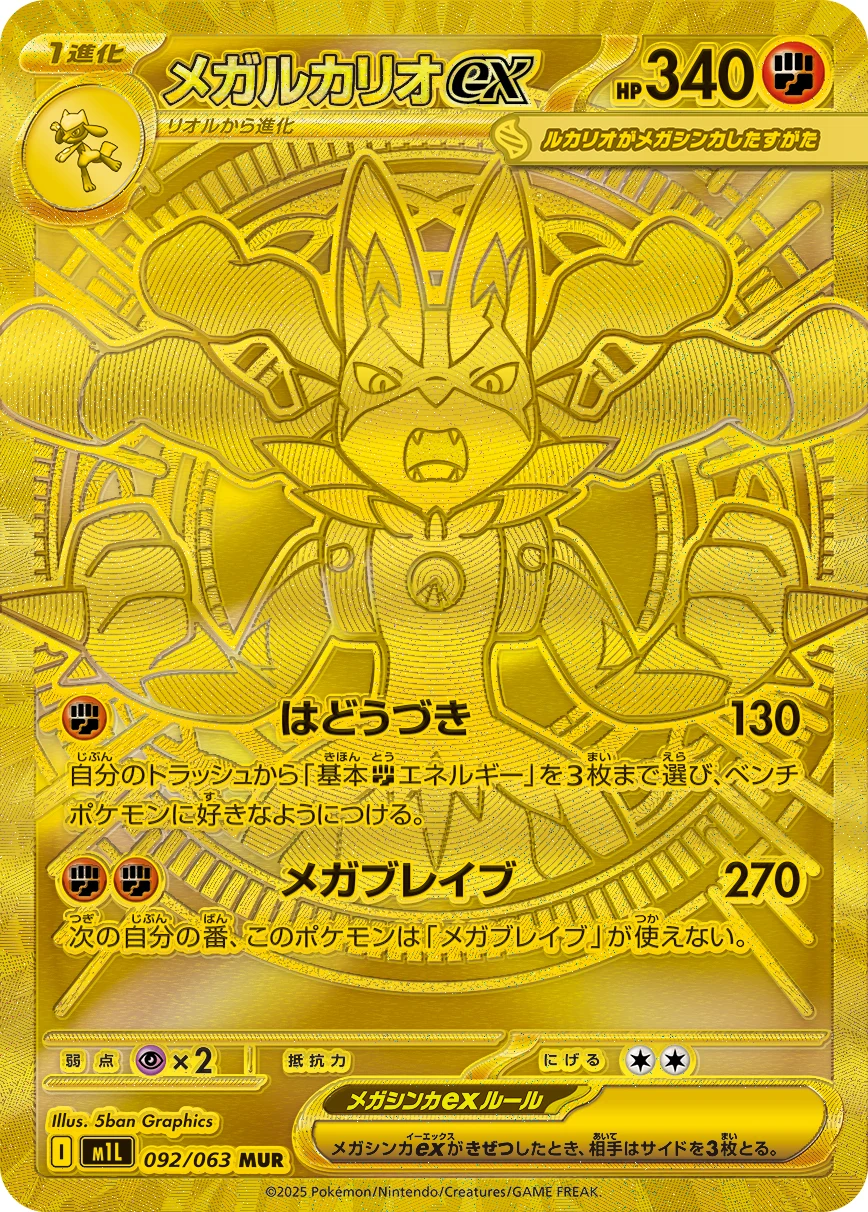
メガルカリオex
029/063 RR 078/063 SR 088/063 SAR 092/063 MUR
Fighting
340
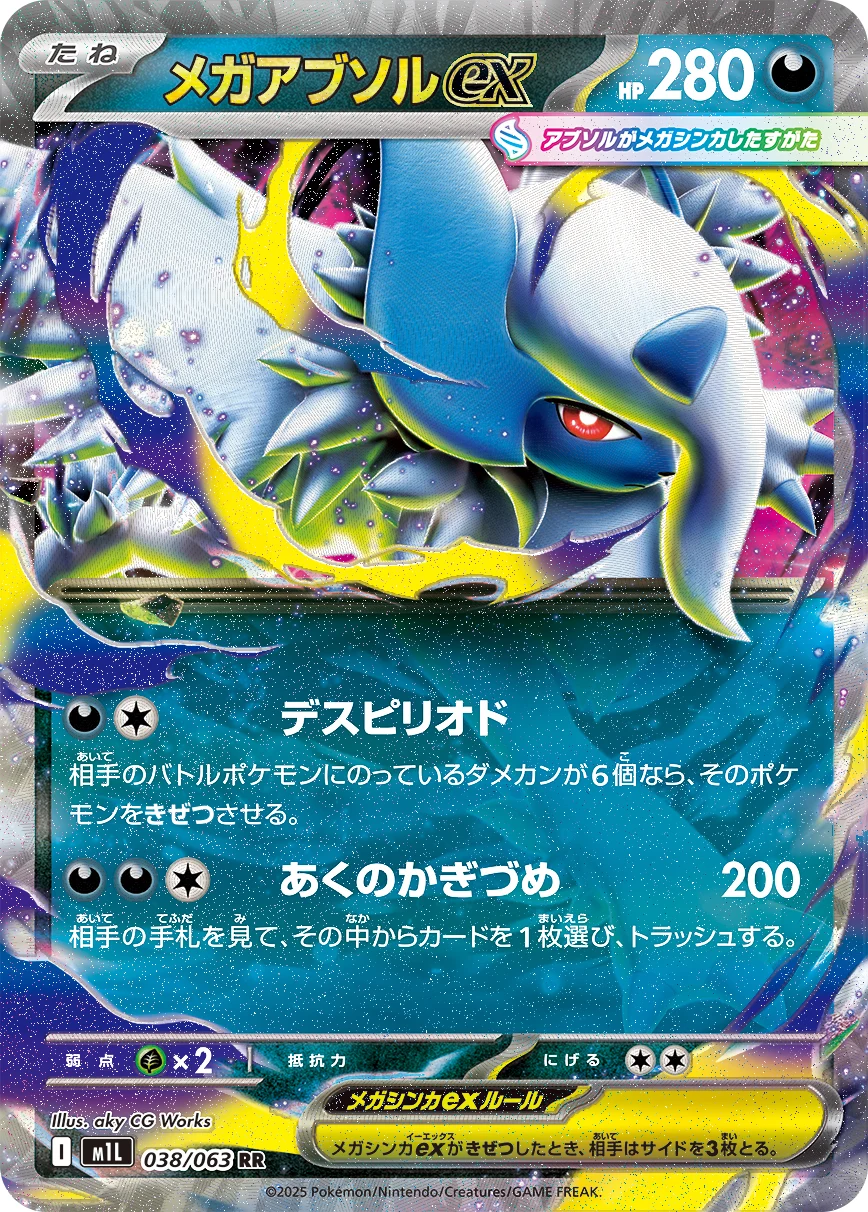
Mega Absol ex
メガアブソルex
038/063 RR 079/063 SR 089/063 SAR
Darkness
280
Mega Mawile ex
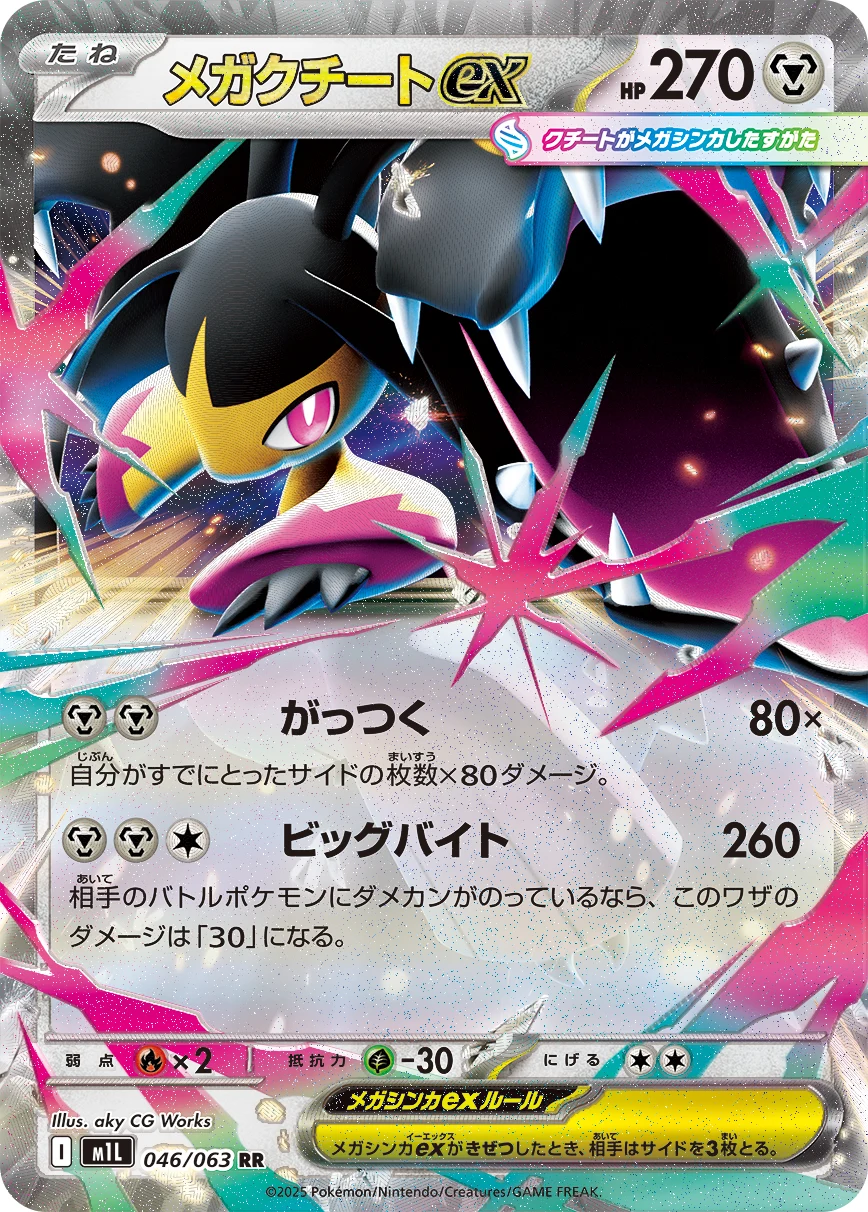
メガクチートex
046/063 RR 080/063 SR
Metal
270
Mega Lucario ex 092/063 MUR, M1L Mega Brave (official image, pokemon-card.com)
The high class pack MEGA Dream ex (ハイクラスパック「MEGAドリームex」) holds 25 Mega ex printings of ten Mega ex, and the official card database as of November 18, 2026 lists a Mega Attack Rare (MA) for each of the ten. Gardevoir, Lucario and Charizard X already had cards in M1L, M1S or M2; for the other seven, M2a is their first expansion set. In M2a, Mega Charizard X ex, Mega Diancie ex and Mega Gengar ex appear only above the /193 main set.
Carta
Japanese name
No. and rarity
Type
HP
Mega Froslass ex
メガユキメノコex
036/193 RR 224/193 MA 233/193 SAR
Water
310
Mega Eelektross ex
メガシビルドンex
049/193 RR 225/193 MA 235/193 SAR
Lightning
350
Mega Gardevoir ex
メガサーナイトex
071/193 RR 226/193 MA
Psychic
360
Mega Lucario ex
メガルカリオex
092/193 RR 228/193 MA
Fighting
340
Mega Hawlucha ex
メガルチャブルex
094/193 RR 229/193 MA 239/193 SAR
Fighting
250
Mega Scrafty ex
メガズルズキンex
110/193 RR 231/193 MA 241/193 SAR
Darkness
330
Mega Dragonite ex
メガカイリューex
126/193 RR 232/193 MA 246/193 SAR 250/193 MUR
Dragon
370
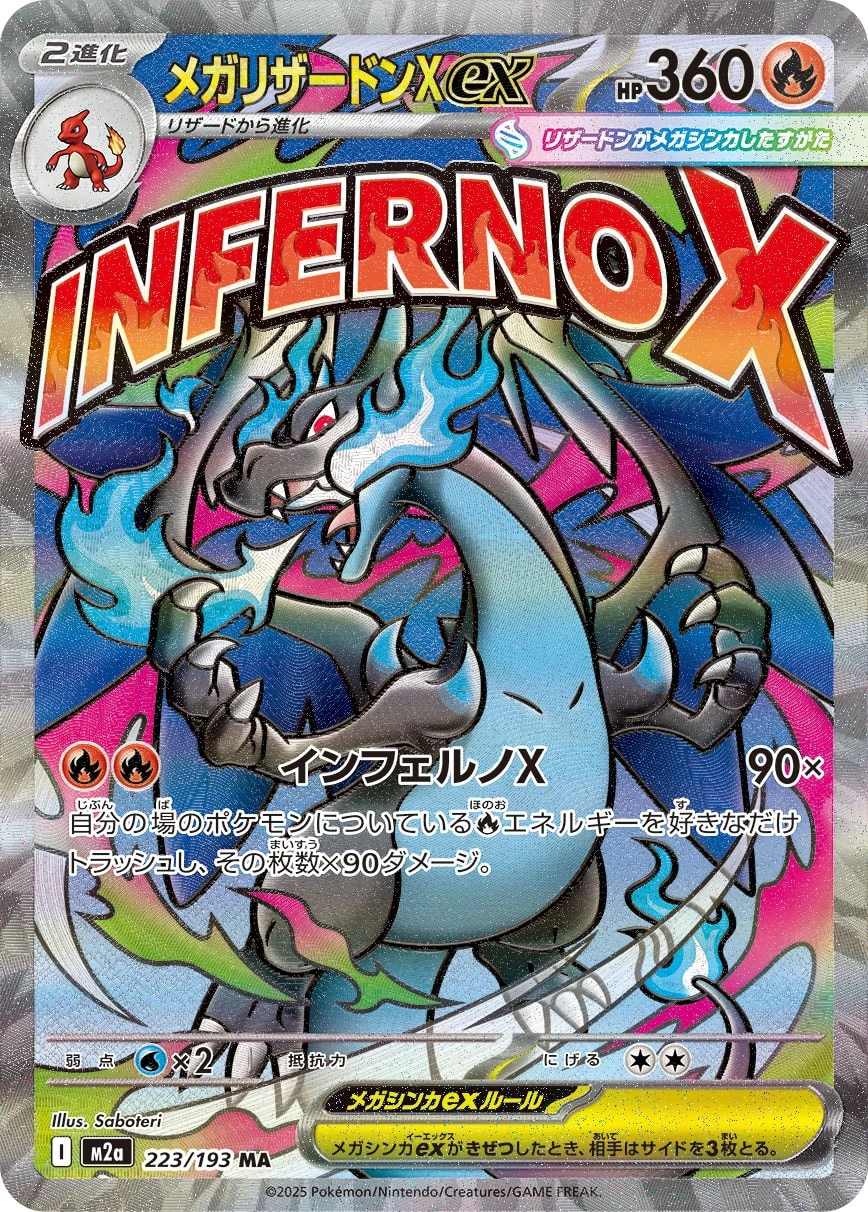
Mega Charizard X ex
メガリザードンXex
223/193 MA
Fire
360
Mega Diancie ex
メガディアンシーex
227/193 MA 238/193 SAR
Psychic
270
Mega Gengar ex
メガゲンガーex
230/193 MA 240/193 SAR
Darkness
350
Mega Charizard X ex 223/193 MA, M2a MEGA Dream ex (official image, pokemon-card.com)
M7 Hadou Seeker (Partial, as of November 18, 2026)
Hadou Seeker (拡張パック「ハドウシーカー」; overseas fans often call it “Aura Seeker”) releases in Japan on November 27, 2026. The card database has no M7 entry yet. As of November 18, 2026, the official M7 page has revealed 42 cards with numbers and rarities; five are RR and one is SAR (a Trainer). Three of the RR cards are Mega Z ex, read from the official card images:
Carta
Japanese name
No. and rarity
Type
HP
Mega Absol Z ex
メガアブソルZex
030/078 RR
Psychic
270
Mega Lucario Z ex
メガルカリオZex
057/078 RR
Metal
330
Mega Garchomp Z ex
メガガブリアスZex
067/078 RR
Dragon
360
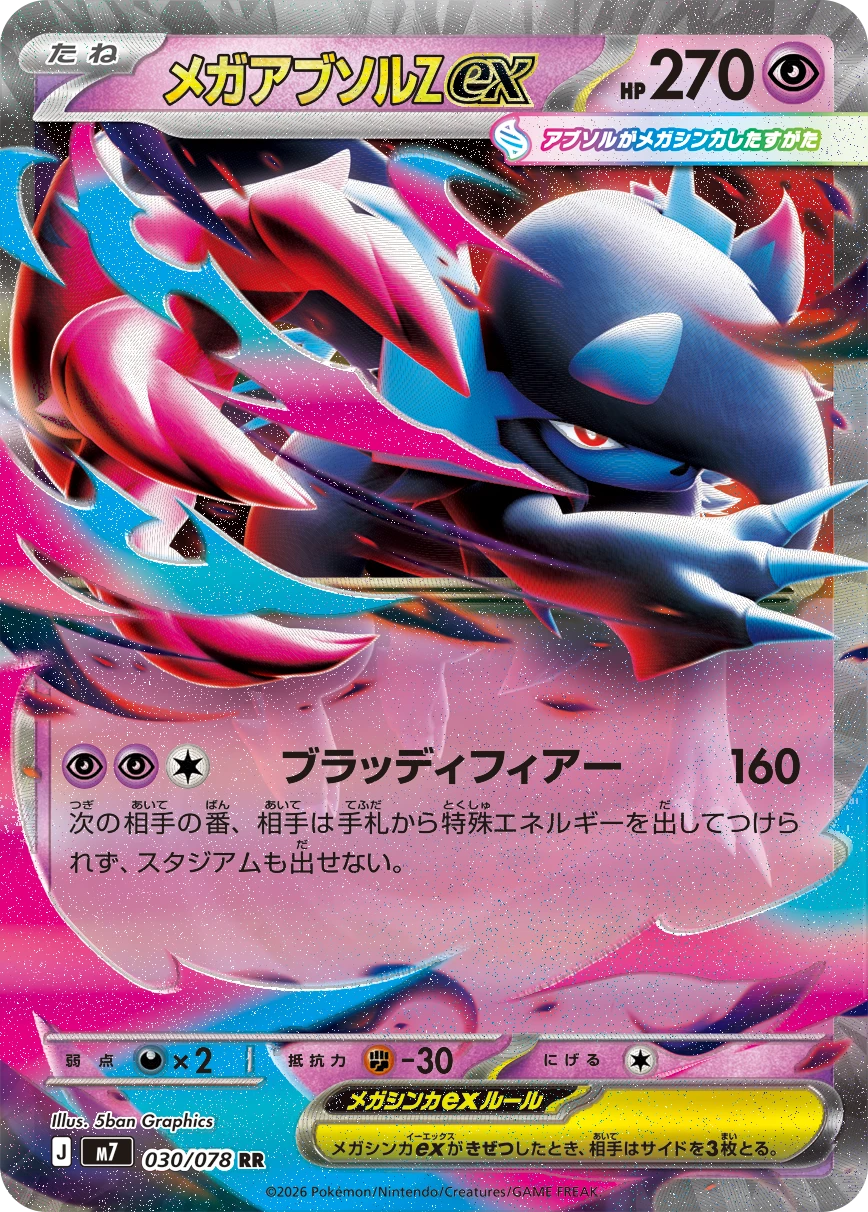
Mega Absol Z ex 030/078 RR, M7 Hadou Seeker (official image, pokemon-card.com)
All three print the Mega Evolution ex rule. Mega Absol Z ex (Psychic) and Mega Lucario Z ex (Metal) are different card names from Mega Absol ex (Darkness) and Mega Lucario ex (Fighting), so they count separately. No SR, SAR or MUR Mega ex is among the 42 cards revealed as of November 18, 2026. More on the Z forms: Mega Z ex Pokémon cards explained.
Four Japanese deck products hold 15 Mega ex printings. Codes: MBG = Starter Set MEGA Mega Gengar ex (スターターセットMEGA メガゲンガーex), MBD = Starter Set MEGA Mega Diancie ex (スターターセットMEGA メガディアンシーex), MC = MEGA Start Deck 100 Battle Collection (スタートデッキ100 バトルコレクション), MG = Special Deck Set MEGA (スペシャルデッキセットMEGA メガオーダイル・メガカイリュー・メガゲンガー). Their database pages show no rarity mark, and the official MG listing says it includes some cards released or distributed before.
Code
Carta
Japanese name
N.
Type
HP
MBG
Mega Gengar ex
メガゲンガーex
003/021
Darkness
350
MBD
Mega Diancie ex
メガディアンシーex
005/021
Psychic
270
MC
Mega Meganium ex
メガメガニウムex
018/742 761/742
Grass
360
MC
Mega Charizard Y ex
メガリザードンYex
085/742 766/742
Fire
360
MC
Mega Emboar ex
メガエンブオーex
113/742 762/742
Fire
380
MC
Mega Feraligatr ex
メガオーダイルex
169/742 763/742
Water
370
MC
Mega Audino ex
メガタブンネex
602/742 759/742
Colorless
270
MG
Mega Feraligatr ex
メガオーダイルex
003/038
Water
370
MG
Mega Gengar ex
メガゲンガーex
014/038
Darkness
350
MG
Mega Dragonite ex
メガカイリューex
022/038
Dragon
370
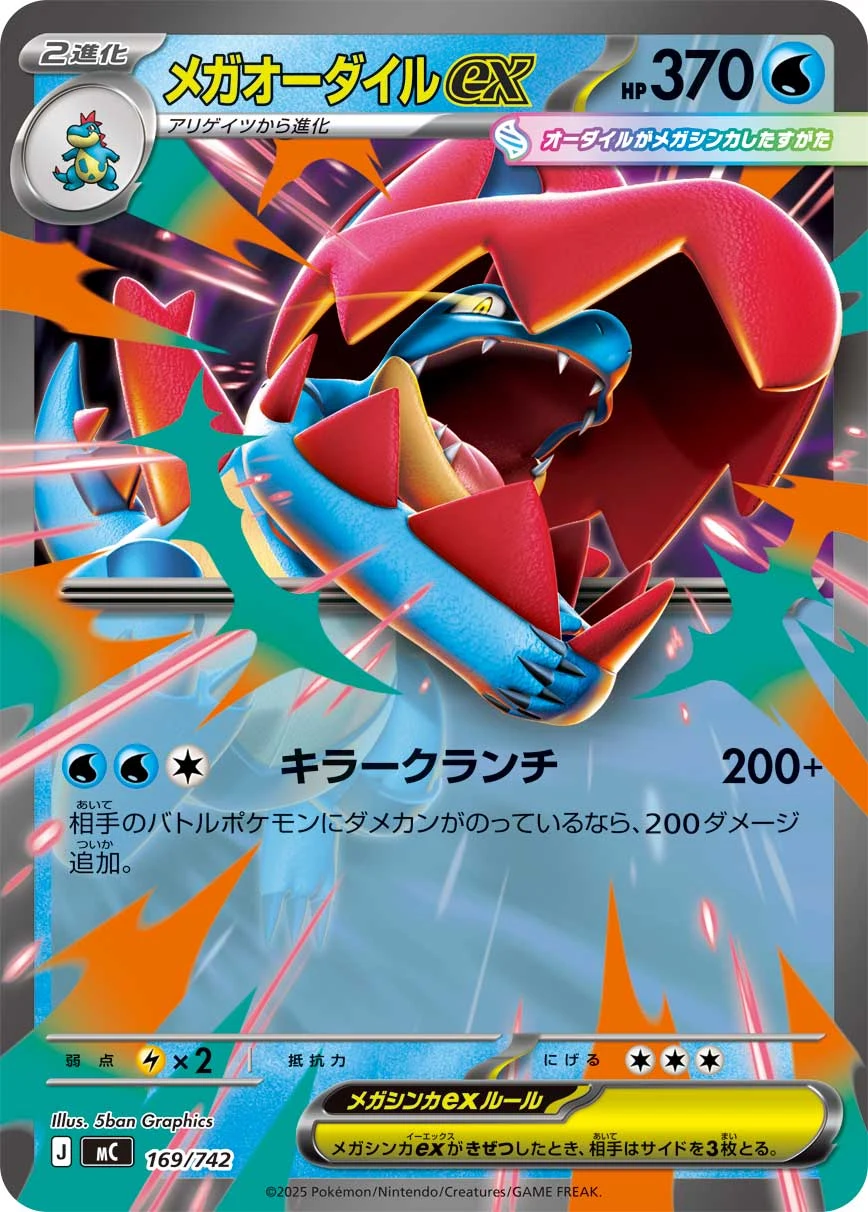
Mega Feraligatr ex 169/742, MEGA Start Deck 100 Battle Collection (official image, pokemon-card.com)
Absol and Lucario appear under two types each because their Z forms are separate cards.
Mega Attack Rares and MURs
In the official card database as of November 18, 2026, Mega Attack Rare (MA) exists only in M2a: 10 cards. Four MA renders shown in an August 31, 2026 official video are not database cards and are not counted. MUR exists once in each set from M1L to M6.
Mega ex with an MA
No. (M2a)
Mega ex with a MUR
Set and no.
Mega Charizard X ex
223/193
Mega Lucario ex
M1L 092/063
Mega Froslass ex
224/193
Mega Gardevoir ex
M1S 092/063
Mega Eelektross ex
225/193
Mega Charizard X ex
M2 116/080
Mega Gardevoir ex
226/193
Mega Dragonite ex
M2a 250/193
Mega Diancie ex
227/193
Mega Zygarde ex
M3 117/080
Mega Lucario ex
228/193
Mega Greninja ex
M4 120/083
Mega Hawlucha ex
229/193
Mega Darkrai ex
M5 118/081
Mega Gengar ex
230/193
Mega Rayquaza ex
M6 113/076
Mega Scrafty ex
231/193
—
—
Mega Dragonite ex
232/193
—
—
Four names have both: Charizard X, Gardevoir, Lucario and Dragonite. Gardevoir and Lucario have six printings each, Charizard X and Dragonite five. The MUR cards are also covered in our Mega Evolution chase card guide.
At the other end, nine Mega ex have only an RR and an SR: Camerupt, Mawile, Abomasnow, Manectric, Heracross, Skarmory, Pyroar, Excadrill and Malamar.
Megas With No Expansion Card
Ten of the 50 Mega ex appear in no expansion set:
Mega ex
Where it appears
Mega Meganium ex
MC 018, 761
Mega Charizard Y ex
MC 085, 766
Mega Emboar ex
MC 113, 762
Mega Feraligatr ex
MC 169, 763; MG 003
Mega Audino ex
MC 602, 759; promo 146/M-P
Mega Gallade ex
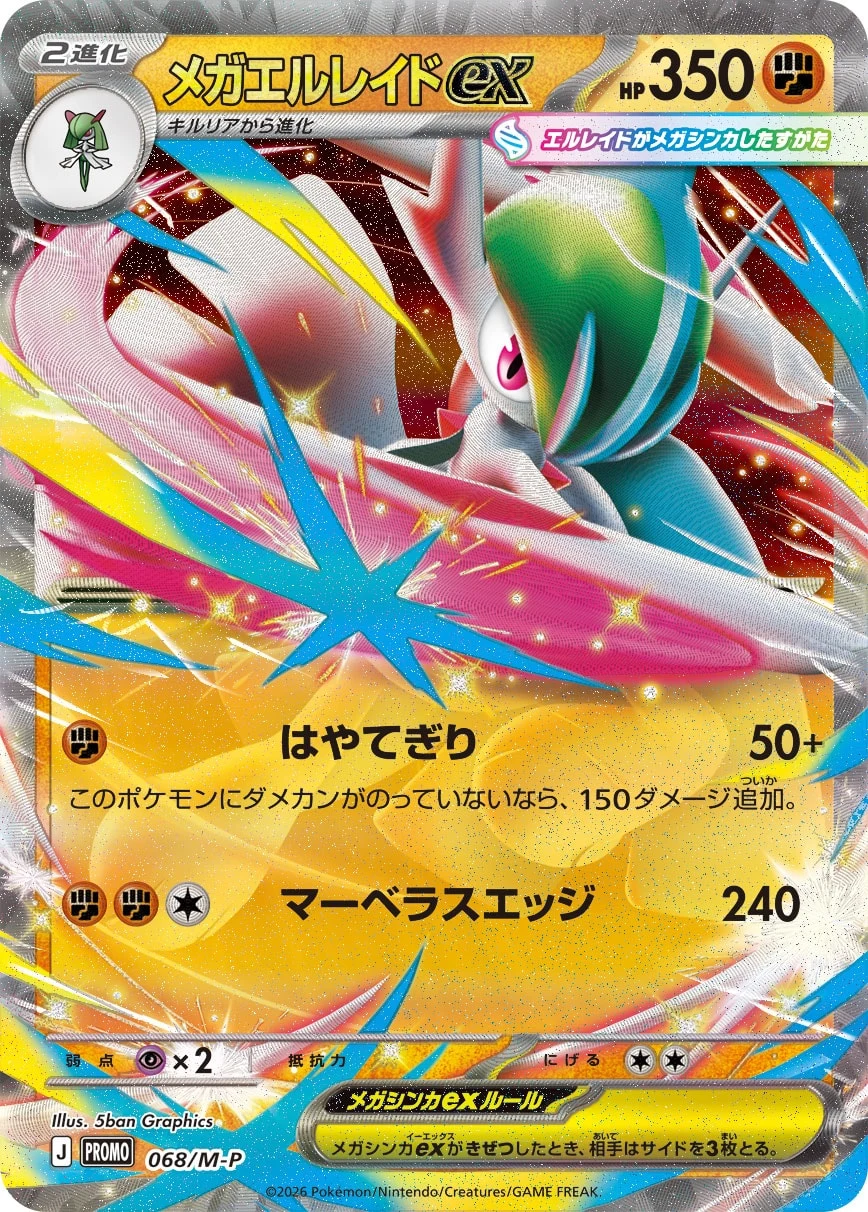
Promos 068/M-P and 137/M-P
Mega Slowbro ex
Promo 071/M-P
Mega Delphox ex
Promo 096/M-P
Mega Tatsugiri ex
Promo 139/M-P
Mega Heatran ex
Promo 169/M-P
Mega Gengar ex and Mega Diancie ex headline Starter Set MEGA decks but also have M2a cards; Mega Kangaskhan ex and Mega Zeraora ex have promos as well as expansion cards. For Mega Pokémon that have no Mega ex card yet, see our checklist of Megas without a card.
What Is Confirmed and What Is Not
Confirmed: every row from M1L to M6, the deck products and the promos (official card database, November 18, 2026).
Confirmed, partial: the three M7 Mega Z ex, from official card images; as of November 18, 2026 the official M7 page shows 42 cards and the card database has no M7 entry.
Not on this list: leaks, English-set information, and four Mega Attack Rare renders from an August 31, 2026 official video marked as under development.
Not read: the distribution dates of the promo packs and campaigns.
Where to Buy Japanese Mega ex Products
These products from the tables above are currently listed in our shop:
For every card in a set, start from the card list hub. Sourcing requests for a specific card or product go through Ordine rapido. The product pages show the current terms.
Domande frequenti
How many Japanese Mega Pokémon ex cards are there?
As of November 18, 2026, the official Japanese card database and the official M7 page show 140 Mega ex printings of 50 different Mega Pokémon ex: 116 in expansion sets from M1L to M7, 15 in deck products and 9 promos. M7 Hadou Seeker is partial until its full list is published.
Which Mega ex cards have a Mega Attack Rare?
Ten in the official card database as of November 18, 2026, all in MEGA Dream ex (M2a) at 223 to 232/193: Mega Charizard X ex, Mega Froslass ex, Mega Eelektross ex, Mega Gardevoir ex, Mega Diancie ex, Mega Lucario ex, Mega Hawlucha ex, Mega Gengar ex, Mega Scrafty ex and Mega Dragonite ex.
Which Mega ex cards have a MUR?
Eight, one in each set from M1L to M6: Mega Lucario ex (M1L), Mega Gardevoir ex (M1S), Mega Charizard X ex (M2), Mega Dragonite ex (M2a), Mega Zygarde ex (M3), Mega Greninja ex (M4), Mega Darkrai ex (M5) and Mega Rayquaza ex (M6). No MUR has been revealed for M7 as of November 18, 2026.
Which Mega ex are not in any expansion set?
Ten: Mega Meganium ex, Mega Charizard Y ex, Mega Emboar ex and Mega Feraligatr ex (deck products), Mega Audino ex (deck product and promo), and Mega Gallade ex, Mega Slowbro ex, Mega Delphox ex, Mega Tatsugiri ex and Mega Heatran ex (promos).
How many Prize cards does a Mega ex card give up?
Three. Every Mega ex card prints the Mega Evolution ex rule: when a Mega Evolution ex is Knocked Out, the opponent takes 3 Prize cards.
Bewear Full Art 076/064: guida alla carta AR di Night Wanderer
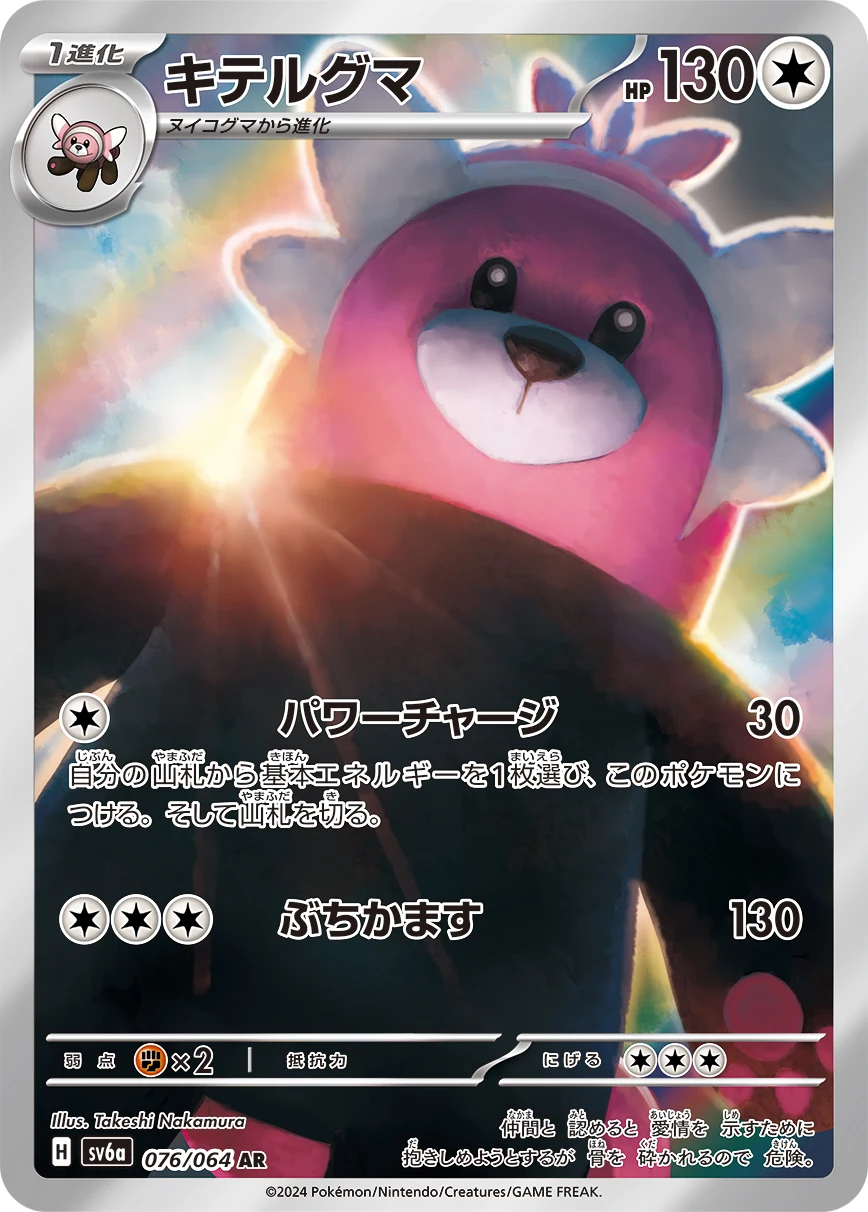
The Bewear full art is the AR card SV6a 076/064 from the Japanese set Night Wanderer, illustrated by Takeshi Nakamura. This guide covers its HP, attacks, artist, set facts and how it differs from Bewear’s 17 other Japanese prints.
The Bewear full art is SV6a 076/064, rarity AR, from the Japanese Enhanced Expansion Pack “Night Wanderer”.
It has HP 130, is a Stage 1 Pokémon and uses two attacks, Power Charge (30) and Slam (130).
Takeshi Nakamura is the illustrator; Night Wanderer was released in Japan on June 7, 2024.
The official database lists 18 Japanese Bewear prints, and 076/064 is the one with an AR mark.
Updated November 18, 2026
Which Bewear Card Is the Full Art?
The Bewear full art is SV6a 076/064, the card with the AR rarity mark from the Japanese set Night Wanderer. Its card number is 76 out of a printed set total of 64, so it is numbered above the set total.
English attack names in this guide are our translations of the Japanese card text. The official Japanese database lists 18 Bewear prints, and this one carries the AR mark in its Bewear card search. For the wider history of full art cards, see our dated timeline from SR to FUR.
Bewear SV6a 076/064 (official Japanese card image, pokemon-card.com).
What Are the HP and Attacks of Bewear 076/064?
Bewear 076/064 is a Stage 1 Pokémon with 130 HP and two attacks. Its first attack, Power Charge, deals 30 damage and attaches a Basic Energy from your deck to Bewear. Its second attack, Slam, deals 130 damage.
Attack (our translation)
Damage
Effect
Power Charge
30
Search your deck for a Basic Energy card and attach it to this Pokémon, then shuffle your deck.
Slam
130
No additional effect text on the card.
In play, Power Charge lets Bewear build its own energy while it attacks, and Slam is a flat 130 damage with no condition. The card lists no ability. The same pair of attacks appears on the starter deck and Common prints compared in the sixth section.
Who Illustrated the Bewear AR and What Does Its Flavor Text Say?
Takeshi Nakamura illustrated the Bewear AR. The card is for Pokédex No. 760 and records a height of 2.1 m and a weight of 135.0 kg.
The flavor text reads, in our translation: “When it accepts someone as a friend, it tries to hug them to show its affection, but it is dangerous because it breaks bones.” This text describes the Pokémon’s behavior and has no effect on the game rules.
Where Does Bewear Sit Among the Night Wanderer AR Cards?
Bewear is one of 12 AR cards in Night Wanderer, a Japanese enhanced expansion pack released on June 7, 2024. Each pack holds 5 cards and was priced at 180 yen (tax included).
The official SV6a page lists Bewear under its heading for AR, SR and SAR cards, with this description in our translation: “Bewear gazing at something with its back to the sun. A shadow falls across its face, adding to its presence.” The other 11 AR cards in the set are in the table below.
Does Bewear Have Other Japanese Prints Besides the AR?
Yes, Bewear has 17 other Japanese prints, and none of them carries the AR mark. Expansion-pack prints are marked C, U or R, while deck, promo and magazine prints show no rarity mark.
Print
Set
Rarity mark
HP
SV6a 053/064
Night Wanderer
C
130
M1S 056/063
Mega Symphonia
C
130
S7R 041/067
Blue Sky Stream
U
130
S2 083/096
Expansion Pack S2
U
140
SM11a 049/064
Enhanced Expansion Pack SM11a
U
120
SM1S 052/060
Expansion Pack SM1S
U
130
SM3N 046/051
Expansion Pack SM3N
U
120
SM4A 027/050
Expansion Pack SM4A
R
130
SMP 035/SM-P (Bewear GX)
Sun & Moon Promo Card Pack 1
none
210
SMP 058/SM-P
Product not shown in the database
none
130
SMP 087/SM-P
Product not shown in the database
none
120
SMP1 013/013
Magazine bonus deck
none
130
SMH 063/131
GX Starter Deck
none
130
SMD 018/026
30-card battle deck set
none
130
SI 237/414
Start Deck 100
none
130
MC 617/742
Start Deck 100 Battle Collection
none
130
SVM 115/175
Starter Deck Generations
none
130
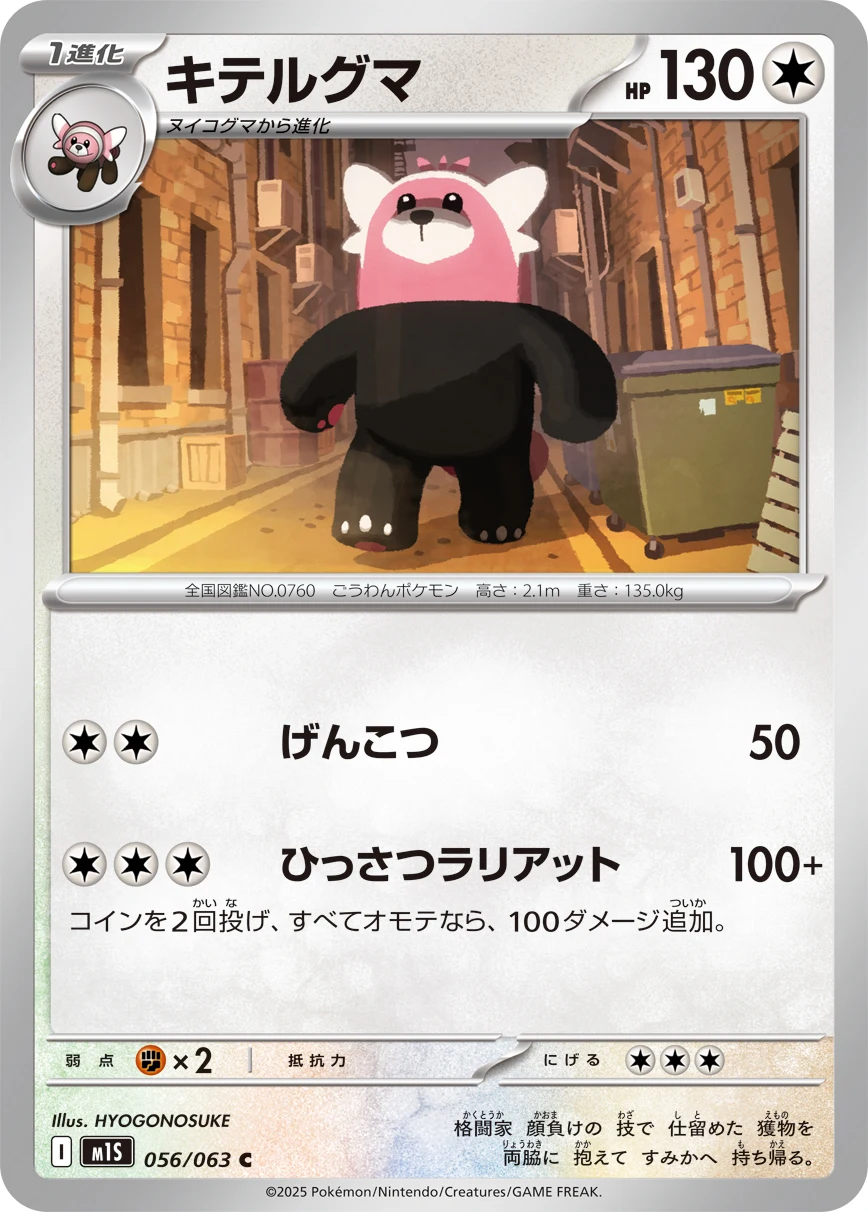
The Mega Symphonia print below shows a different pair of attacks, Fist (50) and Finishing Lariat (100+), the second of which adds 100 damage if two coin flips are both heads. Its illustrator is HYOGONOSUKE.
Bewear M1S 056/063 (official Japanese card image, pokemon-card.com).
The GX card, SMP 35/SM-P, is a different game card from the AR. It has HP 210 and the attacks Bear Hug (80), Double Impact (100×) and the GX attack Big Throw GX. Under its special rule, the opponent takes 2 Prize cards when a Pokémon-GX is knocked out. For other Pokémon whose prints sit above their set total, see our guides to Ninetales and Mareep.
Is the AR Bewear the Same Card as the Starter Deck Reprints?
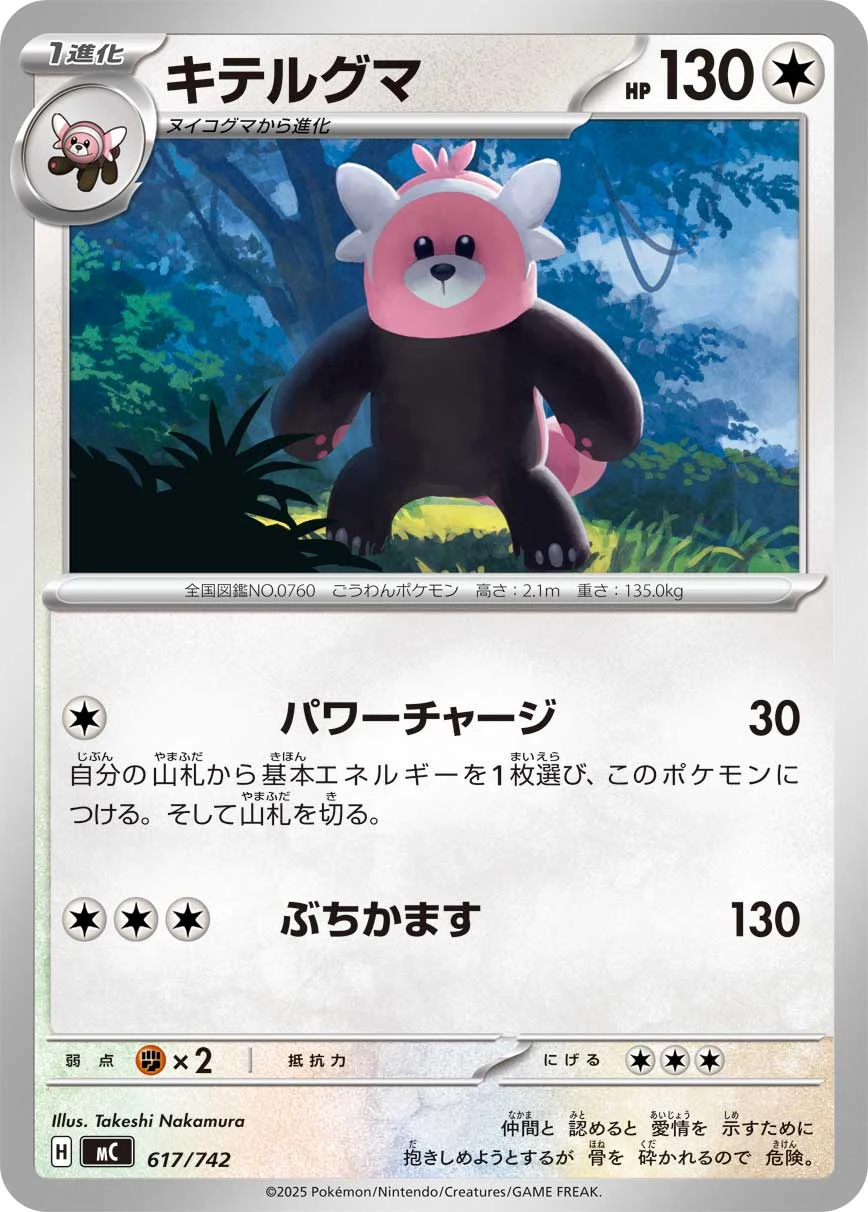
The AR Bewear shares its attacks and HP with three other prints, but it is a separate print with its own rarity mark. The starter deck prints MC 617/742 and SVM 115/175 and the Night Wanderer Common 053/064 all show HP 130 with Power Charge (30) and Slam (130).
Print
Set
Rarity mark
HP
Attacks
Illustrator
SV6a 076/064
Night Wanderer
AR
130
Power Charge 30, Slam 130
Takeshi Nakamura
SV6a 053/064
Night Wanderer
C
130
Power Charge 30, Slam 130
Takeshi Nakamura
MC 617/742
Start Deck 100 Battle Collection
none
130
Power Charge 30, Slam 130
Takeshi Nakamura
SVM 115/175
Starter Deck Generations: Tapu Koko ex and Mimikyu ex
none
130
Power Charge 30, Slam 130
Takeshi Nakamura
The attacks, HP and illustrator are the same on all four prints. In the official database the AR print shows the AR mark, the Night Wanderer Common shows C, and the two deck cards show no rarity mark.
Bewear MC 617/742 (official Japanese card image, pokemon-card.com).
Domande frequenti
Which Bewear card is the full art?
It is SV6a 076/064, the AR card from the Japanese set Night Wanderer. It is the one Bewear print with an AR mark among the 18 in the official database.
When was the Bewear full art released?
Night Wanderer, the set that holds it, was released in Japan on June 7, 2024 (Friday), according to the official SV6a page.
Who illustrated the Bewear AR card?
Takeshi Nakamura illustrated it. He is also credited on the Night Wanderer Common 053/064 and the MC and SVM starter deck prints.
How many AR cards are in Night Wanderer?
The set has 12 AR cards, including Bewear. The others are Tapu Bulu, Houndoom, Horsea, Duskull, Dusclops, Dusknoir, Cresselia, Zorua, Cufant, Fraxure and Persian.
How many Japanese Bewear prints are there?
The official database lists 18 Japanese prints of Bewear, including the AR and the Bewear GX promo.
Yu-Gi-Oh! PRIDE AND SOUL in Giappone e il +1 Expansion Pack riportato
PRIDE AND SOUL is the Japanese Yu-Gi-Oh! OCG core booster dated for January 23, 2027. Konami has not yet opened a product page for it. On November 18, 2026, Konami’s Japanese product site showed it only as one line in the product list: a title, a category, a date and a price.
This guide puts what can be checked in one place for players and collectors outside Japan: the official listing and the reported specifications, how the first-print +1 Expansion Pack has worked in the last three core boosters, the cards shown so far, what is still open, and where PRIDE AND SOUL sits in the core booster line since 2025. Anything from fan sites or community databases rather than Konami is marked as reported.
Key Facts
Official: PRIDE AND SOUL is a 基本パック (core booster) releasing in Japan on Saturday, January 23, 2027, at ¥198 including tax (¥180 before tax).
Official: a new theme is named 果て無き闇 (Hatenaki Yami; fans translate it as “Endless Darkness”), and ドラゴン・目覚めの旋律 (The Melody of Awakening Dragon) returns with a new illustration.
Reported by YGOrganization and Yu-Gi-Oh! Meta: 5 carte per pack, 30 packs per box, and a +1 Expansion Pack in first-production boxes. Yugipedia reports the prefix PASO, and YGOrganization reports the ten cards’ numbers, stats and English translations.
Not on Konami’s product site as of November 18, 2026: a product page, a box price, the set size, the rarity split and the full card list. The product list shows a placeholder where the pack image goes; YGOrganization’s November 11 post shows the pack art (reported).
Facts in this guide were checked on November 18, 2026, against Konami’s Japanese product list, the official pages of earlier core boosters, the official Yu-Gi-Oh! X account and the official card database. Konami lists ¥198 including tax (¥180 before tax). Shop listings are identified separately. Conversions use ¥154 = US$1.
What PRIDE AND SOUL Is
Konami’s product list prints the title in Latin capitals, PRIDE AND SOUL, under 基本パック: the core booster line that introduces new themes for the OCG. The Japanese reading reported by the Japanese news site トレカの地図 (Toreca Map) and by Yugipedia is プライド・アンド・ソウル. This guide uses the official Latin title.
Toreca Map reported the provisional title on September 7, 2026, with 「(仮)」, the Japanese mark for a provisional name. By November 18 the official list no longer showed it. According to Yu-Gi-Oh! Meta, YGOrganization and Toreca Map, the announcement called PRIDE AND SOUL the fourth core booster of Konami’s 2026 fiscal year, with multiple new themes, enough cards to build each new theme from this product alone, cards for past themes and recent products, and further Overframe cards. Yu-Gi-Oh! Meta and Toreca Map reported that more details would follow in V Jump and Weekly Shonen Jump.
Yugipedia lists the set prefix as PASO, Blue-Eyes Chaos MAXIMUM Dragon as the cover card and Seto Kaiba as the cover character, and links the title to a manga line where Kaiba says one of his monsters embodies his pride and his soul. All of this is reported until the product page goes up.
PRIDE AND SOUL is a Japanese OCG product with Japanese-language cards. Our guide to OCG vs TCG differences explains how the two games relate.
Official Listing and Reported Specifications
Konami’s list gives the product details. Its official X account names the Japanese theme and the new-art Melody reprint. Yugipedia reports the prefix, and YGOrganization reports the ten cards’ numbers, stats and English translations. The table separates the official listing from what has only been reported.
Articolo
Figure
Status
Title
PRIDE AND SOUL
Official (product list)
Category
基本パック (core booster)
Official
Uscita in Giappone
2027年1月23日(土) — Saturday, January 23, 2027
Official
Prezzo
¥198 including tax (¥180 before tax); about US$1.29 by our conversion
Official amount; the list gives no unit
Cards per pack
5
Reported by YGOrganization and Yu-Gi-Oh! Meta
Packs per box
30
Reported by YGOrganization and Yu-Gi-Oh! Meta
Cards per box
150
Arithmetic on the reported 30-pack box: 30 × 5
Box price
Not on the product list
30 × ¥198 = ¥5,940 (about US$39), arithmetic on the reported 30-pack box
Box bonus
+1 Expansion Pack, first production run
Reported by YGOrganization and Yu-Gi-Oh! Meta
Set prefix
PASO
Reported (Yugipedia)
Set size, rarities
Not on the product list
As of November 18, 2026
Pack image
Placeholder on the product list; pack art in YGOrganization’s November 11 post
Official (placeholder); reported (pack art)
The PRIDE AND SOUL entry gives ¥198 without the unit; the per-pack reading comes from the reported announcement and matches the earlier sets, whose entries read 「1パック 198円」. The reported 5-card, 30-pack format matches the official pages of CHAOS ORIGINS, BEYOND THE BRAVE and IMMORTAL PHOENIX. Konami’s product list gave no PRIDE AND SOUL box price as of November 18.
The official list also has a card sleeve product on January 23, 2027: デュエリストカードプロテクター THE CHRONICLES Evil★Twin, at ¥990. It is a separate item. Our Japanese Yu-Gi-Oh! release schedule for 2026–2027 includes a section on PRIDE AND SOUL.
The Reported +1 Expansion Pack
Konami calls the bonus in CORI, BETB and IMPH the +1 Expansion Pack (「+1エクスパンションパック」). Yu-Gi-Oh! Meta and YGOrganization report the same bonus for first-production PRIDE AND SOUL boxes, with cards that suit the set’s themes in higher rarity, with new artwork, or both.
Konami’s product list gives no breakdown for it. Yugipedia’s page (reported) lists one card per pack, 15 Ultra Rare cards, 14 also as Secret Rare, 4 also as Prismatic Secret Rare, and one card only with an extended art. One card is already linked to it: Konami’s official X account announced on November 11, 2026, that ドラゴン・目覚めの旋律 (The Melody of Awakening Dragon) is reprinted with a new illustration, and Essential Japan and YGOrganization report that this version is in the +1 pack as PASO-JPS11. The new artwork is official; its placement in the bonus pack is reported.
How the +1 Expansion Pack works in the three previous core boosters
Konami’s three preceding Expansion Pack pages, for CHAOS ORIGINS, BEYOND THE BRAVE and IMMORTAL PHOENIX, carry the same text.
IMMORTAL PHOENIX (IMPH) box and its +1 Expansion Pack, official image (earlier release shown for comparison, not PRIDE AND SOUL)
Konami’s product listing still shows a placeholder for the PRIDE AND SOUL pack; every image in this guide shows an earlier core booster.
Item (official, CORI / BETB / IMPH pages)
Figure
Where it comes
First-production boxes
Cards per pack
1
Card types
15: 14 Ultra Rare + 1 token (Ultra Rare finish)
Reprints
All 14 Ultra Rare cards
Also as Secret Rare
All 14
Also as Prismatic Secret Rare
4 of the 14
New illustrations
4 of the 14
14 cards plus 1 token gives the 15 types. The badge on the image above says the same in short form: one pack with one card, included only in first-production boxes, and the pack is marked NOT FOR SALE. The official breakdown for the earlier sets includes a token; the community breakdown for PRIDE AND SOUL does not, so rely on neither for PRIDE AND SOUL until Konami’s page is up. Our Prismatic Secret Rare explainer shows what that finish looks like.
The Core Booster Line and Its Bonus Packs Since 2025
Konami’s list shows a core booster roughly every three months, each on a Saturday. The eight preceding releases used three bonus-pack names. Konami explicitly lists one card per Expansion Pack for CORI, BETB and IMPH. Every row below comes from the official list and product pages, except where marked reported.
Release
Core booster
Code
Price per pack (tax incl.)
Bonus pack (official name)
Official bonus contents
2025-01-25 (Sat)
ALLIANCE INSIGHT
ALIN
¥176
+1ボーナスパック (+1 Bonus Pack)
21 types: 1 Quarter Century Secret Rare, 9 Ultra Rare, 11 Super Rare; not packed in reprinted boxes
2025-04-26 (Sat)
DUELIST ADVANCE
DUAD
¥176
+1アシストパック (+1 Assist Pack)
20 Ultra Rare types, one also available as Prismatic Secret Rare
2025-07-26 (Sat)
DOOM OF DIMENSIONS
DOOD
¥176
+1アシストパック
Same as DUELIST ADVANCE
2025-10-25 (Sat)
BURST PROTOCOL
BPRO
¥176
+1アシストパック
Same as DUELIST ADVANCE
2026-01-24 (Sat)
BLAZING DOMINION
BLZD
¥176
+1アシストパック
Same as DUELIST ADVANCE
2026-04-25 (Sat)
CHAOS ORIGINS
CORI
¥198
+1エクスパンションパック (+1 Expansion Pack)
15 types: 14 Ultra Rare reprints + 1 token
2026-07-18 (Sat)
BEYOND THE BRAVE
BETB
¥198
+1エクスパンションパック
Same as CHAOS ORIGINS
2026-10-31 (Sat)
IMMORTAL PHOENIX
IMPH
¥198
+1エクスパンションパック
Same as CHAOS ORIGINS
2027-01-23 (Sat)
PRIDE AND SOUL
PASO (reported)
¥198 listed; per pack according to YGOrganization
+1エクスパンションパック (reported)
Not on Konami’s product list (November 18, 2026)
The ALLIANCE INSIGHT total checks out: 1 + 9 + 11 = 21. The pack price moved from ¥176 to ¥198 between BLAZING DOMINION and CHAOS ORIGINS, a step of ¥22. The four dates from April 2026 to January 2027 line up with the reported description of PRIDE AND SOUL as the fourth core booster of the fiscal year.
The distribution wording differs too. The Assist Pack pages say the pack comes with the box; the Expansion Pack pages say first-production boxes; ALLIANCE INSIGHT’s page says its bonus pack is not included in reprinted stock. For PRIDE AND SOUL, the reports say “first production run” and none of them covers later production. If the bonus pack matters to you, ask a seller whether a box is from the first production run.
CHAOS ORIGINS (CORI), Japanese pack, official image (earlier release shown for comparison, not PRIDE AND SOUL)
IMMORTAL PHOENIX (IMPH), Japanese box and pack, official image (earlier release shown for comparison, not PRIDE AND SOUL)
The three core boosters before PRIDE AND SOUL share one official structure: 80 card types (4 Ultimate Rare, 8 Ultra Rare, 10 Super Rare, 18 Rare, 40 Normal; 4 + 8 + 10 + 18 + 40 = 80), with 24 also as Prismatic Secret Rare and 30 as Secret Rare. That is the pattern of the line so far, not a published figure for PRIDE AND SOUL.
The previous core booster is IMMORTAL PHOENIX, covered in our IMMORTAL PHOENIX guide. CHAOS ORIGINS, the first set on the table above with the +1 Expansion Pack name, has its own CHAOS ORIGINS guide.
BEYOND THE BRAVE (BETB) box and its +1 Expansion Pack, official image (earlier release shown for comparison, not PRIDE AND SOUL)
Japanese Yu-Gi-Oh! Core Booster Box
BETB-Beyond the Brave Japanese Yu-Gi-Oh Booster Box
This is BEYOND THE BRAVE, an earlier core booster in the same line, not PRIDE AND SOUL.
What Has Been Revealed So Far
Date (2026)
What was shown
Status
September 7
Announcement: provisional title, January 23 date, ¥198, 5 cards / 30 packs, new themes, Overframe cards, +1 Expansion Pack
Reported (official text quoted by Yu-Gi-Oh! Meta, YGOrganization and トレカの地図)
November 11
Official X post: a V Jump January special issue article reveals the new theme 「果て無き闇」 and the new-art reprint 「ドラゴン・目覚めの旋律」
Official
November 11
Ten new cards and the pack art shown on the official news site
Reported (YGOrganization for the cards and the pack art; Essential Japan for the cards)
November 18
Official card database search for PASO returns no cards
Official (absence)
The key phrase of the November 11 post is 「新テーマ「果て無き闇」」 — “new theme Hatenaki Yami.” Endless Darkness is a fan translation, not an official English name.
The ten reported cards
YGOrganization published translations of ten cards on November 11, citing Konami’s news site. Names below are fan translations; only 果て無き闇 has an official Japanese name confirmed here. Numbers and stats are reported and may change in the final printing.
No. (reported)
Name (fan translation)
Card type (reported)
PASO-JP001
Blue-Eyes Alternative White Dragon, the Guided Phantom Beast
Level 8 LIGHT Dragon, ATK 3000 / DEF 2500
PASO-JP002
Krystal Cloud Dragon
Level 6 LIGHT Dragon, ATK 2500 / DEF 1000
PASO-JP003
Assault Slash Wyvern
Level 4 LIGHT Dragon, ATK 1800 / DEF 1000
PASO-JP004
Saggi the Dark Sacrifice Clown
Level 3 DARK Spellcaster, ATK 600 / DEF 1500
PASO-JP027
Blue-Eyes Chaos MAXIMUM Dragon
Level 8 DARK Dragon Ritual, ATK 4000 / DEF 0
PASO-JP029
Neo Blue-Eyes Hyper Ultimate Dragon
Level 12 LIGHT Dragon Fusion, ATK 4500 / DEF 3800
PASO-JP049
Endless Darkness (果て無き闇)
Field Spell
PASO-JP050
Neo Chaos Form
Normal Spell
PASO-JP051
Dimensional Ascension
Normal Spell
PASO-JP071
Pandemic Infection
Normal Trap
The count matches Essential Japan’s description: six Effect Monsters, three Spells and one Trap, 6 + 3 + 1 = 10. In the reported translations, several cards check for a banished “Blue-Eyes” monster or refer to cards that “mention Endless Darkness.” JP027 can be Ritual Summoned with “Chaos Form”, and JP050 can Fusion Summon a Blue-Eyes Fusion monster or Ritual Summon a Chaos or Black Luster Soldier Ritual monster. The Field Spell JP049 stops the opponent targeting or destroying, with card effects, monsters with 4000 or more original ATK.
Essential Japan also reports a Prismatic Secret Rare Overframe version of Blue-Eyes Chaos MAXIMUM Dragon. Overframe cards are already part of the line: the CHAOS ORIGINS, BEYOND THE BRAVE and IMMORTAL PHOENIX pages each list 4 among their Prismatic Secret Rares.
The word PRIDE also appears in an earlier Japanese product, QUARTER CENTURY CHRONICLE side:PRIDE, a special pack released on March 23, 2024. The box is currently listed at ¥7,994.
What Has Not Been Revealed
As of November 18, 2026, these are open questions. “Not published” in this table means not found in the official material read for this guide: Konami’s product list, the earlier product pages, the official X account and the card database. We do not fill them with guesses.
Detail
Status on November 18, 2026
Official product page
Not opened; the product list shows a placeholder where the pack image goes
Set size, rarity split, Secret / Prismatic / Overframe counts
Not published
Whether one box completes the set
Not published
Full card list and Japanese names
Konami’s November 11 X post names only 果て無き闇 and ドラゴン・目覚めの旋律; the product list and the card database have no card list
The other new themes
YGOrganization reported multiple new themes. Konami’s November 11 X post names one, 果て無き闇.
+1 Expansion Pack card list
Not on Konami’s product list or card database
Official English names for the new cards
None published as of November 18
English TCG release
None announced, according to Essential Japan
Pull rates
Konami does not publish them
Next core booster
Not on the official list, which runs to March 2027
Yugipedia lists a Simplified Chinese edition for February 20, 2027 (reported). The product pages of the earlier core boosters give the full specification, including that one box will not complete all 80 types. Until a PRIDE AND SOUL page is published, those figures stay open.
Where to Buy Japanese Yu-Gi-Oh! Boxes
The links below are earlier Japanese core boosters and related Yu-Gi-Oh! products in our catalogue. None of them is PRIDE AND SOUL.
Sourcing requests for a specific Japanese product or card go through our Quick Order page; the product page shows the current terms.
Domande frequenti
When does Yu-Gi-Oh! PRIDE AND SOUL release in Japan?
Konami’s official product list dates it for Saturday, January 23, 2027.
How much is a PRIDE AND SOUL pack and how many packs are in a box?
Konami lists ¥198 including tax (¥180 before tax). YGOrganization reports five carte per pack and 30 packs per box. At ¥198 per pack, 30 packs total ¥5,940. Konami’s product list gives no PRIDE AND SOUL box price.
What is the reported +1 Expansion Pack in PRIDE AND SOUL?
Yu-Gi-Oh! Meta reports a first-production box bonus. Yugipedia lists one card per bonus pack. Konami’s product list gives no PRIDE AND SOUL bonus-pack list. In the three previous core boosters the official version held 15 types: 14 Ultra Rare reprints and 1 token.
What theme has Konami officially named for PRIDE AND SOUL?
Konami’s official X account named a new theme 果て無き闇 (Hatenaki Yami), translated by fans as Endless Darkness, on November 11, 2026. The same post said ドラゴン・目覚めの旋律 (The Melody of Awakening Dragon) is reprinted with a new illustration.
Is Blue-Eyes Chaos MAXIMUM Dragon in PRIDE AND SOUL?
It is reported as PASO-JP027, a Level 8 DARK Dragon Ritual monster with 4000 ATK, from the November 11 reveal, and Yugipedia lists it as the cover card. The official product page is not up yet, so treat these details as reported.
Is there an English version of PRIDE AND SOUL?
No English TCG release has been announced, according to Essential Japan. Yugipedia reports a Simplified Chinese edition for February 20, 2027.
Tabella dei tipi del GCC Pokémon: tutti i tipi di carta, Debolezza e Resistenza, con i nomi giapponesi
If you have just opened a Japanese Pokémon booster pack, the first thing that stops you is often not the attack text but the symbols. A leaf, a flame, an eye, a fist: each one is a card type. The Japanese card search writes nine type names in kanji and two, フェアリー and ドラゴン, in katakana. This guide puts all of them in one table you can use straight away.
The official Japanese card database sorts Pokémon cards into 11 types: 草 Grass, 炎 Fire, 水 Water, 雷 Lightning, 超 Psychic, 闘 Fighting, 悪 Darkness, 鋼 Metal, フェアリー Fairy, ドラゴン Dragon and 無色 Colorless. The official beginner guide pictures ten of them, all but Fairy, and the card search shows フェアリー only outside its default Standard-regulation view. Weakness and Resistance are not fixed for each type. They are printed on each individual card, and the official rules tell you to read them from the card in front of you.
We checked the rules against the official Japanese site pokemon-card.com and the official English Advanced Player’s Rulebook Ver. 3.4 on November 18, 2026. This is a rules explainer only: no deck advice and no ranking of types.
Key Takeaways
11 card types are listed in the official Japanese card search across all regulations: 草, 炎, 水, 雷, 超, 闘, 悪, 鋼, フェアリー, ドラゴン and 無色. Its default Standard view shows ten, without フェアリー.
The official rule guide lists Basic Energy for 9 of them. There is no basic Dragon Energy and no basic Colorless Energy.
Weakness (弱点) and Resistance (抵抗力) are printed on each card. Apply the modifier printed on the defending Active Pokémon. In our 2,179-card sample, 2,092 cards showed ×2 Weakness and one showed +20.
Tipi di carte in the Official Search (All Regulations)
9
Basic Energy Types in the Rule Guide
×2
×2 Weakness in 2,092 of 2,179 sampled cards
−30
−30 on 489 of 494 sampled cards with Resistance
The Pokémon TCG Type Chart: All 11 Types
This is the table to keep open while you sort cards. The Japanese names are exactly as the official card search writes them. The readings are the furigana printed over each type symbol in Japanese card text on the checked example cards; Fairy and Dragon are written in katakana, so they need no reading. Eight colours were checked on basic Energy cards. The Fairy, Dragon and Colorless colours describe Pokémon card icons. English names follow the English rulebook; ‘Dragon’ follows the Japanese search’s internal key dragon.
#
Japanese name
Reading
English name
Symbol
Colour
Basic Energy?
1
草
くさ (kusa)
Grass
Leaf
Green
Yes
2
炎
ほのお (honoo)
Fire
Flame
Red
Yes
3
水
みず (mizu)
Water
Water drop
Blue
Yes
4
雷
かみなり (kaminari)
Lightning
Lightning bolt
Yellow
Yes
5
超
ちょう (chou)
Psychic
Eye
Purple
Yes
6
闘
とう (tou)
Fighting
Fist
Orange
Yes
7
悪
あく (aku)
Darkness
Dark crescent on a dark disc
Dark teal with black
Yes
8
鋼
はがね (hagane)
Metal
Angular silver mark
Silver / grey
Yes
9
フェアリー
(katakana)
Fairy
Winged mark
Pink
Yes
10
ドラゴン
(katakana)
Dragon
Dragon mark
Gold / ochre
No
11
無色
むしょく (mushoku)
Colorless
Black star on a white circle
White / light grey
No
Three notes on the names:
The card search and the Pokédex do not always write a name the same way. Steel appears as 鋼 in the card search, while the official Pokédex writes はがね; both read hagane.
Dragon is ドラゴン. The card search writes Dragon in katakana.
Darkness has two English spellings in official text. The English rulebook uses Darkness in its Basic Energy list and Dark in its all-Energy list. Both refer to 悪.
Why the Count Is 11 (and Why Basic Energy Has 9)
The card-search and Energy lists answer different questions.
Official list
Count
What is on it
Card search filter “タイプ” (Pokémon type), all regulations
11
草, 炎, 水, 雷, 超, 闘, 悪, 鋼, フェアリー, ドラゴン, 無色
The same filter in the default Standard (スタンダード) view
Grass, Fire, Water, Lightning, Psychic, Fighting, Darkness, Metal (no Fairy)
With all regulations selected, the card search applies the same 11 labels to its Weakness (弱点), Resistance (抵抗力) and attack-Energy filters; the Standard view omits フェアリー from all four. The attack-Energy filter adds one more option, なし (“none”), for attacks that need no Energy; that is not a type.
The official English rulebook says “Basic Energy can be one of 9 types”, ending its list with Fairy. The Japanese beginner page adds that 無色タイプの基本エネルギーはありません, meaning there is no Colorless basic Energy. Dragon is in neither Energy list.
How Weakness and Resistance Work
The official beginner guide’s example uses a Ralts card with a Darkness Weakness and a Fighting Resistance: damage from a Darkness Pokémon is doubled, and damage from a Fighting Pokémon is reduced by 30. The same page adds that if no mark is printed, the Pokémon has no Weakness or no Resistance.
Whose type counts
The beginner guide’s FAQ answers a question that confuses many new players. The comparison is between the attacking Pokémon’s type and the defending Pokémon’s printed Weakness or Resistance. The Energy used to pay for the attack, or attached to the attacker, does not matter. A Grass Pokémon powered by Fire Energy still attacks as a Grass Pokémon.
Only the Active Pokémon
Weakness and Resistance change damage only for the Active Pokémon (バトルポケモン). Damage to Benched Pokémon is not changed.
The order of the damage calculation
Step
What happens
1
Read the attack’s damage number and text
2
Apply effects on the attacking Pokémon
3
Weakness: if the printed Weakness type matches the attacker’s type, apply the printed Weakness modifier. Both rule guides say to apply the modifier written on the card, not a fixed number.
4
Resistance: if the printed Resistance type matches the attacker’s type, subtract the printed number; if the result is 0 or less, the calculation ends
5
Apply effects on the Pokémon taking the damage
Why There Is No Fixed Weakness Chart
The official TCG sources reviewed here give no fixed Weakness chart: neither the official rules hub, the beginner guide nor the advanced rule guide contains a table saying “type A is weak to type B”. Each card carries its own Weakness and Resistance.
To show what that looks like in practice, here is what the official card database showed on November 18, 2026 for 2,179 Pokémon card entries under 21 Japanese set codes. The sample covers the MEGA series sets M1L to M6, M2a and the M6a 30th CELEBRATION set, plus SV4a, SV8a, S4a, S8b, S12a, a few smaller products and 11 MEGA promo cards. It is a sample, not the whole database.
The displayed rows total 2,177 single-type cards. The full 2,179-card sample also includes one Lightning/Metal card and one Darkness/Psychic card. The patterns that matter for reading cards:
The same type, different Weakness. Of 263 Water cards in the sample, 188 showed Lightning Weakness, 74 Metal and one none.
In the sample, the multiplier is almost always ×2. 2,092 of the 2,179 cards print ×2, 86 print no Weakness, and one card prints +20: a Yuxie reprint in M6a whose Weakness is Psychic +20.
In the sample, Resistance is usually absent. 1,685 cards print none, 489 print −30 and 5 print −20.
No Fighting card in the sample prints a Resistance. In the sample, Psychic and Metal cards are where Resistance is common.
How to Read the Bottom of a Japanese Card
Alakazam (フーディン) M1S 038/063 R — Psychic type, the card the official beginner guide uses to explain card layout
The official beginner guide explains card layout with this Alakazam from メガシンフォニア (M1S Mega Symphonia). The type mark sits at the top right, next to the HP: the guide says the type can be read from the mark at the top right of the card. Alakazam’s bottom bar reads as follows.
Damage from that type’s attackers is changed by the printed modifier
抵抗力
Resistance
A type symbol and a minus number (−30 here)
Damage from that type’s attackers is reduced by the number
にげる
Retreat (Retreat Cost)
Colorless symbols
Energy you discard to move this Pokémon from the Active Spot to the Bench
Alakazam shows one Colorless symbol for its Retreat Cost. The English rulebook places the Retreat Cost at the bottom right corner of the card.
In the 2,179-card sample, 90 cards print no Retreat symbol, 1,001 print one, 753 print two, 260 print three and 75 print four.
Attack costs sit to the left of the attack name. The symbols there are the Energy types the attack needs. A Colorless symbol in a cost can be paid by any type.
The beginner guide numbers 16 parts of the card, including the regulation mark, expansion mark, rarity mark and collection number. If you are matching a Japanese card to a set list, those are the parts to read; our Japanese card list hub collects the set lists.
Example Cards by Type
Each image is the official card image from the Japanese card database.
Grass
Mega Venusaur ex (メガフシギバナex) M1L 003/063 RR — Grass type
Mega Venusaur ex from M1L Mega Brave: Weakness Fire ×2, no Resistance, Retreat 4. On the checked example, the card text shows くさ above the Grass symbol.
Fire
Mega Charizard X ex (メガリザードンXex) M2 013/080 RR — Fire type
Mega Charizard X ex from M2 Inferno X: Weakness Water ×2, no Resistance, Retreat 2. On the checked example, the card text shows ほのお above the Fire symbol.
Water
Mega Greninja ex (メガゲッコウガex) M4 022/083 RR — Water type
Mega Greninja ex from M4 Ninja Spinner: Weakness Lightning ×2, no Resistance, Retreat 1. On the checked example, the card text shows みず above the Water symbol.
Lightning
Mega Zeraora ex (メガゼラオラex) M5 026/081 RR — Lightning type
Mega Zeraora ex from M5 Abyss Eye: Weakness Fighting ×2, no Resistance, Retreat 1. On the checked example, the card text shows かみなり above the Lightning symbol.
Psychic
Alakazam from M1S, shown in the section above, is the Psychic example: Weakness Darkness ×2, Resistance Fighting −30, Retreat 1. Mega Gardevoir ex, M1S 042/063, shows ちょう above the Psychic symbol.
Fighting
Mega Lucario ex (メガルカリオex) M1L 029/063 RR — Fighting type
Mega Lucario ex from M1L Mega Brave: Weakness Psychic ×2, no Resistance, Retreat 2. On the checked example, the card text shows とう above the Fighting symbol.
Mega Absol ex (メガアブソルex) M1L 038/063 RR — Darkness type
Mega Absol ex from M1L Mega Brave: Weakness Grass ×2, no Resistance, Retreat 2. On a checked Crawdaunt card from the same set, the card text shows あく above the Darkness symbol. For more on this type, see our Dark-type Pokémon cards guide.
Metal
Mega Mawile ex (メガクチートex) M1L 046/063 RR — Metal type
Mega Mawile ex from M1L Mega Brave has Fire ×2 Weakness and Grass −30 Resistance, Retreat 2. Of the 133 sampled Metal cards, 128 showed Fire Weakness and 127 showed Grass −30 Resistance. On a checked Metagross card from M4, the card text shows はがね above the Metal symbol.
Fairy
M Gardevoir-EX (Mサーナイト EX) M6a 156/103 — Fairy type, from 30th CELEBRATION
The one Fairy card in the sample is this M Gardevoir-EX from M6a 30th CELEBRATION, a classic-style card with the pink Fairy symbol: Weakness Metal ×2, Resistance Darkness −20, Retreat 2. Our Fairy-type Pokémon cards guide covers the type in more depth.
Dragon and Colorless: the Special Cases
Dragon
Mega Latias ex (メガラティアスex) M1S 049/063 RR — Dragon type
Dragon is a full Pokémon type in the official card search, but it differs from the nine Energy types in two ways:
No basic Dragon Energy. Mega Latias ex’s second attack, Mirage Impulse (rendering of ミラージュインパルス), costs one Fire, one Psychic and one Colorless Energy.
Usually no Weakness in the sample. 84 of the 85 Dragon cards in the sample print no Weakness, and none prints a Resistance. The exception is a Rayquaza-EX reprint in M6a, weak to Dragon ×2. Mega Latias ex prints no Weakness and no Resistance, with Retreat 1.
Mega Kangaskhan ex (メガガルーラex) M1S 051/063 RR — Colorless type
Colorless does two different jobs:
As a Pokémon type. Mega Kangaskhan ex is a Colorless Pokémon: Weakness Fighting ×2, no Resistance, Retreat 3. Of 226 Colorless cards in the sample, 161 showed Fighting Weakness, 64 Lightning and one Psychic.
As a cost symbol. In an attack cost, the Colorless star can be paid with any type of Energy.
The Prism Energy image on the official beginner page shows むしょく over the Colorless star.
Tipi di carte vs Video-Game Types
A Pokémon’s card type can differ from its Pokédex type. The Pokédex lists Clefable as Fairy and Mawile as Steel/Fairy. The two cards shown here are Psychic and Metal respectively.
Pokémon
Type in the official Pokédex
Carta
Card type
Clefable (ピクシー)
Fairy (フェアリー)
Mega Clefable ex (メガピクシーex), M3 030 RR
Psychic (超)
Mawile (クチート)
Steel and Fairy (はがね・フェアリー)
Mega Mawile ex (メガクチートex), M1L 046/063 RR
Metal (鋼)
No official page cited here maps every video-game type to a card type. The rule for collectors is simple: the card type is the symbol at the top right of the card, whatever the Pokémon’s type is in the games.
A Pokémon can also have two card types. In the sample, a Metagross from M6a is both Lightning and Metal, and the official rule guide quotes the Scovillain ex Ability “Double Type” (rendering of ダブルタイプ), which makes that Pokémon Grass and Fire while it is in play. Single-type posts such as our Water-type Pokémon cards guide and Fire-type Pokémon cards guide look at one type each.
Checklist: Reading Type on a Japanese Card
Top right, next to HP: the type symbol. Match it to the chart above.
弱点 (Weakness): a type symbol plus the modifier to apply. No symbol means no Weakness.
抵抗力 (Resistance): a type symbol plus a minus number. In our sample, 1,685 cards showed no Resistance, 489 showed −30 and five showed −20.
にげる (Retreat): count the Colorless stars; that is the card’s printed Retreat Cost.
Left of each attack name: the Energy symbols the attack needs. A star can be paid with any type.
Never assume Weakness from type alone. Water cards, Fighting cards, Darkness cards and Colorless cards each print more than one Weakness type in our sample.
The official Japanese card search lists 11 types across all regulations: Grass, Fire, Water, Lightning, Psychic, Fighting, Darkness, Metal, Fairy, Dragon and Colorless. Its default Standard view shows ten, without Fairy. The official rule guide lists Basic Energy for 9 of them; there is no basic Dragon or Colorless Energy. The official beginner guide pictures ten Pokémon types, without Fairy.
What are the Japanese names of the Pokémon card types?
Is there a fixed weakness chart in the Pokémon TCG?
No. Weakness and Resistance are printed on each card, and cards of the same type can differ. Of 263 Water cards in our sample, 188 showed Lightning Weakness, 74 Metal and one none.
How much extra damage does Weakness do?
The rules apply the modifier printed on the card. In our 2,179-card sample, 2,092 cards showed ×2 Weakness and one showed +20. Weakness only affects the Active Pokémon.
What does Resistance −30 mean?
Damage from an attacker of the printed type is reduced by 30. In our sample, 1,685 cards showed no Resistance, 489 showed −30 and five showed −20. Resistance only affects the Active Pokémon.
What do 弱点, 抵抗力 and にげる mean on a Japanese card?
弱点 is Weakness, 抵抗力 is Resistance and にげる is Retreat. The number of Colorless stars after にげる is the Energy you discard to retreat.
Hisuian Growlithe Full Art: carte AR 075/066 e 078/076
The Japanese hisuian growlithe full art is the AR card 075/066 from SV5a (Crimson Haze), illustrated by GIDORA. The AR 078/076 from M6 (Delta Reign) is the regular Growlithe, not the Hisuian form. This guide compares HP, attacks and illustrators print by print.
The English attack names below are our translations of the Japanese card text, except where the official page already gives an English name. Pokémon names follow the usual English forms: Growlithe, Arcanine and Hisuian Arcanine.
Which card is the Hisuian Growlithe full art?
The Hisuian Growlithe full art is the Japanese card SV5a (Crimson Haze) 075/066, which carries the AR rarity mark in the official card database. “Full art” is the collector name; the database itself writes AR.
The card is a Basic Pokémon with HP 80. The illustrator credited on the official card page is GIDORA. Its number, 75, is higher than the printed set total of 066, which means it sits beyond the numbered main list of the set. That is a quick visual check when you read a card number: a Hisuian Growlithe numbered 075/066 cannot be a main-list print.
Hisuian Growlithe, SV5a (Crimson Haze) 075/066, rarity AR. Official card image from pokemon-card.com.
The database search for Growlithe returns 33 prints in total across all Japanese sets. The AR mark appears on two of those lines: M6 078/076 and SV5a 075/066. The SV5a card is the Hisuian one. The section on other Hisuian prints below lists them one by one.
Is the M6 078/076 Growlithe AR a Hisuian card?
No. The M6 (Delta Reign) 078/076 card is the regular Growlithe, and the official database lists it under the plain Growlithe name, not the Hisuian one. It also has the AR rarity mark, which is why it appears next to the Hisuian card in searches for hisuian growlithe full art.
The card is a Basic with HP 80 and two attacks. Roar sends the opponent’s Active Pokémon to the Bench, and the opponent chooses which Pokémon comes up. Back Kick does 50 damage. The illustrator is Yoshimoto Yoshimon. Like the SV5a card, its number is above the set total, 078 against 076. The set itself was released on July 31, 2026, with 5 carte per pack and a suggested retail price of ¥200 including tax, as shown on the official M6 page.
Growlithe (the regular form), M6 (Delta Reign) 078/076, rarity AR. Official card image from pokemon-card.com.
The simplest way to tell the two AR cards apart is the name line and the attacks. The table below puts the facts side by side.
Detail
SV5a 075/066
M6 078/076
Form
Hisuian Growlithe
Growlithe (regular)
Set
SV5a (Crimson Haze)
M6 (Delta Reign)
Rarity
AR
AR
HP
80
80
First attack
Scorched All Over: discards the Stadium in play
Roar: switches the opponent’s Active Pokémon with a Benched one
Second attack
Rush, 40 damage; 10 damage to itself
Back Kick, 50 damage
Illustrator
GIDORA
Yoshimoto Yoshimon
The regular M6 card also has a non-AR print with the same attacks, M6 010/076 with rarity C_C. Its official page credits the illustrator Teeziro, so the AR and the common differ in artwork and rarity but not in text.
Growlithe (the regular form), M6 (Delta Reign) 010/076, rarity C_C. Official card image from pokemon-card.com.
Two more regular Growlithe prints show how the plain form appears in other sets. SV10 (Glory of Team Rocket) 013/098 has HP 80 and two attacks, Ember for 10 and Claw Scratch for 20, with illustrator ryoma uratsuka. SV2a (Pokemon 151) 058/165 has HP 80 and an attack that discards one Energy from the opponent’s Active Pokémon, illustrated by Atsushi Furusawa. Neither is Hisuian, and neither is an AR.
Growlithe, SV10 (Glory of Team Rocket) 013/098, rarity C_C.Growlithe, SV2a (Pokemon 151) 058/165, rarity C_C.
What do the attacks on the SV5a AR 075/066 do?
The Hisuian Growlithe AR has two attacks: Scorched All Over, which trashes the Stadium in play, and Rush, which does 40 damage and 10 damage to the Pokémon itself. The card has HP 80 and is a Basic.
Scorched All Over has no damage number. Its text sends the Stadium currently in play to the discard pile, and it does not say whose Stadium it is. In practice that makes it a Stadium-removal effect on a Basic Pokémon. Rush is a plain 40-damage attack with a drawback: the attacker takes 10 damage as well.
Set against the regular SV10 Growlithe, which has Ember for 10 and Claw Scratch for 20 at the same HP of 80, the Hisuian card trades a small damage attack for a Stadium effect and a stronger second attack. The comparison only concerns printed text; it says nothing about how either card performs in play.
What this means for a collector: the card text is the same as on the regular print in the same set, so the AR is a different version of the same card. If you want the Hisuian form in its AR version, SV5a 075/066 is the card. If you want only the game text, the regular print has it too.
Attack (our translation)
Damage
Effect
Scorched All Over
None printed
Trash the Stadium in play.
Rush
40
This Pokémon also takes 10 damage.
How does the AR differ from the regular SV5a 041/066 print?
The two cards differ in rarity, number and illustrator, not in HP or attacks. The regular print is SV5a (Crimson Haze) 041/066 with rarity C_C, and the AR is 075/066.
The regular card is a Basic with HP 80 and carries the same two attacks, Scorched All Over and Rush for 40. Its illustrator is Whisker, while the AR is by GIDORA. The regular card sits inside the numbered list (41 of 66); the AR sits outside it (75 of 66).
Hisuian Growlithe, SV5a (Crimson Haze) 041/066, rarity C_C. Official card image from pokemon-card.com.
Detail
Regular print
Full art print
Card number
041/066
075/066
Rarity mark
C_C
AR
HP
80
80
Attacks
Scorched All Over; Rush 40
Scorched All Over; Rush 40
Illustrator
Whisker
GIDORA
Check the number and the illustrator name when you compare cards. A copy numbered 041/066 is the regular print even though the Pokémon is the same.
What does Hisuian Growlithe evolve into?
Hisuian Growlithe evolves into Hisuian Arcanine. This comes from the official card page for the Hisuian Growlithe in S10D (Time Gazer), numbered 029/067, which lists Hisuian Growlithe as Pokédex No. 058, the Watch Pokémon, with a height of 0.8 m and a weight of 22.7 kg.
The evolution runs in both directions on the official pages. The Hisuian Arcanine card in S12a (VSTAR Universe), numbered 070/172, is No. 059, the Legend Pokémon, and states that it evolves from Hisuian Growlithe. It has HP 130 and attacks that include Sharp Fang for 100. The illustrator is Oswaldo KATO.
Stage
Carta
Pokédex No.
HP
Basic
Hisuian Growlithe, S10D 029/067
058
80
Evolution
Hisuian Arcanine, S12a 070/172
059
130
The regular Growlithe on M6 078/076 has a plain name line, without the word Hisuian, so check the name line on the card to tell the two forms apart. The SV5a AR 075/066 is the Hisuian Basic of this line, and Hisuian Arcanine is the card it evolves into.
Which other Hisuian Growlithe prints exist in Japan?
Besides the two SV5a cards, the official database lists Hisuian Growlithe in S10a (Dark Fantasma), S10D (Time Gazer) and S12a (VSTAR Universe). That gives seven database lines in total, and the SV5a 075/066 card is the one with an AR mark.
Two of these lines are repeated: the database lists two entries for S10a 032/071 and two for S12a 069/172, each with the same number. They are separate database entries for the same number, so count them once when you build a checklist.
Set
Number
Rarity mark
HP
Illustrator
S10D (Time Gazer)
029/067
C_C
80
Akira Komayama
S10a (Dark Fantasma)
032/071
C_C
70
Kouki Saitou
S12a (VSTAR Universe)
069/172
No mark
70
Kouki Saitou
SV5a (Crimson Haze)
041/066
C_C
80
Whisker
SV5a (Crimson Haze)
075/066
AR
80
GIDORA
The attacks differ too. The S10D card has Defensive Stance, which on a coin-flip heads means the Pokémon takes no damage from attacks during the opponent’s next turn, plus Bite for 30. The S10a and S12a cards share one attack, Singe, which burns the opponent’s Active Pokémon, and both are by Kouki Saitou with HP 70. Within the five numbers shown above, Scorched All Over and Rush appear on the two SV5a cards.
The S12a line has no rarity mark in the database, and the S10a line is marked C_C. The two HP 70 cards come from the same illustrator, while each HP 80 card has a different one. If you collect by artist, the table is a short checklist of five numbers.
Which other AR cards are in the M6 set?
The M6 (Delta Reign) set has 12 AR cards including Growlithe, and the other 11 are Masquerain, Magmortar, Kyogre, Electivire, Pincurchin, Enamorus, Groudon, Inkay, Azurill, Altaria and Kecleon. The official card search lists them when you filter M6 by rarity AR.
That list matters for one reason here: Growlithe is the Growlithe-line name in it, so a search for an M6 AR with a Growlithe name will return the regular 078/076 card. It will not return a Hisuian card.
Card numbers for the other 11 are not given here; use the official search for them.
How do shipping and payment work for Japanese cards?
Orders ship by FedEx with a tracking number, and all payments are made in Japanese yen. The shipping policy gives FedEx International Connect Plus an estimated transit time of usually 3-7 business days after dispatch, and that figure is an estimate only.
Customs inspections, import procedures, weather and carrier congestion can delay delivery after the parcel is handed to FedEx. The payment methods page lists what is accepted and explains the exchange-rate differences that your card issuer or PayPal sets.
More Hisuian Growlithe and full art guides
These guides cover the same kind of Japanese AR card for other Pokémon, so you can compare how full art prints are numbered and credited.
It is SV5a (Crimson Haze) 075/066, rarity AR, with HP 80 and illustrator GIDORA.
Is the M6 078/076 Growlithe AR a Hisuian Growlithe?
No. M6 (Delta Reign) 078/076 is the regular Growlithe with HP 80, the attacks Roar and Back Kick for 50, and illustrator Yoshimoto Yoshimon.
Is the AR different from the regular SV5a Hisuian Growlithe?
The game text is the same, because both have HP 80, Scorched All Over and Rush for 40. The AR is numbered 075/066, has the AR mark and is illustrated by GIDORA; the regular card is 041/066 with the C_C mark and illustrator Whisker.
What does Hisuian Growlithe evolve into?
It evolves into Hisuian Arcanine, according to the official card pages for Hisuian Growlithe and for Hisuian Arcanine 070/172.
How many Japanese Growlithe prints are in the official database?
The official database lists 33 Growlithe prints. Seven of those lines are Hisuian, and two of those seven repeat the same set number.
Yu-Gi-Oh! THE CHRONICLES DECK DX: Magistus (CH03): guida all'edizione giapponese
Konami’s Japanese product page for THE CHRONICLES DECK DX マギストス (CH03) gives the release date, the price and an exact contents list. It also shows three new cards. The page does not carry the full deck list yet, and the cards’ Japanese text appears only inside images.
This guide puts the checked CH03 information into English: the contents line by line, the three officially shown cards, a comparison with the two earlier Chronicles Decks (CH01 and CH02), and a clear split between official, reported and not-yet-revealed details.
Key Facts
Official: CH03 releases in Japan on Saturday, December 5, 2026, at ¥1,980 including tax (¥1,800 before tax).
Official: a 55-card deck (1 Ultra Rare, 10 Normal Parallel, 44 Normal) plus a 5-card pack (1 Ultra Rare, 4 Super Rare), 6 acrylic Spell Counters and one combined one-player duel-field/playing-guide sheet.
Official: every card in the pack also exists in Secret Rare and Prismatic Secret Rare versions, and the cards can be rebuilt into a Magistus deck or an Endymion deck.
Not on Konami’s product page as of November 18, 2026: the full card list and a count of new cards. No English (TCG) version was found in the sources checked that day.
Facts in this guide were checked against Konami’s official Japanese product pages, the official card database and the official English product site on November 18, 2026. CH03’s Japanese list price is ¥1,980 including tax. Its US$12.86 equivalent uses ¥154 = US$1. Linked shop products show the shop’s prices.
What CH03 Is
The full Japanese product name is 遊戯王OCGデュエルモンスターズ THE CHRONICLES DECK DX マギストス. Konami files it under 構築済みデッキ (preconstructed deck). Yugipedia and YGOrganization use the English rendering THE CHRONICLES DECK DX: Magistus, and this guide uses that name. Magistus is the existing English archetype name for マギストス.
THE CHRONICLES DECK DX Magistus (CH03), Japanese package, official image
The code CH03 comes from the official page address (/japan/products/ch03/) and the set numbers printed on its three card images. The two earlier decks are CH01 and CH02 in the official card database.
The deck is built around 「マギストス」, the fourth entry in the promotional short anime series 「Yu-Gi-Oh! CARD GAME THE CHRONICLES」, which Konami’s banner says is published monthly.
THE CHRONICLES DECK DX Magistus (CH03), key visual, official image
The page stresses two features. Swapping cards lets you build either a 「マギストス」 (Magistus) deck or an 「エンディミオン」 (Endymion) deck, and the product includes acrylic 「魔力カウンター」 (Spell Counters) newly sculpted for it.
CH03 is a Japanese OCG product, and its cards are printed in Japanese. Our guide to OCG vs TCG differences covers what that means for players outside Japan.
Full Contents From the Official Page
The contents list from Konami’s product page, item by item:
Item (Japanese name)
English
Quantità
Detail
構築済みデッキ
Preconstructed deck
1 deck
55 cards: 1 Ultra Rare + 10 Normal Parallel + 44 Normal
賢者達の決戦パック
Sages’ Decisive Battle Pack (our rendering)
1 pack
5 cards: 1 Ultra Rare + 4 Super Rare
魔力カウンター
Spell Counters
6 counters
Acrylic, newly sculpted for this product
特製デュエルフィールド / プレイングガイド
Special duel field (for one player) / playing guide
1 sheet
One combined sheet
Prezzo
¥1,980 (¥1,800 before tax)
—
About US$12.86
Uscita in Giappone
Saturday, December 5, 2026
—
—
The deck is 1 + 10 + 44 = 55 cards and the pack 1 + 4 = 5, so one product holds 60 cards. The 60 is arithmetic on the official parts, not a figure Konami prints.
The page adds four notes under the contents list:
The product is a deck set for one player.
The 55-card deck is the same in every copy.
Every card in the pack also exists in a Secret Rare version and a Prismatic Secret Rare version.
Specifications may change.
One Pack Is Not Fixed
The deck is identical in every box; only the pack can differ, because each pack card also exists as Secret Rare and Prismatic Secret Rare. Konami publishes no odds for either version.
Rarities in the Deck and the Pack
CH03 splits its rarities between two parts of the box, and the page states each part separately.
Part
Rarity (Japanese)
English
Cards
Deck
ウルトラレア仕様
Ultra Rare
1
Deck
ノーマルパラレル仕様
Normal Parallel
10
Deck
ノーマル仕様
Normal
44
Pack
ウルトラレア仕様
Ultra Rare
1
Pack
スーパーレア仕様
Super Rare
4
Pack (alternative versions)
シークレットレア / プリズマティックシークレットレア
Secret Rare / Prismatic Secret Rare
Exist for every pack card
As of November 18, 2026, Konami’s CH03 product page does not identify the deck’s Ultra Rare, its ten Normal Parallels or the five pack cards.
Konami’s page tells the story behind the deck. Long ago, three magicians opened a door to another world. Years later, the demon they sealed shows signs of returning. One rules a fortified magic city as a magical king. One leads a guild of magic craftsmen. The third is a young man who heard rumours of an ancient summoner. The demon was once their friend. The page calls the product the story of the great Three Sages (三賢者, read as マギストス).
Yu-Gi-Oh! CARD GAME THE CHRONICLES series banner, official image
In game terms, the page highlights crossovers. One heading says that several themes cross with 「マギストス」. The officially named links are:
召喚獣 (Invoked): the new Fusion monster shown on the page is also an Invoked-related card.
ウィッチクラフト (Witchcrafter): the new monster 「アルル」 is also a Witchcrafter-related card.
エンディミオン (Endymion): the cards can be rearranged into an Endymion deck instead of a Magistus deck.
Invoked, Witchcrafter and Endymion are the existing English archetype names used in community references.
The Three Cards Konami Has Shown
The product page shows three card images. The Japanese names and effects below were read from those images; the images are small, so the summaries are paraphrases, not translations of the full text. The new cards have no official English names, so this guide uses the Japanese names.
大いなる三賢者, CH03, official image (number appears to read CH03-JPP01)
召喚獣マギストス・ヘルヴィム, CH03-JPP02, CH03, official image
結晶の魔女神アルル, CH03-JPP04, CH03, official image
Card 1: The Link-3 Magistus Ace
大いなる三賢者: the page calls this the theme’s first Link-3 ace. It is a LIGHT Spellcaster Link monster with 2,500 ATK that needs two or more Spellcaster monsters. You can use only one of its three effects per turn:
When it is Special Summoned from the Extra Deck, equip a 「マギストス」 monster or a Spellcaster monster from your Extra Deck to it.
Discard one card to return every Fusion, Synchro, Xyz and Link monster on your opponent’s field and in their Graveyard to the Extra Deck.
During your opponent’s Main Phase, add a 「マギストス」 card from your Graveyard or from among your banished cards to your hand.
Card 2: CH03-JPP02, the Invoked-Linked Fusion
召喚獣マギストス・ヘルヴィム is a Level 9 LIGHT Spellcaster Fusion monster with 2,500 ATK and 2,100 DEF. Its materials are a 「マギストス」 monster plus a Spellcaster monster. The page text spells the name 「ヘルヴェム」, while the card image reads 「ヘルヴィム」; this guide follows the card image.
If this Fusion Monster is Special Summoned from the Extra Deck, target one card your opponent controls and destroy it. Each of its two effects can be used once per turn.
When your opponent activates a monster effect or one of their monsters declares an attack, banish this card (if it was not Special Summoned that turn) to Special Summon a different 「マギストス」 or 「召喚獣」 monster from your Extra Deck.
Card 3: CH03-JPP04, the Witchcrafter-Linked Monster
結晶の魔女神アルル is a Level 8 LIGHT Spellcaster with 2,800 ATK and 1,000 DEF, and the page’s Witchcrafter link.
If a 「マギストス」 monster is on the field, Special Summon this card from your hand.
Target one face-up monster your opponent controls and negate its effects until the end of the turn.
If sent to the Graveyard, banish this card and target a Magistus or Witchcrafter monster in your Graveyard. Special Summon that target. Each of this card’s three effects can be used once per turn.
The card numbers on these images read CH03-JPP02 and CH03-JPP04; the first number appears to read CH03-JPP01. Konami’s page does not explain the “JPP” prefix or say which of these cards are in the deck and which are in the pack.
Japanese Yu-Gi-Oh! Special Set
QCDB-Quarter Century Duelist Box Japanese Yu-Gi-Oh Special Set
On November 9, 2026, the fan news site YGOrganization published three more CH03 cards, crediting Konami’s Japanese news site. These are reported, and the English names are YGOrganization’s translations.
Reported no.
Name (unofficial translation)
Card type
What it does (reported)
CH03-JP028
Dunamis Magistus
Quick-Play Spell
Returns one of your Fusion, Synchro, Xyz or Link monsters to the Extra Deck, then may Special Summon a Magistus monster of the same Extra Deck card type from your Extra Deck; a Graveyard effect attaches a Magistus monster from the Deck to an Xyz Monster
Special Summoned by banishing a face-up Spell; places Spell Counters; cannot be destroyed by battle or effects while equipped; can gain 500 ATK and attack again
CH03-JPP05
Visperad Magistus
Quick-Play Spell
Equips an opponent’s face-up monster to your Magistus or Spellcaster monster, giving your monster 500 ATK. Its Graveyard effect shuffles this Spell and an Extra Deck monster from your Graveyard into the Deck
The same article lists 25 reprints, including Endymion, the Master Magician, Mythical Beast Garuda and Beyond the Pendulum. Tinpanblog reports eight new cards. Konami says the product includes several. Neither number appears on Konami’s page, which says more information will follow.
Until Konami publishes the official list, treat any complete CH03 card list as unconfirmed.
CH03 vs CH01 and CH02
CH03 is the third Chronicles Deck, and it adds “DX” to the name; CH01 and CH02 do not carry it. The two earlier products are THE CHRONICLES DECK 白の物語 (CH01), based on the anime’s second story, and THE CHRONICLES DECK 精霊術の使い手 (CH02), based on the third.
THE CHRONICLES DECK 白の物語 (CH01), Japanese package, official image
THE CHRONICLES DECK 精霊術の使い手 (CH02), Japanese package, official image
Articolo
CH01
CH02
CH03 (DX)
Uscita in Giappone
2025-10-25 (Sat)
2026-01-24 (Sat)
2026-12-05 (Sat)
Price (tax incl.)
¥1,430
¥1,430
¥1,980
Before tax
¥1,300
¥1,300
¥1,800
Cards
50 (Main 40 + Extra 10)
50 (Main 40 + Extra 10)
55-card deck + 5-card pack
Special rarities
1 Secret + 2 Ultra + 3 Super + 10 Normal Parallel
1 Secret + 2 Ultra + 3 Super + 10 Normal Parallel
Deck: 1 Ultra + 10 Normal Parallel; pack: 1 Ultra + 4 Super
Alternative versions
Ultra Rares also exist as Prismatic Secret Rare
Ultra Rares also exist as Prismatic Secret Rare
Every pack card also exists as Secret Rare and Prismatic Secret Rare
New cards
2 new + 4 reprints with new art
2 new + 4 reprints with new art
“Several” (no count on the product page)
Extras
Duel field (one player) / playing guide
Duel field (one player) / playing guide
One combined one-player duel-field/playing-guide sheet, 6 acrylic Spell Counters
Alternative builds described
Not specified
Not specified
Magistus or Endymion
On CH01 and CH02, the official pages name 16 cards by special rarity (1 + 2 + 3 + 10). They do not state the rarity of the other 34 cards in the 50-card deck. On both, the Super Rare slot covers four card types, and one of those four is printed as Secret Rare.
What the DX format changes, based on the three official pages:
Prezzo: ¥1,980 against ¥1,430, a difference of ¥550.
Card count: 60 cards across deck and pack against 50.
Where the foil cards sit: CH01 and CH02 put Secret, Ultra and Super Rares in the deck itself. CH03’s deck has one Ultra Rare and ten Normal Parallel cards, and the Super Rares move to the separate pack.
Variable contents: In CH01 and CH02, the Ultra Rares also have Prismatic Secret Rare versions, and one of four Super Rare card types is included as a Secret Rare. In CH03, each of the five pack cards also exists in Secret Rare and Prismatic Secret Rare versions. Konami does not specify which finishes can appear together.
Accessories and builds: CH03 adds the acrylic Spell Counters and the option of two decks.
The earlier product pages highlight the Fusion Monsters 聖痕喰らいし竜 (CH01-JP041) and 大輪の霊使い (CH02-JP041).
Konami’s English (TCG) site has a product page for THE CHRONICLES DECK: Spirit Charmers (All-Foil Edition), the TCG product for the Spirit Charmers story. That page lists:
51 cards: 50 Ultra Rares plus one Secret Rare that repeats one of six Ultra Rare cards, with a small chance of a Starlight Rare instead.
2 brand-new cards and 4 new variant arts.
Official Tournament Store launch on 01/21/2026, general launch on 01/23/2026, and an MSRP of $19.99 per box.
The same page names an earlier TCG product, THE CHRONICLES DECK: The Fallen & The Virtuous (All-Foil Edition), but gives no date or price for it.
For Magistus: on November 18, 2026, Konami’s English CH03 product address returned 404. The two YGOrganization reports checked gave no TCG release information. We make no prediction about an English version.
The TCG and OCG Chronicles Decks are also built differently: Spirit Charmers in English is an all-foil 51-card deck, while the Japanese CH02 is a 50-card deck with mixed rarities.
Official, Reported and Not Yet Revealed
Detail
Status
Source
Release 2026-12-05 (Sat), ¥1,980 (¥1,800 before tax)
Official
Konami Japanese product page
55-card deck: 1 Ultra Rare, 10 Normal Parallel, 44 Normal; same in every copy
Official
Product page
5-card pack: 1 Ultra Rare, 4 Super Rare; every card also as Secret and Prismatic Secret
Official
Product page
6 acrylic Spell Counters, one combined one-player duel-field/playing-guide sheet
Official
Product page
Magistus or Endymion build
Official
Product page
大いなる三賢者, 召喚獣マギストス・ヘルヴィム, 結晶の魔女神アルル
Official
Card images on the product page
Dunamis Magistus, Endymion, the Lord of Magistus, Visperad Magistus
Reported
YGOrganization, November 9, 2026
25 reprints named
Reported
YGOrganization, November 9, 2026
Eight new cards in total
Reported
Tinpanblog
Full deck and pack lists
Not yet revealed
Page says more information will follow
Which cards are Ultra Rare and Normal Parallel
Not yet revealed
—
Secret / Prismatic Secret odds
Not published
—
Official English card names; English product
Not found
On November 18, 2026, Konami’s English CH03 product address returned 404. The two YGOrganization reports checked gave no TCG release information.
Checklist Before Buying Japanese CH03
Check the name and code. CH03 is the DX Magistus deck; CH01 and CH02 are earlier decks, and ANIMATION CHRONICLE is a separate line.
Compare against the list price. Konami’s price is ¥1,980 including tax. A seller’s listing is that seller’s own price.
Know which part varies. The 55-card deck is identical in every copy. Only the 5-card pack can contain Secret Rare or Prismatic Secret Rare versions, and no odds are published.
Search new cards by Japanese name or set number. The English names in circulation are unofficial translations.
Sourcing requests for a specific Japanese product or card go through our Quick Order page; each product page shows its current terms.
Domande frequenti
When does THE CHRONICLES DECK DX Magistus release in Japan?
Konami’s Japanese product page lists Saturday, December 5, 2026.
How much does CH03 cost?
The official price is ¥1,980 including tax (¥1,800 before tax), about US$12.86.
What is in the box?
A 55-card deck (1 Ultra Rare, 10 Normal Parallel, 44 Normal), a 5-card pack (1 Ultra Rare, 4 Super Rare), 6 acrylic Spell Counters and one combined one-player duel-field/playing-guide sheet.
Is every copy of CH03 the same?
The 55-card deck is identical in every copy. Every card in the 5-card pack also exists in Secret Rare and Prismatic Secret Rare versions, so the pack can differ. Konami does not publish the odds.
How is CH03 different from CH01 and CH02?
CH01 and CH02 are 50-card decks at ¥1,430. CH03 costs ¥1,980 and adds a separate 5-card pack, acrylic Spell Counters and the option to build either a Magistus or an Endymion deck.
Is there an English version of the Magistus Chronicles Deck?
On November 18, 2026, Konami’s English CH03 product address returned 404. The two YGOrganization reports checked gave no TCG release information. Konami’s English site does list a TCG Chronicles Deck for Spirit Charmers, which is an all-foil 51-card build.