Crea un account gratuito: accumula punti e livello
Samurai Sword Tokyo
Ordini Carrello

SM3H To Have Seen the Battle Rainbow: Guide
Two expansion packs, one release date, and a set name that reads like a riddle. “To Have Seen the Battle Rainbow” is the English rendering of a Japanese title that promises something dramatic — and the pack delivers it in the form of one of the earliest Charizard GX printings from the Sun & Moon era.

SM3H, officially 拡張パック「闘う虹を見たか」 (“Did You See The Fighting Rainbow” on card databases), released alongside its companion set SM3N on June 16, 2017. Together the two packs landed at the midpoint of the era’s first year, introduced a Legendary trio finale, and gave the format its first look at a card that has since become a recurring name in Charizard collecting circles: Charizard GX RR, SM3H 011/051.

This guide covers what’s actually in SM3H, how its companion set SM3N differs, and where the Charizard GX RR sits today. We ship graded Japanese singles out of Tokyo, and the copy referenced throughout this guide is presently listed in our own catalog.

Key Takeaway

SM3H “To Have Seen the Battle Rainbow” and its companion SM3N “Light Consuming Darkness” both released June 16, 2017, each with 57 cataloged cards. SM3H’s headline Legendary is Ho-Oh GX; SM3N’s is Necrozma GX, alongside the first-ever physical card of Marshadow GX. The set’s best-known chase card, Charizard GX RR (SM3H 011/051), is graded PSA 10 and currently listed at ¥36,050 in our Tokyo inventory.

Jun 16, 2017
Release Date (Both Sets)

¥150
Pack Price (+tax)

57
Cataloged Cards (Each Set)

2
Twin Enhanced-Adjacent Packs

What Is SM3H “To Have Seen the Battle Rainbow”?

SM3H is an expansion pack in Japan’s Sun & Moon series, released June 16, 2017. Packs sold for ¥150 plus tax, five cards each, in line with the standard pricing structure the Sun & Moon era used across its first several expansions. Card database listings put the set at 57 cataloged cards, with the main numbering running through 051 before secret and hyper-rare slots.
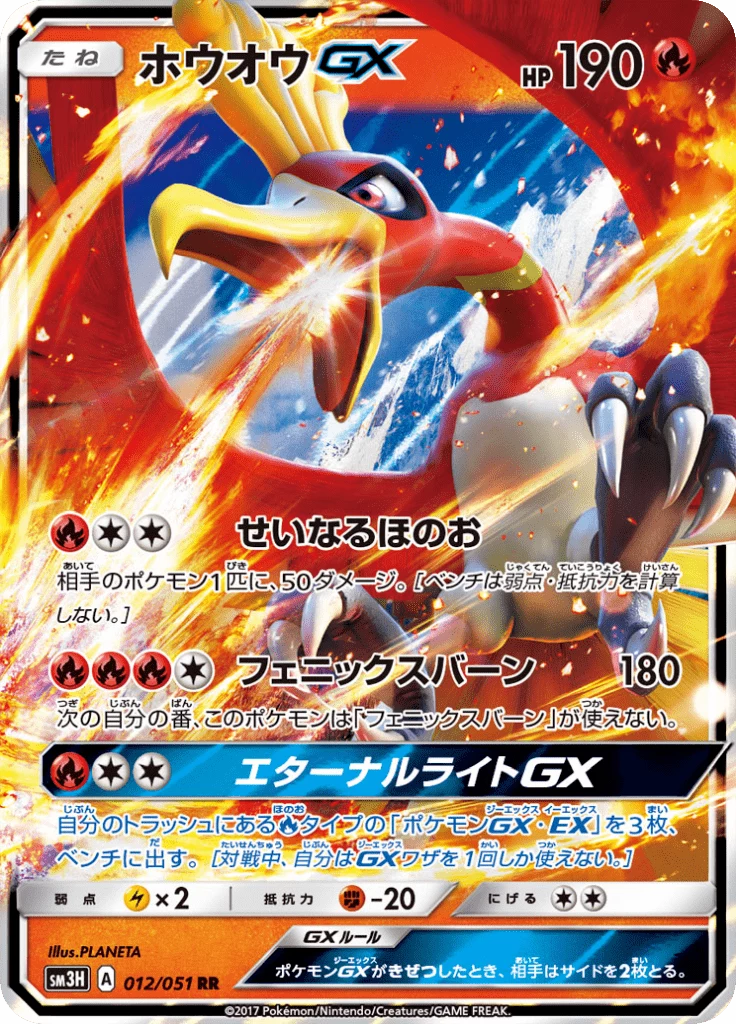
Ho-Oh GX RR 012/051, SM3H To Have Seen the Battle Rainbow
Ho-Oh GX RR 012/051 — the headline Legendary of SM3H “To Have Seen the Battle Rainbow”

The set’s headline Legendary is Ho-Oh GX, and the official promotional framing for SM3 centers on a fire-type push — Ho-Oh GX leads that charge, backed by an expanded lineup of Trainer cards, including entries built around Kiawe (カキ). That fire-type focus is also where Charizard GX RR earns its place: it’s the set’s other major fire-type card, and the one that has held the most attention in secondary-market circles since release.

Reading the Set Code

SM3H and SM3N are twin packs from the same release wave — not a base/enhanced pairing like some later Sun & Moon sets. Both released the same day with their own 57-card checklists and their own headline Legendary.

The Companion Set: SM3N “Light Consuming Darkness”

SM3N, 拡張パック「光を喰らう闇」, shares SM3H’s release date, price point, and 57-card checklist — but its roster leans in a very different direction. Where SM3H centers Ho-Oh GX and fire-type strategy, SM3N is built around Necrozma GX and the darker, Ultra Beast-adjacent side of the era’s storyline.
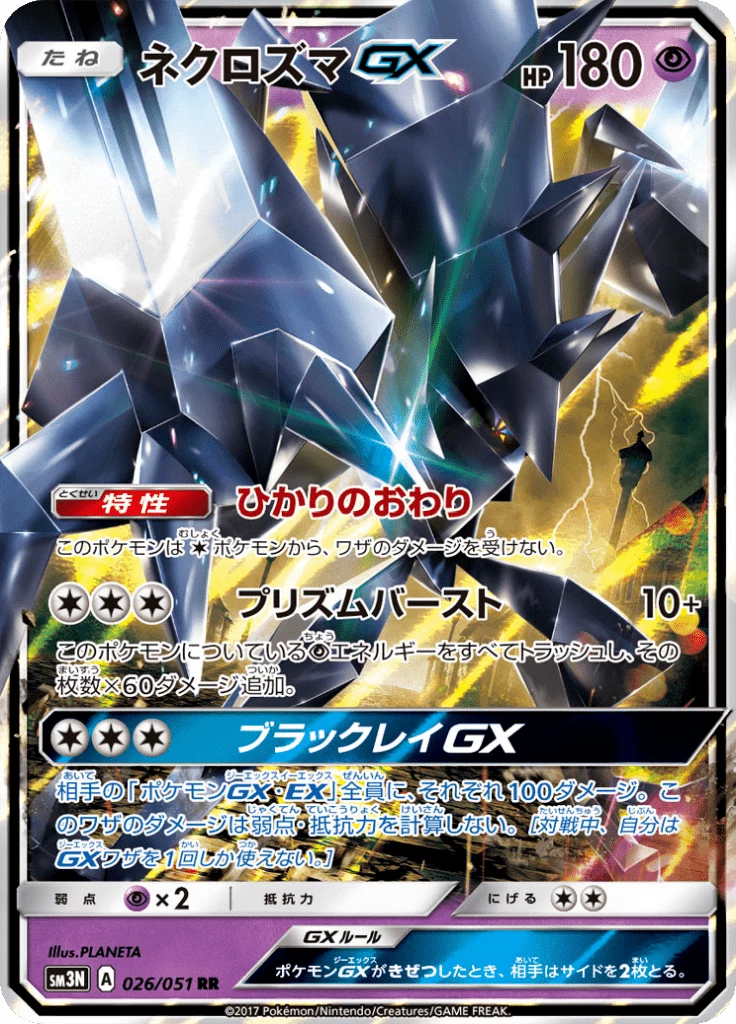
Necrozma GX RR 026/051, SM3N Light Consuming Darkness

Necrozma GX RR 026/051 — SM3N headline Legendary

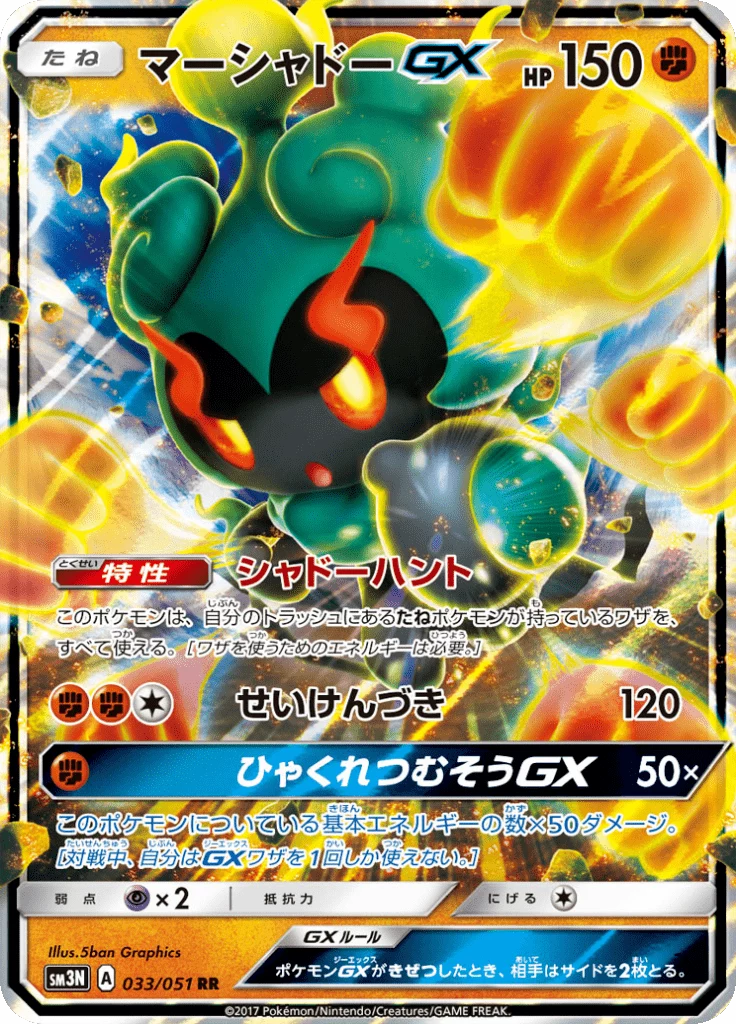
Marshadow GX RR 033/051, SM3N Light Consuming Darkness, first physical card printing

Marshadow GX RR 033/051 — the Mythical’s first-ever physical card

SM3N also carries a small but genuinely notable piece of set history: it’s where Marshadow GX made its first appearance as a physical trading card, ahead of any other printed release for the Mythical Pokemon. For collectors building a “firsts” list across the Sun & Moon era, that alone makes SM3N worth knowing alongside its more fire-focused sibling.

We don’t currently stock SM3N singles or sealed product in this listing — this guide focuses on SM3H, where our in-stock Charizard GX RR sits. If you’re chasing Necrozma GX or the Marshadow GX debut specifically, reach out through our Quick Order page and we can source against the live Japanese market.

The Chase Card: Charizard GX RR
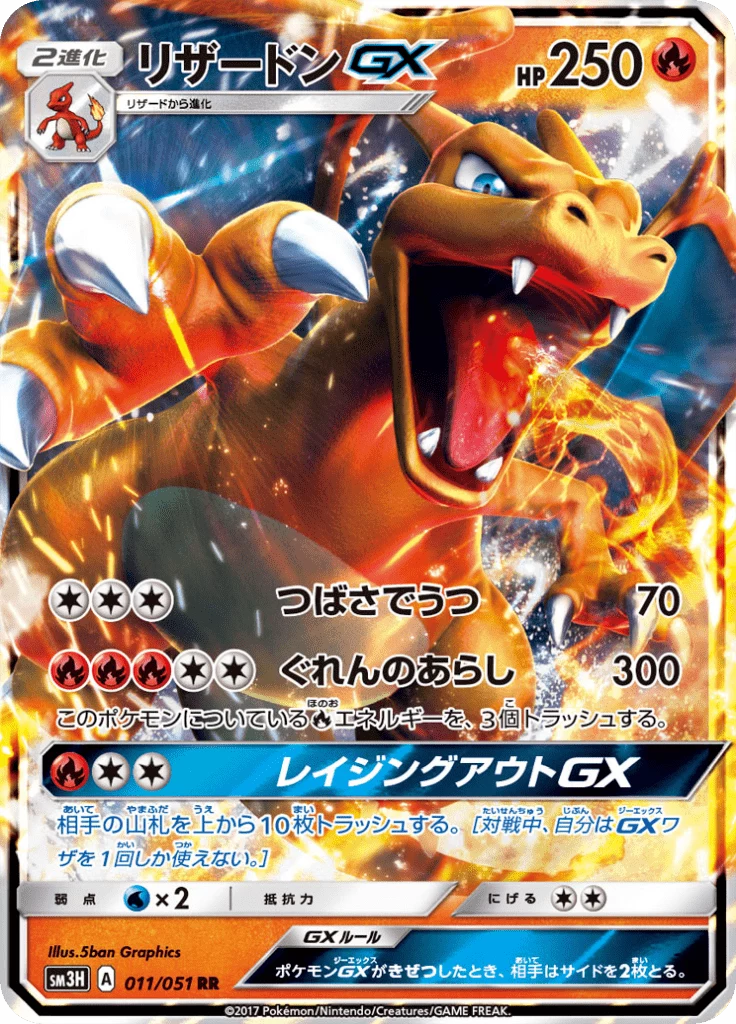
Charizard GX RR, SM3H 011/051, To Have Seen the Battle Rainbow
Charizard GX RR, SM3H 011/051 — the set’s most-tracked single

Sitting at card number 011/051 in SM3H, Charizard GX RR is the entry most collectors reach for when they talk about this set. It shares the fire-type spotlight with Ho-Oh GX, and Charizard’s presence is specifically called out in the set’s own promotional material alongside Ho-Oh GX and Kiawe-led Fire support — a rare case of the official framing naming both the headline Legendary and a supporting chase card in the same breath.

Our current copy is graded PSA 10 and is currently listed at ¥36,050. It’s a one-of-one holder in our catalog — when it sells, it’s gone, and the listing won’t restock automatically at the same price point.

Shop This Card
PSA 10 Charizard GX RR — SM3H 011/051
Currently listed at ¥36,050
Ships from Tokyo · Tracked delivery

View Product →

What RR Means on This Card

Carta Set Number Rarity
Charizard GX RR SM3H 011/051 Double Rare (RR)
Ho-Oh GX — headline Legendary SM3H 012/051 Double Rare (RR)
Necrozma GX — headline Legendary SM3N 026/051 Double Rare (RR)
Marshadow GX — first physical printing SM3N 033/051 Double Rare (RR)

The RR tag on Charizard GX marks it as a Double Rare — the standard rarity every regular GX card carries in this era, one step above the set’s non-GX Rare (R) slot, and sitting below the SR full-art secret slots numbered 052–057. It’s a holofoil GX card with the full-panel attack text and GX-specific artwork treatment that defined this rarity across the early Sun & Moon sets. Ho-Oh GX, Necrozma GX, and Marshadow GX are all Double Rare (RR) as well, at 012/051, 026/051, and 033/051 respectively.

On Grading and Condizione

SM3H used the textured holofoil stock common to 2017 Sun & Moon GX cards, which shows edge and surface wear readily. A PSA 10 copy like the one in our listing above reflects a card that graded gem mint on both surface and centering — not every raw copy in circulation will meet that bar.

Where SM3 Fits in the Sun & Moon Timeline

SM3H and SM3N landed roughly six months after the Sun & Moon series opened with SM1S/SM1M in December 2016, and about two months after the SM2+ enhanced pack in April 2017. That puts SM3 squarely in the era’s first full year, before the Ultra Beast-focused SM4S/SM4A wave that followed later in 2017.

If Ho-Oh GX and the Marshadow GX debut are era-opening moments for you, our SM4S Awakened Heroes & Ultra Dimension guide covers the next chapter, where Silvally GX and four Ultra Beast GX cards took over the spotlight. For the complete release-order map across every Sun & Moon expansion, see our Sun & Moon era Japanese Pokemon guide.

And if you’re weighing this Charizard GX RR against other Charizard printings from across the Japanese card market — different sets, different rarities, different grades — our PSA 10 Charizard Japanese cards buying guide lays out the wider graded Charizard landscape in one place.

Where to Buy SM3H Cards from Japan

We ship graded Japanese singles and sealed product worldwide from Tokyo with tracked delivery. For this set specifically, the fastest route is straight to the card:

  • The card itself — our PSA 10 Charizard GX RR (SM3H 011/051) listing, currently at ¥36,050, one-of-one stock.
  • More graded singles — browse our full PSA 10 collection for other Sun & Moon-era cards currently in stock.
  • A mixed order — use our Quick Order page to combine this card with sealed product, other singles, or a specific request from SM3N.

Because we’re only carrying a single graded copy of Charizard GX RR at the moment, the listing above reflects live stock rather than a running restock — once it’s sold, we’ll update the page rather than leave a stale price up.

Domande frequenti

What is SM3H “To Have Seen the Battle Rainbow”?

SM3H is a Japanese Sun & Moon-series expansion pack, officially 拡張パック「闘う虹を見たか」, released June 16, 2017, at ¥150 plus tax per five-card pack. Its headline Legendary is Ho-Oh GX, and its best-known chase card is Charizard GX RR (011/051).

What is the difference between SM3H and SM3N?

SM3H and SM3N are twin expansion packs that released the same day, June 16, 2017, each with 57 cataloged cards. SM3H is built around Ho-Oh GX and a fire-type focus; SM3N is built around Necrozma GX and also contains the first-ever physical card printing of Marshadow GX.

What is the chase card in SM3H?

Charizard GX RR, card number 011/051, is SM3H’s most-tracked single. It shares the fire-type spotlight with the set’s headline card, Ho-Oh GX, and both cards are named together in the set’s official promotional material.

What does the RR rarity mean on Charizard GX?

RR stands for Double Rare — the standard rarity every regular GX card carries in this era, one step above the set’s non-GX Rare (R) slot, and below the SR full-art secret slots. It’s a holofoil GX card with full-panel attack text and GX-specific artwork.

When did SM3H and SM3N release?

Both sets released on the same date, June 16, 2017, roughly six months after the Sun & Moon series opened in Japan with SM1S/SM1M in December 2016.
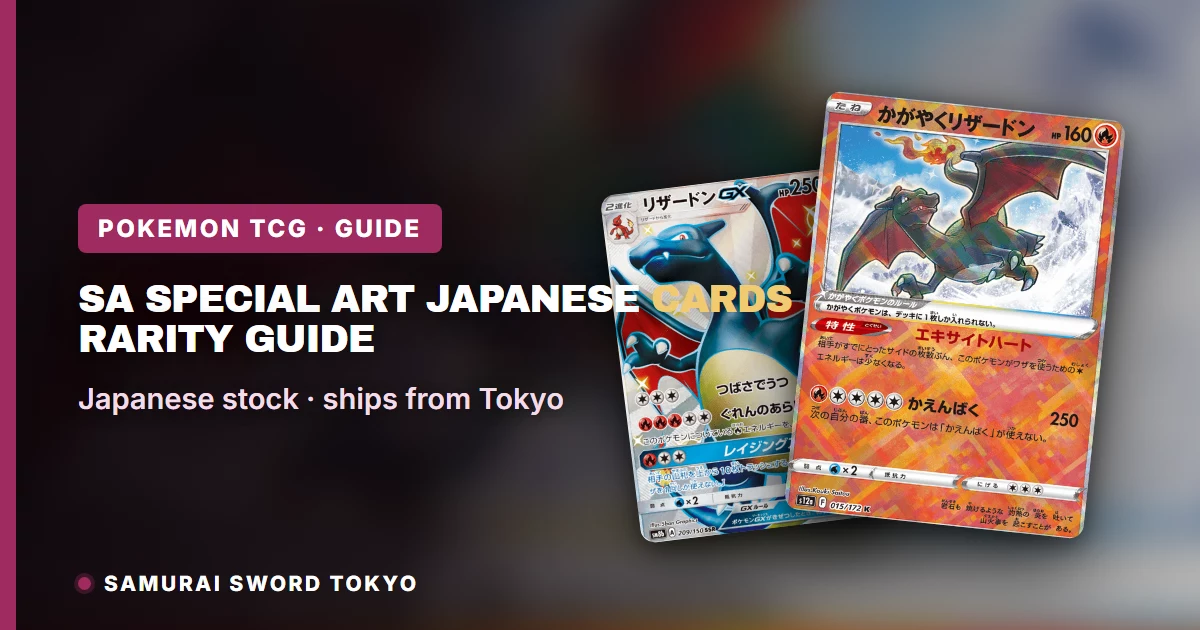
SA Special Art Japanese Cards: Rarity Guide

Two cards can look nearly identical — same full-art alternate illustration style, same premium price bracket — and still belong to completely different rarity systems, because one of them is a Special Art Rare and the other is what collectors just call SA. If you’ve seen “SA” stamped after a card’s name on a Japanese listing and assumed it meant the same thing as SAR, it doesn’t, and mixing the two up is the single easiest way to overpay or underpay for a Japanese full art.

SA is a community shorthand, not a rarity symbol printed on the card. It refers to the full-art SR and HR cards that Japan printed before the SAR system existed — and it stopped being a new category once VSTAR Universe shipped in December 2022. This guide explains exactly what separates SA from SAR, from Radiant, from SSR, and from the newly introduced BWR, then walks through the highest-value SA cards currently in our Tokyo inventory.

Key Takeaway

“SA” (Special Art) is a collector nickname for pre-VSTAR Universe full-art SR/HR cards, not an official rarity symbol. It ended when SAR (Special Art Rare) launched in December 2022. Our highest SA-tagged single is PSA10 Gardevoir & Sylveon GX SR:SA [SM9a 061/055], currently listed at ¥397,786, while PSA10 Vaporeon V SR:SA [S6a 075/069] sits at ¥42,209 as a far more accessible entry point.

2022
SA Ended (Dec, VSTAR Universe)

¥397,786
Highest SA Listed

¥39,879
Lowest Confirmed SA Listed

1
Official Rarity Symbol (“SA” Is Not One)

Prices reflect our current Tokyo listings as of August 2026, converted at ¥163/USD where noted. All figures are our own Tokyo listing prices, not third-party market averages.

What SA Actually Means — and What It Isn’t

SA stands for Special Art. It’s the term collectors and Japanese secondary sellers use for full-art SR and HR cards that Japan printed before the SAR (Special Art Rare) system existed. There is no official “SA” rarity symbol printed on these cards by the Pokemon Company — a card marked “SA” in a listing is really an SR or HR card that happens to carry full-bleed illustration, and the SA label is added by the seller to flag that visual treatment.

Before going further, it’s worth being explicit about what SA is not, because the naming across Japan’s top rarities overlaps constantly:

  • SA is not SAR. SAR (Special Art Rare) is the official rarity that replaced this style of card starting with VSTAR Universe in December 2022. The two are structurally different — see the next section.
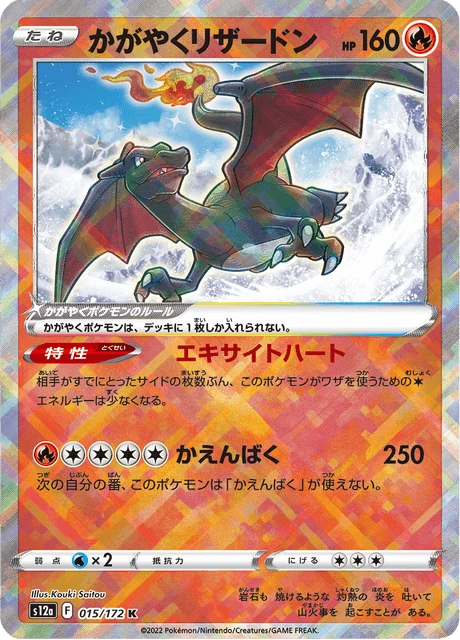
  • SA is not Radiant / K. Radiant Pokemon (かがやくポケモン, symbol “K”) is a Shiny Pokemon sub-line that debuted in Battle Region (S9a), limited to one per deck. PSA10 Radiant Charizard K [s12a 015/172], currently listed at ¥11,070, is a Radiant card, not an SA card, even though both are chase-tier full arts from the same VSTAR Universe set.
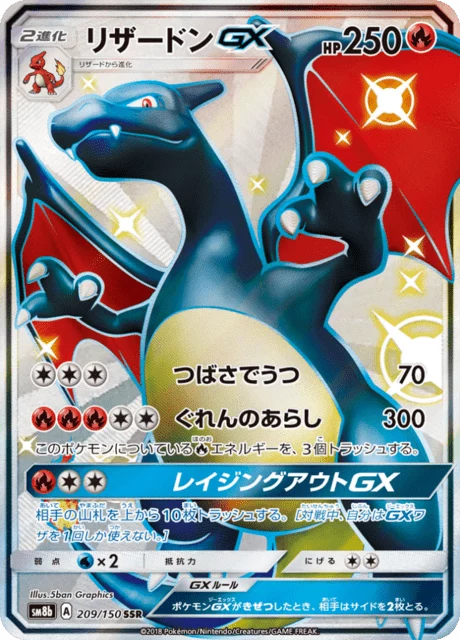
  • SA is not SSR. Shiny Super Rare cards apply a Shiny color-swap and special holofoil treatment to a GX card’s existing full-art illustration, rather than carrying a new alternate illustration of their own. PSA10 Charizard GX SSR [SM8b 209/150], currently listed at ¥381,718, looks nothing like an SA card despite a similar price tier.
  • SA is not BWR. Black White Rare is Japan’s newest rarity, introduced in June 2025 with Black Bolt and White Flare, and its defining feature is a solid black-or-white holo finish across the whole card — unrelated to full-art illustration.
  • SA overlaps with HR in some listings. Because HR (Hyper Rare / Rainbow Rare) full-art cards from the same pre-2023 era are sometimes tagged “HR:SA” together, you’ll see cards double-labeled. That’s a labeling convention, not a sign the card belongs to two separate rarities.
The One-Line Rule

If the card predates December 2022 and has a full-art alternate illustration filed under the SR/HR rarity symbol, it’s SA. If it’s from December 2022 onward and has that same kind of alternate illustration printed under the official SAR rarity symbol, it’s SAR.

Two neighboring rarities make the disambiguation concrete:

Radiant Charizard K card s12a 015/172 VSTAR Universe

Radiant Charizard K [s12a 015/172] — not SA, it’s Radiant

Charizard GX SSR card SM8b 209/150 GX Ultra Shiny

Charizard GX SSR [SM8b 209/150] — not SA, it’s SSR

SA vs SAR: The Real Structural Difference

The distinction goes deeper than just “before and after 2022.” SA and SAR are built differently as cards, and understanding that construction is what actually separates the two categories.

SA (Special Art) SAR (Special Art Rare)
Era Sun & Moon through pre–December 2022 December 2022 (VSTAR Universe) onward
Artwork Its own alternate illustration, distinct from the set’s regular SR/RR print — but filed under the SR/HR rarity symbol, with no dedicated “SA” mark The same kind of exclusive alternate illustration, but printed under the official SAR rarity symbol instead
Card mark None official — still prints as SR/HR, “SA” is a community label only Printed “SAR” text (JP) / gold double-star icon (EN, as “Special Illustration Rare”)
New cards still made? No — discontinued once SAR launched Yes — ongoing rarity

In practice: a set like Night Unison (SM9a) gave its Gardevoir & Sylveon GX two separate full-art SR prints — 060/055 illustrated by 5ban Graphics, and the SA-tagged 061/055 illustrated separately by Atsuko Nishida — both alternate illustrations, filed under the same SR symbol. A set like Terastal Festival ex (SV8a) gives its Sylveon ex the same kind of alternate illustration, but printed under the official SAR rarity symbol instead of SR. Same collecting instinct, different rarity system.

There’s also a labeling quirk worth knowing before you go hunting on card databases: on limitlesstcg.com, SA-era cards are filed under the broader “Secret Rare” category rather than a dedicated “SA” tag, while SAR cards get their own explicit “Special Art Rare” classification. The SA shorthand exists on marketplaces and seller listings, not inside that database’s own classification for the older cards.

The Highest-Value SA Cards Currently Listed

Ranked by current listing price, these are the SA-tagged singles carrying the biggest price tags in our inventory right now:

# Carta Set Currently listed
1 Gardevoir & Sylveon GX SR SA Night Unison (SM9a 061/055) ¥397,786
2 Giratina V SR SA 111/100 ¥388,102
3 Reshiram & Charizard GX SR SA Double Blaze (SM10 097/095) ¥380,688
4 Sylveon VMAX HR SA 093/069 ¥284,543
5 Mew VMAX HR SA 119/100 ¥261,352
6 Lugia V SR SA Paradigm Trigger (s12 110/098) ¥243,904
7 Rayquaza V SR SA Blue Sky Stream (S7R 076/067) ¥237,930
8 Greninja & Zoroark GX SR SA Night Unison (SM9a 059/055) ¥158,620

Two GX tag-team cards from the same set, Night Unison, occupy both the #1 and #8 spots on this list — a reminder that within a single set, SA pricing is driven far more by the individual Pokemon’s popularity than by the printing itself.

Two SA Cards From Our Current Listings

Every card discussed in this guide is listed with its full number and set in our own inventory, but two SA singles are worth calling out directly — both currently listed (as of August 2026) and easy to check against the physical card in hand.

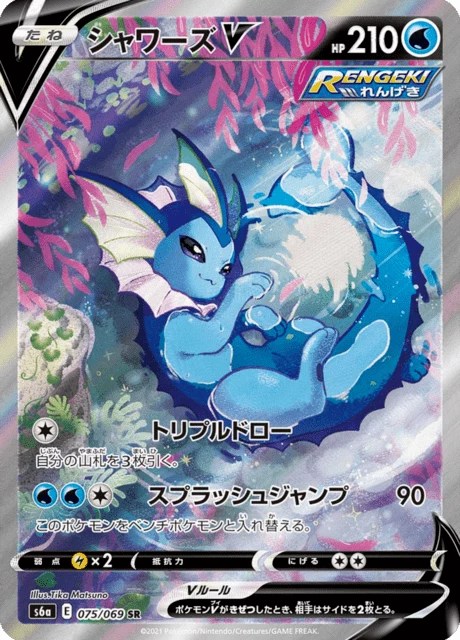
Vaporeon V SR SA card S6a 075/069 Eevee Heroes

Vaporeon V SR:SA [S6a 075/069]

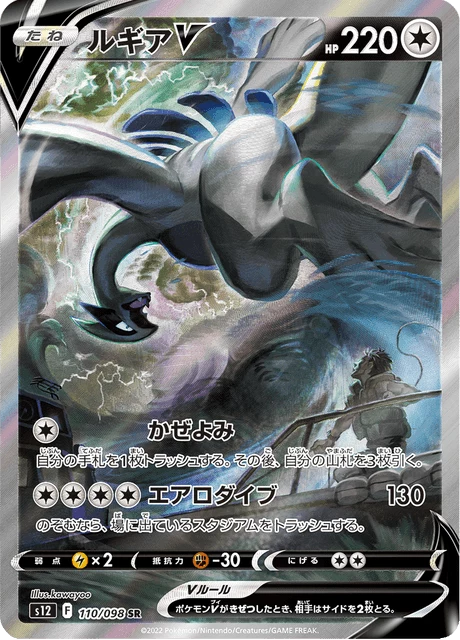
Lugia V SR SA card S12 110/098 Paradigm Trigger

Lugia V SR:SA [s12 110/098]

PSA10 Vaporeon V SR:SA [S6a 075/069] comes from Eevee Heroes, and it’s currently listed at ¥42,209 — roughly a tenth of the price of the top card on this list, despite carrying the same full-art construction. PSA10 Lugia V SR:SA [s12 110/098] from Paradigm Trigger sits much higher at ¥243,904, reflecting how strongly a legendary-tier Pokemon drives SA pricing compared to an Eeveelution.

From ¥397,786 Down: Where SA Gets Affordable

The SA tier spans an enormous range. At the top, Gardevoir & Sylveon GX SA sits at ¥397,786. At the accessible end, both Eevee Heroes SA prints — Vaporeon V SR:SA at ¥42,209 and Jolteon V SR:SA [S6a 079/069] at ¥39,879 — are currently our lowest-priced confirmed SA singles.

Because SA production stopped at the end of 2022, the truly budget-friendly full-art collecting now happens on the SAR side of the line, not the SA side. Recent SAR successors currently listed well under ¥10,000 include MEGA Eelektross ex SAR at ¥6,983, Volcanion ex SAR at ¥6,468, and Chien-Pao ex SAR [SV2P 093/071] at ¥9,208. These aren’t SA cards — they’re the modern continuation of the same full-art collecting habit, just under the newer rarity system.

Shop This Rarity
Eevee Heroes SA Pair — Vaporeon V & Jolteon V SR:SA
Currently listed at ¥42,209 and ¥39,879
Ships from Tokyo · Tracked delivery

View Vaporeon V SA →

Where SA Sits Among Japan’s Other Chase Rarities

SA is one piece of a much larger rarity landscape in Japanese Pokemon cards, and the naming conventions genuinely do overlap between neighboring tiers. If you’re building out a fuller picture:

  • For the rarity that took over from SA in December 2022, see our full Japanese Alt Art (SAR) cards guide, which covers the exclusive-illustration successor tier in depth.
  • For how SA fits against every other Japanese rarity symbol — from AR to UR to CHR — our Japanese Pokemon card rarities explained guide is the full reference map.
  • The rainbow-foil HR tier that sometimes double-labels with SA (as in “HR:SA” listings) has its own famous case study in our Moonbreon (Umbreon GX HR) guide, which is the single most requested HR card we’re asked about.

Treat SA as a historical label rather than a live rarity system: it describes a specific window of Japanese printing (Sun & Moon era through late 2022) and a specific construction (a full-art alternate illustration filed under the regular SR/HR symbol rather than a dedicated SAR symbol), and it isn’t something new sets can add to going forward.

Where to Buy SA Japanese Cards

We ship graded and raw Japanese singles worldwide out of Tokyo with tracked delivery. SA cards are individually listed as PSA 10 singles rather than sold sealed, so buying one means going straight to the product page for that specific card and number.

Shop This Card
PSA10 Gardevoir & Sylveon GX SR:SA [SM9a 061/055]
Currently listed at ¥397,786
Ships from Tokyo · Tracked delivery

View Product →

For the wider category, browse our PSA 10 Japanese singles collection, which includes every SA and SAR card referenced in this guide. If you’re after several specific cards or numbers at once, our Quick Order page is the fastest way to build a mixed order in one pass.

Domande frequenti

What does SA mean on a Japanese Pokemon card?

SA stands for Special Art — a community nickname for full-art SR and HR cards printed before December 2022, when the SAR (Special Art Rare) system replaced this style. It is not an official rarity symbol printed on the card itself.

What’s the difference between SA and SAR?

SA cards carry their own full-art alternate illustration, but it’s printed under the regular SR/HR rarity symbol with no dedicated mark of its own. SAR cards carry that same kind of alternate illustration, but printed under the official SAR rarity symbol instead. SA ended with the SAR system’s launch in VSTAR Universe, in December 2022.

Is SA the same as HR (Rainbow Rare)?

No. HR refers to the rainbow-foil finish used on Sun & Moon through Sword & Shield era full arts. Some cards are labeled “HR:SA” together because they’re both an HR-finish card and predate the SAR system, but SA and HR describe two different attributes of the same card, not the same rarity.

What is the most valuable SA card currently listed?

PSA10 Gardevoir & Sylveon GX SR:SA [SM9a 061/055], currently listed at ¥397,786.

Are new SA cards still being printed?

No. SA describes a specific pre-December 2022 printing style. New full-art cards from VSTAR Universe onward use the SAR (Special Art Rare) or newer rarity systems instead.

Japanese Booster Box Shrink Wrap: Buyer’s Guide

Ask ten collectors what a sealed Japanese booster box “should” look like, and most will say the same thing: shrink wrap, tight and unbroken, straight out of the case. Ask those same ten collectors for a source that actually defines that standard, and the conversation usually stops there.

We went looking for that source before writing this guide — official statements from The Pokémon Company, distributor documentation, anything that spells out a single, industry-wide rule for how Japanese booster boxes are packaged and shipped. We didn’t find one. What we did find is more useful in practice: the physical facts about what shrink film actually is and does, and a real example from our own catalog of how a shrink-wrap difference gets handled on a real listing.

Key Takeaway

We currently list the same box — SV6 Transformation Mask — two ways: the standard sealed version at ¥15,450, and a 【No Shrink】version currently listed at ¥12,480. There’s no single published rule that tells you what “no shrink” is supposed to mean across the hobby — so we label ours explicitly instead of leaving it ambiguous.

2
Common Film Types (PVC / POF)

¥2,970
Price Gap, Our 2 SV6 Listings

0
Company-Wide Standard We Could Verify

Prices are our own current listings as of August 13, 2026. USD figures use ¥163/USD (2026-07 internal reference rate) for approximate conversion only.

What Shrink Wrap Actually Is

Before getting into how it applies to booster boxes, it helps to know what the material actually is. Shrink wrap is a polymer film that shrinks tightly over whatever it’s covering once heat is applied — typically with a handheld heat gun for individual items, or a heat tunnel on a conveyor line for volume packaging.

Two film types account for most commercial shrink wrap. PVC (polyvinyl chloride) is cheap and lightweight, which is why it shows up so often on mass-market packaging, though it has known drawbacks as a film material. Polyolefin, often shortened to POF, is the higher-grade option — more durable, more puncture-resistant, and generally considered a more recyclable material than PVC.

Neither of those two facts is specific to trading card packaging. They’re general properties of the film itself, documented the same way for any shrink-wrapped product, from electronics to food packaging. The application method is the same across industries too: a handheld heat gun for one-off or small-batch wrapping, or a heat tunnel on a conveyor line when a manufacturer is running volume production. In both cases, the film starts loose around the item and only takes its final tight shape once heat is applied.

Why Sealed Packaging Gets Shrink-Wrapped

One of the most common documented uses of shrink film across industries is tamper resistance — bands or full wraps applied over parts of a package specifically so that removal or damage is visible. That’s the general logic behind why any sealed consumer product, booster boxes included, tends to arrive shrink-wrapped from the manufacturer: it gives a buyer a visual signal that the box hasn’t been opened since it left the production line.

It’s worth being precise about what that fact does and doesn’t tell us. It explains why shrink wrap exists as a packaging category in the first place. It is not a statement from Pokémon Card Laboratory, The Pokémon Company, or any Japanese distributor about their specific packaging policy for a given booster box release. We looked for that kind of statement and couldn’t confirm one, which brings us to the more important section of this guide.

What’s Documented — and What Isn’t

In researching this guide, we tried to confirm a few specific claims that come up constantly in collector conversation: that Japanese booster boxes are always shipped shrink-wrapped as standard, that Pokémon Center stock is packaged differently from wholesale distribution, and that there’s a settled definition of what “no shrink” means when a seller uses that label. We could not find an official, citable source for any of those three claims.

That’s not the same as saying they’re false. It means we don’t have a source we’re comfortable putting in front of you as fact, so we’re not going to present them as one. This guide sticks to what we can actually back up: general packaging-material facts, and what we ourselves do when a box in our catalog doesn’t have factory shrink on it.

We also looked into Pokémon Center’s role as a retail channel while researching this, since “Pokémon Center stock versus regular distribution” is a common thread in the same conversations. What’s confirmed is background, not a packaging claim: Pokémon Center stores in Japan are an official channel run by The Pokémon Company, and that company does run store- and online-exclusive product lines through it. None of that tells us anything specific about shrink-wrap practices on any given box, so we’re not extending it into one.

What This Means for You

Treat shrink-wrap presence as one visual detail on a listing, not a certificate. It tells you something about how a specific box currently looks — it isn’t a documented, industry-wide guarantee of anything beyond that.

A Real Example: Our Two SV6 Transformation Mask Listings

Rather than talk about shrink wrap in the abstract, here’s how it plays out on an actual product page. We currently carry SV6 Transformation Mask as two separate listings:

Listing Shrink status Current price
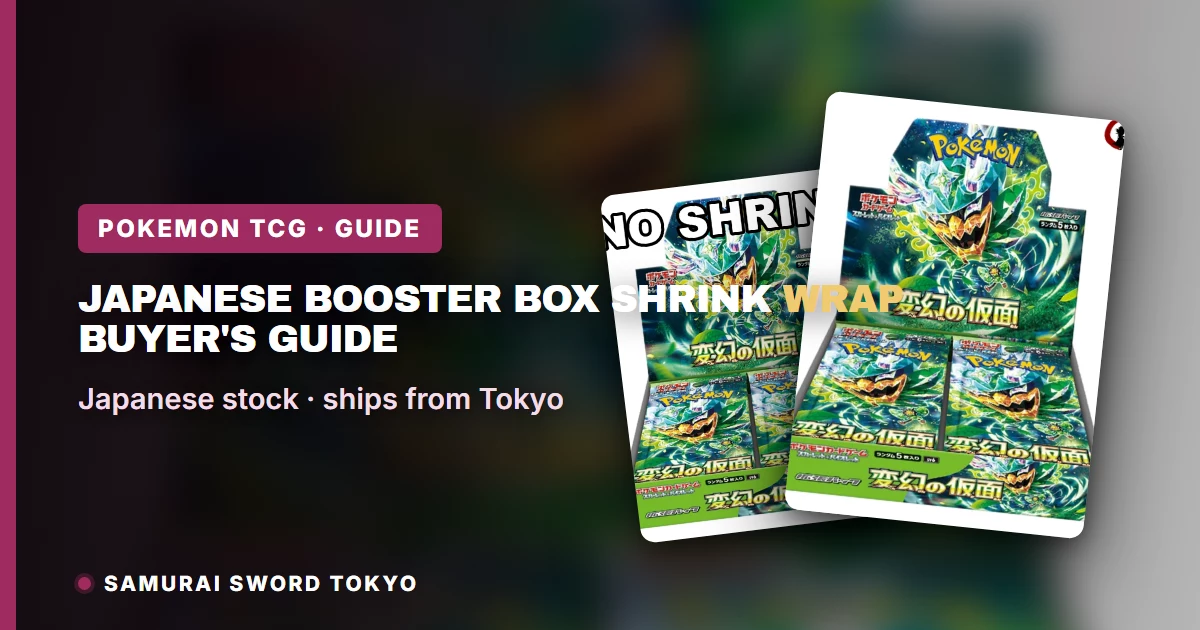
SV6-Transformation Mask Japanese Pokemon Booster Box Standard sealed ¥15,450 (~$95)
【No Shrink】SV6-Transformation Mask Japanese Pokemon Booster Box No shrink wrap ¥12,480 (~$77)

Same box, same set, two distinct product pages with the shrink-wrap condition stated directly in the title and the price set accordingly. That’s a decision we make at the listing level for our own catalog — it’s a fact about how we sell this specific product, not a general claim about what a “no shrink” label means when other sellers use it.

SV6-Transformation Mask Japanese Pokemon Booster Box — sealed product

SV6-Transformation Mask Booster Box (Standard Sealed)

【No Shrink】SV6-Transformation Mask Japanese Pokemon Booster Box — sealed product

【No Shrink】SV6-Transformation Mask Booster Box

Shop This Set
SV6 Transformation Mask Booster Box (Japanese)
Standard sealed listing currently at ¥15,450
Ships from Tokyo · Tracked delivery

View Product →

What Actually Protects You as a Buyer

Since there’s no universal published shrink-wrap standard to lean on, the more reliable habits are the ones that don’t depend on one:

  • Read the listing, not just the photo. If a seller’s title or description states the shrink-wrap condition directly — as ours does with “No Shrink” — that’s a specific claim you can hold them to, rather than an assumption you’re making from a thumbnail image.
  • Look past the wrapper. Shrink film covers the outside of a box; it says nothing about the packs inside. If authenticity of the cards themselves is the real concern, our guide to spotting fake Japanese Pokemon cards covers what to actually check once a box is opened.
  • Know what a legitimate box looks like inside. Our Japanese booster box unboxing guide walks through what you should expect to find pack by pack, which is a more concrete check than packaging condition alone.
  • Vintage product is its own category. Older sealed boxes carry different handling and storage histories than a current release like SV6, and shrink-wrap condition reads differently on a decades-old box than on this year’s product. Our vintage Japanese booster box guide covers that older-product context separately.
  • Buy from a seller who will answer questions before you order. A written, specific answer about a specific box beats a general rule that may not exist in the first place.

Domande frequenti

What is booster box shrink wrap actually made of?

Generally PVC or polyolefin (POF) film. PVC is cheaper and lighter but has known drawbacks as a material; polyolefin is more durable, more puncture-resistant, and considered the higher-grade, more recyclable option of the two.

Why do sealed products get shrink-wrapped in the first place?

Tamper resistance is one of the most common documented uses of shrink film across industries — wrapping a product so that removal or damage is visibly apparent. That’s a general packaging-material fact, not a statement specific to Japanese Pokemon booster boxes.

Does Samurai Sword Tokyo sell booster boxes without shrink wrap?

Yes, when we have one. As of this writing, our SV6 Transformation Mask box is listed both ways: the standard sealed version currently at ¥15,450, and a 【No Shrink】version currently listed at ¥12,480, labeled and priced separately.

Is there one official standard for whether Japanese booster boxes ship with shrink wrap?

Not that we could confirm. In researching this guide we did not find an official, citable statement from The Pokémon Company or a Japanese distributor defining a single company-wide packaging standard, so we’re not asserting one here.

Does missing shrink wrap mean a box isn’t authentic?

We can’t make that claim without a source to back it, so we won’t. Shrink-wrap condition is one visual detail on a listing. If authenticity is your concern, our fake card guide and unboxing guide cover more concrete ways to evaluate a box and its contents.

Where to Buy Japanese Booster Boxes from Tokyo

We ship sealed Japanese product worldwide out of Tokyo with tracked delivery, and we label shrink-wrap condition on the listing itself whenever it’s relevant — as with the two SV6 Transformation Mask pages above.

For a mixed order across multiple boxes, sets, or singles in a single shipment, our Quick Order page is the fastest way to check current stock and get everything into one cart.

SM4S Awakened Heroes & Ultra Dimension: Guide

September 15, 2017 gave Japanese collectors two packs on the same shelf, released the same day, built around two very different jobs. SM4S “Awakened Heroes” introduced a Pokemon-GX that had never appeared in the card game before. SM4A “Beasts from the Ultradimension” spent its print run building out the Ultra Beast GX lineup the Sun & Moon games had just introduced.

Pokemon-GX cards themselves weren’t new by this point — the type debuted nine months earlier in SM1 “Collection Sun” and “Collection Moon,” released December 9, 2016. What SM4 added wasn’t the mechanic itself but two specific applications of it: one brand-new GX Pokemon, and a coordinated four-card GX line built around a single theme.
This guide covers what’s confirmed about both sets — release details, card counts, and the specific cards worth knowing — and flags anywhere the record is thin instead of guessing. We currently list one graded single from this pairing.

Key Takeaway

We currently list PSA 10 Gladion SR (055/050, Awakened Heroes) at ¥32,960 — stock is limited, so check the live product page for current availability before ordering. SM4S and SM4A themselves headline with Silvally GX’s Trading Card Game debut and a four-card Ultra Beast GX line split across the two packs.

2
Paired Sets (SM4S + SM4A)

Sep 15, 2017
Release Date (Both)

4
Ultra Beast GX Cards

55
Cards Catalogued Per Set

Card numbers, sets, and release details below are sourced from the official pokemon-card.com product page and the LimitlessTCG card database, as cited throughout. Where a detail couldn’t be confirmed against a primary source — box pack counts, some rarity codes — we’ve said so rather than guessing.

SM4S and SM4A at a Glance

SM4S and SM4A are the fourth expansion-pack pairing of Japan’s Sun & Moon era, following the same two-pack, same-day release pattern the era used throughout — our Sun & Moon era guide covers how that pairing structure worked across the full era.

Set Japanese name English name Release Pack Cards catalogued
SM4S 覚醒の勇者 Awakened Heroes Sept 15, 2017 ¥150+tax, 5 cards 55 (to 050)
SM4A 超次元の暴獣 Beasts from the Ultradimension Sept 15, 2017 ¥150+tax, 5 cards 55 (to 050)

Both packs list 55 cataloged cards with main-set numbering running to 050 — secret and Hyper Rare slots print above that number. Box pack counts for either set weren’t confirmed against a primary source for this guide, so we’re not stating a per-box figure.

The set-code naming is worth flagging since it isn’t consistent across the era. SM1’s pairing used “S” and “M” for Sun and Moon, and SM5’s used the same S/M split for Ultra Sun and Ultra Moon. SM4 instead pairs “S” (Awakened Heroes) with “A” (Beasts from the Ultradimension) — so the letter after the number identifies the specific pack, not a fixed Sun/Moon position, and it’s worth checking the full set code rather than assuming from the number alone.

Silvally GX: The Debut Card of Awakened Heroes

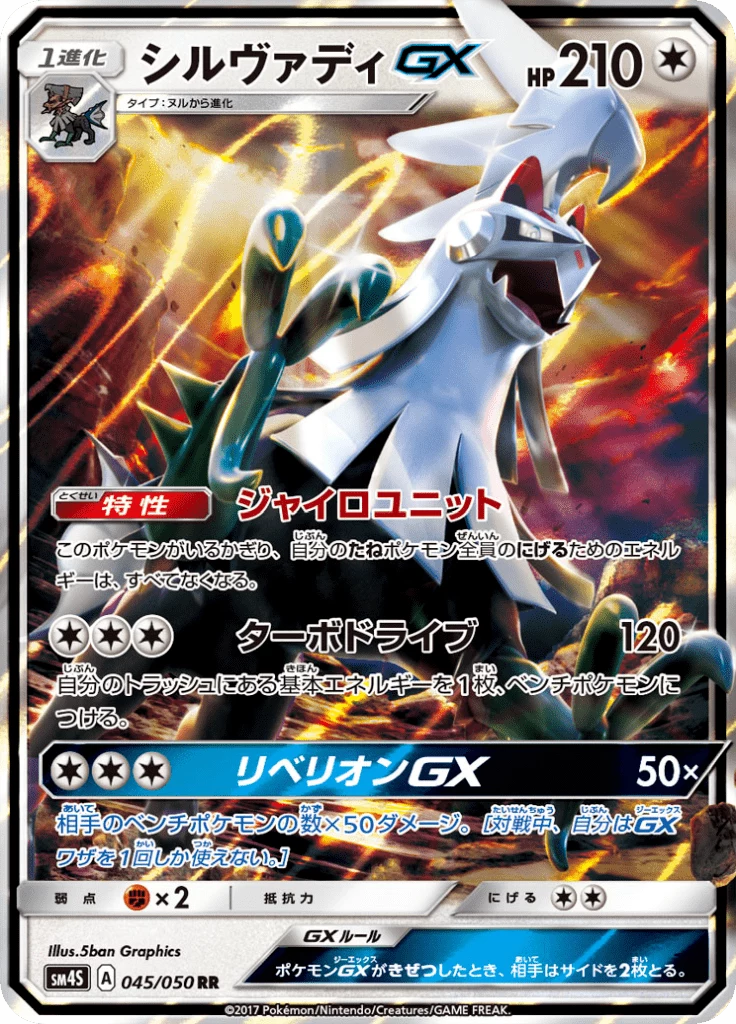
Silvally GX 045/050, Awakened Heroes (SM4S)
Silvally GX 045/050 — Awakened Heroes (SM4S)

SM4S is built around Silvally GX (045/050), which made its Pokemon Trading Card Game debut in this set according to the official pokemon-card.com product page. Nothing earlier in the Sun & Moon-era release lineup put Silvally on cardboard, which makes Awakened Heroes the point of origin for every Silvally GX print that followed.

The exact rarity code printed on Silvally GX (RR, SR, or another designation) wasn’t confirmed against a primary source for this guide, so we’re describing it here by its role in the set — the headline debut card — rather than assigning a rarity tier we can’t verify. If you’re tracking down a copy, confirm the rarity stamp against a card database before you buy rather than assuming from the card name alone.

The Ultra Beast GX Line Across SM4A

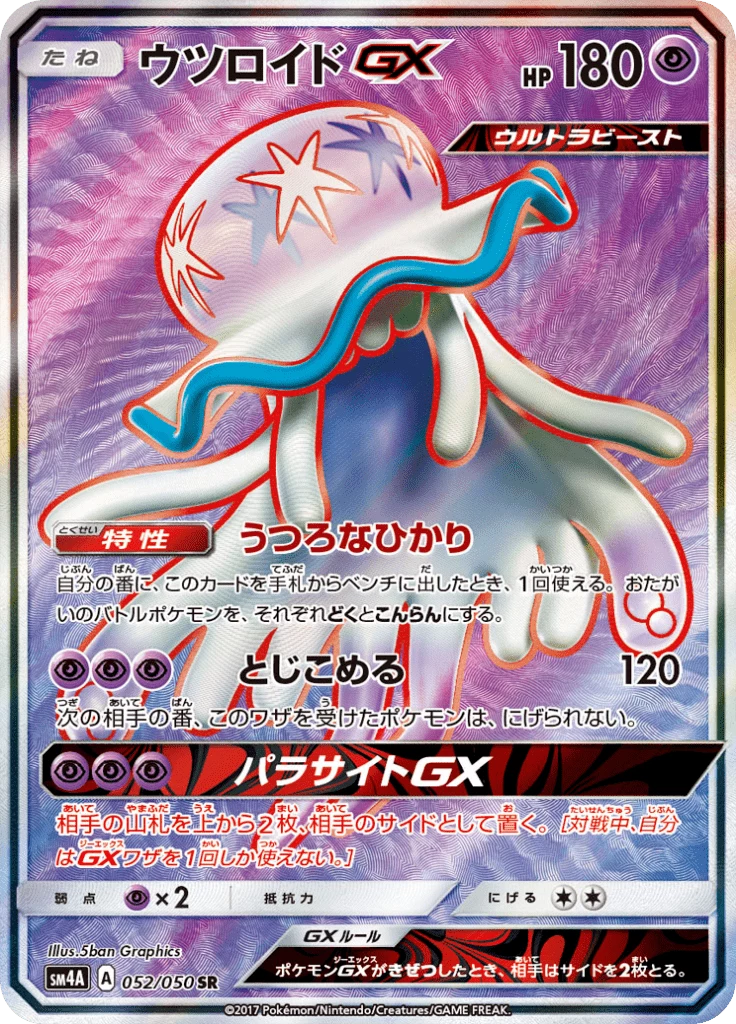
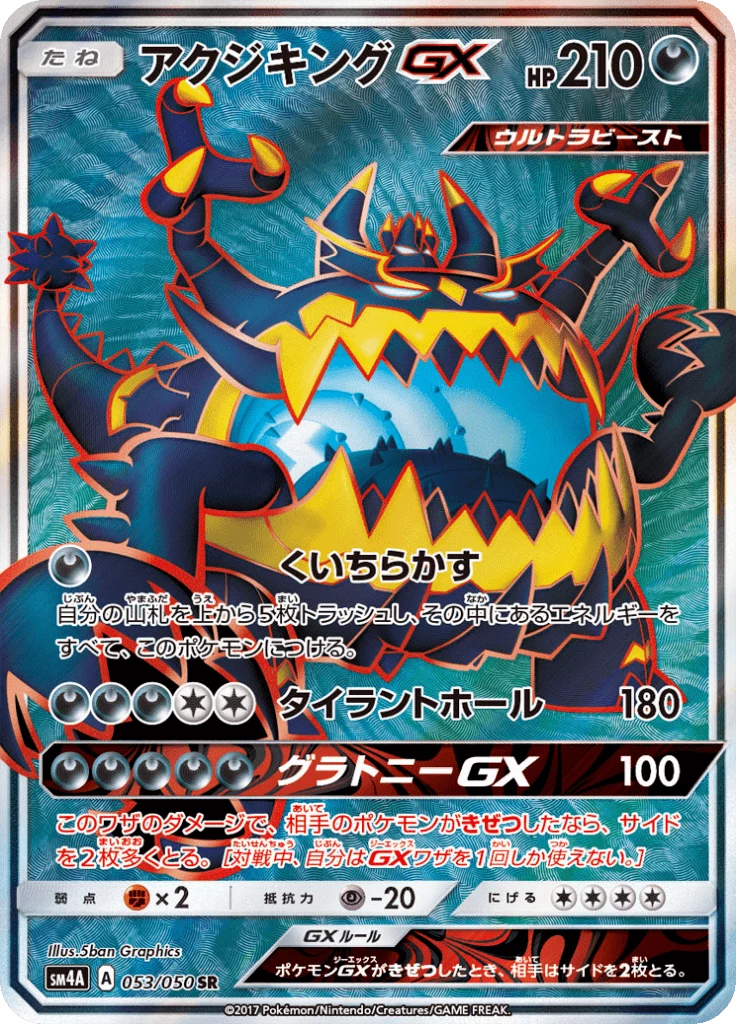
Where SM4S centers on a single debut, SM4A’s whole print run is organized around one theme: the official product page names a four-card Ultra Beast GX line running across the two packs — Guzzlord GX (アクジキングGX), Buzzwole GX (マッシブーンGX), Nihilego GX (ウツロイドGX), and Kartana GX (カミツルギGX). Of the two we could confirm placement for, both print out of SM4A specifically.

Nihilego GX 052/050, Beasts from the Ultradimension (SM4A)

Nihilego GX 052/050 (SM4A)

Guzzlord GX 053/050, Beasts from the Ultradimension (SM4A)

Guzzlord GX 053/050 (SM4A)

Nihilego GX is printed at 052/050 and Guzzlord GX at 053/050, both above the set’s 050 main-set ceiling — the secret-rare-style slots typical of the era. We could confirm print numbers and card images for these two directly against the LimitlessTCG database.

Buzzwole GX and Kartana GX are named on the same official product page as part of the same four-card line, but we couldn’t confirm their exact print numbers, set placement, or a verified card image for either one in the time we had for this guide. Rather than guess a card number, we’re flagging that as unconfirmed — if you’re chasing the full quartet, verify those two specifically before you buy.

For collectors, the practical takeaway is that the Ultra Beast GX theme isn’t contained in a single pack. Two of the four confirmed cards — Nihilego GX and Guzzlord GX — come out of SM4A boosters specifically, not SM4S, so opening Awakened Heroes alone won’t get you the full line even though the product page markets the theme across both sets together.

Gladion SR: The Card We Currently Stock

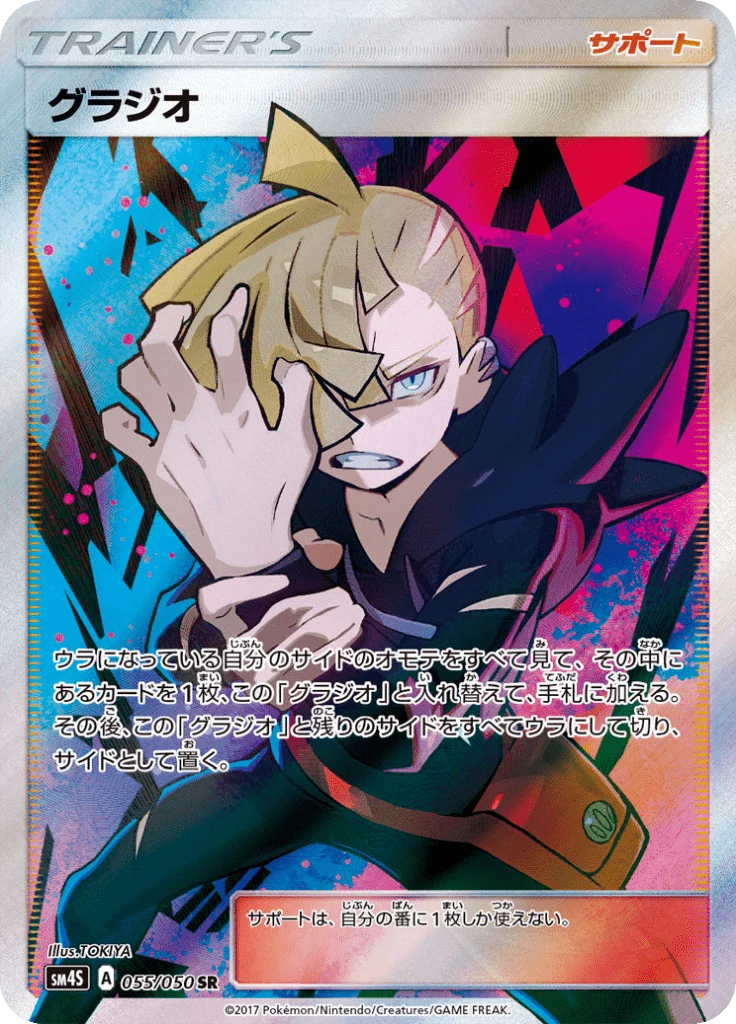
Gladion SR 055/050, Awakened Heroes (SM4S)
Gladion SR 055/050 — Awakened Heroes (SM4S)

Alongside the debut and Ultra Beast cards, Awakened Heroes also carries a Super Rare-tier print: Gladion SR (055/050). It’s the one card from this SM4S/SM4A pairing we currently hold in graded stock, and it sits in the same set that introduced Silvally GX — so it’s a natural pickup for anyone building out Awakened Heroes as a complete pack rather than chasing a single headline card.

Note that the printed card number (055/050) runs above the set’s 050 main-set ceiling, the same pattern seen with Nihilego GX and Guzzlord GX in SM4A — each set’s above-050 slots are where its rarer, above-common-rarity prints live.

PSA 10 Anchor
Gladion SR 055/050 — Awakened Heroes (SM4S)
Currently listed at ¥32,960
Ships from Tokyo · Tracked delivery

View Product →

This is a graded single and stock is limited — the live product page reflects current availability, and once it sells we’ll update the listing rather than source another PSA 10 example right away.

SM4S vs SM4A: Which Half to Chase First

Since both packs released the same day at the same price, the practical difference comes down to what you’re chasing:

  • Want the debut card: SM4S is where Silvally GX (045/050) entered the card game, and it’s also the half that carries Gladion SR (055/050), currently listed at ¥32,960 in PSA 10.
  • Want the Ultra Beast theme: SM4A carries Nihilego GX (052/050) and Guzzlord GX (053/050) directly, plus the set’s share of the four-card Ultra Beast GX line overall.
  • Want the full theme in one place: since the Ultra Beast GX quartet and Silvally’s debut are split across both packs, completing the SM4-era storyline means picking up product from both SM4S and SM4A rather than one alone.

SM4 sits between two other Sun & Moon-era packs worth knowing if you’re working through the era in release order. The pack before it, released three months earlier, is covered in our SM3H “To Have Seen the Battle Rainbow” guide. The next main expansion after SM4, released December 8, 2017, is covered in our SM5S “Ultra Sun” guide.

Where to Buy SM4 Cards from Japan

We ship graded Japanese singles and sealed product out of Tokyo with tracked delivery worldwide. For the card covered in this guide:

Shop the Collection
PSA 10 Graded Singles
Ships from Tokyo · Tracked delivery

View Collection →

For a mixed order across SM4S, SM4A, or any other Sun & Moon-era pack, use the Quick Order page directly and we’ll source what we can.

Domande frequenti

What are SM4S and SM4A?

SM4S “Awakened Heroes” (覚醒の勇者) and SM4A “Beasts from the Ultradimension” (超次元の暴獣) are a paired Japanese Pokemon Trading Card Game expansion, both released September 15, 2017, at ¥150+tax per 5-card pack. Each catalogs 55 cards with main-set numbering to 050.

What is Silvally GX’s significance in Awakened Heroes?

Silvally GX (045/050) made its Pokemon Trading Card Game debut in SM4S, according to the official pokemon-card.com product page. It’s the set’s headline card.

What is the Ultra Beast GX line in SM4A?

The official product page names four Ultra Beast GX cards across SM4S/SM4A: Guzzlord GX, Buzzwole GX, Nihilego GX, and Kartana GX. We could confirm print numbers for Nihilego GX (052/050) and Guzzlord GX (053/050) against the card database; Buzzwole GX and Kartana GX’s exact print numbers weren’t confirmed for this guide.

What is Gladion SR worth, and is it currently listed?

We currently list a PSA 10 Gladion SR (055/050, Awakened Heroes) at ¥32,960. It’s a graded single with limited stock, so check the live product page for current availability.

Where does SM4 fit in the Sun & Moon release timeline?

SM4S and SM4A released September 15, 2017, after SM3H/SM3N (June 16, 2017) and before SM5S “Ultra Sun” (December 8, 2017). See our SM3H and SM5S guides for the packs on either side.

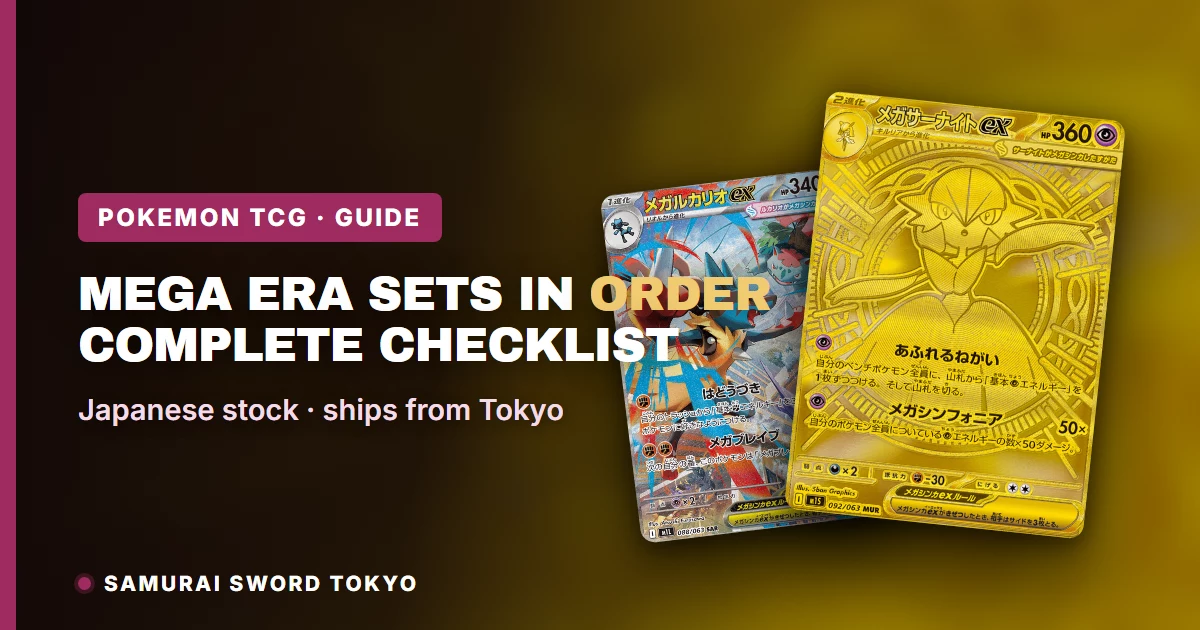
Mega Era Sets In Order: Complete Checklist

Twelve months. Eight booster boxes. One naming scheme that jumps from M1S straight to M2a and back to plain M3, M4, M5, M6 — and no official “start here” chart anywhere in English.

The Japanese Mega era kicked off on August 1, 2025 with two simultaneous releases and has shipped a new set roughly every six to ten weeks since. If you’re trying to figure out which box comes before which, what each one’s flagship chase card actually is, or simply want the full lineup in order before you build a set run, this is that list — release date by release date, from M1S through the current flagship, M6 Storm Emeralda.

Key Takeaway

Eight Mega era booster boxes have released between August 2025 and July 2026: M1S, M1L, M2, M2a, M3, M4, M5, and M6. Sealed boxes are currently listed from ¥7,600 for M5 Abyss Eye up to ¥16,800 for the newest release, M6 Storm Emeralda.

8
Sets Released

Aug ’25–Jul ’26
Release Span

¥7,600
Lowest Listed Box

¥16,800
Highest Listed Box

The Complete Mega Era Timeline

Every Mega era set to date, in release order, with total card count and the flagship chase card that headlines each box:

Set Code JP Release Total Cards Flagship Chase Booster Box
Mega Symphonia M1S Aug 1, 2025 92 Mega Gardevoir ex ¥9,500
Mega Brave M1L Aug 1, 2025 92 Mega Lucario ex ¥10,608
Inferno X M2 Sep 26, 2025 116 Mega Charizard X ex ¥15,980
Mega Dream ex M2a Nov 28, 2025 250 Mega Gengar ex ¥12,804
Nihil Zero M3 Jan 23, 2026 117 Mega Zygarde ex ¥8,112
Ninja Spinner M4 Mar 13, 2026 120 Mega Greninja ex ¥9,500
Abyss Eye M5 May 22, 2026 118 Mega Darkrai ex ¥7,600
Storm Emeralda M6 Jul 31, 2026 113 Mega Rayquaza ex ¥16,800

The cadence is fairly tight for most of the run — about seven to eight weeks between M2 and M2a, M2a and M3, and M3 and M4 — stretching to about ten weeks between M4 and M5, and again between M5 and M6. M1S and M1L are the one exception to the “one set at a time” pattern, launching on the exact same day as a matched pair.

For a card-by-card breakdown of every top chase across all eight sets, see our Mega Evolution chase card guide. For current market pricing on those same chases, our Mega booster box price index tracks the whole era in one table.

M1S Mega Symphonia & M1L Mega Brave: Where It Started

The Mega era opened with a matched pair on August 1, 2025 — two 92-card sets released the same day, each built around a different Mega Evolution flagship. This paired-launch structure hasn’t repeated since; every set after M1S/M1L has come out on its own.

/sw/wp-content/uploads/2026/08/img_mega_m1s_92_r_jp_lg_42df7996ba19-1.webp

Mega Gardevoir ex MUR 092/063 (Mega Symphonia)

/sw/wp-content/uploads/2026/08/img_mega_m1l_88_r_jp_lg_b4d1f2db5551-1.webp

Mega Lucario ex SAR 088/063 (Mega Brave)

M1S Mega Symphonia is headlined by Mega Gardevoir ex, printed as both a Special Art Rare (#087/063) and a Mega Ultra Rare (#092/063). M1L Mega Brave counters with Mega Lucario ex, whose SAR (#088/063) and MUR (#092/063) are widely regarded as the top chase of the launch pair. Both sets carry the same 92-card total — 63 main-set cards plus the SR/SAR/MUR chase tier — and set the template every Mega era set has followed since: a main set, a Special Art Rare run, and a gold-etched Mega Ultra Rare at the very top.

M2 Inferno X: The First Fire-Type Flagship

M2 Inferno X arrived September 26, 2025, about seven and a half weeks after the M1 pair, and it’s the first set in the era to give a Fire-type the flagship slot. At 116 total cards — 80 in the main set plus the SR/SAR/MUR chase run — it’s a noticeably bigger set than either M1 release.

/sw/wp-content/uploads/2026/08/img_mega_m2_116_r_jp_lg_250575fde1b3-1.webp
Mega Charizard X ex MUR 116/080 (Inferno X)

Mega Charizard X ex is printed across four rarity tiers in this set — a regular version plus SR #094/080, SAR #110/080, and MUR #116/080 — among the most heavily reprinted flagships documented across the era so far. Its named attack, “Inferno X,” discards any number of Fire Energy from your Pokemon in play and deals 90 damage for each Energy discarded, a mechanic that rewards exactly the kind of Energy-heavy deck a Mega Charizard build usually runs. The M2 Inferno X box is currently listed at ¥15,980, the second-highest box price in the lineup after M6.

M2a Mega Dream ex: The 250-Card Collector Set

Released November 28, 2025, M2a Mega Dream ex is the outlier of the whole era by size — 250 total cards, made up of a 193-card main set plus 57 secret-tier cards. No other Mega era release comes close to that count.

/sw/wp-content/uploads/2026/08/img_mega_m2a_240_r_jp_lg_057b918ba8a6-1.webp

Mega Gengar ex SAR 240 (Mega Dream ex)

/sw/wp-content/uploads/2026/08/img_mega_m2a_250_r_jp_lg_4041bcfbcf20-1.webp

Mega Dragonite ex 250 (Mega Dream ex)

Mega Gengar ex (#240, SAR) is the set’s most-discussed chase, alongside Mega Dragonite ex printed at both #250 and #246. M2a is also where the Mega era introduced a brand-new rarity tier: MA, Mega Attack Rare — a comic-panel illustration style paired with the card’s named attack worked into the artwork, printed across a short run of MA cards. If you’re building a complete Mega era rarity run, M2a is the one set where you’ll need to track down an MA copy specifically — it’s not a rarity tier we’ve seen documented in any of the other seven sets in this lineup.

M3 Nihil Zero: A Coin-Flip Mega Zygarde

M3 Nihil Zero (also referred to as Munikis Zero) released January 23, 2026, roughly eight weeks after M2a. It settles back down to a more typical 117 total cards — 80 in the main set plus 37 secret-tier cards, the exact same secret-tier count M4 would carry two months later.

/sw/wp-content/uploads/2026/08/img_mega_m3_117_r_jp_lg_6bf71d57366e-1.webp
Mega Zygarde ex Ultra Rare 117/080 (Nihil Zero)

Mega Zygarde ex is a 310 HP Fighting-type flagship, printed as a Special Art Rare at #113/080 and again as an Ultra Rare gold-border version at #117/080. Its kit is built around two named attacks: “Gaia Wave” hits for 200 damage and reduces the damage this Pokemon takes on the opponent’s next turn by 30, while “Munikis Zero” flips a coin for each of the opponent’s Pokemon and deals 150 damage to each one that lands heads (Bench damage isn’t affected by Weakness or Resistance). It’s the second-least expensive box in the lineup: the M3 Nihil Zero box is listed at ¥8,112.

M4 Ninja Spinner & M5 Abyss Eye: The Bridge Sets

The next two releases sit between M3 and the current flagship, M6, and both keep the era’s card counts in familiar territory.

Set JP Release Total Cards Flagship Chase Booster Box
M4 Ninja Spinner Mar 13, 2026 120 (83 main + 37 secret) Mega Greninja ex SR #098/083, MUR #120/083 ¥9,500
M5 Abyss Eye May 22, 2026 118 (81 main + SR/AR/SAR/MUR) Mega Darkrai ex SAR #114, MUR #118 ¥7,600

M4 Ninja Spinner (March 13, 2026) puts a Water-type in the flagship slot for the first time in the era, with Mega Greninja ex topping out at MUR #120/083 and Cinccino ex as a secondary SAR chase at #117/083. M5 Abyss Eye — released internationally in English as “Pitch Black” — followed on May 22, 2026 with Mega Darkrai ex as a 280 HP Darkness-type flagship, its “Night Raid” attack dealing 110-plus damage backed by a second attack also named “Abyss Eye.” At ¥7,600, the M5 box is the single cheapest sealed entry point into the entire Mega era lineup.

M6 Storm Emeralda: The Current Flagship

M6 Storm Emeralda released July 31, 2026 and, as of this writing, is the newest and most expensive set in the Mega era — a 113-card set (76 in the main set plus 37 secret-tier cards) built around Mega Rayquaza ex as the top Mega Ultra Rare.

Storm Emeralda is also the set that introduced the era’s newest structural gimmick: paired stadium cards, where a single piece of artwork is split across two separate Stadium card prints designed to be played and read together as a set. It’s the first time the Mega era has done anything like it, and it makes M6 the one release in this list where the gimmick itself — not just the flagship chase — is part of what collectors are chasing.

Shop This Set
M6 Storm Emeralda Booster Box (Japanese)
Currently listed at ¥16,800
Ships from Tokyo · Tracked delivery

View Product →

For the full Storm Emeralda breakdown — every Mega Rayquaza ex printing, the paired-stadium mechanic explained, and pre-order details — see our Storm Emeralda M6 complete guide.

Which Mega Era Box Fits Your Collection

Sorted from lowest to highest current listed price:

  • ¥7,600 — M5 Abyss Eye. The cheapest way into the era right now, and the set holding the current Mega Darkrai ex flagship.
  • ¥8,112 — M3 Nihil Zero. The coin-flip Mega Zygarde ex set, and the second-cheapest box in the lineup.
  • ¥9,500 — both M1S Mega Symphonia and M4 Ninja Spinner currently sit at the same listed price, despite being released seven months apart.
  • ¥10,608 — M1L Mega Brave, the Mega Lucario ex half of the launch pair.
  • ¥12,804 — M2a Mega Dream ex. The 250-card giant of the era, and the only set with the MA rarity tier.
  • ¥15,980 — M2 Inferno X, headlined by the four-tier Mega Charizard X ex run.
  • ¥16,800 — M6 Storm Emeralda, the current flagship and the most expensive box in the lineup.
Building a Complete Run

If your goal is one sealed box of every Mega era set rather than chasing a single chase card, start with the cheapest boxes first — M5 and M3 — and treat M6 as the last purchase, since newest-release pricing tends to move the most in the weeks right after launch.

Where to Buy Mega Era Booster Boxes from Japan

We ship all eight Mega era boxes sealed from Tokyo with tracked delivery. If you’re building a complete run, ordering more than one box in the same shipment is the most efficient way to do it.

  • Start with the current flagship: M6 Storm Emeralda, currently listed at ¥16,800.
  • Browse the full sealed lineup — Mega era and beyond — in our booster box collection.
  • Building a mixed order across several Mega era sets, or want a specific single instead of a sealed box? Our Quick Order page is the fastest way to put together a multi-set want-list in one checkout.

For deeper dives once you know which set you’re chasing, our Mega Evolution chase card guide covers every top pull across all eight sets, and our Mega booster box price index tracks how each box’s market price has moved since release.

Domande frequenti

What order were the Mega era Japanese sets released in?

M1S Mega Symphonia and M1L Mega Brave (both August 1, 2025), then M2 Inferno X (September 26, 2025), M2a Mega Dream ex (November 28, 2025), M3 Nihil Zero (January 23, 2026), M4 Ninja Spinner (March 13, 2026), M5 Abyss Eye (May 22, 2026), and M6 Storm Emeralda (July 31, 2026).

How many total cards are in the Mega era so far?

Across all eight sets released between August 2025 and July 2026, the individual set sizes range from 92 cards (M1S and M1L) up to 250 cards for M2a Mega Dream ex, the largest release in the era.

Which Mega era booster box is the cheapest to buy right now?

M5 Abyss Eye is currently the least expensive listed box in the lineup at ¥7,600, followed closely by M3 Nihil Zero at ¥8,112.

What’s different between M1S Mega Symphonia and M1L Mega Brave?

They released the same day, August 1, 2025, and both run 92 total cards, but each has its own flagship: M1S is built around Mega Gardevoir ex, while M1L is built around Mega Lucario ex. They’re companion sets rather than one being a follow-up to the other.

Is M6 Storm Emeralda the newest set in the Mega era?

As of this guide’s publication (August 2026), yes — M6 Storm Emeralda, released July 31, 2026, is the most recent Mega era release and currently the era’s most expensive sealed box at ¥16,800.

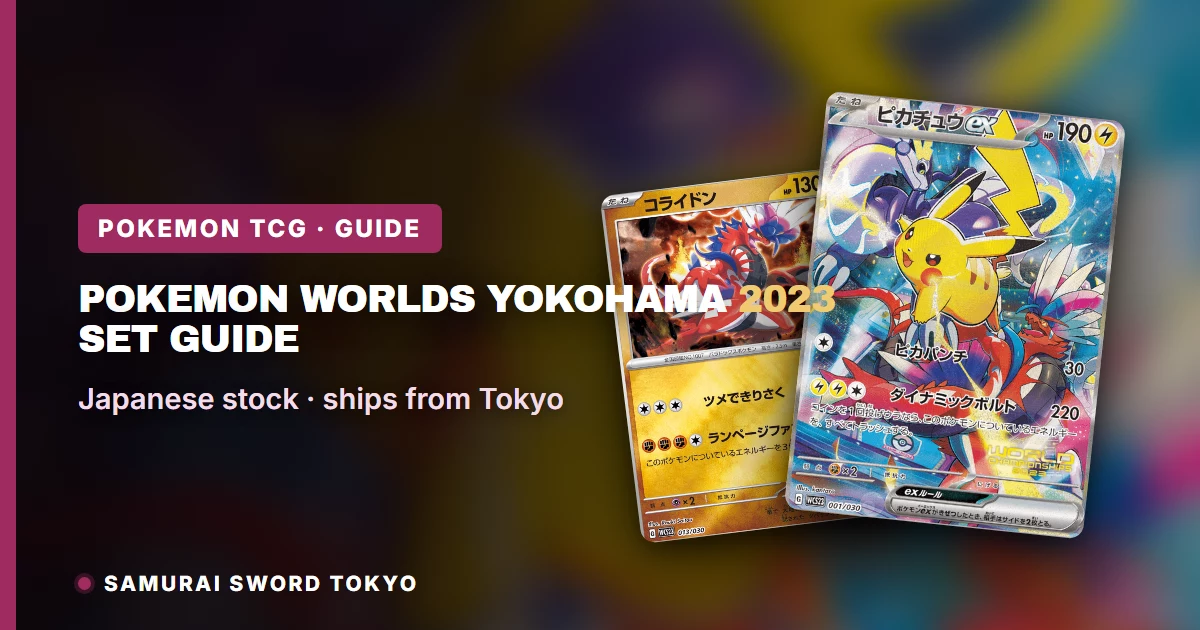
Pokemon Worlds Yokohama 2023: Set Guide

Pokémon’s biggest competitive event had never been held in Japan — not once, in over two decades of World Championships — until August 2023. When it finally happened, it happened in Yokohama, and the TCG got a Pikachu card that only exists because of it.

The 2023 Pokémon World Championships ran across three days at PACIFICO Yokohama, and the lead-up product was a Japanese-exclusive deck built specifically for the occasion: a sealed 30-card set headlined by a full art Pikachu ex found nowhere else. It’s the kind of release that only exists because of a single dated event — no ongoing print run, no later restock, just one deck tied to one weekend in one city.

This guide covers the event itself, what came in the deck, and exactly how the Yokohama Pikachu card differs from the regular Pikachu ex it was reprinted from — plus the other special version of that same card that collectors sometimes mix it up with.

Key Takeaway

The 2023 Pokémon World Championships Yokohama Deck: Pikachu is currently listed at ¥54,600. It’s a sealed 30-card deck, released July 28, 2023 ahead of the first Worlds ever held in Japan, and its headline card is a Yokohama-exclusive full art Pikachu ex — card number 001/030, distinct from the standard Pikachu ex (ex Starter Set 001/021 in Japan / Paldea Evolved 063/193 in English) it reprints.

Aug 11–13
2023 Worlds Dates

1st
Time Held in Japan

4
Competitive Formats

30
Cards in the Yokohama Deck

The First Worlds Held in Japan

The 2023 Pokémon World Championships ran August 11–13, 2023 at PACIFICO Yokohama in Kanagawa Prefecture. It was the first time the event had ever been held in Japan, and only the third time it had been held outside the United States.

For a franchise built in Japan, that’s a notable gap — more than two decades of World Championships before the tournament finally landed in the country where Pokémon originated. The Yokohama event, and the products released around it, exist because of that milestone.

Detail Fact
Dates August 11–13, 2023
Venue PACIFICO Yokohama Convention Center
Location Yokohama, Kanagawa Prefecture, Japan
Significance First Worlds held in Japan; third held outside the US

Four Formats, One Weekend

The 2023 Worlds ran four separate competitive tracks under one roof:

  • Pokémon TCG — played under the 2023–24 Standard format.
  • Pokémon VGC — video game competition under Scarlet & Violet, Regulation Set D.
  • Pokémon GO — competitive play under the Great League format.
  • Pokémon UNITE — played on the Theia Sky Ruins map, themed around Rayquaza.

The TCG side is what produced the collectible most relevant to Japanese card buyers today — the Yokohama Deck: Pikachu, covered below.

Why This Deck Matters to Collectors

Most Pokémon TCG collectibles connect to a set, a season, or an ongoing print schedule. The Yokohama Deck connects to a single dated milestone that will never repeat — the first time the World Championships happened in the country where the franchise started. That combination is what separates it from a typical special-edition product: the artwork, the numbering, and the release window are all locked to that one weekend in August 2023.

For collectors specifically tracking Japan-exclusive material rather than the wider English-language market, that kind of one-event product tends to sit in a different category from a standard set chase card — it’s tied to a moment rather than a print run, which is part of why buyers ask about it by name years later.

The Free Event Distribution: Stretchy Form Tatsugiri

Alongside the tournament, a separate in-game giveaway ran for players: a serial code redeemable for a Stretchy Form Tatsugiri, distributed from August 7 to 31, 2023. This was a video-game distribution rather than a TCG product, but it shared the same commemorative window as the Yokohama event.

The 2023 Yokohama Deck: Pikachu

Ahead of the tournament, Japan got a standalone commemorative product: the 2023 Pokémon World Championships Yokohama Deck: Pikachu, released July 28, 2023 — roughly two weeks before the event itself.

The deck’s contents:

  • 30 unique cards, plus basic Energy (10 Lightning, 8 Fighting)
  • An aluminium deck tin
  • A yellow “Pikachu Pokémon World Championships 2023” coin
  • 64 card sleeves themed around the 2023 Pokémon World Championships
  • A sheet of cardboard damage and status-condition markers

It was built and released specifically to lead into the Yokohama tournament — a sealed, ready-to-play deck rather than a booster product, positioned as the commemorative centerpiece of the whole event.

Shop This Deck
2023 Pokémon World Championships Yokohama Deck: Pikachu
Currently listed at ¥54,600
Ships from Tokyo · Tracked delivery

View Product →

The Yokohama Pikachu Card, Explained

The card everyone associates with this deck — sometimes referred to informally as the “Yokohama Pikachu” — is a special full art printing of an existing card: Pikachu ex, originally released in Japan’s ex Starter Set Pikachu ex & Pawmot (001/021) and printed in English as Paldea Evolved 063/193 (for more on Japan-exclusive starter-set cards, see our Japan-exclusive Pokémon cards guide). The base card runs HP190, Lightning type, and was originally illustrated by N-DESIGN Inc.

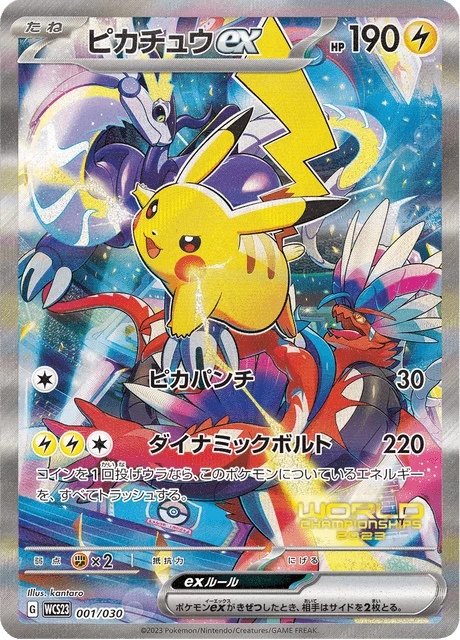
For the Yokohama Deck, Japan reprinted it as a full art card with new artwork by illustrator kantaro, depicting Pikachu battling Koraidon and Miraidon, with a 2023 Pokémon World Championships stamp embossed into the design. This version was given its own deck-specific numbering — 001/030 — separate from the standard card’s 063/193. On Limitless TCG’s catalog it’s tracked under set code WCS23, listed as “World Championships 2023 Yokohama Deck –Pikachu– #1.”

Pikachu ex 001/030 Full Art, 2023 Pokemon World Championships Yokohama Deck: Pikachu (WCS23)
Pikachu ex 001/030, Full Art — 2023 Pokémon World Championships Yokohama Deck: Pikachu (WCS23)
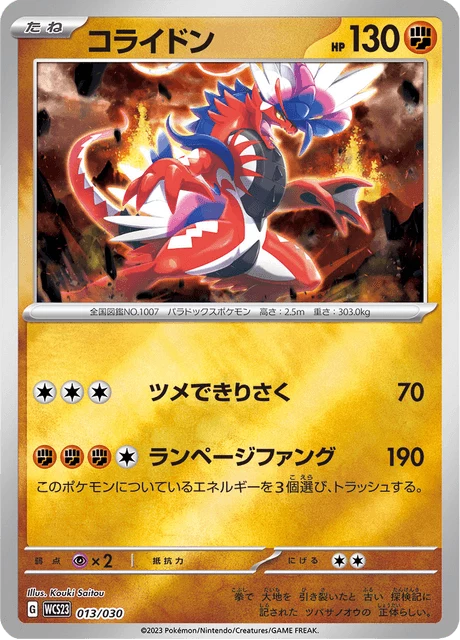
Koraidon 013/030, 2023 Pokemon World Championships Yokohama Deck: Pikachu (WCS23)

Koraidon [WCS23 013/030]

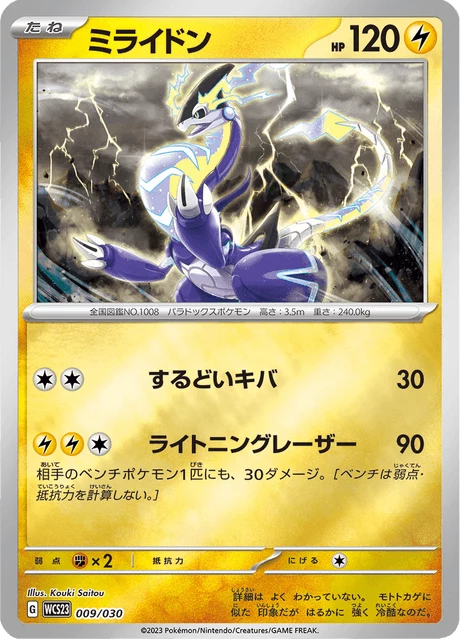
Miraidon 009/030, 2023 Pokemon World Championships Yokohama Deck: Pikachu (WCS23)

Miraidon [WCS23 009/030]

Koraidon and Miraidon — the two legendaries depicted battling Pikachu on the full art card above — are also included in the deck as their own standalone cards, numbered 013/030 and 009/030 respectively.

So the short version: same Pikachu ex, same stats and attacks as the standard version it reprints (ex Starter Set 001/021 in Japan; Paldea Evolved 063/193 in English), but a different piece of artwork, a different card number, and a distribution limited to this one commemorative deck. If you’re used to how Pokémon Center exclusives work — see our Pokémon Center Pikachu promo guide for other event-tied Pikachu variants — this follows the same pattern: an existing card given a one-off treatment tied to a specific occasion.

What Else Is in the Deck

Beyond the headline Pikachu ex, the deck runs 29 other unique cards plus its energy count. Not every card in the list has been individually confirmed, but the following are documented:

Category Confirmed cards
Pokémon Annihilape, Cyclizar, Koraidon, Magnemite, Mankey, Miraidon, Pawmi, Pawmo, Pawmot, Primeape, Squawkabilly, Tadbulb, Kilowattrel
Trainers Energy Retrieval, Energy Search, Great Ball, Professor’s Research, Nemona, Judge, Ultra Ball, Switch, Pokémon Catcher, Dendra, Jacq, Youngster
Basic Energy 10 Lightning, 8 Fighting

That’s a Koraidon/Miraidon-era, Lightning-and-Fighting deck built around the same two legendaries shown battling Pikachu on the headline card’s artwork — a coherent theme running through the whole product, not just the chase card. Nemona, one of the Trainer cards confirmed in the list, is the rival character introduced in Scarlet & Violet, which keeps the deck’s supporting cast tied to the same generation as its box art rather than pulling in older-era Trainers.

The Pawmi evolution line (Pawmi, Pawmo, Pawmot) and the Primeape/Annihilape line each get multiple stages represented, which is typical of a preconstructed theme deck built to actually play rather than a pure novelty box — it can be shuffled up and used, not just displayed.

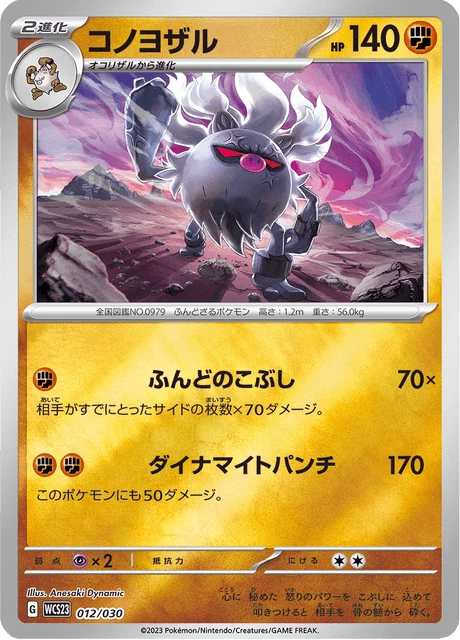
Annihilape 012/030, 2023 Pokemon World Championships Yokohama Deck: Pikachu (WCS23)
Annihilape 012/030 — 2023 Pokémon World Championships Yokohama Deck: Pikachu (WCS23)

Don’t Confuse It With the 2024 Reprint

Pikachu ex (Paldea Evolved 063/193) got a second special treatment roughly a year later: a version with a silver snowflake stamp, included in the Holiday Calendar 2024 release from August 23, 2024. That’s a completely separate product with no connection to the Yokohama Worlds event — different stamp, different release, different occasion. If you’re buying specifically for the Worlds tie-in, confirm you’re looking at the 001/030 WCS23 numbering and the Koraidon/Miraidon full art, not the snowflake-stamped Holiday Calendar version.

Where to Find It Today

We ship Japanese sealed product out of Tokyo with tracked delivery worldwide. The 2023 Pokémon World Championships Yokohama Deck: Pikachu is currently listed at ¥54,600.

For other Japanese sealed decks and booster boxes, browse our sealed Japanese product collection, or see our broader roundup of best Japanese Pokémon promo cards for other event-exclusive singles worth tracking. For anything not currently listed, our Quick Order page is the fastest way to request a quote.

Domande frequenti

When and where was the 2023 Pokémon World Championships held?

August 11–13, 2023, at PACIFICO Yokohama in Kanagawa Prefecture, Japan. It was the first time the event was held in Japan and only the third time held outside the United States.

Is the Yokohama Pikachu card the same as the regular Pikachu ex from Paldea Evolved?

It’s the same underlying card — same stats and attacks as Pikachu ex 063/193 — but reprinted as a full art card with new artwork by kantaro, depicting Pikachu against Koraidon and Miraidon, embossed with a 2023 Pokémon World Championships stamp. It carries its own deck-specific number, 001/030.

What’s included in the 2023 Pokémon World Championships Yokohama Deck: Pikachu?

30 unique cards plus basic Energy (10 Lightning, 8 Fighting), an aluminium deck tin, a yellow Pikachu Pokémon World Championships 2023 coin, 64 event-themed card sleeves, and a sheet of cardboard damage and status markers. It released July 28, 2023, ahead of the tournament.

What’s the difference between the Yokohama Pikachu and the 2024 Holiday Calendar Pikachu ex?

They’re two separate special versions of the same base card. The Yokohama version (001/030, WCS23) has Koraidon/Miraidon full art tied to the 2023 Worlds. The Holiday Calendar 2024 version, released August 23, 2024, instead carries a silver snowflake stamp and has no connection to the Yokohama event.

What competitive formats were played at the 2023 Yokohama Worlds?

Four: Pokémon TCG (2023–24 Standard format), Pokémon VGC (Scarlet & Violet, Regulation Set D), Pokémon GO (Great League format), and Pokémon UNITE (Theia Sky Ruins map).

Was the 2023 Yokohama Worlds the first time the event was held outside the United States?

No — it was the third time the World Championships had been held outside the US, but the first time it was held specifically in Japan.

SM5S Ultra Sun: Pull Rates & Best Cards Guide

Two Necrozma forms, two enhanced expansions, released in Japan on the exact same day — that’s the setup behind SM5S Ultra Sun and its twin, SM5M Ultra Moon.

Ultra Sun (SM5S) landed on December 8, 2017, as the Sun & Moon series’ fifth main expansion, and it’s the half of the pair built around Dusk Mane Necrozma GX — the fused Necrozma-Solgaleo form making its Pokemon TCG debut here. The set is also where Prism Star, a rarity that never existed before this release, first appeared on cards, headlined by the Prism Star Trainer card Akagi. Add in Sinnoh-region callbacks like Dialga GX and the Trainer SR Mars, and Ultra Sun packs a lot of firsts into one release.

This guide covers what’s actually in SM5S Ultra Sun, its headline chase cards, how it differs from its same-day twin Ultra Moon, and what buying into this set looks like from Japan today. We ship Japanese Pokemon singles and sealed product out of Tokyo, and the pricing below reflects our own current listings.

If you’re new to how the Sun & Moon era structured its releases, the short version is this: Japan split each “chapter” of the game generation into paired enhanced expansions that shared a release date and a set of design conventions — card numbering, pack pricing, and rarity tiers included — while each half carried its own distinct headline cards. Ultra Sun and Ultra Moon are one of the clearest examples of that format, since the split follows the same Dusk Mane / Dawn Wings Necrozma divide that defined the video games they’re based on.

Key Takeaway

SM5S Ultra Sun released December 8, 2017, headlined by Dusk Mane Necrozma GX and the debut of the Prism Star rarity via Akagi. Our PSA 10 copy of the set’s Trainer SR chase, Mars, 072/066, is currently listed at ¥25,750 — a single graded card, so once it sells it’s gone.

2017
JP Release Year

66
Main Set Cards

¥25,750
PSA 10 Mars SR

8 yrs
Since Release (2026)

Prices below are our own current listings in Japanese yen, sourced from our Tokyo inventory.

Inside SM5S Ultra Sun

SM5S Ultra Sun is the fifth main numbered expansion of the Japanese Sun & Moon series, released December 8, 2017. Its enhanced-expansion twin, SM5M Ultra Moon, released the same day — a paired-release format the Sun & Moon series used repeatedly, splitting one game generation’s content across two simultaneous sets.

Internationally, Ultra Sun and Ultra Moon were unified into a single English release, Sun & Moon—Ultra Prism, which followed on February 2, 2018. Packs sold for ¥150 plus tax, five cards each, the standard configuration for this era of Japanese expansions.

The main numbered set runs to 066, with limitlesstcg’s database listing 72 distinct cards once the secret-rare tier above that number is included. Thematically, Ultra Sun leans into two things at once: its own new Necrozma fusion form (Dusk Mane) as the banner legendary, and a set of Sinnoh-region callbacks — Dialga GX among them — woven into the Trainer and Pokemon lineup alongside it. For the wider arc this set sits in, our Sun & Moon era guide covers how Ultra Sun fits between the earlier GX-era sets and what came after.

The Headline GX: Dusk Mane Necrozma

/sw/wp-content/uploads/2026/08/img_sm5s_sm5s_68_r_jp_c7641f8e2ca4-1.webp

Dusk Mane Necrozma GX, 068/066 SR — SM5S Ultra Sun
Set’s headline chase card

Dusk Mane Necrozma GX made its Pokemon TCG debut in SM5S Ultra Sun, printed as a secret rare at 068/066 — one slot above the set’s 66-card main numbering, which is where the Sun & Moon era placed its top chase cards. It’s the fused form of Necrozma and Solgaleo, and its presence here is exactly why Ultra Sun and Ultra Moon released as a matched pair: each set carries a different Necrozma fusion as its centerpiece.

Ultra Moon’s equivalent, Dawn Wings Necrozma GX, plays the same role in that set — different fusion, different artwork, same structural spot in the release. We break that side of the pair down in the comparison section further below.

The naming isn’t a coincidence: the video games this set draws from split the Ultra Necrozma fusion into two exclusive forms, one per version, and the TCG mirrored that split by handing each half of the card set its own fusion as the cover-star GX. That’s the throughline collectors use to keep the two sets straight — if you’re holding the daytime-colored form, you’re holding an Ultra Sun card; the nighttime-colored form belongs to Ultra Moon.

Prism Star Debuts: Akagi

/sw/wp-content/uploads/2026/08/img_sm5s_sm5s_59_r_jp_d46eeca444ea-1.webp

Akagi, 059/066 Prism Star — SM5S Ultra Sun
Prism Star rarity debut

SM5S Ultra Sun is where the Prism Star rarity entered the Pokemon TCG for the first time, and Akagi, printed at 059/066, is the card most associated with that debut. Prism Star cards carry a distinctive design treatment that set them apart from every rarity that came before, and Ultra Sun is where collectors point to when the mechanic’s history comes up.

As the debut print of the mechanic, Akagi tends to get referenced any time the Prism Star era of Japanese sets is discussed — it’s the starting point for a rarity family that continued to appear across the sets that followed in the Sun & Moon lineup. For anyone building a collection around “firsts” — debut mechanics, debut fusions, debut card types — SM5S Ultra Sun is a set that checks two of those boxes in a single release, which is part of why it still gets pulled into conversations about foundational Sun & Moon-era product nearly a decade later.

Sinnoh Callbacks: Dialga GX and the Mars SR

/sw/wp-content/uploads/2026/08/img_sm5s_sm5s_45_r_jp_a1a4630fc31a-1.webp

Dialga GX, 045/066 RR — SM5S Ultra Sun
Sinnoh-region GX in the base lineup

/sw/wp-content/uploads/2026/08/img_sm5s_sm5s_72_r_jp_49974751b331-1.webp

Mars, 072/066 SR — SM5S Ultra Sun

Alongside its own new Necrozma fusion content (Dusk Mane), Ultra Sun reaches back to the Sinnoh region for part of its lineup. Dialga GX, printed at 045/066 as a Double Rare, sits in the set’s main GX tier. Ultra Sun’s Pokemon lineup also includes Leafeon GX among its Sinnoh-adjacent Eeveelution content, alongside Trainer supporter cards built around Team Galactic-era characters.

The clearest example of that Trainer-card side is Mars, printed as a secret rare at 072/066 — a full-art supporter card and the anchor for anyone tracking Ultra Sun’s Trainer chase tier specifically, separate from the set’s more common Uncommon-rarity printing of the same character earlier in the base numbering. Our PSA 10 graded copy is currently listed at ¥25,750. It’s a single physical card, professionally graded — one-of-one stock, so when it sells, it’s gone.

Shop This Card
PSA 10 Mars SR, 072/066 (SM5S Ultra Sun)
Currently listed at ¥25,750
Ships from Tokyo · Tracked delivery

View Product →

SM5S vs SM5M: Two Halves of the Same Release

Because Ultra Sun and Ultra Moon released on the same day and merged into a single English set, it’s easy to mix the two up. They’re distinct sets with distinct headline cards, and the split runs straight down the middle of the Ultra Necrozma story.

SM5S Ultra Sun — covered in this guide — is built around Dusk Mane Necrozma GX, the Prism Star debut via Akagi, and the Dialga GX / Mars SR Sinnoh-region content detailed above.

SM5M Ultra Moon is the mirror release, headlined instead by Dawn Wings Necrozma GX, with Glaceon GX playing a comparable role on that side of the split. Our SM5M Ultra Moon pull rates and best cards guide covers that set’s own chase cards and current listings in full.

If you’re deciding which half of the pair to chase first, it usually comes down to which Necrozma fusion — and which Trainer SR — you’re after, since both sets share the same release window, pack structure, and rarity tiers.

Where to Buy SM5S Ultra Sun from Japan

We ship PSA-graded Japanese singles and sealed Pokemon product worldwide from Tokyo with tracked delivery. For SM5S Ultra Sun specifically, our PSA 10 Mars SR is the direct route to the set’s Trainer chase card without opening product yourself.

For more graded Sun & Moon-era singles, our PSA 10 collection is the fastest way to browse what’s currently listed, and our full graded catalogue lives on the PSA10 card list page. If you’re comparing Ultra Sun against its twin before deciding where to spend, keep the SM5M Ultra Moon guide open alongside this one — both sets rotate independently, and availability on either side changes as individual graded cards sell.

For mixed orders spanning multiple Japanese sets — Ultra Sun singles alongside product from other Sun & Moon-era releases — the Quick Order page is the fastest checkout route we offer.

Domande frequenti

What is the headline card in SM5S Ultra Sun?

Dusk Mane Necrozma GX, printed as a secret rare at 068/066. It made its Pokemon TCG debut in this set as the fused Necrozma-Solgaleo form.

When did SM5S Ultra Sun release, and what’s its English equivalent?

SM5S Ultra Sun released in Japan on December 8, 2017, the same day as its twin, SM5M Ultra Moon. Both sets were unified into the English release Sun & Moon—Ultra Prism, which followed on February 2, 2018.

What is Prism Star, and which card introduced it?

Prism Star is a rarity that first appeared in SM5S Ultra Sun. Akagi, printed at 059/066, is the card most associated with the rarity’s debut in this set.

What’s the difference between SM5S Ultra Sun and SM5M Ultra Moon?

Ultra Sun is headlined by Dusk Mane Necrozma GX, the Prism Star debut card Akagi, and Sinnoh-region content including Dialga GX and the Mars SR. Ultra Moon, its same-day twin, is headlined instead by Dawn Wings Necrozma GX alongside Glaceon GX.

How much is the Mars SR from SM5S worth?

Our PSA 10 graded copy of Mars, 072/066, is currently listed at ¥25,750. As a single graded card, availability is one-of-one.

What are the pull rates for SM5S Ultra Sun?

Pokemon never published official pull rates for SM5S Ultra Sun, and we don’t have community-reported pull-rate data we can verify for this 2017 release. For chase cards like Dusk Mane Necrozma GX, Akagi, and the Mars SR, graded singles like the ones listed in this guide are the more reliable route than opening packs today.

Genesect Card Value Guide: Best Japanese Prints

Genesect is a fossil Pokemon — revived from a prehistoric bug using technology, according to its in-game backstory — and its Japanese card history reads a little like a fossil record of its own. Six major print lines across thirteen years, a typing that has flipped back and forth, and a rarity ladder that runs from a plain EX to a modern SAR chase. If you’re holding a Genesect card and trying to place it, the print you have depends entirely on which era it came from.

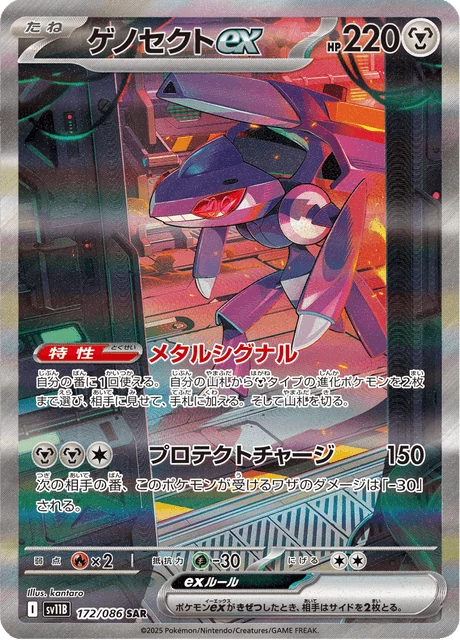
This guide lines up the major Japanese Genesect printing lines we could verify, from the 2013 debut through the Black Bolt (SV11B) chase cards we stock today — it isn’t a complete list of every Genesect card ever printed in Japan. We ship graded Japanese singles out of Tokyo, and we currently carry two PSA 10 Genesect ex copies from Black Bolt — both single graded pieces, so once either sells, that exact slab is gone.

Key Takeaway

This guide tracks six major Japanese Pokemon TCG print lines for Genesect since March 2013, with typing that has moved between Grass and Metal more than once rather than switching a single time. The version we stock is Genesect ex from Black Bolt (SV11B, June 6, 2025) — it has since been reprinted in other sets, but Black Bolt is where our graded copies come from: PSA 10 SAR [172/086] is currently listed at ¥8,135, and PSA 10 SR [164/086] is currently listed at ¥5,459.

6
Major Print Lines Covered

2025-06-06
Set We Stock (Black Bolt)

Metal
Type on GX/V/ex Line (since 2018)

¥5,459–¥8,135
PSA 10 Black Bolt, Listed

Every Genesect Printing, Set by Set

Here’s the print history in release order, based on the sets we were able to verify card numbers and dates for:

Carta Set Number Rarity JP Release
Genesect EX Megalo Cannon (BW9) 010/076 R 2013-03-15
Genesect EX Megalo Cannon (BW9) 078/076 SR 2013-03-15
Genesect EX Awakening of Psychic Kings (XY10) 051/078 RR 2016-03-18
Genesect EX Awakening of Psychic Kings (XY10) 083/078 SR 2016-03-18
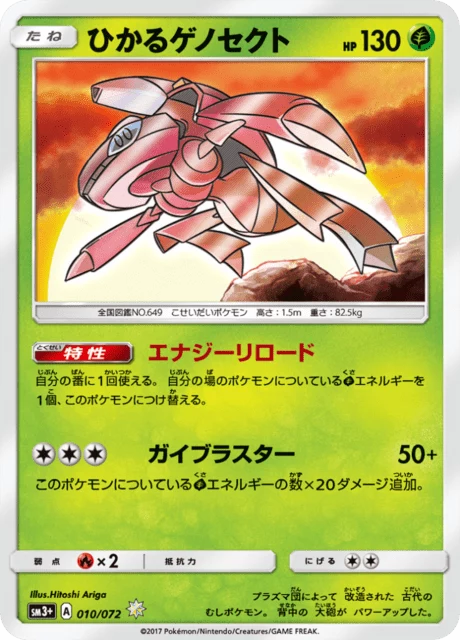
Shining Genesect Shining Legends (SM3+) 010/072 — 2017-07-15
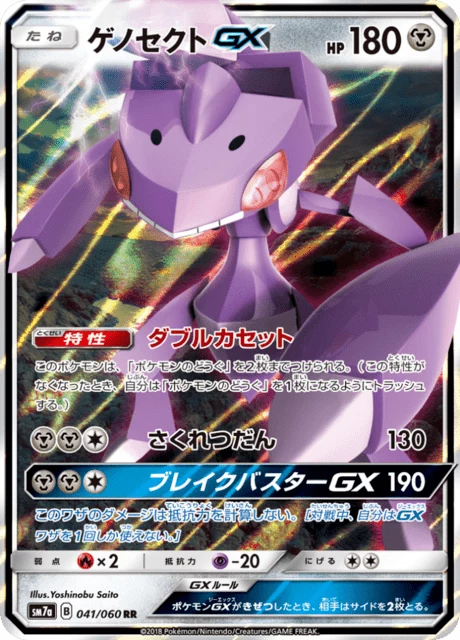
Genesect GX Thunderclap Spark (SM7a) 041/060 RR 2018-07-06
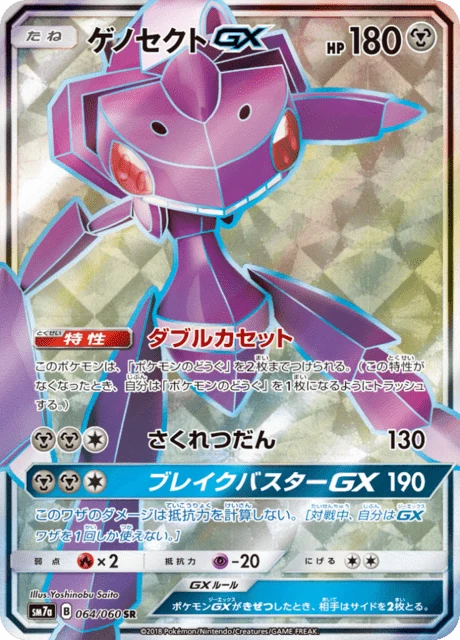
Genesect GX Thunderclap Spark (SM7a) 064/060 SR 2018-07-06
Genesect GX Thunderclap Spark (SM7a) 070/060 HR 2018-07-06
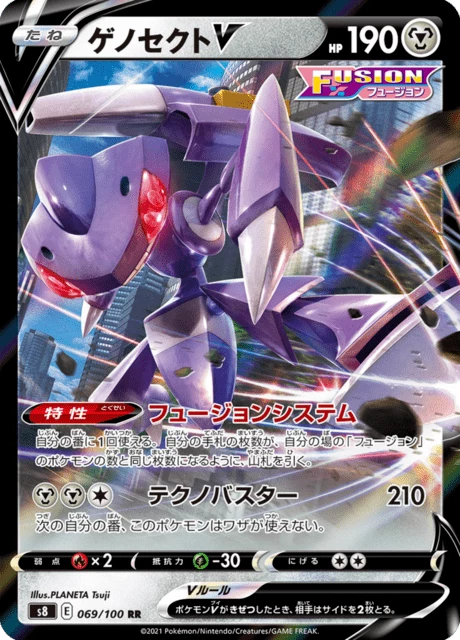
Genesect V Fusion Arts (S8) 069/100 RR 2021-09-24
Genesect V Fusion Arts (S8) 108/100 & 109/100 SR 2021-09-24
Genesect ex Black Bolt (SV11B) 069/086 RR 2025-06-06
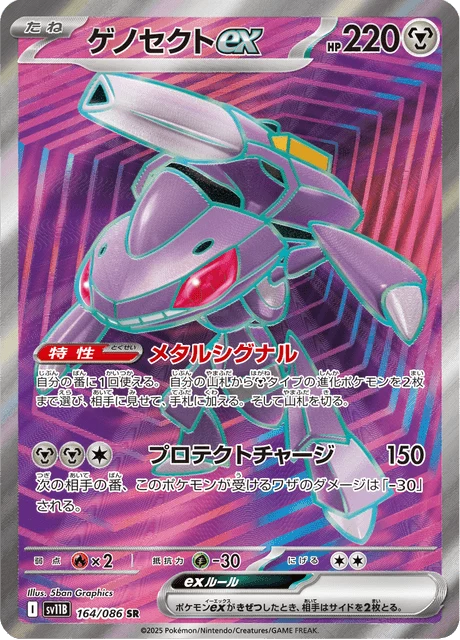
Genesect ex Black Bolt (SV11B) 164/086 SR 2025-06-06
Genesect ex Black Bolt (SV11B) 172/086 SAR 2025-06-06

Two things stand out across the list. First, every era gave Genesect at least one step-up rarity above its base card — an SR in 2013 and 2016, a shiny-styled print in 2017, a GX line with three separate rarities in 2018, and now an ex line with three rarities again in 2025. Second, the type printed on the card changes partway through the timeline, which we cover in its own section below.

The sections that follow walk through each era, and the current Black Bolt (SV11B) chase cards — the only ones we currently stock in graded form — get the closest look.

The Current Chase: Genesect ex from Black Bolt (SV11B)

Black Bolt released in Japan on June 6, 2025, alongside its paired set White Flare, with Genesect ex, HP 220, Metal type, in three rarities — a regular RR at 069/086, an SR at 164/086, and a Special Art Rare at 172/086. It’s since been reprinted in later sets such as MEGA Dream ex, but Black Bolt is the printing we stock. We currently carry PSA 10 graded copies of the two step-up rarities.

Genesect ex [SV11B 164/086] SR, Black Bolt

Genesect ex SR [SV11B 164/086]

Genesect ex [SV11B 172/086] SAR, Black Bolt

Genesect ex SAR [SV11B 172/086]

One-of-One Stock

Both listings are single graded copies — one-of-one stock. When either sells, that exact certified card is gone, and the next Genesect ex we list may carry a different grade, cert number, or price.

Black Bolt’s full pull-rate breakdown, including where these two Genesect ex prints rank among the set’s other chases, is in our Black Bolt (SV11B) Pull Rates & Best Cards guide. The set’s actual headline chase is a different card entirely — a Zekrom ex in the new BWR (Black White Rare) tier, which we break down separately in our BWR Black & White Rare cards guide.

Shop This Set
SV11B Black Bolt Japanese Pokemon Booster Box
Home set of Genesect ex [164/086 & 172/086]
Ships from Tokyo · Tracked delivery

View Product →

Black Bolt is one of the current wave of Scarlet & Violet-era Japanese sets — our Scarlet & Violet era guide maps out where it sits alongside every other SV expansion, from SV1A through the White Flare/Black Bolt pair.

The Shiny Debut: Shining Genesect, SM3+

Shining Genesect [SM3+ 010/072], Shining Legends

Shining Legends (SM3+), released in Japan on July 15, 2017, gave Genesect its first appearance in the “Shiny” card family — a special-rarity treatment separate from a regular colorway, rather than an ordinary reprint. This particular Shining Genesect sits at card number 010/072, HP 130, and is Grass-typed, matching the type its very first BW6 printing used four years earlier.

We don’t currently carry a graded copy of this printing. For collectors focused on the “Shiny” card family specifically rather than Genesect on its own, our Japanese Pokemon card rarities guide places Shining-series cards alongside SA, SAR, HR, and the other Japan-specific tiers so you can see how they relate.

The GX Era: Thunderclap Spark (SM7a)

Thunderclap Spark (SM7a), released July 6, 2018, is the deepest single-set Genesect release on this list — three separate rarities of the same GX card, HP 180, Metal type: a regular RR at 041/060, a full-art SR at 064/060, and a rainbow-foil HR at 070/060.

Genesect GX [SM7a 041/060] RR, Thunderclap Spark

Genesect GX RR [SM7a 041/060]

Genesect GX [SM7a 064/060] SR, Thunderclap Spark, full art

Genesect GX SR [SM7a 064/060]

A third print, the rainbow-foil HR at 070/060, rounds out the set but doesn’t have an independently verified image URL in our source material, so we’re not displaying it here. Thunderclap Spark is the enhanced expansion pairing with SM7’s “Sky-Splitting Charisma,” and this is also the point where Genesect’s card typing settled into Metal — a change we look at directly below.

We don’t currently carry a graded Thunderclap Spark Genesect GX. If you’re after Metal-type GX-era cards in general, our set-specific guides for the SM block are the place to compare pull structures before you commit to a box.

The V Era: Fusion Arts (S8)

Genesect V [S8 069/100] RR, Fusion Arts
Genesect V [S8 069/100], Fusion Arts

Fusion Arts (S8), released September 24, 2021, brought Genesect into the V card line: HP 190, Metal type, RR at 069/100 in this 100-card set, plus two separate SR printings at 108/100 and 109/100. Having two distinct SR-rarity Genesect V cards in the same set is unusual for a single Pokemon and is worth double-checking your card number against if you’re trying to identify which one you own.

We don’t currently carry a graded Fusion Arts Genesect V. Between Shining Legends, Thunderclap Spark, and Fusion Arts, Genesect has now appeared in three separate special-rarity systems — Shiny, GX, and V — before landing on its current ex-line treatment in Black Bolt.

From Grass to Metal: Genesect’s Typing Across Prints

One detail that trips up collectors comparing older and newer Genesect cards: the printed type doesn’t switch once and stay switched — it goes back and forth by printing. The original 2013 Megalo Cannon (BW9) print is Grass type, but Awakening of Psychic Kings (XY10) already switched to Metal type in 2016. The 2017 Shining Genesect (SM3+) print went back to Grass type, and then Thunderclap Spark (SM7a, 2018) onward — the GX, V, and ex lines this guide covers, including Fusion Arts (S8) and Black Bolt (SV11B) — settled on Metal type.
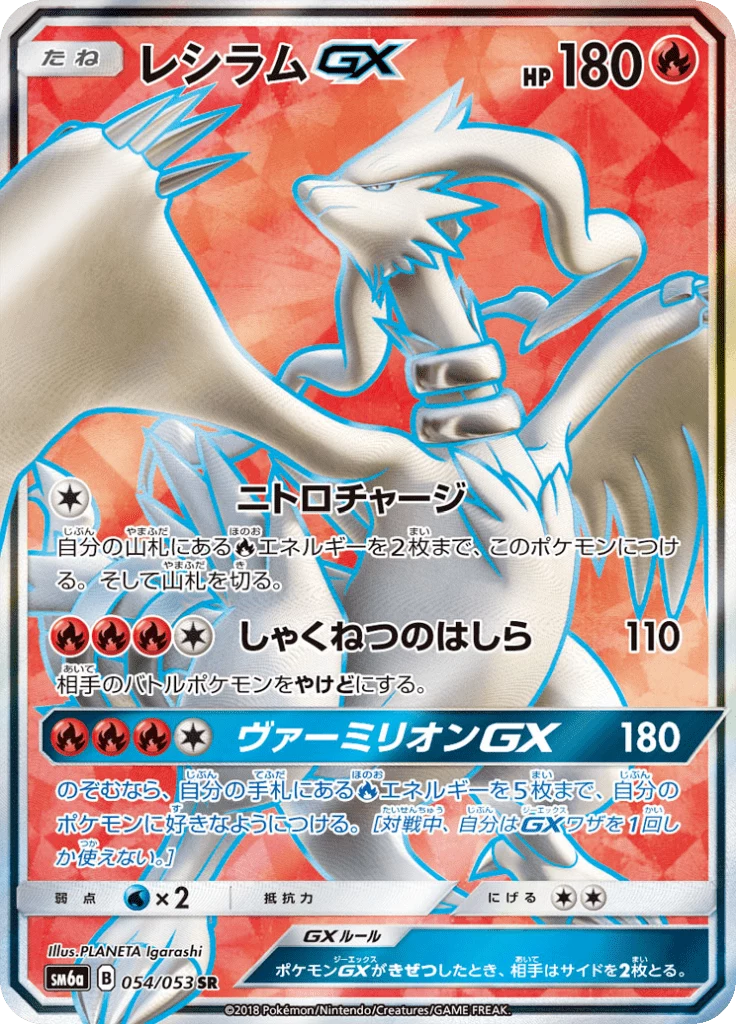
That’s not the whole picture, though: plain (non-GX/V/ex) Genesect prints outside this guide’s main lineup have continued to use Grass type even after 2018, so “Metal since 2018” only holds for the EX/GX/V/ex chase-card line we’ve tracked here. If you’re sorting a collection by type rather than by set, check the card in hand rather than assume by era.

Where to Buy Genesect Cards from Japan

We ship graded and sealed Japanese Pokemon product worldwide from Tokyo with tracked delivery. Our current Genesect lineup is limited to the two Black Bolt PSA 10 singles above, so the fastest way to check availability is to go straight to each product page:

For the set these two cards actually come from, see our Black Bolt (SV11B) Pull Rates & Best Cards guide, or zoom out to the full Scarlet & Violet era guide to see where Black Bolt fits among every other SV-era Japanese release. And if the Black Bolt chase you’re actually after is the set’s BWR-tier Zekrom ex rather than Genesect, that’s covered in our BWR Black & White Rare cards guide.

Domande frequenti

What is the newest Genesect card from Japan?

The Genesect ex line debuted in Black Bolt (SV11B), released in Japan on June 6, 2025, in three rarities: RR (069/086), SR (164/086), and Special Art Rare (172/086). That same Genesect ex has since been reprinted in later sets, but Black Bolt is the printing we stock.

Which Genesect cards does Samurai Sword currently stock?

Two PSA 10 graded singles from Black Bolt (SV11B): Genesect ex SAR [172/086] at ¥8,135 and Genesect ex SR [164/086] at ¥5,459. Both are single certified copies.

Is Genesect a Grass-type or Metal-type card?

Both, and it isn’t a one-time switch. The 2013 Megalo Cannon (BW9) print is Grass type, Awakening of Psychic Kings (XY10, 2016) is Metal type, and 2017 Shining Legends (SM3+) went back to Grass type. From Thunderclap Spark (SM7a, 2018) onward, the GX/V/ex line covered in this guide — including Fusion Arts (S8) and Black Bolt (SV11B) — is Metal type, though some Grass-type Genesect prints outside that line have continued to appear since.

What set is the “Shining Genesect” card from?

Shining Legends (SM3+), released in Japan on July 15, 2017. Card number 010/072, HP 130, Grass type.

Does Black Bolt have a rarer Genesect chase than the SAR?

The SAR [172/086] is Genesect’s top rarity in Black Bolt, but the set’s overall headline chase card is a different Pokemon — a Zekrom ex in the newer BWR (Black White Rare) tier, covered in our separate BWR cards guide.

Japanese Pokemon Mirror Card Variants: Guide

The word “mirror” has been attached to Japanese Pokemon card variants — by The Pokemon Company in some releases and by retailers in others — for four years now, and it hasn’t pointed to a single consistent treatment. A 2021 “mirror” Pikachu, a 2023 “Monster Ball mirror” Eeveelution, and a 2025 “mirror” Mega Charizard Y ex all use the same English loanword for two distinct families of foil treatment.

That’s not a marketing accident so much as a naming pattern that drifted, disappeared, and came back. This guide walks through the genealogy in release order — where the plain “mirror” term started, how it detoured into the ball-pattern parallels most collectors know today, and where it landed most recently — so you can tell which era a “mirror” card in front of you actually belongs to. For the deepest dive on the ball-pattern middle chapter specifically, our Master Ball mirror guide covers identification, pricing, and the two sets it appears in.

Key Takeaway

“Mirror” has labeled two distinct families of foil treatment across four Japanese sets since October 2021: a plain foil finish in s8a 25th Anniversary Collection and 2025’s Start Deck 100 Battle Collection, and ball-pattern parallels (Monster Ball / Master Ball mirror) in SV2a 151 and SV8a Terastal Festival ex. A PSA 10 Pikachu Mirror [s8a 001/028] is currently listed at ¥20,769 (~$127), and a PSA 10 MEGA Charizard Y ex Mirror [MC 085/742] is currently listed at ¥21,424 (~$131).

4
Sets With a “Mirror” Card

2021–2025
Years Covered

2
Distinct Foil Treatments

¥12,525
Lowest Listed Mirror Chase

Prices below reflect current listings on our site as of August 2026, converted at ¥163/USD where noted.

What “Mirror” Means Across Japanese Pokemon Sets

In the loosest sense, a “mirror” card is any Japanese printing whose foil pattern differs from the set’s standard holo — a distinct treatment applied to a chase slot rather than the base rarity. That’s a broad definition on purpose, because the actual technical execution has changed more than once: sometimes it’s a plain reflective foil layered over the standard art, and sometimes it’s a repeating shape — a Poke Ball or Master Ball silhouette — etched into the holo pattern itself.

What stays constant is the English loanword itself. Japanese retailers and collectors have applied “ミラー” (mirror) to all of the variants below, which is exactly why the term causes confusion when you’re trying to identify a specific card from a listing title alone. The sections that follow go set by set, in release order, so you can match a card you’re holding to the right era.

The Origin: Plain Mirror in 25th Anniversary Collection (2021)

The earliest “mirror” card in this lineage comes from s8a, the 25th Anniversary Collection, released October 22, 2021. The set’s pull structure gave each pack five kira (foil) cards, one of them a basic Energy, drawn randomly from a pool of 28 species. Inside that pool sits a single card carrying the “mirror” label rather than a standard kira finish: Pikachu, numbered 001/028.

Pikachu Mirror, S8a 001/028, 25th Anniversary Collection

Pikachu Mirror [s8a 001/028]
Currently listed (PSA 10): ¥20,769 (~$127)

Multiple secondary-market listings for this card use the plain word “mirror” without a ball-pattern qualifier, which is the detail that separates it from everything covered in the next section — no Poke Ball or Master Ball shape is described anywhere in how retailers list this printing. We haven’t found an official technical writeup from The Pokemon Company spelling out exactly what differentiates this foil from the set’s regular kira finish, so treat “plain mirror foil” as the community-consistent description rather than a manufacturer’s spec sheet. A PSA 10 copy is currently listed at ¥20,769 (~$127) in our inventory — a graded single, one-of-one stock, gone once it sells.

For the rest of what shipped in this set, including its promo pack and Golden Box companions, our S8a-P 25th Anniversary promo pack guide covers the adjacent releases from the same anniversary wave.

The Ball-Pattern Detour: Master Ball & Monster Ball Mirror (2023–2024)

Nearly two years after s8a, the “mirror” label came back attached to a genuinely different mechanic. SV2a, “Pokemon Card 151,” released June 16, 2023, and its official product page describes cards with “a special processing in a Monster Ball pattern, a gorgeous mirror finish” (モンスターボール柄の特殊な加工がされた、豪華ミラー仕様のカードが収録). That’s a repeating Poke Ball shape etched into the foil — not the plain finish from 2021 — and within that same parallel tier sits a rarer sibling: the Master Ball mirror, identifiable by a rounder-eared silhouette carrying an “M” mark, reserved for C/U/R rarity cards only.

SV8a, “Terastal Festival ex,” released December 6, 2024, continued the same two-tier ball-pattern system roughly eighteen months later. Both sets share the mechanic; they differ mainly in eligible card pool and pull rate.

We’ve covered this parallel system in full elsewhere on the site, so we won’t re-run the identification guide or pull-rate tables here. If you’re trying to tell a Master Ball mirror apart from a Monster Ball mirror, or want our full priced stock of both, see our dedicated Master Ball mirror guide. For box-level pull rates and best cards from each individual set, our 151 pull rates guide and Terastal Festival ex pull rates guide break down what else comes out of a box.

One card from this era worth calling out here, since it isn’t covered in the Master Ball guide above: Pikachu C, Monster Ball mirror [SV2a 025/165], from 151 itself. A PSA 10 copy is currently our highest-priced single from either ball-pattern set.

Pikachu C Monster Ball Mirror, SV2a 025/165, Pokemon Card 151

Pikachu C Monster Ball Mirror [SV2a 025/165]
Currently listed (PSA 10): ¥39,717 (~$244)

Umbreon Monster Ball Mirror, SV8a 092/187, Terastal Festival ex

Umbreon Monster Ball Mirror [SV8a 092/187]
Currently listed (PSA 10): ¥12,525 (~$77)

Shop This Parallel
PSA 10 Pikachu C Monster Ball Mirror [SV2a 025/165]
Currently listed at ¥39,717 (~$244)
Ships from Tokyo · Tracked delivery

View Product →

Mirror Returns: Start Deck 100 Battle Collection (2025)

Start Deck 100 “Battle Collection” (set code MC), released December 19, 2025, is a different product format entirely — a ¥891 randomized deck where one of 100 possible pre-built 60-card decks lands in the buyer’s hands. Deck No. 001 is where the naming loops back to the beginning: it contains a card labeled with the plain “mirror” term again, not a ball pattern.

MEGA Charizard Y ex Mirror, MC 085/742, Start Deck 100 Battle Collection

MEGA Charizard Y ex Mirror [MC 085/742]
Currently listed (PSA 10): ¥21,424 (~$131)

MEGA Charizard Y ex, numbered 085/742, carries this plain “mirror” designation as the standard version of the deck’s headline card. A PSA 10 copy is currently listed at ¥21,424 (~$131) in our inventory — a graded single, one-of-one stock.

Above that sits a separate, higher chase tier for the same deck: MEGA Charizard Y ex [MC-766/742], known in the community as “No. 001 (gold)” and catalogued as an MUR — the deck’s top-end pull, distinct from the mirror version above it and not something we currently carry graded stock of.

On the Pull Rate

Community estimates for pulling the MUR “gold” version put it around one in a thousand decks, but The Pokemon Company hasn’t published an official rate for Start Deck 100. Treat any specific ratio you see online as community-reported and unofficial.

For the full breakdown of what’s inside all 100 possible decks, our Start Deck 100 Battle Collection guide covers the format in depth.

The Full Timeline: Four Sets, Four Years

Laid out by release date, here’s every “mirror”-labeled card covered above, with our current listed price for each:

Set JP release Naming Example card PSA 10, currently listed
25th Anniversary Collection (s8a) 2021-10-22 Plain “mirror” Pikachu 001/028 ¥20,769
151 (SV2a) 2023-06-16 Monster Ball / Master Ball mirror Pikachu C 025/165 ¥39,717
Terastal Festival ex (SV8a) 2024-12-06 Monster Ball / Master Ball mirror Umbreon 092/187 ¥12,525
Start Deck 100 Battle Collection (MC) 2025-12-19 Plain “mirror” MEGA Charizard Y ex 085/742 ¥21,424

Read top to bottom, the pattern is a loop rather than a straight line: plain mirror foil in 2021, a two-year detour into ball-pattern parallels across 151 and Terastal Festival ex, then a return to the plain “mirror” term for Start Deck 100’s headline card in late 2025. Whether the ball-pattern system shows up again in a future set isn’t something we can confirm either way — we’re describing what’s documented through the four releases above, not predicting what comes next.

Mirror vs SA vs Ball-Pattern: Don’t Mix Up the Mechanics

One more mechanic gets confused with “mirror” cards regularly, so it’s worth separating clearly: the SA (Special Art) insert system used in products like the Sword & Shield High Class Decks isn’t a mirror treatment at all. That mechanic swaps an entire card — art and all — for a special-art alternate version at the print stage; a mirror card, by contrast, keeps the same base art and simply changes the foil finish layered over it. Our Sword & Shield High Class Decks guide covers how that separate SA swap mechanic works if you’re trying to tell the two apart.

Check This First

If the artwork itself changes between the “regular” and “chase” version of a card, you’re looking at an SA swap or a similar alternate-art mechanic. If the artwork is identical and only the foil pattern differs, you’re looking at a mirror variant — plain or ball-pattern.

Within the mirror family itself, the tell is whether a repeating shape is etched into the foil. A plain mirror foil (s8a, Start Deck 100) shows no ball silhouette; a ball-pattern mirror (151, Terastal Festival ex) shows either a plain Poke Ball outline (Monster Ball mirror) or a rounder-eared silhouette with an “M” mark (Master Ball mirror). None of these differences are visible in a flat product photo — the foil pattern only reveals itself when the card is tilted under light, so don’t judge a listing off a static image alone.

Where to Buy Mirror Cards from Japan

We ship graded Japanese singles worldwide from Tokyo with tracked delivery. Across the four eras above, our current stock includes the PSA 10 Pikachu Mirror [s8a 001/028] at ¥20,769, the PSA 10 Pikachu C Monster Ball Mirror [SV2a 025/165] at ¥39,717, the PSA 10 Umbreon Monster Ball Mirror [SV8a 092/187] at ¥12,525, and the PSA 10 MEGA Charizard Y ex Mirror [MC 085/742] at ¥21,424 — all graded singles, all one-of-one stock. For the Master Ball mirror parallel specifically, see the full priced lineup in our Master Ball mirror guide.

Browse the wider graded singles market across every Japanese set on our PSA 10 collection, or use our Quick Order page to build a mixed order — sealed product and singles together — if you’re after a specific mirror printing we don’t currently have listed.

Domande frequenti

What does “mirror” mean on a Japanese Pokemon card?

It’s a foil finish applied to a chase slot that differs from a set’s standard holo. The specific execution has changed over time — a plain reflective foil in 2021 and 2025, and a repeating Poke Ball or Master Ball shape etched into the foil in 2023–2024.

Is Master Ball mirror the same as a plain “mirror” card?

No. Master Ball mirror and Monster Ball mirror are ball-pattern parallels found only in SV2a 151 and SV8a Terastal Festival ex. The plain “mirror” cards in s8a 25th Anniversary Collection and Start Deck 100 Battle Collection carry no ball pattern.

Which sets have carried a “mirror” card?

Four, as documented so far: s8a 25th Anniversary Collection (2021-10-22), SV2a 151 (2023-06-16), SV8a Terastal Festival ex (2024-12-06), and Start Deck 100 Battle Collection (2025-12-19).

Is a mirror card the same as an SA (Special Art) card?

No. SA is a full alternate-art swap at the print stage. A mirror card keeps the identical base artwork and only changes the foil pattern layered over it.

Where can I see identification and pricing for Master Ball mirror specifically?

Our dedicated Master Ball mirror guide covers how to tell it apart from Monster Ball mirror, plus our full priced stock of both.

SM6a Dragon Storm: guida ai pull rate & alle carte migliori

Four Dragon-type GX Pokemon, three rarity tiers apiece, and a set number that trips people up every time it shows up in a listing. SM6a Dragon Storm is one of the smaller, more focused Sun & Moon-era Japanese expansions — and it’s also the set behind the English-language Dragon Majesty release, even though the two don’t line up card for card.

SM6a Dragon Storm (ドラゴンストーム) is a Japanese “enhanced expansion pack” released April 6, 2018, built around Reshiram GX, Dragonite GX, Kingdra GX, and White Kyurem GX — each printed at multiple rarity tiers — plus two Prism Star cards, Victini and Lance. This guide walks through the set’s structure, its GX chase cards by number and rarity, and how it relates to its English counterpart.

Key Takeaway

SM6a Dragon Storm’s four headline GX Pokemon — Reshiram, Dragonite, Kingdra, and White Kyurem — each carry a Double Rare, Secret Rare, and Hyper Rare print. We currently list a sealed SM6a Dragon Storm Japanese Booster Box at ¥102,900 (~$631), shipped from Tokyo.

Apr 6, 2018
Japan Release Date

53 base / 66 incl. secrets
Cards (JP Shop Checklist)

5
Cards Per Pack

¥102,900
Sealed Box, Currently Listed

Pricing reflects our own in-Tokyo stock listing, re-checked August 13, 2026. USD figures are approximate conversions at ¥163/USD (July 2026 basis). Pull-rate language in this guide is described in relative, community-reported terms only — we haven’t found an official Pokemon-published odds figure for this specific set.

What Is SM6a Dragon Storm?

SM6a Dragon Storm’s official Japanese name is the enhanced expansion pack “ドラゴンストーム” (Dragon Storm), released in Japan on Friday, April 6, 2018. “Enhanced expansion pack” is the same product category used for other smaller, theme-focused Sun & Moon-era Japanese sets — distinct from a full-numbered main expansion, but still sold in standard 5-card booster packs.

The set’s official product page centers the release on four Dragon-type GX Pokemon: Reshiram GX, Dragonite GX (カイリューGX), Kingdra GX (キングドラGX), and White Kyurem GX (ホワイトキュレムGX). Bulbapedia’s description of the English Dragon Majesty release — which pools cards from multiple Japanese sets, not SM6a alone — characterizes that broader English product as spotlighting “draconic Pokemon: Reshiram-GX, Salamence-GX, Dragonite-GX, and over a dozen more, including Charizard.” Salamence-GX isn’t part of Dragon Storm’s own Japanese checklist; the four Dragon-type GX Pokemon confirmed in SM6a by card number are the ones this guide covers below.

Release Date & Set Structure

Detail Value
Japanese name ドラゴンストーム (Dragon Storm)
Japan release date April 6, 2018 (Friday)
English equivalent Dragon Majesty (September 7, 2018)
Cards per pack 5
Basic set (denominator, by JP shop checklist) 53
Total incl. secret rares (by JP shop checklist) 66
Rarity breakdown (by same checklist) C×24 / U×16 / R×7 / PR×2 / RR×4 / SR×6 / HR×4 / UR×3

The basic set runs 53 cards (the denominator used in every card number in this guide, e.g. 008/053). Including the secret-rare slots numbered 054–066, the same Japanese shop checklist puts the full count at 66. limitlesstcg’s Japanese-language database lists 59 cards for SM6a — that’s the 53-card basic set plus the six Secret Rare (SR) prints (054–059), without the four Hyper Rare and three Ultra Rare secret prints (060–066) that push the shop checklist’s total to 66.

Pull Rates: What We Can (and Can’t) Confirm

We haven’t found a Pokemon-published, official pull-rate percentage for SM6a Dragon Storm, and we don’t publish unofficial box-odds figures we can’t trace back to a verifiable source. What the set’s own rarity breakdown does tell you structurally: out of 66 total cards (53 basic set plus 13 secret-rare slots), four sit at Double Rare (RR), six at Super Rare (SR), and four at Hyper Rare (HR) — and all four of the set’s headline GX Pokemon have a print in all three tiers: RR, SR, and HR. Any specific per-pack or per-box odds you see quoted elsewhere for this set should be treated as community-reported and unofficial unless you can trace it to a repeatable, verifiable sample.

The Four Dragon-Type GX Chases

All four of Dragon Storm’s headline GX Pokemon follow the same three-tier pattern: a standard Double Rare (RR) print in the base numbering, a Secret Rare full-art print (labeled SR by Japanese retail, though limitlesstcg’s database records the same cards as “Secret Rare” too), and a Hyper Rare print above that.

Carta Number Rarity (JP retail)
Reshiram GX 008/053 RR
Reshiram GX (Special Art) 054/053 SR
Reshiram GX 060/053 HR
Kingdra GX 014/053 RR
Kingdra GX (Special Art) 055/053 SR
Kingdra GX 061/053 HR
Dragonite GX 028/053 RR
Dragonite GX (Special Art) 056/053 SR
Dragonite GX 062/053 HR
White Kyurem GX 035/053 RR
White Kyurem GX (Special Art) 057/053 SR
White Kyurem GX 063/053 HR

One naming wrinkle worth knowing before you shop listings: Japanese retail sources (like netoff’s buyback listings) label the 054/053, 055/053, 056/053, and 057/053 prints “SR,” while limitlesstcg’s database records the same cards under the English term “Secret Rare.” The 008/053 Reshiram GX print is similarly called “RR” by JP retail and “Double Rare” by limitlesstcg. These are two conventions describing the same cards, not a rarity disagreement — but it’s a common source of confusion when cross-referencing a listing against a database entry.

Reshiram GX 008/053 RR, SM6a Dragon Storm

Reshiram GX RR — SM6a 008/053

Reshiram GX Special Art 054/053 SR, SM6a Dragon Storm

Reshiram GX (Special Art) SR — SM6a 054/053

Dragonite GX Special Art 056/053 SR, SM6a Dragon Storm

Dragonite GX (Special Art) SR — SM6a 056/053

All four GX Pokemon share the same RR/SR/HR structure: Reshiram GX (008/053 RR), Kingdra GX (014/053 RR), Dragonite GX (028/053 RR), and White Kyurem GX (035/053 RR), each with a matching Secret Rare and Hyper Rare print higher in the numbering. If you’re chasing a specific number, cross-reference against the table above to confirm which rarity tier you’re looking at.

Kingdra GX & White Kyurem GX: The Quieter Half

Kingdra GX and White Kyurem GX round out Dragon Storm’s four-GX lineup, and they follow the exact same two-tier pattern as Dragonite GX: a Special Art Secret Rare print, then a Hyper Rare print in the higher numbering.

Kingdra GX Special Art 055/053 SR SM6a Dragon Storm

Kingdra GX (Special Art) SR — SM6a 055/053

Kingdra GX sits at 055/053 for its Special Art SR and 061/053 for its HR. White Kyurem GX sits at 057/053 for its Special Art SR and 063/053 for its HR. Both are part of the set’s official headline lineup alongside Reshiram GX and Dragonite GX, per the set’s official product page. We don’t have an independently verified image for the White Kyurem GX prints or either HR-tier print, so we’re not showing those here — if you’re identifying a physical copy, match against the card number and rarity tier in the table above rather than artwork alone.

The Prism Star Pair: Victini and Lance

Beyond the four GX Pokemon, Dragon Storm carries two Prism Star cards — a separate rarity category from the GX tiers above:

  • Victini ♢ — card number 004/053, Prism Star rarity.
  • Lance ♢ (Japanese name: ワタル, Wataru) — card number 050/053, Prism Star rarity. The English-language equivalent print is confirmed as Dragon Majesty card #61, “Lance, Prism Star.”

Lance is a notable inclusion for the set’s Dragon theme specifically: in the games and anime, Lance (Wataru) is the Dragon-type specialist Elite Four member and Champion, so his Prism Star card lines up directly with the set’s four Dragon-type GX Pokemon rather than being an unrelated trainer insert.

Dragon Storm vs. Dragon Majesty: The English Connection

SM6a Dragon Storm is the Japanese set behind the English-language Dragon Majesty release — but the two don’t share a simple 1:1 checklist. Dragon Majesty released internationally on September 7, 2018, roughly five months after Japan’s April 6 release, and carries 78 cards total, compared to Dragon Storm’s 53-card Japanese basic set (66 including secret rares).

Distribution is where the two releases diverge most. The English Dragon Majesty product wasn’t sold as a standalone booster pack line the way most Sun & Moon-era English sets were — it was distributed through special bundle products packaged with pins, figures, and other collectible goods rather than standard shelf boosters. That distribution model is specific to the English release; our research didn’t turn up a confirmed answer on whether Japan’s SM6a followed the same bundled approach or sold as ordinary 5-card boosters through normal retail, so we’re not asserting either way here. The official Japanese product page does describe the standard 5-card pack configuration used across other enhanced expansion packs of the era.

Where SM6a Fits in the SM6 Family

Dragon Storm carries the “SM6a” designation, placing it alongside two other releases that share the same SM6 era number: the base SM6 Forbidden Light set and the enhanced expansion SM6b Champion Road. All three sit in the same numbered generation of the Sun & Moon era, though this guide only verifies release-date and checklist detail for SM6a itself — see each linked guide for that set’s own confirmed dates and chase cards.

For the broader arc of the Sun & Moon era — every main set and enhanced expansion in release order — our Sun & Moon era Japanese Pokemon guide covers the full timeline that Dragon Storm sits within.

Where to Buy SM6a Dragon Storm from Japan

We ship Japanese sealed product worldwide from Tokyo with tracked delivery. Right now our SM6a stock is a sealed booster box: SM6a Dragon Storm Japanese Booster Box, currently listed at ¥102,900 (~$631).

Shop This Set
SM6a Dragon Storm Japanese Booster Box
¥102,900 (~$631)
Ships from Tokyo · Tracked delivery

View Product →

We don’t currently carry graded SM6a singles as separately listed stock. For sealed Japanese booster boxes from other sets, browse our Japanese sealed booster box collection. For a mixed order across sealed product and singles, or to ask us to source a specific SM6a card by number, our Quick Order page is the fastest route.

Domande frequenti

What is SM6a Dragon Storm and when was it released?

SM6a Dragon Storm (ドラゴンストーム) is a Japanese Sun & Moon-era enhanced expansion pack released April 6, 2018, built around four Dragon-type GX Pokemon: Reshiram GX, Dragonite GX, Kingdra GX, and White Kyurem GX.

What is the best card in SM6a Dragon Storm?

The set’s four headline cards are Reshiram GX, Dragonite GX, Kingdra GX, and White Kyurem GX, and all four share the same three-tier structure: a Double Rare (RR) base print, a Special Art Secret Rare, and a Hyper Rare.

How many cards are in SM6a Dragon Storm?

The basic set runs 53 cards (the denominator in every card number, e.g. 008/053). A Japanese shop checklist puts the full count, including secret rares, at 66. limitlesstcg’s database lists 59 cards — the 53-card basic set plus its six Secret Rare prints, without the four Hyper Rare and three Ultra Rare secret prints that bring the shop checklist’s total to 66.

What is the English equivalent of SM6a Dragon Storm?

Dragon Majesty, released internationally on September 7, 2018, about five months after the Japanese release. It carries 78 cards versus Dragon Storm’s 53-card basic set (66 including secret rares), and in English it was distributed through special bundle products rather than as a standalone booster pack line.

What are the Prism Star cards in SM6a Dragon Storm?

Victini (004/053) and Lance (050/053, Japanese name Wataru). Lance’s English-language equivalent is confirmed as Dragon Majesty card #61, “Lance, Prism Star.” As the Dragon-type specialist Champion in the games and anime, his inclusion ties directly to the set’s Dragon-type theme.