Crea un account gratuito: accumula punti e livello
Samurai Sword Tokyo
Ordini Carrello

Guida alla carta PSA10 Quaquaval ex SAR (098/073): Triplet Beat
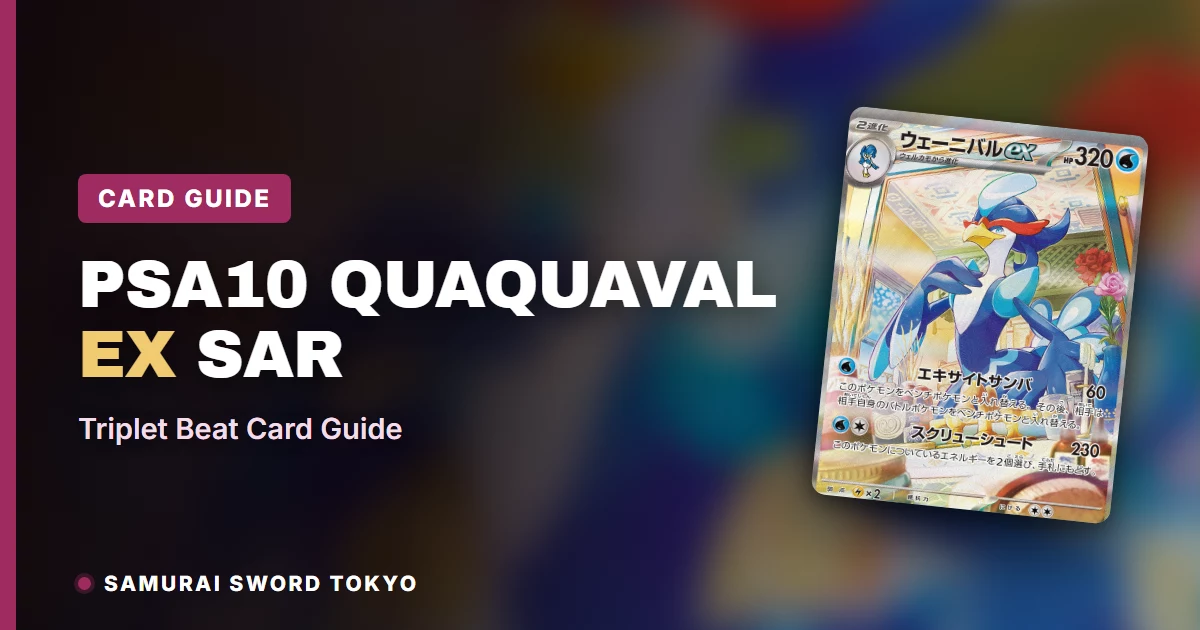
Quaquaval ex holds a specific place in the Scarlet & Violet Japanese card pool: it’s the fully-evolved Water-type starter from the Paldea region, and its Special Art Rare printing from Triplet Beat (SV1a) is the version collectors chase. Card number 098/073 pairs a 320 HP frame with the full-art SAR treatment, and it’s a card currently listed graded PSA10, shipping from our shop in Tokyo.

This guide covers exactly what’s printed on the card, where it sits inside the Triplet Beat set and the wider Paldea starter line, and what a PSA10 copy is listed at today. We source and ship Japanese singles worldwide, so the pricing below reflects our own current listing rather than a marketplace average.

If you already know you have the full-art SAR and just want to compare it to what else is listed graded, the sections below on the Triplet Beat set and on similar chase-tier cards will be the most useful. If you’re not sure which Quaquaval card is sitting in your binder, start with the identification notes in the first section.

Key Takeaways

Quaquaval ex SAR (098/073) is a 320 HP Water-type Stage 2 card from Triplet Beat (SV1a), released in Japan on March 10, 2023. It’s the Special Art Rare printing of the fully-evolved Paldea Water starter, illustrated by Souichirou Gunjima. A PSA10 copy is currently listed at ¥16,038 (~$100.9) in our shop.

320
HP

Stage 2
Evolution

SAR
Rarity

Mar 2023
JP Release

Price shown is our own current PSA10 listing as of September 2026, converted at ¥159/USD.

What Is Quaquaval ex SAR (098/073)?
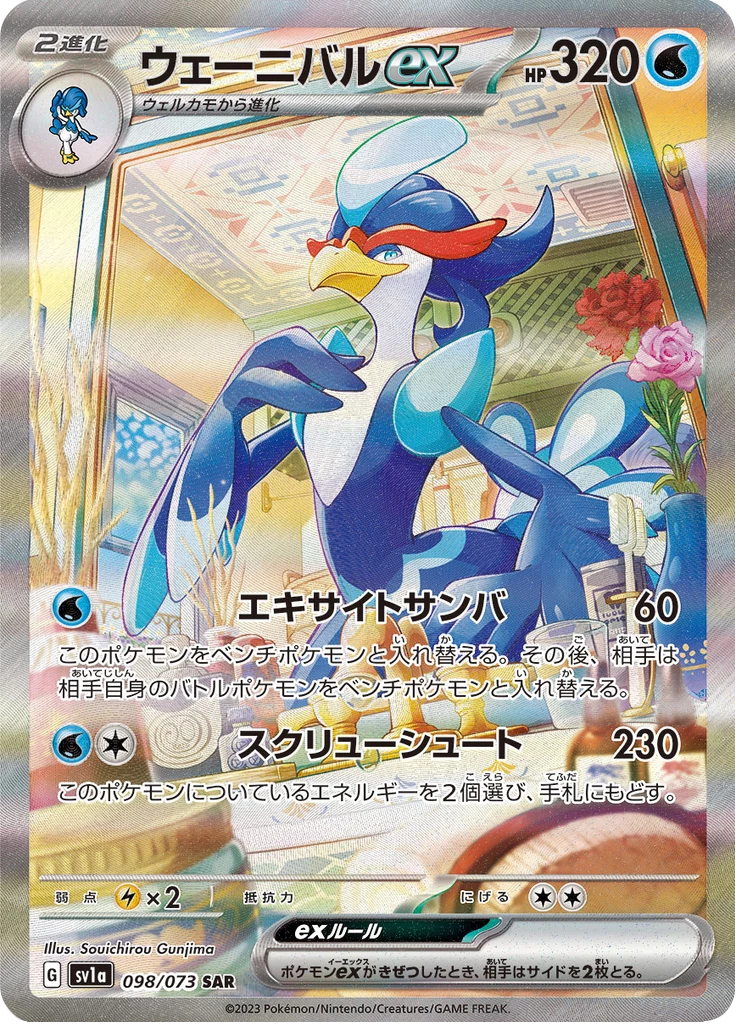
Quaquaval ex 098/073 SAR Triplet Beat full art card
Quaquaval ex 098/073, SAR — Triplet Beat (SV1a)

Quaquaval ex (JP: ウェーニバルex) is a Water-type Stage 2 Pokemon with 320 HP, evolving from Quaxwell. Its two attacks are named “Excite Samba” and “Screw Shoot”. The card is illustrated by Souichirou Gunjima.

This specific printing — card number 098/073, Special Art Rare (SAR) — is a full-art secret rare from Triplet Beat (SV1a), an enhanced expansion pack released in Japan on March 10, 2023. Triplet Beat’s nominal checklist runs to 073, but the set’s full print total is 103 cards, so a number like 098 sits in the SAR/secret-rare block printed above the base count — a standard Japanese TCG convention for chase-card numbering, not a printing error.

As a Stage 2 Pokemon, Quaquaval ex sits at the top of a three-card evolution line, which is one of the reasons the full-art treatment lands on this particular card number rather than on Quaxly or Quaxwell. “Excite Samba” and “Screw Shoot” are the two named attacks on the card; we’re not restating their exact damage or effect text here since our sourced reference doesn’t detail it beyond the names, and we’d rather leave it out than guess.

Which Quaquaval Card Do You Have?

Triplet Beat also includes a regular (non-SAR) Quaquaval card within the base 073 count, and Quaquaval separately appears as part of the “ex Starter Set Quaxly & Mimikyu ex” promo product. Both are different cards from the 098/073 SAR covered in this guide — check the card number and the full-art SAR treatment before assuming you have this printing.

Quaquaval and the Paldea Water Starter Line

Quaquaval is the final evolution of the Water-type starter from the Paldea region, introduced in the Scarlet & Violet video games. In the TCG, that starter status is exactly why the ex/SAR treatment exists at all — fully-evolved starter Pokemon are a recurring focus for full-art secret rares across the Scarlet & Violet card era, and Quaquaval’s Triplet Beat SAR is the flagship chase version of this particular line.

If you’re after the whole evolution family — Quaxly, Quaxwell and Quaquaval together, across their various printings — our Paldea starters card guide covers the full line. This article is narrower by design: it’s a single-card PSA10 deep dive on the 098/073 SAR specifically, not a starter-family overview.

That starter-line status is worth keeping in mind when you’re comparing this card to others in the same set. Fully-evolved starters are consistently where set designers put their flagship full-art treatment, and Quaquaval ex SAR is Triplet Beat’s version of that pattern for the Water-type starter specifically.

The Triplet Beat (SV1a) Set

Triplet Beat (SV1a) is an enhanced expansion pack released in Japan on March 10, 2023, with a total print run of 103 cards. It sits in the early Scarlet & Violet era of the Japanese TCG, and the Quaquaval ex SAR is one of its headline full-art pulls.

For the complete checklist, see our Triplet Beat (SV1a) card list. If you’re weighing whether to open sealed product from this set, our Triplet Beat pull-rate and best-cards guide has that box-value context — we don’t restate pull-rate figures here since this article is focused on the single card. For where Triplet Beat fits against other Scarlet & Violet-era Japanese sets, our Scarlet & Violet Japanese card list is the broader index.

PSA10 Value and Where This Card Sits

A PSA10 copy of Quaquaval ex SAR (098/073) is currently listed at ¥16,038 (~$100.9) in our shop. That’s the only price we can confirm here — we haven’t verified competitor or auction figures for this exact printing, so we’re not citing any, and we won’t speculate on where the number moves next.

At just over ¥16,000, this SAR sits comfortably in the mid-range for a modern Japanese chase card. If you’re building out a PSA10 collection around this price point, our PSA10 Japanese cards under ¥30,000 guide rounds up other cards in the same bracket.

Grading matters here because a full-art SAR like this one is printed on a textured foil surface that shows handling wear more easily than a standard holofoil card. A PSA10 designation means the specific copy met PSA’s Gem Mint standard — the highest tier PSA grades to — across centering, corners, edges and surface, though PSA’s own standard allows for certain minor factory characteristics rather than requiring literal flawlessness. It doesn’t change what’s printed on the card, but it does mean you’re buying a copy that’s already been independently checked rather than assessing raw condition yourself.

How This SAR Compares to Other Chase Cards We Carry

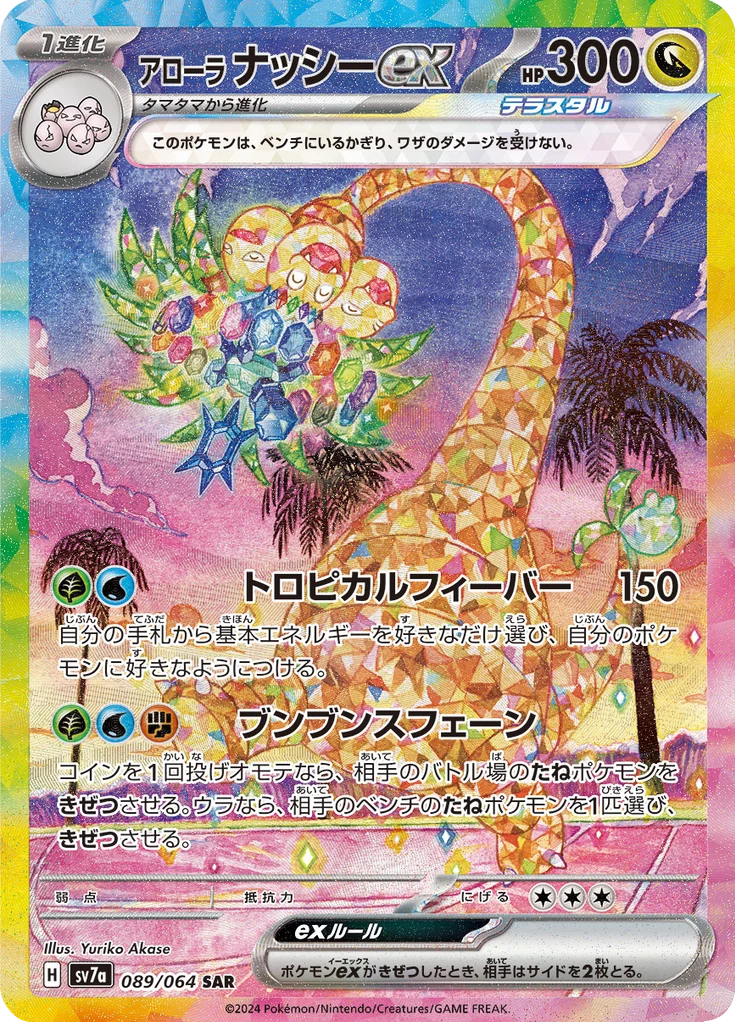
Quaquaval ex SAR isn’t the only full-art Special Art Rare we handle in PSA10. Here are three other ex/Radiant-tier chase cards from different Japanese sets, for a sense of how the full-art treatment looks across the current card pool — these are separate cards from separate sets, not other Quaquaval printings.
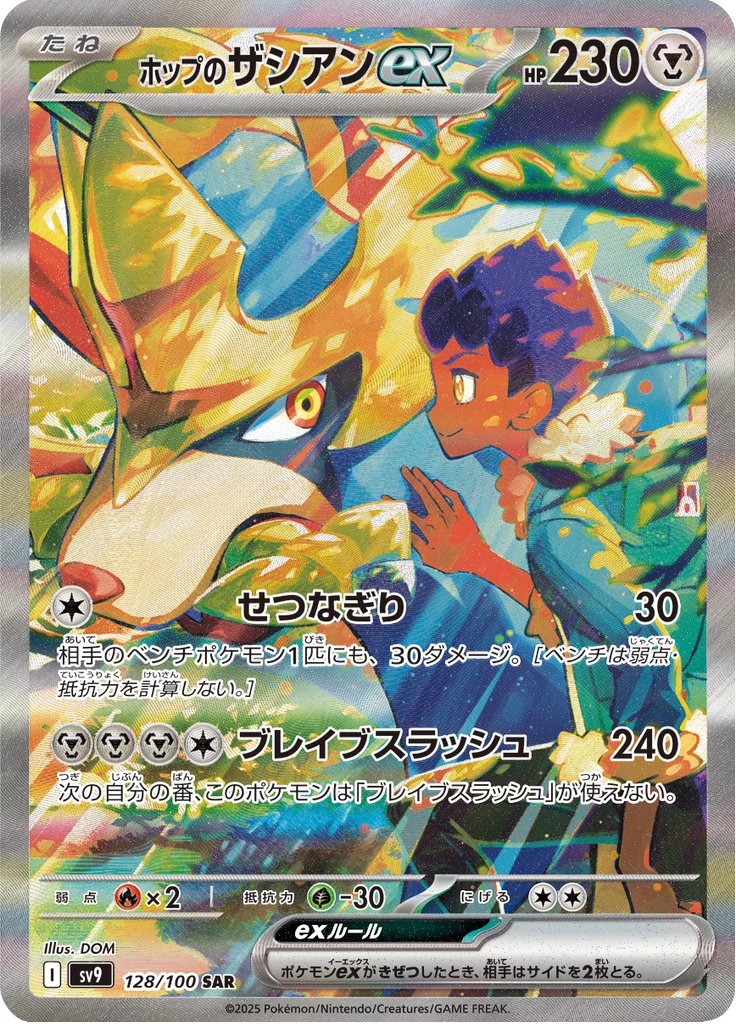
Hop's Zacian ex 128/100 SAR Battle Partners card
Hop’s Zacian ex 128/100, SAR — Battle Partners (SV9)
Alolan Exeggutor ex 089/064 SAR Paradise Dragona card
Alolan Exeggutor ex 089/064, SAR — Paradise Dragona (SV7a)
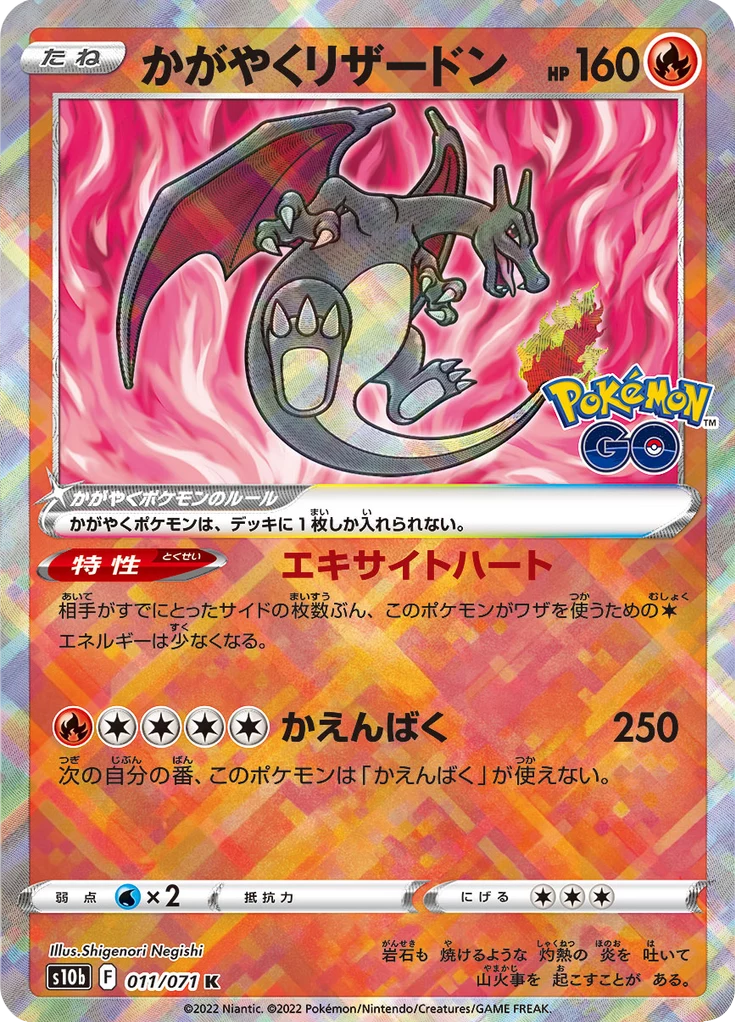
Radiant Charizard K 011/071 Pokemon GO card
Radiant Charizard K 011/071, Radiant Rare — Pokemon GO (S10b)

Each of these comes from a different Japanese set and a different rarity slot, but they share the same appeal as Quaquaval ex SAR: a full-art or radiant treatment on a Pokemon with strong recognition outside the TCG itself. If Water-type starters aren’t your focus, browsing sister guides for cards like these is a reasonable way to compare full-art styles before committing to a single-card purchase.

Where to Buy PSA10 Quaquaval ex SAR

We grade and ship this card from Tokyo with tracked delivery. If you want the exact 098/073 SAR in PSA10, the product page below is the direct route.

Shop This Card
PSA10 Quaquaval ex 098/073 SAR
Currently listed at ¥16,038 (~$100.9)
Ships from Tokyo · Tracked delivery

View Product →

Looking for other Triplet Beat singles or a mixed order across Japanese sets? Our Quick Order page is the fastest way to put one together.

Domande frequenti

What is Quaquaval ex SAR (098/073)?

It’s a 320 HP Water-type Stage 2 Pokemon card, evolving from Quaxwell, with the attacks “Excite Samba” and “Screw Shoot”. Card number 098/073 is the Special Art Rare (full-art secret rare) printing from Triplet Beat (SV1a), illustrated by Souichirou Gunjima.

What set is Quaquaval ex SAR from, and when was it released?

Triplet Beat (SV1a), an enhanced expansion pack released in Japan on March 10, 2023, with a total print run of 103 cards.

Is Quaquaval ex SAR the same card as the base Quaquaval card or the Starter Set promo?

No. Triplet Beat also contains a separate, non-SAR Quaquaval card within its base 073-card checklist, and Quaquaval also appears in the “ex Starter Set Quaxly & Mimikyu ex” promo product. Both are different cards from the 098/073 full-art SAR covered here.

How much is a PSA10 Quaquaval ex SAR (098/073) worth?

Our own PSA10 copy is currently listed at ¥16,038 (about $100.9 at ¥159/USD). We haven’t verified other marketplace or auction prices for this printing, so we don’t cite any here.

Is Quaquaval a starter Pokemon?

Yes — Quaquaval is the fully-evolved form of the Water-type starter from the Paldea region, introduced in the Scarlet & Violet video games. This SAR is one of several full-art chase printings tied to Scarlet & Violet-era starter Pokemon.
SV1S Scarlet ex vs SV1V Violet ex: quale coppia gemella acquistare

Two Japanese Pokemon booster boxes released on exactly the same day, carry exactly the same card count, and were later merged into a single English set. If you are trying to decide between SV1S Scarlet ex and SV1V Violet ex, the honest answer is that they were never built to compete with each other — they were built to be bought together.

SV1S and SV1V were the first Japanese Scarlet & Violet-era Pokemon TCG expansions, both released January 20, 2023, and together they introduced the Tera (Terastal) mechanic to the card game for the first time. Each box is built around its own legendary mascot ex card, and on our current listings the two boxes sit at different prices.

This guide compares them directly: what actually differs between the two sets, which mascot each box is built around, how the Japanese split compares to the combined English version, and what each box currently costs.

Key Takeaways

SV1S Scarlet ex and SV1V Violet ex both released on January 20, 2023, as a split twin pair — 108 cards each, 216 combined — and together introduced the Tera mechanic to the Pokemon TCG. SV1S is built around Koraidon ex (SV1S 106/108, Ultra Rare); SV1V is built around Miraidon ex (SV1V 106/108, Ultra Rare). We currently list the SV1S Scarlet ex booster box at ¥14,896 (~$94) and the SV1V Violet ex booster box at ¥11,536 (~$73).

Jan 20, 2023
JP Release (Both Sets)

108
Cards Per Set

¥14,896
SV1S Box (~$94)

¥11,536
SV1V Box (~$73)

Prices in this guide are current listings on our site, converted at ¥159/USD (September 2026 rate).

SV1S vs SV1V: The Basics

Set for set, SV1S and SV1V are structurally identical — same card count, same release date, same era-opening mechanic. The differences are in the mascot, the illustrator, and, on our current stock, the price.

SV1S Scarlet ex SV1V Violet ex
Codice set SV1S SV1V
Carte nel set 108 108
JP release date January 20, 2023 January 20, 2023
Box mascot Koraidon ex, 106/108, Ultra Rare Miraidon ex, 106/108, Ultra Rare
Mascot illustrator aky CG Works 5ban Graphics
Mascot HP / type HP 230, Fighting HP 220, Lightning
Current box price ¥14,896 (~$94) ¥11,536 (~$73)
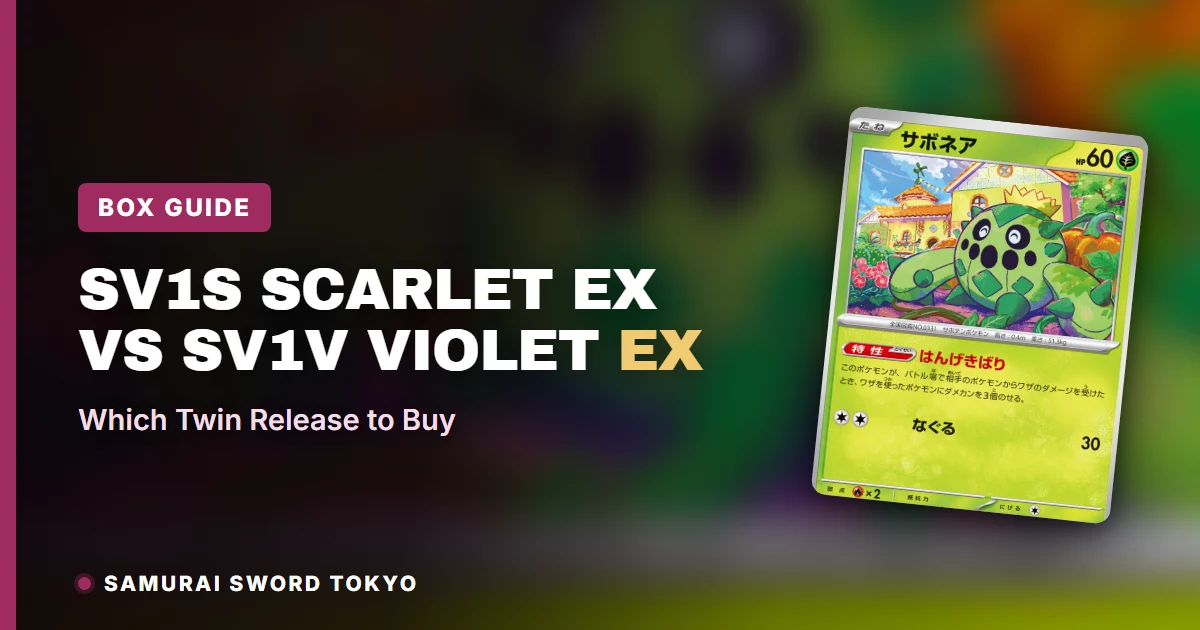
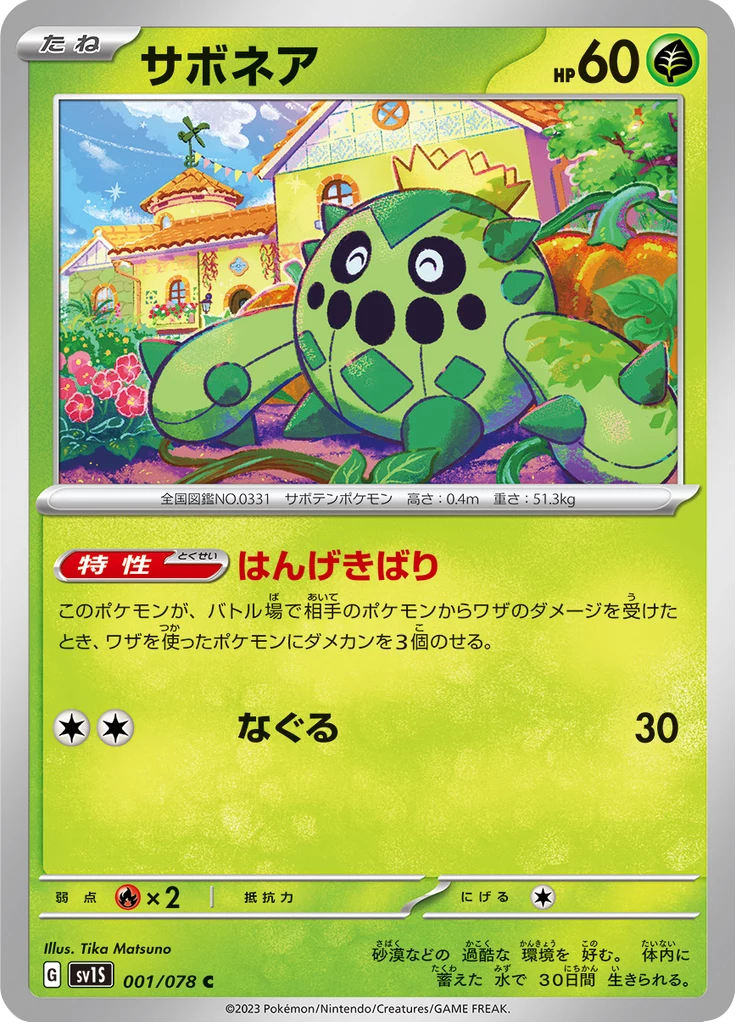
Cacnea, SV1S 1/108, Common
Cacnea, SV1S 1/108, Common — one of 108 cards in the Scarlet ex set

We couldn’t confirm a packs-per-box or cards-per-pack figure for either set from the sources used to build this guide, so we’re not quoting one here — treat any number you see elsewhere for either box as unverified.

For the complete 108-card breakdowns of each set, see our Scarlet ex (SV1S) complete card list and Violet ex (SV1V) card list.

Why Two Boxes Instead of One

SV1S and SV1V are the very first Japanese expansions of the Scarlet & Violet era, and Japan released them as a split twin pair rather than a single combined set — one box per game version, mirroring the Scarlet and Violet video games themselves. As Bulbapedia puts it, “In Japan, the expansion split into two separate releases: ‘Scarlet ex’ and ‘Violet ex.'”

That splitting pattern became the template for how The Pokemon Company Japan has handled several era-opening releases since: two parallel boxes, released the same day, each carrying its own legendary mascot, aimed at collectors who want both versions rather than forcing a single choice.

For more on how this Japanese-set structure maps onto the wider Scarlet & Violet era, our Scarlet & Violet Japanese card list hub covers SV1S, SV1V, and the SV1a set that followed them.

Box Mascots: Koraidon ex vs Miraidon ex

The clearest difference between the two boxes is the ex card each one is built around.

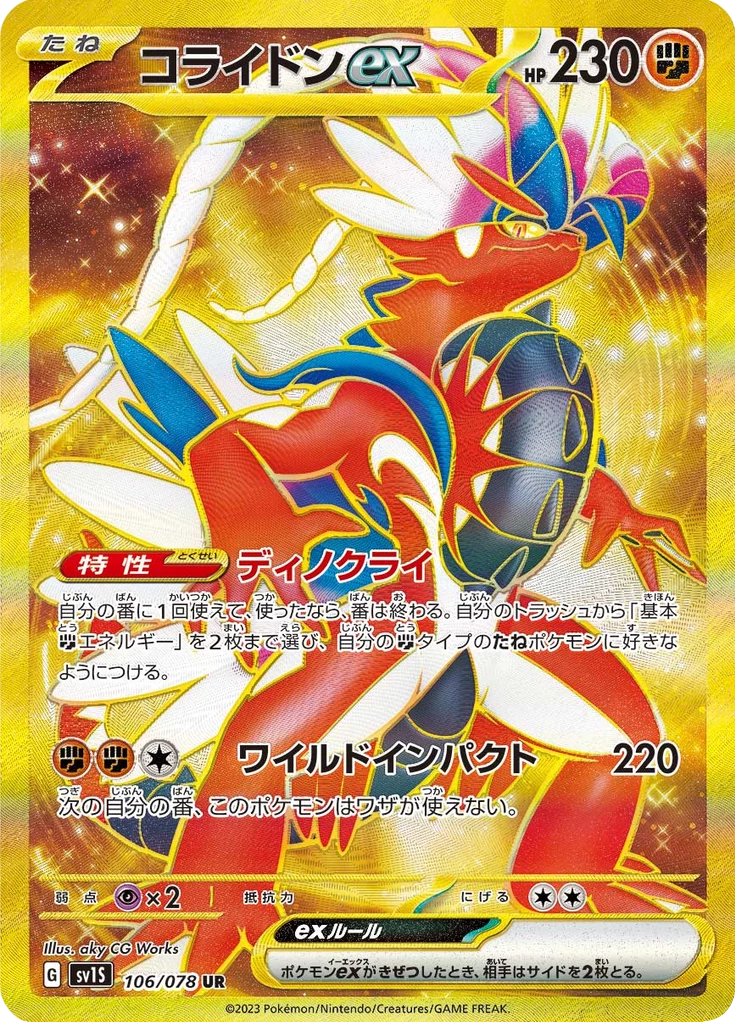
Koraidon ex, SV1S 106/108, Ultra Rare

Koraidon ex — SV1S 106/108 (Ultra Rare)
HP 230 · Fighting · illus. aky CG Works

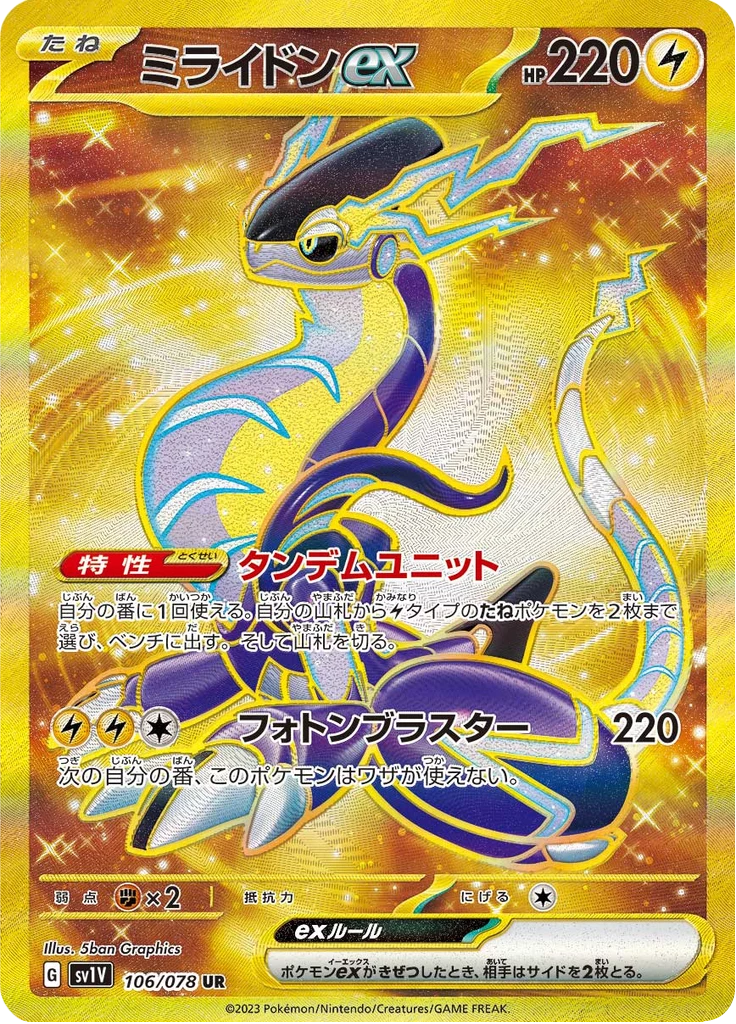
Miraidon ex, SV1V 106/108, Ultra Rare

Miraidon ex — SV1V 106/108 (Ultra Rare)
HP 220 · Lightning · illus. 5ban Graphics

Koraidon ex (SV1S 106/108) is a Fighting-type card with HP 230, illustrated by aky CG Works. Miraidon ex (SV1V 106/108) is a Lightning-type card with HP 220, illustrated by 5ban Graphics. Both sit at Ultra Rare within their respective sets, and both are the card most collectors associate with each box.

If you already have a favourite between the two Paradox legendaries, that preference is likely to matter more to most buyers than anything else in this comparison. For a closer look at one of the chase cards adjacent to this era, see our Miriam Pokemon card guide, which covers SIR and SAR prints from SV1V.
The Tera Mechanic Debut

Beyond the mascots, SV1S and SV1V share the same historical significance: together they introduced the Tera (Terastal) mechanic to the Pokemon Trading Card Game for the first time. That mechanic has continued through later Scarlet & Violet-era sets in both Japanese and English releases.

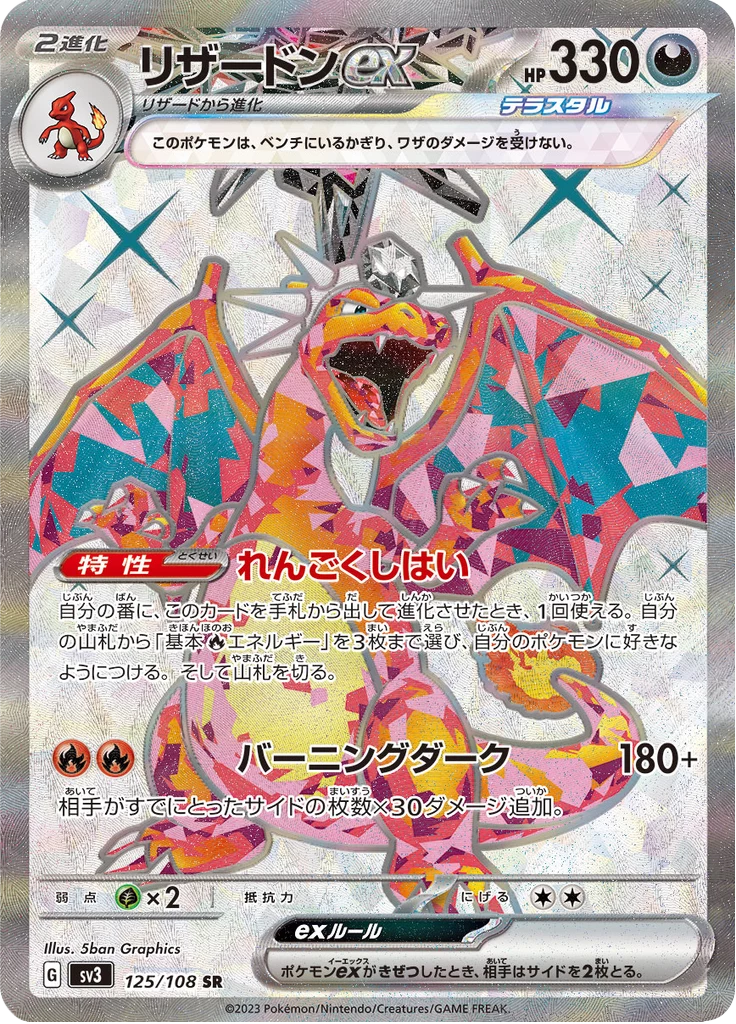
Charizard ex, SV3 125, a later Tera ex printing shown for format reference only
Charizard ex, SV3 125 — a later Scarlet & Violet-era Tera ex printing, shown only to illustrate the card format; it is not part of SV1S or SV1V

The image above is from SV3, a set released after SV1S and SV1V, and is included purely to show what the Tera ex card format looks like in general — it is not one of the 216 combined SV1S/SV1V cards. If a mechanic’s origin point matters to your collection, SV1S and SV1V are the two boxes that started it.

For the sets that came directly after this pair, see our Paldea Evolved Japanese card list (SV2D/SV2P), the next chronological twin release.

How This Compares to the English Scarlet & Violet Set

If you’ve only collected the English side of the Scarlet & Violet era, it’s worth being precise about what SV1S and SV1V add up to. The English market combined both Japanese sets into a single release, “Scarlet & Violet,” which shipped March 31, 2023, with 258 English cards — against 216 combined Japanese cards across SV1S and SV1V.

That’s not a like-for-like reprint. The English set is not simply “SV1S plus SV1V translated” — it carries more total cards than the two Japanese sets combined, which means the English and Japanese versions of this era are not interchangeable collections. If you want the original split-set structure, including cards or print details unique to the Japanese release, you need the Japanese boxes specifically.

For the wider context on how the Japanese Scarlet & Violet-era sets are organised, our Kirlia Japanese Pokemon cards guide also touches on SV1S prints within this era.

Price Comparison: SV1S vs SV1V

On our current listings, the two boxes are priced differently:

Box Mascot Currently listed at
SV1S Scarlet ex Koraidon ex, 106/108 UR ¥14,896 (~$94)
SV1V Violet ex Miraidon ex, 106/108 UR ¥11,536 (~$73)

That’s roughly a ¥3,360 (~$21) gap between the two boxes on our current listings. We’re not going to speculate on why that gap exists or which box is the better buy financially — pricing reflects our own listing at the time of writing, not a market-wide valuation of either set, and we don’t have verified pull-rate data for either box to weigh into a value argument.

Which One Should You Buy

Since SV1S and SV1V are structurally the same set split in two, the decision usually comes down to two things: which mascot you want, and what you’re prepared to spend.

  • Pick SV1S Scarlet ex if Koraidon ex is the card you want as your box mascot, or if you’re building a Fighting-type-leaning collection from this era.
  • Pick SV1V Violet ex if Miraidon ex is your preferred mascot, if you’re leaning Lightning-type, or if the lower current listing price matters to your budget.
  • Consider both if you want the complete twin-release pair as it was originally sold in Japan — together they cover all 216 combined cards from this era.
Keep in Mind

Neither box is objectively “better” as a collectible — they’re the same release split by game version. The mascot you prefer and your budget are the two variables that actually differ between them.
Shop This Set
SV1S-Scarlet ex Japanese Pokemon Booster Box
Contains Koraidon ex, SV1S 106/108
Ships from Tokyo · Tracked delivery

View Product →

Where to Buy SV1S and SV1V

We ship Japanese sealed Pokemon booster boxes worldwide from Tokyo with tracked delivery. Both twin-release boxes are currently listed individually: the SV1S-Scarlet ex Japanese Pokemon Booster Box at ¥14,896 (~$94), and the SV1V-Violet ex Japanese Pokemon Booster Box at ¥11,536 (~$73).

For the wider range of Japanese sealed booster boxes we carry, browse our Japanese sealed booster box collection. For singles, mixed orders, or specific cards from either set that aren’t listed individually, our Quick Order page is the fastest way to build a request.

Domande frequenti

What’s the difference between SV1S Scarlet ex and SV1V Violet ex?

Both are 108-card Japanese sets that released on the same day, January 20, 2023, as a split twin pair. The main differences are the box mascot (Koraidon ex for SV1S, Miraidon ex for SV1V), the illustrator, and current listing price.

Which box mascot does each set feature?

SV1S Scarlet ex is built around Koraidon ex (SV1S 106/108, Ultra Rare, HP 230, Fighting, illustrated by aky CG Works). SV1V Violet ex is built around Miraidon ex (SV1V 106/108, Ultra Rare, HP 220, Lightning, illustrated by 5ban Graphics).

How do SV1S and SV1V compare to the English Scarlet & Violet set?

The English market combined both Japanese sets into one release, “Scarlet & Violet,” with 258 English cards, versus 216 combined cards across the two Japanese sets. It is not a direct one-to-one reprint of either Japanese set.

What new mechanic did SV1S and SV1V introduce?

Together, these two sets introduced the Tera (Terastal) mechanic to the Pokemon Trading Card Game for the first time.

Which box costs more, SV1S or SV1V?

On our current listings, SV1S Scarlet ex is priced higher at ¥14,896 (~$94), compared to SV1V Violet ex at ¥11,536 (~$73).

Celebratory Fanfare M-P 033: la carta ricompensa della Serie del Campionato 2025

Most Japanese promo cards come home in a booster box or a store campaign. This one comes home in a tournament bag.

Celebratory Fanfare (おいわいファンファーレ), card number 033/M-P, is a Stadium-type Trainer card issued through Japan’s Mega Promotional Cards (M-P) series — and it didn’t reach anyone’s hands through a pack. It was earned. Specifically, it was a merchandise reward tied to Championship Points from Pokemon’s 2025 Champions League season in Japan, which puts it in a different category from almost every other promo card we cover: distribution by tournament result, not by print run at retail.

This guide covers what the card actually is, how it was distributed, where it sits inside the wider M-P promotional series, and what a graded copy is currently listed at.

Key Takeaway

Celebratory Fanfare (033/M-P) is a Stadium Trainer card, not a Pokemon card. It was distributed as a merchandise reward for players who reached 30 or more Championship Points in Japan’s 2025 competitive season — specifically the 30–79 point tier — and was never sold at retail. We currently have a PSA10-graded copy listed at ¥85,580 (~$538).

033/M-P
Card Number

102
Cards in M-P Series

30+
CSP Reward Threshold

¥85,580
PSA10 Listed Price

Price converted at ¥159/USD (September 2026).

What Is Celebratory Fanfare (033/M-P)?

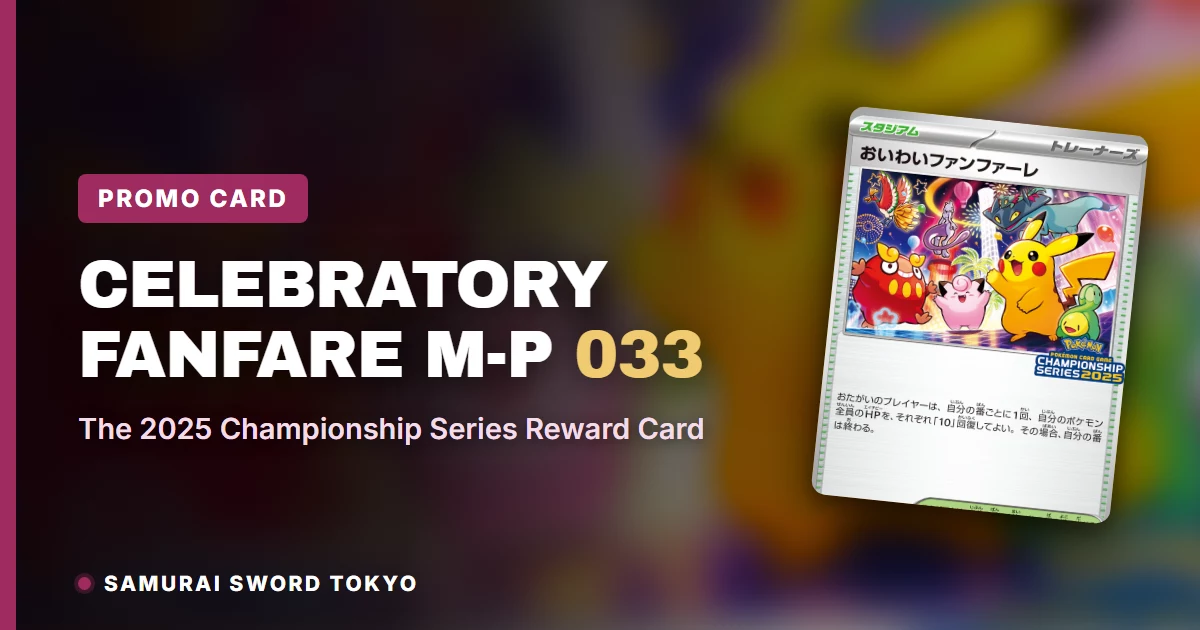
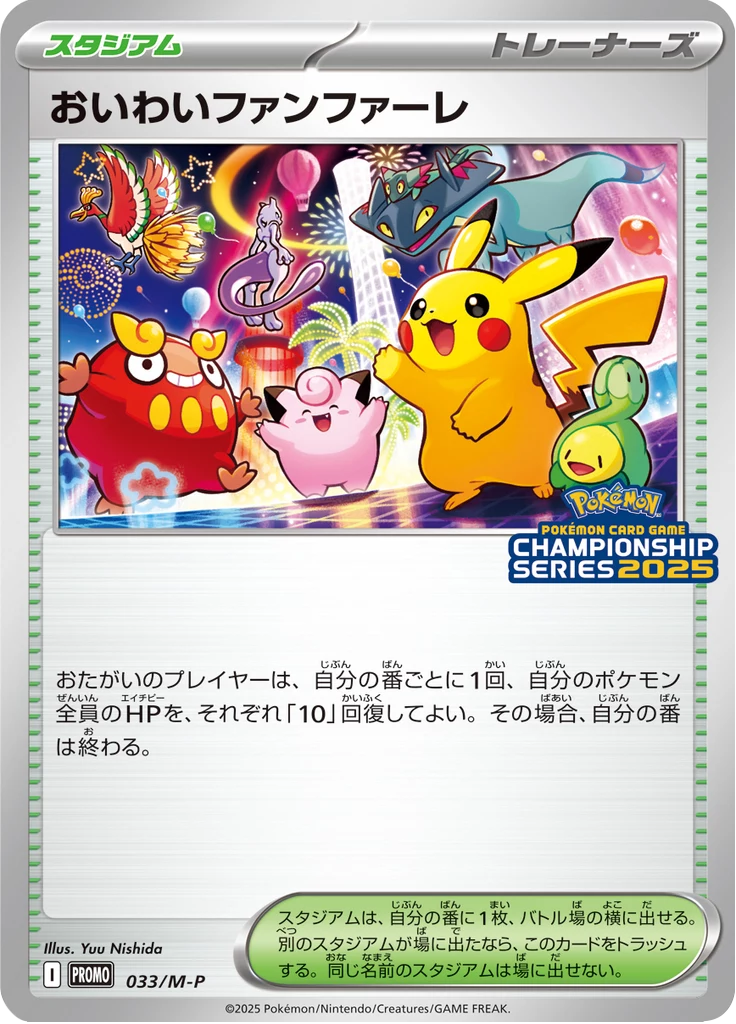
Celebratory Fanfare, 033/M-P, Stadium, Mega Promotional Cards
Celebratory Fanfare — 033/M-P, Stadium, Mega Promotional Cards

Celebratory Fanfare is card 033 in Japan’s M-P (Mega Promotional Cards) series, a running promo line that is currently indexed at 102 cards. Card-type matters here: this is a Stadium, which is a Trainer subtype. There’s no HP, no attacks, and no Pokemon printed as the subject — it’s a battlefield-effect card, the same functional category as any other Stadium in the Trainer deck.

That distinction is worth stating plainly because it’s easy to assume every promo card with bright, celebratory artwork is a Pokemon card. This one isn’t. If you’re building a collection specifically around Pokemon-type cards, Celebratory Fanfare belongs in a separate “Trainer promo” shelf, not next to your EX or ex holos.

Both the card’s identity and its Stadium classification are corroborated across independent Japanese TCG references, and it’s confirmed tournament-legal in Standard and Expanded formats in Japan.

The Japanese name, おいわいファンファーレ (roughly “celebration fanfare”), fits the card’s origin story better than most promo names do — it was printed specifically to mark a competitive achievement, not to accompany a set release or a seasonal retail push. That naming choice is a small but useful tell when you’re trying to sort a stack of M-P promos by how each one was actually distributed.

How the Card Was Distributed: A Championship Points Reward

Most promo cards in this M-P series reach collectors through retail campaigns, magazine bundles, or event attendance. Celebratory Fanfare took a narrower path: according to Bulbapedia’s Mega Promotional Cards listing (corroborated by Limitless TCG’s card database), it was issued as a merchandise reward for Japan’s 2025 Champions League season, tied specifically to a player’s accumulated Championship Points (CSP).

The threshold was 30 or more Championship Points, with this particular card sitting in the 30–79 point merchandise tier — a mid-range competitive bracket, not the top prize reserved for the season’s highest finishers. In practical terms, that means every copy in circulation was originally held by a competitive player who earned the points required, then either kept the card or later sold it into the secondary market.

Why This Changes the Supply Picture

Reward-tier cards like this one are not restocked, reprinted on a schedule, or sold through normal retail channels. As an unverified but widely repeated pattern in the Japanese promo market, cards distributed this way tend to enter secondary-market circulation only when a player who redeemed one chooses to resell it — not through any ongoing supply. Treat that as context rather than a guaranteed scarcity figure; no official print-run number has been published for this specific reward tier.

This is also why you won’t find Celebratory Fanfare bundled into a booster box or sold as a standalone promo pack the way many M-P cards are. Its only route to market is competitive redemption followed by resale.

For anyone tracking Japanese tournament-reward cards as a collecting category, this matters more than it might seem. A retail promo can theoretically resurface indefinitely if a store reruns a campaign. A points-tier merchandise reward from a single competitive season cannot — the eligibility window is fixed to that season, and once it closes, the only new copies entering circulation are ones already held by players.

The M-P Promotional Series: Where This Card Sits

The M-P (Mega Promotional Cards) series is Japan’s ongoing promo line for the current Mega-era Pokemon TCG, and it now runs to 102 indexed cards covering a mix of Pokemon, Trainers, and Stadiums pulled from tournaments, campaigns, and merchandise programs. Celebratory Fanfare’s slot at 033 places it roughly a third of the way through the numbered run.

Because the series spans so many distribution methods, individual cards within it can vary enormously in how they were obtained — some were simple retail inserts, others were store-exclusive campaign rewards, and others, like this one, were tournament merchandise. The numbering doesn’t tell you which is which; the distribution note attached to each card does.

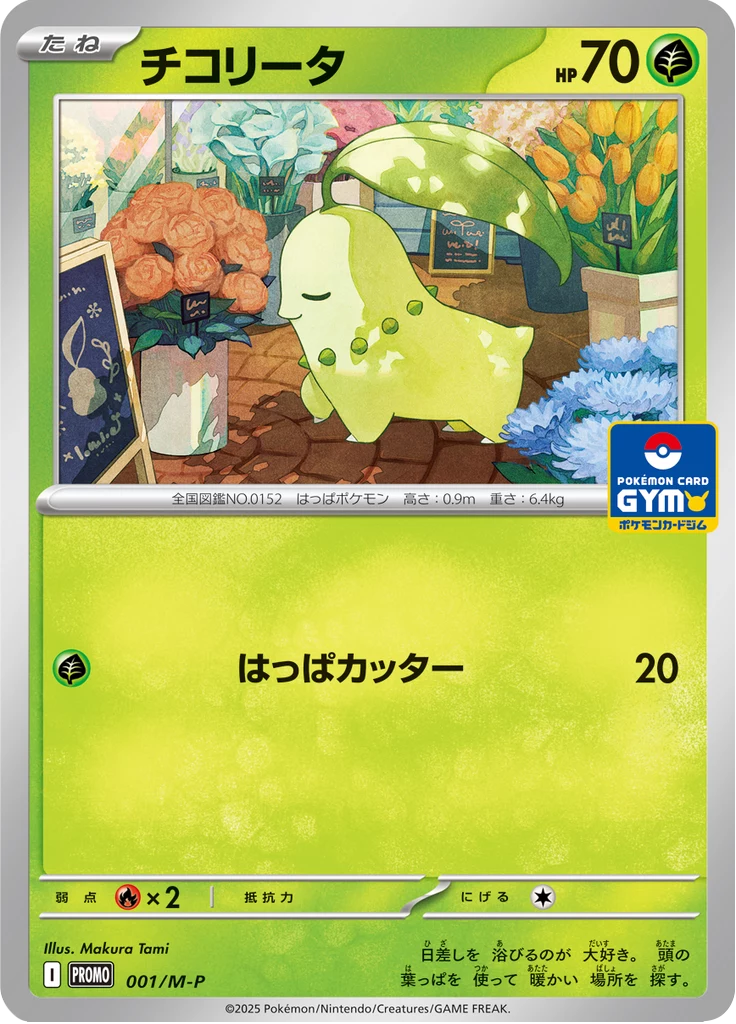
Mega Promotional Cards (M-P) series, card 001

Mega Promotional Cards (M-P) series

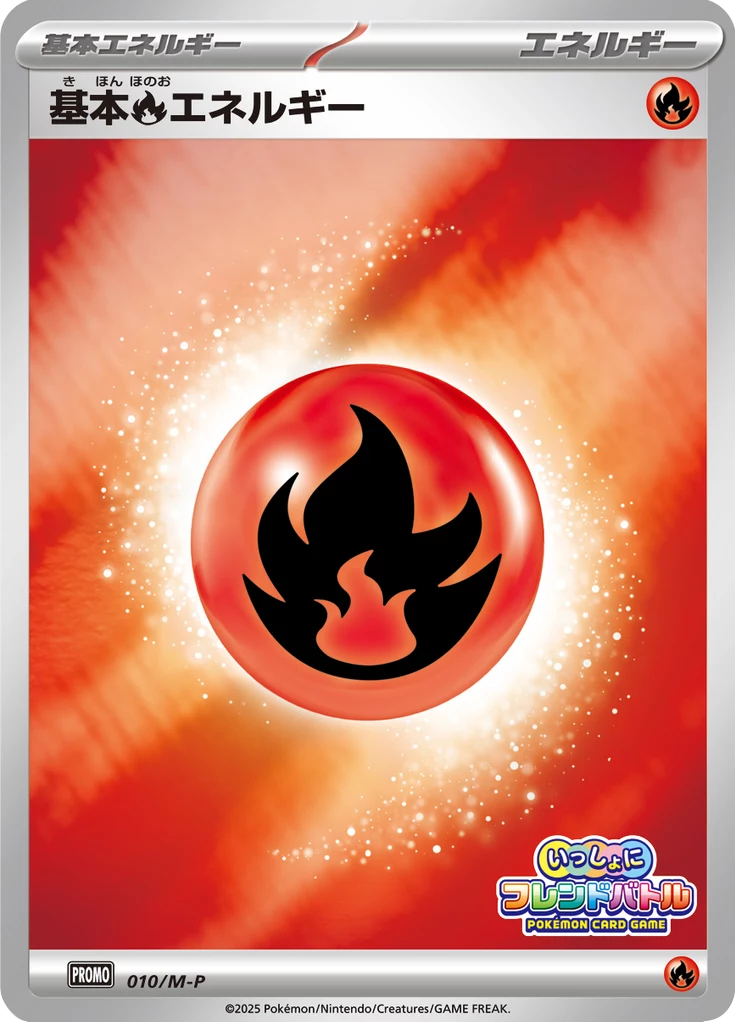
Mega Promotional Cards (M-P) series, card 010

Mega Promotional Cards (M-P) series

Mega Promotional Cards (M-P) series, card 020

Mega Promotional Cards (M-P) series

If you’re new to collecting Japanese promo runs generally, our S-P promo best cards guide and SM-P promo best cards guide cover the two predecessor promo lines and how their chase cards have traded over time — useful comparison points for judging where a card like Celebratory Fanfare fits within the broader promo-collecting landscape. For a wider look at how Japan has handled Pokemon Center and store promos outside tournament rewards, see our Pokemon Center Pikachu promo guide.

Market Context and Current Listing

Because Celebratory Fanfare never had a retail price to begin with, there’s no traditional “market average” to quote the way you would for a booster-pulled secret rare. The only pricing data point we can verify is our own current listing.

We have a PSA10-graded copy listed at ¥85,580 (~$538), converted at ¥159/USD. That price reflects a gem-mint graded example of a card that, by its own distribution history, was never manufactured for open sale — every unit that exists came from a competitive player’s reward allocation.

If you’re weighing whether a graded copy is worth the premium over a raw card, our Japanese Pokemon card grading guide walks through what PSA10 status actually verifies and how grading costs factor into a reward-tier card like this one.

Where to Buy Japanese Promo Cards

We ship Japanese singles and sealed product worldwide out of Tokyo with tracked delivery. Celebratory Fanfare’s currently listed PSA10 copy is the direct route if you want this specific card.

Shop This Card
PSA10 Celebrate Fanfare P [M-P 033]
Currently listed at ¥85,580 (~$538)
Ships from Tokyo · Tracked delivery

View Product →

For other Japanese promo singles or a mixed order, our Quick Order page is the fastest way to build a list.

Domande frequenti

What is Celebratory Fanfare (033/M-P)?

It’s a Stadium-type Trainer card, number 033 in Japan’s M-P (Mega Promotional Cards) series. It was distributed as a merchandise reward for players who earned 30 or more Championship Points in Japan’s 2025 Champions League season.

Is Celebratory Fanfare a Pokemon card?

No. It’s a Stadium, which is a Trainer subtype — there’s no HP, no attacks, and no Pokemon depicted as the card’s subject.

How do you obtain a Celebratory Fanfare card?

It was never sold at retail. It was issued as a merchandise reward tied to Championship Points from Japan’s 2025 competitive season, specifically the 30–79 point tier. Copies now available on the secondary market come from players who redeemed and later resold their reward.

What is the M-P promotional series?

M-P (Mega Promotional Cards) is Japan’s ongoing promo card line for the current Mega-era Pokemon TCG, currently indexed at 102 cards covering a mix of distribution methods including retail campaigns, events, and tournament merchandise rewards.

How much does a PSA10 Celebratory Fanfare cost?

We currently have a PSA10-graded copy listed at ¥85,580 (about $538 at ¥159/USD). This is our own listing price, not a broader market average, since the card was never sold at retail.

Guida al promo Flareon VMAX "Summer PokéCard": la S-P 186, premio della lotteria

Two Flareon VMAX products share the same Pokémon and the same 320 HP figure, and very little else. One was won through a Japanese lottery. The other was sold in a retail box. Confusing the two means comparing a promo that was never for sale against a box that anyone could buy.

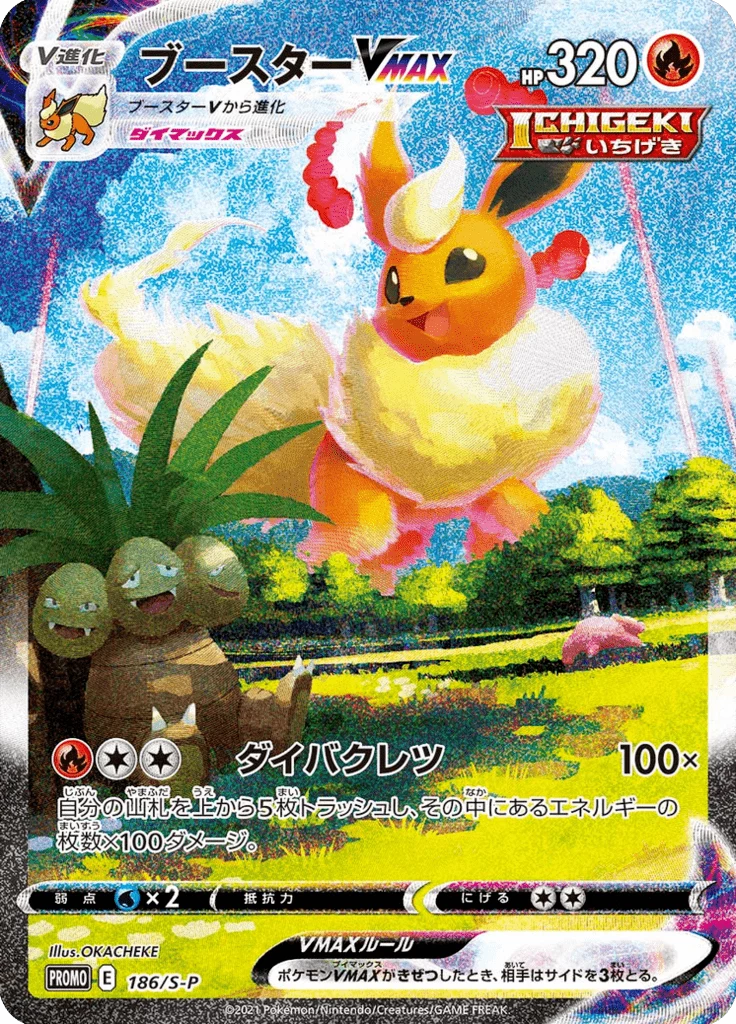
The card in question is Flareon VMAX, card number 186/S-P, part of the Sword & Shield-era S-P Promotional Cards line. It was never sold on its own. It was won — through a 2021 Japanese campaign that handed a small run of alternate-art promos to lottery winners rather than pack-openers. That distribution history is exactly why it sits at a different price level from anything printed for retail.

This guide sets out what the card is, where its artwork actually comes from, how the 2021 campaign worked, and what a graded copy is currently listed for.

Key Takeaway

Flareon VMAX 186/S-P is a Japan-only lottery promo from the 2021 Summer Pokémon Card Campaign (July 21–September 30, 2021), illustrated by OKACHEKE — a different artist from the main-set Evolving Skies print. It is not the same product as the separately-sold Flareon VMAX Premium Collection box. A PSA10-graded copy is currently listed at ¥1,263,460 (~$7,947).

186/S-P
Card Number

OKACHEKE
Illustrator

Jul 21–Sep 30, 2021
Campaign Window

¥1,263,460
Currently Listed (PSA10)

Prices in this guide are converted at ¥159/USD (September 2026).

What Is the Flareon VMAX Summer PokéCard?

The full official identifier is Flareon VMAX, card number 186/S-P, from the S-P Promotional Cards line that ran through the Sword & Shield era. Collectors generally refer to it by its distribution nickname, the “Summer PokéCard,” after the 2021 campaign that gave it out.

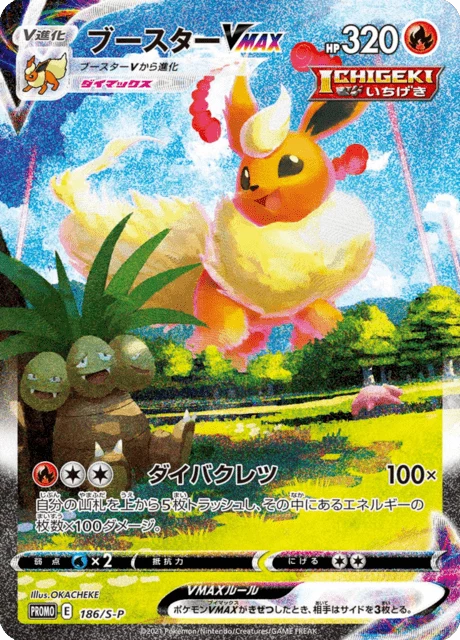
Flareon VMAX card number 186/S-P, S-P Promotional Cards, Japanese print
Flareon VMAX, card number 186/S-P, S-P Promotional Cards

The print is illustrated by OKACHEKE, which is the detail that separates it from every other Flareon VMAX in a collection. The main-set version of this card was illustrated by 5ban Graphics; 186/S-P is a different artist working from the same Pokémon and the same VMAX design, giving it a distinct look even to someone who already owns the standard print.

Detail Value
Carta Flareon VMAX
Card number 186/S-P
Set S-P Promotional Cards (Sword & Shield era)
Illustrator OKACHEKE
Distribution 2021 Summer Pokémon Card Campaign lottery

From Eevee Heroes to Evolving Skies: Where the Artwork Comes From

Flareon VMAX as a Pokémon first appeared in Japan’s Eevee Heroes VMAX special set before crossing into English print in Evolving Skies, where it’s catalogued as #018/203 with 320 HP.

186/S-P is not that print. It’s a later, separately-illustrated alternate-art version of the same Pokémon, produced specifically for the 2021 lottery campaign rather than for either the Japanese or English mainline sets. If you’re comparing a 186/S-P copy to an Evolving Skies Flareon VMAX side by side, you’re looking at two different pieces of art built around the same card design — not two copies of the same print.

For the broader Eeveelution VMAX picture from this same window, our Vaporeon, Jolteon & Flareon cards guide covers how the three fit together.

The 2021 Summer Pokémon Card Campaign: How the Lottery Worked

Japan’s “Summer Pokémon Card Campaign” (夏のポケモンカードキャンペーン) ran from July 21 to September 30, 2021. It wasn’t a purchase-and-open mechanic. Entrants played a match and then submitted an application form to go into a lottery draw, with winners receiving card sets that included the Flareon VMAX 186/S-P promo — hence the “Summer PokéCard” name collectors use for it.

That’s worth underlining because it changes how you should think about scarcity here. This isn’t a chase card sitting inside a booster box; it’s a fixed prize pool handed to lottery winners over a roughly ten-week application window. There’s no pack-pull rate to quote, because there was never a pack to pull it from.

Identifying Your Copy

Check for the “S-P” designation and the 186 card number printed on the card, and compare the artwork to the main-set Evolving Skies Flareon VMAX. If the illustration credit and framing don’t match what you’d expect from a standard set card, you likely have the 186/S-P promo rather than a mainline print.

Don’t Confuse It With: The Flareon VMAX Premium Collection

A second Flareon VMAX product exists from the same general period, and it’s easy to mix up with 186/S-P: the Flareon VMAX Premium Collection, a full-art retail box distributed from December 3, 2021.

The two are unrelated as products. The Premium Collection was a purchasable box available through normal retail channels; 186/S-P was a lottery-only promo from a campaign that had already closed by the end of September that same year. If a listing doesn’t specify “S-P 186,” it’s very likely describing the Premium Collection print instead — always check the card number before comparing prices.

What This PSA10 Copy Is Worth Right Now

A PSA10-graded copy of the Flareon VMAX Summer PokéCard is currently listed at ¥1,263,460 (~$7,947). This is a single-listing anchor price for this specific graded item, not a market-wide average — treat it as a real, current data point on this exact card rather than a benchmark for every 186/S-P in circulation.

Flareon VMAX 186/S-P Japanese promo card illustrated by OKACHEKE
The OKACHEKE illustration on Flareon VMAX 186/S-P, distinct from the main-set Evolving Skies artwork

Two structural factors push a promo like this toward the upper end of the Eeveelution-VMAX price range: a lottery-only distribution with no retail equivalent, and a print that never crossed into English. Neither is a guess — both are simply what the 2021 campaign structure and the card’s Japan-only status mean for supply.

Where 186/S-P Fits in the Wider Promo Landscape

Flareon wasn’t the only Eeveelution to get a Summer PokéCard treatment in 2021. If you’re building out the set, our Vaporeon VMAX Summer PokéCard guide covers the sister card from the same campaign, and the Espeon VMAX card guide covers a related Eeveelution VMAX print from the broader era.

Flareon VMAX card number 186/S-P, S-P Promotional Cards

Flareon VMAX 186/S-P

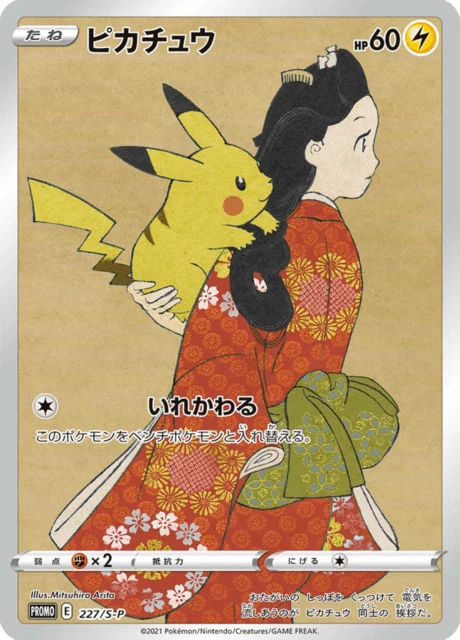
Pikachu card number 227/S-P, S-P Promotional Cards

Pikachu 227/S-P (same S-P promo line, different Pokémon)

Both cards sit under the same S-P Promotional Cards umbrella, though they came from entirely different distribution events. For the full family of S-P promos, see our S-P promo best-cards guide. If VMAX-era alternate art is what you collect, the Moonbreon (Umbreon VMAX) value guide and the Shadow Rider Calyrex VMAX guide cover two of the most-discussed prints from the same general period.

Where to Buy Flareon VMAX and Other Japanese Promos

We ship graded Japanese singles from Tokyo with tracked delivery worldwide. The PSA10 Flareon VMAX Summer PokéCard is a single listing on our site.

Shop This Card
PSA10 Flareon VMAX Summer PokéCard (186/S-P)
Currently listed at ¥1,263,460 (~$7,947)
Ships from Tokyo · Tracked delivery

View Product →

For other S-P promos and Eeveelution VMAX singles, our Quick Order page is the fastest way to build a mixed order across graded and raw stock.

Domande frequenti

What is the Flareon VMAX Summer PokéCard?

It’s Flareon VMAX, card number 186/S-P, from the S-P Promotional Cards line. It’s illustrated by OKACHEKE and was distributed through Japan’s 2021 Summer Pokémon Card Campaign lottery, which is why collectors call it the “Summer PokéCard.”

Is the S-P 186 print the same as the Flareon VMAX in Evolving Skies?

No. Flareon VMAX first appeared in Japan’s Eevee Heroes set and later in Evolving Skies internationally (#018/203, 320 HP). The 186/S-P promo is a separate, later print of the same Pokémon, illustrated by OKACHEKE rather than the main-set illustrator, 5ban Graphics.

How did people get the Flareon VMAX Summer PokéCard in 2021?

It wasn’t sold. Entrants in Japan’s Summer Pokémon Card Campaign (July 21–September 30, 2021) played a match and submitted an application form to enter a lottery draw, with winners receiving card sets that included this promo.

Is the Flareon VMAX Premium Collection the same as the Summer PokéCard promo?

No, they’re different products. The Premium Collection is a retail full-art box distributed from December 3, 2021, and was available for purchase. The Summer PokéCard (186/S-P) was a lottery-only promo from a campaign that closed at the end of September that year.

What is a PSA10 Flareon VMAX Summer PokéCard worth right now?

Our PSA10-graded copy is currently listed at ¥1,263,460 (about $7,947). That’s a single-copy anchor price for the specific slab we hold, not a market-wide average.

Jolteon, carte Pokemon giapponesi: la guida completa a ogni stampa chiave

Jolteon has five documented Japanese card printings, and four of them are currently listed in our own PSA10 stock at prices ranging from ¥13,178 to ¥42,676. If you’re trying to work out what a Jolteon card in your binder is actually worth, the set code and card number matter far more than how the artwork looks at a glance.

This guide lists every confirmed Jolteon printing by set, number and rarity, prices the four currently listed in our own stock, and covers the one further printing — a Special Art Rare from Terastal Festival ex — that exists in the print history but isn’t currently listed by us. If you want Jolteon ranked head-to-head against its fellow original Eeveelutions, our Vaporeon, Jolteon & Flareon guide covers all three side by side; this article is the single-species deep dive on Jolteon specifically.

Key Takeaway

Four Jolteon printings are currently listed in our own PSA10 stock, spanning ¥13,178–¥42,676 (~$83–$268 at ¥159/USD). The Jolteon V SR (S6a 079/069) is the highest of the four — two separately graded copies of it are currently listed at slightly different prices — ahead of the Yu Nagaba promo (SVP 064) and both Master Ball Mirror prints.

5
Documented Printings

¥42,676
Highest (V SR)

¥13,178
Lowest Listed

4
Sets Represented

Prices are our own listed prices as of September 2026, converted at ¥159/USD.

Every Jolteon Card and What It’s Worth

Four Jolteon printings, ranked by current listed price — all PSA10 graded, all from our own stock:

# Carta Set Listed price
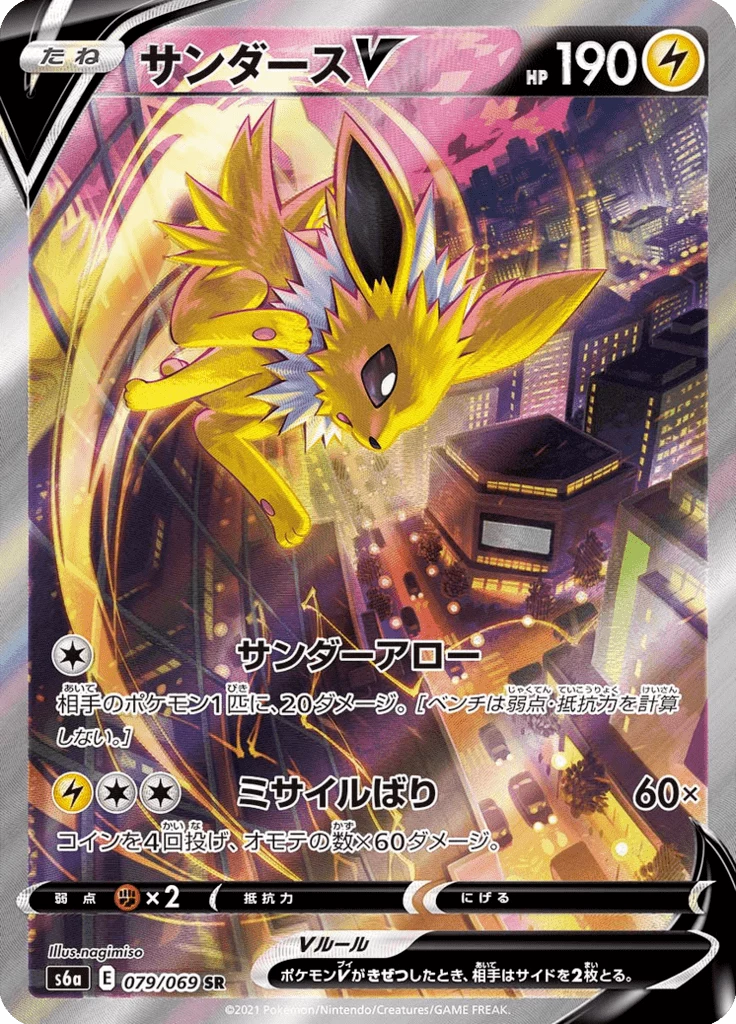
1 Jolteon V SR SA [S6a 079/069] Eevee Heroes ¥42,676 (~$268)
2 Jolteon V SR SA [S6a 079/069] (separately graded copy) Eevee Heroes ¥40,269 (~$253)
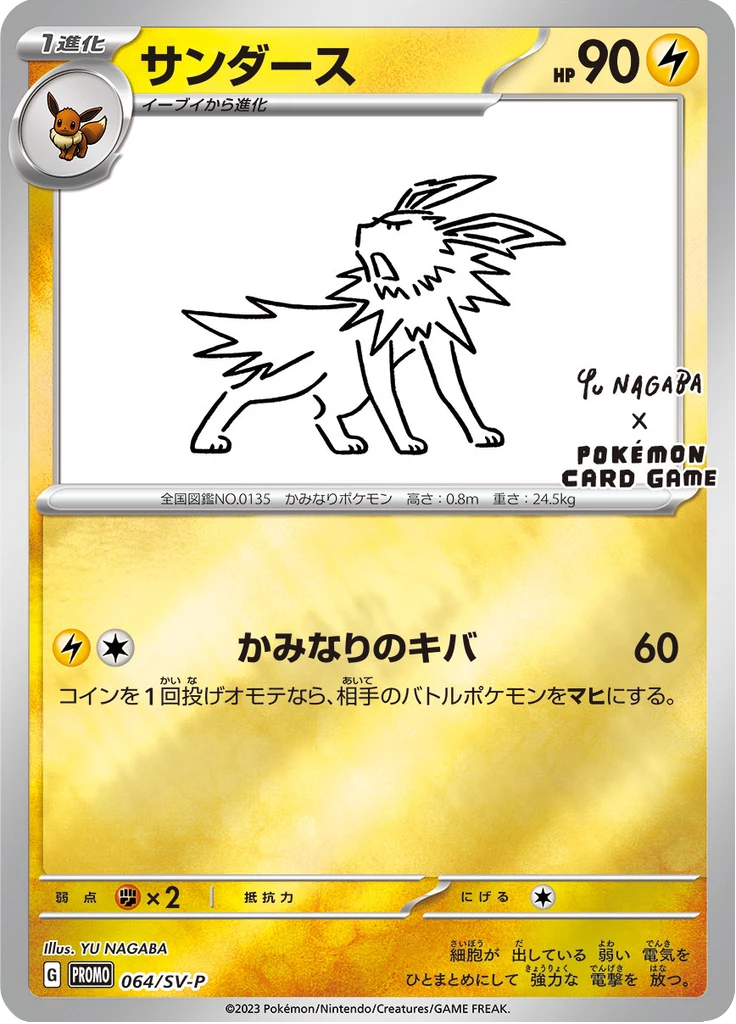
3 Jolteon, Yu Nagaba promo [064/SV-P] Scarlet & Violet Promotional Cards ¥32,336 (~$203)
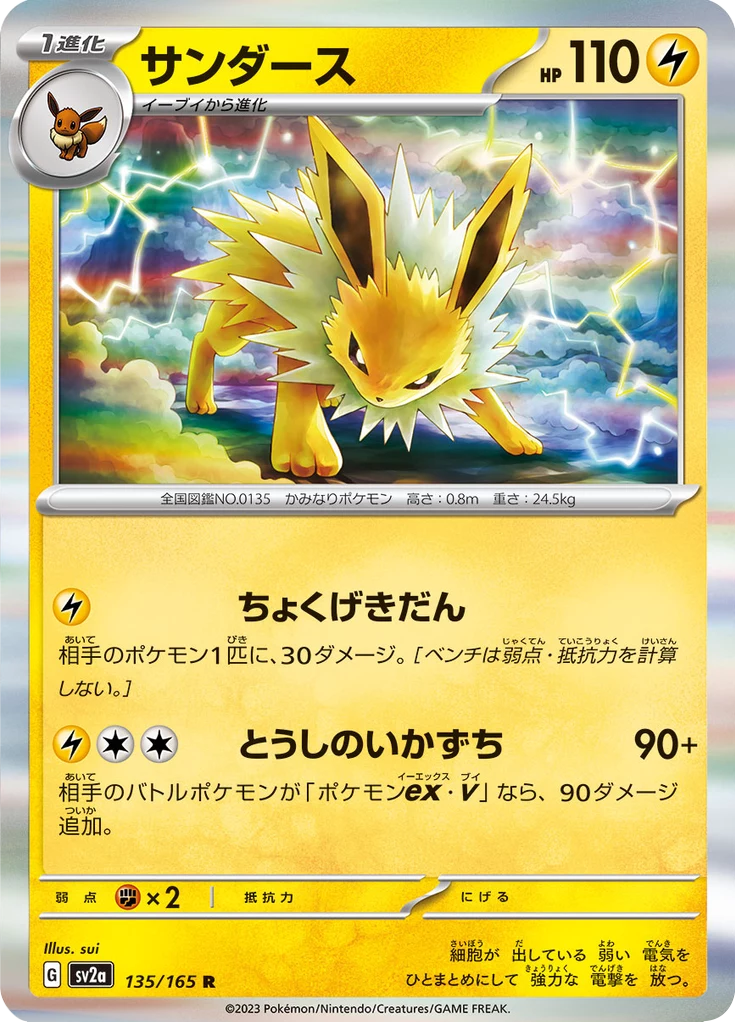
4 Jolteon R, Master Ball Mirror [SV2a 135/165] Pokemon Card 151 ¥14,410 (~$91)
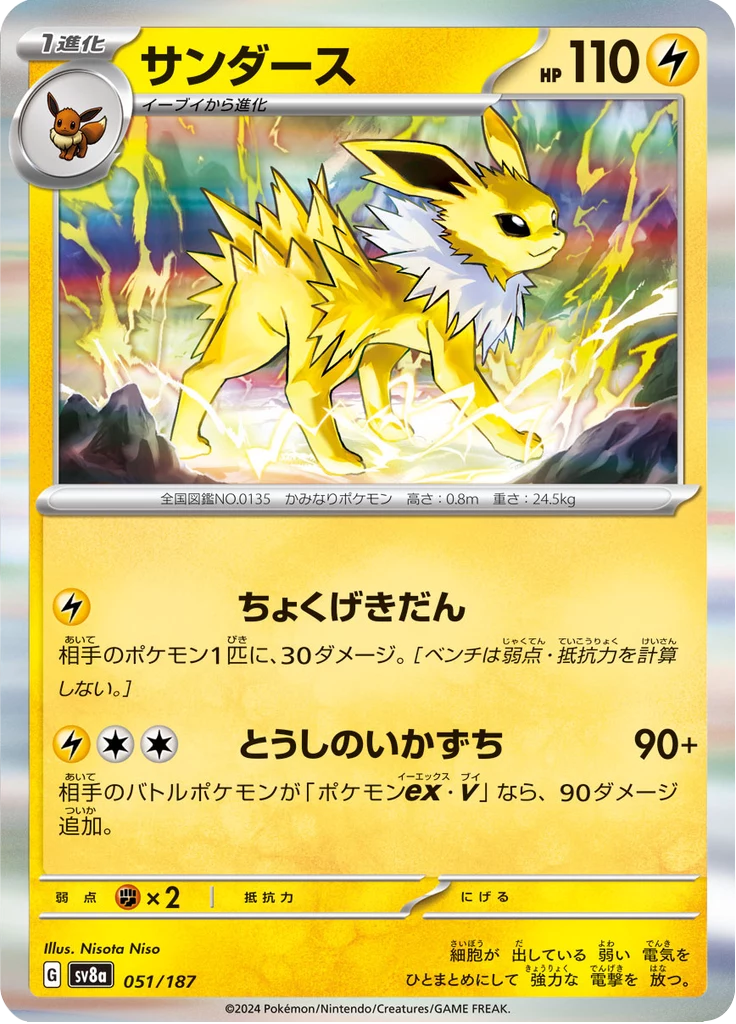
5 Jolteon, Master Ball Mirror [SV8a 051/187] Terastal Festival ex ¥13,178 (~$83)

Two things stand out. First, the V SR sits clear of everything else — both graded copies of it price above every other Jolteon printing we carry. Second, the two Master Ball Mirror prints, pulled from two completely different sets three years apart in the print record, land within ¥1,232 of each other. A fifth printing, the Jolteon ex Special Art Rare from Terastal Festival ex, exists in the wider print history but isn’t currently listed by us — it’s covered separately below.

The Chase Print: Jolteon V SR (S6a 079/069)

Jolteon V SR 079/069 Eevee Heroes card
Jolteon V SR SA, 079/069, Eevee Heroes (S6a)

The Jolteon V SR, card 079/069 from Eevee Heroes (set code S6a), is the highest-priced Jolteon printing currently listed by us. Two separately graded PSA10 copies of this exact card are currently listed: one at ¥42,676 (~$268), and another at ¥40,269 (~$253).

That ¥2,407 gap is a normal cert-to-cert spread for two copies of the same printing — not a difference in card version or set. If you’re comparing a Jolteon V SR you own against either of ours, the card number to check is 079/069; that’s the identifier that confirms it’s this Eevee Heroes printing rather than a different set entirely. Eevee Heroes’ full card list is covered in our S6a set and box guide.

The Yu Nagaba Promo: Jolteon 064/SV-P

Jolteon 064/SV-P Yu Nagaba promo card
Jolteon, 064/SV-P, Scarlet & Violet Promotional Cards, illustrated by Yu Nagaba

Card 064 in the Scarlet & Violet Promotional Cards line (set code SVP) is Jolteon rendered by artist Yu Nagaba, whose distinctive flat-colour style has been used across a run of Pokemon promo cards. Our graded copy is currently listed at ¥32,336 (~$203), the second-highest Jolteon printing we carry.

Nagaba promos sit in their own collecting lane separate from mainline set pulls — distribution, demand drivers and the wider artist context are covered in our Yu Nagaba Pokemon card guide, which is worth reading alongside this section if you’re building out a Nagaba run rather than a Jolteon-specific one.

Two Master Ball Mirrors: SV2a vs SV8a

Jolteon R Master Ball Mirror 135/165 Pokemon Card 151 card

Jolteon R, Master Ball Mirror [SV2a 135/165]
¥14,410 (~$91)

Jolteon Master Ball Mirror 051/187 Terastal Festival ex card

Jolteon, Master Ball Mirror [SV8a 051/187]
¥13,178 (~$83)

Master Ball Mirror is a reprint mechanic that has now given Jolteon two separate printings. The first is SV2a 135/165 from Pokemon Card 151, currently listed at ¥14,410 (~$91). The second is SV8a 051/187, illustrated by Nisota Niso, from Terastal Festival ex, currently listed at ¥13,178 (~$83).

They’re the two most accessible Jolteon printings currently listed by us, priced within ¥1,232 of each other despite coming from different sets. For how the Master Ball Mirror treatment works and which other cards carry it, see our Master Ball Mirror mechanic guide. The SV8a printing’s source set is broken down in our Terastal Festival ex card list.

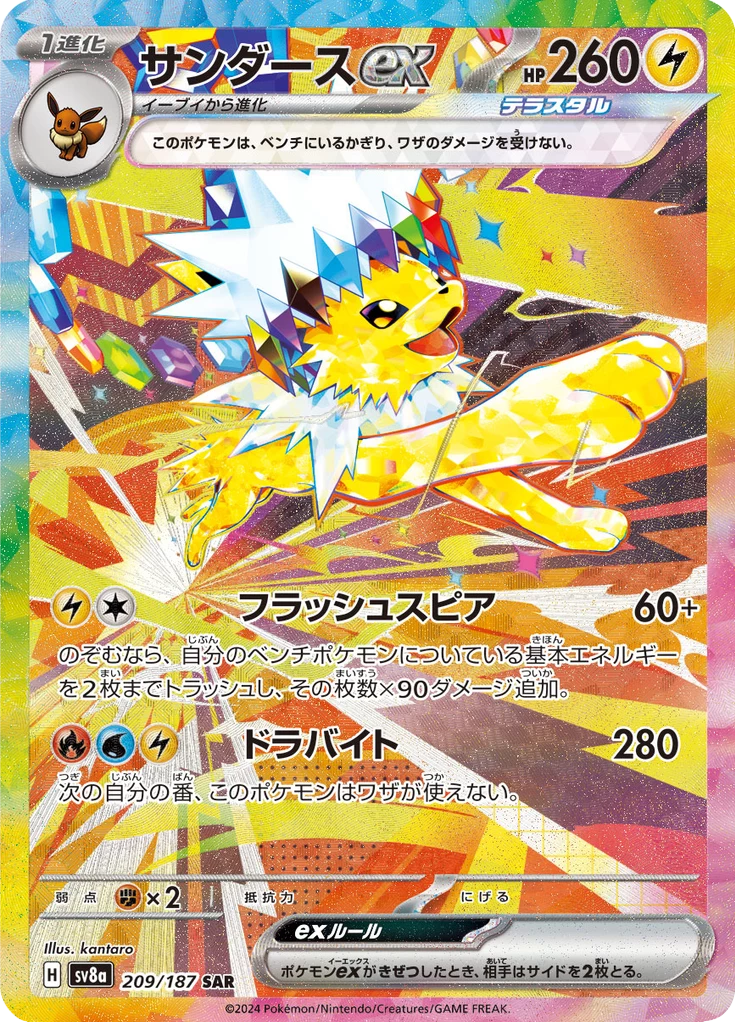
Beyond Our Stock: Jolteon ex SAR (SV8a 209/187)

Jolteon ex SAR 209/187 Terastal Festival ex card
Jolteon ex, SAR, 209/187, Terastal Festival ex, illustrated by Kantaro

A fifth confirmed Jolteon printing sits in the same Terastal Festival ex set as the SV8a Master Ball Mirror above: the Jolteon ex Special Art Rare, card 209/187, illustrated by Kantaro. This one isn’t currently listed on our site, so we don’t have a listed price to give you — it’s included here purely for print-history completeness, not as something available to buy from us today.

If you’re trying to source this specific printing, our Quick Order page is the way to put in a request; we can’t promise timing on any specific card, but it’s the right channel to ask through.

Which Jolteon Print Fits Your Budget

Working from the table above, here’s how our four currently listed Jolteon printings break down by spend:

  • Under $100 — the two Master Ball Mirrors: SV8a 051/187 (~$83) and SV2a 135/165 (~$91). Both are the same reprint treatment from different sets, so pick whichever set you’re already collecting.
  • $200–$270 — the Yu Nagaba promo (~$203) or either graded copy of the V SR (~$253–$268). The Nagaba promo is the distinct-art option; the V SR is the mainline chase print.
  • Print-history only, no price yet — the Jolteon ex SAR (SV8a 209/187). Not currently listed; ask via Ordine rapido if you’re specifically after it.
Check the Card Number First

Jolteon’s two Master Ball Mirror prints and its regular V SR all use different card numbers within different sets. Before comparing a copy you own against the prices above, confirm the set code and number match — artwork alone won’t tell you which printing you’re holding.

How Jolteon Compares to the Other Eeveelutions

This guide only covers Jolteon in isolation — every printing, priced individually, with no other species mixed in. If you want to see how Jolteon’s V SR and Master Ball Mirror prices stack up directly against Vaporeon and Flareon’s equivalents, our Vaporeon, Jolteon & Flareon cards guide ranks all three side by side. For the wider Eevee family beyond just the original three, see our Eevee family card guide.

Where to Buy Jolteon Cards from Japan

We grade-check and ship PSA10 Japanese singles out of Tokyo with tracked delivery. The V SR below is our highest-value Jolteon printing currently listed.

Featured Listing
PSA10 Jolteon V SR SA [S6a 079/069]
Currently listed at ¥42,676 (~$268)
Ships from Tokyo · Tracked delivery

View Product →

For the other three Jolteon printings currently listed — the Nagaba promo, the SV2a Master Ball Mirror and the SV8a Master Ball Mirror — use the links above, or build a mixed order of Jolteon and other Japanese singles through our Quick Order page.

Domande frequenti

What is the most valuable Jolteon Japanese card?

Of the printings covered in this guide, the Jolteon V SR SA (S6a 079/069) from Eevee Heroes is the highest, currently listed at ¥42,676 (~$268). A separately graded copy of the same card is also currently listed at ¥40,269 (~$253).

How much is the Jolteon V SR (S6a 079/069) worth?

Our two graded PSA10 copies are listed at ¥42,676 (~$268) and ¥40,269 (~$253). That gap reflects normal cert-to-cert variance between two copies of the same printing, not a different version of the card.

What is a Master Ball Mirror card?

It’s a reprint treatment that has been applied to Jolteon twice — once in Pokemon Card 151 (SV2a 135/165) and once in Terastal Festival ex (SV8a 051/187), currently listed at ¥14,410 (~$91) and ¥13,178 (~$83) respectively. See our Master Ball Mirror guide for how the mechanic works across other cards.

Is the Jolteon ex SAR from Terastal Festival ex in stock?

Not currently. It’s a confirmed printing (SV8a 209/187, illustrated by Kantaro) included here for print-history context, but we don’t have a graded copy listed. Requests can be placed through our Quick Order page.

Where can I buy Jolteon cards from Japan?

We ship PSA10 graded Jolteon singles from Tokyo with tracked delivery. Four printings are currently listed on our site (linked throughout this guide), and additional requests can be placed via our Quick Order page.

MEGA Start Deck 100: Guida ai Prezzi Regular vs White Box

One product line, two listings, and a 41.7x gap in price. The regular listing draws one random deck from a confirmed pool of 102 possible decks; what the White Box listing actually contains beyond that isn’t specified. Neither one tells you which deck is inside until you open it.

The MEGA Start Deck 100 Battle Collection is a Japanese blind-deck product — buy one unit, get one random deck out of 102 possibilities, one of which is a gold-etched Mega Charizard Y ex variant. We list it two ways: a regular listing at ¥1,200, and a “White Box” listing at ¥50,000. This guide lays out exactly what’s verified about each, what isn’t, and why the gap between them is larger than it might look at first glance.

Key Takeaway

The regular MEGA Start Deck 100 listing is currently ¥1,200 (~$8); the White Box listing is ¥50,000 (~$314) — a 41.7x difference. “White Box” is our own listing name, not a term used by Pokemon’s official product documentation, and no odds or contents guarantee has been published for either listing. Read the gap as a pricing fact, not a promise.

102
Possible Decks

742
Unique Cards in the Pool

¥50,000
White Box Listing

41.7x
Price Gap vs Regular

Prices are our own live listings as of September 2026, converted at ¥159/USD.

What Is the MEGA Start Deck 100 Battle Collection?

The MEGA Start Deck 100 Battle Collection released in Japan on December 19, 2025, followed by a Traditional Chinese release on January 9, 2026, and a Korean release on February 13, 2026. Each purchased unit is one random deck drawn from a pool of 102 possible decks: 100 standard numbered decks, one secret deck, and one special gold-etched Mega Charizard Y ex variant of Deck No. 001. Across all 102 possible decks, the total unique card pool runs to 742 cards — described by Bulbapedia as the largest single Japanese card collection issued in this format to date.

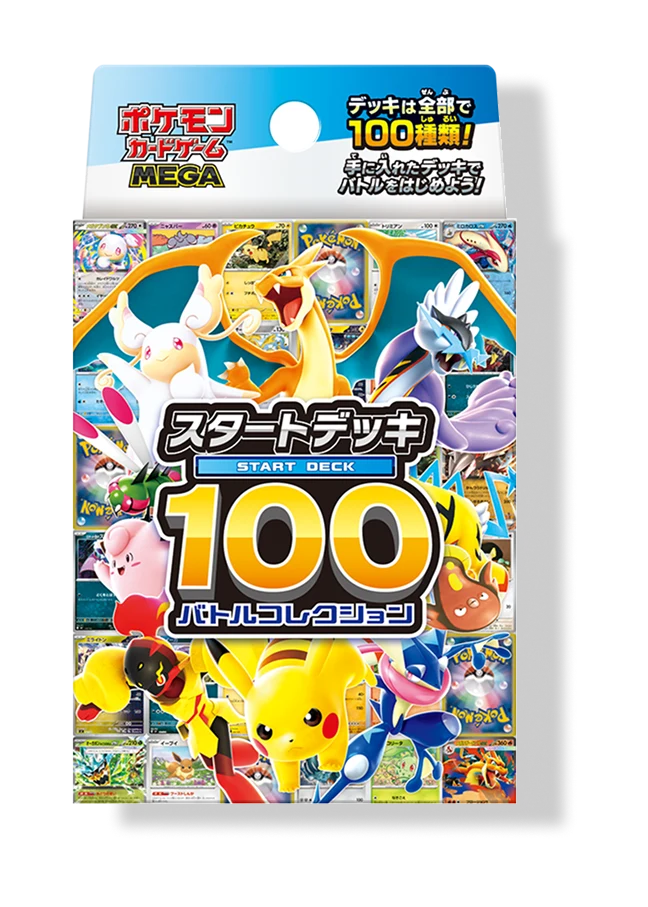
MEGA Start Deck 100 Battle Collection product listing photo
Our own product listing photo for the MEGA Start Deck 100 Battle Collection — the same photo appears on both the regular and White Box listings.

A separate, related product — “Start Deck 100 Battle Collection CoroCiao Version” (Deck No. 000) — released simultaneously in Japan as a magazine tie-in. It is a distinct SKU from the standard product and is not covered by the two listings compared in this guide.

We don’t have a verified breakdown of what’s inside any individual numbered deck — card counts, energy split, or the exact 60-card list — so this guide sticks to what’s confirmed: the release timeline, the size of the deck pool, and our own two prices.

The Regular Listing: One Random Deck for ¥1,200

The regular MEGA Start Deck 100 Battle Collection listing is currently priced at ¥1,200 (~$8). Buying it draws one deck at random from the full 102-deck pool — the same pool that includes the gold Mega Charizard Y ex variant. Nothing about the packaging or listing tells you in advance which of the 102 decks you’ll receive.

This is the standard way most collectors will experience the product: a low-cost entry into a large, unsorted pool of decks, with the gold chase variant sitting somewhere in the mix alongside 101 other outcomes.

The White Box Listing: What We Know and What We Don’t

The White Box listing is priced at ¥50,000 (~$314). It’s important to be precise about what that name does and doesn’t mean.

“White Box” is not a term used by Bulbapedia or found on Limitless TCG for this product, and no official Pokemon Company documentation describing a “white box” variant or tier could be verified. Our two listings — regular and White Box — are priced 41.7x apart, which may reflect a reseller or collector-market distinction, such as a specially selected or marked outer box. The official product page does not list it as a product tier, and we are not stating what it guarantees, what’s inside it, or why it is priced the way it is beyond that being our current listing price.

Read This Before Buying Either Listing

No odds or pull-rate figures for the gold Mega Charizard Y ex deck have been published for this product, and neither listing is confirmed or guaranteed to contain that deck. Both are described here strictly as what they are: our own listings, at our own current prices.

What is factual and checkable: both the regular and White Box product pages currently use the identical product photo — the same image file appears on both listings. That’s worth noting as an observation, but it isn’t evidence for or against any claim about what’s inside either box.

The 41.7x Price Gap, Read Correctly

¥50,000 divided by ¥1,200 works out to a 41.7x gap between the two listings — the number that frames this whole comparison. Here’s the same information side by side:

Regular White Box
Prezzo ¥1,200 (~$8) ¥50,000 (~$314)
What you get One random deck from the 102-deck pool Not specified by the listing — contents beyond the regular product’s 102-deck pool are unconfirmed
Official product tier? Standard product Not listed on the official product page — our own listing name
Contents guaranteed? No No
Product photo Same image as White Box listing Same image as regular listing

Laid out this way, the gap is a pricing fact we can fully source — both numbers come from our own live product pages — but the reason for the gap is not something we can verify or explain beyond that. Anyone comparing the two should treat the 41.7x figure as exactly what it is: a ratio between two listing prices, not a stated multiple on expected value.

Where This Sits in the Mega Evolution Era

The Start Deck 100 Battle Collection’s December 19, 2025 release places it inside the current Mega Evolution (“M-series”) stretch of Japanese releases, landing between the M2a MEGA Dream ex expansion (November 28, 2025) and M3 Nihil Zero (January 23, 2026). It’s a tie-in product built around the same Mega-era cast rather than a numbered main-series expansion.

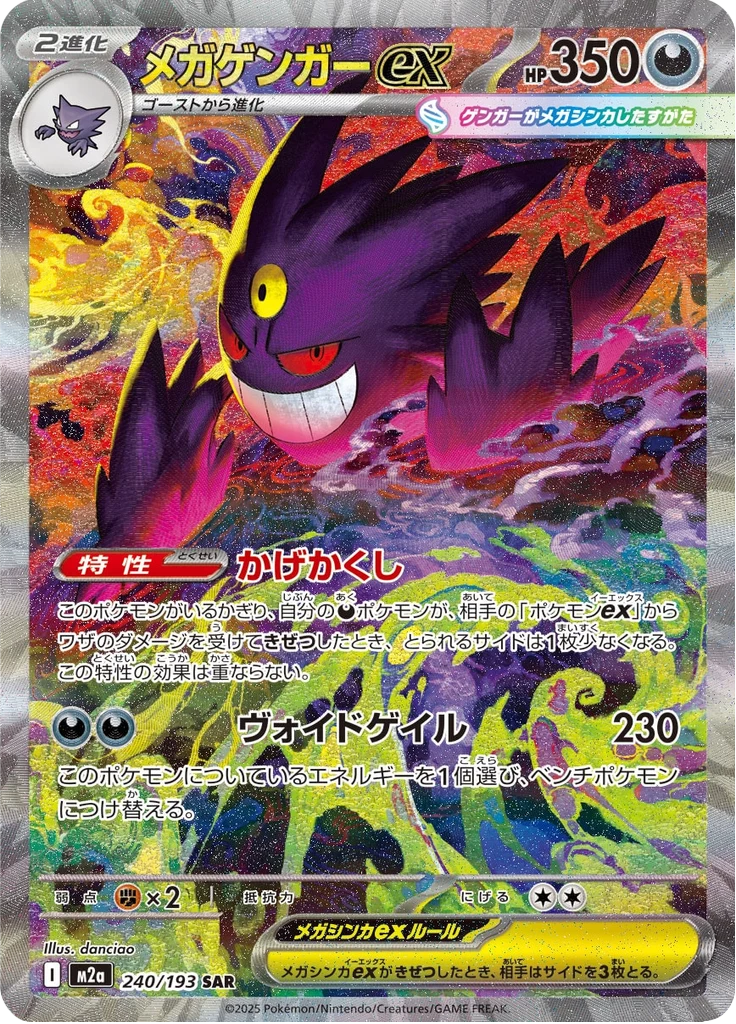
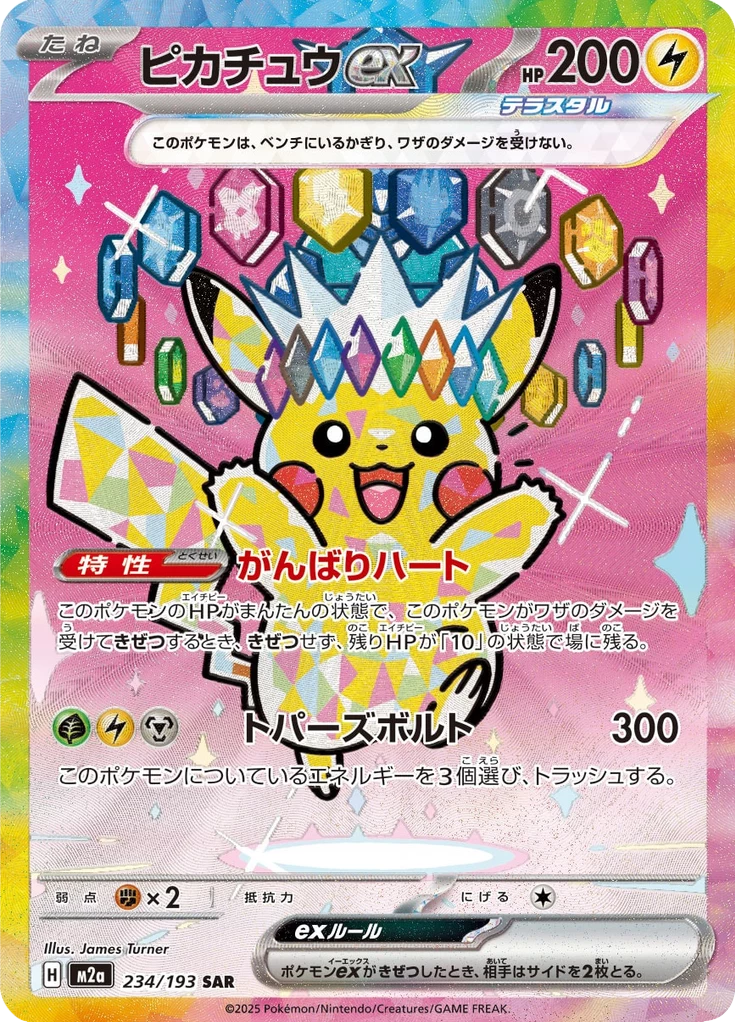
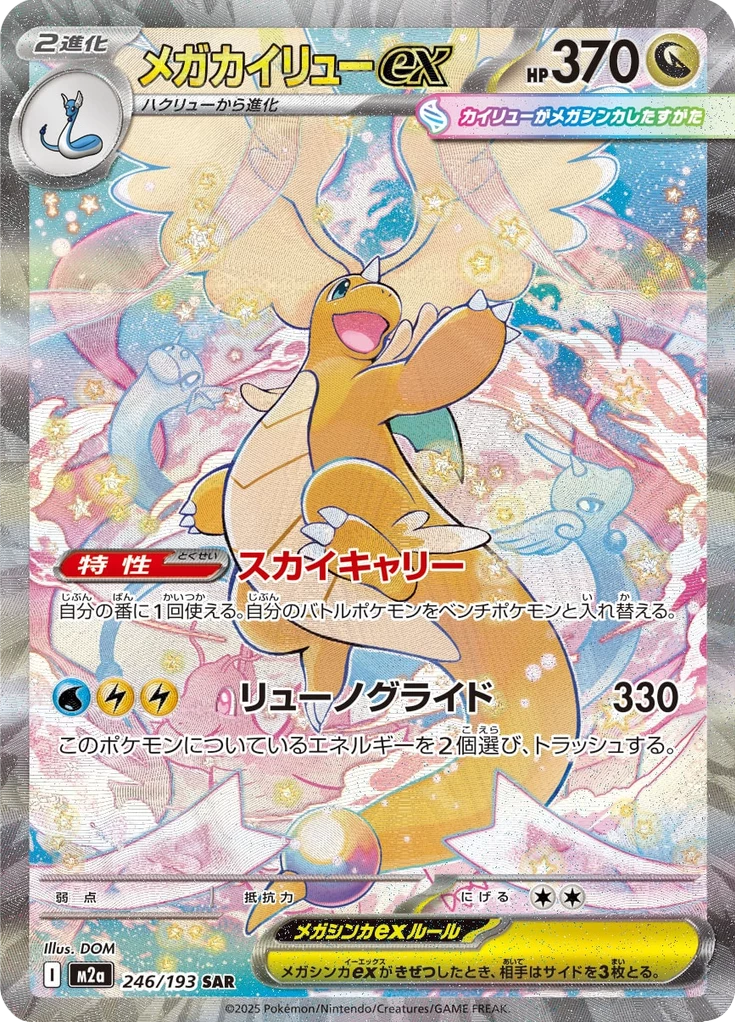
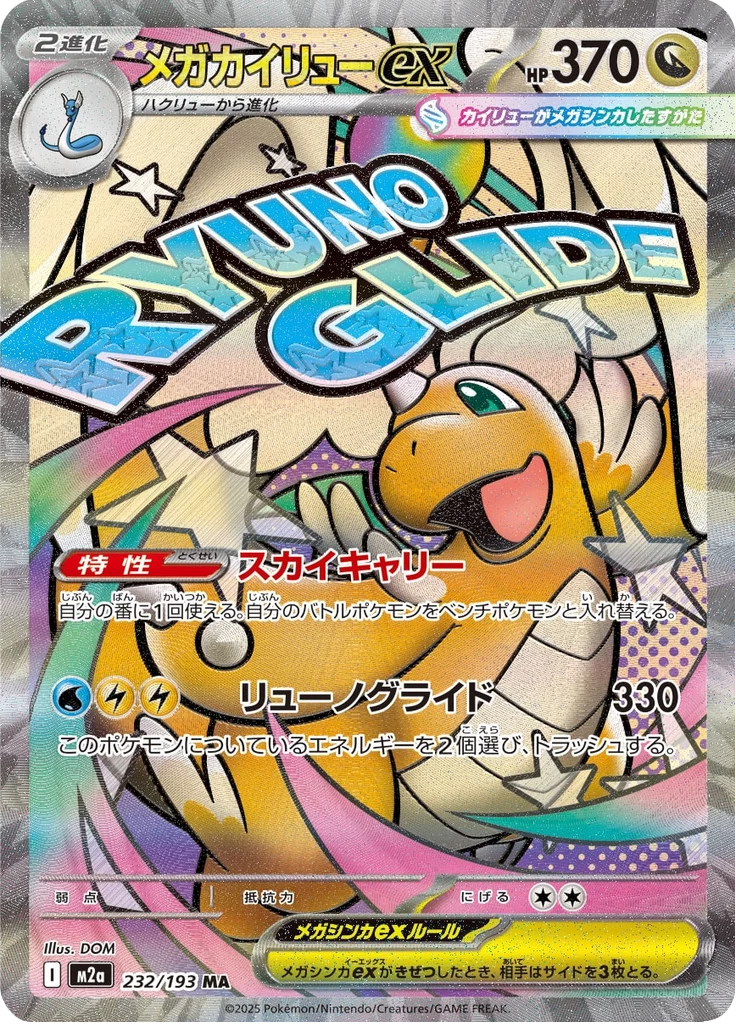
The card art below is from M2a — illustrative of the Mega Evolution era this product belongs to, not confirmed contents of any specific Start Deck 100 deck.

Mega Gengar ex, M2a #240
Mega Gengar ex, M2a #240 — illustrative Mega Evolution-era card art, not confirmed contents of this Start Deck 100 product.
Pikachu ex, M2a #234
Pikachu ex, M2a #234 — illustrative Mega Evolution-era card art, not confirmed contents of this Start Deck 100 product.
Mega Dragonite ex, M2a #246
Mega Dragonite ex, M2a #246 — illustrative Mega Evolution-era card art, not confirmed contents of this Start Deck 100 product.
Mega Kairyu ex alt print, M2a #232
Mega Kairyu (Dragonite) ex alt print, M2a #232 — illustrative Mega Evolution-era card art, not confirmed contents of this Start Deck 100 product.

For a wider view of what’s come out during this stretch, see our Mega Evolution era sets in order guide and our Mega Charizard cards value guide — useful context for the chase variant riding along inside this deck pool.

Which Listing Fits Your Approach

Because neither listing carries a published odds figure or contents guarantee, this isn’t a value calculation we can make for you — it’s a question of how much randomness and how much spend you’re comfortable with.

  • Lowest entry point: the regular listing at ¥1,200 (~$8) puts you into the same 102-deck pool at the lowest possible cost per attempt.
  • Higher spend, same pool, per our listing: the White Box listing at ¥50,000 (~$314) is priced well above the regular listing. As covered above, we cannot state what that premium is based on beyond our own current pricing.
  • Either way: treat this as a blind-deck product first. If getting a specific deck matters to you, there is currently no verified way to guarantee that outcome through either listing.
Shop This Listing
MEGA Start Deck 100 Battle Collection – White Box (Japanese)
Currently listed at ¥50,000 (~$314)
Ships from Tokyo · Tracked delivery

View Product →

For broader budget context across the current Mega Evolution lineup, our budget Mega ex cards guide and Mega Evolution chase card guide cover lower-cost ways to build toward the same cast of cards.

Where to Buy the MEGA Start Deck 100 Battle Collection

We ship Japanese sealed product worldwide out of Tokyo with tracked delivery. Both listings covered in this guide are currently on our site:

For a broader look at the full product line and related decks, start with our Start Deck 100 Battle Collection guide. For anything not listed individually, our Quick Order page is the fastest way to build a mixed order alongside these decks.

Domande frequenti

What is the MEGA Start Deck 100 Battle Collection?

A Japanese blind-deck product released December 19, 2025 (Traditional Chinese release January 9, 2026; Korean release February 13, 2026). Each unit is one random deck from a pool of 102 possible decks — 100 standard numbered decks, one secret deck, and one gold-etched Mega Charizard Y ex variant — covering 742 unique cards in total.

Is the “White Box” an official Pokemon Company product tier?

Not confirmed. “White Box” is not a term found on Bulbapedia or Limitless TCG for this product. It is the name of our own listing, priced separately from the regular listing, and it should not be read as an official tier, guarantee, or stated contents distinction.

What is the price difference between the regular and White Box listings?

The regular listing is currently ¥1,200 (~$8) and the White Box listing is ¥50,000 (~$314) — a 41.7x gap between the two.

Does buying the White Box guarantee the gold Mega Charizard Y ex deck?

No. No odds or contents guarantee has been published for either listing, and it isn’t confirmed whether the White Box draws from the same 102-deck pool as the regular listing or something different.

When was the Start Deck 100 Battle Collection released?

December 19, 2025 in Japan, followed by a Traditional Chinese release on January 9, 2026 and a Korean release on February 13, 2026. A related magazine tie-in product, the CoroCiao Version (Deck No. 000), released in Japan at the same time as a separate SKU.

Pikachu 054/049 CHR: guida alla carta Dream League

The number on this card doesn’t add up — and that’s exactly the point.

Dream League (SM11b) is a 49-card Japanese subset. Pikachu 054/049 is numbered five higher than the set’s own total. That isn’t a printing error; it’s the standard convention Japanese TCG sets use to flag a bonus-style parallel print, and it’s the reason this particular Pikachu carries the “CHR” — Character Rare — label instead of sitting alongside the regular common print at 016/049.

This guide identifies exactly what the Pikachu 054/049 CHR is, how it differs from the standard Dream League Pikachu, who illustrated it, and where the card number convention comes from. We ship Japanese singles and sealed product out of Tokyo, including a PSA 10 copy of this exact card, so the sourcing details here come from stock we’ve actually handled.

Key Takeaway

Pikachu 054/049 is a CHR (Character Rare) print from Dream League (SM11b), released August 2, 2019 — a 70 HP Basic Lightning-type illustrated by Hitoshi Ariga. Its card number sits above the set’s printed total of 49, the same pattern used for other bonus-style parallel prints in this generation. Our own PSA 10 copy is currently listed at ¥73,700 (~$464).

70
HP

CHR
Rarity Class

49
Main Set Size

2019
Release Year

Exchange rate for USD conversions in this guide: ¥159/USD (September 2026).

What Is the Pikachu 054/049 CHR?

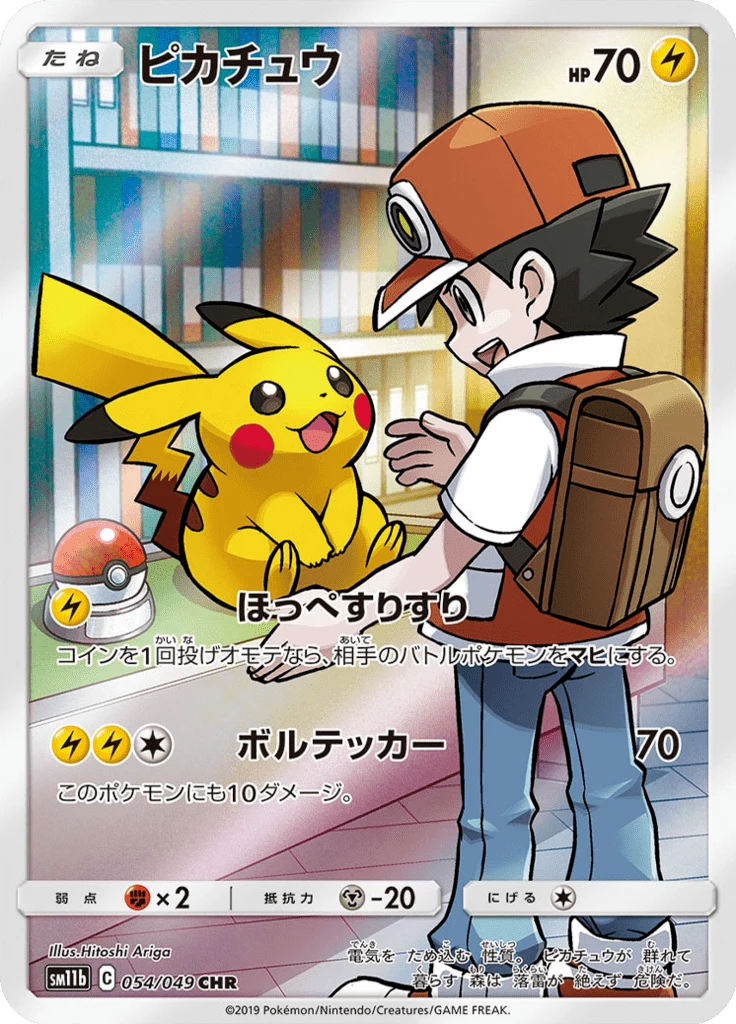
Pikachu 054/049 is a Basic Lightning-type with 70 HP, a Fighting-type weakness, and Metal resistance. It carries two attacks: “ほっべすりすり” (Cheek Rub) and “ボルテッカー” (Volt Tackle). The card was released as part of Dream League, the 18th Japanese subset of the Sun & Moon Era, on August 2, 2019.

Pikachu 054/049 CHR Dream League Japanese Pokemon card
Pikachu 054/049, CHR — Dream League (SM11b)

The “CHR” rarity label and the “054/049” card number are independently corroborated across two separate card databases — one of the more reliable ways to confirm you’re looking at the correct print when a card number doesn’t match the set’s printed total.

The Dream League Set and Where This Card Sits

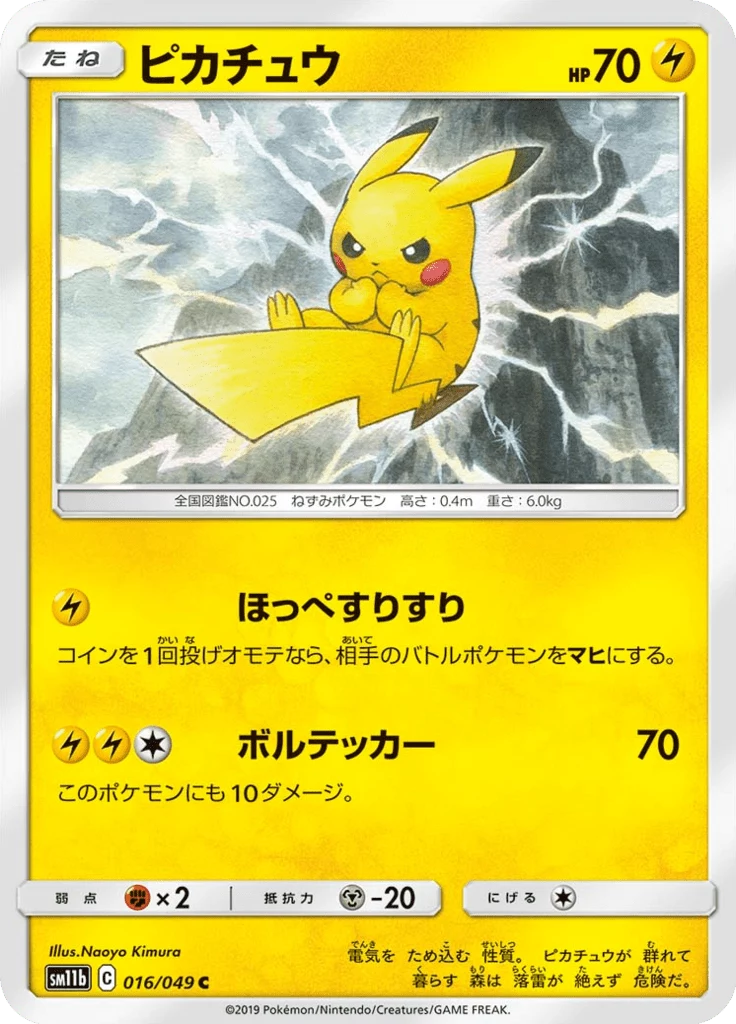
Dream League (SM11b) has a main set total of 49 cards. A regular, common-rarity Pikachu already exists in that main run at 016/049 — its English-language equivalent is Cosmic Eclipse 66/236, for anyone cross-referencing Western checklists.

Our card, at 054/049, numerically exceeds that 49-card total. In Japanese TCG numbering, a card sitting above the printed set total is the standard convention for a bonus or secret-style parallel print — the same pattern used across other CHR and secret-rarity cards from this generation. It’s not a second “regular” Pikachu; it’s a separate, higher-rarity insert built around the same character.

Quick Way to Check

If the number printed on your card is higher than the set’s stated total, you’re almost certainly holding a bonus-tier parallel rather than a base-set common — check the rarity mark in the corner to confirm.

What Makes a CHR Card Different from a Regular Print

“CHR” stands for Character Rare, a Japanese-exclusive rarity tier introduced during the Sun & Moon Era that reworks a specific Pokemon into fuller, more detailed artwork than its standard counterpart in the same set. Our 054/049 print carries that CHR designation, and it’s listed under the identical “054/049 CHR” description on a second retailer’s card database, independent of the primary reference source — useful confirmation if you’re trying to verify a copy against multiple listings before buying.

One thing we can’t confirm: the exact print run size or how CHR-tier cards like this one were originally distributed within Dream League packs. Neither of our reference sources documents a distribution method for this specific print, so we’re not going to invent a scarcity story here — treat any claim about print numbers or pull odds for this card as unverified until a primary source publishes one.

For more on how this rarity tier compares to others in the Japanese TCG, see our CHR Character Rare Cards collector’s guide.

How to Tell It Apart from the Regular 016/049

Because both cards share the same character and set, the card number in the bottom corner is the fastest way to confirm which one you’re holding.

Pikachu 054/049 CHR Dream League Japanese Pokemon card

Pikachu 054/049 — CHR

Pikachu 016/049 C Dream League Japanese Pokemon card

Pikachu 016/049 — Regular (C)

The 016/049 copy is the standard common-rarity Pikachu that fills out the main 49-card run. The 054/049 CHR reworks the same character with the fuller Character Rare treatment and sits outside that main numbering entirely. If your card’s number is at or below 049, you’re holding the regular print; if it reads 054/049, it’s the CHR.

The Artist Behind the Card

Pikachu 054/049 CHR was illustrated by Hitoshi Ariga, an artist credited on more than 140 Pokemon cards across the franchise’s history. Ariga’s illustration work spans multiple Japanese subsets from this era, and this Dream League CHR print is one of his contributions to the set.

Other Pikachu Prints from the Same Era

Pikachu is one of the most frequently reprinted characters in the Japanese TCG, and the years around Dream League produced several other promotional versions worth knowing about if you’re building out a Pikachu collection rather than chasing one specific card.

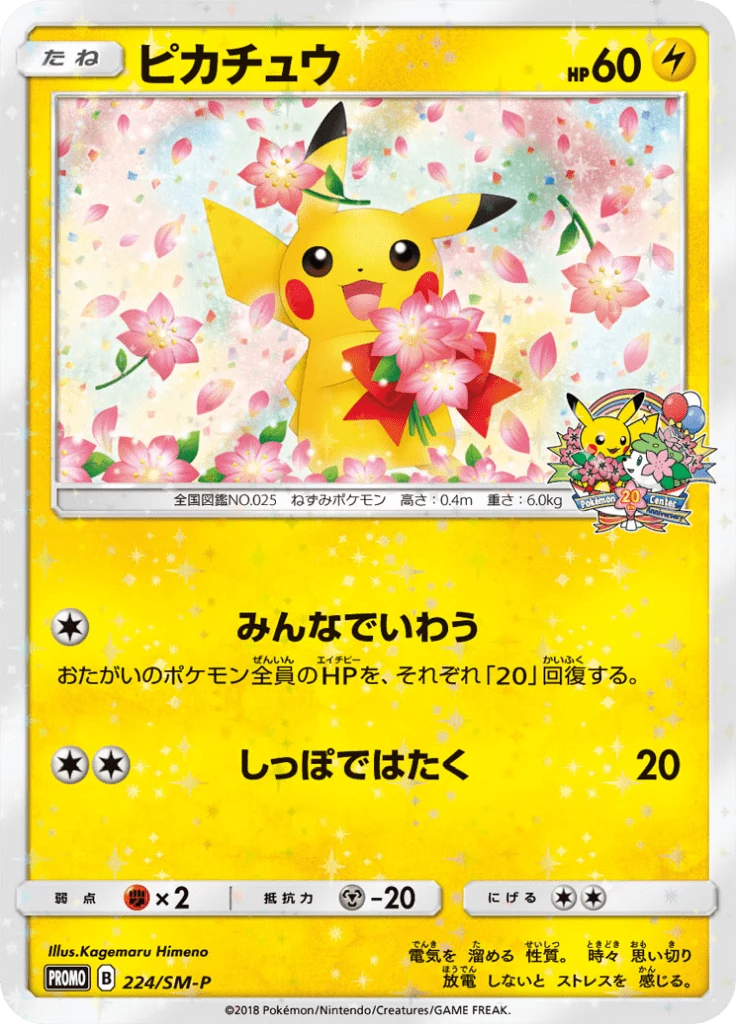
Pikachu 224 SM-P Promotional Japanese Pokemon card

Pikachu — SM-P Promotional #224

Pikachu 1 SV-P Promotional Japanese Pokemon card

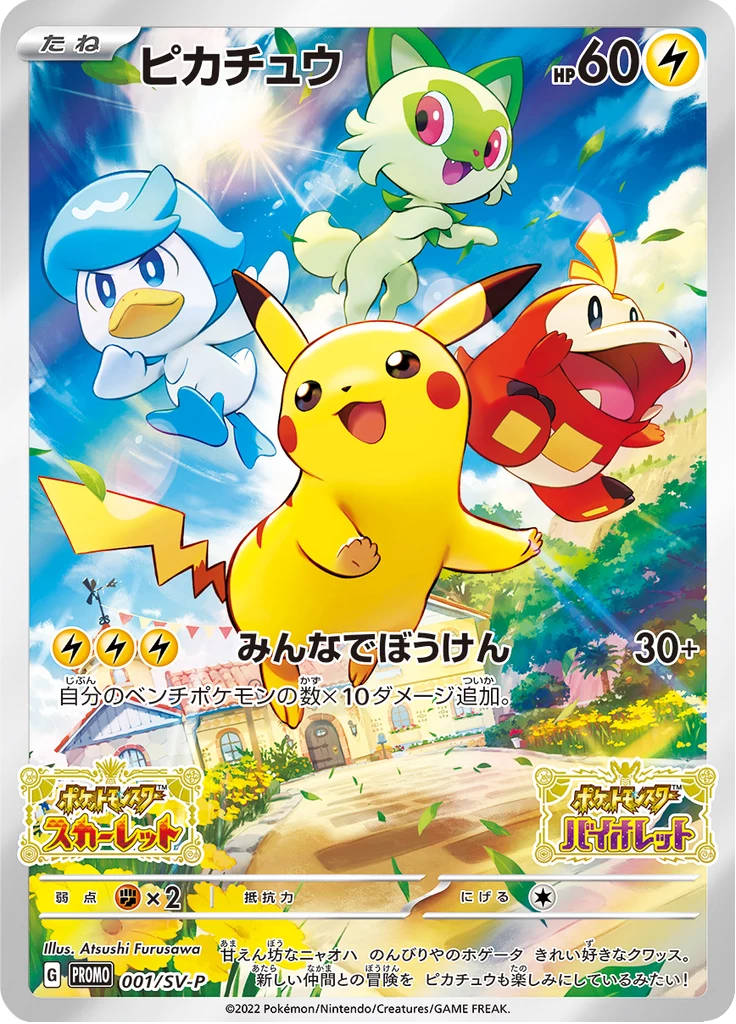
Pikachu — SV-P Promotional #1

These sit in separate promo lines from Dream League and from each other, and we haven’t collected price data on either for this guide — they’re included here purely as reference points for how often Pikachu recurs across Japanese promo cycles. If you’re comparing Pikachu chases more broadly, our Best Pikachu Cards in Japanese Pokemon TCG guide and Top 10 Pikachu Japanese Cards round-up cover the wider field, and our Pikachu VMAX Cards value guide covers the VMAX side of the character’s catalogue.

Our PSA 10 Copy and Why Grading Matters

A PSA 10 graded copy of the Pikachu 054/049 CHR is listed at ¥73,700 (~$464). We don’t have competitor pricing data to compare it against, so we’re presenting our own listing as a single reference point rather than a market-wide valuation.

Grading matters more for CHR-tier cards than it might look at first glance: the fuller character-focused artwork on this rarity tier tends to run edge-to-edge or close to it, which makes centring and edge wear more visible than on a simpler common-rarity frame. A PSA 10 designation confirms the copy has been independently assessed against that standard rather than taken on the seller’s word. For a broader look at how grading affects Pikachu cards specifically, see our PSA 10 Pikachu Japanese Cards buying guide.

Where to Buy the Pikachu 054/049 CHR

We ship Japanese singles and sealed product worldwide from Tokyo with tracked delivery. Our PSA 10 copy of this card is the direct route if you want a graded, verified example rather than sourcing raw.

Shop This Card
PSA 10 Pikachu 054/049 CHR
Currently listed at ¥73,700 (~$464)
Ships from Tokyo · Tracked delivery

View Product →

If this exact copy has already sold or you’re after a different grade or condition, our Quick Order page is the fastest way to send us a request and get sourcing options directly.

Domande frequenti

What is Pikachu 054/049 CHR from Dream League?

It’s a Character Rare (CHR) print of Pikachu from the Japanese Dream League (SM11b) set, released August 2, 2019. It’s a 70 HP Basic Lightning-type illustrated by Hitoshi Ariga, distinct from the regular common Pikachu at 016/049 in the same set.

Why does the card number 054/049 exceed the set’s total of 49 cards?

A card number above a set’s printed total is the standard Japanese-TCG convention for a bonus or secret-style parallel print — the same pattern used for other CHR and secret-rarity cards from this generation, rather than an error.

Who illustrated Pikachu 054/049 CHR?

Hitoshi Ariga, an artist credited on more than 140 Pokemon cards across the franchise.

How is Pikachu 054/049 CHR different from Pikachu 016/049?

016/049 is the regular, common-rarity Pikachu in Dream League’s main 49-card run. 054/049 is the Character Rare (CHR) version of the same character, numbered outside that main set and built around fuller artwork.

Where can I buy a PSA 10 graded copy of this card?

We currently list a PSA 10 graded copy at ¥73,700 (about $464), shipped from Tokyo with tracked delivery. If that copy is unavailable, requests can be submitted through our Quick Order page.

Random PSA10 “1 Card” Mystery Box: vale la pena rischiare ¥6,300?

¥6,300 gets you one card. Which card, nobody can tell you in advance — not us, not the listing, not anyone.

The Random PSA10 – 1 Card product on samuraiswordtokyo.com is exactly what the name says: a single, already-graded PSA 10 card, chosen at random, for a flat price. No card list. No published odds. No stated minimum value. That makes it either an interesting way to try graded cards cheaply, or a bad way to spend ¥6,300, depending entirely on information nobody is publishing — including us.

This guide sticks to what is actually verifiable: the price, what the product does and doesn’t tell you, and where that price sits next to individually listed Japanese PSA10 cards we sell separately. We are not going to invent odds, a minimum value, or an expected-value calculation, because none of that data exists in any form we can check.

Key Takeaways

The Random PSA10 – 1 Card product is currently listed at ¥6,300 (~$40 at ¥159/USD, September 2026). It is one randomly selected, PSA 10–graded card — no odds, card pool, or minimum guaranteed value are published anywhere. Separately, our cheapest individually listed PSA10 Japanese cards start around ¥6,800, where you know exactly which card you’re buying before you pay.

¥6,300
Listed Price

~$40
USD at ¥159/USD

1
Card, Randomly Selected

0
Odds Published

Prices are as listed on samuraiswordtokyo.com as of September 1, 2026, converted at ¥159/USD. Live prices can move after publish date — check the product page for the current figure.

What the Random PSA10 Product Actually Is

The listing is titled Random PSA10 – 1 Card, and the product itself is one unit: a single trading card that has already been graded PSA 10 by PSA, selected at random rather than chosen by the buyer. You don’t pick a franchise, a set, or a card — you pay the listed price and receive whatever card is allocated. If you’re new to what a PSA 10 grade actually signifies, our guide to what PSA 10 means on a Pokemon card covers the grading side separately from this product.

That’s the entire product description we can verify. There is no accompanying list of which cards are eligible to be pulled, no breakdown by franchise or set, and no card gallery tied to this specific listing. Anything beyond “one random PSA10 card for a fixed price” would be us guessing, so we’re not going to do that.

Price: ¥6,300 (~$40)

The Random PSA10 – 1 Card product is currently listed at ¥6,300 (~$40 at ¥159/USD, September 2026). It’s a single price point — there’s no tiered version of this product (no “premium” random box at a higher price, no bulk discount for ordering more than one) in our current catalogue.

That price buys you a PSA 10–graded card and nothing else — no choice of card, no visibility into what’s being selected from, and no stated floor on what the card might be worth. Whether that’s a reasonable price depends entirely on information the listing doesn’t provide, which brings us to the actual problem with evaluating this product.

What We Don’t Know — And Why It Matters

Here is the honest gap in this product, stated plainly: we do not know, and cannot find published anywhere, any of the following about the Random PSA10 – 1 Card listing:

  • The odds of receiving any specific card, franchise, set, or rarity tier.
  • The composition of the pool the card is drawn from — how many distinct cards, what range of grades beyond “PSA 10,” or which franchises are included.
  • A minimum guaranteed value for the card you receive.
Why We’re Not Calculating “Expected Value”

An expected-value calculation for a random product needs two inputs: the range of possible outcomes, and the odds of each one. Neither is published for this listing. Any number you see elsewhere claiming to tell you the “average value” of this specific product is not something we can verify, and we’re not going to manufacture one here.

This isn’t a criticism unique to this listing — blind and randomised card products across the hobby generally don’t publish pull rates. It just means the honest answer to “is it worth it” is that nobody outside the person building the pool actually knows, and that includes us.

What Individually Listed Japanese PSA10 Promos Look Like

To be clear before this section: none of the cards shown below are connected to the Random PSA10 – 1 Card product. We have no data linking any specific card to that listing’s pool. These are simply examples of Japanese PSA10 promo cards from our own catalogue, shown here so you can see what an individually graded, individually listed Japanese card looks like in hand — the kind of thing you’d be choosing directly if you bought a named card instead of a random one.

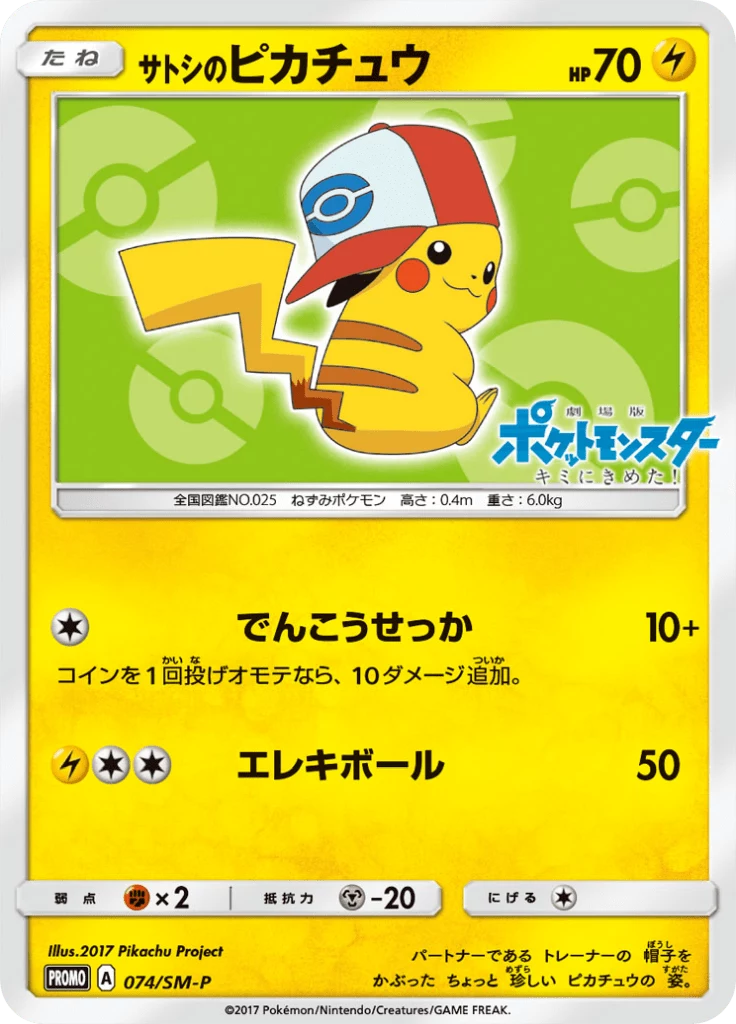
Ash's Pikachu SM-P 074 Japanese promo card

Ash’s Pikachu, SM-P 074 (Japanese promo)

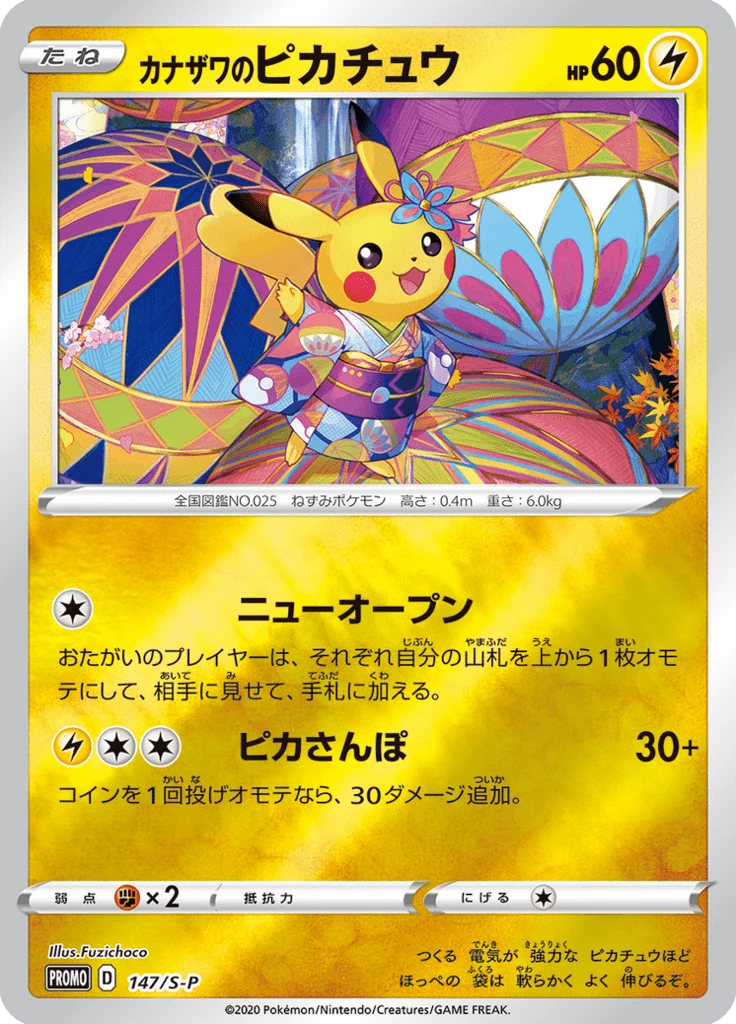
Kanazawa Pikachu No Mark S-P 147 Japanese promo card

Kanazawa Pikachu No Mark, S-P 147 (Japanese promo)

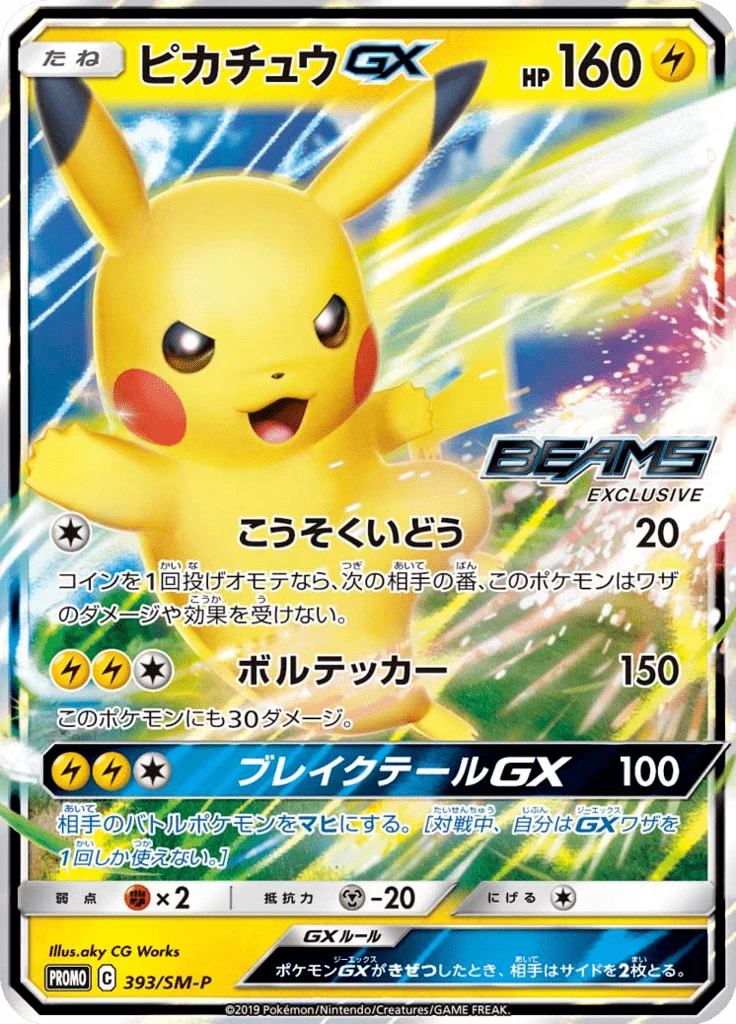
Pikachu GX SM-P 393 Japanese promo card

Pikachu GX, SM-P 393 (Japanese promo)

Flareon VMAX Summer S-P 186 Japanese promo card

Flareon VMAX Summer, S-P 186 (Japanese promo)

With a named card, what you see is what you get, before you pay — card, number, rarity, set, all fixed. That certainty is the trade-off you give up with a random product, in exchange for a lower entry price and the novelty of not knowing.

Where ¥6,300 Sits Against Named PSA10 Cards

Separately from the Random PSA10 – 1 Card product, we also sell individually listed, individually graded PSA10 Japanese cards where the card is fixed and known before you buy. Our cheapest examples currently in that category price close to the random product’s ¥6,300, which gives a useful reference point — not a claim about what the random product might contain.

Prodotto Carta Prezzo
Random PSA10 – 1 Card Unknown — randomly selected ¥6,300 (~$40)
Individually listed PSA10 single Team Rocket’s Murkrow AR [SV10 106/098] ¥6,820 (~$43)
Individually listed PSA10 single Friends of Paldea SR [SV8a 195/187] ¥7,700 (~$48)

Read that table as a price comparison only. Separately, other individually listed PSA10 cards in our catalogue start around ¥6,800 — close to the random product’s ¥6,300 — but those two named cards are not possible outcomes of the Random PSA10 listing, and we have no evidence connecting the two products in any way. The difference is what you’re actually paying for: with the named cards above, the specific card is guaranteed before you check out; with the random product, only the grade (PSA 10) and the price are fixed. For a sense of what the top of the same PSA10 market looks like by contrast, see our roundup of the most expensive PSA 10 Pokemon cards we’ve listed.

Who This Product Actually Suits

Given what is and isn’t known, a few honest use cases stand out:

  • Buyers who want a low-cost way to own a graded card, full stop. ¥6,300 gets you a slabbed PSA 10 card of some kind, without needing to research or choose a specific one.
  • Collectors treating it as a novelty add-on to a larger order. As one item alongside sealed product or chosen singles, the unknown factor is a small, contained variable rather than the whole purchase.
  • Buyers who want certainty over cost. If knowing exactly which card you’ll receive matters more than the price, an individually listed PSA10 single — like the two named above — removes the unknown entirely, usually for a similar or only slightly higher price. Our broader PSA10-versus-raw comparison covers that trade-off in more general terms.

What it isn’t, based on the information available, is a calculable value play. Without published odds or a disclosed pool, there’s no way to state that the card you receive will be worth more, less, or the same as ¥6,300 — and we’re not going to frame it as either a bargain or a loss when the underlying numbers to make that call don’t exist publicly. If you’re buying PSA10 cards with resale or bulk sourcing in mind rather than as a one-off purchase, see our notes on Japanese graded cards for resellers and buying PSA10 cards in bulk from Japan — both are about named, chosen cards rather than random ones.

Where to Buy

The Random PSA10 – 1 Card product is currently listed at ¥6,300 (~$40) on samuraiswordtokyo.com, shipping from Tokyo.

Shop This Product
Random PSA10 – 1 Card
One randomly selected PSA10-graded card — currently ¥6,300 (~$40)
Ships from Tokyo · Tracked delivery

View Product →

If you’d rather choose your card outright, our individually listed PSA10 singles — including Team Rocket’s Murkrow AR at ¥6,820 (~$43) and Friends of Paldea SR at ¥7,700 (~$48) — sit in the same price range with the card fixed in advance. For a mixed order across either product type, our Quick Order page is the fastest way to build one out.

Domande frequenti

What exactly is the Random PSA10 – 1 Card product?

It’s a single trading card that has already been graded PSA 10, selected at random rather than chosen by the buyer. Samurai Sword Tokyo does not publish a list of which cards can appear, so the specific card you receive is unknown until it arrives.

How much does the Random PSA10 – 1 Card cost?

It is currently listed at ¥6,300, about $40 at ¥159/USD (September 2026 rates).

Are the odds of getting a specific card published anywhere?

No. There is no published data on the odds of any particular card, rarity, or value tier, and no minimum guaranteed value is stated for this product. Any expected-value claim would require that data, and it does not exist publicly.

Is a Random PSA10 card guaranteed to be worth more than ¥6,300?

There is no guarantee either way. Because the selection pool and odds are not published, it is not possible to state that the card received will be worth more, less, or the same as the ¥6,300 price.

How does ¥6,300 compare with buying an individually listed PSA10 card?

Separately, our individually listed PSA10 Japanese cards start around ¥6,800 for specific, chosen cards, such as Team Rocket’s Murkrow AR (SV10 106/098) at ¥6,820 and Friends of Paldea SR (SV8a 195/187) at ¥7,700. Those are fixed, known cards; the Random PSA10 product does not offer that certainty.

Confronto box SV2D Clay Burst vs SV2P Snow Hazard

Same release date. Same card count. Two different boxes.

SV2D Clay Burst and SV2P Snow Hazard hit the Japanese market on the same day back in April 2023, and together they make up the Japanese-language half of what English-language collectors know as Paldea Evolved. If you’re trying to work out which one to add to a Scarlet & Violet-era collection — or whether you need both — this guide lines up what’s actually verified about each set: release facts, one confirmed card from each, and the sealed box prices we currently list out of Tokyo.

Key Takeaways

SV2D Clay Burst and SV2P Snow Hazard both released in Japan on April 14, 2023, each with 99 cards, forming the Japanese basis for the English “Paldea Evolved” set. Both are listed on our site as sealed Japanese booster boxes: SV2D Clay Burst is currently listed at ¥11,270, and SV2P Snow Hazard at ¥12,250. We have not independently verified pull-rate figures or a mascot ex Pokémon for either set — see the dedicated pull-rate articles linked below for that detail.

2
Twin Sets Compared

99
Cards in Each Set

Apr 14, 2023
Japan Release Date

2nd
SV-Era Twin Pairing

Prices below are our current store listings as of September 2026, converted at ¥159/USD for reference.

SV2D vs SV2P at a Glance

SV2D Clay Burst and SV2P Snow Hazard are the second twin-set pairing of the Scarlet & Violet era in Japan, following the earlier SV1S/SV1V split. Both carry 99 cards, both released on the same day, and combined they form the Japanese card pool behind the English-language Paldea Evolved set.

Set Codice set Cards Release date Our listed price
Clay Burst SV2D 99 April 14, 2023 ¥11,270
Snow Hazard SV2P 99 April 14, 2023 ¥12,250

On paper the two sets are structurally identical — same card count, same release day, same era. The differences that matter for a buying decision come down to the individual cards each set contains and the price gap between the two sealed boxes, both covered below.

SV2D Clay Burst: What’s Inside

SV2D Clay Burst is a 99-card Japanese set released April 14, 2023. One verified card from the set is Flamigo, card SV2D 082/071, an Art Rare with 110 HP, Colorless type, illustrated by Shibuzoh.

Flamigo SV2D 082/071 Art Rare Japanese Pokemon card from Clay Burst
Flamigo, SV2D 082/071, Art Rare — SV2D Clay Burst

For the complete 99-card checklist, see our Clay Burst (SV2D) complete card list. We haven’t independently verified pull-rate figures for this set in this guide — our SV2D pull-rates and best-cards article covers that separately. A sealed SV2D Clay Burst booster box is currently listed at ¥11,270 (~$71) on our site, shipping from Tokyo.

SV2P Snow Hazard: What’s Inside

SV2P Snow Hazard is also a 99-card Japanese set, released the same day as SV2D — April 14, 2023. One verified card from this set is Rookidee (ココガラ), card SV2P 082/071, also an Art Rare, with 60 HP, Colorless type, illustrated by GOSSAN.

Rookidee SV2P 082/071 Art Rare Japanese Pokemon card from Snow Hazard
Rookidee, SV2P 082/071, Art Rare — SV2P Snow Hazard

Notice both sets land their Art Rare at card 82 of 99 — Flamigo for SV2D, Rookidee for SV2P. That’s a structural echo, not a coincidence unique to these two, and it’s the kind of detail worth checking if you’re trying to identify a loose card. Full spoilers for this set are in our Snow Hazard (SV2P) complete card list, and pull-rate specifics are in the SV2P pull-rates and best-cards article rather than repeated here. A sealed SV2P Snow Hazard booster box is currently listed at ¥12,250 (~$77).

Same Day, Same Era: How the Two Sets Connect

SV2D and SV2P aren’t a random pairing. They’re the second time the Scarlet & Violet era used the Japanese twin-set format — splitting one English-language set’s card pool across two simultaneous Japanese releases, the way SV1S and SV1V did before them. Combined, SV2D Clay Burst and SV2P Snow Hazard supply the Japanese card pool behind the English Paldea Evolved set.

The two sets also share a quieter structural detail: each one closes out its numbered checklist with a full-art Ultra Rare Basic Energy card at slot 99 of 99. SV2D ends on a Grass Energy; SV2P ends on a Water Energy. Neither is flashy compared to the Art Rares, but both are legitimate Ultra Rare slots and a useful marker if you’re trying to confirm you have a complete set.

Basic Grass Energy SV2D 099/071 Ultra Rare full-art Japanese Pokemon energy card
Basic Grass Energy, SV2D 099/071, Ultra Rare — SV2D Clay Burst
Basic Water Energy SV2P 099/071 Ultra Rare full-art Japanese Pokemon energy card
Basic Water Energy, SV2P 099/071, Ultra Rare — SV2P Snow Hazard

Price Comparison: Clay Burst vs Snow Hazard

Both boxes come from the same era and the same card count, but they don’t currently list at the same price. Here’s the direct comparison of our own current listings, shipping from Tokyo:

Box Currently listed at Approx. USD
SV2D Clay Burst ¥11,270 ~$71
SV2P Snow Hazard ¥12,250 ~$77

That’s roughly a ¥980 gap between the two sealed boxes. We haven’t verified packs-per-box or cards-per-pack counts for either set, so we can’t translate that gap into a per-pack or per-card comparison — treat it as a box-to-box price difference only.

On the Price Gap

A single listed price per box doesn’t tell you which set has moved more in the secondary market since 2023 — we don’t have independently verified secondary-market data for either set beyond our own current sealed-box listings. Treat the figures above as “currently listed at,” not as a historical price trend.

Which Box Should You Buy?

There’s no verified pull-rate or profitability data separating SV2D from SV2P, so this isn’t a case where one box is objectively the stronger buy. What we can say from the confirmed facts:

  • Set completeness. Because SV2D and SV2P together form the Japanese basis for Paldea Evolved, collectors chasing the full English-equivalent card pool typically want both rather than one or the other.
  • Budget. SV2D Clay Burst is currently the cheaper of the two sealed boxes at ¥11,270 versus ¥12,250 for SV2P Snow Hazard — a modest but real difference if you’re choosing just one.
  • Art preference. The one verified Art Rare from each set carries a different illustrator — Shibuzoh’s Flamigo for SV2D, GOSSAN’s Rookidee for SV2P. If a specific illustration style is the deciding factor, check the full checklists linked above before buying, since we’ve only independently verified one card per set here.

If pull rates matter to your decision, don’t rely on this guide for that — check the dedicated SV2D pull-rates article and SV2P pull-rates article for that specific data.

Where to Buy SV2D and SV2P from Japan

We ship sealed Japanese booster boxes worldwide from Tokyo with tracked delivery. Both SV2D Clay Burst and SV2P Snow Hazard are currently in our catalogue as sealed boxes.

Shop This Set
SV2D Clay Burst Japanese Pokemon Booster Box
Currently listed at ¥11,270
Ships from Tokyo · Tracked delivery

View Product →

Prefer Snow Hazard, or want both? The SV2P Snow Hazard booster box is listed separately at ¥12,250. For singles from either set or a mixed order across both, our Quick Order page is the fastest way to build a combined order.

Domande frequenti

What’s the difference between SV2D Clay Burst and SV2P Snow Hazard?

They’re the twin Japanese sets released on the same day, April 14, 2023, each with 99 cards. Together they form the Japanese basis for the English “Paldea Evolved” set. The verified Art Rares differ — Flamigo (SV2D 082/071, illustrated by Shibuzoh) versus Rookidee (SV2P 082/071, illustrated by GOSSAN) — and the two sealed boxes currently list at different prices.

When were SV2D and SV2P released?

Both released in Japan on April 14, 2023, on the same day.

How many cards are in each set?

99 cards each.

Which set has better pull rates?

We haven’t independently verified pull-rate figures for either set in this guide. See our dedicated SV2D and SV2P pull-rates articles for that specific data rather than treating anything here as a pull-rate claim.

Is there an English equivalent to SV2D and SV2P?

Yes — combined, the two Japanese sets correspond to the English-language “Paldea Evolved” set.

Charizard V SSR 307/190: la guida PSA 10 alla caccia dello Shiny Vault di Shiny Star V

Two Charizard cards can sit side by side in the same binder page, share the same artist credit, and still sell for very different prices — because one carries a card number from inside a set’s Shiny Vault sub-checklist, and the other doesn’t.

Charizard V, card number 307/190, is that first kind of card. It comes from the Shiny Vault inside Shiny Star V (S4a), the Japanese high-class pack Pokemon released on November 20, 2020, with 326 cards total. The “307” in its number sits well above the set’s 190-card base checklist — the tell that a print belongs to the Shiny Vault sub-set rather than the main set.

This guide covers what the card actually is, why you’ll see its rarity written two different ways, how Shiny Star V relates to the English-market Shining Fates release, and what our own PSA 10 copy is currently listed at.

Key Takeaway

Charizard V SSR (307/190) is a Shiny Vault print from Shiny Star V (S4a), Japan’s November 2020 high-class pack with 326 cards total. Limitless Card Database labels its rarity tier “Shiny Ultra Rare”; the shorthand overseas collectors commonly use for it is SSR. Our own PSA 10 copy is currently listed at ¥41,908 (~$264).

326
Cards in Shiny Star V

307/190
Card Number

2020
Japan Release Year

$264
Current Listing (Ours)

Prices are converted at ¥159/USD (September 2026). The only price referenced in this guide is our own current listing — no third-party auction or marketplace prices have been verified for this specific card.

What Is Charizard V SSR 307/190?

Charizard V SSR card number 307/190 Shiny Star V Japanese Pokemon card
リザードンV / Charizard V, card number 307/190, Shiny Star V (S4a) — artist 5ban Graphics

The Japanese name printed on the card is リザードンV (Charizard V). It was illustrated by 5ban Graphics and carries card number 307/190. The “/190” is the base-set checklist total for Shiny Star V, and any card numbered above that count belongs to the set’s Shiny Vault sub-checklist rather than the main 190-card set.

Shiny Star V (S4a) itself is a Japanese “Shiny Vault” high-class pack, released on November 20, 2020, with 326 cards total across the full set once the base checklist and Shiny Vault sub-set are combined.

If you’re chasing the modern Mega Evolution mechanic instead, that’s a different lineage entirely — our Mega Charizard X ex guide covers every printing from the Inferno X MUR down to vintage XY prints. This 307/190 card predates that mechanic and uses the Pokemon V system instead, with no Mega Evolution involved.

Inside Shiny Star V’s Shiny Vault

The Shiny Vault is the reason Shiny Star V remains one of the most talked-about Japanese sets from the Sword & Shield era. It’s the block of cards numbered above the 190-card base checklist, running up through the set’s overall total of 326, and it groups shiny-color reprints of that generation’s key Pokemon V and VMAX cards together in one dedicated chase section.

Charizard V at 307/190 sits inside that block, and it isn’t alone. Its own VMAX evolution appears in the same Shiny Vault, alongside other Pokemon V/VMAX shiny reprints from the set.

Charizard VMAX SSR card number 308/190 Shiny Star V

Charizard VMAX SSR — 308/190 — Shiny Star V (S4a)

Centiskorch V SSR card number 309/190 Shiny Star V

Centiskorch V SSR — 309/190 — Shiny Star V (S4a)

Shiny Star V card number 304/190 Shiny Vault

Shiny Vault card — 304/190 — Shiny Star V (S4a)

Reading the Card Number

Charizard VMAX at 308/190 evolves directly from Charizard V at 307/190, and both sit in the same Shiny Vault — a useful pairing if you’re building the evolution line rather than a single card.

For the full 326-card checklist, see our Top 10 Charizard Japanese Cards Ranked guide for how this print compares across eras — that article is a ranked roundup spanning multiple sets, while this one stays focused on the single 307/190 SSR print.

SSR, Shiny Super Rare, or Shiny Ultra Rare?

One thing that trips up buyers researching this card is the rarity label itself. Limitless Card Database, which catalogues the card at card number 307, lists the tier as “Shiny Ultra Rare.” Overseas collectors, however, commonly render the same Japanese-side rarity as “Shiny Super Rare,” abbreviated SSR — and that’s the label our own listing and roster use.

These aren’t two different cards or two different tiers — it’s one rarity slot with two names circulating in English-language collector shorthand. When you see “SSR 307/190” and “Shiny Ultra Rare 307/190” used for the same card, they refer to the identical print.

We haven’t verified exact pull odds for the Shiny Vault SSR slot in Shiny Star V, so we won’t state a number here. If pull-rate data is something you need for opening product from this set, treat any figure you find elsewhere as unconfirmed unless it cites a source.

Shiny Star V vs Shining Fates: Related, Not Identical

Shiny Star V card number 310/190 Shiny Vault Japanese Pokemon card
Another Shiny Vault card from the same 326-card Shiny Star V (S4a) set — card number 310/190

Shiny Star V (S4a) is the Japanese-side product. Its English-market counterpart is Shining Fates, which localised the same Shiny Vault concept under its own English-side rarity naming for shiny cards.

It’s important not to treat these as the same release, though. Shiny Star V and Shining Fates are separate market products with separate print runs, sold in different regions on different schedules. A Shiny Star V 307/190 and a Shining Fates equivalent are not interchangeable copies of one print — they’re parallel releases of the same design concept in two languages.

For more on how Japanese chase cards compare with their PSA 10 counterparts generally, our PSA 10 Charizard Japanese Cards buying guide covers the wider category; this article stays specific to the 307/190 SSR print rather than surveying the full Charizard PSA 10 market.

What This Card Is Worth Today

Detail Value
Card name リザードンV / Charizard V
Set Shiny Star V (S4a)
Card number 307/190
Rarity SSR (Shiny Ultra Rare)
Artist 5ban Graphics
Japan release date November 20, 2020
Our PSA 10 price ¥41,908 (~$264)

Our own PSA 10 graded copy is currently listed at ¥41,908 (~$264). We haven’t fetched or verified third-party auction or marketplace prices for this specific card, so this listing is the only price point we can state with confidence — treat any outside figure you encounter separately as unverified against our own data.

To see how this listing sits within our broader Charizard price range, our Most Expensive PSA 10 Japanese Pokemon Cards We Have Listed price ladder is a useful reference point.

Shop This Card
PSA10 Charizard V SSR 307/190 (Shiny Star V)
Currently listed at ¥41,908 (~$264)
Ships from Tokyo · Tracked delivery

View Product →

Where to Buy Charizard V SSR from Japan

We ship graded singles and sealed Japanese product worldwide from Tokyo with tracked delivery. Our PSA 10 copy of Charizard V SSR 307/190 is currently listed at ¥41,908 (~$264), and it’s the exact Shiny Star V print covered throughout this guide.

If you’re building out the same Shiny Vault set — the VMAX evolution, Centiskorch V, or other numbered entries — or looking for a different Charizard era such as the 30th Celebration reprint (137/103) or the 25th Anniversary promo (001/025), our Quick Order page is the fastest way to build a mixed order across singles and sealed product.

Domande frequenti

What is Charizard V SSR 307/190?

It’s the Charizard V print from the Shiny Vault sub-set of Shiny Star V (S4a), a Japanese high-class pack released November 20, 2020, with 326 cards total. Card number 307/190 places it above the set’s 190-card base checklist, and it was illustrated by 5ban Graphics.

Is “SSR” the official rarity name for this card?

Limitless Card Database labels the tier “Shiny Ultra Rare.” “SSR” (Shiny Super Rare) is the shorthand overseas collectors commonly use for the same Japanese-side rarity, and it’s the label our own listing uses — both refer to the identical print.

Is Shiny Star V the same as the English Shining Fates set?

No. Shiny Star V is the Japanese-side product; Shining Fates is its English-market counterpart with its own rarity naming for the Shiny Vault, but the two are separate releases with separate print runs.

What other cards share the Shiny Vault with Charizard V 307/190?

Charizard VMAX SSR (308/190) evolves directly from this Charizard V print and shares the same Shiny Vault, alongside cards such as Centiskorch V SSR (309/190) and other numbered entries running up through the set’s 326-card total.

How much is Charizard V SSR 307/190 worth?

Our own PSA 10 copy is currently listed at ¥41,908 (~$264). We haven’t verified third-party auction or marketplace prices for this specific card, so we don’t quote outside figures here.