Crea un account gratuito: accumula punti e livello
Samurai Sword Tokyo
Ordini Carrello

Guida alla carta Pokémon Bonsly: ogni stampa giapponese da conoscere
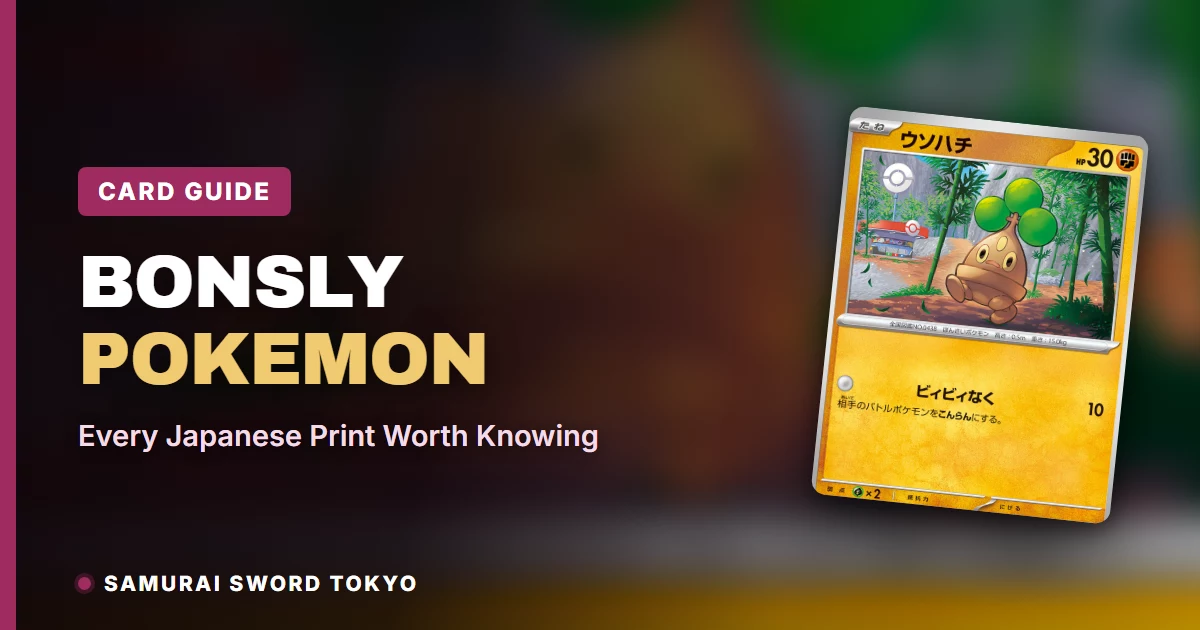
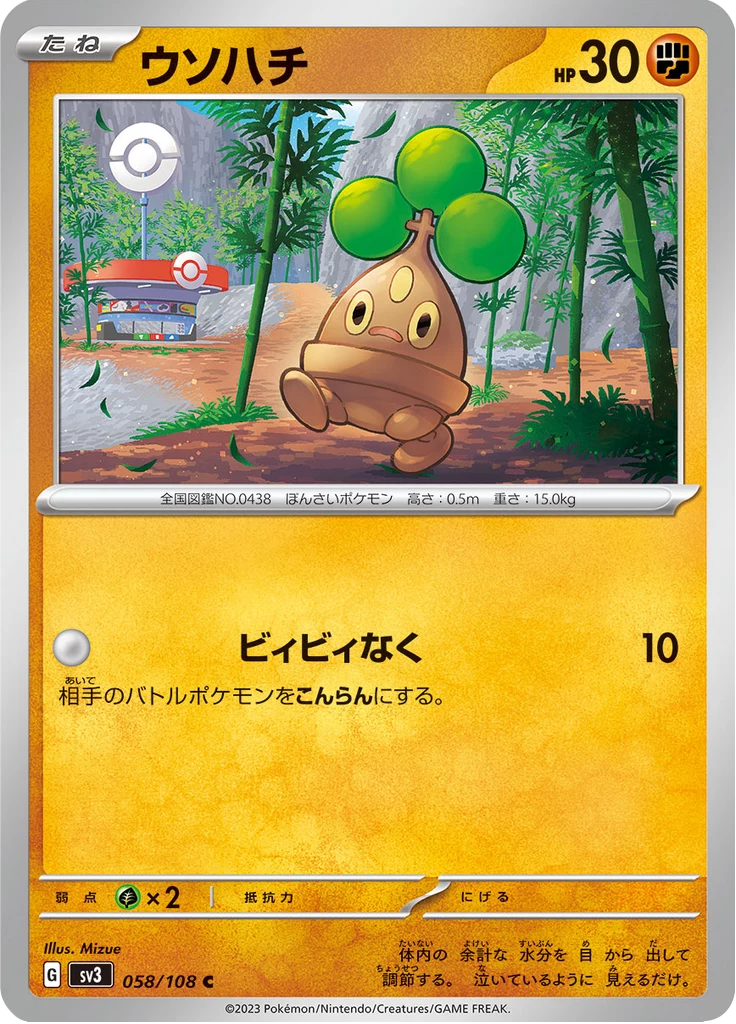
Bonsly — ウソハチ (Usohachi) in Japanese — is Sudowoodo’s Basic-stage pre-evolution, printed as a Fighting-type card even though the games place it in the Rock-type, baby-Pokemon family. Its Japanese card history is short: a Limitless database search filtered to Bonsly returns exactly one current-era print, and this guide covers that print in full — what set it’s from, what the card does, and which sealed Japanese boxes still carry a shot at pulling one.

This bonsly pokemon card guide walks through the confirmed print, the Expansion Pack it comes from, the same-set chase cards worth knowing, and the two Japanese boxes we currently list that contain that release. Bonsly doesn’t have a graded PSA 10 single listed on our site at the moment, so rather than pointing you at a single that doesn’t exist, this guide leads to the sealed product the print actually comes out of.

Key Takeaway

One Japanese Bonsly print is verified in this guide: card #058/108 from the Expansion Pack Ruler of the Black Flame (set code SV3), a Fighting-type Basic Pokemon illustrated by Mizue. We don’t currently have a graded Bonsly single listed — sourcing requests go through Quick Order. The SV3 Ruler of the Black Flame Booster Box that carries this print is currently listed at ¥17,160 (~$108), and the set’s headline chase card, the PSA 10 Charizard ex UR [SV3 139/108], is currently listed at ¥23,584 (~$148). Exchange rate used throughout: ¥159/USD (September 2026).

1
Print Verified

Low-tier
Rarity (unconfirmed)

1
Era Covered

Sep 2026
Prices Checked

Bonsly’s Verified Japanese Print

Bonsly 058/108, Ruler of the Black Flame
Bonsly 058/108, Ruler of the Black Flame (SV3)

The single Bonsly print we’ve verified this session is card #058 of the Expansion Pack Ruler of the Black Flame, set code SV3, illustrated by Mizue. It’s a Basic Pokemon with 30 HP, printed as Fighting-type despite Bonsly’s Rock-type classification in the core games. We haven’t independently reconfirmed a rarity label for this specific card beyond a low-tier inference from context, so treat it as printed at a low rarity tier typical of Basic Pokemon in this set rather than a confirmed “Common” designation.

Carta Set / Number Rarity Illustrator Release
Bonsly SV3 058/108 Low-tier (not independently reconfirmed) Mizue Not verified this session

No older or promo Bonsly print turned up in this session’s search, and no graded PSA 10 Bonsly single is currently on our site. If you’re after a graded copy, a sourcing request through Ordine rapido is the direct route — we don’t carry a fixed timeline for when or whether a specific graded single becomes available.

The Set It Comes From: Ruler of the Black Flame (SV3)
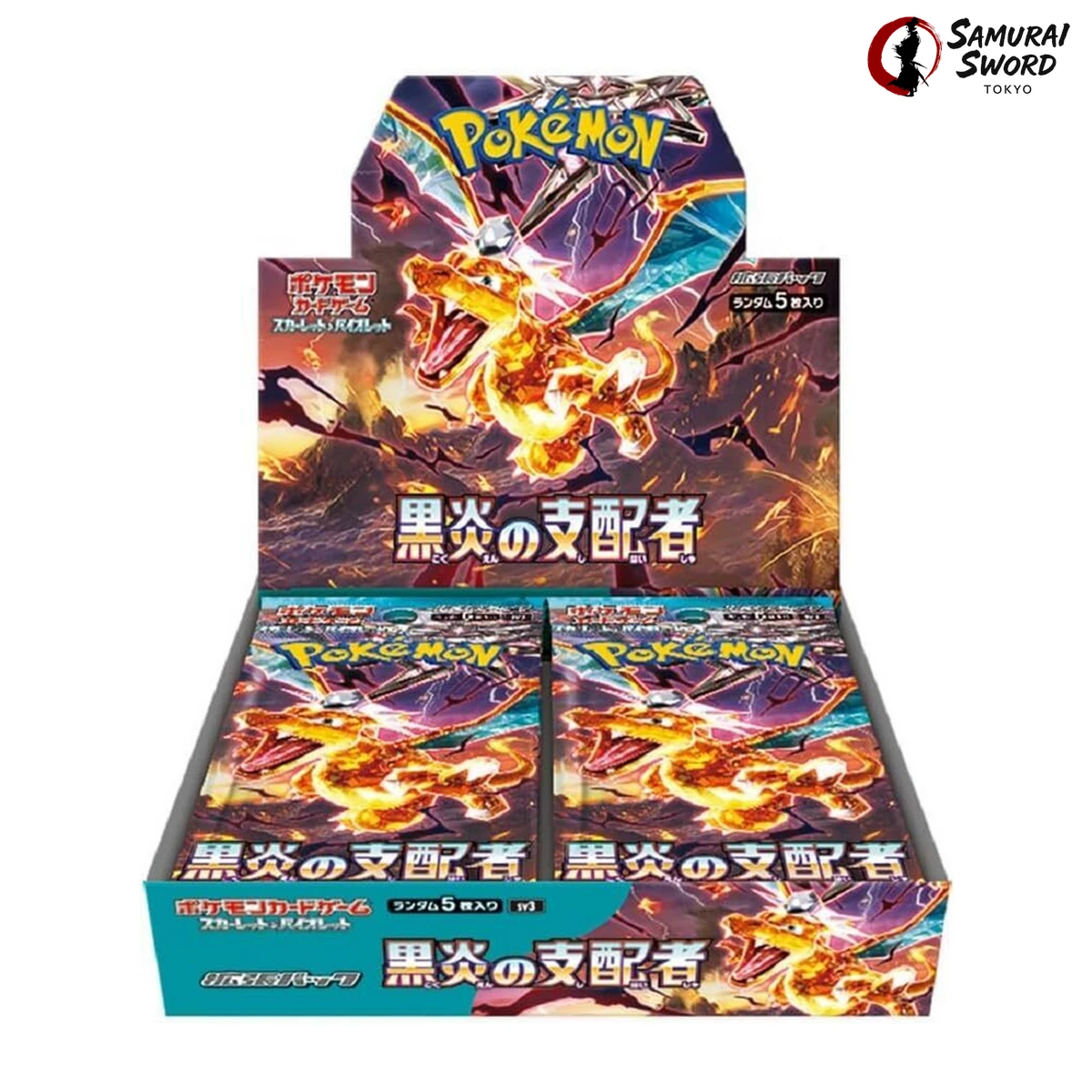
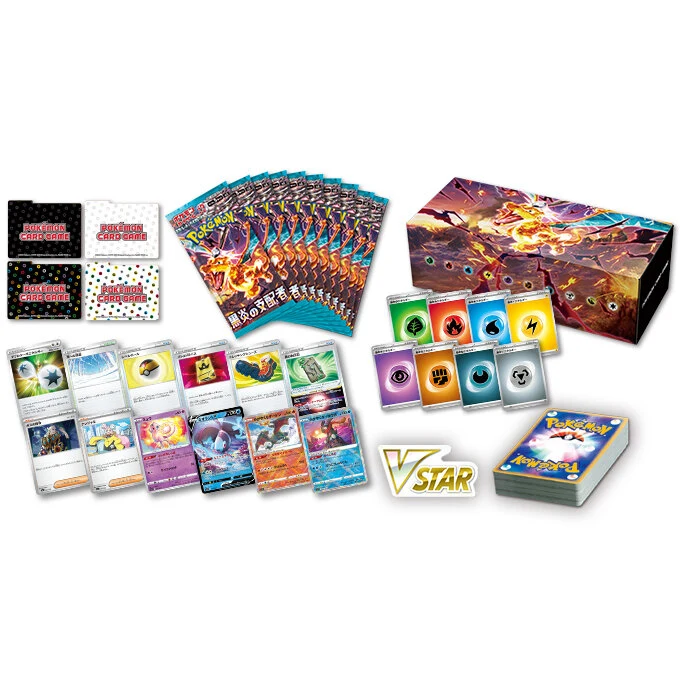
SV3 Ruler of the Black Flame Japanese Pokemon booster box
SV3-Ruler Of The Black Flame Japanese Pokemon Booster Box

The set carrying Bonsly’s confirmed print is Expansion Pack “Ruler of the Black Flame,” set code SV3. Limitless lists it under that English-translated title; we haven’t independently reconfirmed the official Japanese-language set name this session, so we’re using the translated title as displayed. The database also cross-references an English-set equivalent for this print: Obsidian Flames (OBF) #110, which puts a Bonsly collector working from either language’s checklist looking at the same underlying release.

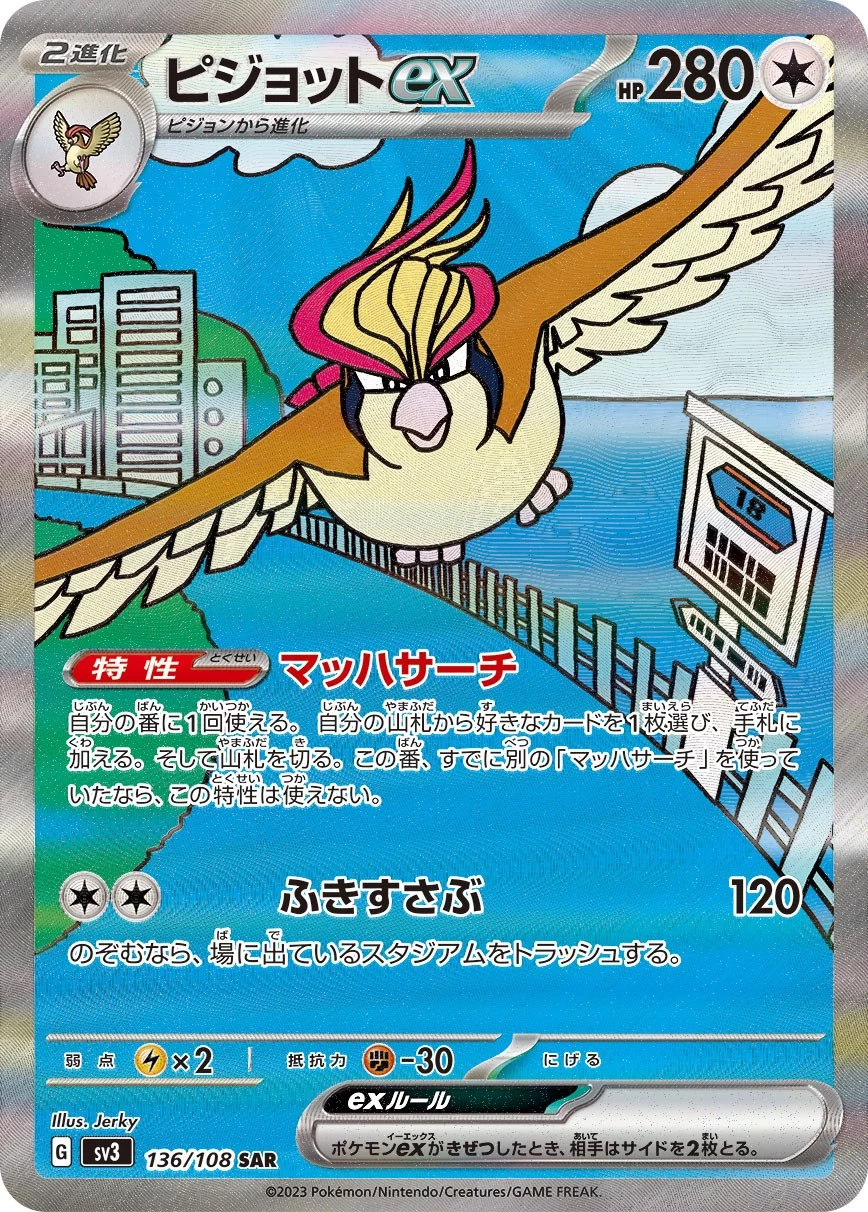
Cards in this set carry a /108 denominator — the same one printed on Bonsly’s own 058/108 — even where the numerator runs past that count for higher rarity slots. The set’s Charizard ex Ultra Rare is numbered 139/108, and its Tyranitar ex Super Rare and Pidgeot ex Special Art Rare sit in the same secret-rare range above the base 108-card count that Bonsly belongs to. That shared denominator is the quickest way to confirm a card belongs to this release before checking the specific rarity slot it fills.

Chase Prints and What Makes Them Collectible
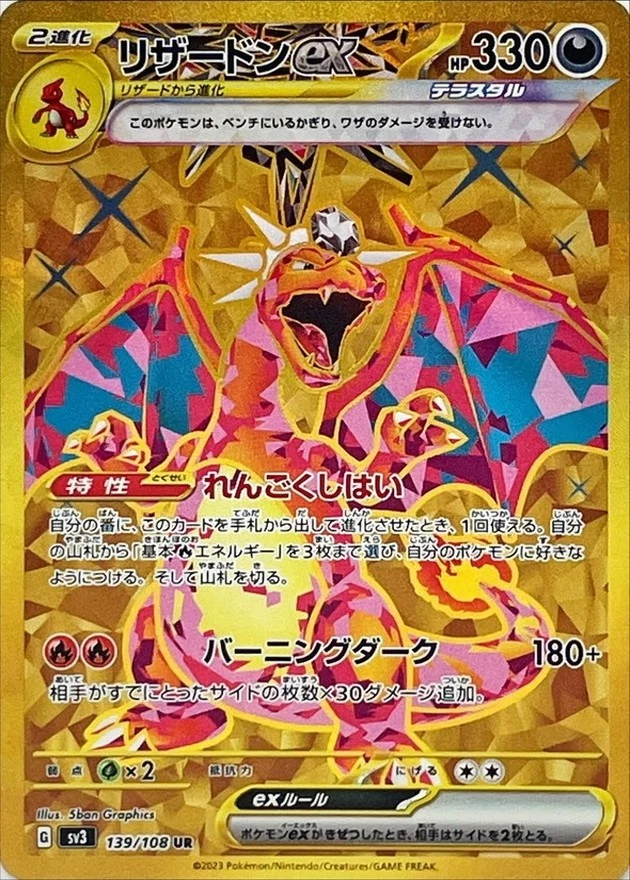
Charizard ex UR, SV3 139/108, Ruler of the Black Flame

Charizard ex UR, SV3 139/108, Ruler of the Black Flame

Tyranitar ex SR, SV3, Ruler of the Black Flame

Tyranitar ex SR, SV3, Ruler of the Black Flame

Pidgeot ex SAR, SV3, Ruler of the Black Flame

Pidgeot ex SAR, SV3, Ruler of the Black Flame

Bonsly’s Basic-Pokemon slot sits well below the set’s headline rarity tiers. Ruler of the Black Flame’s own chase lineup runs Ultra Rare (Charizard ex, 139/108), Super Rare (Tyranitar ex), and Special Art Rare (Pidgeot ex) — three distinct rarity tiers above a standard Basic Pokemon print like Bonsly’s. That spread is typical of a modern Expansion Pack structure: a low-tier Basic card shares a box with several stacked secret and special-art rarity slots for the set’s marquee Pokemon.

None of the three chase cards above changes what Bonsly’s own print is worth pulling for — they’re listed here because they come from the same booster box and give collectors a sense of where Bonsly’s low-tier print sits relative to the set’s premium slots. For a set-hopper opening boxes for the headline pulls, Bonsly is the kind of card that turns up alongside those chase slots rather than one collectors specifically chase on its own.

Japanese Products from Bonsly’s Set

Two Japanese products from the Ruler of the Black Flame release family are currently listed on our site. The booster box is the set that Bonsly 058/108 belongs to; the deck build box comes from the same set family, and Bonsly’s inclusion in it is not verified here:

Ruler of the Black Flame Deck Build Box
Shop This Set
SV3-Ruler Of The Black Flame Japanese Pokemon Booster Box
Currently listed at ¥17,160 (~$108)
Ships from Tokyo · Tracked delivery

View Product →

Where to Buy Bonsly Cards from Tokyo

We ship Japanese sealed product worldwide out of Tokyo with tracked delivery. The SV3 Ruler of the Black Flame Booster Box currently listed at ¥17,160 (~$108), is the direct route to Bonsly’s confirmed print, and the Ruler of the Black Flame Deck Build Box currently listed at ¥5,400 (~$34), is the lower-cost same-set alternative. Browse the wider Japanese Pokemon booster box collection for other current sealed product, or request a quote via Ordine rapido for a graded Bonsly single or any card from this set not listed above — no timing guarantees, but sourcing requests go through that page.

This guide is part of a wider Day 23 collector-guide cluster covering early-game and fossil-adjacent Pokemon — see our Pichu cards guide, Kabuto cards guide, and Kadabra cards guide for more, and if you’re browsing by Pokedex order across generations, our Pokemon 151 Japanese card list is a related hub to continue from.

Domande frequenti

Is there a Bonsly Pokemon card?

Yes — one Japanese print is verified in this guide: Bonsly #058/108 from the Expansion Pack Ruler of the Black Flame (set code SV3), a Fighting-type Basic Pokemon illustrated by Mizue.

What rarity is the Japanese Bonsly card?

We haven’t independently reconfirmed a specific rarity label for this card beyond a low-tier inference from context. It’s best described as printed at a low rarity tier typical of Basic Pokemon in this set rather than a confirmed “Common” designation.

Is there a PSA 10 Bonsly card for sale?

We don’t currently have a graded Bonsly single listed. Sourcing requests for a specific graded copy go through our Quick Order page, with no fixed timing.

What box do I open to pull a Bonsly card?

Bonsly’s confirmed print comes from Ruler of the Black Flame (SV3). We currently list the SV3 Ruler of the Black Flame Booster Box at ¥17,160 (~$108) and the Ruler of the Black Flame Deck Build Box at ¥5,400 (~$34), both from the same release.

What is the English equivalent of the Japanese Bonsly card?

Limitless cross-references this print with Obsidian Flames (OBF) #110 on the English side.

What are the chase cards in the same set as Bonsly?

Ruler of the Black Flame’s headline chase cards are Charizard ex UR (139/108), Tyranitar ex SR, and Pidgeot ex SAR — all pulled from the same booster box as Bonsly’s #058/108 print.

Gardevoir & Sylveon GX SA: guida alla carta giapponese

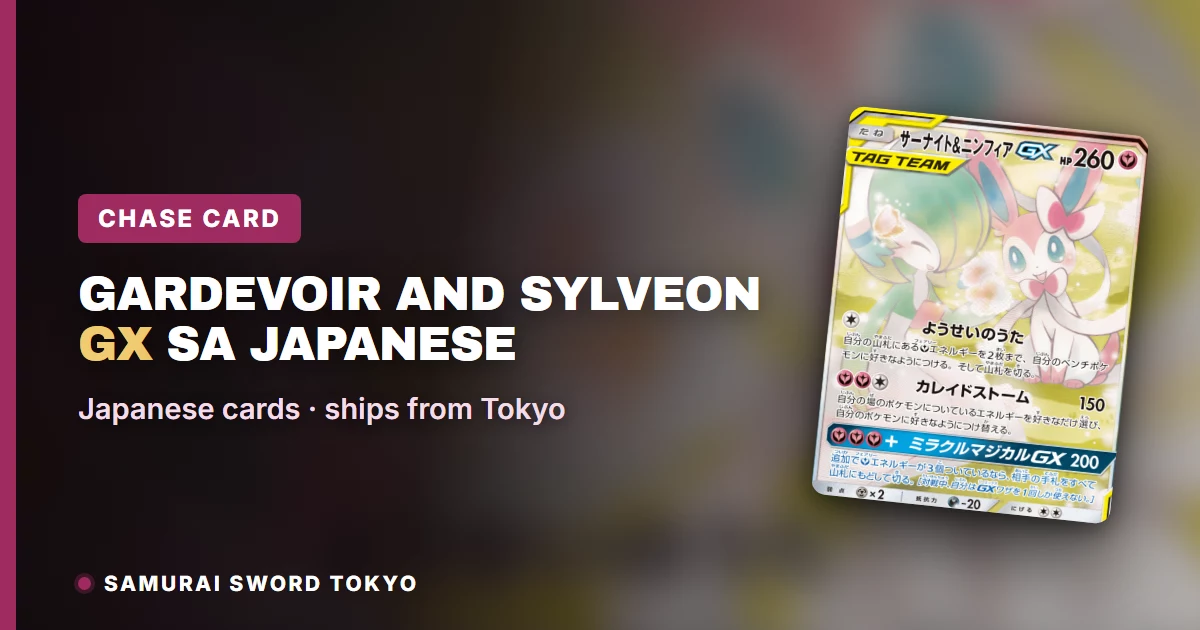
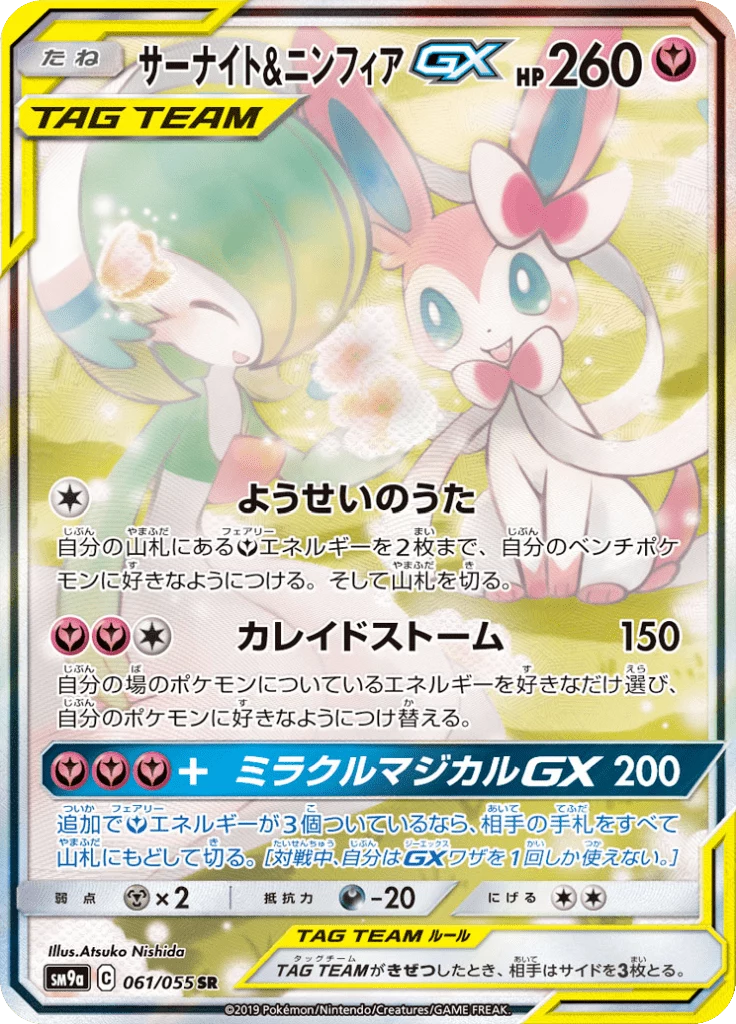
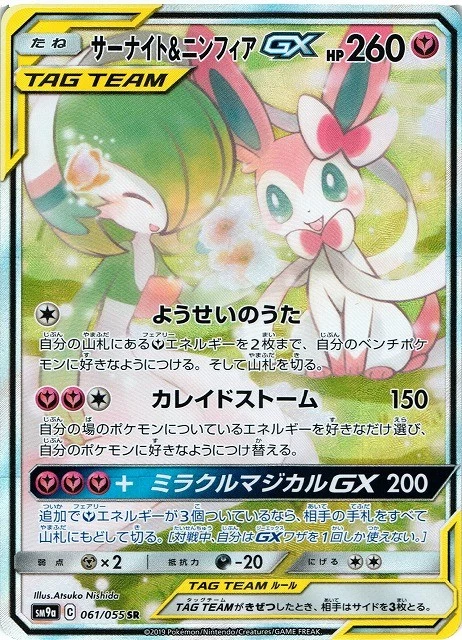
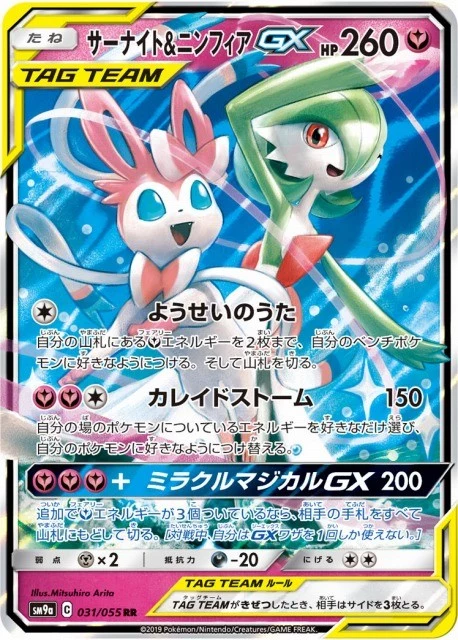
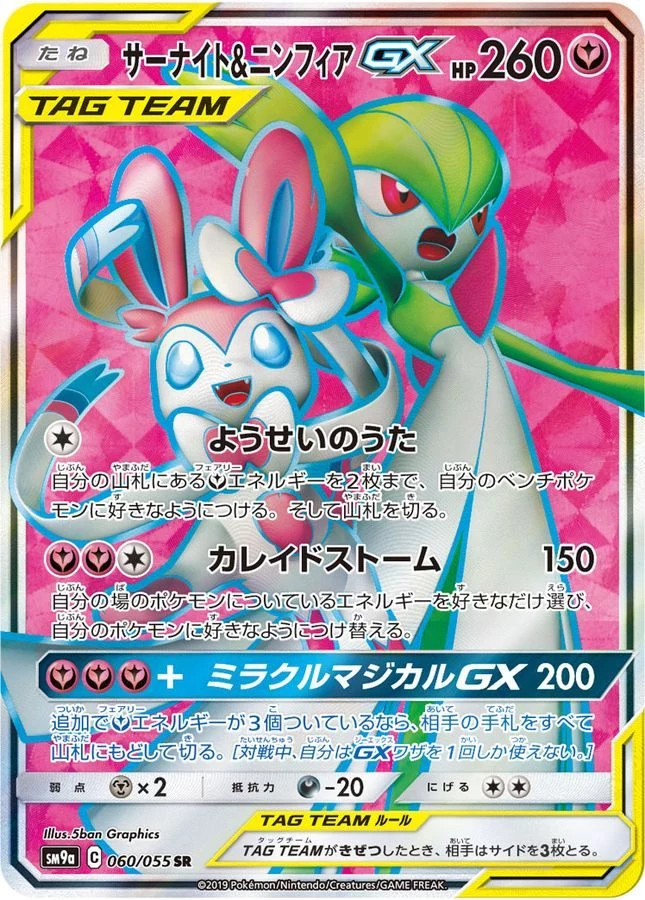
Gardevoir & Sylveon GX comes from a single Japanese set, with three documented prints spread across three separate rarity tiers. The card is サーナイト&ニンフィアGX — Gardevoir & Sylveon GX, No. 061/055, printed as a Special Art (SA) print in the Japanese high class pack ハイクラスパック「ナイトユニゾン」/ High Class Pack "Night Unison" (set code SM9a). A PSA 10 copy of this exact print is currently listed on our site, graded and shipped from Tokyo, and this guide walks through what the card is, how its three prints compare, where Night Unison sits among Japanese high class packs, and how the Japanese print lines up against its English counterpart.

Key Takeaways

Gardevoir & Sylveon GX SA (061/055) is a PSA 10, currently listed at ¥429,599 (~$2,702) — the top tier of three documented Japanese prints of this card, all from Night Unison (SM9a), the high class pack released 11 January 2019 with 63 total cards. If you’d rather pull your own copy, the SM9A-Night Unison Japanese Pokemon Booster Box is where all three prints originate.

260
HP

SA
Rarity (061/055)

63
Set Size (SM9a)

Jan 2019
Japan Release

Prices below are current samuraiswordtokyo.com listings, converted at ¥159/USD (September 2026).

The Card: Gardevoir & Sylveon GX 061/055 SA

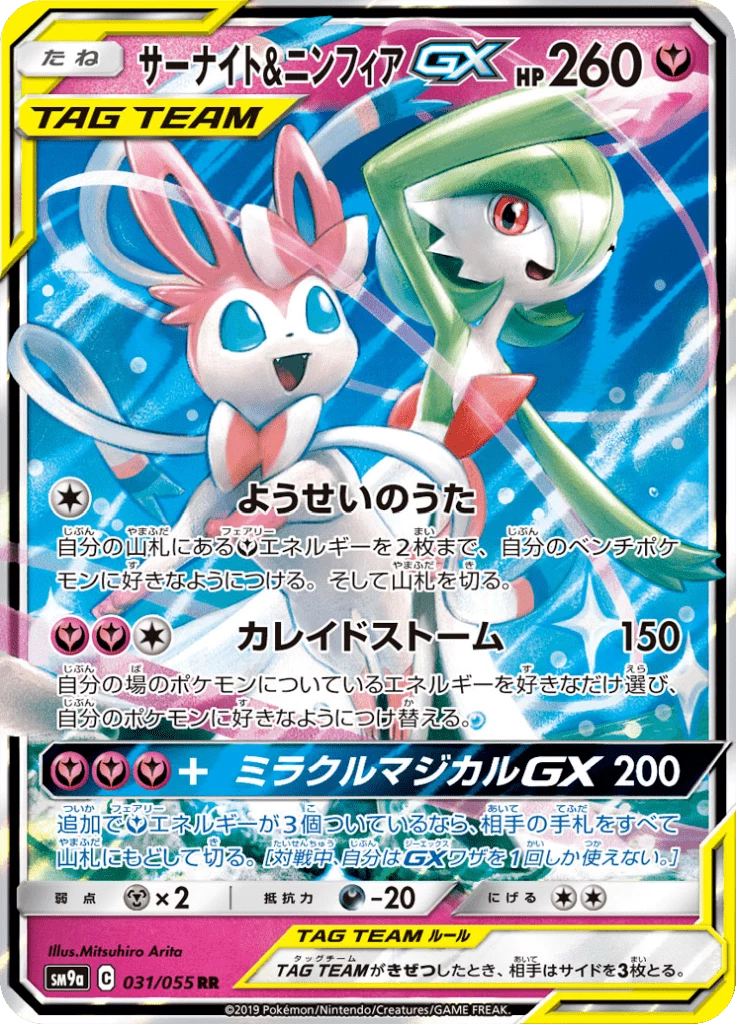
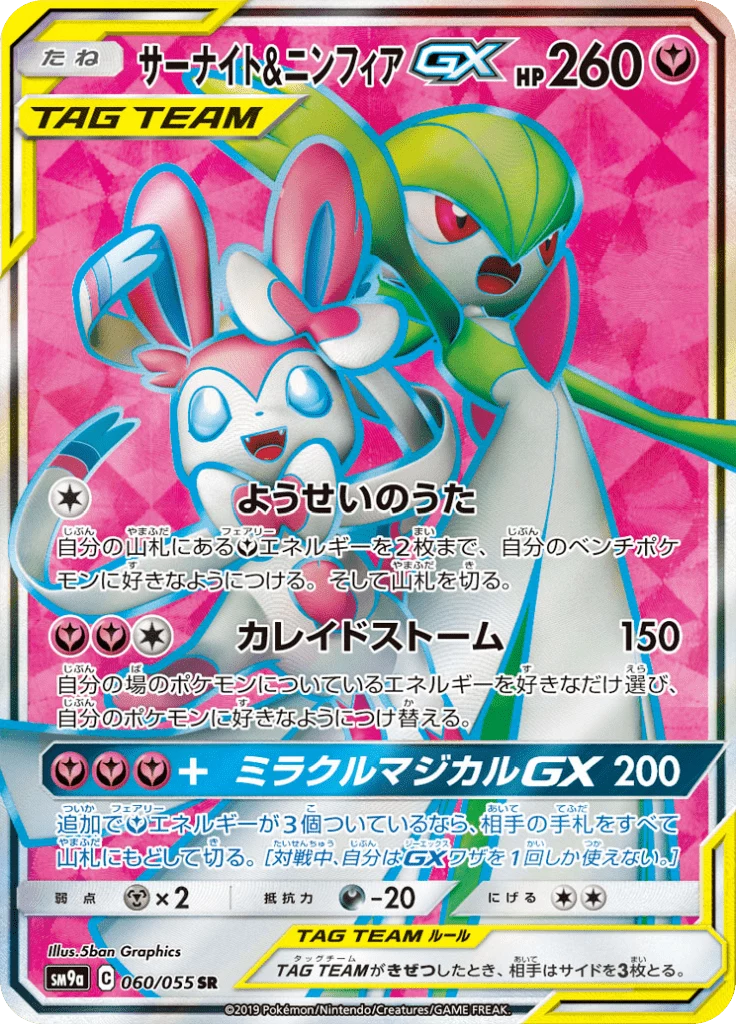
Gardevoir & Sylveon GX is a Basic Pokemon — a Tag Team card representing two Pokemon on one card rather than an evolution line — with the Fairy type and 260 HP. It carries an ability-style attack, Fairy Song (ようせいのうた), which searches for Energy; a standard attack, Kaleidostorm (カレイドストーム, 2 Fairy Energy + 1 Colorless), which deals 150 damage and repositions Energy; and the GX attack Miracle Magical GX (ミラクルマジカルGX, 3 Fairy Energy), which deals 200 damage and, if three additional Fairy Energy are attached, forces the opponent to shuffle their entire hand into their deck. Like all GX attacks, it can only be used once per game. The card’s Weakness is Metal, its Resistance is Darkness −20, and its Retreat Cost is 2.

Gardevoir & Sylveon GX 061/055 SA, Night Unison (SM9a)
Gardevoir & Sylveon GX 061/055 SA — Night Unison (SM9a), illustrated by Atsuko Nishida

The 061/055 print is illustrated by Atsuko Nishida, and its position at #061 in an “055” set — a number well past the set’s own main card count — is the standard Japanese convention for marking a card as a secret/special slot rather than part of the main numbered run.

PSA 10 Gardevoir & Sylveon GX SA 061/055 slab, listed on samuraiswordtokyo.com

Our own graded copy of this print is currently listed at ¥429,599 (~$2,702), PSA 10.

The Set: Night Unison (SM9a)

Night Unison — ハイクラスパック「ナイトユニゾン」 in Japanese — is set code SM9a, a Japanese high class pack released on 11 January 2019. The set runs to 63 total cards, with its main numbered run going up to 055 and the remaining slots reserved for secret/special-rarity prints, including the SR and SA treatments of Gardevoir & Sylveon GX covered above. The SM9a set code places it within the Sun & Moon era of Japanese Pokemon TCG high class packs.

For the complete 63-card breakdown, see our Night Unison (SM9a) card list, and for a pull-rate discussion of the set’s best cards, see our Night Unison pull-rates hub.

Sealed Night Unison product — where all three Gardevoir & Sylveon GX prints originate — is available as the SM9A-Night Unison Japanese Pokemon Booster Box currently listed at ¥80,850.

Japanese vs English Print

Gardevoir & Sylveon GX does have an English-set equivalent, but the numbering does not map one-to-one onto the Japanese release. The English set is Unbroken Bonds (UNB), and it carries the card across four separate slots: a standard print at #130, a full art at #204, a secret-rare full art at #205, and a secret rare/rainbow print at #225.

That is four English treatments against three Japanese ones. The Japanese RR (031/055), SR (060/055), and SA (061/055) do not correspond directly to any single English number in a fixed one-to-one fashion — the safest way to describe the relationship is that the Japanese Night Unison set corresponds to Unbroken Bonds as a whole, rather than asserting an exact tier-for-tier match between any one Japanese print and any one English number. If you are matching a Japanese copy against an English one, go by artwork and rarity treatment rather than assuming the numbers will line up.

Where This SA Sits Among Japanese Chase Rarities

Within Night Unison, the three confirmed Gardevoir & Sylveon GX prints sit on three different rungs of the set’s rarity structure: the main-numbered RR (Double Rare) at 031/055, the secret-slot SR at 060/055, and the secret-slot SA (Special Art) at 061/055. The SA sits above the SR — both are secret-slot, full-illustration treatments of the same card text and stats, but they are two separately numbered, separately illustrated prints (Atsuko Nishida for the SA versus 5ban Graphics for the SR), not the same artwork in different foiling.

Gardevoir & Sylveon GX’s SA treatment sits alongside other Tag Team GX “SA”-tier cards we list in PSA 10, including Latias & Latios GX SA, a different Tag Team pair from a separate set that uses the same top-tier SA mechanic. For a broader ranking of the wider Tag Team GX category, see our best Tag Team GX cards guide.

For a broader look at the species on either side of this Tag Team, see our Gardevoir cards guide and our Sylveon cards guide.

Shop This Card
PSA 10 Gardevoir & Sylveon GX SA 061/055
Currently listed at ¥429,599 (~$2,702)
Ships from Tokyo · Tracked delivery

View Product →

Where to Buy Gardevoir & Sylveon GX from Tokyo

Our graded copy of PSA 10 Gardevoir & Sylveon GX SA 061/055 is currently listed at ¥429,599 (~$2,702), shipped from Tokyo with tracked delivery. If the SA is outside your budget, the same card is also available at the SR tier, 060/055 at ¥33,630 (~$212), and the RR tier, 031/055 at ¥17,511 (~$110), both graded PSA 10.

If you’d rather pull your own copy, sealed SM9A-Night Unison Japanese Pokemon Booster Boxes are the source product for all three prints, currently listed at ¥80,850. For other graded Tag Team GX cards in the same PSA 10 tier, browse our full PSA 10 graded card collection. For a mixed order across singles and sealed product, our Quick Order page is the fastest way to build a cart.

Domande frequenti

What is Gardevoir & Sylveon GX 061/055 SA?

It is the Special Art (SA) print of Gardevoir & Sylveon GX, card 061/055 from the Japanese high class pack Night Unison (set code SM9a), released 11 January 2019. A PSA 10 copy of this print is currently listed at ¥429,599 (~$2,702).

What’s the difference between the RR, SR, and SA prints?

All three come from Night Unison, released the same day. The 031/055 is an RR (Double Rare) print inside the set’s main numbering; the 060/055 SR and 061/055 SA are both secret-slot, full-illustration prints, illustrated by different artists (5ban Graphics and Atsuko Nishida respectively) — two separately numbered tiers, not the same artwork in different foiling.

Does Gardevoir & Sylveon GX have an English print?

Yes — Unbroken Bonds (UNB) carries the card across four slots: a standard print at #130, a full art at #204, a secret-rare full art at #205, and a secret rare/rainbow print at #225. These don’t map one-to-one onto the three Japanese prints.

What set is Gardevoir & Sylveon GX from?

Night Unison, Japanese set code SM9a, a high class pack released 11 January 2019 with 63 total cards.

What are Gardevoir & Sylveon GX’s stats?

It is a Fairy-type Basic Tag Team Pokemon with 260 HP, Weakness to Metal, Resistance to Darkness (−20), and a Retreat Cost of 2. Its GX attack, Miracle Magical GX, deals 200 damage and can force the opponent to shuffle their entire hand into their deck.

Where can I buy a PSA 10 Gardevoir & Sylveon GX from Tokyo?

Our graded SA (061/055) copy is currently listed at ¥429,599 (~$2,702), with the SR and RR tiers also available at ¥33,630 (~$212) and ¥17,511 (~$110), all with tracked shipping from Tokyo.

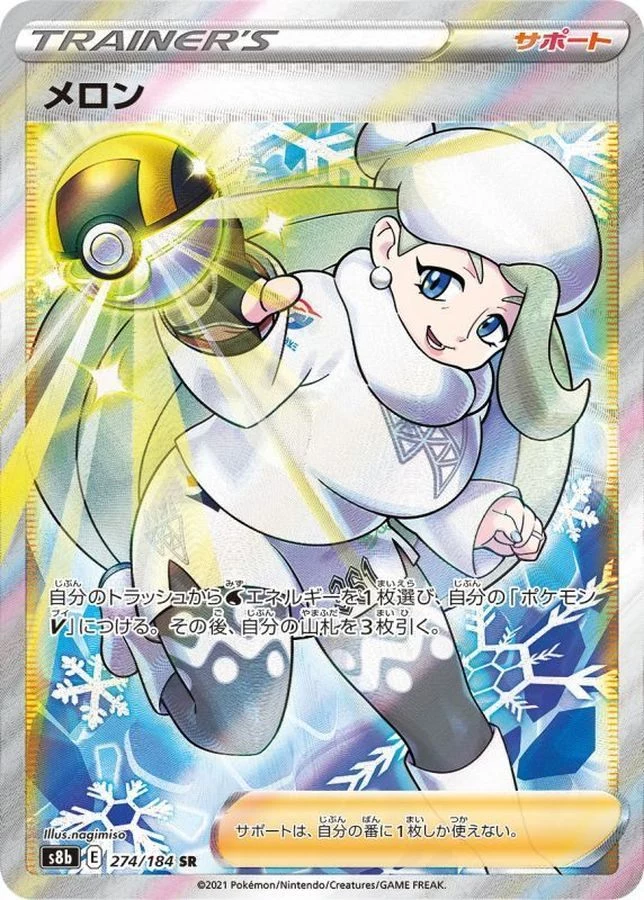
Guida alla carta Allenatore Melony Pokémon: tutte le edizioni giapponesi SR e SAR

One Supporter, three Japanese high-class packs, three different illustrators — and not one of them shares artwork with either of the other two.

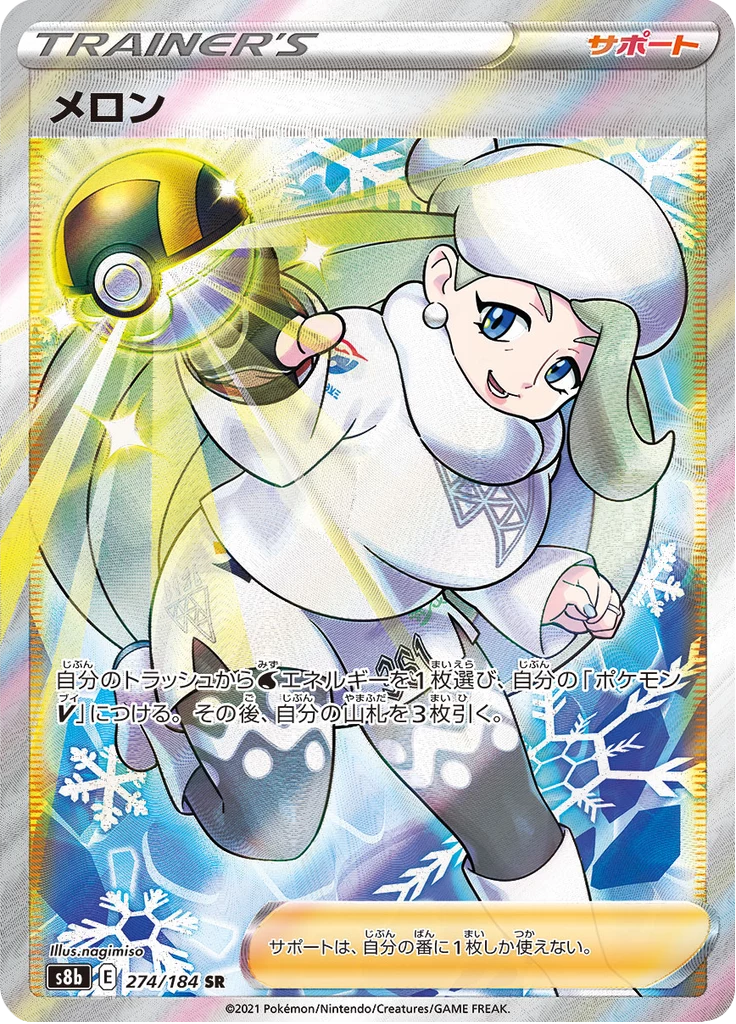
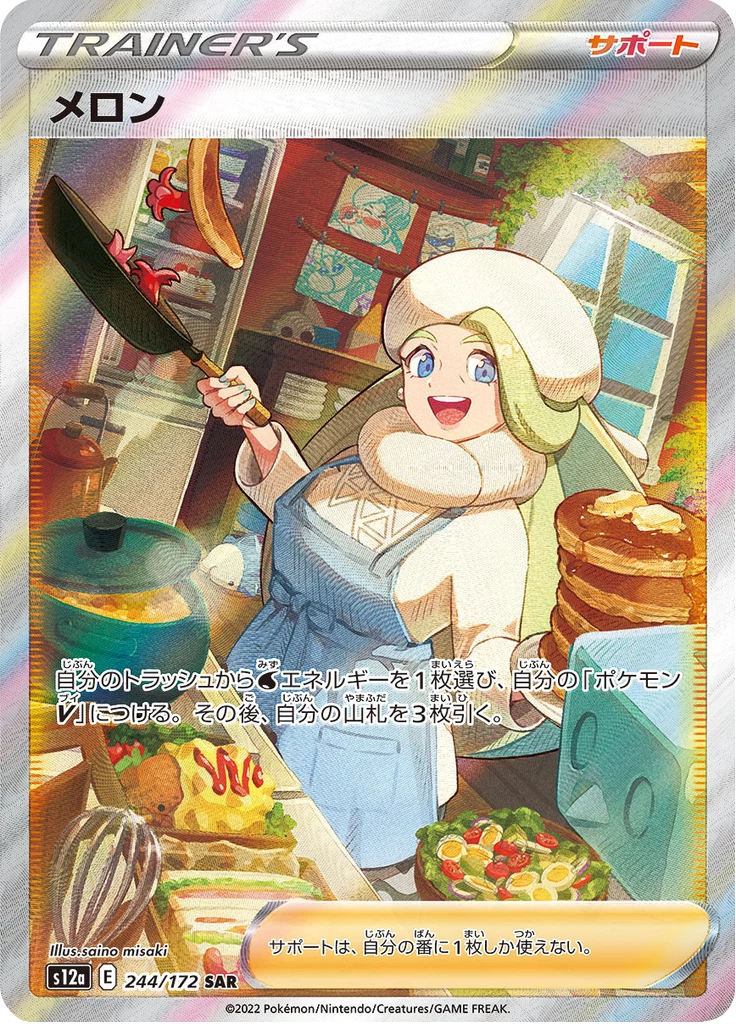
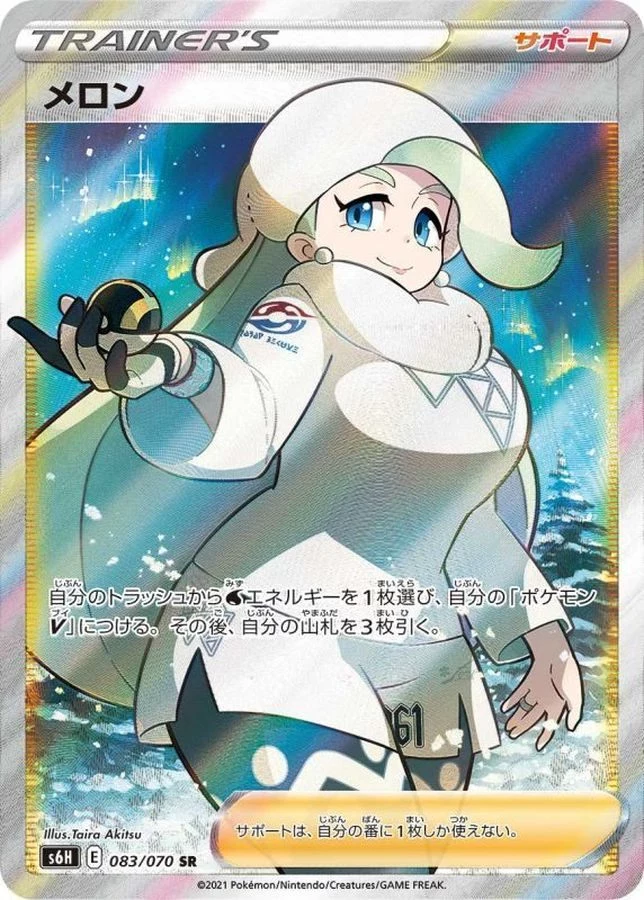
Melony is the Galar region’s Ice-type Gym Leader, and her Japanese name, メロン (Melon), has appeared on a Trainer – Supporter card three separate times across 2021 and 2022: a Super Rare in Silver Lance, a second Super Rare in VMAX Climax, and a Special Art Rare in VSTAR Universe’s “Galarian Gallery” subset. This guide covers all three verified Japanese prints — set, card number, illustrator and release date for each — and how they line up against the English-language Chilling Reign release.

Key Takeaways

Three Japanese Melony Supporter prints are currently listed as graded singles on our site, spanning three separate High Class Packs released between April 2021 and December 2022. The newest and highest-tier of the three — PSA 10 Melony SAR (244/172, VSTAR Universe, “Galarian Gallery”) — is currently listed at ¥14,649 (~$92). If you’d rather open the set that introduced the card to Japan, the Silver Lance booster box is currently listed at ¥19,000.

3
Japanese Prints

SR & SAR
Rarities Covered

3
Sets Spanned

Sep 2026
Prices Checked

Prices are our own listed prices as of September 2026, converted at ¥159/USD.

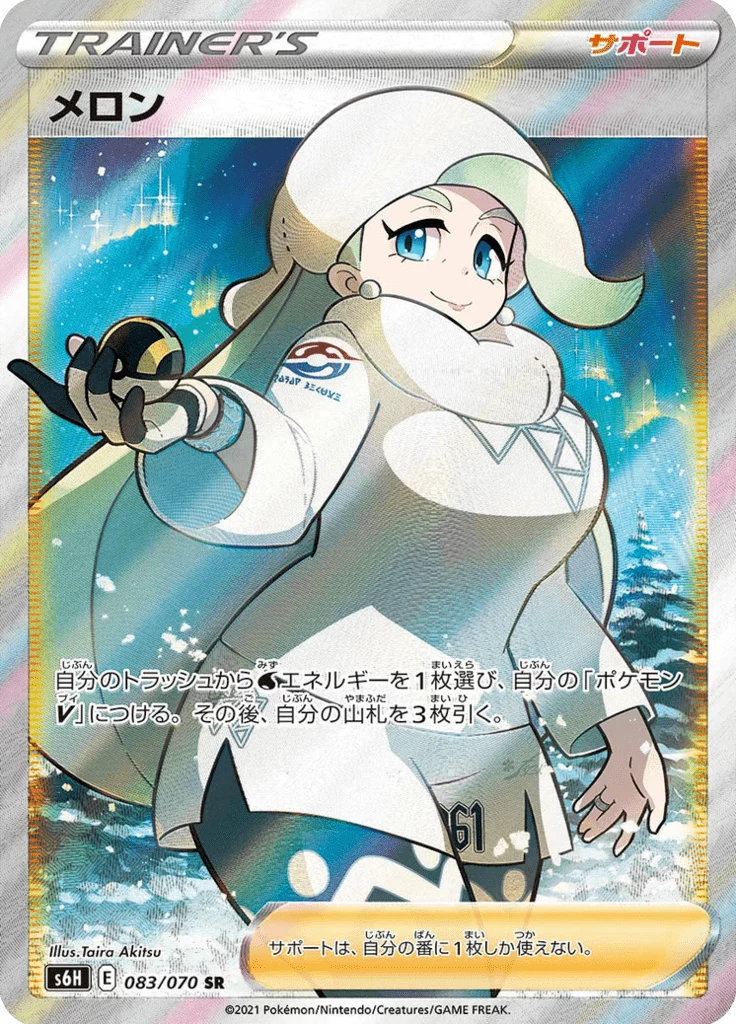
Melony SR — Silver Lance (S6H) 083/070

Melony 083/070, Super Rare — Silver Lance (S6H) Japanese Pokemon Supporter card
Melony 083/070, SR — Silver Lance (S6H)

Melony’s first Japanese Supporter print appeared in Silver Lance (S6H), a High Class Pack released 23 April 2021 with 83 cards in the set. The card is numbered 083/070, Super Rare (SR), and the illustration is credited to Taira Akitsu.

A PSA 10 copy of this print is currently listed at ¥13,923 (~$88). Silver Lance itself — the set that introduced Melony to the Japanese card pool — is currently listed as a sealed booster box at ¥19,000. For a full rundown of what else the set contains, see our Silver Lance (S6H) card list.

Melony SR — VMAX Climax (S8b) 274/184

Melony 274/184, Super Rare — VMAX Climax (S8b) Japanese Pokemon Supporter card
Melony 274/184, SR — VMAX Climax (S8b)

Eight months on, Melony reappeared in VMAX Climax (S8b), a High Class Pack released 3 December 2021 with 277 cards. This second SR is numbered 274/184 and is illustrated by nagimiso, a different artist from the Silver Lance print.

Same Rarity, Different Artist

The Silver Lance and VMAX Climax prints are both SR-tier full-art Supporters from the same general season, and it’s easy to assume they share artwork. They don’t: 083/070 is illustrated by Taira Akitsu, 274/184 by nagimiso. Treat them as two distinct prints rather than one card reprinted twice.

A PSA 10 copy of the VMAX Climax print is currently listed at ¥8,259 (~$52). The VMAX Climax booster box itself is currently listed at ¥39,900; our VMAX Climax booster box buying guide covers what else is inside.

Melony SAR — VSTAR Universe (s12a) 244/172, Galarian Gallery

Melony 244/172, Special Art Rare — VSTAR Universe (s12a) Galarian Gallery Japanese Pokemon Supporter card
Melony 244/172, SAR — VSTAR Universe (s12a), Galarian Gallery

A year later, Melony’s third and highest-tier Japanese print arrived in VSTAR Universe (s12a), a High Class Pack released 2 December 2022 with 254 cards. This is a Special Art Rare (SAR), numbered 244/172, sitting inside the set’s “Galarian Gallery” subset — a themed run of alternate full-art Trainer cards built around Galar-region characters. The illustration is credited to saino misaki; our saino misaki illustrator guide is a single-artist hub covering multiple cards, where this Melony guide is a single-trainer deep dive.

A PSA 10 copy of this print is currently listed at ¥14,649 (~$92). For the rest of the set, see our VSTAR Universe (s12a) card list; the sealed booster box is currently listed at ¥30,870.

On all three prints, the card’s Japanese name is メロン (Melon). If you’re checking Japanese marketplaces or grading population data, search that name rather than the English localisation “Melony,” which is only used internationally.

Japanese vs English Print

The English-language equivalent of this card is Chilling Reign (CRE), which carries Melony across three rarities within a single set:

Rarity Card # Set
Standard 146 Chilling Reign (CRE)
Full Art 195 Chilling Reign (CRE)
Secret Rare 218 Chilling Reign (CRE)

Unlike English, which grouped Melony’s rarities into one set, Japan spread its three prints across three separate High Class Packs over roughly twenty months — Silver Lance, VMAX Climax, then VSTAR Universe’s Galarian Gallery subset. The Galarian Gallery SAR artwork was later reprinted internationally as well, appearing in Crown Zenith’s own Galarian Gallery subset as card GG64. For more on how Japanese full-art SR and SAR tiers correspond to their English equivalents in general, see our full-art trainer cards (Japanese SR/SAR) guide.

Where the SR and SAR Sit in Japanese Rarity Tiers

Both of Melony’s SR prints and her SAR print belong to the upper full-art tiers used across Japanese Sword & Shield–era High Class Packs. SR (Super Rare) covers the full-art Trainer and Supporter treatment used in Silver Lance and VMAX Climax. SAR (Special Art Rare) sits a tier above SR and is built around alternate, often more elaborate full-art illustrations — in VSTAR Universe’s case, grouped into the set’s named “Galarian Gallery” subset rather than scattered through the main print run.

Set Card # Rarity Release
Silver Lance (S6H) 083/070 SR 2021-04-23
VMAX Climax (S8b) 274/184 SR 2021-12-03
VSTAR Universe (s12a), Galarian Gallery 244/172 SAR 2022-12-02

Melony sits alongside a wider category of female Gym Leader Supporter cards carrying full-art SR and SAR treatments across these same eras; our female Pokemon trainer card roundup covers more of that category, and our broader PSA 10 trainer cards guide covers graded Japanese Trainer cards in general.

Shop This Card
PSA 10 Melony SAR (244/172, VSTAR Universe)
Currently listed at ¥14,649 (~$92)
Ships from Tokyo · Tracked delivery

View Product →

Where to Buy Melony Cards from Tokyo

We ship graded and sealed Japanese product out of Tokyo with tracked delivery. All three Melony PSA 10 prints covered above are individually listed — here’s the direct route to each.

PSA 10 Melony SAR 244/172 VSTAR Universe slab

SAR 244/172 (VSTAR Universe)

PSA 10 Melony SR 083/070 Silver Lance slab

SR 083/070 (Silver Lance)

PSA 10 Melony SR 274/184 VMAX Climax slab

SR 274/184 (VMAX Climax)

The Silver Lance SR is currently listed at ¥13,923 (~$88), and the VMAX Climax SR is currently listed at ¥8,259 (~$52). If you’d rather open sealed product, the three source boxes — Silver Lance (¥19,000), VMAX Climax (¥39,900), and VSTAR Universe (¥30,870) — are all currently listed as sealed booster boxes. Browse more graded singles in our PSA 10 graded card collection, or build a mixed order through our Quick Order page.

Domande frequenti

Who is Melony in the Pokemon games?

Melony is the Galar region’s Ice-type Gym Leader. Her Japanese name is メロン (Melon); “Melony” is the official English localisation used internationally.

How many Japanese Melony Supporter cards are there?

The verified Japanese prints are three: Silver Lance (S6H) 083/070 SR, VMAX Climax (S8b) 274/184 SR, and VSTAR Universe (s12a) 244/172 SAR from the Galarian Gallery subset.

Are the Silver Lance and VMAX Climax SR prints the same artwork?

No. Despite both being SR-tier full-art Supporters, they use two different illustrators — Taira Akitsu for Silver Lance 083/070, and nagimiso for VMAX Climax 274/184. They are two distinct prints, not one card reprinted twice.

What’s the English equivalent of the Japanese Melony card?

Chilling Reign (CRE) carries Melony across three English rarities: #146 (standard), #195 (full art), and #218 (secret rare). The Japanese Galarian Gallery SAR artwork was later reprinted internationally in Crown Zenith’s own Galarian Gallery subset as card GG64.

What does SAR mean on the VSTAR Universe print?

SAR stands for Special Art Rare, a tier above SR built around alternate full-art illustrations. On VSTAR Universe (s12a), the Melony SAR sits within the set’s named “Galarian Gallery” subset.

Where can I buy Melony PSA 10 cards from Japan?

All three PSA 10 prints are listed individually on our site — see the “Where to Buy” section above for direct links, or use our Quick Order page to combine them with other Japanese singles or sealed product in one order.

Carte Pokemon V spiegate: V, VMAX & VSTAR nei set giapponesi Sword & Shield

Pokemon V, VMAX and VSTAR are three related but different card types, all built during the Sword & Shield era around the same idea: a stronger single-card upgrade that costs the opponent more than the usual one Prize card when it’s Knocked Out. A Pokemon V and a Pokemon VSTAR both give up 2 Prize cards on a Knock Out; a Pokemon VMAX gives up 3.

They didn’t all arrive at once, either. V and VMAX launched together in Japan in December 2019. VSTAR came more than two years later, as a separate mechanic with its own rules. This guide breaks down what each card type actually does, when each one first appeared in a Japanese set, and which Japanese Sword & Shield boxes from our own shop carry them.

Key Takeaways

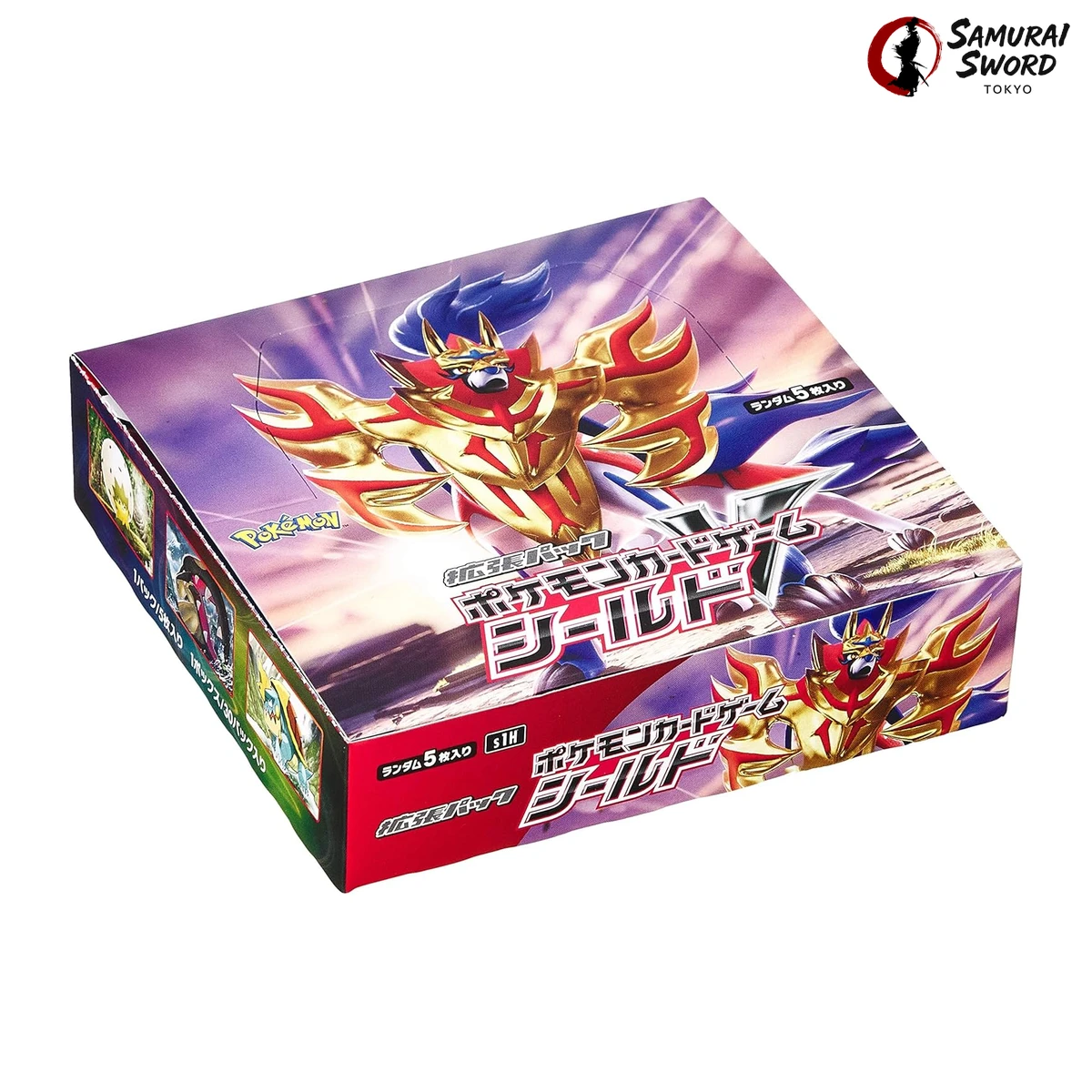
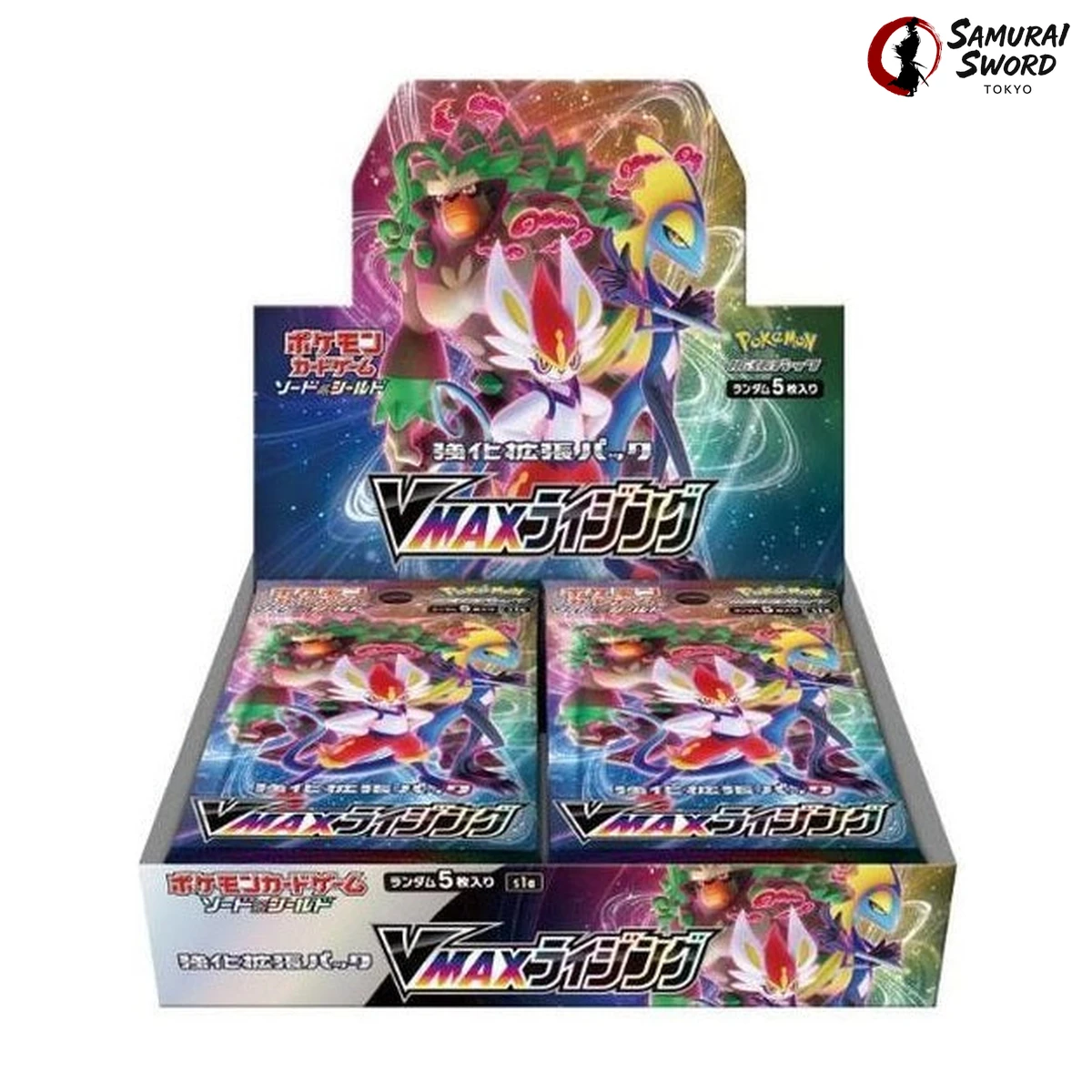
Pokemon V and VSTAR both cost the opponent 2 Prize cards on a Knock Out; VMAX costs 3. V and VMAX first appeared together in Japan’s Sword (S1W) and Shield (S1H) sets on 6 December 2019, followed by the dedicated VMAX Rising (S1a) booster box, currently listed at ¥94,500 (~$594). VSTAR didn’t exist yet at that point — it debuted in Japan’s Star Birth expansion in January 2022. Our S1H Shield V booster box is currently listed at ¥63,000 (~$396) if you want a box from the mechanic’s original release.

2
Prize Cards (V / VSTAR)

3
Prize Cards (VMAX)

Dec 2019
V & VMAX Debut (Japan)

Jan 2022
VSTAR Debut (Japan)

What Makes a Pokemon V Different from a Regular Pokemon

Pokemon V is a Basic Pokemon card type introduced with the Sword & Shield era. A Pokemon V of a given species is printed with higher HP and stronger attacks than a regular, non-V card of the same Pokemon — that’s the entire trade-off built into the card type. In exchange for that extra power, a Pokemon V gives the opponent 2 Prize cards instead of the usual 1 when it’s Knocked Out.

That Prize-card cost is the mechanical backbone of every V-based card discussed in this guide, and it directly extends the basic scoring rules covered in our how to play Pokemon cards beginner guide — if you’re new to the game, that’s the place to start before this one.

VMAX: The Dynamax Evolution

A Pokemon VMAX evolves from a Pokemon V. The card type represents the Dynamax, Gigantamax and Eternamax mechanics from the Sword & Shield video games, translated onto an even bigger, more powerful card. Knocking out a VMAX costs the opponent 3 Prize cards — one more than a V, and the steepest Prize-card cost of the three types covered here.

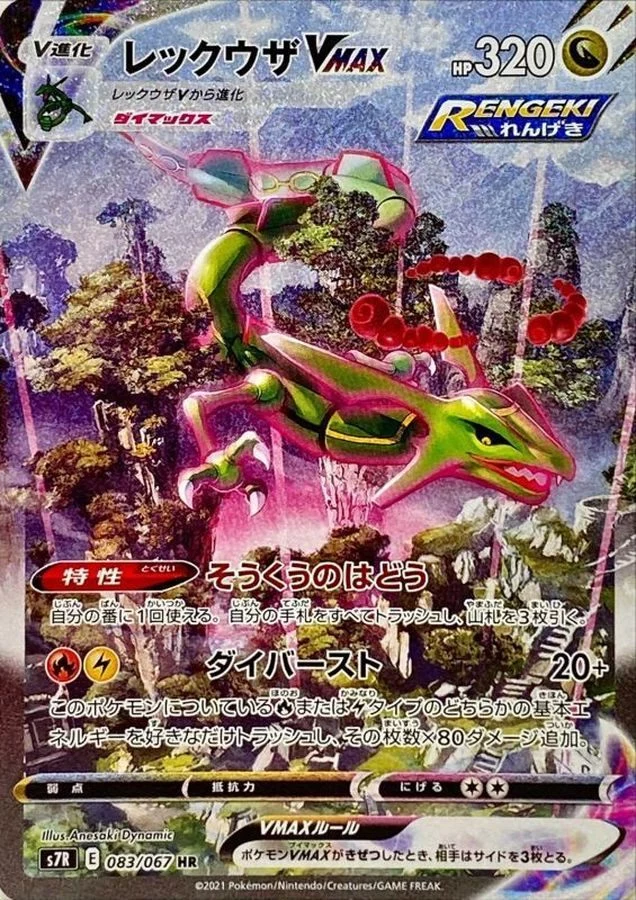
PSA 10 Rayquaza VMAX, Hyper Rare, Japanese Sword and Shield era card

Rayquaza VMAX, Hyper Rare (HR)

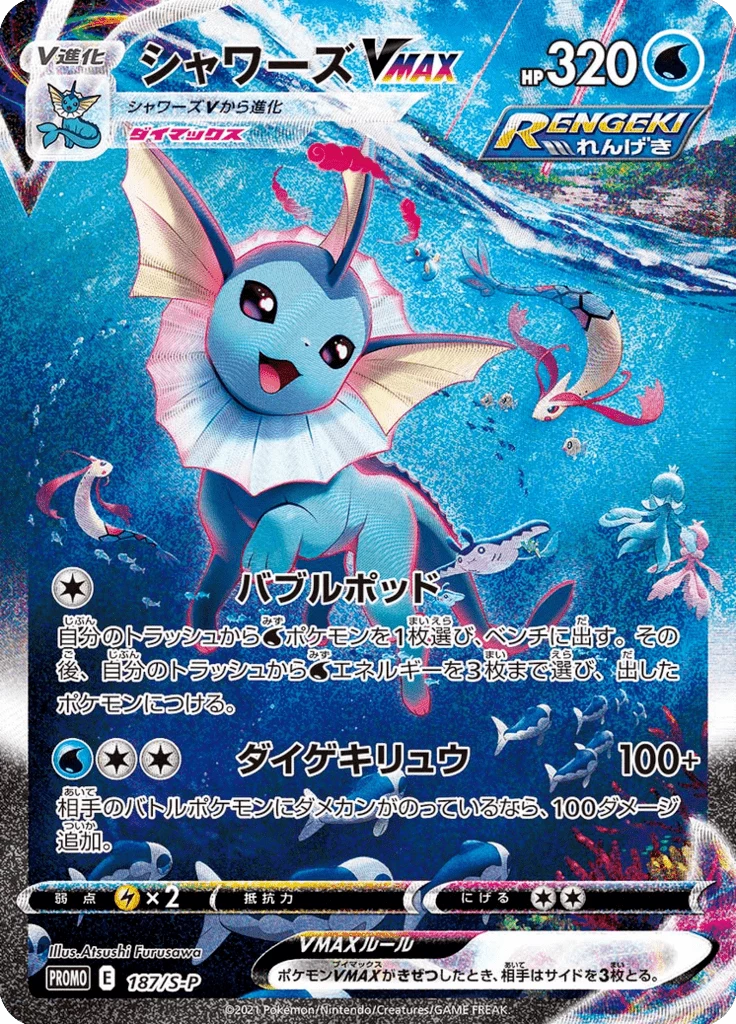
Vaporeon VMAX card number S-P 187, Japanese Sword and Shield era promo

Vaporeon VMAX, S-P 187 (promo)

Both cards above are Pokemon VMAX — one a Hyper Rare set pull, the other a numbered Japanese promo — and both carry the same 3-Prize cost regardless of rarity. For a full single-card breakdown of a Sword & Shield-era VMAX pulled from the same card pool as our S2 box below, see our Toxtricity VMAX card guide. For the wider value picture across the card type, see our best Japanese VMAX cards guide.

VSTAR: A Different Upgrade, Two Years Later

A Pokemon VSTAR also evolves from a Pokemon V, but it isn’t a VMAX with a different name. Each VSTAR card carries a VSTAR Power — either an attack or an Ability — that can only be used once per game, across your entire VSTAR lineup. Knocking out a VSTAR costs the opponent 2 Prize cards, the same as a plain Pokemon V and one fewer than a VMAX.

VSTAR is also newer than V and VMAX by a wide margin. The mechanic debuted in Japan in the Star Birth expansion, released 14 January 2022. The English-language equivalent, Brilliant Stars, followed on 25 February 2022. That’s more than two years after Pokemon V and VMAX first appeared in Japan — VSTAR was not part of the original Sword & Shield launch. For the full VSTAR-era set list, see our VSTAR Universe (S12a) card list.

V vs VMAX vs VSTAR at a Glance

The Prize-card cost is the one number worth memorising, because it’s easy to mix up VMAX and VSTAR since both evolve from a V:

Card type Evolves from Prize cards on KO Defining mechanic
Pokemon V Basic (does not evolve from another V card) 2 Higher HP and stronger attacks than a same-species regular Pokemon
Pokemon VMAX Pokemon V 3 Represents Dynamax, Gigantamax and Eternamax from the video games
Pokemon VSTAR Pokemon V 2 One VSTAR Power (attack or Ability) usable once per game

Note the pattern: VMAX and VSTAR share the same evolution requirement — both need a Pokemon V in play first — but they don’t share the same Prize-card cost. Only VMAX pushes that number to 3; VSTAR stays level with a plain V at 2.

Where V, VMAX and VSTAR First Appeared in Japan

Pokemon V and VMAX launched together in Japan on the same day. VSTAR followed as a separate, later addition:

Japanese set Code Uscita in Giappone Milestone
Sword S1W 6 Dec 2019 First Japanese Pokemon V and VMAX cards
Shield S1H 6 Dec 2019 First Japanese Pokemon V and VMAX cards
VMAX Rising S1a 7 Feb 2020 Dedicated high-class pack adding more V and VMAX cards
Star Birth — 14 Jan 2022 First Japanese Pokemon VSTAR cards
Brilliant Stars (English) — 25 Feb 2022 English-language VSTAR debut
S1H Shield V Japanese Pokemon booster box, mechanic's introduction set

S1H, Shield V Booster Box

S1a VMAX Rising Japanese Pokemon booster box, dedicated V VMAX high-class pack

S1a, VMAX Rising Booster Box

The dedicated VMAX Rising (S1a) card list covers all 78 Japanese cards and rarities from that set if you want the full breakdown rather than just the mechanic explainer here; our S1a VMAX Rising pull rates and best cards guide is the companion piece on what’s actually chase-worthy inside the set.

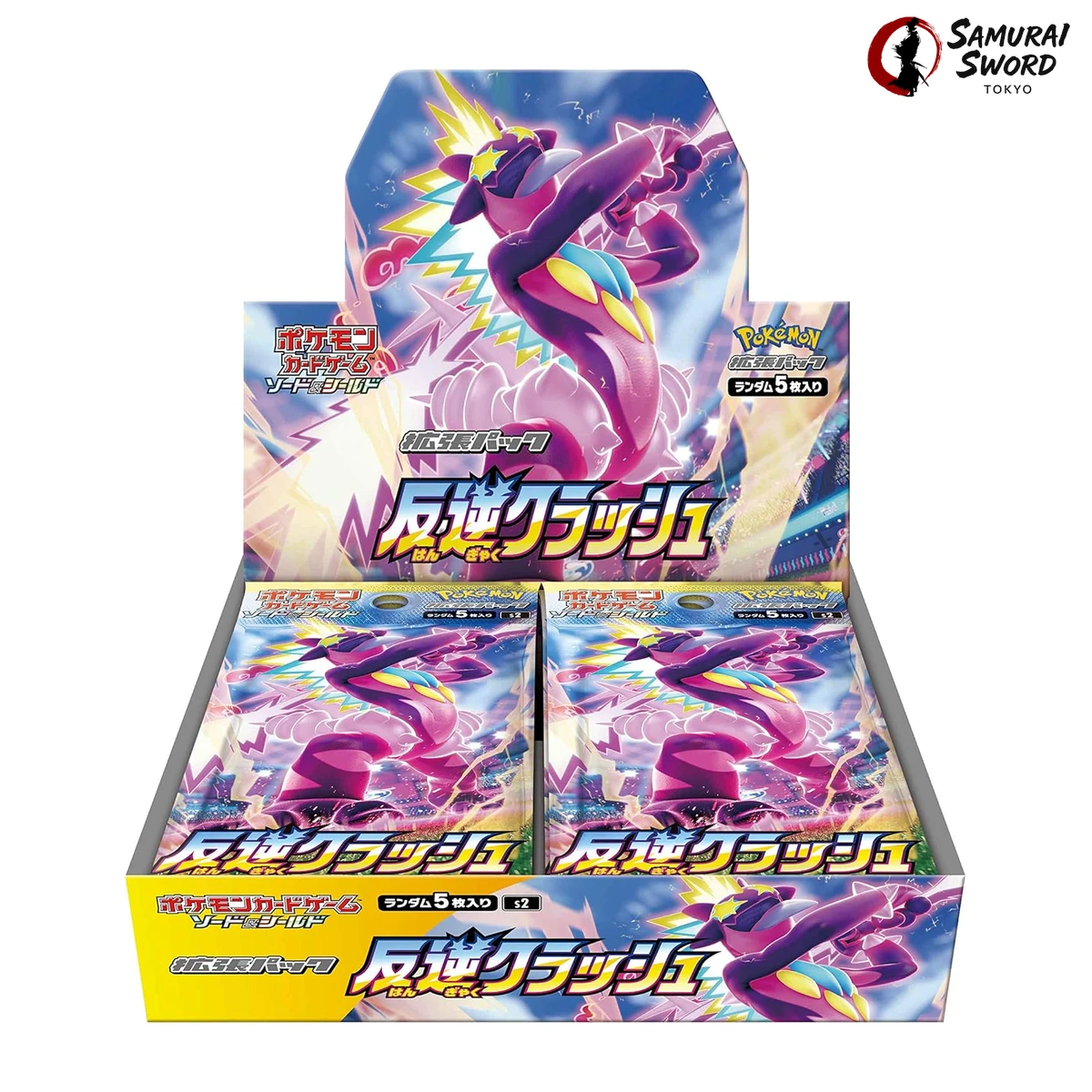
S2 Rebellion Crash Japanese Pokemon booster box, Sword and Shield era continuation set
S2, Rebellion Crash Booster Box — a later Sword & Shield-era set that continued the V/VMAX card pool, not the mechanic’s original introduction

Our third box anchor, S2 Rebellion Crash, is worth calling out specifically: it’s a Sword & Shield-era set that continued printing V and VMAX cards, but it did not introduce the mechanic — that credit belongs to S1W/S1H from December 2019.

Which Japanese Sword & Shield Boxes to Open for V and VMAX

All three of our current Sword & Shield-era anchors carry V and VMAX cards, but each sits at a different point in the mechanic’s history:

None of these three boxes contain VSTAR cards — that mechanic wasn’t introduced until Star Birth in January 2022, well after all three of these sets released. If you’re specifically after VSTAR-era product, our VSTAR Universe (S12a) card list covers that later set. For browsing beyond these three, our Japanese Pokemon booster box collection lists everything currently available.

Shop This Set
S1H-Shield V Japanese Pokemon Booster Box
The Shield-side half of the set that introduced V and VMAX to Japan
Ships from Tokyo · Tracked delivery

View Product →

Where to Buy V, VMAX and VSTAR Cards from Tokyo

We ship Japanese sealed product worldwide out of Tokyo with tracked delivery. For V and VMAX specifically, our three Sword & Shield-era anchors above cover the mechanic from its December 2019 introduction (S1H, S1W’s Shield-side counterpart) through its dedicated high-class pack (S1A) and a later continuation set (S2):

Browse the full Japanese Pokemon booster box collection for other sets, or use Ordine rapido to build a mixed order of boxes and singles in one pass. Sourcing requests for prints not listed above go through Quick Order as well.

Domande frequenti

What’s the difference between Pokemon V, VMAX and VSTAR cards?

Pokemon V is a Basic Pokemon card type from the Sword & Shield era, printed with higher HP and stronger attacks than a regular same-species card. VMAX and VSTAR both evolve from a V, but VMAX represents the Dynamax, Gigantamax and Eternamax mechanics and costs 3 Prize cards on a Knock Out, while VSTAR carries a once-per-game VSTAR Power and costs 2 Prize cards — the same as a plain V.

How many Prize cards do you take when you Knock Out a VMAX?

Three. That’s one more than a Pokemon V or VSTAR, which each give up 2 Prize cards when Knocked Out, and two more than a regular Pokemon, which gives up 1.

Are VSTAR cards the same as VMAX cards?

No. Both evolve from a Pokemon V, but VMAX gives the opponent 3 Prize cards on a Knock Out and represents the Dynamax mechanic, while VSTAR gives up only 2 Prize cards and instead carries a VSTAR Power usable once per game.

When did V and VMAX cards first appear in Japan?

Pokemon V and VMAX made their first Japanese TCG appearance in the Sword (S1W) and Shield (S1H) expansions, released 6 December 2019. The dedicated VMAX Rising (S1a) high-class pack followed on 7 February 2020 with more V and VMAX cards.

When was the VSTAR mechanic introduced?

VSTAR debuted in Japan in the Star Birth expansion, released 14 January 2022 — over two years after V and VMAX. The English-language equivalent, Brilliant Stars, released 25 February 2022.

Which Japanese Sword & Shield boxes contain V and VMAX cards?

Our current anchors are the S1A-VMAX Rising booster box (a dedicated V/VMAX high-class pack), the S1H-Shield V booster box (from the mechanic’s original introduction), and the S2-Rebellion Crash booster box (a later Sword & Shield-era set that continued the V/VMAX card pool). None of these three contain VSTAR cards, which came later in Star Birth.

Shrouded Fable Chase Cards: le stampe giapponesi di Night Wanderer (SV6a) dietro di esse

Shrouded Fable released in English on 2 August 2024 with 64 cards plus 35 secret rares — and every one of its headline chase cards traces back to a single Japanese set that arrived nearly two months earlier. That set is Night Wanderer (SV6a), an Enhanced Expansion Pack released 7 June 2024, and on Japanese price lists and import invoices you will usually just see it written as “SV6a” or “Night Wanderer.”

Night Wanderer catalogues 94 entries in total, and its box art Pokemon — the gold-etched Pecharunt ex — is also the headline chase card of the English set it fed into. This guide maps Shrouded Fable’s chase cards to their exact Japanese printings, explains why the English set ended up with more total cards than its Japanese source, and shows where the Japanese box currently sits on our own site. For the full 94-entry Japanese catalogue with every rarity tier, see our Shrouded Fable Japanese card list — this article is the shorter, curated deep dive into the seven cards collectors actually chase.

Key Takeaways

Shrouded Fable’s chase cards all come from one Japanese set, Night Wanderer (SV6a), released 7 June 2024. The set’s mascot chase card, Pecharunt ex (SV6a 92), is a gold Ultra Rare. The SV6a Night Wanderer Japanese Booster Box is currently listed at ¥10,192 (~$64), and our Shrouded Fable Japanese card list covers the complete 94-card catalogue if you want the full picture beyond these seven chase cards.

99
EN Cards (64+35 SR)

94
JP Cards (SV6a)

7 Jun 2024
JP Release (Night Wanderer)

2 Aug 2024
EN Release (Shrouded Fable)

The box price below is our own Tokyo listing, converted at ¥159/USD (September 2026). We do not quote third-party market prices in this article.

Which Japanese Set Shrouded Fable Was Built From

Unlike some English sets that draw from two or three Japanese releases, Shrouded Fable has one clean Japanese source.

EN Set JP Set Code JP Name JP Release
Shrouded Fable SV6a Night Wanderer (Enhanced Expansion Pack) 7 June 2024

Night Wanderer is what Pokemon calls an “Enhanced Expansion Pack” — a smaller, focused Japanese release rather than a full-size main set. Its 94 catalogued entries break down across the rarity ladder: 10 Secret Rare, 5 Special Art Rare, 12 Art Rare, 6 Double Rare, 7 Rare, 20 Uncommon and 28 Common (the gold Ultra Rare slots sit on top of these tiers). The seven chase cards covered in this guide are pulled from the top two tiers — the 3 Ultra Rare and 10 Secret Rare slots — which is where Night Wanderer concentrates its most sought-after prints.

For the complete list across every rarity tier, our Night Wanderer SV6a card list has the full breakdown, and our SV6a pull-rates hub covers the set’s best cards in more depth. Night Wanderer should not be confused with SV6 Mask of Change, a separate Japanese set from earlier in the same block — see our SV6 vs SV6a box guide if you want the two sets told apart clearly.

Shrouded Fable Chase Cards and Their Japanese Prints

Seven cards make up the chase-card core of this pairing: three gold Ultra Rares and a four-card Secret Rare run. Here is each one, English name first, with the exact Japanese printing behind it.

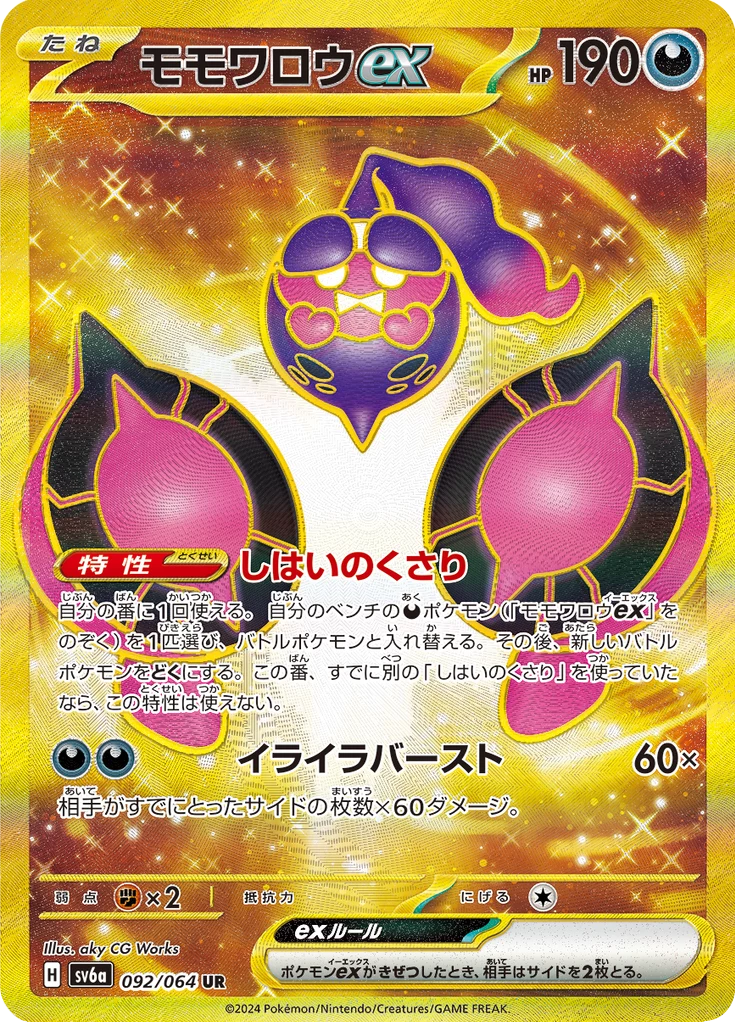
1. Pecharunt ex — SV6a 92 (Ultra Rare)

Pecharunt ex, SV6a 92, Ultra Rare, Night Wanderer

Pecharunt ex is Night Wanderer’s box art Pokemon and the set’s headline mascot chase card — the print most collectors are hunting when they open a Night Wanderer box. Its English printing carries the Hyper Rare treatment in Shrouded Fable, matching the gold Ultra Rare finish of the Japanese original.

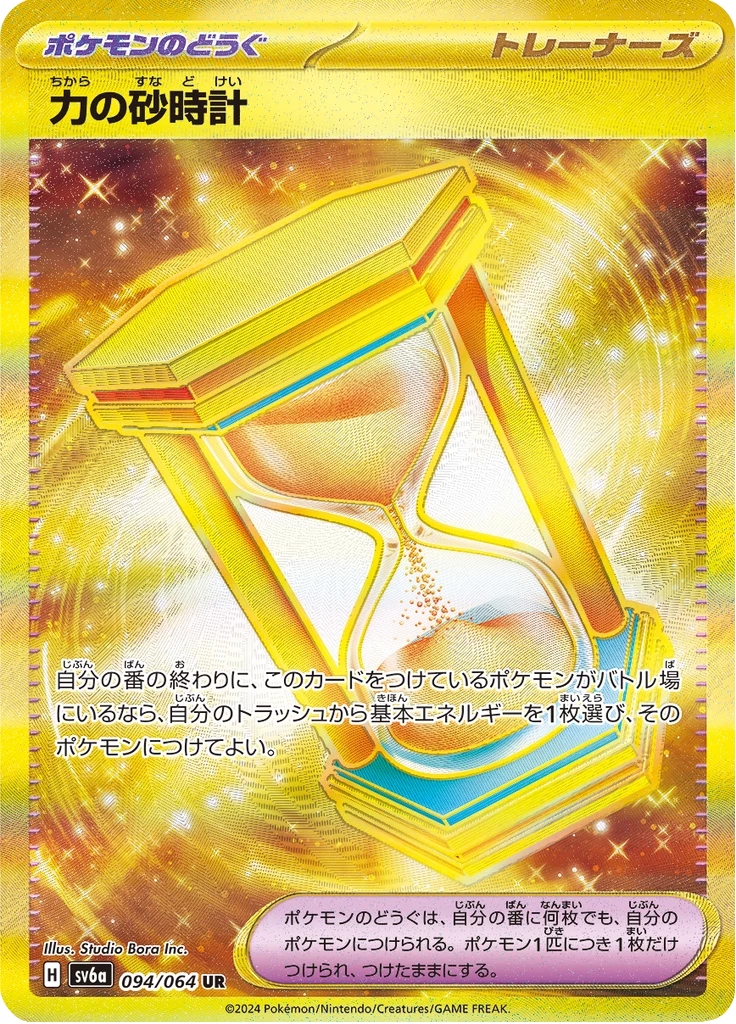
2. Hourglass of Power — SV6a 94 (Ultra Rare)

Hourglass of Power, SV6a 94, Ultra Rare, Night Wanderer

Hourglass of Power sits at the very top of Night Wanderer’s print run at SV6a 94. Like Pecharunt ex, it carries the Hyper Rare name in English.

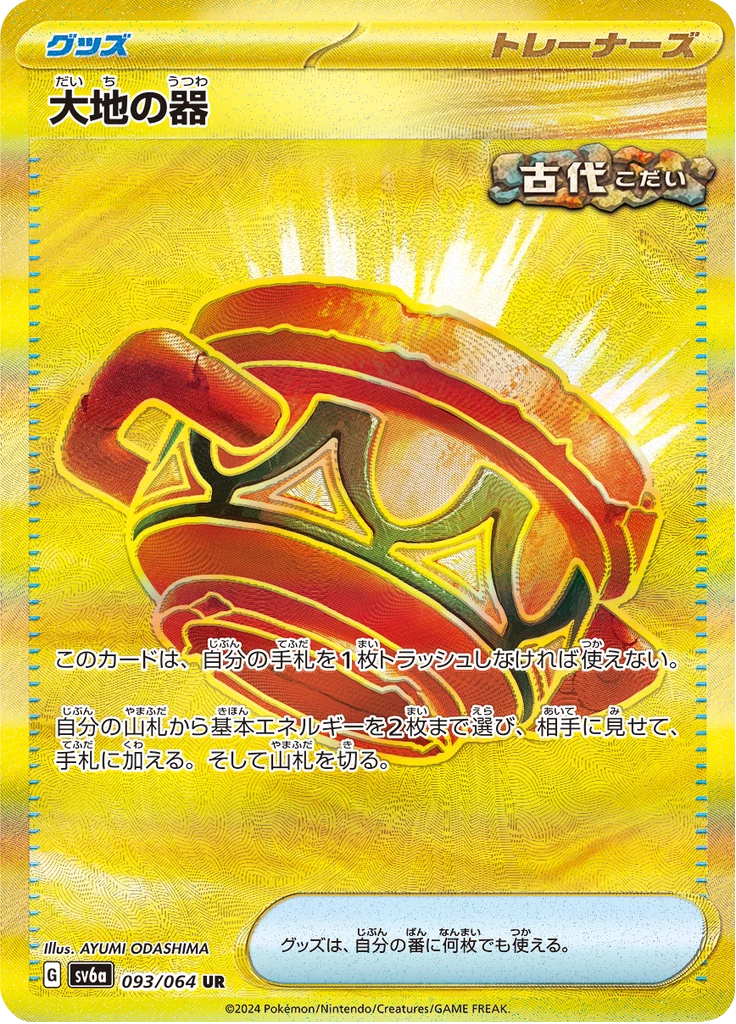
3. Earthen Vessel — SV6a 93 (Ultra Rare)

Earthen Vessel, SV6a 93, Ultra Rare, Night Wanderer

Earthen Vessel is the third of Night Wanderer’s three gold Ultra Rares, sitting one number below Hourglass of Power. All three Ultra Rares in this set carry the Hyper Rare name once they cross into English.

4. Kingdra ex — SV6a 77 (Secret Rare)

Kingdra ex opens Night Wanderer’s Secret Rare run at SV6a 77. No verified image is available for this specific print at the time of writing, so it is listed here by number and rarity rather than shown. In English, it carries the Special Illustration Rare name.

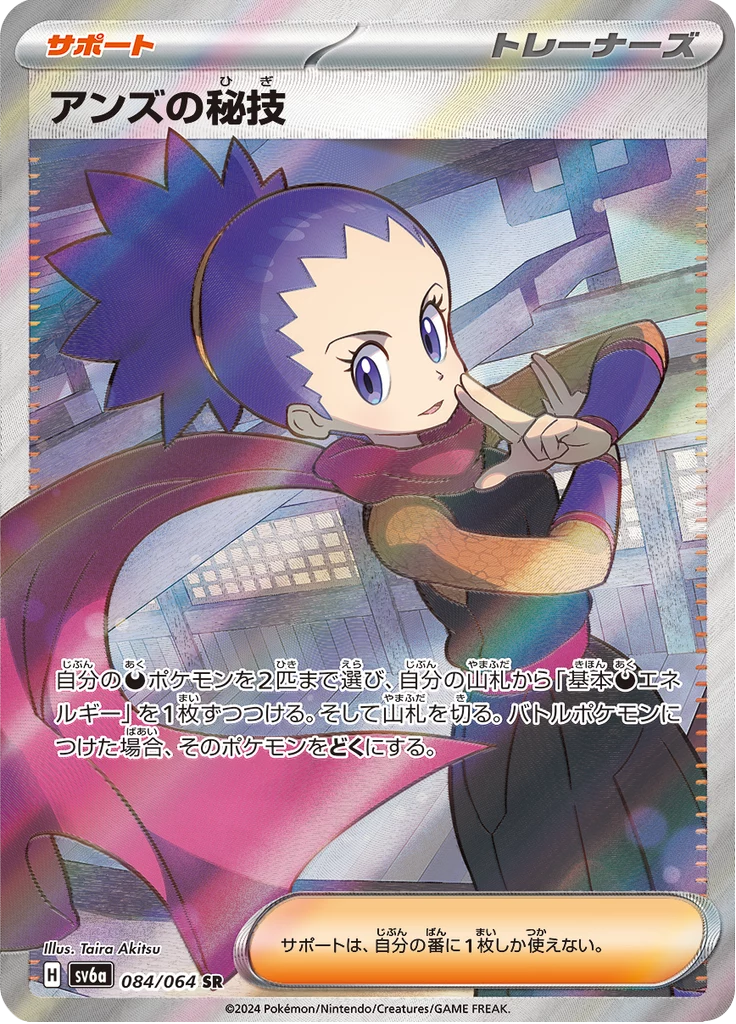
5. Janine’s Secret Technique — SV6a 84 (Secret Rare)

Janine's Secret Technique, SV6a 84, Secret Rare, Night Wanderer
Janine’s Secret Technique, SV6a 84, Secret Rare, Night Wanderer

Janine’s Secret Technique sits inside the same Secret Rare run, numbered SV6a 84. Its English printing is a Special Illustration Rare.

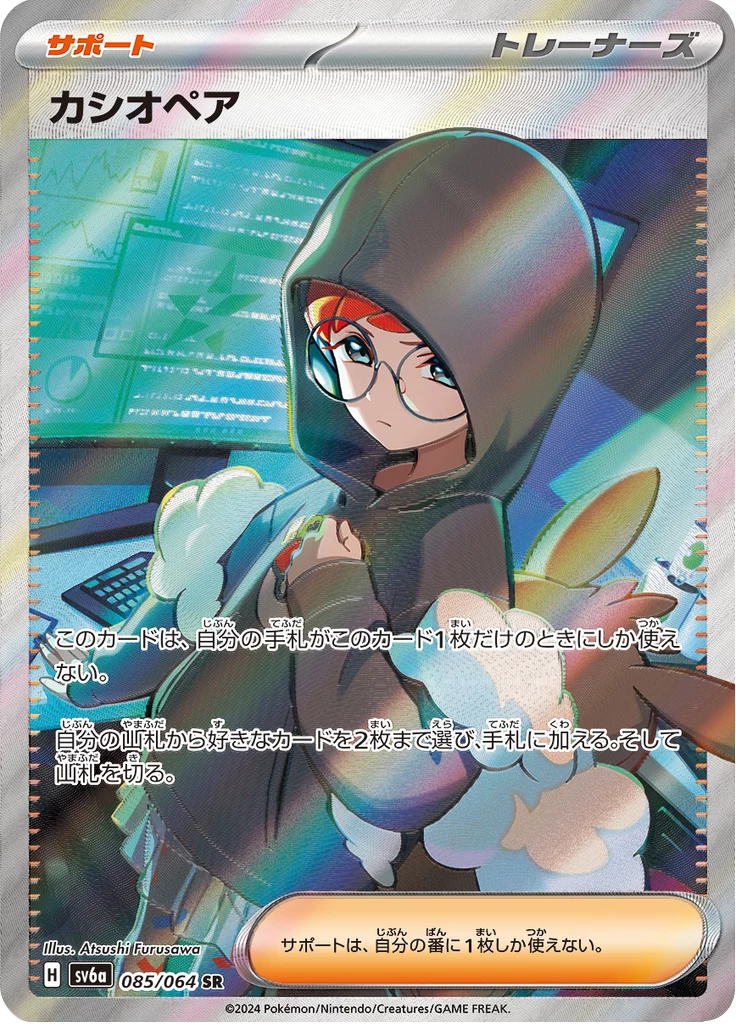
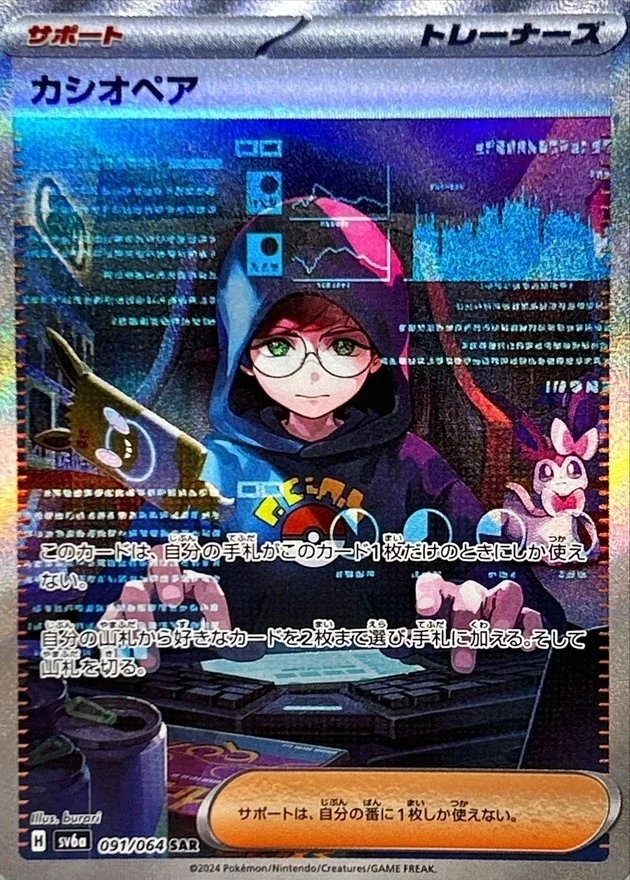
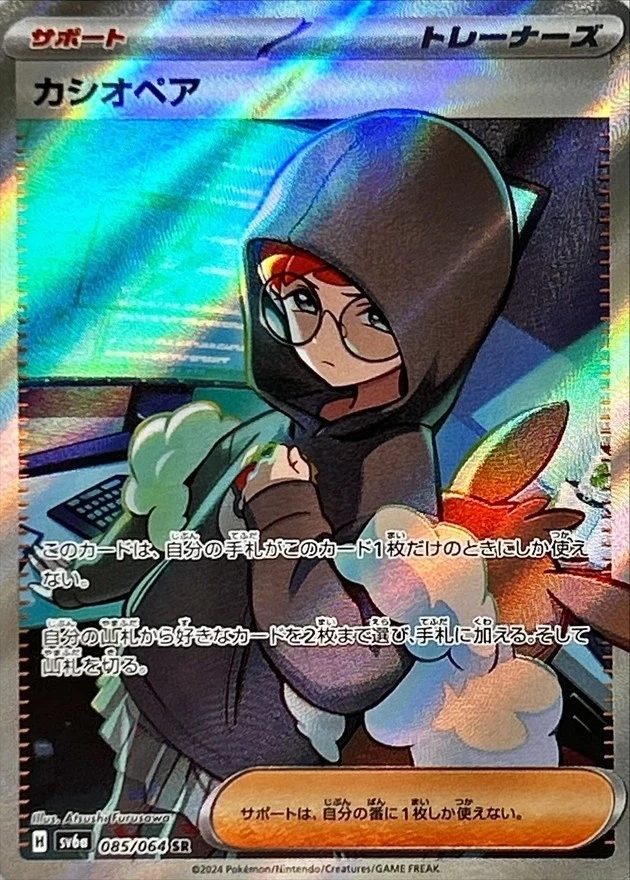
6. Cassiopeia — SV6a 85 (Secret Rare)

Cassiopeia, SV6a 85, Secret Rare, Night Wanderer

Cassiopeia follows directly after Janine’s Secret Technique at SV6a 85, also a Secret Rare, and also a Special Illustration Rare in English.

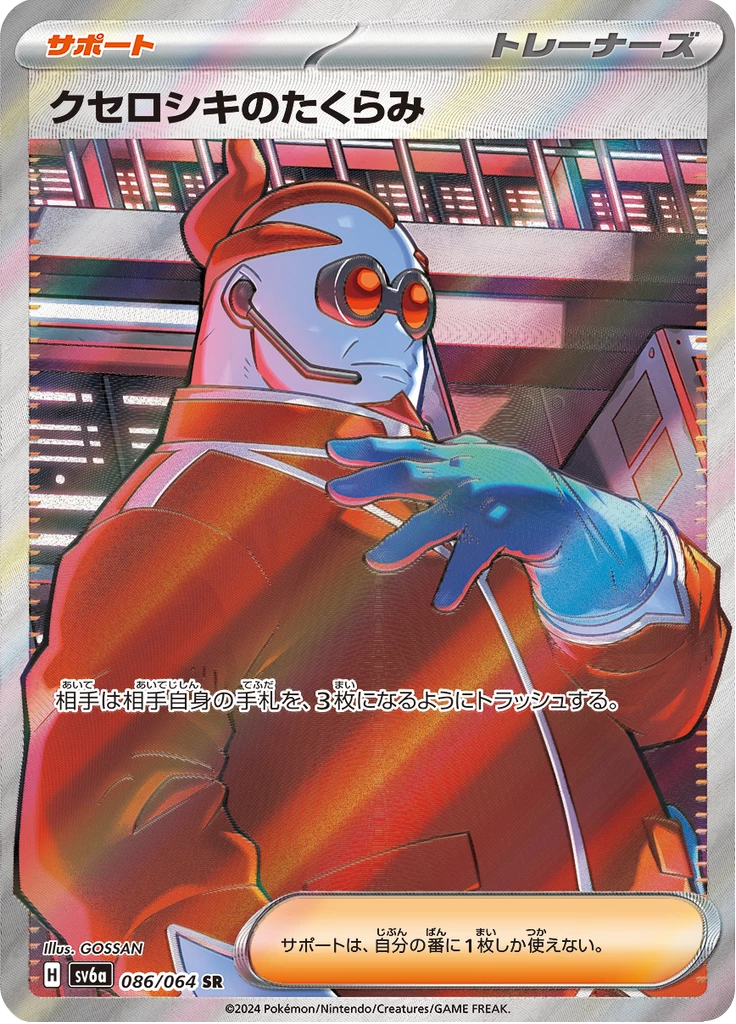
7. Xerosic’s Scheme — SV6a 86 (Secret Rare)

Xerosic's Scheme, SV6a 86, Secret Rare, Night Wanderer
Xerosic’s Scheme, SV6a 86, Secret Rare, Night Wanderer

Xerosic’s Scheme closes out the Secret Rare run at SV6a 86, one number above Cassiopeia. Its English printing is also a Special Illustration Rare, matching the other mapped cards in the run.

English Card English Rarity Japanese Print Japanese Rarity
Pecharunt ex Hyper Rare SV6a 92 Ultra Rare
Hourglass of Power Hyper Rare SV6a 94 Ultra Rare
Earthen Vessel Hyper Rare SV6a 93 Ultra Rare
Kingdra ex Special Illustration Rare SV6a 77 Secret Rare
Janine’s Secret Technique Special Illustration Rare SV6a 84 Secret Rare
Cassiopeia Special Illustration Rare SV6a 85 Secret Rare
Xerosic’s Scheme Special Illustration Rare SV6a 86 Secret Rare

Rarity Names: English vs Japanese

The rarity names in the table above look different on each side of the pairing, but they follow a consistent pattern across this generation of Scarlet & Violet sets. As a general rule for this SV era: Japanese AR (Art Rare) corresponds to English Illustration Rare; Japanese SAR (Special Art Rare) corresponds to English Special Illustration Rare; and Japanese UR (gold Ultra Rare) corresponds to English Hyper Rare.

The Secret Rare prints from Night Wanderer’s SV6a 77–86 run that are mapped here all localise into the Special Illustration Rare tier in English, and the set’s three gold Ultra Rares — Pecharunt ex, Earthen Vessel and Hourglass of Power — all become Hyper Rares. Night Wanderer does not use an Art Rare-to-Illustration Rare pairing among the seven chase cards in this guide, but the broader convention holds across the set’s full 94-card catalogue.

Japanese vs English Version: What Changes

Shrouded Fable’s English card count doesn’t match Night Wanderer’s Japanese total, and the gap is worth explaining before you go comparing checklists. The English set runs 64 numbered cards plus 35 secret rares, for 99 cards total. Night Wanderer catalogues 94 entries. As reported by PokeBeach and Pokellector, the difference comes from a handful of Illustration Rares and gold Energy cards that Shrouded Fable carried over from earlier Japanese releases rather than pulling everything from SV6a alone — so the English set is not a straight one-for-one port of the Japanese set, even though every chase card covered in this guide does map directly back to SV6a.

Release timing is the other visible gap. Night Wanderer released in Japan on 7 June 2024; Shrouded Fable followed in English on 2 August 2024, roughly eight weeks later.

Numbering is the easiest way to tell a Japanese and English copy apart at a glance. A Japanese print keeps its SV6a-prefixed number for life — Pecharunt ex is “SV6a 92” whether you bought it in 2024 or find it in a binder years from now — while Shrouded Fable renumbers every card into its own English-only sequence starting at 1. The same illustration can carry two completely different numbers depending on which release you are holding, and that’s the main reason a mapping table like the one above is useful when you’re trying to match a Japanese and English copy of the same card.

Shop This Set
SV6a Night Wanderer Japanese Pokemon Booster Box
Contains the source prints behind Shrouded Fable’s Ultra Rare chase cards
Ships from Tokyo · Tracked delivery

View Product →

Where to Buy the Japanese Night Wanderer Cards from Tokyo

We ship Japanese sealed product worldwide from Tokyo with tracked delivery. The SV6a Night Wanderer Japanese Booster Box is currently listed at ¥10,192 (~$64) and is the direct route to all seven chase cards covered in this guide, since every one of them is pulled from this box.

Three of the seven are also currently listed as graded PSA10 singles: Pecharunt ex at ¥11,564 (~$73), Janine’s Secret Technique at ¥8,260 (~$52), and Cassiopeia at ¥7,056 (~$44). For any of the others not linked above, sourcing requests go through Ordine rapido. For other Japanese Pokemon booster boxes, browse our Pokemon card box collection, and for the full 94-card Night Wanderer catalogue with every rarity tier, see our Shrouded Fable Japanese card list.

Domande frequenti

What Japanese set do Shrouded Fable’s chase cards come from?

All seven of Shrouded Fable’s headline chase cards come from a single Japanese set, Night Wanderer (SV6a), released 7 June 2024 as an Enhanced Expansion Pack.

Which card is Shrouded Fable’s headline chase card?

Pecharunt ex (SV6a 92, Ultra Rare in Japan, Hyper Rare in English) is Night Wanderer’s box art Pokemon and the set’s headline mascot chase card.

Why does Shrouded Fable have more cards in English than Night Wanderer has in Japanese?

Shrouded Fable totals 99 cards (64 numbered plus 35 secret rares) against Night Wanderer’s 94 catalogued entries. As reported by PokeBeach and Pokellector, the extra English cards are Illustration Rares and gold Energy cards carried over from earlier Japanese releases rather than pulled from SV6a alone.

How do Japanese and English rarity names line up for this set?

As a general rule for this Scarlet & Violet era, Japanese AR (Art Rare) corresponds to English Illustration Rare, Japanese SAR (Special Art Rare) corresponds to English Special Illustration Rare, and Japanese gold Ultra Rare corresponds to English Hyper Rare. Night Wanderer’s own Secret Rare run localises into the Special Illustration Rare tier in English.

Can I buy the individual Shrouded Fable chase cards as singles?

Three of the seven — Pecharunt ex, Janine’s Secret Technique, and Cassiopeia — are currently listed as graded PSA10 singles. For any of the others not linked above, sourcing requests go through Quick Order.

Where can I buy the Japanese Night Wanderer booster box?

The SV6a Night Wanderer Japanese Booster Box is currently listed at ¥10,192 (~$64) and ships from Tokyo with tracked delivery. See the Where to Buy section above for the direct link.

Starlight Rare vs 20th Secret Rare in Yu-Gi-Oh: confronto tra le rarità chase di TCG e OCG

Starlight Rare and 20th Secret Rare both get called “the ultimate chase rarity” in Yu-Gi-Oh discussion, and it’s easy to assume they’re the same idea printed for two audiences. They aren’t. Starlight Rare is a TCG-only foil tier that started in 2019 and is still being printed today. 20th Secret Rare is an OCG-only foil tier that ran for about two years and was retired in 2020. They never appeared in the same product, and one did not turn into the other.

This guide lines up what each rarity actually is, when each one existed, and — since we ship Japanese cards out of Tokyo — which one you can currently order from us. Short answer on that last point: no Starlight Rare today, but two graded Japanese 20th Secret Rare cards are on the site.

Key Takeaways

Starlight Rare (Yu-Gi-Oh TCG) debuted in Rising Rampage (2019) and remains an active chase rarity in the Battles of Legend sub-series. 20th Secret Rare (Yu-Gi-Oh OCG) ran from Cybernetic Horizon (2018) to Rise of the Duelist (April 2020), when Prismatic Secret Rare took over the OCG’s top foil slot — not Starlight Rare. We don’t currently list a Starlight Rare card, but two Japanese 20th Secret Rare PSA 10s are listed: PSA10 Dark Magician Girl 20th SE and PSA10 Hiita the Fire Charmer, Ablaze 20th SE.

2019
Starlight Rare Debut (TCG)

2018–20
20th Secret Rare Era (OCG)

Sep 2026
Prices Checked

¥159
Per USD (Sept 2026)

Yen figures below convert at ¥159/USD (September 2026). Starlight Rare and 20th Secret Rare release history is sourced from Yugipedia’s entries on each rarity; product details are from our own catalogue.

What Is a Starlight Rare? (Yu-Gi-Oh TCG)

Starlight Rare is a TCG-only foil tier. It debuted in Rising Rampage in 2019, then became a recurring premium chase rarity inside the Battles of Legend sub-series starting with Battles of Legend: Armageddon on 23 July 2020, and has continued to appear in later Battles of Legend releases — including Monster Mayhem on 23 June 2025, per secondary retail sourcing.

Visually, a Starlight Rare uses the same horizontal holographic foil pattern found on a Prismatic Secret Rare, but the treatment covers the entire card rather than only the artwork window. Foil is absent only from the text box, any empty Link Arrows, and small portions of the artwork itself — everything else on the card front carries the holographic finish.

On scarcity: third-party retail sources report Starlight Rare pulls from original core-set boxes at roughly one per case to one per two cases, which works out to something like one per 12–24 boxes. That is a secondary-sourced community estimate, not a figure Konami has published, so treat it as a reported range rather than an official print-run number.

We don’t currently list a Starlight Rare card on our site — sourcing requests for one go through Ordine rapido.

What Is a 20th Secret Rare? (Yu-Gi-Oh OCG)

PSA10 Dark Magician Girl 20th Secret Rare [20TH-JPC55], 20th Anniversary Legend Collection
PSA10 Dark Magician Girl 20th SE [20TH-JPC55], 20th Anniversary Legend Collection (Japanese)

20th Secret Rare is an OCG-only foil tier, introduced in Cybernetic Horizon in 2018 to mark the Yu-Gi-Oh OCG’s 20th anniversary. It went on to appear across several anniversary-themed OCG products — including 20th Anniversary Legend Collection, 20th Anniversary Legend Selection, and the 20th Secret Rare Special Pack — as well as in ordinary core boosters through 2018–2020.

The rarity was discontinued when the OCG’s Rise of the Duelist booster (April 2020) replaced it with a new, visually similar foil called Prismatic Secret Rare. The last 20th Secret Rare card ever printed was The Winged Dragon of Ra, in that same Rise of the Duelist booster.

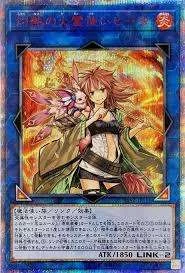
Our two listed 20th Secret Rare cards show both sides of how the rarity was used. PSA10 Dark Magician Girl 20th SE [20TH-JPC55] is currently listed at ¥330,400 (~$2,078) and comes from 20th Anniversary Legend Collection, one of the dedicated anniversary products named above. PSA10 Hiita the Fire Charmer, Ablaze 20th SE [SAST-JP056] is currently listed at ¥145,140 (~$913) and comes from Savage Strike, an ordinary 2019 OCG core booster that used the 20th SE treatment for one chase card — confirming the rarity turned up in both anniversary-specific sets and regular boosters during its run.

PSA10 Hiita the Fire Charmer, Ablaze 20th Secret Rare [SAST-JP056], Savage Strike
PSA10 Hiita the Fire Charmer, Ablaze 20th SE [SAST-JP056], Savage Strike (Japanese)

For how 20th Secret Rare compares to a different TCG-side finish from the same general period — Ghost Rare, a long-running visual-effect rarity that is unrelated to either card discussed here — see our companion guide, 20th Secret Rare vs Ghost Rare Explained.

Starlight Rare vs 20th Secret Rare: Side by Side

Laid out next to each other, the two rarities share a similar “top of the ladder” feel but sit on completely separate timelines and product lines:

Rarity Regione Debut Status Currently on our site
Starlight Rare TCG only 2019 — Rising Rampage Active — recurring in the Battles of Legend sub-series Not listed — Ordine rapido
20th Secret Rare OCG only 2018 — Cybernetic Horizon Retired April 2020 — replaced by Prismatic Secret Rare 2 PSA 10s: Dark Magician Girl, Hiita

The foil treatments look related at a glance — both push holographic coverage well beyond a standard Secret Rare — but a Starlight Rare wraps the entire card front, while 20th Secret Rare uses the earlier OCG holographic-name style that Prismatic Secret Rare later carried forward. For a full breakdown of Yu-Gi-Oh’s highest-value chase cards across both regions, see our most expensive Yu-Gi-Oh cards guide.

Why They Get Confused — and Why One Didn’t Replace the Other

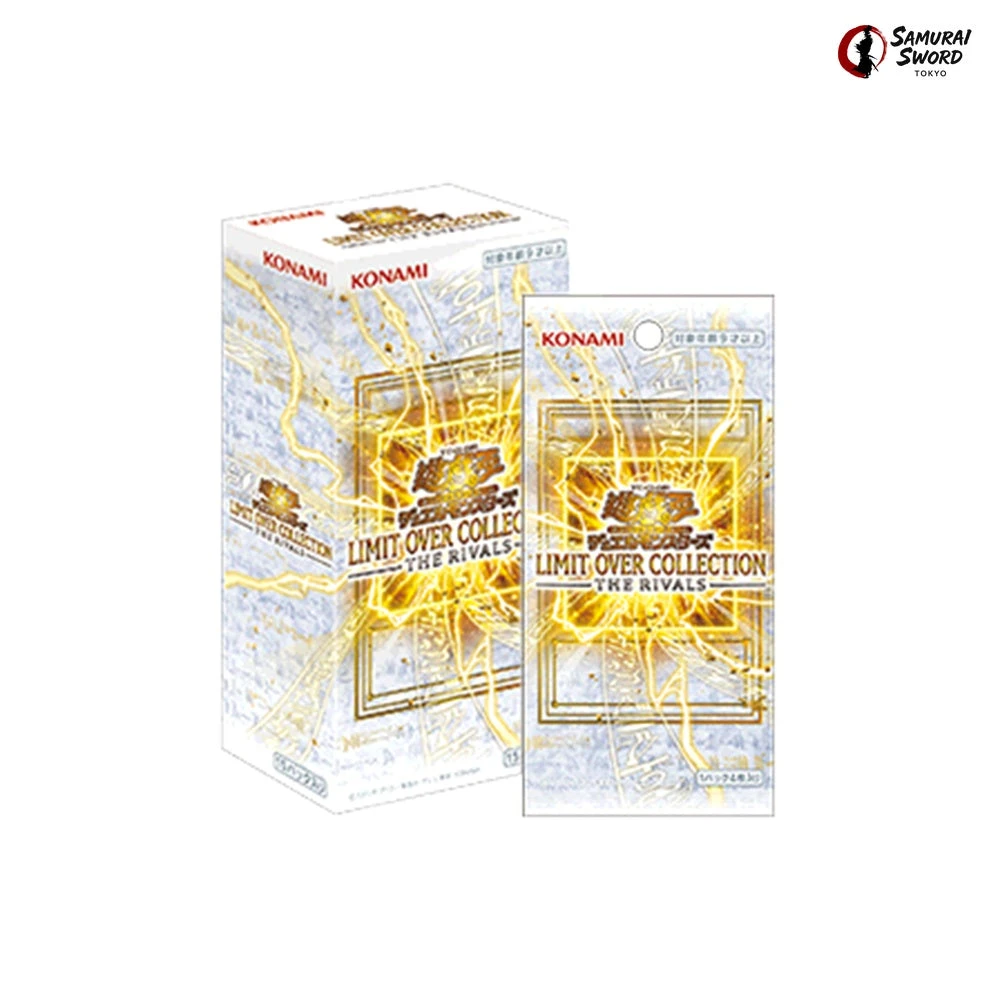
LIMIT OVER COLLECTION: THE RIVALS (LOCR) Japanese Yu-Gi-Oh booster box
LIMIT OVER COLLECTION: THE RIVALS (LOCR), a current Japanese OCG booster carrying Prismatic Secret Rare — the finish that actually replaced 20th Secret Rare

Starlight Rare and Prismatic Secret Rare are commonly described as regional counterparts of the same modern “whole-card holographic” idea, and that comparison is reasonable — both push foil coverage further than a standard Secret Rare, and both currently sit near the top of their region’s ladder. Where the confusion creeps in is assuming Starlight Rare is what 20th Secret Rare “became.”

It isn’t. 20th Secret Rare is a separate, earlier OCG rarity that Prismatic Secret Rare replaced in April 2020 — not Starlight Rare’s direct predecessor. The accurate framing is this: 20th Secret Rare (OCG, 2018–2020) and Starlight Rare (TCG, 2019–present) both sat at the top of their region’s rarity ladder in roughly the same window, and both were eventually followed or accompanied by full-card-foil concepts in their own region — Prismatic Secret Rare in the OCG’s case — but they are two different rarities that were never printed in the same product, on the same timeline, or under the same name.

For the OCG side of that successor story in full, including the finish’s own later detour through Quarter Century Secret Rare, see our Prismatic Secret Rare explained guide.

Where Each Rarity Sits on Its Region’s Ladder

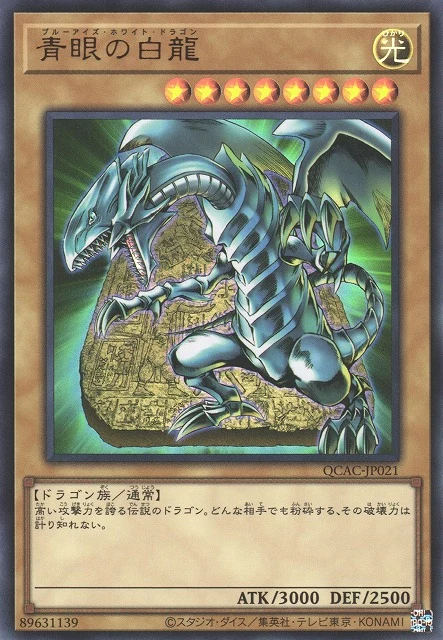
Blue-Eyes White Dragon, Ultra Rare, Quarter Century Art Collection (Japanese)

Blue-Eyes White Dragon UR, Quarter Century Art Collection (JP)

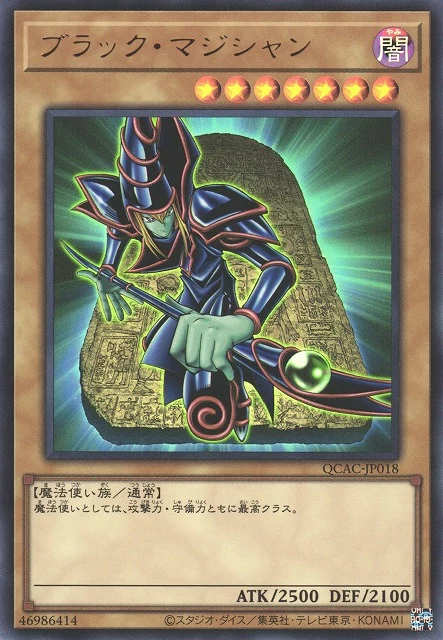
Dark Magician, Ultra Rare, Quarter Century Art Collection (Japanese)

Dark Magician UR, Quarter Century Art Collection (JP)

On the OCG side, 20th Secret Rare occupied the top-tier “anniversary foil” slot from 2018 to 2020. That slot didn’t stay static after 20th SE retired — Prismatic Secret Rare took over in April 2020, was itself stood in for by a different anniversary finish between 2023 and 2025, and the OCG’s ladder has kept adding specialty tiers since. Our OCG rarity guide covering Quarter Century Secret Rare walks through that full modern ladder, including the showcase set built specifically around the Quarter Century finish, the Quarter Century Art Collection guide, plus the newest tiers debuting on sets like Limit Over Collection. This article’s focus — Starlight Rare and 20th Secret Rare — sits earlier on that timeline than the rarities covered there.

On the TCG side, Starlight Rare sits at the top of the Battles of Legend sub-series specifically, above the Prismatic Secret Rare treatment that also appears in TCG products. There is no TCG equivalent that directly maps onto the OCG’s 20th Secret Rare — the two ladders developed their premium tiers independently, which is part of why lining them up card-for-card doesn’t work cleanly.

Buying Japanese 20th Secret Rare Cards from Tokyo

We don’t currently list a Yu-Gi-Oh TCG Starlight Rare card — sourcing requests for one go through Ordine rapido, with no timing attached. What we do carry, in graded Japanese OCG form, is 20th Secret Rare.

PSA10 Dark Magician Girl 20th SE [20TH-JPC55], from 20th Anniversary Legend Collection, is currently listed at ¥330,400 (~$2,078). PSA10 Hiita the Fire Charmer, Ablaze 20th SE [SAST-JP056], from Savage Strike, is currently listed at ¥145,140 (~$913). Both are graded Japanese pulls of a rarity Konami stopped printing in 2020, which is part of why a retired tier like this carries the premium it does compared with an actively-printed one.

Browse the rest of our graded Japanese singles in the PSA 10 collection. For the OCG’s current top-tier foil — Prismatic Secret Rare, the rarity that actually replaced 20th Secret Rare in 2020 — see our Prismatic Secret Rare explained guide. For anything else across either rarity family, including a Starlight Rare single or additional 20th Secret Rare cards, Ordine rapido is the fastest way to put a mixed request in front of us.

Shop This Rarity
PSA10 Dark Magician Girl 20th SE [20TH-JPC55], 20th Anniversary Legend Collection
Currently listed at ¥330,400 (~$2,078)
Ships from Tokyo · Tracked delivery

View Product →

Domande frequenti

Is Starlight Rare the same as 20th Secret Rare?

No. Starlight Rare is a Yu-Gi-Oh TCG-only rarity that debuted in 2019 and is still printed today. 20th Secret Rare is a Yu-Gi-Oh OCG-only rarity that ran from 2018 to 2020 and was retired years ago. They never appeared in the same product.

Did Starlight Rare replace 20th Secret Rare?

No. The OCG rarity that replaced 20th Secret Rare in April 2020 is Prismatic Secret Rare, not Starlight Rare. Starlight Rare is a separate TCG-only rarity on its own timeline, and the two were never printed in the same product line.

When did Starlight Rare first appear?

Starlight Rare debuted in Rising Rampage in 2019, then became a recurring chase rarity in the Battles of Legend sub-series starting with Battles of Legend: Armageddon on 23 July 2020, continuing into later releases in that sub-series.

What was the last set to use 20th Secret Rare?

Rise of the Duelist, released in April 2020, was the final OCG booster to use 20th Secret Rare — its last 20th Secret Rare card was The Winged Dragon of Ra. That same booster introduced Prismatic Secret Rare as the replacement.

How rare is a Starlight Rare pull?

Third-party retail sources report roughly one Starlight Rare per case to one per two cases from original core-set boxes, which works out to something like one per 12–24 boxes. That figure is a secondary-sourced community estimate rather than an official number from Konami.

Do you sell Starlight Rare cards?

Not at the moment — we don’t currently list a Starlight Rare card. Sourcing requests go through Quick Order. We do currently list two graded Japanese 20th Secret Rare PSA 10s, Dark Magician Girl and Hiita the Fire Charmer, Ablaze.

Guida alla serie promozionale Boss's Pikachu: Team Rocket, Plasma, Skull, Galactic, Aqua & Flare

In January 2018, Pokémon Center and Pokémon Store shoppers in Japan who bought five booster packs in one transaction could pick a Pikachu card dressed as the boss of one of seven Pokémon villain teams — Rocket, Magma, Aqua, Galactic, Plasma, Flare or Skull. Same Lightning-type Basic Pikachu, same attack text, seven different team liveries.

Bulbapedia lists all seven under one official name, “Pretend Boss Pikachu” (Japanese: ボスごっこピカチュウ, plus the team name), numbered 191 through 197 in the SM-P Promotional card block. This store’s own listings shorten that to “Boss Pikachu [Team]” — same underlying cards.

This guide covers the full seven-card run, the campaign that distributed them, and the four PSA10-graded team variants covered in detail — Team Rocket, Team Galactic, Team Plasma and Team Skull — all currently listed on our site. Team Aqua and Team Flare are listed as well and covered below; Team Magma exists in the same numbered run but is not currently listed, and sourcing requests for it go through Quick Order.

Key Takeaways

Pretend Boss Pikachu is a seven-card Japanese promo series (SM-P 191–197), one card per Pokémon villain team, distributed from 20 January 2018 through the “Team Rainbow Rocket’s Ambition” campaign at Pokémon Centers and Pokémon Stores for shoppers who bought five booster packs in one transaction. This store currently lists PSA10 graded cards for six of the seven: Team Rocket (SM-P 191) at ¥636,020 (~$4,000) and Team Plasma (SM-P 195) at ¥646,640 (~$4,067), plus Team Galactic and Team Skull below, and Team Aqua (SM-P 192) at ¥519,200 (~$3,265) and Team Flare (SM-P 196) at ¥495,364 (~$3,116). Team Magma is not currently listed.

7
Team Variants (SM-P 191–197)

2018
Campaign Launch Year

5 Packs
Purchase To Qualify

Sep 2026
Prices Checked

Prices are this store’s current listed prices as of September 2026, converted at ¥159/USD.

The Pretend Boss Pikachu Promo Series

Bulbapedia’s full official name for this line is “Pretend Boss Pikachu” (Japanese: ボスごっこピカチュウ, plus the team name) — a Lightning-type Basic Pokémon promo, part of the SM-P Promotional card block. All seven team variants share one continuous promo-number run, 191 through 197, per Bulbapedia’s SM-P Promotional cards table:

N. Team Japanese name On our site
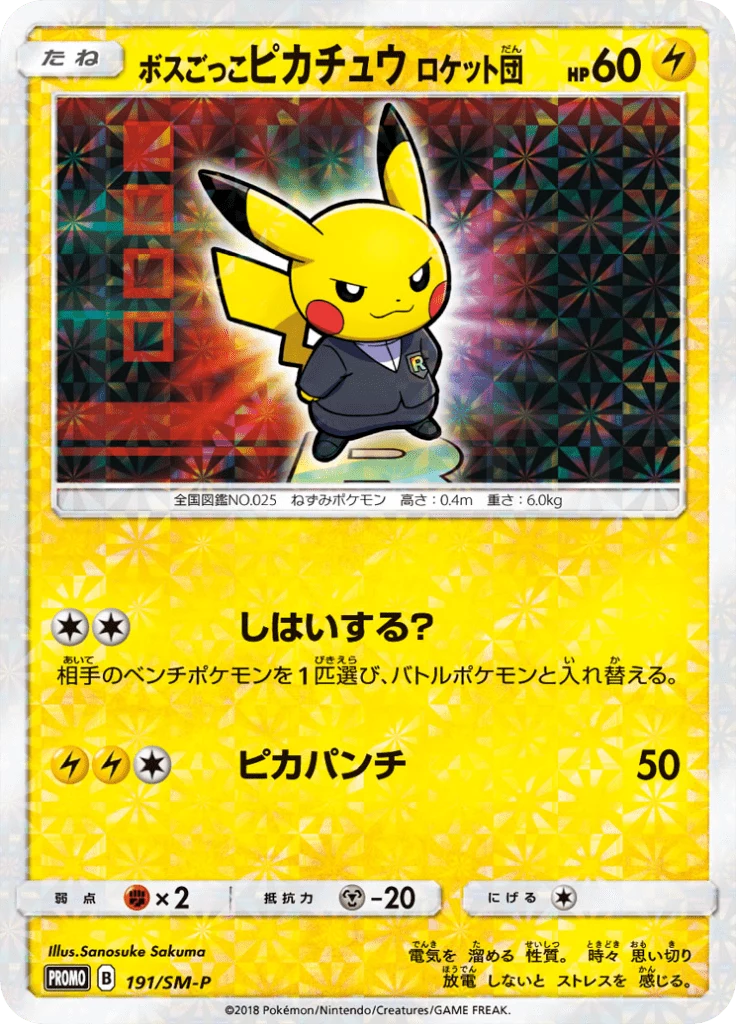
191/SM-P Team Rocket ボスごっこピカチュウ ロケット団 Listed
192/SM-P Team Aqua — Listed (¥519,200)
193/SM-P Team Magma — Not listed
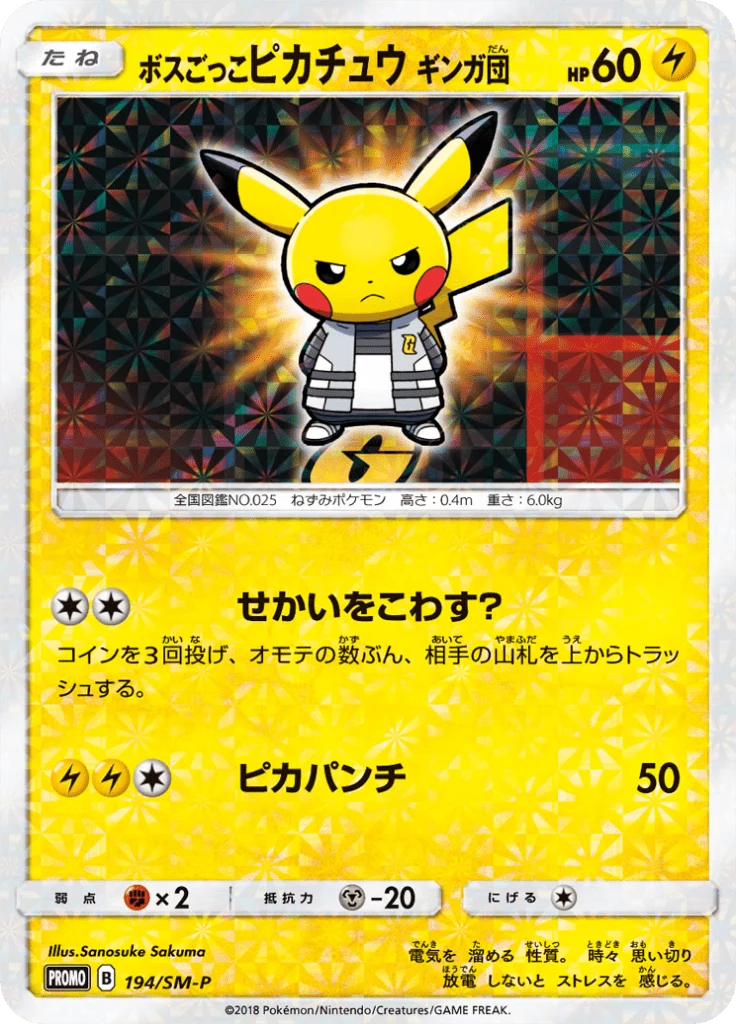
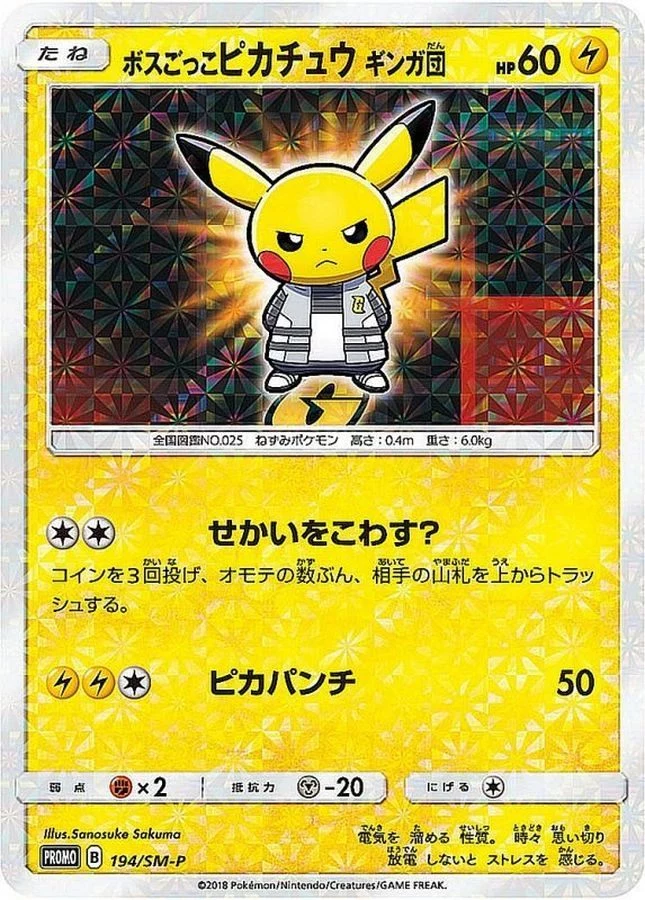
194/SM-P Team Galactic ボスごっこピカチュウ ギンガ団 Listed
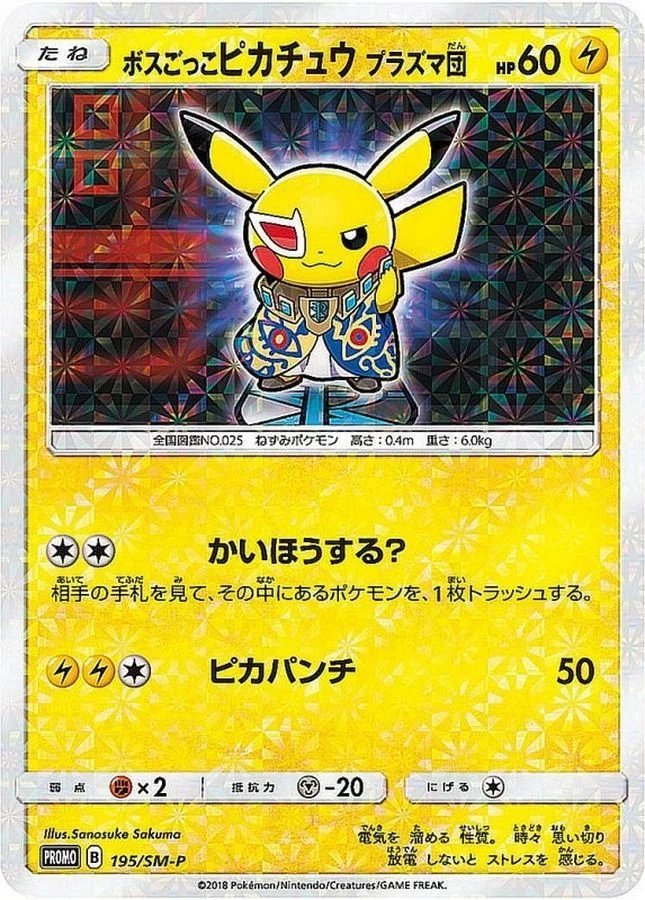
195/SM-P Team Plasma ボスごっこピカチュウ プラズマ団 Listed
196/SM-P Team Flare — Listed (¥495,364)
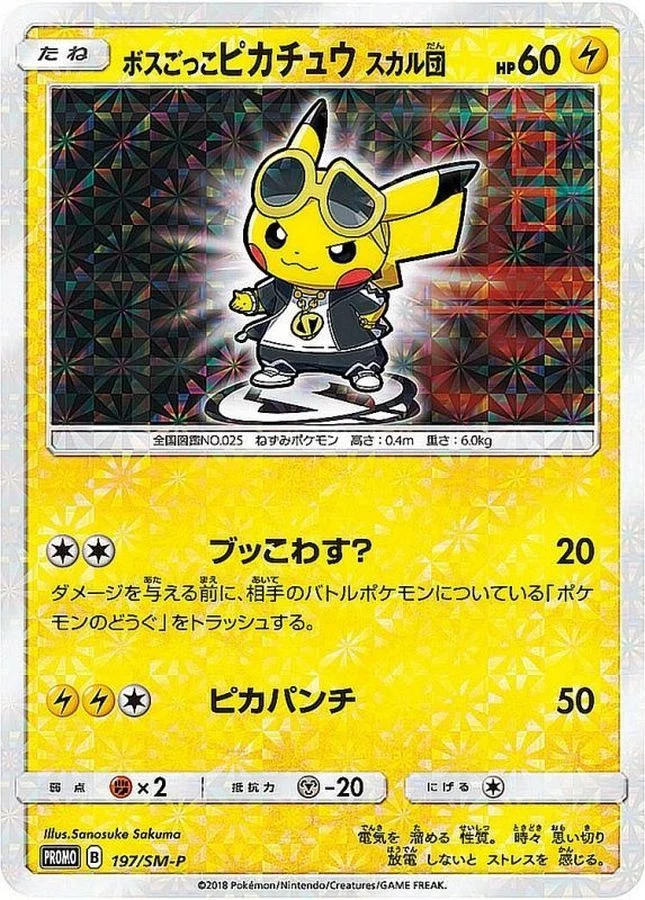
197/SM-P Team Skull ボスごっこピカチュウ スカル団 Listed

This store lists six of the seven — Team Rocket, Team Aqua, Team Galactic, Team Plasma, Team Flare and Team Skull — as individually graded PSA10 cards. Team Magma is not currently listed; sourcing requests for it go through Ordine rapido. The illustrator credited on Bulbapedia for each of the four variants covered in detail below is Sanosuke Sakuma.

Not the Same “Pretend ___ Pikachu”

Our Novelty Special-BOX Pikachu Promos guide covers “Pretend Team Skull Pikachu” (SM-P Promo 013) — a different, earlier release from the 2016 Sun & Moon Special Box, tied to its own separate campaign. This article covers the later 2018 “Pretend Boss Pikachu” line (SM-P 191–197), distributed through the Team Rainbow Rocket’s Ambition campaign. Same naming convention, different characters, different years — don’t mix the two up.

Boss Pikachu Team Rocket, SM-P 191, Promo, SM-P Promotional cards

Boss Pikachu Team Rocket
SM-P 191

Boss Pikachu Team Galactic, SM-P 194, Promo, SM-P Promotional cards

Boss Pikachu Team Galactic
SM-P 194

Boss Pikachu Team Plasma, SM-P 195, Promo, SM-P Promotional cards

Boss Pikachu Team Plasma
SM-P 195

Boss Pikachu Team Skull, SM-P 197, Promo, SM-P Promotional cards

Boss Pikachu Team Skull
SM-P 197

Team Rocket: SM-P 191

PSA10 Boss Pikachu Team Rocket SM-P 191, listed on samuraiswordtokyo.com
Boss Pikachu Team Rocket · SM-P 191 · Promo · SM-P Promotional cards

Boss Pikachu Team Rocket (SM-P 191, Japanese: ボスごっこピカチュウ ロケット団) is one of the six Pretend Boss Pikachu team variants currently listed on this site as a graded PSA10 card. It’s illustrated by Sanosuke Sakuma and was distributed through the January 2018 Team Rainbow Rocket’s Ambition campaign alongside the other six team variants. A PSA10 card is currently listed at ¥636,020 (~$4,000).

Team Galactic: SM-P 194

PSA10 Boss Pikachu Team Galactic SM-P 194, listed on samuraiswordtokyo.com
Boss Pikachu Team Galactic · SM-P 194 · Promo · SM-P Promotional cards

Boss Pikachu Team Galactic (SM-P 194, Japanese: ボスごっこピカチュウ ギンガ団) is illustrated by Sanosuke Sakuma and belongs to the same seven-card Team Rainbow Rocket’s Ambition run as the other variants on this page. A PSA10 card is currently listed at ¥527,460 (~$3,317).

Team Plasma: SM-P 195

PSA10 Boss Pikachu Team Plasma SM-P 195, listed on samuraiswordtokyo.com
Boss Pikachu Team Plasma · SM-P 195 · Promo · SM-P Promotional cards

Boss Pikachu Team Plasma (SM-P 195, Japanese: ボスごっこピカチュウ プラズマ団) carries the same Sanosuke Sakuma illustration credit as the rest of the run. A PSA10 card is currently listed at ¥646,640 (~$4,067), the highest of the six team variants this store currently lists.

Team Skull: SM-P 197

PSA10 Boss Pikachu Team Skull SM-P 197, listed on samuraiswordtokyo.com
Boss Pikachu Team Skull · SM-P 197 · Promo · SM-P Promotional cards

Boss Pikachu Team Skull (SM-P 197, Japanese: ボスごっこピカチュウ スカル団) closes out the numbered run at the highest promo number in the run, also illustrated by Sanosuke Sakuma. A PSA10 card is currently listed at ¥552,252 (~$3,473).

How the Series Was Distributed

Bulbapedia’s page for each of the seven cards carries the same distribution note, verbatim: “Starting January 20, 2018 for as long as stocks lasted, customers at participating Pokémon Centers (including the Pokémon Center Online) and Pokémon Stores who purchased five booster packs in one transaction could select to receive 1 of 7 Pretend Boss Pikachu promotional cards.” In other words, this wasn’t a random pack pull — shoppers chose which of the seven team variants they wanted at the register, for as long as that location’s stock of that specific variant lasted.

The seven-team roster lines up with “Team Rainbow Rocket,” the villain-alliance concept from Pokémon Ultra Sun and Ultra Moon, in which former antagonist team leaders and grunts from across the games band together under one banner. The 2018 “Team Rainbow Rocket’s Ambition” campaign that distributed these promos is themed around that concept, which is why the run spans seven separate villain teams — Rocket, Magma, Aqua, Galactic, Plasma, Flare and Skull — rather than tying to a single game’s cast.

For related Japanese Pikachu promo lines, see our Poncho Pikachu value guide and Mega Tokyo Pikachu promo guide — both cover separate costume-Pikachu campaigns, not this Team Rainbow Rocket run. For how Japanese promo distribution works more broadly, our One Piece promo cards guide and Japanese old-back Pokémon cards guide give wider context on Japanese promo collecting.

Grading and What PSA 10 Means for These Promos

PSA 10 is the top grade PSA issues, reserved for cards judged free of the centring, corner, edge and surface flaws that lower grades allow. For a promo-only card like this one — never sold inside a booster box, never given a widely distributed set-code release — a PSA10 slab is the main way a buyer can verify condition without a set or booster context to compare it against.

All six Boss Pikachu team variants listed on this site are graded PSA10 cards, not raw examples. If you’re comparing a raw card against a slabbed one, check the promo number in the corner first — 191, 192, 194, 195, 196 and 197 are the six this store lists, and the team name printed on the card should match the Japanese name in the table above.

Where to Buy Boss Pikachu Cards from Tokyo

We ship Japanese sealed product and graded singles worldwide from Tokyo with tracked delivery. Six Pretend Boss Pikachu team variants are currently listed as PSA10 graded cards:

Featured Card
PSA10 Boss Pikachu Team Plasma (SM-P Promo 195)
Currently listed at ¥646,640 (~$4,067)
Ships from Tokyo · Tracked delivery

View Product →

Also currently listed: Team Rocket at ¥636,020 (~$4,000), Team Galactic at ¥527,460 (~$3,317), and Team Skull at ¥552,252 (~$3,473). Team Aqua at ¥519,200 (~$3,265) and Team Flare at ¥495,364 (~$3,116) are listed too. Team Magma is not listed on our site at the moment — sourcing requests for it go through Ordine rapido.

For more PSA10-graded Japanese promos, browse our PSA 10 collection, or add specific cards to a mixed order through Ordine rapido.

Domande frequenti

What is “Boss Pikachu”?

Boss Pikachu is this store’s shorthand for “Pretend Boss Pikachu,” a seven-card Japanese promo series (SM-P Promotional cards, numbers 191–197) in which the same Lightning-type Basic Pikachu design was reprinted once per Pokémon villain team — Rocket, Magma, Aqua, Galactic, Plasma, Flare and Skull.

How many Boss Pikachu team variants are there, and which ones are listed here?

All seven team variants (SM-P 191–197) exist as one numbered run. This store currently lists six as graded PSA10 cards — Team Rocket, Team Aqua, Team Galactic, Team Plasma, Team Flare and Team Skull. Team Magma is not listed at the moment; sourcing requests go through Quick Order.

How was the Boss Pikachu series originally distributed?

Starting 20 January 2018, shoppers at participating Japanese Pokémon Centers, Pokémon Center Online and Pokémon Stores who bought five booster packs in one transaction could choose 1 of the 7 Pretend Boss Pikachu cards, for as long as each location had stock of that variant.

What is Team Rainbow Rocket, and why does it matter for this series?

Team Rainbow Rocket is the villain-alliance concept from Pokémon Ultra Sun and Ultra Moon, uniting former antagonist team leaders and grunts from across the games under one banner. The 2018 “Team Rainbow Rocket’s Ambition” campaign that distributed these promos is themed around that concept, which is why the card run covers seven separate villain teams instead of one.

Where can I buy Boss Pikachu PSA10 cards from Japan?

Six team variants — Rocket, Aqua, Galactic, Plasma, Flare and Skull — are currently listed as PSA10 graded cards on this site, shipping from Tokyo with tracked delivery. Use Quick Order to ask about Team Magma or to build a mixed order.

Giovanni's Magikarp Old Back: guida alla carta giapponese (serie Gym)

Giovanni’s Magikarp comes from a single documented Japanese print — a 1999 old-back single that carries a numbering convention most collectors never learn to read correctly. That makes it a useful card to walk through in detail: one print, one set, and a numbering system that looks like a set position but isn’t.

The card is Giovanni’s Magikarp, our listing’s card number No.129, from the Japanese expansion Gym Expansion Volume 2, “Challenge from the Darkness” — the set Bulbapedia’s English-language records list as Gym Challenge, Japan’s 6th TCG expansion, released 25 June 1999. It carries the original 1996–2001 “old back” card design, predating the July 2001 card-back redesign introduced with Pokemon VS. We currently list a PSA 10 graded copy of this print, and this guide covers what the card is, how its number actually works, how the Japanese print compares to its English counterpart, and where it sits alongside the other Gym-leader singles we list from the same set.

Key Takeaways

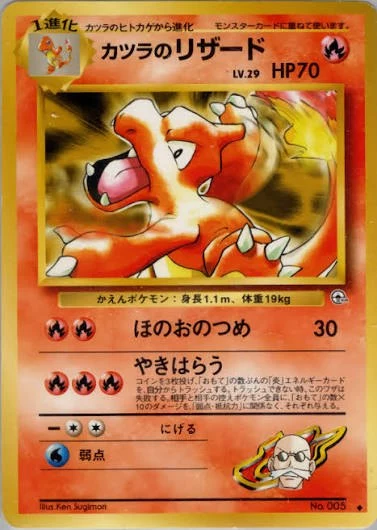
Giovanni’s Magikarp Old Back No.129 is a PSA 10, currently listed at ¥159,064 (~$1,000). It comes from Gym Expansion Volume 2 (JP release 25 June 1999, 98 total Japanese cards), and the “No.129” on the card is a National Pokedex-based numbering convention, not a set position. No additional Japanese print of this exact card is documented. From the same set, we also list a PSA 10 Blaine’s Charmeleon Old Back [PMCG-G2 No.005] currently listed at ¥100,300 (~$631).

30
HP

Common
Rarity (EN Print)

98
JP Set Size

25 Jun 1999
Japan Release

Prices below are current samuraiswordtokyo.com listings, converted at ¥159/USD (September 2026).

The Card: Giovanni’s Magikarp Old Back No.129

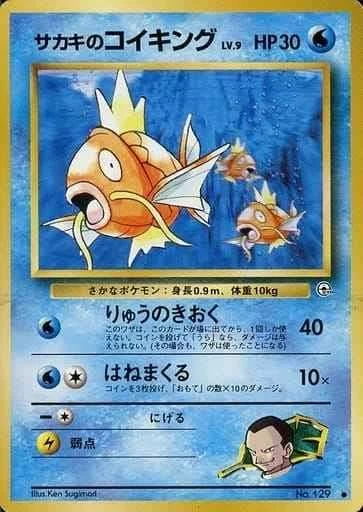
Giovanni’s Magikarp is a Basic, Water-type Pokemon with 30 HP. It carries two attacks: “Ancestral Memory,” a coin-flip attack for 40 damage, and “Flail Around,” a three-coin-flip attack with variable damage depending on how many flips land heads. The English print credits Ken Sugimori as illustrator; the Japanese-language print’s illustrator credit was not independently re-verified for this guide, but it is very likely the same artist.

PSA 10 Giovanni's Magikarp Old Back PMCG-G2 No.129 slab, listed on samuraiswordtokyo.com
PSA 10 Giovanni’s Magikarp Old Back PMCG-G2 No.129 slab, listed on samuraiswordtokyo.com

Our own graded copy of this print is currently listed at ¥159,064 (~$1,000), PSA 10. The card number printed on the slab — No.129 — is not the card’s sequential position within a print run. It reflects the numbering convention used across old-back-era Japanese sets: cards are ordered by type first, then by ascending rarity, then by National Pokedex number within each group. Magikarp’s own National Pokedex number is 129, which is exactly what shows up on this print. It’s a structural rule that applies to old-back Japanese sets generally, not something unique to this particular card. For more on reading Japanese card numbering conventions, see our guide to reading Japanese Pokemon cards.

The Set: Gym Expansion Volume 2

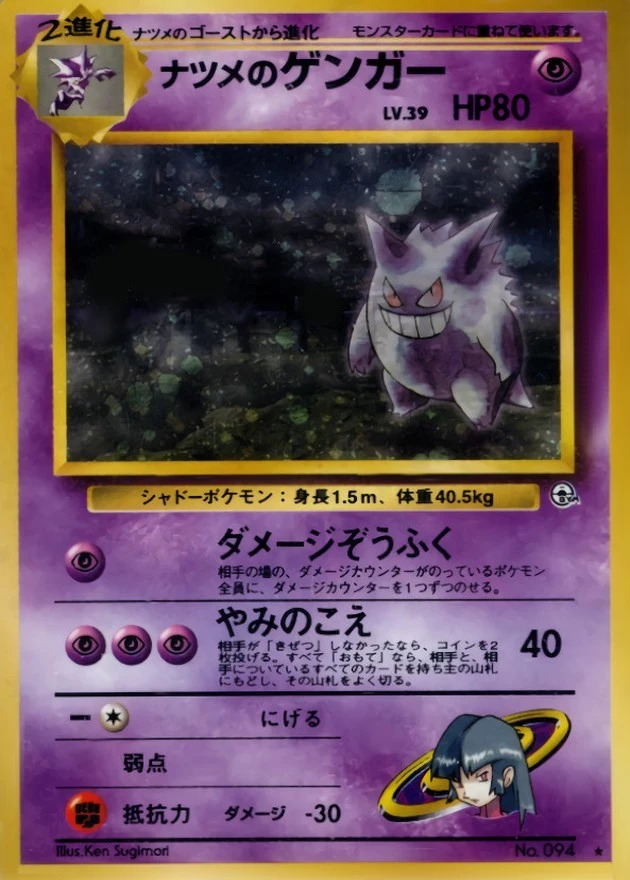
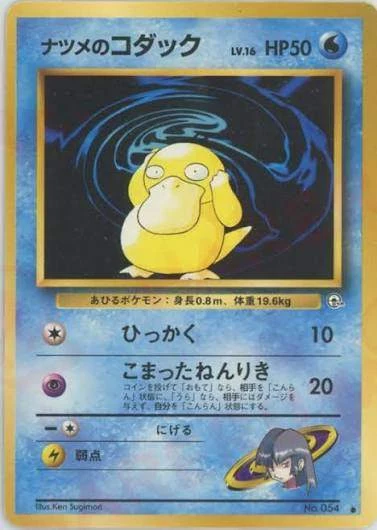
Gym Expansion Volume 2, “Challenge from the Darkness” — the set Bulbapedia’s English-language records catalogue as Gym Challenge — is Japan’s 6th TCG expansion, released 25 June 1999, with 98 total Japanese cards. It belongs to the Gym series (1996–1999), the block of old-back-era sets that introduced Gym Leader-owned Pokemon — cards like Giovanni’s Magikarp, Blaine’s Charmeleon, Sabrina’s Gengar, and Sabrina’s Psyduck, each named for the Gym Leader who “owns” that Pokemon in the games.

For a broader look at how the Gym series sets fit together, see our Pokemon Center Gym Sets guide. There is no modern booster box product tied to this 1999 vintage single — Gym Expansion Volume 2 is a vintage-era set with no current sealed release, so any box-style buying route runs through the general old-back guides linked above rather than a specific sealed product listing.

Japanese vs English Print

Giovanni’s Magikarp does have an English print, and its numbering looks completely different from the Japanese version. The English release is Gym Challenge (2000), card #73/132, at Common rarity. That number reflects a straightforward sequential position within a 132-card English set — nothing to do with National Pokedex numbers.

The Japanese Gym Expansion Volume 2 print released a full year earlier, on 25 June 1999, versus the English Gym Challenge release in 2000. So the two prints share the same artwork and card text but sit in entirely different numbering systems, released roughly a year apart. If you’re trying to match a Japanese copy against an English one, go by the card name and artwork rather than assuming the numbers correspond — a No.129 Japanese print and a #73/132 English print are the same card under two unrelated numbering conventions.

Where This Print Sits Among Japanese Old-Back Singles

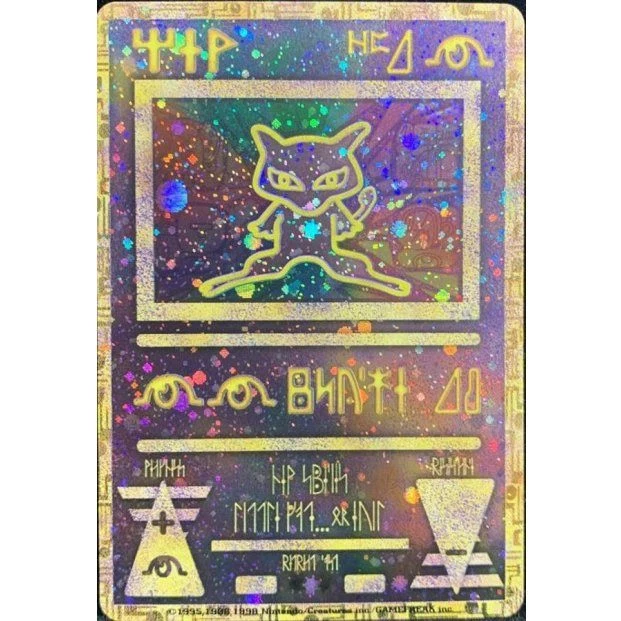
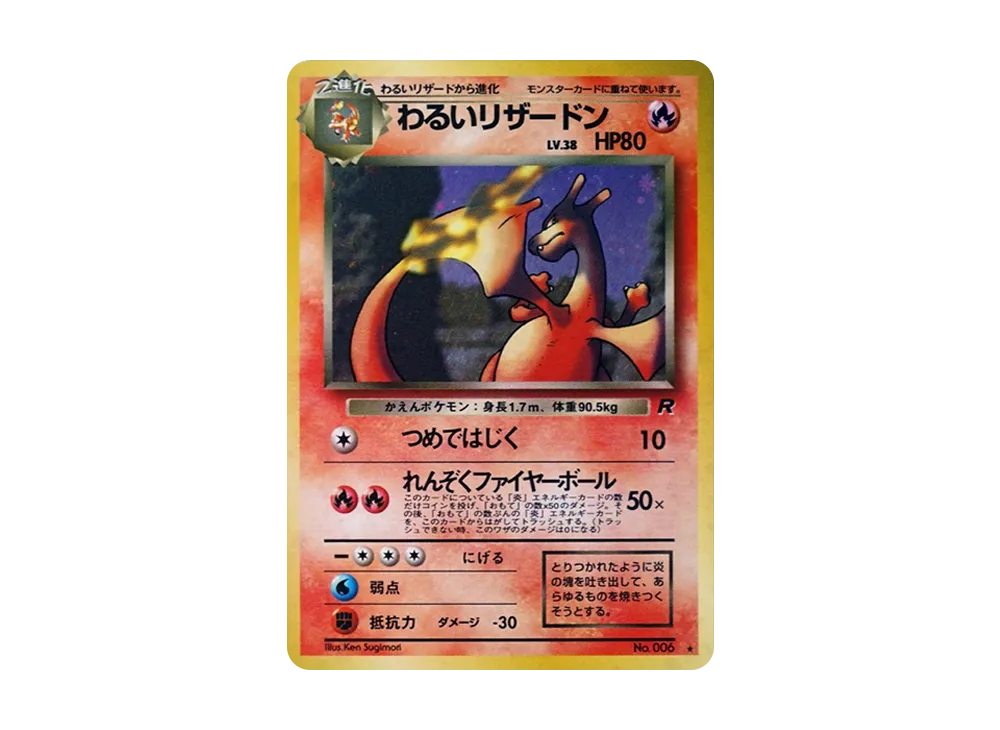
Giovanni’s Magikarp sits within the old-back design category alongside vintage singles from other Gym-series and Team Rocket-era sets. The “old back” design itself — the card-back artwork used from 1996 until the July 2001 redesign — spans multiple sets and multiple years, not just Gym Expansion Volume 2. Two examples from our own catalogue show the range of that broader category:

PSA 10 Ancient Mew Old Back slab, listed on samuraiswordtokyo.com

Ancient Mew Late Revised Old Back

PSA 10 Charizard Old Back PMCG4 No.006 slab, listed on samuraiswordtokyo.com

Charizard Old Back PMCG4 No.006

Ancient Mew is a separate promo release, and the Charizard PMCG4 No.006 print comes from a different Team Rocket-era old-back set entirely — both are useful visual reference points for what “old back” means as a design category, distinct from Gym Expansion Volume 2’s own numbering. Within Gym Expansion Volume 2 specifically, Giovanni’s Magikarp is a Common-tier single on the English side, positioned early in the set’s type-and-Pokedex-based ordering on the Japanese side.

One thing worth separating clearly: this vintage Giovanni’s Magikarp is not related to Boss’s Orders (Giovanni), the modern Supporter/Trainer card built around a completely different game mechanic and printed decades later. Same Gym Leader name, two unrelated cards from two unrelated eras — we cover that modern card separately in our Boss’s Orders (Giovanni) Supporter card guide.

Shop This Card
PSA 10 Giovanni’s Magikarp: Old Back [PMCG-G2 No.129]
Currently listed at ¥159,064 (~$1,000)
Ships from Tokyo · Tracked delivery

View Product →

Where to Buy Giovanni’s Magikarp from Tokyo

Our graded copy of PSA 10 Giovanni’s Magikarp Old Back [PMCG-G2 No.129] is currently listed at ¥159,064 (~$1,000), shipped from Tokyo with tracked delivery. From the same Gym Expansion Volume 2 set, we also list the sibling PSA 10 singles covered above: Blaine’s Charmeleon Old Back No.005 at ¥100,300 (~$631), Sabrina’s Gengar Lv.39 R Old Back No.094 at ¥1,528,100 (~$9,610), and Sabrina’s Psyduck Old Back No.054 at ¥233,640 (~$1,469), which we cover in its own dedicated guide.

For the wider PSA 10 range, browse our PSA 10 graded card collection. For sourcing requests on other Gym-series or old-back singles not listed above, our Quick Order page is the fastest way to build a mixed order.

Domande frequenti

What is Giovanni’s Magikarp Old Back No.129?

It’s the Japanese old-back print of Giovanni’s Magikarp from Gym Expansion Volume 2, “Challenge from the Darkness” (Japan’s 6th TCG expansion, released 25 June 1999). We list a PSA 10 graded copy, currently listed at ¥159,064 (~$1,000).

What does the “No.129” on this card mean?

It isn’t the card’s set position. Old-back-era Japanese sets order cards by type first, then by ascending rarity, then by National Pokedex number within each group. Magikarp’s own National Pokedex number is 129, which is exactly what appears on this print.

Is there an English version of Giovanni’s Magikarp?

Yes — Gym Challenge (2000), card #73/132, Common rarity. The Japanese Gym Expansion Volume 2 print released about a year earlier, on 25 June 1999, and uses an unrelated numbering system.

Is this the same card as Boss’s Orders (Giovanni)?

No. Boss’s Orders (Giovanni) is a modern Supporter/Trainer card from a different era and mechanic. Giovanni’s Magikarp is a 1999 vintage Basic Pokemon card from the old-back Gym series — different card types entirely, despite sharing the Giovanni name.

Are there other Japanese prints of Giovanni’s Magikarp?

No additional Japanese reprint of this exact card has been documented in our research. Any claim of further Japanese prints should be treated as unverified.

Where can I buy a PSA 10 Giovanni’s Magikarp from Tokyo?

Our graded copy is currently listed at ¥159,064 (~$1,000), shipped from Tokyo with tracked delivery. Sibling Gym-leader singles from the same set are also listed, and our Quick Order page covers sourcing requests for anything not currently listed.

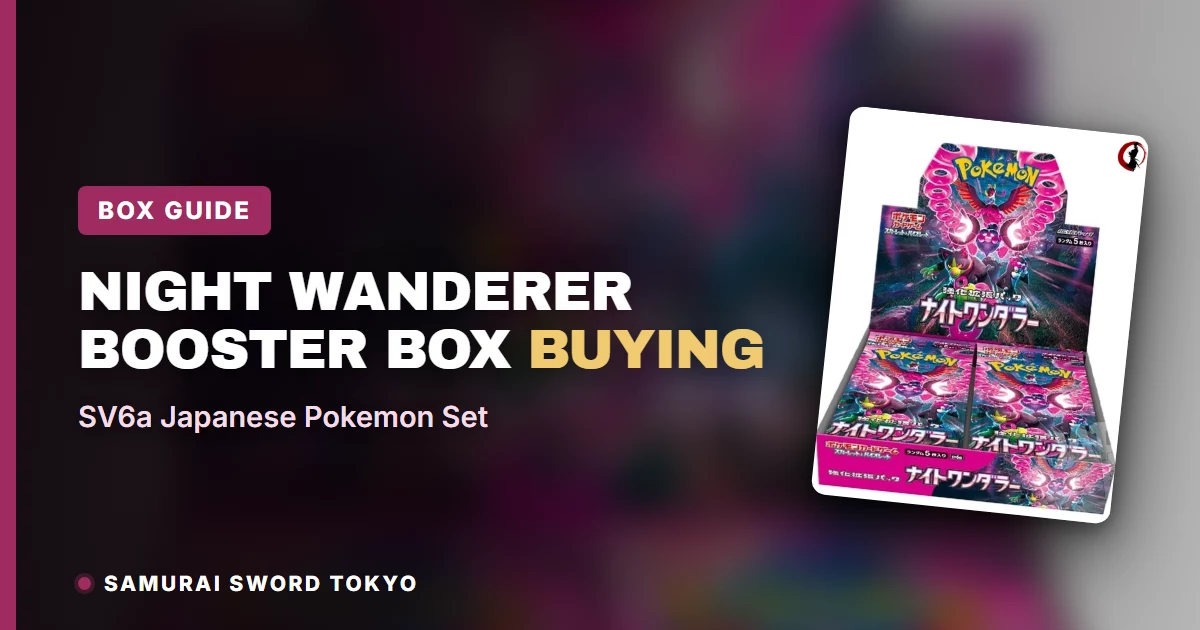
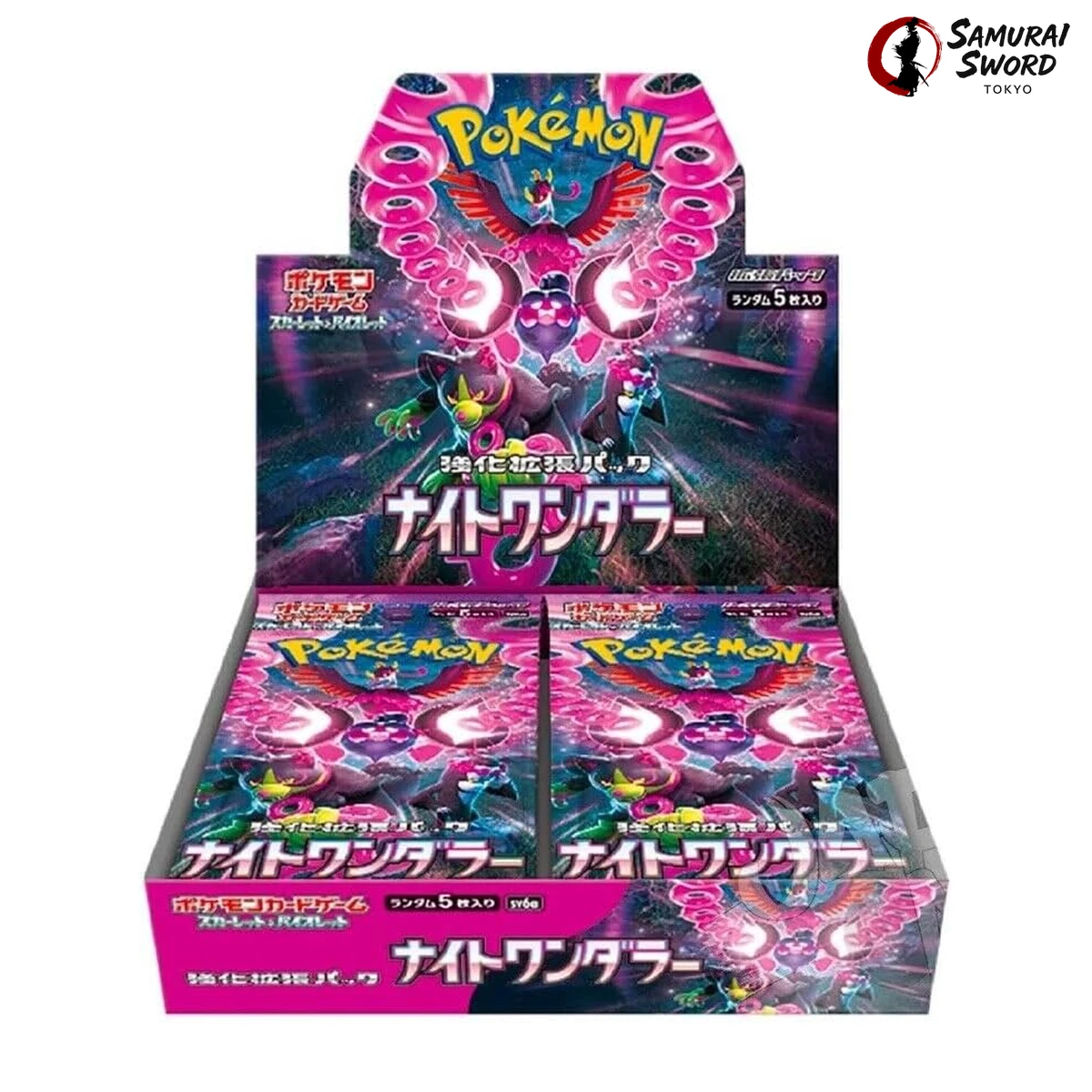
Guida all'acquisto della Booster Box Night Wanderer: set giapponese SV6a Pokémon

Night Wanderer — ナイトワンダラー in Japanese — is set code SV6a, a Scarlet & Violet-era 強化拡張パック (Enhanced Expansion Pack) that released in Japan on 7 June 2024. It’s the direct Japanese source for Shrouded Fable, the English-language set collectors know it by — five of its ten headline chase cards sit at Special Art Rare, and one of its two Ultra Rares, Earthen Vessel, is one of the more distinctive support-card secrets from that era.

This guide covers what’s actually in a Night Wanderer box, which cards define the chase, what our site currently lists for the box and for graded singles from the set, and how Night Wanderer relates to its English counterpart. We ship Japanese sealed product and PSA-graded singles out of Tokyo, so every price below is our own current listing, not a third-party market figure.

Key Takeaway

The SV6A-Night Wanderer Japanese Pokemon Booster Box is currently listed at ¥10,192 (~$64). The set runs 94 total cards (64 main-set + 30 secret/parallel-numbered) across 30 packs of 5 cards each, and its chase tier includes five Special Art Rares — Cassiopeia, Fezandipiti ex, Okidogi ex, Munkidori ex and Pecharunt ex — plus an Ultra Rare Pecharunt ex and an Ultra Rare Earthen Vessel. We don’t currently have a separate Damaged Box or No Shrink listing for this release; if a graded single is more your speed, the PSA 10 Cassiopeia SAR 091/064 is currently listed at ¥9,204 (~$58).

94
Total Cards

30
Packs per Box

5
Cards per Pack

Jun 2024
Japan Release

Prices below are our current listed prices as of September 2026, converted at ¥159/USD.

What’s Inside a Night Wanderer Booster Box

SV6A-Night Wanderer Japanese Pokemon booster box, listed on samuraiswordtokyo.com
SV6A-Night Wanderer Japanese Pokemon Booster Box
Articolo Value
Japanese name ナイトワンダラー (Night Wanderer)
Codice set SV6a
Pack type 強化拡張パック (Enhanced Expansion Pack)
Japan release date 7 June 2024
Total cards 94 (64 main-set + 30 secret/parallel-numbered)
Packs per box 30
Cards per pack 5

The 30-packs-per-box, 5-cards-per-pack structure above is cross-checked against retailer listings for this set rather than pulled from a live official pokemon-card.com page — the set’s official page returned a 404 for us this session, likely archived off the current site navigation. Treat the pack and box counts as retailer-corroborated rather than official-page-confirmed, though they line up with what our own existing Night Wanderer pull-rates coverage uses.

Of the 94 total cards, 64 make up the main numbered set and the remaining 30 are secret and parallel-numbered cards running past #064. Within that secret tier, five cards carry Special Art Rare status — a figure sourced from our own already-published Night Wanderer pull rates and best cards guide rather than independently re-verified against an official set page today. We’re not stating a pull rate for any individual card — the pull-rates guide linked above is the place for that level of detail; this guide is about what’s in the box and what to buy.

Night Wanderer’s English-language counterpart is Shrouded Fable (SFA), which carries the same headline chase cards under the English checklist — more on that pairing further down this page.

Chase Cards in Night Wanderer

Ten cards make up the set’s chase tier. Five are Special Art Rares, two are Ultra Rares, and the rest span Art Rare and Secret Rare:

Cassiopeia 091/064 SAR, Night Wanderer

Cassiopeia SAR 091/064

Cassiopeia 085/064 SR, Night Wanderer

Cassiopeia SR 085/064

Pecharunt ex 092/064 UR, Night Wanderer

Pecharunt ex UR 092/064

Okidogi ex 087/064 SAR, Night Wanderer

Okidogi ex SAR 087/064

Fezandipiti ex 089/064 SAR, Night Wanderer

Fezandipiti ex SAR 089/064

Munkidori ex 088/064 SAR, Night Wanderer

Munkidori ex SAR 088/064

The PSA 10 Cassiopeia SAR 091/064 is currently listed at ¥9,204 (~$58) — the set’s top Special Art Rare. We also currently list the lower-tier PSA 10 Cassiopeia SR 085/064 at ¥6,028 (~$38), for buyers who want the character without the SAR premium. The PSA 10 Pecharunt ex UR 092/064 is currently listed at ¥11,564 (~$73), and the PSA 10 Okidogi ex SAR 087/064 is currently listed at ¥9,440 (~$59).

Fezandipiti ex SAR (089/064) and Munkidori ex SAR (088/064) round out the Special Art Rare tier alongside Cassiopeia and Okidogi ex. Neither print is currently listed on our site — sourcing requests for either go through Ordine rapido, with no timeline to share on availability.

Five more cards round out the chase tier without a card-grid image here:

Carta Number Rarity
Pecharunt ex 090/064 SAR
Earthen Vessel 093/064 UR
Duskull 068/064 AR
Persian 075/064 AR
Janine’s Secret Technique 084/064 SR

Two of the five cards in that table are currently listed as graded singles on our site: the PSA 10 Janine’s Secret Technique SR 084/064 is currently listed at ¥8,260 (~$52), and our PSA 10 Persian AR 075/064 is currently listed. The other three — Pecharunt ex SAR 090/064, the Ultra Rare Earthen Vessel, and Duskull AR 068/064 — are not currently listed; sourcing requests for those go through Ordine rapido. For the full 94-card breakdown, see our Night Wanderer (SV6a) complete card list, and for a deeper look at how these secrets stack up against each other, our pull rates and best cards guide is the dedicated resource — this page focuses on the box-buying decision, not the card-by-card pull breakdown.

Regular Box, Damaged Box and No Shrink: What’s Listed

SV6a Night Wanderer is currently listed on our site as a single standard sealed booster box — the SV6A-Night Wanderer Japanese Pokemon Booster Box at ¥10,192 (~$64). We don’t have a separate Damaged Box or No Shrink listing for this particular release at the moment.

If you’re specifically after either condition category for Night Wanderer, a request through Ordine rapido is the way to flag it — we can’t promise a timeline for whether one gets added, and this guide isn’t the place to speculate on that. What we can confirm is the one listing that exists today and its current price.

Japanese vs English Version: Night Wanderer and Shrouded Fable

Night Wanderer’s English-language counterpart is Shrouded Fable (SFA). The two sets share the same headline chase cards under different set codes and languages — it’s the connection our own existing Night Wanderer pull rates and best cards guide draws directly, and it’s the premise of our dedicated Shrouded Fable Japanese card list, which maps the English checklist back to its Japanese SV6a printings card by card.

If you’re trying to match a specific Japanese Night Wanderer pull to its English Shrouded Fable equivalent, that card-list article is the more useful reference — it’s built for that exact mapping. This guide stays focused on the sealed-box decision: what’s in the box, what our site currently has listed, and where to buy it.

Night Wanderer also has a same-era sibling worth knowing about if you’re comparing SV6-family boxes: SV6 Mask of Change released alongside it. Our SV6 vs SV6a box guide puts the two side by side for buyers deciding between them.

Shop This Set
SV6A-Night Wanderer Japanese Pokemon Booster Box
Currently listed at ¥10,192 (~$64)
Ships from Tokyo · Tracked delivery

View Product →

Where to Buy a Night Wanderer Booster Box from Tokyo

We ship Japanese sealed product and PSA-graded singles worldwide out of Tokyo with tracked delivery. The SV6A-Night Wanderer Japanese Pokemon Booster Box currently listed at ¥10,192 (~$64), is the direct route into the set’s full 94-card pool, including a shot at all five Special Art Rares and both Ultra Rares.

If you’d rather go straight for a specific card, several graded singles from this set are currently listed: PSA 10 Cassiopeia SAR 091/064 at ¥9,204 (~$58), PSA 10 Cassiopeia SR 085/064 at ¥6,028 (~$38), PSA 10 Pecharunt ex UR 092/064 at ¥11,564 (~$73), PSA 10 Okidogi ex SAR 087/064 at ¥9,440 (~$59), PSA 10 Janine’s Secret Technique SR 084/064 at ¥8,260 (~$52), and our PSA 10 Persian AR 075/064 listing. Browse the wider Japanese Pokemon booster box collection for other current sealed product, or send a sourcing request for Fezandipiti ex, Munkidori ex, Earthen Vessel, or any single not listed above through Ordine rapido.

For more on this set, see our Night Wanderer (SV6a) complete card list, the deeper pull rates and best cards guide, the Shrouded Fable Japanese card list for the English-side mapping, and our SV6 vs SV6a box guide if you’re deciding between the two same-era releases.

Domande frequenti

What is Night Wanderer (SV6a)?

Night Wanderer is the Japanese name for set code SV6a, a Scarlet & Violet-era Enhanced Expansion Pack released in Japan on 7 June 2024. It’s the direct Japanese source for the English-language set Shrouded Fable.

What’s inside a Night Wanderer booster box?

Each box runs 30 packs of 5 cards, drawn from a 94-card set: 64 main-set cards plus a 30-card secret and parallel-numbered tier. The pack and box counts are retailer-corroborated rather than confirmed against a live official set page, which returned a 404 for us this session.

What are the chase cards in Night Wanderer?

Ten cards make up the chase tier: five Special Art Rares (Cassiopeia, Fezandipiti ex, Okidogi ex, Munkidori ex, Pecharunt ex 090/064), two Ultra Rares (Pecharunt ex 092/064, Earthen Vessel), two Art Rares (Duskull, Persian), and one Secret Rare (Janine’s Secret Technique).

Is there a Damaged Box or No Shrink listing for Night Wanderer?

Not currently. We list this release as a single standard sealed booster box at ¥10,192 (~$64). If you’re specifically looking for a Damaged Box or No Shrink version, a request through Quick Order is the way to flag it, though we can’t promise a timeline.

What is the English equivalent of Night Wanderer?

Shrouded Fable (SFA). The two sets share the same headline chase cards under different set codes and languages — our Shrouded Fable Japanese card list maps the English checklist back to its SV6a printings card by card.

Where can I buy a Night Wanderer booster box?

The SV6A-Night Wanderer Japanese Pokemon Booster Box is currently listed at ¥10,192 (~$64) on our site, shipping from Tokyo with tracked delivery. Graded PSA 10 singles from the set are also currently listed, and sourcing requests for anything else go through Quick Order.

Guida alla carta Pokémon Poliwrath: tutte le stampe giapponesi da conoscere

A Limitless search for ニョロボン (Nyorobon) — Poliwrath’s Japanese name — returns seven Japanese prints across seven different sets: SV6, SV2a, S10D, SM10, SM1M, CP6, and XY3, every one of them sorted under a blanket “R” on the search index. That count doesn’t include one further Poliwrath print we list: a PSA 10 slab from 2001’s e-Card era that predates Limitless’s own database and doesn’t turn up in that search at all.

Poliwrath is the Stage 2 final evolution of the Poliwag line — ニョロゾ (Poliwhirl, Nyorozo) into ニョロボン — Water/Fighting-typed in the games, though only one of its Japanese TCG prints has been individually verified card-by-card in this guide. This guide covers what we’ve confirmed for each Poliwrath print and which ones are currently listed on our site, either as graded singles or inside a sealed box.

Key Takeaways

Poliwrath’s oldest verified Japanese print — a PSA 10 e1 109/128 from December 2001’s “Base Expansion Pack” — is currently listed at ¥186,440 (~$1,173), and the modern Master Ball Mirror parallel of its SV2a 62/165 base print is currently listed at ¥16,401 (~$103). The SV2a booster box that pulls the modern parallel is currently listed at ¥43,860 (~$276). Exchange rate used throughout: ¥159/USD (September 2026).

7
Prints Indexed by Limitless

1
Individually Verified Print

Sep 2026
Prices Checked

Sep 2026
Prices Checked

Every Verified Japanese Poliwrath Card

Searching Limitless’s Japanese card database for Poliwrath by species returns seven prints, every one of them listed as “R” on the search index:

Set N. Index rarity Individually confirmed?
SV2a 62 R Yes — Uncommon on the card page itself, HP 160, Water, illustrator Kurata So
SV6 25 R No — set/number confirmed only
S10D 31 R No — set/number confirmed only
SM10 23 R No — set/number confirmed only
SM1M 11 R No — set/number confirmed only
CP6 25 R No — set/number confirmed only
XY3 17 R No — set/number confirmed only

Note the mismatch on the SV2a row: the search index sorts every result into one blanket “R” category, but the individual SV2a 62 card page identifies the base print as Uncommon rather than Rare. We haven’t opened the other six card pages individually, so illustrator and HP details aren’t cited for those six prints here.

Poliwrath, SV6 25, confirmed via Limitless search index, not individually verified

Poliwrath, SV6 25 — confirmed to exist, not individually verified

Beyond these seven, an eighth Poliwrath print is currently listed on our site that doesn’t turn up in that search at all: a 2001 e-series print from the “Base Expansion Pack.” Limitless’s database returns nothing for that set code (e1) when queried directly, and its coverage of the e-Card era generally appears incomplete — so the totals in this guide describe the prints we’ve verified rather than a final count.

The Vintage Original: e1 Base Expansion Pack (2001)

PSA 10 Poliwrath e1 Base Expansion Pack 109/128 slab, listed on samuraiswordtokyo.com
PSA 10 Poliwrath, e1 109/128, “1ED,” Pokemon Card e Vol.1 “Base Expansion Pack”

Our oldest verified Poliwrath print is catalogued on our own listing as “e1 109/128, ‘1ED,’ Pokemon Card e Vol.1 ‘Base Expansion Pack.'” It doesn’t appear on Limitless at all — the set page for code “e1” returns a 404 — but the underlying Japanese release is documented on Bulbapedia: the “基本拡張パック” (Base Expansion Pack) came out in Japan on December 1, 2001, and carried 128 cards. That figure lines up exactly with our anchor’s “/128” denominator, which is what supports treating “e1” as this set.

The English equivalent is Expedition Base Set, released September 15, 2002, with 165 cards. Poliwrath appears there twice: as #24/165 Rare Holo and #60/165 Rare (non-holo).

What We Haven’t Verified

Our own listing gives this print’s Japanese card number as 109 and marks it “1ED” for 1st Edition. We haven’t found an independent, card-level source confirming either detail — the set identification above rests on the “/128” denominator matching Bulbapedia’s card count, not on a direct check of card number 109 itself. Treat “109” and the 1st Edition designation as sourced from our own listing title rather than independently verified.

This print predates the other Poliwrath prints in this guide by more than a decade — the next-oldest verified print, the SV2a Master Ball Mirror below, comes from the current Scarlet & Violet era. It’s currently listed at ¥186,440 (~$1,173).

Pokemon Card 151: The SV2a Master Ball Mirror

Poliwrath, SV2a 62/165, Uncommon, Pokemon Card 151

Poliwrath U (base print), SV2a 62/165

PSA 10 Poliwrath Master Ball Mirror SV2a 062/165 slab, listed on samuraiswordtokyo.com

Our PSA 10 slab of the SV2a 062/165 Master Ball Mirror

The base print at 62/165 is an Uncommon, illustrated by Kurata So, listing 160 HP and Water type on its own card page — the only Poliwrath print in this guide with those details individually confirmed. Limitless’s card page for this number doesn’t show a separately numbered Master Ball Mirror listing; the Master Ball Mirror our own PSA 10 anchor carries is a foil parallel of the same 62/165 print rather than a distinct card number. Our Master Ball Mirror Pokemon cards guide covers how that parallel tier works across the rest of SV2a.

This print comes from Pokemon Card 151 (SV2a), the set our full SV2a card list covers checklist-wide — that hub is the place to go for the rest of the set; this guide stays focused on Poliwrath’s single print inside it. The Master Ball Mirror is currently listed at ¥16,401 (~$103).

Chase Prints and What Makes Them Collectible
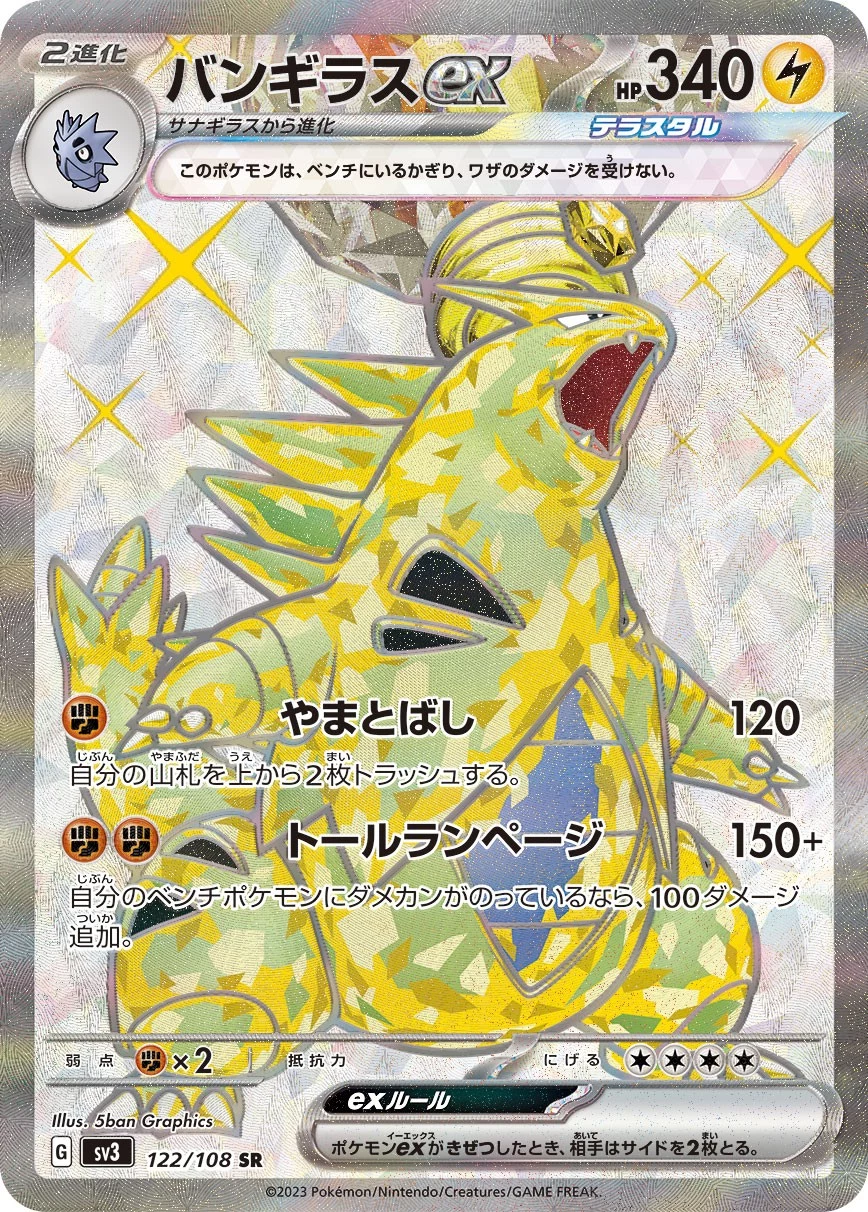
The individually verified SV2a print doesn’t carry a secret-rare or full-art treatment. The SV2a base print is an Uncommon, and the six other Limitless-indexed prints all sort under the same blanket “R” category with no illustrator or rarity detail confirmed beyond that. What makes the two prints we currently list collectible comes down to two different factors:
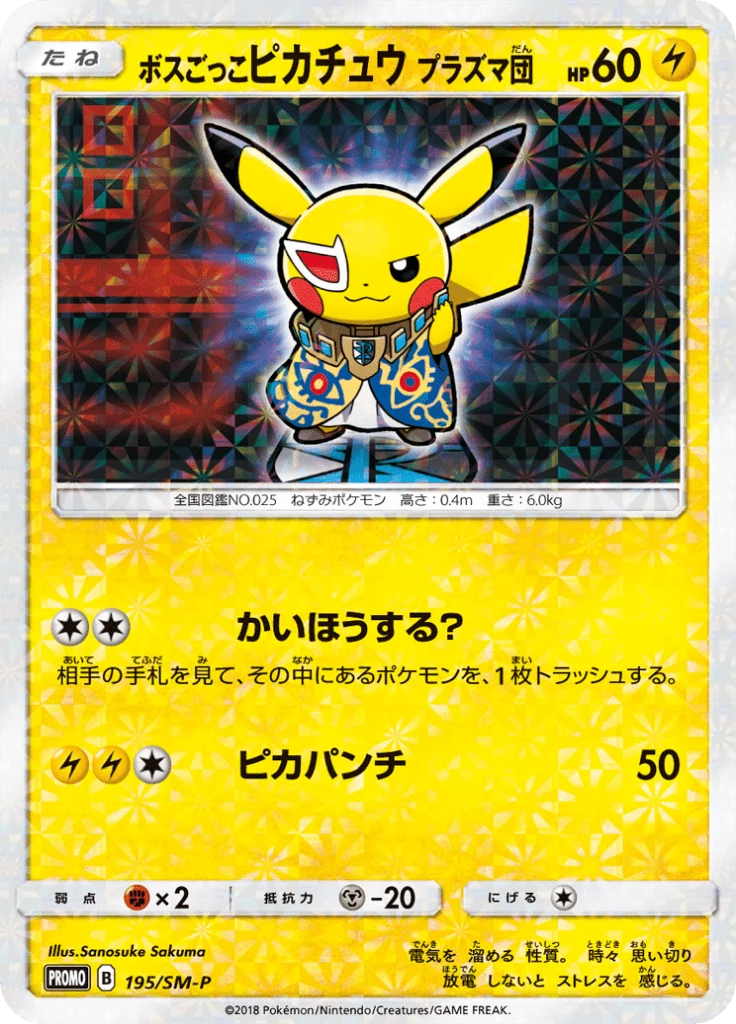
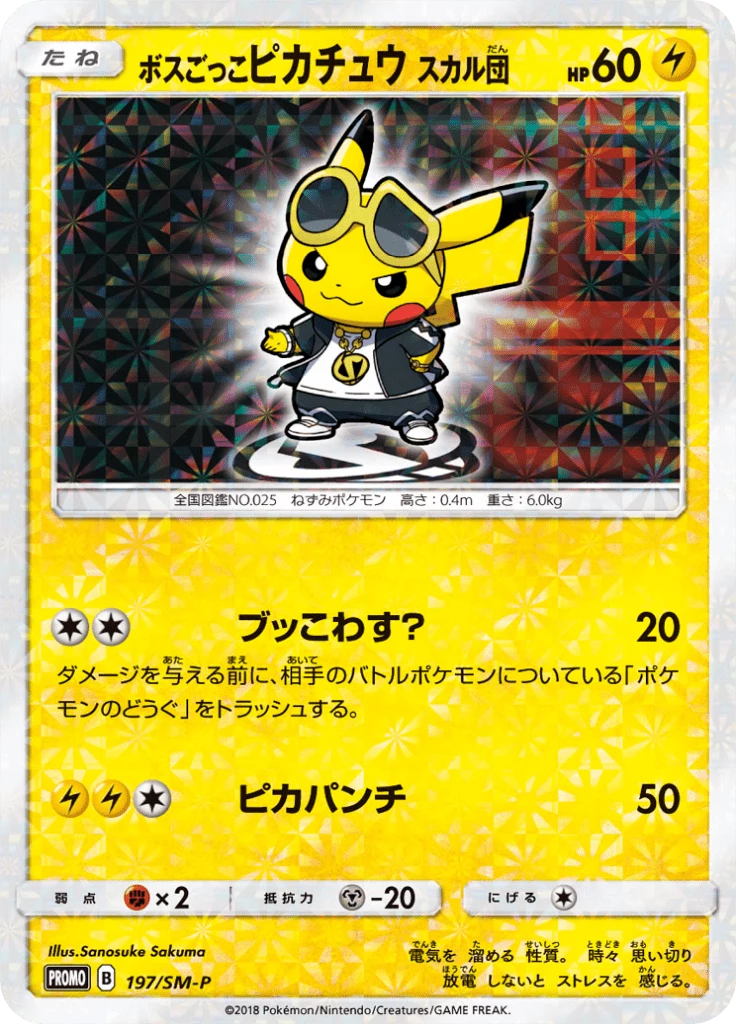
  • The e1 print’s age and format. It comes from the December 2001 e-Card era, a production window that predates the other verified Poliwrath prints in this guide by more than a decade, and it doesn’t appear in Limitless’s database at all.
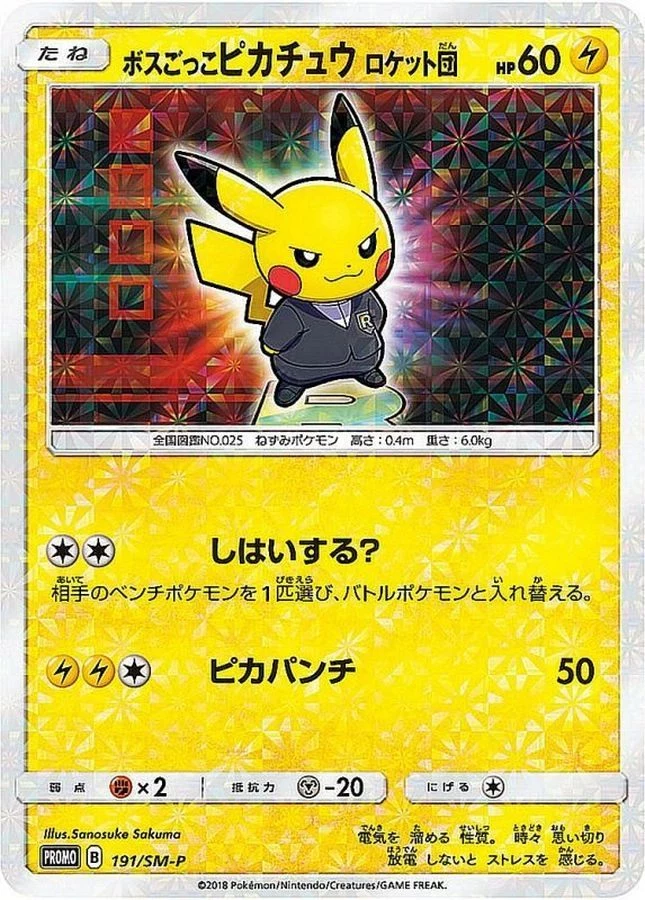
  • The SV2a print’s foil parallel. The Master Ball Mirror treatment is a foil parallel finish, which is what separates the base 62/165 Uncommon from the mirror-foil version of the same number.

PSA 10 grading is what elevates both of our listed slabs above an ungraded copy of the same print — a gem-mint certification layered on top of whichever set and rarity each card originally carried.

Which Japanese Box to Open for Poliwrath

Only the modern SV2a Master Ball Mirror comes packed inside a currently listed Japanese booster box. The 2001 e1 print was a booster-pack pull from an era before Limitless’s own catalogue begins, and we don’t have a currently listed sealed product tied to that release.

Shop This Set
SV2A-Pokemon 151 Japanese Pokemon Booster Box
Currently listed at ¥43,860 (~$276)
Ships from Tokyo · Tracked delivery

View Product →

SV2A Pokemon 151 Japanese Booster Box, listed on samuraiswordtokyo.com
SV2A-Pokemon 151 Japanese Booster Box, currently listed at ¥43,860 (~$276)

For the rest of the set’s checklist and pull context, see our Pokemon 151 (SV2a) card list and our SV2a pull-rate and best-cards hub.

Where to Buy Poliwrath Cards from Tokyo

We ship Japanese cards and sealed product worldwide out of Tokyo with tracked delivery. Both verified Poliwrath prints and the box they connect to are currently listed:

Browse the wider PSA 10 graded card collection or the Japanese Pokemon booster box collection for related listings. For any of the six index-confirmed prints not covered in detail above, request a quote via Ordine rapido — no timing guarantees, but sourcing requests for specific cards go through that page.

Poliwrath’s Base Expansion Pack era runs roughly alongside some of the earliest Team Rocket-era Japanese reprints, though the two sets aren’t a direct match — our Team Rocket Pokemon card family guide covers that surrounding period for readers curious about the era. For the modern SV2a side of this guide, our Pokemon 151 booster box buying guide covers the sealed-product side of chasing a Master Ball Mirror pull.

Domande frequenti

How many Japanese Poliwrath card prints are there?

Seven are indexed on Limitless’s Japanese card search — SV6 25, SV2a 62, S10D 31, SM10 23, SM1M 11, CP6 25, and XY3 17 — and an eighth print is currently listed on our site that doesn’t appear there at all, a 2001 e-series print from the “Base Expansion Pack.” Only the SV2a print has been individually verified card-by-card in this guide.

What is the oldest Japanese Poliwrath card?

A PSA 10 print catalogued as e1 109/128, “1ED,” from the “Base Expansion Pack” — Japan’s equivalent to the December 1, 2001 release Bulbapedia documents as the 128-card Base Expansion Pack. The English version of this set is Expedition Base Set, where Poliwrath appears as #24/165 Rare Holo and #60/165 Rare.

What is the SV2a Master Ball Mirror Poliwrath?

A foil parallel of the base Uncommon SV2a 62/165 print from Pokemon Card 151, rather than a separately numbered card. Our PSA 10 graded copy of it is currently listed at ¥16,401 (~$103).

Is the e1 Poliwrath available in English?

Yes — as Expedition Base Set #24/165 (Rare Holo) and #60/165 (Rare), released September 15, 2002. The specific Japanese card number, 109, and its 1st Edition status haven’t been independently verified beyond our own listing title.

Where can I buy Japanese Poliwrath cards?

We ship from Tokyo with tracked delivery. Two PSA 10 graded Poliwrath prints and the SV2a booster box that pulls the modern print are currently listed, and sourcing requests for any of the other six indexed prints go through our Quick Order page.