Crea un account gratuito: accumula punti e livello
Samurai Sword Tokyo
Ordini Carrello

Carte Lusamine Full Art e SR: tutte le edizioni giapponesi identificate
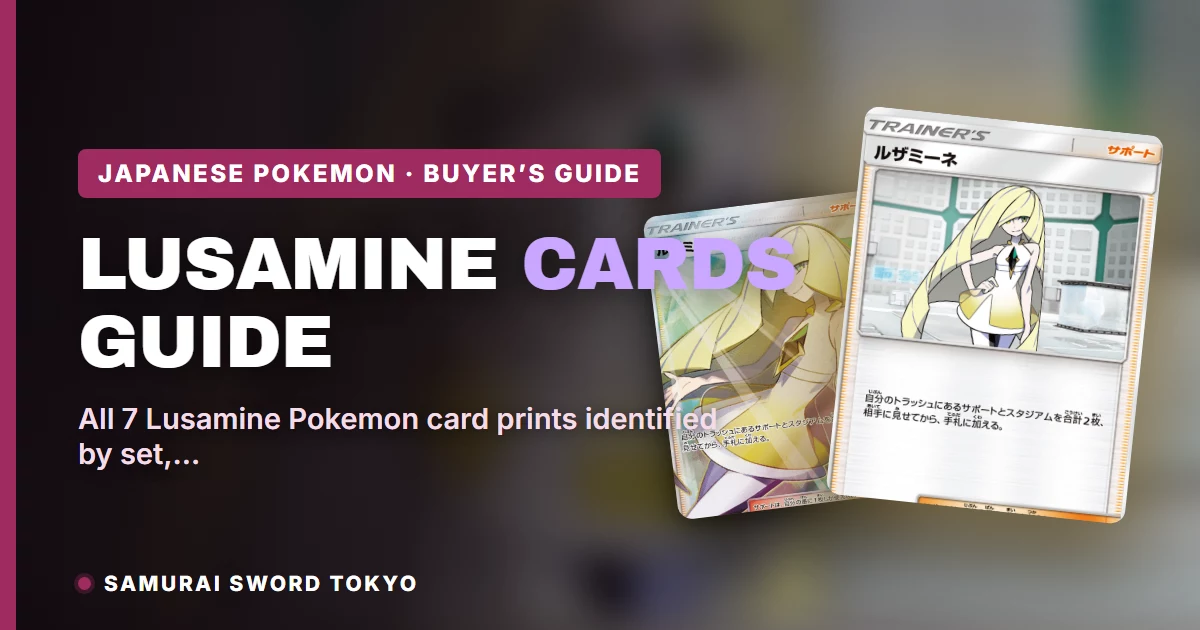
Lusamine has seven separate Japanese printings spread across five different sets and products. Two of them — both Secret Rares — are the Lusamine full art prints, and most of the seven share a name, a number range, or an illustrator with at least one other, which makes misidentifying a copy easier than it should be. One Secret Rare looks similar to another Secret Rare from an entirely different product in the same era, and two of the seven prints are literally the same artwork by the same illustrator, released a year apart.

This guide walks through every confirmed Lusamine print: the SM4A original and its Secret Rare, the GX Battle Boost pair, the GX Ultra Shiny and Sky Legend reprints, and the Prism Star variant with its own special deckbuilding rule. We ship Japanese sealed product and singles from Tokyo, and the prices we cite from our own catalog reflect that vault.

All seven prints are Trainer-category Supporter cards rather than Pokemon, which puts Lusamine in the same collecting bracket as Wicke and Red & Blue rather than alongside the Pokemon featured in the same expansions. That’s a useful filter if you’re building a checklist by category instead of by set, since none of the seven carry HP, attacks, or the other Pokemon-card fields — every one is a text-effect Supporter or, in one case, a Prism Star Supporter with its own special rule.

Key Takeaway

Seven Lusamine prints exist across SM4A, GX Battle Boost, GX Ultra Shiny, Sky Legend, and Super Burst Impact (2017–2019). The chase print of the lineup is the SM4A Secret Rare, 055/050, one of the two Lusamine full art prints — our graded PSA 10 copy is sold out at the time of this update; sourcing requests go through Ordine rapido.

Updated September 23, 2026
  • Both Lusamine Secret Rares — the SM4A 055/050 and the GX Battle Boost 120/114 — are sold out at the time of this update; sourcing requests go through Ordine rapido.
  • The lowest SNKRDUNK asking price on September 23, 2026 was ¥195,000 (PSA 10) / ¥73,999 (raw) for 055/050, and ¥480,000 (PSA 10) / ¥75,800 (raw) for 120/114.
  • The companion Aether Foundation Secret Rare, Wicke SR [SM3N 057/051], is currently listed — see the product below.
7
Prints Confirmed

5
Sets & Products

1
Prism Star Print

2017–2019
Years Covered

Card and set details below come from the official Pokemon Card Database and Limitless TCG; store state current as of September 23, 2026. USD figures added in this update convert at ¥154/USD, approximate; older figures keep the rate stated when they were written.

Every Lusamine Card and How to Tell Them Apart

Seven confirmed prints:

Carta Number Rarity Set / Product Illustrator
Lusamine SM4A 047/050 Regular Beasts from the Ultradimension (2017) take
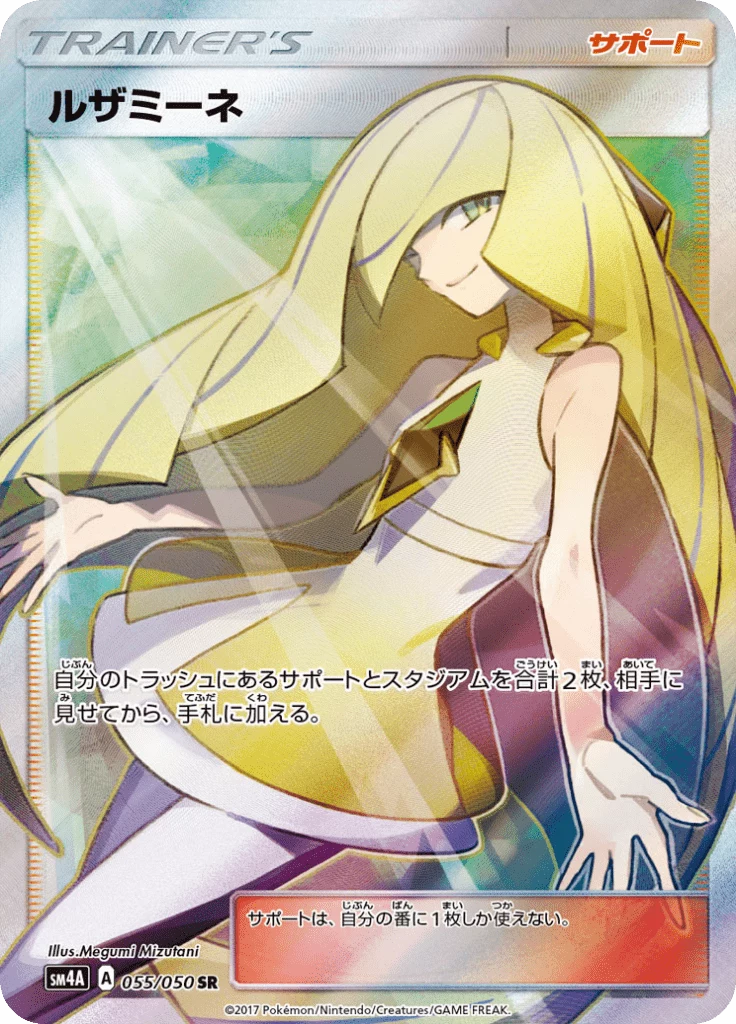
Lusamine SM4A 055/050 SR Beasts from the Ultradimension (2017) Megumi Mizutani
Lusamine SM4+ 109/114 Regular GX Battle Boost take
Lusamine SM4+ 120/114 SR GX Battle Boost You Iribi
Lusamine SM8b 136/150 Regular GX Ultra Shiny (2018) take
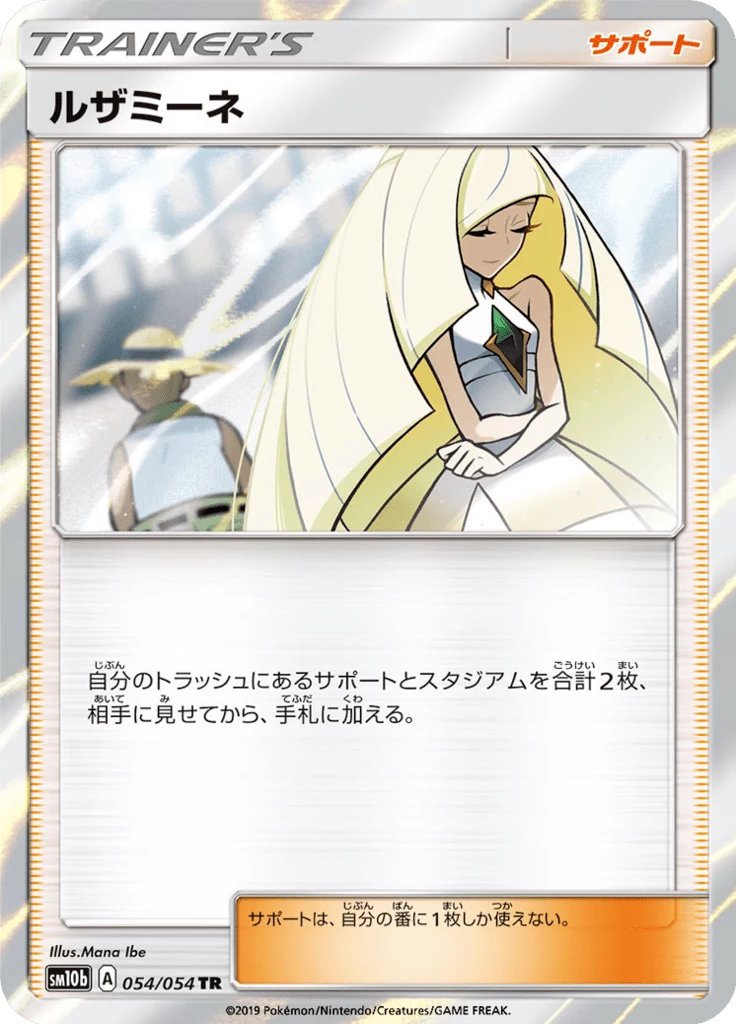
Lusamine SM10b 054/054 Regular Sky Legend (2019) Mana Ibe
Lusamine ◇ SM8 092/095 Prism Star Super Burst Impact (2018) nagimiso

Two things make this lineup easy to mix up. First, three different prints — 047/050, 109/114, and 136/150 — are illustrated by the same artist, take, and two of them reuse the exact same artwork. Second, the two Secret Rare prints, 055/050 and 120/114 — the two Lusamine full art prints — are separated by a different set, a different illustrator, and a different number range, but both are full-art SR Supporters of the same character released within about a year of each other. Number and set code, not the art style, are what settle which one you’re holding.

The Original: SM4A Regular and Secret Rare
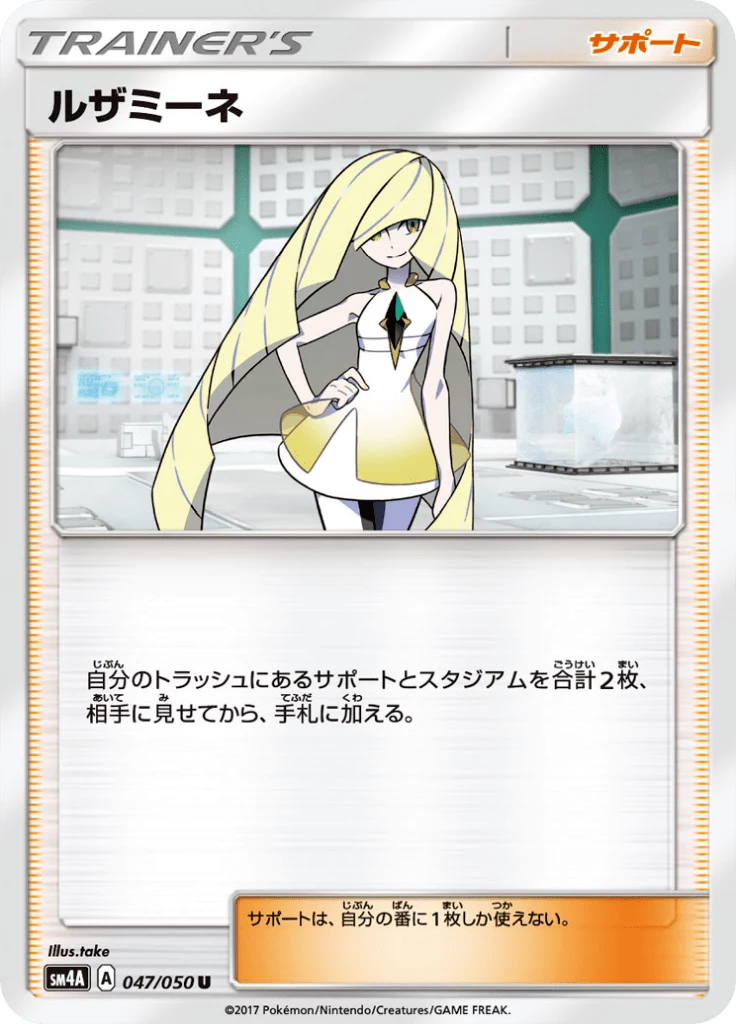
Lusamine, SM4A 047/050, Beasts from the Ultradimension

Lusamine, SM4A 047/050 (Regular)

Lusamine SR, SM4A 055/050, Beasts from the Ultradimension

Lusamine SR, SM4A 055/050

Lusamine debuted in the Beasts from the Ultradimension expansion (SM4A), released September 15, 2017. The regular print, 047/050, is a Supporter card illustrated by take. Its effect: search your discard pile for up to 2 cards in any combination of Supporter and Stadium cards, reveal them to your opponent, and add them to your hand — a recursion effect that lets you reuse Supporters you’ve already played, in an era before that kind of card recycling was common.

The Secret Rare, 055/050, is the full-art printing of the same card — the first of the two Lusamine full art prints — illustrated separately by Megumi Mizutani. It’s numbered above the set’s 050-card base total, which is the standard marker for a Secret Rare slot in this era of Japanese sets. Our graded PSA 10 copy of this print is sold out at the time of this update; sourcing requests go through Ordine rapido. The lowest asking price on SNKRDUNK on September 23, 2026 was ¥195,000 for a PSA 10 copy and ¥73,999 for a raw copy.

Check This First

Two different Lusamine Secret Rares exist — this SM4A 055/050 print by Mizutani, and a second SR from GX Battle Boost (120/114) by a different illustrator entirely. Confirm the set code and number printed on the card before assuming which SR you have.

The High-Class Reprint: GX Battle Boost

The GX Battle Boost high-class pack (official database code SM4p; the set logo printed on the card itself reads “SM4+”) added a second pair of Lusamine prints: a regular version at 109/114, illustrated by take under the same artwork family as the SM4A original, and a Secret Rare at 120/114, illustrated by You Iribi in a distinct full-art style — the second Lusamine full art print, and per the official database the only Lusamine print credited to that illustrator. The 120/114 SR corresponds to the English-language Ultra Prism 153/156 full-art printing.

The official product page lists a release date of October 20, 2017 for GX Battle Boost. If you’re trying to identify a copy, the fastest check is the illustrator credit printed on the card — take for 109/114, You Iribi for 120/114 — since both numbers sit in the same 114-card range as each other but nowhere near the SM4A 047–055/050 range.

Our graded PSA 10 copy of the 120/114 SR is sold out at the time of this update; sourcing requests go through Ordine rapido. The lowest asking price on SNKRDUNK on September 23, 2026 was ¥480,000 for a PSA 10 copy and ¥75,800 for a raw copy.

Because GX Battle Boost runs its own 114-card numbering rather than continuing SM4A’s 050-card count, a Lusamine copy with a /114 denominator is a GX Battle Boost print, not an SM4A one.

Later Reprints: GX Ultra Shiny and Sky Legend
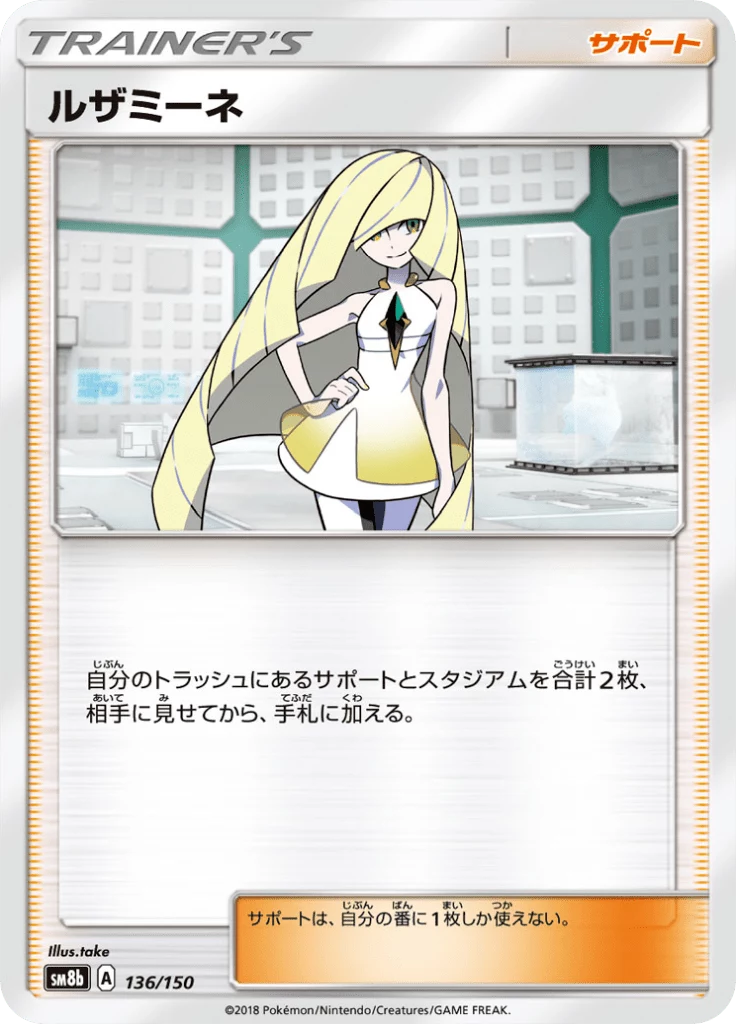
Lusamine, SM8b 136/150, GX Ultra Shiny

Lusamine, SM8b 136/150 (GX Ultra Shiny)

Lusamine, SM10b 054/054, Sky Legend

Lusamine, SM10b 054/054 (Sky Legend)

The 2018 GX Ultra Shiny high-class pack (SM8b) reprinted Lusamine at 136/150, again illustrated by take and carrying the same discard-recursion effect as the 047/050 original. If you’re building out that pack specifically, the same GX Ultra Shiny release also produced our PSA 10 Darkrai GX SSR [SM8b 230/150], currently listed at ¥40,872 (~$265). See the full GX Ultra Shiny (SM8b) card list.

The 2019 Sky Legend expansion (SM10b, released April 26, 2019) reprinted Lusamine a second time at 054/054 — the last number in that set — with entirely new artwork by Mana Ibe rather than a repeat of take’s illustration. Sky Legend is the same set that introduced Jessie & James, so a Sky Legend booster is one of the few products where Lusamine sits alongside Team Rocket-themed prints in the same checklist. See the full Sky Legend (SM10b) card list.

The Prism Star Variant: Lusamine ◇
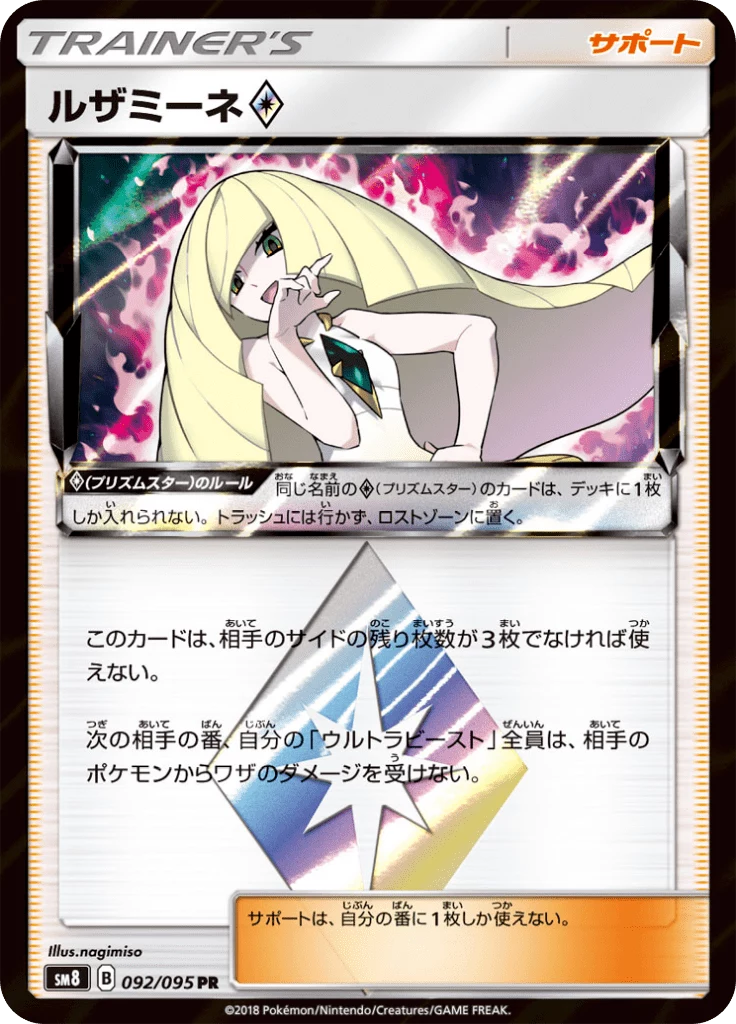
Lusamine Prism Star, SM8 092/095, Super Burst Impact
Lusamine ◇, SM8 092/095, Super Burst Impact

The Super Burst Impact expansion (SM8, released September 7, 2018) gave Lusamine a completely different card under the Prism Star mechanic, illustrated by nagimiso and corresponding to the English-language Lost Thunder 182/214 printing. Prism Star cards use their own special rule: only one card with the same name is allowed across your entire deck, and when it leaves play, it goes to the Lost Zone instead of the discard pile. See the full Super Burst Impact (SM8) card list.

The effect on this printing is also distinct from the searching Supporters above: it can only be used if your opponent has exactly 3 Prize cards remaining, and if you use it, all of your Ultra Beast Pokemon take no damage from your opponent’s Pokemon’s attacks during your opponent’s next turn. It’s a narrower, more situational card than the discard-recursion Lusamine prints, built specifically around the Ultra Beast archetype that ran through the Sun & Moon era.

The Aether Foundation Connection

Lusamine’s SM4A debut (September 2017) landed within a few months of another Aether Foundation Supporter, Wicke, whose own Secret Rare comes from the Light Consuming Darkness expansion (SM3N, June 2017). Both are Sun & Moon-era Supporter cards tied to the same in-universe organization, and both got the same treatment: a common-numbered regular print followed by a fuller-art Secret Rare later in the same base set. Wicke’s Secret Rare is currently listed in our vault, unlike either Lusamine SR at the time of this update — see our Wicke Pokemon cards guide for the full print rundown.

Companion Aether Foundation SR
PSA 10 Wicke SR [SM3N 057/051]
Currently listed at ¥62,982 (~$409)
Ships from Tokyo

View Product →

For the wider Beasts from the Ultradimension checklist that the SM4A Lusamine prints come from, see our SM4A set guide. For graded Supporter and Trainer cards more broadly, our PSA 10 Japanese Trainer cards guide covers the category Lusamine belongs to, and our Sun & Moon era guide places all of this within the broader 2017–2019 block of Japanese sets.

Between them, Lusamine and Wicke’s Secret Rares span the first half of that Sun & Moon block — June 2017 for Wicke’s Light Consuming Darkness printing, September 2017 for Lusamine’s Beasts from the Ultradimension printing — while Lusamine’s later reprints (GX Ultra Shiny in 2018, Sky Legend in 2019) carry the same card through most of the rest of the era. Anyone assembling a full Aether Foundation Supporter run is really tracking two originals and a trail of reprints across roughly two years of Japanese releases.

Where to Buy Lusamine Cards from Japan

We ship from Tokyo; if your country appears at checkout we can ship to you. Both Lusamine Secret Rares are sold out at the time of this update; sourcing requests go through Ordine rapido.

For other current PSA 10 Trainer and Supporter cards, check our PSA 10 card list or the wider PSA 10 collection, or use our Quick Order page to ask about a specific print, including the GX Battle Boost or GX Ultra Shiny prints not currently listed on the site.

Domande frequenti

How many Lusamine Pokemon cards are there?

Seven confirmed Japanese prints across five sets and products released between 2017 and 2019: SM4A (regular and Secret Rare), GX Battle Boost (regular and Secret Rare), GX Ultra Shiny, Sky Legend, and the Prism Star variant from Super Burst Impact.

Which Lusamine card is the main chase print?

The SM4A Secret Rare (055/050) is the chase print of the lineup. Our PSA 10 copy of it is sold out at the time of this update; sourcing requests go through Quick Order.

What is a Prism Star card, and how is Lusamine ◇ different?

Prism Star cards follow a special deckbuilding rule: only one card of that name is allowed across your entire deck, and it goes to the Lost Zone instead of the discard pile when it leaves play. Lusamine ◇ (SM8 092/095) also carries a different effect than the standard Lusamine Supporters — it protects your Ultra Beast Pokemon from damage, rather than recovering Supporters and Stadiums from your discard pile.

Where can I buy a Lusamine Pokemon card from Japan?

We ship from Tokyo; if your country appears at checkout we can ship to you. Our PSA 10 Lusamine SR [SM4A 055/050] is sold out at the time of this update; check our PSA 10 card list for other graded Trainer cards currently listed, such as the companion Wicke SR, or use our Quick Order page to ask about specific prints.
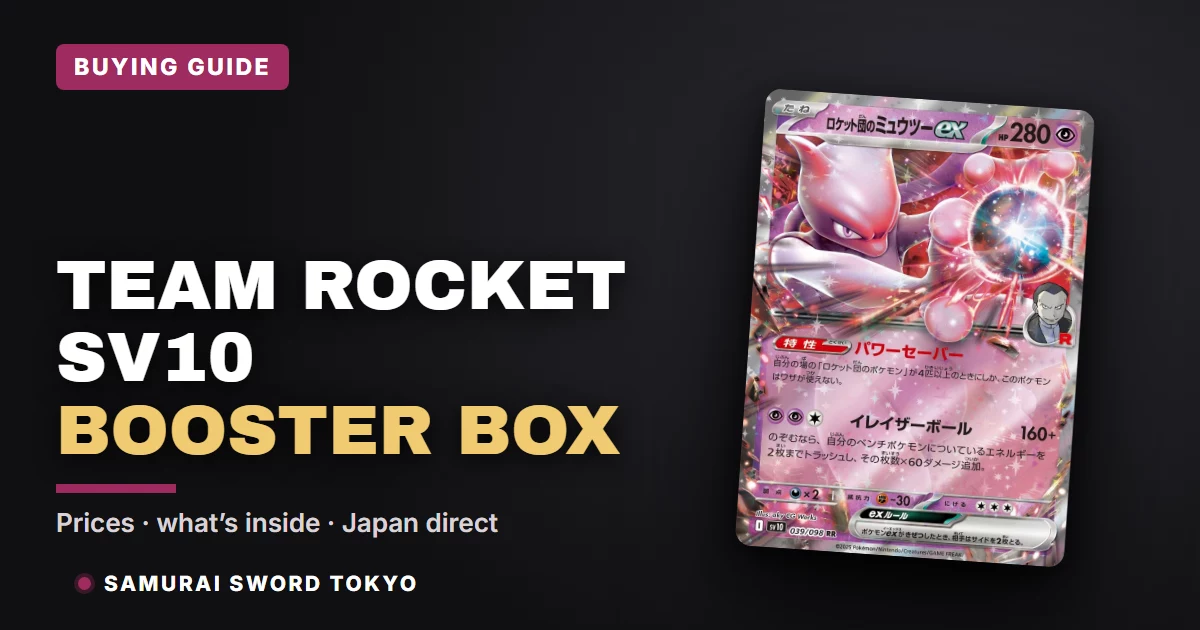
Guida all'acquisto del Booster Box Glory of Team Rocket (SV10)

The Glory of Team Rocket booster box put an entire villain team on the checklist — the set is built around cards carrying the “Team Rocket’s” prefix, from the AR pulls up through the four-way chase for Team Rocket’s Mewtwo ex. It’s the Japanese set that later fed directly into Destined Rivals overseas.

If you’re deciding whether to open a box, buy singles, or chase the Attaché Case Set instead, this guide walks through exactly what’s in a box, which card to watch for, and how the numbers compare across the different ways to buy into this set. We ship this set out of Tokyo, so the pricing below reflects what we’re actually listing.

Key Takeaway

Glory of Team Rocket (SV10) is 98 base cards plus 34 secrets for 132 total, sold 5 cards per ¥180 pack, 30 packs per box. The chase is Team Rocket’s Mewtwo ex, printed across four rarities — RR #039, SR #114, SAR #125, and UR #130. A sealed box’s Sealed option was listed at ¥20,500 (~$133) on September 23, 2026.

Updated September 23, 2026
  • SNKRDUNK’s lowest asks on September 23, 2026: box ¥23,300, Attaché Case Set ¥27,300, Team Rocket’s Mewtwo ex SAR 125/098 PSA10 ¥200,000, Team Rocket’s Mewtwo ex SR 114/098 PSA10 ¥11,999.
  • Full card-by-card breakdown: SV10 Glory of Team Rocket card list.
5
Cards / Pack

30
Packs / Box

132
Total Cards (98 base)

Current Box Price, Sealed option (~$133)

Store prices and SNKRDUNK asks are dated September 23, 2026. USD figures convert at ¥154/USD, approximate. Official MSRP and product details come from Pokémon’s official Glory of Team Rocket product page.

What’s Inside a Glory of Team Rocket Booster Box

Glory of Team Rocket (ロケット団の栄光) released in Japan on April 18, 2025 as a standard 拡張パック (main expansion). Every pack costs ¥180 (tax included) and contains 5 random cards. A sealed box holds 30 packs, which works out to roughly ¥5,400 in pack MSRP before any secondary-market markup.

Tier Card count Numbers
Base set 98 cards 001–098
AR (Art Rare) 12 099–110
SR (Super Rare) 13 111–123
SAR (Special Art Rare) 6 124–129
UR (Ultra Rare) 3 130–132
Total with secrets 132 001–132
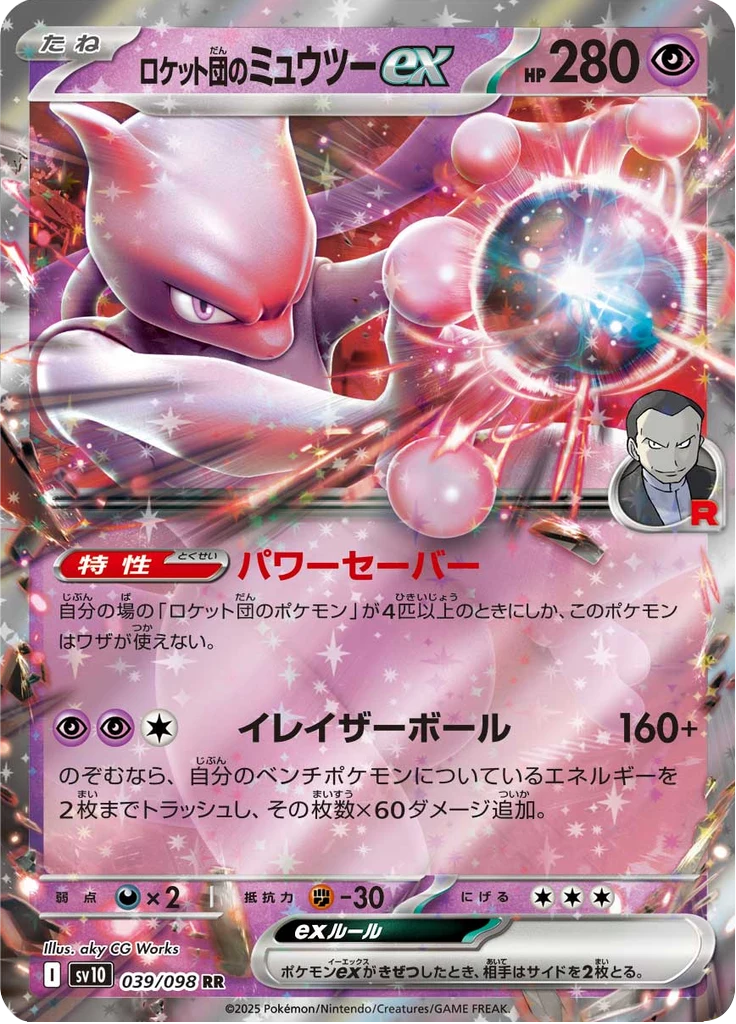
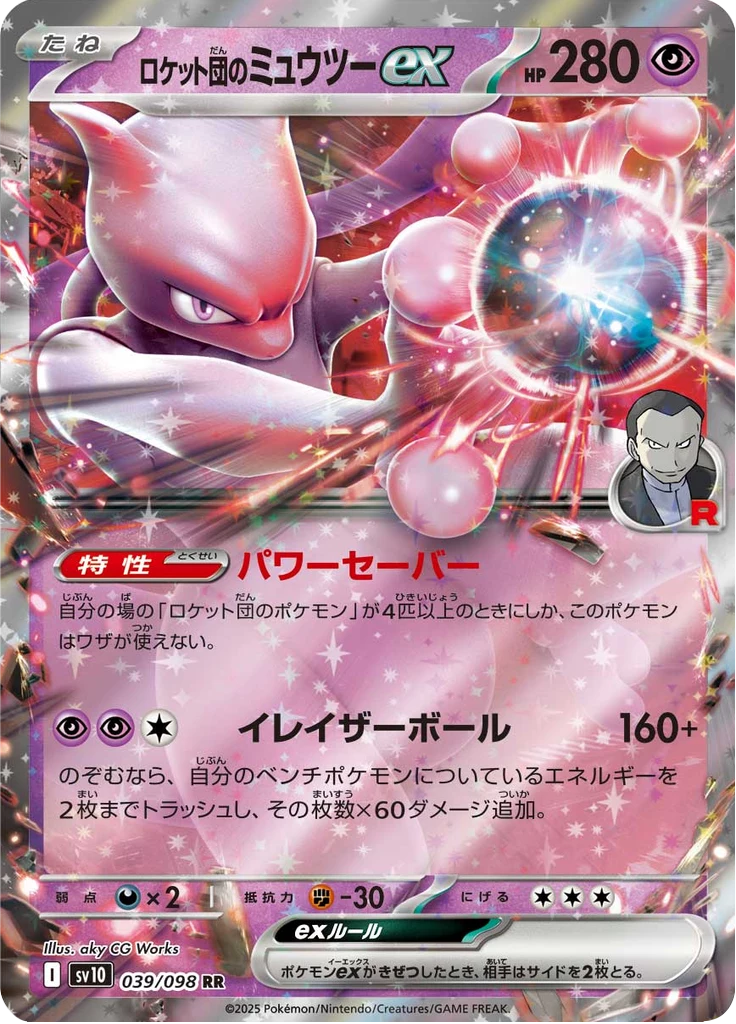
Team Rocket's Mewtwo ex 039/098 RR base rare card from Glory of Team Rocket
Team Rocket’s Mewtwo ex 039/098, RR — Glory of Team Rocket

Every card in the secret-rare block above #098 carries the set’s defining gimmick: nearly every Pokémon and Trainer is stamped “Team Rocket’s” or otherwise tied to the villain team, right down to the Team Rocket executives (Ariana, Archer, Giovanni, Petrel, Proton) who get their own Supporter cards in SR and SAR form. That’s a different structure from most SV-era sets, where secrets are mostly generic AR Pokémon — here, the set’s whole identity is baked into the rarity block.

The Chase: Team Rocket’s Mewtwo ex Across Four Rarities

One card anchors this set’s value: Team Rocket’s Mewtwo ex. It’s printed four separate times — a base RR, a Super Rare, a Special Art Rare, and an Ultra Rare — and all four sit in this one box.

Team Rocket's Mewtwo ex 039/098 RR Glory of Team Rocket base rare

Team Rocket’s Mewtwo ex 039/098 RR

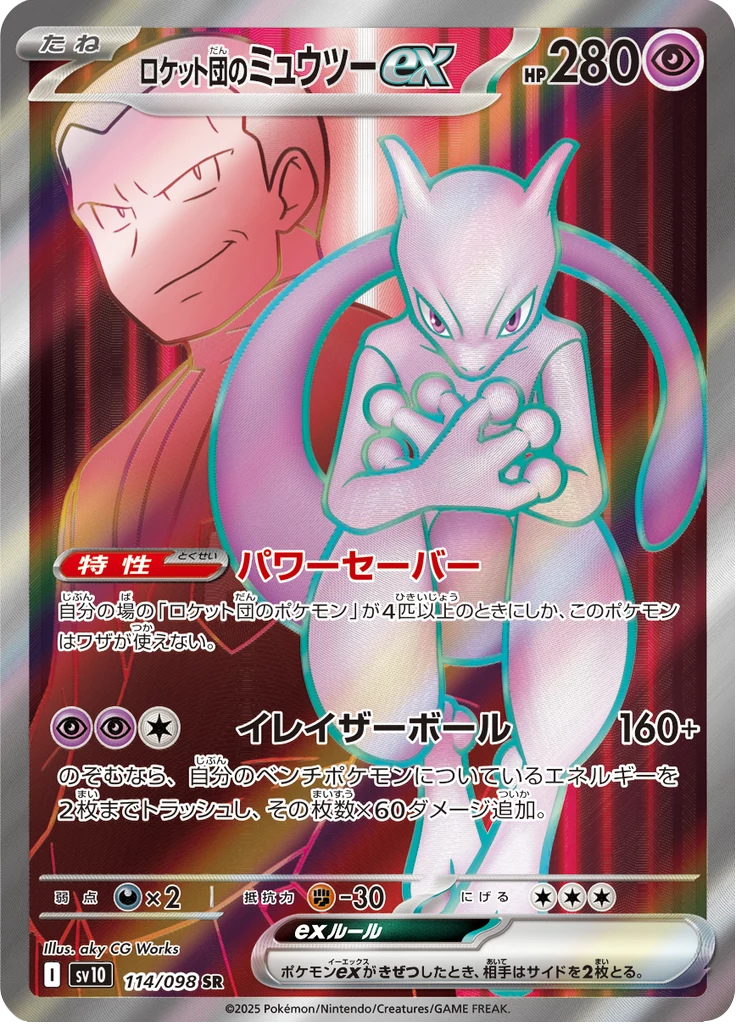
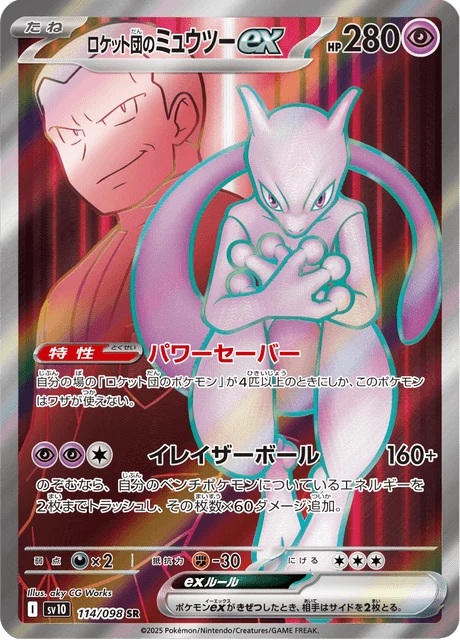
Team Rocket's Mewtwo ex 114/098 SR Glory of Team Rocket secret rare

Team Rocket’s Mewtwo ex 114/098 SR

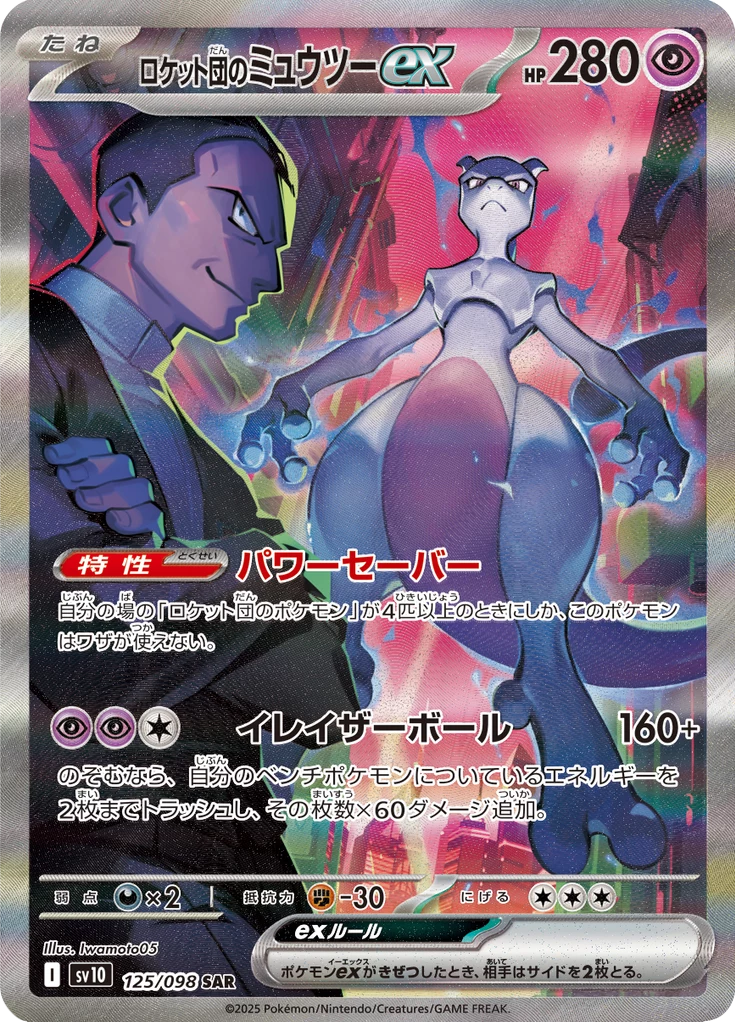
Team Rocket's Mewtwo ex 125/098 SAR Glory of Team Rocket special art rare

Team Rocket’s Mewtwo ex 125/098 SAR

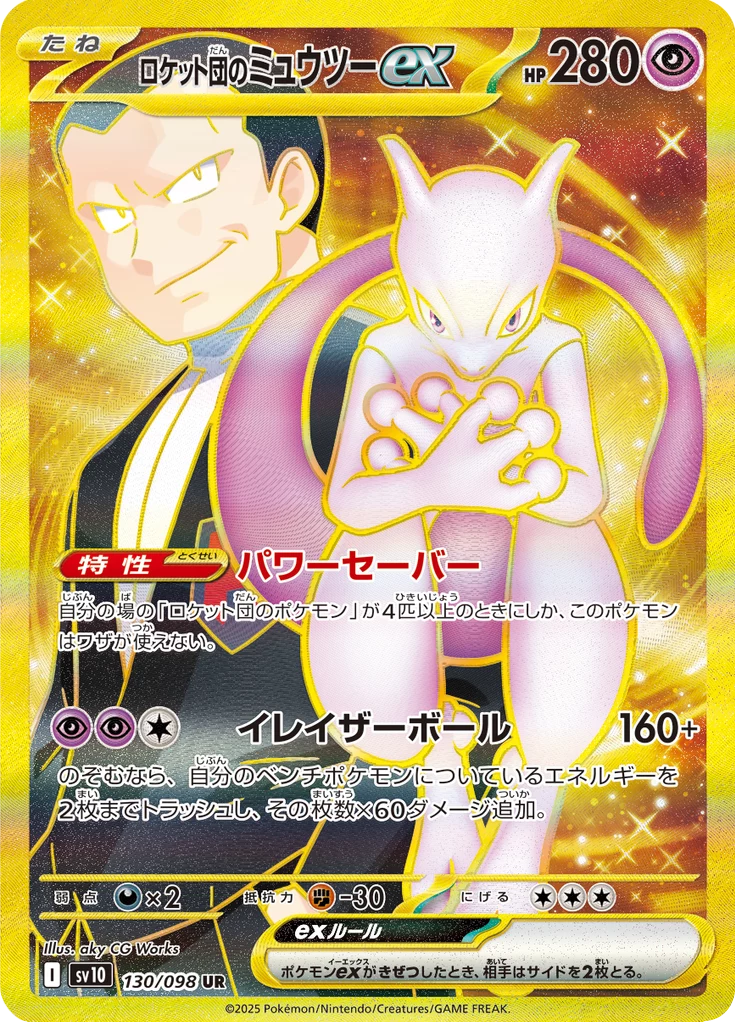
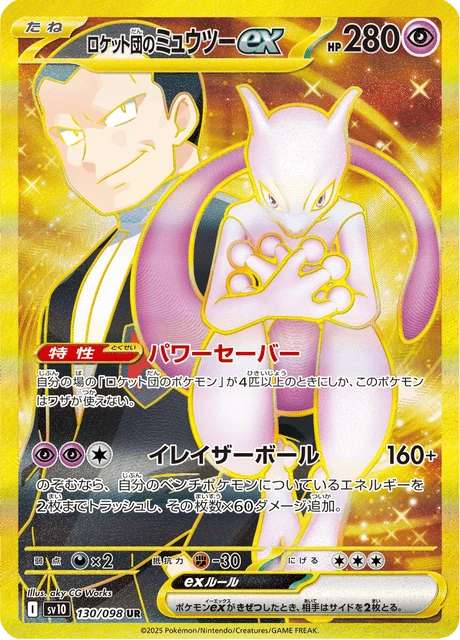
Team Rocket's Mewtwo ex 130/098 UR Glory of Team Rocket ultra rare

Team Rocket’s Mewtwo ex 130/098 UR

The RR base version (#039/098) is the one you’ll pull most often — it’s part of the regular base-set distribution, not the secret block. Our graded listing is the PSA10 RR.

Moving up the chain, the SR (#114/098) sits in the secret-rare run alongside the set’s other ex Pokémon and Team Rocket executive Supporters. Our graded listing is the PSA10 SR. On SNKRDUNK, a PSA10 SR asked ¥11,999 and a raw SR asked ¥1,500, both on September 23, 2026.

The SAR (#125/098) is the alt-art version of the same card, in the six-card Special Art Rare tier. On SNKRDUNK, the lowest asking price for a PSA10 SAR was ¥200,000 and for a raw SAR was ¥35,500, both on September 23, 2026 — a separate marketplace listing, not our own stock.

At the top sits the UR (#130/098), one of only three Ultra Rares in the whole set.

Team Rocket's Mewtwo ex 130/098 UR Glory of Team Rocket ultra rare full artwork close-up
Team Rocket’s Mewtwo ex 130/098, UR — Glory of Team Rocket

For a full breakdown of every printing side by side, see our dedicated Team Rocket’s Mewtwo ex card guide.

Other Team Rocket Pulls Worth Watching

Mewtwo ex isn’t the only reason to open this set. The 12-card AR tier is stacked with Team Rocket-branded Pokémon plus a couple of non-Rocket legendaries, and the SAR/UR tiers include a second ex line worth tracking.

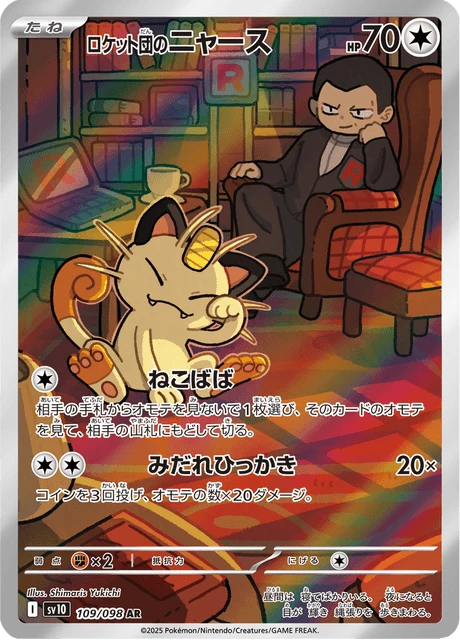
Team Rocket's Meowth 109/098 AR Glory of Team Rocket art rare card
Team Rocket’s Meowth 109/098, AR — Glory of Team Rocket

On the AR side, Team Rocket’s Meowth (#109/098) is the thematic mascot of the set — the talking Meowth is the closest thing the roster has to a face card. It sits alongside eleven other ARs, including two non-Rocket legendaries pulled into the set’s roster, Zamazenta (#107/098) and Kangaskhan (#110/098). Graded PSA10 listings for several ARs:

On the ex side, Team Rocket’s Crobat ex runs its own SR/SAR/UR ladder — #117 SR, #127 SAR, #131 UR. The Crobat ex SAR in PSA10 has its own product page: PSA10 Crobat ex SAR. For pull-rate context on where these land in a typical case, see our Glory of Team Rocket pull rates and best cards breakdown.

On Grading

Graded cards on our site carry PSA’s own grade; we do not grade cards ourselves.

The Attaché Case Set: A Different Way to Buy In

Alongside the standard booster box, Pokémon released a collector-oriented bundle: the ロケット団のアタッシュケースセット (Team Rocket’s Attaché Case Set). Official contents are a Team Rocket-branded attaché case plus 30 packs of Glory of Team Rocket — exactly one box’s worth of packs — for an official price of ¥14,900 (tax included). There is no promo card included; the case and the packs are the entire official contents.

It released the same day as the main set, April 18, 2025, but through a different channel: a Pokémon Center Online lottery (entries April 14–16, 2025), followed later by a made-to-order window (受注販売, May 12–15, 2025) rather than standard open retail, with no ongoing retail restock after those windows closed.

Our own listing is the Glory of Team Rocket Attaché Case Set. For external market context, SNKRDUNK’s lowest asking price for a similar Attaché Case Set listing was ¥27,300 on September 23, 2026 — a separate marketplace listing, not our own stock.

Current Box Pricing

A sealed Glory of Team Rocket booster box was listed at ¥20,500 (~$133) on September 23, 2026 — roughly 3.8x the ¥5,400 combined pack MSRP for the 30 packs inside. For external market context, the lowest asking price on SNKRDUNK for a sealed box was ¥23,300 on September 23, 2026.

Team Rocket's Mewtwo ex 114/098 SR Glory of Team Rocket secret rare full artwork close-up
Team Rocket’s Mewtwo ex 114/098, SR — Glory of Team Rocket
Shop This Set
SV10 Glory of Team Rocket Japanese Booster Box
Sealed option listed at ¥20,500 (~$133) on September 23, 2026
Ships from Tokyo

View Product →

If you’re weighing box odds against just buying the specific printing you want, our SV10 pull rates and best cards guide lays out the community-reported odds by tier.

Who Should Buy This Box (and the Alternatives)

Three different ways to get into this set, and they suit different buyers:

  • Sigillato booster box (¥20,500 / ~$133) — the right call if you want the full pack-opening experience and a real shot at any of the 34 secret cards, including the SAR and UR Mewtwo ex. Best for buyers who enjoy the process as much as the outcome.
  • Attaché Case Set — the same 30 packs as a box, plus a branded case. Makes sense mainly for collectors who specifically want the case as a display or storage piece alongside the packs.
  • Graded PSA10 singles — the direct route if you know exactly which card you want — RR, SR, or UR Mewtwo ex, or any of the AR pulls — without the variance of opening packs. Pricing varies by card; see the full run on the PSA 10 collection or the SV10 card list page.

If you’re building out a broader Team Rocket collection rather than just this one set, our Team Rocket Japanese Pokémon cards guide covers the theme across multiple sets, and our PSA10 Team Rocket cards guide focuses specifically on the graded market for this whole roster.

One thing worth knowing before you buy: Glory of Team Rocket has no standalone English release. Its cards, along with SV9a Heat Wave Arena, were combined into the English set Destined Rivals, released May 30, 2025. If you’ve seen Destined Rivals singles priced differently from what’s listed here, that’s why — different language, different set, same underlying card pool for a portion of the checklist.

Where to Buy Glory of Team Rocket

We ship Japanese sealed product and PSA10 singles from Tokyo; if your country appears at checkout we can ship to you. For the set overall, start with a sealed box or the card list page below. Graded singles are browsable in our PSA 10 collection. Sourcing requests for specific singles go through our Quick Order page.

Browse every base and secret card in the set on the full SV10 Glory of Team Rocket card list page.

Domande frequenti

What’s inside a Glory of Team Rocket booster box?

A box holds 30 packs at ¥180 each, 5 carte per pack. The set totals 132 cards: 98 in the base set and 34 secrets (12 AR, 13 SR, 6 SAR, 3 UR), released in Japan on April 18, 2025.

What is the chase card in Glory of Team Rocket?

Team Rocket’s Mewtwo ex, printed across four rarities: RR #039/098, SR #114/098, SAR #125/098, and UR #130/098. On SNKRDUNK on September 23, 2026 the lowest PSA 10 ask was ¥200,000 for the SAR and ¥11,999 for the SR.

What’s the difference between the SAR and UR Team Rocket’s Mewtwo ex?

The SAR (#125/098) is one of six Special Art Rares in the set’s alt-art tier; the UR (#130/098) is one of only three Ultra Rares, the set’s highest rarity tier.

Is the Attaché Case Set worth buying instead of a booster box?

The Attaché Case Set contains the same 30 packs as a booster box plus a Team Rocket-branded case, no promo card. Its original issue price was ¥14,900 through a Pokémon Center lottery and made-to-order window rather than open retail; it suits buyers who want the case itself, not just the packs.

Does Glory of Team Rocket have an English release?

Not as a standalone set. Its card pool was combined with SV9a Heat Wave Arena into the English set Destined Rivals, released May 30, 2025.

Le carte Yu-Gi-Oh più costose: vendite documentate e grail dell'OCG

One Yu-Gi-Oh card has a verified, auction-documented sale price of $311,211. Almost every other number you’ve seen on a “most expensive Yu-Gi-Oh cards” list — the $2 million steel card, the $400,000 dragon — is an asking price or a rumor with no buyer, no receipt, and no auction house behind it.

That distinction matters if you’re trying to understand what the most expensive Yu-Gi-Oh cards are actually worth versus what gets repeated in listicles. This guide separates the two categories cleanly: documented sales you can trace to a source, and widely circulated figures that are, at best, unverified asks. It also covers where the modern chase rarity — Quarter Century Secret Rare — hides in current Japanese sets, and one documented-grail card, Ancient Fairy Dragon, that you can actually buy a graded copy of.

Key Takeaway

The highest Yu-Gi-Oh card sale with a public, verifiable price is Tyler the Great Warrior at $311,211 (eBay, closed April 29, 2023). The Black Luster Soldier stainless-steel card’s widely repeated “$2 million sale” has no auction record, named buyer, or primary source — it’s an unverified rumor, not a documented ask (the card’s actual documented ask is ¥998,000,000, ~$10M, from a 2013 listing). The Blue-Eyes Ultimate Dragon’s “$400K sale” is a documented asking price with no confirmed buyer — not a sale. Treat rumors and documented asks separately.

Updated September 23, 2026
$311,211
Documented record sale (2023)

5
Verified sale events catalogued here

$85,000+
2nd-highest documented sale (2020)

2023
Year Quarter Century Secret Rare launched

The Most Expensive Yu-Gi-Oh Cards With Documented Sales

These five results are the ones that hold up to scrutiny — each one traces to an auction record, an eBay listing, or an auction house’s own sale archive.

Carta Prezzo Data Venue
Tyler the Great Warrior (1-of-1, Make-A-Wish) $311,211 Apr 29, 2023 eBay auction
Blue-Eyes White Dragon, 1st Ed. LOB alternate-art $85,000+ Oct 2020 Auction
Blue-Eyes White Dragon, 1st Ed. (Konami) $43,200 Sep 2022 Heritage Auctions
Dark Magician — 2021 KC Grand Tournament Championship prize $38,400 Dec 2022 Heritage Auctions
Blue-Eyes White Dragon, Prismatic Secret Rare PSA 10 $25,100 Feb 2021 Auction

Notice what these five have in common: an auction platform, a closing date, and independent coverage. That’s a meaningfully higher bar than “a shop owner said it was worth $X,” which is the standard behind most of the bigger numbers you’ll see elsewhere — covered in the rumors section below.

The Record Holder: Tyler the Great Warrior

Tyler the Great Warrior is a 1-of-1 card created in 2005 for Tyler Gressle, a Make-A-Wish recipient being treated for a rare form of liver cancer. Exactly one copy was ever printed. No reprint, no proxy, no second version exists.

Gressle held onto the card for close to two decades before listing it himself on eBay in March 2023. The auction closed on April 29, 2023 after 179 bids, at a final price of $311,211. Industry outlet ygorganization described the result as the most expensive verified, publicly documented Yu-Gi-Oh card sale in history — a framing this guide adopts because, unlike most of the figures floating around the hobby, this one has an eBay listing ID, a closing date, and contemporaneous press coverage behind it.

One correction worth flagging: several older write-ups date this sale to 2021. It happened in 2023.

Blue-Eyes and the Heritage Auctions Sales

Below Tyler the Great Warrior, the next tier of documented sales belongs almost entirely to Blue-Eyes White Dragon and one Dark Magician prize card, closed at Heritage Auctions and other tracked auction venues.

The single highest of these is a 1st Edition Blue-Eyes White Dragon alternate-art card from Legend of Blue Eyes White Dragon, with a closing price of $85,000+ in October 2020, per coverage from CGC and ScreenRant. A separate 1st Edition Konami-printed Blue-Eyes closed at $43,200 at Heritage Auctions in September 2022.

The Dark Magician entry on this list isn’t a set pull — it’s a tournament prize card, awarded to the winner of the 2021 KC Grand Tournament Championship. That copy closed at $38,400 at Heritage Auctions in December 2022. Rounding out the group, a Blue-Eyes White Dragon Prismatic Secret Rare graded PSA 10 closed at $25,100 in February 2021.

The pattern across all four: 1st printings, tournament-exclusive prize cards, and top-grade condition of the franchise’s most recognizable monster. That’s a different profile from the “rarest artwork ever” claims that dominate most other listicles.

The Grails That Never Actually Sold

This is the section most “most expensive Yu-Gi-Oh cards” articles get wrong. The cards below are genuinely rare — several are one-of-one prize cards — but the eye-popping dollar figures attached to them are documented listings, not documented sales. No buyer, no closing bid, no auction record.

Carta Documented figure What it actually is
Black Luster Soldier, stainless-steel (1-of-1) ¥998,000,000 (~US$10M) 2013 asking price on CardCollectors.jp, per Kotaku — not a sale
Blue-Eyes Ultimate Dragon, Asia Championship 2001 prize ¥45,000,000 (~US$400K) Jan 2018 asking price at Card Shop Spiral, Akihabara — not a sale
Armament of the Lethal Lords, World Championship 2006 prize Reportedly ~$9,000 No dated asking figure; reported figure only, no auction-house documentation

Black Luster Soldier (stainless steel) was awarded to the winner of Japan’s first nationwide Yu-Gi-Oh tournament in 1999 and printed on actual stainless steel — it isn’t tournament-legal and only one copy exists. The documented price event is a 2013 CardCollectors.jp listing at ¥998,000,000 (roughly US$10M), covered by Kotaku, sold with a letter of authenticity. That’s an asking price. No current SNKRDUNK figure for this card is in this update. The “$2 million sale” figure that circulates in many listicles has no auction record, no named buyer, and no primary source — treat it strictly as a rumor.

Blue-Eyes Ultimate Dragon is a 1-of-1 prize awarded to the winner of the Asia Championship 2001. Its owner listed it at Card Shop Spiral in Akihabara in January 2018 for ¥45,000,000 (about $400K). That figure does not reflect a completed sale, and the “$400K sale” wording that shows up in other roundups is describing an ask, not a transaction. No current SNKRDUNK figure for this card is in this update.

Armament of the Lethal Lords, a World Championship 2006 prize card (WCPS-EN602), reportedly changed hands for around $9,000 — no dated asking figure for this card is documented, and the higher “$400K+ sale” figure attached to this card in some articles has no auction-house documentation behind it.

One more claim worth flagging directly: a “1999 Asian Championship Tournament Black Magician” is reported to have brought around $150,000. No primary auction record for that figure is documented — it should be treated as an unverified rumor.

Reading Big Yu-Gi-Oh Price Numbers

If a headline card price has no auction platform, date, or named source attached to it, it’s almost always an asking price someone quoted once and other sites copied. Documented sales — the kind in the table at the top of this article — are rare in this hobby precisely because so few of these grails ever change hands publicly.

Where the Current Chase Rarity Hides: Quarter Century Secret Rare

The cards above are historical outliers — one-of-ones and tournament prizes that will never be pulled from a pack. The modern equivalent of “the rare one everyone wants” is a rarity you can actually chase from current Japanese sealed product: Quarter Century Secret Rare (QCSE).

QCSE is identified by a speckled holographic champagne-gold card name, a “Yu-Gi-Oh! Card Game 25th Quarter Century” logo watermark in the middle of the text box, and Secret Rare foil covering the full card surface. It’s nearly identical to the earlier 20th Secret Rare, apart from the watermark and the gold (versus red) name foil.

Konami introduced QCSE in Japan through RARITY COLLECTION — QUARTER CENTURY EDITION (RC04), February 2023, with the TCG equivalent, Legendary Collection: 25th Anniversary Edition, arriving that April. From Duelist Nexus (OCG, April 2023) onward, QCSE officially replaced Prismatic Secret Rare as the top standard-booster rarity.

Two current OCG sets are built specifically around this rarity:

  • QUARTER CENTURY ART COLLECTION (QCAC), released February 22, 2025 — 100 cards (40 Ultra Rare + 60 Super Rare, no Common slot), and every single one of those 100 also exists as a Secret Rare and as a QCSE. Ten-plus artworks are new to the OCG, and three cards — Dark Magician Girl (3rd artwork), a new Blue-Eyes White Dragon, and a new Dark Magician — exist as QCSE only, with no lower-rarity version at all.
  • QUARTER CENTURY CHRONICLE side:PRIDE (QCCP), released March 23, 2024 — 200 cards (2 QCSE + 80 Ultra Rare + 118 Super Rare), where all of the SR/UR cards also exist in Secret and QCSE forms, and 60 cards additionally exist as Ultimate Rare. It shipped 4 carte per pack, 15 packs per box, at ¥385 per pack in Japan. Its companion set, side:UNITY (QCCU), released one month earlier on February 23, 2024.

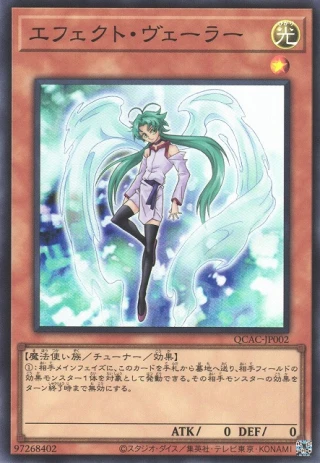
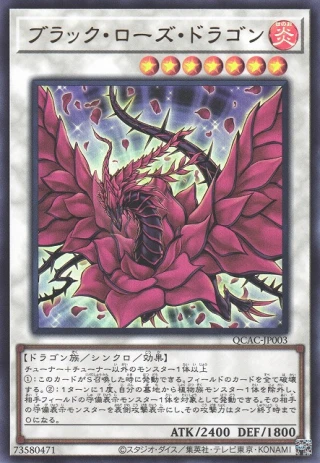
Because the entire QCAC checklist doubles as a QCSE checklist, it’s the most direct route to opening this rarity from current product. We cover the full 100-card breakdown in our QCAC set guide. The six cards below are QCAC checklist examples shown to illustrate the set’s card style — not the Dark Magician Girl / Blue-Eyes White Dragon / Dark Magician trio that carries the QCSE-exclusive printings described above.

Effect Veiler card QCAC-JP002, Quarter Century Art Collection

Effect Veiler, QCAC-JP002

Black Rose Dragon card QCAC-JP003, Quarter Century Art Collection

Black Rose Dragon, QCAC-JP003

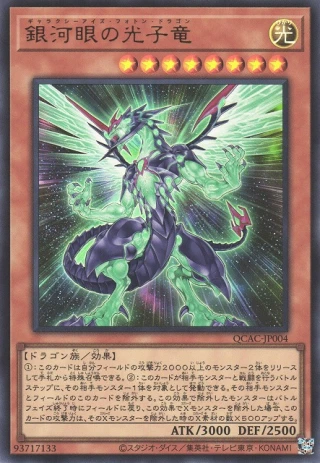
Galaxy-Eyes Photon Dragon card QCAC-JP004, Quarter Century Art Collection

Galaxy-Eyes Photon Dragon, QCAC-JP004

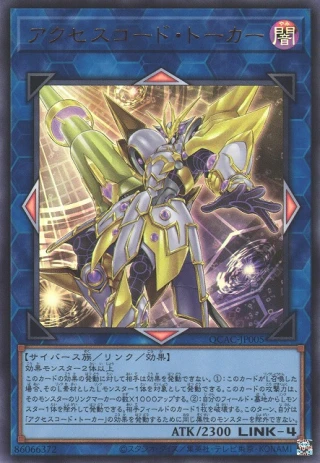
Accesscode Talker card QCAC-JP005, Quarter Century Art Collection

Accesscode Talker, QCAC-JP005

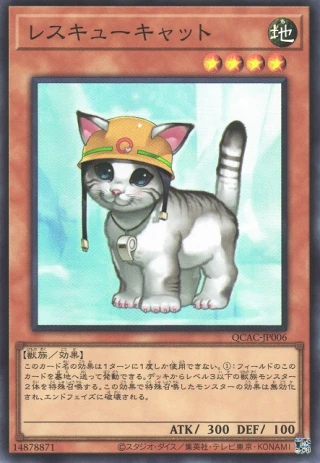
Rescue Cat card QCAC-JP006, Quarter Century Art Collection

Rescue Cat, QCAC-JP006

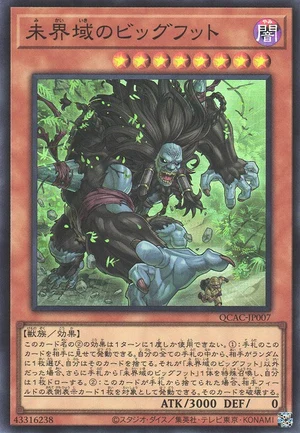
Danger! Bigfoot! card QCAC-JP007, Quarter Century Art Collection

Danger! Bigfoot!, QCAC-JP007

If you want to chase the QCSE trio directly, our listing is the QCAC booster box, and requests for a specific product go through Ordine rapido. Our carton listings are the QCAC booster box by the carton and the QCCP side:PRIDE booster box by the carton. The lowest asking price on SNKRDUNK on September 23, 2026 was ¥6,399 for a single QCAC box and ¥7,199 for a single QCCP side:PRIDE box — both are separate marketplace listings, not our pricing. For the full checklists, see the QCAC card list and the QCCP side:PRIDE card list.

A Documented Grail You Can Actually Own: Ancient Fairy Dragon

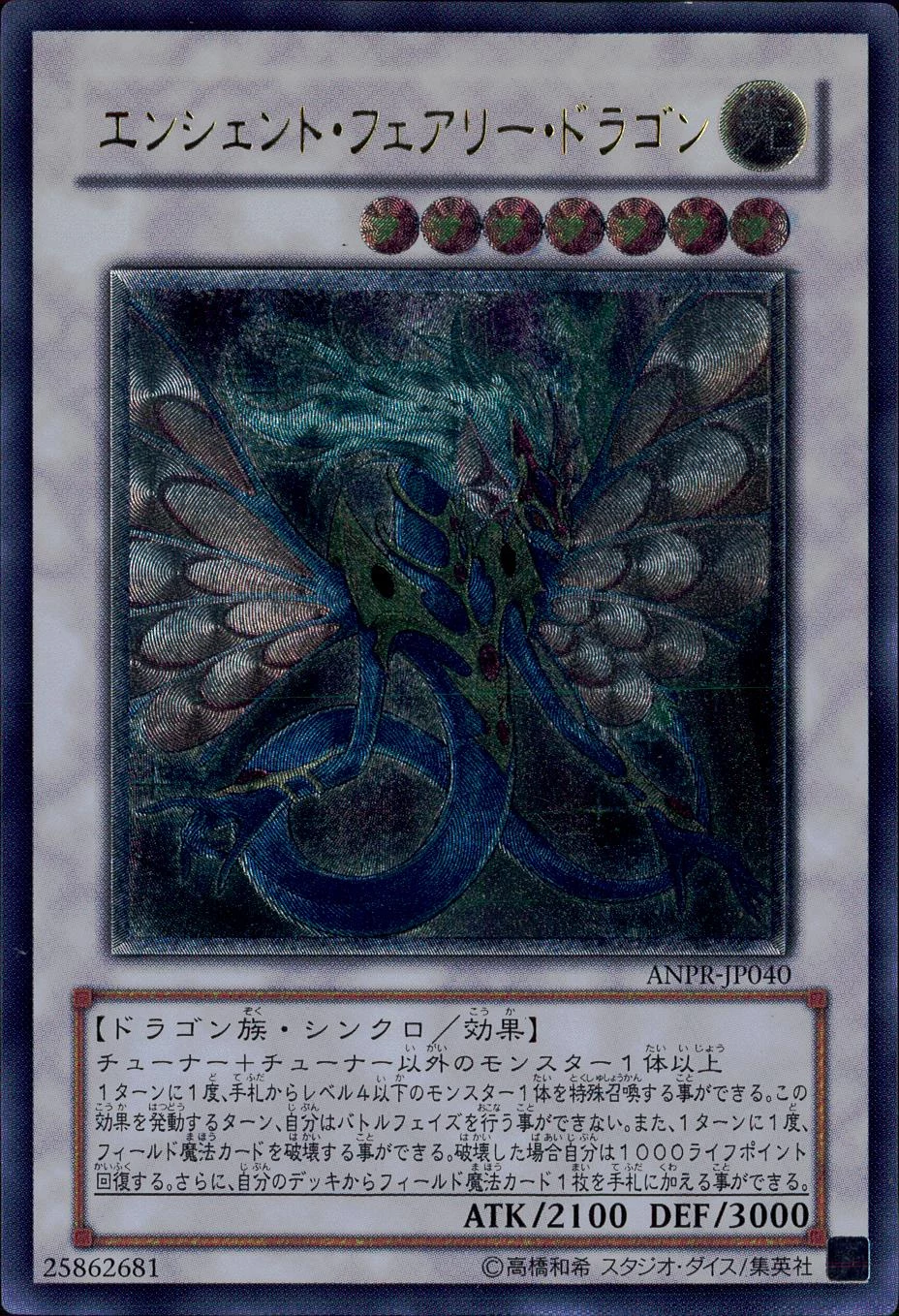
Ancient Fairy Dragon card HR ANPR-JP040, Ancient Prophecy
Ancient Fairy Dragon, Holographic Rare, ANPR-JP040 — Ancient Prophecy (2009)

Everything in the previous section is either untouchable (one-of-one prize cards) or a matter of opening enough boxes and hoping. Ancient Fairy Dragon sits in a different category: a genuinely chase original printing that you can buy as a graded single.

The card debuted in ANCIENT PROPHECY (ANPR-JP040) on April 18, 2009, with its Holographic Rare printing serving as the set’s ghost-equivalent chase variant — alongside Ultra Rare and Ultimate Rare (relief) versions. It’s a Level 7 LIGHT Dragon Synchro, and in the anime it’s one of the Signer Dragons in Yu-Gi-Oh! 5D’s, bonded to Luna. The card was banned in 2018 because its original effects weren’t limited to once per turn, enabling a Field Spell loop; it returned to legal play with an errata in 2023.

Ancient Fairy Dragon later got the Quarter Century treatment too — it appears in RARITY COLLECTION — QUARTER CENTURY EDITION (RC04-JP031, Feb 2023) with a Quarter Century Secret Rare printing among its available foils, tying this original 2009 chase card directly into the modern QCSE story above.

Our PSA10 Ancient Fairy Dragon HR [ANPR-JP040], Ancient Prophecy, was listed at ¥79,040 (~$513) on September 23, 2026. PSA assigned the grade; the certification number can be looked up on PSA’s site. No dated PSA 10 figure for this print is in this update. USD figures convert at ¥154/USD, approximate. For the full printing-by-printing price breakdown across all catalogued OCG and TCG printings of this card, see our dedicated Ancient Fairy Dragon card guide.

Shop This Card
PSA10 Ancient Fairy Dragon HR [ANPR-JP040] (Ancient Prophecy)
Listed at ¥79,040 (~$513) on September 23, 2026
Ships from Tokyo

View Product →

Where to Buy Japanese Yu-Gi-Oh Sealed Product

We ship from Tokyo via FedEx; if your country appears at checkout we can ship to you. If you’re chasing Quarter Century Secret Rare specifically, QCAC’s entire 100-card checklist doubles as the QCSE list. The graded PSA10 Ancient Fairy Dragon single, listed at ¥79,040 (~$513) on September 23, 2026, is a documented QCSE-adjacent chase card; browse more graded singles in our PSA 10 collection.

For our broader Japanese Yu-Gi-Oh lineup, printing history, and buying basics, start with our Japanese Yu-Gi-Oh cards buying guide. If you’re planning to buy graded singles or vintage cards from Japan, it’s also worth reading our guide to spotting fake Yu-Gi-Oh cards before you commit to a high-value purchase. Sourcing requests for a mixed order go through our Quick Order page.

Domande frequenti

What is the most expensive Yu-Gi-Oh card ever documented sold?

Tyler the Great Warrior, a 1-of-1 Make-A-Wish card, sold on eBay for $311,211 in an auction that closed April 29, 2023. It’s the highest Yu-Gi-Oh card sale with a public, verifiable price — a listing ID, a closing date, and press coverage.

Did the Black Luster Soldier stainless-steel card really sell for $2 million?

No verified sale exists at that price. The documented figure is a 2013 asking price of ¥998,000,000 (about US$10M) on CardCollectors.jp, covered by Kotaku. The “$2 million sale” that circulates in many articles has no auction record, buyer, or primary source — treat it as an unverified rumor.

What is Quarter Century Secret Rare and when did it launch?

Quarter Century Secret Rare (QCSE) is a foil treatment with a champagne-gold card name and a 25th Quarter Century watermark. It launched in Japan via RARITY COLLECTION — QUARTER CENTURY EDITION (RC04) in February 2023, with the TCG’s Legendary Collection: 25th Anniversary Edition following in April 2023, and officially replaced Prismatic Secret Rare as the top booster rarity from Duelist Nexus onward.

Which sets have the best chance of pulling Quarter Century Secret Rare cards?

QUARTER CENTURY ART COLLECTION (QCAC, Feb 2025) is the most direct route — all 100 cards in the set also exist as QCSE, including three QCSE-exclusive artworks. QUARTER CENTURY CHRONICLE side:PRIDE (QCCP, Mar 2024) and its companion side:UNITY (QCCU, Feb 2024) also carry QCSE slots across their 200-card checklists.

Is Ancient Fairy Dragon a valuable Yu-Gi-Oh card?

Its original Holographic Rare printing from Ancient Prophecy (ANPR-JP040, 2009) is the set’s chase variant, and it later received a Quarter Century Secret Rare printing in RC04 (2023). Our PSA10-graded original HR printing was listed at ¥79,040 (about $513) on September 23, 2026.

Carte Pokemon di Yuka Morii: guida all'illustratrice di arte in argilla

Most Pokemon TCG illustrators draw. Yuka Morii sculpts: Yuka Morii Pokemon cards are photographs of clay models she builds by hand. Since debuting on Omanyte in the Neo Discovery expansion in 2000, Morii has built a 213-card catalog by making physical clay models of Pokemon, arranging them against real or built scenery, and photographing the result — the photograph is the card art. It’s a technique unlike almost anything else in the TCG’s illustrator roster, and it’s why her cards are instantly recognizable once you know to look for the texture.

Her catalog skews toward Commons and Uncommons from the early 2000s, plus a scattering of modern Rares, Art Rares, and special-art GX cards. That mix means her name doesn’t show up on many marquee chase cards, and it also means very few of her prints are common candidates for PSA 10 grading in the first place.

This guide covers who Morii is, how the clay-and-photograph technique actually works, a walk through several verified cards from her catalog, and how to source a Morii print from a catalog this thin on graded singles.

Key Takeaway

Yuka Morii has illustrated 213 Pokemon TCG cards since her 2000 debut on Omanyte (Neo Discovery), using a signature technique of sculpting clay Pokemon models and photographing them rather than drawing. The PSA 10 card from Pokekyun Collection has its own product page: Swirlix CP3 023/032. Sourcing requests go through Quick Order. Because her catalog is Common/Uncommon-heavy, most other Morii prints don’t surface as PSA 10 singles often, so collectors hunting a specific card generally go through our Quick Order page.

Updated September 23, 2026
  • The PSA 10 listing has its own product page: Swirlix CP3 023/032. Sourcing requests go through Ordine rapido.
  • The lowest asking price on SNKRDUNK on September 23, 2026 was ¥14,800 for a PSA 10 copy of this card (¥3,000 for a raw copy).
  • For the full Pokekyun Collection checklist, see the CP3 card list.
213
Total TCG Cards Illustrated

19
TCG Pocket Cards

2000
TCG Debut Year (Neo Discovery)

Common
Rarity of Swirlix CP3 023/032

Who Is Yuka Morii?

Yuka Morii, referred to as she/her by Bulbapedia, debuted in the Pokemon Trading Card Game with the Neo Discovery expansion in 2000, and her first contribution to the game was a clay-sculpted Omanyte. In the years since, she has illustrated 213 main-TCG cards plus 19 Pokemon Trading Card Game Pocket cards, per Bulbapedia’s count. Her favorite Pokemon, according to the same source, is Ditto — a detail that lines up neatly with one of her most distinctive print runs, covered below.

Academically, Morii is a graduate of Tokyo Zokei University and holds an MA in Living Design from the Kuwasawa Design Institute, where she currently works as a part-time lecturer. That design-school background shows up in how deliberately her process is described: this is deliberate, design-trained model-making rather than casual craft work.

Morii’s catalog sits alongside other Japanese Pokemon TCG illustrators we track closely, including Mitsuhiro Arita, whose painterly style defined the game’s earliest era, and Sowsow, another painterly-style illustrator with a very different catalog shape. Morii’s clay-and-photograph approach stands apart from both.

The Clay Sculpture Behind the Cards

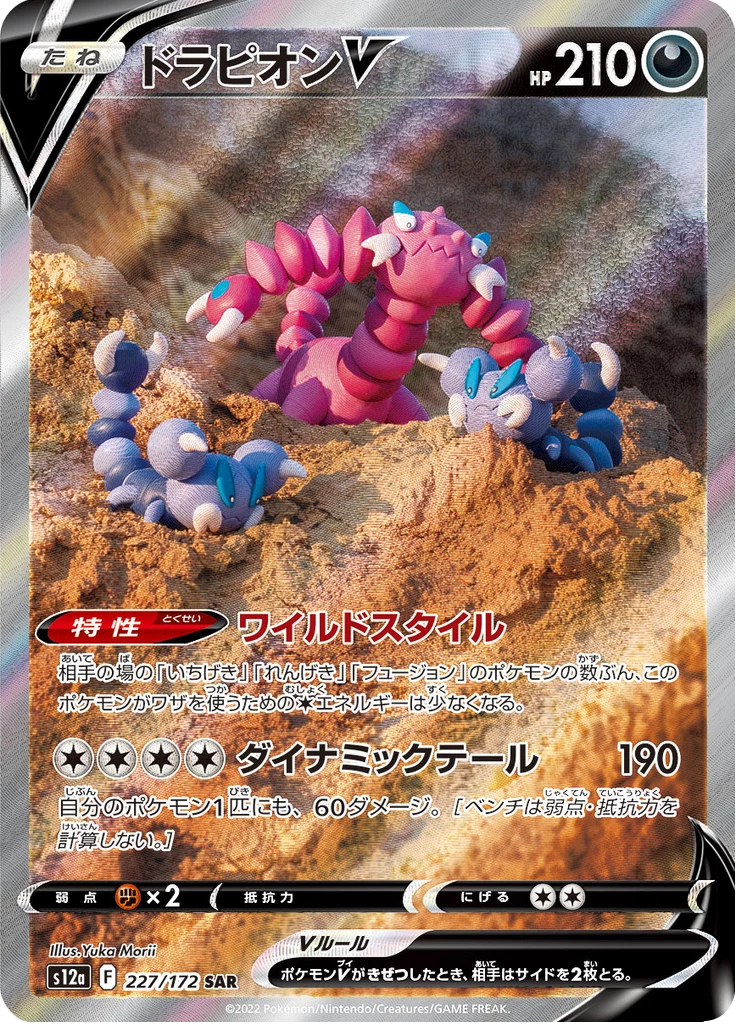
Drapion V SAR, S12a 227/172, VSTAR Universe

Per Bulbapedia, Morii’s signature technique is to sculpt Pokemon “in the same style as her other works” and then “photograph the finished model against an arranged scenery or actual location.” The card art you see isn’t a drawing at all — it’s a photograph of a physical clay figure, staged and lit like a small diorama. That’s a very different production pipeline from standard drawn or digital illustration, and it’s what gives her cards their distinctive texture: soft, slightly uneven surfaces that read as handmade rather than rendered.

The print pictured above is from VSTAR Universe; see the full VSTAR Universe (S12a) card list for every print in the set.

In an interview with OTAQUEST, Morii described her own process in more detail: before she ever picks up clay, she “creates artworks by imagining the 3D images of the Pokemon and draws sketches, then has discussions with others.” Only after that planning stage does the sculpting begin. She has also said she prefers hand-sculpting over 3D printing specifically because the small imperfections of handmade work add personality that a printed model wouldn’t have — a preference that speaks directly to why the finished cards look the way they do.

The technique has drawn mainstream attention outside the collecting community as well. Kotaku ran a 2022 feature on her work titled “Oh Wow, The Best Pokémon Card Art All Comes From The Same Person,” introducing her clay-photography process to readers who’d likely handled one of her cards without ever clocking that it wasn’t a painting.

From Omanyte to Mimikyu: Notable Cards in the Catalog

Morii’s 213-card body of work runs from Neo-era Commons through modern Art Rares and special-art GX cards. A few entries stand out for how clearly they show the range of her clay technique across two and a half decades.

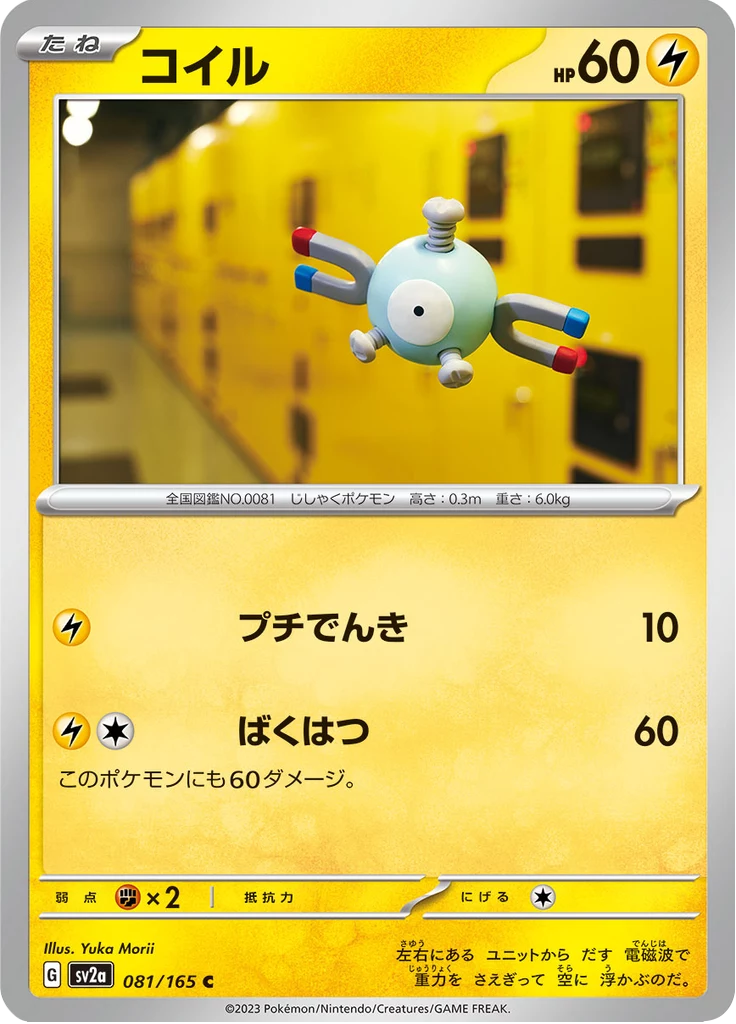
Magnemite, SV2a 081/165, Pokemon Card 151

Given that Ditto is her stated favorite Pokemon, it’s fitting that one striking single-set run in her catalog is ten separate clay Ditto illustrations, numbered #35–40 and #61–64 in the Delta Species expansion. The run shows how far the clay-and-photograph method can be pushed across variations of a single Pokemon. The Magnemite print pictured above is from Pokemon Card 151; see the full Pokemon 151 (SV2a) card list for every print in the set.

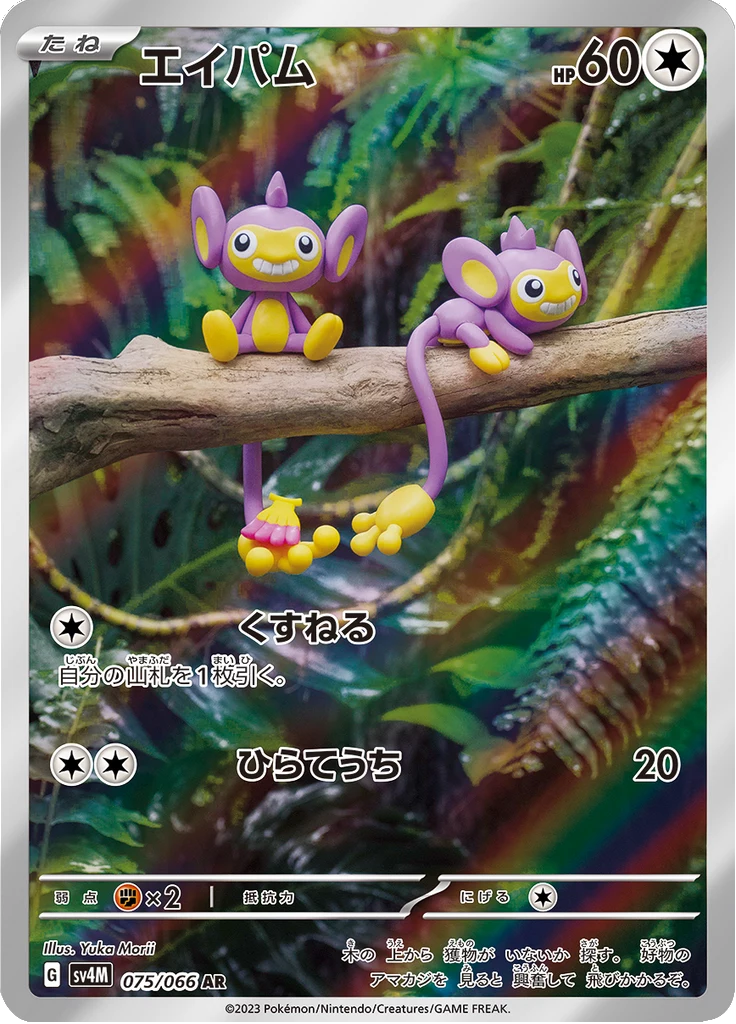
Aipom AR, SV4M 075/066, Future Flash
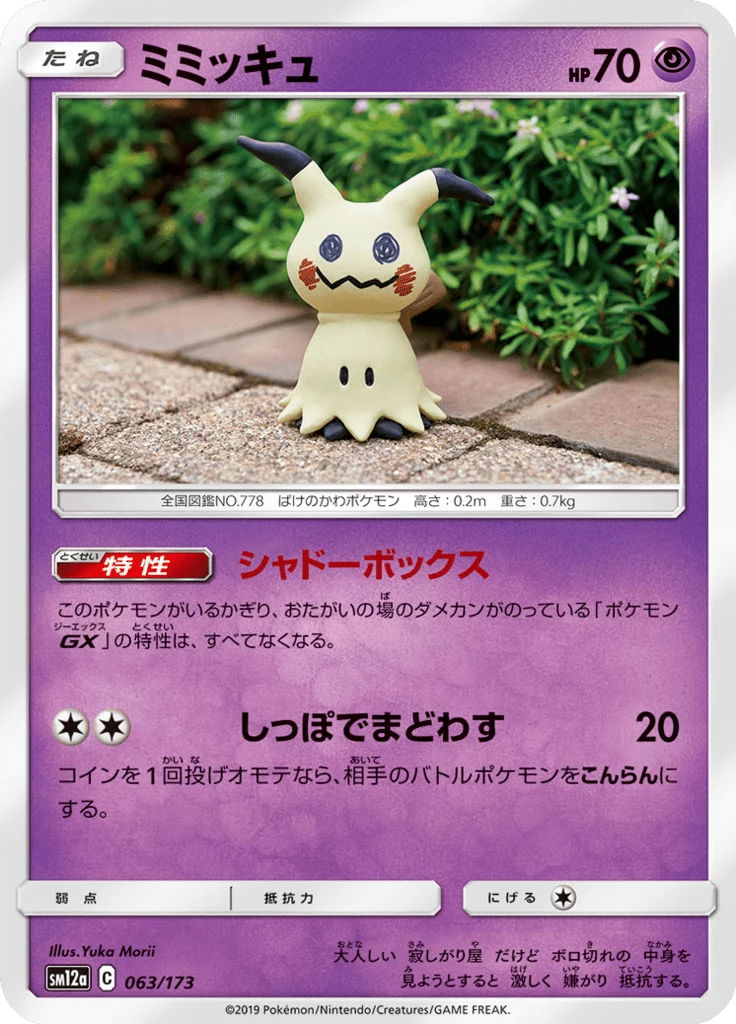
Mimikyu, SM12a 063/173, Tag All Stars (JP print of EN CEC 97)
Mimikyu CEC 97, Cosmic Eclipse
Mimikyu, SM12a 063/173, Tag All Stars (JP print of EN CEC 97)
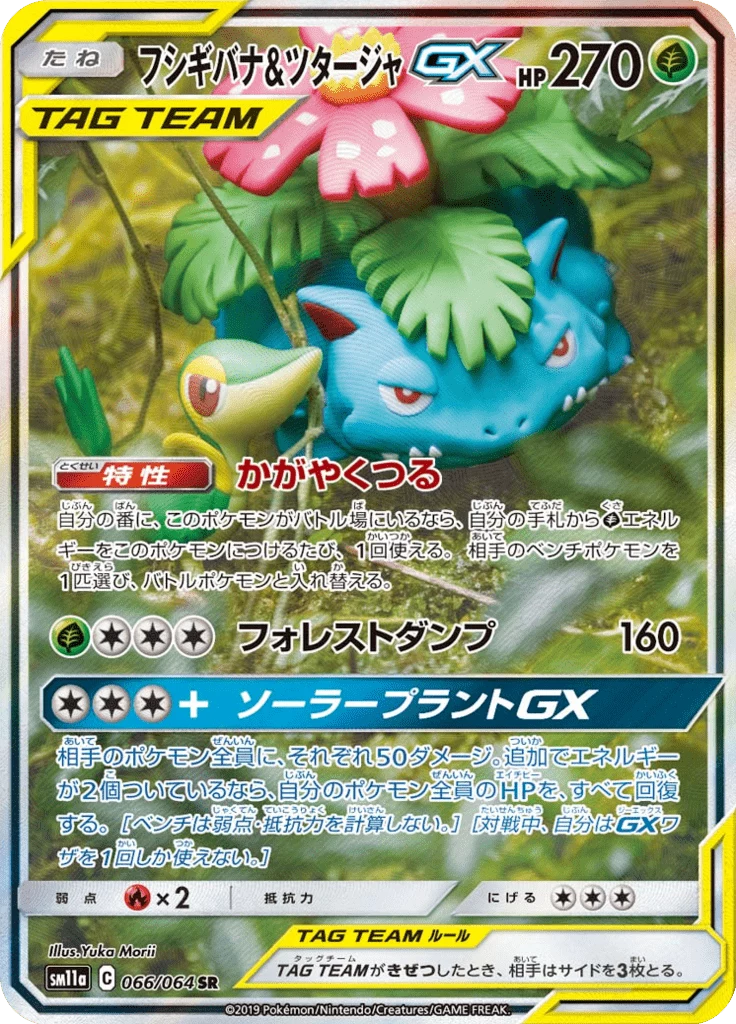
Venusaur and Snivy GX SM11a 066/064 SR Remix Bout card illustrated by Yuka Morii
Venusaur & Snivy-GX SM11a 066/064

Claydol EM 24 from Emerald is a small joke that’s easy to miss: Claydol is a Pokemon literally made of clay, illustrated by an artist who works in literal clay. Whether or not it was intentional, the pairing of subject and medium is one of the more satisfying coincidences in her catalog. Mimikyu CEC 97 from Cosmic Eclipse shows the technique applied to a much more recent and widely recognized Pokemon, and Venusaur & Snivy-GX, printed as SM Black Star Promo #SM229 in English and as a Secret Rare in the Japanese Remix Bout set (SM11a 066/064), demonstrates that Morii’s clay work extends into the special-art, multi-Pokemon GX card format — not just single-Pokemon Commons and Uncommons. The prints pictured above are from the Japanese Future Flash, Tag All Stars, and Remix Bout sets; see the full Future Flash (SV4M), Tag All Stars (SM12a), and Remix Bout (SM11a) card lists for every print in those sets.

Other verified credits across her career include Blissey (Neo Revelation), Piloswine and Raichu (Skyridge), Jumpluff (Aquapolis), Poliwrath (Expedition), Happiny (Mysterious Treasures), Drapion V (Crown Zenith Galarian Gallery), Aipom (Paradox Rift), Klinklang (Black Bolt), and Magnemite/Magneton in the 151 (MEW) set — a spread that runs from the Neo era (2000) through some of the game’s most recent releases.

PSA 10 Listing
Kahili 065/060 SR, PSA 10
Listed at ¥20,280 (~$132) on September 23, 2026
Ships from Tokyo

View Product →

USD figures convert at ¥154/USD, approximate.

Yuka Morii Cards We Have Listed

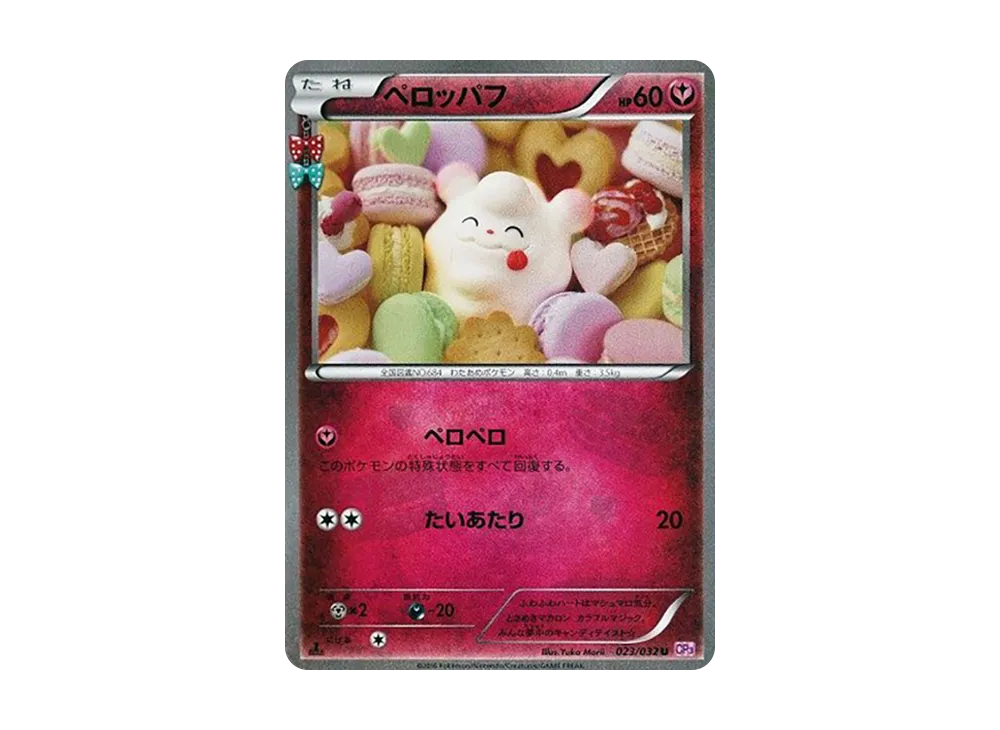
Swirlix CP3 023/032 Common Pokekyun Collection card illustrated by Yuka Morii
Swirlix CP3 023/032, Pokekyun Collection

Swirlix CP3 023/032 (PSA 10) is from the Japanese Pokekyun Collection. Sourcing requests go through Ordine rapido. It’s a Common-rarity print, consistent with the bulk of Morii’s output, and it’s the entry point we’d point a Morii collector to first.

The lowest asking price on SNKRDUNK on September 23, 2026 was ¥14,800 for a PSA 10 copy of this card, and ¥3,000 for a raw copy.

Graded Morii prints are scarce because of the shape of Morii’s catalog. Her 213 credits skew heavily toward Commons and Uncommons from the early-to-mid 2000s, card types that are typically played and handled rather than preserved, and that are less likely to be submitted for grading in the first place. An early-2000s-era Common surviving in gem-mint condition and making it through PSA grading is simply a less common event than the same outcome for a modern Ultra Rare.

For collectors specifically hunting one of the other verified Morii prints above — the Ditto run, Claydol, Mimikyu, or the Venusaur & Snivy-GX special art — the most direct route is our Quick Order page, where you can flag a specific card or artist for us to watch the Japanese secondary market for. It’s the same sourcing approach we point collectors toward for Amelicart, another illustrator — sourcing requests go through the Quick Order page.

Beyond the Cards: Yuka Morii’s Wider Work

Morii’s published work outside the TCG includes several books: Let’s Make Pizza, Wanriky! (1997), the Supermarket Mania series (2004–2008), and Tokyo Goods Patrol (2009).

She has also contributed 3D illustrations to the Atashin’chi anime, worked on mascot character design, created characters for the Toei Subway, and produced clay play sets and advertising campaigns.

That range — publishing, anime tie-in work, transit mascot design, and advertising — makes clear that the Pokemon TCG is one application of a broader clay-sculpture and design practice rather than the whole of her output. Her academic role as a part-time lecturer at the Kuwasawa Design Institute, where she earned her own MA in Living Design, adds another layer: the person behind the clay Omanyte and the ten clay Dittos also teaches design at the institution level.

Where to Buy Yuka Morii Cards from Japan

We stock PSA 10-graded Japanese singles out of Tokyo. Sourcing requests go through Quick Order. Our PSA 10 Kahili 065/060 SR was listed at ¥20,280 (~$132) on September 23, 2026.

USD figures convert at ¥154/USD, approximate.

For the wider PSA 10 catalog, browse our PSA 10 card list or the full PSA 10 collection to filter by set, illustrator, and price, or see the CP3 Pokekyun Collection card list for the full checklist Swirlix comes from.

If you’re after a specific Yuka Morii print beyond Swirlix — the clay Ditto run, Claydol, Mimikyu, or the Venusaur & Snivy-GX special art — sourcing requests go through the Quick Order page.

Domande frequenti

Who is Yuka Morii?

Yuka Morii is a Pokemon TCG illustrator who has illustrated 213 main-TCG cards plus 19 Pokemon Trading Card Game Pocket cards since debuting on Omanyte in the Neo Discovery expansion in 2000. She is known for a signature technique of sculpting clay Pokemon models and photographing them, rather than drawing.

What makes Yuka Morii’s Pokemon card art different from other illustrators?

Instead of painting or digitally drawing her cards, Morii sculpts physical clay models of Pokemon and photographs them against arranged scenery or an actual location. The card art is a photograph of a real handmade sculpture rather than an illustration.

What was Yuka Morii’s first Pokemon TCG card?

Her debut card was Omanyte in the Neo Discovery expansion in 2000, a clay-sculpted figure that established the technique she has used throughout her 213-card career.

Why doesn’t Samurai Sword Tokyo have more Yuka Morii cards listed?

Morii’s 213-card catalog skews heavily toward Commons and Uncommons from the early 2000s, which are submitted for PSA grading far less often than modern chase Rares. That makes graded PSA 10 examples of her work naturally scarce. Collectors looking for a specific Morii print can request it through our Quick Order page.

What else has Yuka Morii worked on outside Pokemon cards?

Morii has published books including Let’s Make Pizza, Wanriky! and the Supermarket Mania series, contributed 3D illustrations to the Atashin’chi anime, designed mascot characters and Toei Subway characters, and produced clay play sets and advertising campaigns. She is also a part-time lecturer at the Kuwasawa Design Institute, where she earned her MA in Living Design.

Guida alle carte degli starter di Alola: Rowlet, Litten e Popplio

The Alola starters — Rowlet, Litten, and Popplio — have been printed across ten years of Japanese Pokemon TCG sets — from the very first Sun & Moon starter deck in December 2016 to a mega-era Primarina card released in May 2026. This guide finishes our regional starters series by tracking every verified Alola-line printing in one place: Decidueye’s six-card run, plus the current chase cards for Incineroar and Primarina.

We’re not covering VGC viability or competitive rankings here. This is a collector’s map of what exists, when it released, and what it looks like — useful whether you’re building a Rowlet binder or just trying to identify a card someone handed you.

Alola is an unusual region to map this way, because its starter line’s TCG history doesn’t run in a straight line. Rowlet’s evolved form, Decidueye, got the lion’s share of attention across the Sun & Moon era — a starter-deck debut, a tag team, a shiny secret rare, and a Hisuian regional-form reprint — while Litten and Popplio’s evolved forms show up only once each in this guide’s verified scope: Incineroar ex is a Scarlet & Violet-era print (SV5M), and Primarina AR is a current mega-era print (M5). That gap is part of what makes the Alola trio worth mapping on its own rather than folding it into a generic “starters” list.

Key Takeaway

Eight verified printings of the Alola starters span 2016–2026 across three lines. Decidueye (Rowlet’s final form) has the deepest run at six cards, including a Shiny SSR and a Hisuian VSTAR. Litten’s Incineroar ex is a Scarlet & Violet-era print (SV5M); Popplio’s Primarina AR is a current mega-era print (M5). The Rowlet Munch Exhibition promo 290/SM-P was listed as a PSA 10 at ¥354,732 (~$2,303) on September 23, 2026. Sealed boxes from each set are the other way to chase these prints.
Updated September 23, 2026
8
Verified Printings

2016–2026
Years Covered

3
Starter Lines

5
Sealed Boxes Tracked

Prices below were listed on September 23, 2026 for sealed Japanese booster boxes. USD figures convert at ¥154/USD, approximate. The Rowlet Munch Exhibition promo 290/SM-P was listed as a PSA 10 at ¥354,732 (~$2,303) on September 23, 2026; sealed boxes are the collectible route to the other printings.

Every Alola Starter Printing in One Table

Eight verified prints across the three Alola starter lines, in release order:

Carta Line Set Number Released
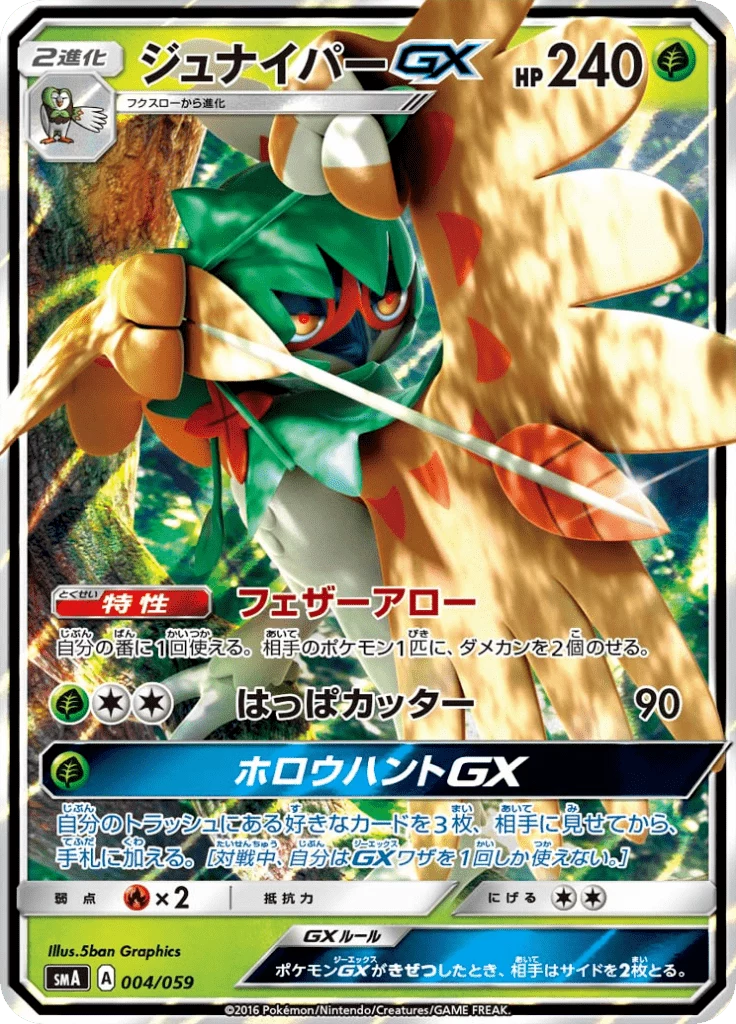
Decidueye-GX Rowlet Starter Set SM (SMA) 004/059 Dec 2016
Rowlet Munch Exhibition Promo Rowlet SM-P 290/SM-P Nov 2018
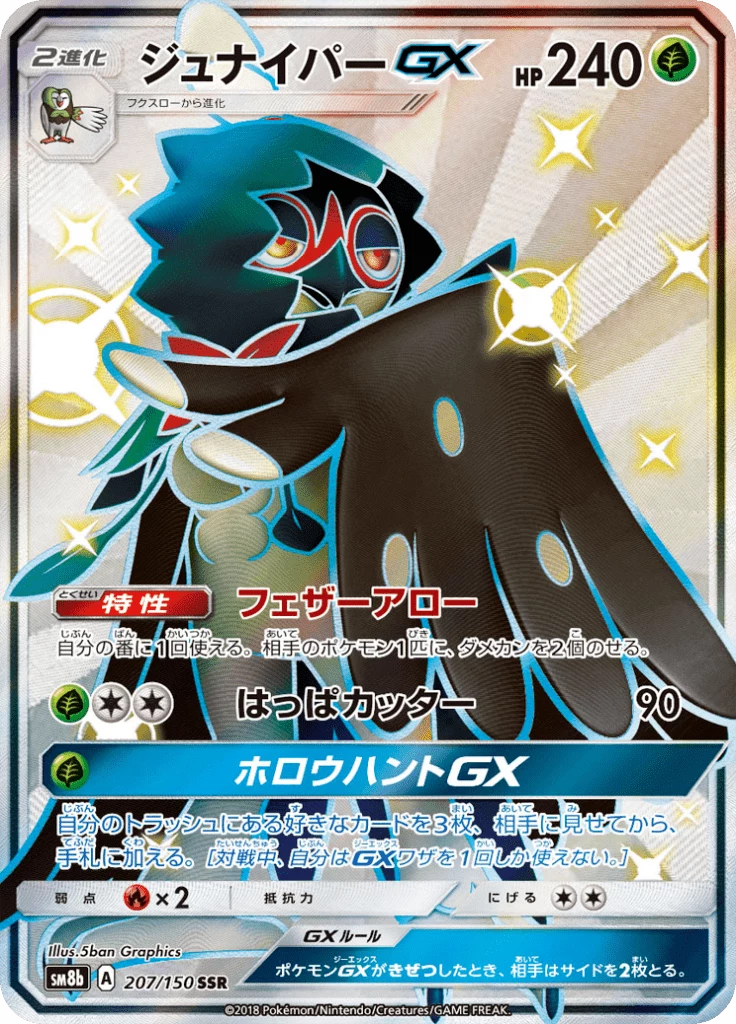
Shiny Decidueye-GX SSR Rowlet GX Ultra Shiny (SM8b) 207/150 Nov 2018
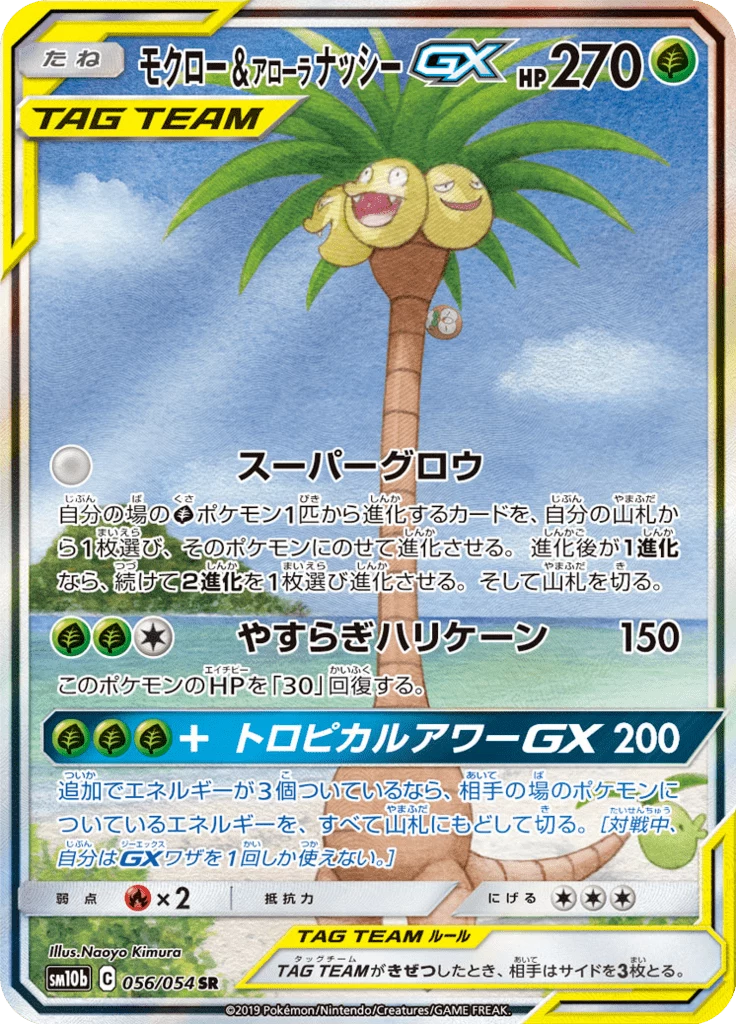
Rowlet & Alolan Exeggutor-GX SA Rowlet Sky Legends (SM10b) 056/054 Apr 2019
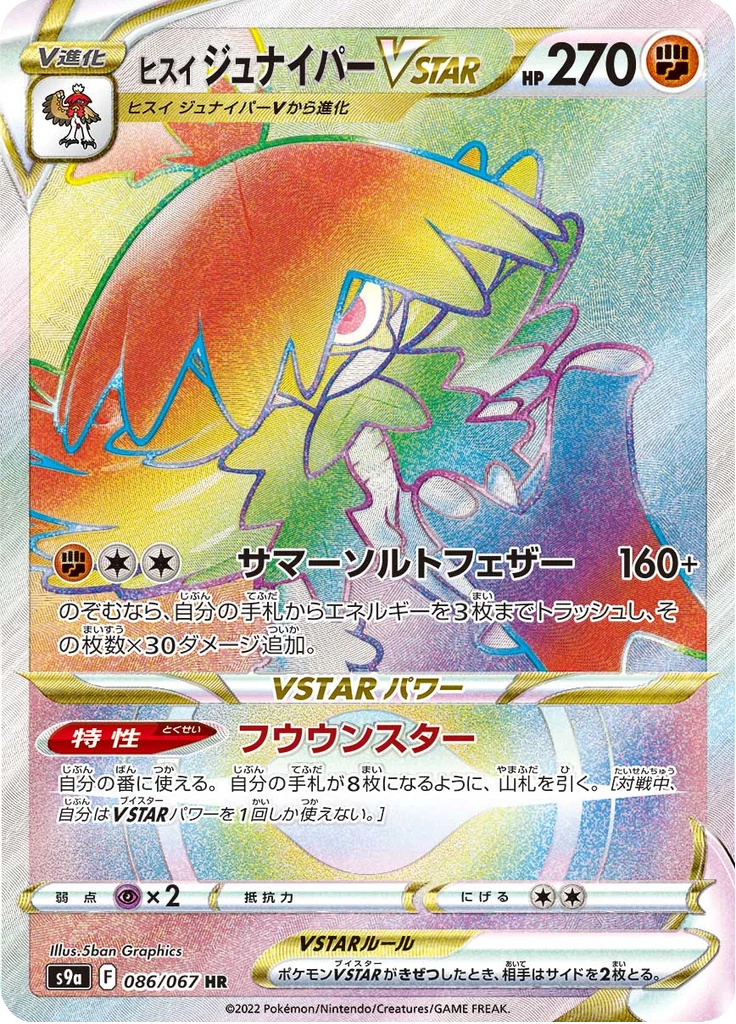
Hisuian Decidueye VSTAR HR Rowlet Battle Region (S9a) 086/067 Feb 2022
Incineroar ex SR Litten Cyber Judge (SV5M) 085/071 Jan 2024
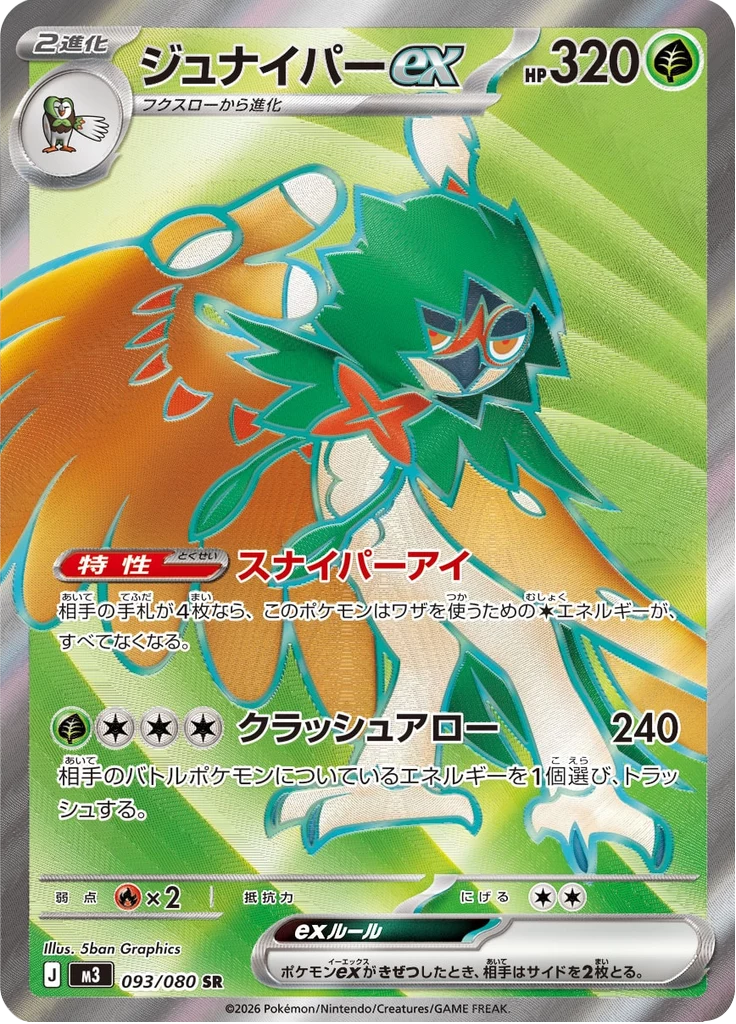
Decidueye ex SR Rowlet Nihil Zero (M3) 093/080 Jan 2026
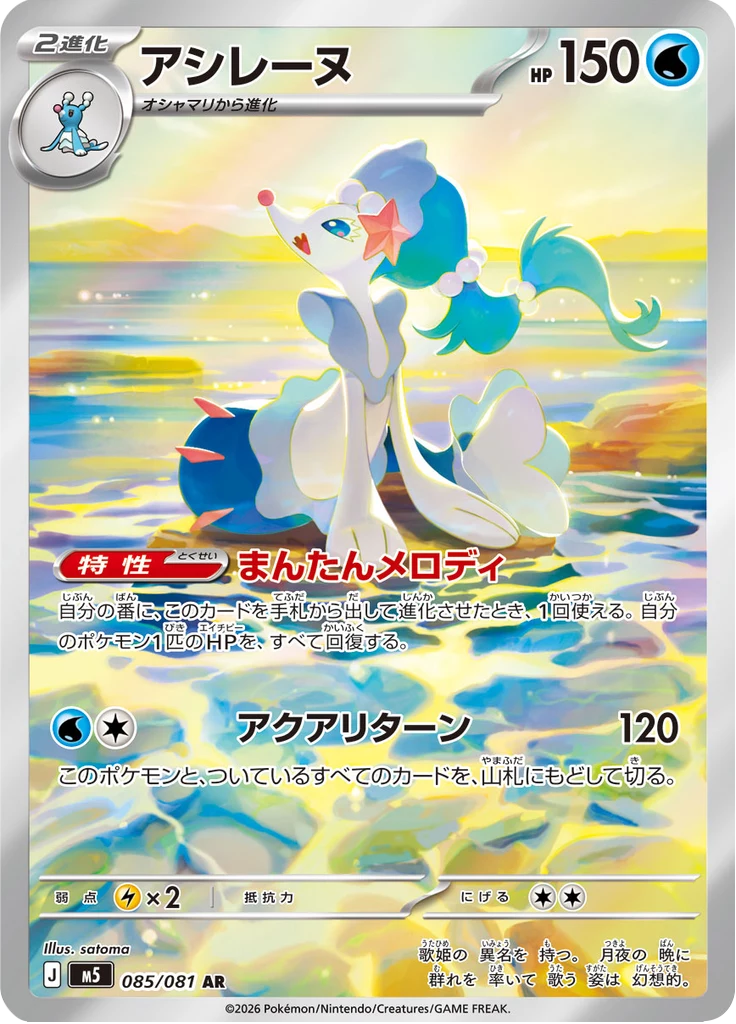
Primarina AR Popplio Abyss Eye (M5) 085 May 2026

The pattern is lopsided: Decidueye has appeared six times since 2016, while Litten and Popplio’s evolved forms each have exactly one verified print in this guide’s scope — Incineroar ex from the Scarlet & Violet era (SV5M) and Primarina AR from the current mega era (M5). That’s not unusual for a starter trio — the “cover” starter of a generation (Rowlet, in Sun & Moon’s case) tends to get more GX/VSTAR/ex treatment across a set’s lifespan than its two partners.

The card frame is the fastest way to place any of these eight in time, even without checking the set code. GX cards (the debut print, the shiny SSR, and the Rowlet & Alolan Exeggutor tag team) all belong to the 2016–2019 Sun & Moon era and share the same rounded, colour-banded frame. The single VSTAR print — Hisuian Decidueye — belongs to the 2022 Sword & Shield era and uses the star-shaped HP icon that VSTAR cards are known for. The three most recent cards (Incineroar ex, Decidueye ex, and Primarina AR) all use the current “ex” and alternate-rare frame conventions, spanning the SV5M Cyber Judge set in 2024 through the M3 and M5 mega-era sets in 2026. If you’re sorting a binder by feel rather than by set code, frame style alone gets you most of the way to the right era.

The Decidueye Line: Six Prints from 2016 to 2026

Decidueye’s Japanese TCG debut was Decidueye-GX 004/059 in the Starter Set SM (SMA), released December 9, 2016 — the deck that launched the Sun & Moon era in Japan. The English-language debut followed in the base Sun & Moon set (Decidueye-GX 12/149).

Decidueye-GX 004/059 Starter Set SM

Decidueye-GX 004/059 (Starter Set SM)

Shiny Decidueye-GX SSR 207/150 GX Ultra Shiny

Shiny Decidueye-GX SSR 207/150 (GX Ultra Shiny)

Rowlet & Alolan Exeggutor-GX SA 056/054 Sky Legends

Rowlet & Alolan Exeggutor-GX SA 056/054 (Sky Legends)

Hisuian Decidueye VSTAR HR 086/067 Battle Region

Hisuian Decidueye VSTAR HR 086/067 (Battle Region)

Decidueye ex SR 093/080 Nihil Zero

Decidueye ex SR 093/080 (Nihil Zero)

Two years after the starter deck, GX Ultra Shiny (SM8b), November 2, 2018, added a shiny SSR Decidueye-GX at 207/150 — the alternate-color secret-rare slot that era’s ultra shiny sets were built around. About five months later, Sky Legends (SM10b, April 26, 2019) paired Rowlet with an evolutionary partner from the same island in a tag team GX: Rowlet & Alolan Exeggutor-GX, full art, at 056/054.

The line then skipped ahead to the Sword & Shield era with Hisuian Decidueye VSTAR HR 086/067 in Battle Region (S9a, February 25, 2022) — the Legends: Arceus-style regional form treatment, released in the English-language Astral Radiance set as well. Most recently, Decidueye returned in the current mega era as Decidueye ex SR 093/080 in Nihil Zero (M3, January 23, 2026), the newest print in this guide.

If you’re trying to identify which Decidueye card you have, the card number and set logo are the fastest tell — six prints span three different card frame generations (GX, VSTAR, ex), so the layout alone narrows it down quickly.

Incineroar ex and Primarina AR: The Current Chase Cards

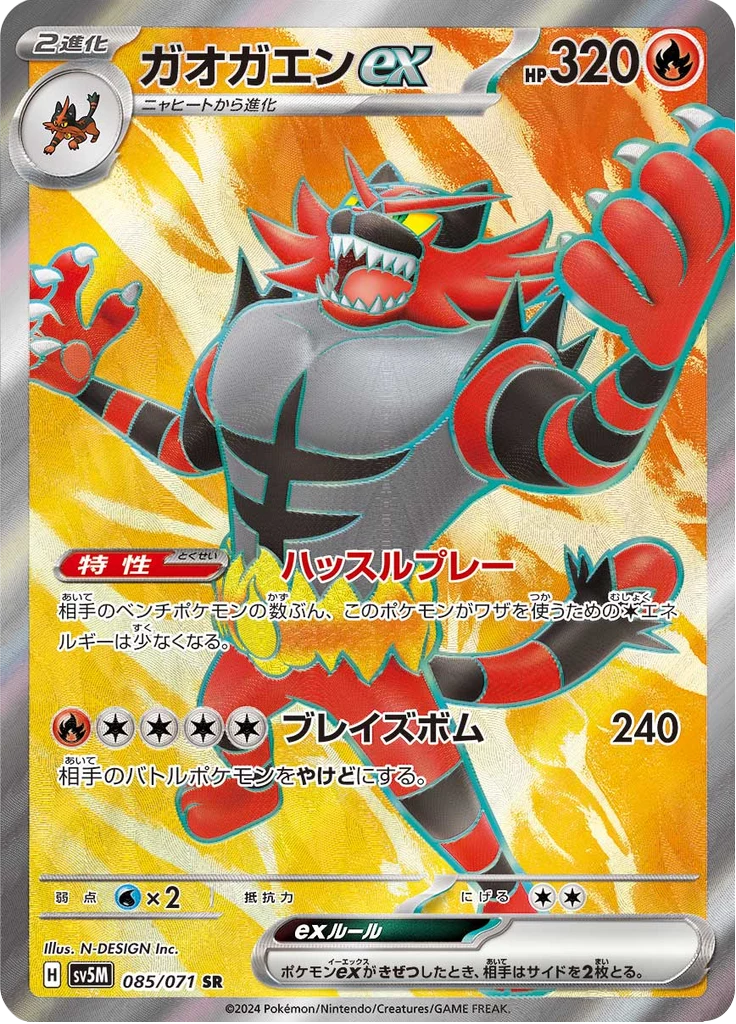
Litten and Popplio’s fully evolved forms don’t have Decidueye’s print history in this guide’s verified scope. Incineroar ex SR 085/071 is a Scarlet & Violet-era print (Cyber Judge, SV5M, January 2024); Primarina AR 085 is a current mega-era print (Abyss Eye, M5, May 2026).

Incineroar ex SR 085/071 Cyber Judge

Incineroar ex SR 085/071 (Cyber Judge)

Primarina AR 085 Abyss Eye

Primarina AR 085 (Abyss Eye)

Incineroar ex SR 085/071 released in Cyber Judge (SV5M) on January 26, 2024, the Japanese counterpart to the English Temporal Forces-era print run. It’s Litten’s line represented at the ex secret-rare tier, and the box it comes from, SV5M Cyber Judge Booster Box, was listed with the No Shrink option at ¥9,180 (~$60) and the Sealed option at ¥11,220 (~$73) on September 23, 2026. The lowest asking price on SNKRDUNK for a PSA10 Incineroar ex SR 085/071 was ¥5,900 on September 23, 2026; a raw copy asked ¥1,000 the same day.

Primarina AR 085 is Popplio’s newest and only verified print in this guide, released in Abyss Eye (M5) on May 22, 2026 — the most recent card of the eight covered here. It’s an alternate-art rare, the current era’s mid-tier chase slot below the SAR/SR/UR treatments. M5 Abyss Eye Booster Box was listed with the Sealed option at ¥8,160 (~$53) and the No Shrink option at ¥8,475 (~$55) on September 23, 2026; a raw Primarina AR 085 asked ¥1,000 on SNKRDUNK on September 23, 2026. No dated PSA 10 figure for this print is in this update.

The lowest asking prices on SNKRDUNK on September 23, 2026 were ¥7,999 (M3), ¥7,850 (M5) and ¥11,000 (SV5M) for a sealed box.

For the full rarity breakdown of either set, see the SV5M Cyber Judge card list, our SV5M Cyber Judge pull rates guide, or the M3 Nihil Zero card list (which also covers the current Decidueye ex print).

Worth noting: this guide’s verified scope is limited to the printings confirmed above, and both Incineroar and Primarina may well have earlier Japanese printings outside that scope. What’s confirmed is that these two cards are each Pokemon’s current representative for their line — the one you’ll find in a current booster box rather than in a decade-old binder.

The Munch Exhibition Promo: Rowlet Meets “The Scream”

Rowlet Munch Exhibition Promo 290/SM-P
Rowlet, 290/SM-P — distributed alongside the Tokyo Metropolitan Art Museum’s Edvard Munch exhibition

A crossover that stands apart from the rest of this list: Rowlet 290/SM-P was distributed starting November 2, 2018, tied to “Munch: A Retrospective,” the Edvard Munch exhibition running at the Tokyo Metropolitan Art Museum from October 27, 2018 to January 20, 2019. Buyers who purchased two packs at Pokemon Center or Pokemon Store locations during the tie-in period received the card as a bonus. This promo was listed as a PSA 10 single at ¥354,732 (~$2,303) on September 23, 2026.

The illustration, by Hideki Ishikawa, riffs on Munch’s 1910 version of “The Scream” while working in a Mimikyu silhouette — a Rowlet card, but the artwork is doing something entirely different from the rest of this list. It’s part of a broader Munch Exhibition promo series that also included cards for other Pokemon at the time; this guide covers only the Rowlet entry within its verified scope.

Cards like this sit outside the normal set-and-booster-pack pipeline that the rest of this guide’s printings came through. They were tied to a specific purchase (two packs, during a defined window) at specific retail locations rather than distributed inside any Sun & Moon-era product, which is part of why exhibition-tie-in promos like this one tend to be harder to track down years later than a card that shipped inside every booster box of a mainline set.

Alola Completes the Regional Starters Series

This is the eighth and final entry in our regional starters series, rounding out every generation we’ve covered so far. If you’re chasing a specific region’s trio, the other guides are here:

Each guide follows the same format: every verified printing, release dates, and the sealed product where the current-era chase cards live.

How to Collect the Alola Starters

The Rowlet Munch Exhibition promo 290/SM-P was listed as a PSA 10 single at ¥354,732 (~$2,303) on September 23, 2026. The practical route into the rest of this lineup is sealed booster boxes from the sets that contain each printing — five boxes cover five of the eight cards, with each box’s price in the table below.

Box Contains Current price
SM10B Sky Legends Booster Box Rowlet & Alolan Exeggutor-GX SA Listed in our store; the product page shows the current terms
S9A Battle Region Booster Box Hisuian Decidueye VSTAR HR Listed at ¥11,000 (~$71) on September 23, 2026; the product page shows the current terms
M3 Nihil Zero Booster Box Decidueye ex SR Listed in our store; the product page shows the current terms
SV5M Cyber Judge Booster Box Incineroar ex SR No Shrink ¥9,180 (~$60)
M5 Abyss Eye Booster Box Primarina AR Sealed ¥8,160 (~$53)

Requests for the Starter Set SM debut (SMA) and the GX Ultra Shiny SSR (SM8b) go via our Quick Order page. The Munch Exhibition promo comes from no booster box; its PSA 10 single is the one linked above.

Shop This Set
SV5M Cyber Judge Booster Box (Japanese)
No Shrink listed on September 23, 2026 at ¥9,180 (~$60) · Sealed at ¥11,220 (~$73)
Ships from Tokyo

View Product →

For the complete card-by-card breakdown of that set, see the SV5M Cyber Judge card list or the M3 Nihil Zero card list. For individual Alola-starter singles across any of these sets, or any of the other prints in the main table, request a quote via our Quick Order page.

Where to Buy Alola Starter Boxes from Japan

We ship Japanese sealed product from Tokyo via FedEx; if your country appears at checkout we can ship to you. The five boxes above are the direct route to five of the eight Alola starter printings in this guide, and each box also opens the rest of that set’s card pool — useful if you’re chasing more than just the starter card.

If you collect across generations, check the PSA 10 card list hub for graded Alola starter singles, and the SV5M Cyber Judge and M5 Abyss Eye boxes are the lowest-priced entry points on this list for a current-era starter chase card.

M5 Abyss Eye and SV5M Cyber Judge are the lower-priced entry points; S9A Battle Region runs a little higher. Any of the seven other regional guides linked above follow a similar price spread between their oldest and newest sets.

For graded singles, browse the PSA 10 collection; for sourcing requests on prints we don’t currently list, use our Quick Order page.

Domande frequenti

Which Pokemon are the Alola starters, and which cards does this guide cover?

Rowlet, Litten, and Popplio are the Alola region’s starter Pokemon. This guide covers their fully evolved forms in the Japanese TCG: Decidueye (Rowlet), Incineroar (Litten), and Primarina (Popplio), across eight verified printings from 2016 to 2026.

When did Rowlet and its evolutions first appear in the Japanese TCG?

Decidueye-GX 004/059 debuted in the Starter Set SM (SMA), released December 9, 2016, at the start of Japan’s Sun & Moon era. It’s the earliest verified printing in this guide.

What is the Munch Exhibition promo card?

Rowlet 290/SM-P is a Japanese promo distributed from November 2, 2018, tied to an Edvard Munch retrospective at the Tokyo Metropolitan Art Museum. The illustration by Hideki Ishikawa reworks Munch’s 1910 version of “The Scream” with a Mimikyu silhouette worked into the design.

Are there current mega-era prints of the Alola starters?

Yes. Decidueye ex SR 093/080 released in Nihil Zero (M3) in January 2026, and Primarina AR 085 released in Abyss Eye (M5) in May 2026. Incineroar ex SR 085/071 from Cyber Judge (SV5M, January 2024) is the most recent verified Litten-line print.

Where can I buy sealed product with these cards from Japan?

We list sealed booster boxes for SM10B Sky Legends, S9A Battle Region, M3 Nihil Zero, SV5M Cyber Judge, and M5 Abyss Eye — each contains one of the verified Alola starter printings. Individual singles or other sets can be requested by getting a quote via our Quick Order page.

Carte Pokemon di Tomokazu Komiya: guida allo stile primitivismo

Tomokazu Komiya is the Pokemon TCG illustrator whose deliberately deformed, primitivism-style cards look unlike almost anything else printed under the Pokemon Company banner. In 2023, the Van Gogh Museum in Amsterdam put its own paintings next to Pokemon art for a licensed collaboration — and Komiya was one of the illustrators chosen to reinterpret Van Gogh masterworks, work that sits squarely inside the same deformed, loosely colored style Bulbapedia credits to his wider Pokemon Trading Card Game catalog.

Komiya’s cards are deliberately “deformed and loosely colored,” in Bulbapedia’s own description of the style — stretched faces, oversized eyes, and color choices that clash on purpose. This guide covers who Komiya is, what that style actually looks like across a TCG career that spans vending-era Japan to the newest English sets, and everything we’ve verified about Tomokazu Komiya Pokemon cards, and this guide doubles as the way to ask us to source one.

Key Takeaway

Komiya is a Japanese illustrator born in 1973 whose Pokemon TCG work is credited by Bulbapedia to the Primitivism art movement — intentionally “deformed and loosely colored” Pokemon portraits with exaggerated facial proportions. Komiya’s TCG debut dates back to Japan’s early vending-card series, and in 2023 the illustrator contributed to the official Pokemon × Van Gogh Museum collaboration. If you want a Komiya card, flag it on our Quick Order page and we’ll source it.

Updated September 23, 2026
1973
Year Born

249
TCG Cards on Limitless (Main Sets Only)

Neo Genesis
English-Language TCG Debut Set

2023
Van Gogh Museum Collab Year

Card and set details verified against Bulbapedia and Limitless TCG.

Who Is Tomokazu Komiya?

Tomokazu Komiya (小宮智和) is a Japanese illustrator born in 1973. Per Bulbapedia, Komiya’s first Pokemon Trading Card Game artwork appeared in Japan’s Expansion Sheet 1, part of the early vending-machine card series, well before the illustrator’s English-language debut arrived on Neo Genesis.

That gives Komiya a TCG career running from Japan’s early vending-card era through to current-era sets. The Limitless TCG artist database listed 249 cards under Komiya’s name as of August 2026, covering only main-line TCG sets — no Pokemon Trading Card Game Pocket sets appear in that result. Bulbapedia’s own tally counts 271 TCG cards plus a separate 36 Pokemon TCG Pocket cards; because the two databases scope things differently, we’re citing both figures separately rather than adding them into one number.

What makes Komiya’s catalog stand out isn’t the size — it’s the consistency of a deliberately deformed, loosely colored style that sits far from the more polished character art most collectors associate with the franchise.

The Primitivism Style: Deformed, Loose, and Deliberate

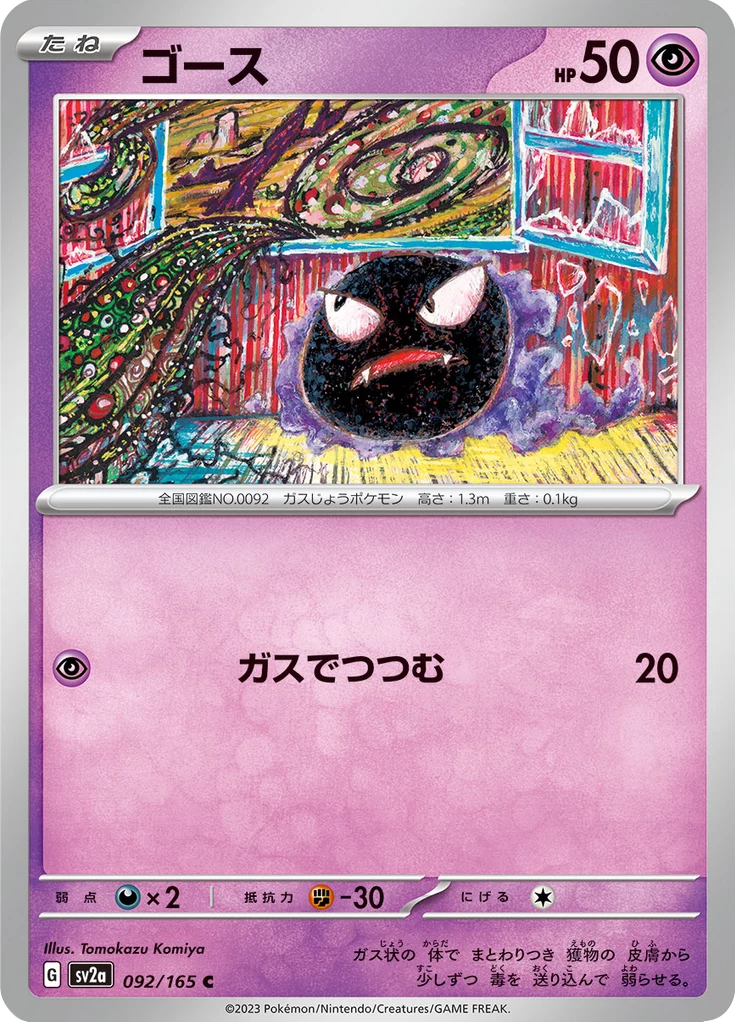
Gastly SV2a 92 C Pokemon Card 151
Gastly SV2a 92 C, Pokemon Card 151 (JP)
Haunter SV2a 93 U Pokemon Card 151
Haunter SV2a 93 U, Pokemon Card 151 (JP)
Gengar SV2a 94 R Pokemon Card 151
Gengar SV2a 94 R, Pokemon Card 151 (JP)

Bulbapedia files Komiya’s work under Primitivism, describing the movement as one that “takes inspiration from themes or stylistic elements of prehistory, tribal cultures, or children’s art.” Some fans use the shorthand “folk-art” or “naive style” for the look, and that description is consistent with Bulbapedia’s framing — but Primitivism is the term Bulbapedia itself uses, and it’s the one worth citing.

In practice, Bulbapedia describes the work as exaggerating the features of Pokemon — particularly facial and bodily proportions, focusing on the eyes or length of the face — paired with “deformed and loosely colored images” and “vibrant colors or unusual tones to create a stark contrast.” The Gastly-Haunter-Gengar line from Pokemon Card 151 above (Japanese prints shown) is a compact example: three creatures from the same evolution family, each stretched and re-colored in ways that prioritize mood over anatomical accuracy.

That same trio also illustrates a distinction worth making for anyone shopping the Pokemon 151 (MEW) set specifically: Komiya’s Pokemon 151 cards are this Gastly/Haunter/Gengar line at numbers 92 through 94. They are not the same cards as the set’s widely traded alternate-art rares of Psyduck, Charmander, Snorlax, Squirtle, and Pikachu, which carry different illustrator credits entirely. See the full Pokemon 151 (SV2a) card list for every print in the set.

From Vending Cards to Black Bolt: A Career Span

Baxcalibur SV2P 077/071 AR Snow Hazard
Baxcalibur SV2P 077/071 AR, Snow Hazard (JP)
Galarian Slowking V S5a 080/070 SR Matchless Fighters
Galarian Slowking V S5a 080/070 SR, Matchless Fighters (JP)

The Limitless database’s 249 results for Komiya span roughly three decades of Pokemon TCG history, and the illustrator’s more recent work shows the same Primitivism approach applied to newer card formats. Paldea Evolved’s Baxcalibur Illustration Rare and its companion Illustration Rares for Frigibax and Arctibax — the full three-stage line, numbers 208 through 210 — put Komiya’s exaggerated proportions on a full-art canvas rather than the smaller frame of a standard-rarity card. The JP print pictured above is from Snow Hazard; see the full Snow Hazard (SV2P) card list for every print in the set.

Chilling Reign’s Galarian Slowking V, an Ultra Rare, sits at a higher rarity tier and shows the style holding up on a Pokemon V card, where full-body illustration space leaves more room for the deliberately loose coloring Bulbapedia describes. The JP print pictured above is from Matchless Fighters; see the full Matchless Fighters (S5a) card list for every print in the set.

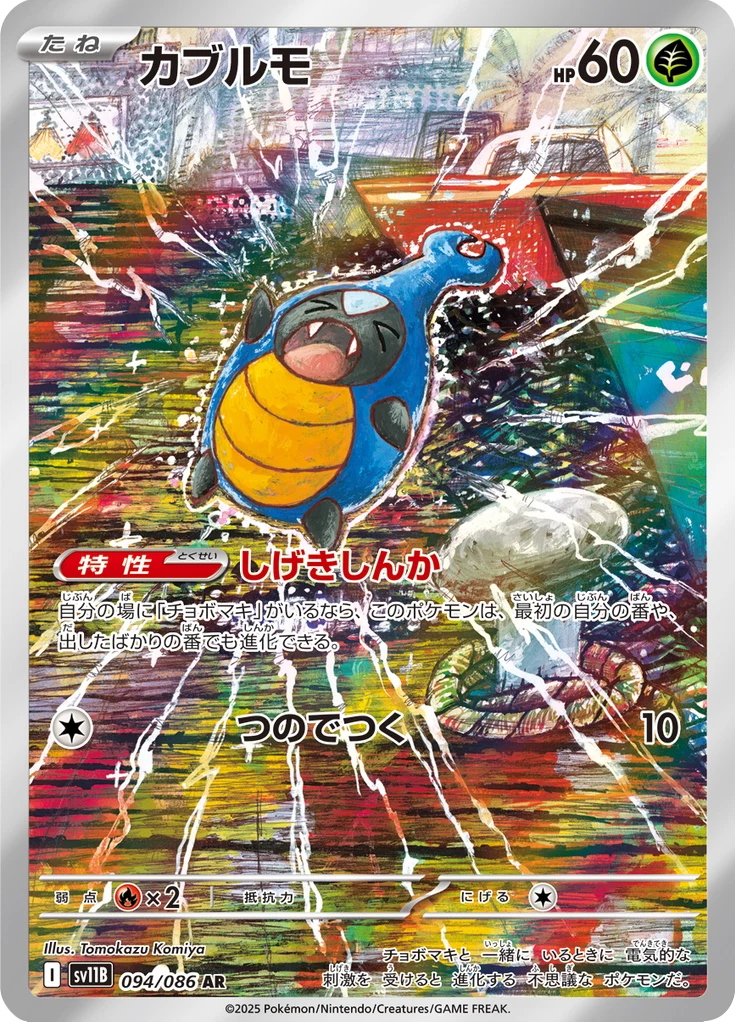
Karrablast SV11B 094/086 AR Black Bolt
Karrablast SV11B 094/086 AR, Black Bolt (JP)

Komiya’s most recent English-set work in the verified list comes from Black Bolt (JP print pictured; the set released under the same title in English), where a Karrablast Illustration Rare shows the style in a current-era print run rather than only vending-era archives. Between the vending-series debut and Black Bolt, Komiya’s card list also runs through Rebel Clash’s Spiritomb, Vivid Voltage’s Shedinja and Ninjask, Silver Tempest’s Jynx, and dozens of other Rare, Uncommon, and Common prints — a career built more on steady output across sets than a handful of chase cards. Raw Black Bolt singles — the set that Karrablast AR comes from — are listed in our Black Bolt (SV11B) singles collection.

Shop Black Bolt Sealed
SV11B Black Bolt Japanese Booster Box
Ships from Tokyo

View Product →

USD figures convert at ¥154/USD, approximate.

Beyond the Cards: Pokemon Tales and the Van Gogh Museum

Komiya’s Pokemon work extends beyond the trading card game itself. Per Bulbapedia, the illustrator contributed artwork to multiple volumes of the Pokemon Tales picture-book series, published by Shogakukan between 1997 and 2002 — putting Komiya’s Primitivism style in front of readers well before most of the illustrator’s TCG catalog existed.

More recently, Komiya was one of the illustrators selected for the 2023 Pokemon × Van Gogh Museum collaboration, contributing illustrations of Sunflora and Smeargle reinterpreted through specific Van Gogh masterworks. That collaboration is separate from the well-known “Pikachu with Grey Felt Hat” promo card from the same Van Gogh Museum partnership, which carries a different illustrator credit — worth flagging clearly, since the two are easy to conflate.

Komiya’s art has also appeared on official Pokemon Center merchandise, including postcards, stickers, and card sleeves, along with sticker designs for the Pokemon HOME app. Taken together, the picture-book work, the museum collaboration, and the merchandise line point to a Primitivism style that Pokemon has repeatedly reached for outside the trading card game as well as inside it.

Komiya Cards and How to Source One

The table below lists the illustrator’s notable printings referenced in this guide; sourcing requests go through Ordine rapido:

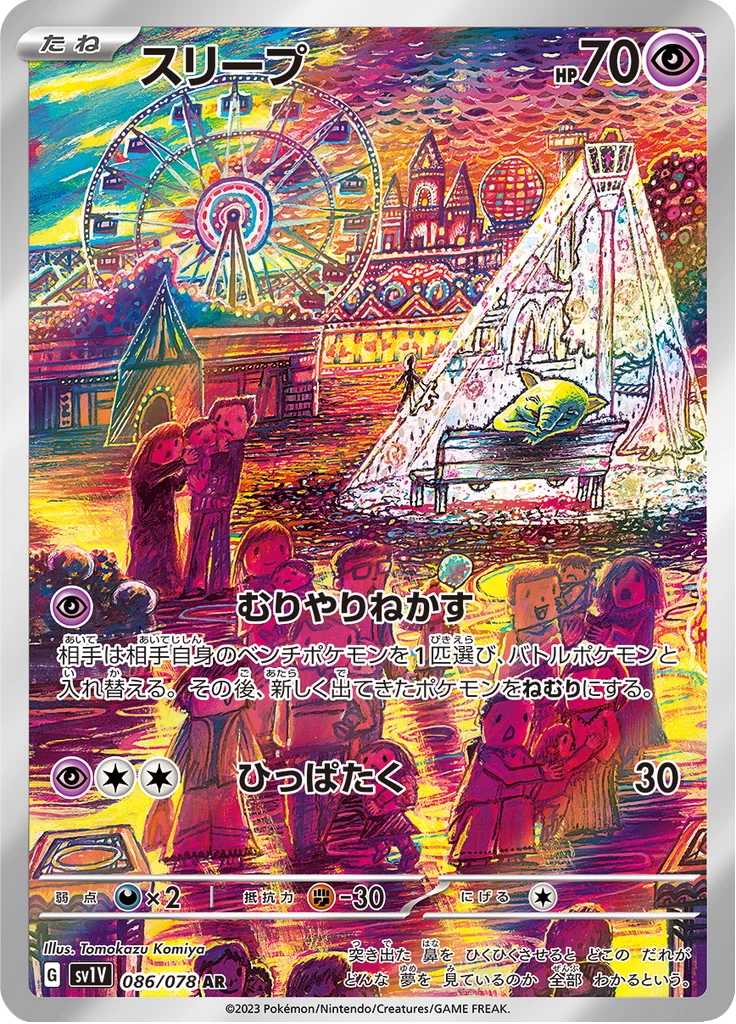
Drowzee SV1V 086/078 AR Violet ex
Drowzee SV1V 086/078 AR, Violet ex (JP)
Carta Set Type
Gastly Pokemon 151 (92) Common
Haunter Pokemon 151 (93) Uncommon
Gengar Pokemon 151 (94) Rare
Drowzee, AR Scarlet & Violet (210) Illustration Rare
Baxcalibur, AR Paldea Evolved (210) Illustration Rare
Galarian Slowking V Chilling Reign (179) Ultra Rare
Karrablast, AR Black Bolt (94) Illustration Rare

Komiya did not illustrate the Pokemon 151 Psyduck, Charmander, Snorlax, Squirtle or Pikachu ARs; his Pokemon 151 cards are the Gastly, Haunter and Gengar line (92–94).

The JP print pictured above (Drowzee, SV1V 086/078 AR) is from Violet ex; see the full Violet ex (SV1V) card list for every print in the set.

Flag any of the cards above on our Quick Order page and we’ll confirm next steps.

If you’re interested in artists working in unconventional techniques rather than standard illustration, our Yuka Morii guide covers another Pokemon TCG illustrator built around a distinctive, non-traditional method. For a wider look at how the game’s most recognized artist compares, our Mitsuhiro Arita guide is a useful counterpoint.

Requesting a Komiya Card from Japan

We source and ship Japanese Pokemon cards and sealed product from Tokyo. For an illustrator like Komiya, the process runs through a direct request:

  • Flag which Komiya card you’re after — the Pokemon 151 Gastly/Haunter/Gengar line, the Paldea Evolved Baxcalibur, the Chilling Reign Galarian Slowking V, the Black Bolt Karrablast, or any other verified print — on our Quick Order page.
  • Browse our current PSA 10 card list for graded cards from other illustrators, or the full PSA 10 collection.
  • For Black Bolt sealed product, see the Black Bolt card list or the Black Bolt booster box listing above.
  • If you’re comparing artists working in similarly unconventional styles, our Amelicart guide covers another sourcing-only illustrator profile built the same way — catalog and notable cards.

Domande frequenti

Who is Tomokazu Komiya?

Tomokazu Komiya is a Japanese illustrator born in 1973. Bulbapedia credits Komiya’s Pokemon Trading Card Game work to the Primitivism art movement, and the illustrator’s TCG debut dates back to Japan’s early Expansion Sheet 1 vending-card series, with an English-language debut on Neo Genesis.

What is Tomokazu Komiya’s art style called?

Bulbapedia describes Komiya’s Pokemon TCG work as Primitivism, an art movement drawing on prehistoric, tribal, or children’s-art themes. In practice this means “deformed and loosely colored images” with exaggerated facial and bodily proportions and vibrant, contrasting color choices, per Bulbapedia.

When did Tomokazu Komiya start illustrating Pokemon cards?

Komiya’s first Pokemon TCG artwork appeared in Japan’s Expansion Sheet 1, part of the early vending-machine card series. The English-language debut came later, on the Neo Genesis expansion.

What is the Pokemon × Van Gogh Museum collaboration?

In 2023, Pokemon partnered with the Van Gogh Museum on a licensed collaboration. Komiya contributed illustrations of Sunflora and Smeargle reinterpreted through specific Van Gogh masterworks. This is separate from the “Pikachu with Grey Felt Hat” promo card from the same partnership, which carries a different illustrator credit.

Which Pokemon 151 cards did Komiya illustrate?

Komiya illustrated the Gastly, Haunter, and Gengar line in the Pokemon 151 (MEW) set, at card numbers 92 through 94. These are different cards from the set’s widely traded Psyduck, Charmander, Snorlax, Squirtle, and Pikachu alternate-art rares, which have different illustrator credits.

Lisia SR 104/096: illustrazione giapponese e guida al Supporter Prism Star

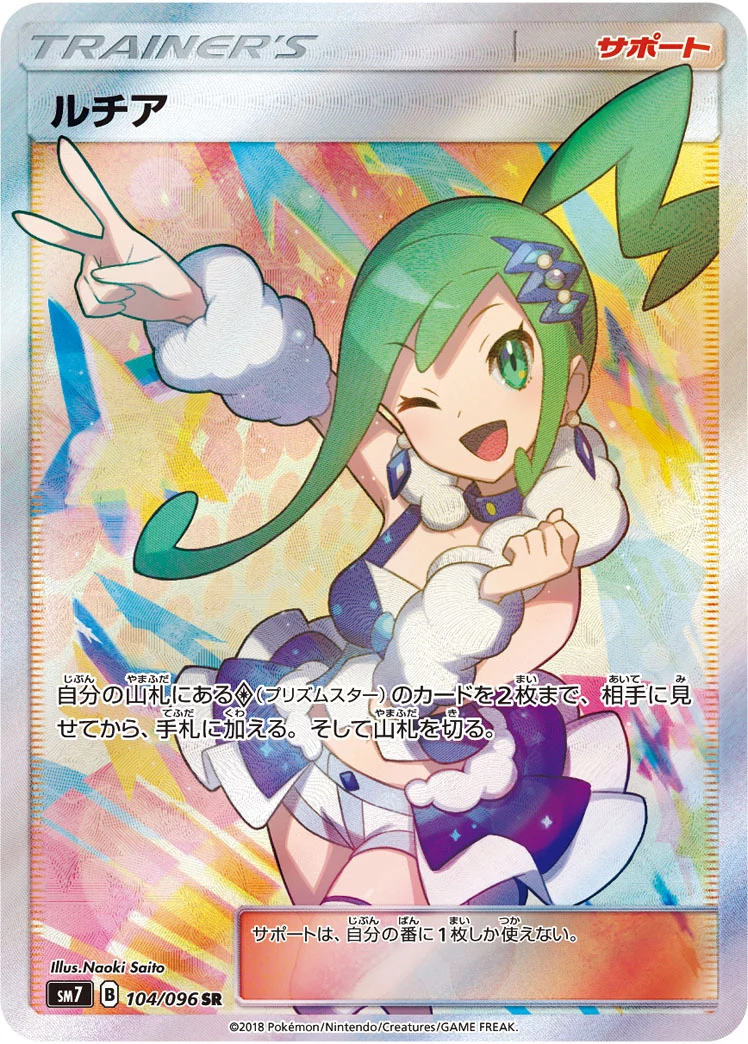
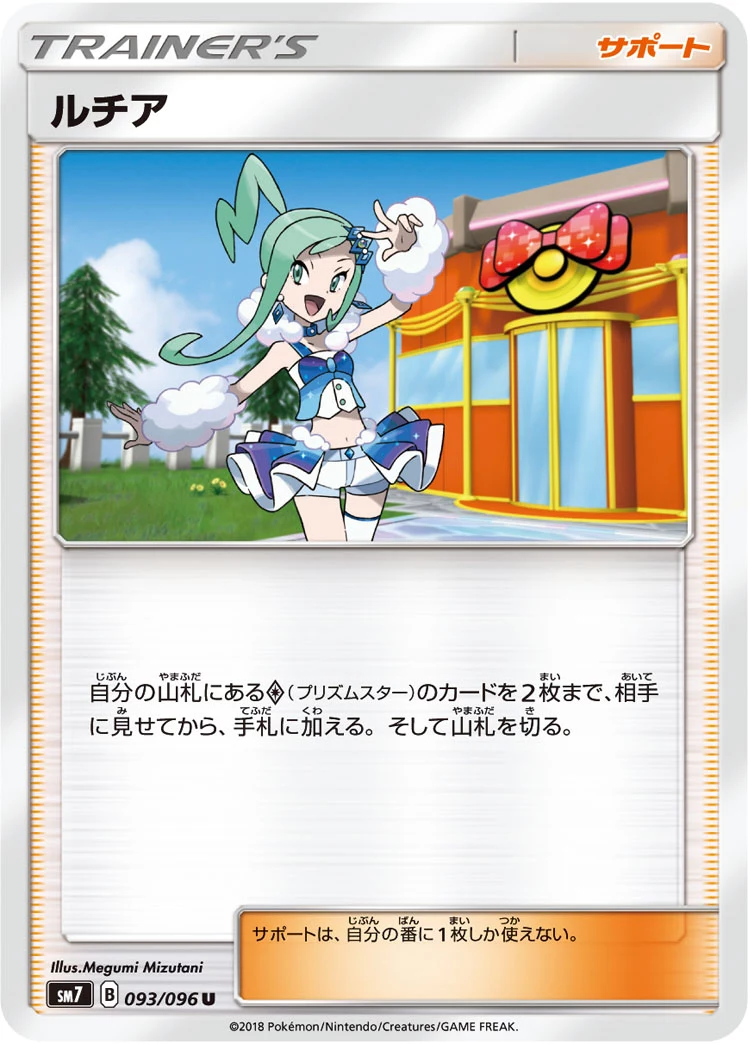
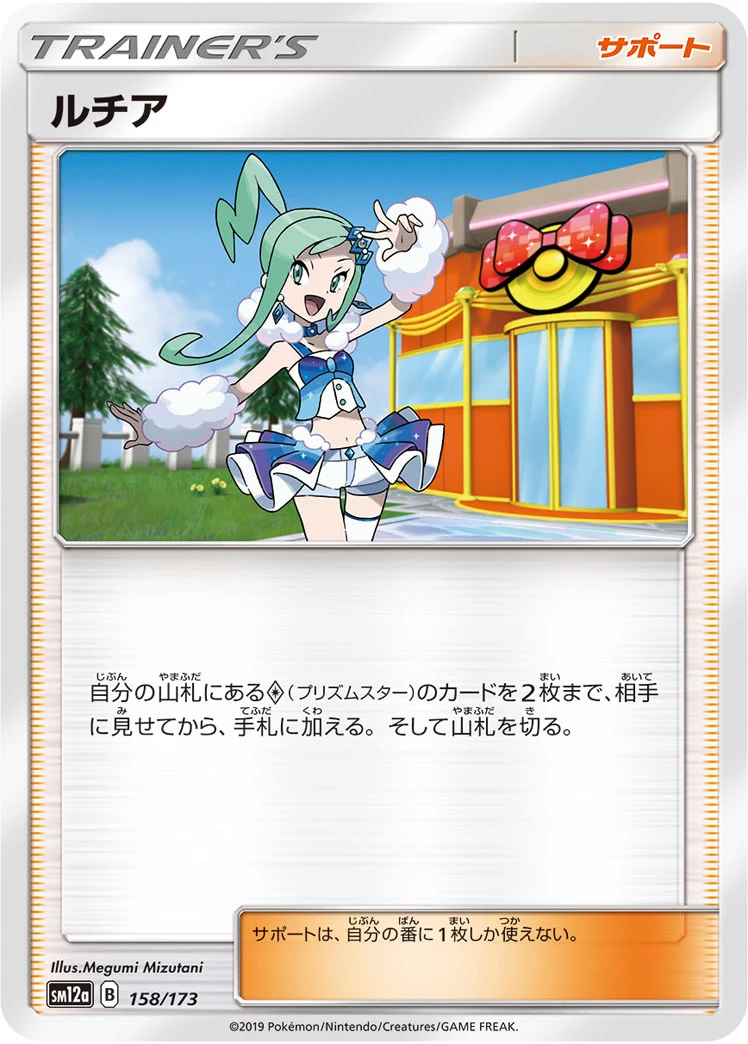
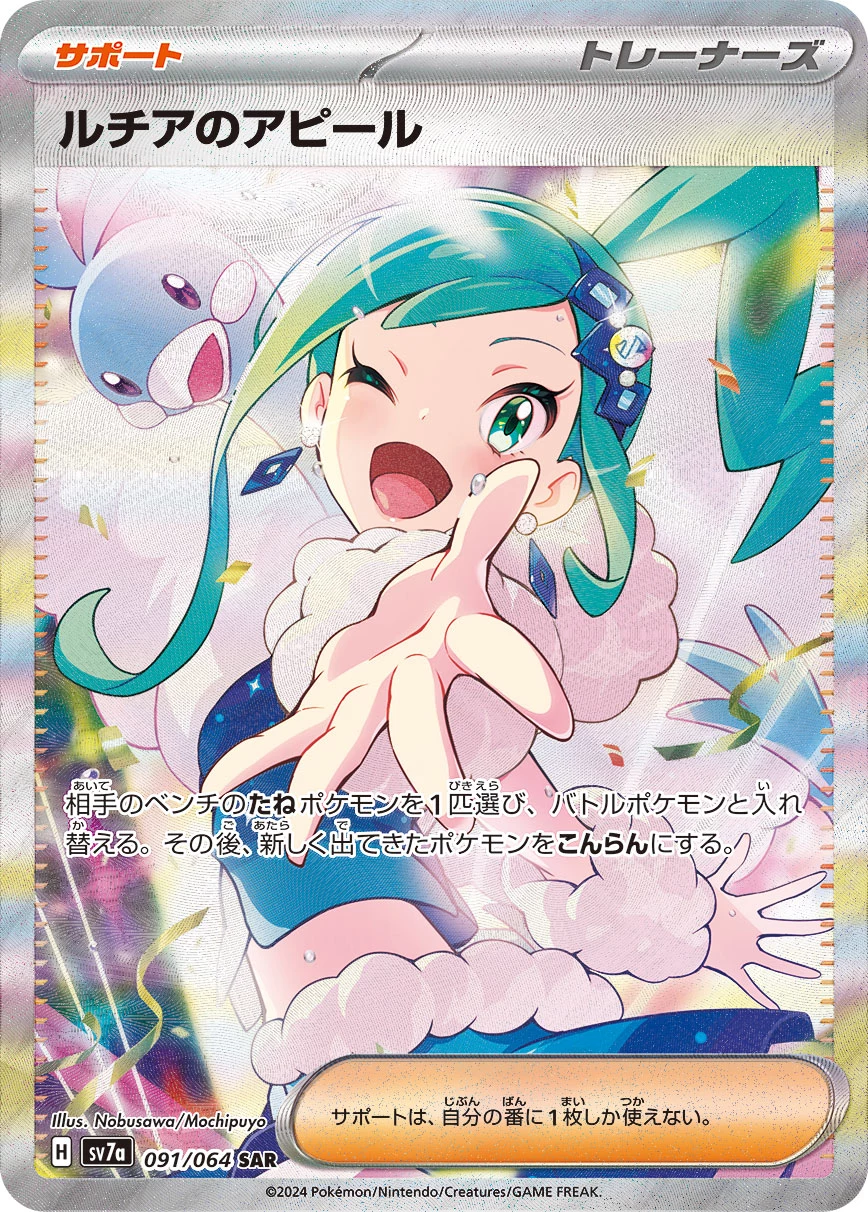
Japanese Lisia SR 104/096 is the Naoki Saito illustration from SM7, Charisma of the Wrecked Sky. The card is named ルチア and searches your deck for up to two Prism Star cards. It is a different Supporter from Lisia’s Appeal, despite both cards featuring Lisia.

The full number is especially useful here. Ordinary Lisia prints reuse the same search effect under other numbers, while Lisia’s Appeal changes both the name and effect. This guide identifies the SM7 SR, compares it with two ordinary prints and gives the key checks for an exact-card purchase.

The Card This Guide Covers

Lisia / ルチア · SM7 · 104/096 · SR · Naoki Saito. Look for the winking pose, raised V sign and these lower-edge identifiers. A listing for SV7a 091/064 SAR is Lisia’s Appeal, a separate card.

Official card records, images and store product identity checked September 21, 2026. Current prices and purchase status remain on the linked product page.

Identify the SM7 Lisia SR

The official 104/096 entry names Naoki Saito as the illustrator and places Lisia in the Japanese expansion 裂空のカリスマ. Its official product page gives June 1, 2018 as the release date. The card image supplies SM7, SR and the B regulation mark.

Field What to match
Japanese printed name ルチア
Collector number 104/096
Codice set SM7
Japanese product 裂空のカリスマ / Charisma of the Wrecked Sky
Rarity and category SR, Supporter
Illustrator Naoki Saito

Search with the complete number and language. “104” alone can point to unrelated cards, and an English card featuring a similar picture can carry a different set and collector number. A matching character name is only the first identification step.

The denominator 096 identifies the set’s numbering convention. It is not a serial number or a count of physical copies printed. Likewise, SR describes the printed rarity category; it does not tell you the condition of the copy in a seller’s photograph.

Our SM7 card list places Lisia among the other set entries. Use it for set completion, while keeping 104/096 as a distinct row when comparing singles or preparing a sourcing request.

Naoki Saito’s Portrait and the Ordinary Artwork

Official Japanese Lisia 104/096 from SM7, illustrated by Naoki Saito
Lisia 104/096 SR · SM7 · Naoki Saito
Official Japanese Lisia 093/096 from SM7, illustrated by Megumi Mizutani
Lisia 093/096 U · SM7 · Megumi Mizutani

The SR shows Lisia winking, with one arm raised in a V sign and the other hand held near her chest. Her green hair and white-and-blue costume stand out against a bright, multicolored background. Those are observations of the official image, separate from any claim about demand or the number of cards printed.

The ordinary SM7 093/096 U is credited to Megumi Mizutani. It shows Lisia standing outside a red-and-gold building inside a conventional illustration window. The scene and pose differ from the SR even though the printed Supporter effect is the same.

If you collect Naoki Saito’s work, 104/096 is the relevant print in this comparison. If you want a small Lisia character page, the contrasting portrait and outdoor scene offer two different pictures. Choosing both is an artwork preference, not a claim that the ordinary card adds an extra effect.

Use these original images to identify details, then ask for photographs of the actual item. Reference art cannot reveal a dent, edge wear, scratches or a grading label on a particular offered copy. It also cannot establish how a foil surface will look under the seller’s lighting.

A Reprint and a Different Supporter

Official Japanese Lisia 158/173 from SM12a, illustrated by Megumi Mizutani
Lisia 158/173 · SM12a · Megumi Mizutani
Official Japanese Lisia's Appeal 091/064 from SV7a, illustrated by Nobusawa/Mochipuyo
Different Supporter: Lisia’s Appeal 091/064 SAR · SV7a · Nobusawa/Mochipuyo

The SM12a 158/173 record belongs to TAG TEAM GX Tag All Stars and credits Megumi Mizutani. Its image repeats the outdoor illustration seen on SM7 093/096. The pictured lower edge has no rarity letter beside 158/173. This is a separate print of the same plain Lisia Supporter.

The SV7a 091/064 SAR entry is named ルチアのアピール, Lisia’s Appeal. Its credit is written Nobusawa/Mochipuyo, and its set is Paradise Dragona. It is not another number for the Naoki Saito SM7 SR.

Lisia’s Appeal selects an opponent’s Benched Basic Pokémon, switches it with their Active Pokémon, and Confuses the newly Active Pokémon. It does not perform the Prism Star search. Our dedicated Lisia’s Appeal guide covers that separate Supporter in more detail.

For a collector, the practical distinction is a three-part label: character, complete card name and collector number. A photo of 091/064 beside a title saying 104/096 is a mismatch that needs clarification. A “Lisia collection” may reasonably include both, but an offer for one does not substitute for the other.

This page compares three plain Lisia prints and one different Supporter for identification. It does not claim to catalogue every Lisia-related card, language or finish. Keep your checklist’s scope explicit when comparing it with someone else’s collection.

Build an Exact Lisia Purchase Request

The existing SST Lisia 104/096 SR product page identifies the Japanese card and is labelled PSA 10. Check its current price and purchase status directly. No catalogue image on this page promises a particular slab is available or depicts its actual certification label.

For a graded offer, match the card language, number, title and grade to the actual holder. Use PSA Cert Verification to review the certification record, while remembering PSA’s warning that a valid number alone does not authenticate a physical item in a listing.

For a raw copy, ask for uncropped front and back photographs plus views of the corners, edges and surface. Read any condition notes before comparing the amount with another seller’s ask. Raw, PSA 9 and PSA 10 offers are different condition categories, even when all refer to 104/096.

A useful request reads “Japanese Lisia, SM7 104/096 SR, Naoki Saito, one copy,” followed by your preferred condition or grade. If the exact item is unavailable, send that through Ordine rapido. You can also browse the PSA 10 collection for current graded options.

Keep the reference image with the request. It makes the distinction from Megumi Mizutani’s ordinary scene and the later Lisia’s Appeal portrait immediately visible, reducing the chance that a shortened product title leads to the wrong card.

Domande frequenti

Who illustrated Lisia 104/096 SR?

Naoki Saito illustrated Japanese Lisia 104/096 SR from SM7, Charisma of the Wrecked Sky. The Japanese product was released June 1, 2018.

What does the original Lisia Supporter do?

It searches your deck for up to two Prism Star cards, reveals them to your opponent, puts them into your hand and then shuffles the deck. It does not search for any two Pokémon without that restriction.

Is Lisia 093/096 the same print as 104/096?

No. Both belong to SM7 and have the same Supporter effect, but 093/096 U has Megumi Mizutani artwork while 104/096 SR has Naoki Saito artwork.

What is Lisia 158/173?

It is the plain Lisia Supporter from SM12a TAG TEAM GX Tag All Stars, illustrated by Megumi Mizutani. It repeats the ordinary outdoor artwork and the Prism Star search effect.

Is Lisia 104/096 the same card as Lisia’s Appeal?

No. Lisia’s Appeal is a different named Supporter with a switching-and-Confusion effect. Its SV7a 091/064 SAR is credited to Nobusawa/Mochipuyo, not Naoki Saito.

Where can I check current Japanese Lisia 104/096 offers?

Use the exact SST Lisia 104/096 SR product page for current prices and purchase status. Quick Order accepts a sourcing request with the full number, Japanese language, quantity and desired condition.

Klara SR 082/070: guida a illustrazione, effetto ed edizione giapponese

Japanese Klara SR 082/070 is the Naoki Saito illustration from S5a, the expansion commonly called Peerless Fighters. Its close portrait differs from the Ken Sugimori artwork used on several ordinary and promotional prints. All four Klara cards compared here recover Pokémon and basic Energy from the discard pile.
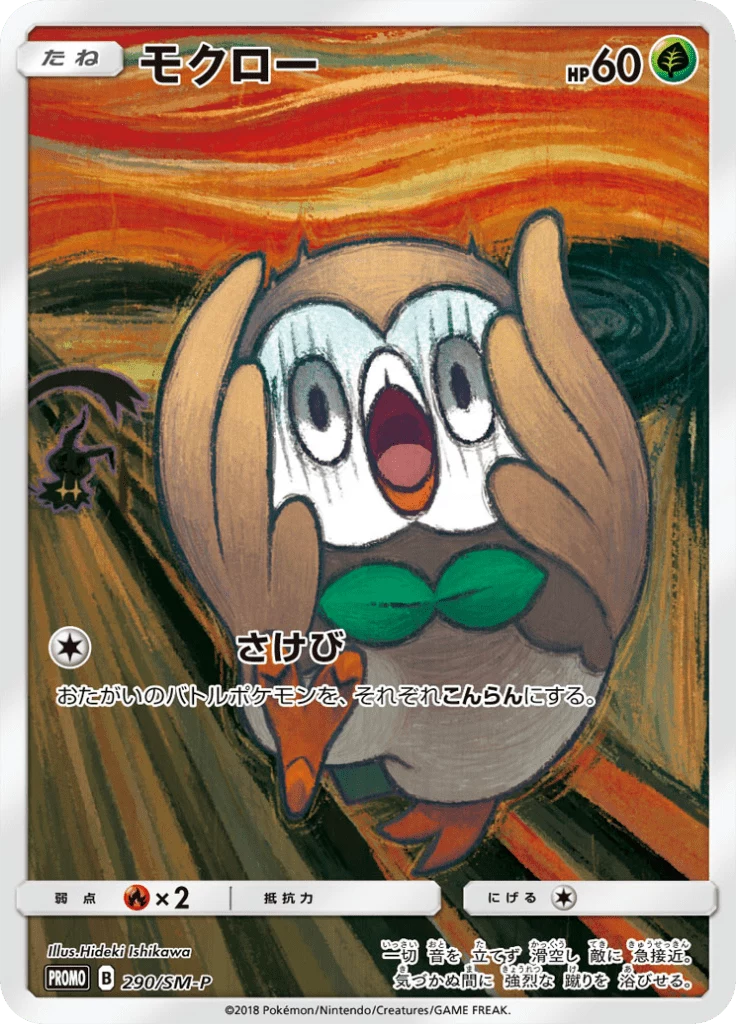
“Klara full art” is a useful starting search, but a purchase needs a complete number. This guide separates 082/070 from 067/070, VMAX Climax 151/184 and the Pokémon Card Gym promo 223/S-P. It also distinguishes the single card from the similarly named Klara & Avery boxed collection.

The SR Identifier

Look for クララ · S5a · 082/070 · SR and the Naoki Saito credit. The recovery effect allows up to two Pokémon and up to two basic Energy cards; it is not limited to two cards in total.

Official card identities, images and store product identity checked September 21, 2026. Product links provide current prices and purchase status.

082/070 SR Beside 067/070 U

The official entries identify 082/070 as Naoki Saito’s Klara and 067/070 as Ken Sugimori’s. Both come from the Japanese product 双璧のファイター, code S5a. The official product page gives March 19, 2021 as its release date.

Official Japanese Klara 082/070 from S5a, illustrated by Naoki Saito
082/070 SR · S5a · Naoki Saito
Official Japanese Klara 067/070 from S5a, illustrated by Ken Sugimori
067/070 U · S5a · Ken Sugimori

In the SR, Klara fills most of the card. Her pink hair, large hair accessory and white jacket stand against a colorful outdoor background, with her hands held near her face. The lower edge carries 082/070, SR and Naoki Saito’s credit. These visible identifiers are a firmer match than a listing title abbreviated to the character’s name.

The ordinary 067/070 U shows Klara standing in front of a building within a rectangular artwork window. Ken Sugimori is the printed illustrator. It has the same Supporter text, but it is a separate numbered entry with a different image.

For an art collection, this comparison gives you two distinct presentations of Klara. For a numbered S5a collection, both positions matter. The denominator 070 is a set reference, not a statement that only seventy copies exist. The SR number above it does not disclose a print run or an individual pull probability.

Our S5a card list covers the surrounding set. The Peerless Fighters set guide provides the broader box context. Neither a set name nor a booster-box photograph substitutes for the full identifier when buying this single.

Two Recovery Categories, One Supporter

Klara lets you choose up to two Pokémon cards and up to two basic Energy cards from your discard pile, reveal them to your opponent, and put them into your hand. The printed text explicitly allows you to choose only Pokémon or only basic Energy.

The two limits are separate. If the relevant cards are in your discard pile, a selection can contain four cards: two Pokémon plus two basic Energy. You cannot use the unused Pokémon allowance to take a third basic Energy. Likewise, the text does not offer four Pokémon in place of the Energy.

Example selection from your discard Within the printed limits? Reason
2 Pokémon and 2 basic Energy Yes Each category reaches its own limit.
1 Pokémon and no Energy Yes Using only one category is allowed.
No Pokémon and 2 basic Energy Yes The basic-Energy category can be used alone.
3 Pokémon and 1 basic Energy No The Pokémon category is capped at two.
1 Special Energy as an Energy choice No The Energy category specifies basic Energy.

The destination is your hand. Klara does not attach the recovered Energy, put the recovered Pokémon directly on your Bench or search your deck for replacements. Recovering cards can prepare later actions, but those actions still follow their own instructions and limits.

The printed Supporter reminder permits one Supporter during your turn. The SR artwork does not increase the recovery allowance. These examples explain the card text, not a current tournament recommendation; confirm the event’s format and language rules before choosing a physical print for organized play.

The Same Portrait Under Three Numbers

The Ken Sugimori portrait also appears in the official records for S8b 151/184 and 223/S-P. A familiar illustration alone therefore does not identify which release a seller is offering.

Official Japanese Klara 151/184 from S8b, illustrated by Ken Sugimori
151/184 · S8b VMAX Climax · Ken Sugimori
Official Japanese Klara 223/S-P from S-P, illustrated by Ken Sugimori
223/S-P promo · Pokémon Card Gym logo · Ken Sugimori

The pictured 151/184 belongs to VMAX Climax and has no rarity letter next to its number. Its lower identifiers differ from the S5a 067/070 U. This guide does not assign a particular physical foil finish to an offer based only on the official catalogue image.

The 223/S-P image includes the Pokémon Card Gym logo and a PROMO label. Its official record associates it with the September 2021 New Set Battle. That gives historical release context, not a current distribution offer or a verified total number of copies.

Number Printed distinction to check Artist
067/070 S5a and U Ken Sugimori
151/184 S8b, with no rarity letter in the reference image Ken Sugimori
223/S-P PROMO and Pokémon Card Gym logo Ken Sugimori

For a small character collection, the SR and one ordinary portrait may be enough to represent the two illustrations shown here. A promo collection has a different goal and may specifically need 223/S-P. These four examples are not an exhaustive Klara checklist; use the exact number to define the scope you want.

A Klara & Avery Box Is a Different Purchase

The official Klara & Avery collection announcement describes a March 19, 2021 product containing two S5a booster boxes together with sleeves, a deck case and a storage box. Its accessories use character-themed artwork.

That product name is not a guarantee that a particular Klara SR is included among the random booster contents. The ordinary S5a product page describes randomly packed cards. If your goal is Naoki Saito’s 082/070, an exact single-card offer is the purchase to identify; a sealed collection is a different collecting choice.

Similarly, a listing for sleeves or a storage box showing Klara does not represent a Klara trading card. Read the included-item list, quantity and condition. For a used collection, distinguish sealed booster boxes, empty packaging and loose accessories before comparing its asking price with another offer.

Specify the Print and the Condizione

Our existing Japanese Klara 082/070 SR product page is labelled PSA 10. It shows the current price and purchase status for that product; the official card pictures above do not depict a current slab or establish its certification.

For a raw card, request clear photographs of the front, back, corners, edges and surface. For a graded copy, check the actual holder label, language, collector number and grade. Use PSA Cert Verification as part of that review, while keeping PSA’s warning in mind that a valid certification number alone does not authenticate a physical listing.

A precise sourcing request is “Japanese Klara, S5a 082/070 SR, one copy,” followed by the raw condition or grading requirement you want. Submit it through Ordine rapido if the exact product is unavailable. The PSA 10 collection is another route to current graded options.

Compare like with like: the same language, full number and condition category, with shipping and any applicable destination charges considered separately. A low ask for 067/070 is not a lower-priced offer for 082/070, even though both cards perform the same game action.

Domande frequenti

Who illustrated Japanese Klara 082/070 SR?

Naoki Saito illustrated Klara 082/070 SR from S5a, commonly called Peerless Fighters. The Japanese product was released March 19, 2021.

Can Klara recover four cards?

Yes, if eligible cards are in your discard pile: up to two Pokémon and up to two basic Energy cards. These are separate category limits, not permission to take any four cards.

Can Klara recover only Pokemon or only Energy?

Yes. The text allows either category alone. The Energy choices must be basic Energy cards, and the recovered cards go to your hand.

Does Klara attach the Energy it recovers?

No. Its effect puts the selected cards into your hand. It does not itself attach Energy or place the recovered Pokémon onto your Bench.

What identifies Klara 223/S-P?

It is the Ken Sugimori promo with the Pokémon Card Gym logo and PROMO label. The official database associates it with the September 2021 New Set Battle.

Does the Klara and Avery collection guarantee 082/070 SR?

The official contents describe S5a booster boxes and accessories, not a guaranteed 082/070 single. If you want that exact illustration, identify a single-card offer by its full number and language.

Greavard Full Art: giapponese 087/078 vs inglese 214/198

The Greavard full-art room illustration by sowsow is Japanese 087/078 AR or English 214/198 Illustration Rare. The Japanese edition belongs to Violet ex, set code SV1V. Its English counterpart belongs to the Scarlet & Violet base expansion. The same picture therefore appears under two different collector numbers.

There is another distinction inside the Japanese set: Greavard 046/078 shares the AR’s 70 HP and attack, while 047/078 has 80 HP and different attacks. This guide separates those prints, explains the Psychic-type condition in the AR’s damage calculation and shows how to request the intended raw or graded single.

The Card to Request

Use Japanese Greavard / ボチ, SV1V 087/078 AR, sowsow for the illustrated room scene. Check the Greavard 087/078 PSA 10 product page for current purchase terms, or send a raw-card request through Ordine rapido. The official images below identify the prints; they do not show a particular graded item for sale.

Official Japanese card records, the English card image and store product identity checked September 21, 2026. Current prices and availability are left on the linked product page.

087/078
Japanese AR
214/198
English IR
70 HP
Basic, Psychic
sowsow
AR Illustrator

Japanese 087/078 and English 214/198

The official Japanese database identifies Greavard 087/078 from Violet ex and credits sowsow. The printed set code is SV1V, and AR appears beside the number. These small details are more useful than a listing title that only says “Greavard full art.”

The official English Scarlet & Violet checklist lists Greavard at 214 with the Illustration Rare symbol. Its official English card image confirms 214/198, sowsow and the same room illustration. The English edition is not numbered 087/078.

Check Japanese art card English art card
Printed name ボチ Greavard
Set Violet ex, SV1V Scarlet & Violet
Number 087/078 214/198
Rarity Art Rare, AR Illustration Rare
Illustrator sowsow sowsow
Greavard identifier map: Japanese Violet ex 087/078 AR and English Scarlet and Violet 214/198 Illustration Rare share sowsow artwork
Editorial language map based on the official card images and English checklist.

Start with the printed language, then match the complete collector number. The denominator is part of the set numbering system, not the number of copies produced. A card numbered above its denominator does not provide evidence of its print run or a guaranteed value.

The sowsow Room Illustration

Official Japanese Greavard 087/078 AR by sowsow, resting its front paws on a purple character cushion in a room with books, toys and candles
087/078 AR · sowsow · Violet ex. Official card reference.

The AR places Greavard on a round rug, resting its front paws on a purple character cushion. Books, candles and small character-shaped objects fill the room. A fireplace and furniture give the scene depth, while the candle on Greavard’s head becomes part of the room’s lighting.

The soft texture and overlapping objects reward a closer look than a small shop thumbnail allows. They also provide quick visual checks: this is the indoor scene, not either of the outdoor illustrations on the ordinary Violet ex cards. Preserve the lowercase artist credit, sowsow, in your checklist.

For a character collection, this print emphasizes Greavard’s surroundings as much as its face. For a Japanese AR collection, SV1V and 087/078 identify its position in the set. For a bilingual display, pair it with English 214/198 and label the languages. Those choices concern presentation rather than a stronger attack or higher HP.

Why 046/078 and 047/078 Are Different

Official Japanese Greavard 046/078 C by yuu, with 70 HP and a forest illustration
046/078 C · yuu · 70 HP
Official Japanese Greavard 047/078 C by Shin Nagasawa, with 80 HP and two attacks
047/078 C · Shin Nagasawa · 80 HP

Greavard 046/078 is the yuu illustration with Greavard facing the viewer in a dark forest. It has 70 HP and the same one-Psychic-Energy discard-pile attack as the AR. Both images show C or AR beside the number, respectively.

Greavard 047/078 is illustrated by Shin Nagasawa and shows the Pokémon moving through loose earth. It has 80 HP. Its first attack looks at the opponent’s hand and puts a chosen Supporter from that hand on the bottom of their deck; its other attack does 30 damage.

That means the two common cards are not simply interchangeable pictures of the AR’s game text. If a listing combines the room-scene photograph with “047/078, 80 HP,” ask the seller which physical print is being offered. A correct character name is not enough to resolve conflicting identifiers.

Japanese print Artist HP Relation to the AR
087/078 AR sowsow 70 The indoor full illustration
046/078 C yuu 70 Matching game text, different picture
047/078 C Shin Nagasawa 80 Different attacks and HP

Our Violet ex card list places these numbers in the wider expansion. Keep each print on a separate checklist row when you want more than one version.

What Graveyard Gamboling Actually Counts

The English card names the AR’s attack Graveyard Gamboling. It costs one Psychic Energy and does 10 damage for each Psychic Pokémon in your discard pile. The Psychic-type restriction is important: the effect does not count every Pokémon of every type.

For an illustrative calculation, suppose your discard pile contains three Psychic Pokémon and two Water Pokémon. The printed calculation is 3 × 10 = 30 damage before Weakness, Resistance and other effects. Counting all five Pokémon would produce the wrong starting figure.

The attack also does not count Pokémon on the Bench or in your hand. Nor does it instruct you to discard cards as part of its effect. It reads the qualifying Pokémon already in your discard pile. The picture’s toys and cushions are illustration details, not extra Pokémon cards in play.

Greavard 087/078 has Darkness weakness ×2, Fighting resistance −30 and a retreat cost of two Colorless Energy. These match Japanese 046/078. The separate 047/078 keeps that weakness and resistance but has a retreat cost of three Colorless Energy, another reason to read the actual card instead of transferring all details between prints.
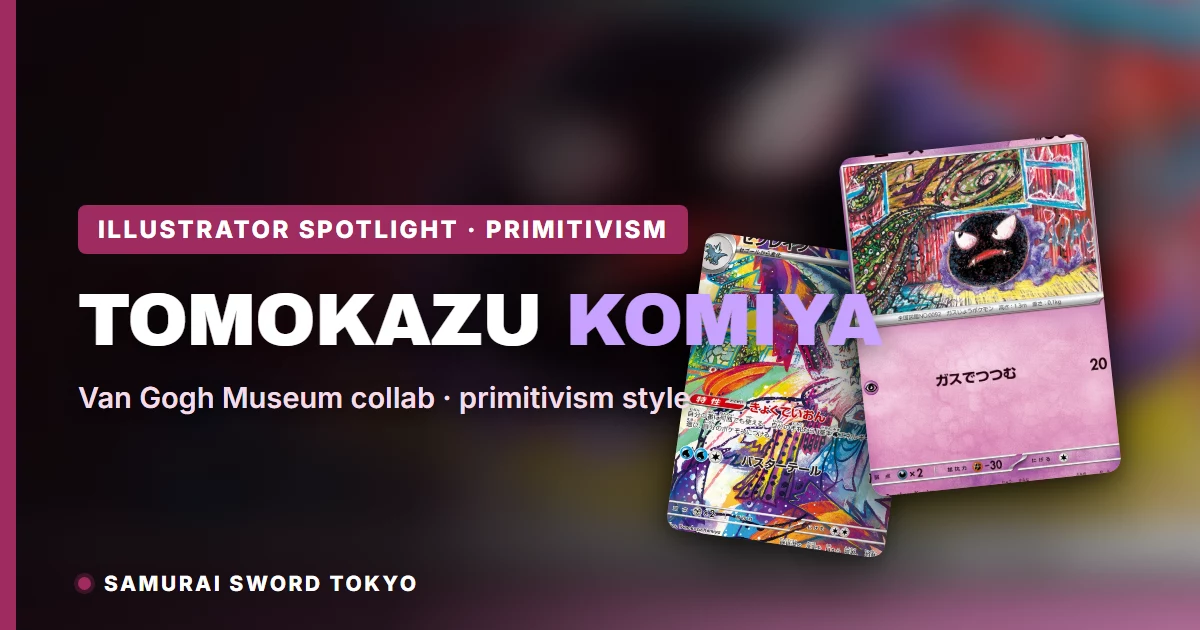
This is a print and collecting guide. If you want to use the card in an event, check that event’s current format and permitted card languages. An official reference image and a printed regulation mark identify the card but do not establish eligibility for every event today.

Checking the Exact Single

The existing SST product Greavard AR 087/078, PSA 10 identifies the Japanese art card. Check its current price, purchase status and any stated sourcing or dispatch timing on that page. A graded product description does not turn the unencapsulated official images in this article into photographs of a particular PSA holder.

For a graded offer, compare the actual card and certification label with the number and language you requested. Read the grade explicitly. PSA Cert Verification can help check a certification record, while a valid number alone does not authenticate the physical item in a seller’s photographs.

For a raw copy, request front and back photographs, with edges and corners visible. Ask for angled lighting when assessing surface marks. The busy indoor scene can conceal small defects in a compressed thumbnail, and an illustration reference cannot establish the condition of the offered copy.

Choose the Exact Print

Japanese Greavard 087/078 AR

Follow the existing PSA 10 product page for current terms, or use Quick Order to request a raw copy with your quantity and condition requirements.
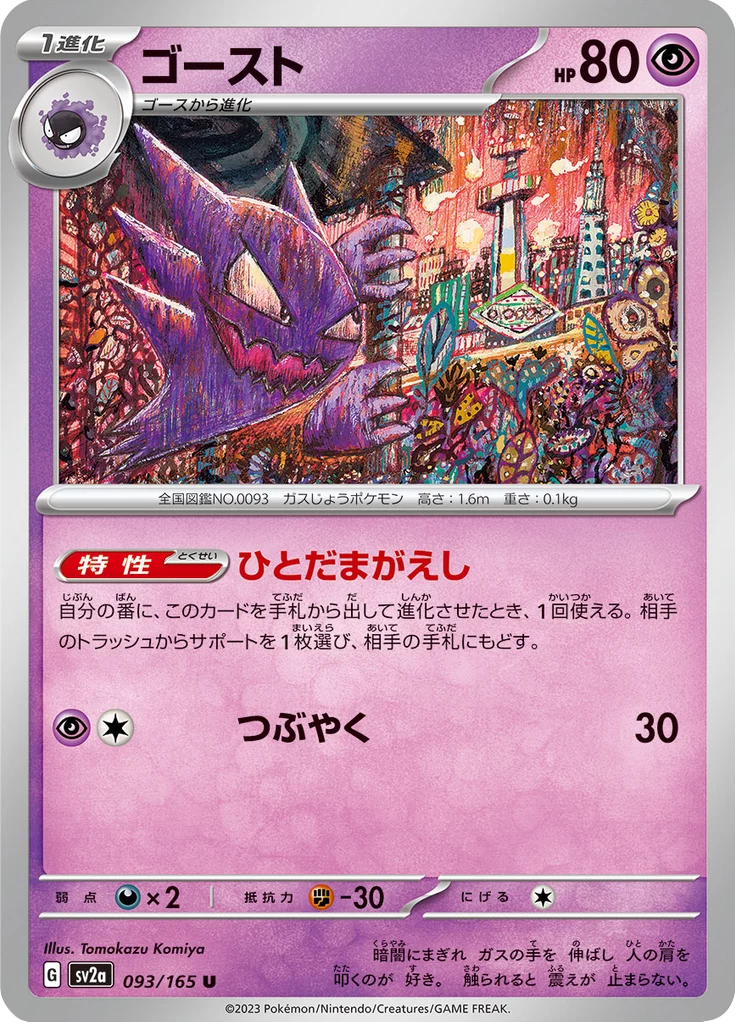
Check Greavard AR →

If your goal is this particular illustration, a single-card request is more specific than opening packs hoping to find it. For a broader Violet ex opening, review the Japanese Violet ex box listing. A box does not promise Greavard AR, and its current packaging option should be checked separately.

Domande frequenti

What is the Japanese Greavard full-art number?

The sowsow room illustration is SV1V 087/078 AR from Japanese Violet ex. Its English Scarlet & Violet counterpart is 214/198 Illustration Rare.

Who illustrated Greavard 087/078?

sowsow illustrated the room scene on 087/078 AR. The ordinary Japanese 046/078 is by yuu, while 047/078 is by Shin Nagasawa.

Does Greavard AR have the same effect as both common versions?

No. It shares 70 HP and its attack with Japanese 046/078. Japanese 047/078 has 80 HP and different attacks.

Does Graveyard Gamboling count every Pokemon in the discard pile?

No. It counts Psychic Pokemon in your discard pile and does 10 damage per qualifying Pokemon before modifiers. Pokemon of other types do not count toward that printed calculation.

Do the official images show the PSA 10 copy for sale?

No. They are official card references for identification. A graded purchase should be checked against the actual holder, label and photographs of the offered copy.

Where can I request Japanese Greavard 087/078 AR?

Use the existing SST Greavard 087/078 PSA 10 page for current graded terms, or Quick Order for an exact sourcing request specifying Japanese language, SV1V 087/078 AR, quantity and desired condition.

Bea SR 109/100: artwork giapponese, 261/184 e guida alle promo

Japanese Bea SR 109/100 is the Hideki Ishikawa illustration from Amazing Volt Tackle, set code S4. The other SR compared here, 261/184 from VMAX Climax, is illustrated by Souichirou Gunjima. Both are the Supporter named サイトウ, but the complete numbers identify different artwork and products.
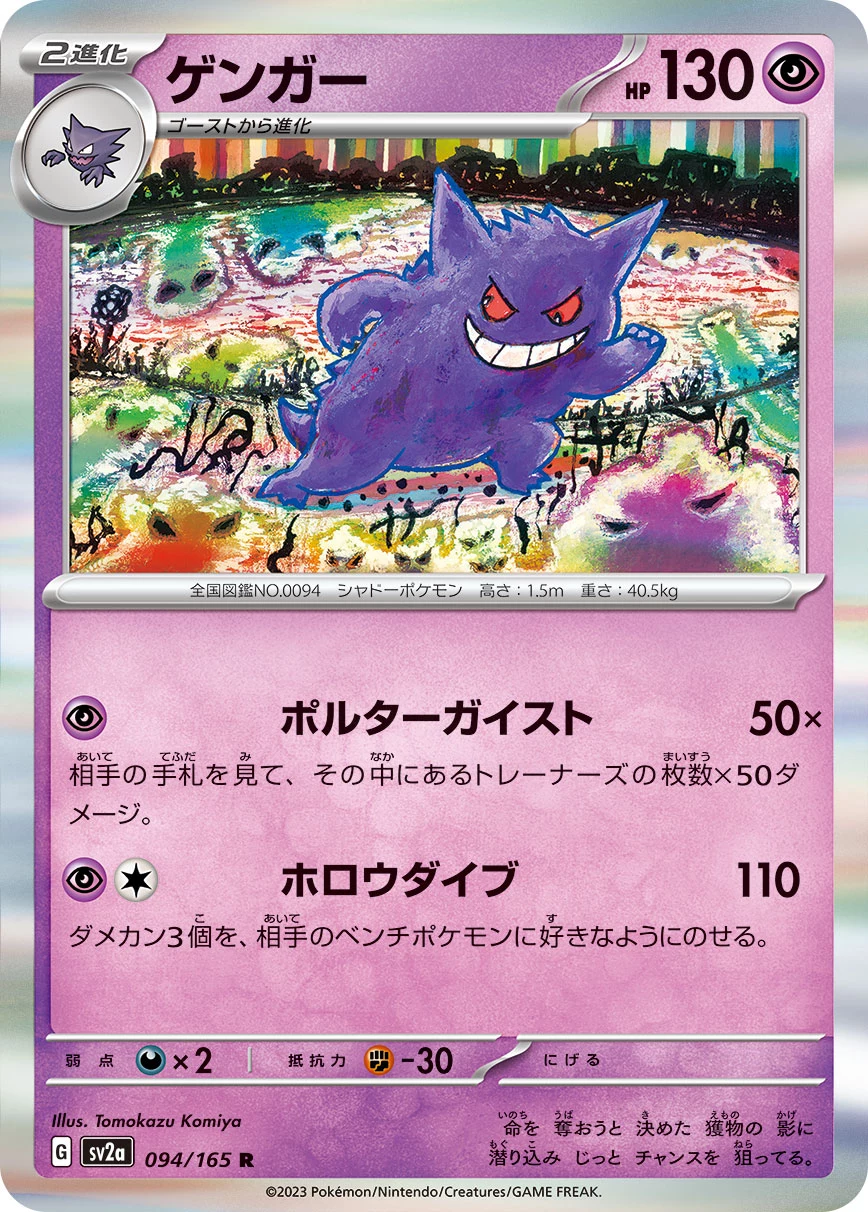
If you searched for “Bea full art,” start with the picture and number you actually want. This guide compares those two SRs with the ordinary S4 card and the after-school promo, then explains the Energy-attachment effect that all four share.

Four Useful Identifiers

109/100 is the S4 SR; 261/184 is the S8b SR; 093/100 is the S4 U; and 229/S-P is the Trainer Card Collection promo. Keep the language and set code with the number when requesting a particular print.

Official card records, original images and store product identities checked September 21, 2026. Follow the linked product pages for current prices and purchase status.
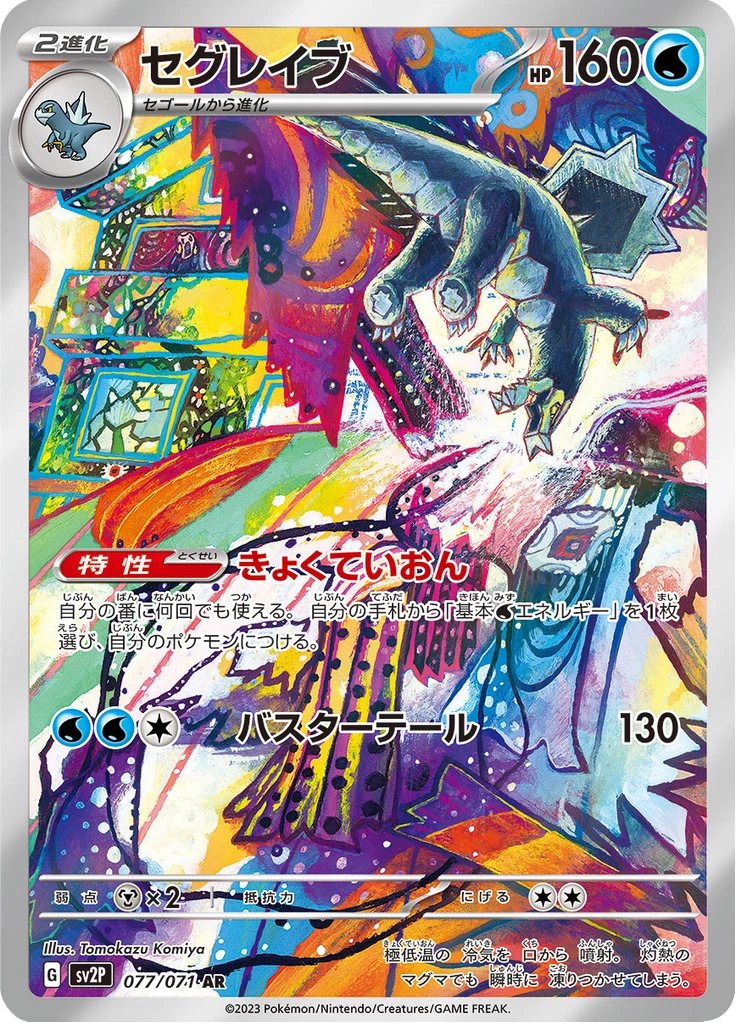
Match the Number Before Comparing Offers

The official records identify four distinct examples below. This is a practical comparison, not a count of every Bea printing or finish. An offer headed only “Japanese Bea” leaves the set, illustration and rarity unresolved.
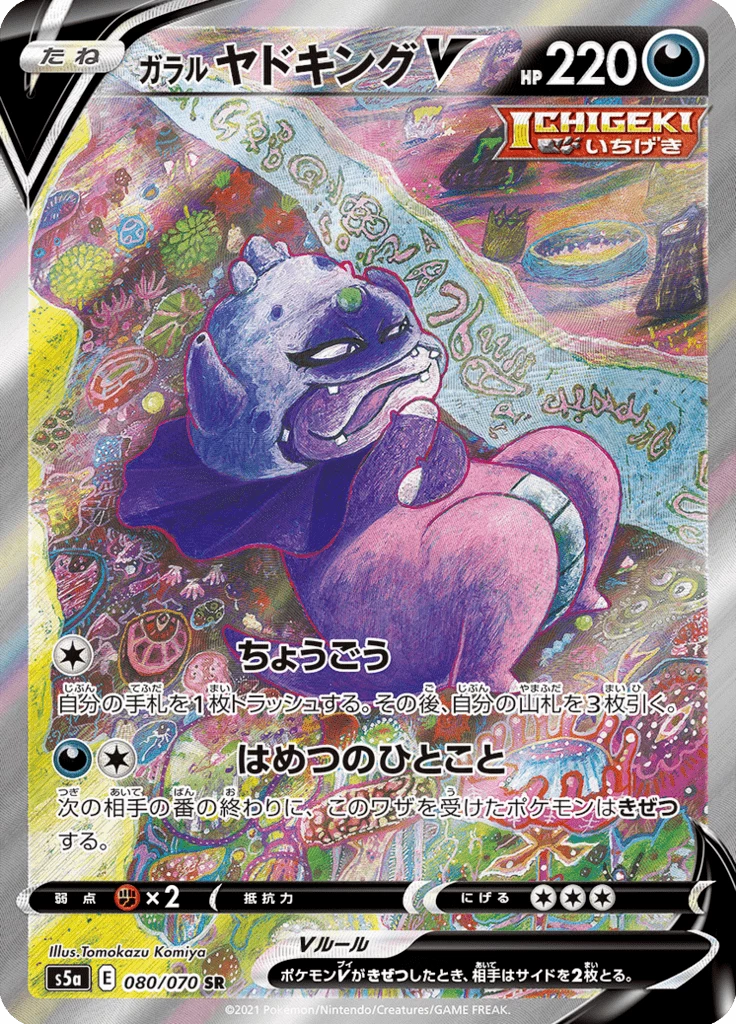
Number Japanese release / code Rarity or category Illustrator
109/100 Amazing Volt Tackle / S4 SR Hideki Ishikawa
261/184 VMAX Climax / S8b SR Souichirou Gunjima
093/100 Amazing Volt Tackle / S4 U take
229/S-P Trainer Card Collection / S-P Promo Atsushi Furusawa

Amazing Volt Tackle is the familiar English rendering of 仰天のボルテッカー. Its official Japanese product page gives September 18, 2020 as the release date. That date describes the Japanese S4 product, not an English expansion that later used related cards.

The denominator in 109/100 is part of the collector number. It does not mean that only 100 copies exist, and the number above the denominator does not quantify a pull rate. Use our S4 card list for the surrounding numbered set, or the Amazing Volt Tackle guide for broader set context.

Two Gym-Uniform SR Illustrations

Official Japanese Bea 109/100 from S4, illustrated by Hideki Ishikawa
109/100 SR · S4 · Hideki Ishikawa
Official Japanese Bea 261/184 from S8b, illustrated by Souichirou Gunjima
261/184 SR · S8b · Souichirou Gunjima

Hideki Ishikawa’s 109/100 puts Bea close to the viewer, with one bent leg prominently in the foreground. Her gym uniform and orange glove sit against a bright, multicolored background. The pose is a useful visual check when a seller has abbreviated the title.

Souichirou Gunjima’s 261/184 uses a different stance: one raised orange-gloved hand holds a Poké Ball, while the other fist extends forward beside a bright burst of light. Yellow and orange dominate the background. It is a separate composition, not a photograph of the S4 card with different lighting.

Both images carry SR beside their collector numbers and a D regulation mark. Those printed details help identify the cards; they are not a statement about current tournament eligibility. The official VMAX Climax page provides the product context for S8b.

For a Bea collection, the contrasting poses can justify owning both. For an illustrator collection, the different credits determine which belongs in your page. Neither preference establishes a smaller print run or a future price advantage. The images here are official card references, so they cannot establish the surface quality or grade of an offered physical copy.

Five Discarded Cards Do Not Mean Five Energy

All four official Bea records describe the same sequence: discard the top five cards of your deck, then attach the Energy cards found among those five to your Benched Fighting Pokémon, distributing them as you choose. The Fighting-type symbol is visible in the card text, even when a text-only page extraction omits it.

That wording has three practical limits. The five cards come from the top of your deck, the Energy must come from that newly discarded group, and the recipients must be eligible Pokémon on your Bench. Bea does not search your deck for five Energy or pick up every Energy already in your discard pile.

What happens in this example? What Bea provides
The five cards contain two basic Energy and three non-Energy cards The two Energy cards can be attached among eligible Benched Fighting Pokémon.
The five cards contain no Energy No Energy cards from that group are available to attach.
You want Energy on your Active Pokémon The printed recipient is a Benched Fighting Pokémon; the Active position is outside that instruction.

These examples explain the ordinary printed sequence; they do not estimate how often a deck will reveal Energy. That frequency depends on its contents and the cards remaining in it. The Supporter also does not draw those five cards into your hand: discarding and drawing are different actions.

The reminder text permits one Supporter during your turn. Buying the SR rather than the U or promo changes the collectible presentation, not that turn limit or the attachment effect. If you intend to play the card at an event, check the event’s current format and language requirements separately from this print-identification guide.

The Stadium Card and After-School Promo

Official Japanese Bea 093/100 from S4, illustrated by take
093/100 U · S4 · take
Official Japanese Bea 229/S-P from S-P, illustrated by Atsushi Furusawa
229/S-P promo · Trainer Card Collection · Atsushi Furusawa

The 093/100 U uses a conventional illustration window. Bea stands in a stadium scene, and the official artist credit is take, written in lowercase. It belongs to S4 alongside 109/100, but it occupies a different number and has different artwork.

The 229/S-P promo shows Bea running through a town in a white collared outfit. The credit is Atsushi Furusawa. The signature design across the illustration is part of the pictured promo design; the image is not evidence that an illustrator personally autographed a particular copy.

The official Trainer Card Collection announcement places this after-school theme in a collection released August 20, 2021. That historical product included a promo card and collecting accessories. It does not imply that a current offer for the loose 229/S-P card includes the original binder, packs or other contents.

A useful four-card binder selection can therefore show two SR poses, a stadium scene and an after-school scene. If you are completing a particular set instead, record the S4 and S8b numbers separately from the S-P promo. A visually related card can be relevant to a character collection without belonging to the same numbered expansion.

Choose an Artwork, Then Check the Actual Copy

Our existing Bea SR product pages distinguish the two complete numbers. Each linked product is labelled PSA 10. Open the page for its current price and purchase status rather than assuming that a reference image or an older listing means a copy is available.

S4 Bea 109/100 SR

Hideki Ishikawa’s close, raised-leg composition from Amazing Volt Tackle.

Check Bea 109/100 SR

S8b Bea 261/184 SR

Souichirou Gunjima’s Poké Ball pose from VMAX Climax.

Check Bea 261/184 SR

For a raw card, ask for front, back, edge and corner photographs of the offered item. For a graded card, compare the actual label, number and grade with the description. PSA Cert Verification is one useful check; PSA warns that a valid certification number alone does not authenticate the physical item in a listing.

Keep raw and graded offers in separate comparisons. Also separate Japanese and English editions even when related artwork appears on both. A price makes sense only alongside the exact print, condition, quantity and seller terms.

If the desired card is unavailable, send its full identifier through Ordine rapido: for example, “Japanese Bea, S4 109/100 SR, one copy,” followed by your requested condition or grade. The PSA 10 collection provides a broader route to current graded offers.

Domande frequenti

Which set contains Japanese Bea 109/100 SR?

Bea 109/100 SR belongs to Amazing Volt Tackle, set code S4. Hideki Ishikawa illustrated it. The Japanese product was released September 18, 2020.

How is Bea 261/184 different from 109/100?

261/184 is the S8b VMAX Climax SR illustrated by Souichirou Gunjima. It has different artwork and a different set identity from the Hideki Ishikawa 109/100 SR, but the same Supporter effect.

Does Bea attach five Energy cards?

Not necessarily. Bea discards the top five cards of your deck and attaches Energy cards found among that group to your Benched Fighting Pokemon. Five discarded cards are not a guarantee of five Energy.

Can Bea attach Energy to the Active Pokemon?

The printed effect specifies Benched Fighting Pokemon as recipients. It does not provide an attachment to your Active Pokemon.

What is Bea 229/S-P?

It is the Trainer Card Collection promo illustrated by Atsushi Furusawa, showing Bea in an after-school scene. Its signature design is part of the pictured card; it is not evidence of a personally autographed copy.

Where can I check current Bea SR prices?

Use the separate SST product pages for Japanese 109/100 SR and 261/184 SR. They show current prices and purchase status. Quick Order accepts requests for an unavailable exact print and desired condition.