Crea una cuenta gratis y suma puntos y rango
Samurai Sword Tokyo
Pedidos Carrito

Jerky Pokemon Cards: Color-Block SARs from Lumineon V to Dragapult
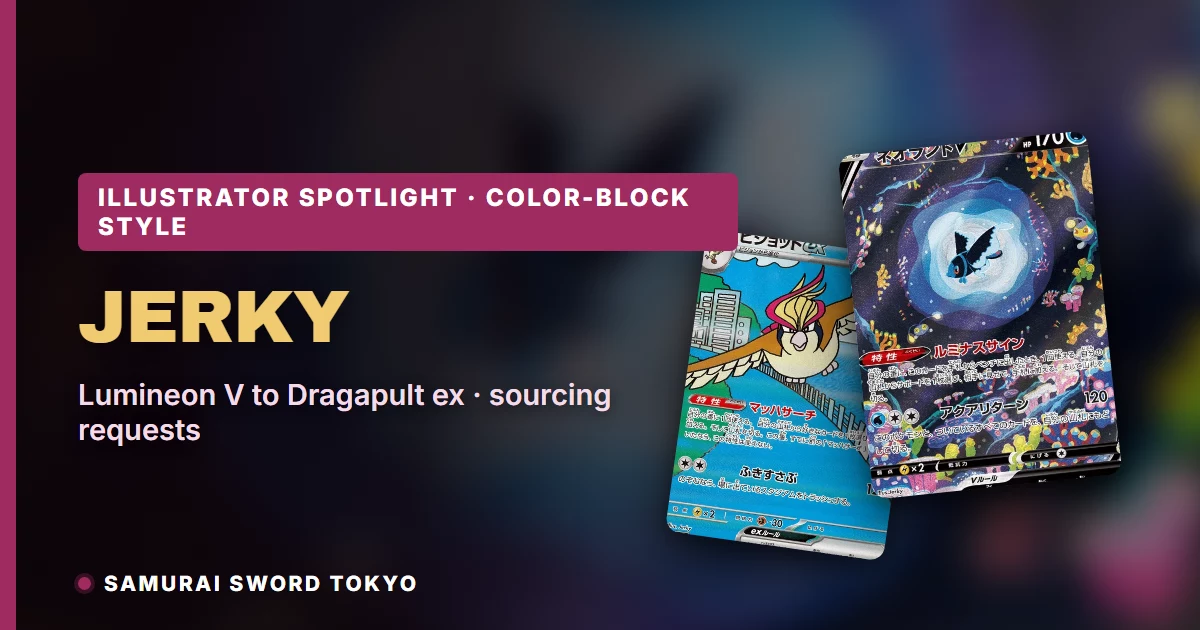
A Lumineon swimming through a sheet of hard-edged, high-contrast color blocks — that debut card introduced an illustrator whose entire signature is contrast.

The illustrator is Jerky, a Japanese freelance artist also credited on some prints as «Banana Jerky.» This guide covers Jerky’s debut special art rare, the run of special art rares that followed, the alternate-art side work, and how to source a Jerky card from Japan — because as of this writing, we don’t currently hold a graded Jerky print in our own vault.

Key Takeaway

This is a sourcing guide, not a stock listing. We don’t currently have a Jerky PSA 10 in our vault, so instead of a product page, the fastest route to a specific Jerky card — the Lumineon V SAR (s12a 216/172), Pigeot ex SAR (SV3 136/108), Tapu Koko ex SAR (SV3a 086/062), or Dragapult ex SAR (SV8a 221/187) — is our Quick Order sourcing request.

43
Main-Line Cards Illustrated

s12a
Debut Set (Lumineon V SAR)

4
Special Art Rares to Date

0
Currently In Stock — Sourcing Only

Who Is Jerky?

Jerky is a Japanese freelance illustrator who also appears on some Pokemon TCG credits as «Banana Jerky.» Jerky’s Pokemon TCG debut came with the Lumineon V special art rare at 216/172 in s12a, a card that immediately established the illustrator’s approach: hard divisions of flat color placed directly against the subject rather than a soft, blended background.

Bulbapedia describes Jerky’s work as built around «a distinctive color-blocking technique with vibrant, high-contrast colors» — a description that holds across the illustrator’s catalog, from the debut Lumineon V through the special art rares and alternate art pieces that followed. To date, Jerky has illustrated 43 main-line Pokemon TCG cards, with additional prints across Pokemon Trading Card Game Pocket.

Beyond the credit name, the debut set, and the recurring style described by Bulbapedia, other personal details about Jerky are not publicly verified, so we’re not speculating on them here. What’s documented is the card record itself, which is substantial enough on its own — four special art rares, plus a run of alternate art cards that apply the same color-blocking approach at a smaller scale.

The SAR Run: Lumineon V to Dragapult ex
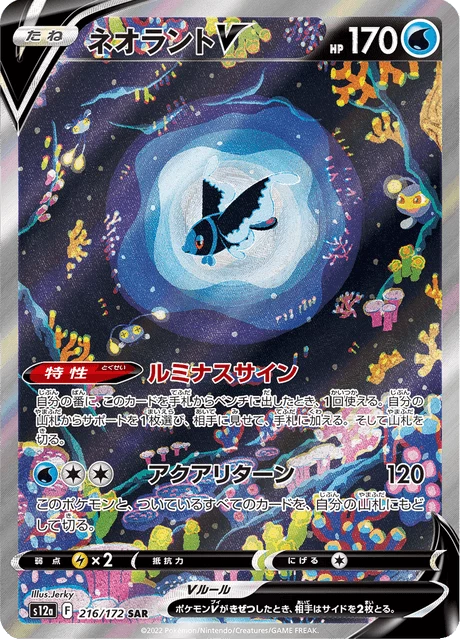
Lumineon V (Neorant V) 216/172 SAR, s12a VSTAR Universe (official card image)
Lumineon V 216/172 SAR — s12a VSTAR Universe, illus. Jerky (official card image)

Jerky’s headline work in the Pokemon TCG is a run of four special art rares, each sitting in its set’s SAR slot:

  • Lumineon V — s12a, 216/172. The debut card, and the one that set the color-blocking template the rest of the run follows.
  • Pigeot ex — SV3, 136/108. A special art rare built around the same evolution line Jerky also covered in alternate art within the same set (see below).
  • Tapu Koko ex — SV3a, 086/062. The Tapu Koko special art rare, continuing the run into the SV3a set.
  • Dragapult ex — SV8a, 221/187.

All four sit in the special art rare slot of their respective sets. None of the four is currently in our graded inventory; see the sourcing section below for how we handle requests on cards we don’t stock.

The Color-Block AR Side Work
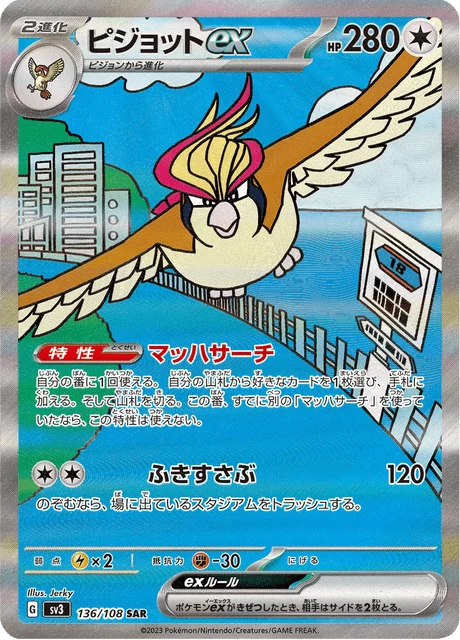
Pigeot ex 136/108 SAR, SV3 (official card image)
Pigeot ex 136/108 SAR — SV3, illus. Jerky (official card image)

Alongside the SAR run, Jerky has also illustrated a number of alternate art cards that apply the same color-blocking technique at the AR rarity tier rather than the SAR slot:

  • Pidgey / Pidgeotto / Pigeot line — SV3, 118-119/108. Alternate art pieces covering the same evolution line as the Pigeot ex special art rare in the same set.
  • Tropius — SV1a, 074/073.
  • Archeops — SV11W, 130/086.
  • Dreepy / Drakloak — M2a, 211-212/193.
  • Ludicolo — M2, 081/080.

The AR pieces show the same visual signature applied consistently across sets — flat, high-contrast color divisions rather than a rendered or painterly background, whether the subject is a legendary bird, a Ghost-type line, or a Grass-type evolution.

Jerky Lista de cartas

The notable cards from Jerky’s catalog covered in this guide:

Carta Colección Number Rarity
Lumineon V s12a 216/172 SAR
Pigeot ex SV3 136/108 SAR
Pidgey / Pidgeotto / Pigeot SV3 118-119/108 AR
Tapu Koko ex SV3a 086/062 SAR
Dragapult ex SV8a 221/187 SAR
Tropius SV1a 074/073 AR
Archeops SV11W 130/086 AR
Dreepy / Drakloak M2a 211-212/193 AR
Ludicolo M2 081/080 AR

Nine notable entries out of 43 main-line cards illustrated to date. This list covers notable entries rather than the full print run.

Beyond the Cards: Jerky’s Wider Work

Jerky’s own portfolio site, banana-jerky.com, fills in the picture the card credits don’t. Its About page describes an illustrator and designer born in 1988, from Saga Prefecture and now based in Nara, and the Work page shows a client list that runs well past the Pokemon TCG.

Card collectors have crossed paths with more of that work than they might realize. Per the portfolio, Jerky illustrated the One Piece Card Game’s Official Card Sleeve 8 and has produced card illustration for Nijisanji (ANYCOLOR) — so the color-block style has already reached two other corners of the Japanese card hobby. Other listed projects include a Pokemon Sleep collaboration with the sauna-directory service Sauna Ikitai, Tamagotchi magazine illustration, Doggy Box pamphlets in 2023 and 2025, a wall illustration for Cafe Hello, a card for a children’s art festival in New Taipei City, Taiwan, and a relocation guidebook for the town of Tomioka in Fukushima.

The portfolio also records exhibitions: an exhibition and sale in Shanghai on July 14–15, 2024, and participation in the Pokemon Card Art Walk in Yokohama’s Minato Mirai district. Jerky runs X and Instagram accounts under @bananajerky. For anyone sourcing a Lumineon V or Dragapult ex through the section below, that wider portfolio is a useful reminder that the artist behind these SARs is an active working illustrator, not a one-set credit.

Sourcing a Jerky Card from Japan

We don’t currently hold a graded Jerky print in our vault — not the Lumineon V debut, not the Pigeot ex, Tapu Koko ex, or Dragapult ex special art rares, and none of the alternate art side pieces. Rather than list a card we don’t have, we’re telling you plainly where things stand.

If you’re after a specific Jerky card, the most direct route is our Quick Order page. Flag the exact card — set code, number, and rarity, using the list above as a reference — and we’ll work the Japanese secondary market on your behalf and confirm availability before anything ships.

Jerky’s debut card sits in s12a, a set that’s well represented elsewhere in our graded inventory. If you’re building out a set-focused collection around that release, our Origin Forme Palkia VSTAR guide covers another s12a chase card, and our full PSA 10 collection is worth browsing for what else from the same release is available right now.

How Sourcing Requests Work

A Quick Order sourcing request isn’t a guarantee — it’s us checking the market on your behalf and coming back with a confirmed price and timeline before you commit. It’s the same process we use for any graded card that isn’t currently sitting in our own inventory.

Where to Buy

We ship graded Japanese PSA 10 cards and sealed Japanese product worldwide from Tokyo with tracked delivery. For Jerky specifically:

For more illustrator coverage from the same research pass, see our guides to sowsow, Raita Kazama, and Amelicart, or our deeper dive on AKIRA EGAWA‘s special art rare run. Our Japanese PSA 10 price guide is a good starting point if you’re new to grading premiums on Japanese prints generally.

Preguntas frecuentes

Who is Jerky?

Jerky is a Japanese freelance Pokemon TCG illustrator, also credited on some prints as «Banana Jerky.» Jerky debuted in the Pokemon TCG with the Lumineon V special art rare (s12a 216/172) and has since illustrated 43 main-line cards.

What is Jerky’s debut card?

Lumineon V, a special art rare numbered 216/172 in s12a. It established the color-blocking style that runs through Jerky’s later work.

What does Jerky’s «color-blocking» style mean?

Bulbapedia describes it as «a distinctive color-blocking technique with vibrant, high-contrast colors» — flat, hard-edged divisions of color placed against the subject, rather than a blended or painterly background.

Do you have any Jerky PSA 10 cards currently in stock?

No. As of this writing we don’t hold a graded Jerky print in our vault. This guide is a sourcing reference rather than a stock listing; use our Quick Order page to request a specific card.

How can I source a specific Jerky card from Japan?

Flag the card — set code, number, and rarity — on our Quick Order page. We’ll check the Japanese secondary market and confirm availability and pricing before anything ships.

What else has Jerky worked on?

Per the artist’s portfolio site, Jerky illustrated the One Piece Card Game’s Official Card Sleeve 8 and has produced card illustration for Nijisanji (ANYCOLOR), along with projects including a Pokemon Sleep collaboration with Sauna Ikitai and Doggy Box pamphlets. The portfolio also records a July 2024 exhibition and sale in Shanghai and participation in the Pokemon Card Art Walk in Yokohama.
Cartas Pokémon de HYOGONOSUKE: The Three Birds Alt Art y estilo de libro ilustrado

HYOGONOSUKE designs scenes — artwork built to be read across two or three cards at once, so that lining them up side by side completes a single picture. A run of connecting-scene cards in that format went viral around the release of Destined Rivals.

Outside the trading card, HYOGONOSUKE’s flat, picture-book-influenced style has shown up in Love Live! illustration, Doraemon artwork, children’s picture books, and manga work, plus official game artwork for Kubfu and Urshifu in Pokemon Sword & Shield’s Crown Tundra expansion. Inside the TCG, the catalog runs to 93 main-TCG cards plus 29 TCG Pocket cards; the Limitless database lists 117 Japanese-language prints including reprints.

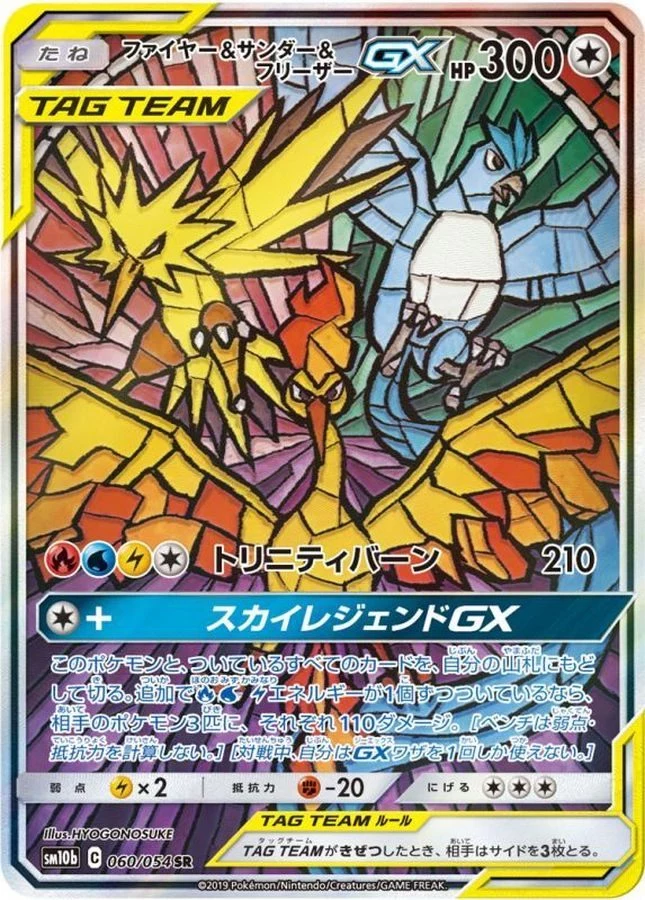
This guide covers who HYOGONOSUKE is, the one card the artist’s work has produced for our PSA 10 vault so far — the Moltres & Zapdos & Articuno GX SA from SM10b — and the rest of the notable catalog, most of which we haven’t carried yet. Because we’re working from a thin archive rather than a live shelf here, this guide leans on sourcing rather than a shopping list.

Key Takeaway

HYOGONOSUKE debuted in the Pokemon TCG on Team Up-era Jirachi in 2018 and has since illustrated 93 TCG cards plus 29 Pokemon TCG Pocket cards; the Limitless database lists 117 Japanese-language prints including reprints. The one HYOGONOSUKE card confirmed in our own trading history — Moltres & Zapdos & Articuno GX SA (SM10b 060/054) — was last listed at ¥666,925. Everything past that card in this guide is catalog reference rather than live inventory; the Quick Order page is the fastest way to flag a sourcing request.

93
TCG Cards Illustrated

2018
TCG Debut (Team Up)

¥666,925
Three Birds GX SA (Last Listed)

Who Is HYOGONOSUKE?

HYOGONOSUKE’s first Pokemon TCG card was Jirachi, released during the Team Up era in 2018. Since that debut, the artist’s catalog has grown to 93 cards in the physical TCG, plus 29 more in Pokemon TCG Pocket; the Limitless database lists 117 Japanese-language prints including reprints.

The style is immediately recognizable once you know to look for it: blocky textures and dense, saturated color laid down in a flat, picture-book manner. It’s the same visual language HYOGONOSUKE brings to work outside the card game, including Love Live! illustration, Doraemon artwork, picture books, and manga.
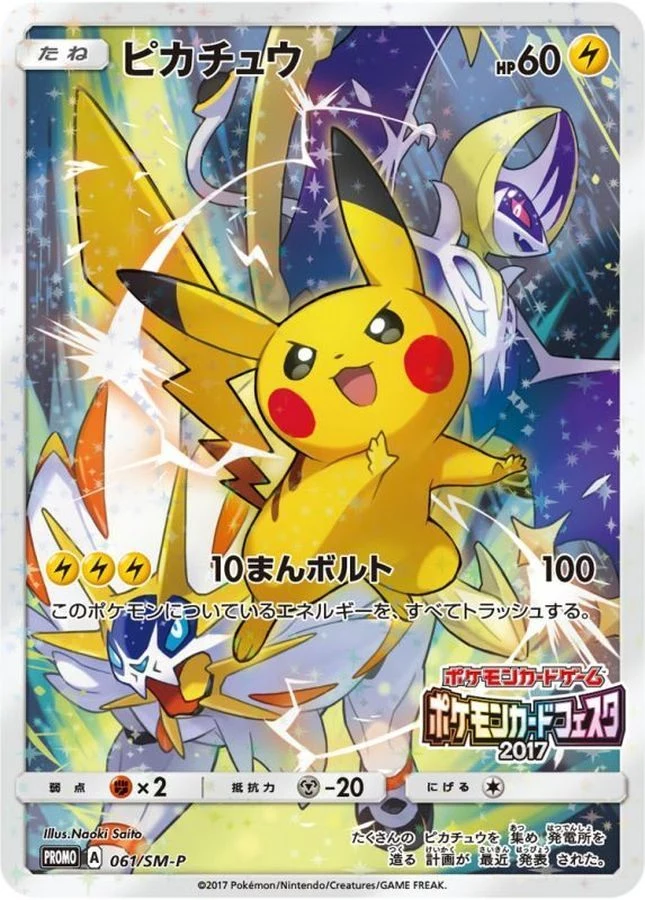
The clearest demonstration of that style inside the TCG is the connecting-card format: artwork split across two or three cards so that placing them edge to edge completes one continuous scene. A run of these connecting cards went viral around the release of Destined Rivals.
Beyond the TCG, HYOGONOSUKE is also credited with the official artwork for Kubfu and Urshifu in Pokemon Sword & Shield’s Crown Tundra expansion — game art rather than a trading card, but a sign that the picture-book style has been used by the franchise outside the card game as well.

HYOGONOSUKE’s catalog sits alongside other Japanese illustrators we track closely, including Shinji Kanda, Kouki Saitou, and Mitsuhiro Arita, each of whom has a dedicated guide covering their own most notable printings.

The Three Birds: Moltres & Zapdos & Articuno GX SA

Moltres Zapdos Articuno GX SA alt art card 060/054 from SM10b illustrated by HYOGONOSUKE
Moltres & Zapdos & Articuno GX SA, SM10b 060/054 — the only HYOGONOSUKE card confirmed in our own trading history

The card that anchors this guide is the Moltres & Zapdos & Articuno GX Special Art (SM10b 060/054) — a full-art alt art pulling all three original legendary birds into a single GX-rules card. It’s the one HYOGONOSUKE card confirmed in our own PSA 10 trading history, and it’s a substantial one: our copy was last listed at ¥666,925.

That single card is doing a lot of work in this guide. HYOGONOSUKE’s TCG catalog runs to 93 cards, but this is the only one we have a confirmed record of moving through our own vault at PSA 10 — which makes it both the centerpiece and, at the moment, the whole of the archive.

We can take a sourcing request through Pedido rápido for a graded copy from the Japanese secondary market — the same route we’d point you to for any high-value single.

On Sourcing a Chase Card

A last-listed price tells you where our listing sat, not what the next copy will cost. For a card at this level, a Quick Order request is a better first step.

Other HYOGONOSUKE Cards Worth Knowing

Outside the three birds alt art, HYOGONOSUKE’s catalog includes several cards that show up regularly in illustrator tracking on Bulbapedia and Limitless. They’re worth knowing about if you’re following the artist’s work rather than shopping this specific archive.

Tyranitar V SA (S5I 077) is another Special Art alt art. The lake trio (SV8 048–050) — Uxie, Mesprit, and Azelf — is a three-card group from a more recent Scarlet & Violet-era set. Pikachu V (S8a 020) and Ogerpon (SV9a 021) round out the wider notable list.

Carta Number / Set Catalog note
Tyranitar V SA 077, S5I Special Art alt art
Uxie / Mesprit / Azelf (lake trio) 048–050, SV8 Three-card legendary group
Pikachu V 020, S8a Notable catalog card
Ogerpon 021, SV9a Current-generation Scarlet & Violet

None of these four are cards we can point to a listing for today. They’re catalog context — a sense of the range HYOGONOSUKE has worked across, from single-Pokemon standard illustrations to multi-card legendary groupings, beyond the one card that’s actually passed through our own vault.

The Archive: Why This Guide Is Sourcing-First

Most of our illustrator guides work from a running vault — a set of graded cards, plus a few archive references with last-listed prices. HYOGONOSUKE’s guide is different because the confirmed record is thinner: one card, the three birds GX SA.

Archived Moltres Zapdos Articuno GX SA card, out of stock, last listed at 666,925 yen

Moltres & Zapdos & Articuno GX SA, SM10b 060/054
Last listed ¥666,925

Archived Card
Moltres & Zapdos & Articuno GX SA, PSA 10
Last listed ¥666,925

See Archived Listing →

That doesn’t mean the artist’s other 92 TCG cards don’t exist in the graded market — it means we haven’t confirmed one moving through our own hands yet. A 93-card catalog spread across eight years leaves plenty to ask for. That’s the gap this guide is meant to bridge: enough catalog detail to know what to ask for, routed through a sourcing request.

Beyond the Cards: HYOGONOSUKE’s Wider Work

The picture-book comparison isn’t just a description of the style — HYOGONOSUKE has actually made picture books. The artist illustrated Itsudemo Kirby 3: Yuuki wo Kimi ni, a Kirby picture book published by Shogakukan on March 27, 2020, with text by Asami Taniguchi. There’s also a technique book under HYOGONOSUKE’s own name, Hyogonosuke-ryu Illust no Kakikata, published by Gijutsu-Hyohronsha in February 2021; per the publisher’s profile, HYOGONOSUKE is from Fukuyama, Hiroshima, works in a picture-book-like style of light and shadow, and counts the illustrations for the Angou Club children’s book series as a major credit.

Per a HugKum feature, HYOGONOSUKE has also produced illustration work for the Doraemon films, and the pairing of Pokemon and Love Live! Sunshine!! jobs was the turning point in going freelance.

Inside Pokemon but outside the TCG, Bulbapedia records the Kubfu and Urshifu wallpaper art for Sword & Shield’s Crown Tundra expansion, work on Pokemon Quest, and goods design across deck cases, sleeves, and playmats. Why this matters to collectors: the flat, luminous style on a card like the three birds GX SA is the same one running through published books and official merchandise — a sustained body of work rather than a single viral card. HYOGONOSUKE maintains a site at hyogonosuke.com and runs an X account under @hyogonosuke.

Where to Buy HYOGONOSUKE Cards from Japan

We grade and source Japanese PSA 10 singles out of Tokyo. The three birds GX SA is the card to flag first, and the fastest way to start a request is our Quick Order page.

Start a Sourcing Request
HYOGONOSUKE — Moltres & Zapdos & Articuno GX SA
Last listed ¥666,925
Ships from Tokyo · Tracked delivery once sourced

Request via Quick Order →

For the wider PSA 10 catalog while you wait on a HYOGONOSUKE request, browse our full PSA 10 collection or the PSA 10 card list to filter by set and price. Our Japanese PSA 10 price guide and PSA 10 trainer cards guide cover how we price and grade across the broader vault. If GX-era alt art chase cards are what you’re after more generally, our Pikachu & Zekrom-GX guide covers another full-art secret rare from the same rules era.

The fastest path to any HYOGONOSUKE card — the three birds GX SA or anything else from the 93-card catalog — is the same Quick Order request flow we use for sourcing across the rest of the vault.

Preguntas frecuentes

Who is HYOGONOSUKE?

HYOGONOSUKE is a Pokemon TCG illustrator who debuted on Team Up-era Jirachi in 2018 and has since illustrated 93 TCG cards, recognizable for a blocky-textured, densely colored, picture-book-style approach.

What is the Moltres & Zapdos & Articuno GX SA card?

It’s a Special Art alt art (SM10b 060/054) illustrated by HYOGONOSUKE, combining all three original legendary birds on one card. It’s the only HYOGONOSUKE card confirmed in our own PSA 10 trading history, last listed at ¥666,925.

What are HYOGONOSUKE’s connecting-scene cards?

Connecting-scene cards are illustrations split across two or three cards so that arranging them side by side completes one continuous scene. A run of these cards went viral around the release of Destined Rivals.

Does HYOGONOSUKE work outside the Pokemon TCG?

Yes. Outside the TCG, HYOGONOSUKE has illustrated Love Live! artwork, Doraemon artwork, picture books, and manga, and is credited with the official Kubfu and Urshifu artwork for Pokemon Sword & Shield’s Crown Tundra expansion.

What else has HYOGONOSUKE worked on?

HYOGONOSUKE illustrated the Kirby picture book Itsudemo Kirby 3: Yuuki wo Kimi ni (Shogakukan, 2020) and authored the technique book Hyogonosuke-ryu Illust no Kakikata (Gijutsu-Hyohronsha, 2021), and the publisher’s profile lists the Angou Club children’s series illustrations as a major credit. Per HugKum, HYOGONOSUKE has also produced illustration work for the Doraemon films, while Bulbapedia records Pokemon Quest work, Crown Tundra wallpaper art, and official goods design.

Cartas Pokemon de sowsow: las joyas pictóricas del artista de la colaboración con Van Gogh

sowsow Pokemon cards range from Gengar VMAX’s swirling, oversized scene to Espeon V’s quiet room of floating books. Comparing those settings is a useful way to choose a first artist page: start with the artwork you want to look at, then match its Japanese set code and card number.

The same illustrator participated in the official 2023 Pokemon × Van Gogh Museum collaboration. The museum identifies sowsow among its participating artists; that connection offers another starting point for discovering the card work.

Born in 1988, sowsow has Japanese card credits in Forbidden Light (SM6), including Avalugg, Inkay and Cubone, released in March 2018. This guide keeps its focus on Gengar VMAX, Espeon V and Pikachu, then explores Lunatone and shiny Charmander. The linked PSA 10 products are backorder listings: review the sourcing terms on the individual product page before ordering.

Key Takeaway

Choose Gengar VMAX SA (SGG 020/019) for a dramatic scene, Espeon V SA (S6a 081/069) for an indoor setting, or Pikachu (124/S-P) for a woodland moment. For another full-card scene, compare Lunatone AR (S12a 184/172). Use the scene and full Japanese print number to guide your selection.

Updated October 20, 2026
  • Japanese print numbers and illustrator credits checked against the official card database; S4a 238/190 is Yamper, correcting the earlier Wooloo reference.
  • Purchase links now point to the matching PSA 10 backorder listings. Check each page for its current asking price, availability and terms.
  • Use the Eevee Heroes card list and Shiny Treasure ex card list to explore the surrounding sets.
1988
Born

SM6
Early Japanese Credits (2018)

sowsow
Printed Illustrator Credit

2023
Pokemon × Van Gogh Museum Collab

Collection notes compare specific Japanese printings. Check the linked product pages for current asking prices and sourcing terms.

Who Is sowsow?

sowsow is an illustrator and designer whose work appears on Pokemon cards. The Van Gogh Museum’s collaboration record gives the birth year as 1988. Early Japanese credits include Avalugg 026/094, Inkay 036/094 and Cubone 041/094 in Forbidden Light (SM6), which released in Japan on March 2, 2018.

In 2023, the Pokemon Company and the Van Gogh Museum in Amsterdam launched an official collaboration. The museum names sowsow as one of the participating artists. Its public activities ran from September 28, 2023 to January 7, 2024.

In a September 2024 TSUTAYA interview, sowsow describes balancing the softness of colored-pencil-like work with an acrylic-like weight, and showing ordinary life within imagined worlds. This helps explain what to look for in the illustrations below: a room, a small encounter or an unusual creature moving through its surroundings.

The same interview confirms work on both the Pokemon and One Piece card games. For this guide, the printed Illus. sowsow credit is the practical identifier. Card totals depend on whether a list includes reprints, other languages or digital cards; the official illustrator search lets you explore Japanese examples by illustrator.

On the cards pictured here, look along the bottom edge for Illus. sowsow. Read that credit together with the set code and full number. The credit identifies the illustrator; the number identifies the particular printing. For example, Espeon V 081/069 and Lunatone 184/172 share an artist but belong to different sets and carry different rarity labels. This check is useful when a search result shows only a cropped illustration.

For other illustrator profiles, see our Teeziro guide, our kirisAki guide, and our AKIRA EGAWA guide. Compare artists by setting, color and composition as well as by the Pokemon shown; a binder page can bring together different species without needing to follow a price ranking.

What you enjoy looking at Japanese print to compare Detail to notice
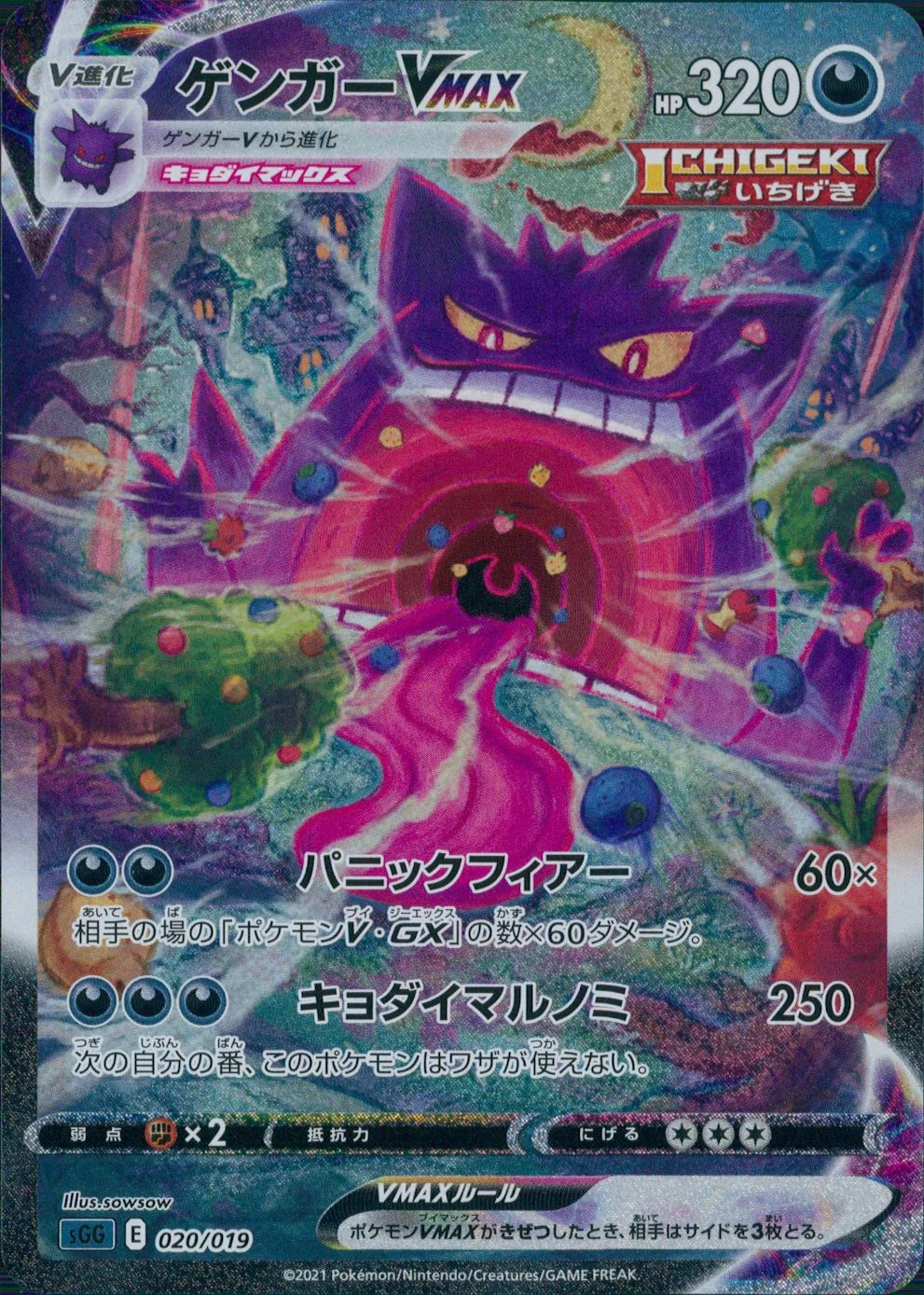
Large, dramatic scenes Gengar VMAX — SGG 020/019 The open mouth and flowing magenta tongue draw the eye toward the center.
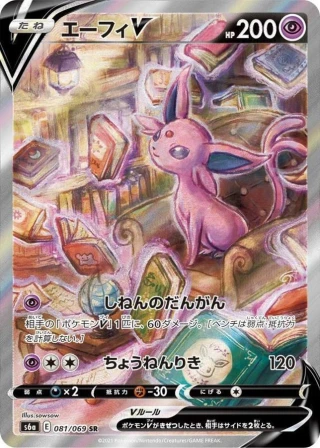
Quiet interiors Espeon V — S6a 081/069 An armchair, shelves and floating books fill the room.
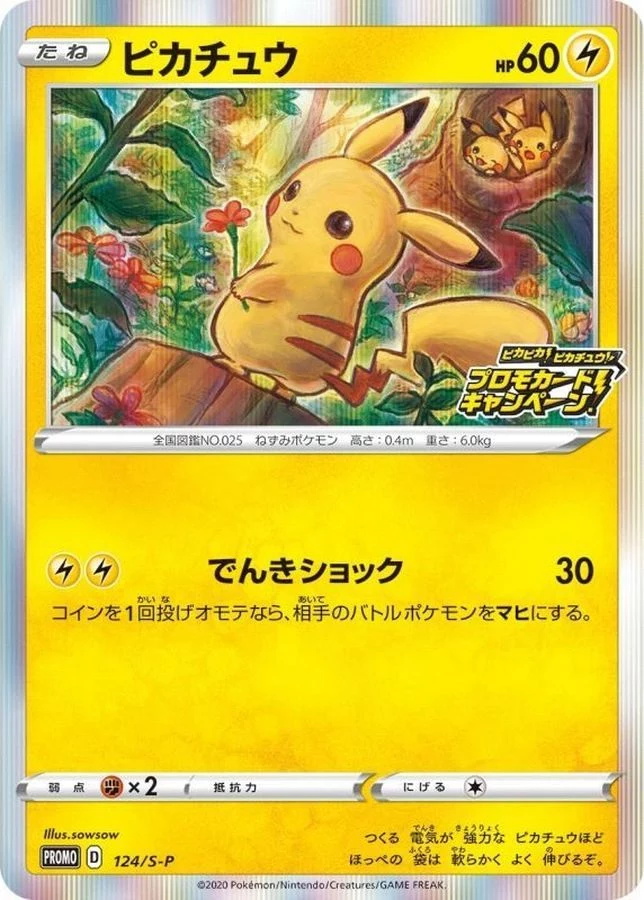
Small woodland encounters Pikachu — 124/S-P Two Pichu peer from a tree hollow behind Pikachu.
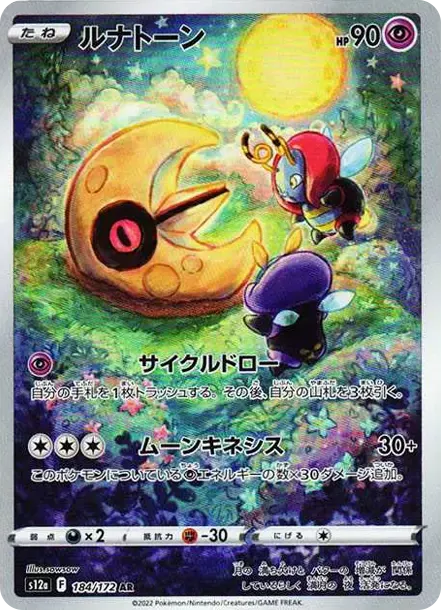
Moonlit scenes Lunatone — S12a 184/172 AR Volbeat and Illumise share the scene under a bright moon.
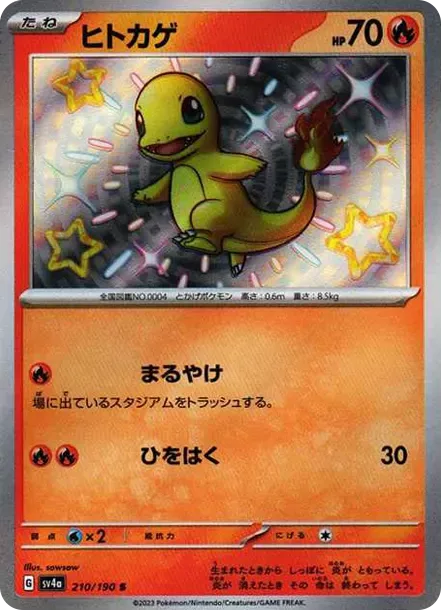
Shiny character portraits Charmander — SV4a 210/190 S Changed body colors and star motifs carry the composition.

Pick the scene first, then check the full printed number to identify its illustration. The table offers starting points for an artist collection based on visible details.

The Centerpiece: Gengar VMAX SA (020/019)

Gengar VMAX SA [020/019], SGG High Class Deck

The centerpiece of this guide is Gengar VMAX Special Art at 020/019, from the Japanese High Class Deck Gengar VMAX (SGG). The official card entry credits sowsow. The set code and number distinguish this print from other Gengar VMAX cards; the initials SA are a collector-facing special-art label.

The illustration builds around an enormous open mouth and a magenta tongue, with small colorful objects scattered across a teal and purple setting. It gives you several details to follow across the card. Compare that movement with Espeon’s room below: both feature a purple Pokemon, but the surrounding space gives each image a different mood.

For a graded version of this exact Japanese print, see the PSA 10 Gengar VMAX SGG 020/019 backorder listing. Read its current offer and sourcing terms before deciding.

The Eevee Heroes Connection: Espeon V SA (081/069)

Espeon V SA [081/069], Eevee Heroes

sowsow also illustrated the Espeon V Special Art at 081/069 from Eevee Heroes (S6a), as confirmed by the official Japanese card entry. The card itself prints SR beside its number; SA identifies the special-art version in collector and store descriptions. It should not be confused with a card carrying the later SAR rarity label.

Espeon sits in an armchair surrounded by books, with shelves and warm interior light behind it. The floating books bring movement into an otherwise settled room. For someone collecting indoor scenes, the objects and setting can be as appealing as the featured Pokemon; look at those details before comparing asking prices.

Our Eevee Heroes S6a card list and box guide puts the card in its set context. The Espeon cards guide compares more Espeon printings, while the Teeziro guide offers another illustrator-led route through Eeveelution artwork.

For the exact artwork, compare the Espeon V 081/069 PSA 10 backorder listing. If you prefer opening packs from the surrounding set, explore the Eevee Heroes S6a box below.

Explore the set
Eevee Heroes S6a Japanese Booster Box
Check the current box price
Browse the product details and selected condition.

View Booster Box →

If you need help identifying the correct print, use Pedido rápido and include S6a 081/069 and the requested grade in your enquiry.

Pikachu Promo (124/S-P)

Pikachu [124/S-P], Promo

The Pikachu promo at 124/S-P provides a smaller framed scene within a traditional card layout. The official Japanese entry credits sowsow, and the number is printed at the bottom of the card. Use that full promo number when searching, rather than combining prices for unrelated Pikachu promotions.

Pikachu balances on a branch beside a red flower, while two Pichu look out from a tree hollow. The yellow card body frames the woodland illustration. It is a different viewing experience from Gengar and Espeon’s larger illustrations: the little background encounter is contained in the picture window above the attack text.

Compare the exact print on the PSA 10 Pikachu 124/S-P backorder listing. This is separate from the Van Gogh Museum’s Pikachu with Grey Felt Hat artwork, which the museum credits to Naoyo Kimura. Use 124/S-P when requesting this woodland illustration.

Compare sowsow Japanese Prints

This section brings the guide’s selected Japanese prints together for comparison. The links below are PSA 10 backorder offers. Use the individual product pages to check current asking prices and sourcing terms.

Carta Japanese print Purchase route
Gengar VMAX SA SGG 020/019 View PSA 10 backorder listing
Espeon V SA S6a 081/069 (SR) View PSA 10 backorder listing
Pikachu promo 124/S-P View PSA 10 backorder listing
Lunatone AR S12a 184/172 View PSA 10 backorder listing
Charmander S SV4a 210/190 View PSA 10 backorder listing

Beyond the three original focal cards, Lunatone 184/172 from VSTAR Universe (S12a) shows a moonlit encounter with Volbeat and Illumise. Its printed rarity is AR, or Art Rare. The yellow moon and Lunatone stand out against blue and purple foliage, making it an alternative for collectors who want an extended scene with a gentler pace.

Lunatone AR S12a 184/172 illustrated by sowsow, moonlit scene with Volbeat and Illumise
Lunatone AR — S12a 184/172, VSTAR Universe. Compare the PSA 10 backorder listing.

Charmander SV4a 210/190 from Shiny Treasure ex takes a character-focused approach. Its yellow body sits against bright star motifs, with S printed beside the number. This portrait offers a different way to build a page from the rooms and landscapes shown above.

Shiny Charmander S SV4a 210/190 illustrated by sowsow
Charmander S — SV4a 210/190, Shiny Treasure ex. See the PSA 10 backorder listing.

Another verified sowsow print is Yamper S4a 238/190 from Shiny Star V. For set context, see the VSTAR Universe card list and the Shiny Treasure ex card list.

A useful collecting choice is whether you want several settings by one illustrator or several treatments of one Pokemon. The first route lets Lunatone, Pikachu and Espeon share a page through color and atmosphere; the second sends you toward the linked character guides. For a coherent page, repeat a color or setting across the cards you choose.

Beyond the Cards: sowsow’s Wider Work

The museum’s official record places sowsow alongside Naoyo Kimura and Tomokazu Komiya in the 2023 Pokemon collaboration. It names works inspired by Van Gogh paintings, including a Munchlax and Snorlax scene based on The Bedroom. The exhibition gave collectors another way to explore how Pokemon characters inhabit a setting.

The TSUTAYA interview also describes sowsow’s work as an illustrator and designer across several fields and confirms participation in the One Piece Card Game. These projects give collectors more of the artist’s work to explore beyond one Pokemon set. The artist’s site is sowsowkoubou.com, which links to the artist’s X account, @sowsowkoubou.

For a card collection, keep that wider context alongside the details you can verify on the object itself: printed name, set code, number and illustrator credit. A matching visual style can help you discover an image, but the small credit line is a firmer way to confirm who drew the exact printing.

Where to Buy sowsow Cards from Japan

Use the exact Japanese card number to move from an artwork you like to a product listing. Use the comparison table above to open the matching PSA 10 backorder offer, then review its current asking price, availability and purchase terms before placing an order.

Explore the PSA 10 collection or visual PSA 10 card list for more graded printings.

Before comparing two offers, match the set code, number, language and grade. A raw card and a PSA 10 listing describe different conditions, and a repeated Pokemon name may hide a different illustration. Use product photographs and the stated terms to resolve those differences rather than assuming a general artist search has found the same item.

Looking for Yamper S4a 238/190 or another sowsow print? Send the full card reference through Pedido rápido for a sourcing enquiry. For more illustrator profiles, see our guides to Naoki Saito and Hideki Ishikawa.

Preguntas frecuentes

Who is sowsow?

sowsow is an illustrator and designer credited on Pokemon cards including Gengar VMAX SGG 020/019, Espeon V S6a 081/069 and Pikachu 124/S-P. The Van Gogh Museum gives the birth year as 1988 and names sowsow as a participating artist in its 2023 Pokemon collaboration.

What is the Pokemon × Van Gogh Museum collaboration?

Pokemon and the Van Gogh Museum launched an official collaboration in 2023. The museum names sowsow among the artists; its Pokemon activities ran from September 28, 2023 to January 7, 2024. Exhibition artworks should be distinguished from specific numbered trading cards.

Which sowsow cards should I compare?

Compare Gengar VMAX SGG 020/019 for a dramatic scene, Espeon V S6a 081/069 for a quiet interior and Pikachu 124/S-P for a woodland encounter. Lunatone S12a 184/172 adds a moonlit scene, while Charmander SV4a 210/190 offers a shiny portrait.

How can I order sowsow’s Espeon V from Eevee Heroes?

The linked Espeon V S6a 081/069 product is a PSA 10 backorder listing. Check the product page for its current asking price and sourcing terms.

What other sowsow cards can I find in this guide?

The guide links PSA 10 backorder offers for Pikachu 124/S-P, Lunatone S12a 184/172 and Charmander SV4a 210/190, alongside Gengar and Espeon. It also identifies Yamper S4a 238/190 as another sowsow print.

Where can I buy graded sowsow cards from Japan?

Use the exact-print product links in this guide or explore the PSA 10 collection. Review the current asking price and backorder terms on each product page. Quick Order can be used for a sourcing enquiry with the card number and requested grade.

What else has sowsow worked on?

The Van Gogh Museum confirms participation in its 2023 Pokemon collaboration. A September 2024 TSUTAYA interview also confirms illustration and design work across several fields, including the One Piece Card Game.

Kouki Saitou Pokemon Cards: Mario Pikachu & the Promo Pikachu Run

If you’ve ever seen a promo Pikachu dressed as Mario, wrapped in a poncho, or splashing in the surf, there’s a good chance the same illustrator drew it. Kouki Saitou is a recurring artist behind Japan’s Pikachu promo cards — 694 cards across a career that started back in the Aquapolis era.

Unlike illustrators whose reputation rests on one or two chase cards, Saitou’s footprint is broad and promo-heavy, which makes the catalog easy to underrate at a glance and genuinely difficult to collect in full. A handful of names show up over and over when Japanese Pikachu promos come up, and Saitou’s is among them.

This guide covers who Saitou is, the Pikachu promo lineage that made the name recognizable, and every Kouki Saitou card currently in our PSA 10 vault — from the seven-figure Mario Pikachu down to cards that are currently out of stock but worth knowing about.

Key Takeaway

Kouki Saitou has illustrated 694 Pokemon TCG cards since debuting in the Aquapolis era, including the promo Pikachu series. We currently hold 10 Saitou cards graded PSA 10, led by Mario Pikachu 293/XY-P, currently listed at ¥1,674,780, and poncho Pikachu 203/XY-P, currently listed at ¥363,775.

694
Total TCG Cards Illustrated

10
Saitou Cards in Our Vault

6
Currently In Stock

1973
Born (May 13)

Who Is Kouki Saitou?

Kouki Saitou, born May 13, 1973, is a freelance illustrator whose Pokemon TCG career now spans 694 main-TCG cards plus 78 Pokemon Trading Card Game Pocket cards; the Limitless database lists 498 Japanese-language prints including reprints. Before working on the Pokemon TCG, Saitou illustrated manga-style artwork for game tie-in projects under the name “¼ King!” — a detail Bulbapedia records as part of the pre-Pokemon portfolio. Saitou’s first Pokemon TCG card appeared during the Aquapolis era, and the artist has been a steady presence in the promo card space ever since.

Not to be confused with Naoki Saito, a different Pokemon TCG illustrator with a similarly spelled name — the two are unrelated artists with separate card catalogs.

According to Bulbapedia, Saitou’s cards are recognizable for a realist, dynamic style built on strong light-and-shadow contrast and dramatic high- or low-angle compositions. The same source notes Akira Toriyama and Studio Ghibli’s Hayao Miyazaki as influences on the artist’s approach — a lineage that shows up in the sense of motion and exaggerated perspective running through Saitou’s most recognizable Pikachu promos.

That combination — a realist rendering style paired with theatrical camera angles — is part of why the promo Pikachu series reads differently from Pikachu’s standard set appearances. A costumed or staged Pikachu illustrated with dramatic lighting and an unusual vantage point stands out in a way a straightforward set portrait typically doesn’t, which is a large part of what collectors are responding to when they seek out Saitou’s promos specifically rather than any Pikachu card.

Saitou’s catalog sits alongside other Japanese illustrators we track closely, including Mitsuhiro Arita and Hideki Ishikawa, both of whom have their own guides covering their most valuable printings.

The Pikachu Promo Legacy

Pikachu promos are where Saitou’s name shows up most often, and one card anchors the entire lineup.

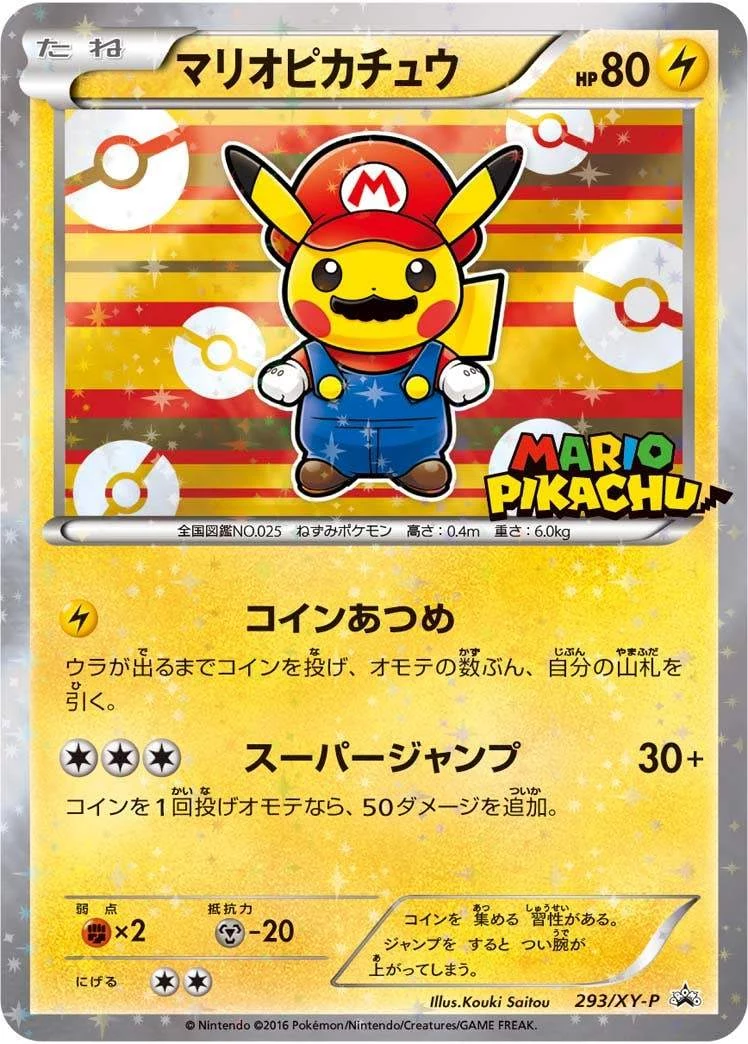
Mario Pikachu 293/XY-P promo card illustrated by Kouki Saitou
Mario Pikachu 293/XY-P, XY-P promo

Mario Pikachu 293/XY-P is the card most collectors associate with Saitou’s name. It’s the first entry in a four-card promo run (293–296), and the copy we currently hold in PSA 10 is listed at ¥1,674,780 — the highest-priced Saitou card in our vault by a wide margin. It sits at the center of our dedicated Mario Pikachu card guide, which covers the full 293–296 series in more depth.

Being the lead card in a numbered series matters here. Promo runs like 293–296 are typically released and collected as a set, which means 293 carries the recognition of being both the first number in the sequence and the specific Pikachu-as-Mario artwork that gave the whole run its identity. The PSA 10 copy currently in our vault is the only one of the four we hold in graded condition.

The rest of the Pikachu promo lineage follows a similar pattern — Pikachu dressed or staged for a themed moment, issued as a standalone promo card outside a numbered main set.

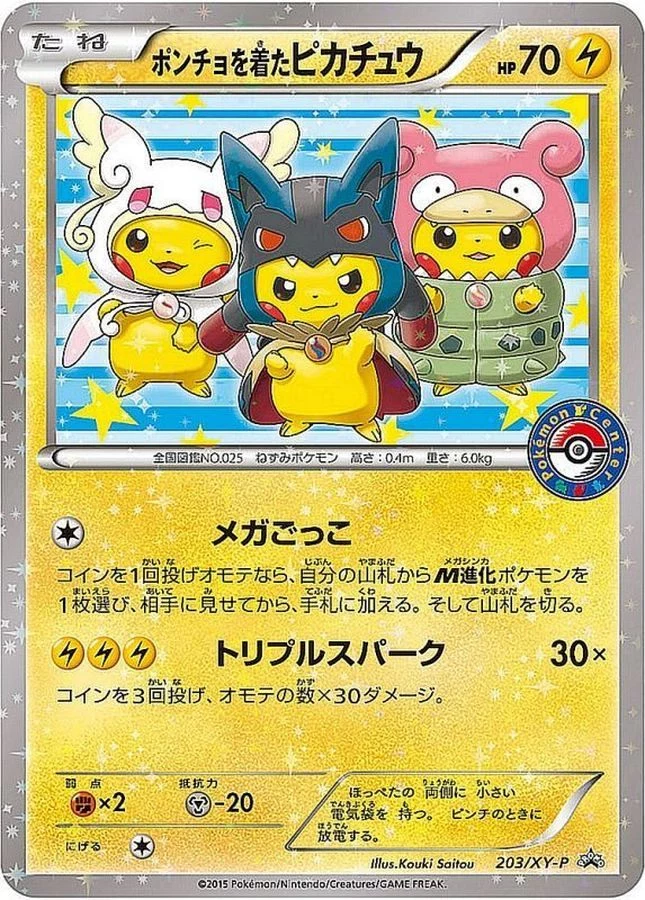
Poncho Pikachu 203/XY-P promo card illustrated by Kouki Saitou

Poncho Pikachu 203/XY-P
¥363,775

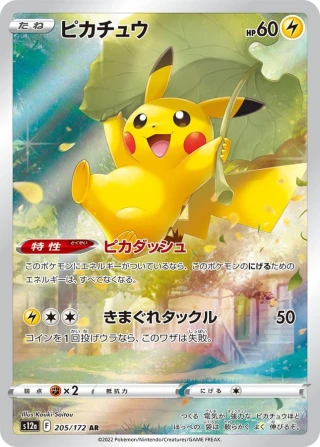
Pikachu 205/172 AR card from s12a illustrated by Kouki Saitou

Pikachu 205/172 AR (s12a)
¥99,086

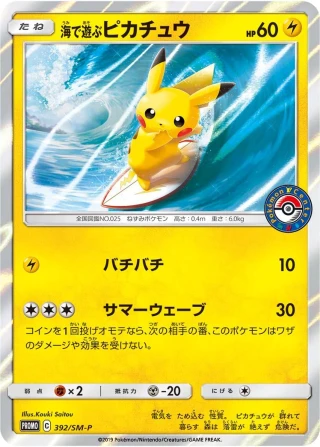
Sea-play Pikachu 392/SM-P promo card illustrated by Kouki Saitou

Sea-Play Pikachu 392/SM-P
¥96,295

Poncho Pikachu 203/XY-P is part of a two-card promo pairing (203–204), and our PSA 10 copy is currently listed at ¥363,775 — the second-highest Saitou card we carry, and a clear step below Mario Pikachu but still well ahead of the rest of the lineup. Pikachu 205/172 AR from s12a is a more recent alternate-art printing, currently listed at ¥99,086, and it shows how the same artist’s Pikachu work spans both older XY-era promos and current-generation alternate-art treatments. Sea-Play Pikachu 392/SM-P — Pikachu staged at the beach — rounds out the group at ¥96,295, sitting almost neck and neck with the s12a alternate art despite coming from a completely different era and promo family.

Two more Pikachu promos from Saitou’s catalog have moved through our vault and are currently out of stock: Manzai Pikachu 407/SM-P, a comedy-duo-themed Pikachu promo last listed at ¥154,500, and Tohoku Pikachu 260/SV-P, last listed at ¥41,066. Both are covered with their last-listed prices in the vault table below, and both show that Saitou’s Pikachu promos in our vault haven’t been limited to Mario Pikachu and poncho Pikachu — the smaller, regionally or thematically named promos have moved through our PSA 10 vault as well.

Beyond Pikachu: Shining Arceus, Magikarp, and More

Pikachu promos get the attention, but Saitou’s 694-card catalog covers a much wider range of Pokemon.

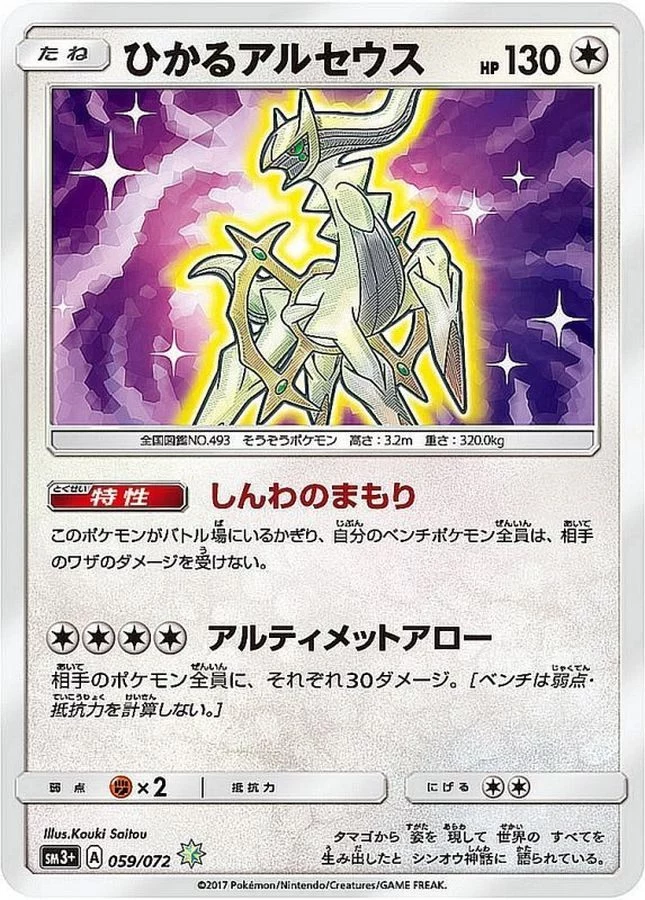
Shining Arceus H 059/072 card from SM3+ illustrated by Kouki Saitou
Shining Arceus H 059/072, SM3+

Shining Arceus H 059/072 from SM3+ is one of the two non-Pikachu cards we currently hold in PSA 10, listed at ¥41,199. The other is Magikarp 129/165 from SV2a — the “151” set — listed at ¥33,468, a comparatively affordable entry point into Saitou’s work. Both cards sit well below the Pikachu promo tier, which reflects a broader pattern across the catalog: Saitou’s promo Pikachu work commands a premium that the artist’s non-promo, in-set illustrations generally don’t reach.

Saitou’s wider NOTABLE credits, per Bulbapedia and Limitless, include cards we don’t currently stock: Ho-Oh S8a 004 and Lugia S8a 005 (both from the 25th anniversary era), Zacian S4a 136 and Zamazenta S4a 138, Radiant Charizard s12a 015, and the SM-P 208–211 hakama Pikachu promo series. These give a sense of the catalog’s range — Legendary box-art staples alongside more Pikachu promo work — even though we don’t have PSA 10 copies of them in stock. The Ho-Oh and Lugia pairing in particular is notable simply for the company it keeps: both were issued around the game’s 25th anniversary, placing Saitou’s name alongside some of the most recognizable Legendary artwork of that era, even without a graded copy on our shelves to show for it.

Taken together, the non-Pikachu side of the catalog underscores that Saitou isn’t a single-subject illustrator who happened to draw a famous Pikachu. Legendaries, box-art staples, and set-based alternate arts all appear across the 694-card body of work, with Pikachu promos simply forming the most commercially visible slice of it.

The Kouki Saitou Vault: Every Card We Carry

All 10 Kouki Saitou cards that have passed through our PSA 10 vault, ranked by price. Six are currently listed — three Pikachu promos, the s12a Pikachu AR, Shining Arceus, and Magikarp — and four more are archive references. The gap between the top and bottom of the table — roughly ¥1.66 million from highest to lowest — gives a sense of how much a single promo series can dominate an illustrator’s pricing within our vault.

# Carta Number / Set Status Precio
1 Mario Pikachu 293/XY-P In Stock ¥1,674,780
2 Poncho Pikachu 203/XY-P In Stock ¥363,775
3 Manzai Pikachu 407/SM-P Out of Stock — request via Quick Order last listed ¥154,500
4 Pikachu 205/172 AR s12a In Stock ¥99,086
5 Sea-Play Pikachu 392/SM-P In Stock ¥96,295
6 Espeon VMAX 189/S-P Out of Stock — request via Quick Order last listed ¥83,801
7 Shining Arceus H 059/072, SM3+ In Stock ¥41,199
8 Tohoku Pikachu 260/SV-P Out of Stock — request via Quick Order last listed ¥41,066
9 Magikarp 129/165, SV2a In Stock ¥33,468
10 Meowscarada ex SAR 096/073, SV1a Out of Stock — request via Quick Order last listed ¥18,993

Six of the ten are currently in stock. The four that show as out of stock are archive references with their last-listed prices shown — if you’re after one of them specifically, the Quick Order page is the fastest way to flag interest for when a copy comes back through the vault. Given how promo-driven Saitou’s catalog is, we don’t expect this exact list of ten to be static; new copies of these cards, and occasionally cards from the wider NOTABLE list above, surface in the Japanese secondary market and make their way into grading over time.

Beyond the Cards: Kouki Saitou’s Wider Work

The “¼ King!” name from the pre-Pokemon years covers more ground than a passing credit. Bulbapedia’s records of that period run from 1994 to 2003 and span manga-style illustration for game tie-in anthology publications on Xenogears, Thousand Arms, Super Robot Wars, Evangelion, and The King of Fighters — nearly a decade of licensed game illustration completed before the first Pokemon card.

Inside the franchise, the card catalog is only part of the credit list. Per Bulbapedia, Saitou contributed background illustration to Pokemon Mystery Dungeon: Explorers of Time and Darkness (2007) and Explorers of Sky (2009), worked on Pokemon Ranger: Shadows of Almia (2008) and Pokemon Ranger: Guardian Signs (2010), handled character design for the DS typing game Learn with Pokemon: Typing Adventure (2011), and contributed to the Pokemon Rumble series and Pokemon Picross.

Outside client work, Saitou develops an original fantasy world called Kortlek on a personal site, per Bulbapedia, and TSUTAYA has featured Saitou as one of the artists in its Legend Artist Collection line of original trading card supplies, complete with an official interview. Saitou also runs an X account under @Kouglof0513. Why this matters to collectors: the illustrator behind Mario Pikachu isn’t a single-format artist — the same hand has been drawing across the franchise’s spin-off games and Japan’s wider game-illustration world since the mid-1990s, which is part of why the promo catalog reads with so much range.

Where to Buy Kouki Saitou Cards from Japan

We source and grade Japanese PSA 10 singles out of Tokyo, and Kouki Saitou’s Pikachu promos are some of the most requested illustrator-specific cards we carry. The Mario Pikachu and poncho Pikachu listings below are the two currently available at the top of the vault.

Shop This Card
Mario Pikachu 293/XY-P, PSA 10
Currently listed at ¥1,674,780
Ships from Tokyo · Tracked delivery

View Product →

For the wider PSA 10 catalog, browse our full PSA 10 collection or the PSA 10 card list to filter by set and price. Our Japanese PSA 10 price guide and PSA 10 Pikachu buying guide cover how we price and grade across the wider vault, including cards outside Saitou’s catalog. For anything currently out of stock, the Quick Order page is the fastest way to build a request.

If Kouki Saitou’s promo Pikachu lineage is what brought you here, the Mario Pikachu and poncho Pikachu listings are the two to check first, since they’re the only two currently in stock at the top end of the vault. Everything else in the table above, in stock or not, can be tracked down through the same product pages and Quick Order request flow.

Preguntas frecuentes

Who is Kouki Saitou?

Kouki Saitou is a freelance Pokemon TCG illustrator, born May 13, 1973, who has illustrated 694 cards since debuting during the Aquapolis era. Saitou is best known for the Mario Pikachu and poncho Pikachu promo cards.

What is the Mario Pikachu card and why is it valuable?

Mario Pikachu 293/XY-P is a promo card from a four-card series (293–296) illustrated by Kouki Saitou. Our PSA 10 copy is currently listed at ¥1,674,780, the highest-priced Saitou card in our vault.

Is Kouki Saitou the same illustrator as Naoki Saito?

No. Kouki Saitou and Naoki Saito are different Pokemon TCG illustrators with similarly spelled names but separate card catalogs.

What other Pikachu cards has Kouki Saitou illustrated?

Beyond Mario Pikachu, Saitou’s Pikachu promo work includes poncho Pikachu 203/XY-P, Pikachu 205/172 AR from s12a, Sea-Play Pikachu 392/SM-P, Manzai Pikachu 407/SM-P, and Tohoku Pikachu 260/SV-P.

Are all Kouki Saitou promo cards in stock?

No. Of the 10 Saitou cards in our vault, 6 are currently in stock and 4 are currently out of stock, including Manzai Pikachu and Tohoku Pikachu. Out-of-stock cards can be requested through our Quick Order page.

Has Kouki Saitou illustrated any Legendary Pokemon cards?

Yes. Saitou’s catalog includes Ho-Oh S8a 004, Lugia S8a 005, Zacian S4a 136, and Zamazenta S4a 138, though we don’t currently hold graded PSA 10 copies of these Legendary cards in our vault.

What else has Kouki Saitou worked on?

Before Pokemon, Saitou illustrated game tie-in anthology artwork from 1994 to 2003 under the name “¼ King!”, on titles including Xenogears, Super Robot Wars, Evangelion, and The King of Fighters. Within the franchise, Bulbapedia records credits on the Pokemon Mystery Dungeon Explorers games, both Pokemon Ranger titles, Learn with Pokemon: Typing Adventure, the Pokemon Rumble series, and Pokemon Picross. Saitou also develops an original fantasy world called Kortlek on a personal site.

Teeziro Pokemon Cards: The Umbreon V Alt Art & Wild Force Trio

An illustrator whose pen name comes from a T-shaped intersection made it into the Pokemon TCG through a Charizard drawing that didn’t even win. It got him to the semifinals of the Pokemon Card Illustration Grand Prix, and he went on to make his official TCG debut with Lycanroc — the start of a career that now includes 86 official trading card printings.

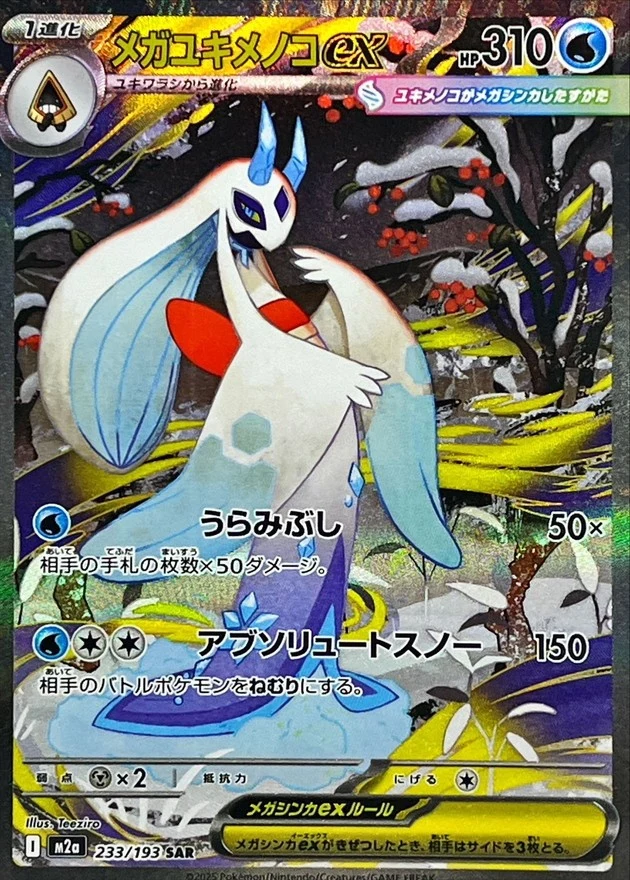
That artist is Teeziro, and four of his cards sit in our vault right now: one of the defining alt arts of Eevee Heroes, a Paradox Pokemon SAR from Wild Force, a Celebi V promo, and a Mega-era SAR. This guide covers who he is, his big-monster illustration specialty, and which of his cards we currently stock.

Key Takeaway

Teeziro illustrated the Eevee Heroes Umbreon V SR SA (085/069), currently listed at ¥112,884, and all three Wild Force paradox SAR chase cards — Gouging Fire, Walking Wake, and Raging Bolt (SV5K 093–095) — of which we stock Walking Wake ex SAR (094/071) at ¥13,184. He debuted on Lycanroc in Chilling Reign (S6H) after a Charizard entry took him to the semifinals of the Pokemon Card Illustration Grand Prix.

86
TCG Cards Illustrated

S6H
Debut Set (Lycanroc, Chilling Reign)

3
Wild Force Paradox SARs, All His

4
Teeziro PSA 10s in Our Vault

Prices reflect our current PSA 10 graded listings as of August 2026.

Who Is Teeziro?

Teeziro’s pen name comes from T-jiro — a reference to a T-shaped road intersection (T-字路) in Japanese — and the story behind how he became an official Pokemon TCG artist runs through a design contest rather than a traditional portfolio submission. His entry in the Pokemon Card Illustration Grand Prix, a Charizard piece, advanced him to the semifinal round. He didn’t take the top prize, but he went on to become an official Pokemon TCG illustrator.

His TCG debut came with Lycanroc, card 042 in Chilling Reign (S6H). Since then he’s built a catalog of 86 TCG printings and 27 cards in Pokemon Trading Card Game Pocket, plus art contributed to Pokemon HOME and to Pokemon’s 30th-anniversary publications.

In interviews cited by Bulbapedia, Teeziro is described as a specialist in large, imposing Pokemon. That specialty shows up in the two chase-card runs covered below: the Umbreon V special art and the three Wild Force Paradox Pokemon SARs. It’s a different lane from artists like kirisAki, whose best-known work centers on trainer portraits like Marnie and Iono, or Mitsuhiro Arita, the artist behind the original 1996 Charizard.

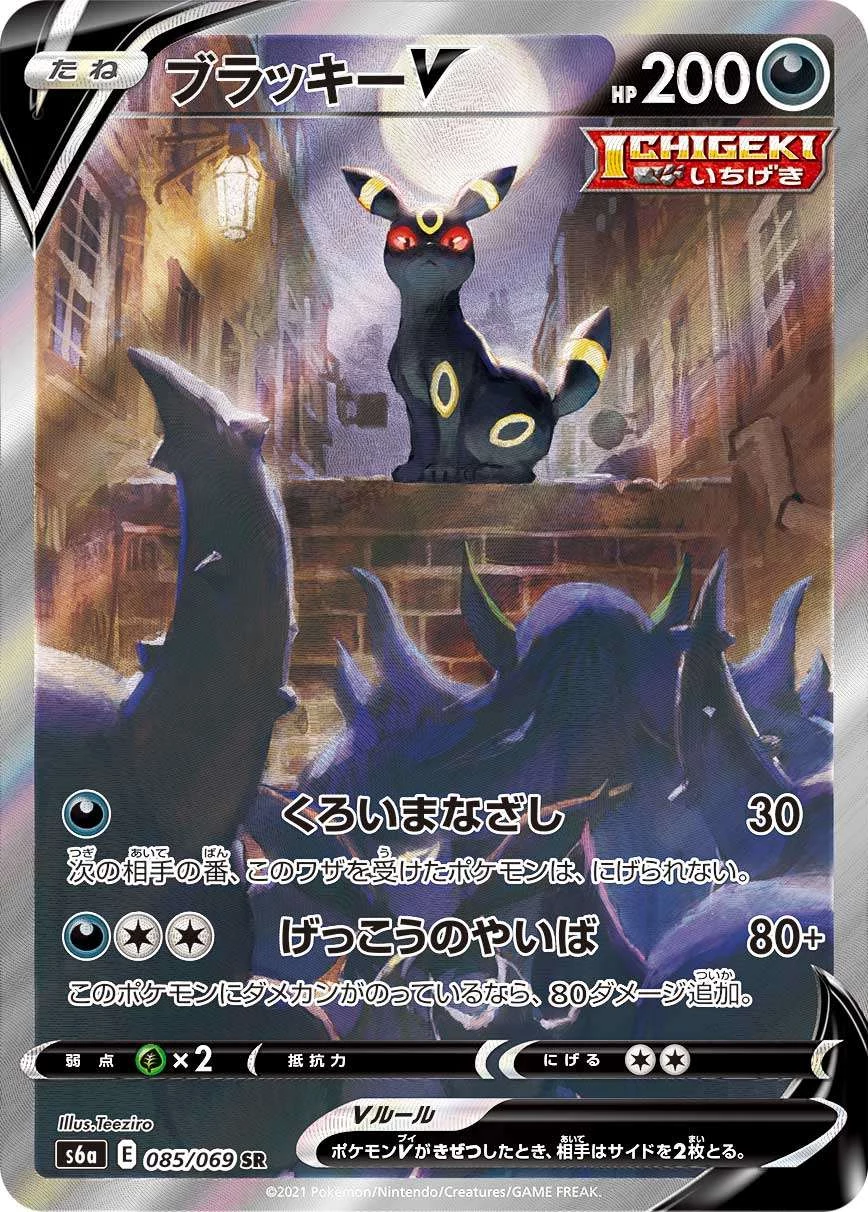
The Eevee Heroes Moment: Umbreon V SR SA

Umbreon V [085/069], Eevee Heroes

Teeziro’s signature single card is the Umbreon V SR Special Art at 085/069 from Eevee Heroes (S6a) — the same set our Eevee Heroes S6a card list and box guide covers in full. It shows Umbreon rendered large across a nocturnal scene, ring markings glowing.

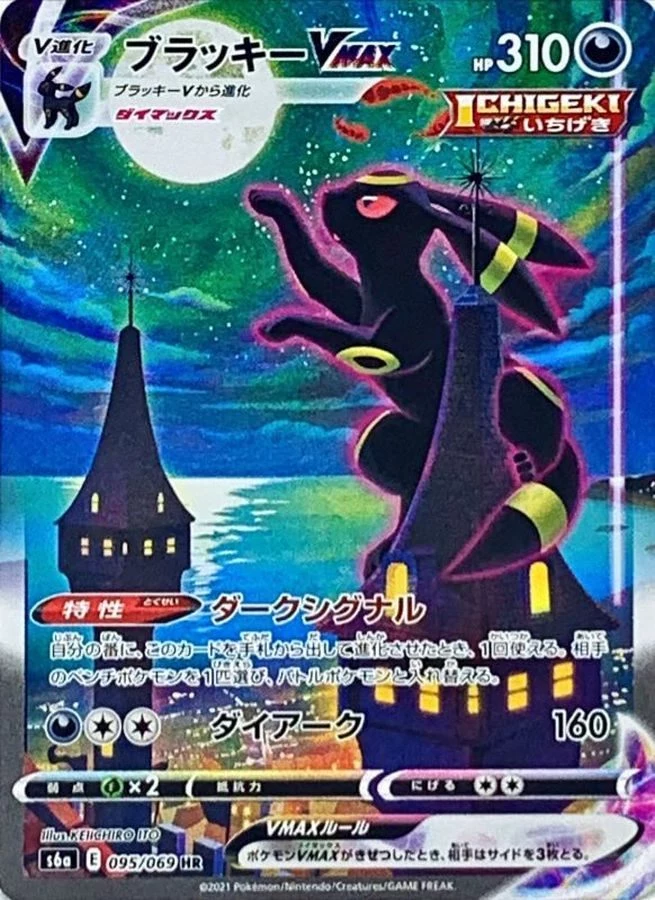
In the secret-rare run that closes out Eevee Heroes, the Umbreon V SA sits directly beneath the Umbreon VMAX HR SA at 095/069 — the card collectors know as «Moonbreon,» illustrated by KEIICHIRO ITO. Our full Moonbreon buying guide covers that card in detail. Teeziro’s Umbreon V is the SR tier’s own chase card in the same run. Our own top Umbreon cards guide ranks it alongside Moonbreon and the rest of the set’s best Umbreon prints.

Our PSA 10 copy of the Umbreon V SR SA is currently listed at ¥112,884.

PSA 10 Centerpiece
Umbreon V SR SA (085/069) — Eevee Heroes, illustrated by Teeziro
Currently listed at ¥112,884
Ships from Tokyo · Tracked delivery

View Product →

The Wild Force Paradox: All Three SARs, One Artist

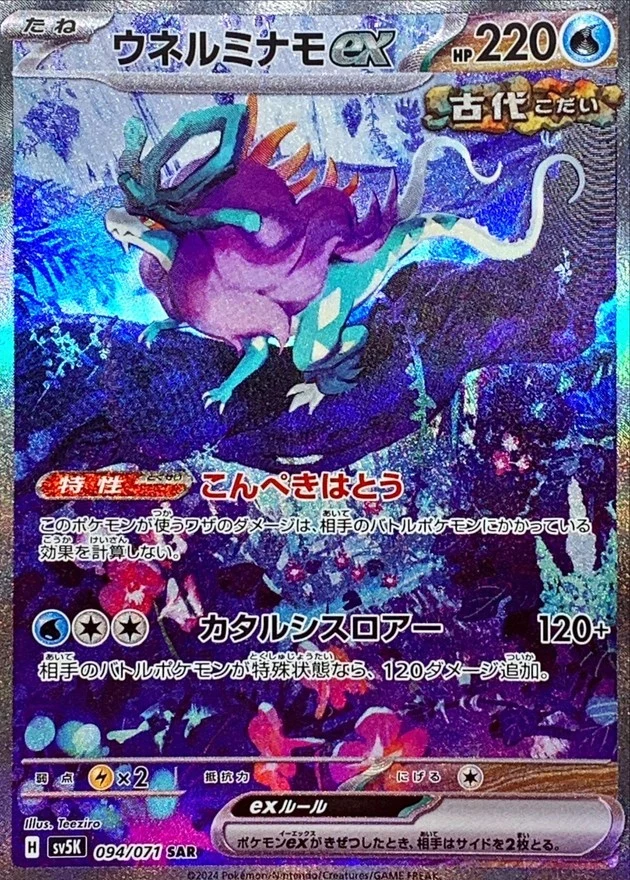
Walking Wake ex [094/071], Wild Force

Wild Force (SV5K) closes with a run of three Paradox Pokemon secret rares — and Teeziro illustrated all three of them himself. Gouging Fire ex SAR (093), Walking Wake ex SAR (094/071), and Raging Bolt ex SAR (095) form a consecutive block at the top of the set’s secret rare numbering, and the entire trio was illustrated by a single artist.

Each of the three cards shows a large, mid-motion Paradox Pokemon — in line with the big-monster specialty described in the interviews cited by Bulbapedia.

We currently hold one of the three: Walking Wake ex SAR (094/071), PSA 10, listed at ¥13,184. It’s the entry point into this trio for anyone who wants a Teeziro Paradox Pokemon in graded condition without chasing all three at once.

Handing a whole subset’s worth of secret rares to a single illustrator isn’t unique to Teeziro — our AKIRA EGAWA guide covers a similar pattern across a different run of gold URs. What sets Teeziro’s trio apart is the subject matter: three Paradox Pokemon across three separate cards.

Teeziro in Our Vault

Beyond the Eevee Heroes and Wild Force headliners, we hold two more Teeziro prints — a promo and a Mega-era secret rare — rounding out four graded copies of his work currently in stock.

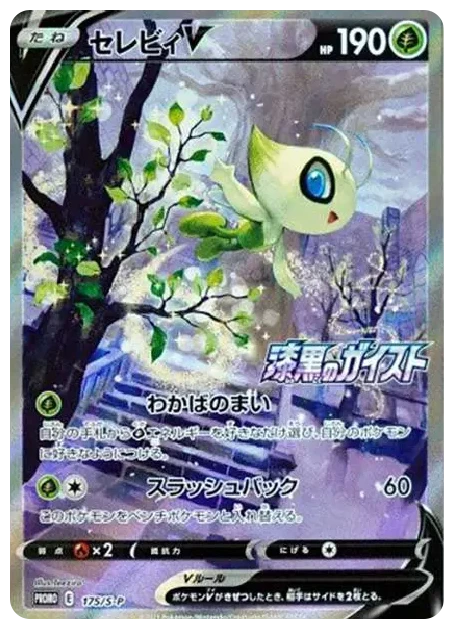
Celebi V [175/S-P], Promo

Celebi V (175/S-P) is a promo card, and it’s covered in more depth — alongside the rest of our mythical Pokemon lineup — in our best mythical Pokemon cards guide. Our PSA 10 copy is listed at ¥43,073.

Mega Froslass ex [233/193], M2a

Mega Froslass ex SAR (233/193) comes from the M2a set in the Mega era. Our PSA 10 copy is listed at ¥8,302 — the lowest-priced entry point into Teeziro’s graded catalog we currently stock.

Carta Colección PSA 10 Price
Umbreon V SR SA (085/069) Eevee Heroes (S6a) ¥112,884
Celebi V (175/S-P) Promo ¥43,073
Walking Wake ex SAR (094/071) Wild Force (SV5K) ¥13,184
Mega Froslass ex SAR (233/193) M2a ¥8,302

Four cards, four different release contexts — a mainline set SR, a purchase-campaign promo, a paradox-subset SAR, and a Mega-era high-class pack SAR — and all four illustrated by the same artist known for large, imposing Pokemon.

Where to Buy Teeziro Cards from Japan

We ship graded Japanese PSA 10 cards worldwide from Tokyo with tracked delivery. For the Teeziro prints covered in this guide:

Looking for Gouging Fire or Raging Bolt to complete the Wild Force paradox trio, or another Teeziro print not currently in stock? Flag it on our Quick Order page and we’ll notify you when a graded copy is confirmed.

Preguntas frecuentes

Who is Teeziro?

Teeziro is a Japanese Pokemon TCG illustrator whose pen name references a T-shaped road intersection. He became an official artist after a Charizard entry reached the semifinals of the Pokemon Card Illustration Grand Prix, debuted on Lycanroc in Chilling Reign (S6H), and has since illustrated 86 TCG cards plus 27 Pokemon Trading Card Game Pocket cards, along with art for Pokemon HOME and Pokemon’s 30th-anniversary publications.

What is Teeziro’s Umbreon V card from Eevee Heroes?

It’s the Umbreon V SR Special Art at 085/069 from Eevee Heroes (S6a). It sits directly beneath the Umbreon VMAX HR SA «Moonbreon» (095/069) by KEIICHIRO ITO in the same secret rare run. Our PSA 10 copy is listed at ¥112,884.

Did Teeziro illustrate all three Wild Force paradox SARs?

Yes. Gouging Fire ex, Walking Wake ex, and Raging Bolt ex — the three Paradox Pokemon secret rares in Wild Force (SV5K, cards 093–095) — were all illustrated by Teeziro. We currently stock a PSA 10 Walking Wake ex SAR (094/071) at ¥13,184.

What other Teeziro cards do you stock?

Beyond the Umbreon V and Walking Wake, we hold PSA 10 copies of the Celebi V promo (175/S-P, ¥43,073) and the Mega Froslass ex SAR (233/193, M2a, ¥8,302).

What kind of Pokemon does Teeziro usually illustrate?

Interviews cited by Bulbapedia describe him as a specialist in large, imposing Pokemon. That shows up in both the Umbreon V and the three Wild Force Paradox Pokemon covered in this guide.

Where can I buy graded Teeziro cards from Japan?

We ship PSA 10 graded Japanese cards worldwide from Tokyo with tracked delivery. See the product links above, browse our full PSA 10 collection, or flag an out-of-stock Teeziro card on our Quick Order page for restock notification.

kirisAki Pokemon Cards: Marnie’s Artist, Pokekyun Grails & a Trophy

One artist painted the S1H Marnie Supporter and one of the hardest trainer promos to obtain. kirisAki’s catalog runs from a mainstream Sword & Shield Supporter to a tournament-only trophy promo — and somewhere in between sits a 1st-edition Flareon we’ve had listed at over ¥800,000.

kirisAki debuted in the Pokemon TCG on a Tangela print during the Legendary Treasures era and has since illustrated 159 unique Japanese TCG cards plus 27 more for Pokemon Pocket, alongside key art for Pokemon Masters EX and Holowear designs in Pokemon UNITE. Marnie is the artist’s signature subject — she’s appeared in kirisAki’s hand across five separate Japanese sets. This guide walks the four kirisAki cards currently in our vault, plus one archived trophy piece that is not currently listed for sale but can’t be left out of the story.

Key Takeaway

Our PSA10 Flareon EX RR (1st edition, CP3 007/032) is currently listed at ¥805,688 — the most valuable kirisAki card we carry. Three more kirisAki pieces are also listed: the Marnie SR (S1H 068/060) at ¥101,723, the Jirachi (CP3 015/032) at ¥38,808, and the Marnie HR (S1H 072/060), the rainbow print of the same artwork, at ¥26,100. A fifth card, the Acerola Extra Battle Day trophy promo, is out of stock and shown here for reference only.

159
Unique TCG Illustrations

5
Marnie Sets Illustrated

¥805,688
Top Listed: Flareon EX

4
kirisAki Cards in Our Vault

Prices reflect our own PSA10 listings as of August 2026.

Who Is kirisAki?

kirisAki is a Japanese illustrator born February 5, who entered the Pokemon TCG during the Legendary Treasures era with a print of Tangela. Since that debut, the artist’s catalog has grown to 159 unique cards for the Japanese TCG, plus 27 additional illustrations for Pokemon Pocket.

kirisAki’s work extends well beyond the trading card itself. The artist has served as a key artist for Pokemon Masters EX and designed Holowear — the cosmetic outfit system — for four Pokemon in Pokemon UNITE: Charizard, Greninja, Gardevoir, and Gengar. In the TCG, kirisAki illustrates both Pokemon and Trainer cards, including the current-era regular Professor’s Research Supporter used throughout the Scarlet & Violet block.

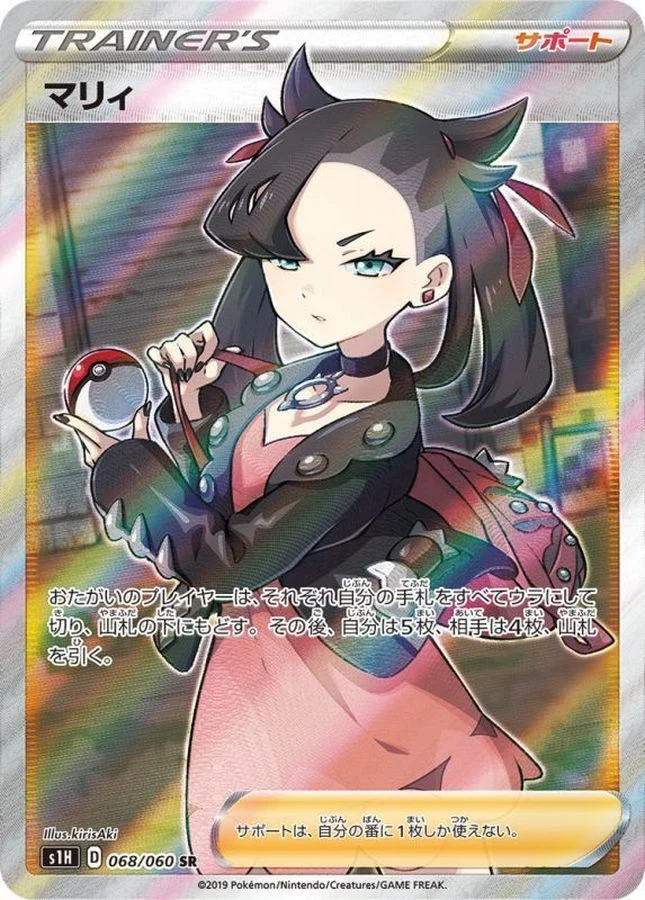
But if there’s one subject that defines kirisAki’s TCG output, it’s Marnie. The Team Yell leader has been illustrated by kirisAki across five separate Japanese sets — S1H, SD, S3a, S4a, and S8b — making kirisAki a recurring artist for Marnie across five sets. We cover two of those Marnie prints, both from the S1H base set, later in this guide.

Beyond Marnie, kirisAki’s notable-card list spans four eras of the Japanese TCG: Galarian Zapdos V (S8b 237/184, CSR), Iono (SV2D 096/071, SAR), Skyla (S4a 195/190, SR), Raihan (S7D 077/067, SR), Irida (S10P 077/067, SR), and Volo (S10a 084/071, SR) — a run of Trainer chase cards from Sword & Shield through the current Scarlet & Violet Japanese sets.

The Pokekyun Connection: Flareon EX & Jirachi

Two of kirisAki’s earliest and most valuable TCG prints share a set stamp: CP3, the Pokekyun Collection.

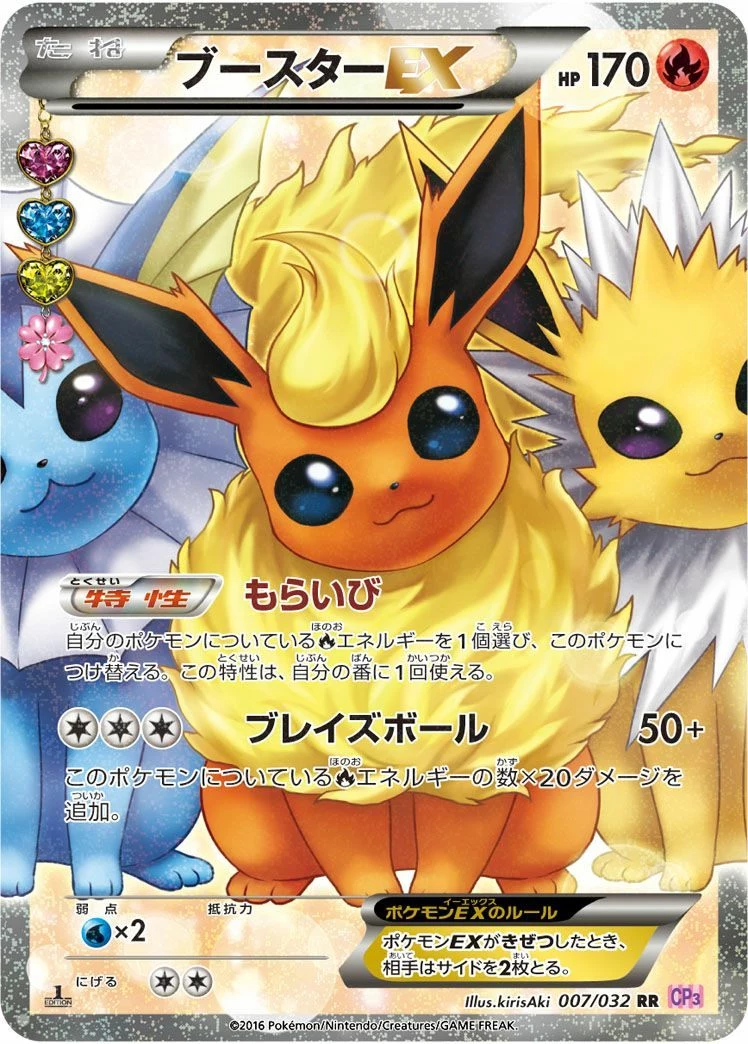
Flareon EX RR [007/032], CP3
Flareon EX RR 007/032, 1st edition CP3 — the grail centerpiece of kirisAki’s catalog

The Flareon EX RR (1st edition, CP3 007/032) is the grail centerpiece of this guide. Our PSA10 copy is currently listed at ¥805,688 — by far the most valuable kirisAki card we carry, and one of the highest-priced cards across our entire illustrator series. A 1st-edition stamp on an EX-era card is already a meaningful scarcity marker on its own; paired with a PSA 10 grade and kirisAki’s early, now sought-after artwork, it’s the card that anchors the artist’s entire secondary-market ceiling.

Flareon EX RR [007/032], CP3

Currently Listed
PSA10 Flareon EX RR, 1st Edition (CP3 007/032)
¥805,688
Ships from Tokyo · Tracked delivery

View Product →

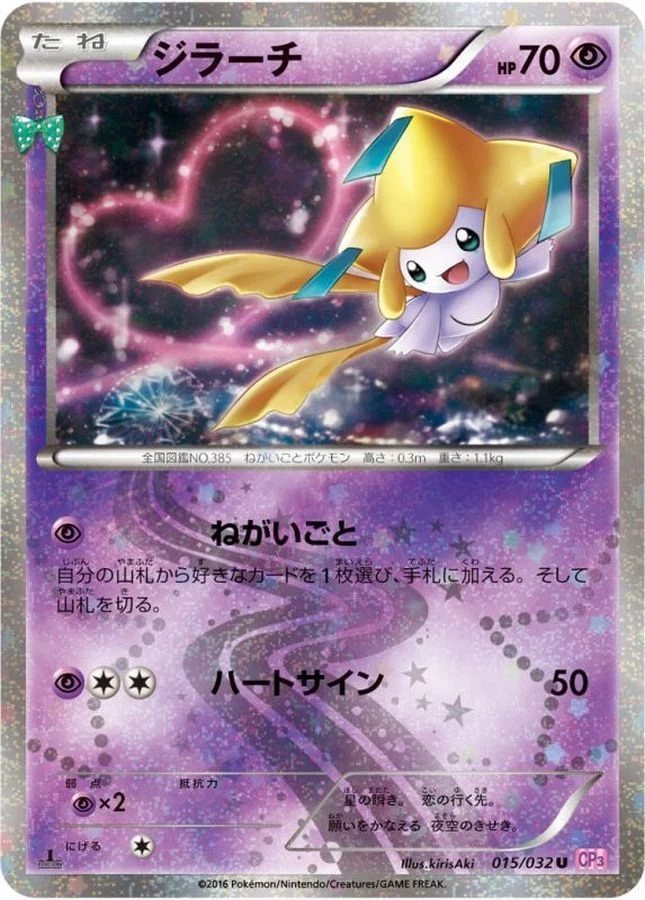
Jirachi U [015/032], CP3
Jirachi U 015/032, 1st edition CP3 — same pack, same artist, a very different price

The Jirachi U (1st edition, CP3 015/032) comes from the same pack and the same artist, but sits at a very different price point: our PSA10 copy is currently listed at ¥38,808. Jirachi is a Mythical Pokemon, and Mythical-tier cards from this era have their own collecting logic, which we cover in more depth in our guide to the best Mythical Pokemon cards, Celebi and Jirachi. Side by side, the Flareon and Jirachi from CP3 are a useful reminder of how much a card’s base Pokemon — not just the illustrator or the print run — can move the price.

The Trophy Tier: Acerola’s Extra Battle Day Promo

kirisAki’s trophy-tier piece of work is not currently listed for sale. The Acerola 395/SM-P Extra Battle Day promo carries brand-new kirisAki artwork — not a reprint of any earlier Acerola illustration — and it was never sold as a standalone product. It was awarded to winners at in-store Extra Battle Day tournament events held across October and November 2019, one of three randomized promo packs (395–397/SM-P) given out to that season’s event winners.

Our own copy is archived and out of stock, last listed at ¥3,965,500. It’s not currently listed for sale — we’re including it because it’s the clearest illustration of how far kirisAki’s range extends, from a mainstream S1H Supporter to a tournament-only promo that sits among the rarer Trainer-card prizes in the hobby. For the full story on this card and the rest of Acerola’s catalog, our Acerola cards guide covers the entire ladder, from an entry-level SAR up to this same trophy promo.

kirisAki in Our Vault

Here’s the complete kirisAki lineup covered in this guide, ordered by tier:

Carta Colección PSA10 price Status
Flareon EX RR 007/032 (1st ed.) CP3 ¥805,688 Currently listed
Marnie 068/060 SR S1H ¥101,723 Currently listed
Jirachi U 015/032 (1st ed.) CP3 ¥38,808 Currently listed
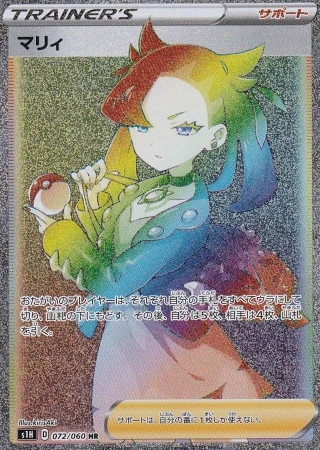
Marnie 072/060 HR S1H ¥26,100 Currently listed
Acerola 395/SM-P Extra Battle Day promo Tournament promo ¥3,965,500 Out of stock (archive)

Four of five are listed today; the Extra Battle Day trophy is the outlier, shown for reference rather than sale. If you’re building out a broader illustrator-focused collection, our guides to Hideki Ishikawa, Naoki Saito, and Teeziro cover three more artists with their own vaults of currently-listed PSA10 cards.

Where to Buy kirisAki Cards from Japan

We ship graded and sealed Japanese Pokemon product out of Tokyo with tracked delivery worldwide. Four kirisAki cards are currently listed: the Flareon EX RR at ¥805,688, the Marnie SR at ¥101,723, the Jirachi at ¥38,808, and the Marnie HR at ¥26,100. The Acerola Extra Battle Day promo is archived and not currently listed for sale; use Pedido rápido to flag interest if a similar tournament-only promo comes into our inventory.

To browse graded Japanese cards more broadly, our full PSA10 collection and the PSA10 card list cover everything currently in stock, restockable, and archived across sets. For general context on how Japanese PSA10 pricing works, our Japanese PSA10 Pokemon cards price guide is a good next stop.

Preguntas frecuentes

Who is kirisAki?

kirisAki is a Japanese Pokemon TCG illustrator, born February 5, who debuted in the game with a Tangela print during the Legendary Treasures era. The artist has since illustrated 159 unique Japanese TCG cards, 27 Pokemon Pocket cards, key art for Pokemon Masters EX, and Holowear designs for Charizard, Greninja, Gardevoir, and Gengar in Pokemon UNITE.

What’s the most valuable kirisAki Pokemon card?

Among cards currently listed in our inventory, the PSA10 Flareon EX RR (1st edition, CP3 007/032) at ¥805,688 is the most valuable kirisAki card we carry. The archived Acerola Extra Battle Day trophy promo (395/SM-P) was last listed higher, at ¥3,965,500, but it’s out of stock and not currently listed for sale.

What’s the difference between the Marnie SR and Marnie HR?

Both come from the S1H base set and share the same kirisAki artwork, but in different rarity slots: the SR (068/060) is currently listed at ¥101,723, and the HR (072/060), the rainbow-foil «Hyper Rare» version of the same illustration, is currently listed lower at ¥26,100.

Why isn’t the Acerola Extra Battle Day promo listed for sale?

It’s a tournament-only promo that was never sold as a standalone product — it was awarded to winners at in-store Extra Battle Day events in October and November 2019. Our copy is archived and out of stock, last listed at ¥3,965,500, and it is not currently listed for sale.

Where can I buy kirisAki Pokemon cards from Japan?

We currently list four kirisAki PSA10 cards — the Flareon EX RR, Marnie SR, Jirachi, and Marnie HR — and ship them from Tokyo with tracked delivery worldwide. Browse our full PSA10 collection or use Pedido rápido to request a restock alert on any out-of-stock kirisAki piece.

Hideki Ishikawa Pokemon Cards: The Munch Rowlet & 7-Eleven Pikachu

Search «Hideki Ishikawa Pokemon cards» and you’ll sometimes see his name attached to Lillie’s full art run. It’s a mix-up worth correcting up front: across his 138 Japanese prints (88 unique cards), Lillie doesn’t appear once. What Ishikawa actually built is a different kind of portfolio — two collaboration promo cards, a string of trainer full arts covering gym leaders, champions, and more, and a body of character design work that runs well outside the trading card aisle entirely.

He debuted in the Pokemon TCG with Magmar in the Generations expansion tied to the franchise’s 20th anniversary, and has since illustrated 88 mainline TCG cards plus 14 more for Pokemon Card Game Pocket. This guide walks through who he is, the two promo cards that anchor his highest values, the trainer full arts he’s actually known for, and the ten Ishikawa cards currently sitting in our PSA 10 vault.

Key Takeaway

Hideki Ishikawa has illustrated 88 Japanese TCG cards since his Magmar debut in the 20th anniversary Generations expansion — and despite a common online mix-up, none of them are Lillie. His highest-value work in our vault is the Rowlet Munch Exhibition promo (290/SM-P) at ¥412,412, followed by the Pikachu Seven-Eleven promo (001/S-P) at ¥247,406. We currently hold ten of his PSA 10 graded cards.

88
TCG Cards Illustrated

10
In Our Vault

¥412,412
Highest: Rowlet Munch Promo

0
Lillie Cards (Common Mix-Up)

Prices are our current PSA 10 listings as of August 2026.

Who Is Hideki Ishikawa?

Hideki Ishikawa (石川ヒデキ) entered the Pokemon Trading Card Game with Magmar, part of the Generations expansion released alongside Pokemon’s 20th anniversary — card number 014. From that debut, his TCG output has grown to 88 mainline Japanese cards, plus 14 additional illustrations for the mobile Pokemon Card Game Pocket, for a combined catalog of just over 100 pieces.

Outside the TCG, Ishikawa is a character designer and illustrator known for work on the Disgaea series and the Mega Man series, and he has also contributed character illustration work to Pokemon Duel. Within the TCG, a large share of his widely recognized cards are trainer full arts — portraits of gym leaders, champions, and team bosses rendered in the game’s premium full-art treatment, rather than Pokemon-focused artwork.

Correcting the Record

Ishikawa is sometimes credited online as the artist behind Lillie’s famous full art run. That’s incorrect — across his complete 138-print Japanese TCG catalog, Lillie does not appear. The trainer cards he’s actually known for include Cynthia (SM10 095/095 SR), Guzma (SM-P 396), Tate & Liza (SM7 103/096 SR), and Misty’s Favor (SM11 104/094 SR), covered below.

The Two Collaboration Promos: Rowlet’s Munch Tie-In & the Seven-Eleven Pikachu

The two most valuable Ishikawa cards in our vault are both promotional releases — cards issued outside a mainline expansion, numbered in Japan’s SM-P and S-P promo tracks rather than a standard set. Both carry collaboration names directly in their own card titles.

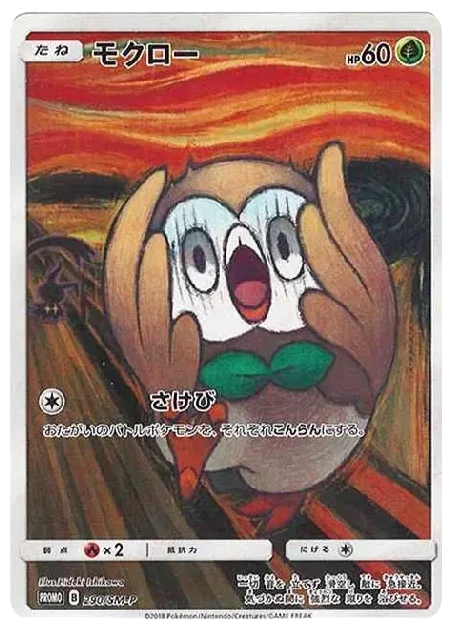
Rowlet Munch Exhibition promo 290/SM-P, illustrated by Hideki Ishikawa
Rowlet Munch Exhibition promo 290/SM-P — illustrated by Hideki Ishikawa

The first is Rowlet, promo card 290/SM-P, whose official name ties it to a Munch exhibition tie-in — a reference reflected directly in the card’s title within Japan’s promo numbering system. It’s currently the single highest-priced Ishikawa card we carry, listed at ¥412,412.

PSA 10 Grail
Rowlet Munch Exhibition Promo 290/SM-P (Hideki Ishikawa art)
Currently listed at ¥412,412
Ships from Tokyo · Tracked delivery

View Product →

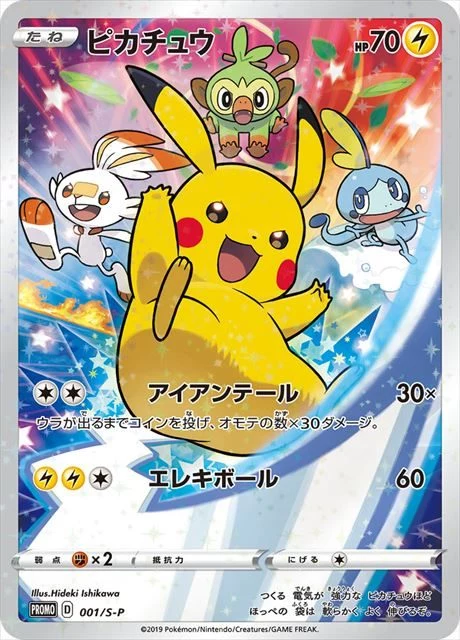
Pikachu Seven-Eleven promo 001/S-P, illustrated by Hideki Ishikawa
Pikachu Seven-Eleven promo 001/S-P — illustrated by Hideki Ishikawa

The second is Pikachu, promo card 001/S-P, whose name carries the Seven-Eleven convenience store chain directly — a retail collaboration promo, again reflected in the card’s own title rather than a standard set name. We currently list a PSA 10 copy at ¥247,406.

PSA 10 Grail
Pikachu Seven-Eleven Promo 001/S-P (Hideki Ishikawa art)
Currently listed at ¥247,406
Ships from Tokyo · Tracked delivery

View Product →

Both cards sit well above the rest of Ishikawa’s catalog in price. Both are promo-track cards outside a numbered expansion, with collaboration names carried in their own card titles.

Ishikawa’s Trainer Full Arts: Misty, Cynthia & Guzma

Beyond the two promos, the cards Ishikawa is known for among collectors are trainer full arts. Four stand out across his catalog: Misty’s Favor, Cynthia, Guzma, and Tate & Liza.

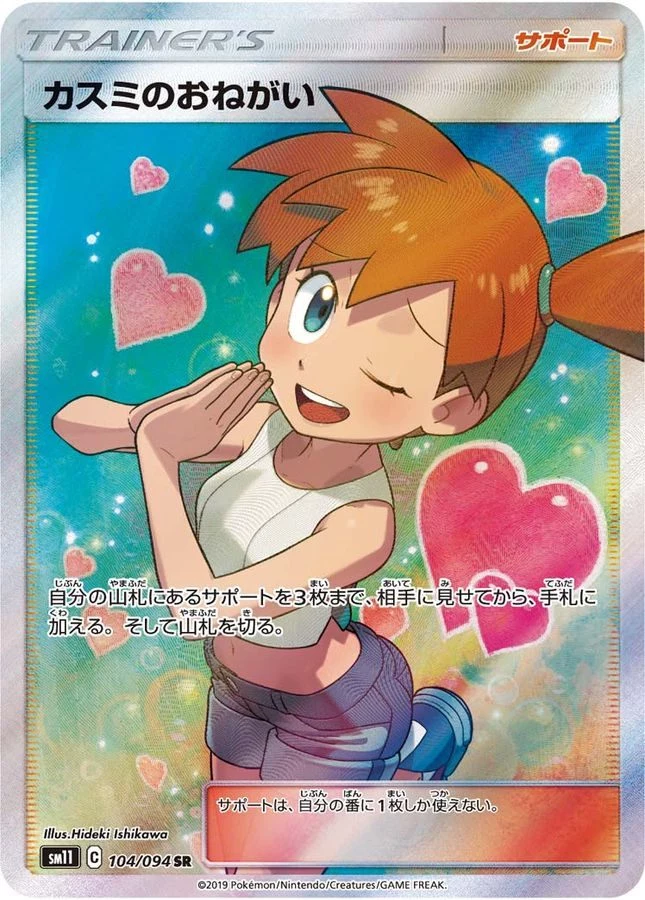
Misty's Favor 104/094 SR, illustrated by Hideki Ishikawa
Misty’s Favor 104/094 SR, Miracle Twin (SM11) — illustrated by Hideki Ishikawa

Misty’s Favor (104/094 SR), from the Miracle Twin expansion, is the one we currently hold in stock. Our PSA 10 copy is listed at ¥60,976. We’ve covered this card and the rest of the Misty lineup, including a full price comparison against current market asks, in our dedicated Misty cards guide.

PSA 10 Grail
Misty’s Favor SR 104/094 — Miracle Twin (Hideki Ishikawa art)
Currently listed at ¥60,976
Ships from Tokyo · Tracked delivery

View Product →

The other three trainer full arts round out the catalog but aren’t currently in our stock, so they’re covered here for reference rather than as purchase links: Cynthia (095/095 SR) from Double Blaze (SM10), the Sinnoh region champion’s full art; Guzma (promo 396/SM-P), the Team Skull leader’s promo card release; and Tate & Liza (SM7 103/096 SR), Hoenn’s gym leader duo. All three sit alongside Misty’s Favor as the trainer full arts most associated with Ishikawa’s TCG work.

Ishikawa in Our Vault: All Ten Cards

Beyond the two promos and Misty’s Favor, our stock includes seven more Ishikawa-illustrated PSA 10 cards, spanning Legendary full arts, secret rares, and additional trainer supporters. Here’s the complete list, highest to lowest price:

Carta Colección Price (JPY)
Rowlet Munch Exhibition Promo 290/SM-P Promo ¥412,412
Pikachu Seven-Eleven Promo 001/S-P Promo ¥247,406
Solgaleo & Lunala GX 063/049 SR Dream League (SM11b) ¥86,973
Misty’s Favor 104/094 SR Miracle Twin (SM11) ¥60,976
Rayquaza VMAX 252/184 CSR VMAX Climax (S8b) ¥49,191
Jasmine (Mikan) 058/052 SR SM8a ¥19,961
Friends in Sinnoh 247/172 SR VSTAR Universe (s12a) ¥17,810
Schoolgirl 078/067 SR Skyscraping Perfect (S7D) ¥13,816
Karen’s Conviction 081/070 SR S5a ¥13,699
Solgaleo & Lunala GX 020/049 RR Dream League (SM11b) ¥13,349
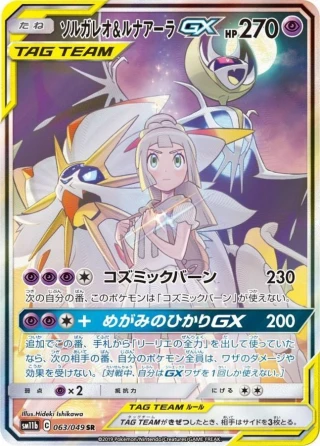
Solgaleo & Lunala GX 063/049 SR, illustrated by Hideki Ishikawa

Solgaleo & Lunala GX 063/049 SR
¥86,973

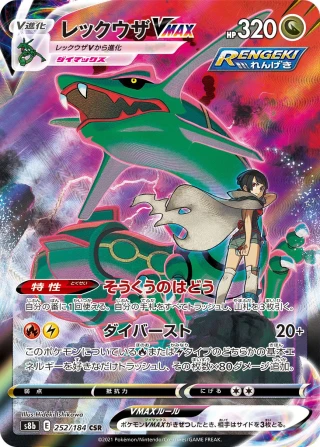
Rayquaza VMAX 252/184 CSR, illustrated by Hideki Ishikawa

Rayquaza VMAX 252/184 CSR
¥49,191

The Rayquaza VMAX CSR is part of the broader Rayquaza VMAX card family — see our full Rayquaza VMAX cards guide for how it compares against the set’s other Rayquaza printings. And for the graded-card side of the hobby more broadly — how PSA 10 pricing works, what drives premiums, and how to evaluate a listing — our Japanese PSA 10 Pokemon cards price guide covers the fundamentals.

Ishikawa’s catalog sits alongside two other illustrators we’ve profiled from the same generation of Japanese TCG artists: see our Naoki Saito cards guide and kirisAki cards guide for more of the artists behind our PSA 10 vault. Misty’s Tears, one of the more frequently misdescribed cards in the hobby, was illustrated by a different artist entirely — Ken Sugimori, covered in our separate Ken Sugimori cards guide.

Where to Buy Hideki Ishikawa Cards from Japan

We ship graded Japanese singles out of Tokyo with tracked delivery worldwide. For the cards in this guide specifically:

Browse the full graded lineup on our PSA 10 collection or the visual PSA 10 card list, or build a mixed order — including Cynthia, Guzma, or Tate & Liza restock requests — on our Quick Order page.

Preguntas frecuentes

Did Hideki Ishikawa illustrate Lillie’s full art cards?

No. This is a common mix-up online, but across his complete 138-print Japanese TCG catalog, Lillie does not appear. The trainer full arts he’s actually known for are Misty’s Favor (SM11 104/094 SR), Cynthia (SM10 095/095 SR), Guzma (SM-P 396), and Tate & Liza (SM7 103/096 SR).

What was Hideki Ishikawa’s first Pokemon TCG card?

Magmar, card 014, from the Generations expansion released alongside Pokemon’s 20th anniversary. Since that debut he has illustrated 88 mainline Japanese TCG cards plus 14 more for Pokemon Card Game Pocket.

What is the Rowlet Munch Exhibition promo?

It’s a promotional Rowlet card, numbered 290/SM-P in Japan’s promo track and illustrated by Hideki Ishikawa. Its official name ties it to a Munch exhibition collaboration. It’s the most valuable Ishikawa card in our vault, currently listed at ¥412,412 in PSA 10.

What is the Pikachu Seven-Eleven promo?

A promotional Pikachu card, numbered 001/S-P and illustrated by Hideki Ishikawa, whose name carries the Seven-Eleven convenience store chain — a retail collaboration promo. We currently list a PSA 10 copy at ¥247,406.

Does Hideki Ishikawa do work outside the Pokemon TCG?

Yes. He’s a character designer and illustrator known for work on the Disgaea series and the Mega Man series, and has contributed character illustration work to Pokemon Duel.

Where can I buy PSA 10 Hideki Ishikawa cards from Japan?

We currently hold ten PSA 10 Ishikawa cards, led by the Rowlet Munch Exhibition promo (¥412,412) and the Pikachu Seven-Eleven promo (¥247,406), plus Misty’s Favor SR (¥60,976) and seven more. All ship from Tokyo with tracked delivery. Browse the full lineup on our PSA 10 collection page or request a restock on cards not currently in stock via our Quick Order page.

AKIRA EGAWA Pokemon Cards: All Four VSTAR Universe Gold URs & SARs

Four gold URs in one set. One illustrator.

When s12a VSTAR Universe shipped its lineup of full-gold ultra rares, all four — numbers 259 through 262 — came out of the same artist’s hand: Akira Egawa. That’s an unusual concentration for a single set’s top rarity tier, and it sits alongside a résumé that includes official booster pack artwork for four Sword & Shield expansions and a judging seat on Pokemon’s own illustration contest. We hold two of those four gold URs in our Tokyo vault right now, plus six more Egawa cards spanning Scarlet & Violet SARs and a promo VMAX.

This guide covers who Egawa is, the s12a UR sweep, a fun split-credit story involving the most famous Umbreon in the game, and every Egawa-illustrated PSA 10 we currently stock.

Key Takeaway

Akira Egawa illustrated all four VSTAR Universe gold URs (259–262). We currently hold two — Origin Forme Palkia VSTAR UR at ¥34,528 and Arceus VSTAR UR at ¥46,670 — plus six more Egawa cards, topped by a Charizard ex SAR at ¥79,001. Egawa also illustrated the standard Umbreon VMAX (s6a 048); the alt-art «Moonbreon» (s6a 095) is a different artist’s work, and we carry that one too.

4
s12a Gold URs by Egawa

2
Held in Our Vault

8
Egawa Cards We Stock

¥79,001
Top Piece: Charizard ex SAR

Prices reflect current listings on our PSA 10 collection, checked August 2026. All cards below are graded PSA 10 and in stock.

Who Is Akira Egawa?

Akira Egawa’s Pokemon TCG credit debuted in 2019 with Riolu in Unified Minds. Bulbapedia identifies Egawa as a second-generation Pokemon player — someone who grew up with the games rather than discovering them as an adult hire.

Egawa’s international card count sits at 89 (114 in Japan), plus 36 illustrations for Pokemon TCG Pocket. That’s a substantial body of work, but the credential that separates Egawa from most set illustrators is pack art: Egawa painted the official booster pack artwork for four Sword & Shield expansions — Battle Styles, Chilling Reign, Evolving Skies, and Fusion Strike. Pack art is a different assignment than a single card; it’s the image that represents an entire set on shelves worldwide.

In 2022, Egawa served as a judge for the official Pokemon Card Illustration Contest — the evaluating side of the craft, not just the producing side. Outside Pokemon, Egawa has worked on Fate/Grand Order, Fire Emblem Heroes, and the One Piece Card Game, three of the biggest character-driven franchises in Japanese gaming and TCG.

Egawa’s Pokemon catalog runs from ultra-premium golds down to everyday VMAX promos: the s12a VSTAR Universe URs covered below, a Charizard ex UR in the base SV3 set, an Umbreon VMAX in s6a and again in S8b, a Pikachu VMAX distributed as an S-P promo, a Mewtwo V-UNION, and Special Art Rares for Team Rocket’s Moltres ex, Hydreigon ex, Mega Latias ex, Mega Hawlucha ex, and Blaziken VMAX.

What stands out across that list is range. Pack art requires a composition that works at a glance from across a store shelf; a V-UNION spans four physical cards that have to line up into one image when placed side by side; a Special Art Rare needs a full-bleed scene built around a single Pokemon with no card frame to anchor it. Egawa has shipped credits in all three formats, plus the standard card frame and the gold UR treatment covered next — which is a wider range of assignment types than most illustrators get inside a single generation of sets.

The s12a Sweep: All Four VSTAR Universe Gold URs

VSTAR Universe (s12a) is one of the most chased sets in modern Japanese Pokemon TCG, and its four gold-foil ultra rares — card numbers 259 through 262, the top of the set’s rarity ladder — were all painted by Egawa.

Origin Forme Palkia VSTAR UR 259/172, VSTAR Universe

Origin Forme Palkia VSTAR UR 259/172
¥34,528

Arceus VSTAR UR 262/172, VSTAR Universe

Arceus VSTAR UR 262/172
¥46,670

We currently hold two of the four: the Origin Forme Palkia VSTAR UR (259/172) at ¥34,528, and the Arceus VSTAR UR (262/172) at ¥46,670. Both are PSA 10, both are gold-foil URs from the same four-card Egawa block, and both are in the same collection you’ll want to browse if you’re building a VSTAR Universe UR run.

If Origin Forme is the angle you’re chasing, our Origin Forme Palkia VSTAR guide and Origin Forme Dialga VSTAR guide cover the wider Origin Forme lineup across sets in more depth.

Gold URs sit at the very top of the rarity chart in VSTAR Universe, a Sword & Shield era high-class pack, above SAR and above the standard VSTAR treatment — a full gold-foil card face reserved for a small handful of slots per set. Having one illustrator credited across the entire tier means every gold UR pull from a VSTAR Universe box carries the same visual signature, whether it lands as a Palkia, an Arceus, or one of the other two entries in the quartet. For collectors building toward a complete UR run, that consistency is part of the appeal — you’re not mixing artists across the chase tier the way most sets require.

One Umbreon VMAX, Two Illustrators

Umbreon VMAX HR alt art 095/069, s6a Eevee Heroes (Moonbreon)
Umbreon VMAX HR 095/069, s6a — the alt-art «Moonbreon,» illustrated by Keiichiro Ito, not Egawa

Here’s a split credit that trips up a lot of collectors. The Japanese Eevee Heroes set (s6a) shipped Umbreon VMAX in two forms: the standard VMAX at card number 048, and the alternate-art «Moonbreon» at 095/069 — among the most chased modern Pokemon cards, and the same artwork that appears as a distinct printing in the English Evolving Skies set at 215/203. They look like they should share an artist. They don’t.

Egawa illustrated the regular 048, the standard-frame VMAX that most s6a boosters produce. The 095 alt art — Moonbreon — was illustrated by Keiichiro Ito, and it’s the card Ito is best known for. Two different artists, two very different market tiers, one Pokemon, one set.

We don’t currently stock the regular Egawa 048, but we do hold the Ito alt art: Umbreon VMAX HR 095/069, graded PSA 10, at ¥920,614. If Moonbreon is what brought you here, our full Moonbreon card guide covers its background, print history, and grading notes in detail, and the card itself is listed at /products/psa10-2641. For the wider Evolving Skies checklist it comes from, see our Eevee Heroes (s6a) card list and box guide.

It’s worth flagging this pairing for anyone assembling an Egawa collection specifically: a checklist search for «Umbreon VMAX» pulls both cards, and only one of them is Egawa’s. Ito’s TCG output is narrower than Egawa’s — a mix of standard rares and alt rares rather than gold URs or box art — and Moonbreon is the single card his catalog is built around. Egawa’s version of the same Pokemon is the quieter, standard-frame release from the same set. Knowing which is which before you buy saves a mislabeled search later.

Akira Egawa in Our Vault: All Eight Cards

Every Egawa-illustrated card we currently hold, graded PSA 10 and ranked by price:

Carta Colección Precio Link
Charizard ex SAR 349/190 SV4a Shiny Treasure ex ¥79,001 Vista
Arceus VSTAR UR 262/172 s12a VSTAR Universe ¥46,670 Vista
Team Rocket’s Moltres ex SAR 124/098 SV10 ¥40,226 Vista
Origin Forme Palkia VSTAR UR 259/172 s12a VSTAR Universe ¥34,528 Vista
Hydreigon ex SAR 133/106 SV8 ¥17,190 Vista
Pikachu VMAX 265/S-P Promo ¥16,480 Vista
MEGA Latias ex SAR 088/063 M1S Mega Symphonia ¥14,419 Vista
Mega Hawlucha ex SAR 239/193 M2a ¥8,236 Vista
Charizard ex SAR 349/190, SV4a Shiny Treasure ex

Charizard ex SAR 349/190
¥79,001

Team Rocket's Moltres ex SAR 124/098, SV10

Team Rocket’s Moltres ex SAR 124/098
¥40,226

The Charizard ex SAR (349/190) from SV4a Shiny Treasure ex is the highest-priced Egawa card in the vault at ¥79,001 — a Special Art Rare of the franchise’s flagship Pokemon, which makes it the natural centerpiece if you’re picking one Egawa card to own. From there the lineup runs through a modern Team Rocket’s Moltres ex SAR, the two VSTAR Universe gold URs, and a run of SARs and promos covering Hydreigon, Mega Latias, Pikachu, and Mega Hawlucha — eight cards across six sets plus a promo, one consistent illustrator credit across all of them.

Where to Buy Akira Egawa Cards from Japan

All eight cards above are graded PSA 10 and shipping from our Tokyo inventory. If you want the single strongest piece in the lineup, the Charizard ex SAR is the one to start with.

Top Pick
Charizard ex SAR 349/190 (SV4a), PSA 10
¥79,001
Ships from Tokyo · Tracked delivery

View Product →

For the full graded catalog beyond Egawa’s work, browse our PSA 10 collection or the complete PSA 10 card list hub. For mixed orders across singles and sealed product, our Quick Order page is the fastest route.

Egawa’s work sits alongside other illustrators we track closely — see our guides to Naoki Saito, Teeziro, and Mitsuhiro Arita for more artist-driven picks from our current inventory.

Preguntas frecuentes

Which cards did Akira Egawa illustrate in s12a VSTAR Universe?

All four gold ultra rares in the set, numbered 259 through 262. We currently hold two of them: the Origin Forme Palkia VSTAR UR (259/172) at ¥34,528 and the Arceus VSTAR UR (262/172) at ¥46,670.

Did Akira Egawa illustrate the Moonbreon alt art?

No. Egawa illustrated the standard Umbreon VMAX (s6a 048). The alternate-art «Moonbreon» (s6a 095) was illustrated by Keiichiro Ito. We stock the Ito alt art, graded PSA 10, at ¥920,614.

What official booster pack artwork has Akira Egawa illustrated?

Booster pack artwork for four Sword & Shield era expansions: Battle Styles, Chilling Reign, Evolving Skies, and Fusion Strike.

Which Akira Egawa card is the most valuable in our current stock?

The Charizard ex Special Art Rare (349/190) from SV4a Shiny Treasure ex, graded PSA 10, at ¥79,001.

Has Akira Egawa worked outside the Pokemon Trading Card Game?

Yes. Egawa has also illustrated for Fate/Grand Order, Fire Emblem Heroes, and the One Piece Card Game, and served as a judge for the 2022 Pokemon Card Illustration Contest.

How many Akira Egawa cards do you currently stock?

Eight, all graded PSA 10, spanning s12a VSTAR Universe, SV4a, SV8, SV10, M1S, and M2a, plus one S-P promo.

Naoki Saito Pokemon Cards: Festa Pikachu, CP2 Legends & Modern SARs

One artist, one promo card, and a price tag over half a million yen.

Naoki Saito has been drawing Pokemon cards since the HeartGold & SoulSilver era, and his name attaches to some of the most sought-after promos and alternate arts in the game — a Pikachu promo from Pokemon Card Game Festa 2017, a pair of CP2 legendary birds and beasts, and SARs he’s still illustrating today. His portfolio runs to 250 TCG cards, and ten of them currently sit in our PSA 10 vault.

This guide covers who Saito is, the eras his work spans, and exactly what we’re holding — card by card, number by number — so you know what you’re looking at if you own or are considering one of his cards.

Key Takeaway

Naoki Saito has illustrated 250 Pokemon TCG cards since the HGSS era. Our PSA 10 vault holds ten of them, led by the Pikachu Festa 2017 promo at ¥537,454 and the Latios CP2 alternate art at ¥115,092. The rest range from ¥8,446 to ¥100,940, spanning his vintage CP2/CP5 work through SARs he’s still producing in 2025–26.

10
Cards in Our PSA 10 Vault

¥537,454
Vault Centerpiece (Festa Pikachu)

250
TCG Cards Illustrated

2026
Still Actively Illustrating

Prices reflect our current PSA 10 listings as of August 2026 and are quoted in Japanese yen.

Who Is Naoki Saito?

Naoki Saito (さいとうなおき) was born in 1982 in Yamagata Prefecture and graduated from Tama Art University. Before working on the Pokemon TCG full time, he was employed at Konami. He moved into freelance illustration and began contributing to the card game during the HeartGold & SoulSilver era.

Since then his card count has grown to 250 TCG cards plus 37 TCG Pocket cards — 334 Japanese-language entries in the Limitless database. He’s also contributed artwork to Duel Masters outside of Pokemon.

Saito’s work isn’t limited to individual cards. He painted map and city artwork tied to the Pokemon Black & White era, designed Trainer characters for the Sun & Moon era, and contributed art to Pokemon Ranger: Guardian Signs. He also runs the YouTube channel @saitonaoki2 — and he’s still actively illustrating for the TCG heading into 2026.

That range — individual card illustration, full map artwork for a mainline era, Trainer character design, and a spin-off game credit — is unusual even among prolific TCG artists, most of whom stay within card illustration alone. It’s also part of why his catalog spans such a wide stretch of the hobby: a collector who only knows him from a single alternate art is often unaware he also had a hand in the visual identity of an entire generation’s marketing.

Signature Works

A few cards define Saito’s reputation among collectors more than the rest of his catalog:

  • Pikachu, SM-P 061 — the Pokemon Card Game Festa 2017 promo, and the highest-priced Saito card in our vault.
  • Latios, CP2 019/027 and Zekrom, CP2 009/027 — two of the legendary alternate-art rares from the CP2 “Legendary Shine Collection” set, both frequently cited alongside his best vintage work.
  • Arceus, CP5 036/036 — a first-edition alternate art from the CP5 promo set, closing out his 2015–2016 concept-pack era run.
  • Mimikyu VMAX, S8b 234/184 CSR — his character special art rare from the modern VMAX era, proof his output didn’t stop after the vintage promos.
  • Hilda, SV11W 173/086 SAR and Canari, M2a 219/193 SR — his most recent work, both from the 2025–26 window and both still active in current sets.

That spread — a 2017 Festa promo, two 2015–2016 concept-pack era legendary alternate arts, a modern VMAX special art rare, and two cards from the current MEGA era — is what makes Saito’s catalog worth tracking rather than treating as a one-card artist.

Saito in Our PSA 10 Vault

All ten Naoki Saito cards currently in our PSA 10 inventory, ranked by price:

Carta Set / Number Precio
Pikachu, Festa 2017 promo SM-P 061 ¥537,454
Latios R CP2 019/027 ¥115,092
Pikachu SM-P 200 ¥100,940
Zekrom CP2 009/027 ¥97,849
Arceus, 1st Edition CP5 036/036 ¥58,504
Mimikyu VMAX CSR S8b 234/184 ¥42,328
Vaporeon (Showers) EX, promo XY-P 194 ¥34,299
Hilda SAR SV11W 173/086 ¥26,158
Meowth MM 052/165 ¥13,905
Canari SR M2a 219/193 ¥8,446

The spread across this table roughly mirrors Saito’s career — a Festa 2017 promo at the very top, two CP2-era legendary alternate arts in the upper tier, a first-edition CP5 promo, a modern VMAX special art rare in the middle, and his two most recent SARs closer to the entry point.

Two cards outside the top four are worth flagging on their own. The Vaporeon (Showers) EX promo, XY-P 194, is currently listed at ¥34,299 and represents a different era again — the XY block promo run, distinct from both the CP2 legendaries and the modern VMAX/SAR cards. And the Meowth card, MM 052/165, at ¥13,905, carries his name at the lower end of the table and remains listed.

Top Picks From the Vault

Pikachu SM-P 061, Festa 2017 promo PSA 10 graded card
Pikachu SM-P 061, Festa 2017 promo — the centerpiece of our Saito holdings

The Pikachu SM-P 061 is a Pokemon Card Game Festa 2017 promo, currently listed at ¥537,454 — roughly five times the next card on this list. This is currently the only PSA 10 copy in our vault.

Latios R 019/027, CP2 Legendary Shine Collection alternate art PSA 10 card

Latios R, CP2 019/027
¥115,092

Zekrom 009/027, CP2 Legendary Shine Collection alternate art PSA 10 card

Zekrom, CP2 009/027
¥97,849

The Latios and Zekrom alternate arts both come from the same CP2 promo run and are usually discussed as a pair — full-scene legendary artwork with none of the standard card-frame furniture. Latios currently runs slightly ahead of Zekrom at ¥115,092 versus ¥97,849, and both sit comfortably in the six-figure-to-near-six-figure range that defines Saito’s CP2 output. If you’re building out a legendary-focused collection, we’ve covered Latios and its counterpart Latias in more depth in our Latias & Latios card guide, and Zekrom’s full printing history — including the GX-era cards — in our Zekrom card value guide.

Rounding out the upper tier, Pikachu SM-P 200 is a second Saito Pikachu promo, distinct from the Festa card, currently listed at ¥100,940. Two Pikachu promos from the same illustrator sitting within the top three of his vault holdings says something about how consistently his Pikachu work has held value across different eras of distribution.

Vintage CP2/CP5 vs His Active 2025–26 Work

Saito’s career splits cleanly into two windows in our inventory: the CP2/CP5 concept-pack era of 2015–2016, and his current run of SARs from 2025–26.

Era Cards Price range
CP2 / CP5 promo era (2015–2016) Latios CP2 019/027, Zekrom CP2 009/027, Arceus CP5 036/036 1ED ¥58,504–¥115,092
2025–26 active work Hilda SAR SV11W 173/086, Canari SR M2a 219/193 ¥8,446–¥26,158
Arceus CP5 036/036 first edition promo PSA 10 card, illustrated by Naoki Saito
Arceus, CP5 036/036 1st Edition — the closing card of Saito’s early promo run

The vintage side is complete — Latios, Zekrom, and Arceus are all promo cards from sets that closed out over a decade ago, so what exists is what exists. That fixed supply is a large part of why they price above his current work. For the rest of Arceus’s printing history across other sets and rarities, see our Arceus card value guide.

The 2025–26 side is the opposite situation: Hilda and Canari are cards from sets that are still current, illustrated by an artist who is still working. Prices on that end of the vault sit lower for now, but Saito remains active, which means his catalog — and this section of the table — is still growing.

It’s worth being precise about attribution here, because Saito’s name gets mixed up with other illustrators working the same sets more often than most. A different Hilda print from the same SV11W set and a different Canari print from the same M2a set are credited to other artists entirely — only the specific SAR (SV11W 173/086) and SR (M2a 219/193) numbers listed in this guide are his.

Mimikyu VMAX 234/184 CSR PSA 10 card, illustrated by Naoki Saito
Mimikyu VMAX 234/184 CSR — Saito’s modern-era special art rare, priced between the two windows

The Mimikyu VMAX CSR at ¥42,328 sits between the two eras almost exactly, which fits its timing — a modern-era special art rare that’s had enough time on the market to settle, but comes from a set young enough that it hasn’t reached vintage promo territory. If you want the full breakdown of Mimikyu’s other printings, see our Mimikyu card value guide.

Worth Noting

Saito is one of several artists whose work anchors our PSA 10 vault. If you’re comparing illustrator-driven value, our guides to Mitsuhiro Arita, Akira Egawa, and kirisAki cover three more artists with active holdings in our inventory.

Where to Buy Naoki Saito Cards

All ten PSA 10 graded Saito cards listed above ship from our Tokyo inventory with tracked delivery. The Festa Pikachu promo is a single-copy listing, so availability at that end of the vault moves fastest.

Vault Centerpiece
Pikachu, Festa 2017 Promo (SM-P 061) — PSA 10
¥537,454
Ships from Tokyo · Tracked delivery

View Product →

For the full range of graded Japanese cards beyond Saito’s work, browse our PSA 10 collection, or use the Quick Order page to build a mixed order across illustrators, sets, and card numbers.

Preguntas frecuentes

Who is Naoki Saito in the Pokemon TCG?

Naoki Saito is a Japanese illustrator, born 1982 in Yamagata Prefecture and a graduate of Tama Art University, who began working on the Pokemon TCG during the HeartGold & SoulSilver era after starting his career at Konami. He has illustrated 250 Pokemon TCG cards plus 37 TCG Pocket cards (334 Japanese-language entries in the Limitless database).

What is Naoki Saito’s most valuable card in your PSA 10 vault?

The Pikachu SM-P 061 Festa 2017 promo, currently listed at ¥537,454. It prices well above the rest of his catalog.

Is Naoki Saito still working on the Pokemon TCG?

Yes. His Hilda SAR (SV11W 173/086) and Canari SR (M2a 219/193) are both from 2025–26 sets, making him an actively working illustrator rather than a vintage-only name.

What’s the difference between Saito’s CP2/CP5 cards and his modern SARs?

The CP2/CP5 cards — Latios, Zekrom, and Arceus — are promo cards from sets that closed over a decade ago, so their supply is fixed. His 2025–26 SARs, Hilda and Canari, come from current sets by an artist still actively illustrating, which is reflected in their current price range of ¥8,446 to ¥26,158.

Where can I buy Naoki Saito PSA 10 cards from Japan?

All ten cards covered in this guide are listed individually with links above, and ship from our Tokyo inventory with tracked delivery. Our full PSA 10 collection and Quick Order page cover cards from other illustrators as well.

Cartas Pokemon de Ken Sugimori: el arte original del diseñador sobre cartón

Every one of the original 151 Pokemon exists on cardboard because one artist drew it first — not for a trading card, but for the game itself. Ken Sugimori created the original artwork for the entire Generation I roster before the Pokemon Trading Card Game was even a plan, and decades later his game artwork is still the source material collectors chase.

That distinction gives Sugimori a unique place among TCG illustrators. Mitsuhiro Arita, Naoki Saito, and Hideki Ishikawa built their reputations painting scenes specifically for the TCG. Sugimori’s most famous cards — Base Set Blastoise, Base Set Mewtwo, the Gym-era Trainer cards — carry the same artwork that defined how these Pokemon look in the games, the anime, and everywhere else the franchise appears. This guide covers his design career, his TCG print history, and the three Sugimori-connected cards currently in our PSA 10 vault.

Key Takeaway

Our PSA 10 Red’s Pikachu (270/SM-P) is currently listed at ¥230,720 — a confirmed Ken Sugimori illustration and the centerpiece of our Sugimori-connected lineup. Bulbapedia credits Sugimori with 970 TCG card illustrations to date, on top of his role creating the original artwork for all 151 original Pokemon for the game franchise itself.

151
Original Pokemon Illustrated

970
TCG Card Credits (Bulbapedia)

¥230,720
Our Red’s Pikachu PSA 10

1966
Born

Card and illustrator details are sourced from Bulbapedia and Limitless TCG. Prices are current listings on our site as of August 2026.

Who Is Ken Sugimori

Ken Sugimori was born January 27, 1966, and became one of the closest collaborators of Satoshi Tajiri, the creator of the Pokemon franchise. Rather than joining as a card illustrator, Sugimori’s role has always been foundational to the games themselves: he is responsible for the original artwork of the Pokemon game franchise, and he created the original artwork for all 151 Pokemon from the first generation — the character designs that the TCG, the anime, the merchandise, and every subsequent generation of games have built on top of.

His role expanded alongside the franchise. Bulbapedia credits him as Graphics Director on the Gold and Silver era of the main series games, and as Art Director across Diamond & Pearl, Black & White, X & Y, and Sword & Shield — meaning he shaped the visual direction of Pokemon design across four separate console generations, not just the original 1996 roster. He also contributed character concept art for the Pokemon animated films released between 1998 and 2004.

On the card side, Bulbapedia lists 970 TCG illustrations credited to Sugimori, and Limitless TCG’s database lists 1,091 English-language prints carrying his artwork. Few illustrators in the franchise’s history have a print footprint that wide.

His TCG Legacy: From Base Set to the Gym Era

Sugimori’s TCG work begins at the very start of the game. In the original 1996 Base Set, he illustrated Blastoise (2/102) and Mewtwo (10/102) — two of the set’s widely recognized cards, and two pieces of artwork that Pokemon has continued to reprint for decades since. That reprint pattern is a recurring theme with his work: his illustrations have been reused across later anniversary sets.

He carried that same role into the Neo era, illustrating the original Shining Gyarados in Neo Revelation — an early «Shining» holo-foil Pokemon — and the companion Shining Magikarp, whose artwork Pokemon later credited to him again when it was reprinted in the Celebrations set (CC10). The Gym-era expansions leaned on him heavily for Trainer cards tied to specific gym leaders, including Giovanni’s Trainer prints and Misty’s Gyarados. Notably, both the Japanese and English printings of the gym leader Trainer card Misty’s Tears carry separate Sugimori illustrations — a detail we cover in full in our Misty Pokemon cards guide.

His Trainer-card work continued well past the Gym era. He illustrated Imposter Professor Oak, Professor Juniper (BLW101), the regular print of Acerola (BUS112) — covered in more depth in our Acerola Pokemon cards guide — and the regular print of Lillie (SUM122). More recently, his game-art style has carried into modern Trainer prints such as Serena (SIT164), and into a Japanese promo of the current era: Red’s Pikachu (270/SM-P), the card at the center of our own PSA 10 lineup below.

Sugimori in Our PSA 10 Vault

Three cards in our current PSA 10 inventory connect to Sugimori’s artwork — one confirmed illustration credit, and two 25th Anniversary reprints that carry his original Base Set art forward into a newer print run.

Red's Pikachu 270/SM-P, Japanese promo
Red’s Pikachu 270/SM-P, Japanese promo — illustrated by Ken Sugimori

The centerpiece of the vault is Red’s Pikachu (270/SM-P), a Japanese promo card with a confirmed Sugimori illustration credit. It’s currently listed at ¥230,720 in PSA 10, and it’s the clearest example of what makes his TCG work distinct: this isn’t a generic Pikachu portrait, it’s game-character art tied directly to Red, the player character from the original Pokemon games.

The other two cards in the vault are 25th Anniversary reprints, and we want to be precise about what they are. Shining Magikarp (25th, 010/025), listed at ¥34,286, is a reprint featuring the original Neo Revelation Shining Magikarp artwork — the same art Pokemon credited to Sugimori when it reappeared in the Celebrations set. Blastoise (25th, 003/025), listed at ¥27,882, is a reprint featuring his original Base Set Blastoise artwork. Both are reprints featuring his original artwork rather than fresh illustrations commissioned for these specific promos, so we’re describing them that way rather than issuing a new illustrator credit for the reprint itself.

Shining Magikarp 25th 010/025, 25th Anniversary Collection

Shining Magikarp 25th 010/025
¥34,286

Blastoise 25th 003/025, 25th Anniversary Collection

Blastoise 25th 003/025
¥27,882

Carta Colección Attribution Our price (PSA 10)
Red’s Pikachu 270/SM-P Japanese promo Confirmed illustration ¥230,720
Shining Magikarp 25th 010/025 25th Anniversary Collection Reprint featuring his artwork ¥34,286
Blastoise 25th 003/025 25th Anniversary Collection Reprint featuring his artwork ¥27,882

Why His Game-Art Style Matters to Collectors

The distinction between Sugimori and the rest of the illustrators in this series isn’t a matter of skill ranking — it’s a matter of what the artwork represents. Illustrators like Mitsuhiro Arita, Naoki Saito, and Hideki Ishikawa (covered in our Mitsuhiro Arita guide, Naoki Saito guide, and Hideki Ishikawa guide) built their TCG reputations by composing original scenes specifically for individual cards — a Pokemon in a setting, a Trainer in a pose, an alternate-art moment that exists nowhere else.

Sugimori’s TCG work runs the opposite direction. Because he is the artist who created the original artwork for the Pokemon themselves and directed their visual style across multiple game generations, his card illustrations frequently carry the same design that appears in the games, the anime, and official merchandise. Base Set Blastoise and Base Set Mewtwo aren’t just early TCG art — they’re close to the character designs collectors already recognize from the franchise’s core visual identity.

For collectors building a set around illustrators rather than just cards, that makes Sugimori a different kind of target than the rest of this series.

Where to Buy Sugimori-Connected Cards from Japan

We ship graded Japanese singles out of Tokyo with tracked delivery worldwide. All three Sugimori-connected cards in this guide are part of our current PSA 10 inventory.

Red's Pikachu 270/SM-P PSA 10, Japanese promo

PSA 10 Vault Centerpiece
Red’s Pikachu 270/SM-P (Ken Sugimori art)
Currently listed at ¥230,720
Ships from Tokyo · Tracked delivery

View Product →

For the two 25th Anniversary reprints, Shining Magikarp 25th (010/025) is listed at ¥34,286 and Blastoise 25th (003/025) is listed at ¥27,882. Browse the full graded lineup on our PSA 10 collection or the visual PSA 10 card list, and use our Quick Order page if you’re building a mixed order across illustrators.

For more on how we grade and price the broader PSA 10 lineup, see our Japanese PSA 10 Pokemon cards price guide.

Preguntas frecuentes

Who is Ken Sugimori?

Ken Sugimori (born January 27, 1966) is responsible for the original artwork of the Pokemon game franchise and created the original artwork for all 151 Pokemon from the first generation. He served as Graphics Director during the Gold and Silver era and as Art Director across Diamond & Pearl, Black & White, X & Y, and Sword & Shield, and also contributed character concept art for the Pokemon films released between 1998 and 2004.

How many Pokemon TCG cards has Sugimori illustrated?

Bulbapedia credits him with 970 TCG card illustrations. Limitless TCG’s database lists 1,091 English-language prints carrying his artwork.

What are Sugimori’s most famous Pokemon TCG cards?

Base Set Blastoise (2/102) and Base Set Mewtwo (10/102) from the original 1996 set, Shining Gyarados and Shining Magikarp from the Neo era, and Gym-era Trainer cards including Giovanni’s cards and Misty’s Gyarados. He also illustrated the modern Japanese promo Red’s Pikachu (270/SM-P).

Are the 25th Anniversary Shining Magikarp and Blastoise cards new Sugimori illustrations?

No. Both are reprints featuring his original artwork — Shining Magikarp reprints the Neo Revelation illustration Pokemon later credited to him again for the Celebrations set, and Blastoise reprints his original Base Set illustration. Neither is a new illustration commissioned specifically for the 25th Anniversary print.

How is Sugimori different from other Pokemon TCG illustrators?

Illustrators like Mitsuhiro Arita, Naoki Saito, and Hideki Ishikawa compose original scenes specifically for individual cards. Sugimori created the original artwork for the Pokemon characters themselves and directed their visual style across multiple game generations, so his TCG illustrations often carry the same character design that appears in the games and anime, rather than a card-specific artistic scene.

Where can I buy PSA 10 Sugimori-connected cards from Japan?

We currently stock a PSA 10 Red’s Pikachu (270/SM-P) at ¥230,720, plus 25th Anniversary reprints of Shining Magikarp (¥34,286) and Blastoise (¥27,882), all shipped from Tokyo with tracked delivery. Browse the full graded lineup on our PSA 10 collection page or the visual PSA 10 card list.