Kostenloses Konto erstellen: Punkte & Rang sammeln
Samurai Sword Tokyo
Bestellungen Warenkorb

Kawayoo Pokemon Cards: Illustrator Guide & Card Values
Two Pokemon cards in our PSA 10 vault right now carry the same illustrator credit — a lowercase signature that reads simply “Illustrated by kawayoo.” Behind that credit is a freelance digital illustrator whose Limitless TCG catalog runs to 238 Japanese-language cards and counting, spanning from the artist’s Rising Rivals debut to the Special Art Rare in White Flare (SV11W).

What makes the credit worth tracking is consistency across eras. This isn’t an artist who appeared for one hyped set and vanished — the catalog covers Secret Rares in Tag Bolt, Star Birth, and Paradigm Trigger, a Special Art Rare in White Flare, and the HeartGold & SoulSilver series‘ packaging art in between. For collectors who buy by illustrator as much as by Pokemon, that kind of long-running footprint is exactly what’s worth verifying card by card rather than taking on faith.

This guide covers what’s verifiable about Kawayoo (川洋), works through a representative slice of the card catalog, checks the artist’s credits against our own PSA 10 inventory, and ends at the two matching cards we currently have listed.

Key Takeaway

Kawayoo has illustrated 238 Japanese-language Pokemon TCG cards (per Limitless TCG’s exact-match database) and drew the promotional booster and theme-deck art for every expansion in the HeartGold & SoulSilver series. Our PSA 10 vault currently holds two matching cards: Lugia V SR:SA (S12 110/098), currently listed at ¥226,394, and Reshiram ex 168/086 SAR, currently listed at ¥42,160.

238
JP TCG Cards Illustrated

218
EN TCG Cards Illustrated

2
In-Stock PSA 10 Matches (2026-08-12)

1974
Birth Year (per Bulbapedia)

Who Is Kawayoo?

Bulbapedia gives the artist’s name as Kawaguchi Yoohei (Japanese: 川口洋平), born 1974, a freelance digital illustrator working in the Pokemon Trading Card Game. The wiki’s own text is internally inconsistent about the romanization, spelling the given name both “Yoohei” and “Youhei” in different places — so this guide doesn’t assert one spelling as official, and refers to the artist by name throughout.

On card credits, the artist goes by the nickname “kawayoo” (川洋), and Limitless TCG’s individual card pages render that credit in lowercase — “Illustrated by kawayoo” — matching the nickname styling rather than the full formal name.

Kawayoo’s first Pokemon TCG work was illustrating Walrein, Hippopotas, and Nidorino for the Rising Rivals expansion. Since then, the catalog has grown substantially: Limitless TCG’s exact-match search returns 238 cards in the Japanese-language database and 218 cards in the English-language database as of this guide’s research date. Those two counts track different products (Japanese versus English print runs) and largely overlap in content, so they shouldn’t be added together. Bulbapedia runs its own separate tally — 215 TCG cards, plus 46 cards in Pokemon Trading Card Game Pocket — using a different methodology from the Limitless counts above, so that figure is best read on its own rather than reconciled against the Limitless numbers.

One integrity check worth flagging: Limitless TCG’s search treats a plain artist-name query as a substring match, which can pull in unrelated names that merely contain the same letters. For Kawayoo, that risk doesn’t apply — the exact-match query (using Limitless’s own !artist: operator, the same one it uses to build the credit link on individual card pages) returned the identical figure of 238 Japanese cards as the plain substring search. That match confirms the count isn’t inflated by contamination from another artist’s name, and every card cited in this guide was additionally re-verified on its own individual card page showing the literal “Illustrated by kawayoo” credit.

The Kawayoo Style: How the Artwork Is Built
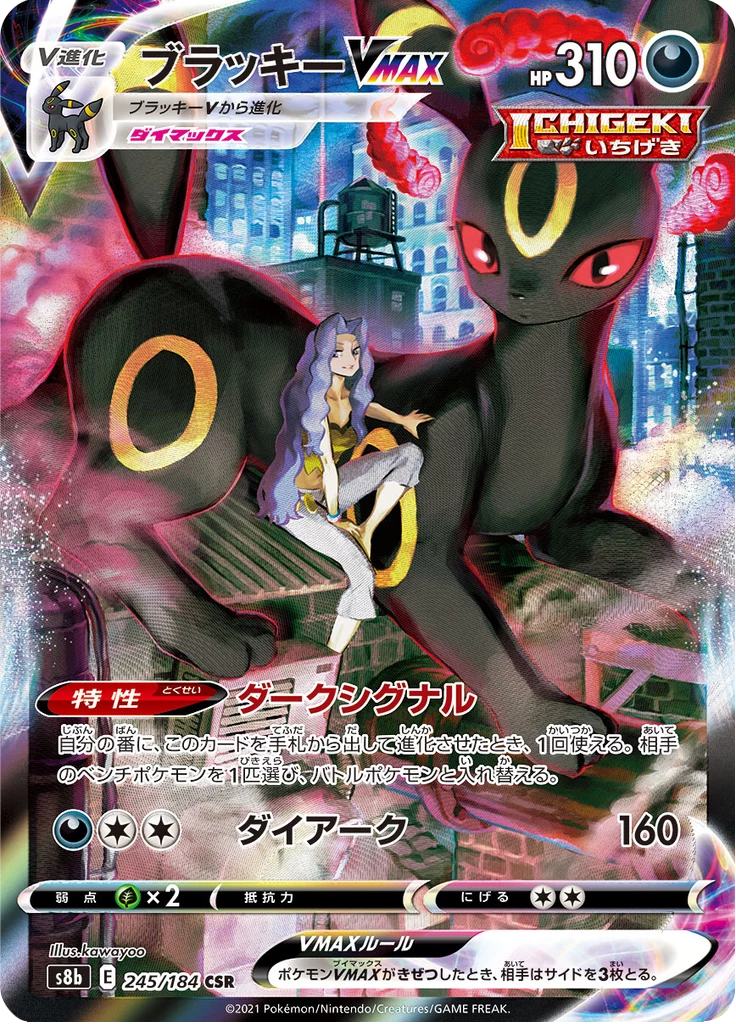
Umbreon VMAX S8b 245 Character Super Rare VMAX Climax
Umbreon VMAX S8b 245, Character Super Rare, VMAX Climax

Per Bulbapedia’s description of the technique, Kawayoo builds each subject from scratch on a graphic tablet in image-editing software, applying hundreds of individual strokes to work up base shapes, outlines, backgrounds, and final detail passes. The result is described as surreal, heavy, and multi-layered — closer to an oil painting than a flat digital illustration — with recurring attention to muscle tone, expression, and contrast, and thematic influences drawn from cyberpunk and anime.

That approach carried across an entire era of the TCG’s promotional output: Kawayoo drew the booster pack art and theme deck art for every expansion in the HeartGold & SoulSilver series, meaning the booster and theme-deck packaging of that entire series came from this artist.

It’s worth being precise about what Bulbapedia’s description does and doesn’t establish. It describes a working method — hundreds of tablet strokes building up layered, oil-painting-like results with a focus on muscle tone, expression, and contrast — and it names cyberpunk and anime as thematic influences. It does not describe individual card compositions beyond that general technique, so this guide doesn’t invent specific descriptions of, say, the Lugia V or Reshiram ex artwork discussed later; the cited technique applies across the catalog as a general working style rather than as a card-by-card breakdown.

Card Catalog: From Rising Rivals to White Flare

The catalog spans well over a decade of Japanese Pokemon TCG sets. Here’s a representative slice, individually re-verified against Limitless TCG’s card-page credits:

Karte Set (JP code) Number Rarity
Lugia V Paradigm Trigger (S12) 110 Secret Rare
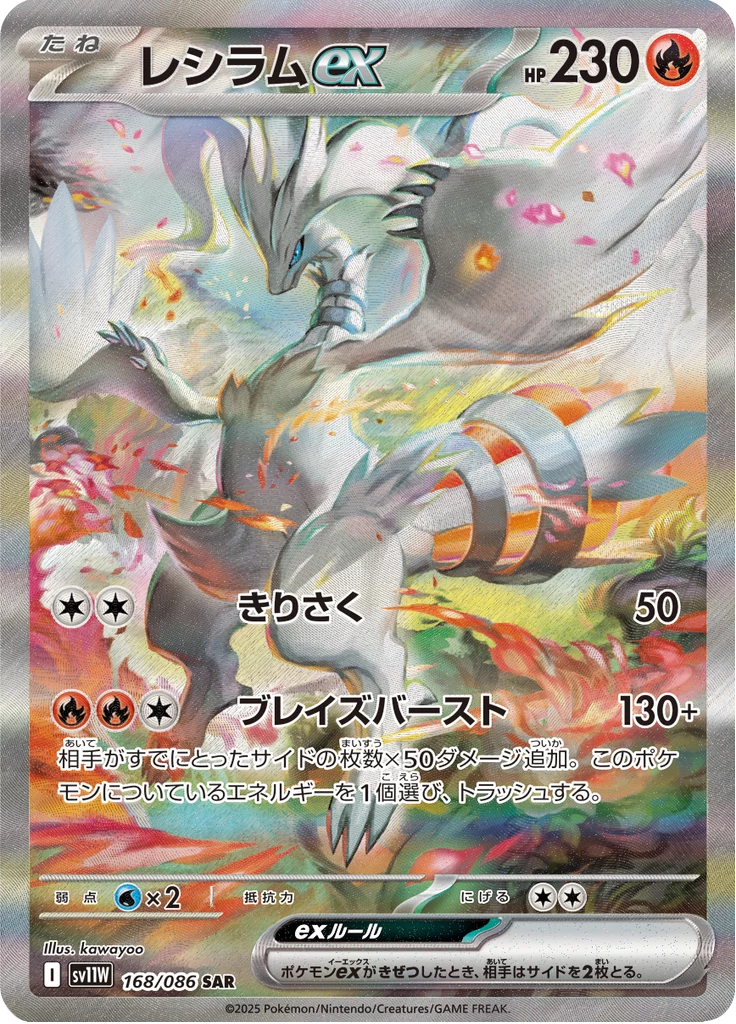
Reshiram ex White Flare (SV11W) 168 Special Art Rare
Umbreon VMAX VMAX Climax (S8b) 245 Character Super Rare
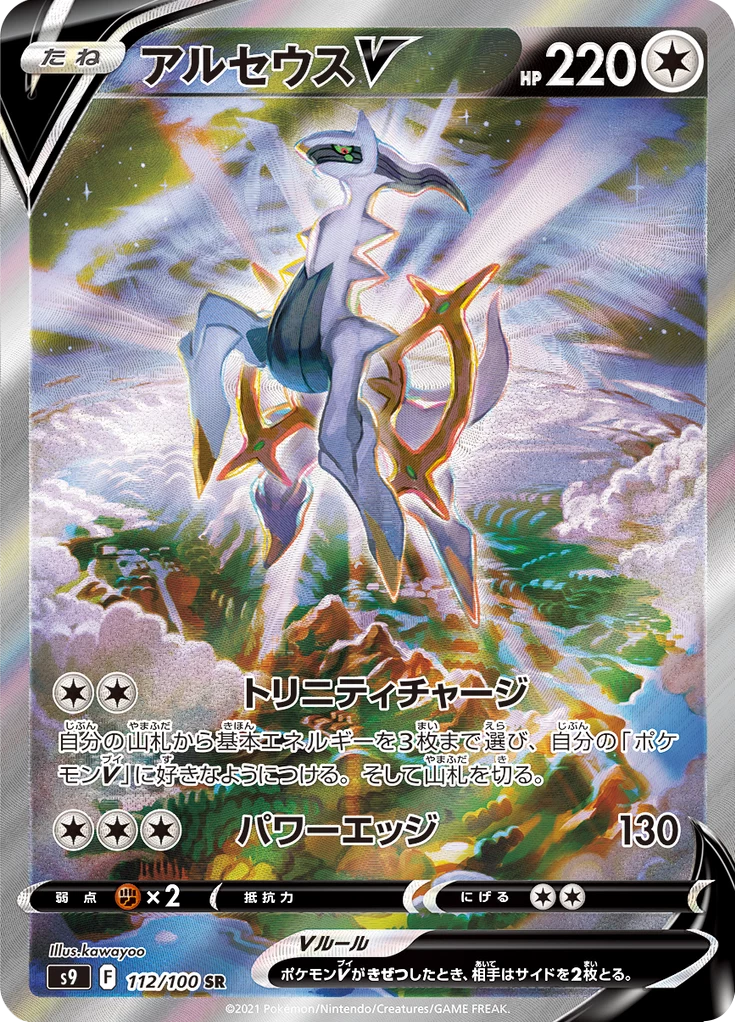
Arceus V Star Birth (S9) 112 Secret Rare
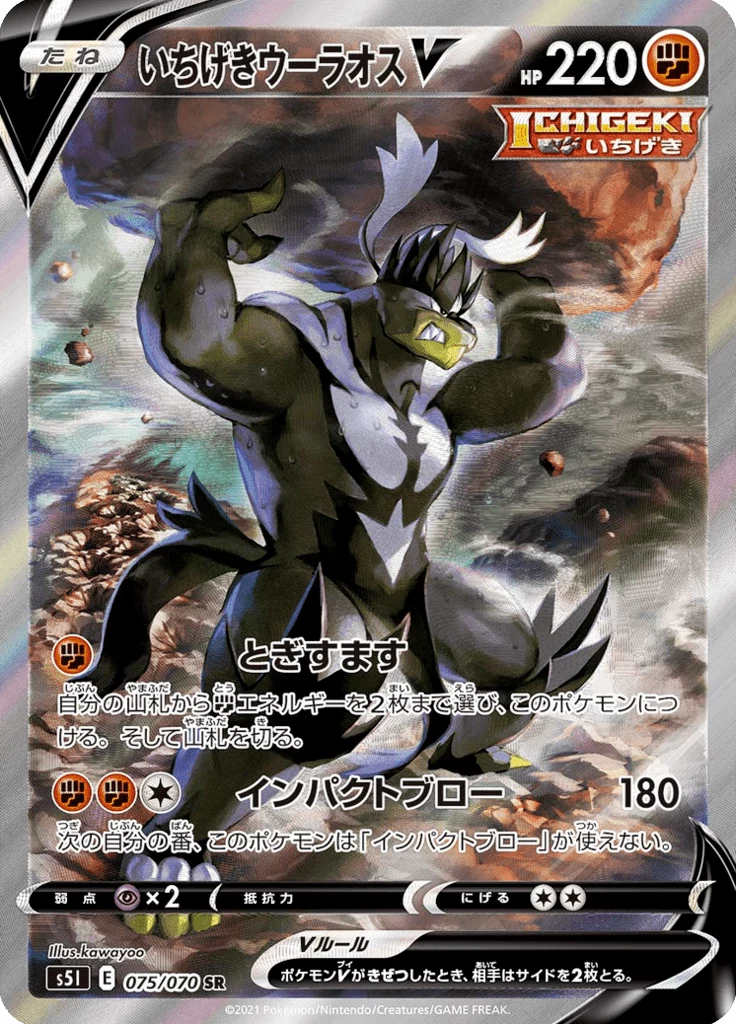
Single Strike Urshifu V Single Strike Master (S5I) 75 Secret Rare
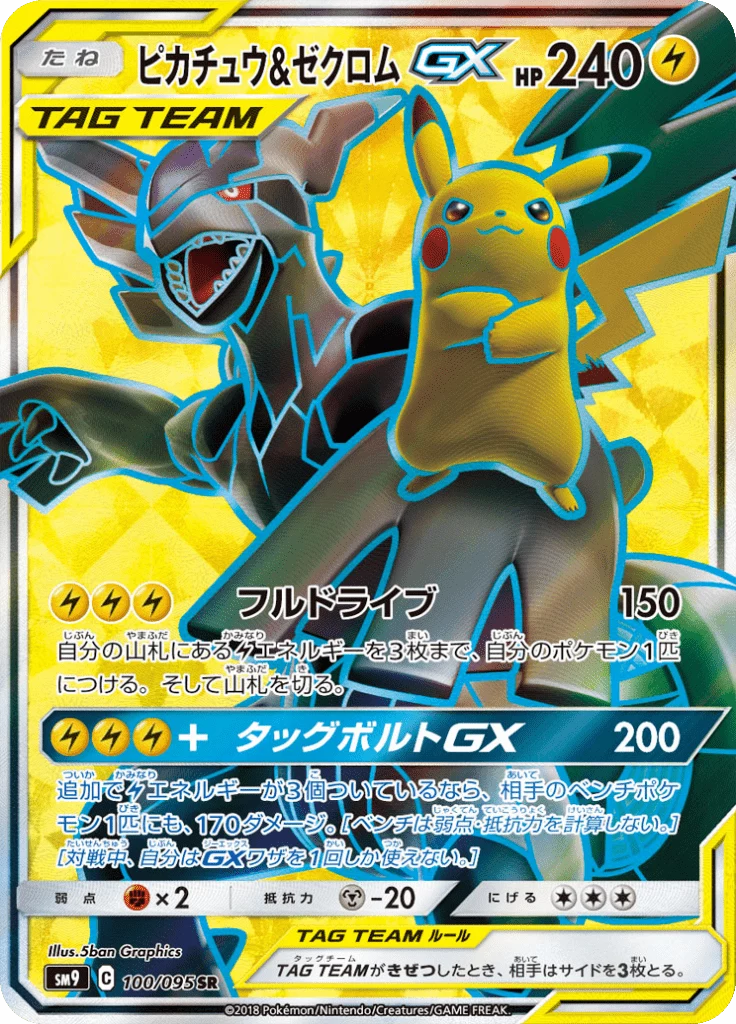
Pikachu & Zekrom-GX Tag Bolt (SM9) 101 Secret Rare
Drapion Nihil Zero (M3) 90 Art Rare

Two things stand out looking across this slice. First, the era range is wide — the older Tag Bolt and Single Strike Master prints sit alongside the White Flare release, showing a sustained, active credit rather than a short run tied to a single expansion cycle. Second, the rarity tier in this sample is consistently high: every card here sits at Secret Rare, Special Art Rare, Character Super Rare, or Art Rare tier. That same high-rarity tier also shows up in the in-stock crossmatch below — both matching cards are Secret Rare or Special Art Rare tier, with no Kawayoo commons currently in our vault.

The seven cards above are a representative sample, not the full 238-card Japanese list — Limitless TCG’s database is the place to browse the complete catalog set by set. What this slice does establish, re-verified individually on each card’s own Limitless page, is that the “Illustrated by kawayoo” credit holds consistently across very different Pokemon subjects: Legendary birds and beasts (Lugia, Reshiram, Arceus), a Fighting-type Pokemon V (Single Strike Urshifu), a Tag Team GX (Pikachu & Zekrom-GX), a VMAX Character Rare (Umbreon), and a standard-frame Art Rare (Drapion). That range across Pokemon types and card formats is part of why the credit is worth tracking rather than treating as a one-card fluke.
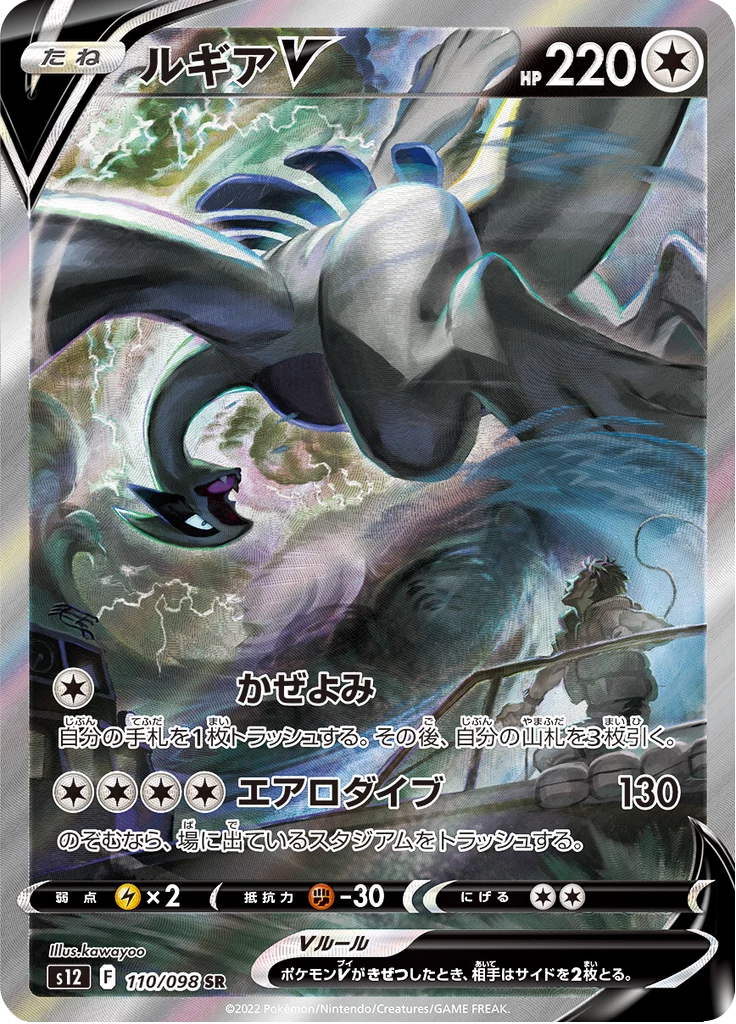
Lugia V S12 110/098 Secret Rare Paradigm Trigger
Lugia V S12 110/098, Secret Rare, Paradigm Trigger
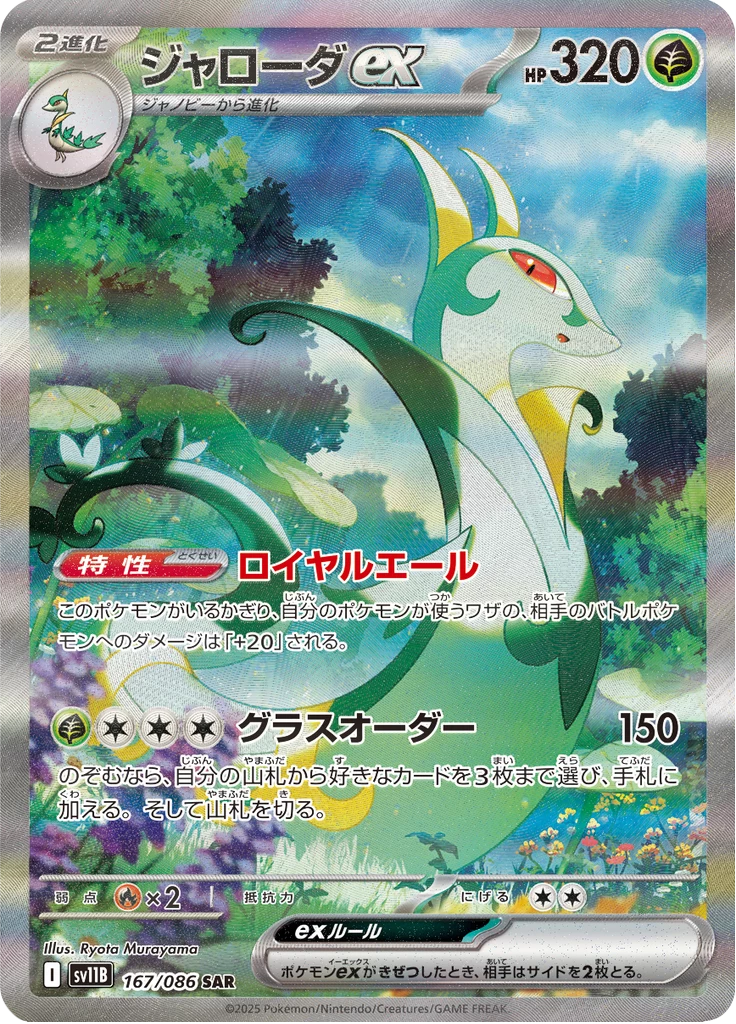
Reshiram ex SV11W 168/086 Special Art Rare White Flare
Reshiram ex SV11W 168/086, Special Art Rare, White Flare
Arceus V S9 112 Secret Rare Star Birth
Arceus V S9 112, Secret Rare, Star Birth
Single Strike Urshifu V S5I 75 Secret Rare Single Strike Master
Single Strike Urshifu V S5I 75, Secret Rare, Single Strike Master

In Our PSA 10 Vault

We checked Kawayoo’s Limitless-verified card list against our own PSA 10 inventory directly — matching by collector number and card name rather than by Pokemon name alone, since numerator coincidences across unrelated sets are common. The result: two matches.

The higher-value match is Lugia V SR:SA (S12 110/098) from Paradigm Trigger, currently listed at ¥226,394. The second is Reshiram ex 168/086 SAR from White Flare, currently listed at ¥42,160. Both are Secret Rare or Special Art Rare tier prints matching the pattern in the card catalog above — no common-rarity Kawayoo cards turned up in the crossmatch.

Shop This Card
Lugia V SR:SA, S12 110/098, PSA 10
Currently listed at ¥226,394
Ships from Tokyo · Tracked delivery

View Product →

What Kawayoo Cards Cost Right Now

With only two verified in-stock data points, this isn’t enough to draw a full market curve for the artist — but the spread between the two is informative on its own. The Lugia V SR:SA at ¥226,394 and the Reshiram ex SAR at ¥42,160 sit more than five times apart despite both carrying the same illustrator credit and a comparable secret/special-art rarity tier.

What the two prices do confirm is that an illustrator credit alone doesn’t set a price band.

Beyond the Cards

Outside the TCG, Kawayoo has illustrated maps and other promotional artwork across multiple mainline Pokemon game generations. Per Bulbapedia, that work includes the Hoenn map for Omega Ruby and Alpha Sapphire, the Alola maps for both Sun/Moon and Ultra Sun/Ultra Moon, the Kanto map for Let’s Go, Pikachu! and Let’s Go, Eevee!, the Shiny Tapu Koko event artwork, and a Crown Tundra promotional wallpaper depicting Sinnoh.

Read together with the HeartGold & SoulSilver booster and theme-deck art covered above, the pattern is an artist whose work extends past individual card illustrations into the packaging and promotional layer of entire Pokemon releases — work that reaches collectors even when they aren’t specifically pulling a Kawayoo-credited card. Bulbapedia’s writeup does not name any employer, award, or non-Pokemon client for this artist, so this guide stops at what’s documented rather than speculating about a wider design career.

Where to Buy Kawayoo Cards from Japan

We stock and ship Japanese PSA 10 singles out of Tokyo, and both Kawayoo-credited cards currently in stock (as of our 2026-08-12 inventory check) are listed individually rather than as a restockable line item.

Shop This Card
Reshiram ex 168/086 SAR, PSA 10
Currently listed at ¥42,160
Ships from Tokyo · Tracked delivery

View Product →

For the wider PSA 10 catalog, browse our PSA 10 collection or the full PSA 10 card list to filter by set, illustrator, and price. For cards not currently in stock, the Quick Order page is the fastest way to build a request. If you’re comparing illustrator profiles across our ongoing series, KEIICHIRO ITO and Naoki Saito both have their own dedicated guides.

Häufig gestellte Fragen

Who is Kawayoo?

Kawayoo (川洋) is the card-credit nickname of Kawaguchi Yoohei (川口洋平), a freelance digital illustrator born in 1974 per Bulbapedia. The artist’s first Pokemon TCG cards were Walrein, Hippopotas, and Nidorino for the Rising Rivals expansion, and the catalog has since grown to 238 cards in Limitless TCG’s Japanese-language database.

How many Pokemon cards has Kawayoo illustrated?

Limitless TCG’s exact-match search returns 238 cards in the Japanese-language database and 218 cards in the English-language database. Bulbapedia’s own separate tally is 215 TCG cards plus 46 Pokemon Trading Card Game Pocket cards, using a different methodology from the Limitless counts.

What is Kawayoo’s art style known for?

Per Bulbapedia, Kawayoo builds each subject from scratch using a graphic tablet, applying hundreds of strokes to define shapes, outlines, backgrounds, and final detail. The results are described as surreal, heavy, and multi-layered, closer to an oil painting than flat digital art, with recurring focus on muscle tone, expression, and contrast, and themes influenced by cyberpunk and anime.

Did Kawayoo illustrate any Pokemon TCG set packaging?

Yes. Kawayoo drew the promotional booster pack art and theme deck art for every expansion in the HeartGold & SoulSilver series, in addition to individual card illustrations across other sets.

Which Kawayoo cards are currently in stock as PSA 10?

As of our 2026-08-12 inventory check, our PSA 10 vault holds two Kawayoo-credited cards: Lugia V SR:SA (S12 110/098) from Paradigm Trigger, currently listed at ¥226,394, and Reshiram ex 168/086 SAR from White Flare, currently listed at ¥42,160.

Is there a set price range for Kawayoo-illustrated cards?

No. The two verified in-stock prices — ¥226,394 and ¥42,160 — sit more than five times apart despite a comparable rarity tier, which shows the illustrator credit alone doesn’t set a price band. Each card’s price still depends on its specific set, collector number, and rarity.
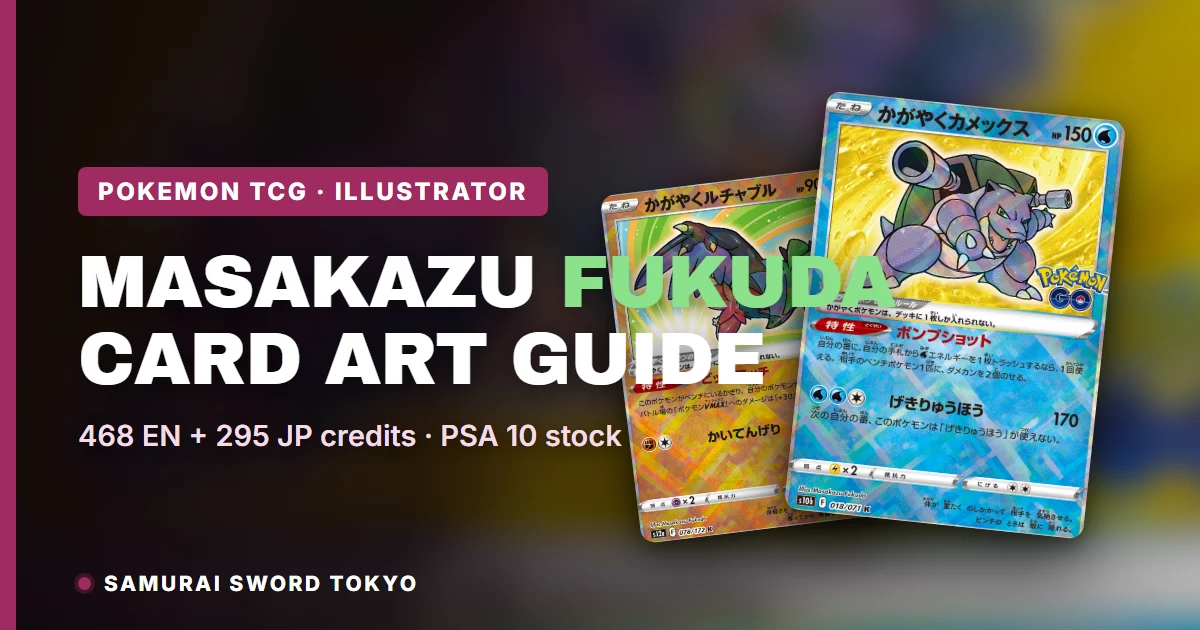
Masakazu Fukuda Pokemon Cards: Illustrator Guide & Catalog

Masakazu Fukuda has been drawing Pokemon cards since 2003, and the catalog that’s built up since then runs to 468 English-language credits and 295 Japanese-language credits in Limitless TCG’s databases — two separate counts covering largely overlapping print runs, not a total to add together. Before any of that, Fukuda spent the 1990s in character and graphic design work across the game industry, then went freelance and carried that design sensibility into a two-decade run on the Pokemon Trading Card Game.

This guide works from Bulbapedia’s biography of Fukuda, Limitless TCG’s card credit database, and a direct crossmatch against our own PSA 10 inventory. It covers the debut cards, the Pokemon ☆ (Star) card series Fukuda illustrated in full, a sample of the wider catalog spanning Sword & Shield and Scarlet & Violet-era sets, and the artist’s substantial body of work outside the card game — from 1990s console art direction to Kamen Rider merchandise. Where the record doesn’t say more — birth date, the names of those 1990s employers, awards — we leave it there instead of guessing. This guide also does not use gendered pronouns for Fukuda; we refer to the artist by name or with „they/their“ throughout.

Key Takeaway

Masakazu Fukuda has 468 English-language and 295 Japanese-language card credits in Limitless TCG’s databases, illustrating for the Pokemon Trading Card Game since 2003 and providing artwork for every Pokemon ☆ (Star) card in the series (per Bulbapedia). We do not currently have a Masakazu Fukuda PSA 10 listed. If you’re after one of the cards covered below, flag it on our Quick Order page and we’ll confirm sourcing.

468
EN Database Card Credits

295
JP Database Card Credits

2003
TCG Debut Year

0
Fukuda PSA 10s Currently in Stock

Card and biography details verified against Bulbapedia and Limitless TCG as of August 2026.

Who Is Masakazu Fukuda?

Per Bulbapedia, Masakazu Fukuda was primarily involved with character and graphic design at multiple game companies during the 1990s — Bulbapedia does not name the specific companies, so this guide doesn’t either — before moving into work as a freelance illustrator. Fukuda has been providing artwork for the Pokemon Trading Card Game since 2003, which puts the TCG career at just over two decades and counting.

The Limitless TCG artist database returns an exact-match result of 468 cards in the English-only database and 295 cards in the Japanese-language database for a search on Fukuda’s name — identical whether searched as a substring or as an exact match, so there’s no other artist name polluting the count. Bulbapedia’s own internal tally, using a different counting method again, lists 472 TCG cards illustrated so far, plus a separate 43 cards in Pokemon Trading Card Game Pocket. Because the three counting methods scope things differently, we’re citing all of them separately rather than combining them into one number.

Bulbapedia quotes Fukuda’s own description of the work as cute, colorful, and vibrant — a self-assessment that lines up with the cards covered below, and one worth keeping in mind heading into the next section on Fukuda’s best-known series.

That 1990s-design-to-freelance-illustrator path is worth sitting with for a moment, because it shows up in how varied Fukuda’s later credits are. A career that starts in character and graphic design for game companies, rather than in fine art or manga, tends to produce an illustrator comfortable moving between very different formats — video game art direction one decade, trading card portraits the next, apparel and card-game tie-ins after that. The sections below on video game credits and merchandise work follow that same thread.

The Debut: EX FireRed & LeafGreen

Fukuda’s first Pokemon Trading Card Game illustrations, per Bulbapedia, were Meowth, Persian, and Tauros, all from the EX FireRed & LeafGreen expansion. That set anchors the start of a catalog that has since grown to hundreds of cards across two decades of English and Japanese Pokemon TCG releases — everything covered in the sections below sits downstream of those three debut illustrations.

The Pokemon ☆ Cards: Fukuda’s Signature Series

The single fact that separates Fukuda’s catalog from most other Pokemon TCG illustrators: per Bulbapedia, Fukuda provided the illustrations for every Pokemon ☆ (Pokemon Star) card in the Trading Card Game. Pokemon Star was a chase-rarity subset in the TCG, and having a single illustrator credited with the entire series is unusual.

Bulbapedia’s description of the approach is specific: Fukuda purposefully exaggerates the angles and colors used on Pokemon ☆ cards to make them stand out from standard-rarity printings of the same Pokemon. That’s consistent with the „cute, colorful, and vibrant“ self-description quoted above — the exaggeration is a deliberate stylistic choice on a subset built specifically to be a visual step up from the regular card pool.

One more biographical detail from Bulbapedia worth noting here, since it ties directly to Fukuda’s card output: the illustrator’s favorite Pokemon is Lugia.

It’s worth being precise about what „every Pokemon ☆ card“ does and doesn’t tell you. It’s a claim about a specific, named rarity tier — not a claim that Fukuda illustrated every card in any given set, and not a claim about later rarity tiers like Pokemon-ex, GX, V, or VSTAR full arts, which draw from a much wider pool of illustrators including Fukuda alongside many others. The catalog section below covers examples from those later tiers on their own terms.

Inside the Fukuda Catalog

Beyond the Pokemon ☆ series, Fukuda’s catalog runs across two decades of sets. The cards below were individually confirmed on their Limitless TCG pages, each showing „Illustrated by Masakazu Fukuda“ as the credit line.

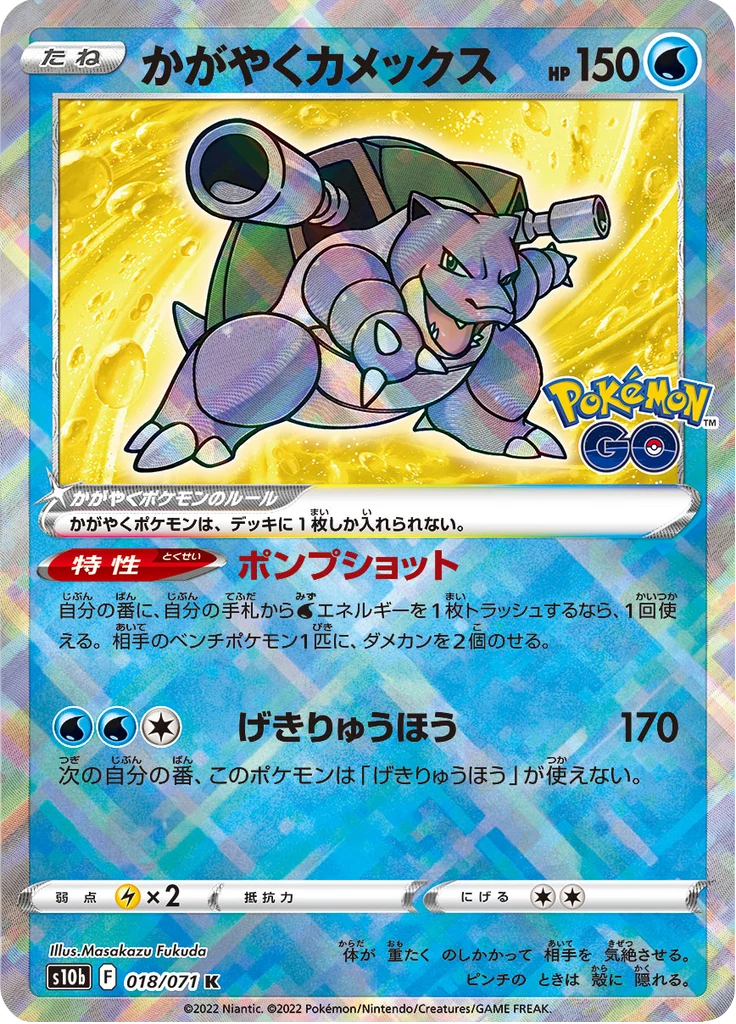
Radiant Blastoise S10b 018 Radiant Rare Pokemon GO
Radiant Blastoise (かがゃくカメックス), S10b #18, Radiant Rare
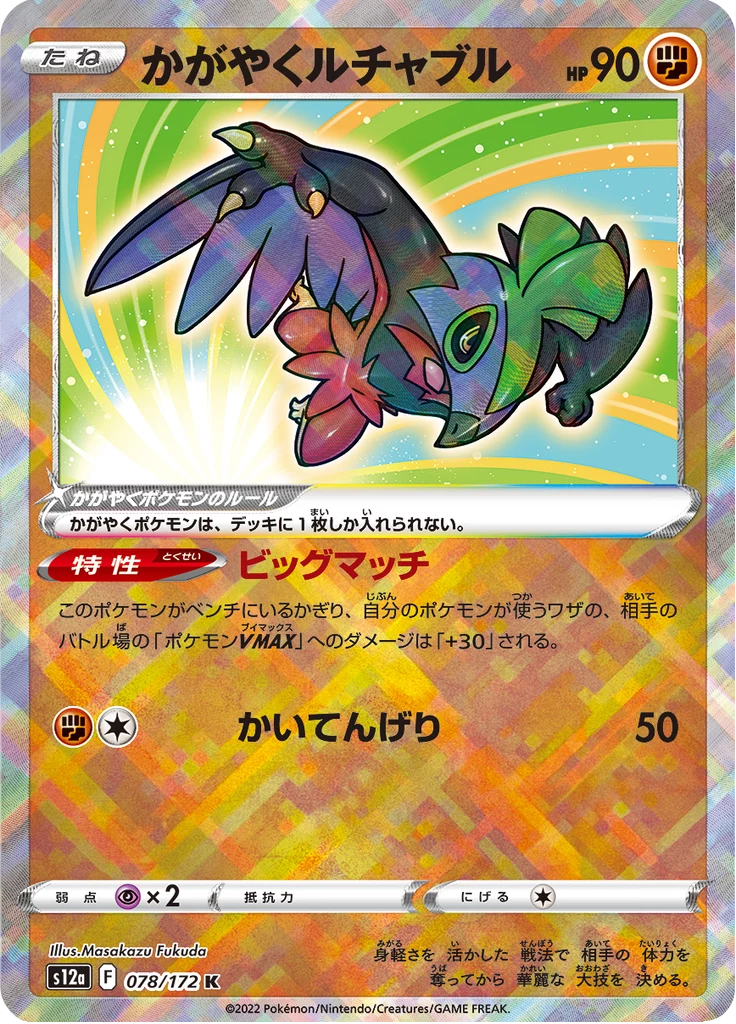
Sparkling Hawlucha S12a 078 Radiant Rare VSTAR Universe
Sparkling Hawlucha (かがゃくルチャブル), S12a #78, Radiant Rare
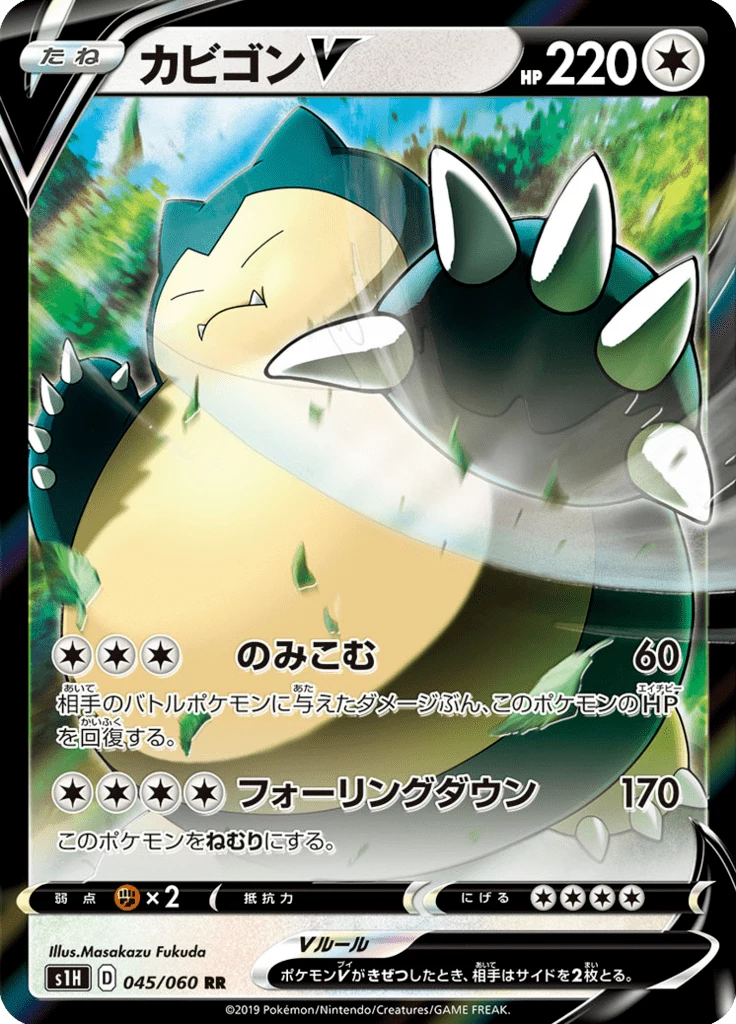
Snorlax V S1H 045 Double Rare Shield
Snorlax V (カビゴンV), S1H #45, Double Rare
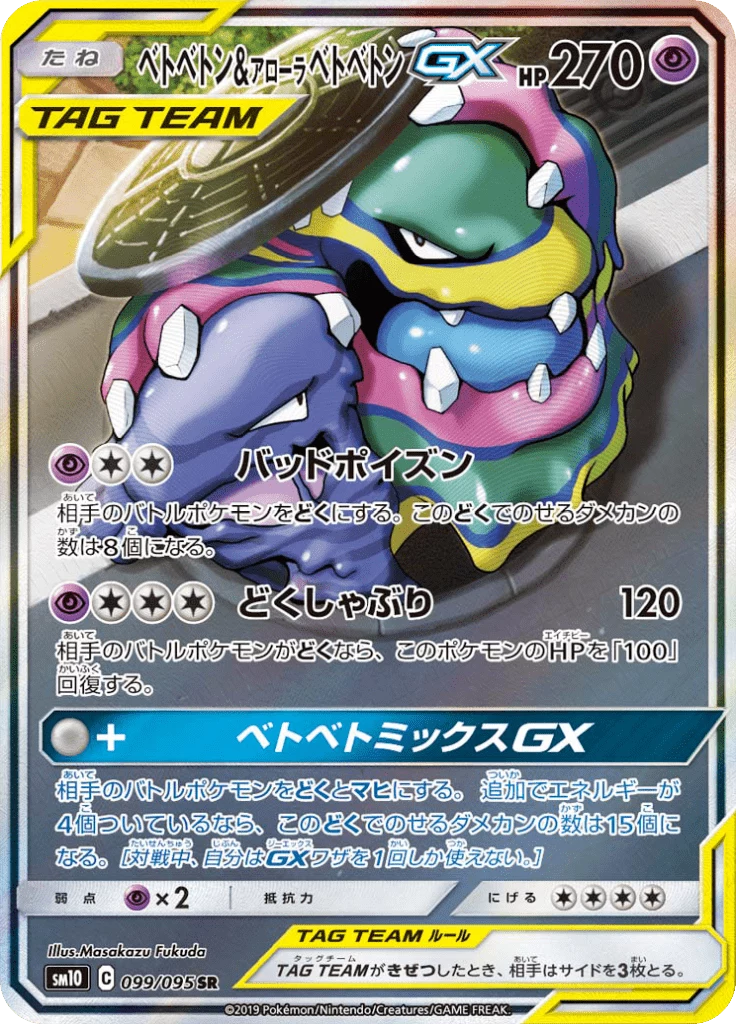
Muk and Alolan Muk-GX SM10 099 Secret Rare Double Blaze
Muk & Alolan Muk-GX (ベトベトン&アローラベトベトンGX), SM10 #99, Secret Rare

The Radiant Blastoise (Pokemon GO, S10b #18) and Sparkling Hawlucha (VSTAR Universe, S12a #78) pair are both Radiant Rares — the Sword & Shield-era „かがゃく“ (kagayaku, „sparkling/radiant“) rarity tier. Landing two Radiant Rares in separate sets is a useful marker of how consistently Fukuda’s work has been chosen for that particular rarity.

Snorlax V (Shield, S1H #45) is a Double Rare from a Sword & Shield-era Japanese set, and Muk & Alolan Muk-GX (Double Blaze, SM10 #99) is a Secret Rare from the preceding Sun & Moon era — together they show the catalog carrying through the GX-to-V generational transition.

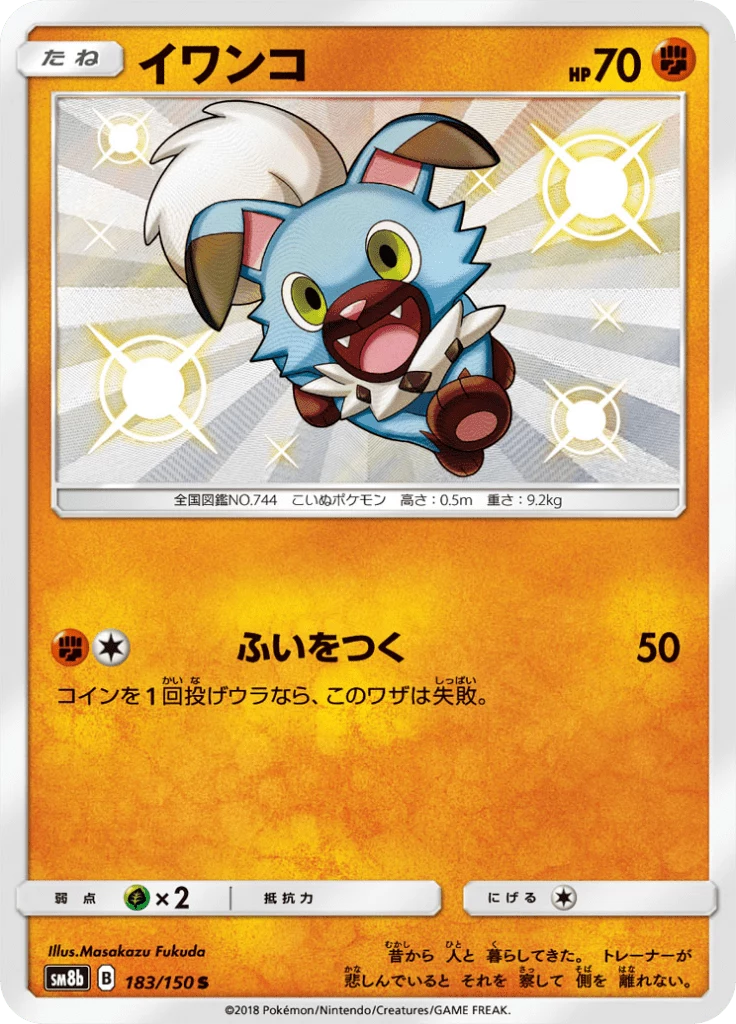
Rockruff SM8b 183 Secret Rare GX Ultra Shiny
Rockruff (イワンコ), SM8b #183, Secret Rare
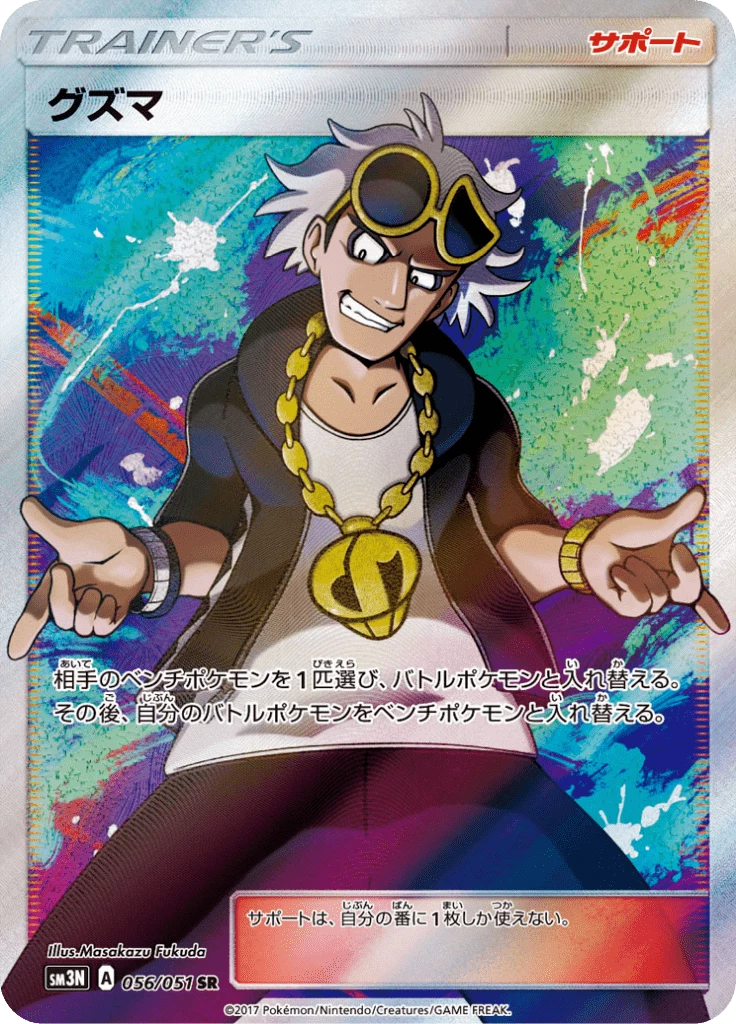
Guzma SM3N 056 Secret Rare Light Consuming Darkness
Guzma (グズマ), SM3N #56, Secret Rare
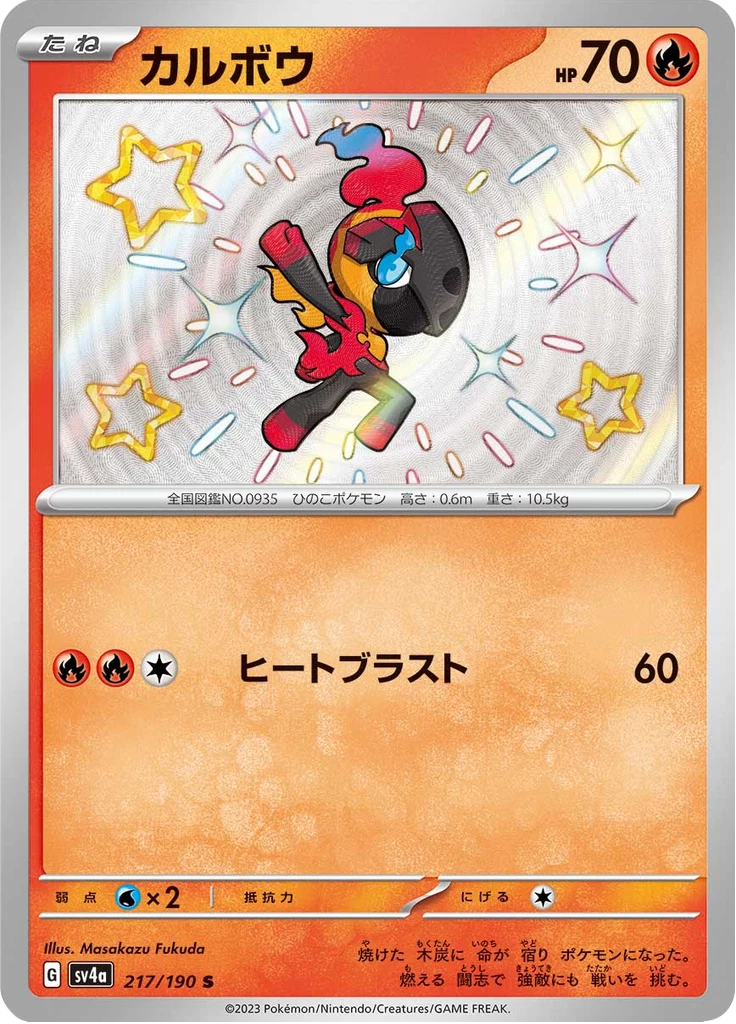
Charcadet SV4a 217 Shiny Rare Shiny Treasure ex
Charcadet (カルボウ), SV4a #217, Shiny Rare

Rockruff (GX Ultra Shiny, SM8b #183) and Guzma (Light Consuming Darkness, SM3N #56) are both Secret Rares from the Sun & Moon era, the Guzma card notable for being a Trainer illustration rather than a Pokemon portrait — a reminder that Fukuda’s catalog isn’t limited to creatures alone. Charcadet (Shiny Treasure ex, SV4a #217) brings the sample into the current Scarlet & Violet era as a Shiny Rare. Across these seven cards alone, the catalog spans Sun & Moon-era Double Blaze and Light Consuming Darkness, GX Ultra Shiny, the Sword & Shield-era Shield set, Pokemon GO, VSTAR Universe, and the Scarlet & Violet-era Shiny Treasure ex — seven separate Japanese expansions spanning multiple eras.

Beyond the Cards: Video Games, Merchandise, and More

Fukuda’s illustration work extends well past the Pokemon Trading Card Game, starting with credits from the 1990s video game industry that Bulbapedia lists in detail. Fukuda served as Production Design and Art Director on Zero Divide (PlayStation, 1995), worked as assistant enemy character designer on Tengai Makyou III: Namida (PS2, 2005), and was a Development Artist on Culdcept Saga (Xbox 360, 2006).

Within the Pokemon franchise but outside the card game itself, Bulbapedia credits Fukuda with providing artwork for deck kits and special packs sold in Japan, as well as booster pack and theme deck artwork for English and European releases — specifically the Majestic Dawn set’s booster packs and the Polar Frost and Forest Force theme decks. Other listed illustration work includes Pokemon Center shop goods illustrations dating back to 2007, a Uniqlo Pokemon T-shirt design from 2009, and card illustrations for Kamen Rider Battle: Ganbaride starting the same year — showing the same character-design background from the 1990s carrying into merchandise and other card games well after the Pokemon TCG debut.

Bulbapedia also lists a set of personal interests for Fukuda: a fan of mecha design who admires designer Hajime Katoki, a reader whose favorite manga artists include Katsuhiro Otomo, Masamune Shirow, and Akira Toriyama, a keen biker, a practitioner of wide-angle photography, and a listener of electronic music and late-1960s music — particularly James Brown.

Taken together, the video game credits, the Pokemon merchandise, and the Kamen Rider card work describe an illustrator whose output was never confined to a single franchise or medium. The 1990s design background explains the range: art direction on a PlayStation fighting game and enemy character design on a role-playing game sequel are a different discipline from painting a Pokemon ☆ card, and Fukuda’s résumé, as documented by Bulbapedia, moves across all of it.

Fukuda in Our PSA 10 Vault

We checked all 401 rows of our current PSA 10 inventory against Fukuda’s 295-card Japanese-language Limitless list, matching on collector number and card name together rather than name alone. Every inventory item whose collector number happened to coincide with a number in Fukuda’s list was individually reviewed, and in each case the card name did not match — for example, an in-stock „Umbreon & Darkrai GX 182/173“ shares a collector number with Fukuda’s XY #182 Blacksmith, but they are not the same card.

The result: we do not currently hold a graded Masakazu Fukuda card. If one of the cards covered in this guide — the Pokemon ☆ series, Radiant Blastoise, Sparkling Hawlucha, Snorlax V, Muk & Alolan Muk-GX, Rockruff, Guzma, Charcadet, or any other verified Fukuda print — is what brought you here, the fastest way to move forward is a request through our Quick Order page, where we’ll confirm sourcing and next steps.

Not Currently in Stock
Request a Graded Masakazu Fukuda Card
We’ll confirm sourcing and availability
Ships from Tokyo · Tracked delivery

Request via Quick Order →

If you’re browsing while a specific Fukuda card is sourced, our PSA 10 card list covers graded cards from other illustrators that are in stock right now.

Requesting a Fukuda Card from Japan

We source and ship Japanese Pokemon cards and sealed product from Tokyo with tracked delivery. For an illustrator like Fukuda, where we don’t currently hold graded stock on hand, the process runs through a direct request rather than an existing listing:

  • Flag which Fukuda card you’re after — a Pokemon ☆ card, Radiant Blastoise, Sparkling Hawlucha, Snorlax V, Muk & Alolan Muk-GX, Rockruff, Guzma, Charcadet, or any other verified print — on our Quick Order page.
  • Browse our current PSA 10 card list or the PSA 10 collection for graded cards already in stock from other illustrators.
  • If you’re comparing illustrators across our ongoing series, our guides to KEIICHIRO ITO, Souichirou Gunjima, and Sui cover other artists built on the same catalog-plus-crossmatch research standard.

Häufig gestellte Fragen

Who is Masakazu Fukuda?

Masakazu Fukuda is a Pokemon Trading Card Game illustrator with 468 English-language and 295 Japanese-language card credits in Limitless TCG’s databases. Per Bulbapedia, Fukuda worked in character and graphic design at multiple game companies during the 1990s before becoming a freelance illustrator, and has provided Pokemon TCG artwork since 2003.

What was Masakazu Fukuda’s first Pokemon TCG card?

Per Bulbapedia, Fukuda’s first Pokemon TCG illustrations were Meowth, Persian, and Tauros, all from the EX FireRed & LeafGreen expansion.

Did Masakazu Fukuda illustrate the Pokemon ☆ (Star) cards?

Yes. Bulbapedia states Fukuda provided the illustrations for all Pokemon ☆ (Pokemon Star) cards in the Trading Card Game, purposefully exaggerating the angles and colors used to make them stand out from standard printings.

Do you have any Masakazu Fukuda PSA 10 cards in stock?

Not currently. We checked Fukuda’s full Japanese-language Limitless catalog against our live PSA 10 inventory and found no matches. Flag the card you want on our Quick Order page and we’ll confirm sourcing and availability.

What has Masakazu Fukuda worked on outside the Pokemon TCG?

Per Bulbapedia, Fukuda’s video game credits include Zero Divide (PlayStation, 1995, Production Design and Art Director), Tengai Makyou III: Namida (PS2, 2005), and Culdcept Saga (Xbox 360, 2006). Fukuda has also illustrated Pokemon Center merchandise since 2007, a 2009 Uniqlo Pokemon T-shirt, and Kamen Rider Battle: Ganbaride cards starting in 2009.

How many cards has Masakazu Fukuda illustrated?

Limitless TCG lists 468 cards in its English-only database and 295 in its Japanese-language database, both exact matches with no other artist name included. Bulbapedia’s own count is 472 core TCG cards plus 43 in Pokemon Trading Card Game Pocket.

PLANETA Igarashi Pokemon Cards: Illustrator Guide

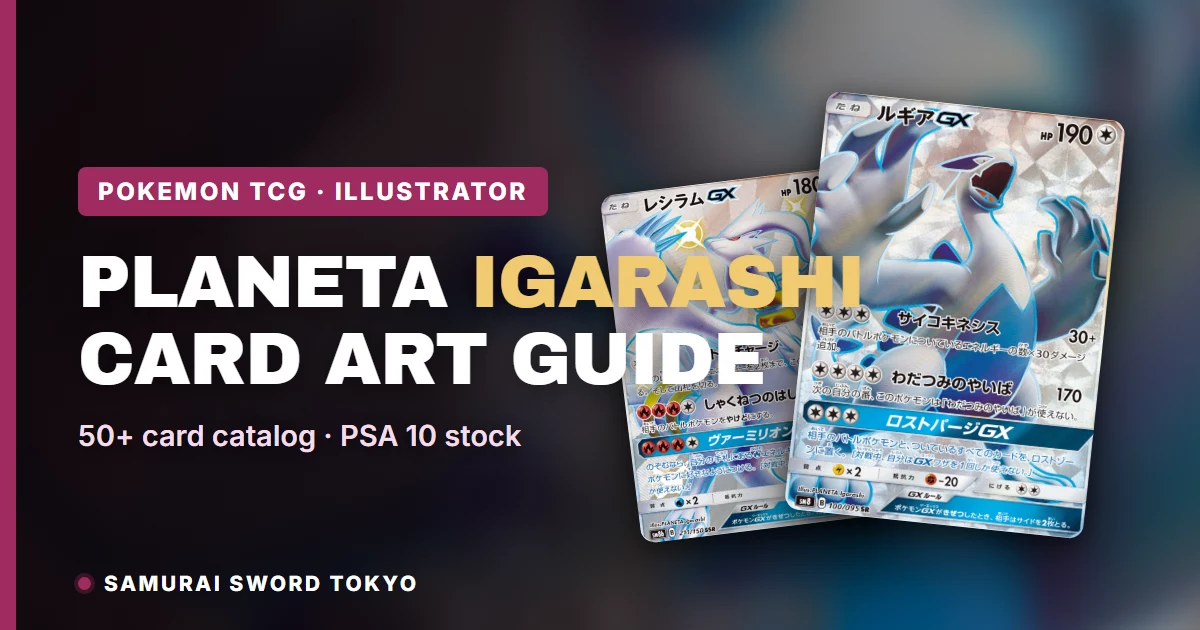
PLANETA Igarashi is the credit line printed on more than fifty Pokemon TCG cards, but the name behind it is a real person: Kazuya Igarashi, an illustrator who has worked at the studio PLANETA since 2011. The „PLANETA“ prefix is a studio credit — other credits at the same studio, such as PLANETA Mochizuki, are a different credit with its own card list, and this guide covers only Igarashi’s own catalog.

What that catalog shows is a run of GX- and V-era Secret and Double Rares, from a Sun & Moon-era full art debut through to Sword & Shield promos. This guide walks through what’s verifiable about the illustrator, surveys the representative cards confirmed on Limitless TCG’s database, and ends at the one PSA 10 copy currently in our vault.

Illustrator credits matter to collectors for a simple reason: the same Pokemon can appear on dozens of cards across different sets, and the artist behind a specific print is often the detail that separates a common bulk card from a chase card. Tracking a studio credit like „PLANETA Igarashi“ down to the individual behind it, and then cross-checking that credit against real in-stock inventory, is exactly the kind of verification this guide is built around.

Key Takeaway

PLANETA Igarashi (Kazuya Igarashi) has illustrated 51 cards in both Limitless TCG’s English and Japanese databases, with Bulbapedia’s own tally at 42. Our PSA 10 vault currently holds one PLANETA Igarashi card — the Dedenne GX RR, SM12a 048/173, currently listed at ¥15,243.

51
Cards in Limitless EN & JP DB

42
Bulbapedia Card Tally

24
TCG Pocket Cards

2011
Joined PLANETA Studio

Who Is PLANETA Igarashi?

Kazuya Igarashi is an illustrator who has worked at PLANETA since 2011, per Bulbapedia. He has contributed artwork to the Pokemon Trading Card Game, and cards he has illustrated are credited „PLANETA Igarashi“ (per Bulbapedia). Bulbapedia refers to Igarashi with he/him pronouns, which this guide follows.

That convention matters for anyone shopping by artist name: PLANETA is a studio, not a single illustrator, and other artists working under the same studio banner are credited separately. PLANETA Mochizuki, for example, is a different credit with its own card list — don’t mix them. This guide covers only cards individually confirmed as „Illustrated by PLANETA Igarashi“ on Limitless TCG’s card pages — not PLANETA-credited work in general.

His first card was the Full Art Ultra Necrozma-GX from the Forbidden Light expansion, covered in more detail below. Since then, Limitless TCG’s database lists 51 cards under his exact-match credit in both the English and Japanese card lists (a figure that counts printings, not unique illustrations, so it is not directly comparable to Bulbapedia’s own tally of 42 TCG cards). Bulbapedia does not give a birth date, location, or any biography beyond his studio affiliation and card credits — so that’s where the verifiable record on Igarashi as a person stops.

One detail worth noting for anyone cross-referencing card databases: the Limitless TCG EN and JP database counts for Igarashi are both 51.

The Debut Card: Full Art Ultra Necrozma-GX

PLANETA Igarashi’s first Pokemon TCG credit is the Full Art Ultra Necrozma-GX from the Forbidden Light expansion, per Bulbapedia. Forbidden Light was part of the Sun & Moon era, which places Igarashi’s earliest TCG work in roughly the same window as several other Sun & Moon-era illustrators — a period defined by the GX and full art card formats that run through the representative cards below.

From that debut, the catalog grew into the pattern visible in the sections below: GX and V-era Secret Rares and Double Rares, spread across Sun & Moon and Sword & Shield expansions, plus Sword & Shield promotional prints. The full art format of that debut card — artwork covering the entire card face rather than a cropped window above the text box — is a format choice that recurs through GX-era Secret Rares generally, though this guide only asserts the format for cards individually confirmed as such.

Signature Chase Cards in the Catalog

Beyond the Forbidden Light debut, Limitless TCG’s Japanese database confirms PLANETA Igarashi’s credit on individual card pages for a run of GX- and V-era chase rarities. Four representative cards, each individually re-verified as „Illustrated by PLANETA Igarashi“:

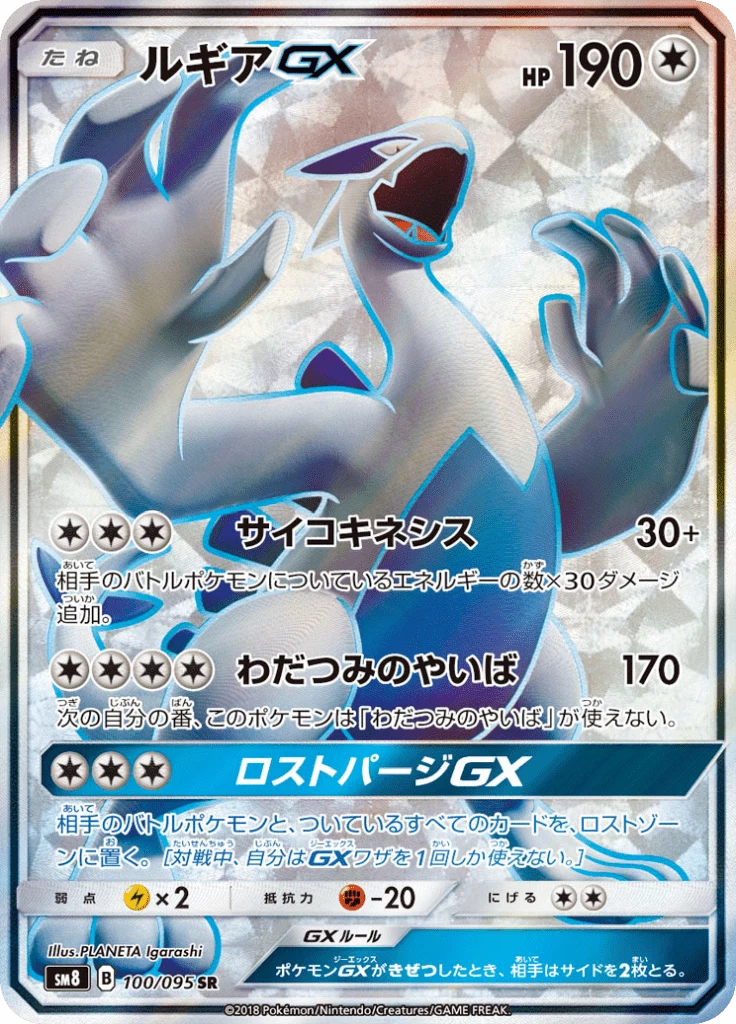
Lugia GX SM8 100, Secret Rare, Super Burst Impact
Lugia GX, Super Burst Impact (SM8) #100, Secret Rare
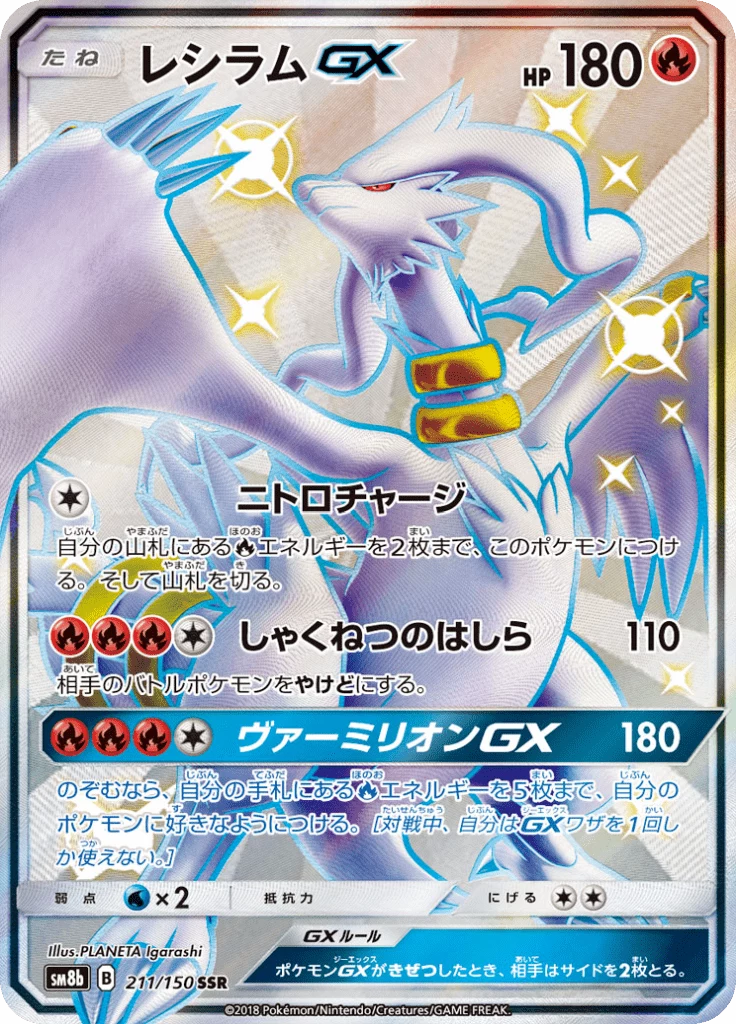
Reshiram GX SM8b 211, Secret Rare, GX Ultra Shiny
Reshiram GX, GX Ultra Shiny (SM8b) #211, Secret Rare
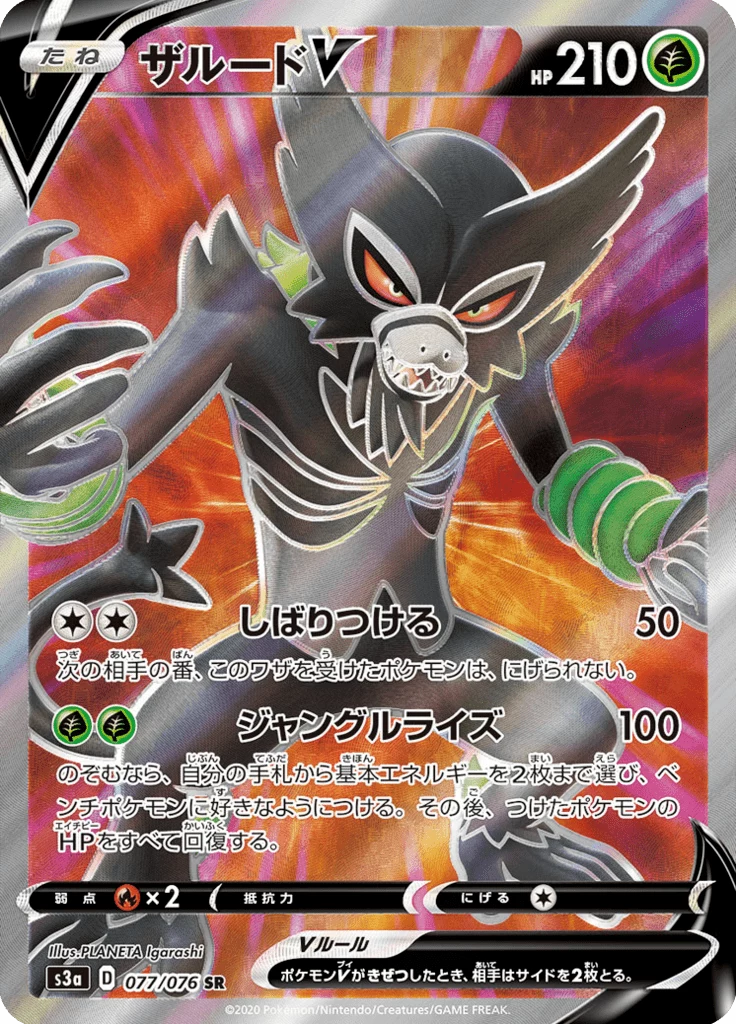
Zarude V S3a 77, Secret Rare, Legendary Heartbeat
Zarude V, Legendary Heartbeat (S3a) #77, Secret Rare

Lugia GX (Super Burst Impact, SM8 #100) and Reshiram GX (GX Ultra Shiny, SM8b #211) both landed in Secret Rare slots, numbered past the set’s printed total in their respective Sun & Moon-era sets. Zarude V (Legendary Heartbeat, S3a #77) carries the same Secret Rare status in a Sword & Shield-era set, showing the credit carried over cleanly across the format transition from GX to V mechanics.

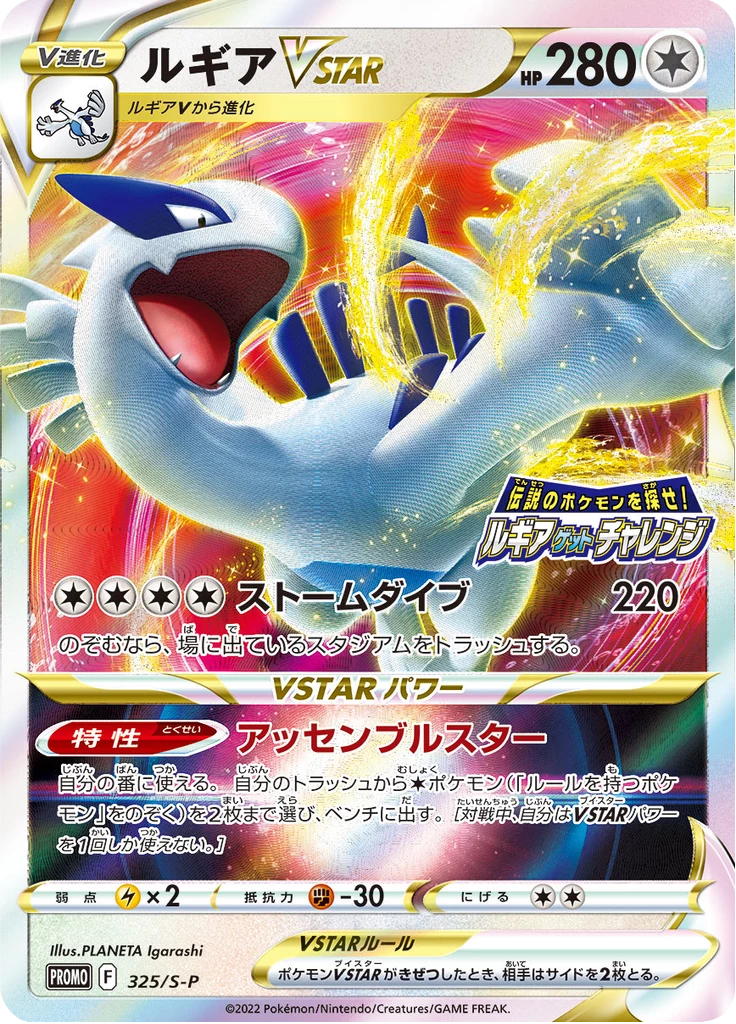
Lugia VSTAR SP 325 Sword and Shield Promotional Card
Lugia VSTAR, Sword & Shield Promotional Cards (SP) #325

The catalog also extends into promotional prints: Lugia VSTAR (SP #325) is credited to PLANETA Igarashi in the Sword & Shield Promotional Cards line, confirming the studio credit shows up outside numbered set releases too.

Karte Set (JP code) Number Rarity
Lugia GX Super Burst Impact (SM8) 100 Secret Rare
Reshiram GX GX Ultra Shiny (SM8b) 211 Secret Rare
Zarude V Legendary Heartbeat (S3a) 77 Secret Rare
Lugia VSTAR Sword & Shield Promotional Cards (SP) 325 Promo
Dedenne GX Tag All Stars (SM12a) 48 Double Rare
Dedenne GX Night Unison (SM9a) 16 Double Rare

The last two rows — two different Dedenne GX printings — are worth their own section, since one of them is the card currently sitting in our PSA 10 vault.

The Two Dedenne GX Prints

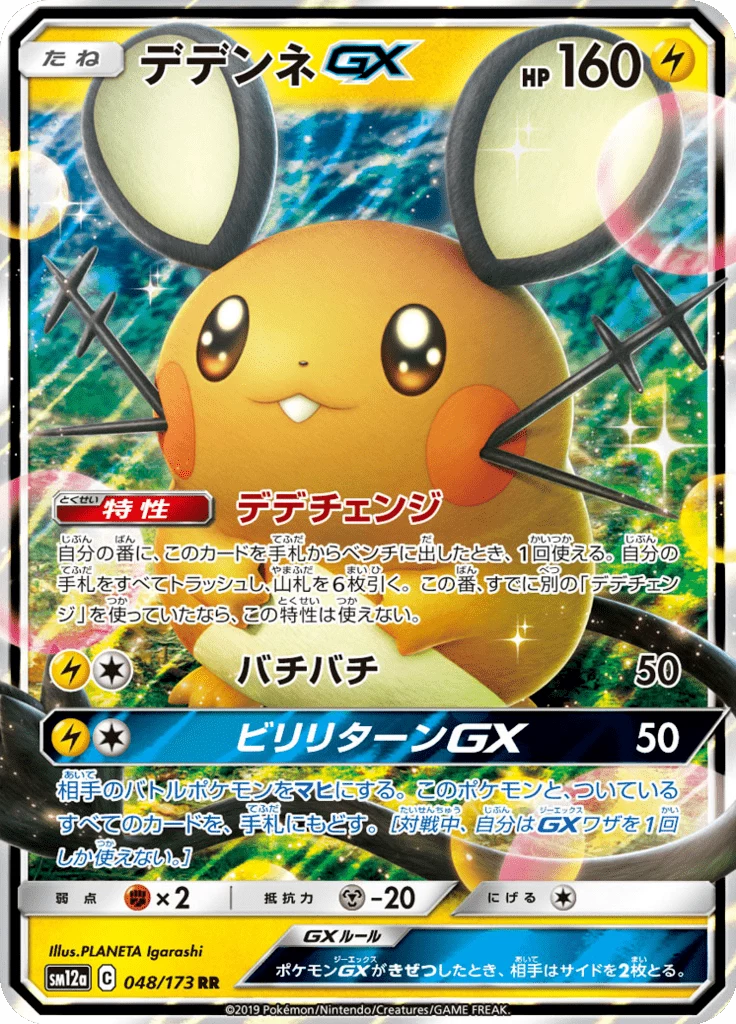
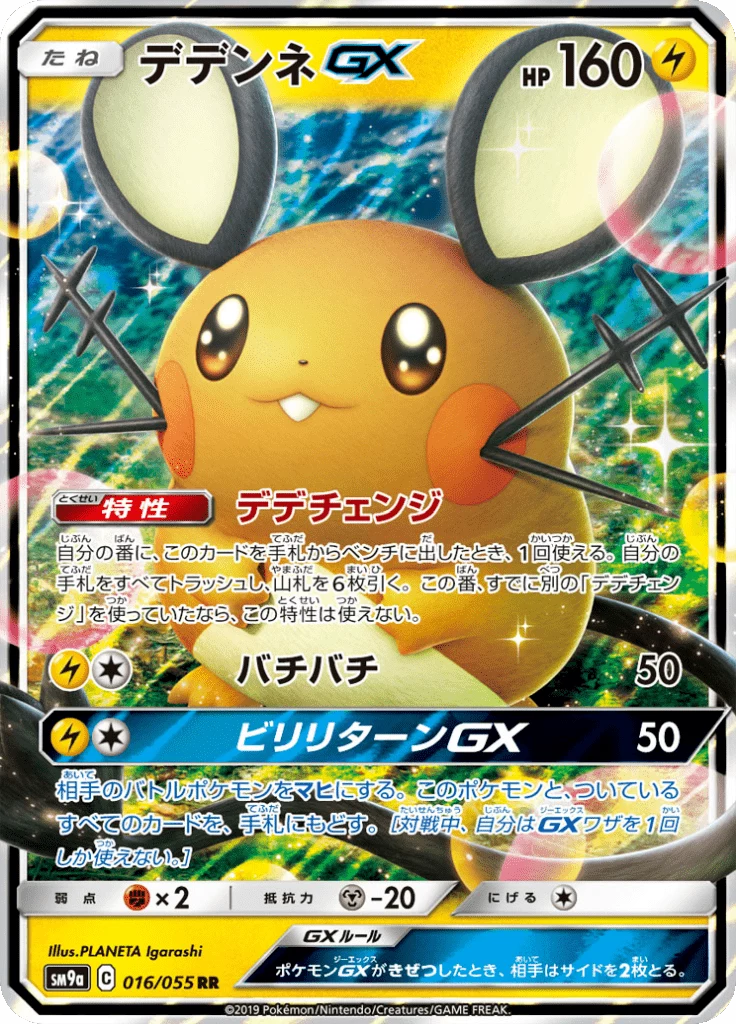
PLANETA Igarashi’s credit appears on Dedenne GX twice, in two separate Sun & Moon-era sets: Tag All Stars (SM12a #48) and Night Unison (SM9a #16). Both are individually confirmed as „Illustrated by PLANETA Igarashi“ on their Limitless TCG card pages, and both carry Double Rare status in their respective sets.

Dedenne GX SM12a 048/173 Double Rare Tag All Stars
Dedenne GX, Tag All Stars (SM12a) #48, Double Rare
Dedenne GX SM9a 016 Double Rare Night Unison
Dedenne GX, Night Unison (SM9a) #16, Double Rare

These are two distinct products from two distinct set releases, not variant stampings of the same print run — Tag All Stars is the High Class Pack „TAG TEAM GX Tag All Stars“ (SM12a), and Night Unison is SM9a. The Tag All Stars printing, numbered 048/173 in the set, is the one currently listed in our PSA 10 vault.

In Our PSA 10 Vault

We checked PLANETA Igarashi’s card credits against our PSA 10 inventory directly. The result: one match, the Dedenne GX RR, SM12a 048/173, currently listed at ¥15,243.

Shop This Card
Dedenne GX RR, SM12a 048/173, PSA 10
Currently listed at ¥15,243
Ships from Tokyo · Tracked delivery

View Product →

A Note on the Secret-Numbered Print

Our inventory also carries a Dedenne GX SM12a 175/173 SA — a secret alternate-art print above the set’s regular 173-card count. Limitless TCG’s Japanese database does not list card number 175 for Tag All Stars, so we cannot confirm whether PLANETA Igarashi illustrated that specific print. Only the regular 048/173 print above is confirmed as his work; the 175/173 secret print is not counted as a PLANETA Igarashi match.

No other card in PLANETA Igarashi’s catalog — Lugia GX, Reshiram GX, Zarude V, Lugia VSTAR, or the Night Unison Dedenne GX — currently has a graded PSA 10 copy in our vault. If one of those is what brought you here, the Quick Order page is the fastest way to flag interest for when a copy surfaces and gets graded.

The check ran against our full in-stock PSA 10 inventory, matched by collector number and card name against PLANETA Igarashi’s complete 51-card Limitless catalog — not just the six representative cards covered above — so the single match reported here reflects a full inventory check rather than a spot-check of the highlighted cards.

Beyond the Cards

Outside the TCG’s numbered sets, Igarashi has also illustrated 24 cards appearing in Pokemon Trading Card Game Pocket, per Bulbapedia — a separate mobile-game catalog tracked apart from the main TCG counts above.

Bulbapedia’s sole citation for Igarashi’s studio affiliation is a CGWorld feature on PLANETA itself; we have not read the article’s content beyond confirming the link exists, so we’re not summarizing what it covers. Beyond his employment at PLANETA and his card credits, Bulbapedia does not document any awards, exhibitions, or work outside the Pokemon TCG for Igarashi specifically — so that’s the extent of what’s currently verifiable about him as an individual.

That gap is worth being upfront about rather than filling in. For PLANETA Igarashi specifically, the card catalog and the single Bulbapedia citation are what’s documented; we’re not speculating beyond that.

Where to Buy PLANETA Igarashi Cards from Japan

We stock PSA 10 Japanese singles and ship from Tokyo, and the Dedenne GX RR from Tag All Stars is the single PLANETA Igarashi-illustrated card currently listed in our vault.

Shop This Card
Dedenne GX RR, SM12a 048/173, PSA 10
Currently listed at ¥15,243
Ships from Tokyo · Tracked delivery

View Product →

For the wider PSA 10 catalog, browse our PSA 10 collection or our PSA 10 card list to filter by set and price. If you’re comparing our ongoing illustrator series, our guides to KEIICHIRO ITO, Megumi Mizutani, and Sui each cover a different artist’s most valuable printings. For anything not currently in stock, the Quick Order page is the fastest way to build a request.

Pricing and availability can shift between when this guide was checked and when you’re reading it — the product page linked above always reflects the current listing.

Häufig gestellte Fragen

Who is PLANETA Igarashi?

PLANETA Igarashi is the card credit for Kazuya Igarashi, an illustrator who has worked at the studio PLANETA since 2011. He has illustrated 51 Pokemon TCG cards per Limitless TCG’s database (42 per Bulbapedia’s own tally), plus 24 cards in Pokemon Trading Card Game Pocket.

What was PLANETA Igarashi’s first Pokemon card?

The Full Art Ultra Necrozma-GX from the Forbidden Light expansion, per Bulbapedia.

Is „PLANETA“ a person or a studio?

PLANETA is a studio; Igarashi is one illustrator working there. Other credits under the same studio, such as PLANETA Mochizuki, are a different credit with its own card list. Don’t assume every „PLANETA“-credited card is Kazuya Igarashi’s work.

Is the Dedenne GX 175/173 secret rare also illustrated by PLANETA Igarashi?

Unverified. Limitless TCG’s Japanese database does not list card number 175 for Tag All Stars (SM12a), so the illustrator credit for that specific secret print cannot be confirmed from our sources. Only the regular Dedenne GX print at 048/173 is confirmed as PLANETA Igarashi’s work.

What other cards has PLANETA Igarashi illustrated?

Confirmed credits include Lugia GX (Super Burst Impact, SM8 #100), Reshiram GX (GX Ultra Shiny, SM8b #211), Zarude V (Legendary Heartbeat, S3a #77), Lugia VSTAR (Sword & Shield Promotional Cards, SP #325), and two separate Dedenne GX prints from Tag All Stars (SM12a #48) and Night Unison (SM9a #16).

Where can I buy a PLANETA Igarashi Pokemon card?

As of our August 12, 2026 stock check, our PSA 10 Dedenne GX RR (SM12a 048/173) is available directly on our product page, currently listed at ¥15,243. For the wider PSA 10 catalog, browse our PSA 10 collection or PSA 10 card list, or use our Quick Order page to request cards that are currently out of stock.

Shin Nagasawa Pokemon Cards: Illustrator Guide to 300+ Cards

Shin Nagasawa (長潘真) has been drawing Pokemon cards since the Supreme Victors era, and the catalog that’s built up since then runs to hundreds of cards — comic-book outlines on some, painterly color shading on others, and a body of work that started not in trading cards at all, but at a Japanese video game studio.

This guide covers what’s actually documented about Nagasawa: the career path into the Pokemon TCG, the visual style Bulbapedia describes across the catalog, a set of verified card credits with Japanese-print images, the packaging and merchandise work outside the card game itself, and where that catalog stands against our own PSA 10 inventory today.

Key Takeaway

Shin Nagasawa has illustrated 343 cards in Limitless TCG’s Japanese-language database (300 in the English-language database), going back to a debut with Dragonite FB and Regigigas FB in the Supreme Victors expansion. We checked our full PSA 10 inventory against Nagasawa’s verified card list and currently hold no graded copies credited to this illustrator — if you’re chasing a specific Nagasawa print, the Quick Order page is the fastest way to flag it for when a copy comes in.

343
JP TCG Cards (Limitless)

300
EN TCG Cards (Limitless)

2000
Went Freelance

4
Set Covers Illustrated (Plasma/Boundaries Era)

Who Is Shin Nagasawa?

Shin Nagasawa (Japanese: 長潘真) is a freelance illustrator who has provided artwork for the Pokemon Trading Card Game and other Pokemon-related merchandise, per Bulbapedia. The path into the TCG did not start there: after graduating from university in 1994, Nagasawa worked as a graphic designer at Square for a number of years, credited as a monster concept artist on several titles during that period. This guide does not list the specific titles — what’s documented is the role, not the title list.

Nagasawa went freelance in 2000, and Bulbapedia describes a body of work since then that spans illustration, a manga series, concept art for several games, and card illustrations for multiple trading card games — not just Pokemon. Within the Pokemon TCG specifically, the first credited illustrations were Dragonite FB and Regigigas FB, both from the Supreme Victors expansion.

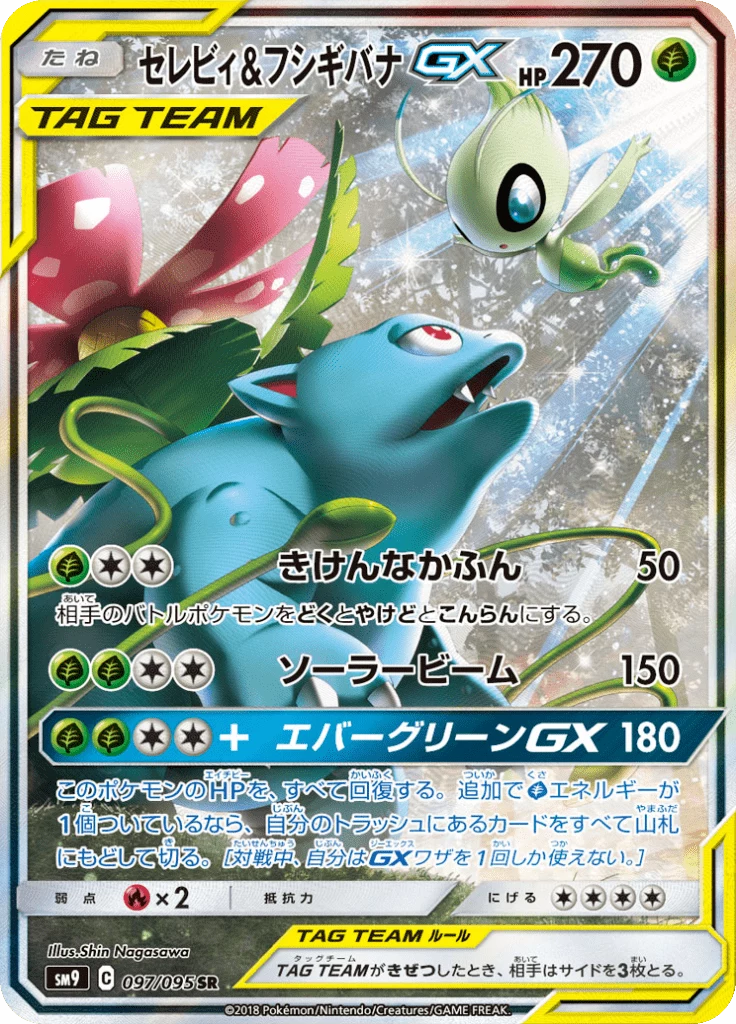
On the numbers: Limitless TCG’s Japanese-language database currently lists 343 cards credited to Nagasawa, and the English-language database lists 300. These are two separate catalogs tracking different print runs of overlapping artwork, so the two figures shouldn’t be added together. Bulbapedia’s own count — 299 TCG cards, plus 71 in Pokemon Trading Card Game Pocket — is a third, separately-maintained tally kept here for reference rather than combined with the Limitless numbers. We didn’t take the database totals at face value either: the Celebi & Venusaur-GX secret rare featured below was individually re-checked on its own Limitless card page, which shows the literal credit line “Illustrated by Shin Nagasawa,” before it was counted toward this guide.

Between the 1994 Square years and the 2000 freelance turn, Bulbapedia is specific about the job title — graphic designer, later credited as a monster concept artist — but this guide does not list the specific titles or an employer-side project list beyond that. That’s a narrower biography than some of the other illustrators in this series get, and rather than filling the gap with plausible-sounding game titles, this guide leaves it exactly as documented: a multi-year design career at a Japanese studio, followed by two-plus decades as a freelance illustrator working across the Pokemon TCG, other trading card games, manga, and self-published dojinshi.

One thing worth flagging up front: this guide follows Bulbapedia’s sourcing rather than assuming pronouns, and refers to Nagasawa by name throughout rather than guessing at gendered language beyond what’s documented on the wiki.

The Nagasawa Style: Outlines, Shadow, and Motion

Bulbapedia’s description of the Nagasawa style splits into two visual modes that show up across the catalog. Some illustrations are drawn in a style reminiscent of comic books — solid black outlines, areas of extreme shadow rendered as flat solid black. Others lean the opposite direction, with color shading doing the work of defining detail and background rather than hard linework. What ties the two modes together, per Bulbapedia, is a near-constant focus on motion: in nearly every illustration, Nagasawa frames a specific portion of the Pokemon’s body with a deliberate degree of tilt, rather than a static full-body pose.

Celebi and Venusaur-GX SM9 097 Secret Rare Tag Bolt
Celebi & Venusaur-GX, SM9 097, Secret Rare, Tag Bolt
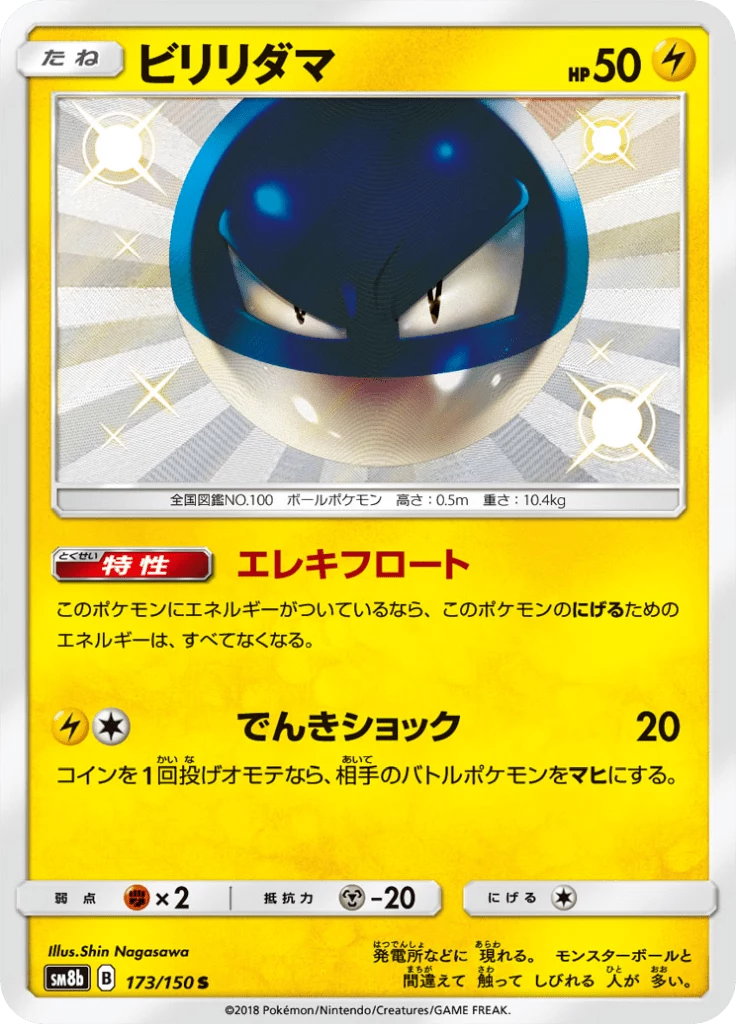
Voltorb SM8b 173 Secret Rare GX Ultra Shiny
Voltorb, SM8b 173, Secret Rare, GX Ultra Shiny
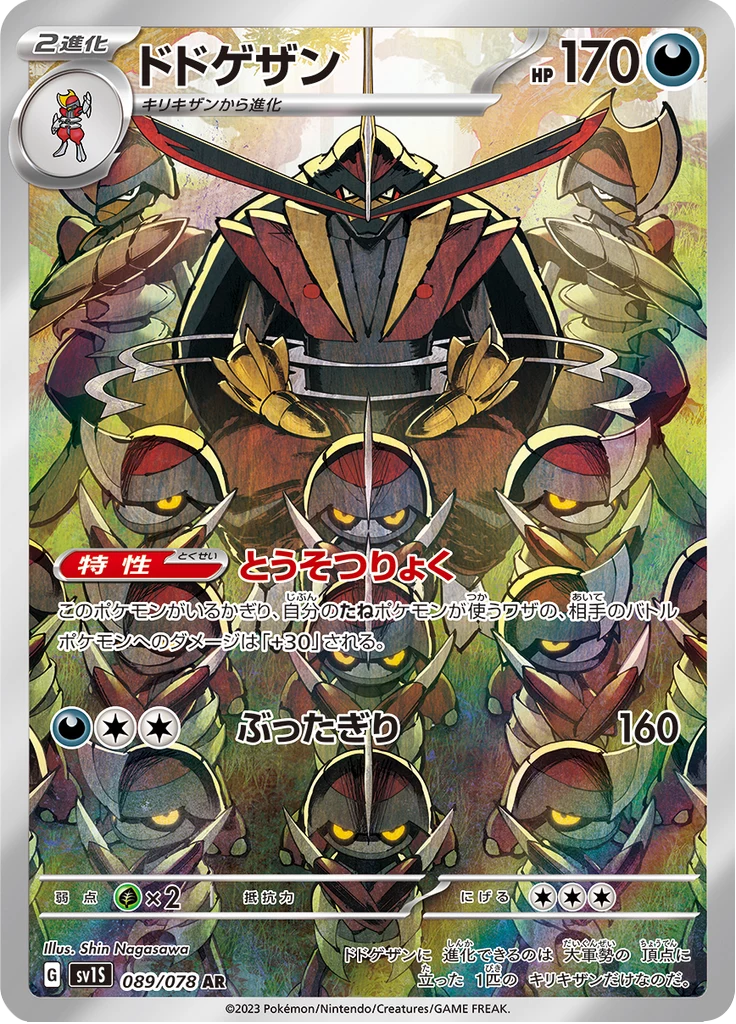
Kingambit SV1S 089 Art Rare Scarlet ex
Kingambit, SV1S 089, Art Rare, Scarlet ex

The Celebi & Venusaur-GX secret rare and the Voltorb secret rare both appear closer to the comic-outline mode — heavy black contour lines and blocked-in shadow doing most of the visual work. Kingambit, from the more recent Scarlet ex Art Rare tier, sits closer to the shading-led mode, with the tilt-and-motion framing Bulbapedia describes carried through into the Scarlet & Violet era of the catalog.

Spotting a Nagasawa Illustration

Look for the outline-versus-shading split first, then check the framing: a tight crop on part of the Pokemon’s body, angled rather than square-on, is the throughline Bulbapedia identifies across both visual modes.

Notable Cards in the Catalog

The 343-card Japanese-language list spans well over a decade of Pokemon TCG sets, from the debut Supreme Victors printings through current Scarlet & Violet-era product. A representative cross-section, each individually confirmed on its Limitless card page as “Illustrated by Shin Nagasawa”:

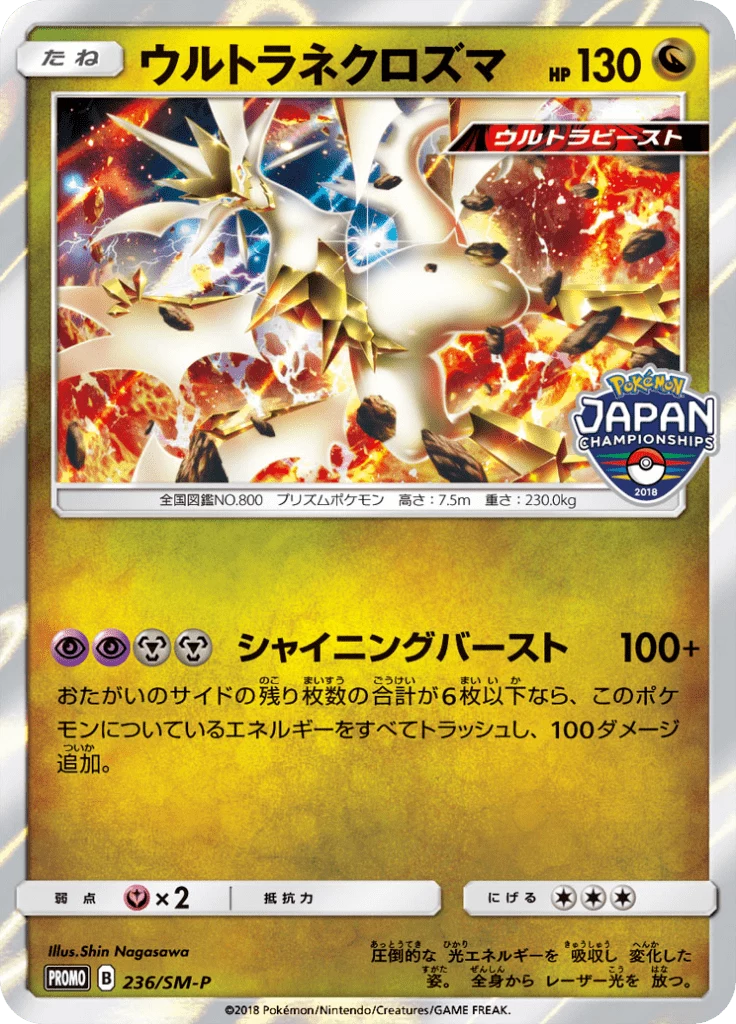
Ultra Necrozma SMP 236 Sun and Moon Promotional Cards
Ultra Necrozma, SMP 236, Sun & Moon Promotional Cards
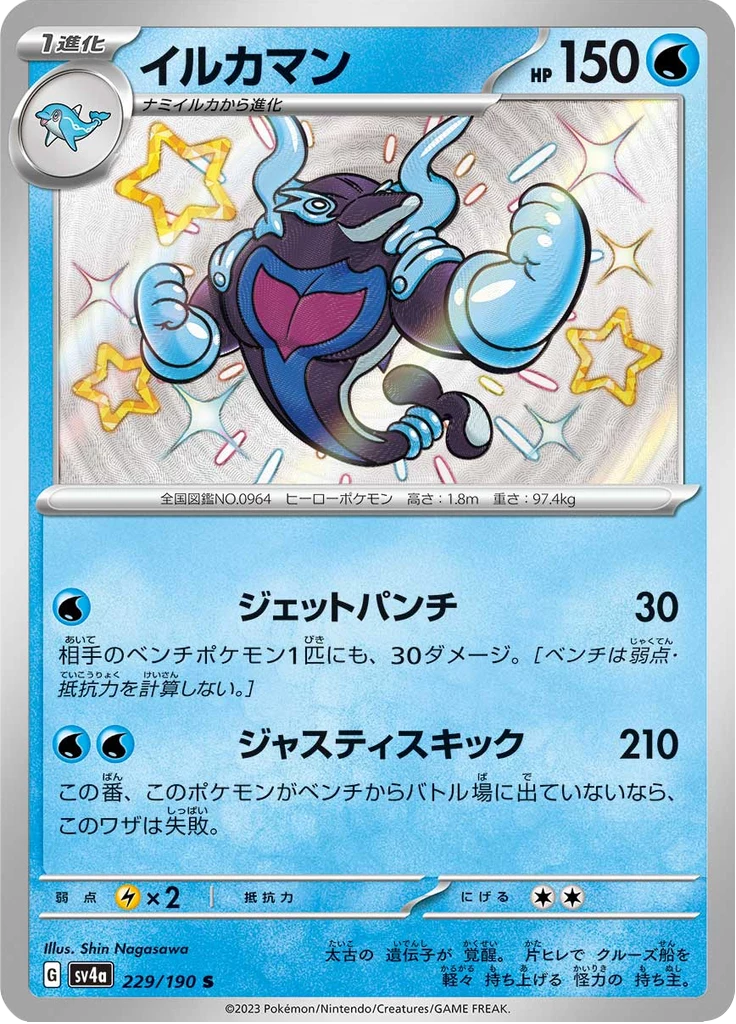
Palafin SV4a 229 Shiny Rare Shiny Treasure ex
Palafin, SV4a 229, Shiny Rare, Shiny Treasure ex
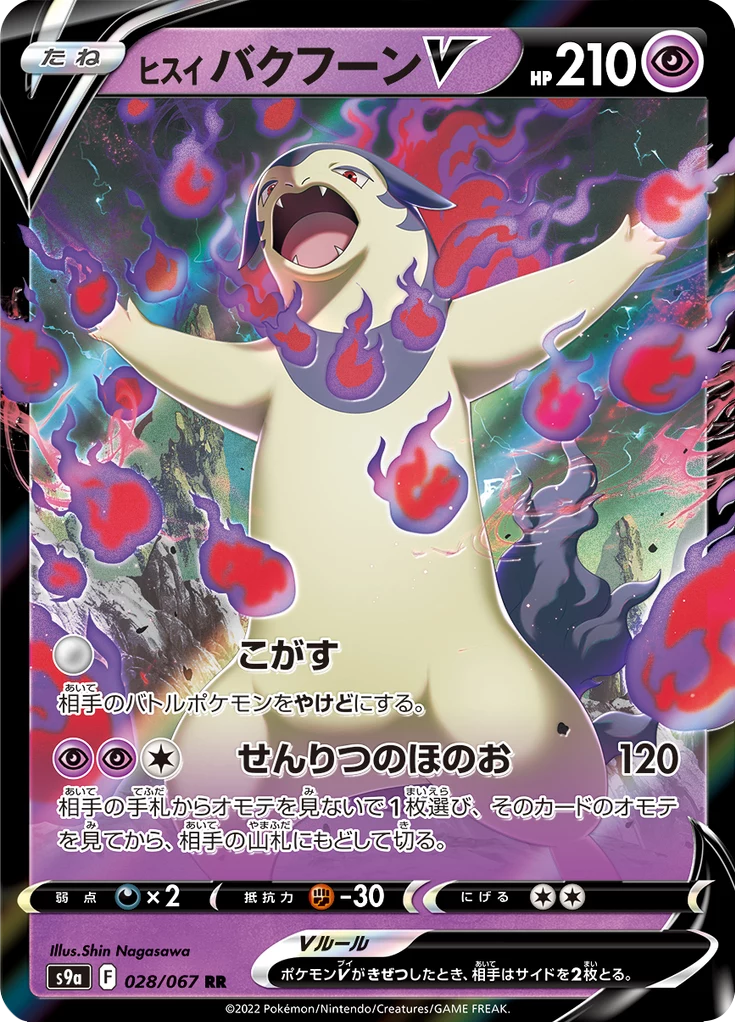
Hisuian Typhlosion V S9a 028 Double Rare Battle Region
Hisuian Typhlosion V, S9a 028, Double Rare, Battle Region

Ultra Necrozma, printed as a Sun & Moon-era promo card, and Palafin, from the Shiny Treasure ex Shiny Rare tier, come from different eras of the catalog but share the same tilted, motion-focused framing. Hisuian Typhlosion V, from Battle Region’s Double Rare lineup, is a further example of the shading-led mode carrying through the Sword & Shield era.

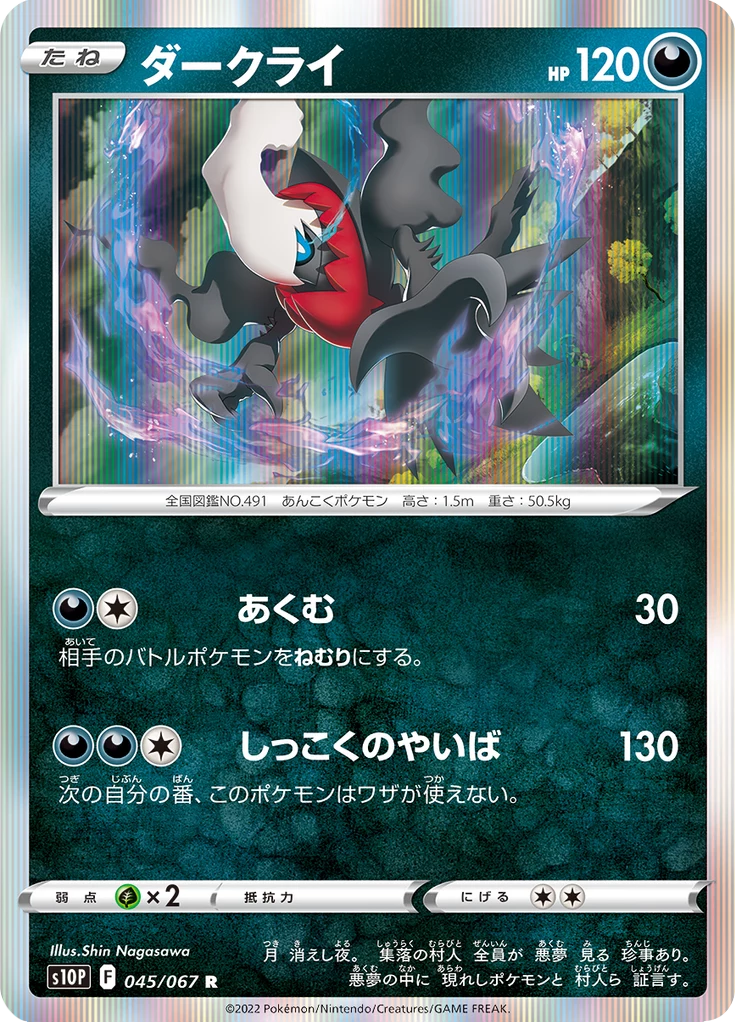
Darkrai S10P 045 Rare Space Juggler
Darkrai, S10P 045, Rare, Space Juggler

Darkrai, printed at the standard Rare tier in Space Juggler, is a reminder that Nagasawa’s output isn’t limited to chase-rarity alt arts — the verified sample includes standard Rares as well as chase prints like secret rares and shiny rares. Read across the full list, the catalog reads less like a handful of headline pulls and more like a sustained, decade-plus run of Pokemon TCG set work.

The span between the earliest confirmed credits and the most recent is worth sitting with, too. Supreme Victors, where Dragonite FB and Regigigas FB first carried the Nagasawa credit, sits many sets back in the Limitless timeline from the Scarlet & Violet-era Kingambit and Palafin prints shown above. The catalog reads as a career that started with the Supreme Victors debut and has continued into current-era product, rather than a short run confined to one generation of sets.

Beyond the Cards: Packaging, Merchandise, and Manga

Nagasawa’s Pokemon-related work extends past individual card illustrations into set packaging and physical merchandise. Per Bulbapedia, Nagasawa produced the packaging artwork for four expansions released outside Japan: Boundaries Crossed, Plasma Storm, Plasma Freeze, and Plasma Blast.

Other Pokemon merchandise credited to Nagasawa includes a 2011 New Year’s greeting card and pochi bags featuring Reshiram & Zekrom, a Uniqlo T-shirt design featuring Tepig, Pignite, and Emboar, Pokemon Center stationery featuring Kyurem versus Tornadus, Thundurus, and Landorus, and deck shields featuring Gardevoir & Lilligant.

Outside official Pokemon work, Nagasawa has self-published dojinshi under the pseudonyms “JASON” (ジェイソン) and “J-mura” (J村), and is credited with a published manga series, “Ao I Hada,” released in three volumes between 2000 and 2001 through GONZO and Kadokawa Shoten. None of this crosses back into the Pokemon TCG catalog directly, but it fills in the freelance career Bulbapedia describes running alongside the card work since 2000.

Taken together, the packaging credits and the merchandise list are a different kind of documentation than a card count. A set’s box art and pack art are what a buyer sees before opening anything, and Bulbapedia crediting four internationally-released expansions to one illustrator is a different kind of visibility than any single card credit, chase rarity or not. The merchandise list, in turn, shows the same illustrator working outside the TCG entirely — stationery, apparel, deck shields — on licensed Pokemon products that never touch a booster pack.

For collectors comparing illustrator catalogs side by side, Nagasawa’s body of set-packaging and merchandise work sits closer to career-spanning illustrators like Mitsuhiro Arita than to newer, card-only names — the packaging credits in particular are a level of TCG involvement not every illustrator in our series has documented.

In Our PSA 10 Vault

We checked Nagasawa’s full Limitless card list against our current PSA 10 inventory directly, matching by collector number and card name rather than Pokemon name alone — the same method we use across this illustrator series, to avoid a name coincidence standing in for a real match.

The result: no inventory item currently matches a Limitless-verified Shin Nagasawa credit. That’s a straightforward inventory snapshot rather than a statement about the catalog’s collectibility — a 343-card Japanese-language list this size may return to stock over time. Several inventory titles carried a collector number that numerically coincided with a Nagasawa-credited card, and each of those near-matches was checked individually against the card name before being ruled out — a numerator matching alone isn’t treated as a match anywhere in this illustrator series.

Browse the Catalog
PSA 10 Japanese Pokemon Cards
Filter by illustrator, set, and price
Ships from Tokyo · Tracked delivery

Shop PSA 10 Cards →

If a specific Nagasawa-illustrated card brought you here — the Celebi & Venusaur-GX secret rare, the Voltorb secret rare, or any of the packaging-era Plasma set cards — the Quick Order page is the fastest way to flag a request for when a graded copy comes into stock.

Where to Buy Japanese Pokemon Cards

We source and ship Japanese Pokemon cards out of Tokyo, and while our vault doesn’t currently hold a PSA 10 copy credited to Shin Nagasawa specifically, the full graded catalog is browsable by illustrator, set, and rarity.
Start with our PSA 10 card list to search across the entire graded inventory, or browse the PSA 10 collection directly. For anything not currently in stock — including specific Nagasawa prints like the Supreme Victors debut cards or the Plasma-era set covers — the Quick Order page is the fastest way to build a request.

If you’re researching illustrator catalogs more broadly, our guides to KEIICHIRO ITO and Teeziro cover two other illustrators with verified card catalogs and current PSA 10 stock notes, in the same format as this guide.

Häufig gestellte Fragen

Who is Shin Nagasawa?

Shin Nagasawa (長潘真) is a freelance illustrator who has provided artwork for the Pokemon Trading Card Game since debuting with Dragonite FB and Regigigas FB in the Supreme Victors expansion. Nagasawa previously worked as a graphic designer and monster concept artist at Square before going freelance in 2000.

How many Pokemon cards has Shin Nagasawa illustrated?

Limitless TCG’s Japanese-language database lists 343 cards credited to Nagasawa; the English-language database lists 300. These are separate catalogs and shouldn’t be added together. Bulbapedia’s own tally is 299 TCG cards plus 71 Pokemon Trading Card Game Pocket cards.

What is Shin Nagasawa’s illustration style known for?

Bulbapedia describes two recurring modes: some illustrations use solid black outlines and blocked-in shadow, reminiscent of comic books, while others rely on color shading to define detail and background. Across nearly all of them, the framing focuses on motion and a specific tilted portion of the Pokemon’s body rather than a static full-body pose.

Did Shin Nagasawa work in video games before Pokemon cards?

Yes. After graduating from university in 1994, Nagasawa worked as a graphic designer at Square for a number of years and was credited as a monster concept artist on several titles, before going freelance in 2000. The specific titles are not covered in this guide.

What Pokemon set packaging has Shin Nagasawa illustrated?

Nagasawa produced the packaging artwork for four expansions released outside Japan: Boundaries Crossed, Plasma Storm, Plasma Freeze, and Plasma Blast. Other credited merchandise includes Uniqlo T-shirt designs, Pokemon Center stationery, deck shields, and a 2011 Reshiram & Zekrom New Year’s greeting card.

Are there Shin Nagasawa PSA 10 cards currently in stock?

As of this guide’s last inventory check, we hold no PSA 10 cards specifically matched to a verified Shin Nagasawa credit. Browse our PSA 10 card list for the current graded catalog, or use the Quick Order page to request a specific Nagasawa print.

Uta Pokemon Cards: A Collector’s Guide to the Illustrator

Search Limitless TCG’s card database for the illustrator name “Uta” and it returns 425 English-language cards and 561 Japanese-language cards. Almost none of that is actually Uta’s work — the search is a substring match, so it also pulls in every card credited to any illustrator whose name simply contains the letters “uta,” among them Megumi Mizutani and Saya Tsuruta. Run the exact-match search Limitless itself uses on individual card-credit links, and the real catalog is far smaller: 61 English-language cards and 73 Japanese-language cards. Those 61/73 figures are the exact-match search counts; the eight cards featured in this guide were each individually confirmed on their own Limitless card page to carry the literal credit “Illustrated by Uta.”

This guide sticks to what that exact-match catalog and Bulbapedia’s illustrator page can actually verify: Uta’s debut card, the shape of the catalog across sets and rarities, and the single PSA 10 copy of an Uta-illustrated card currently sitting in our vault. Bulbapedia’s page for Uta is a short stub, and it refers to the illustrator with they/them pronouns throughout — a convention this guide follows, rather than guessing at a gender, nationality, or real name that no public source confirms.

Key Takeaway

Uta is credited on 61 English-language and 73 Japanese-language Pokemon TCG cards (Limitless TCG exact-match count), debuting with Ponyta from the Cosmic Eclipse expansion. Our PSA 10 vault currently holds one Uta-illustrated card — the Galarian Articuno V SR:SA, S5a 074/070, currently listed at ¥20,497.

61
EN Cards (Exact Match)

73
JP Cards (Exact Match)

11
TCG Pocket Cards

1
PSA10 In-Stock Match

Catalog figures reflect Limitless TCG’s exact-match illustrator search (!artist:Uta), the same operator Limitless uses in its own card-credit links, checked on August 12, 2026. The in-stock price reflects our vault on the same date.

Who Is Uta?

Per Bulbapedia, Uta is an illustrator who has contributed artwork to the Pokemon Trading Card Game. The page is marked as a stub — there is no biography, no birthplace, no career narrative, and no stated art style, which is unusual next to the more thoroughly documented illustrators in our ongoing series. What the page does state directly is that Uta’s first card was Ponyta from the Cosmic Eclipse expansion, and it refers to the illustrator throughout with they/them pronouns (“Their first card was Ponyta”).

Bulbapedia’s own tally credits Uta with 62 TCG cards, plus 11 cards in Pokemon Trading Card Game Pocket. That 62-card figure is close to, but not identical to, the Limitless exact-match count of 61 English-language cards cited above — the two sources use different methodologies and shouldn’t be summed or treated as interchangeable, and the TCG Pocket figure is a separate product tracked separately again.

Every card attributed to Uta in this guide was individually re-verified on its own Limitless card page, showing the plain one-word credit “Illustrated by Uta,” specifically to avoid the substring-search contamination described above. That verification step matters more here than for most illustrators: a name as short and common a syllable as “Uta” is exactly the kind of string that produces false positives in a simple text search, and we’d rather report a smaller, accurate catalog than a larger, polluted one.

This is also one of the thinner profiles in our ongoing illustrator series. Where guides on artists like Kawayoo or Naoyo Kimura can draw on a full Bulbapedia career section — debut sets, technique notes, work outside the TCG — the Uta page offers a single sentence about the debut card and nothing more. That’s a real constraint on what this guide can responsibly say, and it shapes the rest of the piece: the sections below stay close to the verified card list itself, because that list is the most complete record of Uta’s work currently available to check.

The Debut: Ponyta from Cosmic Eclipse

Bulbapedia states plainly that Uta’s first card was Ponyta, released in the English-language Cosmic Eclipse expansion. Beyond the Pokemon and the set name, the stub page gives no further detail about that debut — no release context, no rarity, no illustration description.

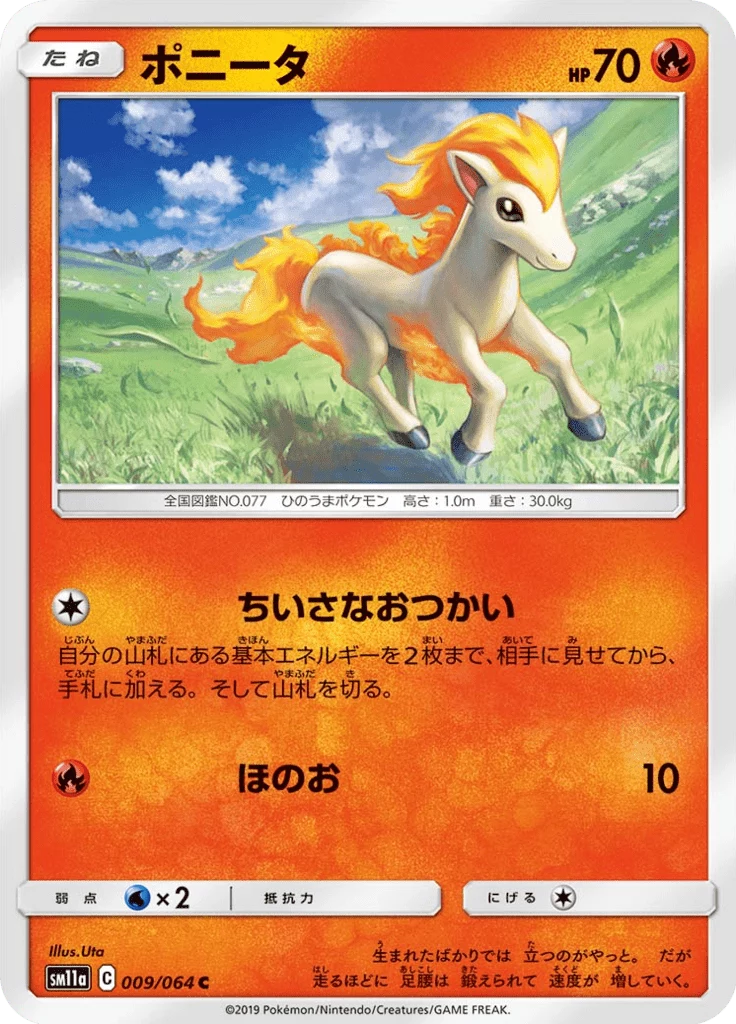
Separately, on the Japanese side, Limitless TCG’s exact-match illustrator list includes a Ponyta printed in Remix Bout (SM11a) #9, a Common, with the “Illustrated by Uta” credit individually re-verified on its card page. It’s tempting to assume this is simply the Japanese counterpart of the Cosmic Eclipse debut card, but neither source states that the two are the same illustration, and Bulbapedia and Limitless are tracking different regional printings independently. We’re keeping the two facts separate rather than merging them into a single claim neither source makes.

Ponyta SM11a 009 Remix Bout common card illustrated by Uta
Ponyta, Remix Bout (SM11a) #9, Common

Beyond Ponyta: The Wider Uta Catalog

Ponyta is the one card Bulbapedia calls out by name, but the exact-match catalog runs from early Common-tier set fill through modern Secret Rare chase cards, spanning sets from the Sun & Moon era through the Scarlet & Violet era in Japan. A representative slice, individually verified against Limitless’s Japanese card pages:

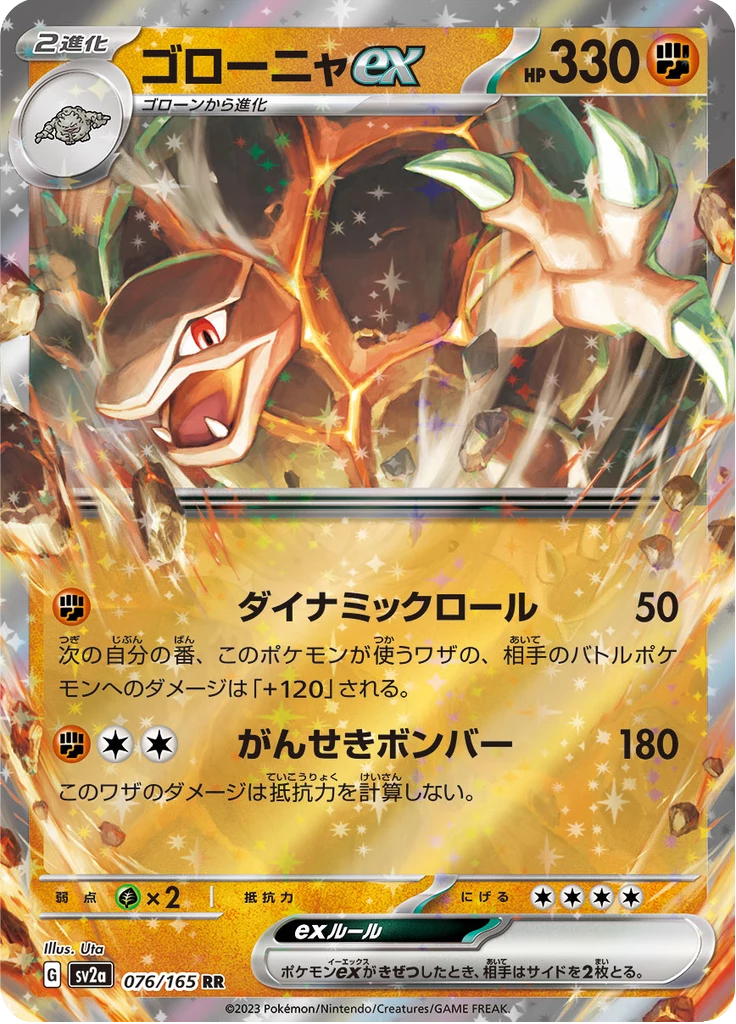
Golem ex SV2a 076 Double Rare Pokemon Card 151 illustrated by Uta
Golem ex, Pokemon Card 151 (SV2a) #76, Double Rare
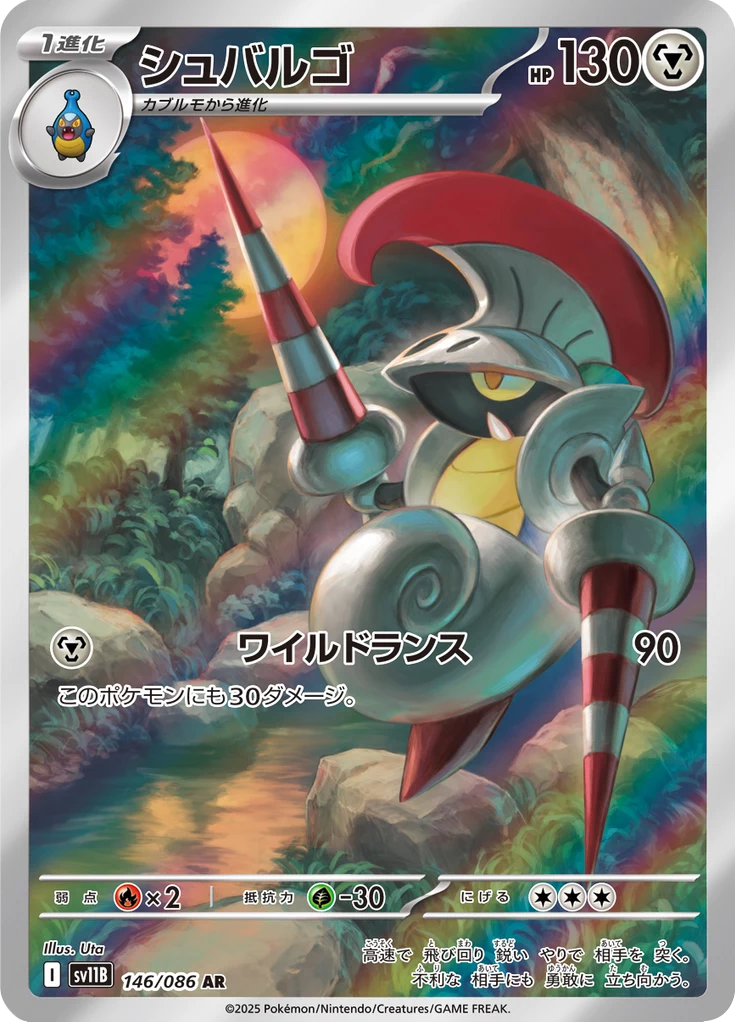
Escavalier SV11B 146 Art Rare Black Bolt illustrated by Uta
Escavalier, Black Bolt (SV11B) #146, Art Rare
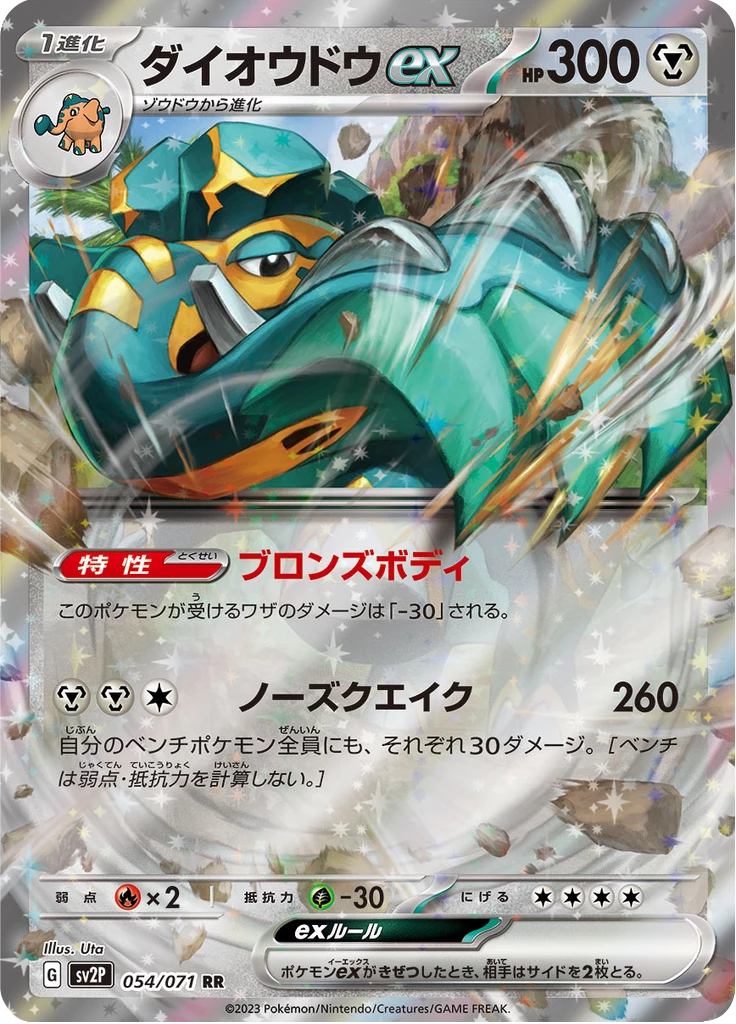
Copperajah ex SV2P 054 Double Rare Snow Hazard illustrated by Uta
Copperajah ex, Snow Hazard (SV2P) #54, Double Rare

Golem ex appears in the Pokemon Card 151 set (SV2a) at Double Rare rarity. Escavalier comes from Black Bolt (SV11B) at Art Rare, a full-illustration tier that gives the Pokemon the whole card face rather than a bordered portrait. Copperajah ex is a Double Rare from Snow Hazard (SV2P), one of the Scarlet & Violet era’s early expansions.
The rest of the verified sample rounds out the picture: Oranguru V (VSTAR Universe, S12a #130, Double Rare), Groudon (Terastal Fest ex, SV8a #80, rarity not listed on Limitless’s search view), and Garbodor V (Skyscraping Perfection, S7D #30, Double Rare) all carry the same individually re-verified “Illustrated by Uta” credit. The full table below lists every card in this sample alongside its set and number.

Karte Set (JP code) Number Rarity
Galarian Articuno V S5a 74 Secret Rare
Ponyta Remix Bout (SM11a) 9 Common
Golem ex Pokemon Card 151 (SV2a) 76 Double Rare
Escavalier Black Bolt (SV11B) 146 Art Rare
Copperajah ex Snow Hazard (SV2P) 54 Double Rare
Oranguru V VSTAR Universe (S12a) 130 Double Rare
Groudon Terastal Fest ex (SV8a) 80 —
Garbodor V Skyscraping Perfection (S7D) 30 Double Rare

Read together, this eight-card sample spans both Common-tier set portraits and Double Rare or Secret Rare chase slots across several years of Japanese releases. With only eight cards verified against a 73-card exact-match catalog, this is a description of the sample itself rather than a conclusion about Uta’s output as a whole.

Of the eight cards verified for this guide, four sit at Double Rare (Golem ex, Copperajah ex, Oranguru V, Garbodor V), one is a Secret Rare (Galarian Articuno V), one is an Art Rare (Escavalier), one is a Common (Ponyta), and one has no rarity listed on Limitless’s search view (Groudon). Within this sample, Double Rare is the most common rarity, with a single Secret Rare rather than several — a distribution limited to these eight cards, not a claim about the full catalog.

In Our PSA 10 Vault

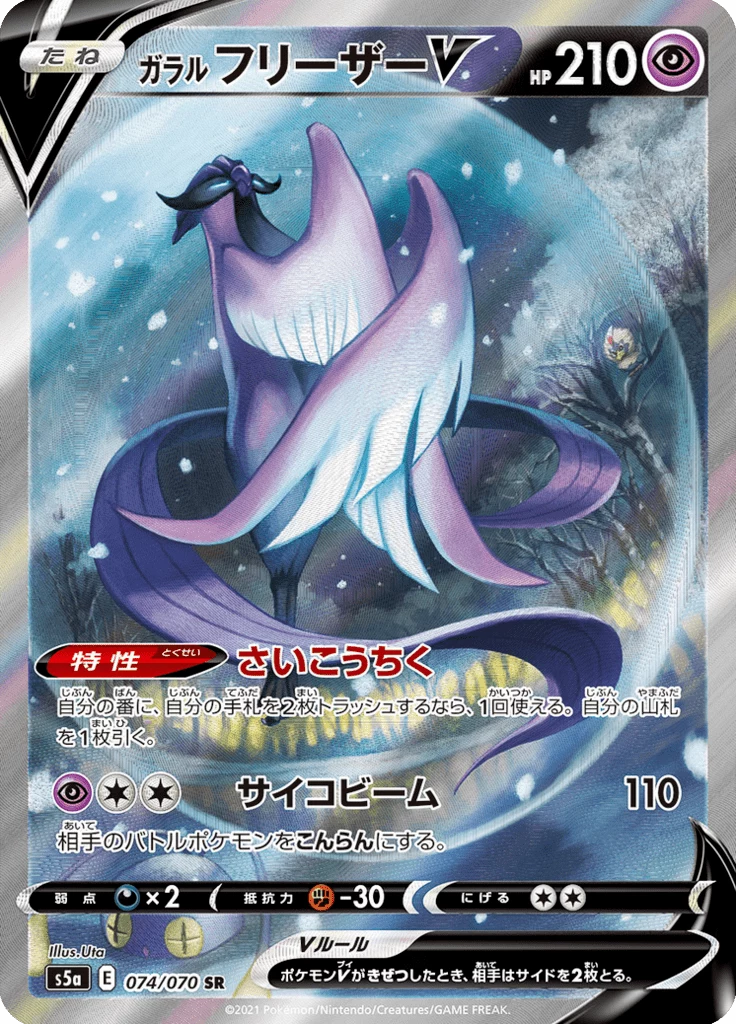
We checked Uta’s exact-match Japanese card list directly against our PSA 10 inventory, matching on collector number, card name, and the “Illustrated by Uta” credit rather than relying on the Pokemon name alone — the same standard applied across our illustrator series generally, where a matching collector number alone has been enough to produce false positives on unrelated printings. Against that standard, the result for Uta is a single match: Galarian Articuno V SR:SA, S5a 074/070, currently listed at ¥20,497.

Galarian Articuno V S5a 074 Secret Rare illustrated by Uta
Galarian Articuno V, S5a 074/070, Secret Rare
Shop This Card
Galarian Articuno V SR:SA, S5a 074/070, PSA 10
Currently listed at ¥20,497
Ships from Tokyo · Tracked delivery

View Product →

None of the other cards described above — Ponyta, Golem ex, Escavalier, Copperajah ex, Oranguru V, Groudon, or Garbodor V — currently have a graded PSA 10 copy in our vault. If one of those is specifically what brought you here, the Quick Order page is the fastest way to flag interest for when a copy surfaces and gets graded.

Beyond the Cards

Outside the Pokemon TCG catalog, verified information about Uta is sparse. Bulbapedia’s stub page lists a Twitter account as Uta’s external link, and states nothing further — no other franchises, no exhibitions, no books, no confirmed non-TCG work of any kind.

Rather than filling that gap with speculation, this guide leaves it here: what’s documented is the card catalog itself, the debut credit, and the they/them pronoun note from Bulbapedia’s own text. Everything else about Uta — real name, gender, nationality, art background — is currently unconfirmed by any source we could check. We’d rather publish a shorter, accurate profile than round out the gaps with plausible-sounding guesses, and if a fuller biography becomes verifiable in the future, this guide is a candidate for an update rather than a rewrite.

Where to Buy Uta Cards from Japan

We stock PSA 10 Japanese singles and ship from Tokyo, and the Galarian Articuno V is the single Uta-illustrated card currently available in our vault.

Shop This Card
Galarian Articuno V SR:SA, S5a 074/070, PSA 10
Currently listed at ¥20,497
Ships from Tokyo · Tracked delivery

View Product →

For the wider PSA 10 catalog, browse our PSA 10 card list or our full PSA 10 collection to filter by set, illustrator, and price. If you’re comparing illustrators across our ongoing artist series, KEIICHIRO ITO, Kawayoo, and Naoyo Kimura each have their own dedicated guides covering their most notable printings. For anything not currently in stock, the Quick Order page is the fastest way to build a request.

Häufig gestellte Fragen

Who is Uta, the Pokemon TCG illustrator?

Uta is an illustrator credited on 61 English-language and 73 Japanese-language Pokemon TCG cards (Limitless TCG exact-match count). Bulbapedia’s page for Uta is a stub that refers to the illustrator with they/them pronouns and states their first card was Ponyta from the Cosmic Eclipse expansion. No confirmed real name, gender, or nationality is available from any source we checked.

What was Uta’s first Pokemon TCG card?

Per Bulbapedia, Uta’s first card was Ponyta from the Cosmic Eclipse expansion. Separately, Limitless TCG’s Japanese database lists a Ponyta credited to Uta in Remix Bout (SM11a) #9; the two are not confirmed to be the same illustration.

How many cards has Uta illustrated?

Limitless TCG’s exact-match illustrator search returns 61 English-language cards and 73 Japanese-language cards credited to Uta. Bulbapedia’s own tally is 62 TCG cards plus 11 Pokemon Trading Card Game Pocket cards. These figures come from different databases and methodologies and should not be added together.

Why does searching „Uta“ on card databases return hundreds of results?

A plain substring search for „Uta“ also matches every illustrator whose name happens to contain those letters, such as Megumi Mizutani and Saya Tsuruta, inflating the count to 425 English and 561 Japanese cards. The accurate, exact-match count for Uta alone is 61 English and 73 Japanese cards.

Do we know Uta’s real name or gender?

No. Bulbapedia’s page for Uta is a stub with no confirmed real name, gender, or nationality. The page uses they/them pronouns, which this guide follows.
Is the Uta-illustrated Galarian Articuno V card in stock?

As of our August 12, 2026 stock check, our PSA 10 copy of the Galarian Articuno V SR:SA (S5a 074/070) was in stock and listed at ¥20,497. It was the only Uta-illustrated card in our PSA 10 vault at that time.

What kinds of Pokemon TCG sets has Uta worked on?

The verified sample for this guide spans Sun & Moon-era sets (Remix Bout) through Sword & Shield-era Japanese sets (VSTAR Universe, Skyscraping Perfection, Matchless Fighters) and into Scarlet & Violet-era Japanese sets (Pokemon Card 151, Snow Hazard, Terastal Fest ex, Black Bolt), across rarities from Common up to Secret Rare. That range indicates ongoing, multi-year work rather than a single limited run, though the exact start and end dates of Uta’s TCG career are not stated by any source checked.

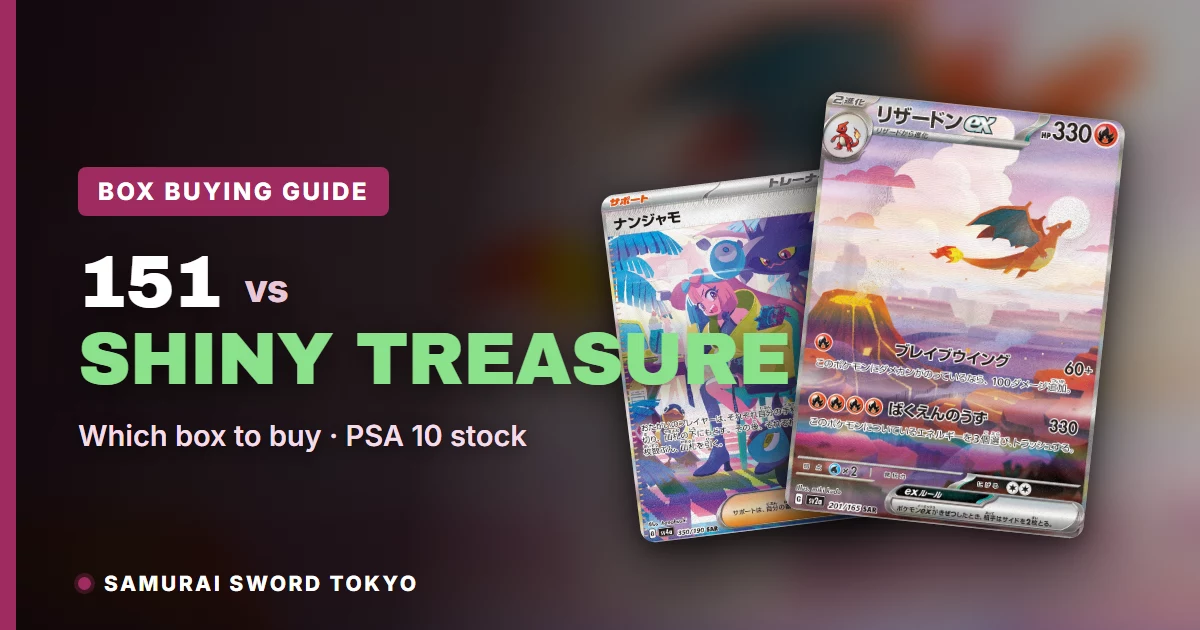
Pokemon 151 vs Shiny Treasure ex: Which Box to Buy [2026]

Two of the most requested Japanese booster boxes on our site are Pokemon 151 and Shiny Treasure ex — and picking between them is a common question. Both come from the Scarlet & Violet era and both carry a reputation as chase-card sets. But they are built around completely different ideas, priced differently, and reward different kinds of buyers.

This guide compares them on the four things that actually matter before you spend real money: what’s printed inside, what the box costs right now, which cards people are chasing, and who each set genuinely suits. No hype, no invented pull rates — just the verified set data and our own live pricing.

Key Takeaway

Pokemon 151 (SV2a) is currently listed at ¥55,500 per sealed box. Shiny Treasure ex (SV4a) is currently listed at ¥20,176 sealed. 151 is a smaller, tighter, more expensive set built around 165 core Pokemon; Shiny Treasure ex is a much larger high-class pack with 190 base cards and a huge shiny secret-rare tail, priced at roughly a third of 151’s cost.

210
151 Total Cards

360
Shiny Treasure ex Total Cards

¥55,500
151 Box Price

¥20,176
Shiny Treasure ex Box Price

Prices below are current listings on samuraiswordtokyo.com as of August 2026 and change with live inventory — check the linked product page for the price and availability at the moment you order.

What’s Actually in Each Box

Start with the sets themselves, because the two are built on opposite design philosophies.

Set Japanese name Release date Total cards Base set Secret rares
Pokemon 151 (SV2a) ポケモンカード151 June 16, 2023 210 165 45 (166–210)
Shiny Treasure ex (SV4a) シャイニートレジャーex December 1, 2023 360 190 170 (191–360)

Pokemon 151 is exactly what the name promises: a complete run through the original 151 Pokemon, capped off with Master Ball and Poke Ball mirror-holo inserts. The set is compact by modern standards — 165 cards in the base run, with a 45-card secret-rare tail on top. That tightness is part of the appeal: fewer total slots means each hit is a slightly bigger share of the print run.

Shiny Treasure ex takes the opposite approach. It’s a „high-class pack,“ a category built specifically to load a box with rare-slot cards, and it shows in the numbers — a 190-card base set backed by a 170-card secret-rare tail, for 360 cards total. The headline mechanic is shiny Pokemon: the set’s SSR tier is built almost entirely from shiny-colored ex cards, which is a different collecting hook than 151’s nostalgia angle.

Reading the Numbers Right

A bigger secret-rare tail doesn’t mean bigger odds of pulling one specific card — it means more distinct rare slots to spread across. 151’s smaller tail concentrates value on fewer cards; Shiny Treasure ex’s larger tail spreads it across more.

Box Price Comparison

The price gap between these two boxes is the single biggest factor in this comparison — 151 currently costs roughly 2.75x what Shiny Treasure ex does.

Produkt Zustand Preis
Pokemon 151 Booster Box — Sealed Factory sealed ¥55,500
Shiny Treasure ex Booster Box — Sealed Factory sealed ¥20,176
Shiny Treasure ex Booster Box — No Shrink Opened outer shrink, sealed packs ¥17,340

151 is built entirely around the original Gen 1 lineup, while Shiny Treasure ex, released less than six months later, is currently listed at a fraction of 151’s price.

If budget matters more than which Pokemon are on the cards, the no-shrink Shiny Treasure ex listing at ¥17,340 is the cheapest entry point on this page — same sealed packs inside, just without the factory outer wrap.

The Chase Cards in Each Set

Here’s where the two sets diverge in personality. 151’s chase cards are the starters and Mew; Shiny Treasure ex’s chase cards are the Trainer SARs and the shiny ex lineup.
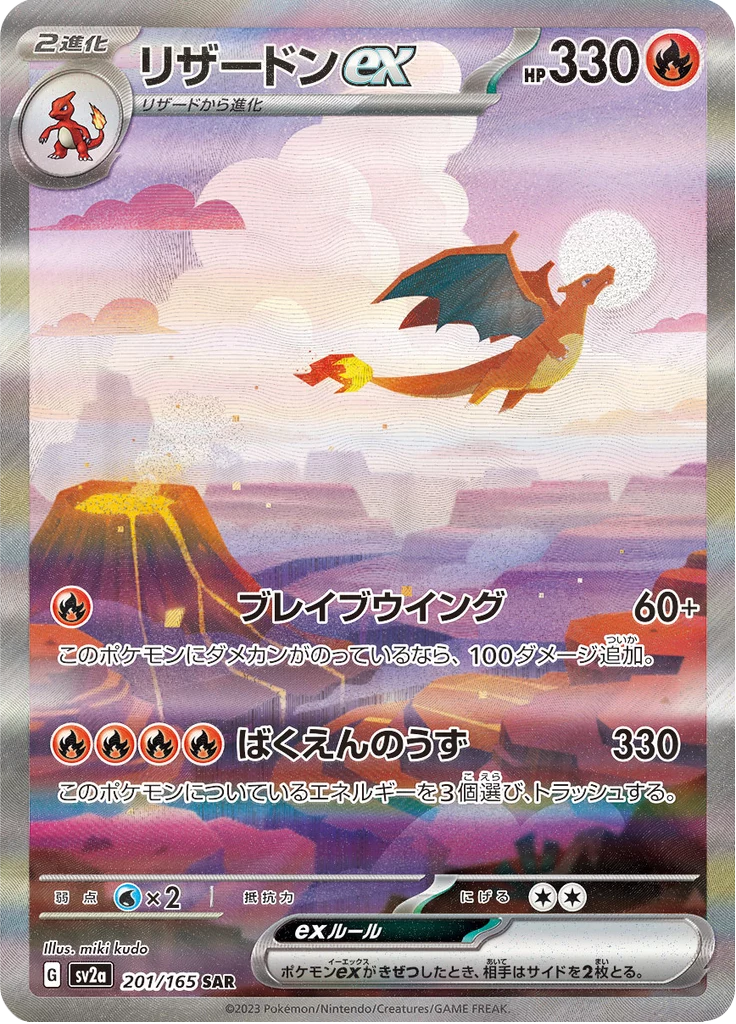
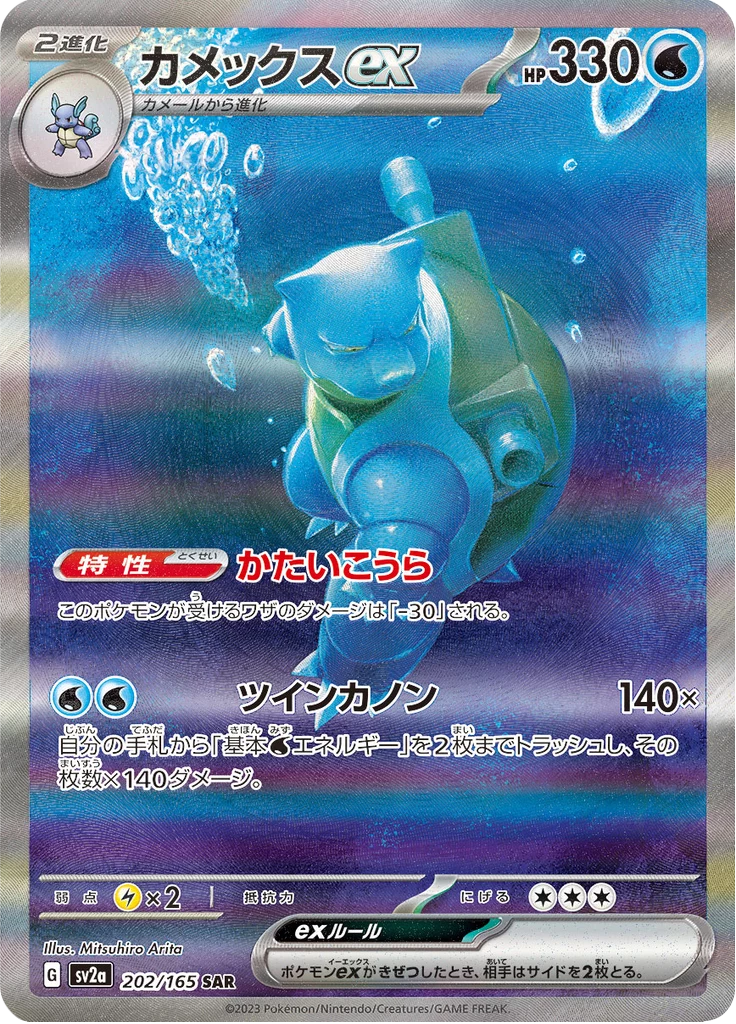
Charizard ex SAR 201/165 Pokemon 151 special art rare card

Charizard ex SAR 201/165

Blastoise ex SAR 202/165 Pokemon 151 special art rare card

Blastoise ex SAR 202/165

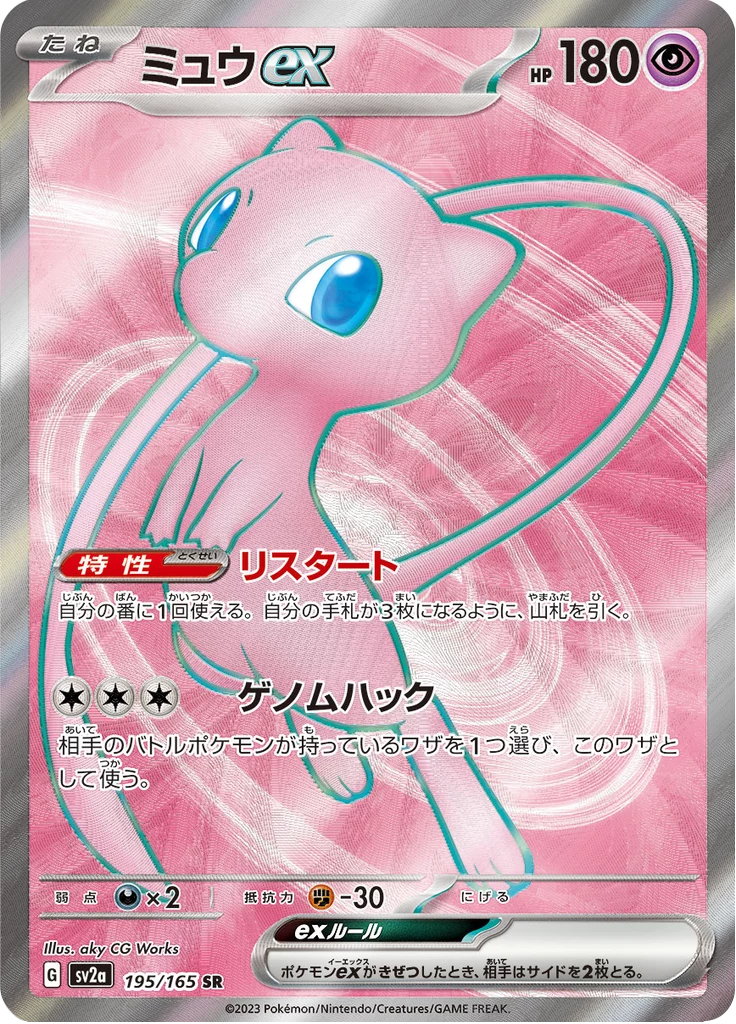
Mew ex SR 195/165 Pokemon 151 super rare card

Mew ex SR 195/165

Charizard ex 201/165 and Blastoise ex 202/165 sit at the top of 151’s want list as SAR-tier art cards, backed by Mew ex 195/165 and a matching Charizard ex 185/165 in the SR tier. All four lean on the same appeal: the original three starters and the franchise mascot, rendered in the set’s signature full-art treatment. It’s a short, easily explained list, which is exactly why it’s stayed popular with buyers who don’t follow the game closely — you don’t need to know the set to know what you’re chasing.

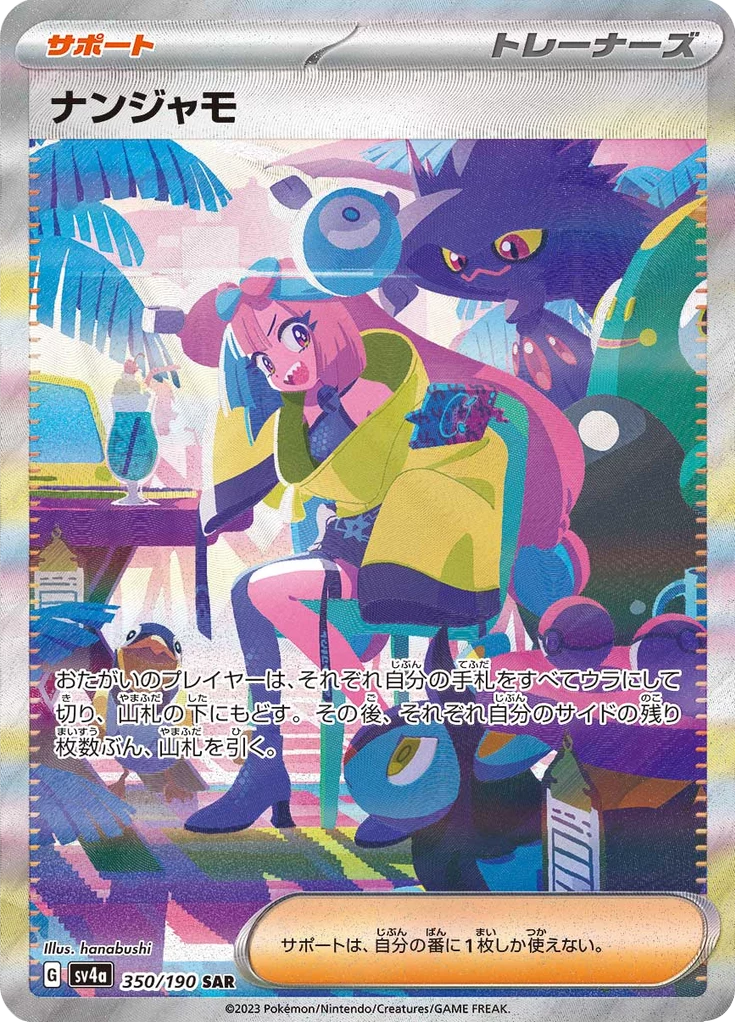
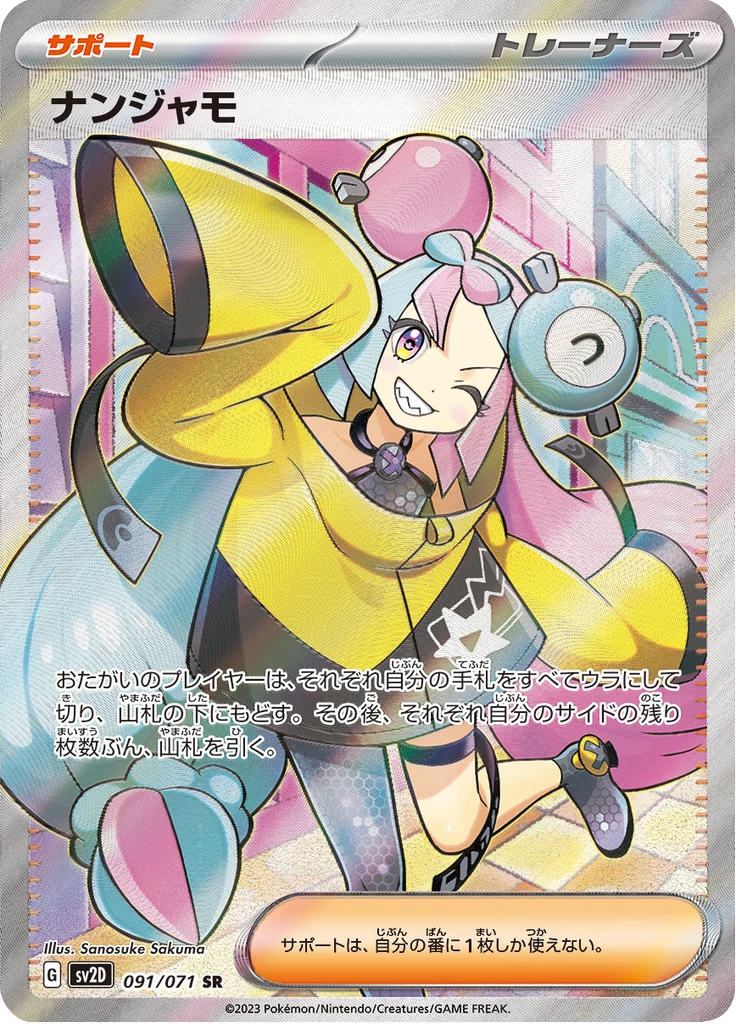
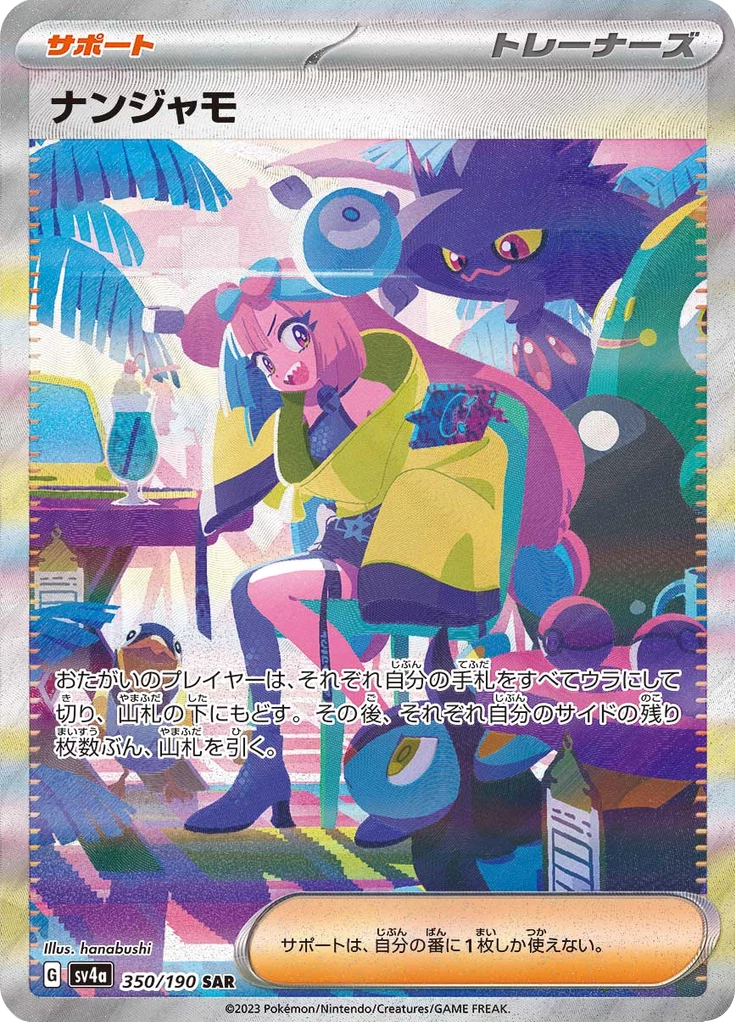
Nanjamo Iono SAR 350/190 Shiny Treasure ex special art rare card

Nanjamo (Iono) SAR 350/190

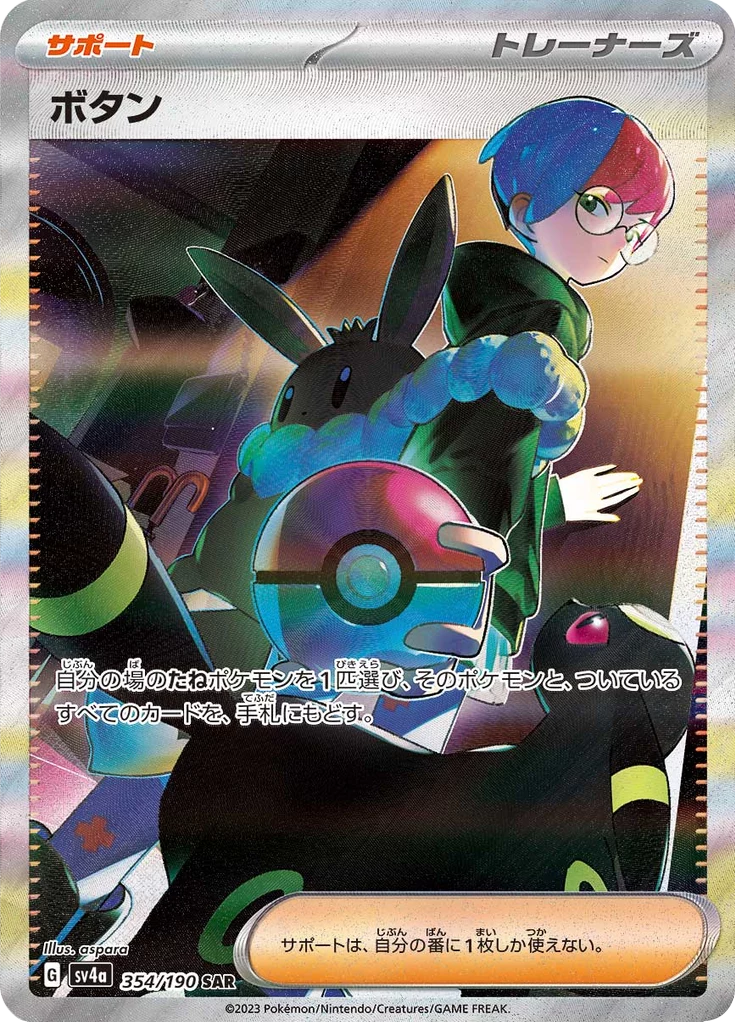
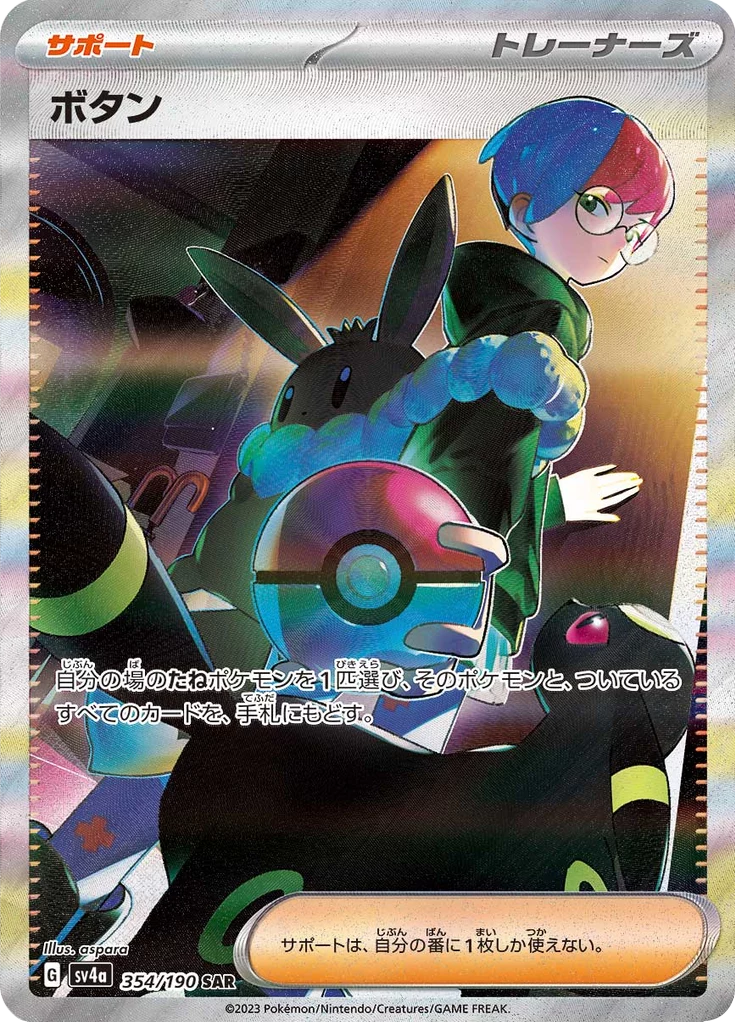
Button Penny SAR 354/190 Shiny Treasure ex special art rare card

Button (Penny) SAR 354/190

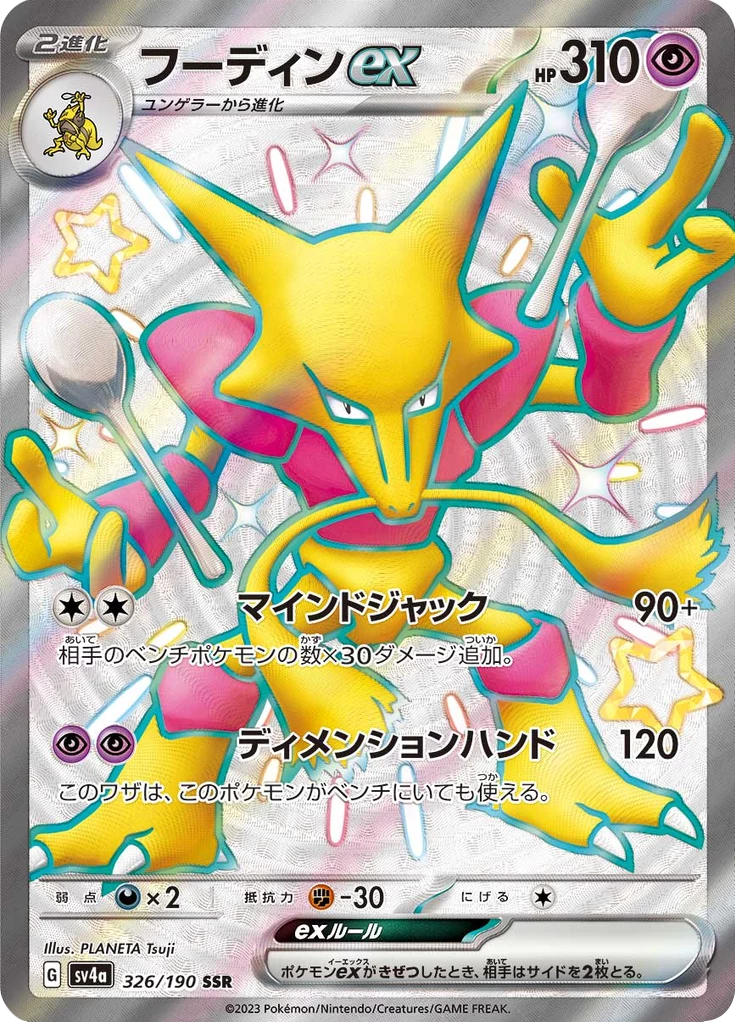
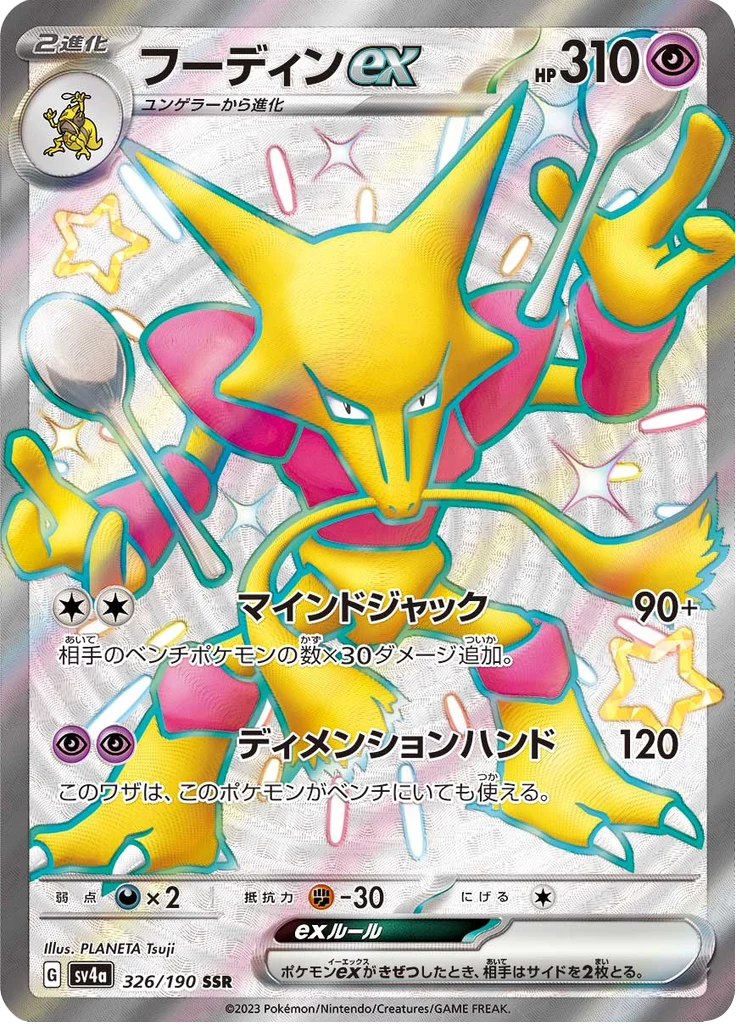
Alakazam ex SSR 326/190 Shiny Treasure ex shiny secret rare card

Alakazam ex SSR 326/190

Shiny Treasure ex’s top targets are the Trainer SARs — Nanjamo 350/190 and Button 354/190 — both drawn in the same oversized character-art style that made the set’s Trainer cards its most talked-about pulls. Underneath that sits the set’s real identity: a deep run of shiny-colored ex Pokemon at SSR, with Alakazam ex 326/190 as a representative example of the tier. Where 151 gives you four cards to hope for, Shiny Treasure ex gives you a wide field of shiny SSRs plus two headline Trainer SARs, which spreads the excitement across a lot more of the box.

For the full breakdown of every rarity slot in each set, see our Pokemon 151 pull rates guide and our Shiny Treasure ex pull rates guide.

On Pull Rate Claims

Neither set has official published pull rates. Any specific odds you see floating around are community-reported estimates, not manufacturer data — treat them as a rough guide, not a guarantee.

Which Box Fits Your Collection

Set data and price only tell half the story. The more useful question is which box matches how you actually collect.
Pokemon 151 fits you if you want the smallest, most recognizable set on this list — Gen 1 completionists, buyers who want the starters and Mew specifically, and anyone building a display around the „original 151“ concept rather than the wider Scarlet & Violet story. It also fits buyers who prioritize a tighter, more concentrated chase over a larger spread of possible hits, and who are comfortable paying a premium for that.

Shiny Treasure ex fits you if budget-per-box matters, you like the shiny-Pokemon collecting angle specifically, or you want more total cards and more distinct SSR targets to open toward for the same money. It’s also the more approachable entry point for buyers who are newer to Japanese sealed product and want to test the format before committing to a pricier box like 151.

Neither set requires deep familiarity with the Scarlet & Violet storyline to enjoy — 151 leans on nostalgia everyone already has, and Shiny Treasure ex leans on a visual gimmick (shiny colors) that needs no context at all.

The Verdict: Pick by Use Case

  • Want the cheapest way into either set — Shiny Treasure ex, no-shrink, at ¥17,340. Same packs, lower price.
  • Want a specific, well-known chase list — Pokemon 151, sealed, at ¥55,500. Four cards define the set and everyone recognizes them.
  • Want the shiny-collecting angle — Shiny Treasure ex is built specifically around it; 151 doesn’t have a shiny mechanic at all.
  • Want a single graded card instead of a box — our PSA10 Nanjamo SAR 350/190 is currently listed at ¥30,282, a way to own Shiny Treasure ex’s headline Trainer card already graded, without opening a box.
  • Undecided and want to compare full checklists first — browse the Pokemon 151 pull rates guide and the Shiny Treasure ex pull rates guide before choosing.
Shop Shiny Treasure ex
SV4A Shiny Treasure ex Booster Box (Japanese)
Currently listed at ¥20,176 sealed
Ships from Tokyo · Tracked delivery

View Product →

Where to Buy Both Boxes

We ship both sets sealed from Tokyo with tracked delivery. If you already know which set you want, go straight to the product page below; if you’re still weighing options, our full shop and quick-order tool make it easy to compare or build a mixed order.

Shop This Set
SV2A Pokemon 151 Booster Box (Japanese)
Currently listed at ¥55,500 sealed
Ships from Tokyo · Tracked delivery

View Product →

For everything else — other Japanese sets, singles, and PSA-graded cards — browse our full shop or use our Quick Order page to build a mixed order in one pass.

Häufig gestellte Fragen

Which is more expensive, Pokemon 151 or Shiny Treasure ex?

Pokemon 151 is currently listed at ¥55,500 sealed, compared to ¥20,176 for Shiny Treasure ex sealed — roughly 2.75x the price for 151.

What’s the difference in card count between the two sets?

Pokemon 151 has 210 total cards (165 base plus 45 secret rares). Shiny Treasure ex has 360 total cards (190 base plus 170 secret rares) — nearly double the size.

Which set has the bigger chase cards?

151’s chase cards are the Charizard ex and Blastoise ex SARs plus the Mew ex SR — a short, well-known list. Shiny Treasure ex’s headline pulls are the Nanjamo and Button Trainer SARs, backed by a large field of shiny ex SSRs, spreading the chase across more distinct cards.

Can I buy graded singles instead of a box?

Yes for Shiny Treasure ex — our PSA10 Nanjamo SAR 350/190 is currently listed at ¥30,282. 151’s individual PSA10 chase cards are not currently in stock, so the sealed box is the available route into that set right now.

Which box should a first-time Japanese sealed buyer choose?

Shiny Treasure ex is the more approachable entry point on price alone, at roughly a third of 151’s cost, with a no-shrink option available at ¥17,340 for an even lower entry. 151 suits buyers who specifically want the original Gen 1 chase list and are comfortable paying its premium.

Shiny Treasure ex vs Terastal Festival ex: Box Guide

Two Japanese high-class packs, one price bracket, and two very different reasons to open a box. Shiny Treasure ex and Terastal Festival ex are currently sitting within a few hundred yen of each other in our stock, which means the choice between them comes down to what’s actually printed inside — not which one costs more.

Both are „high-class pack“ releases in the Scarlet & Violet era, and both are currently listed as sealed boxes on our site. What separates them is the size and shape of the secret rare pool sitting behind the base set — and that’s the axis this comparison runs on.

Neither set is a reprint or a variant of the other — they’re separate releases roughly a year apart, each built around its own theme and its own chase list. What they share is the format: a smaller base set than a mainline expansion, a mirror-holo insert structure, and a secret rare tier that carries the bulk of the set’s resale value. This guide walks through both boxes card pool by card pool, compares what each currently costs sealed, and lays out a straightforward way to decide between them if you’re picking just one.

Key Takeaway

Shiny Treasure ex (SV4a) is currently listed at ¥20,176 sealed, Terastal Festival ex (SV8a) at ¥20,592 sealed — a ¥416 gap. Shiny Treasure ex runs 170 secret-rare card slots built around shiny-colored SAR/SSR pulls; Terastal Festival ex runs a tighter 50-slot secret pool built around Eeveelution and Tera-form SAR chase cards. Same budget, two different collecting goals.

360
SV4a Total Cards

237
SV8a Total Cards

¥416
Sealed Price Gap

2023 / 2024
Release Years

Prices reflect current listings on samuraiswordtokyo.com as of this guide’s publish date. Stock levels change; check the linked product pages for the live count before ordering.

Shiny Treasure ex vs Terastal Festival ex at a Glance

Both sets belong to the same „high-class pack“ category Pokemon TCG Japan uses for its biggest chase-card releases, sitting a step above a standard expansion in card count and secret rare density. Here’s the side-by-side structure before we get into what’s actually in each box.

  Shiny Treasure ex (SV4a) Terastal Festival ex (SV8a)
Release date December 1, 2023 December 6, 2024
Base set size 190 cards 187 cards
Secret rare cards 191–360 (170 cards) 188–237 (50 cards)
Total cards 360 237
Sealed box price ¥20,176 ¥20,592
No-shrink box price ¥17,340 ¥19,032
Core chase theme Shiny (color-reversed) ex and SSR cards Terastal-form ex and Eeveelution SAR cards

The headline number is the secret rare count: Shiny Treasure ex packs more than three times as many secret-tier cards into its pool as Terastal Festival ex. That single structural difference shapes almost everything else in this comparison — what you’re chasing, how deep the pull pool is, and which chase cards actually move.

What’s Inside Shiny Treasure ex (SV4a)

Shiny Treasure ex released December 1, 2023, and its entire identity is built around one idea: color-reversed „shiny“ Pokemon printed as SAR and SSR secret rares. The base set runs 190 cards, and the secret rare tier — numbered 191 through 360 — adds another 170 cards on top of that, giving the set 360 total cards. That secret pool is one of the largest of any high-class pack in the SV era.

Iono SAR 350/190 Shiny Treasure ex Japanese secret rare card

Iono SAR 350/190

Penny SAR 354/190 Shiny Treasure ex Japanese secret rare card

Penny SAR 354/190

Alakazam ex SSR 326/190 Shiny Treasure ex Japanese secret rare card

Alakazam ex SSR 326/190

The two cards that drive the set’s reputation among collectors are the supporter SARs — Iono SAR (350/190) and Penny SAR (354/190). Both are full-art trainer secret rares in the shiny-adjacent art style the set is known for. We currently carry a PSA 10 Iono SAR at ¥30,282 — a useful reference point for what a top-grade copy of the set’s headline chase card commands.

Beyond the two supporter chases, the SSR tier is built around shiny-colored ex Pokemon, with cards like Alakazam ex SSR representing the color-reversed art treatment that gives the set its name. If your goal is completing a shiny-dex or chasing the largest possible pool of alternate-art secret rares in a single box, Shiny Treasure ex is built for exactly that.

What’s Inside Terastal Festival ex (SV8a)

Terastal Festival ex released almost exactly a year later, on December 6, 2024, and takes a different approach to the same high-class pack format. Its base set runs 187 cards, with secret rares numbered 188 through 237 — 50 cards in total, less than a third of Shiny Treasure ex’s secret pool. The set carries the Master Ball / Monster Ball mirror-holo structure forward, but concentrates its chase value into a much narrower band of cards.

Leafeon ex SAR 200/187 Terastal Festival ex Japanese secret rare card

Leafeon ex SAR 200/187

Eevee ex SAR 224/187 Terastal Festival ex Japanese secret rare card

Eevee ex SAR 224/187

Dragapult ex SAR 221/187 Terastal Festival ex Japanese secret rare card

Dragapult ex SAR 221/187

The set’s identity leans hard on Eeveelutions and Tera-form ex Pokemon. Eevee ex SAR (224/187) and Leafeon ex SAR (200/187) anchor the Eeveelution side, while Dragapult ex SAR (221/187) and Terapagos ex SAR represent the Tera-form chase tier — Terapagos in particular carries name recognition as the mascot of the Terastal mechanic. PSA 10 copies of both Leafeon ex SAR (currently listed at ¥21,609) and Eevee ex SAR (currently listed at ¥15,615) are in our graded inventory, which gives a rough sense of where the set’s top singles land relative to the box price.

With a 50-card secret pool instead of 170, Terastal Festival ex is the more concentrated of the two sets: fewer total chase targets, but a shorter list to actually complete if that’s the goal.

Shop Both Sets
Shiny Treasure ex & Terastal Festival ex Booster Boxes (Japanese)
Sealed and no-shrink options currently listed
Ships from Tokyo · Tracked delivery

Shiny Treasure ex →

Box Price: The ¥416 Gap

At list price, these two boxes are about as close as two Japanese high-class packs get. Shiny Treasure ex is currently listed sealed at ¥20,176, and Terastal Festival ex sealed is currently listed at ¥20,592 — a difference of ¥416, well under 3% apart. Neither set has a meaningful price advantage over the other on the sealed box alone.

Produkt Zustand Preis
Shiny Treasure ex Booster Box Sealed (shrink-wrapped) ¥20,176
Shiny Treasure ex Booster Box No shrink ¥17,340
Terastal Festival ex Booster Box Sealed (shrink-wrapped) ¥20,592
Terastal Festival ex Booster Box No shrink ¥19,032

The no-shrink gap is a bit wider — ¥17,340 versus ¥19,032, a difference of ¥1,692. If budget is the deciding factor, the sealed prices put both sets on essentially even footing; the real decision comes down to what’s inside the box, not what it costs to buy.

It’s worth noting that a „no shrink“ listing is not a discount tier on a worse box — it’s the same sealed product without the outer shrink wrap, typically because the box was opened for inspection or repackaged during handling. Collectors chasing a display-condition box for long-term storage generally want the shrink-wrapped listing; collectors buying purely to open packs often treat the two as interchangeable and go with whichever is priced lower at the time.

Chase Card Comparison

This is where the two sets diverge the most. Shiny Treasure ex’s 170-card secret pool spreads chase value across a wide field of shiny-colored ex and SSR Pokemon, with the two supporter SARs — Iono and Penny — standing out as the cards collectors specifically look for. Terastal Festival ex’s 50-card secret pool concentrates chase value into a shorter list of SAR-tier ex Pokemon built around Eeveelutions and Tera forms.

  • Depth of the chase list: Shiny Treasure ex has more than three times the secret rare slots, meaning more distinct cards worth chasing across a full case — but also more competition for pull attention inside that pool.
  • Named recognition: Terastal Festival ex leans on Eeveelutions (a perennial collector favorite) and Terapagos (the Terastal mechanic’s mascot), giving its chase cards a clearer „everyone knows this Pokemon“ pull.
  • Trainer vs Pokemon focus: Shiny Treasure ex’s headline chases — Iono and Penny — are trainer-class supporter cards, a category that consistently draws strong secondary-market interest independent of the Pokemon itself. Terastal Festival ex’s chase tier is Pokemon-card led.
  • Graded reference points: PSA 10 copies from both sets are currently listed — Iono SAR from Shiny Treasure ex at ¥30,282, and Leafeon ex SAR / Eevee ex SAR from Terastal Festival ex at ¥21,609 and ¥15,615 respectively — useful benchmarks if you’re weighing box-opening odds against buying a graded single outright.
On Pull Rates

Pokemon TCG Japan does not publish official per-card pull rates for either set. Any specific ratio you see quoted online is community-reported and unofficial — treat it as a rough signal, not a guarantee, when deciding what to open.

Which One Should You Buy

Both boxes sit in the same price bracket, so the honest answer depends on what you’re actually collecting for.

  • Buy Shiny Treasure ex if you want the widest possible secret rare pool in a single high-class pack, you’re specifically chasing the Iono or Penny supporter SARs, or shiny-colored ex/SSR art is what you collect.
  • Buy Terastal Festival ex if you’d rather chase a shorter, more concentrated secret rare list, you collect Eeveelutions or want a Terapagos-themed piece, or you prefer Pokemon-led chase cards over trainer supporters.
  • Buy both if your budget allows — at a combined ¥40,768 sealed, you’d cover two structurally different high-class packs from consecutive SV-era release years, giving a case study in how Pokemon TCG Japan varied the format year over year.

For collectors newer to Japanese high-class packs, the practical takeaway is this: card count and secret rare density are printed facts you can compare before you buy, while pull luck on any individual box is not. Decide which chase list you actually want first, then let the near-identical pricing be a non-factor in the decision.

One more angle worth weighing: if you’re building toward a complete secret-rare set rather than opening for resale value, the 50-card Terastal Festival ex list is a realistically finishable target across a handful of boxes, while the 170-card Shiny Treasure ex list is a considerably longer project. Neither is the „wrong“ choice — it just changes whether you’re planning a weekend opening session or a longer-term collecting goal.

Where to Buy Both Boxes

We ship Japanese sealed product out of Tokyo with tracked delivery. Both Shiny Treasure ex and Terastal Festival ex are currently listed with sealed and no-shrink options.

Shop This Set
Terastal Festival ex Booster Box (Japanese)
Sealed and no-shrink options currently listed
Ships from Tokyo · Tracked delivery

View Product →

Want the full pull-rate and best-card breakdown for either set individually? See our dedicated guides for Shiny Treasure ex pull rates and best cards and Terastal Festival ex pull rates and best cards. For mixed orders across singles and sealed product, our Quick Order page is the fastest checkout route.

Häufig gestellte Fragen

Which is cheaper, Shiny Treasure ex or Terastal Festival ex?

Shiny Treasure ex is currently listed sealed at ¥20,176, and Terastal Festival ex sealed at ¥20,592 — a ¥416 gap. Sealed prices for both change with stock, so check the live listing before ordering.

How many secret rare cards are in each set?

Shiny Treasure ex has 170 secret rare cards (numbered 191–360 on a 190-card base set), while Terastal Festival ex has 50 secret rare cards (numbered 188–237 on a 187-card base set).

What are the chase cards in Shiny Treasure ex?

The two most sought-after cards are the Iono SAR (350/190) and Penny SAR (354/190) full-art supporter secret rares, alongside shiny-colored ex and SSR Pokemon like Alakazam ex SSR.

What are the chase cards in Terastal Festival ex?

The set’s headline cards are Eeveelution SARs — Eevee ex SAR (224/187) and Leafeon ex SAR (200/187) — along with Tera-form ex cards like Dragapult ex SAR (221/187) and Terapagos ex SAR.

When were Shiny Treasure ex and Terastal Festival ex released?

Shiny Treasure ex released December 1, 2023. Terastal Festival ex released December 6, 2024, almost exactly a year later.

What does „no shrink“ mean on a booster box listing?

A no-shrink box is the same sealed booster box without its outer shrink wrap, usually because it was opened for inspection or repackaged during handling. It’s still a full sealed box of packs, just without the factory plastic wrap.

Are Shiny Treasure ex and Terastal Festival ex part of the same set family?

Both belong to Pokemon TCG Japan’s Scarlet & Violet-era „high-class pack“ category, but they are separate, independently themed releases rather than variants of one another.

5ban Graphics Pokemon Cards: Illustrator Guide

5ban Graphics is not one illustrator — it’s a group of artists working within Creatures, Inc. That distinction matters more here than in most illustrator profiles, because the scale is different: the Limitless TCG database lists 1,716 English-language cards and 2,087 Japanese cards under the 5ban Graphics credit, spanning TCG eras from Black & White through Scarlet & Violet.

This guide covers what’s actually documented about the group — its name, its stated design philosophy, and its work outside the core card game — then cross-matches eight representative “Illustrated by 5ban Graphics” prints against our own PSA 10 inventory in Tokyo. All eight are currently listed, and the full price table is below.

Key Takeaway

5ban Graphics is a studio credit, not an individual artist — Limitless TCG lists 1,716 English-language and 2,087 Japanese cards under the name. Two of the 5ban Graphics-credited prints currently listed in our PSA 10 inventory (as of 2026-08-12) are Leafeon GX SSR (206/150) at ¥30,385 and Pikachu & Zekrom GX SR (100/095) at ¥90,022, both credited to 5ban Graphics on Limitless.

1,716
English Cards (Limitless)

2,087
Japanese Cards (Limitless)

27
PSA 10 Listed Matches

Black & White–present
Era Range

Who (and What) Is 5ban Graphics?

Per Bulbapedia, 5ban Graphics is a group of artists within Creatures, Inc. who have illustrated many cards for the Pokemon Trading Card Game from Black & White onward. The group has designed many Trainer cards, as well as many Full Art cards and Pokemon cards for the Black and White, XY, Sun & Moon, Sword & Shield, and Scarlet & Violet TCG series.

The name itself is a piece of Creatures, Inc. history rather than a stylistic label: Bulbapedia notes it references the studio’s former address at 10 Gobancho, Chiyoda-ku, Tokyo.

Card counts for 5ban Graphics vary by source and shouldn’t be combined. Bulbapedia’s own tally lists 1,043 cards illustrated by the group, using its own counting method. Limitless TCG’s card database — which tracks English and Japanese print runs separately — returns 1,716 cards for the English-language search and 2,087 for the Japanese search. None of these three numbers should be added together or presented as a single definitive total; they’re different methodologies measuring overlapping but not identical sets of prints.

For buyers, the practical takeaway is that a “5ban Graphics” credit on a listing doesn’t tell you much about a card’s era, rarity, or price on its own — it can point to an early Mega-EX just as easily as a current Scarlet & Violet secret rare. The sections below work through what the credit does and doesn’t tell you, using cards we’ve individually verified against Limitless TCG rather than relying on set-level assumptions.

Design Philosophy and Studio Anonymity

One of the few first-hand statements attributed to the group comes from a 2012 interview posted to the Creatures, Inc. PTCG blog, in which the studio discussed the creation of card artwork. Per Bulbapedia’s account of that interview, 5ban Graphics said it likes to make the Pokemon look three-dimensional, while exemplifying the best qualities of the Pokemon where possible so that it stands out on its own — a working description of the group’s approach to full-body Pokemon illustration rather than a claim about any single card.

M Charizard EX CP6 091/087 Secret Rare 20th Anniversary Pack
M Charizard EX CP6 091/087, Secret Rare, 20th Anniversary Pack
M Rayquaza EX XY7 095/081 Ultra Rare Bandit Ring
M Rayquaza EX XY7 095/081, Ultra Rare, Bandit Ring

Our PSA 10 copies of these two Mega-EX prints are currently listed at ¥763,271 for the M Charizard EX and ¥703,490 for the M Rayquaza EX.

Beyond that one interview, Bulbapedia is explicit that very little is known about the identities of artists within 5ban Graphics. The one concrete data point is indirect: Ayaka Yoshida’s Twitter bio identifies Yoshida as a former member of the group, which is the closest thing to a named individual connected to the credit that Bulbapedia’s sourcing supports. No other names, headcounts, or internal structure are documented, and this guide isn’t going to guess at them.

Why This Guide Reads Differently

The other artists in our illustrator series are named individuals with a personal biography. 5ban Graphics is a studio credit shared across a group whose membership isn’t publicly documented — so this guide treats the name as a production credit, not a personal one, and skips the biographical details that don’t exist for it.

Eight Verified Cards, All Cross-Matched to Stock

Rather than list the full catalog, we picked eight representative “Illustrated by 5ban Graphics” cards, verified individually on Limitless TCG’s card pages, and checked them against our own PSA 10 inventory. All eight matched a current listing:

Karte Set Rarity Currently listed at
M Charizard EX 091/087 20th Anniversary Pack (CP6) Secret Rare ¥763,271
M Rayquaza EX 095/081 Bandit Ring (XY7) Ultra Rare ¥703,490
Reshiram ex 174/086 White Flare (SV11W) Ultra Rare ¥135,857
Pikachu & Zekrom GX 100/095 Tag Bolt (SM9) Secret Rare ¥90,022
Darkrai GX 230/150 GX Ultra Shiny (SM8b) Secret Rare ¥53,560
Charizard GX 011/051 Did You See The Fighting Rainbow (SM3H) Double Rare ¥38,110
Leafeon GX 206/150 GX Ultra Shiny (SM8b) Secret Rare ¥30,385
Glaceon V 076/069 Eevee Heroes (S6a) Secret Rare ¥8,961

Sorting by price rather than release date makes the range obvious: the same credit line runs from a standard-issue Sword & Shield-era secret rare up to a Mega-EX that predates the GX era entirely, with a wide gap between the two. That spread is a direct consequence of 5ban Graphics being a multi-artist, multi-era credit rather than a single illustrator’s body of work.

Twelve More Confirmed Matches in Our Vault

The eight cards above are a starting sample, not the full picture. Extending the same collector-number verification to the rest of our PSA 10 inventory turned up twelve additional 5ban Graphics-credited cards with a confirmed set name, each individually checked on its Limitless TCG card page before being added here:

Karte Set Currently listed at
MEGA Gardevoir ex MUR 092/063 Mega Symphonia (M1S) ¥170,135
M Charizard EX RR 055/080 Wild Blaze (XY2) ¥142,490
M Venusaur EX SR 089/087 20th Anniversary Pack (CP6) ¥91,464
M Gengar EX 049/131 “EX x M x BREAK” (CP4) ¥72,100
M Scizor EX SR 087/080 Anger of Heaven (XY9) ¥61,800
Gengar VMAX 002/019 Gengar VMAX High Class Deck (SGG) ¥22,660
M Sharpedo EX 071/171 The Best of XY (XY) ¥21,424
Scizor GX SSR 233/150 GX Ultra Shiny (SM8b) ¥27,810
Suicune GX RR 028/095 Super-Burst Impact (SM8) ¥12,360
Leafeon V 070/069 Eevee Heroes (S6a) ¥9,095
Reshiram ex SR 160/086 White Flare (SV11W) ¥6,866
Genesect ex SR 164/086 Black Bolt (SV11B) ¥5,459

A pattern stands out in this second batch: five of the twelve are Mega-EX prints from the XY era (Sharpedo, Charizard, Venusaur, Gengar, Scizor), which lines up with Bulbapedia’s note that the group has been active in the TCG’s art pipeline since Black & White — well before the GX and V/VMAX naming conventions existed. The Reshiram ex and Genesect ex rows, by contrast, are from White Flare and Black Bolt, both Scarlet & Violet-era releases, which is evidence in our own inventory that the credit is still active on recent product, not just legacy reprints.

Beyond the Cards

Bulbapedia’s coverage of 5ban Graphics extends past the core card game in two documented directions. The group has also illustrated 47 cards appearing in Pokemon Trading Card Game Pocket — a separate mobile product with its own card pool, kept apart from the 1,716/2,087 counts above.

On the merchandise side, Bulbapedia credits 5ban Graphics with the TCG “Cyber Judge” booster art and the “Wild Force” booster art, each sourced to “The Pokémon card art life” tracking account rather than an official Pokemon Company statement. We’re carrying that sourcing distinction forward here rather than presenting it as confirmed by the publisher directly.

In Our PSA 10 Vault

We checked 5ban Graphics‘ Japanese-language card list against our full PSA 10 inventory on 2026-08-12, matching by collector number (and set code where the product title includes one) rather than by Pokemon or Trainer name alone — a name-only match would have pulled in cards illustrated by someone else entirely. That process returned 27 currently listed matches (as of 2026-08-12; 26 unique cards, with Reshiram ex 174/086 currently listed as two separate PSA 10 units).

The process also excluded some plausible-looking candidates. Several high-value Pikachu and Eevee-line cards in our inventory that share a set with confirmed 5ban Graphics work — for example, other Pikachu V and VMAX prints from VMAX Climax — are not credited to 5ban Graphics on Limitless and were left out rather than assumed. A handful of secret-numbered cards from Tag All Stars (SM12a) (collector numbers above 173, including the currently listed Dedenne GX 175/173 and Umbreon & Darkrai GX 181/173) also fall outside what Limitless’s Japanese database currently indexes for that set, so no artist attribution — for 5ban Graphics or anyone else — can be made for those specific prints.

Where to Buy 5ban Graphics Cards from Japan

The eight cards profiled above are a small sample of the 27 5ban Graphics-credited prints currently listed in our PSA 10 inventory (as of 2026-08-12). The M Charizard EX is the highest-priced match among the eight cards in this guide:

Shop This Card
M Charizard EX 091/087, Secret Rare, PSA 10
Currently listed at ¥763,271
Tracked delivery

View Product →

For the wider catalog, browse our PSA 10 card list to filter by set and price, or use our Quick Order page to request a specific card that isn’t currently listed. If you’re comparing illustrators across our ongoing series, KEIICHIRO ITO, Atsuko Nishida, and Yuka Morii each have their own dedicated guides — all three are named individual illustrators, which makes for a useful contrast against a studio credit like 5ban Graphics.

Häufig gestellte Fragen

Is 5ban Graphics a person or a studio?

5ban Graphics is a group of artists within Creatures, Inc., not an individual illustrator. Very little is publicly known about who works within the group; Bulbapedia notes only that Ayaka Yoshida’s Twitter bio identifies Yoshida as a former member.

How many cards has 5ban Graphics illustrated?

Counts vary by source and shouldn’t be combined. Bulbapedia’s own tally lists 1,043 cards; Limitless TCG’s database separately returns 1,716 cards in its English-language search and 2,087 in its Japanese-language search, covering the Black & White era through Scarlet & Violet.

Where does the name „5ban Graphics“ come from?

Per Bulbapedia, the name references Creatures, Inc.’s former address at 10 Gobancho, Chiyoda-ku, Tokyo.

What is 5ban Graphics‘ stated design approach?

In a 2012 interview posted to the Creatures, Inc. PTCG blog, the group said it likes to make Pokemon look three-dimensional while exemplifying the best qualities of the Pokemon so it stands out on its own.

How many 5ban Graphics cards are currently in your PSA 10 vault?

27 currently listed matches as of 2026-08-12 (26 unique cards, since one print is currently listed as two separate graded units). Matching was done by collector number and set code, not by Pokemon name alone.

Has 5ban Graphics illustrated cards outside the core TCG?

Yes. Per Bulbapedia, the group has illustrated 47 cards in Pokemon Trading Card Game Pocket, and is credited with the “Cyber Judge” and “Wild Force” TCG booster art.

Sanosuke Sakuma Pokemon Cards: Iono SR & Illustrator Guide

Sanosuke Sakuma has been part of the Pokemon TCG’s illustration roster since 2013 — a Trainer-card illustrator with a soft, warm color palette and a slightly painterly finish that reads as gentle even in the middle of a fight-focused set.

This guide covers what’s actually documented about Sanosuke Sakuma — the career timeline, the drawing style, the crossover into in-game character design — then walks through the flagship modern chase card, the wider catalog, and the PSA 10 copies currently listed in our vault. Every card credit below was checked against its individual Limitless TCG page rather than relying on set-level search results alone, since substring matches on illustrator names can otherwise pull in unrelated artists. Per our house style for this illustrator series, gendered pronouns are avoided throughout; the artist is referred to by name.

Key Takeaway

Sanosuke Sakuma has illustrated 169 English-language Pokemon TCG cards and 273 Japanese-language prints on Limitless TCG’s database (the two databases largely cover the same illustrations and shouldn’t be summed), with a career running from the 2013 Shiny Collection through current Scarlet & Violet-era Trainer cards. Our PSA 10 vault currently holds seven Sakuma-illustrated cards, including Iono 091/071 SR, currently listed at ¥19,014.

169
English TCG Cards (Limitless)

273
Japanese TCG Prints (Limitless)

2013
Debut Year (Shiny Collection)

7
PSA 10 Listed Matches

Who Is Sanosuke Sakuma?

Sanosuke Sakuma (Japanese: 佐久間さのすけ Sakuma Sanosuke; born October 31, 1990) is a freelance illustrator based in Kanagawa, per Bulbapedia’s artist entry. Sakuma began providing artwork for the Pokemon Trading Card Game in 2013, with the first illustrations featured on cards released in the Shiny Collection — a debut that lines up cleanly with two of the PSA 10 cards currently listed later in this guide, both of which come from that exact set.

On the tools side, Bulbapedia states Sakuma draws digitally, using Adobe Photoshop as the primary application. Stylistically, Bulbapedia describes work that „specializes in producing artwork with cute characters and invoking a warm atmosphere, utilizing a specific color palette and soft drawing style,“ while also noting that Sakuma „experiments with different styles, including anime, impasto, and watercolor“ depending on the card. That range shows up across the catalog: some prints lean toward soft, rounded character work, while chase-tier Trainer cards push into more painterly, textured territory.

By Bulbapedia’s own count, Sakuma has illustrated 161 TCG cards — a tally that uses a different counting methodology than the Limitless TCG database figures cited throughout this guide (169 English-language cards, 273 Japanese-language prints), so none of these three numbers should be added together or treated as interchangeable. What all three agree on is scale: this is a career built on a genuinely large body of work, not a handful of headline prints.

For readers comparing artists across our illustrator series, Sakuma’s catalog sits alongside KEIICHIRO ITO, Mitsuhiro Arita, and Teeziro — each covered in a dedicated guide.

The 2013 debut date is worth pausing on: that puts Sakuma’s start in the TCG well before the Sun & Moon and Sword & Shield design work that came later in the career. In practice, that means the catalog spans two distinct eras — Shiny Collection (2013) illustrations on one end, and current Scarlet & Violet Trainer and Supporter chase cards on the other, with well over a decade of TCG Pocket, VMAX Climax, and VSTAR Universe-era work filling the gap between them.

Iono SR: The Signature Modern Chase Card

Among Sakuma’s Scarlet & Violet-era work, the flagship modern chase card is Iono, from Clay Burst (SV2D) #091/071, a Secret Rare. The individual Limitless TCG card page states directly that the print is „Illustrated by Sanosuke Sakuma,“ and the printed card itself carries the „Illus. Sanosuke Sakuma“ credit line alongside the 091/071 collector number.

Iono SV2D 091/071 Secret Rare Clay Burst Pokemon card illustrated by Sanosuke Sakuma
Iono SV2D 091/071, Secret Rare, Clay Burst

Iono is a modern Gym Leader-tier Supporter card. A PSA 10 copy of this exact print is currently listed at ¥19,014 (as of 2026-08-12).

Shop This Card
Iono 091/071 SR, Clay Burst, PSA 10
Currently listed at ¥19,014
Tracked delivery

View Product →

The Wider Catalog: GX Tag Teams, Trainers & Early Work

Iono is a recent highlight, but the Limitless database shows a catalog that stretches back through the Sun & Moon GX era and into the earliest Sword & Shield Character Rare boom. A handful of representative cards give a sense of the range.

Latias and Latios GX SM9 105 Secret Rare Tag Bolt Pokemon card illustrated by Sanosuke Sakuma
Latias & Latios-GX SM9 105, Secret Rare, Tag Bolt
Gardevoir S8b 196 Character Holo Rare VMAX Climax Pokemon card illustrated by Sanosuke Sakuma
Gardevoir S8b 196, Character Holo Rare, VMAX Climax
Whitney SM8 101 Secret Rare Super-Burst Impact Pokemon card illustrated by Sanosuke Sakuma
Whitney SM8 101/095, Secret Rare, Super-Burst Impact

On the GX Tag Team side, Latias & Latios-GX (Tag Bolt, SM9 #105) is a Secret Rare that predates the Iono chase by several years and shows an earlier, more classically-posed illustration style. Gardevoir from VMAX Climax (S8b #196) carries a Character Holo Rare slot, one of the „character“ subsets that ran through the late Sword & Shield era. On the Supporter side, Whitney from Super-Burst Impact (SM8 #101/095) is another Secret Rare Trainer card, illustrated in the same era as the Latias & Latios-GX print.

Professor's Research S12a 248 Secret Rare VSTAR Universe Pokemon card illustrated by Sanosuke Sakuma
Professor’s Research S12a 248, Secret Rare, VSTAR Universe

Professor’s Research, the Secret Rare Supporter from VSTAR Universe (S12a #248), is one of the catalog’s higher-profile chase Trainer cards. Further back, Jirachi from Legendary Heartbeat (S3a #50) carries an Amazing Rare designation.

Jirachi S3a 50 Amazing Rare Legendary Heartbeat Pokemon card illustrated by Sanosuke Sakuma
Jirachi S3a 50, Amazing Rare, Legendary Heartbeat

Taken together, the catalog reads less like a small set of headline grails and more like a long, steady run of Trainer-focused and character-focused illustration work, with Iono as the current-era standout rather than an outlier. Collectors focused specifically on Trainer-card illustration — as opposed to Pokemon artwork — will find Sakuma’s name recurring across several set eras rather than tied to a single breakout print, which is part of why the 169/273-card Limitless counts run as high as they do relative to some other illustrators in this series.

From Card Art to In-Game Character Design

One detail that separates Sakuma from many card-only illustrators: during the TCG career, Sakuma also began working as a character designer on Pokemon Sun and Moon and Pokemon Sword and Shield, creating many of those games‘ various Trainer classes, per Bulbapedia. That’s a different credit from card illustration, covering the design of in-game Trainer classes rather than individual trading-card artwork.

It’s a useful piece of context when looking at the Trainer-heavy side of the card catalog covered above. Cards like Iono, Whitney, and Professor’s Research aren’t incidental Supporter-slot fill for this illustrator — they sit alongside a broader body of work designing how Trainer characters look across the mainline games.

Beyond the Cards

Sakuma’s work extends past the TCG in a few documented directions, per Bulbapedia’s artist entry:

  • Animation: Sakuma contributed art for animation in Pokemon Horizons: The Series, credited on episode HZ055.
  • Pokemon UNITE: Event art credited to Sakuma includes the „Green and Blastoise Legacy Trainer Showdown Event art.“
  • Merchandise: Bulbapedia’s merchandise list credits Sakuma with the Pokemon Center „Ride with Lapras“ line, the „Ride with Latias and Latios“ line, and TCG sleeve/deck box art featuring Lucas, Dawn, Rei, and Akari.
  • Pokemon Trading Card Game Pocket: Sakuma has also illustrated 35 cards appearing in TCG Pocket, per Bulbapedia — a separate mobile-game card pool from the physical TCG counts cited elsewhere in this guide.

None of this is a complete list of every project Sakuma has worked on — it’s what Bulbapedia’s sourced entry documents. Award history, agency arrangements, and any work outside these credited projects aren’t stated in that source, so this guide doesn’t speculate beyond it.

In Our PSA 10 Vault

We checked Sakuma’s illustrated-card list directly against our current PSA 10 inventory on 2026-08-12. The result: seven currently listed matches, spanning the 2013 Shiny Collection debut set through modern Scarlet & Violet Trainer and Supporter cards.

Karte Set Preis
Iono 091/071 SR Clay Burst (SV2D) ¥19,014
Whitney 101/095 SR Super-Burst Impact (SM8) ¥41,200
Growlithe U :1ED 004/020 Shiny Collection (SC) ¥59,740
Latias R :1ED 018/027 Legend Kira Collection (CP2) ¥107,589
Dragonite R: Master Ball Mirror 149/165 Pokemon Card 151 (SV2a) ¥31,580
Ursaring C :1ED 016/020 Shiny Collection (SC) ¥15,965
Copycat 079/067 SR S7D ¥8,137

Every card on that list was individually cross-checked against its Limitless TCG card page, and each page shows the „Illustrated by Sanosuke Sakuma“ credit line. The two Shiny Collection prints — Growlithe and Ursaring — line up directly with Bulbapedia’s statement that Sakuma’s first Pokemon TCG illustrations were released in that exact set back in 2013, which makes them the closest thing in our current listings to a debut-era Sakuma card.

Prices shown reflect current listings and move with the market, so treat the figures above as a snapshot rather than a fixed catalog. For any Sakuma-illustrated card not shown here, the Quick Order page is the fastest way to flag interest for when a copy surfaces and gets graded.

Where to Buy Sanosuke Sakuma Cards from Japan

The seven cards above are the Sanosuke Sakuma-illustrated prints currently listed in our PSA 10 inventory (as of 2026-08-12).

Shop This Card
Iono 091/071 SR, Clay Burst, PSA 10
Currently listed at ¥19,014
Tracked delivery

View Product →

For the wider PSA 10 catalog, browse our PSA 10 collection or the full PSA 10 card list to filter by set, illustrator, and price. If you’re comparing illustrator profiles across our series, KEIICHIRO ITO and Mitsuhiro Arita each have their own dedicated guides. For anything not currently listed, the Quick Order page is the fastest way to build a request.

Häufig gestellte Fragen

Who is Sanosuke Sakuma?

Sanosuke Sakuma (佐久間さのすけ, born October 31, 1990) is a freelance illustrator based in Kanagawa who began providing artwork for the Pokemon Trading Card Game in 2013, starting with the Shiny Collection. Sakuma has since illustrated 169 English-language TCG cards and 273 Japanese-language prints per Limitless TCG’s database, and also works as a character designer credited with many Trainer classes in Pokemon Sun and Moon and Pokemon Sword and Shield.

What is Sakuma’s most notable recent card?

Iono, a Secret Rare Supporter card from Clay Burst (SV2D 091/071), is the most-asked-about current-era card. The Limitless TCG card page confirms „Illustrated by Sanosuke Sakuma,“ and our PSA 10 copy is currently listed at ¥19,014.

What drawing style is Sanosuke Sakuma known for?

Per Bulbapedia, Sakuma specializes in artwork with cute characters and a warm atmosphere, using a specific color palette and soft drawing style, while also experimenting with anime, impasto, and watercolor techniques depending on the card. Work is done digitally in Adobe Photoshop.

Has Sanosuke Sakuma worked on anything besides trading cards?

Yes. Per Bulbapedia, Sakuma contributed animation art to Pokemon Horizons: The Series (episode HZ055), event art for Pokemon UNITE, merchandise art for Pokemon Center’s „Ride with Lapras“ and „Ride with Latias and Latios“ lines, and TCG sleeve/deck box art featuring Lucas, Dawn, Rei, and Akari. Sakuma has also illustrated 35 cards in Pokemon Trading Card Game Pocket.

Which Sanosuke Sakuma cards are currently listed as PSA 10?

As of 2026-08-12, our PSA 10 inventory lists seven Sakuma-illustrated cards: Iono (SV2D 091/071 SR), Whitney (SM8 101/095 SR), Growlithe and Ursaring from the 2013 Shiny Collection, Latias (CP2 018/027), Dragonite Master Ball Mirror (SV2a 149/165), and Copycat (S7D 079/067 SR). Prices are current listings and move with the market.

Why doesn’t this guide use pronouns?

This guide refers to Sanosuke Sakuma by name rather than using pronouns, since gender is not documented in the sourced material, following our editorial approach for this illustrator series.

Ryota Murayama Pokemon Cards: Illustrator Guide & Reshiram

Ryota Murayama — also credited under the alias ovopack — has been illustrating for the Pokemon Trading Card Game since Flashfire, where a Druddigon print marked the start of the catalog. The name shows up on 60 cards in the English-language Limitless TCG database and 73 in the Japanese-language database — two separate counts covering overlapping ground, not figures to add together.

This guide walks through what’s documented about Murayama, the highest-priced Murayama-credited card currently listed in our PSA10 vault — a secret rare Reshiram & Charizard-GX from Double Blaze — the wider body of Special Art Rare and secret rare work behind it, and the four Murayama-credited cards currently listed.

Every card discussed below was checked against an individual Limitless TCG card page carrying the literal “Illustrated by Ryota Murayama” credit — not just a name search, since Limitless artist searches return substring matches that can occasionally pull in unrelated names. The vault listings section goes a step further: it’s a direct crossmatch against a fresh pull of our live PSA10 inventory (2026-08-12), so the four cards listed here are the actual result of checking Murayama’s full catalog against what’s currently listed, not an assumption about what a well-known illustrator’s catalog should contain.

Key Takeaway

Ryota Murayama has illustrated 60 English-language Pokemon TCG cards and 73 Japanese-language cards (separate database counts, per Limitless TCG), debuting with Druddigon in Flashfire. Four Murayama-credited cards are currently listed in our PSA10 vault (inventory checked 2026-08-12), led by Reshiram & Charizard-GX SA, SM10 097/095, currently listed at ¥378,834.

60
English-Language Cards

73
Japanese-Language Cards

14
TCG Pocket Cards

4
Listed PSA10 Matches

Who Is Ryota Murayama?

Ryota Murayama, also known by the alias ovopack, is an illustrator for the Pokemon Trading Card Game. Murayama has been illustrating for the TCG since the Flashfire expansion, where Druddigon was the first card credited to the name. Bulbapedia’s own tally counts 57 TCG cards illustrated by Murayama — a different counting methodology from the Limitless TCG database figures used throughout this guide (60 English-language cards, 73 Japanese-language cards), so none of these three numbers should be summed or treated as interchangeable.

Beyond that career outline, documented biographical detail is limited: no birth date, residence, or employer history is stated on Bulbapedia, so this guide doesn’t speculate on any of it. What follows is built from the verified card catalog and the small number of merchandise and promotional credits Bulbapedia documents.

For readers following our illustrator series, Murayama’s catalog sits alongside KEIICHIRO ITO, Mitsuhiro Arita, and Teeziro — each covered in their own dedicated guide built the same way: verified card counts, individually confirmed illustrator credits, and a direct crossmatch against our current PSA10 inventory rather than a general catalog summary.

From Flashfire to Scarlet & Violet: The Catalog

The catalog starts with Druddigon in Flashfire, and the verified entries include several Special Art Rare and secret rare headliners: Reshiram & Charizard-GX (Double Blaze, SM10 #97, Secret Rare), Pikachu V (VMAX Climax, S8b #222, Character Super Rare), Koraidon ex (Scarlet ex, SV1S #103, Special Art Rare), Roaring Moon ex (Ancient Roar, SV4K #90, Special Art Rare), Poppy (Ruler of the Black Flame, SV3 #138, Special Art Rare), Serperior ex (Black Bolt, SV11B #167, Special Art Rare), Charizard V (Star Birth, S9 #103, Secret Rare), and Mew (VSTAR Universe, S12a #183, Art Rare).

That spread — a Tag Team GX secret rare, several Special Art Rares, a Character Super Rare, and an Art Rare set card — is the shape of the catalog this guide covers in the next two sections: the highest-priced card currently listed in our vault, and the wider body of work around it. It also spans two different TCG search databases that don’t fully line up: the English-language Limitless search returns 60 cards, the Japanese-language search returns 73, and Bulbapedia’s own internal count lands at 57. None of those three numbers describes the same thing, and this guide keeps them separate rather than picking whichever sounds most impressive.

The Top Listing: Reshiram & Charizard-GX SA

Reshiram & Charizard GX SM10 097/095 Secret Rare Double Blaze illustrated by Ryota Murayama
Reshiram & Charizard-GX SM10 097/095, Secret Rare, Double Blaze

The highest-priced Murayama-credited card currently listed in our vault is Reshiram & Charizard-GX, 097/095 from Double Blaze (SM10), a secret rare Tag Team GX — the Limitless TCG card page confirms the “Illustrated by Ryota Murayama” credit directly. Our copy is graded PSA10 and currently listed at ¥378,834.

It’s worth noting that Murayama’s credit isn’t limited to secret-rare chase cards — a Pikachu V print from the V Starter Decks line (SD #28) carries the same “Illus. Ryota Murayama” imprint on the card itself, a detail that shows the catalog isn’t confined to a single rarity tier.

As a Tag Team GX, Reshiram & Charizard-GX puts two Pokemon on a single secret-rare card. At ¥378,834, it is the highest-priced of the four Murayama-credited cards currently listed in our vault — well above the other three listings covered in the sections below.

Shop This Card
Reshiram & Charizard-GX SA, SM10 097/095, PSA10
Currently listed at ¥378,834
Ships from Tokyo · Tracked delivery

View Product →

Beyond the Top Listing: The Wider Catalog

Reshiram & Charizard-GX is one entry in a catalog that spans 60 English-language cards and 73 Japanese-language cards on Limitless TCG — separate database counts, not a combined total. The Special Art Rare tier accounts for several of the verified entries.

Koraidon ex SV1S 103 Special Art Rare Scarlet ex illustrated by Ryota Murayama
Koraidon ex SV1S 103, Special Art Rare, Scarlet ex
Roaring Moon ex SV4K 90 Special Art Rare Ancient Roar illustrated by Ryota Murayama
Roaring Moon ex SV4K 90, Special Art Rare, Ancient Roar
Mew S12a 183 Art Rare VSTAR Universe illustrated by Ryota Murayama
Mew S12a 183, Art Rare, VSTAR Universe

Koraidon ex (Scarlet ex, SV1S #103) and Roaring Moon ex (Ancient Roar, SV4K #90) are both Special Art Rares, alongside Poppy (Ruler of the Black Flame, SV3 #138) and Serperior ex (Black Bolt, SV11B #167) — the latter also one of the four cards currently listed in our vault, covered in the next section. On the Character Super Rare side sits Pikachu V from VMAX Climax (S8b #222), and the secret-rare tier includes Charizard V from Star Birth (S9 #103). Mew (VSTAR Universe, S12a #183) rounds out the sample at the Art Rare tier.

Current PSA10 Vault Listings

We checked Murayama’s catalog against our live PSA10 inventory directly rather than assuming name recognition equals stock depth. The result: four matches, each individually confirmed against a Limitless TCG card page showing “Illustrated by Ryota Murayama.”

Karte Set (JP code) Number Preis
Reshiram & Charizard-GX SA Double Blaze (SM10) 097/095 ¥378,834
Pikachu V CSR VMAX Climax (S8b) 222/184 ¥50,050
Flareon (Master Ball Mirror) Pokemon Card 151 (SV2a) 136/165 ¥16,047
Serperior ex SAR Black Bolt (SV11B) 167/086 ¥7,908
Pikachu V S8b 222 Character Super Rare VMAX Climax illustrated by Ryota Murayama
Pikachu V S8b 222/184, Character Super Rare, VMAX Climax

Reshiram & Charizard-GX leads the vault at ¥378,834, followed by Pikachu V (VMAX Climax, S8b #222) currently listed at ¥50,050. The Pokemon Card 151 Master Ball mirror Flareon (SV2a #136) is currently listed at ¥16,047, and Serperior ex from Black Bolt (SV11B #167) is currently listed at ¥7,908.

Serperior ex SV11B 167 Special Art Rare Black Bolt illustrated by Ryota Murayama
Serperior ex SV11B 167/086, Special Art Rare, Black Bolt

During the crossmatch, one plausible-looking candidate — a Pikachu listed at 028/071 — was checked and excluded: the only Murayama-credited Pikachu at collector number 28 is the SD starter-deck print, whose card reads 028/127, a different denominator entirely. It’s a reminder that collector number and set denominator both have to match before a card gets credited here, not just the Pokemon name.

That crossmatch ran against 401 in-stock PSA10 product rows pulled directly from our live inventory on 2026-08-12, checked line by line rather than filtered by keyword. Four matches out of that full set is a narrow result for an illustrator with a 60-to-73-card catalog — the only way to know which cards are actually listed is to check the current inventory directly.

Checking a Card

If you’re trying to confirm whether a Ryota Murayama card in your own collection matches one of these four, the collector number and denominator (the two numbers separated by a slash) need to match exactly — not just the Pokemon and set name.

Beyond the Cards

Outside the TCG print catalog, Bulbapedia documents a handful of Murayama credits. As part of a Legendary Pokemon Wallpaper promotion running up to the release of The Crown Tundra, Poké Times released artwork of Reshiram and Zekrom by Murayama. Bulbapedia’s merchandise list also credits Murayama with TCG art for Gaia Volcano and Tidal Storm, citing an artbook, and with artwork of Zacian, Zamazenta, and Eternatus, citing a Twitter post by Murayama.

In the Pokemon Legends: Arceus context, Bulbapedia credits Murayama with the “Snorlax Blocks the Way” artwork for Project Snorlax, citing Murayama’s own confirmation. Murayama has also illustrated 14 cards appearing in Pokemon Trading Card Game Pocket, per Bulbapedia — a separate count from the 60 and 73 English- and Japanese-language TCG figures used elsewhere in this guide.

Taken together, these credits show a working illustrator whose output extends past the physical card catalog into promotional wallpaper art, artbook-published TCG pieces, social-media-confirmed legendary artwork, and at least one cross-media credit tied to Pokemon Legends: Arceus. None of it changes the listings picture covered above — the four PSA10 cards are the only Murayama-credited items currently listed in our vault (as of the 2026-08-12 crossmatch) — but it fills out the picture of where the name shows up beyond a single set of trading cards.

Where to Buy Ryota Murayama Cards from Japan

We source and ship Japanese PSA10 singles out of Tokyo, and Reshiram & Charizard-GX SA is currently the highest-priced Ryota Murayama card listed in our vault.

Shop This Card
Reshiram & Charizard-GX SA, SM10 097/095, PSA10
Currently listed at ¥378,834
Ships from Tokyo · Tracked delivery

View Product →

For the wider PSA10 catalog, browse our PSA10 card list, which can be filtered by set, illustrator, and price — or the full PSA10 collection for everything currently graded and listed. If you’re comparing illustrators across our ongoing series, KEIICHIRO ITO and Teeziro both have dedicated guides covering their highest-priced listed printings. For anything not currently listed, our Quick Order page is the fastest way to build a request.

Häufig gestellte Fragen

Who is Ryota Murayama?

Ryota Murayama, also known by the alias ovopack, is an illustrator for the Pokemon Trading Card Game who has been illustrating since the Flashfire expansion, starting with Druddigon. The catalog spans 60 cards in the English-language Limitless TCG database and 73 in the Japanese-language database — separate counts covering overlapping ground.

What is the highest-priced Ryota Murayama card currently listed in our PSA10 vault?

Reshiram & Charizard-GX SA, 097/095 from Double Blaze (SM10), a secret rare Tag Team GX. It’s currently listed at ¥378,834, the highest-priced of the four Murayama-credited cards currently listed.

What was Ryota Murayama’s first Pokemon TCG card?

Per Bulbapedia, Murayama has been illustrating for the TCG since Flashfire, starting with Druddigon.

How many Pokemon cards has Ryota Murayama illustrated?

Bulbapedia’s own tally counts 57 TCG cards. The Limitless TCG database returns 60 cards for the English-language search and 73 for the Japanese-language search — three separate counts using different methodologies, none of which should be added together.

What other Ryota Murayama cards are currently listed in the PSA10 vault?

Beyond Reshiram & Charizard-GX, the current listings include Pikachu V (VMAX Climax, S8b 222/184) at ¥50,050, a Master Ball Mirror Flareon (Pokemon Card 151, SV2a 136/165) at ¥16,047, and Serperior ex (Black Bolt, SV11B 167/086) at ¥7,908.

Has Ryota Murayama done any work outside the Pokemon TCG?

Yes. Bulbapedia documents a Legendary Pokemon Wallpaper promotion (Reshiram and Zekrom art via Poké Times), TCG merchandise art for Gaia Volcano and Tidal Storm, artwork of Zacian, Zamazenta, and Eternatus, the “Snorlax Blocks the Way” art for Project Snorlax, and 14 cards in Pokemon Trading Card Game Pocket.

How are the illustrator credits and prices in this guide verified?

Each card is checked against its individual Limitless TCG card page, which displays the literal “Illustrated by Ryota Murayama” credit. Listed matches are crossmatched against a full, direct pull of our live PSA10 inventory rather than a keyword search, so the four vault cards listed here reflect what’s actually currently listed, not an assumption based on the artist’s overall catalog size.