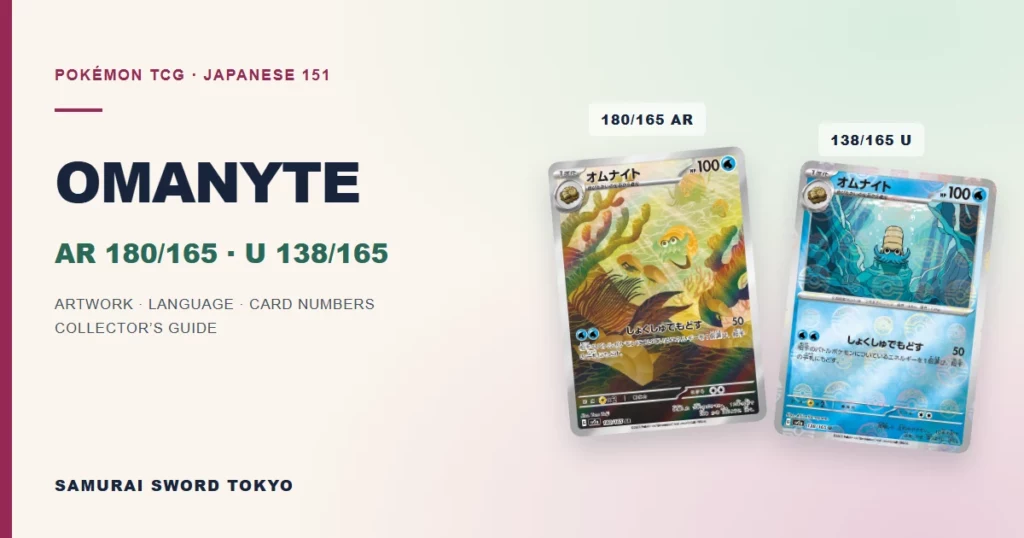
Omanyte 180/165 exists in both Japanese and English, with the same collector number and the same Yano Keiji illustration. The Japanese card is an Art Rare, marked AR in Pokémon Card 151 (SV2a). The English version belongs to Scarlet & Violet—151 and is classified as an Illustration Rare. The number alone does not tell you which language a seller is offering.
This guide explains that distinction, compares the illustration with the separate 138/165 design and shows which details matter when buying a single. It also explains the fossil evolution and attack without treating the AR as a more powerful version of the ordinary card.
For the Japanese art card, request Omanyte / オムナイト, SV2a 180/165 AR. An English 180/165 is a different language edition; a Japanese 138/165 is a different illustration. For a particular single, send those identifiers through Quick Order. The Japanese Pokémon Card 151 box page is for sealed product, with current options and availability shown there.
Official card and checklist sources checked September 21, 2026. This guide does not quote a live single-card price or guarantee a specific pull from a pack.
Which Omanyte 180/165 Do You Have?
The Japanese official database entry identifies the art card as SV2a 180/165 and credits Yano Keiji. The official English 151 checklist independently lists Omanyte at 180. The English card database identifies that version as 180/165 Illustration Rare.
| Check | Japanese art card | English art card |
|---|---|---|
| Name on the front | オムナイト | Omanyte |
| Set | Pokémon Card 151, SV2a | Scarlet & Violet—151 |
| Collector number | 180/165 | 180/165 |
| Rarity designation | Art Rare, AR | Illustration Rare |
| Illustrator | Yano Keiji | Yano Keiji |
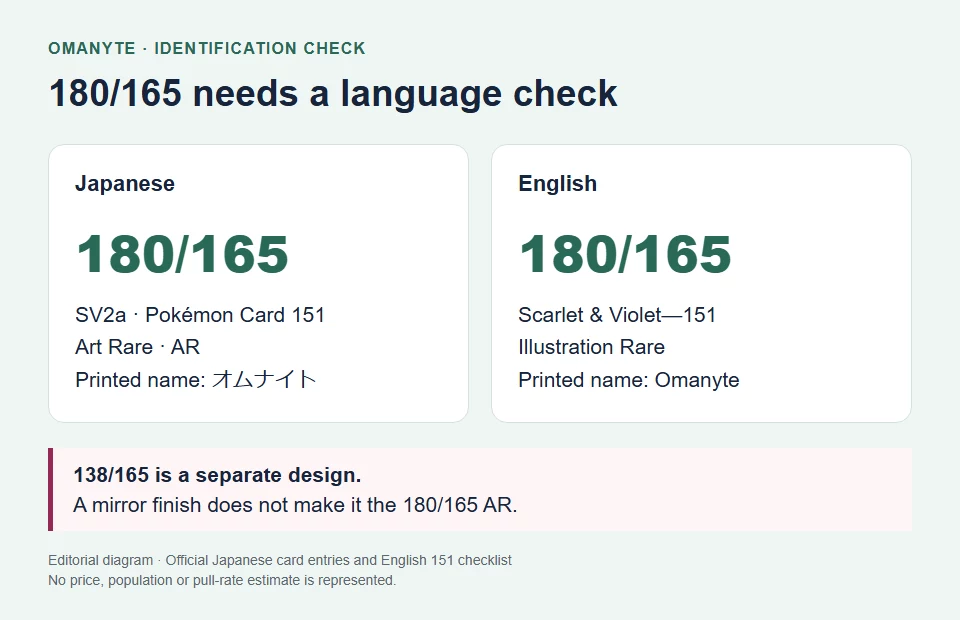
Start with the actual card photograph, then check the listing’s language field. A title such as “Omanyte full art 180” can describe either edition. A cropped photo that shows only the underwater scene removes the text and set details that would settle the question. Ask for an uncropped front when those details are missing.
“Full art” is a useful search phrase here, but it is less precise than the card’s actual rarity. Use AR for the Japanese 180/165 and Illustration Rare for the English edition. Do not assume that every full-art listing is a Japanese SR, or that two listings with the same number are interchangeable.
Yano Keiji’s AR vs the 138/165 Illustration
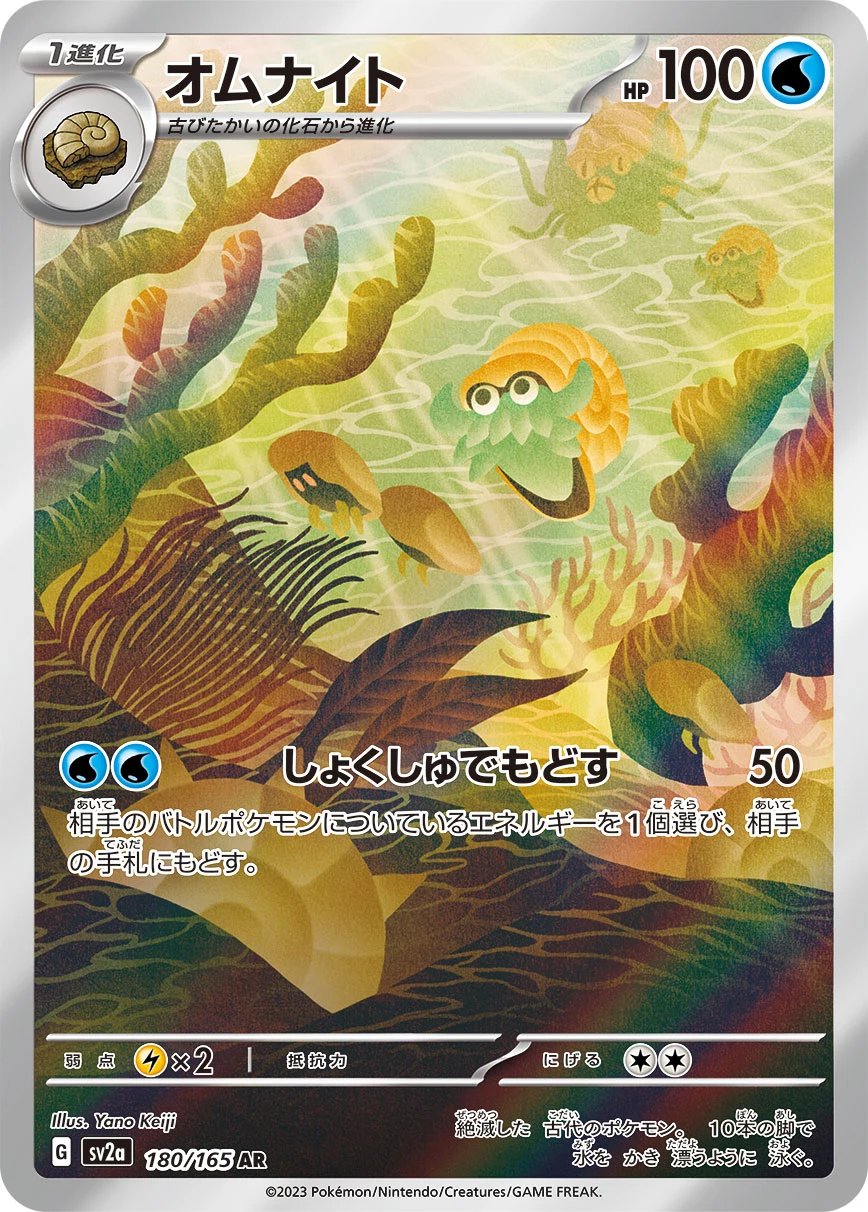
On the AR, a large Omanyte floats through a softly colored underwater environment while smaller Omanyte appear farther away. Plants frame the scene, and the pale light near the surface contrasts with the darker foreground. The illustration extends around the attack text, making the surrounding habitat part of the card’s appeal.
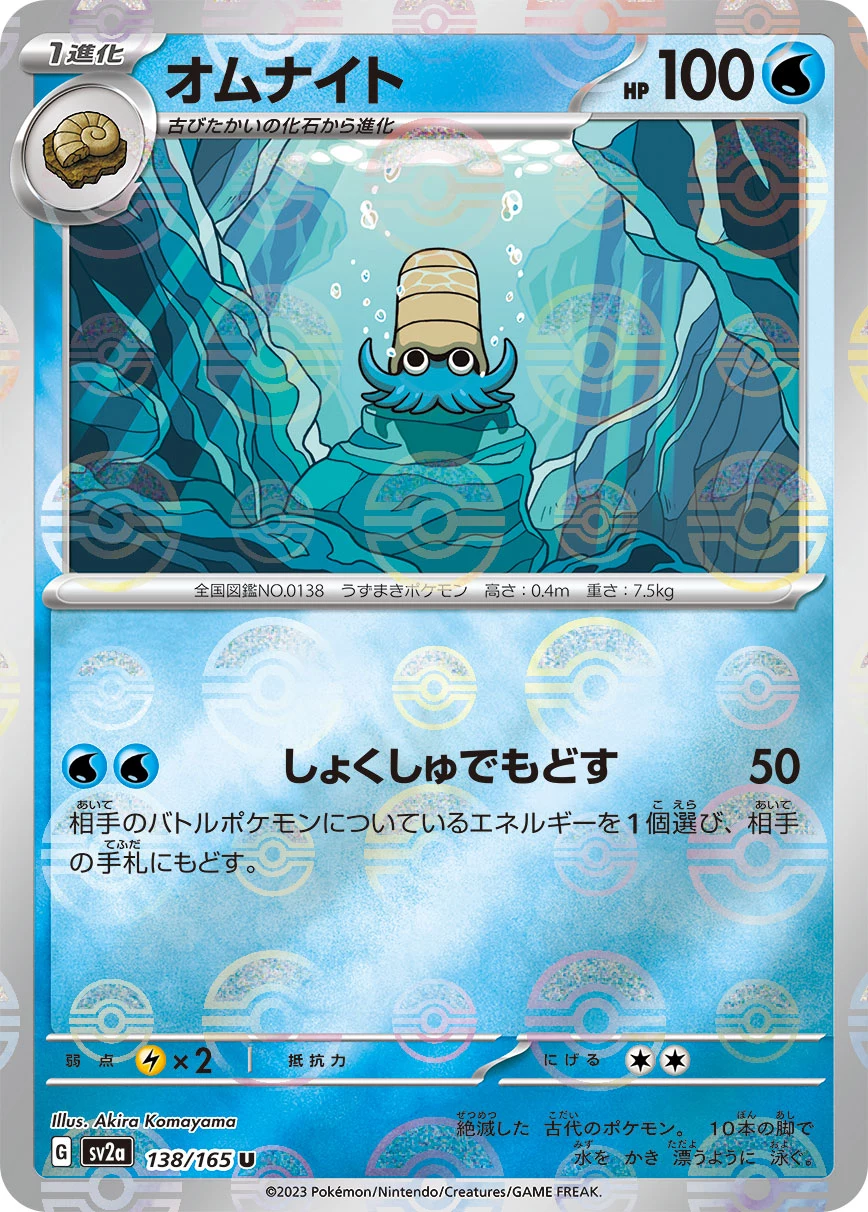
The 138/165 entry credits Akira Komayama. Its Omanyte sits within a conventional rectangular artwork window between blue rock walls. The official image shown here includes a repeating Poké Ball pattern across the card. Its U rarity and 138/165 number remain different from the Yano Keiji AR, even when the foil catches the light.
These comparisons answer two separate questions: which illustration is printed, and which finish is being offered. A mirror finish on 138/165 does not turn it into 180/165. Likewise, “holo Omanyte” leaves too much unspecified to identify the desired card. Compare the number, artist and full front before comparing prices.
The Fossil Evolution and Tentacular Return
The Japanese AR has 100 HP and is a Water-type Stage 1 that evolves from Antique Helix Fossil. That evolution line is printed directly beneath the name. Omanyte’s small size in the illustration does not make this particular card a Basic Pokémon that can simply begin on the Bench.
Its attack, Tentacular Return in English, costs two Water Energy and does 50 damage. It also returns one Energy attached to the opponent’s Active Pokémon to their hand. Returning that Energy is different from discarding it: the opponent still has the card in hand and may be able to use it again.
The card has Lightning weakness ×2, no printed resistance and a retreat cost of two Colorless Energy. Both Japanese images above show those same game details. The AR changes the illustration and collectible presentation; it does not add an Ability, an extra attack or a stronger damage number to the 138/165 design.
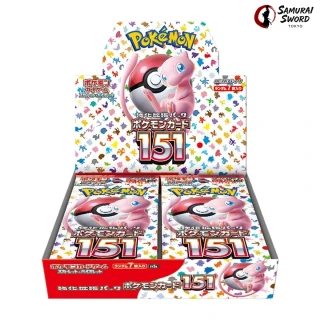
For play, consult the current rules for the event and language you intend to use. This collector guide identifies the printed card rather than promising current tournament eligibility. For display, the fossil icon, Japanese name and underwater composition are useful details to recognize without needing to build a deck around it.
How to Read a Raw or Graded Listing
A useful raw-card listing shows both sides, identifies the language and states a condition. Check the edges and corners against a contrasting background, then look across the surface under more than one angle of light. A straight-on scan is useful for recognizing the artwork, but can conceal a dent or a reflective surface mark.
For a graded copy, match the card inside the holder to its label: Omanyte, the correct set, 180/165 and the intended language. Read the grade instead of assuming every encapsulated copy is PSA 10. Use the official PSA certification checker as one part of the assessment; a matching number alone does not authenticate the physical item being offered.
Keep price comparisons like for like. A Japanese raw copy, an English raw copy and a graded Japanese copy are three different offers. Shipping, condition, grading company and the seller’s return terms also affect the comparison. An asking price records what a seller wants; it does not demonstrate a completed sale at that amount.
When requesting a quote, specify the version in a single line: “Japanese Omanyte, SV2a 180/165 AR, raw” or “Japanese Omanyte, SV2a 180/165 AR, PSA 10.” Add the quantity and any condition requirements. That is more actionable than “the Omanyte full art,” particularly when different language editions share its number.
Buying a Single or Opening Japanese 151
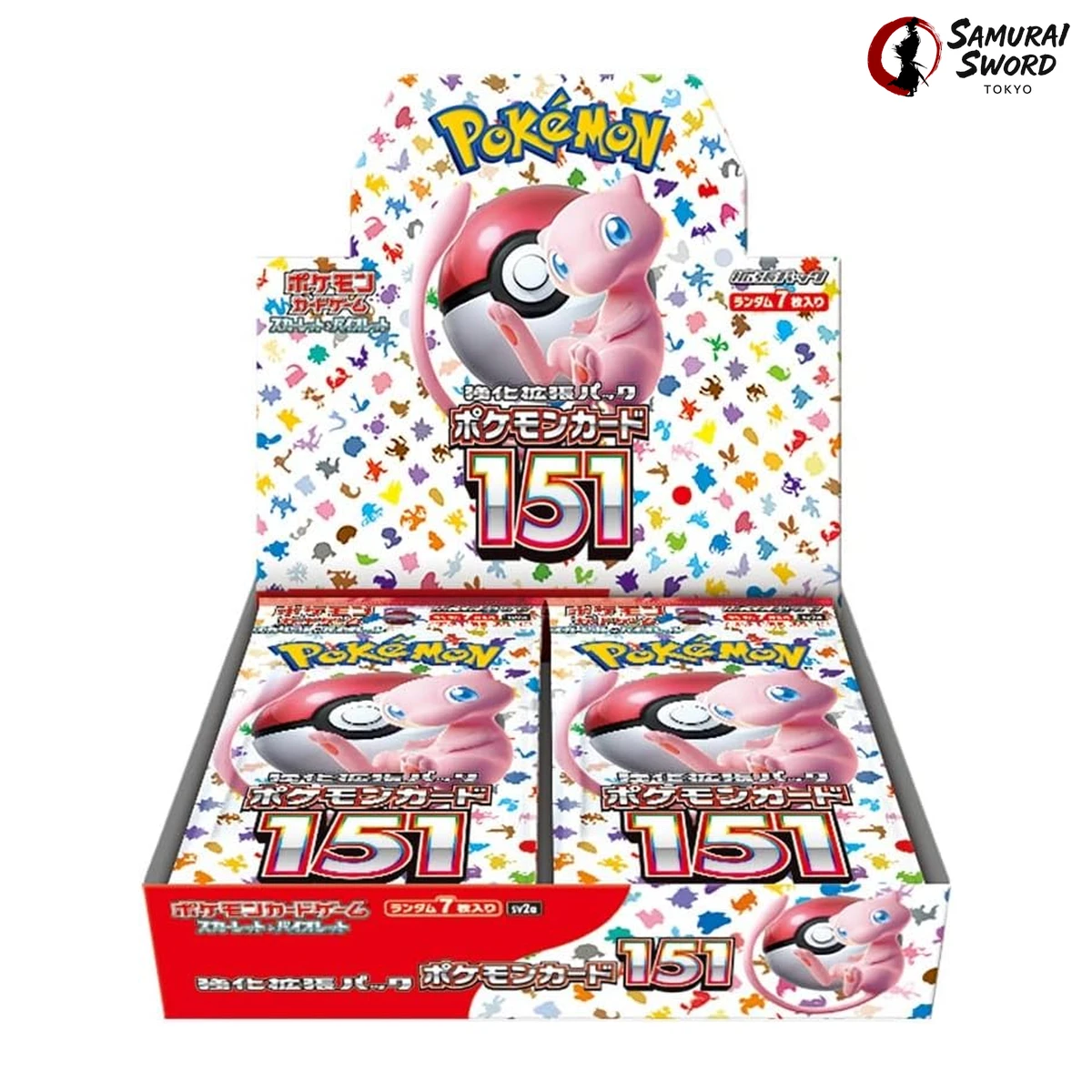
If your aim is this particular illustration, request the identified single. If you want the experience of opening the wider Japanese set, review the SV2a booster box listing and select the offered condition or packaging option carefully. A sealed box, a no-shrink option and a damaged outer box should not be treated as identical listings.
The official Japanese set page establishes Pokémon Card 151 as the source product. Our Japanese 151 card list helps place Omanyte among the set’s other illustrations. Buying a box gives you packs from that product; it does not reserve a specific AR for you.
Japanese Omanyte 180/165 AR
Request the exact single, language and grade through Quick Order. Review the quotation and available condition before ordering.
For graded alternatives, browse the PSA 10 collection. Current product pages and quotations carry the live offer; the reference images in this guide explain card identity and do not represent the condition of a particular copy for sale.
Frequently Asked Questions
Is Omanyte 180/165 Japanese or English?
Both editions exist with that number. The Japanese SV2a card is an Art Rare marked AR, while the English Scarlet & Violet—151 version is an Illustration Rare. Check the printed language and set details.
Who illustrated Omanyte 180/165?
Yano Keiji illustrated the underwater scene on Omanyte 180/165. The separate Japanese 138/165 illustration is credited to Akira Komayama.
Is Omanyte 138/165 the same card as the Art Rare?
It has the same game text in Japanese Pokémon Card 151, but a different illustration, collector number and rarity. A mirror finish on 138/165 does not make it the 180/165 AR.
What does Omanyte 180/165 do?
It is a 100 HP Water-type Stage 1 that evolves from Antique Helix Fossil. Tentacular Return costs two Water Energy, does 50 damage and returns one Energy attached to the opponent’s Active Pokémon to their hand.
Does a Japanese 151 box guarantee Omanyte AR?
No specific Omanyte pull is promised here. If you want Japanese 180/165 AR specifically, request that single instead of relying on a box opening.
How should I request a Japanese Omanyte single?
Specify Omanyte or オムナイト, SV2a 180/165 AR, Japanese language, quantity and whether you want a raw or graded card. Use Quick Order for a quotation and confirm the offered condition before ordering.
Picked for this article
📩 Get member-only sale alerts & coupons
Sale alerts, coupons and restock notices by email — straight from Tokyo.