Create a free account to earn points & rank
Samurai Sword Tokyo
Orders Cart

Yu-Gi-Oh Starlight Rare vs 20th Secret Rare: TCG and OCG Chase Rarities Compared
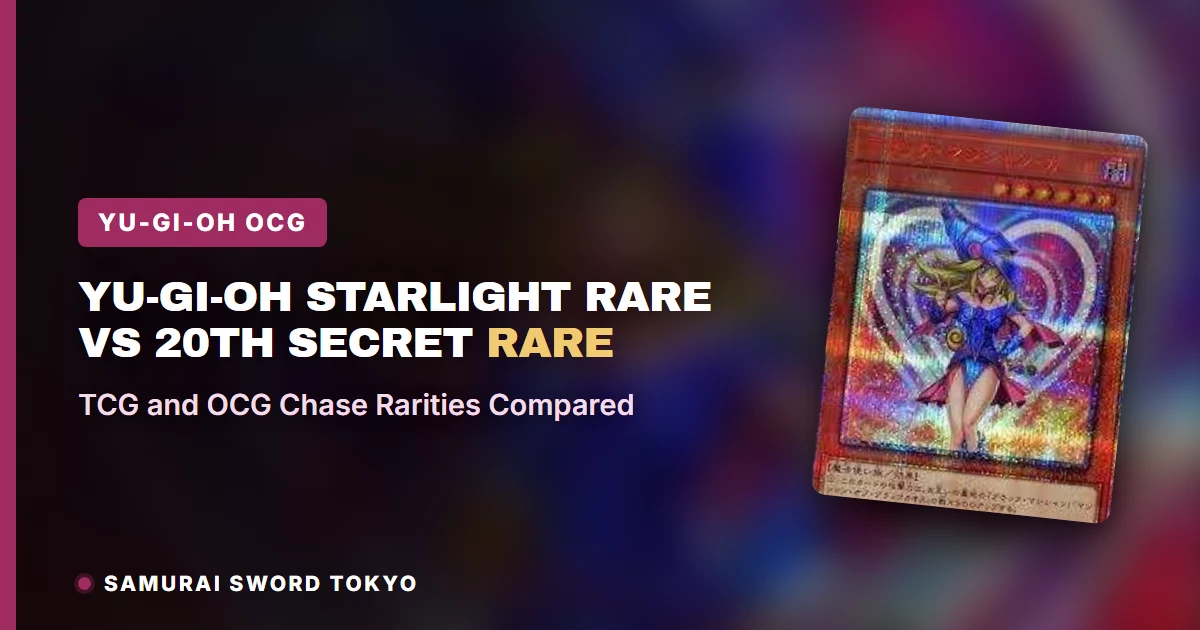
Starlight Rare and 20th Secret Rare both get called “the ultimate chase rarity” in Yu-Gi-Oh discussion, and it’s easy to assume they’re the same idea printed for two audiences. They aren’t. Starlight Rare is a TCG-only foil tier that started in 2019 and is still being printed today. 20th Secret Rare is an OCG-only foil tier that ran for about two years and was retired in 2020. They never appeared in the same product, and one did not turn into the other.

This guide lines up what each rarity actually is, when each one existed, and — since we ship Japanese cards out of Tokyo — which one you can currently order from us. Short answer on that last point: no Starlight Rare today, but two graded Japanese 20th Secret Rare cards are on the site.

Key Takeaways

Starlight Rare (Yu-Gi-Oh TCG) debuted in Rising Rampage (2019) and remains an active chase rarity in the Battles of Legend sub-series. 20th Secret Rare (Yu-Gi-Oh OCG) ran from Cybernetic Horizon (2018) to Rise of the Duelist (April 2020), when Prismatic Secret Rare took over the OCG’s top foil slot — not Starlight Rare. We don’t currently list a Starlight Rare card, but two Japanese 20th Secret Rare PSA 10s are listed: PSA10 Dark Magician Girl 20th SE and PSA10 Hiita the Fire Charmer, Ablaze 20th SE.

2019
Starlight Rare Debut (TCG)

2018–20
20th Secret Rare Era (OCG)

Sep 2026
Prices Checked

¥159
Per USD (Sept 2026)

Yen figures below convert at ¥159/USD (September 2026). Starlight Rare and 20th Secret Rare release history is sourced from Yugipedia’s entries on each rarity; product details are from our own catalogue.

What Is a Starlight Rare? (Yu-Gi-Oh TCG)

Starlight Rare is a TCG-only foil tier. It debuted in Rising Rampage in 2019, then became a recurring premium chase rarity inside the Battles of Legend sub-series starting with Battles of Legend: Armageddon on 23 July 2020, and has continued to appear in later Battles of Legend releases — including Monster Mayhem on 23 June 2025, per secondary retail sourcing.

Visually, a Starlight Rare uses the same horizontal holographic foil pattern found on a Prismatic Secret Rare, but the treatment covers the entire card rather than only the artwork window. Foil is absent only from the text box, any empty Link Arrows, and small portions of the artwork itself — everything else on the card front carries the holographic finish.

On scarcity: third-party retail sources report Starlight Rare pulls from original core-set boxes at roughly one per case to one per two cases, which works out to something like one per 12–24 boxes. That is a secondary-sourced community estimate, not a figure Konami has published, so treat it as a reported range rather than an official print-run number.

We don’t currently list a Starlight Rare card on our site — sourcing requests for one go through Quick Order.

What Is a 20th Secret Rare? (Yu-Gi-Oh OCG)

PSA10 Dark Magician Girl 20th Secret Rare [20TH-JPC55], 20th Anniversary Legend Collection
PSA10 Dark Magician Girl 20th SE [20TH-JPC55], 20th Anniversary Legend Collection (Japanese)

20th Secret Rare is an OCG-only foil tier, introduced in Cybernetic Horizon in 2018 to mark the Yu-Gi-Oh OCG’s 20th anniversary. It went on to appear across several anniversary-themed OCG products — including 20th Anniversary Legend Collection, 20th Anniversary Legend Selection, and the 20th Secret Rare Special Pack — as well as in ordinary core boosters through 2018–2020.

The rarity was discontinued when the OCG’s Rise of the Duelist booster (April 2020) replaced it with a new, visually similar foil called Prismatic Secret Rare. The last 20th Secret Rare card ever printed was The Winged Dragon of Ra, in that same Rise of the Duelist booster.

Our two listed 20th Secret Rare cards show both sides of how the rarity was used. PSA10 Dark Magician Girl 20th SE [20TH-JPC55] is currently listed at ¥330,400 (~$2,078) and comes from 20th Anniversary Legend Collection, one of the dedicated anniversary products named above. PSA10 Hiita the Fire Charmer, Ablaze 20th SE [SAST-JP056] is currently listed at ¥145,140 (~$913) and comes from Savage Strike, an ordinary 2019 OCG core booster that used the 20th SE treatment for one chase card — confirming the rarity turned up in both anniversary-specific sets and regular boosters during its run.
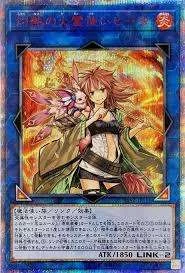
PSA10 Hiita the Fire Charmer, Ablaze 20th Secret Rare [SAST-JP056], Savage Strike
PSA10 Hiita the Fire Charmer, Ablaze 20th SE [SAST-JP056], Savage Strike (Japanese)

For how 20th Secret Rare compares to a different TCG-side finish from the same general period — Ghost Rare, a long-running visual-effect rarity that is unrelated to either card discussed here — see our companion guide, 20th Secret Rare vs Ghost Rare Explained.

Starlight Rare vs 20th Secret Rare: Side by Side

Laid out next to each other, the two rarities share a similar “top of the ladder” feel but sit on completely separate timelines and product lines:

Rarity Region Debut Status Currently on our site
Starlight Rare TCG only 2019 — Rising Rampage Active — recurring in the Battles of Legend sub-series Not listed — Quick Order
20th Secret Rare OCG only 2018 — Cybernetic Horizon Retired April 2020 — replaced by Prismatic Secret Rare 2 PSA 10s: Dark Magician Girl, Hiita

The foil treatments look related at a glance — both push holographic coverage well beyond a standard Secret Rare — but a Starlight Rare wraps the entire card front, while 20th Secret Rare uses the earlier OCG holographic-name style that Prismatic Secret Rare later carried forward. For a full breakdown of Yu-Gi-Oh’s highest-value chase cards across both regions, see our most expensive Yu-Gi-Oh cards guide.

Why They Get Confused — and Why One Didn’t Replace the Other
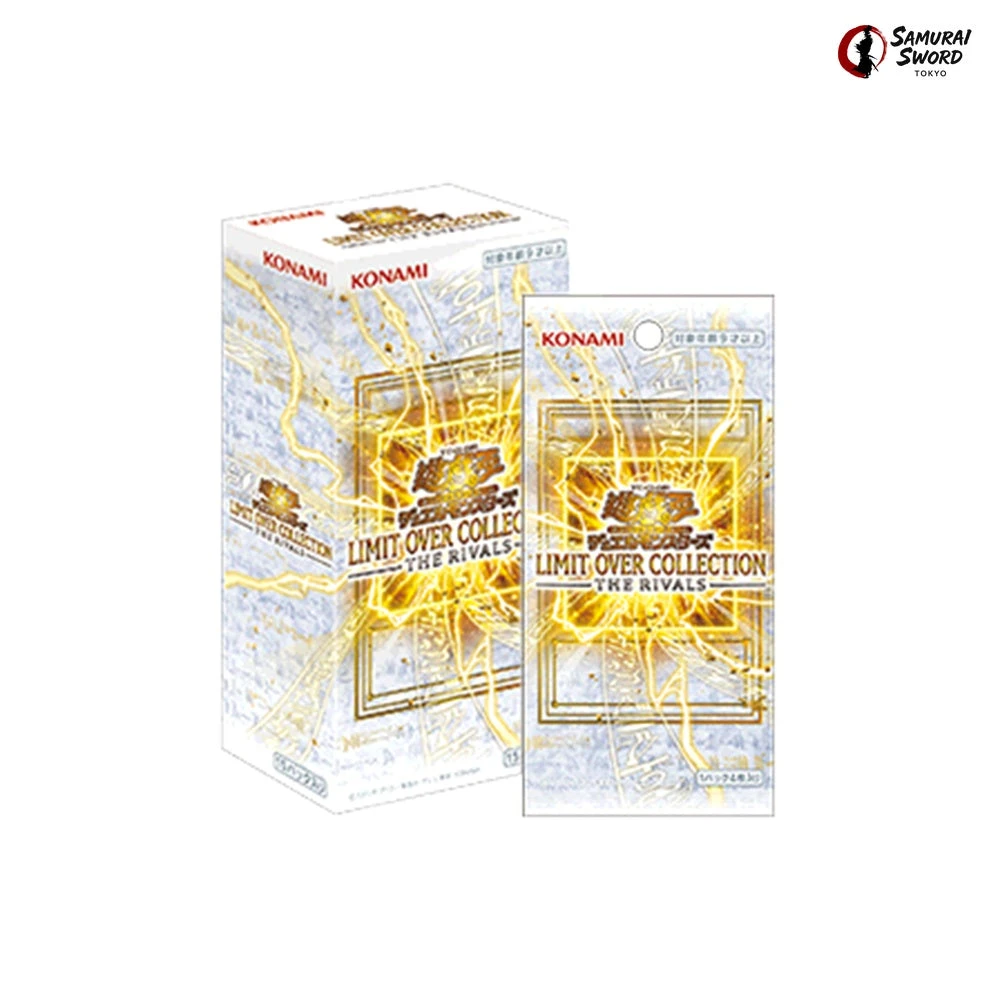
LIMIT OVER COLLECTION: THE RIVALS (LOCR) Japanese Yu-Gi-Oh booster box
LIMIT OVER COLLECTION: THE RIVALS (LOCR), a current Japanese OCG booster carrying Prismatic Secret Rare — the finish that actually replaced 20th Secret Rare

Starlight Rare and Prismatic Secret Rare are commonly described as regional counterparts of the same modern “whole-card holographic” idea, and that comparison is reasonable — both push foil coverage further than a standard Secret Rare, and both currently sit near the top of their region’s ladder. Where the confusion creeps in is assuming Starlight Rare is what 20th Secret Rare “became.”

It isn’t. 20th Secret Rare is a separate, earlier OCG rarity that Prismatic Secret Rare replaced in April 2020 — not Starlight Rare’s direct predecessor. The accurate framing is this: 20th Secret Rare (OCG, 2018–2020) and Starlight Rare (TCG, 2019–present) both sat at the top of their region’s rarity ladder in roughly the same window, and both were eventually followed or accompanied by full-card-foil concepts in their own region — Prismatic Secret Rare in the OCG’s case — but they are two different rarities that were never printed in the same product, on the same timeline, or under the same name.

For the OCG side of that successor story in full, including the finish’s own later detour through Quarter Century Secret Rare, see our Prismatic Secret Rare explained guide.

Where Each Rarity Sits on Its Region’s Ladder
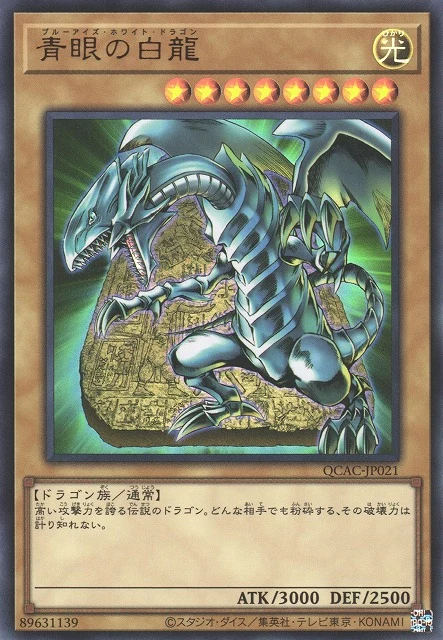
Blue-Eyes White Dragon, Ultra Rare, Quarter Century Art Collection (Japanese)

Blue-Eyes White Dragon UR, Quarter Century Art Collection (JP)

Dark Magician, Ultra Rare, Quarter Century Art Collection (Japanese)

Dark Magician UR, Quarter Century Art Collection (JP)

On the OCG side, 20th Secret Rare occupied the top-tier “anniversary foil” slot from 2018 to 2020. That slot didn’t stay static after 20th SE retired — Prismatic Secret Rare took over in April 2020, was itself stood in for by a different anniversary finish between 2023 and 2025, and the OCG’s ladder has kept adding specialty tiers since. Our OCG rarity guide covering Quarter Century Secret Rare walks through that full modern ladder, including the showcase set built specifically around the Quarter Century finish, the Quarter Century Art Collection guide, plus the newest tiers debuting on sets like Limit Over Collection. This article’s focus — Starlight Rare and 20th Secret Rare — sits earlier on that timeline than the rarities covered there.

On the TCG side, Starlight Rare sits at the top of the Battles of Legend sub-series specifically, above the Prismatic Secret Rare treatment that also appears in TCG products. There is no TCG equivalent that directly maps onto the OCG’s 20th Secret Rare — the two ladders developed their premium tiers independently, which is part of why lining them up card-for-card doesn’t work cleanly.

Buying Japanese 20th Secret Rare Cards from Tokyo

We don’t currently list a Yu-Gi-Oh TCG Starlight Rare card — sourcing requests for one go through Quick Order, with no timing attached. What we do carry, in graded Japanese OCG form, is 20th Secret Rare.

PSA10 Dark Magician Girl 20th SE [20TH-JPC55], from 20th Anniversary Legend Collection, is currently listed at ¥330,400 (~$2,078). PSA10 Hiita the Fire Charmer, Ablaze 20th SE [SAST-JP056], from Savage Strike, is currently listed at ¥145,140 (~$913). Both are graded Japanese pulls of a rarity Konami stopped printing in 2020, which is part of why a retired tier like this carries the premium it does compared with an actively-printed one.

Browse the rest of our graded Japanese singles in the PSA 10 collection. For the OCG’s current top-tier foil — Prismatic Secret Rare, the rarity that actually replaced 20th Secret Rare in 2020 — see our Prismatic Secret Rare explained guide. For anything else across either rarity family, including a Starlight Rare single or additional 20th Secret Rare cards, Quick Order is the fastest way to put a mixed request in front of us.

Shop This Rarity
PSA10 Dark Magician Girl 20th SE [20TH-JPC55], 20th Anniversary Legend Collection
Currently listed at ¥330,400 (~$2,078)
Ships from Tokyo · Tracked delivery

View Product →

Frequently Asked Questions

Is Starlight Rare the same as 20th Secret Rare?

No. Starlight Rare is a Yu-Gi-Oh TCG-only rarity that debuted in 2019 and is still printed today. 20th Secret Rare is a Yu-Gi-Oh OCG-only rarity that ran from 2018 to 2020 and was retired years ago. They never appeared in the same product.

Did Starlight Rare replace 20th Secret Rare?

No. The OCG rarity that replaced 20th Secret Rare in April 2020 is Prismatic Secret Rare, not Starlight Rare. Starlight Rare is a separate TCG-only rarity on its own timeline, and the two were never printed in the same product line.

When did Starlight Rare first appear?

Starlight Rare debuted in Rising Rampage in 2019, then became a recurring chase rarity in the Battles of Legend sub-series starting with Battles of Legend: Armageddon on 23 July 2020, continuing into later releases in that sub-series.

What was the last set to use 20th Secret Rare?

Rise of the Duelist, released in April 2020, was the final OCG booster to use 20th Secret Rare — its last 20th Secret Rare card was The Winged Dragon of Ra. That same booster introduced Prismatic Secret Rare as the replacement.

How rare is a Starlight Rare pull?

Third-party retail sources report roughly one Starlight Rare per case to one per two cases from original core-set boxes, which works out to something like one per 12–24 boxes. That figure is a secondary-sourced community estimate rather than an official number from Konami.

Do you sell Starlight Rare cards?

Not at the moment — we don’t currently list a Starlight Rare card. Sourcing requests go through Quick Order. We do currently list two graded Japanese 20th Secret Rare PSA 10s, Dark Magician Girl and Hiita the Fire Charmer, Ablaze.
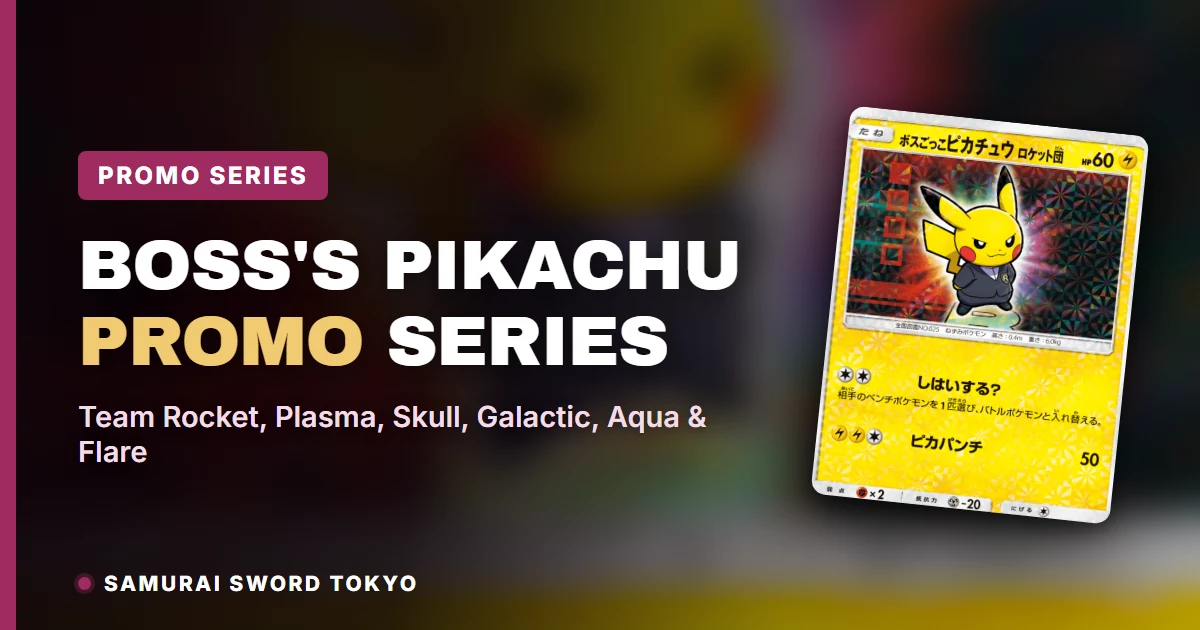
Boss’s Pikachu Promo Series Guide: Team Rocket, Plasma, Skull, Galactic, Aqua & Flare

In January 2018, Pokémon Center and Pokémon Store shoppers in Japan who bought five booster packs in one transaction could pick a Pikachu card dressed as the boss of one of seven Pokémon villain teams — Rocket, Magma, Aqua, Galactic, Plasma, Flare or Skull. Same Lightning-type Basic Pikachu, same attack text, seven different team liveries.

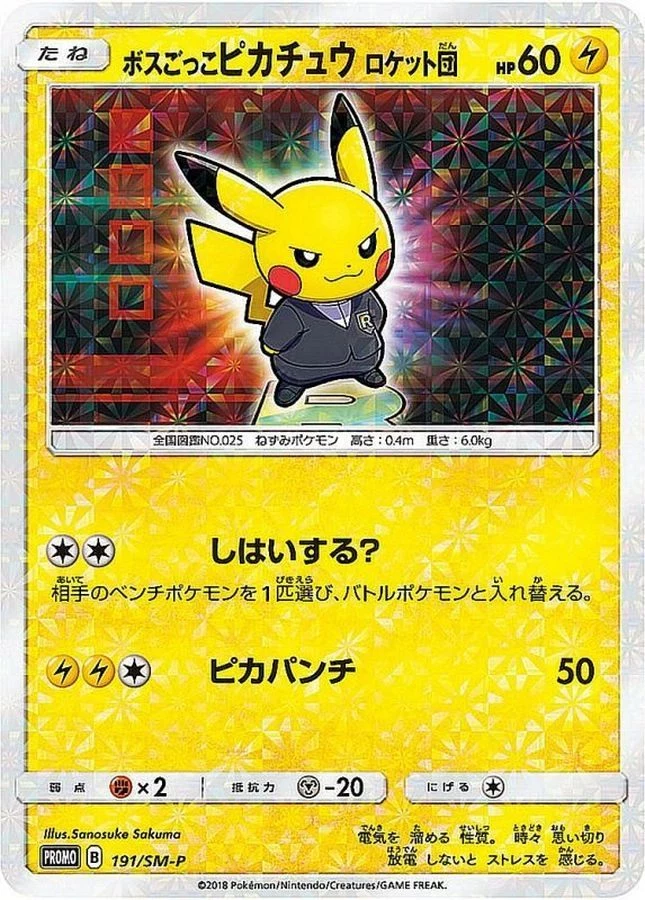
Bulbapedia lists all seven under one official name, “Pretend Boss Pikachu” (Japanese: ボスごっこピカチュウ, plus the team name), numbered 191 through 197 in the SM-P Promotional card block. This store’s own listings shorten that to “Boss Pikachu [Team]” — same underlying cards.

This guide covers the full seven-card run, the campaign that distributed them, and the four PSA10-graded team variants covered in detail — Team Rocket, Team Galactic, Team Plasma and Team Skull — all currently listed on our site. Team Aqua and Team Flare are listed as well and covered below; Team Magma exists in the same numbered run but is not currently listed, and sourcing requests for it go through Quick Order.
Key Takeaways

Pretend Boss Pikachu is a seven-card Japanese promo series (SM-P 191–197), one card per Pokémon villain team, distributed from 20 January 2018 through the “Team Rainbow Rocket’s Ambition” campaign at Pokémon Centers and Pokémon Stores for shoppers who bought five booster packs in one transaction. This store currently lists PSA10 graded cards for six of the seven: Team Rocket (SM-P 191) at ¥636,020 (~$4,000) and Team Plasma (SM-P 195) at ¥646,640 (~$4,067), plus Team Galactic and Team Skull below, and Team Aqua (SM-P 192) at ¥519,200 (~$3,265) and Team Flare (SM-P 196) at ¥495,364 (~$3,116). Team Magma is not currently listed.

7
Team Variants (SM-P 191–197)

2018
Campaign Launch Year

5 Packs
Purchase To Qualify

Sep 2026
Prices Checked

Prices are this store’s current listed prices as of September 2026, converted at ¥159/USD.

The Pretend Boss Pikachu Promo Series

Bulbapedia’s full official name for this line is “Pretend Boss Pikachu” (Japanese: ボスごっこピカチュウ, plus the team name) — a Lightning-type Basic Pokémon promo, part of the SM-P Promotional card block. All seven team variants share one continuous promo-number run, 191 through 197, per Bulbapedia’s SM-P Promotional cards table:

No. Team Japanese name On our site
191/SM-P Team Rocket ボスごっこピカチュウ ロケット団 Listed
192/SM-P Team Aqua — Listed (¥519,200)
193/SM-P Team Magma — Not listed
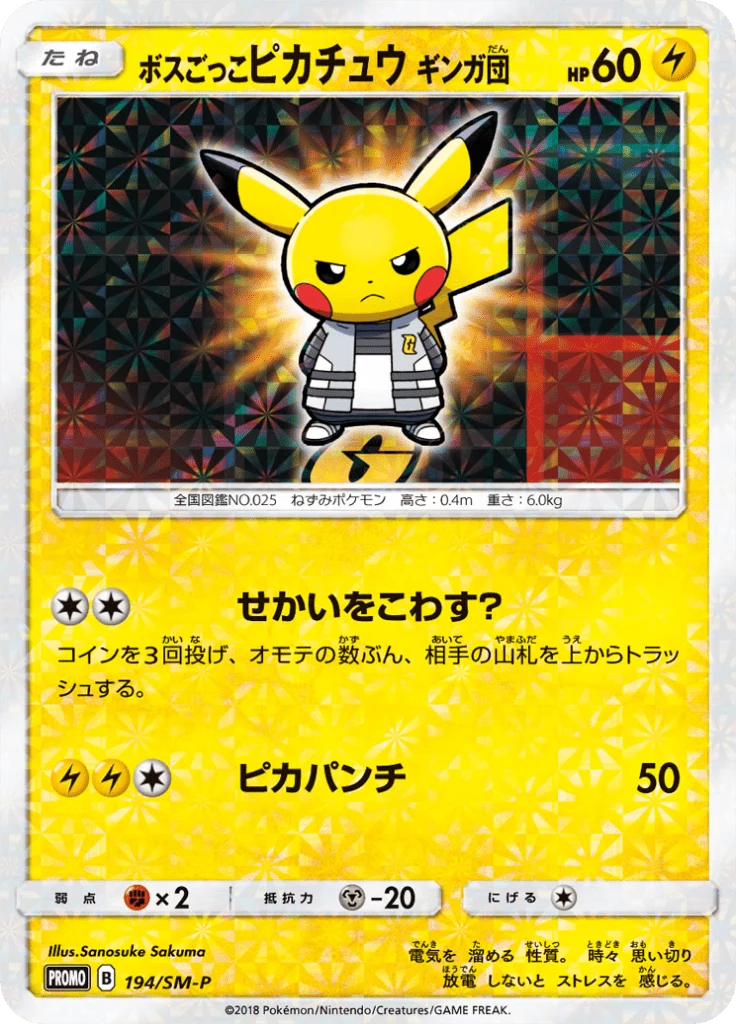
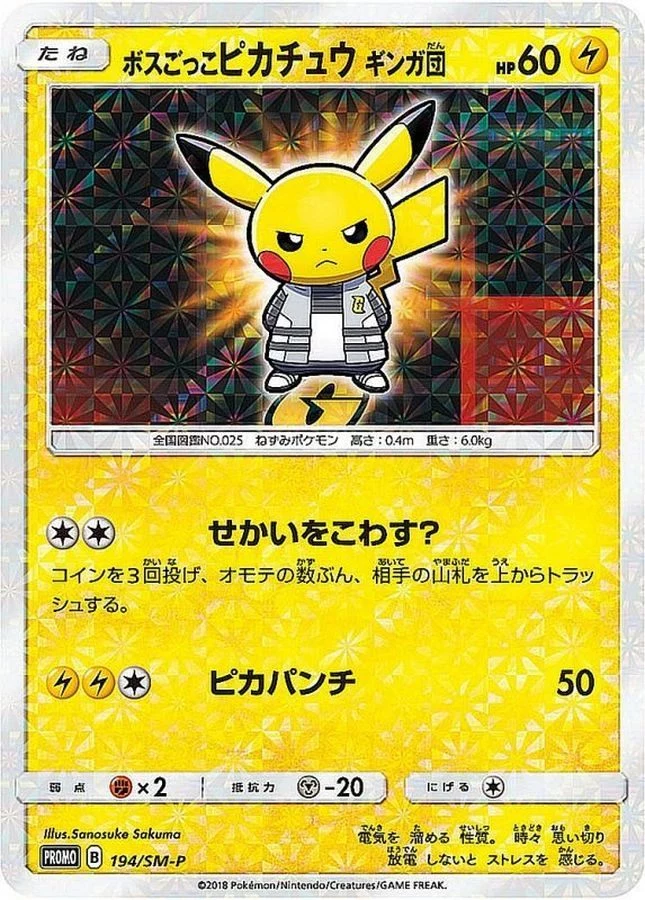
194/SM-P Team Galactic ボスごっこピカチュウ ギンガ団 Listed
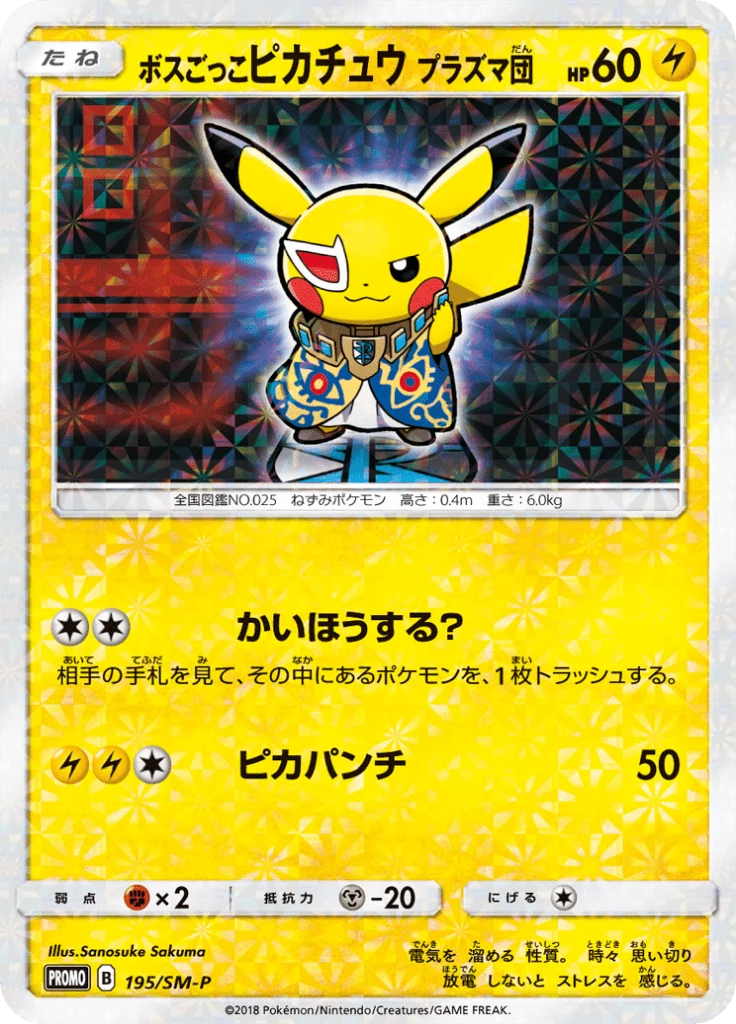
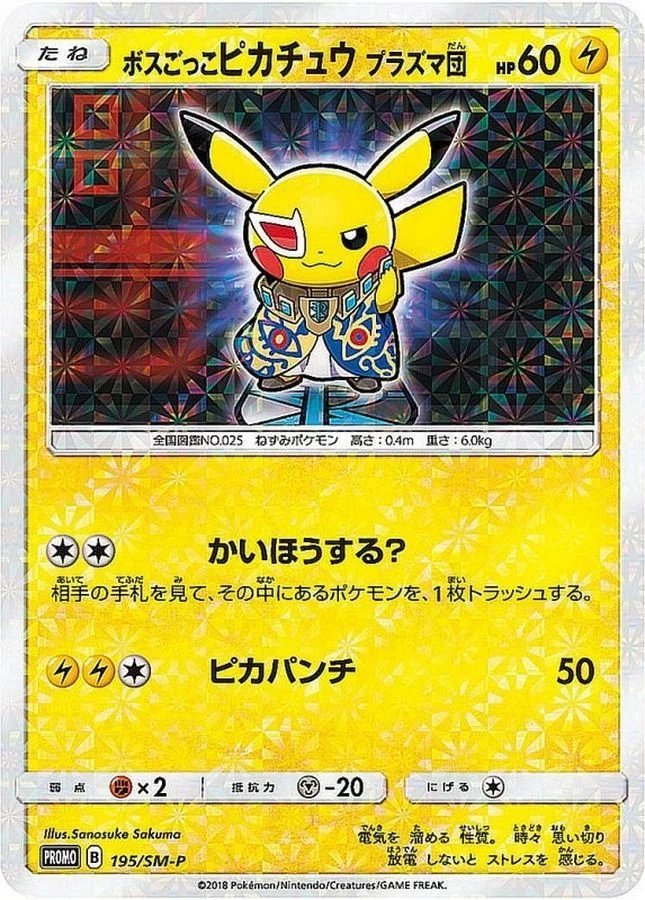
195/SM-P Team Plasma ボスごっこピカチュウ プラズマ団 Listed
196/SM-P Team Flare — Listed (¥495,364)
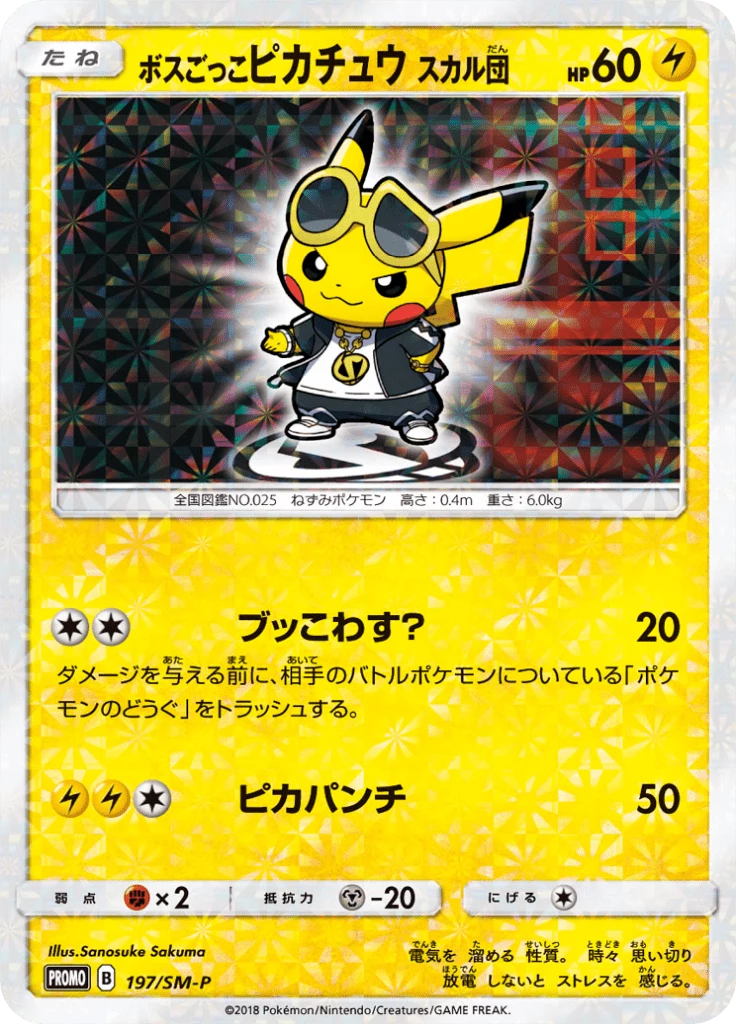
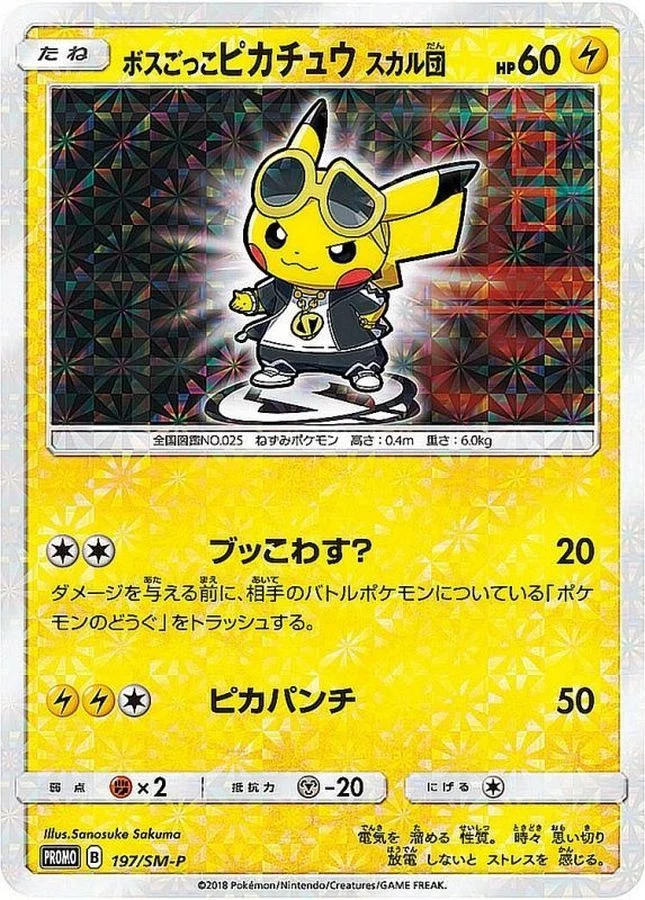
197/SM-P Team Skull ボスごっこピカチュウ スカル団 Listed

This store lists six of the seven — Team Rocket, Team Aqua, Team Galactic, Team Plasma, Team Flare and Team Skull — as individually graded PSA10 cards. Team Magma is not currently listed; sourcing requests for it go through Quick Order. The illustrator credited on Bulbapedia for each of the four variants covered in detail below is Sanosuke Sakuma.

Not the Same “Pretend ___ Pikachu”

Our Novelty Special-BOX Pikachu Promos guide covers “Pretend Team Skull Pikachu” (SM-P Promo 013) — a different, earlier release from the 2016 Sun & Moon Special Box, tied to its own separate campaign. This article covers the later 2018 “Pretend Boss Pikachu” line (SM-P 191–197), distributed through the Team Rainbow Rocket’s Ambition campaign. Same naming convention, different characters, different years — don’t mix the two up.

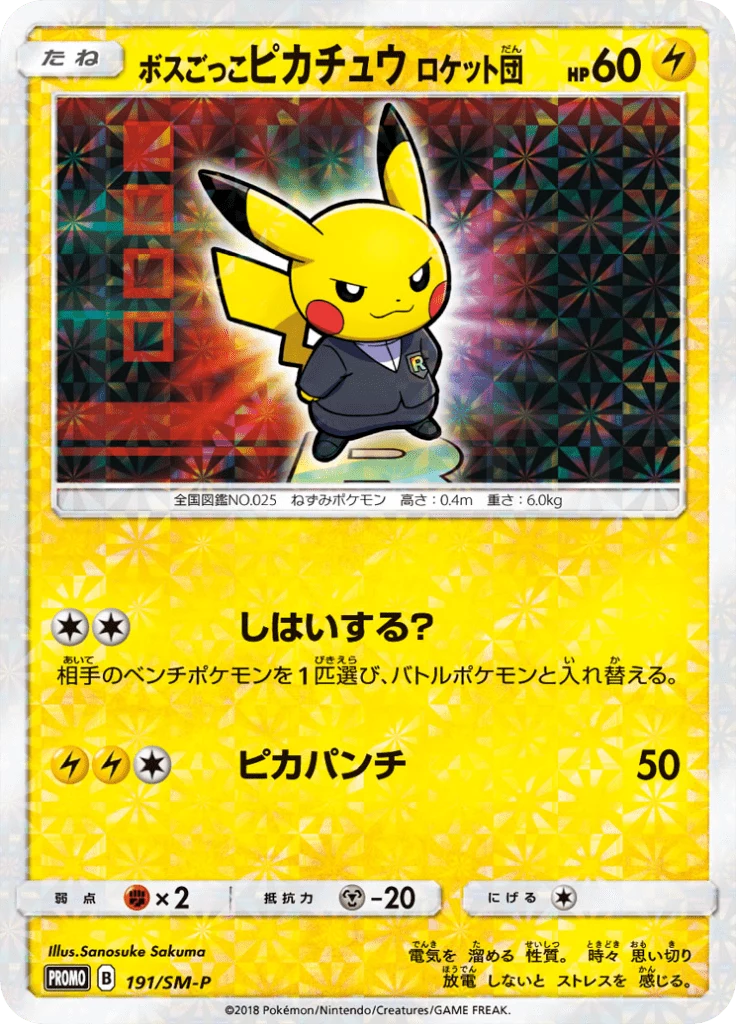
Boss Pikachu Team Rocket, SM-P 191, Promo, SM-P Promotional cards

Boss Pikachu Team Rocket
SM-P 191

Boss Pikachu Team Galactic, SM-P 194, Promo, SM-P Promotional cards

Boss Pikachu Team Galactic
SM-P 194

Boss Pikachu Team Plasma, SM-P 195, Promo, SM-P Promotional cards

Boss Pikachu Team Plasma
SM-P 195

Boss Pikachu Team Skull, SM-P 197, Promo, SM-P Promotional cards

Boss Pikachu Team Skull
SM-P 197

Team Rocket: SM-P 191

PSA10 Boss Pikachu Team Rocket SM-P 191, listed on samuraiswordtokyo.com
Boss Pikachu Team Rocket · SM-P 191 · Promo · SM-P Promotional cards

Boss Pikachu Team Rocket (SM-P 191, Japanese: ボスごっこピカチュウ ロケット団) is one of the six Pretend Boss Pikachu team variants currently listed on this site as a graded PSA10 card. It’s illustrated by Sanosuke Sakuma and was distributed through the January 2018 Team Rainbow Rocket’s Ambition campaign alongside the other six team variants. A PSA10 card is currently listed at ¥636,020 (~$4,000).

Team Galactic: SM-P 194

PSA10 Boss Pikachu Team Galactic SM-P 194, listed on samuraiswordtokyo.com
Boss Pikachu Team Galactic · SM-P 194 · Promo · SM-P Promotional cards

Boss Pikachu Team Galactic (SM-P 194, Japanese: ボスごっこピカチュウ ギンガ団) is illustrated by Sanosuke Sakuma and belongs to the same seven-card Team Rainbow Rocket’s Ambition run as the other variants on this page. A PSA10 card is currently listed at ¥527,460 (~$3,317).

Team Plasma: SM-P 195

PSA10 Boss Pikachu Team Plasma SM-P 195, listed on samuraiswordtokyo.com
Boss Pikachu Team Plasma · SM-P 195 · Promo · SM-P Promotional cards

Boss Pikachu Team Plasma (SM-P 195, Japanese: ボスごっこピカチュウ プラズマ団) carries the same Sanosuke Sakuma illustration credit as the rest of the run. A PSA10 card is currently listed at ¥646,640 (~$4,067), the highest of the six team variants this store currently lists.

Team Skull: SM-P 197

PSA10 Boss Pikachu Team Skull SM-P 197, listed on samuraiswordtokyo.com
Boss Pikachu Team Skull · SM-P 197 · Promo · SM-P Promotional cards

Boss Pikachu Team Skull (SM-P 197, Japanese: ボスごっこピカチュウ スカル団) closes out the numbered run at the highest promo number in the run, also illustrated by Sanosuke Sakuma. A PSA10 card is currently listed at ¥552,252 (~$3,473).

How the Series Was Distributed

Bulbapedia’s page for each of the seven cards carries the same distribution note, verbatim: “Starting January 20, 2018 for as long as stocks lasted, customers at participating Pokémon Centers (including the Pokémon Center Online) and Pokémon Stores who purchased five booster packs in one transaction could select to receive 1 of 7 Pretend Boss Pikachu promotional cards.” In other words, this wasn’t a random pack pull — shoppers chose which of the seven team variants they wanted at the register, for as long as that location’s stock of that specific variant lasted.

The seven-team roster lines up with “Team Rainbow Rocket,” the villain-alliance concept from Pokémon Ultra Sun and Ultra Moon, in which former antagonist team leaders and grunts from across the games band together under one banner. The 2018 “Team Rainbow Rocket’s Ambition” campaign that distributed these promos is themed around that concept, which is why the run spans seven separate villain teams — Rocket, Magma, Aqua, Galactic, Plasma, Flare and Skull — rather than tying to a single game’s cast.

For related Japanese Pikachu promo lines, see our Poncho Pikachu value guide and Mega Tokyo Pikachu promo guide — both cover separate costume-Pikachu campaigns, not this Team Rainbow Rocket run. For how Japanese promo distribution works more broadly, our One Piece promo cards guide and Japanese old-back Pokémon cards guide give wider context on Japanese promo collecting.

Grading and What PSA 10 Means for These Promos

PSA 10 is the top grade PSA issues, reserved for cards judged free of the centring, corner, edge and surface flaws that lower grades allow. For a promo-only card like this one — never sold inside a booster box, never given a widely distributed set-code release — a PSA10 slab is the main way a buyer can verify condition without a set or booster context to compare it against.

All six Boss Pikachu team variants listed on this site are graded PSA10 cards, not raw examples. If you’re comparing a raw card against a slabbed one, check the promo number in the corner first — 191, 192, 194, 195, 196 and 197 are the six this store lists, and the team name printed on the card should match the Japanese name in the table above.

Where to Buy Boss Pikachu Cards from Tokyo

We ship Japanese sealed product and graded singles worldwide from Tokyo with tracked delivery. Six Pretend Boss Pikachu team variants are currently listed as PSA10 graded cards:

Featured Card
PSA10 Boss Pikachu Team Plasma (SM-P Promo 195)
Currently listed at ¥646,640 (~$4,067)
Ships from Tokyo · Tracked delivery

View Product →

Also currently listed: Team Rocket at ¥636,020 (~$4,000), Team Galactic at ¥527,460 (~$3,317), and Team Skull at ¥552,252 (~$3,473). Team Aqua at ¥519,200 (~$3,265) and Team Flare at ¥495,364 (~$3,116) are listed too. Team Magma is not listed on our site at the moment — sourcing requests for it go through Quick Order.

For more PSA10-graded Japanese promos, browse our PSA 10 collection, or add specific cards to a mixed order through Quick Order.

Frequently Asked Questions

What is “Boss Pikachu”?

Boss Pikachu is this store’s shorthand for “Pretend Boss Pikachu,” a seven-card Japanese promo series (SM-P Promotional cards, numbers 191–197) in which the same Lightning-type Basic Pikachu design was reprinted once per Pokémon villain team — Rocket, Magma, Aqua, Galactic, Plasma, Flare and Skull.

How many Boss Pikachu team variants are there, and which ones are listed here?

All seven team variants (SM-P 191–197) exist as one numbered run. This store currently lists six as graded PSA10 cards — Team Rocket, Team Aqua, Team Galactic, Team Plasma, Team Flare and Team Skull. Team Magma is not listed at the moment; sourcing requests go through Quick Order.

How was the Boss Pikachu series originally distributed?

Starting 20 January 2018, shoppers at participating Japanese Pokémon Centers, Pokémon Center Online and Pokémon Stores who bought five booster packs in one transaction could choose 1 of the 7 Pretend Boss Pikachu cards, for as long as each location had stock of that variant.

What is Team Rainbow Rocket, and why does it matter for this series?

Team Rainbow Rocket is the villain-alliance concept from Pokémon Ultra Sun and Ultra Moon, uniting former antagonist team leaders and grunts from across the games under one banner. The 2018 “Team Rainbow Rocket’s Ambition” campaign that distributed these promos is themed around that concept, which is why the card run covers seven separate villain teams instead of one.

Where can I buy Boss Pikachu PSA10 cards from Japan?

Six team variants — Rocket, Aqua, Galactic, Plasma, Flare and Skull — are currently listed as PSA10 graded cards on this site, shipping from Tokyo with tracked delivery. Use Quick Order to ask about Team Magma or to build a mixed order.

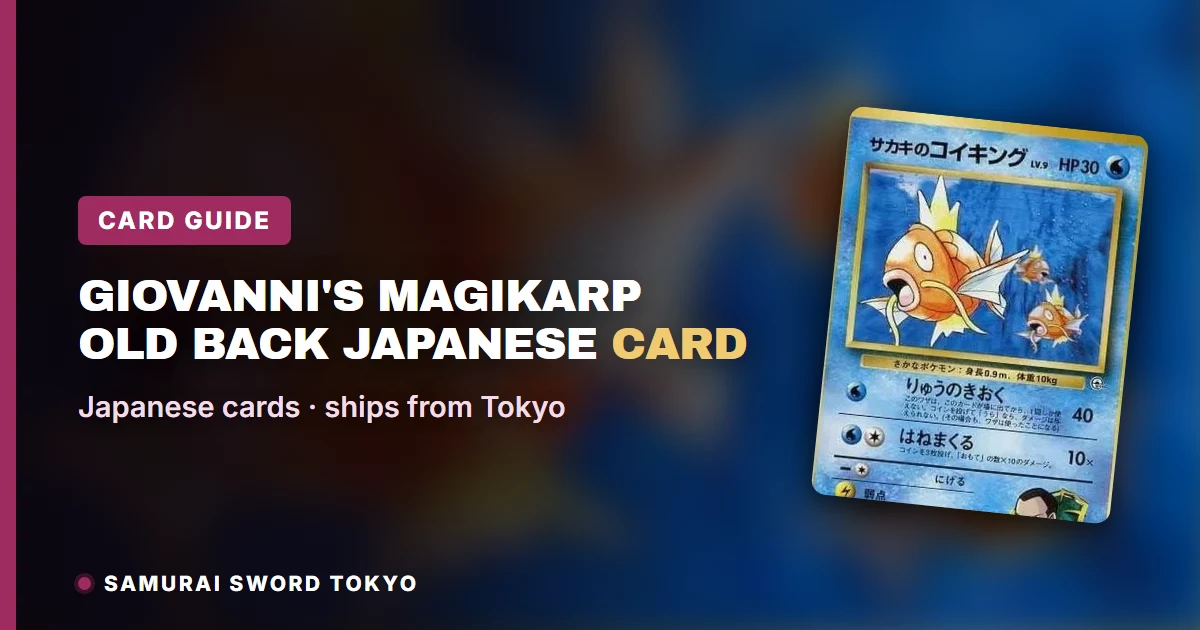
Giovanni’s Magikarp Old Back Japanese Card Guide (Gym Series)

Giovanni’s Magikarp comes from a single documented Japanese print — a 1999 old-back single that carries a numbering convention most collectors never learn to read correctly. That makes it a useful card to walk through in detail: one print, one set, and a numbering system that looks like a set position but isn’t.

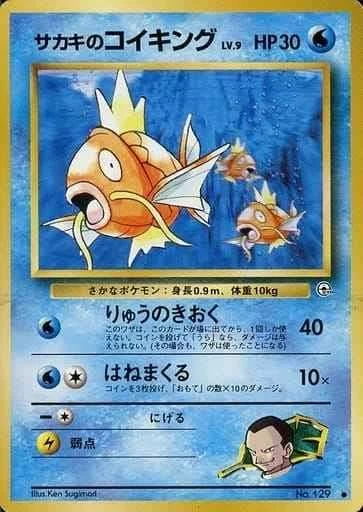
The card is Giovanni’s Magikarp, our listing’s card number No.129, from the Japanese expansion Gym Expansion Volume 2, “Challenge from the Darkness” — the set Bulbapedia’s English-language records list as Gym Challenge, Japan’s 6th TCG expansion, released 25 June 1999. It carries the original 1996–2001 “old back” card design, predating the July 2001 card-back redesign introduced with Pokemon VS. We currently list a PSA 10 graded copy of this print, and this guide covers what the card is, how its number actually works, how the Japanese print compares to its English counterpart, and where it sits alongside the other Gym-leader singles we list from the same set.

Key Takeaways

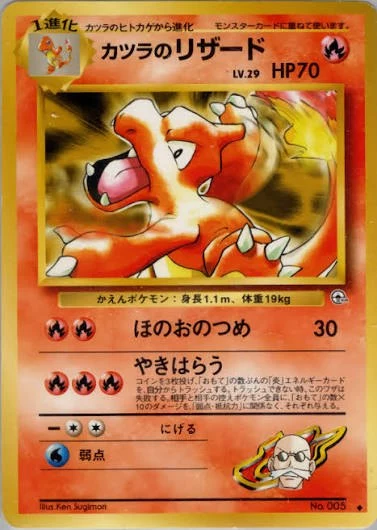
Giovanni’s Magikarp Old Back No.129 is a PSA 10, currently listed at ¥159,064 (~$1,000). It comes from Gym Expansion Volume 2 (JP release 25 June 1999, 98 total Japanese cards), and the “No.129” on the card is a National Pokedex-based numbering convention, not a set position. No additional Japanese print of this exact card is documented. From the same set, we also list a PSA 10 Blaine’s Charmeleon Old Back [PMCG-G2 No.005] currently listed at ¥100,300 (~$631).

30
HP

Common
Rarity (EN Print)

98
JP Set Size

25 Jun 1999
Japan Release

Prices below are current samuraiswordtokyo.com listings, converted at ¥159/USD (September 2026).

The Card: Giovanni’s Magikarp Old Back No.129

Giovanni’s Magikarp is a Basic, Water-type Pokemon with 30 HP. It carries two attacks: “Ancestral Memory,” a coin-flip attack for 40 damage, and “Flail Around,” a three-coin-flip attack with variable damage depending on how many flips land heads. The English print credits Ken Sugimori as illustrator; the Japanese-language print’s illustrator credit was not independently re-verified for this guide, but it is very likely the same artist.

PSA 10 Giovanni's Magikarp Old Back PMCG-G2 No.129 slab, listed on samuraiswordtokyo.com
PSA 10 Giovanni’s Magikarp Old Back PMCG-G2 No.129 slab, listed on samuraiswordtokyo.com

Our own graded copy of this print is currently listed at ¥159,064 (~$1,000), PSA 10. The card number printed on the slab — No.129 — is not the card’s sequential position within a print run. It reflects the numbering convention used across old-back-era Japanese sets: cards are ordered by type first, then by ascending rarity, then by National Pokedex number within each group. Magikarp’s own National Pokedex number is 129, which is exactly what shows up on this print. It’s a structural rule that applies to old-back Japanese sets generally, not something unique to this particular card. For more on reading Japanese card numbering conventions, see our guide to reading Japanese Pokemon cards.

The Set: Gym Expansion Volume 2

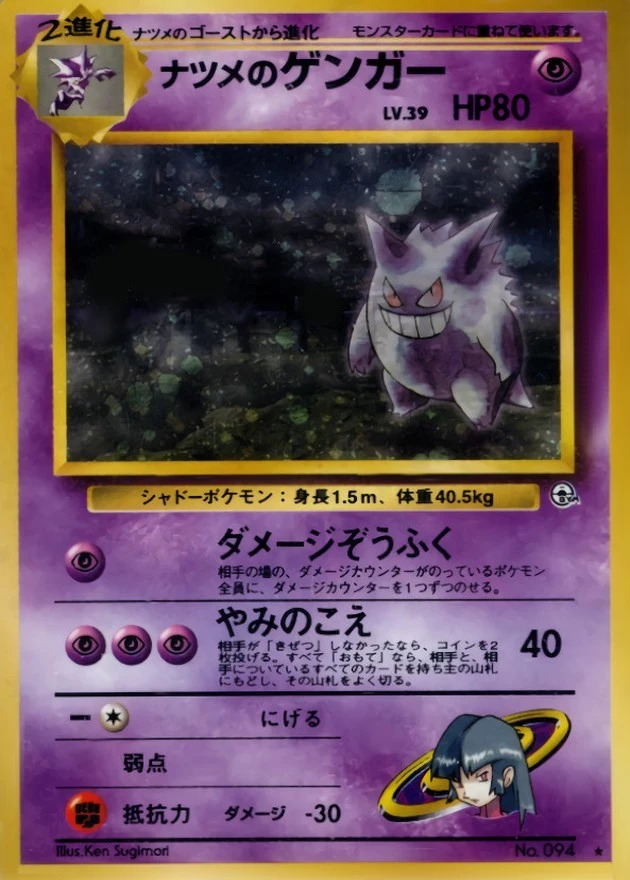
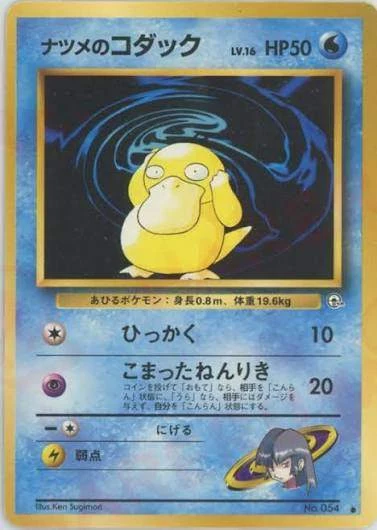
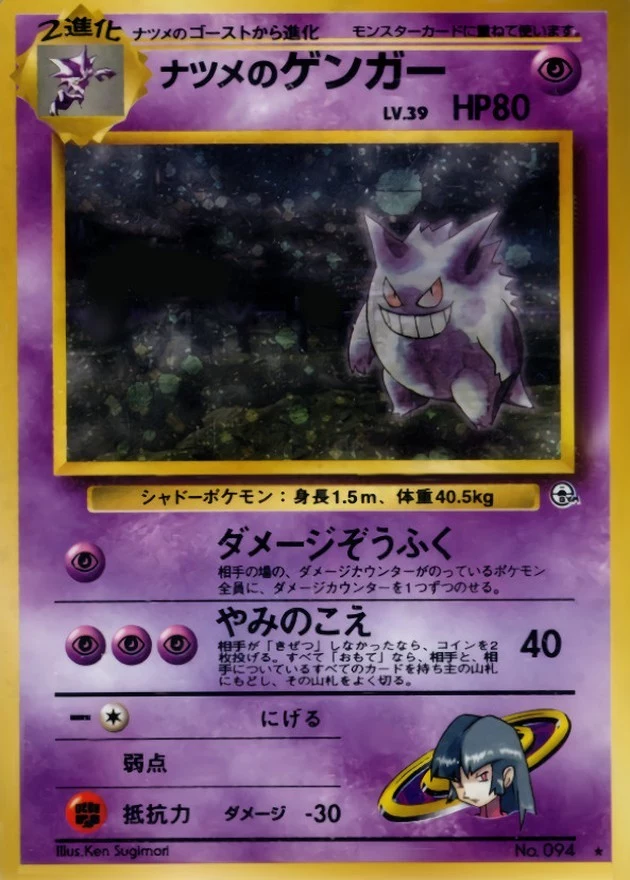
Gym Expansion Volume 2, “Challenge from the Darkness” — the set Bulbapedia’s English-language records catalogue as Gym Challenge — is Japan’s 6th TCG expansion, released 25 June 1999, with 98 total Japanese cards. It belongs to the Gym series (1996–1999), the block of old-back-era sets that introduced Gym Leader-owned Pokemon — cards like Giovanni’s Magikarp, Blaine’s Charmeleon, Sabrina’s Gengar, and Sabrina’s Psyduck, each named for the Gym Leader who “owns” that Pokemon in the games.

For a broader look at how the Gym series sets fit together, see our Pokemon Center Gym Sets guide. There is no modern booster box product tied to this 1999 vintage single — Gym Expansion Volume 2 is a vintage-era set with no current sealed release, so any box-style buying route runs through the general old-back guides linked above rather than a specific sealed product listing.

Japanese vs English Print

Giovanni’s Magikarp does have an English print, and its numbering looks completely different from the Japanese version. The English release is Gym Challenge (2000), card #73/132, at Common rarity. That number reflects a straightforward sequential position within a 132-card English set — nothing to do with National Pokedex numbers.

The Japanese Gym Expansion Volume 2 print released a full year earlier, on 25 June 1999, versus the English Gym Challenge release in 2000. So the two prints share the same artwork and card text but sit in entirely different numbering systems, released roughly a year apart. If you’re trying to match a Japanese copy against an English one, go by the card name and artwork rather than assuming the numbers correspond — a No.129 Japanese print and a #73/132 English print are the same card under two unrelated numbering conventions.

Where This Print Sits Among Japanese Old-Back Singles

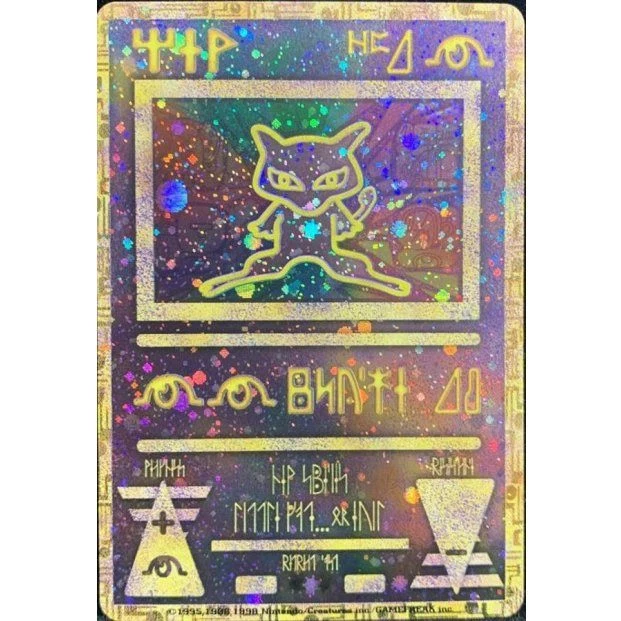
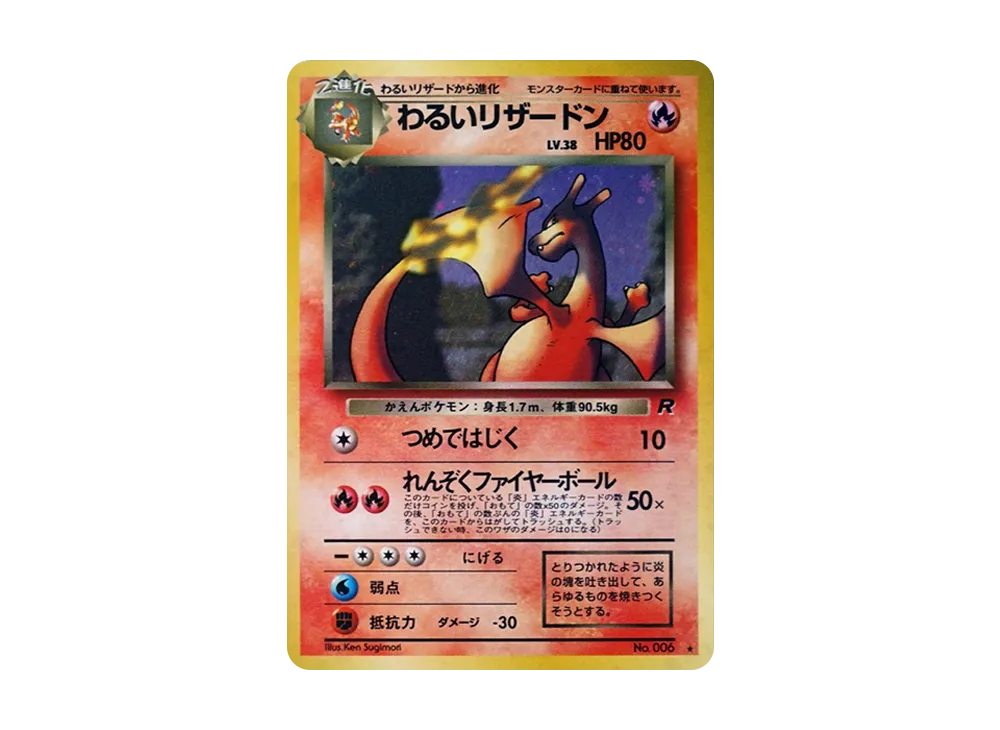
Giovanni’s Magikarp sits within the old-back design category alongside vintage singles from other Gym-series and Team Rocket-era sets. The “old back” design itself — the card-back artwork used from 1996 until the July 2001 redesign — spans multiple sets and multiple years, not just Gym Expansion Volume 2. Two examples from our own catalogue show the range of that broader category:

PSA 10 Ancient Mew Old Back slab, listed on samuraiswordtokyo.com

Ancient Mew Late Revised Old Back

PSA 10 Charizard Old Back PMCG4 No.006 slab, listed on samuraiswordtokyo.com

Charizard Old Back PMCG4 No.006

Ancient Mew is a separate promo release, and the Charizard PMCG4 No.006 print comes from a different Team Rocket-era old-back set entirely — both are useful visual reference points for what “old back” means as a design category, distinct from Gym Expansion Volume 2’s own numbering. Within Gym Expansion Volume 2 specifically, Giovanni’s Magikarp is a Common-tier single on the English side, positioned early in the set’s type-and-Pokedex-based ordering on the Japanese side.

One thing worth separating clearly: this vintage Giovanni’s Magikarp is not related to Boss’s Orders (Giovanni), the modern Supporter/Trainer card built around a completely different game mechanic and printed decades later. Same Gym Leader name, two unrelated cards from two unrelated eras — we cover that modern card separately in our Boss’s Orders (Giovanni) Supporter card guide.

Shop This Card
PSA 10 Giovanni’s Magikarp: Old Back [PMCG-G2 No.129]
Currently listed at ¥159,064 (~$1,000)
Ships from Tokyo · Tracked delivery

View Product →

Where to Buy Giovanni’s Magikarp from Tokyo

Our graded copy of PSA 10 Giovanni’s Magikarp Old Back [PMCG-G2 No.129] is currently listed at ¥159,064 (~$1,000), shipped from Tokyo with tracked delivery. From the same Gym Expansion Volume 2 set, we also list the sibling PSA 10 singles covered above: Blaine’s Charmeleon Old Back No.005 at ¥100,300 (~$631), Sabrina’s Gengar Lv.39 R Old Back No.094 at ¥1,528,100 (~$9,610), and Sabrina’s Psyduck Old Back No.054 at ¥233,640 (~$1,469), which we cover in its own dedicated guide.

For the wider PSA 10 range, browse our PSA 10 graded card collection. For sourcing requests on other Gym-series or old-back singles not listed above, our Quick Order page is the fastest way to build a mixed order.

Frequently Asked Questions

What is Giovanni’s Magikarp Old Back No.129?

It’s the Japanese old-back print of Giovanni’s Magikarp from Gym Expansion Volume 2, “Challenge from the Darkness” (Japan’s 6th TCG expansion, released 25 June 1999). We list a PSA 10 graded copy, currently listed at ¥159,064 (~$1,000).

What does the “No.129” on this card mean?

It isn’t the card’s set position. Old-back-era Japanese sets order cards by type first, then by ascending rarity, then by National Pokedex number within each group. Magikarp’s own National Pokedex number is 129, which is exactly what appears on this print.

Is there an English version of Giovanni’s Magikarp?

Yes — Gym Challenge (2000), card #73/132, Common rarity. The Japanese Gym Expansion Volume 2 print released about a year earlier, on 25 June 1999, and uses an unrelated numbering system.

Is this the same card as Boss’s Orders (Giovanni)?

No. Boss’s Orders (Giovanni) is a modern Supporter/Trainer card from a different era and mechanic. Giovanni’s Magikarp is a 1999 vintage Basic Pokemon card from the old-back Gym series — different card types entirely, despite sharing the Giovanni name.

Are there other Japanese prints of Giovanni’s Magikarp?

No additional Japanese reprint of this exact card has been documented in our research. Any claim of further Japanese prints should be treated as unverified.

Where can I buy a PSA 10 Giovanni’s Magikarp from Tokyo?

Our graded copy is currently listed at ¥159,064 (~$1,000), shipped from Tokyo with tracked delivery. Sibling Gym-leader singles from the same set are also listed, and our Quick Order page covers sourcing requests for anything not currently listed.

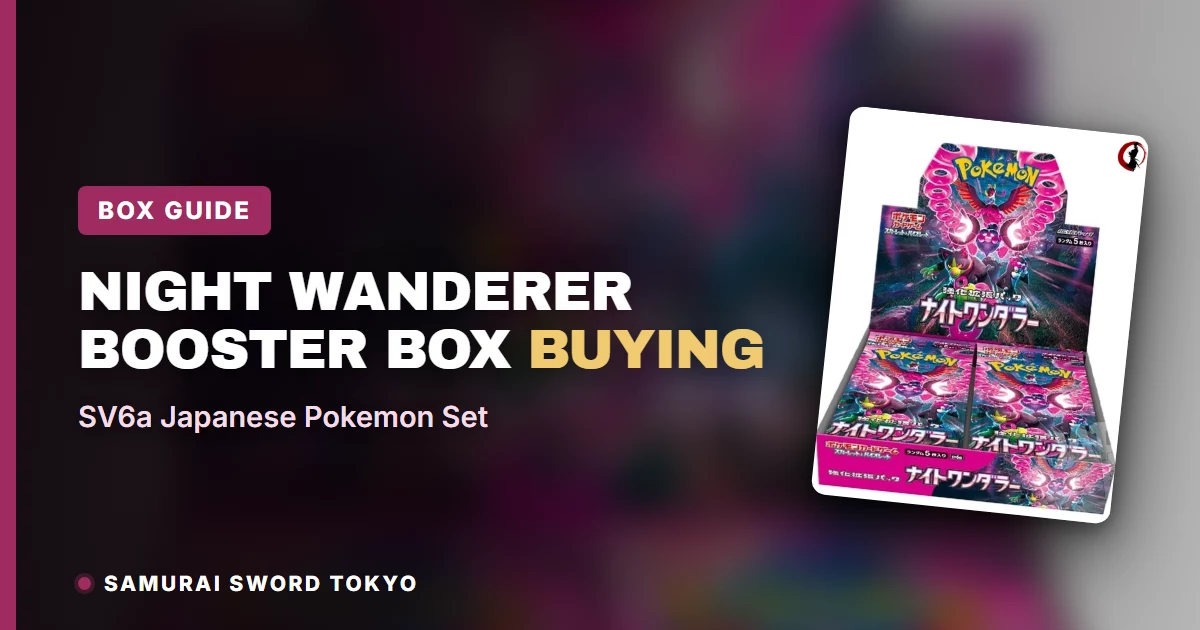
Night Wanderer Booster Box Buying Guide: SV6a Japanese Pokemon Set

Night Wanderer — ナイトワンダラー in Japanese — is set code SV6a, a Scarlet & Violet-era 強化拡張パック (Enhanced Expansion Pack) that released in Japan on 7 June 2024. It’s the direct Japanese source for Shrouded Fable, the English-language set collectors know it by — five of its ten headline chase cards sit at Special Art Rare, and one of its two Ultra Rares, Earthen Vessel, is one of the more distinctive support-card secrets from that era.

This guide covers what’s actually in a Night Wanderer box, which cards define the chase, what our site currently lists for the box and for graded singles from the set, and how Night Wanderer relates to its English counterpart. We ship Japanese sealed product and PSA-graded singles out of Tokyo, so every price below is our own current listing, not a third-party market figure.

Key Takeaway

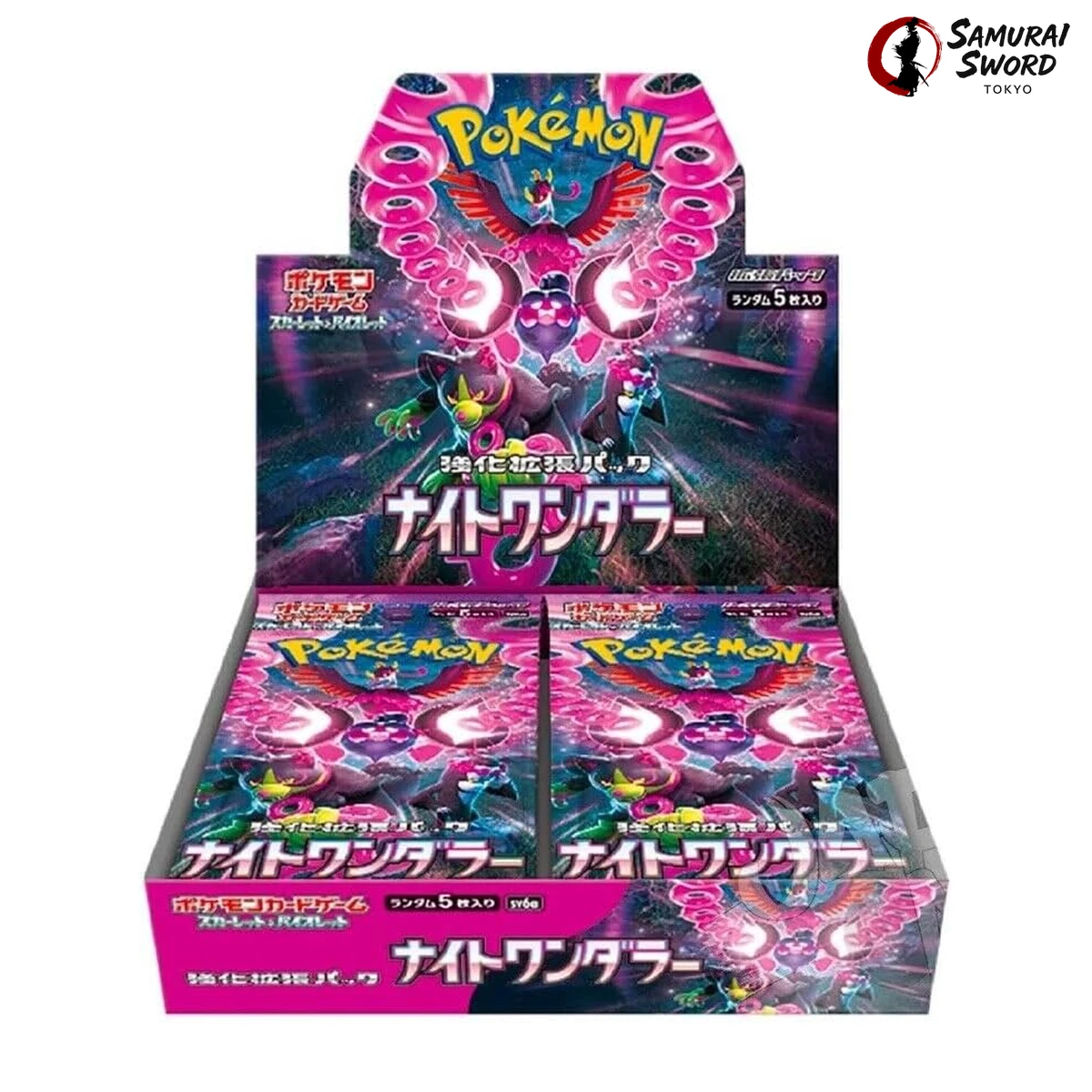
The SV6A-Night Wanderer Japanese Pokemon Booster Box is currently listed at ¥10,192 (~$64). The set runs 94 total cards (64 main-set + 30 secret/parallel-numbered) across 30 packs of 5 cards each, and its chase tier includes five Special Art Rares — Cassiopeia, Fezandipiti ex, Okidogi ex, Munkidori ex and Pecharunt ex — plus an Ultra Rare Pecharunt ex and an Ultra Rare Earthen Vessel. We don’t currently have a separate Damaged Box or No Shrink listing for this release; if a graded single is more your speed, the PSA 10 Cassiopeia SAR 091/064 is currently listed at ¥9,204 (~$58).

94
Total Cards

30
Packs per Box

5
Cards per Pack

Jun 2024
Japan Release

Prices below are our current listed prices as of September 2026, converted at ¥159/USD.

What’s Inside a Night Wanderer Booster Box

SV6A-Night Wanderer Japanese Pokemon booster box, listed on samuraiswordtokyo.com
SV6A-Night Wanderer Japanese Pokemon Booster Box
Item Value
Japanese name ナイトワンダラー (Night Wanderer)
Set code SV6a
Pack type 強化拡張パック (Enhanced Expansion Pack)
Japan release date 7 June 2024
Total cards 94 (64 main-set + 30 secret/parallel-numbered)
Packs per box 30
Cards per pack 5

The 30-packs-per-box, 5-cards-per-pack structure above is cross-checked against retailer listings for this set rather than pulled from a live official pokemon-card.com page — the set’s official page returned a 404 for us this session, likely archived off the current site navigation. Treat the pack and box counts as retailer-corroborated rather than official-page-confirmed, though they line up with what our own existing Night Wanderer pull-rates coverage uses.

Of the 94 total cards, 64 make up the main numbered set and the remaining 30 are secret and parallel-numbered cards running past #064. Within that secret tier, five cards carry Special Art Rare status — a figure sourced from our own already-published Night Wanderer pull rates and best cards guide rather than independently re-verified against an official set page today. We’re not stating a pull rate for any individual card — the pull-rates guide linked above is the place for that level of detail; this guide is about what’s in the box and what to buy.

Night Wanderer’s English-language counterpart is Shrouded Fable (SFA), which carries the same headline chase cards under the English checklist — more on that pairing further down this page.

Chase Cards in Night Wanderer

Ten cards make up the set’s chase tier. Five are Special Art Rares, two are Ultra Rares, and the rest span Art Rare and Secret Rare:

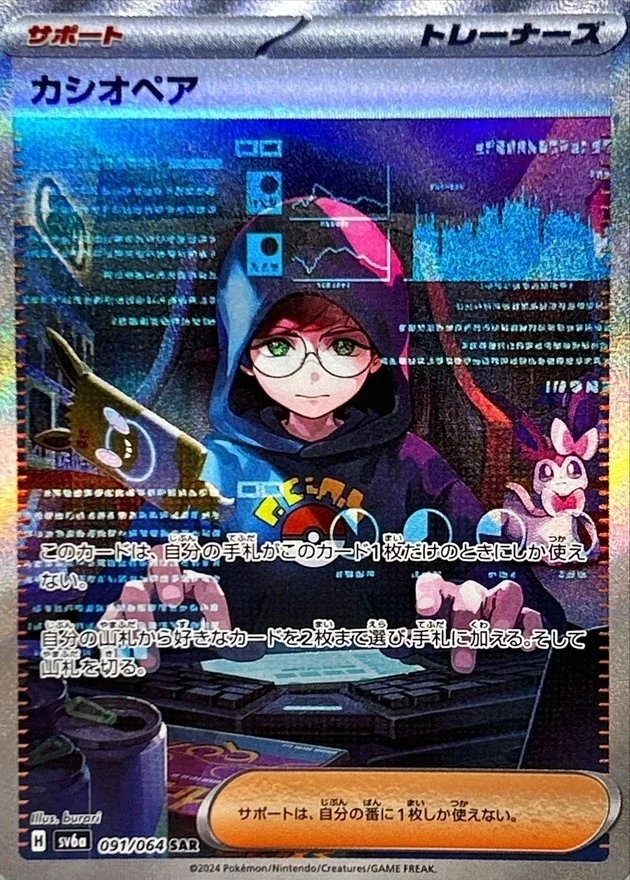
Cassiopeia 091/064 SAR, Night Wanderer

Cassiopeia SAR 091/064

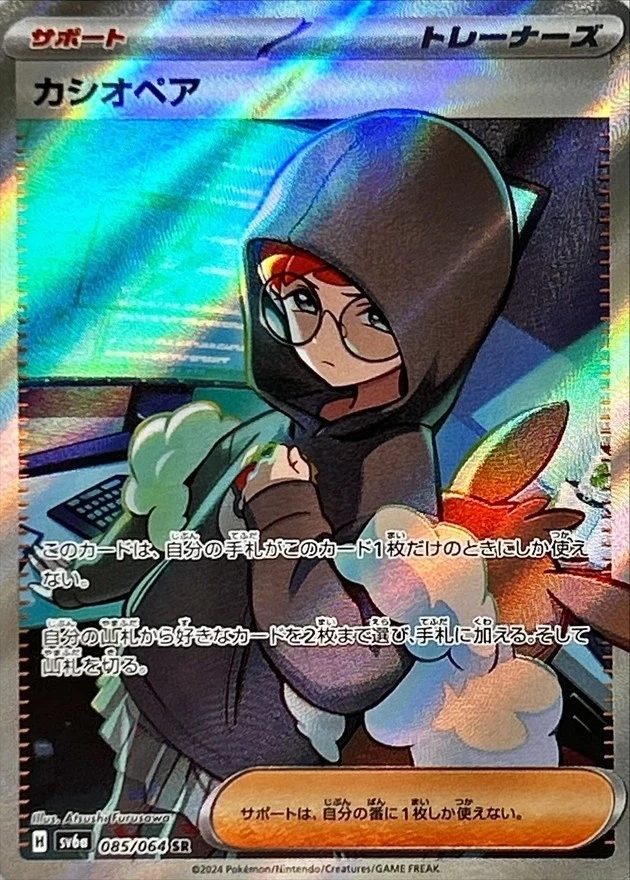
Cassiopeia 085/064 SR, Night Wanderer

Cassiopeia SR 085/064

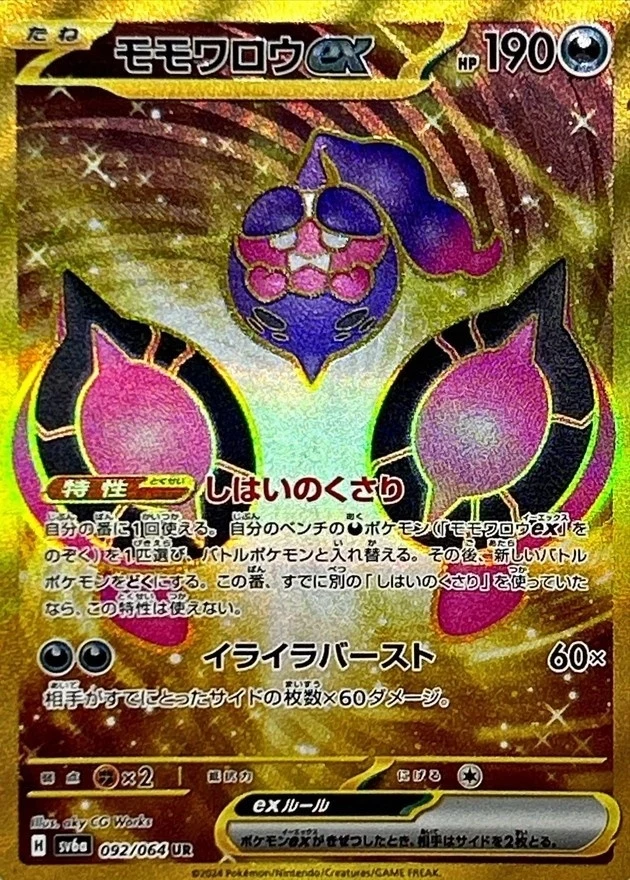
Pecharunt ex 092/064 UR, Night Wanderer

Pecharunt ex UR 092/064

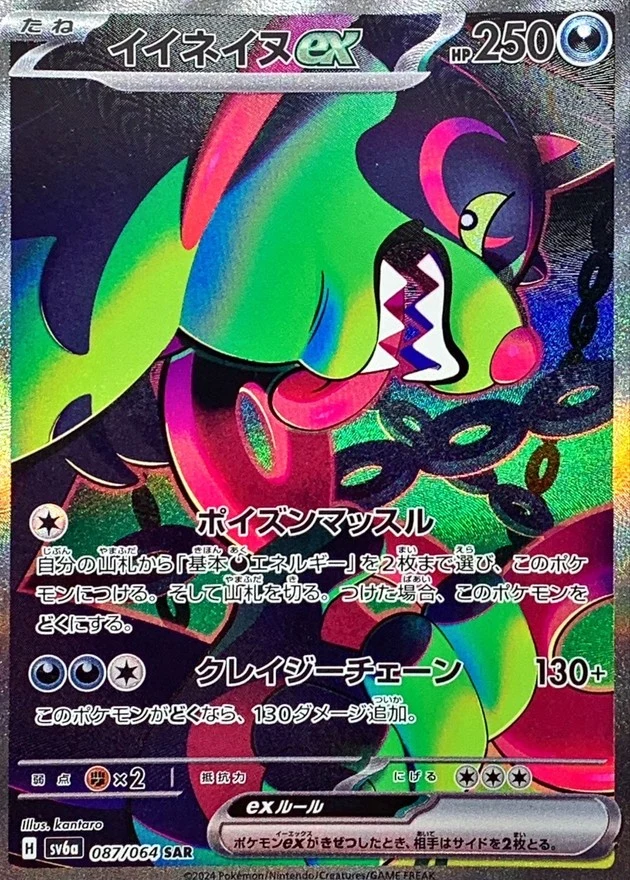
Okidogi ex 087/064 SAR, Night Wanderer

Okidogi ex SAR 087/064

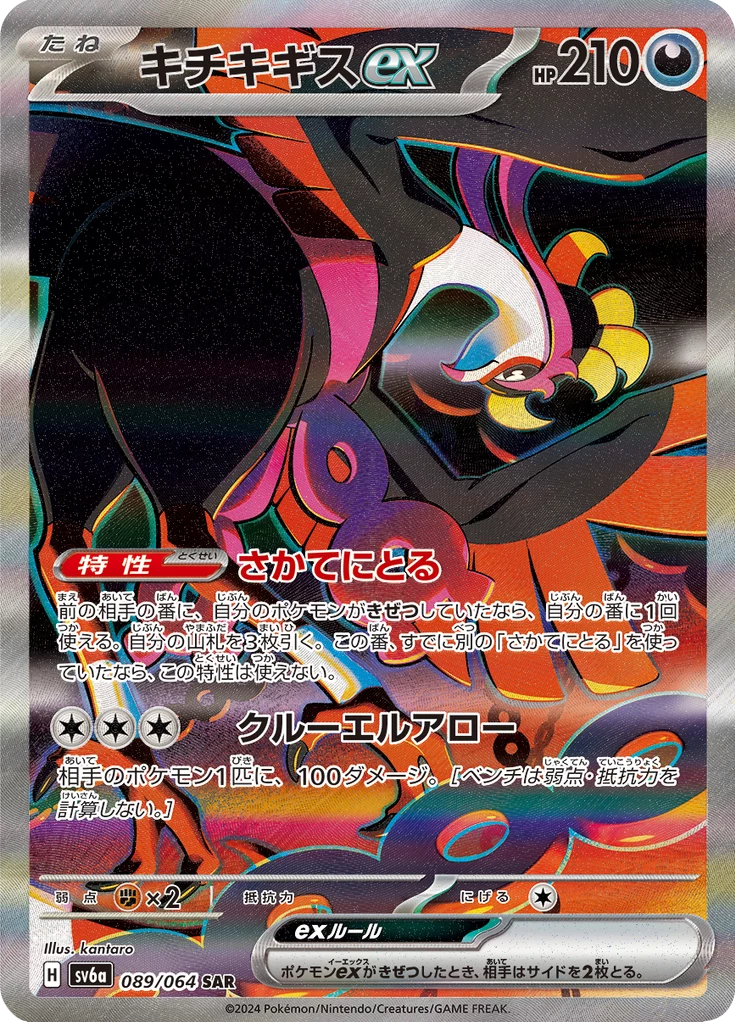
Fezandipiti ex 089/064 SAR, Night Wanderer

Fezandipiti ex SAR 089/064

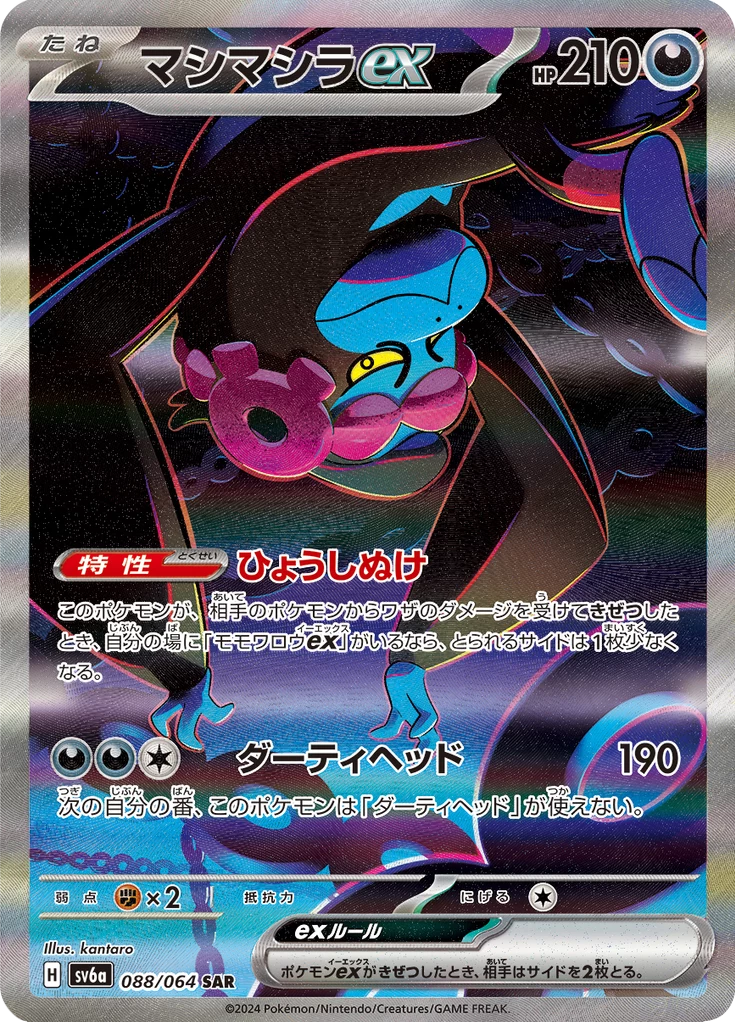
Munkidori ex 088/064 SAR, Night Wanderer

Munkidori ex SAR 088/064

The PSA 10 Cassiopeia SAR 091/064 is currently listed at ¥9,204 (~$58) — the set’s top Special Art Rare. We also currently list the lower-tier PSA 10 Cassiopeia SR 085/064 at ¥6,028 (~$38), for buyers who want the character without the SAR premium. The PSA 10 Pecharunt ex UR 092/064 is currently listed at ¥11,564 (~$73), and the PSA 10 Okidogi ex SAR 087/064 is currently listed at ¥9,440 (~$59).

Fezandipiti ex SAR (089/064) and Munkidori ex SAR (088/064) round out the Special Art Rare tier alongside Cassiopeia and Okidogi ex. Neither print is currently listed on our site — sourcing requests for either go through Quick Order, with no timeline to share on availability.

Five more cards round out the chase tier without a card-grid image here:

Card Number Rarity
Pecharunt ex 090/064 SAR
Earthen Vessel 093/064 UR
Duskull 068/064 AR
Persian 075/064 AR
Janine’s Secret Technique 084/064 SR

Two of the five cards in that table are currently listed as graded singles on our site: the PSA 10 Janine’s Secret Technique SR 084/064 is currently listed at ¥8,260 (~$52), and our PSA 10 Persian AR 075/064 is currently listed. The other three — Pecharunt ex SAR 090/064, the Ultra Rare Earthen Vessel, and Duskull AR 068/064 — are not currently listed; sourcing requests for those go through Quick Order. For the full 94-card breakdown, see our Night Wanderer (SV6a) complete card list, and for a deeper look at how these secrets stack up against each other, our pull rates and best cards guide is the dedicated resource — this page focuses on the box-buying decision, not the card-by-card pull breakdown.

Regular Box, Damaged Box and No Shrink: What’s Listed

SV6a Night Wanderer is currently listed on our site as a single standard sealed booster box — the SV6A-Night Wanderer Japanese Pokemon Booster Box at ¥10,192 (~$64). We don’t have a separate Damaged Box or No Shrink listing for this particular release at the moment.

If you’re specifically after either condition category for Night Wanderer, a request through Quick Order is the way to flag it — we can’t promise a timeline for whether one gets added, and this guide isn’t the place to speculate on that. What we can confirm is the one listing that exists today and its current price.

Japanese vs English Version: Night Wanderer and Shrouded Fable

Night Wanderer’s English-language counterpart is Shrouded Fable (SFA). The two sets share the same headline chase cards under different set codes and languages — it’s the connection our own existing Night Wanderer pull rates and best cards guide draws directly, and it’s the premise of our dedicated Shrouded Fable Japanese card list, which maps the English checklist back to its Japanese SV6a printings card by card.

If you’re trying to match a specific Japanese Night Wanderer pull to its English Shrouded Fable equivalent, that card-list article is the more useful reference — it’s built for that exact mapping. This guide stays focused on the sealed-box decision: what’s in the box, what our site currently has listed, and where to buy it.

Night Wanderer also has a same-era sibling worth knowing about if you’re comparing SV6-family boxes: SV6 Mask of Change released alongside it. Our SV6 vs SV6a box guide puts the two side by side for buyers deciding between them.

Shop This Set
SV6A-Night Wanderer Japanese Pokemon Booster Box
Currently listed at ¥10,192 (~$64)
Ships from Tokyo · Tracked delivery

View Product →

Where to Buy a Night Wanderer Booster Box from Tokyo

We ship Japanese sealed product and PSA-graded singles worldwide out of Tokyo with tracked delivery. The SV6A-Night Wanderer Japanese Pokemon Booster Box currently listed at ¥10,192 (~$64), is the direct route into the set’s full 94-card pool, including a shot at all five Special Art Rares and both Ultra Rares.

If you’d rather go straight for a specific card, several graded singles from this set are currently listed: PSA 10 Cassiopeia SAR 091/064 at ¥9,204 (~$58), PSA 10 Cassiopeia SR 085/064 at ¥6,028 (~$38), PSA 10 Pecharunt ex UR 092/064 at ¥11,564 (~$73), PSA 10 Okidogi ex SAR 087/064 at ¥9,440 (~$59), PSA 10 Janine’s Secret Technique SR 084/064 at ¥8,260 (~$52), and our PSA 10 Persian AR 075/064 listing. Browse the wider Japanese Pokemon booster box collection for other current sealed product, or send a sourcing request for Fezandipiti ex, Munkidori ex, Earthen Vessel, or any single not listed above through Quick Order.

For more on this set, see our Night Wanderer (SV6a) complete card list, the deeper pull rates and best cards guide, the Shrouded Fable Japanese card list for the English-side mapping, and our SV6 vs SV6a box guide if you’re deciding between the two same-era releases.

Frequently Asked Questions

What is Night Wanderer (SV6a)?

Night Wanderer is the Japanese name for set code SV6a, a Scarlet & Violet-era Enhanced Expansion Pack released in Japan on 7 June 2024. It’s the direct Japanese source for the English-language set Shrouded Fable.

What’s inside a Night Wanderer booster box?

Each box runs 30 packs of 5 cards, drawn from a 94-card set: 64 main-set cards plus a 30-card secret and parallel-numbered tier. The pack and box counts are retailer-corroborated rather than confirmed against a live official set page, which returned a 404 for us this session.

What are the chase cards in Night Wanderer?

Ten cards make up the chase tier: five Special Art Rares (Cassiopeia, Fezandipiti ex, Okidogi ex, Munkidori ex, Pecharunt ex 090/064), two Ultra Rares (Pecharunt ex 092/064, Earthen Vessel), two Art Rares (Duskull, Persian), and one Secret Rare (Janine’s Secret Technique).

Is there a Damaged Box or No Shrink listing for Night Wanderer?

Not currently. We list this release as a single standard sealed booster box at ¥10,192 (~$64). If you’re specifically looking for a Damaged Box or No Shrink version, a request through Quick Order is the way to flag it, though we can’t promise a timeline.

What is the English equivalent of Night Wanderer?

Shrouded Fable (SFA). The two sets share the same headline chase cards under different set codes and languages — our Shrouded Fable Japanese card list maps the English checklist back to its SV6a printings card by card.

Where can I buy a Night Wanderer booster box?

The SV6A-Night Wanderer Japanese Pokemon Booster Box is currently listed at ¥10,192 (~$64) on our site, shipping from Tokyo with tracked delivery. Graded PSA 10 singles from the set are also currently listed, and sourcing requests for anything else go through Quick Order.

Poliwrath Pokemon Card Guide: Every Japanese Print Worth Knowing

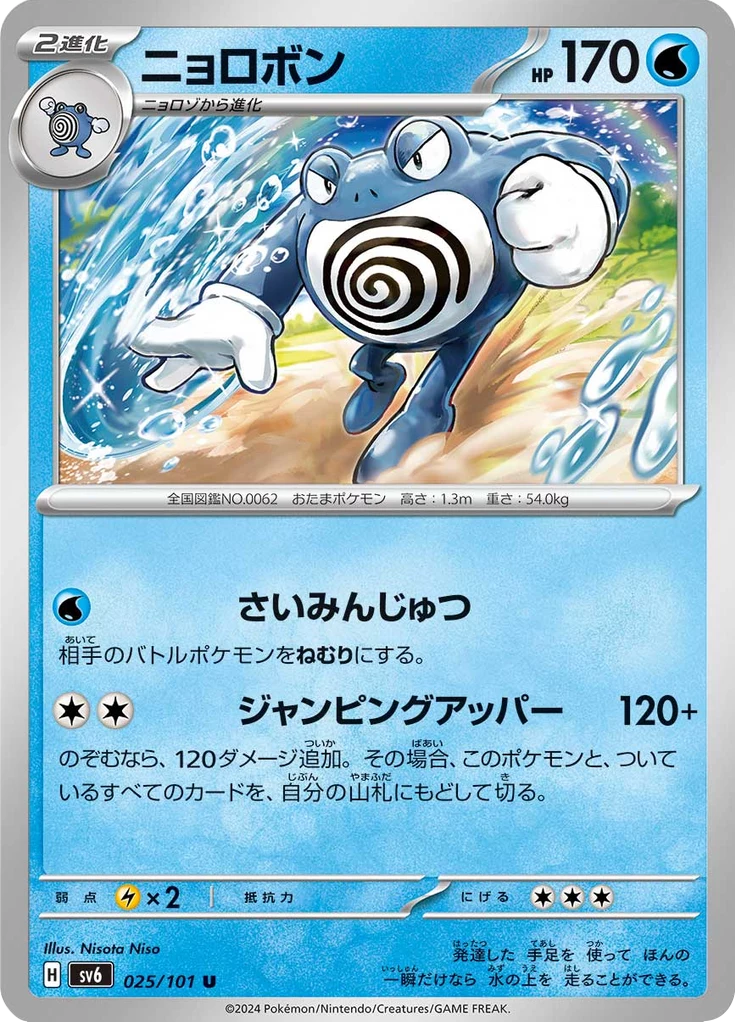
A Limitless search for ニョロボン (Nyorobon) — Poliwrath’s Japanese name — returns seven Japanese prints across seven different sets: SV6, SV2a, S10D, SM10, SM1M, CP6, and XY3, every one of them sorted under a blanket “R” on the search index. That count doesn’t include one further Poliwrath print we list: a PSA 10 slab from 2001’s e-Card era that predates Limitless’s own database and doesn’t turn up in that search at all.

Poliwrath is the Stage 2 final evolution of the Poliwag line — ニョロゾ (Poliwhirl, Nyorozo) into ニョロボン — Water/Fighting-typed in the games, though only one of its Japanese TCG prints has been individually verified card-by-card in this guide. This guide covers what we’ve confirmed for each Poliwrath print and which ones are currently listed on our site, either as graded singles or inside a sealed box.

Key Takeaways

Poliwrath’s oldest verified Japanese print — a PSA 10 e1 109/128 from December 2001’s “Base Expansion Pack” — is currently listed at ¥186,440 (~$1,173), and the modern Master Ball Mirror parallel of its SV2a 62/165 base print is currently listed at ¥16,401 (~$103). The SV2a booster box that pulls the modern parallel is currently listed at ¥43,860 (~$276). Exchange rate used throughout: ¥159/USD (September 2026).

7
Prints Indexed by Limitless

1
Individually Verified Print

Sep 2026
Prices Checked

Sep 2026
Prices Checked

Every Verified Japanese Poliwrath Card

Searching Limitless’s Japanese card database for Poliwrath by species returns seven prints, every one of them listed as “R” on the search index:

Set No. Index rarity Individually confirmed?
SV2a 62 R Yes — Uncommon on the card page itself, HP 160, Water, illustrator Kurata So
SV6 25 R No — set/number confirmed only
S10D 31 R No — set/number confirmed only
SM10 23 R No — set/number confirmed only
SM1M 11 R No — set/number confirmed only
CP6 25 R No — set/number confirmed only
XY3 17 R No — set/number confirmed only

Note the mismatch on the SV2a row: the search index sorts every result into one blanket “R” category, but the individual SV2a 62 card page identifies the base print as Uncommon rather than Rare. We haven’t opened the other six card pages individually, so illustrator and HP details aren’t cited for those six prints here.

Poliwrath, SV6 25, confirmed via Limitless search index, not individually verified

Poliwrath, SV6 25 — confirmed to exist, not individually verified

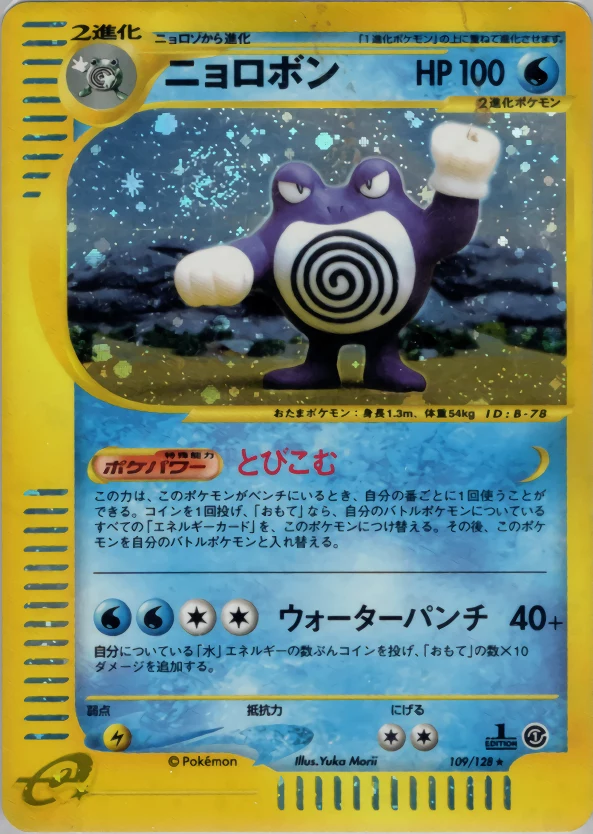
Beyond these seven, an eighth Poliwrath print is currently listed on our site that doesn’t turn up in that search at all: a 2001 e-series print from the “Base Expansion Pack.” Limitless’s database returns nothing for that set code (e1) when queried directly, and its coverage of the e-Card era generally appears incomplete — so the totals in this guide describe the prints we’ve verified rather than a final count.

The Vintage Original: e1 Base Expansion Pack (2001)

PSA 10 Poliwrath e1 Base Expansion Pack 109/128 slab, listed on samuraiswordtokyo.com
PSA 10 Poliwrath, e1 109/128, “1ED,” Pokemon Card e Vol.1 “Base Expansion Pack”

Our oldest verified Poliwrath print is catalogued on our own listing as “e1 109/128, ‘1ED,’ Pokemon Card e Vol.1 ‘Base Expansion Pack.'” It doesn’t appear on Limitless at all — the set page for code “e1” returns a 404 — but the underlying Japanese release is documented on Bulbapedia: the “基本拡張パック” (Base Expansion Pack) came out in Japan on December 1, 2001, and carried 128 cards. That figure lines up exactly with our anchor’s “/128” denominator, which is what supports treating “e1” as this set.

The English equivalent is Expedition Base Set, released September 15, 2002, with 165 cards. Poliwrath appears there twice: as #24/165 Rare Holo and #60/165 Rare (non-holo).

What We Haven’t Verified

Our own listing gives this print’s Japanese card number as 109 and marks it “1ED” for 1st Edition. We haven’t found an independent, card-level source confirming either detail — the set identification above rests on the “/128” denominator matching Bulbapedia’s card count, not on a direct check of card number 109 itself. Treat “109” and the 1st Edition designation as sourced from our own listing title rather than independently verified.

This print predates the other Poliwrath prints in this guide by more than a decade — the next-oldest verified print, the SV2a Master Ball Mirror below, comes from the current Scarlet & Violet era. It’s currently listed at ¥186,440 (~$1,173).

Pokemon Card 151: The SV2a Master Ball Mirror

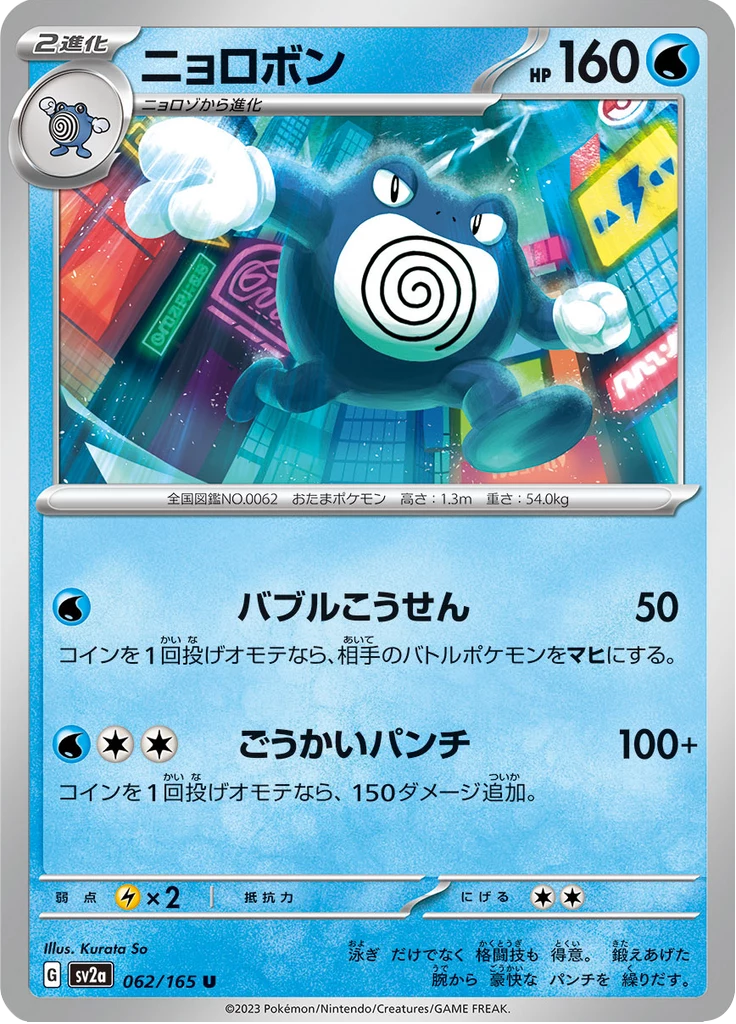
Poliwrath, SV2a 62/165, Uncommon, Pokemon Card 151

Poliwrath U (base print), SV2a 62/165

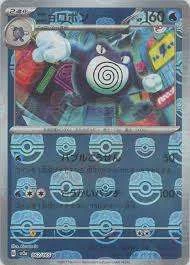
PSA 10 Poliwrath Master Ball Mirror SV2a 062/165 slab, listed on samuraiswordtokyo.com

Our PSA 10 slab of the SV2a 062/165 Master Ball Mirror

The base print at 62/165 is an Uncommon, illustrated by Kurata So, listing 160 HP and Water type on its own card page — the only Poliwrath print in this guide with those details individually confirmed. Limitless’s card page for this number doesn’t show a separately numbered Master Ball Mirror listing; the Master Ball Mirror our own PSA 10 anchor carries is a foil parallel of the same 62/165 print rather than a distinct card number. Our Master Ball Mirror Pokemon cards guide covers how that parallel tier works across the rest of SV2a.

This print comes from Pokemon Card 151 (SV2a), the set our full SV2a card list covers checklist-wide — that hub is the place to go for the rest of the set; this guide stays focused on Poliwrath’s single print inside it. The Master Ball Mirror is currently listed at ¥16,401 (~$103).

Chase Prints and What Makes Them Collectible

The individually verified SV2a print doesn’t carry a secret-rare or full-art treatment. The SV2a base print is an Uncommon, and the six other Limitless-indexed prints all sort under the same blanket “R” category with no illustrator or rarity detail confirmed beyond that. What makes the two prints we currently list collectible comes down to two different factors:

  • The e1 print’s age and format. It comes from the December 2001 e-Card era, a production window that predates the other verified Poliwrath prints in this guide by more than a decade, and it doesn’t appear in Limitless’s database at all.
  • The SV2a print’s foil parallel. The Master Ball Mirror treatment is a foil parallel finish, which is what separates the base 62/165 Uncommon from the mirror-foil version of the same number.

PSA 10 grading is what elevates both of our listed slabs above an ungraded copy of the same print — a gem-mint certification layered on top of whichever set and rarity each card originally carried.

Which Japanese Box to Open for Poliwrath

Only the modern SV2a Master Ball Mirror comes packed inside a currently listed Japanese booster box. The 2001 e1 print was a booster-pack pull from an era before Limitless’s own catalogue begins, and we don’t have a currently listed sealed product tied to that release.

Shop This Set
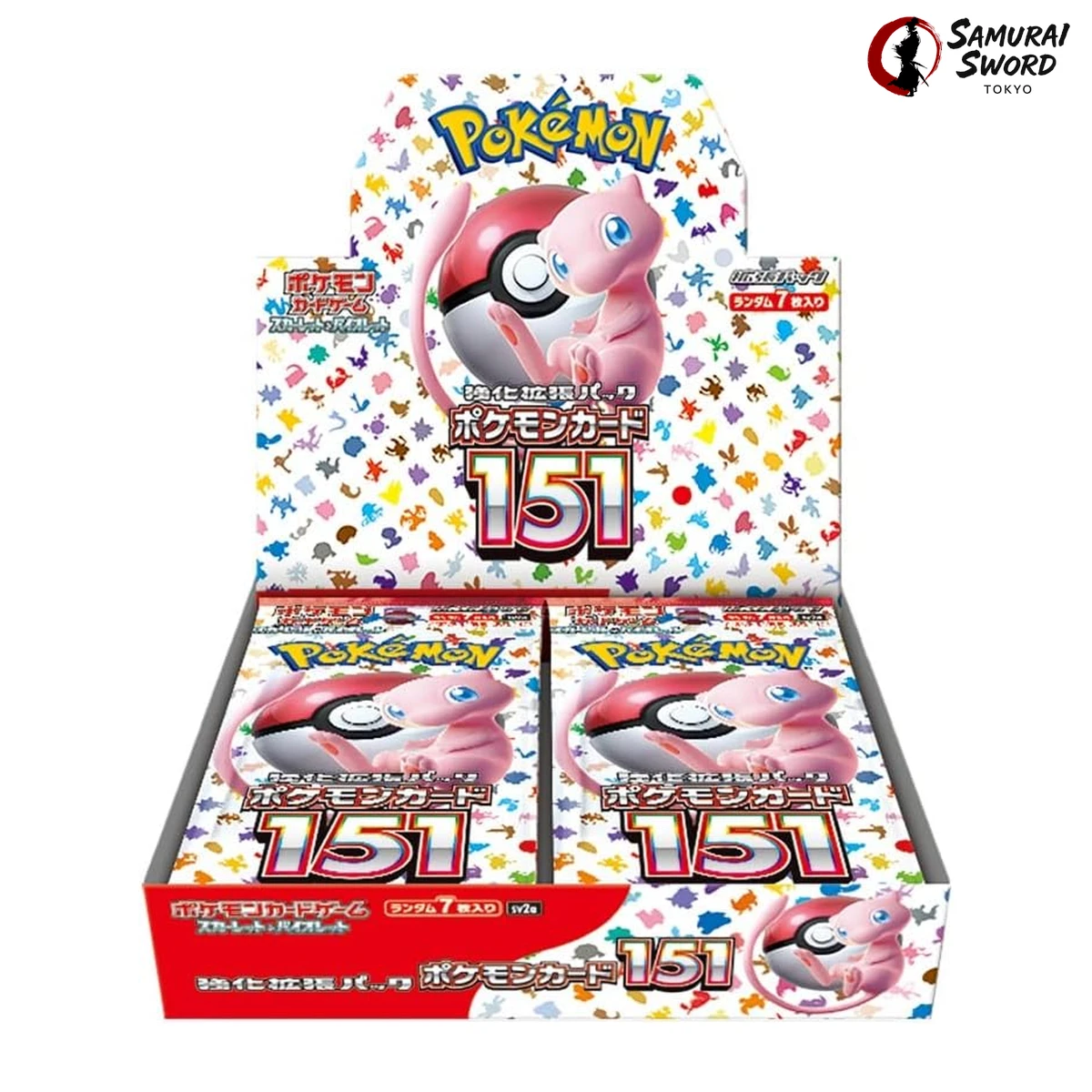
SV2A-Pokemon 151 Japanese Pokemon Booster Box
Currently listed at ¥43,860 (~$276)
Ships from Tokyo · Tracked delivery

View Product →

SV2A Pokemon 151 Japanese Booster Box, listed on samuraiswordtokyo.com
SV2A-Pokemon 151 Japanese Booster Box, currently listed at ¥43,860 (~$276)

For the rest of the set’s checklist and pull context, see our Pokemon 151 (SV2a) card list and our SV2a pull-rate and best-cards hub.

Where to Buy Poliwrath Cards from Tokyo

We ship Japanese cards and sealed product worldwide out of Tokyo with tracked delivery. Both verified Poliwrath prints and the box they connect to are currently listed:

Browse the wider PSA 10 graded card collection or the Japanese Pokemon booster box collection for related listings. For any of the six index-confirmed prints not covered in detail above, request a quote via Quick Order — no timing guarantees, but sourcing requests for specific cards go through that page.

Poliwrath’s Base Expansion Pack era runs roughly alongside some of the earliest Team Rocket-era Japanese reprints, though the two sets aren’t a direct match — our Team Rocket Pokemon card family guide covers that surrounding period for readers curious about the era. For the modern SV2a side of this guide, our Pokemon 151 booster box buying guide covers the sealed-product side of chasing a Master Ball Mirror pull.

Frequently Asked Questions

How many Japanese Poliwrath card prints are there?

Seven are indexed on Limitless’s Japanese card search — SV6 25, SV2a 62, S10D 31, SM10 23, SM1M 11, CP6 25, and XY3 17 — and an eighth print is currently listed on our site that doesn’t appear there at all, a 2001 e-series print from the “Base Expansion Pack.” Only the SV2a print has been individually verified card-by-card in this guide.

What is the oldest Japanese Poliwrath card?

A PSA 10 print catalogued as e1 109/128, “1ED,” from the “Base Expansion Pack” — Japan’s equivalent to the December 1, 2001 release Bulbapedia documents as the 128-card Base Expansion Pack. The English version of this set is Expedition Base Set, where Poliwrath appears as #24/165 Rare Holo and #60/165 Rare.

What is the SV2a Master Ball Mirror Poliwrath?

A foil parallel of the base Uncommon SV2a 62/165 print from Pokemon Card 151, rather than a separately numbered card. Our PSA 10 graded copy of it is currently listed at ¥16,401 (~$103).

Is the e1 Poliwrath available in English?

Yes — as Expedition Base Set #24/165 (Rare Holo) and #60/165 (Rare), released September 15, 2002. The specific Japanese card number, 109, and its 1st Edition status haven’t been independently verified beyond our own listing title.

Where can I buy Japanese Poliwrath cards?

We ship from Tokyo with tracked delivery. Two PSA 10 graded Poliwrath prints and the SV2a booster box that pulls the modern print are currently listed, and sourcing requests for any of the other six indexed prints go through our Quick Order page.

Silver Tempest Chase Cards: Incandescent Arcana & Paradigm Trigger (S11a/S12) Japanese Prints

Pokémon TCG Sword & Shield—Silver Tempest closed out the Sword & Shield era in English on 11 November 2022, but its headline chase cards did not start there. They come from two separate Japanese sets: S11a Incandescent Arcana, released 2 September 2022, and S12 Paradigm Trigger, released 21 October 2022. In Japan, the same gold-foil cards English collectors call Hyper Rare are catalogued under a plainer name: Ultra Rare.

This guide maps the Silver Tempest chase cards back to its Japanese set, number and rarity — using S11a and S12 as the two source sets. It does not use S12a VSTAR Universe, which is a different Japanese set that feeds the English Crown Zenith release instead. For the full two-set catalogue and pricing, see our Silver Tempest Japanese card list.

Key Takeaways

Silver Tempest’s chase cards are sourced from two Japanese sets — S11a Incandescent Arcana and S12 Paradigm Trigger — not S12a VSTAR Universe (that set feeds Crown Zenith instead). The S12 Paradigm Trigger Japanese Pokemon Booster Box is currently listed at ¥21,266 (~$134), and every card mapped below is documented in full in our Silver Tempest Japanese card list.

215
EN Cards (195+20 SR)

94+125
JP Catalogued (S11a+S12)

Sep–Oct 2022
JP Release (S11a/S12)

11 Nov 2022
EN Release

Prices below are our own Tokyo listings, converted at ¥159/USD (September 2026). We do not quote third-party market prices.

Which Japanese Sets Silver Tempest Was Built From

Silver Tempest is a two-set compilation. Pokémon drew its 215-card English checklist — 195 main-set cards plus 20 secret rares — from two Japanese Enhanced/Expansion packs released roughly six to ten weeks earlier.

EN set JP set code JP name JP release
Silver Tempest S11a Incandescent Arcana 2 September 2022
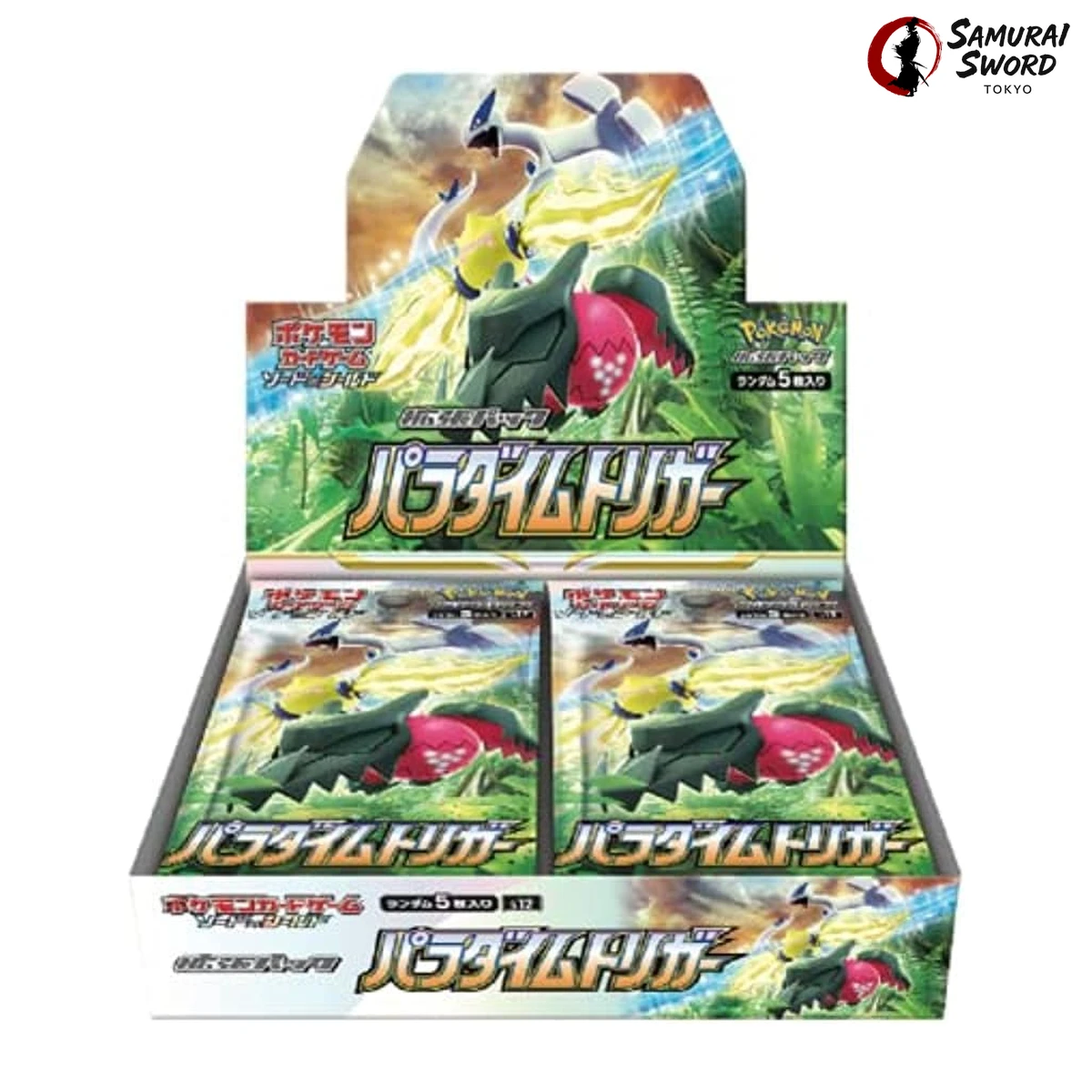
Silver Tempest S12 Paradigm Trigger 21 October 2022
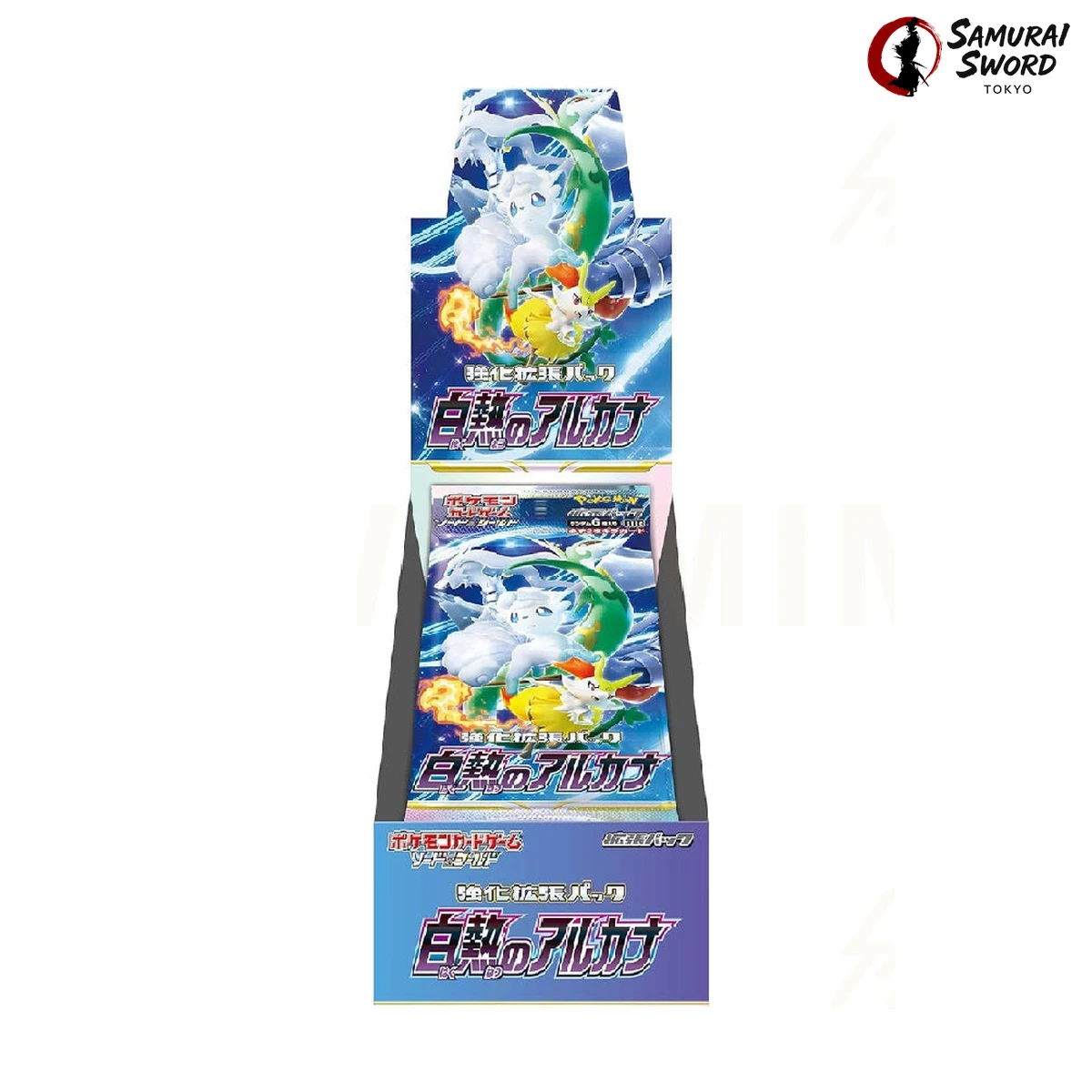
S11a Incandescent Arcana Japanese Pokemon Booster Box

Incandescent Arcana (S11a) is an Enhanced Expansion Pack and catalogues 94 entries: 3 Ultra Rare, 9 Secret Rare, 3 Triple Rare, 6 Double Rare, 10 Rare, 21 Uncommon, 25 Common, 3 Radiant Rare, 6 Character Holo Rare, 2 Character Super Rare and 6 Holo Rare. Paradigm Trigger (S12) is a full Expansion Pack and catalogues 125 entries: 3 Ultra Rare, 16 Secret Rare, 4 Triple Rare, 8 Double Rare, 10 Rare, 32 Uncommon and 44 Common, plus 8 Holo Rare. Between them, that’s a combined 219 catalogued Japanese entries feeding Silver Tempest’s 215-card English checklist.

Looking for a Different Set?

If you’re after VSTAR Universe or Crown Zenith cards, S11a and S12 are not your sets — those two belong to Silver Tempest. VSTAR Universe is Japanese set S12a, which is the source for the English Crown Zenith release instead. See our Crown Zenith Japanese card list, our No Shrink vs regular S12a box guide, and our Hisuian Zoroark VSTAR guide if that’s the set you’re chasing.

Silver Tempest Chase Cards and Their Japanese Prints

Ten cards make up the chase-card core of this two-set release: six gold-foil Ultra Rares (three per set) that anchor the top of each Japanese checklist, plus four Secret Rares that mark the start and end of each set’s secret run. Here is each one, mapped to its Japanese set, number and rarity.

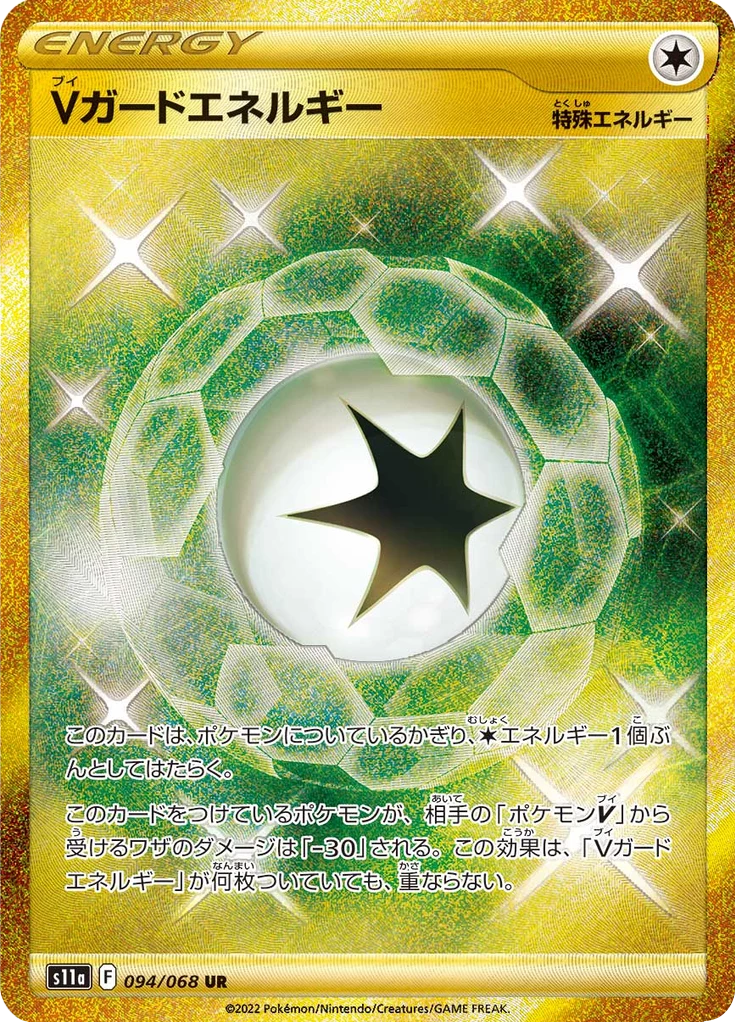
1. V-Guard Energy — S11a 94, Ultra Rare

V-Guard Energy, S11a 094, Ultra Rare, Incandescent Arcana
V-Guard Energy, S11a 94, Ultra Rare (gold), Incandescent Arcana

V-Guard Energy sits at the very top of the Incandescent Arcana checklist, S11a 94, catalogued as Ultra Rare (gold). In Silver Tempest’s English rarity language, this gold-foil energy card is a Hyper Rare.

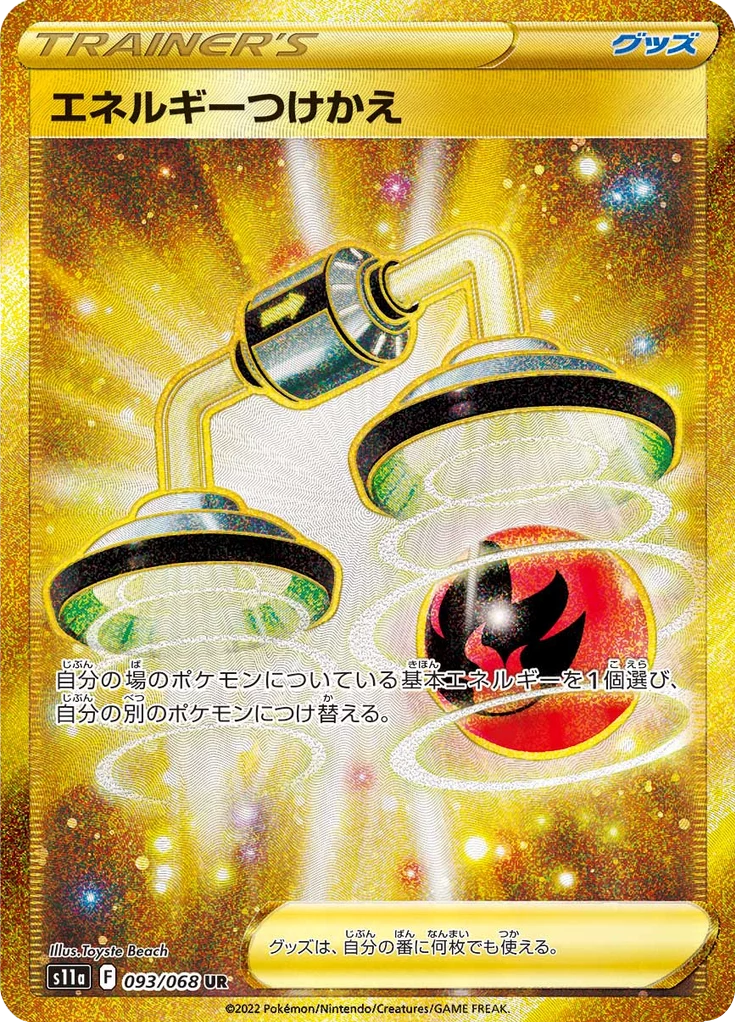
2. Energy Switch — S11a 93, Ultra Rare

Energy Switch, S11a 093, Ultra Rare, Incandescent Arcana
Energy Switch, S11a 93, Ultra Rare (gold), Incandescent Arcana

Energy Switch, S11a 93, is the second of Incandescent Arcana’s three Ultra Rares — another gold-foil trainer card that reads as a Hyper Rare on the English side.

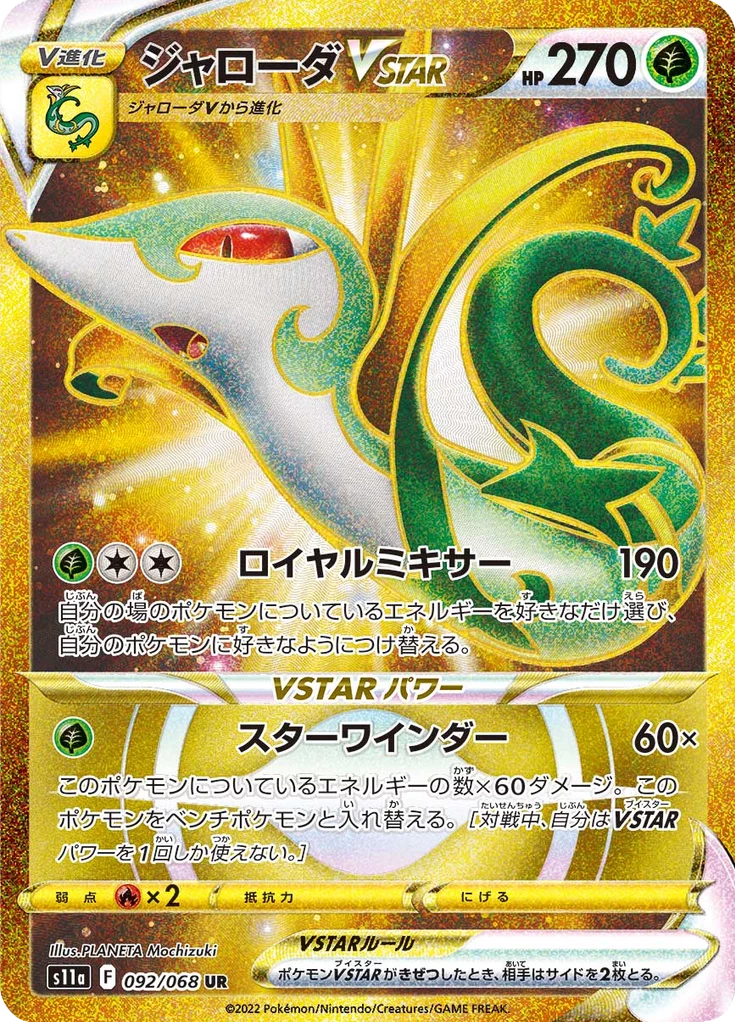
3. Serperior VSTAR — S11a 92, Ultra Rare

Serperior VSTAR, S11a 092, Ultra Rare, Incandescent Arcana
Serperior VSTAR, S11a 92, Ultra Rare (gold), Incandescent Arcana

Serperior VSTAR, S11a 92, closes out Incandescent Arcana’s Ultra Rare run and is the set’s flagship VSTAR chase card. We currently list a PSA 10 of this card at ¥9,204 (~$58).

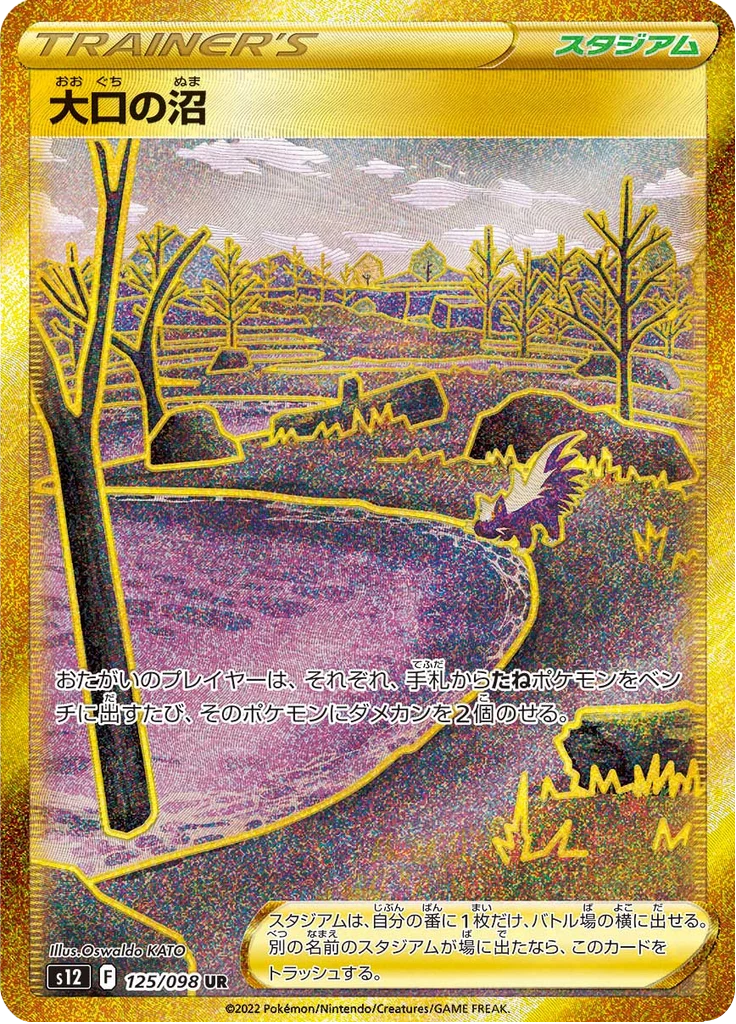
4. Gapejaw Bog — S12 125, Ultra Rare

Gapejaw Bog, S12 125, Ultra Rare, Paradigm Trigger
Gapejaw Bog, S12 125, Ultra Rare (gold), Paradigm Trigger

Gapejaw Bog, S12 125, is the final catalogued entry in Paradigm Trigger and one of the set’s three Ultra Rares — a gold-foil stadium card that carries Hyper Rare status in the English checklist.

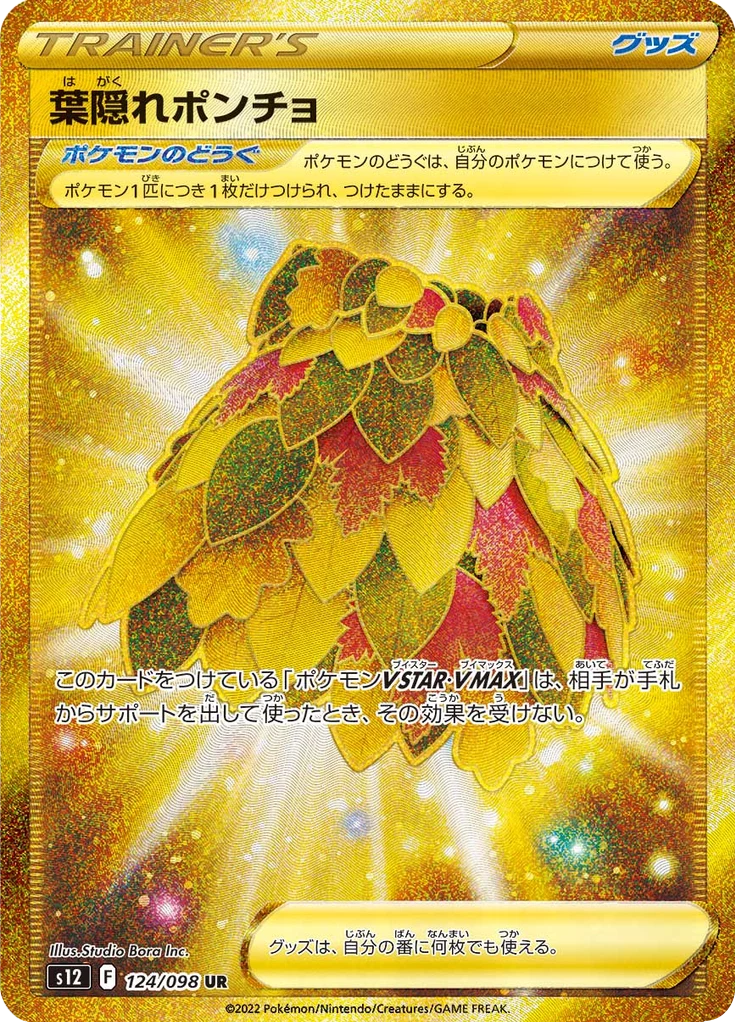
5. Lurking Poncho — S12 124, Ultra Rare

Lurking Poncho, S12 124, Ultra Rare, Paradigm Trigger
Lurking Poncho, S12 124, Ultra Rare (gold), Paradigm Trigger

Lurking Poncho, S12 124, is the middle Ultra Rare in Paradigm Trigger’s gold-foil run — another item card promoted to Hyper Rare status in Silver Tempest.

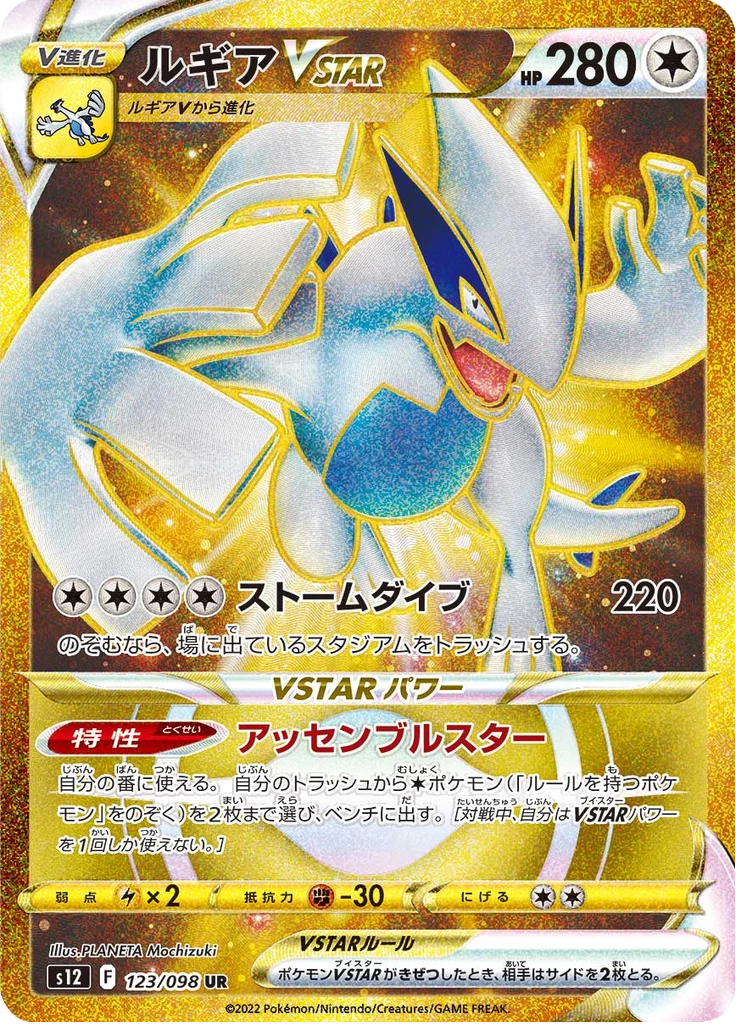
6. Lugia VSTAR — S12 123, Ultra Rare

Lugia VSTAR, S12 123, Ultra Rare, Paradigm Trigger
Lugia VSTAR, S12 123, Ultra Rare (gold), Paradigm Trigger

Lugia VSTAR, S12 123, is Paradigm Trigger’s flagship VSTAR chase card and the counterpart to Serperior VSTAR on the S11a side. We currently list a PSA 10 of this card at ¥15,795 (~$99).

7. Wallace — S11a 83, Secret Rare

Wallace, S11a 83, sits at the tail end of Incandescent Arcana’s Secret Rare run. The exact English rarity name applied to this print in Silver Tempest is not confirmed here, though era conventions for this generation used “Secret Rare” or “Rainbow Rare” for comparable supporter prints. This print is not listed on our site at the moment; sourcing requests go through Quick Order.

8. Serperior V — S11a 75, Secret Rare

Serperior V, S11a 75, opens Incandescent Arcana’s Secret Rare run — a full-art Pokémon V print in Secret Rare. This print is not listed on our site at the moment; sourcing requests go through Quick Order.

9. Lance — S12 114, Secret Rare

Lance, S12 114, closes out Paradigm Trigger’s Secret Rare run, mirroring Wallace’s position on the S11a side. This print is not listed on our site at the moment; sourcing requests go through Quick Order.

10. Chesnaught V — S12 99, Secret Rare

Chesnaught V, S12 99, opens Paradigm Trigger’s Secret Rare run — the S12 counterpart to Serperior V. This print is not listed on our site at the moment; sourcing requests go through Quick Order.

EN card (Silver Tempest) JP set + number JP rarity EN rarity name
V-Guard Energy S11a 94 Ultra Rare (gold) Hyper Rare
Energy Switch S11a 93 Ultra Rare (gold) Hyper Rare
Serperior VSTAR S11a 92 Ultra Rare (gold) Hyper Rare
Gapejaw Bog S12 125 Ultra Rare (gold) Hyper Rare
Lurking Poncho S12 124 Ultra Rare (gold) Hyper Rare
Lugia VSTAR S12 123 Ultra Rare (gold) Hyper Rare
Wallace S11a 83 Secret Rare Secret Rare / Rainbow Rare (era term, unverified exact EN name)
Serperior V S11a 75 Secret Rare Secret Rare
Lance S12 114 Secret Rare Secret Rare
Chesnaught V S12 99 Secret Rare Secret Rare

Rarity Names: English vs Japanese

Silver Tempest is a Sword & Shield-era set pair, and its rarity vocabulary belongs to that era — not the AR/SAR system used in later Scarlet & Violet-era Japanese sets. In S11a and S12, the gold-foil energy, item and VSTAR prints are simply catalogued as Ultra Rare; the English side renames that same tier Hyper Rare. The plain full-art supporter and Pokémon V prints that open and close each set’s secret run are catalogued as Secret Rare in Japan, carried into English as Secret Rare (era-labelled “Rainbow Rare” in some contexts, though the exact English name for the Wallace print specifically is not confirmed here).

S11a’s own composition also carries additional era-specific tiers beyond a plain Secret Rare: 3 Radiant Rare, 6 Character Holo Rare and 2 Character Super Rare slots. Several of our own graded PSA 10 listings for this pair of sets carry those same distinctions as product-title tags — “SR:SA” (Secret Rare, Special Art), “CHR” (Character Holo Rare) and “CSR” (Character Super Rare) — each a step apart from a plain “SR” code.

JP rarity EN rarity name Where it appears
Ultra Rare (gold) Hyper Rare 6 cards: 3 in S11a, 3 in S12
Secret Rare Secret Rare / Rainbow Rare (era term) 4 cards mapped above
Radiant Rare / Character Holo Rare / Character Super Rare Not separately confirmed here S11a-only tiers; seen as “SR:SA” / “CHR” / “CSR” on some own-stock PSA 10 titles

Japanese vs English Version: What Changes

The card counts tell most of the story. S11a Incandescent Arcana catalogues 94 entries and S12 Paradigm Trigger catalogues 125, a combined 219 across the two Japanese sets — against 215 in the English release (195 main-set cards plus 20 secret rares). The two totals are close, but they are not the same number, which is normal for a two-set compilation: some Japanese numbering and some English secret-rare slots do not line up card for card.

Release timing also runs in Japan’s favour. Incandescent Arcana released 2 September 2022 and Paradigm Trigger released 21 October 2022, both well ahead of Silver Tempest’s 11 November 2022 English release. As with other Sword & Shield-era compilations, each Japanese card keeps its own set code and printed number for its entire life — a card is “S11a 92” or “S12 123” regardless of language — while the English release renumbers everything into a single Silver Tempest sequence.

Shop This Set
S12-Paradigm Trigger Japanese Pokemon Booster Box
Currently listed at ¥21,266 (~$134)
Ships from Tokyo · Tracked delivery

View Product →

Where to Buy the Japanese Silver Tempest Cards from Tokyo

We ship Japanese sealed product and graded singles worldwide from Tokyo with tracked delivery. If you want a chance at pulling these Ultra Rares yourself, sealed product from either source set gets you there: the S11a Incandescent Arcana Japanese Pokemon Booster Box is currently listed at ¥12,740 (~$80), and the S12 Paradigm Trigger box above is currently listed at ¥21,266 (~$134). A Damaged Box version of Paradigm Trigger is currently listed at ¥20,830 (~$131) for buyers who don’t need pristine outer packaging.

S12 Paradigm Trigger Japanese Pokemon Booster Box

For graded singles, we currently list a PSA 10 Lugia VSTAR (S12 123, Ultra Rare) at ¥15,795 (~$99) and a PSA 10 Serperior VSTAR (S11a 92, Ultra Rare) at ¥9,204 (~$58). Browse more graded singles in our PSA 10 graded card collection, more sealed boxes in our Pokemon card box collection, or build a mixed order — including the four Secret Rares not currently listed here — through Quick Order. For the full two-set catalogue and pricing, see our Silver Tempest Japanese card list.

Frequently Asked Questions

Which Japanese sets is Silver Tempest sourced from?

Two Japanese sets: S11a Incandescent Arcana (released 2 September 2022) and S12 Paradigm Trigger (released 21 October 2022). It is not sourced from S12a VSTAR Universe, which feeds the English Crown Zenith release instead.

What does “Ultra Rare” in Japan mean in English rarity terms?

The gold-foil Ultra Rare prints in S11a and S12 are Japan’s catalogue name for the cards English collectors call Hyper Rare. Six of them — three per set — anchor the top of Silver Tempest’s secret run.

Are the Silver Tempest Secret Rares, like Wallace or Lance, listed on your site?

Not currently. Sourcing requests for these four Secret Rare prints (Wallace, Serperior V, Lance and Chesnaught V) go through Quick Order.

Is S12a VSTAR Universe part of Silver Tempest?

No. S12a VSTAR Universe is the Japanese source set for Crown Zenith, a separate English release. See our Crown Zenith Japanese card list if that’s the set you’re after.

Can I buy graded PSA 10 Silver Tempest singles from you?

Yes — we currently list a PSA 10 Lugia VSTAR (S12 123) at ¥15,795 (~$99) and a PSA 10 Serperior VSTAR (S11a 92) at ¥9,204 (~$58), both linked in the Where to Buy section above.

When did Silver Tempest release in English versus Japan?

Silver Tempest released in English on 11 November 2022. Its two Japanese source sets released earlier: Incandescent Arcana on 2 September 2022 and Paradigm Trigger on 21 October 2022.

Zekrom 15th Anniversary Card Guide: White Collection 055/053 SR

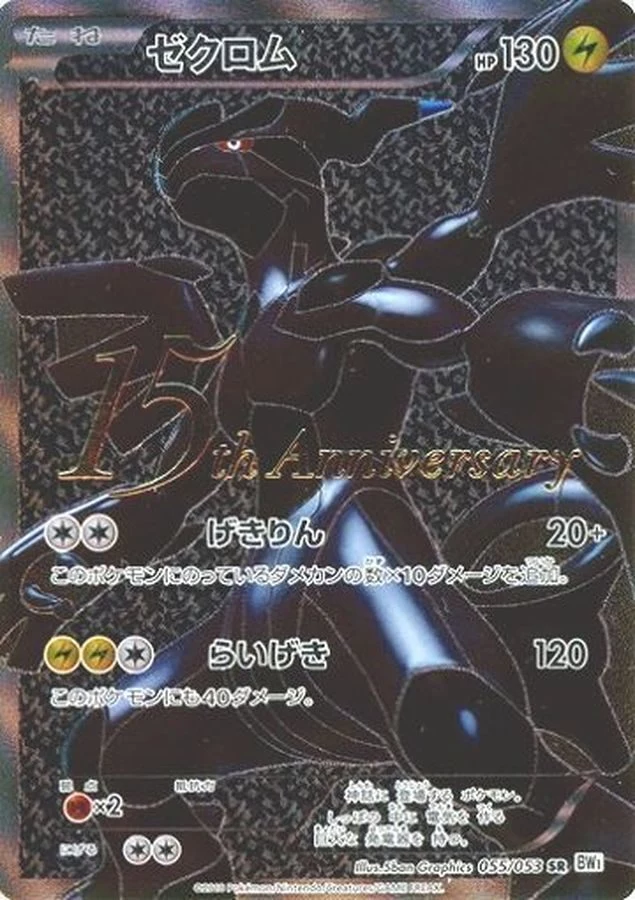
Zekrom is a Dragon/Electric-type Legendary, and its best-known Japanese Full Art carries a piece of the card game’s own anniversary history stamped onto it. The print we grade and list in PSA 10 is a foil-stamped 15th Anniversary variant of the White Collection 055/053 SR Full Art Zekrom — the same illustration, by 5ban Graphics, that first appeared when the White Collection expansion released in Japan on 17 December 2010.

This guide walks through where 055/053 sits inside Zekrom’s wider Japanese print run, what the 15th Anniversary stamp is (and what it is not), how the White Collection set compares to its English counterpart, and where this print ranks against the other Zekrom PSA 10s listed on our site.

Key Takeaways

Our PSA 10 Zekrom 15th Anniversary [BW-P 055/053] is currently listed at ¥1,982,400 (~$12,468). The plain White Collection 055/053 SR — the same card number, without the anniversary foil stamp — is a separate PSA 10 listing at ¥353,999 (~$2,226). The 15th Anniversary stamp was applied to prints inserted into a Pokémon Center-exclusive bundle, and the bundle’s release date is unverified — sources conflict. The White Collection base set (17 December 2010) predates the Japanese “old back” era cutoff by nearly a decade, so this is a modern Black & White-era print, not a vintage old-back card.

Dragon/Electric
Type

SR
Rarity (Full Art)

53
Set Size (White Collection)

Dec 2010
Japan Release

Prices below are current samuraiswordtokyo.com listings, converted at ¥159/USD (September 2026).

The Card: Zekrom 055/053 SR Full Art

Zekrom is a Dragon/Electric-type Legendary Pokemon. The 055/053 print is a Full Art treatment at the SR tier, illustrated by 5ban Graphics, and its position at #055 in a “053” set — a number past the set’s own main count — marks it as the special/secret slot rather than part of the regular numbered run.

PSA 10 Zekrom 15th Anniversary BW-P 055/053, listed on samuraiswordtokyo.com
Zekrom 15th Anniversary, 055/053, SR (Full Art), PSA 10

The print listed above is not a separate card from the base 055/053 SR — it is that same Full Art illustration, but with a foil anniversary stamp added, sourced from a Pokémon Center-exclusive bundle rather than a standard booster or promo pack. It is currently listed at ¥1,982,400 (~$12,468), graded PSA 10.

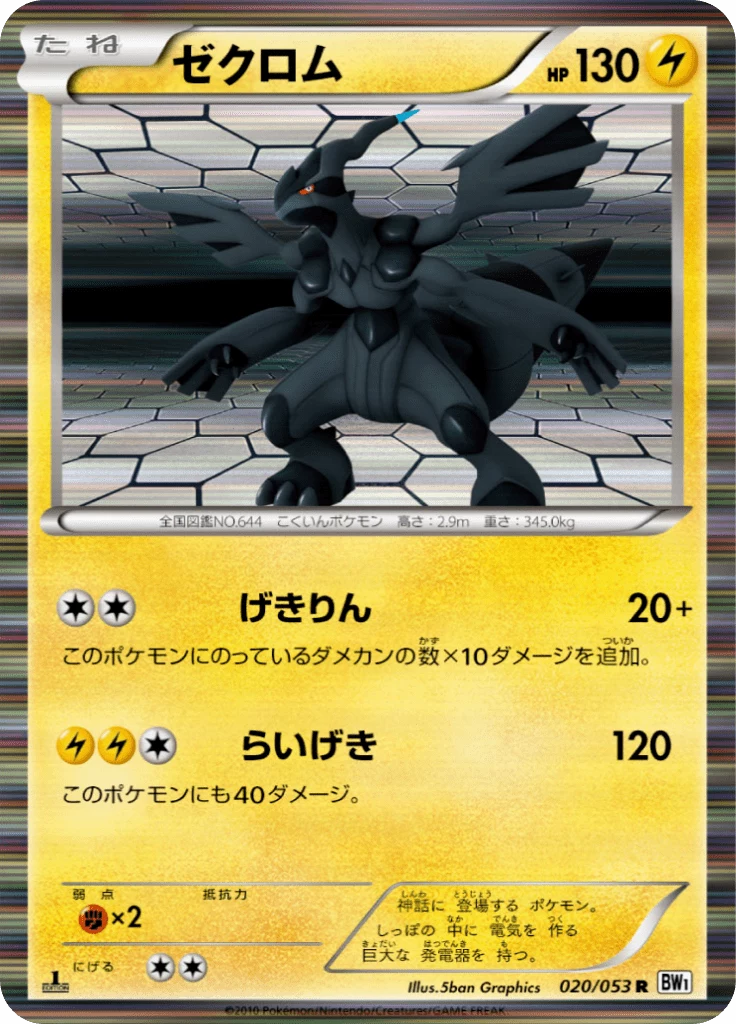
The base White Collection 055/053 SR — the same illustration, same card number, without the anniversary stamp — is a separate print in our catalogue, covered in the next section.

The Set: White Collection (BW1w)

White Collection is one half of the paired Japanese Black Collection / White Collection starter-based expansions, released in Japan on 17 December 2010. Combined, the Japanese Black & White-era release covered a total of 112 cards across both Collections, with White Collection’s own card numbers running to /053 — the “053” in our anchor’s 055/053 number refers to that subset.

Release Date Not Confirmed

The Pokémon Center-exclusive bundle that carries the 15th Anniversary foil stamp is reported with two different release dates across sources we checked — one reference points to October 2011, another to August 2012. We are not presenting either date as confirmed until this is resolved against a fuller official record.

Per secondary marketplace listings for this bundle (not an official set record), the anniversary product also included items such as sleeves, a coin, damage counters, and playmats alongside the foil-stamped 055/053 card — details worth noting as context, though we treat them as secondary-source information rather than confirmed specifications.

The White Collection print sits in the same wider Black & White era covered by our full Zekrom Japanese print guide, which tracks every Zekrom print across every era rather than this single anniversary deep dive.

Japanese vs English Print

The base White Collection 055/053 Full Art has a confirmed English equivalent: Black & White (EN) #114/114, Rare Ultra, from the English Black & White base set, which released on 25 April 2011 — about four months after the Japanese White Collection. The English base set carries 115 cards against White Collection’s 53-card subset, since the English release consolidated both Japanese Black Collection and White Collection cards into one set.

For the 15th Anniversary foil-stamped variant specifically, no English-market equivalent of the anniversary bundle itself is verified here — the verified prints are the base Japanese Full Art (055/053 SR) and its English Rare Ultra counterpart (114/114); the anniversary stamp appears to be a Japan-market bundle insert rather than a separately catalogued international product.

Where This SR Sits Among Japanese Rarity Tiers

Within White Collection, Zekrom’s two main-set prints sit on different rungs of the set’s own rarity structure: the Regular (R) print at 020/053, and the Full Art SR at 055/053, positioned outside the set’s core numbering as the special slot — the standard pattern for SR-tier Full Art cards in this era of Japanese sets.

The 15th Anniversary foil stamp does not change that underlying rarity tier. It is a bundle-insert distinction layered on top of the same SR Full Art print, not a separate or higher rarity classification within the set itself.

For a wider view of how Zekrom’s later prints — including the modern M-series reprints — compare across our full graded range, see our Zekrom price and best-cards roundup.

Shop This Card
PSA10 Zekrom 15th : PROMO [BW-P 055/053]
Currently listed at ¥1,982,400 (~$12,468)
Ships from Tokyo · Tracked delivery

View Product →

Where to Buy Zekrom 15th Anniversary from Tokyo

Our graded PSA 10 Zekrom 15th Anniversary [BW-P 055/053] is currently listed at ¥1,982,400 (~$12,468), shipped from Tokyo with tracked delivery. If the anniversary stamp is not what you are after and you want the same artwork without it, the base PSA 10 Zekrom SR [BW1 055/053] is listed separately at ¥353,999 (~$2,226).

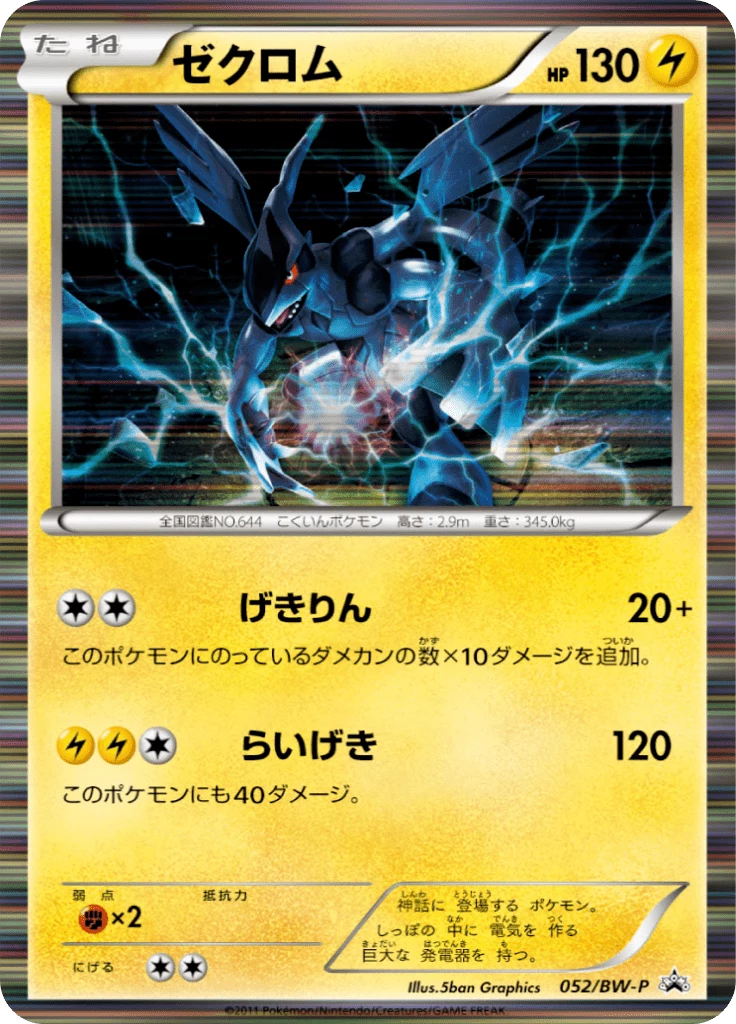
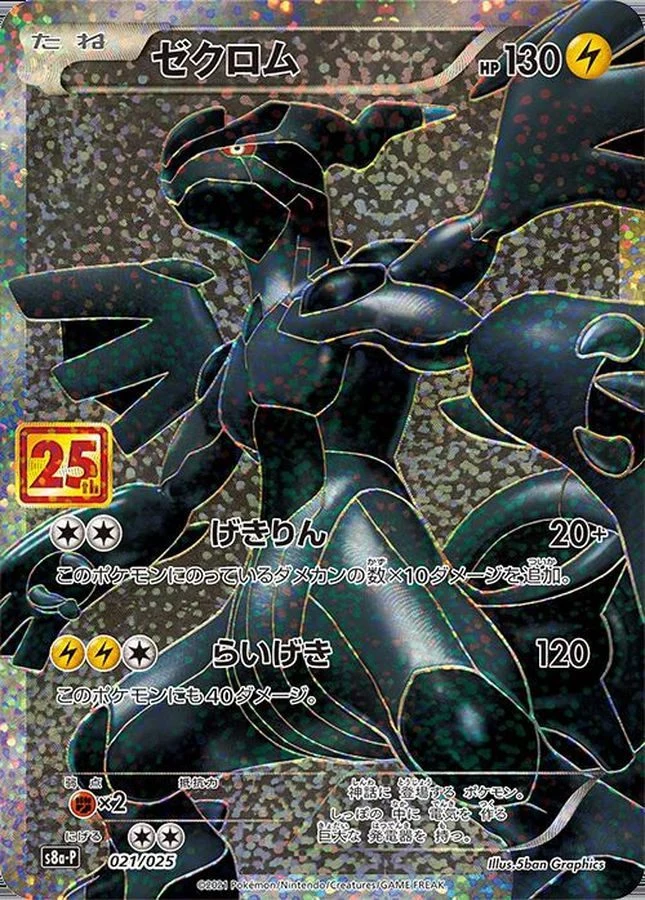
For a lower entry point on a different Zekrom print, the PSA 10 Zekrom Promo [S8a-P 021/025] is listed at ¥23,707 (~$149). We also list a PSA 10 Zekrom R :1ED [CP2 009/027] from the Legend Kira Collection at ¥103,604 (~$652) — a different regular-rarity Zekrom print from a separate set, not part of the White Collection print run covered above.

For the modern 2025-26 M-series print, see our separate Zekrom 30th Celebration card guide — a different, much more recent print era from the 2010 White Collection card covered here. Zekrom also appears in dual-Pokemon prints. For general context on where 2010-era Japanese prints like this one sit relative to true vintage cards, see our Japanese old-back cards guide — note that White Collection released nearly a decade after the July 2001 old-back cutoff, so this Zekrom print is a modern Black & White-era card, not an old-back card.

Browse the full graded range in our PSA 10 graded card collection, or build a mixed order across singles and sealed product through our Quick Order page.

Frequently Asked Questions

What is the Zekrom 15th Anniversary card?

It is a foil-stamped anniversary variant of the White Collection 055/053 SR Full Art Zekrom, inserted into a Pokémon Center-exclusive bundle. It is the same illustration and card number as the base 055/053 print, with an anniversary stamp added. We list a PSA 10 of this print at ¥1,982,400 (~$12,468).

Is the 15th Anniversary Zekrom the same card as the plain SR 055/053?

Same artwork and card number, different print. The anniversary-stamped version comes from a Pokémon Center-exclusive bundle; the plain version is the standard White Collection print. We list them separately — the plain SR is priced at ¥353,999 (~$2,226) against ¥1,982,400 for the anniversary-stamped print.

When was the 15th Anniversary Premium Set released?

Unverified. Sources we checked conflict — one points to October 2011, another to August 2012 — so we are not presenting either date as confirmed.

Does Zekrom 055/053 have an English print?

Yes, the base Full Art print corresponds to Black & White (EN) #114/114, Rare Ultra, from the English Black & White base set released 25 April 2011. No English equivalent of the 15th Anniversary bundle itself is verified.

Is this a Japanese “old back” card?

No. White Collection released on 17 December 2010, nearly a decade after the July 2001 old-back cutover. This is a modern Black & White-era print with an anniversary foil stamp, not a vintage old-back card.

Where can I buy a PSA 10 Zekrom 15th Anniversary from Tokyo?

Our PSA 10 Zekrom 15th Anniversary [BW-P 055/053] is currently listed at ¥1,982,400 (~$12,468), shipped from Tokyo with tracked delivery. Other Zekrom PSA 10 prints, including the plain 055/053 SR and the 25th Anniversary promo pack print, are also listed on our site, or you can build a mixed order through our Quick Order page.

Briar Pokemon Trainer Card Guide: The SAR 132/102 Print (Stellar Miracle SV7)

Briar, known in Japan as ブライア (Buraia), is a Trainer character tied to the Area Zero and Blueberry Academy storylines in Pokemon Scarlet & Violet, and she has one confirmed Special Art Rare (SAR) Supporter print in the Japanese TCG so far.

That print comes from the Stellar Miracle (SV7) expansion pack, released 19 July 2024, and it carries a situational effect built around Prize cards rather than a straightforward draw or search. This guide covers the card itself, what we can and can’t confirm about an English-set equivalent, and where it sits in the Japanese rarity system — without inventing a second printing that doesn’t exist in our research.

Key Takeaways

Briar has one confirmed Japanese SAR print — PSA 10 Briar SAR 132/102, Stellar Miracle (SV7) currently listed at ¥9,439 (~$59). The card’s Prize-card effect only activates when the opponent has exactly 2 Prize cards remaining. The set it comes from, SV7 Stellar Miracle currently listed at ¥10,192, is a 135-card Japanese release from July 2024.

1
Confirmed JP Print

SAR
Rarity

SV7
Stellar Miracle Set

Sep 2026
Prices Checked

Prices are our own listed prices as of September 2026, converted at ¥159/USD.

Briar SAR 132/102: Stellar Miracle (SV7)

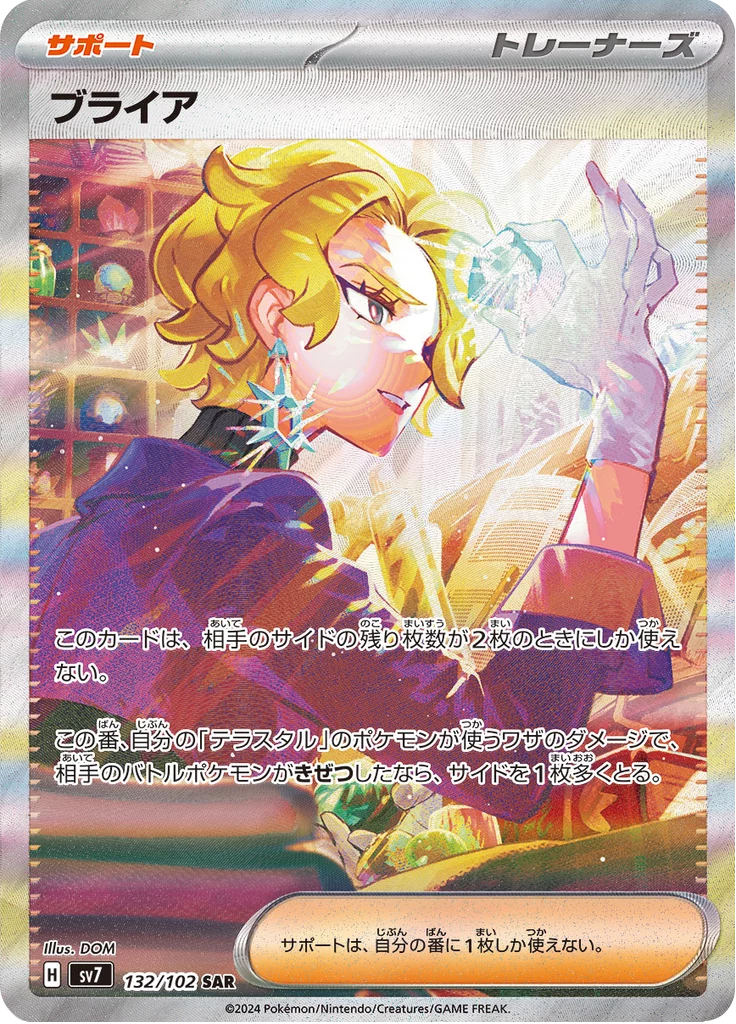
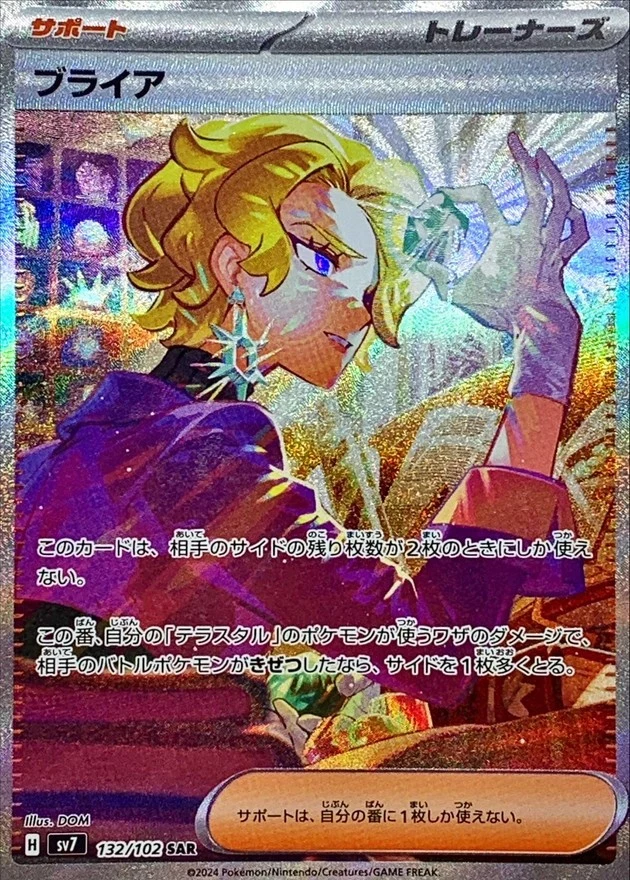
Briar SAR 132/102 Stellar Miracle SV7 Japanese Pokemon Supporter card
Briar SAR 132/102, Stellar Miracle (SV7)

Briar’s Japanese Supporter print appeared in エキスパンションパック「ステラミラクル」 — the Stellar Miracle expansion pack, catalogued as SV7, released 19 July 2024 as a 135-card Japanese set. The card is numbered 132/102, Special Art Rare (SAR), illustrated by DOM.

The effect is conditional rather than an unconditional draw or search: it can only be used while the opponent has exactly 2 Prize cards remaining, and it applies when a Tera Pokemon’s attack knocks out the opponent’s Active Pokemon that turn — in that specific window, you take an additional Prize card. The card carries Regulation Mark H.

Our research did not turn up a second Japanese print of Briar. Until a second print is verified, treat this SV7 132/102 SAR as the one confirmed Japanese Briar Supporter card rather than assuming a reprint exists elsewhere.

A PSA 10 print of this card is currently listed at ¥9,439 (~$59).

Japanese vs English Print

An automated lookup on Limitless TCG’s card database reported an English-set equivalent for this card as Stellar Crown #132 — the same card number carried over into the English set name that Stellar Miracle maps to. That number match is consistent with how other SV7 cards have lined up against Stellar Crown in our research, but this specific Briar mapping has not been independently cross-checked on a second source.

Treat the Stellar Crown #132 mapping as reported rather than confirmed. If you’re trying to match a raw English card to this Japanese SAR, the card number is the strongest signal we can point to, but we’re not stating it as a verified fact in this guide.

Where This SAR Sits in Japanese Rarity Tiers

Special Art Rare (SAR) is the full-art alternate-illustration tier applied to Trainer and Supporter cards in the current Scarlet & Violet-era Japanese TCG. It sits above the standard Super Rare (SR) treatment within the same expansion — both are alt-art Trainer slots, but SAR carries the more elaborate, full-bleed illustration treatment.

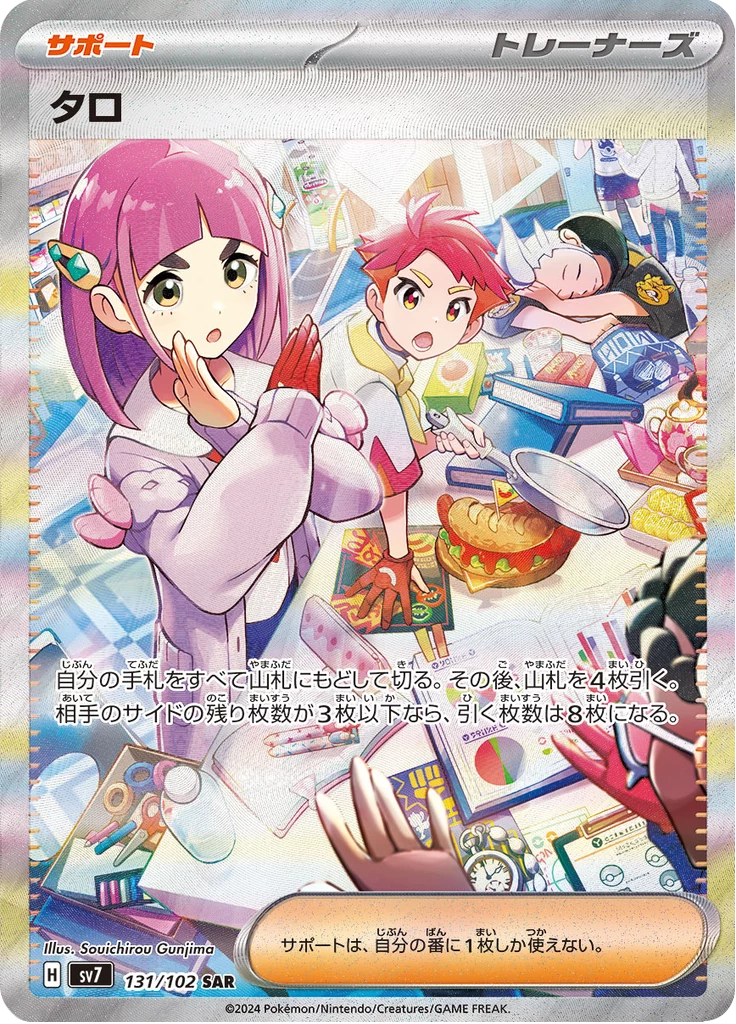
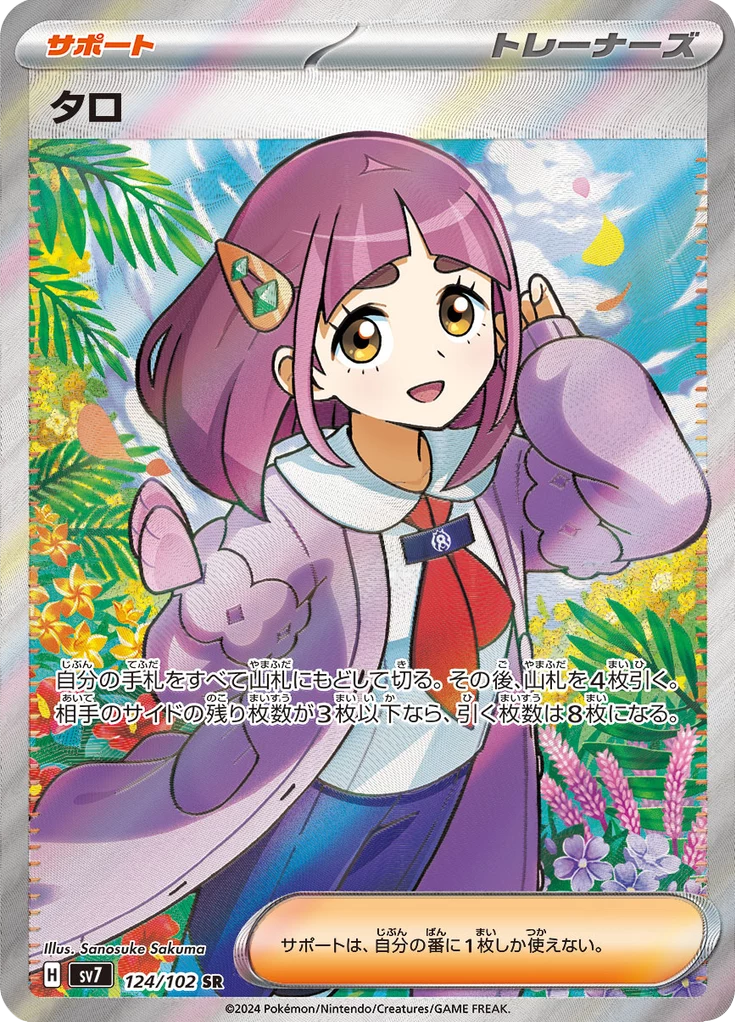
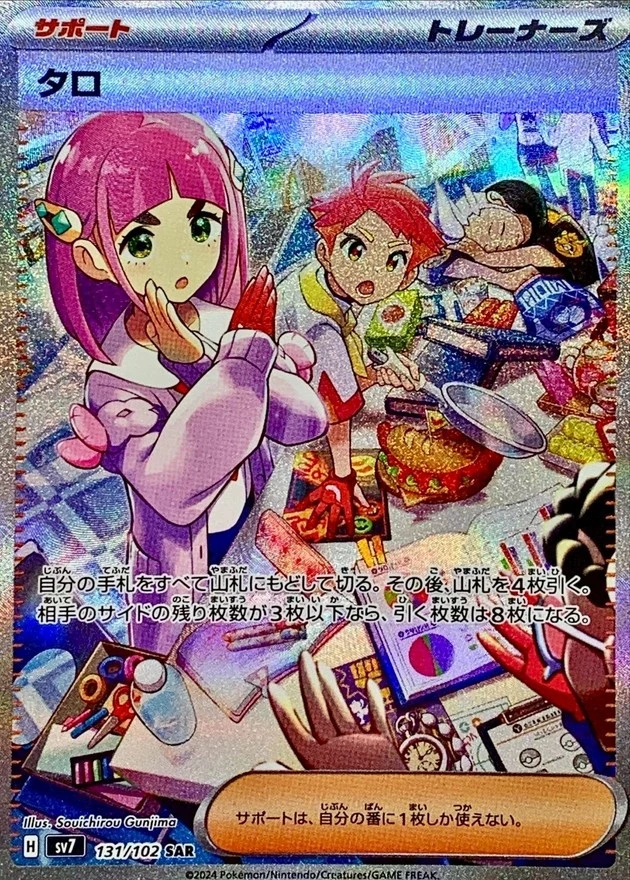
Stellar Miracle (SV7) is the same set that produced other high-rarity Trainer pulls, including a Lacey SAR (131/102) and a Lacey SR (124/102) — useful reference points if you’re trying to place Briar’s SAR alongside other alt-art Supporters from the same box rather than comparing it to a different set’s rarity scale.

Lacey SAR 131/102 Stellar Miracle SV7 Japanese Pokemon Supporter card

Lacey SAR 131/102 (SV7)

Lacey SR 124/102 Stellar Miracle SV7 Japanese Pokemon Supporter card

Lacey SR 124/102 (SV7)

Since the card text on Briar’s SAR is a conditional Prize-card effect rather than a draw or search engine, its collectibility within the SAR tier rests on the illustration treatment and set position rather than in-game power level — the same pattern that applies to most SAR Supporters in this era.

PSA 10 Briar SAR SV7 132/102 slab, listed on samuraiswordtokyo.com

PSA 10 Briar SAR 132/102 (SV7)

PSA 10 Lacey SAR SV7 131/102 slab, listed on samuraiswordtokyo.com

PSA 10 Lacey SAR 131/102 (SV7)

Shop This Card
PSA 10 Briar SAR 132/102 (Stellar Miracle, SV7)
Currently listed at ¥9,439 (~$59)
Ships from Tokyo · Tracked delivery

View Product →

Where to Buy Briar Cards from Tokyo

We ship graded and raw Japanese singles out of Tokyo with tracked delivery. The Briar SAR covered here is currently listed as a PSA 10 in our shop, and it comes from a set we also list sealed.

The card itself, PSA 10 Briar SAR 132/102, is listed at ¥9,439 (~$59). If you’d rather chase your own print by opening packs, the sealed SV7 Stellar Miracle Japanese Booster Box is listed at ¥10,192, and a Damaged Box version of the same set is listed at ¥11,520. Treat all three prices as listing snapshots rather than an ongoing supply.

For prints we don’t currently list, sourcing requests go through our Quick Order page — no restock timing is promised, but it’s the fastest way to build a mixed order. For more graded Trainer and Supporter singles from Japan, browse our PSA 10 graded card collection.

For the broader category this card belongs to, see our female Pokemon trainer card roundup and our wider PSA 10 Trainer card guide. For the SAR/SR alt-art tier specifically, our Japanese full-art Trainer card guide explains how it fits alongside other rarities. For the complete Stellar Miracle checklist rather than this single-card deep dive, see the Stellar Miracle (SV7) full card list, or our Stellar Miracle pull-rates and best-cards roundup. If you’re building a box order around this set, our Stellar Miracle booster box buying guide covers the sealed side in detail, and our Lacey Trainer card guide covers the other SAR Supporter pulled from the same set.

Frequently Asked Questions

What is the Briar Pokemon card?

Briar is a Trainer character from the Area Zero and Blueberry Academy storylines in Pokemon Scarlet & Violet, printed once so far as a Japanese Supporter card — a Special Art Rare (SAR) numbered 132/102 from the Stellar Miracle (SV7) expansion pack, released 19 July 2024.

What does the Briar Supporter card do?

It can only be used while the opponent has exactly 2 Prize cards remaining. If a Tera Pokemon’s attack knocks out the opponent’s Active Pokemon that turn, you take an additional Prize card. The card carries Regulation Mark H and was illustrated by DOM.

Does Briar have more than one Japanese print?

Not that our research has confirmed. We found one Japanese Briar Supporter print — SV7 132/102, SAR — and no second Japanese reprint. If that changes, this guide will be updated.

Is there an English version of the Briar SAR?

An automated lookup on Limitless TCG reported the English-set equivalent as Stellar Crown #132, matching the same card number. That mapping is reported rather than independently confirmed on a second source, so treat it as likely rather than certain.

What set is the Briar SAR from?

Stellar Miracle, catalogued as SV7, a 135-card Japanese expansion released 19 July 2024. we list both a sealed booster box and a Damaged Box version of this set.

Where can I buy a PSA 10 Briar card?

The SV7 print is currently listed at ¥9,439 (~$59). The sealed Stellar Miracle booster box is also listed if you’d rather open packs. For prints not currently listed, sourcing requests go through Quick Order.

Here Comes Team Rocket! Old Back Japanese Card Guide: From 1997 Rocket Gang to the XY-P 278 Reprint

“Here Comes Team Rocket!” is one of the oldest Trainer cards in the Japanese Pokemon TCG with a real claim to firsts — per Bulbapedia, it was “one of the first Holofoil Trainer cards in both English and Japanese,” and the first Japanese card to carry a Super Rare rarity. That debut print dates back to 1997, well inside the game’s original “old back” design era.

The card has been reprinted several times since, in both languages, and two of those reprints are what we currently list as PSA 10 graded singles: a 2017 full art promo distributed only inside a Pokemon Center Japan special-edition case, and a 2021 25th Anniversary confetti-holofoil reprint. This guide walks through the full print history from the 1997 old-back debut to today, explains exactly which prints we list, and is upfront about the one we don’t.

Key Takeaways

Our headline listing is the 2017 XY-P 278 full art promo, PSA 10, currently listed at ¥5,876,400 (~$36,958). We also list the 2021 25th Anniversary reprint, S8a-P 006/025, PSA 10, currently listed at ¥10,051 (~$63). The original 1997 old-back print itself — the true debut, from the Japanese Rocket Gang set — is not listed on our site at the moment; sourcing requests go through Quick Order.

Trainer
Card Type

Full Art
XY-P 278 Rarity

65
Rocket Gang (JP) Set Size

1997
Original Japan Release

Prices are this store’s current listed prices as of September 2026, converted at ¥159/USD.

The Card: Here Comes Team Rocket! XY-P 278 Full Art Promo

“Here Comes Team Rocket!” is a Supporter-class Trainer card featuring Jessie, James, and Meowth. Per Bulbapedia, its effect lets each player use the card once per turn, and its primary effect causes both players’ Prize cards to be revealed face-up for the rest of the game — a card built entirely around information, not damage.

Here Comes Team Rocket! XY-P 278, Full Art Promo, XY Promotional Cards (Japan)
Here Comes Team Rocket!, XY-P Promotional 278 — illustrated by Naoki Saito

The XY-P 278 print is a Full Art promo — card template described as “reminiscent of the Original Era card layout” — illustrated by Naoki Saito and confirmed via Limitless as card #278 in the Japanese XY Promotional (XYP) card list, card type Trainer-Supporter. It carries no standard rarity letter grade, since it never went through a normal set print run.

This print was distributed exclusively inside the 20th Anniversary Team Rocket Special Case (also referred to as the Special Attache Case), a Pokemon Center Japan online-exclusive product released February 2017, with a reported pre-order window of 3 November–18 December 2016 (secondary-sourced from marketplace listings, not independently confirmed via Bulbapedia). It was never sold separately or in any standard booster product.

A PSA 10 example of this exact print is currently listed at ¥5,876,400 (~$36,958).

PSA 10 Here Comes Team Rocket! XY-P 278 slab, listed on samuraiswordtokyo.com
PSA 10 Here Comes Team Rocket! XY-P 278, listed on samuraiswordtokyo.com

The Original Set: Rocket Gang and the Old Back Era

The card’s true debut is the Japanese set ロケット団 (Rocket Gang), the JP equivalent of the English “Team Rocket” expansion. It released in Japan on 21 November 1997 at a set size of 65 cards (the English Team Rocket set runs to 83 cards). The English side numbers the card at 15/82 as the Rare Holo and 71/82 as a non-holo Rare.

Japan’s Pokemon TCG used its original “Pocket Monsters Card Game” back design — the POCKET MONSTERS wordmark curved across the top, CARD GAME on a ribbon beneath the Poke Ball — from the game’s 20 October 1996 debut through every set released before 19 July 2001. The back design changed with the VS expansion, released that same July 2001 date, which switched to the “Pokemon” design used in international prints. Rocket Gang’s November 1997 release sits comfortably inside that pre-2001 “old back” window, which is what puts the original print of “Here Comes Team Rocket!” in the old-back category this guide is named for.

PSA 10 Charizard Old Back PMCG4 006, Rocket Gang set

Charizard, Old Back PMCG4 No.006 (same 1997 set)

PSA 10 Gyarados Old Back PMCG4 130, Rocket Gang set

Gyarados, Old Back PMCG4 No.130 (same 1997 set)

Two other headline cards from the same 1997 Rocket Gang release are ones we do carry as PSA 10 graded old-back singles: Charizard, Old Back [PMCG4 No.006] currently listed at ¥877,448 (~$5,518), and Gyarados, Old Back [PMCG4 No.130] currently listed at ¥469,640 (~$2,954). Both give a sense of what a genuine 1997 old-back print from this set looks like and is currently listed at, even though “Here Comes Team Rocket!” itself isn’t among our current old-back listings.

Japanese vs English Print

The clearest Japanese-vs-English comparison sits in the 2021 reprint wave. The English side got Celebrations, a 25th Anniversary set that reprinted the card at 15/82 as a “Rare Classic.” The Japanese side got the Promo Card Pack 25th Anniversary Edition, which reprinted it at 006/025 with a distinct “Confetti Holofoil” treatment and a red/gold “25th” logo worked into the artwork — a different visual treatment from its English counterpart despite marking the same anniversary.

The 2017 XY-P 278 Full Art promo has no directly equivalent English-language print in our records — it was a Japan-only distribution tied to a Pokemon Center Japan retail product, not a set insert with a parallel international release. Based on the print history we’ve verified, no English-language release of that exact full art treatment has turned up; we phrase that as what our verified sources show, not as an absolute guarantee.

Going back to the 1997 original, both the English Team Rocket 15/82 and the Japanese Rocket Gang printing are Holofoil, and per Bulbapedia both count among “the first Holofoil Trainer cards in both English and Japanese” — the Japanese print additionally holds the distinction of being the first Japanese card issued at Super Rare rarity.

Where These Prints Sit Among Japanese Rarity Tiers

The 1997 Rocket Gang original sits at the top of the card’s own rarity history: it was the debut Japanese card to carry a Super Rare rarity, at a point when that tier didn’t yet exist elsewhere in the Japanese card pool. The JP reprint inside Expansion Pack 20th Anniversary (CP6 103/087) sits at the opposite end, printed as a plain Uncommon — a set-filler treatment for a card that had, by then, become a piece of TCG history rather than a competitive staple.

Our two current anchors sit in the modern promo lane rather than on a standard set’s rarity ladder. XY-P 278 is a Full Art promo distributed only through a retail special-edition case — a print that never had to compete for a slot in a numbered set at all. S8a-P 006/025 is a Confetti Holofoil promo-pack print, a treatment specific to Japan’s 25th Anniversary promo run rather than a mainline set rarity. Comparing the two, the XY-P 278 full art sits well above the S8a-P reprint in scarcity and price, reflecting its one-off, single-retail-product distribution versus a wider anniversary promo-pack run.

Shop This Card
PSA 10 Here Comes Team Rocket! XY-P 278 Full Art Promo
Currently listed at ¥5,876,400 (~$36,958)
Ships from Tokyo · Tracked delivery

View Product →

Where to Buy Here Comes Team Rocket! Cards from Tokyo

We ship Japanese graded singles worldwide from Tokyo with tracked delivery. Our headline listing is the 2017 full art promo, PSA 10 Here Comes Team Rocket!, XY-P 278 currently listed at ¥5,876,400 (~$36,958). The more accessible 2021 reprint, PSA 10 Here Comes Team Rocket!, S8a-P 006/025, is currently listed at ¥10,051 (~$63).

For other headline pulls from the same 1997 set, see PSA 10 Charizard, Old Back [PMCG4 No.006] and PSA 10 Gyarados, Old Back [PMCG4 No.130], or browse the full range in our PSA 10 graded card collection. The original 1997 old-back print of “Here Comes Team Rocket!” itself is not listed on our site at the moment; sourcing requests go through our Quick Order page, which is also the fastest way to build a mixed order across singles and sealed product.

For more on this card family, our Team Rocket Japanese Pokemon cards hub covers every era from 1997 old-backs through the modern SV10 set, and our PSA 10 Team Rocket cards guide focuses specifically on graded vintage and modern examples. For the wider character family this card is named after, see our Team Rocket’s Pokemon card family guide. On the old-back design side, our Japanese old-back cards guide and old-back vs new-back design guide give the general identification and value context this article doesn’t repeat in full. If you’re comparing this 1997 print against a different old-back single-card deep dive, our Cal Steelix Old Back card guide follows the same format for a 2000 magazine promo. And for a “then vs now” look at the Team Rocket brand, our Glory of Team Rocket booster box buying guide covers the unrelated modern SV10 set of the same name.

Frequently Asked Questions

What does “Here Comes Team Rocket!” do?

It’s a Supporter-class Trainer card featuring Jessie, James, and Meowth. Per Bulbapedia, each player can use it once per turn, and its primary effect reveals both players’ Prize cards face-up for the rest of the game.

What is the original 1997 old-back print, and do you have it?

The original is the Japanese Rocket Gang printing, released 21 November 1997, inside the game’s pre-2001 “old back” design era. We do not currently list this original print; sourcing requests go through Quick Order.

What is the XY-P 278 print you sell?

It’s a 2017 Full Art promo illustrated by Naoki Saito, distributed exclusively inside the Pokemon Center Japan 20th Anniversary Team Rocket Special Case. A PSA 10 example is currently listed at ¥5,876,400 (~$36,958).

What is the S8a-P 006/025 reprint?

It’s a 2021 25th Anniversary promo-pack reprint with a Confetti Holofoil treatment and a red/gold “25th” logo in the artwork. A PSA 10 example is currently listed at ¥10,051 (~$63).

Is the Japanese print different from the English versions?

Yes. The English side has its own separate print history (Team Rocket 15/82, EX Team Rocket Returns 111/109, Evolutions 113/108, Celebrations 15/82), while the Japanese side runs through Rocket Gang, Rocket Gang Strikes Back, Expansion Pack 20th Anniversary, XY-P 278, and the 25th Anniversary promo pack — different numbering and, from XY-P 278 onward, different artwork treatments entirely.

Where can I buy a PSA 10 “Here Comes Team Rocket!” from Tokyo?

Our XY-P 278 full art promo is currently listed at ¥5,876,400 (~$36,958), and our S8a-P 006/025 reprint is currently listed at ¥10,051 (~$63), both shipped from Tokyo with tracked delivery. Use our Quick Order page to ask about the original 1997 old-back print or to build a mixed order.

What Was the First Pokemon Card? Japan’s Oldest Pokemon Card (1996) Guide

The first Japanese Pokemon card came from a single set: the Expansion Pack (拡張パック), published by Media Factory on 20 October 1996. It shipped as ¥300-plus-tax, 10-card packs, and the full set ran to 102 cards built around the original 151 Generation I Pokemon. That is the oldest Pokemon card — the actual Trading Card Game, not a lookalike collectible from the same year.

The confusion around “the oldest Pokemon card” almost always comes from one design detail: every Japanese card from 1996 through mid-2001 shares the same card back. That means a 1998 Gym card and a 2001 Neo card can look exactly as “old” as the true 1996 first print at a glance — and they routinely get mislabelled online because of it.

This guide sorts out what actually dates to 1996, what only shares the look of that era, and what a genuine 1996 example is currently listed for.

Key Takeaway

The Pokemon Trading Card Game launched in Japan on 20 October 1996 with the 102-card Expansion Pack (PMCG1) from Media Factory, sold in ¥300 (+tax) packs of 10 cards. A separate Bandai Carddass line predates it by a month but has no attacks, HP, or game rules — it is not the Trading Card Game. A PSA 10 Pikachu [PMCG1-2], graded from that exact 1996 print, is currently listed at ¥915,208 (~$5,756). Everything else people call “Old Back,” including three further Old Back PSA 10 examples covered below, comes from later Gym and Neo sets that only share the card-back design — not the 1996 print date.

20 Oct 1996
Japan TCG Release Date

102
Cards in First Set

¥300
Pack Price (10 Cards, +tax)

1996–2001
“Old Back” Design Era

Yen figures below convert at ¥159/USD (September 2026). Prices are a September 2026 store snapshot — check the linked listing for the current number before ordering.

What Was the First Japanese Pokemon Card?

Ask “what was the first Pokemon card” and the precise answer is a physical product: the Expansion Pack (拡張パック), internally catalogued as PMCG1 by card databases. Media Factory published it in Japan on 20 October 1996, sold in ¥300-plus-tax packs of 10 cards, for a total set size of 102 cards drawn from the original 151 Generation I Pokemon.

That release date and pack structure line up with Bulbapedia’s Pokemon Trading Card Game entry, which records the TCG as originally published in Japan in October 1996 by Media Factory, alongside multiple Japanese-language collector sources that corroborate the exact 20 October date and ¥300 price. Treat those two specifics as well-corroborated secondary-sourced facts rather than an official Nintendo press statement.

There was no English-language version of the game yet in 1996. For that entire stretch, the Expansion Pack and its immediate Japanese follow-ups were the whole Pokemon Trading Card Game.

PSA 10 Pikachu Old Back PMCG1-2 slab, the 1996 first Japanese Pokemon set, listed on samuraiswordtokyo.com
PSA 10 Pikachu [PMCG1-2], Expansion Pack (1996) — currently listed at ¥915,208 (~$5,756)

Carddass vs the Trading Card Game: Which Came First?

One line predates the Expansion Pack by a month, and it is the other main source of confusion around this topic: Bandai’s Carddass Pocket Monsters cards, released in September 1996. Carddass is a separate, non-TCG collectible line — the cards carry Pokemon artwork but none of the attacks, HP, or game rules that define a Pokemon Trading Card Game card.

“First Pokemon collectible card” (Carddass, September 1996) and “first Pokemon Trading Card Game card” (Expansion Pack, 20 October 1996) are two different claims about two different products. This guide, and most of what people mean when they search “oldest Pokemon card,” is about the second one.

Line Publisher Release Trading Card Game rules?
Carddass Pocket Monsters Bandai September 1996 No — collectible only, no attacks or HP
Expansion Pack (拡張パック / PMCG1) Media Factory 20 October 1996 Yes — the first Pokemon TCG set

First Print vs Resale: The “No-Mark” Distinction

Even within the Expansion Pack itself, Japanese collectors separate two print runs of the same 102-card set. The true first print is informally called マークなし (“no-mark”), because it lacks a small rarity star that a later 再販 (resale, or reprint) run of the same cards added afterward. Both runs are the same 1996 cards from the same set — the difference is a printing detail, not a separate release.

There is no verified, exact print-quantity figure for either run, so any specific count you see for the “no-mark” first print should be treated with caution.

The PSA 10 Pikachu shown above is graded from the marked 再販 (resale) print of the Expansion Pack, not the unmarked original run. It is still the same 1996 set and the same first-ever Pokemon Trading Card Game card — just from the later of the two 1996-era print passes.

If you are trying to identify a raw card at home, check for that small star before assuming which of the two you are holding.

This first-print/resale split inside the 1996 set is also a different idea from “1st Edition,” a separate stamp system used on other Pokemon sets and explained in our Japanese 1st Edition Pokemon cards guide. A 1st Edition mark and the Expansion Pack’s マークなし/再販 print distinction are not interchangeable concepts, even though both describe “which print run is this.”

The “Old Back” Era: 1996–2001

Every card from the 1996 Expansion Pack through the Gym-series and Neo-series releases that followed shares one card-back design: the Japanese text ポケットモンスター カードゲーム (“Pocket Monsters Card Game”), a copyright line along the bottom, and a two-tone Poké Ball graphic. That shared back design is what “Old Back” describes — a multi-year design era running from 1996 to July 2001, not a single set. In July 2001, the “Pokemon VS” era switched to the modern card-back design still used today.

Our Japanese Old Back Pokemon cards value guide covers that whole design era across every set it spans. This article is narrower on purpose: it is specifically about which one card, from which one set, is the actual first Pokemon card ever printed. For a closer side-by-side on the back design itself, see our Old Back vs New Back explainer.

Set / series Year Card-back design
Expansion Pack (PMCG1) 1996 Old Back — the first set
Gym Expansion 1 & 2 1998 Old Back
Neo series (Neo 1–4, Neo Promotional) 1999–2001 Old Back
Pokemon VS era onward From July 2001 New Back (modern design begins)
M Sharpedo EX, 2017, modern Japanese print from 2017 shown for comparison, not an Old Back card
A modern Japanese print (2017), shown only for visual contrast — not an Old Back card.

Set the two card backs side by side and the difference is immediate: the two-tone Poké Ball and older copyright line on any 1996–2001 card, versus the current design on anything printed since. A raw card with the two-tone-ball back is genuinely from this era — though, as the next section covers, that alone does not make it the first set.

Which Old Back Cards Are NOT From the First Set

This is the single most common mix-up in the “oldest Pokemon card” conversation: any card with the two-tone-ball Old Back design gets called “the first Pokemon card” or “from 1996,” even when it is a Gym-series or Neo-series print from years later. Three PSA 10 Old Back examples make the point directly — all genuinely Old Back, and none of them from the 1996 first set.

Card Set Year Listed price
Sabrina’s Gengar Lv.39 R [PMCG-G2 No.094] Gym Expansion 2, “Challenge from the Darkness” 1998 ¥1,528,100 (~$9,611)
Shining Mew [neo-P No.151] Neo Promotional c. 2000–2001 ¥10,442,999 (~$65,679)
Cal Steelix [neo4 No.208] Neo 4, “Darkness, and to Light…” 2001 ¥4,720,000 (~$29,686)
Sabrina's Gengar Lv.39 R, PMCG-G2 No.094, Gym Expansion 2, PSA 10 Old Back

Sabrina’s Gengar Lv.39 R [PMCG-G2 No.094]
¥1,528,100 (~$9,611)

Shining Mew, neo-P No.151, Neo Promotional, PSA 10 Old Back

Shining Mew [neo-P No.151]
¥10,442,999 (~$65,679)

Cal Steelix, neo4 No.208, Neo 4, PSA 10 Old Back

Cal Steelix [neo4 No.208]
¥4,720,000 (~$29,686)

All three share the Old Back card-back design with the 1996 Expansion Pack — and nothing else about the date. Sabrina’s Gengar is a 1998 Gym-series print, Cal Steelix a 2001 Neo 4 print, and Shining Mew a Neo-series promotional print from around 2000–2001. None of them predate the Expansion Pack, and none should be described as “from 1996” or “the first set.” For a closer look at a specific Neo-era Old Back promo single, see our Celebi Old Back promo card guide.

Where to Buy Japanese Old Back Cards from Tokyo

Whether you are after the actual 1996 first set or a later Old Back print from the Gym or Neo years, here is what is currently listed:

All four ship from Tokyo with tracked delivery. Browse the wider PSA 10 graded card collection for further Old Back and modern Japanese singles, or use Quick Order to build a mixed order. If you already own a raw Old Back card and want to know what grading could do for it, our Japanese Pokemon card grading guide covers PSA, BGS, and CGC side by side.

Shop This Card
PSA 10 Pikachu [PMCG1-2], Expansion Pack (Japanese, 1996)
Currently listed at ¥915,208 (~$5,756)
Ships from Tokyo · Tracked delivery

View Product →

Frequently Asked Questions

What was the first Pokemon card?

The first Japanese Pokemon Trading Card Game card came from the Expansion Pack (拡張パック, PMCG1), published by Media Factory on 20 October 1996. It was sold in ¥300 (+tax) packs of 10 cards, with 102 cards total in the set.

Is Carddass older than the Pokemon Trading Card Game?

Bandai’s Carddass Pocket Monsters line released in September 1996, one month before the Expansion Pack. It is a separate, non-TCG collectible line with no attacks, HP, or game rules, so it predates the Trading Card Game itself without being the Trading Card Game.

What does “Old Back” mean on a Japanese Pokemon card?

“Old Back” describes the card-back design used from the 1996 Expansion Pack through the Gym and Neo series, until the “Pokemon VS” era switched to the modern design in July 2001. It is a multi-year design era, not one set.

Is a Gym or Neo series “Old Back” card from 1996?

No. Gym Expansion cards released in 1998 and Neo series cards released between 1999 and 2001. They share the same Old Back card-back design as the 1996 Expansion Pack, but only the Expansion Pack itself dates to 1996.

What is the difference between a “no-mark” and “resale” print of the Expansion Pack?

Japanese collectors call the true first print run マークなし (“no-mark”), because it lacks a small rarity star that a later 再販 (resale) print run of the same 102-card set added. Both are the same 1996 cards from the same set; the difference is a printing detail between the two runs.

Is “1st Edition” the same as “the first set”?

No. “1st Edition” is a separate stamp system used on other Pokemon sets, unrelated to the Expansion Pack’s マークなし/再販 print distinction. A card can be part of the oldest set without carrying a 1st Edition mark, and 1st Edition cards exist on sets released well after 1996.