Create a free account to earn points & rank
Samurai Sword Tokyo
Orders Cart

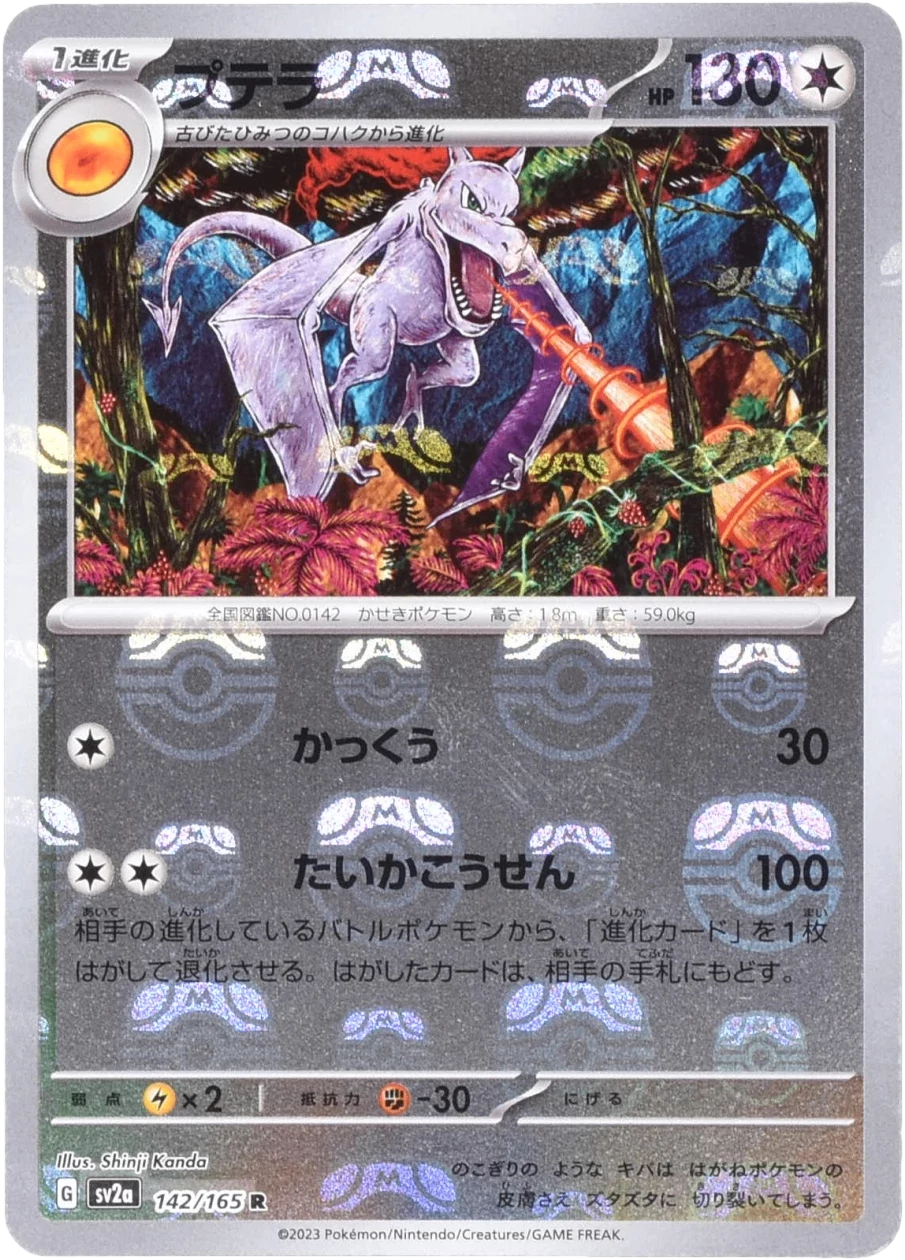
Aerodactyl Master Ball Mirror 142/165 Card Guide: Pokemon Card 151 (Japanese)
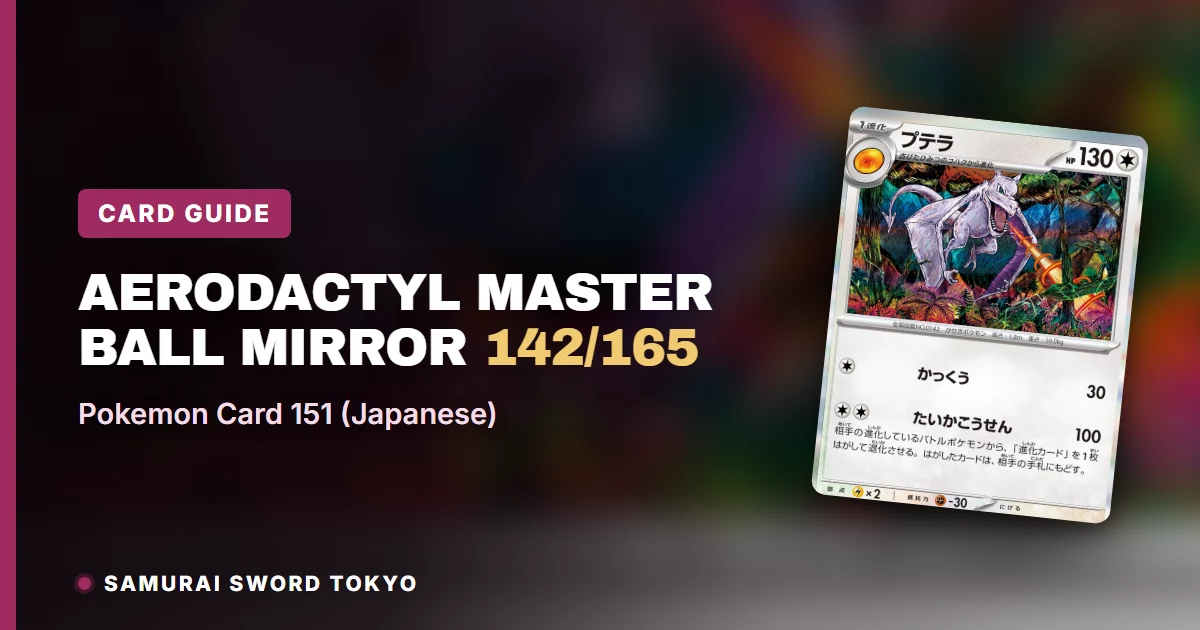
Aerodactyl’s Japanese card pool is short and easy to track: one print covered here, one set, one foil treatment worth knowing about. That makes it a clean entry point for anyone chasing the Master Ball Mirror mechanic without wading through a decade of reprints.

The card is プテラ — Aerodactyl, No. 142/165, printed as a Rare (R) in the Japanese enhanced expansion pack ポケモンカード151 / Pokemon Card 151 (set code SV2a), carrying the set’s Master Ball Mirror foil parallel. A graded PSA 10 example of this exact print is currently listed on our site, shipped from Tokyo, and this guide covers what the card is, how the Master Ball Mirror treatment works, where the print sits inside SV2a, and how it compares to the card’s English release.

Key Takeaways

Aerodactyl R: Master Ball Mirror 142/165 is a PSA 10, currently listed at ¥24,214 (~$152). It’s a Rare-tier foil parallel from Pokemon Card 151 (SV2a), Japan’s 16 June 2023 enhanced expansion pack, which applies its Poké Ball/Master Ball Mirror mechanic across Common, Uncommon and Rare cards. If you’d rather pull your own copy, the SV2A-Pokemon 151 Japanese Booster Box is the sealed source product this print comes from.

130
HP

R
Rarity (142/165)

165
Main Numbering (SV2a)

Jun 2023
Japan Release

Prices below are current samuraiswordtokyo.com listings, converted at ¥159/USD (September 2026).

The Card: Aerodactyl 142/165 R

Aerodactyl is a Colorless-type Stage 1 Pokemon, with 130 HP. It carries two attacks: かっくう for 30 damage on a single Colorless energy, and たいかこうせん for 100 damage on two Colorless energy — the latter also removes one Evolution card from an opponent’s evolved Active Pokemon and returns it to hand. It has a Weakness to Lightning, a Resistance to Fighting, and a Retreat Cost of 0, with Regulation Mark G. The 142/165 print is illustrated by Shinji Kanda.
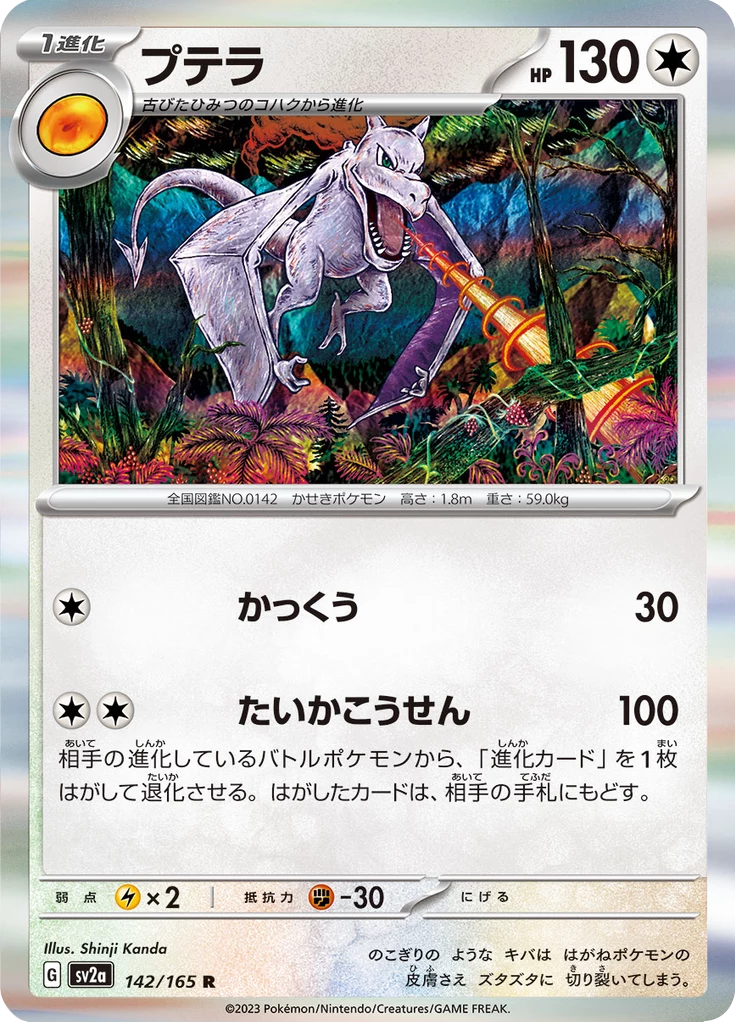
Aerodactyl 142/165 R, Master Ball Mirror, Pokemon Card 151 (SV2a)
Aerodactyl 142/165 R — Pokemon Card 151 (SV2a), illustrated by Shinji Kanda

Printed rarity for this card number is Rare (R). The Master Ball Mirror is a foil-pattern parallel applied on top of that same Rare print — not a separate, higher printed rarity tier. Our own graded example of this exact print carries a current listing at ¥24,214 (~$152), PSA 10.
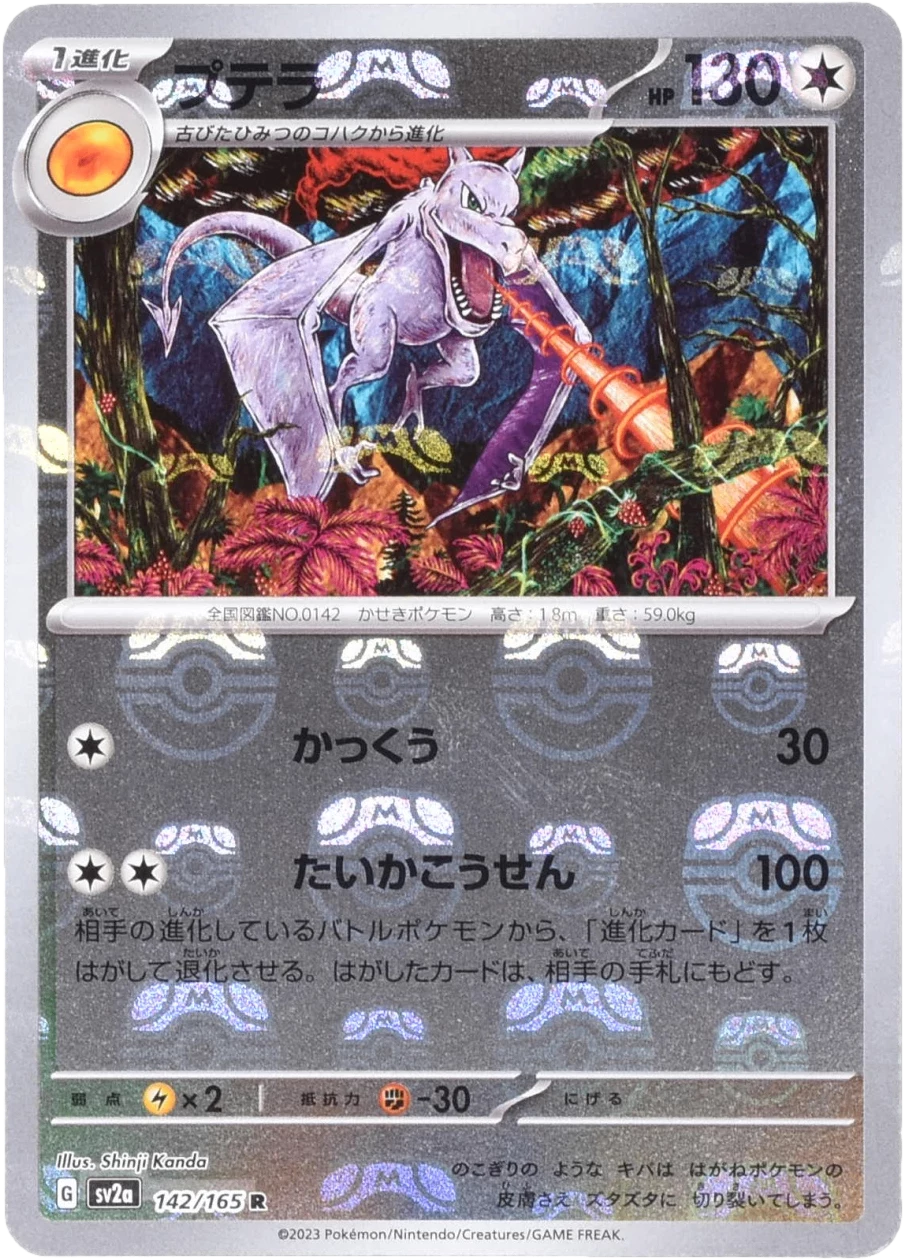
PSA 10 Aerodactyl Master Ball Mirror 142/165 slab, listed on samuraiswordtokyo.com

The Set: Pokemon Card 151 (SV2a)

Pokemon Card 151 — 強化拡張パック「ポケモンカード151」in Japanese — is set code SV2a, an enhanced expansion pack released in Japan on 16 June 2023. The set totals 210 cards, with each Japanese booster pack containing 7 cards and 2 guaranteed holofoils. The card’s own printed number, 142/165, sits inside the set’s main numbered run, which tops out at 165 before the set’s higher secret-rare and full-art slots continue on past that number toward the 210-card total.
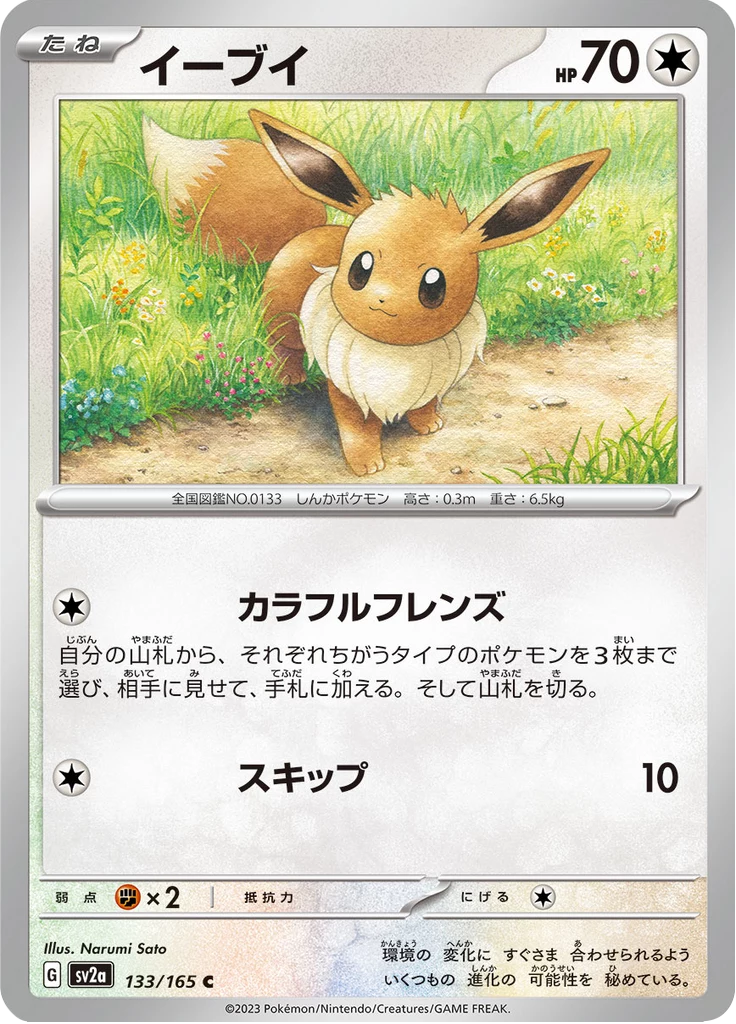
Eevee 133/165, Pokemon Card 151 (SV2a)
Eevee 133/165 — another card from the same Pokemon Card 151 (SV2a) main numbering

SV2a is built entirely around the original 151 Pokemon from the Kanto region, and the set carries its own dedicated pull-rate and full card-list resources on our site — see our Pokemon Card 151 pull-rates and best cards hub and our SV2a full card list for the set-wide picture beyond this single Aerodactyl print.

Sealed SV2a product — where this print originates — is available as the SV2A-Pokemon 151 Japanese Booster Box currently listed at ¥43,860 (~$276), with a Damaged Box variant at ¥53,760 (~$338) for buyers who don’t mind cosmetic packaging wear. Our Pokemon Card 151 booster box buying guide covers both options in more depth.
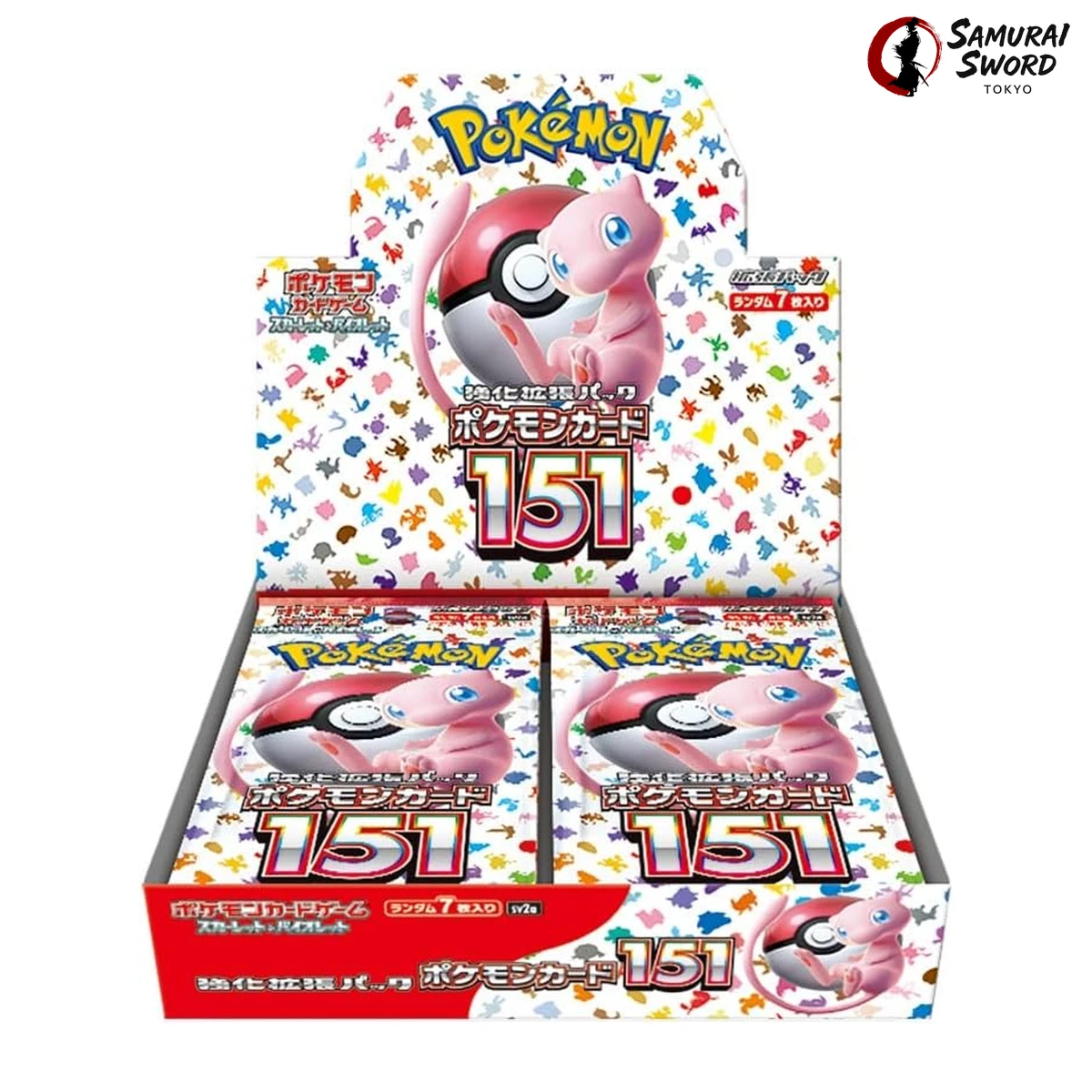
SV2A Pokemon Card 151 Japanese Booster Box, listed on samuraiswordtokyo.com

Japanese vs English Print

Pokemon Card 151 does have an English-set equivalent: 151 (Scarlet & Violet—151, “MEW”), which released internationally in September/October 2023. At the set level, the EN 151 set carries the same design idea — a Poké Ball/Master Ball Reverse Holo parallel treatment that mirrors the JP Poké Ball/Master Ball Mirror mechanic.

No exact English card-number match has been verified for this specific Aerodactyl print, so we won’t assert one here. If you’re trying to match a Japanese Master Ball Mirror copy against an English Reverse Holo, treat the two sets as parallel in concept rather than assuming the card numbers or foil odds line up one-to-one.

Where This Print Sits Among Japanese Rarity Tiers

142/165’s base printed rarity is Rare (R) — one step above SV2a’s Common and Uncommon cards, and below the set’s full-art and secret-rare cards that sit outside the main 165-card numbering. The Master Ball Mirror sits on top of that same Rare print as a foil-pattern parallel, not as a distinct printed rarity of its own.

Within that Rare tier, a given card can carry either of two mirror-holo foil patterns: the more commonly seen Poké Ball pattern, or, per Bulbapedia, “rarely,” the Master Ball pattern that this print carries. No official pull-odds figure has been published for how often either pattern turns up, so we treat this as a foil variant of an ordinary Rare card rather than a headline chase slot — the set’s standout secret-rare and full-art cards, discussed in our Pokemon Card 151 pull-rates hub, sit in a different part of the card list entirely.
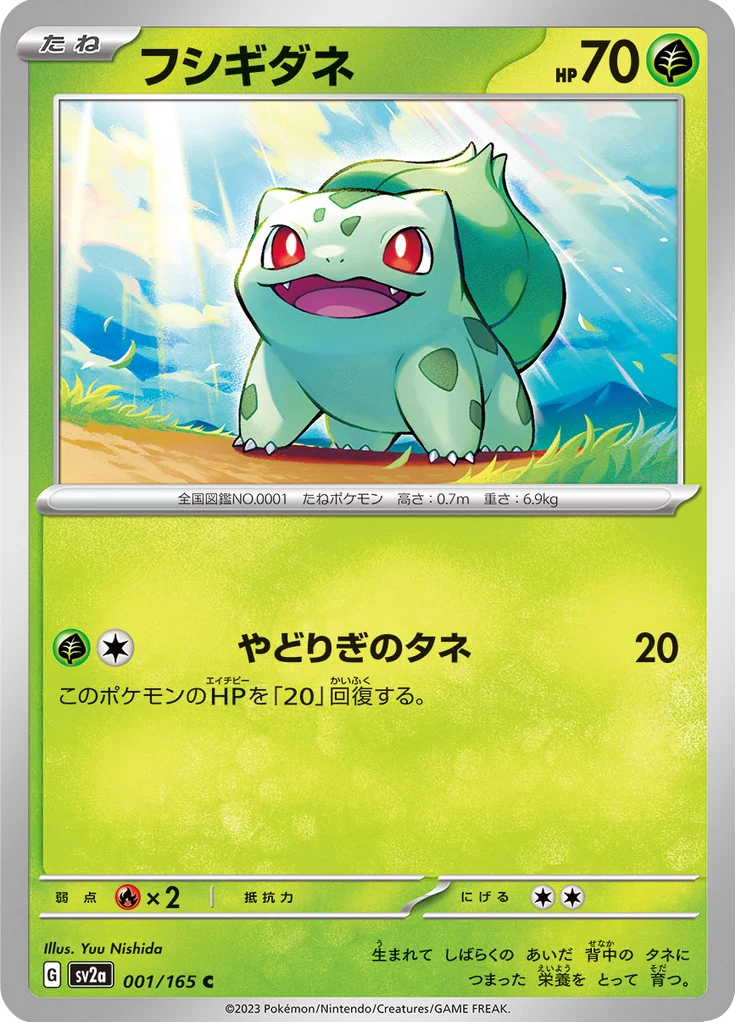
Bulbasaur 001/165, Pokemon Card 151 (SV2a)
Bulbasaur 001/165 — the opening card of Pokemon Card 151 (SV2a)’s main numbering

Shop This Card
PSA 10 Aerodactyl R: Master Ball Mirror 142/165
Currently listed at ¥24,214 (~$152)
Ships from Tokyo · Tracked delivery

View Product →

Where to Buy Aerodactyl from Tokyo

Our graded example of Aerodactyl R: Master Ball Mirror 142/165 carries a current listing at ¥24,214 (~$152), PSA 10 and shipped from Tokyo with tracked delivery. If you’d rather pull your own copy, sealed SV2A-Pokemon 151 Japanese Booster Boxes are the source product for this print, from ¥43,860 (~$276), with a Damaged Box option at ¥53,760 (~$338).
PSA 10 Aerodactyl Master Ball Mirror 142/165 slab, listed on samuraiswordtokyo.com

For other Rare-tier Master Ball Mirror cards from the same set, see our graded PSA 10 Articuno R: Master Ball Mirror [SV2a 144/165] at ¥12,102 (~$76) and PSA 10 Mewtwo R: Master Ball Mirror [SV2a 150/165] at ¥40,299 (~$253), or browse the full range in our PSA 10 graded card collection. For every documented Japanese print of Aerodactyl beyond this one card, see our Aerodactyl Pokemon card guide, and for the same Master Ball Mirror mechanic on a different card, see our Umbreon Master Ball Mirror card guide. For a mixed order across singles and sealed product, our Quick Order page is the fastest way to build a cart.

Frequently Asked Questions

What is Aerodactyl Master Ball Mirror 142/165?

It’s the Master Ball Mirror foil parallel of Aerodactyl’s Rare-tier print, card 142/165 from the Japanese enhanced expansion pack Pokemon Card 151 (set code SV2a), released 16 June 2023. A PSA 10 example of this print carries a current listing at ¥24,214 (~$152).

Is the Master Ball Mirror a separate printed rarity from the regular Rare card?

No. The Master Ball Mirror is a foil-pattern parallel of the same Rare print — same card number, same printed rarity — not a distinct higher rarity tier. Per Bulbapedia, Common, Uncommon and Rare cards in SV2a get a mirror-holo variant in either a Poké Ball pattern or, rarely, a Master Ball pattern.

What set is this card from?

Pokemon Card 151, Japanese set code SV2a, an enhanced expansion pack released 16 June 2023 with 210 total cards and a main numbering that runs to 165. Each Japanese booster pack contains 7 cards with 2 guaranteed holofoils.

Does Aerodactyl Master Ball Mirror have an English print?

Pokemon Card 151’s English equivalent set, 151 (Scarlet & Violet—151, “MEW”), carries the same Poké Ball/Master Ball Reverse Holo design concept at the set level. No exact English card-number match has been verified for this specific Aerodactyl print.

What other Master Ball Mirror cards are available from this set?

We currently list graded PSA 10 Articuno R: Master Ball Mirror (144/165) and PSA 10 Mewtwo R: Master Ball Mirror (150/165) from the same Pokemon Card 151 (SV2a) set, alongside sealed booster boxes that both prints come from.

Where can I buy Aerodactyl Master Ball Mirror from Tokyo?

Our graded 142/165 example carries a current listing at ¥24,214 (~$152), shipped from Tokyo with tracked delivery. Sealed SV2A booster boxes are also available if you’d rather pull your own copy.
Dugtrio Pokemon Card Guide: Every Japanese Print Worth Knowing

Searching Limitless’s Japanese card database by species for Dugtrio (ダグトリオ) returns 12 indexed prints, spanning current Scarlet & Violet reprints back through Sword & Shield and Sun & Moon-era sets. Two more prints are currently listed on our site that don’t appear in that index at all — one from 1997, the other from 2001.

Dugtrio is a Stage 1 Pokemon, evolving from Diglett (ディグダ), and three of the four prints we’ve been able to verify in detail — the two modern reprints and the 1997 vintage original — carry it as a Fighting-type card. We haven’t independently confirmed the type on the fourth, our 2001 Base Expansion Pack anchor. This guide walks through what we’ve verified for each print and which ones you can currently buy from us as graded PSA 10 singles.

Key Takeaway

Limitless’s species search indexes 12 Japanese Dugtrio prints. Two more prints are currently listed on our site — a 1997 Old Back print from the original Japanese Team Rocket expansion and a 2001 print from the Base Expansion Pack, neither of which appears in that index. The 1997 Old Back Dugtrio is currently listed at ¥176,999 (~$1,113), and the Base Expansion Pack print is currently listed without a displayed price — sourcing for anything else goes through Quick Order.

12
Prints Indexed by Limitless

2
Individually Verified Index Prints

Sep 2026
Prices Checked

1997
Earliest Verified Print

The Japanese Dugtrio Cards Verified in This Guide

Searching Limitless’s Japanese card database for Dugtrio by species returns 12 prints, all sorted under “R” on the search index itself:

Set No. Index rarity Individually confirmed?
SV2a (Pokemon Card 151) 51 R (index) / Uncommon on card page Yes — HP 90, Fighting, illustrator Miki Tanaka
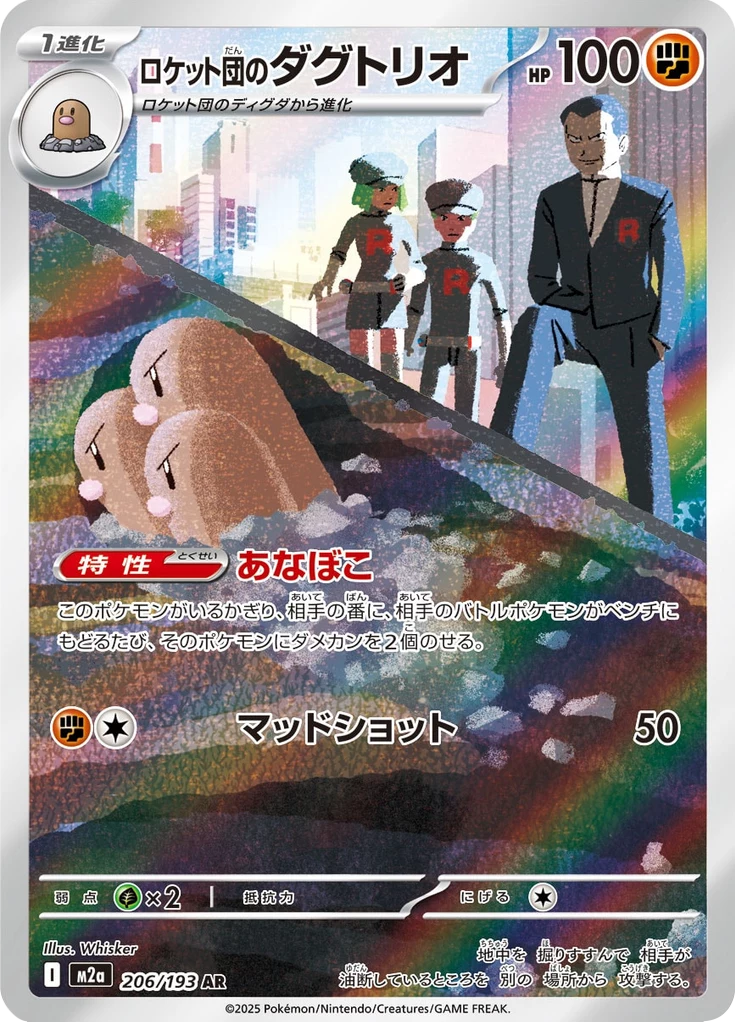
M2a (Mega Dream ex) 206 R (index) / Art Rare on card page Yes — HP 100, Fighting, illustrator Whisker — “Team Rocket’s Dugtrio”
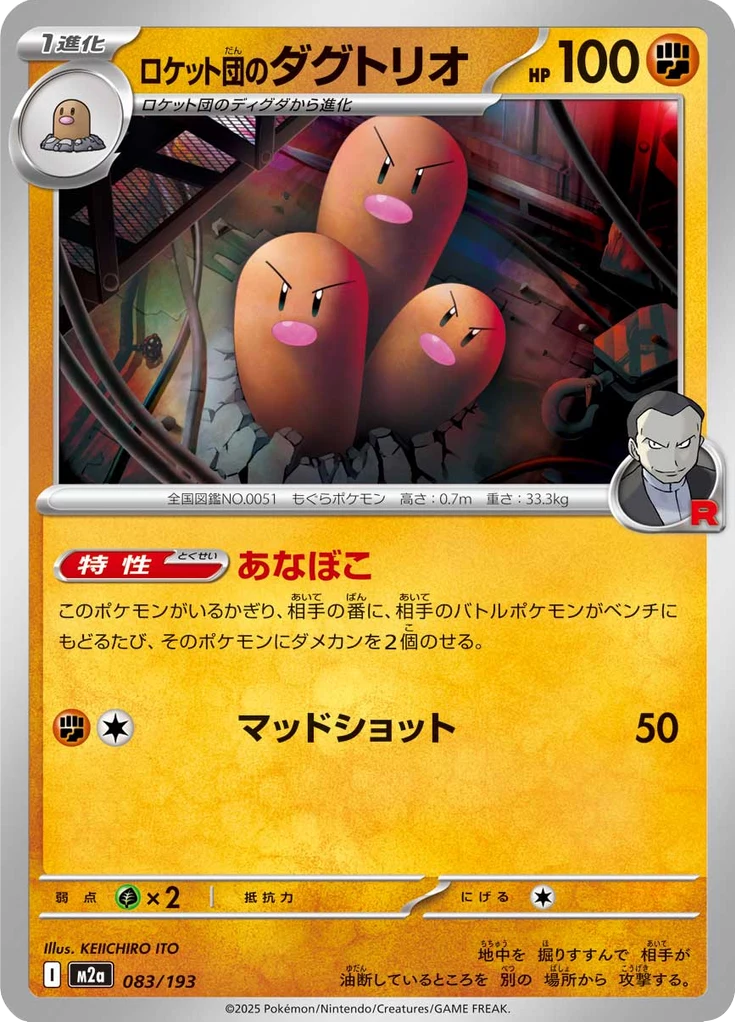
M2a (Mega Dream ex) 83 R No — set/number confirmed only
SV1a 45 R No — set/number confirmed only
SI 207 R No — set/number confirmed only
S5a 34 R No — set/number confirmed only
S2a 39 R No — set/number confirmed only
SAf 2 R No — set/number confirmed only
SM10 44 R No — set/number confirmed only
CP6 54 R No — set/number confirmed only
20th 29 R No — set/number confirmed only
XY1y 30 R No — set/number confirmed only

Note the mismatch on the first two rows: the index sorts every result under a blanket “R,” but the SV2a 51 card page identifies it as Uncommon, and the M2a 206 card page identifies it as an Art Rare. Where we’ve only seen the index listing, we’re not citing illustrator or HP for that print.

Beyond these 12, two more Dugtrio prints are currently listed on our site — a 1997 Old Back print and a 2001 Base Expansion Pack print — that don’t turn up in Limitless’s search at all. Limitless’s coverage of pre-2001 Japanese sets isn’t complete, so treat the totals here as the prints we’ve verified rather than a final count.

The Modern Prints: SV2a 51 and “Team Rocket’s Dugtrio” (M2a 206)

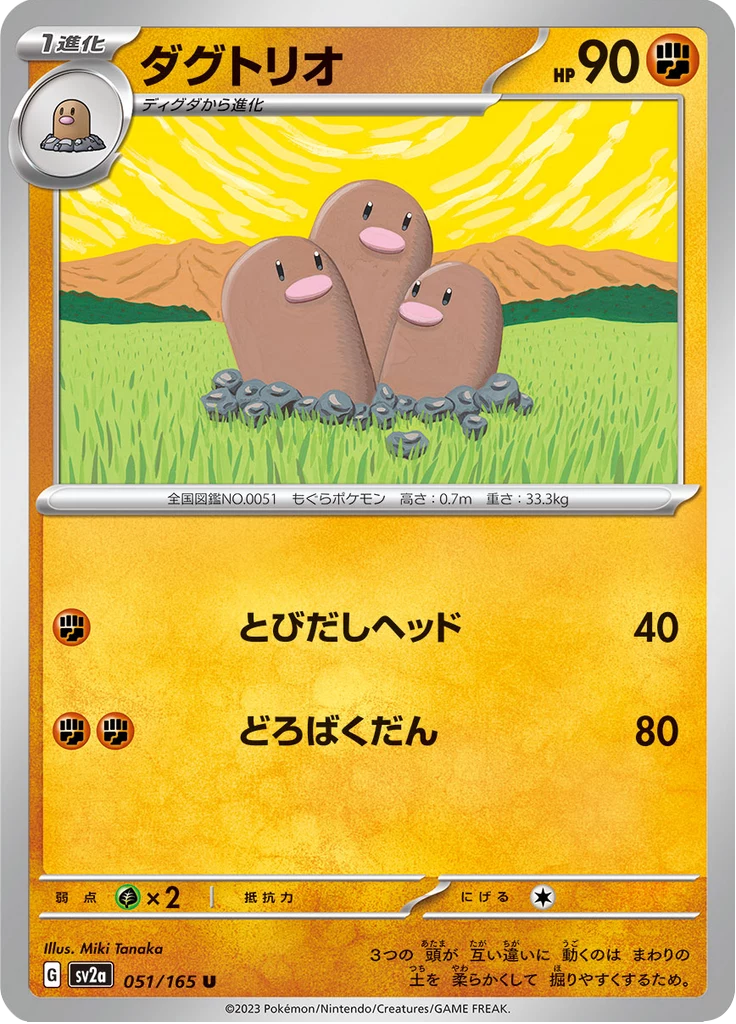
Dugtrio, SV2a 51, Uncommon, Pokemon Card 151

Dugtrio, SV2a 51, Uncommon (Pokemon Card 151)

Team Rocket's Dugtrio, M2a 206, Art Rare, Mega Dream ex

Team Rocket’s Dugtrio, M2a 206, Art Rare (Mega Dream ex)

SV2a 51 is one of Dugtrio’s standard prints, from SV2a, “Pokemon Card 151,” the set built around the original 151 Pokemon — see our full SV2a card list, since Dugtrio’s entry sits at #51 in that checklist. It’s illustrated by Miki Tanaka, HP 90, Fighting-type, and identified as Uncommon on its individual card page even though the search index groups it under the blanket “R” category.
M2a 206 is a different matter entirely. It’s a modern reprint/reimagining literally named “Team Rocket’s Dugtrio” (ロケット団のダグトリオ), from M2a, “Mega Dream ex.” It’s illustrated by Whisker, HP 100, Fighting-type, and an Art Rare on its individual card page. It carries the same Team Rocket villain-team theme as our vintage 1997 anchor below — but the two are not the same card. See the disambiguation section further down.
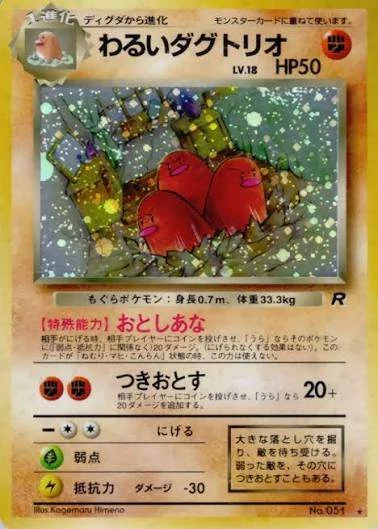
The 1997 Original: Dark Dugtrio from the Team Rocket Expansion (PMCG4)

PSA 10 Dugtrio Old Back Team Rocket 1997 slab, listed on samuraiswordtokyo.com
PSA 10 Dugtrio, Old Back, catalogued by our team as PMCG4 No.051, “Team Rocket”

The earliest Dugtrio print we list doesn’t show up on Limitless at all — a direct card-page lookup for PMCG4/51 returns a 404. The set corresponds to the Japanese “Rocket Gang” (ロケット団) expansion, known in English as Team Rocket. Per Bulbapedia, it released in Japan on November 21, 1997, as the 4th numbered Japanese set, holding 65 cards in total. Dugtrio appears in this set as “Dark Dugtrio,” a Rare Holo Fighting-type card; the English Team Rocket equivalent is #6/82.

Our own listing catalogues this slab as “No.051,” but that number doesn’t match either the 65-card Japanese checklist or the 82-card English checklist directly — likely an internal catalog reference rather than an official Team Rocket print number, and we’re not asserting it as one until we can verify it further. This print uses the 1996–2001 “Old Back” card design; see our Old Back vs New Back explainer for how to spot that design at a glance, and our Japanese Old Back cards guide for the wider category this print sits in.

Check This First

If the back of your card uses the older Old Back design with no printed set icon in the corner, and the artwork is a dark-toned recolour, you’re likely looking at a Team Rocket-era “Dark” Pokemon print — the theme this 1997 set introduced.

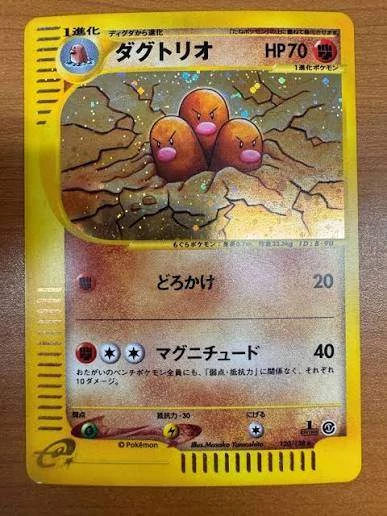
The 2001 Print: Dugtrio from the Base Expansion Pack (e1 120/128)

PSA 10 Dugtrio e1 Base Expansion Pack 120/128 slab, listed on samuraiswordtokyo.com
PSA 10 Dugtrio, 1ED, catalogued by our team as e1 120/128, “Base Expansion Pack”

Our second vintage anchor also doesn’t turn up on Limitless — the e-series sets aren’t indexed there. Per Bulbapedia, the Japanese “Base Expansion Pack” released December 1, 2001, with 128 cards total, matching the “/128” denominator on our listing. The English equivalent, Expedition Base Set, followed on September 15, 2002, with 165 cards; Dugtrio appears there twice, as #10/165 (Rare Holo) and #44/165 (Rare, non-holo).

This anchor is listed on our site without a displayed price — enquiries for it route through Quick Order rather than a checkout price.

Three Cards Named “Team Rocket”: Don’t Mix Them Up

Two of the prints above share a name, and it’s worth separating them. The 1997 “Dark Dugtrio” comes from the original Japanese Team Rocket expansion (Rocket Gang, PMCG4) — a vintage set built around the anime villain team. The M2a 206 card, “Team Rocket’s Dugtrio,” is a completely different card, printed 28 years later as a modern reprint/reimagining on the same theme, from an unrelated 2025–26 set (M2a, “Mega Dream ex”). Same theme, different cards, different eras — the M2a print is not a reprint of the 1997 original.

There’s also a third, unrelated product using the same branding: SV10, “Glory of Team Rocket”, a 2024 Scarlet & Violet-era set. We haven’t verified whether that set carries a Dugtrio print, and it isn’t an anchor in this guide — it’s noted here only so the naming doesn’t get confused with the two Dugtrio prints above.

For the wider picture of every card named after the villain team, see our Team Rocket Pokemon Card Family guide — a cross-species survey covering both our vintage Dark Dugtrio and the modern Team Rocket’s Dugtrio concept. This guide is a Dugtrio-only deep dive across every set, not just the Team Rocket-branded ones. Our Team Rocket’s Mewtwo ex card guide covers a sibling single-card guide using the same modern naming convention.

Other Verified Prints via the Limitless Index

Dugtrio, M2a 83, R, Mega Dream ex

Dugtrio, M2a 83, R (Mega Dream ex)

Ten more prints are confirmed to exist via Limitless’s search index — M2a 83, SV1a 45, SI 207, S5a 34, S2a 39, SAf 2, SM10 44, CP6 54, 20th 29, and XY1y 30 — each returning a set code, card number, and “R” index rarity. The card image for M2a 83 loads and confirms the print, but we didn’t open its full card page, so we’re not citing illustrator or HP for it or the other nine here; set and number are the only facts carried forward for that group.

Across all 12 indexed prints, the pattern holds: a Dugtrio reprint sorted under a blanket “R” rarity on the search index, spread across Scarlet & Violet, Sword & Shield, Sun & Moon and XY-era sets.

Chase Prints and What Makes Them Collectible

None of the individually verified Dugtrio prints sit at a secret-rare or full-art tier in the modern sense — SV2a 51 is an Uncommon, and M2a 206’s Art Rare is the highest rarity tier we’ve confirmed on any print in this guide. What makes the two vintage anchors collectible is age and design era rather than a printed rarity symbol:

  • The 1997 Team Rocket print (PMCG4) is collectible for its production window — the Old Back card design ran from 1996 to 2001 and was retired afterward, and Bulbapedia documents this print as a Rare Holo within that 65-card set.
  • The 2001 Base Expansion Pack print (e1) is Dugtrio’s other vintage anchor, matching the 128-card Japanese checklist Bulbapedia confirms for that release.
  • PSA 10 grading itself is what elevates either of these vintage slabs above an ungraded copy of the same print — a gem-mint certification applies on top of whichever set and rarity the card originally carried.

The Art Rare M2a 206 sits differently: its collectibility comes from being a current, still-releasing modern reprint on a recognisable villain-team theme, rather than from age.

Which Japanese Dugtrio Prints Are Currently Listed

Of the 14 Dugtrio prints covered in this guide, three of them sit on our site right now — all as graded PSA 10 singles:

The remaining 12 indexed prints aren’t listed on our site at the moment; sourcing requests for those go through Quick Order.

Shop This Print
PSA 10 Dugtrio, Old Back, PMCG4 No.051, “Team Rocket”
Currently listed at ¥176,999 (~$1,113)
Ships from Tokyo · Tracked delivery

View Product →

Where to Buy Dugtrio Cards from Tokyo

We ship Japanese graded singles and sealed product worldwide out of Tokyo with tracked delivery. For Dugtrio specifically, both currently listed prints are vintage PSA 10 singles — the 1997 Team Rocket Old Back print and the 2001 Base Expansion Pack print. For the wider graded-card selection, browse our PSA 10 graded card collection.

Among Dugtrio’s modern prints, the Team Rocket’s Dugtrio AR (M2a 206/193) is currently listed at ¥5,305 (~$33). SV2a 51 comes from Pokemon Card 151, covered set-wide in our SV2a card list, and M2a 206 belongs to the same Team Rocket-branded reprint wave covered in our Team Rocket Pokemon Card Family guide and our Team Rocket’s Mewtwo ex card guide. For any of the ten remaining index-only prints, or a different Dugtrio print entirely, request a quote via our Quick Order page — there’s no timing attached to sourcing requests, but it’s the fastest way to check availability on a specific print.

Frequently Asked Questions

How many Japanese Dugtrio card prints are there?

Limitless’s species search indexes 12 Japanese Dugtrio prints, and two more prints are currently listed on our site — a 1997 Old Back print and a 2001 Base Expansion Pack print — that don’t appear in that index. Pre-2001 Japanese sets aren’t fully indexed on Limitless, so this guide covers the prints we’ve verified rather than a final total.

What is the oldest Dugtrio card?

The 1997 Old Back print from the Japanese Team Rocket expansion (Rocket Gang, PMCG4), released November 21, 1997 per Bulbapedia. Dugtrio appears there as “Dark Dugtrio,” a Rare Holo Fighting-type card; our listing catalogues it as No.051, though that number doesn’t match either the Japanese or English checklist directly.

Is “Team Rocket’s Dugtrio” (M2a 206) the same card as the 1997 Old Back Dugtrio?

No. They’re different cards released 28 years apart. The 1997 print is “Dark Dugtrio” from the original Team Rocket expansion; the M2a 206 print is a modern reprint/reimagining literally named “Team Rocket’s Dugtrio,” from an unrelated 2025–26 set. Both share the villain-team theme, but neither is a reprint of the other.

Does the e1 Base Expansion Pack Dugtrio have an English equivalent?

Yes, per Bulbapedia. The English Expedition Base Set (September 15, 2002) carries Dugtrio twice, as #10/165 (Rare Holo) and #44/165 (Rare, non-holo), corresponding to the Japanese Base Expansion Pack (December 1, 2001, 128 cards).

Where can I buy Japanese Dugtrio cards?

We ship graded singles and sealed product from Tokyo with tracked delivery. Two Dugtrio PSA 10 prints are currently listed on our site, and requesting a quote via our Quick Order page covers sourcing for any of the other prints in this guide.

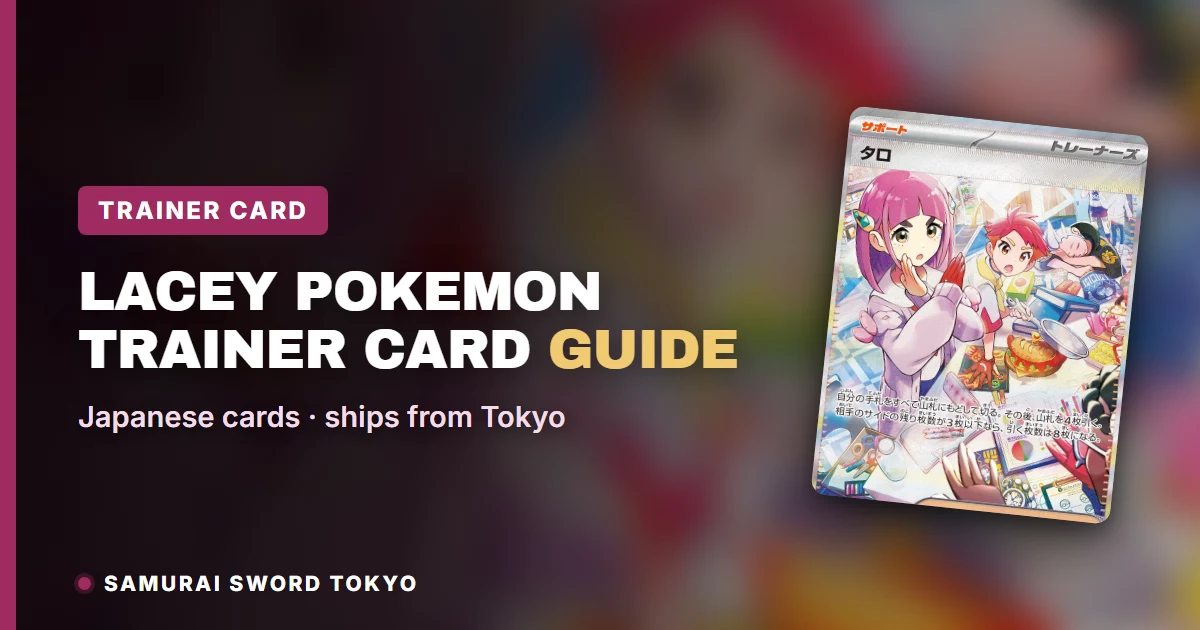
Lacey Pokemon Trainer Card Guide (Japanese SR/SAR)

One Supporter card, one printed effect, three Japanese numbers — and two of them come from the very same set.

Lacey is a member of the Elite Four in Pokemon Scarlet & Violet, and her card exists in three confirmed Japanese prints: two from the expansion pack Stellar Miracle (SV7), released the same day at two different rarities, and a third from the high class pack Terastal Festival ex (SV8a), released almost five months later. This guide covers all three prints — what the card does, how the numbering breaks down across the two sets, and where the Japanese and English markets connect.

Key Takeaways

Lacey has three confirmed Japanese prints, all part of our female Pokemon trainer card roundup: PSA 10 Lacey SAR 131/102, currently listed at ¥39,047 (~$246), and PSA 10 Lacey SR 124/102, currently listed at ¥11,446 (~$72), both from Stellar Miracle (SV7), plus PSA 10 Lacey SAR 231/187, currently listed at ¥7,198 (~$45), from Terastal Festival ex (SV8a). All three prints run the same card text: put your entire hand into your deck and shuffle, then draw 4 cards — or 8 if your opponent has 3 or fewer Prize cards remaining.

3
Prints Covered

SR / SAR
Rarities (our listing)

2
Sets (SV7 & SV8a)

Sep 2026
Prices Checked

Prices are our own listed prices as of September 2026, converted at ¥159/USD.

Japanese vs English Print

Stellar Miracle (SV7) is the Japanese source set for the English expansion Stellar Crown — the same naming pairing our own set-list and pull-rates guides for SV7 already use. Per a Limitless card-page summary fetched for this guide, the 131/102 SAR print corresponds to Stellar Crown #139 in the English set. That pairing is well supported and we present it with confidence.

The picture is less clear for the other two prints. Limitless’s summaries for 124/102 and 231/187 referenced “Stellar Crown and Prismatic Evolutions” generically, without a single confirmed English card number for either print. Treat any specific English number you see quoted for the 124/102 SR or the 231/187 SAR as unverified/reported only rather than a confirmed cross-reference — and note that Terastal Festival ex (SV8a) and Stellar Miracle (SV7) are two separate Japanese sets, so the 231/187 print should not be conflated with either Stellar Miracle print when you’re matching numbers.

If you’re specifically hunting an English-language Lacey card, check the exact number against a current English checklist before buying, rather than relying on these Japanese numbers as a substitute.

Where Lacey’s SR and SAR Sit in Japanese Rarity Tiers

All three Lacey prints sit in their respective sets’ above-the-set-count numbering block — 131/102 and 124/102 against Stellar Miracle’s “/102” denominator, and 231/187 against Terastal Festival ex’s “/187” denominator — which is where Japanese sets place their higher-rarity Supporter and Trainer cards. Our own SR and SAR labels track how each print is catalogued on our site; Limitless’s generic “Secret Rare” filter bucket for the 124/102 print describes the same card from its own database structure, not necessarily the literal rarity text printed on the card itself, so we lead with our own SR/SAR terms throughout.

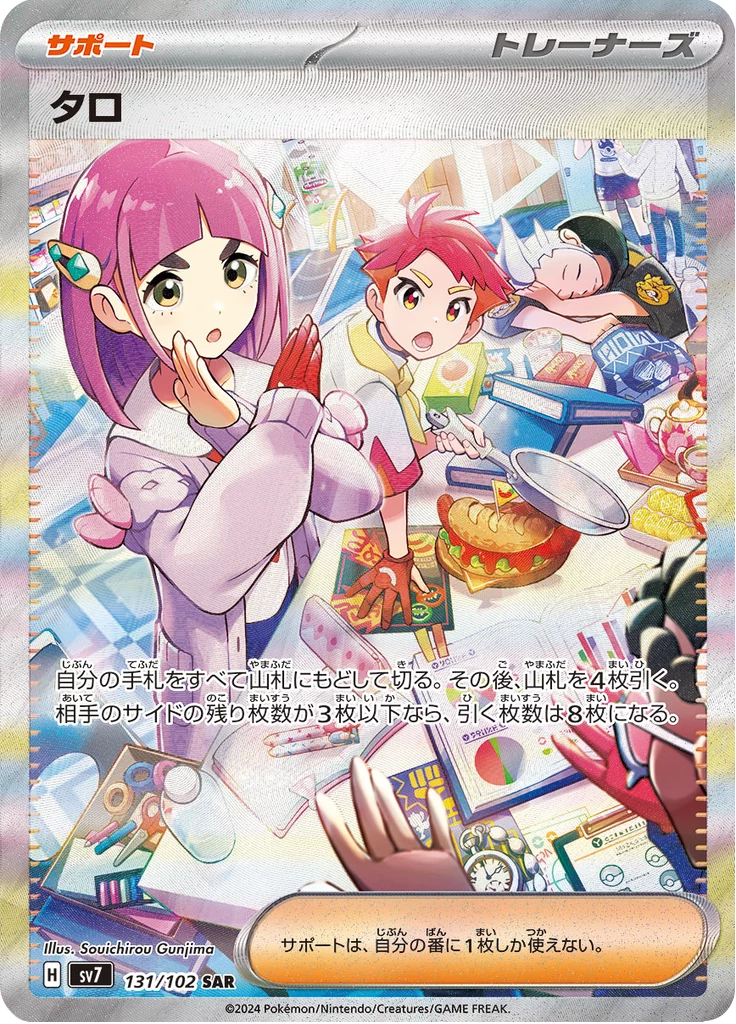
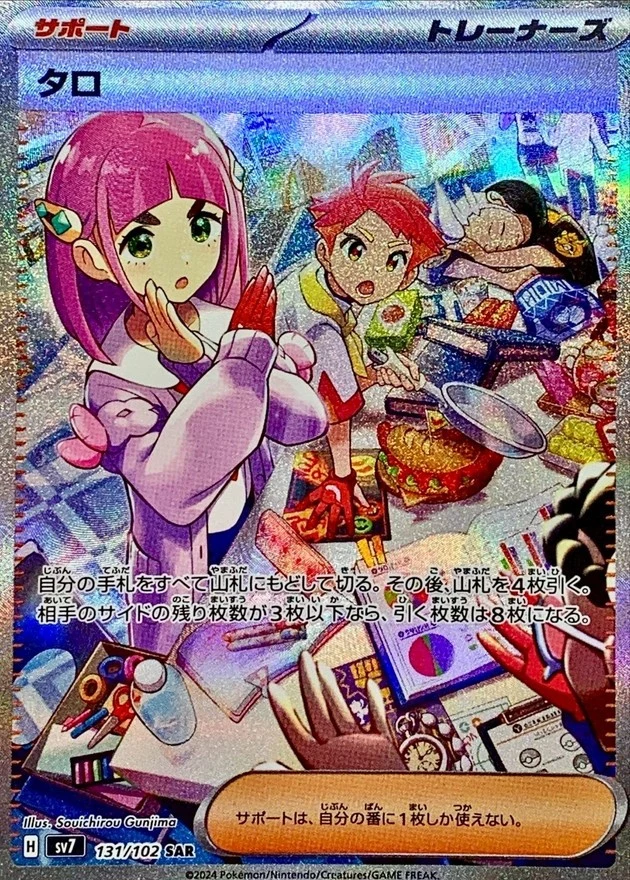
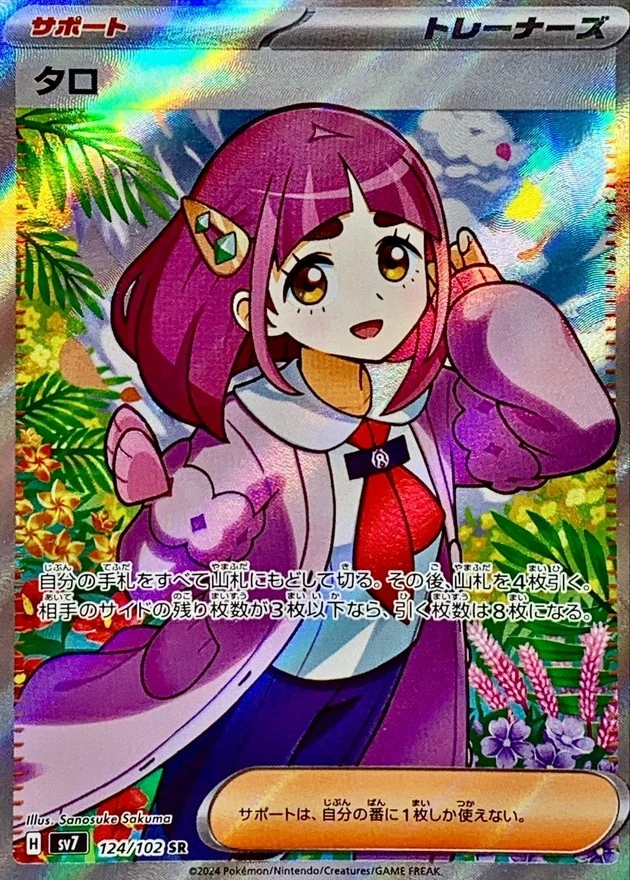
Lacey SAR 131/102 Stellar Miracle Japanese Pokemon Supporter card

Lacey SAR 131/102

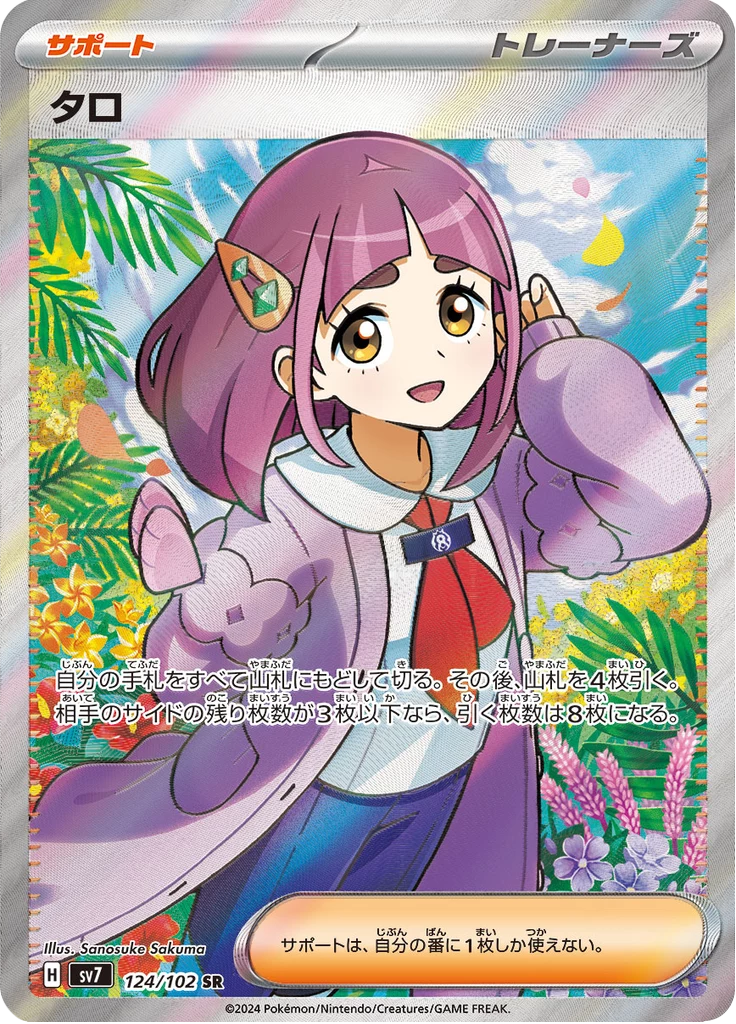
Lacey SR 124/102 Stellar Miracle Japanese Pokemon Supporter card

Lacey SR 124/102

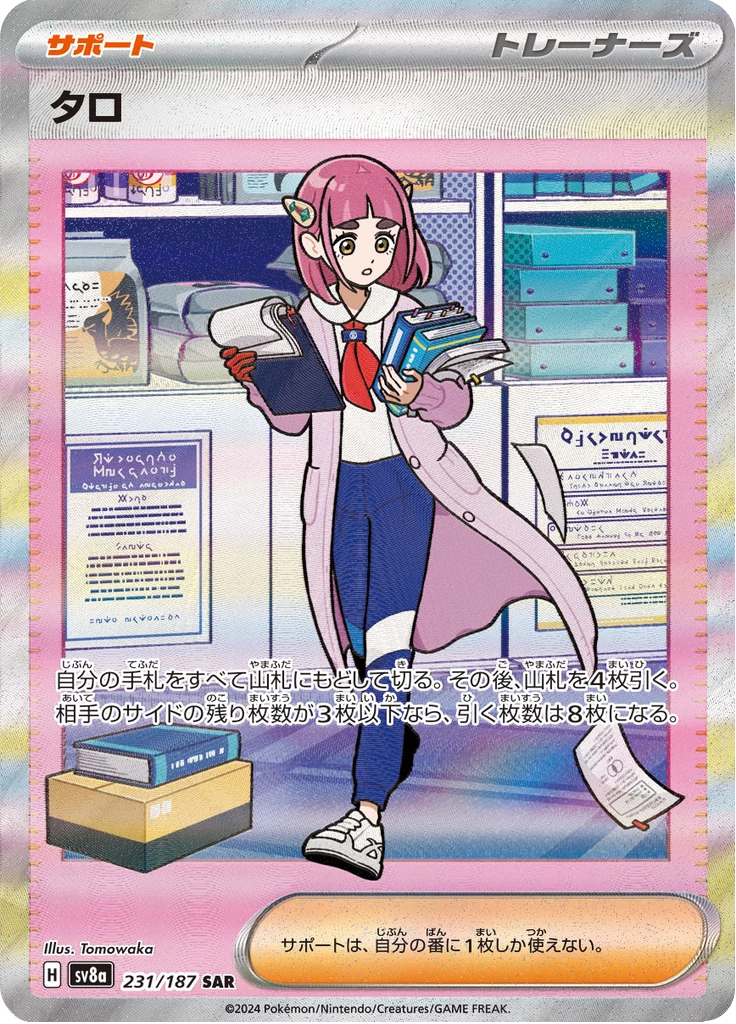
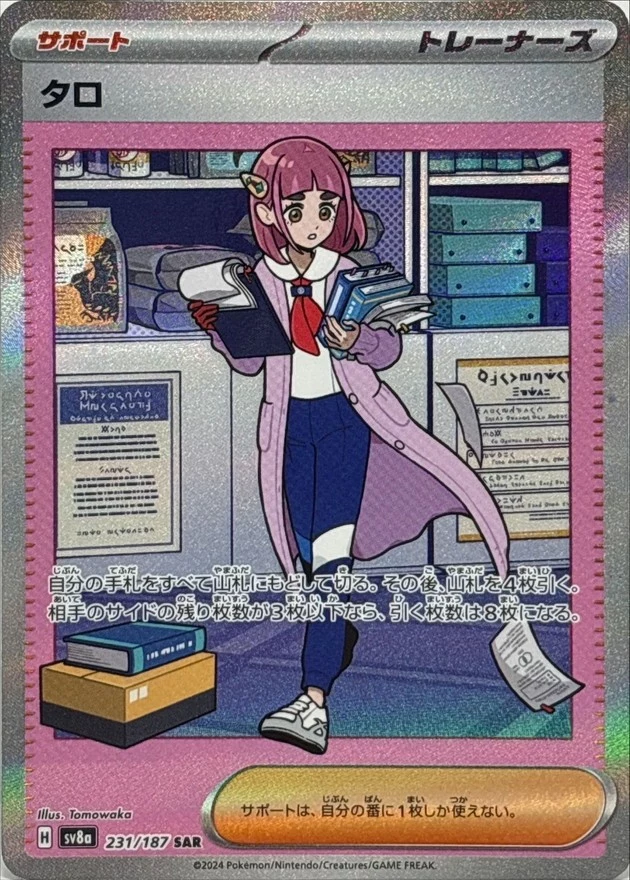
Lacey SAR 231/187 Terastal Festival ex Japanese Pokemon Supporter card

Lacey SAR 231/187

For a broader view of where SR- and SAR-class Supporter prints sit across Japanese sets generally, our full-art SR/SAR trainer card guide and PSA 10 trainer card guide cover the wider rarity ladder in more depth than a single character’s cards can.

Shop This Card
PSA 10 Lacey SAR (131/102, Stellar Miracle)
Currently listed at ¥39,047 (~$246)
Ships from Tokyo · Tracked delivery

View Product →

Where to Buy Lacey Cards from Tokyo

We ship graded and raw Japanese singles out of Tokyo with tracked delivery. All three Lacey prints below are individually listed PSA 10 units.

Print Set Card # Rarity (our listing) Illustrator Our price
Lacey Stellar Miracle (SV7) 131/102 SAR Souichirou Gunjima ¥39,047 (~$246)
Lacey Stellar Miracle (SV7) 124/102 SR Sanosuke Sakuma ¥11,446 (~$72)
Lacey Terastal Festival ex (SV8a) 231/187 SAR Tomowaka ¥7,198 (~$45)

If you’d rather open the sets yourself, the Stellar Miracle (SV7) sealed booster box is currently listed at ¥10,192 (~$64) — source of the two SV7 prints — and the Terastal Festival ex (SV8a) sealed booster box is currently listed at ¥17,510 (~$110), source of the 231/187 SAR.

For more graded Japanese Supporter cards in this category, browse our PSA 10 graded card collection, or see our guide to Briar’s Supporter cards, another Elite Four character from the same Stellar Miracle set. For anything not covered here, our Quick Order page is the fastest way to build a mixed order.

Frequently Asked Questions

Who is Lacey on this Pokemon TCG card?

Lacey is a member of the Elite Four in Pokemon Scarlet & Violet. Her Japanese card name is タロ (Taro), and her Supporter card appears in three confirmed Japanese prints across two sets.

How many Japanese prints of Lacey are there?

Three: SAR 131/102 and SR 124/102, both from Stellar Miracle (SV7), released 19 July 2024, plus SAR 231/187 from Terastal Festival ex (SV8a), released 6 December 2024.

What does the Lacey Supporter card do?

All three prints share the same effect: put your entire hand into your deck and shuffle, then draw 4 cards — draw 8 instead if your opponent has 3 or fewer Prize cards remaining. The card carries Regulation Mark H.

Is there an English-language version of the Lacey card?

The 131/102 SAR corresponds to Stellar Crown #139 in the English set, per a Limitless card-page summary. For the 124/102 SR and 231/187 SAR, Limitless referenced “Stellar Crown and Prismatic Evolutions” generically without a confirmed card number, so treat any specific number for those two as unverified.

Why are there two different Lacey prints from the same set (SV7)?

Stellar Miracle (SV7) includes Lacey at two rarities — SAR 131/102, illustrated by Souichirou Gunjima, and SR 124/102, illustrated by Sanosuke Sakuma — both released the same day, 19 July 2024. Different illustrators and different card numbers identify which print you’re holding.

Where can I buy a PSA 10 Lacey card from Japan?

The 131/102 SAR is currently listed at ¥39,047 (~$246), the 124/102 SR at ¥11,446 (~$72), and the 231/187 SAR at ¥7,198 (~$45), all shipped from Tokyo. The Stellar Miracle and Terastal Festival ex sealed booster boxes, which contain these prints, are listed at ¥10,192 (~$64) and ¥17,510 (~$110) respectively. Sourcing requests for anything else go through our Quick Order page.

OP-12 Booster Box Buying Guide: Legacy of the Master Japanese One Piece Box

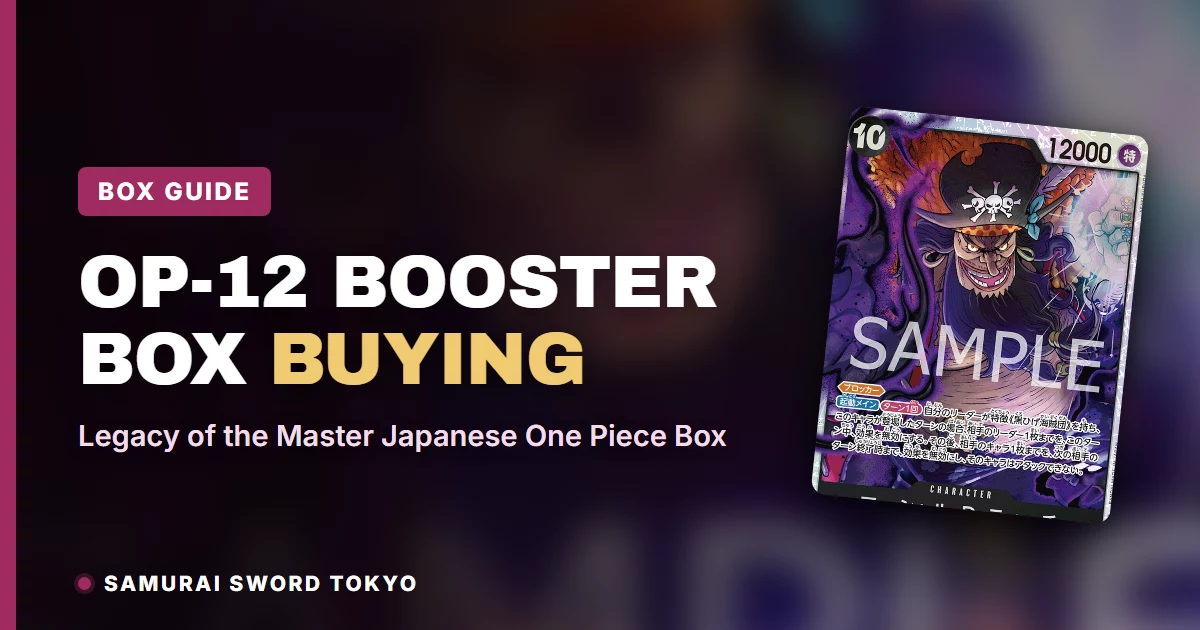
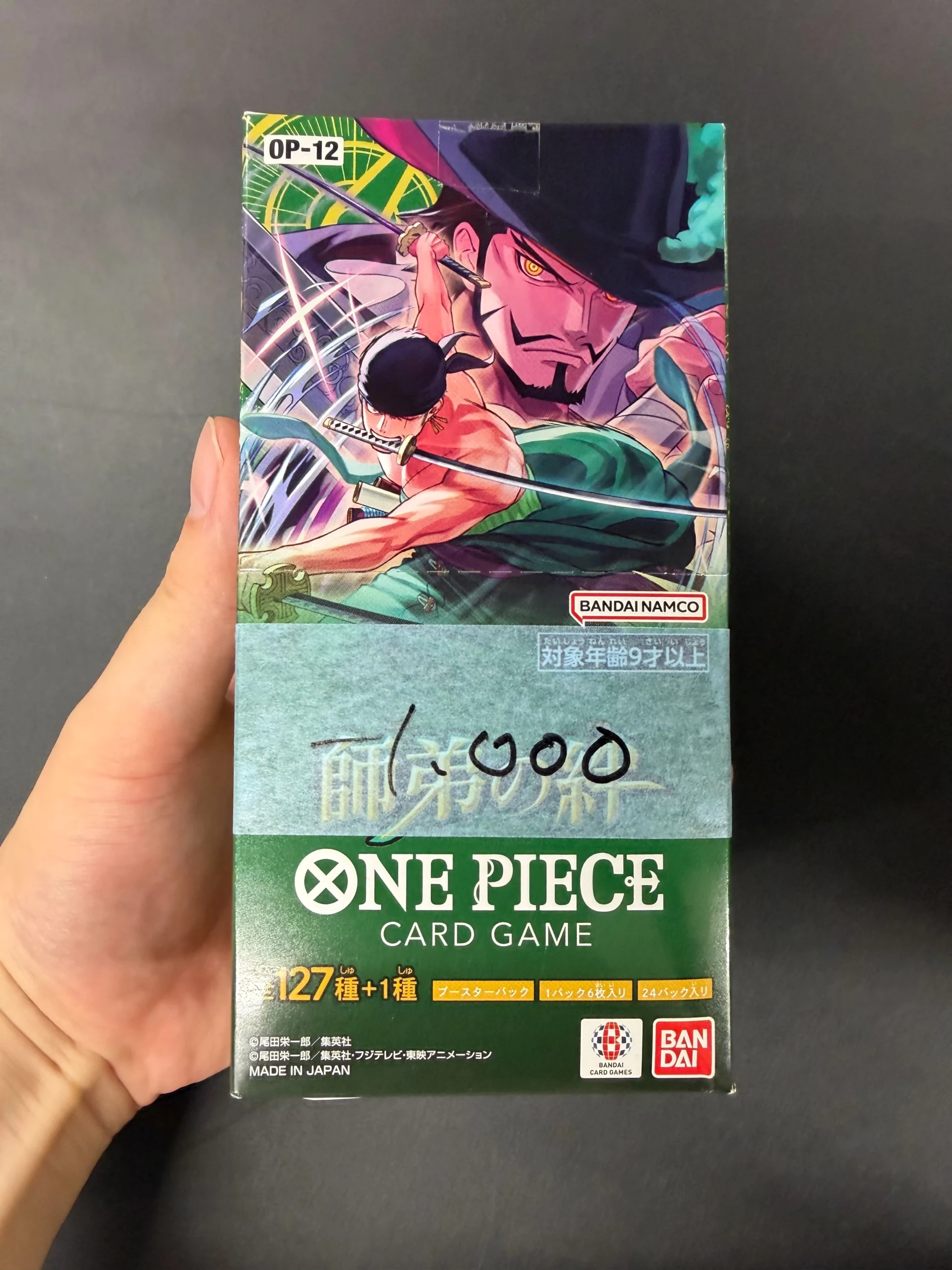
OP-12, Legacy of the Master (師弟の絆), is One Piece Card Game’s mentor-and-student set — Silvers Rayleigh and Luffy, Dracule Mihawk and Zoro, Bartholomew Kuma and Bonney, built across six new Leaders: Rayleigh, Gol D. Roger, Zoro, Kuzan, Sanji, and Rosinante. It released in Japan on May 31, 2025, with the English-language version following roughly three months later, on August 22, 2025.

If you’re deciding whether to open a box of OP-12, this guide covers what’s actually inside one, which cards define the set’s chase tier, why our Damaged Box listing is the only OP-12 box option on our site right now, and where the Japanese and English versions currently stand. We ship Japanese sealed product out of Tokyo, so every price below reflects our own live listings today — not a historical snapshot or a third-party figure.

Key Takeaway

OP-12, Legacy of the Master, is a 129-card-type set built around mentor-student pairs from across the One Piece saga, sold in 24-pack boxes at 6 cards per pack in Japanese. The chase tier is topped by the 3rd Anniversary Special Card of Marshall D. Teach in Gold and Silver backgrounds — both printed under the reused card number OP09-093 rather than an OP-12 number — plus Jewelry Bonney’s Secret Rare Comic Parallel (OP12-118). Our OP-12 Damaged Box is currently listed at ¥18,050 (~$114); the Regular Box isn’t listed on our site at the moment. A PSA10 Jewelry Bonney is currently listed at ¥173,455 (~$1,091).

129
Card Types in Set

24
Packs per Box

6
Cards per Pack (JPN)

May 2025
Japan Release

Prices below are our own listed prices as of September 7, 2026, converted at ¥159/USD. These are our listings, not third-party market prices, and they move — always check the linked product page for the current figure.

What’s in an OP-12 Legacy of the Master Box

Item Value
Japanese/English name Legacy of the Master (師弟の絆)
Set code OP-12
JP release date May 31, 2025
EN release date August 22, 2025
Card types in set 129
Packs per box 24
Cards per pack 6 (Japanese) / 12 (English)
Theme Mentor-and-student pairs across the One Piece saga

The set introduces six new Leaders, each built around one of those mentor-student pairings: Rayleigh and Gol D. Roger anchor the Roger Pirates side, Zoro and Kuzan bring in the swordsman and the ex-Admiral, and Sanji and Rosinante round out the six. That spread is the throughline for the whole release — rather than centring on one crew or arc, OP-12 pulls specific relationships from across the entire series.

Rarity-wise, the set’s own guide (whose itemised tiers don’t account for every one of the 129 card types) breaks the set down as 6 Leaders, a base tier of Common, Uncommon and Rare cards (45/30/26 respectively, per the store’s existing pull-rates guide — a distribution described there as implied rather than an officially itemised count), 10 Super Rare, 2 Secret Rare, 6 Special Art Parallel, 1 Treasure Rare, and 2 3rd Anniversary Special Cards (Gold and Silver). The 24-pack, 6-card-per-pack Japanese box format matches the standard OPTCG structure used across recent Japanese releases; the English box instead runs 12 cards per pack across the same 24 packs.

Chase Cards in OP-12: Legacy of the Master

OP-12’s chase tier is headlined by a 3rd Anniversary Special Card of Marshall D. Teach that carries a card number from a completely different set, alongside a Secret Rare Comic Parallel of Jewelry Bonney and two Zoro-linked parallels.

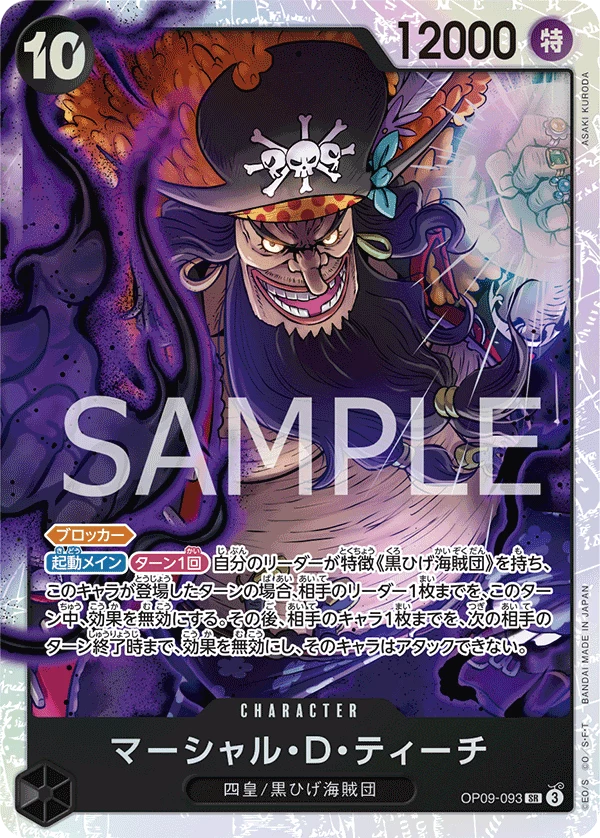
Marshall D. Teach — 3rd Anniversary Special Card, Gold & Silver Backgrounds

Marshall D. Teach card OP09-093, Comic Parallel, original OP-09 printing reused for the OP-12 3rd Anniversary Special Cards
Marshall D. Teach, OP09-093 — the original OP-09 Comic Parallel artwork that the OP-12 3rd Anniversary Special Cards reuse

Worth flagging directly: this is not an OP-12-numbered card. Both the Gold-background and Silver-background 3rd Anniversary Special Cards distributed inside OP-12 packs are printed under card number OP09-093 — the same number as the original Marshall D. Teach Comic Parallel from OP-09 — rather than carrying a number of their own. That’s a deliberate cross-set numbering choice tied to the 3rd Anniversary release, not a mispack or an error, but it does mean you won’t find these two cards by searching an OP-12 number.

The Gold-background version is the set’s top chase card. A graded copy is currently listed at ¥397,896 (~$2,502). The Silver-background version is not listed on our site at the moment; sourcing requests go through Quick Order.

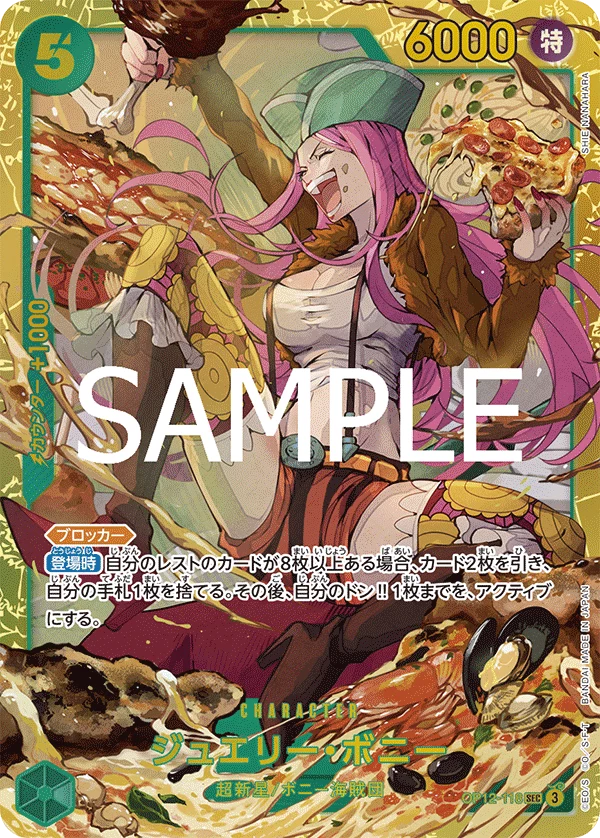
Jewelry Bonney — OP12-118, Secret Rare Comic Parallel

Jewelry Bonney card OP12-118, Secret Rare Comic Parallel, OP-12 Legacy of the Master
Jewelry Bonney, OP12-118, Secret Rare Comic Parallel — OP-12 Legacy of the Master

Bonney’s Secret Rare Comic Parallel is the set’s top card that actually carries an OP-12 number, and it fits the set’s theme directly — she’s one half of the Kuma/Bonney mentor pairing the release is built around. A graded copy is currently listed at ¥173,455 (~$1,091).

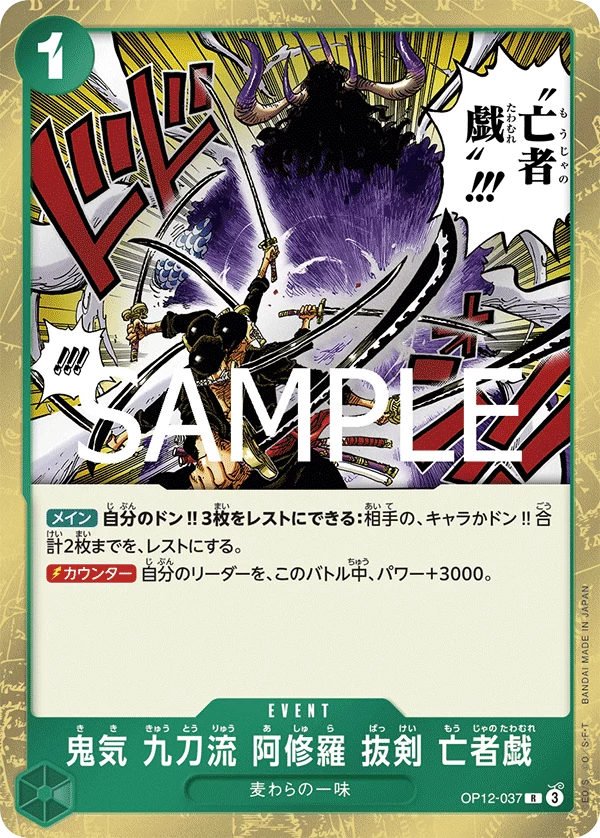
Demon Aura Nine Sword Style Asura — OP12-037, Rare Parallel

Demon Aura Nine Sword Style Asura event card OP12-037, Rare Parallel, OP-12 Legacy of the Master
Demon Aura Nine Sword Style Asura, OP12-037, Rare Parallel — OP-12 Legacy of the Master

This is Zoro’s event-card parallel, sitting at the Rare rarity tier rather than one of the set’s higher secrets. It’s not currently listed on our site; sourcing requests go through Quick Order.

Roronoa Zoro — OP12-020, Leader Parallel

The fifth card in this set’s chase tier is a Leader-rarity parallel of Roronoa Zoro himself, one of the set’s six new Leaders and the other half of the Mihawk/Zoro mentor pairing. It’s not currently listed on our site; sourcing requests go through Quick Order.

Card Number Rarity
Marshall D. Teach (Gold Background) OP09-093 3rd Anniversary Special Card
Marshall D. Teach (Silver Background) OP09-093 3rd Anniversary Special Card
Jewelry Bonney OP12-118 Secret Rare, Comic Parallel
Demon Aura Nine Sword Style Asura OP12-037 Rare Parallel
Roronoa Zoro OP12-020 Leader Parallel

Currently listed on our site, PSA10 graded:

PSA10 graded Jewelry Bonney card OP12-118, Secret Rare Comic Parallel, OP-12 Legacy of the Master

PSA10 Jewelry Bonney, OP12-118

PSA10 graded Marshall D. Teach card OP09-093, 3rd Anniversary Special Card, Gold Background, distributed in OP-12 packs

PSA10 Marshall D. Teach (Gold), OP09-093

For a card-by-card breakdown that goes deeper than these five — framed around estimates rather than official odds — see our OP-12 pull rates and best cards guide, which this box-buying guide differs from by focusing on the box itself rather than pull-by-pull odds. For the complete 129-type checklist, see our OP-12 card list, and for every parallel and alt-art printing, our OP-12 parallel & alt-art card list (36 versions).

Regular Box vs Damaged Box for OP-12

OP-12 Legacy of the Master Japanese One Piece Booster Box, Damaged Box listing
OP-12 Legacy of the Master Japanese One Piece Booster Box — Damaged Box listing

On our site, “Damaged Box” is a condition category for sealed boxes where the outer packaging — not the contents — is affected. The 24 packs inside stay factory-sealed regardless of the outer box’s condition, so a Damaged Box gets you the same sealed packs a Regular Box would.

Right now, the Damaged Box is the only OP-12 box listing on our site: it’s currently listed at ¥18,050 (~$114). This set’s Regular Box is not listed on our site at the moment; sourcing requests for it go through Quick Order. We also don’t currently list a No Shrink variant for OP-12.

If you’re weighing Damaged Box pricing for OP-12 against other One Piece sets, our One Piece Damaged Box lineup guide covers the comparison across OP-04 through OP-12.

Japanese vs English Version of OP-12

OP-12, Legacy of the Master, is the same set in both languages — there’s no separate English-only name or split card pool to account for. The English version released under the same name roughly three months after Japan: August 22, 2025 against a May 31, 2025 Japan release.

The two versions do differ in pack structure. The Japanese box runs 6 cards per pack across 24 packs; the English box uses 12 cards per pack across the same 24-pack count. What we sell is the Japanese printing, sealed and shipped from Tokyo. If your interest is specifically in the Japanese-language cards — for display, for a Japanese-format table, or simply because that’s the print you collect — the Damaged Box listing above is Japanese product.

Where to Buy an OP-12 Booster Box from Tokyo

We ship sealed Japanese OP-12 boxes and PSA10-graded singles worldwide from Tokyo with tracked delivery.

Shop This Set
OP-12 Legacy of the Master Japanese One Piece Booster Box — Damaged Box
Currently listed at ¥18,050 (~$114)
Ships from Tokyo · Tracked delivery

View Product →

For the graded singles, the PSA10 Jewelry Bonney and the PSA10 Marshall D. Teach (Gold) are both currently listed and linked above. For the wider One Piece lineup, our One Piece booster box collection covers every set we currently list, and our franchise-level One Piece booster box buying guide is the place to start if you’re deciding between OP-12 and another set entirely. For graded singles more broadly, see our PSA10 graded card collection. For the Regular Box, the Silver-background Teach card, the Zoro-linked parallels, or anything else not currently listed, the Quick Order page is the fastest way to reach us.

Frequently Asked Questions

What’s inside an OP-12 Legacy of the Master booster box?

An OP-12 box contains 24 packs. The Japanese box runs 6 cards per pack; the English box runs 12 cards per pack. The set totals 129 card types across 6 new Leaders, a Common/Uncommon/Rare base tier, and a secret tier running from Super Rare up to two 3rd Anniversary Special Cards, built around mentor-and-student pairs from across the One Piece saga.

What are the chase cards in OP-12?

The top chase is the 3rd Anniversary Special Card of Marshall D. Teach, distributed in Gold and Silver background versions. Also in the chase tier: Jewelry Bonney’s Secret Rare Comic Parallel (OP12-118), the Demon Aura Nine Sword Style Asura Zoro event card (OP12-037, Rare Parallel), and a Roronoa Zoro Leader Parallel (OP12-020).

Why is the Marshall D. Teach 3rd Anniversary card numbered OP09-093 instead of an OP-12 number?

Both the Gold and Silver background 3rd Anniversary Special Cards distributed inside OP-12 packs reuse card number OP09-093 — the same number as the original Marshall D. Teach Comic Parallel from OP-09. It’s a deliberate cross-set numbering choice for the 3rd Anniversary release, not an OP-12-numbered card.

Can I buy the Regular Box of OP-12 from your site?

Not at the moment. The Damaged Box is currently our only OP-12 box listing, at ¥18,050 (~$114). Requests for a Regular Box go through our Quick Order page.

Is there an English version of OP-12?

Yes. Legacy of the Master released in English under the same name on August 22, 2025, roughly three months after the May 31, 2025 Japanese release. The English box uses 12 cards per pack against 6 in the Japanese box. We sell the Japanese printing.

Can I buy graded PSA10 singles from OP-12?

Yes. PSA10 Jewelry Bonney (OP12-118) is currently listed at ¥173,455 (~$1,091), and PSA10 Marshall D. Teach, Gold background (OP09-093), is currently listed at ¥397,896 (~$2,502). The Silver-background Teach and other OP-12 singles aren’t currently listed; requests go through Quick Order.

Shibuya Pikachu Promo Card Guide: The S-P 002 Pokemon Center Opening Card

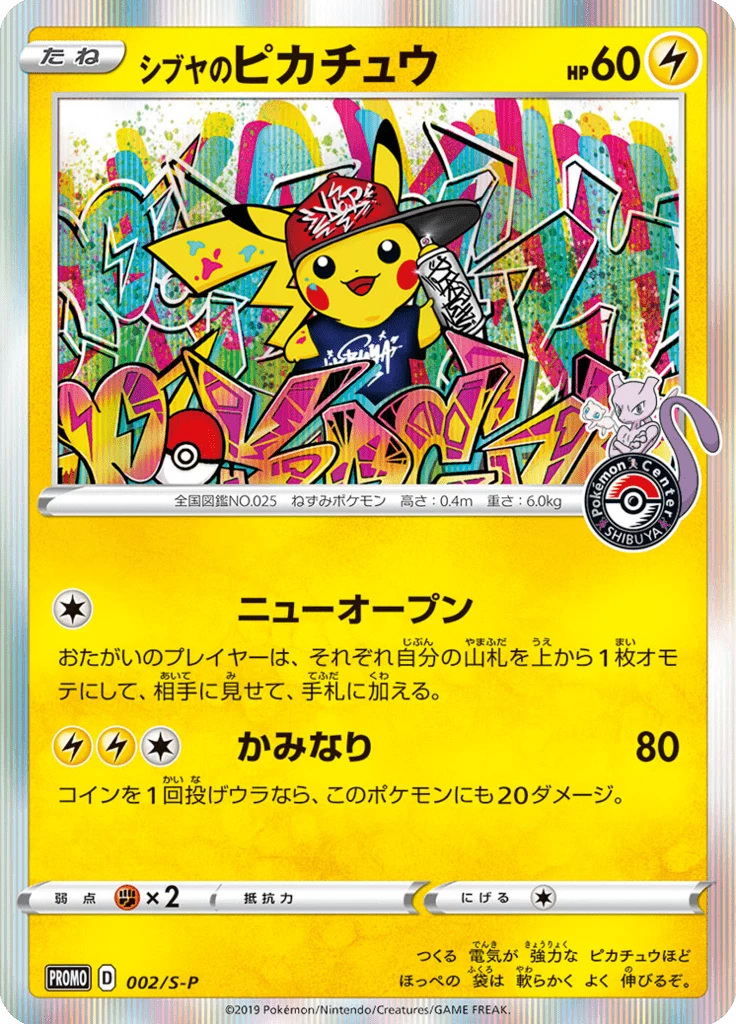
Shibuya’s Pikachu is a holofoil promo Pokemon Center Shibuya gave away to mark its store opening on 22 November 2019. It carries the card number 002/S-P, which places it in the Sword & Shield-era S-P Japanese promo line rather than in any numbered booster set — a distinction that matters once you start comparing it against the wider family of regional Pokemon Center Pikachu promos.

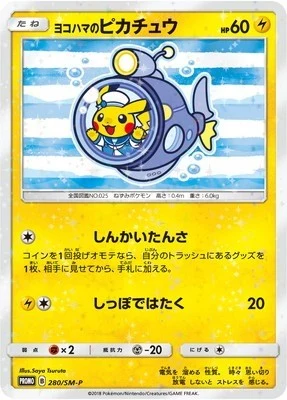
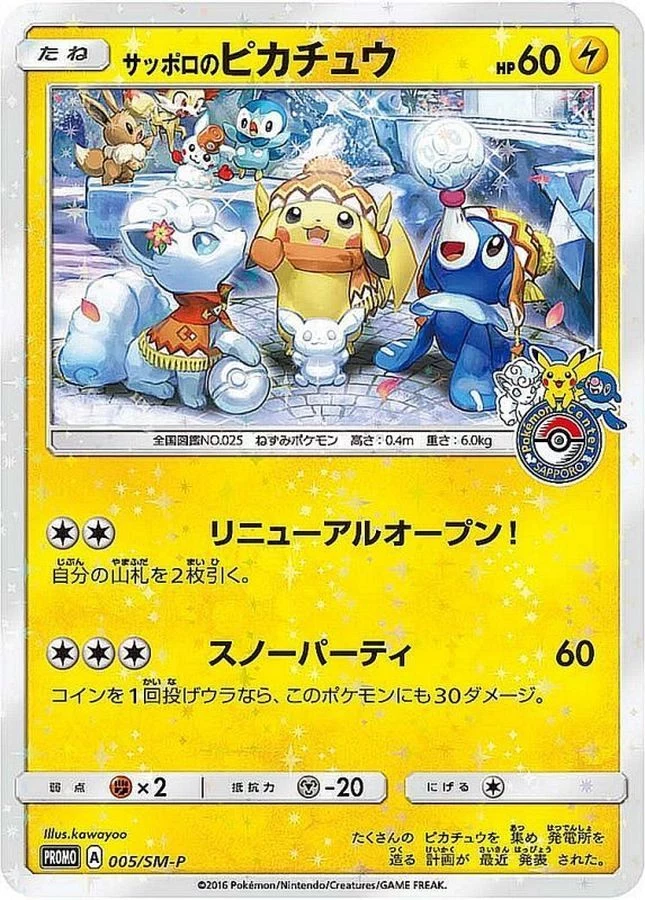
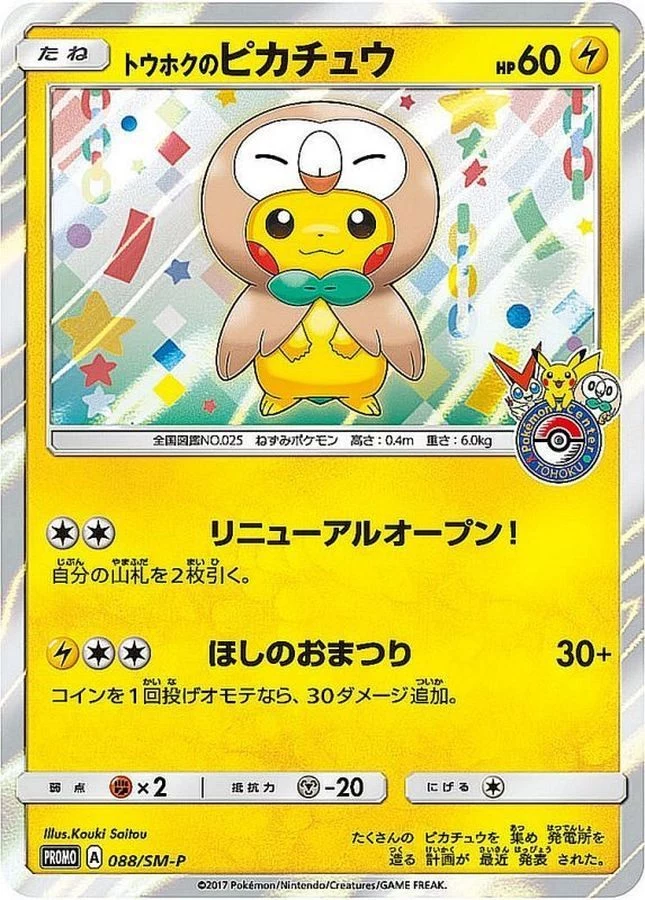
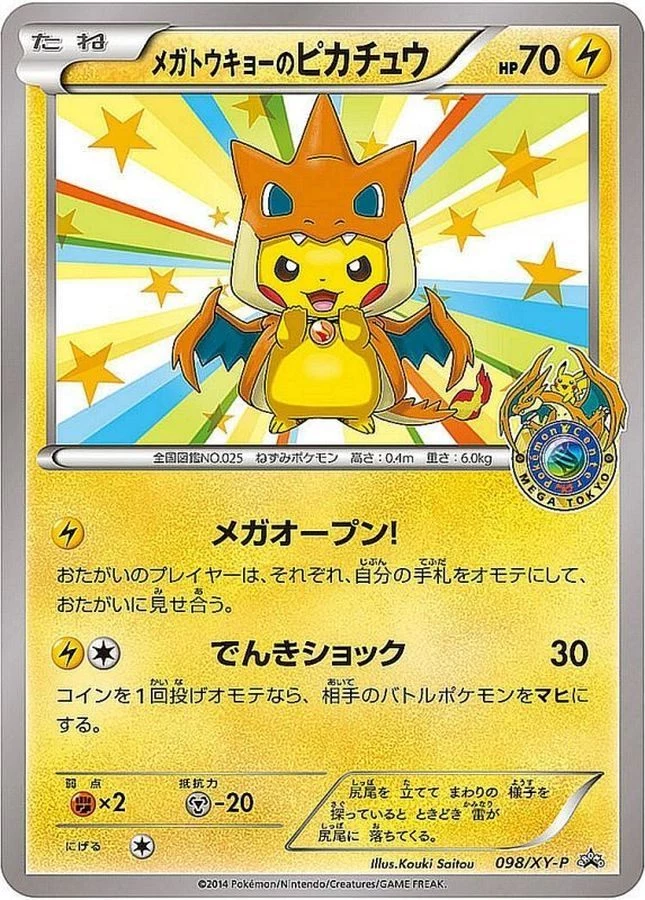
Pokemon Center Shibuya’s opening is one stop in a long-running Japanese tradition of handing out a store-specific Pikachu card around a location’s opening, reopening, or anniversary event. Sibling cards from that same tradition include Yokohama’s Pikachu, Sapporo Pikachu, Tohoku Pikachu, and the older Mega Tokyo Pikachu — each tied to its own store and its own promo numbering line. This guide covers what the card is, where it sits among those regional siblings, how the S-P promo line works, and our own graded listing of this exact print.

Key Takeaways

Shibuya’s Pikachu 002/S-P is a PSA 10, currently listed at ¥171,289 (~$1,077). It was distributed at Pokemon Center Shibuya’s opening on 22 November 2019, and per Bulbapedia the same promotion also reached other Pokemon Center and Pokemon Store locations around the same time. For another regional Pikachu from the same broad tradition, we also list a PSA 10 Sapporo Pikachu SM-P 005 at ¥384,758 (~$2,420).

60
HP

Lightning
Type

Holofoil Promo
Rarity

22 Nov 2019
Distribution Date

Prices below are our own samuraiswordtokyo.com listings, converted at ¥159/USD (September 2026).

The Card: Shibuya’s Pikachu 002/S-P

Shibuya’s Pikachu (渋谷のピカチュウ) is a Basic Pokemon, Lightning type, with 60 HP. It carries two attacks: New Open, a support move tied to the store-opening theme, and Thunder, which deals 80 damage with a coin-flip risk of hitting Pikachu itself on a tails result. Weakness is Fighting for double damage, and retreat cost is a single Colorless energy — a standard build for a promo centred on a Basic Pokemon rather than one designed for competitive play.

The illustrator credit for this print is not verified in the sources we checked, so we’re not attributing the artwork to a named artist here.

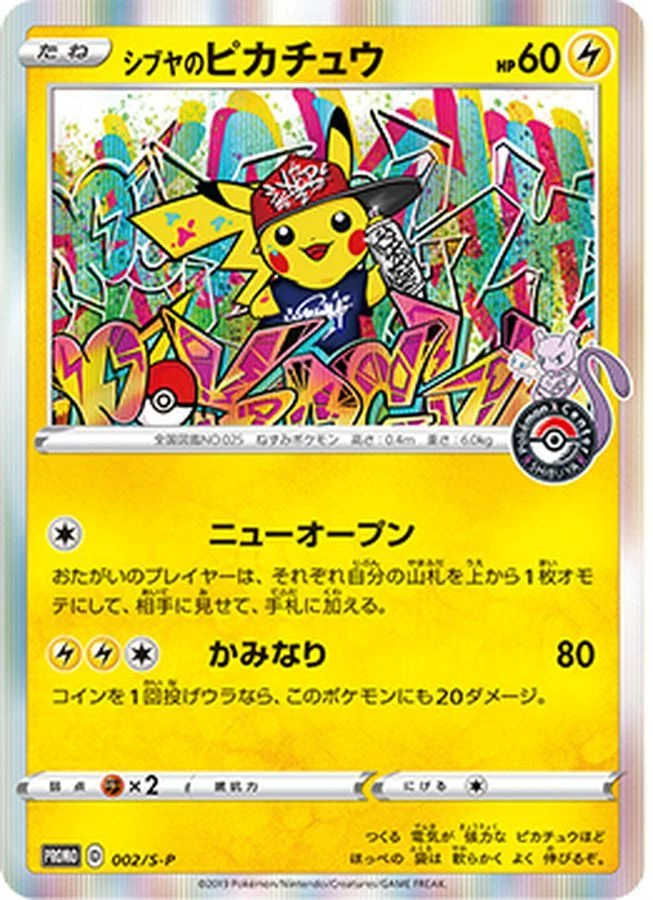
Shibuya's Pikachu 002/S-P Holofoil Promo, S-P promo line
Shibuya’s Pikachu 002/S-P — Holofoil Promo, S-P promo line

Card number 002/S-P places it in the Sword & Shield-era Japanese promo numbering line rather than in a numbered booster set — more on how that line works below. Because it’s a promo, there’s no SR/HR-style rarity slot attached to it; it’s simply catalogued as a holofoil promo.

Our graded example of this print is currently listed at ¥171,289 (~$1,077), PSA 10.

PSA 10 Shibuya's Pikachu 002/S-P slab, listed on samuraiswordtokyo.com
Our graded PSA 10 Shibuya’s Pikachu 002/S-P, currently listed at ¥171,289 (~$1,077)

Shibuya’s Pikachu Among the Regional Pokemon Center Promos

Shibuya’s Pikachu belongs to a broader run of Japanese promos: a store-specific Pikachu handed out around an opening, reopening, or anniversary event at a particular Pokemon Center or Pokemon Store. These aren’t parallel print treatments of one card — each regional Pikachu is its own card, with its own number, and in several cases its own promo numbering line entirely.

Card Number Promo Line Currently Listed
Shibuya’s Pikachu 002/S-P S-P (Sword & Shield era) ¥171,289 (~$1,077)
Yokohama’s Pikachu 280/SM-P SM-P (Sun & Moon era) ¥442,476 (~$2,783)
Sapporo Pikachu SM-P 005 SM-P (Sun & Moon era) ¥384,758 (~$2,420)
Tohoku Pikachu SM-P 088 SM-P (Sun & Moon era) ¥332,760 (~$2,093)
Mega Tokyo Pikachu XY-P 098/XY-P XY-P (older, XY era) ¥473,180 (~$2,976)

We list graded PSA 10 examples of four of these regional Pikachu promos: Sapporo Pikachu SM-P 005, Tohoku Pikachu SM-P 088, and the older Mega Tokyo Pikachu XY-P 098/XY-P, which predates the SM-P and S-P numbering entirely. Yokohama’s Pikachu 280/SM-P is currently listed at ¥442,476 (~$2,783).

For a wider ranking of these regional Pikachu promos, see our regional Pokemon Center Pikachu value ranking guide, and for the general concept behind the tradition, our Pokemon Center Pikachu promo guide. This article is a single-card deep dive on Shibuya specifically, so those two are the places to go for the broader comparison.

The S-P Promo Line and How This Card Was Distributed

S-P is the Sword & Shield-era Japanese promo numbering line, and 002/S-P is Shibuya’s Pikachu’s position within it. Unlike a numbered booster set, S-P promos aren’t pulled from packs — they’re distributed directly at events, store openings, and other promotions, so there’s no set size or pack structure to describe here.

Shibuya’s Pikachu was given away at Pokemon Center Shibuya to mark the store’s opening on 22 November 2019. Per Bulbapedia, the same promotion also distributed the card at other Pokemon Center and Pokemon Store locations around the same time, so it wasn’t limited to foot traffic through the Shibuya store alone.

Yokohama’s Pikachu and Sapporo Pikachu carry SM-P numbers instead, placing them in the earlier Sun & Moon-era promo line, while Mega Tokyo Pikachu’s XY-P 098 number goes back further still, to the XY era. Comparing the promo-line prefix is one of the fastest ways to place a given regional Pikachu promo in time without needing an exact release date. For the S-P line specifically, see our S-P promo best cards guide; for the SM-P line that Yokohama and Sapporo share, see our SM-P promo best cards guide.

Japanese vs English Print

No English print of this exact card turned up during this research. If an English-language version of Shibuya’s Pikachu exists, we haven’t been able to confirm it, so this guide treats it as a Japanese release until that changes.

Where This Promo Sits Among Japanese Rarity Tiers

Numbered Japanese sets run a rarity ladder from common holofoils up through tiers like SR and SAR, and how often each tier turns up is a function of how the set is packed. Shibuya’s Pikachu doesn’t sit anywhere on that ladder, because it was never packed into boosters in the first place — it’s a holofoil promo distributed directly to visitors, so its scarcity comes from the reach of the original giveaway rather than from a printed rarity slot.

That puts it in the same category as the other regional Pokemon Center Pikachu promos above: interest here tracks event scarcity and collector demand for a specific store’s card, not a rarity symbol printed on the card itself.

Shop This Card
PSA 10 Shibuya’s Pikachu 002/S-P
Currently listed at ¥171,289 (~$1,077)
Ships from Tokyo · Tracked delivery

View Product →

Where to Buy Shibuya’s Pikachu from Tokyo

Our graded PSA 10 Shibuya’s Pikachu 002/S-P is currently listed at ¥171,289 (~$1,077), shipped from Tokyo with tracked delivery. If you’re building out the wider regional Pikachu lineup, we also list PSA 10 Sapporo Pikachu SM-P 005 at ¥384,758 (~$2,420), Tohoku Pikachu SM-P 088 at ¥332,760 (~$2,093), and Mega Tokyo Pikachu XY-P 098/XY-P at ¥473,180 (~$2,976).

Browse the wider range in our PSA 10 graded card collection, or use our Quick Order page for a mixed order across singles and sealed product. For a closer look at two other single-card guides in the same regional Pikachu family, see our Tohoku’s Pikachu card guide and our Fukuoka’s Pikachu card guide.

Frequently Asked Questions

What is Shibuya’s Pikachu 002/S-P?

It’s a holofoil promo Pokemon Center Shibuya gave away to mark its store opening. The card number is 002/S-P, part of the Sword & Shield-era Japanese S-P promo line. We list a PSA 10 example of this print, currently at ¥171,289 (~$1,077).

When was Shibuya’s Pikachu distributed?

It was given away at Pokemon Center Shibuya’s opening on 22 November 2019. Per Bulbapedia, the same promotion also reached other Pokemon Center and Pokemon Store locations around the same time.

Does Shibuya’s Pikachu have an English print?

No English print of this exact card turned up during our research. Until an English version is independently confirmed, this guide treats it as a Japanese release.

What rarity tier is Shibuya’s Pikachu?

It’s a holofoil promo, not a card pulled from booster packs, so it doesn’t carry an SR/HR-style rarity slot. Its scarcity comes from the original giveaway rather than a printed rarity tier.

What other regional Pokemon Center Pikachu promos exist?

Sibling cards in the same tradition include Yokohama’s Pikachu (280/SM-P), Sapporo Pikachu (SM-P 005), Tohoku Pikachu (SM-P 088), and the older Mega Tokyo Pikachu (XY-P 098/XY-P). Each ties to its own store event and its own promo numbering line.

Where can I buy a PSA 10 Shibuya’s Pikachu from Tokyo?

Our graded 002/S-P example is currently listed at ¥171,289 (~$1,077) with tracked shipping from Tokyo. We also list other regional Pikachu promos in PSA 10 if you’re building out the wider set.

Umbreon GX Promo SM-P 125 Card Guide: Japanese Play Points Print

Umbreon-GX (ブラッキーGX) has two Japanese prints covered in this guide, and only one of them came from a booster pack. The other — SM-P 125 — is a card players redeemed with accumulated Play Points at Japanese Champion’s League events during 2018–2019 and at the 2019 Pokemon Japan Championships. Nobody pulled it from a pack.

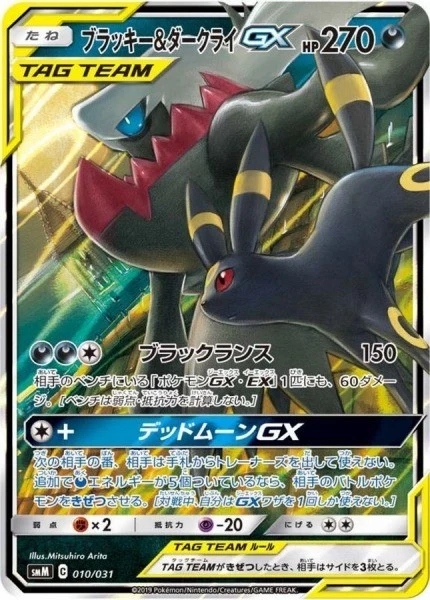
The card is Umbreon-GX, numbered 125 in Japan’s SM-P promotional series, illustrated by 5ban Graphics. We currently list a PSA 10 example of this exact print, graded and shipped from Tokyo. This guide covers what the card says, how it compares with its Collection Moon sibling and its English counterpart, and where it sits among the store’s wider Umbreon-GX and Umbreon PSA 10 range — while keeping it clearly separate from the similarly named Umbreon & Darkrai-GX and Shiny Umbreon-GX, which are different cards entirely.

Key Takeaways

Umbreon-GX SM-P 125 is a PSA 10, currently listed at ¥261,252 (~$1,643). It was distributed in Japan through the Play Points redemption programme at Champion’s League events during 2018–2019 and at the 2019 Pokemon Japan Championships — not through booster packs. The other verified Japanese print is the Collection Moon (SM1M) 037/060 Double Rare, which we also list: PSA 10 Umbreon-GX RR SM1M 037/060 currently listed at ¥40,922 (~$257).

200
HP

Darkness
Type

Promo
Rarity (SM-P 125)

2018–19
Play Points Era

Prices below are current samuraiswordtokyo.com listings, converted at ¥159/USD (September 2026).

The Card: Umbreon-GX SM-P 125

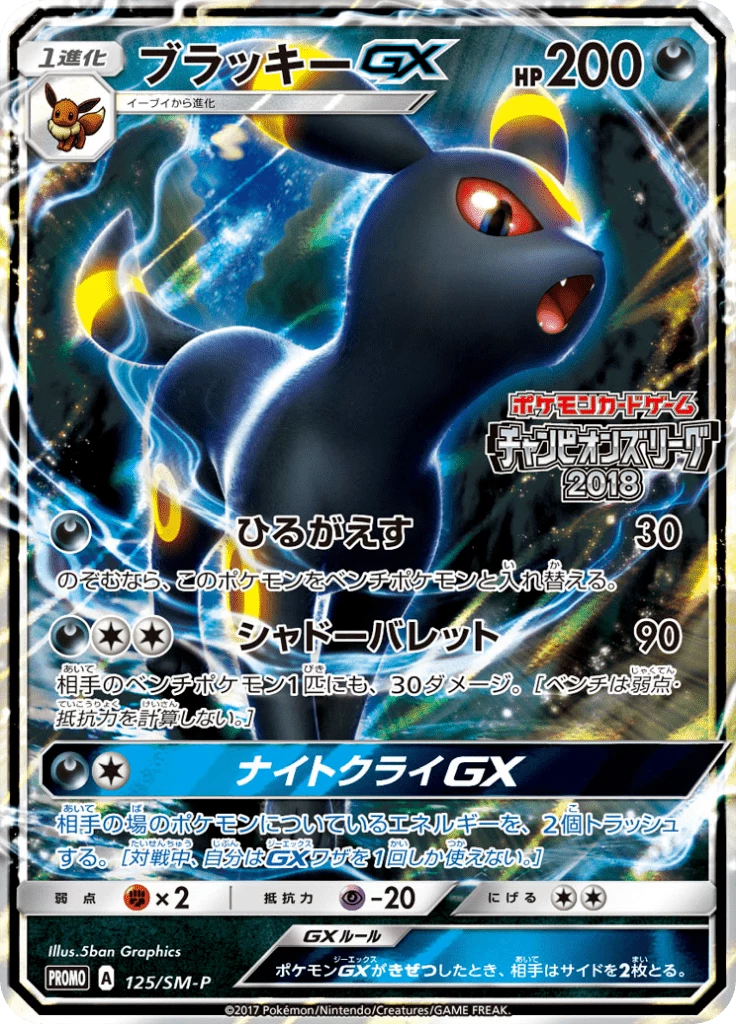
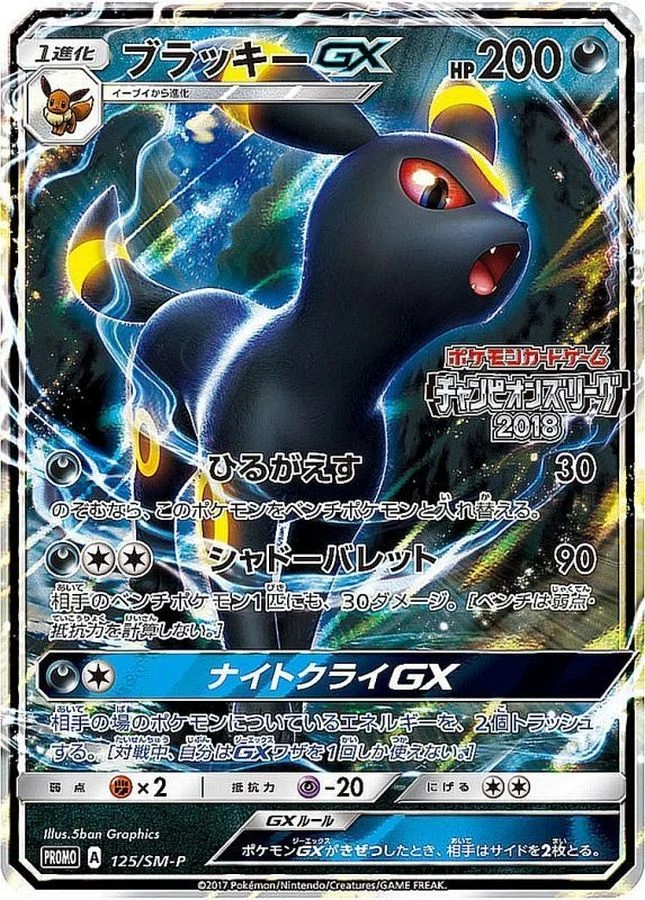
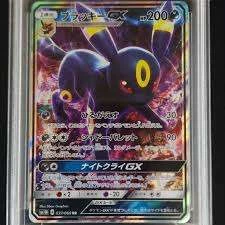
Umbreon-GX carries 200 HP and is a Darkness-type Stage 1 Pokemon, evolving from Eevee (イーブイ). It has three attacks: Strafe (ひるがえす, D, 30 damage, may switch Umbreon-GX itself to the bench), Shadow Bullet (シャドーバレット, DCC, 90 damage plus 30 damage to a benched opponent Pokemon, ignoring Weakness and Resistance), and the GX attack Night Cry-GX (ナイトクライGX, DC, discards 2 Energy from the Defending Pokemon). It has a Fighting weakness, Psychic resistance, and a retreat cost of 2. The illustration is credited to 5ban Graphics.

Umbreon-GX SM-P 125 Promo, SM-P Promotional cards
Umbreon-GX SM-P 125 — Japanese SM-P Promotional Cards

Our own graded example of this print is currently listed at ¥261,252 (~$1,643), PSA 10.

PSA 10 Umbreon GX SM-P 125 promo slab, listed on samuraiswordtokyo.com

The SM-P Promo Series and the Collection Moon Set

SM-P is Japan’s general promotional numbering for the Sun & Moon era — it covers tournament prizes, redemption programmes and other promo issues rather than a single boxed product, which is why this print doesn’t have a pack size or box structure to describe. For a broader look at cards carrying that same SM-P prefix, see our SM-P promo cards guide, which rounds up the wider series rather than one card.

Collection Moon (SM1M), where the sibling 037/060 print comes from, is a Japanese Expansion Pack released 9 December 2016. It paired with Collection Sun as one of the earliest Sun & Moon-era Japanese releases, and it’s where Umbreon-GX first appeared in Japan in any form — roughly two years before the SM-P 125 promo followed via the Play Points programme.

Japanese vs English Print

Umbreon-GX does have an English-language equivalent: the base Sun & Moon set’s #80/149, an Ultra Rare, released with the EN base set in February 2017 — a few months after the Japanese Collection Moon print. We found no promo-numbered English release lining up with the Japanese SM-P 125 specifically; in the English-language market, this card is tracked through that one Ultra Rare base-set print rather than a matching redemption promo.

If you’re matching a print in hand against either market, go by the card number and rarity treatment printed on it — 80/149 for the English Ultra Rare, 037/060 or 125/SM-P for the two Japanese prints — rather than assuming the numbering lines up across languages.

Where This Promo Sits Among Japanese Rarity Tiers

Promo cards like SM-P 125 sit outside the normal pack-pulled rarity ladder entirely. There’s no Common, Rare, RR or SR slot to place it on, because it never came out of a booster box — it came from a redemption programme, which puts it in the same broad “Promo” category as tournament prizes and other SM-P-numbered issues.

Its sibling, the Collection Moon 037/060 print, does sit inside the normal ladder — RR (Double Rare) is the standard non-secret treatment for a GX card in a 2016-era Japanese expansion. The SM-P promo’s standing comes from its distribution being tied to an event and points programme rather than pack odds, a distinction that runs through most of the store’s promo-numbered Umbreon catalogue.

A handful of other Umbreon and Umbreon-GX PSA 10s sit alongside it in the store’s catalogue, at very different price points depending on rarity and print run:

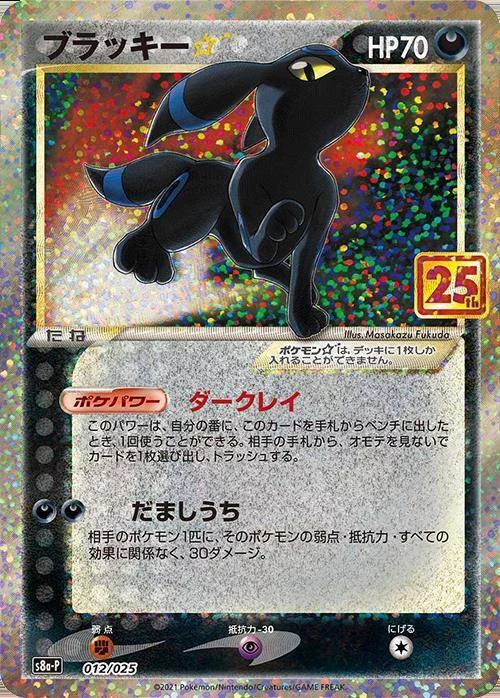
Those two are separate cards from separate print runs — the 25th Anniversary Umbreon promo isn’t a GX card at all, and Umbreon & Darkrai GX pairs Umbreon with a second Pokemon on the same card. Neither is another printing of the solo Umbreon-GX SM-P 125 covered here. Our 25th Anniversary Umbreon PSA 10 guide and Umbreon & Darkrai-GX guide cover those separately, and our Top Umbreon Cards ranking puts every Umbreon print — star, V, VMAX, ex and GX alike — into a single cross-species comparison instead of the single-card focus here.

Shop This Card
PSA 10 Umbreon-GX SM-P 125
Currently listed at ¥261,252 (~$1,643)
Ships from Tokyo · Tracked delivery

View Product →

Where to Buy Umbreon-GX from Tokyo

Our graded copy of PSA 10 Umbreon-GX SM-P 125 is currently listed at ¥261,252 (~$1,643), shipped from Tokyo with tracked delivery. Because this print came from a redemption programme rather than a booster box, there’s no sealed product tied to it directly — the graded single is the route to this exact card. If you’d rather have the Collection Moon RR sibling instead, our PSA 10 Umbreon-GX RR SM1M 037/060 is currently listed at ¥40,922 (~$257).

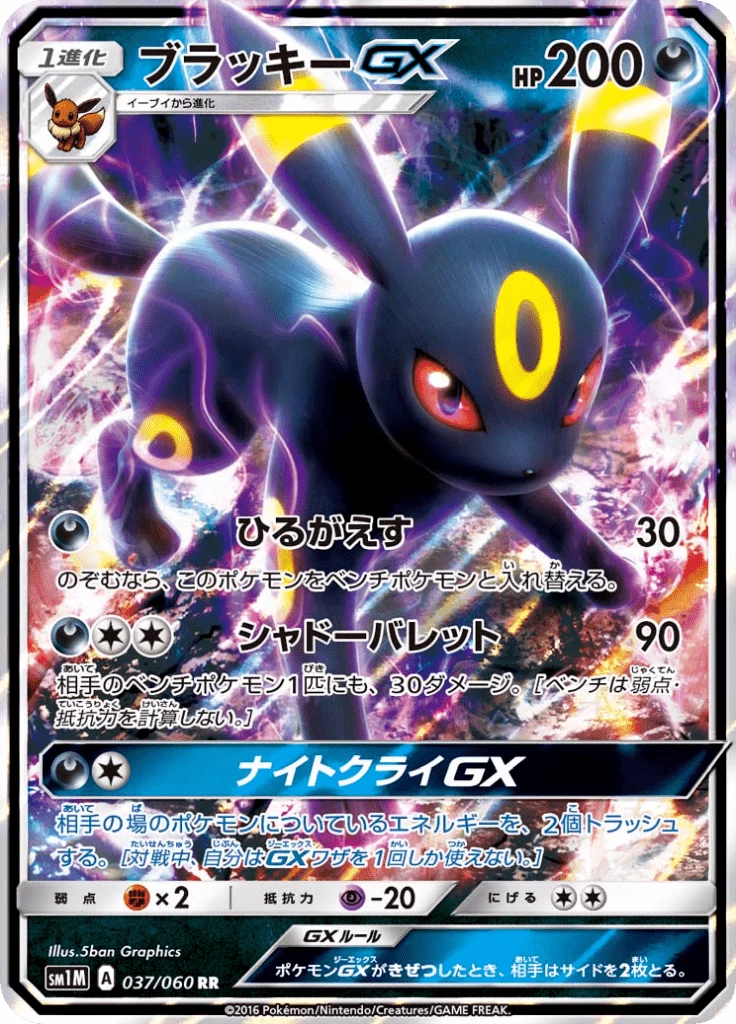
PSA 10 Umbreon GX RR SM1M 037/060 slab, listed on samuraiswordtokyo.com
PSA 10 Umbreon-GX RR SM1M 037/060 slab, listed on samuraiswordtokyo.com

For the wider Umbreon lineup, our Moonbreon (Umbreon VMAX) value guide, Umbreon ex full art 30th Celebration guide and Umbreon 30th Celebration card guide cover the Pokemon’s other modern chase prints, while the Top Umbreon Cards ranking and Umbreon GX value guide put every printing side by side. Browse the full range in our PSA 10 graded card collection, and for a mixed order across singles and sealed product, our Quick Order page is the fastest way to build a cart.

Frequently Asked Questions

What is Umbreon-GX SM-P 125?

It is a Japanese promo card, HP 200, Darkness type, numbered 125 in the SM-P Promotional cards series, illustrated by 5ban Graphics. It was distributed through the Play Points redemption programme rather than a booster pack. We list a PSA 10 example, currently at ¥261,252 (~$1,643).

How was the Umbreon-GX SM-P 125 promo distributed?

Players redeemed accumulated Play Points for it at Japanese Champion’s League events during 2018–2019 and at the 2019 Pokemon Japan Championships. It was one of several GX cards offered through that programme, not something pulled from a pack.

Are there other Japanese prints of Umbreon-GX?

Besides the SM-P 125 promo, this guide covers one other print: Collection Moon (SM1M) 037/060, a Double Rare (RR) released 9 December 2016. We list a PSA 10 of that print as well, currently at ¥40,922 (~$257).

Is Umbreon-GX SM-P 125 the same card as Umbreon & Darkrai-GX or Shiny Umbreon-GX?

No. Umbreon & Darkrai-GX is a Tag Team card pairing two Pokemon on one card, and Shiny Umbreon-GX (Hidden Fates SV69) is a different named card with its own shiny colouring. Both have separate print runs from the solo Umbreon-GX covered in this guide.

Does Umbreon-GX have an English print?

Yes — the base Sun & Moon set’s #80/149, an Ultra Rare, released in February 2017. We found no promo-numbered English release matching the Japanese SM-P 125 specifically.

Where can I buy a PSA 10 Umbreon-GX from Tokyo?

Our graded SM-P 125 copy is currently listed at ¥261,252 (~$1,643) with tracked shipping from Tokyo. The Collection Moon RR sibling is also available at ¥40,922 (~$257) if you’d rather have the pack-pulled print instead of the promo.

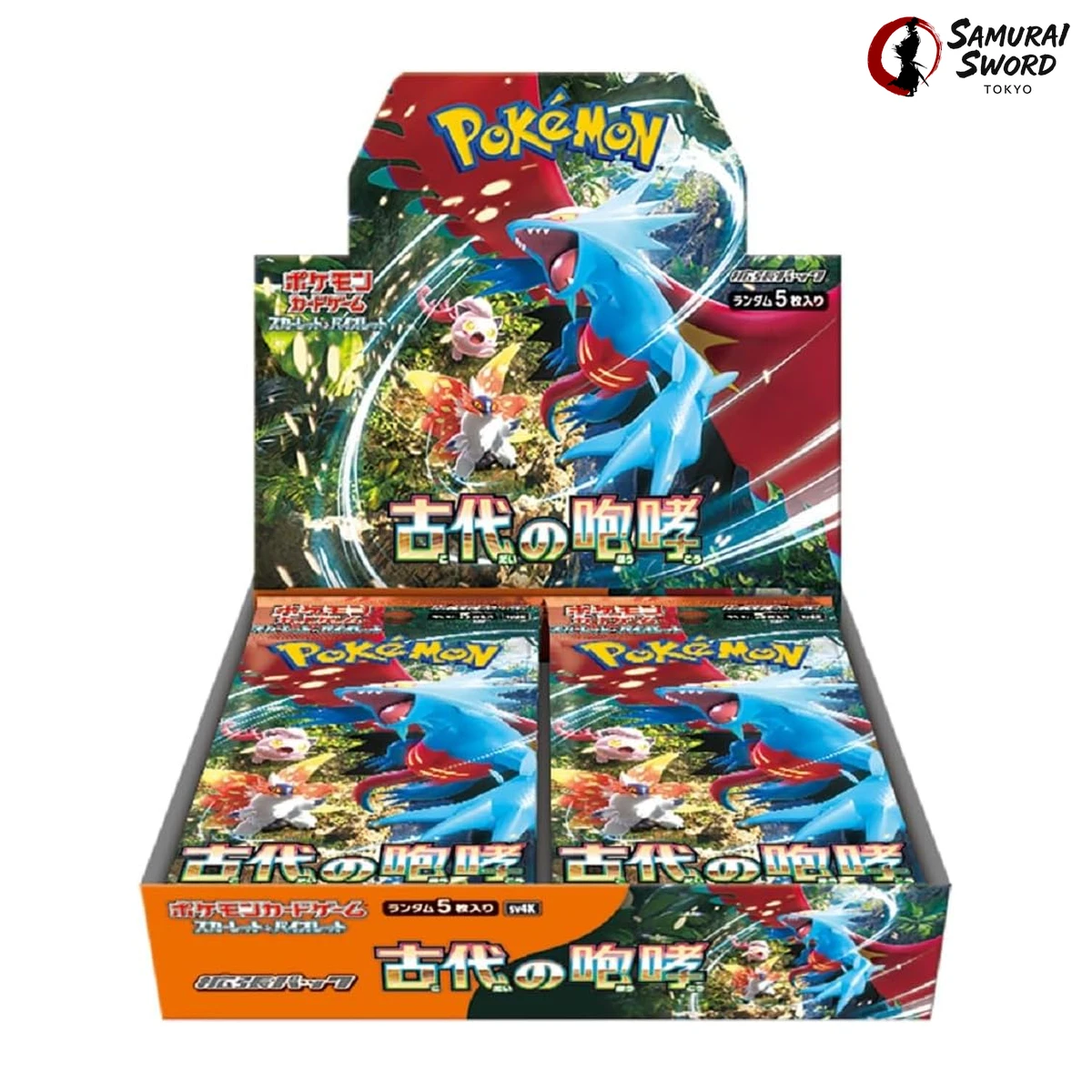
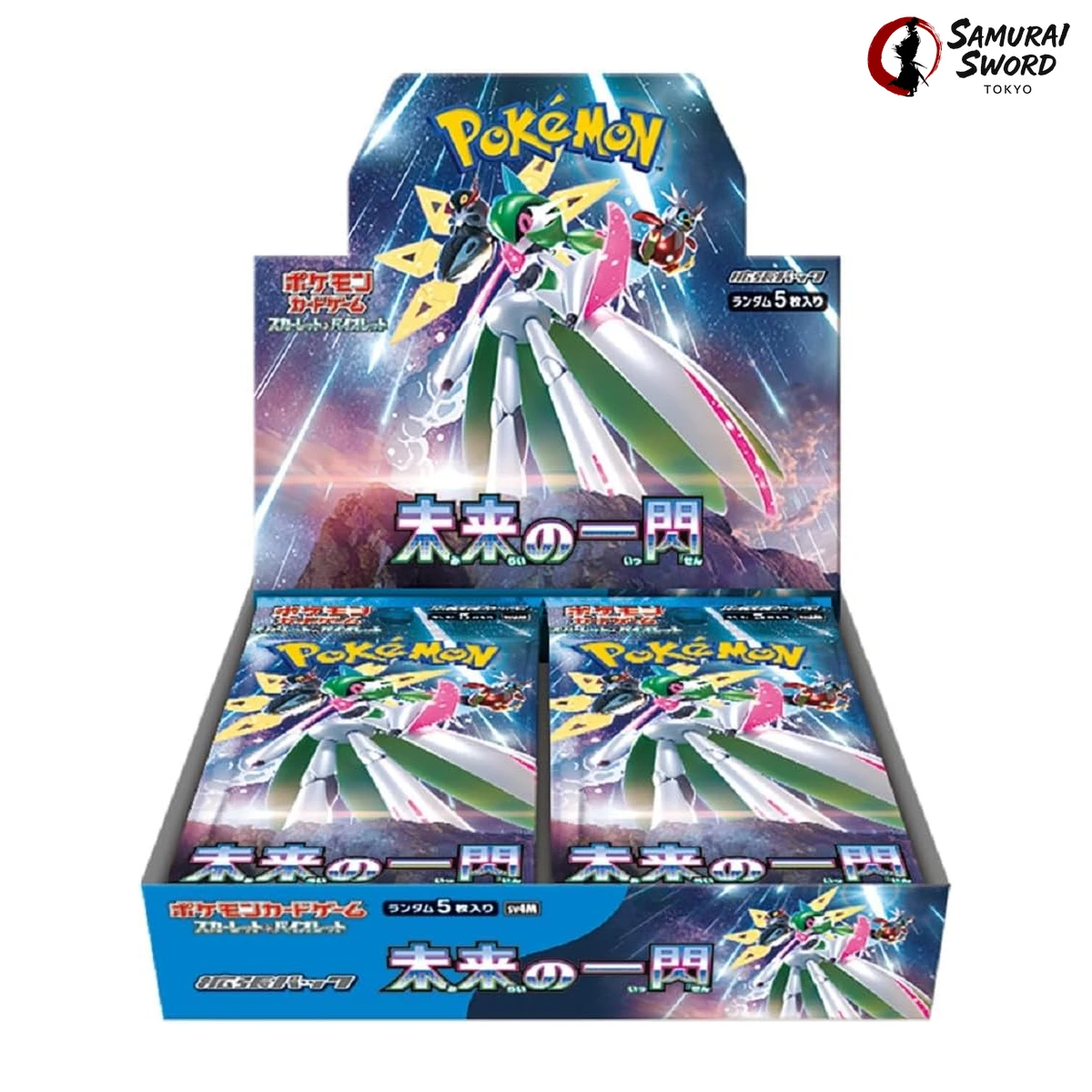
Ancient & Future Pokemon Cards Explained: Ancient Roar and Future Flash (SV4K/SV4M)

Ancient and Future are not rarity tiers and not a Pokemon type — they are a card mechanic built around Paradox Pokemon from the Scarlet & Violet video games. Ancient cards feature past-form Paradox Pokemon such as Roaring Moon and Sandy Shocks; Future cards feature future-form Paradox Pokemon such as Iron Valiant and Iron Moth.

Japan introduced the mechanic with a same-day two-set release: SV4K “Ancient Roar” for the Ancient side and SV4M “Future Flash” for the Future side. Rather than mixing Ancient and Future Pokemon into one shared set the way earlier Scarlet & Violet-era releases sometimes blended themes, Japan gave each camp its own standalone set, its own box art, and its own full card list — while keeping both on the same release calendar date. This guide explains what the Ancient/Future split means, how to spot an Ancient or Future card on sight, how the two Japanese sets break down card by card, and how they map onto the English side of the game.

Key Takeaways

Ancient and Future cards feature past-form and future-form Paradox Pokemon respectively, and both carry a small stamp graphic in the bottom-right corner of the card. Japan released them together on October 27, 2023 as two separate sets: SV4K Ancient Roar currently listed at ¥10,192 (~$64), and SV4M Future Flash currently listed at ¥10,088 (~$63). Both sets feed into the English Paradox Rift expansion — alongside a third Japanese set, SV3a.

2
Same-Day JP Sets

94
Cards in SV4K Ancient Roar

28
Secret Rarities in SV4K

Oct 27, 2023
Japan Release Date

Yen figures below convert at ¥159/USD (September 2026). Prices are a store snapshot — check the linked listing for the current number before ordering.

What “Ancient” and “Future” Mean on a Pokemon Card

Ancient and Future are a card mechanic tied to the Paradox Pokemon introduced in the Scarlet & Violet video games — creatures presented as alternate-timeline forms of existing Pokemon. The mechanic splits them into two camps:

  • Ancient cards feature past-form Paradox Pokemon, for example Roaring Moon and Sandy Shocks.
  • Future cards feature future-form Paradox Pokemon, for example Iron Valiant and Iron Moth.

Rather than mixing both camps into one set, Japan gave each camp its own dedicated set on the same release day — which is why the two sets below share a release date but have separate names, separate card lists, and separate box art built around their theme.

The naming is a useful memory aid on its own: “Ancient Roar” pairs a past-tense idea (Ancient) with a loud, primal-sounding word (Roar), while “Future Flash” pairs a forward-looking idea (Future) with a fast, technological-sounding word (Flash). If you remember the mechanic split, the set names follow logically from it.

Ancient Roar and Future Flash: The Two Japanese Sets

Both sets released in Japan on the same day — October 27, 2023 — and split the Ancient/Future mechanic cleanly down the middle.

Set JP code Theme Japan release
Ancient Roar SV4K Ancient (past-form Paradox Pokemon) October 27, 2023
Future Flash SV4M Future (future-form Paradox Pokemon) October 27, 2023
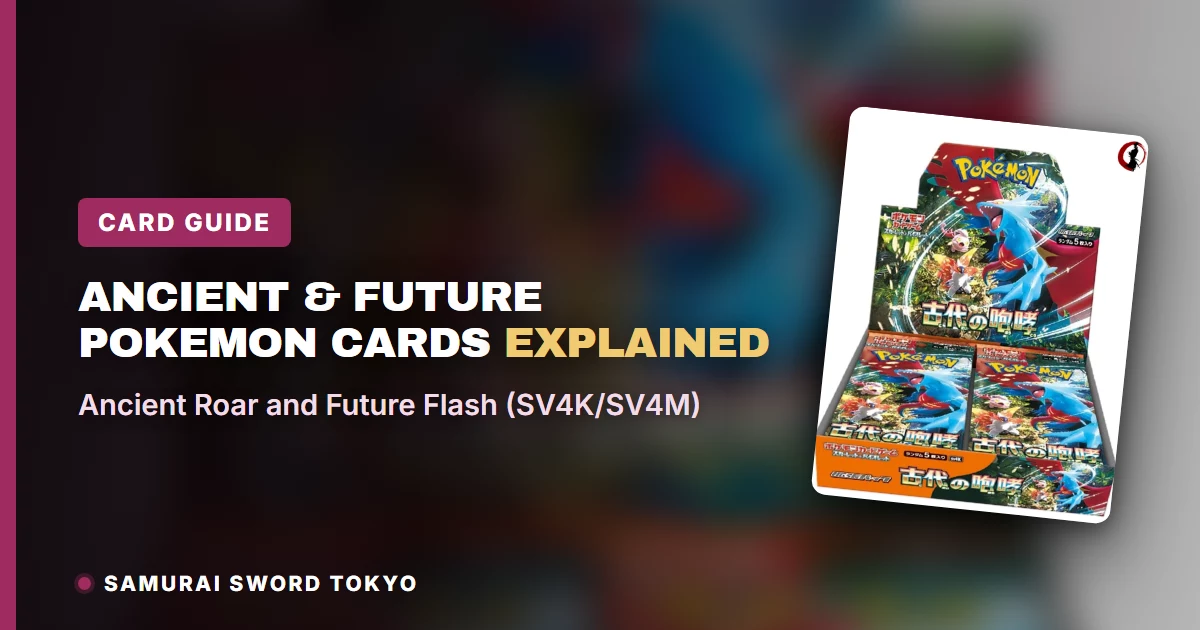
SV4K Ancient Roar Japanese Pokemon booster box

SV4K Ancient Roar Booster Box

SV4M Future Flash Japanese Pokemon booster box

SV4M Future Flash Booster Box

For the full card-by-card breakdown of each set, see our Ancient Roar (SV4K) card list and Future Flash (SV4M) card list.

How to Spot an Ancient or Future Card

Ancient and Future Pokemon cards in this pair of sets carry an individual small stamp graphic printed in the bottom-right of the card. That stamp is the fastest way to confirm a card belongs to the mechanic without needing to know every Paradox Pokemon by sight.

The same stamp-style design convention — a small corner graphic marking a themed subset — was also used in the earlier Japanese Single Strike Master (S5I) and Rapid Strike Master (S5R) sets. That is a different mechanic with a different theme (Single Strike and Rapid Strike style versions of existing Pokemon, rather than Paradox Pokemon); the stamp placement is simply a design convention the sets share, not evidence the mechanics are related.

In practical terms, this means two separate things can both be true about a Japanese Pokemon card: it can carry a small corner stamp, and that stamp can belong to entirely different mechanics depending on which set and era the card comes from. When you are trying to identify a card, always check which set it is from first, then use the stamp to confirm the mechanic rather than assuming the mechanic from the stamp style alone.

Inside SV4K Ancient Roar: The Card Count Breakdown

SV4K Ancient Roar totals 94 cards: a 66-card base/main set plus a 28-card secret-rarity run split across four rarity tiers.

Tier Cards
Base/main set 66
AR (secret) 12
SR (secret) 9
SAR (secret) 5
UR (secret) 2
Secret-rarity total 28
Set total 94

That secret-rarity split is what the set’s pull-rates coverage digs into in more depth — see our SV4K Ancient Roar pull rates and best cards page and its sibling, SV4M Future Flash pull rates and best cards, for the Future-side equivalent.

From Japan to English: Where Paradox Rift Comes From

Both SV4K Ancient Roar and SV4M Future Flash feed into the English Paradox Rift (PAR) expansion. It is a common shorthand to say Paradox Rift is “the English version of Ancient Roar and Future Flash,” but that oversimplifies the mapping — a third Japanese set, SV3a, is also a source set for Paradox Rift.

In other words, Paradox Rift pulls its card pool from three Japanese sets, not two. Our own set-facts hubs cover this mapping in full: the Paradox Rift Japanese card list lays out the complete JP-to-EN mapping, and the Paradox Rift chase cards page tracks which Japanese prints the English chase cards come from.

That three-set structure is worth remembering if you are trying to trace a specific English Paradox Rift card back to its Japanese original: the print you are looking for could be sitting in Ancient Roar, Future Flash, or SV3a, and the set it came from is not always obvious from the English card alone. This is exactly the kind of detail that gets lost when a set is described with the shorthand “this is just the English version of X,” and it is why the dedicated JP-to-EN hub linked above stays separate from this explainer rather than folding the full mapping in here.

Which Ancient Roar and Future Flash Box to Buy

If you want the Ancient side of the mechanic, SV4K Ancient Roar is currently listed at ¥10,192 (~$64). For the Future side, SV4M Future Flash is currently listed at ¥10,088 (~$63). Both are sealed Japanese booster boxes from the same October 2023 release.

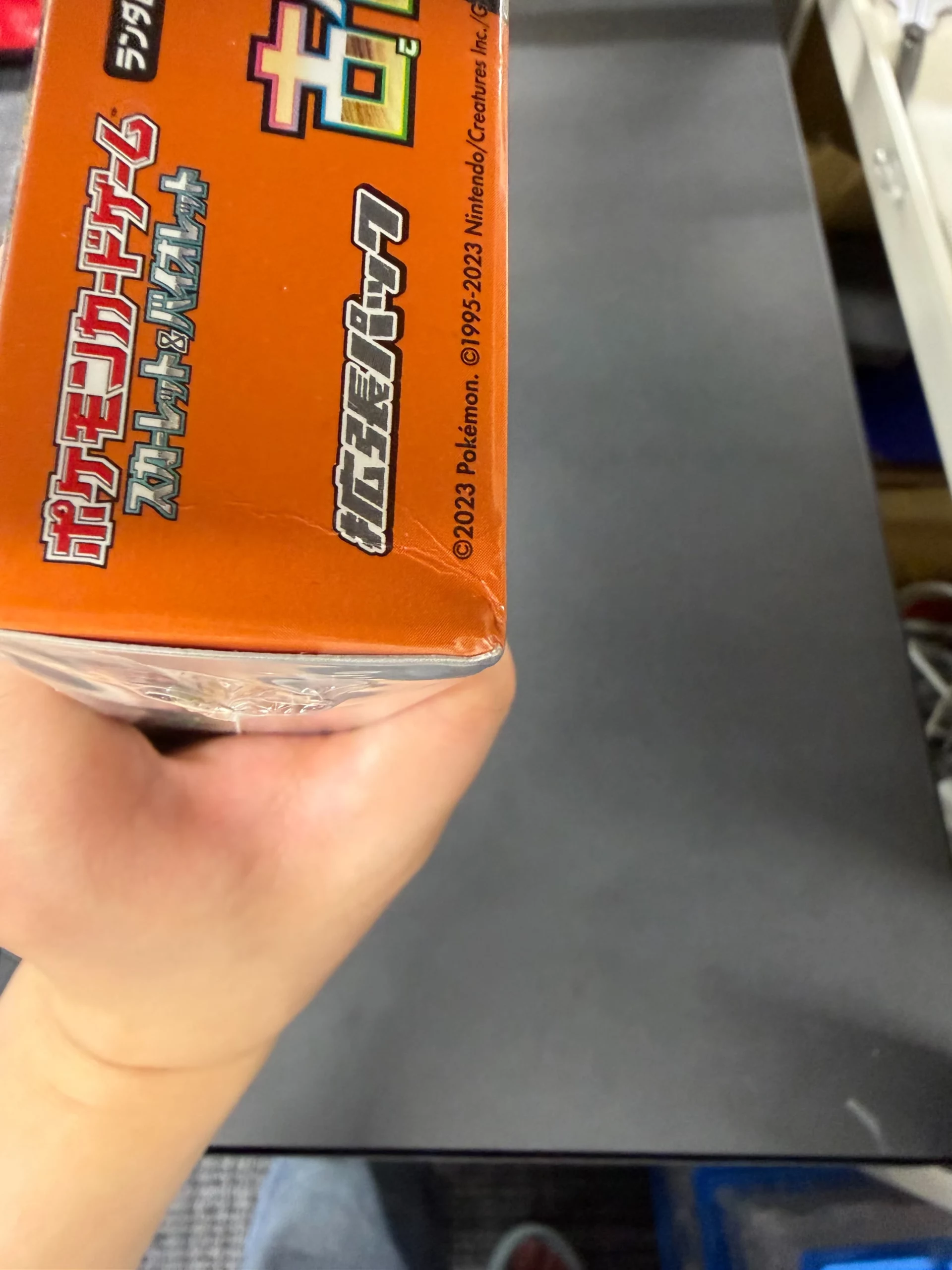
We also list a Damaged Box variant of SV4K Ancient Roar in our own catalogue: same set contents, sold at a different price point purely because of cosmetic condition on the outer box. As with every Damaged Box listing on this site, the definition is cosmetic box damage only — the sealed product inside is unaffected. See our general Damaged Box explainer for how the store defines the category (written for a different set, but the same store-wide definition applies here).

SV4K Ancient Roar Japanese Pokemon booster box Damaged Box main photo
SV4K Ancient Roar — Damaged Box listing, main photo
SV4K Ancient Roar Japanese Pokemon booster box Damaged Box detail photo

SV4K Ancient Roar — Damaged Box detail

SV4K Ancient Roar Japanese Pokemon booster box Damaged Box detail photo

SV4K Ancient Roar — Damaged Box detail

The SV4K Ancient Roar Damaged Box is currently listed at ¥12,000 (~$75). For more Japanese Pokemon booster boxes, browse the Pokemon card box collection, or build a mixed order — sealed boxes plus singles — through Quick Order.

Featured Product
SV4K Ancient Roar Japanese Pokemon Booster Box
Currently listed at ¥10,192 (~$64)
Ships from Tokyo · Tracked delivery

View Product →

Frequently Asked Questions

What is the difference between Ancient and Future Pokemon cards?

Ancient cards feature past-form Paradox Pokemon (for example Roaring Moon and Sandy Shocks); Future cards feature future-form Paradox Pokemon (for example Iron Valiant and Iron Moth). Japan split the two camps into separate sets: SV4K Ancient Roar for Ancient, SV4M Future Flash for Future.

When were Ancient Roar and Future Flash released in Japan?

Both sets released together on October 27, 2023.

How many cards are in SV4K Ancient Roar?

94 cards total: a 66-card base/main set plus a 28-card secret-rarity run (12 AR, 9 SR, 5 SAR, 2 UR).

How can you tell if a card is Ancient or Future?

Ancient and Future cards carry a small stamp graphic in the bottom-right corner of the card. The same stamp-style design convention was also used on the earlier Single Strike Master (S5I) and Rapid Strike Master (S5R) Japanese sets, though that is a separate, unrelated mechanic.

What is the English equivalent of Ancient Roar and Future Flash?

Both sets feed into the English Paradox Rift (PAR) expansion — along with a third Japanese source set, SV3a. Paradox Rift is built from three Japanese sets, not just SV4K and SV4M.

What is the difference between a regular box and a Damaged Box on your site?

A Damaged Box has the same sealed set contents as the regular box; the difference is cosmetic damage to the outer box only. It is sold at a different price point purely because of that cosmetic condition.

Feraligatr Pokemon Card Guide: Every Japanese Print Worth Knowing

A species search on Limitless for Feraligatr’s Japanese name, オーダイル, turns up nine indexed prints spanning the XY era through the current Scarlet & Violet promo run. Two more prints are currently listed on our site that don’t show up in that index at all — one of them printed in 1999, before the database Limitless draws on even starts.

Feraligatr is the Stage 2 final evolution of the Johto Water starter line — Totodile into Croconaw into Feraligatr — and every verified print in this guide carries the same 180 HP Water-type stat line. What changes from print to print is the set, the rarity treatment, and in two cases, whether the card is documented anywhere outside our own product listing at all. This guide walks through what we’ve verified for each one and which of them you can currently buy from us as graded PSA 10 singles.

Key Takeaway

Limitless’s species search indexes nine Japanese Feraligatr prints, and we also currently list two additional prints — a 1999 Neo Premium File Old Back and an L1-H HeartGold Collection print — that don’t appear in that index. Of the eleven prints covered here, three of them are currently listed on our site as graded PSA 10 singles: the L1-H HeartGold Collection print, currently listed at ¥159,300 (~$1,002), the SV-P 241 promo, currently listed at ¥8,260 (~$52), and the Neo Premium File Old Back print, currently listed at ¥70,799 (~$445).

9
Prints Indexed by Limitless

2
Individually Verified Prints

Sep 2026
Prices Checked

Water
Type (All Verified Prints)

The Japanese Feraligatr Cards Verified in This Guide

Searching Limitless’s Japanese card database for Feraligatr by species returns nine prints, all listed as “R” on the search index itself:

Set No. Index rarity Individually confirmed?
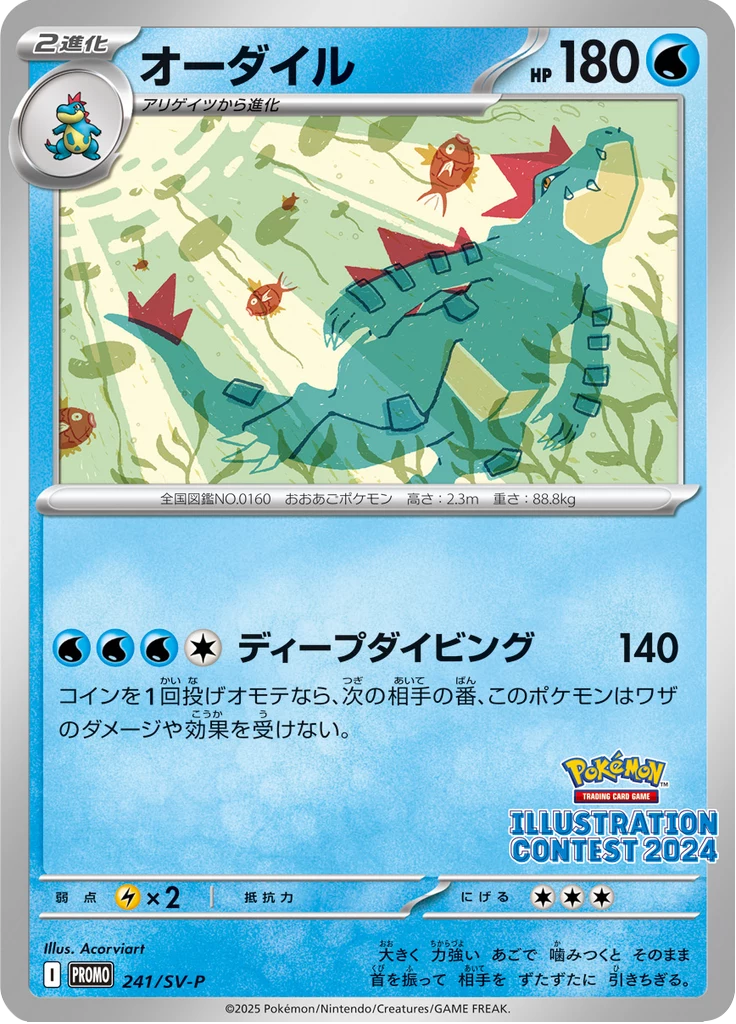
SVP (Scarlet & Violet Promotional Cards) 241 R (index) / Promo on card page Yes — HP 180, Water, illustrator Acorviart
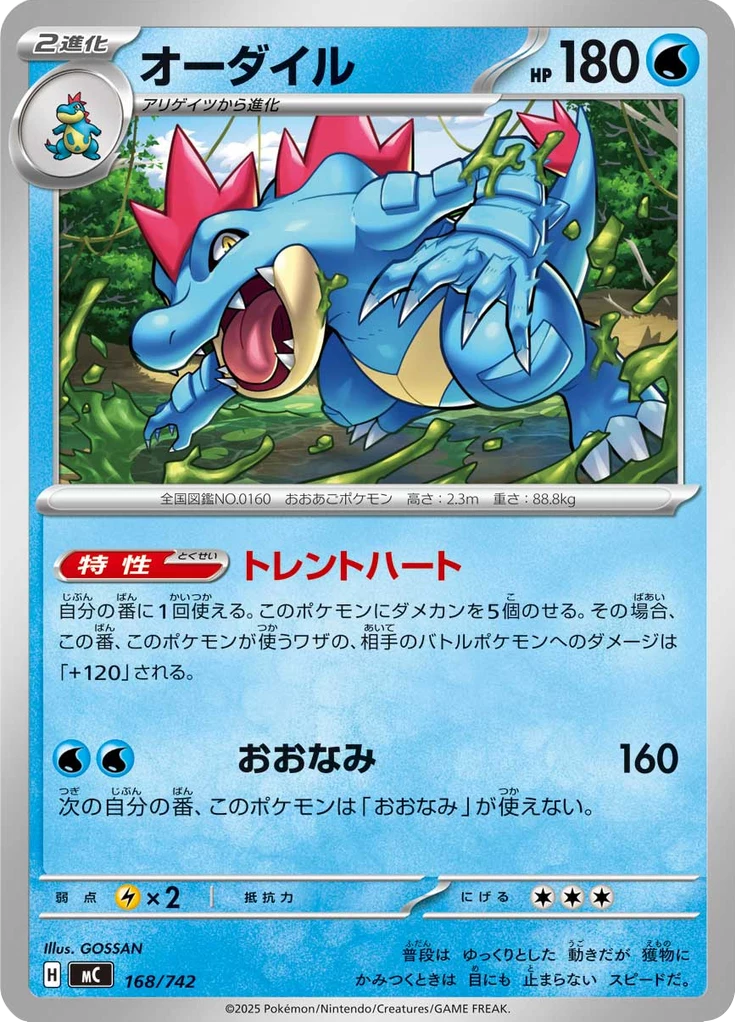
MC (Starter Decks 100 Battle Collection) 168 R (index) / not stated on card page Yes — HP 180, Water, illustrator GOSSAN
SV8a 34 R No — set/number confirmed only
SV5K 15 R No — set/number confirmed only
S8 22 R No — set/number confirmed only
SMH 26 R No — set/number confirmed only
SM6b 17 R No — set/number confirmed only
SM3p 21 R No — set/number confirmed only
XY4 17 R No — set/number confirmed only

Note the mismatch on the first two rows: the search index labels every result “R” as a blanket sort category, but the individual SV-P 241 card page identifies it as a promo card rather than a numbered rarity, and the MC 168 card page doesn’t state a rarity at all. Where we’ve only seen the index listing and haven’t opened the individual card page, we’re not citing illustrator or HP for that print in this guide.

Beyond these nine, we also currently list two more Feraligatr prints — a 1999 Neo Premium File print and an L1-H HeartGold Collection print — that don’t turn up in Limitless’s search at all. Limitless’s coverage of pre-2001 Japanese sets isn’t complete, so treat the totals here as the prints we’ve verified rather than a final count.

The 1999 Original: Neo Premium File 1’s Unnumbered Feraligatr

PSA 10 Feraligatr Old Back Neo Premium File slab, listed on samuraiswordtokyo.com
PSA 10 Feraligatr, catalogued by our team as PRMF-1 No.160, Neo Premium File 1

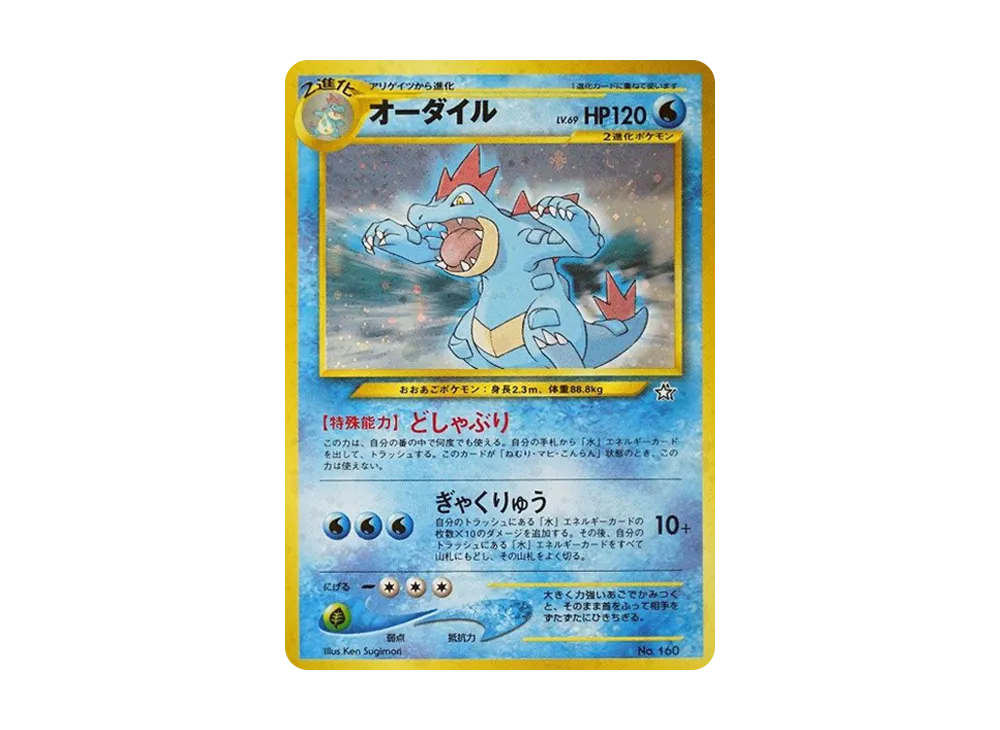
The earliest Feraligatr print we list doesn’t show up on Limitless at all — searching for set code PRMF-1 there returns nothing. The card corresponds to Neo Premium File 1, a binder/file product released December 10, 1999 according to Bulbapedia. It held nine unnumbered promotional cards covering the three Generation II starter lines — Chikorita, Cyndaquil, and Totodile — and Feraligatr is the final card in that set, closing out the Totodile line.

Bulbapedia describes the Neo Premium File 1 cards as unnumbered. Our own listing catalogues this slab as “No.160,” but that’s our team’s own reference number rather than an official Neo Premium File print number — treat it as a catalog tag, not an official designation. This print uses the 1996–2001 “Old Back” card design; see our Old Back vs New Back explainer for how to spot that design at a glance, and our Japanese Old Back cards guide for the wider category this print sits in.

Check This First

If the back of your card uses the older Old Back design and there’s no printed card number in the corner, you’re likely holding a Premium File promo rather than a mainline set card — Feraligatr’s sibling from the same product line is Celebi, covered in our Neo Premium File 3 Celebi guide (a different binder in the same series).

The HeartGold Collection PSA 10 (L1-H 025/070)

PSA 10 Feraligatr HeartGold Collection L1-H 025/070 slab, listed on samuraiswordtokyo.com
PSA 10 Feraligatr, L1-H 025/070, “HeartGold Collection”

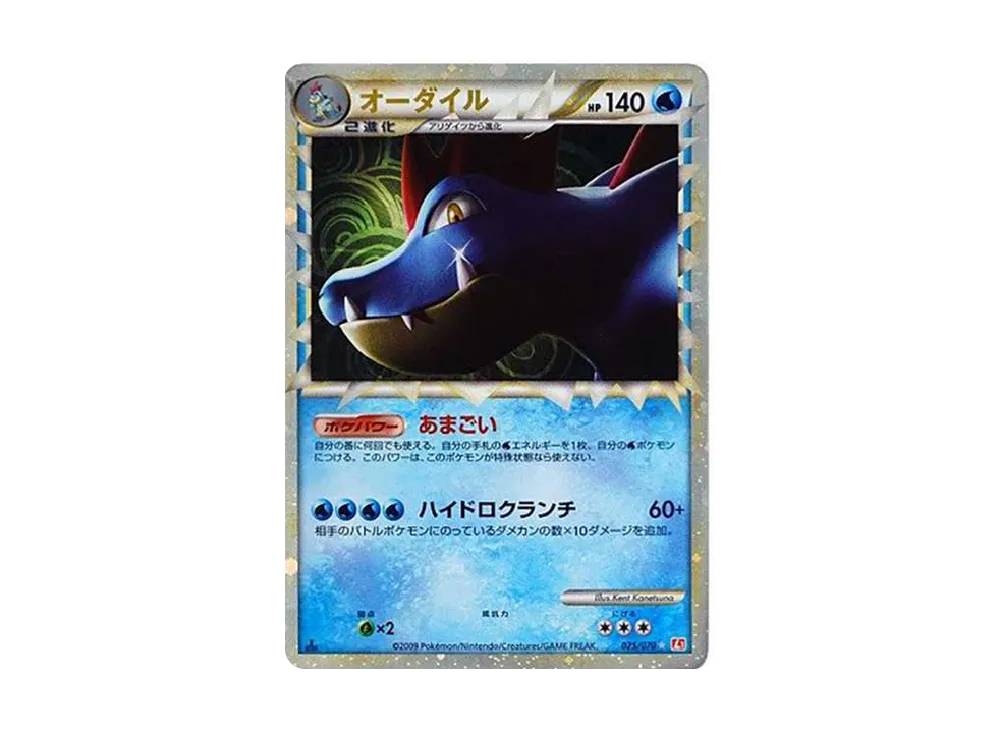
Our second pre-2001-style anchor also doesn’t turn up on Limitless: a search for set code L1-H returns nothing there either. This is the one print in our lineup where we don’t have an independent source beyond our own product listing — we haven’t been able to confirm a release date, distribution context, or set background for “HeartGold Collection” 025/070 anywhere else. Treat the set name and card number here as what our listing states rather than as independently verified facts, and note that we can’t date this print the way we can date the 1999 Neo Premium File print above.

The Modern Prints: SV-P 241 and MC 168

Feraligatr, SVP 241, Scarlet & Violet Promotional Cards

Feraligatr, SVP 241, Scarlet & Violet Promotional Cards

Feraligatr, MC 168, Starter Decks 100 Battle Collection

Feraligatr, MC 168, Starter Decks 100 Battle Collection

SV-P 241 is our anchor listing for the modern era, illustrated by Acorviart. Our product title describes it as an “Illustration Contest 2024 Promo Card Commemoration Campaign for Award-Winning Works” release, and Limitless confirms the card “has not been released internationally yet” — it’s a Japan-exclusive promo. We haven’t been able to verify the exact distribution date or venue beyond that product title, so we’re not stating one here.

MC 168 comes from the Starter Decks 100 Battle Collection, illustrated by GOSSAN. Its card page doesn’t state an explicit rarity, distinguishing it from the standard-rarity treatment its set-index listing implies. Both modern prints share the same 180 HP Water-type stat line as every other verified print in this guide.

Other Verified Prints: XY4, S8, and Five More

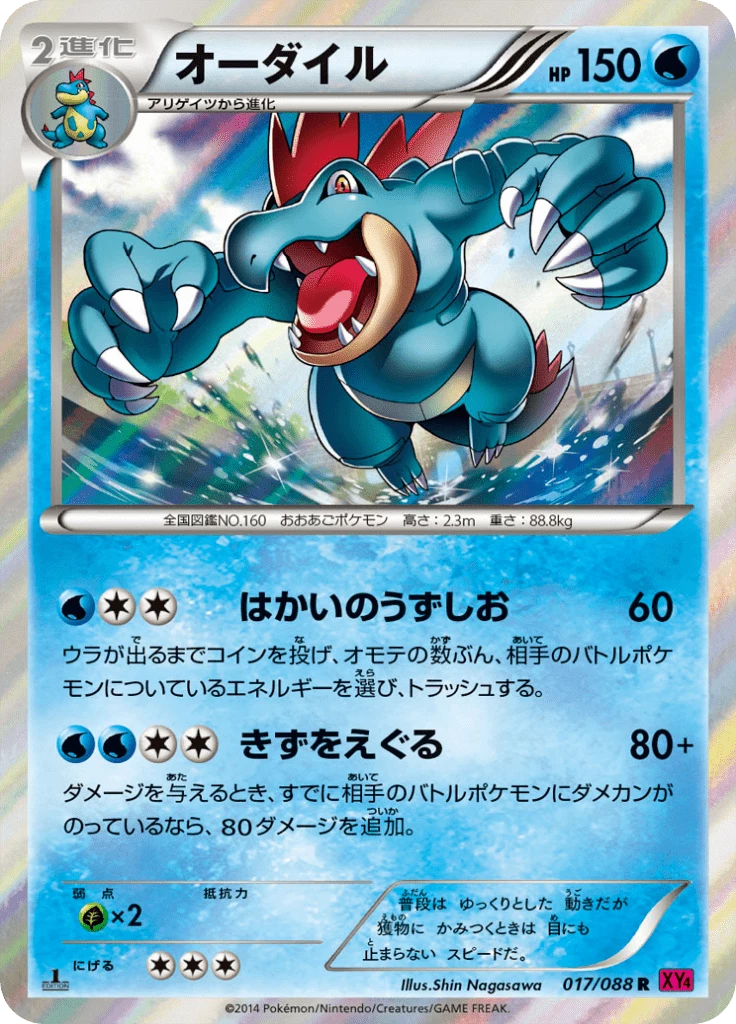
Feraligatr, XY4 17, R

Feraligatr, XY4 17, R

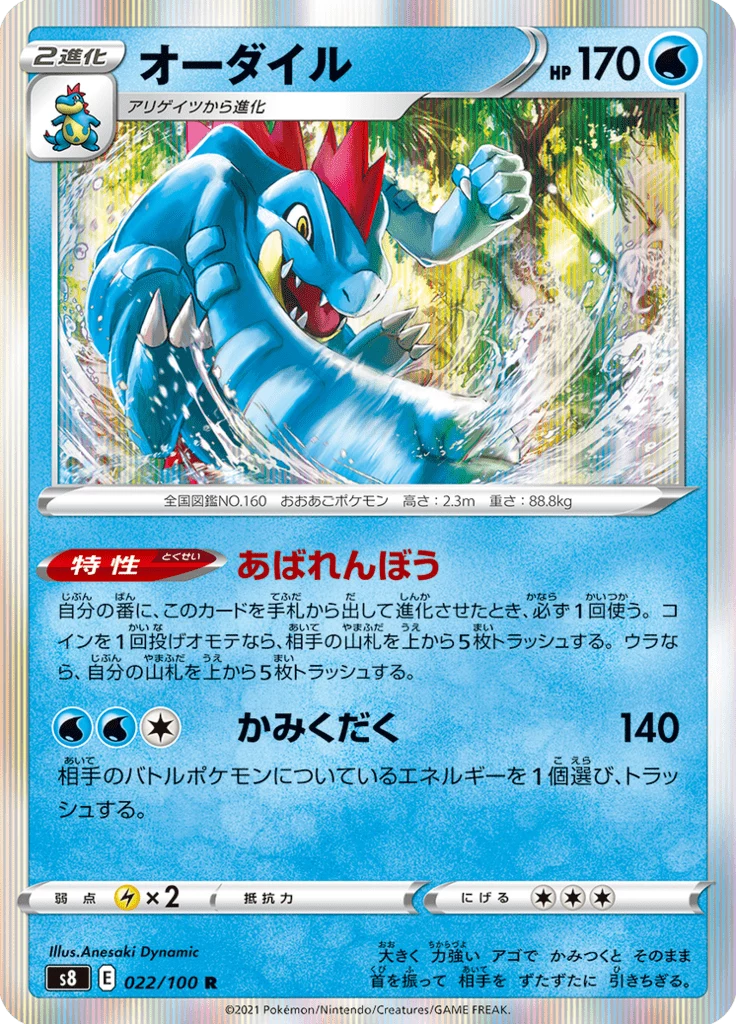
Feraligatr, S8 22, R

Feraligatr, S8 22, R

Five more prints are confirmed to exist via Limitless’s search index — SV8a 34, SV5K 15, SMH 26, SM6b 17, and SM3p 21 — each returning a set code, card number, and “R” index rarity. We didn’t open the individual card pages for these five, so we’re not citing illustrator or HP details for them here; the set and number are the only facts we’re carrying forward.

Across all nine indexed prints, the pattern holds: a single Water-type Feraligatr reprinted at Rare across successive Sun & Moon and Scarlet & Violet-era sets, plus the standalone XY4 print, none of which carry a secret-rare or full-art treatment as far as Limitless’s index shows.

Chase Prints and What Makes Them Collectible

None of Feraligatr’s verified prints sit at a secret-rare or full-art tier — the search index lists all nine indexed prints as Rare (though, as noted above, that label isn’t confirmed on every individual card page), and the two non-indexed anchors don’t carry a modern rarity label at all. What makes these specific slabs collectible is age and distribution rather than a printed rarity symbol:

  • The 1999 Neo Premium File print is collectible for its production window — the Old Back card design ran from 1996 to 2001 and was retired afterward, and this print comes from a binder product rather than a boosters-and-packs mainline set.
  • The SV-P 241 promo is collectible as a Japan-exclusive release — Limitless confirms it hasn’t been released internationally, so an English-language equivalent doesn’t exist for this specific print.
  • PSA 10 grading itself is what elevates any of these three listed slabs above an ungraded copy of the same print — a gem-mint certification applies on top of whichever set and rarity the card originally carried.

The HeartGold Collection print is harder to place on this scale, since we haven’t confirmed its release context beyond our own listing — its collectibility, for now, rests on the same PSA 10 certification rather than any documented scarcity.

Which Japanese Feraligatr Prints Are Currently Listed

Among the eleven Feraligatr prints covered in this guide, these are the graded PSA 10 singles linked in this guide:

For MC 168 and the seven index-only prints, no graded single is linked in this guide; sourcing requests for those go through Quick Order.

Shop This Print
PSA 10 Feraligatr, SV-P 241, “Illustration Contest 2024 Promo”
Currently listed at ¥8,260 (~$52)
Ships from Tokyo · Tracked delivery

View Product →

PSA 10 Feraligatr SV-P 241 promo slab, listed on samuraiswordtokyo.com
PSA 10 Feraligatr, SV-P 241, “Illustration Contest 2024 Promo,” currently listed at ¥8,260 (~$52)

Where to Buy Feraligatr Cards from Tokyo

We ship Japanese sealed product and graded singles worldwide out of Tokyo with tracked delivery. For Feraligatr specifically, all three of our currently listed prints are graded PSA 10 singles — the HeartGold Collection L1-H 025/070, the Old Back Neo Premium File print, and the SV-P 241 promo. For the wider graded-card selection, browse our PSA 10 graded card collection.

Feraligatr shares its evolution line with two other Johto starters worth knowing if you’re building out a full set — see our Chikorita, Cyndaquil & Totodile: Pokemon Johto Starter Cards Guide for the family-wide picture (that guide covers all three starter lines; this one is a Feraligatr-only deep dive). For any of the eight prints not currently listed on our site, request a quote via our Quick Order page — there’s no timing attached to sourcing requests, but it’s the fastest route to check availability on a specific print.

Frequently Asked Questions

How many Japanese Feraligatr card prints are there?

Limitless’s species search indexes nine Japanese Feraligatr prints, and two more prints are currently listed on our site — a 1999 Neo Premium File print and an L1-H HeartGold Collection print — that don’t appear in that index. Pre-2001 Japanese sets aren’t fully indexed on Limitless, so this guide covers the prints we’ve verified rather than a final total.

What is the oldest Feraligatr card?

The Neo Premium File 1 print, released December 10, 1999, per Bulbapedia. It’s an unnumbered promo from a binder product covering the three Generation II starter lines, and our listing catalogues it as No.160 as our own reference rather than an official Neo Premium File number.

Is the SV-P 241 Feraligatr available in English?

No confirmed English equivalent. Limitless notes that this specific print “has not been released internationally yet,” making it a Japan-exclusive promo as of this guide.

What does PSA 10 mean for a Feraligatr card?

A gem-mint grading certification from PSA, applied on top of whichever set and rarity the card originally carried. All three Feraligatr prints we currently list are graded PSA 10 examples.

Where can I buy Japanese Feraligatr cards?

We ship graded singles and sealed product from Tokyo with tracked delivery. Three Feraligatr PSA 10 prints are currently listed on our site, and requesting a quote via our Quick Order page covers sourcing for any of the other prints in this guide.

Leon Pokemon Card Guide: Japanese SR & Promo Prints

Leon shares a name with two very different Japanese Supporter cards, printed under two entirely different products — one from a numbered booster set, one from Japan’s separate promotional-card track.

Leon (Japanese: ダンデ, Dande) is a Supporter card built around the Sword & Shield Champion character. Both confirmed Japanese prints run the exact same effect text, but they come from different sets, different rarity classifications, and — going by third-party card databases — a genuinely tangled set of English-language counterparts. This guide covers both: the S4 110/100 print from Amazing Volt Tackle, and the S-P 230 promotional print, how to tell them apart, and what each one corresponds to outside Japan.

Key Takeaways

Two Japanese Leon Supporter prints are covered here: PSA 10 Leon SR (S4 110/100, Amazing Volt Tackle) currently listed at ¥13,924 (~$88), and PSA 10 Leon Promo (S-P 230), listed without a displayed price — sourcing goes through Quick Order enquiry. Both cards carry the identical effect: this turn, damage dealt by your Pokémon’s attacks to the opponent’s Active Pokémon is increased by +30. If you’d rather open the set the SR comes from, the S4-Amazing V Charge Japanese Pokemon Booster Box is currently listed at ¥50,400.

2
Prints Covered

SR
Top Rarity (S4)

S4 & S-P
Sets

Sep 2026
Prices Checked

Prices are our own listed prices as of September 2026, converted at ¥159/USD.

Who Is Leon?

Leon is a Supporter card themed around the Sword & Shield Champion character from the Pokémon games. On both Japanese cards covered in this guide, the name is printed as ダンデ (Dande) — the same character across both prints.

Quick Reference

Search Japanese marketplaces and grading databases using ダンデ (Dande) rather than the English localisation “Leon” — both prints below carry that Japanese name on the card itself.

Card effect, identical on both prints: this turn, damage dealt by your Pokémon’s attacks to the opponent’s Active Pokémon is increased by +30.

Here is a quick-glance summary of both prints before the full breakdown below:

Print Set Number Rarity Illustrator Release Status
Leon SR Amazing Volt Tackle (S4) 110/100 SR (per our listing) Hideki Ishikawa 18 Sept 2020 ¥13,924 (~$88)
Leon Promo Sword & Shield Promotional Cards (S-P) 230 Promo Naoki Saito date not confirmed Quick Order enquiry

Leon SR: The Amazing Volt Tackle Print (110/100)

Leon SR 110/100, Amazing Volt Tackle (S4)
Leon SR 110/100 — Amazing Volt Tackle (S4), illustrated by Hideki Ishikawa

Leon’s first Japanese Supporter print appeared in Amazing Volt Tackle (S4), released 18 September 2020, as card 110/100, SR per our own listing, illustrated by Hideki Ishikawa.

Amazing Volt Tackle totals 111 cards despite the /100 denominator printed on the regular card run — Leon’s SR sits in that upper numbering band, at 110 of 111.

Set-Name Note

If you see the S4 set bracketed elsewhere on our site as “Vorteker of Heaven,” that’s a garbled machine-translation of the same Japanese title (アメイジング・ボルテッカー), not a separate or official set name. We use Amazing Volt Tackle (S4) throughout this guide. Our own booster-box listing, “S4-Amazing V Charge Japanese Pokemon Booster Box,” is a second in-house translation of the same S4 set — all three names point to one and the same set.

PSA 10 Leon SR S4 110/100 slab, listed on samuraiswordtokyo.com
PSA 10 Leon SR (S4 110/100) — the print listed on our site

A PSA 10 of this print is currently listed at ¥13,924 (~$88). If you’d rather start from sealed product, the S4 set itself is currently listed at ¥50,400 as the S4-Amazing V Charge Japanese Pokemon Booster Box.

For the complete S4 set list, see our Amazing Volt Tackle (S4) card list — this article is a single-character deep dive, not a full-set breakdown. For pull-rate information on the set as a whole, see our S4 pull-rates guide.

Leon Promo: The Sword & Shield Promo Print (230)

Leon Promo 230, Sword & Shield Promotional Cards (S-P)
Leon Promo 230 — Sword & Shield Promotional Cards, illustrated by Naoki Saito

The second Japanese Leon print comes from Sword & Shield Promotional Cards, indexed in Limitless’s database as “SP”; our own listing brackets the same promo series as “S-P Promotional cards” — a notation difference rather than two separate series. Card number 230 is illustrated by Naoki Saito; we could not confirm an exact release date for this specific promo card during this research.

Mechanically it is the identical card: this turn, damage dealt by your Pokémon’s attacks to the opponent’s Active Pokémon is increased by +30 — the same effect as the S4 SR above.

PSA 10 Leon PROMO S-P 230 slab, listed on samuraiswordtokyo.com
PSA 10 Leon Promo (S-P 230) — listed without a displayed price

This print is listed in our own catalogue without a displayed price — sourcing goes through Quick Order enquiry via our PSA 10 Leon Promo (S-P 230) listing.

For more Sword & Shield-era Japanese promotional Supporters, see our S-P promo card guide.

Japanese vs English Print

Leon’s cards exist outside Japan too, though the two prints map to the English market very differently. Limitless’s own card database links our S4 110/100 SR to the English Vivid Voltage #182 Full Art print — a pairing we treat as reasonably reliable, since it is reported as a direct one-to-one match for that specific card number.

The S-P 230 promo is a different story. Limitless’s records report that same Japanese promo number corresponding to as many as four separate English printings — Vivid Voltage #154, Vivid Voltage #182, Vivid Voltage #195, and Crown Zenith #134 — with additional Japanese appearances noted across the Amazing Volt Tackle set, the Family Pokémon Card Game product, and VMAX Climax. We’re presenting that multi-set list exactly as reported rather than as something independently checked card-by-card here; a single promo number spanning that many separate printings is unusual enough that any one of those pairings is a starting point for further research rather than a confirmed match.

Where Leon’s Prints Sit in Japanese Rarity Tiers

Leon’s two prints sit in different parts of the Japanese card system entirely, and rarity is really where the SR and the Promo diverge. Our own listing records the S4 print as SR — a numbered-set rarity slot, positioned in the upper band above the set’s regular /100 run. The S-P print, by contrast, carries a Promo rarity: distributed through Japan’s separate promotional-card program rather than inside a numbered booster set, so it never carried a set-relative rarity slot the way the SR does.

That distinction matters more than the labels alone suggest. A numbered SR sits inside one specific set’s print run; a promo card is issued on its own schedule, tied to a distribution product rather than a set. For a broader look at how SR and SAR-tier Japanese Trainer and Supporter cards compare across different sets, see our full-art SR/SAR trainer card guide; for PSA 10 Trainer cards specifically, our PSA 10 Trainer card guide covers the wider category.

Shop This Card
PSA 10 Leon SR (S4 110/100, Amazing Volt Tackle)
Currently listed at ¥13,924 (~$88)
Ships from Tokyo · Tracked delivery

View Product →

Where to Buy Leon Cards from Tokyo

We ship graded and raw Japanese singles out of Tokyo with tracked delivery. Both Leon prints covered in this guide are individually listed in our catalogue.

PSA 10 Leon SR S4 110/100 slab, listed on samuraiswordtokyo.com
The Leon SR print listed above — PSA 10, S4 110/100

The S4 SR is currently listed at ¥13,924 (~$88). The S-P Promo print, PSA 10 Leon Promo (S-P 230), is listed without a displayed price — sourcing goes through Quick Order enquiry. If you’d rather start from sealed product, the S4-Amazing V Charge Japanese Pokemon Booster Box is currently listed at ¥50,400.

For more graded Japanese Trainer and Supporter cards, browse our PSA 10 graded card collection. For other Japanese singles or sealed product to combine into one order, our Quick Order page is the fastest way to build a mixed order.

Frequently Asked Questions

Who is Leon in the Pokemon games?

The card is themed around Leon, the Champion character from Pokémon Sword & Shield. Both Japanese prints covered here use his Japanese name, ダンデ (Dande), on the card itself.

How many Japanese Leon Supporter cards are there?

Our research has verified two Japanese Leon Supporter prints: the SR from Amazing Volt Tackle (S4), numbered 110/100, and the Promo from Sword & Shield Promotional Cards (S-P), numbered 230.

What does the Leon Supporter card do?

Both prints share the same effect: this turn, damage dealt by your Pokémon’s attacks to the opponent’s Active Pokémon is increased by +30.

Is the S-P 230 promo the same card as the S4 SR?

Same character and identical effect text, but different products, different rarity classifications, and different card numbers. The SR comes from a numbered booster set; the Promo comes from Japan’s separate promotional-card program.

What is the English version of Leon’s Japanese cards?

The S4 SR pairs with the English Vivid Voltage #182 Full Art print, per Limitless’s card database. The S-P promo’s English counterpart is less clear-cut: Limitless’s records report it corresponding to as many as four different English printings (Vivid Voltage #154, #182, #195, and Crown Zenith #134); we’re presenting that as reported rather than independently verified card-by-card.

Is the PSA 10 Leon Promo card available to buy?

It is listed in our catalogue without a displayed price. Sourcing goes through our Quick Order enquiry rather than a standard checkout price.

Pichu Pokemon Card Guide: Every Japanese Print Worth Knowing

Pichu — ピチュー in Japanese — is Pikachu’s Basic-stage pre-evolution, and its Japanese card history runs almost entirely through promos rather than standard booster pulls. A search of Limitless’s modern-database filter for Pichu turns up just three current-era prints, but the fuller Japanese picture stretches back seventeen years earlier, into a run of store and movie-tie-in promotional cards that never shipped inside a Pichu-specific box at all.

This pichu pokemon card guide covers every Japanese Pichu print we’ve verified: a 2008 store promo, a 2009 movie promo (the well-known Spiky-eared Pichu M), a current-generation Sword & Shield-era promo, and the two most recent “Hibiki’s Pichu” prints. None of the five came out of a set we list sealed today, so rather than pointing you at a box, this guide leads to the three PSA 10-graded Pichu singles we currently list.

Key Takeaways

Five Japanese Pichu prints verified here, spanning 2008–2025 across four eras — none from a currently-stocked booster box. The oldest is the 2008 DP-P 112 store promo, currently listed as PSA 10 Pichu [DP-P 112] at ¥328,040 (~$2,063). The 2009 movie-tie-in Spiky-eared Pichu M is currently listed as PSA 10 Spiky-eared Pichu M [010/022] at ¥257,240 (~$1,618). Exchange rate used throughout: ¥159/USD (September 2026).

5
Pichu Prints

2
Rarity Tiers

4
Eras Covered

Sep 2026
Prices Checked

Every Verified Japanese Pichu Card

Five Pichu prints across roughly seventeen years, from a 2008 store handout to a late-2025 starter-deck reprint:

Card Set / Number Rarity Illustrator Release
Pichu DP-P 112 Promo Midori Harada 19 Jul 2008
Spiky-eared Pichu M Movie Random Pack 010/022 Promo Takahiro Yamashita 18 Jul 2009
Mischievous Pichu S-P 214 Promo Akira Komayama Sword & Shield era (exact date not verified)
Hibiki’s Pichu SV9a 036 Common Narumi Sato Heat Wave Arena (SV9a)
Hibiki’s Pichu (reprint) MC 241 — Narumi Sato 19 Dec 2025, Start Deck 100 Battle Collection (MC)

Two patterns stand out. First, three of the five prints are event or store promos that never ran through a standard booster box — the 2008 DP-P handout, the 2009 movie pack, and the current Sword & Shield-era S-P promo. Second, the two newest prints share the same artwork and illustrator: SV9a 036 and its MC 241 reprint are the same “Hibiki’s Pichu” card released in two different products.

Check This First

If your card reads “DP-P” or has a movie-pack number like 010/022, you’re holding one of the two vintage event promos. If it reads “S-P 214,” “SV9a 036,” or “MC 241,” it’s one of the three current-generation prints instead.

The 2008 Store Promo: DP-P 112

Pichu, DP-P 112, Promo, DP-P Promotional cards
PSA 10 Pichu, DP-P 112, DP-P Promotional cards

The earliest Japanese Pichu print we’ve verified is DP-P 112, a plain Pichu distributed as part of the “Collection Challenge: Trade Please DP” event. It went out at participating store chains starting 19 July 2008, while supplies lasted, rather than through a booster box. A secondary source names Midori Harada as illustrator, but that credit is not independently confirmed, so we’re flagging it as reported rather than verified.

Because it moved through a limited-run store event rather than random pack distribution, DP-P 112 sits in the promo tier alongside the other two promotional Pichu prints in this guide.

The 2009 Movie Promo: Spiky-eared Pichu M

Spiky-eared Pichu M, 010/022, Promo, Movie Commemoration Random Pack
PSA 10 Spiky-eared Pichu M, 010/022, Movie Commemoration Random Pack

A year later, the Movie Commemoration Random Pack tied to the Japanese theatrical release of Arceus: To a Conquering Spacetime (18 July 2009) introduced ギザミミピチュー M — Spiky-eared Pichu M — illustrated by Takahiro Yamashita. Card 010/022 is one of three art variants (009–011/022) covering the same Spiky-eared Pichu concept within that random pack, distributed at cinemas rather than through regular retail.

A separate detail worth knowing: Bulbapedia also documents a run of additional Spiky-eared Pichu variants distributed the same month through Shogakukan magazines, produced via a fan illustration contest (credited winners include Shunsuke Takemori, Haruka Uekura, Taisei Fujita, Keita Mizuno, Mahiro Shinozaki, and Shizuka Kusakabe). Those magazine-contest cards are a distinct product from the Movie Random Pack numbers above — they’re a different distribution channel and a different print, not another copy of 010/022.

The Modern Prints: Mischievous Pichu and Hibiki’s Pichu

Mischievous Pichu, S-P 214, Promo, Sword and Shield era Japanese promo

Mischievous Pichu, S-P 214

Hibiki's Pichu, SV9a 036, Common, Heat Wave Arena

Hibiki’s Pichu, SV9a 036, Heat Wave Arena

Hibiki's Pichu, MC 241, Start Deck 100 Battle Collection

Hibiki’s Pichu, MC 241, Start Deck 100 Battle Collection

いたずら好きのピチュー — Mischievous Pichu, S-P 214 — is a current Sword & Shield-era Japanese promo illustrated by Akira Komayama. According to Limitless, this specific print has not been released internationally, which is why the card doesn’t turn up in English set checklists.

The two newest Pichu prints are both titled ヒビキのピチュー — Hibiki’s Pichu — and share the same Narumi Sato artwork. SV9a 036 comes from Heat Wave Arena; MC 241 is a reprint of the same card released 19 Dec 2025 in Start Deck 100 Battle Collection. On the English side, the equivalent card is Ethan’s Pichu, #71 in Destined Rivals (DRI) — the vintage 2008 and 2009 event promos have no directly equivalent English-set release in the records we’ve checked.

For more on how modern Scarlet & Violet-era rarity treatments are structured across recent Japanese sets, see our Master Ball Mirror Pokemon cards guide.

Chase Prints and What Makes Them Collectible

Pichu’s Japanese card list splits cleanly into two rarity tiers. The three promos — DP-P 112, Spiky-eared Pichu M, and Mischievous Pichu — all moved through event or store distribution rather than standard booster packs, which puts them in a scarcer structural tier than a normal set pull. The two Hibiki’s Pichu prints, by contrast, are standard common-rarity cards issued through their respective set and starter-deck releases.

Within the promo group, Spiky-eared Pichu M ties directly to a specific theatrical release and a distinct alternate-art concept rather than a plain reissue of the standard Pichu artwork. DP-P 112 is the oldest print in the lineup and distributed through a “Trade Please” event at participating store chains rather than a film tie-in. Mischievous Pichu is the newest promo and the only one of the three confirmed as not released outside Japan.

Featured Print
PSA 10 Spiky-eared Pichu M [010/022]
Currently listed at ¥257,240 (~$1,618)
Ships from Tokyo · Tracked delivery

View Product →

Where These Pichu Prints Come From

None of the five prints above are anchored to a Pichu-specific booster box, and we don’t currently list sealed product from the sets and products they came out of. The two vintage promos (DP-P 112, Spiky-eared Pichu M) and the current Mischievous Pichu print were never distributed through a standard booster box at all — they went out via store events and a movie-tie-in random pack. The two Hibiki’s Pichu prints are ordinary common-rarity pulls from Heat Wave Arena (SV9a) and the Start Deck 100 Battle Collection (MC) respectively, but neither product is part of our current sealed lineup.

That makes the direct route to owning any of these five cards the graded singles below, or a sourcing request through our Quick Order page for the specific print you’re after.

Where to Buy Pichu Cards from Tokyo

We ship Japanese cards worldwide out of Tokyo with tracked delivery. The Pichu prints currently listed on our site are PSA 10 graded singles:

Browse the wider PSA 10 graded card collection for other Japanese promos and chase singles, or request a quote via Quick Order for the Hibiki’s Pichu prints or any Pichu card not listed above — no timing guarantees, but sourcing requests for specific cards go through that page. For more PSA 10 promo content in this style, see our PSA 10 trainer cards Japanese Pokemon guide, and if you’re browsing by Pokedex order across generations, our Pokemon 151 Japanese card list is a related hub to continue from.

This guide is also part of a wider collector-guide cluster covering other classic Japanese prints — see our Kabuto cards guide, Kadabra cards guide, and Bonsly cards guide for more.

Frequently Asked Questions

How many Japanese Pichu card prints are there?

Five prints verified in this guide, spanning 2008 to 2025 across four eras: a 2008 store promo (DP-P 112), a 2009 movie promo (Spiky-eared Pichu M), a Sword & Shield-era promo (Mischievous Pichu, S-P 214), and two “Hibiki’s Pichu” prints (SV9a 036 and its MC 241 reprint).

What is Spiky-eared Pichu?

Spiky-eared Pichu M is a Japanese promo card, number 010/022 from the Movie Commemoration Random Pack tied to the 18 July 2009 theatrical release of Arceus: To a Conquering Spacetime, illustrated by Takahiro Yamashita. It’s one of three art variants (009–011/022) distributed through that pack; a separate set of contest-winner variants was distributed the same month via Shogakukan magazines and is a different card.

What is the oldest Japanese Pichu card?

DP-P 112, a plain Pichu distributed through the “Collection Challenge: Trade Please DP” store event starting 19 July 2008. It’s the earliest Japanese Pichu print verified in this guide.

Is there an English version of these Pichu promos?

The 2008 and 2009 event promos don’t have a directly equivalent English-set release in the records we’ve checked. The two modern “Hibiki’s Pichu” prints correspond to Ethan’s Pichu, #71 in the English Destined Rivals (DRI) set.

What’s the difference between the SV9a and MC prints of Hibiki’s Pichu?

They’re the same card and the same Narumi Sato artwork. SV9a 036 comes from Heat Wave Arena; MC 241 is a reprint released 19 Dec 2025 in the Start Deck 100 Battle Collection.

Where can I buy Japanese Pichu cards?

We ship from Tokyo with tracked delivery. PSA 10 graded Pichu singles are currently listed — DP-P 112, Spiky-eared Pichu M [010/022], and Mischievous Pichu [S-P 214] — and sourcing requests for the Hibiki’s Pichu prints or any other Pichu card go through our Quick Order page.