White Flare ETB Pokémon Center: English Box vs Japanese Set
The White Flare ETB Pokémon Center is the English-language Pokémon TCG: Scarlet & Violet-White Flare Pokémon Center Elite Trainer Box, with 11 booster packs and 2 full-art foil promo cards. Its Japanese counterpart set is Expansion Pack “White Flare” (SV11W), whose official product lineup has no Elite Trainer Box.
Updated November 12, 2026
Key Takeaways
The Pokémon Center Elite Trainer Box for Scarlet & Violet-White Flare is an English-market product with product code 10-10037-117.
Per the official English expansion page, it contains 11 booster packs and 2 full-art foil promo cards, one of them with a Pokémon Center logo.
The standard Elite Trainer Box contains 9 booster packs and 1 promo; sleeves (65) and Energy cards (45) are the same in both.
The Japanese set, Expansion Pack “White Flare” (SV11W), was released on June 6, 2025 according to the official Japanese SV11 page.
That page lists three Japanese products: the Expansion Pack, the Expansion Pack Deluxe and the Card File Set.
Key fact
Detail
English product
Pokémon TCG: Scarlet & Violet-White Flare Pokémon Center Elite Trainer Box (Pokémon Center page)
Japanese set (English name)
Expansion Pack “White Flare”, Japanese edition
Japanese set (Japanese name)
拡張パック「ホワイトフレア」
Set code
SV11W
Japanese release date
June 6, 2025 (Friday), together with Expansion Pack “Black Bolt” (pokemon-card.com)
Inside the English Pokémon Center ETB
11 booster packs, 2 full-art foil promo cards, 65 card sleeves, 45 Energy cards and play accessories (tcg.pokemon.com)
What Is the White Flare ETB Pokémon Center Version?
It is the Pokémon Center edition of the Elite Trainer Box for the English expansion Scarlet & Violet-White Flare. The product title reads “Pokémon TCG: Scarlet & Violet-White Flare Pokémon Center Elite Trainer Box”, and the Pokémon Center URL carries the product code 10-10037-117.
The English expansion page at tcg.pokemon.com lists two sister expansions, Scarlet & Violet-Black Bolt and Scarlet & Violet-White Flare. Each has the same four product types: a Pokémon Center Elite Trainer Box, an Elite Trainer Box, a Booster Bundle of six booster packs and a Poster Collection. The Pokémon Center box is therefore one of four English White Flare products, not a separate set.
The Japanese pair works the same way. Expansion Pack “Black Bolt” and Expansion Pack “White Flare” came out together on June 6, 2025, and White Flare carries the set code SV11W. The Japanese release date comes from the official Japanese page, not from the English page. When an English listing says “White Flare”, the Japanese set behind it is SV11W, and the English and Japanese names match.
Three things share the White Flare name. The first is the English expansion, Scarlet & Violet-White Flare. The second is the English Pokémon Center box, one product inside that expansion. The third is the Japanese Expansion Pack “White Flare”, a different printing with Japanese text and its own product lineup. Keeping them apart tells you which product you are looking at before you order.
A quick way to sort a listing is to read three details: the language of the cards, the product type in the title and the source that states the contents. “Pokémon Center Elite Trainer Box” points to the English box and the English expansion page. “Expansion Pack”, “Expansion Pack Deluxe” or “Card File Set” points to the Japanese lineup and the Japanese SV11 page.
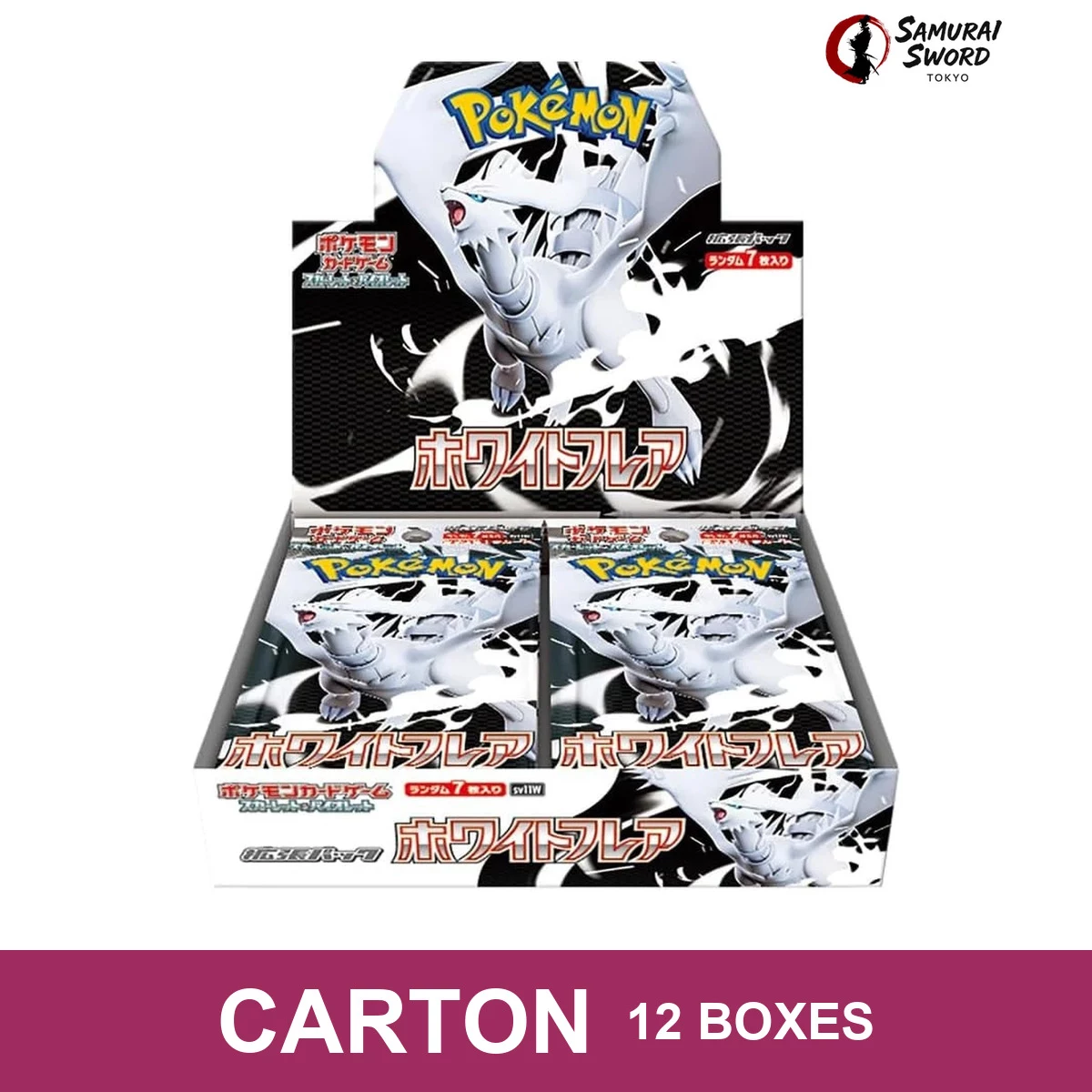
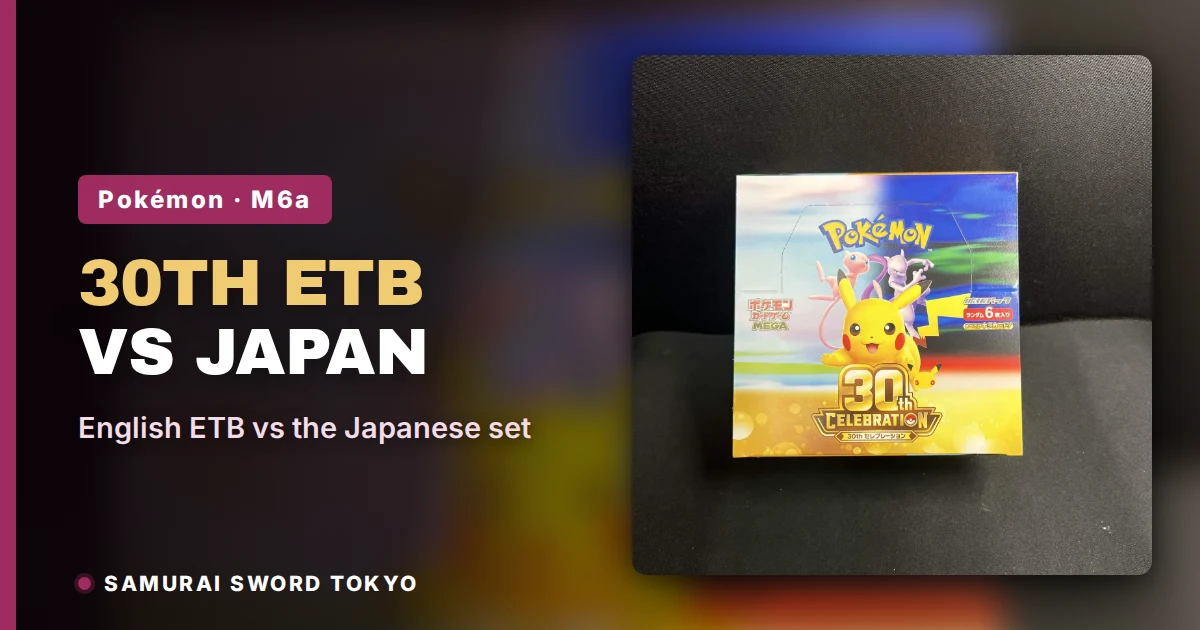
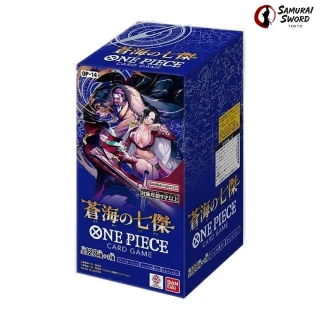
The Japanese SV11W-White Flare carton, one of our Japanese products for this set.
What Is Inside the White Flare Pokémon Center Elite Trainer Box?
The White Flare Pokémon Center Elite Trainer Box contains 11 booster packs, 2 full-art foil promo cards and a full set of play accessories. The contents below come from the official English expansion page at tcg.pokemon.com.
11 booster packs
2 full-art foil promo cards (Thundurus or Tornadus), one of them with a Pokémon Center logo
65 card sleeves
45 Energy cards
A player’s guide
6 damage-counter dice
1 competition-legal coin-flip die
2 plastic condition markers
A collector’s box with 4 dividers
A Pokémon TCG Live code card
Two points stand out. First, the pack count is 11, which is two more packs than the standard Elite Trainer Box lists. Second, the promos are a Thundurus or a Tornadus, printed as full-art foils.
The accessories make up the rest of the box: 65 card sleeves, 45 Energy cards, a player’s guide, 6 damage-counter dice, 1 competition-legal coin-flip die, 2 plastic condition markers, a collector’s box with 4 dividers and a Pokémon TCG Live code card. If you want that bundle of play items, the English box is the product that lists them.
The list has three groups. The first group is cards: 11 booster packs, 2 foil promos and 45 Energy cards. The second is protection and storage: 65 sleeves and the collector’s box with its 4 dividers. The third is play items: the player’s guide, 6 damage-counter dice, 1 competition-legal coin-flip die and 2 plastic condition markers, plus the Pokémon TCG Live code card.
The Japanese products on the official SV11 page are built differently. Their descriptions center on packs and a card file. A buyer who wants the English accessory bundle should look at the English box; a buyer who wants Japanese-language cards should look at the Japanese lineup covered further down.
How Does the Pokémon Center ETB Differ From the Standard White Flare ETB?
The Pokémon Center ETB holds two more booster packs and one more promo card than the standard White Flare ETB. The accessory list is the same on both boxes according to the official English page.
Item
Pokémon Center ETB
Standard ETB
Booster packs
11
9
Full-art foil promo cards
2 (Thundurus or Tornadus, one with a Pokémon Center logo)
1 (Thundurus or Tornadus)
Card sleeves
65
65
Energy cards
45
45
Other accessories
Player’s guide, dice, condition markers, collector’s box with dividers, Pokémon TCG Live code card
Same accessories
The Pokémon Center logo on one of the two promos is the visible difference between the boxes. Both boxes are listed under the same English White Flare expansion. What changes is the quantity of packs and the promo set, not the expansion.
The sleeve and Energy counts are identical, so the difference between the two boxes sits entirely in the two additional packs and the second promo. If the Pokémon Center logo matters to you, that promo is the item to look for; if it does not, the standard box lists the same accessories with fewer packs.
In pack terms the gap is simple arithmetic: 11 packs against 9 is a difference of 2 packs. In promo terms it is 2 against 1. Everything else on the official list matches line for line, which makes this a short comparison and an easy one to check against the official page.
The Booster Bundle sits lower on the pack scale. It holds six booster packs, against 9 in the standard ETB and 11 in the Pokémon Center ETB. The Booster Bundle is a pack product, while the two ETBs are pack-plus-accessory products.
Does Japan Have an ETB for White Flare (SV11W)?
The official Japanese SV11 page lists three White Flare products, and an Elite Trainer Box is not one of them. The three are the Expansion Pack “White Flare”, the Expansion Pack Deluxe “White Flare” and the Card File Set. The listing comes from pokemon-card.com.
Japanese product
Price (tax incl.)
What it holds
Expansion Pack “White Flare”
¥290
7 cards, randomly packed
Expansion Pack Deluxe “White Flare”
¥1,450
35 cards, randomly packed, with one AR card in each Deluxe pack
Card File Set
¥2,640
1 holo promo Victini, 1 three-pocket card file (156-card capacity), 3 packs each of Black Bolt and White Flare
The Japanese lineup is built around booster packs and one accessory set, while the English lineup is built around ETBs, a Booster Bundle and a Poster Collection. A collector searching for a “Japanese White Flare ETB” will therefore not find a one-to-one match.
The price lines give a simple comparison. The Expansion Pack costs ¥290 for 7 cards and the Deluxe costs ¥1,450 for 35 cards. The Deluxe pack holds five times the cards of the standard pack for five times the price, and each Deluxe pack contains one AR card.
The Card File Set is the Japanese product that comes nearest to an accessory bundle. It pairs a three-pocket card file with a 156-card capacity and six packs, three from each of the two sets, plus the holo Victini promo. For ¥2,640 (tax included) the official page lists that whole package.
The deck-building format for the two Japanese sets also differs from a single-set setup. The official page says the Black Bolt / White Flare format uses cards from both packs plus some basic Energy cards.
For an English-language buyer the practical point is the product type. An English ETB is a box that holds packs, sleeves, dice and a collector’s box. A Japanese Expansion Pack is a single pack of 7 cards, and the Japanese Deluxe pack is a larger pack of 35 cards. They are sold and described in different units, so compare the contents lines rather than the names.
What Does the Japanese White Flare Set Contain Instead?
The Japanese White Flare set contains cards numbered out of 086 in the main run, plus AR and SAR versions of the Unova Pokémon. The official page states that each of the 156 Unova Pokémon has an AR or SAR version, and that Reshiram ex has a special BWR (Black White Rare) version.
Official reveal material from pokemon-card.com, published May 4, 2025, named these White Flare cards: Stoutland, Herdier, Lillipup, Energy Retrieval (Item), Ignition Energy (Special Energy), Cheren (Supporter) and Touko (Supporter). Reshiram ex is the BWR card in White Flare, while Zekrom ex is the BWR card in Black Bolt.
A few card entries from the official card database show the card-level detail:
Reshiram ex, 017/086, rarity RR: HP 230, illustrated by 5ban Graphics, with the attacks Slash (50) and Blaze Burst (130+). Our Reshiram ex White Flare guide covers its prints.
Oshawott, 018/086: HP 70, illustrated by rika, with the attacks Tackle (10) and Water Gun (30). See our Oshawott White Flare guide.
Whimsicott ex, 159/086: HP 230, illustrated by 5ban Graphics, with the attacks Energy Gift and Wonder Cotton (50×).
Touko, 085/086: a Supporter illustrated by yuu.
The Card File Set includes three packs each of Black Bolt and White Flare.
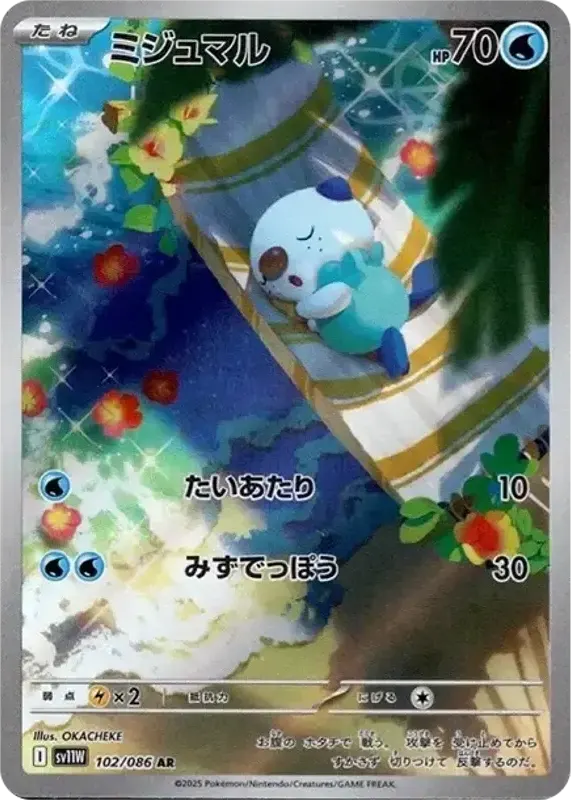
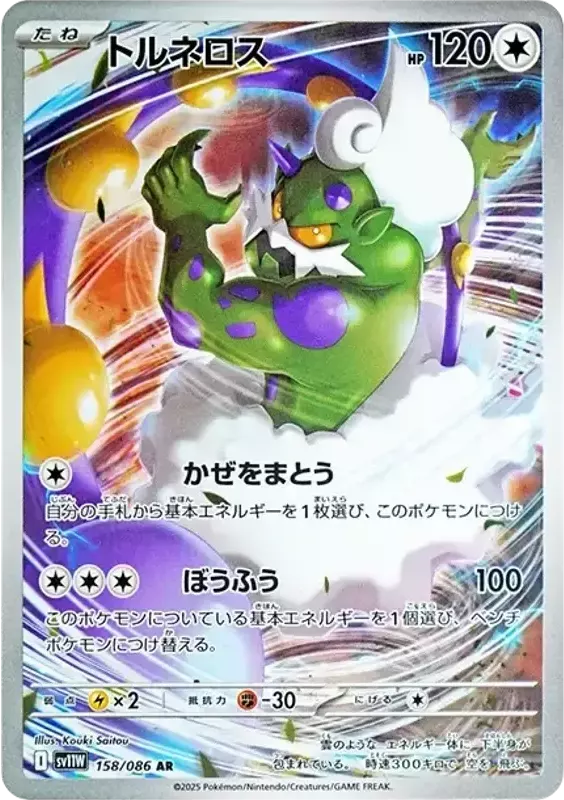
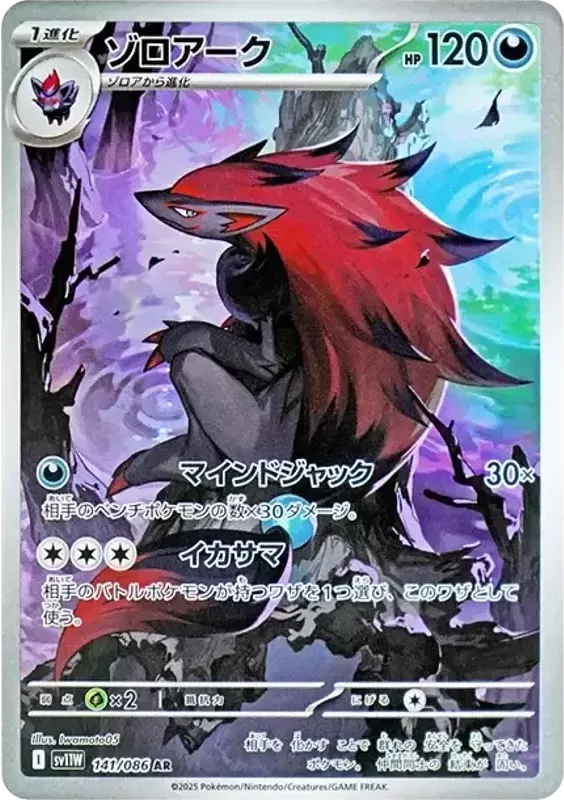
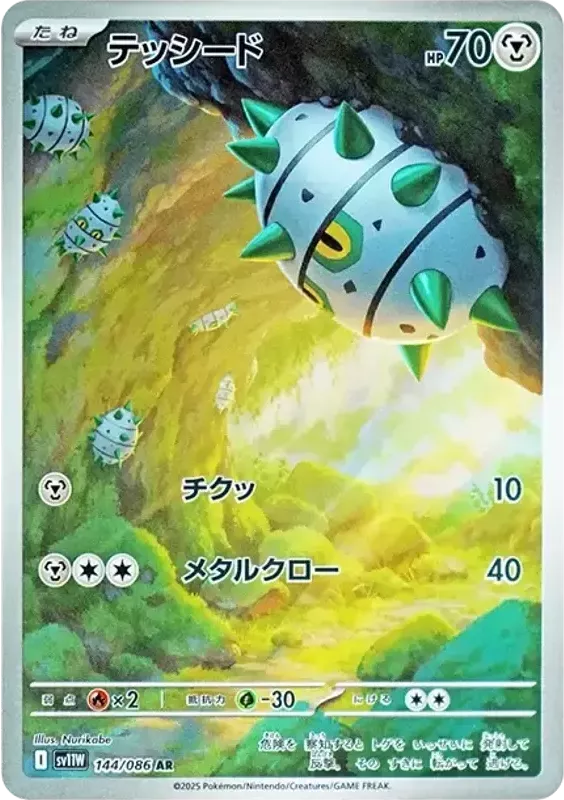
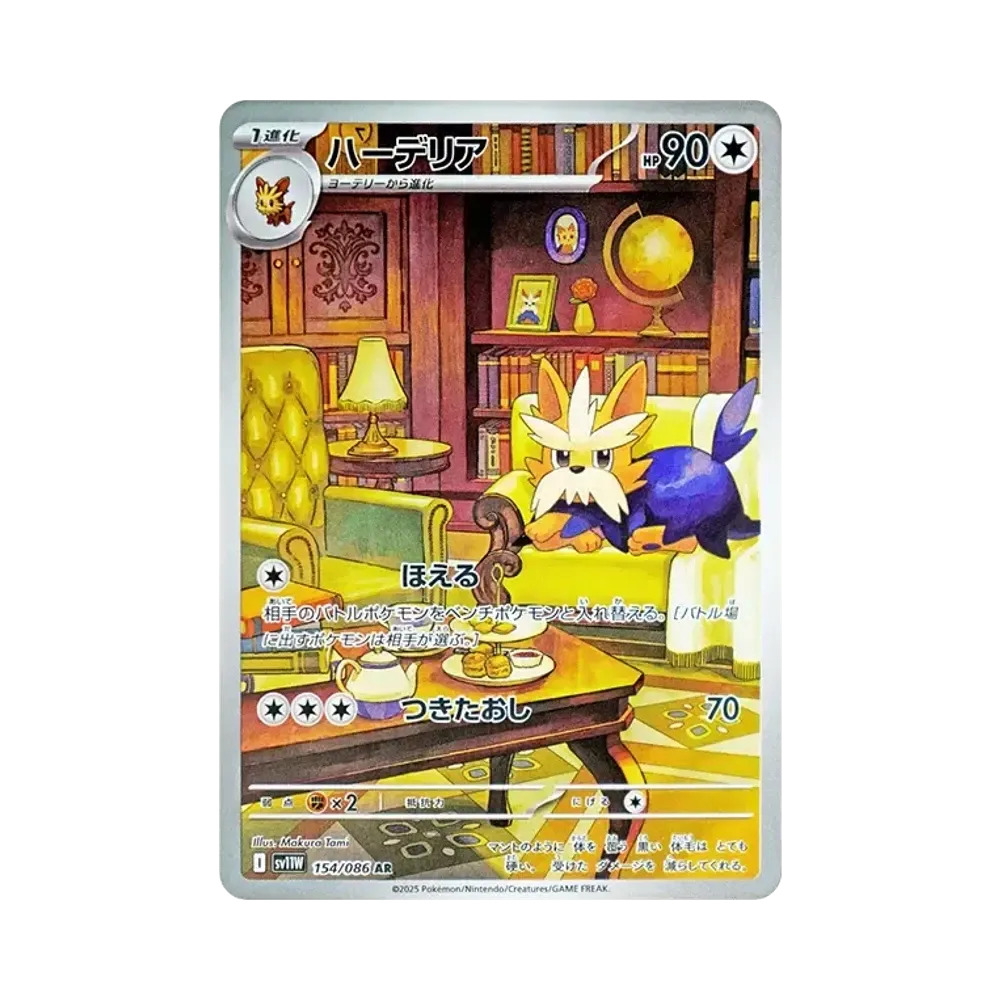
The same Pokémon can appear in more than one rarity. Oshawott appears at 018/086 in the main run, and the AR version of Oshawott is numbered 102/086 in the graded cards we list. The AR cards in our listings carry numbers above the 086 denominator, for example Zoroark 141/086, Ferroseed 144/086, Herdier 154/086 and Tornadus 158/086.
That numbering is useful when you compare the two languages. English collectors who know the English set by name can find the Japanese card by its number and the Japanese name printed on it. The official name table pairs each Japanese Pokémon name with an English one: Oshawott, Lillipup, Herdier, Stoutland, Whimsicott and Reshiram.
The revealed cards also show the card types in the set. Stoutland, Herdier and Lillipup are Pokémon, Energy Retrieval is an Item, Ignition Energy is a Special Energy, and Cheren and Touko are Supporters. Reshiram ex and Whimsicott ex are ex cards with 230 HP each.
The Victini promo ties the two Japanese sets together. The official page says the promo Victini in the Card File Set uses the same illustration as the AR Victini in Black Bolt.
Oshawott AR 102/086 from Japanese White Flare, graded PSA 10.
Which Thundurus and Tornadus Promos Come With the English ETB?
The English Pokémon Center ETB includes two full-art foil promo cards, each a Thundurus or a Tornadus, and one of the two has a Pokémon Center logo. The standard ETB includes one such promo.
The Japanese side handles promos differently. The Card File Set includes one holo promo Victini, and the official page says it uses the same illustration as the AR Victini in Black Bolt.
That gives collectors two separate promo goals. The English boxes carry a Thundurus or Tornadus full-art foil, and the Japanese Card File Set carries a holo Victini. The two promos belong to different products.
Tornadus does exist in the Japanese set as an AR card. Our PSA10 Tornadus AR [SV11W 158/086] page and our second Tornadus page cover a graded copy of the AR numbered 158/086; the second page is priced at ¥5,500 on November 12, 2026. It is a card from the Japanese set and is not the English promo, so treat the two as separate items when you compare.
Tornadus AR 158/086 from Japanese White Flare, graded PSA 10.
Which Should You Choose: the English ETB or Japanese White Flare Products?
Choose the English White Flare ETB Pokémon Center box if you want English-language cards plus sleeves, Energy cards and dice in one box. Choose Japanese White Flare products if you want Japanese-language cards, the Deluxe pack with its AR card in each pack or the Victini promo.
Your goal
Better fit
Why
Play in English with accessories included
English Pokémon Center ETB
11 packs, 65 sleeves, 45 Energy cards and dice in one box
Collect the Thundurus or Tornadus promo
English ETB
The promo is part of the English boxes
Open Japanese packs
Japanese Expansion Pack or Deluxe
7 cards for ¥290, or 35 cards for ¥1,450
Get the Victini promo with a card file
Japanese Card File Set
Includes the holo Victini, a card file and 3 packs each of the two sets
Own a graded Japanese card
PSA 10 singles from SV11W
The card is already graded, so no pack opening is needed
Card language is the deciding factor. Japanese White Flare cards carry Japanese text, with the Japanese name of each Pokémon printed on the card. English cards carry English names. If you cannot read Japanese, check the English name of each card before you buy; the official card database lists both the Japanese name and the card number.
The Pokémon Center ETB suits a player who wants to start playing, while the Japanese products suit a collector who wants Japanese printings. A reasonable plan for someone who wants both is to buy the English box for the accessories and promos, and add Japanese packs or graded singles for the Japanese artwork and text. For a set-focused view of Japanese cards and prints, read our White Flare SV11W card list article.
The decision also depends on what you do with the cards. A deck builder who needs sleeves and Energy cards benefits from the ETB, which lists 65 and 45 of them. A collector who wants a graded card such as a PSA 10 Oshawott AR does not need any accessories, because the card is already graded.
Check before you order
English Pokémon Center ETB
Japanese White Flare (SV11W)
Language of the cards
English
Japanese
Where the contents are stated
tcg.pokemon.com
pokemon-card.com
Box-style product
Elite Trainer Box and Pokémon Center Elite Trainer Box
No Elite Trainer Box on the official page
Promo
Thundurus or Tornadus full-art foil
Holo Victini in the Card File Set
How to identify a card
English card name
Card number out of 086 and the Japanese name
Where Can You Buy Japanese White Flare Products From Tokyo?
Our online store ships the Japanese edition of White Flare (SV11W) from Tokyo by FedEx. The English Pokémon Center ETB has its own Pokémon Center page, so the products below are all Japanese-set items, with the boxes first and the PSA 10 cards after them.
The SV11W-White Flare DX Japanese booster box page uses this product image.
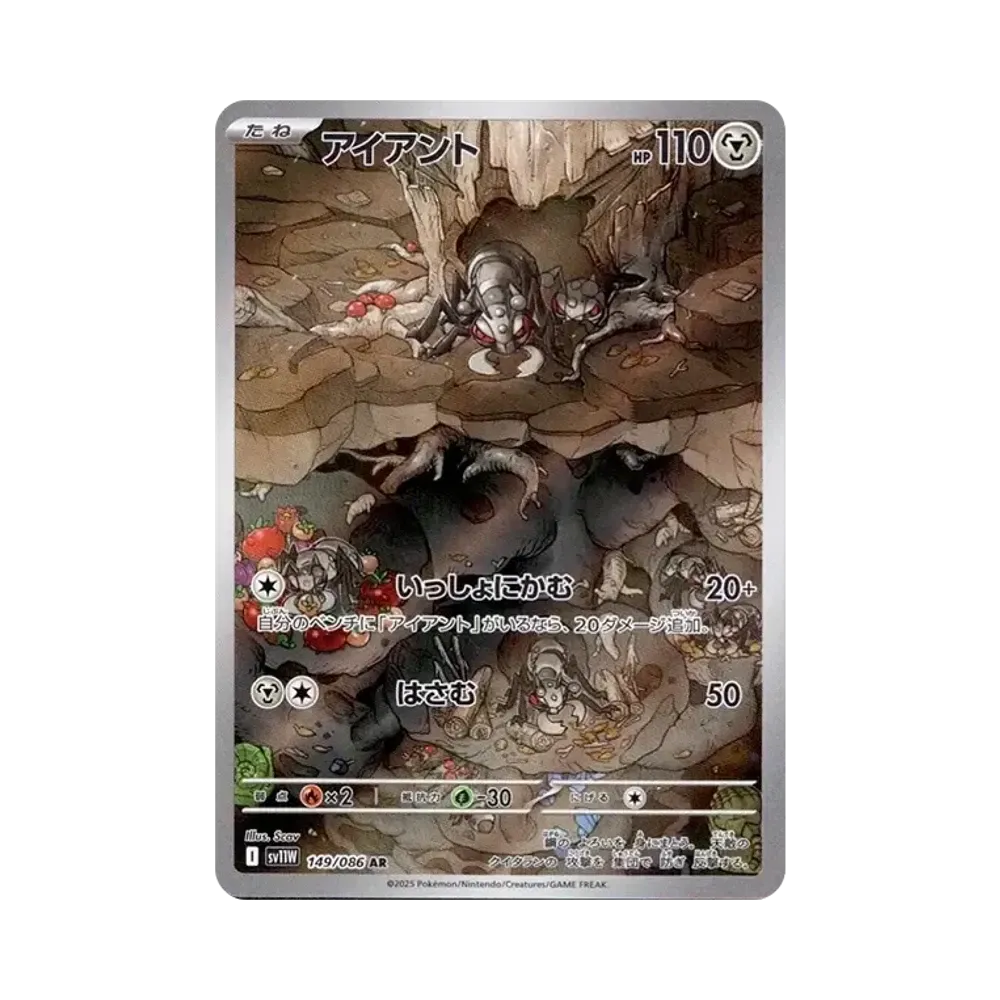
Zoroark AR 141/086, PSA 10.Ferroseed AR 144/086, PSA 10.Herdier AR 154/086, PSA 10.Durant AR 149/086, PSA 10.
Orders ship from Tokyo by FedEx with a tracking number, and the shipping cost is calculated at checkout. Delivery dates are estimates, and customs processing in your country can add time once FedEx has the parcel; the details are on our shipping policy. Payments are made in Japanese yen through Wise, PayPal or cards via PayPal, as described on our payment methods page.
Frequently Asked Questions
Does the White Flare Pokémon Center ETB come with promo cards?
Yes. It contains 2 full-art foil promo cards, each a Thundurus or a Tornadus, and one of them has a Pokémon Center logo. The standard ETB contains 1 such promo.
How many booster packs are in the White Flare Pokémon Center ETB?
It contains 11 booster packs. The standard White Flare Elite Trainer Box contains 9.
Is the Japanese version of White Flare the same set as the English one?
The Japanese set is Expansion Pack “White Flare” (SV11W), and the English expansion is Scarlet & Violet-White Flare. They share a name, but the Japanese cards are printed in Japanese and the product lineups differ.
When was the Japanese White Flare set released?
Expansion Pack “White Flare” was released in Japan on June 6, 2025, the same day as Expansion Pack “Black Bolt”.
What is in the Japanese Card File Set?
It costs ¥2,640 and contains one holo promo Victini, a three-pocket card file with a 156-card capacity and 3 packs each of Black Bolt and White Flare.
Is there a Japanese Elite Trainer Box for White Flare?
No. The official Japanese SV11 page lists the Expansion Pack, the Expansion Pack Deluxe and the Card File Set, with no Elite Trainer Box.
Does the Pokémon Center ETB include sleeves and Energy cards?
Yes. It includes 65 card sleeves and 45 Energy cards, the same counts as the standard Elite Trainer Box.
How many cards are in a Japanese White Flare Deluxe pack?
The Expansion Pack Deluxe “White Flare” holds 35 randomly packed cards and costs ¥1,450 with tax. Each Deluxe pack contains one AR card.
Pokémon 151 UPC vs Japanese SV2a: What You Get in Each
The Pokemon 151 UPC is the Ultra-Premium Collection from Pokémon Trading Card Game: Scarlet & Violet-151, the English expansion that matches Japan’s SV2a, the Enhanced Expansion Pack “Pokémon Card 151”, released on June 16, 2023. This guide sets out what the English box and the Japanese release each contain.
Key Takeaways
The 151 UPC (Ultra-Premium Collection) holds 16 booster packs, a metal hyper rare Mew ex card and Mew and Mewtwo promos, and it launched October 6, 2023.
Japanese SV2a was released in Japan on June 16, 2023, with 7-card booster packs at 290 yen.
Japan’s promo cards come in two Card File Sets at 2,200 yen each, with Bulbasaur, Charmander and Squirtle promos and 5 booster packs.
The English expansion launched worldwide on September 22, 2023, about three months after the Japanese set.
Launched October 6, 2023; 16 booster packs plus promos and accessories
What is the Pokémon 151 UPC and how does it relate to SV2a?
The Pokémon 151 UPC is the Ultra-Premium Collection, a boxed product made for the English Scarlet & Violet-151 expansion, and the Japanese set that matches that expansion is SV2a. The UPC is one product inside the expansion, not a separate set. The official English expansion page lists it beside the Pokémon Center Elite Trainer Box, the Elite Trainer Box, the Booster Bundle, the Binder Collection (9-Pocket Portfolio), the Poster Collection, Collection-Alakazam ex and Collection-Zapdos ex.
The dates show how the two releases line up. The Japanese Enhanced Expansion Pack “Pokémon Card 151” went on sale in Japan on June 16, 2023, according to the official Japanese product page. The English expansion launched worldwide on September 22, 2023, and the Ultra-Premium Collection followed on October 6, 2023, according to the official press release. From the Japanese release to the UPC is a gap of nearly four months.
Both versions share the same core idea. The Japanese page says the set covers 151 Pokémon from Bulbasaur to Mew in Pokédex number order. The English press release says the set includes all original 151 Pokémon, with illustration rare and special illustration rare alternate art cards, and the English expansion page says it features all 151 Pokémon from the Kanto region.
What is inside the Pokémon 151 Ultra-Premium Collection?
The 151 UPC contains 16 booster packs, a metal hyper rare Mew ex card, two promo cards, a stitched-edge Mew playmat, a deck box, a Mew coin and gameplay accessories. The press release lists each item, and the table below repeats them.
Item
Detail from the press release
Booster packs
16
Mew ex card
Metal hyper rare
Mew ex promo
Special illustration rare-style
Mewtwo promo
Illustration rare-style
Playmat
Stitched-edge Mew playmat
Other items
Deck box, Mew coin and gameplay accessories
The pack count separates the UPC from the other English 151 boxes. The same media alert gives nine booster packs in the Elite Trainer Box and eleven in the Pokémon Center Elite Trainer Box. The Booster Bundle has six packs, the Binder Collection has four packs plus a nine-pocket album that holds up to 360 cards, and the Poster Collection has three packs. The Mini Tins hold two packs each. Against those figures, the UPC’s 16 packs compare with 11 in the Pokémon Center Elite Trainer Box and 9 in the standard Elite Trainer Box.
Each of those products carries its own extras. The Elite Trainer Box has one Snorlax illustration rare-style promo and gameplay accessories, and the Pokémon Center version has two Snorlax illustration rare-style promos, one with the Pokémon Center logo. The Poster Collection has three promos featuring the Kanto first partner Pokémon and a two-sided poster. Each Mini Tin has one coin, chosen from 10 Energy-type designs, and one art card.
Two smaller collections launched on the same day as the UPC. Collection-Alakazam ex has four booster packs, a double rare-style Alakazam ex promo and foil Kadabra and Abra promos. Collection-Zapdos ex has four booster packs, a double rare-style Zapdos ex promo, a foil Electabuzz promo and an oversize Zapdos ex card. The Mini Tins launched on October 6, 2023 as well.
The press release gives pack counts per product but not the number of cards per English pack, so this guide compares box contents rather than card totals. For the Japanese side, the pack size is stated, and it is covered next.
What does the Japanese Pokémon Card 151 (SV2a) offer instead?
The Japanese set offers a 7-card booster pack at 290 yen including tax, plus two Card File Sets at 2,200 yen each that carry the set’s promo cards. All of this comes from the official Japanese SV2a page, which also notes that cards are inserted at random.
The page highlights AR, SAR and SR illustration cards, with Pikachu, Nidoking, Omanyte and Mew ex as examples. It also says the set has Poké Ball pattern mirror cards. The ex cards it lists are Venusaur ex, Charizard ex, Blastoise ex, Arbok ex, Ninetales ex, Wigglytuff ex, Alakazam ex, Lapras ex, Golbat ex, Raichu ex, Kangaskhan ex and Mew ex, and it names Jynx ex as an ex card too.
Trainer cards on the page include Sabrina’s Charisma, Safety Goggles, Erika’s Invitation, Snatch Arm, Leftovers, Professor Oak’s Transfer, Air Balloon and three fossil Items: Old Amber, Helix Fossil and Dome Fossil. The English press release for the UPC gives no Trainer card list, so this Trainer line-up is a detail of the Japanese page.
The official site also runs a “Pokémon Card 151 Challenge” quiz game, a feature of the Japanese product page.
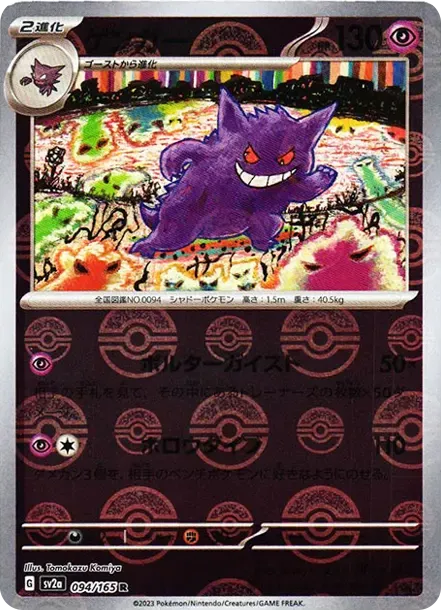
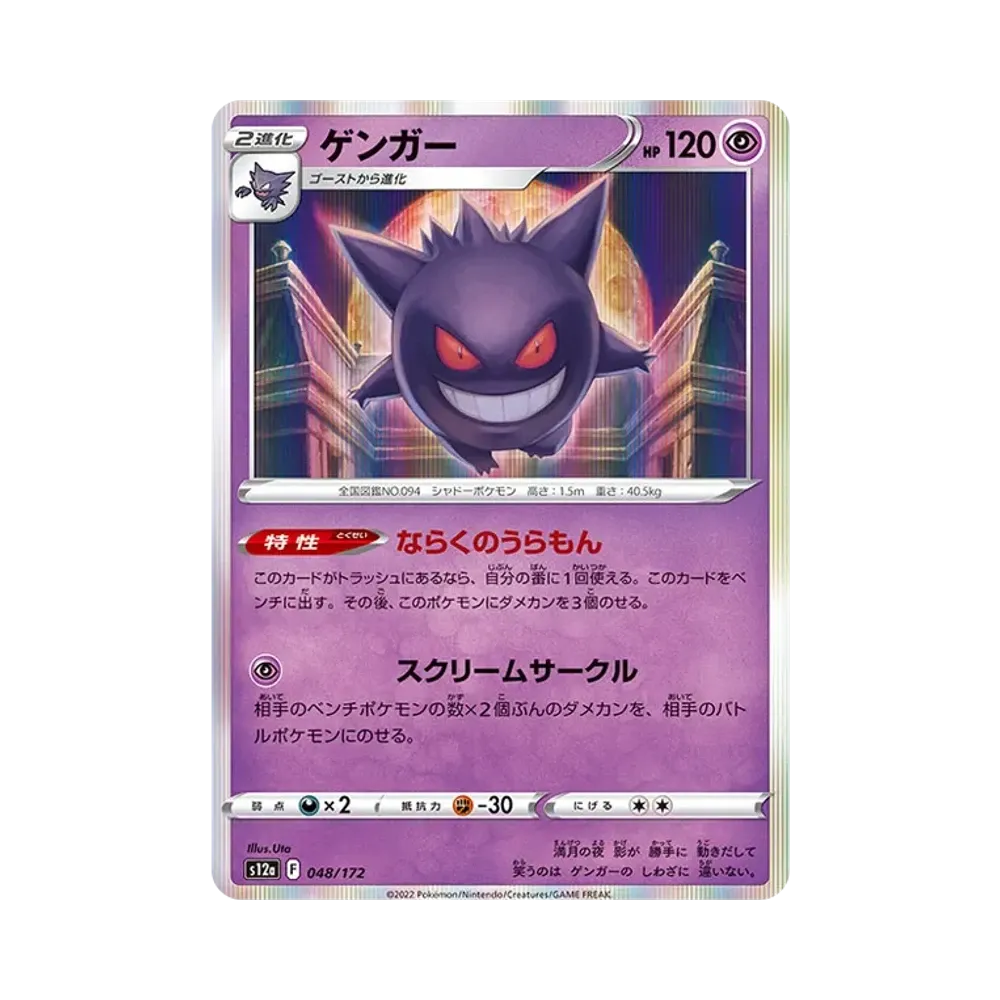
Gengar R Monster Ball Mirror 094/165, a Poké Ball pattern mirror card.
How do the English 151 UPC and the Japanese 151 set compare side by side?
The English 151 UPC is a premium box with 16 packs and promos, while Japanese SV2a is sold as booster packs and two Card File Sets, and the two differ in release date, structure and card language. The table lines up what the official pages state.
Point
English 151 UPC
Japanese SV2a
Official name
Pokémon TCG: Scarlet & Violet-151, Ultra-Premium Collection
Enhanced Expansion Pack “Pokémon Card 151”
Release date
October 6, 2023 for the UPC; expansion September 22, 2023
June 16, 2023 in Japan
Packs in the main product
16 booster packs in the UPC
5 booster packs in each Card File Set; packs also sold singly
Cards per pack
Not stated in the press release
7 random cards
Promo cards
Special illustration rare-style Mew ex and illustration rare-style Mewtwo
Bulbasaur, Charmander and Squirtle, 1 each, in the Card File Sets
Extras
Playmat, deck box, coin, accessories
1 card file and 1 catalog poster in each Card File Set
Rarity wording
Illustration rare and special illustration rare
AR, SAR and SR illustration cards
Japan received the set first. The Japanese product is the Enhanced Expansion Pack “Pokémon Card 151”, and the English line is Scarlet & Violet-151. The English UPC cards are printed for the English expansion, and the Japanese cards belong to the Japanese edition, so if you collect by language you are choosing between two separate products that share one Pokémon list.
The rarity names differ in wording. The English press release speaks of illustration rare and special illustration rare cards, while the Japanese page uses the abbreviations AR, SAR and SR and names specific examples, such as Pikachu, Nidoking, Omanyte and Mew ex.
Which Mew and Mewtwo promos come with the 151 UPC?
The 151 UPC includes a special illustration rare-style Mew ex promo and an illustration rare-style Mewtwo promo, plus a separate metal hyper rare Mew ex card.
The press release describes them in these exact terms: a metal hyper rare Mew ex card, a special illustration rare-style Mew ex promo and an illustration rare-style Mewtwo promo. A stitched-edge Mew playmat, a deck box and a Mew coin accompany them, which gives the box a Mew theme beyond the cards.
The Japanese sources name different promos. The Japanese Card File Sets carry promos for Bulbasaur, Charmander and Squirtle, and the official page notes that promo cards come in the two card file sets. The page also names Mew ex among the set’s ex cards and highlights it as an example of an illustration card, so Mew ex appears in the Japanese set as a regular part of the card list.
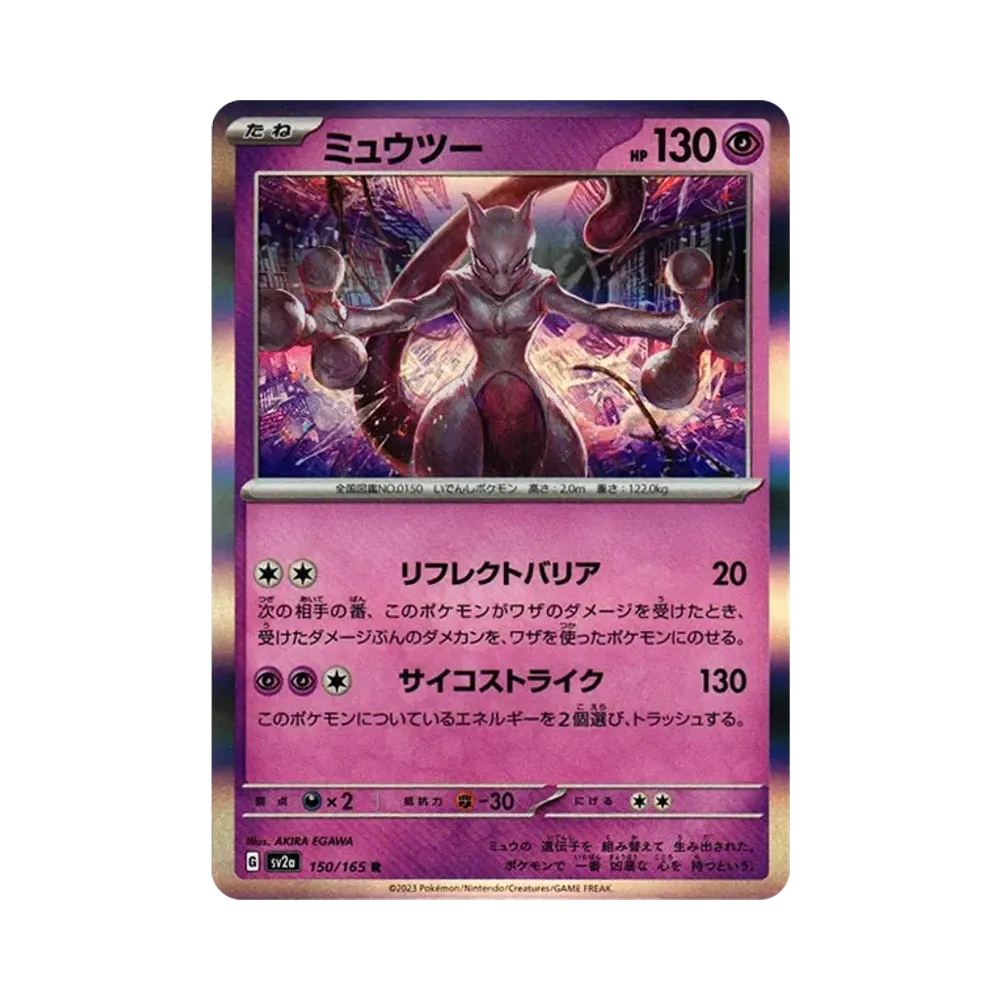
Mewtwo appears in the Japanese set as Mewtwo R, number 150/165, which you can see in PSA10 Mewtwo R [SV2a 150/165] at ¥9,350 on November 12, 2026. The English promo is an illustration rare-style card inside the UPC. If you are collecting Mewtwo from this era, treat the English promo and the Japanese set card as two separate targets.
Mew itself closes the Pokédex order that both versions follow. The Japanese page describes the set as running from Bulbasaur to Mew, so Mew ex sits at the end of the 151 Pokémon, while the UPC puts Mew on the playmat, the coin and the cards.
Does the Japanese set have a product like the 151 UPC?
The official Japanese SV2a page lists a booster pack and two Card File Sets, and none of them matches the 16-pack 151 UPC in size. The nearest match is the Card File Set, which has fewer packs and different extras.
There are two Card File Sets, each at 2,200 yen. One is named “Monster Ball” and the other is named for Venusaur, Charizard and Blastoise. Both hold the same contents: promo cards of Bulbasaur, Charmander and Squirtle, one of each, plus one card file, 5 booster packs and 1 catalog poster. The page adds that the Card File Set promos are mirror style.
That puts the Japanese bundle at 5 packs, against 16 packs in the UPC. The extras differ as well: a card file and a catalog poster on the Japanese side, and a playmat, deck box and coin on the English side. The UPC leans on Mew and Mewtwo cards, while the Card File Set leans on the three Kanto starter promos.
A single Japanese booster pack costs 290 yen for 7 cards, so five packs at that price come to 1,450 yen, which is the pack portion of a 2,200 yen Card File Set. The remaining 750 yen covers the three promos, the card file and the catalog poster, going by the contents the page lists.
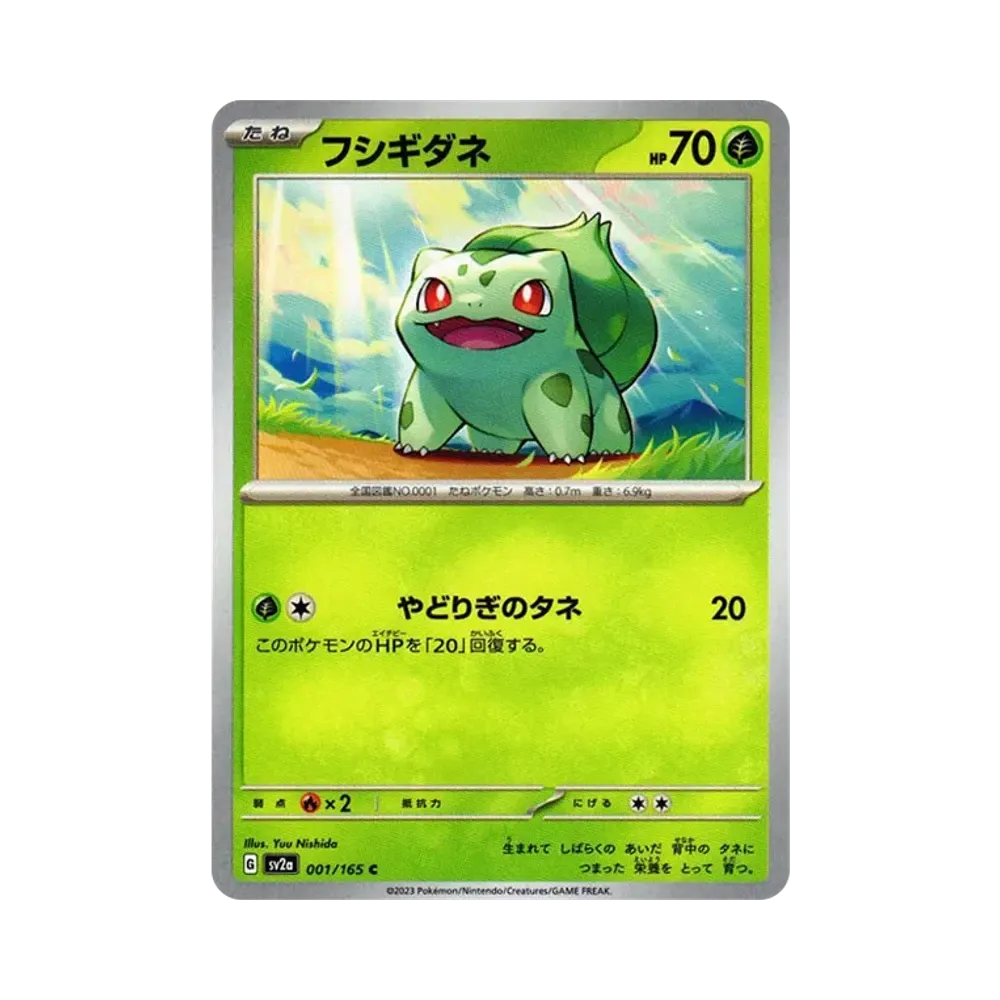
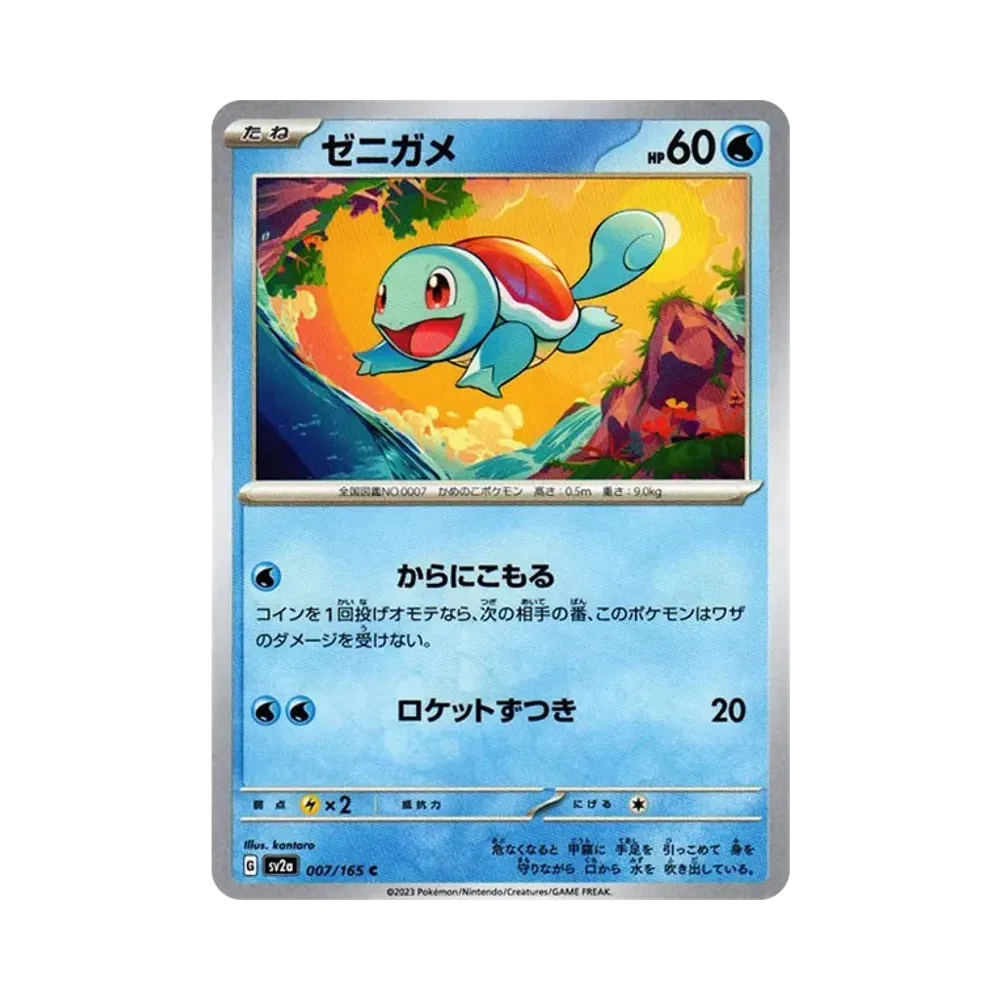
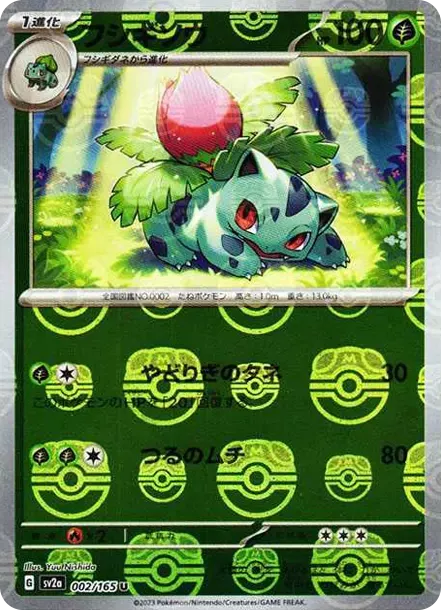
Bulbasaur C 001/165, the first number in SV2a. This is a regular set card, not the Card File promo.Squirtle C 007/165, a regular SV2a card.
Which 151 UPC extras can Japanese SV2a cards stand in for?
The sources name Japanese SV2a items for the Mew ex, Mewtwo and Alakazam ex themes, and name no Japanese counterpart for the playmat, deck box or coin. The table shows each UPC item next to what the Japanese sources state.
UPC item
Related Japanese SV2a item
What the sources state
Metal hyper rare Mew ex
Mew ex
The Japanese page lists Mew ex among the set’s ex cards
Special illustration rare-style Mew ex promo
Mew ex
The Japanese page names Mew ex as an illustration card example
Illustration rare-style Mewtwo promo
Mewtwo R 150/165
The Japanese set numbers Mewtwo R as 150/165
16 booster packs
7-card packs at 290 yen, or 5 packs in a Card File Set
The Japanese Card File Set holds 5 packs
Playmat, deck box, coin
Card file and catalog poster in the Card File Sets
The Japanese extras are a card file and a poster
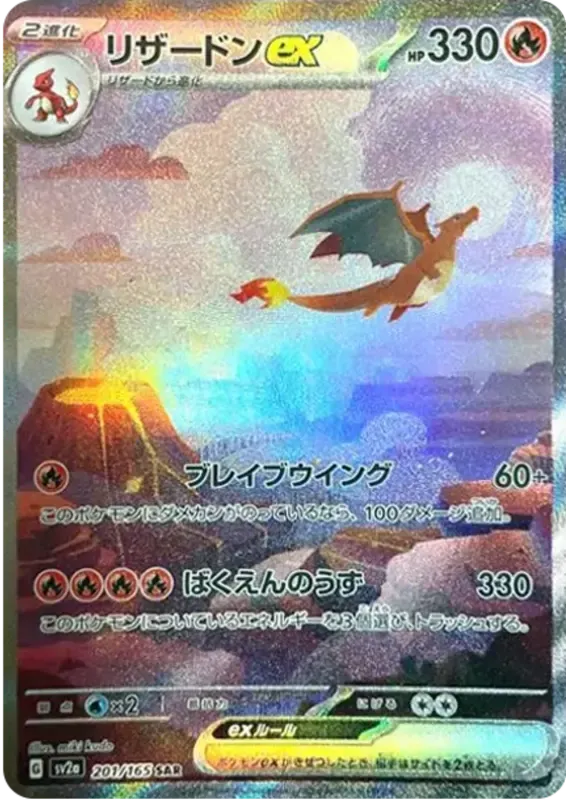
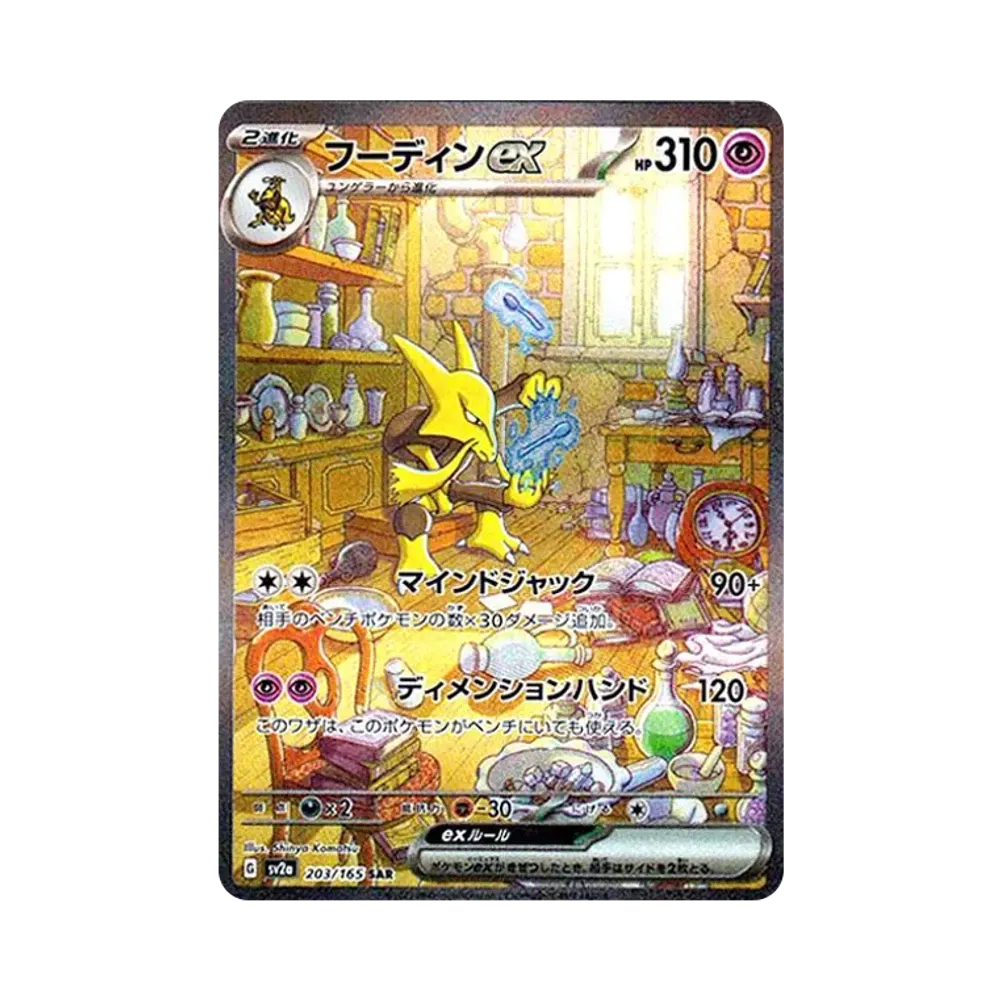
Alakazam ex is a theme that appears on both sides. English Collection-Alakazam ex has a double rare-style Alakazam ex promo, and the Japanese set lists Alakazam ex among its ex cards. The listing PSA10 Alakazam ex SAR [SV2a 203/165] is ¥26,545 on November 12, 2026. Its number, 203, is higher than the 165 base count, like the Charizard ex SAR above.
Alakazam ex SAR 203/165 from Japanese SV2a.
My recommendation depends on what you want. If you want a sealed English box with a playmat and Mew-themed accessories, the English UPC is the product described in the press release. If you want Japanese-language cards from the set, a single graded card is a direct route, and our SV2A PSA 10 cards guide and how-to-choose guide help you pick. For a release-date walk-through, use the SV2A release date guide.
Where can I buy Japanese SV2a cards and how does shipping work?
You can buy Japanese SV2a cards through the product pages linked below, and the full set is on the SV2a card list page. All of these are cards from the Japanese 151 set.
Shipping goes by FedEx with a tracking number, and the cost is calculated at checkout from your delivery address. Customs processing in your country and carrier events can affect delivery, and the shipping policy sets out the terms. Payments are made in Japanese yen through Wise, PayPal or cards via PayPal, and the payment methods page explains the 5% processing fee that applies to every method except Wise.
Frequently Asked Questions
What is the Pokemon 151 UPC?
It is the Ultra-Premium Collection for the English Scarlet & Violet-151 expansion. It holds 16 booster packs, a metal hyper rare Mew ex card, a Mew ex promo, a Mewtwo promo, a playmat, a deck box, a coin and accessories.
When did the 151 UPC come out compared with Japanese SV2a?
The Japanese set was released on June 16, 2023. The English expansion launched on September 22, 2023, and the Ultra-Premium Collection launched on October 6, 2023.
How many cards are in a Japanese SV2a booster pack?
A Japanese SV2a booster pack holds 7 random cards and costs 290 yen including tax, according to the official Japanese page.
Does the Japanese set include Mew ex?
Yes. Mew ex is among the ex cards the official page lists, and it is one of the examples the page highlights for illustration cards.
How many packs are in the Japanese Card File Set compared with the UPC?
Each Japanese Card File Set holds 5 booster packs, a card file, a catalog poster and three promos. The English 151 UPC holds 16 booster packs.
What do the Japanese Card File Sets cost?
Each of the two Card File Sets costs 2,200 yen. They are named “Monster Ball” and Venusaur, Charizard, Blastoise, and they share the same contents.
Where can I see the whole Japanese set?
The Pokemon 151 Card List page shows the full set, which the page title gives as 210 cards.
Delta Reign Booster Bundle vs the Japanese M6 Storm Emeralda Set
The Pokémon Delta Reign Booster Bundle is a six-pack English-language product from Pokémon TCG: Mega Evolution—Delta Reign, and this article compares it with the Japanese Storm Emeralda set (code M6). Delta Reign released November 6, 2026, while the Japanese M6 set released July 31, 2026.
Japanese Storm Emeralda (M6) went on sale on July 31, 2026 at ¥200 per five-card pack.
Japanese M6 packs hold 5 cards and no Basic Energy; Delta Reign Booster Display Box packs hold 10 cards plus one Basic Energy.
Samurai Sword Tokyo ships PSA 10 graded Japanese M6 cards from Tokyo by FedEx with a tracking number.
What Is the Pokémon Delta Reign Booster Bundle?
The Delta Reign Booster Bundle is an English-language Pokémon TCG product made of six booster packs from the Mega Evolution—Delta Reign expansion. The official Pokémon showcase describes it as “a full half-dozen booster packs” and gives it a release date of November 6, 2026.
By pack count it sits in the lower half of the Delta Reign showcase: the Build & Battle Box holds four packs, the Booster Bundle six, the Elite Trainer Box nine, the Pokémon Center Elite Trainer Box eleven, and the Booster Display Box 36. The bundle entry lists no promo card, sleeves, dice or deck box. If you want to open packs of the new set and nothing else, the bundle is the product built for that.
The showcase page also tells you what the expansion is as a whole. It states that Delta Reign has “over 135” cards. It does not give a printed set code for the English expansion, so this article uses the product names the sources use: Delta Reign on the English side and Storm Emeralda (M6) on the Japanese side.
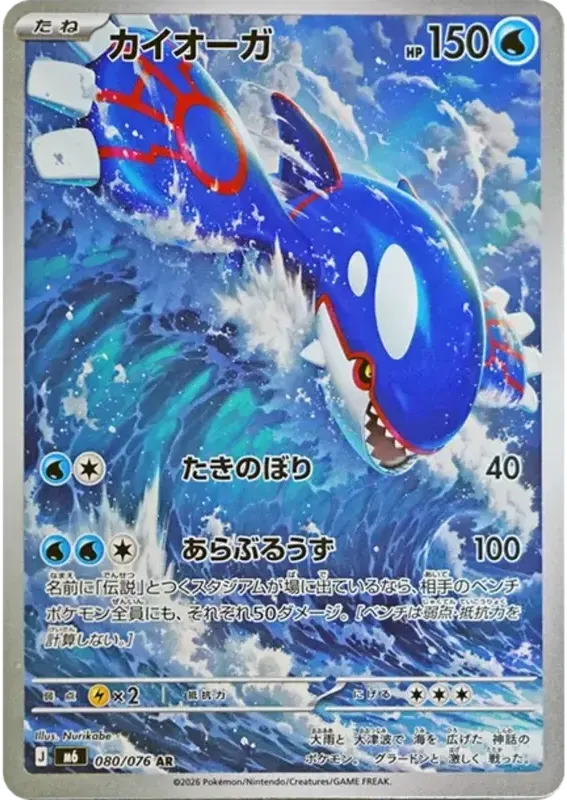
Our own range on the Japanese set is graded cards, for example the PSA10 Kyogre AR [M6 080/076] at ¥19,234 on November 12, 2026. The rest of this article lines up the English bundle and the Japanese set so you can decide which one fits what you want.
Key fact
Delta Reign (English)
Storm Emeralda (Japanese)
Official name
Pokémon TCG: Mega Evolution—Delta Reign
Pokémon Card Game MEGA Expansion Pack “Storm Emeralda” (ポケモンカードゲーム MEGA 拡張パック「ストームエメラルダ」), Japanese edition
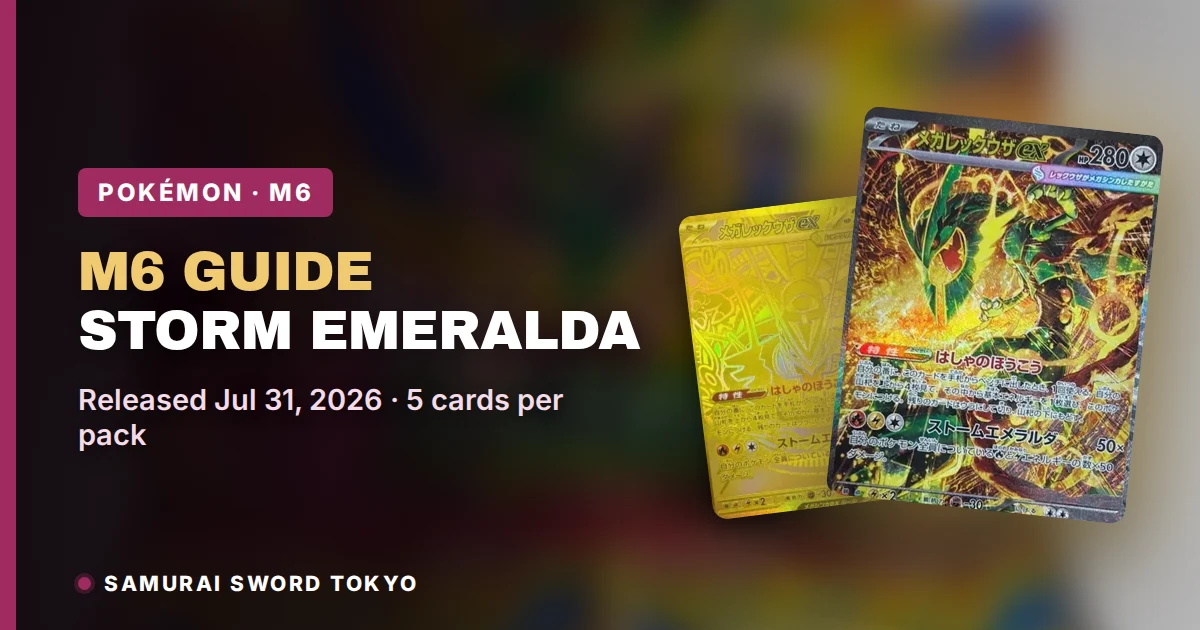
Storm Emeralda (M6), the Japanese set compared with the Delta Reign bundle in this article.
How Does the Delta Reign Booster Bundle Relate to Japanese Storm Emeralda (M6)?
The two products are described on separate official pages, and this article puts them side by side: the Delta Reign showcase at pokemon.com for the bundle and the Japanese product page at pokemon-card.com/ex/m6/ for Storm Emeralda.
What the official pages let you compare directly is the pack format. The English showcase states that display-box packs hold ten cards and one Basic Energy. The Japanese page states that Storm Emeralda packs hold five cards and that Basic Energy cards are not included in the expansion. Those two statements alone show that the pack formats differ, which the next section sets out in detail.
A bundle is also a way of packaging English packs. The Japanese release page describes the pack and its cards; it does not describe a bundle. So when you read “Booster Bundle” in English and “expansion pack” on the Japanese page, you are reading two different kinds of product listing.
Our listing page for the Japanese set is the place for the full card run: the Storm Emeralda (M6) card list shows the whole set with card numbers. This article stays on the bundle comparison.
What Comes in a Delta Reign Booster Bundle Compared With a Japanese M6 Pack?
A Delta Reign Booster Bundle gives you six booster packs, while one Japanese M6 pack is a single five-card pack sold at a suggested ¥200. The sources describe the contents of each as follows.
Item
Delta Reign Booster Bundle (English)
Japanese M6 pack
Packs in the product
Six booster packs
One five-card pack
Cards per pack
The showcase gives 10 cards per pack for the Booster Display Box; the bundle entry gives only the pack count
5 cards, randomly inserted
Basic Energy
One Basic Energy per pack in the Booster Display Box
Not included in the expansion pack
Promo card
None listed for the bundle
None listed for the pack
Official price shown
Not shown on the showcase page
¥200 (tax included), suggested retail price
The cards-per-pack line needs care. The official showcase gives “10 cards and one Basic Energy” for packs in the Booster Display Box. It does not repeat the number in the bundle entry, so read the bundle’s six packs as Delta Reign packs and check the product label for the exact count.
The Japanese side is clearer. The official page says each pack holds five cards, that cards are inserted randomly, and that no Basic Energy cards are part of Storm Emeralda. A Japanese M6 pack is therefore smaller than the Delta Reign display-box pack described by Pokémon, and it has no energy slot.
A little arithmetic from those official numbers shows the gap. Six Japanese M6 packs hold 30 cards in total and carry a combined suggested retail price of ¥1,200. Nine Japanese packs hold 45 cards. A Booster Display Box of 36 Delta Reign packs holds 360 cards plus 36 Basic Energy cards.
Counting packs alone, six Delta Reign packs and six Japanese M6 packs look equal. The official pages describe them differently, though: the English display-box packs hold 10 cards and one Basic Energy, and the Japanese packs hold five cards and no Basic Energy.
Card language is the other difference you will see at once. Delta Reign cards are English. Storm Emeralda cards are Japanese-language cards, with Japanese text and the Japanese set numbering. The card numbers on our M6 listings, such as 095/076 and 110/076, are Japanese-edition numbers, and the first number can be higher than the second.
The Japanese page adds one rule worth knowing if you play. The two-card Stadiums count toward a limit of four total halves in a deck, and tournament deck registration requires the registered counts to match the deck. The English showcase page does not discuss deck rules, so this is a point from the Japanese page only.
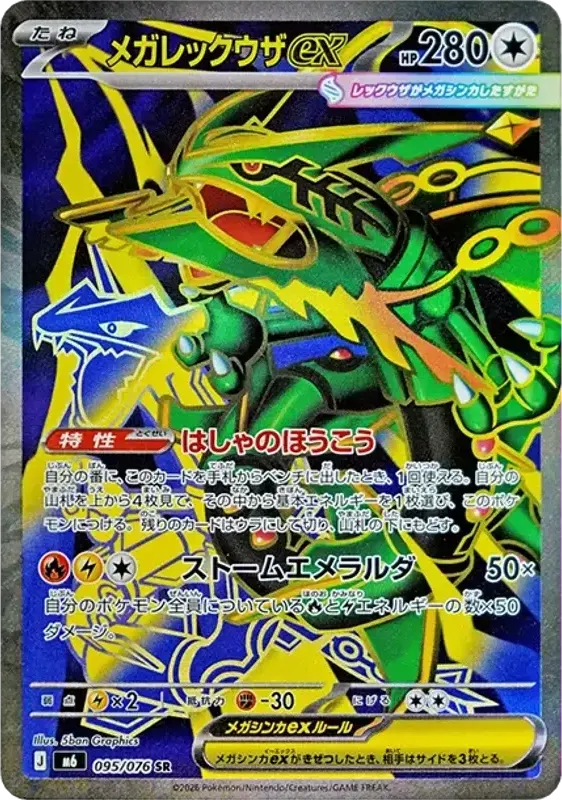
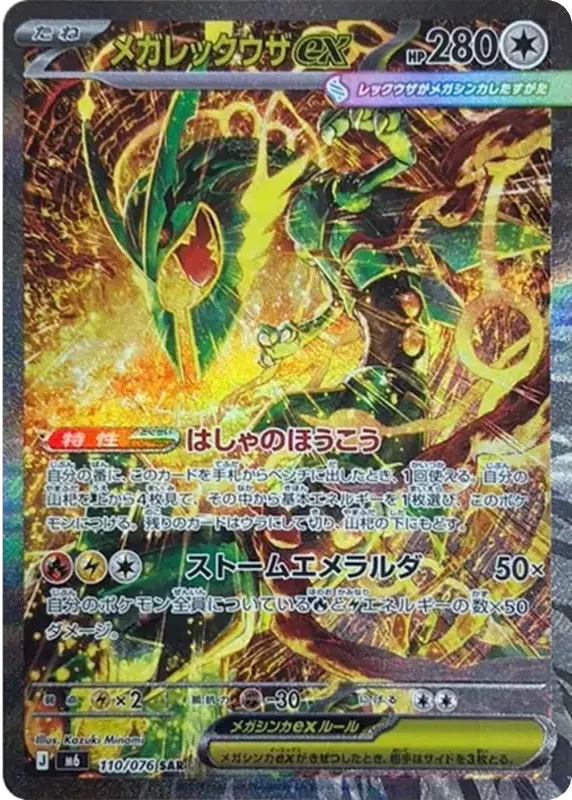
MEGA Rayquaza ex 095/076 from Japanese M6, graded PSA 10.
When Do the Delta Reign Booster Bundle and the Japanese Set Release?
The Delta Reign Booster Bundle released November 6, 2026, and Japanese Storm Emeralda (M6) released July 31, 2026, which is a gap of 98 days between the two.
The Japanese date comes from the official Japanese product page, which gives Friday, July 31, 2026. The English date comes from the Pokémon showcase page, which lists the Booster Bundle, the Booster Display Box, the Elite Trainer Box and the Pokémon Center Elite Trainer Box all at November 6, 2026. The Build & Battle Box is dated November 20, 2026 and is sold initially at local game stores during Prerelease events.
For collectors, the order matters because the Japanese Storm Emeralda release date has already passed. If you want a Japanese card from that set, you are not waiting for the English launch. The 98-day gap equals exactly 14 weeks.
The 14-day step inside the English lineup is also worth noting. The bundle, display box and both Elite Trainer Boxes share November 6, while the Build & Battle Box follows 14 days later on November 20. If your plan is packs first and a ready-to-play deck later, the dates already fall in that order.
Which Cards Do the Official Sources Show for Delta Reign and M6?
The official Japanese M6 page shows cards including Mega Rayquaza ex, Talonflame ex, Mega Golisopod ex, Cacturne and Wishiwashi ex, and the Delta Reign showcase names a foil Kyogre promo rather than a card list.
The Japanese page displays Mega Rayquaza ex, Talonflame ex, Mega Golisopod ex, Cacturne and Wishiwashi ex. It also shows the trainer card Adventure Lantern and two two-card Stadiums, Legendary Summit and Legendary Trench.
The English showcase page is a product page, not a card list. It states that the expansion has “over 135” cards and that the Elite Trainer Box includes a full-art foil Kyogre promo. The Pokémon Center version includes two Kyogre promos, one with a Pokémon Center logo.
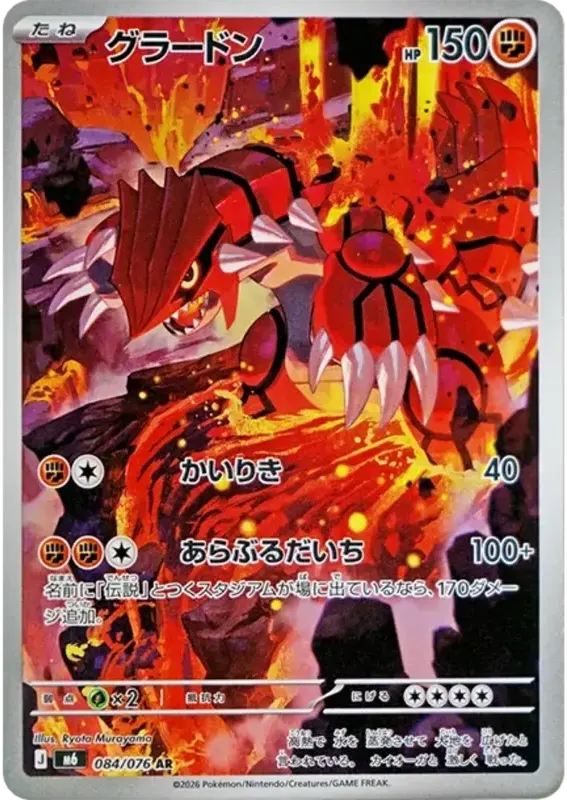
On the Japanese side, graded singles from the set carry the numbers printed on the cards. Kyogre appears as number 080/076 and Groudon as 084/076. Those are Japanese cards from M6; do not read them as the Delta Reign promo.
Kyogre AR 080/076 from Japanese M6.Groudon AR 084/076 from Japanese M6.
How Do the Other Delta Reign Products Compare With the Booster Bundle?
The Booster Bundle is the six-pack entry in the Delta Reign lineup, above the Build & Battle Box’s four packs and below the nine-pack Elite Trainer Box.
Same as the Elite Trainer Box plus two Kyogre promos, one with a Pokémon Center logo
November 6, 2026
Build & Battle Box
4
40-card deck, one of four foil promos, Pokémon TCG Live code card
November 20, 2026
Compared with the bundle, the Elite Trainer Box adds three more packs and a promo; the Pokémon Center version adds five more packs than the bundle and a second promo. The Build & Battle Box swaps pack count for a ready-to-play 40-card deck with four packs. The bundle is the product to look at when you want packs and no accessories.
Against the Booster Display Box, the bundle is the smaller step. The display box holds 36 packs, which is six times the bundle’s six, or 30 packs more. Both release on November 6, 2026, so the choice between them is about how many packs you want, not about timing.
The Japanese release has a different shape. Its official page covers the pack and the cards, not a lineup of boxed accessories. Because of that, there is no Japanese bundle to compare one for one. A Japanese buyer who wants several packs buys several packs, or buys graded singles.
The same English-versus-Japanese comparison exists for the 30th Celebration set, a different expansion with its own code (M6a). Our guides cover the 30th Celebration Booster Bundle and the Elite Trainer Box against the Japanese packs if you are weighing that set instead.
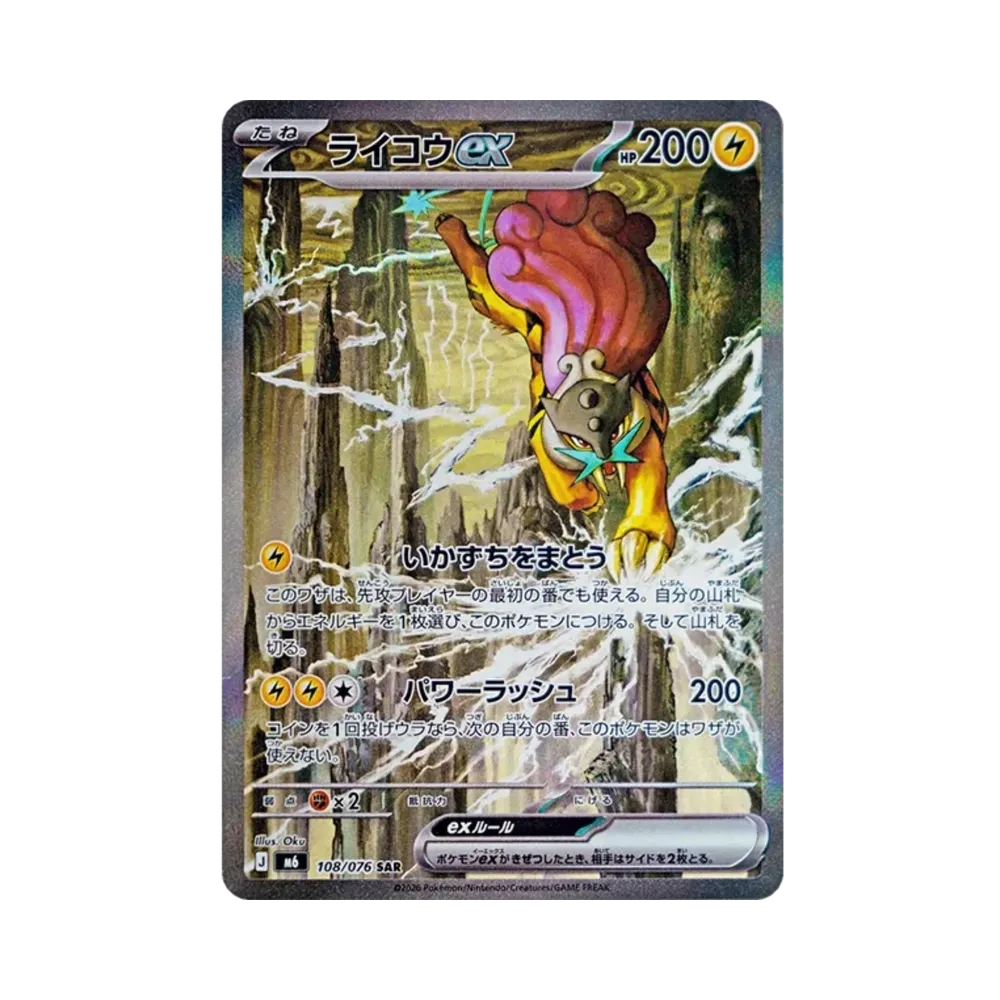
Raikou ex 108/076 from Japanese M6.
Should You Choose the Delta Reign Booster Bundle or Japanese Storm Emeralda Cards?
Choose the Delta Reign Booster Bundle if you want English cards in a six-pack product, and choose Japanese Storm Emeralda cards if you want Japanese-language cards from a set that has already been released.
Here is a plain way to decide.
You want to open packs in English: the bundle fits, with six packs and no accessories.
You want a specific card from M6: a graded Japanese single is a direct route. The cards in the buying section below each have a number and a PSA 10 grade on the listing.
You want Basic Energy in the pack: the English display-box packs include one; Japanese M6 packs do not.
You want a card before November 6: the Japanese set released July 31, 2026.
You collect Japanese-language art and numbering: the Japanese cards carry the Japanese set numbers.
One more point: the pack formats differ. The English page gives ten cards plus a Basic Energy for display-box packs, while the Japanese page gives five cards and no Basic Energy, and the English side adds the Kyogre promo in its Elite Trainer Boxes. If you want one particular M6 card, a Japanese single is the direct product. If you want to open packs of Delta Reign, the English bundle is the product to look for.
The showcase page shows no price for the bundle, so a price comparison with the ¥200 Japanese pack is not possible from the official sources. Compare the pack counts, formats and dates instead.
Where Can You Buy Storm Emeralda (M6) Cards From Tokyo?
You can buy Japanese Storm Emeralda (M6) cards from Samurai Sword Tokyo as PSA 10 graded singles, shipped from Tokyo by FedEx with a tracking number. Graded M6 cards on our product pages:
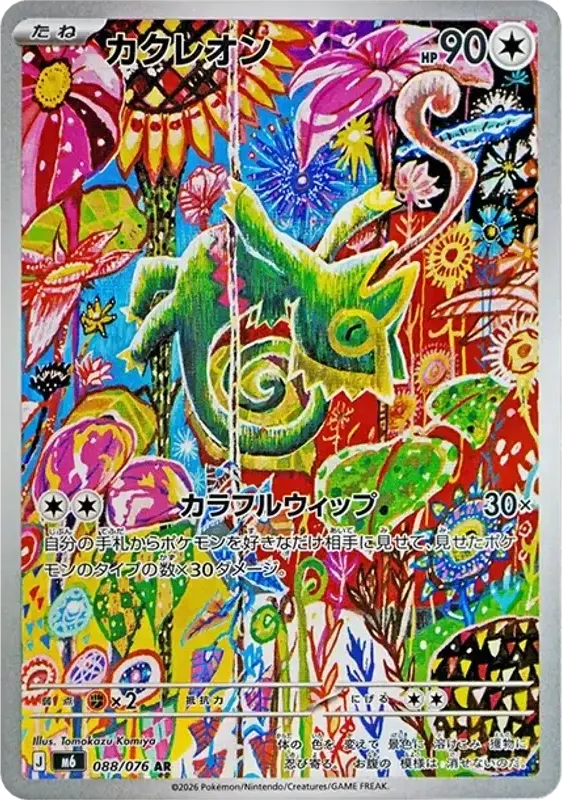
MEGA Rayquaza ex SAR 110/076 from Japanese M6.Kecleon AR 088/076 from Japanese M6.
On shipping, our shipping policy lists FedEx International Connect Plus (usually 3-7 business days after dispatch) and FedEx International Priority (usually 2-5 business days), both estimates with the cost calculated at checkout. After handoff to FedEx, customs processing is handled by the destination country’s authorities. Payments are made in Japanese yen through Wise, PayPal or cards through PayPal, as set out on the payment methods page.
Frequently Asked Questions
Is the Pokémon Delta Reign Booster Bundle the same as Storm Emeralda?
No. They are separate products on separate official pages: the bundle is an English Delta Reign product, and Storm Emeralda (M6) is a Japanese-edition expansion pack. The language, pack format and release date differ between the two.
How many packs are in the Delta Reign Booster Bundle?
It holds six booster packs, which the official showcase calls “a full half-dozen booster packs”. It released November 6, 2026.
How many cards are in a Japanese M6 pack?
A Japanese Storm Emeralda pack holds five cards, inserted randomly, at a suggested retail price of ¥200 including tax. The expansion does not include Basic Energy cards.
When did the Japanese M6 set come out compared with Delta Reign?
Japanese Storm Emeralda released July 31, 2026, and the Delta Reign Booster Bundle released November 6, 2026, a gap of 98 days.
Which Delta Reign product includes a Kyogre promo?
The Elite Trainer Box includes a full-art foil Kyogre promo, and the Pokémon Center Elite Trainer Box includes two Kyogre promos, one with a Pokémon Center logo. The Booster Bundle lists no promo card.
When does the Delta Reign Build & Battle Box release?
It is dated November 20, 2026, two weeks after the bundle, and it is sold initially at local game stores during Prerelease events.
Do Japanese Storm Emeralda packs include a Basic Energy card?
No. The official Japanese page states that Basic Energy cards are not included in the expansion pack, while Delta Reign Booster Display Box packs each include one Basic Energy.
Delta Reign Elite Trainer Box vs Japanese Storm Emeralda M6
The Delta Reign Elite Trainer Box (ETB) belongs to the English Pokémon TCG: Mega Evolution-Delta Reign line, released November 6, 2026. The Japanese set Storm Emeralda (M6) has a published pack price: ¥200 including tax for a 5-card pack.
Key Takeaways
The English Pokémon TCG: Mega Evolution-Delta Reign went on sale at participating retailers worldwide on November 6, 2026, and its product list includes Elite Trainer Boxes.
The Japanese set M6, Storm Emeralda, released on July 31, 2026, 98 days earlier.
A Japanese M6 pack holds 5 cards and carries a suggested retail price of ¥200 including tax, with no basic Energy cards in the set.
Mega Rayquaza ex and Legendary Stadium cards are featured on both the English Delta Reign announcement and the Japanese M6 page.
Our shop ships Japanese-edition products, including PSA 10 singles from M6.
Updated November 12, 2026
Key fact
Detail
English product line
Pokémon Trading Card Game: Mega Evolution-Delta Reign (English edition), including Elite Trainer Boxes (press.pokemon.com)
Japanese set compared
Pokémon Card Game MEGA Expansion Pack “Storm Emeralda” (ポケモンカードゲーム MEGA 拡張パック「ストームエメラルダ」), Japanese edition
5 cards, random; ¥200 including tax suggested retail price; no basic Energy
This guide uses the official pages to set the Delta Reign line beside the Japanese set Storm Emeralda and to show where the two differ. If you want a Japanese M6 card, a graded example such as PSA10 MEGA Rayquaza ex SAR [M6 110/076] is ¥69,728 on November 12, 2026. For the whole set, the Storm Emeralda (M6) card list has all 113 cards, including the secret rares.
What is the Delta Reign Elite Trainer Box (ETB) and when does it release?
The Delta Reign Elite Trainer Box (ETB) is an English-edition product of the Pokémon Trading Card Game: Mega Evolution-Delta Reign expansion, and the English edition went on sale on November 6, 2026. The announcement on press.pokemon.com gives the retail release as that date at participating retailers worldwide.
The same announcement sets out the surrounding schedule. Prerelease tournaments began October 24, 2026, at participating independent retailers, as part of the Play! Pokémon program. Pokémon TCG Live early access opened on November 5, 2026 on iOS, Android, macOS and Windows. The announcement itself is dated August 20, 2026.
The products named in the announcement are booster packs, Elite Trainer Boxes and various collections. So the ETB is one of several ways to buy into the same English expansion, not a separate set. The announcement does not itemize what sits inside the Elite Trainer Box, so the retailer’s product page is the place to read its contents.
Date
Event
Edition
July 31, 2026
Storm Emeralda (M6) released in Japan
Japanese
August 20, 2026
Delta Reign announcement published
English
October 24, 2026
Prerelease tournaments begin at participating independent retailers
English
November 5, 2026
Pokémon TCG Live early access
English
November 6, 2026
Retail release at participating retailers worldwide, including Elite Trainer Boxes
English
Japanese M6 reached stores 98 days before the Delta Reign retail date. Counting from July 31 to November 6, that is 92 days to the end of October plus 6 more. A collector who wants Japanese-language cards from M6 has had that set since July 31. A player who wants English text had to wait for the Delta Reign line, which is now out.
The English announcement also separates the ways players meet the expansion. Retail products are one route; the prerelease tournaments, run through the Play! Pokémon program at independent retailers, are another; and TCG Live early access on November 5 is a third date, falling the day before the retail release. For an ETB buyer, the practical point is the retail date: November 6, 2026 is when the box could first be bought at participating retailers.
The Delta Reign Elite Trainer Box is sold through participating retailers, so the figure you pay depends on the retailer you buy from.
What the sources do give is a firm anchor for the Japanese side: the suggested retail price of a Storm Emeralda (M6) pack is ¥200 including tax, and a pack holds 5 cards. That works out to ¥40 per card at the list price. It is a Japanese list price for a single pack, not a price for any English box.
Two practical points follow for anyone comparing prices. First, an English ETB and a Japanese pack are different kinds of purchase, so a straight price comparison only means something once you decide what you want: a boxed English product, or Japanese packs and cards. Second, the Japanese figure is in yen and tax is included in it, so it will not match a price you see in your own currency. If you want a Delta Reign ETB, check the price at the retailer carrying it. If you want Japanese M6 cards, the yen figures in this guide are the ones to work from.
To size a Japanese pack purchase, the arithmetic from the list price is simple. These figures are list-price arithmetic only, before any retailer markup, shipping or payment fee.
Japanese M6 packs
Cards (5 per pack)
At ¥200 list price
1
5
¥200
5
25
¥1,000
10
50
¥2,000
20
100
¥4,000
Packs hold random cards, and the Japanese page states plainly that basic Energy cards are not included in the expansion pack. That detail matters when you plan a deck: if you open Japanese M6 packs, you will not find basic Energy among the cards in them.
The same page gives the pack format in one line: an expansion pack, 1 pack, 5 cards, randomly inserted. Because the Delta Reign announcement lists boxed products and collections rather than a per-pack figure, the one number that can be compared across the two editions is the card count and price of a Japanese pack. For an English ETB, the retailer’s listing is the source for both the price and the contents.
How does the English Delta Reign ETB relate to Japanese Storm Emeralda (M6)?
The English Delta Reign announcement and the Japanese Storm Emeralda (M6) page feature several of the same headline cards: Mega Rayquaza ex, Mega Golisopod ex and Legendary Stadium cards. The official pages do not state that the two sets correspond, so this guide compares only what each page lists.
The English announcement describes Mega Rayquaza ex (“Sky High”) as returning to the TCG for the first time since the XY-Ancient Origins expansion. It also names Mega Golurk ex and Mega Malamar ex as featured cards. Its counts are 4 Mega Evolution Pokémon ex, 6 Pokémon ex, 6 Stadium cards forming 3 Legendary Stadiums, 14 illustration rare Pokémon, 17 ultra rare Pokémon and Trainer cards, and 6 special illustration rare Pokémon and Supporter cards.
The Japanese official M6 page names more cards than the English announcement does. Its list includes Mega Rayquaza ex (m6-058), Talonflame ex (m6-062), Mega Golisopod ex (m6-009), Wishiwashi ex (m6-021), the Cacturne card (m6-005), Legendary Summit (m6-073 and m6-074) and Legendary Trench (m6-071 and m6-072). The page also introduces Mega Gallade ex as a card obtainable at Shield Battle events and campaigns.
Here is how the two sides line up on the points the official pages cover.
Point
English Delta Reign
Japanese Storm Emeralda (M6)
Release
November 6, 2026 at participating retailers worldwide
July 31, 2026 (Friday)
Language of cards
English
Japanese
Early events
Prerelease tournaments from October 24, 2026; TCG Live early access November 5, 2026
Mega Gallade ex is introduced as obtainable at Shield Battle events and campaigns
Products named
Booster packs, Elite Trainer Boxes, various collections
Expansion pack, 5 cards per pack
Basic Energy cards
Not stated in the announcement
Not included in the expansion pack
Legendary Stadium
6 Stadium cards forming 3 Legendary Stadiums; packs with a Legendary Stadium hold both halves
Pairs played as “left” and “right”; up to 4 in total in a deck across both sides
Price
See the retailer
¥200 per pack including tax
One rule on the Japanese page is worth knowing if you play. The two-part Stadiums, Legendary Summit and Legendary Trench, count “left” and “right” together toward a limit of 4 copies in a deck. At tournaments that require deck registration, the numbers of “left” and “right” cards you register in the deck-building tool must match the actual deck. The English announcement notes that placed side by side the two halves of a Legendary Stadium form an extended artwork, and that booster packs containing a Legendary Stadium include both halves.
The English counts also show how the Stadium cards add up: 6 Stadium cards forming 3 Legendary Stadiums means each Legendary Stadium is a pair of two cards. The Japanese page names two of these pairs, Legendary Summit and Legendary Trench, with four card identifiers between them (m6-071 to m6-074).
Playing the set? Our Raikou ex guide explains one of its ex cards.
How does a Japanese M6 pack price compare with buying an ETB?
A Japanese M6 pack lists at ¥200 including tax for 5 cards, while the Delta Reign ETB price is set by the retailer and is not in the official announcement, so the two cannot be reduced to one per-pack number from the sources. What you can compare is what each route puts in your hands.
Route
What the sources say you get
Price basis
Japanese M6 pack
5 cards, random, Japanese language; no basic Energy in the expansion pack
¥200 including tax, suggested retail price
Delta Reign Elite Trainer Box
An English-edition product of the Delta Reign expansion, released November 6, 2026
See the retailer
PSA 10 M6 single
One graded Japanese card from the set
Priced per card; see the table in the buying section below
At ¥200 for 5 cards, ten Japanese packs would come to ¥2,000 at the list price, before any retailer markup or shipping. That is a quick way to size a Japanese-pack purchase, and it shows why pack-by-pack pricing and boxed-product pricing sit on different footing. A boxed English product bundles its own contents, and the announcement does not list them, so you will want the retailer’s own product page for a like-for-like check.
The other route for a collector who wants one specific card is a graded single. A pack gives random cards; a PSA 10 single is the named card itself, at a price per card, and the grade tells you the card’s condition before it ships. The product pages state that PSA 10 is the grade given to cards in flawless, gem mint condition.
The same ETB-versus-Japanese-set question for the later 30th Celebration (M6a) release.
Which Mega Rayquaza ex cards belong to the ETB’s set and to M6?
Mega Rayquaza ex is the shared headline card: the English announcement features it, and the Japanese M6 page lists it. The English text says it returns for the first time since the XY-Ancient Origins expansion.
On the Japanese side, the official M6 page shows Mega Rayquaza ex under the identifier m6-058. It also lists a card with the Japanese name メガレックウザキャップ (m6-066; official English name not announced) and ヒガナの信頼 (m6-069; official English name not announced), both shown on the same page. Our graded listings carry the numbers PSA10 MEGA Rayquaza ex SR [M6 095/076] and PSA10 MEGA Rayquaza ex SAR [M6 110/076].
MEGA Rayquaza ex SAR, M6 110/076, graded PSA 10.MEGA Rayquaza ex SR, M6 095/076, graded PSA 10.
The rarity labels are worth reading with care when you compare against English cards. The English announcement counts 14 illustration rare Pokémon, 17 ultra rare Pokémon and Trainer cards and 6 special illustration rare Pokémon and Supporter cards. The Japanese listings use SR, SAR and AR labels on their cards. This guide does not map one set of labels onto the other; use each edition’s own figures.
The PSA 10 grade tells you the condition of a card, not its set language. Both Mega Rayquaza ex cards above are the Japanese-language versions from M6. If you prefer an English Mega Rayquaza ex, that belongs to the Delta Reign line and is bought from an English-edition retailer.
The English announcement also lists Mega Golisopod ex as featured, and the Japanese page lists the same Pokémon as m6-009. Both pages therefore name at least three of the same headline cards: Mega Rayquaza ex, Mega Golisopod ex and the Legendary Stadium pairs. The English announcement adds Mega Golurk ex and Mega Malamar ex to its featured list.
Should you buy the Delta Reign ETB or Japanese M6 products?
Buy the Delta Reign Elite Trainer Box if you want English-language cards and a boxed English product; buy Japanese M6 products if you want Japanese-language cards or a specific card from the Japanese set. Our shop ships Japanese-edition products, so the second choice is the one our listings cover.
These cases make the choice clearer:
You play English-language tournaments or want English text. Choose the Delta Reign ETB or Delta Reign packs from an English-edition retailer.
You collect Japanese cards or want the earlier release. The Japanese set came out July 31, 2026, 98 days before the English retail date.
You want a particular Mega Rayquaza ex or another M6 card. A PSA 10 single, linked below, gives you that exact card.
You are weighing price per pack. Japanese M6 packs list at ¥200 each. For the English ETB, use the retailer’s price.
You want to build a Legendary Stadium pair. Both pages feature them. Remember the Japanese rule of 4 total across left and right halves.
If you are still deciding between products from the broader Japanese lineup, our Storm Emeralda (M6) buying guide sets out the choices between a box, a PSA 10 single and a damaged box.
My recommendation for a collector outside Japan who is torn: decide the language first. English text points to the Delta Reign ETB. A wish for one named card points to a Japanese PSA 10 single. Wanting to open packs in Japanese points to M6 packs at the ¥200 list price. The ETB and Japanese M6 products are not substitutes for each other, so the language of the card decides the purchase.
Where can you buy M6 products from Tokyo, and how does shipping work?
You can buy Japanese M6 products from our online store, starting with the graded cards below, and the shipping policy page sets out how orders go out.
On shipping, customs and payment, in short: orders ship from Tokyo by FedEx with a tracking number, and the shipping cost is calculated at checkout from your delivery address. Once an order is with FedEx, customs and import procedures in your country are controlled by the carrier and destination authorities. Payment is in Japanese yen by Wise bank transfer, PayPal, or credit and debit card through PayPal; Wise carries no processing fee, while PayPal and card payments carry a 5% payment processing fee. Details are on the shipping policy and payment methods pages.
Frequently Asked Questions
Which Japanese set shares headline cards with the Delta Reign Elite Trainer Box’s set?
Storm Emeralda (M6), released July 31, 2026, lists Mega Rayquaza ex, Mega Golisopod ex and Legendary Stadium pairs, which the Delta Reign announcement also features.
When did the Delta Reign Elite Trainer Box come out?
The English Pokémon TCG: Mega Evolution-Delta Reign went on sale at participating retailers worldwide on November 6, 2026. Prerelease tournaments began October 24, 2026, and Pokémon TCG Live early access opened November 5, 2026.
Is Delta Reign the same as Storm Emeralda (M6)?
The official pages do not call them the same set. Delta Reign is the English-edition line and Storm Emeralda is the Japanese-language set released July 31, 2026; Mega Rayquaza ex, Mega Golisopod ex and Legendary Stadium pairs appear on both pages.
How much is one Japanese Storm Emeralda (M6) pack?
A Japanese M6 pack has a suggested retail price of ¥200 including tax and holds 5 cards, randomly inserted. Basic Energy cards are not included in the expansion pack.
Is Mega Rayquaza ex in the Delta Reign set?
Yes. The English announcement features Mega Rayquaza ex (“Sky High”) as returning to the TCG for the first time since the XY-Ancient Origins expansion. The Japanese M6 page lists it too.
Where can I see all the cards in the Japanese M6 set?
How many Legendary Stadium cards can I put in a Japanese M6 deck?
Up to 4 in total, counting the “left” and “right” halves of Legendary Summit and Legendary Trench together. For tournaments with deck registration, the registered left and right counts must match the physical deck.
Shiny Mewtwo Card: SSR 219/150 Guide for Collectors
The shiny Mewtwo card in Japanese SM8b (SM8B) is Mewtwo GX, SSR 219/150, from the High Class Pack “GX Ultra Shiny”, released in Japan on November 2, 2018. SSR is the Shiny Super Rare rarity, and Mewtwo GX is named as a chase card of the SM8B-GX Ultra Shiny booster box.
Key Takeaways
The card is Mewtwo GX, number 219/150, rarity SSR, in the Japanese High Class Pack “GX Ultra Shiny” (SM8b).
The Japanese release date of the set is November 2, 2018, per the booster box page.
A box holds 10 packs of 10 cards (100 cards), and individual card pulls are not guaranteed.
10 booster packs, 10 cards per pack, 100 cards per box; 150 card types
Listed chase cards
SSR Shiny Charizard GX, SSR Shiny Rayquaza GX, SSR Shiny Mewtwo GX, SR Cynthia, HR Eevee GX Gold
Which Shiny Mewtwo card is the Japanese SM8b SSR 219/150?
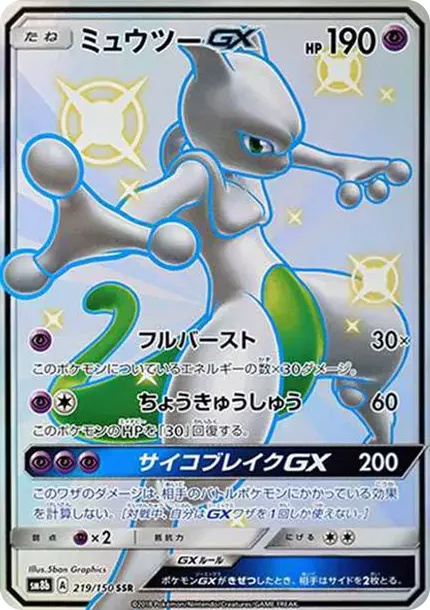
It is Mewtwo GX with card number 219/150 and the SSR rarity, printed in the Japanese High Class Pack “GX Ultra Shiny”. The shop lists it as “Mewtwo GX SSR [SM8b 219/150]”, and the box page names “SSR Shiny Mewtwo GX” among the key cards of the set.
The PSA 10 listing image for Mewtwo GX SSR 219/150 (SM8b).
Three details pin down the card so nothing gets mixed up. First, the name is Mewtwo GX, not Mewtwo ex or Mewtwo VSTAR; those are other card types with their own prints. Second, the number is 219/150, and the rarity mark is SSR. Third, the set is the Japanese edition: the box page labels the product “Japanese Original Edition, High Class Pack”.
The box page describes the product as “a world of brilliant Shiny Pokemon” and calls the SM8B-GX Ultra Shiny High Class booster box the crown jewel of the Sun & Moon era, famous for its Shiny GX cards. It lists Shiny Super Rares (SSR) among the rarity tiers of the set. Mewtwo GX is one of three SSR cards the page names as chase cards, next to Shiny Charizard GX and Shiny Rayquaza GX.
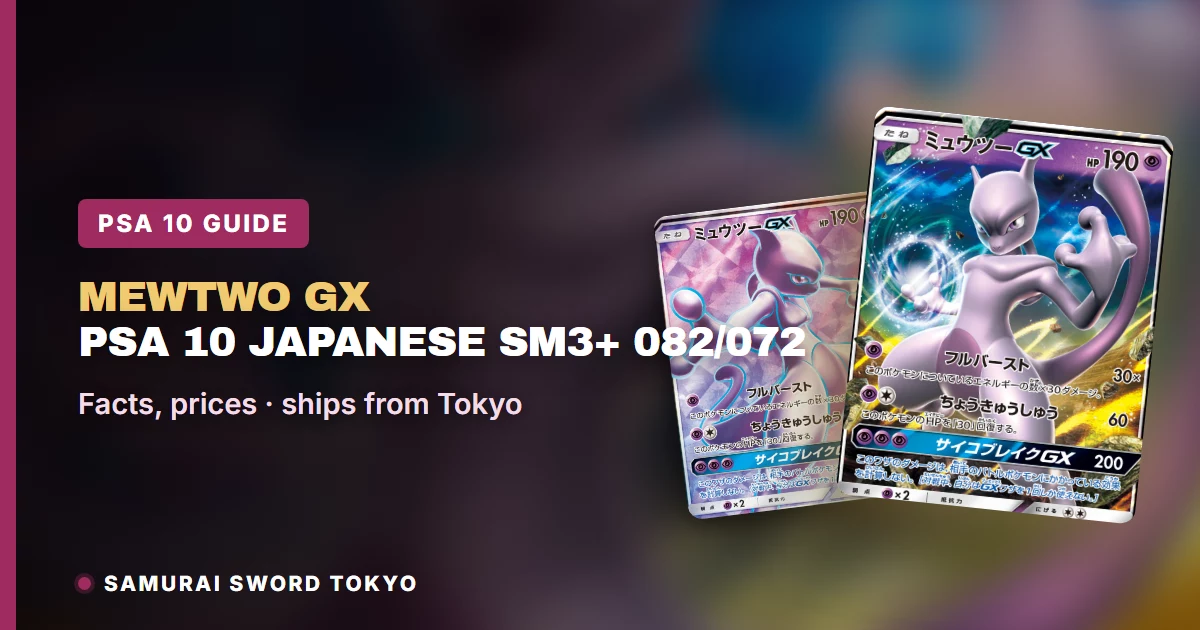
If you came here for a different shiny Mewtwo, check the number printed on the card. A card reading 219/150 with the SSR mark is this one. Cards with other numbers, such as 082/072 for the SM3+ Mewtwo GX, belong to different sets, and section 5 sorts them out. The English name Mewtwo is the official English name of the Pokémon, so searches in English and the Japanese listing name lead to the same character.
A practical way to confirm the card in hand or on a listing is to read three fields in order: the card type (GX), the number (219/150) and the set code (SM8b). The shop’s product titles follow the same pattern, “Mewtwo GX SSR [SM8b 219/150] (High Class Pack “GX Ultra Shiny”)”, so every field you need to match is already in the name.
What are the key facts of Mewtwo GX SSR in High Class Pack “GX Ultra Shiny”?
The facts that matter are the number (219/150), the rarity (SSR), the Japanese release date (November 2, 2018) and the way the set is packed: 10 packs per box, 10 cards per pack. These details come from the shop’s booster box page and the PSA 10 product page for this card.
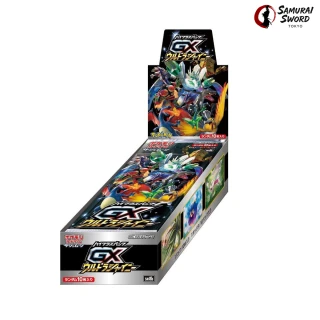
The SM8B-GX Ultra Shiny booster box, labelled Japanese Original Edition, High Class Pack.
Field
What the product pages state
Product type
Japanese Original Edition, High Class Pack
Packs per box
10 booster packs
Cards per pack
10 cards (100 cards per box)
Card types
150
Rarity of Mewtwo GX 219/150
SSR
Japanese release
November 2, 2018
Randomisation
Cards are packed at random at the factory; pulls are not guaranteed
The last row is the one to remember when you decide between a box and a single. A High Class Pack box is a randomized product. The booster box page states that the specific cards in each box are randomly packed at the factory and that individual card pulls are not guaranteed. The same page lists Mewtwo GX as a key card, which tells you what the set features, not what any one box will hold.
The box page also says the product is brand new and sealed, shipped from the warehouse in Tokyo by FedEx, with tracking and insurance on each shipment. The listed price of the box, currently listed at ¥164,836, divided by 10 packs gives about ¥16,484 per pack. That is simple arithmetic on the listed price, useful only for sizing the box against the single card in section 4. It says nothing about what a pack contains.
The shop writes the set as SM8B on the box page and as SM8b on the card listings. Both refer to the same Sun & Moon “GX Ultra Shiny” product family, so either spelling in a product title points to this set.
The PSA 10 page adds its own facts about the card. It gives the card as Mewtwo GX No. 219/150, set High Class Pack “GX Ultra Shiny”, rarity SSR, graded PSA 10 (Gem Mint). It describes PSA 10 as the highest grade certifiable by Professional Sports Authenticator, awarded to cards in flawless, gem mint condition, and it notes that the PSA case may have minor scratches or marks on its surface. Section 4 goes through what that means for a buyer.
Where does the shiny Mewtwo card sit among the SM8b chase cards?
It is one of five cards the booster box page names as key and chase cards: three SSR cards (Shiny Charizard GX, Shiny Rayquaza GX and Shiny Mewtwo GX), the SR Cynthia and the HR Eevee GX in gold.
Listed chase card
Rarity as listed
Related guide
Shiny Charizard GX
SSR
—
Shiny Rayquaza GX
SSR
—
Shiny Mewtwo GX (219/150)
SSR
This guide
Cynthia
SR
—
Eevee GX Gold
HR
—
The box page does not rank these cards against each other, and neither does this guide. What the list shows is that the set features shiny GX cards, with Mewtwo GX named beside two other shiny GX Pokémon at the same SSR rarity. Five cards are named; the page counts 150 card types in total.
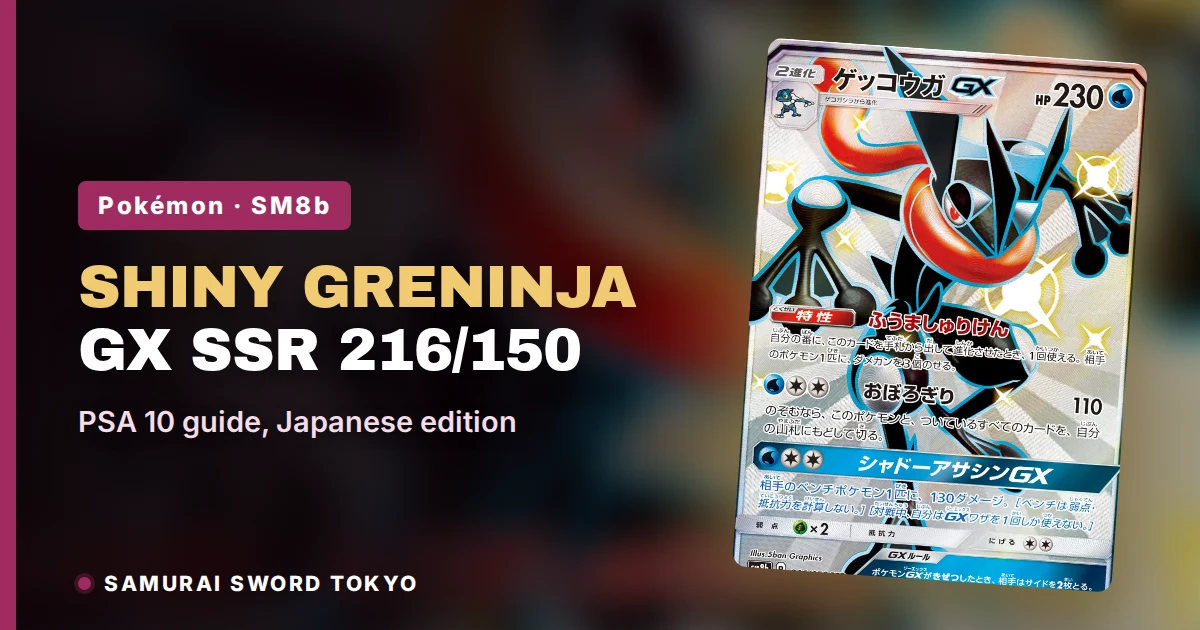
If you are collecting shiny cards from this set, the Shiny Greninja card guide follows the same format as this article: card number, set, PSA 10 listing and box facts.
Our guides to the shiny Umbreon card from SM8b and SV8a and the shiny Gardevoir card cover other shiny prints that include SM8b. The method is the same each time: find the number, find the set, then decide between a single and a box.
What does a PSA 10 copy of the shiny Mewtwo card mean?
A PSA 10 copy is the card in a PSA case with the grade Gem Mint, which the product page describes as the highest possible grade. The product page names the exact card, Mewtwo GX No. 219/150, so the number and the grade are stated on the listing.
Cards in flawless, gem mint condition, as graded by Professional Sports Authenticator
Which card?
Mewtwo GX No. 219/150, rarity SSR, High Class Pack “GX Ultra Shiny”
Anything to know about the case?
The page notes the PSA case may have minor scratches or marks on its surface
Listing type
Listed at ¥75,602 on November 12, 2026; the product page shows the current terms
The case note matters. The grade applies to the card inside the slab, and the product page says the plastic case can show minor scratches or marks. If you want a flawless case as well as a PSA 10 card, treat that as a separate preference: the listing text does not promise a particular case finish.
Compared with a box, a slab is a specific card at a stated grade. The box page lists Mewtwo GX as a chase card but guarantees no pulls. The listed price of ¥75,602 is for one specific card at a known grade, while the box is listed at ¥164,836 for 10 packs. The difference between the two listed prices is ¥89,234. If you want this exact card at a stated grade, the PSA 10 page is the direct route. If you want to open the set, the box is the route.
How does the shiny Mewtwo card compare with other Mewtwo prints?
The SM8b card is a Mewtwo GX in the SSR tier, while the other Japanese Mewtwo prints in our guides are different cards from different sets. The table sorts them by set and number.
The SM3+ Mewtwo GX (082/072) is the other Mewtwo GX print in our guides.
The closest comparison is the SM3+ Mewtwo GX. Both are Mewtwo GX cards, but they have different numbers, 082/072 against 219/150, and come from different products. The SM8b card carries the SSR mark of the “GX Ultra Shiny” set; the SM3+ card has its own set and number, covered in our Mewtwo GX PSA 10 guide.
Mewtwo VSTAR in Pokémon GO (S10b) is covered in our guide as 084/071 HR and 091/071 UR.
Our Japanese Mewtwo PSA 10 comparison places the SM8b card beside the other prints.
A quick rule when you search: match three things, the card type (GX, VSTAR, ex), the number and the set code. For this guide that is Mewtwo GX, 219/150, SM8b. A listing that matches the name but not the number is a different card.
How does the SM8b shiny Mewtwo differ from Shiny Star V shinies and the Mewtwo ex FUR?
The SM8b card is a Mewtwo GX SSR from a set released in Japan on November 2, 2018. Shiny Star V (S4a) is a separate Sword & Shield High Class Pack released in 2020, and the Mewtwo ex FUR is a card from a 2026 product with a different rarity.
The Shiny Star V (S4a) box; its Charizard VMAX SSR is numbered 308/190 on the official card database.
Shiny Star V is a second Japanese High Class Pack about shiny Pokémon, so it is a natural set to place beside SM8b. The official Shiny Star V page shows the “new illustration” and “shiny” icons, the “Amazing Rare” label and the deluxe mirror finish, and the official feature on color-variant Pokémon lists examples such as Ditto V and Ditto VMAX. The official Pokémon Card database shows Charizard VMAX at 308/190 with the SSR icon, HP 330, illustrated by aky CG Works. For the Charizard side of that set, read our Charizard VMAX gold card guide; for Shiny Suicune, see the Shiny Suicune 221/190 guide.
The Mewtwo ex FUR is a separate card. The 30th CELEBRATION page lists FUR as a new rarity, Futuristic Rare, with Mewtwo ex at image file number 134 and Mew ex at 135, both illustrated by YOSHIROTTEN. The product is a 6-card Kira pack at ¥360 with a Pikachu card and a basic energy designed by YOSHIROTTEN in each pack, released worldwide on September 16, 2026. The page also says the 30 special reprint cards numbered 136–165 cannot be used in the current standard regulation, and that a 30th CELEBRATION card set released on October 16, 2026. If you want the SSR Mewtwo GX, FUR is a different search.
Choose the single if you want Mewtwo GX 219/150 at a stated grade. Choose the box if you want to open 10 packs of the set, and accept that card pulls are not guaranteed. Prices were read on November 12, 2026 and are listed in yen.
Orders ship by tracked FedEx, with shipping cost calculated at checkout and customs handled by the carrier and destination authorities after handover; payment is in Japanese yen by Wise bank transfer, PayPal or cards through PayPal, with a 5% processing fee on PayPal and cards and none on Wise. Full terms are on the shipping policy and payment methods pages.
Frequently Asked Questions
What is the shiny Mewtwo card number?
The shiny Mewtwo card in Japanese SM8b is Mewtwo GX, number 219/150, rarity SSR. The set is the High Class Pack “GX Ultra Shiny”.
What does SSR mean on the shiny Mewtwo card?
SSR stands for Shiny Super Rare, one of the rarity tiers the booster box page lists for this set. Mewtwo GX, Charizard GX and Rayquaza GX are the three SSR chase cards it names.
When was the shiny Mewtwo card released?
The High Class Pack “GX Ultra Shiny” was released in Japan on November 2, 2018, according to the booster box page.
Is the Mewtwo ex FUR the same as the shiny Mewtwo card?
No. The Mewtwo ex in 30th CELEBRATION has the FUR (Futuristic Rare) rarity and comes from a product released on September 16, 2026, while the shiny Mewtwo card is Mewtwo GX SSR 219/150 from 2018.
Does a booster box guarantee the shiny Mewtwo card?
No. The box page states that cards are randomly packed and individual pulls are not guaranteed, even though Mewtwo GX is listed as a key card.
What does a PSA 10 shiny Mewtwo card include?
It is one card graded PSA 10 (Gem Mint) in a PSA case. The product page notes the case may have minor scratches or marks on its surface.
Is the shiny Mewtwo card part of the Shiny Star V set?
No. Mewtwo GX 219/150 belongs to SM8b, while Shiny Star V (S4a) is a separate set released in Japan on November 20, 2020.
How many cards are in a box that holds the shiny Mewtwo card?
A box of the SM8B-GX Ultra Shiny set holds 10 booster packs of 10 cards each, 100 cards in total, drawn from 150 card types.
Pikachu VSTAR Universe: Complete Guide to the S12a AR
Pikachu in VSTAR Universe is the Pikachu 205/172 card, an AR (Art Rare) from the Japanese Pokémon Card Game Sword & Shield High Class Pack “VSTAR Universe” (set code S12a, also typed s12a). It is a Basic Pokémon with 60 HP, illustrated by Kouki Saitou, and its Ability is Pika Dash.
Updated November 12, 2026
Key Takeaways
The card is Pikachu 205/172, AR rarity, from S12a High Class Pack “VSTAR Universe” (Japanese edition) (official card page).
Illustrator is Kouki Saitou; the card is a Basic Pokémon with HP 60 and the Ability Pika Dash.
The set released on December 2, 2022 at 550 yen per 10-card pack, and AR and SAR were newly introduced in it (official set page).
Mew AR 183/172 is another 60 HP AR in the set; its illustrator is Ryota Murayama.
10 cards per pack, randomly inserted; a V, VSTAR or VMAX card is confirmed in each pack
Pack price
550 yen, tax included
Illustrator
Kouki Saitou
Which Pikachu card is in VSTAR Universe (S12a)?
The Pikachu card this guide covers is number 205 of 172, printed with the AR rarity icon, from the Japanese High Class Pack “VSTAR Universe”. The official card page lists it as ピカチュウ (Pikachu), card number 205 / 172, set S12a, rarity icon AR. Our VSTAR Universe card list shows the whole set, so this article stays on one card.
AR stands for Art Rare. The official set page states that AR and SAR (Special Art Rare) were newly introduced in S12a, and the official card page lists Pikachu 205/172 with the AR rarity icon. The set page gallery shows 17 AR cards and 25 SAR cards.
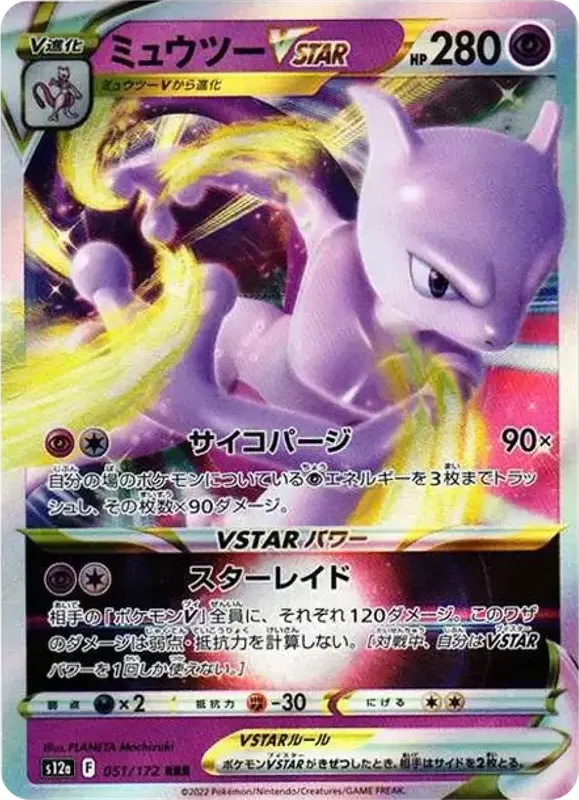
Other cards in the set sit in different rarity groups. Our S12a chase cards guide covers the Charizard, Mewtwo VSTAR and Rayquaza VMAX cards. Our PSA10 Mewtwo VSTAR RRR 051/172 was listed at ¥6,708 on November 12, 2026. Pikachu 205/172 is a different card with a different rarity icon, an AR instead of an RRR.
The English name of the card is Pikachu. The phrase “Pikachu VSTAR Universe” combines the Pokémon name with the set name: the set is the High Class Pack “VSTAR Universe”, and the card is Pikachu. The official card page does not mark Pikachu 205/172 as a VSTAR card. It shows a Basic Pokémon with 60 HP.
To keep the entity unambiguous, here are the exact names. The product is the Pokémon Card Game Sword & Shield High Class Pack “VSTAR Universe” (ハイクラスパック「VSTARユニバース」), set code S12a, Japanese edition. The card is Pikachu, 205 / 172, AR. Use all three of those identifiers (set code, number, rarity) when you search or read a listing.
What are the key facts of Pikachu 205/172 AR?
Pikachu 205/172 is an AR, Basic (the official page says たね) Pokémon with 60 HP, illustrated by Kouki Saitou, with the Pokédex entry No. 025 Mouse Pokémon, 0.4 m and 6.0 kg. All of this comes from the official card page for Pikachu 205/172.
Pikachu 205/172 AR at a glance
Field
Value
Source
Card number
205 / 172
Official card page
Set
S12a High Class Pack “VSTAR Universe”
Official card page
Rarity icon
AR (Art Rare)
Official card page; AR introduced with this set per the set page
Stage
Basic (たね)
Official card page
HP
60
Official card page
Pokédex entry
No. 025, Mouse Pokémon (ねずみポケモン), 0.4 m / 6.0 kg
Official card page
Ability
Pika Dash (ピカダッシュ)
Official card page
Attack
Capricious Tackle (きまぐれタックル), 50 damage: flip a coin; if tails, this attack does nothing
Official card page
Illustrator
Kouki Saitou
Official card page
The numbers around Pikachu help you place it. Mewtwo V is 050/172 (official card page), Mew AR is 183/172, Mewtwo VSTAR SAR is 221/172 (official card page), and Arceus VSTAR is 262/172 with the UR icon (official card page). Pikachu 205 is numbered after Mew’s 183 and before Mewtwo VSTAR’s 221.
Card numbers in this guide are written as the card’s own number over 172. Keldeo AR 179, Mew AR 183, Pikachu AR 205, Mewtwo VSTAR SAR 221 and Arceus VSTAR UR 262 have a first figure above 172, while Mewtwo V 050, Gengar 048 and Charizard V 013 have lower numbers.
When you read a listing for this card, check three things: the set code (S12a), the full number (205/172) and the rarity (AR). If a listing gives all three, you know it is the Pikachu from this High Class Pack. The card is from the Japanese edition, so it is a Japanese-language card, and the English wording used in this guide is a rendering of the official Japanese card entry.
The same identifiers apply to the cards sold in our shop for this set. Our product names carry the set code and the card number in square brackets, for example “s12a 051/172” for Mewtwo VSTAR, so you can match a product page to an official card page by number.
What does the Pikachu AR do in play, and who illustrated it?
Pikachu 205/172 has the Ability Pika Dash (rendering): if this Pokémon has Energy attached, all the Energy needed to retreat it is removed. Its attack is きまぐれタックル (Capricious Tackle, rendering) for 50 damage: flip a coin, and if tails, the attack does nothing. The illustrator is Kouki Saitou. All of this is on the official card page.
The card is a Basic Pokémon (たね) with 60 HP. Those two numbers and words are what the official page prints for the card’s type and size. The Pokédex line on the card reads No. 025, Mouse Pokémon, 0.4 m and 6.0 kg.
The illustrator credit is printed on the card page as Kouki Saitou. The official set page for VSTAR Universe also links an interview with 16 illustrators, which is the official place to read about the artists behind the set (official set page). That page does not say which of the 16 illustrators are interviewed, so this guide does not say whether Kouki Saitou is one of them.
For other cards in the set, the official pages credit other illustrators: Mew 183/172 is credited to Ryota Murayama, Mewtwo V 050/172 to Nurikabe, Mewtwo VSTAR SAR 221/172 to GOSSAN and Arceus VSTAR 262/172 to AKIRA EGAWA. That gives a small picture of how many different names appear across the set, using only the cards cited in this guide.
Because the card is Japanese, the text on it is in Japanese. The names used here, Pika Dash and the others marked “(rendering)”, are English renderings of the official Japanese entries so that readers outside Japan can follow the card. Match the card by set code, number and rarity rather than by the English wording of the Ability.
How does Pikachu compare with Mew AR 183/172 in this set?
Mew AR 183/172 shares Pikachu’s AR rarity icon and 60 HP, but it has a different illustrator, Ryota Murayama, and a different Ability. The Mew entry is on its official card page.
Pikachu 205/172 AR vs Mew 183/172 AR
Field
Pikachu 205/172
Mew 183/172
Rarity icon
AR
AR
HP
60
60
Illustrator
Kouki Saitou
Ryota Murayama
Ability
Pika Dash (rendering)
Mysterious Tail (rendering)
Card number
205 / 172
183 / 172
Read the table row by row. Rarity and HP match, so those two fields do not separate the cards. Illustrator, Ability and card number do. Mew’s entry lists an Ability, Mysterious Tail, and an attack, Psyshot, which does 30. Pikachu’s entry lists the Ability Pika Dash and the attack きまぐれタックル, which does 50.
Mew also appears in other forms in this set: the official set page names Mew VMAX and Mew V among its notable cards. Our Mew VSTAR Universe card guide covers the Mew cards in detail.
Keldeo AR 179/172, another AR from S12a, here as a PSA 10 slab.
Keldeo AR 179/172 is also an AR from the same set. Our PSA 10 Keldeo AR 179/172 was listed at ¥7,625 on November 12, 2026.
What is the VSTAR Universe High Class Pack that Pikachu comes from?
VSTAR Universe is a Japanese High Class Pack released on December 2, 2022, sold at 550 yen per pack with 10 randomly inserted cards, and each pack is confirmed to hold a V, VSTAR or VMAX card (official S12a page).
Where can I see the full VSTAR Universe card list?
The full list is on our VSTAR Universe Card List page, which covers 262 cards of the Japanese Pokémon TCG set. That page is the place for card-by-card browsing, so this article does not repeat the set table.
How do I buy Japanese VSTAR Universe cards from Tokyo?
Buy through the product pages linked below, starting with the S12a cards, and read the shipping and payment pages before you check out. The S12a cards here are PSA 10 graded. Each product page describes the card as graded PSA 10 (Gem Mint) and notes that the PSA case may have minor scratches or marks on its surface.
The shipping policy gives FedEx transit estimates of usually 3-7 business days (Connect Plus) or 2-5 business days (International Priority) after dispatch, with cost calculated at checkout, and says customs delays after handoff to FedEx are outside our control. Most orders are processed within 5 business days after payment clears. Payments are in Japanese yen, and the 5% processing fee applies to every method except Wise (payment methods).
Frequently Asked Questions
Is Pikachu a VSTAR card in VSTAR Universe?
No. The official entry for Pikachu 205/172 shows a Basic Pokémon with 60 HP and the AR rarity icon. “VSTAR” in the phrase comes from the set name.
What rarity is Pikachu 205/172 in S12a?
It carries the AR (Art Rare) rarity icon on the official card page. AR and SAR were newly introduced in this set.
Who is the illustrator of the Pikachu AR in VSTAR Universe?
Kouki Saitou is credited as the illustrator on the official card page for Pikachu 205/172.
What does the Pika Dash Ability do?
If the Pokémon has Energy attached, all Energy needed to retreat it is removed, according to the official card text rendered in English.
When was the VSTAR Universe High Class Pack released?
It was released in Japan on December 2, 2022 at 550 yen per pack of 10 cards.
How many cards are in the VSTAR Universe set?
Our card list page covers 262 cards, and the card numbered 262/172 on the official site is Arceus VSTAR.
Is Pikachu part of the VSTAR Universe Jumbo Card Collection?
The official announcement names three Jumbo Card Collection products, Lapras, Mew and Latias, released on December 16. Pikachu is not among them.
Yu Nagaba Espeon: Complete Guide to the SV-P 066 Promo
The Yu Nagaba Espeon is the Japanese promo card Espeon No. 066/SV-P, illustrated by YU NAGABA as part of the “YU NAGABA × Pokémon Card Game” collaboration. It is a Stage 1 Pokémon with HP 110 and the attack Psychic Beam.
The Yu Nagaba Espeon card is Espeon number 066/SV-P, a Japanese Pokémon Card Game promo whose illustrator is credited as YU NAGABA on the official card database page. The page footer links to the “YU NAGABA × Pokémon Card Game” collaboration, which ties the card to the artist’s name.
The number 066/SV-P and the rarity PROMO identify the card. It was handed out in the store and online campaign described in the next section. When you check a copy, look at three things: the name Espeon, the number 066/SV-P and the illustrator credit YU NAGABA. Those three details match the official database entry.
YU NAGABA drew all nine promo cards in this collaboration, and Espeon sits alongside its Eevee siblings in that run. If you want the wider story of the collaboration, our Yu Nagaba × Pokemon Cards collab guide covers it; this article stays on the Espeon card.
Espeon 066/SV-P in a PSA 10 slab, the format of the PSA 10 products discussed below.
For buyers, the card appears in two forms: the raw promo as it was handed out, and the PSA 10 graded copy. Section 7 covers the graded version, and the PSA 10 Espeon SV-P 066 product page is the one to open first if you want one.
How Did the Yu Nagaba × Pokémon Card Game Promo Campaign Work?
The promo campaign started on May 24, 2023 (a Wednesday) and gave one random promo card for every ¥1,000 (tax included) spent at Pokémon Center, Pokémon Store or Pokémon Center Online, according to the official announcement. The card you received was random, so getting the Espeon depended on the draw among the nine promo cards.
Rule
What the official page says
Start date
May 24, 2023 (Wednesday)
Trigger
One random promo card per ¥1,000 (tax included) purchase
Where
Pokémon Center, Pokémon Store, Pokémon Center Online
In-store limit
Max 10 cards per person
Online limit
Max 10 per checkout
Online start
May 24 at 10:00
Lottery winners
1 card per item, or 4 cards for the Special BOX
Exclusions
Pre-order and backorder items
End
Ends when quantities run out, though it may be extended
Two details stand out. First, the limits (10 per person in store, 10 per online checkout) capped how many cards one buyer could take in a single visit or checkout. Second, the lottery route: Pokémon Center Online held lottery sales for the collaboration items, and a winner received one promo card per item won, or four for the Special BOX.
The online distribution began at 10:00 on May 24, the same date the in-store campaign started. The announcement also states that pre-order and backorder items were excluded, so those purchases did not count toward a card. The campaign ends when quantities run out, though the announcement says it may be extended.
The announcement names three places for the campaign: Pokémon Center, Pokémon Store and Pokémon Center Online. It gives the in-store limit and the online limit as separate rules, so a buyer shopping in a store and a buyer checking out online each followed their own cap of 10 cards.
What Does the Yu Nagaba Espeon Card Look Like and What Are Its Stats?
The Yu Nagaba Espeon is a Stage 1 Pokémon card with HP 110 and one attack, Psychic Beam, which deals 80 damage and confuses the opponent’s Active Pokémon, per the official card page. The card text shows Espeon as Pokédex No. 196, the “Sun Pokémon” (たいようポケモン in Japanese), measuring 0.9 m and weighing 26.5 kg.
Stat
Value
Pokémon
Espeon
Pokédex number
196
Category
Sun Pokémon
Stage
Stage 1 Evolution
HP
110
Height / weight
0.9 m / 26.5 kg
Attack
Psychic Beam: 80 damage, confuses the opponent’s Active Pokémon
Weakness
×2
Resistance
−30
Illustrator
YU NAGABA
The illustration is credited to YU NAGABA, the artist named on all nine cards of the collaboration. The card lists a single attack, Psychic Beam, and its confusion effect applies to the opponent’s Active Pokémon. For comparison with the larger Espeon cards in section 6, this card’s HP is 110 and its attack deals 80 damage.
The official page also prints the weakness as ×2 and the resistance as −30. Those two lines, together with HP 110 and the 80-damage attack, are the full set of numbers on the card entry. The Pokédex entry (No. 196, Sun Pokémon, 0.9 m, 26.5 kg) is the flavor data shown on the card itself.
Which Eevee Evolution Promos Did Yu Nagaba Draw Alongside Espeon?
YU NAGABA drew nine promo cards in the collaboration: Eevee plus eight evolutions, with Espeon as the fifth in the official list. The official announcement names all nine, and the English names below follow the official Pokémon site.
#
Japanese name (official list)
English name
1
イーブイ
Eevee
2
シャワーズ
Vaporeon
3
サンダース
Jolteon
4
ブースター
Flareon
5
エーフィ
Espeon
6
ブラッキー
Umbreon
7
リーフィア
Leafeon
8
グレイシア
Glaceon
9
ニンフィア
Sylveon
If you are tracking Espeon together with its siblings, our Eevee cards guide looks at the Yu Nagaba promos next to other Eevee-family cards, and the PSA 10 Eeveelutions guide compares graded Japanese cards across the family.
Because the distribution was random, a collector who wants the full run needs all nine cards, and the Espeon is one slot in that checklist. The list above is the official order from the announcement, so Espeon is the fifth name, between Flareon and Umbreon.
Our collab guide covers all nine Yu Nagaba promos, not just Espeon.
What Else Came With the Yu Nagaba Eevees Collaboration?
The collaboration also included three items released on May 24, 2023, plus a separate BEAMS collaboration released May 20 (a Saturday), all listed on the official announcement. The promo card campaign started on the same May 24 date as the three items.
Product
Price (tax included)
Release
Details
Eevees Special BOX
¥4,800
May 24, 2023
Deck shield ×1 set (64 cards), deck case with 2 divider boards ×1, rubber playmat ×1, card box ×1
The official page states that the Special BOX cannot be used to play a game on its own, and the 64 cards in the contents list are a set of deck shields. The Collection File is a 9-pocket, 4-ring card file that holds 180 cards, and it comes with ten 9-pocket refills.
At the time of the announcement, Pokémon Center Online had already held lottery sales for the three items, and general sale dates were undecided. That is why the lottery rule in section 2 matters: a winner of the Special BOX received four promo cards, while a winner of the file or the frame received one.
How Does the Yu Nagaba Espeon Differ From Other Espeon Cards?
The Yu Nagaba Espeon differs from other Japanese Espeon cards in illustrator, rarity and source: it is a PROMO from a store campaign with HP 110, while the ex and EX cards below list HP between 170 and 270. The comparison uses the official card database pages.
The Yu Nagaba card is a Stage 1 with HP 110 and a single 80-damage attack. By contrast, the SV8a Espeon ex cards are Stage 1 with HP 270, and the SV8a SAR 211/187 lists the attack Psycho Out at 160 damage. The XY9-B Espeon EX 084/080 is a Basic with HP 170, and the 043/040 card lists Sunshine Beat 30× on HP 260.
Illustrators differ across these prints: YU NAGABA for the promo, sui for the SAR, 5ban Graphics for the SV8a RR and for the 014/040 and 298/742 cards, Ryo Ueda for the SR, Ayaka Yoshida for the 035/080 and 045/171 cards, and REND for 043/040. The SV8a SAR 211/187 comes from the High Class Pack “Terastal Festival ex”, while the Yu Nagaba card came from the store campaign.
Three of the other cards are tied to named products on the official pages: 014/040 links to the 30th CELEBRATION Premium Deck Set (Espeon and Umbreon), 298/742 links to Start Deck 100 Battle Collection, and 045/171 links to THE BEST OF XY. The Yu Nagaba promo’s official page links to the YU NAGABA × Pokémon Card Game collaboration instead.
The SV8a SAR and XY9-B EX prints are covered in a separate guide.Espeon ex 043/040 comes from a different source than the Yu Nagaba promo.Espeon GX HR 068/060 is another Espeon print covered in its own guide.Umbreon and Espeon cards from the 30th Anniversary are collected in one guide.Espeon & Deoxys GX SA is a tag-team print, covered in its own guide.
Is the Yu Nagaba Espeon Available as a PSA 10 Card?
Yes, the Yu Nagaba Espeon is offered on our site as a PSA 10 graded card, under the name “PSA10 Espeon: PROMO [SV-P 066]”. PSA 10 is the Gem Mint grade from Professional Sports Authenticator, awarded to cards in flawless, gem mint condition, according to our product descriptions.
The product descriptions add one note on the slab itself: the PSA case may have minor scratches or marks on its surface. Read that line before you order, because it describes the case and not the card inside it.
Both pages describe the same card: Espeon No. 066/SV-P from the SV-P Promotional cards “YU NAGABA × Pokémon Card Game”, rarity PROMO. For a wider view of graded Eevee-family cards, see our PSA 10 Eeveelutions guide.
Where Can You Buy the Yu Nagaba Espeon, and How Does Shipping Work?
Our shipping policy gives two FedEx options with tracking: International Connect Plus, with a usual transit estimate of 3-7 business days after dispatch, and International Priority, usually 2-5 business days. Shipping cost is calculated at checkout, most orders are processed within 5 business days after PayPal or Wise payment has cleared, and all of these times are estimates, not guarantees. For PSA graded cards, we secure the matching card once your payment has cleared, even if extra sourcing is needed.
All payments are made in Japanese yen. Per our payment methods page, Wise bank transfer carries no payment processing fee, while PayPal and card payments carry a 5% payment processing fee.
Frequently Asked Questions
What number is the Yu Nagaba Espeon card?
It is No. 066/SV-P, in the set “SV-P Promotional cards YU NAGABA × Pokémon Card Game”, with the rarity PROMO. The official card page lists the same number.
Who illustrated the Yu Nagaba Espeon?
YU NAGABA is credited as the illustrator on the official card database. YU NAGABA drew all nine promo cards in the collaboration.
How much HP does the Yu Nagaba Espeon have, and what does it do?
It has HP 110 and is a Stage 1 Evolution. Its attack, Psychic Beam, deals 80 damage and confuses the opponent’s Active Pokémon.
What are the weakness and resistance on the Yu Nagaba Espeon?
The official card page lists weakness ×2 and resistance −30. The card also shows Pokédex No. 196, the Sun Pokémon, at 0.9 m and 26.5 kg.
How did people get the Yu Nagaba Espeon in 2023?
From May 24, 2023, one random promo card was given per ¥1,000 (tax included) spent at Pokémon Center, Pokémon Store or Pokémon Center Online. Pre-order and backorder items were excluded from the campaign.
Which other Pokémon did YU NAGABA draw for the promo set?
Eevee, Vaporeon, Jolteon, Flareon, Umbreon, Leafeon, Glaceon and Sylveon, alongside Espeon. That makes nine cards in total.
Is the Yu Nagaba Espeon the same as the Espeon ex from Terastal Festival ex?
No. The Terastal Festival ex Espeon ex cards (211/187 SAR by sui and 063/187 RR by 5ban Graphics) are from the SV8a set with HP 270, while the Yu Nagaba card is a promo with HP 110.
Does a Yu Nagaba Espeon PSA 10 exist?
Yes. Our site has PSA 10 product pages for Espeon 066/SV-P, including a separate page for the same card.
How many promo cards did a Special BOX lottery winner receive?
A lottery winner received four promo cards for the Eevees Special BOX, and one card for each of the other items. The Special BOX cost ¥4,800 with tax included.
Chansey AR in Mask of Change (SV6): PSA 10 Card Guide
Chansey AR is the AR-rarity Chansey card numbered 113/101 in the Japanese Expansion Pack “Mask of Change” (SV6). This guide explains that one card: its number, rarity and grade, and how to tell it apart from the other Chansey we list.
Listed at ¥10,263 on November 12, 2026; the product page shows the current terms
What is the Chansey AR card in Mask of Change?
It is a Japanese-edition Pokémon Trading Card Game card of Chansey with the AR rarity code, from the Expansion Pack “Mask of Change”, set code SV6, card number 113/101. We list it in a PSA 10 (Gem Mint) slab. The Key facts table above puts the exact names in one place so the card can be matched to its listing.
Chansey AR, SV6 113/101, in a PSA 10 slab.
The English name matters because an English marketplace title and a Japanese card database entry can describe the same card with different words. The official name table pairs the Japanese name ラッキー with Chansey. When you compare listings, keep three items together: the name Chansey, the set code SV6, and the number 113/101. Those three points identify one card. A title that gives only “Chansey” and a grade leaves the set and number open, so read the rest of the title before you decide.
This is a Japanese-edition card from a Japanese set. The listing description names the set, the number and the AR rarity, and says the card is graded PSA 10 (Gem Mint). It also carries a note that the PSA case may have minor scratches or marks on its surface. That note is worth reading before you buy any slab.
The PSA 10 copy has its own product page: standard PSA 10 page for the Chansey AR. The identifying line to check is “SV6 113/101” and the Mask of Change set name in the product title.
The product description is laid out in a fixed order: the Pokémon name with its number, then the set, then the rarity, then the grade statement. For the Chansey AR the first line reads “Chansey No. 113/101 | Set: Expansion Pack “Mask of Change” | Rarity: AR”. Reading the description in that order gives you the same items the title gives, so the two work as a cross-check. If the title and the first line of the description agree, you are looking at the card this guide describes.
Where to look
What it tells you about Chansey AR
Product title
Grade, name, rarity, set code and number, then the full set name
First line of the description
Name with number, set name and rarity code
Grade statement
PSA 10 (Gem Mint), as graded by Professional Sports Authenticator
Case note
The PSA case may have minor scratches or marks on its surface
What are the set, number and rarity of Chansey AR SV6 113/101?
The set is Expansion Pack “Mask of Change” (SV6), the number is 113/101, and the rarity is AR. Each part of that string tells you something specific, and reading them in order is a quick way to check a listing.
Set: “Mask of Change” (SV6). SV6 is the set code in our product title, written as “SV6 113/101” with the set name in parentheses afterwards. Keep the code and the number together when you compare this card with any other listing.
Number: 113/101. We state the number exactly as it appears on the listing: 113 before the slash and 101 after it. We make no claim about the size of the set from those digits. For buyers the printed pair is what matters, because it is the string you match against a listing or a photo.
Rarity: AR. AR is the rarity code that appears on the listing (“Rarity: AR”). The official 151 page uses the same style of code, mentioning AR, SAR and SR rarities for that set. If you want the wider picture of how these codes sit across the Chansey family, our Chansey and Blissey full art card guide covers the AR, CSR and SR prints in one place.
A second photo of a Chansey AR PSA 10 slab, from the standard PSA 10 page.
Check
What to look for on Chansey AR
Set code
SV6
Set name
Expansion Pack “Mask of Change”
Number
113/101
Rarity code
AR
Name
Chansey
Grade
PSA 10, Gem Mint
Edition
Japanese edition
A short practical rule follows: if a title says Chansey but the number is not 113/101 or the set code is not SV6, it is a different card. The Chansey in the 151 set, for example, also has a number that begins with 113, but the figure after the slash is 165. Because the first figure matches, check the second figure and the set code, which is why the next two sections set the two cards side by side.
The title itself follows a pattern. Our Chansey AR title reads “PSA10 Chansey AR [SV6 113/101](Expansion Pack “Mask of Change”)”: grade first, then the name and rarity, then the set code and number in square brackets, then the full set name in parentheses. The 151 card follows the same pattern, “PSA10 Chansey R: Master Ball Mirror[SV2a 113/165](Enhanced Expansion Pack “Pokemon Card 151″)”. Once you know the pattern, each title can be read in a few seconds, and the two titles differ in every field except the Pokémon name and the grade.
Use the same habit when you read a photo. Check that the card in the photo carries the number written in the title. Two photos of a Chansey AR PSA 10 slab appear in this article, so you can compare the slab and the card against the title yourself, and the product page shows its own photo before you order.
Which other Chansey card from a Japanese set is worth knowing?
The Chansey R: Master Ball Mirror, number 113/165, from the Enhanced Expansion Pack “Pokemon Card 151” (SV2a), is the other Chansey we list as a PSA 10. Its number also starts with 113, so check the figure after the slash to tell it from the Mask of Change card.
On the official SV2a page, a booster pack was priced at 290 yen including tax and contains 7 cards inserted at random. The page lists Chansey among the 151 Pokémon of the set, and it mentions the AR, SAR and SR rarities as well as mirror-finish Monster Ball pattern cards. Our listing calls the card “R: Master Ball Mirror”, so that is the name to use when you look for it.
Chansey R: Master Ball Mirror, SV2a 113/165, in a PSA 10 slab.
2,200 yen each, two versions, with 5 booster packs, a card file and a catalog poster
Chansey
Listed among the 151 Pokémon of the set
The 151 set is a different product line from Mask of Change. It is an enhanced expansion pack, and a separate official announcement says it was to be sold through Pokémon Center Online as made-to-order. That detail is about the sealed set, not the single card. For the set background, see our SV2A guide to Japanese Pokémon Card 151.
Our SV2A guide covers the set that holds the 113/165 Chansey.
For a Chansey collector, the 151 card is a Chansey with a different finish. The mirror-finish Monster Ball pattern is described on the official set page as a feature of that set, and our listing names the card with that pattern. The Mask of Change card is an AR, which is a different rarity code and a different set, so the two cards are separate entries in a collection.
The official page also describes two Card File Sets for 151, each priced at 2,200 yen, with promo Bulbasaur, Charmander and Squirtle, a card file, 5 booster packs and a catalog poster. Those are sealed products and do not contain a slabbed Chansey, but they show how that set was sold in more than one format. A collector who wants a specific Chansey from it, rather than random cards from 7-card packs, is the buyer a graded single suits.
How does Chansey AR compare with Chansey R Master Ball Mirror?
They are two different cards from two different Japanese sets, and the clearest differences are set, rarity and number.
Point
Chansey AR
Chansey R: Master Ball Mirror
Set
Expansion Pack “Mask of Change”
Enhanced Expansion Pack “Pokemon Card 151”
Set code
SV6
SV2a
Number
113/101
113/165
Rarity
AR
R, Master Ball Mirror pattern
Grade
PSA 10
PSA 10
Listing
Listed at ¥10,263 on November 12, 2026; the product page shows the current terms
Listed at ¥11,491 on November 12, 2026; the product page shows the current terms
The price gap (¥11,491 minus ¥10,263 is ¥1,228) is a simple subtraction of our two listing prices read on November 12, 2026. It is not a statement about how the cards trade elsewhere, and it does not say which card is worth more over time. The product page shows the current terms and price, so read it before you order.
Which should you choose? Pick the Chansey AR from SV6 if the AR card from Mask of Change is what you are after. Pick the Master Ball Mirror if you collect the 151 set or want the mirror-pattern Chansey. They are not substitutes for one another, because the set and the finish differ. If you collect Chansey as a Pokémon across sets, buying both is the straightforward route, and the Chansey and Blissey guide shows the other prints you may want to add.
Here is how different collectors can decide:
You collect by set. Choose the card that belongs to your set: SV6 for Mask of Change, SV2a for 151.
You collect by Pokémon. Both cards belong in a Chansey binder or display; the numbers 113/101 and 113/165 are different entries.
You collect by rarity code. The AR is the pick for an AR run; the Master Ball Mirror belongs with mirror-pattern cards from the 151 set.
You collect for display. Both arrive in a PSA 10 slab, so the format is the same. Look at the slab photos and the listing note about case marks.
The comparison also shows what the two cards share. Both carry the name Chansey, both are Japanese-edition cards, both are graded PSA 10, and both listings use the same case-mark note. The grade does not separate them, so the choice comes down to set, rarity and finish.
What does a PSA 10 grade mean for a Chansey AR?
A PSA 10 means Professional Sports Authenticator graded the card Gem Mint, which our listing describes as the highest possible grade. The grade applies to the card inside the case, and it is the same label for both Chansey cards we list.
The product description puts it this way: PSA 10 is awarded only to cards in flawless, gem mint condition. That is the wording from the product page, and it is the right way to read the label: a statement about the condition of the card when PSA graded it. It is not a statement about price, and it does not say how many copies exist at that grade.
What a PSA 10 buyer gets in practice:
A slab. The card stays in the PSA case, so you do not handle the card itself.
A fixed grade. The grade is printed on the label. Two PSA 10 copies of the same card carry the same grade label.
A case that can show marks. Our listings note that the PSA case may have minor scratches or marks on its surface. Judge the card by the grade and the photos, and expect that the plastic may not be pristine.
A PSA 10 single is a known card, so you see its name and number before you buy. The 151 page shows the other route: a booster pack there contains 7 randomly inserted cards, so a collector who wants one specific Chansey from that set faces a random draw when opening packs. A graded single removes that randomness. For another example of how we describe PSA 10 cards, our Nihil Zero (M3) buying guide covers PSA 10 cards and shipping for a different set.
Our Nihil Zero guide explains PSA 10 cards and shipping from Japan.
Question
What the PSA 10 label answers
Which card is it?
Not answered by the grade; read the set code and number in the title
What condition is the card?
Gem Mint, per the listing description
Is the plastic case perfect?
Not promised; the listing notes minor scratches or marks may appear
How many copies exist at this grade?
Not stated by the listing
How to read a Chansey PSA 10 listing in four steps
Match the set code and number: SV6 and 113/101 for the AR, SV2a and 113/165 for the Master Ball Mirror.
Confirm the rarity in the title: AR for the Mask of Change card, R with the Master Ball Mirror pattern for the 151 card.
Confirm the grade: PSA 10 (Gem Mint).
Read the product page for the current terms and price.
A PSA label tells you nothing about the finish or the set, which is why the first two steps come before the grade: a PSA 10 of the wrong Chansey is still the wrong card.
A PSA 10 slab also changes how you compare Chansey cards. With a raw card you would weigh centering, surface and edges yourself. With a slab the grader has already assigned the grade, and the remaining question is which print you want. That is why this guide spends its time on set code, number and rarity, and not on condition grading. The condition detail we can add from our own listing is the case note: minor scratches or marks may appear on the PSA case surface.
Where can you read more about Chansey and Blissey prints?
Our Chansey and Blissey full art card guide is the place to read about the wider family of Japanese AR, CSR and SR prints. This article is the fact sheet for the SV6 AR and its namesake from the 151 set.
The Chansey and Blissey guide covers the family beyond SV6.
Our Inferno X guide shows how a Japanese pre-order works, step by step.
Reading order matters. Start with the family guide if you do not yet know which Chansey prints interest you. Come back to this page when you have chosen the SV6 AR and want to check its number, set code and listing terms. Use the SV2A guide when the 151 Chansey is the card you want and you need the set around it.
A note on names while you read across guides: Chansey is the English name used throughout, and the Japanese name appears once in the Key facts table. Blissey, the evolved form that shares the family guide, is a separate Pokémon with its own cards. This article stays with Chansey, and the numbers it discusses are 113/101 and 113/165.
Shipping, customs and payment in short, from our own pages: standard shipping is FedEx International Connect Plus with tracking, estimated at usually 3-7 business days after dispatch, and expedited shipping is FedEx International Priority, usually 2-5 business days. These are estimates, and shipping cost is calculated at checkout from your delivery address. Most orders are processed and shipped within 5 business days after PayPal or Wise payment has cleared. All payments are made in Japanese yen, and Wise bank transfer carries no payment processing fee. Read the full shipping policy and the payment methods page before you order, because after handoff to FedEx, customs inspections and import procedures at the destination are controlled by the carrier and local authorities.
Frequently Asked Questions
What is Chansey AR SV6 113/101?
It is the AR-rarity Chansey card, number 113/101, from the Japanese Expansion Pack “Mask of Change” (SV6). We list it graded PSA 10 (Gem Mint).
Is the Chansey AR from Mask of Change a Japanese card?
Yes. It comes from the Japanese edition of Expansion Pack “Mask of Change”, set code SV6.
Is the Chansey AR the same card as the Chansey in Pokémon Card 151?
No. The 151 Chansey is R: Master Ball Mirror, number 113/165, from set SV2a. The Mask of Change card is AR, number 113/101, from SV6.
Does a PSA 10 grade mean the case has no marks?
No. PSA 10 describes the card’s Gem Mint condition. Our listings note that the PSA case may have minor scratches or marks on its surface.
How can you tell the two Chansey cards apart quickly?
Check the set code and the figure after the slash. The Mask of Change card is SV6 113/101, and the Pokémon Card 151 card is SV2a 113/165.
Which Chansey card has the Master Ball Mirror pattern?
The Chansey R: Master Ball Mirror, number 113/165, from SV2a (Pokémon Card 151). The official 151 page mentions mirror-finish Monster Ball pattern cards for that set.
What does the number 113/101 tell me about the card?
It is the printed number pair on the Chansey AR, and it is the string to match against a listing. We make no claim about the size of the SV6 set from it.
Ivysaur 151: Complete Guide to the SV2a Cards
Ivysaur 151 is shorthand for the Ivysaur cards in the Japanese Pokémon Card 151 set (SV2a): the regular 002/165 card and the 167/165 Art Rare. Both are HP 100 cards that evolve from Bulbasaur, and they are drawn by two different illustrators, Yuu Nishida and Yoriyuki Ikegami.
Ivysaur AR 167/165 in a PSA 10 case, Japanese edition.
What is Ivysaur 151 in the Japanese Pokémon Card 151 set?
Ivysaur 151 is the Stage 1 Ivysaur from Pokémon Card 151, the Japanese enhanced expansion pack with set code SV2a. The regular card is numbered 002/165, and the official database lists it at No. 002.
The official Japanese card database lists Ivysaur at No. 002 for both of its cards in this set, which carry the set code SV2a. The 002/165 page is here, and the 167/165 page is here. Both give Ivysaur a height of 1.0 m and a weight of 13.0 kg.
The phrase “ivysaur 151” covers two different collecting targets. One is the regular card at 002/165, which sits in the main numbering of the set. The other is the Art Rare at 167/165, which sits above the 165 count of the main numbers. Our product pages list the second as “Ivysaur AR”, and the shop’s PSA 10 data labels it Illustration Rare.
The number after the slash is the figure to read first. On both SV2a cards it is 165. A card numbered 002 sits inside that count, and a card numbered 167 sits above it. The same pattern shows up in another Ivysaur print: Mega Brave has a 002/063 card and a 065/063 card, so a card numbered above the printed count is not unique to SV2a.
SV2a Pokémon Card 151 contains two Ivysaur cards: the regular 002/165 and the Art Rare 167/165. The table sets them side by side, using the official card pages and our product listings.
Number
Version
Illustrator
HP
Attacks
002/165
Regular card (our listing names a Master Ball Mirror version of it)
Yuu Nishida
100
Leech Seed 30, Vine Whip 80
167/165
Art Rare (Illustration Rare)
Yoriyuki Ikegami
100
Leech Seed 30, Vine Whip 80
The attack names Leech Seed and Vine Whip come from our product page for the 167/165 card. The official database writes the two attacks in Japanese and gives the same damage values on both numbers: 30 for the first attack and 80 for the second.
The two cards share a stat line, so the difference between them is the artwork and the number. Yuu Nishida is credited on the 002/165 official page, and Yoriyuki Ikegami is credited on the 167/165 page. If you collect by artist, those two names are the reason to want both.
To tell the two apart in a binder or a graded case, read the number (002 or 167), the illustrator credit and the rarity text. Our listing for the 002/165 card includes the words “Master Ball Mirror” in its name. The official card page for 002/165 does not use that wording, so treat it as the name of our listing rather than as an official rarity label.
The choice comes down to what you are collecting. If you want the Art Rare, pick 167/165. If you are completing the numbered run of the set, 002/165 is the card that fills the Ivysaur slot in order. If you collect by artist, you need both, because each number credits a different illustrator.
Ivysaur 002/165 in its Master Ball Mirror version, graded PSA 10.
What are the HP and attacks of the 002/165 Ivysaur?
The 002/165 Ivysaur has 100 HP and two attacks: Leech Seed for 30 damage and Vine Whip for 80 damage. The Leech Seed attack heals 20 HP, according to the official page.
Here is how the card reads on the official database page:
Card number: 002/165, set code SV2a, Pokédex No. 002.
HP: 100.
Leech Seed: 30 damage, and it heals 20 HP.
Vine Whip: 80 damage.
Size: 1.0 m tall and 13.0 kg.
Evolution: evolves from Bulbasaur into Venusaur and Venusaur ex.
Illustrator: Yuu Nishida.
The two attacks are far apart in damage. Vine Whip does 50 more damage than Leech Seed, and Leech Seed gives back 20 HP of the 100 HP the card carries. Put plainly, the first attack is the lighter one with a healing effect, and the second is the heavy hit.
The same HP and attack lines also appear on Ivysaur 002/049 in a Special Deck Set ex that features Venusaur, Charizard and Blastoise (official page), with Yuu Nishida as illustrator again. That card is a different print with a different number, so it is not part of SV2a.
The Japanese attack names on the official pages are やどりぎのタネ for the 30-damage attack and つるのムチ for the 80-damage attack. Our product page for the 167/165 card renders them in English as Leech Seed and Vine Whip, and this guide uses those English names throughout.
How does the Ivysaur 167/165 Art Rare differ from the regular card?
The 167/165 Art Rare differs from the regular 002/165 card in its number, rarity and artwork, while the HP and attacks stay the same. It is drawn by Yoriyuki Ikegami, and it sits outside the 165 main numbers.
The official page lists 167/165 with HP 100, Leech Seed (30, heals 20 damage), Vine Whip (80), a weakness of ×2, and a 1.0 m, 13.0 kg Ivysaur. See the official 167/165 page.
Our product listing for this card adds the rest of the card face:
The Pokédex line printed on the card reads, in our listing, “Exposure to sunlight adds to its strength. Sunlight also makes the bud on its back grow larger.”
Reading the energy costs together with the attacks: Leech Seed needs Grass and Colorless energy for 30 damage and a 20 HP heal, and Vine Whip needs Grass, Grass and Colorless energy for 80 damage. The card also has a retreat cost of 3.
For collectors the practical difference is the number and the artwork. If you want a binder page for the Pokémon Card 151 Bulbasaur line, the regular 002/165 fits the main set order. If you want the Art Rare, 167/165 is the one. Our longer print-by-print write-up is in the Ivysaur Japanese Pokemon Cards guide to the 151 Art Rare print.
Cover of our Ivysaur guide to the 151 Art Rare print.
How does Ivysaur 151 compare with Ivysaur prints from other Japanese sets?
Ivysaur 151 keeps the Leech Seed and Vine Whip attack pair that also appears on the Special Deck Set ex card, while the Mega Brave, Pokémon GO, GX Ultra Shiny and Shining Legends prints use different attacks. The table lists the Ivysaur prints in the official database that we use for comparison.
A 30-damage leaf attack and a 50-damage whip attack that poisons and confuses
Kouki Saitou
Three points stand out from the table. First, the SV2a numbers and the Special Deck Set ex card share one attack line, and Yuu Nishida drew both the SV2a 002/165 and the 002/049 deck card. Second, the Mega Brave prints raise HP to 110 and carry a single attack. Third, Kouki Saitou illustrated both the GX Ultra Shiny and the Shining Legends cards, which carry the set codes SM8b and SM3p.
Taken one print at a time, the differences are concrete. The Mega Brave cards have 10 more HP than the SV2a cards and one attack at 60 damage, where SV2a has two attacks at 30 and 80. The Pokémon GO card keeps 100 HP but swaps the SV2a pair for a different first attack and a 60-damage leaf attack. The GX Ultra Shiny and Shining Legends cards also keep 100 HP, with a 30-damage and a 50-damage attack, and the Shining Legends version adds poison and confusion to the second one.
Card counts differ too. SV2a prints Ivysaur against a count of 165, the Special Deck Set ex card against 049, Mega Brave against 063, Pokémon GO against 071, GX Ultra Shiny against 150 and Shining Legends against 072. A number like 002 therefore means nothing on its own: always read it with the set count or the set code.
If you want…
Look at
Why (from the table)
An Ivysaur with its own illustrator credit inside the 151 set
167/165
Yoriyuki Ikegami is credited on the official page
The Ivysaur that fills the main numbering of the 151 set
002/165
Number 002 sits inside the 165 count
The same attack pair outside SV2a
002/049
Special Deck Set ex card with Leech Seed 30 and Vine Whip 80
More HP than 100
002/063 or 065/063
Mega Brave cards have HP 110
Artwork by one illustrator across two sets
002/150 or 002/072
Both credit Kouki Saitou
If you want a card with the same attack set as SV2a, the Special Deck Set ex print is the match in this table. If you collect by artwork, the table doubles as an artist checklist: Yuu Nishida, Yoriyuki Ikegami, Takumi Wada, mashu, zig and Kouki Saitou.
Where does Ivysaur fit in the Bulbasaur evolution line?
Ivysaur is the middle stage: it evolves from Bulbasaur and evolves into Venusaur or Venusaur ex. The official pages for SV2a, Mega Brave and the Special Deck Set ex state this line.
The two SV2a pages name Bulbasaur as the previous stage and Venusaur and Venusaur ex as the next ones. The Mega Brave pages and the Special Deck Set ex page also name Mega Venusaur ex among the evolutions, which the SV2a pages do not.
Position
Pokémon (English name)
Where it shows in this guide
Previous stage
Bulbasaur
Named as “Evolves from” on 002/165 and 167/165
This guide
Ivysaur
Stage 1, Pokédex No. 002
Next stage
Venusaur, Venusaur ex
Named as “Evolves into” on both SV2a cards
Also named on other pages
Mega Venusaur ex
Named on the Mega Brave and Special Deck Set ex Ivysaur pages
Because the evolution line is printed on the card pages, a collector can check a card’s family from the Ivysaur page alone. For a Bulbasaur-line binder from Pokémon Card 151, the Ivysaur slot has two choices, 002/165 and 167/165, with Bulbasaur before it and Venusaur after it.
The Special Deck Set ex that carries Ivysaur 002/049 features Venusaur, Charizard and Blastoise. It is a pointer if you are collecting the Venusaur, Charizard and Blastoise lines from one product.
Where can you buy Ivysaur 151 PSA 10 cards from Japan?
Both SV2a Ivysaur numbers have PSA 10 product pages on our shop.
Prices were read on November 12, 2026 and can change. Each product page shows its current terms. Our listing notes that the PSA case may have minor scratches or marks on its surface.
On logistics, our shipping policy says standard shipping is FedEx International Connect Plus and expedited shipping is FedEx International Priority, both with a tracking number and a cost calculated at checkout. Most orders are processed within 5 business days after PayPal or Wise payment has cleared, and transit times are estimates only. Payments are in yen through Wise, PayPal or cards via PayPal, as set out on the payment methods page.
Ivysaur 151 is the search phrase for the Ivysaur cards in Pokémon Card 151 (SV2a), a Japanese enhanced expansion pack. The two cards are 002/165 and the Art Rare 167/165.
Who illustrated the Ivysaur 151 cards?
Yuu Nishida illustrated the regular 002/165 card, and Yoriyuki Ikegami illustrated the Art Rare 167/165, according to the official Japanese card pages.
What attacks does Ivysaur have in SV2a?
Both SV2a Ivysaur cards have Leech Seed for 30 damage, which heals 20 HP, and Vine Whip for 80 damage. Both have 100 HP.
Is the Ivysaur 167/165 card an Art Rare?
Yes, 167/165 is the Art Rare, shown as Illustration Rare in our product data and listed as “AR” in the product name. Its number sits above the 165 main numbers of the set.
Which Pokémon does Ivysaur evolve from and into?
Ivysaur evolves from Bulbasaur. On the SV2a cards it evolves into Venusaur and Venusaur ex, and the Mega Brave and Special Deck Set ex pages also list Mega Venusaur ex.
Are there Ivysaur cards in sets other than SV2a?
Yes. The official database also lists Ivysaur in Mega Brave, Pokémon GO, GX Ultra Shiny, Shining Legends and a Special Deck Set ex, as compared in the table above.
What is Ivysaur’s Pokédex number on these cards?
Ivysaur is Pokédex No. 002 on the official SV2a and Mega Brave pages, and the regular SV2a card is numbered 002/165.
How tall and heavy is Ivysaur on the SV2a cards?
Both SV2a official pages give Ivysaur a height of 1.0 m and a weight of 13.0 kg.
Which Ivysaur 151 card should I choose, 002/165 or 167/165?
Choose 167/165 if you want the Art Rare, and choose 002/165 if you are filling the main numbered run of the set. The HP and attacks are the same on both, and each credits a different illustrator.
OP14-112 Boa Hancock: Effect, Versions and Deck Fit
OP14-112 is the Super Rare Boa Hancock Character card in OP-14 (OP14), the Japanese booster set The Azure Sea’s Seven. It costs 9, has 10000 power, is Yellow, and its On Play effect moves cards between both players’ Life areas. It also exists as a parallel art version and an SP version.
Key Takeaways
OP14-112 is a Super Rare (SR) Boa Hancock Character with Cost 9 and 10000 power, per the official card list.
The official list shows three entries under this number: the regular SR, a parallel art SR and an SP CARD version.
Its On Play effect starts with a check for a Leader with the {The Seven Warlords of the Sea} type; the OP14-041 Boa Hancock Leader has that type.
OP-14 released in Japan on November 22, 2025, with 6 cards per pack and 128 + 1 card types (official OP-14 page).
Updated November 12, 2026
What is OP14-112 Boa Hancock in The Azure Sea’s Seven?
OP14-112 is the Boa Hancock Character card numbered 112 in BOOSTER PACK -The Azure Sea’s Seven- [OP-14], printed as a Super Rare with the Special attribute and the types The Seven Warlords of the Sea and Kuja Pirates. This guide covers that one card: its text, its versions and the Leader it connects to. For every card in the set, use our OP-14 The Azure Sea’s Seven Complete Card List.
The card belongs to a set built around the Seven Warlords of the Sea. Our box listing names Dracule Mihawk, Boa Hancock, Crocodile, Bartholomew Kuma and Jinbe as key cards, and Boa Hancock is the character this card shows. The official pages list OP14-112 in the Boa Hancock (Blue/Yellow) combo section and in the section on character cards with notable effects. The official Japanese page lists it among the related cards for the Boa Hancock Leader (OP14-041) deck.
Three pieces of printed data identify the card without ambiguity. The number is OP14-112. The name is Boa Hancock. The card type is Character, not Leader. Anyone searching by name alone will meet two different Boa Hancock cards in this set, the Leader OP14-041 and this Character, so the card number is the reliable way to ask for the right one. Both appear in the official card list for the series, and both have a parallel art version of the same number.
The printed identity of the card, in the order the official list gives it, is as follows: Character, Cost 9, Power 10000, no Counter value, Color Yellow, Attribute Special, Type The Seven Warlords of the Sea/Kuja Pirates. Those type words matter more than the others, because the effect text refers to one of them directly, and the Leader that this card connects to carries both.
What does the OP14-112 Boa Hancock effect do?
The OP14-112 Boa Hancock effect adds a card from your deck to your Life, then takes one card from the top of your opponent’s Life into their hand, and the On Play text opens with a check for a Leader with the {The Seven Warlords of the Sea} type. The text below is paraphrased from the official English card list.
Part of the card
What it says (paraphrased)
[On Play]
If your Leader has the {The Seven Warlords of the Sea} type, add up to 1 card from the top of your deck to the top of your Life cards. Then add up to 1 card from the top of your opponent’s Life cards to the owner’s hand.
[Trigger]
Play up to 1 Character card with 6000 power or less and a [Trigger] from your hand.
Read the On Play effect in the order the card prints it. The text begins with the condition: your Leader has the {The Seven Warlords of the Sea} type. Next comes your own Life: up to 1 card from the top of your deck goes to the top of your Life cards. Then comes your opponent’s Life: up to 1 card from the top of their Life cards goes to the owner’s hand, which means it returns to their hand rather than being trashed.
The words “up to 1” appear in both steps, so each step is written as a maximum of one card. The words “top of your deck” and “top of your Life cards” fix where the card comes from and where it goes. The card says “owner’s hand” for the opponent’s Life card, so the card ends up with the player who owned it.
The Trigger is a separate line on the card, marked with its own [Trigger] label. It reads: play up to 1 Character card with 6000 power or less and a [Trigger] from your hand. It names three limits on what can be played: it must be a Character card, it must have 6000 power or less, and it must itself have a [Trigger]. The card’s own Trigger text carries no Leader-type condition in the official wording.
Printed stat
OP14-112
Card type
Character
Cost
9
Power
10000
Counter
No Counter value printed
Color
Yellow
Attribute
Special
Types
The Seven Warlords of the Sea / Kuja Pirates
The cost of 9 and the power of 10000 are the two numbers to remember. Cost 9 is the number printed in the card’s cost field, and power 10000 is exactly twice the 5000 power printed on the OP14-041 Leader. The official card list gives these figures and nothing beyond them, so the stats above are the full printed profile of the card.
Which versions of OP14-112 exist: SR, parallel and SP?
Three versions of OP14-112 appear in the official card list: the regular Super Rare, a parallel art Super Rare, and a parallel art SP CARD. All three carry identical stats and effect text.
Our guide to the OP-14 parallel and SP cards, which covers the alternate art prints of this set.
Version
Rarity shown
Card type
Stats and effect
Regular print
SR
Character
Cost 9, Power 10000, Yellow
Parallel art version
SR
Character
Same as the regular print
Parallel art version
SP CARD
Character
Same as the regular print
The official list labels two of the three entries “parallel art version of this card number”. The regular print has no such label. The third entry, the SP CARD, is also marked as a parallel art version, and its rarity field reads SP CARD instead of SR. So the difference between the versions is the artwork and the rarity label, not the game text. Every printed line of effect is the same across the three entries.
The official OP-14 page lists Special Cards as a rarity group of 6 cards, but that page does not say which cards fill it, and it gives no rarity for OP14-112. The rarity shown above comes from the card list itself. Treat the card list entry as the source for which version carries which label.
The Leader that fits OP14-112 on the printed data is OP14-041 Boa Hancock, because it has the {The Seven Warlords of the Sea} type the On Play effect checks for, and both official OP-14 pages list OP14-112 alongside the Boa Hancock Leader. Start with that Leader if you want the On Play condition to be met.
Here is why the pairing fits, using only the printed card data:
Type match. OP14-041 carries The Seven Warlords of the Sea and Kuja Pirates types, so the On Play condition on OP14-112 is met.
Color match. OP14-041 is Blue/Yellow and OP14-112 is Yellow, so the Character’s color is one of the Leader’s colors.
Effect link. OP14-041 refers to {Amazon Lily} or {Kuja Pirates} type Characters with 5000 base power or more being K.O.’d. OP14-112 is a Kuja Pirates Character with 10000 power, so it falls in that group.
The OP14-041 effect, paraphrased from the official list, has two parts. On your opponent’s turn, when you play a Character, you draw 1 card. With DON!! x1, once per turn, when one of your {Amazon Lily} or {Kuja Pirates} type Characters with 5000 base power or more is K.O.’d, you add up to 1 card from the top of your opponent’s Life cards to the owner’s hand. The Leader has Life 4, power 5000 and no Counter value.
The official Japanese page lists OP14-112 among the related cards for the Boa Hancock Leader (OP14-041) deck. The English official page places it in the Boa Hancock (Blue/Yellow) combo section. Both pages tie the card to the Boa Hancock Leader deck.
Check
OP14-041 Leader
OP14-112 Character
Result
Seven Warlords type
Yes
Yes
On Play condition is met
Kuja Pirates type
Yes
Yes
Character is a Kuja Pirates type for the Leader’s effect
Power of 5000 or more
Leader power 5000
Character power 10000
Character is above the 5000 base power line in the Leader text
Color
Blue/Yellow
Yellow
Yellow is shared
A Leader that does not carry the {The Seven Warlords of the Sea} type does not meet the condition written at the start of the On Play effect. The type is the condition the card names, so check your Leader’s type line before adding the card.
How does OP14-112 differ from the OP14-041 Boa Hancock Leader?
OP14-112 is a Cost 9 Character you play from your hand, while OP14-041 is the Life 4, 5000 power Leader that sits in your Leader area. They share a name and the Seven Warlords and Kuja Pirates types, and Yellow appears on both, but they are different card types with different text.
Feature
OP14-041 (Leader)
OP14-112 (Character)
Card type
Leader
Character
Rarity shown
L
SR (also SP CARD parallel)
Color
Blue/Yellow
Yellow
Life / Cost
Life 4
Cost 9
Power
5000
10000
Types
The Seven Warlords of the Sea / Kuja Pirates
The Seven Warlords of the Sea / Kuja Pirates
Effect text
On the opponent’s turn, draw 1 when you play a Character; with DON!! x1, once per turn, add an opponent’s Life card to their hand when a qualifying Character is K.O.’d
On Play: add a card from your deck to your Life, then add an opponent’s Life card to their hand
Both cards touch the opponent’s Life, in different places on the card. The Leader’s text is tied to the opponent’s turn and to a K.O. of a qualifying Character. OP14-112’s text is tied to the card being played, under the [On Play] label.
The Leader also has a parallel art version of the same number, as the official list shows. Boa Hancock therefore appears twice in the set as a card number worth tracking: OP14-041 as the Leader and OP14-112 as the Character. They are separate card numbers in the official card list, each with its own entries.
Where does OP14-112 fit in the OP-14 set and its rarity slots?
OP14-112 is printed as a Super Rare in OP-14, a set of 128 + 1 card types that released in Japan on November 22, 2025. The official OP-14 page gives the rarity breakdown, in which the Super Rare group has 10 cards.
Rarity group
Cards in OP-14
Special Cards
6
Leader Cards
7
Secret Rare
2
Super Rare
10
Rare
26
Uncommon
30
Common
45
Special 3rd Anniversary Cards
2
DON!! Card
1
Those groups add up to 129, which matches the “128 + 1” the page gives. OP14-112 belongs to the Super Rare line of that table. Official notes say multiples of one card may appear and a full set may be hard to assemble, and that card illustrations may differ from the final product. The Japanese page adds that cards are randomly inserted and that specifications may change.
Our OP-14 card list article covers the cards, rarities and parallels of the set.
There is also a pack with the same name on the English official site, BOOSTER PACK -THE AZURE SEA’S SEVEN- [OP14-EB04], which that site lists with a release date of January 16, 2026, an MSRP of USD $4.99 per pack, and 163 card types plus 2 listed separately. That page lists OP14-112 Boa Hancock as a combo card in the Boa Hancock deck section and in the features section on character cards. This article is about the Japanese edition, so card counts and release dates elsewhere here refer to OP-14.
More OP-14 guides
Our OP-14 chase card article covers the headline hits of the set.
Where can you buy OP-14 products to chase OP14-112?
You can open OP-14 booster boxes from our shop, which ships sealed Japanese products from Tokyo. The OP-14 The Azure Sea’s Seven Booster Japanese One Piece Booster Box is currently listed, and the OP-14 Damaged Box version is currently listed at ¥9,660. The Damaged Box has cosmetic damage to the outer box, the cards inside are described as unaffected, and it is sold as-is with no returns or refunds.
The OP-14 booster box: 24 packs, 6 cards per pack, 144 cards in total.
A box is a randomized product. The box listing states that the cards in each box are randomly packed at the factory and that individual card pulls are not guaranteed, so a box is a chance at OP14-112, not a purchase of it.
Our shipping policy states that orders go out by FedEx International Connect Plus (usually 3-7 business days after dispatch) or FedEx International Priority (usually 2-5 business days), both with tracking, and that these are estimates, not guaranteed dates. Shipping cost is calculated at checkout, most orders are processed within 5 business days after payment clears, and customs processing in the destination country is outside our control. Payments are made in Japanese yen through Wise, PayPal or cards via PayPal, as set out on the payment methods page.
Frequently Asked Questions
What rarity is OP14-112 Boa Hancock?
OP14-112 is a Super Rare (SR) in the official card list. A parallel art SR and a parallel art SP CARD version of the same number are also listed.
What does OP14-112 Boa Hancock cost to play and how much power does it have?
It costs 9 and has 10000 power, with no Counter value. It is a Yellow Character with the Special attribute.
Which Leader type does the OP14-112 On Play effect check for?
The On Play effect begins with the condition that your Leader has the {The Seven Warlords of the Sea} type. The OP14-041 Boa Hancock Leader has that type.
Is OP14-112 the same card as the Boa Hancock Leader?
No. The Leader is OP14-041, a Blue/Yellow Leader with Life 4 and 5000 power; OP14-112 is a separate Yellow Character with Cost 9 and 10000 power.
Do the SR, parallel and SP versions of OP14-112 have different effects?
No. The official list shows the same stats and the same effect text on all three entries. Only the artwork and the rarity label (SR or SP CARD) differ.
When was the set with OP14-112 released?
The Japanese OP-14 booster pack released on November 22, 2025. The English-language pack named OP14-EB04 is listed on the official English site with a release date of January 16, 2026.
Does opening a booster box guarantee OP14-112?
No. Boxes are randomized, and our box listing says individual card pulls are not guaranteed.